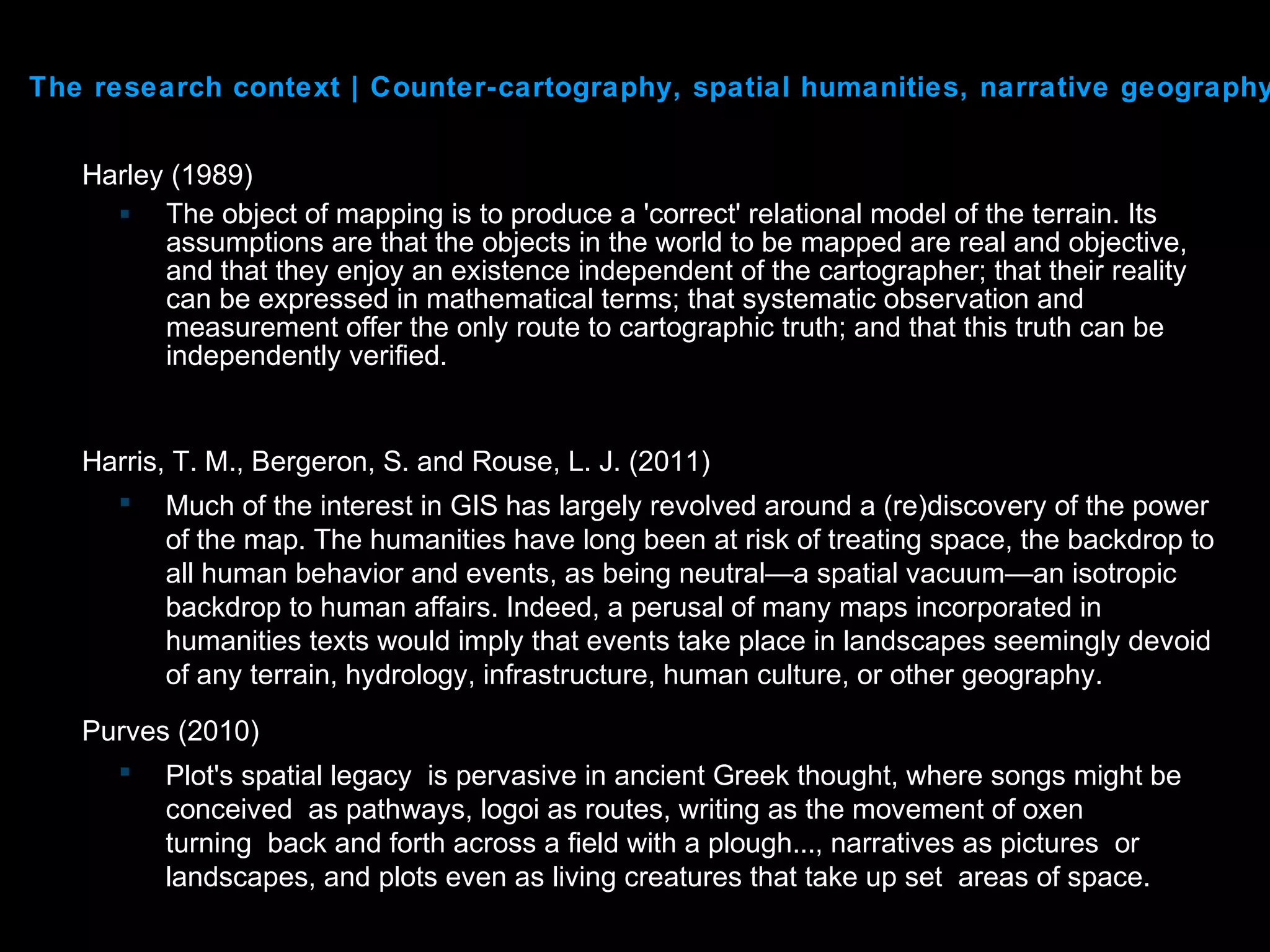
Towards a new geography of the
ancient world: Counter-cartography,
network graphs and bottomless
maps
 
Elton Barker (The Open University)
http://hestia.open.ac.uk/
http://pelagiosproject.blogspot.co.uk
@Hestiaproject, @Pelagiosproject
21 October 2015 | Classics Research Seminar, University of Reading
How is space mapped discursively in Herodotus’s Histories?
 Hestia (2008-2010, 2013-2014), funded by the AHRC
 Stefan Bouzarovski, Dept. of Geography, University of Birmingham
 Chris Pelling, Christ Church, Oxford
 Leif Isaksen, Dept. of Archaeology, University of Southampton
Presentation summary | The projects
How can we link together the data about the ancient world?
 Pelagios (2011, 2011-2012, 2013-2015), funded by JISC, Mellon, AHRC
 Leif Isaksen, Dept. of Archaeology, University of Southampton
 Rainer Simon, Austrian Institute of Technology
 Pau de Soto, University of Southampton
The ancient world in GIS | AMWC: mapping antiquity topographically
Harley (1989)
 The object of mapping is to produce a 'correct' relational model of the terrain. Its
assumptions are that the objects in the world to be mapped are real and objective,
and that they enjoy an existence independent of the cartographer; that their reality
can be expressed in mathematical terms; that systematic observation and
measurement offer the only route to cartographic truth; and that this truth can be
independently verified.
The research context | Counter-cartography, spatial humanities, narrative geography
Harris, T. M., Bergeron, S. and Rouse, L. J. (2011)
 Much of the interest in GIS has largely revolved around a (re)discovery of the power
of the map. The humanities have long been at risk of treating space, the backdrop to
all human behavior and events, as being neutral—a spatial vacuum—an isotropic
backdrop to human affairs. Indeed, a perusal of many maps incorporated in
humanities texts would imply that events take place in landscapes seemingly devoid
of any terrain, hydrology, infrastructure, human culture, or other geography.
Purves (2010)
 Plot's spatial legacy is pervasive in ancient Greek thought, where songs might be
conceived as pathways, logoi as routes, writing as the movement of oxen
turning back and forth across a field with a plough..., narratives as pictures or
landscapes, and plots even as living creatures that take up set areas of space.
But after this (the Persians say), the Greeks were very much to blame; for they invaded
Asia before the Persians attacked Europe… “We of Asia did not deign to notice the
seizure of our women; but the Greeks, for the sake of a Lacedaemonian woman,
recruited a great armada, came to Asia, and destroyed the power of Priam. Ever since
then we have regarded Greeks as our enemies.” For the Persians claim Asia for their
own, and the foreign peoples that inhabit it; Europe and the Greek people they consider
to be separate from them. Herodotus, Histories 1.4
I laugh to see how many have before now drawn maps of the world, not one of them
reasonably; for they draw the world as round as if fashioned by compasses, encircled
by the Ocean river, and Asia and Europe of a like extent. For myself, I will in a few
words indicate the extent of the two, and how each should be drawn.
Herodotus, Histories 4.36.2
It was in the reign of Cleomenes that Aristagoras the tyrant of Miletus came to Sparta.
When he had an audience with the king, as the Lacedaemonians report, he brought
with him a bronze tablet on which the map of all the earth was engraved, and all the
sea and all the rivers (ἔχων χάλκεον πίνακα ἐν τῷ γῆς ἁπάσης περίοδος ἐνετέτμητο καὶ
θάλασσά τε πᾶσα καὶ ποταμοὶ πάντες)
Herodotus, Histories 5.49.1
Why is Herodotus ‘good to think with’? | Three passages
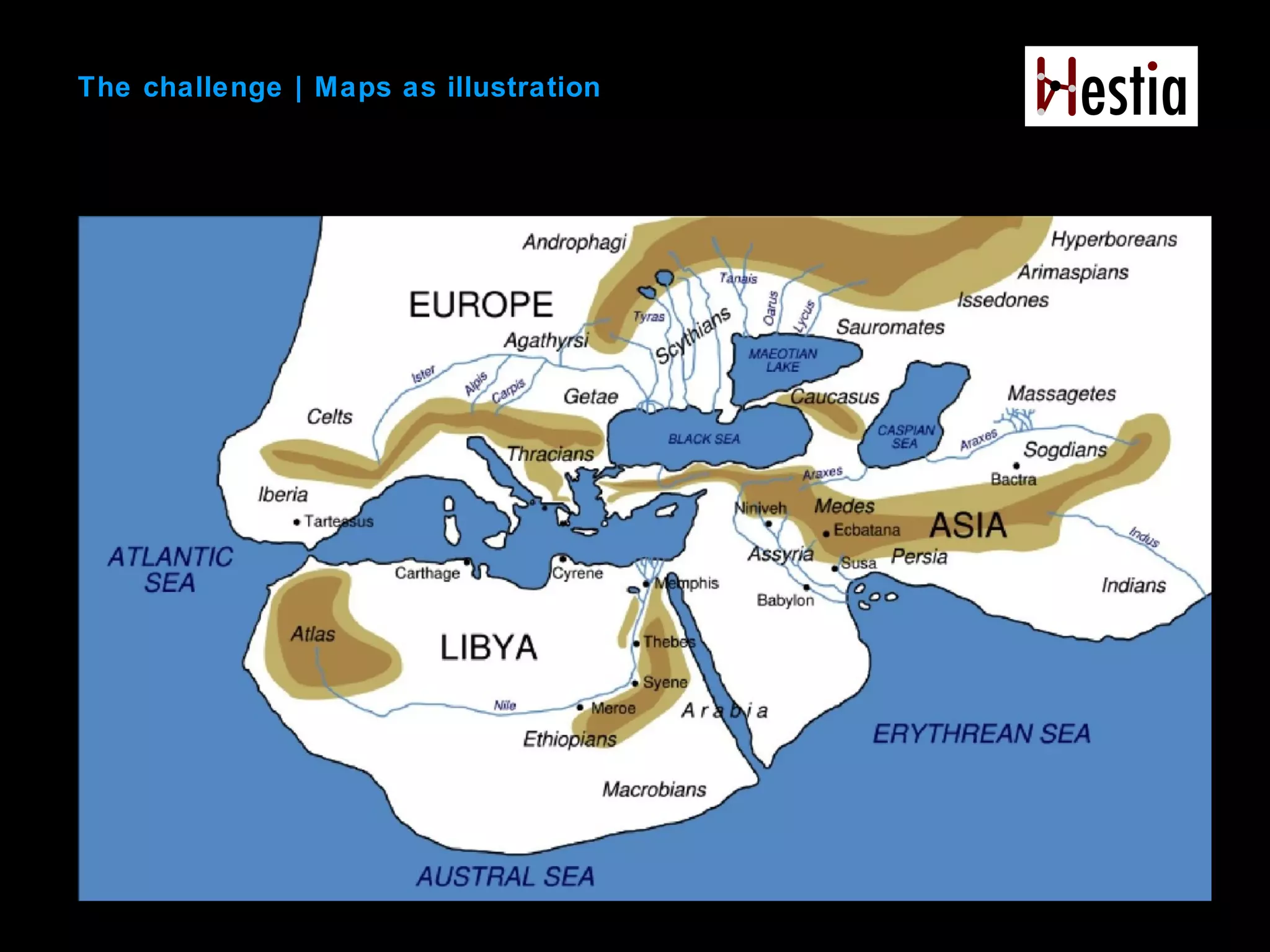
The challenge | Maps as illustration
The Source Text | Reusing digital data
Places in GIS | Reproducing a Cartesian world view
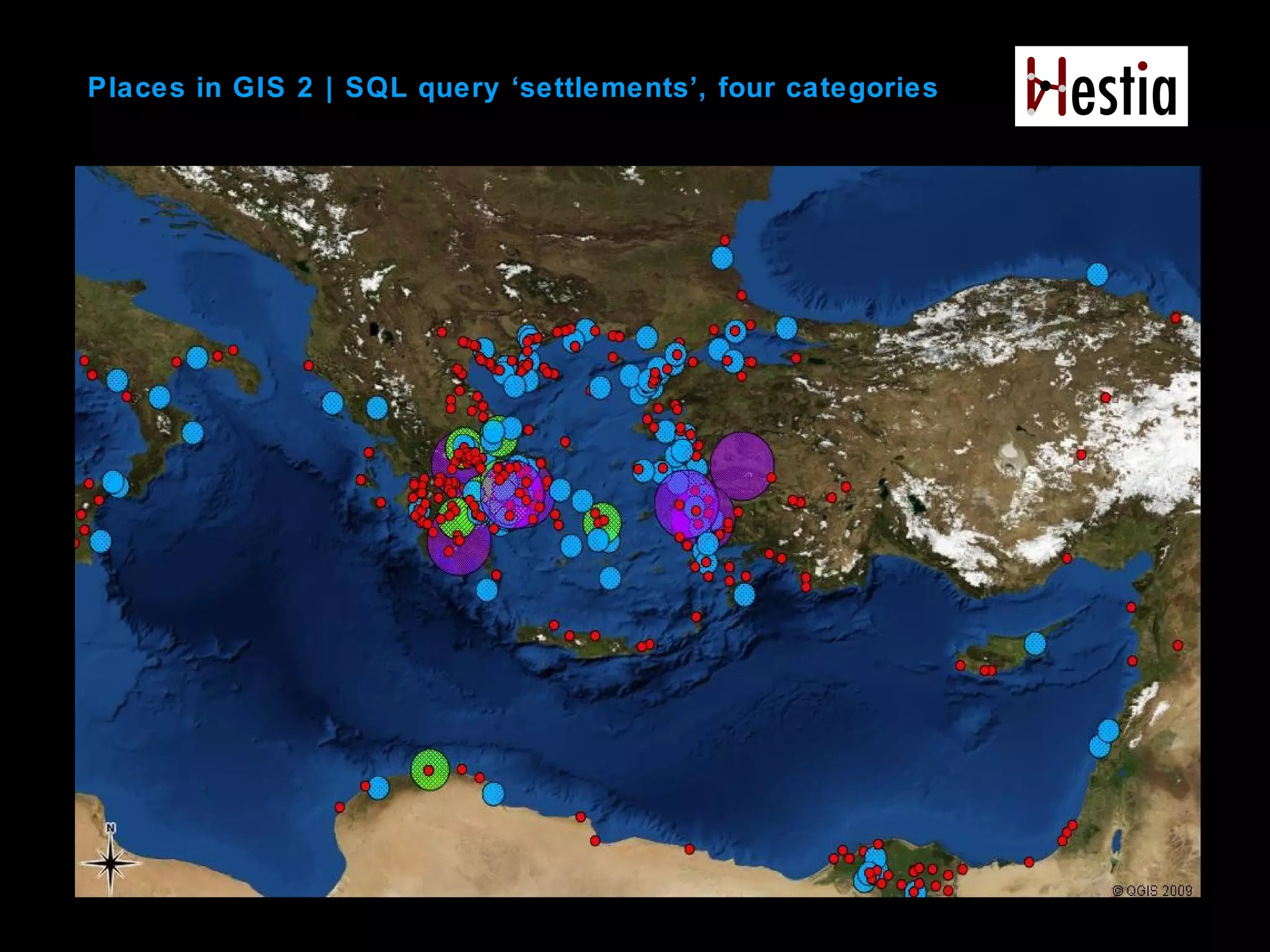
Places in GIS 2 | SQL query ‘settlements’, four categories
Web technologies | (still) Reproducing a Cartesian world
view
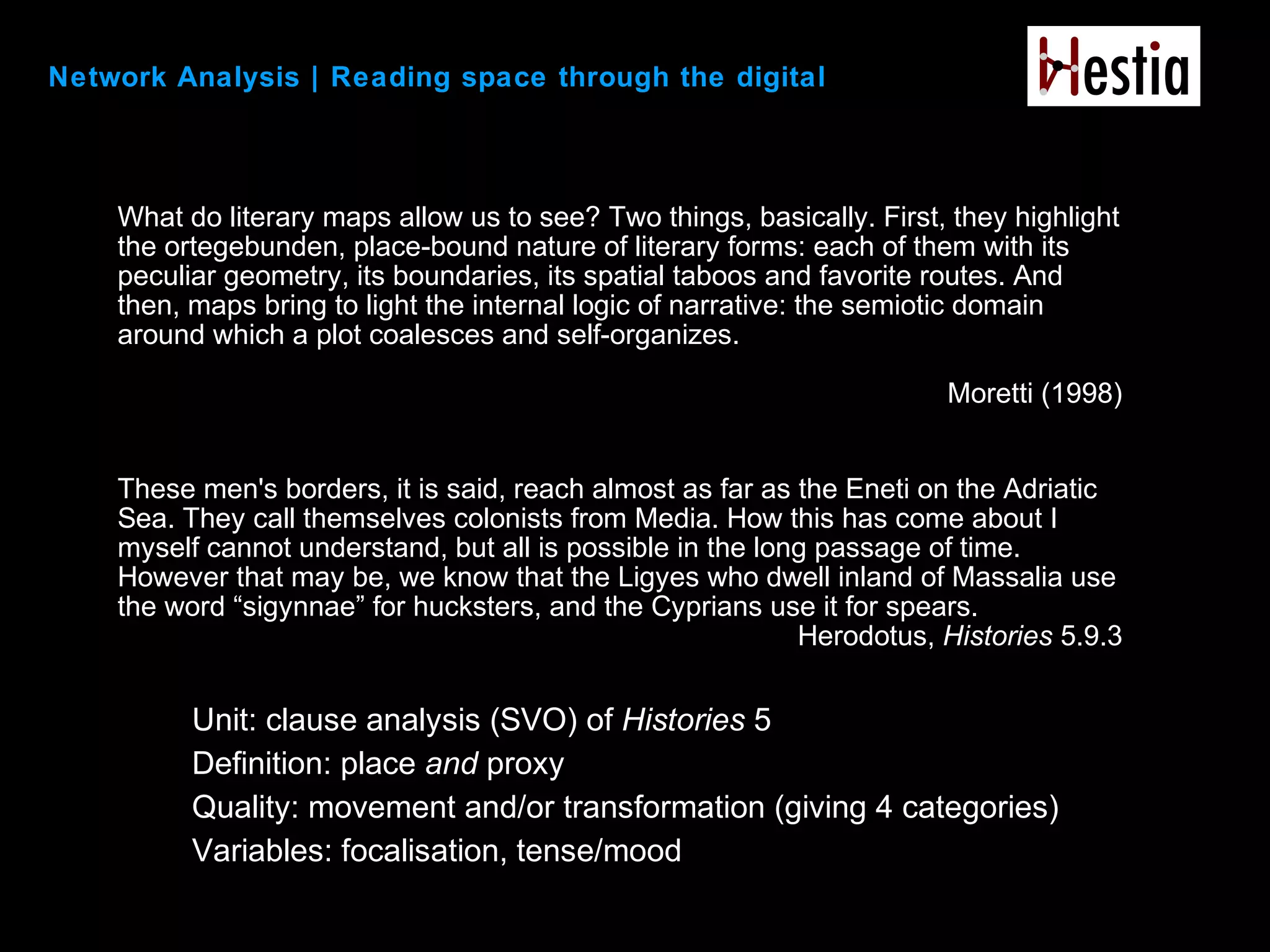
Network Analysis | Reading space through the digital
Unit: clause analysis (SVO) of Histories 5
Definition: place and proxy
Quality: movement and/or transformation (giving 4 categories)
Variables: focalisation, tense/mood
What do literary maps allow us to see? Two things, basically. First, they highlight
the ortegebunden, place-bound nature of literary forms: each of them with its
peculiar geometry, its boundaries, its spatial taboos and favorite routes. And
then, maps bring to light the internal logic of narrative: the semiotic domain
around which a plot coalesces and self-organizes.
Moretti (1998)
These men's borders, it is said, reach almost as far as the Eneti on the Adriatic
Sea. They call themselves colonists from Media. How this has come about I
myself cannot understand, but all is possible in the long passage of time.
However that may be, we know that the Ligyes who dwell inland of Massalia use
the word “sigynnae” for hucksters, and the Cyprians use it for spears.
Herodotus, Histories 5.9.3
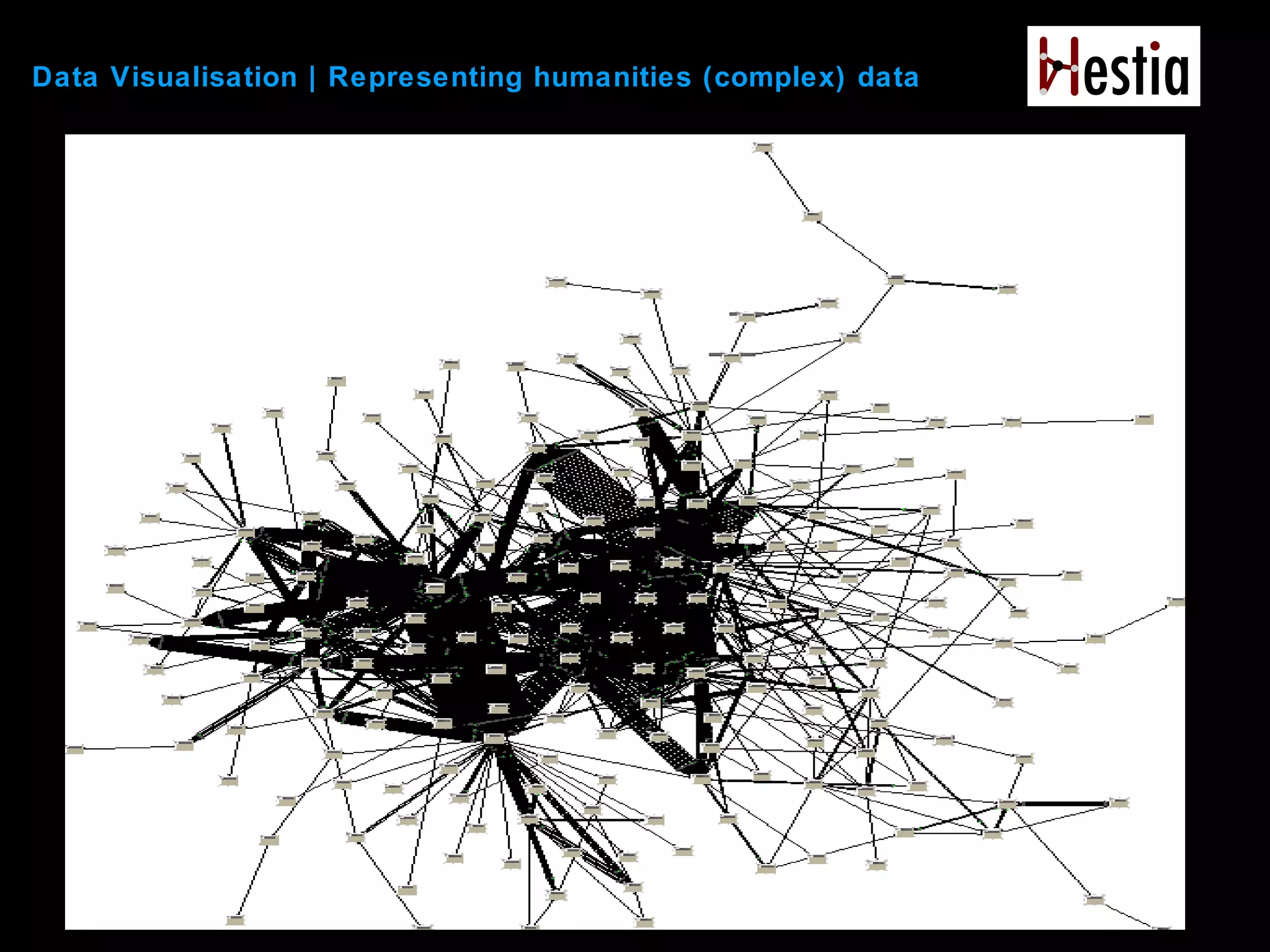
Data Visualisation | Representing humanities (complex) data
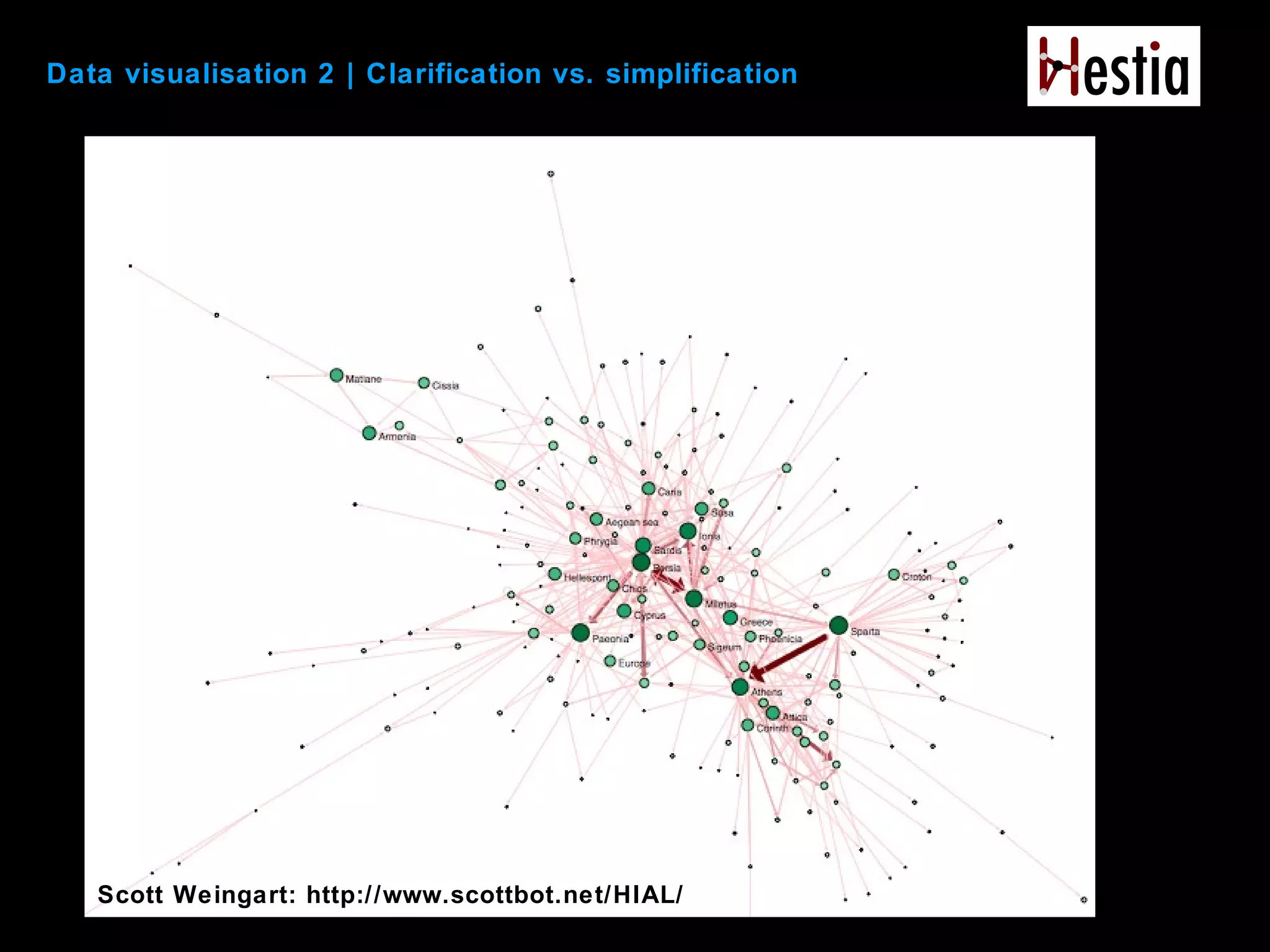
Data visualisation 2 | Clarification vs. simplification
Scott Weingart: http://www.scottbot.net/HIAL/
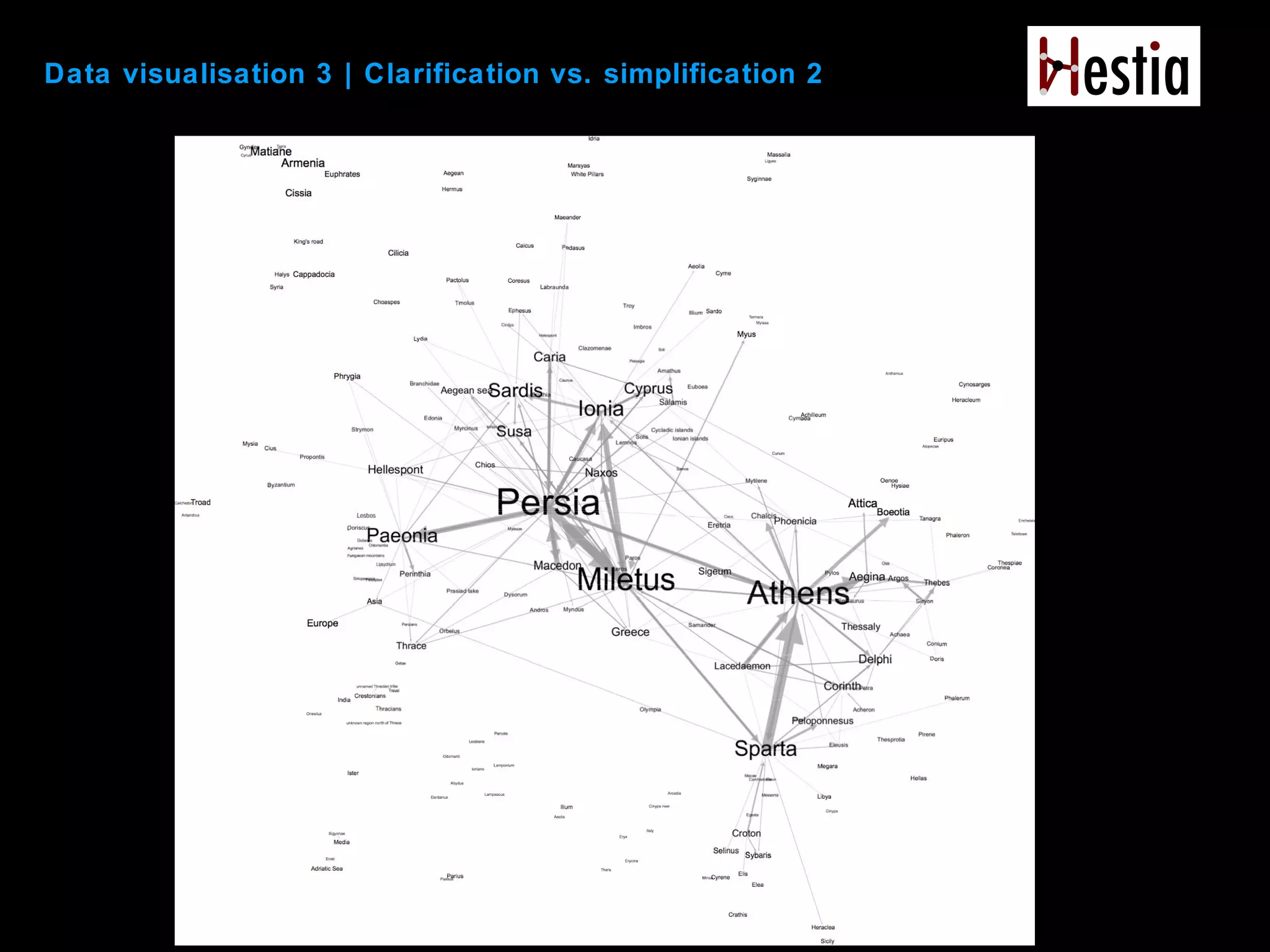
Data visualisation 3 | Clarification vs. simplification 2
Data visualisation | Clarification vs. simplification
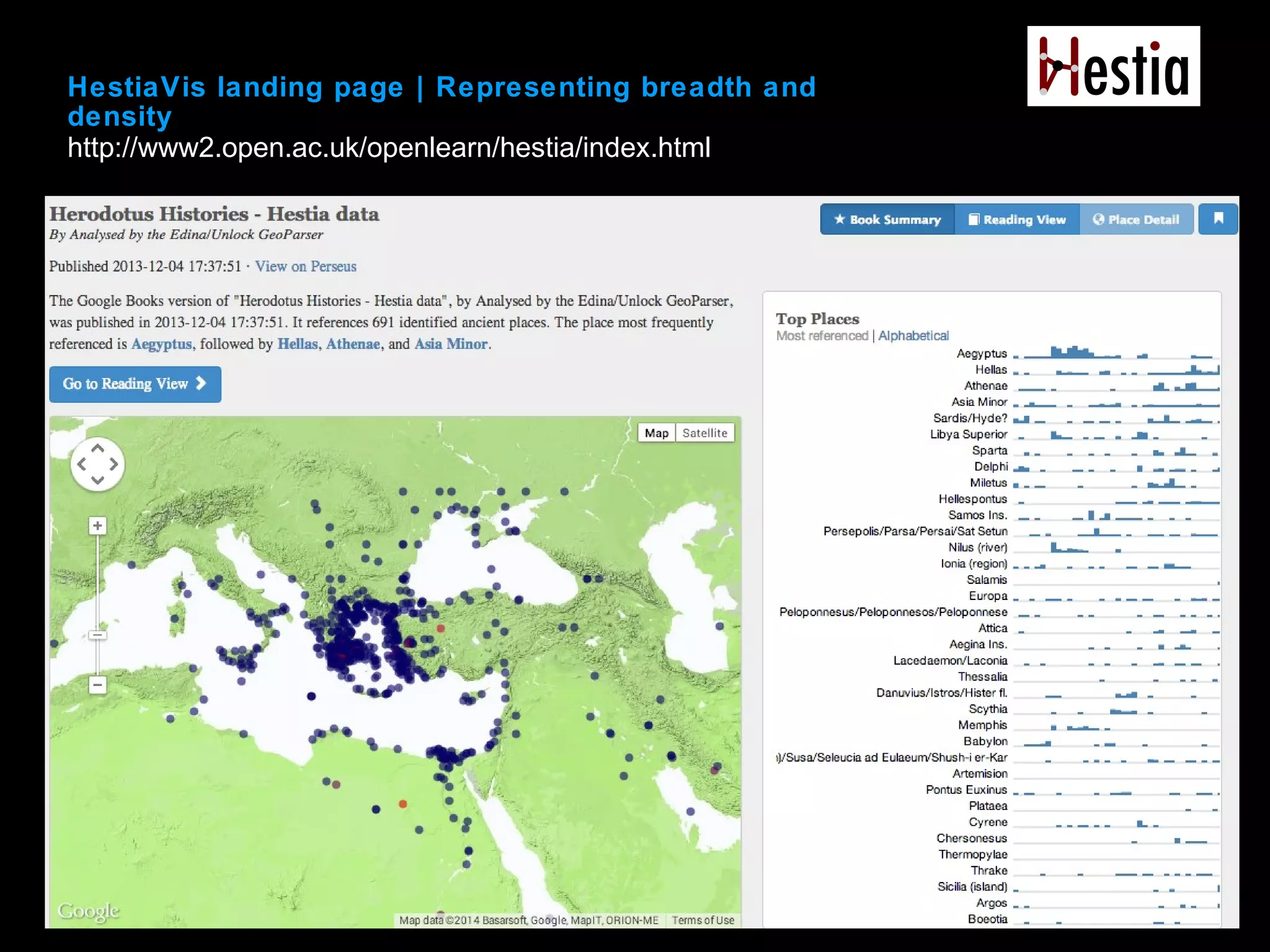
http://www2.open.ac.uk/openlearn/hestia/index.html
HestiaVis landing page | Representing breadth and
density
HestiaVis Reading View | Reading texts spatially
HestiaVis Place View | Tracing networks
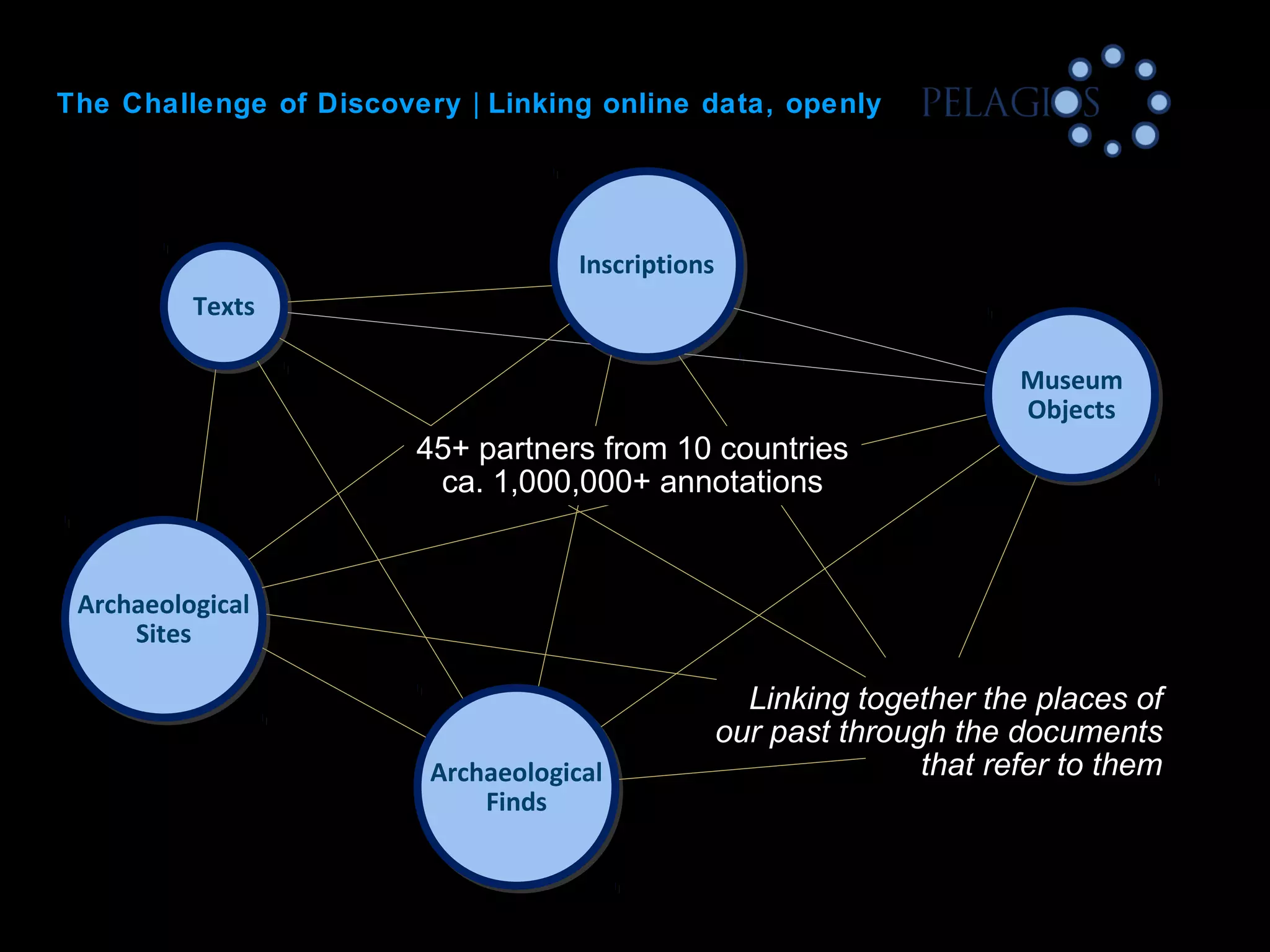
Linking together the places of
our past through the documents
that refer to them
InscriptionsInscriptions
TextsTexts
Archaeological
Finds
Archaeological
Finds
Museum
Objects
Museum
Objects
Archaeological
Sites
Archaeological
Sites
The Challenge of Discovery | Linking online data, openly
45+ partners from 10 countries
ca. 1,000,000+ annotations
20
 Data aggregation X
 Standard data representation X
 MEGA search portal X
Connectivity through common references rather than a common schemaConnectivity through common references rather than a common schema
What Pelagios isn’t | One ring to rule them all
The concept | Don’t Unify the Model – Annotate!
21
pleiades:579885
(Athenae)
pleiades:570685
(Sparta)
Pleiades
Ancient
World
Resources
Pelagios
Pelagios network | Interlinking different knowledge
communities
Towards a digital scholarship | Bottomless Maps
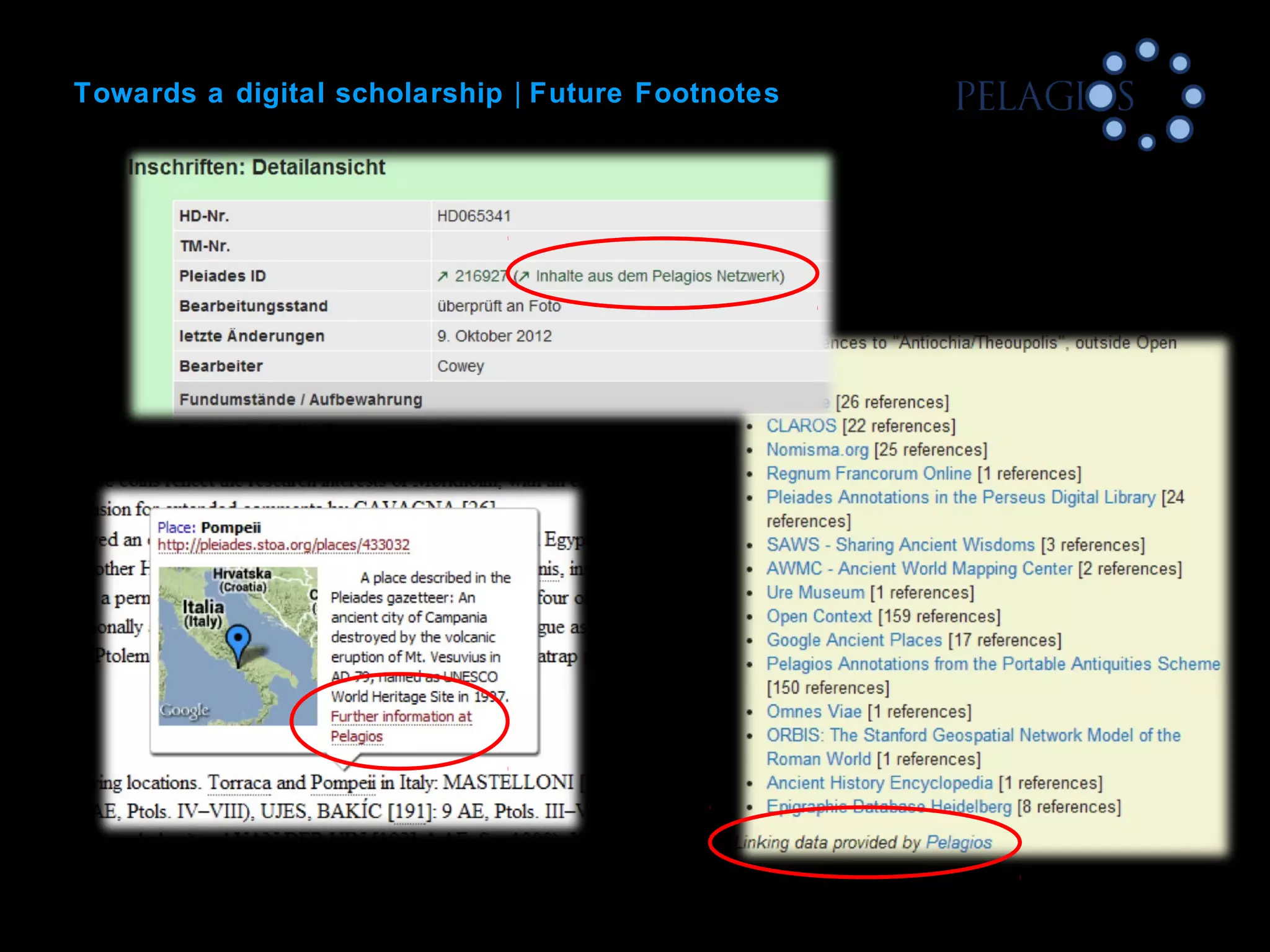
Towards a digital scholarship | Future Footnotes
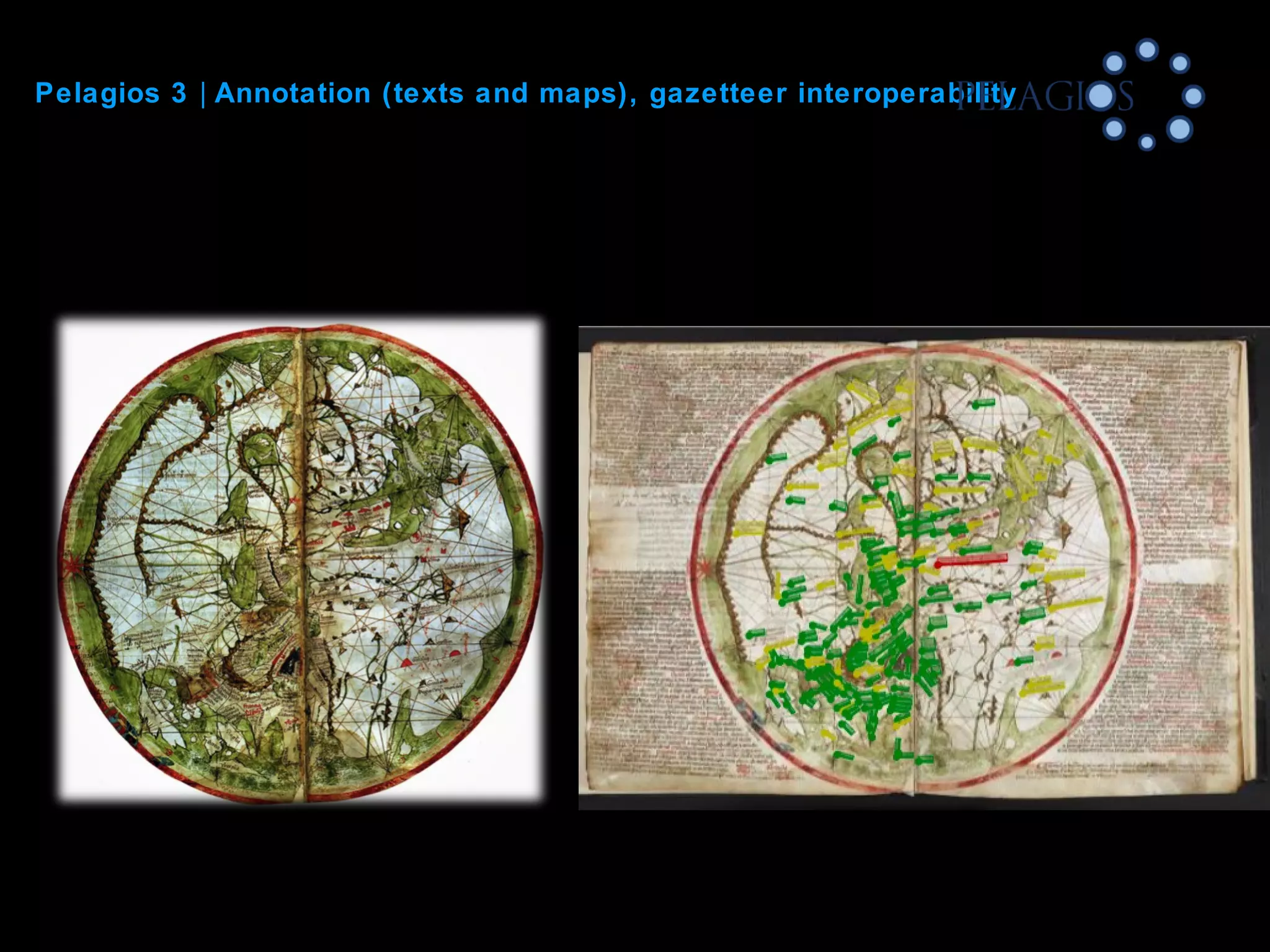
Pelagios 3 | Annotation (texts and maps), gazetteer interoperability
Making annotation easy | developing a Web-based Open Source tool
http://pelagios.org/recogito/
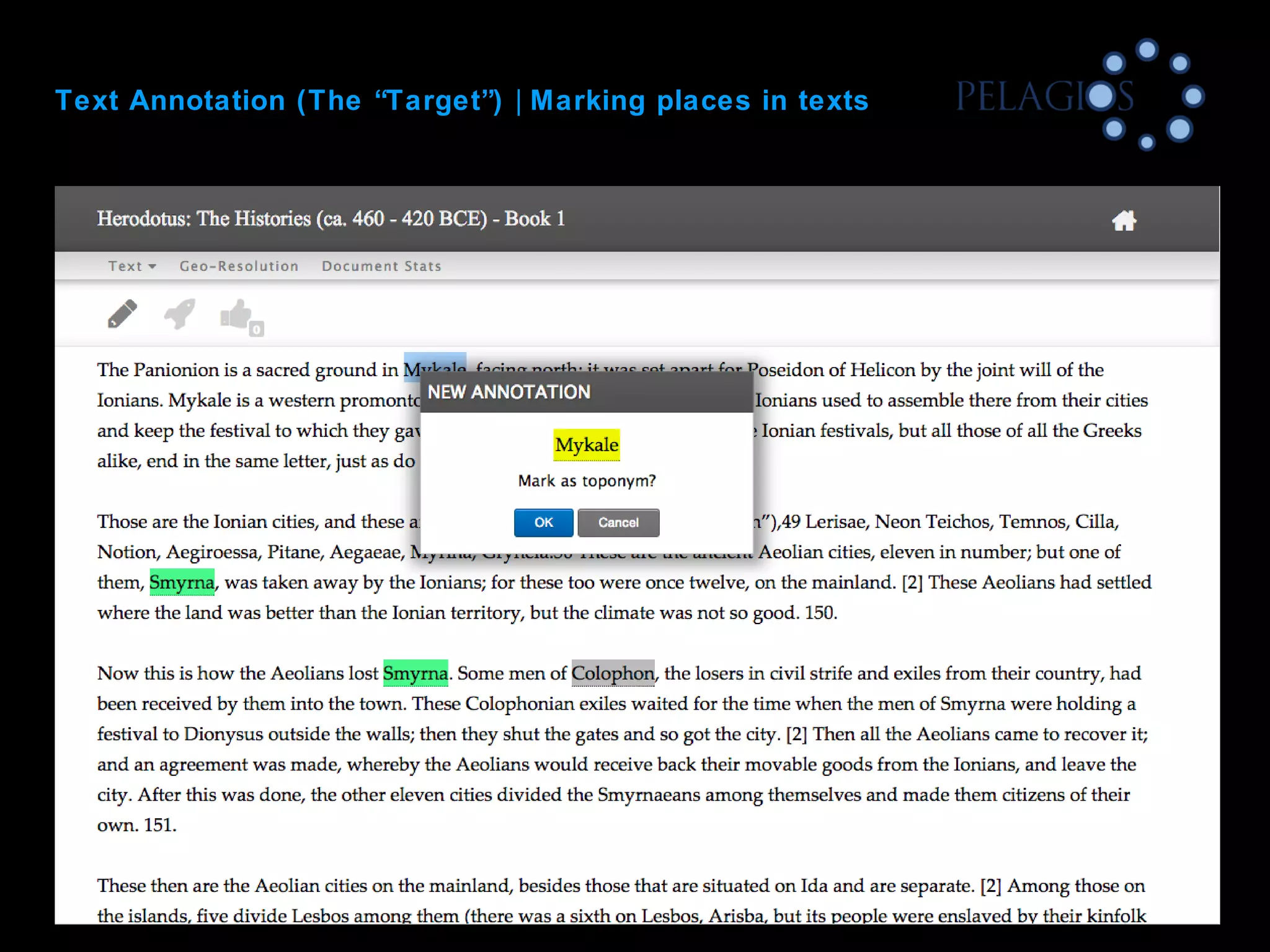
Text Annotation (The “Target”) | Marking places in texts
Image Annotation (The “Target”) | Marking toponyms on maps
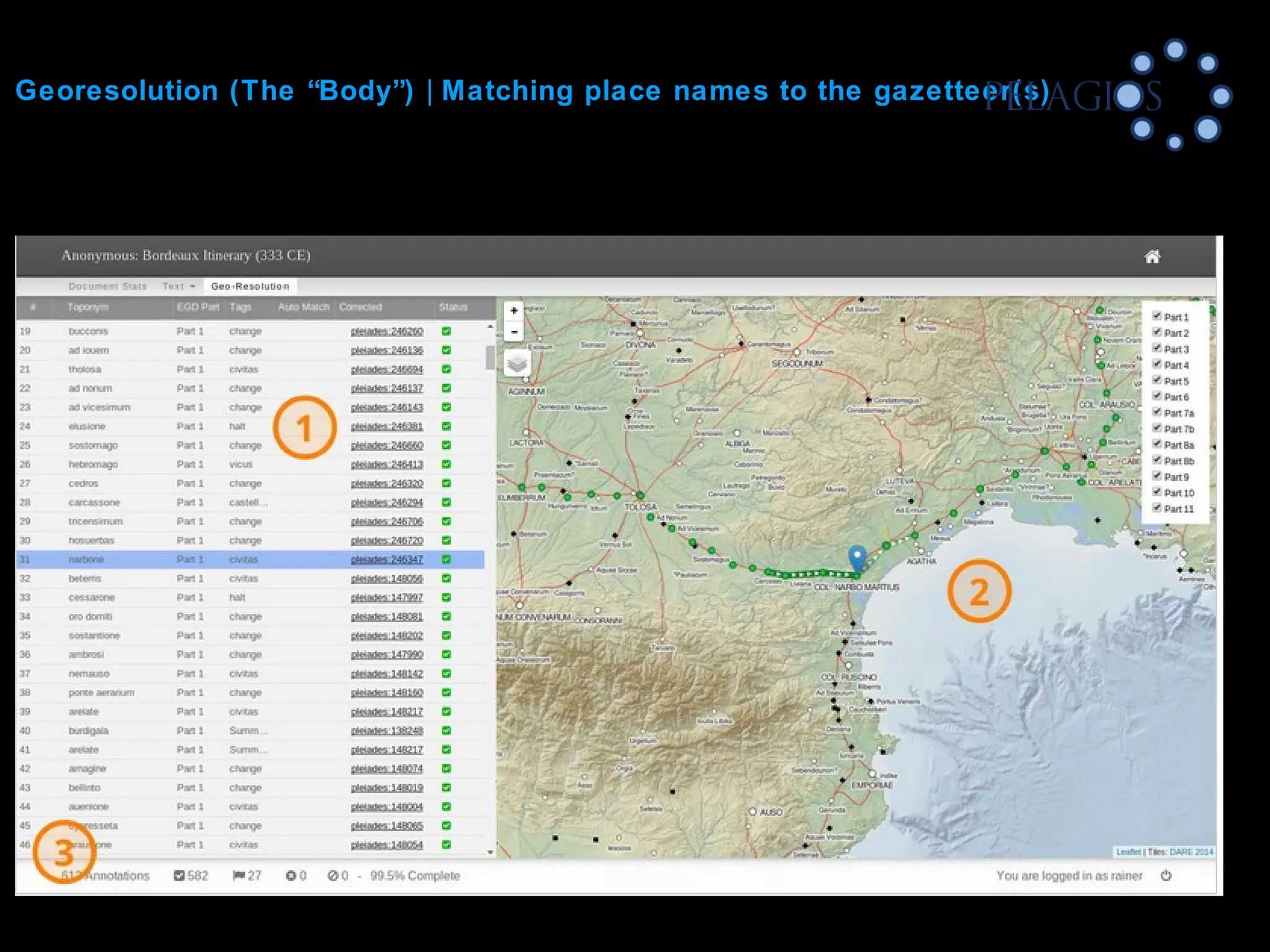
Georesolution (The “Body”) | Matching place names to the gazetteer(s)
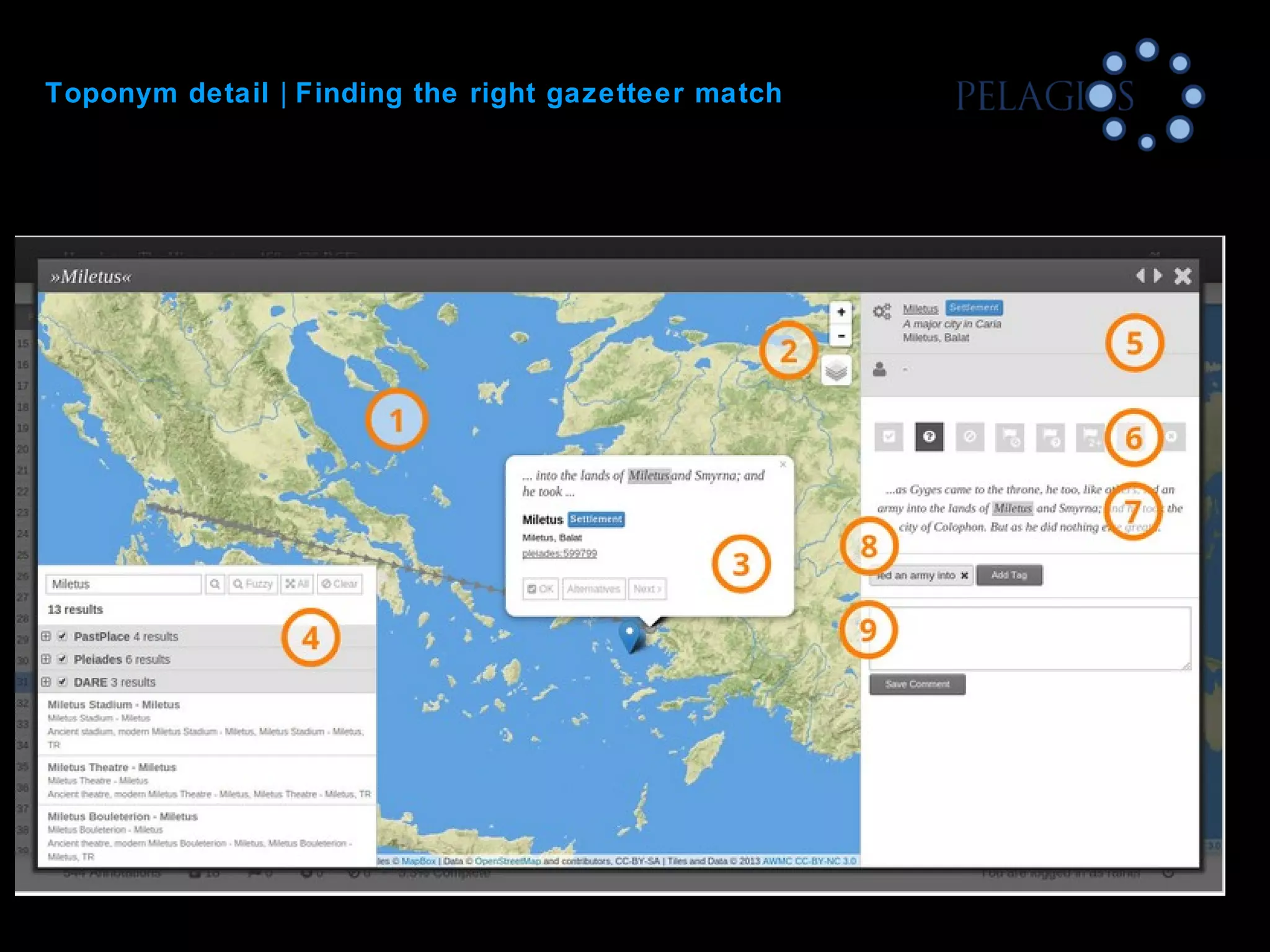
Toponym detail | Finding the right gazetteer match
Pelagios 3 outcomes | Browser-based maps of geographic data
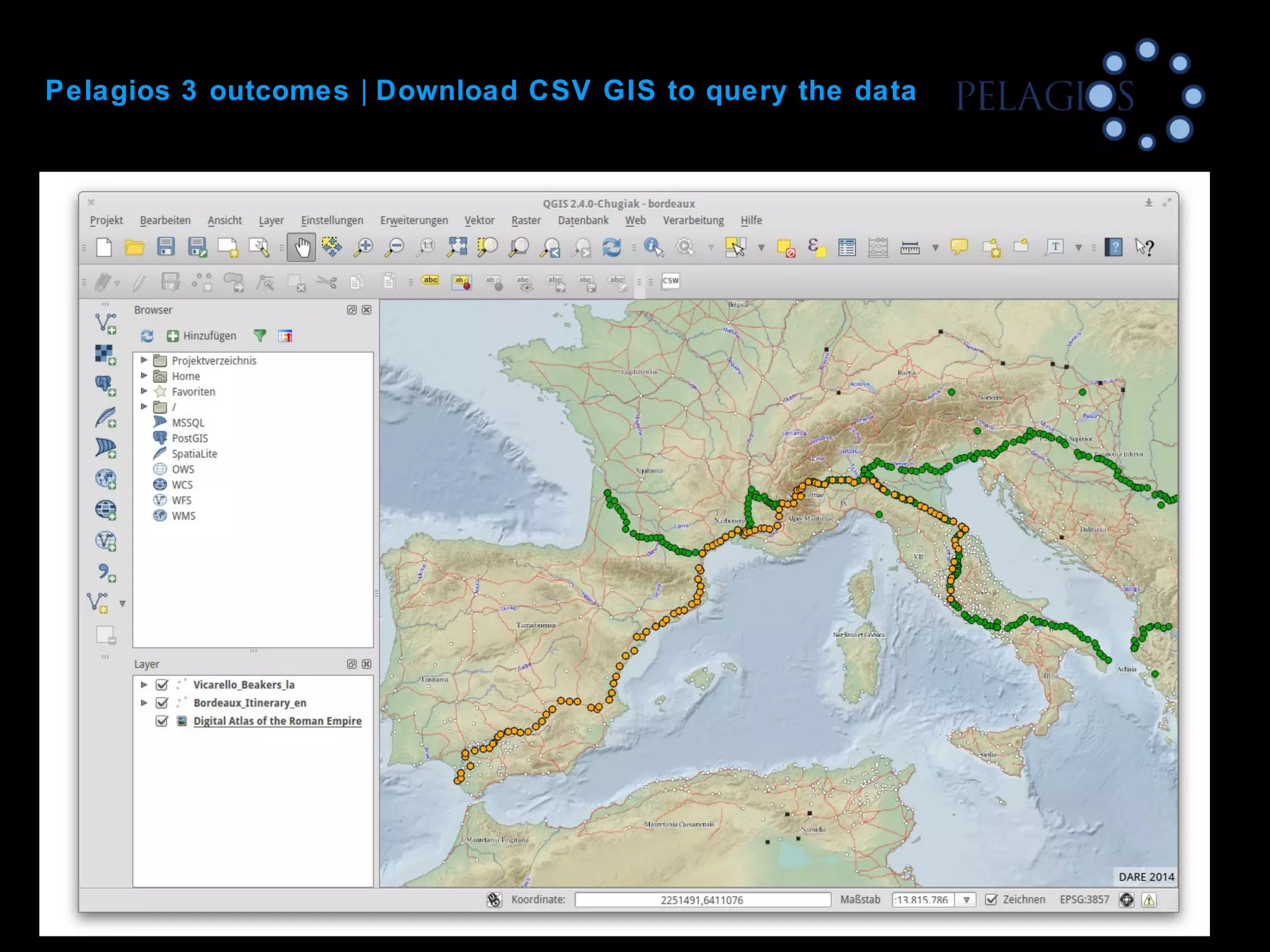
Pelagios 3 outcomes | Download CSV GIS to query the data
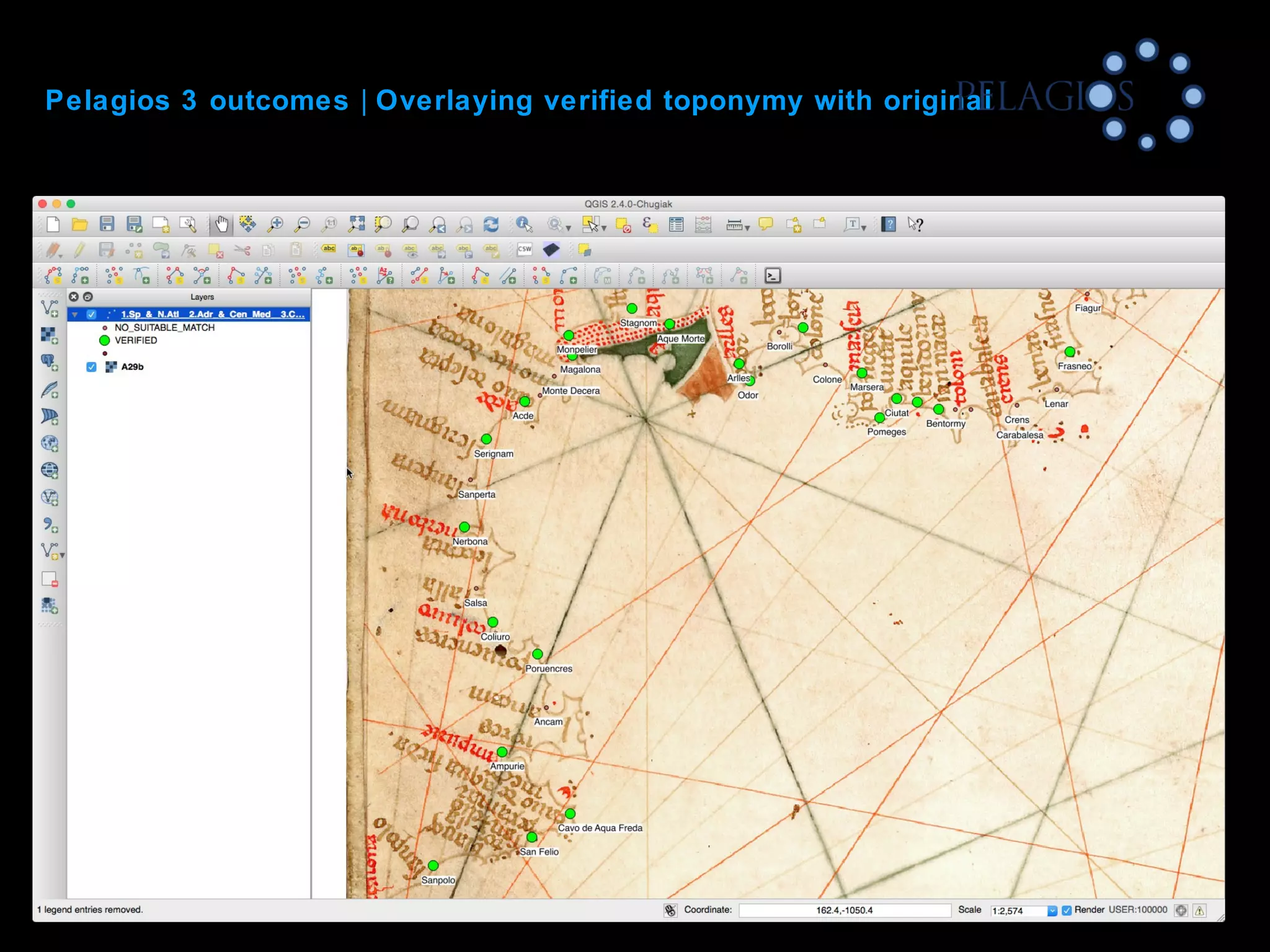
Pelagios 3 outcomes | Overlaying verified toponymy with original
The Pelagios API v.3 | A “google” style search with bells
API v.3 query (‘Peripleo’) | Searching by object + filtering results
http://pelagios.org/peripleo/map
Pleiades
PastPlace
Getty Thesauri
PeriodO
ChronOntology
Canonical Text
Services
SENSCHAL
SNAP
OCRE
…
Google Ancient Places (OU, Soton)
Perseus Digital Library (Tufts)
Arachne (Cologne)
SPQR (King's College, London)
Digital Memory Engineering (AIT)
Open Context (UC Berkeley)
CLAROS (Oxford)
PtolemyMachine (Holy Cross)
Ure Museum (Reading)
FastiOnline (AIAC)
Nomisma (ANS)
Regnum Francorum Online
Papyri.info (ISAW/NYU)
Ports Antiques
Oracc (U. Penn.)
Meketre (Vienna)
OCRE (ANS/ISAW)
Squinchpix
ORBIS (Stanford)
MJBC (Cambridge)
ISAW Papers (ISAW)
Totenbuch (Bonn/Cologne)
PAS (The British Museum)
SAWS (KCL/Uppsala/Stockholm/Vienna)
Trismegistos (K. U. Leuven)
AWMC (Chapel Hill)
Encyclopaedia of the Hellenic World
DM Project (Drew)
Ancient History Encyclopedia
Dickinson College Commentaries
Edinburgh Geoparser (Edinburgh)
EDH (Heidelberg)
EAGLE
LGPN (Oxford)
...
50+ projects
The Digital Ecosystem | Linking places, people,
time…
| An Emerging Ecosystem
Resource Curators
Concept Schemes
Infrastructure
& Support
Thanks to JISC, the Andrew W. Mellon Foundation, the AHRC, the
Onassis Foundation, and all our partners
Thank you for your attention!
Hestia are:
Elton Barker, Classical Studies, The Open University
Stefan Bouzarovski, Dept. of Geography, University of Manchester
Chris Pelling, Classics, Christ Church, Oxford
Leif Isaksen, Dept. of Archaeology, University of Southampton
Website and blog: http://hestia.open.ac.uk/ Twitter: @Hestiaproject
Pelagios are:
Elton Barker, Classical Studies, The Open University
Leif Isaksen, Dept. of History, University of Southampton
Rainer Simon, Austrian Institute of Technology, Vienna
Pau de Soto Cañ amares, Institute of Catalan Studies, Barcelona
Blog: http://pelagiosproject.blogspot.co.uk Twitter: @Pelagiosproject
Annotation: http://pelagios.org/recogito/ Search: http://pelagios.org/peripleo/map
Code: https://github.com/pelagios

Hestia+Pelagios, University of Reading, 2015

  • 1.
    Towards a newgeography of the ancient world: Counter-cartography, network graphs and bottomless maps   Elton Barker (The Open University) http://hestia.open.ac.uk/ http://pelagiosproject.blogspot.co.uk @Hestiaproject, @Pelagiosproject 21 October 2015 | Classics Research Seminar, University of Reading
  • 2.
    How is spacemapped discursively in Herodotus’s Histories?  Hestia (2008-2010, 2013-2014), funded by the AHRC  Stefan Bouzarovski, Dept. of Geography, University of Birmingham  Chris Pelling, Christ Church, Oxford  Leif Isaksen, Dept. of Archaeology, University of Southampton Presentation summary | The projects How can we link together the data about the ancient world?  Pelagios (2011, 2011-2012, 2013-2015), funded by JISC, Mellon, AHRC  Leif Isaksen, Dept. of Archaeology, University of Southampton  Rainer Simon, Austrian Institute of Technology  Pau de Soto, University of Southampton
  • 3.
    The ancient worldin GIS | AMWC: mapping antiquity topographically
  • 4.
    Harley (1989)  Theobject of mapping is to produce a 'correct' relational model of the terrain. Its assumptions are that the objects in the world to be mapped are real and objective, and that they enjoy an existence independent of the cartographer; that their reality can be expressed in mathematical terms; that systematic observation and measurement offer the only route to cartographic truth; and that this truth can be independently verified. The research context | Counter-cartography, spatial humanities, narrative geography Harris, T. M., Bergeron, S. and Rouse, L. J. (2011)  Much of the interest in GIS has largely revolved around a (re)discovery of the power of the map. The humanities have long been at risk of treating space, the backdrop to all human behavior and events, as being neutral—a spatial vacuum—an isotropic backdrop to human affairs. Indeed, a perusal of many maps incorporated in humanities texts would imply that events take place in landscapes seemingly devoid of any terrain, hydrology, infrastructure, human culture, or other geography. Purves (2010)  Plot's spatial legacy is pervasive in ancient Greek thought, where songs might be conceived as pathways, logoi as routes, writing as the movement of oxen turning back and forth across a field with a plough..., narratives as pictures or landscapes, and plots even as living creatures that take up set areas of space.
  • 5.
    But after this(the Persians say), the Greeks were very much to blame; for they invaded Asia before the Persians attacked Europe… “We of Asia did not deign to notice the seizure of our women; but the Greeks, for the sake of a Lacedaemonian woman, recruited a great armada, came to Asia, and destroyed the power of Priam. Ever since then we have regarded Greeks as our enemies.” For the Persians claim Asia for their own, and the foreign peoples that inhabit it; Europe and the Greek people they consider to be separate from them. Herodotus, Histories 1.4 I laugh to see how many have before now drawn maps of the world, not one of them reasonably; for they draw the world as round as if fashioned by compasses, encircled by the Ocean river, and Asia and Europe of a like extent. For myself, I will in a few words indicate the extent of the two, and how each should be drawn. Herodotus, Histories 4.36.2 It was in the reign of Cleomenes that Aristagoras the tyrant of Miletus came to Sparta. When he had an audience with the king, as the Lacedaemonians report, he brought with him a bronze tablet on which the map of all the earth was engraved, and all the sea and all the rivers (ἔχων χάλκεον πίνακα ἐν τῷ γῆς ἁπάσης περίοδος ἐνετέτμητο καὶ θάλασσά τε πᾶσα καὶ ποταμοὶ πάντες) Herodotus, Histories 5.49.1 Why is Herodotus ‘good to think with’? | Three passages
  • 6.
    The challenge |Maps as illustration
  • 7.
    The Source Text| Reusing digital data
  • 8.
    Places in GIS| Reproducing a Cartesian world view
  • 9.
    Places in GIS2 | SQL query ‘settlements’, four categories
  • 10.
    Web technologies |(still) Reproducing a Cartesian world view
  • 11.
    Network Analysis |Reading space through the digital Unit: clause analysis (SVO) of Histories 5 Definition: place and proxy Quality: movement and/or transformation (giving 4 categories) Variables: focalisation, tense/mood What do literary maps allow us to see? Two things, basically. First, they highlight the ortegebunden, place-bound nature of literary forms: each of them with its peculiar geometry, its boundaries, its spatial taboos and favorite routes. And then, maps bring to light the internal logic of narrative: the semiotic domain around which a plot coalesces and self-organizes. Moretti (1998) These men's borders, it is said, reach almost as far as the Eneti on the Adriatic Sea. They call themselves colonists from Media. How this has come about I myself cannot understand, but all is possible in the long passage of time. However that may be, we know that the Ligyes who dwell inland of Massalia use the word “sigynnae” for hucksters, and the Cyprians use it for spears. Herodotus, Histories 5.9.3
  • 12.
    Data Visualisation |Representing humanities (complex) data
  • 13.
    Data visualisation 2| Clarification vs. simplification Scott Weingart: http://www.scottbot.net/HIAL/
  • 14.
    Data visualisation 3| Clarification vs. simplification 2
  • 15.
    Data visualisation |Clarification vs. simplification
  • 16.
  • 17.
    HestiaVis Reading View| Reading texts spatially
  • 18.
    HestiaVis Place View| Tracing networks
  • 19.
    Linking together theplaces of our past through the documents that refer to them InscriptionsInscriptions TextsTexts Archaeological Finds Archaeological Finds Museum Objects Museum Objects Archaeological Sites Archaeological Sites The Challenge of Discovery | Linking online data, openly 45+ partners from 10 countries ca. 1,000,000+ annotations
  • 20.
    20  Data aggregationX  Standard data representation X  MEGA search portal X Connectivity through common references rather than a common schemaConnectivity through common references rather than a common schema What Pelagios isn’t | One ring to rule them all
  • 21.
    The concept |Don’t Unify the Model – Annotate! 21 pleiades:579885 (Athenae) pleiades:570685 (Sparta)
  • 22.
    Pleiades Ancient World Resources Pelagios Pelagios network |Interlinking different knowledge communities
  • 23.
    Towards a digitalscholarship | Bottomless Maps
  • 24.
    Towards a digitalscholarship | Future Footnotes
  • 25.
    Pelagios 3 |Annotation (texts and maps), gazetteer interoperability
  • 26.
    Making annotation easy| developing a Web-based Open Source tool http://pelagios.org/recogito/
  • 27.
    Text Annotation (The“Target”) | Marking places in texts
  • 28.
    Image Annotation (The“Target”) | Marking toponyms on maps
  • 29.
    Georesolution (The “Body”)| Matching place names to the gazetteer(s)
  • 30.
    Toponym detail |Finding the right gazetteer match
  • 31.
    Pelagios 3 outcomes| Browser-based maps of geographic data
  • 32.
    Pelagios 3 outcomes| Download CSV GIS to query the data
  • 33.
    Pelagios 3 outcomes| Overlaying verified toponymy with original
  • 34.
    The Pelagios APIv.3 | A “google” style search with bells
  • 35.
    API v.3 query(‘Peripleo’) | Searching by object + filtering results http://pelagios.org/peripleo/map
  • 36.
    Pleiades PastPlace Getty Thesauri PeriodO ChronOntology Canonical Text Services SENSCHAL SNAP OCRE … GoogleAncient Places (OU, Soton) Perseus Digital Library (Tufts) Arachne (Cologne) SPQR (King's College, London) Digital Memory Engineering (AIT) Open Context (UC Berkeley) CLAROS (Oxford) PtolemyMachine (Holy Cross) Ure Museum (Reading) FastiOnline (AIAC) Nomisma (ANS) Regnum Francorum Online Papyri.info (ISAW/NYU) Ports Antiques Oracc (U. Penn.) Meketre (Vienna) OCRE (ANS/ISAW) Squinchpix ORBIS (Stanford) MJBC (Cambridge) ISAW Papers (ISAW) Totenbuch (Bonn/Cologne) PAS (The British Museum) SAWS (KCL/Uppsala/Stockholm/Vienna) Trismegistos (K. U. Leuven) AWMC (Chapel Hill) Encyclopaedia of the Hellenic World DM Project (Drew) Ancient History Encyclopedia Dickinson College Commentaries Edinburgh Geoparser (Edinburgh) EDH (Heidelberg) EAGLE LGPN (Oxford) ... 50+ projects The Digital Ecosystem | Linking places, people, time… | An Emerging Ecosystem Resource Curators Concept Schemes Infrastructure & Support
  • 37.
    Thanks to JISC,the Andrew W. Mellon Foundation, the AHRC, the Onassis Foundation, and all our partners Thank you for your attention! Hestia are: Elton Barker, Classical Studies, The Open University Stefan Bouzarovski, Dept. of Geography, University of Manchester Chris Pelling, Classics, Christ Church, Oxford Leif Isaksen, Dept. of Archaeology, University of Southampton Website and blog: http://hestia.open.ac.uk/ Twitter: @Hestiaproject Pelagios are: Elton Barker, Classical Studies, The Open University Leif Isaksen, Dept. of History, University of Southampton Rainer Simon, Austrian Institute of Technology, Vienna Pau de Soto Cañ amares, Institute of Catalan Studies, Barcelona Blog: http://pelagiosproject.blogspot.co.uk Twitter: @Pelagiosproject Annotation: http://pelagios.org/recogito/ Search: http://pelagios.org/peripleo/map Code: https://github.com/pelagios