The OECD Guidelines
and the Netherlands’
National Contact Point
NCP-NL in Practice
by
Herman Mulder
Independent member
National Contact Point: the Netherlands
Each adhering country must set up an NCP with the tasks of:
• Raising awareness of the OECD Guidelines with businesses,
trade unions and non-governmental organisations
• Promotion of Guidelines and grievance procedure to companies
• Assistance to companies on implementing the Guidelines (tools, workshops
etc)
• Assistance to companies in the early resolution of dilemma’s (prevention)
• Assistance to interested parties on filing a complaint
• Implementing the OECD Guidelines’ complaint mechanism
• Solution-oriented handling of complaints
• By independent experts/mediators
• Through constructive dialogue, mediation and long term perspective
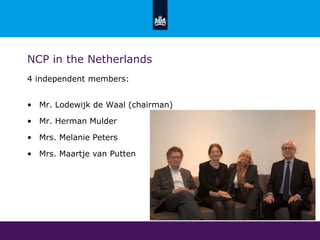
NCP in the Netherlands
4 independent members:
• Mr. Lodewijk de Waal (chairman)
• Mr. Herman Mulder
• Mrs. Melanie Peters
• Mrs. Maartje van Putten
NCP the Netherlands
4 advisory members:
• Herman Bavinck (Infrastructure & Environment)
• Aart-Jan Bette (Social Affairs & Employment)
• Gerbert Kunst (Economic Affairs)
• Marjan Schippers (Foreign Affairs)
4 NCP+ members:
• Alexandra van Selm (SERIMVO)
• Marhijn Visser (VNO-NCW)
• Lucia van Westerlaak (FNV)
• Joseph Wilde (OECD Watch)
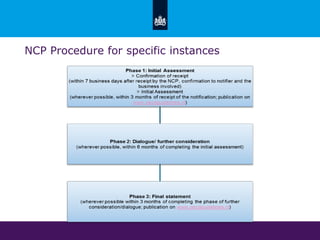
NCP Procedure for specific instances
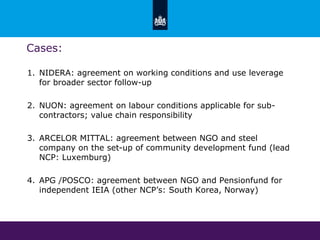
Cases:
1. NIDERA: agreement on working conditions and use leverage
for broader sector follow-up
2. NUON: agreement on labour conditions applicable for sub-
contractors; value chain responsibility
3. ARCELOR MITTAL: agreement between NGO and steel
company on the set-up of community development fund (lead
NCP: Luxemburg)
4. APG /POSCO: agreement between NGO and Pensionfund for
independent IEIA (other NCP’s: South Korea, Norway)
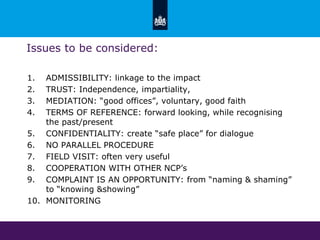
Issues to be considered:
1. ADMISSIBILITY: linkage to the impact
2. TRUST: Independence, impartiality,
3. MEDIATION: “good offices”, voluntary, good faith
4. TERMS OF REFERENCE: forward looking, while recognising
the past/present
5. CONFIDENTIALITY: create “safe place” for dialogue
6. NO PARALLEL PROCEDURE
7. FIELD VISIT: often very useful
8. COOPERATION WITH OTHER NCP’s
9. COMPLAINT IS AN OPPORTUNITY: from “naming & shaming”
to “knowing &showing”
10. MONITORING
+31 70 348 4200
www.oecdguidelines.nl
ncpoecd@minbuza.nl
@oesorichtlijnen

Presentation by Herman Mulder at the workshop in China on responsible business conduct

  • 1.
    The OECD Guidelines andthe Netherlands’ National Contact Point NCP-NL in Practice by Herman Mulder Independent member
  • 2.
    National Contact Point:the Netherlands Each adhering country must set up an NCP with the tasks of: • Raising awareness of the OECD Guidelines with businesses, trade unions and non-governmental organisations • Promotion of Guidelines and grievance procedure to companies • Assistance to companies on implementing the Guidelines (tools, workshops etc) • Assistance to companies in the early resolution of dilemma’s (prevention) • Assistance to interested parties on filing a complaint • Implementing the OECD Guidelines’ complaint mechanism • Solution-oriented handling of complaints • By independent experts/mediators • Through constructive dialogue, mediation and long term perspective
  • 3.
    NCP in theNetherlands 4 independent members: • Mr. Lodewijk de Waal (chairman) • Mr. Herman Mulder • Mrs. Melanie Peters • Mrs. Maartje van Putten
  • 4.
    NCP the Netherlands 4advisory members: • Herman Bavinck (Infrastructure & Environment) • Aart-Jan Bette (Social Affairs & Employment) • Gerbert Kunst (Economic Affairs) • Marjan Schippers (Foreign Affairs) 4 NCP+ members: • Alexandra van Selm (SERIMVO) • Marhijn Visser (VNO-NCW) • Lucia van Westerlaak (FNV) • Joseph Wilde (OECD Watch)
  • 5.
    NCP Procedure forspecific instances
  • 7.
    Cases: 1. NIDERA: agreementon working conditions and use leverage for broader sector follow-up 2. NUON: agreement on labour conditions applicable for sub- contractors; value chain responsibility 3. ARCELOR MITTAL: agreement between NGO and steel company on the set-up of community development fund (lead NCP: Luxemburg) 4. APG /POSCO: agreement between NGO and Pensionfund for independent IEIA (other NCP’s: South Korea, Norway)
  • 8.
    Issues to beconsidered: 1. ADMISSIBILITY: linkage to the impact 2. TRUST: Independence, impartiality, 3. MEDIATION: “good offices”, voluntary, good faith 4. TERMS OF REFERENCE: forward looking, while recognising the past/present 5. CONFIDENTIALITY: create “safe place” for dialogue 6. NO PARALLEL PROCEDURE 7. FIELD VISIT: often very useful 8. COOPERATION WITH OTHER NCP’s 9. COMPLAINT IS AN OPPORTUNITY: from “naming & shaming” to “knowing &showing” 10. MONITORING
  • 9.
    +31 70 3484200 www.oecdguidelines.nl ncpoecd@minbuza.nl @oesorichtlijnen