Hematology
Mohamad H Qari, MD, FRCPA
Hematology
Cellular Components
Components of Blood
 Red Blood Cells
 White Blood Cells
 Inflammatory process
 Coagulation
Blood Typing
Clotting disorders
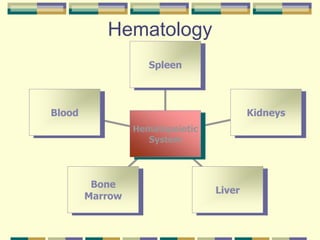
Hematology
Spleen
Kidneys
Liver
Bone
Marrow
Blood
Hematopoietic
System
Hematopoeisis
Three developmental periods
 Mesoblastic
 Blood islands of yolk sac
 Primarily RBC production
 Embryonic hemoglobin produced
 Hepatic
 At 6 weeks cell production in liver
 Fetal hemoglobin produced
 Spleen, thymus, lymph nodes also active prod.
 Myeloid
 At 5th month Bone Marrow becomes site of prod.
 Liver & spleen now Extramedullary
 Hemoglobin A (22)
Requirements For
Hematopoiesis
Stem Cells
Growth Factors
Microenviroment
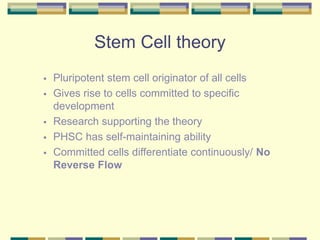
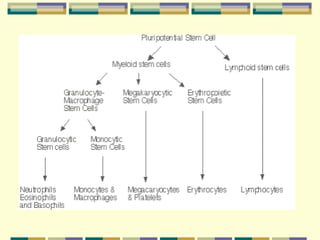
Stem Cell theory
 Pluripotent stem cell originator of all cells
 Gives rise to cells committed to specific
development
 Research supporting the theory
 PHSC has self-maintaining ability
 Committed cells differentiate continuously/ No
Reverse Flow
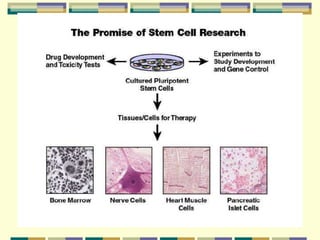
Stem cells in Research
Pluripotent cells derived from:
 Cell mass of embryos at blastocyst stage (IVF)
 Fetal tissue from terminated pregnancy
Application
 Identification of factors of cellular decision-making
 Development and testing of drugs
 Generation of cells and tissue for therapy
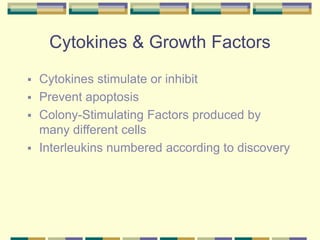
Cytokines & Growth Factors
 Cytokines stimulate or inhibit
 Prevent apoptosis
 Colony-Stimulating Factors produced by
many different cells
 Interleukins numbered according to discovery
Components of Blood
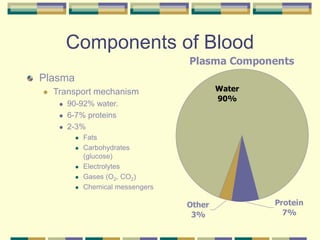
Plasma
 Transport mechanism
 90-92% water.
 6-7% proteins
 2-3%
 Fats
 Carbohydrates
(glucose)
 Electrolytes
 Gases (O2, CO2)
 Chemical messengers
Plasma Components
Other
3%
Protein
7%
Water
90%
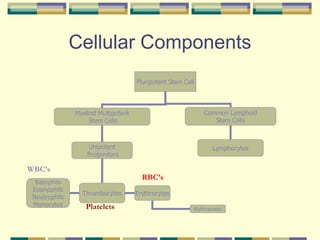
Cellular Components
Pluripotent Stem Cell
Myeloid Multipotent
Stem Cells
Common Lymphoid
Stem Cells
Unipotent
Progenitors
Basophils
Eosinophils
Neutrophils
Monocytes
Lymphocytes
Erythrocytes
Thrombocytes
Erythropoietin
WBC’s
RBC’s
Platelets
Components of Blood
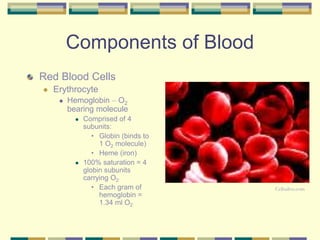
Red Blood Cells
 Erythrocyte
 Hemoglobin – O2
bearing molecule
 Comprised of 4
subunits:
• Globin (binds to
1 O2 molecule)
• Heme (iron)
 100% saturation = 4
globin subunits
carrying O2
• Each gram of
hemoglobin =
1.34 ml O2
Cellsalive.com
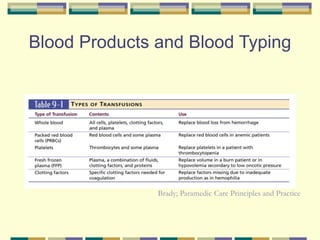
Blood Products and Blood Typing
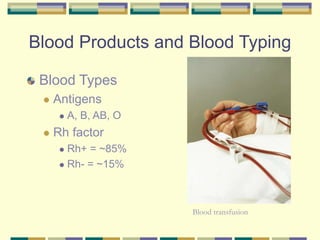
Blood Types
 Antigens
 A, B, AB, O
 Rh factor
 Rh+ = ~85%
 Rh- = ~15%
Blood transfusion
Components of Blood
Red Blood Cells
(cont.)
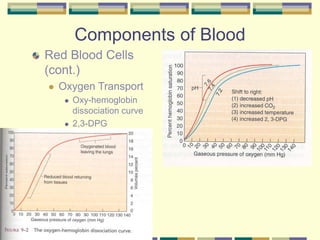
 Oxygen Transport
 Oxy-hemoglobin
dissociation curve
 2,3-DPG
Components of Blood
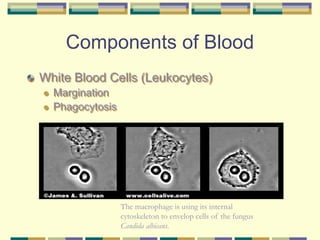
White Blood Cells (Leukocytes)
 Margination
 Phagocytosis
The macrophage is using its internal
cytoskeleton to envelop cells of the fungus
Candida albicans.
Components of Blood
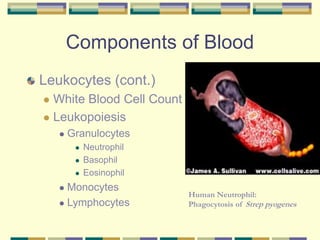
Leukocytes (cont.)
 White Blood Cell Count
 Leukopoiesis
 Granulocytes
 Neutrophil
 Basophil
 Eosinophil
 Monocytes
 Lymphocytes
Human Neutrophil:
Phagocytosis of Strep pyogenes
Components of Blood
Leukocytes (cont.)
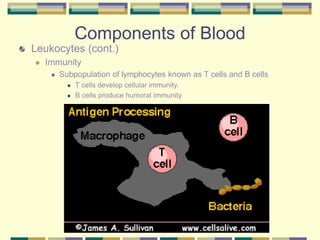
 Immunity
 Subpopulation of lymphocytes known as T cells and B cells
 T cells develop cellular immunity.
 B cells produce humoral immunity
Components of Blood
Inflammatory Process
 MAST CELLS.
 Immunoglobulin E antibody
IgE,
 Antigens
 Antigens stick to the mast cell IgE
antibodies, causing granules in the
mast cell to fire their contents into
the surrounding tissue.
 This releases a host of inflammatory
materials - leukotrienes, tumor
necrosis factor, interleukin-4 and
other cytokines that turn on other
inflammatory cells.
 These materials cause fluid to leak
from the capillaries and white cells
including neutrophils, T cells and
eosinophils to leave the circulation.
The end result is a "local
inflammatory response", a red, itchy
welt.
Cellsalive.com
Components of Blood
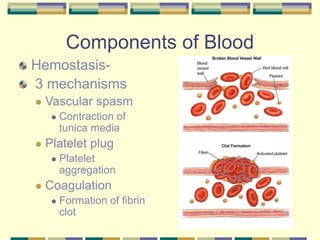
Hemostasis-
3 mechanisms
 Vascular spasm
 Contraction of
tunica media
 Platelet plug
 Platelet
aggregation
 Coagulation
 Formation of fibrin
clot
Components of Blood
Hemostasis (cont.)
 Fibrinolysis
 Lysis of clot (plasmin)
 Thrombosis
 Thrombolytics
 Medications affecting clot formation
 Alter the enzyme
on the platelet.
 Affect the coagulation cascade.
 Enhance clotting.
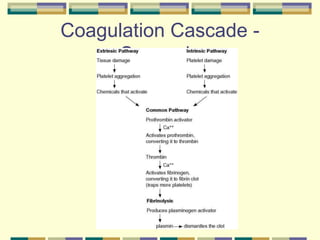
Coagulation Cascade -
Synopsis
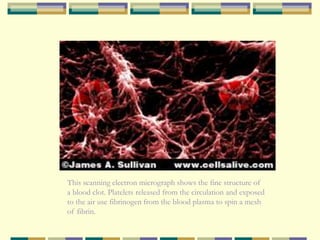
This scanning electron micrograph shows the fine structure of
a blood clot. Platelets released from the circulation and exposed
to the air use fibrinogen from the blood plasma to spin a mesh
of fibrin.
General Assessment -
Management
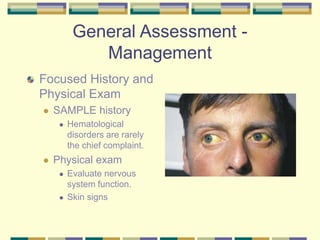
Focused History and
Physical Exam
 SAMPLE history
 Hematological
disorders are rarely
the chief complaint.
 Physical exam
 Evaluate nervous
system function.
 Skin signs
General Assessment - Management
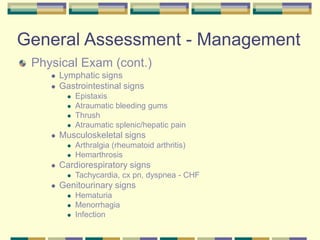
Physical Exam (cont.)
 Lymphatic signs
 Gastrointestinal signs
 Epistaxis
 Atraumatic bleeding gums
 Thrush
 Atraumatic splenic/hepatic pain
 Musculoskeletal signs
 Arthralgia (rheumatoid arthritis)
 Hemarthrosis
 Cardiorespiratory signs
 Tachycardia, cx pn, dyspnea - CHF
 Genitourinary signs
 Hematuria
 Menorrhagia
 Infection
Blood Products and Blood Typing
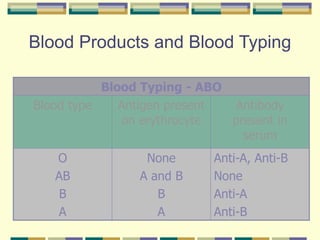
Blood Typing - ABO
Blood type Antigen present
on erythrocyte
Antibody
present in
serum
O
AB
B
A
None
A and B
B
A
Anti-A, Anti-B
None
Anti-A
Anti-B
Blood Products and Blood Typing
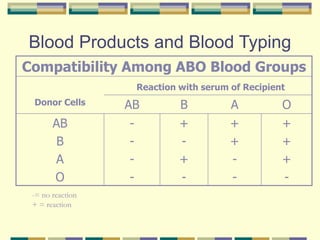
Compatibility Among ABO Blood Groups
Reaction with serum of Recipient
Donor Cells AB B A O
AB
B
A
O
-
-
-
-
+
-
+
-
+
+
-
-
+
+
+
-
-= no reaction
+ = reaction
Blood Products and Blood Typing
Brady; Paramedic Care Principles and Practice
Diseases of Erythrocytes
Anemias
 Anemia is a sign, not a separate disease process.
 Signs and symptoms may not be present until the body is
stressed.
 Differentiate chronic anemia from acute episode.
 Treat signs and symptoms.
 Maximize oxygenation and limit blood loss.
 Establish IV therapy if indicated.
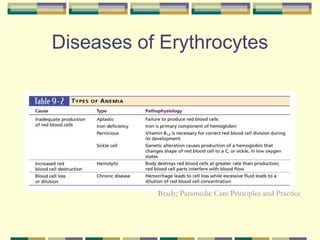
Diseases of Erythrocytes
Brady; Paramedic Care Principles and Practice
Diseases of Erythrocytes
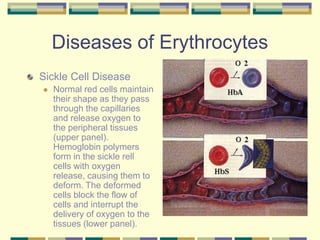
Sickle Cell Disease
 Normal red cells maintain
their shape as they pass
through the capillaries
and release oxygen to
the peripheral tissues
(upper panel).
Hemoglobin polymers
form in the sickle rell
cells with oxygen
release, causing them to
deform. The deformed
cells block the flow of
cells and interrupt the
delivery of oxygen to the
tissues (lower panel).
Diseases of Erythrocytes
Sickle Cell Disease (cont.)
 Sickle cell crises
 Vaso-occlusive
 Musculoskeletal/abdominal pain
 Priapism
 Renal/cerebral infarctions
 Hematological
 Lowered hemoglobin
 Splenic sequestration
 Infectious
 Management
 Follow general treatment guidelines prn.
 Consider analgesics.
Diseases of Erythrocytes
Polycythemia
 Overproduction of erythrocytes.
 Occurs in patients > 50 years old or with
secondary dehydration.
 Most deaths due to thrombosis
 Results in bleeding abnormalities:
 Epistaxis, spontaneous bruising, GI bleeding.
 Management:
 Follow general treatment guidelines.
Diseases of Leukocytes
Leukopenia/Neutropenia
 Too few white blood cells or neutrophils.
 Follow general treatment guidelines and
provide supportive care.
Leukocytosis
 An increase in the number of circulating
white blood cells, often due to infection.
 Leukemoid reaction
Diseases of Leukocytes
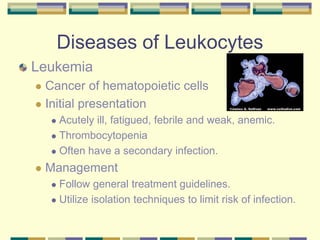
Leukemia
 Cancer of hematopoietic cells
 Initial presentation
 Acutely ill, fatigued, febrile and weak, anemic.
 Thrombocytopenia
 Often have a secondary infection.
 Management
 Follow general treatment guidelines.
 Utilize isolation techniques to limit risk of infection.
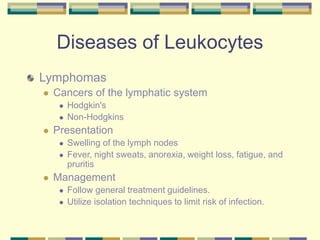
Diseases of Leukocytes
Lymphomas
 Cancers of the lymphatic system
 Hodgkin's
 Non-Hodgkins
 Presentation
 Swelling of the lymph nodes
 Fever, night sweats, anorexia, weight loss, fatigue, and
pruritis
 Management
 Follow general treatment guidelines.
 Utilize isolation techniques to limit risk of infection.
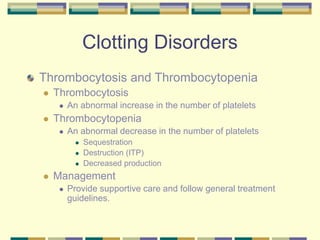
Clotting Disorders
Thrombocytosis and Thrombocytopenia
 Thrombocytosis
 An abnormal increase in the number of platelets
 Thrombocytopenia
 An abnormal decrease in the number of platelets
 Sequestration
 Destruction (ITP)
 Decreased production
 Management
 Provide supportive care and follow general treatment
guidelines.
Clotting Disorders
Hemophilia
 Deficiency or absence of a blood clotting factor
 Deficiency of factor VIII causes hemophilia A.
 Deficiency of factor IX causes hemophilia B.
 Deficiency is a sex-linked, inherited disorder.
 Defective gene is carried on the X chromosome.
 Signs & Symptoms
 Numerous bruises, deep muscle bleeding, and joint
bleeding.
Clotting Disorders
Hemophilia (cont.)
 Management
 Treat the patient similarly to others.
 Administer supplemental oxygen.
 Establish IV access.
 Be alert for recurrent or prolonged bleeding, and prevent
additional trauma.
Von Willebrand’s Disease
 Deficient component of factor VIII
 Generally results in excessive bleeding.
 Generally is not serious; provide supportive care.
Clotting Disorders
Disseminated Intravascular Coagulation
Components of Blood
Leukocytes (cont.)
 Autoimmune disease
 May be specific or general
 Alterations in the immune process
 Immunosuppression
 HIV
 Anti-rejection medication
 Chemotherapy/Cancer
 System activation of coagulation cascade.
Anticoagulants/Antiplatelets
Classifying agents
 Anticoagulants
 Block synthesis and activation of clotting
factors
 Antiplatelets
 Interfere with platelet aggregation or activation
 Fibrinolytics
 Dissolve fibrin component of thrombi
Anticoagulants/Antiplatelets
Anticoagulants
 Warfarin
 Blocks activation of Vit K
 Interferes w/ coagulation factors II, VII, IX, and X
 Unfractionated Heparin
 Binds antithrombin III (AT-III)
 Inhibits coagulation factors IX and X and thrombin
 Hirudin (medicinal leech)
 Prevents thrombin binding
Anticoagulants/Antiplatelets
Antiplatelets
 Aspirin
 Prevents platelet activation through
cyclooxygenase blockade.
 Prevents production of thromboxane A2
 Allows prostacyclin synthesis
 Ticlodipine
 Deforms platelet membrane fibrinogen receptor
Anticoagulants/Antiplatelets
Antiplatelets (cont.)
 Glycoprotein IIb-IIIa Receptor Inhibitors
 G IIb-IIIa = platelet membrane receptor of fibrinogen
 Abciximab
 Eptifibatide
 Tirofiban
Fibrinolytics
 Activate plasminogen to plasmin = fibrinolysis
 Streptokinase
 Anistreplase
 Tissue Plasminogen Activator
 Reteplase
 Urokinase
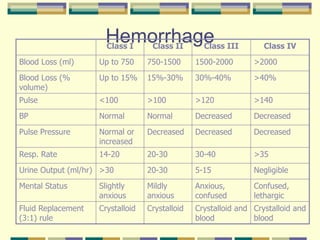
Hemorrhage
Class I Class II Class III Class IV
Blood Loss (ml) Up to 750 750-1500 1500-2000 >2000
Blood Loss (%
volume)
Up to 15% 15%-30% 30%-40% >40%
Pulse <100 >100 >120 >140
BP Normal Normal Decreased Decreased
Pulse Pressure Normal or
increased
Decreased Decreased Decreased
Resp. Rate 14-20 20-30 30-40 >35
Urine Output (ml/hr) >30 20-30 5-15 Negligible
Mental Status Slightly
anxious
Mildly
anxious
Anxious,
confused
Confused,
lethargic
Fluid Replacement
(3:1) rule
Crystalloid Crystalloid Crystalloid and
blood
Crystalloid and
blood
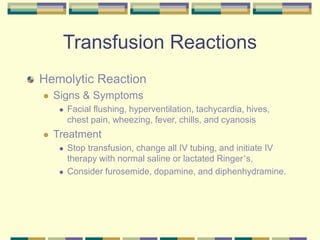
Transfusion Reactions
Hemolytic Reaction
 Signs & Symptoms
 Facial flushing, hyperventilation, tachycardia, hives,
chest pain, wheezing, fever, chills, and cyanosis
 Treatment
 Stop transfusion, change all IV tubing, and initiate IV
therapy with normal saline or lactated Ringer’s.
 Consider furosemide, dopamine, and diphenhydramine.
Transfusion Reactions
Febrile Non-hemolytic Reactions
 Signs & Symptoms
 Headache, fever, and chills
 Treatment
 Stop transfusion, change all IV tubing, and
initiate IV therapy with normal saline or lactated
Ringer’s.
 Consider Diphenhydramine and an antipyretic.
 Observe closely to ensure reaction is non-
hemolytic.
Hematology subject introduction lecutr.ppt

Hematology subject introduction lecutr.ppt

  • 1.
  • 2.
    Hematology Cellular Components Components ofBlood  Red Blood Cells  White Blood Cells  Inflammatory process  Coagulation Blood Typing Clotting disorders
  • 3.
  • 4.
    Hematopoeisis Three developmental periods Mesoblastic  Blood islands of yolk sac  Primarily RBC production  Embryonic hemoglobin produced  Hepatic  At 6 weeks cell production in liver  Fetal hemoglobin produced  Spleen, thymus, lymph nodes also active prod.  Myeloid  At 5th month Bone Marrow becomes site of prod.  Liver & spleen now Extramedullary  Hemoglobin A (22)
  • 5.
  • 6.
    Stem Cell theory Pluripotent stem cell originator of all cells  Gives rise to cells committed to specific development  Research supporting the theory  PHSC has self-maintaining ability  Committed cells differentiate continuously/ No Reverse Flow
  • 7.
    Stem cells inResearch Pluripotent cells derived from:  Cell mass of embryos at blastocyst stage (IVF)  Fetal tissue from terminated pregnancy Application  Identification of factors of cellular decision-making  Development and testing of drugs  Generation of cells and tissue for therapy
  • 10.
    Cytokines & GrowthFactors  Cytokines stimulate or inhibit  Prevent apoptosis  Colony-Stimulating Factors produced by many different cells  Interleukins numbered according to discovery
  • 11.
    Components of Blood Plasma Transport mechanism  90-92% water.  6-7% proteins  2-3%  Fats  Carbohydrates (glucose)  Electrolytes  Gases (O2, CO2)  Chemical messengers Plasma Components Other 3% Protein 7% Water 90%
  • 12.
    Cellular Components Pluripotent StemCell Myeloid Multipotent Stem Cells Common Lymphoid Stem Cells Unipotent Progenitors Basophils Eosinophils Neutrophils Monocytes Lymphocytes Erythrocytes Thrombocytes Erythropoietin WBC’s RBC’s Platelets
  • 13.
    Components of Blood RedBlood Cells  Erythrocyte  Hemoglobin – O2 bearing molecule  Comprised of 4 subunits: • Globin (binds to 1 O2 molecule) • Heme (iron)  100% saturation = 4 globin subunits carrying O2 • Each gram of hemoglobin = 1.34 ml O2 Cellsalive.com
  • 14.
    Blood Products andBlood Typing Blood Types  Antigens  A, B, AB, O  Rh factor  Rh+ = ~85%  Rh- = ~15% Blood transfusion
  • 15.
    Components of Blood RedBlood Cells (cont.)  Oxygen Transport  Oxy-hemoglobin dissociation curve  2,3-DPG
  • 16.
    Components of Blood WhiteBlood Cells (Leukocytes)  Margination  Phagocytosis The macrophage is using its internal cytoskeleton to envelop cells of the fungus Candida albicans.
  • 17.
    Components of Blood Leukocytes(cont.)  White Blood Cell Count  Leukopoiesis  Granulocytes  Neutrophil  Basophil  Eosinophil  Monocytes  Lymphocytes Human Neutrophil: Phagocytosis of Strep pyogenes
  • 18.
    Components of Blood Leukocytes(cont.)  Immunity  Subpopulation of lymphocytes known as T cells and B cells  T cells develop cellular immunity.  B cells produce humoral immunity
  • 19.
    Components of Blood InflammatoryProcess  MAST CELLS.  Immunoglobulin E antibody IgE,  Antigens  Antigens stick to the mast cell IgE antibodies, causing granules in the mast cell to fire their contents into the surrounding tissue.  This releases a host of inflammatory materials - leukotrienes, tumor necrosis factor, interleukin-4 and other cytokines that turn on other inflammatory cells.  These materials cause fluid to leak from the capillaries and white cells including neutrophils, T cells and eosinophils to leave the circulation. The end result is a "local inflammatory response", a red, itchy welt. Cellsalive.com
  • 20.
    Components of Blood Hemostasis- 3mechanisms  Vascular spasm  Contraction of tunica media  Platelet plug  Platelet aggregation  Coagulation  Formation of fibrin clot
  • 21.
    Components of Blood Hemostasis(cont.)  Fibrinolysis  Lysis of clot (plasmin)  Thrombosis  Thrombolytics  Medications affecting clot formation  Alter the enzyme on the platelet.  Affect the coagulation cascade.  Enhance clotting.
  • 22.
  • 23.
    This scanning electronmicrograph shows the fine structure of a blood clot. Platelets released from the circulation and exposed to the air use fibrinogen from the blood plasma to spin a mesh of fibrin.
  • 24.
    General Assessment - Management FocusedHistory and Physical Exam  SAMPLE history  Hematological disorders are rarely the chief complaint.  Physical exam  Evaluate nervous system function.  Skin signs
  • 25.
    General Assessment -Management Physical Exam (cont.)  Lymphatic signs  Gastrointestinal signs  Epistaxis  Atraumatic bleeding gums  Thrush  Atraumatic splenic/hepatic pain  Musculoskeletal signs  Arthralgia (rheumatoid arthritis)  Hemarthrosis  Cardiorespiratory signs  Tachycardia, cx pn, dyspnea - CHF  Genitourinary signs  Hematuria  Menorrhagia  Infection
  • 26.
    Blood Products andBlood Typing Blood Typing - ABO Blood type Antigen present on erythrocyte Antibody present in serum O AB B A None A and B B A Anti-A, Anti-B None Anti-A Anti-B
  • 27.
    Blood Products andBlood Typing Compatibility Among ABO Blood Groups Reaction with serum of Recipient Donor Cells AB B A O AB B A O - - - - + - + - + + - - + + + - -= no reaction + = reaction
  • 28.
    Blood Products andBlood Typing Brady; Paramedic Care Principles and Practice
  • 29.
    Diseases of Erythrocytes Anemias Anemia is a sign, not a separate disease process.  Signs and symptoms may not be present until the body is stressed.  Differentiate chronic anemia from acute episode.  Treat signs and symptoms.  Maximize oxygenation and limit blood loss.  Establish IV therapy if indicated.
  • 30.
    Diseases of Erythrocytes Brady;Paramedic Care Principles and Practice
  • 31.
    Diseases of Erythrocytes SickleCell Disease  Normal red cells maintain their shape as they pass through the capillaries and release oxygen to the peripheral tissues (upper panel). Hemoglobin polymers form in the sickle rell cells with oxygen release, causing them to deform. The deformed cells block the flow of cells and interrupt the delivery of oxygen to the tissues (lower panel).
  • 32.
    Diseases of Erythrocytes SickleCell Disease (cont.)  Sickle cell crises  Vaso-occlusive  Musculoskeletal/abdominal pain  Priapism  Renal/cerebral infarctions  Hematological  Lowered hemoglobin  Splenic sequestration  Infectious  Management  Follow general treatment guidelines prn.  Consider analgesics.
  • 33.
    Diseases of Erythrocytes Polycythemia Overproduction of erythrocytes.  Occurs in patients > 50 years old or with secondary dehydration.  Most deaths due to thrombosis  Results in bleeding abnormalities:  Epistaxis, spontaneous bruising, GI bleeding.  Management:  Follow general treatment guidelines.
  • 34.
    Diseases of Leukocytes Leukopenia/Neutropenia Too few white blood cells or neutrophils.  Follow general treatment guidelines and provide supportive care. Leukocytosis  An increase in the number of circulating white blood cells, often due to infection.  Leukemoid reaction
  • 35.
    Diseases of Leukocytes Leukemia Cancer of hematopoietic cells  Initial presentation  Acutely ill, fatigued, febrile and weak, anemic.  Thrombocytopenia  Often have a secondary infection.  Management  Follow general treatment guidelines.  Utilize isolation techniques to limit risk of infection.
  • 36.
    Diseases of Leukocytes Lymphomas Cancers of the lymphatic system  Hodgkin's  Non-Hodgkins  Presentation  Swelling of the lymph nodes  Fever, night sweats, anorexia, weight loss, fatigue, and pruritis  Management  Follow general treatment guidelines.  Utilize isolation techniques to limit risk of infection.
  • 37.
    Clotting Disorders Thrombocytosis andThrombocytopenia  Thrombocytosis  An abnormal increase in the number of platelets  Thrombocytopenia  An abnormal decrease in the number of platelets  Sequestration  Destruction (ITP)  Decreased production  Management  Provide supportive care and follow general treatment guidelines.
  • 38.
    Clotting Disorders Hemophilia  Deficiencyor absence of a blood clotting factor  Deficiency of factor VIII causes hemophilia A.  Deficiency of factor IX causes hemophilia B.  Deficiency is a sex-linked, inherited disorder.  Defective gene is carried on the X chromosome.  Signs & Symptoms  Numerous bruises, deep muscle bleeding, and joint bleeding.
  • 39.
    Clotting Disorders Hemophilia (cont.) Management  Treat the patient similarly to others.  Administer supplemental oxygen.  Establish IV access.  Be alert for recurrent or prolonged bleeding, and prevent additional trauma. Von Willebrand’s Disease  Deficient component of factor VIII  Generally results in excessive bleeding.  Generally is not serious; provide supportive care.
  • 40.
  • 41.
    Components of Blood Leukocytes(cont.)  Autoimmune disease  May be specific or general  Alterations in the immune process  Immunosuppression  HIV  Anti-rejection medication  Chemotherapy/Cancer  System activation of coagulation cascade.
  • 42.
    Anticoagulants/Antiplatelets Classifying agents  Anticoagulants Block synthesis and activation of clotting factors  Antiplatelets  Interfere with platelet aggregation or activation  Fibrinolytics  Dissolve fibrin component of thrombi
  • 43.
    Anticoagulants/Antiplatelets Anticoagulants  Warfarin  Blocksactivation of Vit K  Interferes w/ coagulation factors II, VII, IX, and X  Unfractionated Heparin  Binds antithrombin III (AT-III)  Inhibits coagulation factors IX and X and thrombin  Hirudin (medicinal leech)  Prevents thrombin binding
  • 44.
    Anticoagulants/Antiplatelets Antiplatelets  Aspirin  Preventsplatelet activation through cyclooxygenase blockade.  Prevents production of thromboxane A2  Allows prostacyclin synthesis  Ticlodipine  Deforms platelet membrane fibrinogen receptor
  • 45.
    Anticoagulants/Antiplatelets Antiplatelets (cont.)  GlycoproteinIIb-IIIa Receptor Inhibitors  G IIb-IIIa = platelet membrane receptor of fibrinogen  Abciximab  Eptifibatide  Tirofiban Fibrinolytics  Activate plasminogen to plasmin = fibrinolysis  Streptokinase  Anistreplase  Tissue Plasminogen Activator  Reteplase  Urokinase
  • 46.
    Hemorrhage Class I ClassII Class III Class IV Blood Loss (ml) Up to 750 750-1500 1500-2000 >2000 Blood Loss (% volume) Up to 15% 15%-30% 30%-40% >40% Pulse <100 >100 >120 >140 BP Normal Normal Decreased Decreased Pulse Pressure Normal or increased Decreased Decreased Decreased Resp. Rate 14-20 20-30 30-40 >35 Urine Output (ml/hr) >30 20-30 5-15 Negligible Mental Status Slightly anxious Mildly anxious Anxious, confused Confused, lethargic Fluid Replacement (3:1) rule Crystalloid Crystalloid Crystalloid and blood Crystalloid and blood
  • 47.
    Transfusion Reactions Hemolytic Reaction Signs & Symptoms  Facial flushing, hyperventilation, tachycardia, hives, chest pain, wheezing, fever, chills, and cyanosis  Treatment  Stop transfusion, change all IV tubing, and initiate IV therapy with normal saline or lactated Ringer’s.  Consider furosemide, dopamine, and diphenhydramine.
  • 48.
    Transfusion Reactions Febrile Non-hemolyticReactions  Signs & Symptoms  Headache, fever, and chills  Treatment  Stop transfusion, change all IV tubing, and initiate IV therapy with normal saline or lactated Ringer’s.  Consider Diphenhydramine and an antipyretic.  Observe closely to ensure reaction is non- hemolytic.