HELSINKI DECLARATION ON
PATIENT SAFETY IN ANAESTHESIOLOGY
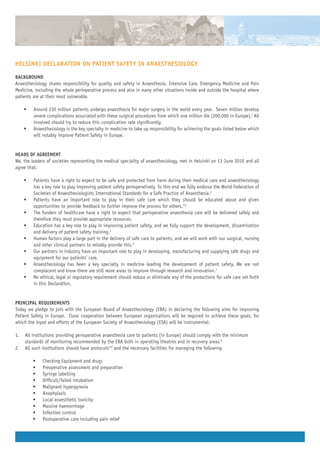
Helsinki Declaration on Patient safety in anaestHesiology

BackgroUnD
Anaesthesiology shares responsibility for quality and safety in Anaesthesia, Intensive Care, Emergency Medicine and Pain
Medicine, including the whole perioperative process and also in many other situations inside and outside the hospital where
patients are at their most vulnerable.

     •   Around 230 million patients undergo anaesthesia for major surgery in the world every year. Seven million develop
         severe complications associated with these surgical procedures from which one million die (200,000 in Europe).1 All
         involved should try to reduce this complication rate significantly.
     •   Anaesthesiology is the key specialty in medicine to take up responsibility for achieving the goals listed below which
         will notably improve Patient Safety in Europe.


HeaDs of agreeMent
We, the leaders of societies representing the medical speciality of anaesthesiology, met in Helsinki on 13 June 2010 and all
agree that:

     •   Patients have a right to expect to be safe and protected from harm during their medical care and anaesthesiology
         has a key role to play improving patient safety perioperatively. To this end we fully endorse the World Federation of
         Societies of Anaesthesiologists International Standards for a Safe Practice of Anaesthesia.2
     •   Patients have an important role to play in their safe care which they should be educated about and given
         opportunities to provide feedback to further improve the process for others.3;4
     •   The funders of healthcare have a right to expect that perioperative anaesthesia care will be delivered safely and
         therefore they must provide appropriate resources.
     •   Education has a key role to play in improving patient safety, and we fully support the development, dissemination
         and delivery of patient safety training.5
     •   Human factors play a large part in the delivery of safe care to patients, and we will work with our surgical, nursing
         and other clinical partners to reliably provide this.6
     •   Our partners in industry have an important role to play in developing, manufacturing and supplying safe drugs and
         equipment for our patients’ care.
     •   Anaesthesiology has been a key specialty in medicine leading the development of patient safety. We are not
         complacent and know there are still more areas to improve through research and innovation.7
     •   No ethical, legal or regulatory requirement should reduce or eliminate any of the protections for safe care set forth
         in this Declaration.


PrinciPal reQUireMents
Today we pledge to join with the European Board of Anaesthesiology (EBA) in declaring the following aims for improving
Patient Safety in Europe. Close cooperation between European organisations will be required to achieve these goals, for
which the input and efforts of the European Society of Anaesthesiology (ESA) will be instrumental:

1.   All institutions providing perioperative anaesthesia care to patients (in Europe) should comply with the minimum
     standards of monitoring recommended by the EBA both in operating theatres and in recovery areas.8
2.   All such institutions should have protocols2;9 and the necessary facilities for managing the following

         •   Checking Equipment and drugs
         •   Preoperative assessment and preparation
         •   Syringe labelling
         •   Difficult/failed intubation
         •   Malignant hyperpyrexia
         •   Anaphylaxis
         •   Local anaesthetic toxicity
         •   Massive haemorrhage
         •   Infection control
         •   Postoperative care including pain relief
3.   All institutions providing sedation to patients must comply with anaesthesiology recognised sedation standards for safe practice.10-14
4.   All institutions should support the WHO Safe Surgery Saves Lives initiative and Checklist.15
5.   All departments of anaesthesiology in Europe must be able to produce an annual report of measures taken and results obtained in improving
     patient safety locally.
6.   All institutions providing anaesthesiological care to patients must collect the required data to be able to produce an annual report on patient
     morbidity and mortality.
7.   All institutions providing anaesthesiological care to patients must contribute to the recognised national or other major audits of safe practice
     and critical incident reporting systems.16-18 Resources must be provided to achieve this.


conclUsion
   • This declaration emphasises the key role of anaesthesiology in promoting safe perioperative care.


continUity
   • We invite anyone involved in healthcare to join us and sign up to this declaration.
   • We will reconvene to annually review our progress to implement this declaration.


DUring tHe eUroanaestHesia 2010 oPening cereMony, satUrDay 12 JUne 2010, tHe Helsinki Declaration
Will Be signeD By:

Dr. Jannicke Mellin-Olsen,
President, European Board of Anaesthesiology/UEMS

Prof. Paolo Pelosi,
President, European Society of Anaesthesiology

Prof. Hugo Van Aken,
Chairperson, National Anaesthesia Societies Committee on behalf of the ESA Member Societies


tHe Helsinki Declaration on Patient safety in anaestHesiology Has Been aPProVeD By:


european Board of anaesthesiology officers                                                      esa Board of Directors
President: Dr. Jannicke Mellin-Olsen (NO)                                                       President: Prof. Paolo Pelosi (IT)
Secretary/Treasurer: Dr. Ellen O’Sullivan (IE)                                                  Past-President: Prof. Johannes Knape (NL)
Vice-President: Prof. Seppo Alahuhta (FI)                                                       Secretary: Prof. Andreas Hoeft (DE)
Past-President: Prof. Johannes Knape (NL)                                                       Treasurer: Dr. Maurizio Solca (IT)
                                                                                                Non-Officer: Prof. Daniela Filipescu (RO)
                                                                                                Non-Officer: Prof. Charles-Marc Samama (FR)
                                                                                                Non-Officer: Prof. Robert Sneyd (UK)
                                                                                                NASC Chairperson: Prof. Hugo Van Aken (DE)
european Board of anaesthesiology Members                            esa scientific Programme committee (sPc)representatives
Austria:                                Prof. Robert Fitzgerald      Dr. Sven Staender (CH) & SPC-SC17
                                       Prof. Karin Khünl-Brady       Prof. Ravi Mahajan (UK)
Belgium:                                Prof. Luc Van Obbergh        Prof. Peter Kranke (DE)
                                                Dr. Rene Heylen
Bulgaria:                                      Prof. Ivan Smilov
Croatia:                                       Prof. Alan Šustić
                                                                     esa guidelines committee
Cyprus:                                          Dr. Carmel Abel
                                        Dr. Christos Demetriou       Prof. Andrew Smith (UK)
Czech Republic:                          Prof. Karel Cvachovec
Denmark:                                       Dr. Grethe Astrup     reference list
                                                   Dr. Dorte Keld
Estonia:                                 Dr. Jurate Samarütel        1.    Weiser TG, Regenbogen SE, Thompson KD, Haynes AB,
                                                                           Lipsitz SR, Berry WR, Gawande AA: An estimation of the global volume
France:                                      Prof. Benoit Vallet           of surgery: a modelling strategy based on available data. Lancet 2008;
Germany:                                  Prof. Hugo Van Aken              372: 139-44
                                    Prof. Thomas Hachenberg          2.    World Federation of Societies of Anaesthesiologists. 2008
Greece:                                   Prof. Anna Malissova             International Standards for a Safe Practice of Anaesthesia. http://
                                                                           anaesthesiologists.org/en/guidelines/safety-and-quality-of-practice-
Hungary:                                  Prof. Maria Janecskó
                                                                           guidelines.html World Federation of Societies of Anaesthesiologists.
                                            Prof. László Vimláti           Last accessed 8-4-2010.
Ireland:                                     Dr. Sean Mc Devitt      3.    Peat M, Entwistle V, Hall J, Birks Y, Golder S: Scoping review and
Israel:                                           Dr. Zeev Goldik          approach to appraisal of interventions intended to involve patients in
Italy:                              Prof. Edoardo De Robertis              patient safety. J.Health Serv.Res.
                                                                           Policy 2010; 15 Suppl 1: 17-25
                                             Prof. Flavia Petrini    4.    Davis RE, Jacklin R, Sevdalis N, Vincent CA: Patient involvement
                                             Dr. Raffaella Pagni           in patient safety: what factors influence patient participation and
Latvia:                                Prof. Antonina Sondore              engagement?
                                              Dr. Pēteris Tomiņš           Health Expect. 2007; 10: 259-67
                                                                     5.    Staender SE: Patient safety in anesthesia. Minerva Anestesiol.
Lithuania:                           Prof. Juozas Ivaškevičius
                                                                           2010; 76: 45-50
                                         Prof. Jurate Sipylaite      6.    Reason J: Human Error. Cambridge, Cambridge University Press, 1990,
Macedonia:                                    Prof. M. Soljakova     7.    Gaba DM: Anaesthesiology as a model for patient safety in health
Malta:                                           Dr. Mario Zerafa          care. BMJ 2000; 320: 785-8
                                                Dr. Carmel Abela     8.    Mellin-Olsen J, O’Sullivan E, Balogh D, Drobnik L, Knape JT, Petrini F,
                                                                           Vimlati L: Guidelines for safety and quality in anaesthesia practice in
Netherlands:                                        Dr. Hans Pöll          the European Union. Eur.J.Anaesthesiol. 2007; 24: 479-82
                                               Dr. Marco Marcus      9.    Vimlati L, Gilsanz F, Goldik Z: Quality and safety guidelines of
Norway:                                    Dr. Gutorm Brattebø             postanaesthesia care: Working Party on Post Anaesthesia Care
Poland:                                      Prof. Leon Drobnik            (approved by the European Board and Section of Anaesthesiology,
                                                                           Union Europeenne des Medecins Specialistes). Eur.J.Anaesthesiol.
                                           Prof. Andrzej Kubler
                                                                           2009; 26: 715-21
Portugal:                         Prof. Francisco Lucas Matos        10.   Practice guidelines for sedation and analgesia by
                                           Prof. Joaquim Viana             non-anesthesiologists. Anesthesiology 2002; 96: 1004-17
                                           Prof. Nuno Meideros       11.   Gisvold SE, Raeder J, Jyssum T, Andersen L, Arnesen C,
Romania:                                 Prof. Iurie Acalovschi            Kvale L, Mellin OJ: Guidelines for the practice of anesthesia in Norway.
                                                                           Acta Anaesthesiol.Scand. 2002; 46: 942-6
Russia:                                Prof. Igor V. Molchanov       12.   Recommendations for anesthesia and sedation in nonoperating room
Serbia:                                 Prof. Radmila R. Kolak             locations.
Slovakia:                                    Dr. Štefan Trenkler           Minerva Anestesiol. 2005; 71: 11-20
                                               Dr. Jozef Firment     13.   Cote CJ, Wilson S: Guidelines for monitoring and management of
                                                                           pediatric patients during and after sedation for diagnostic and
                                          Dr. Monika Paulíková
                                                                           therapeutic procedures: an update. Paediatr.Anaesth. 2008; 18: 9-10
                                            Prof. Matúš Paulíny      14.   Knape JT: The impact of the european guidelines for sedation by
Slovenia:                             Prof. Vesna Paver-Erzen              non-anaesthesiologists for gastroenterology practice. J.Gastrointestin.
                                 Prof. Vesna Novak-Jankovic                Liver Dis. 2007; 16: 429-30
Spain:                                 Prof. Fernando Gilsanz        15.   Haynes AB, Weiser TG, Berry WR, Lipsitz SR, Breizat AH, Dellinger
                                                                           EP, Herbosa T, Joseph S, Kibatala PL, Lapitan MC, Merry AF, Moorthy
                                           Prof. Margarita Puig            K, Reznick RK, Taylor B, Gawande AA: A surgical safety checklist to
Sweden:                             Dr. Lennart Christiansson              reduce morbidity and mortality in a global population. N.Engl.J.Med.
                                               Dr. Jonas Åkeson            2009; 360: 491-9
Switzerland:                               Prof. Albert Urwyler      16.   Critical Incident Reporting and Reacting Network - CIRRNET. http://
                                                                           www.cirrnet.ch/ Swiss Foundation for Patient Safety. Last accessed
                                      Dr. Elisabeth van Gessel
                                                                           8-4-2010.
Turkey:                                        Prof. Zuhal Aykaç     17.   National Reporting and Learning Service.
United Kingdom:                           Dr. Peter Nightingale            http://www.nrls.npsa.nhs.uk/report-a-patient-safety-incident/
                                             Dr. David Whitaker            National Health Service (NHS). Last accessed 8-4-2010.
                                                                     18.   National Confidential Enquiry into Patient Outcome and Death. http://
                                                                           www.ncepod.org.uk/ .Last accessed 8-4-2010.
UEMS Executive:            Dr. Bernard Maillet (Secretary General)
                                                                     the Helsinki Declaration on Patient safety in anaesthesiology will
                                                                     be published in the european Journal of anaesthesiology 2010; 27:
                                                                     in press.
European Board and Section of Anaesthesiology
    European Union of Medical Specialists

             www.eba-uems.eu


    www.euroanaesthesia.org

HELSINKI DECLARATION ON PATIENT SAFETY IN ANAESTHESIOLOGY

  • 1.
    HELSINKI DECLARATION ON PATIENTSAFETY IN ANAESTHESIOLOGY
  • 2.
    Helsinki Declaration onPatient safety in anaestHesiology BackgroUnD Anaesthesiology shares responsibility for quality and safety in Anaesthesia, Intensive Care, Emergency Medicine and Pain Medicine, including the whole perioperative process and also in many other situations inside and outside the hospital where patients are at their most vulnerable. • Around 230 million patients undergo anaesthesia for major surgery in the world every year. Seven million develop severe complications associated with these surgical procedures from which one million die (200,000 in Europe).1 All involved should try to reduce this complication rate significantly. • Anaesthesiology is the key specialty in medicine to take up responsibility for achieving the goals listed below which will notably improve Patient Safety in Europe. HeaDs of agreeMent We, the leaders of societies representing the medical speciality of anaesthesiology, met in Helsinki on 13 June 2010 and all agree that: • Patients have a right to expect to be safe and protected from harm during their medical care and anaesthesiology has a key role to play improving patient safety perioperatively. To this end we fully endorse the World Federation of Societies of Anaesthesiologists International Standards for a Safe Practice of Anaesthesia.2 • Patients have an important role to play in their safe care which they should be educated about and given opportunities to provide feedback to further improve the process for others.3;4 • The funders of healthcare have a right to expect that perioperative anaesthesia care will be delivered safely and therefore they must provide appropriate resources. • Education has a key role to play in improving patient safety, and we fully support the development, dissemination and delivery of patient safety training.5 • Human factors play a large part in the delivery of safe care to patients, and we will work with our surgical, nursing and other clinical partners to reliably provide this.6 • Our partners in industry have an important role to play in developing, manufacturing and supplying safe drugs and equipment for our patients’ care. • Anaesthesiology has been a key specialty in medicine leading the development of patient safety. We are not complacent and know there are still more areas to improve through research and innovation.7 • No ethical, legal or regulatory requirement should reduce or eliminate any of the protections for safe care set forth in this Declaration. PrinciPal reQUireMents Today we pledge to join with the European Board of Anaesthesiology (EBA) in declaring the following aims for improving Patient Safety in Europe. Close cooperation between European organisations will be required to achieve these goals, for which the input and efforts of the European Society of Anaesthesiology (ESA) will be instrumental: 1. All institutions providing perioperative anaesthesia care to patients (in Europe) should comply with the minimum standards of monitoring recommended by the EBA both in operating theatres and in recovery areas.8 2. All such institutions should have protocols2;9 and the necessary facilities for managing the following • Checking Equipment and drugs • Preoperative assessment and preparation • Syringe labelling • Difficult/failed intubation • Malignant hyperpyrexia • Anaphylaxis • Local anaesthetic toxicity • Massive haemorrhage • Infection control • Postoperative care including pain relief
  • 3.
    3. All institutions providing sedation to patients must comply with anaesthesiology recognised sedation standards for safe practice.10-14 4. All institutions should support the WHO Safe Surgery Saves Lives initiative and Checklist.15 5. All departments of anaesthesiology in Europe must be able to produce an annual report of measures taken and results obtained in improving patient safety locally. 6. All institutions providing anaesthesiological care to patients must collect the required data to be able to produce an annual report on patient morbidity and mortality. 7. All institutions providing anaesthesiological care to patients must contribute to the recognised national or other major audits of safe practice and critical incident reporting systems.16-18 Resources must be provided to achieve this. conclUsion • This declaration emphasises the key role of anaesthesiology in promoting safe perioperative care. continUity • We invite anyone involved in healthcare to join us and sign up to this declaration. • We will reconvene to annually review our progress to implement this declaration. DUring tHe eUroanaestHesia 2010 oPening cereMony, satUrDay 12 JUne 2010, tHe Helsinki Declaration Will Be signeD By: Dr. Jannicke Mellin-Olsen, President, European Board of Anaesthesiology/UEMS Prof. Paolo Pelosi, President, European Society of Anaesthesiology Prof. Hugo Van Aken, Chairperson, National Anaesthesia Societies Committee on behalf of the ESA Member Societies tHe Helsinki Declaration on Patient safety in anaestHesiology Has Been aPProVeD By: european Board of anaesthesiology officers esa Board of Directors President: Dr. Jannicke Mellin-Olsen (NO) President: Prof. Paolo Pelosi (IT) Secretary/Treasurer: Dr. Ellen O’Sullivan (IE) Past-President: Prof. Johannes Knape (NL) Vice-President: Prof. Seppo Alahuhta (FI) Secretary: Prof. Andreas Hoeft (DE) Past-President: Prof. Johannes Knape (NL) Treasurer: Dr. Maurizio Solca (IT) Non-Officer: Prof. Daniela Filipescu (RO) Non-Officer: Prof. Charles-Marc Samama (FR) Non-Officer: Prof. Robert Sneyd (UK) NASC Chairperson: Prof. Hugo Van Aken (DE)
  • 4.
    european Board ofanaesthesiology Members esa scientific Programme committee (sPc)representatives Austria: Prof. Robert Fitzgerald Dr. Sven Staender (CH) & SPC-SC17 Prof. Karin Khünl-Brady Prof. Ravi Mahajan (UK) Belgium: Prof. Luc Van Obbergh Prof. Peter Kranke (DE) Dr. Rene Heylen Bulgaria: Prof. Ivan Smilov Croatia: Prof. Alan Šustić esa guidelines committee Cyprus: Dr. Carmel Abel Dr. Christos Demetriou Prof. Andrew Smith (UK) Czech Republic: Prof. Karel Cvachovec Denmark: Dr. Grethe Astrup reference list Dr. Dorte Keld Estonia: Dr. Jurate Samarütel 1. Weiser TG, Regenbogen SE, Thompson KD, Haynes AB, Lipsitz SR, Berry WR, Gawande AA: An estimation of the global volume France: Prof. Benoit Vallet of surgery: a modelling strategy based on available data. Lancet 2008; Germany: Prof. Hugo Van Aken 372: 139-44 Prof. Thomas Hachenberg 2. World Federation of Societies of Anaesthesiologists. 2008 Greece: Prof. Anna Malissova International Standards for a Safe Practice of Anaesthesia. http:// anaesthesiologists.org/en/guidelines/safety-and-quality-of-practice- Hungary: Prof. Maria Janecskó guidelines.html World Federation of Societies of Anaesthesiologists. Prof. László Vimláti Last accessed 8-4-2010. Ireland: Dr. Sean Mc Devitt 3. Peat M, Entwistle V, Hall J, Birks Y, Golder S: Scoping review and Israel: Dr. Zeev Goldik approach to appraisal of interventions intended to involve patients in Italy: Prof. Edoardo De Robertis patient safety. J.Health Serv.Res. Policy 2010; 15 Suppl 1: 17-25 Prof. Flavia Petrini 4. Davis RE, Jacklin R, Sevdalis N, Vincent CA: Patient involvement Dr. Raffaella Pagni in patient safety: what factors influence patient participation and Latvia: Prof. Antonina Sondore engagement? Dr. Pēteris Tomiņš Health Expect. 2007; 10: 259-67 5. Staender SE: Patient safety in anesthesia. Minerva Anestesiol. Lithuania: Prof. Juozas Ivaškevičius 2010; 76: 45-50 Prof. Jurate Sipylaite 6. Reason J: Human Error. Cambridge, Cambridge University Press, 1990, Macedonia: Prof. M. Soljakova 7. Gaba DM: Anaesthesiology as a model for patient safety in health Malta: Dr. Mario Zerafa care. BMJ 2000; 320: 785-8 Dr. Carmel Abela 8. Mellin-Olsen J, O’Sullivan E, Balogh D, Drobnik L, Knape JT, Petrini F, Vimlati L: Guidelines for safety and quality in anaesthesia practice in Netherlands: Dr. Hans Pöll the European Union. Eur.J.Anaesthesiol. 2007; 24: 479-82 Dr. Marco Marcus 9. Vimlati L, Gilsanz F, Goldik Z: Quality and safety guidelines of Norway: Dr. Gutorm Brattebø postanaesthesia care: Working Party on Post Anaesthesia Care Poland: Prof. Leon Drobnik (approved by the European Board and Section of Anaesthesiology, Union Europeenne des Medecins Specialistes). Eur.J.Anaesthesiol. Prof. Andrzej Kubler 2009; 26: 715-21 Portugal: Prof. Francisco Lucas Matos 10. Practice guidelines for sedation and analgesia by Prof. Joaquim Viana non-anesthesiologists. Anesthesiology 2002; 96: 1004-17 Prof. Nuno Meideros 11. Gisvold SE, Raeder J, Jyssum T, Andersen L, Arnesen C, Romania: Prof. Iurie Acalovschi Kvale L, Mellin OJ: Guidelines for the practice of anesthesia in Norway. Acta Anaesthesiol.Scand. 2002; 46: 942-6 Russia: Prof. Igor V. Molchanov 12. Recommendations for anesthesia and sedation in nonoperating room Serbia: Prof. Radmila R. Kolak locations. Slovakia: Dr. Štefan Trenkler Minerva Anestesiol. 2005; 71: 11-20 Dr. Jozef Firment 13. Cote CJ, Wilson S: Guidelines for monitoring and management of pediatric patients during and after sedation for diagnostic and Dr. Monika Paulíková therapeutic procedures: an update. Paediatr.Anaesth. 2008; 18: 9-10 Prof. Matúš Paulíny 14. Knape JT: The impact of the european guidelines for sedation by Slovenia: Prof. Vesna Paver-Erzen non-anaesthesiologists for gastroenterology practice. J.Gastrointestin. Prof. Vesna Novak-Jankovic Liver Dis. 2007; 16: 429-30 Spain: Prof. Fernando Gilsanz 15. Haynes AB, Weiser TG, Berry WR, Lipsitz SR, Breizat AH, Dellinger EP, Herbosa T, Joseph S, Kibatala PL, Lapitan MC, Merry AF, Moorthy Prof. Margarita Puig K, Reznick RK, Taylor B, Gawande AA: A surgical safety checklist to Sweden: Dr. Lennart Christiansson reduce morbidity and mortality in a global population. N.Engl.J.Med. Dr. Jonas Åkeson 2009; 360: 491-9 Switzerland: Prof. Albert Urwyler 16. Critical Incident Reporting and Reacting Network - CIRRNET. http:// www.cirrnet.ch/ Swiss Foundation for Patient Safety. Last accessed Dr. Elisabeth van Gessel 8-4-2010. Turkey: Prof. Zuhal Aykaç 17. National Reporting and Learning Service. United Kingdom: Dr. Peter Nightingale http://www.nrls.npsa.nhs.uk/report-a-patient-safety-incident/ Dr. David Whitaker National Health Service (NHS). Last accessed 8-4-2010. 18. National Confidential Enquiry into Patient Outcome and Death. http:// www.ncepod.org.uk/ .Last accessed 8-4-2010. UEMS Executive: Dr. Bernard Maillet (Secretary General) the Helsinki Declaration on Patient safety in anaesthesiology will be published in the european Journal of anaesthesiology 2010; 27: in press.
  • 5.
    European Board andSection of Anaesthesiology European Union of Medical Specialists www.eba-uems.eu www.euroanaesthesia.org