Heat Transfer in
Aerospace Applications
“Técnicas computacionales en aeronáutica” Class 2018
Jocelyn Crespo Camacho
Josué Jesús Díaz Beltrán
Irving Mitchell Estrada Garibaldi
Andrés Antonio Vales Ramírez
October 2018
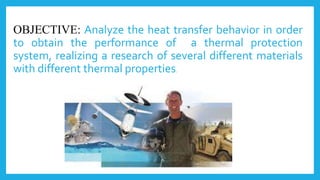
OBJECTIVE: Analyze the heat transfer behavior in order
to obtain the performance of a thermal protection
system, realizing a research of several different materials
with different thermal properties.
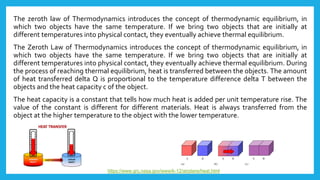
The zeroth law of Thermodynamics introduces the concept of thermodynamic equilibrium, in
which two objects have the same temperature. If we bring two objects that are initially at
different temperatures into physical contact, they eventually achieve thermal equilibrium.
The Zeroth Law of Thermodynamics introduces the concept of thermodynamic equilibrium, in
which two objects have the same temperature. If we bring two objects that are initially at
different temperatures into physical contact, they eventually achieve thermal equilibrium. During
the process of reaching thermal equilibrium, heat is transferred between the objects. The amount
of heat transferred delta Q is proportional to the temperature difference delta T between the
objects and the heat capacity c of the object.
The heat capacity is a constant that tells how much heat is added per unit temperature rise. The
value of the constant is different for different materials. Heat is always transferred from the
object at the higher temperature to the object with the lower temperature.
https://www.grc.nasa.gov/www/k-12/airplane/heat.html
PROBLEM DESCRIPTION
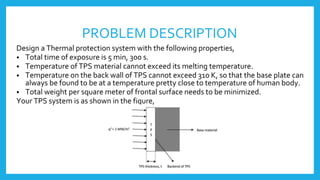
Design a Thermal protection system with the following properties,
• Total time of exposure is 5 min, 300 s.
• Temperature of TPS material cannot exceed its melting temperature.
• Temperature on the back wall of TPS cannot exceed 310 K, so that the base plate can
always be found to be at a temperature pretty close to temperature of human body.
• Total weight per square meter of frontal surface needs to be minimized.
Your TPS system is as shown in the figure,
MATERIAL
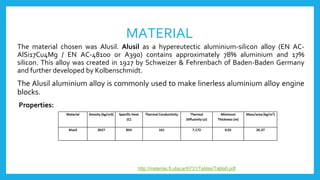
The material chosen was Alusil. Alusil as a hypereutectic aluminium-silicon alloy (EN AC-
AlSi17Cu4Mg / EN AC-48100 or A390) contains approximately 78% aluminium and 17%
silicon. This alloy was created in 1927 by Schweizer & Fehrenbach of Baden-Baden Germany
and further developed by Kolbenschmidt.
The Alusil aluminium alloy is commonly used to make linerless aluminium alloy engine
blocks.
Properties:
Material Density (kg/m3) Specific Heat
(C)
Thermal Conductivity Thermal
Diffusivity (𝛼)
Minimum
Thickness (m)
Mass/area (kg/m2)
Alusil 2627 854 161 7,172 0.01 26.27
http://materias.fi.uba.ar/6731/Tablas/Tabla5.pdf
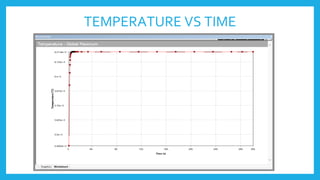
TEMPERATURE VS TIME
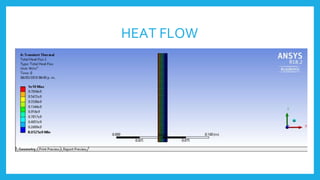
HEAT FLOW

HEAT TRANSFER AERONAUTICAL APPLICATIONS.pptx

  • 1.
    Heat Transfer in AerospaceApplications “Técnicas computacionales en aeronáutica” Class 2018 Jocelyn Crespo Camacho Josué Jesús Díaz Beltrán Irving Mitchell Estrada Garibaldi Andrés Antonio Vales Ramírez October 2018
  • 2.
    OBJECTIVE: Analyze theheat transfer behavior in order to obtain the performance of a thermal protection system, realizing a research of several different materials with different thermal properties.
  • 3.
    The zeroth lawof Thermodynamics introduces the concept of thermodynamic equilibrium, in which two objects have the same temperature. If we bring two objects that are initially at different temperatures into physical contact, they eventually achieve thermal equilibrium. The Zeroth Law of Thermodynamics introduces the concept of thermodynamic equilibrium, in which two objects have the same temperature. If we bring two objects that are initially at different temperatures into physical contact, they eventually achieve thermal equilibrium. During the process of reaching thermal equilibrium, heat is transferred between the objects. The amount of heat transferred delta Q is proportional to the temperature difference delta T between the objects and the heat capacity c of the object. The heat capacity is a constant that tells how much heat is added per unit temperature rise. The value of the constant is different for different materials. Heat is always transferred from the object at the higher temperature to the object with the lower temperature. https://www.grc.nasa.gov/www/k-12/airplane/heat.html
  • 4.
    PROBLEM DESCRIPTION Design aThermal protection system with the following properties, • Total time of exposure is 5 min, 300 s. • Temperature of TPS material cannot exceed its melting temperature. • Temperature on the back wall of TPS cannot exceed 310 K, so that the base plate can always be found to be at a temperature pretty close to temperature of human body. • Total weight per square meter of frontal surface needs to be minimized. Your TPS system is as shown in the figure,
  • 5.
    MATERIAL The material chosenwas Alusil. Alusil as a hypereutectic aluminium-silicon alloy (EN AC- AlSi17Cu4Mg / EN AC-48100 or A390) contains approximately 78% aluminium and 17% silicon. This alloy was created in 1927 by Schweizer & Fehrenbach of Baden-Baden Germany and further developed by Kolbenschmidt. The Alusil aluminium alloy is commonly used to make linerless aluminium alloy engine blocks. Properties: Material Density (kg/m3) Specific Heat (C) Thermal Conductivity Thermal Diffusivity (𝛼) Minimum Thickness (m) Mass/area (kg/m2) Alusil 2627 854 161 7,172 0.01 26.27 http://materias.fi.uba.ar/6731/Tablas/Tabla5.pdf
  • 6.
  • 7.