Cardiovascular system
School of Biomedical Engineering
Instructor: Trịnh Như Thùy, PhD
Email: tnthuy@hcmiu.edu.vn
BM091IU_Human Anatomy and Physiology
What does happen when you have extreme exercise?
The Cadiovascular System
• Cardiovascular system includes heart and blood vessels
Why is heart a symbol of love?
Understand and follow your heart
• Regular beating of the heart is achieved as a result of the inherent rhythmicity
of cardiac muscle; no nerves are located within the heart itself, and no
outside regulatory mechanisms are necessary to stimulate the muscle to
contract rhythmically.
• Factors that control the rise and fall of calcium concentrations in the cardiac
muscle cell have profound effects on cardiac function.
• The heart rate may be fast simply as a reaction to other processes going on in
the body. Ex: stress hormone or overproduction of thyroid hormone directly
increases heart rate through acting on receptors in the heart.
• Stimulants directly increase heart rate considered as a cause of fast heart rate
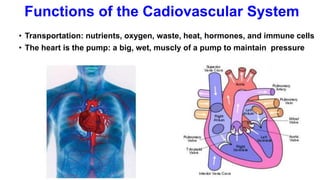
Functions of the Cadiovascular System
• Transportation: nutrients, oxygen, waste, heat, hormones, and immune cells
• The heart is the pump: a big, wet, muscly of a pump to maintain pressure
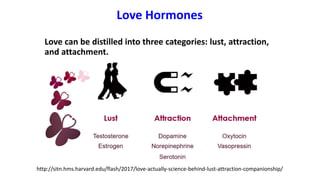
Love Hormones
Love can be distilled into three categories: lust, attraction,
and attachment.
http://sitn.hms.harvard.edu/flash/2017/love-actually-science-behind-lust-attraction-companionship/
Function of Cardiovascular system
• Heart ventricles, atria, and valves create a pump
• Maintain both high and low pressure
• Blood circulates from the heart to the body through your arteries
• Blood circulates from the body to the heart through your veins
• Systolic and diastolic blood pressure
• Pacemaker cells generate their own action potentials
• The electricity in the cardiac conduction pathway
The Heart (video)
https://www.youtube.com/watch?v=28CYhgjrBLA
1. What does the cardiovascular system
consist of?
2. How does the cardiovascular system
transport of gases?
3. How many layers does the heart wall
have?
4. Which serve to ensure one-way blood
flow through the heart?
5. How can the heart. Generate its own
electical stimulation?
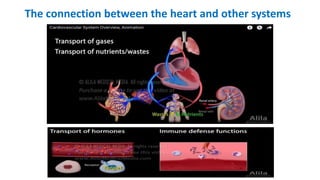
The connection between the heart and other systems
The Heart
• The heart weighs about 250 - 350 grams,
located nearly center of your chest and
mediastinum cavity between your lungs
• The heart is divided into four chambers
consisting of two atria and two ventricles; the
atria receive blood, while the ventricles pump
blood.
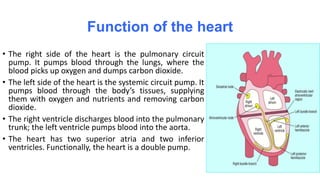
Function of the heart
• The right side of the heart is the pulmonary circuit
pump. It pumps blood through the lungs, where the
blood picks up oxygen and dumps carbon dioxide.
• The left side of the heart is the systemic circuit pump. It
pumps blood through the body’s tissues, supplying
them with oxygen and nutrients and removing carbon
dioxide.
• The right ventricle discharges blood into the pulmonary
trunk; the left ventricle pumps blood into the aorta.
• The heart has two superior atria and two inferior
ventricles. Functionally, the heart is a double pump.
Function of the heart
• Generating high hydrostatic pressure to pump blood out of the
heart, while also creating low pressure to bring it back in
• A measure of the amount of strain your arteries feel as your
heart moves your blood around (about 60 beats per minute)
• 100,000 beats a day, 35 million beats a year, 2 to 3 billion beats
in a lifetime. You can measure by checking your own pulse (bắt
mạch - đông y)
• The small mammals have faster heat rates but shorter life span.
In the other hand, large mammals have slower heart rates but
longer life spans. Most mammals have a surprisingly similar
total number of heart beats in their lifetime.
Form following function
• General system of chambers, valves,
veins, and arteries all work together
to circulate blood around your body
• Air also moves from high to low
pressure areas, which we’ll talk about
in respiratory system. Heart creates
this pressure
Heart pump
• Atria: thin wall because the blood come to in low pressure
• Ventricles: the true pump of the heart with big, strong wall
When the valves open and close, we
can hear the sound lub-dub
The atrioventricular (AV)
valves (tricuspid and mitral)
prevent backflow into the atria
when the ventricles are
contracting
The semilunar (SL) valves
(pulmonary and aortic) prevent
backflow into the ventricles
when the ventricles are
relaxing.
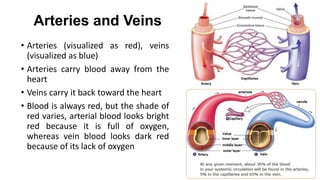
Arteries and Veins
• Arteries (visualized as red), veins
(visualized as blue)
• Arteries carry blood away from the
heart
• Veins carry it back toward the heart
• Blood is always red, but the shade of
red varies, arterial blood looks bright
red because it is full of oxygen,
whereas vein blood looks dark red
because of its lack of oxygen
Blood circulation (video)
- Oxygen-poor systemic blood (máu
thiếu oxy) enters the right atrium,
passes into the right ventricle, through
the pulmonary trunk to the lungs, and
back to the left atrium via the pulmonary
veins.
- Oxygen-laden blood (máu chứa nhiều
oxy) entering the left atrium from the
lungs flows into the left ventricle and
then into the aorta, which provides the
functional supply of all body organs.
- Systemic veins return the oxygen-
depleted blood to the right atrium.
Blood pressure measure
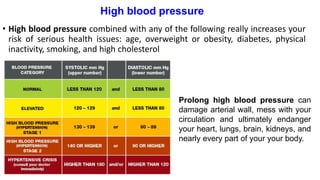
• The unit used for blood pressure are millimeters of mercury, or mmHg
• The normal systolic blood pressure is around 120 mmHg and a normal
diastolic blood pressure is around 80 mmHg
120 Systolic blood pressure (high pressure)
The peak pressure produced by the contracting ventricles
80 Diastolic blood pressure (low pressure)
The pressure in your arteries when the ventricles are relaxed.
High blood pressure
• High blood pressure combined with any of the following really increases your
risk of serious health issues: age, overweight or obesity, diabetes, physical
inactivity, smoking, and high cholesterol
Prolong high blood pressure can
damage arterial wall, mess with your
circulation and ultimately endanger
your heart, lungs, brain, kidneys, and
nearly every part of your your body.
Understanding Blood Pressure
1. Why should we understanding our blood pressure?
2. Why can your lifestyles cause the hypertension?
3. What problems do hypertension affect your body?
https://www.youtube.com/watch?v=mOgciP5MMXk
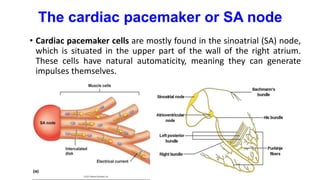
The cardiac pacemaker or SA node
• Cardiac pacemaker cells are mostly found in the sinoatrial (SA) node,
which is situated in the upper part of the wall of the right atrium.
These cells have natural automaticity, meaning they can generate
impulses themselves.
Action Potential in Cardiac Pacemaker Cells
https://www.youtube.com/watch?v=v7Q9BrNfIpQ&t=6s
1. What is action potential? Where is it generated?
2. What difference when membrane voltage become less or
more negative?
3. How is action potential generated?
4. How many action potential that pacemarker cells of the SA
node create per min?
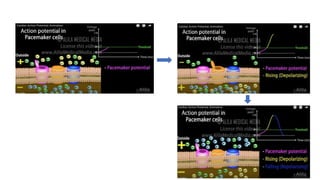
Action Potential in Cardiac Pacemaker Cells
• Cardiac action potential (Video): The cardiac action potential is a brief
change in voltage (membrane potential) across the cell membrane of
heart cells. This is caused by the movement of charged atoms (called
ions) between the inside and outside of the cell, through proteins called
ion channels.
• The pacemaker cells use the movement of sodium, calcium, and
potassium to get your heart beating
• The membrane depolarization of contractile myocytes causes opening of
sodium channels and allows sodium to enter, which is responsible for the
rising phase of the action potential curve. Depolarization also opens slow
Ca2+ channels; Ca2+ entry prolongs the period of depolarization (creates
the plateau).
Cardiac pacemaker cells in heart
Conduction system of the heart and the inherent rate
EKG/ECG interpretation
Electrocardiography is the process of producing an electrocardiogram (ECG
or EKG), a recording – a graph of voltage versus time – of the electrical
activity of the heart using electrodes placed on the skin.
Pulmonary circulation loop: exchange oxygen and carbondioxide
Oxygen is the most urgent, without it you will die is insufficient to
meet the needs of the body and lungs.
The term "congestive heart failure (suy tim xung huyết)" is often
indicate Heart failure, a pathophysiological state in which cardiac
output used, as one of the common symptoms is congestion, or
build-up of fluid in a person's tissues and veins in the lungs or
other parts of the body.
Congestive heart failure
Hands-only CPR consists of two easy steps:
- Call 115 (Cấp cứu)
- Push hard and fast in the center of the chest
- Give rescue breaths
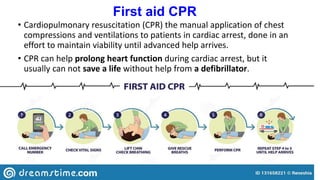
Cardiopulmonary resuscitation (CPR)
• Cardiopulmonary resuscitation (CPR) the manual application of chest
compressions and ventilations to patients in cardiac arrest, done in an
effort to maintain viability until advanced help arrives.
• CPR can help prolong heart function during cardiac arrest, but it
usually can not save a life without help from a defibrillator.
First aid CPR
Defibrillators
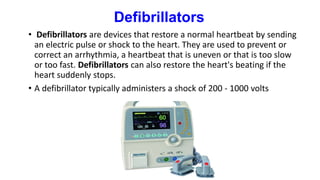
• Defibrillators are devices that restore a normal heartbeat by sending
an electric pulse or shock to the heart. They are used to prevent or
correct an arrhythmia, a heartbeat that is uneven or that is too slow
or too fast. Defibrillators can also restore the heart's beating if the
heart suddenly stops.
• A defibrillator typically administers a shock of 200 - 1000 volts
Critical thinking question (Work in group)
A pacemaker produces an electrical stimulus of the cardiac
muscle. Explain how the heart conducts electricity with an
artificial pacemaker. When do the patients should implant an
artificial pacemaker? Are there any other methods for
treating pacemaker failure?
• Muscle tissue is a specialized tissue found in animals which functions by
contracting, thereby applying forces to different parts of the body.
• Muscle tissue consists of fibers of muscle cells connected together in
sheets and fibers.
Muscle tissue
- Skeletal muscle tissue: both
structurally and functionally separate
from one another, meaning some
cells can work while others don’t.
- Cardiac muscle tissue: both
physically and electrically connected,
all of the time

5_Cardiovascular System_updated.pptx

  • 1.
    Cardiovascular system School ofBiomedical Engineering Instructor: Trịnh Như Thùy, PhD Email: tnthuy@hcmiu.edu.vn BM091IU_Human Anatomy and Physiology
  • 2.
    What does happenwhen you have extreme exercise?
  • 3.
    The Cadiovascular System •Cardiovascular system includes heart and blood vessels
  • 4.
    Why is hearta symbol of love?
  • 5.
    Understand and followyour heart • Regular beating of the heart is achieved as a result of the inherent rhythmicity of cardiac muscle; no nerves are located within the heart itself, and no outside regulatory mechanisms are necessary to stimulate the muscle to contract rhythmically. • Factors that control the rise and fall of calcium concentrations in the cardiac muscle cell have profound effects on cardiac function. • The heart rate may be fast simply as a reaction to other processes going on in the body. Ex: stress hormone or overproduction of thyroid hormone directly increases heart rate through acting on receptors in the heart. • Stimulants directly increase heart rate considered as a cause of fast heart rate
  • 6.
    Functions of theCadiovascular System • Transportation: nutrients, oxygen, waste, heat, hormones, and immune cells • The heart is the pump: a big, wet, muscly of a pump to maintain pressure
  • 7.
    Love Hormones Love canbe distilled into three categories: lust, attraction, and attachment. http://sitn.hms.harvard.edu/flash/2017/love-actually-science-behind-lust-attraction-companionship/
  • 8.
    Function of Cardiovascularsystem • Heart ventricles, atria, and valves create a pump • Maintain both high and low pressure • Blood circulates from the heart to the body through your arteries • Blood circulates from the body to the heart through your veins • Systolic and diastolic blood pressure • Pacemaker cells generate their own action potentials • The electricity in the cardiac conduction pathway
  • 9.
    The Heart (video) https://www.youtube.com/watch?v=28CYhgjrBLA 1.What does the cardiovascular system consist of? 2. How does the cardiovascular system transport of gases? 3. How many layers does the heart wall have? 4. Which serve to ensure one-way blood flow through the heart? 5. How can the heart. Generate its own electical stimulation?
  • 10.
    The connection betweenthe heart and other systems
  • 11.
    The Heart • Theheart weighs about 250 - 350 grams, located nearly center of your chest and mediastinum cavity between your lungs • The heart is divided into four chambers consisting of two atria and two ventricles; the atria receive blood, while the ventricles pump blood.
  • 12.
    Function of theheart • The right side of the heart is the pulmonary circuit pump. It pumps blood through the lungs, where the blood picks up oxygen and dumps carbon dioxide. • The left side of the heart is the systemic circuit pump. It pumps blood through the body’s tissues, supplying them with oxygen and nutrients and removing carbon dioxide. • The right ventricle discharges blood into the pulmonary trunk; the left ventricle pumps blood into the aorta. • The heart has two superior atria and two inferior ventricles. Functionally, the heart is a double pump.
  • 13.
    Function of theheart • Generating high hydrostatic pressure to pump blood out of the heart, while also creating low pressure to bring it back in • A measure of the amount of strain your arteries feel as your heart moves your blood around (about 60 beats per minute) • 100,000 beats a day, 35 million beats a year, 2 to 3 billion beats in a lifetime. You can measure by checking your own pulse (bắt mạch - đông y) • The small mammals have faster heat rates but shorter life span. In the other hand, large mammals have slower heart rates but longer life spans. Most mammals have a surprisingly similar total number of heart beats in their lifetime.
  • 14.
    Form following function •General system of chambers, valves, veins, and arteries all work together to circulate blood around your body • Air also moves from high to low pressure areas, which we’ll talk about in respiratory system. Heart creates this pressure
  • 15.
    Heart pump • Atria:thin wall because the blood come to in low pressure • Ventricles: the true pump of the heart with big, strong wall
  • 16.
    When the valvesopen and close, we can hear the sound lub-dub The atrioventricular (AV) valves (tricuspid and mitral) prevent backflow into the atria when the ventricles are contracting The semilunar (SL) valves (pulmonary and aortic) prevent backflow into the ventricles when the ventricles are relaxing.
  • 17.
    Arteries and Veins •Arteries (visualized as red), veins (visualized as blue) • Arteries carry blood away from the heart • Veins carry it back toward the heart • Blood is always red, but the shade of red varies, arterial blood looks bright red because it is full of oxygen, whereas vein blood looks dark red because of its lack of oxygen
  • 18.
    Blood circulation (video) -Oxygen-poor systemic blood (máu thiếu oxy) enters the right atrium, passes into the right ventricle, through the pulmonary trunk to the lungs, and back to the left atrium via the pulmonary veins. - Oxygen-laden blood (máu chứa nhiều oxy) entering the left atrium from the lungs flows into the left ventricle and then into the aorta, which provides the functional supply of all body organs. - Systemic veins return the oxygen- depleted blood to the right atrium.
  • 19.
    Blood pressure measure •The unit used for blood pressure are millimeters of mercury, or mmHg • The normal systolic blood pressure is around 120 mmHg and a normal diastolic blood pressure is around 80 mmHg 120 Systolic blood pressure (high pressure) The peak pressure produced by the contracting ventricles 80 Diastolic blood pressure (low pressure) The pressure in your arteries when the ventricles are relaxed.
  • 20.
    High blood pressure •High blood pressure combined with any of the following really increases your risk of serious health issues: age, overweight or obesity, diabetes, physical inactivity, smoking, and high cholesterol Prolong high blood pressure can damage arterial wall, mess with your circulation and ultimately endanger your heart, lungs, brain, kidneys, and nearly every part of your your body.
  • 21.
    Understanding Blood Pressure 1.Why should we understanding our blood pressure? 2. Why can your lifestyles cause the hypertension? 3. What problems do hypertension affect your body? https://www.youtube.com/watch?v=mOgciP5MMXk
  • 22.
    The cardiac pacemakeror SA node • Cardiac pacemaker cells are mostly found in the sinoatrial (SA) node, which is situated in the upper part of the wall of the right atrium. These cells have natural automaticity, meaning they can generate impulses themselves.
  • 23.
    Action Potential inCardiac Pacemaker Cells https://www.youtube.com/watch?v=v7Q9BrNfIpQ&t=6s 1. What is action potential? Where is it generated? 2. What difference when membrane voltage become less or more negative? 3. How is action potential generated? 4. How many action potential that pacemarker cells of the SA node create per min?
  • 25.
    Action Potential inCardiac Pacemaker Cells • Cardiac action potential (Video): The cardiac action potential is a brief change in voltage (membrane potential) across the cell membrane of heart cells. This is caused by the movement of charged atoms (called ions) between the inside and outside of the cell, through proteins called ion channels. • The pacemaker cells use the movement of sodium, calcium, and potassium to get your heart beating • The membrane depolarization of contractile myocytes causes opening of sodium channels and allows sodium to enter, which is responsible for the rising phase of the action potential curve. Depolarization also opens slow Ca2+ channels; Ca2+ entry prolongs the period of depolarization (creates the plateau).
  • 26.
  • 27.
    Conduction system ofthe heart and the inherent rate
  • 28.
    EKG/ECG interpretation Electrocardiography isthe process of producing an electrocardiogram (ECG or EKG), a recording – a graph of voltage versus time – of the electrical activity of the heart using electrodes placed on the skin.
  • 29.
    Pulmonary circulation loop:exchange oxygen and carbondioxide Oxygen is the most urgent, without it you will die is insufficient to meet the needs of the body and lungs. The term "congestive heart failure (suy tim xung huyết)" is often indicate Heart failure, a pathophysiological state in which cardiac output used, as one of the common symptoms is congestion, or build-up of fluid in a person's tissues and veins in the lungs or other parts of the body. Congestive heart failure
  • 31.
    Hands-only CPR consistsof two easy steps: - Call 115 (Cấp cứu) - Push hard and fast in the center of the chest - Give rescue breaths Cardiopulmonary resuscitation (CPR)
  • 32.
    • Cardiopulmonary resuscitation(CPR) the manual application of chest compressions and ventilations to patients in cardiac arrest, done in an effort to maintain viability until advanced help arrives. • CPR can help prolong heart function during cardiac arrest, but it usually can not save a life without help from a defibrillator. First aid CPR
  • 33.
    Defibrillators • Defibrillators aredevices that restore a normal heartbeat by sending an electric pulse or shock to the heart. They are used to prevent or correct an arrhythmia, a heartbeat that is uneven or that is too slow or too fast. Defibrillators can also restore the heart's beating if the heart suddenly stops. • A defibrillator typically administers a shock of 200 - 1000 volts
  • 34.
    Critical thinking question(Work in group) A pacemaker produces an electrical stimulus of the cardiac muscle. Explain how the heart conducts electricity with an artificial pacemaker. When do the patients should implant an artificial pacemaker? Are there any other methods for treating pacemaker failure?
  • 35.
    • Muscle tissueis a specialized tissue found in animals which functions by contracting, thereby applying forces to different parts of the body. • Muscle tissue consists of fibers of muscle cells connected together in sheets and fibers. Muscle tissue - Skeletal muscle tissue: both structurally and functionally separate from one another, meaning some cells can work while others don’t. - Cardiac muscle tissue: both physically and electrically connected, all of the time

Editor's Notes

  • #10 The 4 valves: aortic, tricuspid. Pulmonary, and mitral valves. Epicardium, endocardium, and myocardium.
  • #22 Eat too much salt Lack of exercise Gain weight Drink too much alcohol
  • #24 Action potential is re-reversal electricity of the electric polarity at the cell membrane Action potential is generated the membrane voltage must depolarize to a critical value, called the threshold. 80 action potential when membrane voltage become more negative, which called reporlarize => produced by votage gate of ion channel. When membrane voltage increase and become less negative => cell will be less polarize, which called depolarize.