on
                                            Health Reform


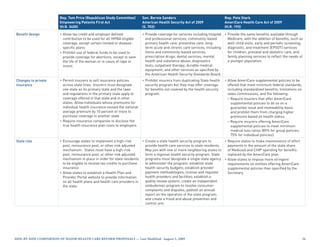
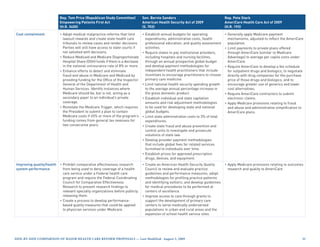
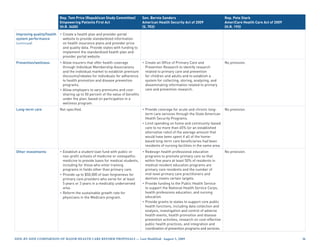
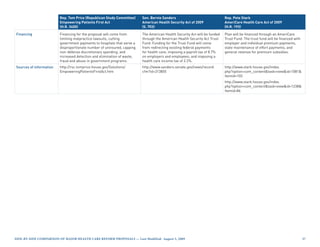
This side-by-side compares the leading comprehensive reform proposals across a number of key characteristics and plan components. Included in this side-by-
side are proposals for moving toward universal coverage that have been put forward by the President and Members of Congress. In an effort to capture the most
important proposals, we have included those that have been formally introduced as legislation as well as those that have been offered as principles or in White
Paper form. This side-by-side will be regularly updated to reflect changes in the proposals and to incorporate major new proposals as they are announced.
The House Tri-Committee summary incorporates the major amendments to the legislation adopted by the three committees of jurisdiction during their mark-ups
of the bill. These amendments are identified using an abbreviation for the House panel that approved it — “E&C” for the Committee on Energy and Commerce;
“E&L” for the Committee on Education and Labor; and “W&M” for the Committee on Ways and Means.

                                                                                                        House Tri-Committee
                                                                                                        America’s Affordable Health
                         Senate Finance Committee               Senate HELP Committee                   Choices Act of 2009                     President Obama
                         Policy Options                         Affordable Health Choices Act           (H.R. 3200)                             Principles for Health Reform

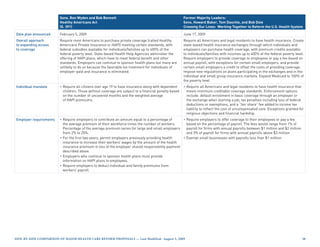
Date plan announced      April – May 2009                       June 9, 2009                            June 19, 2009                           February 26, 2009
Overall approach         The Senate Finance Committee           Require individuals to have health      Require all individuals to have         President Obama outlined eight
to expanding access      released a series of papers laying     insurance. Create state-based           health insurance. Create a Health       principles for health care reform
to coverage              out options for health reform. While   American Health Benefit Gateways        Insurance Exchange through which        in his FY 2010 Budget overview.
                         not a formal proposal, these papers    through which individuals and small     individuals and smaller employers       The President has indicated that
                         offer a framework for achieving        businesses can purchase health          can purchase health coverage, with      comprehensive health reform should:
                         health reform goals and present the    coverage, with subsidies available to   premium and cost-sharing credits        • Reduce long-term growth of
                         range of options the Committee will    individuals/families with incomes up    available to individuals/families         health care costs for businesses
                         consider as it works to draft health   to 400% of the federal poverty level    with incomes up to 400% of the            and government.
                         reform legislation.                    (or $73,240 for a family of three in    federal poverty level (or $73,240 for
                                                                                                                                                • Protect families from bankruptcy or
                         Require all individuals to have        2009). Require employers to provide     a family of three in 2009). Require
                                                                                                                                                  debt because of health care costs.
                         health insurance. Create a Health      coverage to their employees or          employers to provide coverage to
                                                                                                                                                • Guarantee choice of doctors and
                         Insurance Exchange through which       pay an annual fee, with exceptions      employees or pay into a Health
                                                                                                                                                  health plans.
                         individuals and small businesses       for small employers, and provide        Insurance Exchange Trust Fund,
                                                                certain small employers a credit        with exceptions for certain small       • Invest in prevention and wellness.
                         can purchase health coverage, with
                                                                to offset the costs of providing        employers, and provide certain          • Improve patient safety and quality
                         subsidies available to individuals/
                                                                coverage. Impose new regulations        small employers a credit to offset        care.
                         families with incomes between 100
                         and 400% of the federal poverty        on the individual and small group       the costs of providing coverage.        • Assure affordable, quality health
                         level. Impose new regulations on       insurance markets. Expand               Impose new regulations on plans           coverage for all Americans.
                         the non-group and small group          Medicaid to all individuals with        participating in the Exchange and in    • Maintain coverage when you
                         insurance markets. Expand              incomes up to 150% of the federal       the small group insurance market.         change or lose your job.
                         Medicaid and CHIP and offer a          poverty level.                          Expand Medicaid to 133% of the          • End barriers to coverage for
                         temporary Medicare buy-in for the                                              poverty level.                            people with pre-existing medical
                         pre-Medicare population.                                                                                                 conditions.


Side-by-Side CompariSon of major HealtH Care reform propoSalS — last modified: august 5, 2009
House Tri-Committee
                                                                                                       America’s Affordable Health
                        Senate Finance Committee                 Senate HELP Committee                 Choices Act of 2009                    President Obama
                        Policy Options                           Affordable Health Choices Act         (H.R. 3200)                            Principles for Health Reform

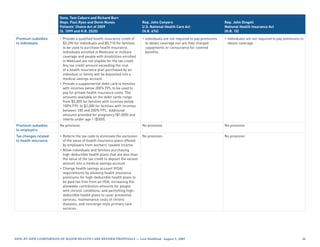
Individual mandate      • Require all individuals to have     • Require individuals to have        • Require all individuals to have          • The plan must put the country
                          insurance that meets minimum          qualifying health coverage.          “acceptable health coverage”.              on a clear path to cover all
                          coverage standards. Enforced          Enforced through a minimum           Those without coverage pay                 Americans.
                          through an excise tax equal to a      tax penalty of no more than          a penalty of 2.5% of modified
                          percentage of the premium for         $750 per year. Exemptions to the     adjusted gross income up to
                          the lowest cost option available      individual mandate will be granted   the cost of the average national
                          through the Health Insurance          to residents of states that do not   premium for self-only or
                          Exchange in the area where the        establish an American Health         family coverage under a basic
                          individual resides. Exemptions will   Benefit Gateway, members of          plan in the Health Insurance
                          be granted for financial hardship;    Indian tribes, those for whom        Exchange. Exceptions granted for
                          if the lowest cost plan option        affordable coverage is not           dependents, religious objections,
                          exceeds 10% of an individual’s        available, and those without         and financial hardship.
                          income; and if the individual has     coverage for fewer than 90 days.
                          income below 100% of the poverty
                          level.
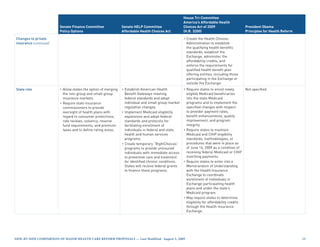
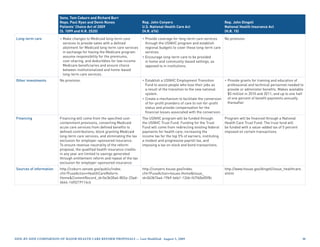
Employer requirements   • Proposed Option A: Require             • Require employers to offer health   • Require employers to offer           Not specified.
                          employers with more than                 coverage to their employees and       coverage to their employees and
                          $500,000 in total payroll per            contribute at least 60% of the        contribute at least 72.5% of the
                          year to offer coverage to their          premium cost or pay $750 for          premium cost for single coverage
                          employees and contribute at              each uninsured full-time              and 65% of the premium cost for
                          least 50% of the premium or pay          employee and $375 for each            family coverage of the lowest cost
                          an assessment. The employer              uninsured part-time employee          plan that meets the essential
                          assessment could be structured           who is not offered coverage. For      benefits package requirements or
                          in several ways: 1) a set fee per        employers subject to the              pay 8% of payroll into the Health
                          enrollee per month based on total        assessment, the first 25 workers      Insurance Exchange Trust Fund.
                          annual payroll; 2) a tiered penalty      are exempted.                         [EL Committee amendment:
                          calculated as a percentage of          • Exempt employers with 25 or           Provide hardship exemptions
                          payroll; or 3) a larger penalty only     fewer employees from the              for employers that would be
                          on firms with annual payroll of          requirement to provide coverage.      negatively affected by job losses
                          more than $1,500,000.                                                          as a result of requirement.]
                        • Proposed Option B: No employer
                          “pay or play” requirement.


Side-by-Side CompariSon of major HealtH Care reform propoSalS — last modified: august 5, 2009                                                                                   2
House Tri-Committee
                                                                                            America’s Affordable Health
                        Senate Finance Committee          Senate HELP Committee             Choices Act of 2009                   President Obama
                        Policy Options                    Affordable Health Choices Act     (H.R. 3200)                           Principles for Health Reform

Employer requirements                                                                       • Eliminate or reduce the pay
(continued)                                                                                   or play assessment for small
                                                                                              employers with annual payroll of
                                                                                              less than $400,000:
                                                                                              – Annual payroll less than
                                                                                                $250,000: exempt
                                                                                              – Annual payroll between
                                                                                                $250,000 and $300,000: 2% of
                                                                                                payroll;
                                                                                              – Annual payroll between
                                                                                                $300,000 and $350,000: 4% of
                                                                                                payroll;
                                                                                              – Annual payroll between
                                                                                                $350,000 and $400,000: 6% of
                                                                                                payroll.
                                                                                              [EC Committee amendment:
                                                                                              Extend the reduction in the pay
                                                                                              or play assessment for small
                                                                                              employers with annual payroll of
                                                                                              less than $750,000 and replace
                                                                                              the above schedule with the
                                                                                              following:
                                                                                              – Annual payroll less than
                                                                                                $500,000: exempt
                                                                                              – Annual payroll between
                                                                                                $500,000 and $585,000: 2% of
                                                                                                payroll;
                                                                                              – Annual payroll between
                                                                                                $585,000 and $670,000: 4% of
                                                                                                payroll;
                                                                                              – Annual payroll between
                                                                                                $670,000 and $750,000: 6% of
                                                                                                payroll.]
                                                                                            • Require employers that offer
                                                                                              coverage to automatically enroll
                                                                                              into the employer’s lowest cost
                                                                                              premium plan any individual who
                                                                                              does not elect coverage under the
                                                                                              employer plan or does not opt out
                                                                                              of such coverage.


Side-by-Side CompariSon of major HealtH Care reform propoSalS — last modified: august 5, 2009
House Tri-Committee
                                                                                                      America’s Affordable Health
                        Senate Finance Committee               Senate HELP Committee                  Choices Act of 2009                  President Obama
                        Policy Options                         Affordable Health Choices Act          (H.R. 3200)                          Principles for Health Reform

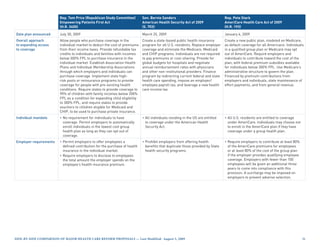
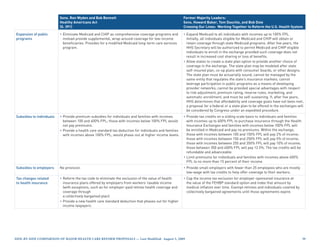
Expansion of public     Medicaid                               • Expand Medicaid to all individuals   • Expand Medicaid to all individuals • As a foundation for health
programs                • Expand Medicaid to all individuals     (children, pregnant women,             (children, pregnant women,           reform, the President signed
                          with incomes up to 115% FPL,           parents, and adults without            parents, and adults without          the Children’s Health Insurance
                          with a possible increase in            dependent children) with incomes       dependent children) with incomes     Program Reauthorization
                          eligibility for parents, pregnant      up to 150% FPL. Individuals            up to 133% FPL. Newly eligible,      Act (CHIPRA), which provides
                          women, and children to a               eligible for Medicaid will be          non-traditional (childless adults)   coverage to 11 million children.
                          higher level. Coverage could be        covered through state Medicaid         Medicaid beneficiaries may
                          provided through the current           programs and will not be eligible      enroll in coverage through the
                          program structure or by enrolling      for credits to purchase coverage       Exchange if they were enrolled
                          children, pregnant women,              through American Health Benefit        in qualified health coverage
                          parents, and childless adults in       Gateways.                              during the six months before
                          the Health Insurance Exchange.       • Grant individuals eligible for         becoming Medicaid eligible.
                          Another alternative is to enroll       the Children’s Health Insurance        Provide Medicaid coverage for all
                          all populations except childless       Program (CHIP) the option of           newborns who lack acceptable
                          adults in Medicaid. Under this         enrolling in CHIP or enrolling in      coverage and provide optional
                          approach, childless adults would       a qualified health plan through a      Medicaid coverage to low-income
                          not be eligible for Medicaid but       Gateway.                               HIV-infected individuals and for
                          would be given tax credits to                                                 family planning services to certain
                          purchase coverage through the                                                 low-income women. In addition,
                          Exchange or to buy-in to Medicaid.                                            increase Medicaid payment
                        Children’s Health Insurance                                                     rates for primary care providers
                        Program                                                                         to 100% of Medicare rates.
                        • After September 30, 2013, expand                                              [EC Committee amendment:
                          CHIP eligibility to 275% FPL. Once                                            Require states to submit a state
                          the Health Insurance Exchange is                                              plan amendment specifying the
                          fully operational, CHIP enrollees                                             payment rates to be paid under
                          would obtain coverage through                                                 the state’s Medicaid program.]
                          the Exchange and states would                                                 The coverage expansions (except
                          be required to continue to provide                                            the optional expansions) and the
                          services not covered by plans in                                              enhanced provider payments
                          the Exchange, including Early and                                             will be fully financed with
                          Periodic Screening, Diagnosis,                                                federal funds. [EC Committee
                          and Treatment (EPSDT) services.                                               amendment: Replace full federal
                                                                                                        financing for Medicaid coverage
                        Medicare                                                                        expansions with 100% federal
                        • Until the Health Insurance                                                    financing through 2014 and 90%
                          Exchange is underway, allow                                                   federal financing beginning in year
                          individuals aged 55-64 without                                                2015.]
                          coverage to buy-in to Medicare at
                          full-cost.
                        • Phase-out or reduce the two-
                          year waiting period for Medicare
                          eligibility for people with
                          disabilities.

Side-by-Side CompariSon of major HealtH Care reform propoSalS — last modified: august 5, 2009
House Tri-Committee
                                                                                                    America’s Affordable Health
                        Senate Finance Committee               Senate HELP Committee                Choices Act of 2009                   President Obama
                        Policy Options                         Affordable Health Choices Act        (H.R. 3200)                           Principles for Health Reform

Expansion of public     Public Health Insurance Option                                              • Require Children’s Health
programs (continued)    • Proposed Option A: Create a new                                             Insurance Program (CHIP)
                          public plan to be offered through                                           enrollees to obtain coverage
                          the Exchange that will be subject                                           through the Health Insurance
                          to the same rating and risk                                                 Exchange (in the first year the
                          adjustment rules as the private                                             Exchange is available) provided
                          plans. The public plan could                                                the Health Choices Commissioner
                          be administered by the federal                                              determines that the Exchange
                          government, by multiple third-                                              has the capacity to cover these
                          party administrators, or by the                                             children and that procedures
                          states.                                                                     are in place to ensure the timely
                        • Proposed Option B: Do not create                                            transition of CHIP enrollees
                          a public plan option.                                                       into the Exchange without an
                                                                                                      interruption of coverage.
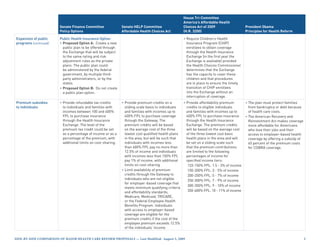
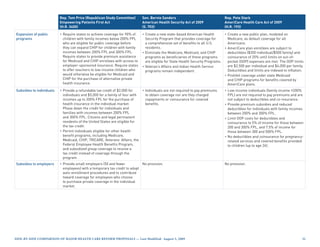
Premium subsidies       • Provide refundable tax credits       • Provide premium credits on a       • Provide affordability premium       • The plan must protect families’
to individuals            to individuals and families with       sliding scale basis to individuals   credits to eligible individuals       from bankruptcy or debt because
                          incomes between 100 and 400%           and families with incomes up to      and families with incomes up to       of health care costs.
                          FPL to purchase insurance              400% FPL to purchase coverage        400% FPL to purchase insurance      • The American Recovery and
                          through the Health Insurance           through the Gateway. The             through the Health Insurance          Reinvestment Act makes coverage
                          Exchange. The level of the             premium credits will be based        Exchange. The premium credits         more affordable for Americans
                          premium tax credit could be set        on the average cost of the three     will be based on the average cost     who lose their jobs and their
                          as a percentage of income or as a      lowest cost qualified health plans   of the three lowest cost basic        access to employer-based health
                          percentage of the premium, with        in the area, but will be such that   health plans in the area and will     coverage by offering a subsidy of
                          additional limits on cost-sharing.     individuals with incomes less        be set on a sliding scale such        65 percent of the premium costs
                                                                 than 400% FPL pay no more than       that the premium contributions        for COBRA coverage.
                                                                 12.5% of income and individuals      are limited to the following
                                                                 with incomes less than 150% FPL      percentages of income for
                                                                 pay 1% of income, with additional    specified income tiers:
                                                                 limits on cost-sharing.               133-150% FPL: 1.5 - 3% of income
                                                               • Limit availability of premium         150-200% FPL: 3 - 5% of income
                                                                 credits through the Gateway to        200-250% FPL: 5 - 7% of income
                                                                 individuals who are not eligible      250-300% FPL: 7 - 9% of income
                                                                 for employer-based coverage that
                                                                                                       300-350% FPL: 9 - 10% of income
                                                                 meets minimum qualifying criteria
                                                                 and affordability standards,          350-400% FPL: 10 - 11% of income
                                                                 Medicare, Medicaid, TRICARE,
                                                                 or the Federal Employee Health
                                                                 Benefits Program. Individuals
                                                                 with access to employer-based
                                                                 coverage are eligible for the
                                                                 premium credits if the cost of the
                                                                 employee premium exceeds 12.5%
                                                                 of the individuals’ income.


Side-by-Side CompariSon of major HealtH Care reform propoSalS — last modified: august 5, 2009                                                                                   5
House Tri-Committee
                                                                                            America’s Affordable Health
                             Senate Finance Committee     Senate HELP Committee             Choices Act of 2009                      President Obama
                             Policy Options               Affordable Health Choices Act     (H.R. 3200)                              Principles for Health Reform

Premium subsidies                                                                               [EC Committee amendment:
to individuals (continued)                                                                      Replaces the above subsidy
                                                                                                schedule with the following:
                                                                                                 133-150% FPL: 1.5 - 3% of income
                                                                                                 150-200% FPL: 3 – 5.5% of income
                                                                                                 200-250% FPL: 5.5 - 8% of income
                                                                                                 250-300% FPL: 8 - 10% of income
                                                                                                 300-350% FPL: 10 - 11% of income
                                                                                                 350-400% FPL: 11 - 12% of income]
                                                                                                [EC Committee amendment:
                                                                                                Increase the affordability credits
                                                                                                annually by the estimated savings
                                                                                                achieved through adopting a
                                                                                                formulary in the public health
                                                                                                insurance option, pharmacy
                                                                                                benefit manager transparency
                                                                                                requirements, developing
                                                                                                accountable care organization
                                                                                                pilot programs in Medicaid, and
                                                                                                administrative simplification.]
                                                                                                [EC Committee amendment:
                                                                                                Increase the affordability credits
                                                                                                annually by the estimated
                                                                                                savings achieved through limiting
                                                                                                increases in premiums for plans
                                                                                                in the Exchange to no more than
                                                                                                150% of the annual increase in
                                                                                                medical inflation and by requiring
                                                                                                the Secretary to negotiate
                                                                                                directly with prescription drug
                                                                                                manufacturers to lower the prices
                                                                                                for Medicare Part D plans.]


Side-by-Side CompariSon of major HealtH Care reform propoSalS — last modified: august 5, 2009
House Tri-Committee
                                                                                            America’s Affordable Health
                             Senate Finance Committee     Senate HELP Committee             Choices Act of 2009                      President Obama
                             Policy Options               Affordable Health Choices Act     (H.R. 3200)                              Principles for Health Reform

Premium subsidies                                                                           • Provide affordability cost-sharing
to individuals (continued)                                                                    credits to eligible individuals and
                                                                                              families with incomes up to 400%
                                                                                              FPL. The cost-sharing credits
                                                                                              reduce the cost-sharing amounts
                                                                                              and annual cost-sharing limits
                                                                                              and have the effect of increasing
                                                                                              the actuarial value of the basic
                                                                                              benefit plan to the following
                                                                                              percentages of the full value of the
                                                                                              plan for the specified income tier:
                                                                                               133-150% FPL: 97%
                                                                                               150-200% FPL: 93%
                                                                                               200-250% FPL: 85%
                                                                                               250-300% FPL: 78%
                                                                                               300-350% FPL: 72%
                                                                                               350-400% FPL: 70%
                                                                                            • Limit availability of premium and
                                                                                              cost-sharing credits to US citizens
                                                                                              and lawfully residing immigrants
                                                                                              who meet the income limits
                                                                                              and are not enrolled in qualified
                                                                                              or grandfathered employer or
                                                                                              individual coverage, Medicare,
                                                                                              Medicaid (except those eligible
                                                                                              to enroll in the Exchange),
                                                                                              TRICARE, or VA coverage (with
                                                                                              some exceptions). Individuals
                                                                                              with access to employer-based
                                                                                              coverage are eligible for the
                                                                                              premium and cost-sharing
                                                                                              credits if the cost of the employee
                                                                                              premium exceeds 11% of
                                                                                              the individuals’ income [EC
                                                                                              Committee amendment: To be
                                                                                              eligible for the premium and cost-
                                                                                              sharing credits, the cost of the
                                                                                              employee premium must exceed
                                                                                              12% of individuals’ income.].


Side-by-Side CompariSon of major HealtH Care reform propoSalS — last modified: august 5, 2009
House Tri-Committee
                                                                                                     America’s Affordable Health
                        Senate Finance Committee              Senate HELP Committee                  Choices Act of 2009                     President Obama
                        Policy Options                        Affordable Health Choices Act          (H.R. 3200)                             Principles for Health Reform

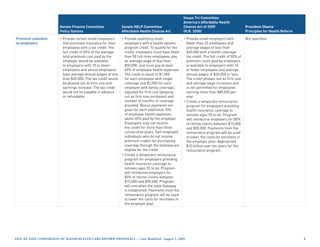
Premium subsidies       • Provide certain small employers    • Provide qualifying small            • Provide small employers with            Not specified.
to employers              that purchase insurance for their    employers with a health options       fewer than 25 employees and
                          employees with a tax credit. The     program credit. To qualify for the    average wages of less than
                          full credit of 50% of the average    credit, employers must have fewer     $40,000 with a health coverage
                          total premium cost paid by the       than 50 full-time employees, pay      tax credit. The full credit of 50% of
                          employer would be available          an average wage of less than          premium costs paid by employers
                          to employers with 10 or fewer        $50,000, and must pay at least        is available to employers with 10
                          employees and whose employees        60% of employee health expenses.      or fewer employees and average
                          have average annual wages of less    The credit is equal to $1,000         annual wages of $20,000 or less.
                          than $20,000. The tax credit would   for each employee with single         The credit phases-out as firm size
                          be phased out as firm size and       coverage and $2,000 for each          and average wage increases and
                          earnings increase. The tax credit    employee with family coverage,        is not permitted for employees
                          would not be payable in advance      adjusted for firm size (phasing       earning more than $80,000 per
                          or refundable.                       out as firm size increases) and       year.
                                                               number of months of coverage        • Create a temporary reinsurance
                                                               provided. Bonus payments are          program for employers providing
                                                               given for each additional 10%         health insurance coverage to
                                                               of employee health expenses           retirees ages 55 to 64. Program
                                                               above 60% paid by the employer.       will reimburse employers for 80%
                                                               Employers may not receive             of retiree claims between $15,000
                                                               the credit for more than three        and $90,000. Payments from the
                                                               consecutive years. Self-employed      reinsurance program will be used
                                                               individuals who do not receive        to lower the costs for enrollees in
                                                               premium credits for purchasing        the employer plan. Appropriate
                                                               coverage through the Gateway are      $10 billion over ten years for the
                                                               eligible for the credit.              reinsurance program.
                                                             • Create a temporary reinsurance
                                                               program for employers providing
                                                               health insurance coverage to
                                                               retirees ages 55 to 64. Program
                                                               will reimburse employers for
                                                               80% of retiree claims between
                                                               $15,000 and $90,000. Program
                                                               will end when the state Gateway
                                                               is established. Payments from the
                                                               reinsurance program will be used
                                                               to lower the costs for enrollees in
                                                               the employer plan.


Side-by-Side CompariSon of major HealtH Care reform propoSalS — last modified: august 5, 2009
House Tri-Committee
                                                                                                     America’s Affordable Health
                        Senate Finance Committee              Senate HELP Committee                  Choices Act of 2009                   President Obama
                        Policy Options                        Affordable Health Choices Act          (H.R. 3200)                           Principles for Health Reform

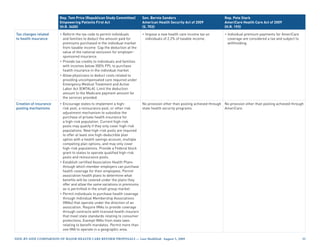
Tax changes related     • Considers several health            • Impose a minimum tax on              • Impose a tax on individuals         Not specified.
to health insurance       insurance-related tax changes         individuals without qualifying         without acceptable health care
                          affecting the tax preference for      health care coverage of no more        coverage of 2.5% of modified
                          employer-sponsored insurance,         than $750 per year.                    adjusted gross income.
                          health savings accounts,
                          flexible spending accounts, and
                          deductions for medical expenses.
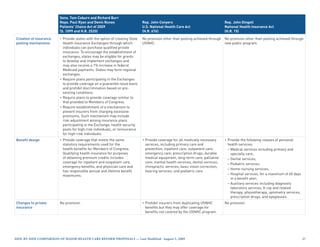
Creation of insurance   • Create one national or multiple     • Create state-based American           • Create a National Health Insurance • The plan should provide portability
pooling mechanisms        regional Health Insurance             Health Benefit Gateways,                Exchange, through which individuals   of coverage and should offer
                          Exchanges through which               administered by a governmental          and employers (phasing-in eligibility Americans a choice of health
                          individuals and small employers       agency or non-profit organization,      for employers starting with smallest  plans.
                          can purchase qualified insurance.     through which individuals and           employers) can purchase qualified
                        • Require all state-licensed insurers   small employers can purchase            insurance, including from private
                          in the non-group and small group      qualified coverage. States may          health plans and the public health
                          markets to participate in the         form regional Gateways or allow         insurance option.
                          Health Insurance Exchange(s).         more than one Gateway to operate • Restrict access to coverage
                        • Require guarantee issue and           in a state as long as each Gateway      through the Exchange to
                          renewability and allow rating         serves a distinct geographic area.      individuals who are not enrolled
                          variation based only on age,        • Restrict access to coverage             in qualified or grandfathered
                          tobacco use, family composition,      through the Gateways to                 employer or individual coverage,
                          and geography (not health status)     individuals who are not                 Medicare, Medicaid (with some
                          in the Exchange(s).                   incarcerated and who are not            exceptions), TRICARE, or VA
                        • Require the Exchange(s) to            eligible for employer-sponsored         coverage (with some exceptions).
                          develop a standardized format         coverage that meets minimum             [EC Committee amendment:
                          for presenting insurance              qualifying criteria and affordability   Permit members of the armed
                          options, create a web portal to       standards, Medicare, Medicaid,          forces and those with coverage
                          help consumers find insurance,        TRICARE, or the Federal Employee        through TRICARE or the VA to
                          maintain a call center for            Health Benefits Program.                enroll in a health benefits plan
                          customer service, and establish                                               offered through the Exchange.]
                          procedures for enrolling                                                    • Create a new public health
                          individuals and businesses and                                                insurance option to be offered
                          for determining eligibility for tax                                           through the Health Insurance
                          credits.                                                                      Exchange that must meet the same
                                                                                                        requirements as private plans
                                                                                                        regarding benefit levels, provider
                                                                                                        networks, consumer protections,
                                                                                                        and cost-sharing. Require the
                                                                                                        public plan to offer basic, enhanced,
                                                                                                        and premium plans, and permit it to
                                                                                                        offer premium plus plans. Finance
                                                                                                        the costs of the public plan through
                                                                                                        revenues from premiums.


Side-by-Side CompariSon of major HealtH Care reform propoSalS — last modified: august 5, 2009                                                                                      9
House Tri-Committee
                                                                                                  America’s Affordable Health
                        Senate Finance Committee          Senate HELP Committee                   Choices Act of 2009                   President Obama
                        Policy Options                    Affordable Health Choices Act           (H.R. 3200)                           Principles for Health Reform

Creation of insurance                                     • Create a community health              For the first three years, set
pooling mechanisms                                          insurance option to be offered         provider payment rates in the
(continued)                                                 through state Gateways that            public plan at Medicare rates
                                                            complies with the requirements         and allow bonus payments of
                                                            of being a qualified health plan.      5% for providers that participate
                                                            Require that the costs of the          in both Medicare and the public
                                                            community health insurance plan        plan and for pediatricians
                                                            be financed through revenues           and other providers that don’t
                                                            from premiums, require the             typically participate in Medicare.
                                                            plan to negotiate payment rates        In subsequent years, permit the
                                                            with providers, and contract           Secretary to establish a process
                                                            with qualified nonprofit entities      for setting rates. [EC Committee
                                                            to administer the plan. Permit         amendment: Require the public
                                                            the plan to develop innovative         health insurance option to
                                                            payment policies to promote            negotiate rates with providers so
                                                            quality, efficiency, and savings to    that the rates are not lower than
                                                            consumers. Require each State to       Medicare rates and not higher
                                                            establish a State Advisory Council     than the average rates paid by
                                                            to provide recommendations on          other qualified health benefit
                                                            policies and procedures for the        plan offering entities.] Health
                                                            community health insurance             care providers participating
                                                            option.                                in Medicare are considered
                                                          • Create three benefit tiers of          participating providers in the
                                                            plans to be offered through the        public plan unless they opt out.
                                                            Gateways based on the percentage       Permit the public plan to develop
                                                            of allowed benefit costs covered by    innovative payment mechanisms,
                                                            the plan:                              including medical home and other
                                                            – Tier 1: includes the essential       care management payments,
                                                              health benefits and covers 76%       value-based purchasing, bundling
                                                              of the benefit costs of the plan;    of services, differential payment
                                                            – Tier 2: includes the essential       rates, performance based
                                                              health benefits and covers 84%       payments, or partial capitation
                                                              of the benefit costs of the plan;    and modify cost sharing and
                                                                                                   payment rates to encourage use
                                                            – Tier 3: includes the essential
                                                                                                   of high-value services. [EC
                                                              health benefits and covers 93%
                                                                                                   Committee amendment: Clarify
                                                              of the benefit costs of the plan.
                                                                                                   that the public health insurance
                                                                                                   option must meet the same
                                                                                                   requirements as other plans
                                                                                                   relating to guarantee issue and
                                                                                                   renewability, insurance rating
                                                                                                   rules, network adequacy, and
                                                                                                   transparency of information.]


Side-by-Side CompariSon of major HealtH Care reform propoSalS — last modified: august 5, 2009                                                                          0
House Tri-Committee
                                                                                                  America’s Affordable Health
                        Senate Finance Committee          Senate HELP Committee                   Choices Act of 2009                      President Obama
                        Policy Options                    Affordable Health Choices Act           (H.R. 3200)                              Principles for Health Reform

Creation of insurance                                     • Require guarantee issue and             [EC Committee amendment:
pooling mechanisms                                          renewability of health insurance        Require the public health
(continued)                                                 policies in the individual and small    insurance option to adopt a
                                                            group markets; prohibit pre-            prescription drug formulary.]
                                                            existing condition exclusions; and • Create four benefit categories of
                                                            allow rating variation based only       plans to be offered through the
                                                            on family structure, geography,         Exchange:
                                                            the actuarial value of the health       – Basic plan includes essential
                                                            plan benefit, tobacco use, and age        benefits package and covers
                                                            (with only 2 to 1 variation).             70% of the benefit costs of the
                                                          • Require plans participating in            plan;
                                                            the Gateway to provide coverage         – Enhanced plan includes
                                                            for at least the essential health         essential benefits package,
                                                            care benefits, meet network               reduced cost sharing compared
                                                            adequacy requirements, and                to the basic plan, and covers
                                                            make information regarding plan           85% of benefit costs of the plan;
                                                            benefits service area, premium          – Premium plan includes essential
                                                            and cost sharing, and grievance           benefits package with reduced
                                                            and appeal procedures available           cost sharing compared to the
                                                            to consumers.                             enhanced plan and covers 95%
                                                          • Require states to adjust payments         of the benefit costs of the plan;
                                                            to health plans based on the            – Premium plus plan is a premium
                                                            actuarial risk of plan enrollees          plan that provides additional
                                                            using methods established by the          benefits, such as oral health and
                                                            Secretary.                                vision care.
                                                          • Require the Gateway to certify        • Require guarantee issue and
                                                            participating health plans, provide     renewability; allow rating variation
                                                            consumers with information              based only on age (limited to 2 to
                                                            allowing them to choose among           1 ratio), premium rating area, and
                                                            plans (including through a              family enrollment; and limit the
                                                            centralized website), contract with     medical loss ratio to a specified
                                                            navigators to conduct outreach          percentage.
                                                            and enrollment assistance, create
                                                            a single point of entry for enrolling
                                                            in coverage through the Gateway
                                                            or through Medicaid, CHIP or
                                                            other federal programs, and assist
                                                            consumers with the purchase
                                                            of long-term care services and
                                                            supports.


Side-by-Side CompariSon of major HealtH Care reform propoSalS — last modified: august 5, 2009
House Tri-Committee
                                                                                                 America’s Affordable Health
                        Senate Finance Committee          Senate HELP Committee                  Choices Act of 2009                      President Obama
                        Policy Options                    Affordable Health Choices Act          (H.R. 3200)                              Principles for Health Reform

Creation of insurance                                     • Following initial federal support,   • Require plans participating
pooling mechanisms                                          the Gateway will be funded by          in the Exchange to be state
(continued)                                                 a surcharge of no more than            licensed, report data as required,
                                                            4% of premiums collected by            implement affordability credits,
                                                            participating health plans.            meet network adequacy
                                                                                                   standards, provide culturally and
                                                                                                   linguistically appropriate services,
                                                                                                   contract with essential community
                                                                                                   providers, and participate in risk
                                                                                                   pooling. Require participating
                                                                                                   plans to offer one basic plan for
                                                                                                   each service area and permit
                                                                                                   them to offer additional plans.
                                                                                                   [EC Committee amendment:
                                                                                                   Require plans to provide
                                                                                                   information related to end-of-life
                                                                                                   planning to individuals and provide
                                                                                                   the option to establish advance
                                                                                                   directives and physician’s order
                                                                                                   for life sustaining treatment.]
                                                                                                 • Require risk adjustment of
                                                                                                   participating Exchange plans.
                                                                                                 • Provide information to consumers
                                                                                                   to enable them to choose among
                                                                                                   plans in the Exchange, including
                                                                                                   establishing a telephone hotline
                                                                                                   and maintaining a website and
                                                                                                   provide information on open
                                                                                                   enrollment periods and how to
                                                                                                   enroll.
                                                                                                 • [EC Committee amendment:
                                                                                                   Prohibit plans participating in the
                                                                                                   Exchange from discriminating
                                                                                                   against any provider because of
                                                                                                   a willingness or unwillingness to
                                                                                                   provide abortions.] .
                                                                                                 • [EC Committee amendment:
                                                                                                   Facilitate the establishment of
                                                                                                   non-for-profit, member-run
                                                                                                   health insurance cooperatives
                                                                                                   to provide insurance through the
                                                                                                   Exchange.]


Side-by-Side CompariSon of major HealtH Care reform propoSalS — last modified: august 5, 2009                                                                            2
House Tri-Committee
                                                                                                      America’s Affordable Health
                        Senate Finance Committee               Senate HELP Committee                  Choices Act of 2009                     President Obama
                        Policy Options                         Affordable Health Choices Act          (H.R. 3200)                             Principles for Health Reform

Creation of insurance                                                                                 • Allow states to operate state-
pooling mechanisms                                                                                      based exchanges if they
(continued)                                                                                             demonstrate the capacity to
                                                                                                        meet the requirements for
                                                                                                        administering the Exchange.
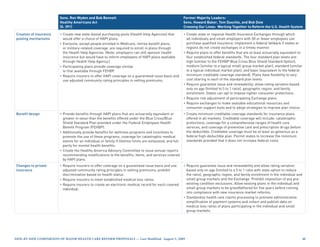
Benefit design          • Create four benefit categories        • Create the essential health care     • Create an essential benefits         Not specified.
                          (lowest, low, medium, and high).        benefits package that provides a       package that provides a
                          Require all plans to provide a          comprehensive array of services        comprehensive set of services,
                          comprehensive set of services and       and prohibits inclusion of lifetime    covers 70% of the actuarial value
                          prohibit inclusion of lifetime limits   or annual limits on the dollar         of the covered benefits, limits
                          on coverage or annual limits on         value of the benefits. The essential   annual cost-sharing to $5,000/
                          benefits.                               health benefits must be included       individual and $10,000/family,
                        • All policies (except certain            in all qualified health plans and      and does not impose annual or
                          grandfathered employer-                 must be equal to the scope of          lifetime limits on coverage. The
                          sponsored plans) must comply            benefits provided by a typical         Health Benefits Advisory Council,
                          with one of the four benefit            employer plan. Create a                chaired by the Surgeon General,
                          categories, including those offered     temporary, independent                 will make recommendations on
                          through the Exchange and those          commission to advise the               specific services to be covered by
                          offered outside of the Exchange.        Secretary in the development of        the essential benefits package as
                                                                  the essential health benefit           well as cost-sharing levels. [EL
                                                                  package.                               Committee amendment: Require
                                                                • Specify the criteria for minimum       early and periodic screening,
                                                                  qualifying coverage for purposes       diagnostic, and treatment
                                                                  of meeting the individual mandate      (EPSDT) services for children
                                                                  for coverage, and an affordability     under age 21 be included in the
                                                                  standard such that coverage is         essential benefits package.] [EC
                                                                  deemed unaffordable if the             Committee amendment: Prohibit
                                                                  premium exceeds 12.5% of an            abortion coverage from being
                                                                  individual’s adjusted gross income.    required as part of the essential
                                                                                                         benefits package; require
                                                                                                         segregation of public subsidy
                                                                                                         funds from private premiums
                                                                                                         payments for plans that choose
                                                                                                         to cover abortion services beyond
                                                                                                         Hyde—which allows coverage for
                                                                                                         abortion services to save the life
                                                                                                         of the woman and in cases of rape
                                                                                                         or incest; and require there be no
                                                                                                         effect on state or federal laws on
                                                                                                         abortions.]


Side-by-Side CompariSon of major HealtH Care reform propoSalS — last modified: august 5, 2009
House Tri-Committee
                                                                                                       America’s Affordable Health
                        Senate Finance Committee               Senate HELP Committee                   Choices Act of 2009                      President Obama
                        Policy Options                         Affordable Health Choices Act           (H.R. 3200)                              Principles for Health Reform

Benefit design                                                                                         • All qualified health benefits plans,
(continued)                                                                                              including those offered through
                                                                                                         the Exchange and those offered
                                                                                                         outside of the Exchange (except
                                                                                                         certain grandfathered individual
                                                                                                         and employer-sponsored plans)
                                                                                                         must provide at least the essential
                                                                                                         benefits package.
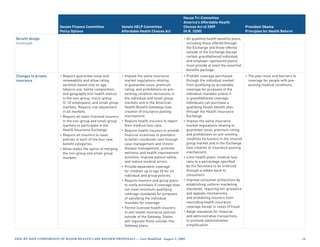
Changes to private      • Require guarantee issue and         • Impose the same insurance              • Prohibit coverage purchased         • The plan must end barriers to
insurance                 renewability and allow rating         market regulations relating              through the individual market         coverage for people with pre-
                          variation based only on age,          to guarantee issue, premium              from qualifying as acceptable         existing medical conditions.
                          tobacco use, family composition,      rating, and prohibitions on pre-         coverage for purposes of the
                          and geography (not health status)     existing condition exclusions in         individual mandate unless it
                          in the non-group, micro-group         the individual and small group           is grandfathered coverage.
                          (2-10 employees), and small group     markets and in the American              Individuals can purchase a
                          markets. Require risk adjustment      Health Benefit Gateways (see             qualifying health benefit plan
                          in all markets.                       creation of insurance pooling            through the Health Insurance
                        • Require all state-licensed insurers   mechanism).                              Exchange.
                          in the non-group and small group • Require health insurers to report         • Impose the same insurance
                          markets to participate in the         their medical loss ratio.                market regulations relating to
                          Health Insurance Exchange.          • Require health insurers to provide       guarantee issue, premium rating,
                        • Require all insurers to issue         financial incentives to providers        and prohibitions on pre-existing
                          policies in each of the four new      to better coordinate care through        condition exclusions in the insured
                          benefit categories.                   case management and chronic              group market and in the Exchange
                        • Allow states the option of merging    disease management, promote              (see creation of insurance pooling
                          the non-group and small group         wellness and health improvement          mechanism).
                          markets.                              activities, improve patient safety,    • Limit health plans’ medical loss
                                                                and reduce medical errors.               ratio to a percentage specified
                                                              • Provide dependent coverage               by the Secretary to be enforced
                                                                for children up to age 26 for all        through a rebate back to
                                                                individual and group policies.           consumers.
                                                              • Require insurers and group plans       • Improve consumer protections by
                                                                to notify enrollees if coverage does     establishing uniform marketing
                                                                not meet minimum qualifying              standards, requiring fair grievance
                                                                coverage standards for purposes          and appeals mechanisms,
                                                                of satisfying the individual             and prohibiting insurers from
                                                                mandate for coverage.                    rescinding health insurance
                                                              • Permit licensed health insurers          coverage except in cases of fraud.
                                                                to sell health insurance policies      • Adopt standards for financial
                                                                outside of the Gateway. States           and administrative transactions
                                                                will regulate these outside-the-         to promote administrative
                                                                Gateway plans.                           simplification.


Side-by-Side CompariSon of major HealtH Care reform propoSalS — last modified: august 5, 2009
House Tri-Committee
                                                                                                      America’s Affordable Health
                        Senate Finance Committee               Senate HELP Committee                  Choices Act of 2009                    President Obama
                        Policy Options                         Affordable Health Choices Act          (H.R. 3200)                            Principles for Health Reform

Changes to private                                                                                    • Create the Health Choices
insurance (continued)                                                                                   Administration to establish
                                                                                                        the qualifying health benefits
                                                                                                        standards, establish the
                                                                                                        Exchange, administer the
                                                                                                        affordability credits, and
                                                                                                        enforce the requirements for
                                                                                                        qualified health benefit plan
                                                                                                        offering entities, including those
                                                                                                        participating in the Exchange or
                                                                                                        outside the Exchange.
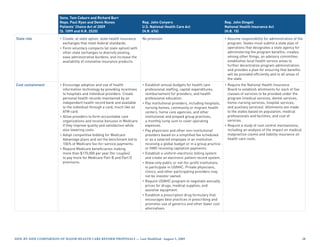
State role              • Allow states the option of merging   • Establish American Health            • Require states to enroll newly        Not specified.
                          the non-group and small group          Benefit Gateways meeting               eligible Medicaid beneficiaries
                          insurance markets.                     federal standards and adopt            into the state Medicaid
                        • Require state insurance                individual and small group market      programs and to implement the
                          commissioners to provide               regulation changes.                    specified changes with respect
                          oversight of health plans with       • Implement Medicaid eligibility         to provider payment rates,
                          regard to consumer protections,        expansions and adopt federal           benefit enhancements, quality
                          rate reviews, solvency, reserve        standards and protocols for            improvement, and program
                          fund requirements, and premium         facilitating enrollment of             integrity.
                          taxes and to define rating areas.      individuals in federal and state     • Require states to maintain
                                                                 health and human services              Medicaid and CHIP eligibility
                                                                 programs.                              standards, methodologies, or
                                                               • Create temporary “RightChoices”        procedures that were in place as
                                                                 programs to provide uninsured          of June 16, 2009 as a condition of
                                                                 individuals with immediate access      receiving federal Medicaid or CHIP
                                                                 to preventive care and treatment       matching payments.
                                                                 for identified chronic conditions.   • Require states to enter into a
                                                                 States will receive federal grants     Memorandum of Understanding
                                                                 to finance these programs.             with the Health Insurance
                                                                                                        Exchange to coordinate
                                                                                                        enrollment of individuals in
                                                                                                        Exchange-participating health
                                                                                                        plans and under the state’s
                                                                                                        Medicaid program.
                                                                                                      • May require states to determine
                                                                                                        eligibility for affordability credits
                                                                                                        through the Health Insurance
                                                                                                        Exchange.


Side-by-Side CompariSon of major HealtH Care reform propoSalS — last modified: august 5, 2009                                                                               5
House Tri-Committee
                                                                                                  America’s Affordable Health
                        Senate Finance Committee             Senate HELP Committee                Choices Act of 2009                  President Obama
                        Policy Options                       Affordable Health Choices Act        (H.R. 3200)                          Principles for Health Reform

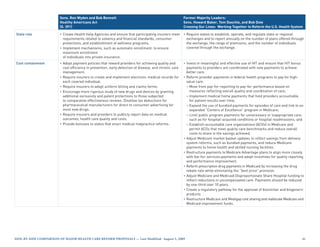
Cost containment        • Encourage adoption and use of      • Establish a Health Care Program    • Simplify health insurance           • The plan should reduce high
                          health information technology        Integrity Coordinating Council       administration by adopting            administrative costs, unnecessary
                          by expanding eligibility for         and two new federal department       standards for financial and           tests and services, waste, and
                          the Medicare HIT incentives          positions to oversee policy,         administrative transactions,          other inefficiencies that consume
                          in the American Recovery and         program development, and             including timely and transparent      money with no added benefit.
                          Reinvestment Act to include          oversight of health care fraud,      claims and denial management
                          additional providers.                waste, and abuse in public and       processes and use of standard
                        • Eliminate fraud, waste, and abuse    private coverage.                    electronic transactions.
                          in public programs through more    • Simplify health insurance          • [EC Committee amendment:
                          intensive screening of providers,    administration by adopting           Limit annual increases in the
                          the development of the “One PI       standards for financial and          premiums charged under any
                          database” to capture and share       administrative transactions,         health plans participating in the
                          data across federal and state        including timely and transparent     Exchange to no more than 150%
                          programs, increased penalties        claims and denial management         of the annual percentage increase
                          for submitting false claims and      processes and use of standard        in medical inflation. Provide
                          violating EMTALA, and increase       electronic transactions.             exceptions if this limit would
                          funding for anti-fraud activities.                                        threaten a health plan’s financial
                        • Restructure payments to Medicare                                          viability.]
                          Advantage plans to promote                                              • Modify provider payments under
                          efficiency and quality.                                                   Medicare including:
                        • Require drug or device                                                    – Modify market basket updates
                          manufacturers to disclose                                                   to account for productivity
                          payments and incentives given                                               improvements for inpatient
                          to providers and any investment                                             hospital, home health, skilled
                          interest held by a physician.                                               nursing facility, and other
                        • Improve transparency of                                                     Medicare providers; and
                          information about skilled nursing                                         – Reduce payments for
                          facilities.                                                                 potentially preventable hospital
                        • Allow providers organized as                                                readmissions.
                          accountable care organizations                                          • Restructure payments to Medicare
                          that voluntarily meet quality                                             Advantage plans, phasing to 100%
                          thresholds to share in the cost-                                          of fee-for-services payments, with
                          savings they achieve for the                                              bonus payments for quality.
                          Medicare program.                                                       • Increase the Medicaid drug
                                                                                                    rebate percentage and extend
                                                                                                    the prescription drug rebate to
                                                                                                    Medicaid managed care plans.
                                                                                                    Require drug manufacturers to
                                                                                                    provide drug rebates for dual
                                                                                                    eligibles enrolled in Part D plans.


Side-by-Side CompariSon of major HealtH Care reform propoSalS — last modified: august 5, 2009
House Tri-Committee
                                                                                            America’s Affordable Health
                        Senate Finance Committee          Senate HELP Committee             Choices Act of 2009                     President Obama
                        Policy Options                    Affordable Health Choices Act     (H.R. 3200)                             Principles for Health Reform

Cost containment                                                                            • [EC Committee amendment:
(continued)                                                                                   Require the Secretary to negotiate
                                                                                              directly with pharmaceutical
                                                                                              manufacturers to lower drug
                                                                                              prices for Medicare Part D plans
                                                                                              and Medicare Advantage Part D
                                                                                              plans.]
                                                                                            • Reduce Medicaid DSH payments
                                                                                              by $6 billion in 2019, imposing the
                                                                                              largest percentage reductions in
                                                                                              state DSH allotments in states
                                                                                              with the lowest uninsured rates
                                                                                              and those that do not target DSH
                                                                                              payments.
                                                                                            • Require hospitals and ambulatory
                                                                                              surgical centers to report on
                                                                                              health care-associated infections
                                                                                              to the Centers for Disease Control
                                                                                              and Prevention and refuse
                                                                                              Medicaid payments for certain
                                                                                              health care-associated conditions.
                                                                                            • Reduce waste, fraud, and abuse
                                                                                              in public programs by allowing
                                                                                              provider screening, enhanced
                                                                                              oversight periods, and enrollment
                                                                                              moratoria in areas identified as
                                                                                              being at elevated risk of fraud
                                                                                              in all public programs, and by
                                                                                              requiring Medicare and Medicaid
                                                                                              program providers and suppliers
                                                                                              to establish compliance programs.


Side-by-Side CompariSon of major HealtH Care reform propoSalS — last modified: august 5, 2009
House Tri-Committee
                                                                                                           America’s Affordable Health
                           Senate Finance Committee                Senate HELP Committee                   Choices Act of 2009                   President Obama
                           Policy Options                          Affordable Health Choices Act           (H.R. 3200)                           Principles for Health Reform

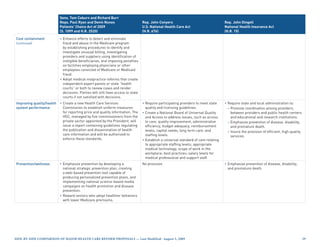
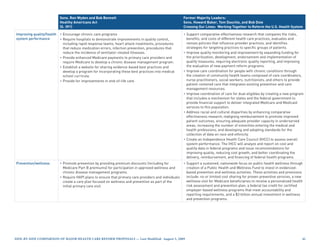
Improving quality/health • Strengthen primary care and             • Develop a national strategy to        • Support comparative effectiveness • The plan must ensure the
system performance         chronic care management by                improve the delivery of health          research by establishing a Center    implementation of patient safety
                           providing bonus payments to               care services, patient health           for Comparative Effectiveness        measures and provide incentives
                           certain primary care providers            outcomes, and population                Research within the Agency           for changes in the delivery
                           and providing reimbursement for           health that includes publishing         for Healthcare Research and          system to reduce unnecessary
                           certain care management activities        an annual national health care          Quality to conduct, support, and     variability in patient care. It must
                           for patients with hospital stays          quality report card. Create an          synthesize research on outcomes,     support the widespread use of
                           related to a major chronic condition.     inter-agency Working Group on           effectiveness, and appropriateness   health information technology
                         • Establish a framework to set              Health Care Quality to coordinate       of health care services and          and the development of data
                           national priorities for comparative       and streamline federal quality          procedures. An independent           on the effectiveness of medical
                           clinical effectiveness research.          activities related to the national      CER Commission will oversee          interventions to improve the
                         • Create a Chronic Care                     quality strategy.                       the activities of the Center. [EC   quality of care delivered.
                           Management Innovation Center            • Develop, through a multi-               Committee amendment: Prohibit      • To lay the foundation for improving
                           within CMS to disseminate                 stakeholder process, quality            use of comparative effectiveness     the health care delivery system
                           innovations that foster patient-          measures that allow assessments         research findings to deny or         and quality of care, the American
                           centered care coordination                of health outcomes; continuity          ration care or to make coverage      Recovery and Reinvestment
                           innovations for high-cost,                and coordination of care; safety,       decisions in Medicare.]              Act invests $19 billion in health
                           chronically ill Medicare                  effectiveness and timeliness          • Strengthen primary care and          information technology, including
                           beneficiaries.                            of care; health disparities;            care coordination by increasing      $17 billion in incentives to
                         • Bundle payments for acute,                and appropriate use of health           Medicaid payments for primary        providers to encourage their use
                           inpatient hospital services and           care resources. Require public          care providers, providing Medicare   of electronic medical records,
                           post-acute care services occurring        reporting on quality measures           bonus payments to primary care       and provides $1.1 billion for
                           within 30 days of discharge from a        through a user-friendly website.        practitioners (with larger bonuses   comparative effectiveness
                           hospital.                               • Create a Center for Health              paid to primary care practitioners   research.
                         • Establish a hospital value-based          Outcomes Research and                   serving in health professional
                           purchasing program to pay                 Evaluation within the Agency            shortage areas).
                           hospitals based on performance            for Healthcare Research and           • Conduct Medicare pilot programs
                           on quality measures.                      Quality to conduct and synthesize       to test payment incentive models
                         • Develop a strategy for the                research on the effectiveness           for accountable care organizations
                           development, selection, and               of health care services and             and bundling of post-acute
                           implementation of quality                 procedures to provide providers         care payments, and conduct
                           measures that involves input from         and patients with information on        pilot programs in Medicare and
                           multiple stakeholders. Improve            the most effective therapies for        Medicaid to assess the feasibility
                           public reporting of quality and           preventing and treating health          of reimbursing qualified patient-
                           performance information that              conditions.                             centered medical homes. [EC
                           includes making information             • Provide grants for improving health     Committee amendment: Adopt
                           available on the web.                     system efficiency, including grants     accountable care organization,
                                                                     to establish community health           bundled payment, and medical
                         • Require enhanced collection
                                                                     teams to support a medical home         home models on a large scale if
                           and reporting of data on race,
                                                                     model; to implement medication          pilot programs prove successful at
                           ethnicity, and primary language.
                                                                     management services; to design          reducing costs.]
                           Also require collection of access
                           and treatment data for people with        and implement regional emergency
                           disabilities.                             care and trauma systems.


Side-by-Side CompariSon of major HealtH Care reform propoSalS — last modified: august 5, 2009
House Tri-Committee
                                                                                                  America’s Affordable Health
                           Senate Finance Committee       Senate HELP Committee                   Choices Act of 2009                     President Obama
                           Policy Options                 Affordable Health Choices Act           (H.R. 3200)                             Principles for Health Reform

Improving quality/health                                  • Require hospitals to report             [EC Committee amendment:
system performance                                          preventable readmission rates;          Conduct accountable care
(continued)                                                 hospitals with high re-admission        organization pilot programs in
                                                            rates will be required to work with     Medicaid.]
                                                            local patient safety organizations    • [EC Committee amendment:
                                                            to improve their rates.                 Establish the Center for
                                                          • Create a Patient Safety Research        Medicare and Medicaid Payment
                                                            Center charged with identifying,        Innovation Center to test
                                                            evaluating, and disseminating           payment models that address
                                                            information on best practices for       populations experiencing poor
                                                            improving health care quality.          clinical outcomes or avoidable
                                                          • Create an inter-agency                  expenditures. Evaluate all models
                                                            Working Group to coordinate             and expand those models that
                                                            and streamline federal quality          improve quality without increasing
                                                            activities.                             spending or reduce spending
                                                          • Develop interoperable standards         without reducing quality, or both.]
                                                            for using HIT to enroll individuals   • [WM Committee amendment:
                                                            in public programs and provide          Require the Institute of Medicine
                                                            grants to states and other              to conduct a study on geographic
                                                            governmental entities to adopt          variation in health care spending
                                                            and implement enrollment                and recommend strategies for
                                                            technology.                             addressing this variation by
                                                                                                    promoting high-value care.]
                                                                                                  • Improve coordination of care
                                                                                                    for dual eligibles by creating a
                                                                                                    new office or program within
                                                                                                    the Centers for Medicare and
                                                                                                    Medicaid Services.
                                                                                                  • Establish the Center for Quality
                                                                                                    Improvement to identify, develop,
                                                                                                    evaluate, disseminate, and
                                                                                                    implement best practices in the
                                                                                                    delivery of health care services.
                                                                                                    Develop national priorities for
                                                                                                    performance improvement and
                                                                                                    quality measures for the delivery
                                                                                                    of health care services.


Side-by-Side CompariSon of major HealtH Care reform propoSalS — last modified: august 5, 2009                                                                            9
House Tri-Committee
                                                                                                        America’s Affordable Health
                           Senate Finance Committee              Senate HELP Committee                  Choices Act of 2009                     President Obama
                           Policy Options                        Affordable Health Choices Act          (H.R. 3200)                             Principles for Health Reform

Improving quality/health                                                                                • Require disclosure of financial
system performance                                                                                        relationships between health
(continued)                                                                                               entities, including physicians,
                                                                                                          hospitals, pharmacists, and other
                                                                                                          providers, and manufacturers
                                                                                                          and distributors of covered drugs,
                                                                                                          devices, biologicals, and medical
                                                                                                          supplies.
                                                                                                        • Reduce racial and ethnic
                                                                                                          disparities by conducting a study
                                                                                                          on the feasibility of developing
                                                                                                          Medicare payment systems for
                                                                                                          language services, providing
                                                                                                          Medicare demonstration grants
                                                                                                          to reimburse culturally and
                                                                                                          linguistically appropriate services
                                                                                                          and developing standards for
                                                                                                          the collection of data on race,
                                                                                                          ethnicity, and primary language.
                                                                                                        • [EC Committee amendment:
                                                                                                          Conduct a national public
                                                                                                          education campaign to raise
                                                                                                          awareness about the importance
                                                                                                          of planning for care near the end
                                                                                                          of life.]
Prevention/wellness        • Improve prevention by covering     • Develop a national prevention and     • Develop a national strategy to        • The plan must invest in public
                             only proven preventive services      health promotion strategy that          improve the nation’s health             health measures proven to reduce
                             in Medicare and Medicaid and         sets specific goals for improving       through evidenced-based                 cost drivers in our system, such as
                             providing incentives to Medicare     health. Create a prevention and         clinical and community-based            obesity, sedentary lifestyles, and
                             and Medicaid beneficiaries to        public health investment fund           prevention and wellness                 smoking, as well as guarantee
                             complete behavior modification       to expand and sustain funding           activities. Create task forces          access to proven preventive
                             programs.                            for prevention and public health        on Clinical Preventive Services         treatments. The American
                           • Promote prevention and wellness      programs.                               and Community Preventive                Recovery and Reinvestment Act
                             by providing grants to states to   • Award competitive grants to             Services to develop, update, and        provides $1 billion for prevention
                             implement innovative approaches      state and local governments and         disseminate evidenced-based             and wellness.
                             to promoting integration of health   community-based organizations           recommendations on the use of
                             care services to improve health      to implement and evaluate               clinical and community prevention
                             and wellness outcomes and            proven community preventive             services.
                             providing tax credits to small       health activities to reduce chronic
                             businesses that implement proven     disease rates and address health
                             wellness programs.                   disparities.


Side-by-Side CompariSon of major HealtH Care reform propoSalS — last modified: august 5, 2009                                                                                       20
House Tri-Committee
                                                                                                    America’s Affordable Health
                        Senate Finance Committee             Senate HELP Committee                  Choices Act of 2009                     President Obama
                        Policy Options                       Affordable Health Choices Act          (H.R. 3200)                             Principles for Health Reform

Prevention/wellness                                          • Permit insurers to create            • Improve prevention by covering
(continued)                                                    incentives for health promotion        only proven preventive services in
                                                               and disease prevention practices.      Medicare and Medicaid. Eliminate
                                                             • Encourage employers to provide         any cost-sharing for preventive
                                                               wellness programs by conducting        services in Medicare and increase
                                                               targeted educational campaigns         Medicare payments for certain
                                                               to raise awareness of the value of     preventive services to 100% of
                                                               these programs and by increasing       actual charges or fee schedule
                                                               the allowable premium discount         rates.
                                                               for employees who participate in
                                                               these programs from 20 percent
                                                               to 30 percent.
                                                             • Create a temporary Right Choices
                                                               Program to provide uninsured
                                                               adults with access to preventive
                                                               services.
Long-term care          • Improve the availability of long- • Establish a national, voluntary       • [EC Committee amendment:             Not specified.
                          term care services by increasing    insurance program for purchasing        Establish a national, voluntary
                          access to home and community        community living assistance             insurance program for purchasing
                          based services through changes in   services and supports (CLASS            community living assistance
                          Medicaid program requirements       program). The program will              services and supports (CLASS
                          and through grants to states.       provide individuals with functional     program). The program will
                                                              limitations a cash benefit to           provide individuals with functional
                                                              purchase non-medical services           limitations a cash benefit to
                                                              and supports necessary to               purchase non-medical services
                                                              maintain community residence.           and supports necessary to
                                                              The program is financed through         maintain community residence.
                                                              voluntary payroll deductions:           The program is financed through
                                                              all working adults will be              voluntary payroll deductions:
                                                              automatically enrolled in the           all working adults will be
                                                              program, unless they choose to          automatically enrolled in the
                                                              opt-out.                                program, unless they choose to
                                                                                                      opt-out.]
                                                                                                    • Improve transparency of
                                                                                                      information about skilled nursing
                                                                                                      facilities and nursing facilities.


Side-by-Side CompariSon of major HealtH Care reform propoSalS — last modified: august 5, 2009                                                                              2
House Tri-Committee
                                                                                                       America’s Affordable Health
                        Senate Finance Committee               Senate HELP Committee                   Choices Act of 2009                   President Obama
                        Policy Options                         Affordable Health Choices Act           (H.R. 3200)                           Principles for Health Reform

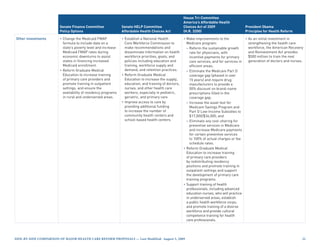
Other investments       • Change the Medicaid FMAP             • Establish a National Health           • Make improvements to the             • As an initial investment in
                          formula to include data on a           Care Workforce Commission to            Medicare program:                      strengthening the health care
                          state’s poverty level and increase     make recommendations and                – Reform the sustainable growth        workforce, the American Recovery
                          Medicaid FMAP rates during             disseminate information on health         rate for physicians, with            and Reinvestment Act provides
                          economic downturns to assist           workforce priorities, goals, and          incentive payments for primary       $500 million to train the next
                          states in financing increased          policies including education and          care services, and for services in   generation of doctors and nurses.
                          Medicaid enrollment.                   training, workforce supply and            efficient areas;
                        • Reform Graduate Medical                demand, and retention practices.        – Eliminate the Medicare Part D
                          Education to increase training       • Reform Graduate Medical                   coverage gap (phased in over
                          of primary care providers and          Education to increase the supply,         15 years) and require drug
                          promote training in outpatient         education, and training of doctors,       manufacturers to provide a
                          settings, and ensure the               nurses, and other health care             50% discount on brand-name
                          availability of residency programs     workers, especially in pediatric,         prescriptions filled in the
                          in rural and underserved areas.        geriatric, and primary care.              coverage gap;
                                                               • Improve access to care by               – Increase the asset test for
                                                                 providing additional funding              Medicare Savings Program and
                                                                 to increase the number of                 Part D Low-Income Subsidies to
                                                                 community health centers and              $17,000/$34,000; and
                                                                 school-based health centers.            – Eliminate any cost-sharing for
                                                                                                           preventive services in Medicare
                                                                                                           and increase Medicare payments
                                                                                                           for certain preventive services
                                                                                                           to 100% of actual charges or fee
                                                                                                           schedule rates.
                                                                                                       • Reform Graduate Medical
                                                                                                         Education to increase training
                                                                                                         of primary care providers
                                                                                                         by redistributing residency
                                                                                                         positions and promote training in
                                                                                                         outpatient settings and support
                                                                                                         the development of primary care
                                                                                                         training programs.
                                                                                                       • Support training of health
                                                                                                         professionals, including advanced
                                                                                                         education nurses, who will practice
                                                                                                         in underserved areas; establish
                                                                                                         a public health workforce corps;
                                                                                                         and promote training of a diverse
                                                                                                         workforce and provide cultural
                                                                                                         competence training for health
                                                                                                         care professionals.


Side-by-Side CompariSon of major HealtH Care reform propoSalS — last modified: august 5, 2009                                                                                   22
House Tri-Committee
                                                                                                     America’s Affordable Health
                        Senate Finance Committee               Senate HELP Committee                 Choices Act of 2009                       President Obama
                        Policy Options                         Affordable Health Choices Act         (H.R. 3200)                               Principles for Health Reform

Other investments                                                                                      [EC Committee amendment:
(continued)                                                                                            Support the development of
                                                                                                       interdisciplinary mental and
                                                                                                       behavioral health training
                                                                                                       programs.] [EC Committee
                                                                                                       amendment: Establish a
                                                                                                       training program for oral health
                                                                                                       professionals.]
                                                                                                     • Provide grants to each state health
                                                                                                       department to address core public
                                                                                                       health infrastructure needs.
                                                                                                     • Conduct a study of the feasibility of
                                                                                                       adjusting the federal poverty level
                                                                                                       to reflect variations in the cost of
                                                                                                       living across different areas.
                                                                                                     • [EL Committee amendment:
                                                                                                       Grant waivers to requirements
                                                                                                       related to the Employee
                                                                                                       Retirement Income Security Act
                                                                                                       of 1974 (ERISA) to states seeking
                                                                                                       to establish a state single payer
                                                                                                       system.]
Financing               Not specified. Considering a range     The Congressional Budget Office       The Congressional Budget                  President Obama dedicated $630
                        of options for achieving savings and   estimates this proposal will cost     Office estimates the net cost             billion over ten years toward a
                        for generating new revenues.           $615 billion over 10 years. Because   of the proposal (less payments            Health Reform Reserve Fund in his
                                                               the Senate HELP Committee does        from employers and uninsured              budget outline released in February
                                                               not have jurisdiction over the        individuals) to be $1.042 trillion        2009 to partially offset the cost of
                                                               Medicare and Medicaid programs        over ten years. Approximately half        health reform.
                                                               nor revenue raising authority,        of the cost of the plan is financed
                                                               mechanisms for financing the          through savings from Medicare and
                                                               proposal will be developed in         Medicaid, including incorporating
                                                               conjunction with the Senate Finance   productivity improvements into
                                                               Committee.                            Medicare market basket updates,
                                                                                                     reducing payments to Medicare
                                                                                                     Advantage plans, changing drug
                                                                                                     rebate provisions, reducing
                                                                                                     potentially preventable hospital
                                                                                                     readmissions, and cutting Medicaid
                                                                                                     DSH payments.


Side-by-Side CompariSon of major HealtH Care reform propoSalS — last modified: august 5, 2009                                                                                     2
House Tri-Committee
                                                                                                 America’s Affordable Health
                         Senate Finance Committee                Senate HELP Committee           Choices Act of 2009                    President Obama
                         Policy Options                          Affordable Health Choices Act   (H.R. 3200)                            Principles for Health Reform

Financing (continued)                                                                            The remaining costs are financed
                                                                                                 through a surcharge imposed
                                                                                                 on families with incomes above
                                                                                                 $350,000 and individuals with
                                                                                                 incomes above $280,000. The
                                                                                                 surcharge is equal to 1% for
                                                                                                 families with modified adjusted
                                                                                                 gross income between $350,000
                                                                                                 and $500,000; 1.5% for families with
                                                                                                 modified adjusted gross income
                                                                                                 between $500,000 and $1,000,000;
                                                                                                 and 5.4% for families with modified
                                                                                                 adjusted gross income greater
                                                                                                 than $1,000,000. These surcharge
                                                                                                 percentages may be adjusted if
                                                                                                 federal health reform achieves
                                                                                                 greater than expected savings.
Sources of information   Go to following link: http://finance.   http://help.senate.gov/         Ways and Means Committee:              http://www.whitehouse.gov/omb/
                         senate.gov/sitepages/baucus.htm                                         http://waysandmeans.house.gov/         budget/
                         then select these items                                                 MoreInfo.asp?section=52                http://www.HealthReform.gov
                         5-11-09 Baucus, Grassley Policy                                         Energy and Commerce Committee:
                         Options for Expanding Health                                            http://energycommerce.house.
                         Care Coverage: Proposals to                                             gov/index.php?option=com_content
                         Provide Affordable Coverage to All                                      view=articleid=1687catid=156
                         Americans                                                               Itemid=55
                         4-28-09 Baucus, Grassley Policy                                         Education and Labor Committee:
                         Options for Transforming the Health                                     http://edlabor.house.gov/
                         Care Delivery System: Proposals to                                      newsroom/2009/07/ed-labor-
                         Improve Patient Care and Reduce                                         approves-historic-hea.shtml
                         Health Care Costs


Side-by-Side CompariSon of major HealtH Care reform propoSalS — last modified: august 5, 2009                                                                            2
Sens. Tom Coburn and Richard Burr
                        Reps. Paul Ryan and Devin Nunes                       Rep. John Conyers                                    Rep. John Dingell
                        Patients’ Choice Act of 2009                          U.S. National Health Care Act                        National Health Insurance Act
                        (S. 1099 and H.R. 2520)                               (H.R. 676)                                           (H.R. 15)

Date plan announced     May 20, 2009                                          January 26, 2009                                     January 6, 2009
                                                                                                                                   (Has introduced similar legislation in each
                                                                                                                                   Congressional session since 1957)
Overall approach        Create state-based health insurance exchanges         Create a public health insurance program for         Create a national health insurance program for
to expanding access     through which private plans offer coverage            all U.S. residents. Replace employer coverage        individuals meeting eligibility requirements.
to coverage             meeting certain benefit and other standards.          and eliminate the Medicare, Medicaid and CHIP        Require states to administer the program
                        Employers can continue to provide coverage            programs. Individuals are not required to pay        and provide for equivalent care for “needy”
                        to their employees, but the current tax               premiums or cost-sharing. Require conversion         individuals who do not meet eligibility
                        preference for employer-sponsored insurance           to a non-profit health care system. Provide          requirements. A National Health Insurance
                        will be replaced with a tax credit of $2,290 for      for global budgets for hospitals and negotiate       Board determines allotments for the classes of
                        individuals and $5,710 for families to provide        annual reimbursement rates with physicians           covered services. Financed by a value-added tax
                        incentives for insurance coverage. Maintain           and other non-institutional providers. Finance       imposed on certain transactions.
                        Medicaid coverage for low-income people with          program by redirecting current federal and state
                        disabilities, but integrate low-income families       health care spending, impose an employer/
                        currently eligible for Medicaid into private          employee payroll tax, and leverage additional
                        insurance.                                            taxes.
Individual mandate      • No requirement for individuals to have            • All individuals residing in the US are covered       • Individuals meeting certain requirements are
                          coverage. Permit states to establish procedures     under the United States National Health Care           entitled to benefits under the National Health
                          to automatically enroll individuals into low-       Act (USNHC).                                           Insurance Program.
                          cost, high-deductible coverage through the
                          exchange and to provide incentives to individuals
                          to maintain coverage from year to year.
Employer requirements   No provision.                                         No provision.                                        No provision.
Expansion of public     • Restructure the Medicaid program to provide         • Create a new public plan, the USNHC program,       • Create a new public plan, covering medical,
programs                  acute care only to low-income people with             that provides coverage for a comprehensive set       dental, podiatric, home-nursing, hospital, and
                          disabilities, children in foster care, low-income     of benefits, including long-term care services,      auxiliary services. A National Health Insurance
                          women with breast or cervical cancer, and             to all US residents.                                 Board, in consultation with a National Advisory
                          certain TB-infected individuals. Integrate          • Eliminate the Medicare, Medicaid, and CHIP           Medical Council determines the scope of
                          low-income families into private insurance            programs as beneficiaries of these programs          benefits consistent with the statute.
                          by providing them with a tax credit plus other        are eligible for the USNHC program.                • Continue Medicare, but enrollees may be
                          financial support. Eliminate the entitlement        • VA health programs will remain independent           transferred into the new program in the future.
                          for long-term care services under Medicaid            for 10 years after which they will either remain     Medicare beneficiaries are covered under the
                          and replace it with a block grant to states for       independent or be integrated into the USNHC          new program for services that are not covered
                          long-term care services for eligible elderly and      program. The Indian Health Service will remain       by Medicare.
                          disabled individuals.                                 independent for 5 years after which it will be     • Require states to provide equivalent services to
                        • Allow private facilities to compete with              integrated into the USNHC program.                   those not eligible under the new plan. Current
                          Veteran’s Administration facilities to provide                                                             federal Medicaid funds and other federal funds
                          care to veterans.                                                                                          provided to states under the Social Security Act
                        • Allow eligible American Indians to access                                                                  are available for this purpose.
                          medical care outside of Indian Health Service
                          facilities.


Side-by-Side CompariSon of major HealtH Care reform propoSalS — last modified: august 5, 2009                                                                                         25
Sens. Tom Coburn and Richard Burr
                        Reps. Paul Ryan and Devin Nunes                       Rep. John Conyers                                Rep. John Dingell
                        Patients’ Choice Act of 2009                          U.S. National Health Care Act                    National Health Insurance Act
                        (S. 1099 and H.R. 2520)                               (H.R. 676)                                       (H.R. 15)

Premium subsidies       • Provide a qualified health insurance credit of      • Individuals are not required to pay premiums   • Individuals are not required to pay premiums to
to individuals            $2,290 for individuals and $5,710 for families        to obtain coverage nor are they charged          obtain coverage.
                          to be used to purchase health insurance.              copayments or coinsurance for covered
                          Individuals enrolled in Medicare or military          benefits.
                          coverage and people with disabilities enrolled
                          in Medicaid are not eligible for the tax credit.
                          Any tax credit amount exceeding the cost
                          of a health insurance plan purchased by an
                          individual or family will be deposited into a
                          medical savings account.
                        • Provide a supplemental debit card to families
                          with incomes below 200% FPL to be used to
                          pay for private health insurance costs. The
                          amounts available on the debit cards range
                          from $5,000 for families with incomes below
                          100% FPL to $2,000 for families with incomes
                          between 180 and 200% FPL. Additional
                          amounts provided for pregnancy ($1,000) and
                          infants under age 1 ($500).
Premium subsidies       No provision.                                         No provision.                                    No provision.
to employers
Tax changes related     • Reform the tax code to eliminate the exclusion      No provision.                                    No provision.
to health insurance       of the value of health insurance plans offered
                          by employers from workers’ taxable income.
                        • Allow individuals and families purchasing
                          high-deductible health plans that are less than
                          the value of the tax credit to deposit the excess
                          amount into a medical savings account.
                        • Change health savings account (HSA)
                          requirements by allowing health insurance
                          premiums for high-deductible health plans to
                          be paid tax-free from an HSA, increasing the
                          allowable contribution amounts for people
                          with chronic conditions, and permitting high-
                          deductible health plans to cover preventive
                          services, maintenance costs of chronic
                          diseases, and concierge-style primary care
                          services.


Side-by-Side CompariSon of major HealtH Care reform propoSalS — last modified: august 5, 2009                                                                                  2
Sens. Tom Coburn and Richard Burr
                        Reps. Paul Ryan and Devin Nunes                      Rep. John Conyers                                   Rep. John Dingell
                        Patients’ Choice Act of 2009                         U.S. National Health Care Act                       National Health Insurance Act
                        (S. 1099 and H.R. 2520)                              (H.R. 676)                                          (H.R. 15)

Creation of insurance   • Provide states with the option of creating State   No provision other than pooling achieved through No provision other than pooling achieved through
pooling mechanisms        Health Insurance Exchanges through which           USNHC.                                           new public program.
                          individuals can purchase qualified private
                          insurance. To encourage the establishment of
                          exchanges, states may be eligible for grants
                          to develop and implement exchanges and
                          may also receive a 1% increase in federal
                          Medicaid payments. States may form regional
                          exchanges.
                        • Require plans participating in the Exchanges
                          to provide coverage on a guarantee issue basis
                          and prohibit discrimination based on pre-
                          existing conditions.
                        • Require plans to provide coverage similar to
                          that provided to Members of Congress.
                        • Require establishment of a mechanism to
                          prevent insurers from charging excessive
                          premiums. Such mechanism may include
                          risk-adjustment among insurance plans
                          participating in the Exchange, health security
                          pools for high-risk individuals, or reinsurance
                          for high-risk individuals.
Benefit design          • Provide coverage that meets the same               • Provide coverage for all medically necessary      • Provide the following classes of personal
                          statutory requirements used for the                  services, including primary care and                health services:
                          health benefits for Members of Congress.             prevention; inpatient care; outpatient care;        – Medical services including primary and
                          Qualifying health insurance for purposes             emergency care; prescription drugs; durable           specialty care;
                          of obtaining premium credits includes                medical equipment; long-term care; palliative       – Dental services;
                          coverage for inpatient and outpatient care,          care; mental health services; dental services;      – Podiatric services;
                          emergency benefits, and physician care and           chiropractic services; basic vision correction;
                                                                                                                                   – Home-nursing services;
                          has responsible annual and lifetime benefit          hearing services; and podiatric care.
                          maximums.                                                                                                – Hospital services, for a maximum of 60 days
                                                                                                                                     in a benefit year;
                                                                                                                                   – Auxiliary services including diagnostic
                                                                                                                                     laboratory services, X-ray and related
                                                                                                                                     therapy, physiotherapy, optometry services,
                                                                                                                                     prescription drugs, and eyeglasses.
Changes to private      No provision.                                        • Prohibit insurers from duplicating USNHC          No provision.
insurance                                                                      benefits but they may offer coverage for
                                                                               benefits not covered by the USNHC program.


Side-by-Side CompariSon of major HealtH Care reform propoSalS — last modified: august 5, 2009                                                                                      2
Sens. Tom Coburn and Richard Burr
                        Reps. Paul Ryan and Devin Nunes                     Rep. John Conyers                                     Rep. John Dingell
                        Patients’ Choice Act of 2009                        U.S. National Health Care Act                         National Health Insurance Act
                        (S. 1099 and H.R. 2520)                             (H.R. 676)                                            (H.R. 15)

State role              • Create, at state option, state health insurance   No provision.                                         • Assume responsibility for administration of the
                          exchanges that meet federal standards.                                                                    program. States must submit a state plan of
                        • Form voluntary compacts (at state option) with                                                            operations that designates a state agency for
                          other state exchanges to diversify pooling,                                                               administering the program benefits; creates,
                          ease administrative burdens, and increase the                                                             among other things, an advisory committee;
                          availability of innovative insurance products.                                                            establishes local health service areas to
                                                                                                                                    further decentralize program administration;
                                                                                                                                    and provides a plan for ensuring that benefits
                                                                                                                                    will be provided efficiently and to all areas of
                                                                                                                                    the state.
Cost containment        • Encourage adoption and use of health              • Establish annual budgets for health care            • Require the National Health Insurance
                          information technology by providing incentives      professional staffing, capital expenditures,          Board to establish allotments for each of five
                          to hospitals and individual providers. Create       reimbursement for providers, and health               classes of services to be provided under the
                          personal health records maintained by an            professional education.                               program (medical services, dental services,
                          independent health record bank and available      • Pay institutional providers, including hospitals,     home-nursing services, hospital services,
                          to the individual through a card, much like an      nursing homes, community or migrant health            and auxiliary services). Allotments are made
                          ATM card.                                           centers, home care agencies, and other                to the states based on population, medical
                        • Allow providers to form accountable care            institutional and prepaid group practices,            professionals and facilities, and cost of
                          organizations and receive bonuses in Medicare       a monthly lump sum to cover operating                 services.
                          if they improve quality and satisfaction while      expenses.                                           • Require a study of cost control mechanisms,
                          also lowering costs.                              • Pay physicians and other non-institutional            including an analysis of the impact on medical
                        • Adopt competitive bidding for Medicare              providers based on a simplified fee scheduled         malpractice claims and liability insurance on
                          Advantage plans and set the benchmark bid to        or as a salaried employee in an institution           health care costs.
                          106% of Medicare fee-for-service payments.          receiving a global budget or in a group practice
                        • Require Medicare beneficiaries making               or HMO receiving capitation payments.
                          more than $170,000 per year (for couples)         • Establish a uniform electronic billing system
                          to pay more for Medicare Part B and Part D          and create an electronic patient record system.
                          premiums.                                         • Allow only public or not-for-profit institutions
                                                                              to participate in USNHC. Private physicians,
                                                                              clinics, and other participating providers may
                                                                              not be investor owned.
                                                                            • Require USNHC program to negotiate annually
                                                                              prices for drugs, medical supplies, and
                                                                              assistive equipment.
                                                                            • Establish a prescription drug formulary that
                                                                              encourages best practices in prescribing and
                                                                              promotes use of generics and other lower cost
                                                                              alternatives.


Side-by-Side CompariSon of major HealtH Care reform propoSalS — last modified: august 5, 2009                                                                                        2
Sens. Tom Coburn and Richard Burr
                          Reps. Paul Ryan and Devin Nunes                        Rep. John Conyers                                   Rep. John Dingell
                          Patients’ Choice Act of 2009                           U.S. National Health Care Act                       National Health Insurance Act
                          (S. 1099 and H.R. 2520)                                (H.R. 676)                                          (H.R. 15)

Cost containment          • Enhance efforts to detect and eliminate
(continued)                 fraud and abuse in the Medicare program
                            by establishing procedures to identify and
                            investigate unusual billing, investigating
                            providers and suppliers using identification of
                            ineligible beneficiaries, and imposing penalties
                            on facilities employing physicians or other
                            employees convicted of Medicare or Medicaid
                            fraud.
                          • Adopt medical malpractice reforms that create
                            independent expert panels or state “health
                            courts” or both to review cases and render
                            decisions. Parties will still have access to state
                            courts if not satisfied with decisions.
Improving quality/health • Create a new Health Care Services                     • Require participating providers to meet state     • Require state and local administration to:
system performance         Commission to establish uniform measures                quality and licensing guidelines.                   – Promote coordination among providers,
                           for reporting price and quality information. The      • Create a National Board of Universal Quality          between providers and public health centers
                           HSC, managed by five commissioners from the             and Access to address issues, such as access          and educational and research institutions.
                           private sector appointed by the President, will         to care, quality improvement, administrative        – Emphasize prevention of disease, disability,
                           issue a report containing guidelines regulating         efficiency, budget adequacy, reimbursement            and premature death.
                           the publication and dissemination of health             levels, capital needs, long term care, and          – Insure the provision of efficient, high quality
                           care information and will be authorized to              staffing levels.                                      services.
                           enforce these standards.                              • Establish a universal standard of care relating
                                                                                   to appropriate staffing levels; appropriate
                                                                                   medical technology; scope of work in the
                                                                                   workplace; best practices; salary levels for
                                                                                   medical professional and support staff.
Prevention/wellness       • Emphasize prevention by developing a                 No provision.                                       • Emphasize prevention of disease, disability,
                            national strategic prevention plan, creating                                                               and premature death.
                            a web-based prevention tool capable of
                            producing personalized prevention plans, and
                            implementing national science-based media
                            campaigns on health promotion and disease
                            prevention.
                          • Reward seniors who adopt healthier behaviors
                            with lower Medicare premiums.


Side-by-Side CompariSon of major HealtH Care reform propoSalS — last modified: august 5, 2009                                                                                              29
Sens. Tom Coburn and Richard Burr
                         Reps. Paul Ryan and Devin Nunes                    Rep. John Conyers                                   Rep. John Dingell
                         Patients’ Choice Act of 2009                       U.S. National Health Care Act                       National Health Insurance Act
                         (S. 1099 and H.R. 2520)                            (H.R. 676)                                          (H.R. 15)

Long-term care           • Make changes to Medicaid long-term care          • Provide coverage for long-term care services      No provision.
                           services to provide sates with a defined           through the USNHC program and establish
                           allotment for Medicaid long-term care services     regional budgets to cover these long-term care
                           in exchange for having the Medicare program        services.
                           assume responsibility for the premiums,          • Encourage long-term care to be provided
                           cost-sharing, and deductibles for low-income       in home and community-based settings, as
                           Medicare beneficiaries and ensure choice           opposed to in institutions.
                           between institutionalized and home-based
                           long-term care services.
Other investments        No provision.                                      • Establish a USNHC Employment Transition           • Provide grants for training and education of
                                                                              Fund to assist people who lose their jobs as        professional and technical personnel needed to
                                                                              a result of the transition to the new national      provide or administer benefits. Makes available
                                                                              system.                                             $5 million in 2010 and 2011; and up to one half
                                                                            • Create a mechanism to facilitate the conversion     of one percent of benefit payments annually
                                                                              of for-profit providers of care to not-for-profit   thereafter.
                                                                              status and provide compensation for the
                                                                              financial losses associated with the conversion.
Financing                Financing will come from the specified cost-       The USNHC program will be funded through            Program will be financed through a National
                         containment provisions, converting Medicaid        the USNHC Trust Fund. Funding for the Trust         Health Care Trust Fund. The trust fund will
                         acute care services from defined benefits to       Fund will come from redirecting existing federal    be funded with a value-added tax of 5 percent
                         defined contributions, block granting Medicaid     payments for health care; increasing the            imposed on certain transactions.
                         long-term care services, and eliminating the tax   income tax for the top 5% of earners, instituting
                         exclusion for employer-sponsored insurance.        a modest and progressive payroll tax, and
                         To ensure revenue-neutrality of the reform         imposing a tax on stock and bond transactions.
                         proposal, the qualified health insurance credits
                         in any year are limited to savings generated
                         through entitlement reform and repeal of the tax
                         exclusion for employer-sponsored insurance.
Sources of information   http://coburn.senate.gov/public/index.             http://conyers.house.gov/index.                     http://www.house.gov/dingell/issue_healthcare.
                         cfm?FuseAction=HealthCareReform.                   cfm?FuseAction=Issues.HomeIssue_                   shtml
                         HomeContentRecord_id=5e3b30a4-802a-23ad-          id=063b74a4-19b9-b4b1-126b-f67f60e05f8c
                         4b44-14f0219114c6


Side-by-Side CompariSon of major HealtH Care reform propoSalS — last modified: august 5, 2009                                                                                    0
Rep. Tom Price (Republican Study Committee)          Sen. Bernie Sanders                                 Rep. Pete Stark
                        Empowering Patients First Act                        American Health Security Act of 2009                AmeriCare Health Care Act of 2009
                        (H.R. 3400)                                          (S. 703)                                            (H.R. 193)

Date plan announced     July 30, 2009                                        March 25, 2009                                      January 6, 2009
Overall approach        Allow people who purchase coverage in the            Create a state-based public health insurance        Create a new public plan, modeled on Medicare,
to expanding access     individual market to deduct the cost of premiums     program for all U.S. residents. Replace employer    as default coverage for all Americans. Individuals
to coverage             from their income taxes. Provide refundable tax      coverage and eliminate the Medicare, Medicaid       in a qualified group plan or Medicare may opt
                        credits to individuals and families with incomes     and CHIP programs. Individuals are not required     out of AmeriCare. Require employers and
                        below 300% FPL to purchase insurance in the          to pay premiums or cost-sharing. Provide for        individuals to contribute toward the cost of the
                        individual market. Establish Association Health      global budgets for hospitals and negotiate          plan, with federal premium subsidies available
                        Plans and Individual Membership Associations         annual reimbursement rates with physicians          for individuals below 300% FPL. Use Medicare’s
                        through which employers and individuals can          and other non-institutional providers. Finance      administrative structure to govern the plan.
                        purchase coverage. Implement state high-             program by redirecting current federal and state    Financed by premium contributions from
                        risk pools or reinsurance programs to provide        health care spending, impose an employer/           employers and individuals, state maintenance of
                        coverage for people with pre-existing health         employee payroll tax, and leverage a new health     effort payments, and from general revenue.
                        conditions. Require states to provide coverage to    care income tax.
                        90% of children with family incomes below 200%
                        FPL as a condition for expanding child eligibility
                        to 300% FPL, and require states to provide
                        vouchers to children eligible for Medicaid and
                        CHIP, to be used to purchase private insurance.
Individual mandate      • No requirement for individuals to have             • All individuals residing in the US are entitled   • All U.S. residents are entitled to coverage
                          coverage. Permit employers to automatically          to coverage under the American Health               under AmeriCare. Individuals may choose not
                          enroll individuals in the lowest cost group          Security Act.                                       to enroll in the AmeriCare plan if they have
                          health plan as long as they can opt out of                                                               coverage under a group health plan.
                          coverage.
Employer requirements   • Permit employers to offer employees a              • Prohibit employers from offering health           • Require employers to contribute at least 80%
                          defined contribution for the purchase of health      benefits that duplicate those provided by State     of the AmeriCare premiums for employees
                          insurance in the individual market.                  health security programs.                           or at least 80% of the cost of the group plan
                        • Require employers to disclose to employees                                                               if the employer provides qualifying employee
                          the total amount the employer spends on the                                                              coverage. Employers with fewer than 100
                          employee’s health insurance premium.                                                                     employees will be given an additional three
                                                                                                                                   years to come into compliance with this
                                                                                                                                   provision. A surcharge may be imposed on
                                                                                                                                   employers to prevent adverse selection.


Side-by-Side CompariSon of major HealtH Care reform propoSalS — last modified: august 5, 2009
Rep. Tom Price (Republican Study Committee)        Sen. Bernie Sanders                                Rep. Pete Stark
                           Empowering Patients First Act                      American Health Security Act of 2009               AmeriCare Health Care Act of 2009
                           (H.R. 3400)                                        (S. 703)                                           (H.R. 193)

Expansion of public        • Require states to achieve coverage for 90% of    • Create a new state-based American Health         • Create a new public plan, modeled on
programs                     children with family incomes below 200% FPL        Security Program that provides coverage for        Medicare, as default coverage for all
                             who are eligible for public coverage before        a comprehensive set of benefits to all U.S.        Americans.
                             they can expand CHIP for children with family      residents.                                       • AmeriCare plan enrollees are subject to
                             incomes between 200% FPL and 300% FPL.           • Eliminate the Medicare, Medicaid, and CHIP         deductibles ($350 individual/$500 family) and
                             Require states to provide premium assistance       programs as beneficiaries of these programs        coinsurance of 20% until limits on out-of-
                             for Medicaid and CHIP enrollees with access to     are eligible for State Health Security Programs.   pocket (OOP) expenses are met. The OOP limits
                             employer-sponsored insurance. Require states     • Veteran’s Affairs and Indian Health Service        are $2,500 per individual and $4,000 per family.
                             to offer vouchers to low-income children who       programs remain independent.                       Deductibles and limits are indexed to inflation.
                             would otherwise be eligible for Medicaid and                                                        • Prohibit coverage under state Medicaid
                             CHIP for the purchase of alternative private                                                          and CHIP programs for benefits covered by
                             health insurance.                                                                                     AmeriCare plans.
Subsidies to individuals   • Provide a refundable tax credit of $2,000 for    • Individuals are not required to pay premiums     • Low-income individuals (family income 200%
                             individuals and $5,000 for a family of four with   to obtain coverage nor are they charged            FPL) are not required to pay premiums and are
                             incomes up to 200% FPL for the purchase of         copayments or coinsurance for covered              not subject to deductibles and co-insurance.
                             health insurance in the individual market.         benefits.                                        • Provide premium subsidies and reduced
                             Phase down the credit for individuals and                                                             deductibles for individuals with family incomes
                             families with incomes between 200% FPL                                                                between 200% and 300% FPL.
                             and 300% FPL. Citizens and legal permanent                                                          • Limit OOP costs for deductibles and
                             residents of the United States are eligible for                                                       coinsurance to 5% of income for those between
                             the tax credit.                                                                                       200 and 300% FPL, and 7.5% of income for
                           • Permit individuals eligible for other health                                                          those between 300 and 500% FPL.
                             benefit programs, including Medicare,                                                               • No deductibles and coinsurance for pregnancy-
                             Medicaid, CHIP, TRICARE, Veterans’ Affairs, the                                                       related services and covered benefits provided
                             Federal Employee Health Benefits Program,                                                             to children (up to age 24).
                             and subsidized group coverage to receive a
                             tax credit instead of coverage through the
                             program.
Subsidies to employers     • Provide small employers (50 and fewer           No provision.                                       No provision.
                             employees) with a temporary tax credit to adopt
                             auto-enrollment procedures and to contribute
                             toward coverage for employees who choose
                             to purchase private coverage in the individual
                             market.


Side-by-Side CompariSon of major HealtH Care reform propoSalS — last modified: august 5, 2009                                                                                     2
Rep. Tom Price (Republican Study Committee)         Sen. Bernie Sanders                            Rep. Pete Stark
                        Empowering Patients First Act                       American Health Security Act of 2009           AmeriCare Health Care Act of 2009
                        (H.R. 3400)                                         (S. 703)                                       (H.R. 193)

Tax changes related     • Reform the tax code to permit individuals         • Impose a new health care income tax on       • Individual premium payments for AmeriCare
to health insurance       and families to deduct the amount paid for          individuals of 2.2% of taxable income.         coverage are considered a tax and subject to
                          premiums purchased in the individual market                                                        withholding.
                          from taxable income. Cap the deduction at the
                          value of the national exclusion for employer-
                          sponsored insurance.
                        • Provide tax credits to individuals and families
                          with incomes below 300% FPL to purchase
                          health insurance in the individual market.
                        • Allow physicians to deduct costs related to
                          providing uncompensated care required under
                          Emergency Medical Treatment and Active
                          Labor Act (EMTALA). Limit the deduction
                          amount to the Medicare payment amount for
                          the services provided.
Creation of insurance   • Encourage states to implement a high-           No provision other than pooling achieved through No provision other than pooling achieved through
pooling mechanisms        risk pool, a reinsurance pool, or other risk    state health security programs.                  AmeriCare.
                          adjustment mechanism to subsidize the
                          purchase of private health insurance for
                          a high-risk population. Current high-risk
                          pools may qualify if they only cover high-risk
                          populations. New high-risk pools are required
                          to offer at least one high-deductible plan
                          option with a health savings account, multiple
                          competing plan options, and may only cover
                          high-risk populations. Provide a Federal block
                          grant to states to operate qualified high-risk
                          pools and reinsurance pools.
                        • Establish certified Association Health Plans
                          through which member employers can purchase
                          health coverage for their employees. Permit
                          association health plans to determine what
                          benefits will be covered under the plans they
                          offer and allow the same variations in premiums
                          as is permitted in the small group market.
                        • Permit individuals to purchase health coverage
                          through Individual Membership Associations
                          (IMAs) that operate under the direction of an
                          association. Require IMAs to provide coverage
                          through contracts with licensed health insurers
                          that meet state standards relating to consumer
                          protections. Exempt IMAs from state laws
                          relating to benefit mandates. Permit more than
                          one IMA to operate in a geographic area.

Side-by-Side CompariSon of major HealtH Care reform propoSalS — last modified: august 5, 2009
Rep. Tom Price (Republican Study Committee)         Sen. Bernie Sanders                                 Rep. Pete Stark
                        Empowering Patients First Act                       American Health Security Act of 2009                AmeriCare Health Care Act of 2009
                        (H.R. 3400)                                         (S. 703)                                            (H.R. 193)

Benefit design          • Allow tax credit and employer defined             • Provide coverage for services including hospital • Provide the same benefits available through
                          contribution to be used for all HIPAA eligible      and professional services; community-based         Medicare, with the addition of benefits, such as
                          coverage, except certain limited or disease-        primary health care; preventive care; long-        well-child visits, early and periodic screening,
                          specific plans.                                     term acute and chronic care services, including    diagnostic, and treatment (EPSDT) services
                        • Prohibit use of federal funds to be used to         home and community-based services;                 for children, prenatal and obstetric care, and
                          provide coverage for abortions, except to save      prescription drugs; dental services; mental        family planning services to reflect the needs of
                          the life of the woman or in cases of rape or        health and substance abuse; diagnostics            a younger population.
                          incest.                                             tests; outpatient therapy; durable medical
                                                                              equipment; and other services as specified by
                                                                              the American Health Security Standards Board.
Changes to private      • Permit insurers to sell insurance policies        • Prohibit insurers from duplicating State health   • Allow AmeriCare supplemental policies to be
insurance                 across state lines. Insurers must designate         security program but they may offer coverage        offered that meet minimum federal standards,
                          one state as its primary state and the laws         for benefits not covered by the health security     including standardized benefits, limitations on
                          and regulations in the primary state apply to       program.                                            sales commissions, and the following:
                          coverage offered in that state and in other                                                             – Require insurers that offer AmeriCare
                          states. Allow individuals whose premiums for                                                              supplemental policies to do so on a
                          individual health insurance exceed the national                                                           guarantee issue and renewability basis
                          average premium by 10 percent or more to                                                                  and prohibit them from charging higher
                          purchase coverage in another state.                                                                       premiums based on health status.
                        • Require insurance companies to disclose the                                                             – Require insurers offering AmeriCare
                          true health insurance plan costs to employers.                                                            supplemental policies to meet minimum
                                                                                                                                    medical loss ratios (85% for group policies;
                                                                                                                                    75% for individual policies).
State role              • Encourage states to implement a high-risk         • Create a state health security program to        • Require states to make maintenance of effort
                          pool, reinsurance pool, or other risk adjusted      provide health care services to state residents.   payments in the amount of the state share
                          mechanism. States must have a high-risk             May join with one or more neighboring states to    of Medicaid and CHIP spending for benefits
                          pool, reinsurance pool, or other risk adjusted      form a regional health security program. State     replaced by the AmeriCare plan.
                          mechanism in place in order for state residents     programs must designate a single state agency • Allow states to impose more stringent
                          to be eligible to receive tax credits to purchase   to administer the program; establish state         requirements on entities offering AmeriCare
                          insurance.                                          health security budgets; establish provider        supplemental policies than specified by the
                        • Allow states to establish a Health Plan and         payment methodologies; license and regulate        Secretary.
                          Provider Portal website to provide information      health providers and facilities; establish a
                          on all health plans and health care providers in    quality review system; create an independent
                          the state.                                          ombudsman program to resolve consumer
                                                                              complaints and disputes; publish an annual
                                                                              report on the operation of the state program;
                                                                              and create a fraud and abuse prevention and
                                                                              control unit.


Side-by-Side CompariSon of major HealtH Care reform propoSalS — last modified: august 5, 2009
Rep. Tom Price (Republican Study Committee)           Sen. Bernie Sanders                                  Rep. Pete Stark
                          Empowering Patients First Act                         American Health Security Act of 2009                 AmeriCare Health Care Act of 2009
                          (H.R. 3400)                                           (S. 703)                                             (H.R. 193)

Cost containment          • Adopt medical malpractice reforms that limit        • Establish annual budgets for operating             • Generally apply Medicare payment
                            lawsuit rewards and create state health care          expenditures, administrative costs, health           mechanisms, adjusted to reflect the AmeriCare
                            tribunals to review cases and render decisions.       professional education, and quality assessment       population.
                            Parties will still have access to state courts if     activities.                                        • Limit payments to private plans offered
                            not satisfied with decisions.                       • Require states to pay institutional providers,       through AmeriCare (similar to Medicare
                          • Reduce Medicaid and Medicare Disproportionate         including hospitals and nursing facilities,          Advantage) to average per capita costs under
                            Hospital Share (DSH) funds if there is a decrease     through an annual prospective global budget          AmeriCare.
                            in the national uninsurance rate of 8% or more.       and develop payment methodologies for              • Require AmeriCare to develop a fee schedule
                          • Enhance efforts to detect and eliminate               independent health practitioners that include        for outpatient drugs and biologics, to negotiate
                            fraud and abuse in Medicare and Medicaid by           incentives to encourage practitioners to choose      directly with drug companies for the purchase
                            providing funding for the Office of the Inspector     primary care medicine.                               price of those drugs and biologics, and to
                            General of the Department of Health and             • Limit national health security spending growth       encourage greater use of generics and lower
                            Human Services. Identify instances where              to the average annual percentage increase in         cost alternatives.
                            Medicare should be, but is not, acting as a           the gross domestic product.                        • Require AmeriCare contractors to submit
                            secondary payer to an individual’s private          • Establish individual and state capitation            electronic claims.
                            coverage.                                             amounts and risk adjustment methodologies          • Apply Medicare provisions relating to fraud
                          • Reinstate the Medicare Trigger, which requires        to be used for developing state and national         and abuse and administrative simplification to
                            the President to submit a plan to contain             global budgets.                                      AmeriCare plans.
                            Medicare costs if 45% or more of the program’s      • Limit state administrative costs to 3% of total
                            funding comes from general tax revenues for           expenditures.
                            two consecutive years.                              • Create state fraud and abuse prevention and
                                                                                  control units to investigate and prosecute
                                                                                  violations of state law.
                                                                                • Develop provider payment methodologies
                                                                                  that include global fees for related services
                                                                                  furnished to individuals over time.
                                                                                • Establish prices for approved prescription
                                                                                  drugs, devices, and equipment.
Improving quality/health • Prohibit comparative effectiveness research          • Create an American Health Security Quality         • Apply Medicare provisions relating to outcomes
system performance         from being used to deny coverage of a health           Council to review and evaluate practice              research and quality to AmeriCare.
                           care service under a Federal health care               guidelines and performance measures; adopt
                           program and require the Federal Coordinating           methodologies for profiling practice patterns
                           Council for Comparative Effectiveness                  and identifying outliers; and develop guidelines
                           Research to present research findings to               for medical procedures to be performed at
                           relevant specialty organizations before publicly       centers of excellence.
                           releasing them.                                      • Improve access to care through grants to
                         • Create a process to develop performance-               support the development of primary care
                           based quality measures that could be applied           centers to serve medically underserved
                           to physician services under Medicare.                  populations in urban and rural areas and the
                                                                                  expansion of school health service sites.


Side-by-Side CompariSon of major HealtH Care reform propoSalS — last modified: august 5, 2009                                                                                         5
Rep. Tom Price (Republican Study Committee)         Sen. Bernie Sanders                                   Rep. Pete Stark
                          Empowering Patients First Act                       American Health Security Act of 2009                  AmeriCare Health Care Act of 2009
                          (H.R. 3400)                                         (S. 703)                                              (H.R. 193)

Improving quality/health • Create a health plan and provider portal
system performance         website to provide standardized information
(continued)                on health insurance plans and provider price
                           and quality data. Provide states with funding to
                           implement the standardized health plan and
                           provider portal website.
Prevention/wellness       • Allow insurers that offer health coverage         • Create an Office of Primary Care and                No provision.
                            through Individual Membership Associations          Prevention Research to identify research
                            and the individual market to establish premium      related to primary care and prevention
                            discounts/rebates for individuals for adherence     for children and adults and to establish a
                            to health promotion and disease prevention          system for collecting, storing, analyzing, and
                            programs.                                           disseminating information related to primary
                          • Allow employers to vary premiums and cost-          care and prevention research.
                            sharing up to 50 percent of the value of benefits
                            under the plan, based on participation in a
                            wellness program.
Long-term care            Not specified.                                      • Provide coverage for acute and chronic long-        No provision.
                                                                                term care services through the State American
                                                                                Health Security Programs.
                                                                              • Limit spending on home and community-based
                                                                                care to no more than 65% (or an established
                                                                                alternative ratio) of the average amount that
                                                                                would have been spent if all of the home-
                                                                                based long-term care beneficiaries had been
                                                                                residents of nursing facilities in the same area.
Other investments         • Establish a student loan fund with public or    • Redesign health professional education                No provision.
                            non-profit schools of medicine or osteopathic     programs to promote primary care so that
                            medicine to provide loans for medical students,   within five years at least 50% of residents in
                            including for those who enter training            medical resident education programs are
                            programs in fields other than primary care.       primary care residents and the number of
                          • Provide up to $50,000 of loan forgiveness for     mid-level primary care practitioners and
                            primary care providers who serve for at least     dentists meets certain targets.
                            5 years or 3 years in a medically underserved   • Provide funding to the Public Health Service
                            area.                                             to support the National Health Service Corps,
                          • Reform the sustainable growth rate for            health professions education, and nursing
                            physicians in the Medicare program.               education.
                                                                            • Provide grants to states to support core public
                                                                              health functions, including data collection and
                                                                              analysis, investigation and control of adverse
                                                                              health events, health promotion and disease
                                                                              prevention activities, research on cost-effective
                                                                              public health practices, and integration and
                                                                              coordination of prevention programs and services.

Side-by-Side CompariSon of major HealtH Care reform propoSalS — last modified: august 5, 2009
Rep. Tom Price (Republican Study Committee)     Sen. Bernie Sanders                               Rep. Pete Stark
                         Empowering Patients First Act                   American Health Security Act of 2009              AmeriCare Health Care Act of 2009
                         (H.R. 3400)                                     (S. 703)                                          (H.R. 193)

Financing                Financing for the proposal will come from       The American Health Security Act will be funded   Plan will be financed through an AmeriCare
                         limiting malpractice lawsuits, cutting          through the American Health Security Act Trust    Trust Fund. The trust fund will be financed with
                         government payments to hospitals that serve a   Fund. Funding for the Trust Fund will come        employer and individual premium payments,
                         disproportionate number of uninsured, capping   from redirecting existing federal payments        state maintenance of effort payments, and
                         non-defense discretionary spending, and         for health care; imposing a payroll tax of 8.7%   general revenue for premium subsidies.
                         increased detection and elimination of waste,   on employers and employees; and imposing a
                         fraud and abuse in government programs.         health care income tax of 2.2%.
Sources of information   http://rsc.tomprice.house.gov/Solutions/        http://www.sanders.senate.gov/news/record.        http://www.stark.house.gov/index.
                         EmpoweringPatientsFirstAct.htm                  cfm?id=313855                                     php?option=com_contenttask=viewid=1081
                                                                                                                           Itemid=103
                                                                                                                           http://www.stark.house.gov/index.
                                                                                                                           php?option=com_contenttask=viewid=1238
                                                                                                                           Itemid=84


Side-by-Side CompariSon of major HealtH Care reform propoSalS — last modified: august 5, 2009
Sens. Ron Wyden and Bob Bennett                                               Former Majority Leaders:
                        Healthy Americans Act                                                         Sens. Howard Baker, Tom Daschle, and Bob Dole
                        (S. 391)                                                                      Crossing Our Lines: Working Together to Reform the U.S. Health System

Date plan announced     February 5, 2009                                                              June 17, 2009
Overall approach        Require most Americans to purchase private coverage (called Healthy           Require all Americans and legal residents to have health insurance. Create
to expanding access     Americans Private Insurance or HAPI) meeting certain standards, with          state-based health insurance exchanges through which individuals and
to coverage             federal subsidies available for individuals/families up to 400% of the        employers can purchase health coverage, with premium credits available
                        federal poverty level. State-based Health Help Agencies administer the        to individuals/families with incomes up to 400% of the federal poverty level.
                        offering of HAPI plans, which have to meet federal benefit and other          Require employers to provide coverage to employees or pay a fee based on
                        standards. Employers can continue to sponsor health plans but many are        annual payroll, with exceptions for certain small employers, and provide
                        unlikely to do so because the favorable tax treatment for individuals of      certain small employers a credit to offset the costs of providing coverage.
                        employer-paid and insurance is eliminated.                                    Impose new regulations on plans participating in the exchanges and in the
                                                                                                      individual and small group insurance markets. Expand Medicaid to 100% of
                                                                                                      the poverty level.
Individual mandate      • Require all citizens over age 19 to have insurance along with dependent     • Require all Americans and legal residents to have health insurance that
                          children. Those without coverage are subject to a financial penalty based     meets minimum creditable coverage standards. Enforcement options
                          on the number of uncovered months and the weighted average                    include: default enrollment in basic coverage through an employer or
                          of HAPI premiums.                                                             the exchange when starting a job, tax penalties including loss of federal
                                                                                                        deductions or exemptions, and a “fair share” fee added to income tax
                                                                                                        liability to reflect the cost of uncompensated care. Exceptions granted for
                                                                                                        religious objections and financial hardship.
Employer requirements   • Require employers to contribute an amount equal to a percentage of      • Require employers to offer coverage to their employees or pay a fee
                          the average premium of their workforce times the number of workers.       based on the percentage of payroll. The fees would range from 1% of
                          Percentage of the average premium varies for large and small employers    payroll for firms with annual payrolls between $1 million and $2 million
                          from 2% to 25%.                                                           and 3% of payroll for firms with annual payrolls above $3 million.
                        • For the first two years, permit employers previously providing health   • Exempt small businesses with payrolls less than $1 million.
                          insurance to increase their workers’ wages by the amount of the health
                          insurance premium in lieu of the employer shared responsibility payment
                          described above.
                        • Employers who continue to sponsor health plans must provide
                          information on HAPI plans to employees.
                        • Require employers to deduct individual and family premiums from
                          workers’ payroll.


Side-by-Side CompariSon of major HealtH Care reform propoSalS — last modified: august 5, 2009
Sens. Ron Wyden and Bob Bennett                                               Former Majority Leaders:
                           Healthy Americans Act                                                         Sens. Howard Baker, Tom Daschle, and Bob Dole
                           (S. 391)                                                                      Crossing Our Lines: Working Together to Reform the U.S. Health System

Expansion of public        • Eliminate Medicaid and CHIP as comprehensive coverage programs and          • Expand Medicaid to all individuals with incomes up to 100% FPL.
programs                     instead provide supplemental, wrap-around coverage for low-income             Initially, all individuals eligible for Medicaid and CHIP will obtain or
                             beneficiaries. Provides for a modified Medicaid long-term care services       retain coverage through state Medicaid programs. After five years, the
                             program.                                                                      HHS Secretary will be authorized to permit Medicaid and CHIP eligible
                                                                                                           individuals to enroll in the exchange provided such coverage does not
                                                                                                           result in increased cost sharing or loss of benefits.
                                                                                                         • Allow states to create a state plan option to provide another choice of
                                                                                                           coverage in the exchange. The state plan may be modeled after state
                                                                                                           self-insured plan, co-op plans with consumer boards, or other designs.
                                                                                                           The state plan must be actuarially sound; cannot be managed by the
                                                                                                           same entity that regulates the state’s insurance markets; cannot
                                                                                                           leverage participation in public programs as a means of developing
                                                                                                           provider networks; cannot be provided special advantages with respect
                                                                                                           to risk adjustment, premium rating, reserve rules, marketing, and
                                                                                                           automatic enrollment; and must be self-sustaining. If, after five years,
                                                                                                           HHS determines that affordability and coverage goals have not been met,
                                                                                                           a proposal for a federal or a state plan to be offered in the exchanges will
                                                                                                           be considered by Congress under an expedited procedure.
Subsidies to individuals   • Provide premium subsidies for individuals and families with incomes         • Provide tax credits on a sliding scale basis to individuals and families
                             between 100 and 400% FPL; those with incomes below 100% FPL would             with incomes up to 400% FPL to purchase insurance through the Health
                             not pay premiums.                                                             Insurance Exchanges and families with incomes below 100% FPL will
                           • Provide a health care standard tax deduction for individuals and families     be enrolled in Medicaid and pay no premiums. Within the exchange,
                             with incomes above 100% FPL; would phase-out at higher income levels.         those with incomes between 100 and 150% FPL will pay 2% of income;
                                                                                                           those with incomes between 150 and 250% FPL will pay 5% of income;
                                                                                                           those with incomes between 250 and 350% FPL will pay 10% of income;
                                                                                                           those between 350 and 400% FPL will pay 12.5%. The tax credits will be
                                                                                                           refundable and advanceable.
                                                                                                         • Limit premiums for individuals and families with incomes above 400%
                                                                                                           FPL to no more than 15 percent of their income.
Subsidies to employers     No provision.                                                                 • Provide small employers with fewer than 25 employees who are mostly
                                                                                                           low-wage with tax credits to help offer coverage to their workers.
Tax changes related        • Reform the tax code to eliminate the exclusion of the value of health       • Cap the income tax exclusion for employer-sponsored insurance at
to health insurance          insurance plans offered by employers from workers’ taxable income             the value of the FEHBP standard option and index that amount by
                             (with exceptions, such as for employer-paid retiree health coverage and       medical inflation over time. Exempt retirees and individuals covered by
                             coverage through                                                              collectively bargained agreements until those agreements expire.
                             a collectively bargained plan).
                           • Provide a new health care standard deduction that phases out for higher
                             income taxpayers.


Side-by-Side CompariSon of major HealtH Care reform propoSalS — last modified: august 5, 2009                                                                                         9
Sens. Ron Wyden and Bob Bennett                                                   Former Majority Leaders:
                        Healthy Americans Act                                                             Sens. Howard Baker, Tom Daschle, and Bob Dole
                        (S. 391)                                                                          Crossing Our Lines: Working Together to Reform the U.S. Health System

Creation of insurance   • Create new state-based purchasing pools (Health Help Agencies) that             • Create state or regional Health Insurance Exchanges through which
pooling mechanisms        would offer a choice of HAPI plans.                                               all individuals and small employers with 50 or fewer employees can
                        • Everyone, except people enrolled in Medicare, retiree benefit plans,              purchase qualified insurance. Implement a federal fallback if states or
                          or military-related coverage, are required to enroll in plans through             regions do not create exchanges in a timely manner.
                          the Health Help Agencies. (Note: employers can still sponsor health             • Require plans to offer benefits that are at least actuarially equivalent to
                          insurance but would have to inform employees of HAPI plans available              four established federal standards. The four standard plan levels are:
                          through Health Help Agency.)                                                      high (similar to the FEHBP Blue Cross Blue Shield Standard Option),
                        • Participating plans provide coverage similar                                      medium (similar to a typical small group market plan), standard (similar
                          to that available through FEHBP.                                                  to a typical individual market plan), and basic (equivalent to the federal
                        • Require insurers to offer HAPI coverage on a guaranteed issue basis and           minimum creditable coverage standard). Plans have flexibility to vary
                          use adjusted community rating principles in setting premiums.                     cost sharing in each of the standard plan levels.
                                                                                                          • Require guarantee issue and renewability; allow rating variation based
                                                                                                            only on age (limited to 5 to 1 ratio), geographic region, and family
                                                                                                            enrollment. States can opt to impose tighter consumer protections.
                                                                                                          • Require risk adjustment of participating Exchange plans.
                                                                                                          • Require exchanges to make available educational resources and
                                                                                                            consumer support tools and to adopt strategies to improve plan choice.
Benefit design          • Provide benefits through HAPI plans that are actuarially equivalent or          • Create minimum creditable coverage standards for insurance plans
                          greater in value than the benefits offered under the Blue Cross/Blue              offered in all markets. Creditable coverage will include: catastrophic
                          Shield Standard Plan provided under the Federal Employees Health                  protections, coverage for a comprehensive ranges of health care
                          Benefit Program (FEHBP).                                                          services, and coverage of preventive care and prescription drugs before
                        • Additionally provide benefits for wellness programs and incentives to             the deductible. Creditable coverage must be at least as generous as a
                          promote the use of these programs, coverage for catastrophic medical              federal high-deductible plan. Permit states to increase the minimum
                          events for an individual or family if lifetime limits are exhausted, and full     standards provided that it does not increase federal costs.
                          parity for mental health benefits.
                        • Create the Healthy America Advisory Committee to issue annual reports
                          recommending modifications to the benefits, items, and services covered
                          by HAPI plans.
Changes to private      • Require insurers to offer coverage on a guaranteed issue basis and use          • Require guarantee issue and renewability and allow rating variation
insurance                 adjusted community rating principles in setting premiums; prohibit                based only on age (limited to a 5 to 1 ratio with state option to reduce
                          discrimination based on health status.                                            the ratio), geographic region, and family enrollment in the individual and
                        • Require insurers to meet established medical loss ratios.                         small group markets and the Exchange. Prohibit imposition of any pre-
                        • Require insurers to create an electronic medical record for each covered          existing condition exclusions. Allow existing plans in the individual and
                          individual.                                                                       small group markets to be grandfathered for five years before coming
                                                                                                            into compliance with new insurance market reforms.
                                                                                                          • Standardize health care claims processing to promote administrative
                                                                                                            simplification of payment systems and collect and publish data on
                                                                                                            medical loss ratios of plans participating in the individual and small
                                                                                                            group markets.


Side-by-Side CompariSon of major HealtH Care reform propoSalS — last modified: august 5, 2009                                                                                            0
Sens. Ron Wyden and Bob Bennett                                                 Former Majority Leaders:
                        Healthy Americans Act                                                           Sens. Howard Baker, Tom Daschle, and Bob Dole
                        (S. 391)                                                                        Crossing Our Lines: Working Together to Reform the U.S. Health System

State role              • Create Health Help Agencies and ensure that participating insurers meet • Require states to establish, operate, and regulate state or regional
                          requirements related to solvency and financial standards, consumer        exchanges and to report annually on the number of plans offered through
                          protections, and establishment of wellness programs.                      the exchange, the range of premiums, and the number of individuals
                        • Implement mechanisms, such as automatic enrollment, to ensure             covered through the exchange.
                          maximum enrollment
                          of individuals into private insurance.
Cost containment        • Adopt payment policies that reward providers for achieving quality and        • Invest in meaningful and effective use of HIT and ensure that HIT bonus
                          cost efficiency in prevention, early detection of disease, and chronic care     payments to providers are coordinated with new payments to achieve
                          management.                                                                     better care.
                        • Require insurers to create and implement electronic medical records for       • Reform provider payments in federal health programs to pay for high-
                          each covered individual.                                                        value care.
                        • Require insurers to adopt uniform billing and claims forms.                     – Move from pay-for-reporting to pay-for-performance based on
                        • Encourage more rigorous study of new drugs and devices by granting                measures reflecting overall quality and coordination of care;
                          additional exclusivity and patent protections to those subjected                – Implement medical home payments that hold providers accountable
                          to comparative effectiveness reviews. Disallow tax deductions for                 for patient results over time;
                          pharmaceutical manufacturers for direct to consumer advertising for             – Expand the use of bundled payments for episodes of care and link to an
                          most new drugs.                                                                   expanded “Centers of Excellence” program in Medicare;
                        • Require insurers and providers to publicly report data on medical               – Limit public program payments for unnecessary or inappropriate care,
                          outcomes, health care quality and costs.                                          such as for hospital-acquired conditions or hospital readmissions; and
                        • Provide bonuses to states that enact medical malpractice reforms.               – Establish accountable care organizations (ACOs) in Medicare and
                                                                                                            permit ACOs that meet quality care benchmarks and reduce overall
                                                                                                            costs to share in the savings achieved.
                                                                                                        • Adjust Medicare market basket updates to reflect savings from delivery
                                                                                                          system reforms, such as bundled payments, and reduce Medicare
                                                                                                          payments to home health and skilled nursing facilities.
                                                                                                        • Restructure payments to Medicare Advantage plans to align more closely
                                                                                                          with fee-for-services payments and adopt incentives for quality reporting
                                                                                                          and performance improvement.
                                                                                                        • Reform prescription drug payments in Medicaid by increasing the drug
                                                                                                          rebate rate while eliminating the “best price” provision.
                                                                                                        • Adjust Medicare and Medicaid Disproportionate Share Hospital funding to
                                                                                                          reflect reductions in uncompensated care. Payments should be reduced
                                                                                                          by one-third over 10 years.
                                                                                                        • Create a regulatory pathway for the approval of biosimilar and biogeneric
                                                                                                          products.
                                                                                                        • Restructure Medicare and Medigap cost sharing and reallocate Medicare and
                                                                                                          Medicaid improvement funds.


Side-by-Side CompariSon of major HealtH Care reform propoSalS — last modified: august 5, 2009
Sens. Ron Wyden and Bob Bennett                                              Former Majority Leaders:
                          Healthy Americans Act                                                        Sens. Howard Baker, Tom Daschle, and Bob Dole
                          (S. 391)                                                                     Crossing Our Lines: Working Together to Reform the U.S. Health System

Improving quality/health • Encourage chronic care programs                                             • Support comparative effectiveness research that compares the risks,
system performance       • Require hospitals to demonstrate improvements in quality control,             benefits, and costs of different health care practices, evaluates and
                           including rapid response teams, heart attack treatments, procedures           revises policies that influence provider practices, and identifies
                           that reduce medication errors, infection prevention, procedures that          strategies for targeting practices to specific groups of patients.
                           reduce the incidence of ventilator-related illnesses.                       • Improve quality monitoring and improvement by expanding funding for
                         • Provide enhanced Medicare payments to primary care providers and              the prioritization, development, endorsement and implementation of
                           require Medicare to develop a chronic disease management program.             qualify measures, requiring electronic quality reporting, and improving
                         • Establish a website for sharing evidence-based best practices and             the evaluation of new payment reform programs.
                           develop a program for incorporating these best practices into medical       • Improve care coordination for people with chronic conditions through
                           school curricula.                                                             the creation of community health teams composed of care coordinators,
                         • Provide for improvements in end-of-life care.                                 nurse practitioners, social workers, nutritionists, and others to provide
                                                                                                         patient-centered care that integrates existing prevention and care
                                                                                                         management resources.
                                                                                                       • Improve coordination of care for dual eligibles by creating a new program
                                                                                                         that includes a mechanism for states and the federal government to
                                                                                                         provide financial support to deliver integrated Medicare and Medicaid
                                                                                                         services to this population.
                                                                                                       • Address racial and cultural disparities by enhancing comparative
                                                                                                         effectiveness research, realigning reimbursement to promote improved
                                                                                                         patient outcomes, ensuring adequate provider capacity in underserved
                                                                                                         areas, increasing the number of minorities entering the medical and
                                                                                                         health professions, and developing and adopting standards for the
                                                                                                         collection of data on race and ethnicity.
                                                                                                       • Create an Independence Health Care Council (IHCC) to assess overall
                                                                                                         system performance. The IHCC will analyze and report on cost and
                                                                                                         quality data in federal programs and issue recommendations for
                                                                                                         improving quality, reducing cost growth, and better coordinating the
                                                                                                         delivery, reimbursement, and financing of federal health programs.
Prevention/wellness       • Promote prevention by providing premium discounts (including for           • Support a sustained, nationwide focus on public health wellness through
                            Medicare Part B premiums) for participation in approved wellness and         creation of a Public Health and Wellness Fund to invest in evidenced-
                            chronic disease management programs.                                         based prevention and wellness activities. These activities and provisions
                          • Require HAPI plans to ensure that primary care providers and individuals     include: no or limited cost sharing for proven preventive services, a new
                            create a care plan focused on wellness and prevention as part of the         wellness visit for Medicare beneficiaries to receive a personalized health
                            initial primary care visit.                                                  risk assessment and prevention plan, a federal tax credit for certified
                                                                                                         employer-based wellness programs that meet accountability and
                                                                                                         reporting requirements, and a $3 billion annual investment in wellness
                                                                                                         and prevention programs.


Side-by-Side CompariSon of major HealtH Care reform propoSalS — last modified: august 5, 2009                                                                                     2
Sens. Ron Wyden and Bob Bennett                                               Former Majority Leaders:
                           Healthy Americans Act                                                         Sens. Howard Baker, Tom Daschle, and Bob Dole
                           (S. 391)                                                                      Crossing Our Lines: Working Together to Reform the U.S. Health System

 Long-term care            • Permit states to create State Choices for Long-term Care Programs           No provision.
                             through their Medicaid programs to provide institutional and home and
                             community-based long-term care for eligible individuals.
                           • Create new long-term care insurance plans that meet standards
                             developed by NAIC or by federal regulations. Require additional
                             consumer protections for long-term care policies regarding guarantee
                             renewal, prohibitions on limitations and exclusions, pre-existing
                             conditions, and other issues.
 Other investments         • Provide grants to school districts and communities to increase access to    • Reform Graduate Medical Education to increase training of primary care
                             school-based clinics.                                                         providers, promote training in settings and geographic areas where
                           • Permit states to create State Choices for Long-term Care Programs             providers will practice, and encourage integrated systems of care to
                             through their Medicaid programs to provide institutional and home and         increase reliance on a qualified non-physician workforce. Provide funding
                             community-based long-term care for eligible individuals.                      for the training of more nurses and allied health professionals. Revise
                           • Create new long-term care insurance plans that meet standards                 scope of practice laws to encourage use of advanced practice nurses,
                             developed by NAIC or by federal regulations.                                  pharmacists, and other allied health professionals.
                                                                                                         • Consider additional financial incentives to ensure adequate provider
                                                                                                           capacity in medically underserved urban and rural areas.
                                                                                                         • Provide full federal funding for the Medicaid expansion so that states are
                                                                                                           not required to pay any of the costs for the newly eligible populations.
 Financing                 In 2008, CBO scored an amended version of the bill which is very similar to   The anticipated cost of health reform is $1.2 trillion over 10 years. The
                           this year’s version. In that CBO estimate, Federal costs would be offset by   delivery system, reimbursement, employer “pay” contribution, and tax
                           revenues and savings in first year of full implementation, Thereafter, the    exclusion reforms in the proposal (and related interactions) are expected
                           bill would be more than self-financing because of indexing growth in the      to achieve over $1 trillion in savings and new revenues. To ensure budget
                           value of the health insurance deduction and the subsidized benefits.          neutrality, Congress could enact additional Medicare or Medicaid savings,
                           Financing will come from combination of individual premiums, employer         create an enforceable budget “trigger” mechanism to slow spending
                           assessments, state and federal savings in Medicaid, elimination of most       growth above a target level, or empower the Independent Health Care
                           Medicare and Medicaid disproportionate share hospital (DSH) payments,         Council to develop additional recommendations for achieving federal
                           and changes in tax treatment of insurance.                                    spending growth targets.

 Sources of information    http://wyden.senate.gov/issues/Legislation/Healthy_Americans_Act.cfm          http://www.bpcleadersproject.org/
                           http://wyden.senate.gov/issues/Health_Care.cfm
                           http://www.cbo.gov/ftpdocs/91xx/doc9184/05-01-HealthCare-Letter.pdf


THE HENRY J. KAISER FAMILY FOUNDATION                                                                                                                                    www.kff.org
Headquarters: 2400 Sand Hill Road Menlo Park, CA 94025        650.854.9400    Fax: 650.854.4800
Washington Offices and Barbara Jordan Conference Center: 1330 G Street, NW Washington, DC 20005 202.347.5270 Fax: 202.347.5274
The Kaiser Family Foundation is a non-profit private operating foundation, based in Menlo Park, California, dedicated to producing and communicating the best possible analysis
and information on health issues.

Healthreform Sbs Full

  • 1.
    on Health Reform This side-by-side compares the leading comprehensive reform proposals across a number of key characteristics and plan components. Included in this side-by- side are proposals for moving toward universal coverage that have been put forward by the President and Members of Congress. In an effort to capture the most important proposals, we have included those that have been formally introduced as legislation as well as those that have been offered as principles or in White Paper form. This side-by-side will be regularly updated to reflect changes in the proposals and to incorporate major new proposals as they are announced. The House Tri-Committee summary incorporates the major amendments to the legislation adopted by the three committees of jurisdiction during their mark-ups of the bill. These amendments are identified using an abbreviation for the House panel that approved it — “E&C” for the Committee on Energy and Commerce; “E&L” for the Committee on Education and Labor; and “W&M” for the Committee on Ways and Means. House Tri-Committee America’s Affordable Health Senate Finance Committee Senate HELP Committee Choices Act of 2009 President Obama Policy Options Affordable Health Choices Act (H.R. 3200) Principles for Health Reform Date plan announced April – May 2009 June 9, 2009 June 19, 2009 February 26, 2009 Overall approach The Senate Finance Committee Require individuals to have health Require all individuals to have President Obama outlined eight to expanding access released a series of papers laying insurance. Create state-based health insurance. Create a Health principles for health care reform to coverage out options for health reform. While American Health Benefit Gateways Insurance Exchange through which in his FY 2010 Budget overview. not a formal proposal, these papers through which individuals and small individuals and smaller employers The President has indicated that offer a framework for achieving businesses can purchase health can purchase health coverage, with comprehensive health reform should: health reform goals and present the coverage, with subsidies available to premium and cost-sharing credits • Reduce long-term growth of range of options the Committee will individuals/families with incomes up available to individuals/families health care costs for businesses consider as it works to draft health to 400% of the federal poverty level with incomes up to 400% of the and government. reform legislation. (or $73,240 for a family of three in federal poverty level (or $73,240 for • Protect families from bankruptcy or Require all individuals to have 2009). Require employers to provide a family of three in 2009). Require debt because of health care costs. health insurance. Create a Health coverage to their employees or employers to provide coverage to • Guarantee choice of doctors and Insurance Exchange through which pay an annual fee, with exceptions employees or pay into a Health health plans. individuals and small businesses for small employers, and provide Insurance Exchange Trust Fund, certain small employers a credit with exceptions for certain small • Invest in prevention and wellness. can purchase health coverage, with to offset the costs of providing employers, and provide certain • Improve patient safety and quality subsidies available to individuals/ coverage. Impose new regulations small employers a credit to offset care. families with incomes between 100 and 400% of the federal poverty on the individual and small group the costs of providing coverage. • Assure affordable, quality health level. Impose new regulations on insurance markets. Expand Impose new regulations on plans coverage for all Americans. the non-group and small group Medicaid to all individuals with participating in the Exchange and in • Maintain coverage when you insurance markets. Expand incomes up to 150% of the federal the small group insurance market. change or lose your job. Medicaid and CHIP and offer a poverty level. Expand Medicaid to 133% of the • End barriers to coverage for temporary Medicare buy-in for the poverty level. people with pre-existing medical pre-Medicare population. conditions. Side-by-Side CompariSon of major HealtH Care reform propoSalS — last modified: august 5, 2009
  • 2.
    House Tri-Committee America’s Affordable Health Senate Finance Committee Senate HELP Committee Choices Act of 2009 President Obama Policy Options Affordable Health Choices Act (H.R. 3200) Principles for Health Reform Individual mandate • Require all individuals to have • Require individuals to have • Require all individuals to have • The plan must put the country insurance that meets minimum qualifying health coverage. “acceptable health coverage”. on a clear path to cover all coverage standards. Enforced Enforced through a minimum Those without coverage pay Americans. through an excise tax equal to a tax penalty of no more than a penalty of 2.5% of modified percentage of the premium for $750 per year. Exemptions to the adjusted gross income up to the lowest cost option available individual mandate will be granted the cost of the average national through the Health Insurance to residents of states that do not premium for self-only or Exchange in the area where the establish an American Health family coverage under a basic individual resides. Exemptions will Benefit Gateway, members of plan in the Health Insurance be granted for financial hardship; Indian tribes, those for whom Exchange. Exceptions granted for if the lowest cost plan option affordable coverage is not dependents, religious objections, exceeds 10% of an individual’s available, and those without and financial hardship. income; and if the individual has coverage for fewer than 90 days. income below 100% of the poverty level. Employer requirements • Proposed Option A: Require • Require employers to offer health • Require employers to offer Not specified. employers with more than coverage to their employees and coverage to their employees and $500,000 in total payroll per contribute at least 60% of the contribute at least 72.5% of the year to offer coverage to their premium cost or pay $750 for premium cost for single coverage employees and contribute at each uninsured full-time and 65% of the premium cost for least 50% of the premium or pay employee and $375 for each family coverage of the lowest cost an assessment. The employer uninsured part-time employee plan that meets the essential assessment could be structured who is not offered coverage. For benefits package requirements or in several ways: 1) a set fee per employers subject to the pay 8% of payroll into the Health enrollee per month based on total assessment, the first 25 workers Insurance Exchange Trust Fund. annual payroll; 2) a tiered penalty are exempted. [EL Committee amendment: calculated as a percentage of • Exempt employers with 25 or Provide hardship exemptions payroll; or 3) a larger penalty only fewer employees from the for employers that would be on firms with annual payroll of requirement to provide coverage. negatively affected by job losses more than $1,500,000. as a result of requirement.] • Proposed Option B: No employer “pay or play” requirement. Side-by-Side CompariSon of major HealtH Care reform propoSalS — last modified: august 5, 2009 2
  • 3.
    House Tri-Committee America’s Affordable Health Senate Finance Committee Senate HELP Committee Choices Act of 2009 President Obama Policy Options Affordable Health Choices Act (H.R. 3200) Principles for Health Reform Employer requirements • Eliminate or reduce the pay (continued) or play assessment for small employers with annual payroll of less than $400,000: – Annual payroll less than $250,000: exempt – Annual payroll between $250,000 and $300,000: 2% of payroll; – Annual payroll between $300,000 and $350,000: 4% of payroll; – Annual payroll between $350,000 and $400,000: 6% of payroll. [EC Committee amendment: Extend the reduction in the pay or play assessment for small employers with annual payroll of less than $750,000 and replace the above schedule with the following: – Annual payroll less than $500,000: exempt – Annual payroll between $500,000 and $585,000: 2% of payroll; – Annual payroll between $585,000 and $670,000: 4% of payroll; – Annual payroll between $670,000 and $750,000: 6% of payroll.] • Require employers that offer coverage to automatically enroll into the employer’s lowest cost premium plan any individual who does not elect coverage under the employer plan or does not opt out of such coverage. Side-by-Side CompariSon of major HealtH Care reform propoSalS — last modified: august 5, 2009
  • 4.
    House Tri-Committee America’s Affordable Health Senate Finance Committee Senate HELP Committee Choices Act of 2009 President Obama Policy Options Affordable Health Choices Act (H.R. 3200) Principles for Health Reform Expansion of public Medicaid • Expand Medicaid to all individuals • Expand Medicaid to all individuals • As a foundation for health programs • Expand Medicaid to all individuals (children, pregnant women, (children, pregnant women, reform, the President signed with incomes up to 115% FPL, parents, and adults without parents, and adults without the Children’s Health Insurance with a possible increase in dependent children) with incomes dependent children) with incomes Program Reauthorization eligibility for parents, pregnant up to 150% FPL. Individuals up to 133% FPL. Newly eligible, Act (CHIPRA), which provides women, and children to a eligible for Medicaid will be non-traditional (childless adults) coverage to 11 million children. higher level. Coverage could be covered through state Medicaid Medicaid beneficiaries may provided through the current programs and will not be eligible enroll in coverage through the program structure or by enrolling for credits to purchase coverage Exchange if they were enrolled children, pregnant women, through American Health Benefit in qualified health coverage parents, and childless adults in Gateways. during the six months before the Health Insurance Exchange. • Grant individuals eligible for becoming Medicaid eligible. Another alternative is to enroll the Children’s Health Insurance Provide Medicaid coverage for all all populations except childless Program (CHIP) the option of newborns who lack acceptable adults in Medicaid. Under this enrolling in CHIP or enrolling in coverage and provide optional approach, childless adults would a qualified health plan through a Medicaid coverage to low-income not be eligible for Medicaid but Gateway. HIV-infected individuals and for would be given tax credits to family planning services to certain purchase coverage through the low-income women. In addition, Exchange or to buy-in to Medicaid. increase Medicaid payment Children’s Health Insurance rates for primary care providers Program to 100% of Medicare rates. • After September 30, 2013, expand [EC Committee amendment: CHIP eligibility to 275% FPL. Once Require states to submit a state the Health Insurance Exchange is plan amendment specifying the fully operational, CHIP enrollees payment rates to be paid under would obtain coverage through the state’s Medicaid program.] the Exchange and states would The coverage expansions (except be required to continue to provide the optional expansions) and the services not covered by plans in enhanced provider payments the Exchange, including Early and will be fully financed with Periodic Screening, Diagnosis, federal funds. [EC Committee and Treatment (EPSDT) services. amendment: Replace full federal financing for Medicaid coverage Medicare expansions with 100% federal • Until the Health Insurance financing through 2014 and 90% Exchange is underway, allow federal financing beginning in year individuals aged 55-64 without 2015.] coverage to buy-in to Medicare at full-cost. • Phase-out or reduce the two- year waiting period for Medicare eligibility for people with disabilities. Side-by-Side CompariSon of major HealtH Care reform propoSalS — last modified: august 5, 2009
  • 5.
    House Tri-Committee America’s Affordable Health Senate Finance Committee Senate HELP Committee Choices Act of 2009 President Obama Policy Options Affordable Health Choices Act (H.R. 3200) Principles for Health Reform Expansion of public Public Health Insurance Option • Require Children’s Health programs (continued) • Proposed Option A: Create a new Insurance Program (CHIP) public plan to be offered through enrollees to obtain coverage the Exchange that will be subject through the Health Insurance to the same rating and risk Exchange (in the first year the adjustment rules as the private Exchange is available) provided plans. The public plan could the Health Choices Commissioner be administered by the federal determines that the Exchange government, by multiple third- has the capacity to cover these party administrators, or by the children and that procedures states. are in place to ensure the timely • Proposed Option B: Do not create transition of CHIP enrollees a public plan option. into the Exchange without an interruption of coverage. Premium subsidies • Provide refundable tax credits • Provide premium credits on a • Provide affordability premium • The plan must protect families’ to individuals to individuals and families with sliding scale basis to individuals credits to eligible individuals from bankruptcy or debt because incomes between 100 and 400% and families with incomes up to and families with incomes up to of health care costs. FPL to purchase insurance 400% FPL to purchase coverage 400% FPL to purchase insurance • The American Recovery and through the Health Insurance through the Gateway. The through the Health Insurance Reinvestment Act makes coverage Exchange. The level of the premium credits will be based Exchange. The premium credits more affordable for Americans premium tax credit could be set on the average cost of the three will be based on the average cost who lose their jobs and their as a percentage of income or as a lowest cost qualified health plans of the three lowest cost basic access to employer-based health percentage of the premium, with in the area, but will be such that health plans in the area and will coverage by offering a subsidy of additional limits on cost-sharing. individuals with incomes less be set on a sliding scale such 65 percent of the premium costs than 400% FPL pay no more than that the premium contributions for COBRA coverage. 12.5% of income and individuals are limited to the following with incomes less than 150% FPL percentages of income for pay 1% of income, with additional specified income tiers: limits on cost-sharing. 133-150% FPL: 1.5 - 3% of income • Limit availability of premium 150-200% FPL: 3 - 5% of income credits through the Gateway to 200-250% FPL: 5 - 7% of income individuals who are not eligible 250-300% FPL: 7 - 9% of income for employer-based coverage that 300-350% FPL: 9 - 10% of income meets minimum qualifying criteria and affordability standards, 350-400% FPL: 10 - 11% of income Medicare, Medicaid, TRICARE, or the Federal Employee Health Benefits Program. Individuals with access to employer-based coverage are eligible for the premium credits if the cost of the employee premium exceeds 12.5% of the individuals’ income. Side-by-Side CompariSon of major HealtH Care reform propoSalS — last modified: august 5, 2009 5
  • 6.
    House Tri-Committee America’s Affordable Health Senate Finance Committee Senate HELP Committee Choices Act of 2009 President Obama Policy Options Affordable Health Choices Act (H.R. 3200) Principles for Health Reform Premium subsidies [EC Committee amendment: to individuals (continued) Replaces the above subsidy schedule with the following: 133-150% FPL: 1.5 - 3% of income 150-200% FPL: 3 – 5.5% of income 200-250% FPL: 5.5 - 8% of income 250-300% FPL: 8 - 10% of income 300-350% FPL: 10 - 11% of income 350-400% FPL: 11 - 12% of income] [EC Committee amendment: Increase the affordability credits annually by the estimated savings achieved through adopting a formulary in the public health insurance option, pharmacy benefit manager transparency requirements, developing accountable care organization pilot programs in Medicaid, and administrative simplification.] [EC Committee amendment: Increase the affordability credits annually by the estimated savings achieved through limiting increases in premiums for plans in the Exchange to no more than 150% of the annual increase in medical inflation and by requiring the Secretary to negotiate directly with prescription drug manufacturers to lower the prices for Medicare Part D plans.] Side-by-Side CompariSon of major HealtH Care reform propoSalS — last modified: august 5, 2009
  • 7.
    House Tri-Committee America’s Affordable Health Senate Finance Committee Senate HELP Committee Choices Act of 2009 President Obama Policy Options Affordable Health Choices Act (H.R. 3200) Principles for Health Reform Premium subsidies • Provide affordability cost-sharing to individuals (continued) credits to eligible individuals and families with incomes up to 400% FPL. The cost-sharing credits reduce the cost-sharing amounts and annual cost-sharing limits and have the effect of increasing the actuarial value of the basic benefit plan to the following percentages of the full value of the plan for the specified income tier: 133-150% FPL: 97% 150-200% FPL: 93% 200-250% FPL: 85% 250-300% FPL: 78% 300-350% FPL: 72% 350-400% FPL: 70% • Limit availability of premium and cost-sharing credits to US citizens and lawfully residing immigrants who meet the income limits and are not enrolled in qualified or grandfathered employer or individual coverage, Medicare, Medicaid (except those eligible to enroll in the Exchange), TRICARE, or VA coverage (with some exceptions). Individuals with access to employer-based coverage are eligible for the premium and cost-sharing credits if the cost of the employee premium exceeds 11% of the individuals’ income [EC Committee amendment: To be eligible for the premium and cost- sharing credits, the cost of the employee premium must exceed 12% of individuals’ income.]. Side-by-Side CompariSon of major HealtH Care reform propoSalS — last modified: august 5, 2009
  • 8.
    House Tri-Committee America’s Affordable Health Senate Finance Committee Senate HELP Committee Choices Act of 2009 President Obama Policy Options Affordable Health Choices Act (H.R. 3200) Principles for Health Reform Premium subsidies • Provide certain small employers • Provide qualifying small • Provide small employers with Not specified. to employers that purchase insurance for their employers with a health options fewer than 25 employees and employees with a tax credit. The program credit. To qualify for the average wages of less than full credit of 50% of the average credit, employers must have fewer $40,000 with a health coverage total premium cost paid by the than 50 full-time employees, pay tax credit. The full credit of 50% of employer would be available an average wage of less than premium costs paid by employers to employers with 10 or fewer $50,000, and must pay at least is available to employers with 10 employees and whose employees 60% of employee health expenses. or fewer employees and average have average annual wages of less The credit is equal to $1,000 annual wages of $20,000 or less. than $20,000. The tax credit would for each employee with single The credit phases-out as firm size be phased out as firm size and coverage and $2,000 for each and average wage increases and earnings increase. The tax credit employee with family coverage, is not permitted for employees would not be payable in advance adjusted for firm size (phasing earning more than $80,000 per or refundable. out as firm size increases) and year. number of months of coverage • Create a temporary reinsurance provided. Bonus payments are program for employers providing given for each additional 10% health insurance coverage to of employee health expenses retirees ages 55 to 64. Program above 60% paid by the employer. will reimburse employers for 80% Employers may not receive of retiree claims between $15,000 the credit for more than three and $90,000. Payments from the consecutive years. Self-employed reinsurance program will be used individuals who do not receive to lower the costs for enrollees in premium credits for purchasing the employer plan. Appropriate coverage through the Gateway are $10 billion over ten years for the eligible for the credit. reinsurance program. • Create a temporary reinsurance program for employers providing health insurance coverage to retirees ages 55 to 64. Program will reimburse employers for 80% of retiree claims between $15,000 and $90,000. Program will end when the state Gateway is established. Payments from the reinsurance program will be used to lower the costs for enrollees in the employer plan. Side-by-Side CompariSon of major HealtH Care reform propoSalS — last modified: august 5, 2009
  • 9.
    House Tri-Committee America’s Affordable Health Senate Finance Committee Senate HELP Committee Choices Act of 2009 President Obama Policy Options Affordable Health Choices Act (H.R. 3200) Principles for Health Reform Tax changes related • Considers several health • Impose a minimum tax on • Impose a tax on individuals Not specified. to health insurance insurance-related tax changes individuals without qualifying without acceptable health care affecting the tax preference for health care coverage of no more coverage of 2.5% of modified employer-sponsored insurance, than $750 per year. adjusted gross income. health savings accounts, flexible spending accounts, and deductions for medical expenses. Creation of insurance • Create one national or multiple • Create state-based American • Create a National Health Insurance • The plan should provide portability pooling mechanisms regional Health Insurance Health Benefit Gateways, Exchange, through which individuals of coverage and should offer Exchanges through which administered by a governmental and employers (phasing-in eligibility Americans a choice of health individuals and small employers agency or non-profit organization, for employers starting with smallest plans. can purchase qualified insurance. through which individuals and employers) can purchase qualified • Require all state-licensed insurers small employers can purchase insurance, including from private in the non-group and small group qualified coverage. States may health plans and the public health markets to participate in the form regional Gateways or allow insurance option. Health Insurance Exchange(s). more than one Gateway to operate • Restrict access to coverage • Require guarantee issue and in a state as long as each Gateway through the Exchange to renewability and allow rating serves a distinct geographic area. individuals who are not enrolled variation based only on age, • Restrict access to coverage in qualified or grandfathered tobacco use, family composition, through the Gateways to employer or individual coverage, and geography (not health status) individuals who are not Medicare, Medicaid (with some in the Exchange(s). incarcerated and who are not exceptions), TRICARE, or VA • Require the Exchange(s) to eligible for employer-sponsored coverage (with some exceptions). develop a standardized format coverage that meets minimum [EC Committee amendment: for presenting insurance qualifying criteria and affordability Permit members of the armed options, create a web portal to standards, Medicare, Medicaid, forces and those with coverage help consumers find insurance, TRICARE, or the Federal Employee through TRICARE or the VA to maintain a call center for Health Benefits Program. enroll in a health benefits plan customer service, and establish offered through the Exchange.] procedures for enrolling • Create a new public health individuals and businesses and insurance option to be offered for determining eligibility for tax through the Health Insurance credits. Exchange that must meet the same requirements as private plans regarding benefit levels, provider networks, consumer protections, and cost-sharing. Require the public plan to offer basic, enhanced, and premium plans, and permit it to offer premium plus plans. Finance the costs of the public plan through revenues from premiums. Side-by-Side CompariSon of major HealtH Care reform propoSalS — last modified: august 5, 2009 9
  • 10.
    House Tri-Committee America’s Affordable Health Senate Finance Committee Senate HELP Committee Choices Act of 2009 President Obama Policy Options Affordable Health Choices Act (H.R. 3200) Principles for Health Reform Creation of insurance • Create a community health For the first three years, set pooling mechanisms insurance option to be offered provider payment rates in the (continued) through state Gateways that public plan at Medicare rates complies with the requirements and allow bonus payments of of being a qualified health plan. 5% for providers that participate Require that the costs of the in both Medicare and the public community health insurance plan plan and for pediatricians be financed through revenues and other providers that don’t from premiums, require the typically participate in Medicare. plan to negotiate payment rates In subsequent years, permit the with providers, and contract Secretary to establish a process with qualified nonprofit entities for setting rates. [EC Committee to administer the plan. Permit amendment: Require the public the plan to develop innovative health insurance option to payment policies to promote negotiate rates with providers so quality, efficiency, and savings to that the rates are not lower than consumers. Require each State to Medicare rates and not higher establish a State Advisory Council than the average rates paid by to provide recommendations on other qualified health benefit policies and procedures for the plan offering entities.] Health community health insurance care providers participating option. in Medicare are considered • Create three benefit tiers of participating providers in the plans to be offered through the public plan unless they opt out. Gateways based on the percentage Permit the public plan to develop of allowed benefit costs covered by innovative payment mechanisms, the plan: including medical home and other – Tier 1: includes the essential care management payments, health benefits and covers 76% value-based purchasing, bundling of the benefit costs of the plan; of services, differential payment – Tier 2: includes the essential rates, performance based health benefits and covers 84% payments, or partial capitation of the benefit costs of the plan; and modify cost sharing and payment rates to encourage use – Tier 3: includes the essential of high-value services. [EC health benefits and covers 93% Committee amendment: Clarify of the benefit costs of the plan. that the public health insurance option must meet the same requirements as other plans relating to guarantee issue and renewability, insurance rating rules, network adequacy, and transparency of information.] Side-by-Side CompariSon of major HealtH Care reform propoSalS — last modified: august 5, 2009 0
  • 11.
    House Tri-Committee America’s Affordable Health Senate Finance Committee Senate HELP Committee Choices Act of 2009 President Obama Policy Options Affordable Health Choices Act (H.R. 3200) Principles for Health Reform Creation of insurance • Require guarantee issue and [EC Committee amendment: pooling mechanisms renewability of health insurance Require the public health (continued) policies in the individual and small insurance option to adopt a group markets; prohibit pre- prescription drug formulary.] existing condition exclusions; and • Create four benefit categories of allow rating variation based only plans to be offered through the on family structure, geography, Exchange: the actuarial value of the health – Basic plan includes essential plan benefit, tobacco use, and age benefits package and covers (with only 2 to 1 variation). 70% of the benefit costs of the • Require plans participating in plan; the Gateway to provide coverage – Enhanced plan includes for at least the essential health essential benefits package, care benefits, meet network reduced cost sharing compared adequacy requirements, and to the basic plan, and covers make information regarding plan 85% of benefit costs of the plan; benefits service area, premium – Premium plan includes essential and cost sharing, and grievance benefits package with reduced and appeal procedures available cost sharing compared to the to consumers. enhanced plan and covers 95% • Require states to adjust payments of the benefit costs of the plan; to health plans based on the – Premium plus plan is a premium actuarial risk of plan enrollees plan that provides additional using methods established by the benefits, such as oral health and Secretary. vision care. • Require the Gateway to certify • Require guarantee issue and participating health plans, provide renewability; allow rating variation consumers with information based only on age (limited to 2 to allowing them to choose among 1 ratio), premium rating area, and plans (including through a family enrollment; and limit the centralized website), contract with medical loss ratio to a specified navigators to conduct outreach percentage. and enrollment assistance, create a single point of entry for enrolling in coverage through the Gateway or through Medicaid, CHIP or other federal programs, and assist consumers with the purchase of long-term care services and supports. Side-by-Side CompariSon of major HealtH Care reform propoSalS — last modified: august 5, 2009
  • 12.
    House Tri-Committee America’s Affordable Health Senate Finance Committee Senate HELP Committee Choices Act of 2009 President Obama Policy Options Affordable Health Choices Act (H.R. 3200) Principles for Health Reform Creation of insurance • Following initial federal support, • Require plans participating pooling mechanisms the Gateway will be funded by in the Exchange to be state (continued) a surcharge of no more than licensed, report data as required, 4% of premiums collected by implement affordability credits, participating health plans. meet network adequacy standards, provide culturally and linguistically appropriate services, contract with essential community providers, and participate in risk pooling. Require participating plans to offer one basic plan for each service area and permit them to offer additional plans. [EC Committee amendment: Require plans to provide information related to end-of-life planning to individuals and provide the option to establish advance directives and physician’s order for life sustaining treatment.] • Require risk adjustment of participating Exchange plans. • Provide information to consumers to enable them to choose among plans in the Exchange, including establishing a telephone hotline and maintaining a website and provide information on open enrollment periods and how to enroll. • [EC Committee amendment: Prohibit plans participating in the Exchange from discriminating against any provider because of a willingness or unwillingness to provide abortions.] . • [EC Committee amendment: Facilitate the establishment of non-for-profit, member-run health insurance cooperatives to provide insurance through the Exchange.] Side-by-Side CompariSon of major HealtH Care reform propoSalS — last modified: august 5, 2009 2
  • 13.
    House Tri-Committee America’s Affordable Health Senate Finance Committee Senate HELP Committee Choices Act of 2009 President Obama Policy Options Affordable Health Choices Act (H.R. 3200) Principles for Health Reform Creation of insurance • Allow states to operate state- pooling mechanisms based exchanges if they (continued) demonstrate the capacity to meet the requirements for administering the Exchange. Benefit design • Create four benefit categories • Create the essential health care • Create an essential benefits Not specified. (lowest, low, medium, and high). benefits package that provides a package that provides a Require all plans to provide a comprehensive array of services comprehensive set of services, comprehensive set of services and and prohibits inclusion of lifetime covers 70% of the actuarial value prohibit inclusion of lifetime limits or annual limits on the dollar of the covered benefits, limits on coverage or annual limits on value of the benefits. The essential annual cost-sharing to $5,000/ benefits. health benefits must be included individual and $10,000/family, • All policies (except certain in all qualified health plans and and does not impose annual or grandfathered employer- must be equal to the scope of lifetime limits on coverage. The sponsored plans) must comply benefits provided by a typical Health Benefits Advisory Council, with one of the four benefit employer plan. Create a chaired by the Surgeon General, categories, including those offered temporary, independent will make recommendations on through the Exchange and those commission to advise the specific services to be covered by offered outside of the Exchange. Secretary in the development of the essential benefits package as the essential health benefit well as cost-sharing levels. [EL package. Committee amendment: Require • Specify the criteria for minimum early and periodic screening, qualifying coverage for purposes diagnostic, and treatment of meeting the individual mandate (EPSDT) services for children for coverage, and an affordability under age 21 be included in the standard such that coverage is essential benefits package.] [EC deemed unaffordable if the Committee amendment: Prohibit premium exceeds 12.5% of an abortion coverage from being individual’s adjusted gross income. required as part of the essential benefits package; require segregation of public subsidy funds from private premiums payments for plans that choose to cover abortion services beyond Hyde—which allows coverage for abortion services to save the life of the woman and in cases of rape or incest; and require there be no effect on state or federal laws on abortions.] Side-by-Side CompariSon of major HealtH Care reform propoSalS — last modified: august 5, 2009
  • 14.
    House Tri-Committee America’s Affordable Health Senate Finance Committee Senate HELP Committee Choices Act of 2009 President Obama Policy Options Affordable Health Choices Act (H.R. 3200) Principles for Health Reform Benefit design • All qualified health benefits plans, (continued) including those offered through the Exchange and those offered outside of the Exchange (except certain grandfathered individual and employer-sponsored plans) must provide at least the essential benefits package. Changes to private • Require guarantee issue and • Impose the same insurance • Prohibit coverage purchased • The plan must end barriers to insurance renewability and allow rating market regulations relating through the individual market coverage for people with pre- variation based only on age, to guarantee issue, premium from qualifying as acceptable existing medical conditions. tobacco use, family composition, rating, and prohibitions on pre- coverage for purposes of the and geography (not health status) existing condition exclusions in individual mandate unless it in the non-group, micro-group the individual and small group is grandfathered coverage. (2-10 employees), and small group markets and in the American Individuals can purchase a markets. Require risk adjustment Health Benefit Gateways (see qualifying health benefit plan in all markets. creation of insurance pooling through the Health Insurance • Require all state-licensed insurers mechanism). Exchange. in the non-group and small group • Require health insurers to report • Impose the same insurance markets to participate in the their medical loss ratio. market regulations relating to Health Insurance Exchange. • Require health insurers to provide guarantee issue, premium rating, • Require all insurers to issue financial incentives to providers and prohibitions on pre-existing policies in each of the four new to better coordinate care through condition exclusions in the insured benefit categories. case management and chronic group market and in the Exchange • Allow states the option of merging disease management, promote (see creation of insurance pooling the non-group and small group wellness and health improvement mechanism). markets. activities, improve patient safety, • Limit health plans’ medical loss and reduce medical errors. ratio to a percentage specified • Provide dependent coverage by the Secretary to be enforced for children up to age 26 for all through a rebate back to individual and group policies. consumers. • Require insurers and group plans • Improve consumer protections by to notify enrollees if coverage does establishing uniform marketing not meet minimum qualifying standards, requiring fair grievance coverage standards for purposes and appeals mechanisms, of satisfying the individual and prohibiting insurers from mandate for coverage. rescinding health insurance • Permit licensed health insurers coverage except in cases of fraud. to sell health insurance policies • Adopt standards for financial outside of the Gateway. States and administrative transactions will regulate these outside-the- to promote administrative Gateway plans. simplification. Side-by-Side CompariSon of major HealtH Care reform propoSalS — last modified: august 5, 2009
  • 15.
    House Tri-Committee America’s Affordable Health Senate Finance Committee Senate HELP Committee Choices Act of 2009 President Obama Policy Options Affordable Health Choices Act (H.R. 3200) Principles for Health Reform Changes to private • Create the Health Choices insurance (continued) Administration to establish the qualifying health benefits standards, establish the Exchange, administer the affordability credits, and enforce the requirements for qualified health benefit plan offering entities, including those participating in the Exchange or outside the Exchange. State role • Allow states the option of merging • Establish American Health • Require states to enroll newly Not specified. the non-group and small group Benefit Gateways meeting eligible Medicaid beneficiaries insurance markets. federal standards and adopt into the state Medicaid • Require state insurance individual and small group market programs and to implement the commissioners to provide regulation changes. specified changes with respect oversight of health plans with • Implement Medicaid eligibility to provider payment rates, regard to consumer protections, expansions and adopt federal benefit enhancements, quality rate reviews, solvency, reserve standards and protocols for improvement, and program fund requirements, and premium facilitating enrollment of integrity. taxes and to define rating areas. individuals in federal and state • Require states to maintain health and human services Medicaid and CHIP eligibility programs. standards, methodologies, or • Create temporary “RightChoices” procedures that were in place as programs to provide uninsured of June 16, 2009 as a condition of individuals with immediate access receiving federal Medicaid or CHIP to preventive care and treatment matching payments. for identified chronic conditions. • Require states to enter into a States will receive federal grants Memorandum of Understanding to finance these programs. with the Health Insurance Exchange to coordinate enrollment of individuals in Exchange-participating health plans and under the state’s Medicaid program. • May require states to determine eligibility for affordability credits through the Health Insurance Exchange. Side-by-Side CompariSon of major HealtH Care reform propoSalS — last modified: august 5, 2009 5
  • 16.
    House Tri-Committee America’s Affordable Health Senate Finance Committee Senate HELP Committee Choices Act of 2009 President Obama Policy Options Affordable Health Choices Act (H.R. 3200) Principles for Health Reform Cost containment • Encourage adoption and use of • Establish a Health Care Program • Simplify health insurance • The plan should reduce high health information technology Integrity Coordinating Council administration by adopting administrative costs, unnecessary by expanding eligibility for and two new federal department standards for financial and tests and services, waste, and the Medicare HIT incentives positions to oversee policy, administrative transactions, other inefficiencies that consume in the American Recovery and program development, and including timely and transparent money with no added benefit. Reinvestment Act to include oversight of health care fraud, claims and denial management additional providers. waste, and abuse in public and processes and use of standard • Eliminate fraud, waste, and abuse private coverage. electronic transactions. in public programs through more • Simplify health insurance • [EC Committee amendment: intensive screening of providers, administration by adopting Limit annual increases in the the development of the “One PI standards for financial and premiums charged under any database” to capture and share administrative transactions, health plans participating in the data across federal and state including timely and transparent Exchange to no more than 150% programs, increased penalties claims and denial management of the annual percentage increase for submitting false claims and processes and use of standard in medical inflation. Provide violating EMTALA, and increase electronic transactions. exceptions if this limit would funding for anti-fraud activities. threaten a health plan’s financial • Restructure payments to Medicare viability.] Advantage plans to promote • Modify provider payments under efficiency and quality. Medicare including: • Require drug or device – Modify market basket updates manufacturers to disclose to account for productivity payments and incentives given improvements for inpatient to providers and any investment hospital, home health, skilled interest held by a physician. nursing facility, and other • Improve transparency of Medicare providers; and information about skilled nursing – Reduce payments for facilities. potentially preventable hospital • Allow providers organized as readmissions. accountable care organizations • Restructure payments to Medicare that voluntarily meet quality Advantage plans, phasing to 100% thresholds to share in the cost- of fee-for-services payments, with savings they achieve for the bonus payments for quality. Medicare program. • Increase the Medicaid drug rebate percentage and extend the prescription drug rebate to Medicaid managed care plans. Require drug manufacturers to provide drug rebates for dual eligibles enrolled in Part D plans. Side-by-Side CompariSon of major HealtH Care reform propoSalS — last modified: august 5, 2009
  • 17.
    House Tri-Committee America’s Affordable Health Senate Finance Committee Senate HELP Committee Choices Act of 2009 President Obama Policy Options Affordable Health Choices Act (H.R. 3200) Principles for Health Reform Cost containment • [EC Committee amendment: (continued) Require the Secretary to negotiate directly with pharmaceutical manufacturers to lower drug prices for Medicare Part D plans and Medicare Advantage Part D plans.] • Reduce Medicaid DSH payments by $6 billion in 2019, imposing the largest percentage reductions in state DSH allotments in states with the lowest uninsured rates and those that do not target DSH payments. • Require hospitals and ambulatory surgical centers to report on health care-associated infections to the Centers for Disease Control and Prevention and refuse Medicaid payments for certain health care-associated conditions. • Reduce waste, fraud, and abuse in public programs by allowing provider screening, enhanced oversight periods, and enrollment moratoria in areas identified as being at elevated risk of fraud in all public programs, and by requiring Medicare and Medicaid program providers and suppliers to establish compliance programs. Side-by-Side CompariSon of major HealtH Care reform propoSalS — last modified: august 5, 2009
  • 18.
    House Tri-Committee America’s Affordable Health Senate Finance Committee Senate HELP Committee Choices Act of 2009 President Obama Policy Options Affordable Health Choices Act (H.R. 3200) Principles for Health Reform Improving quality/health • Strengthen primary care and • Develop a national strategy to • Support comparative effectiveness • The plan must ensure the system performance chronic care management by improve the delivery of health research by establishing a Center implementation of patient safety providing bonus payments to care services, patient health for Comparative Effectiveness measures and provide incentives certain primary care providers outcomes, and population Research within the Agency for changes in the delivery and providing reimbursement for health that includes publishing for Healthcare Research and system to reduce unnecessary certain care management activities an annual national health care Quality to conduct, support, and variability in patient care. It must for patients with hospital stays quality report card. Create an synthesize research on outcomes, support the widespread use of related to a major chronic condition. inter-agency Working Group on effectiveness, and appropriateness health information technology • Establish a framework to set Health Care Quality to coordinate of health care services and and the development of data national priorities for comparative and streamline federal quality procedures. An independent on the effectiveness of medical clinical effectiveness research. activities related to the national CER Commission will oversee interventions to improve the • Create a Chronic Care quality strategy. the activities of the Center. [EC quality of care delivered. Management Innovation Center • Develop, through a multi- Committee amendment: Prohibit • To lay the foundation for improving within CMS to disseminate stakeholder process, quality use of comparative effectiveness the health care delivery system innovations that foster patient- measures that allow assessments research findings to deny or and quality of care, the American centered care coordination of health outcomes; continuity ration care or to make coverage Recovery and Reinvestment innovations for high-cost, and coordination of care; safety, decisions in Medicare.] Act invests $19 billion in health chronically ill Medicare effectiveness and timeliness • Strengthen primary care and information technology, including beneficiaries. of care; health disparities; care coordination by increasing $17 billion in incentives to • Bundle payments for acute, and appropriate use of health Medicaid payments for primary providers to encourage their use inpatient hospital services and care resources. Require public care providers, providing Medicare of electronic medical records, post-acute care services occurring reporting on quality measures bonus payments to primary care and provides $1.1 billion for within 30 days of discharge from a through a user-friendly website. practitioners (with larger bonuses comparative effectiveness hospital. • Create a Center for Health paid to primary care practitioners research. • Establish a hospital value-based Outcomes Research and serving in health professional purchasing program to pay Evaluation within the Agency shortage areas). hospitals based on performance for Healthcare Research and • Conduct Medicare pilot programs on quality measures. Quality to conduct and synthesize to test payment incentive models • Develop a strategy for the research on the effectiveness for accountable care organizations development, selection, and of health care services and and bundling of post-acute implementation of quality procedures to provide providers care payments, and conduct measures that involves input from and patients with information on pilot programs in Medicare and multiple stakeholders. Improve the most effective therapies for Medicaid to assess the feasibility public reporting of quality and preventing and treating health of reimbursing qualified patient- performance information that conditions. centered medical homes. [EC includes making information • Provide grants for improving health Committee amendment: Adopt available on the web. system efficiency, including grants accountable care organization, to establish community health bundled payment, and medical • Require enhanced collection teams to support a medical home home models on a large scale if and reporting of data on race, model; to implement medication pilot programs prove successful at ethnicity, and primary language. management services; to design reducing costs.] Also require collection of access and treatment data for people with and implement regional emergency disabilities. care and trauma systems. Side-by-Side CompariSon of major HealtH Care reform propoSalS — last modified: august 5, 2009
  • 19.
    House Tri-Committee America’s Affordable Health Senate Finance Committee Senate HELP Committee Choices Act of 2009 President Obama Policy Options Affordable Health Choices Act (H.R. 3200) Principles for Health Reform Improving quality/health • Require hospitals to report [EC Committee amendment: system performance preventable readmission rates; Conduct accountable care (continued) hospitals with high re-admission organization pilot programs in rates will be required to work with Medicaid.] local patient safety organizations • [EC Committee amendment: to improve their rates. Establish the Center for • Create a Patient Safety Research Medicare and Medicaid Payment Center charged with identifying, Innovation Center to test evaluating, and disseminating payment models that address information on best practices for populations experiencing poor improving health care quality. clinical outcomes or avoidable • Create an inter-agency expenditures. Evaluate all models Working Group to coordinate and expand those models that and streamline federal quality improve quality without increasing activities. spending or reduce spending • Develop interoperable standards without reducing quality, or both.] for using HIT to enroll individuals • [WM Committee amendment: in public programs and provide Require the Institute of Medicine grants to states and other to conduct a study on geographic governmental entities to adopt variation in health care spending and implement enrollment and recommend strategies for technology. addressing this variation by promoting high-value care.] • Improve coordination of care for dual eligibles by creating a new office or program within the Centers for Medicare and Medicaid Services. • Establish the Center for Quality Improvement to identify, develop, evaluate, disseminate, and implement best practices in the delivery of health care services. Develop national priorities for performance improvement and quality measures for the delivery of health care services. Side-by-Side CompariSon of major HealtH Care reform propoSalS — last modified: august 5, 2009 9
  • 20.
    House Tri-Committee America’s Affordable Health Senate Finance Committee Senate HELP Committee Choices Act of 2009 President Obama Policy Options Affordable Health Choices Act (H.R. 3200) Principles for Health Reform Improving quality/health • Require disclosure of financial system performance relationships between health (continued) entities, including physicians, hospitals, pharmacists, and other providers, and manufacturers and distributors of covered drugs, devices, biologicals, and medical supplies. • Reduce racial and ethnic disparities by conducting a study on the feasibility of developing Medicare payment systems for language services, providing Medicare demonstration grants to reimburse culturally and linguistically appropriate services and developing standards for the collection of data on race, ethnicity, and primary language. • [EC Committee amendment: Conduct a national public education campaign to raise awareness about the importance of planning for care near the end of life.] Prevention/wellness • Improve prevention by covering • Develop a national prevention and • Develop a national strategy to • The plan must invest in public only proven preventive services health promotion strategy that improve the nation’s health health measures proven to reduce in Medicare and Medicaid and sets specific goals for improving through evidenced-based cost drivers in our system, such as providing incentives to Medicare health. Create a prevention and clinical and community-based obesity, sedentary lifestyles, and and Medicaid beneficiaries to public health investment fund prevention and wellness smoking, as well as guarantee complete behavior modification to expand and sustain funding activities. Create task forces access to proven preventive programs. for prevention and public health on Clinical Preventive Services treatments. The American • Promote prevention and wellness programs. and Community Preventive Recovery and Reinvestment Act by providing grants to states to • Award competitive grants to Services to develop, update, and provides $1 billion for prevention implement innovative approaches state and local governments and disseminate evidenced-based and wellness. to promoting integration of health community-based organizations recommendations on the use of care services to improve health to implement and evaluate clinical and community prevention and wellness outcomes and proven community preventive services. providing tax credits to small health activities to reduce chronic businesses that implement proven disease rates and address health wellness programs. disparities. Side-by-Side CompariSon of major HealtH Care reform propoSalS — last modified: august 5, 2009 20
  • 21.
    House Tri-Committee America’s Affordable Health Senate Finance Committee Senate HELP Committee Choices Act of 2009 President Obama Policy Options Affordable Health Choices Act (H.R. 3200) Principles for Health Reform Prevention/wellness • Permit insurers to create • Improve prevention by covering (continued) incentives for health promotion only proven preventive services in and disease prevention practices. Medicare and Medicaid. Eliminate • Encourage employers to provide any cost-sharing for preventive wellness programs by conducting services in Medicare and increase targeted educational campaigns Medicare payments for certain to raise awareness of the value of preventive services to 100% of these programs and by increasing actual charges or fee schedule the allowable premium discount rates. for employees who participate in these programs from 20 percent to 30 percent. • Create a temporary Right Choices Program to provide uninsured adults with access to preventive services. Long-term care • Improve the availability of long- • Establish a national, voluntary • [EC Committee amendment: Not specified. term care services by increasing insurance program for purchasing Establish a national, voluntary access to home and community community living assistance insurance program for purchasing based services through changes in services and supports (CLASS community living assistance Medicaid program requirements program). The program will services and supports (CLASS and through grants to states. provide individuals with functional program). The program will limitations a cash benefit to provide individuals with functional purchase non-medical services limitations a cash benefit to and supports necessary to purchase non-medical services maintain community residence. and supports necessary to The program is financed through maintain community residence. voluntary payroll deductions: The program is financed through all working adults will be voluntary payroll deductions: automatically enrolled in the all working adults will be program, unless they choose to automatically enrolled in the opt-out. program, unless they choose to opt-out.] • Improve transparency of information about skilled nursing facilities and nursing facilities. Side-by-Side CompariSon of major HealtH Care reform propoSalS — last modified: august 5, 2009 2
  • 22.
    House Tri-Committee America’s Affordable Health Senate Finance Committee Senate HELP Committee Choices Act of 2009 President Obama Policy Options Affordable Health Choices Act (H.R. 3200) Principles for Health Reform Other investments • Change the Medicaid FMAP • Establish a National Health • Make improvements to the • As an initial investment in formula to include data on a Care Workforce Commission to Medicare program: strengthening the health care state’s poverty level and increase make recommendations and – Reform the sustainable growth workforce, the American Recovery Medicaid FMAP rates during disseminate information on health rate for physicians, with and Reinvestment Act provides economic downturns to assist workforce priorities, goals, and incentive payments for primary $500 million to train the next states in financing increased policies including education and care services, and for services in generation of doctors and nurses. Medicaid enrollment. training, workforce supply and efficient areas; • Reform Graduate Medical demand, and retention practices. – Eliminate the Medicare Part D Education to increase training • Reform Graduate Medical coverage gap (phased in over of primary care providers and Education to increase the supply, 15 years) and require drug promote training in outpatient education, and training of doctors, manufacturers to provide a settings, and ensure the nurses, and other health care 50% discount on brand-name availability of residency programs workers, especially in pediatric, prescriptions filled in the in rural and underserved areas. geriatric, and primary care. coverage gap; • Improve access to care by – Increase the asset test for providing additional funding Medicare Savings Program and to increase the number of Part D Low-Income Subsidies to community health centers and $17,000/$34,000; and school-based health centers. – Eliminate any cost-sharing for preventive services in Medicare and increase Medicare payments for certain preventive services to 100% of actual charges or fee schedule rates. • Reform Graduate Medical Education to increase training of primary care providers by redistributing residency positions and promote training in outpatient settings and support the development of primary care training programs. • Support training of health professionals, including advanced education nurses, who will practice in underserved areas; establish a public health workforce corps; and promote training of a diverse workforce and provide cultural competence training for health care professionals. Side-by-Side CompariSon of major HealtH Care reform propoSalS — last modified: august 5, 2009 22
  • 23.
    House Tri-Committee America’s Affordable Health Senate Finance Committee Senate HELP Committee Choices Act of 2009 President Obama Policy Options Affordable Health Choices Act (H.R. 3200) Principles for Health Reform Other investments [EC Committee amendment: (continued) Support the development of interdisciplinary mental and behavioral health training programs.] [EC Committee amendment: Establish a training program for oral health professionals.] • Provide grants to each state health department to address core public health infrastructure needs. • Conduct a study of the feasibility of adjusting the federal poverty level to reflect variations in the cost of living across different areas. • [EL Committee amendment: Grant waivers to requirements related to the Employee Retirement Income Security Act of 1974 (ERISA) to states seeking to establish a state single payer system.] Financing Not specified. Considering a range The Congressional Budget Office The Congressional Budget President Obama dedicated $630 of options for achieving savings and estimates this proposal will cost Office estimates the net cost billion over ten years toward a for generating new revenues. $615 billion over 10 years. Because of the proposal (less payments Health Reform Reserve Fund in his the Senate HELP Committee does from employers and uninsured budget outline released in February not have jurisdiction over the individuals) to be $1.042 trillion 2009 to partially offset the cost of Medicare and Medicaid programs over ten years. Approximately half health reform. nor revenue raising authority, of the cost of the plan is financed mechanisms for financing the through savings from Medicare and proposal will be developed in Medicaid, including incorporating conjunction with the Senate Finance productivity improvements into Committee. Medicare market basket updates, reducing payments to Medicare Advantage plans, changing drug rebate provisions, reducing potentially preventable hospital readmissions, and cutting Medicaid DSH payments. Side-by-Side CompariSon of major HealtH Care reform propoSalS — last modified: august 5, 2009 2
  • 24.
    House Tri-Committee America’s Affordable Health Senate Finance Committee Senate HELP Committee Choices Act of 2009 President Obama Policy Options Affordable Health Choices Act (H.R. 3200) Principles for Health Reform Financing (continued) The remaining costs are financed through a surcharge imposed on families with incomes above $350,000 and individuals with incomes above $280,000. The surcharge is equal to 1% for families with modified adjusted gross income between $350,000 and $500,000; 1.5% for families with modified adjusted gross income between $500,000 and $1,000,000; and 5.4% for families with modified adjusted gross income greater than $1,000,000. These surcharge percentages may be adjusted if federal health reform achieves greater than expected savings. Sources of information Go to following link: http://finance. http://help.senate.gov/ Ways and Means Committee: http://www.whitehouse.gov/omb/ senate.gov/sitepages/baucus.htm http://waysandmeans.house.gov/ budget/ then select these items MoreInfo.asp?section=52 http://www.HealthReform.gov 5-11-09 Baucus, Grassley Policy Energy and Commerce Committee: Options for Expanding Health http://energycommerce.house. Care Coverage: Proposals to gov/index.php?option=com_content Provide Affordable Coverage to All view=articleid=1687catid=156 Americans Itemid=55 4-28-09 Baucus, Grassley Policy Education and Labor Committee: Options for Transforming the Health http://edlabor.house.gov/ Care Delivery System: Proposals to newsroom/2009/07/ed-labor- Improve Patient Care and Reduce approves-historic-hea.shtml Health Care Costs Side-by-Side CompariSon of major HealtH Care reform propoSalS — last modified: august 5, 2009 2
  • 25.
    Sens. Tom Coburnand Richard Burr Reps. Paul Ryan and Devin Nunes Rep. John Conyers Rep. John Dingell Patients’ Choice Act of 2009 U.S. National Health Care Act National Health Insurance Act (S. 1099 and H.R. 2520) (H.R. 676) (H.R. 15) Date plan announced May 20, 2009 January 26, 2009 January 6, 2009 (Has introduced similar legislation in each Congressional session since 1957) Overall approach Create state-based health insurance exchanges Create a public health insurance program for Create a national health insurance program for to expanding access through which private plans offer coverage all U.S. residents. Replace employer coverage individuals meeting eligibility requirements. to coverage meeting certain benefit and other standards. and eliminate the Medicare, Medicaid and CHIP Require states to administer the program Employers can continue to provide coverage programs. Individuals are not required to pay and provide for equivalent care for “needy” to their employees, but the current tax premiums or cost-sharing. Require conversion individuals who do not meet eligibility preference for employer-sponsored insurance to a non-profit health care system. Provide requirements. A National Health Insurance will be replaced with a tax credit of $2,290 for for global budgets for hospitals and negotiate Board determines allotments for the classes of individuals and $5,710 for families to provide annual reimbursement rates with physicians covered services. Financed by a value-added tax incentives for insurance coverage. Maintain and other non-institutional providers. Finance imposed on certain transactions. Medicaid coverage for low-income people with program by redirecting current federal and state disabilities, but integrate low-income families health care spending, impose an employer/ currently eligible for Medicaid into private employee payroll tax, and leverage additional insurance. taxes. Individual mandate • No requirement for individuals to have • All individuals residing in the US are covered • Individuals meeting certain requirements are coverage. Permit states to establish procedures under the United States National Health Care entitled to benefits under the National Health to automatically enroll individuals into low- Act (USNHC). Insurance Program. cost, high-deductible coverage through the exchange and to provide incentives to individuals to maintain coverage from year to year. Employer requirements No provision. No provision. No provision. Expansion of public • Restructure the Medicaid program to provide • Create a new public plan, the USNHC program, • Create a new public plan, covering medical, programs acute care only to low-income people with that provides coverage for a comprehensive set dental, podiatric, home-nursing, hospital, and disabilities, children in foster care, low-income of benefits, including long-term care services, auxiliary services. A National Health Insurance women with breast or cervical cancer, and to all US residents. Board, in consultation with a National Advisory certain TB-infected individuals. Integrate • Eliminate the Medicare, Medicaid, and CHIP Medical Council determines the scope of low-income families into private insurance programs as beneficiaries of these programs benefits consistent with the statute. by providing them with a tax credit plus other are eligible for the USNHC program. • Continue Medicare, but enrollees may be financial support. Eliminate the entitlement • VA health programs will remain independent transferred into the new program in the future. for long-term care services under Medicaid for 10 years after which they will either remain Medicare beneficiaries are covered under the and replace it with a block grant to states for independent or be integrated into the USNHC new program for services that are not covered long-term care services for eligible elderly and program. The Indian Health Service will remain by Medicare. disabled individuals. independent for 5 years after which it will be • Require states to provide equivalent services to • Allow private facilities to compete with integrated into the USNHC program. those not eligible under the new plan. Current Veteran’s Administration facilities to provide federal Medicaid funds and other federal funds care to veterans. provided to states under the Social Security Act • Allow eligible American Indians to access are available for this purpose. medical care outside of Indian Health Service facilities. Side-by-Side CompariSon of major HealtH Care reform propoSalS — last modified: august 5, 2009 25
  • 26.
    Sens. Tom Coburnand Richard Burr Reps. Paul Ryan and Devin Nunes Rep. John Conyers Rep. John Dingell Patients’ Choice Act of 2009 U.S. National Health Care Act National Health Insurance Act (S. 1099 and H.R. 2520) (H.R. 676) (H.R. 15) Premium subsidies • Provide a qualified health insurance credit of • Individuals are not required to pay premiums • Individuals are not required to pay premiums to to individuals $2,290 for individuals and $5,710 for families to obtain coverage nor are they charged obtain coverage. to be used to purchase health insurance. copayments or coinsurance for covered Individuals enrolled in Medicare or military benefits. coverage and people with disabilities enrolled in Medicaid are not eligible for the tax credit. Any tax credit amount exceeding the cost of a health insurance plan purchased by an individual or family will be deposited into a medical savings account. • Provide a supplemental debit card to families with incomes below 200% FPL to be used to pay for private health insurance costs. The amounts available on the debit cards range from $5,000 for families with incomes below 100% FPL to $2,000 for families with incomes between 180 and 200% FPL. Additional amounts provided for pregnancy ($1,000) and infants under age 1 ($500). Premium subsidies No provision. No provision. No provision. to employers Tax changes related • Reform the tax code to eliminate the exclusion No provision. No provision. to health insurance of the value of health insurance plans offered by employers from workers’ taxable income. • Allow individuals and families purchasing high-deductible health plans that are less than the value of the tax credit to deposit the excess amount into a medical savings account. • Change health savings account (HSA) requirements by allowing health insurance premiums for high-deductible health plans to be paid tax-free from an HSA, increasing the allowable contribution amounts for people with chronic conditions, and permitting high- deductible health plans to cover preventive services, maintenance costs of chronic diseases, and concierge-style primary care services. Side-by-Side CompariSon of major HealtH Care reform propoSalS — last modified: august 5, 2009 2
  • 27.
    Sens. Tom Coburnand Richard Burr Reps. Paul Ryan and Devin Nunes Rep. John Conyers Rep. John Dingell Patients’ Choice Act of 2009 U.S. National Health Care Act National Health Insurance Act (S. 1099 and H.R. 2520) (H.R. 676) (H.R. 15) Creation of insurance • Provide states with the option of creating State No provision other than pooling achieved through No provision other than pooling achieved through pooling mechanisms Health Insurance Exchanges through which USNHC. new public program. individuals can purchase qualified private insurance. To encourage the establishment of exchanges, states may be eligible for grants to develop and implement exchanges and may also receive a 1% increase in federal Medicaid payments. States may form regional exchanges. • Require plans participating in the Exchanges to provide coverage on a guarantee issue basis and prohibit discrimination based on pre- existing conditions. • Require plans to provide coverage similar to that provided to Members of Congress. • Require establishment of a mechanism to prevent insurers from charging excessive premiums. Such mechanism may include risk-adjustment among insurance plans participating in the Exchange, health security pools for high-risk individuals, or reinsurance for high-risk individuals. Benefit design • Provide coverage that meets the same • Provide coverage for all medically necessary • Provide the following classes of personal statutory requirements used for the services, including primary care and health services: health benefits for Members of Congress. prevention; inpatient care; outpatient care; – Medical services including primary and Qualifying health insurance for purposes emergency care; prescription drugs; durable specialty care; of obtaining premium credits includes medical equipment; long-term care; palliative – Dental services; coverage for inpatient and outpatient care, care; mental health services; dental services; – Podiatric services; emergency benefits, and physician care and chiropractic services; basic vision correction; – Home-nursing services; has responsible annual and lifetime benefit hearing services; and podiatric care. maximums. – Hospital services, for a maximum of 60 days in a benefit year; – Auxiliary services including diagnostic laboratory services, X-ray and related therapy, physiotherapy, optometry services, prescription drugs, and eyeglasses. Changes to private No provision. • Prohibit insurers from duplicating USNHC No provision. insurance benefits but they may offer coverage for benefits not covered by the USNHC program. Side-by-Side CompariSon of major HealtH Care reform propoSalS — last modified: august 5, 2009 2
  • 28.
    Sens. Tom Coburnand Richard Burr Reps. Paul Ryan and Devin Nunes Rep. John Conyers Rep. John Dingell Patients’ Choice Act of 2009 U.S. National Health Care Act National Health Insurance Act (S. 1099 and H.R. 2520) (H.R. 676) (H.R. 15) State role • Create, at state option, state health insurance No provision. • Assume responsibility for administration of the exchanges that meet federal standards. program. States must submit a state plan of • Form voluntary compacts (at state option) with operations that designates a state agency for other state exchanges to diversify pooling, administering the program benefits; creates, ease administrative burdens, and increase the among other things, an advisory committee; availability of innovative insurance products. establishes local health service areas to further decentralize program administration; and provides a plan for ensuring that benefits will be provided efficiently and to all areas of the state. Cost containment • Encourage adoption and use of health • Establish annual budgets for health care • Require the National Health Insurance information technology by providing incentives professional staffing, capital expenditures, Board to establish allotments for each of five to hospitals and individual providers. Create reimbursement for providers, and health classes of services to be provided under the personal health records maintained by an professional education. program (medical services, dental services, independent health record bank and available • Pay institutional providers, including hospitals, home-nursing services, hospital services, to the individual through a card, much like an nursing homes, community or migrant health and auxiliary services). Allotments are made ATM card. centers, home care agencies, and other to the states based on population, medical • Allow providers to form accountable care institutional and prepaid group practices, professionals and facilities, and cost of organizations and receive bonuses in Medicare a monthly lump sum to cover operating services. if they improve quality and satisfaction while expenses. • Require a study of cost control mechanisms, also lowering costs. • Pay physicians and other non-institutional including an analysis of the impact on medical • Adopt competitive bidding for Medicare providers based on a simplified fee scheduled malpractice claims and liability insurance on Advantage plans and set the benchmark bid to or as a salaried employee in an institution health care costs. 106% of Medicare fee-for-service payments. receiving a global budget or in a group practice • Require Medicare beneficiaries making or HMO receiving capitation payments. more than $170,000 per year (for couples) • Establish a uniform electronic billing system to pay more for Medicare Part B and Part D and create an electronic patient record system. premiums. • Allow only public or not-for-profit institutions to participate in USNHC. Private physicians, clinics, and other participating providers may not be investor owned. • Require USNHC program to negotiate annually prices for drugs, medical supplies, and assistive equipment. • Establish a prescription drug formulary that encourages best practices in prescribing and promotes use of generics and other lower cost alternatives. Side-by-Side CompariSon of major HealtH Care reform propoSalS — last modified: august 5, 2009 2
  • 29.
    Sens. Tom Coburnand Richard Burr Reps. Paul Ryan and Devin Nunes Rep. John Conyers Rep. John Dingell Patients’ Choice Act of 2009 U.S. National Health Care Act National Health Insurance Act (S. 1099 and H.R. 2520) (H.R. 676) (H.R. 15) Cost containment • Enhance efforts to detect and eliminate (continued) fraud and abuse in the Medicare program by establishing procedures to identify and investigate unusual billing, investigating providers and suppliers using identification of ineligible beneficiaries, and imposing penalties on facilities employing physicians or other employees convicted of Medicare or Medicaid fraud. • Adopt medical malpractice reforms that create independent expert panels or state “health courts” or both to review cases and render decisions. Parties will still have access to state courts if not satisfied with decisions. Improving quality/health • Create a new Health Care Services • Require participating providers to meet state • Require state and local administration to: system performance Commission to establish uniform measures quality and licensing guidelines. – Promote coordination among providers, for reporting price and quality information. The • Create a National Board of Universal Quality between providers and public health centers HSC, managed by five commissioners from the and Access to address issues, such as access and educational and research institutions. private sector appointed by the President, will to care, quality improvement, administrative – Emphasize prevention of disease, disability, issue a report containing guidelines regulating efficiency, budget adequacy, reimbursement and premature death. the publication and dissemination of health levels, capital needs, long term care, and – Insure the provision of efficient, high quality care information and will be authorized to staffing levels. services. enforce these standards. • Establish a universal standard of care relating to appropriate staffing levels; appropriate medical technology; scope of work in the workplace; best practices; salary levels for medical professional and support staff. Prevention/wellness • Emphasize prevention by developing a No provision. • Emphasize prevention of disease, disability, national strategic prevention plan, creating and premature death. a web-based prevention tool capable of producing personalized prevention plans, and implementing national science-based media campaigns on health promotion and disease prevention. • Reward seniors who adopt healthier behaviors with lower Medicare premiums. Side-by-Side CompariSon of major HealtH Care reform propoSalS — last modified: august 5, 2009 29
  • 30.
    Sens. Tom Coburnand Richard Burr Reps. Paul Ryan and Devin Nunes Rep. John Conyers Rep. John Dingell Patients’ Choice Act of 2009 U.S. National Health Care Act National Health Insurance Act (S. 1099 and H.R. 2520) (H.R. 676) (H.R. 15) Long-term care • Make changes to Medicaid long-term care • Provide coverage for long-term care services No provision. services to provide sates with a defined through the USNHC program and establish allotment for Medicaid long-term care services regional budgets to cover these long-term care in exchange for having the Medicare program services. assume responsibility for the premiums, • Encourage long-term care to be provided cost-sharing, and deductibles for low-income in home and community-based settings, as Medicare beneficiaries and ensure choice opposed to in institutions. between institutionalized and home-based long-term care services. Other investments No provision. • Establish a USNHC Employment Transition • Provide grants for training and education of Fund to assist people who lose their jobs as professional and technical personnel needed to a result of the transition to the new national provide or administer benefits. Makes available system. $5 million in 2010 and 2011; and up to one half • Create a mechanism to facilitate the conversion of one percent of benefit payments annually of for-profit providers of care to not-for-profit thereafter. status and provide compensation for the financial losses associated with the conversion. Financing Financing will come from the specified cost- The USNHC program will be funded through Program will be financed through a National containment provisions, converting Medicaid the USNHC Trust Fund. Funding for the Trust Health Care Trust Fund. The trust fund will acute care services from defined benefits to Fund will come from redirecting existing federal be funded with a value-added tax of 5 percent defined contributions, block granting Medicaid payments for health care; increasing the imposed on certain transactions. long-term care services, and eliminating the tax income tax for the top 5% of earners, instituting exclusion for employer-sponsored insurance. a modest and progressive payroll tax, and To ensure revenue-neutrality of the reform imposing a tax on stock and bond transactions. proposal, the qualified health insurance credits in any year are limited to savings generated through entitlement reform and repeal of the tax exclusion for employer-sponsored insurance. Sources of information http://coburn.senate.gov/public/index. http://conyers.house.gov/index. http://www.house.gov/dingell/issue_healthcare. cfm?FuseAction=HealthCareReform. cfm?FuseAction=Issues.HomeIssue_ shtml HomeContentRecord_id=5e3b30a4-802a-23ad- id=063b74a4-19b9-b4b1-126b-f67f60e05f8c 4b44-14f0219114c6 Side-by-Side CompariSon of major HealtH Care reform propoSalS — last modified: august 5, 2009 0
  • 31.
    Rep. Tom Price(Republican Study Committee) Sen. Bernie Sanders Rep. Pete Stark Empowering Patients First Act American Health Security Act of 2009 AmeriCare Health Care Act of 2009 (H.R. 3400) (S. 703) (H.R. 193) Date plan announced July 30, 2009 March 25, 2009 January 6, 2009 Overall approach Allow people who purchase coverage in the Create a state-based public health insurance Create a new public plan, modeled on Medicare, to expanding access individual market to deduct the cost of premiums program for all U.S. residents. Replace employer as default coverage for all Americans. Individuals to coverage from their income taxes. Provide refundable tax coverage and eliminate the Medicare, Medicaid in a qualified group plan or Medicare may opt credits to individuals and families with incomes and CHIP programs. Individuals are not required out of AmeriCare. Require employers and below 300% FPL to purchase insurance in the to pay premiums or cost-sharing. Provide for individuals to contribute toward the cost of the individual market. Establish Association Health global budgets for hospitals and negotiate plan, with federal premium subsidies available Plans and Individual Membership Associations annual reimbursement rates with physicians for individuals below 300% FPL. Use Medicare’s through which employers and individuals can and other non-institutional providers. Finance administrative structure to govern the plan. purchase coverage. Implement state high- program by redirecting current federal and state Financed by premium contributions from risk pools or reinsurance programs to provide health care spending, impose an employer/ employers and individuals, state maintenance of coverage for people with pre-existing health employee payroll tax, and leverage a new health effort payments, and from general revenue. conditions. Require states to provide coverage to care income tax. 90% of children with family incomes below 200% FPL as a condition for expanding child eligibility to 300% FPL, and require states to provide vouchers to children eligible for Medicaid and CHIP, to be used to purchase private insurance. Individual mandate • No requirement for individuals to have • All individuals residing in the US are entitled • All U.S. residents are entitled to coverage coverage. Permit employers to automatically to coverage under the American Health under AmeriCare. Individuals may choose not enroll individuals in the lowest cost group Security Act. to enroll in the AmeriCare plan if they have health plan as long as they can opt out of coverage under a group health plan. coverage. Employer requirements • Permit employers to offer employees a • Prohibit employers from offering health • Require employers to contribute at least 80% defined contribution for the purchase of health benefits that duplicate those provided by State of the AmeriCare premiums for employees insurance in the individual market. health security programs. or at least 80% of the cost of the group plan • Require employers to disclose to employees if the employer provides qualifying employee the total amount the employer spends on the coverage. Employers with fewer than 100 employee’s health insurance premium. employees will be given an additional three years to come into compliance with this provision. A surcharge may be imposed on employers to prevent adverse selection. Side-by-Side CompariSon of major HealtH Care reform propoSalS — last modified: august 5, 2009
  • 32.
    Rep. Tom Price(Republican Study Committee) Sen. Bernie Sanders Rep. Pete Stark Empowering Patients First Act American Health Security Act of 2009 AmeriCare Health Care Act of 2009 (H.R. 3400) (S. 703) (H.R. 193) Expansion of public • Require states to achieve coverage for 90% of • Create a new state-based American Health • Create a new public plan, modeled on programs children with family incomes below 200% FPL Security Program that provides coverage for Medicare, as default coverage for all who are eligible for public coverage before a comprehensive set of benefits to all U.S. Americans. they can expand CHIP for children with family residents. • AmeriCare plan enrollees are subject to incomes between 200% FPL and 300% FPL. • Eliminate the Medicare, Medicaid, and CHIP deductibles ($350 individual/$500 family) and Require states to provide premium assistance programs as beneficiaries of these programs coinsurance of 20% until limits on out-of- for Medicaid and CHIP enrollees with access to are eligible for State Health Security Programs. pocket (OOP) expenses are met. The OOP limits employer-sponsored insurance. Require states • Veteran’s Affairs and Indian Health Service are $2,500 per individual and $4,000 per family. to offer vouchers to low-income children who programs remain independent. Deductibles and limits are indexed to inflation. would otherwise be eligible for Medicaid and • Prohibit coverage under state Medicaid CHIP for the purchase of alternative private and CHIP programs for benefits covered by health insurance. AmeriCare plans. Subsidies to individuals • Provide a refundable tax credit of $2,000 for • Individuals are not required to pay premiums • Low-income individuals (family income 200% individuals and $5,000 for a family of four with to obtain coverage nor are they charged FPL) are not required to pay premiums and are incomes up to 200% FPL for the purchase of copayments or coinsurance for covered not subject to deductibles and co-insurance. health insurance in the individual market. benefits. • Provide premium subsidies and reduced Phase down the credit for individuals and deductibles for individuals with family incomes families with incomes between 200% FPL between 200% and 300% FPL. and 300% FPL. Citizens and legal permanent • Limit OOP costs for deductibles and residents of the United States are eligible for coinsurance to 5% of income for those between the tax credit. 200 and 300% FPL, and 7.5% of income for • Permit individuals eligible for other health those between 300 and 500% FPL. benefit programs, including Medicare, • No deductibles and coinsurance for pregnancy- Medicaid, CHIP, TRICARE, Veterans’ Affairs, the related services and covered benefits provided Federal Employee Health Benefits Program, to children (up to age 24). and subsidized group coverage to receive a tax credit instead of coverage through the program. Subsidies to employers • Provide small employers (50 and fewer No provision. No provision. employees) with a temporary tax credit to adopt auto-enrollment procedures and to contribute toward coverage for employees who choose to purchase private coverage in the individual market. Side-by-Side CompariSon of major HealtH Care reform propoSalS — last modified: august 5, 2009 2
  • 33.
    Rep. Tom Price(Republican Study Committee) Sen. Bernie Sanders Rep. Pete Stark Empowering Patients First Act American Health Security Act of 2009 AmeriCare Health Care Act of 2009 (H.R. 3400) (S. 703) (H.R. 193) Tax changes related • Reform the tax code to permit individuals • Impose a new health care income tax on • Individual premium payments for AmeriCare to health insurance and families to deduct the amount paid for individuals of 2.2% of taxable income. coverage are considered a tax and subject to premiums purchased in the individual market withholding. from taxable income. Cap the deduction at the value of the national exclusion for employer- sponsored insurance. • Provide tax credits to individuals and families with incomes below 300% FPL to purchase health insurance in the individual market. • Allow physicians to deduct costs related to providing uncompensated care required under Emergency Medical Treatment and Active Labor Act (EMTALA). Limit the deduction amount to the Medicare payment amount for the services provided. Creation of insurance • Encourage states to implement a high- No provision other than pooling achieved through No provision other than pooling achieved through pooling mechanisms risk pool, a reinsurance pool, or other risk state health security programs. AmeriCare. adjustment mechanism to subsidize the purchase of private health insurance for a high-risk population. Current high-risk pools may qualify if they only cover high-risk populations. New high-risk pools are required to offer at least one high-deductible plan option with a health savings account, multiple competing plan options, and may only cover high-risk populations. Provide a Federal block grant to states to operate qualified high-risk pools and reinsurance pools. • Establish certified Association Health Plans through which member employers can purchase health coverage for their employees. Permit association health plans to determine what benefits will be covered under the plans they offer and allow the same variations in premiums as is permitted in the small group market. • Permit individuals to purchase health coverage through Individual Membership Associations (IMAs) that operate under the direction of an association. Require IMAs to provide coverage through contracts with licensed health insurers that meet state standards relating to consumer protections. Exempt IMAs from state laws relating to benefit mandates. Permit more than one IMA to operate in a geographic area. Side-by-Side CompariSon of major HealtH Care reform propoSalS — last modified: august 5, 2009
  • 34.
    Rep. Tom Price(Republican Study Committee) Sen. Bernie Sanders Rep. Pete Stark Empowering Patients First Act American Health Security Act of 2009 AmeriCare Health Care Act of 2009 (H.R. 3400) (S. 703) (H.R. 193) Benefit design • Allow tax credit and employer defined • Provide coverage for services including hospital • Provide the same benefits available through contribution to be used for all HIPAA eligible and professional services; community-based Medicare, with the addition of benefits, such as coverage, except certain limited or disease- primary health care; preventive care; long- well-child visits, early and periodic screening, specific plans. term acute and chronic care services, including diagnostic, and treatment (EPSDT) services • Prohibit use of federal funds to be used to home and community-based services; for children, prenatal and obstetric care, and provide coverage for abortions, except to save prescription drugs; dental services; mental family planning services to reflect the needs of the life of the woman or in cases of rape or health and substance abuse; diagnostics a younger population. incest. tests; outpatient therapy; durable medical equipment; and other services as specified by the American Health Security Standards Board. Changes to private • Permit insurers to sell insurance policies • Prohibit insurers from duplicating State health • Allow AmeriCare supplemental policies to be insurance across state lines. Insurers must designate security program but they may offer coverage offered that meet minimum federal standards, one state as its primary state and the laws for benefits not covered by the health security including standardized benefits, limitations on and regulations in the primary state apply to program. sales commissions, and the following: coverage offered in that state and in other – Require insurers that offer AmeriCare states. Allow individuals whose premiums for supplemental policies to do so on a individual health insurance exceed the national guarantee issue and renewability basis average premium by 10 percent or more to and prohibit them from charging higher purchase coverage in another state. premiums based on health status. • Require insurance companies to disclose the – Require insurers offering AmeriCare true health insurance plan costs to employers. supplemental policies to meet minimum medical loss ratios (85% for group policies; 75% for individual policies). State role • Encourage states to implement a high-risk • Create a state health security program to • Require states to make maintenance of effort pool, reinsurance pool, or other risk adjusted provide health care services to state residents. payments in the amount of the state share mechanism. States must have a high-risk May join with one or more neighboring states to of Medicaid and CHIP spending for benefits pool, reinsurance pool, or other risk adjusted form a regional health security program. State replaced by the AmeriCare plan. mechanism in place in order for state residents programs must designate a single state agency • Allow states to impose more stringent to be eligible to receive tax credits to purchase to administer the program; establish state requirements on entities offering AmeriCare insurance. health security budgets; establish provider supplemental policies than specified by the • Allow states to establish a Health Plan and payment methodologies; license and regulate Secretary. Provider Portal website to provide information health providers and facilities; establish a on all health plans and health care providers in quality review system; create an independent the state. ombudsman program to resolve consumer complaints and disputes; publish an annual report on the operation of the state program; and create a fraud and abuse prevention and control unit. Side-by-Side CompariSon of major HealtH Care reform propoSalS — last modified: august 5, 2009
  • 35.
    Rep. Tom Price(Republican Study Committee) Sen. Bernie Sanders Rep. Pete Stark Empowering Patients First Act American Health Security Act of 2009 AmeriCare Health Care Act of 2009 (H.R. 3400) (S. 703) (H.R. 193) Cost containment • Adopt medical malpractice reforms that limit • Establish annual budgets for operating • Generally apply Medicare payment lawsuit rewards and create state health care expenditures, administrative costs, health mechanisms, adjusted to reflect the AmeriCare tribunals to review cases and render decisions. professional education, and quality assessment population. Parties will still have access to state courts if activities. • Limit payments to private plans offered not satisfied with decisions. • Require states to pay institutional providers, through AmeriCare (similar to Medicare • Reduce Medicaid and Medicare Disproportionate including hospitals and nursing facilities, Advantage) to average per capita costs under Hospital Share (DSH) funds if there is a decrease through an annual prospective global budget AmeriCare. in the national uninsurance rate of 8% or more. and develop payment methodologies for • Require AmeriCare to develop a fee schedule • Enhance efforts to detect and eliminate independent health practitioners that include for outpatient drugs and biologics, to negotiate fraud and abuse in Medicare and Medicaid by incentives to encourage practitioners to choose directly with drug companies for the purchase providing funding for the Office of the Inspector primary care medicine. price of those drugs and biologics, and to General of the Department of Health and • Limit national health security spending growth encourage greater use of generics and lower Human Services. Identify instances where to the average annual percentage increase in cost alternatives. Medicare should be, but is not, acting as a the gross domestic product. • Require AmeriCare contractors to submit secondary payer to an individual’s private • Establish individual and state capitation electronic claims. coverage. amounts and risk adjustment methodologies • Apply Medicare provisions relating to fraud • Reinstate the Medicare Trigger, which requires to be used for developing state and national and abuse and administrative simplification to the President to submit a plan to contain global budgets. AmeriCare plans. Medicare costs if 45% or more of the program’s • Limit state administrative costs to 3% of total funding comes from general tax revenues for expenditures. two consecutive years. • Create state fraud and abuse prevention and control units to investigate and prosecute violations of state law. • Develop provider payment methodologies that include global fees for related services furnished to individuals over time. • Establish prices for approved prescription drugs, devices, and equipment. Improving quality/health • Prohibit comparative effectiveness research • Create an American Health Security Quality • Apply Medicare provisions relating to outcomes system performance from being used to deny coverage of a health Council to review and evaluate practice research and quality to AmeriCare. care service under a Federal health care guidelines and performance measures; adopt program and require the Federal Coordinating methodologies for profiling practice patterns Council for Comparative Effectiveness and identifying outliers; and develop guidelines Research to present research findings to for medical procedures to be performed at relevant specialty organizations before publicly centers of excellence. releasing them. • Improve access to care through grants to • Create a process to develop performance- support the development of primary care based quality measures that could be applied centers to serve medically underserved to physician services under Medicare. populations in urban and rural areas and the expansion of school health service sites. Side-by-Side CompariSon of major HealtH Care reform propoSalS — last modified: august 5, 2009 5
  • 36.
    Rep. Tom Price(Republican Study Committee) Sen. Bernie Sanders Rep. Pete Stark Empowering Patients First Act American Health Security Act of 2009 AmeriCare Health Care Act of 2009 (H.R. 3400) (S. 703) (H.R. 193) Improving quality/health • Create a health plan and provider portal system performance website to provide standardized information (continued) on health insurance plans and provider price and quality data. Provide states with funding to implement the standardized health plan and provider portal website. Prevention/wellness • Allow insurers that offer health coverage • Create an Office of Primary Care and No provision. through Individual Membership Associations Prevention Research to identify research and the individual market to establish premium related to primary care and prevention discounts/rebates for individuals for adherence for children and adults and to establish a to health promotion and disease prevention system for collecting, storing, analyzing, and programs. disseminating information related to primary • Allow employers to vary premiums and cost- care and prevention research. sharing up to 50 percent of the value of benefits under the plan, based on participation in a wellness program. Long-term care Not specified. • Provide coverage for acute and chronic long- No provision. term care services through the State American Health Security Programs. • Limit spending on home and community-based care to no more than 65% (or an established alternative ratio) of the average amount that would have been spent if all of the home- based long-term care beneficiaries had been residents of nursing facilities in the same area. Other investments • Establish a student loan fund with public or • Redesign health professional education No provision. non-profit schools of medicine or osteopathic programs to promote primary care so that medicine to provide loans for medical students, within five years at least 50% of residents in including for those who enter training medical resident education programs are programs in fields other than primary care. primary care residents and the number of • Provide up to $50,000 of loan forgiveness for mid-level primary care practitioners and primary care providers who serve for at least dentists meets certain targets. 5 years or 3 years in a medically underserved • Provide funding to the Public Health Service area. to support the National Health Service Corps, • Reform the sustainable growth rate for health professions education, and nursing physicians in the Medicare program. education. • Provide grants to states to support core public health functions, including data collection and analysis, investigation and control of adverse health events, health promotion and disease prevention activities, research on cost-effective public health practices, and integration and coordination of prevention programs and services. Side-by-Side CompariSon of major HealtH Care reform propoSalS — last modified: august 5, 2009
  • 37.
    Rep. Tom Price(Republican Study Committee) Sen. Bernie Sanders Rep. Pete Stark Empowering Patients First Act American Health Security Act of 2009 AmeriCare Health Care Act of 2009 (H.R. 3400) (S. 703) (H.R. 193) Financing Financing for the proposal will come from The American Health Security Act will be funded Plan will be financed through an AmeriCare limiting malpractice lawsuits, cutting through the American Health Security Act Trust Trust Fund. The trust fund will be financed with government payments to hospitals that serve a Fund. Funding for the Trust Fund will come employer and individual premium payments, disproportionate number of uninsured, capping from redirecting existing federal payments state maintenance of effort payments, and non-defense discretionary spending, and for health care; imposing a payroll tax of 8.7% general revenue for premium subsidies. increased detection and elimination of waste, on employers and employees; and imposing a fraud and abuse in government programs. health care income tax of 2.2%. Sources of information http://rsc.tomprice.house.gov/Solutions/ http://www.sanders.senate.gov/news/record. http://www.stark.house.gov/index. EmpoweringPatientsFirstAct.htm cfm?id=313855 php?option=com_contenttask=viewid=1081 Itemid=103 http://www.stark.house.gov/index. php?option=com_contenttask=viewid=1238 Itemid=84 Side-by-Side CompariSon of major HealtH Care reform propoSalS — last modified: august 5, 2009
  • 38.
    Sens. Ron Wydenand Bob Bennett Former Majority Leaders: Healthy Americans Act Sens. Howard Baker, Tom Daschle, and Bob Dole (S. 391) Crossing Our Lines: Working Together to Reform the U.S. Health System Date plan announced February 5, 2009 June 17, 2009 Overall approach Require most Americans to purchase private coverage (called Healthy Require all Americans and legal residents to have health insurance. Create to expanding access Americans Private Insurance or HAPI) meeting certain standards, with state-based health insurance exchanges through which individuals and to coverage federal subsidies available for individuals/families up to 400% of the employers can purchase health coverage, with premium credits available federal poverty level. State-based Health Help Agencies administer the to individuals/families with incomes up to 400% of the federal poverty level. offering of HAPI plans, which have to meet federal benefit and other Require employers to provide coverage to employees or pay a fee based on standards. Employers can continue to sponsor health plans but many are annual payroll, with exceptions for certain small employers, and provide unlikely to do so because the favorable tax treatment for individuals of certain small employers a credit to offset the costs of providing coverage. employer-paid and insurance is eliminated. Impose new regulations on plans participating in the exchanges and in the individual and small group insurance markets. Expand Medicaid to 100% of the poverty level. Individual mandate • Require all citizens over age 19 to have insurance along with dependent • Require all Americans and legal residents to have health insurance that children. Those without coverage are subject to a financial penalty based meets minimum creditable coverage standards. Enforcement options on the number of uncovered months and the weighted average include: default enrollment in basic coverage through an employer or of HAPI premiums. the exchange when starting a job, tax penalties including loss of federal deductions or exemptions, and a “fair share” fee added to income tax liability to reflect the cost of uncompensated care. Exceptions granted for religious objections and financial hardship. Employer requirements • Require employers to contribute an amount equal to a percentage of • Require employers to offer coverage to their employees or pay a fee the average premium of their workforce times the number of workers. based on the percentage of payroll. The fees would range from 1% of Percentage of the average premium varies for large and small employers payroll for firms with annual payrolls between $1 million and $2 million from 2% to 25%. and 3% of payroll for firms with annual payrolls above $3 million. • For the first two years, permit employers previously providing health • Exempt small businesses with payrolls less than $1 million. insurance to increase their workers’ wages by the amount of the health insurance premium in lieu of the employer shared responsibility payment described above. • Employers who continue to sponsor health plans must provide information on HAPI plans to employees. • Require employers to deduct individual and family premiums from workers’ payroll. Side-by-Side CompariSon of major HealtH Care reform propoSalS — last modified: august 5, 2009
  • 39.
    Sens. Ron Wydenand Bob Bennett Former Majority Leaders: Healthy Americans Act Sens. Howard Baker, Tom Daschle, and Bob Dole (S. 391) Crossing Our Lines: Working Together to Reform the U.S. Health System Expansion of public • Eliminate Medicaid and CHIP as comprehensive coverage programs and • Expand Medicaid to all individuals with incomes up to 100% FPL. programs instead provide supplemental, wrap-around coverage for low-income Initially, all individuals eligible for Medicaid and CHIP will obtain or beneficiaries. Provides for a modified Medicaid long-term care services retain coverage through state Medicaid programs. After five years, the program. HHS Secretary will be authorized to permit Medicaid and CHIP eligible individuals to enroll in the exchange provided such coverage does not result in increased cost sharing or loss of benefits. • Allow states to create a state plan option to provide another choice of coverage in the exchange. The state plan may be modeled after state self-insured plan, co-op plans with consumer boards, or other designs. The state plan must be actuarially sound; cannot be managed by the same entity that regulates the state’s insurance markets; cannot leverage participation in public programs as a means of developing provider networks; cannot be provided special advantages with respect to risk adjustment, premium rating, reserve rules, marketing, and automatic enrollment; and must be self-sustaining. If, after five years, HHS determines that affordability and coverage goals have not been met, a proposal for a federal or a state plan to be offered in the exchanges will be considered by Congress under an expedited procedure. Subsidies to individuals • Provide premium subsidies for individuals and families with incomes • Provide tax credits on a sliding scale basis to individuals and families between 100 and 400% FPL; those with incomes below 100% FPL would with incomes up to 400% FPL to purchase insurance through the Health not pay premiums. Insurance Exchanges and families with incomes below 100% FPL will • Provide a health care standard tax deduction for individuals and families be enrolled in Medicaid and pay no premiums. Within the exchange, with incomes above 100% FPL; would phase-out at higher income levels. those with incomes between 100 and 150% FPL will pay 2% of income; those with incomes between 150 and 250% FPL will pay 5% of income; those with incomes between 250 and 350% FPL will pay 10% of income; those between 350 and 400% FPL will pay 12.5%. The tax credits will be refundable and advanceable. • Limit premiums for individuals and families with incomes above 400% FPL to no more than 15 percent of their income. Subsidies to employers No provision. • Provide small employers with fewer than 25 employees who are mostly low-wage with tax credits to help offer coverage to their workers. Tax changes related • Reform the tax code to eliminate the exclusion of the value of health • Cap the income tax exclusion for employer-sponsored insurance at to health insurance insurance plans offered by employers from workers’ taxable income the value of the FEHBP standard option and index that amount by (with exceptions, such as for employer-paid retiree health coverage and medical inflation over time. Exempt retirees and individuals covered by coverage through collectively bargained agreements until those agreements expire. a collectively bargained plan). • Provide a new health care standard deduction that phases out for higher income taxpayers. Side-by-Side CompariSon of major HealtH Care reform propoSalS — last modified: august 5, 2009 9
  • 40.
    Sens. Ron Wydenand Bob Bennett Former Majority Leaders: Healthy Americans Act Sens. Howard Baker, Tom Daschle, and Bob Dole (S. 391) Crossing Our Lines: Working Together to Reform the U.S. Health System Creation of insurance • Create new state-based purchasing pools (Health Help Agencies) that • Create state or regional Health Insurance Exchanges through which pooling mechanisms would offer a choice of HAPI plans. all individuals and small employers with 50 or fewer employees can • Everyone, except people enrolled in Medicare, retiree benefit plans, purchase qualified insurance. Implement a federal fallback if states or or military-related coverage, are required to enroll in plans through regions do not create exchanges in a timely manner. the Health Help Agencies. (Note: employers can still sponsor health • Require plans to offer benefits that are at least actuarially equivalent to insurance but would have to inform employees of HAPI plans available four established federal standards. The four standard plan levels are: through Health Help Agency.) high (similar to the FEHBP Blue Cross Blue Shield Standard Option), • Participating plans provide coverage similar medium (similar to a typical small group market plan), standard (similar to that available through FEHBP. to a typical individual market plan), and basic (equivalent to the federal • Require insurers to offer HAPI coverage on a guaranteed issue basis and minimum creditable coverage standard). Plans have flexibility to vary use adjusted community rating principles in setting premiums. cost sharing in each of the standard plan levels. • Require guarantee issue and renewability; allow rating variation based only on age (limited to 5 to 1 ratio), geographic region, and family enrollment. States can opt to impose tighter consumer protections. • Require risk adjustment of participating Exchange plans. • Require exchanges to make available educational resources and consumer support tools and to adopt strategies to improve plan choice. Benefit design • Provide benefits through HAPI plans that are actuarially equivalent or • Create minimum creditable coverage standards for insurance plans greater in value than the benefits offered under the Blue Cross/Blue offered in all markets. Creditable coverage will include: catastrophic Shield Standard Plan provided under the Federal Employees Health protections, coverage for a comprehensive ranges of health care Benefit Program (FEHBP). services, and coverage of preventive care and prescription drugs before • Additionally provide benefits for wellness programs and incentives to the deductible. Creditable coverage must be at least as generous as a promote the use of these programs, coverage for catastrophic medical federal high-deductible plan. Permit states to increase the minimum events for an individual or family if lifetime limits are exhausted, and full standards provided that it does not increase federal costs. parity for mental health benefits. • Create the Healthy America Advisory Committee to issue annual reports recommending modifications to the benefits, items, and services covered by HAPI plans. Changes to private • Require insurers to offer coverage on a guaranteed issue basis and use • Require guarantee issue and renewability and allow rating variation insurance adjusted community rating principles in setting premiums; prohibit based only on age (limited to a 5 to 1 ratio with state option to reduce discrimination based on health status. the ratio), geographic region, and family enrollment in the individual and • Require insurers to meet established medical loss ratios. small group markets and the Exchange. Prohibit imposition of any pre- • Require insurers to create an electronic medical record for each covered existing condition exclusions. Allow existing plans in the individual and individual. small group markets to be grandfathered for five years before coming into compliance with new insurance market reforms. • Standardize health care claims processing to promote administrative simplification of payment systems and collect and publish data on medical loss ratios of plans participating in the individual and small group markets. Side-by-Side CompariSon of major HealtH Care reform propoSalS — last modified: august 5, 2009 0
  • 41.
    Sens. Ron Wydenand Bob Bennett Former Majority Leaders: Healthy Americans Act Sens. Howard Baker, Tom Daschle, and Bob Dole (S. 391) Crossing Our Lines: Working Together to Reform the U.S. Health System State role • Create Health Help Agencies and ensure that participating insurers meet • Require states to establish, operate, and regulate state or regional requirements related to solvency and financial standards, consumer exchanges and to report annually on the number of plans offered through protections, and establishment of wellness programs. the exchange, the range of premiums, and the number of individuals • Implement mechanisms, such as automatic enrollment, to ensure covered through the exchange. maximum enrollment of individuals into private insurance. Cost containment • Adopt payment policies that reward providers for achieving quality and • Invest in meaningful and effective use of HIT and ensure that HIT bonus cost efficiency in prevention, early detection of disease, and chronic care payments to providers are coordinated with new payments to achieve management. better care. • Require insurers to create and implement electronic medical records for • Reform provider payments in federal health programs to pay for high- each covered individual. value care. • Require insurers to adopt uniform billing and claims forms. – Move from pay-for-reporting to pay-for-performance based on • Encourage more rigorous study of new drugs and devices by granting measures reflecting overall quality and coordination of care; additional exclusivity and patent protections to those subjected – Implement medical home payments that hold providers accountable to comparative effectiveness reviews. Disallow tax deductions for for patient results over time; pharmaceutical manufacturers for direct to consumer advertising for – Expand the use of bundled payments for episodes of care and link to an most new drugs. expanded “Centers of Excellence” program in Medicare; • Require insurers and providers to publicly report data on medical – Limit public program payments for unnecessary or inappropriate care, outcomes, health care quality and costs. such as for hospital-acquired conditions or hospital readmissions; and • Provide bonuses to states that enact medical malpractice reforms. – Establish accountable care organizations (ACOs) in Medicare and permit ACOs that meet quality care benchmarks and reduce overall costs to share in the savings achieved. • Adjust Medicare market basket updates to reflect savings from delivery system reforms, such as bundled payments, and reduce Medicare payments to home health and skilled nursing facilities. • Restructure payments to Medicare Advantage plans to align more closely with fee-for-services payments and adopt incentives for quality reporting and performance improvement. • Reform prescription drug payments in Medicaid by increasing the drug rebate rate while eliminating the “best price” provision. • Adjust Medicare and Medicaid Disproportionate Share Hospital funding to reflect reductions in uncompensated care. Payments should be reduced by one-third over 10 years. • Create a regulatory pathway for the approval of biosimilar and biogeneric products. • Restructure Medicare and Medigap cost sharing and reallocate Medicare and Medicaid improvement funds. Side-by-Side CompariSon of major HealtH Care reform propoSalS — last modified: august 5, 2009
  • 42.
    Sens. Ron Wydenand Bob Bennett Former Majority Leaders: Healthy Americans Act Sens. Howard Baker, Tom Daschle, and Bob Dole (S. 391) Crossing Our Lines: Working Together to Reform the U.S. Health System Improving quality/health • Encourage chronic care programs • Support comparative effectiveness research that compares the risks, system performance • Require hospitals to demonstrate improvements in quality control, benefits, and costs of different health care practices, evaluates and including rapid response teams, heart attack treatments, procedures revises policies that influence provider practices, and identifies that reduce medication errors, infection prevention, procedures that strategies for targeting practices to specific groups of patients. reduce the incidence of ventilator-related illnesses. • Improve quality monitoring and improvement by expanding funding for • Provide enhanced Medicare payments to primary care providers and the prioritization, development, endorsement and implementation of require Medicare to develop a chronic disease management program. qualify measures, requiring electronic quality reporting, and improving • Establish a website for sharing evidence-based best practices and the evaluation of new payment reform programs. develop a program for incorporating these best practices into medical • Improve care coordination for people with chronic conditions through school curricula. the creation of community health teams composed of care coordinators, • Provide for improvements in end-of-life care. nurse practitioners, social workers, nutritionists, and others to provide patient-centered care that integrates existing prevention and care management resources. • Improve coordination of care for dual eligibles by creating a new program that includes a mechanism for states and the federal government to provide financial support to deliver integrated Medicare and Medicaid services to this population. • Address racial and cultural disparities by enhancing comparative effectiveness research, realigning reimbursement to promote improved patient outcomes, ensuring adequate provider capacity in underserved areas, increasing the number of minorities entering the medical and health professions, and developing and adopting standards for the collection of data on race and ethnicity. • Create an Independence Health Care Council (IHCC) to assess overall system performance. The IHCC will analyze and report on cost and quality data in federal programs and issue recommendations for improving quality, reducing cost growth, and better coordinating the delivery, reimbursement, and financing of federal health programs. Prevention/wellness • Promote prevention by providing premium discounts (including for • Support a sustained, nationwide focus on public health wellness through Medicare Part B premiums) for participation in approved wellness and creation of a Public Health and Wellness Fund to invest in evidenced- chronic disease management programs. based prevention and wellness activities. These activities and provisions • Require HAPI plans to ensure that primary care providers and individuals include: no or limited cost sharing for proven preventive services, a new create a care plan focused on wellness and prevention as part of the wellness visit for Medicare beneficiaries to receive a personalized health initial primary care visit. risk assessment and prevention plan, a federal tax credit for certified employer-based wellness programs that meet accountability and reporting requirements, and a $3 billion annual investment in wellness and prevention programs. Side-by-Side CompariSon of major HealtH Care reform propoSalS — last modified: august 5, 2009 2
  • 43.
    Sens. Ron Wydenand Bob Bennett Former Majority Leaders: Healthy Americans Act Sens. Howard Baker, Tom Daschle, and Bob Dole (S. 391) Crossing Our Lines: Working Together to Reform the U.S. Health System Long-term care • Permit states to create State Choices for Long-term Care Programs No provision. through their Medicaid programs to provide institutional and home and community-based long-term care for eligible individuals. • Create new long-term care insurance plans that meet standards developed by NAIC or by federal regulations. Require additional consumer protections for long-term care policies regarding guarantee renewal, prohibitions on limitations and exclusions, pre-existing conditions, and other issues. Other investments • Provide grants to school districts and communities to increase access to • Reform Graduate Medical Education to increase training of primary care school-based clinics. providers, promote training in settings and geographic areas where • Permit states to create State Choices for Long-term Care Programs providers will practice, and encourage integrated systems of care to through their Medicaid programs to provide institutional and home and increase reliance on a qualified non-physician workforce. Provide funding community-based long-term care for eligible individuals. for the training of more nurses and allied health professionals. Revise • Create new long-term care insurance plans that meet standards scope of practice laws to encourage use of advanced practice nurses, developed by NAIC or by federal regulations. pharmacists, and other allied health professionals. • Consider additional financial incentives to ensure adequate provider capacity in medically underserved urban and rural areas. • Provide full federal funding for the Medicaid expansion so that states are not required to pay any of the costs for the newly eligible populations. Financing In 2008, CBO scored an amended version of the bill which is very similar to The anticipated cost of health reform is $1.2 trillion over 10 years. The this year’s version. In that CBO estimate, Federal costs would be offset by delivery system, reimbursement, employer “pay” contribution, and tax revenues and savings in first year of full implementation, Thereafter, the exclusion reforms in the proposal (and related interactions) are expected bill would be more than self-financing because of indexing growth in the to achieve over $1 trillion in savings and new revenues. To ensure budget value of the health insurance deduction and the subsidized benefits. neutrality, Congress could enact additional Medicare or Medicaid savings, Financing will come from combination of individual premiums, employer create an enforceable budget “trigger” mechanism to slow spending assessments, state and federal savings in Medicaid, elimination of most growth above a target level, or empower the Independent Health Care Medicare and Medicaid disproportionate share hospital (DSH) payments, Council to develop additional recommendations for achieving federal and changes in tax treatment of insurance. spending growth targets. Sources of information http://wyden.senate.gov/issues/Legislation/Healthy_Americans_Act.cfm http://www.bpcleadersproject.org/ http://wyden.senate.gov/issues/Health_Care.cfm http://www.cbo.gov/ftpdocs/91xx/doc9184/05-01-HealthCare-Letter.pdf THE HENRY J. KAISER FAMILY FOUNDATION www.kff.org Headquarters: 2400 Sand Hill Road Menlo Park, CA 94025 650.854.9400 Fax: 650.854.4800 Washington Offices and Barbara Jordan Conference Center: 1330 G Street, NW Washington, DC 20005 202.347.5270 Fax: 202.347.5274 The Kaiser Family Foundation is a non-profit private operating foundation, based in Menlo Park, California, dedicated to producing and communicating the best possible analysis and information on health issues.