Patient Protection Act:  Unpacking the Tax Complexities Dan Gibson, CPA, EA Sarah Anderson, CPA, MST June 22, 2010
Opening Comments Act Does Not Mandate Employer Insurance Coverage. However, Penalty to individuals who don’t have coverage. Provides credits for those who can’t afford it. Penalty to Large Employers who don’t provide it. Penalty to Large Employers who don’t provide enough of it. Rewards Small Employers who do provide it. Taxes High Income Individuals and High Cost Insurance Plans to help pay for it.
Agenda Individuals  – Potential Penalty Large Employers  – Potential Penalty Small Employers  – Potential Credit Higher Income Individuals  – Potential Tax High-Cost Insurance  – Potential Tax Reporting Requirements  – More of it FSAs/HSAs/HRAs  - Restrictions
INDIVIDUALS
Minimum Essential Coverage Penalty Starts:  2014 Applicable to:  Any Uninsured Person who is a - US Citizen (living in the US) US legal residents.
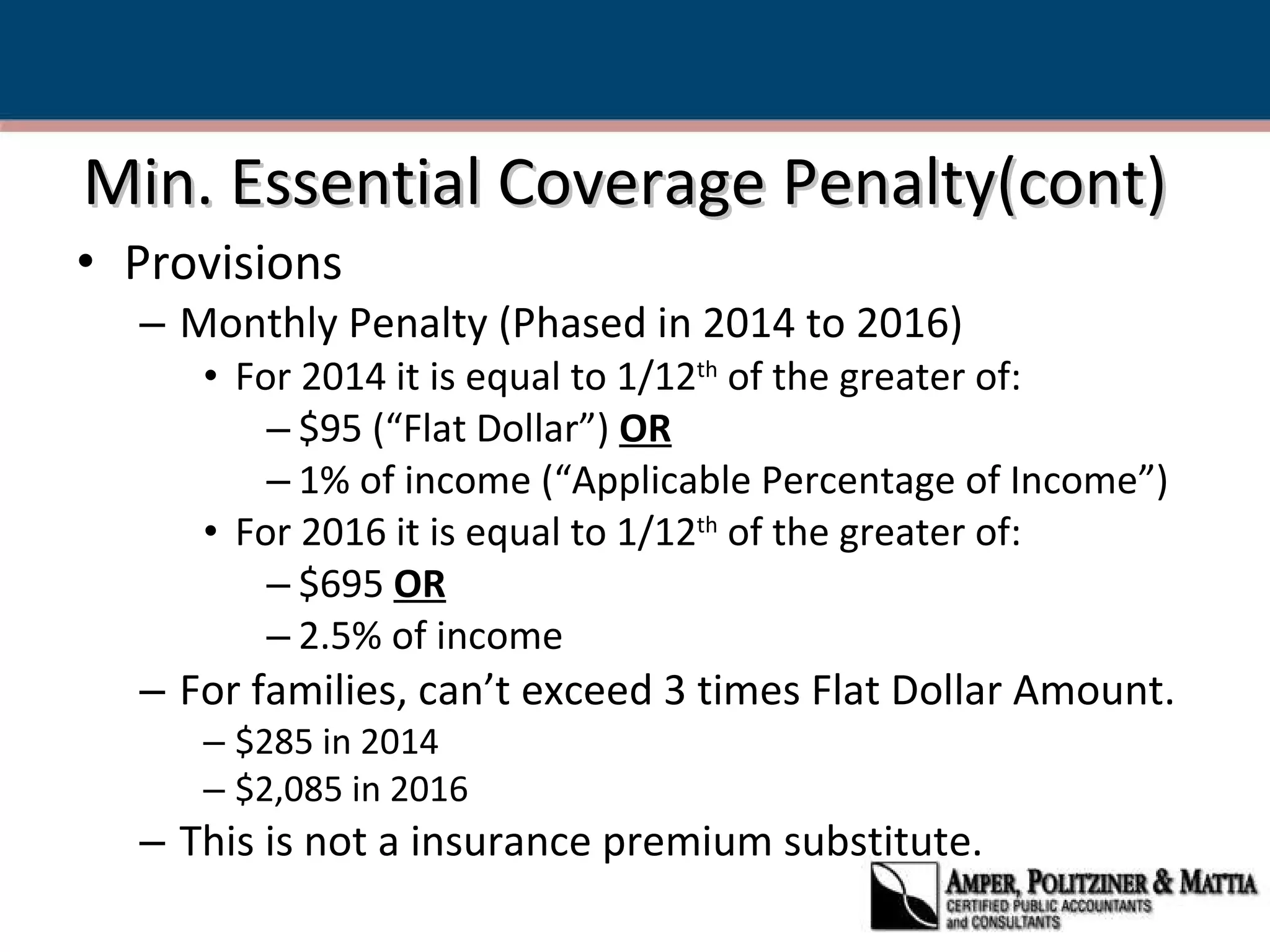
Min. Essential Coverage Penalty(cont) Provisions  Monthly Penalty (Phased in 2014 to 2016) For 2014 it is equal to 1/12 th  of the greater of: $95 (“Flat Dollar”)  OR 1% of income (“Applicable Percentage of Income”) For 2016 it is equal to 1/12 th  of the greater of: $695  OR 2.5% of income For families, can’t exceed 3 times Flat Dollar Amount. $285 in 2014 $2,085 in 2016 This is not a insurance premium substitute.
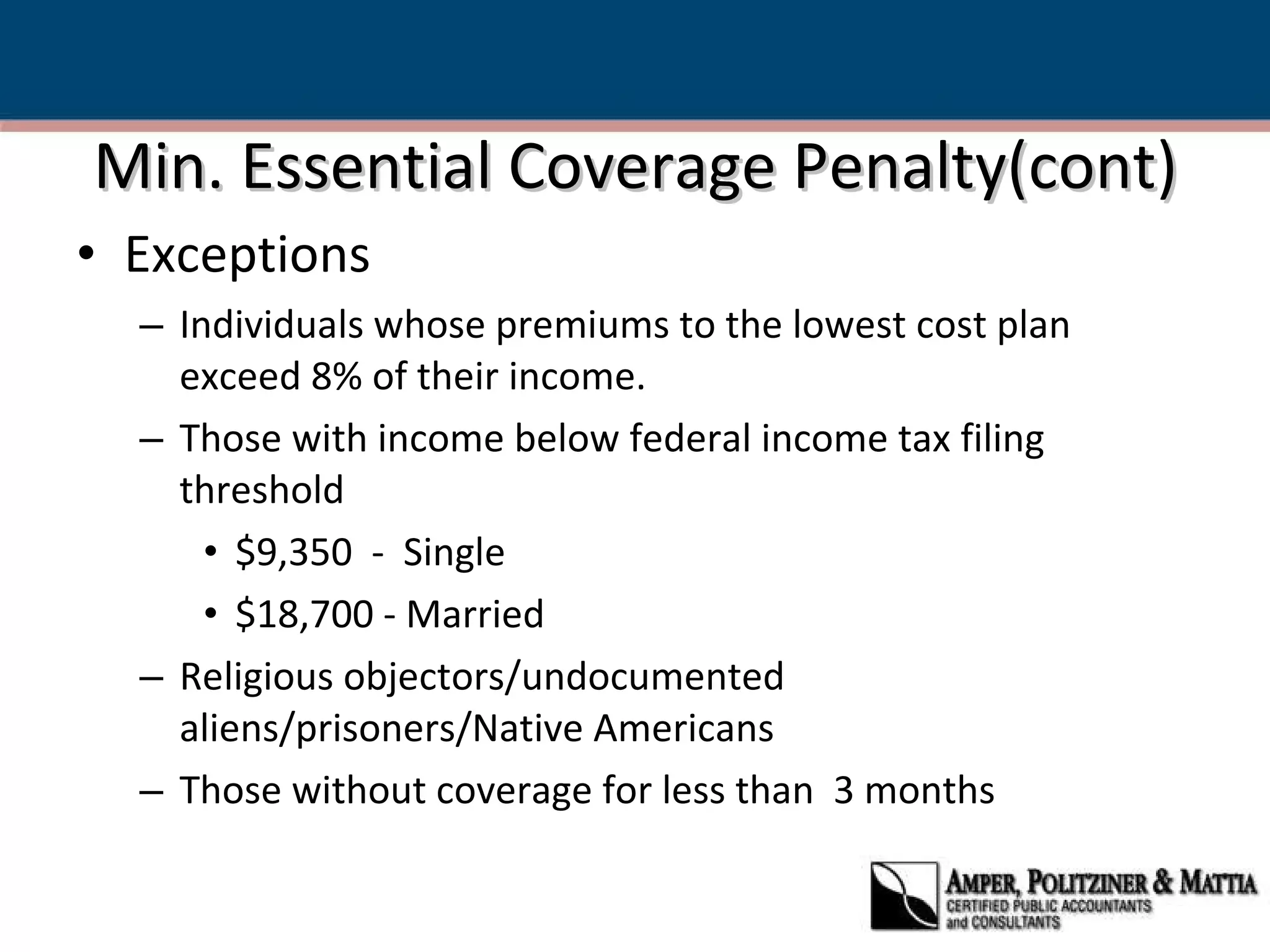
Min. Essential Coverage Penalty(cont) Exceptions Individuals whose premiums to the lowest cost plan exceed 8% of their income. Those with income below federal income tax filing threshold $9,350  -  Single $18,700 - Married Religious objectors/undocumented aliens/prisoners/Native Americans Those without coverage for less than  3 months
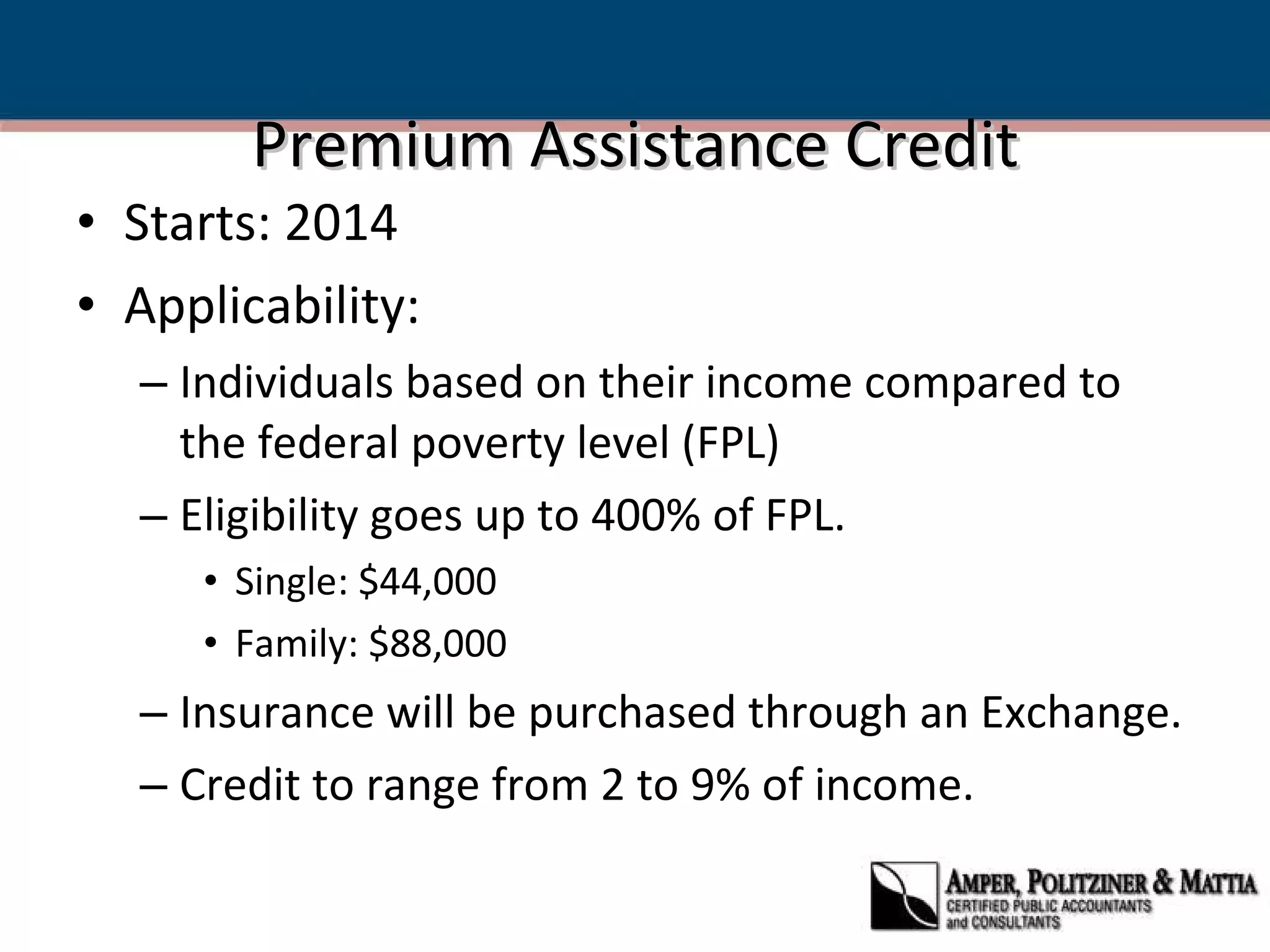
Premium Assistance Credit Starts: 2014 Applicability: Individuals based on their income compared to the federal poverty level (FPL) Eligibility goes up to 400% of FPL.  Single: $44,000 Family: $88,000 Insurance will be purchased through an Exchange. Credit to range from 2 to 9% of income.
Premium Assistance Credit(cont) Exceptions To Eligibility Those covered by employer plans Unless  Employer pays for less than 60% of premiums, or Employee contributions exceeds 9.5% of income.
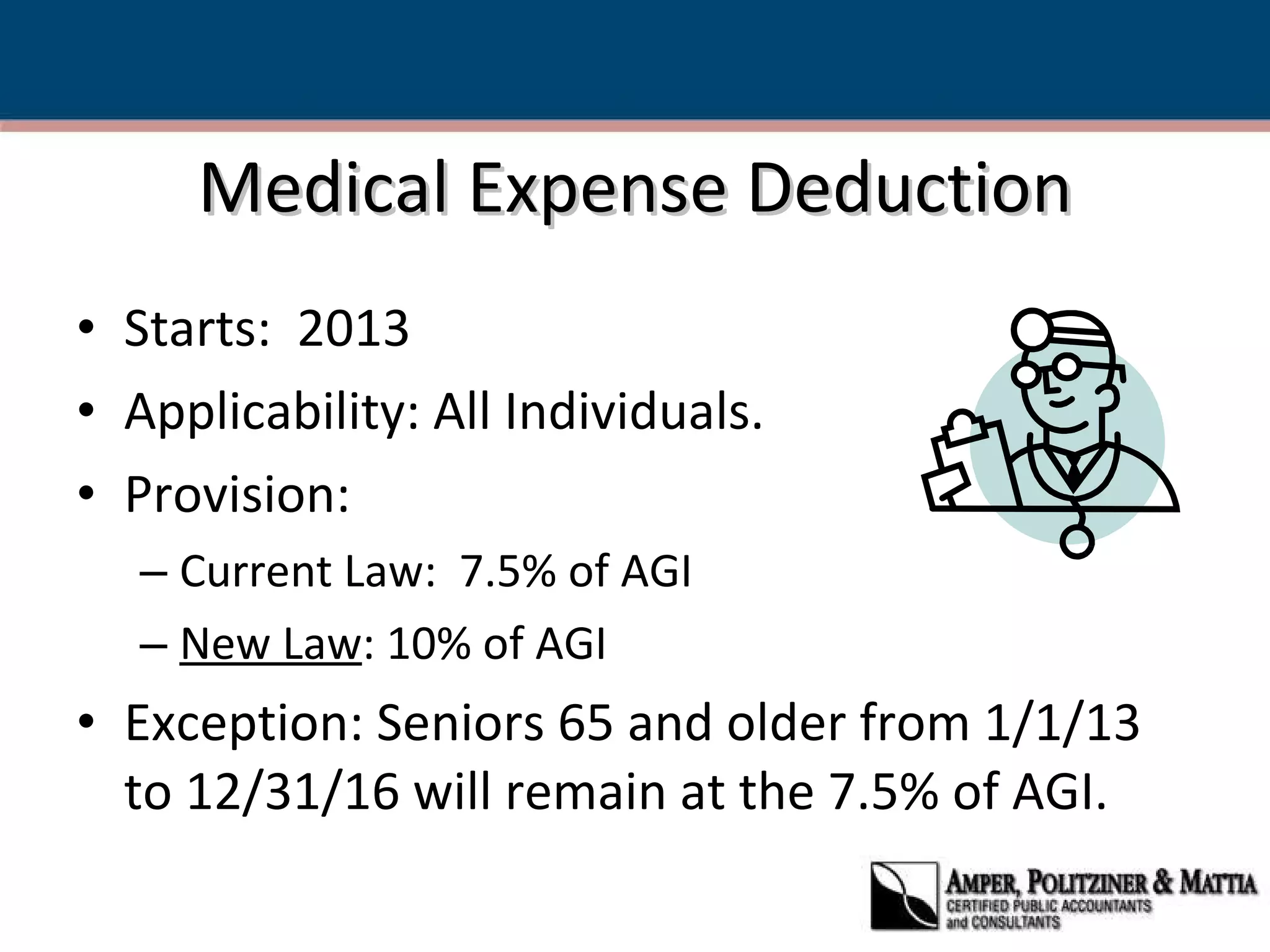
Medical Expense Deduction Starts:  2013  Applicability: All Individuals. Provision:  Current Law:  7.5% of AGI New Law : 10% of AGI Exception: Seniors 65 and older from 1/1/13 to 12/31/16 will remain at the 7.5% of AGI.
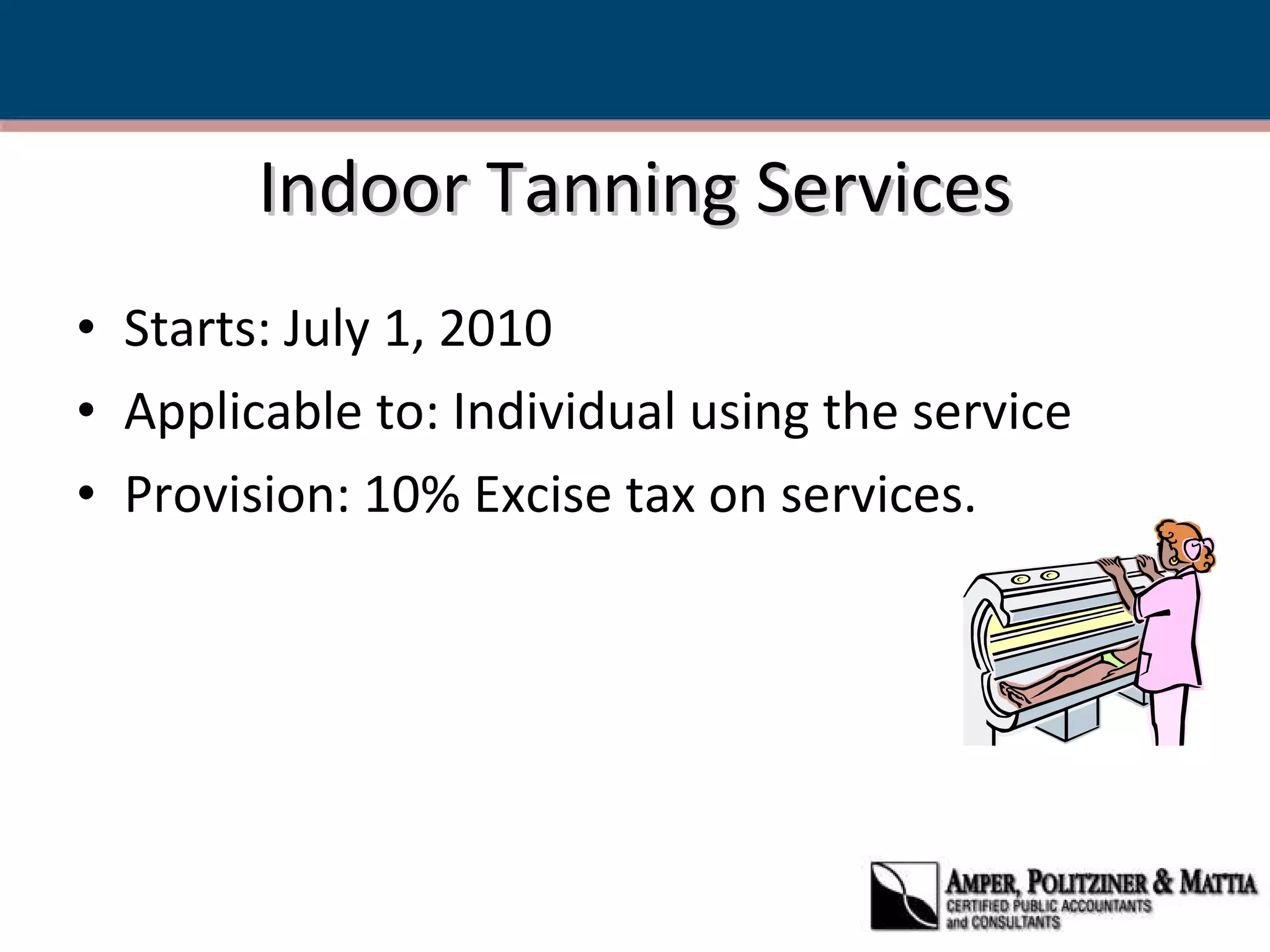
Indoor Tanning Services Starts: July 1, 2010 Applicable to: Individual using the service  Provision: 10% Excise tax on services.
LARGE EMPLOYERS
Nondeductible Penalty (Pay or Play) Starts:  2014 Applicable to: Employers w/ 50+ full-time employees. F/T = Average of 30 hours/week At least one employee is eligible for a premium credit. Look back to prior year for number of employees. Employer not offering an insurance plan, or Employer’s plan underfunded or too expensive for employee to buy
Nondeductible Penalty(Cont) If No coverage offered: Penalty is equal to 1/12 th  of $2,000($167.67) for any month times the number of employees for the month. Penalty is calculated based on the number of employees over 30.  (i.e. 70 – 30 = 40 * $167.67 = $6,706.80/month) If Plan is underfunded or too expensive: Penalty equal to the # of employees receiving a premium assistance tax credit time 1/12 th  of $3,000 ($250) for any month. This is limited to 1/12 th  of $2,000/month times the # of full-time employees. Again, this is calculated based on the number of employees over 30.
Free Choice Vouchers Starts:  2014 Applicable to : Employers providing insurance Provision:  Employer required to provide voucher to qualified employee Employee not participating in employer plan Employee whose premium contribution would have exceeded 8%, but not  9.5% of household income. Employee’s Household income does not exceed 400% of FPL Voucher’s value is the amount the employer would have paid for the employee to their plan. Voucher used for the Insurance Exchange.
SMALL EMPLOYERS
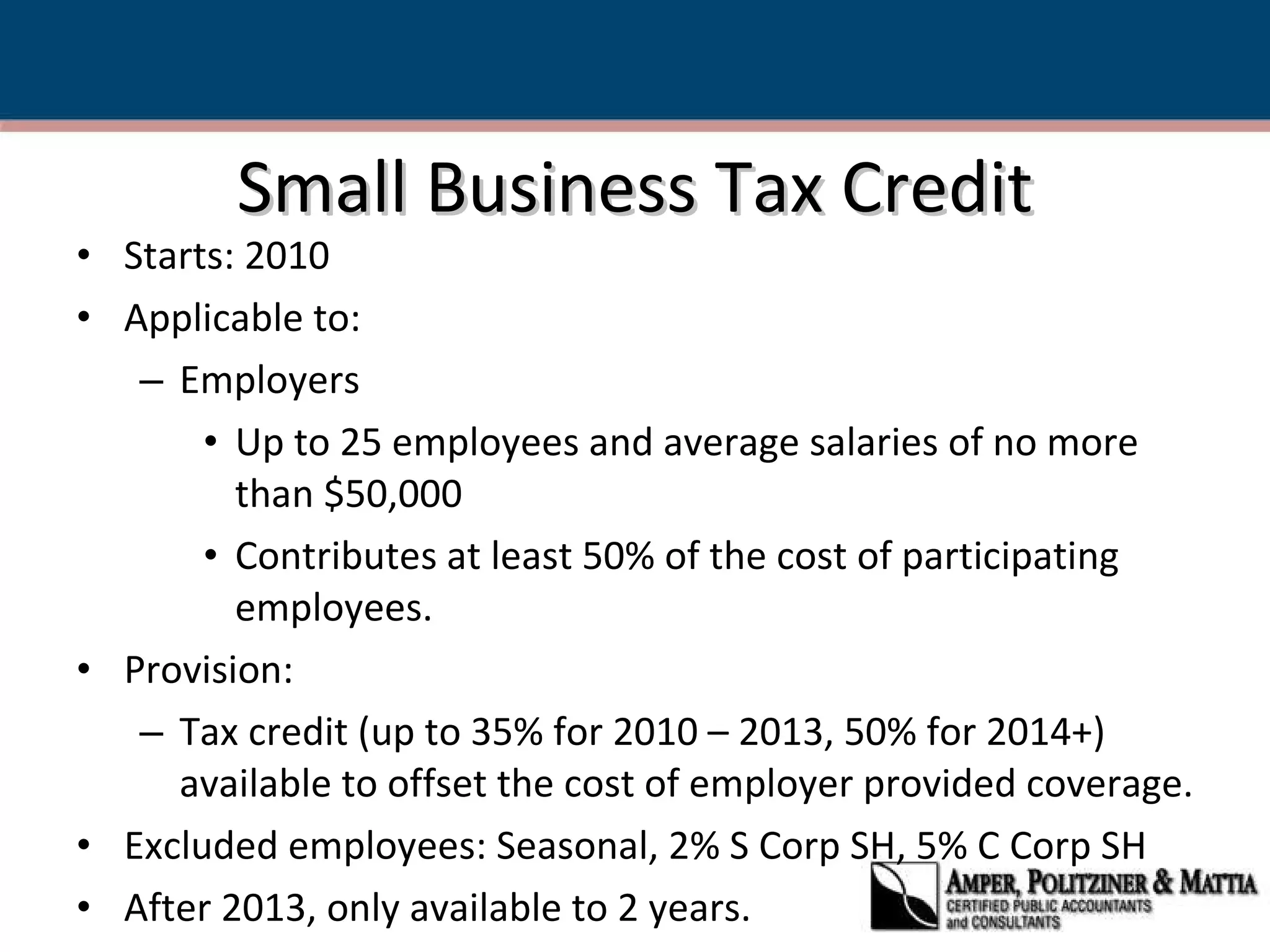
Small Business Tax Credit Starts: 2010 Applicable to: Employers  Up to 25 employees and average salaries of no more than $50,000 Contributes at least 50% of the cost of participating employees. Provision: Tax credit (up to 35% for 2010 – 2013, 50% for 2014+) available to offset the cost of employer provided coverage. Excluded employees: Seasonal, 2% S Corp SH, 5% C Corp SH After 2013, only available to 2 years.
HIGHER INCOME TAXPAYERS
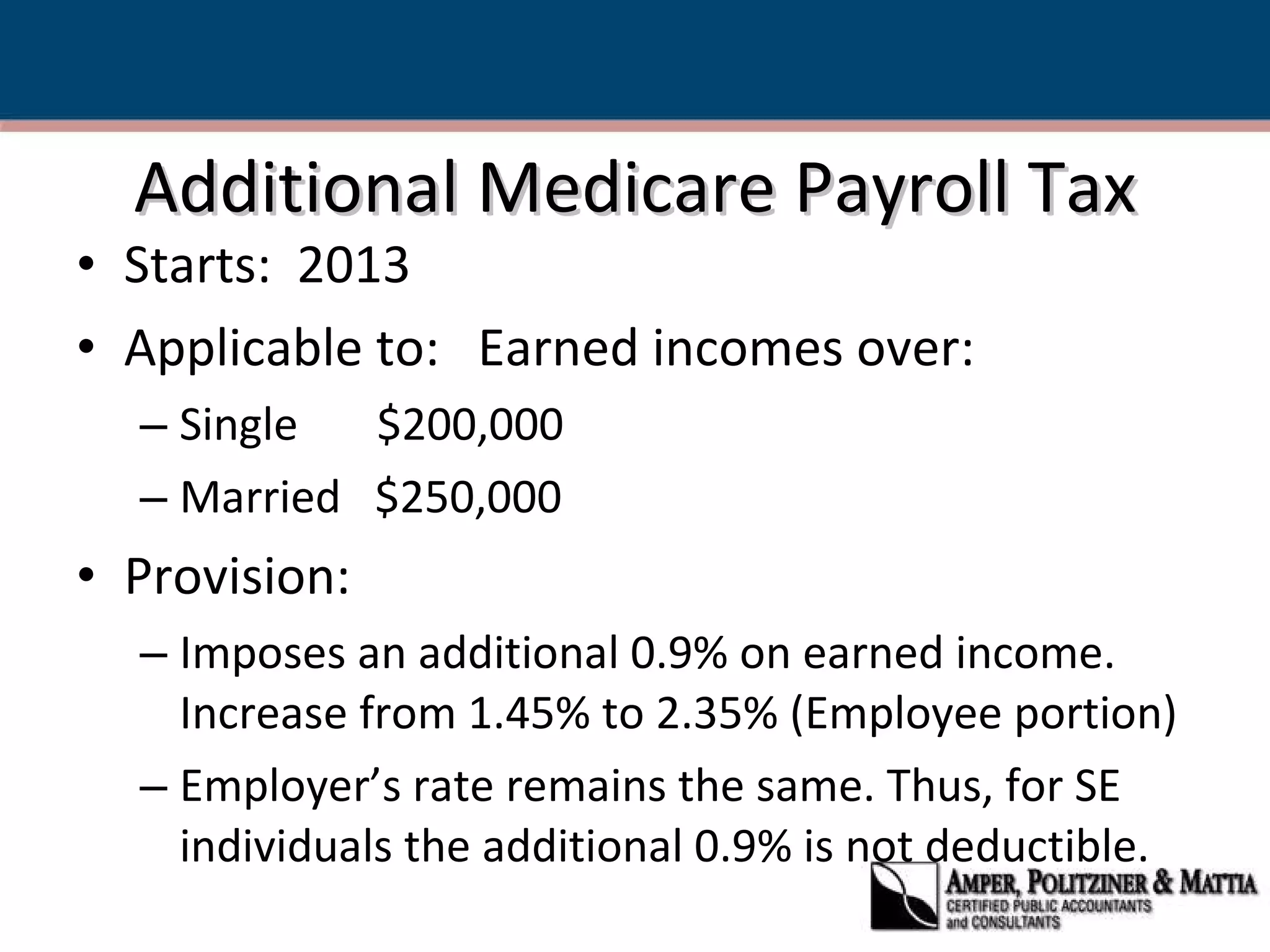
Additional Medicare Payroll Tax Starts:  2013 Applicable to:  Earned incomes over: Single  $200,000 Married  $250,000 Provision: Imposes an additional 0.9% on earned income. Increase from 1.45% to 2.35% (Employee portion) Employer’s rate remains the same. Thus, for SE individuals the additional 0.9% is not deductible.
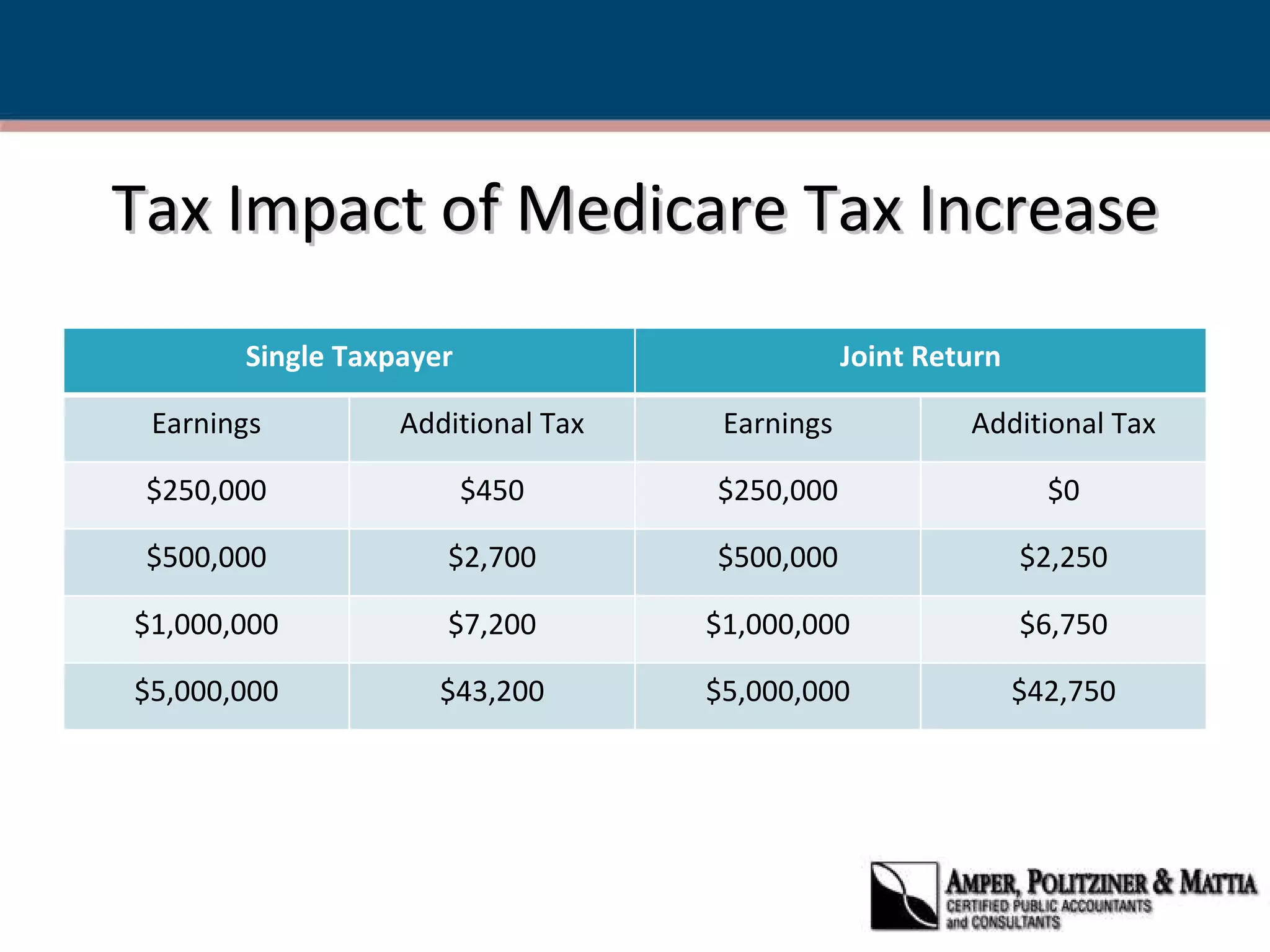
Tax Impact of Medicare Tax Increase Single Taxpayer Joint Return Earnings Additional Tax Earnings Additional Tax $250,000 $450 $250,000 $0 $500,000 $2,700 $500,000 $2,250 $1,000,000 $7,200 $1,000,000 $6,750 $5,000,000 $43,200 $5,000,000 $42,750
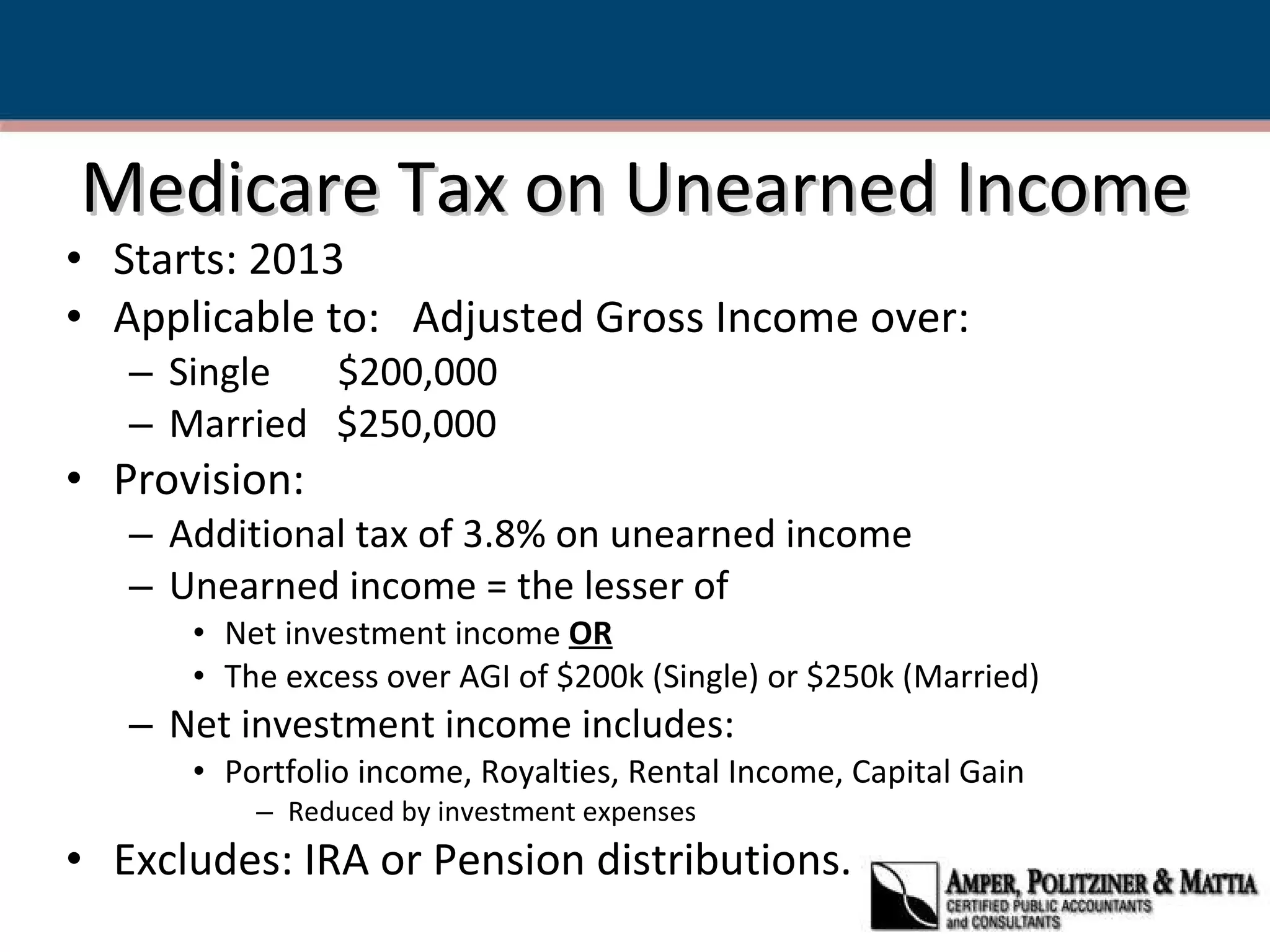
Medicare Tax on Unearned Income Starts: 2013 Applicable to:  Adjusted Gross Income over: Single  $200,000 Married  $250,000 Provision: Additional tax of 3.8% on unearned income Unearned income = the lesser of Net investment income  OR The excess over AGI of $200k (Single) or $250k (Married) Net investment income includes: Portfolio income, Royalties, Rental Income, Capital Gain Reduced by investment expenses Excludes: IRA or Pension distributions.
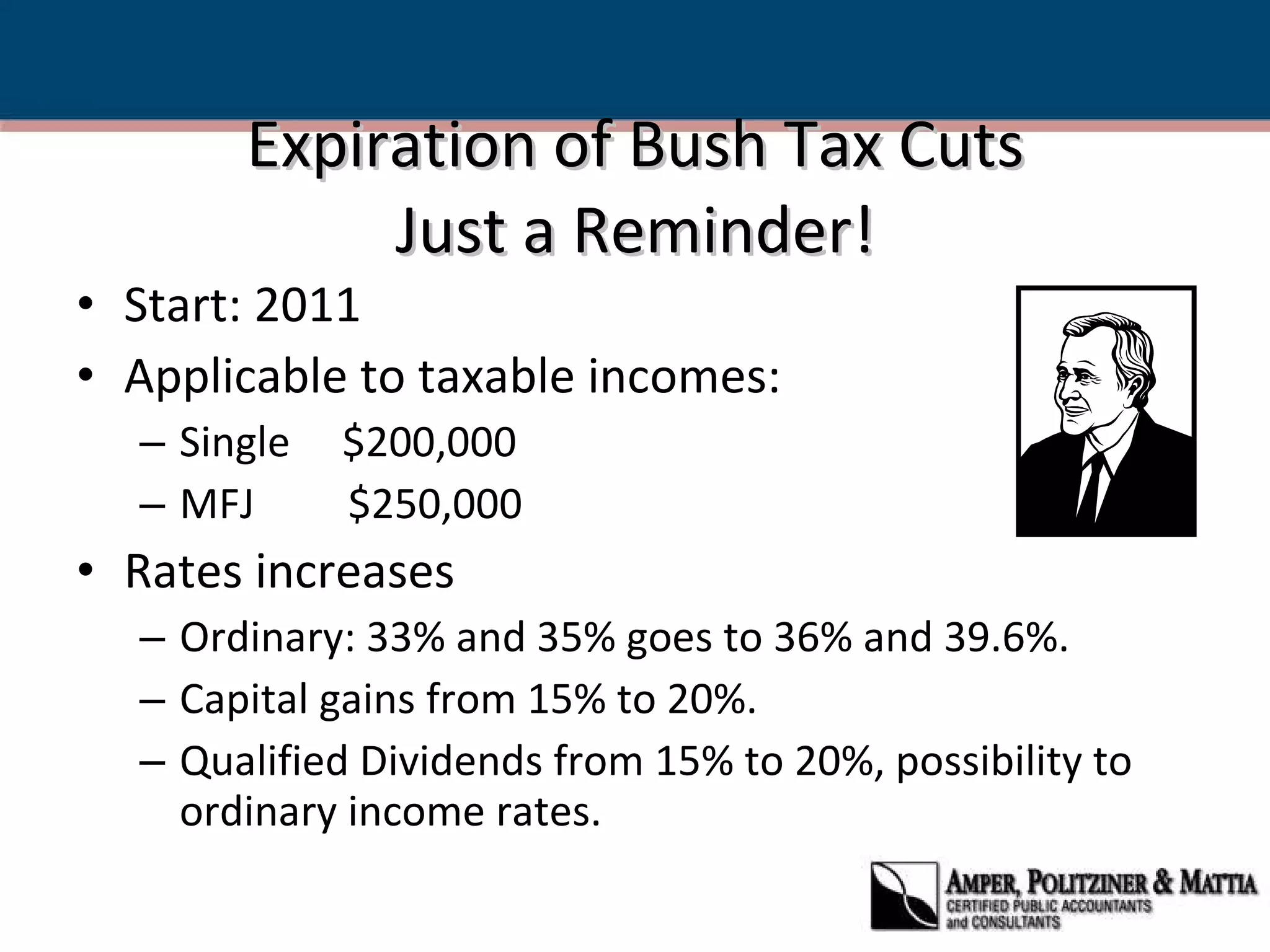
Expiration of Bush Tax Cuts Just a Reminder! Start: 2011 Applicable to taxable incomes: Single  $200,000  MFJ  $250,000 Rates increases Ordinary: 33% and 35% goes to 36% and 39.6%.  Capital gains from 15% to 20%.  Qualified Dividends from 15% to 20%, possibility to ordinary income rates.
HIGH COST INSURANCE
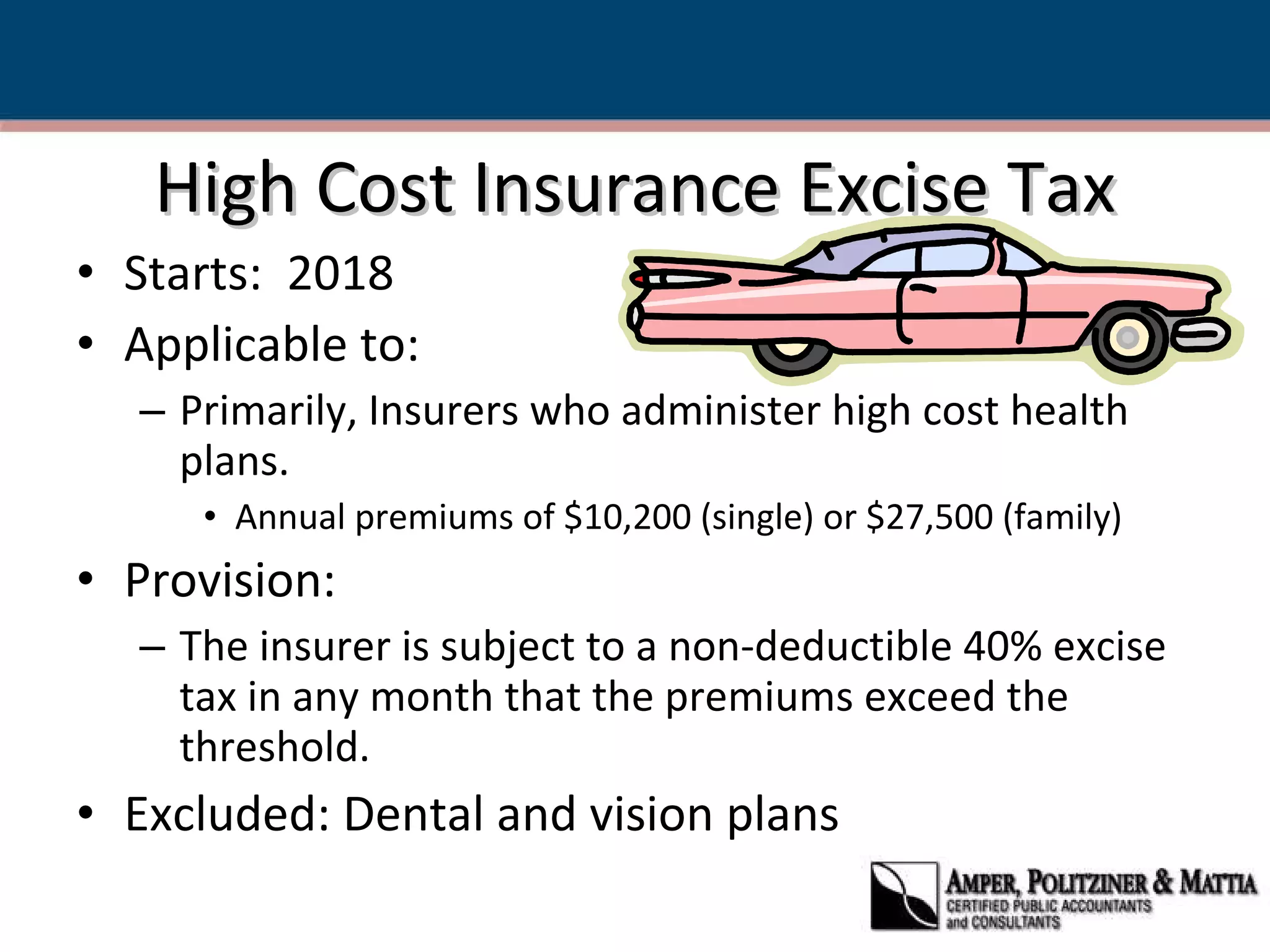
High Cost Insurance Excise Tax Starts:  2018 Applicable to: Primarily, Insurers who administer high cost health plans. Annual premiums of $10,200 (single) or $27,500 (family) Provision: The insurer is subject to a non-deductible 40% excise tax in any month that the premiums exceed the threshold. Excluded: Dental and vision plans
REPORTING REQUIREMENTS
Employers Providing Coverage Starts: 2014  Applicable to: Employers providing insurance plans. Provision: Will be required to file information returns stating: Employer Name/Address/EIN Dates of coverage Insurance coverage Premiums paid by employee
Reporting for Large Employers Starts: 2014 Applicable:  Large Employers Provision:  Must Report Certification that it offers full-time employees an insurance plan. Number of F/T employees/month for the calendar year and information indicating if F/T employee is covered. If Er coverage is provided - additional information regarding cost and availability of coverage must also be provided.
Reporting on W-2’s Start: 2011 Applicable: Employers paying any premiums. Provision:  Provide the value of the employer-provided health insurance on the employee’s W-2
FSAs/HSAs/HRAs
FSAs/HSAs/HRAs Starting in 2011 the definition of qualified medical expenses will conform to itemized medical expenses. i.e. OTC drugs will no longer apply. Starting in 2013 contributions to FSAs will be capped at $2,500 (annually indexed for inflation) Starting in 2011 there will be increased penalties for HSAs. An additional tax on disqualified distributions of 20% (currently 10%)
Time Line Summary 2010 Health Insurance Credit for Small Businesses 2011 OTC drugs not allowed for FSA/HRA/HSA/MSA Penalty on NQ HAS/MSA distributions increases  W-2 reporting for cost of health coverage provided.
Time Line Summary(cont.) 2013 FSA contributions capped at $2,500 Ee portion of medicare tax increased by .9%(2.35%) Medical deduction threshold increases to 10% Medicare surcharge (3.8%) on unearned income
Time Line Summary(cont) 2014 Free choice vouchers Health insurance premium assistance credit Potential penalty for individuals w/o insurance Potential penalty for lg employers not providing Information reporting by insurance providers Information reporting by Large employers
Time Line Summary(cont.) 2018 Penalty on High-Cost Health Plans
Contact Information Dan Gibson, CPA, EA Amper, Politziner & Mattia, LLP 750 Rt. 202 S, Suite 500 Bridgewater, NJ 08807 Phone: 908-218-5002 Email:  [email_address] Sarah Anderson, CPA, MST Amper, Politziner & Mattia, LLP 750 Rt. 202 S, Suite 500 Bridgewater, NJ 08807 Phone: 908-218-5002 Email:  [email_address]

Healthcare Act Presentation

  • 1.
    Patient Protection Act: Unpacking the Tax Complexities Dan Gibson, CPA, EA Sarah Anderson, CPA, MST June 22, 2010
  • 2.
    Opening Comments ActDoes Not Mandate Employer Insurance Coverage. However, Penalty to individuals who don’t have coverage. Provides credits for those who can’t afford it. Penalty to Large Employers who don’t provide it. Penalty to Large Employers who don’t provide enough of it. Rewards Small Employers who do provide it. Taxes High Income Individuals and High Cost Insurance Plans to help pay for it.
  • 3.
    Agenda Individuals – Potential Penalty Large Employers – Potential Penalty Small Employers – Potential Credit Higher Income Individuals – Potential Tax High-Cost Insurance – Potential Tax Reporting Requirements – More of it FSAs/HSAs/HRAs - Restrictions
  • 4.
  • 5.
    Minimum Essential CoveragePenalty Starts: 2014 Applicable to: Any Uninsured Person who is a - US Citizen (living in the US) US legal residents.
  • 6.
    Min. Essential CoveragePenalty(cont) Provisions Monthly Penalty (Phased in 2014 to 2016) For 2014 it is equal to 1/12 th of the greater of: $95 (“Flat Dollar”) OR 1% of income (“Applicable Percentage of Income”) For 2016 it is equal to 1/12 th of the greater of: $695 OR 2.5% of income For families, can’t exceed 3 times Flat Dollar Amount. $285 in 2014 $2,085 in 2016 This is not a insurance premium substitute.
  • 7.
    Min. Essential CoveragePenalty(cont) Exceptions Individuals whose premiums to the lowest cost plan exceed 8% of their income. Those with income below federal income tax filing threshold $9,350 - Single $18,700 - Married Religious objectors/undocumented aliens/prisoners/Native Americans Those without coverage for less than 3 months
  • 8.
    Premium Assistance CreditStarts: 2014 Applicability: Individuals based on their income compared to the federal poverty level (FPL) Eligibility goes up to 400% of FPL. Single: $44,000 Family: $88,000 Insurance will be purchased through an Exchange. Credit to range from 2 to 9% of income.
  • 9.
    Premium Assistance Credit(cont)Exceptions To Eligibility Those covered by employer plans Unless Employer pays for less than 60% of premiums, or Employee contributions exceeds 9.5% of income.
  • 10.
    Medical Expense DeductionStarts: 2013 Applicability: All Individuals. Provision: Current Law: 7.5% of AGI New Law : 10% of AGI Exception: Seniors 65 and older from 1/1/13 to 12/31/16 will remain at the 7.5% of AGI.
  • 11.
    Indoor Tanning ServicesStarts: July 1, 2010 Applicable to: Individual using the service Provision: 10% Excise tax on services.
  • 12.
  • 13.
    Nondeductible Penalty (Payor Play) Starts: 2014 Applicable to: Employers w/ 50+ full-time employees. F/T = Average of 30 hours/week At least one employee is eligible for a premium credit. Look back to prior year for number of employees. Employer not offering an insurance plan, or Employer’s plan underfunded or too expensive for employee to buy
  • 14.
    Nondeductible Penalty(Cont) IfNo coverage offered: Penalty is equal to 1/12 th of $2,000($167.67) for any month times the number of employees for the month. Penalty is calculated based on the number of employees over 30. (i.e. 70 – 30 = 40 * $167.67 = $6,706.80/month) If Plan is underfunded or too expensive: Penalty equal to the # of employees receiving a premium assistance tax credit time 1/12 th of $3,000 ($250) for any month. This is limited to 1/12 th of $2,000/month times the # of full-time employees. Again, this is calculated based on the number of employees over 30.
  • 15.
    Free Choice VouchersStarts: 2014 Applicable to : Employers providing insurance Provision: Employer required to provide voucher to qualified employee Employee not participating in employer plan Employee whose premium contribution would have exceeded 8%, but not 9.5% of household income. Employee’s Household income does not exceed 400% of FPL Voucher’s value is the amount the employer would have paid for the employee to their plan. Voucher used for the Insurance Exchange.
  • 16.
  • 17.
    Small Business TaxCredit Starts: 2010 Applicable to: Employers Up to 25 employees and average salaries of no more than $50,000 Contributes at least 50% of the cost of participating employees. Provision: Tax credit (up to 35% for 2010 – 2013, 50% for 2014+) available to offset the cost of employer provided coverage. Excluded employees: Seasonal, 2% S Corp SH, 5% C Corp SH After 2013, only available to 2 years.
  • 18.
  • 19.
    Additional Medicare PayrollTax Starts: 2013 Applicable to: Earned incomes over: Single $200,000 Married $250,000 Provision: Imposes an additional 0.9% on earned income. Increase from 1.45% to 2.35% (Employee portion) Employer’s rate remains the same. Thus, for SE individuals the additional 0.9% is not deductible.
  • 20.
    Tax Impact ofMedicare Tax Increase Single Taxpayer Joint Return Earnings Additional Tax Earnings Additional Tax $250,000 $450 $250,000 $0 $500,000 $2,700 $500,000 $2,250 $1,000,000 $7,200 $1,000,000 $6,750 $5,000,000 $43,200 $5,000,000 $42,750
  • 21.
    Medicare Tax onUnearned Income Starts: 2013 Applicable to: Adjusted Gross Income over: Single $200,000 Married $250,000 Provision: Additional tax of 3.8% on unearned income Unearned income = the lesser of Net investment income OR The excess over AGI of $200k (Single) or $250k (Married) Net investment income includes: Portfolio income, Royalties, Rental Income, Capital Gain Reduced by investment expenses Excludes: IRA or Pension distributions.
  • 22.
    Expiration of BushTax Cuts Just a Reminder! Start: 2011 Applicable to taxable incomes: Single $200,000 MFJ $250,000 Rates increases Ordinary: 33% and 35% goes to 36% and 39.6%. Capital gains from 15% to 20%. Qualified Dividends from 15% to 20%, possibility to ordinary income rates.
  • 23.
  • 24.
    High Cost InsuranceExcise Tax Starts: 2018 Applicable to: Primarily, Insurers who administer high cost health plans. Annual premiums of $10,200 (single) or $27,500 (family) Provision: The insurer is subject to a non-deductible 40% excise tax in any month that the premiums exceed the threshold. Excluded: Dental and vision plans
  • 25.
  • 26.
    Employers Providing CoverageStarts: 2014 Applicable to: Employers providing insurance plans. Provision: Will be required to file information returns stating: Employer Name/Address/EIN Dates of coverage Insurance coverage Premiums paid by employee
  • 27.
    Reporting for LargeEmployers Starts: 2014 Applicable: Large Employers Provision: Must Report Certification that it offers full-time employees an insurance plan. Number of F/T employees/month for the calendar year and information indicating if F/T employee is covered. If Er coverage is provided - additional information regarding cost and availability of coverage must also be provided.
  • 28.
    Reporting on W-2’sStart: 2011 Applicable: Employers paying any premiums. Provision: Provide the value of the employer-provided health insurance on the employee’s W-2
  • 29.
  • 30.
    FSAs/HSAs/HRAs Starting in2011 the definition of qualified medical expenses will conform to itemized medical expenses. i.e. OTC drugs will no longer apply. Starting in 2013 contributions to FSAs will be capped at $2,500 (annually indexed for inflation) Starting in 2011 there will be increased penalties for HSAs. An additional tax on disqualified distributions of 20% (currently 10%)
  • 31.
    Time Line Summary2010 Health Insurance Credit for Small Businesses 2011 OTC drugs not allowed for FSA/HRA/HSA/MSA Penalty on NQ HAS/MSA distributions increases W-2 reporting for cost of health coverage provided.
  • 32.
    Time Line Summary(cont.)2013 FSA contributions capped at $2,500 Ee portion of medicare tax increased by .9%(2.35%) Medical deduction threshold increases to 10% Medicare surcharge (3.8%) on unearned income
  • 33.
    Time Line Summary(cont)2014 Free choice vouchers Health insurance premium assistance credit Potential penalty for individuals w/o insurance Potential penalty for lg employers not providing Information reporting by insurance providers Information reporting by Large employers
  • 34.
    Time Line Summary(cont.)2018 Penalty on High-Cost Health Plans
  • 35.
    Contact Information DanGibson, CPA, EA Amper, Politziner & Mattia, LLP 750 Rt. 202 S, Suite 500 Bridgewater, NJ 08807 Phone: 908-218-5002 Email: [email_address] Sarah Anderson, CPA, MST Amper, Politziner & Mattia, LLP 750 Rt. 202 S, Suite 500 Bridgewater, NJ 08807 Phone: 908-218-5002 Email: [email_address]