QUARTER III – HEALTH
HEALTH TRENDS, ISSUES
AND CONCERN
(GLOBAL LEVEL)
JEROME V. MANABAT
MAPEH 10 –Teacher
This module aims to help you:
• learn about different global health issues and the
initiatives made to help address these problems.
• Improve understanding of health concerns and
how these are treated or implemented around the
world and locally. At the end of each lesson, a
transfer activity will help evaluate your
understanding of the different topics.
• You will also be assessed prior to answering the
different activities and again at the end of the
lesson to check for knowledge, understanding,
attitudes and skills learned.
Todays lesson:
• Definition/meaning of global health
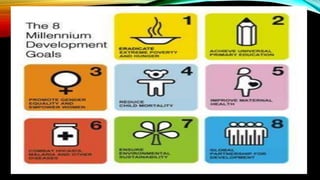
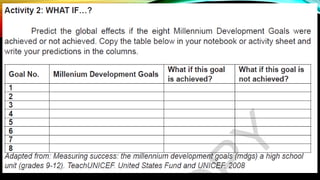
• 8 Millennium development goals (MDG)
• UNDP’s Quick Wins to answer achieve the
8 MDG
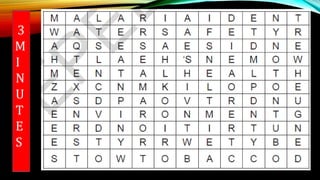
Activity: Word Hunt
With your group spot the word Use whiteboard
marker pen and write the answers in your activity
white pad.
Procedure:
1. Look for words/terms related global health issues
and concerns that the World Health Organization
and member-nations are facing.
3
M
I
N
U
T
E
S
Guide questions:
1.List down different health, trends and issues
problem cited on the video you are going to
watch?
2.What are the different health services
mentioned in the video?
VIDEO CLIP VIEWING: WHO
BRINGING HEALTH TO LIFE
The term “global health” rose in
popularity along with the rise of
globalization.
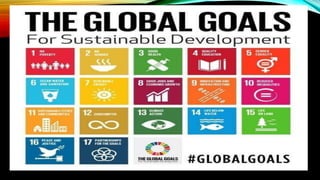
Both terms improved public awareness
of vulnerabilities and shared
responsibilities among people for the
different injustices in the
world.
Global Health - pertains to various health
issues, concerns, and trends which go beyond
national boundaries and call for global
initiatives for the protection and promotion of
peoples’ health across the world. - Ilona
Kickbush (2006)
Global Health is an area for study, research and
practice that prioritizes health improvement and
achieving impartiality in healthcare and wellness
worldwide. - Koplan and Associates (2009)
GLOBAL HEALTH - Diverse health
issues, concerns and trends which
call for all nations to address and
act on to promote and protect health
of individuals and groups across
boundaries.
The primary international body
responsible for developing leadership in
health, setting norms and standards and
providing health support among nations
around the world.
WORLD HEALTH ORGANIZATION
(WHO):
These are programs and projects which help
address global health issues, concerns and
trends.
Global Health Initiatives
QUICK WINS -- UNDP intervention
program which refers to actions that
can be immediately used within the
community or locale to produce
effective results. (See page 272-273)
*UNDP – United Nations Development
Program
Stop TB
Roll Back Malaria
Global Fund to Fight HIV/AIDS Malariaand otherdiseases,
Framework Convention on Tobacco Control
Comprehensive Mental Health Action Plan
Global Strategy to Reduce the Harmful Use of Alcohol
Global Strategy for the Prevention and Control of Non-
Communicable Diseases.
GLOBAL HEALTH
INITIATIVES
These are goals set by the United Nations for its member-
nations to be fulfilled on an agreed span of time (2015) to
be evaluated and counter-checked under world
standards.
• UN created MDG in 2000 in effort to improve life in
developing regions by 2015
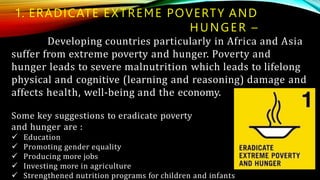
1. ERADICATE EXTREME POVERTY AND
HUNGER –
Developing countries particularly in Africa and Asia
suffer from extreme poverty and hunger. Poverty and
hunger leads to severe malnutrition which leads to lifelong
physical and cognitive (learning and reasoning) damage and
affects health, well-being and the economy.
Some key suggestions to eradicate poverty
and hunger are :
 Education
 Promoting gender equality
 Producing more jobs
 Investing more in agriculture
 Strengthened nutrition programs for children and infants
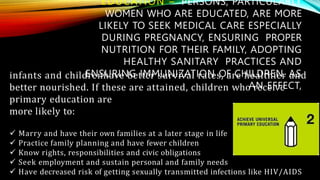
EDUCATION – PERSONS, PARTICULARLY
WOMEN WHO ARE EDUCATED, ARE MORE
LIKELY TO SEEK MEDICAL CARE ESPECIALLY
DURING PREGNANCY, ENSURING PROPER
NUTRITION FOR THEIR FAMILY, ADOPTING
HEALTHY SANITARY PRACTICES AND
ENSURING IMMUNIZATION OF CHILDREN. AS
AN EFFECT,
infants and childrenhave better survival rates, are healthier and
better nourished. If these are attained, children who receive
primary education are
more likely to:
 Marry and have their own families at a later stage in life
 Practice family planning and have fewer children
 Know rights, responsibilities and civic obligations
 Seek employment and sustain personal and family needs
 Have decreased risk of getting sexually transmitted infections like HIV/AIDS
3. PROMOTE GENDER EQUALITY &
EMPOWER WOMEN –
Gender equality means equal representation of men and
women. It implies that all gender should have equal value
and treatment. Equal gender treatment empowers women
and other groups creating opportunities in education, work,
finances, and other aspects which improves the economy
and lessen effects of financial crises.
Gender equality can be achieved through:
 Early childhood development intervention
 Promotion of women’s political rights and involvement
 Improved reproductive health programs and policies
 Education and integrating gender equality in school curriculum
 Improved women’s access to work and strengthened labor policies for women
4. REDUCE CHILD MORTALITY - Programs and
policies which help reduce child mortality like
improving nutritional intake, healthcare facilities
and infrastructure, and other fields which improve
children’s lives. Strengthening local and national
health programs and policies is one way to reduce
child mortality.
This includes:
 Immunization programs
 Assuring the survival and better health of mothers
 Improving reproductive health programs and policies
 Better nutrition program for infants, children and
5. IMPROVED MATERNAL HEALTH - is not only
about mother’s health but also involves the health and
wellness of the family. Maternal health also helps
eradicate other problems like poverty, gender
inequality, decreased workforce, lower birth deaths,
and disability of women.
Some ways to improve maternal health include:
 Improved and proper nutrition of mothers
 Teaching the benefits of birth spacing and small family size
 Educating young boys and girls about the importance of maternal
health
 Better and improved access to hospital care especially obstetric-
gynecology, prenatal and postnatal care
6. COMBAT HIV/AIDS MALARIA AND OTHER DISEASES –
Emerging and re-emerging diseases like HIV/AIDS, malaria,
influenza and other diseases affect productivity and growth of
nations. Some of the effects of disease outbreak are loss of jobs,
shortage in professional workers, and creating social crises. Children
are the most vulnerable and are exposed to exploitation and abuse
undermining their normal growth and development. Some ways to
combat diseases include effective prevention, treatment and care
Like:
 Improved housing conditions
 Increased access to anti-malarial medicines
 Promoting safer sex behavior and preventive education for all
 Promoting Tuberculosis (TB) screening of HIV/AIDS persons and
 TB - Directly Observed Treatment Short (TB-DOTS) Course therapy
 Promoting the use of insecticide-treated nets to fight mosquito-borne diseases
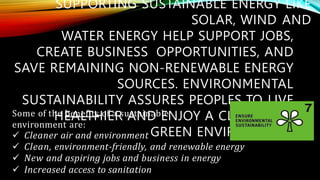
SUPPORTING SUSTAINABLE ENERGY LIKE
SOLAR, WIND AND
WATER ENERGY HELP SUPPORT JOBS,
CREATE BUSINESS OPPORTUNITIES, AND
SAVE REMAINING NON-RENEWABLE ENERGY
SOURCES. ENVIRONMENTAL
SUSTAINABILITY ASSURES PEOPLES TO LIVE
HEALTHIER AND ENJOY A CLEAN AND
GREEN ENVIRONMENT.
Some of the benefits of a sustainable
environment are:
 Cleaner air and environment
 Clean, environment-friendly, and renewable energy
 New and aspiring jobs and business in energy
 Increased access to sanitation
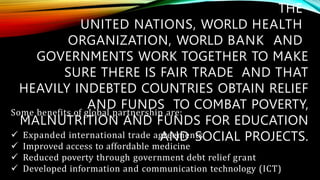
THE
UNITED NATIONS, WORLD HEALTH
ORGANIZATION, WORLD BANK AND
GOVERNMENTS WORK TOGETHER TO MAKE
SURE THERE IS FAIR TRADE AND THAT
HEAVILY INDEBTED COUNTRIES OBTAIN RELIEF
AND FUNDS TO COMBAT POVERTY,
MALNUTRITION AND FUNDS FOR EDUCATION
AND SOCIAL PROJECTS.
Some benefits of global partnership are:
 Expanded international trade agreements
 Improved access to affordable medicine
 Reduced poverty through government debt relief grant
 Developed information and communication technology (ICT)
ACTIVITY: NAME THAT ICON
VIDEO CLIP
VIEWING
Guide Questions:
1. How much portion was cut in extreme poverty?
2. How Many Percent was increased or added in universal primary
education?
3. Was gender equality has been met? Yes or no?
4. How many children are still dying below 5 years old?
5. How many of the women get prenatal care?
6. How many young women are infected by HIV every Hour?
7. How many people don’t have basic sanitation like toilet?
8. Was the Global partnership fully achieved? Yes/no?
THE 10 GLOBAL
HEALTH TRENDS,
ISSUES,
AND CONCERNS
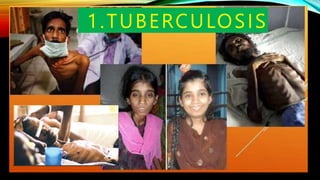
1.TUBERCULOSIS
1.T U B E RC U LO S I S
• Commonly known as T B (Tubercle Bacillus, is a bacterial infection that
can spread through the lymph nodes and bloodstream to any organ in
your body. It is often most found in the lungs.
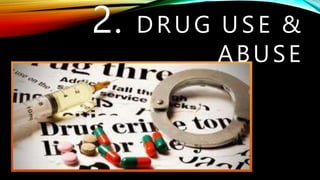
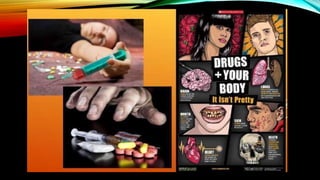
2. DRUG USE &
ABUSE
drug substance in amounts or
with methods which are harmful
to themselves or others.
2. D R U G U S E & A B U S E
IT IS PATTERNED USE OF A DRUG IN
WHICH THE USER CONSUMES THE
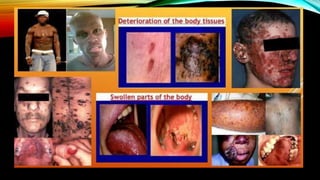
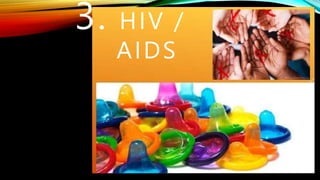
3. HIV /
AIDS
It is transmitted primarily via
unprotected sexual intercourse,
contaminated blood transfusions,
hypodermic needles, and from
mother to child during pregnancy,
delivery, or breastfeeding.
3. H I V /A I D S
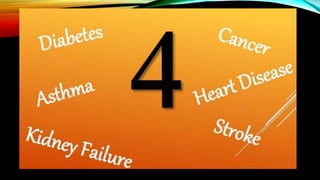
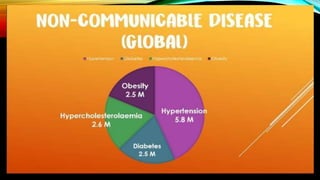
NON-COMMUNICABLE DISEASE
NCD, can refer to chronic diseases
which last for long periods of time and
progress slowly.
COMMUNICABLE DISEASE -
Also known as infectious disease or
transmissible diseases.
- These are illnesses that result
from the infection, presence and
growth of pathogenic biologic
agents in humans.
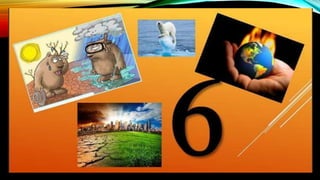
CLIMATE CHANGE
A change in global or regional climate patterns
attributed directly or indirectly to human
activity.
•“Global Warming” in sheep’s
clothing. A long-term change in the
Earth’s climate.
• A long-term change in the Earth’s climate.
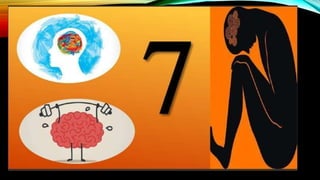
MENTAL HEALTH
-It is a level of psychological
well-being and the absence
of a mental disorder.
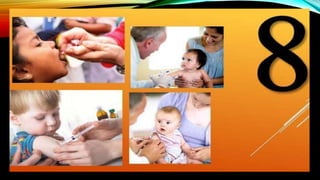
IMMUNIZATION & VACCINES
- It is the safe and effective use of a
small amount of a weakened and
killed virus or bacteria or bits of lab
made protein that imitate the virus in
order to prevent infection by the
same virus or bacteria.
When you get an immunization, you’re injected with the weakened form or a
disease. This triggers your body’s immune response, causing it to either produce
antibodies and the like.
ALCOHOL & TOBACCO
ABUSE/ADDICTION
The excessive consumption of alcohol and tobacco.
- Causes communicable and non communicable
diseases.
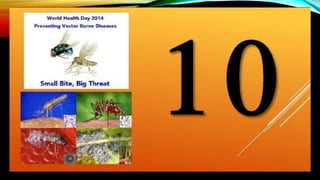
MALARIA /OTHER VECTOR-BORNE
MALARIA causes symptoms that
typically include fever, fatigue, vomiting
and headaches. In severe cases, it can
cause yellow skin, seizures, coma or
death.
VECTORS are living organisms that
can transmit infectious diseases
between humans or from animals to
THERE ARE 195 COUNTRIES IN THE
WORLD TODAY. THIS TOTAL
COMPRISES 193 COUNTRIES THAT ARE
MEMBER STATES OF THE UNITED
NATIONS AND 2 COUNTRIES THAT
ARE NON-MEMBER OBSERVER
STATES: THE HOLY SEE AND THE
STATE OF PALESTINE.

HEALTH TRENDS.pptx

  • 1.
    QUARTER III –HEALTH HEALTH TRENDS, ISSUES AND CONCERN (GLOBAL LEVEL) JEROME V. MANABAT MAPEH 10 –Teacher
  • 2.
    This module aimsto help you: • learn about different global health issues and the initiatives made to help address these problems. • Improve understanding of health concerns and how these are treated or implemented around the world and locally. At the end of each lesson, a transfer activity will help evaluate your understanding of the different topics. • You will also be assessed prior to answering the different activities and again at the end of the lesson to check for knowledge, understanding, attitudes and skills learned.
  • 3.
    Todays lesson: • Definition/meaningof global health • 8 Millennium development goals (MDG) • UNDP’s Quick Wins to answer achieve the 8 MDG
  • 4.
    Activity: Word Hunt Withyour group spot the word Use whiteboard marker pen and write the answers in your activity white pad. Procedure: 1. Look for words/terms related global health issues and concerns that the World Health Organization and member-nations are facing.
  • 5.
  • 8.
    Guide questions: 1.List downdifferent health, trends and issues problem cited on the video you are going to watch? 2.What are the different health services mentioned in the video? VIDEO CLIP VIEWING: WHO BRINGING HEALTH TO LIFE
  • 9.
    The term “globalhealth” rose in popularity along with the rise of globalization. Both terms improved public awareness of vulnerabilities and shared responsibilities among people for the different injustices in the world.
  • 10.
    Global Health -pertains to various health issues, concerns, and trends which go beyond national boundaries and call for global initiatives for the protection and promotion of peoples’ health across the world. - Ilona Kickbush (2006) Global Health is an area for study, research and practice that prioritizes health improvement and achieving impartiality in healthcare and wellness worldwide. - Koplan and Associates (2009)
  • 11.
    GLOBAL HEALTH -Diverse health issues, concerns and trends which call for all nations to address and act on to promote and protect health of individuals and groups across boundaries.
  • 12.
    The primary internationalbody responsible for developing leadership in health, setting norms and standards and providing health support among nations around the world. WORLD HEALTH ORGANIZATION (WHO):
  • 13.
    These are programsand projects which help address global health issues, concerns and trends. Global Health Initiatives
  • 14.
    QUICK WINS --UNDP intervention program which refers to actions that can be immediately used within the community or locale to produce effective results. (See page 272-273) *UNDP – United Nations Development Program
  • 15.
    Stop TB Roll BackMalaria Global Fund to Fight HIV/AIDS Malariaand otherdiseases, Framework Convention on Tobacco Control Comprehensive Mental Health Action Plan Global Strategy to Reduce the Harmful Use of Alcohol Global Strategy for the Prevention and Control of Non- Communicable Diseases. GLOBAL HEALTH INITIATIVES
  • 17.
    These are goalsset by the United Nations for its member- nations to be fulfilled on an agreed span of time (2015) to be evaluated and counter-checked under world standards. • UN created MDG in 2000 in effort to improve life in developing regions by 2015
  • 19.
    1. ERADICATE EXTREMEPOVERTY AND HUNGER – Developing countries particularly in Africa and Asia suffer from extreme poverty and hunger. Poverty and hunger leads to severe malnutrition which leads to lifelong physical and cognitive (learning and reasoning) damage and affects health, well-being and the economy. Some key suggestions to eradicate poverty and hunger are :  Education  Promoting gender equality  Producing more jobs  Investing more in agriculture  Strengthened nutrition programs for children and infants
  • 20.
    EDUCATION – PERSONS,PARTICULARLY WOMEN WHO ARE EDUCATED, ARE MORE LIKELY TO SEEK MEDICAL CARE ESPECIALLY DURING PREGNANCY, ENSURING PROPER NUTRITION FOR THEIR FAMILY, ADOPTING HEALTHY SANITARY PRACTICES AND ENSURING IMMUNIZATION OF CHILDREN. AS AN EFFECT, infants and childrenhave better survival rates, are healthier and better nourished. If these are attained, children who receive primary education are more likely to:  Marry and have their own families at a later stage in life  Practice family planning and have fewer children  Know rights, responsibilities and civic obligations  Seek employment and sustain personal and family needs  Have decreased risk of getting sexually transmitted infections like HIV/AIDS
  • 21.
    3. PROMOTE GENDEREQUALITY & EMPOWER WOMEN – Gender equality means equal representation of men and women. It implies that all gender should have equal value and treatment. Equal gender treatment empowers women and other groups creating opportunities in education, work, finances, and other aspects which improves the economy and lessen effects of financial crises. Gender equality can be achieved through:  Early childhood development intervention  Promotion of women’s political rights and involvement  Improved reproductive health programs and policies  Education and integrating gender equality in school curriculum  Improved women’s access to work and strengthened labor policies for women
  • 22.
    4. REDUCE CHILDMORTALITY - Programs and policies which help reduce child mortality like improving nutritional intake, healthcare facilities and infrastructure, and other fields which improve children’s lives. Strengthening local and national health programs and policies is one way to reduce child mortality. This includes:  Immunization programs  Assuring the survival and better health of mothers  Improving reproductive health programs and policies  Better nutrition program for infants, children and
  • 23.
    5. IMPROVED MATERNALHEALTH - is not only about mother’s health but also involves the health and wellness of the family. Maternal health also helps eradicate other problems like poverty, gender inequality, decreased workforce, lower birth deaths, and disability of women. Some ways to improve maternal health include:  Improved and proper nutrition of mothers  Teaching the benefits of birth spacing and small family size  Educating young boys and girls about the importance of maternal health  Better and improved access to hospital care especially obstetric- gynecology, prenatal and postnatal care
  • 24.
    6. COMBAT HIV/AIDSMALARIA AND OTHER DISEASES – Emerging and re-emerging diseases like HIV/AIDS, malaria, influenza and other diseases affect productivity and growth of nations. Some of the effects of disease outbreak are loss of jobs, shortage in professional workers, and creating social crises. Children are the most vulnerable and are exposed to exploitation and abuse undermining their normal growth and development. Some ways to combat diseases include effective prevention, treatment and care Like:  Improved housing conditions  Increased access to anti-malarial medicines  Promoting safer sex behavior and preventive education for all  Promoting Tuberculosis (TB) screening of HIV/AIDS persons and  TB - Directly Observed Treatment Short (TB-DOTS) Course therapy  Promoting the use of insecticide-treated nets to fight mosquito-borne diseases
  • 25.
    SUPPORTING SUSTAINABLE ENERGYLIKE SOLAR, WIND AND WATER ENERGY HELP SUPPORT JOBS, CREATE BUSINESS OPPORTUNITIES, AND SAVE REMAINING NON-RENEWABLE ENERGY SOURCES. ENVIRONMENTAL SUSTAINABILITY ASSURES PEOPLES TO LIVE HEALTHIER AND ENJOY A CLEAN AND GREEN ENVIRONMENT. Some of the benefits of a sustainable environment are:  Cleaner air and environment  Clean, environment-friendly, and renewable energy  New and aspiring jobs and business in energy  Increased access to sanitation
  • 26.
    THE UNITED NATIONS, WORLDHEALTH ORGANIZATION, WORLD BANK AND GOVERNMENTS WORK TOGETHER TO MAKE SURE THERE IS FAIR TRADE AND THAT HEAVILY INDEBTED COUNTRIES OBTAIN RELIEF AND FUNDS TO COMBAT POVERTY, MALNUTRITION AND FUNDS FOR EDUCATION AND SOCIAL PROJECTS. Some benefits of global partnership are:  Expanded international trade agreements  Improved access to affordable medicine  Reduced poverty through government debt relief grant  Developed information and communication technology (ICT)
  • 27.
  • 29.
    VIDEO CLIP VIEWING Guide Questions: 1.How much portion was cut in extreme poverty? 2. How Many Percent was increased or added in universal primary education? 3. Was gender equality has been met? Yes or no? 4. How many children are still dying below 5 years old? 5. How many of the women get prenatal care? 6. How many young women are infected by HIV every Hour? 7. How many people don’t have basic sanitation like toilet? 8. Was the Global partnership fully achieved? Yes/no?
  • 33.
    THE 10 GLOBAL HEALTHTRENDS, ISSUES, AND CONCERNS
  • 34.
  • 35.
    1.T U BE RC U LO S I S • Commonly known as T B (Tubercle Bacillus, is a bacterial infection that can spread through the lymph nodes and bloodstream to any organ in your body. It is often most found in the lungs.
  • 36.
    2. DRUG USE& ABUSE
  • 37.
    drug substance inamounts or with methods which are harmful to themselves or others. 2. D R U G U S E & A B U S E IT IS PATTERNED USE OF A DRUG IN WHICH THE USER CONSUMES THE
  • 39.
  • 40.
    It is transmittedprimarily via unprotected sexual intercourse, contaminated blood transfusions, hypodermic needles, and from mother to child during pregnancy, delivery, or breastfeeding. 3. H I V /A I D S
  • 43.
    NON-COMMUNICABLE DISEASE NCD, canrefer to chronic diseases which last for long periods of time and progress slowly.
  • 46.
    COMMUNICABLE DISEASE - Alsoknown as infectious disease or transmissible diseases. - These are illnesses that result from the infection, presence and growth of pathogenic biologic agents in humans.
  • 48.
    CLIMATE CHANGE A changein global or regional climate patterns attributed directly or indirectly to human activity. •“Global Warming” in sheep’s clothing. A long-term change in the Earth’s climate. • A long-term change in the Earth’s climate.
  • 50.
    MENTAL HEALTH -It isa level of psychological well-being and the absence of a mental disorder.
  • 52.
    IMMUNIZATION & VACCINES -It is the safe and effective use of a small amount of a weakened and killed virus or bacteria or bits of lab made protein that imitate the virus in order to prevent infection by the same virus or bacteria. When you get an immunization, you’re injected with the weakened form or a disease. This triggers your body’s immune response, causing it to either produce antibodies and the like.
  • 54.
    ALCOHOL & TOBACCO ABUSE/ADDICTION Theexcessive consumption of alcohol and tobacco. - Causes communicable and non communicable diseases.
  • 56.
    MALARIA /OTHER VECTOR-BORNE MALARIAcauses symptoms that typically include fever, fatigue, vomiting and headaches. In severe cases, it can cause yellow skin, seizures, coma or death. VECTORS are living organisms that can transmit infectious diseases between humans or from animals to
  • 57.
    THERE ARE 195COUNTRIES IN THE WORLD TODAY. THIS TOTAL COMPRISES 193 COUNTRIES THAT ARE MEMBER STATES OF THE UNITED NATIONS AND 2 COUNTRIES THAT ARE NON-MEMBER OBSERVER STATES: THE HOLY SEE AND THE STATE OF PALESTINE.