Health inequalities related to the
gender division of working-time in
Europe
Lucía Artazcoz
Public Health Agency of Barcelona
Barcelona, 3 June 2015
Presentation outline
 Conceptual framework based on the sexual division of work
 Work-family balance
 Artazcoz L, Cortès I, Puig-Barrachina V, Benavides, FG, Escribà-Agüir V,
Borrell C. Combining employment and family in Europe: the role of family
policies in health. Eur J Public Health. 2014 Nov 8;24:649–55.
 Part-time work
 Sanchez E, Cortes I, Bartoll, X, Artazcoz L. Part-time employment, health
and gender in Europe: a systematic review. Universitat Pompeu Fabra;
2015.
 Long working hours
 Artazcoz L, Cortès I, Benavides FG, Escribà-Agüir V, Bartoll X, Vargas H,
Borrell C. Long working hours and health status in Europe: The role of
gender and welfare state regimes in a context of economic crisis (under
review).
Welfare state regimes
 Gender division of work
 Position in the labour market
 Position in families
 Gender division of family roles
 Responsible for domestic and family
work
 Breadwinner
 Gender division of working time
Welfare state regimes and the gender
division of working time and family positions
 Nordic countries
 Double earner/double carer
 Long part-time hours and public services for child care
 Continental countries
 Traditional family model with support for families
 Part-time for WFB
 Southern-European countries
 Traditional family models, with no support for families
 Low participation of women in the labour force
 Post-comunist countries
 Double earner/women carers
 High participation of women in the labour force
 Anglo-Saxon countries
 Market-oriented family models
 Long working hours for men; short part-time hours for women
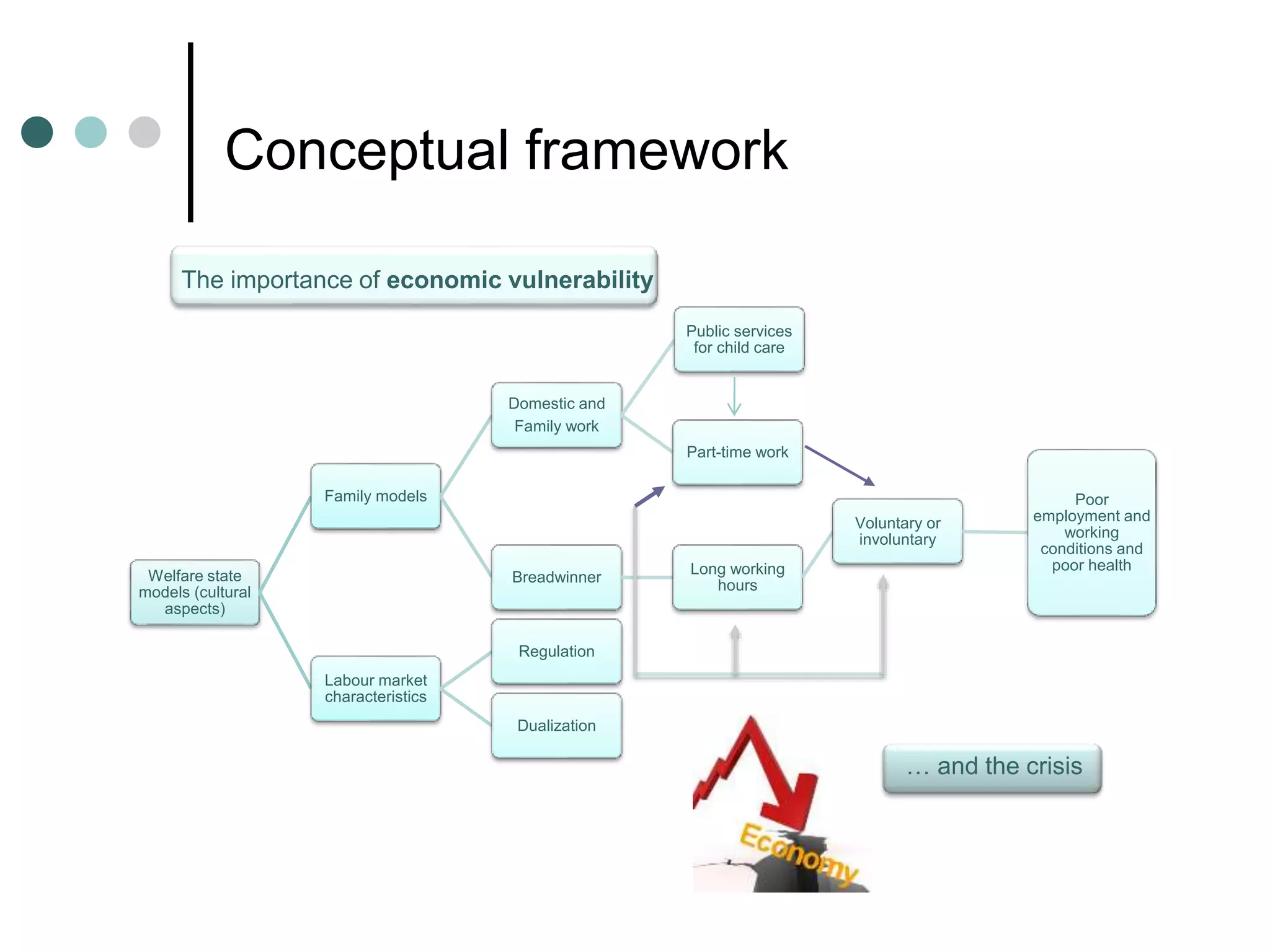
Conceptual framework
Welfare state
models (cultural
aspects)
Family models
Domestic and
Family work
Public services
for child care
Part-time work
Breadwinner
Long working
hours
Voluntary or
involuntary
Poor
employment and
working
conditions and
poor health
Labour market
characteristics
Regulation
Dualization
The importance of economic vulnerability
… and the crisis
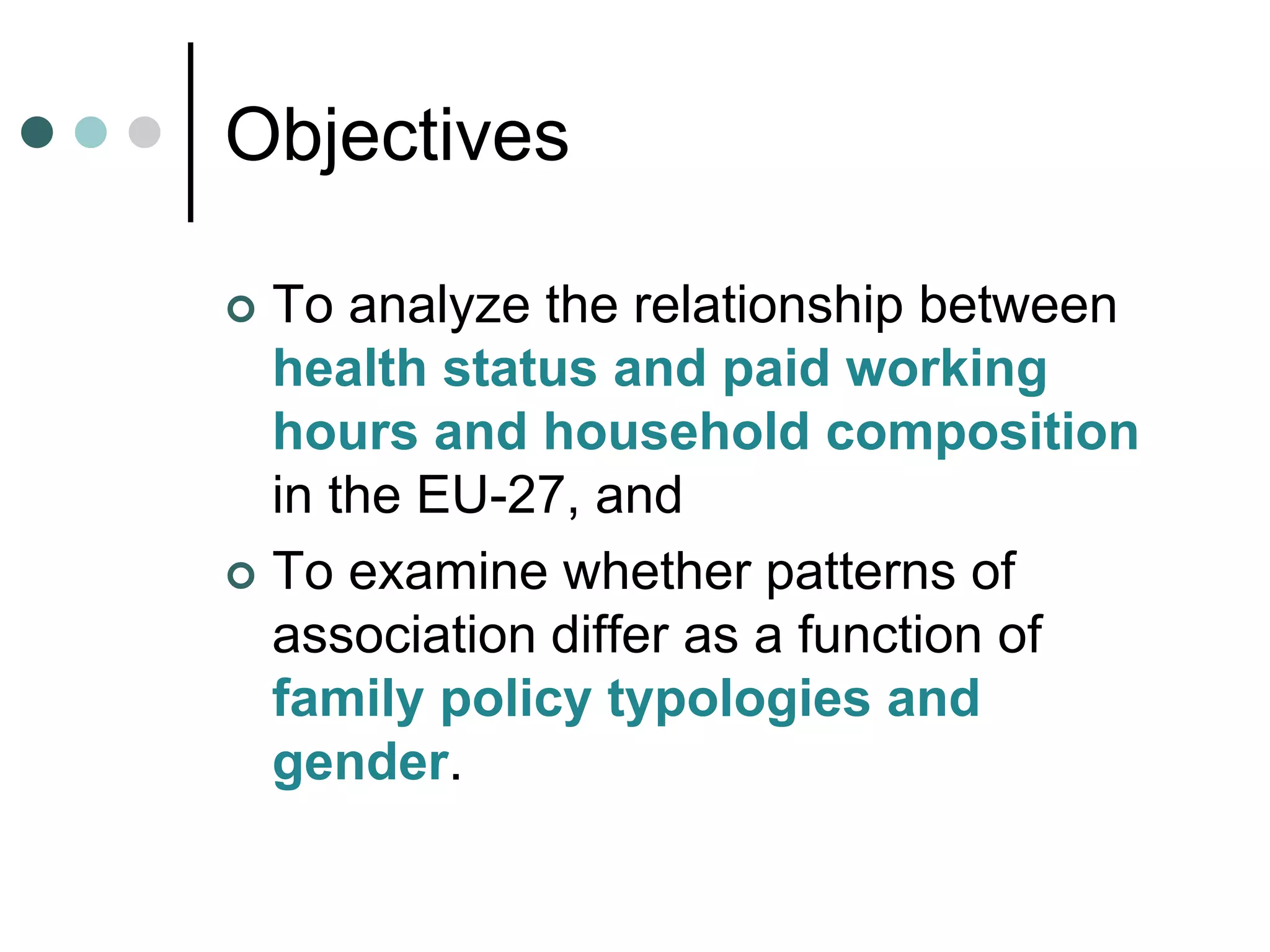
Objectives
 To analyze the relationship between
health status and paid working
hours and household composition
in the EU-27, and
 To examine whether patterns of
association differ as a function of
family policy typologies and
gender.
Methods
 Data from the 2010 European Working Conditions
Survey
 Sample: Workers married or cohabiting (10482 men and
8882 women)
 Employment demands: working hours (< 30, 30-40, 41-50
and >50)
 Household composition
 Number of children
 Living with older than 64
 Partner’s employment status
 Health outcomes
 General health status
 Psychological wellbeing
Long working hours and poor
psychological wellbeing among men
1,1 1,14
0,98
2,3
1,39 1,34
1,62
2,22
0,76
0,090
0,5
1
1,5
2
2,5
3
3,5
4
4,5
41-50 51-60 41-50 51-60 41-50 51-60 41-50 51-60 41-50 51-60
aOR(95%CI)
Continental Anglo-Saxon Eastern South Nordic
30-40 hours
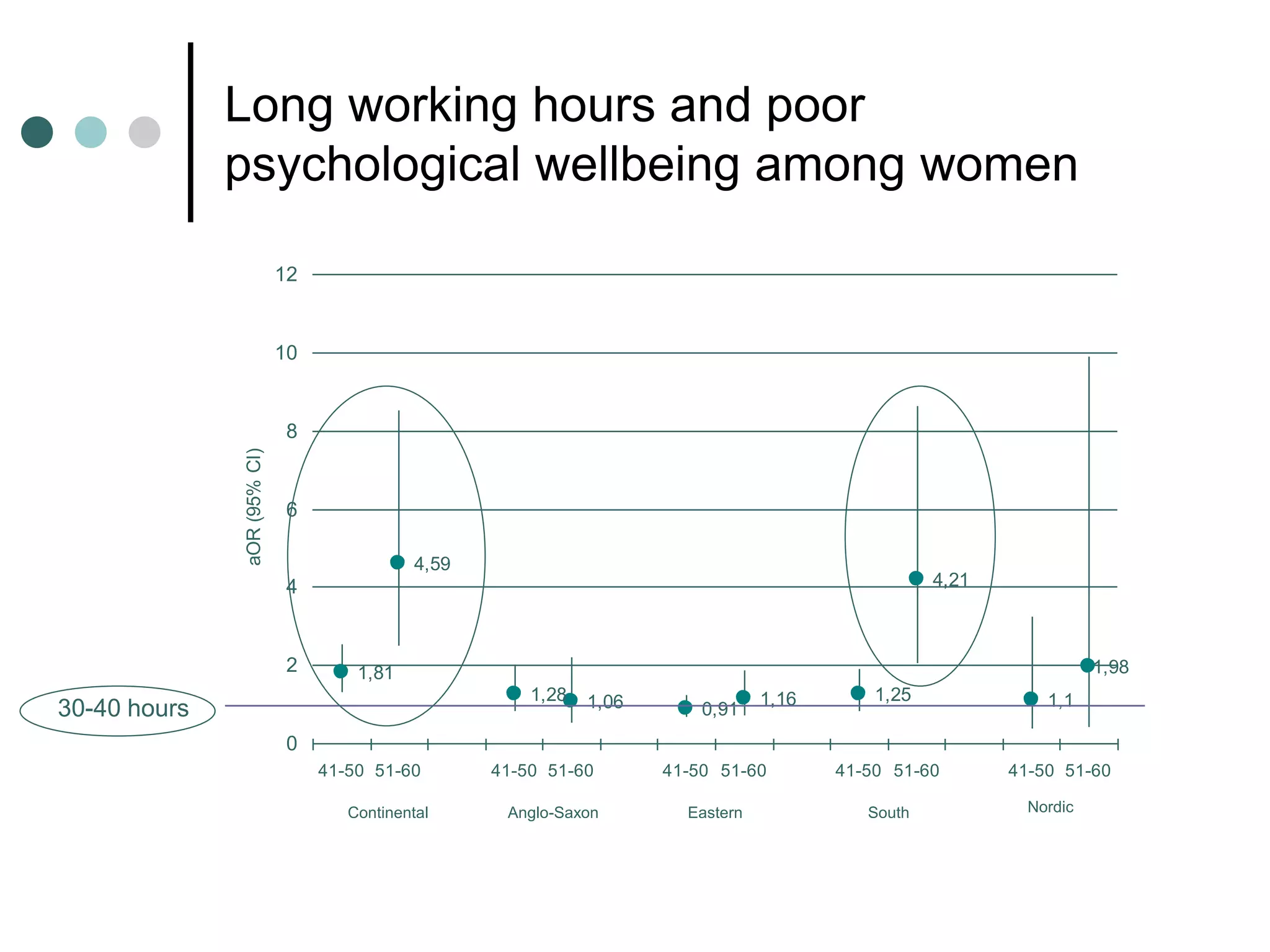
Long working hours and poor
psychological wellbeing among women
1,81
4,59
1,28 1,06 0,91
1,16 1,25
4,21
1,1
1,98
0
2
4
6
8
10
12
41-50 51-60 41-50 51-60 41-50 51-60 41-50 51-60 41-50 51-60
aOR(95%CI)
Continental Anglo-Saxon Eastern South Nordic
30-40 hours
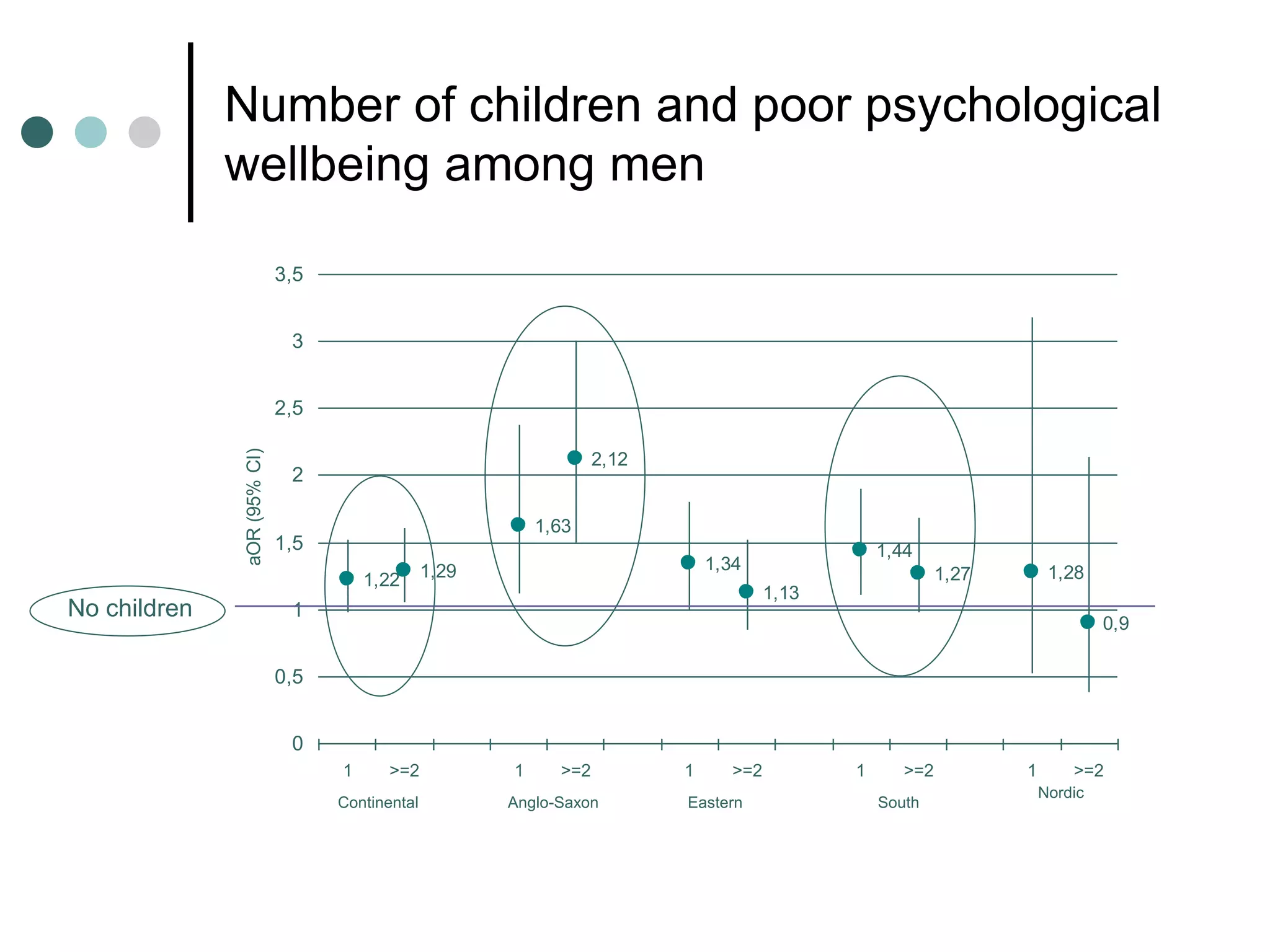
Number of children and poor psychological
wellbeing among men
1,22 1,29
1,63
2,12
1,34
1,13
1,44
1,27 1,28
0,9
0
0,5
1
1,5
2
2,5
3
3,5
1 >=2 1 >=2 1 >=2 1 >=2 1 >=2
aOR(95%CI)
Continental Anglo-Saxon Eastern South
Nordic
No children
Number of children and poor psychological
wellbeing among women
1,44
1,69 1,74
1,4
1,06 1
1,32
1,5
0,52
1,34
0
0,5
1
1,5
2
2,5
3
3,5
1 >=2 1 >=2 1 >=2 1 >=2 1 >=2
aOR(95%CI)
Continental Anglo-Saxon Eastern South Nordic
No children
 Continental and Southern European countries:
 Long working hours and family demands associated with health status in both sexes, although
these associations are stronger and more consistent among women;
 Men from Southern European countries: Poor health status and psychological wellbeing
among living with older than 64 -> Evictions?
 Anglo-Saxon countries:
 Association between long working hours and family demands and health mainly limited to
men
 Women: The only country where part-time was related to better health status
 Nordic and Eastern European countries:
 Long working hours and family demands largely unassociated with poor health outcomes in
both sexes.
Review of the evidence:
Sanchez E, Cortes I, Bartoll X, Artazcoz L. Part-time employment, health
and gender in Europe: a systematic review. Universitat Pompeu Fabra;
2015
Part-time work, health, employment
and working conditions
Part-time work in the EU-27 by
country and sex in 2013
Eurostat, Labour Force Survey
Involuntary part-time work in the
EU-27 by country and sex in 2013
Eurostat, Labour Force Survey
Objectives
 To collect the evidence about the
relationship of part-time employment
with employment and working
conditions and health status
 To understand the heterogeneity of
results
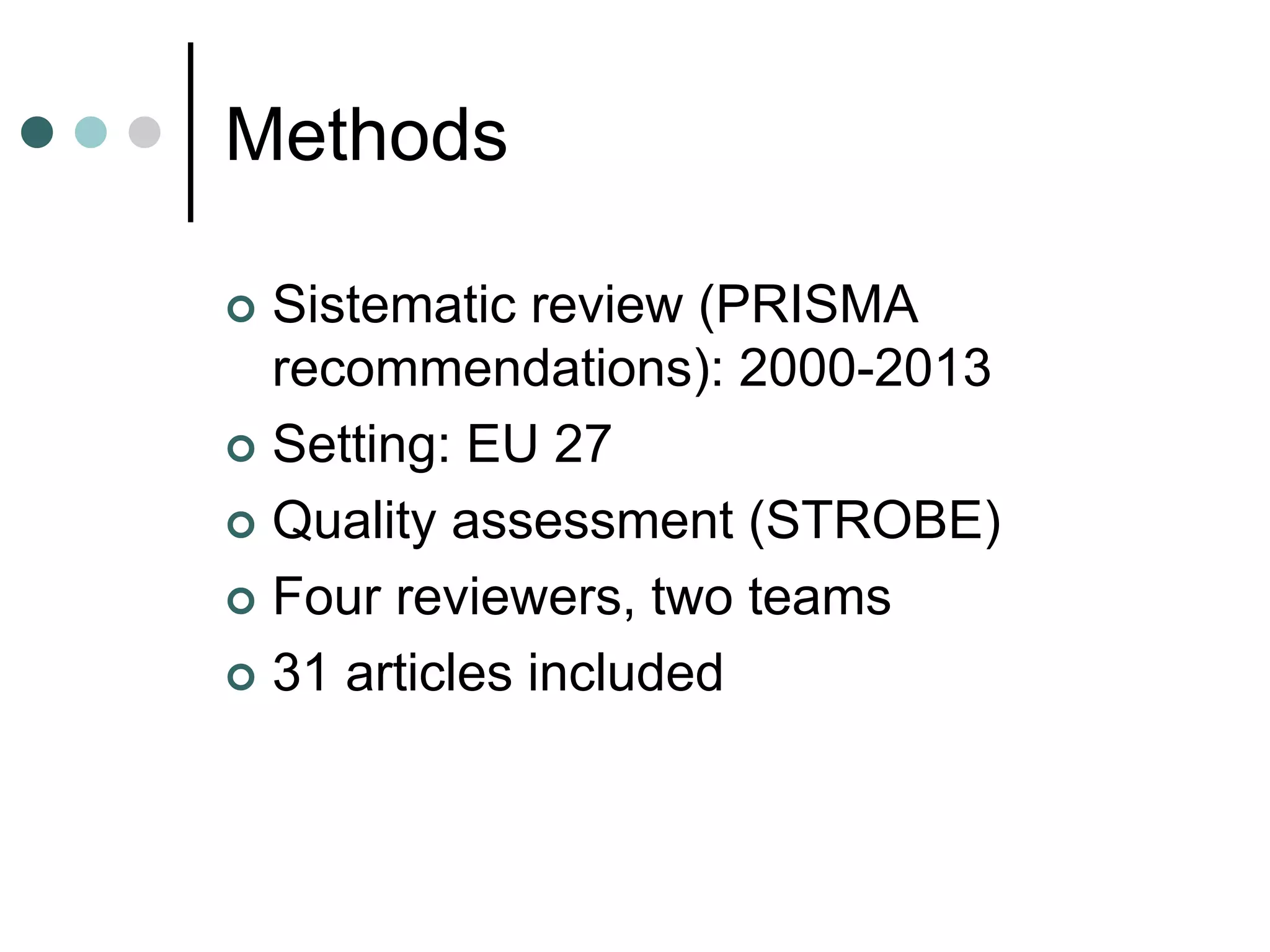
Methods
 Sistematic review (PRISMA
recommendations): 2000-2013
 Setting: EU 27
 Quality assessment (STROBE)
 Four reviewers, two teams
 31 articles included
Results: Employment quality
Countries Gender Other
characteristics
Articles
Favorable outcomes
Better work-family
balance
SE; NL; DE; UK; IR; PT Both sexes; stronger
association in women (NL;
liberal countries)
Short hours part-time
(<20-24h/w) and
permanent contract. Non-
manager position
15-19
Unfavorable outcomes
X Job insecurity EU-15 Both sexes 4
X Lower promotion
prospects
UK (*); ES Both sexes; stronger
association in women
Mothers 5-9
X Lower salaries UK; DE; ES Both sexes; stronger
association in women
7,10-12
X Lower control UK; SE (menos) Both sexes; stronger
association in women
13
X Lower participation UK Both sexes; stronger
association in women
PTE manager position 5
X Occupational
downgrading
UK High qualified women when
changing from FTE to PTE
Mothers 14
* Voluntary PTE
Understanding heterogeneous
results
 Country differences:
 PTE as a retention/integration strategy
 PTE as marginalization
 Higher impact among women:
 Feminized occupations
 Really voluntary?: Affordability of
public childcare services
 Gender, willfullness and contract
Artazcoz L, Cortès I, Benavides FG, Escribà-Agüir V, Bartoll X, Vargas H, Borrell C.
Long working hours and health status in Europe: The role of gender and welfare
state regimes in a context of economic crisis (under review).
Long working hours and
health status
Germany United Kingdom Poland Spain Sweden
Very long working hours (>=50 hours/w) in
some European countries (2013)
Source: OECD better life index
Objectives
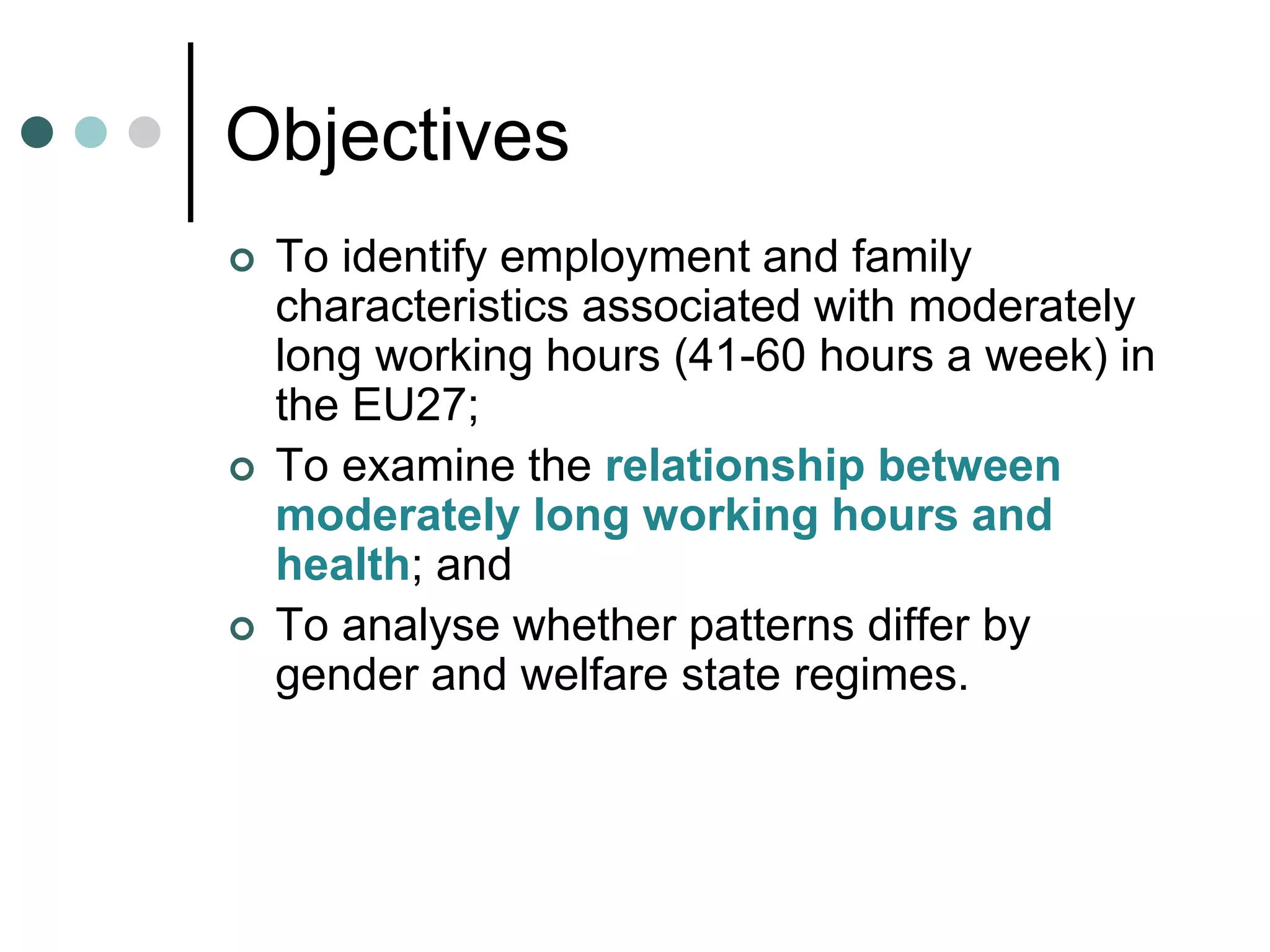
 To identify employment and family
characteristics associated with moderately
long working hours (41-60 hours a week) in
the EU27;
 To examine the relationship between
moderately long working hours and
health; and
 To analyse whether patterns differ by
gender and welfare state regimes.
Methods
 Data from the 2010 European Working Conditions Survey
 Sample: Employees working 30-60 hours a week.
 Working hours (< 30, 30-40, 41-50 and >50)
 Multiple logistic regression models separated by sex and
ajusted for
 Occupational category
 Type of contract
 Type of company (public-private)
 Supervisory role
 Household composition
• Partner/marital status
• Number of children
• Being the main contributor of the household income
 Health outcomes
 General health status
 Psychological wellbeing
Long working hours and poor
psychological wellbeing among men
1,15
0,96 0,91
2,8
1,2
0,77
1,4
2,61
1,16
0,24
0
0,5
1
1,5
2
2,5
3
3,5
4
4,5
41-50 51-60 41-50 51-60 41-50 51-60 41-50 51-60 41-50 51-60
aOR(95%CI)
Continental Anglo-Saxon Eastern South Nordic
30-40 hours
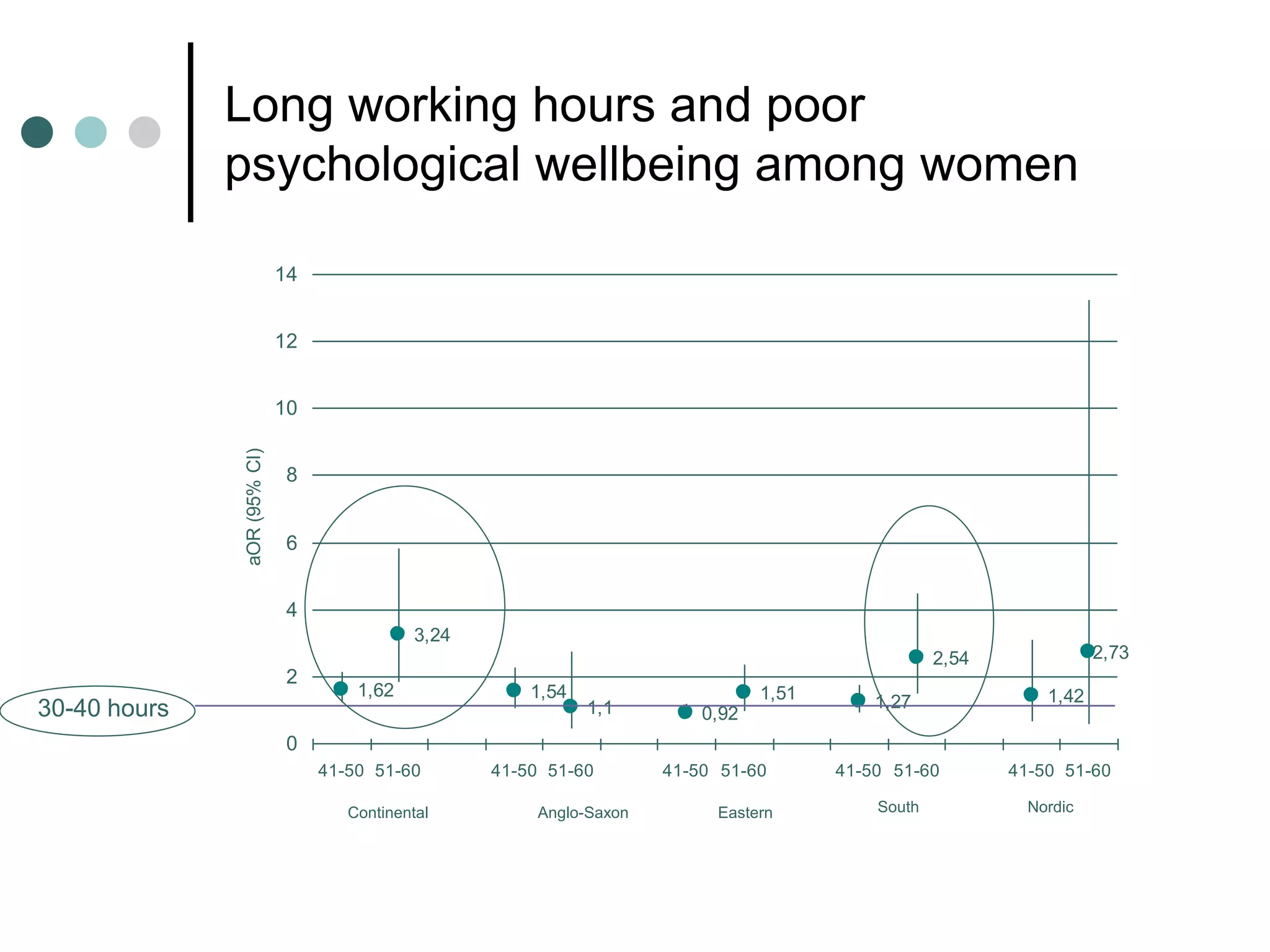
Long working hours and poor
psychological wellbeing among women
1,62
3,24
1,54
1,1 0,92
1,51 1,27
2,54
1,42
2,73
0
2
4
6
8
10
12
14
41-50 51-60 41-50 51-60 41-50 51-60 41-50 51-60 41-50 51-60
aOR(95%CI)
Continental Anglo-Saxon Eastern South Nordic
30-40 hours
Opting out of the 48-hour
week in the UK
 Workers 18 or over who want to work more than 48 hours a
week, can choose to opt out of the 48-hour limit.
 This could be for a certain period or indefinitely. It must be
voluntary and in writing.
 It can’t be contained in an agreement with the whole workforce.
However, employers are allowed to ask individual workers if
they’d be willing to opt out.
 An employer shouldn’t sack or unfairly treat a worker (eg refused
promotion) for refusing to sign an opt-out.
Source: https://www.gov.uk/maximum-weekly-working-hours/weekly-maximum-working-hours-and-opting-out
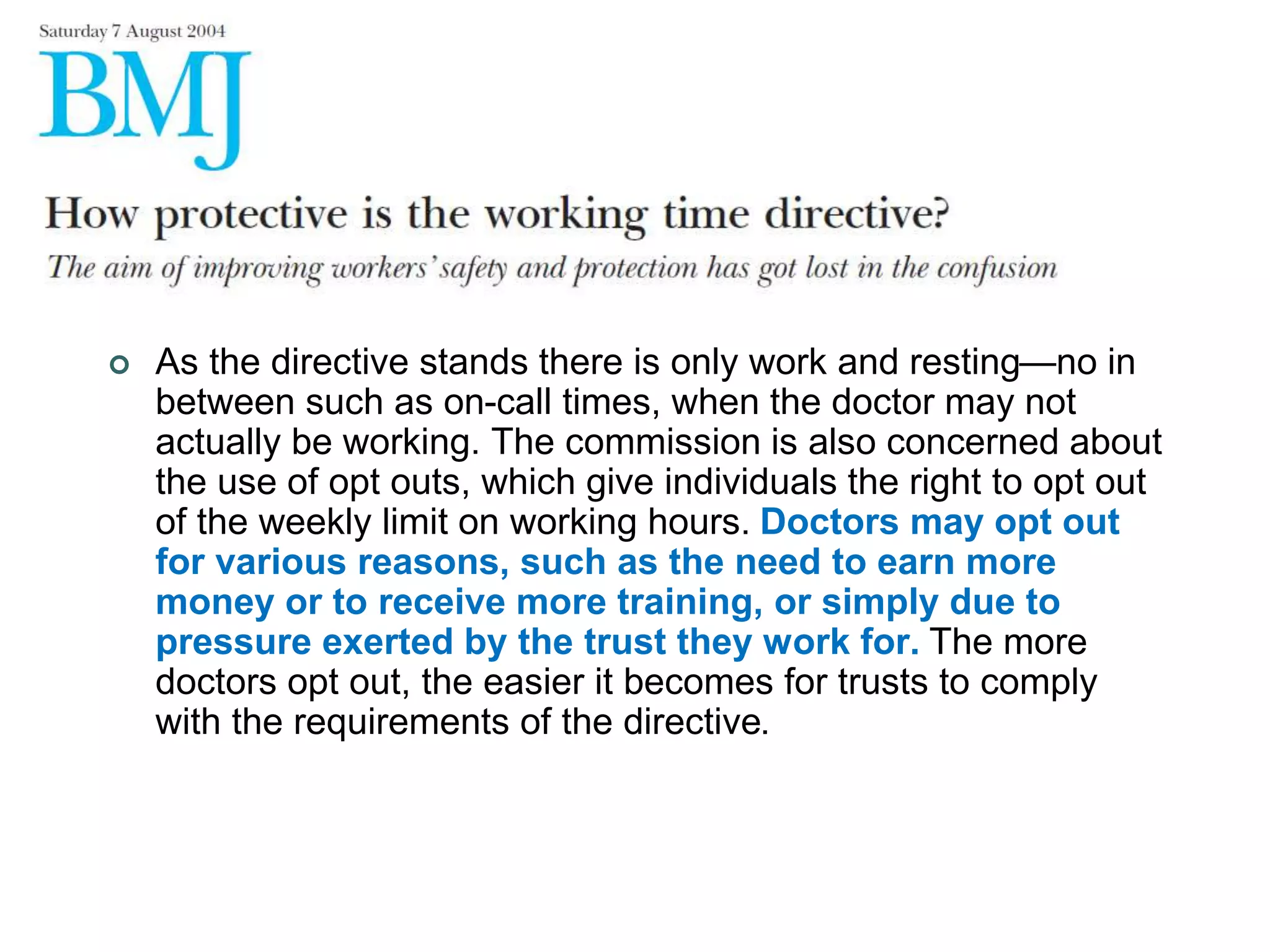
 As the directive stands there is only work and resting—no in
between such as on-call times, when the doctor may not
actually be working. The commission is also concerned about
the use of opt outs, which give individuals the right to opt out
of the weekly limit on working hours. Doctors may opt out
for various reasons, such as the need to earn more
money or to receive more training, or simply due to
pressure exerted by the trust they work for. The more
doctors opt out, the easier it becomes for trusts to comply
with the requirements of the directive.
Economic vulnerability
Labour market deregulation
Labour market dualization
Work-family overload
Family models
Understanding gender and country differences
in the relationship between working time and
health status
Health inequalities related to the
gender division of working-time in
Europe
Lucía Artazcoz
Public Health Agency of Barcelona
Barcelona, 3 June 2015

Health inequalities related to the gender division of working-time in Europe

  • 1.
    Health inequalities relatedto the gender division of working-time in Europe Lucía Artazcoz Public Health Agency of Barcelona Barcelona, 3 June 2015
  • 2.
    Presentation outline  Conceptualframework based on the sexual division of work  Work-family balance  Artazcoz L, Cortès I, Puig-Barrachina V, Benavides, FG, Escribà-Agüir V, Borrell C. Combining employment and family in Europe: the role of family policies in health. Eur J Public Health. 2014 Nov 8;24:649–55.  Part-time work  Sanchez E, Cortes I, Bartoll, X, Artazcoz L. Part-time employment, health and gender in Europe: a systematic review. Universitat Pompeu Fabra; 2015.  Long working hours  Artazcoz L, Cortès I, Benavides FG, Escribà-Agüir V, Bartoll X, Vargas H, Borrell C. Long working hours and health status in Europe: The role of gender and welfare state regimes in a context of economic crisis (under review).
  • 3.
    Welfare state regimes Gender division of work  Position in the labour market  Position in families  Gender division of family roles  Responsible for domestic and family work  Breadwinner  Gender division of working time
  • 4.
    Welfare state regimesand the gender division of working time and family positions  Nordic countries  Double earner/double carer  Long part-time hours and public services for child care  Continental countries  Traditional family model with support for families  Part-time for WFB  Southern-European countries  Traditional family models, with no support for families  Low participation of women in the labour force  Post-comunist countries  Double earner/women carers  High participation of women in the labour force  Anglo-Saxon countries  Market-oriented family models  Long working hours for men; short part-time hours for women
  • 6.
    Conceptual framework Welfare state models(cultural aspects) Family models Domestic and Family work Public services for child care Part-time work Breadwinner Long working hours Voluntary or involuntary Poor employment and working conditions and poor health Labour market characteristics Regulation Dualization The importance of economic vulnerability … and the crisis
  • 8.
    Objectives  To analyzethe relationship between health status and paid working hours and household composition in the EU-27, and  To examine whether patterns of association differ as a function of family policy typologies and gender.
  • 9.
    Methods  Data fromthe 2010 European Working Conditions Survey  Sample: Workers married or cohabiting (10482 men and 8882 women)  Employment demands: working hours (< 30, 30-40, 41-50 and >50)  Household composition  Number of children  Living with older than 64  Partner’s employment status  Health outcomes  General health status  Psychological wellbeing
  • 10.
    Long working hoursand poor psychological wellbeing among men 1,1 1,14 0,98 2,3 1,39 1,34 1,62 2,22 0,76 0,090 0,5 1 1,5 2 2,5 3 3,5 4 4,5 41-50 51-60 41-50 51-60 41-50 51-60 41-50 51-60 41-50 51-60 aOR(95%CI) Continental Anglo-Saxon Eastern South Nordic 30-40 hours
  • 11.
    Long working hoursand poor psychological wellbeing among women 1,81 4,59 1,28 1,06 0,91 1,16 1,25 4,21 1,1 1,98 0 2 4 6 8 10 12 41-50 51-60 41-50 51-60 41-50 51-60 41-50 51-60 41-50 51-60 aOR(95%CI) Continental Anglo-Saxon Eastern South Nordic 30-40 hours
  • 12.
    Number of childrenand poor psychological wellbeing among men 1,22 1,29 1,63 2,12 1,34 1,13 1,44 1,27 1,28 0,9 0 0,5 1 1,5 2 2,5 3 3,5 1 >=2 1 >=2 1 >=2 1 >=2 1 >=2 aOR(95%CI) Continental Anglo-Saxon Eastern South Nordic No children
  • 13.
    Number of childrenand poor psychological wellbeing among women 1,44 1,69 1,74 1,4 1,06 1 1,32 1,5 0,52 1,34 0 0,5 1 1,5 2 2,5 3 3,5 1 >=2 1 >=2 1 >=2 1 >=2 1 >=2 aOR(95%CI) Continental Anglo-Saxon Eastern South Nordic No children
  • 14.
     Continental andSouthern European countries:  Long working hours and family demands associated with health status in both sexes, although these associations are stronger and more consistent among women;  Men from Southern European countries: Poor health status and psychological wellbeing among living with older than 64 -> Evictions?  Anglo-Saxon countries:  Association between long working hours and family demands and health mainly limited to men  Women: The only country where part-time was related to better health status  Nordic and Eastern European countries:  Long working hours and family demands largely unassociated with poor health outcomes in both sexes.
  • 15.
    Review of theevidence: Sanchez E, Cortes I, Bartoll X, Artazcoz L. Part-time employment, health and gender in Europe: a systematic review. Universitat Pompeu Fabra; 2015 Part-time work, health, employment and working conditions
  • 16.
    Part-time work inthe EU-27 by country and sex in 2013 Eurostat, Labour Force Survey
  • 17.
    Involuntary part-time workin the EU-27 by country and sex in 2013 Eurostat, Labour Force Survey
  • 18.
    Objectives  To collectthe evidence about the relationship of part-time employment with employment and working conditions and health status  To understand the heterogeneity of results
  • 19.
    Methods  Sistematic review(PRISMA recommendations): 2000-2013  Setting: EU 27  Quality assessment (STROBE)  Four reviewers, two teams  31 articles included
  • 20.
    Results: Employment quality CountriesGender Other characteristics Articles Favorable outcomes Better work-family balance SE; NL; DE; UK; IR; PT Both sexes; stronger association in women (NL; liberal countries) Short hours part-time (<20-24h/w) and permanent contract. Non- manager position 15-19 Unfavorable outcomes X Job insecurity EU-15 Both sexes 4 X Lower promotion prospects UK (*); ES Both sexes; stronger association in women Mothers 5-9 X Lower salaries UK; DE; ES Both sexes; stronger association in women 7,10-12 X Lower control UK; SE (menos) Both sexes; stronger association in women 13 X Lower participation UK Both sexes; stronger association in women PTE manager position 5 X Occupational downgrading UK High qualified women when changing from FTE to PTE Mothers 14 * Voluntary PTE
  • 21.
    Understanding heterogeneous results  Countrydifferences:  PTE as a retention/integration strategy  PTE as marginalization  Higher impact among women:  Feminized occupations  Really voluntary?: Affordability of public childcare services  Gender, willfullness and contract
  • 23.
    Artazcoz L, CortèsI, Benavides FG, Escribà-Agüir V, Bartoll X, Vargas H, Borrell C. Long working hours and health status in Europe: The role of gender and welfare state regimes in a context of economic crisis (under review). Long working hours and health status
  • 24.
    Germany United KingdomPoland Spain Sweden Very long working hours (>=50 hours/w) in some European countries (2013) Source: OECD better life index
  • 25.
    Objectives  To identifyemployment and family characteristics associated with moderately long working hours (41-60 hours a week) in the EU27;  To examine the relationship between moderately long working hours and health; and  To analyse whether patterns differ by gender and welfare state regimes.
  • 26.
    Methods  Data fromthe 2010 European Working Conditions Survey  Sample: Employees working 30-60 hours a week.  Working hours (< 30, 30-40, 41-50 and >50)  Multiple logistic regression models separated by sex and ajusted for  Occupational category  Type of contract  Type of company (public-private)  Supervisory role  Household composition • Partner/marital status • Number of children • Being the main contributor of the household income  Health outcomes  General health status  Psychological wellbeing
  • 27.
    Long working hoursand poor psychological wellbeing among men 1,15 0,96 0,91 2,8 1,2 0,77 1,4 2,61 1,16 0,24 0 0,5 1 1,5 2 2,5 3 3,5 4 4,5 41-50 51-60 41-50 51-60 41-50 51-60 41-50 51-60 41-50 51-60 aOR(95%CI) Continental Anglo-Saxon Eastern South Nordic 30-40 hours
  • 28.
    Long working hoursand poor psychological wellbeing among women 1,62 3,24 1,54 1,1 0,92 1,51 1,27 2,54 1,42 2,73 0 2 4 6 8 10 12 14 41-50 51-60 41-50 51-60 41-50 51-60 41-50 51-60 41-50 51-60 aOR(95%CI) Continental Anglo-Saxon Eastern South Nordic 30-40 hours
  • 29.
    Opting out ofthe 48-hour week in the UK  Workers 18 or over who want to work more than 48 hours a week, can choose to opt out of the 48-hour limit.  This could be for a certain period or indefinitely. It must be voluntary and in writing.  It can’t be contained in an agreement with the whole workforce. However, employers are allowed to ask individual workers if they’d be willing to opt out.  An employer shouldn’t sack or unfairly treat a worker (eg refused promotion) for refusing to sign an opt-out. Source: https://www.gov.uk/maximum-weekly-working-hours/weekly-maximum-working-hours-and-opting-out
  • 30.
     As thedirective stands there is only work and resting—no in between such as on-call times, when the doctor may not actually be working. The commission is also concerned about the use of opt outs, which give individuals the right to opt out of the weekly limit on working hours. Doctors may opt out for various reasons, such as the need to earn more money or to receive more training, or simply due to pressure exerted by the trust they work for. The more doctors opt out, the easier it becomes for trusts to comply with the requirements of the directive.
  • 31.
    Economic vulnerability Labour marketderegulation Labour market dualization Work-family overload Family models Understanding gender and country differences in the relationship between working time and health status
  • 32.
    Health inequalities relatedto the gender division of working-time in Europe Lucía Artazcoz Public Health Agency of Barcelona Barcelona, 3 June 2015