Pailan College of Management & Technology
Course – BBA in Hospital Management
Semester – 3rd Sem
It is presented by
MADHUMITA SARDER,PRALAY MONDAL,SUSMITA ROY,
PRITY DHARA,DEBARATI SENBAKSHI, SUSMITA
PRAMANIK,AHONA MUKHERJEE,PALLABI
CHAKRABORTY,JAYITA SAHA
ACKNOWLEDGEMENT
 I Would like to express my special thanks of
gratitude to my teacher “Annwesha Paul” for
their able guidance and support in completing
our presentation.
Date Team -B
Introduction
• Health education forms an important part of health
promotion activities.
• Health education is a social science that draws from
the biological, environmental, psychological, physical
and medical sciences to promote health and prevent
disease, disability and premature death through
education-driven voluntary behavior change
activities.
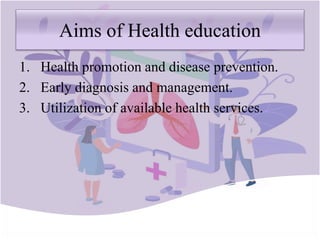
Aims of Health education
1. Health promotion and disease prevention.
2. Early diagnosis and management.
3. Utilization of available health services.
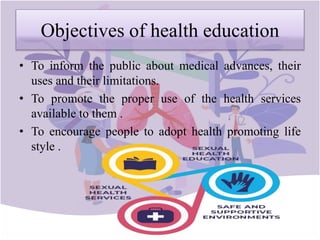
Objectives of health education
• To inform the public about medical advances, their
uses and their limitations.
• To promote the proper use of the health services
available to them .
• To encourage people to adopt health promoting life
style .
Methodology
• Venue - Pailan College of Management &
Technology
• It’s a secondary data collection & it has been taken
from –
• www.google.com
• www.slideplayer.com
• www.slideshare.net
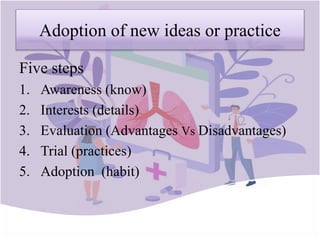
Adoption of new ideas or practice
Five steps
1. Awareness (know)
2. Interests (details)
3. Evaluation (Advantages Vs Disadvantages)
4. Trial (practices)
5. Adoption (habit)
Stages for health education
• Stage of Sensitization
• Stage of Publicity
• Stage of Education
• Stage of Attitude change
• Stage of Motivation and Action
• Stage of Community Transformation (social
change)
Principles of Health education
1. Interest.
2. Participation.
3. Proceed from known to unknown.
4. Comprehension.
5. Reinforcement by repetition.
6. Motivation
Conclusion
• Overall, health education, combined with
health improvement approaches have a greater
impact, in prevention and reducing the
incidence of emerging diseases.
Bibliography
• This entire project has been taken from the net &
the sides are
• www.researchgate.net
• www.slideplayer.com
• www.slideshare.net
• www.powershow.com
THANK YOU

Health Education.pptx

  • 1.
    Pailan College ofManagement & Technology Course – BBA in Hospital Management Semester – 3rd Sem It is presented by MADHUMITA SARDER,PRALAY MONDAL,SUSMITA ROY, PRITY DHARA,DEBARATI SENBAKSHI, SUSMITA PRAMANIK,AHONA MUKHERJEE,PALLABI CHAKRABORTY,JAYITA SAHA
  • 2.
    ACKNOWLEDGEMENT  I Wouldlike to express my special thanks of gratitude to my teacher “Annwesha Paul” for their able guidance and support in completing our presentation. Date Team -B
  • 3.
    Introduction • Health educationforms an important part of health promotion activities. • Health education is a social science that draws from the biological, environmental, psychological, physical and medical sciences to promote health and prevent disease, disability and premature death through education-driven voluntary behavior change activities.
  • 4.
    Aims of Healtheducation 1. Health promotion and disease prevention. 2. Early diagnosis and management. 3. Utilization of available health services.
  • 5.
    Objectives of healtheducation • To inform the public about medical advances, their uses and their limitations. • To promote the proper use of the health services available to them . • To encourage people to adopt health promoting life style .
  • 6.
    Methodology • Venue -Pailan College of Management & Technology • It’s a secondary data collection & it has been taken from – • www.google.com • www.slideplayer.com • www.slideshare.net
  • 7.
    Adoption of newideas or practice Five steps 1. Awareness (know) 2. Interests (details) 3. Evaluation (Advantages Vs Disadvantages) 4. Trial (practices) 5. Adoption (habit)
  • 8.
    Stages for healtheducation • Stage of Sensitization • Stage of Publicity • Stage of Education • Stage of Attitude change • Stage of Motivation and Action • Stage of Community Transformation (social change)
  • 9.
    Principles of Healtheducation 1. Interest. 2. Participation. 3. Proceed from known to unknown. 4. Comprehension. 5. Reinforcement by repetition. 6. Motivation
  • 10.
    Conclusion • Overall, healtheducation, combined with health improvement approaches have a greater impact, in prevention and reducing the incidence of emerging diseases.
  • 11.
    Bibliography • This entireproject has been taken from the net & the sides are • www.researchgate.net • www.slideplayer.com • www.slideshare.net • www.powershow.com THANK YOU