A Mental Health Lesson for 5th/6th Graders

             By Miriam Fleck
Lesson Objectives:

Students will learn about the concept of stress.
Students will learn how to identify stress within
themselves, and how stress affects their bodies and
decisions.
Students will learn how to prevent stress from
becoming overwhelming.
Students will learn how to reduce stress with
exercises they can utilize in various situations.
Sunshine State Standards:
 HE.5.B.3.5: Select a healthy option when making decisions for yourself and/or others.
HE.6.C.1.2: Describe how the physical, mental/emotional, social, and intellectual
dimensions of health are interrelated.
HE.5.C.1.2: Explain the physical, mental/emotional, social, and intellectual dimensions
of health.
HE.5.P.1.2: Apply a variety of healthy practices and behaviors to maintain or improve
personal health.

Necessary Equipment:
Projector
Projection Screen
Laptop
PowerPoint Software
Optional: Flash drive

Procedures/Activities:
Activities to reduce stress: Hand Alternations, Deep Breathing, Drawing With Your
Nose: A Neck Tension Relieving Exercise, Reframing: How to Change Your Perception
and Change Your Reaction.
Stress
• Stress is a physiological response by the body
  to a stimulus. In other words, stress is the
  strain caused by our responses to pressure.
• Stress can be physical, emotional, or mental
  tension.
• Stress itself is not necessarily bad.
Are you stretched too far?

   When we have stress (good or
   bad), we are like a rubber band
being stretched out. Usually, we can
return to our normal shape once the
         stressor is relieved.

 But what if we’re spread too thin?

Even if we don’t break, are we really
        the same as before?

  How much stress can we really
           handle?
How does Stress affect us?
• 2/3 of all Doctor visits are related to stress
• Bad Habits (drugs, alcohol, tobacco)
• Sleep Problems
• Bullying/Fighting
• Driving/Car Accidents
• Heart Disease, High Blood
  Pressure, migraines, cancer, etc.
• School/Work productivity
• Poor Judgment/Decision-Making
STRESS ALL OVER
   Stress affects every
      bodily system
•Cardiovascular
•Nervous System
•Respiratory
•Digestive System
•Muscular
•Immune System
•Endocrine
•Lymphatic
•Skeletal
•Urinary
Stressor


                  Central Nervous
                      System


      CORTISOL                          ADRENALIN


Readies our bodies for              Increases heart rate
  injury or infection
 Helps us remember
  vital information                   Gives us energy
HEART                          MUSCLES                                 BLOOD
heart rate increases due to      Tighten: Fight/Flight/Freeze   Flow to brain and muscles increase by 400%
      adrenalin surge


      LUNGS                               SKIN                            STOMACH
Breathing increases, oxygen is     Perspiration (sweat) rises             Digestion Slows/Stops
    delivered to muscles
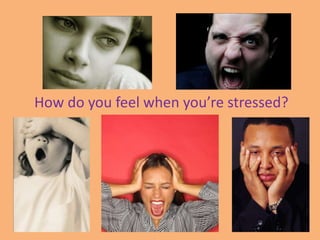
How do you feel when you’re stressed?
How do you deal with stress?
Ask yourself:
• Where in my body am I
  holding my stress?
• How do I feel?
• Are there stressors I can
  eliminate (temporary or
  permanent)
• What are my choices?
An ounce of prevention is worth a pound of cure
LEFT BRAIN vs. RIGHT BRAIN
When we’re stressed, the two hemispheres of our brain
have difficulty communicating with each other, but there
            are ways to get them talking again.
BREATHE
Taking deep breaths slows your heart rate, gives mental
     clarity, releases body toxins, eases pain, aids
 digestion, improves physical stamina, improves blood
                         quality,
                   and releases tension.
Stress can cause us to have tension in our
    necks. We can relieve this tension by
“tracing” a small infinity symbol with our nose!
Counting Backwards
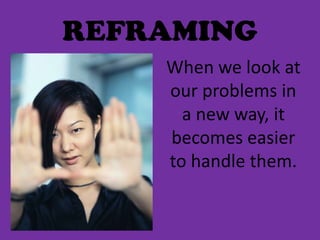
REFRAMING
    When we look at
    our problems in
      a new way, it
    becomes easier
    to handle them.
Assessment:
 What  is stress?
Is stress good, bad, or neither?
How does our body react to stress?
What chemicals are released in our body when we feel
stressed?
How does our brain react to stress?
What 3 things can help us to prevent stress?
What can we do if we feel stressed? Name 3 activities we can
do to reduce our stress in the moment.
How does deep breathing help us to de-stress?
What is reframing?
How does reframing help us to de-stress?

Health classproject#1

  • 1.
    A Mental HealthLesson for 5th/6th Graders By Miriam Fleck
  • 2.
    Lesson Objectives: Students willlearn about the concept of stress. Students will learn how to identify stress within themselves, and how stress affects their bodies and decisions. Students will learn how to prevent stress from becoming overwhelming. Students will learn how to reduce stress with exercises they can utilize in various situations.
  • 3.
    Sunshine State Standards: HE.5.B.3.5: Select a healthy option when making decisions for yourself and/or others. HE.6.C.1.2: Describe how the physical, mental/emotional, social, and intellectual dimensions of health are interrelated. HE.5.C.1.2: Explain the physical, mental/emotional, social, and intellectual dimensions of health. HE.5.P.1.2: Apply a variety of healthy practices and behaviors to maintain or improve personal health. Necessary Equipment: Projector Projection Screen Laptop PowerPoint Software Optional: Flash drive Procedures/Activities: Activities to reduce stress: Hand Alternations, Deep Breathing, Drawing With Your Nose: A Neck Tension Relieving Exercise, Reframing: How to Change Your Perception and Change Your Reaction.
  • 4.
    Stress • Stress isa physiological response by the body to a stimulus. In other words, stress is the strain caused by our responses to pressure. • Stress can be physical, emotional, or mental tension. • Stress itself is not necessarily bad.
  • 5.
    Are you stretchedtoo far? When we have stress (good or bad), we are like a rubber band being stretched out. Usually, we can return to our normal shape once the stressor is relieved. But what if we’re spread too thin? Even if we don’t break, are we really the same as before? How much stress can we really handle?
  • 6.
    How does Stressaffect us? • 2/3 of all Doctor visits are related to stress • Bad Habits (drugs, alcohol, tobacco) • Sleep Problems • Bullying/Fighting • Driving/Car Accidents • Heart Disease, High Blood Pressure, migraines, cancer, etc. • School/Work productivity • Poor Judgment/Decision-Making
  • 7.
    STRESS ALL OVER Stress affects every bodily system •Cardiovascular •Nervous System •Respiratory •Digestive System •Muscular •Immune System •Endocrine •Lymphatic •Skeletal •Urinary
  • 8.
    Stressor Central Nervous System CORTISOL ADRENALIN Readies our bodies for Increases heart rate injury or infection Helps us remember vital information Gives us energy
  • 9.
    HEART MUSCLES BLOOD heart rate increases due to Tighten: Fight/Flight/Freeze Flow to brain and muscles increase by 400% adrenalin surge LUNGS SKIN STOMACH Breathing increases, oxygen is Perspiration (sweat) rises Digestion Slows/Stops delivered to muscles
  • 10.
    How do youfeel when you’re stressed?
  • 11.
    How do youdeal with stress? Ask yourself: • Where in my body am I holding my stress? • How do I feel? • Are there stressors I can eliminate (temporary or permanent) • What are my choices?
  • 12.
    An ounce ofprevention is worth a pound of cure
  • 13.
    LEFT BRAIN vs.RIGHT BRAIN When we’re stressed, the two hemispheres of our brain have difficulty communicating with each other, but there are ways to get them talking again.
  • 14.
    BREATHE Taking deep breathsslows your heart rate, gives mental clarity, releases body toxins, eases pain, aids digestion, improves physical stamina, improves blood quality, and releases tension.
  • 15.
    Stress can causeus to have tension in our necks. We can relieve this tension by “tracing” a small infinity symbol with our nose!
  • 16.
  • 17.
    REFRAMING When we look at our problems in a new way, it becomes easier to handle them.
  • 18.
    Assessment:  What is stress? Is stress good, bad, or neither? How does our body react to stress? What chemicals are released in our body when we feel stressed? How does our brain react to stress? What 3 things can help us to prevent stress? What can we do if we feel stressed? Name 3 activities we can do to reduce our stress in the moment. How does deep breathing help us to de-stress? What is reframing? How does reframing help us to de-stress?

Editor's Notes

  • #9 Our bodies react to stress like we’re being chased by a tiger. Thousands of years ago, we would run from tigers, and therefore cortisol and adrenalin were helpful. But, we do not run to get away from tigers. The adrenaline and cortisol in our bodies when we feel stressed do not get released, and can make us sick.