Healing Our Heroes
A Holistic Perspective on Ending Veteran
Homelessness
Presented by:
Christopher Monceaux, MBS, MS, PLPC, CCTP
Shauna Russell, M.S., PLPC, CCTP, CIT
Outline
I. Introduction
II. Mental Health
III. Substance Use Disorders
IV. Medical Issues
V. Legal Barriers
VI. Vocational Rehabilitation
VII. Finances
VIII. Housing
IX. Conclusion
X. Resources
Introduction
• Basic Tenets of Military Culture:
• “Duty, Honor, Country”
• Subcultures within the military
• Branch, Unit, Platoon, MOS (Military Occupational
Specialty)
• The “Average” Soldier
• Unique Challenges faced by veterans
• Importance of assuming a holistic perspective on
treatment
Mental Health: Trauma
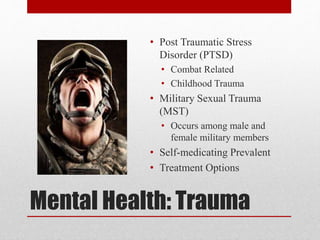
• Post Traumatic Stress
Disorder (PTSD)
• Combat Related
• Childhood Trauma
• Military Sexual Trauma
(MST)
• Occurs among male and
female military members
• Self-medicating Prevalent
• Treatment Options
Mental Health: Other Concerns
• Veterans diagnosed with depression account for slightly more
than 14 percent of the total
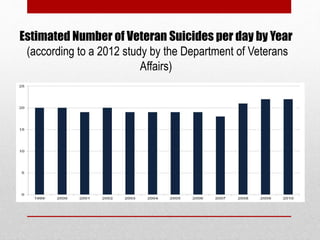
• Current Suicide Rate among veterans: About 22 per day
• PTSD, Depression, and TBI has higher prevalence in OEF/OIF
veterans
• Personality Disorders:
• Often go undiagnosed
• Present unique treatment challenges
Estimated Number of Veteran Suicides per day by Year
(according to a 2012 study by the Department of Veterans
Affairs)
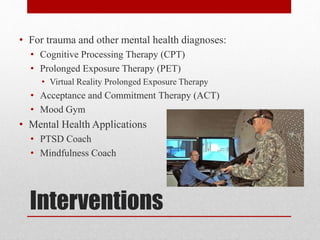
Interventions
• For trauma and other mental health diagnoses:
• Cognitive Processing Therapy (CPT)
• Prolonged Exposure Therapy (PET)
• Virtual Reality Prolonged Exposure Therapy
• Acceptance and Commitment Therapy (ACT)
• Mood Gym
• Mental Health Applications
• PTSD Coach
• Mindfulness Coach
Interventions (Ctd)
• Eye Movement Desensitization & Reprocessing (EMDR)
• Adaptive Information Processing Model
• 8-phase standard protocol
• Adapted protocols for several mental health disorders
• Dialectical Behavior Therapy
• Dialectics & Validation
• Skills Training
• Interpersonal effectiveness, emotion regulation, mindfulness, &
distress tolerance
• Integrative Approach
Substance Use Disorders
• Between 2004 and 2006, 7.1% of U.S. veterans met the
criteria for a substance use disorder.
• Older generation vs. Younger Generation
• Increased abuse of prescription drugs
• Legality of marijuana; potential treatment implications?
• Research is conflicting
• May explain higher usage among younger vets
SUDs Interventions
• Counseling & Psychotherapy
• Cognitive Behavior Therapy, DeTUR, Motivational
Interviewing, Harm Reduction, Relapse Prevention
• Community Support
• AA/NA Meetings & Sponsor
• SMART Recovery
• Celebrate Recovery
• Rational Recovery
• Seeking Safety (Co-Occurring PTSD and Substance Use
Disorders)
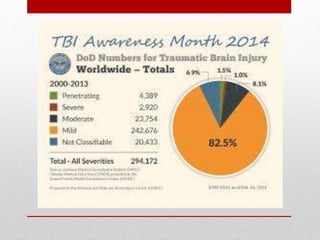
Medical Issues: TBI
• Traumatic Brain Injury (TBI) defined as “an alteration in
brain function, or other evidence of brain pathology,
caused by an external force.”
• A TBI may be classified as focal or diffuse; open or
closed; and mild, moderate, or severe. (Penetrating is a
different classification)
• Traumatic brain injury has become known as a “signature
wound” of Operation Enduring Freedom (OEF) and
Operation Iraqi Freedom (OIF)
• TBI can significantly affect diagnosis and treatment
TBI and Treatment
• Diagnostic Difficulties
• Effects similar to the symptoms of many mental health
diagnoses
• Treatment implications
• Slower
• Difficulty remembering appointments and completing tasks
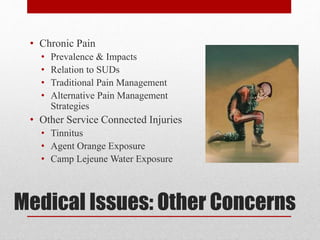
Medical Issues: Other Concerns
• Chronic Pain
• Prevalence & Impacts
• Relation to SUDs
• Traditional Pain Management
• Alternative Pain Management
Strategies
• Other Service Connected Injuries
• Tinnitus
• Agent Orange Exposure
• Camp Lejeune Water Exposure
Medical Issues: Other Concerns
• Diet & Exercise
• MOVE Program
• Yoga and other low-impact activity
• Sexually Transmitted Diseases
• HIV & Hepatitis C
• Other chronic health complications
Legal Barriers
• Felonies (stigma, employment barrier, housing barrier)
• Drug Charges (Drug Court, treatment as alternative to jail
time)
• Child Support (numerous financial implications)
• License restrictions (no transportation = employment
barrier; consequence of child support and other legal
issues)
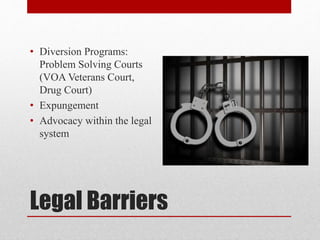
Legal Barriers
• Diversion Programs:
Problem Solving Courts
(VOA Veterans Court,
Drug Court)
• Expungement
• Advocacy within the legal
system
Vocational Rehabilitation
• Reintegration into civilian workforce
• VBA Vocational Rehabilitation & Education Programs
(Chapters 31, 36, 18, & 35)
• VHA Compensated Work Therapy Programs
• Incentive Therapy (IT)
• Compensated Work Therapy (CWT)
• Supported Employment Program (SE)
• Community Partners
• Goodwill
• LRS
• Employer-agency connections
Other Income Sources
• VA Service-Connected Benefits
• VA Non-Service Connected Pension
• SSDI/SSI Benefits
• SOAR application
• Non-cash Benefits
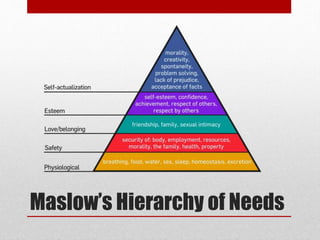
Maslow’s Hierarchy of Needs
Housing
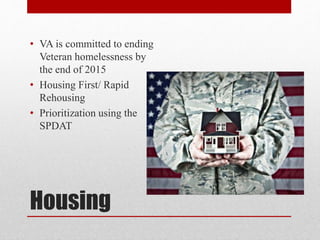
• VA is committed to ending
Veteran homelessness by
the end of 2015
• Housing First/ Rapid
Rehousing
• Prioritization using the
SPDAT
Housing
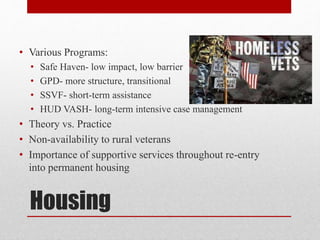
• Various Programs:
• Safe Haven- low impact, low barrier
• GPD- more structure, transitional
• SSVF- short-term assistance
• HUD VASH- long-term intensive case management
• Theory vs. Practice
• Non-availability to rural veterans
• Importance of supportive services throughout re-entry
into permanent housing
Practice Scenarios
Conclusion
• Implications for
treatment
• Coordination of services
for best outcome
• Importance of assuming
a holistic perspective
Additional Resources
• Links for additional information
• SAMHSA:
• http://www.samhsa.gov/veterans-military-families
• Military OneSource
• http://www.militaryonesource.mil/
• Seeking Safety
• http://www.treatment-innovations.org/seeking-safety.html
• Virtual Reality Exposure Therapy:
• http://ict.usc.edu/prototypes/pts/
• Department of Veterans Affairs:
• http://www.ptsd.va.gov/
• http://www.va.gov/opa/docs/suicide-data-report-2012-final.pdf
• http://www.va.gov/homeless/about_the_initiative.asp
Resources Continued
• Volunteers of America
• http://www.voanorthla.org/
• Legal Resources:
• http://grantome.com/grant/NIH/I01-RX000484-02
• http://usich.gov/population/veterans/veterans_homelessness
_in_focus/breaking_down_legal_barriers_to_housing/
• http://www.nationalhomeless.org/factsheets/veterans.html

Healing Our Heroes- LCA Presentation

  • 1.
    Healing Our Heroes AHolistic Perspective on Ending Veteran Homelessness Presented by: Christopher Monceaux, MBS, MS, PLPC, CCTP Shauna Russell, M.S., PLPC, CCTP, CIT
  • 2.
    Outline I. Introduction II. MentalHealth III. Substance Use Disorders IV. Medical Issues V. Legal Barriers VI. Vocational Rehabilitation VII. Finances VIII. Housing IX. Conclusion X. Resources
  • 3.
    Introduction • Basic Tenetsof Military Culture: • “Duty, Honor, Country” • Subcultures within the military • Branch, Unit, Platoon, MOS (Military Occupational Specialty) • The “Average” Soldier • Unique Challenges faced by veterans • Importance of assuming a holistic perspective on treatment
  • 4.
    Mental Health: Trauma •Post Traumatic Stress Disorder (PTSD) • Combat Related • Childhood Trauma • Military Sexual Trauma (MST) • Occurs among male and female military members • Self-medicating Prevalent • Treatment Options
  • 5.
    Mental Health: OtherConcerns • Veterans diagnosed with depression account for slightly more than 14 percent of the total • Current Suicide Rate among veterans: About 22 per day • PTSD, Depression, and TBI has higher prevalence in OEF/OIF veterans • Personality Disorders: • Often go undiagnosed • Present unique treatment challenges
  • 6.
    Estimated Number ofVeteran Suicides per day by Year (according to a 2012 study by the Department of Veterans Affairs)
  • 7.
    Interventions • For traumaand other mental health diagnoses: • Cognitive Processing Therapy (CPT) • Prolonged Exposure Therapy (PET) • Virtual Reality Prolonged Exposure Therapy • Acceptance and Commitment Therapy (ACT) • Mood Gym • Mental Health Applications • PTSD Coach • Mindfulness Coach
  • 8.
    Interventions (Ctd) • EyeMovement Desensitization & Reprocessing (EMDR) • Adaptive Information Processing Model • 8-phase standard protocol • Adapted protocols for several mental health disorders • Dialectical Behavior Therapy • Dialectics & Validation • Skills Training • Interpersonal effectiveness, emotion regulation, mindfulness, & distress tolerance • Integrative Approach
  • 9.
    Substance Use Disorders •Between 2004 and 2006, 7.1% of U.S. veterans met the criteria for a substance use disorder. • Older generation vs. Younger Generation • Increased abuse of prescription drugs • Legality of marijuana; potential treatment implications? • Research is conflicting • May explain higher usage among younger vets
  • 10.
    SUDs Interventions • Counseling& Psychotherapy • Cognitive Behavior Therapy, DeTUR, Motivational Interviewing, Harm Reduction, Relapse Prevention • Community Support • AA/NA Meetings & Sponsor • SMART Recovery • Celebrate Recovery • Rational Recovery • Seeking Safety (Co-Occurring PTSD and Substance Use Disorders)
  • 11.
    Medical Issues: TBI •Traumatic Brain Injury (TBI) defined as “an alteration in brain function, or other evidence of brain pathology, caused by an external force.” • A TBI may be classified as focal or diffuse; open or closed; and mild, moderate, or severe. (Penetrating is a different classification) • Traumatic brain injury has become known as a “signature wound” of Operation Enduring Freedom (OEF) and Operation Iraqi Freedom (OIF) • TBI can significantly affect diagnosis and treatment
  • 12.
    TBI and Treatment •Diagnostic Difficulties • Effects similar to the symptoms of many mental health diagnoses • Treatment implications • Slower • Difficulty remembering appointments and completing tasks
  • 14.
    Medical Issues: OtherConcerns • Chronic Pain • Prevalence & Impacts • Relation to SUDs • Traditional Pain Management • Alternative Pain Management Strategies • Other Service Connected Injuries • Tinnitus • Agent Orange Exposure • Camp Lejeune Water Exposure
  • 15.
    Medical Issues: OtherConcerns • Diet & Exercise • MOVE Program • Yoga and other low-impact activity • Sexually Transmitted Diseases • HIV & Hepatitis C • Other chronic health complications
  • 16.
    Legal Barriers • Felonies(stigma, employment barrier, housing barrier) • Drug Charges (Drug Court, treatment as alternative to jail time) • Child Support (numerous financial implications) • License restrictions (no transportation = employment barrier; consequence of child support and other legal issues)
  • 17.
    Legal Barriers • DiversionPrograms: Problem Solving Courts (VOA Veterans Court, Drug Court) • Expungement • Advocacy within the legal system
  • 18.
    Vocational Rehabilitation • Reintegrationinto civilian workforce • VBA Vocational Rehabilitation & Education Programs (Chapters 31, 36, 18, & 35) • VHA Compensated Work Therapy Programs • Incentive Therapy (IT) • Compensated Work Therapy (CWT) • Supported Employment Program (SE) • Community Partners • Goodwill • LRS • Employer-agency connections
  • 19.
    Other Income Sources •VA Service-Connected Benefits • VA Non-Service Connected Pension • SSDI/SSI Benefits • SOAR application • Non-cash Benefits
  • 20.
  • 21.
    Housing • VA iscommitted to ending Veteran homelessness by the end of 2015 • Housing First/ Rapid Rehousing • Prioritization using the SPDAT
  • 22.
    Housing • Various Programs: •Safe Haven- low impact, low barrier • GPD- more structure, transitional • SSVF- short-term assistance • HUD VASH- long-term intensive case management • Theory vs. Practice • Non-availability to rural veterans • Importance of supportive services throughout re-entry into permanent housing
  • 23.
  • 24.
    Conclusion • Implications for treatment •Coordination of services for best outcome • Importance of assuming a holistic perspective
  • 25.
    Additional Resources • Linksfor additional information • SAMHSA: • http://www.samhsa.gov/veterans-military-families • Military OneSource • http://www.militaryonesource.mil/ • Seeking Safety • http://www.treatment-innovations.org/seeking-safety.html • Virtual Reality Exposure Therapy: • http://ict.usc.edu/prototypes/pts/ • Department of Veterans Affairs: • http://www.ptsd.va.gov/ • http://www.va.gov/opa/docs/suicide-data-report-2012-final.pdf • http://www.va.gov/homeless/about_the_initiative.asp
  • 26.
    Resources Continued • Volunteersof America • http://www.voanorthla.org/ • Legal Resources: • http://grantome.com/grant/NIH/I01-RX000484-02 • http://usich.gov/population/veterans/veterans_homelessness _in_focus/breaking_down_legal_barriers_to_housing/ • http://www.nationalhomeless.org/factsheets/veterans.html