Unit 5: Community-OrganizationalPsychology
• Organizations, whether they are private sector
businesses, mental health clinics, prisons, or any
other community organization, are one of the
settings at which we spend our ages.
• This chapter looks at ways that organizations
can be conceptualized from a community
perspective & how an organizational psychology
might inform efforts to realize a community
psychology.
3.
-An aspect oforganizational psychology that parallels
community psychology is the understanding that
individuals & organizations have an active (an ever-
changing, transactional influence) relationship
-For instance, at one point, an individual might be
highly motivated to stay in an organization, whereas
at another time, he or she may be motivated to
leave. Sometimes, just when a disgruntled individual
wants to leave the organization, the organization
needs that person & so seeks to retain him or her.
4.
-The study ofsuch dynamic relationships is
pertinent to both community psychology &
organizational psychology. The primary aim is to
enhance the functioning of individuals in
organizations.
- The more specific intent is:
- To empower individuals within organizations to
create innovative solutions to the problems facing
them,
-To ensure that the innovations & changes are
humanistic, and
- Organizational psychologists focus on the sense of
community reducing turnover (Moynihan & Pandey, 2008).
5.
Everyday organizational issues
-Formost, the workplace is one of the central
defining contexts to one’s identity. It can provide
a source of both pride (i.e. bring economic well-
being, sense of accomplishment , happiness, a
sense of self-esteem, and status & pain (On the
other hand, organizations can also frustrate and
alienate people and cause much stress)
- The work setting changes & demands naturally
affect our lives.
6.
With thatin mind, we turn to a sampling of the
problems of today’s organizations. These are:
a) Stress
b) Organizational culture
c) Burnout
d) Ecological culture
7.
A) Stress
-Lazarus andFolkman (1984) defined psychological
stress as:
“a particular relationship between the person & the
environment that is appraised by the person as
taxing or exceeding his or her resources &
endangering his or her well-being” (p. 19).
-Zohar (1997) proposed the following three types of
work hassles ( A.K.A stressors).
i. Role conflict
ii. Role ambiguity
iii. Role overload
8.
i.) Role conflict(when there are different and
opposing work expectations, such as to be a
friend but also to be able to criticize
performance)
ii.) Role ambiguity (when it is unclear what one
is expected to do, for example not being told
what the job expectations are);
9.
iii.) Role overload(there is just too much to do
… empty the warehouse in 10 minutes, or do
what used to be two full-time jobs).
iv. Those work hassles (Role conflict, Role
ambiguity & Role overload) are correlated with
negative mood & later fatigue (Zohar, 1999).
10.
B) Organizational culture
Organizational culture consists of the beliefs,
attitudes, values, & expectations shared by most
members of the organization (Schein, 1985, 1990).
Once these beliefs and values are
established, they tend to persist over time as the
organization shapes & molds its members in its
image.
* If unchecked, this could lead to burnout.
11.
For example,
* Canyou recall how different all of the
freshmen looked in appearance and dress
your first week of classes? By senior year,
many of these same students looked more
similar because other students pressured
them to conform to the organization’s image.
12.
-Besides conformity, theprevailing
organizational culture guides/affects the
organization’s:
1) Structure & processes,
i.e. how decisions are made (processes) in the
organization
1.1) Decision-making system, also determines
social class distinctions within organizations, such
as status differences between executives and
middle managers.
13.
2) Organizational cultureaffects the ideology of the
organization.
- If the organization views human nature as good, it
will tend to allow subordinate participation (Tosi,
Rizzo, & Carroll, 1986).
- If the culture emphasizes the development of human
potential, then the members are more likely to be
allowed to develop & create new ideas without much
interference from the organization.
14.
-An open culture,one appreciative of human
dignity and one that enhances human growth, or
that encourage diversity. in which gender, race,
and class might be appreciated is preferred by
most organizational members and by most
community psychologists.
-Open cultures foster a sense of community,
better communication, & more empowerment,
which can exist in an organization just as it may
in neighborhoods.
15.
-Such organizational culturestend to foster
employee commitment, among their other
positive effects.
- However, when the culture is repressive in
that it inhibits human growth, high levels of
member cynicism develop, performance
deteriorates, & cohesiveness drops.
16.
C) Burnout
…….is afeeling of overall exhaustion that is the
result of too much pressure & not
enough sources of satisfaction.
o Burnout has three components:
a) The feeling of being drained or exhausted
b) Depersonalization or insensitivity to others,
including clients, and a kind of cynicism
c) A sense of low personal accomplishment or
the feeling that one’s efforts are futile
17.
Determinants of Burnout
-Six organizational factors have been identified as
contributing to burnout:
1. Workload: Overload of duties & responsibilities
2. Control: Lack of participation in decision making
3. Reward: Inadequate social, institutional, and/or
monetary recognition
4. Community: Social support is wanting and lack of
social integration
5. Fairness: Do not feel just or equitable environment,
lack of reciprocity
6. Values: Incongruency of meaning & goals between
individual and environment
18.
Symptoms ofburnout include
loss of interest in one’s job,
apathy, depression, irritability, and finding
fault with others.
the quality of the individual’s work
(performance) also deteriorates, and
the person often blindly & superficially follows
rules and procedures.
19.
D) Ecological culture
a)Size of organizations
- Members of small organizations report more
supportive environments, less discrimination, & more
loyalty to the organization (MacDermid, et al. 2001).
- On the other hand, large organizations often create
negative conditions.
20.
-For instance, Hellman,et al. (1985) found that
the larger the program, the more the members
experienced anxiety, held negative views of the
psychosocial aspects of the organization, &
perceived greater psychological distance from
the organization.
21.
b) Demographic diversityin workplace
-The growing diversity in the workplace has
produced other ecological considerations
for organizations.
- Fassinger (2008) discussed the trends toward
larger proportions of the workforce being women,
people of color, sexual minorities, & people with
physical disabilities.
-The impact of such shifts in the composition of
organizations can be both :
-beneficial i.e. “e.g., more diversity in the workplace,
more diversity in leadership) ” and
- challenging, can be costly, apt to conflict/biases
22.
Stress Reduction
Socialsupport from coworkers ameliorated
the effects of stress & burnout in various
community agencies (Bernier, 1998; Turnipseed, 1998).
Active coping (dealing with the problem) led
to the eventual lessening of stress symptoms
(anxiety, depression, physical complaint),
whereas, avoidance coping (ignoring the
problem, distracting oneself) did not.
Having good social support increased active
coping, which in turn led to fewer problems.
23.
-The concept ofsocial support (i.e. the active
participation of significant others in an individual’s
stress management efforts.) would seem to be a
natural area of investigation for community
psychology.
“Those around us are often a resource.”
-Thus social support might work like coping by
assisting the person to change the situation, to
change the meaning of the situation, to change
the emotional reaction to the situation, or to
change all three. (Thoits, 1986, p. 417)
-Research? ...is asystematic & organized way
of finding answers to questions.
• Systematic- has a definite set of procedures
and steps which you will follow.
• Organized -an orderly process, in that there is
a structure or method in going about doing
research.
–It is a planned procedure, not a spontaneous
one.
–It is focused & limited to a specific scope.
Unit 6: Scientific Research Methods in CP
26.
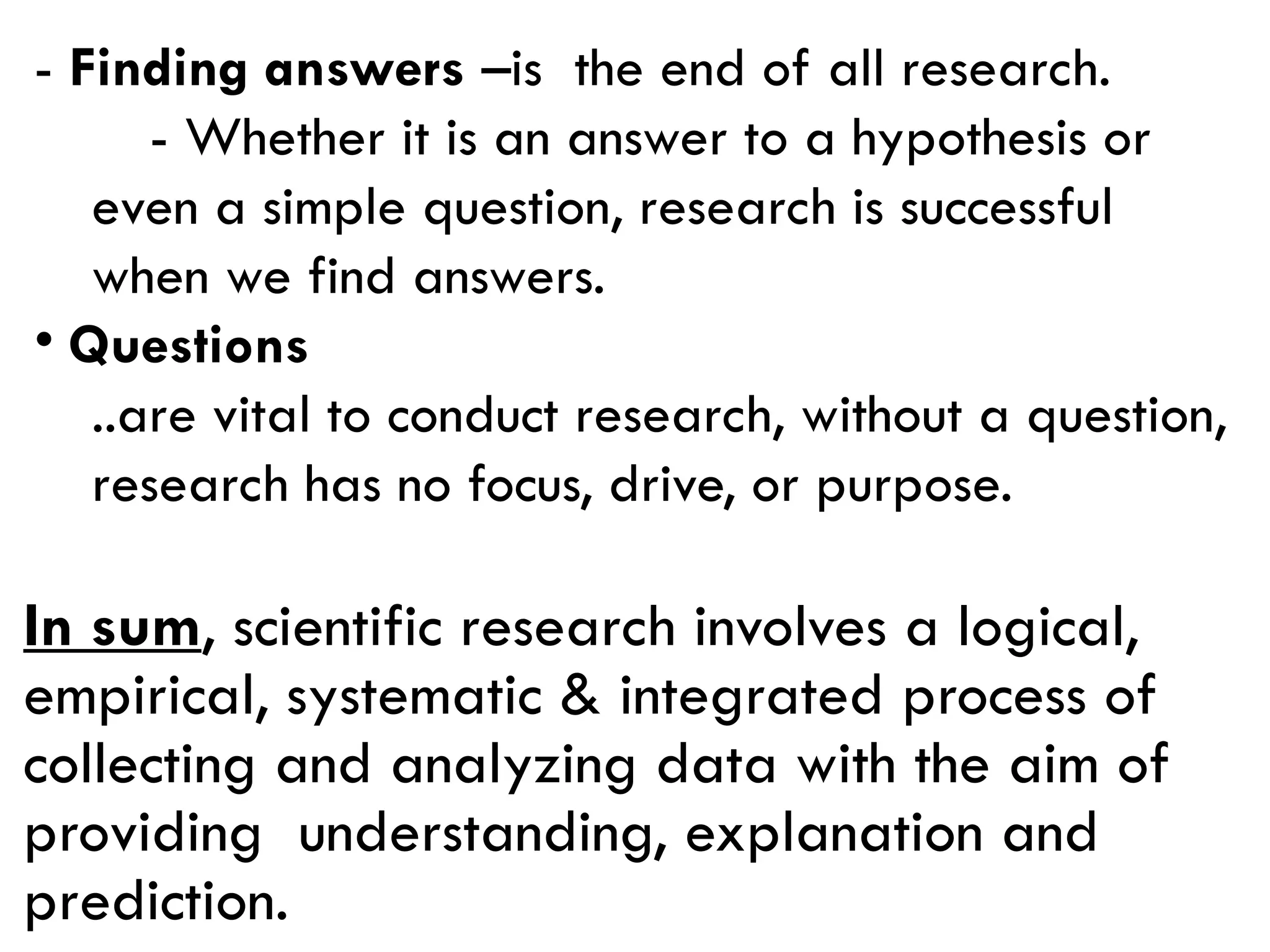
- Finding answers–is the end of all research.
- Whether it is an answer to a hypothesis or
even a simple question, research is successful
when we find answers.
• Questions
..are vital to conduct research, without a question,
research has no focus, drive, or purpose.
In sum, scientific research involves a logical,
empirical, systematic & integrated process of
collecting and analyzing data with the aim of
providing understanding, explanation and
prediction.
27.
The Essence ofScientific Research
1.Theory development
• The goal of scientific research is theory
construction:
• In other words, when scientists conduct
research, by using a set of related assumptions
and activities, they effectively come to
understand the world around them.
i.e. because theory directs our research
and helps us to avoid some common pitfalls
in the conducting of scientific inquiries.
28.
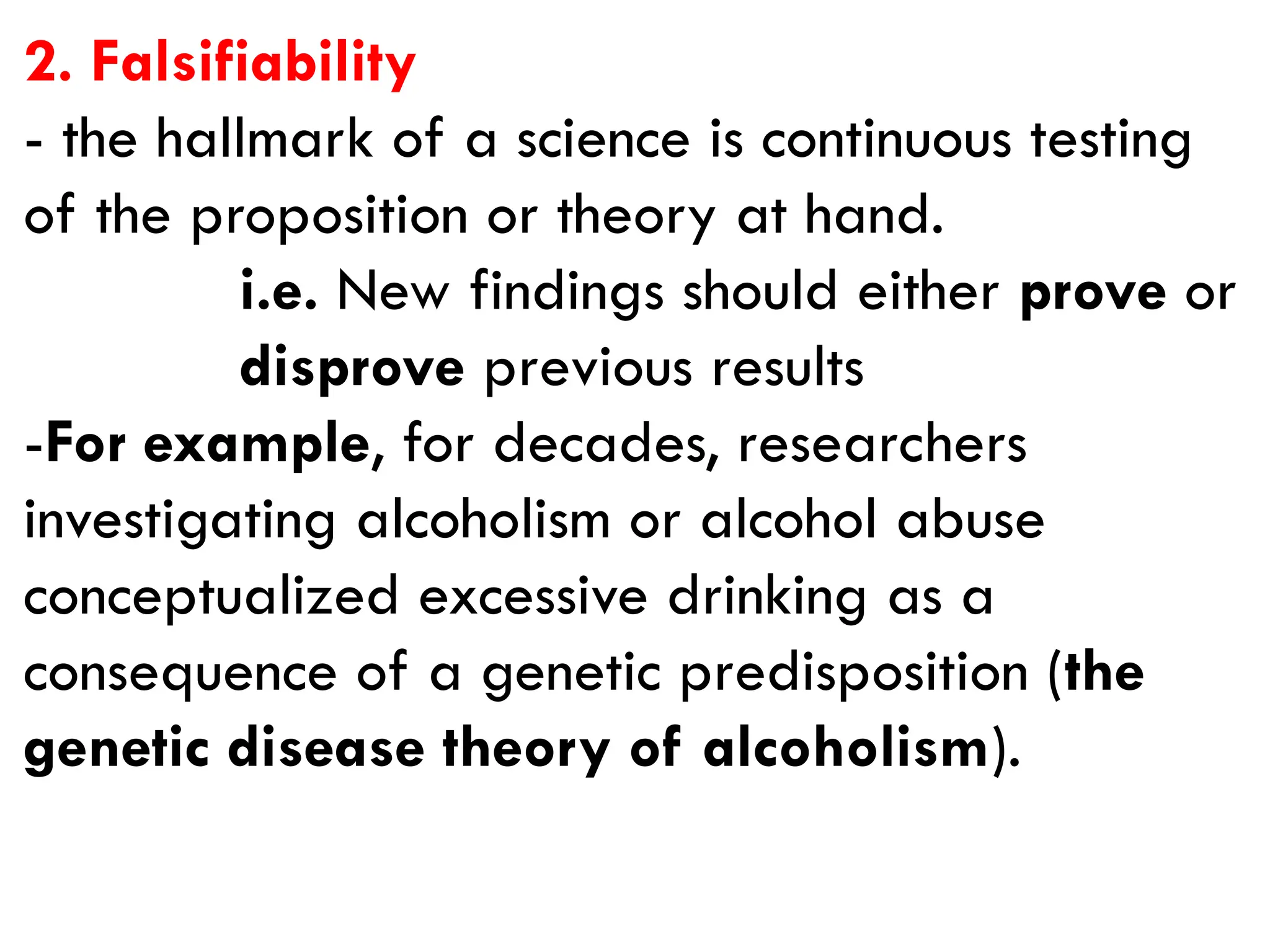
2. Falsifiability
- thehallmark of a science is continuous testing
of the proposition or theory at hand.
i.e. New findings should either prove or
disprove previous results
-For example, for decades, researchers
investigating alcoholism or alcohol abuse
conceptualized excessive drinking as a
consequence of a genetic predisposition (the
genetic disease theory of alcoholism).
29.
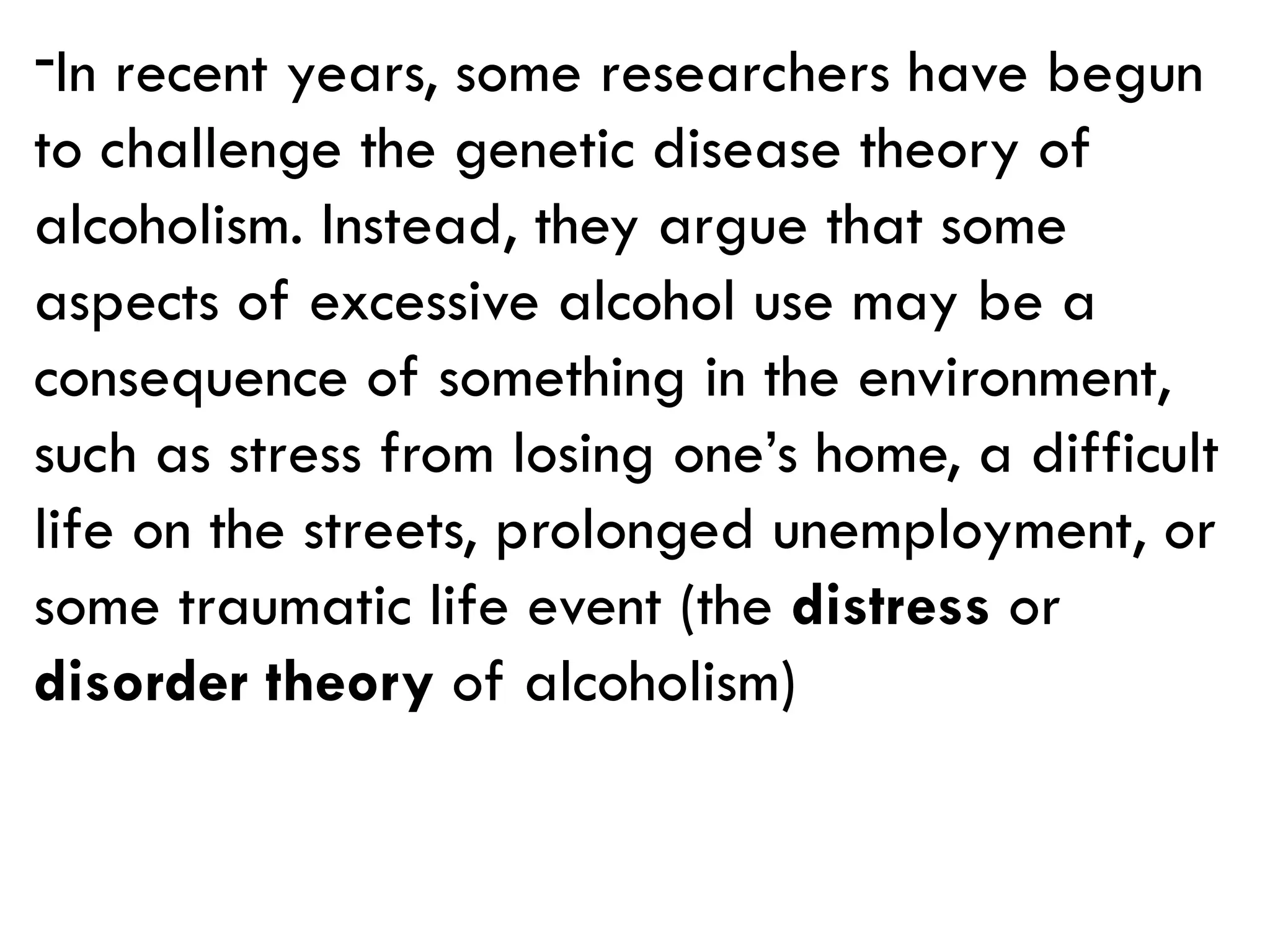
-In recent years,some researchers have begun
to challenge the genetic disease theory of
alcoholism. Instead, they argue that some
aspects of excessive alcohol use may be a
consequence of something in the environment,
such as stress from losing one’s home, a difficult
life on the streets, prolonged unemployment, or
some traumatic life event (the distress or
disorder theory of alcoholism)
30.
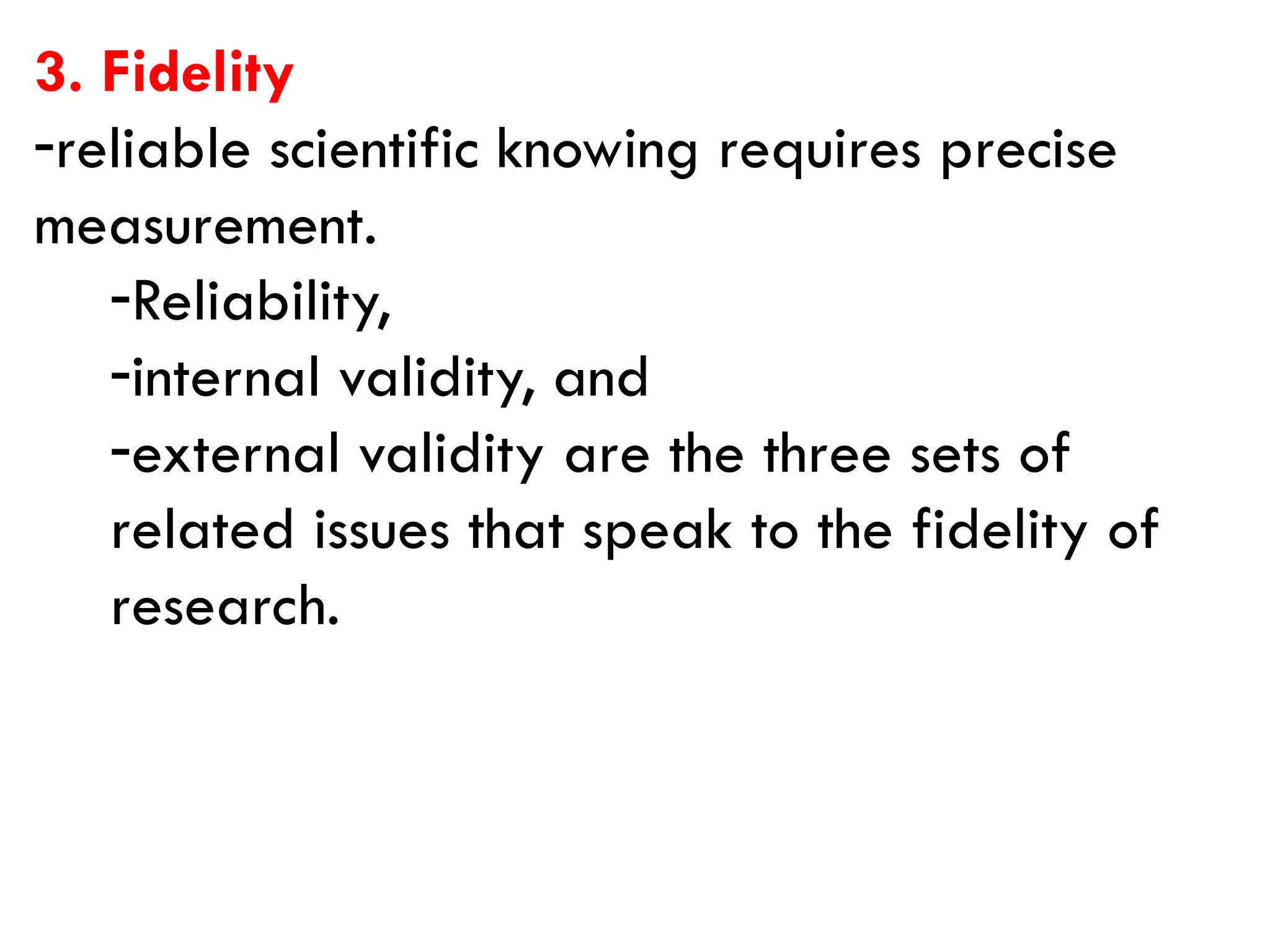
3. Fidelity
-reliable scientificknowing requires precise
measurement.
-Reliability,
-internal validity, and
-external validity are the three sets of
related issues that speak to the fidelity of
research.
31.
3.1 Reliability
……...refers tothe extent to which measurable
features of a theory and/or finding are
trustworthy or dependable.
-When a question is asked at different
times, does it get the same or a similar
answer? If it does, then we trust that the
answer will remain consistent.
32.
3.2 Internal validity
……refersto the degree to which we believe the
results of a study truly describe what happens in a
given set of research circumstances.
-Research is said to have high internal validity
when confounding effects are at a minimum.
- Confounding effects are extraneous variables
that influence the dependent variable and
invalidate the conclusions drawn from the research.
33.
3.3 External validity……..refers to the
generalizability of results from one study to
other settings.
Do the results apply to larger community
settings?
- Where diversity matters in the variables under
investigation, the study’s methodology should
account for it.
- Until these results are replicated with similar
samples in other cities and settings, the study
results must be interpreted as applicable only to
its study area.
34.
Traditional Scientific Methods
-Thereare traditional group research
strategies that are used by all psychologists,
including community psychologists.
-Basically, the three Scientific Research Designs
are:
• Correlation Research
• Quasi-experimental Research
• Experimental Research
35.
a) Correlational methods
-allowone to examine the associations or
relationships between two or more variables
in their natural environments.
-Correlational methods do not contain active
manipulations of the variables under study;
rather, they are usually descriptive.
-For example, one might want to investigate the
relationship between the number of months a woman
has been pregnant & the severity of her substance
abuse; these variables are not manipulated.
36.
b) Experimental Research
…………Inexperimental research, intervening
variables are controlled for by randomly
assigning participants to groups, holding
conditions constant, & manipulating the
independent variable.
37.
-An independent variableis the condition that is
varied between groups (e.g., people in one
group receive a treatment; people in the other
do not).
-The dependent variable is what the scientist
measures to see the effects of the independent
variable
- If assignment is random, the two groups, (i.e.
experimental & control), can be assumed to be
similar to each other, or rather, equivalent.
38.
-If there areany differences between the
groups at the end of the process, it can be
assumed that the independent variable is what
brought about the change, because the only
difference between the groups is the
independent variable’s presence or absence.
39.
c) Quasi-experimental Research
-For practical & ethical reasons, many variables
studied in the field of community psychology
(e.g., school climate or minors being exposed to
alcohol or cigarettes) cannot be experimentally
manipulated. Similarly, subjects cannot always
be randomly assigned to groups.
-For example, if a participant is pregnant, it is
not possible to randomly assign her to the
nonpregnant group.
40.
-The quasi-experimental designallows for
more natural or realistic research, where initial
differences between experimental &
comparison groups may not be balanced.
41.
Alternative research methodsused in C.P
-They are research methodologies used by
community psychologists but not by laboratory
based psychologist.
-In some cases, these methods come from other
disciplines such as anthropology or public
health, and in others.
- These methods are:
A) Ethnography and
B) Epidemiology
42.
a) Ethnography
………refers toa broad class of designs and
measurement procedures where one speaks
directly with participants of the study.
-The primary purpose of ethnography is to
allow one to gain an understanding of how
people view their own experiences. The effort
is to see the world from their perspective.
-In other words, the informants/participants
use their own language to describe their own
experiences.
43.
-Participant observation isa special type of
ethnographic technique.
-In participant observation, the researcher is
actively engaged in the dynamics within the
setting. There are assumed to be ongoing
dialogues between the researcher & the
participants.
44.
-For example, aresearcher who is interested in
the study of teenage gangs often needs to
“hang out” with the gangs for a period of time.
-Also, the researcher needs to acquire the
language used by the gangs to facilitate his
or her investigation of the gangs’ social
network characteristics as well as to establish
trust
45.
b) Epidemiology
-The researchentails “the study of the
occurrence & distribution of diseases and
other health-related conditions in
populations”
-usually used by those in public health.
- There are two measures of the rate of illness
in the community:
i. prevalence and
ii. incidence.
46.
1- The prevalenceof a disease or health-
related condition is the aggregate or total
number of people within a given population
who have the disorder
-Prevalence rates can be established using a
retrospective design or looking back at all
known cases.
-In this design, we would count all old cases
and all new cases.
47.
-Depending on theobjectives of the
epidemiological investigation, measurement
procedures as well as techniques used in the
design can range from household interviews to
random telephone dialing, others include the
use of archived data such as birth certificates,
death certificates, census records, or other
previously collected data.
48.
ii. Incidence
………..refers tothe number of people
within a given population who have acquired
the condition within a specific time period
such as a week, a month, or a year.
-Incidence rates can be established using a
prospective design or investigation of new
cases.
49.
- Here, allnew cases for the given time frame
are counted.
-Rising incidence rates tell us that the
problem is increasing.
-Declining incidence rates suggest that the
problem is lessening
50.
Need Assessment &Program Evaluation
- What is Need?
Community needs are the gaps between what a
situation is and what it should be.
-Needs assessment refers to a set of methods
to determine whether a program or intervention
can be of use to a given population.
-It can be conducted via interviews, surveys,
and other observational or descriptive
information.
51.
Types of needs(Perspectives on needs)
• Normative
• Perceived
• Expressed
• Relative
A)- Normative need, are needs defined by
experts.
- Are based on the existence of standards or
criterion established by custom, authority or
general consensus against which quantity or
quality of a situation or condition is measured
52.
.
B) Perceived need
-Theyare needs defined by what people think
or feel about their needs
- Can be identified through interviews, focus
groups, town meetings..
-Standard changes with each respondent- i.e. is
subjective.
C) Expressed need
-Need defined by the number of people who
have actually sought help
- Focuses on circumstances in which feeling is
translated to action.
53.
.
D) Relative need
-Gapbetween level of services existing in one
community and those existing in similar
communities or geographic areas
- It must consider differences in population and
social pathology
- Concerned with equity.
54.
-When the needsor problems have been
identified, and a program has then been
developed or refined to address needs related
to a particular issue, the program’s
effectiveness or efficiency should be evaluated,
this process is called program evaluation.
- There are generally two kinds of evaluations:
1- Process evaluation and
2- Outcome evaluation
Program Evaluation
55.
Process evaluationexamines what a
program is doing.
- Are things going as planned, with
interventions occurring in a timely fashion?
-What are the day-to-day operations like?
-Where are the problems of implementation
& execution?
oA good process evaluation should report on
what a program is doing well & what it is not
doing well.
56.
An outcomeevaluation, on the other hand,
looks at the effects of a program. At the end
of the intervention,
-What has been accomplished?
-Does the program do what it intended to do?
-Most program evaluations look at immediate
outcomes, but community programs may require
extended outcome evaluations.
57.
-Ultimately, program evaluationis about
program accountability.
-To that end, eight questions (along with the
corresponding strategies for addressing them)
serve as guides for program accountability:
a)- Are there needs for the program? (needs
assessment)
b)- What is the scientific knowledge or best
practices basis for the program? (consult
scientific literature & promising practice programs)
58.
c)- How donew program(s) integrate with
existing programs?(feedback on comprehensiveness
and fit of program)
d)- How can the program best be implemented?
(planning)
e)- How effective is that implementation?
(process evaluation)
f)- How effective is the program? (outcome &
impact evaluation)
g)- How can the program be improved? (lessons
learned)
h)- How can effective programs be
institutionalized? (replication or spin-off)
#2 it is futile to attempt to understand individuals apart from the settings or the contexts to which they belong (the unwavering position of Cp). To understand the effects of environmental factors or settings on individuals, one must understand something about the setting—in this case, organizations, whether they are private sector businesses, mental health clinics, prisons, or any other community organization.
#3 individuals & organizations have an active relationship i.e. an ever-changing, transactional relationship that occurs over an extended period of time( Maton, 2008).
#4 the primary aim in community psychology is to enhance the functioning of individuals in organizations (Shinn & Perkins, 2000).
i.e. community psychologists create a sense of belonging to the organization & hope to enhance human functioning. Like, reducing turnover
#5 People spend a great deal of their adult lives in organizations, particularly in their place of employment but also in volunteer, recreational, and educational groups. One’s organizational affiliations often bring economic well-being, emotional security, happiness, a sense of self-esteem, and status, as well as the social rewards of belonging to a group and a sense of accomplishment (Schultz & Schultz, 1998). On the other hand, organizations can also frustrate and alienate people and cause much stress (Rubin & Brody, 2005).
#7 And although stress from home can spill over into the workplace, the likelihood of workplace stress interfering with home life has been shown to be significantly greater (Mennino, Rubin, & Brayfield, 2005)
#8 Workers can be too busy or too bored. Interpersonal conflicts among coworkers may exist, or the individual may not feel competent or sufficiently trained to do the work. The job may be dangerous, such as working on a ward with violent individuals, or may be in a demanding and hazardous environment where noise, fumes, poor lighting, or the work itself can produce stress. There could be supervisory problems, too many or too few rules, or too much or too little structure.
#10 These might be held within a definition of the workplace cultural context (O’Donnell, 2006). …….i.e. the influence of the unspoken and assumed values and expectations, that is, culture, seemed critical to any consideration of workplace stress.
#12 For instance, whether decisions originate from the bottom, as when average organizational citizens participate in decisions, or from the top, when a centralized management makes the decisions, is part of the organization’s structure (top and bottom) and processes (how the decision is made).
#13 The distribution of power is also likely to be affected by the organization’s culture. If lower-level members make decisions, they will have more power than if they are not allowed to participate in decision making.
#16 is a feeling of overall exhaustion that is the result of too much pressure and not enough sources of satisfaction (Maslach, Schaufeli, & Leiter, 2000; Moss, 1981).
#17 - Six organizational factors have been identified as contributing to burnout (Leiter & Maslach, 2004, 2005)
#18 Maslach and Leiter (2008) found that they could identify those who are at high risk for burnout by looking at the worker’s perception of site fairness and earlier reports of exhaustion or cynicism. When the individual’s expectations of fairness do not match those of the work site, the tendency to move toward exhaustion and cynicism increases. However, when work site fairness expectations are met, the individual seems to become more engaged (as opposed to burned out) with his or her work. These findings highlight both burnout and engagement tendencies as playing a role in burnout. Whereas Leiter and Maslach’s (1998) earlier suggestion was to identify those who could stay energetic, involved, and feeling effective (i.e., engaged) versus those who would burn out, the later findings supported the role of the perceived work environment in determining these behaviors and attitudes. Fair settings retain personnel and maintain job effectiveness over time.
#19 Members of small organizations report more supportive environments, less discrimination, and more loyalty to the organization (MacDermid, Hertzog, Kensinger, & Zipp, 2001). For instance, Hellman, et al. (1985) examined residential mental health treatment programs by measuring staff and client perceptions. Not surprisingly, the larger the program, the more the members experienced anxiety
#21 To support diversity, community psychologists aimed to foster an organizational climate that emphasized:
Understanding others in the context of their culture and their situation
Shared goals and destiny (we all win or lose)
An understanding and valuing of differences (along with appreciation of the larger social and historical forces that have brought about these differences)
Taking responsibility for their effects on their environment (impact versus intent— what happens to others versus what an individual meant to do)
#22 In some instances, social support can actually worsen the individual’s situation (Grossi & Berg, 1991). Similarly, regard must be given to each person’s cultural background and what kind of support is most appropriate for that person (Jay & D’Augelli, 1991).
#23 Seeking social support is listed among Lazarus and Folk-man’s coping styles. It assumes there is a social support system from which to receive assistance.
#27 Scientific knowing is an inductive process that goes from specific instances to the general. The goal of a theory is to allow researchers to describe, predict, and control for why and how a variable or variables relate to observable or measurable events pertaining to an issue.
#28 -Falsifiability calls for a reliance on observable events to help support or reject any given concept.
#29 Thus, a new theory emerges—the distress or disorder theory of alcoholism.
#32 Scientists look for objective reality - the world as it is - uncolored by personal opinion or feelings. Scientific knowing attempts to eliminate personal bias in data collection and analysis. That is, do not try to prove your own beliefs. They are willing to accept empirical results contrary to their own opinions or values.
#33 The classic manner to achieve representativeness is through random sampling, where all potential participants have an equal chance of being selected for a study. If we were interested in the opinions of both males and females at a school and got mostly males in our sample, we could not honestly say the study was fair.
#35 Causation cannot be determined from correlational studies, because intervening or confounding variables could have produced the effects noted.
#39 many variables cannot be experimentally manipulated. Similarly, subjects cannot always be randomly assigned to groups.
#42 Ethnography allows an individual study participants to describe their own experiences without having to translate them into the words of the researchers.
#45 This includes a broad class of designs (e.g., prospective or “futuristic” studies and retrospective or “historical” studies) and measurement procedures and techniques (e.g., records, random telephone samples, or neighborhood surveys).
#46 In the case of depression, we would count all old cases, take away all cases that have been cured, and then add all the new cases. This tells us the total number of cases in the population at a particular time.
#52 Expressed need Major weakness is the assumption that all persons with need seek appropriate help
#54 Program evaluation refers to a broad class of designs, methodologies, and measurement procedures and techniques that allow one to examine “social programs … and the policies that spawn and justify them, [and] aim to improve the welfare of individuals, organizations, and society” (Shadish, Cook, & Leviton, 1991, p. 19).