By Joseph Lias
President
Simplay Labs LLC
E-mail: joseph.lias@simplaylabs.com
In a few years, HDMI has become
the de facto digital interface stan-
dard for the high-definition CE
market. There are more than 700
adopters of HDMI worldwide. This
article discusses product interop-
erability issues faced by manufac-
turers and explains how a strong
and well-defined program of
interoperability performance test-
ing addresses these issues.
As with all types of products,
not all high-definition CE devices
are designed equally, allowing for
various interpretations of stan-
dards and testing specifications by
manufacturers. Moreover, just one
misinterpretation can break the in-
teroperability of an entire system.
Meeting consumer expectations
is more than just asking ”Does it
work?“ Consumers want to know
”Is this the high-performing,
fully-interoperable product I was
expecting?“
Accordingly, there needs to
be a means by which consumers,
manufacturers and retailers can
easily identify products verified to
be fully interoperable.
Need for more
While HDMI Licensing LLC
AuthorizedTestingCenters(HDMI-
ATCs) test for electrical parametric
and protocol compliance against
the HDMI specification, there is
a need to build upon this basic
interface testing with additional
testing programs designed to sim-
plifyconsumerpurchasedecisions
and enhance the high definition
entertainment experience.
Testing must encompass
robustness as well as interoper-
ability between HD devices from
different manufacturers. This type
of product-stress and interopera-
bility testing is not available within
HDMI-ATCs. There are no HDMI-
ATC plug test compliance speci-
fications, or test tools designed
to ensure graceful recovery from
protocol and interface “glitches.“
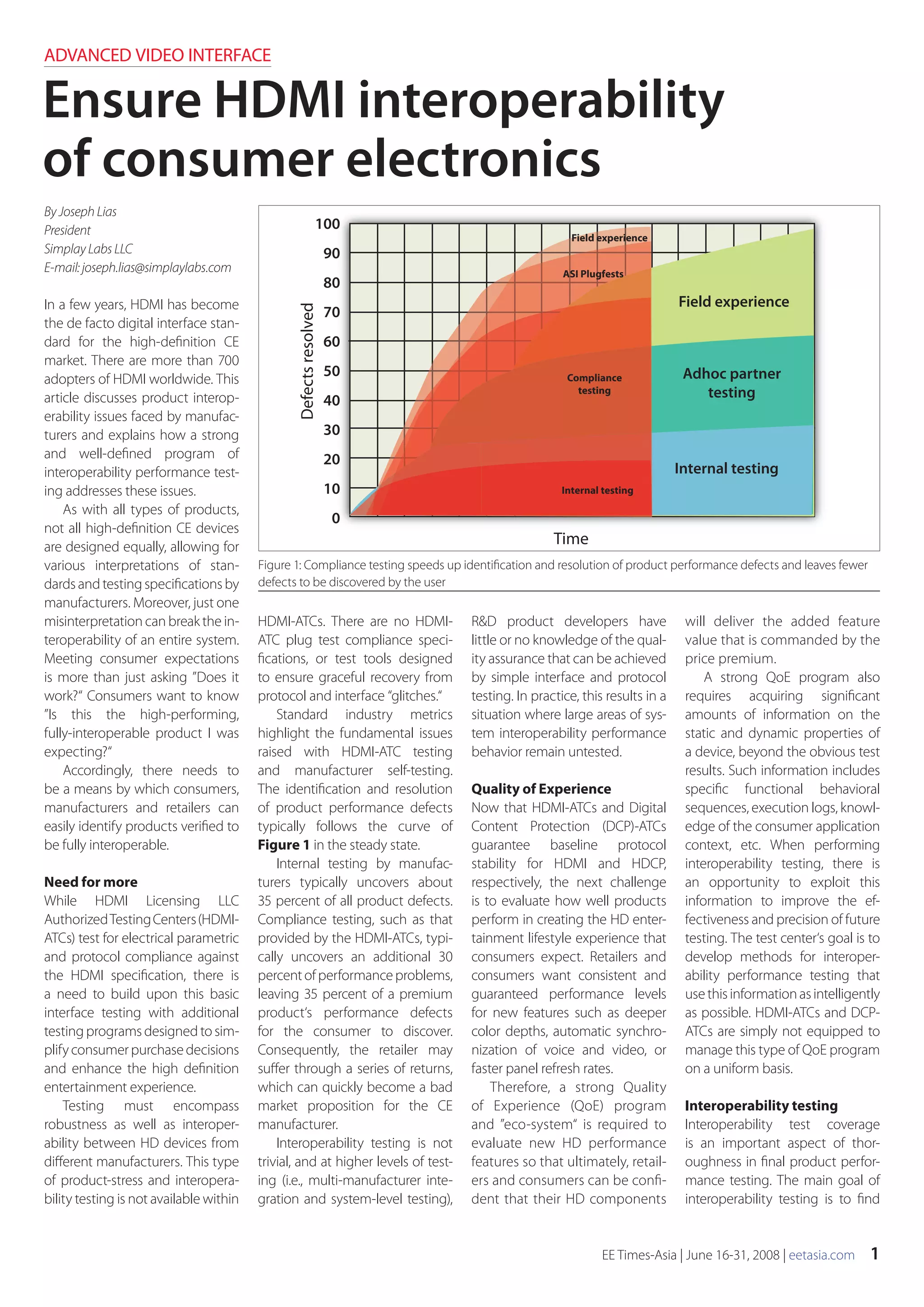
Standard industry metrics
highlight the fundamental issues
raised with HDMI-ATC testing
and manufacturer self-testing.
The identification and resolution
of product performance defects
typically follows the curve of
Figure 1 in the steady state.
Internal testing by manufac-
turers typically uncovers about
35 percent of all product defects.
Compliance testing, such as that
provided by the HDMI-ATCs, typi-
cally uncovers an additional 30
percentofperformanceproblems,
leaving 35 percent of a premium
product‘s performance defects
for the consumer to discover.
Consequently, the retailer may
suffer through a series of returns,
which can quickly become a bad
market proposition for the CE
manufacturer.
Interoperability testing is not
trivial, and at higher levels of test-
ing (i.e., multi-manufacturer inte-
gration and system-level testing),
R&D product developers have
little or no knowledge of the qual-
ity assurance that can be achieved
by simple interface and protocol
testing. In practice, this results in a
situation where large areas of sys-
tem interoperability performance
behavior remain untested.
Quality of Experience
Now that HDMI-ATCs and Digital
Content Protection (DCP)-ATCs
guarantee baseline protocol
stability for HDMI and HDCP,
respectively, the next challenge
is to evaluate how well products
perform in creating the HD enter-
tainment lifestyle experience that
consumers expect. Retailers and
consumers want consistent and
guaranteed performance levels
for new features such as deeper
color depths, automatic synchro-
nization of voice and video, or
faster panel refresh rates.
Therefore, a strong Quality
of Experience (QoE) program
and ”eco-system“ is required to
evaluate new HD performance
features so that ultimately, retail-
ers and consumers can be confi-
dent that their HD components
will deliver the added feature
value that is commanded by the
price premium.
A strong QoE program also
requires acquiring significant
amounts of information on the
static and dynamic properties of
a device, beyond the obvious test
results. Such information includes
specific functional behavioral
sequences, execution logs, knowl-
edge of the consumer application
context, etc. When performing
interoperability testing, there is
an opportunity to exploit this
information to improve the ef-
fectiveness and precision of future
testing. The test center‘s goal is to
develop methods for interoper-
ability performance testing that
usethisinformationasintelligently
as possible. HDMI-ATCs and DCP-
ATCs are simply not equipped to
manage this type of QoE program
on a uniform basis.
Interoperability testing
Interoperability test coverage
is an important aspect of thor-
oughness in final product perfor-
mance testing. The main goal of
interoperability testing is to find
EE Times-Asia | June 16-31, 2008 | eetasia.com
Ensure HDMI interoperability
of consumer electronics
ADVANCED VIDEO INTERFACE
100
90
80
70
60
50
40
30
20
10
0
Time
Field experience
Adhoc partner
testing
Internal testing
Defectsresolved
Field experience
ASI Plugfests
Compliance
testing
Internal testing
Figure 1: Compliance testing speeds up identification and resolution of product performance defects and leaves fewer
defects to be discovered by the user
compatibility failures, and cover-
age is a way to show how well
tests have ”covered“ a particular
performance aspect of the entire
equipment chain. There are many
coverage techniques, e.g., setup
flow coverage, content flow cov-
erage and user interface coverage.
Some techniques are pragmatic,
while others rely on more formal-
ized definitions and models of the
expected system behavior.
Testing must be designed to
promote greater interoperability
between HD products from dif-
ferent manufacturers, as well as to
help maximize the ability of these
products to receive and play pre-
mium digital content. There are
five general categories of device
testing, requiring a complex and
time-consumingtestmatrix.These
categories are source or player
devices such as DVD players, STBs,
PCs and game consoles; presenta-
tion or display devices such as TVs
and projectors; home theater A/V
receivers; switches and multiplex-
ers; and cables.
Each of these products must
be subjected to several types of
tests not provided by HDMI-ATC
testing, including interoper-
ability and High-Definition Digital
Content Protected (HDCP) imple-
mentation stress testing.
•	 Interoperability testing covers:
•	 Signal quality of Display Data
Channel (DDC) bus with mul-
tiple cable lengths;
•	 Multiple connects and discon-
nects of physical hot plugs;
•	 Power cycling of multiple
source and display combina-
tions;
•	 Sourcedeviceformattransition
handling to ensure every con-
nected sink device supported
in mode is tested; and
•	 ExtendedDisplayIdentification
Data (EDID) format support to
confirm proper source device
behavior with standard for-
mats.
HDCP implementation stress
testing, in turn, covers:
•	 DDC communication;
•	 Key selection vector (KSV) and
key integrity;
•	 Authentication;
•	 Encryption and decryption;
•	 Link integrity;
•	 Second part of authentication;
and
•	 Repeater identification
Best practices
Interoperable performance
alignment of CE manufactur-
ers, retailers and consumers can
be a daunting task. It requires a
cross-industry organization with
a vision for a wired and wireless
network of interoperable CE,
PC and mobile devices, in the
home and on the road, enabling
a seamless environment for shar-
ing and growing new digital
media and content services.
The focus must be on delivering
interoperability guidelines and
best practices based on open
industry standards to ensure con-
vergence. These best practices
are case-driven and specify the
interoperable building blocks
that are available to construct
platforms and software infra-
structure. These guidelines must
also focus on interoperability be-
tween these devices for personal
media uses involving imaging,
audio and video.
The following are brief ex-
amples of best practice guidelines
for managing the EDID interoper-
ability function between HDMI
source and sink devices.
Source device guidance
A typical user may have pur-
chased a high-end HDTV and
paired it with a network opera-
tor’s supplied STB and another
manufacturer’s DVD player, both
via HDMI connections. HDTVs
sold in retail are often sold on
the merits of their picture quality,
since display and image quality
are the core functions being put
forth. Thus, many manufacturers
of display devices develop and
differentiate their products with
high-quality image processing
technology. Producers of most
sourcedevices,ontheotherhand,
concentrate their development
efforts on the core functions of
their devices, such as decoding
media or transmitted signals.
When the consumer sets these
products up in the home and the
DVD player is scaling images for
the HDTV, rather than allowing
the HDTV to do so, or possibly
both devices are applying image
processing, the consumer will
experience image quality that
is inferior to what he saw in the
store, sometimes leading him to
initiate a service call and/or return
the product.
Source devices should always
read the associated sink device’s
EDID and only output video for-
mats that are indicated as being
supported by that EDID.
If the full-frame content be-
ing sent across the interface is
pre-recorded or originates from
broadcast, and its video format is
described in the associated sink
device’s EDID, the source should
pass it through to the sink without
scaling or de-interlacing.
There are three reasons for
requiring this setting to be a
default. First, display devices are
optimized to process signaling
based on their own characteristics
and properties. These properties
may shift over the life of a display,
temperature, and time, among
other variables. Only the display
itself is capable of monitoring and
compensating for these shifts in
parameters. Second, there is no
way that the display is capable of
completely communicating its
parameters to a source, because
a source device is not conceivably
pre-programmed to handle the
parameters of all different types of
sinks, and there is no mechanism
to communicate time-varying
changes in parameters as the
EDID is only read at a hot-plug
event, and in many cases only at
initialization. Third, to provide the
best consumer experience in set-
ting up any randomly configured
system (devices from multiple
manufacturers), some common
ruleshouldbeestablishedandthis
is one that makes the most sense
given today’s typical configura-
tions of pairing a high-end display
with a low-end DVD player.
If the source is incapable of
passing through the content,
then the source device must fol-
low the rules of precedence de-
scribed in CEA-861, based on the
ordering of video formats in EDID.
Thismeansthatthesourceshould
attempt to transform the content
to video format described at the
lowest address in the EDID first
(the Preferred Timing Format, or
PTF). But if the source device is
incapable of converting the con-
tent to the PTF, then if should be
transformed to the video format
described at the next lowest ad-
dress, etc. If it is determined that
the rules of precedence intro-
duce both down and upscaling
in the overall system, then the
source should attempt to choose
the next highest priority video
format which does not cause
both up and downscaling in the
overall system.
If the source device performs
a transformation on the content
prior to sending it to the sink, it
is required to indicate the type
of transformation by setting the
proper bits in the AVI InfoFrame
including A0, B0, B1, S0, S1, M0, M1,
R0, R1, R2, R3, ITC, Q0, Q1, SC0, SC1
and if applicable, bar data bytes.
Note: Not all devices (i.e.,
legacy DVI devices) are capable
of receiving InfoFrames, and are
therefore incapable of optimiz-
ing the displayed image if it has
been transformed. This is another
reason why transformation at the
source should be the last alterna-
tive after pass-through.
If the sink device does contain
a VSDB that indicates HDMI capa-
bility (and contains an SVD with
a value greater than seven) in its
EDID, the source should assume
that InfoFrames are received and
parsed by the sink.
Device precedence
Because the sink device is the
last component in the video pro-
cessing chain, it is incapable of
enforcing any control over what
previous devices in the chain do
with respect to video processing.
The only way to assure best per-
formance of a complete system is
to create a set of guidelines that
gives the sink device precedence
for doing the video processing,
based on the image formats it can
 eetasia.com | June 16-31, 2008 | EE Times-Asia
EE Times-Asia | June 16-31, 2008 | eetasia.com
handle. These formats are identi-
fied via timing format descriptors
in the sink’s EDID.
In order to deliver the best
out-of-box experience to the
majority of consumers, all devices
preceding the sink in the video
processing chain should, by de-
fault, assume that the sink handles
all video processing functions
for video formats declared in the
sink’s EDID.
Sink devices should always
provide a valid EDID. The order-
ing of the timings in EDID is
critical to assure optimal perfor-
mance of the complete system.
Programmers who define the
sink EDID should account for like-
ly use cases and order the video
timings to handle these cases
to maximize the optimization of
overall system performance.
The Preferred Timing Format,
the video format described in the
lowest EDID address, does not
necessarily provide the optimal
image on the display. The optimal
display performance is a function
of the display, the overall system
and the quality of the content. As
such, the ordering of video for-
mats called out in EDID is critical
in assuring that the best possible
image quality is displayed for the
viewer. Most CE display devices,
such as HDTVs, use over-scan by
default. Since edges of the im-
age are discarded, the display
slightly up-scales a “safe” portion
of the image in order to fill the full
screen. It should be a goal to avoid
systems where both downscaling
and some form of upscaling oc-
cur, as this combination is likely
to introduce undesirable artifacts
during consumer viewing. As
pointed out, with most HDTVs
there is always an upscaling step
due to over-scan, so downscaling
in the source creates a potential
forundesirableartifacts.Upscaling
twice tends to provide more desir-
able results than down/upscaling,
however scaling twice should be
avoided if possible.
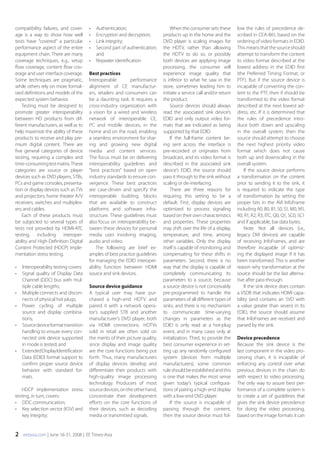
Simplay partnerships
Simplay Labs is committed to
enabling optimal performance
of HD products, facilitating a
highly interoperable, integrated
and seamless experience. We
collaborate with retailers, content
providers and custom electronics
professionals to enable consum-
ers’ passion for the HD lifestyle.
And we work with manufacturers
to ensure QoE beyond simple pro-
tocol specifications, by delivering
the best possible HD experience
to the consumer Figure 2.
Simplay Labs’ “Simplay HD”
interoperability performance test-
ing program provides significant
benefitsacrosstheentireHDvalue
chain. For manufacturers the pro-
gram improves RD effectiveness,
time to market, cost control and
product differentiation. Retailers
benefit from the quality partner-
ship by fewer returns--since basic
protocol testing is not enough
to manage returns--and easier
floor sales. Consumers get peace
of mind, quality and a true “lean-
back” experience.
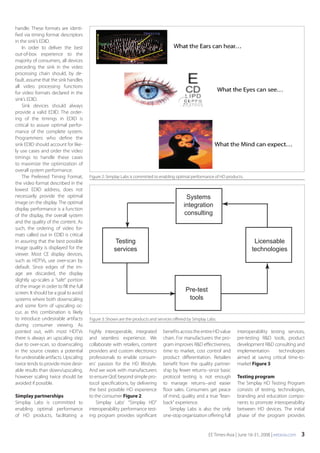
Simplay Labs is also the only
one-stop organization offering full
interoperability testing services,
pre-testing RD tools, product
development RD consulting and
implementation technologies
aimed at saving critical time-to-
market Figure 3.
Testing program
The Simplay HD Testing Program
consists of testing, technologies,
branding and education compo-
nents to promote interoperability
between HD devices. The initial
phase of the program provides
Figure 2: Simplay Labs is committed to enabling optimal performance of HD products.
Systems
integration
consulting
Testing
services
Licensable
technologies
Pre-test
tools
Figure 3: Shown are the products and services offered by Simplay Labs.
eetasia.com | June 16-31, 2008 | EE Times-Asia
a Simplay HD Compatibility Test
Specification and a testing service
for device manufacturers. Testing
includes HDCP functionality in
conjunction with HDMI, as well
as compatibility between HDMI-
HDCP devices from different
manufacturers. The Simplay HD
program provides CE manufactur-
ers with well-defined tools and
documentation for critical multi-
product interoperability testing.
This includes test specification,
or “what to test” and use of an
open standard. Also the test plan,
or “how to test,” determination of
pass/fail/warning test cases and
again, use of an open standard, is
included. Another element is the
combination the test equipment,
software and worldwide staff. The
last element is, of course, the com-
patibility/interoperability lab itself.
Compliance with DCP-HDCP
and HDMI interface requirements
is a prerequisite for entry into the
Simplay HD performance test-
ing program. Once compliance
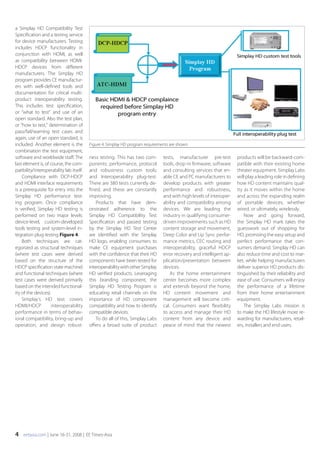
is verified, Simplay HD testing is
performed on two major levels:
device-level, custom-developed
tools testing and system-level in-
tegration plug testing Figure 4.
Both techniques are cat-
egorized as structural techniques
(where test cases were derived
based on the structure of the
HDCP specificationstatemachine)
and functional techniques (where
test cases were derived primarily
based on the intended functional-
ity of the devices).
Simplay’s HD test covers
HDMI/HDCP interoperability
performance in terms of behav-
ioral compatibility, bring-up and
operation, and design robust-
ness testing. This has two com-
ponents: performance, protocol
and robustness custom tools;
and Interoperability plug-test.
There are 380 tests currently de-
fined, and these are constantly
improving.
Products that have dem-
onstrated adherence to the
Simplay HD Compatibility Test
Specification and passed testing
by the Simplay HD Test Center
are identified with the Simplay
HD logo, enabling consumers to
make CE equipment purchases
with the confidence that their HD
components have been tested for
interoperabilitywithotherSimplay
HD verified products. Leveraging
this branding component, the
Simplay HD Testing Program is
educating retail channels on the
importance of HD component
compatibility and how to identify
compatible devices.
To do all of this, Simplay Labs
offers a broad suite of product
tests, manufacturer pre-test
tools, drop-in firmware, software
and consulting services that en-
able CE and PC manufacturers to
develop products with greater
performance and robustness,
and with high levels of interoper-
ability and compatibility among
devices. We are leading the
industry in qualifying consumer-
driven improvements such as HD
content storage and movement,
Deep Color and Lip Sync perfor-
mance metrics, CEC routing and
interoperability, graceful HDCP
error recovery and intelligent ap-
plication/presentation between
devices.
As the home entertainment
center becomes more complex
and extends beyond the home,
HD content movement and
management will become criti-
cal. Consumers want flexibility
to access and manage their HD
content from any device and
peace of mind that the newest
products will be backward-com-
patible with their existing home
theater equipment. Simplay Labs
will play a leading role in defining
how HD content maintains qual-
ity as it moves within the home
and across the expanding realm
of portable devices, whether
wired, or ultimately, wirelessly.
Now and going forward,
the Simplay HD mark takes the
guesswork out of shopping for
HD, promising the easy setup and
perfect performance that con-
sumers demand. Simplay HD can
also reduce time and cost to mar-
ket, while helping manufacturers
deliver superior HD products dis-
tinguished by their reliability and
ease of use. Consumers will enjoy
the performance of a lifetime
from their home entertainment
equipment.
The Simplay Labs mission is
to make the HD lifestyle more re-
warding for manufacturers, retail-
ers, installers and end users.
Figure 4: Simplay HD program requirements are shown.

HDMI Interop

  • 1.
    By Joseph Lias President SimplayLabs LLC E-mail: joseph.lias@simplaylabs.com In a few years, HDMI has become the de facto digital interface stan- dard for the high-definition CE market. There are more than 700 adopters of HDMI worldwide. This article discusses product interop- erability issues faced by manufac- turers and explains how a strong and well-defined program of interoperability performance test- ing addresses these issues. As with all types of products, not all high-definition CE devices are designed equally, allowing for various interpretations of stan- dards and testing specifications by manufacturers. Moreover, just one misinterpretation can break the in- teroperability of an entire system. Meeting consumer expectations is more than just asking ”Does it work?“ Consumers want to know ”Is this the high-performing, fully-interoperable product I was expecting?“ Accordingly, there needs to be a means by which consumers, manufacturers and retailers can easily identify products verified to be fully interoperable. Need for more While HDMI Licensing LLC AuthorizedTestingCenters(HDMI- ATCs) test for electrical parametric and protocol compliance against the HDMI specification, there is a need to build upon this basic interface testing with additional testing programs designed to sim- plifyconsumerpurchasedecisions and enhance the high definition entertainment experience. Testing must encompass robustness as well as interoper- ability between HD devices from different manufacturers. This type of product-stress and interopera- bility testing is not available within HDMI-ATCs. There are no HDMI- ATC plug test compliance speci- fications, or test tools designed to ensure graceful recovery from protocol and interface “glitches.“ Standard industry metrics highlight the fundamental issues raised with HDMI-ATC testing and manufacturer self-testing. The identification and resolution of product performance defects typically follows the curve of Figure 1 in the steady state. Internal testing by manufac- turers typically uncovers about 35 percent of all product defects. Compliance testing, such as that provided by the HDMI-ATCs, typi- cally uncovers an additional 30 percentofperformanceproblems, leaving 35 percent of a premium product‘s performance defects for the consumer to discover. Consequently, the retailer may suffer through a series of returns, which can quickly become a bad market proposition for the CE manufacturer. Interoperability testing is not trivial, and at higher levels of test- ing (i.e., multi-manufacturer inte- gration and system-level testing), R&D product developers have little or no knowledge of the qual- ity assurance that can be achieved by simple interface and protocol testing. In practice, this results in a situation where large areas of sys- tem interoperability performance behavior remain untested. Quality of Experience Now that HDMI-ATCs and Digital Content Protection (DCP)-ATCs guarantee baseline protocol stability for HDMI and HDCP, respectively, the next challenge is to evaluate how well products perform in creating the HD enter- tainment lifestyle experience that consumers expect. Retailers and consumers want consistent and guaranteed performance levels for new features such as deeper color depths, automatic synchro- nization of voice and video, or faster panel refresh rates. Therefore, a strong Quality of Experience (QoE) program and ”eco-system“ is required to evaluate new HD performance features so that ultimately, retail- ers and consumers can be confi- dent that their HD components will deliver the added feature value that is commanded by the price premium. A strong QoE program also requires acquiring significant amounts of information on the static and dynamic properties of a device, beyond the obvious test results. Such information includes specific functional behavioral sequences, execution logs, knowl- edge of the consumer application context, etc. When performing interoperability testing, there is an opportunity to exploit this information to improve the ef- fectiveness and precision of future testing. The test center‘s goal is to develop methods for interoper- ability performance testing that usethisinformationasintelligently as possible. HDMI-ATCs and DCP- ATCs are simply not equipped to manage this type of QoE program on a uniform basis. Interoperability testing Interoperability test coverage is an important aspect of thor- oughness in final product perfor- mance testing. The main goal of interoperability testing is to find EE Times-Asia | June 16-31, 2008 | eetasia.com Ensure HDMI interoperability of consumer electronics ADVANCED VIDEO INTERFACE 100 90 80 70 60 50 40 30 20 10 0 Time Field experience Adhoc partner testing Internal testing Defectsresolved Field experience ASI Plugfests Compliance testing Internal testing Figure 1: Compliance testing speeds up identification and resolution of product performance defects and leaves fewer defects to be discovered by the user
  • 2.
    compatibility failures, andcover- age is a way to show how well tests have ”covered“ a particular performance aspect of the entire equipment chain. There are many coverage techniques, e.g., setup flow coverage, content flow cov- erage and user interface coverage. Some techniques are pragmatic, while others rely on more formal- ized definitions and models of the expected system behavior. Testing must be designed to promote greater interoperability between HD products from dif- ferent manufacturers, as well as to help maximize the ability of these products to receive and play pre- mium digital content. There are five general categories of device testing, requiring a complex and time-consumingtestmatrix.These categories are source or player devices such as DVD players, STBs, PCs and game consoles; presenta- tion or display devices such as TVs and projectors; home theater A/V receivers; switches and multiplex- ers; and cables. Each of these products must be subjected to several types of tests not provided by HDMI-ATC testing, including interoper- ability and High-Definition Digital Content Protected (HDCP) imple- mentation stress testing. • Interoperability testing covers: • Signal quality of Display Data Channel (DDC) bus with mul- tiple cable lengths; • Multiple connects and discon- nects of physical hot plugs; • Power cycling of multiple source and display combina- tions; • Sourcedeviceformattransition handling to ensure every con- nected sink device supported in mode is tested; and • ExtendedDisplayIdentification Data (EDID) format support to confirm proper source device behavior with standard for- mats. HDCP implementation stress testing, in turn, covers: • DDC communication; • Key selection vector (KSV) and key integrity; • Authentication; • Encryption and decryption; • Link integrity; • Second part of authentication; and • Repeater identification Best practices Interoperable performance alignment of CE manufactur- ers, retailers and consumers can be a daunting task. It requires a cross-industry organization with a vision for a wired and wireless network of interoperable CE, PC and mobile devices, in the home and on the road, enabling a seamless environment for shar- ing and growing new digital media and content services. The focus must be on delivering interoperability guidelines and best practices based on open industry standards to ensure con- vergence. These best practices are case-driven and specify the interoperable building blocks that are available to construct platforms and software infra- structure. These guidelines must also focus on interoperability be- tween these devices for personal media uses involving imaging, audio and video. The following are brief ex- amples of best practice guidelines for managing the EDID interoper- ability function between HDMI source and sink devices. Source device guidance A typical user may have pur- chased a high-end HDTV and paired it with a network opera- tor’s supplied STB and another manufacturer’s DVD player, both via HDMI connections. HDTVs sold in retail are often sold on the merits of their picture quality, since display and image quality are the core functions being put forth. Thus, many manufacturers of display devices develop and differentiate their products with high-quality image processing technology. Producers of most sourcedevices,ontheotherhand, concentrate their development efforts on the core functions of their devices, such as decoding media or transmitted signals. When the consumer sets these products up in the home and the DVD player is scaling images for the HDTV, rather than allowing the HDTV to do so, or possibly both devices are applying image processing, the consumer will experience image quality that is inferior to what he saw in the store, sometimes leading him to initiate a service call and/or return the product. Source devices should always read the associated sink device’s EDID and only output video for- mats that are indicated as being supported by that EDID. If the full-frame content be- ing sent across the interface is pre-recorded or originates from broadcast, and its video format is described in the associated sink device’s EDID, the source should pass it through to the sink without scaling or de-interlacing. There are three reasons for requiring this setting to be a default. First, display devices are optimized to process signaling based on their own characteristics and properties. These properties may shift over the life of a display, temperature, and time, among other variables. Only the display itself is capable of monitoring and compensating for these shifts in parameters. Second, there is no way that the display is capable of completely communicating its parameters to a source, because a source device is not conceivably pre-programmed to handle the parameters of all different types of sinks, and there is no mechanism to communicate time-varying changes in parameters as the EDID is only read at a hot-plug event, and in many cases only at initialization. Third, to provide the best consumer experience in set- ting up any randomly configured system (devices from multiple manufacturers), some common ruleshouldbeestablishedandthis is one that makes the most sense given today’s typical configura- tions of pairing a high-end display with a low-end DVD player. If the source is incapable of passing through the content, then the source device must fol- low the rules of precedence de- scribed in CEA-861, based on the ordering of video formats in EDID. Thismeansthatthesourceshould attempt to transform the content to video format described at the lowest address in the EDID first (the Preferred Timing Format, or PTF). But if the source device is incapable of converting the con- tent to the PTF, then if should be transformed to the video format described at the next lowest ad- dress, etc. If it is determined that the rules of precedence intro- duce both down and upscaling in the overall system, then the source should attempt to choose the next highest priority video format which does not cause both up and downscaling in the overall system. If the source device performs a transformation on the content prior to sending it to the sink, it is required to indicate the type of transformation by setting the proper bits in the AVI InfoFrame including A0, B0, B1, S0, S1, M0, M1, R0, R1, R2, R3, ITC, Q0, Q1, SC0, SC1 and if applicable, bar data bytes. Note: Not all devices (i.e., legacy DVI devices) are capable of receiving InfoFrames, and are therefore incapable of optimiz- ing the displayed image if it has been transformed. This is another reason why transformation at the source should be the last alterna- tive after pass-through. If the sink device does contain a VSDB that indicates HDMI capa- bility (and contains an SVD with a value greater than seven) in its EDID, the source should assume that InfoFrames are received and parsed by the sink. Device precedence Because the sink device is the last component in the video pro- cessing chain, it is incapable of enforcing any control over what previous devices in the chain do with respect to video processing. The only way to assure best per- formance of a complete system is to create a set of guidelines that gives the sink device precedence for doing the video processing, based on the image formats it can eetasia.com | June 16-31, 2008 | EE Times-Asia
  • 3.
    EE Times-Asia |June 16-31, 2008 | eetasia.com handle. These formats are identi- fied via timing format descriptors in the sink’s EDID. In order to deliver the best out-of-box experience to the majority of consumers, all devices preceding the sink in the video processing chain should, by de- fault, assume that the sink handles all video processing functions for video formats declared in the sink’s EDID. Sink devices should always provide a valid EDID. The order- ing of the timings in EDID is critical to assure optimal perfor- mance of the complete system. Programmers who define the sink EDID should account for like- ly use cases and order the video timings to handle these cases to maximize the optimization of overall system performance. The Preferred Timing Format, the video format described in the lowest EDID address, does not necessarily provide the optimal image on the display. The optimal display performance is a function of the display, the overall system and the quality of the content. As such, the ordering of video for- mats called out in EDID is critical in assuring that the best possible image quality is displayed for the viewer. Most CE display devices, such as HDTVs, use over-scan by default. Since edges of the im- age are discarded, the display slightly up-scales a “safe” portion of the image in order to fill the full screen. It should be a goal to avoid systems where both downscaling and some form of upscaling oc- cur, as this combination is likely to introduce undesirable artifacts during consumer viewing. As pointed out, with most HDTVs there is always an upscaling step due to over-scan, so downscaling in the source creates a potential forundesirableartifacts.Upscaling twice tends to provide more desir- able results than down/upscaling, however scaling twice should be avoided if possible. Simplay partnerships Simplay Labs is committed to enabling optimal performance of HD products, facilitating a highly interoperable, integrated and seamless experience. We collaborate with retailers, content providers and custom electronics professionals to enable consum- ers’ passion for the HD lifestyle. And we work with manufacturers to ensure QoE beyond simple pro- tocol specifications, by delivering the best possible HD experience to the consumer Figure 2. Simplay Labs’ “Simplay HD” interoperability performance test- ing program provides significant benefitsacrosstheentireHDvalue chain. For manufacturers the pro- gram improves RD effectiveness, time to market, cost control and product differentiation. Retailers benefit from the quality partner- ship by fewer returns--since basic protocol testing is not enough to manage returns--and easier floor sales. Consumers get peace of mind, quality and a true “lean- back” experience. Simplay Labs is also the only one-stop organization offering full interoperability testing services, pre-testing RD tools, product development RD consulting and implementation technologies aimed at saving critical time-to- market Figure 3. Testing program The Simplay HD Testing Program consists of testing, technologies, branding and education compo- nents to promote interoperability between HD devices. The initial phase of the program provides Figure 2: Simplay Labs is committed to enabling optimal performance of HD products. Systems integration consulting Testing services Licensable technologies Pre-test tools Figure 3: Shown are the products and services offered by Simplay Labs.
  • 4.
    eetasia.com | June16-31, 2008 | EE Times-Asia a Simplay HD Compatibility Test Specification and a testing service for device manufacturers. Testing includes HDCP functionality in conjunction with HDMI, as well as compatibility between HDMI- HDCP devices from different manufacturers. The Simplay HD program provides CE manufactur- ers with well-defined tools and documentation for critical multi- product interoperability testing. This includes test specification, or “what to test” and use of an open standard. Also the test plan, or “how to test,” determination of pass/fail/warning test cases and again, use of an open standard, is included. Another element is the combination the test equipment, software and worldwide staff. The last element is, of course, the com- patibility/interoperability lab itself. Compliance with DCP-HDCP and HDMI interface requirements is a prerequisite for entry into the Simplay HD performance test- ing program. Once compliance is verified, Simplay HD testing is performed on two major levels: device-level, custom-developed tools testing and system-level in- tegration plug testing Figure 4. Both techniques are cat- egorized as structural techniques (where test cases were derived based on the structure of the HDCP specificationstatemachine) and functional techniques (where test cases were derived primarily based on the intended functional- ity of the devices). Simplay’s HD test covers HDMI/HDCP interoperability performance in terms of behav- ioral compatibility, bring-up and operation, and design robust- ness testing. This has two com- ponents: performance, protocol and robustness custom tools; and Interoperability plug-test. There are 380 tests currently de- fined, and these are constantly improving. Products that have dem- onstrated adherence to the Simplay HD Compatibility Test Specification and passed testing by the Simplay HD Test Center are identified with the Simplay HD logo, enabling consumers to make CE equipment purchases with the confidence that their HD components have been tested for interoperabilitywithotherSimplay HD verified products. Leveraging this branding component, the Simplay HD Testing Program is educating retail channels on the importance of HD component compatibility and how to identify compatible devices. To do all of this, Simplay Labs offers a broad suite of product tests, manufacturer pre-test tools, drop-in firmware, software and consulting services that en- able CE and PC manufacturers to develop products with greater performance and robustness, and with high levels of interoper- ability and compatibility among devices. We are leading the industry in qualifying consumer- driven improvements such as HD content storage and movement, Deep Color and Lip Sync perfor- mance metrics, CEC routing and interoperability, graceful HDCP error recovery and intelligent ap- plication/presentation between devices. As the home entertainment center becomes more complex and extends beyond the home, HD content movement and management will become criti- cal. Consumers want flexibility to access and manage their HD content from any device and peace of mind that the newest products will be backward-com- patible with their existing home theater equipment. Simplay Labs will play a leading role in defining how HD content maintains qual- ity as it moves within the home and across the expanding realm of portable devices, whether wired, or ultimately, wirelessly. Now and going forward, the Simplay HD mark takes the guesswork out of shopping for HD, promising the easy setup and perfect performance that con- sumers demand. Simplay HD can also reduce time and cost to mar- ket, while helping manufacturers deliver superior HD products dis- tinguished by their reliability and ease of use. Consumers will enjoy the performance of a lifetime from their home entertainment equipment. The Simplay Labs mission is to make the HD lifestyle more re- warding for manufacturers, retail- ers, installers and end users. Figure 4: Simplay HD program requirements are shown.