

Licensed to:
Danila Pisarev
danechka@spbnews.ru
User #19039
Licensed
to
19039
-
Danila
Pisarev
(danechka@spbnews.ru)
WRITE FOR US!
If you want to bring a PHP-related topic to the attention of the professional PHP community,
whether it is personal research, company software, or anything else, why not write an article for
php|architect? If you would like to contribute, contact us and one of our editors will be happy to
help you hone your idea and turn it into a beautiful article for our magazine. Visit www.phparch.
com/writeforus.php or contact our editorial team at write@phparch.com and get started!
6 Email Verification
That email address is valid—but is it a fake?
Sharon Levy
by
16 Migrating PHP, part II: PHP Code
The pitfalls of upgrading, and how to avoid them
Stefan Priebsch
by
25 EAV Modeling
Not just for medical records after all
Carl Welch
by
34 A Refactoring Diary: The Story Continues
For everyone out there who isn’t a frameworks guru (yet)
Bart McLeod
by
4 Editorial
E_YMMV
Steph Fox
by
44 Test P attern
Scripting Integration
Matt Zandstra
by
50 etc/
Beyond Safe Mode
Stuart Herbert
by
57 exit(0);
Welcome to the Intertuber
Marco Tabini
by
FEATURES
COLUMNS
Download this month’s code at: http://www.phparch.com/code/
TM
CONTENTS
June 2008
Licensed
to
19039
-
Danila
Pisarev
(danechka@spbnews.ru)
EDITORIAL
A
s you’re probably aware, Phar is now a core extension in PHP 5.3. This is
great news for Greg Beaver, the project lead; he has worked incredibly
hard to make the extension do all that could possibly be asked of it, and
more. Marcus Börger and myself also work on the extension, but we’ve been left
blinking at the speed of development more than once. At the time of writing,
Greg had just added OpenSSL signing support to Phar, which means that the
only thing left on the immediate TODO is performance optimization.
Oh, and forward compatibility.
Now optimization is definitely more Greg’s kind of thing than mine, and
Marcus doesn’t have much spare time these days, so I took it on myself to
focus on that other thing. I went to look at PHP 6.
The good news is that from now, all phars created using PHP 5.2.1 and up
should run under PHP 6 and vice versa. The structure’s unchanged. Sing halle-
lujah. The bad news is that a phar with a default stub won’t run under versions
of PHP prior to PHP 5.2.1, whereas we had PHP 5.1 support this time last week.
Blame: b and the binary cast. The default stub calls unpack(), you see, and PHP
6 needs to be told that the second argument to unpack() is a binary string and
not a Unicode string. The only ways we have of telling PHP 6 this will throw
a parse error in PHP 5.2.0 and under. There’s no way to have both backward
compatibility and forward compatibility: we have to choose.
I approached Andrei Zmievski and asked why we couldn’t simply have a
fallback implicit conversion from Unicode to binary where the context is
known, i.e. in built-in PHP functions that require binary strings. He explained
that there’s no way to be certain of the intended encoding. I argued. After
all, the user has control over the encoding through various INI directives and/
or through the actual encoding of the physical script; we just needed to know
which of those values would be used for implicit conversion. Andrei reiterated
that implicit conversion is generally a Bad Thing, due to the lack of certainty.
Muttering ’new INI directive’ under my breath, I’m still failing to see why an
implicit conversion in that context couldn’t be allowed and accompanied by
an E_STRICT or even an E_DEPRECATED advisory message, just to make BC more
possible. We never expected to support PHP 4, and thankfully there aren’t many
PHP 5.0 users out there, but PHP 5.1 is relatively popular and it’s pretty hard
to swallow losing userland compatibility with it from PHP 5.2.1 up.
I’ll be interested to see what Stefan Priebsch has to say about forward com-
patibility in his migration series, but unfortunately we all have to wait another
month to read his take on that. It’s still interesting, from the perspective of
PHP 5.3.0-dev, to see just how far we’ve come since PHP 4.
E_YMMV June 2008
Volume 7 - Issue 6
Publisher
Marco Tabini
Editor-in-Chief
Steph Fox
Author Liaison
Cathleen MacIsaac
Editorial Team
Arbi Arzoumani
Steph Fox
write@phparch.com
Graphics & Layout
Arbi Arzoumani
Managing Editor
Arbi Arzoumani
News Editor
Eddie Peloke
Elizabeth Naramore
news@phparch.com
Authors
Stuart Herbert, Sharon Levy, Bart
McLeod, Stefan Priebsch, Marco
Tabini, Carl Welch, Matt Zandstra
php|architect (ISSN 1709-7169) is published
twelve times a year by Marco Tabini & Associates,
Inc., 28 Bombay Ave., Toronto, ON M3H1B7,
Canada.
Although all possible care has been placed in
assuring the accuracy of the contents of this
magazine, including all associated source code,
listings and figures, the publisher assumes
no responsibilities with regards of use of the
information contained herein or in all associated
material.
php|architect, php|a, the php|architect logo,
Marco Tabini & Associates, Inc. and the Mta Logo
are trademarks of Marco Tabini & Associates,
Inc.
Contact Information:
General mailbox:	 info@phparch.com
Editorial:		 editors@phparch.com
Sales & advertising:	 sales@phparch.com
Printed in Canada
Copyright
©2003-2008
Marco Tabini & Associates, Inc.
All Rights Reserved
Steph Fox
by
4 • php|architect • June 2008
Licensed
to
19039
-
Danila
Pisarev
(danechka@spbnews.ru)
Licensed
to
19039
-
Danila
Pisarev
(danechka@spbnews.ru)
FEATURE
EmailVerification
T
here are two issues a developer may come up
against from time to time: email validation and
email verification. While validation largely con-
cerns the format of an email address—the presence and
placement of an @ symbol, a period and other charac-
ters—verification involves answering a simple question.
Is the email address genuine? If an email address is
phony or does not belong to the person providing it,
then storing it is a poor idea.
The bonus of email verification is that it can also
enhance user experience. Since as humans we are error
prone, a number of false email addresses could be
the result of typos rather than any malicious intent.
Back in January 2006 Daniel Bonniot, of Drupal fame,
reported that merely checking whether a domain exists
could catch “between 1/2 and 2/3 of typos” (http://
drupal.org/project/email_verify). Email verification can
thus provide a mechanism to support users, allowing
you to give immediate feedback so they can make any
necessary corrections.
As for pranksters, we might try a little psychology
to discourage them. For example, a Web page might
warn that the IP address of the user’s computer will be
contained in an email sent to the real owner, thereby
allowing her to trace the prankster’s identity. Of
course, this tactic relies on the assumption that most
users are unaware that IP addresses can be allocated
dynamically.
Sharon Levy
by
A user submits an email address through a contact page. Next, your PHP script
takes over and validates it. You may conclude that you can now move on. But
have you really exercised due diligence? If that email address were a fake,
how would you know? More importantly, how would your script know? In this
article, I will explore some techniques that should prove useful.
PHP: 5.2.1+
O/S: Any supported by PHP
Useful/Related Links:
CGI 1.1 specification:
•	 http://hoohoo.ncsa.uiuc.edu/cgi/
interface.html
RFC 821 (SMTP):
•	 http://tools.ietf.org/html/rfc821
RFC 2821 (SMTP):
•	 http://tools.ietf.org/html/rfc2821
SMTP clarifications:
•	 http://tools.ietf.org/html/rfc1123
SMTP overview:
•	 http://nemesis.lonestar.org/site/mail_
trouble.html
DNS extensions:
•	 http://tools.ietf.org/html/rfc1886
DNS records:
•	 http://www.debianhelp.co.uk/dnsrecords.htm
DNS and Windows:
•	 http://www.tech-faq.com/understanding-
dns.shtml
dig tutorial:
•	 http://www.hungrypenguin.net/dig.php
dig manpage:
•	 http://linux.die.net/man/1/dig
host manpage:
•	 http://linux.die.net/man/1/host
nslookup manpage:
•	 http://linux.die.net/man/1/nslookup
nslookup.exe tutorial:
•	 http://support.microsoft.com/
kb/200525
TO DISCUSS THIS ARTICLE VISIT:
http://c7y-bb.phparchitect.com/viewforum.php?f=10
6 • php|architect • June 2008
Licensed
to
19039
-
Danila
Pisarev
(danechka@spbnews.ru)
Clearly, if someone wishes to intentionally provide a
fake email address in a “Contact Us” mail form, it will
take more than psychology alone to deter such an an-
noyance. A developer who knows how to verify an email
address may eliminate or greatly reduce the spam that
a business receives.
There are two approaches to email verification. The
more familiar one is where the website sends an email
to the newly registered user. If the user responds to
the email, within a limited time span, that user’s email
address is judged to be legitimate. This method has
the reputation of being virtually bullet-proof—but is
it? Some email programs may consider such correspon-
dence as “spam” or “junk mail”. The user needs to think
about checking the spam filter and junk mail folder,
assuming he even knows what to do. This approach
is also limited; sometimes email verification needs to
occur within seconds rather than hours. In such cases,
email verification needs to be automated. This second
approach is well suited for PHP.
Validation First
An important initial step in verifying an email address
is to ascertain its validity. This involves checking
that it conforms to one of several formats, such as
user@example.com or user@php.example.com. (Multiple
subdomains must pass muster, too.) There is an
excellent article about email validation in Security
Corner: An In-Depth Look at mail() by Stefan Esser (see
php|architect volume 6, issue 6).
I have browsed several web-based tutorials on email
verification. They were all instructive but usually brief
by necessity. I wish to take what I’ve learned along the
way, expand on it, and share some code for doing email
verification in PHP 5.
Extracting the Domain Name
Since user@example.com conforms to a valid email
format, let’s proceed to verify it. A preliminary step
is to split the email address in two. Using PHP’s
explode(), you can cleanly split the address on the @
symbol , keeping the domain while discarding the user
name, as follows:
$email = ‘user@example.com’;
list(, $domain) = explode(‘@’, $email);
Performing the split with explode() is sensible since
we are not dealing with a regular expression. For
those situations where a regular expression is needed,
preg_split() should be your choice over split(),
according to the official source for all things PHP, www.
php.net.
Now that I’ve shown you how to extract the domain
name, let’s proceed with investigating whether it is
genuine. If it proves to be inauthentic, then we are
finished. And, I can give my computer a break.
What Is A Domain?
When setting out to determine whether a domain is
valid, we need to consider what a domain actually is.
If you set up a website and purchase a name for
it, that name is its domain name. For example, when
a business seeks a Web presence, it needs to choose
a top level domain name (TLD) and a second level
domain. The obvious choice for the TLD is frequently
com, while designating the second level domain requires
more thought. So, in the case of phparch.com, the
second level domain is phparch. Prepending that with
www results in the full URL, www.phparch.com.
The Domain Name System (DNS) is what makes it
possible for you to type a URL into the location area of
your browser and be directed to the correct site. The
way DNS works is that there is a distributed database
of IP addresses and corresponding human-readable
names across the Internet, spread over millions of
computers whose job is to function as domain name
servers. A domain name server translates a URL into an
IP address, a machine-readable string of numbers and
dots.
DNS and Email
By means of DNS, we can determine whether a domain
name corresponds to a real domain. If you query a
domain name server, you can see what, if any, records
it has for a specific domain. Such records may include
whether there is a mail server, denoted by an MX
record. However, if that record type is missing, we
should check to see if there is an A record. Such a
record indicates the IP address of the domain’s host,
which may be treated as if it were the mail server (see
RFC 2821, Sections 3.6 and 5.). Knowing whether a
domain possesses MX or A resource records (RR) informs
us about its validity.
At this point, we are still considering whether user@
example.com contains a valid domain. So, let us use the
DNS system and see what we might learn. First, I will
show you how do this manually on Linux so that we can
7 • php|architect • June 2008
Email Verification
Licensed
to
19039
-
Danila
Pisarev
(danechka@spbnews.ru)
understand how to do the same thing later using PHP.
DNS Resolution
If you’re running a standard Linux distro, you may
choose to use one of the BIND (Berkeley Internet Name
Domain) DNS resolving utilities such as host or dig
(Domain Information Groper). The man pages describe
host as a simple utility, whereas dig is referred to as a
flexible tool. The syntax of either utility is straight-
forward; which of them you choose is a matter of
preference.
Using host to detect an MX record simply involves
typing on the command line:
host -t MX example.com
You may optionally append a period to the domain.
This ensures that you are querying only for DNS records
specific to the fully qualified domain name (FQDN)
example.com and not, for instance, example.com.
whatever.net. If there are any MX records belonging to
example.com, they will be listed in the output.
I used this command, without the -t parameter, on
an email domain whose website is now defunct follow-
ing two mergers and acquisitions. I expected that host
would by default search for an A RR and find nothing.
Instead, the output contained the names of five
mail exchange servers—all belonging to the previous
company that had acquired the domain!
If you prefer not to have to remember to use a switch
like -t, try using dig. At the command prompt, dig
syntax is simpler than that of host:
dig [<DNS server>] <domain name> [<type>]
If you omit the type argument, the default behaviour is
for the query to check for the A record.
Having dwelled on the mechanics of using host and
dig, we should now have an easier time as we make our
way toward accomplishing the same feat using PHP.
To The Web
If you set $domain to “gmail.com”, see what the follow-
ing code yields:
exec(“dig “ . escapeshellarg($domain). “ MX”, $ips);
var_dump($ips);
On my shared hosting account, the script outputs an
empty array because my webhost is thankfully, con-
cerned about security and disallows exec() and back
ticks. You should have better luck with this snippet,
if you have a dedicated server and it’s under your own
control.
If the string value of $domain is derived
from user input, it is best to escape it by using
escapeshellarg(), thereby rendering it harmless in
the shell environment. Single quotes will envelop the
entire string, and single quotes within the string are
themselves quoted.
The results of the call to dig will populate $ips,
which—being an array—we can manipulate. If back
ticks are available, you could achieve similar results.
It’s just a little more work, since you would need to
parse the output.
The main advantage of using dig with PHP is that it
involves little code, and it’s fast. The result will quickly
1. <?php
2.  
3. error_reporting(E_ALL|E_STRICT);
4.  
5. require ‘listing2.php’;
6. require ‘listing3.php’;
7.  
8. $email = array();
9.  
10. // Insert values for 3 email addresses you’d like to test   
11. $emails[0] = ‘’;
12. $emails[1] = ‘’;
13. $emails[2] = ‘’;
14.  
15. foreach ($emails as $email) {
16.  
17.     try {
18.         $host = getMXServer($email);
19.         if ($host) {
20.             $mboxChecker = new mailBoxChecker($email, $host);
21.             if ($mboxChecker) {
22.                 $mboxChecker->checkMailBox();
23.                 $mboxChecker->setActive();
24.                 $mboxChecker->report();
25.             }
26.         }
27.     } catch(Exception $e) {
28.         echo $e->getMessage().”<br />n”;
29.     }
30. }
31.  
32. ?>
33.  
 
LISTING 1
“The main advantage of
using dig with PHP is that it
involves little code, and it’s
fast.”
8 • php|architect • June 2008
Email Verification
Licensed
to
19039
-
Danila
Pisarev
(danechka@spbnews.ru)
confirm if $domain has an MX record. If not, you can
easily check if the domain even has an IP address by
substituting an A for MX in this code snippet. Or, try
the ANY parameter instead, which will tell you whether
the domain name has any DNS records.
Obviously, none of the code snippets I’ve used so far
are pure PHP solutions. To implement them, you would
need to be running a standard Linux distro with the dig
and/or host utilities installed. In addition, you must
have unrestricted use of exec(). All in all, you may find
an entirely PHP-based solution a bit more practical as
well as interesting.
Pure PHP
PHP has an abundance of built-in networking func-
tions, so the immediate question is which of them will
provide meaningful information about a domain and its
mail servers. To see if there is an MX record associated
with the domain, my inclination is to use a combina-
tion of checkdnsrr() and getmxrr().
checkdnsrr(), as its name implies, checks for the
existence of DNS records. Since its only job is to return
a Boolean result, it’s fast. The result indicates whether
the specified type could be found. What surprised me
when I ran my application (see Listings 1, 2 and 3) was
that valid email addresses were sometimes rejected. I
blamed checkdnsrr() initially and accused it of return-
ing false results.
Since then, I believe that innocent function is blame-
less. When I turn on error reporting, I sometimes see a
mysterious message when I re-run the application:
Notice: fputs() [function.fputs]: send of 6 bytes
failed with errno=32 Broken pipe”.
Obviously fputs() has been unable to finish reading
the socket. I tried using stream_set_blocking(), which
is supposed to help fputs() finish its job, but that
didn’t work—perhaps that function still has a bug, as
has been previously reported.
I am getting ahead of myself. So, let’s get back to
how to obtain an MX record
in PHP. The following code aims to do precisely that for
$domain:
if (checkdnsrr($domain, ‘MX’)) {
getmxrr($domain, $mxhosts);
$host = (count($mxhosts)) ? $mxhosts[0] : null;
}
As the code shows, when there is an MX record, we
can then obtain it with the aid of getmxrr(). When
invoked, $mxhosts will automatically be filled in for you
with an array of data.
Each element in the $mxhosts array contains a mail
exchange URL. However, mail servers have a priority
38. function getWinRR($domain, $rr=’MX’)
39. {
40. $isMX = false;
41. $isA = false;
42. $host = false;
43.  
44.     exec(“nslookup -type=$rr $domain”, $output);
45.  
46.     foreach ($output as $record) {
47.  
48.         $arr = explode(‘ ‘, $record);
49.         $isMX = (($rr == ‘MX’) && strstr($record, $rr));
50.  
51.         if (!$isMX) {
52.             $isA = ( strstr($record, ‘Name’) );
53.         }
54.  
55.         if ($isMX ) {
56.             $arraySize = sizeof($arr) - 1;
57.             /* Note: this will return an MX at random
58.                rather than the favoured MX server */
59.             $host = $arr[ $arraySize ];
60.             break;
61.         } else {
62.             if ($isA) {
63.                 $host = $domain;
64.             }
65.         }
66.     }
67.     return $host;
68. }
69.  
70. ?>
LISTING 2: Continued...
1. <?php
2.  
3. function getMXServer($email)
4. {
5.     $host = ‘’;
6.  
7.     if (!$email) {
8.         throw new Exception(‘No email address given’);
9.     }
10.  
11.     // split $email to get the domain
12.     list(, $domain) =   explode(‘@’, $email);
13.  
14.     // a windows solution
15.     if (!function_exists(‘checkdnsrr’)) {
16.         $host = getWinRR($domain);
17.     } else {
18.         // a linux solution
19.         if (checkdnsrr($domain, ‘MX’)) {
20.             getmxrr($domain, $mxhosts, $weight);
21.             asort($weight);
22.             $priority_key = key($weight);
23.             $host = (count($mxhosts)) ? $mxhosts[ $priority_key ] : null;
24.         } else {
25.             if (checkdnsrr($domain, ‘A’)) {
26.                $host = $domain;
27.             }
28.         }
29.     }
30.  
31.     if (!$host) {
32.         throw new Exception(“$email appears to be invalid. Did you make
a mistake?”);
33.     }
34.  
35.     return $host;
36. }
37.  
LISTING 2
9 • php|architect • June 2008
Email Verification
Licensed
to
19039
-
Danila
Pisarev
(danechka@spbnews.ru)
rating, and $mxhosts may not reflect the priority order.
The mail server with the lowest priority rating is the
preferred one to actually contact. With a little more
work, let’s modify the code by inserting an optional
third parameter, $weight:
if (checkdnsrr($domain, ‘MX’)) {
getmxrr($domain, $mxhosts, $weight);
asort($weight);
$key = key($weight);
$host = (count($mxhosts)) ? $mxhosts[$key] :
null;
}
asort() comes in handy here, as it sorts the $weight
array in ascending order while still maintaining key
associations. Now we can get the key corresponding to
the lowest priority value, and so we may contact the
preferred server.
When checkdnsrr() (or dns_check_record() in PHP
1. <?php
2.  
3. class mailBoxChecker
4. {
5.     const PORT=25;
6.     const SUCCESS=220;
7.     const OKAY=250;
8.     const ALLGOOD=3;
9.  
10.     private $timeout = 30; // number of seconds
11.     private $mbox_status = 0;
12.     private $email;
13.     private $host;
14.     private $active;
15.     private $converstion;
16.  
17.     public function __construct($email, $host)
18.     {
19.         $this->email = $email;
20.         $client = (isset($_SERVER[‘HOSTNAME’]))? $_SERVER[‘HOSTNAME’]
: $_SERVER[‘HTTP_HOST’];
21.  
22.         if (!$client) {
23.             exit(‘Unable to determine client host name’);
24.         }
25.  
26.         $this->conversation = array(
27.                                “HELO $clientrn”,
28.                                “MAIL FROM: <{$email}>rn”,
29.                                “RCPT TO: <{$email}>rn”,
30.                                );
31.         $this->host  = $host;
32.         $this->fp = @fsockopen($this->host,
33.                                self::PORT,
34.                                $errNum,
35.                                $errMsg,
36.                                $this->timeout);
37.  
38.         if (!$this->fp){
39.             throw new Exception(‘System error - ‘ .
40.                                 ‘$errNum $errMsg’);
41.         }
42.     }
43.  
44.     private function getEmail()
45.     {
46.         return $this->email;
47.     }
48.  
49.     private function setTimeout($num)
50.     {
51.         $this->timeout = $num;
52.     }
53.  
54.     private function getTimeout()
55.     {
56.         return $this->timeout;
57.     }
58.  
59.     private function getFp()
60.     {
61.         return $this->fp;
62.     }
63.  
64.     private function getConversation()
65.     {
66.         return $this->conversation;
67.     }
68.  
69.     private function getMbox_status()
70.     {
71.         return $this->mbox_status;
72.     }
73.  
74.     private function setMbox_status()
75.     {
76.         $this->mbox_status++;
77.     }
78.  
79.     private function getActive()
80.     {
81.         return $this->active;
82.     }
83.  
84.     public function setActive()
85.     {
86.         $bool = ($this->getMbox_status() == self::ALLGOOD)? true :
LISTING 3
false;
87.         $this->active = $bool;
88.     }
89.  
90.     public function report()
91.     {
92.         $email = $this->getEmail();
93.         $resBln = $this->getActive();
94.         $result = ($resBln === true)? “true” : “false”;
95.         echo “n<p>Is $email an active mailbox? $result</p>n”;
96.     }
97.  
98.     public function checkMailBox()
99.     {
100.         $commands = $this->getConversation();
101.         $this->setTimeout(5);
102.         $fp = $this->getFp();
103.  
104.         if (!stream_set_timeout($fp, $this->getTimeout())) {
105.             throw new Exception(‘Unable to set stream timeout’);
106.         }
107.  
108.         $intVal = intval(fgets($fp));
109.  
110.         if ((self::SUCCESS !== $intVal) && (self::OKAY !== $intVal)) {
111.             throw new Exception(‘Server has refused connection’);
112.         }
113.  
114.         // starting the conversation ...
115.         for ($i = 0, $max = count($commands); $i < $max; $i++) {
116.             fputs($fp, $commands[$i]);
117.             $intVal = intval(fgets($fp));
118.  
119.             if (($intVal === self::SUCCESS) || ($intVal === self::OKAY))
{
120.                 $this->setMbox_status();
121.             }
122.         }
123.  
124.         fputs($fp, “QUITrn”);
125.         $meta_data = stream_get_meta_data($fp);
126.         fclose($fp);
127.  
128.         if ($meta_data[‘timed_out’]) {
129.             throw new Exception(‘Timeout occurred while reading or
writing data’);
130.         }
131.     }
132.  
133. } // end class
134.  
135. ?>
136.  
 
LISTING 3: Continued...
10 • php|architect • June 2008
Email Verification
Licensed
to
19039
-
Danila
Pisarev
(danechka@spbnews.ru)
5), returns FALSE, we should set the value of its second
parameter to A. If the result yields TRUE, then we can
safely consider the domain itself as the mail server.
If we wanted the actual data contained in the A
record, i.e. the host IP address for the domain, we
could fetch it with dns_get_record($domain, DNS_A).
Note that DNS_A is a constant, as opposed to the
second parameter in checkdnsrr() which is a string.
What About Windows?
If you are running PHP under Windows, the companion
functions checkdnsrr() and getmxrr() are unavailable.
Attempting to use either function will result in PHP
notifying you about a “Call to undefined function.”
Fortunately, there is another way you can retrieve the
DNS data for a host. One of the BIND utilities that has
a Windows version is nslookup which, as its name hints,
will do a name server lookup. In fact, nslookup.exe
comes as standard with the Windows operating system.
If you wanted to create a Windows-friendly
checkdnsrr() function, here’s one way to do it using
nslookup:
function getWinRR ($domain, $rr=’MX’){
exec(“nslookup -type=$rr $domain”, $output);
foreach($output as $record) {
if (strstr($record, $rr)) {
return true;
}
}
return false;
}
In contemplating the code for getWinRR(), a few
thoughts come to mind.
You may wonder why I use strstr(), instead of a
function like preg_match(). My primary reason is speed.
Built-in functions that don’t require a regex will always
be faster than those that do, owing to the nature of
the way regex technology works.
At present, getWinRR() is a nice starting point but
the function could benefit from further enhancement
to allow you to obtain the actual DNS data. You may
peruse an improved version, which includes parsing the
results with PHP, in Listing 2.
Of course, this function depends mightily on a devel-
oper’s having the ability to use exec() in her working
environment. An alternative would be to try the PEAR
class Net_DNS, a port of the PERL module NET::DNS. The
class merits your consideration since it uses a socket
to make a connection instead of relying on system
commands like exec().
Talking With Strangers
Suppose that example.com was indeed a valid domain.
Whether we are done, will depend on how certain we
need to be that user@example.com represents an existing
mailbox. Let’s assume it is worthwhile to go the extra
mile.
To achieve this end, we will use SMTP (Simple Mail
Transfer Protocol) to have a conversation with the mail
server at example.com. The dialogue will be initiated
as if our intent were to send user@example.com an
email from itself, no less. This step is important, for
it will clarify the status of the mailbox. Having such a
dialogue will require making a connection to the server
on port 25. Here’s the text of how such a conversation
might have transpired between another non-existent
website named b.com and mailserver.example.com:
Client: HELO www.b.com
Server: 220 system in order
Client: MAIL FROM: <user@example.com>
Server: 250 Hello b.com
Client: RCPT TO: <user@example.com>
Server: 250 OK
Client: QUIT
As you can see, b.com initiates a brief conversation
with the server by issuing a series of commands and
awaits a response for each. HELO alerts the server that
a mail session has started. Although we could try EHLO
instead, I’ve found that that gives less reliable results;
not every MX server implements support for it. If the
server responds with a 220, meaning READY, I know
that the server has accepted the SMTP connection and
further communication is possible.
One question that may arise is what kind of a domain
name makes an acceptable argument for HELO. RFC
2821 (Section 2.3.5 Domain) clearly states “A domain
name that is not in FQDN form is no more than a local
alias. Local aliases MUST NOT appear in any SMTP trans-
action.” However, another techie I’ve consulted with in
“One question that may arise
is what kind of a domain name
makes an acceptable argument
for HELO.”
11 • php|architect • June 2008
Email Verification
Licensed
to
19039
-
Danila
Pisarev
(danechka@spbnews.ru)
writing this piece firmly believes that many mail servers
will accept unqualified domain names, too. At this
point, the only thing we both agree on is that most
MX servers will not accept localhost as an argument to
HELO.
Returning to the server dialogue, the client b.com
next tells the server over at example.com to accept mail
from a specific email address by issuing a MAIL FROM:
command. Note, the HELO argument might be different
from the MAIL FROM information. SMTP permits email to
be sent or relayed from a user to even itself by means
of another website. In the dialogue depicted here,
the server accepts b.com as a fully qualified domain
and compliantly agrees to deliver email from user@
example.com to that mailbox. (Incidentally, silly as it
may sound, sending email from yourself to yourself can
be beneficial, particularly when doing a lot of multi-
tasking.)
RCPT TO instructs the server regarding the recipient
of the email. The server is amenable, responding with
another 250. The mailbox appears to be active, so there
is nothing more to do except end the session with a
QUIT command.
It may seem a tad deceptive to lead the server into
thinking that b.com wishes to send an email, when we
only want to know the status of a mailbox. While the
SMTP protocol would seem to provide a more straight-
forward solution with its VERIFY/VRFY command (see
RFC 2821, section 4.1.1.6), many servers disallow it.
If given the wildcard * parameter, VERIFY provides the
email addresses of all the users on a server, making it
an unwitting accomplice of spammers.
Returning to the imagined dialogue, we see what
should occur when there are no errors. But, what if I
had made a simple typo, such as transposing a couple
of letters in the user name of the email address? In
that case, expect that the server would complain with a
550 message, meaning that the mailbox is unavailable.
Time Out
Now that we understand how to dialogue with a server
using a telnet session, let’s do it again—only with PHP
this time. In order to dialogue with the server—wheth-
er from the command line or from a script—we need
to establish a connection to the server on port 25. PHP
provides a fine function for this purpose: fsockopen().
We could establish a connection with code as brief as
this:
$host = ‘mail.example.com’;
$port = 25;
$fp = @fsockopen($host, $port);
if (!$fp) {
exit(“Unable to connect at this time... try
again latern”);
}
But what if the connection times out? How would we
know that?
That actually happened to me after relying on a
similar script to connect to a server overseas. When
I ran the same script on a domestic server, back in
the USA, I became aware of the timeout issue. To get
around it, we need to modify the code:
$host = ‘mail.example.com’;
$port = 25;
$timeout = 30; // seconds
$fp = @fsockopen($host, $port, $errNum, $errMsg,
$timeout);
if (!$fp) {
exit(“System error $errNum: $errMsgn”);
}
The $timeout parameter tells our script how long to
keep trying to make a connection before giving up.
If an error occurs, $errNum and $errMsg will both be
automatically set. According to the PHP manual, the
timeout parameter will not necessarily be understood
in all environments; but in most situations, setting
$timeout will prevent your script hanging.
To retrieve the server’s response to the connection
we need to read from the socket. We’re looking for an
immediate server greeting of 220, and we can safely
ignore anything else that may follow. The best function
to do that is fgets():
$success = 220;
$response = fgets($fp);
if ($success == intval($response)) {
echo “connection acceptedn”;
}
To obtain the response, we have a variety of functions
from which to choose, including those involving regular
expressions. Since the server always prefaces a response
with a three-digit numeric code, I use intval() to
detect whether or not the server responds with 220,
meaning success. A response code of 451 would denote
failure at this point (see RFC 2821).
If I were actually expecting to receive lines exceed-
ing 8K, the code would make use of the optional
second parameter for line length. Allowing PHP to
continue reading a line length greater than 8K without
passing in the optional parameter is more resource
12 • php|architect • June 2008
Email Verification
Licensed
to
19039
-
Danila
Pisarev
(danechka@spbnews.ru)
intensive, and hence inefficient.
Another place where a timeout may occur is when
reading from or writing to the pipe that fsockopen()
creates between your machine and the mail server. You
can deal with that issue by using two companion func-
tions from the streams API: stream_set_timeout() and
stream_get_meta_data(). stream_set_timeout operates
on the stream itself, whereas the timeout parameter in
fsockopen() only operates while making the connection
to the server. The first element of the array returned by
stream_get_meta_data() contains the timeout status
for the stream.
A Note About _SERVER
Any server-side dialog script will need to be cautious
when it comes to using server variables, particularly in
the HELO greeting. It’s not safe to assume that every
environment will have $_SERVER[’HTTP_HOST’], for
example. I once came across a terminal script that con-
sistently timed out whenever there was a brief period
of inactivity. The script appeared to work fine except
that, for some mysterious reason, email addresses I
knew were valid were assessed otherwise.
In attempting to debug that script, I did a
var_dump() of $_SERVER and noticed that common
server variables such as $_SERVER[’SERVER_NAME’] did
not appear to exist, despite what it says in the CGI 1.1
specification. Since the box was not my own, I assumed
that this was due to the configuration of that particular
system. However, as the PHP manual has it, if you run
a script that uses server variables in a CLI environment,
“... few, if any, of these will be available.” Providing
HELO with the correct information when identifying
your server is critical, otherwise the results may be
inaccurate.
In order to tie all the scripts presented so far
together, you will find an email verifier script in Listing
1 which includes the two files whose code is available
in Listing 2 and Listing 3. I hope you will enjoy trying
them out. To run them, I suggest that you use a regular
www-server. Oh, and do keep error_reporting on, at
least for the first trial run.
On Reliability
There are three variables for email addresses in Listing
1. Set the variables to use email addresses of your
choice. When I tested the code I used one valid email
address and two that I knew were bogus. One of those
was fake because it represented the good one dis-
torted by a deliberate typo. The other one I knew was
completely phony. I decided to test the verification
program on a Web server, both as a Web application
and as a command line script (CLI).
From my US-based box, the program correctly verified
the one active mailbox and rejected the other two,
whether run as a CLI script or as a Web application.
Encouraged by these results, I decided to test the
script from a virtual host based in the UK. To my
surprise, the results were erratic there, and sometimes
produced false positives if I simply refreshed the
browser. The only noticeable difference between the
two boxes is that one uses anti-spam greylisting, which
may possibly explain some false positive results. Or
not. Perhaps the discrepancy is due to something else
entirely. Owing to networking minutiae that may differ
from one domain to another, the seemingly simple task
of email verification can produce questionable results.
Of the two steps involved in email verification, the
first seems far more reliable than the second; it exposes
the validity of the domain with pretty good precision.
The second step, however, can be very hit and miss. It
can yield false results—positive or negative—as well
as providing accurate information. The false negative
we can do something about, in that it’s possible to fall
back on an exchange of email with the user, but the
false positive may be beyond one’s control.
These results, then, are not absolutes. They could
be made more reliable if you only took the second
step with mail servers that have proven themselves
consistently reliable over time. In other words, you’d
need a domain whitelist—and you may find that, even
then, changes in your server environment could impact
the level of reliability.
“Common server variables ...
do not always exist, despite
what it says in the CGI 1.1
specification.”
13 • php|architect • June 2008
Email Verification
Licensed
to
19039
-
Danila
Pisarev
(danechka@spbnews.ru)
From Theory Into Practice
The way you use email verification, and the extent to
which you use it, is likely to depend on the context.
If a user plans to become a member of your website
the most rigorous sort of verification would be in
order, which would involve sending the user an email
and asking for a response. The site ought to explain
this, and should also cover what to do if user does
not receive the email, i.e. checking whether the email
may have landed in his spam folder. This sort of rigor
is necessary to avoid storing a fake email address or
worse, one that exists but does not belong to the user.
Another situation might involve a “Send A Friend”
feature. This typically has the user provide a friend’s
email address through a form, and that data may or
may not be stored. If neither the sender nor sendee’s
email will be stored, then simply checking whether
their domains are valid may be all that is realistically
needed.
A “Contact Us” feature also raises the question of
how much email verification there needs to be. If you
simply want to collect feedback and have no intention
of replying to individuals, the halfway solution of
checking the domain may be enough. However, if you
intend to actually reply to the user or store the email
address, the extra step of the serverside chat may be
warranted.
Since there is an uncertainty factor when it comes
to that extra step, probably email verification should
be relied upon at most as a way to help users avoid
typos when providing an email address. You may
argue that it’s sufficient to require that users enter
the email address twice in succession. If the strings
do not match, obviously there is a typo. But, what
about the case of a user making the same typo twice in
succession? Perhaps the domain name is a commonly
misspelled word, for example, or perhaps the user has
multiple email addresses, with some ending in .com and
others in .net or .org. With email verification, that kind
of typo can readily be detected.
Finally, it’s important how you respond to your users
if their email addresses prove unverifiable. An accusa-
tory tone can quickly alienate users and cause them to
feel negative towards your site. A helpful approach is
to respond to failed verification with an informative
message, such as: “There seems to be a typo in the
email address you’ve provided. Are you sure you wish
to submit it as-is?” This kind of approach gives the
user the opportunity to check whether any correction
is necessary—and a website with happy users spells
happiness for its developers.
Sharon Levy is a self-taught PHP developer and evange-
list who has been doing Web development professionally
since the glory days of the dot-com boom. In its after-
math, she prefers working with open source technologies
such as PHP. Sharon applies solutions to companies using
Linux or Windows, in industries ranging from avionics to
finance and e-commerce. Her formal education includes
a B.A. from UCLA and a certificate in C/UNIX.
At Yakabod, you’ll join a small, talented, dedicated team of hard
working professionals, who sincerely enjoy our work with
technology, and are excited to build solutions that really matter.
VISIT JOBS.YAKABOD.COM & JOIN THE ADVENTURE
We Kick App
BeAwesome
We’re hiring the best PHP Developers, Designers,
and Test Engineers we can find.
Email Verification
Licensed
to
19039
-
Danila
Pisarev
(danechka@spbnews.ru)
Licensed
to
19039
-
Danila
Pisarev
(danechka@spbnews.ru)
FEATURE
T
here are three levels of problems that PHP code
can cause when migrating.
First off, PHP code that used to work fine may
not compile on the target system. This is usually due to
naming conflicts, which can be resolved rather easily.
Second, the code may throw new errors, warnings or
notices on the target system. It is very important that
you configure PHP to output all error classes. In most
cases, an E_WARNING or E_NOTICE is an indicator of a
potential problem in your code that could land you in
hot water further down the line if you choose to ignore
it. To be able to distinguish new error messages from
existing ones, you should begin the migration by either
fixing all existing error messages or at least document-
ing them, so that you don’t wrongly attribute them to
the new environment.
Last but not least, once the code compiles and works
without any errors, warnings or notices, you have
to make sure that the application’s behaviour is still
the same. This can be done by comparing test results
computed on the original system and the target system.
While most of the issues mentioned in this article
are not too serious in themselves, ignoring them often
leads to hard-to-find errors that show up somewhere
else, leading to long and tedious debugging sessions.
By paying attention to the many small details, you can
avoid many migration problems—or at least, discover
their origin more quickly.
As PHP 4 support will be discontinued on August 8th, 2008, now is the time to
migrate your legacy PHP applications to PHP 5. In last month’s issue, I covered
some important aspects of the server environment that you should keep in
mind when preparing a PHP migration. In this article, I will show you code that
is likely to cause problems when migrating and provide you with solutions to
make your application work on the target system.
Migrating PHP, part II:
PHP Code
Stefan Priebsch
by
PHP: 5.2.1+
TO DISCUSS THIS ARTICLE VISIT:
http://c7y-bb.phparchitect.com/viewforum.php?f=10
16 • php|architect • June 2008
Licensed
to
19039
-
Danila
Pisarev
(danechka@spbnews.ru)
Case Sensitivity
As we know, operating systems treat case sensitivity
differently. Windows, for example, is case insensitive,
while Unix is case sensitive. PHP has a very pragmatic
approach to case sensitivity, meaning that some
aspects are case sensitive while others are case insensi-
tive. Fortunately, this behaviour does not depend on
the operating system PHP runs on, except for the file
handling, which is always system dependent.
Variable names in PHP are always case sensitive.
Interestingly, constants are also case sensitive,
although by convention they are usually written in
upper case letters. When defining a constant, you can
use an optional boolean parameter that forces the
constant to be case insensitive:
<?php
define(‘TEST’, 3, true);
define(‘test’, 4);
var_dump(TEST);
var_dump(test);
PHP will issue an E_NOTICE when running the above
snippet, as you are trying to redefine an already
existing constant:
Notice: Constant test already defined in test.php on
line 4
int(3)
int(3)
Unfortunately, many programs configure PHP so that
E_NOTICE errors are not displayed. Having received no
warning message, you would not necessarily know that
the define() in line 4 had no effect, causing the script
to subsequently run with a wrong value.
PHP 4 has some so-called magic constants, __LINE__,
__FILE__, __FUNCTION__ and __CLASS__. These were joined
by __METHOD__ from PHP 5.0 on. Starting with PHP 5.3,
two more magic constants will be available: __DIR__ and
__NAMESPACE__. The names of magic constants always
begin and end with two underscores. Magic constants
are also always case insensitive, as opposed to normal
constants.
One catch to watch out for is that __FUNCTION__
and __CLASS__ used to return lower case characters
in PHP 4, but in PHP 5 will return the names as they
were defined. If you need to retain PHP 4 behaviour
for string comparisons and so on, use strtolower() to
convert the result to lower case characters.
As with function and method names, PHP treats class
names as case insensitive. This encourages sluggish
programming, because you can write class names in
varying case while still referring to the same class:
class Test
{
public function __construct()
{
var_dump(‘class Test’);
}
}
$test = new test;
$test = new Test;
$test = new TEST;
PHP instantiates the same class three times:
string(10) “class Test”
When you’re mapping class names to file names, which
is a common approach in PHP OO, case can become a
real issue because the underlying operating system may
be case sensitive or case insensitive. This can lead to
files not being found on Unix, while they are found on
Windows.
To avoid such cross-platform issues, you should never
use file names that only differ in casing. Although
this is possible and perfectly valid on Unix, you will
run into trouble if you try to copy your application to
Windows. Migrating applications from Unix to Windows
is not always a trivial operation, not least because
Unix allows more special characters in file names than
Windows. Unix basically allows every special character
except the directory separator (which is the forward
slash /). Windows is more restrictive and disallows a
number of special characters: question marks, single
quotes, colons and asterisks—and you can’t create a
file under Windows whose name begins with a period. I
would recommend only using alphanumeric file names
with underscores to ensure cross-platform portability.
Naming Conflicts
Reserved keywords have a special purpose in PHP.
When PHP compiles the source code to executable
code, the lexer scans the source and translates the
plain text into so-called tokens, in much the same
way as token_get_all() does. To find its way through
the source code, the parser uses a number of reserved
keywords as anchor points. If a reserved keyword
appears as an identifier (i.e. function or method name,
class or constant) in the source code, the parser gets
confused and fails to compile the PHP script. Therefore,
when migrating PHP code, naming conflicts due to new
17 • php|architect • June 2008
Migrating PHP, part II: PHP Code
Licensed
to
19039
-
Danila
Pisarev
(danechka@spbnews.ru)
reserved keywords on the target system can occur.
Although it is possible to define a constant with a
keyword as its name—because the identifier is enclosed
in quotes—accessing that constant will not work, as
the following example shows:
<?php
define(‘case’, 3);
var_dump(case);
Depending on your parser, the output will be either:
Parse error: syntax error, unexpected T_CASE, ex-
pecting ‘)’ in test.php on line 4
or
Parse error: parse error, expecting `’)’’ in test.
php on line 4
In either case the error occurs in line 4, where we try
to output the constant, and not in line 3, where we
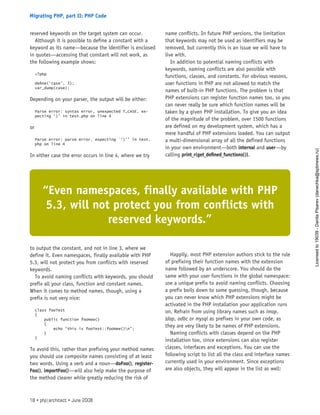
define it. Even namespaces, finally available with PHP
5.3, will not protect you from conflicts with reserved
keywords.
To avoid naming conflicts with keywords, you should
prefix all your class, function and constant names.
When it comes to method names, though, using a
prefix is not very nice:
class fooTest
{
public function fooNew()
{
echo “this is fooTest::fooNew()n”;
}
}
To avoid this, rather than prefixing your method names
you should use composite names consisting of at least
two words. Using a verb and a noun—doFoo(), register-
Foo(), importFoo()—will also help make the purpose of
the method clearer while greatly reducing the risk of
name conflicts. In future PHP versions, the limitation
that keywords may not be used as identifiers may be
removed, but currently this is an issue we will have to
live with.
In addition to potential naming conflicts with
keywords, naming conflicts are also possible with
functions, classes, and constants. For obvious reasons,
user functions in PHP are not allowed to match the
names of built-in PHP functions. The problem is that
PHP extensions can register function names too, so you
can never really be sure which function names will be
taken by a given PHP installation. To give you an idea
of the magnitude of the problem, over 1500 functions
are defined on my development system, which has a
mere handful of PHP extensions loaded. You can output
a multi-dimensional array of all the defined functions
in your own environment—both internal and user—by
calling print_r(get_defined_functions()).
Happily, most PHP extension authors stick to the rule
of prefixing their function names with the extension
name followed by an underscore. You should do the
same with your user functions in the global namespace:
use a unique prefix to avoid naming conflicts. Choosing
a prefix boils down to some guessing, though, because
you can never know which PHP extensions might be
activated in the PHP installation your application runs
on. Refrain from using library names such as imap,
ldap, odbc or mysql as prefixes in your own code, as
they are very likely to be names of PHP extensions.
Naming conflicts with classes depend on the PHP
installation too, since extensions can also register
classes, interfaces and exceptions. You can use the
following script to list all the class and interface names
currently used in your environment. Since exceptions
are also objects, they will appear in the list as well:
“Even namespaces, finally available with PHP
5.3, will not protect you from conflicts with
reserved keywords.”
18 • php|architect • June 2008
Migrating PHP, part II: PHP Code
Licensed
to
19039
-
Danila
Pisarev
(danechka@spbnews.ru)
var_dump(implode(‘, ‘,
array_merge(get_declared_classes(),
get_declared_inter-
faces())));
On my PHP 5.2 installation, calling that line results in
a list of 128 names, some of which have great potential
for naming conflicts: ArrayObject, DateTime, Directory,
DOMElement, Iterator, Serializable, and (under Windows)
com. To avoid naming conflicts, prefix all your class
names. Either that, or become an early adopter of PHP
5.3 and use namespaces.
Fortunately, naming conflicts are usually rather easy
to spot, since they generally result in a fatal error that
names both the duplicator and the duplicated (cannot
redeclare...). There are some cases, though, where class
name conflicts can lead to strange runtime errors. This
happens when two classes/files on your system have
the same name, the wrong file is inadvertently loaded,
and you thus try to call a non-existing class method or
access a non-existing member.
array_merge()
The built-in function array_merge(), as you probably
know, merges one or more arrays. While PHP 4 silently
converts any non-array arguments to arrays, in PHP 5
array_merge() expects all parameters passed to the
function to actually be arrays:
<?php
$a = array(1, 2, 3);
$b = 4;
var_dump(array_merge($a, $b));
Under PHP 4, the output from this code is:
array(4) {
[0]=>
int(1)
[1]=>
int(2)
[2]=>
int(3)
[3]=>
int(4)
}
Under all versions of PHP 5, the code triggers a warning
and the result is empty:
Warning: array_merge(): Argument #2 is not an array
in test.php on line 3
NULL
To avoid problems due to this change, you could write
a wrapper function and replace all occurrences of
array_merge() with a call to this wrapper function.
Since array_merge() can take a variable amount of
parameters, the wrapper function is necessarily a little
complicated, as you can see in Listing 1. The other
alternative of course would be to make certain that
every single argument to array_merge() in your legacy
code is actually an array.
ip2long()
Another built-in PHP function, ip2long(), converts
an IP address given in the common format of four
numbers separated by a dot to a 32-bit number. On PHP
4, the function returns -1 if the string passed in was
not a valid IP address. PHP 5 returns FALSE instead.
To fix your code, you should replace any checks for -1
following a call to ip2long() in your application with a
type-safe comparison with FALSE:
if (false === ip2long(...)) ...
strrpos() and strripos()
Under PHP 4, strrpos() finds the last occurrence
of a given character (needle) in a string (haystack)
and returns the index value of that character. This
1. <?php
2.  
3. function array_merge_compat()
4. {
5.     $num = func_num_args();
6.  
7.     if (0 == $num) {
8.         return NULL;
9.     }
10.  
11.     if (1 == $num) {
12.         return func_get_arg(0);
13.     }
14.  
15.     $result = func_get_arg(0);
16.  
17.     for ($i = 1; $i < $num; $i++) {
18.         $arg = func_get_arg($i);
19.  
20.         if (NULL == $arg) {
21.             continue;
22.         }
23.  
24.         if (is_array($arg)) {
25.             $result = array_merge($result, $arg);
26.         } else {
27.             $result = array_merge($result, array($arg));
28.         }
29.     }
30.  
31.     return $result;
32. }
33.  
34. // and test...
35. $a = array(1, 2, 3);
36. $b = 4;
37. var_dump(array_merge_compat($a, $b));
38.  
39. ?>
40.  
 
LISTING 1
19 • php|architect • June 2008
Migrating PHP, part II: PHP Code
Licensed
to
19039
-
Danila
Pisarev
(danechka@spbnews.ru)
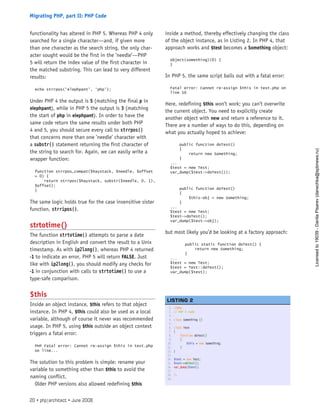
functionality has altered in PHP 5. Whereas PHP 4 only
searched for a single character—and, if given more
than one character as the search string, the only char-
acter sought would be the first in the ’needle’—PHP
5 will return the index value of the first character in
the matched substring. This can lead to very different
results:
echo strrpos(‘elephpant’, ‘php’);
Under PHP 4 the output is 5 (matching the final p in
elephpant), while in PHP 5 the output is 3 (matching
the start of php in elephpant). In order to have the
same code return the same results under both PHP
4 and 5, you should secure every call to strrpos()
that concerns more than one ’needle’ character with
a substr() statement returning the first character of
the string to search for. Again, we can easily write a
wrapper function:
function strrpos_compat($haystack, $needle, $offset
= 0) {
return strrpos($haystack, substr($needle, 0, 1),
$offset);
}
The same logic holds true for the case insensitive sister
function, strripos().
strtotime()
The function strtotime() attempts to parse a date
description in English and convert the result to a Unix
timestamp. As with ip2long(), whereas PHP 4 returned
-1 to indicate an error, PHP 5 will return FALSE. Just
like with ip2long(), you should modify any checks for
-1 in conjunction with calls to strtotime() to use a
type-safe comparison.
$this
Inside an object instance, $this refers to that object
instance. In PHP 4, $this could also be used as a local
variable, although of course it never was recommended
usage. In PHP 5, using $this outside an object context
triggers a fatal error:
PHP Fatal error: Cannot re-assign $this in test.php
on line...
The solution to this problem is simple: rename your
variable to something other than $this to avoid the
naming conflict.
Older PHP versions also allowed redefining $this
inside a method, thereby effectively changing the class
of the object instance, as in Listing 2. In PHP 4, that
approach works and $test becomes a Something object:
object(something)(0) {
}
In PHP 5, the same script bails out with a fatal error:
Fatal error: Cannot re-assign $this in test.php on
line 10
Here, redefining $this won’t work; you can’t overwrite
the current object. You need to explicitly create
another object with new and return a reference to it.
There are a number of ways to do this, depending on
what you actually hoped to achieve:
public function doTest()
{
return new Something;
}
...
$test = new Test;
var_dump($test->doTest());
public function doTest()
{
$this-obj = new Something;
}
...
$test = new Test;
$test->doTest();
var_dump($test->obj);
but most likely you’d be looking at a factory approach:
	 public static function doTest() {
		 return new Something;
	 }
...
$test = new Test;
$test = Test::doTest();
var_dump($test);
1. <?php
2. // PHP 4 code
3.  
4. class Something {}
5.  
6. class Test
7. {
8.     function doTest()
9.     {
10.         $this = new Something;
11.     }
12. }
13.  
14. $test = new Test;
15. $test->doTest();
16. var_dump($test);
17.  
18. ?>
19.  
 
LISTING 2
20 • php|architect • June 2008
Migrating PHP, part II: PHP Code
Licensed
to
19039
-
Danila
Pisarev
(danechka@spbnews.ru)
Comparing Objects
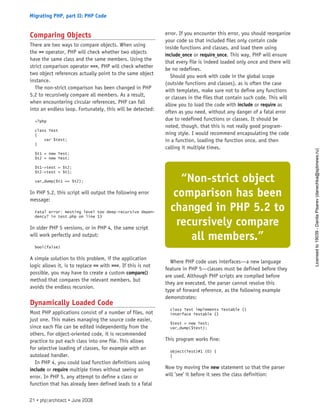
There are two ways to compare objects. When using
the == operator, PHP will check whether two objects
have the same class and the same members. Using the
strict comparison operator ===, PHP will check whether
two object references actually point to the same object
instance.
The non-strict comparison has been changed in PHP
5.2 to recursively compare all members. As a result,
when encountering circular references, PHP can fall
into an endless loop. Fortunately, this will be detected:
<?php
class Test
{
var $test;
}
$t1 = new Test;
$t2 = new Test;
$t1->test = $t2;
$t2->test = $t1;
var_dump($t1 == $t2);
In PHP 5.2, this script will output the following error
message:
Fatal error: Nesting level too deep—recursive depen-
dency? in test.php on line 13
In older PHP 5 versions, or in PHP 4, the same script
will work perfectly and output:
bool(false)
A simple solution to this problem, if the application
logic allows it, is to replace == with ===. If this is not
possible, you may have to create a custom compare()
method that compares the relevant members, but
avoids the endless recursion.
Dynamically Loaded Code
Most PHP applications consist of a number of files, not
just one. This makes managing the source code easier,
since each file can be edited independently from the
others. For object-oriented code, it is recommended
practice to put each class into one file. This allows
for selective loading of classes, for example with an
autoload handler.
In PHP 4, you could load function definitions using
include or require multiple times without seeing an
error. In PHP 5, any attempt to define a class or
function that has already been defined leads to a fatal
error. If you encounter this error, you should reorganize
your code so that included files only contain code
inside functions and classes, and load them using
include_once or require_once. This way, PHP will ensure
that every file is indeed loaded only once and there will
be no redefines.
Should you work with code in the global scope
(outside functions and classes), as is often the case
with templates, make sure not to define any functions
or classes in the files that contain such code. This will
allow you to load the code with include or require as
often as you need, without any danger of a fatal error
due to redefined functions or classes. It should be
noted, though, that this is not really good program-
ming style. I would recommend encapsulating the code
in a function, loading the function once, and then
calling it multiple times.
Where PHP code uses interfaces—a new language
feature in PHP 5—classes must be defined before they
are used. Although PHP scripts are compiled before
they are executed, the parser cannot resolve this
type of forward reference, as the following example
demonstrates:
class Test implements Testable {}
interface Testable {}
$test = new Test;
var_dump($test);
This program works fine:
object(Test)#1 (0) {
}
Now try moving the new statement so that the parser
will ’see’ it before it sees the class definition:
“Non-strict object
comparison has been
changed in PHP 5.2 to
recursively compare
all members.”
21 • php|architect • June 2008
Migrating PHP, part II: PHP Code
Licensed
to
19039
-
Danila
Pisarev
(danechka@spbnews.ru)
$test = new Test;
var_dump($test);
class Test implements Testable {}
interface Testable {}
Now the program fails:
Fatal error: Class ‘Test’ not found in test.php on
line 2
To avoid this error, you must stick to the “define before
use” rule. An easy way to do this is to use autoloading,
and put each class and interface into an individual file.
PHP will then take care of loading all the required code
in the correct order.
unset() and Strings
The function unset() can delete existing variables or
array elements. To delete an array element the key
must be specified, e.g. unset($a[2]). The same syntax
allows read access to specific characters of a string, but
it has never been possible to delete characters from a
string using unset(). Whereas PHP 4 silently ignored the
attempt, PHP 5 bails out with a fatal error:
<?php
$string = ‘hello world’;
unset($string[0]);
var_dump($string);
Under PHP 4, this snippet outputs “hello world”. Under
PHP 5, it fails with a fatal error:
Fatal error: Cannot unset string offsets in test.php
on line 4
To avoid this, just don’t use unset() on a string offset—
it never worked anyway. You could sanely use the
following check to avoid inadvertently doing that:
if (!is_string($var)) unset($var[0]);
Modulo Division
As I expect we all know, a division by zero is
undefined.
The modulo operator (%) calculates the remainder of
a division. When modulo dividing by zero, the remain-
der is undefined as well. Older PHP versions simply
returned FALSE, meaning that hard-to-find follow-up
errors could occur. Newer PHP versions will also return
FALSE, but will issue a warning too:
Warning: Division by zero in test.php on line 3
bool(false)
To ensure that you do not confuse a numeric 0 with
FALSE, you should always use type-safe comparison
(===) for the result.
Type-Converting Integer Values
PHP is a dynamically typed language. That means that,
unlike languages with strong typing, PHP does not
need to know the type of a variable when creating it.
PHP will interpret the variable as a different data type
according to the context.
In some cases, automated conversion is not that
easy. While it is obvious that the string “123” matches
the integer value 123, the question arises whether
“ 123” and “123 ” should also be interpreted as 123.
The various PHP versions are not entirely equal when
it comes to making these decisions. PHP 4 and PHP
5.0.0 both give a wrong response, but no warning
(this assuming the date is evaluated as being within
the UNIX date range). Some versions of the PHP 5.0
series will refuse point blank to convert a string with
leading or trailing whitespace to an integer value.
Current PHP 5 versions are a little more relaxed about
the whitespace, but an E_NOTICE will be triggered,
although the conversion itself is generally successful.
An example is the date() function, which formats a
date given as a Unix timestamp:
var_dump(date(‘d.m.Y’, ‘ 120000000000 ‘));
Since PHP 5.1, this snippet will output:
Notice: A non well formed numeric value encountered
in test.php on line 3
string(10) “16.10.1961”
Should you see notices like this in your applica-
tion, consider using trim() to remove the surplus
“In some cases,
automated
conversion is not
that easy.”
22 • php|architect • June 2008
Migrating PHP, part II: PHP Code
Licensed
to
19039
-
Danila
Pisarev
(danechka@spbnews.ru)
whitespace. Keep it in mind that, up until PHP 5.1, the
returned value would have been wildly inaccurate, and
casting the input string to integer will both silence the
notice and give the same wrong result as in PHP 4.
If PHP completely fails to convert the value to an
integer when passing a string to date(), the following
warning will be issued:
Warning: date() expects parameter 2 to be long,
string given in test.php on line 3
In that case, date()—in line with many other native
PHP functions—will return a boolean FALSE instead of
a string.
Empty Objects
The way PHP treats empty objects has changed between
PHP 4 and PHP 5. Although an object without proper-
ties was considered empty by PHP 4, all versions of PHP
5 will disagree:
class Test {}
$test = new Test;
var_dump(empty($test));
In PHP 4 this outputs TRUE, while in PHP 5 it will
output FALSE. This difference can be explained by the
fact that objects in PHP 4 were basically arrays rather
than true objects.
Should your application happen to rely on the PHP 4
behaviour, you could add an isEmpty() method to the
object that uses the Reflection API to check whether
there are any members:
class Test
{
public function isEmpty()
{
$refl = new ReflectionClass($this);
return sizeof($refl->getProperties()) == 0;
}
}
$test = new Test;
var_dump($test->isEmpty());
This will work under all versions of PHP 5.
__toString()
The magic __toString() method is called to convert an
object to a string. This allows you to print objects
directly using print $object, instead of having to call a
special render() or print() method.
Older PHP 5 versions used to output the object iden-
tifier when implicitly converting an object to a string.
Some applications may rely on this behaviour to write
log files.
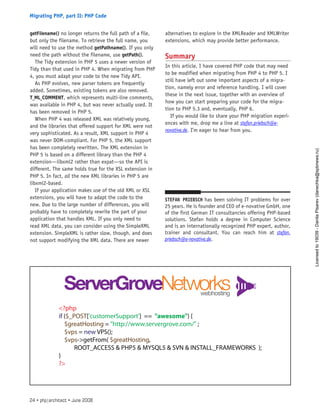
Until PHP 5.2, __toString() was only called when the
object was directly output by print or echo. Since then,
__toString() is called whenever the object is used as a
string. The behaviour is unlikely to change again.
If no __toString() implementation is present in the
object, PHP will not convert the object to a string any
more, but will output a new kind of error: a catch-
able fatal error that can be handled by a custom error
handler. It looks like this:
Catchable fatal error: Object of class Test could
not be converted to string in test.php on line 16
It is forbidden to throw exceptions in a __toString()
method, and trying to do so will result in a fatal error:
Fatal error: Method Test::__toString() must not
throw an exception in test.php on line 18
PHP Extensions
Due to the large number of PHP extensions available, it
would be impossible to provide you with a full overview
of all the changes and potential migration issues. I will
therefore only list a few known issues with commonly
used core extensions.
The new Date extension comes as standard since PHP
5.2.0, providing both an OO API and a much greater
range than UNIX timestamps could offer while also
retaining back compatibility with the old PHP 4 imple-
mentation of date/time support. You shouldn’t see any
changes when using it, but you need to be aware that
you should set an appropriate timezone yourself in your
php.ini:
date.timezone = Europe/London
or in your script:
ini_set(‘date.timezone’, ‘Europe/London’);
or (again in your script):
date_default_timezone_set(‘Europe/London’);
Omitting this step will mean that an E_STRICT (another
new-to-PHP 5 error level) message is thrown every time
you use a date or time related PHP function. If you—or
your operating system—set an invalid timezone, you
will see an E_NOTICE.
Since PHP 5.2.1, the SPLFileObject method
23 • php|architect • June 2008
Migrating PHP, part II: PHP Code
Licensed
to
19039
-
Danila
Pisarev
(danechka@spbnews.ru)
getFilename() no longer returns the full path of a file,
but only the filename. To retrieve the full name, you
will need to use the method getPathname(). If you only
need the path without the filename, use getPath().
The Tidy extension in PHP 5 uses a newer version of
Tidy than that used in PHP 4. When migrating from PHP
4, you must adapt your code to the new Tidy API.
As PHP evolves, new parser tokens are frequently
added. Sometimes, existing tokens are also removed.
T_ML_COMMENT, which represents multi-line comments,
was available in PHP 4, but was never actually used. It
has been removed in PHP 5.
When PHP 4 was released XML was relatively young,
and the libraries that offered support for XML were not
very sophisticated. As a result, XML support in PHP 4
was never DOM-compliant. For PHP 5, the XML support
has been completely rewritten. The XML extension in
PHP 5 is based on a different library than the PHP 4
extension—libxml2 rather than expat—so the API is
different. The same holds true for the XSL extension in
PHP 5. In fact, all the new XML libraries in PHP 5 are
libxml2-based.
If your application makes use of the old XML or XSL
extensions, you will have to adapt the code to the
new. Due to the large number of differences, you will
probably have to completely rewrite the part of your
application that handles XML. If you only need to
read XML data, you can consider using the SimpleXML
extension. SimpleXML is rather slow, though, and does
not support modifying the XML data. There are newer
alternatives to explore in the XMLReader and XMLWriter
extensions, which may provide better performance.
Summary
In this article, I have covered PHP code that may need
to be modified when migrating from PHP 4 to PHP 5. I
still have left out some important aspects of a migra-
tion, namely error and reference handling. I will cover
these in the next issue, together with an overview of
how you can start preparing your code for the migra-
tion to PHP 5.3 and, eventually, PHP 6.
If you would like to share your PHP migration experi-
ences with me, drop me a line at stefan.priebsch@e-
novative.de. I’m eager to hear from you.
Stefan Priebsch has been solving IT problems for over
25 years. He is founder and CEO of e-novative GmbH, one
of the first German IT consultancies offering PHP-based
solutions. Stefan holds a degree in Computer Science
and is an internationally recognized PHP expert, author,
trainer and consultant. You can reach him at stefan.
priebsch@e-novative.de.
24 • php|architect • June 2008
Migrating PHP, part II: PHP Code
Licensed
to
19039
-
Danila
Pisarev
(danechka@spbnews.ru)
FEATURE
Although best known for its use in the medical records industry, the Entity-
Attribute-Value (EAV) model can be a useful technique for designing any
database that needs to store a large and/or frequently-changing set of data
fields.
O
ccasionally a Web application needs to track
entities with a large or variable set of attributes.
Examples might include qualities describing a
person, or details describing an event. A simplistic data
design might be to create a table for the entity, with
one column for every attribute in the set. This is very
effective for an entity with a small and rarely-changing
set of attributes, but it doesn’t scale very well.
A few examples of where this solution is not very
effective would include:
• a very large set of attributes, only some of which
will apply to an individual entity
• a large set of attributes that tends to change
frequently over time
• attributes that can have very long values
PHP: 5.2.1+
Other Software: MySQL 4.1 (could be applied to other RDBMS)
Useful/Related Links:
MySQL Indexes:
•	 http://dev.mysql.com/doc/refman/4.1/
en/indexes.html
MySQL Partitioning:
•	 http://dev.mysql.com/tech-
resources/articles/performance-partitioning.html
CSRF:
•	 http://shiflett.org/articles/cross-site-request-
forgeries
TO DISCUSS THIS ARTICLE VISIT:
http://c7y-bb.phparchitect.com/viewforum.php?f=10
Carl Welch
by
EAVModeling
25 • php|architect • June 2008
Licensed
to
19039
-
Danila
Pisarev
(danechka@spbnews.ru)
The third point became significant to me when I was
working on a project a few years ago. I was maintain-
ing a Web application whose attributes included user
responses to textarea-type questions—in other words,
free text that had to be stored as data. Occasionally
I would end up with database records that taxed the
storage engine’s table width limits, because some of
the site users had written very long responses.
In this article I will introduce the entity-attribute-
value (EAV) data model. It is a much more sophisti-
cated (and complicated) solution than the simplistic
model described above. The EAV model is sometimes
used in the medical records industry, where it fits
perfectly: OBGYN data generally isn’t relevant to male
patients, and the record for a patient who has never
been diagnosed with diabetes won’t have much use for
data regarding insulin prescriptions.
The EAV model can make it much easier to add,
remove and alter a wide range of entity attributes
managed by a Web application. Making this kind of
change can even be as easy as updating the applica-
tion’s configuration metadata. The consequence of the
EAV model is typically a greater number—and greater
complexity—of SQL statements.
I will develop the idea of the EAV model in this
article, using the example of an online scholarship
application system to illustrate. I’ll provide the SQL
statements; I’ll try to keep them reasonably generic,
but since I use MySQL myself they are bound to show a
MySQL bias. This does not, by any means, restrict the
model to MySQL. Similarly, although any code samples
will naturally be written in PHP, the same concepts
could be applied in any programming language. Finally,
given that the number of data abstraction layers avail-
able rivals the number of application frameworks—not
to mention the number of protons in the universe—I’ll
just stick with the standard PHP mysql extension for
code samples. I’ll also briefly discuss data types, colla-
tion issues, and MySQL storage engines.
For the sake of brevity, I will not be checking the
return values of the mysql_*() functions, but obviously
your code should do this. Better yet, you could use
an abstraction layer that throws exceptions. And,
naturally, if your abstraction layer of choice supports
prepared statements, that’s a great way to mitigate the
risk of SQL injection.
EAV Basics
In its simplest incarnation, an EAV model would have
four tables: one each for the entities, attributes and
values of the model’s name, and a linking table to
pull those three together. An example schema appears
in the class diagram in Figure 1, and the associated
SQL statements in Listing 1. Please take note of the
uniqueness constraints in the field_names and field_
values tables. Also, please note that I haven’t specified
storage engine or collation types. I’ll talk about these
later in this article.
So, on with our example scholarship application
system. Let’s start by imagining a page that asks the
user for his or her first name, last name, and a short—
that’s less than 255 bytes—summary of why he or she
should be a scholarship recipient.
When someone decides to apply for a scholarship and
FIGURE 1
1. CREATE TABLE applications (
2.     app_id INT UNSIGNED PRIMARY KEY AUTO_INCREMENT,
3.     epoch DATETIME NOT NULL DEFAULT ‘0000-00-00 00:00:00’
4. );
5.  
6. CREATE TABLE field_names (
7.     fid INT UNSIGNED PRIMARY KEY AUTO_INCREMENT,
8.     field_name VARCHAR(50) NOT NULL DEFAULT ‘’,
9.     UNIQUE KEY (field_name)
10. );
11.  
12. CREATE TABLE field_values (
13.     vid INT UNSIGNED PRIMARY KEY AUTO_INCREMENT,
14.     value VARCHAR(255) NOT NULL DEFAULT ‘’,
15.     UNIQUE KEY (value)
16. );
17.  
18. CREATE TABLE application_data (
19.     app_id INT UNSIGNED NOT NULL DEFAULT 0,
20.     fid INT UNSIGNED NOT NULL DEFAULT 0,
21.     vid INT UNSIGNED NOT NULL DEFAULT 0,
22.     PRIMARY KEY (app_id, fid)
23. );
24.  
25. INSERT INTO field_names VALUES(1, ‘fname’);
26. INSERT INTO field_names VALUES(2, ‘lname’);
27. INSERT INTO field_names VALUES(3, ‘justification’);
28.  
 
LISTING 1
26 • php|architect • June 2008
EAV Modeling
Licensed
to
19039
-
Danila
Pisarev
(danechka@spbnews.ru)
fills out our form, the application will do the following:
• create a new row in the applications table and
store the primary key value of the inserted row in
$app_id
• insert the applicant’s first name into the field_
values table and store the primary key value of
the inserted row in $vid
• record the value of field_names.fid in $fid (’fname’
=> 1, in this case)
• insert a row into the application_data table with
an SQL statement resembling: INSERT INTO appli-
cation_data VALUES(’$app_id’, ’$fid’, ’$vid’)
• repeat the previous three steps for the applicant’s
last name and justification
This implementation is basic, and clearly has scalability
issues. I’ll try to address those as we go along. It may
also appear problematic in another way, at first glance.
For example, what happens when the second person
named Carl applies for a scholarship? A row contain-
ing the value Carl will already exist in the field_values
table...
Well, you could search the field_values table for Carl
and, if it’s already stored there, pick up the field_values.
vid you’ll need later on. If Carl isn’t already listed in
field_values, you’ll need to insert it and then retrieve
the primary key of the inserted row. It’s not a problem
to have two applicants share the same value and
primary key in the values table, any more than it is to
find two people named Carl in real life. The uniqueness
of the entire entry is controlled by the application_data
table.
Since you would generally stand a good chance of
needing to insert the value, and since you would have
to ask the database for the primary key anyway, I prefer
to insert the row and then search for the inserted row,
as you can see in Listing 2.
First we fetch the attribute data from the field_names
table; I’ve assumed here that our HTML form fields,
passed to the script by a POST request, will share the
same names as their equivalents stored in field_names.
Then we create a new entity record by inserting a row
into the applications table that contains the current
timestamp, and store its id in $app_id. Only then
can we start packing the values passed to the script
from our form (that is, the V part of EAV) into the
field_values table.
You may recall that we put a uniqueness constraint
on field_values.value, because we don’t want two rows
in field_values to contain the same value. Thanks to
this constraint, attempting to insert a value that is
already present will cause MySQL to return an error. For
this reason we need to use an INSERT IGNORE... query:
this downgrades the MySQL error on duplication to a
warning, which means that we won’t see any output
regardless of the outcome. The query will, however, still
only insert the value if it’s not already there. Following
that with a SELECT statement will fetch the vid associ-
ated with that specific value, whether the value was
already in the table or not.
Finally, we populate the linking table, applica-
tion_data, with a single record that contains the unique
identifiers for the entity, attribute and value records
we just inserted (or didn’t, as the case may be). As
I mentioned earlier, this effectively ties the entity,
attribute, and value records together with a unique
identifier provided by the applications table.
Let’s assume that our fictional system will also
1. <?php
2.  
3. $fid_ref = array();
4. $vid_ref = array();
5.  
6. $sql = ‘SELECT fid, field_name FROM field_names’;
7. $res = mysql_query($sql);
8.  
9. while ($row = mysql_fetch_row($res)) {
10.     $fid_ref[$row[0]] = $row[1];
11. }
12.  
13. mysql_free_result($res);
14.  
15. $sql = ‘INSERT INTO applications (epoch) VALUES(NOW())’;
16. mysql_query($sql);
17. $app_id = mysql_insert_id();
18.  
19. foreach ($fid_ref as $fid => $field_name) {
20.     $e_val = (!empty($_POST[$field_name]) ? mysql_real_escape_string($_
POST[$field_name]) : ‘’);
21.     $sql = “INSERT IGNORE INTO field_values “ .
22.            “SET value=’$e_val’”;
23.     mysql_query($sql);
24.  
25.     $sql = “SELECT vid FROM field_values “ .
26.            “WHERE value=’$e_val’”;
27.     $res = mysql_query($sql);
28.  
29.     $row = mysql_fetch_row($res);
30.     $vid_ref[$fid] = $row[0];
31.     mysql_free_result($res);
32. }
33.  
34. foreach ($vid_ref as $fid => $vid) {
35.     $sql = “INSERT INTO application_data “ .
36.            “(app_id, fid, vid) “ .
37.            “VALUES(‘$app_id’, ‘$fid’, ‘$vid’)”;
38.     mysql_query($sql);
39. }
40.  
41. ?>
42.  
 
LISTING 2
27 • php|architect • June 2008
EAV Modeling
Licensed
to
19039
-
Danila
Pisarev
(danechka@spbnews.ru)
require an administrative interface that allows the
scholarship office to view reports of the applica-
tions. Imagine a view whereby the scholarship office
worker can see a list of recently submitted application
hyperlinks and, by clicking a link, send a GET request
with the application ID in the query string. Listing 3
illustrates how the administrative interface code would
retrieve and display an application submission.
Data Types
What if the scholarship office wants to collect fields
that don’t really work as VARCHAR types? For example,
they might be interested in the candidate’s grade point
average (a DOUBLE), or the candidate’s date of birth
(a DATE, DATETIME or INTEGER [epoch]), or even the
size of the candidate’s high school graduating class
(an INTEGER). Or what if they want to allow more than
255 bytes for responses to the “justification” question,
or decide they would like to set further essay-style
questions?
Well, you could make field_values.value a TEXT column
and treat every piece of input data as a string. That
might work, but it would also render the column index
just about useless.
A better approach—albeit at the expense of even
trickier SQL statements—would be to add a new
column, field_type, to the field_names table. As the
name implies, this new column would indicate the
data type. There would then need to be a values table
for each data type supported by your application, in
place of the original field_values table. So you might
have tables named varchar_values, integer_values, date_
values, text_values, float_values and so on. The updated
schema for field_names and the *_values tables appears
in Figure 2 and Listing 4.
You may have noticed that I specified an index prefix
length of 100 bytes for the uniqueness constraint in
FIGURE 2
1. <?php
2.  
3. $app_id = (!empty($_GET[‘app_id’]) ? intval($_GET[‘app_id’]) : 0);
4. $sql = “SELECT field_name, value “ .
5.        “FROM application_data JOIN field_names “ .
6.        “ON application_data.fid=field_names.fid “ .
7.        “JOIN field_values “ .
8.        “ON application_data.vid=field_values.vid “ .
9.        “WHERE app_id=’$app_id’ “ .
10.        “ORDER BY application_data.fid”;
11. $res = mysql_query($sql);
12.  
13. while ($row = mysql_fetch_row($res)) {
14.     print ‘<p><strong>’ . htmlentities($row[0]) .
15.           ‘:</strong><br />’ .
16.           nl2br(htmlentities($row[1])) . ‘</p>’;
17. }
18.  
19. mysql_free_result($res);
20.  
21. ?>
22.  
 
LISTING 3
1. CREATE TABLE field_names (
2.     fid INT UNSIGNED PRIMARY KEY AUTO_INCREMENT,
3.     field_name VARCHAR(50) NOT NULL DEFAULT ‘’,
4.     field_type ENUM(‘VARCHAR’, ‘INTEGER’, ‘DOUBLE’,
5.         ‘DATE’, ‘TEXT’) NOT NULL DEFAULT ‘VARCHAR’,
6.     UNIQUE KEY (field_name)
7. );
8. CREATE TABLE varchar_values (
9.     vid INT UNSIGNED PRIMARY KEY AUTO_INCREMENT,
10.     value VARCHAR(255) NOT NULL DEFAULT ‘’,
11.     UNIQUE KEY (value)
12. );
13. CREATE TABLE integer_values (
14.     vid INT UNSIGNED PRIMARY KEY AUTO_INCREMENT,
15.     value INT(11) NOT NULL DEFAULT 0,
16.     UNIQUE KEY (value)
17. );
18. CREATE TABLE double_values (
19.     vid INT UNSIGNED PRIMARY KEY AUTO_INCREMENT,
20.     value DOUBLE NOT NULL DEFAULT 0,
21.     UNIQUE KEY (value)
22. );
23. CREATE TABLE date_values (
24.     vid INT UNSIGNED PRIMARY KEY AUTO_INCREMENT,
25.     value DATE NOT NULL DEFAULT ‘0000-00-00’,
26.     UNIQUE KEY (value)
27. );
28. CREATE TABLE text_values (
29.     vid INT UNSIGNED PRIMARY KEY AUTO_INCREMENT,
30.     value TEXT NOT NULL DEFAULT ‘’,
31.     UNIQUE KEY (value(100))
32. );
 
LISTING 4
28 • php|architect • June 2008
EAV Modeling
Licensed
to
19039
-
Danila
Pisarev
(danechka@spbnews.ru)
the text_values table (TEXT and BLOB column indexes
both require a prefix length). This approach makes the
assumption that no two applicants will type exactly
the same 100 bytes at the beginning of their essay
responses. An alternative would be to omit the unique-
ness constraint in text_values; omitting the constraint
may be better for performance, anyway, according to
the MySQL manual.
The updated PHP code would need to keep track of
each field’s data type so that it can insert the corre-
sponding value into the appropriate value table. As you
can see, I’ve done precisely this in Listing 5.
The code for the administrative interface will likewise
need to be type-aware. When pulling the data fields
for an application, the code will need to pull fields
from each of the value tables. Although it makes for a
long query, a union can work for this, as illustrated in
Listing 6.
Attribute-Related Enhancements
For something like a scholarship application, or
anything that asks a large number of questions, you’ll
probably want to break the form up into several pages.
It has to be better than having a single, monstrously
long form with a scrollbar two pixels tall.
To achieve this, imagine having other attribute-relat-
ed items in your attribute table (here, field_names). For
example, you could have a column named field_names.
page_number, indicating on which page a particular
field should appear. And field_names.display_order
could be used to determine the order in which the
fields should appear on the page, either in the public
interface used by the applicants, or in the administra-
tive interface.
The attribute table could also store input validation
rules. For example, some of the data fields, such as
first and last names, will need to require input, whereas
others, such as gender and ethnicity, may well be
optional. You’ll probably want to impose length limits
on some of the fields—no more than 80 characters for
an email address, for example—and you may want to
enforce regular expression matching for others, such
as /Ad{2}/d{2}/d{4}z/xms for the date of birth.
Items that could be expressed using a drop-down list,
FIGURE 3
1. <?php
2.  
3. $fid_ref = array();
4. $vid_ref = array();
5.  
6. $sql = ‘SELECT fid, field_name, field_type ‘ .
7.        ‘FROM field_names’;
8. $res = mysql_query($sql);
9.  
10. while ($row = mysql_fetch_row($res)) {
11.     $fid_ref[$row[0]] = array(
12.         ‘name’ => $row[1],
13.         ‘type’ => $row[2],
14.     );
15. }
16.  
17. mysql_free_result($res);
18.  
19. $sql = ‘INSERT INTO applications (epoch) VALUES(NOW())’;
20. mysql_query($sql);
21. $app_id = mysql_insert_id();
22.  
23. foreach ($fid_ref as $fid => $field_ref) {
24.     $field_name = $field_ref[‘name’];
25.     $field_type = $field_ref[‘type’];
26.     $e_val = (!empty($_POST[$field_name]) ? mysql_real_escape_string($_
POST[$field_name]) : ‘’);
27.     $table_name = $field_type . ‘_values’;
28.  
29.     $sql = “INSERT IGNORE INTO $table_name “ .
30.            “SET value=’$e_val’”;
31.     mysql_query($sql);
32.  
33.     $sql = “SELECT vid FROM $table_name “ .
34.            “WHERE value=’$e_val’”;
35.     $res = mysql_query($sql);
36.  
37.     $row = mysql_fetch_row($res);
38.     $vid_ref[$fid] = $row[0];
39.     mysql_free_result($res);
40. }
41.  
42. foreach ($vid_ref as $fid => $vid) {
43.     $sql = “INSERT INTO application_data “ .
44.            “(app_id, fid, vid) “ .
45.            “VALUES(‘$app_id’, ‘$fid’, ‘$vid’)”;
46.     mysql_query($sql);
47. }
48.  
49. ?>
 
LISTING 5
1. <?php
2.  
3. $sql = “SELECT field_name, serialized_display_options “ .
4.        “FROM field_names WHERE page_number=1 “ .
5.        “AND active=’yes’ ORDER BY display_order”;
6. $res = mysql_query($sql);
7. $form_HTML = ‘’;
8.  
9. while ($row = mysql_fetch_row($res)) {
10.     $form_HTML .= create_form_field($row[0], $row[1]);
11. }
12.  
13. mysql_free_result($res);
14.  
15. ?>
16.  
 
LISTING 6
29 • php|architect • June 2008
EAV Modeling
Licensed
to
19039
-
Danila
Pisarev
(danechka@spbnews.ru)
like marital status, could even have a list of allowed
responses.
Another useful column might be field_names.default_
value (or maybe field_names.can_be_null), so that your
application will know what to do if a user doesn’t care
to provide a response to an optional question. And
field_names.active could be a Boolean flag that you
clear when the scholarship office tells you that they no
longer want to collect the mother_maiden_name field.
You wouldn’t want to simply delete that row from field_
names, because you probably already have correspond-
ing rows stored in application_data.
In fact, if you set up the attribute table to contain
all the information related to displaying and validating
your form fields, then adding a new field could be as
easy as adding a row to this table. The code for gener-
ating the view is in Listing 7, and the code for process-
ing the POST request on that page is in Listing 8.
The attribute table examples offered in this article
are fairly unsophisticated. But it can be a good place to
store any attribute-related metadata that will be useful
to you at runtime.
Hierarchical Fields
When I was doing this for my work, the “scholarship
office” threw me an interesting curve that had me
stumped for a while. They gave me printouts of how
they wanted their application to look, and one of the
pages had something like Figure 3.
OK, so at first glance this doesn’t look like a big deal.
There should clearly be VARCHAR fields named employ-
ment_job_title, employment_employer, and employment_
hours_per_week, and there should be DATE fields named
employment_from and employment_to.
The problem is that an applicant might provide zero,
one, or more than one employment entries. I’m way too
fastidious (anal? dainty?) to do things like employment_
job_title_1, employment_job_title_2, etc. Besides, what if
I only go to employment_job_title_5, and an applicant
has had (and wants to report) six jobs?
The way I chose to approach this was to put another
column in the linking table capable of grouping
together the five fields for a given employment entry
on a given application (see Listing 9).
The scholarship application has a page with a form
that contains input boxes for the five data fields
(employment_job_title, employment_employer and so
on). When someone submits that form, our scholarship
application inserts the data in the same way as in the
previous sections, but it now also creates an identifier
for this particular employment entry on this particular
scholarship application. This identifier is inserted as
the set_id for those five rows in application_data. The
application then returns the user to the same form, so
that he/she may enter another employment entry at
will.
An easy way of doing this would be to use the epoch
for the set_id, with the assumption that a legitimate
user wouldn’t POST more than one employment record
per second. But this introduces a race condition, so
a better alternative would be to use some randomly-
generated data pushed through a digest function such
as MD5 or SHA1. In fact, if you are using anti-CSRF
1. <?php
2.  
3. $sql = “SELECT field_name, serialized_display_options “ .
4.        “FROM field_names WHERE page_number=1 “ .
5.        “AND active=’yes’ ORDER BY display_order”;
6. $res = mysql_query($sql);
7. $form_HTML = ‘’;
8.  
9. while ($row = mysql_fetch_row($res)) {
10.     $form_HTML .= create_form_field($row[0], $row[1]);
11. }
12.  
13. mysql_free_result($res);
14.  
15. ?>
16.  
 
LISTING 7
1. <?php
2.  
3. $sql = “SELECT field_name, serialized_validation_rules “ .
4.        “FROM field_names WHERE page_number=1 “ .
5.        “AND active=’yes’”;
6. $res = mysql_query($sql);
7. $form_is_valid = 1;
8.  
9. while ($row = mysql_fetch_row($res)) {
10.     $field_name = $row[0];
11.     $field_is_valid = validate_field($_POST[$field_name],
12.                                      unserialize($row[1]));
13.     if (!$field_is_valid) {
14.         $form_is_valid = 0;
15.         break;
16.     }
17. }
18.  
19. mysql_free_result($res);
20.  
21. ?>
22.  
 
LISTING 8
1. CREATE TABLE application_data (
2.     app_id INT UNSIGNED NOT NULL DEFAULT 0,
3.     fid INT UNSIGNED NOT NULL DEFAULT 0,
4.     set_id VARCHAR(40) NOT NULL DEFAULT ‘’,
5.     vid INT UNSIGNED NOT NULL DEFAULT 0,
6.     PRIMARY KEY (app_id, fid, set_id)
7. );
8.  
 
LISTING 9
30 • php|architect • June 2008
EAV Modeling
Licensed
to
19039
-
Danila
Pisarev
(danechka@spbnews.ru)
tokens on your forms (and if you aren’t, you should be),
you could just use that for the set_id.
For fields that aren’t part of a set, such as first_name,
you could simply have an empty string in application_
data.set_id.
Later, when the administrative interface is retrieving
the data for scholarship application #327, in which the
applicant provided two employment entries, it’ll find
ten rows with app_id=327 and the application_data.fid
values corresponding to the employment-related fields.
Five of those rows will share one value of set_id and the
other five will have a different value, thus allowing the
admin interface to group the fields into the distinct
employment entries.
The following sections will describe a few other
issues I have encountered in creating EAV systems.
Linking Table Inserts/Updates
Depending on the nature of your application, your users
may need to update fields for which they have already
provided data. In the case of our scholarship applica-
tion, too, we should allow the applicant to go back
and revise the data he/she has provided on a previous
page. Another common example would involve allowing
your users to update their email address or background
color preference.
If so, you may want to consider using the REPLACE
INTO... syntax for inserting and updating rows in your
linking table (application_data). The advantage of using
REPLACE INTO... is that it works for adding new rows
into the linking table and for updating existing rows,
which also means that the syntax will work if you don’t
know whether you’re inserting or updating.
Imagine that you added cell_phone_number as a data
field two months ago. With REPLACE INTO..., you can
use the same SQL statement for a new user who needs
to insert data for that field, and for a returning user
who wants to update the information he or she entered
some time last year.
Storage Engines
If you recall, I intentionally omitted specifying the
engine type in the CREATE TABLE... statements. Some of
the database interaction lends itself to database trans-
actions, like creating a new application record. This
interaction creates an entry in the entity table, may
add several entries in one or more of the value tables,
and will add many entries to the linking table. If you’re
comfortable using a transaction-enabled storage engine
such as InnoDB, you could wrap this interaction in a
transaction for atomic changes. If you’re interested
in trying this, your schema statements might look
something like those in Listing 10. (Note that I’ve only
shown the varchar_values table there; you’d probably
want to include all the value tables.)
The foreign key constraints in application_data are
such that you’ll be prevented from deleting a row in the
values table if that row references a row in the linking
table. A similar arrangement is in place for the attri-
bute table as well, but I’ve done something a bit differ-
ent for the entity table. With the ON DELETE CASCADE
clause, deleting a row in the entity table (applications)
will automatically delete all the corresponding rows
1. CREATE TABLE applications (
2.     app_id INT UNSIGNED PRIMARY KEY AUTO_INCREMENT,
3.     epoch DATETIME NOT NULL DEFAULT ‘0000-00-00 00:00:00’
4. ) ENGINE=InnoDB;
5.  
6. CREATE TABLE field_names (
7.     fid INT UNSIGNED PRIMARY KEY AUTO_INCREMENT,
8.     field_name VARCHAR(50) NOT NULL DEFAULT ‘’,
9.     field_type ENUM(‘varchar’, ‘integer’, ‘double’, ‘date’, ‘text’)
10.         NOT NULL DEFAULT ‘varchar’,
11.     UNIQUE KEY (field_name)
12. ) ENGINE=InnoDB;
13.  
14. CREATE TABLE varchar_values (
15.     vid INT UNSIGNED PRIMARY KEY AUTO_INCREMENT,
16.     value VARCHAR(255) NOT NULL DEFAULT ‘’,
17.     UNIQUE KEY (value)
18. ) ENGINE=InnoDB;
19.  
20. CREATE TABLE application_data (
21.     app_id INT UNSIGNED NOT NULL DEFAULT 0,
22.     fid INT UNSIGNED NOT NULL DEFAULT 0,
23.     set_id varchar(40) not null default ‘’,
24.     vid INT UNSIGNED NOT NULL DEFAULT 0,
25.     PRIMARY KEY (app_id, fid, set_id),
26.     INDEX app_data_fid_idx (fid),
27.     INDEX app_data_vid_idx (vid),
28.     FOREIGN KEY (app_id) REFERENCES applications (app_id) ON DELETE
CASCADE,
29.     FOREIGN KEY (fid) REFERENCES field_names (fid) ON DELETE RESTRICT,
30.     FOREIGN KEY (vid) REFERENCES varchar_values (vid) ON DELETE RESTRICT
31. ) ENGINE=InnoDB;
32.  
 
LISTING 10
“What if I only go to
employment_job_title_5,
and an applicant wants to
report six jobs?”
31 • php|architect • June 2008
EAV Modeling
Licensed
to
19039
-
Danila
Pisarev
(danechka@spbnews.ru)
in the linking table. In other words, a single DELETE
command will totally eliminate all traces of a scholar-
ship application, which can be a useful (if somewhat
dangerous) short cut.
On the other hand, if the nature of your applica-
tion is such that you need MySQL full-text searches,
you may need to stick with MyISAM—at least for the
varchar_values and/or text_values tables.
Collation
Another important consideration is collation in your
varchar_values table. The default character collation in
MySQL is case insensitive. Imagine two users whose last
names are McMurtry and Mcmurtry (note the difference
in capitalization), and pretend that Alice Mcmurtry
submits before Bob McMurtry does. With the default
collation, Mcmurtry will be in varchar_values after Alice
submits, and Bob’s attempt to insert McMurtry won’t
insert a new row because MySQL will consider Mcmurtry
and McMurtry to be the same string. This may be very
frustrating to Bob, because he’ll see a last name of
Mcmurtry in the dropdown list but won’t be able to
change it to McMurtry.
By setting the collation of the varchar_values.
value column to a case sensitive collation, MySQL will
consider Mcmurtry and McMurtry to be distinct strings:
CREATE TABLE varchar_values (
vid INT UNSIGNED PRIMARY KEY AUTO_INCREMENT,
value VARCHAR(255) CHARACTER SET latin1
COLLATE latin1_general_cs NOT NULL DEFAULT ‘’,
UNIQUE KEY (value)
);
Tracking Value History
Depending on the nature of your application, it may
be helpful to track changes in a value over time. For
example, if your application allows its users to update
their phone numbers or email addresses, it might be
helpful to keep a record of those changes. You can
accomplish this sort of thing by adding a table similar
to that in Listing 11.
The changed_to_id column is a foreign key to vid in
one of the value tables. fid, a foreign key to the at-
tribute table field_names, indicates which value table by
way of field_names.field_type. So whenever a row in the
linking table (application_data) is added or updated, you
can add a row to value_history, and this will create a
record of how those values are changed over time.
Notice that I’m using changed_at to distinguish
between different changes of the same field for a
given entity. You could set that using MySQL’s NOW()
function, or with something like date(’Y-m-d H:i:s’)
in PHP. Again, though, this creates a possible race
condition and may not be appropriate to your particular
circumstances.
Trailing Whitespace
Trailing whitespace is another possible gotcha for
VARCHAR data, something I discovered only very
recently when working on another EAV system. This
other system, which is not a Web application and which
includes the history tracking described above, imports
data from a set of text files into a MySQL database with
an EAV architecture. These text files are periodically
updated by an external process. As the values change,
the importer needs to update the data—and create
history records.
The interesting thing here is that when you try
inserting data into a VARCHAR column, MySQL removes
any trailing whitespace before inserting it. So if one
of the data items to be imported is a character string
such as ’hello ’ (with trailing whitespace), MySQL will
blithely insert hello into the table. At the next import
runtime, the importer will compare the data in the
current input text file with the persistent data stored
in the database. Although the data in the text file is
1. CREATE TABLE value_history (
2.     app_id INTEGER NOT NULL DEFAULT 0,
3.     fid INTEGER NOT NULL DEFAULT 0,
4.     changed_to_id INTEGER NOT NULL DEFAULT 0,
5.     changed_at DATETIME NOT NULL
6.                         DEFAULT ‘0000-00-00 00:00:00’,
7.     PRIMARY KEY (app_id, fid, changed_at)
8. );
9.  
 
LISTING 11
“Depending on
the nature of your
application, it may be
helpful to track changes
in a value.”
32 • php|architect • June 2008
EAV Modeling
Licensed
to
19039
-
Danila
Pisarev
(danechka@spbnews.ru)
’hello ’ on both occasions, the importer will detect a
difference because there is trailing whitespace in the
current value and none in the value pulled from the
database. Fields will therefore be updated unnecessar-
ily, and you end up with a bunch of erroneous histori-
cal data. In fact, it will appear that that particular
value was changed from hello to hello at every import
runtime.
In such cases, it becomes important that the
importer strips the trailing whitespace before compar-
ing it with the persistent data.
Xtreme EAV
Here are a couple of fun ideas for the more ambitious
among you.
If you end up running several Web applications with
EAV databases, you could try sharing the value tables.
The idea would be to have a single database containing
the *_values tables. Your EAV Web application databases
would have their own attribute, entity and linking
tables, but no value tables of their own.
For those of you who found that idea entirely too
practical, maybe this will appeal to you more...
Some search engines have the useful—or irritat-
ing, depending on your point of view—feature of
suggesting search items as you type into the search
engine input field. If you’re into AJAX and want to do
something like this, here’s a fabulous way to waste lots
of bandwidth and CPU cycles. Let’s say that you wanted
the user to see suggestions as she or he is typing in
the first name field (you know, just in case he or she is
having trouble remembering how to spell it), and you
wanted the suggestions to be drawn from the pool of
values that other users have entered in the first name
field.
We’ll pretend that you want to suggest values that
match the first three characters the user types into the
input field, and that you want to display the 10 most
popular matching values. If the field_names.fid value
for first name is 1, and the first three letters typed are
car, then the SQL statement triggered by the AJAX call
might be something like this:
SELECT COUNT(*) c, value COLLATE latin1_general_ci v
FROM application_data t1 JOIN varchar_values t2
ON t1.vid=t2.vid WHERE fid=1
GROUP BY t1.vid HAVING v LIKE ‘car%’
ORDER BY c desc LIMIT 10;
Recall that we stipulated case sensitive collation on
varchar_values.value, so this query must explicitly
tell the engine to use a case insensitive collation.
Otherwise, car would match carlotta but not Carl.
Again, this kind of thing is a great way to turn your
database server into an abacus.
Horizontal Partitioning
One final point I’d like to cover concerns something I
haven’t actually tried yet myself. If your application is
wildly popular, some of your tables—particularly the
value and linking tables—may attain alarmingly large
row counts. If so, you may wish to explore the hori-
zontal partitioning feature in MySQL. There’s a useful
article about partitioning on the MySQL developer
resource pages (see the links box at the head of this
article).
Horizontal partitioning, in theory at least, would
for example allow you to split up your varchar_values
table into two tables: one containing values that begin
with lower-case letters, and one containing capitalized
values. This particular example would use the RANGE
partitioning mode, but there are several other modes
(and methods) available.
Conclusion
In this article we’ve looked at the entity-attribute-value
(EAV) model of database design. I wrapped the discus-
sion in an example of an online scholarship application
Web application, but I hope I’ve convinced you that
this technique is potentially useful in a broad variety
of projects. At the expense of some substantially more
complicated SQL statements, EAV architecture can offer
a system with greater scalability and normalization.
Carl Welch is a Web developer and Linux system adminis-
trator. He bears unhealthy addictions to science fiction,
RSS feeds, version control and other silliness—evidence
of which is documented at http://mbrisby.blogspot.com.
33 • php|architect • June 2008
EAV Modeling
Licensed
to
19039
-
Danila
Pisarev
(danechka@spbnews.ru)
FEATURE
PHP: 5.2.5
O/S: Any supported by PHP and MySQL
Other Software: HTTP server, e.g. IIS or Apache
Useful/Related Links:
http://framework.zend.co
•	 m
TO DISCUSS THIS ARTICLE VISIT:
http://c7y-bb.phparchitect.com/viewforum.php?f=10
Bart McLeod
by
This is the final part of my diary recording the attempt to refactor my old legacy
CMS, which I would like to replace with a rock solid, framework-based Internet
application. I started adapting my CMS to use the Zend Framework last month,
and will now conclude the journal. Enjoy!
A Refactoring Diary:
The Story Continues
I
f you missed last month’s php|architect, you should
know that I changed my approach quite radically
when I started to work with the Zend Framework.
One thing I learned from the previous two refactoring
projects was that reading about the framework before
you start work is invaluable in terms of time saved.
Another was that it’s a good idea to get each small part
working properly before taking the next step.
I struggled a little with the Zend autoloader, until
I had the idea to add __autoload() to my bootstrap
file and call Zend_Loader::loadClass() from inside the
function. I also had some problems with mod_rewrite
(again). But the part I’m still working on, 16 ’days’
into the project, is adapting my legacy CMS to the MVC
model.
As before, this is purely a spare-time project. Each
’day’ in my diary therefore represents at most a few
hours, and sometimes much less.
34 • php|architect • June 2008
Licensed
to
19039
-
Danila
Pisarev
(danechka@spbnews.ru)
Day 17: The Model
I consulted Cal Evans’ ZF book about the Model part
of the MVC implementation. It comes down to this:
complete freedom. None, Light or Heavy Model. Cal
prefers a heavy model, which not only creates, updates
and deletes data but also has some knowledge of how
to behave. It will for example have ideas about what
valid data is. In my case, the heavy model would know
that if a given subject already exists, it may not be
created again. Instead of letting the error occur and
confronting the user with it, my new CMS should use
AJAX or a simple JsHttpRequest to ask the model some-
thing like subjectExists($myNewSubject). This would be
part of the clientside validation process, so no invalid
form submission would take place to frustrate the user.
I am faced with a few choices now. I could:
• Re-use my auto-query functionality and pass the
queries to Zend_Db
• Build a heavy model for every table
• Generate a light model for every table and add
heavy stuff only where necessary
Option 1 does not allow the intelligent options that I
would like to use. Option 2 is going to mean a lot of
work, which is not why I chose to adopt a framework.
That leaves me with Option 3, which still means
some work because it involves the writing of a code
generator.
And then, where should I place the model, and how
should I talk to it inside the controller?
The classes that belong to the model go into the
models directory, so I create a sub-directory cms. The
model for the subject table goes in application/default/
models/cms/CmsSubject.php. (I’ll simplify this with a
constant, MODELS_BASE, to represent the full physical
path.) The controller will then include the model:
require_once MODELS_BASE . ‘cms/CmsSubject.php’;
Reading Cal’s book, I found I’d been working too hard
for database insertion. I was building a traditional
query and calling $db->query($query). It worked fine,
but ZF is simpler than that. You can build an associa-
tive array, say $data, with the column names as keys,
and do:
$affected_rows = $db->insert($tablename, $data);
Notice that $data shares many key-value pairs with the
array returned by $this->getRequest()->getParams() in
my controller, after posting my form. This similarity
gave me the extraordinary idea of populating the model
class almost automatically. The only difference is that
the array provided by the request object contains a few
extra key-value pairs. These must be filtered out of the
array before it is used in the call to the database.
Filtering is achieved using a whitelist approach. The
model has to know which fields are in the table, so it
will extract those fields from the request parameters.
Should I add the array of valid fields or columns
manually, or add it automatically by querying the
database for it? I choose ’automatically’, because I’m
creating a lot of models. If you only have a few models,
or if performance is a big issue, you should type the
column list yourself.
Having come this far, it is a logical step to have a
Base class for the models. In their most primitive form,
subclasses will have to override only one property
of their parent: the table name. See Listing 1 for an
implementation of the CmsDataObject base class. Note
how extremely simple the code has become using this
approach. (Of course, you must realize that this type of
model does not offer any security at all.)
The form validation itself is now responsible for
offering valid data to the model. It is alright to do this,
as long as you guard the server-side form validation
process. The read() and delete() methods are slightly
less straightforward then the others, and were not
implemented yet. For these two, the model needs to
know, or to be told, what the primary keys are.
One way to achieve this would be to pass the primary
keys in. Another way would be to determine them in
the constructor, while reading all the fields. For read
operations, it is clearly easier to just pass them in,
since you will need to provide the values anyway. For
deletion, this should not be necessary. Deleting a
data objects’ record is typically an ambiguous opera-
tion: what are you going to do with the data object
afterwards? It will still exist, but it will also be invalid,
since its counterpart in the database is deleted.
Perhaps you could ask some kind of cleaning service to
garbage collect it. Or does unset($this) work inside a
class? Maybe deletion should not be made part of the
data object itself. You could use a TableManager class
instead. A TableManager could also be made responsible
for answering questions like subjectExists()... fine. My
read() method is now implemented, see Listing 2.
If you want validation inside your model, it can
35 • php|architect • June 2008
A Refactoring Diary: The Story Continues
Licensed
to
19039
-
Danila
Pisarev
(danechka@spbnews.ru)
1. <?php
2.  
3.     class InvalidDataException extends Exception {}
4.  
5.     class CmsDataObject {
6.         protected $columns = array();
7.         protected $data = array();
8.         protected $db;
9.         protected $tablename = ‘subject’;
10.         protected $primaryKeys = array();
11.         protected $primaryKeyValues = array();
12.  
13.         function __construct($code = null) {
14.  
15.             if (!is_null($code)) {
16.                 $this->read($code);
17.             }
18.  
19.             $this->db =  Globals::getDb(‘mrvane’);
20.             $query = “SHOW columns FROM $this->tablename”;
21.             $columns = $this->db->fetchAll($query);
22.  
23.             foreach ($columns as $row) {
24.                 $this->columns[] = $row[‘Field’];
25.                 if ($row[‘Key’] == ‘PRI’) {
26.                     //add to primary keys
27.                     $this->primaryKeys[] = $row[‘Field’];
28.                 }
29.             }
30.  
31.             $this->initializeDefaults();
32.         }
33.  
34.         protected function initializeDefaults() {
35.             //no implementation in the base class
36.         }
37.  
38.         protected function hasValidData() {
39.             return true;
40.         }
41.  
42.         public function populate($array) {
43.  
44.             foreach ($array as $k => $v) {
45.  
46.                 if (in_array($k, $this->columns)) {
47.                           $this->data[$k] = $v;
48.                 }
49.  
50.                 if (in_array($k, $this->primaryKeys)) {
51.                        $this->primaryKeyValues[$k] = $v;
52.                 }
53.             }
54.         }
55.  
56.         public function __get($name) {
57.  
58.             if (in_array($name, $this->columns)) {
59.                 return $this->data[$name];
60.             }
61.  
62.             return null;
63.         }
64.  
65.         public function update() {
66.  
67.             if (!$this->hasValidData()) {
68.                 throw new InvalidDataException(“Invalid data in “ .
__CLASS__ . “::” . __FUNCTION__ . “()”);
69.             }
70.  
71.             $keys = array();
72.  
73.             foreach ($this->primaryKeys as $key) {
74.                        $keys[$key] = $this->data[$key];
75.             }
76.  
77.             return $this->db->update($this->tablename,
78.                                      $this->data,
79.                                      $this->buildCriteria($keys));
80.         }
81.  
82.         public function delete() {
83.             return false;
84.         }
85.  
86.         public function create() {
LISTING 1
87.  
88.             if (!$this->hasValidData()) {
89.                 throw new InvalidDataException(“Invalid data in “ .
__CLASS__ . “::” . __FUNCTION__ . “()”);
90.             }
91.  
92.             return $this->db->insert($this->tablename,
93.                                      $this->data);
94.         }
95.  
96.         public function read($keys = null) {
97.             return false;
98.         }
99.  
100.         protected function buildCriteria($keys) {
101.             $criteria = ‘’;
102.             $delimiter = ‘’;
103.  
104.             foreach ($keys as $k => $v) {
105.                 $criteria .= $delimiter;
106.                 $criteria .= “ $k = ‘$v’ “;
107.                 $delimiter = “ AND “;
108.             }
109.  
110.             return $criteria;
111.         }
112.  
113.         public static function dateToMySql($dateString) {
114.             $date = new Zend_Date(date_parse($dateString));
115.             return $date->get(‘YYYY-MM-dd’);
116.         }
117.  
118.         public static function dateFromMySql($dateString) {
119.             $date = new Zend_Date(date_parse($dateString));
120.             return $date->get(‘dd-MM-YYYY’);
121.         }
122.  
123.         public function getCount($criteria = “”) {
124.             $query = “SELECT count(*) FROM $this->tablename $criteria”;
125.             return $this->db->fetchOne($query);
126.         }
127.  
128.         public function getData() {
129.             $public_data = array();
130.  
131.             foreach ($this->data as $k => $v) {
132.                 $public_data[$k] = $this->__get($k);
133.             }
134.  
135.             return $public_data;
136.         }
137.  
138.         public function listRecords($offset = 0, $number = 10, $where) {
139.            $safe_offset = (int) $offset;
140.            $safe_number = (int) $number;
141.  
142.            if ($safe_number === 0) {
143.                $safe_number = 10;
144.            }
145.  
146.            $query = “SELECT * FROM $this->tablename $where LIMIT $safe_
offset, $safe_number”;
147.            $results = $this->db->fetchAll($query);
148.            return $results;
149.         }
150.  
151.         public function exists() {
152.  
153.             if ($this->read($this->primaryKeyValues)) {
154.                 return true;
155.             }
156.  
157.             return false;
158.         }
159.     }
160.  
 
LISTING 1: Continued...
36 • php|architect • June 2008
A Refactoring Diary: The Story Continues
Licensed
to
19039
-
Danila
Pisarev
(danechka@spbnews.ru)
easily be accomplished by introducing a hasValidData()
function. This will be checked before an INSERT or
UPDATE operation, and an InvalidDataException can be
thrown on failure. Of course, for every subclass of the
base data object, you will then have to override has-
ValidData() since it is specific to each table. In the base
class, hasValidData() will return TRUE. Apart from that,
it has no implementation.
I now have a basic model in place. Creating this
model was easy, straightforward and fast, thanks to the
simplicity of ZF. The next step is to make the form act
as a database administration page capable of listing
the existing subjects and paging them.
First, I need to refactor the controller so that the
building of the form is in a separate function. This is
going be the private function buildForm($data = null).
If $data is an associative array, the values will be dis-
played in the form fields that correspond to the keys.
This way, I will be able to reuse the form for display
across different actions.
So far, saving a record created a new one. How about
updating? The model will need to know if it already
has a counterpart in the database or not. This can be
accomplished by setting a flag when reading it from
the database. I try using the base data object property
in_db for this, and the new createOrUpdate() method to
take care of the decision.
Unfortunately this idea does not work, due to the
stateless nature of HTTP. The flag will be gone upon
re-posting the form. So, perhaps the form itself should
store the flag. This can be done by evaluating the
$data object passed into the formBuilder() function.
If it is NULL, no flag needs to be placed. I will
check for the flag, exists, in the save() action of the
subjectsController.
I found a ZF bug! The update() method is now called,
but complains about a duplicate primary key... which of
course makes no sense. Does it try to set the primary
key? Am I using the function the wrong way? Yes, I
am. I need to specify a third argument when calling
Zend_Db’s update() method—the WHERE clause. Again,
it would be nice if the data object had knowledge of
its primary keys. I will pass them in once more, and
encapsulate the building of the WHERE clause inside a
function. This works—no bug for ZF after all! I’m not
sure if my WHERE clause builder is right for multiple
keys, but I’ll see trouble with the translations table
later if it isn’t.
After this exciting adventure, it’s time for more fun. I
add a button that brings up a new empty form and add
default values for the dates, because I’m tired of typing
valid date values during testing. Bringing up a new
empty form can be done by changing the action, but
also simply by using a regular button that changes the
document.location. This is done in three minutes. Now
for the default date values. ZF comes with classes for
dates, so I’ll look at those first.
Day 18: Dates
Once the default time zone is set in php.ini, it’s safe
to use Zend_Date. The default dates are created in my
controller, but it’s also possible to create a custom
class for date elements:
$date = new Zend_Date;
$begin = $data->begin ? $data->begin : $date-
>get(‘dd-MM-YYYY’); //ISO format
$end = $data->end ? $data->end : ‘31-12-9999’;
$begin and $end are passed into their respective form
elements as the values. The form is now fully func-
tional, except there is no way to delete a subject yet.
One of the things I hoped to gain from moving to
a framework was nice date selectors, but Zend_Form
doesn’t provide them. Even if it did, I need them to
“The good news is that Zend_Date can handle many
date formats and convert them to timestamps
internally.”
37 • php|architect • June 2008
A Refactoring Diary: The Story Continues
Licensed
to
19039
-
Danila
Pisarev
(danechka@spbnews.ru)
handle Dutch date formatting.
The good news is that Zend_Date can handle many
date formats and convert them to timestamps inter-
nally. So I should be able to use one field and a date
selector, display the Dutch date format (or any other)
and convert it to MySQL date format on save, or back
on retrieval.
The next question is where to put the functionality
to convert the dates? Should I create a convertDate()
method in the base data object, so that it can be used
anywhere? Or use a utility class and call it whenever
needed? Or does Zend_Date itself offer such a utility?
Let me check that first:
$date = new Zend_Date(‘10.03.2007 00:00:00’, Zend_
Date::ISO_8601, ‘nl’);
Feed it the date and specify the locale, and Zend_Date
will parse the date string correctly. You then extract
the date using format specifiers before offering it to
MySQL. It’s also possible to pass the constructor a
date array as the first argument. This can be obtained
by calling a built-in PHP function, date_parse(), on an
arbitrary date string. So I end up with two methods:
public static function dateToMySql($dateString) {
$date = new Zend_Date(date_parse($dateString));
return $date->get(‘YYYY-MM-dd’);
}
public static function dateFromMySql($dateString) {
$date = new Zend_Date(date_parse($dateString));
return $date->get(‘dd-MM-YYYY’);
}
And they do their job! As a side effect, though, my
default date values no longer work, and I get the most
curious dates from my custom getter when the data
object is empty. This is overcome by adding the condi-
tion if (isset($this->data[’name’])) to the getter.
Now that the date magic works nicely, it’s time to
find a selector. I could just steal the date selector from
symfony. Except that, on my new laptop, I no longer
have symfony installed...
Putting it to work will have to wait till next time.
Day 19: The Date Picker, And More
I started the day by moving the setting of default
values from the buildForm() method in the controller to
the CmsSubject class in the model. This not only allows
cleaner code in buildForm(), but also offers a cleaner
separation between model and controller.
Setting up the date picker from symfony was a cinch.
The only bottleneck was the paths to the script and
stylesheets (paths, again!). Relative paths no longer
seem to work, so I had to prefix each path with a
slash. The fun part, though, is that you can set the
date picker in the template. There’s no need to create
a specific date input class, it’s so easy to set up. There
are even localized versions available for download, so I
now have a Dutch date picker!
It now becomes apparent that I need to re-use
common parts of the templates, since it makes no
sense to include the date picker scripts and styles every
time. They should be in a common header, and the
registration of the begin and end fields should be in a
common footer or a decorator for the form. A simple
include would do, but what does the manual have to
say about it?
$this->headScript()->appendFile(“/scripts/jquery.
js”);
$this->headScript()->appendFile(“/scripts/
ui.datepicker.js”);
$this->headScript()->appendFile(“/scripts/
ui.datepicker-nl.js”);
echo $this->headScript();
Although this outputs the desired script tags in my
html head, it does not solve the include problem. I’ll
just use a regular include for the head. Or maybe I can
make a different action use the same template? They
do not really differ much anyway! I managed to render
the index.phtml view script for the save() action. But I
had to get rather rough with it to accomplish this:
echo $this->view->render(‘subjects/index.phtml’);
die();//rude, I think
There should be a more graceful way... If I leave out
the die(), two view scripts are rendered: the one with
the name of the action AND index.phtml, in that order.
So there is a stack of view scripts, but how can I influ-
ence the order in which they are rendered? If I can
determine the order, it means a solution to my include
problem. I can make a header.php script and call:
echo $this->view->render(‘header.php’);
in every action that needs it. But I’ll give up on this for
now, and use regular include_once statements to include
header.php and datescript.php. I had to configure the
path to the views directory in order to easily include my
files in two views. It still doesn’t feel really good this
way, but it works. Next time I will try form validation,
but I still would like to reduce the number of views.
Retrospective comment: I stand corrected here.
Instead of having $this->view->render() in the
38 • php|architect • June 2008
A Refactoring Diary: The Story Continues
Licensed
to
19039
-
Danila
Pisarev
(danechka@spbnews.ru)
controller, I should have written $this->render(’form’)
in order to render form.phtml for all actions that use
the form. Section 7.7 of the programmers reference
guide documents this. The point is you should not
call render() on the controller’s view object, but on
the controller itself. Doing this means you no longer
need a fully qualified path to your view script. Calling
$this->render(’form’) inside your controller action will
override the default view to render, so you can simply
re-use subjects/form.phtml for your new, save, edit and
delete actions.
Day 20: Form Validation
Form validation is relatively simple. If you build your
form elements like I did, you have no doubt passed in
an options array on creation of the form elements. This
array is the place to put your validators:
‘validators’ => array(‘alpha’,’myvalidator’);
so that you may add as many validators as you like for
each element. If you create elements explicitly with the
new keyword, thus yielding a new element instance,
you will probably have an addValidator() method at your
disposal.
To know if your form is valid, you will need to rebuild
it after submission. That smells like .NET. On your
rebuilt form (which does NOT need to be filled with the
submitted values) you should call isValid($data_array) to
know whether the data is valid. If you use the default
decorators you will also see messages around any form
elements that have errors, but in my case, I do not see
these. My form validates as expected and even gives me
nice—albeit English—error messages when I call $form-
>getMessages().
I also found that, once the form is validated you can
use $form->getValues(), so there’s no need to call upon
the request object to get the values. This call will also
guarantee filtered values, which is good if you want to
hand them over to your model. However, none of this
works until you actually have called isValid() on the
form!
Although it’s not overly important, this means I will
have to find a way to first build the form and then
populate it with the values of the model or the request
after validating it. This is just to show the user the
actual input values following an attempt to save a
record with the form. Or would the population of the
form elements be done automagically, after calling
isValid()? That would be really nice. No, unfortunately,
this kind of magic goes beyond ZF.
This simply means that what I do at present is not
correct. First, I populate the form with values taken
directly from the request. These can break the form if
the values contain HTML tags, so I should at least call
the escape() function on them I guess. Second, after
I validate the form, I repopulate the model with the
filtered values from the form. Could this be the cause of
the decorators not working? After validation, I set the
form property of the view again from scratch, without
a subsequent call to isValid(). It’s hardly likely that
the decorators with errors would show up then, is it?
Bingo—I removed the second call to buildForm() now,
assigned the already-built form to the form property of
the underlying view, and the error message shows up!
The next issue is that I want to populate the form,
not only with the values from the request, but also
with filtered values. This means I will have to populate
the form with the model after validating the form,
so I might need a different mechanism if the form is
invalid... I understand if you can’t follow me here.
Experiment with it yourself, and you’ll get the picture.
Now I found a problem with validators. If I try to use
a regex validator I get an error, even though I followed
the instructions in the manual. Perhaps I mis-typed
something? Ah, I found it: the regex itself should be in
an array. Setting up a complex element is better done
the object oriented way. At least in my opinion:
$s = new Zend_Form_Element_Text(‘sequence_number’);
$s->setLabel(‘volgorde’);
$s->setRequired(true);
$s->setValue($data->sequence_number);
$s->addValidator(‘regex’,false,array(‘/^d{1,5}$/’));
$form->addElement($s);
All the regex validator checks is that $s consists of 1
to 5 digits. Unfortunately, the message my users will
see when their input does not meet this requirement is
hardly human readable: ’111111’ does not match against
pattern ’/^d{1,5}$/’. It will be clear to the user that
what she typed did not live up to my expectations,
but what is she expected to make of the message? I’d
better write my own validators for fields like these,
which will allow me to provide my own error messages.
On my way there, I found this interesting function
: Zend_Form::persistData(). This might be a solution to
my earlier problems with persisting data on the form.
And it works! There is no need to use POST or other
request data ’manually’ before validation—all you have
to do is call persistData() on the form!
Zend_Form also has a populate() method that will
39 • php|architect • June 2008
A Refactoring Diary: The Story Continues
Licensed
to
19039
-
Danila
Pisarev
(danechka@spbnews.ru)
probably do the opposite: populate the form with
values retrieved from the database, perhaps after a save
action, to reflect the data that actually made it into
the database. I imagine that populate() should take
an associative array of key-value pairs where the keys
match the form element names. The data property of
the data object class would be the perfect candidate
for form population; I’ll just need to add a getData()
method to the base data object. Yahoo! This works,
first time right.
There is a subtle difference now in the way I deter-
mine if a form contains data from an existing record. I
now add the hidden exists element after populating the
form following an update or creation of a new record.
The more I get to know ZF, the simpler the code
becomes.
The only drawback of populating the form using
the $data array is that my nice Dutch dates (from my
custom getters) have turned back into English dates,
since they were stored in the English format internally.
Let me see if I can change the internal storage, or just
modify the values when handing out the data property.
This seems to work, but I don’t trust it; the dots in the
date are not replaced with MySQL dashes... Ah, there
was an error in my getData() method! Here is the cor-
rected version:
public function getData(){
$public_data = array();
foreach ($this->data as $k=>$v) {
$public_data[$k] = $this->__get($k);
}
return $public_data;
}
Note that since the magic getter does not work inter-
nally, as in $this->property, I have to call it explicitly
as $this->__get(’property’).
Another thing that calls for adjustment is the default
values on the dates, which were also provided by
the data object. I can set them, using a dummy data
object. Defaults are defaults anyway.
On to the custom validators. A quick inspection of
the ZF code tells me that most or all validators extend
Zend_Validate_Abstract. I also found I can use simpler
validators for the sequence number. Instead of using
a regex to limit the input to 5 digits, I can add two
validators: one to check that the input is all digits
(the ’digits’ validator) and one to checks that the input
value is less than 100000 (the ’lessThan’ validator). As
a bonus, this also gives me error messages that non
geeks can understand. However, I wonder that the
framework contributors didn’t think about translating
these simple error messages. Why would they have
omitted such an important step? Perhaps there is some
kind of entry point where I can translate them; perhaps
this was considered preferable to subclassing validators
with the single purpose of translating the messages.
The simplest approach would of course be to instanti-
ate a validator explicitly and set a custom (translated)
message. This works! Simplicity wins again. All I need
to do now is set up labeling and the means of translat-
ing the labels. Does ZF provide some kind of labeling
toolset? Not that I don’t have one, but while I’m at it,
I might as well ask ZF first (I can feel this is going to
become a habit, asking ZF first).
Zend_Label does not exist, but Zend_Translate does. I
will not go into it very deeply here, but I will tell you
which solution I chose and why.
I chose to use *.csv files for translations, because
they are fast and easy to edit—even by my customers.
It’s also very easy to convert my existing translation
files to the CSV format. The code, then, looks like this:
$translate = new Zend_Translate(‘csv’, ‘path/to/
mytranslation.csv’, ‘de’);
$translate->addTranslation(‘path/to/other.csv’,
‘fr’);
1. <?php
2.  
3. class CmsDataObject {
4.  
5.     // ...
6.  
7.     public function read($keys = null) {
8.  
9.         if (is_null($keys)) {
10.             /* Populate the data object before calling
11.                this!There is no need to provide the keys
12.                or even to know which fields they are. */
13.             $keys = $this->primaryKeyValues;
14.         }
15.  
16.         if (is_array($keys)) {
17.             $criteria = ‘ WHERE ‘;
18.             $criteria .= $this->buildCriteria($keys);
19.         } else {
20.             throw new Exception(“Invalid keys in “ . __CLASS__ . “::” .
__FUNCTION__ . “()”);
21.         }
22.  
23.         $query = “SELECT * FROM $this->tablename $criteria LIMIT 1”;
24.         $result = $this->db->fetchRow($query);
25.  
26.         if (is_array($result)) {
27.             $this->data = $result;
28.             return true;
29.         }
30.  
31.         return false;
32.     }
33.  
34. } // class CmsDataObject
35.  
36. ?>
37.  
 
LISTING 2
40 • php|architect • June 2008
A Refactoring Diary: The Story Continues
Licensed
to
19039
-
Danila
Pisarev
(danechka@spbnews.ru)
echo $translate->_(‘hello’);
/* Zend_Translate will automatically detect and use
the users language */
The .csv file will contain something like hello;bonjour—
and that’s really all there is to it! Zend_Form also has
a setTranslator() method. If it’s my lucky day, this
means it will translate all labels and possibly all error
messages automatically, if translations are present.
Although not the most inspiring of tasks, I have to
add translations now or risk this becoming a burden
later. I will build only a Dutch language file; the
English labels will be in the code itself. I tried to set a
translator on the form, but it wants a Zend_Translate_
Adapter, and I don’t know what that does or how to get
one that works. Would the book help me here? No, it
doesn’t. Back to the manual then.
Strangely enough, setting the translation adapter on
the form is different from adding a translation file as a
Zend_Translate instance to the global scope:
$form->setTranslator(new Zend_Translate_Adapter_Csv(
ROOT.’/languages/nl/cms.
csv’,’nl’));
Now let me put some translations into the file and
some English labels into the form. This works instantly.
The only word that does not translate is the value
on the submit button, which is now save (the Dutch
version would be opslaan). So the form translator only
translates labels; the submit button must be translated
manually. I wonder if error messages will be trans-
lated... yes they are! To find the messages you’ll need
to translate, just trigger all the errors you can think of
and put them into your translation files. You’ll probably
want messages in the default language to be translated
too, because this gives you a clean way to customize
them without setting them explicitly on the validator
objects. It might be nice to use a factory to hand out
translators for the form, allowing the ability to switch
between languages. The configured or detected locale
could then be used automatically by the factory to
determine which translation to hand out.
Unfortunately, while testing my error messages I find
that my alphabetic validator doesn’t do as I intended.
It allows characters like ê, while my intention was to
allow only [a-z]. I will need a regex validator here so
that I can use URLs without having to worry about
encoding. This also means I will have to set a custom
error message, because the key regexNotMatch will
apply to several other validators and so can’t be used
for a specific translation. What I find absolutely
stunning is that, since using a translator on the form, I
no longer get error messages: instead I see keys for the
error messages, which will ease both translation and
customization.
In this particular case however, I will have to trans-
late the custom message myself. Oops, and even that
does not work! It’s a minor detail, but still something
for the ZF team to look into I think:
$validator_abc->setMessage(‘uh oh’,’regexNotMatch’);
If used in conjunction with a translator on the form,
this snippet displays the key regexNotMatch rather than
a custom message. As soon as I remove the transla-
tor, the custom message shows up. So if you use a
translator, you are only able to set custom messages
by translating the keys. This is good thinking, in itself,
but a regex validator can deal with so many different
patterns that you may end up translating only regex-
NotMatch. In that case, there is no way of telling users
what kind of input is required for different regexes. For
now, I will just translate it as ’invalid input’ and let the
user guess.
Another issue is that required no longer works if I
“To find the messages you’ll need to translate, just
trigger all the errors you can think of and put them
into your translation files.”
41 • php|architect • June 2008
A Refactoring Diary: The Story Continues
Licensed
to
19039
-
Danila
Pisarev
(danechka@spbnews.ru)
set it the OO way. or if I pass it in as an option... Of
course, I could change the regex to refuse empty input.
The funny thing is, required works for the sequence_
number element. Beats me, altogether.
For better or for worse, everything is translated now.
What I have omitted is configuration or detection of
the locale. I will leave that to you, because I have
some other interesting things to do before this pilot
project is complete: deleting and listing subjects.
Retrospective comment: In the final ZF 1.5 release,
custom messages are also shown if the form has a
translator. The downside is that you have to translate
them manually. If you had this issue yourself, you
should remove the translation for regexNotMatch from
your language file, otherwise it will overrule the custom
message you set! It would allow for simpler code if
a custom message could be translated by the form
translator.
Day 21: Deleting Records
I have decided to give the base CmsDataObject knowl-
edge of its primary keys. This allows for an easy to use
delete() method, although it will leave the user with an
invalid data object if he does not destroy it. It will also
make the update() method simpler, since the primary
keys don’t need to be passed in. You will find the
delete() method in Listing 3.
Minor bug found: setAttribs($array) doesn’t unset the
attributes. What I am trying to accomplish is to have
a disabled delete button on the form, enabled only
when an existing record is loaded into the form. If you
run the code in Listing 4, you will see that the button
remains disabled. As you can see in the listed output,
the $attribs array no longer has a disabled attribute.
But after setting those attributes on the element, the
element still has it. I will try to fix this.
From inspection of the code, I learned that
setAttrib(’disabled’, null) will do the trick. However, for
convenience, I would like to propose a removeAttrib()
method for Zend_Form_Element, in line with most of the
other classes in Zend_Form.
Last Friday I applied to become a Zend Framework
contributor, because I wanted to fix some of the issues
I encountered. This may take a while, because you need
to sign and send in a CLA before you can contribute
anything, or even report bugs in the bug tracker. It
should take about five days to process my application.
In other news, I am no longer working with the pre-
pre-release version. ZF 1.5RC1 is out!
1. <?php
2.  
3. class CmsDataObject {
4.  
5.     // ...
6.  
7.     public function delete() {
8.  
9.         if (!$this->hasValidData()) {
10.             throw new InvalidDataException(“Invalid data in “ . __CLASS__
. “::” . __FUNCTION__ . “()”);
11.         }
12.  
13.         $keys = array();
14.  
15.         foreach ($this->primaryKeys as $key) {
16.             $keys[$key] = $this->data[$key];
17.         }
18.  
19.         return $this->db->delete($this->tablename,
20.                                  $this->buildCriteria($keys));
21.         }
22.  
23. } // class CmsDataObject
24.  
25. ?>
26.  
 
LISTING 3
1. <?php
2.  
3. $form->addElement(
4.         ‘submit’,
5.         ‘delete’,
6.         array(‘value’ => $form->getTranslator()->_(‘delete’),
7.               ‘class’ => ‘cms_button’,
8.               ‘onclick’ => “document.getElementById(‘cms_form’).action=’/
subjects/delete’;return true;”,
9.               ‘disabled’=>’disabled’)
10.               );
11.  
12. $attribs = $form->getElement(‘delete’)->getAttribs();
13. var_dump($attribs);
14.  
15. $element = array_pop($attribs);
16. var_dump($element);
17. var_dump($attribs);
18.  
19. $form->getElement(‘delete’)->setAttribs($attribs);
20. $attribs = $form->getElement(‘delete’)->getAttribs();
21. var_dump($attribs);
22.  
23. /* output:
24. array(3) {
25.   [“class”]=>
26.   string(10) “cms_button”
27.   [“onclick”]=>
28.   string(74) “document.getElementById(‘cms_form’).action=’/subjects/
delete’;return true;”
29.   [“disabled”]=>
30.   string(8) “disabled”
31. }
32. string(8) “disabled”
33. array(2) {
34.   [“class”]=>
35.   string(10) “cms_button”
36.   [“onclick”]=>
37.   string(74) “document.getElementById(‘cms_form’).action=’/subjects/
delete’;return true;”
38. }
39. array(3) {
40.   [“class”]=>
41.   string(10) “cms_button”
42.   [“onclick”]=>
43.   string(74) “document.getElementById(‘cms_form’).action=’/subjects/
delete’;return true;”
44.   [“disabled”]=>
45.   string(8) “disabled”
46. }
47. */
48.  
49. ?>
50.  
 
LISTING 4
42 • php|architect • June 2008
A Refactoring Diary: The Story Continues
Licensed
to
19039
-
Danila
Pisarev
(danechka@spbnews.ru)
Day 22: Using Modules
I have now started another ZF-based project. This
one is not experimental—it has to go live within two
weeks. Along the way, reading through the manual, I
found a solution to the modular approach. If you read
all through my ZF diary, you will remember that I tried
in vain to have my CMS run as an admin module, rather
than as a frontend application. The key to the solution
is in the bootstrap file, where you may specify a whole
array of controller directories rather than just one. The
frontend is simply the default array key. The path to
the admin module can be loaded in the FrontController
by calling:
$controller->setControllerDirectory(
array(‘admin’=>$path_to_admin,
‘default’=>$path_to_de-
fault));
Obviously, this way you will be able to have as many
modules as you wish.
One important thing to keep in mind is that you have
to prefix the class names with the module name plus an
underscore, e.g. Admin_IndexController. However, you
should not prefix the names of the files in which these
classes are located. So Admin_IndexController is defined
in a file named IndexController.php, and located in
APP_ROOT.’/admin/controllers. Do not forget this, write
it down, and put it under your pillow.
Time’s Up!
Today I became a contributor to ZF: I received approval
by e-mail. It took them ten days, but there you go.
Now, what were those issues again?
In Retrospect
Picking up this article after a few weeks I feel I have so
much to tell you, but there’s simply no room for it all.
It is clear by now that I will be using Zend Framework
for my future projects wherever it seems to fit. At this
point I’m not only refactoring the CMS backend, but
also the frontend of an existing website. Why?
• My code is organized into small units that are
easier to maintain
• The code is cleaner and shorter, so it’s easier to
maintain or update
• My code is becoming more reliable
• My programs are now so extensible that it is even
making me happy
• I feel I get a lot of support from the community
even before I ask questions, simply because
others are asking the same questions and the
answers are dripping from the forums right into
my mailbox
• When I go to code elements myself, I keep
discovering ZF already has something for it.
Example: Zend_Registry. I implemented my super
ninja Globals class as a registry—no need. Just
setting the database connection in the config file
and putting that in the registry will do!
• I save so much time coding that there is time left
to focus on the users and their tasks. The CMS is
improving so much, it promises to be fun to use
• The ZF community is so active, that all the issues
I found while writing this article were resolved
before I found the time to report them
The list could probably be longer, but I think you get
the picture. I found my framework. Now it’s your turn
to find yours!
Bart McLeod is a self-employed Web developer and the
owner of Space Web, a small company in The Netherlands
that builds websites for other small companies (http://
spaceweb.nl). Bart can be—and usually is—hired to solve
Web and database related programming issues for other
companies, focusing on PHP and .NET development. He
is also a painter (http://bartmcleod.nl) and a father. You
may contact him at mcleod@spaceweb.nl.
43 • php|architect • June 2008
A Refactoring Diary: The Story Continues
Licensed
to
19039
-
Danila
Pisarev
(danechka@spbnews.ru)
S
ince my last column, I have had to get agile with
one of those projects. You know the kind—an
unmovable deadline which seems unfeasibly close,
fluid requirements, little time for QA. With a vague air
of mania hanging over your team, it’s tempting to dive
in and focus exclusively on churning out code.
With everything having to work more or less on
deadline day though, it pays to pay some attention to
automated build and testing. You don’t want to press
the big red button on launch day and not be entirely
sure what will happen. Far better for everyone on your
team to have their own big red button, and to get them
hitting it daily.
You might think that a bunch of unit tests and a
PEAR package file are all you need as far as test and
installation is concerned, and if you’re only producing
a library, you’re probably right. If, on the other hand,
your scope is wider (a Web application, for example)
then you probably need more than this. So this month,
and in my next column, I’m going to look at some
aspects of building the red button. In particular, this
month I will focus on automated build: how to make
it super easy for a developer to take an untouched
development space from a single bootstrap script to a
test-ready integration environment. We will build tools
to support a fictitious project called maxithing.
Scripting the Mundane
We have found that the key to good integration is to
remove impedance from our developers—to reduce
the annoyances which stand in the way of setting
up a development environment, running component
Matt Zandstra
by
Testing as you go can be crucial to a project’s success, especially when you really
don’t think you have enough time to do it—and besides, actual development is
so much more interesting... If this sounds like you, automated builds and tests
are the way to go. In this month’s Test Pattern, I’ll introduce you to the joy of
scripting the mundane.
Scripting
Integration
TO DISCUSS THIS ARTICLE VISIT:
http://c7y-bb.phparchitect.com/viewforum.php?f=10
44 • php|architect • June 2008
TEST PATTERN
Licensed
to
19039
-
Danila
Pisarev
(danechka@spbnews.ru)
tests, installing and packaging. If you make any of this
difficult for your developers, there are two potential
outcomes. Either your team will spend valuable coding
time on repetitive tasks, to the detriment of morale
and productivity, or they will skip some of the tasks to
get onto the important business of being brilliant and
creative. In the latter case, this can mean nightmares
come integration time. Your codebase will be insuf-
ficiently tested, and it will be bedded into a number of
development environments.
This process of ’bedding in’ is insidious, and it
happens all the time. A developer will generally
download tools and packages whilst he or she is
working, and it is easy to forget to add any dependen-
cies that this creates to a build file. It’s only when you
check out the code somewhere else that the everything
begins to fall apart due to dependency failures.
Our solution to these problems is to script the
bajeezus out of them. If we find ourselves performing
a process with multiple steps more than once, we’ll add
the steps to a script of some kind. Housekeeping of this
sort is often not glamorous, but it can be surprisingly
satisfying. Perhaps this is because you get the whole
project lifecycle in miniature when creating project
management code. You move from identifying need, to
scoping solution, to shipping, to seeing your code in
operation, to fixes and improvements—sometimes in a
matter of hours.
Another nice thing about such scripts is that you can
lower the bar somewhat. These are not scripts for end
users, they are designed for your team. Since you know,
and may even constrain your team’s choice of develop-
ment environment (at least for the purposes of integra-
tion) you won’t have to worry about every combination
of platform and version. You will have the luxury of
making assumptions about a developer’s environment.
From Bridgehead to Occupation
First things first. You should make it easy for a user to
check out a working environment and install it some-
where far away from their inevitably messily customized
development space. Let’s assume that your team have
agreed to use Fedora for development. Ideally we want
to be able to give the user a small package or script
and say ’run that’. The work involved on her part should
be as minimal as possible.
The work environment into which your code installs
should default to some kind of base level. What
constitutes a base will vary, of course. You may, for
example, define your starting point as a particular
Fedora distribution with PHP 5.2.5, CVS and MySQL 4.1
already installed. If not, then you will need to include
the installation of those base level items in your script.
The same is true of configuration—will the environ-
ment already have a $CVSROOT environment variable
populated in a useful way?
It’s up to you whether the base environment comes
pre-configured with all this stuff, or whether you
script it. What you don’t want is for your developer to
have to install core packages or set up configuration.
Remember, we’re making things easy.
So, how can developers find access to a clean
environment? Virtualization tools such as VMware and
Parallels make this pretty easy these days. You can set
up a virtual Linux installation and snapshot it in an
optimal state.
In Listing 1 you’ll find a simple little script, qbuild-
maxi, that our user might copy into just such a virgin
environment. It’s a shell script, because at this stage
we may not even have access to PHP. The script installs
some core tools, and then checks out a project from
CVS. Note that the script supports branches. This is
crucial, because a serious project is likely to consist
1. sudo yum install -y php
2. sudo yum install -y php-pear
3. sudo yum install -y cvs
4.  
5. usage () {
6.     echo “usage: $progname <name> <branch>”
7. }
8. mysys() {
9.     echo “+ $*”
10.     $* || exit 1
11. }
12.  
13. progname=`basename $0`
14.  
15. if [$# -lt 1]; then
16.     usage
17.     exit 0
18. elif [$# -gt 1]; then
19.     BRANCHSTR=” -r “$2
20. fi
21.  
22. NAME=$1
23. sudo pear upgrade pear
24. sudo pear channel-discover pear.phing.info
25. sudo pear install phing/phing
26. sudo pear install PEAR_PackageFileManager
27.  
28. mysys cvs checkout $BRANCHSTR $BRANCHSTR -d $NAME projects/maxithing
29.  
 
LISTING 1
45 • php|architect • June 2008
Licensed
to
19039
-
Danila
Pisarev
(danechka@spbnews.ru)
of at least one release branch, with development
continuing in HEAD. It may also include any number of
temporary development branches. All these should be
installed and tested on a regular basis.
Remember, one size won’t fit all—this script is
customized to a particular Linux distribution, and uses
platform-specific tools such as yum. Our audience is a
select group of developers whose integration environ-
ment is a particular snapshot of a Fedora distribution.
Of course, as time wears on we’ll want to extend our
support across a number of platforms so that we can
perform our tests in different contexts.
qbuildmaxi may be a little script, but it’s a also a big
blunt instrument. It might be as well to encourage de-
velopers to use it only in a clean virtual environment.
Here’s how a developer might run the script:
sudo ./qbuildmaxi blah maxithing-release-1_0_0-
branch
This should check out the release branch for our project
and install its core requirements.
So far, the script is enough to win us a freshly
checked out codebase, but not enough to actually
install anything or run tests. Before tacking build
though, let’s take a quick look at what we checked out
from CVS. This is the structure of the maxithing project.
Organizing Project Files
My team commonly divides our projects’ top level
directories something like this:
pkg/
test/
code/
docs/
archive/
In the root directory you will of course create
overview documents like ChangeLog, README, and
RELEASE_NOTES.
pkg/ is the project control room. It’s where we put
the highest level scripts. Here you might find scripts
for generating documentation, building PEAR packages,
installing development applications or setting up
execution and development contexts.
Our setup script, here qbuildmaxi, might live within
pkg/, perhaps in pkg/tools/qbuildmaxi. It’s important
that all tools should be checked into CVS and made
available to developers. We might also make a centrally
hosted package of qbuildmaxi, to make it easy to install
independently of an existing CVS checkout.
test/ is where we place end-to-end tests. These tests
assess the application as an integrated whole. While
unit tests assess classes in place, end-to-end tests may
assess an installed instance of the application. In order
to support this, the test environment may populate
a database with sample data and set up any files a
system might use or generate during operation.
code/ (also often named src/) is where a developer
spends most of his or her time. It is where you will find
a project’s source code. You may also find unit tests,
mocks and configuration files here.
docs/ and archive/ are broadly self-explanatory. docs/
may contain both user and developer documentation,
and archive/ can store anything old: previous packages,
legacy tools and so on.
Now that we know what what our setup script checks
out, it’s time to do some actual installation.
Phing and PEAR
The simplest build option is to put a package.xml file in
src/ and to run the command pear package to generate
a tarball.
Although we do want to work with PEAR, it may
not provide enough functionality for our developers
without help. In addition to a simple install, they will
likely want to automate other tasks. These tasks might
include running integration and unit tests, populat-
ing databases with test data, regenerating the PEAR
package to include new files, updating the ChangeLog
file, and any amount of housekeeping.
Such tasks can be handled with a batch of shell
scripts, of course, but we are lucky to have a flexible
and extensible PHP tool available to us. Phing (Phing
Is Not Gnu make) is a port of the excellent Java build
tool, Ant. Phing deserves an article, or even a small
book to itself, so this can only be a short introduction.
Phing uses an XML file, usually named build.xml.
This consists of target tags, which are invoked like
commands by Phing. A particular task can be specified
on the command line when calling Phing. Tasks also
relate to one another in dependency relationships. So
you might have an install task which depends upon, and
therefore implicitly invokes, a build task. Phing also
works with property tags, which manage data, and task
tags, which do stuff—like copying files around.
Once we have a project environment in place, Phing
can become our project scripting base of operations.
Let’s kick off by defining a root element (project) and
setting up a couple of properties:
46 • php|architect • June 2008
Scripting Integration
Licensed
to
19039
-
Danila
Pisarev
(danechka@spbnews.ru)
<project name=”maxithing”
default=”build”
basedir=”.”>
<property name=”VERSION”
value=”1.0.1” />
<property name=”BUILDLOC”
value=”../build/${phing.project.name}-
${VERSION}” />
<property name=”BUILDBALL”
value=”${phing.project.name}-${VERSION}.
tgz” />
Of course, over time we’d be adding to these proper-
ties. For now, I’ll kick off with some basics: a version,
a location for building (relative to the pkg/ directory
where we’ll save build.xml) and a tarball name. Note the
way we can refer to existing properties in tag attributes
using ${this} syntax. Also note that Phing provides
built-in properties such as ${phing.project.name}.
Let’s look at a target now. Here is build, the default
target as defined in the root project tag. It simply sets
up two dependencies:
<target name=”build”
depends=”copyfiles, buildpkg” />
copyfiles does just as it says on the tin. It copies files
from src/ to a directory named build/. buildpkg uses
these files to generate a PEAR package file. Here are
the two targets:
<target name=”copyfiles”>
<copy todir=”${BUILDLOC}” >
<fileset dir=”../code” />
</copy>
</target>
<target name=”buildpkg”>
<echo>building package</echo>
</target>
I lied, of course. buildpkg skates over a forthcoming
discussion by deploying a simple task: echo to output
a message. copyfiles, though, is the real deal. It uses
the copy task to move all files and directories from
the src/ directory to the destination I set up in the
BUILDLOC property. The fileset tag here is an example
of a type. Types are elements that encapsulate special
kinds of project data; in this case, a bunch of files and
directories. Let’s run that code:
$ phing build
Buildfile: /home/mattz/maxibranch/pkg/build.xml
maxithing > copyfiles:
maxithing > buildpkg:
[echo] building package
maxithing > build:
BUILD FINISHED
Total time: 0.4199 seconds
Copying files over to a build directory is a good start.
We can operate on these files, performing substitu-
tions and other adjustments. We could then use Phing
to install the files directly—copying them into target
directories on the system. Our end users are unlikely to
have Phing, however, and asking people to download
a separate build tool just to install our code is a
serious barrier to take up. PEAR, on the other hand is
often bundled with PHP, and is the standard for easy
end-user installation.
We could construct a PEAR build file (package.xml) by
following the instructions on the PEAR website (http://
pear.php.net/manual/en/guide.developers.package2.php),
and then leave it loose in src/. Keeping it up to date
with files that have been added and removed from the
various packages will be a pain though. Luckily there
is a PEAR package named PEAR_PackageFileManager
and, even more luckily, there is a Phing task named
pearpkg2 that wraps it. Take a look at the code in
Listing 2. It may look heavy, but actually most of those
elements have direct parallels to elements required for
package.xml. The fileset part at the end is where the
magic happens. It causes all files and directories in the
build directory to be added to the package file. Now,
if we run our build again, Phing tells us that it has
created the package:
maxithing > buildpkg:
[pearpkg2] Creating [default] package.xml file in
base directory.
Now that we can create a PEAR package ,it’s time to
add a task for installing it. Having run phing build, the
developer (or the qbuildmaxi script) has enough in the
build/ directory to run the pear install command. I can
easily do this manually:
$ cd ../build/maxithing-1.0.1/
$ sudo pear install package.xml
Password:
install ok: channel://pear.php.net/maxithing-1.0.1
But how can I achieve this from within the build.
xml file? There is one imperfect possibility here. The
PhpEval task allows you to embed PHP code within your
build file. We might do something like this:
<target name=”install2”
depends=”build”>
<php expression=”chdir(‘${BUILDLOC}’);
system(‘pear install -f package.
xml’);” />
</target>
But that’s truly horrible, even given my caveat about
relaxed standards. We’re probably going to want to use
47 • php|architect • June 2008
Scripting Integration
Licensed
to
19039
-
Danila
Pisarev
(danechka@spbnews.ru)
PEAR functionality in other situations (tarball genera-
tion springs to mind). Why not build a quick and dirty
wrapper of our own, that provides access to PEAR?
Phing’s support for custom tasks is what makes it so
ultimately useful. If you had to rely only on built-in
tasks we’d soon all abandon it for a bunch of arbitrary
shell scripts or (shudder) make.
Like all good PHP plugins, a custom task must extend
a base class. This enforces good structure on your part:
require_once “phing/Task.php”;
class BasicPear extends Task {
public function init() {
}
public function main() {
}
}
Phing calls the init() method first, then calls methods
corresponding to arguments in the task tag (more on
that coming up). Finally it calls main(), in which you
should perform the real business of your task.
So what’s all this about arguments? Well, if you want
to accept an argument named path in your element,
you should create a method that looks like this:
public function getPath($value) {
// do something with $value
}
This method is called if the user includes the relevant
argument. The $value argument of course contains the
user-provided input.
So we want to create a task called basicpear (so
called because it was cobbled together in half an hour
and might melt your system if used in the real world).
It will accept the following attributes: cmd, arguments,
options and chdir. Here’s the class signature:
class BasicPear extends Task {
private $cmdstr = null;
private $args = array();
private $chdir = null;
private $opts = array();
The getCmd() method expects a PEAR command (duh):
public function setCmd($str) {
$this->cmdstr = $str;
}
getArguments() takes a space-delimited list of argu-
ments and saves them as an array:
public function setArguments($str) {
$this->args = preg_split(“/s+/”, $str);
}
getOptions() expects long format options, again space-
separated. It, too, breaks its input down into an array:
public function setOptions($str) {
$options = preg_split(“/s+/”, $str);
foreach ($options as $o) {
if (preg_match(“/^(.*?)=(.*)/”, $o, $m))
{
$this->opts[$m[1]] = $m[2];
} else {
$this->opts[$o] = true;
}
}
}
setChdir() simply stores its input:
public function setChdir($str) {
$this->chdir = $str;
}
1. <target name=”buildpkg”>
2.   <taskdef name=”basicpear” classname=”BasicPear” />
3.   <delete file=”${BUILDLOC}/package.xml” />
4.   <pearpkg2 name=”maxithing” dir=”${BUILDLOC}”>
5.     <option name=”channel” value=”pear.php.net”/>
6.     <option name=”summary” value=”my summary”/>
7.     <option name=”description” value=”my description”/>
8.     <option name=”apiversion” value=”1.0.0”/>
9.     <option name=”apistability” value=”stable”/>
10.     <option name=”releaseversion” value=”${VERSION}”/>
11.     <option name=”releasestability” value=”beta”/>
12.     <option name=”license” value=”Apache”/>
13.     <option name=”phpdep” value=”5.1.0”/>
14.     <option name=”pearinstallerdep” value=”1.4.6”/>
15.     <option name=”packagetype” value=”php”/>
16.     <option name=”notes” value=”notes”/>
17.     <mapping name=”maintainers”>
18.       <element>
19.         <element key=”handle” value=”mattz”/>
20.         <element key=”name” value=”matt zandstra”/>
21.         <element key=”email” value=”matt@blah.com”/>
22.         <element key=”role” value=”lead”/>
23.       </element>
24.     </mapping>
25.     <fileset dir=”${BUILDLOC}”>
26.       <include name=”**”/>
27.     </fileset>
28.   </pearpkg2>
29. </target>
30.  
LISTING 2
“Phing’s support for
custom tasks is what
makes it so ultimately
useful.”
48 • php|architect • June 2008
Scripting Integration
Licensed
to
19039
-
Danila
Pisarev
(danechka@spbnews.ru)
Finally I can work with my collected data in the main()
method contained in Listing 3. You can see that I store
the current working directory for later use, and chdir()
if the user has set a value for the $chdir property. Next
I simply pass the command, options and arguments
data to various PEAR methods. Note that if things
go wrong, I make use of Phing’s BuildException class.
Finally I chdir() back to my starting location.
Assuming I save this class in a file named BasicPear.
php in pkg/ (next to build.xml), how do I get Phing to
know about it? Well let’s look at the new task in use:
<target name=”install”
depends=”build”>
<taskdef name=”basicpear”
classname=”BasicPear” />
<basicpear cmd=”install”
options=”force”
arguments=”package.xml”
chdir=”${BUILDLOC}” />
</target>
That’s much neater! As you can see, the taskdef tag as-
sociates the name ’basicpear’ with the class BasicPear.
The way I use the basicpear tag itself here should be
reasonably self explanatory. It is equivalent to:
cd path/to/buildlocation;
pear install package.xml;
cd -;
This is what our Phing install now looks like on the
command line:
$ sudo phing install
Buildfile: /home/mattz/maxibranch/pkg/build.xml
maxithing > copyfiles:
maxithing > buildpkg:
[delete] Deleting: /home/mattz/maxibranch/build/
maxithing-1.0.1/package.xml
[pearpkg2] Creating [default] package.xml file in
base directory.
Analyzing spag/domain/blah.php
maxithing > build:
maxithing > install:
[basicpear] install ok: channel://pear.php.net/
maxithing-1.0.1
BUILD FINISHED
Total time: 0.6482 seconds
Here, as an added bonus is a target that builds a
package file using basicpear:
<target name=”generatePackage” depends=”build”>
<taskdef name=”basicpear” classname=”BasicPear” />
<basicpear cmd=”package” chdir=”${BUILDLOC}” />
<move todir=”${BUILDLOC}/packages”
file=”${BUILDLOC}/${BUILDBALL}” />
</target>
Just by adding a couple of lines to qbuildmaxi, we can
now automate both installation and package tarball
generation.
Now a developer working on integration can enter
a minimal setup environment, and from a small script
set up a coding environment checked out either from
a branch or HEAD. He or she can also install and make
packages using Phing. Next time round, I’ll build on
this basis to look at some tricks and issues associated
with testing.
Matt Zandstra is a developer and writer. He works for
Yahoo! in California. Matt is the author of a number of
books and articles about PHP including PHP: Objects,
Patterns and Practice published by Apress. He writes
about code occasionally at http://www.getinstance.com.
1. <?php
2.  
3. class BasicPear extends Task {
4.  
5.     // ...
6.  
7.     public function main() {
8.         ob_start();
9.         $here = getCwd();
10.         PEAR_Command::setFrontendType(‘CLI’);
11.  
12.         if (!is_null($this->chdir)) {
13.             chdir($this->chdir);
14.         }
15.  
16.         $config = PEAR_Config::singleton($pear_user_config,
17.                                          $pear_system_config);
18.         $cmd = PEAR_Command::factory($this->cmdstr,
19.                                      $config);
20.  
21.         if (PEAR::isError($cmd)) {
22.             $msg = “could not find command ‘{$this->cmdstr}’”;
23.             throw new BuildException($msg);
24.         }
25.  
26.         $opts = array();
27.         $result = $cmd->run($this->cmdstr,
28.                             $this->opts,
29.                             $this->args);
30.  
31.         if ($result === false) {
32.             $msg = “command error ‘{$this->cmdstr}’”;
33.             throw new BuildException($msg);
34.         }
35.  
36.         if (PEAR::isError($result)) {
37.             throw new BuildException($result->getMessage());
38.         }
39.  
40.         $this->log(ob_get_contents());
41.         chdir($here);
42.         ob_end_clean();
43.     }
44.  
45. } // class BasicPear
46.  
47. ?>
48.  
 
LISTING 3
49 • php|architect • June 2008
Scripting Integration
Licensed
to
19039
-
Danila
Pisarev
(danechka@spbnews.ru)
/etc
I
f you currently rely on PHP’s safe_mode to secure
your Web servers, it’s time to start looking for an
alternative solution. When PHP 6 is released, it
will not include support for safe_mode. The PHP core
development team have decided—rightly, in my humble
opinion—that safe_mode doesn’t provide the security
that is really required. The problem is that safe_mode is
in the wrong place, architecturally speaking, to solve
the problem of securing a shared server.
It simply isn’t possible for PHP to provide a 100%
cast-iron guarantee that the PHP code of website A
cannot look at the MySQL username and password that
is part of website B’s code. This is because the PHP
code for both website A and website B runs as the same
user (normally apache, www or nobody). As far as the
underlying operating system is concerned, websites A
and B are owned by the same user, and therefore they
must trust one other, as demonstrated in Figure 1. It is
this built-in expectation of trust that safe_mode tries
to overcome, with limited success. To make a server
secure, instead of fighting the operating system, we
need to harness it.
Stuart Herbert
by
We’ve all heard the rumours about the end of safe_mode, and now it’s getting
scarily close to becoming a reality. I’d like to use this column to talk about
some of the alternative approaches to shared server security.
Beyond Safe Mode
PHP: Any
O/S: Linux
Other Software: Apache 2
Useful/Related Links:
mpm-itk homepage:
•	 http://mpm-itk.sesse.net/
mpm-peruser homepage:
•	 http://www.telana.com/
peruser.php
suEXEC homepage:
•	 http://httpd.apache.org/docs/2.0/
suexec.html
suPHP homepage:
•	 http://suphp.org
The Web Platform:
•	 http://blog.stuartherbert.com/php/
series-the-web-platform/
TO DISCUSS THIS ARTICLE VISIT:
http://c7y-bb.phparchitect.com/viewforum.php?f=10
50 • php|architect • June 2008
Licensed
to
19039
-
Danila
Pisarev
(danechka@spbnews.ru)
If website A and website B are owned by different
users, and if their PHP code executes as different users,
then the underlying operating system can handle the
security for us as illustrated in Figure 2. This approach
will always be more secure than safe_mode ever could
be, because the operating system is the right place to
be enforcing this sort of security.
But it isn’t PHP’s job to implement this approach,
which is why we must look beyond safe_mode for a
solution.
PHP’s job is to run and execute your code. It’s
Apache that controls the connection to the user’s Web
browser, and Apache that decides whether PHP should
run or not. To get the right balance between high per-
formance and security, Apache is therefore the correct
place to handle the job of switching to the right user
before PHP is executed.
I’m going to look at three different ways to change
Apache to ensure that your PHP scripts are run as
different users. One way involves taking advantage of
Apache’s existing features, and the other two involve
enhancing Apache’s capabilities by adding third-party
code.
Solution 1: Apache’s suexec
Our first option is to have Apache use the built-in
suEXEC support to run PHP as a CGI process. Only
processes running as the user ’root’ can become another
user, so Apache uses a setuid binary named suexec to
temporarily become root and then switch to the desired
user. This gives us the scenario in Figure 3.
Why use this approach? Well, for a start suexec
already comes with Apache, which is important if you’re
not comfortable compiling Apache from source. Chances
are that PHP/CGI is also provided as a binary package
for your Linux distribution. You can be confident that
the Apache developers have made suexec very secure,
and that they will quickly fix any security problems
found in it.
But that’s about it on the good-news front. Running
PHP via suexec is slow slow slow. suexec is fiddly to
configure, and provides unhelpful log messages if you
get it wrong. You also can’t use HTTP auth support in
your PHP code—that only works under mod_php, which
can be a problem for some installations of the popular
phpMyAdmin application.
FIGURE 1
FIGURE 2
51 • php|architect • June 2008
Beyond Safe Mode
Licensed
to
19039
-
Danila
Pisarev
(danechka@spbnews.ru)
Solution 2: mod_suphp
In the quest for a faster solution, mod_suphp is our
second option. Created by Sebastian Marsching, it
provides a much-easier-to-configure alternative to
suexec. As with suexec, you end up running PHP as
a CGI process. Each CGI process runs as the user who
owns the website, this time through a setuid binary
named suphp. The model is fairly similar; see Figure 4.
There’s no denying that mod_suphp is a very popular
solution. It has been around for years, and the project
provides a helpful mailing list if you run into problems
and need help. There are mod_suphp packages available
for several popular Linux distributions too, which makes
it a good choice if you’re not comfortable compiling
and installing Apache from source code.
Again, the downsides are performance, and the limi-
tations that come from running PHP as a CGI program.
The good news is that mod_suphp is faster at running
PHP scripts than suexec, but it’s still substantially
slower than using mod_php with no additional security.
Solution 3: Alternative Apache MPMs
The two solutions we’ve looked at so far are both
mechanisms that Apache’s existing processing engines
(named MPMs, which is an acronym for multi-process-
ing modules) call. Apache itself remains unchanged;
we’re just adding extra bits of work for Apache to do.
These extra bits of work involve creating new processes,
which is computationally expensive. As a result, we get
the security that we seek, at the cost of performance
and capacity. This can be a bit of a problem in a com-
mercial environment; the business model for shared
hosting servers is normally built around cramming as
many websites as possible onto a single machine, to
keep costs as low as possible.
What if, instead of adding extra work for Apache to
do, we could change the work that Apache does?
This is the approach taken by two alternative Apache
MPMs: mpm-peruser and mpm-itk. Both MPMs are based
on mpm-prefork, the default MPM for Apache 2, which
mimics the behaviour of Apache 1.3. This makes it safe
to use them with mod_php, without having to worry
about multi-threading issues. Both of these MPMs fully
implement our desired security behaviour from Figure 2.
The main difference between mpm-peruser and
mpm-itk is that the former maintains a per-user pool of
Apache processes, whilst mpm-itk does not. One of the
main performance tricks that Apache uses is to create
FIGURE 3
FIGURE 4
“What if, instead of adding
extra work for Apache to do,
we could change the work that
Apache does?”
52 • php|architect • June 2008
Beyond Safe Mode
Licensed
to
19039
-
Danila
Pisarev
(danechka@spbnews.ru)
a pool of Apache child processes that just hang around
until they are needed. After the page request has been
served, the Apache child process goes back into the
pool ready for the next request. Incidentally, it’s this
model that makes mod_php work so well, and at the
same time makes it incredibly difficult for mod_ruby to
run Ruby on Rails well.
mpm-peruser copies the same trick, except that
it creates a pool of Apache processes for each user,
as illustrated in Figure 5. Under UNIX-like operating
systems, processes cannot change which user they
run as once they have dropped their root privileges,
so they cannot switch from one pool to another. (This
makes UNIX-like systems inherently more secure than
Windows, where processes can change which user they
run as.)
mpm-itk does not copy this trick; after the Apache
process has served the page request the process is
terminated, as demonstrated in Figure 6. This makes
mpm-itk a little bit slower, but simpler and less time-
consuming to configure.
mpm-peruser is well suited to servers where you
understand the load that the different websites on
the server will receive, and where you also have the
time to put into tuning the size of the Apache process
pools. A good example of this might be your company
website, where you want to re-use an existing PHP
application such as a blog engine, but you need to run
it in a separate virtual host (and as a separate user) to
minimize the risk when/if it gets hacked.
By contrast, the simpler mpm-itk is well suited to
servers where the load across the different websites is
unpredictable or just not well understood. It’s also a
great choice when you simply don’t have the time to
put into tuning the process pool sizes of mpm-peruser.
mpm-itk is slower than mpm-peruser because it doesn’t
maintain the per-user process pools, and it does spend
longer running with root privileges, so it could prove to
be a larger security risk.
What About PHP/FastCGI + suexec?
Whenever I talk about securing shared hosting servers,
I’m nearly always asked why I don’t recommend using
FIGURE 5 FIGURE 6
53 • php|architect • June 2008
Beyond Safe Mode
Licensed
to
19039
-
Danila
Pisarev
(danechka@spbnews.ru)
PHP/FastCGI + suexec, so it’s something that I should
cover here. My own experience is that PHP/FastCGI
provides excellent performance (especially when Apache
is compiled to use the multi-threaded mpm-worker), but
even with PHP 5.2.6, a small number of Web requests
fail when they should succeed. That is completely unac-
ceptable to me. If I can’t trust my Web server to handle
the page requests I believe it should, how can I expect
my customers to trust my website?
I’m hoping to find the time to work out exactly
where the fault is (PHP? Apache? my testing?) and file
a useful bug report, but until this has been done, I
can’t recommend PHP/FastCGI + suexec to anyone who
needs their website to be 100% reliable.
Conclusions
Alternative Apache MPMs provide the best solution
for securing a shared Web server. If you know how the
load will be distributed between the websites (and if
you have the time to make the effort), mpm-peruser
provides the highest performance without compromis-
ing security. And if you don’t know, then mpm-itk
provides a simpler approach that offers the security we
need.
There are bound to be other approaches out there
that I haven’t covered today. As I come across those
and evaluate them, I’ll be posting articles about them
as part of The Web Platform series on my website, at
http://blog.stuartherbert.com/php/series-the-web-platform/.
You will also find instructions for installing and/or
configuring suexec, suphp, mpm-peruser and mpm-itk
among the articles in that series.
Stuart Herbert is the Technical Manager at Gradwell.
com, where he oversees implementing Gradwell’s mission
to enable the Internet that you can’t see. A co-author
of the Zend Certification Study Guide for PHP 4, Stuart
regularly blogs about The Web Platform—the eco-system
that must be created to run your PHP applications. Away
from computers, Stuart is a keen photographer and Tai
Chi instructor. You can follow his blog at http://blog.stu-
artherbert.com/php.
And now for something
completely different
The first monthly magazine dedicated
exclusively to Python.
	
SUBSCRIBE TODAY!
For more info go to:
http://www.pythonmagazine.com
54 • php|architect • June 2008
Beyond Safe Mode
Licensed
to
19039
-
Danila
Pisarev
(danechka@spbnews.ru)
Licensed
to
19039
-
Danila
Pisarev
(danechka@spbnews.ru)
Licensed
to
19039
-
Danila
Pisarev
(danechka@spbnews.ru)
Welcome to the Intertuber
Marco Tabini
by
exit(0);
///////// 			 ///////////////////////
I
n my years navigating the
perilous waters of the Internet,
I have learned to categorize
people into two groups: those who
speak, and those who do.
The speaker is brash, outspoken,
verbally diarrheic and, generally
speaking, the least dangerous of
the two. After all, he’s too busy
telling the world how beauti-
ful his (or her) latest creation is
that takes advantage of Google
Maps to create a Web 2.0-powered
representation of the migration of
fire ants by means of multimedia
SMS messages posted to Flickr via
Yahoo! Messenger, to be capable of
producing something that is really
useful.
The doer, on the other hand, is
the real disruptor. A doer has two
distinguishing characteristics: he
dislikes useless technology beyond
the realm of personal research, and
is lazy enough that he doesn’t want
to reinvent the wheel every time
he needs to get something done—
because, you see, the doer actually
needs to get things done.
In the world of the Intertubes,
everybody is a bit speaker and a
bit doer. After all, it is difficult
to create without sharing, and to
share without creating. Mashups
are a great example of this
attitude—the vast majority of the
experiments in Web-two-point-oh-
ness you see are completely, utterly
pointless. Do you really need to
map the path of ice cream vans
throughout your neighborhood?
Probably not.
On the other hand, mashups are
also a great example of the op-
portunities that technology offers
us today, and that would have been
very hard to reproduce just a few
years ago. For better or for worse,
we have settled on a number of
widely-implemented communication
standards that make it possible for
almost any two (or three, or four)
technologies to talk to each other;
for the doer who is looking to solve
a problem, having this Rosetta-like
capability is like striking gold and
finding the ore is mixed with a
diamond vein.
As a case in point, let me give
you a little overview of how the
registration system we have built
for our conferences works. Lots of
people seem to be curious about
the way we do this, and I’ve seen
other companies spend consider-
able amounts of money buying an
off-the-shelf solution that practi-
cally does the same thing.
The entire attendee management
process at any of our confer-
ences is completely automated—a
person signs up online through our
website, and their information is
passed along by several services
until it eventually makes its way
onto a badge. There are several
advantages to this: first, human
interaction is kept to a minimum—
which also means that the
opportunity for making mistakes
is also kept well in check. This is
particularly important when you’re
dealing with attendees coming
from all over the world and their
hotel reservations. It’s easy to mis-
spell a name when you can’t even
read it, and I’d rather not have to
tell a person who has just flown
for ten hours to come to an event
he trusted me to organize that his
hotel room is, well, not there.
Approximately one week before
the beginning of a conference,
our backend system “mashes up”
with an online fax provider to send
out confirmation faxes to those
people who have requested them.
We don’t always use this feature,
but the capability is there. The
final confirmations, which we also
send via e-mail, contain a unique
identifier for each attendee as well;
this comes in handy later on in the
process.
Once we get on the scene at a
conference, we make a copy of our
“Do you really
need to map
the path of
ice cream vans
throughout your
neighborhood?”
57 • php|architect • June 2008
Licensed
to
19039
-
Danila
Pisarev
(danechka@spbnews.ru)
Welcome to the Intertuber
//////////////////////////////////////////
user database on a local server that
sits on a secure, private network
to which only our machines have
access. The data resides on a
MySQL database, on top of which
we have built a PHP-based system
that acts a simple Web service
capable of performing three
actions: finding an attendee by any
of a number of search parameters,
marking an attendee as checked in
and determining whether a given
attendee has already checked in.
The service is exposed through a
very simple JSON-based interface—
the very same interface, in fact,
that we use for most of our Web
properties.
On the frontend, a GUI ap-
plication written using Adobe AIR
(and very appropriately named
Badger) communicates with the
on-site backend through the Web
service and allows any number
of operators to sign in attendees
at a high speed, thanks to that
unique ID that appeared on their
final confirmation e-mail or fax. A
third PHP system interfaces with a
simple, run-of-the-mill label printer
either through AppleScript (if the
server happens to run on OSX) or
COM (if it’s running on Windows)
and provides badge-printing
capabilities.
Because a client installation of
Badger can interface independently
with both the server that provides
user-management functionality
and the server that handles the
printing of labels, this system can
scale to an essentially limitless
level at the cost of nothing more
than a $150 printer, $100 in labels
and two people for every thousand
or so attendees per day. And,
since the technology is capable of
determining whether a user has
already checked in, the process can
be completely decentralized with
minimal risks. In fact, it would be
relatively easy to integrate it with
a simple kiosk capable of allowing
attendees to check themselves in.
So, here you have it: a mash-up
system built entirely out of glue
that holds together five different
technologies and takes maximum
advantage of their individual
strong points to minimize costs
and improve productivity. It’s not
glamorous, but I’m happy to leave
the ant-tracking, Google-mapping
goodness to others while I actually
solve problems.
58 • php|architect • June 2008
Licensed
to
19039
-
Danila
Pisarev
(danechka@spbnews.ru)
Licensed
to
19039
-
Danila
Pisarev
(danechka@spbnews.ru)
NEXCESS.NET Internet Solutions
304 1/2 S. State St.
Ann Arbor, MI 48104-2445
h t t p : / / n e x c e s s . n e t
PHP / MySQL
SPECIALISTS!
Simple, Affordable, Reliable PHP / MySQL Web Hosting Solutions
POPULAR SHARED HOSTING PACKAGES
MINI-ME $695
POPULAR RESELLER HOSTING PACKAGES
500 MB Storage
15 GB Transfer
50 E-Mail Accounts
25 Subdomains
25 MySQL Databases
PHP5 / MySQL 4.1.X
SITEWORX control panel
/mo SMALL BIZ $2195
2000 MB Storage
50 GB Transfer
200 E-Mail Accounts
75 Subdomains
75 MySQL Databases
PHP5 / MySQL 4.1.X
SITEWORX control panel
/mo
NEXRESELL 1 $1695
900 MB Storage
30 GB Transfer
Unlimited MySQL Databases
Host 30 Domains
PHP5 / MYSQL 4.1.X
NODEWORX Reseller Access
All of our servers run our in-house developed PHP/MySQL
server control panel: INTERWORX-CP
INTERWORX-CP features include:
- Rigorous spam / virus filtering
- Detailed website usage stats (including realtime metrics)
- Superb file management; WYSIWYG HTML editor
INTERWORX-CP is also available for your dedicated server. Just visit
http://interworx.info for more information and to place your order.
WHY NEXCESS.NET? WE ARE PHP/MYSQL DEVELOPERS
LIKE YOU AND UNDERSTAND YOUR SUPPORT NEEDS!
ORDER TODAY AND GET 10% OFF ANY WEB HOSTING PACKAGE
VISIT HTTP://NEXCESS.NET/PHPARCH FOR DETAILS
Dedicated & Managed Dedicated server solutions also available
Serving the web since Y2K
/mo NEXRESELL 2 $5995
7500 MB Storage
100 GB Transfer
Unlimited MySQL Databases
Host Unlimited Domains
PHP5 / MySQL 4.1.X
NODEWORX Reseller Access
/mo
C O N T R O L P A N E L
:
php
php5
php
php4
NEW! PHP 5 & MYSQL 4.1.X
PHP4 & MySQL 3.x/4.0.x options also available
We'll install any PHP extension you
need! Just ask :)
128 BIT SSL CERTIFICATES
AS LOW AS $39.95 / YEAR
DOMAIN NAME REGISTRATION
FROM $10.00 / YEAR
GENEROUS AFFILIATE PROGRAM
UP TO 100% PAYBACK
PER REFERRAL
30 DAY
MONEY BACK GUARANTEE
FREE DOMAIN NAME
WITH ANY ANNUAL SIGNUP
4.1.x
3.x/4.0.x
Licensed
to
19039
-
Danila
Pisarev
(danechka@spbnews.ru)

Hay php architect eav modeling

  • 1.
  • 2.
  • 3.
    WRITE FOR US! Ifyou want to bring a PHP-related topic to the attention of the professional PHP community, whether it is personal research, company software, or anything else, why not write an article for php|architect? If you would like to contribute, contact us and one of our editors will be happy to help you hone your idea and turn it into a beautiful article for our magazine. Visit www.phparch. com/writeforus.php or contact our editorial team at write@phparch.com and get started! 6 Email Verification That email address is valid—but is it a fake? Sharon Levy by 16 Migrating PHP, part II: PHP Code The pitfalls of upgrading, and how to avoid them Stefan Priebsch by 25 EAV Modeling Not just for medical records after all Carl Welch by 34 A Refactoring Diary: The Story Continues For everyone out there who isn’t a frameworks guru (yet) Bart McLeod by 4 Editorial E_YMMV Steph Fox by 44 Test P attern Scripting Integration Matt Zandstra by 50 etc/ Beyond Safe Mode Stuart Herbert by 57 exit(0); Welcome to the Intertuber Marco Tabini by FEATURES COLUMNS Download this month’s code at: http://www.phparch.com/code/ TM CONTENTS June 2008 Licensed to 19039 - Danila Pisarev (danechka@spbnews.ru)
  • 4.
    EDITORIAL A s you’re probablyaware, Phar is now a core extension in PHP 5.3. This is great news for Greg Beaver, the project lead; he has worked incredibly hard to make the extension do all that could possibly be asked of it, and more. Marcus Börger and myself also work on the extension, but we’ve been left blinking at the speed of development more than once. At the time of writing, Greg had just added OpenSSL signing support to Phar, which means that the only thing left on the immediate TODO is performance optimization. Oh, and forward compatibility. Now optimization is definitely more Greg’s kind of thing than mine, and Marcus doesn’t have much spare time these days, so I took it on myself to focus on that other thing. I went to look at PHP 6. The good news is that from now, all phars created using PHP 5.2.1 and up should run under PHP 6 and vice versa. The structure’s unchanged. Sing halle- lujah. The bad news is that a phar with a default stub won’t run under versions of PHP prior to PHP 5.2.1, whereas we had PHP 5.1 support this time last week. Blame: b and the binary cast. The default stub calls unpack(), you see, and PHP 6 needs to be told that the second argument to unpack() is a binary string and not a Unicode string. The only ways we have of telling PHP 6 this will throw a parse error in PHP 5.2.0 and under. There’s no way to have both backward compatibility and forward compatibility: we have to choose. I approached Andrei Zmievski and asked why we couldn’t simply have a fallback implicit conversion from Unicode to binary where the context is known, i.e. in built-in PHP functions that require binary strings. He explained that there’s no way to be certain of the intended encoding. I argued. After all, the user has control over the encoding through various INI directives and/ or through the actual encoding of the physical script; we just needed to know which of those values would be used for implicit conversion. Andrei reiterated that implicit conversion is generally a Bad Thing, due to the lack of certainty. Muttering ’new INI directive’ under my breath, I’m still failing to see why an implicit conversion in that context couldn’t be allowed and accompanied by an E_STRICT or even an E_DEPRECATED advisory message, just to make BC more possible. We never expected to support PHP 4, and thankfully there aren’t many PHP 5.0 users out there, but PHP 5.1 is relatively popular and it’s pretty hard to swallow losing userland compatibility with it from PHP 5.2.1 up. I’ll be interested to see what Stefan Priebsch has to say about forward com- patibility in his migration series, but unfortunately we all have to wait another month to read his take on that. It’s still interesting, from the perspective of PHP 5.3.0-dev, to see just how far we’ve come since PHP 4. E_YMMV June 2008 Volume 7 - Issue 6 Publisher Marco Tabini Editor-in-Chief Steph Fox Author Liaison Cathleen MacIsaac Editorial Team Arbi Arzoumani Steph Fox write@phparch.com Graphics & Layout Arbi Arzoumani Managing Editor Arbi Arzoumani News Editor Eddie Peloke Elizabeth Naramore news@phparch.com Authors Stuart Herbert, Sharon Levy, Bart McLeod, Stefan Priebsch, Marco Tabini, Carl Welch, Matt Zandstra php|architect (ISSN 1709-7169) is published twelve times a year by Marco Tabini & Associates, Inc., 28 Bombay Ave., Toronto, ON M3H1B7, Canada. Although all possible care has been placed in assuring the accuracy of the contents of this magazine, including all associated source code, listings and figures, the publisher assumes no responsibilities with regards of use of the information contained herein or in all associated material. php|architect, php|a, the php|architect logo, Marco Tabini & Associates, Inc. and the Mta Logo are trademarks of Marco Tabini & Associates, Inc. Contact Information: General mailbox: info@phparch.com Editorial: editors@phparch.com Sales & advertising: sales@phparch.com Printed in Canada Copyright ©2003-2008 Marco Tabini & Associates, Inc. All Rights Reserved Steph Fox by 4 • php|architect • June 2008 Licensed to 19039 - Danila Pisarev (danechka@spbnews.ru)
  • 5.
  • 6.
    FEATURE EmailVerification T here are twoissues a developer may come up against from time to time: email validation and email verification. While validation largely con- cerns the format of an email address—the presence and placement of an @ symbol, a period and other charac- ters—verification involves answering a simple question. Is the email address genuine? If an email address is phony or does not belong to the person providing it, then storing it is a poor idea. The bonus of email verification is that it can also enhance user experience. Since as humans we are error prone, a number of false email addresses could be the result of typos rather than any malicious intent. Back in January 2006 Daniel Bonniot, of Drupal fame, reported that merely checking whether a domain exists could catch “between 1/2 and 2/3 of typos” (http:// drupal.org/project/email_verify). Email verification can thus provide a mechanism to support users, allowing you to give immediate feedback so they can make any necessary corrections. As for pranksters, we might try a little psychology to discourage them. For example, a Web page might warn that the IP address of the user’s computer will be contained in an email sent to the real owner, thereby allowing her to trace the prankster’s identity. Of course, this tactic relies on the assumption that most users are unaware that IP addresses can be allocated dynamically. Sharon Levy by A user submits an email address through a contact page. Next, your PHP script takes over and validates it. You may conclude that you can now move on. But have you really exercised due diligence? If that email address were a fake, how would you know? More importantly, how would your script know? In this article, I will explore some techniques that should prove useful. PHP: 5.2.1+ O/S: Any supported by PHP Useful/Related Links: CGI 1.1 specification: • http://hoohoo.ncsa.uiuc.edu/cgi/ interface.html RFC 821 (SMTP): • http://tools.ietf.org/html/rfc821 RFC 2821 (SMTP): • http://tools.ietf.org/html/rfc2821 SMTP clarifications: • http://tools.ietf.org/html/rfc1123 SMTP overview: • http://nemesis.lonestar.org/site/mail_ trouble.html DNS extensions: • http://tools.ietf.org/html/rfc1886 DNS records: • http://www.debianhelp.co.uk/dnsrecords.htm DNS and Windows: • http://www.tech-faq.com/understanding- dns.shtml dig tutorial: • http://www.hungrypenguin.net/dig.php dig manpage: • http://linux.die.net/man/1/dig host manpage: • http://linux.die.net/man/1/host nslookup manpage: • http://linux.die.net/man/1/nslookup nslookup.exe tutorial: • http://support.microsoft.com/ kb/200525 TO DISCUSS THIS ARTICLE VISIT: http://c7y-bb.phparchitect.com/viewforum.php?f=10 6 • php|architect • June 2008 Licensed to 19039 - Danila Pisarev (danechka@spbnews.ru)
  • 7.
    Clearly, if someonewishes to intentionally provide a fake email address in a “Contact Us” mail form, it will take more than psychology alone to deter such an an- noyance. A developer who knows how to verify an email address may eliminate or greatly reduce the spam that a business receives. There are two approaches to email verification. The more familiar one is where the website sends an email to the newly registered user. If the user responds to the email, within a limited time span, that user’s email address is judged to be legitimate. This method has the reputation of being virtually bullet-proof—but is it? Some email programs may consider such correspon- dence as “spam” or “junk mail”. The user needs to think about checking the spam filter and junk mail folder, assuming he even knows what to do. This approach is also limited; sometimes email verification needs to occur within seconds rather than hours. In such cases, email verification needs to be automated. This second approach is well suited for PHP. Validation First An important initial step in verifying an email address is to ascertain its validity. This involves checking that it conforms to one of several formats, such as user@example.com or user@php.example.com. (Multiple subdomains must pass muster, too.) There is an excellent article about email validation in Security Corner: An In-Depth Look at mail() by Stefan Esser (see php|architect volume 6, issue 6). I have browsed several web-based tutorials on email verification. They were all instructive but usually brief by necessity. I wish to take what I’ve learned along the way, expand on it, and share some code for doing email verification in PHP 5. Extracting the Domain Name Since user@example.com conforms to a valid email format, let’s proceed to verify it. A preliminary step is to split the email address in two. Using PHP’s explode(), you can cleanly split the address on the @ symbol , keeping the domain while discarding the user name, as follows: $email = ‘user@example.com’; list(, $domain) = explode(‘@’, $email); Performing the split with explode() is sensible since we are not dealing with a regular expression. For those situations where a regular expression is needed, preg_split() should be your choice over split(), according to the official source for all things PHP, www. php.net. Now that I’ve shown you how to extract the domain name, let’s proceed with investigating whether it is genuine. If it proves to be inauthentic, then we are finished. And, I can give my computer a break. What Is A Domain? When setting out to determine whether a domain is valid, we need to consider what a domain actually is. If you set up a website and purchase a name for it, that name is its domain name. For example, when a business seeks a Web presence, it needs to choose a top level domain name (TLD) and a second level domain. The obvious choice for the TLD is frequently com, while designating the second level domain requires more thought. So, in the case of phparch.com, the second level domain is phparch. Prepending that with www results in the full URL, www.phparch.com. The Domain Name System (DNS) is what makes it possible for you to type a URL into the location area of your browser and be directed to the correct site. The way DNS works is that there is a distributed database of IP addresses and corresponding human-readable names across the Internet, spread over millions of computers whose job is to function as domain name servers. A domain name server translates a URL into an IP address, a machine-readable string of numbers and dots. DNS and Email By means of DNS, we can determine whether a domain name corresponds to a real domain. If you query a domain name server, you can see what, if any, records it has for a specific domain. Such records may include whether there is a mail server, denoted by an MX record. However, if that record type is missing, we should check to see if there is an A record. Such a record indicates the IP address of the domain’s host, which may be treated as if it were the mail server (see RFC 2821, Sections 3.6 and 5.). Knowing whether a domain possesses MX or A resource records (RR) informs us about its validity. At this point, we are still considering whether user@ example.com contains a valid domain. So, let us use the DNS system and see what we might learn. First, I will show you how do this manually on Linux so that we can 7 • php|architect • June 2008 Email Verification Licensed to 19039 - Danila Pisarev (danechka@spbnews.ru)
  • 8.
    understand how todo the same thing later using PHP. DNS Resolution If you’re running a standard Linux distro, you may choose to use one of the BIND (Berkeley Internet Name Domain) DNS resolving utilities such as host or dig (Domain Information Groper). The man pages describe host as a simple utility, whereas dig is referred to as a flexible tool. The syntax of either utility is straight- forward; which of them you choose is a matter of preference. Using host to detect an MX record simply involves typing on the command line: host -t MX example.com You may optionally append a period to the domain. This ensures that you are querying only for DNS records specific to the fully qualified domain name (FQDN) example.com and not, for instance, example.com. whatever.net. If there are any MX records belonging to example.com, they will be listed in the output. I used this command, without the -t parameter, on an email domain whose website is now defunct follow- ing two mergers and acquisitions. I expected that host would by default search for an A RR and find nothing. Instead, the output contained the names of five mail exchange servers—all belonging to the previous company that had acquired the domain! If you prefer not to have to remember to use a switch like -t, try using dig. At the command prompt, dig syntax is simpler than that of host: dig [<DNS server>] <domain name> [<type>] If you omit the type argument, the default behaviour is for the query to check for the A record. Having dwelled on the mechanics of using host and dig, we should now have an easier time as we make our way toward accomplishing the same feat using PHP. To The Web If you set $domain to “gmail.com”, see what the follow- ing code yields: exec(“dig “ . escapeshellarg($domain). “ MX”, $ips); var_dump($ips); On my shared hosting account, the script outputs an empty array because my webhost is thankfully, con- cerned about security and disallows exec() and back ticks. You should have better luck with this snippet, if you have a dedicated server and it’s under your own control. If the string value of $domain is derived from user input, it is best to escape it by using escapeshellarg(), thereby rendering it harmless in the shell environment. Single quotes will envelop the entire string, and single quotes within the string are themselves quoted. The results of the call to dig will populate $ips, which—being an array—we can manipulate. If back ticks are available, you could achieve similar results. It’s just a little more work, since you would need to parse the output. The main advantage of using dig with PHP is that it involves little code, and it’s fast. The result will quickly 1. <?php 2.   3. error_reporting(E_ALL|E_STRICT); 4.   5. require ‘listing2.php’; 6. require ‘listing3.php’; 7.   8. $email = array(); 9.   10. // Insert values for 3 email addresses you’d like to test    11. $emails[0] = ‘’; 12. $emails[1] = ‘’; 13. $emails[2] = ‘’; 14.   15. foreach ($emails as $email) { 16.   17.     try { 18.         $host = getMXServer($email); 19.         if ($host) { 20.             $mboxChecker = new mailBoxChecker($email, $host); 21.             if ($mboxChecker) { 22.                 $mboxChecker->checkMailBox(); 23.                 $mboxChecker->setActive(); 24.                 $mboxChecker->report(); 25.             } 26.         } 27.     } catch(Exception $e) { 28.         echo $e->getMessage().”<br />n”; 29.     } 30. } 31.   32. ?> 33.     LISTING 1 “The main advantage of using dig with PHP is that it involves little code, and it’s fast.” 8 • php|architect • June 2008 Email Verification Licensed to 19039 - Danila Pisarev (danechka@spbnews.ru)
  • 9.
    confirm if $domainhas an MX record. If not, you can easily check if the domain even has an IP address by substituting an A for MX in this code snippet. Or, try the ANY parameter instead, which will tell you whether the domain name has any DNS records. Obviously, none of the code snippets I’ve used so far are pure PHP solutions. To implement them, you would need to be running a standard Linux distro with the dig and/or host utilities installed. In addition, you must have unrestricted use of exec(). All in all, you may find an entirely PHP-based solution a bit more practical as well as interesting. Pure PHP PHP has an abundance of built-in networking func- tions, so the immediate question is which of them will provide meaningful information about a domain and its mail servers. To see if there is an MX record associated with the domain, my inclination is to use a combina- tion of checkdnsrr() and getmxrr(). checkdnsrr(), as its name implies, checks for the existence of DNS records. Since its only job is to return a Boolean result, it’s fast. The result indicates whether the specified type could be found. What surprised me when I ran my application (see Listings 1, 2 and 3) was that valid email addresses were sometimes rejected. I blamed checkdnsrr() initially and accused it of return- ing false results. Since then, I believe that innocent function is blame- less. When I turn on error reporting, I sometimes see a mysterious message when I re-run the application: Notice: fputs() [function.fputs]: send of 6 bytes failed with errno=32 Broken pipe”. Obviously fputs() has been unable to finish reading the socket. I tried using stream_set_blocking(), which is supposed to help fputs() finish its job, but that didn’t work—perhaps that function still has a bug, as has been previously reported. I am getting ahead of myself. So, let’s get back to how to obtain an MX record in PHP. The following code aims to do precisely that for $domain: if (checkdnsrr($domain, ‘MX’)) { getmxrr($domain, $mxhosts); $host = (count($mxhosts)) ? $mxhosts[0] : null; } As the code shows, when there is an MX record, we can then obtain it with the aid of getmxrr(). When invoked, $mxhosts will automatically be filled in for you with an array of data. Each element in the $mxhosts array contains a mail exchange URL. However, mail servers have a priority 38. function getWinRR($domain, $rr=’MX’) 39. { 40. $isMX = false; 41. $isA = false; 42. $host = false; 43.   44.     exec(“nslookup -type=$rr $domain”, $output); 45.   46.     foreach ($output as $record) { 47.   48.         $arr = explode(‘ ‘, $record); 49.         $isMX = (($rr == ‘MX’) && strstr($record, $rr)); 50.   51.         if (!$isMX) { 52.             $isA = ( strstr($record, ‘Name’) ); 53.         } 54.   55.         if ($isMX ) { 56.             $arraySize = sizeof($arr) - 1; 57.             /* Note: this will return an MX at random 58.                rather than the favoured MX server */ 59.             $host = $arr[ $arraySize ]; 60.             break; 61.         } else { 62.             if ($isA) { 63.                 $host = $domain; 64.             } 65.         } 66.     } 67.     return $host; 68. } 69.   70. ?> LISTING 2: Continued... 1. <?php 2.   3. function getMXServer($email) 4. { 5.     $host = ‘’; 6.   7.     if (!$email) { 8.         throw new Exception(‘No email address given’); 9.     } 10.   11.     // split $email to get the domain 12.     list(, $domain) =   explode(‘@’, $email); 13.   14.     // a windows solution 15.     if (!function_exists(‘checkdnsrr’)) { 16.         $host = getWinRR($domain); 17.     } else { 18.         // a linux solution 19.         if (checkdnsrr($domain, ‘MX’)) { 20.             getmxrr($domain, $mxhosts, $weight); 21.             asort($weight); 22.             $priority_key = key($weight); 23.             $host = (count($mxhosts)) ? $mxhosts[ $priority_key ] : null; 24.         } else { 25.             if (checkdnsrr($domain, ‘A’)) { 26.                $host = $domain; 27.             } 28.         } 29.     } 30.   31.     if (!$host) { 32.         throw new Exception(“$email appears to be invalid. Did you make a mistake?”); 33.     } 34.   35.     return $host; 36. } 37.   LISTING 2 9 • php|architect • June 2008 Email Verification Licensed to 19039 - Danila Pisarev (danechka@spbnews.ru)
  • 10.
    rating, and $mxhostsmay not reflect the priority order. The mail server with the lowest priority rating is the preferred one to actually contact. With a little more work, let’s modify the code by inserting an optional third parameter, $weight: if (checkdnsrr($domain, ‘MX’)) { getmxrr($domain, $mxhosts, $weight); asort($weight); $key = key($weight); $host = (count($mxhosts)) ? $mxhosts[$key] : null; } asort() comes in handy here, as it sorts the $weight array in ascending order while still maintaining key associations. Now we can get the key corresponding to the lowest priority value, and so we may contact the preferred server. When checkdnsrr() (or dns_check_record() in PHP 1. <?php 2.   3. class mailBoxChecker 4. { 5.     const PORT=25; 6.     const SUCCESS=220; 7.     const OKAY=250; 8.     const ALLGOOD=3; 9.   10.     private $timeout = 30; // number of seconds 11.     private $mbox_status = 0; 12.     private $email; 13.     private $host; 14.     private $active; 15.     private $converstion; 16.   17.     public function __construct($email, $host) 18.     { 19.         $this->email = $email; 20.         $client = (isset($_SERVER[‘HOSTNAME’]))? $_SERVER[‘HOSTNAME’] : $_SERVER[‘HTTP_HOST’]; 21.   22.         if (!$client) { 23.             exit(‘Unable to determine client host name’); 24.         } 25.   26.         $this->conversation = array( 27.                                “HELO $clientrn”, 28.                                “MAIL FROM: <{$email}>rn”, 29.                                “RCPT TO: <{$email}>rn”, 30.                                ); 31.         $this->host  = $host; 32.         $this->fp = @fsockopen($this->host, 33.                                self::PORT, 34.                                $errNum, 35.                                $errMsg, 36.                                $this->timeout); 37.   38.         if (!$this->fp){ 39.             throw new Exception(‘System error - ‘ . 40.                                 ‘$errNum $errMsg’); 41.         } 42.     } 43.   44.     private function getEmail() 45.     { 46.         return $this->email; 47.     } 48.   49.     private function setTimeout($num) 50.     { 51.         $this->timeout = $num; 52.     } 53.   54.     private function getTimeout() 55.     { 56.         return $this->timeout; 57.     } 58.   59.     private function getFp() 60.     { 61.         return $this->fp; 62.     } 63.   64.     private function getConversation() 65.     { 66.         return $this->conversation; 67.     } 68.   69.     private function getMbox_status() 70.     { 71.         return $this->mbox_status; 72.     } 73.   74.     private function setMbox_status() 75.     { 76.         $this->mbox_status++; 77.     } 78.   79.     private function getActive() 80.     { 81.         return $this->active; 82.     } 83.   84.     public function setActive() 85.     { 86.         $bool = ($this->getMbox_status() == self::ALLGOOD)? true : LISTING 3 false; 87.         $this->active = $bool; 88.     } 89.   90.     public function report() 91.     { 92.         $email = $this->getEmail(); 93.         $resBln = $this->getActive(); 94.         $result = ($resBln === true)? “true” : “false”; 95.         echo “n<p>Is $email an active mailbox? $result</p>n”; 96.     } 97.   98.     public function checkMailBox() 99.     { 100.         $commands = $this->getConversation(); 101.         $this->setTimeout(5); 102.         $fp = $this->getFp(); 103.   104.         if (!stream_set_timeout($fp, $this->getTimeout())) { 105.             throw new Exception(‘Unable to set stream timeout’); 106.         } 107.   108.         $intVal = intval(fgets($fp)); 109.   110.         if ((self::SUCCESS !== $intVal) && (self::OKAY !== $intVal)) { 111.             throw new Exception(‘Server has refused connection’); 112.         } 113.   114.         // starting the conversation ... 115.         for ($i = 0, $max = count($commands); $i < $max; $i++) { 116.             fputs($fp, $commands[$i]); 117.             $intVal = intval(fgets($fp)); 118.   119.             if (($intVal === self::SUCCESS) || ($intVal === self::OKAY)) { 120.                 $this->setMbox_status(); 121.             } 122.         } 123.   124.         fputs($fp, “QUITrn”); 125.         $meta_data = stream_get_meta_data($fp); 126.         fclose($fp); 127.   128.         if ($meta_data[‘timed_out’]) { 129.             throw new Exception(‘Timeout occurred while reading or writing data’); 130.         } 131.     } 132.   133. } // end class 134.   135. ?> 136.     LISTING 3: Continued... 10 • php|architect • June 2008 Email Verification Licensed to 19039 - Danila Pisarev (danechka@spbnews.ru)
  • 11.
    5), returns FALSE,we should set the value of its second parameter to A. If the result yields TRUE, then we can safely consider the domain itself as the mail server. If we wanted the actual data contained in the A record, i.e. the host IP address for the domain, we could fetch it with dns_get_record($domain, DNS_A). Note that DNS_A is a constant, as opposed to the second parameter in checkdnsrr() which is a string. What About Windows? If you are running PHP under Windows, the companion functions checkdnsrr() and getmxrr() are unavailable. Attempting to use either function will result in PHP notifying you about a “Call to undefined function.” Fortunately, there is another way you can retrieve the DNS data for a host. One of the BIND utilities that has a Windows version is nslookup which, as its name hints, will do a name server lookup. In fact, nslookup.exe comes as standard with the Windows operating system. If you wanted to create a Windows-friendly checkdnsrr() function, here’s one way to do it using nslookup: function getWinRR ($domain, $rr=’MX’){ exec(“nslookup -type=$rr $domain”, $output); foreach($output as $record) { if (strstr($record, $rr)) { return true; } } return false; } In contemplating the code for getWinRR(), a few thoughts come to mind. You may wonder why I use strstr(), instead of a function like preg_match(). My primary reason is speed. Built-in functions that don’t require a regex will always be faster than those that do, owing to the nature of the way regex technology works. At present, getWinRR() is a nice starting point but the function could benefit from further enhancement to allow you to obtain the actual DNS data. You may peruse an improved version, which includes parsing the results with PHP, in Listing 2. Of course, this function depends mightily on a devel- oper’s having the ability to use exec() in her working environment. An alternative would be to try the PEAR class Net_DNS, a port of the PERL module NET::DNS. The class merits your consideration since it uses a socket to make a connection instead of relying on system commands like exec(). Talking With Strangers Suppose that example.com was indeed a valid domain. Whether we are done, will depend on how certain we need to be that user@example.com represents an existing mailbox. Let’s assume it is worthwhile to go the extra mile. To achieve this end, we will use SMTP (Simple Mail Transfer Protocol) to have a conversation with the mail server at example.com. The dialogue will be initiated as if our intent were to send user@example.com an email from itself, no less. This step is important, for it will clarify the status of the mailbox. Having such a dialogue will require making a connection to the server on port 25. Here’s the text of how such a conversation might have transpired between another non-existent website named b.com and mailserver.example.com: Client: HELO www.b.com Server: 220 system in order Client: MAIL FROM: <user@example.com> Server: 250 Hello b.com Client: RCPT TO: <user@example.com> Server: 250 OK Client: QUIT As you can see, b.com initiates a brief conversation with the server by issuing a series of commands and awaits a response for each. HELO alerts the server that a mail session has started. Although we could try EHLO instead, I’ve found that that gives less reliable results; not every MX server implements support for it. If the server responds with a 220, meaning READY, I know that the server has accepted the SMTP connection and further communication is possible. One question that may arise is what kind of a domain name makes an acceptable argument for HELO. RFC 2821 (Section 2.3.5 Domain) clearly states “A domain name that is not in FQDN form is no more than a local alias. Local aliases MUST NOT appear in any SMTP trans- action.” However, another techie I’ve consulted with in “One question that may arise is what kind of a domain name makes an acceptable argument for HELO.” 11 • php|architect • June 2008 Email Verification Licensed to 19039 - Danila Pisarev (danechka@spbnews.ru)
  • 12.
    writing this piecefirmly believes that many mail servers will accept unqualified domain names, too. At this point, the only thing we both agree on is that most MX servers will not accept localhost as an argument to HELO. Returning to the server dialogue, the client b.com next tells the server over at example.com to accept mail from a specific email address by issuing a MAIL FROM: command. Note, the HELO argument might be different from the MAIL FROM information. SMTP permits email to be sent or relayed from a user to even itself by means of another website. In the dialogue depicted here, the server accepts b.com as a fully qualified domain and compliantly agrees to deliver email from user@ example.com to that mailbox. (Incidentally, silly as it may sound, sending email from yourself to yourself can be beneficial, particularly when doing a lot of multi- tasking.) RCPT TO instructs the server regarding the recipient of the email. The server is amenable, responding with another 250. The mailbox appears to be active, so there is nothing more to do except end the session with a QUIT command. It may seem a tad deceptive to lead the server into thinking that b.com wishes to send an email, when we only want to know the status of a mailbox. While the SMTP protocol would seem to provide a more straight- forward solution with its VERIFY/VRFY command (see RFC 2821, section 4.1.1.6), many servers disallow it. If given the wildcard * parameter, VERIFY provides the email addresses of all the users on a server, making it an unwitting accomplice of spammers. Returning to the imagined dialogue, we see what should occur when there are no errors. But, what if I had made a simple typo, such as transposing a couple of letters in the user name of the email address? In that case, expect that the server would complain with a 550 message, meaning that the mailbox is unavailable. Time Out Now that we understand how to dialogue with a server using a telnet session, let’s do it again—only with PHP this time. In order to dialogue with the server—wheth- er from the command line or from a script—we need to establish a connection to the server on port 25. PHP provides a fine function for this purpose: fsockopen(). We could establish a connection with code as brief as this: $host = ‘mail.example.com’; $port = 25; $fp = @fsockopen($host, $port); if (!$fp) { exit(“Unable to connect at this time... try again latern”); } But what if the connection times out? How would we know that? That actually happened to me after relying on a similar script to connect to a server overseas. When I ran the same script on a domestic server, back in the USA, I became aware of the timeout issue. To get around it, we need to modify the code: $host = ‘mail.example.com’; $port = 25; $timeout = 30; // seconds $fp = @fsockopen($host, $port, $errNum, $errMsg, $timeout); if (!$fp) { exit(“System error $errNum: $errMsgn”); } The $timeout parameter tells our script how long to keep trying to make a connection before giving up. If an error occurs, $errNum and $errMsg will both be automatically set. According to the PHP manual, the timeout parameter will not necessarily be understood in all environments; but in most situations, setting $timeout will prevent your script hanging. To retrieve the server’s response to the connection we need to read from the socket. We’re looking for an immediate server greeting of 220, and we can safely ignore anything else that may follow. The best function to do that is fgets(): $success = 220; $response = fgets($fp); if ($success == intval($response)) { echo “connection acceptedn”; } To obtain the response, we have a variety of functions from which to choose, including those involving regular expressions. Since the server always prefaces a response with a three-digit numeric code, I use intval() to detect whether or not the server responds with 220, meaning success. A response code of 451 would denote failure at this point (see RFC 2821). If I were actually expecting to receive lines exceed- ing 8K, the code would make use of the optional second parameter for line length. Allowing PHP to continue reading a line length greater than 8K without passing in the optional parameter is more resource 12 • php|architect • June 2008 Email Verification Licensed to 19039 - Danila Pisarev (danechka@spbnews.ru)
  • 13.
    intensive, and henceinefficient. Another place where a timeout may occur is when reading from or writing to the pipe that fsockopen() creates between your machine and the mail server. You can deal with that issue by using two companion func- tions from the streams API: stream_set_timeout() and stream_get_meta_data(). stream_set_timeout operates on the stream itself, whereas the timeout parameter in fsockopen() only operates while making the connection to the server. The first element of the array returned by stream_get_meta_data() contains the timeout status for the stream. A Note About _SERVER Any server-side dialog script will need to be cautious when it comes to using server variables, particularly in the HELO greeting. It’s not safe to assume that every environment will have $_SERVER[’HTTP_HOST’], for example. I once came across a terminal script that con- sistently timed out whenever there was a brief period of inactivity. The script appeared to work fine except that, for some mysterious reason, email addresses I knew were valid were assessed otherwise. In attempting to debug that script, I did a var_dump() of $_SERVER and noticed that common server variables such as $_SERVER[’SERVER_NAME’] did not appear to exist, despite what it says in the CGI 1.1 specification. Since the box was not my own, I assumed that this was due to the configuration of that particular system. However, as the PHP manual has it, if you run a script that uses server variables in a CLI environment, “... few, if any, of these will be available.” Providing HELO with the correct information when identifying your server is critical, otherwise the results may be inaccurate. In order to tie all the scripts presented so far together, you will find an email verifier script in Listing 1 which includes the two files whose code is available in Listing 2 and Listing 3. I hope you will enjoy trying them out. To run them, I suggest that you use a regular www-server. Oh, and do keep error_reporting on, at least for the first trial run. On Reliability There are three variables for email addresses in Listing 1. Set the variables to use email addresses of your choice. When I tested the code I used one valid email address and two that I knew were bogus. One of those was fake because it represented the good one dis- torted by a deliberate typo. The other one I knew was completely phony. I decided to test the verification program on a Web server, both as a Web application and as a command line script (CLI). From my US-based box, the program correctly verified the one active mailbox and rejected the other two, whether run as a CLI script or as a Web application. Encouraged by these results, I decided to test the script from a virtual host based in the UK. To my surprise, the results were erratic there, and sometimes produced false positives if I simply refreshed the browser. The only noticeable difference between the two boxes is that one uses anti-spam greylisting, which may possibly explain some false positive results. Or not. Perhaps the discrepancy is due to something else entirely. Owing to networking minutiae that may differ from one domain to another, the seemingly simple task of email verification can produce questionable results. Of the two steps involved in email verification, the first seems far more reliable than the second; it exposes the validity of the domain with pretty good precision. The second step, however, can be very hit and miss. It can yield false results—positive or negative—as well as providing accurate information. The false negative we can do something about, in that it’s possible to fall back on an exchange of email with the user, but the false positive may be beyond one’s control. These results, then, are not absolutes. They could be made more reliable if you only took the second step with mail servers that have proven themselves consistently reliable over time. In other words, you’d need a domain whitelist—and you may find that, even then, changes in your server environment could impact the level of reliability. “Common server variables ... do not always exist, despite what it says in the CGI 1.1 specification.” 13 • php|architect • June 2008 Email Verification Licensed to 19039 - Danila Pisarev (danechka@spbnews.ru)
  • 14.
    From Theory IntoPractice The way you use email verification, and the extent to which you use it, is likely to depend on the context. If a user plans to become a member of your website the most rigorous sort of verification would be in order, which would involve sending the user an email and asking for a response. The site ought to explain this, and should also cover what to do if user does not receive the email, i.e. checking whether the email may have landed in his spam folder. This sort of rigor is necessary to avoid storing a fake email address or worse, one that exists but does not belong to the user. Another situation might involve a “Send A Friend” feature. This typically has the user provide a friend’s email address through a form, and that data may or may not be stored. If neither the sender nor sendee’s email will be stored, then simply checking whether their domains are valid may be all that is realistically needed. A “Contact Us” feature also raises the question of how much email verification there needs to be. If you simply want to collect feedback and have no intention of replying to individuals, the halfway solution of checking the domain may be enough. However, if you intend to actually reply to the user or store the email address, the extra step of the serverside chat may be warranted. Since there is an uncertainty factor when it comes to that extra step, probably email verification should be relied upon at most as a way to help users avoid typos when providing an email address. You may argue that it’s sufficient to require that users enter the email address twice in succession. If the strings do not match, obviously there is a typo. But, what about the case of a user making the same typo twice in succession? Perhaps the domain name is a commonly misspelled word, for example, or perhaps the user has multiple email addresses, with some ending in .com and others in .net or .org. With email verification, that kind of typo can readily be detected. Finally, it’s important how you respond to your users if their email addresses prove unverifiable. An accusa- tory tone can quickly alienate users and cause them to feel negative towards your site. A helpful approach is to respond to failed verification with an informative message, such as: “There seems to be a typo in the email address you’ve provided. Are you sure you wish to submit it as-is?” This kind of approach gives the user the opportunity to check whether any correction is necessary—and a website with happy users spells happiness for its developers. Sharon Levy is a self-taught PHP developer and evange- list who has been doing Web development professionally since the glory days of the dot-com boom. In its after- math, she prefers working with open source technologies such as PHP. Sharon applies solutions to companies using Linux or Windows, in industries ranging from avionics to finance and e-commerce. Her formal education includes a B.A. from UCLA and a certificate in C/UNIX. At Yakabod, you’ll join a small, talented, dedicated team of hard working professionals, who sincerely enjoy our work with technology, and are excited to build solutions that really matter. VISIT JOBS.YAKABOD.COM & JOIN THE ADVENTURE We Kick App BeAwesome We’re hiring the best PHP Developers, Designers, and Test Engineers we can find. Email Verification Licensed to 19039 - Danila Pisarev (danechka@spbnews.ru)
  • 15.
  • 16.
    FEATURE T here are threelevels of problems that PHP code can cause when migrating. First off, PHP code that used to work fine may not compile on the target system. This is usually due to naming conflicts, which can be resolved rather easily. Second, the code may throw new errors, warnings or notices on the target system. It is very important that you configure PHP to output all error classes. In most cases, an E_WARNING or E_NOTICE is an indicator of a potential problem in your code that could land you in hot water further down the line if you choose to ignore it. To be able to distinguish new error messages from existing ones, you should begin the migration by either fixing all existing error messages or at least document- ing them, so that you don’t wrongly attribute them to the new environment. Last but not least, once the code compiles and works without any errors, warnings or notices, you have to make sure that the application’s behaviour is still the same. This can be done by comparing test results computed on the original system and the target system. While most of the issues mentioned in this article are not too serious in themselves, ignoring them often leads to hard-to-find errors that show up somewhere else, leading to long and tedious debugging sessions. By paying attention to the many small details, you can avoid many migration problems—or at least, discover their origin more quickly. As PHP 4 support will be discontinued on August 8th, 2008, now is the time to migrate your legacy PHP applications to PHP 5. In last month’s issue, I covered some important aspects of the server environment that you should keep in mind when preparing a PHP migration. In this article, I will show you code that is likely to cause problems when migrating and provide you with solutions to make your application work on the target system. Migrating PHP, part II: PHP Code Stefan Priebsch by PHP: 5.2.1+ TO DISCUSS THIS ARTICLE VISIT: http://c7y-bb.phparchitect.com/viewforum.php?f=10 16 • php|architect • June 2008 Licensed to 19039 - Danila Pisarev (danechka@spbnews.ru)
  • 17.
    Case Sensitivity As weknow, operating systems treat case sensitivity differently. Windows, for example, is case insensitive, while Unix is case sensitive. PHP has a very pragmatic approach to case sensitivity, meaning that some aspects are case sensitive while others are case insensi- tive. Fortunately, this behaviour does not depend on the operating system PHP runs on, except for the file handling, which is always system dependent. Variable names in PHP are always case sensitive. Interestingly, constants are also case sensitive, although by convention they are usually written in upper case letters. When defining a constant, you can use an optional boolean parameter that forces the constant to be case insensitive: <?php define(‘TEST’, 3, true); define(‘test’, 4); var_dump(TEST); var_dump(test); PHP will issue an E_NOTICE when running the above snippet, as you are trying to redefine an already existing constant: Notice: Constant test already defined in test.php on line 4 int(3) int(3) Unfortunately, many programs configure PHP so that E_NOTICE errors are not displayed. Having received no warning message, you would not necessarily know that the define() in line 4 had no effect, causing the script to subsequently run with a wrong value. PHP 4 has some so-called magic constants, __LINE__, __FILE__, __FUNCTION__ and __CLASS__. These were joined by __METHOD__ from PHP 5.0 on. Starting with PHP 5.3, two more magic constants will be available: __DIR__ and __NAMESPACE__. The names of magic constants always begin and end with two underscores. Magic constants are also always case insensitive, as opposed to normal constants. One catch to watch out for is that __FUNCTION__ and __CLASS__ used to return lower case characters in PHP 4, but in PHP 5 will return the names as they were defined. If you need to retain PHP 4 behaviour for string comparisons and so on, use strtolower() to convert the result to lower case characters. As with function and method names, PHP treats class names as case insensitive. This encourages sluggish programming, because you can write class names in varying case while still referring to the same class: class Test { public function __construct() { var_dump(‘class Test’); } } $test = new test; $test = new Test; $test = new TEST; PHP instantiates the same class three times: string(10) “class Test” string(10) “class Test” string(10) “class Test” When you’re mapping class names to file names, which is a common approach in PHP OO, case can become a real issue because the underlying operating system may be case sensitive or case insensitive. This can lead to files not being found on Unix, while they are found on Windows. To avoid such cross-platform issues, you should never use file names that only differ in casing. Although this is possible and perfectly valid on Unix, you will run into trouble if you try to copy your application to Windows. Migrating applications from Unix to Windows is not always a trivial operation, not least because Unix allows more special characters in file names than Windows. Unix basically allows every special character except the directory separator (which is the forward slash /). Windows is more restrictive and disallows a number of special characters: question marks, single quotes, colons and asterisks—and you can’t create a file under Windows whose name begins with a period. I would recommend only using alphanumeric file names with underscores to ensure cross-platform portability. Naming Conflicts Reserved keywords have a special purpose in PHP. When PHP compiles the source code to executable code, the lexer scans the source and translates the plain text into so-called tokens, in much the same way as token_get_all() does. To find its way through the source code, the parser uses a number of reserved keywords as anchor points. If a reserved keyword appears as an identifier (i.e. function or method name, class or constant) in the source code, the parser gets confused and fails to compile the PHP script. Therefore, when migrating PHP code, naming conflicts due to new 17 • php|architect • June 2008 Migrating PHP, part II: PHP Code Licensed to 19039 - Danila Pisarev (danechka@spbnews.ru)
  • 18.
    reserved keywords onthe target system can occur. Although it is possible to define a constant with a keyword as its name—because the identifier is enclosed in quotes—accessing that constant will not work, as the following example shows: <?php define(‘case’, 3); var_dump(case); Depending on your parser, the output will be either: Parse error: syntax error, unexpected T_CASE, ex- pecting ‘)’ in test.php on line 4 or Parse error: parse error, expecting `’)’’ in test. php on line 4 In either case the error occurs in line 4, where we try to output the constant, and not in line 3, where we define it. Even namespaces, finally available with PHP 5.3, will not protect you from conflicts with reserved keywords. To avoid naming conflicts with keywords, you should prefix all your class, function and constant names. When it comes to method names, though, using a prefix is not very nice: class fooTest { public function fooNew() { echo “this is fooTest::fooNew()n”; } } To avoid this, rather than prefixing your method names you should use composite names consisting of at least two words. Using a verb and a noun—doFoo(), register- Foo(), importFoo()—will also help make the purpose of the method clearer while greatly reducing the risk of name conflicts. In future PHP versions, the limitation that keywords may not be used as identifiers may be removed, but currently this is an issue we will have to live with. In addition to potential naming conflicts with keywords, naming conflicts are also possible with functions, classes, and constants. For obvious reasons, user functions in PHP are not allowed to match the names of built-in PHP functions. The problem is that PHP extensions can register function names too, so you can never really be sure which function names will be taken by a given PHP installation. To give you an idea of the magnitude of the problem, over 1500 functions are defined on my development system, which has a mere handful of PHP extensions loaded. You can output a multi-dimensional array of all the defined functions in your own environment—both internal and user—by calling print_r(get_defined_functions()). Happily, most PHP extension authors stick to the rule of prefixing their function names with the extension name followed by an underscore. You should do the same with your user functions in the global namespace: use a unique prefix to avoid naming conflicts. Choosing a prefix boils down to some guessing, though, because you can never know which PHP extensions might be activated in the PHP installation your application runs on. Refrain from using library names such as imap, ldap, odbc or mysql as prefixes in your own code, as they are very likely to be names of PHP extensions. Naming conflicts with classes depend on the PHP installation too, since extensions can also register classes, interfaces and exceptions. You can use the following script to list all the class and interface names currently used in your environment. Since exceptions are also objects, they will appear in the list as well: “Even namespaces, finally available with PHP 5.3, will not protect you from conflicts with reserved keywords.” 18 • php|architect • June 2008 Migrating PHP, part II: PHP Code Licensed to 19039 - Danila Pisarev (danechka@spbnews.ru)
  • 19.
    var_dump(implode(‘, ‘, array_merge(get_declared_classes(), get_declared_inter- faces()))); On myPHP 5.2 installation, calling that line results in a list of 128 names, some of which have great potential for naming conflicts: ArrayObject, DateTime, Directory, DOMElement, Iterator, Serializable, and (under Windows) com. To avoid naming conflicts, prefix all your class names. Either that, or become an early adopter of PHP 5.3 and use namespaces. Fortunately, naming conflicts are usually rather easy to spot, since they generally result in a fatal error that names both the duplicator and the duplicated (cannot redeclare...). There are some cases, though, where class name conflicts can lead to strange runtime errors. This happens when two classes/files on your system have the same name, the wrong file is inadvertently loaded, and you thus try to call a non-existing class method or access a non-existing member. array_merge() The built-in function array_merge(), as you probably know, merges one or more arrays. While PHP 4 silently converts any non-array arguments to arrays, in PHP 5 array_merge() expects all parameters passed to the function to actually be arrays: <?php $a = array(1, 2, 3); $b = 4; var_dump(array_merge($a, $b)); Under PHP 4, the output from this code is: array(4) { [0]=> int(1) [1]=> int(2) [2]=> int(3) [3]=> int(4) } Under all versions of PHP 5, the code triggers a warning and the result is empty: Warning: array_merge(): Argument #2 is not an array in test.php on line 3 NULL To avoid problems due to this change, you could write a wrapper function and replace all occurrences of array_merge() with a call to this wrapper function. Since array_merge() can take a variable amount of parameters, the wrapper function is necessarily a little complicated, as you can see in Listing 1. The other alternative of course would be to make certain that every single argument to array_merge() in your legacy code is actually an array. ip2long() Another built-in PHP function, ip2long(), converts an IP address given in the common format of four numbers separated by a dot to a 32-bit number. On PHP 4, the function returns -1 if the string passed in was not a valid IP address. PHP 5 returns FALSE instead. To fix your code, you should replace any checks for -1 following a call to ip2long() in your application with a type-safe comparison with FALSE: if (false === ip2long(...)) ... strrpos() and strripos() Under PHP 4, strrpos() finds the last occurrence of a given character (needle) in a string (haystack) and returns the index value of that character. This 1. <?php 2.   3. function array_merge_compat() 4. { 5.     $num = func_num_args(); 6.   7.     if (0 == $num) { 8.         return NULL; 9.     } 10.   11.     if (1 == $num) { 12.         return func_get_arg(0); 13.     } 14.   15.     $result = func_get_arg(0); 16.   17.     for ($i = 1; $i < $num; $i++) { 18.         $arg = func_get_arg($i); 19.   20.         if (NULL == $arg) { 21.             continue; 22.         } 23.   24.         if (is_array($arg)) { 25.             $result = array_merge($result, $arg); 26.         } else { 27.             $result = array_merge($result, array($arg)); 28.         } 29.     } 30.   31.     return $result; 32. } 33.   34. // and test... 35. $a = array(1, 2, 3); 36. $b = 4; 37. var_dump(array_merge_compat($a, $b)); 38.   39. ?> 40.     LISTING 1 19 • php|architect • June 2008 Migrating PHP, part II: PHP Code Licensed to 19039 - Danila Pisarev (danechka@spbnews.ru)
  • 20.
    functionality has alteredin PHP 5. Whereas PHP 4 only searched for a single character—and, if given more than one character as the search string, the only char- acter sought would be the first in the ’needle’—PHP 5 will return the index value of the first character in the matched substring. This can lead to very different results: echo strrpos(‘elephpant’, ‘php’); Under PHP 4 the output is 5 (matching the final p in elephpant), while in PHP 5 the output is 3 (matching the start of php in elephpant). In order to have the same code return the same results under both PHP 4 and 5, you should secure every call to strrpos() that concerns more than one ’needle’ character with a substr() statement returning the first character of the string to search for. Again, we can easily write a wrapper function: function strrpos_compat($haystack, $needle, $offset = 0) { return strrpos($haystack, substr($needle, 0, 1), $offset); } The same logic holds true for the case insensitive sister function, strripos(). strtotime() The function strtotime() attempts to parse a date description in English and convert the result to a Unix timestamp. As with ip2long(), whereas PHP 4 returned -1 to indicate an error, PHP 5 will return FALSE. Just like with ip2long(), you should modify any checks for -1 in conjunction with calls to strtotime() to use a type-safe comparison. $this Inside an object instance, $this refers to that object instance. In PHP 4, $this could also be used as a local variable, although of course it never was recommended usage. In PHP 5, using $this outside an object context triggers a fatal error: PHP Fatal error: Cannot re-assign $this in test.php on line... The solution to this problem is simple: rename your variable to something other than $this to avoid the naming conflict. Older PHP versions also allowed redefining $this inside a method, thereby effectively changing the class of the object instance, as in Listing 2. In PHP 4, that approach works and $test becomes a Something object: object(something)(0) { } In PHP 5, the same script bails out with a fatal error: Fatal error: Cannot re-assign $this in test.php on line 10 Here, redefining $this won’t work; you can’t overwrite the current object. You need to explicitly create another object with new and return a reference to it. There are a number of ways to do this, depending on what you actually hoped to achieve: public function doTest() { return new Something; } ... $test = new Test; var_dump($test->doTest()); public function doTest() { $this-obj = new Something; } ... $test = new Test; $test->doTest(); var_dump($test->obj); but most likely you’d be looking at a factory approach: public static function doTest() { return new Something; } ... $test = new Test; $test = Test::doTest(); var_dump($test); 1. <?php 2. // PHP 4 code 3.   4. class Something {} 5.   6. class Test 7. { 8.     function doTest() 9.     { 10.         $this = new Something; 11.     } 12. } 13.   14. $test = new Test; 15. $test->doTest(); 16. var_dump($test); 17.   18. ?> 19.     LISTING 2 20 • php|architect • June 2008 Migrating PHP, part II: PHP Code Licensed to 19039 - Danila Pisarev (danechka@spbnews.ru)
  • 21.
    Comparing Objects There aretwo ways to compare objects. When using the == operator, PHP will check whether two objects have the same class and the same members. Using the strict comparison operator ===, PHP will check whether two object references actually point to the same object instance. The non-strict comparison has been changed in PHP 5.2 to recursively compare all members. As a result, when encountering circular references, PHP can fall into an endless loop. Fortunately, this will be detected: <?php class Test { var $test; } $t1 = new Test; $t2 = new Test; $t1->test = $t2; $t2->test = $t1; var_dump($t1 == $t2); In PHP 5.2, this script will output the following error message: Fatal error: Nesting level too deep—recursive depen- dency? in test.php on line 13 In older PHP 5 versions, or in PHP 4, the same script will work perfectly and output: bool(false) A simple solution to this problem, if the application logic allows it, is to replace == with ===. If this is not possible, you may have to create a custom compare() method that compares the relevant members, but avoids the endless recursion. Dynamically Loaded Code Most PHP applications consist of a number of files, not just one. This makes managing the source code easier, since each file can be edited independently from the others. For object-oriented code, it is recommended practice to put each class into one file. This allows for selective loading of classes, for example with an autoload handler. In PHP 4, you could load function definitions using include or require multiple times without seeing an error. In PHP 5, any attempt to define a class or function that has already been defined leads to a fatal error. If you encounter this error, you should reorganize your code so that included files only contain code inside functions and classes, and load them using include_once or require_once. This way, PHP will ensure that every file is indeed loaded only once and there will be no redefines. Should you work with code in the global scope (outside functions and classes), as is often the case with templates, make sure not to define any functions or classes in the files that contain such code. This will allow you to load the code with include or require as often as you need, without any danger of a fatal error due to redefined functions or classes. It should be noted, though, that this is not really good program- ming style. I would recommend encapsulating the code in a function, loading the function once, and then calling it multiple times. Where PHP code uses interfaces—a new language feature in PHP 5—classes must be defined before they are used. Although PHP scripts are compiled before they are executed, the parser cannot resolve this type of forward reference, as the following example demonstrates: class Test implements Testable {} interface Testable {} $test = new Test; var_dump($test); This program works fine: object(Test)#1 (0) { } Now try moving the new statement so that the parser will ’see’ it before it sees the class definition: “Non-strict object comparison has been changed in PHP 5.2 to recursively compare all members.” 21 • php|architect • June 2008 Migrating PHP, part II: PHP Code Licensed to 19039 - Danila Pisarev (danechka@spbnews.ru)
  • 22.
    $test = newTest; var_dump($test); class Test implements Testable {} interface Testable {} Now the program fails: Fatal error: Class ‘Test’ not found in test.php on line 2 To avoid this error, you must stick to the “define before use” rule. An easy way to do this is to use autoloading, and put each class and interface into an individual file. PHP will then take care of loading all the required code in the correct order. unset() and Strings The function unset() can delete existing variables or array elements. To delete an array element the key must be specified, e.g. unset($a[2]). The same syntax allows read access to specific characters of a string, but it has never been possible to delete characters from a string using unset(). Whereas PHP 4 silently ignored the attempt, PHP 5 bails out with a fatal error: <?php $string = ‘hello world’; unset($string[0]); var_dump($string); Under PHP 4, this snippet outputs “hello world”. Under PHP 5, it fails with a fatal error: Fatal error: Cannot unset string offsets in test.php on line 4 To avoid this, just don’t use unset() on a string offset— it never worked anyway. You could sanely use the following check to avoid inadvertently doing that: if (!is_string($var)) unset($var[0]); Modulo Division As I expect we all know, a division by zero is undefined. The modulo operator (%) calculates the remainder of a division. When modulo dividing by zero, the remain- der is undefined as well. Older PHP versions simply returned FALSE, meaning that hard-to-find follow-up errors could occur. Newer PHP versions will also return FALSE, but will issue a warning too: Warning: Division by zero in test.php on line 3 bool(false) To ensure that you do not confuse a numeric 0 with FALSE, you should always use type-safe comparison (===) for the result. Type-Converting Integer Values PHP is a dynamically typed language. That means that, unlike languages with strong typing, PHP does not need to know the type of a variable when creating it. PHP will interpret the variable as a different data type according to the context. In some cases, automated conversion is not that easy. While it is obvious that the string “123” matches the integer value 123, the question arises whether “ 123” and “123 ” should also be interpreted as 123. The various PHP versions are not entirely equal when it comes to making these decisions. PHP 4 and PHP 5.0.0 both give a wrong response, but no warning (this assuming the date is evaluated as being within the UNIX date range). Some versions of the PHP 5.0 series will refuse point blank to convert a string with leading or trailing whitespace to an integer value. Current PHP 5 versions are a little more relaxed about the whitespace, but an E_NOTICE will be triggered, although the conversion itself is generally successful. An example is the date() function, which formats a date given as a Unix timestamp: var_dump(date(‘d.m.Y’, ‘ 120000000000 ‘)); Since PHP 5.1, this snippet will output: Notice: A non well formed numeric value encountered in test.php on line 3 string(10) “16.10.1961” Should you see notices like this in your applica- tion, consider using trim() to remove the surplus “In some cases, automated conversion is not that easy.” 22 • php|architect • June 2008 Migrating PHP, part II: PHP Code Licensed to 19039 - Danila Pisarev (danechka@spbnews.ru)
  • 23.
    whitespace. Keep itin mind that, up until PHP 5.1, the returned value would have been wildly inaccurate, and casting the input string to integer will both silence the notice and give the same wrong result as in PHP 4. If PHP completely fails to convert the value to an integer when passing a string to date(), the following warning will be issued: Warning: date() expects parameter 2 to be long, string given in test.php on line 3 In that case, date()—in line with many other native PHP functions—will return a boolean FALSE instead of a string. Empty Objects The way PHP treats empty objects has changed between PHP 4 and PHP 5. Although an object without proper- ties was considered empty by PHP 4, all versions of PHP 5 will disagree: class Test {} $test = new Test; var_dump(empty($test)); In PHP 4 this outputs TRUE, while in PHP 5 it will output FALSE. This difference can be explained by the fact that objects in PHP 4 were basically arrays rather than true objects. Should your application happen to rely on the PHP 4 behaviour, you could add an isEmpty() method to the object that uses the Reflection API to check whether there are any members: class Test { public function isEmpty() { $refl = new ReflectionClass($this); return sizeof($refl->getProperties()) == 0; } } $test = new Test; var_dump($test->isEmpty()); This will work under all versions of PHP 5. __toString() The magic __toString() method is called to convert an object to a string. This allows you to print objects directly using print $object, instead of having to call a special render() or print() method. Older PHP 5 versions used to output the object iden- tifier when implicitly converting an object to a string. Some applications may rely on this behaviour to write log files. Until PHP 5.2, __toString() was only called when the object was directly output by print or echo. Since then, __toString() is called whenever the object is used as a string. The behaviour is unlikely to change again. If no __toString() implementation is present in the object, PHP will not convert the object to a string any more, but will output a new kind of error: a catch- able fatal error that can be handled by a custom error handler. It looks like this: Catchable fatal error: Object of class Test could not be converted to string in test.php on line 16 It is forbidden to throw exceptions in a __toString() method, and trying to do so will result in a fatal error: Fatal error: Method Test::__toString() must not throw an exception in test.php on line 18 PHP Extensions Due to the large number of PHP extensions available, it would be impossible to provide you with a full overview of all the changes and potential migration issues. I will therefore only list a few known issues with commonly used core extensions. The new Date extension comes as standard since PHP 5.2.0, providing both an OO API and a much greater range than UNIX timestamps could offer while also retaining back compatibility with the old PHP 4 imple- mentation of date/time support. You shouldn’t see any changes when using it, but you need to be aware that you should set an appropriate timezone yourself in your php.ini: date.timezone = Europe/London or in your script: ini_set(‘date.timezone’, ‘Europe/London’); or (again in your script): date_default_timezone_set(‘Europe/London’); Omitting this step will mean that an E_STRICT (another new-to-PHP 5 error level) message is thrown every time you use a date or time related PHP function. If you—or your operating system—set an invalid timezone, you will see an E_NOTICE. Since PHP 5.2.1, the SPLFileObject method 23 • php|architect • June 2008 Migrating PHP, part II: PHP Code Licensed to 19039 - Danila Pisarev (danechka@spbnews.ru)
  • 24.
    getFilename() no longerreturns the full path of a file, but only the filename. To retrieve the full name, you will need to use the method getPathname(). If you only need the path without the filename, use getPath(). The Tidy extension in PHP 5 uses a newer version of Tidy than that used in PHP 4. When migrating from PHP 4, you must adapt your code to the new Tidy API. As PHP evolves, new parser tokens are frequently added. Sometimes, existing tokens are also removed. T_ML_COMMENT, which represents multi-line comments, was available in PHP 4, but was never actually used. It has been removed in PHP 5. When PHP 4 was released XML was relatively young, and the libraries that offered support for XML were not very sophisticated. As a result, XML support in PHP 4 was never DOM-compliant. For PHP 5, the XML support has been completely rewritten. The XML extension in PHP 5 is based on a different library than the PHP 4 extension—libxml2 rather than expat—so the API is different. The same holds true for the XSL extension in PHP 5. In fact, all the new XML libraries in PHP 5 are libxml2-based. If your application makes use of the old XML or XSL extensions, you will have to adapt the code to the new. Due to the large number of differences, you will probably have to completely rewrite the part of your application that handles XML. If you only need to read XML data, you can consider using the SimpleXML extension. SimpleXML is rather slow, though, and does not support modifying the XML data. There are newer alternatives to explore in the XMLReader and XMLWriter extensions, which may provide better performance. Summary In this article, I have covered PHP code that may need to be modified when migrating from PHP 4 to PHP 5. I still have left out some important aspects of a migra- tion, namely error and reference handling. I will cover these in the next issue, together with an overview of how you can start preparing your code for the migra- tion to PHP 5.3 and, eventually, PHP 6. If you would like to share your PHP migration experi- ences with me, drop me a line at stefan.priebsch@e- novative.de. I’m eager to hear from you. Stefan Priebsch has been solving IT problems for over 25 years. He is founder and CEO of e-novative GmbH, one of the first German IT consultancies offering PHP-based solutions. Stefan holds a degree in Computer Science and is an internationally recognized PHP expert, author, trainer and consultant. You can reach him at stefan. priebsch@e-novative.de. 24 • php|architect • June 2008 Migrating PHP, part II: PHP Code Licensed to 19039 - Danila Pisarev (danechka@spbnews.ru)
  • 25.
    FEATURE Although best knownfor its use in the medical records industry, the Entity- Attribute-Value (EAV) model can be a useful technique for designing any database that needs to store a large and/or frequently-changing set of data fields. O ccasionally a Web application needs to track entities with a large or variable set of attributes. Examples might include qualities describing a person, or details describing an event. A simplistic data design might be to create a table for the entity, with one column for every attribute in the set. This is very effective for an entity with a small and rarely-changing set of attributes, but it doesn’t scale very well. A few examples of where this solution is not very effective would include: • a very large set of attributes, only some of which will apply to an individual entity • a large set of attributes that tends to change frequently over time • attributes that can have very long values PHP: 5.2.1+ Other Software: MySQL 4.1 (could be applied to other RDBMS) Useful/Related Links: MySQL Indexes: • http://dev.mysql.com/doc/refman/4.1/ en/indexes.html MySQL Partitioning: • http://dev.mysql.com/tech- resources/articles/performance-partitioning.html CSRF: • http://shiflett.org/articles/cross-site-request- forgeries TO DISCUSS THIS ARTICLE VISIT: http://c7y-bb.phparchitect.com/viewforum.php?f=10 Carl Welch by EAVModeling 25 • php|architect • June 2008 Licensed to 19039 - Danila Pisarev (danechka@spbnews.ru)
  • 26.
    The third pointbecame significant to me when I was working on a project a few years ago. I was maintain- ing a Web application whose attributes included user responses to textarea-type questions—in other words, free text that had to be stored as data. Occasionally I would end up with database records that taxed the storage engine’s table width limits, because some of the site users had written very long responses. In this article I will introduce the entity-attribute- value (EAV) data model. It is a much more sophisti- cated (and complicated) solution than the simplistic model described above. The EAV model is sometimes used in the medical records industry, where it fits perfectly: OBGYN data generally isn’t relevant to male patients, and the record for a patient who has never been diagnosed with diabetes won’t have much use for data regarding insulin prescriptions. The EAV model can make it much easier to add, remove and alter a wide range of entity attributes managed by a Web application. Making this kind of change can even be as easy as updating the applica- tion’s configuration metadata. The consequence of the EAV model is typically a greater number—and greater complexity—of SQL statements. I will develop the idea of the EAV model in this article, using the example of an online scholarship application system to illustrate. I’ll provide the SQL statements; I’ll try to keep them reasonably generic, but since I use MySQL myself they are bound to show a MySQL bias. This does not, by any means, restrict the model to MySQL. Similarly, although any code samples will naturally be written in PHP, the same concepts could be applied in any programming language. Finally, given that the number of data abstraction layers avail- able rivals the number of application frameworks—not to mention the number of protons in the universe—I’ll just stick with the standard PHP mysql extension for code samples. I’ll also briefly discuss data types, colla- tion issues, and MySQL storage engines. For the sake of brevity, I will not be checking the return values of the mysql_*() functions, but obviously your code should do this. Better yet, you could use an abstraction layer that throws exceptions. And, naturally, if your abstraction layer of choice supports prepared statements, that’s a great way to mitigate the risk of SQL injection. EAV Basics In its simplest incarnation, an EAV model would have four tables: one each for the entities, attributes and values of the model’s name, and a linking table to pull those three together. An example schema appears in the class diagram in Figure 1, and the associated SQL statements in Listing 1. Please take note of the uniqueness constraints in the field_names and field_ values tables. Also, please note that I haven’t specified storage engine or collation types. I’ll talk about these later in this article. So, on with our example scholarship application system. Let’s start by imagining a page that asks the user for his or her first name, last name, and a short— that’s less than 255 bytes—summary of why he or she should be a scholarship recipient. When someone decides to apply for a scholarship and FIGURE 1 1. CREATE TABLE applications ( 2.     app_id INT UNSIGNED PRIMARY KEY AUTO_INCREMENT, 3.     epoch DATETIME NOT NULL DEFAULT ‘0000-00-00 00:00:00’ 4. ); 5.   6. CREATE TABLE field_names ( 7.     fid INT UNSIGNED PRIMARY KEY AUTO_INCREMENT, 8.     field_name VARCHAR(50) NOT NULL DEFAULT ‘’, 9.     UNIQUE KEY (field_name) 10. ); 11.   12. CREATE TABLE field_values ( 13.     vid INT UNSIGNED PRIMARY KEY AUTO_INCREMENT, 14.     value VARCHAR(255) NOT NULL DEFAULT ‘’, 15.     UNIQUE KEY (value) 16. ); 17.   18. CREATE TABLE application_data ( 19.     app_id INT UNSIGNED NOT NULL DEFAULT 0, 20.     fid INT UNSIGNED NOT NULL DEFAULT 0, 21.     vid INT UNSIGNED NOT NULL DEFAULT 0, 22.     PRIMARY KEY (app_id, fid) 23. ); 24.   25. INSERT INTO field_names VALUES(1, ‘fname’); 26. INSERT INTO field_names VALUES(2, ‘lname’); 27. INSERT INTO field_names VALUES(3, ‘justification’); 28.     LISTING 1 26 • php|architect • June 2008 EAV Modeling Licensed to 19039 - Danila Pisarev (danechka@spbnews.ru)
  • 27.
    fills out ourform, the application will do the following: • create a new row in the applications table and store the primary key value of the inserted row in $app_id • insert the applicant’s first name into the field_ values table and store the primary key value of the inserted row in $vid • record the value of field_names.fid in $fid (’fname’ => 1, in this case) • insert a row into the application_data table with an SQL statement resembling: INSERT INTO appli- cation_data VALUES(’$app_id’, ’$fid’, ’$vid’) • repeat the previous three steps for the applicant’s last name and justification This implementation is basic, and clearly has scalability issues. I’ll try to address those as we go along. It may also appear problematic in another way, at first glance. For example, what happens when the second person named Carl applies for a scholarship? A row contain- ing the value Carl will already exist in the field_values table... Well, you could search the field_values table for Carl and, if it’s already stored there, pick up the field_values. vid you’ll need later on. If Carl isn’t already listed in field_values, you’ll need to insert it and then retrieve the primary key of the inserted row. It’s not a problem to have two applicants share the same value and primary key in the values table, any more than it is to find two people named Carl in real life. The uniqueness of the entire entry is controlled by the application_data table. Since you would generally stand a good chance of needing to insert the value, and since you would have to ask the database for the primary key anyway, I prefer to insert the row and then search for the inserted row, as you can see in Listing 2. First we fetch the attribute data from the field_names table; I’ve assumed here that our HTML form fields, passed to the script by a POST request, will share the same names as their equivalents stored in field_names. Then we create a new entity record by inserting a row into the applications table that contains the current timestamp, and store its id in $app_id. Only then can we start packing the values passed to the script from our form (that is, the V part of EAV) into the field_values table. You may recall that we put a uniqueness constraint on field_values.value, because we don’t want two rows in field_values to contain the same value. Thanks to this constraint, attempting to insert a value that is already present will cause MySQL to return an error. For this reason we need to use an INSERT IGNORE... query: this downgrades the MySQL error on duplication to a warning, which means that we won’t see any output regardless of the outcome. The query will, however, still only insert the value if it’s not already there. Following that with a SELECT statement will fetch the vid associ- ated with that specific value, whether the value was already in the table or not. Finally, we populate the linking table, applica- tion_data, with a single record that contains the unique identifiers for the entity, attribute and value records we just inserted (or didn’t, as the case may be). As I mentioned earlier, this effectively ties the entity, attribute, and value records together with a unique identifier provided by the applications table. Let’s assume that our fictional system will also 1. <?php 2.   3. $fid_ref = array(); 4. $vid_ref = array(); 5.   6. $sql = ‘SELECT fid, field_name FROM field_names’; 7. $res = mysql_query($sql); 8.   9. while ($row = mysql_fetch_row($res)) { 10.     $fid_ref[$row[0]] = $row[1]; 11. } 12.   13. mysql_free_result($res); 14.   15. $sql = ‘INSERT INTO applications (epoch) VALUES(NOW())’; 16. mysql_query($sql); 17. $app_id = mysql_insert_id(); 18.   19. foreach ($fid_ref as $fid => $field_name) { 20.     $e_val = (!empty($_POST[$field_name]) ? mysql_real_escape_string($_ POST[$field_name]) : ‘’); 21.     $sql = “INSERT IGNORE INTO field_values “ . 22.            “SET value=’$e_val’”; 23.     mysql_query($sql); 24.   25.     $sql = “SELECT vid FROM field_values “ . 26.            “WHERE value=’$e_val’”; 27.     $res = mysql_query($sql); 28.   29.     $row = mysql_fetch_row($res); 30.     $vid_ref[$fid] = $row[0]; 31.     mysql_free_result($res); 32. } 33.   34. foreach ($vid_ref as $fid => $vid) { 35.     $sql = “INSERT INTO application_data “ . 36.            “(app_id, fid, vid) “ . 37.            “VALUES(‘$app_id’, ‘$fid’, ‘$vid’)”; 38.     mysql_query($sql); 39. } 40.   41. ?> 42.     LISTING 2 27 • php|architect • June 2008 EAV Modeling Licensed to 19039 - Danila Pisarev (danechka@spbnews.ru)
  • 28.
    require an administrativeinterface that allows the scholarship office to view reports of the applica- tions. Imagine a view whereby the scholarship office worker can see a list of recently submitted application hyperlinks and, by clicking a link, send a GET request with the application ID in the query string. Listing 3 illustrates how the administrative interface code would retrieve and display an application submission. Data Types What if the scholarship office wants to collect fields that don’t really work as VARCHAR types? For example, they might be interested in the candidate’s grade point average (a DOUBLE), or the candidate’s date of birth (a DATE, DATETIME or INTEGER [epoch]), or even the size of the candidate’s high school graduating class (an INTEGER). Or what if they want to allow more than 255 bytes for responses to the “justification” question, or decide they would like to set further essay-style questions? Well, you could make field_values.value a TEXT column and treat every piece of input data as a string. That might work, but it would also render the column index just about useless. A better approach—albeit at the expense of even trickier SQL statements—would be to add a new column, field_type, to the field_names table. As the name implies, this new column would indicate the data type. There would then need to be a values table for each data type supported by your application, in place of the original field_values table. So you might have tables named varchar_values, integer_values, date_ values, text_values, float_values and so on. The updated schema for field_names and the *_values tables appears in Figure 2 and Listing 4. You may have noticed that I specified an index prefix length of 100 bytes for the uniqueness constraint in FIGURE 2 1. <?php 2.   3. $app_id = (!empty($_GET[‘app_id’]) ? intval($_GET[‘app_id’]) : 0); 4. $sql = “SELECT field_name, value “ . 5.        “FROM application_data JOIN field_names “ . 6.        “ON application_data.fid=field_names.fid “ . 7.        “JOIN field_values “ . 8.        “ON application_data.vid=field_values.vid “ . 9.        “WHERE app_id=’$app_id’ “ . 10.        “ORDER BY application_data.fid”; 11. $res = mysql_query($sql); 12.   13. while ($row = mysql_fetch_row($res)) { 14.     print ‘<p><strong>’ . htmlentities($row[0]) . 15.           ‘:</strong><br />’ . 16.           nl2br(htmlentities($row[1])) . ‘</p>’; 17. } 18.   19. mysql_free_result($res); 20.   21. ?> 22.     LISTING 3 1. CREATE TABLE field_names ( 2.     fid INT UNSIGNED PRIMARY KEY AUTO_INCREMENT, 3.     field_name VARCHAR(50) NOT NULL DEFAULT ‘’, 4.     field_type ENUM(‘VARCHAR’, ‘INTEGER’, ‘DOUBLE’, 5.         ‘DATE’, ‘TEXT’) NOT NULL DEFAULT ‘VARCHAR’, 6.     UNIQUE KEY (field_name) 7. ); 8. CREATE TABLE varchar_values ( 9.     vid INT UNSIGNED PRIMARY KEY AUTO_INCREMENT, 10.     value VARCHAR(255) NOT NULL DEFAULT ‘’, 11.     UNIQUE KEY (value) 12. ); 13. CREATE TABLE integer_values ( 14.     vid INT UNSIGNED PRIMARY KEY AUTO_INCREMENT, 15.     value INT(11) NOT NULL DEFAULT 0, 16.     UNIQUE KEY (value) 17. ); 18. CREATE TABLE double_values ( 19.     vid INT UNSIGNED PRIMARY KEY AUTO_INCREMENT, 20.     value DOUBLE NOT NULL DEFAULT 0, 21.     UNIQUE KEY (value) 22. ); 23. CREATE TABLE date_values ( 24.     vid INT UNSIGNED PRIMARY KEY AUTO_INCREMENT, 25.     value DATE NOT NULL DEFAULT ‘0000-00-00’, 26.     UNIQUE KEY (value) 27. ); 28. CREATE TABLE text_values ( 29.     vid INT UNSIGNED PRIMARY KEY AUTO_INCREMENT, 30.     value TEXT NOT NULL DEFAULT ‘’, 31.     UNIQUE KEY (value(100)) 32. );   LISTING 4 28 • php|architect • June 2008 EAV Modeling Licensed to 19039 - Danila Pisarev (danechka@spbnews.ru)
  • 29.
    the text_values table(TEXT and BLOB column indexes both require a prefix length). This approach makes the assumption that no two applicants will type exactly the same 100 bytes at the beginning of their essay responses. An alternative would be to omit the unique- ness constraint in text_values; omitting the constraint may be better for performance, anyway, according to the MySQL manual. The updated PHP code would need to keep track of each field’s data type so that it can insert the corre- sponding value into the appropriate value table. As you can see, I’ve done precisely this in Listing 5. The code for the administrative interface will likewise need to be type-aware. When pulling the data fields for an application, the code will need to pull fields from each of the value tables. Although it makes for a long query, a union can work for this, as illustrated in Listing 6. Attribute-Related Enhancements For something like a scholarship application, or anything that asks a large number of questions, you’ll probably want to break the form up into several pages. It has to be better than having a single, monstrously long form with a scrollbar two pixels tall. To achieve this, imagine having other attribute-relat- ed items in your attribute table (here, field_names). For example, you could have a column named field_names. page_number, indicating on which page a particular field should appear. And field_names.display_order could be used to determine the order in which the fields should appear on the page, either in the public interface used by the applicants, or in the administra- tive interface. The attribute table could also store input validation rules. For example, some of the data fields, such as first and last names, will need to require input, whereas others, such as gender and ethnicity, may well be optional. You’ll probably want to impose length limits on some of the fields—no more than 80 characters for an email address, for example—and you may want to enforce regular expression matching for others, such as /Ad{2}/d{2}/d{4}z/xms for the date of birth. Items that could be expressed using a drop-down list, FIGURE 3 1. <?php 2.   3. $fid_ref = array(); 4. $vid_ref = array(); 5.   6. $sql = ‘SELECT fid, field_name, field_type ‘ . 7.        ‘FROM field_names’; 8. $res = mysql_query($sql); 9.   10. while ($row = mysql_fetch_row($res)) { 11.     $fid_ref[$row[0]] = array( 12.         ‘name’ => $row[1], 13.         ‘type’ => $row[2], 14.     ); 15. } 16.   17. mysql_free_result($res); 18.   19. $sql = ‘INSERT INTO applications (epoch) VALUES(NOW())’; 20. mysql_query($sql); 21. $app_id = mysql_insert_id(); 22.   23. foreach ($fid_ref as $fid => $field_ref) { 24.     $field_name = $field_ref[‘name’]; 25.     $field_type = $field_ref[‘type’]; 26.     $e_val = (!empty($_POST[$field_name]) ? mysql_real_escape_string($_ POST[$field_name]) : ‘’); 27.     $table_name = $field_type . ‘_values’; 28.   29.     $sql = “INSERT IGNORE INTO $table_name “ . 30.            “SET value=’$e_val’”; 31.     mysql_query($sql); 32.   33.     $sql = “SELECT vid FROM $table_name “ . 34.            “WHERE value=’$e_val’”; 35.     $res = mysql_query($sql); 36.   37.     $row = mysql_fetch_row($res); 38.     $vid_ref[$fid] = $row[0]; 39.     mysql_free_result($res); 40. } 41.   42. foreach ($vid_ref as $fid => $vid) { 43.     $sql = “INSERT INTO application_data “ . 44.            “(app_id, fid, vid) “ . 45.            “VALUES(‘$app_id’, ‘$fid’, ‘$vid’)”; 46.     mysql_query($sql); 47. } 48.   49. ?>   LISTING 5 1. <?php 2.   3. $sql = “SELECT field_name, serialized_display_options “ . 4.        “FROM field_names WHERE page_number=1 “ . 5.        “AND active=’yes’ ORDER BY display_order”; 6. $res = mysql_query($sql); 7. $form_HTML = ‘’; 8.   9. while ($row = mysql_fetch_row($res)) { 10.     $form_HTML .= create_form_field($row[0], $row[1]); 11. } 12.   13. mysql_free_result($res); 14.   15. ?> 16.     LISTING 6 29 • php|architect • June 2008 EAV Modeling Licensed to 19039 - Danila Pisarev (danechka@spbnews.ru)
  • 30.
    like marital status,could even have a list of allowed responses. Another useful column might be field_names.default_ value (or maybe field_names.can_be_null), so that your application will know what to do if a user doesn’t care to provide a response to an optional question. And field_names.active could be a Boolean flag that you clear when the scholarship office tells you that they no longer want to collect the mother_maiden_name field. You wouldn’t want to simply delete that row from field_ names, because you probably already have correspond- ing rows stored in application_data. In fact, if you set up the attribute table to contain all the information related to displaying and validating your form fields, then adding a new field could be as easy as adding a row to this table. The code for gener- ating the view is in Listing 7, and the code for process- ing the POST request on that page is in Listing 8. The attribute table examples offered in this article are fairly unsophisticated. But it can be a good place to store any attribute-related metadata that will be useful to you at runtime. Hierarchical Fields When I was doing this for my work, the “scholarship office” threw me an interesting curve that had me stumped for a while. They gave me printouts of how they wanted their application to look, and one of the pages had something like Figure 3. OK, so at first glance this doesn’t look like a big deal. There should clearly be VARCHAR fields named employ- ment_job_title, employment_employer, and employment_ hours_per_week, and there should be DATE fields named employment_from and employment_to. The problem is that an applicant might provide zero, one, or more than one employment entries. I’m way too fastidious (anal? dainty?) to do things like employment_ job_title_1, employment_job_title_2, etc. Besides, what if I only go to employment_job_title_5, and an applicant has had (and wants to report) six jobs? The way I chose to approach this was to put another column in the linking table capable of grouping together the five fields for a given employment entry on a given application (see Listing 9). The scholarship application has a page with a form that contains input boxes for the five data fields (employment_job_title, employment_employer and so on). When someone submits that form, our scholarship application inserts the data in the same way as in the previous sections, but it now also creates an identifier for this particular employment entry on this particular scholarship application. This identifier is inserted as the set_id for those five rows in application_data. The application then returns the user to the same form, so that he/she may enter another employment entry at will. An easy way of doing this would be to use the epoch for the set_id, with the assumption that a legitimate user wouldn’t POST more than one employment record per second. But this introduces a race condition, so a better alternative would be to use some randomly- generated data pushed through a digest function such as MD5 or SHA1. In fact, if you are using anti-CSRF 1. <?php 2.   3. $sql = “SELECT field_name, serialized_display_options “ . 4.        “FROM field_names WHERE page_number=1 “ . 5.        “AND active=’yes’ ORDER BY display_order”; 6. $res = mysql_query($sql); 7. $form_HTML = ‘’; 8.   9. while ($row = mysql_fetch_row($res)) { 10.     $form_HTML .= create_form_field($row[0], $row[1]); 11. } 12.   13. mysql_free_result($res); 14.   15. ?> 16.     LISTING 7 1. <?php 2.   3. $sql = “SELECT field_name, serialized_validation_rules “ . 4.        “FROM field_names WHERE page_number=1 “ . 5.        “AND active=’yes’”; 6. $res = mysql_query($sql); 7. $form_is_valid = 1; 8.   9. while ($row = mysql_fetch_row($res)) { 10.     $field_name = $row[0]; 11.     $field_is_valid = validate_field($_POST[$field_name], 12.                                      unserialize($row[1])); 13.     if (!$field_is_valid) { 14.         $form_is_valid = 0; 15.         break; 16.     } 17. } 18.   19. mysql_free_result($res); 20.   21. ?> 22.     LISTING 8 1. CREATE TABLE application_data ( 2.     app_id INT UNSIGNED NOT NULL DEFAULT 0, 3.     fid INT UNSIGNED NOT NULL DEFAULT 0, 4.     set_id VARCHAR(40) NOT NULL DEFAULT ‘’, 5.     vid INT UNSIGNED NOT NULL DEFAULT 0, 6.     PRIMARY KEY (app_id, fid, set_id) 7. ); 8.     LISTING 9 30 • php|architect • June 2008 EAV Modeling Licensed to 19039 - Danila Pisarev (danechka@spbnews.ru)
  • 31.
    tokens on yourforms (and if you aren’t, you should be), you could just use that for the set_id. For fields that aren’t part of a set, such as first_name, you could simply have an empty string in application_ data.set_id. Later, when the administrative interface is retrieving the data for scholarship application #327, in which the applicant provided two employment entries, it’ll find ten rows with app_id=327 and the application_data.fid values corresponding to the employment-related fields. Five of those rows will share one value of set_id and the other five will have a different value, thus allowing the admin interface to group the fields into the distinct employment entries. The following sections will describe a few other issues I have encountered in creating EAV systems. Linking Table Inserts/Updates Depending on the nature of your application, your users may need to update fields for which they have already provided data. In the case of our scholarship applica- tion, too, we should allow the applicant to go back and revise the data he/she has provided on a previous page. Another common example would involve allowing your users to update their email address or background color preference. If so, you may want to consider using the REPLACE INTO... syntax for inserting and updating rows in your linking table (application_data). The advantage of using REPLACE INTO... is that it works for adding new rows into the linking table and for updating existing rows, which also means that the syntax will work if you don’t know whether you’re inserting or updating. Imagine that you added cell_phone_number as a data field two months ago. With REPLACE INTO..., you can use the same SQL statement for a new user who needs to insert data for that field, and for a returning user who wants to update the information he or she entered some time last year. Storage Engines If you recall, I intentionally omitted specifying the engine type in the CREATE TABLE... statements. Some of the database interaction lends itself to database trans- actions, like creating a new application record. This interaction creates an entry in the entity table, may add several entries in one or more of the value tables, and will add many entries to the linking table. If you’re comfortable using a transaction-enabled storage engine such as InnoDB, you could wrap this interaction in a transaction for atomic changes. If you’re interested in trying this, your schema statements might look something like those in Listing 10. (Note that I’ve only shown the varchar_values table there; you’d probably want to include all the value tables.) The foreign key constraints in application_data are such that you’ll be prevented from deleting a row in the values table if that row references a row in the linking table. A similar arrangement is in place for the attri- bute table as well, but I’ve done something a bit differ- ent for the entity table. With the ON DELETE CASCADE clause, deleting a row in the entity table (applications) will automatically delete all the corresponding rows 1. CREATE TABLE applications ( 2.     app_id INT UNSIGNED PRIMARY KEY AUTO_INCREMENT, 3.     epoch DATETIME NOT NULL DEFAULT ‘0000-00-00 00:00:00’ 4. ) ENGINE=InnoDB; 5.   6. CREATE TABLE field_names ( 7.     fid INT UNSIGNED PRIMARY KEY AUTO_INCREMENT, 8.     field_name VARCHAR(50) NOT NULL DEFAULT ‘’, 9.     field_type ENUM(‘varchar’, ‘integer’, ‘double’, ‘date’, ‘text’) 10.         NOT NULL DEFAULT ‘varchar’, 11.     UNIQUE KEY (field_name) 12. ) ENGINE=InnoDB; 13.   14. CREATE TABLE varchar_values ( 15.     vid INT UNSIGNED PRIMARY KEY AUTO_INCREMENT, 16.     value VARCHAR(255) NOT NULL DEFAULT ‘’, 17.     UNIQUE KEY (value) 18. ) ENGINE=InnoDB; 19.   20. CREATE TABLE application_data ( 21.     app_id INT UNSIGNED NOT NULL DEFAULT 0, 22.     fid INT UNSIGNED NOT NULL DEFAULT 0, 23.     set_id varchar(40) not null default ‘’, 24.     vid INT UNSIGNED NOT NULL DEFAULT 0, 25.     PRIMARY KEY (app_id, fid, set_id), 26.     INDEX app_data_fid_idx (fid), 27.     INDEX app_data_vid_idx (vid), 28.     FOREIGN KEY (app_id) REFERENCES applications (app_id) ON DELETE CASCADE, 29.     FOREIGN KEY (fid) REFERENCES field_names (fid) ON DELETE RESTRICT, 30.     FOREIGN KEY (vid) REFERENCES varchar_values (vid) ON DELETE RESTRICT 31. ) ENGINE=InnoDB; 32.     LISTING 10 “What if I only go to employment_job_title_5, and an applicant wants to report six jobs?” 31 • php|architect • June 2008 EAV Modeling Licensed to 19039 - Danila Pisarev (danechka@spbnews.ru)
  • 32.
    in the linkingtable. In other words, a single DELETE command will totally eliminate all traces of a scholar- ship application, which can be a useful (if somewhat dangerous) short cut. On the other hand, if the nature of your applica- tion is such that you need MySQL full-text searches, you may need to stick with MyISAM—at least for the varchar_values and/or text_values tables. Collation Another important consideration is collation in your varchar_values table. The default character collation in MySQL is case insensitive. Imagine two users whose last names are McMurtry and Mcmurtry (note the difference in capitalization), and pretend that Alice Mcmurtry submits before Bob McMurtry does. With the default collation, Mcmurtry will be in varchar_values after Alice submits, and Bob’s attempt to insert McMurtry won’t insert a new row because MySQL will consider Mcmurtry and McMurtry to be the same string. This may be very frustrating to Bob, because he’ll see a last name of Mcmurtry in the dropdown list but won’t be able to change it to McMurtry. By setting the collation of the varchar_values. value column to a case sensitive collation, MySQL will consider Mcmurtry and McMurtry to be distinct strings: CREATE TABLE varchar_values ( vid INT UNSIGNED PRIMARY KEY AUTO_INCREMENT, value VARCHAR(255) CHARACTER SET latin1 COLLATE latin1_general_cs NOT NULL DEFAULT ‘’, UNIQUE KEY (value) ); Tracking Value History Depending on the nature of your application, it may be helpful to track changes in a value over time. For example, if your application allows its users to update their phone numbers or email addresses, it might be helpful to keep a record of those changes. You can accomplish this sort of thing by adding a table similar to that in Listing 11. The changed_to_id column is a foreign key to vid in one of the value tables. fid, a foreign key to the at- tribute table field_names, indicates which value table by way of field_names.field_type. So whenever a row in the linking table (application_data) is added or updated, you can add a row to value_history, and this will create a record of how those values are changed over time. Notice that I’m using changed_at to distinguish between different changes of the same field for a given entity. You could set that using MySQL’s NOW() function, or with something like date(’Y-m-d H:i:s’) in PHP. Again, though, this creates a possible race condition and may not be appropriate to your particular circumstances. Trailing Whitespace Trailing whitespace is another possible gotcha for VARCHAR data, something I discovered only very recently when working on another EAV system. This other system, which is not a Web application and which includes the history tracking described above, imports data from a set of text files into a MySQL database with an EAV architecture. These text files are periodically updated by an external process. As the values change, the importer needs to update the data—and create history records. The interesting thing here is that when you try inserting data into a VARCHAR column, MySQL removes any trailing whitespace before inserting it. So if one of the data items to be imported is a character string such as ’hello ’ (with trailing whitespace), MySQL will blithely insert hello into the table. At the next import runtime, the importer will compare the data in the current input text file with the persistent data stored in the database. Although the data in the text file is 1. CREATE TABLE value_history ( 2.     app_id INTEGER NOT NULL DEFAULT 0, 3.     fid INTEGER NOT NULL DEFAULT 0, 4.     changed_to_id INTEGER NOT NULL DEFAULT 0, 5.     changed_at DATETIME NOT NULL 6.                         DEFAULT ‘0000-00-00 00:00:00’, 7.     PRIMARY KEY (app_id, fid, changed_at) 8. ); 9.     LISTING 11 “Depending on the nature of your application, it may be helpful to track changes in a value.” 32 • php|architect • June 2008 EAV Modeling Licensed to 19039 - Danila Pisarev (danechka@spbnews.ru)
  • 33.
    ’hello ’ onboth occasions, the importer will detect a difference because there is trailing whitespace in the current value and none in the value pulled from the database. Fields will therefore be updated unnecessar- ily, and you end up with a bunch of erroneous histori- cal data. In fact, it will appear that that particular value was changed from hello to hello at every import runtime. In such cases, it becomes important that the importer strips the trailing whitespace before compar- ing it with the persistent data. Xtreme EAV Here are a couple of fun ideas for the more ambitious among you. If you end up running several Web applications with EAV databases, you could try sharing the value tables. The idea would be to have a single database containing the *_values tables. Your EAV Web application databases would have their own attribute, entity and linking tables, but no value tables of their own. For those of you who found that idea entirely too practical, maybe this will appeal to you more... Some search engines have the useful—or irritat- ing, depending on your point of view—feature of suggesting search items as you type into the search engine input field. If you’re into AJAX and want to do something like this, here’s a fabulous way to waste lots of bandwidth and CPU cycles. Let’s say that you wanted the user to see suggestions as she or he is typing in the first name field (you know, just in case he or she is having trouble remembering how to spell it), and you wanted the suggestions to be drawn from the pool of values that other users have entered in the first name field. We’ll pretend that you want to suggest values that match the first three characters the user types into the input field, and that you want to display the 10 most popular matching values. If the field_names.fid value for first name is 1, and the first three letters typed are car, then the SQL statement triggered by the AJAX call might be something like this: SELECT COUNT(*) c, value COLLATE latin1_general_ci v FROM application_data t1 JOIN varchar_values t2 ON t1.vid=t2.vid WHERE fid=1 GROUP BY t1.vid HAVING v LIKE ‘car%’ ORDER BY c desc LIMIT 10; Recall that we stipulated case sensitive collation on varchar_values.value, so this query must explicitly tell the engine to use a case insensitive collation. Otherwise, car would match carlotta but not Carl. Again, this kind of thing is a great way to turn your database server into an abacus. Horizontal Partitioning One final point I’d like to cover concerns something I haven’t actually tried yet myself. If your application is wildly popular, some of your tables—particularly the value and linking tables—may attain alarmingly large row counts. If so, you may wish to explore the hori- zontal partitioning feature in MySQL. There’s a useful article about partitioning on the MySQL developer resource pages (see the links box at the head of this article). Horizontal partitioning, in theory at least, would for example allow you to split up your varchar_values table into two tables: one containing values that begin with lower-case letters, and one containing capitalized values. This particular example would use the RANGE partitioning mode, but there are several other modes (and methods) available. Conclusion In this article we’ve looked at the entity-attribute-value (EAV) model of database design. I wrapped the discus- sion in an example of an online scholarship application Web application, but I hope I’ve convinced you that this technique is potentially useful in a broad variety of projects. At the expense of some substantially more complicated SQL statements, EAV architecture can offer a system with greater scalability and normalization. Carl Welch is a Web developer and Linux system adminis- trator. He bears unhealthy addictions to science fiction, RSS feeds, version control and other silliness—evidence of which is documented at http://mbrisby.blogspot.com. 33 • php|architect • June 2008 EAV Modeling Licensed to 19039 - Danila Pisarev (danechka@spbnews.ru)
  • 34.
    FEATURE PHP: 5.2.5 O/S: Anysupported by PHP and MySQL Other Software: HTTP server, e.g. IIS or Apache Useful/Related Links: http://framework.zend.co • m TO DISCUSS THIS ARTICLE VISIT: http://c7y-bb.phparchitect.com/viewforum.php?f=10 Bart McLeod by This is the final part of my diary recording the attempt to refactor my old legacy CMS, which I would like to replace with a rock solid, framework-based Internet application. I started adapting my CMS to use the Zend Framework last month, and will now conclude the journal. Enjoy! A Refactoring Diary: The Story Continues I f you missed last month’s php|architect, you should know that I changed my approach quite radically when I started to work with the Zend Framework. One thing I learned from the previous two refactoring projects was that reading about the framework before you start work is invaluable in terms of time saved. Another was that it’s a good idea to get each small part working properly before taking the next step. I struggled a little with the Zend autoloader, until I had the idea to add __autoload() to my bootstrap file and call Zend_Loader::loadClass() from inside the function. I also had some problems with mod_rewrite (again). But the part I’m still working on, 16 ’days’ into the project, is adapting my legacy CMS to the MVC model. As before, this is purely a spare-time project. Each ’day’ in my diary therefore represents at most a few hours, and sometimes much less. 34 • php|architect • June 2008 Licensed to 19039 - Danila Pisarev (danechka@spbnews.ru)
  • 35.
    Day 17: TheModel I consulted Cal Evans’ ZF book about the Model part of the MVC implementation. It comes down to this: complete freedom. None, Light or Heavy Model. Cal prefers a heavy model, which not only creates, updates and deletes data but also has some knowledge of how to behave. It will for example have ideas about what valid data is. In my case, the heavy model would know that if a given subject already exists, it may not be created again. Instead of letting the error occur and confronting the user with it, my new CMS should use AJAX or a simple JsHttpRequest to ask the model some- thing like subjectExists($myNewSubject). This would be part of the clientside validation process, so no invalid form submission would take place to frustrate the user. I am faced with a few choices now. I could: • Re-use my auto-query functionality and pass the queries to Zend_Db • Build a heavy model for every table • Generate a light model for every table and add heavy stuff only where necessary Option 1 does not allow the intelligent options that I would like to use. Option 2 is going to mean a lot of work, which is not why I chose to adopt a framework. That leaves me with Option 3, which still means some work because it involves the writing of a code generator. And then, where should I place the model, and how should I talk to it inside the controller? The classes that belong to the model go into the models directory, so I create a sub-directory cms. The model for the subject table goes in application/default/ models/cms/CmsSubject.php. (I’ll simplify this with a constant, MODELS_BASE, to represent the full physical path.) The controller will then include the model: require_once MODELS_BASE . ‘cms/CmsSubject.php’; Reading Cal’s book, I found I’d been working too hard for database insertion. I was building a traditional query and calling $db->query($query). It worked fine, but ZF is simpler than that. You can build an associa- tive array, say $data, with the column names as keys, and do: $affected_rows = $db->insert($tablename, $data); Notice that $data shares many key-value pairs with the array returned by $this->getRequest()->getParams() in my controller, after posting my form. This similarity gave me the extraordinary idea of populating the model class almost automatically. The only difference is that the array provided by the request object contains a few extra key-value pairs. These must be filtered out of the array before it is used in the call to the database. Filtering is achieved using a whitelist approach. The model has to know which fields are in the table, so it will extract those fields from the request parameters. Should I add the array of valid fields or columns manually, or add it automatically by querying the database for it? I choose ’automatically’, because I’m creating a lot of models. If you only have a few models, or if performance is a big issue, you should type the column list yourself. Having come this far, it is a logical step to have a Base class for the models. In their most primitive form, subclasses will have to override only one property of their parent: the table name. See Listing 1 for an implementation of the CmsDataObject base class. Note how extremely simple the code has become using this approach. (Of course, you must realize that this type of model does not offer any security at all.) The form validation itself is now responsible for offering valid data to the model. It is alright to do this, as long as you guard the server-side form validation process. The read() and delete() methods are slightly less straightforward then the others, and were not implemented yet. For these two, the model needs to know, or to be told, what the primary keys are. One way to achieve this would be to pass the primary keys in. Another way would be to determine them in the constructor, while reading all the fields. For read operations, it is clearly easier to just pass them in, since you will need to provide the values anyway. For deletion, this should not be necessary. Deleting a data objects’ record is typically an ambiguous opera- tion: what are you going to do with the data object afterwards? It will still exist, but it will also be invalid, since its counterpart in the database is deleted. Perhaps you could ask some kind of cleaning service to garbage collect it. Or does unset($this) work inside a class? Maybe deletion should not be made part of the data object itself. You could use a TableManager class instead. A TableManager could also be made responsible for answering questions like subjectExists()... fine. My read() method is now implemented, see Listing 2. If you want validation inside your model, it can 35 • php|architect • June 2008 A Refactoring Diary: The Story Continues Licensed to 19039 - Danila Pisarev (danechka@spbnews.ru)
  • 36.
    1. <?php 2.   3.     classInvalidDataException extends Exception {} 4.   5.     class CmsDataObject { 6.         protected $columns = array(); 7.         protected $data = array(); 8.         protected $db; 9.         protected $tablename = ‘subject’; 10.         protected $primaryKeys = array(); 11.         protected $primaryKeyValues = array(); 12.   13.         function __construct($code = null) { 14.   15.             if (!is_null($code)) { 16.                 $this->read($code); 17.             } 18.   19.             $this->db =  Globals::getDb(‘mrvane’); 20.             $query = “SHOW columns FROM $this->tablename”; 21.             $columns = $this->db->fetchAll($query); 22.   23.             foreach ($columns as $row) { 24.                 $this->columns[] = $row[‘Field’]; 25.                 if ($row[‘Key’] == ‘PRI’) { 26.                     //add to primary keys 27.                     $this->primaryKeys[] = $row[‘Field’]; 28.                 } 29.             } 30.   31.             $this->initializeDefaults(); 32.         } 33.   34.         protected function initializeDefaults() { 35.             //no implementation in the base class 36.         } 37.   38.         protected function hasValidData() { 39.             return true; 40.         } 41.   42.         public function populate($array) { 43.   44.             foreach ($array as $k => $v) { 45.   46.                 if (in_array($k, $this->columns)) { 47.                           $this->data[$k] = $v; 48.                 } 49.   50.                 if (in_array($k, $this->primaryKeys)) { 51.                        $this->primaryKeyValues[$k] = $v; 52.                 } 53.             } 54.         } 55.   56.         public function __get($name) { 57.   58.             if (in_array($name, $this->columns)) { 59.                 return $this->data[$name]; 60.             } 61.   62.             return null; 63.         } 64.   65.         public function update() { 66.   67.             if (!$this->hasValidData()) { 68.                 throw new InvalidDataException(“Invalid data in “ . __CLASS__ . “::” . __FUNCTION__ . “()”); 69.             } 70.   71.             $keys = array(); 72.   73.             foreach ($this->primaryKeys as $key) { 74.                        $keys[$key] = $this->data[$key]; 75.             } 76.   77.             return $this->db->update($this->tablename, 78.                                      $this->data, 79.                                      $this->buildCriteria($keys)); 80.         } 81.   82.         public function delete() { 83.             return false; 84.         } 85.   86.         public function create() { LISTING 1 87.   88.             if (!$this->hasValidData()) { 89.                 throw new InvalidDataException(“Invalid data in “ . __CLASS__ . “::” . __FUNCTION__ . “()”); 90.             } 91.   92.             return $this->db->insert($this->tablename, 93.                                      $this->data); 94.         } 95.   96.         public function read($keys = null) { 97.             return false; 98.         } 99.   100.         protected function buildCriteria($keys) { 101.             $criteria = ‘’; 102.             $delimiter = ‘’; 103.   104.             foreach ($keys as $k => $v) { 105.                 $criteria .= $delimiter; 106.                 $criteria .= “ $k = ‘$v’ “; 107.                 $delimiter = “ AND “; 108.             } 109.   110.             return $criteria; 111.         } 112.   113.         public static function dateToMySql($dateString) { 114.             $date = new Zend_Date(date_parse($dateString)); 115.             return $date->get(‘YYYY-MM-dd’); 116.         } 117.   118.         public static function dateFromMySql($dateString) { 119.             $date = new Zend_Date(date_parse($dateString)); 120.             return $date->get(‘dd-MM-YYYY’); 121.         } 122.   123.         public function getCount($criteria = “”) { 124.             $query = “SELECT count(*) FROM $this->tablename $criteria”; 125.             return $this->db->fetchOne($query); 126.         } 127.   128.         public function getData() { 129.             $public_data = array(); 130.   131.             foreach ($this->data as $k => $v) { 132.                 $public_data[$k] = $this->__get($k); 133.             } 134.   135.             return $public_data; 136.         } 137.   138.         public function listRecords($offset = 0, $number = 10, $where) { 139.            $safe_offset = (int) $offset; 140.            $safe_number = (int) $number; 141.   142.            if ($safe_number === 0) { 143.                $safe_number = 10; 144.            } 145.   146.            $query = “SELECT * FROM $this->tablename $where LIMIT $safe_ offset, $safe_number”; 147.            $results = $this->db->fetchAll($query); 148.            return $results; 149.         } 150.   151.         public function exists() { 152.   153.             if ($this->read($this->primaryKeyValues)) { 154.                 return true; 155.             } 156.   157.             return false; 158.         } 159.     } 160.     LISTING 1: Continued... 36 • php|architect • June 2008 A Refactoring Diary: The Story Continues Licensed to 19039 - Danila Pisarev (danechka@spbnews.ru)
  • 37.
    easily be accomplishedby introducing a hasValidData() function. This will be checked before an INSERT or UPDATE operation, and an InvalidDataException can be thrown on failure. Of course, for every subclass of the base data object, you will then have to override has- ValidData() since it is specific to each table. In the base class, hasValidData() will return TRUE. Apart from that, it has no implementation. I now have a basic model in place. Creating this model was easy, straightforward and fast, thanks to the simplicity of ZF. The next step is to make the form act as a database administration page capable of listing the existing subjects and paging them. First, I need to refactor the controller so that the building of the form is in a separate function. This is going be the private function buildForm($data = null). If $data is an associative array, the values will be dis- played in the form fields that correspond to the keys. This way, I will be able to reuse the form for display across different actions. So far, saving a record created a new one. How about updating? The model will need to know if it already has a counterpart in the database or not. This can be accomplished by setting a flag when reading it from the database. I try using the base data object property in_db for this, and the new createOrUpdate() method to take care of the decision. Unfortunately this idea does not work, due to the stateless nature of HTTP. The flag will be gone upon re-posting the form. So, perhaps the form itself should store the flag. This can be done by evaluating the $data object passed into the formBuilder() function. If it is NULL, no flag needs to be placed. I will check for the flag, exists, in the save() action of the subjectsController. I found a ZF bug! The update() method is now called, but complains about a duplicate primary key... which of course makes no sense. Does it try to set the primary key? Am I using the function the wrong way? Yes, I am. I need to specify a third argument when calling Zend_Db’s update() method—the WHERE clause. Again, it would be nice if the data object had knowledge of its primary keys. I will pass them in once more, and encapsulate the building of the WHERE clause inside a function. This works—no bug for ZF after all! I’m not sure if my WHERE clause builder is right for multiple keys, but I’ll see trouble with the translations table later if it isn’t. After this exciting adventure, it’s time for more fun. I add a button that brings up a new empty form and add default values for the dates, because I’m tired of typing valid date values during testing. Bringing up a new empty form can be done by changing the action, but also simply by using a regular button that changes the document.location. This is done in three minutes. Now for the default date values. ZF comes with classes for dates, so I’ll look at those first. Day 18: Dates Once the default time zone is set in php.ini, it’s safe to use Zend_Date. The default dates are created in my controller, but it’s also possible to create a custom class for date elements: $date = new Zend_Date; $begin = $data->begin ? $data->begin : $date- >get(‘dd-MM-YYYY’); //ISO format $end = $data->end ? $data->end : ‘31-12-9999’; $begin and $end are passed into their respective form elements as the values. The form is now fully func- tional, except there is no way to delete a subject yet. One of the things I hoped to gain from moving to a framework was nice date selectors, but Zend_Form doesn’t provide them. Even if it did, I need them to “The good news is that Zend_Date can handle many date formats and convert them to timestamps internally.” 37 • php|architect • June 2008 A Refactoring Diary: The Story Continues Licensed to 19039 - Danila Pisarev (danechka@spbnews.ru)
  • 38.
    handle Dutch dateformatting. The good news is that Zend_Date can handle many date formats and convert them to timestamps inter- nally. So I should be able to use one field and a date selector, display the Dutch date format (or any other) and convert it to MySQL date format on save, or back on retrieval. The next question is where to put the functionality to convert the dates? Should I create a convertDate() method in the base data object, so that it can be used anywhere? Or use a utility class and call it whenever needed? Or does Zend_Date itself offer such a utility? Let me check that first: $date = new Zend_Date(‘10.03.2007 00:00:00’, Zend_ Date::ISO_8601, ‘nl’); Feed it the date and specify the locale, and Zend_Date will parse the date string correctly. You then extract the date using format specifiers before offering it to MySQL. It’s also possible to pass the constructor a date array as the first argument. This can be obtained by calling a built-in PHP function, date_parse(), on an arbitrary date string. So I end up with two methods: public static function dateToMySql($dateString) { $date = new Zend_Date(date_parse($dateString)); return $date->get(‘YYYY-MM-dd’); } public static function dateFromMySql($dateString) { $date = new Zend_Date(date_parse($dateString)); return $date->get(‘dd-MM-YYYY’); } And they do their job! As a side effect, though, my default date values no longer work, and I get the most curious dates from my custom getter when the data object is empty. This is overcome by adding the condi- tion if (isset($this->data[’name’])) to the getter. Now that the date magic works nicely, it’s time to find a selector. I could just steal the date selector from symfony. Except that, on my new laptop, I no longer have symfony installed... Putting it to work will have to wait till next time. Day 19: The Date Picker, And More I started the day by moving the setting of default values from the buildForm() method in the controller to the CmsSubject class in the model. This not only allows cleaner code in buildForm(), but also offers a cleaner separation between model and controller. Setting up the date picker from symfony was a cinch. The only bottleneck was the paths to the script and stylesheets (paths, again!). Relative paths no longer seem to work, so I had to prefix each path with a slash. The fun part, though, is that you can set the date picker in the template. There’s no need to create a specific date input class, it’s so easy to set up. There are even localized versions available for download, so I now have a Dutch date picker! It now becomes apparent that I need to re-use common parts of the templates, since it makes no sense to include the date picker scripts and styles every time. They should be in a common header, and the registration of the begin and end fields should be in a common footer or a decorator for the form. A simple include would do, but what does the manual have to say about it? $this->headScript()->appendFile(“/scripts/jquery. js”); $this->headScript()->appendFile(“/scripts/ ui.datepicker.js”); $this->headScript()->appendFile(“/scripts/ ui.datepicker-nl.js”); echo $this->headScript(); Although this outputs the desired script tags in my html head, it does not solve the include problem. I’ll just use a regular include for the head. Or maybe I can make a different action use the same template? They do not really differ much anyway! I managed to render the index.phtml view script for the save() action. But I had to get rather rough with it to accomplish this: echo $this->view->render(‘subjects/index.phtml’); die();//rude, I think There should be a more graceful way... If I leave out the die(), two view scripts are rendered: the one with the name of the action AND index.phtml, in that order. So there is a stack of view scripts, but how can I influ- ence the order in which they are rendered? If I can determine the order, it means a solution to my include problem. I can make a header.php script and call: echo $this->view->render(‘header.php’); in every action that needs it. But I’ll give up on this for now, and use regular include_once statements to include header.php and datescript.php. I had to configure the path to the views directory in order to easily include my files in two views. It still doesn’t feel really good this way, but it works. Next time I will try form validation, but I still would like to reduce the number of views. Retrospective comment: I stand corrected here. Instead of having $this->view->render() in the 38 • php|architect • June 2008 A Refactoring Diary: The Story Continues Licensed to 19039 - Danila Pisarev (danechka@spbnews.ru)
  • 39.
    controller, I shouldhave written $this->render(’form’) in order to render form.phtml for all actions that use the form. Section 7.7 of the programmers reference guide documents this. The point is you should not call render() on the controller’s view object, but on the controller itself. Doing this means you no longer need a fully qualified path to your view script. Calling $this->render(’form’) inside your controller action will override the default view to render, so you can simply re-use subjects/form.phtml for your new, save, edit and delete actions. Day 20: Form Validation Form validation is relatively simple. If you build your form elements like I did, you have no doubt passed in an options array on creation of the form elements. This array is the place to put your validators: ‘validators’ => array(‘alpha’,’myvalidator’); so that you may add as many validators as you like for each element. If you create elements explicitly with the new keyword, thus yielding a new element instance, you will probably have an addValidator() method at your disposal. To know if your form is valid, you will need to rebuild it after submission. That smells like .NET. On your rebuilt form (which does NOT need to be filled with the submitted values) you should call isValid($data_array) to know whether the data is valid. If you use the default decorators you will also see messages around any form elements that have errors, but in my case, I do not see these. My form validates as expected and even gives me nice—albeit English—error messages when I call $form- >getMessages(). I also found that, once the form is validated you can use $form->getValues(), so there’s no need to call upon the request object to get the values. This call will also guarantee filtered values, which is good if you want to hand them over to your model. However, none of this works until you actually have called isValid() on the form! Although it’s not overly important, this means I will have to find a way to first build the form and then populate it with the values of the model or the request after validating it. This is just to show the user the actual input values following an attempt to save a record with the form. Or would the population of the form elements be done automagically, after calling isValid()? That would be really nice. No, unfortunately, this kind of magic goes beyond ZF. This simply means that what I do at present is not correct. First, I populate the form with values taken directly from the request. These can break the form if the values contain HTML tags, so I should at least call the escape() function on them I guess. Second, after I validate the form, I repopulate the model with the filtered values from the form. Could this be the cause of the decorators not working? After validation, I set the form property of the view again from scratch, without a subsequent call to isValid(). It’s hardly likely that the decorators with errors would show up then, is it? Bingo—I removed the second call to buildForm() now, assigned the already-built form to the form property of the underlying view, and the error message shows up! The next issue is that I want to populate the form, not only with the values from the request, but also with filtered values. This means I will have to populate the form with the model after validating the form, so I might need a different mechanism if the form is invalid... I understand if you can’t follow me here. Experiment with it yourself, and you’ll get the picture. Now I found a problem with validators. If I try to use a regex validator I get an error, even though I followed the instructions in the manual. Perhaps I mis-typed something? Ah, I found it: the regex itself should be in an array. Setting up a complex element is better done the object oriented way. At least in my opinion: $s = new Zend_Form_Element_Text(‘sequence_number’); $s->setLabel(‘volgorde’); $s->setRequired(true); $s->setValue($data->sequence_number); $s->addValidator(‘regex’,false,array(‘/^d{1,5}$/’)); $form->addElement($s); All the regex validator checks is that $s consists of 1 to 5 digits. Unfortunately, the message my users will see when their input does not meet this requirement is hardly human readable: ’111111’ does not match against pattern ’/^d{1,5}$/’. It will be clear to the user that what she typed did not live up to my expectations, but what is she expected to make of the message? I’d better write my own validators for fields like these, which will allow me to provide my own error messages. On my way there, I found this interesting function : Zend_Form::persistData(). This might be a solution to my earlier problems with persisting data on the form. And it works! There is no need to use POST or other request data ’manually’ before validation—all you have to do is call persistData() on the form! Zend_Form also has a populate() method that will 39 • php|architect • June 2008 A Refactoring Diary: The Story Continues Licensed to 19039 - Danila Pisarev (danechka@spbnews.ru)
  • 40.
    probably do theopposite: populate the form with values retrieved from the database, perhaps after a save action, to reflect the data that actually made it into the database. I imagine that populate() should take an associative array of key-value pairs where the keys match the form element names. The data property of the data object class would be the perfect candidate for form population; I’ll just need to add a getData() method to the base data object. Yahoo! This works, first time right. There is a subtle difference now in the way I deter- mine if a form contains data from an existing record. I now add the hidden exists element after populating the form following an update or creation of a new record. The more I get to know ZF, the simpler the code becomes. The only drawback of populating the form using the $data array is that my nice Dutch dates (from my custom getters) have turned back into English dates, since they were stored in the English format internally. Let me see if I can change the internal storage, or just modify the values when handing out the data property. This seems to work, but I don’t trust it; the dots in the date are not replaced with MySQL dashes... Ah, there was an error in my getData() method! Here is the cor- rected version: public function getData(){ $public_data = array(); foreach ($this->data as $k=>$v) { $public_data[$k] = $this->__get($k); } return $public_data; } Note that since the magic getter does not work inter- nally, as in $this->property, I have to call it explicitly as $this->__get(’property’). Another thing that calls for adjustment is the default values on the dates, which were also provided by the data object. I can set them, using a dummy data object. Defaults are defaults anyway. On to the custom validators. A quick inspection of the ZF code tells me that most or all validators extend Zend_Validate_Abstract. I also found I can use simpler validators for the sequence number. Instead of using a regex to limit the input to 5 digits, I can add two validators: one to check that the input is all digits (the ’digits’ validator) and one to checks that the input value is less than 100000 (the ’lessThan’ validator). As a bonus, this also gives me error messages that non geeks can understand. However, I wonder that the framework contributors didn’t think about translating these simple error messages. Why would they have omitted such an important step? Perhaps there is some kind of entry point where I can translate them; perhaps this was considered preferable to subclassing validators with the single purpose of translating the messages. The simplest approach would of course be to instanti- ate a validator explicitly and set a custom (translated) message. This works! Simplicity wins again. All I need to do now is set up labeling and the means of translat- ing the labels. Does ZF provide some kind of labeling toolset? Not that I don’t have one, but while I’m at it, I might as well ask ZF first (I can feel this is going to become a habit, asking ZF first). Zend_Label does not exist, but Zend_Translate does. I will not go into it very deeply here, but I will tell you which solution I chose and why. I chose to use *.csv files for translations, because they are fast and easy to edit—even by my customers. It’s also very easy to convert my existing translation files to the CSV format. The code, then, looks like this: $translate = new Zend_Translate(‘csv’, ‘path/to/ mytranslation.csv’, ‘de’); $translate->addTranslation(‘path/to/other.csv’, ‘fr’); 1. <?php 2.   3. class CmsDataObject { 4.   5.     // ... 6.   7.     public function read($keys = null) { 8.   9.         if (is_null($keys)) { 10.             /* Populate the data object before calling 11.                this!There is no need to provide the keys 12.                or even to know which fields they are. */ 13.             $keys = $this->primaryKeyValues; 14.         } 15.   16.         if (is_array($keys)) { 17.             $criteria = ‘ WHERE ‘; 18.             $criteria .= $this->buildCriteria($keys); 19.         } else { 20.             throw new Exception(“Invalid keys in “ . __CLASS__ . “::” . __FUNCTION__ . “()”); 21.         } 22.   23.         $query = “SELECT * FROM $this->tablename $criteria LIMIT 1”; 24.         $result = $this->db->fetchRow($query); 25.   26.         if (is_array($result)) { 27.             $this->data = $result; 28.             return true; 29.         } 30.   31.         return false; 32.     } 33.   34. } // class CmsDataObject 35.   36. ?> 37.     LISTING 2 40 • php|architect • June 2008 A Refactoring Diary: The Story Continues Licensed to 19039 - Danila Pisarev (danechka@spbnews.ru)
  • 41.
    echo $translate->_(‘hello’); /* Zend_Translatewill automatically detect and use the users language */ The .csv file will contain something like hello;bonjour— and that’s really all there is to it! Zend_Form also has a setTranslator() method. If it’s my lucky day, this means it will translate all labels and possibly all error messages automatically, if translations are present. Although not the most inspiring of tasks, I have to add translations now or risk this becoming a burden later. I will build only a Dutch language file; the English labels will be in the code itself. I tried to set a translator on the form, but it wants a Zend_Translate_ Adapter, and I don’t know what that does or how to get one that works. Would the book help me here? No, it doesn’t. Back to the manual then. Strangely enough, setting the translation adapter on the form is different from adding a translation file as a Zend_Translate instance to the global scope: $form->setTranslator(new Zend_Translate_Adapter_Csv( ROOT.’/languages/nl/cms. csv’,’nl’)); Now let me put some translations into the file and some English labels into the form. This works instantly. The only word that does not translate is the value on the submit button, which is now save (the Dutch version would be opslaan). So the form translator only translates labels; the submit button must be translated manually. I wonder if error messages will be trans- lated... yes they are! To find the messages you’ll need to translate, just trigger all the errors you can think of and put them into your translation files. You’ll probably want messages in the default language to be translated too, because this gives you a clean way to customize them without setting them explicitly on the validator objects. It might be nice to use a factory to hand out translators for the form, allowing the ability to switch between languages. The configured or detected locale could then be used automatically by the factory to determine which translation to hand out. Unfortunately, while testing my error messages I find that my alphabetic validator doesn’t do as I intended. It allows characters like ê, while my intention was to allow only [a-z]. I will need a regex validator here so that I can use URLs without having to worry about encoding. This also means I will have to set a custom error message, because the key regexNotMatch will apply to several other validators and so can’t be used for a specific translation. What I find absolutely stunning is that, since using a translator on the form, I no longer get error messages: instead I see keys for the error messages, which will ease both translation and customization. In this particular case however, I will have to trans- late the custom message myself. Oops, and even that does not work! It’s a minor detail, but still something for the ZF team to look into I think: $validator_abc->setMessage(‘uh oh’,’regexNotMatch’); If used in conjunction with a translator on the form, this snippet displays the key regexNotMatch rather than a custom message. As soon as I remove the transla- tor, the custom message shows up. So if you use a translator, you are only able to set custom messages by translating the keys. This is good thinking, in itself, but a regex validator can deal with so many different patterns that you may end up translating only regex- NotMatch. In that case, there is no way of telling users what kind of input is required for different regexes. For now, I will just translate it as ’invalid input’ and let the user guess. Another issue is that required no longer works if I “To find the messages you’ll need to translate, just trigger all the errors you can think of and put them into your translation files.” 41 • php|architect • June 2008 A Refactoring Diary: The Story Continues Licensed to 19039 - Danila Pisarev (danechka@spbnews.ru)
  • 42.
    set it theOO way. or if I pass it in as an option... Of course, I could change the regex to refuse empty input. The funny thing is, required works for the sequence_ number element. Beats me, altogether. For better or for worse, everything is translated now. What I have omitted is configuration or detection of the locale. I will leave that to you, because I have some other interesting things to do before this pilot project is complete: deleting and listing subjects. Retrospective comment: In the final ZF 1.5 release, custom messages are also shown if the form has a translator. The downside is that you have to translate them manually. If you had this issue yourself, you should remove the translation for regexNotMatch from your language file, otherwise it will overrule the custom message you set! It would allow for simpler code if a custom message could be translated by the form translator. Day 21: Deleting Records I have decided to give the base CmsDataObject knowl- edge of its primary keys. This allows for an easy to use delete() method, although it will leave the user with an invalid data object if he does not destroy it. It will also make the update() method simpler, since the primary keys don’t need to be passed in. You will find the delete() method in Listing 3. Minor bug found: setAttribs($array) doesn’t unset the attributes. What I am trying to accomplish is to have a disabled delete button on the form, enabled only when an existing record is loaded into the form. If you run the code in Listing 4, you will see that the button remains disabled. As you can see in the listed output, the $attribs array no longer has a disabled attribute. But after setting those attributes on the element, the element still has it. I will try to fix this. From inspection of the code, I learned that setAttrib(’disabled’, null) will do the trick. However, for convenience, I would like to propose a removeAttrib() method for Zend_Form_Element, in line with most of the other classes in Zend_Form. Last Friday I applied to become a Zend Framework contributor, because I wanted to fix some of the issues I encountered. This may take a while, because you need to sign and send in a CLA before you can contribute anything, or even report bugs in the bug tracker. It should take about five days to process my application. In other news, I am no longer working with the pre- pre-release version. ZF 1.5RC1 is out! 1. <?php 2.   3. class CmsDataObject { 4.   5.     // ... 6.   7.     public function delete() { 8.   9.         if (!$this->hasValidData()) { 10.             throw new InvalidDataException(“Invalid data in “ . __CLASS__ . “::” . __FUNCTION__ . “()”); 11.         } 12.   13.         $keys = array(); 14.   15.         foreach ($this->primaryKeys as $key) { 16.             $keys[$key] = $this->data[$key]; 17.         } 18.   19.         return $this->db->delete($this->tablename, 20.                                  $this->buildCriteria($keys)); 21.         } 22.   23. } // class CmsDataObject 24.   25. ?> 26.     LISTING 3 1. <?php 2.   3. $form->addElement( 4.         ‘submit’, 5.         ‘delete’, 6.         array(‘value’ => $form->getTranslator()->_(‘delete’), 7.               ‘class’ => ‘cms_button’, 8.               ‘onclick’ => “document.getElementById(‘cms_form’).action=’/ subjects/delete’;return true;”, 9.               ‘disabled’=>’disabled’) 10.               ); 11.   12. $attribs = $form->getElement(‘delete’)->getAttribs(); 13. var_dump($attribs); 14.   15. $element = array_pop($attribs); 16. var_dump($element); 17. var_dump($attribs); 18.   19. $form->getElement(‘delete’)->setAttribs($attribs); 20. $attribs = $form->getElement(‘delete’)->getAttribs(); 21. var_dump($attribs); 22.   23. /* output: 24. array(3) { 25.   [“class”]=> 26.   string(10) “cms_button” 27.   [“onclick”]=> 28.   string(74) “document.getElementById(‘cms_form’).action=’/subjects/ delete’;return true;” 29.   [“disabled”]=> 30.   string(8) “disabled” 31. } 32. string(8) “disabled” 33. array(2) { 34.   [“class”]=> 35.   string(10) “cms_button” 36.   [“onclick”]=> 37.   string(74) “document.getElementById(‘cms_form’).action=’/subjects/ delete’;return true;” 38. } 39. array(3) { 40.   [“class”]=> 41.   string(10) “cms_button” 42.   [“onclick”]=> 43.   string(74) “document.getElementById(‘cms_form’).action=’/subjects/ delete’;return true;” 44.   [“disabled”]=> 45.   string(8) “disabled” 46. } 47. */ 48.   49. ?> 50.     LISTING 4 42 • php|architect • June 2008 A Refactoring Diary: The Story Continues Licensed to 19039 - Danila Pisarev (danechka@spbnews.ru)
  • 43.
    Day 22: UsingModules I have now started another ZF-based project. This one is not experimental—it has to go live within two weeks. Along the way, reading through the manual, I found a solution to the modular approach. If you read all through my ZF diary, you will remember that I tried in vain to have my CMS run as an admin module, rather than as a frontend application. The key to the solution is in the bootstrap file, where you may specify a whole array of controller directories rather than just one. The frontend is simply the default array key. The path to the admin module can be loaded in the FrontController by calling: $controller->setControllerDirectory( array(‘admin’=>$path_to_admin, ‘default’=>$path_to_de- fault)); Obviously, this way you will be able to have as many modules as you wish. One important thing to keep in mind is that you have to prefix the class names with the module name plus an underscore, e.g. Admin_IndexController. However, you should not prefix the names of the files in which these classes are located. So Admin_IndexController is defined in a file named IndexController.php, and located in APP_ROOT.’/admin/controllers. Do not forget this, write it down, and put it under your pillow. Time’s Up! Today I became a contributor to ZF: I received approval by e-mail. It took them ten days, but there you go. Now, what were those issues again? In Retrospect Picking up this article after a few weeks I feel I have so much to tell you, but there’s simply no room for it all. It is clear by now that I will be using Zend Framework for my future projects wherever it seems to fit. At this point I’m not only refactoring the CMS backend, but also the frontend of an existing website. Why? • My code is organized into small units that are easier to maintain • The code is cleaner and shorter, so it’s easier to maintain or update • My code is becoming more reliable • My programs are now so extensible that it is even making me happy • I feel I get a lot of support from the community even before I ask questions, simply because others are asking the same questions and the answers are dripping from the forums right into my mailbox • When I go to code elements myself, I keep discovering ZF already has something for it. Example: Zend_Registry. I implemented my super ninja Globals class as a registry—no need. Just setting the database connection in the config file and putting that in the registry will do! • I save so much time coding that there is time left to focus on the users and their tasks. The CMS is improving so much, it promises to be fun to use • The ZF community is so active, that all the issues I found while writing this article were resolved before I found the time to report them The list could probably be longer, but I think you get the picture. I found my framework. Now it’s your turn to find yours! Bart McLeod is a self-employed Web developer and the owner of Space Web, a small company in The Netherlands that builds websites for other small companies (http:// spaceweb.nl). Bart can be—and usually is—hired to solve Web and database related programming issues for other companies, focusing on PHP and .NET development. He is also a painter (http://bartmcleod.nl) and a father. You may contact him at mcleod@spaceweb.nl. 43 • php|architect • June 2008 A Refactoring Diary: The Story Continues Licensed to 19039 - Danila Pisarev (danechka@spbnews.ru)
  • 44.
    S ince my lastcolumn, I have had to get agile with one of those projects. You know the kind—an unmovable deadline which seems unfeasibly close, fluid requirements, little time for QA. With a vague air of mania hanging over your team, it’s tempting to dive in and focus exclusively on churning out code. With everything having to work more or less on deadline day though, it pays to pay some attention to automated build and testing. You don’t want to press the big red button on launch day and not be entirely sure what will happen. Far better for everyone on your team to have their own big red button, and to get them hitting it daily. You might think that a bunch of unit tests and a PEAR package file are all you need as far as test and installation is concerned, and if you’re only producing a library, you’re probably right. If, on the other hand, your scope is wider (a Web application, for example) then you probably need more than this. So this month, and in my next column, I’m going to look at some aspects of building the red button. In particular, this month I will focus on automated build: how to make it super easy for a developer to take an untouched development space from a single bootstrap script to a test-ready integration environment. We will build tools to support a fictitious project called maxithing. Scripting the Mundane We have found that the key to good integration is to remove impedance from our developers—to reduce the annoyances which stand in the way of setting up a development environment, running component Matt Zandstra by Testing as you go can be crucial to a project’s success, especially when you really don’t think you have enough time to do it—and besides, actual development is so much more interesting... If this sounds like you, automated builds and tests are the way to go. In this month’s Test Pattern, I’ll introduce you to the joy of scripting the mundane. Scripting Integration TO DISCUSS THIS ARTICLE VISIT: http://c7y-bb.phparchitect.com/viewforum.php?f=10 44 • php|architect • June 2008 TEST PATTERN Licensed to 19039 - Danila Pisarev (danechka@spbnews.ru)
  • 45.
    tests, installing andpackaging. If you make any of this difficult for your developers, there are two potential outcomes. Either your team will spend valuable coding time on repetitive tasks, to the detriment of morale and productivity, or they will skip some of the tasks to get onto the important business of being brilliant and creative. In the latter case, this can mean nightmares come integration time. Your codebase will be insuf- ficiently tested, and it will be bedded into a number of development environments. This process of ’bedding in’ is insidious, and it happens all the time. A developer will generally download tools and packages whilst he or she is working, and it is easy to forget to add any dependen- cies that this creates to a build file. It’s only when you check out the code somewhere else that the everything begins to fall apart due to dependency failures. Our solution to these problems is to script the bajeezus out of them. If we find ourselves performing a process with multiple steps more than once, we’ll add the steps to a script of some kind. Housekeeping of this sort is often not glamorous, but it can be surprisingly satisfying. Perhaps this is because you get the whole project lifecycle in miniature when creating project management code. You move from identifying need, to scoping solution, to shipping, to seeing your code in operation, to fixes and improvements—sometimes in a matter of hours. Another nice thing about such scripts is that you can lower the bar somewhat. These are not scripts for end users, they are designed for your team. Since you know, and may even constrain your team’s choice of develop- ment environment (at least for the purposes of integra- tion) you won’t have to worry about every combination of platform and version. You will have the luxury of making assumptions about a developer’s environment. From Bridgehead to Occupation First things first. You should make it easy for a user to check out a working environment and install it some- where far away from their inevitably messily customized development space. Let’s assume that your team have agreed to use Fedora for development. Ideally we want to be able to give the user a small package or script and say ’run that’. The work involved on her part should be as minimal as possible. The work environment into which your code installs should default to some kind of base level. What constitutes a base will vary, of course. You may, for example, define your starting point as a particular Fedora distribution with PHP 5.2.5, CVS and MySQL 4.1 already installed. If not, then you will need to include the installation of those base level items in your script. The same is true of configuration—will the environ- ment already have a $CVSROOT environment variable populated in a useful way? It’s up to you whether the base environment comes pre-configured with all this stuff, or whether you script it. What you don’t want is for your developer to have to install core packages or set up configuration. Remember, we’re making things easy. So, how can developers find access to a clean environment? Virtualization tools such as VMware and Parallels make this pretty easy these days. You can set up a virtual Linux installation and snapshot it in an optimal state. In Listing 1 you’ll find a simple little script, qbuild- maxi, that our user might copy into just such a virgin environment. It’s a shell script, because at this stage we may not even have access to PHP. The script installs some core tools, and then checks out a project from CVS. Note that the script supports branches. This is crucial, because a serious project is likely to consist 1. sudo yum install -y php 2. sudo yum install -y php-pear 3. sudo yum install -y cvs 4.   5. usage () { 6.     echo “usage: $progname <name> <branch>” 7. } 8. mysys() { 9.     echo “+ $*” 10.     $* || exit 1 11. } 12.   13. progname=`basename $0` 14.   15. if [$# -lt 1]; then 16.     usage 17.     exit 0 18. elif [$# -gt 1]; then 19.     BRANCHSTR=” -r “$2 20. fi 21.   22. NAME=$1 23. sudo pear upgrade pear 24. sudo pear channel-discover pear.phing.info 25. sudo pear install phing/phing 26. sudo pear install PEAR_PackageFileManager 27.   28. mysys cvs checkout $BRANCHSTR $BRANCHSTR -d $NAME projects/maxithing 29.     LISTING 1 45 • php|architect • June 2008 Licensed to 19039 - Danila Pisarev (danechka@spbnews.ru)
  • 46.
    of at leastone release branch, with development continuing in HEAD. It may also include any number of temporary development branches. All these should be installed and tested on a regular basis. Remember, one size won’t fit all—this script is customized to a particular Linux distribution, and uses platform-specific tools such as yum. Our audience is a select group of developers whose integration environ- ment is a particular snapshot of a Fedora distribution. Of course, as time wears on we’ll want to extend our support across a number of platforms so that we can perform our tests in different contexts. qbuildmaxi may be a little script, but it’s a also a big blunt instrument. It might be as well to encourage de- velopers to use it only in a clean virtual environment. Here’s how a developer might run the script: sudo ./qbuildmaxi blah maxithing-release-1_0_0- branch This should check out the release branch for our project and install its core requirements. So far, the script is enough to win us a freshly checked out codebase, but not enough to actually install anything or run tests. Before tacking build though, let’s take a quick look at what we checked out from CVS. This is the structure of the maxithing project. Organizing Project Files My team commonly divides our projects’ top level directories something like this: pkg/ test/ code/ docs/ archive/ In the root directory you will of course create overview documents like ChangeLog, README, and RELEASE_NOTES. pkg/ is the project control room. It’s where we put the highest level scripts. Here you might find scripts for generating documentation, building PEAR packages, installing development applications or setting up execution and development contexts. Our setup script, here qbuildmaxi, might live within pkg/, perhaps in pkg/tools/qbuildmaxi. It’s important that all tools should be checked into CVS and made available to developers. We might also make a centrally hosted package of qbuildmaxi, to make it easy to install independently of an existing CVS checkout. test/ is where we place end-to-end tests. These tests assess the application as an integrated whole. While unit tests assess classes in place, end-to-end tests may assess an installed instance of the application. In order to support this, the test environment may populate a database with sample data and set up any files a system might use or generate during operation. code/ (also often named src/) is where a developer spends most of his or her time. It is where you will find a project’s source code. You may also find unit tests, mocks and configuration files here. docs/ and archive/ are broadly self-explanatory. docs/ may contain both user and developer documentation, and archive/ can store anything old: previous packages, legacy tools and so on. Now that we know what what our setup script checks out, it’s time to do some actual installation. Phing and PEAR The simplest build option is to put a package.xml file in src/ and to run the command pear package to generate a tarball. Although we do want to work with PEAR, it may not provide enough functionality for our developers without help. In addition to a simple install, they will likely want to automate other tasks. These tasks might include running integration and unit tests, populat- ing databases with test data, regenerating the PEAR package to include new files, updating the ChangeLog file, and any amount of housekeeping. Such tasks can be handled with a batch of shell scripts, of course, but we are lucky to have a flexible and extensible PHP tool available to us. Phing (Phing Is Not Gnu make) is a port of the excellent Java build tool, Ant. Phing deserves an article, or even a small book to itself, so this can only be a short introduction. Phing uses an XML file, usually named build.xml. This consists of target tags, which are invoked like commands by Phing. A particular task can be specified on the command line when calling Phing. Tasks also relate to one another in dependency relationships. So you might have an install task which depends upon, and therefore implicitly invokes, a build task. Phing also works with property tags, which manage data, and task tags, which do stuff—like copying files around. Once we have a project environment in place, Phing can become our project scripting base of operations. Let’s kick off by defining a root element (project) and setting up a couple of properties: 46 • php|architect • June 2008 Scripting Integration Licensed to 19039 - Danila Pisarev (danechka@spbnews.ru)
  • 47.
    <project name=”maxithing” default=”build” basedir=”.”> <property name=”VERSION” value=”1.0.1”/> <property name=”BUILDLOC” value=”../build/${phing.project.name}- ${VERSION}” /> <property name=”BUILDBALL” value=”${phing.project.name}-${VERSION}. tgz” /> Of course, over time we’d be adding to these proper- ties. For now, I’ll kick off with some basics: a version, a location for building (relative to the pkg/ directory where we’ll save build.xml) and a tarball name. Note the way we can refer to existing properties in tag attributes using ${this} syntax. Also note that Phing provides built-in properties such as ${phing.project.name}. Let’s look at a target now. Here is build, the default target as defined in the root project tag. It simply sets up two dependencies: <target name=”build” depends=”copyfiles, buildpkg” /> copyfiles does just as it says on the tin. It copies files from src/ to a directory named build/. buildpkg uses these files to generate a PEAR package file. Here are the two targets: <target name=”copyfiles”> <copy todir=”${BUILDLOC}” > <fileset dir=”../code” /> </copy> </target> <target name=”buildpkg”> <echo>building package</echo> </target> I lied, of course. buildpkg skates over a forthcoming discussion by deploying a simple task: echo to output a message. copyfiles, though, is the real deal. It uses the copy task to move all files and directories from the src/ directory to the destination I set up in the BUILDLOC property. The fileset tag here is an example of a type. Types are elements that encapsulate special kinds of project data; in this case, a bunch of files and directories. Let’s run that code: $ phing build Buildfile: /home/mattz/maxibranch/pkg/build.xml maxithing > copyfiles: maxithing > buildpkg: [echo] building package maxithing > build: BUILD FINISHED Total time: 0.4199 seconds Copying files over to a build directory is a good start. We can operate on these files, performing substitu- tions and other adjustments. We could then use Phing to install the files directly—copying them into target directories on the system. Our end users are unlikely to have Phing, however, and asking people to download a separate build tool just to install our code is a serious barrier to take up. PEAR, on the other hand is often bundled with PHP, and is the standard for easy end-user installation. We could construct a PEAR build file (package.xml) by following the instructions on the PEAR website (http:// pear.php.net/manual/en/guide.developers.package2.php), and then leave it loose in src/. Keeping it up to date with files that have been added and removed from the various packages will be a pain though. Luckily there is a PEAR package named PEAR_PackageFileManager and, even more luckily, there is a Phing task named pearpkg2 that wraps it. Take a look at the code in Listing 2. It may look heavy, but actually most of those elements have direct parallels to elements required for package.xml. The fileset part at the end is where the magic happens. It causes all files and directories in the build directory to be added to the package file. Now, if we run our build again, Phing tells us that it has created the package: maxithing > buildpkg: [pearpkg2] Creating [default] package.xml file in base directory. Now that we can create a PEAR package ,it’s time to add a task for installing it. Having run phing build, the developer (or the qbuildmaxi script) has enough in the build/ directory to run the pear install command. I can easily do this manually: $ cd ../build/maxithing-1.0.1/ $ sudo pear install package.xml Password: install ok: channel://pear.php.net/maxithing-1.0.1 But how can I achieve this from within the build. xml file? There is one imperfect possibility here. The PhpEval task allows you to embed PHP code within your build file. We might do something like this: <target name=”install2” depends=”build”> <php expression=”chdir(‘${BUILDLOC}’); system(‘pear install -f package. xml’);” /> </target> But that’s truly horrible, even given my caveat about relaxed standards. We’re probably going to want to use 47 • php|architect • June 2008 Scripting Integration Licensed to 19039 - Danila Pisarev (danechka@spbnews.ru)
  • 48.
    PEAR functionality inother situations (tarball genera- tion springs to mind). Why not build a quick and dirty wrapper of our own, that provides access to PEAR? Phing’s support for custom tasks is what makes it so ultimately useful. If you had to rely only on built-in tasks we’d soon all abandon it for a bunch of arbitrary shell scripts or (shudder) make. Like all good PHP plugins, a custom task must extend a base class. This enforces good structure on your part: require_once “phing/Task.php”; class BasicPear extends Task { public function init() { } public function main() { } } Phing calls the init() method first, then calls methods corresponding to arguments in the task tag (more on that coming up). Finally it calls main(), in which you should perform the real business of your task. So what’s all this about arguments? Well, if you want to accept an argument named path in your element, you should create a method that looks like this: public function getPath($value) { // do something with $value } This method is called if the user includes the relevant argument. The $value argument of course contains the user-provided input. So we want to create a task called basicpear (so called because it was cobbled together in half an hour and might melt your system if used in the real world). It will accept the following attributes: cmd, arguments, options and chdir. Here’s the class signature: class BasicPear extends Task { private $cmdstr = null; private $args = array(); private $chdir = null; private $opts = array(); The getCmd() method expects a PEAR command (duh): public function setCmd($str) { $this->cmdstr = $str; } getArguments() takes a space-delimited list of argu- ments and saves them as an array: public function setArguments($str) { $this->args = preg_split(“/s+/”, $str); } getOptions() expects long format options, again space- separated. It, too, breaks its input down into an array: public function setOptions($str) { $options = preg_split(“/s+/”, $str); foreach ($options as $o) { if (preg_match(“/^(.*?)=(.*)/”, $o, $m)) { $this->opts[$m[1]] = $m[2]; } else { $this->opts[$o] = true; } } } setChdir() simply stores its input: public function setChdir($str) { $this->chdir = $str; } 1. <target name=”buildpkg”> 2.   <taskdef name=”basicpear” classname=”BasicPear” /> 3.   <delete file=”${BUILDLOC}/package.xml” /> 4.   <pearpkg2 name=”maxithing” dir=”${BUILDLOC}”> 5.     <option name=”channel” value=”pear.php.net”/> 6.     <option name=”summary” value=”my summary”/> 7.     <option name=”description” value=”my description”/> 8.     <option name=”apiversion” value=”1.0.0”/> 9.     <option name=”apistability” value=”stable”/> 10.     <option name=”releaseversion” value=”${VERSION}”/> 11.     <option name=”releasestability” value=”beta”/> 12.     <option name=”license” value=”Apache”/> 13.     <option name=”phpdep” value=”5.1.0”/> 14.     <option name=”pearinstallerdep” value=”1.4.6”/> 15.     <option name=”packagetype” value=”php”/> 16.     <option name=”notes” value=”notes”/> 17.     <mapping name=”maintainers”> 18.       <element> 19.         <element key=”handle” value=”mattz”/> 20.         <element key=”name” value=”matt zandstra”/> 21.         <element key=”email” value=”matt@blah.com”/> 22.         <element key=”role” value=”lead”/> 23.       </element> 24.     </mapping> 25.     <fileset dir=”${BUILDLOC}”> 26.       <include name=”**”/> 27.     </fileset> 28.   </pearpkg2> 29. </target> 30.   LISTING 2 “Phing’s support for custom tasks is what makes it so ultimately useful.” 48 • php|architect • June 2008 Scripting Integration Licensed to 19039 - Danila Pisarev (danechka@spbnews.ru)
  • 49.
    Finally I canwork with my collected data in the main() method contained in Listing 3. You can see that I store the current working directory for later use, and chdir() if the user has set a value for the $chdir property. Next I simply pass the command, options and arguments data to various PEAR methods. Note that if things go wrong, I make use of Phing’s BuildException class. Finally I chdir() back to my starting location. Assuming I save this class in a file named BasicPear. php in pkg/ (next to build.xml), how do I get Phing to know about it? Well let’s look at the new task in use: <target name=”install” depends=”build”> <taskdef name=”basicpear” classname=”BasicPear” /> <basicpear cmd=”install” options=”force” arguments=”package.xml” chdir=”${BUILDLOC}” /> </target> That’s much neater! As you can see, the taskdef tag as- sociates the name ’basicpear’ with the class BasicPear. The way I use the basicpear tag itself here should be reasonably self explanatory. It is equivalent to: cd path/to/buildlocation; pear install package.xml; cd -; This is what our Phing install now looks like on the command line: $ sudo phing install Buildfile: /home/mattz/maxibranch/pkg/build.xml maxithing > copyfiles: maxithing > buildpkg: [delete] Deleting: /home/mattz/maxibranch/build/ maxithing-1.0.1/package.xml [pearpkg2] Creating [default] package.xml file in base directory. Analyzing spag/domain/blah.php maxithing > build: maxithing > install: [basicpear] install ok: channel://pear.php.net/ maxithing-1.0.1 BUILD FINISHED Total time: 0.6482 seconds Here, as an added bonus is a target that builds a package file using basicpear: <target name=”generatePackage” depends=”build”> <taskdef name=”basicpear” classname=”BasicPear” /> <basicpear cmd=”package” chdir=”${BUILDLOC}” /> <move todir=”${BUILDLOC}/packages” file=”${BUILDLOC}/${BUILDBALL}” /> </target> Just by adding a couple of lines to qbuildmaxi, we can now automate both installation and package tarball generation. Now a developer working on integration can enter a minimal setup environment, and from a small script set up a coding environment checked out either from a branch or HEAD. He or she can also install and make packages using Phing. Next time round, I’ll build on this basis to look at some tricks and issues associated with testing. Matt Zandstra is a developer and writer. He works for Yahoo! in California. Matt is the author of a number of books and articles about PHP including PHP: Objects, Patterns and Practice published by Apress. He writes about code occasionally at http://www.getinstance.com. 1. <?php 2.   3. class BasicPear extends Task { 4.   5.     // ... 6.   7.     public function main() { 8.         ob_start(); 9.         $here = getCwd(); 10.         PEAR_Command::setFrontendType(‘CLI’); 11.   12.         if (!is_null($this->chdir)) { 13.             chdir($this->chdir); 14.         } 15.   16.         $config = PEAR_Config::singleton($pear_user_config, 17.                                          $pear_system_config); 18.         $cmd = PEAR_Command::factory($this->cmdstr, 19.                                      $config); 20.   21.         if (PEAR::isError($cmd)) { 22.             $msg = “could not find command ‘{$this->cmdstr}’”; 23.             throw new BuildException($msg); 24.         } 25.   26.         $opts = array(); 27.         $result = $cmd->run($this->cmdstr, 28.                             $this->opts, 29.                             $this->args); 30.   31.         if ($result === false) { 32.             $msg = “command error ‘{$this->cmdstr}’”; 33.             throw new BuildException($msg); 34.         } 35.   36.         if (PEAR::isError($result)) { 37.             throw new BuildException($result->getMessage()); 38.         } 39.   40.         $this->log(ob_get_contents()); 41.         chdir($here); 42.         ob_end_clean(); 43.     } 44.   45. } // class BasicPear 46.   47. ?> 48.     LISTING 3 49 • php|architect • June 2008 Scripting Integration Licensed to 19039 - Danila Pisarev (danechka@spbnews.ru)
  • 50.
    /etc I f you currentlyrely on PHP’s safe_mode to secure your Web servers, it’s time to start looking for an alternative solution. When PHP 6 is released, it will not include support for safe_mode. The PHP core development team have decided—rightly, in my humble opinion—that safe_mode doesn’t provide the security that is really required. The problem is that safe_mode is in the wrong place, architecturally speaking, to solve the problem of securing a shared server. It simply isn’t possible for PHP to provide a 100% cast-iron guarantee that the PHP code of website A cannot look at the MySQL username and password that is part of website B’s code. This is because the PHP code for both website A and website B runs as the same user (normally apache, www or nobody). As far as the underlying operating system is concerned, websites A and B are owned by the same user, and therefore they must trust one other, as demonstrated in Figure 1. It is this built-in expectation of trust that safe_mode tries to overcome, with limited success. To make a server secure, instead of fighting the operating system, we need to harness it. Stuart Herbert by We’ve all heard the rumours about the end of safe_mode, and now it’s getting scarily close to becoming a reality. I’d like to use this column to talk about some of the alternative approaches to shared server security. Beyond Safe Mode PHP: Any O/S: Linux Other Software: Apache 2 Useful/Related Links: mpm-itk homepage: • http://mpm-itk.sesse.net/ mpm-peruser homepage: • http://www.telana.com/ peruser.php suEXEC homepage: • http://httpd.apache.org/docs/2.0/ suexec.html suPHP homepage: • http://suphp.org The Web Platform: • http://blog.stuartherbert.com/php/ series-the-web-platform/ TO DISCUSS THIS ARTICLE VISIT: http://c7y-bb.phparchitect.com/viewforum.php?f=10 50 • php|architect • June 2008 Licensed to 19039 - Danila Pisarev (danechka@spbnews.ru)
  • 51.
    If website Aand website B are owned by different users, and if their PHP code executes as different users, then the underlying operating system can handle the security for us as illustrated in Figure 2. This approach will always be more secure than safe_mode ever could be, because the operating system is the right place to be enforcing this sort of security. But it isn’t PHP’s job to implement this approach, which is why we must look beyond safe_mode for a solution. PHP’s job is to run and execute your code. It’s Apache that controls the connection to the user’s Web browser, and Apache that decides whether PHP should run or not. To get the right balance between high per- formance and security, Apache is therefore the correct place to handle the job of switching to the right user before PHP is executed. I’m going to look at three different ways to change Apache to ensure that your PHP scripts are run as different users. One way involves taking advantage of Apache’s existing features, and the other two involve enhancing Apache’s capabilities by adding third-party code. Solution 1: Apache’s suexec Our first option is to have Apache use the built-in suEXEC support to run PHP as a CGI process. Only processes running as the user ’root’ can become another user, so Apache uses a setuid binary named suexec to temporarily become root and then switch to the desired user. This gives us the scenario in Figure 3. Why use this approach? Well, for a start suexec already comes with Apache, which is important if you’re not comfortable compiling Apache from source. Chances are that PHP/CGI is also provided as a binary package for your Linux distribution. You can be confident that the Apache developers have made suexec very secure, and that they will quickly fix any security problems found in it. But that’s about it on the good-news front. Running PHP via suexec is slow slow slow. suexec is fiddly to configure, and provides unhelpful log messages if you get it wrong. You also can’t use HTTP auth support in your PHP code—that only works under mod_php, which can be a problem for some installations of the popular phpMyAdmin application. FIGURE 1 FIGURE 2 51 • php|architect • June 2008 Beyond Safe Mode Licensed to 19039 - Danila Pisarev (danechka@spbnews.ru)
  • 52.
    Solution 2: mod_suphp Inthe quest for a faster solution, mod_suphp is our second option. Created by Sebastian Marsching, it provides a much-easier-to-configure alternative to suexec. As with suexec, you end up running PHP as a CGI process. Each CGI process runs as the user who owns the website, this time through a setuid binary named suphp. The model is fairly similar; see Figure 4. There’s no denying that mod_suphp is a very popular solution. It has been around for years, and the project provides a helpful mailing list if you run into problems and need help. There are mod_suphp packages available for several popular Linux distributions too, which makes it a good choice if you’re not comfortable compiling and installing Apache from source code. Again, the downsides are performance, and the limi- tations that come from running PHP as a CGI program. The good news is that mod_suphp is faster at running PHP scripts than suexec, but it’s still substantially slower than using mod_php with no additional security. Solution 3: Alternative Apache MPMs The two solutions we’ve looked at so far are both mechanisms that Apache’s existing processing engines (named MPMs, which is an acronym for multi-process- ing modules) call. Apache itself remains unchanged; we’re just adding extra bits of work for Apache to do. These extra bits of work involve creating new processes, which is computationally expensive. As a result, we get the security that we seek, at the cost of performance and capacity. This can be a bit of a problem in a com- mercial environment; the business model for shared hosting servers is normally built around cramming as many websites as possible onto a single machine, to keep costs as low as possible. What if, instead of adding extra work for Apache to do, we could change the work that Apache does? This is the approach taken by two alternative Apache MPMs: mpm-peruser and mpm-itk. Both MPMs are based on mpm-prefork, the default MPM for Apache 2, which mimics the behaviour of Apache 1.3. This makes it safe to use them with mod_php, without having to worry about multi-threading issues. Both of these MPMs fully implement our desired security behaviour from Figure 2. The main difference between mpm-peruser and mpm-itk is that the former maintains a per-user pool of Apache processes, whilst mpm-itk does not. One of the main performance tricks that Apache uses is to create FIGURE 3 FIGURE 4 “What if, instead of adding extra work for Apache to do, we could change the work that Apache does?” 52 • php|architect • June 2008 Beyond Safe Mode Licensed to 19039 - Danila Pisarev (danechka@spbnews.ru)
  • 53.
    a pool ofApache child processes that just hang around until they are needed. After the page request has been served, the Apache child process goes back into the pool ready for the next request. Incidentally, it’s this model that makes mod_php work so well, and at the same time makes it incredibly difficult for mod_ruby to run Ruby on Rails well. mpm-peruser copies the same trick, except that it creates a pool of Apache processes for each user, as illustrated in Figure 5. Under UNIX-like operating systems, processes cannot change which user they run as once they have dropped their root privileges, so they cannot switch from one pool to another. (This makes UNIX-like systems inherently more secure than Windows, where processes can change which user they run as.) mpm-itk does not copy this trick; after the Apache process has served the page request the process is terminated, as demonstrated in Figure 6. This makes mpm-itk a little bit slower, but simpler and less time- consuming to configure. mpm-peruser is well suited to servers where you understand the load that the different websites on the server will receive, and where you also have the time to put into tuning the size of the Apache process pools. A good example of this might be your company website, where you want to re-use an existing PHP application such as a blog engine, but you need to run it in a separate virtual host (and as a separate user) to minimize the risk when/if it gets hacked. By contrast, the simpler mpm-itk is well suited to servers where the load across the different websites is unpredictable or just not well understood. It’s also a great choice when you simply don’t have the time to put into tuning the process pool sizes of mpm-peruser. mpm-itk is slower than mpm-peruser because it doesn’t maintain the per-user process pools, and it does spend longer running with root privileges, so it could prove to be a larger security risk. What About PHP/FastCGI + suexec? Whenever I talk about securing shared hosting servers, I’m nearly always asked why I don’t recommend using FIGURE 5 FIGURE 6 53 • php|architect • June 2008 Beyond Safe Mode Licensed to 19039 - Danila Pisarev (danechka@spbnews.ru)
  • 54.
    PHP/FastCGI + suexec,so it’s something that I should cover here. My own experience is that PHP/FastCGI provides excellent performance (especially when Apache is compiled to use the multi-threaded mpm-worker), but even with PHP 5.2.6, a small number of Web requests fail when they should succeed. That is completely unac- ceptable to me. If I can’t trust my Web server to handle the page requests I believe it should, how can I expect my customers to trust my website? I’m hoping to find the time to work out exactly where the fault is (PHP? Apache? my testing?) and file a useful bug report, but until this has been done, I can’t recommend PHP/FastCGI + suexec to anyone who needs their website to be 100% reliable. Conclusions Alternative Apache MPMs provide the best solution for securing a shared Web server. If you know how the load will be distributed between the websites (and if you have the time to make the effort), mpm-peruser provides the highest performance without compromis- ing security. And if you don’t know, then mpm-itk provides a simpler approach that offers the security we need. There are bound to be other approaches out there that I haven’t covered today. As I come across those and evaluate them, I’ll be posting articles about them as part of The Web Platform series on my website, at http://blog.stuartherbert.com/php/series-the-web-platform/. You will also find instructions for installing and/or configuring suexec, suphp, mpm-peruser and mpm-itk among the articles in that series. Stuart Herbert is the Technical Manager at Gradwell. com, where he oversees implementing Gradwell’s mission to enable the Internet that you can’t see. A co-author of the Zend Certification Study Guide for PHP 4, Stuart regularly blogs about The Web Platform—the eco-system that must be created to run your PHP applications. Away from computers, Stuart is a keen photographer and Tai Chi instructor. You can follow his blog at http://blog.stu- artherbert.com/php. And now for something completely different The first monthly magazine dedicated exclusively to Python. SUBSCRIBE TODAY! For more info go to: http://www.pythonmagazine.com 54 • php|architect • June 2008 Beyond Safe Mode Licensed to 19039 - Danila Pisarev (danechka@spbnews.ru)
  • 55.
  • 56.
  • 57.
    Welcome to theIntertuber Marco Tabini by exit(0); ///////// /////////////////////// I n my years navigating the perilous waters of the Internet, I have learned to categorize people into two groups: those who speak, and those who do. The speaker is brash, outspoken, verbally diarrheic and, generally speaking, the least dangerous of the two. After all, he’s too busy telling the world how beauti- ful his (or her) latest creation is that takes advantage of Google Maps to create a Web 2.0-powered representation of the migration of fire ants by means of multimedia SMS messages posted to Flickr via Yahoo! Messenger, to be capable of producing something that is really useful. The doer, on the other hand, is the real disruptor. A doer has two distinguishing characteristics: he dislikes useless technology beyond the realm of personal research, and is lazy enough that he doesn’t want to reinvent the wheel every time he needs to get something done— because, you see, the doer actually needs to get things done. In the world of the Intertubes, everybody is a bit speaker and a bit doer. After all, it is difficult to create without sharing, and to share without creating. Mashups are a great example of this attitude—the vast majority of the experiments in Web-two-point-oh- ness you see are completely, utterly pointless. Do you really need to map the path of ice cream vans throughout your neighborhood? Probably not. On the other hand, mashups are also a great example of the op- portunities that technology offers us today, and that would have been very hard to reproduce just a few years ago. For better or for worse, we have settled on a number of widely-implemented communication standards that make it possible for almost any two (or three, or four) technologies to talk to each other; for the doer who is looking to solve a problem, having this Rosetta-like capability is like striking gold and finding the ore is mixed with a diamond vein. As a case in point, let me give you a little overview of how the registration system we have built for our conferences works. Lots of people seem to be curious about the way we do this, and I’ve seen other companies spend consider- able amounts of money buying an off-the-shelf solution that practi- cally does the same thing. The entire attendee management process at any of our confer- ences is completely automated—a person signs up online through our website, and their information is passed along by several services until it eventually makes its way onto a badge. There are several advantages to this: first, human interaction is kept to a minimum— which also means that the opportunity for making mistakes is also kept well in check. This is particularly important when you’re dealing with attendees coming from all over the world and their hotel reservations. It’s easy to mis- spell a name when you can’t even read it, and I’d rather not have to tell a person who has just flown for ten hours to come to an event he trusted me to organize that his hotel room is, well, not there. Approximately one week before the beginning of a conference, our backend system “mashes up” with an online fax provider to send out confirmation faxes to those people who have requested them. We don’t always use this feature, but the capability is there. The final confirmations, which we also send via e-mail, contain a unique identifier for each attendee as well; this comes in handy later on in the process. Once we get on the scene at a conference, we make a copy of our “Do you really need to map the path of ice cream vans throughout your neighborhood?” 57 • php|architect • June 2008 Licensed to 19039 - Danila Pisarev (danechka@spbnews.ru)
  • 58.
    Welcome to theIntertuber ////////////////////////////////////////// user database on a local server that sits on a secure, private network to which only our machines have access. The data resides on a MySQL database, on top of which we have built a PHP-based system that acts a simple Web service capable of performing three actions: finding an attendee by any of a number of search parameters, marking an attendee as checked in and determining whether a given attendee has already checked in. The service is exposed through a very simple JSON-based interface— the very same interface, in fact, that we use for most of our Web properties. On the frontend, a GUI ap- plication written using Adobe AIR (and very appropriately named Badger) communicates with the on-site backend through the Web service and allows any number of operators to sign in attendees at a high speed, thanks to that unique ID that appeared on their final confirmation e-mail or fax. A third PHP system interfaces with a simple, run-of-the-mill label printer either through AppleScript (if the server happens to run on OSX) or COM (if it’s running on Windows) and provides badge-printing capabilities. Because a client installation of Badger can interface independently with both the server that provides user-management functionality and the server that handles the printing of labels, this system can scale to an essentially limitless level at the cost of nothing more than a $150 printer, $100 in labels and two people for every thousand or so attendees per day. And, since the technology is capable of determining whether a user has already checked in, the process can be completely decentralized with minimal risks. In fact, it would be relatively easy to integrate it with a simple kiosk capable of allowing attendees to check themselves in. So, here you have it: a mash-up system built entirely out of glue that holds together five different technologies and takes maximum advantage of their individual strong points to minimize costs and improve productivity. It’s not glamorous, but I’m happy to leave the ant-tracking, Google-mapping goodness to others while I actually solve problems. 58 • php|architect • June 2008 Licensed to 19039 - Danila Pisarev (danechka@spbnews.ru)
  • 59.
  • 60.
    NEXCESS.NET Internet Solutions 3041/2 S. State St. Ann Arbor, MI 48104-2445 h t t p : / / n e x c e s s . n e t PHP / MySQL SPECIALISTS! Simple, Affordable, Reliable PHP / MySQL Web Hosting Solutions POPULAR SHARED HOSTING PACKAGES MINI-ME $695 POPULAR RESELLER HOSTING PACKAGES 500 MB Storage 15 GB Transfer 50 E-Mail Accounts 25 Subdomains 25 MySQL Databases PHP5 / MySQL 4.1.X SITEWORX control panel /mo SMALL BIZ $2195 2000 MB Storage 50 GB Transfer 200 E-Mail Accounts 75 Subdomains 75 MySQL Databases PHP5 / MySQL 4.1.X SITEWORX control panel /mo NEXRESELL 1 $1695 900 MB Storage 30 GB Transfer Unlimited MySQL Databases Host 30 Domains PHP5 / MYSQL 4.1.X NODEWORX Reseller Access All of our servers run our in-house developed PHP/MySQL server control panel: INTERWORX-CP INTERWORX-CP features include: - Rigorous spam / virus filtering - Detailed website usage stats (including realtime metrics) - Superb file management; WYSIWYG HTML editor INTERWORX-CP is also available for your dedicated server. Just visit http://interworx.info for more information and to place your order. WHY NEXCESS.NET? WE ARE PHP/MYSQL DEVELOPERS LIKE YOU AND UNDERSTAND YOUR SUPPORT NEEDS! ORDER TODAY AND GET 10% OFF ANY WEB HOSTING PACKAGE VISIT HTTP://NEXCESS.NET/PHPARCH FOR DETAILS Dedicated & Managed Dedicated server solutions also available Serving the web since Y2K /mo NEXRESELL 2 $5995 7500 MB Storage 100 GB Transfer Unlimited MySQL Databases Host Unlimited Domains PHP5 / MySQL 4.1.X NODEWORX Reseller Access /mo C O N T R O L P A N E L : php php5 php php4 NEW! PHP 5 & MYSQL 4.1.X PHP4 & MySQL 3.x/4.0.x options also available We'll install any PHP extension you need! Just ask :) 128 BIT SSL CERTIFICATES AS LOW AS $39.95 / YEAR DOMAIN NAME REGISTRATION FROM $10.00 / YEAR GENEROUS AFFILIATE PROGRAM UP TO 100% PAYBACK PER REFERRAL 30 DAY MONEY BACK GUARANTEE FREE DOMAIN NAME WITH ANY ANNUAL SIGNUP 4.1.x 3.x/4.0.x Licensed to 19039 - Danila Pisarev (danechka@spbnews.ru)