Best Practices for Managing Negative Comments on Social Networking Sites – What Communications Executives Need to Know for 2011 Alex Romanovich, Founder – Social2B Material in this webinar is for reference purposes only. This webinar is sold with the understanding that neither any of the authors nor the publisher are engaged in rendering legal, accounting, investment, or any other professional service directly through. this webinar. Neither the publisher nor the authors assume any liability for any errors or omissions, or for how this webinar or its contents are used or interpreted, or for any consequences resulting directly or indirectly from the use of this webinar. For legal, financial, strategic or any other type of advice, please personally consult the appropriate professional
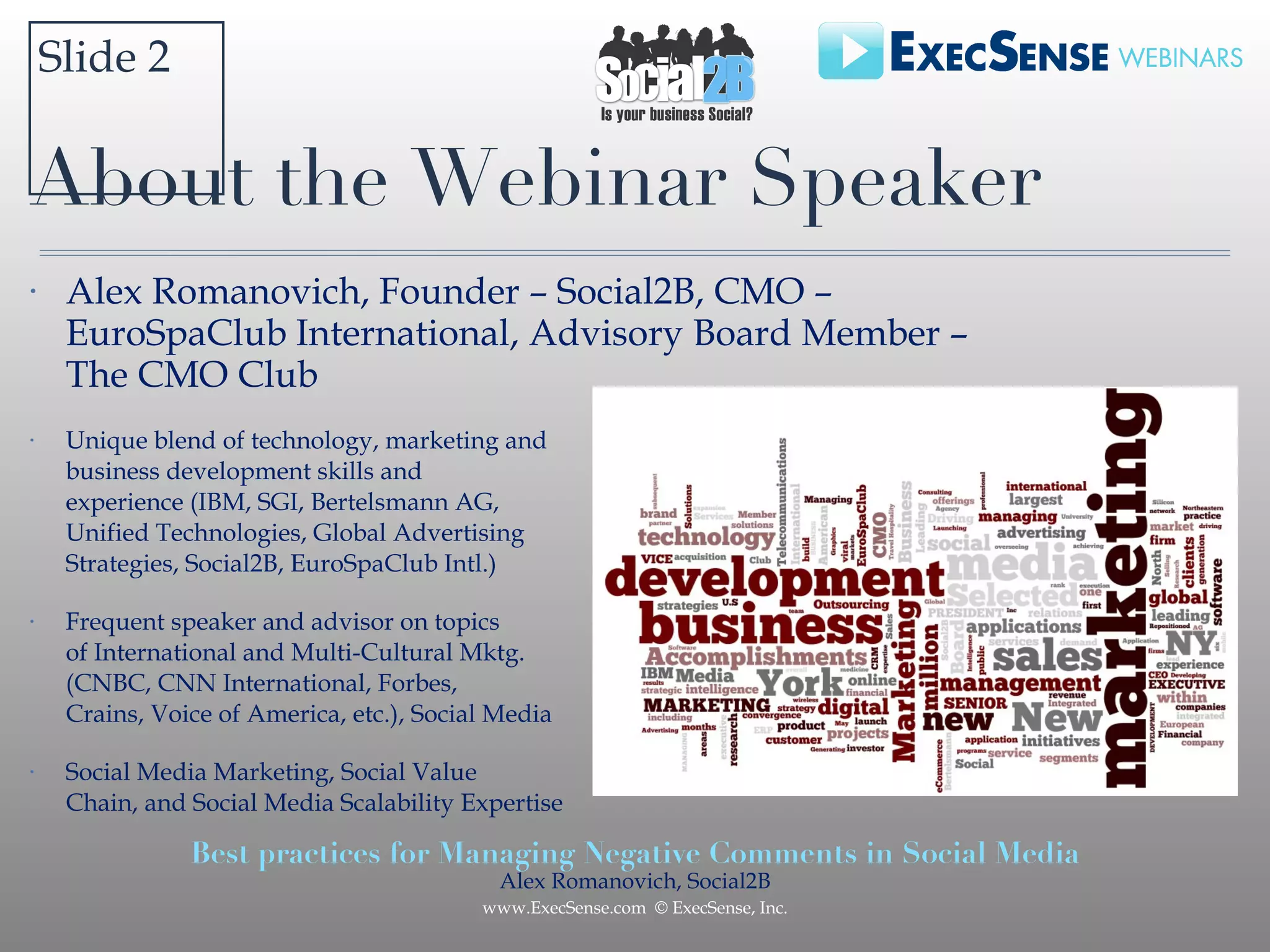
About the Webinar Speaker Alex Romanovich, Founder – Social2B, CMO – EuroSpaClub International, Advisory Board Member – The CMO Club Unique blend of technology, marketing and business development skills and  experience (IBM, SGI, Bertelsmann AG,  Unified Technologies, Global Advertising Strategies, Social2B, EuroSpaClub Intl.)  Frequent speaker and advisor on topics of International and Multi-Cultural Mktg.  (CNBC, CNN International, Forbes,  Crains, Voice of America, etc.), Social Media Social Media Marketing, Social Value Chain, and Social Media Scalability Expertise Slide
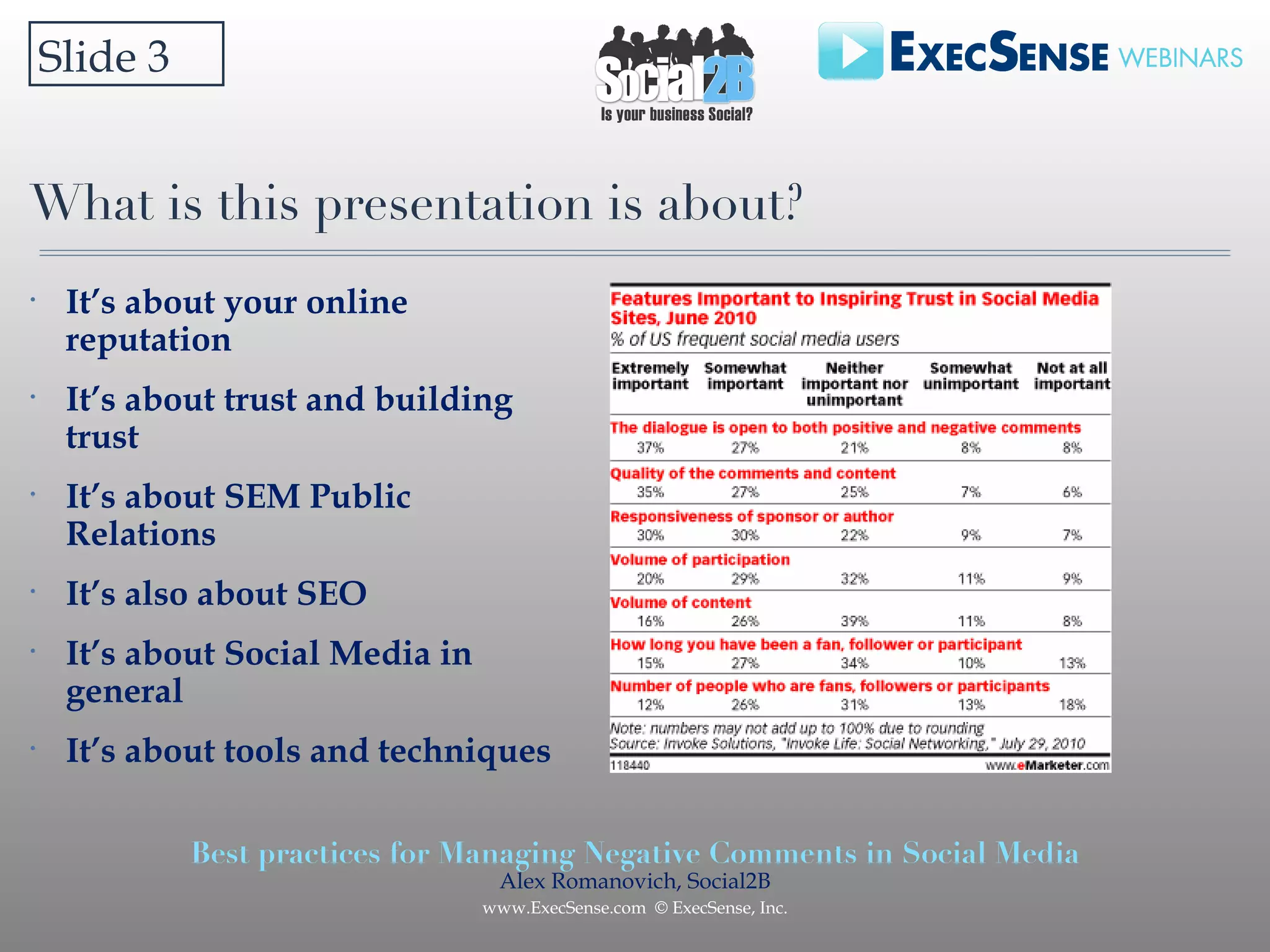
What is this presentation is about? It’s about your online reputation It’s about trust and building trust It’s about SEM Public Relations It’s also about SEO It’s about Social Media in general It’s about tools and techniques Slide 3
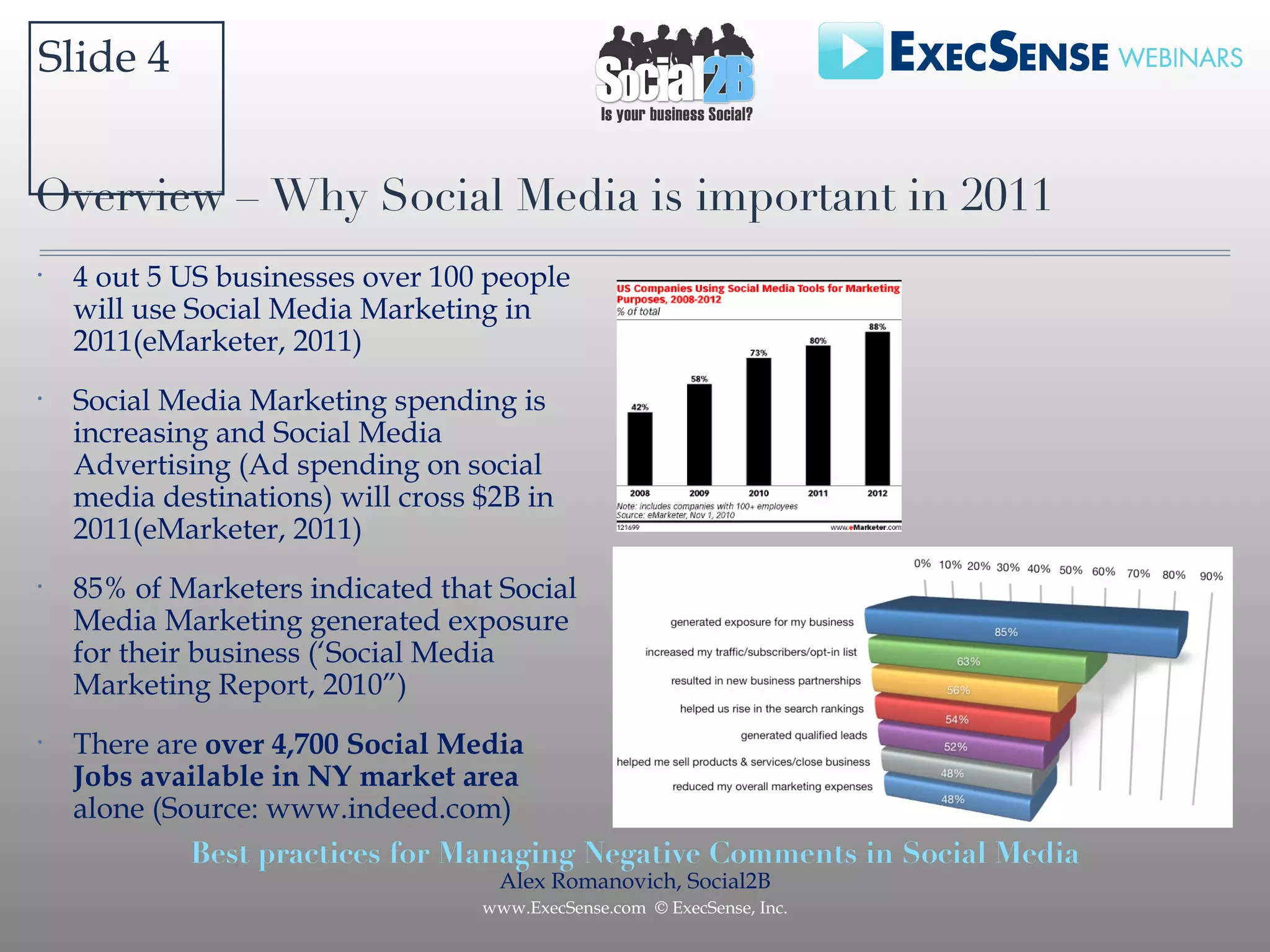
Overview – Why Social Media is important in 2011 4 out 5 US businesses over 100 people will use Social Media Marketing in 2011(eMarketer, 2011) Social Media Marketing spending is increasing and Social Media Advertising (Ad spending on social media destinations) will cross $2B in 2011(eMarketer, 2011) 85% of Marketers indicated that Social Media Marketing generated exposure for their business (‘Social Media Marketing Report, 2010”) There are  over 4,700 Social Media Jobs available in NY market area  alone (Source: www.indeed.com) Slide
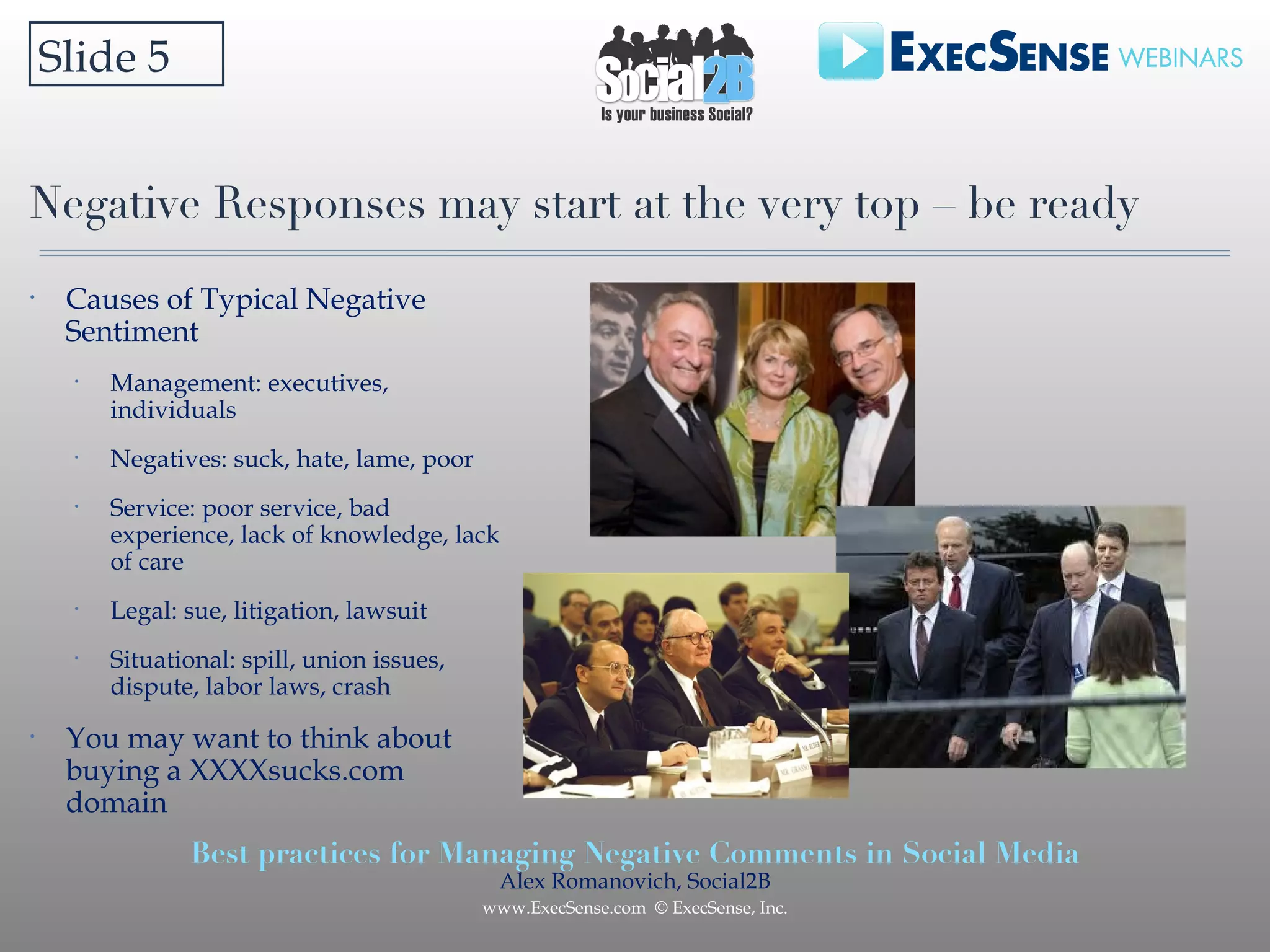
Negative Responses may start at the very top – be ready Causes of Typical Negative Sentiment Management: executives, individuals Negatives: suck, hate, lame, poor Service: poor service, bad experience, lack of knowledge, lack of care Legal: sue, litigation, lawsuit Situational: spill, union issues, dispute, labor laws, crash You may want to think about buying a XXXXsucks.com domain Slide 5
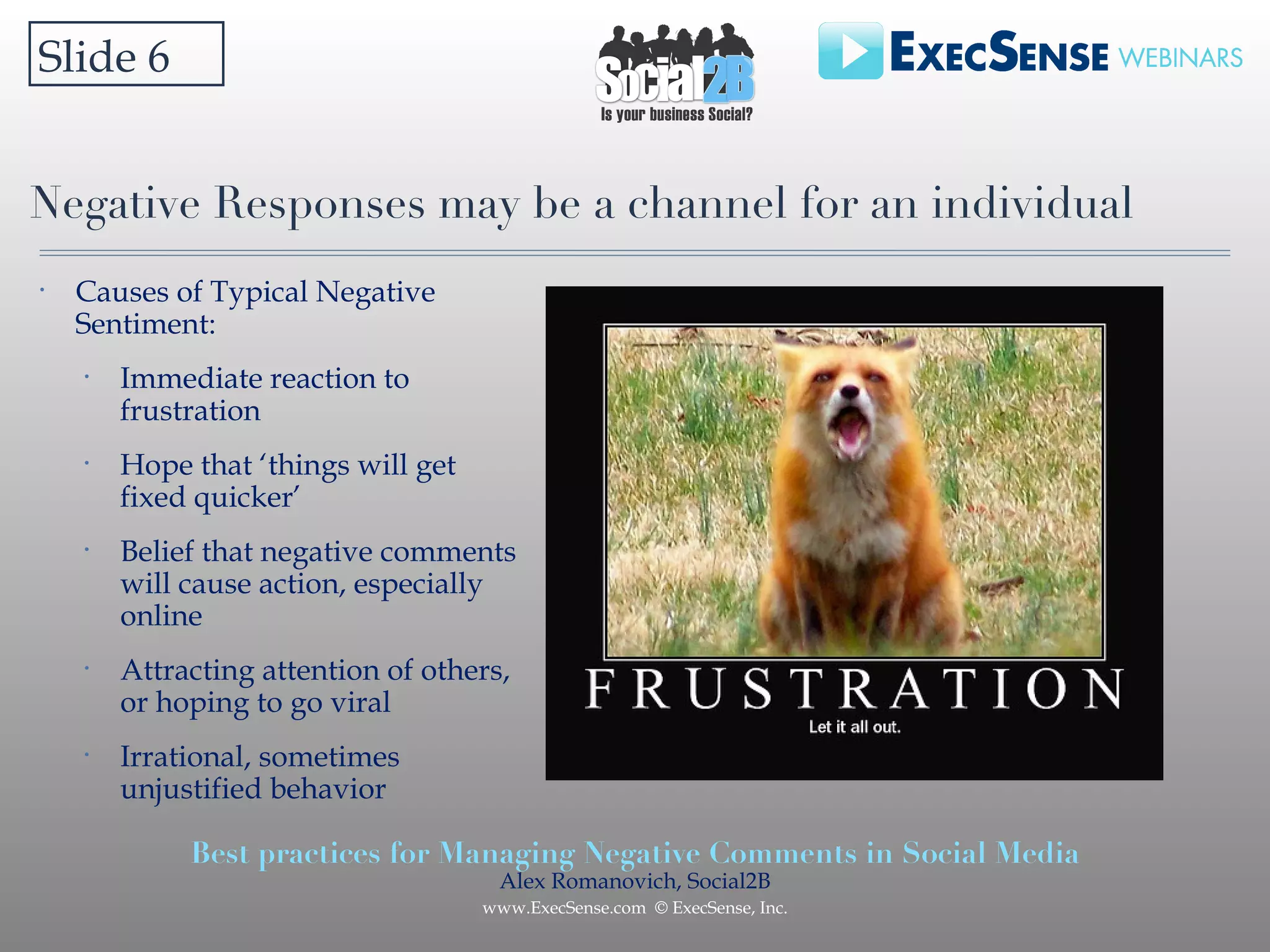
Negative Responses may be a channel for an individual Causes of Typical Negative Sentiment: Immediate reaction to frustration Hope that ‘things will get fixed quicker’ Belief that negative comments will cause action, especially online Attracting attention of others, or hoping to go viral Irrational, sometimes unjustified behavior Slide 6
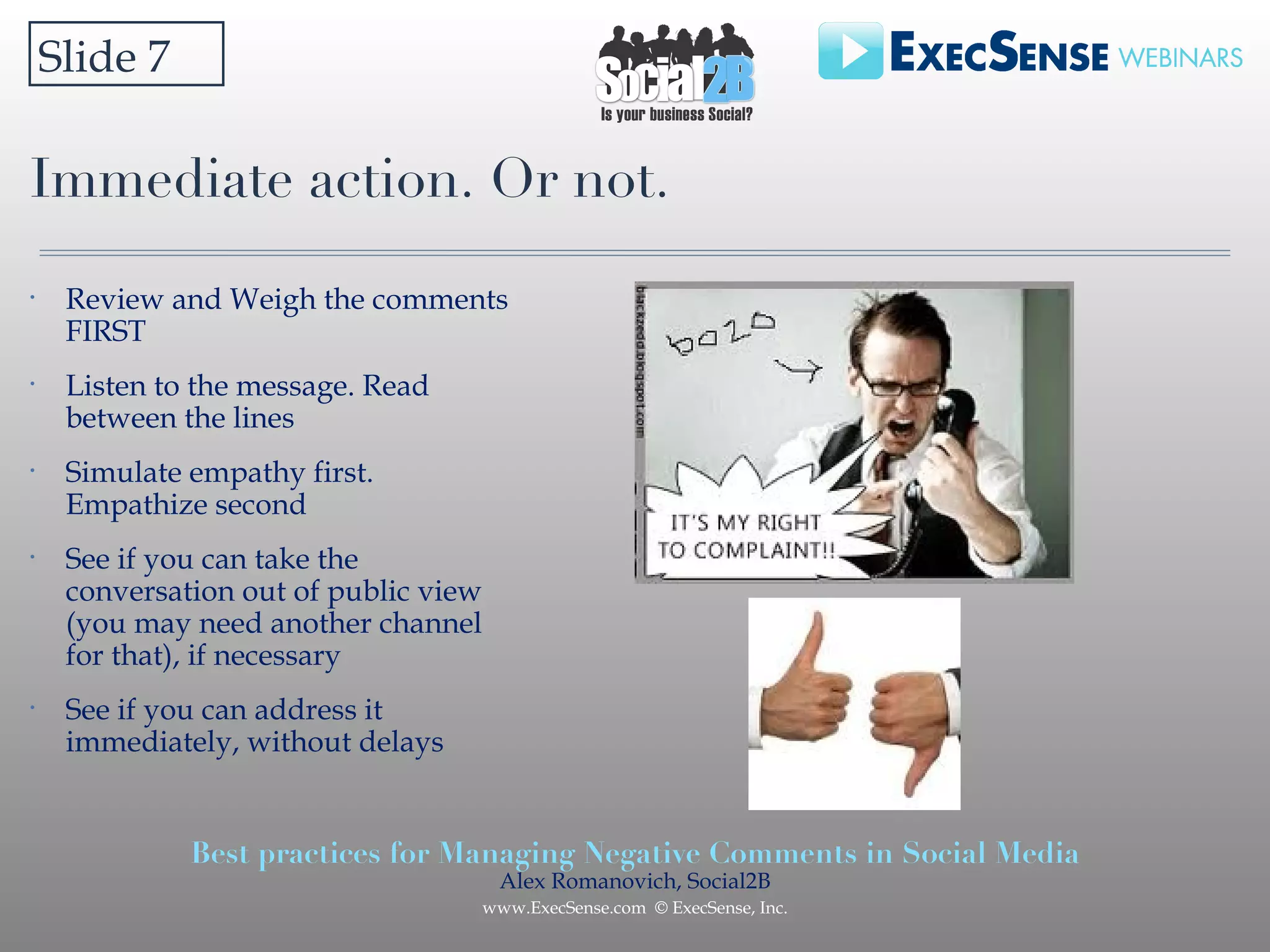
Immediate action. Or not.  Slide 7 Review and Weigh the comments FIRST Listen to the message. Read between the lines Simulate empathy first. Empathize second See if you can take the conversation out of public view (you may need another channel for that), if necessary See if you can address it immediately, without delays
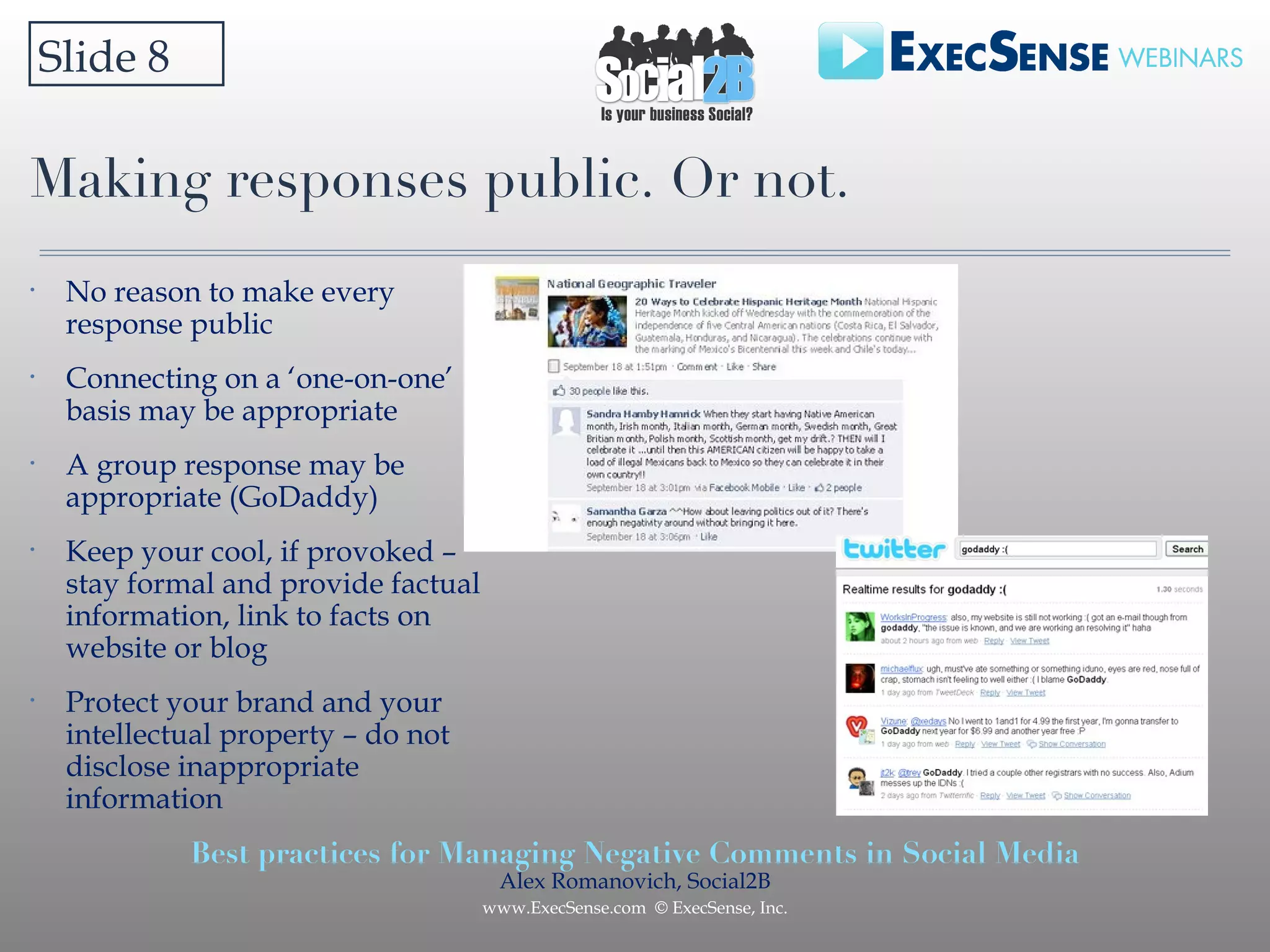
Making responses public. Or not.  Slide 8 No reason to make every response public Connecting on a ‘one-on-one’ basis may be appropriate A group response may be appropriate (GoDaddy) Keep your cool, if provoked – stay formal and provide factual information, link to facts on website or blog Protect your brand and your intellectual property – do not disclose inappropriate information
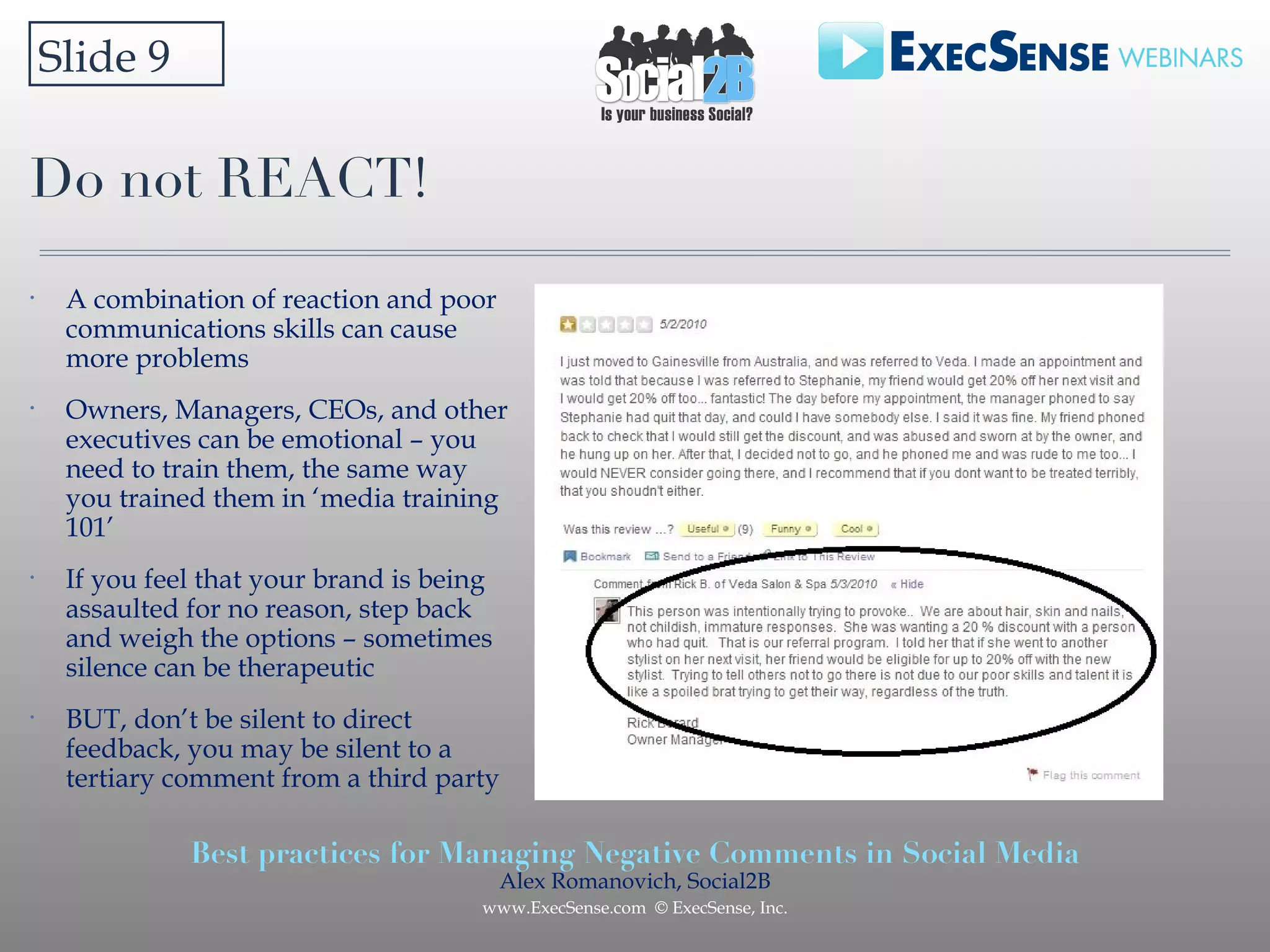
Do not REACT! Slide 9 A combination of reaction and poor communications skills can cause more problems Owners, Managers, CEOs, and other executives can be emotional – you need to train them, the same way you trained them in ‘media training 101’ If you feel that your brand is being assaulted for no reason, step back and weigh the options – sometimes silence can be therapeutic  BUT, don’t be silent to direct feedback, you may be silent to a tertiary comment from a third party
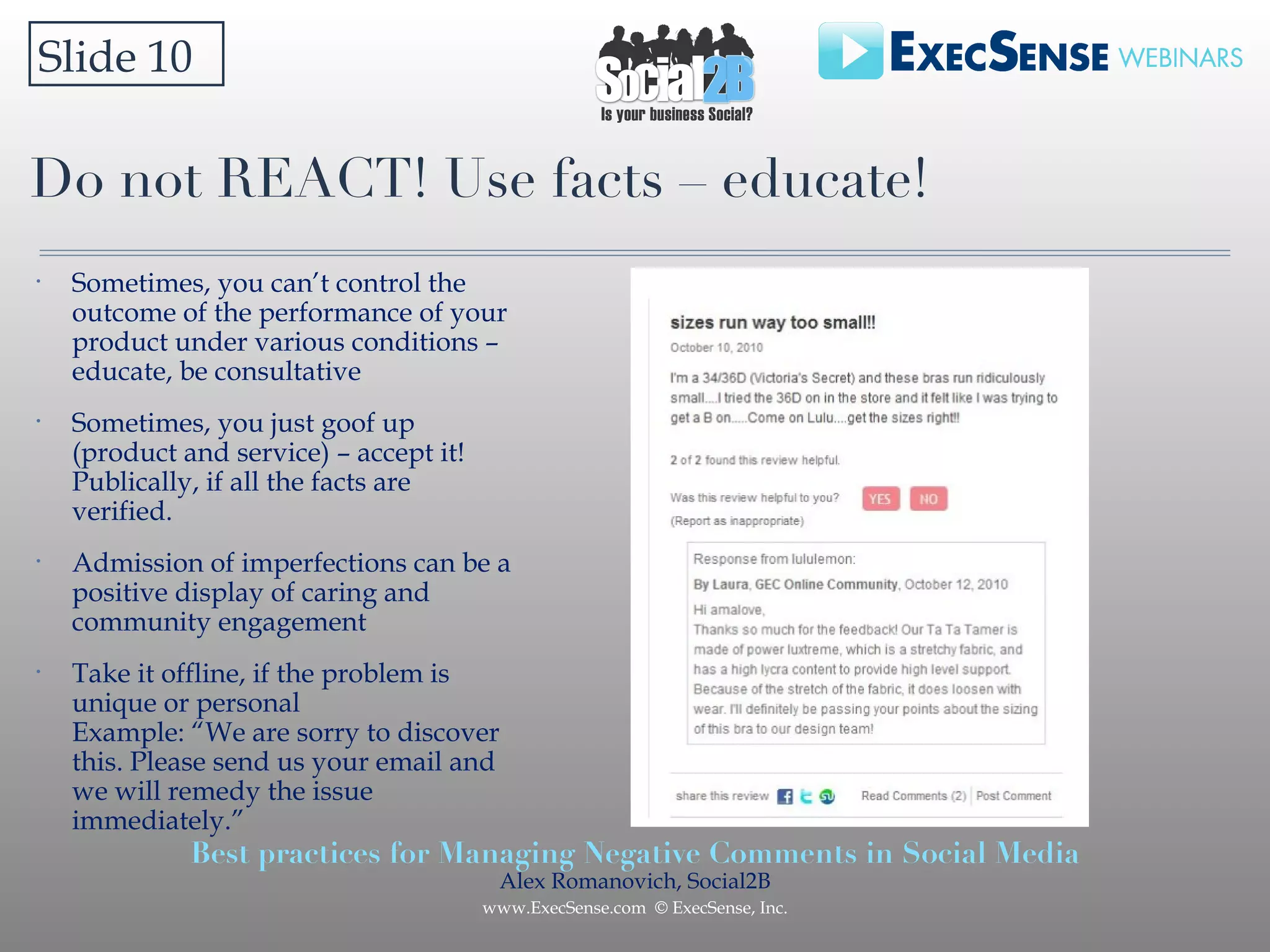
Do not REACT! Use facts – educate! Slide 10 Sometimes, you can’t control the outcome of the performance of your product under various conditions – educate, be consultative Sometimes, you just goof up (product and service) – accept it! Publically, if all the facts are verified.  Admission of imperfections can be a positive display of caring and community engagement Take it offline, if the problem is unique or personal Example: “We are sorry to discover this. Please send us your email and we will remedy the issue immediately.”
Be in sync with your brand and your marketing message! Slide 11 If you are a motor shop, ‘hey, man’ may be OK, but not if you are Citibank Note the tone of your client’s or contributor – you can either deflect it or amplify it, if constructive If your ‘brand speak’ is casual, explore the same tone, but beware of the level of ‘negativity’ – formalization of negative comments is more appropriate when someone is seeking a quick resolution
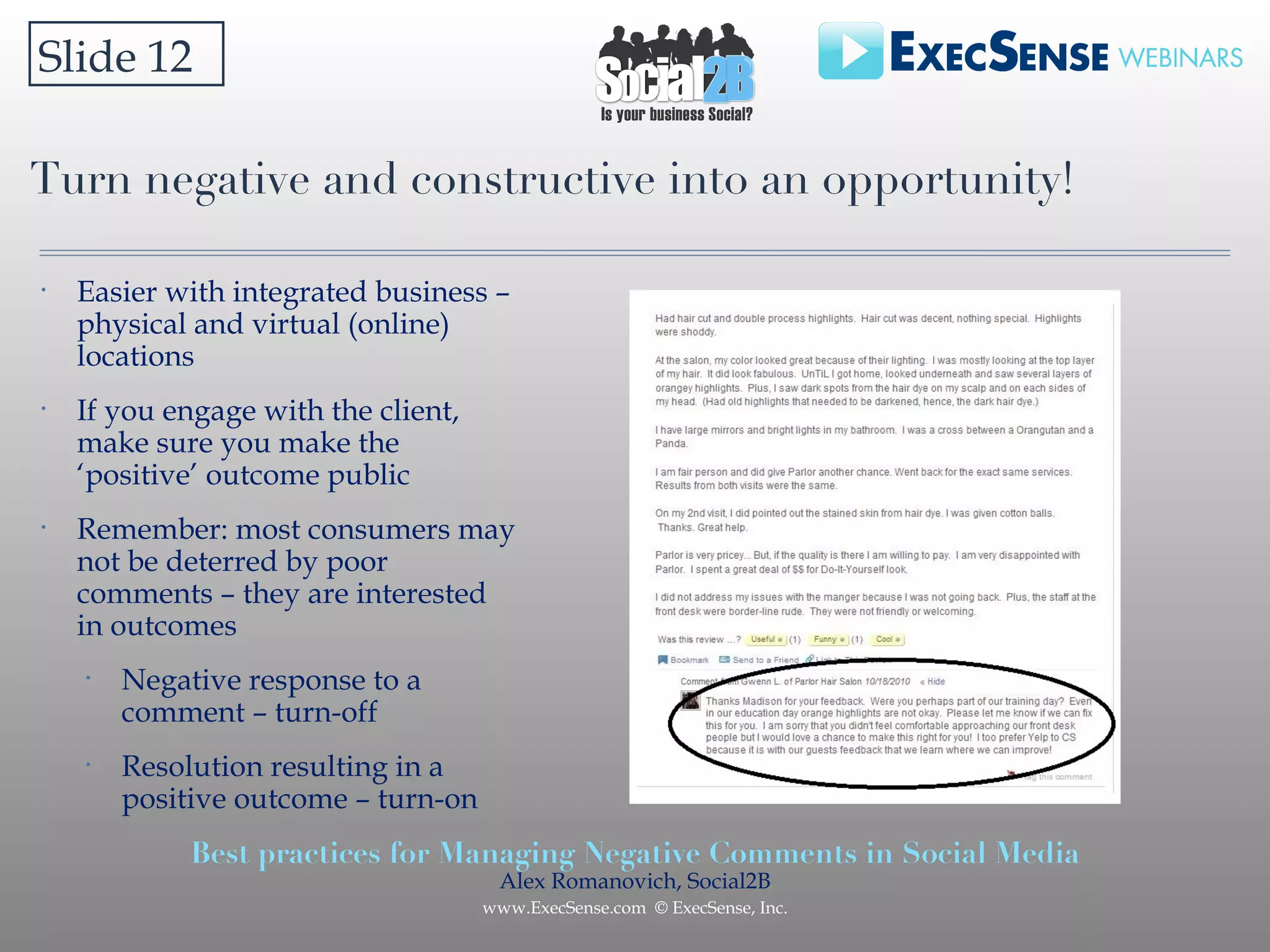
Turn negative and constructive into an opportunity! Slide 12 Easier with integrated business – physical and virtual (online) locations If you engage with the client, make sure you make the ‘positive’ outcome public Remember: most consumers may not be deterred by poor comments – they are interested in outcomes Negative response to a comment – turn-off Resolution resulting in a positive outcome – turn-on
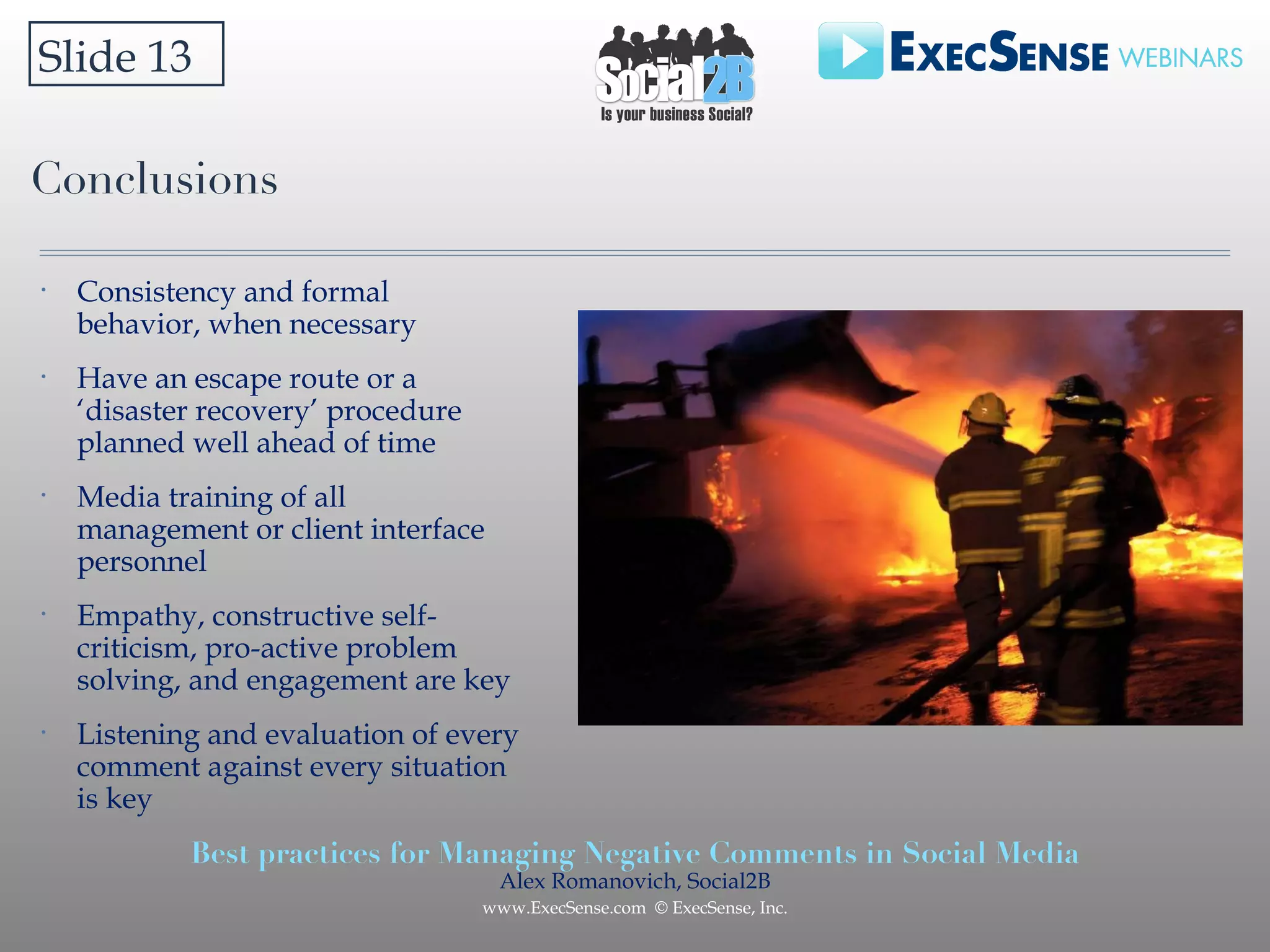
Conclusions Slide 13 Consistency and formal behavior, when necessary Have an escape route or a ‘disaster recovery’ procedure planned well ahead of time Media training of all management or client interface personnel Empathy, constructive self-criticism, pro-active problem solving, and engagement are key Listening and evaluation of every comment against every situation is key
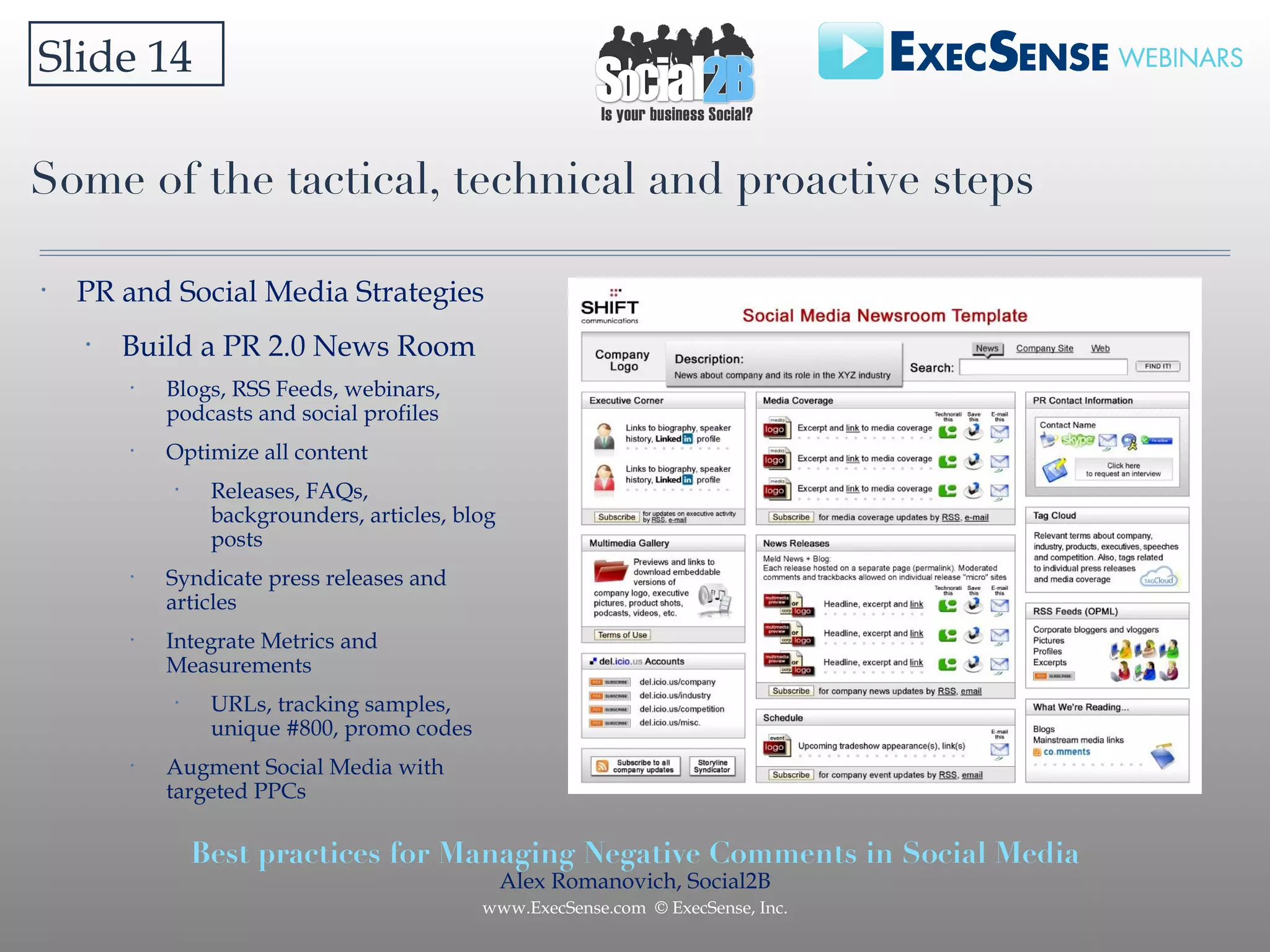
Some of the tactical, technical and proactive steps Slide 14 PR and Social Media Strategies Build a PR 2.0 News Room Blogs, RSS Feeds, webinars, podcasts and social profiles Optimize all content Releases, FAQs, backgrounders, articles, blog posts Syndicate press releases and articles Integrate Metrics and Measurements URLs, tracking samples, unique #800, promo codes Augment Social Media with targeted PPCs
Some of the tactical, technical and proactive steps Slide 15 Emergency Procedures Red Cross Study – one in every five web users turn to Social Media in case of emergency In the event of website or blog ‘denial of service’ – use social media (Basecamp as a recent example) Instant communication – response time is cruicial
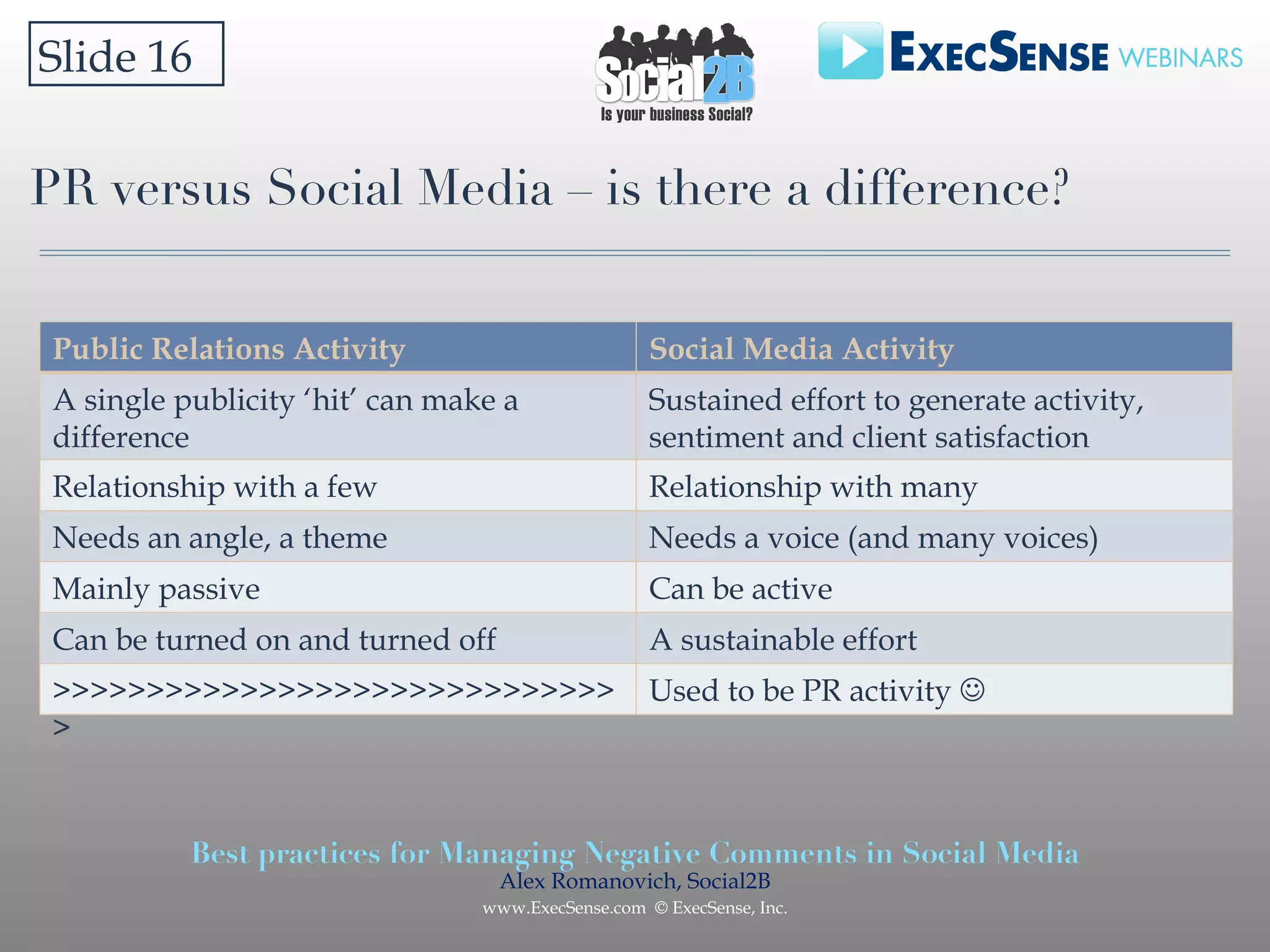
PR versus Social Media – is there a difference? Slide 16  Public Relations Activity Social Media Activity A single publicity ‘hit’ can make a difference Sustained effort to generate activity, sentiment and client satisfaction Relationship with a few Relationship with many Needs an angle, a theme Needs a voice (and many voices) Mainly passive Can be active Can be turned on and turned off A sustainable effort >>>>>>>>>>>>>>>>>>>>>>>>>>>>>>> Used to be PR activity  
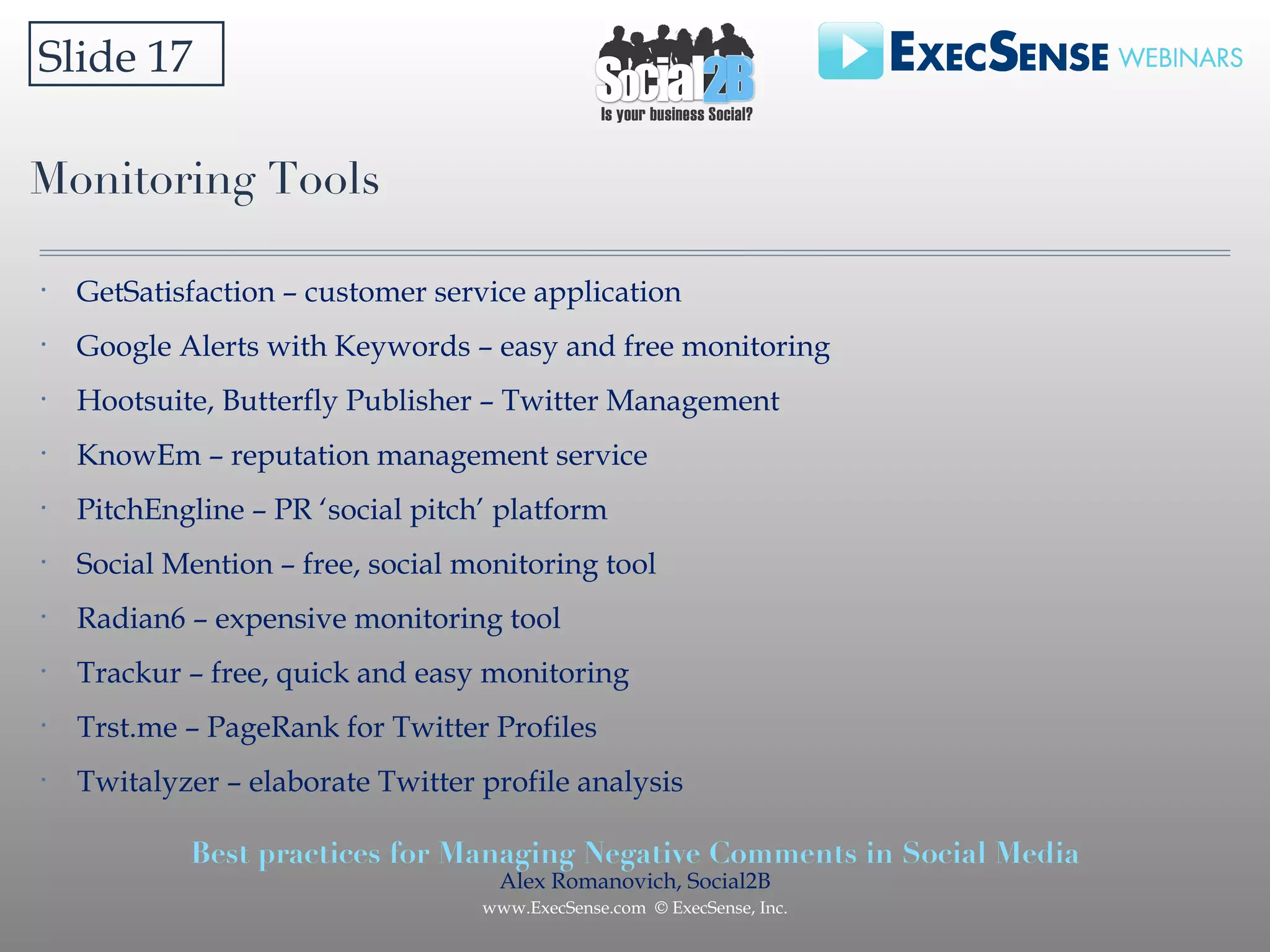
Monitoring Tools Slide 17 GetSatisfaction – customer service application Google Alerts with Keywords – easy and free monitoring Hootsuite, Butterfly Publisher – Twitter Management KnowEm – reputation management service PitchEngline – PR ‘social pitch’ platform Social Mention – free, social monitoring tool Radian6 – expensive monitoring tool Trackur – free, quick and easy monitoring Trst.me – PageRank for Twitter Profiles Twitalyzer – elaborate Twitter profile analysis
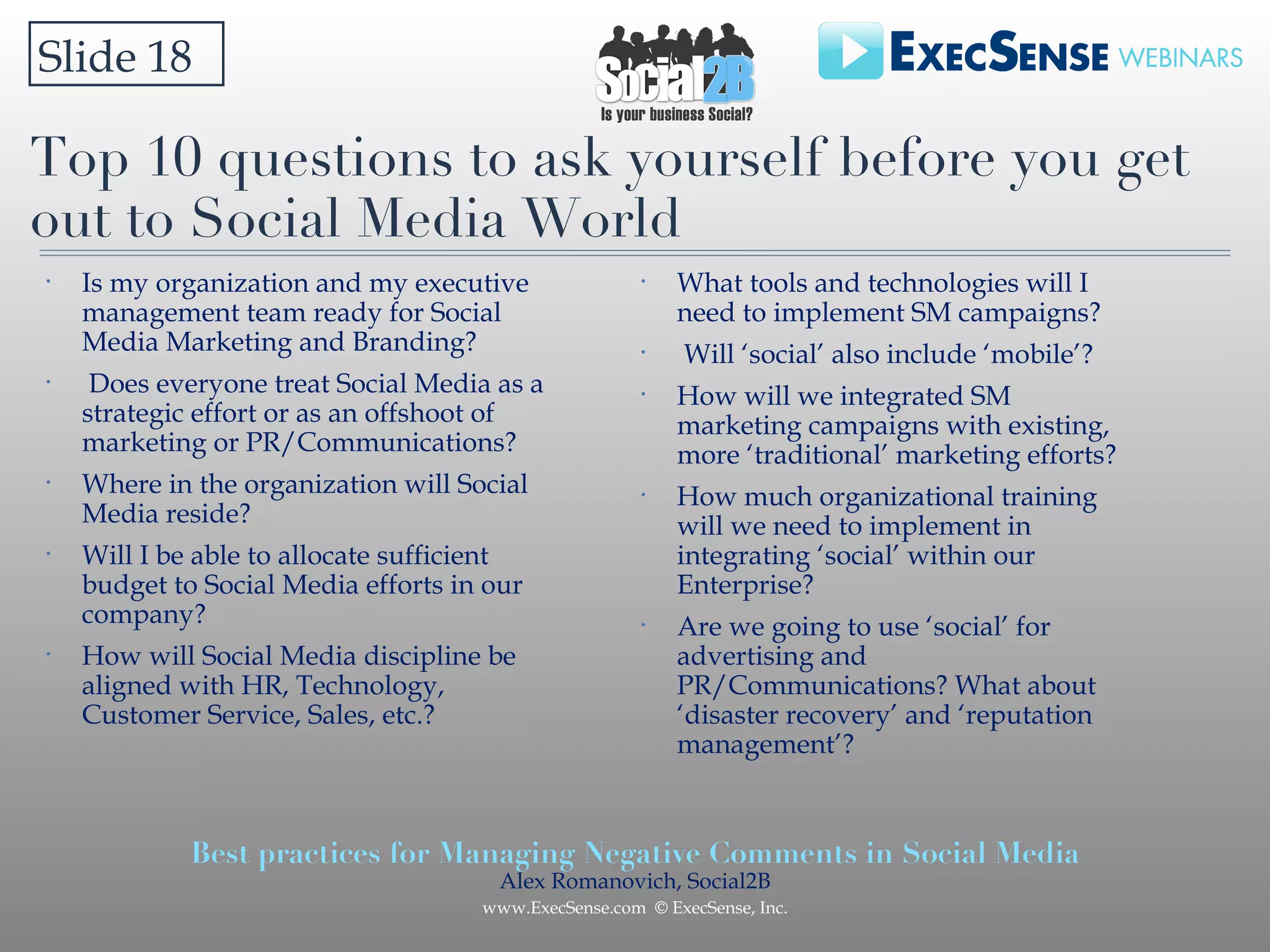
Top 10 questions to ask yourself before you get out to Social Media World Is my organization and my executive management team ready for Social Media Marketing and Branding? Does everyone treat Social Media as a strategic effort or as an offshoot of marketing or PR/Communications? Where in the organization will Social Media reside? Will I be able to allocate sufficient budget to Social Media efforts in our company? How will Social Media discipline be aligned with HR, Technology, Customer Service, Sales, etc.? Slide 18  What tools and technologies will I need to implement SM campaigns? Will ‘social’ also include ‘mobile’? How will we integrated SM marketing campaigns with existing, more ‘traditional’ marketing efforts? How much organizational training will we need to implement in integrating ‘social’ within our Enterprise? Are we going to use ‘social’ for advertising and PR/Communications? What about ‘disaster recovery’ and ‘reputation management’?
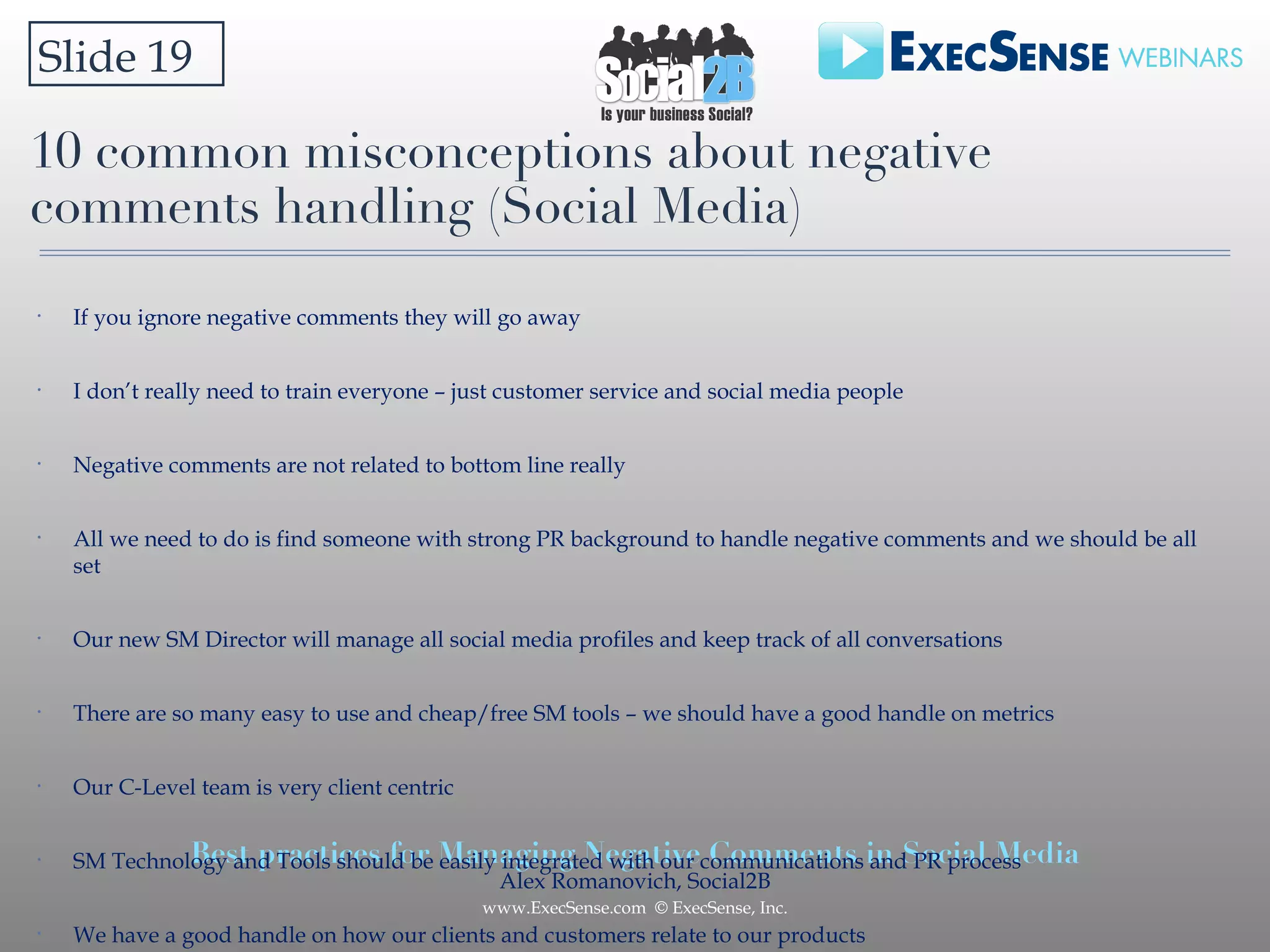
10 common misconceptions about negative comments handling (Social Media) If you ignore negative comments they will go away I don’t really need to train everyone – just customer service and social media people Negative comments are not related to bottom line really All we need to do is find someone with strong PR background to handle negative comments and we should be all set Our new SM Director will manage all social media profiles and keep track of all conversations There are so many easy to use and cheap/free SM tools – we should have a good handle on metrics  Our C-Level team is very client centric SM Technology and Tools should be easily integrated with our communications and PR process We have a good handle on how our clients and customers relate to our products We are ready for a disaster, if it happens Slide 19
Q&A Alex Romanovich Twitter: @social2B and @alexromanovich Google Voice: 1-917-815-1151 LinkedIn: alexromanovich [email_address] Slide 20

Handling Negative Comments Sm

  • 1.
    Best Practices forManaging Negative Comments on Social Networking Sites – What Communications Executives Need to Know for 2011 Alex Romanovich, Founder – Social2B Material in this webinar is for reference purposes only. This webinar is sold with the understanding that neither any of the authors nor the publisher are engaged in rendering legal, accounting, investment, or any other professional service directly through. this webinar. Neither the publisher nor the authors assume any liability for any errors or omissions, or for how this webinar or its contents are used or interpreted, or for any consequences resulting directly or indirectly from the use of this webinar. For legal, financial, strategic or any other type of advice, please personally consult the appropriate professional
  • 2.
    About the WebinarSpeaker Alex Romanovich, Founder – Social2B, CMO – EuroSpaClub International, Advisory Board Member – The CMO Club Unique blend of technology, marketing and business development skills and experience (IBM, SGI, Bertelsmann AG, Unified Technologies, Global Advertising Strategies, Social2B, EuroSpaClub Intl.) Frequent speaker and advisor on topics of International and Multi-Cultural Mktg. (CNBC, CNN International, Forbes, Crains, Voice of America, etc.), Social Media Social Media Marketing, Social Value Chain, and Social Media Scalability Expertise Slide
  • 3.
    What is thispresentation is about? It’s about your online reputation It’s about trust and building trust It’s about SEM Public Relations It’s also about SEO It’s about Social Media in general It’s about tools and techniques Slide 3
  • 4.
    Overview – WhySocial Media is important in 2011 4 out 5 US businesses over 100 people will use Social Media Marketing in 2011(eMarketer, 2011) Social Media Marketing spending is increasing and Social Media Advertising (Ad spending on social media destinations) will cross $2B in 2011(eMarketer, 2011) 85% of Marketers indicated that Social Media Marketing generated exposure for their business (‘Social Media Marketing Report, 2010”) There are over 4,700 Social Media Jobs available in NY market area alone (Source: www.indeed.com) Slide
  • 5.
    Negative Responses maystart at the very top – be ready Causes of Typical Negative Sentiment Management: executives, individuals Negatives: suck, hate, lame, poor Service: poor service, bad experience, lack of knowledge, lack of care Legal: sue, litigation, lawsuit Situational: spill, union issues, dispute, labor laws, crash You may want to think about buying a XXXXsucks.com domain Slide 5
  • 6.
    Negative Responses maybe a channel for an individual Causes of Typical Negative Sentiment: Immediate reaction to frustration Hope that ‘things will get fixed quicker’ Belief that negative comments will cause action, especially online Attracting attention of others, or hoping to go viral Irrational, sometimes unjustified behavior Slide 6
  • 7.
    Immediate action. Ornot. Slide 7 Review and Weigh the comments FIRST Listen to the message. Read between the lines Simulate empathy first. Empathize second See if you can take the conversation out of public view (you may need another channel for that), if necessary See if you can address it immediately, without delays
  • 8.
    Making responses public.Or not. Slide 8 No reason to make every response public Connecting on a ‘one-on-one’ basis may be appropriate A group response may be appropriate (GoDaddy) Keep your cool, if provoked – stay formal and provide factual information, link to facts on website or blog Protect your brand and your intellectual property – do not disclose inappropriate information
  • 9.
    Do not REACT!Slide 9 A combination of reaction and poor communications skills can cause more problems Owners, Managers, CEOs, and other executives can be emotional – you need to train them, the same way you trained them in ‘media training 101’ If you feel that your brand is being assaulted for no reason, step back and weigh the options – sometimes silence can be therapeutic BUT, don’t be silent to direct feedback, you may be silent to a tertiary comment from a third party
  • 10.
    Do not REACT!Use facts – educate! Slide 10 Sometimes, you can’t control the outcome of the performance of your product under various conditions – educate, be consultative Sometimes, you just goof up (product and service) – accept it! Publically, if all the facts are verified. Admission of imperfections can be a positive display of caring and community engagement Take it offline, if the problem is unique or personal Example: “We are sorry to discover this. Please send us your email and we will remedy the issue immediately.”
  • 11.
    Be in syncwith your brand and your marketing message! Slide 11 If you are a motor shop, ‘hey, man’ may be OK, but not if you are Citibank Note the tone of your client’s or contributor – you can either deflect it or amplify it, if constructive If your ‘brand speak’ is casual, explore the same tone, but beware of the level of ‘negativity’ – formalization of negative comments is more appropriate when someone is seeking a quick resolution
  • 12.
    Turn negative andconstructive into an opportunity! Slide 12 Easier with integrated business – physical and virtual (online) locations If you engage with the client, make sure you make the ‘positive’ outcome public Remember: most consumers may not be deterred by poor comments – they are interested in outcomes Negative response to a comment – turn-off Resolution resulting in a positive outcome – turn-on
  • 13.
    Conclusions Slide 13Consistency and formal behavior, when necessary Have an escape route or a ‘disaster recovery’ procedure planned well ahead of time Media training of all management or client interface personnel Empathy, constructive self-criticism, pro-active problem solving, and engagement are key Listening and evaluation of every comment against every situation is key
  • 14.
    Some of thetactical, technical and proactive steps Slide 14 PR and Social Media Strategies Build a PR 2.0 News Room Blogs, RSS Feeds, webinars, podcasts and social profiles Optimize all content Releases, FAQs, backgrounders, articles, blog posts Syndicate press releases and articles Integrate Metrics and Measurements URLs, tracking samples, unique #800, promo codes Augment Social Media with targeted PPCs
  • 15.
    Some of thetactical, technical and proactive steps Slide 15 Emergency Procedures Red Cross Study – one in every five web users turn to Social Media in case of emergency In the event of website or blog ‘denial of service’ – use social media (Basecamp as a recent example) Instant communication – response time is cruicial
  • 16.
    PR versus SocialMedia – is there a difference? Slide 16 Public Relations Activity Social Media Activity A single publicity ‘hit’ can make a difference Sustained effort to generate activity, sentiment and client satisfaction Relationship with a few Relationship with many Needs an angle, a theme Needs a voice (and many voices) Mainly passive Can be active Can be turned on and turned off A sustainable effort >>>>>>>>>>>>>>>>>>>>>>>>>>>>>>> Used to be PR activity 
  • 17.
    Monitoring Tools Slide17 GetSatisfaction – customer service application Google Alerts with Keywords – easy and free monitoring Hootsuite, Butterfly Publisher – Twitter Management KnowEm – reputation management service PitchEngline – PR ‘social pitch’ platform Social Mention – free, social monitoring tool Radian6 – expensive monitoring tool Trackur – free, quick and easy monitoring Trst.me – PageRank for Twitter Profiles Twitalyzer – elaborate Twitter profile analysis
  • 18.
    Top 10 questionsto ask yourself before you get out to Social Media World Is my organization and my executive management team ready for Social Media Marketing and Branding? Does everyone treat Social Media as a strategic effort or as an offshoot of marketing or PR/Communications? Where in the organization will Social Media reside? Will I be able to allocate sufficient budget to Social Media efforts in our company? How will Social Media discipline be aligned with HR, Technology, Customer Service, Sales, etc.? Slide 18 What tools and technologies will I need to implement SM campaigns? Will ‘social’ also include ‘mobile’? How will we integrated SM marketing campaigns with existing, more ‘traditional’ marketing efforts? How much organizational training will we need to implement in integrating ‘social’ within our Enterprise? Are we going to use ‘social’ for advertising and PR/Communications? What about ‘disaster recovery’ and ‘reputation management’?
  • 19.
    10 common misconceptionsabout negative comments handling (Social Media) If you ignore negative comments they will go away I don’t really need to train everyone – just customer service and social media people Negative comments are not related to bottom line really All we need to do is find someone with strong PR background to handle negative comments and we should be all set Our new SM Director will manage all social media profiles and keep track of all conversations There are so many easy to use and cheap/free SM tools – we should have a good handle on metrics Our C-Level team is very client centric SM Technology and Tools should be easily integrated with our communications and PR process We have a good handle on how our clients and customers relate to our products We are ready for a disaster, if it happens Slide 19
  • 20.
    Q&A Alex RomanovichTwitter: @social2B and @alexromanovich Google Voice: 1-917-815-1151 LinkedIn: alexromanovich [email_address] Slide 20