Getting to Global
Handling Duties & Taxes
Avoid bad surprises for your
international customers
Handle Duties & Taxes
Optimizing for Cross-border
The #1 source of bad surprises with eCommerce
Imagine waiting days or weeks for a product you crave only to realize you now have to pay 10 to 50%
more to take possession of your products. That’s the nightmare scenario international shoppers face
when you don’t handle duties and sales taxes properly.
What are import duties?
Import duty is a tax collected on imports by a country's customs authorities. A
good's value will usually dictate the import duty. Depending on the context, import
duty may also be known as a customs duty, tariff, import tax or import tariff.
What are taxes?
They're government fees placed on purchased goods coming into a country (imported).
Even though the goods have been purchased abroad, this tax still applies and must be
collected by customs when goods enter a country.
Sales tax, value-added tax (VAT) and goods and services tax (GST) are practically the
same thing, however the name and rate varies by country. Example tax rates can be 0%,
10%, 20% or more, depending on the country and product.
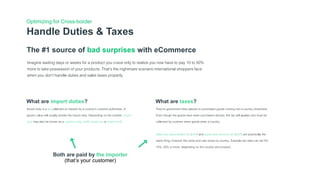
Both are paid by the importer
(that’s your customer)
Handle Duties & Taxes
Optimizing for Cross-border
At the center of it all, the HS Code
HS stands for Harmonized System. It is the international product nomenclature that describes the type of
good that is shipped and allow customs to apply the right duties and taxes. Today, customs officers must
use HS code to clear every commodity that enters or crosses any international borders.
That means if you’re shipping internationally (no matter how), you must know the HS code for each of your
product.
How can I find my HS code?
There are many tools to help you find the HS Codes of your
products. We’ve included those in the Accelerator.
Should I get help?
Unless you have a simple product, then YES.Picking the wrong HS
code can have bad consequences so play it safe and get help!
Optimizing for Cross-border
DDP VS DDU – What does it mean?
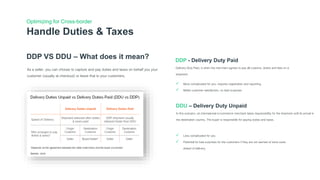
As a seller, you can choose to capture and pay duties and taxes on behalf you your
customer (usually at checkout) or leave that to your customers.
DDP - Delivery Duty Paid
Delivery Duty Paid, is when the merchant agrees to pay all customs, duties and fees on a
shipment.
DDU – Delivery Duty Unpaid
In this scenario, an international e-commerce merchant takes responsibility for the shipment until its arrival in
the destination country. The buyer is responsible for paying duties and taxes.
Handle Duties & Taxes
 More complicated for you, requires registration and reporting
 Better customer satisfaction, no bad surprises
 Less complicated for you
 Potential for bad surprises for the customers if they are not warned of extra costs
ahead of delivery
Handle Duties & Taxes
Optimizing for Cross-border
There are simple ways to calculate and capture duties & taxes
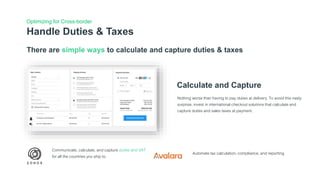
Calculate and Capture
Nothing worse than having to pay duties at delivery. To avoid this nasty
surprise, invest in international checkout solutions that calculate and
capture duties and sales taxes at payment.
Communicate, calculate, and capture duties and VAT
for all the countries you ship to.
Automate tax calculation, compliance, and reporting.

Handling Duties and Taxes

  • 1.
    Getting to Global HandlingDuties & Taxes Avoid bad surprises for your international customers
  • 2.
    Handle Duties &Taxes Optimizing for Cross-border The #1 source of bad surprises with eCommerce Imagine waiting days or weeks for a product you crave only to realize you now have to pay 10 to 50% more to take possession of your products. That’s the nightmare scenario international shoppers face when you don’t handle duties and sales taxes properly. What are import duties? Import duty is a tax collected on imports by a country's customs authorities. A good's value will usually dictate the import duty. Depending on the context, import duty may also be known as a customs duty, tariff, import tax or import tariff. What are taxes? They're government fees placed on purchased goods coming into a country (imported). Even though the goods have been purchased abroad, this tax still applies and must be collected by customs when goods enter a country. Sales tax, value-added tax (VAT) and goods and services tax (GST) are practically the same thing, however the name and rate varies by country. Example tax rates can be 0%, 10%, 20% or more, depending on the country and product. Both are paid by the importer (that’s your customer)
  • 3.
    Handle Duties &Taxes Optimizing for Cross-border At the center of it all, the HS Code HS stands for Harmonized System. It is the international product nomenclature that describes the type of good that is shipped and allow customs to apply the right duties and taxes. Today, customs officers must use HS code to clear every commodity that enters or crosses any international borders. That means if you’re shipping internationally (no matter how), you must know the HS code for each of your product. How can I find my HS code? There are many tools to help you find the HS Codes of your products. We’ve included those in the Accelerator. Should I get help? Unless you have a simple product, then YES.Picking the wrong HS code can have bad consequences so play it safe and get help!
  • 4.
    Optimizing for Cross-border DDPVS DDU – What does it mean? As a seller, you can choose to capture and pay duties and taxes on behalf you your customer (usually at checkout) or leave that to your customers. DDP - Delivery Duty Paid Delivery Duty Paid, is when the merchant agrees to pay all customs, duties and fees on a shipment. DDU – Delivery Duty Unpaid In this scenario, an international e-commerce merchant takes responsibility for the shipment until its arrival in the destination country. The buyer is responsible for paying duties and taxes. Handle Duties & Taxes  More complicated for you, requires registration and reporting  Better customer satisfaction, no bad surprises  Less complicated for you  Potential for bad surprises for the customers if they are not warned of extra costs ahead of delivery
  • 5.
    Handle Duties &Taxes Optimizing for Cross-border There are simple ways to calculate and capture duties & taxes Calculate and Capture Nothing worse than having to pay duties at delivery. To avoid this nasty surprise, invest in international checkout solutions that calculate and capture duties and sales taxes at payment. Communicate, calculate, and capture duties and VAT for all the countries you ship to. Automate tax calculation, compliance, and reporting.