Department of Education
Region III
Division of Pampanga
Gutad National High School
Floridablanca, Pampanga
3rd
Periodic Test in TLE 8
Name: Date:
Gr. / Sec: Score:
Multiple Choices:
Encircle the letter of the correct answer:
1. Part of fish used for smelling.
a. Mouth b. nostril c. eyes d. fins
2. Circulates blood throughout the body.
a. Kidney b. muscle c. heart d. brain
3. Part of fish used for seeing.
a. Mouth b. nostril c. eyes d. fins
4. Scales that resembles a miniature tooth called denticles.
a. Ctenoid b. ganoid c. cyloid d. placoid
5. The process of increasing fish life either with natural or artificial means of reproduction.
a. Fish Cultivation c. Fish Propagation
b. Fish Culture d. Fish Conservation
6. Which of the following is not an internal organ?
a. Gonad b. Liver c. Stomach d. Scales
7. Which of the following is the example of placoid?
a. Pongies scales b. shark scales c. milkfish d. tilapia scales
8. The following are parts of gills except one:
a. Gill rakers b. gill filament c. gill arch d. gill cover
9. Why is there a need to familiarize yourselves with the structure of fish?
a. to familiarize with the internal and external part of fish
b. to have a knowledge in the structure of fish
c. to waste your time
d. a and b
10. The place where plants and animals grow and naturally live.
a. Habitat b. Tide c. sabalo d. competition
11. The smallest and the cleanest compartment where fish are reared from fry up to pre-fingerling
size.
a. Rearing Pond b. Nursery Pondc. Head Pond d. Transition Pond
12. The male reproductive gland of fish.
a. Sabalo b. Milt c. Tide d. pH
13. An area that serves as catchment basin for fish harvest.
a. Rearing pond b. Nursery Pondc. Catching pond d. Head Pond
14. The rearing of fish under controlled or semi-controlled condition.
a. Fish Cultivation c. Fish Conservation
b. Fish Culture d. Fish Propagation
15. Is the total weight of the animal in the given environment?
a. Biomass c. Lab-Lab
b. Standing crop d. Food chain
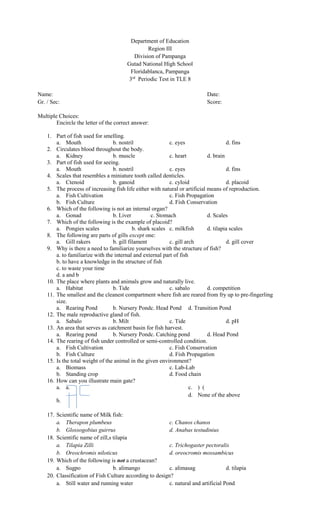
16. How can you illustrate main gate?
a. a.
b.
c. ) (
d. None of the above
17. Scientific name of Milk fish:
a. Therapon plumbeus c. Chanos chanos
b. Glossogobius guirrus d. Anabas testudinius
18. Scientific name of zill,s tilapia
a. Tilapia Zilli c. Trichogaster pectoralis
b. Oreochromis niloticus d. oreocromis mossambicus
19. Which of the following is not a crustacean?
a. Sugpo b. alimango c. alimasag d. tilapia
20. Classification of Fish Culture according to design?
a. Still water and running water c. natural and artificial Pond
b. Intensive and extensive d. all of the above
21. Why is it important to study fish culture?
a. To familiarize with the different compartments
b. To improve your skills about fish culture
c. To know the terminologies used in study fish culture
d. All of the above
22. How the different compartments are divided based on specifications?
a. Based on their stages/sizes c. Based on texture
b. Based on smell d. Based on taste
23. A small plants floating in water.
a. Plankton b. Lab-lab c. Algae d. Predator
24. Which of the following is one of the characteristics of Fish that are suitable in pond culture?
a. Fish should have a disease c. fish should be weak
b. Fish should be fast grower d. fish must be destructive in its own kind
25. Why crustacean is one of the enemies of fish?
a. They compete cultured fish c. they damage to the food and in the habitat of fish
b. They prey to the cultured fish d. they give nutrients to other fish
26. A method that is composed of the simplest forms of gathering aquatic resources.
a. Stupefying method c. Fish poisoning
b. Fishing without gear d. Electrical Fishing
27. Fish poisoning identified as?
a. Fishing without gear c. Stupefying method
b. Falling gear d. none of the above
28. A structure made of anchored bunches of twigs and bushes, piles of rocks which become the
hiding place for fishes.
a. Barricades c. Fish Shelter
b. Fish Coral d. Fish pots
29. Used in catching squids.
a. Pole and line c. troll line
b. Jigger d. simple hand line
30. Muro ami and drive in net are example of what gear?
a. Falling gear c. dragged Gear
b. Drive in gear d. seine net
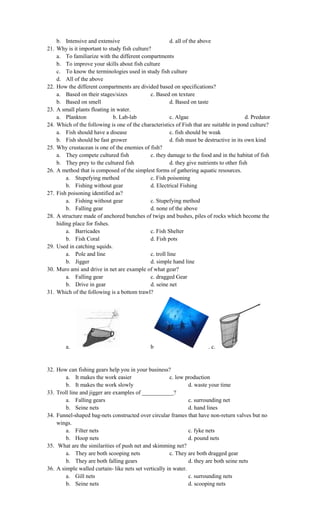
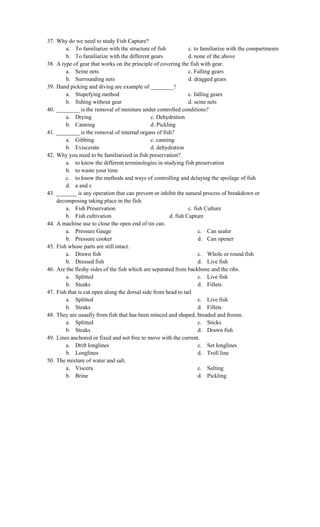
31. Which of the following is a bottom trawl?
a. b . c.
32. How can fishing gears help you in your business?
a. It makes the work easier c. low production
b. It makes the work slowly d. waste your time
33. Troll line and jigger are examples of ___________?
a. Falling gears c. surrounding net
b. Seine nets d. hand lines
34. Funnel-shaped bag-nets constructed over circular frames that have non-return valves but no
wings.
a. Filter nets c. fyke nets
b. Hoop nets d. pound nets
35. What are the similarities of push net and skimming net?
a. They are both scooping nets c. They are both dragged gear
b. They are both falling gears d. they are both seine nets
36. A simple walled curtain- like nets set vertically in water.
a. Gill nets c. surrounding nets
b. Seine nets d. scooping nets
37. Why do we need to study Fish Capture?
a. To familiarize with the structure of fish c. to familiarize with the compartments
b. To familiarize with the different gears d. none of the above
38. A type of gear that works on the principle of covering the fish with gear.
a. Seine nets c. Falling gears
b. Surrounding nets d. dragged gears
39. Hand picking and diving are example of ________?
a. Stupefying method c. falling gears
b. fishing without gear d. seine nets
40. ________ is the removal of moisture under controlled conditions?
a. Drying c. Dehydration
b. Canning d. Pickling
41. ________ is the removal of internal organs of fish?
a. Gibbing c. canning
b. Eviscerate d. dehydration
42. Why you need to be familiarized in fish preservation?
a. to know the different terminologies in studying fish preservation
b. to waste your time
c. to know the methods and ways of controlling and delaying the spoilage of fish
d. a and c
43. _______ is any operation that can prevent or inhibit the natural process of breakdown or
decomposing taking place in the fish.
a. Fish Preservation c. fish Culture
b. Fish cultivation d. fish Capture
44. A machine use to close the open end of tin can.
a. Pressure Gauge
b. Pressure cooker
c. Can sealer
d. Can opener
45. Fish whose parts are still intact.
a. Drawn fish
b. Dressed fish
c. Whole or round fish
d. Live fish
46. Are the fleshy sides of the fish which are separated from backbone and the ribs.
a. Splitted
b. Steaks
c. Live fish
d. Fillets
47. Fish that is cut open along the dorsal side from head to tail
a. Splitted
b. Steaks
c. Live fish
d. Fillets
48. They are usually from fish that has been minced and shaped, breaded and frozen.
a. Splitted
b. Steaks
c. Sticks
d. Drawn fish
49. Lines anchored or fixed and not free to move with the current.
a. Drift longlines
b. Longlines
c. Set longlines
d. Troll line
50. The mixture of water and salt.
a. Viscera
b. Brine
c. Salting
d. Pickling

handicarft production

  • 1.
    Department of Education RegionIII Division of Pampanga Gutad National High School Floridablanca, Pampanga 3rd Periodic Test in TLE 8 Name: Date: Gr. / Sec: Score: Multiple Choices: Encircle the letter of the correct answer: 1. Part of fish used for smelling. a. Mouth b. nostril c. eyes d. fins 2. Circulates blood throughout the body. a. Kidney b. muscle c. heart d. brain 3. Part of fish used for seeing. a. Mouth b. nostril c. eyes d. fins 4. Scales that resembles a miniature tooth called denticles. a. Ctenoid b. ganoid c. cyloid d. placoid 5. The process of increasing fish life either with natural or artificial means of reproduction. a. Fish Cultivation c. Fish Propagation b. Fish Culture d. Fish Conservation 6. Which of the following is not an internal organ? a. Gonad b. Liver c. Stomach d. Scales 7. Which of the following is the example of placoid? a. Pongies scales b. shark scales c. milkfish d. tilapia scales 8. The following are parts of gills except one: a. Gill rakers b. gill filament c. gill arch d. gill cover 9. Why is there a need to familiarize yourselves with the structure of fish? a. to familiarize with the internal and external part of fish b. to have a knowledge in the structure of fish c. to waste your time d. a and b 10. The place where plants and animals grow and naturally live. a. Habitat b. Tide c. sabalo d. competition 11. The smallest and the cleanest compartment where fish are reared from fry up to pre-fingerling size. a. Rearing Pond b. Nursery Pondc. Head Pond d. Transition Pond 12. The male reproductive gland of fish. a. Sabalo b. Milt c. Tide d. pH 13. An area that serves as catchment basin for fish harvest. a. Rearing pond b. Nursery Pondc. Catching pond d. Head Pond 14. The rearing of fish under controlled or semi-controlled condition. a. Fish Cultivation c. Fish Conservation b. Fish Culture d. Fish Propagation 15. Is the total weight of the animal in the given environment? a. Biomass c. Lab-Lab b. Standing crop d. Food chain 16. How can you illustrate main gate? a. a. b. c. ) ( d. None of the above 17. Scientific name of Milk fish: a. Therapon plumbeus c. Chanos chanos b. Glossogobius guirrus d. Anabas testudinius 18. Scientific name of zill,s tilapia a. Tilapia Zilli c. Trichogaster pectoralis b. Oreochromis niloticus d. oreocromis mossambicus 19. Which of the following is not a crustacean? a. Sugpo b. alimango c. alimasag d. tilapia 20. Classification of Fish Culture according to design? a. Still water and running water c. natural and artificial Pond
  • 2.
    b. Intensive andextensive d. all of the above 21. Why is it important to study fish culture? a. To familiarize with the different compartments b. To improve your skills about fish culture c. To know the terminologies used in study fish culture d. All of the above 22. How the different compartments are divided based on specifications? a. Based on their stages/sizes c. Based on texture b. Based on smell d. Based on taste 23. A small plants floating in water. a. Plankton b. Lab-lab c. Algae d. Predator 24. Which of the following is one of the characteristics of Fish that are suitable in pond culture? a. Fish should have a disease c. fish should be weak b. Fish should be fast grower d. fish must be destructive in its own kind 25. Why crustacean is one of the enemies of fish? a. They compete cultured fish c. they damage to the food and in the habitat of fish b. They prey to the cultured fish d. they give nutrients to other fish 26. A method that is composed of the simplest forms of gathering aquatic resources. a. Stupefying method c. Fish poisoning b. Fishing without gear d. Electrical Fishing 27. Fish poisoning identified as? a. Fishing without gear c. Stupefying method b. Falling gear d. none of the above 28. A structure made of anchored bunches of twigs and bushes, piles of rocks which become the hiding place for fishes. a. Barricades c. Fish Shelter b. Fish Coral d. Fish pots 29. Used in catching squids. a. Pole and line c. troll line b. Jigger d. simple hand line 30. Muro ami and drive in net are example of what gear? a. Falling gear c. dragged Gear b. Drive in gear d. seine net 31. Which of the following is a bottom trawl? a. b . c. 32. How can fishing gears help you in your business? a. It makes the work easier c. low production b. It makes the work slowly d. waste your time 33. Troll line and jigger are examples of ___________? a. Falling gears c. surrounding net b. Seine nets d. hand lines 34. Funnel-shaped bag-nets constructed over circular frames that have non-return valves but no wings. a. Filter nets c. fyke nets b. Hoop nets d. pound nets 35. What are the similarities of push net and skimming net? a. They are both scooping nets c. They are both dragged gear b. They are both falling gears d. they are both seine nets 36. A simple walled curtain- like nets set vertically in water. a. Gill nets c. surrounding nets b. Seine nets d. scooping nets
  • 3.
    37. Why dowe need to study Fish Capture? a. To familiarize with the structure of fish c. to familiarize with the compartments b. To familiarize with the different gears d. none of the above 38. A type of gear that works on the principle of covering the fish with gear. a. Seine nets c. Falling gears b. Surrounding nets d. dragged gears 39. Hand picking and diving are example of ________? a. Stupefying method c. falling gears b. fishing without gear d. seine nets 40. ________ is the removal of moisture under controlled conditions? a. Drying c. Dehydration b. Canning d. Pickling 41. ________ is the removal of internal organs of fish? a. Gibbing c. canning b. Eviscerate d. dehydration 42. Why you need to be familiarized in fish preservation? a. to know the different terminologies in studying fish preservation b. to waste your time c. to know the methods and ways of controlling and delaying the spoilage of fish d. a and c 43. _______ is any operation that can prevent or inhibit the natural process of breakdown or decomposing taking place in the fish. a. Fish Preservation c. fish Culture b. Fish cultivation d. fish Capture 44. A machine use to close the open end of tin can. a. Pressure Gauge b. Pressure cooker c. Can sealer d. Can opener 45. Fish whose parts are still intact. a. Drawn fish b. Dressed fish c. Whole or round fish d. Live fish 46. Are the fleshy sides of the fish which are separated from backbone and the ribs. a. Splitted b. Steaks c. Live fish d. Fillets 47. Fish that is cut open along the dorsal side from head to tail a. Splitted b. Steaks c. Live fish d. Fillets 48. They are usually from fish that has been minced and shaped, breaded and frozen. a. Splitted b. Steaks c. Sticks d. Drawn fish 49. Lines anchored or fixed and not free to move with the current. a. Drift longlines b. Longlines c. Set longlines d. Troll line 50. The mixture of water and salt. a. Viscera b. Brine c. Salting d. Pickling