15BUILDING PROFIT SUMMER 2015
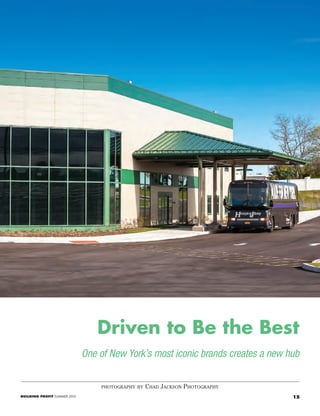
Driven to Be the Best
One of New York’s most iconic brands creates a new hub
photography by ChaD JaCkson photography
16 BUILDING PROFIT SUMMER 2015
The Hampton Jitney is known for luxury.
This unorthodox approach for a shuttle
company propelled the business to success.
The passenger experience feels more like
first-class air travel than a bus ride. On-board
hosts offer snacks and water, and talking on
your cellphone is strictly verboten.
The luxury motor coaches are custom-made
vehicles with special seats and unique
interiors that offer passengers additional
climate control options and a more
comfortable ride than a standard coach bus.
Driving expansion
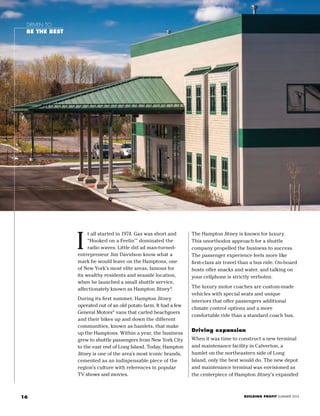
When it was time to construct a new terminal
and maintenance facility in Calverton, a
hamlet on the northeastern side of Long
Island, only the best would do. The new depot
and maintenance terminal was envisioned as
the centerpiece of Hampton Jitney’s expanded
t all started in 1974. Gas was short and
“Hooked on a Feelin’” dominated the
radio waves. Little did ad man-turned-
entrepreneur Jim Davidson know what a
mark he would leave on the Hamptons, one
of New York’s most elite areas, famous for
its wealthy residents and seaside location,
when he launched a small shuttle service,
affectionately known as Hampton Jitney®
.
During its first summer, Hampton Jitney
operated out of an old potato farm. It had a few
General Motors®
vans that carted beachgoers
and their bikes up and down the different
communities, known as hamlets, that make
up the Hamptons. Within a year, the business
grew to shuttle passengers from New York City
to the east end of Long Island. Today, Hampton
Jitney is one of the area’s most iconic brands,
cemented as an indispensable piece of the
region’s culture with references in popular
TV shows and movies.
I
DRIVEN TO
BE THE BEST
17BUILDING PROFIT SUMMER 2015
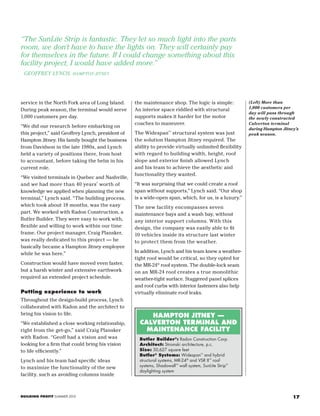
“The SunLite Strip is fantastic. They let so much light into the parts
room, we don’t have to have the lights on. They will certainly pay
for themselves in the future. If I could change something about this
facility project, I would have added more.”
GEOFFREY LYNCH, HAMPTON JITNEY
(Left) More than
1,000 customers per
day will pass through
the newly constructed
Calverton terminal
during Hampton Jitney’s
peak season.
service in the North Fork area of Long Island.
During peak season, the terminal would serve
1,000 customers per day.
“We did our research before embarking on
this project,” said Geoffrey Lynch, president of
Hampton Jitney. His family bought the business
from Davidson in the late 1980s, and Lynch
held a variety of positions there, from host
to accountant, before taking the helm in his
current role.
“We visited terminals in Quebec and Nashville,
and we had more than 40 years’ worth of
knowledge we applied when planning the new
terminal,” Lynch said. “The building process,
which took about 18 months, was the easy
part. We worked with Radon Construction, a
Butler Builder. They were easy to work with,
flexible and willing to work within our time
frame. Our project manager, Craig Plansker,
was really dedicated to this project — he
basically became a Hampton Jitney employee
while he was here.”
Construction would have moved even faster,
but a harsh winter and extensive earthwork
required an extended project schedule.
Putting experience to work
Throughout the design-build process, Lynch
collaborated with Radon and the architect to
bring his vision to life.
“We established a close working relationship,
right from the get-go,” said Craig Plansker
with Radon. “Geoff had a vision and was
looking for a firm that could bring his vision
to life efficiently.”
Lynch and his team had specific ideas
to maximize the functionality of the new
facility, such as avoiding columns inside
the maintenance shop. The logic is simple:
An interior space riddled with structural
supports makes it harder for the motor
coaches to maneuver.
The Widespan™
structural system was just
the solution Hampton Jitney required. The
ability to provide virtually unlimited flexibility
with regard to building width, height, roof
slope and exterior finish allowed Lynch
and his team to achieve the aesthetic and
functionality they wanted.
“It was surprising that we could create a roof
span without supports,” Lynch said. “Our shop
is a wide-open span, which, for us, is a luxury.”
The new facility encompasses seven
maintenance bays and a wash bay, without
any interior support columns. With this
design, the company was easily able to fit
10 vehicles inside its structure last winter
to protect them from the weather.
In addition, Lynch and his team knew a weather-
tight roof would be critical, so they opted for
the MR-24®
roof system. The double-lock seam
on an MR-24 roof creates a true monolithic
weather-tight surface. Staggered panel splices
and roof curbs with interior fasteners also help
virtually eliminate roof leaks.
HAMPTON JITNEY —
CALVERTON TERMINAL AND
MAINTENANCE FACILITY
Butler Builder®
: Radon Construction Corp.
Architect: Stromski architecture, p.c.
Size: 50,627 square feet
Butler®
Systems: Widespan™
and hybrid
structural systems, MR-24®
and VSR II™
roof
systems, Shadowall™
wall system, SunLite Strip™
daylighting system
18 BUILDING PROFIT SUMMER 2015
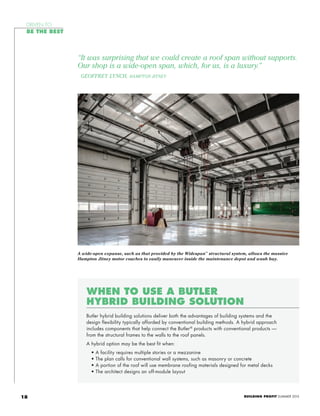
A wide-open expanse, such as that provided by the Widespan™
structural system, allows the massive
Hampton Jitney motor coaches to easily maneuver inside the maintenance depot and wash bay.
Butler hybrid building solutions deliver both the advantages of building systems and the
design flexibility typically afforded by conventional building methods. A hybrid approach
includes components that help connect the Butler®
products with conventional products —
from the structural frames to the walls to the roof panels.
A hybrid option may be the best fit when:
• A facility requires multiple stories or a mezzanine
• The plan calls for conventional wall systems, such as masonry or concrete
• A portion of the roof will use membrane roofing materials designed for metal decks
• The architect designs an off-module layout
WHEN TO USE A BUTLER
HYBRID BUILDING SOLUTION
DRIVEN TO
BE THE BEST
“It was surprising that we could create a roof span without supports.
Our shop is a wide-open span, which, for us, is a luxury.”
GEOFFREY LYNCH, HAMPTON JITNEY
19BUILDING PROFIT SUMMER 2015
BUILDING PROFIT®
SUMMER 2015
Vol. 36, No. 2
Editorial Director:
Leslie Clark
editorial@butlermfg.com
Building Profit®
, Butler Builder®
,
Butler®
, Butlerib®
and MR-24®
are registered trademarks
and SunLite Strip™
,
Butler Manufacturing™
,
Landmark™
, Shadowall™
,
TextureWall™
, ThermaLiner™
,
Thermawall™
, VSR II™
and
Widespan™
are trademarks
of BlueScope Buildings
North America, Inc.
The “f” logo is a registered
trademark of Facebook Inc.
The “IN” logo is a registered
trademark of LinkedIn
Corporation. The YouTube
logo is a registered trademark
of Google Inc.
All other trademarks are
the property of their
respective owners.
Printed in U.S.A.
© 2015 BlueScope Buildings
North America, Inc.
All rights reserved.
Butler Manufacturing™
is a division of BlueScope
Buildings North America, Inc.
P.O. Box 419917, Kansas City,
MO 64141-6917.
May be reprinted by
permission only.
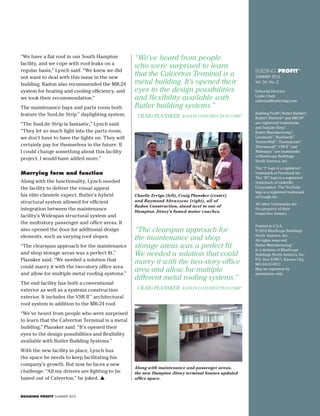
Along with maintenance and passenger areas,
the new Hampton Jitney terminal houses updated
office space.
Charlie Errigo (left), Craig Plansker (center)
and Raymond Abruzzese (right), all of
Radon Construction, stand next to one of
Hampton Jitney’s famed motor coaches.
“We’ve heard from people
who were surprised to learn
that the Calverton Terminal is a
metal building. It’s opened their
eyes to the design possibilities
and flexibility available with
Butler building systems.”
CRAIG PLANSKER, RADON CONSTRUCTION CORP.
“The clearspan approach for
the maintenance and shop
storage areas was a perfect fit.
We needed a solution that could
marry it with the two-story office
area and allow for multiple
different metal roofing systems.”
CRAIG PLANSKER, RADON CONSTRUCTION CORP.
“We have a flat roof in our South Hampton
facility, and we cope with roof leaks on a
regular basis,” Lynch said. “We knew we did
not want to deal with this issue in the new
building. Radon also recommended the MR-24
system for heating and cooling efficiency, and
we took their recommendation.”
The maintenance bays and parts room both
feature the SunLite Strip™
daylighting system.
“The SunLite Strip is fantastic,” Lynch said.
“They let so much light into the parts room,
we don’t have to have the lights on. They will
certainly pay for themselves in the future. If
I could change something about this facility
project, I would have added more.”
Marrying form and function
Along with the functionality, Lynch needed
the facility to deliver the visual appeal
his elite clientele expect. Butler’s hybrid
structural system allowed for efficient
integration between the maintenance
facility’s Widespan structural system and
the multistory passenger and office areas. It
also opened the door for additional design
elements, such as varying roof slopes.
“The clearspan approach for the maintenance
and shop storage areas was a perfect fit,”
Plansker said. “We needed a solution that
could marry it with the two-story office area
and allow for multiple metal roofing systems.”
The end facility has both a conventional
exterior as well as a systems construction
exterior. It includes the VSR II™
architectural
roof system in addition to the MR-24 roof.
“We’ve heard from people who were surprised
to learn that the Calverton Terminal is a metal
building,” Plansker said. “It’s opened their
eyes to the design possibilities and flexibility
available with Butler Building Systems.”
With the new facility in place, Lynch has
the space he needs to keep facilitating his
company’s growth. But now he faces a new
challenge: “All my drivers are fighting to be
based out of Calverton,” he joked. 
BUILDING PROFIT SUMMER 2015
READ
MORE ABOUT
HAMPTON
JITNEY
—
CALVERTON
TERMINAL
ON
PAGE 15.
DRIVEN TO
BE THE BEST
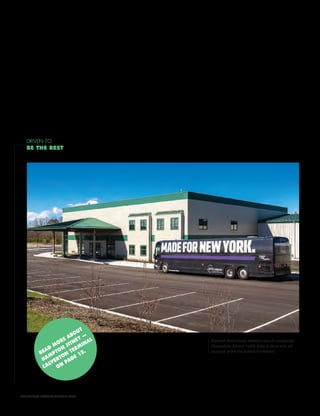
Famed first-class motor coach company
Hampton Jitney rolls into a new era of
luxury with its latest terminal.

Hampton Jitney Terminal - Butler Manufacturing

  • 1.
    15BUILDING PROFIT SUMMER2015 Driven to Be the Best One of New York’s most iconic brands creates a new hub photography by ChaD JaCkson photography
  • 2.
    16 BUILDING PROFITSUMMER 2015 The Hampton Jitney is known for luxury. This unorthodox approach for a shuttle company propelled the business to success. The passenger experience feels more like first-class air travel than a bus ride. On-board hosts offer snacks and water, and talking on your cellphone is strictly verboten. The luxury motor coaches are custom-made vehicles with special seats and unique interiors that offer passengers additional climate control options and a more comfortable ride than a standard coach bus. Driving expansion When it was time to construct a new terminal and maintenance facility in Calverton, a hamlet on the northeastern side of Long Island, only the best would do. The new depot and maintenance terminal was envisioned as the centerpiece of Hampton Jitney’s expanded t all started in 1974. Gas was short and “Hooked on a Feelin’” dominated the radio waves. Little did ad man-turned- entrepreneur Jim Davidson know what a mark he would leave on the Hamptons, one of New York’s most elite areas, famous for its wealthy residents and seaside location, when he launched a small shuttle service, affectionately known as Hampton Jitney® . During its first summer, Hampton Jitney operated out of an old potato farm. It had a few General Motors® vans that carted beachgoers and their bikes up and down the different communities, known as hamlets, that make up the Hamptons. Within a year, the business grew to shuttle passengers from New York City to the east end of Long Island. Today, Hampton Jitney is one of the area’s most iconic brands, cemented as an indispensable piece of the region’s culture with references in popular TV shows and movies. I DRIVEN TO BE THE BEST
  • 3.
    17BUILDING PROFIT SUMMER2015 “The SunLite Strip is fantastic. They let so much light into the parts room, we don’t have to have the lights on. They will certainly pay for themselves in the future. If I could change something about this facility project, I would have added more.” GEOFFREY LYNCH, HAMPTON JITNEY (Left) More than 1,000 customers per day will pass through the newly constructed Calverton terminal during Hampton Jitney’s peak season. service in the North Fork area of Long Island. During peak season, the terminal would serve 1,000 customers per day. “We did our research before embarking on this project,” said Geoffrey Lynch, president of Hampton Jitney. His family bought the business from Davidson in the late 1980s, and Lynch held a variety of positions there, from host to accountant, before taking the helm in his current role. “We visited terminals in Quebec and Nashville, and we had more than 40 years’ worth of knowledge we applied when planning the new terminal,” Lynch said. “The building process, which took about 18 months, was the easy part. We worked with Radon Construction, a Butler Builder. They were easy to work with, flexible and willing to work within our time frame. Our project manager, Craig Plansker, was really dedicated to this project — he basically became a Hampton Jitney employee while he was here.” Construction would have moved even faster, but a harsh winter and extensive earthwork required an extended project schedule. Putting experience to work Throughout the design-build process, Lynch collaborated with Radon and the architect to bring his vision to life. “We established a close working relationship, right from the get-go,” said Craig Plansker with Radon. “Geoff had a vision and was looking for a firm that could bring his vision to life efficiently.” Lynch and his team had specific ideas to maximize the functionality of the new facility, such as avoiding columns inside the maintenance shop. The logic is simple: An interior space riddled with structural supports makes it harder for the motor coaches to maneuver. The Widespan™ structural system was just the solution Hampton Jitney required. The ability to provide virtually unlimited flexibility with regard to building width, height, roof slope and exterior finish allowed Lynch and his team to achieve the aesthetic and functionality they wanted. “It was surprising that we could create a roof span without supports,” Lynch said. “Our shop is a wide-open span, which, for us, is a luxury.” The new facility encompasses seven maintenance bays and a wash bay, without any interior support columns. With this design, the company was easily able to fit 10 vehicles inside its structure last winter to protect them from the weather. In addition, Lynch and his team knew a weather- tight roof would be critical, so they opted for the MR-24® roof system. The double-lock seam on an MR-24 roof creates a true monolithic weather-tight surface. Staggered panel splices and roof curbs with interior fasteners also help virtually eliminate roof leaks. HAMPTON JITNEY — CALVERTON TERMINAL AND MAINTENANCE FACILITY Butler Builder® : Radon Construction Corp. Architect: Stromski architecture, p.c. Size: 50,627 square feet Butler® Systems: Widespan™ and hybrid structural systems, MR-24® and VSR II™ roof systems, Shadowall™ wall system, SunLite Strip™ daylighting system
  • 4.
    18 BUILDING PROFITSUMMER 2015 A wide-open expanse, such as that provided by the Widespan™ structural system, allows the massive Hampton Jitney motor coaches to easily maneuver inside the maintenance depot and wash bay. Butler hybrid building solutions deliver both the advantages of building systems and the design flexibility typically afforded by conventional building methods. A hybrid approach includes components that help connect the Butler® products with conventional products — from the structural frames to the walls to the roof panels. A hybrid option may be the best fit when: • A facility requires multiple stories or a mezzanine • The plan calls for conventional wall systems, such as masonry or concrete • A portion of the roof will use membrane roofing materials designed for metal decks • The architect designs an off-module layout WHEN TO USE A BUTLER HYBRID BUILDING SOLUTION DRIVEN TO BE THE BEST “It was surprising that we could create a roof span without supports. Our shop is a wide-open span, which, for us, is a luxury.” GEOFFREY LYNCH, HAMPTON JITNEY
  • 5.
    19BUILDING PROFIT SUMMER2015 BUILDING PROFIT® SUMMER 2015 Vol. 36, No. 2 Editorial Director: Leslie Clark editorial@butlermfg.com Building Profit® , Butler Builder® , Butler® , Butlerib® and MR-24® are registered trademarks and SunLite Strip™ , Butler Manufacturing™ , Landmark™ , Shadowall™ , TextureWall™ , ThermaLiner™ , Thermawall™ , VSR II™ and Widespan™ are trademarks of BlueScope Buildings North America, Inc. The “f” logo is a registered trademark of Facebook Inc. The “IN” logo is a registered trademark of LinkedIn Corporation. The YouTube logo is a registered trademark of Google Inc. All other trademarks are the property of their respective owners. Printed in U.S.A. © 2015 BlueScope Buildings North America, Inc. All rights reserved. Butler Manufacturing™ is a division of BlueScope Buildings North America, Inc. P.O. Box 419917, Kansas City, MO 64141-6917. May be reprinted by permission only. Along with maintenance and passenger areas, the new Hampton Jitney terminal houses updated office space. Charlie Errigo (left), Craig Plansker (center) and Raymond Abruzzese (right), all of Radon Construction, stand next to one of Hampton Jitney’s famed motor coaches. “We’ve heard from people who were surprised to learn that the Calverton Terminal is a metal building. It’s opened their eyes to the design possibilities and flexibility available with Butler building systems.” CRAIG PLANSKER, RADON CONSTRUCTION CORP. “The clearspan approach for the maintenance and shop storage areas was a perfect fit. We needed a solution that could marry it with the two-story office area and allow for multiple different metal roofing systems.” CRAIG PLANSKER, RADON CONSTRUCTION CORP. “We have a flat roof in our South Hampton facility, and we cope with roof leaks on a regular basis,” Lynch said. “We knew we did not want to deal with this issue in the new building. Radon also recommended the MR-24 system for heating and cooling efficiency, and we took their recommendation.” The maintenance bays and parts room both feature the SunLite Strip™ daylighting system. “The SunLite Strip is fantastic,” Lynch said. “They let so much light into the parts room, we don’t have to have the lights on. They will certainly pay for themselves in the future. If I could change something about this facility project, I would have added more.” Marrying form and function Along with the functionality, Lynch needed the facility to deliver the visual appeal his elite clientele expect. Butler’s hybrid structural system allowed for efficient integration between the maintenance facility’s Widespan structural system and the multistory passenger and office areas. It also opened the door for additional design elements, such as varying roof slopes. “The clearspan approach for the maintenance and shop storage areas was a perfect fit,” Plansker said. “We needed a solution that could marry it with the two-story office area and allow for multiple metal roofing systems.” The end facility has both a conventional exterior as well as a systems construction exterior. It includes the VSR II™ architectural roof system in addition to the MR-24 roof. “We’ve heard from people who were surprised to learn that the Calverton Terminal is a metal building,” Plansker said. “It’s opened their eyes to the design possibilities and flexibility available with Butler Building Systems.” With the new facility in place, Lynch has the space he needs to keep facilitating his company’s growth. But now he faces a new challenge: “All my drivers are fighting to be based out of Calverton,” he joked. 
  • 6.
    BUILDING PROFIT SUMMER2015 READ MORE ABOUT HAMPTON JITNEY — CALVERTON TERMINAL ON PAGE 15. DRIVEN TO BE THE BEST Famed first-class motor coach company Hampton Jitney rolls into a new era of luxury with its latest terminal.