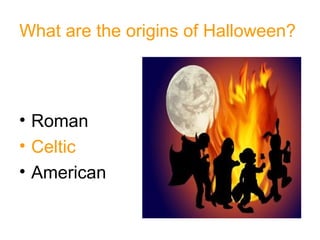
What are the origins of Halloween?   Roman  Celtic American
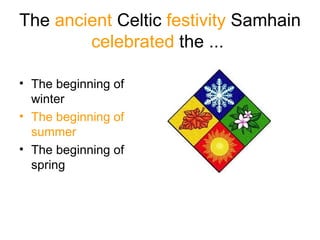
The  ancient  Celtic  festivity  Samhain  celebrated  the ...  The beginning of winter The beginning of summer The beginning of spring
The  Celts  believed  that  ghosts , witches  and   evil  spirits  returned  on the  night  of  October  31st What did they wear to send them away? Funny costumes Frightening costumes Nothing
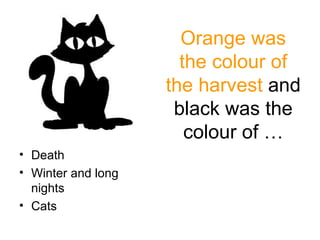
Orange was the colour of the harvest  and black was the colour of … Death Winter and long nights Cats
During  the centuries, the Roman Catholic Church put Christian festivities in the place of pre – Christian festivities.  In the … century  the Church decided to call 1st of November All Saints’ Day. Another name for this day was All Hallows’ Day. An the  evening of … of October  was All Hallows’ Eve. This became Halloween.
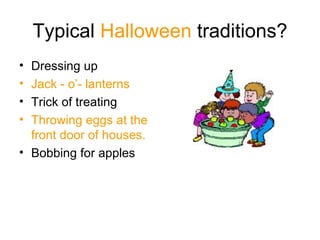
Typical  Halloween  traditions? Dressing up Jack - o’- lanterns Trick of treating Throwing eggs at the front door of houses. Bobbing for apples
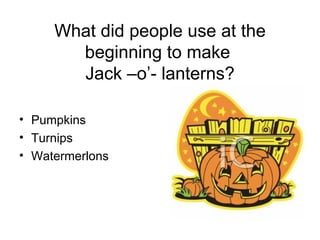
What did people use at the beginning to make  Jack –o’- lanterns? Pumpkins  Turnips Watermerlons
Jack –o’ –lantern myth An old Irish folk tale tells of  Stingy Jack , a lazy yet shrewd farmer who uses a  cross  to trap the  Devil . One story says that Jack tricked the Devil into climbing an apple tree, and once he was up there Jack quickly placed crosses around the trunk or carved a cross into the bark, so that the Devil couldn't get down. Another myth says that Jack put a key in the Devil's pocket while he was suspended upside-down.
Another version of the myth says that Jack was getting chased by some villagers from whom he had stolen, when he met the Devil, who claimed it was time for him to die. However, the thief stalled his death by tempting the Devil with a chance to bedevil the church-going villagers chasing him. Jack told the Devil to turn into a coin with which he would pay for the stolen goods (the Devil could take on any shape he wanted); later, when the coin/Devil disappeared, the Christian villagers would fight over who had stolen it. The Devil agreed to this plan. He turned himself into a silver coin and jumped into Jack's wallet, only to find himself next to a cross Jack had also picked up in the village. Jack had closed the wallet tight, and the cross stripped the Devil of his powers; and so he was trapped. In both myths, Jack only lets the Devil go when he agrees never to take his soul. After a while the thief died, as all living things do. Of course, his life had been too sinful for Jack to go to heaven; however, the Devil had promised not to take his soul, and so he was barred from hell as well. Jack now had nowhere to go. He asked how he would see where to go, as he had no light, and the Devil mockingly tossed him an ember that would never burn out from the flames of hell. Jack carved out one of his turnips (which was his favourite food), put the ember inside it, and began endlessly wandering the Earth for a resting place. He became known as "Jack of the Lantern", or Jack-o'-Lantern.

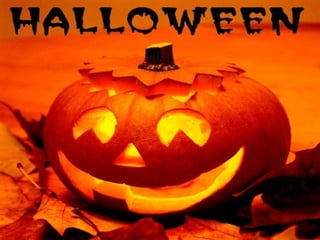
Halloween

  • 1.
  • 2.
    What are theorigins of Halloween? Roman Celtic American
  • 3.
    The ancient Celtic festivity Samhain celebrated the ... The beginning of winter The beginning of summer The beginning of spring
  • 4.
    The Celts believed that ghosts , witches and evil spirits returned on the night of October 31st What did they wear to send them away? Funny costumes Frightening costumes Nothing
  • 5.
    Orange was thecolour of the harvest and black was the colour of … Death Winter and long nights Cats
  • 6.
    During thecenturies, the Roman Catholic Church put Christian festivities in the place of pre – Christian festivities. In the … century the Church decided to call 1st of November All Saints’ Day. Another name for this day was All Hallows’ Day. An the evening of … of October was All Hallows’ Eve. This became Halloween.
  • 7.
    Typical Halloween traditions? Dressing up Jack - o’- lanterns Trick of treating Throwing eggs at the front door of houses. Bobbing for apples
  • 8.
    What did peopleuse at the beginning to make Jack –o’- lanterns? Pumpkins Turnips Watermerlons
  • 9.
    Jack –o’ –lanternmyth An old Irish folk tale tells of Stingy Jack , a lazy yet shrewd farmer who uses a cross to trap the Devil . One story says that Jack tricked the Devil into climbing an apple tree, and once he was up there Jack quickly placed crosses around the trunk or carved a cross into the bark, so that the Devil couldn't get down. Another myth says that Jack put a key in the Devil's pocket while he was suspended upside-down.
  • 10.
    Another version ofthe myth says that Jack was getting chased by some villagers from whom he had stolen, when he met the Devil, who claimed it was time for him to die. However, the thief stalled his death by tempting the Devil with a chance to bedevil the church-going villagers chasing him. Jack told the Devil to turn into a coin with which he would pay for the stolen goods (the Devil could take on any shape he wanted); later, when the coin/Devil disappeared, the Christian villagers would fight over who had stolen it. The Devil agreed to this plan. He turned himself into a silver coin and jumped into Jack's wallet, only to find himself next to a cross Jack had also picked up in the village. Jack had closed the wallet tight, and the cross stripped the Devil of his powers; and so he was trapped. In both myths, Jack only lets the Devil go when he agrees never to take his soul. After a while the thief died, as all living things do. Of course, his life had been too sinful for Jack to go to heaven; however, the Devil had promised not to take his soul, and so he was barred from hell as well. Jack now had nowhere to go. He asked how he would see where to go, as he had no light, and the Devil mockingly tossed him an ember that would never burn out from the flames of hell. Jack carved out one of his turnips (which was his favourite food), put the ember inside it, and began endlessly wandering the Earth for a resting place. He became known as "Jack of the Lantern", or Jack-o'-Lantern.