Insurance Claims for HailInsurance Claims for Hail
on Slate Roofson Slate Roofs
 Hail Damage can show itself in a number of ways. You
will not always see the “bullet holes”, on the left. Many
times it is edge breaks and cracks such as in the right
photo. The key is to find fresh breaks identified by the
lack of aging and dirt on the slate underneath as shown
in both photos below.
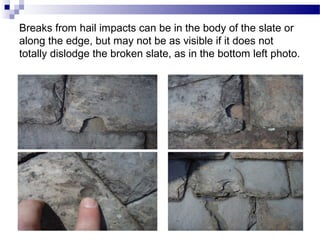
Breaks from hail impacts can be in the body of the slate or
along the edge, but may not be as visible if it does not
totally dislodge the broken slate, as in the bottom left photo.
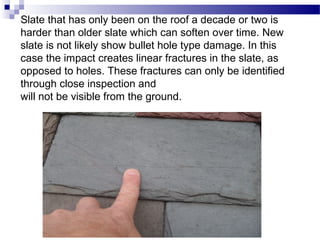
Slate that has only been on the roof a decade or two is
harder than older slate which can soften over time. New
slate is not likely show bullet hole type damage. In this
case the impact creates linear fractures in the slate, as
opposed to holes. These fractures can only be identified
through close inspection and
will not be visible from the ground.
A slate roof can have thousands of these fractured slates and beA slate roof can have thousands of these fractured slates and be
a total loss even tough the roof appears normal from the ground.a total loss even tough the roof appears normal from the ground.
In many cases this damage is overlooked. However, during theIn many cases this damage is overlooked. However, during the
first large wind event or heavy freeze combined with somefirst large wind event or heavy freeze combined with some
moisture, the roof will shed the broken slate in large numbers. Itmoisture, the roof will shed the broken slate in large numbers. It
is important to understand that these fractures will hold moistureis important to understand that these fractures will hold moisture
and expand in freezing temperatures. Slate is the longest lastingand expand in freezing temperatures. Slate is the longest lasting
roofing product because it is highly resistant to moistureroofing product because it is highly resistant to moisture
absorption. However, once moisture is allowed to penetrate theabsorption. However, once moisture is allowed to penetrate the
surface though a crack and freeze, slate is extremely susceptiblesurface though a crack and freeze, slate is extremely susceptible
to breakage because it has zero elasticity. As the moistureto breakage because it has zero elasticity. As the moisture
freezes and expands, it simply continues to break the slate.freezes and expands, it simply continues to break the slate.
There are only two ways to repair a broken slate. The first is using a
fastener called a slate hook, which is most common but is visible from
the ground. The second is called using a “bib” where the slate is drilled
and nailed down and then a copper sheet is placed over the nail holes.
This method is less visible from the ground but takes more time and
effort. In the case of slate hooks, it is considered acceptable to use two
or three in a square, but anything above that number or close to a
valley or drip edge should be avoided. Slate hooks will catch and cause
debris to collect on the roof and is difficult to remove once it is caught in
the hook. See diagrams below.
A roof that looks normal from the ground immediately following a large hail
storm can look totally different after one winter cycle or a wind event dislodges
the broken slate and causes shedding.
The roof below was a total loss. After the hail storm, there was no visible
damage from the window view (right photo). However one year later, thousands
or slates were falling off (left photo). The roof was totally replaced about two
years after the storm.
Immediately after the storm One year after the storm
Replacement vs. Repairs
By slate industry standards, anything over 8% to 10%
damaged is not considered repairable. The most common
size slate on residential construction is 16” or 18” long slate,
but it can go down to 12” length in some areas. So for
instance, on a 50 square roof with 16x10 slate, there are
approximately 13,320 slates. If more that 10% or 1300 slates
are broken, it is not feasible to attempt repair unless the
damage is concentrated in a certain area. In some storms,
only one side of the house might sustain damage. So it may
be appropriate to replace one side of the house and repair the
other. In this case it is important to select the right slate to
match the existing size and color.
Issues for Claims- Every job has to
be negotiated
 Standard Form in Xactimate- Labor rate per SQ does not
properly recognize differences in installation
 1. Standard Pattern vs Graduated or Staggered
 2. Ridge and Valley Details- Open vs Closed Weaved
 3. Multicolor Blend vs. Single Color
 4. Job Difficulty- Roof access extremely important with
slate, # Valleys,
 Color- Purple, Red can be twice the cost of other colors.
Know the color before you quote the job.
 Identify the slate size (lengthsIdentify the slate size (lengths
and widths), exposure and styleand widths), exposure and style
of installation. The standardof installation. The standard
installation on the right is lessinstallation on the right is less
expensive to repair or replaceexpensive to repair or replace
than the staggered installationthan the staggered installation
at bottom right and the heavyat bottom right and the heavy
thickness staggered on thethickness staggered on the
bottom left.bottom left.
 FOR COLOR SELECTION-FOR COLOR SELECTION-
send photos to Vermont Slatesend photos to Vermont Slate
Co. for ID and proper match.Co. for ID and proper match.
 Slate Colors- What’s the difference?
Every customer has different
expectations. When they spend the
money for slate we want to make sure
it is right the first time. Mistakes are
expensive.
Knowing the colors and where they
are is a huge asset in giving the
customer what they want.
 DOMESTIC SLATE NAMES- Unfading Green, Unfading
Dark Green, Semi Weathering Gray/Green, Sea Green,
Unfading Mottled Gray/Green, Unfading Mottled Green
and Purple, SW Mottled Purple, Variegated Purple,
Unfading Purple, SW Purple, Royal Purple, Vermont
Black, Unfading Black, Vermont Clear Black, Mottled
Gray/Black, Vermont Gray/Black, Strata Gray, Unfading
Gray, SW Gray, Clear Gray, Non weathering Red
 Import Colors- North Country Black, Georgetown Gray,
Dover Black, Unfading Gray/Black, Montauk Black,
Plumb, Rustic Multi Color, Aspen, African Gold Augusta
Green, Dublin Green
 HOW DO YOU KNOW WHAT YOUR GETTING?
Range of Colors
 There are an unending number of colors
and qualities of slate, mainly dependant
on the region of formation. Color and
weathering characteristics are a function
of microscopic layers of minerals found
between the layers of sediment. The
Mountain Wash Theory. Every hole in the
ground offers something a little different.
Non-weathering Black
Very common in the Northeast
Vermont Black
Vermont Weathering Black
also called Clear Black
Vermont Black and
Gray/Black is considered
semi-weathering
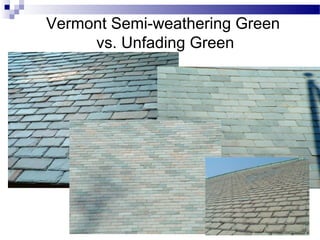
Vermont Semi-weathering Green
vs. Unfading Green
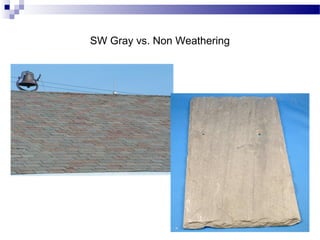
SW Gray vs. Non Weathering
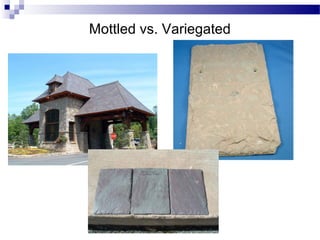
Mottled vs. Variegated
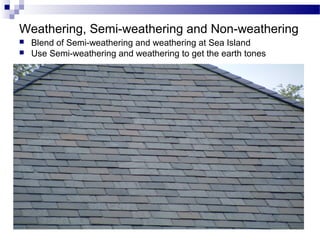
Weathering, Semi-weathering and Non-weathering
 Blend of Semi-weathering and weathering at Sea Island
 Use Semi-weathering and weathering to get the earth tones
Vermont Blends
Peach Bottom vs. Buckingham
Domestic producers range from large to vary small
Slate in the 21st
Century
 Vermont slate constitutes about 67% of slate installed in US today.
 The depletion of Unfading Black stone of available from
Pennsylvania and Maine (such as Bangor, Peach Bottom and
Monson slate) has created a need for non-fading and non-
weathering black from other countries to replace and repair dark
gray and black slate prominent in the Northeastern US.
 Spain, the largest producer of roofing slate (80% of all roofing slate
produced world wide), and offers very high quality (S-1 grade) non-
weathering, non-fading gray and black.
 China and Brazil have huge reserves of all the main colors but
quality varies a great deal. While China and Brazilian slate are
acceptable and even desirable in certain climates like southern
California and Texas, it is not suitable for colder climates in the
northeast.
Quality of Imports vs. Domestics
 As with domestic slate production, both good
and bad slate can be sourced abroad. Vermont
produces S-1 and S-2 grade slate and PA Black
is mainly S-2 while the old Peach Bottom was
probably one of the best S-1 UFD Blacks ever.
The same is true for all of the foreign producers.
 Both S-1 and S-2 Grade slate is allowed for
roofing. ASTM Tests for slate have been under
fire for years and remains in controversy.
However testing is important as a bench march
for imports. Water Absorption, Weather (Acid
Resistance), Modulus of Rupture
 Understanding the difference between Good
Slate and Bad.
 Iron and unstable Pyrite is the main defect found
in imported and domestic slate.
 Only accept S-1 Grade slate and ask for the test
data.
 Spanish Dover on Milwaukee City Hall- Domestic
Unfading Black Unavailable to meet time schedule
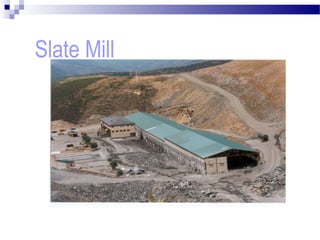
Slate Mill
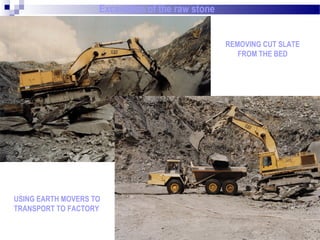
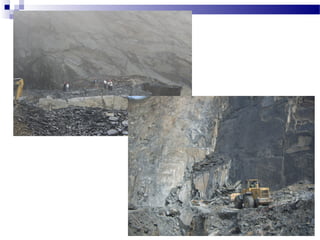
Excavation of the raw stone
REMOVING CUT SLATE
FROM THE BED
USING EARTH MOVERS TO
TRANSPORT TO FACTORY
Splitting Shed
Production Line
Blocks are distributed to the splitters
The slate is package and loaded for shipment
Vermont Slate Co. Contact Info
 Information on colors and styles can be
found on the Web Site
www.vermontslateco.com
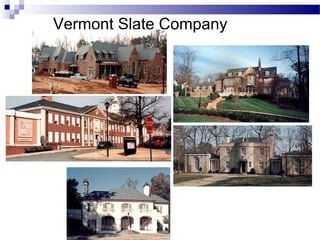
Vermont Slate Company

Insurance Claims for Hail on Slate Roofs

  • 1.
    Insurance Claims forHailInsurance Claims for Hail on Slate Roofson Slate Roofs
  • 2.
     Hail Damagecan show itself in a number of ways. You will not always see the “bullet holes”, on the left. Many times it is edge breaks and cracks such as in the right photo. The key is to find fresh breaks identified by the lack of aging and dirt on the slate underneath as shown in both photos below.
  • 3.
    Breaks from hailimpacts can be in the body of the slate or along the edge, but may not be as visible if it does not totally dislodge the broken slate, as in the bottom left photo.
  • 4.
    Slate that hasonly been on the roof a decade or two is harder than older slate which can soften over time. New slate is not likely show bullet hole type damage. In this case the impact creates linear fractures in the slate, as opposed to holes. These fractures can only be identified through close inspection and will not be visible from the ground.
  • 5.
    A slate roofcan have thousands of these fractured slates and beA slate roof can have thousands of these fractured slates and be a total loss even tough the roof appears normal from the ground.a total loss even tough the roof appears normal from the ground. In many cases this damage is overlooked. However, during theIn many cases this damage is overlooked. However, during the first large wind event or heavy freeze combined with somefirst large wind event or heavy freeze combined with some moisture, the roof will shed the broken slate in large numbers. Itmoisture, the roof will shed the broken slate in large numbers. It is important to understand that these fractures will hold moistureis important to understand that these fractures will hold moisture and expand in freezing temperatures. Slate is the longest lastingand expand in freezing temperatures. Slate is the longest lasting roofing product because it is highly resistant to moistureroofing product because it is highly resistant to moisture absorption. However, once moisture is allowed to penetrate theabsorption. However, once moisture is allowed to penetrate the surface though a crack and freeze, slate is extremely susceptiblesurface though a crack and freeze, slate is extremely susceptible to breakage because it has zero elasticity. As the moistureto breakage because it has zero elasticity. As the moisture freezes and expands, it simply continues to break the slate.freezes and expands, it simply continues to break the slate.
  • 6.
    There are onlytwo ways to repair a broken slate. The first is using a fastener called a slate hook, which is most common but is visible from the ground. The second is called using a “bib” where the slate is drilled and nailed down and then a copper sheet is placed over the nail holes. This method is less visible from the ground but takes more time and effort. In the case of slate hooks, it is considered acceptable to use two or three in a square, but anything above that number or close to a valley or drip edge should be avoided. Slate hooks will catch and cause debris to collect on the roof and is difficult to remove once it is caught in the hook. See diagrams below.
  • 7.
    A roof thatlooks normal from the ground immediately following a large hail storm can look totally different after one winter cycle or a wind event dislodges the broken slate and causes shedding. The roof below was a total loss. After the hail storm, there was no visible damage from the window view (right photo). However one year later, thousands or slates were falling off (left photo). The roof was totally replaced about two years after the storm. Immediately after the storm One year after the storm
  • 8.
    Replacement vs. Repairs Byslate industry standards, anything over 8% to 10% damaged is not considered repairable. The most common size slate on residential construction is 16” or 18” long slate, but it can go down to 12” length in some areas. So for instance, on a 50 square roof with 16x10 slate, there are approximately 13,320 slates. If more that 10% or 1300 slates are broken, it is not feasible to attempt repair unless the damage is concentrated in a certain area. In some storms, only one side of the house might sustain damage. So it may be appropriate to replace one side of the house and repair the other. In this case it is important to select the right slate to match the existing size and color.
  • 9.
    Issues for Claims-Every job has to be negotiated  Standard Form in Xactimate- Labor rate per SQ does not properly recognize differences in installation  1. Standard Pattern vs Graduated or Staggered  2. Ridge and Valley Details- Open vs Closed Weaved  3. Multicolor Blend vs. Single Color  4. Job Difficulty- Roof access extremely important with slate, # Valleys,  Color- Purple, Red can be twice the cost of other colors. Know the color before you quote the job.
  • 10.
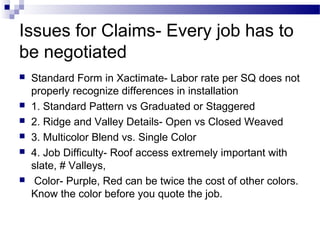
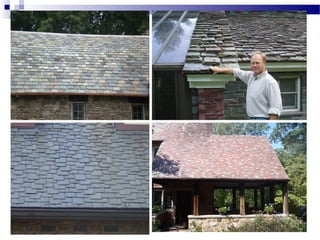
     Identify theslate size (lengthsIdentify the slate size (lengths and widths), exposure and styleand widths), exposure and style of installation. The standardof installation. The standard installation on the right is lessinstallation on the right is less expensive to repair or replaceexpensive to repair or replace than the staggered installationthan the staggered installation at bottom right and the heavyat bottom right and the heavy thickness staggered on thethickness staggered on the bottom left.bottom left.  FOR COLOR SELECTION-FOR COLOR SELECTION- send photos to Vermont Slatesend photos to Vermont Slate Co. for ID and proper match.Co. for ID and proper match.
  • 12.
     Slate Colors-What’s the difference? Every customer has different expectations. When they spend the money for slate we want to make sure it is right the first time. Mistakes are expensive. Knowing the colors and where they are is a huge asset in giving the customer what they want.
  • 14.
     DOMESTIC SLATENAMES- Unfading Green, Unfading Dark Green, Semi Weathering Gray/Green, Sea Green, Unfading Mottled Gray/Green, Unfading Mottled Green and Purple, SW Mottled Purple, Variegated Purple, Unfading Purple, SW Purple, Royal Purple, Vermont Black, Unfading Black, Vermont Clear Black, Mottled Gray/Black, Vermont Gray/Black, Strata Gray, Unfading Gray, SW Gray, Clear Gray, Non weathering Red  Import Colors- North Country Black, Georgetown Gray, Dover Black, Unfading Gray/Black, Montauk Black, Plumb, Rustic Multi Color, Aspen, African Gold Augusta Green, Dublin Green  HOW DO YOU KNOW WHAT YOUR GETTING?
  • 15.
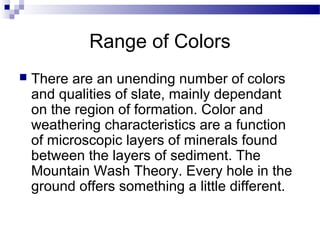
    Range of Colors There are an unending number of colors and qualities of slate, mainly dependant on the region of formation. Color and weathering characteristics are a function of microscopic layers of minerals found between the layers of sediment. The Mountain Wash Theory. Every hole in the ground offers something a little different.
  • 16.
  • 17.
    Vermont Black Vermont WeatheringBlack also called Clear Black Vermont Black and Gray/Black is considered semi-weathering
  • 18.
  • 19.
    SW Gray vs.Non Weathering
  • 20.
  • 21.
    Weathering, Semi-weathering andNon-weathering  Blend of Semi-weathering and weathering at Sea Island  Use Semi-weathering and weathering to get the earth tones
  • 22.
  • 23.
    Peach Bottom vs.Buckingham
  • 24.
    Domestic producers rangefrom large to vary small
  • 25.
    Slate in the21st Century  Vermont slate constitutes about 67% of slate installed in US today.  The depletion of Unfading Black stone of available from Pennsylvania and Maine (such as Bangor, Peach Bottom and Monson slate) has created a need for non-fading and non- weathering black from other countries to replace and repair dark gray and black slate prominent in the Northeastern US.  Spain, the largest producer of roofing slate (80% of all roofing slate produced world wide), and offers very high quality (S-1 grade) non- weathering, non-fading gray and black.  China and Brazil have huge reserves of all the main colors but quality varies a great deal. While China and Brazilian slate are acceptable and even desirable in certain climates like southern California and Texas, it is not suitable for colder climates in the northeast.
  • 26.
    Quality of Importsvs. Domestics  As with domestic slate production, both good and bad slate can be sourced abroad. Vermont produces S-1 and S-2 grade slate and PA Black is mainly S-2 while the old Peach Bottom was probably one of the best S-1 UFD Blacks ever. The same is true for all of the foreign producers.  Both S-1 and S-2 Grade slate is allowed for roofing. ASTM Tests for slate have been under fire for years and remains in controversy. However testing is important as a bench march for imports. Water Absorption, Weather (Acid Resistance), Modulus of Rupture
  • 27.
     Understanding thedifference between Good Slate and Bad.  Iron and unstable Pyrite is the main defect found in imported and domestic slate.  Only accept S-1 Grade slate and ask for the test data.
  • 28.
     Spanish Doveron Milwaukee City Hall- Domestic Unfading Black Unavailable to meet time schedule
  • 29.
  • 30.
    Excavation of theraw stone REMOVING CUT SLATE FROM THE BED USING EARTH MOVERS TO TRANSPORT TO FACTORY
  • 31.
    Splitting Shed Production Line Blocksare distributed to the splitters
  • 32.
    The slate ispackage and loaded for shipment
  • 34.
    Vermont Slate Co.Contact Info  Information on colors and styles can be found on the Web Site www.vermontslateco.com
  • 35.