This study analyzed burnout levels in social workers working in residential placements for at-risk children and youth. It found that the social workers experienced burnout in the dimensions of emotional exhaustion and personal achievement. The work climate was found to influence workers' motivation. Significant predictors of emotional exhaustion included perceived stressors like time pressures and role conflicts, as well as inadequate professional training. Depersonalization, the most complex burnout dimension, had various significant predictors including age, sex, perceived stress sources, and coping styles. The results suggest attention should be paid to reducing stressors and improving training to help prevent burnout in these social workers.
![American Research Journal of Humanities & Social Science (ARJHSS)R) 2020
ARJHSS Journal www.arjhss.com Page | 65
The analysis of Beta values offers empirical support for the three-dimensional definition of burnout
proposed by Maslach and collaborators (Maslach,1999; Maslach & Jackson, 1986; Maslach, Jackson & Leiter,
1996; Maslach, Schaufeli & Leiter, 2001), since it reveals the existence of different predictors for each dimension of
burnout.
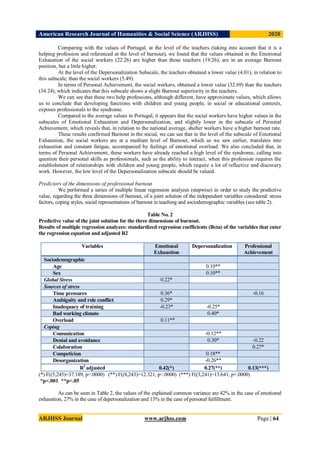
On the other hand, the Beta values also confirm the perspective of several authors (eg Greenglass, 2005)
who conceptualize emotional exhaustion as an orthodox response to stress, since the significant predictors of this
dimension of burnout are: perceived stressors - time pressures (0.36), ambiguity and role conflict (0.29) and
inadequate professional training (B = -0.23); the perceived global stress (B = 0.22); and the objective work overload
indicator (B = 0.11).
With regard to professional achievement, the beta values indicate as significant predictors: the perceived
stress factor - time pressures (B = -0.16); and collaboration coping patterns (B = 0.27) and denial and avoidance (-
0.22). These results highlight the role of coping styles as predictors of professional achievement, meeting the authors
who consider this dimension of burnout as closer to a dispositional variable (Schaufeli & Enzman, 1998).
Finally, the analysis of Beta values suggests that depersonalization is the most complex of the three
dimensions of burnout, having as significant predictors all types of variables considered: sociodemographic variables
- age (B = 0.10) and sex (B = 0.10); the sources of perceived stress - bad climate (B = 0.40) and inadequate
professional training (B = -0.25); the forms of coping by denial and avoidance (B = 0.30); by competition (B = 0.18)
and by disorganization (B = -0.26).
V. CONCLUSIONS
The results demonstrate that the social workers have burnout in subscales of emotional exhaustion and
personal achievement. We also verify that the work climate influences the motivation of workers in the
development of functions.
We confirm that the significant predictors of emotional exhaustion are: perceived stressors - time
pressures, ambiguity and role conflict and inadequate professional training; the perceived global stress; and the
objective work overload indicator. This study corroborates the importance of a multidimensional
conceptualization of burnout to identify different predictors for each of the three dimensions that combine this
syndrome.
The analysis suggests that depersonalization is the most complex of the three dimensions of burnout,
having as significant predictors all types of variables considered: sociodemographic variables - age and sex; the
sources of perceived stress - bad climate and inadequate professional training; the forms of coping by denial and
avoidance; by competition and by disorganization.
In view of the above, we consider it necessary to develop an attentive look at the social workers, who
in order to take good care of themselves, need safe structures and support from others who meet with them in
this context. Finally, we would like to emphasize the contribution of the results found to an understanding,
extended to the studied variables, of the impact of professional burnout on the workers' malaise. Thus, it seems
to us essential to include in the programs for the prevention / action of burnout, an intervention with the
workers, aimed at the promotion of intervention strategies at the level of the studied variables.
REFERENCES
[1]. Ferreira, H. P. (2018). Burnout e perceção da qualidade em serviços prestados por trabalhadores de
equipas educativas em instituições de acolhimento de crianças e jovens (Doctoral dissertation).
[2]. Freitas, D. M. (2018). Clima organizacional e qualidade de vida no trabalho: estudo de caso de uma
reitoria de um Instituto Federal de Ensino (Doctoral dissertation, Instituto Politécnico do Porto. Escola
Superior de Educação). Consultado a 2 de agosto de 2018. Disponível em:
http://hdl.handle.net/10400.22/12621
[3]. Gil Monte P. & Peiró, J. (1999). Perspectivas teóricas y modelos interpretativos para el estudio del
Síndrome de Quemarse por el trabalho. Anales de la Psicología, 15-2, 261-268.
[4]. Vandenberghe, Roland.Huberman, A. M. (1999). Understanding And Preventing Teacher Burnout: A
Sourcebook Of International Research And Practice
[5]. Kyriacou, C. (1987). Teacher Stress and Burnout: An International Review. Educational Research, 29,
146-152.
[6]. Maroco, J., & Tecedeiro, M., 2009 Maroco, J., & Tecedeiro, M. (2009). Inventário de Burnout de
Maslach para estudantes portugueses. Psicologia, Saúde & Doenças, 10(2), 227-235.
[7]. Marques Pinto, A., Lima, M. L., & Lopes da Silva (2008). Delimitação do conceito de burnout
[Defining burnout]. In A. Marques Pinto, & M. J. Chambel (Eds.). Burnout e engagement em contexto
organizacional. Estudos com amostras portuguesas [Burnout and engagement in organizational
settings: Studies with Portuguese samples]. (pp. 15-52). Lisboa: Livros Horizonte.](https://image.slidesharecdn.com/h396067-201027060741/85/H396067-6-320.jpg)
![American Research Journal of Humanities & Social Science (ARJHSS)R) 2020
ARJHSS Journal www.arjhss.com Page | 66
[8]. Matos, B., Aguiar, C., Martins, C., Gama, I., Pires, L., Dias, J., & Queirós, S. (2011). Acolhimento
Terapêutico: Pistas de Intervenção para Profissionais.
[9]. Marques-Pinto, A., & Picado, L. (2011). Adaptação e Bem-Estar nas Escolas Portuguesas: Dos Alunos
aos Professores. Lisboa: Coisas de Ler.
[10]. Martinez, I., Marques Pinto, A., & Lopes da Silva, A., (2001). Burnout em adolescentes do ensino
superior. Revista Portuguesa de Psicologia, 35, 151-167.
[11]. Maslach, C., & Jackson, S. E. (1986). Maslach burnout inventory manual (2nd ed.). Palo Alto, CA:
Consulting Psychologists Press.
[12]. Maslach, C. (1999). Progress in understanding teacher burnout. In R. Vandenberghe, & A. M.
Huberman (Eds.). Understanding and preventing teacher burnout. (pp. 211-222). Cambridge:
Cambridge University Press.
[13]. Maslach, C., & Jackson, S. E. & Leiter, M. P. (1996). Maslach Burnout Inventory Manual (3ºed). Palo
Alto, CA: Consulting Psychologists Press.
[14]. Maslach, C., & Leiter, M. P. (1997). The truth about burnout – How organizations cause personal
stress and what do about it. San Francisco: Jossey-Bass Inc.
[15]. Maslach, C.; Schaufeli, W.B. & Leiter, M. P. (2001). Job burnout. Annual Review Psychology, 52, 397-
422.
[16]. Maslach, C. (2005). Entendendo o Burnout. In A. M. Rossi, P. L. Perrewé, & S. L. Sauter (Eds.), Stress
e qualidade de vida no trabalho: perspectivas atuais da saúde ocupacional (pp. 122-148). São Paulo:
Atlas.
[17]. Picado L. (2007). Anseiedade. Burnout e Engagement (Doctoral dissertation, Universidade de Lisboa).
Disponível em: http://hdl.handle.net/10451/970
[18]. Pierce, C. M., & Molloy, G. N. (1990). Psychological and biographical differences between secondary
school teachers experiencing high and low levels of burnout. British Journal of Educational
Psychology, 60(1), 37–51.
[19]. Schaufeli, W. B., Leiter, M. P., & Maslach, C. (2009). Burnout: 35 years of research and practice. The
Career Development International, 14(3), 204–220.
[20]. Jackson, S. E., Schwab, R. L., & Schuler, R. S. (1986). Toward an understanding of the burnout
phenomenon. Journal of Applied Psychology, 71(4), 630–640.
[21]. Schaufeli, W.B., & Enzmann, D. (1998). The burnout companion to study and practice: A critical
analysis. Philadelphia: Taylor & Francis.
*Corresponding author: Beatriz Farinha
CI-ISCE – Centro de Investigação do ISCE – Instituto Superior de Lisboa e Vale do Tejo](https://image.slidesharecdn.com/h396067-201027060741/85/H396067-7-320.jpg)


