(MINE GAS H2S)
Salman Ihsan
(15PWMIN0747)
Dept: of Mining Engg:
UET Peshawar
Batch 15-19
Presentation
CONTENT
 Introduction of Hydrogen Sulphide gas (H2S)
 Properties of H2S
 Characteristics of H2S
 Sources of H2S
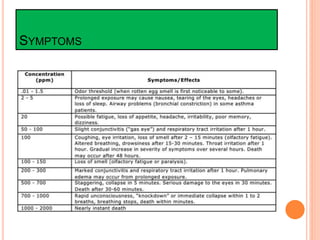
 Symptoms of H2S
 Detection of H2S
 Accidents happened due to H2S
INTRODUCTION
 H2S is naturally occurring chemical.
produced by bacteria as it decomposes
organic materials.
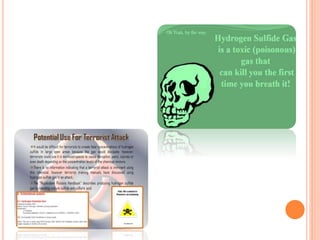
 Hydrogen sulfide is an extremely toxic. gas.
 It blocks the use of oxygen by the body’s cells.
 It is produced when sulfur compounds decompose.
 It is commonly associated with acid mine water.
 It is often referred to by miners as ‘stink damp’ due to its
pungent odour, resembling rotten eggs.
 Note:
It may develop in low oxygen environments such as
sewer, swamps and polluted water.
PROPERTIES
 Colorless
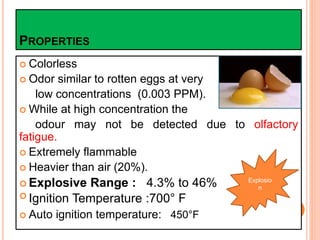
 Odor similar to rotten eggs at very
low concentrations (0.003 PPM).
 While at high concentration the
odour may not be detected due to olfactory
fatigue.
 Extremely flammable
 Heavier than air (20%).
 Explosive Range : 4.3% to 46%
 Ignition Temperature :700° F
 Auto ignition temperature: 450°F
Explosio
n
CHARACTERISTICS
 Hydrogen sulfide, H2S, (referred to as "stink damp" by miners) is a
colorless, highly toxic, and irritant gas which has an extremely
unpleasant, rotten egg odor at low concentrations and a sweetish
odor at higher concentrations.
 Since its specific gravity (1.19) is somewhat higher than that of air
(1.00), it tends to accumulate in deep cavities such as vats, tanks,
ditches, ravines, and cellars.
 Hydrogen sulfide forms explosive mixtures with air or oxygen and is
dangerously flammable upon ignition.
 Water at room temperature absorbs approximately three times its
own volume of the gas.
 It is also soluble in petroleum solvents, crude petroleum, and carbon
disulfide.
SOURCES
 Hydrogen Sulphide is produced when sulpfur compounds are
chemically reduced or decomposed.
 It is found in some oil and gas fields and also in gypsum mines.
 It may also released from methane feeders in mines with methane.
 Hydrogen sulphide is often created when acid mine water corrodes
the metallic sulphides.
 It can also be released from water that contains the gas or
sulphides in solution.
 Heating sulphides in the presence of moisture (as in mine fires)
may produced hydrogen sulphides gas.
 Blasting in sulphide ores can also create and release hydrogen
sulphide gas.
HEALTH HAZARDS OF H2S
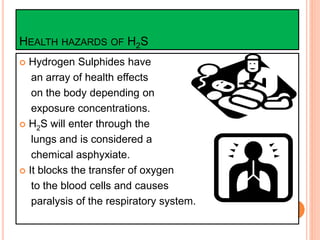
 Hydrogen Sulphides have
an array of health effects
on the body depending on
exposure concentrations.
 H2S will enter through the
lungs and is considered a
chemical asphyxiate.
 It blocks the transfer of oxygen
to the blood cells and causes
paralysis of the respiratory system.
EXPOSURE LIMITS
 PEL - A Permissible Exposure Limit (PEL) is the
maximum amount or concentration of a chemical that a
worker may be exposed to under OSHA regulations.
PEL: 10ppm for an 8-hr period average, 40hrs per
week without a respiratory problem.
 STEL - A Short-Term Exposure Limit (STEL) is the
acceptable average exposure over a short period of
time, usually 15 minutes as long as the time-weighted
average is not exceeded.
STEL: 15ppm for a 15min average.
 IDLH - immediately dangerous to life and health
(IDLH)
100ppm or above.
SYMPTOMS
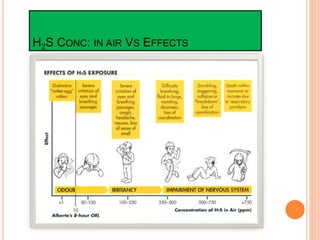
H2S CONC: IN AIR VS EFFECTS
PROTECTION AGAINST H2S EXPOSURE
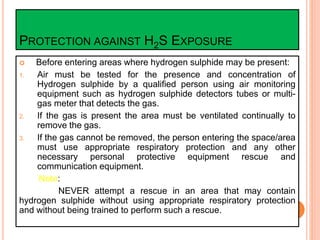
 Before entering areas where hydrogen sulphide may be present:
1. Air must be tested for the presence and concentration of
Hydrogen sulphide by a qualified person using air monitoring
equipment such as hydrogen sulphide detectors tubes or multi-
gas meter that detects the gas.
2. If the gas is present the area must be ventilated continually to
remove the gas.
3. If the gas cannot be removed, the person entering the space/area
must use appropriate respiratory protection and any other
necessary personal protective equipment rescue and
communication equipment.
Note:
NEVER attempt a rescue in an area that may contain
hydrogen sulphide without using appropriate respiratory protection
and without being trained to perform such a rescue.
DETECTION TEST
 H2S is easily detected by its smell at a very low
concentration 0.000075%.
 Another detection test for this gas is done by exposing a
filter paper soaked in lead acetate solution to an
atmosphere containing H2S gas.
 The filter paper turns brown and then black if the
concentration is very high.
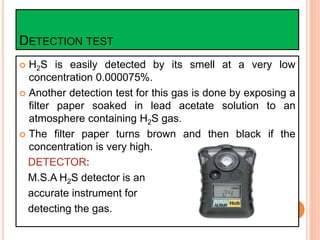
DETECTOR:
M.S.A H2S detector is an
accurate instrument for
detecting the gas.
ACCIDENTS HAPPENED DUE TO H2S
 Barnett Complex Mine, Rosiclare, Illinois in 1971
 Inspiration Consolidated Copper
Company, Inspiration, Arizona in 1971
 Bonnie Lake Mine, Bartow, Florida in 1975
 Sullivan Mine, British Columbia, Canada in 2006
BARNETT COMPLEX MINE, ROSICLARE, ILLINOIS IN
1971
 Seven men died Monday, April 12, 1971, as a result of exposure to
hydrogen sulfide gas in advance workings on the 800-foot level of the
Barnett Complex Mine, Ozark-Mahoning Company, Pope, County,
Illinois
 Drifting and test drilling operations to locate an ore vein were being
conducted at the extreme end of the 800-foot south level, on Friday,
April 9.
 Near the end of the day shift, the third of three test holes struck a
watercourse and water under high pressure was released into the drift.
 Work was discontinued in the area, and the water allowed to flow into
the drift on the belief the body of water would soon be drained.
 Reportedly, hydrogen sulfide was not liberated on Friday; the two
workers who were drilling did not smell the gas or suffer eye irritation.
 The presence of hydrogen sulfide gas was first detected during the day
shift on Saturday, when two miners, out of curiosity, went to the face to
look at the water flow.
CONT..
 The miners reported that the gas irritated their eyes and caused "tightness" in
their chests. At some time between the end of the second shift on Saturday and
Monday morning, one of three fans in the auxiliary ventilation system for the
800 south level failed.
 What ventilation existed at the south end of the 800-foot level thereafter is
unknown.
 On Monday, April 12, installation of a replacement fan was completed shortly
after noon.
 Before the fan was started, a miner went in by the fan to obtain measuring
sticks. He was seen by the men installing the fan, but testimony is not clear as
to his being aware of or warned of a potential danger. In about a half hour, the
miner's brother went into the area to look for him.
 When neither of the two men returned, other miners, without respiratory
protection, attempted rescue
 At this time the replacement fan was started. In the course of events, five
additional miners were overcome while several others, although repeatedly
entering the drift and being affected by the gas, did escape by cutting into the
ventilation tubing for fresh air. At approximately 1:30 p.m., the Company
officials notified the Illinois Department of Mines and Minerals of the accident.
QUESTIONS
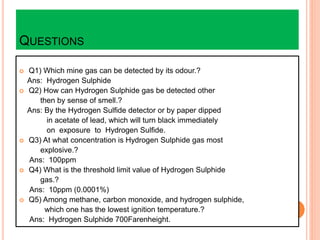
 Q1) Which mine gas can be detected by its odour.?
Ans: Hydrogen Sulphide
 Q2) How can Hydrogen Sulphide gas be detected other
then by sense of smell.?
Ans: By the Hydrogen Sulfide detector or by paper dipped
in acetate of lead, which will turn black immediately
on exposure to Hydrogen Sulfide.
 Q3) At what concentration is Hydrogen Sulphide gas most
explosive.?
Ans: 100ppm
 Q4) What is the threshold limit value of Hydrogen Sulphide
gas.?
Ans: 10ppm (0.0001%)
 Q5) Among methane, carbon monoxide, and hydrogen sulphide,
which one has the lowest ignition temperature.?
Ans: Hydrogen Sulphide 700Farenheight.
H2 s presentation

H2 s presentation

  • 1.
    (MINE GAS H2S) SalmanIhsan (15PWMIN0747) Dept: of Mining Engg: UET Peshawar Batch 15-19 Presentation
  • 2.
    CONTENT  Introduction ofHydrogen Sulphide gas (H2S)  Properties of H2S  Characteristics of H2S  Sources of H2S  Symptoms of H2S  Detection of H2S  Accidents happened due to H2S
  • 4.
    INTRODUCTION  H2S isnaturally occurring chemical. produced by bacteria as it decomposes organic materials.  Hydrogen sulfide is an extremely toxic. gas.  It blocks the use of oxygen by the body’s cells.  It is produced when sulfur compounds decompose.  It is commonly associated with acid mine water.  It is often referred to by miners as ‘stink damp’ due to its pungent odour, resembling rotten eggs.  Note: It may develop in low oxygen environments such as sewer, swamps and polluted water.
  • 5.
    PROPERTIES  Colorless  Odorsimilar to rotten eggs at very low concentrations (0.003 PPM).  While at high concentration the odour may not be detected due to olfactory fatigue.  Extremely flammable  Heavier than air (20%).  Explosive Range : 4.3% to 46%  Ignition Temperature :700° F  Auto ignition temperature: 450°F Explosio n
  • 6.
    CHARACTERISTICS  Hydrogen sulfide,H2S, (referred to as "stink damp" by miners) is a colorless, highly toxic, and irritant gas which has an extremely unpleasant, rotten egg odor at low concentrations and a sweetish odor at higher concentrations.  Since its specific gravity (1.19) is somewhat higher than that of air (1.00), it tends to accumulate in deep cavities such as vats, tanks, ditches, ravines, and cellars.  Hydrogen sulfide forms explosive mixtures with air or oxygen and is dangerously flammable upon ignition.  Water at room temperature absorbs approximately three times its own volume of the gas.  It is also soluble in petroleum solvents, crude petroleum, and carbon disulfide.
  • 7.
    SOURCES  Hydrogen Sulphideis produced when sulpfur compounds are chemically reduced or decomposed.  It is found in some oil and gas fields and also in gypsum mines.  It may also released from methane feeders in mines with methane.  Hydrogen sulphide is often created when acid mine water corrodes the metallic sulphides.  It can also be released from water that contains the gas or sulphides in solution.  Heating sulphides in the presence of moisture (as in mine fires) may produced hydrogen sulphides gas.  Blasting in sulphide ores can also create and release hydrogen sulphide gas.
  • 8.
    HEALTH HAZARDS OFH2S  Hydrogen Sulphides have an array of health effects on the body depending on exposure concentrations.  H2S will enter through the lungs and is considered a chemical asphyxiate.  It blocks the transfer of oxygen to the blood cells and causes paralysis of the respiratory system.
  • 9.
    EXPOSURE LIMITS  PEL- A Permissible Exposure Limit (PEL) is the maximum amount or concentration of a chemical that a worker may be exposed to under OSHA regulations. PEL: 10ppm for an 8-hr period average, 40hrs per week without a respiratory problem.  STEL - A Short-Term Exposure Limit (STEL) is the acceptable average exposure over a short period of time, usually 15 minutes as long as the time-weighted average is not exceeded. STEL: 15ppm for a 15min average.  IDLH - immediately dangerous to life and health (IDLH) 100ppm or above.
  • 10.
  • 11.
    H2S CONC: INAIR VS EFFECTS
  • 12.
    PROTECTION AGAINST H2SEXPOSURE  Before entering areas where hydrogen sulphide may be present: 1. Air must be tested for the presence and concentration of Hydrogen sulphide by a qualified person using air monitoring equipment such as hydrogen sulphide detectors tubes or multi- gas meter that detects the gas. 2. If the gas is present the area must be ventilated continually to remove the gas. 3. If the gas cannot be removed, the person entering the space/area must use appropriate respiratory protection and any other necessary personal protective equipment rescue and communication equipment. Note: NEVER attempt a rescue in an area that may contain hydrogen sulphide without using appropriate respiratory protection and without being trained to perform such a rescue.
  • 13.
    DETECTION TEST  H2Sis easily detected by its smell at a very low concentration 0.000075%.  Another detection test for this gas is done by exposing a filter paper soaked in lead acetate solution to an atmosphere containing H2S gas.  The filter paper turns brown and then black if the concentration is very high. DETECTOR: M.S.A H2S detector is an accurate instrument for detecting the gas.
  • 14.
    ACCIDENTS HAPPENED DUETO H2S  Barnett Complex Mine, Rosiclare, Illinois in 1971  Inspiration Consolidated Copper Company, Inspiration, Arizona in 1971  Bonnie Lake Mine, Bartow, Florida in 1975  Sullivan Mine, British Columbia, Canada in 2006
  • 15.
    BARNETT COMPLEX MINE,ROSICLARE, ILLINOIS IN 1971  Seven men died Monday, April 12, 1971, as a result of exposure to hydrogen sulfide gas in advance workings on the 800-foot level of the Barnett Complex Mine, Ozark-Mahoning Company, Pope, County, Illinois  Drifting and test drilling operations to locate an ore vein were being conducted at the extreme end of the 800-foot south level, on Friday, April 9.  Near the end of the day shift, the third of three test holes struck a watercourse and water under high pressure was released into the drift.  Work was discontinued in the area, and the water allowed to flow into the drift on the belief the body of water would soon be drained.  Reportedly, hydrogen sulfide was not liberated on Friday; the two workers who were drilling did not smell the gas or suffer eye irritation.  The presence of hydrogen sulfide gas was first detected during the day shift on Saturday, when two miners, out of curiosity, went to the face to look at the water flow.
  • 16.
    CONT..  The minersreported that the gas irritated their eyes and caused "tightness" in their chests. At some time between the end of the second shift on Saturday and Monday morning, one of three fans in the auxiliary ventilation system for the 800 south level failed.  What ventilation existed at the south end of the 800-foot level thereafter is unknown.  On Monday, April 12, installation of a replacement fan was completed shortly after noon.  Before the fan was started, a miner went in by the fan to obtain measuring sticks. He was seen by the men installing the fan, but testimony is not clear as to his being aware of or warned of a potential danger. In about a half hour, the miner's brother went into the area to look for him.  When neither of the two men returned, other miners, without respiratory protection, attempted rescue  At this time the replacement fan was started. In the course of events, five additional miners were overcome while several others, although repeatedly entering the drift and being affected by the gas, did escape by cutting into the ventilation tubing for fresh air. At approximately 1:30 p.m., the Company officials notified the Illinois Department of Mines and Minerals of the accident.
  • 18.
    QUESTIONS  Q1) Whichmine gas can be detected by its odour.? Ans: Hydrogen Sulphide  Q2) How can Hydrogen Sulphide gas be detected other then by sense of smell.? Ans: By the Hydrogen Sulfide detector or by paper dipped in acetate of lead, which will turn black immediately on exposure to Hydrogen Sulfide.  Q3) At what concentration is Hydrogen Sulphide gas most explosive.? Ans: 100ppm  Q4) What is the threshold limit value of Hydrogen Sulphide gas.? Ans: 10ppm (0.0001%)  Q5) Among methane, carbon monoxide, and hydrogen sulphide, which one has the lowest ignition temperature.? Ans: Hydrogen Sulphide 700Farenheight.