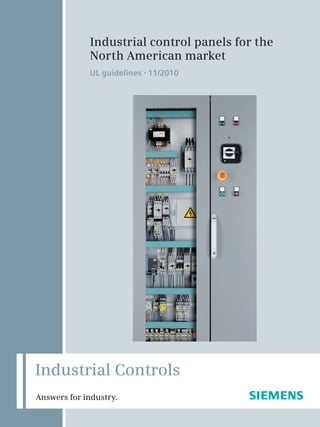
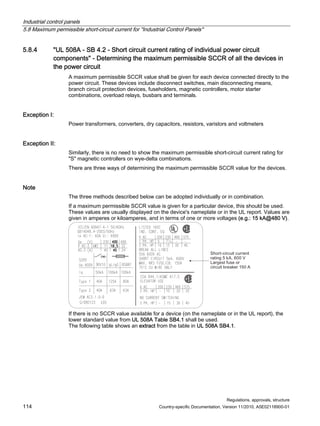
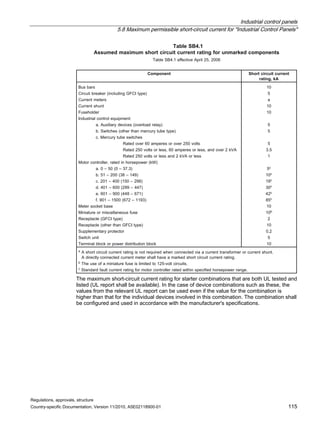
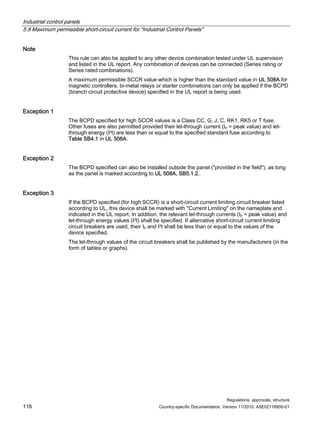
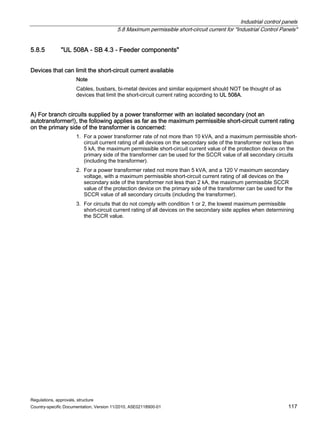
Industrial control panels for the
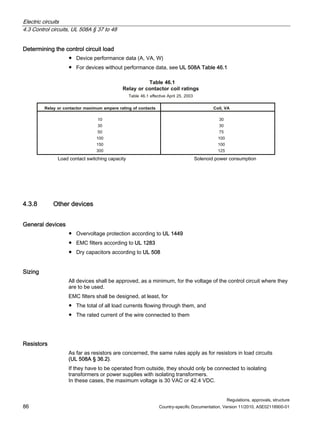
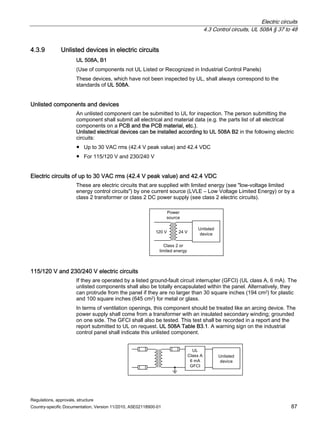
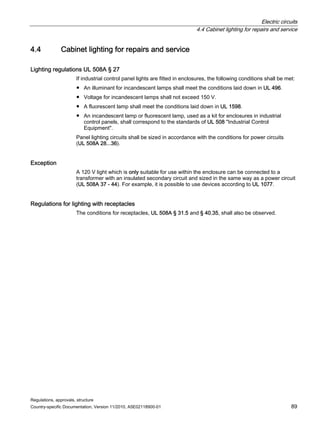
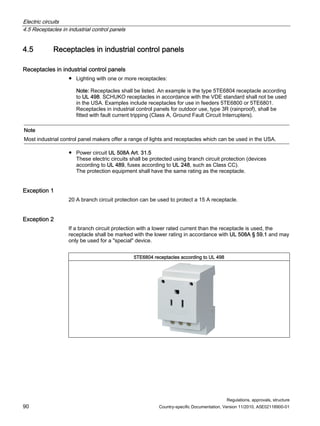
North American market
UL guidelines • 11/2010
Industrial Controls
Answers for industry.
Preface
Working with this
documentation 1
Regulations and guidelines
for the manufacture of
industrial control panels
2
What are industrial control
panels? 3
Electric circuits 4
Industrial control panels 5
Devices 6
Color coding 7
Annex A - Tables A
Annex B B
Industrial Control Panels for North
America
Regulations, approvals, structure
Country-specific Documentation
Version 11/2010
A5E02118900-01
Status V2.0
Legal information
Warning notice system
This manual contains notices you have to observe in order to ensure your personal safety, as well as to prevent
damage to property. The notices referring to your personal safety are highlighted in the manual by a safety alert
symbol, notices referring only to property damage have no safety alert symbol. These notices shown below are
graded according to the degree of danger.
DANGER
indicates that death or severe personal injury will result if proper precautions are not taken.
WARNING
indicates that death or severe personal injury may result if proper precautions are not taken.
CAUTION
with a safety alert symbol, indicates that minor personal injury can result if proper precautions are not taken.
CAUTION
without a safety alert symbol, indicates that property damage can result if proper precautions are not taken.
NOTICE
indicates that an unintended result or situation can occur if the corresponding information is not taken into
account.
If more than one degree of danger is present, the warning notice representing the highest degree of danger will
be used. A notice warning of injury to persons with a safety alert symbol may also include a warning relating to
property damage.
Qualified Personnel
According NEC:
One who has skills and knowledge related to the construction and operation of the electrical equipment and
installations and has received safety training to recognize and avoid the hazards involved.
Proper use of Siemens products
Note the following:
WARNING
Siemens products may only be used for the applications described in the catalog and in the relevant technical
documentation. If products and components from other manufacturers are used, these must be recommended
or approved by Siemens. Proper transport, storage, installation, assembly, commissioning, operation and
maintenance are required to ensure that the products operate safely and without any problems. The permissible
ambient conditions must be adhered to. The information in the relevant documentation must be observed.
Trademarks
All names identified by ® are registered trademarks of the Siemens AG. The remaining trademarks in this
publication may be trademarks whose use by third parties for their own purposes could violate the rights of the
owner.
Disclaimer of Liability
We have reviewed the contents of this publication to ensure consistency with the hardware and software
described. Since variance cannot be precluded entirely, we cannot guarantee full consistency. However, the
information in this publication is reviewed regularly and any necessary corrections are included in subsequent
editions.
This manual is only intended for use within the EU.
Siemens AG
Industry Sector
Postfach 23 55
90713 FUERTH
GERMANY
Ordernumber: A5E02118900
Ⓟ 11/2010
Copyright © Siemens AG 2010.
Technical data subject to change
Regulations, approvals, structure
Country-specific Documentation, Version 11/2010, A5E02118900-01 5
Preface
Note
"Industrial Control Panels for General Application and Industrial Control Panels for Industrial Machinery for the
North American Market" is a guide written by panel builders for panel builders.
The information contained in the manual is intended to assist panel builders. The typical circuit diagrams and
interpretations of standards are not binding and do not claim to be complete regarding configuration, equipment
or any other eventuality
The typical circuit diagrams and interpretations of standards do not represent specific customer solutions, but
are only intended to provide support when it comes to typical applications.
You are responsible for ensuring that the products described are used correctly.
The typical circuit diagrams and interpretations of standards do not relieve you of your responsibility to ensure
safe handling when using, installing operating and maintaining the equipment. By using these typical circuit
diagrams and interpretations of standards, you agree that Siemens cannot be held liable for possible damage
beyond the scope of the liability outlined above. We reserve the right to make changes and revisions to these
typical circuit diagrams and interpretations of standards without prior announcement.
When writing these guidelines, a lot of tables and texts were taken straight from the NEC 2008 or UL standards.
All users must always check whether the items quoted are still up to date or not.
This information has been taken from various English documents and translated and interpreted
back to the best of our knowledge. The original English version takes precedence in all cases.
The information provided here will not in most cases be sufficient to attain approval, listing,
certification or authorization. Detailed knowledge of the corresponding regulations is needed for
that.
The Guidance Manual is based on the ANSI standards from the USA and largely contains
regulations from the National Electrical Code, 2008 Edition,
National Fire Protection Association 79, 2002 Edition and Underwriters Laboratories, UL 508A,
Revision: December 27, 2007.
Industrial control panels and equipment for machinery that is being exported to the USA shall
comply with the appropriate regulations and usually has to be authorized by a "third party". The
aim of this document is to assist exporting manufacturers and their suppliers.
Electrical installations are inspected by local authorities, who base their inspections on the
National Electrical Code® (see 2.1). NEC® 2008 Art. 110.2 specifies that all devices and wires
shall be approved. This means approved by the Authority Having Jurisdiction (AHJ)(Electrical
Inspector). He may or may not ask for third-party listing. "Listing" means third-party approved.
There are no UL 508A regulations for many device applications and design guidelines.
However, to meet the needs of panel builders, these instructions use regulations from other UL
standards, the National Electrical Codes and the NFPA 79, Electrical Standard for Industrial
Machinery.
The applications described here are generally recognized practices.
Preface
Regulations, approvals, structure
6 Country-specific Documentation, Version 11/2010, A5E02118900-01
Regulations, approvals, structure
Country-specific Documentation, Version 11/2010, A5E02118900-01 7
Table of contents
Preface ...................................................................................................................................................... 5
1 Working with this documentation ............................................................................................................. 13
1.1 Scope of the guidelines................................................................................................................13
1.2 Equipment wiring outside the industrial control panel..................................................................14
1.3 Navigational options.....................................................................................................................18
2 Regulations and guidelines for the manufacture of industrial control panels............................................ 19
2.1 National Electrical Code (NEC)....................................................................................................19
2.1.1 NEC 2008 - Organization.............................................................................................................19
2.1.2 Extracts from the NEC 2008 ........................................................................................................20
2.1.3 Inspection.....................................................................................................................................22
2.1.4 NFPA 79 Annex A "Explanatory Material" Article A.3.2.2............................................................25
2.2 US regulations and electric power systems.................................................................................26
2.2.1 Important US standard and approval organizations for the manufacturer of industrial
control panels...............................................................................................................................26
2.2.2 Important regulations for low-voltage switching devices and control panels...............................27
2.2.3 Low-voltage network systems in the US......................................................................................28
2.2.4 Network tolerances according to ANSI and NFPA ......................................................................31
2.3 Underwriters Laboratories (UL)....................................................................................................33
2.3.1 Basic information about UL..........................................................................................................33
2.3.2 UL marks......................................................................................................................................35
2.3.3 UL-listed.......................................................................................................................................37
2.3.4 UL-recognized..............................................................................................................................38
2.3.5 Practical use of listed and recognized .........................................................................................39
2.3.6 The UL certification process ........................................................................................................40
2.4 National Fire Protection Association (NFPA)...............................................................................41
3 What are industrial control panels?.......................................................................................................... 43
3.1 Industrial control panels according to UL 508A ...........................................................................43
3.2 Terms used in the manufacturing of industrial control panels .....................................................45
4 Electric circuits......................................................................................................................................... 49
4.1 Power circuits, external................................................................................................................49
4.1.1 Field wiring...................................................................................................................................49
4.1.2 Terminal size for field wiring (external conductor feeder)............................................................50
4.1.3 Ground and neutral conductors ...................................................................................................52
4.1.4 General regulations on cable installation outside control panels.................................................54
4.1.5 Relation between conduit size and diameter of knockout (KO)...................................................54
4.1.6 Number and size of wires per cable conduit................................................................................55
4.1.7 Diameter of knockouts (KO).........................................................................................................57
4.1.8 Cable conduit types .....................................................................................................................58
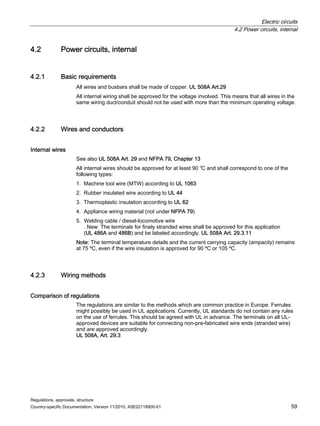
4.2 Power circuits, internal.................................................................................................................59
4.2.1 Basic requirements ......................................................................................................................59
4.2.2 Wires and conductors ..................................................................................................................59
Table of contents
Regulations, approvals, structure
8 Country-specific Documentation, Version 11/2010, A5E02118900-01
4.2.3 Wiring methods ........................................................................................................................... 59
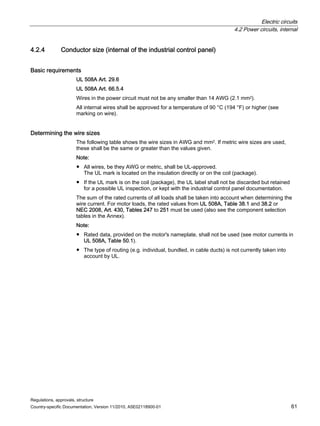
4.2.4 Conductor size (internal of the industrial control panel).............................................................. 61
4.2.5 Ratings for conductor sizes......................................................................................................... 62
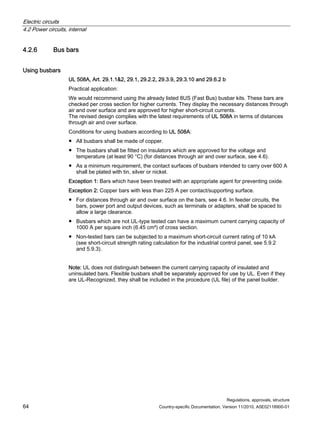
4.2.6 Bus bars ...................................................................................................................................... 64
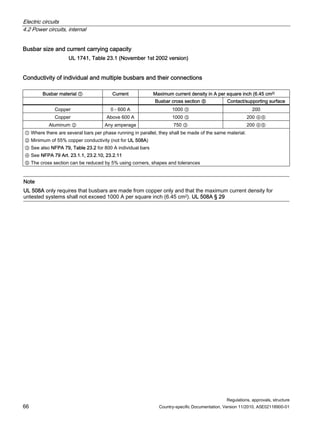
4.2.7 Ampacity of bus bars................................................................................................................... 65
4.3 Control circuits, UL 508A § 37 to 48 ........................................................................................... 67
4.3.1 Definitions.................................................................................................................................... 67
4.3.2 Control circuit .............................................................................................................................. 69
4.3.2.1 External wire cross sections UL 508A §37 ................................................................................. 69
4.3.2.2 Internal wire cross sections UL 508A §38................................................................................... 70
4.3.2.3 Isolating device ........................................................................................................................... 70
4.3.2.4 Overcurrent Protection UL 508A § 40......................................................................................... 71
4.3.3 Control circuit with transformer, UL 508A § 42, Control Circuit - Isolated Secondary................ 74
4.3.3.1 Control transformers ................................................................................................................... 74
4.3.3.2 DC power supply units ................................................................................................................ 77
4.3.4 Control circuits with low voltages and limited energy ................................................................. 78
4.3.5 Class 2 electric circuits................................................................................................................ 80
4.3.6 Industrial control equipment in control circuits UL 508A § 45..................................................... 81
4.3.7 Control circuit loads..................................................................................................................... 85
4.3.8 Other devices .............................................................................................................................. 86
4.3.9 Unlisted devices in electric circuits ............................................................................................. 87
4.4 Cabinet lighting for repairs and service....................................................................................... 89
4.5 Receptacles in industrial control panels...................................................................................... 90
4.6 Branch circuit - Feeder circuit - Distances through air and over surface.................................... 91
5 Industrial control panels........................................................................................................................... 95
5.1 Regulations for industrial control panel manufacturing............................................................... 95
5.2 Enclosures, accessories for enclosures with a high degree of protection.................................. 97
5.3 General issues concerning device selection............................................................................. 100
5.4 Regulations for noncurrent carrying metal parts in an industrial control panel......................... 101
5.5 Doors and cover plates ............................................................................................................. 102
5.6 Fitting components in enclosure openings................................................................................ 103
5.6.1 Regulations for fitting components............................................................................................ 103
5.6.2 Ventilation openings.................................................................................................................. 104
5.6.3 Observation window.................................................................................................................. 105
5.6.4 Fans / blowers........................................................................................................................... 106
5.7 Other built-in panel devices....................................................................................................... 107
5.7.1 Cabinet air conditioner .............................................................................................................. 107
5.7.2 Cabinet heaters......................................................................................................................... 107
5.7.3 Air filters .................................................................................................................................... 107
5.7.4 Thermal insulation in enclosures .............................................................................................. 108
5.8 Maximum permissible short-circuit current for "Industrial Control Panels" ............................... 109
5.8.1 General...................................................................................................................................... 109
5.8.2 Where can you find the short circuit values for industrial control equipment?.......................... 111
5.8.3 UL 508A - SB 4.1 - "Short circuit current rating" - Overview..................................................... 113
5.8.4 "UL 508A - SB 4.2 - Short circuit current rating of individual power circuit components" -
Determining the maximum permissible SCCR of all the devices in the power circuit .............. 114
5.8.5 "UL 508A - SB 4.3 - Feeder components" ................................................................................ 117
Table of contents
Regulations, approvals, structure
Country-specific Documentation, Version 11/2010, A5E02118900-01 9
5.8.6 "UL 508A - SB 4.4 - Determination of the overall short-circuit current rating of the overall
Industrial Control Panel" ............................................................................................................120
5.8.7 Marking the short-circuit value...................................................................................................120
6 Devices.................................................................................................................................................. 121
6.1 Supply circuit disconnecting device ...........................................................................................121
6.1.1 Regulations for the main disconnecting means.........................................................................121
6.1.2 Types and size...........................................................................................................................123
6.1.3 Arrangement of main disconnecting means ..............................................................................126
6.1.4 Door interlocking for the main disconnecting means.................................................................127
6.1.5 Examples ...................................................................................................................................129
6.2 Configuring and sizing combination motor controllers according to UL 508A...........................133
6.2.1 Definitions - Terms.....................................................................................................................133
6.2.2 Possible combination motor controllers ("Construction Types"), versions A to F......................134
6.2.3 Group installation .......................................................................................................................137
6.2.4 Example of motor branch circuit protection ...............................................................................138
6.2.5 Basis for the dimensioning of combination motor controllers according to UL 508A ................139
6.2.5.1 Information on different motor currents......................................................................................139
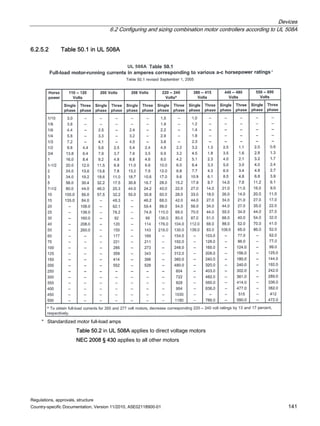
6.2.5.2 Table 50.1 in UL 508A ...............................................................................................................141
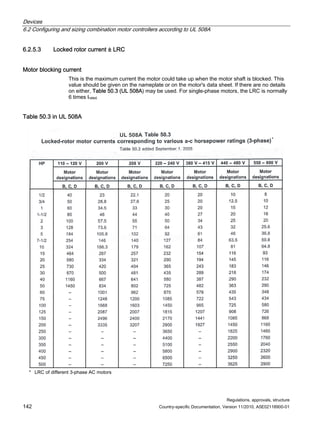
6.2.5.3 Locked rotor current ≙ LRC .......................................................................................................142
6.3 Detailed information about sizing combination motor controllers ..............................................143
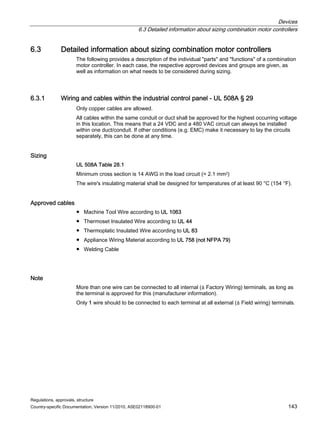
6.3.1 Wiring and cables within the industrial control panel - UL 508A § 29........................................143
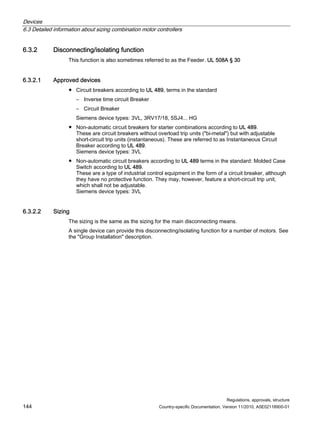
6.3.2 Disconnecting/isolating function.................................................................................................144
6.3.2.1 Approved devices ......................................................................................................................144
6.3.2.2 Sizing .........................................................................................................................................144
6.3.3 Branch circuit protection UL 508A .............................................................................................145
6.3.3.1 Approved devices UL 508A § 31.1 ............................................................................................145
6.3.3.2 Sizing .........................................................................................................................................146
6.3.3.3 Specialities and practical advice................................................................................................148
6.3.4 Magnetic controllers and industrial control equipment...............................................................149
6.3.4.1 Regulations for contactors and switching devices (load controllers).........................................149
6.3.4.2 Sizing .........................................................................................................................................150
6.3.4.3 Semiconductor switching devices..............................................................................................151
6.3.5 Overload protection of motors....................................................................................................151
6.3.6 UL type coordinations 1 and 2 ...................................................................................................153
6.3.7 Motor Controller types E and F..................................................................................................154
6.3.8 Group installation.......................................................................................................................156
6.3.8.1 Approved devices ......................................................................................................................156
6.3.8.2 Structure.....................................................................................................................................156
6.3.8.3 Sizing .........................................................................................................................................157
6.3.8.4 Add on: "...suitable for tap conductor protection".......................................................................158
6.3.8.5 Rules outside the industrial control panel..................................................................................159
6.3.9 Comparison between group installation and type E/F ...............................................................161
6.3.10 Example of combination motor controllers with SIRIUS 3RV motor starter protectors .............162
6.3.11 Wye-delta magnetic controller combination arrangement .........................................................163
6.3.11.1 Magnetic controller sizing ..........................................................................................................164
6.3.11.2 Interlock between wye-delta contactor combinations ................................................................165
6.3.12 Drives with reversible direction of rotation (reversing motor controllers)...................................165
6.3.13 Soft starter..................................................................................................................................166
6.3.14 Frequency converters or variable speed drives.........................................................................168
6.3.15 Branch circuit protection for "non-motor" loads .........................................................................168
6.3.15.1 Heater load.................................................................................................................................168
6.3.15.2 General appliance protection (appliance load) ..........................................................................169
6.3.16 Determining the "full-load ampacity" of transformers, heater loads and capacitor loads ..........169
Table of contents
Regulations, approvals, structure
10 Country-specific Documentation, Version 11/2010, A5E02118900-01
6.4 Device selection according to technical data............................................................................ 170
6.4.1 Overview of devices in power circuits and their functions ........................................................ 170
6.4.2 Overview of devices in control circuits and their functions ....................................................... 172
6.4.3 Devices for combination motor controllers................................................................................ 173
6.4.3.1 Tables for selecting across-the-line magnetic controllers......................................................... 173
6.4.3.2 Selection criteria for wye-delta contactor combination arrangement........................................ 174
6.5 Device selection........................................................................................................................ 178
6.5.1 Overview ................................................................................................................................... 178
6.5.2 Overview of device approval..................................................................................................... 186
6.5.3 Where to find more information on the Internet ........................................................................ 188
7 Color coding .......................................................................................................................................... 199
7.1 Color coding of the grounding conductor (PE) and the grounded conductor (N) ..................... 199
7.2 Color coding of conductors in the power circuit ........................................................................ 201
7.3 Color coding of conductors in the control circuit ....................................................................... 202
7.4 Color coding for control and signaling devices ......................................................................... 203
A Annex A - Tables ................................................................................................................................... 207
A.1 Device selection tables for combination motor controllers........................................................ 207
A.1.1 240 VAC "corner grounded delta"............................................................................................. 209
A.1.2 480/277 VAC, "solidly grounded wye" ...................................................................................... 213
A.1.3 480 VAC "corner grounded delta"............................................................................................. 218
A.1.4 600/347 VAC "solidly grounded wye" ....................................................................................... 220
A.1.5 600 VAC "corner grounded delta"............................................................................................. 223
A.2 Short circuit ratings for Siemens 3RT contactors (extracts) ..................................................... 224
A.2.1 3RT101 contactors (extracts).................................................................................................... 224
A.2.2 3RT102 contactors (extracts).................................................................................................... 226
A.2.3 3RT103 contactors (extracts).................................................................................................... 228
A.2.4 3RT104 contactors (extracts).................................................................................................... 230
A.2.5 3RT105 contactors (extracts).................................................................................................... 232
A.2.6 3RT106 contactors (extracts).................................................................................................... 233
A.2.7 3RT107 contactors (extracts).................................................................................................... 234
A.3 Semiconductor relay ................................................................................................................. 235
A.3.1 3RF20/21 semiconductor relays (extracts) ............................................................................... 235
A.3.2 3RF23/24 solid state controllers (extracts) ............................................................................... 235
A.4 Short circuit ratings for 3RW soft starters (extracts) ................................................................. 236
A.4.1 3RW30, 3RW40 and 3RW44 soft-starters (extracts) up to 75 hp at 460 - 480 V..................... 236
A.5 Short circuit ratings for 3RU overload relay (extracts).............................................................. 240
A.5.1 3RU111 overload relay (extracts) ............................................................................................. 240
A.5.2 3RU112 overload relay (extracts) ............................................................................................. 242
A.5.3 3RU113 overload relay (extracts) ............................................................................................. 244
A.5.4 3RU114 overload relay (extracts) ............................................................................................. 246
A.5.5 3RB20, 3RB21 electronic overload relay (standard applications) (extracts) ............................ 247
A.5.6 3RB22, 3RB23, 3RB29 electronic overload relays (high-feature) (extracts) ............................ 248
A.6 Short circuit ratings for SIMOCODE 3UF7 (extracts) ............................................................... 248
Table of contents
Regulations, approvals, structure
Country-specific Documentation, Version 11/2010, A5E02118900-01 11
B Annex B................................................................................................................................................. 249
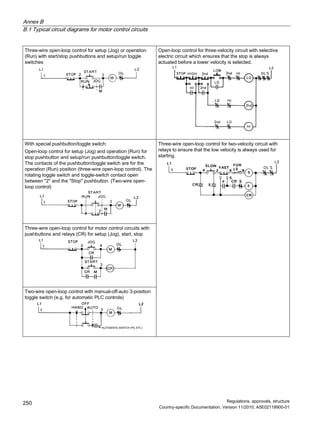
B.1 Typical circuit diagrams for motor control circuits......................................................................249
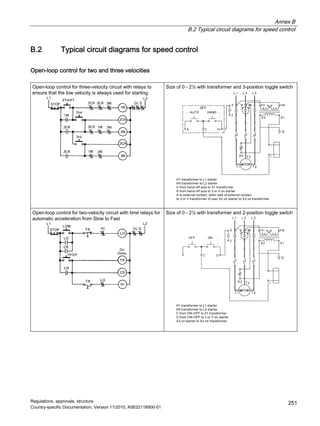
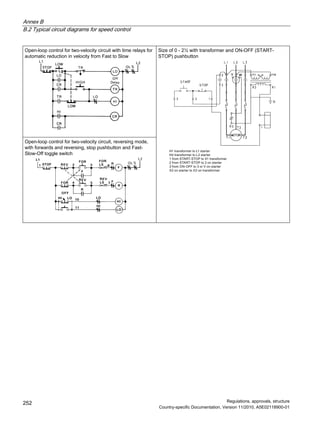
B.2 Typical circuit diagrams for speed control .................................................................................251
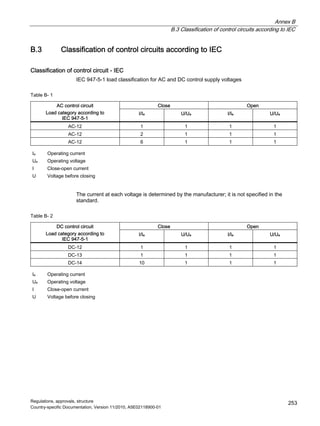
B.3 Classification of control circuits according to IEC......................................................................253
B.4 Feedback form ...........................................................................................................................255
Glossary ................................................................................................................................................ 257
Table of contents
Regulations, approvals, structure
12 Country-specific Documentation, Version 11/2010, A5E02118900-01
Regulations, approvals, structure
Country-specific Documentation, Version 11/2010, A5E02118900-01 13
Working with this documentation 1
1.1 Scope of the guidelines
Focus
This information is mainly restricted to the construction of electrical equipment for machinery,
i.e. industrial control panels and industrial control panels for industrial machinery (Industrial
Control Panels) according to the UL regulations UL 508A (see 3.1). Industrial control panels
are built by the panel builder so that they can be delivered or fitted on a machine.
Use of the UL regulations
If there is a special UL regulation for a machine or system, this shall be used.
Examples: UL 508A, Art. 1.3 & 1.6
● Motor Control Center; UL 845
● Air conditioning; UL 1995 (Heating, Cooling, Air Conditioning)
● Frequency-dependent control units, fuel cells, photovoltaic systems; UL 1741 (Inverters,
Converters and Controllers for use in Independent Power Systems)
● Petrol pumps; UL 1238
● Swimming pools; UL 1563
● Fire pumps; UL 218 (Standard for Fire Pump Controllers)
● Software in Programmable Components; UL 1998
etc.
Working with this documentation
1.2 Equipment wiring outside the industrial control panel
Regulations, approvals, structure
14 Country-specific Documentation, Version 11/2010, A5E02118900-01
1.2 Equipment wiring outside the industrial control panel
Equipment wiring beyond the industrial control panel
UL 508A only deals with wiring within the industrial control panel.
Scope UL 508 A
These requirements cover industrial control panels intended for general industrial use,
operating from a voltage of 600 volts or less. This equipment is intended for installation in
ordinary location, in accordance with the National Electrical Code, ANSI/NFPA 70, where the
ambient temperature does not exceed 40°C (104°F) maximum.
When inspecting external wiring, such as wiring for equipment with several industrial control
panels and wiring that runs to loads, this can be listed as a complete system by UL,
however, it is generally subject to the "Authorities having Jurisdiction" (AHJ)
The UL 508A standard does not cover "external wiring".
External wiring is covered by the regulations in the National Electrical Code, Edition2008,
chapter 3 (e.g. Art. 336 Power and Control Tray Cable: Type TC and TC-ER (Tray Cable –
Exposed Run) and in the respective standard for this machine or these applications such as
NFPA 79 "Electrical Standard for Industrial Machinery", Edition 2002 (e.g. Art. 13,
Conductors, Cables, and Flexible Cords and Chapter 14, Wiring Practices).
Working with this documentation
1.2 Equipment wiring outside the industrial control panel
Regulations, approvals, structure
Country-specific Documentation, Version 11/2010, A5E02118900-01 15
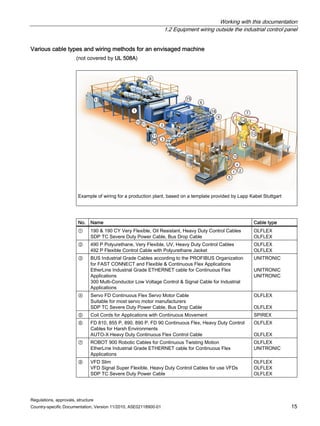
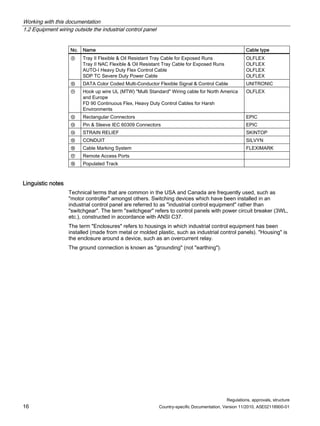
Various cable types and wiring methods for an envisaged machine
(not covered by UL 508A)


Example of wiring for a production plant, based on a template provided by Lapp Kabel Stuttgart
No. Name Cable type
① 190  190 CY Very Flexible, Oil Resistant, Heavy Duty Control Cables
SDP TC Severe Duty Power Cable, Bus Drop Cable
OLFLEX
OLFLEX
② 490 P Polyurethane, Very Flexible, UV, Heavy Duty Control Cables
492 P Flexible Control Cable with Polyurethane Jacket
OLFLEX
OLFLEX
③ BUS Industrial Grade Cables according to the PROFIBUS Organization
for FAST CONNECT and Flexible  Continuous Flex Applications
EtherLine Industrial Grade ETHERNET cable for Continuous Flex
Applications
300 Multi-Conductor Low Voltage Control  Signal Cable for Industrial
Applications
UNITRONIC
UNITRONIC
UNITRONIC
④ Servo FD Continuous Flex Servo Motor Cable
Suitable for most servo motor manufacturers
SDP TC Severe Duty Power Cable, Bus Drop Cable
OLFLEX
OLFLEX
⑤ Coil Cords for Applications with Continuous Movement SPIREX
⑥ FD 810, 855 P, 890, 890 P, FD 90 Continuous Flex, Heavy Duty Control
Cables for Harsh Environments
AUTO-X Heavy Duty Continuous Flex Control Cable
OLFLEX
OLFLEX
⑦ ROBOT 900 Robotic Cables for Continuous Twisting Motion
EtherLine Industrial Grade ETHERNET cable for Continuous Flex
Applications
OLFLEX
UNITRONIC
⑧ VFD Slim
VFD Signal Super Flexible, Heavy Duty Control Cables for use VFDs
SDP TC Severe Duty Power Cable
OLFLEX
OLFLEX
OLFLEX
Working with this documentation
1.2 Equipment wiring outside the industrial control panel
Regulations, approvals, structure
16 Country-specific Documentation, Version 11/2010, A5E02118900-01
No. Name Cable type
⑨ Tray II Flexible  Oil Resistant Tray Cable for Exposed Runs
Tray II NAC Flexible  Oil Resistant Tray Cable for Exposed Runs
AUTO-I Heavy Duty Flex Control Cable
SDP TC Severe Duty Power Cable
OLFLEX
OLFLEX
OLFLEX
OLFLEX
⑩ DATA Color Coded Multi-Conductor Flexible Signal  Control Cable UNITRONIC
⑪ Hook up wire UL (MTW) Multi Standard Wiring cable for North America
and Europe
FD 90 Continuous Flex, Heavy Duty Control Cables for Harsh
Environments
OLFLEX
⑫ Rectangular Connectors EPIC
⑬ Pin  Sleeve IEC 60309 Connectors EPIC
⑭ STRAIN RELIEF SKINTOP
⑮ CONDUIT SILVYN
⑯ Cable Marking System FLEXIMARK
⑰ Remote Access Ports
⑱ Populated Track
Linguistic notes
Technical terms that are common in the USA and Canada are frequently used, such as
motor controller amongst others. Switching devices which have been installed in an
industrial control panel are referred to as industrial control equipment rather than
switchgear. The term switchgear refers to control panels with power circuit breaker (3WL,
etc.), constructed in accordance with ANSI C37.
The term Enclosures refers to housings in which industrial control equipment has been
installed (made from metal or molded plastic, such as industrial control panels). Housing is
the enclosure around a device, such as an overcurrent relay.
The ground connection is known as grounding (not earthing).
Working with this documentation
1.2 Equipment wiring outside the industrial control panel
Regulations, approvals, structure
Country-specific Documentation, Version 11/2010, A5E02118900-01 17
Motor starter types; inrush current
General motor starter types are:
● Across the line: Across-the-Line (XL) or FVNR (Full-Voltage, Non-Reversing)
● Across-the-line reversing: Across-the-Line reverse (Rev STR) or FVR (Full-Voltage,
Reversing)
Inrush current reducing motor starters: Reduced-Voltage Controllers:
● Part-Winding (PW)
● Two (Multi)-Speed
● Reactor or Resistor
● Wye-Delta (Wye/delta)
● Autotransformer
Ambient temperature
Ambient temperature according to UL 508 and 508A:
The ambient temperatures specified in these standards are measured 3 to 4 feet (around
1.20 meters) outside the industrial control panel. This is not the temperature in the panel
near the industrial control equipment. This is referred to as surrounding air temperature.
Working with this documentation
1.3 Navigational options
Regulations, approvals, structure
18 Country-specific Documentation, Version 11/2010, A5E02118900-01
1.3 Navigational options
● Table of contents
● Glossary
Regulations, approvals, structure
Country-specific Documentation, Version 11/2010, A5E02118900-01 19
Regulations and guidelines for the manufacture of
industrial control panels 2
2.1 National Electrical Code (NEC)
2.1.1 NEC 2008 - Organization
National Electric Code - the basis for all electrical installations
The NEC contains minimum requirements!
Individual states (e.g. California Code, New York Code), cities (e.g. Chicago) and counties
may specify more far-reaching regulations.
The manufacturers of devices and systems may choose to apply more stringent
requirements.
NEC 2008 Art. 90.1 (B)
The NEC 2008 contains provisions that are considered necessary for safety. Compliance
therewith and proper maintenance results in an installation that is essentially free from
hazard but not necessarily efficient, convenient, or adequate for good service or future
expansion of electrical use.
NEC 2008 Art. 90.4
The NEC 2008 is intended to be suitable for mandatory application by governmental bodies
that exercise legal jurisdiction over electrical installations, including signaling and
communications systems, and for use by insurance inspectors. The authority having
jurisdiction (AHJ) for enforcement of the Code has the responsibility for making
interpretations of the rules, for deciding on the approval of equipment and materials, and for
granting the special permission contemplated in a number of the rules.
Exceptions
NEC 2008 Art. 90.1 (C)
The NEC 2008 is not intended as a set of instructions for designing systems or for training
persons lacking the relevant qualifications (untrained persons - NEC 2008 Art. 100).
Regulations and guidelines for the manufacture of industrial control panels
2.1 National Electrical Code (NEC)
Regulations, approvals, structure
20 Country-specific Documentation, Version 11/2010, A5E02118900-01
NEC 2008 Art. 90.2 (A)  (B)
The NEC 2008 is applicable to public and private buildings, as well as prefabricated and
mobile homes.
It is NOT applicable to ships, water craft (apart from floating buildings), railways, airplanes,
underground mining, equipment controlled solely by energy producers (power stations and
energy distribution, with the exception of office buildings, parking lots/garages, etc.).
Important
NEC 2008 Art. 90.7
According to the NEC 2008, listed devices and equipment (factory-installed wiring or the
construction of equipment) do not have to be inspected again during system commissioning,
as long as the systems and panels are inspected and approved by an authorized body.
2.1.2 Extracts from the NEC 2008
Marketing electrical industrial control equipment such as magnetic controllers and circuit
breakers in the USA is virtually impossible unless you have UL approval
NEC 2008 Art. 110.2, NEC 2008 Art. 110.3 (B) (or approval from another NRTL).
A huge amount of Siemens' low-voltage industrial control equipment is UL-approved and can
be used without modification in IEC/EN and UL applications.
Mandatory Rules, Permissive Rules and Explanatory Material
Mandatory Rules NEC 2008 90.5 (A)
Mandatory rules of this Code are those that identify actions that are specifically required or prohibited
and are characterized by the use of the terms shall or shall not.
Permissive Rules NEC 2008 90.5 (B)
Permissive rules of this Code are those that identify actions that are allowed but not required, are
normally used to describe options or alternative methods, and are characterized by the use of the
terms shall be permitted or shall not be required.
Explanatory Material NEC 2008 90.5 (C)
Explanatory material, such as references to other standards, references to related sections of this
Code, or information related to a Code rule, is included in this Code in the form of fine print notes
(FPN).
Fine print notes are informational only and are not enforceable as requirements of this Code.
FPN: The format and language used in this Code follow guidelines established by NFPA and
published in the NEC Style Manual. Copies of this manual may be obtained from NFPA.
Regulations and guidelines for the manufacture of industrial control panels
2.1 National Electrical Code (NEC)
Regulations, approvals, structure
Country-specific Documentation, Version 11/2010, A5E02118900-01 21
Requirements for Electrical Installations - NEC - Definitions (excerpt only)
Approval (Article 110.2)
The conductors and equipment required or permitted by this Code shall be acceptable only if
approved.
FPN: See Examination of Equipment for Safety, Section 90-7, and Examination, Identification,
Installation, and Use of Equipment, Section 110-3.
Identified (as applied to equipment) (Article 100)
Recognizable as suitable for the specific purpose, function, use, environment, application, etc., where
described in a particular Code requirement.
FPN: Suitability of equipment for a specific purpose, environment, or application may be determined
by a qualified testing laboratory, inspection agency, or other organization concerned with product
evaluation. Such identification may include labeling or listing (see definitions of Labeled and Listed).
Labeled (Article 100)
Equipment or materials to which has been attached a label, symbol, or other identifying mark of an
organization that is acceptable to the authority having jurisdiction and concerned with product
evaluation, that maintains periodic inspection of production of labeled equipment or materials, and by
whose labeling the manufacturer indicates compliance with appropriate standards or performance in
a specified manner.
Listed (Article 100)
Equipment, materials, or services included in a list, published by an organization that is acceptable to
the authority having jurisdiction and concerned with evaluation of products or services, that maintains
periodic inspection of production of listed equipment or materials or periodic evaluation of services,
and whose listing states that either the equipment, material, or services meets identified standards or
has been tested and found suitable for a specified purpose.
FPN: The means for identifying listed equipment may vary for each organization concerned with
product evaluation, some of which do not recognize equipment as listed unless it is also labeled. Use
of the system employed by the listing organization allows the authority having jurisdiction to identify a
listed product.
Authority Having Jurisdiction (AHJ)
The AHJ has the responsibility of controlling compliance with NEC 2008 specifications, and
ensuring that only those systems which meet NEC 2008 specifications are put into operation.
Generally speaking, the AHJ reports to the relevant state or city authorities. The AHJ is often
an organization such as a building or safety authority. Furthermore, more than one person or
group can share responsibility for this area, particularly where larger or more complex
systems are involved. For example, the head of the fire department might assume
responsibility for fire hazard issues, while other parties may oversee issues relating to
electrics or health and safety.
The end user of the installed equipment (e.g. Industrial Control Panel) needs to request a
site inspection by the AHJ.
Regulations and guidelines for the manufacture of industrial control panels
2.1 National Electrical Code (NEC)
Regulations, approvals, structure
22 Country-specific Documentation, Version 11/2010, A5E02118900-01
2.1.3 Inspection
Every electrical machine or system in the USA is checked by an inspector known as the AHJ
(Authority Having Jurisdiction) before it can be commissioned. Acceptance is based on the
NEC (National Electrical Code, also known as NFPA 70), the relevant application-specific
guidelines such as NFPA 79, as well as any local standards or specifications. In the USA,
acceptance is a legal requirement. Any operators failing to have their machines or systems
checked by an AHJ are putting both their insurance cover and energy supply at risk.
Proper configuration in accordance with the relevant regulations is crucial to the success of
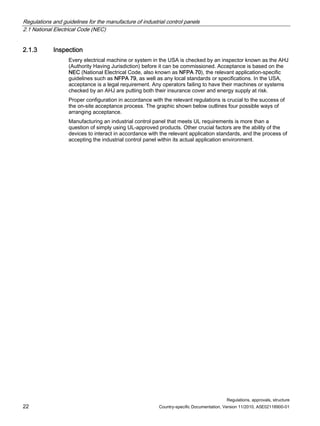
the on-site acceptance process. The graphic shown below outlines four possible ways of
arranging acceptance.
Manufacturing an industrial control panel that meets UL requirements is more than a
question of simply using UL-approved products. Other crucial factors are the ability of the
devices to interact in accordance with the relevant application standards, and the process of
accepting the industrial control panel within its actual application environment.
Regulations and guidelines for the manufacture of industrial control panels
2.1 National Electrical Code (NEC)
Regulations, approvals, structure
Country-specific Documentation, Version 11/2010, A5E02118900-01 23
Options for inspecting industrial control panels in a commissioning context
In most cases, the customer in the USA will specify the type of acceptance. If the type of
acceptance is not mentioned in the specification, you should negotiate with the customer as
considerable costs may result from many forms of acceptance.
RPPLVVLRQLQJSUHUHTXLVLWHIRUHQGFXVWRPHU
RVWH[SHQGLWXUHV
7LPHH[SHQGLWXUHV
IRUILHOGDFFHSWDQFH
$GMXVWPHQWSRVVLELOLW
5HFRPPHQGDWLRQ
$FFHSWDQFHRSWLRQVIRU2(0V
)LHOGLQVSHFWLRQE$+-
0DQGLIIHUHQW
VVWHPV
/LWWOH8/NQRZOHGJH *RRG8/NQRZOHGJH
9HUODUJHTXDQWLWLHV
1RWSRVVLEOH 3RVVLEOHWRJHWKHU
ZLWKPDQXIDFWXUHU
3RVVLEOHILHOG
LQVSHFWLRQUHTXLUHG
3RVVLEOHUHQHZHG
ILHOGLQVSHFWLRQUHTXLUHG
HUWLILHG
PDQXIDFWXUHURI
DQ,3
3UHOLPLQDU
DFFHSWDQFHE
8/LQVSHFWRUDW
WKHIDFWRUVLWH
)LHOGLQVSHFWLRQ
E$+-
LQWKH86$
,3 OLVWHG
ZLWKODEHOE
157/
RQIRUPLWWRWKHDFWXDOVWDQGDUGVRIVDIHWLQHOHFWULFDOLQVWDOODWLRQV
DFFRUGLQJWRWKH26+$UHJXODWLRQV E$+-
 ,QGXVWULDORQWURO3DQHO
 1DWLRQDOO5HFRJQL]HG7HVWLQJ/DERUDWRULHV
 $XWKRULWKDYLQJMXULVGLFWLRQ
Regulations and guidelines for the manufacture of industrial control panels
2.1 National Electrical Code (NEC)
Regulations, approvals, structure
24 Country-specific Documentation, Version 11/2010, A5E02118900-01
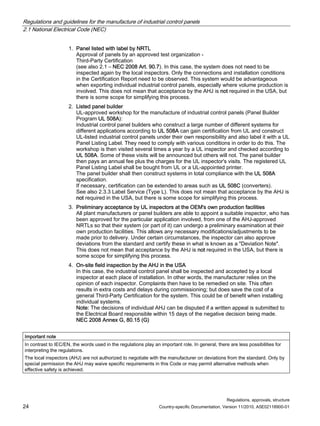
1. Panel listed with label by NRTL
Approval of panels by an approved test organization -
Third-Party Certification
(see also 2.1 – NEC 2008 Art. 90.7). In this case, the system does not need to be
inspected again by the local inspectors. Only the connections and installation conditions
in the Certification Report need to be observed. This system would be advantageous
when exporting individual industrial control panels, especially where volume production is
involved. This does not mean that acceptance by the AHJ is not required in the USA, but
there is some scope for simplifying this process.
2. Listed panel builder
UL-approved workshop for the manufacture of industrial control panels (Panel Builder
Program UL 508A):
Industrial control panel builders who construct a large number of different systems for
different applications according to UL 508A can gain certification from UL and construct
UL-listed industrial control panels under their own responsibility and also label it with a UL
Panel Listing Label. They need to comply with various conditions in order to do this. The
workshop is then visited several times a year by a UL inspector and checked according to
UL 508A. Some of these visits will be announced but others will not. The panel builder
then pays an annual fee plus the charges for the UL inspector's visits. The registered UL
Panel Listing Label shall be bought from UL or a UL-appointed printer.
The panel builder shall then construct systems in total compliance with the UL 508A
specification.
If necessary, certification can be extended to areas such as UL 508C (converters).
See also 2.3.3 Label Service (Type L). This does not mean that acceptance by the AHJ is
not required in the USA, but there is some scope for simplifying this process.
3. Preliminary acceptance by UL inspectors at the OEM's own production facilities
All plant manufacturers or panel builders are able to appoint a suitable inspector, who has
been approved for the particular application involved, from one of the AHJ-approved
NRTLs so that their system (or part of it) can undergo a preliminary examination at their
own production facilities. This allows any necessary modifications/adjustments to be
made prior to delivery. Under certain circumstances, the inspector can also approve
deviations from the standard and certify these in what is known as a Deviation Note.
This does not mean that acceptance by the AHJ is not required in the USA, but there is
some scope for simplifying this process.
4. On-site field inspection by the AHJ in the USA
In this case, the industrial control panel shall be inspected and accepted by a local
inspector at each place of installation. In other words, the manufacturer relies on the
opinion of each inspector. Complaints then have to be remedied on site. This often
results in extra costs and delays during commissioning; but does save the cost of a
general Third-Party Certification for the system. This could be of benefit when installing
individual systems.
Note: The decisions of individual AHJ can be disputed if a written appeal is submitted to
the Electrical Board responsible within 15 days of the negative decision being made.
NEC 2008 Annex G, 80.15 (G)
Important note
In contrast to IEC/EN, the words used in the regulations play an important role. In general, there are less possibilities for
interpreting the regulations.
The local inspectors (AHJ) are not authorized to negotiate with the manufacturer on deviations from the standard. Only by
special permission the AHJ may waive specific requirements in this Code or may permit alternative methods when
effective safety is achieved.
Regulations and guidelines for the manufacture of industrial control panels
2.1 National Electrical Code (NEC)
Regulations, approvals, structure
Country-specific Documentation, Version 11/2010, A5E02118900-01 25
2.1.4 NFPA 79 Annex A Explanatory Material Article A.3.2.2
Authority and responsibility
NFPA 79 does not itself cover any system acceptance tests. This function is mainly handled
by the local inspectors.
A wide range of local inspectors who are not always familiar with electrical systems (such as
local and national inspectors, fire chief or marshal, labor department or health department,
building official) may carry out commissioning in line with AHJ requirements.
NEC 2008 Art. 100
However, if UL certification is required, UL 508A Art 65, 66, 67 stipulates the necessary
regulations and also covers the inspection process.
The industrial control panel shall then also feature the label Industrial Control Panel for
Industrial Machinery.
Extract from NFPA 79 (2002 edition)
A.3.2.2 Authority Having Jurisdiction (AHJ)
The phrase authority having jurisdiction, or its acronym AHJ, is used in NFPA documents in a broad
manner, since jurisdictions and approval agencies vary, as do their responsibilities.
Where public safety is primary, the authority having jurisdiction may be a federal, state, local, or other
regional department or individual such as affair chief; fire marshal; chief of a fire prevention bureau,
labor department, or health department; building official; electrical inspector; or others having
statutory authority.
For insurance purposes, an insurance inspection department, rating bureau, or other insurance
company representative may be the authority having jurisdiction.
In many circumstances, the property owner or his or her designated agent assumes the role of the
authority having jurisdiction; at government installations, the commanding officer or departmental
may be the authority having jurisdiction.
Regulations and guidelines for the manufacture of industrial control panels
2.2 US regulations and electric power systems
Regulations, approvals, structure
26 Country-specific Documentation, Version 11/2010, A5E02118900-01
2.2 US regulations and electric power systems
2.2.1 Important US standard and approval organizations for the manufacturer of
industrial control panels
US standard and approval organizations
Abbreviation Explanations
ANSI American National Standards Institute.
This is the most senior authority for regulations in the US. Most regulations feature the ANSI
standard. Examples are the NEC, or UL 508.
CANENA Council for Harmonization of Electrotechnical Standardization of North America.
This is the standards association for NAFTA. However it is currently of minor importance.
CSA Canadian Standards Association.
This organization publishes standards and approves products in accordance with its own and other
standards (IEC, EN, UL, etc.).
EEMAC Electrical und Electronic Manufacturer Association of Canada.
This is the equivalent to NEMA in Canada.
ETL Electrical Testing Laboratory.
This is a test body that approves devices in accordance with other regulations (UL, IEC, CSA, etc.).
FM Factory Mutual Research.
The work of this organization mainly involves testing components for non-electrical systems, such as
boilers, water heaters, oil stoves. SITOP and LOGO! power supplies are for example approved by
FM.
IEEE Institute of Electrical and Electronics Engineers, Inc.
This body publishes electrical and electronic regulations.
JIC Joint Industrial Council.
Industrial control equipment for the automotive industry has been standardized by this body. This
body is no longer active but is often specified. NFPA 79 is the replacement regulation.
NEMA National Electrical Manufacturer Association.
This is an organization of manufacturers which publishes market data for its members and
standardizes product features such as the size of magnetic controllers and motor frames. Siemens
Energy and Automation, Inc. is a member of NEMA. (NEMA size: (00.0) 1 to 9 are standardized
sizes)
NFPA National Fire Protection Association.
This body publishes numerous regulations and guidelines such as the NEC and NFPA 79.
NRTL National Recognized Testing Laboratory.
This is an approved (non-state) test body. Examples include UL, ETL, CSA and TUV Rheinland of
North America. It is approved by the OSHA (Occupational Safety and Health Administration), a
US state body.
OSHA Occupational Safety and Health Administration.
This body publishes guidelines for safety in plants and workplaces.
UL Underwriters Laboratories, Inc.
This organization publishes standards and approves products in accordance with its own and other
standards, including IEC, EN, CSA.
Regulations and guidelines for the manufacture of industrial control panels
2.2 US regulations and electric power systems
Regulations, approvals, structure
Country-specific Documentation, Version 11/2010, A5E02118900-01 27
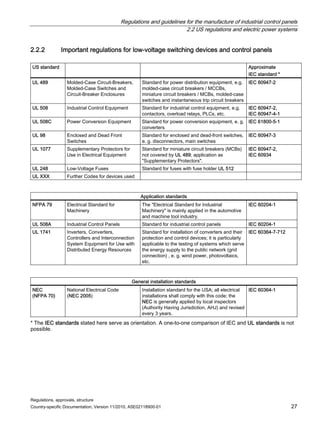
2.2.2 Important regulations for low-voltage switching devices and control panels
US standard Approximate
IEC standard *
UL 489 Molded-Case Circuit-Breakers,
Molded-Case Switches and
Circuit-Breaker Enclosures
Standard for power distribution equipment, e.g.
molded-case circuit breakers / MCCBs,
miniature circuit breakers / MCBs, molded-case
switches and instantaneous trip circuit breakers
IEC 60947-2
UL 508 Industrial Control Equipment Standard for industrial control equipment, e.g.
contactors, overload relays, PLCs, etc.
IEC 60947-2,
IEC 60947-4-1
UL 508C Power Conversion Equipment Standard for power conversion equipment, e. g.
converters
IEC 61800-5-1
UL 98 Enclosed and Dead Front
Switches
Standard for enclosed and dead-front switches,
e. g. disconnectors, main switches
IEC 60947-3
UL 1077 Supplementary Protectors for
Use in Electrical Equipment
Standard for miniature circuit breakers (MCBs)
not covered by UL 489; application as
Supplementary Protectors.
IEC 60947-2,
IEC 60934
UL 248 Low-Voltage Fuses Standard for fuses with fuse holder UL 512
UL XXX Further Codes for devices used
Application standards
NFPA 79 Electrical Standard for
Machinery
The Electrical Standard for Industrial
Machinery is mainly applied in the automotive
and machine tool industry.
IEC 60204-1
UL 508A Industrial Control Panels Standard for industrial control panels IEC 60204-1
UL 1741 Inverters, Converters,
Controllers and Interconnection
System Equipment for Use with
Distributed Energy Resources
Standard for installation of converters and their
protection and control devices; it is particularly
applicable to the testing of systems which serve
the energy supply to the public network (grid
connection) , e. g. wind power, photovoltaics,
etc.
IEC 60364-7-712
General installation standards
NEC
(NFPA 70)
National Electrical Code
(NEC 2005)
Installation standard for the USA; all electrical
installations shall comply with this code; the
NEC is generally applied by local inspectors
(Authority Having Jurisdiction, AHJ) and revised
every 3 years.
IEC 60364-1
* The IEC standards stated here serve as orientation. A one-to-one comparison of IEC and UL standards is not
possible.
Regulations and guidelines for the manufacture of industrial control panels
2.2 US regulations and electric power systems
Regulations, approvals, structure
28 Country-specific Documentation, Version 11/2010, A5E02118900-01
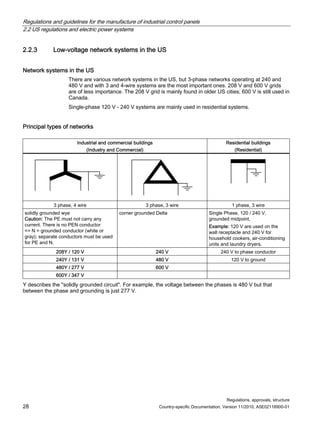
2.2.3 Low-voltage network systems in the US
Network systems in the US
There are various network systems in the US, but 3-phase networks operating at 240 and
480 V and with 3 and 4-wire systems are the most important ones. 208 V and 600 V grids
are of less importance. The 208 V grid is mainly found in older US cities; 600 V is still used in
Canada.
Single-phase 120 V - 240 V systems are mainly used in residential systems.
Principal types of networks
Industrial and commercial buildings
(Industry and Commercial)
Residential buildings
(Residential)
3 phase, 4 wire 3 phase, 3 wire 1 phase, 3 wire
solidly grounded wye
Caution: The PE must not carry any
current. There is no PEN conductor
= N = grounded conductor (white or
gray); separate conductors must be used
for PE and N.
corner grounded Delta Single Phase, 120 / 240 V,
grounded midpoint.
Example: 120 V are used on the
wall receptacle and 240 V for
household cookers, air-conditioning
units and laundry dryers.
208Y / 120 V 240 V 240 V to phase conductor
240Y / 131 V 480 V 120 V to ground
480Y / 277 V 600 V
600Y / 347 V
Y describes the solidly grounded circuit. For example, the voltage between the phases is 480 V but that
between the phase and grounding is just 277 V.
Regulations and guidelines for the manufacture of industrial control panels
2.2 US regulations and electric power systems
Regulations, approvals, structure
Country-specific Documentation, Version 11/2010, A5E02118900-01 29
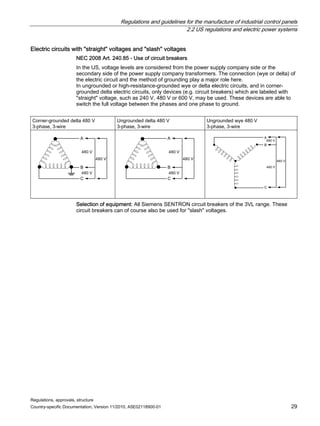
Electric circuits with straight voltages and slash voltages
NEC 2008 Art. 240.85 - Use of circuit breakers
In the US, voltage levels are considered from the power supply company side or the
secondary side of the power supply company transformers. The connection (wye or delta) of
the electric circuit and the method of grounding play a major role here.
In ungrounded or high-resistance-grounded wye or delta electric circuits, and in corner-
grounded delta electric circuits, only devices (e.g. circuit breakers) which are labeled with
straight voltage, such as 240 V, 480 V or 600 V, may be used. These devices are able to
switch the full voltage between the phases and one phase to ground.
Corner-grounded delta 480 V
3-phase, 3-wire
Ungrounded delta 480 V
3-phase, 3-wire
Ungrounded wye 480 V
3-phase, 3-wire
$
%

9
9
9
$
%

9
9
9
%

9
9
9
$
Selection of equipment: All Siemens SENTRON circuit breakers of the 3VL range. These
circuit breakers can of course also be used for slash voltages.
Regulations and guidelines for the manufacture of industrial control panels
2.2 US regulations and electric power systems
Regulations, approvals, structure
30 Country-specific Documentation, Version 11/2010, A5E02118900-01
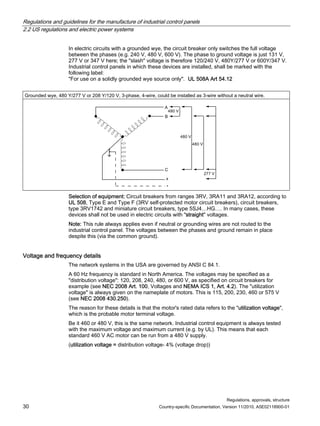
In electric circuits with a grounded wye, the circuit breaker only switches the full voltage
between the phases (e.g. 240 V, 480 V, 600 V). The phase to ground voltage is just 131 V,
277 V or 347 V here; the slash voltage is therefore 120/240 V, 480Y/277 V or 600Y/347 V.
Industrial control panels in which these devices are installed, shall be marked with the
following label:
For use on a solidly grounded wye source only. UL 508A Art 54.12
Grounded wye, 480 Y/277 V or 208 Y/120 V, 3-phase, 4-wire, could be installed as 3-wire without a neutral wire.
$
%

9
9
9
9
[
Selection of equipment: Circuit breakers from ranges 3RV, 3RA11 and 3RA12, according to
UL 508, Type E and Type F (3RV self-protected motor circuit breakers), circuit breakers,
type 3RV1742 and miniature circuit breakers, type 5SJ4…HG…. In many cases, these
devices shall not be used in electric circuits with straight voltages.
Note: This rule always applies even if neutral or grounding wires are not routed to the
industrial control panel. The voltages between the phases and ground remain in place
despite this (via the common ground).
Voltage and frequency details
The network systems in the USA are governed by ANSI C 84.1.
A 60 Hz frequency is standard in North America. The voltages may be specified as a
distribution voltage: 120, 208, 240, 480, or 600 V, as specified on circuit breakers for
example (see NEC 2008 Art. 100, Voltages and NEMA ICS 1, Art. 4.2). The utilization
voltage is always given on the nameplate of motors. This is 115, 200, 230, 460 or 575 V
(see NEC 2008 430.250).
The reason for these details is that the motor's rated data refers to the utilization voltage,
which is the probable motor terminal voltage.
Be it 460 or 480 V, this is the same network. Industrial control equipment is always tested
with the maximum voltage and maximum current (e.g. by UL). This means that each
standard 460 V AC motor can be run from a 480 V supply.
(utilization voltage = distribution voltage- 4% (voltage drop))
Regulations and guidelines for the manufacture of industrial control panels
2.2 US regulations and electric power systems
Regulations, approvals, structure
Country-specific Documentation, Version 11/2010, A5E02118900-01 31
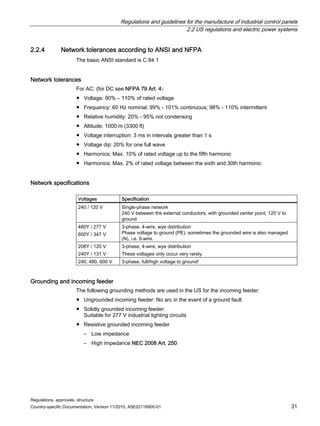
2.2.4 Network tolerances according to ANSI and NFPA
The basic ANSI standard is C 84.1
Network tolerances
For AC: (for DC see NFPA 79 Art. 4)
● Voltage: 90% – 110% of rated voltage
● Frequency: 60 Hz nominal; 99% - 101% continuous; 98% - 110% intermittent
● Relative humidity: 20% - 95% not condensing
● Altitude: 1000 m (3300 ft)
● Voltage interruption: 3 ms in intervals greater than 1 s
● Voltage dip: 20% for one full wave
● Harmonics: Max. 10% of rated voltage up to the fifth harmonic
● Harmonics: Max. 2% of rated voltage between the sixth and 30th harmonic
Network specifications
Voltages Specification
240 / 120 V Single-phase network
240 V between the external conductors, with grounded center point, 120 V to
ground
480Y / 277 V
600Y / 347 V
3-phase, 4-wire, wye distribution
Phase voltage to ground (PE); sometimes the grounded wire is also managed
(N), i.e. 5-wire.
208Y / 120 V
240Y / 131 V
3-phase, 4-wire, wye distribution
These voltages only occur very rarely.
240, 480, 600 V 3-phase, full/high voltage to ground!
Grounding and incoming feeder
The following grounding methods are used in the US for the incoming feeder:
● Ungrounded incoming feeder: No arc in the event of a ground fault
● Solidly grounded incoming feeder:
Suitable for 277 V industrial lighting circuits
● Resistive grounded incoming feeder
– Low impedance
– High impedance NEC 2008 Art. 250
Regulations and guidelines for the manufacture of industrial control panels
2.2 US regulations and electric power systems
Regulations, approvals, structure
32 Country-specific Documentation, Version 11/2010, A5E02118900-01
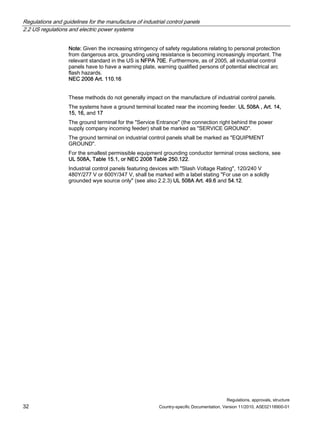
Note: Given the increasing stringency of safety regulations relating to personal protection
from dangerous arcs, grounding using resistance is becoming increasingly important. The
relevant standard in the US is NFPA 70E. Furthermore, as of 2005, all industrial control
panels have to have a warning plate, warning qualified persons of potential electrical arc
flash hazards.
NEC 2008 Art. 110.16
These methods do not generally impact on the manufacture of industrial control panels.
The systems have a ground terminal located near the incoming feeder. UL 508A , Art. 14,
15, 16, and 17
The ground terminal for the Service Entrance (the connection right behind the power
supply company incoming feeder) shall be marked as SERVICE GROUND.
The ground terminal on industrial control panels shall be marked as EQUIPMENT
GROUND.
For the smallest permissible equipment grounding conductor terminal cross sections, see
UL 508A, Table 15.1, or NEC 2008 Table 250.122.
Industrial control panels featuring devices with Slash Voltage Rating, 120/240 V
480Y/277 V or 600Y/347 V, shall be marked with a label stating For use on a solidly
grounded wye source only (see also 2.2.3) UL 508A Art. 49.6 and 54.12.
Regulations and guidelines for the manufacture of industrial control panels
2.3 Underwriters Laboratories (UL)
Regulations, approvals, structure
Country-specific Documentation, Version 11/2010, A5E02118900-01 33
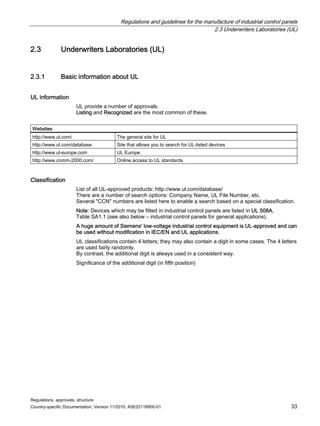
2.3 Underwriters Laboratories (UL)
2.3.1 Basic information about UL
UL information
UL provide a number of approvals.
Listing and Recognized are the most common of these.
Websites
http://www.ul.com/ The general site for UL
http://www.ul.com/database Site that allows you to search for UL-listed devices
http://www.ul-europe.com UL Europe
http://www.comm-2000.com/ Online access to UL standards
Classification
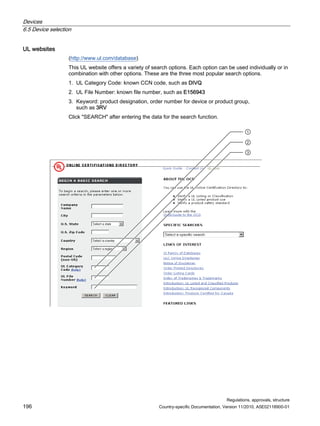
List of all UL-approved products: http://www.ul.com/database/
There are a number of search options: Company Name, UL File Number, etc.
Several CCN numbers are listed here to enable a search based on a special classification.
Note: Devices which may be fitted in industrial control panels are listed in UL 508A,
Table SA1.1 (see also below – industrial control panels for general applications).
A huge amount of Siemens' low-voltage industrial control equipment is UL-approved and can
be used without modification in IEC/EN and UL applications.
UL classifications contain 4 letters; they may also contain a digit in some cases. The 4 letters
are used fairly randomly.
By contrast, the additional digit is always used in a consistent way.
Significance of the additional digit (in fifth position)
Regulations and guidelines for the manufacture of industrial control panels
2.3 Underwriters Laboratories (UL)
Regulations, approvals, structure
34 Country-specific Documentation, Version 11/2010, A5E02118900-01
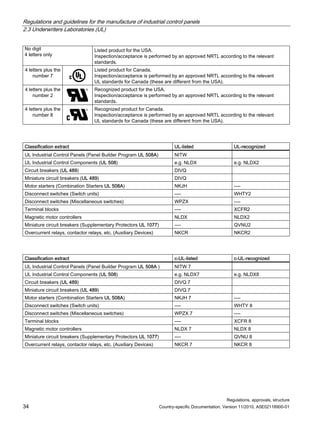
No digit
4 letters only
Listed product for the USA.
Inspection/acceptance is performed by an approved NRTL according to the relevant
standards.
4 letters plus the
number 7
Listed product for Canada.
Inspection/acceptance is performed by an approved NRTL according to the relevant
UL standards for Canada (these are different from the USA).
4 letters plus the
number 2
Recognized product for the USA.
Inspection/acceptance is performed by an approved NRTL according to the relevant
standards.
4 letters plus the
number 8
Recognized product for Canada.
Inspection/acceptance is performed by an approved NRTL according to the relevant
UL standards for Canada (these are different from the USA).
Classification extract UL-listed UL-recognized
UL Industrial Control Panels (Panel Builder Program UL 508A) NITW
UL Industrial Control Components (UL 508) e.g. NLDX e.g. NLDX2
Circuit breakers (UL 489) DIVQ
Miniature circuit breakers (UL 489) DIVQ
Motor starters (Combination Starters UL 508A) NKJH ----
Disconnect switches (Switch units) ---- WHTY2
Disconnect switches (Miscellaneous switches) WPZX ----
Terminal blocks ---- XCFR2
Magnetic motor controllers NLDX NLDX2
Miniature circuit breakers (Supplementary Protectors UL 1077) ---- QVNU2
Overcurrent relays, contactor relays, etc. (Auxiliary Devices) NKCR NKCR2
Classification extract c-UL-listed c-UL-recognized
UL Industrial Control Panels (Panel Builder Program UL 508A ) NITW 7
UL Industrial Control Components (UL 508) e.g. NLDX7 e.g. NLDX8
Circuit breakers (UL 489) DIVQ 7
Miniature circuit breakers (UL 489) DIVQ 7
Motor starters (Combination Starters UL 508A) NKJH 7 ----
Disconnect switches (Switch units) ---- WHTY 8
Disconnect switches (Miscellaneous switches) WPZX 7 ----
Terminal blocks ---- XCFR 8
Magnetic motor controllers NLDX 7 NLDX 8
Miniature circuit breakers (Supplementary Protectors UL 1077) ---- QVNU 8
Overcurrent relays, contactor relays, etc. (Auxiliary Devices) NKCR 7 NKCR 8
Regulations and guidelines for the manufacture of industrial control panels
2.3 Underwriters Laboratories (UL)
Regulations, approvals, structure
Country-specific Documentation, Version 11/2010, A5E02118900-01 35
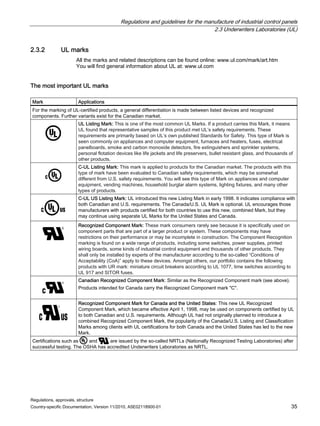
2.3.2 UL marks
All the marks and related descriptions can be found online: www.ul.com/mark/art.htm
You will find general information about UL at: www.ul.com
The most important UL marks
Mark Applications
For the marking of UL-certified products, a general differentiation is made between listed devices and recognized
components. Further variants exist for the Canadian market.
5
UL Listing Mark: This is one of the most common UL Marks. If a product carries this Mark, it means
UL found that representative samples of this product met UL‘s safety requirements. These
requirements are primarily based on UL‘s own published Standards for Safety. This type of Mark is
seen commonly on appliances and computer equipment, furnaces and heaters, fuses, electrical
panelboards, smoke and carbon monoxide detectors, fire extinguishers and sprinkler systems,
personal flotation devices like life jackets and life preservers, bullet resistant glass, and thousands of
other products.
C-UL Listing Mark: This mark is applied to products for the Canadian market. The products with this
type of mark have been evaluated to Canadian safety requirements, which may be somewhat
different from U.S. safety requirements. You will see this type of Mark on appliances and computer
equipment, vending machines, household burglar alarm systems, lighting fixtures, and many other
types of products.
5
C-UL US Listing Mark: UL introduced this new Listing Mark in early 1998. It indicates compliance with
both Canadian and U.S. requirements. The Canada/U.S. UL Mark is optional. UL encourages those
manufacturers with products certified for both countries to use this new, combined Mark, but they
may continue using separate UL Marks for the United States and Canada.
Recognized Component Mark: These mark consumers rarely see because it is specifically used on
component parts that are part of a larger product or system. These components may have
restrictions on their performance or may be incomplete in construction. The Component Recognition
marking is found on a wide range of products, including some switches, power supplies, printed
wiring boards, some kinds of industrial control equipment and thousands of other products. They
shall only be installed by experts of the manufacturer according to the so-called “Conditions of
Acceptability (CoA)” apply to these devices. Amongst others, our portfolio contains the following
products with UR mark: miniature circuit breakers according to UL 1077, time switches according to
UL 917 and SITOR fuses.
Canadian Recognized Component Mark: Similar as the Recognized Component mark (see above).
Products intended for Canada carry the Recognized Component mark C.
5
Recognized Component Mark for Canada and the United States: This new UL Recognized
Component Mark, which became effective April 1, 1998, may be used on components certified by UL
to both Canadian and U.S. requirements. Although UL had not originally planned to introduce a
combined Recognized Component Mark, the popularity of the Canada/U.S. Listing and Classification
Marks among clients with UL certifications for both Canada and the United States has led to the new
Mark.
Certifications such as 5
and are issued by the so-called NRTLs (Nationally Recognized Testing Laboratories) after
successful testing. The OSHA has accredited Underwriters Laboratories as NRTL.
Regulations and guidelines for the manufacture of industrial control panels
2.3 Underwriters Laboratories (UL)
Regulations, approvals, structure
36 Country-specific Documentation, Version 11/2010, A5E02118900-01
Application example
An Industrial Control Panel with this form of label will have been manufactured according to
UL regulations by an approved, UL-listed panel builder. Example of a label for a panel
(including devices and wiring).
Note
Use of UL-approved devices:
Devices which are UL-approved (listed or recognized) cannot be automatically installed in Industrial control
Panels unless their intended use (approval) is known. A 3LD25 LISTED MAN MTR CNTR type switch
(according to UL 508) cannot for example be used as a main disconnecting means. A switch with the label
RECOGNIZED OPEN SWITCH on the other hand would comply with this requirement (e.g. type MCR606).
Particular attention should be paid to the Type Listings; a listed non-metallic conduit is not also automatically
listed as liquid-tight – even if it is classified as IP65 according to IEC.
Note
It is always important to know the product class (CCN) or to have the relevant UL file (report).
Note
UL-approved devices shall always be approved by one of the bodies known as NRTLs.
These NRTLs are approved by the OSHA (= occupational Safety and Health Administration).
Here, approval only applies to specific products/applications. It is essential that you bear in mind the nature and
scope of the relevant NRTL's approval.
NRTLs operated by UL only carry out approvals in the area for which they do have the approval.
Regulations and guidelines for the manufacture of industrial control panels
2.3 Underwriters Laboratories (UL)
Regulations, approvals, structure
Country-specific Documentation, Version 11/2010, A5E02118900-01 37
2.3.3 UL-listed
General rule
5
Devices which are considered to be complete assemblies feature this mark. They are
labeled with the company name, all specified and approved data and the UL mark. Such
devices can be installed by a technician without any special tools and without further
instructions, e.g. a magnetic controller, circuit breaker, etc.
UL-listed variations
There are a number of variations:
● Reexamination Service (Type R): One or more devices are tested by UL, inspected and
described in detail in a report. UL inspectors visit the production facilities periodically and
check that the product is being produced in accordance with the description. (Examples:
magnetic controller, coffee maker)
● Label Service (Type L): A special UL label, that is placed on a product once it has passed
a specified check. Examples include:
– All circuit breakers (UL 489) shall pass a specified test during production (such as
Type R + Reassessment Tests).
– Industrial control equipment (UL 508A) is accepted by a UL inspector.
These labels are bought directly from UL, or via one of the UL-registered printers.
They are administered by the manufacturer, but checked by the UL inspector in
accordance with production.
Regulations and guidelines for the manufacture of industrial control panels
2.3 Underwriters Laboratories (UL)
Regulations, approvals, structure
38 Country-specific Documentation, Version 11/2010, A5E02118900-01
2.3.4 UL-recognized
General rule
This mark is used for components. In other words devices which are assembled in a factory
together with other parts and components and which gain UL approval in the form of an end
product.
UL- Recognized handling
UL- Recognized components only need to feature a type and manufacturer's identification
mark. Their design and application are not therefore complete.
The user shall pay attention to additional information and operating conditions which are
specified in detail in the UL report (known as Conditions of Acceptability, CoA).
The UR mark does not have to be used (optional). The type number shall be included in the
Recognized Component Index or yellow book.
Note: Keep the Operating Instructions. They are part of the device.
Regulations and guidelines for the manufacture of industrial control panels
2.3 Underwriters Laboratories (UL)
Regulations, approvals, structure
Country-specific Documentation, Version 11/2010, A5E02118900-01 39
2.3.5 Practical use of listed and recognized
Use of the marks
In some categories, you have the choice of approving a device as Listedor Recognized.
Application examples
A magnetic controller for a special application without any rated data, but which features
manufacturer identification and order number, can be UR approved.
Some devices can only be approved as components, i.e. with UR, e.g.:
● Circuit breakers which only have an instantaneous trip unit, see NEC 2008,
430.52 (C) (3).
● Terminal blocks according to UL 1059: This UL regulation does not specify distances
over surface or through air. The installation determines the spacing; for industrial control
panels the spacing is 3/8 of an inch (9.6 mm) through air and 1/2 an inch (12.7 mm) for
over surface.
● IEC miniature circuit breakers according to UL 1077:
These devices can only be used as a supplementary protector
(see NEC 2008, 430.72 (A)).
Use of UL-listed and UL-recognized
Example: A washing machine has a motor, thermostat, On and Off switch, electronic
controller, cables, etc. These could all be Recognized Components, which when combined in
an enclosure to create a complete assembly form a UL-listed device.
Regulations and guidelines for the manufacture of industrial control panels
2.3 Underwriters Laboratories (UL)
Regulations, approvals, structure
40 Country-specific Documentation, Version 11/2010, A5E02118900-01
2.3.6 The UL certification process
Product presentation
Thorough preparations in the presentation phase save time and money in the inspection and
test phase.
೼೼೼೼೼೼೼೼೼೼೼
೼
7KHDSSOLFDQWVXEPLWVWKHUHTXHVW SURGXFWGHVFULSWLRQ
FLUFXLWGLDJUDPVSKRWRJUDSKVLQVWUXFWLRQVEURFKXUHV
HWF DORQJZLWKSDUWVOLVWVZLWK8/VWDWXVRI
PDWHULDOVGHYLFHV
,WLVLPSRUWDQWWRVXEPLWLQIRUPDWLRQDERXWDQYDULDWLRQV
WKHVDPHVVWHPEXWODUJHURUVPDOOHULQWHUPVRIN:
IRUH[DPSOH DQGDQRSWLRQVDWWKHVDPHWLPHHYHQLI
IXOOGHWDLOVRIWKHVHDUHQRWHWDYDLODEOH
8/GHFLGHRQWKHWKHUHOHYDQWWHVWSURJUDPDSSOLFDEOH
VWDQGDUG1 DWHJRURQWURO1XPEHU SURGXFWPRGHO
DQGGRFXPHQWDWLRQDVZHOODVDQHVWLPDWLRQRIFRVWV
2QFHWKHDJUHHPHQWRQPDQXIDFWXULQJVXSHUYLVLRQ
/DJUHHPHQW KDVEHHQVLJQHGDOOWKHUHTXLUHG
PRGHOVDQGGRFXPHQWVDUHVXEPLWWHG
8/H[DPLQHDQGWHVWWKHSURGXFW
'RHVWKHSURGXFWPHHW
WKHUHTXLUHPHQWV
12
3URMHFWRIRPSOHWLRQ/HWWHU
,3, LQLWLDOLQVSHFWLRQ
(DUO$XWKRUL]DWLRQ/HWWHU
5HSRUWZLWKWHVWUHVXOWV GRFXPHQWDWLRQ
'HYLDWLRQVUHSRUW
'HVLJQFRUUHFWLRQV
5HVXEPLVVLRQ
(6
3UHOLPLQDU
,QYHVWLJDWLRQ
The word product covers
● Devices (e.g. a circuit breaker)
● Parts of a device (e.g. an auxiliary contact for a circuit breaker)
● Combinations of several devices (e.g. a machine control system)
Regulations and guidelines for the manufacture of industrial control panels
2.4 National Fire Protection Association (NFPA)
Regulations, approvals, structure
Country-specific Documentation, Version 11/2010, A5E02118900-01 41
2.4 National Fire Protection Association (NFPA)
Purpose of the NFPA
The NFPA publishes numerous regulations and guidelines.
Most of these are used in the automotive industry and specified by manufacturers of
machine tools.
Especially NFPA 79 - Electrical Standard for Industrial Machinery.
NFPA 79 applies to electrical/electronic devices, apparatus or systems of industrial
machines which operate with a nominal voltage of 600 V or less. The purpose of NFPA 79 is
to provide detailed information on the use of electrical/electronic devices, apparatus or
systems, supplied as part of industrial machines. This information should help to protect
people and property. Standard NFPA 79 has been officially in force since 1962. Its content is
very similar to that of standard IEC 60204-1, issued by the International Electrotechnical
Commission (IEC).
Note: The NFPA 79 requirements, which are more stringent than those of UL 508A, are
indicated separately in this manual.
Example of a machine typically covered by NFPA 79
Machinery for assembling and transporting materials are treated as industrial machinery
according to UL 508A.
Regulations and guidelines for the manufacture of industrial control panels
2.4 National Fire Protection Association (NFPA)
Regulations, approvals, structure
42 Country-specific Documentation, Version 11/2010, A5E02118900-01
Regulations, approvals, structure
Country-specific Documentation, Version 11/2010, A5E02118900-01 43
What are industrial control panels? 3
3.1 Industrial control panels according to UL 508A
Definition
UL 508A Art. 1.3
An industrial control panel consists of assemblies of two or more components in the power
circuit, such as motor starters, circuit breakers, associated auxiliary and control units, e.g.
command devices, time relays.
UL 508A Structure and content (Industrial Control Panels)
UL 508A is made up of various parts:
● Part 1: Industrial Control Panels, General Use – general applications
● Part 2: Industrial Control Panels, Specific Use – specific applications
– Art. 62 pp: Enclosure
– Art. 65 pp: Industrial Control Panels for use in Industrial Machinery
(UL equivalent to NFPA 79) – industrial control panels for machine tools and plant
engineering
– Art. 68 pp: Industrial Control Panels for use in Crane Control – industrial control panels
for cranes and lifting devices
– Art. 73 pp: Industrial Control Panels for use in Service Equipment – industrial control
panels for power supply
– Art. 80: Industrial Control Panels for use in Elevator Control – industrial control panels
for elevators
– Art. 81 pp: Industrial Control Panels for use in Flame Control – industrial control
panels for flame control (e.g. oil and gas stoves)
– Art. 84 pp: Industrial Control Panels for Marine Use – industrial control panels for
marine applications
– Art. 88 pp: Industrial Control Panels for use in Air Conditioning and Refrigeration
Equipment – industrial control panels for air conditioning and refrigeration applications
The requirements stated in Part 2 do not relate to the entire machine or system, but just
electrical parts.
What are industrial control panels?
3.1 Industrial control panels according to UL 508A
Regulations, approvals, structure
44 Country-specific Documentation, Version 11/2010, A5E02118900-01
UL 508A Supplement und Appendix
● Supplement SA – Specific Component Requirements – requirements for industrial control
equipment in industrial control panels. Only products listed here may be used.
● Supplement SB – Short Circuit Current Ratings for Industrial Control Panels – short circuit
requirements for industrial control panels – see also NEC 2008 Art. 409.
● Annex A – Standards for Components – standards that are of relevance to industrial
control equipment used in industrial control panels
● Annex B – Use of Components NOT UL Listed or Recognized in Industrial Control
Panels – unlisted industrial control equipment
Industrial control panels for general applications
UL 508A Art. 1.1
According to UL 508A industrial control panels are suitable for all general industrial
applications, maximum 600 V, for installation in normal ambient conditions with a maximum
room temperature of 40 °C [104 °F] and in accordance with the National Electrical Code,
ANSI/NFPA 70.
Exceptions
UL 508A Art. 1.5
The standard does not apply to explosion-protected equipment (hazardous / classified
locations) as defined in NEC 2008 Art. 500. These systems are addressed in UL 698. The
standard does not apply to fire pump controllers. These are addressed in UL 218 Standard
for Fire Pump Controllers.
What are industrial control panels?
3.2 Terms used in the manufacturing of industrial control panels
Regulations, approvals, structure
Country-specific Documentation, Version 11/2010, A5E02118900-01 45
3.2 Terms used in the manufacturing of industrial control panels


)HHGHULUFXLW
ODVV
RQWURO
LUFXLW
3RZHULUFXLW
ODVV
RQWURO
LUFXLW
%UDQFKLUFXLW
3RZHULUFXLW
ODVV
RQWURO
LUFXLW
%UDQFKLUFXLW
① Fused disconnect switch acc. to UL 98,
circuit Breaker acc. to UL 489
miniature circuit-breaker acc. to UL 489.
⑩ Control circuit / class 1 circuit / common
control circuit
② Combination motor controller ⑪ Field wiring terminals
③ Branch circuit protection ⑫ Overload relay
④ Starter ⑬ Contactor / controller
⑤ Internal wiring / Factory wiring ⑭ Power transformer - for motor load and
control circuit
⑥ Field wiring ⑮ Control circuit devices and wiring /
class 1 circuit/isolated secondary circuit
⑦ Load (provided in the field) ⑯ Control transformer, ground
(for 1,000 VA max. control transformer)
⑧ Class 2 circuit
⑨ Solenoid or other control devices (provided in the field)
⑰ Supplementary protection
(miniature circuit breaker acc. to UL 1077)
What are industrial control panels?
3.2 Terms used in the manufacturing of industrial control panels
Regulations, approvals, structure
46 Country-specific Documentation, Version 11/2010, A5E02118900-01
Feeder circuit
The conductors and circuitry on the supply side of the branch circuit overcurrent protective
device.
Branch circuit
The conductors and components following the last overcurrent protective device protecting
the load.
Power circuit
Conductors and components of branch and feeder circuits. The power circuit can both be
connected directly to the supply or via power transformers. Motor-driven loads are mostly
classified as power circuits.
Here, respective protective devices are to be used, e.g. circuit breakers according to UL 489.
Control circuit
A circuit that carries the electric signals directing the performance of a controller, and which
does not carry the main power circuit. A control circuit is, in most cases, limited to
15 amperes. There are various ways of realizing control circuits:
● Direct tap-off upstream the branch circuit protective device.
Here, respective protective devices are to be used, e.g. circuit breakers according to
UL 489.
● Direct tap-off downstream the branch circuit protective device.
Here, also so-called supplementary protectors can be used, e. g. miniature circuit
breakers according to UL 1077.
● Via control transformers or DC power supply units. Caution: Various protective devices
may not be approved for this application.
Class 2 control circuit
A control circuit supplied from a source having limited voltage (30 Vr. m. s. or less) and
current capacity, such as from the secondary of a Class 2 transformer, and rated for use with
Class 2 remote-control or signaling circuits.
Class 1 control circuit (acc. to UL 508A)
A control circuit on the load side of an overcurrent protective device where the voltage does
not exceed 600 volts, and where the power available is not limited, or a control circuit on the
load side of a power limiting supply, such as a transformer Class 1.
What are industrial control panels?
3.2 Terms used in the manufacturing of industrial control panels
Regulations, approvals, structure
Country-specific Documentation, Version 11/2010, A5E02118900-01 47
Branch circuit protection
Overcurrent protection with an ampere rating selected to protect the branch circuit.
For a motor branch circuit, the overcurrent protection is required for overcurrents due to
short circuits and faults to ground only.
Field wiring
Conductors to be installed by others to connect the industrial control panel to source(s) of
supply, remote control devices, and loads.
Factory wiring/Internal wiring
The devices shall only be connected by the factory.
Note
The term Overcurrent refers to the overload, short circuit and ground fault currents.
What are industrial control panels?
3.2 Terms used in the manufacturing of industrial control panels
Regulations, approvals, structure
48 Country-specific Documentation, Version 11/2010, A5E02118900-01
Definition of power and control circuit
0DLQFLUFXLW 0DLQFLUFXLW
ODVV
FRQWUROFLUFXLW
ODVV
FRQWURO
FLUFXLW
ODVV
FRQWURO
FLUFXLW
The relevant definitions can be found in UL 508A Chapter 2 Glossary. Here is a limited
selection.
§ 2.38 Power Circuit - Conductors and components of branch and feeder circuits.
§ 2.31 Load
The load is a device external to the industrial control panel that is connected to the power
circuit.
§ 2.11 Control circuit
The control circuit is a circuit that carries the electric signals directing the performance of a
controller, and which does not carry the main power circuit. A control circuit is, in most
cases, limited to 15 amperes.
Note
Motors are generally considered to be loads.
This may also apply to fan motors.
If smaller motors are connected directly to the control circuit, the control circuit can then be
treated as the power circuit. This can sometimes have an impact in terms of the kinds of
devices that can be installed.
Regulations, approvals, structure
Country-specific Documentation, Version 11/2010, A5E02118900-01 49
Electric circuits 4
4.1 Power circuits, external
4.1.1 Field wiring
Field wiring terminals
There shall be one termination point for each external wire requiring connection. Terminals
for copper wires shall be approved according to UL 486A, and those for aluminum wires
according to UL 486B. All terminals intended for the field wiring shall be marked in terms of
the wire material (Cu, Alu, etc.) for which they are intended.
Torques: (Torque in lb-in [1 Nm = 8.85 lb-in]; 1 lb-ft = 12 lb-in)
Terminals for industrial control equipment shall be tested according to UL 486E.
New: All terminals for finely stranded wires, such as welding cables, Diesel Locomotive
Cable (DLC) or those marked as Flexing or Class K, shall be tested according to
UL 486A and UL 486B and labeled accordingly.
Marking field wiring
Marking field wiring: UL 508A Art. 54
Line or Load Terminal.
Torques of terminal screws.
Temperatures of wire.
Note: Only a current carrying capacity of 75 ºC is really ever used now for terminal sizing
(60 ºC is hardly used any more); wires approved for higher temperatures, such as 90 ºC or
105 ºC, may only be loaded (calculated) for 75 ºC current carrying capacity.
Wire material includes copper, aluminum and copper-clad aluminum.
Electric circuits
4.1 Power circuits, external
Regulations, approvals, structure
50 Country-specific Documentation, Version 11/2010, A5E02118900-01
Labeling and marking field wiring terminals
Example:
LINE TERMINALS
AWG # 14 – AWG # 3/0
Use 75 °C Copper Wire Only,
Terminal Torque: 45 - 50 Lb.-in.
Ground terminals, marking: G, GR, GRD, Ground, Grounding or IEC symbol 5019;
New: PE UL 508A Art. 54.5
Ground terminals for equipment connection shall also be identified as Equipment Ground.
4.1.2 Terminal size for field wiring (external conductor feeder)
Sizing
NEC 2008 Art. 215.2(A) (1)
The field wiring terminals shall be designed for a wire size of 125% of the load current, but
shall not be smaller than No. 14 AWG (2.1 mm2).
The terminals for field wiring shall be suited to terminating non-pre-fabricated wires and shall
be approved accordingly; in other words, do not use crimp connections with screw
connections on the busbars.
NEC 2008 Art. 430.22  24
For several motors or motors and other loads: 125% of the full-load amps of the largest
motor plus the sum of the currents of all other loads.
UL 508A, Art. 28.3
If there are lighting or heater loads present, these shall also be taken into account with
125%.
Wire size and rated load carrying capacity for field wiring
UL 508A Table 28.1
The following table contains the wire sizes and rated load carrying capacity according to
NEC 2008, Table 310.16 to 310.20, the maximum permissible load currents and the
maximum short circuit protection for non-motor branch circuits. The short circuit protection
for motor branch circuits can be found in chapter 6.
Electric circuits
4.1 Power circuits, external
Regulations, approvals, structure
Country-specific Documentation, Version 11/2010, A5E02118900-01 51
Wire size and rated load carrying capacity
Rated values,
insulated cables
AWG (mm2)
① Permissible current
carrying capacity
according to
NEC 2008, Tab. 310.16
Cu 75 °C
[A]
② Permissible current carrying
capacity
for load feeders
= Column (1)/1.25
[A]
③ Maximum
short-circuit protection
for non-motor loads:
circuit breakers or
fuses
[A]
14 (2.1) 15 12 15
12 (3.3) 20 16 20
10 (5.3) 30 24 30
8 (8.4) 50 40 50
6 (13.3) 65 52 65
4 (21.2) 85 68 85
3 (26.7) 100 80 100
2 (33.6) 115 92 115
1 (42.2) 130 104 130
1/0 (53.5); (also # 0) 150 120 150
2/0 (67.4); (also # 00) 175 140 175
3/0 (85); (also # 000) 200 160 200
4/0 (107); (also # 0000) 230 184 230
250 kcmil (127) 255 204 255
300 kcmil (152) 285 228 285
350 kcmil (177) 310 248 310
400 kcmil (203) 335 268 335
*500 kcmil (253) 380 304 380
* 500 kcmil (MCM) is (usually) the largest external wire
① Values apply for not more than 3 wires routed in a conduit. Terminals for larger conductor cross sections shall be
provided for systems with 2 or more conductors per phase in one conduit, e.g. 6 or 9. NEC 2008, Tab. 310.16
② Wires should be sized for 125% of the load current. NEC 2008 Art. 430.22 (A)
③ According to NEC 2008 Art. 240.3
Electric circuits
4.1 Power circuits, external
Regulations, approvals, structure
52 Country-specific Documentation, Version 11/2010, A5E02118900-01
4.1.3 Ground and neutral conductors
Ground and neutral wires in the USA
In the USA, the following terms are used:
grounding wire (PE wire) and
grounded wire (N wire).
The grounding wire (green or green/yellow) shall not carry operational current. Each power
circuit shall have a separate ground terminal. The grounded wire (white or gray) is used for
the N wire (IEC). There are no PEN wires (PE and N) in the USA. If neutral wires (N) are
used, these shall be clearly identified and fitted to a separate, insulated terminal.
Ground terminals and grounding wires
Ground terminal sizes (minimum!) - Equipment Grounding.
Table 15.1 in UL 508A shows the smallest permissible grounding wire cross sections.
Larger cross sections can be selected at any time.
The grounding wire shall not, however, be any smaller than that in UL 508A, Table 15.1.
Series wiring of grounding wires
Within industrial control panels, the grounding wires may be routed in series (Daisy-
Chaining), if mechanisms are in place to ensure that removing one device will not interrupt
grounding. NFPA 79 Chapter 8 Art. 8.2.3.2.
Options for plugging in grounding wires
Grounding wires for equipment grounds can be plugged into a terminal strip if mechanisms
are in place to ensure that the ground contact is always the first to make contact and the last
to break contact (first-make, last-break of the equipment grounding conductor). In other
words, the connector's ground contact should be longer.
NFPA 79 Chapter 8 Art. 8.2.4
This requirement applies to all standard connectors (NEMA connectors listed according to
UL 498).
Downstream of the equipment ground, the grounding wires of individual devices can also be
plugged into the industrial control panel, as can loads outside the industrial control panel
(e.g. connection to a motor). In accordance with the standard, these ground contacts should
also be the first to make contact and the last to break contact, e.g. UL 498, Art. 24.3.
Electric circuits
4.1 Power circuits, external
Regulations, approvals, structure
Country-specific Documentation, Version 11/2010, A5E02118900-01 53
Size of equipment ground terminal UL 508A, Table 15.1
Size of equipment grounding or bonding wire of grounded parts (minimum)
Copper Aluminum
Maximum ampere rating of
overcurrent protection for field
wires supplying the industrial
control panel AWG or kcmil [mm2] AWG or kcmil [mm2]
15 14 2.1 12 3.3
20 12 3.3 10 5.3
30 10 5.3 8 8.4
40 10 5.3 8 8.4
50 10 5.3 8 8.4
100 8 8.4 6 13.3
200 6 13.3 4 21.2
300 4 21.2 2 33.6
400 3 26.7 1 42.4
500 2 33.6 1/0 53.5
600 1 42.4 2/0 67.4
800 1/0 53.5 3/0 85.0
1000 2/0 67.4 4/0 107.2
1200 3/0 85.0 250 kcmil 127
1500 4/0 107.2 350 177
2000 250 kcmil 127 400 203
2500 350 177 600 304
3000 400 203 600 304
4000 500 253 800 405
5000 700 355 1200 608
6000 800 506 1200 608
Electric circuits
4.1 Power circuits, external
Regulations, approvals, structure
54 Country-specific Documentation, Version 11/2010, A5E02118900-01
4.1.4 General regulations on cable installation outside control panels
Number of cables in conduits
NEC 2008 Annex C specifies how many cables shall be installed, the cross section and
installation types, and the cable conduit cross sections.
This determines both the size and number of cable conduits. The information provided
makes it possible to determine the number and size of the Knock outs. The Knock outs
shall then be set up in the enclosure according to UL 508A Art. 19.
Comments:
Please consider the issue of spare cables.
Openings for external wiring
Up to type 3R, there are already openings in the enclosure. These are, however, only
permitted on the underside of the panel (e.g. for cable entry), or on the sides, below current-
conducting parts.
4, 4X, 12, 13 enclosure types do not have openings. During installation, these are provided
by an electrician as needed. See UL 508 Art. 25.2.
Take care with the dimensions: The cable conduit sizes are given in inches, e.g. conduit
size 3/4, 1, 1-1/4. These are not the outer diameters of the conduits!
These figures are trade sizes.
Exception: Grounding wires are not current-conducting and may be laid outside the cable
conduit under certain circumstances. NEC 2008 Art. 300.3 (B) (2)
4.1.5 Relation between conduit size and diameter of knockout (KO)
Conduit size and diameter of the Knockouts (KO)
Conduit size
[inch]
KO diameter
[inch]
Metric size designation
1/2 0.859 16
3/4 1.094 21
1 1.359 27
1-1/4 1.719 35
1-1/2 1.958 41
Electric circuits
4.1 Power circuits, external
Regulations, approvals, structure
Country-specific Documentation, Version 11/2010, A5E02118900-01 55
4.1.6 Number and size of wires per cable conduit
Regulations for cable conduit size
The number of wires per cable conduit is stated in NEC 2008 ANNEX C.
Example
Extract from NEC 2008 Annex C
Maximum Number of Conductors or Fixture Wires in Rigid Metal Conduct (RMC)
Conductors
Metric Designator (Trade Size)
Type mm2 Con-
ductor
Size
(AWG
kcmil)
16
(1/2)
21
(3/4)
27
(1)
35
(1 ¼)
41
(1 ½)
53
(2)
63
(2 ½)
78
(3)
91
(3 ½)
103
(4)
129
(5)
155
(6)
2.1 14 4 7 12 21 28 46 66 102 136 176 276 398
3.3 12 3 6 10 17 23 38 55 85 113 146 229 330
5.3 10 3 5 8 14 19 31 44 68 91 118 185 267
8.4 8 1 2 4 7 10 16 23 36 48 61 97 139
13.3 6 1 1 3 6 8 13 18 29 38 49 77 112
21.1 4 1 1 2 4 6 10 14 22 30 38 60 87
26.7 3 1 1 2 4 5 9 12 19 26 34 53 76
33.3 2 1 1 1 3 4 7 11 17 23 29 46 66
42.4 1 0 1 1 1 3 5 7 11 15 19 30 44
53.5 1/0 0 1 1 1 2 4 6 10 13 17 26 38
67.4 2/0 0 1 1 1 2 4 5 8 11 14 23 33
85.0 3/0 0 0 1 1 1 3 4 7 10 12 20 28
107.2 4/0 0 0 1 1 1 3 4 6 8 11 17 24
127 250 0 0 0 1 1 1 3 4 6 8 13 18
152 300 0 0 0 1 1 1 2 4 5 7 11 16
177 350 0 0 0 1 1 1 2 4 5 6 10 15
203 400 0 0 0 1 1 1 1 3 4 6 9 13
RHH,
RHW,
RHW-2
253 500 0 0 0 1 1 1 1 3 4 5 8 11
Notes on above table:
● The table above is only ONE EXAMPLE among many tables for different conduit types.
● Conduit refers to the cable surround.
Tubing refers to the cables within the conduits.
● The table shows the (theoretically) maximum possible number of wires, assuming all
wires have the same cross section.
● Where all wires have the same cross section, the actual permissible number of wires and
the size of the conduit required can be obtained from Table 2 in Chapter 9 of NEC 2008.
Electric circuits
4.1 Power circuits, external
Regulations, approvals, structure
56 Country-specific Documentation, Version 11/2010, A5E02118900-01
Number of conductors Filling rate for all conductor types (as %)
1 53 %
2 31 %
2 40 %
Example
Wire size AWG 10 Type RHH,
number of wires 6,
gives a 40% filling rate.
This means (in theory) that at least 15 wires could be contained in the Conduit (6 ≙ 40%
of 15).
Taken from table for conduit type RMC ≙ Rigid Metal Conduit.
Conduittyp RMC ≙ Rigid Metal Conduit
Wires with different cross sections in a conduit.
The actual permissible number of wires can be obtained using Tables 5 and 5a (diameter
and cross sections) and Table 4.
All tables are contained in NEC 2008 Chapter 9.
The calculation method is as follows:
a) Determine the relevant cross section according to the NEC tables.
b) Add together the individual cross sections obtained.
c) Extrapolate the total cross section calculated in step b) in terms of an filling rate
(in precentage) based on the required conduit cross section.
d) The conduit cross section to be used shall be greater than or equal to the value
derived under step c).
Example
Number Wire size and type Cross section according to
Table 5 [inch2]
Total cross section
[inch2]
4 12 AWG THWN 0.0133 0.0532
3 8 AWG TW 0.0437 0.1311
3 6 AWG THW 0.0726 0.2178
∑ 0.4021
Table 1 gives an filling rate of 40%.
Table 4 gives:
Conduit size 1 1/4 or 35.
Conduit type RMC ≙ Rigid Metal conduit
Maximum usable cross section at 40% filling rate is 0.61 inch2
Electric circuits
4.1 Power circuits, external
Regulations, approvals, structure
Country-specific Documentation, Version 11/2010, A5E02118900-01 57
4.1.7 Diameter of knockouts (KO)
UL 508A Tab. 11.1 – Knockouts or hole sizes and dimensions of bushings
Dimensions of bushings
Trade size of conduits Knockout or hole diameter
Overall diameter Height
[mm] [inch] [mm] [inch] [mm] [inch] [mm] [inch]
21.3 1/2 22.3 7/8 25.4 1 9.5 3/8
26.7 3/4 27.8 1-3/32 31.4 1-15/64 10.7 27/64
33.4 1 34.5 1-23/64 40.5 1-19/32 13.1 33/64
42.3 1-1/4 43.7 1-23/32 48.2 1-15/32 14.3 9/16
48.3 1-1/2 50.0 1-31/32 56.0 2-13/64 15.1 19/32
60.3 2 62.7 2-15/32 68.7 2-45/64 15.9 5/8
73.0 2-1/2 76.2 3 81.3 3-7/32 19.1 3/4
88.9 3 92.1 3-5/8 96.4 3-7/8 20.6 13/18
101.6 3-1/2 104.8 4-1/8 112.7 4-7/16 25.8 15/16
114.0 4 117.5 4-5/8 126.2 4-31/32 25.4 1
127.0 4-1/2 130.2 5-1/8 140.9 5-35/64 27.0 1-1/16
141.3 5 142.9 5-5/8 158.0 6-7/32 30.2 1-3/16
168.3 6 171.5 6-3/4 183.4 7-7/32 31.8 1-1/4
Electric circuits
4.1 Power circuits, external
Regulations, approvals, structure
58 Country-specific Documentation, Version 11/2010, A5E02118900-01
4.1.8 Cable conduit types
Regulations for cable conduit types
RMC Rigid Metal Conduit: NEC 2008 Art. 344
RNC Rigid Nonmetallic Conduit: NEC 2008 Art. 352
EMT Electrical Metallic Tubing: NEC 2008 Art. 358
FMT Flexible Metallic Tubing: NEC 2008 Art. 360
FMC Flexible Metal Conduit: NEC 2008 Art. 348
LFMC Liquidtight Flexible Metal Conduit: NEC 2008 Art. 350
LFNC Liquidtight Flexible Nonmetallic Conduit: NEC 2008 Art. 356
Practical application for panel builders
Outside the industrial control panel, but inside the machine/equipment, use:
Liquidtight Flexible Metal Conduit and Liquidtight Flexible Nonmetallic Conduit
(Type LFNC-A, B or C):
Note
Flexible Metal Conduit: Sizes from 3/8 to 4
Liquidtight Flexible Nonmetallic Conduit: Sizes from 3/8 to 2 (4 is permitted under NEC 2008, but it is difficult
to buy it).
The Chicago Code does not allow Liquidtight Flexible Nonmetallic Conduit
⇒ use Liquidtight Flexible Metallic Conduit.
Electric circuits
4.2 Power circuits, internal
Regulations, approvals, structure
Country-specific Documentation, Version 11/2010, A5E02118900-01 59
4.2 Power circuits, internal
4.2.1 Basic requirements
All wires and busbars shall be made of copper. UL 508A Art.29
All internal wiring shall be approved for the voltage involved. This means that all wires in the
same wiring duct/conduit should not be used with more than the minimum operating voltage.
4.2.2 Wires and conductors
Internal wires
See also UL 508A Art. 29 and NFPA 79, Chapter 13
All internal wires should be approved for at least 90 ℃ and shall correspond to one of the
following types:
1. Machine tool wire (MTW) according to UL 1063
2. Rubber insulated wire according to UL 44
3. Thermoplastic insulation according to UL 62
4. Appliance wiring material (not under NFPA 79)
5. Welding cable / diesel-locomotive wire
. New: The terminals for finely stranded wires shall be approved for this application
(UL 486A and 486B) and be labeled accordingly. UL 508A Art. 29.3.11
Note: The terminal temperature details and the current carrying capacity (ampacity) remains
at 75 ºC, even if the wire insulation is approved for 90 ºC or 105 ºC.
4.2.3 Wiring methods
Comparison of regulations
The regulations are similar to the methods which are common practice in Europe. Ferrules
might possibly be used in UL applications. Currently, UL standards do not contain any rules
on the use of ferrules. This should be agreed with UL in advance. The terminals on all UL-
approved devices are suitable for connecting non-pre-fabricated wire ends (stranded wire)
and are approved accordingly.
UL 508A, Art. 29.3
Electric circuits
4.2 Power circuits, internal
Regulations, approvals, structure
60 Country-specific Documentation, Version 11/2010, A5E02118900-01
Internal wiring – details and exceptions
Note: Some UL-recognized devices are only suitable for factory wiring. This means that the
terminals may only be wired in the factory or by the panel builder. Instructions can then be
found in the UL report.
Within the industrial control panel, UL 508A accepts several wires per termination point
provided that these are safely connected. Safe connection is established by the UL inspector
using a manual pull test. UL 508A, Art. 29.3.6
The wires shall be routed away from sharp edges; all points of contact should be free of
burrs (use edge protection); rubber sleeves should be used for holes.
UL 508A, Art. 29.4
Wires for different voltages shall either be laid separately or all wires shall be designed for
the highest voltage.
Field wiring: UL 508A Art. 25 and NEC Chapter 3
Wiring within the industrial control panel: Table 25.1 in UL 508A specifies the distance
between the field wiring terminal and the enclosure wall within the industrial control panel.
Wire bending space
Minimum bending space, terminal to wall, inches [mm]
Wires per terminala
Size of wire
AWG or MCM
[mm2]
1 2 3 4 or more
14 – 10 (2.1 – 5.3) Not specified a a a
8 – 6 (8.4 – 13.3) 1-1/2 (38) a a a
4 – 3 (21.2 – 26.7) 2 (51) a a a
2 (33.6) 2-1/2 (64) a a a
1 (42.4) 3 (76) a a a
1/0 (53.5) 5 (127) 5 (127) 7 (178)
2/0 (67.4) 6 (152) 6 (152) 7-1/2 (191)
3/0 (85.0) 7 (178) 7 (178) 8 (203)
4/0 (107.2) 7 (178) 7 (178) 8-1/2 (216)
250 (127) 8 (203) 8 (203) 9 (229) 10 (254)
300 (152) 10 (254) 10 (254) 11 (279) 12 (305)
350 (177) 12 (305) 12 (305) 13 (330) 14 (356)
400 (203) 12 (305) 12 (305) 14 (356) 15 (381)
500 (253) 12 (305) 12 (305) 15 (381) 16 (406)
600 (304) 14 (356) 16 (406) 18 (457) 19 (483)
700 (355) 17 (356) 16 (406) 20 (508) 22 (559)
750 – 800 (380 – 405) 18 (457) 19 (483) 22 (559) 24 (610)
900 (456) 18 (457) 19 (483) 24 (610) 24 (610)
1000 (506) 20 (508) - - -
1250 (633) 22 (559) - - -
1500 – 2000 (760 – 1013) 24 (610) - - -
NOTE: ″–″ indicates no value established
a Conductors smaller than 1/0 AWG shall not be connected in parallel
Electric circuits
4.2 Power circuits, internal
Regulations, approvals, structure
Country-specific Documentation, Version 11/2010, A5E02118900-01 61
4.2.4 Conductor size (internal of the industrial control panel)
Basic requirements
UL 508A Art. 29.6
UL 508A Art. 66.5.4
Wires in the power circuit must not be any smaller than 14 AWG (2.1 mm2).
All internal wires shall be approved for a temperature of 90 °C (194 °F) or higher (see
marking on wire).
Determining the wire sizes
The following table shows the wire sizes in AWG and mm2. If metric wire sizes are used,
these shall be the same or greater than the values given.
Note:
● All wires, be they AWG or metric, shall be UL-approved.
The UL mark is located on the insulation directly or on the coil (package).
● If the UL mark is on the coil (package), the UL label shall not be discarded but retained
for a possible UL inspection, or kept with the industrial control panel documentation.
The sum of the rated currents of all loads shall be taken into account when determining the
wire current. For motor loads, the rated values from UL 508A, Table 38.1 and 38.2 or
NEC 2008, Art. 430, Tables 247 to 251 must be used (also see the component selection
tables in the Annex).
Note:
● Rated data, provided on the motor's nameplate, shall not be used (see motor currents in
UL 508A, Table 50.1).
● The type of routing (e.g. individual, bundled, in cable ducts) is not currently taken into
account by UL.
Electric circuits
4.2 Power circuits, internal
Regulations, approvals, structure
62 Country-specific Documentation, Version 11/2010, A5E02118900-01
4.2.5 Ratings for conductor sizes
General rule
Internal wires (ambient temperature of up to 40 °C, measured approx. 1.2 m outside the
industrial control panel) UL 508A, Chapter 29.6
Wire sizes and current carrying capacity - UL 508A, Table 28.1
Wire size 60 °C (140 °F) 75 °C (167 °F)
AWG [mm2] Copper [A] Aluminum [A] Copper [A] Aluminum [A]
14 (2.1) 15 - 15 -
12 (3.3) 20 15 20 15
10 (5.3) 30 25 30 25
8 (8.4) 40 30 50 40
6 (13.3) 55 40 65 50
4 (21.2) 70 55 85 65
3 (26.7) 85 65 100 75
2 (33.6) 95 75 115 90
1 (42.4) 110 85 130 100
1/0 1) (53.5) - - 150 120
2/0 (67.4) - - 175 135
3/0 (85.0) - - 200 155
4/0 (107.2) - - 230 180
250 kcmil (127) - - 255 205
300 (152) - - 285 230
350 (177) - - 310 250
400 (203) - - 335 270
500 (253) - - 380 310
600 (304) - - 420 340
700 (355) - - 460 375
750 (380) - - 475 385
800 (405) - - 490 395
900 (456) - - 520 425
1000 (506) - - 545 445
1250 (633) - - 590 485
1500 (760) - - 625 520
1750 (887) - - 650 545
2000 (1013) - - 665 560
NOTES –
1 For multiple-conductors of the same size (1/0 AWG or larger) at a terminal, the ampacity is equal to the value in this
table for that conductor multiplied by the number of conductors that the terminal is able to accommodate
Electric circuits
4.2 Power circuits, internal
Regulations, approvals, structure
Country-specific Documentation, Version 11/2010, A5E02118900-01 63
UL 508A, Art. 66.5.4
Wires in the power circuit shall not be any smaller than # 14 AWG (2.1 mm2).
Exceptions
Only for control panels for Industrial Machinery.
Wires in the power circuit may be designed using # 16 AWG and # 18 AWG if they comply
with the conditions stated in Table 66.1A.
Wire size and current carrying capacity – exceptions
UL 508A, Table 66.1A
Current load and protection for power circuits with 16 AWG and 18 AWG cables
Cable Load type Max branch circuit protection in amps Trip class of motor overload
protection c)
Size [A]
16 AWG 8 Not motor a) 10 A -
8 Motor a) - see UL 508A Tab. 31.1 Class 10
5.5 Motor a) - see UL 508A Tab. 31.1 Class 20
18 AWG 5.6 Not motor b) - 7 A -
5 Motor b) - see UL 508A Tab. 31.1 Class 10
3.5 Motor b) - see UL 50 A Tab. 31.1 Class 20
a) Circuit breaker with thermal delay labeled for protecting 16 AWG or 18 AWG or class CC, J or T fuses
b) Circuit breaker with thermal delay labeled for protecting 18 AWG or class CC, J or T fuses
c) Class 10: Overload protection trips in 10 seconds at 6 times the current setting.
Class 20: Overload protection trips in 20 seconds at 6 times the current setting.
Application example for up to 600 V
Practical application for up to 600 V:
● Internal wiring according to UL 508A Tab. 28.1
● External wiring, NEC 2008 Table 310.16, up to # 1 AWG (110 A) = 60 °C column,
from # 1/0 AWG (150 A) = 75 °C column PLUS 25% (or x 125%)
– Temperature in excess of 30 ℃; see correction factor under
NEC 2008 Table 310.17
– Correction factor for more than 3 conductors in one cable route, see
NEC 2008 Table 310.15 (B) (2) (a)
● Conductors in parallel: # 1/0 AWG and larger, NEC 2008 310.4,
conditions for parallel cables: same cable materials, same cross section, same insulation,
same connecting type.
Electric circuits
4.2 Power circuits, internal
Regulations, approvals, structure
64 Country-specific Documentation, Version 11/2010, A5E02118900-01
4.2.6 Bus bars
Using busbars
UL 508A, Art. 29.1.12, 29.1, 29.2.2, 29.3.9, 29.3.10 and 29.6.2 b
Practical application:
We would recommend using the already listed 8US (Fast Bus) busbar kits. These bars are
checked per cross section for higher currents. They display the necessary distances through
air and over surface and are approved for higher short-circuit currents.
The revised design complies with the latest requirements of UL 508A in terms of distances
through air and over surface.
Conditions for using busbars according to UL 508A:
● All busbars shall be made of copper.
● The busbars shall be fitted on insulators which are approved for the voltage and
temperature (at least 90 °C) (for distances through air and over surface, see 4.6).
● As a minimum requirement, the contact surfaces of busbars intended to carry over 600 A
shall be plated with tin, silver or nickel.
Exception 1: Bars which have been treated with an appropriate agent for preventing oxide.
Exception 2: Copper bars with less than 225 A per contact/supporting surface.
● For distances through air and over surface on the bars, see 4.6. In feeder circuits, the
bars, power port and output devices, such as terminals or adapters, shall be spaced to
allow a large clearance.
● Busbars which are not UL-type tested can have a maximum current carrying capacity of
1000 A per square inch (6.45 cm²) of cross section.
● Non-tested bars can be subjected to a maximum short-circuit current rating of 10 kA
(see short-circuit strength rating calculation for the industrial control panel, see 5.9.2
and 5.9.3).
Note: UL does not distinguish between the current carrying capacity of insulated and
uninsulated bars. Flexible busbars shall be separately approved for use by UL. Even if they
are UL-Recognized, they shall be included in the procedure (UL file) of the panel builder.
Electric circuits
4.2 Power circuits, internal
Regulations, approvals, structure
Country-specific Documentation, Version 11/2010, A5E02118900-01 65
4.2.7 Ampacity of bus bars
As far as UL 508A, NFPA 79 or NEC 2008 are concerned, there are currently no clear rules
for dealing with non type-tested busbars. The only guidance in this area is provided by the
November 1, 2002 version of UL 1741.
Conditions for using busbars according to UL 1741
UL 1741 (Inverters, Converters and Controllers for use in Independent Power Systems)
contains further requirements:
Note: UL 1741 permits the use of aluminum busbars; UL 508A only permits copper busbars.
UL 1741, Table 23.2
Size of individual bars up to maximum 800 A
Copper busbars Aluminum busbars ②
Size ① Cross section ③ Size ① Cross section ③
Current
[mm] [inch] [mm2] [inch2] [mm] [inch] [mm2] [inch2]
225 3.2 x 22.2 0.125 x
0.875
70.3 0.109 6.4 x 22.2 0.250 x
0.875
141.3 0.219
400 6.4 x 38.1 0.125 x
1.500
242.,0 0.375 6.4 x 50.8 0.250 x
2.000
322.6 0.500
600 6.4 x 50,8 0.250 x
2.000
322.6 0.375 See table 23.1 See table 2
3.1
518.1 0.800
800 6.4 x 76.2 0.250 x
3.000
483.9 0.750 See table 23.1 See table 2
3.1
688.4 1.067
① Bars with other dimensions can be approved if they have the same cross section and an equivalent mechanical
strength.
② Minimum of 55% copper conductivity (not for UL 508A)
③ The cross section can be reduced by 5% using corners, shapes and tolerances.
Note: Several parallel busbars shall have a minimum contact supporting surface (overlap) of no less than 6.45 cm2
(1 square inch) per 200 A.
UL 1741 Art. 23.2.10
The cross sections of bars may be reduced using slots and holes (with or without screws), if:
● The remaining material is at least 70% of the cross section given above.
● The remaining material volume is at least 93% over any 152 mm (6 inch) length.
For the requirements relating to fixing elements, such as screws, rivets, spring rings, cup
washers and shims, see UL 1741 Art. 23.
Electric circuits
4.2 Power circuits, internal
Regulations, approvals, structure
66 Country-specific Documentation, Version 11/2010, A5E02118900-01
Busbar size and current carrying capacity
UL 1741, Table 23.1 (November 1st 2002 version)
Conductivity of individual and multiple busbars and their connections
Busbar material ① Current Maximum current density in A per square inch (6.45 cm2)
Busbar cross section ⑤ Contact/supporting surface
Copper 0 - 600 A 1000 ③ 200
Copper Above 600 A 1000 ③ 200 ④⑤
Aluminum ② Any amperage 750 ③ 200 ④⑤
① Where there are several bars per phase running in parallel, they shall be made of the same material.
② Minimum of 55% copper conductivity (not for UL 508A)
③ See also NFPA 79, Table 23.2 for 800 A individual bars
④ See NFPA 79 Art. 23.1.1, 23.2.10, 23.2.11
⑤ The cross section can be reduced by 5% using corners, shapes and tolerances
Note
UL 508A only requires that busbars are made from copper only and that the maximum current density for
untested systems shall not exceed 1000 A per square inch (6.45 cm2). UL 508A § 29
Electric circuits
4.3 Control circuits, UL 508A § 37 to 48
Regulations, approvals, structure
Country-specific Documentation, Version 11/2010, A5E02118900-01 67
4.3 Control circuits, UL 508A § 37 to 48
4.3.1 Definitions
Description of control circuits and power circuits
Figure 6.2 effective April 25, 2003
UL 508A Figure 6.2
● Class 1 Control Circuits (UL 508A § 2.6) ≙ general control circuits
– A control circuit connected to the load side of a Branch Circuit Protective Devices (for
branch circuit protection).
Maximum voltage: 600 V.
Maximum current/power: unlimited.
– Control circuit connected to the load side of a load transformer
Note
If the machine is covered by NFPA 79, the control voltage is limited to 115 VAC.
● Class 2 Control Circuit(UL 508A § 2.7) ≙ control circuit with limited energy
This control circuit is supplied by a source with a maximum of 30 Vrms and limited
energy. Devices approved for use with class 2 or similar should only be connected to
this type of energy source.
Electric circuits
4.3 Control circuits, UL 508A § 37 to 48
Regulations, approvals, structure
68 Country-specific Documentation, Version 11/2010, A5E02118900-01
● Low-Voltage Limited Energy Circuit(UL 508A § 2.32)
≙ control circuit with a protected low voltage
A circuit with a maximum of 42.4 V peak or DC voltage and maximum power of 100 VA or
5 A at voltages of 20 V or less.
The circuit shall also be protected against overcurrent.
With this type of circuit, it is not permissible to use a power supply connected to the load
voltage via a voltage divider.
Electric circuits
4.3 Control circuits, UL 508A § 37 to 48
Regulations, approvals, structure
Country-specific Documentation, Version 11/2010, A5E02118900-01 69
4.3.2 Control circuit
UL 508A, Art. 37, 38, 39, 40, 41, 42, 45. NEC 2008 Art. 430.72
The motor control circuit is the circuit which branches off the load side of the
branch circuit protection and is used to control the connected industrial control equipment for
the motor.
This circuit is not itself considered to be a branch.
No short-circuit protection is specified for auxiliary switches.
4.3.2.1 External wire cross sections UL 508A §37
Wire sizes in control circuits
The permissible wire cross sections are given in Tables 28.1 and 38.1 of UL 508A.
In general, the minimum size of AWG 14 is not, however, smaller than that of the upstream
protective device.
Table 28.1 of UL 508A provides details of the relationship between the current and the wire
cross section.
Exception
For circuits smaller than 10 A, the field wiring terminal (and, therefore, the wire cross section)
may be selected according to Tab. 37.1 of UL 508A.
Table 37.1
Ampacities of field wiring conductors smaller than 14 AWG (2.1 mm2)
Table 37.1 revised December 28, 2007
Maximum control circuit
terminal ampacity, amperes
d
e
r
i
u
q
e
r
g
n
i
k
r
a
M
e
g
n
a
r
e
r
i
w
l
a
n
i
m
r
e
t
m
u
m
i
n
i
M
m
m
(
G
W
A 2)
s
e
y
)
3
.
1
(
6
1
0
1
o
n
)
1
.
2
–
3
.
1
(
4
1
–
6
1
0
1
s
e
y
)
2
8
.
0
(
8
1
7
o
n
)
1
.
2
–
2
8
.
0
(
4
1
–
8
1
7
s
e
y
)
2
8
.
0
–
2
5
.
0
(
8
1
–
0
2
5
o
n
)
1
.
2
–
2
5
.
0
(
4
1
–
0
2
5
s
e
y
)
2
8
.
0
–
2
3
.
0
(
8
1
–
2
2
3
o
n
)
1
.
2
–
2
3
.
0
(
4
1
–
2
2
3
s
e
y
)
2
8
.
0
–
0
2
.
0
(
8
1
–
4
2
2
o
n
)
1
.
2
–
0
2
.
0
(
4
1
–
4
2
2
s
e
y
)
2
8
.
0
–
3
1
.
0
(
8
1
–
6
2
1
o
n
)
1
.
2
–
3
1
.
0
(
4
1
–
6
2
1
s
e
y
)
2
8
.
0
–
8
0
.
0
(
8
1
–
8
2
8
.
0
o
n
)
1
.
2
–
8
0
.
0
(
4
1
–
8
2
8
.
0
s
e
y
)
2
8
.
0
–
5
0
.
0
(
8
1
–
0
3
5
.
0
o
n
)
1
.
2
–
5
0
.
0
(
4
1
–
0
3
5
.
0
If the column Marking required shows Yes, the connecting diagram for external cables
shall clearly show the size of this terminal.
Electric circuits
4.3 Control circuits, UL 508A § 37 to 48
Regulations, approvals, structure
70 Country-specific Documentation, Version 11/2010, A5E02118900-01
4.3.2.2 Internal wire cross sections UL 508A §38
Sizing depends on the
1. rated current of the protective device, or the
2. rated current of the secondary side of the transformer/power supply
The relevant cross section is selected according to the current load (see previous) using
Tables 28.1 or 38.1 in UL 508A.
Revised 38.2.1 effective March 1, 2007
Table 38.1
Ampacities of control circuit conductors
Revised Table 38.1 effective March 1, 2007
e
z
i
s
r
o
t
c
u
d
n
o
C
s
e
r
e
p
m
a
,
y
t
i
c
a
p
m
A
m
m
(
G
W
A 2)
)
3
.
1
(
6
1
0
1
)
2
8
.
0
(
8
1
7
0
2
5 b (0.52)
2
2
3 b (0.32)
4
2
2 b (0.20)
6
2
1 b (0.13)
8
2
8
.
0 a, b (0.08)
0
3
5
.
0 a, b (0.05)
a Where these conductors are contained in a jacketed multi-conductor cable assembly.
b These sizes of conductors are only for connection of control circuits for electronic programmable input/output and static
control (having no moving parts).
a) Only if the wire is contained in a closed connector or bush housing when connected.
b) Only for connecting electronic signals.
4.3.2.3 Isolating device
A control circuit supplied by an isolated (independent) power supply unit shall have a
Disconnecting Means (isolating device). This device shall meet UL 508A § 30.
Electric circuits
4.3 Control circuits, UL 508A § 37 to 48
Regulations, approvals, structure
Country-specific Documentation, Version 11/2010, A5E02118900-01 71
4.3.2.4 Overcurrent Protection UL 508A § 40
Components which can be used
1. Branch circuit protection according to UL 508A § 31.1.2
2. Circuit breaker (Inverse Time) - UL 508A § 31.1.1; e.g. 3VL, 3RV, 5SJ4 ... HG
3. Special fuse according to UL 248 - 14
4. Supplementary Protector according to UL 1077; e.g. 55J
If fuse holders are being used, they shall be approved according to UL 512.
Installation
Branch circuit protection (see (1) + (2) above) shall be installed in each ungrounded
conductor if the control voltage is provided by an independent (isolated) source.
If the wire cross section is smaller than it should be for the upstream protective device, a
suitable overcurrent protection device needs to be installed where the wire cross section is
reduced.
Sizing
The maximum size of the branch circuit protection is set to 20 A.
Sizing depends on the
● current carrying capacity of the wire
● maximum permissible current consumption of the connected devices
A standard (general use) socket in the control circuit shall be equipped with branch circuit
protection that does not exceed the socket's rated current.
In addition, the socket should only be used for programming and diagnostic devices, and
must be marked accordingly.
Typical motor control circuits (Common Control)
This electric circuit is not considered to be a branch and can either be protected using a UL-
listed branch circuit protective device, e.g. miniature circuit breaker, Siemens types
5SJ4..HG... (UL 489), or an auxiliary protective device (UL 1077) (e.g. Siemens type 5SY,
5SX or 5SP). No short-circuit protection is specified for auxiliary switches.
If an auxiliary protective device (UL 1077) is used, the electric circuit shall not contain any
loads and shall not go outside the industrial control panel.
Exception: If the system is marked for a prospective short-circuit current rating of more than
10 kA, then a UL-listed branch circuit protective device shall be used.
UL 508 Art. 18.2.4
Electric circuits
4.3 Control circuits, UL 508A § 37 to 48
Regulations, approvals, structure
72 Country-specific Documentation, Version 11/2010, A5E02118900-01
Typical motor control circuit
Auxiliary protective device Protective device - control transformer
RQWURO
OLQH
3URWHFWLYH
GHYLFH
%UDQFKFLUFXLW
SURWHFWLRQ
0DJQHWLF
/RDG
RQWURO
OLQH
3URWHFWLYH
GHYLFH
%UDQFKFLUFXLW
SURWHFWLRQ
0DJQHWLF
3-wire, common control
(same voltage as power circuit)
With control transformer
The protective device for the control line shall be designed in accordance with the cross
section of the control lines.
Exception 1: Control circuit connected downstream of the branch circuit protection (in the panel)
If this control circuit does not leave the Industrial Control Panel , the wire cross section can
be selected according to Table 41.1 (UL 508A). Here, the Maximum Protective device
rating is the rated current of the motor branch circuit protection.
Table 41.1
Motor branch circuit protection of common control circuit without remote control devices
Table 41.1 effective April 25, 2003
,
g
n
i
t
a
r
e
c
i
v
e
d
e
v
i
t
c
e
t
o
r
p
m
u
m
i
x
a
M
e
z
i
s
e
r
i
w
t
i
u
c
r
i
c
l
o
r
t
n
o
C
amperes
m
m
(
G
W
A 2)
2
1
)
2
3
.
0
(
2
2
0
2
)
2
5
.
0
(
0
2
5
2
)
2
8
.
0
(
8
1
0
4
)
3
.
1
(
6
1
0
0
1
)
1
.
2
(
4
1
0
2
1
)
3
.
3
(
2
1
Electric circuits
4.3 Control circuits, UL 508A § 37 to 48
Regulations, approvals, structure
Country-specific Documentation, Version 11/2010, A5E02118900-01 73
Exception 2: Control circuit connected downstream of the branch circuit protection (outside the panel)
If this control circuit leaves the Industrial Control Panel, the wire cross section can be
selected according to Table 41.2 (UL 508A). Here, the Maximum Protective device rating is
the rated current of the motor branch circuit protection.
Table 41.2
Motor branch circuit protection of common control circuit with remote control devices
Table 41.2 effective April 25, 2003
,
g
n
i
t
a
r
e
c
i
v
e
d
e
v
i
t
c
e
t
o
r
p
m
u
m
i
x
a
M
e
z
i
s
e
r
i
w
t
i
u
c
r
i
c
l
o
r
t
n
o
C
amperes
m
m
(
G
W
A 2)
3
)
2
3
.
0
(
2
2
5
)
2
5
.
0
(
0
2
7
)
2
8
.
0
(
8
1
0
1
)
3
.
1
(
6
1
5
4
)
1
.
2
(
4
1
0
6
)
3
.
3
(
2
1
Note
The Field wiring Terminals are to be marked according to UL 508A § 54.
Electric circuits
4.3 Control circuits, UL 508A § 37 to 48
Regulations, approvals, structure
74 Country-specific Documentation, Version 11/2010, A5E02118900-01
4.3.3 Control circuit with transformer, UL 508A § 42, Control Circuit - Isolated Secondary
4.3.3.1 Control transformers
Device requirements
The control transformer shall conform to either the
● Standard for speciallity transformer UL 506
or
● Standard for Dry-typ Purpose and Powertransformers UL 1516
The line side shall have its own overcurrent protective device. Sizing according to Table 42.1
(UL 508A).
Table 42.1
Sizing of primary winding only overcurrent protection of a control transformer
Table 42.1 effective April 25, 2003
Control transformer primary current, amperes Rating of overcurrent protection, maximum percentage
of primary current
5
2
1
e
r
o
m
r
o
9 a
7
6
1
9
9
.
8
–
2
0
0
5
2
n
a
h
t
s
s
e
l
a Where the calculated size of the overcurrent protection, branch circuit or supplementary type, does not correspond to a
standard size protective device, the next larger size is able to be used. See 31.3.8 for standard sizes of branch circuit
protection.
a) If the rated current obtained here is not a standard value (see UL 508A 31.3.6), the next highest standard value
may be used.
Exception
An additional form of branch circuit protection can then be dispensed with, if the upstream
protective device (Tab. 42.1) already meets the above conditions.
Electric circuits
4.3 Control circuits, UL 508A § 37 to 48
Regulations, approvals, structure
Country-specific Documentation, Version 11/2010, A5E02118900-01 75
Sizing the overcurrent protection
Both the primary and secondary sides are protected by their own device. Sizing is
determined by UL 508A Tab. 42.2.
A transformer with several secondary side connections requires a protective device for each
of these connections.
Table 42.2
Sizing of primary and secondary overcurrent protection of a control transformer
Table 42.2 effective April 25, 2003
g
n
i
d
n
i
w
y
r
a
d
n
o
c
e
S
g
n
i
d
n
i
w
y
r
a
m
i
r
P
Rated amperes Overcurrent protection
percent of rated amperes
Rated amperes Overcurrent protection
percent of rated amperes
5
2
1
e
r
o
m
r
o
9
0
5
2
e
r
o
m
r
o
9 a
7
6
1
9
n
a
h
t
s
s
e
l
0
5
2
9
9
.
8
–
2
–
–
0
0
5
2
n
a
h
t
s
s
e
l
a Where the calculated size of the overcurrent protection, branch circuit or supplementary type, does not correspond to a
standard size protective device, the next larger size is able to be used. See 31.3.8 for standard sizes of branch circuit
protection.
a) If the rated current needed here is not a standard value (see UL 508A 31.3.6), the next highest standard value
may be used.
Exception
An additional form of branch circuit protection can then be dispensed with, if the upstream
protective device (Tab. 42.2) already meets the above conditions.
Here the secondary side can be protected by one protective device or by a number of
parallel protective devices.
Where a number of (parallel) protective devices are being used, the total sum of their rated
currents shall not exceed the value in Tab. 42.2 (see above).
NOTICE
Control transformers which ONLY operate control circuits may be protected on the primary and secondary
sides using Supplementary Protectors according to UL 1077 (e.g. glass fuses, miniature circuit breakers,
Siemens type 5SY).
CAUTION
Control transformers, which switch motors or mixed loads with consumers (e.g. fans, heaters, lights, air
conditioning systems, etc.), shall only be safeguarded on the primary and secondary sides using branch
circuit protection, i.e. UL-listed fuses (UL 248, e.g. class CC) type 3NW1…,2…,3… or circuit breakers (e.g.
Siemens, circuit breaker, UL 489, type 3RV1742-5..D10 up to 480 V or 5SJ41... up to 240 V).
NOTICE
NEW: For Industrial Control Panels for Industrial Machinery only.
UL 508A, Art. 66.3.2.
The secondary side does not have to be grounded if the transformer only supplies the machine's devices (not
those of other machines too) and has either a ground-fault signaling lamp or ground-fault circuit breaker.
Electric circuits
4.3 Control circuits, UL 508A § 37 to 48
Regulations, approvals, structure
76 Country-specific Documentation, Version 11/2010, A5E02118900-01
Practical application
Control transformer, 50 VA and higher, with 230/460 V primary and 120 V secondary.
Two primary fuses, class CC type 3NW1…,2…,3… (up to 30 A), and one secondary fuse,
Supplementary Fuse, or one miniature circuit breaker are usually used.
● Fuses and fuseholders, class CC, e.g. Siemens type series 3NW1...-OHG., 3NW3...-
OHG, and type series 3NW7…-OHG.
● 4AM type control transformer.
● Siemens type 5SY, 5SX or 5SP miniature circuit breaker.
For control elements outside the control panel:
cables shall be laid in conduits.
No conduits needed: When using class 2 transformers (up to 80/100 VA)
or class 2 power supplies (e.g. Siemens type series 3NW7...-OHG), control circuit with
power supplies.
Electric circuits
4.3 Control circuits, UL 508A § 37 to 48
Regulations, approvals, structure
Country-specific Documentation, Version 11/2010, A5E02118900-01 77
4.3.3.2 DC power supply units
Devices up to 10 A
Power supplies for 24 VDC with rated currents of up to approx. 10 A are normally configured
for a single-phase infeed voltage of 120 VAC. These are connected to the secondary side of
control transformers. Siemens SITOP series power supplies have short-circuit proof inputs
and outputs. No protective devices are necessary according to the regulations.
Devices of more than 10 A
Power supplies for currents of more than 10 A are configured for 3-phase input voltages and
are connected to the load side of the branch circuit protection in the same way as control
transformers.
The same conditions (as for control transformers) shall be met. SITOP power supplies of the
old generation are UL-listed with the condition that upstream unit protection is needed. The
3RV is not approved for use as line protection in the USA. We would recommend either
fitting a UL-listed fuse or a type 5SJ4 miniature circuit breaker upstream.
Device requirements
● Power supply with isolating transformer according to UL 1012 or UL 1950
● Rectifier bridge with cooling enclosure according to UL 1012 or UL 1557
These devices are installed in enclosures with either
● No ventilation openings
● Ventilation openings without fans, or
● Ventilation openings with filter fans
Sizing
A standard power supply should be loaded with no more than 50% of its rated current. If the
device has a number of outputs, each output should be loaded with no more than 50%.
Exception:
Power supplies tested according to UL 508 can be loaded with up to 100%. As SITOP from
Siemens is tested according to UL 508, it can be loaded up to 100%.
Each output circuit shall have its own protective device if
● The total sum of the load currents exceeds the power supply's output current
or
● The output circuit leaves the Industrial Control Panel.
The wire cross section for the output circuit should be sized according to UL 508A Tab. 28.1
or UL 508A 38.1.
Electric circuits
4.3 Control circuits, UL 508A § 37 to 48
Regulations, approvals, structure
78 Country-specific Documentation, Version 11/2010, A5E02118900-01
4.3.4 Control circuits with low voltages and limited energy
(Low-Voltage Limited Energy Circuits)
For DC and AC circuits
Conditions
UL 508A, Art. 43.2.2
Cable materials that are not listed shall be routed separately. Listed cable materials can be
routed in one cable duct with other electric circuits if they are designed for the maximum
voltage of all electric circuits.
1. These electric circuits shall be routed in such a way that they are insulated from other
electric circuits (see above for exception) and shall be operated by insulated secondary
current sources (e.g. control transformers, DC power supplies, batteries (UL 1989),
lithium batteries (UL 1641), current transformers (UL 506), current transformers with 5 A
on secondary side).
2. The maximum open circuit secondary voltages shall not exceed an rms value of
30 VAC or 42.4 V (DC or AC peak value). UL 508A, Art. 43.1.2
3. The overload protection equipment shall not be larger than specified in UL 508A,
Table 43.1,
(glass fuse, 5SX, 5SY or 5SP miniature circuit breaker, Supplementary Protectors,
UL 1077).
Device requirements
● Transformer according to Chapter 4.3.3.1
● Power supply according to Chapter 4.3.3.2
● Sealed battery according to UL 1989
● Lithium battery according to UL 1642
● Current transformer according to UL 506
● Current transformer with 5 A secondary current (...A/5 A)
The maximum no-load or open circuit voltage shall not exceed 30 Vrms, 42.4 V peak value
or 42.4 VDC.
Each of these circuits shall have overcurrent protection according to UL 508A Tab. 43.1.
UL 508A, Table 43.1
Secondary peak voltage in volts (open) Overload protection equipment, amperes
0 – 20 5
20.1 – 42.4 100/V [A] ①
① V equals the peak voltage or, with DC, the secondary no-load or open circuit voltage.
Electric circuits
4.3 Control circuits, UL 508A § 37 to 48
Regulations, approvals, structure
Country-specific Documentation, Version 11/2010, A5E02118900-01 79
Several limited-energy circuits can be installed on the secondary side of a control
transformer or power supply provided that they meet the conditions of Table 43-1.
A maximum current of up to 20 A or a control transformer of up to maximum 1 kVA is usually
applicable to control circuits. UL 508A, Art. 40.3.1
Note: The peak voltage shall be used to calculate the overload protection: e.g. Vp (peak) =
Vrms x √2;
rms = root mean square
In general, cables with Class 1 Conductor approval should be used here.
Outside the industrial control panel, cables do not need to be routed in cable conduits (e.g.
for signal lamps, sensors and actuators).
In addition, these terminals shall be marked as described below or in a similar manner
(UL 508A § 54.6).
● Class 1 control circuit
● Use Class 1 conductors
● For connection to a Class 1 remote control circuit
If these terminals are isolated from the terminals of all the other circuits, there is no need to
comply with the sizing requirements described above.
If not, these sizing requirements shall be observed.
Note: UL 508A, Art. 43.2.1
Devices and cables which are located entirely within these control circuits are not required to
be investigated by UL. These may feature unlisted devices and cables.
Electric circuits
4.3 Control circuits, UL 508A § 37 to 48
Regulations, approvals, structure
80 Country-specific Documentation, Version 11/2010, A5E02118900-01
4.3.5 Class 2 electric circuits
Definition
These circuits shall be used if required by the devices involved (e.g. sensors).
Requirements for class 2 devices:
1. Class 2 and class 3 control transformers according to UL 1585
2. Class 2 power supplies according to UL 1310
3. Temperature sensors (PTC thermistor sensors)
4. Computer power supplies for Information Technology Equipment
5. Any number of class 2 control transformers (for example) can be installed in an industrial
control panel.
Note
Special features UL 508A, Art. 44.2.1
Devices and cables which are located entirely within these control circuits are not required to be investigated by
UL. These may feature unlisted devices and cables.
Wiring
Internal wiring only has to be routed separately if the cable or wire used has a lower
insulating voltage than the highest voltage in the relevant cable duct or conduit. See
UL 508A § 29.5 (internal wiring).
Terminals (Field wiring terminals of class 2 circuits)
Recommendation
We also recommend isolating the field wiring terminals for Class 2 circuits from the other
terminals. A minimum distance of 2 inches (50.8 mm) from the other terminals would be
appropriate here. See UL 508A § 37.4; 37.5; 28.4.1; 28.4.2.
These terminals should also be marked accordingly. UL 508A § 54.
Electric circuits
4.3 Control circuits, UL 508A § 37 to 48
Regulations, approvals, structure
Country-specific Documentation, Version 11/2010, A5E02118900-01 81
4.3.6 Industrial control equipment in control circuits UL 508A § 45
Device requirements
● Auxiliary contacts according to UL 508 recommended for General industrial use
● Special switching devices according to UL 1054
● Time switches according to UL 917
● Temperature controllers according to UL 873
Sizing of control devices
● Rated voltage not lower than control voltage
● Rated current not lower than the total of all rated currents flowing through this device
● A Rating according to Table 45.1 (UL 508A)
Group categorization of industrial control equipment in control circuits
Industrial control equipment in control circuits is also categorized by NEMA, ICS-5:
● Suitable for Heavy Duty: A150, A300 and A600 as well as N150, N300 and N60
● Suitable for Standard Duty: B, C, D and E as well as P, Q, and R in different voltages
UL 508A, Table 45.2/45.3
Electric circuits
4.3 Control circuits, UL 508A § 37 to 48
Regulations, approvals, structure
82 Country-specific Documentation, Version 11/2010, A5E02118900-01
● Fuse details do not have to be marked on the nameplate for control circuit devices.
Groups for alternating current
Rating codes for AC control circuit contacts at 50 and 60 Hz;
(UL 508A Table 45.2)
Maximum make or break current [A]
120 V 240 V 480 V 600 V
Maximum volt-
amperes
*)
Contact
rating
Code
designation
Thermal
continuous
test current
[A]
Make Break Make Break Make Break Make Break Make Break
A150 10 60 6.0 - - - - - - 7200 720
A300 10 60 6.0 30 3.0 - - - - 7200 720
A600 10 60 6.0 30 3.0 15 1.5 12 1.2 7200 720
B150 5 30 3.0 - - - - - - 3600 360
B300 5 30 3.0 15 1.5 - - - - 3600 360
B600 5 30 3.0 15 1.5 7.5 0.75 6 0.60 3600 360
C150 2.5 15 1.5 - - - - - - 1800 180
C300 2.5 15 1.5 7.5 0.75 - - - - 1800 180
C600 2.5 15 1.5 7.5 0.75 3.75 0.375 3.0 0.30 1800 180
D150 1.3 3.6 0.6 - - - - - - 432 72
D300 1.0 3.6 0.6 1.8 0.30 - - - - 432 72
E150 0.5 1.8 0.3 - - - - - - 216 36
*) The numerical suffix designates the maximum voltage design values, which shall be 600, 300, 150 volts for suffixes 600,
300, and 150, respectively.
Electric circuits
4.3 Control circuits, UL 508A § 37 to 48
Regulations, approvals, structure
Country-specific Documentation, Version 11/2010, A5E02118900-01 83
Groups for direct current
Contact rating codes for DC control circuit contacts
(UL 508A Table 45.3 )
Maximum make or break current [A]
Thermal
continuous
test current
Maximum make or
break VA at
300 volts or less
*)
Contact rating code
designation
[A]
125 V 250 V 301 to 600 volts
[VA]
N150 10 2.2 - - 275
N300 10 2.2 1.1 - 275
N600 10 2.2 1.1 0.40 275
P150 5.0 1.1 - - 138
P300 5.0 1.1 0.55 - 138
P600 5.0 1.1 0.55 0.20 138
Q150 2.5 0.55 - - 69
Q300 2.5 0.55 0.27 - 69
Q600 2.5 0.55 0.27 0.10 69
R150 1.0 0.22 - - 28
R300 1.0 0.22 0.11 - 28
*) The numerical suffix designates the maximum voltage design values, which shall be 600, 300, 150 volts for suffixes 600,
300, and 150, respectively.
Table for converting horsepower (hp) to volt-amperes (VA)
Table 45.4
Conversion of horsepower to VA load ratings
Table 45.4 effective April 25, 2003
A
V
,
g
n
i
t
a
r
e
r
e
p
m
a
-
t
l
o
v
g
n
i
d
n
o
p
s
e
r
r
o
C
r
e
w
o
p
e
s
r
o
h
,
g
n
i
t
a
r
h
c
t
i
w
S
4
4
1
0
1
/
1
2
8
1
8
/
1
1
1
2
6
/
1
8
7
2
4
/
1
5
4
3
3
/
1
0
7
4
2
/
1
2
6
6
4
/
3
8
6
7
1
UL 508A §
Electric circuits
4.3 Control circuits, UL 508A § 37 to 48
Regulations, approvals, structure
84 Country-specific Documentation, Version 11/2010, A5E02118900-01
Information on the nameplate
Power coding of the switching capacity of control circuit devices, such as auxiliary switches,
position switches, pushbuttons, auxiliary contactors, time relays, overcurrent relay contacts,
time counters, insta contactors, position switches, etc. are stated with the letters A to E for
AC and N to R for DC devices, plus the voltages 150 V, 300 V and 600 V; this means, for
example, the 150 V switching capacity shall be selected for devices in 24 V control circuits.
A device, marked with a switching capacity of A600, can make at 460 V 15 A and break at
1.5 A.
The make and break capacity of these devices is stated on the nameplate for different
voltage levels. It is similar to the details according to IEC e.g. AC-15.
Fuse details do not have to be marked on the nameplate for control circuit devices.
Arranging control circuit contacts
In principle, ungrounded circuits shall always be switched.
Exceptions
1. Electrical interlock for multi-speed motor controllers where these do not leave the
controller's enclosure
2. Bi-metal/contacts within the device enclosure
3. Items of multi-pole industrial control equipment which simultaneously open both sides of
the control circuit
4. Ground fault detectors
5. Test switches/buttons, solenoid valves in these cases
6. Contacts or solenoids in electronic contacts
7. Start-buttons for two-hand operation where both sides are protected by an overcurrent
protective device
Electric circuits
4.3 Control circuits, UL 508A § 37 to 48
Regulations, approvals, structure
Country-specific Documentation, Version 11/2010, A5E02118900-01 85
Undervoltage protection
After an undervoltage tripping, phase failure or overload trip, neither motors nor motor-driven
loads shall be allowed to start up automatically.
Exceptions
1. Fans, as long as the moving parts are protected against contact
2. Pumps
3. Lighting installations
4.3.7 Control circuit loads
Device requirements
● Indicator lights according to UL 508A
● Lampholders according to UL 496
● Solenoid valves UL 429
● Magnet coils, if approved for this purpose (see UL report for the relevant device).
Siemens magnetic controllers and relays are approved for this purpose.
● Timing devices and counters according to UL 863
● Acoustic signal transmitters according to UL 464
Note
Every electromechanical part (e.g. magnet coils, solenoid valves, indicator lights, etc.) shall be directly
connected by means of a connection to the grounded side of the control supply voltage.
Exception: See Industrial control equipment in control circuits UL 508A § 45
Electric circuits
4.3 Control circuits, UL 508A § 37 to 48
Regulations, approvals, structure
86 Country-specific Documentation, Version 11/2010, A5E02118900-01
Determining the control circuit load
● Device performance data (A, VA, W)
● For devices without performance data, see UL 508A Table 46.1
Table 46.1
Relay or contactor coil ratings
Table 46.1 effective April 25, 2003
A
V
,
l
i
o
C
s
t
c
a
t
n
o
c
f
o
g
n
i
t
a
r
e
r
e
p
m
a
m
u
m
i
x
a
m
r
o
t
c
a
t
n
o
c
r
o
y
a
l
e
R
0
3
0
1
0
3
0
3
5
7
0
5
0
0
1
0
0
1
0
0
1
0
5
1
5
2
1
0
0
3
Load contact switching capacity Solenoid power consumption
4.3.8 Other devices
General devices
● Overvoltage protection according to UL 1449
● EMC filters according to UL 1283
● Dry capacitors according to UL 508
Sizing
All devices shall be approved, as a minimum, for the voltage of the control circuit where they
are to be used.
EMC filters shall be designed, at least, for
● The total of all load currents flowing through them, and
● The rated current of the wire connected to them
Resistors
As far as resistors are concerned, the same rules apply as for resistors in load circuits
(UL 508A § 36.2).
If they have to be operated from outside, they should only be connected to isolating
transformers or power supplies with isolating transformers.
In these cases, the maximum voltage is 30 VAC or 42.4 VDC.
Electric circuits
4.3 Control circuits, UL 508A § 37 to 48
Regulations, approvals, structure
Country-specific Documentation, Version 11/2010, A5E02118900-01 87
4.3.9 Unlisted devices in electric circuits
UL 508A, B1
(Use of components not UL Listed or Recognized in Industrial Control Panels)
These devices, which have not been inspected by UL, shall always correspond to the
standards of UL 508A.
Unlisted components and devices
An unlisted component can be submitted to UL for inspection. The person submitting the
component shall submit all electrical and material data (e.g. the parts list of all electrical
components on a PCB and the PCB material, etc.).
Unlisted electrical devices can be installed according to UL 508A B2 in the following electric
circuits:
● Up to 30 VAC rms (42.4 V peak value) and 42.4 VDC
● For 115/120 V and 230/240 V
Electric circuits of up to 30 VAC rms (42.4 V peak value) and 42.4 VDC
These are electric circuits that are supplied with limited energy (see low-voltage limited
energy control circuits) by one current source (LVLE – Low Voltage Limited Energy) or by a
class 2 transformer or class 2 DC power supply (see class 2 electric circuits).
9 9
8QOLVWHG
GHYLFH
3RZHU
VRXUFH
ODVVRU
OLPLWHGHQHUJ
115/120 V and 230/240 V electric circuits
If they are operated by a listed ground-fault circuit interrupter (GFCI) (UL class A, 6 mA). The
unlisted components shall also be totally encapsulated within the panel. Alternatively, they
can protrude from the panel if they are no larger than 30 square inches (194 cm2) for plastic
and 100 square inches (645 cm2) for metal or glass.
In terms of ventilation openings, this component should be treated like an arcing device. The
power supply shall come from a transformer with an insulated secondary winding; grounded
on one side. The GFCI shall also be tested. This test shall be recorded in a report and the
report submitted to UL on request. UL 508A Table B3.1. A warning sign on the industrial
control panel shall indicate this unlisted component.
8QOLVWHG
GHYLFH
8/
ODVV$
P$
*),
Electric circuits
4.3 Control circuits, UL 508A § 37 to 48
Regulations, approvals, structure
88 Country-specific Documentation, Version 11/2010, A5E02118900-01
Unlisted devices are not permitted as:
UL 508A, B1
● Devices that switch power circuits (e.g. motor loads, short circuit and ground fault)
● Devices in electric circuits with particular safety regulations
(e.g. cathode ray tubes, flammable gases, high pressure [greater than 300 psi –
2.08 Mpa])
● Devices which are tested for other applications
● Devices with links to power circuits (i.e. do not correspond to UL 508A)
● Devices which are installed insulated from the ground fault circuit interrupter
Plastic parts in direct contact with live parts (installation parts) shall be tested in accordance
with UL 508A (flame class according to UL 94).
Electric circuits
4.4 Cabinet lighting for repairs and service
Regulations, approvals, structure
Country-specific Documentation, Version 11/2010, A5E02118900-01 89
4.4 Cabinet lighting for repairs and service
Lighting regulations UL 508A § 27
If industrial control panel lights are fitted in enclosures, the following conditions shall be met:
● An illuminant for incandescent lamps shall meet the conditions laid down in UL 496.
● Voltage for incandescent lamps shall not exceed 150 V.
● A fluorescent lamp shall meet the conditions laid down in UL 1598.
● An incandescent lamp or fluorescent lamp, used as a kit for enclosures in industrial
control panels, shall correspond to the standards of UL 508 Industrial Control
Equipment.
Panel lighting circuits shall be sized in accordance with the conditions for power circuits
(UL 508A 28...36).
Exception
A 120 V light which is only suitable for use within the enclosure can be connected to a
transformer with an insulated secondary circuit and sized in the same way as a power circuit
(UL 508A 37 - 44). For example, it is possible to use devices according to UL 1077.
Regulations for lighting with receptacles
The conditions for receptacles, UL 508A § 31.5 and § 40.35, shall also be observed.
Electric circuits
4.5 Receptacles in industrial control panels
Regulations, approvals, structure
90 Country-specific Documentation, Version 11/2010, A5E02118900-01
4.5 Receptacles in industrial control panels
Receptacles in industrial control panels
● Lighting with one or more receptacles:
Note: Receptacles shall be listed. An example is the type 5TE6804 receptacle according
to UL 498. SCHUKO receptacles in accordance with the VDE standard shall not be used
in the USA. Examples include receptacles for use in feeders 5TE6800 or 5TE6801.
Receptacles in industrial control panels for outdoor use, type 3R (rainproof), shall be
fitted with fault current tripping (Class A, Ground Fault Circuit Interrupters).
Note
Most industrial control panel makers offer a range of lights and receptacles which can be used in the USA.
● Power circuit UL 508A Art. 31.5
These electric circuits shall be protected using branch circuit protection (devices
according to UL 489, fuses according to UL 248, such as Class CC).
The protection equipment shall have the same rating as the receptacle.
Exception 1
20 A branch circuit protection can be used to protect a 15 A receptacle.
Exception 2
If a branch circuit protection with a lower rated current than the receptacle is used, the
receptacle shall be marked with the lower rating in accordance with UL 508A § 59.1 and may
only be used for a special device.
5TE6804 receptacles according to UL 498
Electric circuits
4.6 Branch circuit - Feeder circuit - Distances through air and over surface
Regulations, approvals, structure
Country-specific Documentation, Version 11/2010, A5E02118900-01 91
4.6 Branch circuit - Feeder circuit - Distances through air and over surface
Definition
)HHGHULUFXLW
ODVV
RQWURO
LUFXLW
3RZHULUFXLW
ODVV
RQWURO
LUFXLW
%UDQFKLUFXLW
3RZHULUFXLW
ODVV
RQWURO
LUFXLW
%UDQFKLUFXLW
Feeder circuit
Starting from the load, all devices and components upstream of the first overcurrent branch
circuit protective device.
Branch circuit
Starting from the load, all devices and components up to the first overcurrent branch circuit
protective device.
Note
The Feeder Circuit details also apply to the power supply terminals of the branch circuit protective device.
Electric circuits
4.6 Branch circuit - Feeder circuit - Distances through air and over surface
Regulations, approvals, structure
92 Country-specific Documentation, Version 11/2010, A5E02118900-01
Feeder and branch spacing - distances through air and over surfaces
The new edition of UL 508A defines in detail and for the first time ever the difference in
distances through air and over surfaces between electric circuits in feeder circuits and
branch circuits. This difference also determines the selection of protective and control
devices.
● Feeders:
Special field wiring terminals, fuseholders and busbars shall be spaced far apart.
Protection devices shall be listed. These include Listed Circuit Breakers, SIRIUS
type 3RV17/3RV18 and 5SJ..HG.. miniature circuit breakers, and SENTRON type 3VL or
listed fuses, such as class J, CC or RK5.
The following shall NOT be used: Supplementary Protectors such as 5SX, 5SY or 5SP
miniature circuit breakers, which are approved as Supplementary Protectors or 3RV10
motor circuit breakers marked with MAN. MTR. CNTRL.
Spacing in feeder circuits: Extract from UL 508A Table 10.2
125 V or less 126 - 250 V 251 - 600 V
inch mm inch mm inch mm
Distance through air 1/2 12.7 3/4 19.1 1 25.4
Distance over surface 3/4 19.1 1-1/4 31.8 2 50.8
Between uninsulated live parts and
enclosure
1/2 12.7 1/2 12.7 1
*1/2
25.4
*) For details and exceptions, see UL 508A
● Branches:
Devices and busbars with smaller spacings can be selected within the branch. The input
terminals of the branch circuit protective device (BPCD) shall, however, have larger
spacings. See table below.
Downstream of the BCPD, control devices such as SIRIUS 3RT magnetic controllers,
3RU and 3RB overload relays, 3RV motor circuit breakers (marked with MTR. CNTRL.)
and 3LD disconnect switches (repair switches) can be used depending on their ratings.
UL 508A Art. 10.
Spacings in branch circuits: Extract from UL 508A Table 10.1
51 - 150 V 151 - 300 V 301 - 600 V 0 - 50 V
inch mm inch mm inch mm inch mm
Distance through air 1/8 3.2 1/4 6.4 3/8 9.5 1/16 1.6
Distance over surface 1/4 6.4 3/8 9.5 1/2 12.7 1/16 1.6
Between live wire and enclosure 1/2 12.7 1/2 12.7 1/2 12.7 1/4 6.4
For details and exceptions, see UL 508A Table 10.1
Electric circuits
4.6 Branch circuit - Feeder circuit - Distances through air and over surface
Regulations, approvals, structure
Country-specific Documentation, Version 11/2010, A5E02118900-01 93
Example of Branch Circuit Protective device with large distances through air and over surface
3RV als LISTED COMBINATION MOTOR CONTROLLER , TYPE E
Nameplate of 3RV as LISTED COMBINATION MOTOR CONTROLLER , TYPE E
Note
The large spacings in feeder circuits apply up to and including the input terminals on the branch circuit
protective devices (BCPD). Large terminal blocks shall therefore be fitted; one example is when using
3RV motor circuit breakers as type E and F starters.
Electric circuits
4.6 Branch circuit - Feeder circuit - Distances through air and over surface
Regulations, approvals, structure
94 Country-specific Documentation, Version 11/2010, A5E02118900-01
Special case of power supply company infeed
Spacings for 251V to 600V
max.
2/1 - distance through air and over surfaces
For an industrial control panel that also serves as a power supply company infeed (Service
Entrance or Service Equipment), the larger spacings according to Table 10.2 (Feeder
Circuit) should always be selected. Other, additional conditions for Lighting for repairs and
service shall also be met: See UL 508A § 75.2
Regulations, approvals, structure
Country-specific Documentation, Version 11/2010, A5E02118900-01 95
Industrial control panels 5
5.1 Regulations for industrial control panel manufacturing
The actual enclosures are usually approved or tested according to UL 50/UL 50E. This
standard also defines the Enclosure Type ratings (degrees of protection). If a panel with
Enclosure Type 1 is sufficient, the panel can also be manufactured according to
UL 508A Art. 62-64.
Industrial control panel markings
UL 508A Art. 52 pp
The industrial control panel shall have the following information (minimum requirement):
● Name of the manufacturer
● Full electrical characteristics for each incoming feeder
● Field wiring diagram number or designation
● Place of manufacture (only if the manufacturer produces industrial control panels at
various locations)
● Industrial control panel degree of protection ≙ Enclosure Type rating
● Short-circuit current rating (UL 508A SB5.1 and NEC 2008 Art 409.110)
● Warning of hazardous arcs
(Flash Protection – NEC 2008 Art. 110.16 and NFPA 70E)
● Field connections: Power, control current, grounding, neutral
● Fuse table along with class and size of fuses
● Cautionary markings, e.g. multiple feed-ins, capacitor discharge, electric circuits that are
not deactivated by the main disconnecting means.
● All devices which are not part of the industrial control panel but which have to be
connected to the panel at the site of installation (e.g. circuit breakers).
For other markings, see UL 508A Table 52.1.
Industrial control panels
5.1 Regulations for industrial control panel manufacturing
Regulations, approvals, structure
96 Country-specific Documentation, Version 11/2010, A5E02118900-01
Technical documentation
UL 508A contains few requirements of the documentation supplied with the industrial control
panel. It is generally expected that a circuit diagram, parts list or spare parts list and
Operating Instructions for the devices fitted will be supplied with the industrial control panel
(e.g. in a pocket in the door).
NFPA 79 on the other hand specifies in Chapter 18 that depending on the complexity of the
system, a number of test documents, installation regulations, block diagrams, circuit
diagrams, electric circuit characteristics, operating instructions, maintenance instructions and
spare parts lists shall be supplied.
The manufacturer and user shall agree on which documents are needed. If the user accepts,
circuit diagrams according to the IEC standard can be shipped with the industrial control
panel or equipment.
Regulations for open industrial control panels
UL 508A Art. 18
Industrial control panels that are not completely enclosed are considered to be open
industrial control panels. The general conditions, such as protection against corrosion, do not
differ greatly from other ANSI regulations (e.g. external systems, surface protection with 500-
hour salt spray test – is defined by the user).
The North American regulations differ from the IEC standards in this respect.
Industrial control panels
5.2 Enclosures, accessories for enclosures with a high degree of protection
Regulations, approvals, structure
Country-specific Documentation, Version 11/2010, A5E02118900-01 97
5.2 Enclosures, accessories for enclosures with a high degree of
protection
IP and UL degree of protection
UL 508A Art. 26
Precondition: Enclosure accessories such as fans, air-conditioning equipment, heaters etc.
shall be UL-approved.
Comments: Most manufacturers of UL-listed enclosures have also tested all the accessories
needed.
A comparison between IP degree of protection and enclosure ratings is nothing more than a
rough estimation because the tests and the pass and fail criteria are different. The table
below gives you an overview of the different degrees of protection. The correlation was
published by NEMA. This can only be used for the direction from the NEMA to IP degree of
protection, but not vice versa.
According to UL, enclosures with IP data alone are automatically awarded Enclosure rating 1
only, whatever the level of their IP degree of protection.
Enclosure identification and enclosure rating Type Protection vs. IP Ingress Protection
UL/NEMA *)
Type
Place of installation
(typical application)
Protection against Comparable IP
degree of
protection
1 General use Indoor Accidental contact with live parts and ingress of
falling dirt
IP20
2 Protection against
dripping water
Indoor Ingress of dripping water and falling dirt IP22
3R Rain, hail, ice Outdoor
(starter for pump)
Ingress of dust and rain blown by the wind, and
protection from icing over
4 Dustproof,
waterproof
Indoor/outdoor (food
industry)
Ingress of falling rain, splashwater and jet-water,
no damage should ice form
IP65
4x Dustproof,
waterproof, resistant
to corrosion
Indoor/outdoor
(water treatment
plants, manure
production)
Ingress of falling rain, splashwater and jet-water,
no damage should ice form, anti-corrosion
protection
Does not
exist
12 Protection against
dripping water,
dustproof, oil and
cooling-water proof
Indoor
(machine tools)
Ingress of dripping water, dust, oil and cooling
liquid
IP54
(IP55)
13 Protection against
dripping water,
dustproof, oil and
cooling-water proof
Indoor
(command devices
on machine tools)
Ingress of dripping water, dust, spraying oil and
cooling liquid
IP54+
*) New: In UL 508A – 3RX, 3SX and 3X are type 3 with extra corrosion protection requirements (not listed).
Industrial control panels
5.2 Enclosures, accessories for enclosures with a high degree of protection
Regulations, approvals, structure
98 Country-specific Documentation, Version 11/2010, A5E02118900-01
Special features:
Degrees of protection are specified both in NEC 2008 and by UL using type numbers, such
as type 12. The degree of protection is, however, stated in most manufacturers' catalogs
using the NEMA designation, such as NEMA type 12 (NEMA ICS-6).
Note:
● UL vs. NEMA: An enclosure built in accordance with NEMA (standard ICS-6) is not
automatically UL-listed. It shall be examined by UL for the enclosure rating (UL type 1)
and tested (UL type 3R, 12, 4, etc.).
● For UL / NEMA type 1: If there are uninsulated, current-carrying conductors in the
industrial control panel, the panel shall have a roof to protect against falling dirt.
UL 508A, Art. 21.2.1
● If a water-cooled converter is installed in an industrial control panel, mechanisms shall be
put into place to ensure that water does not touch any of the current-conducting parts
should a water pipe burst (preferably fit these in a separate panel).
[not in UL 508A – but applied] UL 1741
● New: In UL 508A – swiveling mounting panels (only for Industrial Control Panels for use
in Industrial Machinery). It shall be possible for these mounting panels to swivel by more
than 110 degrees.
UL 508A, Art. 66.1.3
● New: In UL 508A – 3RX, 3SX and 3X are type 3 with extra corrosion protection
requirements.
Industrial control panels
5.2 Enclosures, accessories for enclosures with a high degree of protection
Regulations, approvals, structure
Country-specific Documentation, Version 11/2010, A5E02118900-01 99
Extract from UL 50E:
List of all currently applicable Enclosure ratings for NON-Hazardous locations
Table 1
Comparison of specific applications of enclosures for indoor and outdoor nonhazardous locations
(See 6.3)
Type of enclosure
Provides a degree of protection
against the following
environmental conditions
1a 2a 3 3Ra 3S 4 4X 5 6 6P 12 12K 13
Incidental contact with the
enclosed equipment
X X X X X X X X X X X X X
Falling dirt X X X X X X X X X X X X X
Dripping and light splashing of
non-corrosive liquids
X X X X X X X X X X X X
Rain, snow, and sleetb X X X X X X X
Sleetc X
Circulating dust, lint, fibers, and
flyingsd
X X X X X X X X X
Settling airborne dust, lint, fibers,
and flyingsd
X X X X X X X X X X
Windblown dust X X X X X X
Hosedown and splashing water X X X X
Oil and coolant seepage X X X
Oil or coolant spraying and
splashing
X
Corrosive agents X X
Occasional prolonged submersion X
a
b
c
d
These enclosures may be ventilated.
External operating mechanisms are not required to be operable when the enclosure is ice covered.
External operating mechanisms are operable when the enclosure is ice covered. See 8.5.2
These fibers and flyings are nonhazardous materials and are not considered Class III type ignitable fibers or
combustible flyings.
(For Class III type ignitable fibers or combustible flyings, see the Canadian Electrical Code, Part I, Section 18, the
National Electrical Code, Article 500, or Mexico`s NOM-001-SEDE, Electrical installations (utility), Article 500)
Industrial control panels
5.3 General issues concerning device selection
Regulations, approvals, structure
100 Country-specific Documentation, Version 11/2010, A5E02118900-01
5.3 General issues concerning device selection
Selection of devices for industrial control panels (Table SA1.1 in UL 508A)
Devices that can be installed in industrial control panels in accordance with UL 508A are
listed in UL 508A Supplement SA, Table SA1.1. The table shows the paragraph reference,
the UL standard in accordance with which these devices are listed, the category control
number (CCN) and the conditions under which the devices may be used.
The CCN shall be used to search the UL website for the devices (manufacturer, catalog
number) which are to be fitted in the industrial control panel. It shall be established whether
these devices can be used for the Industrial Control Equipment application.
Not all devices which are UL-listed or UL-recognized can be automatically installed in an
industrial control panel according to UL 508A. The devices shall be approved for the
application. For example, terminal blocks recognized for Communication Equipment
cannot be used. Only terminal blocks recognized for Industrial Control Equipment may be
fitted in industrial control panels according to UL 508A. The user shall however also take into
account the distances through air and over surfaces (see feeder circuits and branch circuits).
Part of the SA1.1 table
Industrial control panels
5.4 Regulations for noncurrent carrying metal parts in an industrial control panel
Regulations, approvals, structure
Country-specific Documentation, Version 11/2010, A5E02118900-01 101
5.4 Regulations for noncurrent carrying metal parts in an industrial control
panel
All non-current carrying metal parts shall be conductively connected to one another if there is
the risk of them becoming energized for reasons such as a breakdown of insulation or loose
wiring connections and if they could thereby produce a dangerous situation. UL 508A Art. 14.
If command devices (pushbuttons, indicator lights) are fitted on doors on which devices with
voltages of more than 30 Vrms are installed, these shall be connected to the industrial
control panel using grounding wires. UL 508A Art. 66.3.4
For the minimum cross section of connecting wires, see 4.1.3 or UL 508A Table 15.1.
Exception: When using piano hinges as the door hinges, no extra grounding cables need
be used. Special, listed shims which penetrate the paint on metal parts are authorized as
grounding shims for screwed connections.
Checking continuity of connections between metal parts (Protective Bonding)
Two methods are used:
1. According to UL 508, [not UL 508A] Industrial Control Equipment, Art. 6.7:
Resistance measurement across two points of one connection: The resistance shall not
exceed 0.1 Ohm, measured using a resistance measuring instrument. If the results are
not acceptable, the resistance can also be calculated as follows:
Between the metal part in the enclosure and the ground terminal of the incoming, the
resistance is calculated by measuring the voltage drop, if there is a current of at least
20 A AC or DC, fed from the supply (not more than 12 V). The resistance is calculated by
dividing the voltage drop by the current.
2. According to NFPA 79 Art. 18/18.2:
Resistance measurement across two points of one connection: The resistance shall not
exceed 0.1 ohms.
A current of 10 A is provided, produced by an SELV (safety extra low voltage) current
source; the voltage drop is measured between the equipment ground terminal and
specified points on the industrial control panel; the voltage drop shall not exceed that
given in the table, compared with the cross section of the equipment grounding
conductor:
Maximum authorized voltage drop on grounding conductor at 10 A testing current
Minimum equipment grounding conductor Maximum authorized drop in voltage
18 AWG 3.3 V
16 AWG 2.6 V
14 AWG 1.9 V
12 AWG 1.7 V
10 AWG 1.4 V
 8 AWG 1.0 V
Industrial control panels
5.5 Doors and cover plates
Regulations, approvals, structure
102 Country-specific Documentation, Version 11/2010, A5E02118900-01
5.5 Doors and cover plates
Regulations for doors and cover plates
UL 508A Art. 63.2
Industrial control panel doors should have captive fasteners which can be operated by hand
or using a simple tool (e.g. screwdriver).
The interlock should lock the door over its entire length. A door, more than 48 inches (1.2 m)
in length, measured from the hinged end, should have two or more interlocks.
It shall be possible for the door to open by 90º.
UL 508A Art. 18.4
A door should be present if the industrial control panel contains the following devices:
● Power fuses
● Circuit breakers requiring actuation.
● Motor overload relays which require replacement or actuation.
● Other components, such as time relays or recording appliances which require
maintenance or actuation within the panel.
Exceptions
A door is not required; a cover plate is sufficient:
● If the fuse only has to be replaced in the event of a short circuit.
● If the fuse only protects control circuits located in the panel.
● If there are fixtures in place to actuate the overload relay from the outside.
● If a removable cover plate has an interlock with operating handle which allows the panel
to be disconnected from the power source (free of hazardous voltage) before the cover is
removed
Industrial control panels
5.6 Fitting components in enclosure openings
Regulations, approvals, structure
Country-specific Documentation, Version 11/2010, A5E02118900-01 103
5.6 Fitting components in enclosure openings
5.6.1 Regulations for fitting components
Permitted types
UL 508A, Table 19.1  2
Devices which are fitted in industrial control panel openings shall be of the same Enclosure
rating Type (e.g. operating handles, ammeters and voltmeters, pushbuttons, indicator lights,
fans, filters, and fasteners for openings, etc.). The type definitions and types of device
authorized for special enclosures are stated in UL 508A Table 19.1  2.
Alternative applications
UL 508A, Table 19.3
If different types of devices are to be fitted in an enclosure (alternative applications), the
resulting type of the entire enclosure is specified.
Example of practical application
1. IEC/IP degrees of protection
Panel: IP54
Measuring
device:
IP42
Pushbutton: IP64
⇒ Overall degree of protection: IP42
2. UL-Enclosure rating – Openings for Cable conduits
Tab. 19.1 Indicates how openings should be dealt with here, depending on the
enclosure type rating.
3. UL-Enclosure rating – Retaining current panel Ratings
Tab. 19.2 Indicates the enclosure rating devices shall have if they are not to lose the
desired (target) enclosure rating.
4. UL-Enclosure rating – Device installation with other Enclosure ratings
Differs from Tab. 19.2 (see above)
Tab. 19.3 Indicates which overall degree of protection can be attained.
Industrial control panels
5.6 Fitting components in enclosure openings
Regulations, approvals, structure
104 Country-specific Documentation, Version 11/2010, A5E02118900-01
5.6.2 Ventilation openings
Regulations for ventilation openings
Ventilation openings are permitted with restrictions.
UL 508 Art. 7.9, UL 508A Art. 21
Ventilation openings and covers (barriers) for fan openings
UL 508A Art. 21.2
Ventilation openings:
● Shall not be located on top of the industrial control panel unless they are fitted with a
cover plate (Hood or Shield) to protect against falling dirt.
Exception: A hood or protective shield is not required over ventilation openings to a
compartment of an industrial control panel where no uninsulated live parts are present.
UL 508A Art. 21.2.1
● Shall not be directed at the area occupied by the equipment operator i.e. there shall not
be any control elements (such as operating handles, pushbuttons, indicator lights) next to
the outlet opening.
UL 508A Art. 21.2.2
● The minimum distance between devices with arcing parts (e.g. circuit breakers, magnetic
controllers) and openings is 12 inches (305 mm). If this distance is not observed, barriers
shall be fitted. UL 508A Art. 22.1, Fig. 22.1
Note
The size of metal or plastic mesh panels for ventilating the industrial control panel shall not be more than 12
inches (305 mm) long and the area shall not exceed 200 square inches (0.129 m2), etc.
See UL 508A, Art. 21.3.
Industrial control panels
5.6 Fitting components in enclosure openings
Regulations, approvals, structure
Country-specific Documentation, Version 11/2010, A5E02118900-01 105
Fan outlet openings (forced air outlet)
Shall not be directed at the area occupied by the equipment operator (i.e. there shall not be
any control elements such as operating handles, pushbuttons, indicator lights next to the
outlet opening). Horizontally, this range covers 30 inches (762 mm) in total for the areas to
either side of the center line of each control element or indicator (15 inches either side of this
line). Vertically, this range covers the entire height of a wall-mounted enclosure or in the
case of an enclosure that is standing on the ground, a maximum of 6 1/2 feet (1,981 mm).
UL 508A Art. 21.2.2
ȹ
ȹ
ȹ ȹ
ȹ ȹ
2XWOHW
RSHQLQJ
$UHDZLWKQR
RSHQLQJV
PP
 PP
5.6.3 Observation window
Regulations for observation windows
UL 508A, Art. 23
Only approved for type 1 or UL shall test the application.
Glass window: No more than 102 mm (4 inches) in any dimension (including the diagonal:
shall not be less than 1.4 mm (0.055 inch) thick or more than 305 mm (12 inches) in any
dimension (including the diagonals): shall not be less than 2.92 mm (0.115 inch) thick
Plastic window: Size not exceeding 2.452 mm2 (380 square inches): minimum thickness
3.2 mm (1/8 inch)  flammability rating 5 VA
Industrial control panels
5.6 Fitting components in enclosure openings
Regulations, approvals, structure
106 Country-specific Documentation, Version 11/2010, A5E02118900-01
5.6.4 Fans / blowers
Regulations for fans and fan motors
Approval according to UL 507 is needed for fans.
UL 508A Art. 26.2
Approval according to UL 1004 is needed for fan motors.
UL 508A Art. 26.2.2
Overload protection
UL 508A Art. 26.2.4
Each fan or motor shall incorporate one of the following forms of overload protection to
protect against a locked rotor:
1. Thermal protection complying with UL 2111, where the motor is marked thermally
protected or T.P.
2. Impedance protection according to UL 2111, where the motor is marked Impedance
protected or Z.P.
3. Conventional motor protection, e.g. bi-metal or PTC thermistor detector.
Industrial control panels
5.7 Other built-in panel devices
Regulations, approvals, structure
Country-specific Documentation, Version 11/2010, A5E02118900-01 107
5.7 Other built-in panel devices
5.7.1 Cabinet air conditioner
Regulations for fitting cooling apparatus / heat exchangers (Cabinet air conditioner)
UL 508A Art. 26.3
A panel air conditioner fitted in the enclosure shall comply with the conditions of UL 484 and
be declared as a cooling device for industrial control panels. It shall also be entered in the
UL file (Panel Listing File) of the industrial control panel builder, under special type.
5.7.2 Cabinet heaters
Regulations for fitting industrial control panel heating (Cabinet heater)
UL 508A Art. 26.4
Electrical industrial control panel heating shall comply with the conditions of UL 499 and shall
be installed at least 2 inches (50.8 mm) away from plastic parts and wiring. The internal
wiring shall be approved for a temperature rating of 200 ℃ (only applies if the wires are
connected to the heater itself, e.g. Strip Heaters).
5.7.3 Air filters
Regulations for fitting air filters
UL 508A Art. 26.5
All ventilation openings shall be fitted with filters to reduce the level of pollution if the
enclosure contains PLCs, power supplies, IT equipment or power conversion equipment
(converters).
Exceptions
UL 508A Art. 26.5.1
Air filters are not required over ventilation openings if there is no fan in either the enclosure
or any device within the enclosure.
Industrial control panels
5.7 Other built-in panel devices
Regulations, approvals, structure
108 Country-specific Documentation, Version 11/2010, A5E02118900-01
5.7.4 Thermal insulation in enclosures
Regulations for thermal insulation
If temperature-insulating or noise-insulating materials are fitted inside the enclosure, these
shall:
● Be supported by mechanical means (i.e. not adhesive).
● Be 1/2 inch (12 mm) or more away from uninsulated, live parts and 12 inches (305 mm)
away from arcing parts (use barriers). UL 508A Art. 26.6
Insulation material
● Materials for barriers: UL 508A Art. 12
● Are used between live parts and to ground to increase the distances through air and over
surface.
● The material may be in direct contact with live parts.
● The material does not serve to physically support the installation of devices and parts or
to maintain electrical spacing.
● For suitable materials and their minimum thicknesses, see Table 12.1 (e.g. Fish Paper
[electoral grade paper], Epoxy, Mica, Mylar, Silicone Rubber, etc.).
Materials that are used for the direct support of uninsulated, live parts:
UL 508A Art. 13. These materials are used for assembly and to maintain electrical spacing.
A number of these insulators are available: for example: as thread-bearing spacers (for
busbars and terminals) such as Johnny Balls, and glass-fibre reinforced plates
(e.g.Glastic).
Industrial control panels
5.8 Maximum permissible short-circuit current for Industrial Control Panels
Regulations, approvals, structure
Country-specific Documentation, Version 11/2010, A5E02118900-01 109
5.8 Maximum permissible short-circuit current for Industrial Control
Panels
5.8.1 General
It is not unusual for industrial control panels to require much higher short-circuit current
ratings than the minimum values specified in UL 508; see Table SB4.1 in UL 508A. For
example: Some GM factories in Detroit have a general requirement that industrial control
equipment and panels are approved for 65 kA and 480 V by UL.
Article 409.110 of the NEC 2008 describes the requirements for the short-circuit withstand
ratings marked on industrial control panels (referring to UL 508A, SB).
NEC 2008, Art. 409.110 – Marking
An industrial control panel shall be marked with the following information that is plainly visible
after installation:
1. Manufacturer´s name, trademark, or other descriptive marking by which the organization
responsible for the product can be identified.
2. Supply voltage, phase, frequency, and full-load current.
3. Short-circuit current rating of the industrial control panel based on one of the following:
a. Short-circuit current rating of a listed and labeled assembly.
b. Short-circuit current rating established utilizing an approved method
FPN: UL 508A, Supplement SB, is an example of an approved method.
4. If the industrial control panel is intended as service equipment, it shall be marked to
identify it as being suitable for use as service equipment.
5. Electrical wiring diagram or the number of the index to the electrical drawings showing
the electrical wiring diagram.
6. An enclosure type number shall be marked on the industrial control panel enclosure.
Number 3 of NEC 2008 Article 409.110 details three different ways of determining the SCCR
value of a panel or panel unit (Industrial Control Panel):
Option 1:
Each panel (unit) is officially listed by UL in terms of its SCCR value, a process that is
performed by a suitable laboratory in the presence of UL test engineers.
This method makes sense if a large number of panels identical to the tested version are
required. A new test may be required if there is any deviation from the tested version.
Option 2:
Using pre-tested versions or buying such pre-tested Standard Industrial Control Panels. This
option only seems to be possible when there is access to panels from earlier production
runs, and if the panel is listed in the manner described under Option 1.
Option 3:
Full analysis of the Industrial Control Panels according to UL 508A SB4.
This seems likely to be the most popular option.
This method is described below.
Industrial control panels
5.8 Maximum permissible short-circuit current for Industrial Control Panels
Regulations, approvals, structure
110 Country-specific Documentation, Version 11/2010, A5E02118900-01
Comments:
The following description strictly follows the process outlined in
UL 508A, SB4 – Ratings.
Note
As this point has been completely revised in this edition of UL 508A (April 2006), it may well be that this section
will need to be modified to a certain extent. Therefore, we strongly recommend that all users check the relevant
chapters themselves and decide how UL 508A could be interpreted.
Industrial control panels
5.8 Maximum permissible short-circuit current for Industrial Control Panels
Regulations, approvals, structure
Country-specific Documentation, Version 11/2010, A5E02118900-01 111
5.8.2 Where can you find the short circuit values for industrial control equipment?
Short circuit values in UL device documents
All UL 508 devices in the power circuit shall be labeled with the UL Standard short circuit
current rating (this is the lowest short circuit current rating of the UL minimum requirement,
based on the device's kW or horsepower values). Under certain circumstances, the
protection devices used shall also be identified.
Example: A Siemens magnetic controller, size S2, features Type 3RT103 5 kA, 600 V MAX.
RK5 FUSE / CB: 150 A. This means that the magnetic controller has to be protected using a
class RK5 fuse or a circuit breaker of maximum 150 A with thermal delay.
In the case of the UL Standard short circuit current rating (UL 508 – Standard Interrupting
Capacity) no indication is given regarding the catalog number of the protection device to be
used. A listed device from any manufacturer can be used provided that the specified values
are not exceeded.
For industrial control equipment which has been tested for the higher short circuit current
rating (UL 508 High Interrupting Capacity), these values are documented in the individual
UL reports. When using circuit breakers or miniature circuit breakers, you shall use the
specified manufacturer types. The Class is specified for fuses (e.g. 100 A, class RK5).
UL 508A Table SB4.2
Note: A better fuse (class) (i.e. the same or smaller let-through and peak current) of the
same class or even a larger fuse of a better class can be used (e.g. instead of 200 A
class RK5, you can select 400 A class J). The peak currents (Ip) and let-through currents
(I²t) of the alternative fuse shall be the same as or less than the fuse rating marked on the
device. See Table SB4.2 for the current values of the various fuse classes and their let-
through values.
Industrial control panels
5.8 Maximum permissible short-circuit current for Industrial Control Panels
Regulations, approvals, structure
112 Country-specific Documentation, Version 11/2010, A5E02118900-01
In the following example, the largest fuse is class RK5, 150 A (see nameplate). As
Table SB 4.2 of UL 508A has no 150 A fuse of type RK5, the next smaller fuse shall be
selected. This would be the 100 A fuse in our example. When we look in the up to 50 kA
column, we come across an I2t value of 500 kA2s and an Ip value of 22 kA. The up to 50 kA
column has only been selected for illustration purposes. This means that a 200 A class J
fuse can be used without testing since this fuse has an I²t of 200 kA2s and an Ip of 16 kA.
Example:
Siemens magnetic controller, size S2, type 3RT1035 UL 508A Table SB4.2.3 Exception No. 1
6KRUWFLUFXLWFXUUHQW
UDWLQJN$9
/DUJHVWIXVHRU
FLUFXLWEUHDNHU$
All UL-listed industrial control equipment from Siemens does, of course, meet the minimum
short circuit requirements specified in UL 508. A great deal of Siemens industrial control
equipment is, however, also tested and approved for higher values. The industrial control
panel builder shall either determine these values from the corresponding UL report or
contact Technical Assistance for them.
Conditions
UL publishes the short circuit ratings for Combination Starters (fuse or circuit breaker plus
contactor plus if necessary an overload relais) of the individual manufacturers on a special
website. If higher short-circuit ratings are specified than in Table SB4.1, the following should
be noted: (UL 508A Art. SB4.2.2 c)
● All devices in the power circuit shall be listed for the short circuit rating specified. It shall
be possible for evidence to be provided of the values (e.g. from the UL report).
● The same applies to the main disconnecting means; either a circuit breaker, miniature
circuit breaker (UL 489) or disconnect switch (UL 98) shall be approved for these values.
● In industrial control panels with a short circuit current rating of more than 10 kA,
protection devices in the control circuit which are connected in such that they are not
insulated from the power circuit (e.g. by use of control transformers), shall also be
approved for these higher values.
Note
All control circuit connections in the feeder circuit, with or without control transformer, shall have branch circuit
protective devices (circuit breakers UL 489 or fuses UL 248). These protection devices shall have at least the
same SCCR (Short Circuit Current Rating) as the entire industrial control panel (e.g. fuses of class CC are
approved for up to 200 kA).
Industrial control panels
5.8 Maximum permissible short-circuit current for Industrial Control Panels
Regulations, approvals, structure
Country-specific Documentation, Version 11/2010, A5E02118900-01 113
5.8.3 UL 508A - SB 4.1 - Short circuit current rating - Overview
The maximum permissible short circuit current rating (referred to below as SCCR) of
Industrial Control Panels can be determined as follows. It is given as a root-mean-square
(rms) value.
● First, the maximum permissible SCCR rating of each individual device has to be listed.
This only concerns devices connected directly to the power circuit, including the
protection devices for any control transformers. This is described in UL 508A SB4.2 (see
later in document).
● The maximum permissible SCCR rating for the whole or individual parts of the panel can
then be modified (increased). This is always possible if short-circuit limiting devices are
being used. This is described in UL 508A - SB4.3 (see later in document). Here too, it is
worth identifying and listing each circuit.
● The final step is to determine the maximum permissible SCCR rating for the whole
industrial control panel. This is described in UL 508A SB4.4 (see later in document).
Industrial control panels
5.8 Maximum permissible short-circuit current for Industrial Control Panels
Regulations, approvals, structure
114 Country-specific Documentation, Version 11/2010, A5E02118900-01
5.8.4 UL 508A - SB 4.2 - Short circuit current rating of individual power circuit
components - Determining the maximum permissible SCCR of all the devices in
the power circuit
A maximum permissible SCCR value shall be given for each device connected directly to the
power circuit. These devices include disconnect switches, main disconnecting means,
branch circuit protection devices, fuseholders, magnetic controllers, motor starter
combinations, overload relays, busbars and terminals.
Exception I:
Power transformers, converters, dry capacitors, resistors, varistors and voltmeters
Exception II:
Similarly, there is no need to show the maximum permissible short-circuit current rating for
S magnetic controllers on wye-delta combinations.
There are three ways of determining the maximum permissible SCCR value for the devices.
Note
The three methods described below can be adopted individually or in combination.
If a maximum permissible SCCR value is given for a particular device, this should be used.
These values are usually displayed on the device's nameplate or in the UL report. Values are
given in amperes or kiloamperes, and in terms of one or more voltages (e.g.: 15 kA@480 V).
6KRUWFLUFXLWFXUUHQW
UDWLQJN$9
/DUJHVWIXVHRU
FLUFXLWEUHDNHU$
If there is no SCCR value available for a device (on the nameplate or in the UL report), the
lower standard value from UL 508A Table SB4.1 shall be used.
The following table shows an extract from the table in UL 508A SB4.1.
Industrial control panels
5.8 Maximum permissible short-circuit current for Industrial Control Panels
Regulations, approvals, structure
Country-specific Documentation, Version 11/2010, A5E02118900-01 115
Table SB4.1
t
n
e
r
r
u
c
t
i
u
c
r
i
c
t
r
o
h
S
t
n
e
n
o
p
m
o
C
rating, kA
Bus bars 10
5
)
e
p
y
t
I
C
F
G
g
n
i
d
u
l
c
n
i
(
r
e
k
a
e
r
b
t
i
u
c
r
i
C
Current meters a
Current shunt 10
Fuseholder 10
Industrial control equipment:
5
)
y
a
l
e
r
d
a
o
l
r
e
v
o
(
s
e
c
i
v
e
d
y
r
a
i
l
i
x
u
A
.
a
5
)
e
p
y
t
e
b
u
t
y
r
u
c
r
e
m
n
a
h
t
r
e
h
t
o
(
s
e
h
c
t
i
w
S
.
b
c. Mercury tube switches
5
s
t
l
o
v
0
5
2
r
e
v
o
r
o
s
e
r
e
p
m
a
0
6
r
e
v
o
d
e
t
a
R
Rated 250 volts or less, 60 amperes or less, and over 2 kVA 3.5
1
s
s
e
l
r
o
A
V
k
2
d
n
a
s
s
e
l
r
o
s
t
l
o
v
0
5
2
d
e
t
a
R
Motor controller, rated in horsepower (kW)
a. 0 – 50 (0 – 37.3) 5c
0
1
)
9
4
1
–
8
3
(
0
0
2
–
1
5
.
b c
8
1
)
8
9
2
–
0
5
1
(
0
0
4
–
1
0
2
.
c c
0
3
)
7
4
4
–
9
9
2
(
0
0
6
–
1
0
4
.
d c
2
4
)
1
7
6
–
8
4
4
(
0
0
9
–
1
0
6
.
e c
5
8
)
3
9
1
1
–
2
7
6
(
0
0
5
1
–
1
0
9
.
f c
Meter socket base 10
0
1
e
s
u
f
s
u
o
e
n
a
l
l
e
c
s
i
m
r
o
e
r
u
t
a
i
n
i
M b
Receptacle (GFCI type) 2
0
1
)
e
p
y
t
I
C
F
G
n
a
h
t
r
e
h
t
o
(
e
l
c
a
t
p
e
c
e
R
Supplementary protector 0.2
Switch unit 5
0
1
k
c
o
l
b
n
o
i
t
u
b
i
r
t
s
i
d
r
e
w
o
p
r
o
k
c
o
l
b
l
a
n
i
m
r
e
T
a A short circuit current rating is not required when connected via a current transformer or current shunt.
A directly connected current meter shall have a marked short circuit current rating.
b The use of a miniature fuse is limited to 125-volt circuits.
c Standard fault current rating for motor controller rated within specified horsepower range.
Assumed maximum short circuit current rating for unmarked components
Table SB4.1 effective April 25, 2006
The maximum short-circuit current rating for starter combinations that are both UL tested and
listed (UL report shall be available). In the case of device combinations such as these, the
values from the relevant UL report can be used even if the value for the combination is
higher than that for the individual devices involved in this combination. The combination shall
be configured and used in accordance with the manufacturer's specifications.
Industrial control panels
5.8 Maximum permissible short-circuit current for Industrial Control Panels
Regulations, approvals, structure
116 Country-specific Documentation, Version 11/2010, A5E02118900-01
Note
This rule can also be applied to any other device combination tested under UL supervision
and listed in the UL report. Any combination of devices can be connected (Series rating or
Series rated combinations).
A maximum permissible SCCR value which is higher than the standard value in UL 508A for
magnetic controllers, bi-metal relays or starter combinations can only be applied if the BCPD
(branch circuit protective device) specified in the UL report is being used.
Exception 1
The BCPD specified for high SCCR values is a Class CC, G, J, C, RK1, RK5 or T fuse.
Other fuses are also permitted provided their let-through current (Ip = peak value) and let-
through energy (I2t) are less than or equal to the specified standard fuse according to
Table SB4.1 in UL 508A.
Exception 2
The BCPD specified can also be installed outside the panel (provided in the field), as long
as the panel is marked according to UL 508A, SB5.1.2..
Exception 3
If the BCPD specified (for high SCCR) is a short-circuit current limiting circuit breaker listed
according to UL, this device shall be marked with Current Limiting on the nameplate and
indicated in the UL report. In addition, the relevant let-through currents (Ip = peak value) and
let-through energy values (I2t) shall be specified. If alternative short-circuit current limiting
circuit breakers are used, their Ip and I2t shall be less than or equal to the values of the
device specified.
The let-through values of the circuit breakers shall be published by the manufacturers (in the
form of tables or graphs).
Industrial control panels
5.8 Maximum permissible short-circuit current for Industrial Control Panels
Regulations, approvals, structure
Country-specific Documentation, Version 11/2010, A5E02118900-01 117
5.8.5 UL 508A - SB 4.3 - Feeder components
Devices that can limit the short-circuit current available
Note
Cables, busbars, bi-metal devices and similar equipment should NOT be thought of as
devices that limit the short-circuit current rating according to UL 508A.
A) For branch circuits supplied by a power transformer with an isolated secondary (not an
autotransformer!), the following applies as far as the maximum permissible short-circuit current rating
on the primary side of the transformer is concerned:
1. For a power transformer rate of not more than 10 kVA, and a maximum permissible short-
circuit current rating of all devices on the secondary side of the transformer not less than
5 kA, the maximum permissible short-circuit current value of the protection device on the
primary side of the transformer can be used for the SCCR value of all secondary circuits
(including the transformer).
2. For a power transformer rated not more than 5 kVA, and a 120 V maximum secondary
voltage, with a maximum permissible short-circuit current rating of all devices on the
secondary side of the transformer not less than 2 kA, the maximum permissible SCCR
value of the protection device on the primary side of the transformer can be used for the
SCCR value of all secondary circuits (including the transformer).
3. For circuits that do not comply with condition 1 or 2, the lowest maximum permissible
short-circuit current rating of all devices on the secondary side applies when determining
the SCCR value.
Industrial control panels
5.8 Maximum permissible short-circuit current for Industrial Control Panels
Regulations, approvals, structure
118 Country-specific Documentation, Version 11/2010, A5E02118900-01
B) For branch circuits supplied by a circuit breaker in the feeder circuit which limits the short-circuit
current, the maximum permissible SCCR value is as follows:
1. The maximum permissible short-circuit current rating of the feeder circuit breaker if
– All devices on the load side of the circuit breaker have a larger short-circuit rating than
the circuit breaker's let-through current
and
– The maximum permissible short-circuit current rating of the branch circuit protective
device is not less than the feeder circuit breaker's short-circuit rating.
Note
Here, UL make a clear distinction between devices which are unable to respond
automatically in the event of a short circuit (short-circuit inactive) and those which are able
to respond automatically in the event of a short circuit (short-circuit active). If two short-
circuit active devices are connected in series, the lower maximum permissible short-circuit
rating of the two devices will usually apply. Examples of short-circuit active devices include
circuit breakers with short-circuit trip units or fuses. UL assume that it is practically
impossible to demonstrate (on the basis of the technical data for the devices) which of the
two devices will respond in full, taking up the high short-circuit energy in the process.
However, if such a combination of devices has been tested for a specific short-circuit value
and listed by UL (in other words, a relevant UL report is available), the maximum permissible
short-circuit rating value given in the report can be used, even if it is higher than the short-
circuit value for the individual device. These are known as Series rated combinations.
2. The smallest short circuit current rating of all BCPDs on the load side of the feeder circuit
breaker, if the first part of condition 1 is met, but the maximum permissible short-circuit
current rating of at least one of the BCPDs is less than that of the feeder circuit breaker.
3. The smallest short-circuit current rating of any Branch Circuit Protective Device when the
conditions under 1 or 2 are not met.
Industrial control panels
5.8 Maximum permissible short-circuit current for Industrial Control Panels
Regulations, approvals, structure
Country-specific Documentation, Version 11/2010, A5E02118900-01 119
C) For branch circuits supplied via a class CC, G, J, L, RK1, RK5 or T fuse, the maximum permissible
short-circuit current rating is determined as follows:
1. The maximum permissible short-circuit current rating of the feeder fuse if
– All devices on the load side of the fuse have a higher short-circuit rating than the
fuse's let-through current (only the values in UL 508A, Tab. SB4.2 should be used in
such cases)
and
– The maximum permissible short-circuit current rating of the BCPD (branch circuit
protective device) is not less than the feeder fuse's short-circuit rating.
Note 1
The same principle that applies to circuit breakers also applies here. See the relevant note
(section B).
Note 2
Only those let-through values given for the relevant fuse in Table SB4.2 in UL 508A should
be used. UL assume that a fuse from any manufacturer would be appropriate, and that only
the worst case scenario should be applied as a result. This is incorporated into Table SB4.2.
Extract: Table UL 508A SB4.2
Between threshold and
50 kA
100 kA 200 kA
Fuse types Fuse rating
amperes
I2t x 103 Ip x 103 I2t x 103 Ip x 103 I2t x 103 Ip x 103
Class CC 15
20
30
2
2
7
3
3
6
2
3
7
3
4
7.5
3
3
7
4
5
12
Class G 15
20
30
60
-
-
-
-
-
-
-
-
3.8
5
7
25
4
5
7
10.5
-
-
-
-
-
-
-
-
300 volt
Class T
30
60
100
200
400
3.5
15
40
150
500
5
7
9
13
22
3.5
15
40
150
550
7
9
12
16
28
3.5
15
40
150
550
9
12
12
20
35
2. The smallest short-circuit current rating of all BCPDs applies if the first part of 1 also
applies, but the maximum permissible short-circuit current rating of the BCPDs is less
than that of the Feeder element.
3. The smallest short-circuit current rating of all devices in the branch when the conditions
under 1 and 2 are not met.
Industrial control panels
5.8 Maximum permissible short-circuit current for Industrial Control Panels
Regulations, approvals, structure
120 Country-specific Documentation, Version 11/2010, A5E02118900-01
5.8.6 UL 508A - SB 4.4 - Determination of the overall short-circuit current rating of the
overall Industrial Control Panel
As far as all branch circuits, protected by a BCPD within a panel unit are concerned, this is
the smallest maximum permissible short-circuit current rating of all power-circuit devices on
the load side of the BCPD including the maximum permissible short-circuit current rating of
the protection for the control circuit.
The maximum permissible SCCR value of the panel unit is determined as follows:
1. For panel units with one branch only and no BCPD within the panel, this is the maximum
permissible short-circuit current rating of all power circuit devices including the protection
device for the control circuit.
2. As above, but with a BCPD within the panel.
The value is determined according to SB4.4.
3. For panels (panel units) with a number of branch circuits or feeder circuits such as
disconnect switches, fuses and overcurrent protection devices (Feeder and/or Branch),
the maximum permissible short-circuit current rating is determined as follows:
– The lowest maximum permissible short-circuit current rating of all branches according
to SB4.4 which has not been modified by the rules under SB4.3
– The maximum permissible short-circuit current rating of the feeder device where it was
not possible to modify this according to SB4.4.4 and the protection for the control
circuit is connected on the load side of the feeder device.
– The modified maximum permissible short-circuit current rating according to SB4.3 for
each branch circuit if the associated feeder device from the UL report is being used.
5.8.7 Marking the short-circuit value
UL 508 SB5.1.1
Industrial control panels nameplates shall include the maximum short-circuit current rating: It
is given as follows:
Short-circuit current: ____kA rms symmetrical, ___V maximum or equivalent
An Industrial Control Panel marked with a high SCCR value which does not specify the
relevant BCPD in the case of the exception under SB4.2.3 shall also provide details of which
BCPD is to be connected upstream of the panel.
Regulations, approvals, structure
Country-specific Documentation, Version 11/2010, A5E02118900-01 121
Devices 6
6.1 Supply circuit disconnecting device
(Main Disconnecting Means)
6.1.1 Regulations for the main disconnecting means
Systems according to NFPA
In accordance with NFPA 79 Chapter 5 and UL 508A Art. 30: Each system shall be fitted
with a main disconnecting means. Two or more main disconnecting means shall be installed
where there are two or more systems. The main disconnecting means shall switch off all
electric circuits, including the control circuits.
Exception: Separate circuits such as service receptacles and panel lighting.
Main disconnecting means
General:
In the USA, it is standard practice to design the devices and cables from the load upwards.
The main disconnecting means can be fitted in the industrial control panel, or the panel is
provided with a label stating that a main disconnecting means needs to be connected
upstream during installation.
All the devices used shall be approved.
If there is no need to safely shut down (isolate) other industrial control panels for
maintenance and repair purposes, no other disconnecting means need to be installed.
However if the individual panels need to be switched off separately, the industrial control
equipment referred to under sub-part 6.1.2 can be used. A redundantly driven magnetic
controller with an electrical interlock can also be used if it is approved (listed) for this
isolating function. NFPA 79 Chapter 5.5.4 (3)
For systems with 2 hp or less, the main disconnecting means may be fitted at a distance of
not more than 6 m (20 ft), provided that it is visible and can be easily reached.
Devices
6.1 Supply circuit disconnecting device
Regulations, approvals, structure
122 Country-specific Documentation, Version 11/2010, A5E02118900-01
EMERGENCY STOP
If main disconnecting means are used as emergency stop switches, these shall:
(NFPA 79 Chapter 10.7.5)
● Be visible and easy to access,
● The operating handle shall be red and the background around the handle shall be yellow,
● The switch shall be a switch listed for combination motor controllers (UL 508
Type E or F), or a listed circuit breaker (with Inverse Time Trip unit; Siemens
types 3RV17, 3RV18 or 3VL), or a listed circuit breaker without tripping unit (Molded-
Case Switch such as Siemens SENTRON series).
Exceptions
Exception rule for main disconnecting means in circuits separate from the power circuit, such
as panel lights, receptacles for maintenance, devices for undervoltage protection,
temperature monitoring, heaters, programmable storage devices, etc. NFPA 79
Chapter 5.3.5.
Industrial control panels with these electric circuits shall have a warning sign next to the
operating handle of the main disconnecting means which states that these electric circuits
have to be switched off separately.
Devices
6.1 Supply circuit disconnecting device
Regulations, approvals, structure
Country-specific Documentation, Version 11/2010, A5E02118900-01 123
6.1.2 Types and size
The following devices are approved as main disconnecting means (UL 508A Art. 30.1 and
Art. 30.2):
a) Circuit breakers according to UL 489
(inverse time circuit breaker); e.g. Siemens types 3VL, 3WL, 3RV17/18, 5SJ4 ... - ... HG ...
Sizing
Standard circuit breakers should only be loaded with 80% of their rated current. For
example, a 125 A circuit breaker should only be loaded with 100 A.
Exception
Certain circuit breakers are approved for 100% loads. However, as a minimum requirement
these shall be named in the UL report for the circuit breaker (e.g. some Siemens
types 3RV17/18).
b) Molded-case switches
according to UL 489. These are switches without an overload trip unit. They may, however,
have a not adjustable (fixed) instantaneous trip unit.
Sizing
I) One or more non-motor loads
• 100% for switches with no integrated fuse
• 80% for switches with an integrated fuse
II) One motorized load only
• hp-rating greater than or equal to that of the motor
• Minimum 115% of motor's full-load current according to UL 508A Tab. 50.1
• Minimum rated input current of a frequency converter
III) For more than one motor or for mixed loads (motor and non-motor)
• Minimum 115% of motor's full-load current according to UL 508A Tab. 50.1
• Rated input current of the frequency converter plus the total of all other rated
currents of the non-motorized loads
• The permissible LRC (locked rotor current) of the switch shall not be lower than
the total of all the LRC currents from every motor plus the rated currents of all the
other loads.
For 1-phase motors: LRC = 6 x full-load current according to UL 508A Tab. 50.1
For 3-phase motors the LRC is based on UL 508A Tab. 50.3.
c) Type E motor starters
Self-protected combination motor controllers may be used as the main disconnecting means
according to UL 508A if only one motor is being operated in the industrial control panel
(including any associated control circuits).
Sizing
A type E motor starter should be sized with 100% of the motor's full-load current according to
UL 508A Tab. 50.1 in such cases.
Devices
6.1 Supply circuit disconnecting device
Regulations, approvals, structure
124 Country-specific Documentation, Version 11/2010, A5E02118900-01
d) Disconnect switches according to UL 98
(disconnect switch or switch unit)
Sizing
I) One or more non-motor loads
• 100% for switches with no integrated fuse
• 80% for switches with an integrated fuse
II) One motorized load only
• hp-rating greater than or equal to that of the motor
• Minimum 115% of motor's full-load current according to UL 508A Tab. 50.1
• Minimum rated input current of a frequency converter
III) For more than one motor or for mixed loads (motor and non-motor)
• Minimum 115% of motor's full-load current according to UL 508A Tab. 50.1
• Rated input current of the frequency converter plus the total of all other rated
currents of the non-motorized loads
• The permissible LRC (locked rotor current) of the switch shall not be lower than
the total of all the LRC currents from every motor plus the rated currents of all the
other loads.
For 1-phase motors: LRC = 6 x full-load current according to UL 508A Tab. 50.1
For 3-phase motors the LRC is based on UL 508A Tab. 50.3.
e) Disconnect switches according to UL 977
For currents greater than 600 A
Sizing
I) One or more non-motor loads
• 100% for switches with no integrated fuse
• 80% for switches with an integrated fuse
II) One motorized load only
• hp-rating greater than or equal to that of the motor
• Minimum 115% of motor's full-load current according to UL 508A Tab. 50.1
• Minimum rated input current of a frequency converter
III) For more than one motor or for mixed loads (motor and non-motor)
• Minimum 115% of motor's full-load current according to UL 508A Tab. 50.1
• Rated input current of the frequency converter plus the total of all other rated
currents of the non-motorized loads
• The permissible LRC (locked rotor current) of the switch shall not be lower than
the total of all the LRC currents from every motor plus the rated currents of all the
other loads.
For 1-phase motors: LRC = 6 x full-load current according to UL 508A Tab. 50.1
For 3-phase motors the LRC is based on UL 508A Tab. 50.3.
Devices
6.1 Supply circuit disconnecting device
Regulations, approvals, structure
Country-specific Documentation, Version 11/2010, A5E02118900-01 125
f) Air circuit breakers according to UL 1066
(power circuit breakers)
Sizing
I) One or more non-motor loads
• 100% for switches with no integrated fuse
• 80% for switches with an integrated fuse
II) One motorized load only
• hp-rating greater than or equal to that of the motor
• Minimum 115% of motor's full-load current according to UL 508A Tab. 50.1
• Minimum rated input current of a frequency converter
III) For more than one motor or for mixed loads (motor and non-motor)
• Minimum 115% of motor's full-load current according to UL 508A Tab. 50.1
• Rated input current of the frequency converter plus the total of all other rated
currents of the non-motorized loads
• The permissible LRC (locked rotor current) of the switch shall not be lower than
the total of all the LRC currents from every motor plus the rated currents of all the
other loads.
For 1-phase motors: LRC = 6 x full-load current according to UL 508A Tab. 50.1
For 3-phase motors the LRC is based on UL 508A Tab. 50.3.
Note 1
Industrial control panels with no main disconnecting means shall have some form of marking
which gives the maximum fuse size and fuse class or the maximum permissible circuit
breaker.
Note 2
Manual motor controllers (maintenance switches): (e.g. Siemens types 3LB and 3LD)
Shall meet NEC 2008 430-109 (A) (6) and be labeled with the words Suitable as Motor
Disconnect. These manual motor controllers should only be used in the motor branch circuit
(i.e. downstream of the branch circuit protection). They shall not be used as main
disconnecting means.
Devices
6.1 Supply circuit disconnecting device
Regulations, approvals, structure
126 Country-specific Documentation, Version 11/2010, A5E02118900-01
6.1.3 Arrangement of main disconnecting means
(Operating handles)
Main requirements of operating handles according to UL 489 and UL 98
● When actuated vertically, the ON position shall be at the top.
● The ON and OFF positions shall be clearly marked.
● If two or more main disconnecting means are used, they shall be grouped together.
● It shall be possible for the operating handle to be locked in the OFF position.
● The installation position shall not be any higher than 79 inches (2010 mm), measured
from the surface that the operating personnel stand on to the center position of the
operating handle (according to UL 508A).
2II
2Q
ಯ
PP
Devices
6.1 Supply circuit disconnecting device
Regulations, approvals, structure
Country-specific Documentation, Version 11/2010, A5E02118900-01 127
6.1.4 Door interlocking for the main disconnecting means
Main disconnecting means according to UL 508A
Based on UL 508A Art. 65-67 (effective March 1, 2007) the following functions meet the
relevant requirements in terms of the UL 508A mounting set available as an accessory
(Siemens 8UC9400) in combination with the rotary operating mechanism and industrial
control equipment.
UL 508A approves three options for door interlocking:
● Mechanical (see our 8UC9400 Siemens installation kit)
● Electrical
● A combination of mechanical and electrical.
The electrical interlocking shall meet the same conditions as the mechanical interlocking.
Therefore, the following components are minimum requirements when installing the
electrical interlocking:
– 1 key-operated pushbutton for starting the defeat mechanism
– 1 time relay (adjustable time approx. 0-10 s), the defeat mechanism is active during
this period
– Undervoltage release for each main disconnecting means
– Various auxiliary relays
– A position switch for each door, preferably with (solenoid) interlocking
Switches which are position switches only (without (solenoid) interlocking) should not be
used, as UL 508A clearly states that it should only be possible to open the door if the main
disconnecting means is switched off.
The key-operated pushbutton should only be used to bypass the door position switches with
(solenoid) interlocking and the undervoltage releases for a very short time. Any doors not
opened during this period are interlocked once more. On the open doors, the position
switches with (solenoid) interlocking shall remain open and lock again once these doors
have been closed.
During opening and while the doors are actually open, the undervoltage release shall not
result in tripping.
A similar type of switching should also be used for switching on when the doors are open.
The aim is to
1. Prevent an unauthorized person from opening the panel door(s), as he/she will either not
know how to do this or will not have the key for the button.
2. Prevent any unintentional or accidental switching on by a deliberate action (defeat
mechanism) when the doors are open.
Devices
6.1 Supply circuit disconnecting device
Regulations, approvals, structure
128 Country-specific Documentation, Version 11/2010, A5E02118900-01
Detailed description of the functions
1. The mechanism (the operator lever, etc.) shall be accessible (and able to be operated) at
any time regardless of the position of the door
⇒ UL 508A: 66.6.3 (a)
⇒ NFPA 79: 5.3.4.2 (1)
2. The switching device and rotary operating mechanism form a single unit and cannot be
separated under normal operating conditions.
⇒ this follows from number 1
⇒ UL 508A: 66.6.3 (c); (d)
⇒ NFPA 79: 5.3.3.1 (3)
⇒ NFPA 79: 5.3.4.2 (3)
3. Industrial control panel doors/ALL doors shall be interlocked in the ON position of the
main disconnecting means so that none of the doors can be opened.
⇒ UL 508A: 66.1.5
4. It shall be possible to defeat the interlocking referred to in number 3 so that the industrial
control panel doors can also be opened for servicing and maintenance work when the
main disconnecting means is in the ON position. A tool shall be required for this
purpose (e.g. a small, flat screwdriver).
⇒ UL 508A: 60.1.5.1 (a)
5. The interlocking referred to in number 3 shall be automatically activated on closing the
industrial control panel door without the need for any additional measures.
⇒ UL 508A:6.1.5.1 (c)
6. Tripping a circuit breaker while the door is closed moves the handle to the Trip position.
In this Trip position, the door can only be opened by defeating the door interlocking. If
the mechanism is in the OFF or Reset position, it must be possible to open the door
without defeating it. Any conscious turning of the rotary handle (while main disconnecting
means stays in ON position) shall not enable the door interlockings unless the main
disconnecting means switches off.
⇒ Recommendation by Siemens
7. It shall be possible to switch OFF the rotary operating mechanism at any time, whether
the door is open or closed.
⇒ UL 508A: 66.6.3 (a); (b)
8. It shall only be possible to lock the rotary operating mechanism with a padlock in the
OFF position.
⇒ UL 508A: 30.4.4
⇒ NFPA 79: 5.3.3.1. (3)
9. It shall be possible to switch on the main disconnecting means without any tools or defeat
mechanism. All that should be required is to remove any padlock that may be present.
⇒ UL 508A: 66.1.5
⇒ NFPA 79: 5.3.3.1 (3)
10.The panel door can be opened completely if the main disconnecting means is in the
OFF position without the need to remove any padlock that might be present. If more
than one padlock is used, there is no need to meet the condition that padlocks shall pass
through the doors.
⇒ UL 508A: 66.1.5 in reverse.
11.When the industrial control panel door is open, mechanical interlocking shall be used to
block any switching on of the main disconnecting means. It shall be possible to defeat
this interlocking without tools; it shall also be deactivated when the door(s) is/are closed
again.
⇒ UL 508A: 66.1.5.1 (b)
⇒ NFPA 79: 5.3.3.1 (3)
Devices
6.1 Supply circuit disconnecting device
Regulations, approvals, structure
Country-specific Documentation, Version 11/2010, A5E02118900-01 129
6.1.5 Examples
Calculating the main disconnecting means in the feeder circuit
)RUFDOFXODWLRQRI
FXUUHQWVVHH8/$7DE
0+3
)/$$
0+3
)/$$
0+3
)/$$
+N:
,1
$
7N9$
,SULP
$
+HDWLQJ
8/
,QYHUVH7LPH
LUFXLW
%UHDNHU$
ODVV
-$
IXVH
ODVV-$
IXVH
7SH(
VHOISURWHFWHG
PDQXDOPRWRU
FRQWURO
VHWWR$
8/
%UDQFK
)HHGHU
SK9
/DUJHVWEUDQFK
FLUFXLWSURWHFWLRQ
6PDOOHVWOLVWHG
FLUFXLWEUHDNHU
LV$9/
RU5959
ODVV
IXVH
,1
$
ODVV
IXVH
,1
$
79$
,SULP
$
WDSFRQGXFWRU
Devices
6.1 Supply circuit disconnecting device
Regulations, approvals, structure
130 Country-specific Documentation, Version 11/2010, A5E02118900-01
Disconnect switch (UL 98) with or without fuses
1. Calculate the full-load current (FLC) of each motor using Table 50.1 in UL 508A;
Exception: For special motors, use the FLA on the nameplate.
2. Multiply the total of all motor FLC values by 1.15 (115% of all rated motor currents).
3. Add the currents of all other loads.
4. Use the total of all the currents (virtual motor) calculated to establish the hp of the
disconnect switch according to Table 50.1 in UL 508A.
Example:
Main disconnecting means [A] = ∑ motors x 1.15 + ∑ loads
= (M1 + M2 + M3) x 1.15 + H1 + T1 + T2
= (7.6 + 4.8 + 27) x 1.15 + 6 + 12 + 1.6 = 64.9
Main disconnecting means [A] = 64,9
Note
According to UL 508A, Table 50.1. A motor carries 64.9 A at 480 V, which corresponds to 50 hp. In other words,
the main disconnecting means shall be selected for a minimum of 50 hp.
Circuit breaker (UL 489) only for isolating function; not for overload protection
1. Calculate the full-load current (FLC) of each motor using Table 50.1 in UL 508A
(attached); Exception: For special motors, use the FLC on the nameplate.
2. Add together the FLC of all motors and other loads.
3. Multiply the total of these currents by 1.25 (125% of all rated currents; circuit breakers
may only be loaded up to 80% of their rated current).
Example:
Main disconnecting means [A] = ∑ loads ≤ 80% current of circuit breaker
= (M1 + M2 + M3 + H1 + T1 + T2)
= (7.6 + 4.8 + 27 + 6 + 12+ 1.6) x 1.25
Main disconnecting means [A] = 73,8
Note
A standard circuit breaker should only be designed to operate at a maximum of 80%.
Devices
6.1 Supply circuit disconnecting device
Regulations, approvals, structure
Country-specific Documentation, Version 11/2010, A5E02118900-01 131
Sizing of disconnect switch with fuse (UL 248) or circuit breaker (UL 489) as overload protection for
feeder circuits
Calculating the circuit breaker or fuse size using the branch overload protection.
1. Select the largest branch circuit protection of all the branches (BCPD – Branch Circuit
Protective Device); fuse or circuit breaker.
2. Add together the rated currents of all loads.
3. Select a circuit breaker or fuses according to the load current calculated.
Example:
Protection [A] ≤ I largest protection + ∑ loads
Protection [A] ≤ 45 + 7,6 + 4,8 + 6 + 12 + 1,6 = 77,0
Calculating the size using the feeder and the wire cross section (in AWG)
For industrial control panels
according to UL 508A
Motor loads, select the rated currents from Table 50.1 in UL 508A
For industrial control panels according to NFPA 79
(or UL 508A Art. 66.5.6) (see above for areas of use):
Note: For ambient temperatures of more than 30 °C, see
temperature correction in NEC 2008 Table 310.16
Add together all loads for the resistor heaters and multiply the total
by 1.25 (125% of the rated currents).
Determine the rated current of the largest motor and multiply this
by 1.25 (125% of the FLA rated motor current).
Add together the rated currents
of all loads.
Add together the rated currents of all other motors and loads.
Select the wire size (AWG - American Wire Gauge)) according to the current calculated (or the next
largest wire) from Table 28.1 in UL 508A (Table 29.1 is being removed on March 1, 2007).
Example:
UL 508A: Feeder ∑ Loads
= M1 + M2 + M3 + H1 + T1 + T2
= 59 A
UL 508A, Table 28.1: 6 AWG (65 A)
NFPA 79: Feeder = ∑ heater loads x 1.25 + FLC of largest motor x 1.25 + M1 +
M2 + T1 + T2
= (6 x 1.25) + (27 x 1.25) + 7.6 + 12 + 1.6
= 67.25 A
UL 508A, Table 28.1: 4 AWG (85 A)
Devices
6.1 Supply circuit disconnecting device
Regulations, approvals, structure
132 Country-specific Documentation, Version 11/2010, A5E02118900-01
Note
The circuit breaker/fuse shall be equal to or less than the current carrying capacity of the wire.
Incompatibility of sizing in terms of disconnect switch
Where the smallest circuit breaker, sized as a disconnect switch, is greater than that
permitted for the system's overcurrent protection, there are two possible options:
1. Use a disconnect switch for the isolating function and fuses for the protective function.
2. Adapt the capacity of the feeder conductor to the overcurrent protection (in other words,
increase the size of the feeder conductor).
In other words, a 4 AWG wire should be used in the previous example.
Note
Under certain conditions, the number of branches should be restricted to 6 per feeder in feeder circuits.
Devices
6.2 Configuring and sizing combination motor controllers according to UL 508A
Regulations, approvals, structure
Country-specific Documentation, Version 11/2010, A5E02118900-01 133
6.2 Configuring and sizing combination motor controllers according to
UL 508A
6.2.1 Definitions - Terms
Motor starter
UL 508A § 2.33
Any assembly of an overload relay and a contactor
Combination motor controller
UL 508A § 2.10
One or more devices assembled to provide:
● Disconnecting means
● Branch circuit protection
● Motor control
● Motor overload protection
for a single motor circuit.
Branch Circuit Protection
UL 508A § 2.4
Overcurrent protection with an ampere rating selected to protect the branch circuit.
For a motor branch circuit, the overcurrent protection is required for overcurrents due to
short circuits and faults to ground only,
(see UL 508A§ 2.5; § 2.33; § 2.28).
Overload Protection
UL 508A § 2.36
Protection for motor branch circuits to prohibit motor overloads (during operation and
start-up)
Overcurrent Protection
A device designed to open a circuit when the current through it exceeds a predetermined
value in order to protect the devices and cables attached to it.
Overcurrent can be caused by overloads, short circuits and faults to ground.
Note
Please do NOT confuse overcurrent with overload or use them interchangeably. The term overcurrent covers
overload, short circuit and, if applicable, ground-fault current!
Devices
6.2 Configuring and sizing combination motor controllers according to UL 508A
Regulations, approvals, structure
134 Country-specific Documentation, Version 11/2010, A5E02118900-01
6.2.2 Possible combination motor controllers (Construction Types), versions A to F
UL 508 specifies the protecting and isolating functions separately. The functional criteria to
be met relate to disconnecting means, branch circuit protection, motor control, and overload
protection. An enclosed combination starter is installed in an enclosure with a door-coupling
operating mechanism as the isolating function. Traditionally, a combination starter consists
of a circuit breaker, a magnetic controller and an overload relay installed within an enclosure,
with a door-coupling operating mechanism (usually a lever) mounted on a flange on the front
side. Rotary operating mechanisms are used much less frequently.
Various construction types are listed, divided into types A to F, in the following table.
Types A to D are not commonly referred to as such.
The fusible links (fusible links, motor short-circuit protector, UL 508) listed under type B are
rarely used nowadays.
Devices
6.2 Configuring and sizing combination motor controllers according to UL 508A
Regulations, approvals, structure
Country-specific Documentation, Version 11/2010, A5E02118900-01 135
Table
76.2
Various
constructions
of
combination
motor
controllers
Table
76.2
revised
December
17,
2001
Construction
Type
Construction
Requirements,
Paragraphs
Component
a
Component
n
o
i
t
c
n
u
F
t
n
e
n
o
p
m
o
C
d
r
a
d
n
a
t
S
Disconnect
Branch
Circuit
Protection
Motor
Control
Motor
Overload
A
76.4
–
76.8
Manual
Disconnect
UL
98
or
UL
1087
X
X
s
e
i
r
e
s
8
4
2
L
U
e
s
u
F
Magnetic
or
Solid
State
Motor
Controller
X
8
0
5
L
U
Overload
Relay
X
8
0
5
L
U
B
76.4
–
76.8
Manual
Disconnect
UL
98
or
UL
1087
X
Motor
Short-
Circuit
Protector
X
8
0
5
L
U
Magnetic
or
Solid
State
Motor
Controller
X
8
0
5
L
U
Overload
Relay
X
8
0
5
L
U


%ORFNGLDJUDP
([WUDFWIURP8/
,VRODWLQJIXQFWLRQ
%UDQFKFLUFXLW
2YHUORDGUHODRUGHYLFH
0RWRUFRQWURO
7KLVWSHRI
FRPELQDWLRQPRWRU
FRQWUROOHU
LVEDUHOXVHG
WKHVHGDV
IRULQGXVWULDO
PDFKLQHU
DFFRUGLQJWR8/
ය'LVFRQQHFWVZLWFKIURP6(
$
ය%LPHWDORURWKHUGHYLFHVDSSURYHGIRU
WKLVSXUSRVH
DFFRUGLQJWR8/b
ය0DJQHWLFFRQWDFWRU
DFFRUGLQJWR8/b
ය3RZHUFRQYHUWHUVRIWVWDUWHUHWF
DFFRUGLQJWR8/
ය0DJQHWLFFRQWDFWRU
ය3RZHUFRQYHUWHUVRIWVWDUWHUHWF
ය'LVFRQQHFWVZLWFKIURP6(
$
ය6WDQGDUGIXVHIURP86$
1R6,725IXVH
ය%LPHWDORURWKHUGHYLFHVDSSURYHGIRU
WKLVSXUSRVH
ය0RWRUVWDUWHUSURWHFWRU21/ZLWK
VKRUWFLUFXLWUHOHDVH
DFFRUGLQJWR8/b
DFFWR8/b
DFFWR8/b
DFFRUGLQJWR8/
0RWRUVKRUWFLUFXLWSURWHFWRU
DFFWR8/b
7KLVYHUVLRQLVEDUHOXVHGDQPRUH
([DPSOH
IRUGHYLFH
WSHV
'LVFRQQHFWය
%UDQFKLUFXLW3URWHFWLRQ
!
0RWRURQWUROය
0RWRU2YHUORDGය
0DJQHWLF0RWRURQWURO
DFFWR8/
6ROLG6WDWH0RWRURQWURO
DFFWR8/
2YHUORDG5HOD
QDFK8/
0DQXDO'LVFRQQHFW
0DQXDO'LVFRQQHFW
)XVH
DFFWR8/
ය0ROGHGDVH6ZLWFK
DFFWR8/
0DQXDO'LVFRQQHFW
0DQXDO'LVFRQQHFW
0DJQHWLF0RWRURQWURO
6ROLG6WDWH0RWRURQWURO
2YHUORDG5HOD
6LHPHQV
86$
9/
57
5:
5%58
59
ය0ROGHGDVH6ZLWFK
Devices
6.2 Configuring and sizing combination motor controllers according to UL 508A
Regulations, approvals, structure
136 Country-specific Documentation, Version 11/2010, A5E02118900-01


D
76.4
–
76.9
Instant-
aneous-Trip
Circuit
Breaker
UL
489
X
X
Magnetic
or
Solid
State
Motor
Controller
X
8
0
5
L
U
Overload
Relay
X
8
0
5
L
U
F
76.3.1
–
76.9
Manual
Self-
Protected
Combination
Controller
X
X
X
8
0
5
L
U
Magnetic
or
Solid
State
Motor
X
8
0
5
L
U
C
76.4
–
76.8
Inverse-Time
Circuit
Breaker
UL
489
X
X
Magnetic
or
Solid
State
Motor
Controller
X
8
0
5
L
U
Overload
Relay
X
8
0
5
L
U
E
b
76.3.1
–
76.6,
76.8
–
76.13
Self-Protected
Control
Device
UL
508
X
X
X
X


ය0DJQHWLFFRQWDFWRU
ය3RZHUFRQYHUWHUVRIWVWDUWHUHWF
ය%LPHWDORURWKHUGHYLFHVDSSURYHGIRU
WKLVSXUSRVH
DFFRUGLQJWR8/b
DFFRUGLQJWR8/b
DFFRUGLQJWR8/
DFFRUGLQJWR8/b
යLUFXLWEUHDNHU
ය0DJQHWLFFRQWDFWRU
DFFRUGLQJWR8/b
ය3RZHUFRQYHUWHUVRIWVWDUWHUHWF
DFFRUGLQJWR8/b
ය%LPHWDORURWKHUGHYLFHVDSSURYHGIRU
WKLVSXUSRVH
DFFRUGLQJWR8/b
DFFRUGLQJWR8/b
යLUFXLWEUHDNHUIRUVWDUWHUFRPELQDWLRQV
DFFRUGLQJWR8/b
ය0RWRUVWDUWHUSURWHFWRUDSSURYHGIRU
$//WDVNVLQWKHFRPELQDWLRQPRWRUFRQWUROOHU
DFFRUGLQJWR8/b
ය0RWRUVWDUWHUSURWHFWRUDSSURYHGIRU
$//WDVNVLQWKHFRPELQDWLRQPRWRUFRQWUROOHU
DFFRUGLQJWR8/b
ය0DJQHWLFFRQWDFWRU
DFFRUGLQJWR8/b
ය3RZHUFRQYHUWHUVRIWVWDUWHUHWF
ི7KHPDJQHWLFFRQWDFWRUVKRZQKHUHFDQEHUHSODFHGDWDQWLPH
D
%DPDQXDOPRWRUFRQWURO
59
E
%DPDQXDOPRWRUFRQWURO
59
SOXVD57PDJQHWLFFRQWDFWRU
,IWKHPDQXDOPRWRUFRQWUROLVDOVRDSSURYHGIRUPRWRURYHUORDGWKHELPHWDOGHYLFHUHIHUUHGWRLQཱིLVQRWUHTXLUHG
([WUDFWIURP8/
0DJQHWLF0RWRURQWURO
6ROLG6WDWH0RWRURQWURO
2YHUORDG5HOD
9/
57
5:
5%58
59
,QYHUVH7LPHLUFXLW%UHDNHU
0DJQHWLF0RWRURQWURO
6ROLG6WDWH0RWRURQWURO
2YHUORDG5HOD
9/59
6-
57
5:
5%58
59
,QVWDQWDQHRXV7ULSLUFXLW%UHDNHU
6HOI3URWHFWHGRQWURO'HYLFH
59
ಱ6HOIಯ
6HOI3URWHFWHGRQWURO'HYLFH
0DJQHWLF0RWRURQWURO
6ROLG6WDWH0RWRURQWURO
59
ಱ6HOIಯ
57
5:
Note
The typical circuit diagrams above should be regarded as a schematic representation.
The numbers used can be found both below and in the tables in Annex A.
Devices
6.2 Configuring and sizing combination motor controllers according to UL 508A
Regulations, approvals, structure
Country-specific Documentation, Version 11/2010, A5E02118900-01 137
6.2.3 Group installation
According to UL 508A, it is possible to group loads together in what is known as a Group
Installation. This is based on construction type C.
Typical circuit diagram
A Branch circuit protection
③ Motor control
④ Overload protection
25 Load
0 0
$


In terms of A branch circuit protection, only the following devices are approved for use in
Group Installation:
UL 508A § 31.4.1
● Standard fuses, either 1 x 3-pole or 3 x 1-pole, according to UL 248
Note
Semiconductor fuses according to UL 248-13 (SITOR type) are only approved in a very few exceptional cases
as branch circuit protection.
● Circuit breakers according to UL 489 (Inverse Time Circuit Breaker) with overload and
short-circuit protection
Devices
6.2 Configuring and sizing combination motor controllers according to UL 508A
Regulations, approvals, structure
138 Country-specific Documentation, Version 11/2010, A5E02118900-01
6.2.4 Example of motor branch circuit protection
0


Pos. Branch circuit protection Siemens type
e.g.
Nameplate
inscription
UL std.
21 Field wiring terminal Connection to the
switch
⑪ Disconnect switch, 20 hp MCS 606R Recognized
Switch, Open Type
UL 98
⑬ Fuse, e.g. class J FCJK606 Recognized
Fuse Holder
UL 98
UL 512
⑫ Circuit breaker 3RV1742 or 3VL2 Listed
Circuit Breaker
UL 489
③⑤ Contactor (Controller) 3RT Listed Ind.Cont.EQ UL 508
④ Overload relay
(overload protection)
3RU1136-4EBO Listed Ind.Cont.EQ UL 508
22 Internal wiring UL 508A
NEC 2008 310
23 Field wiring terminal 8WA1011-1NH02 Recognized
Terminal Block
UL 1059
24 Repair switch (option)
(Motor disconnect)
3LD2264-0TB51 Listed
Man. Mtr. Cntr.
UL 508
25 Motor, 460 V
SF 1.15 (nameplate)
Devices
6.2 Configuring and sizing combination motor controllers according to UL 508A
Regulations, approvals, structure
Country-specific Documentation, Version 11/2010, A5E02118900-01 139
6.2.5 Basis for the dimensioning of combination motor controllers according to UL 508A
6.2.5.1 Information on different motor currents
Full load current (FLC) and Full load ampere (FLA)
FLC ≙ full-load current according to the standard
FLA ≙ full-load ampere according to the nameplate
According to UL 508A, only the FLC should be used for sizing combination motor controllers.
In this context, it is advisable to consult Table 50.1 (UL 508A). NEC 2008 § 310 applies
when sizing cables outside the panel.
The only exception relates to motor overload protection – in this case, the FLA on the
nameplate should be used instead.
The following image should make this clear:
)/$
8VHRI)/DQG)/$
)/
1DPHSODWH
$OH[0RWRUR
+3
9ROWV
RGH
530
)UDPH


*

3+
)/$
'HVLJQ
'HJUHH
ULVH


(
r
KS $

9ROWV

9ROWV

9ROWV
8/$7DE
RGHU1(
)HHGHU6*)GHYLFHUDWLQJ
)HHGHUFRQGXFWRUVL]H
%UDQFKFLUFXLW6*)GHYLFHUDWLQJ
%UDQFKFLUFXLWFRQGXFWRUVL]H
'LVFRQQHWFWLQJPHDQVUDWLQJ
RQWUROOHUUDWLQJ
2YHUORDGUDWLQJ
Source: Electrical Inspection Manual (Fig. 7.4)
Devices
6.2 Configuring and sizing combination motor controllers according to UL 508A
Regulations, approvals, structure
140 Country-specific Documentation, Version 11/2010, A5E02118900-01
Note
GF device rating is only required for specific applications.
Here, the FLA value gives the motor's rated current from the motor's nameplate.
The FLC value gives the standard rated current from UL 508A, Tables 50.1 and 50.2. The
values from these tables should be used for devices and wiring within the panel. The NEC
standard contains similar tables for the cabling outside the panel (e.g. NEC 2008
Tab. 310.16)
Devices
6.2 Configuring and sizing combination motor controllers according to UL 508A
Regulations, approvals, structure
Country-specific Documentation, Version 11/2010, A5E02118900-01 141
6.2.5.2 Table 50.1 in UL 508A
UL 508A
* Standardized motor full-load amps
Table 50.2 in UL 508A applies to direct voltage motors
NEC 2008 § 430 applies to all other motors
Devices
6.2 Configuring and sizing combination motor controllers according to UL 508A
Regulations, approvals, structure
142 Country-specific Documentation, Version 11/2010, A5E02118900-01
6.2.5.3 Locked rotor current ≙ LRC
Motor blocking current
This is the maximum current the motor could take up when the motor shaft is blocked. This
value should be given on the nameplate or on the motor's data sheet. If there are no details
on either, Table 50.3 (UL 508A) may be used. For single-phase motors, the LRC is normally
6 times Irated.
Table 50.3 in UL 508A
UL 508A
* LRC of different 3-phase AC motors
Devices
6.3 Detailed information about sizing combination motor controllers
Regulations, approvals, structure
Country-specific Documentation, Version 11/2010, A5E02118900-01 143
6.3 Detailed information about sizing combination motor controllers
The following provides a description of the individual parts and functions of a combination
motor controller. In each case, the respective approved devices and groups are given, as
well as information on what needs to be considered during sizing.
6.3.1 Wiring and cables within the industrial control panel - UL 508A § 29
Only copper cables are allowed.
All cables within the same conduit or duct shall be approved for the highest occurring voltage
in this location. This means that a 24 VDC and a 480 VAC circuit can always be installed
within one duct/conduit. If other conditions (e.g. EMC) make it necessary to lay the circuits
separately, this can be done at any time.
Sizing
UL 508A Table 28.1
Minimum cross section is 14 AWG in the load circuit (≈ 2.1 mm2)
The wire's insulating material shall be designed for temperatures of at least 90 °C (154 °F).
Approved cables
● Machine Tool Wire according to UL 1063
● Thermoset Insulated Wire according to UL 44
● Thermoplatic Insulated Wire according to UL 83
● Appliance Wiring Material according to UL 758 (not NFPA 79)
● Welding Cable
Note
More than one wire can be connected to all internal (≙ Factory Wiring) terminals, as long as
the terminal is approved for this (manufacturer information).
Only 1 wire should to be connected to each terminal at all external (≙ Field wiring) terminals.
Devices
6.3 Detailed information about sizing combination motor controllers
Regulations, approvals, structure
144 Country-specific Documentation, Version 11/2010, A5E02118900-01
6.3.2 Disconnecting/isolating function
This function is also sometimes referred to as the Feeder. UL 508A § 30
6.3.2.1 Approved devices
● Circuit breakers according to UL 489, terms in the standard
– Inverse time circuit Breaker
– Circuit Breaker
Siemens device types: 3VL, 3RV17/18, 5SJ4... HG
● Non-automatic circuit breakers for starter combinations according to UL 489.
These are circuit breakers without overload trip units (bi-metal) but with adjustable
short-circuit trip units (instantaneous). These are referred to as Instantaneous Circuit
Breaker according to UL 489.
Siemens device types: 3VL
● Non-automatic circuit breakers according to UL 489 terms in the standard: Molded Case
Switch according to UL 489.
These are a type of industrial control equipment in the form of a circuit breaker, although
they have no protective function. They may, however, feature a short-circuit trip unit,
which shall not be adjustable.
Siemens device types: 3VL
6.3.2.2 Sizing
The sizing is the same as the sizing for the main disconnecting means.
A single device can provide this disconnecting/isolating function for a number of motors. See
the Group Installation description.
Devices
6.3 Detailed information about sizing combination motor controllers
Regulations, approvals, structure
Country-specific Documentation, Version 11/2010, A5E02118900-01 145
6.3.3 Branch circuit protection UL 508A
6.3.3.1 Approved devices UL 508A § 31.1
● Circuit breakers according to UL 489 (Inverse Time Circuit Breaker or Circuit Breaker)
Siemens device types: 3RV17, 3RV18, 3VL, 5SJ4... HG
● Circuit breakers for starter combinations according to UL 489 (Instantaneous Trip Circuit
Breaker).
These circuit breakers only have short-circuit trip units (NO overload protection).
Siemens device types: 3VL
● Fuse according to UL 248 together with the corresponding fuseholders according to
UL 512.
Fuse classes: CC, J, T, RK1, RK5, etc.
Note
Semiconductor fuses according to UL 248 - 13. Semiconductor fuses should only be
used to protect semiconductor devices; this also assumes the relevant device allows this
and is documented in the UL report.
● Self Protected Combination Motor Controllers according to UL 508 have this function.
Note
The following are not approved:
Miniature circuit breakers according to UL 1077 (Supplementary Protectors)
Motor starter protectors according to UL 508 (Manual Motor Controller)
Other fuses or miniature fuses according to UL 248 - 14
Devices
6.3 Detailed information about sizing combination motor controllers
Regulations, approvals, structure
146 Country-specific Documentation, Version 11/2010, A5E02118900-01
6.3.3.2 Sizing
Table 31.1
Maximum rating of motor branch circuit device percent of full load amperes
Table 31.1 revised September 1, 2005
Type of Branch Circuit
Protective Device
Ampere Rating Nominal rating of motor
branch circuit protective
device, percent of full load
amperes
Notes
)
a
(
9
.
3
.
1
3
,
8
.
3
.
1
3
,
7
.
3
.
1
3
e
e
S
0
0
3
0
0
6
–
0
e
s
u
f
y
a
l
e
d
e
m
i
t
n
o
N
)
b
(
9
.
3
.
1
3
,
8
.
3
.
1
3
,
7
.
3
.
1
3
e
e
S
0
0
3
0
0
6
r
e
v
O
e
s
u
f
y
a
l
e
d
e
m
i
t
n
o
N
Dual element fuse (time
delay) except Class CC
)
c
(
9
.
3
.
1
3
,
8
.
3
.
1
3
,
7
.
3
.
1
3
e
e
S
5
7
1
l
l
A
Class CC Dual element fuse
(time delay)
)
a
(
9
.
3
.
1
3
,
8
.
3
.
1
3
,
7
.
3
.
1
3
e
e
S
0
0
3
0
3
–
0
)
d
(
9
.
3
.
1
3
,
8
.
3
.
1
3
,
7
.
3
.
1
3
e
e
S
0
5
2
0
0
1
–
0
r
e
k
a
e
r
b
t
i
u
c
r
i
c
e
m
i
t
-
e
s
r
e
v
n
I
)
e
(
9
.
3
.
1
3
,
8
.
3
.
1
3
,
7
.
3
.
1
3
e
e
S
0
5
2
0
0
1
r
e
v
O
r
e
k
a
e
r
b
t
i
u
c
r
i
c
e
m
i
t
-
e
s
r
e
v
n
I
Instantaneous-trip circuit
breaker
)
f
(
9
.
3
.
1
3
,
4
.
3
.
1
3
e
e
S
0
0
8
l
l
A
Self-protected Combination
Motor Controller
3
.
3
.
1
3
e
e
S
0
0
1
l
l
A
Manual Self-protected
Combination Motor Controller
3
.
3
.
1
3
e
e
S
0
0
1
l
l
A
UL 508A
UL 508A § ...
* Maximum rated current range for the branch circuit protection as a % of FLC
Devices
6.3 Detailed information about sizing combination motor controllers
Regulations, approvals, structure
Country-specific Documentation, Version 11/2010, A5E02118900-01 147
Single motor
UL 508A Art. 31.3
● Circuit breakers with delayed and instantaneous trip units (inverse-time circuit breaker):
when making your selection, up to 250% of the rated motor current should be considered,
and certainly nothing lower than 125%.
Exception 1:
These maximum values do not apply if the controller or overload relay is marked with a
maximum size of fuse or circuit breaker which is less than these values.
Exception 2:
If the motor's start-up current trips the circuit breaker, the circuit breaker can be
overdimensioned.
– Up to 100 A rated current ⇒ 400% max
– Above 100 A rated current ⇒ 300% max
● Circuit breakers with instantaneous trip units only (instantaneous-trip circuit breaker –
only UL-Recognized): The circuit breaker should be configured for 115% of the thermal
rated trip unit; the magnetic release should be configured for a maximum of 800% of the
FLA.
Exception:
If the motor's start-up current trips the circuit breaker, the circuit breaker can be
overdimensioned.
– Up to 1300% for all motor types
– Up to 1700% for Design B (High efficiency Motors)
● Fuses with time delay. The fuses shall be configured for at least 125% and no more than
175% of the rated motor current; the rated fuse current may however be increased to
225% of the rated motor current.
● Type E and F combination Controller: This selection is based on 100% of the rated motor
current.
Devices
6.3 Detailed information about sizing combination motor controllers
Regulations, approvals, structure
148 Country-specific Documentation, Version 11/2010, A5E02118900-01
6.3.3.3 Specialities and practical advice
Specialities
Note: Type E and F combination starters, such as Siemens types 3RV102, 103 and 104,
may only be used for individual motor branch circuits (not for other loads such as heaters,
lighting or power transformers, etc.).
● They shall not be used as Service Disconnect (directly downstream of the meter).
● These devices have a slash voltage rating, such as 480Y/277 or 600Y/347, and are
therefore only appropriate For use on a solidly grounded wyes source only, or in circuits
with the lower voltage value.
● Manual Starter  Protectors (MSP) and miniature circuit breakers (Siemens types 5SY,
5SX or 5SP) shall not be used as Service Disconnect.
● Self-Protected Combination Motor Controllers / Starter (types E and F) shall have the
larger feeder terminals. (≙ Feeder Circuit).
● 3RV1 may be used for protecting control transformers in the Branch Circuit.
Fuses:
● Class RK5, different versions depending on the voltage (250 V, 600 V)
● Class J, smaller than RK5 and offering better protection
● Class CC (up to 30 A) for small loads
Fuse sizes:
Up to 30 A
Between 30 and 60 A
Between 60 and 100 A
Between 100 and 200 A
Between 200 and 400 A
Between 400 and 600 A
Greater than 600 A
Circuit breaker (as main disconnecting means and branch circuit protection):
Thermal/magnetic trip unit (inverse-time)
● In applications of 1000 A and above, the circuit breaker shall have ground-fault
protection. UL 508A, Art. 31.1.7
● UL-approved up to 40 ℃ only (approval available above this level, with reduced power,
on request)
Devices
6.3 Detailed information about sizing combination motor controllers
Regulations, approvals, structure
Country-specific Documentation, Version 11/2010, A5E02118900-01 149
6.3.4 Magnetic controllers and industrial control equipment
(Load Controller, Motor Controller)
6.3.4.1 Regulations for contactors and switching devices (load controllers)
Devices for direct switching
UL 508A Art. 33
All devices used for direct switching of loads shall be approved according to UL 508.
Siemens magnetic controllers
Siemens type 3RT contactors are authorized for a large number of applications. In addition
to the IEC/EN version, they can also be used in UL applications as general magnetic motor
controllers, magnetic motor controllers for elevators (elevator ratings), magnetic controllers
for lighting and heating, and as magnetic controllers for a Definite Purpose (e.g. for air
conditioning). Certain Siemens types also show on their nameplate the relevant NEMA size
(according to NEMA ICS-2). These range from NEMA size 00 to NEMA size 6.
Magnetic controllers for special applications
1. Magnetic controllers for lighting: Shall be approved according to UL 508 for Tungston-
Load or other lamp loads. Magnetic controllers with a nameplate for motors (e.g. in hp)
cannot be used.
2. Magnetic controllers for heating: Shall be approved according to UL 508 for Resistive
Heating Load. Magnetic controllers with a nameplate for motors cannot be used.
Each individual heating circuit may be fused to a maximum of 60 A (in other words, they
can be operated at a maximum of 48 A). (60 A * 80% = 48 A)
3. DP magnetic controllers (Definite Purpose): These magnetic controllers are the preferred
variants for HVAC (HVAC-Heating, Ventilation, Air-Conditioning). They are configured on
the basis of full-load amps and start-up current rather than on the basis of hp. They may
only be used to switch hermetically sealed cooling system compressor motors.
Selecting industrial control equipment on the basis of rated power
Industrial control equipment is selected on the basis of its rated power, which shall be equal
to or greater than that of the load of the voltage used. For magnetic motor controllers, the
rated power shall be stated in hp.
Conversion from kW to hp (horsepower)
The power conversion factor is as follows:
1 kW = 1.3410 hp
1 hp = 0.74570 kW
Devices
6.3 Detailed information about sizing combination motor controllers
Regulations, approvals, structure
150 Country-specific Documentation, Version 11/2010, A5E02118900-01
6.3.4.2 Sizing
To calculate the switching capacity of magnetic controllers, the hp for the corresponding
voltage shall be selected and the associated current taken from Table 50.1 in UL 508A.
Example: Siemens magnetic controller size S0, 3RT1026: 15 hp when 440-480 V = 21 A
(3-phase), which means this magnetic controller can switch a maximum of 21 A at 460 V.
AC-1 and AC-3
The AC-1 and AC-3 details are for reference purposes only. They are of no practical value
for calculating the switching capacity according to UL or NEC.
Exception: NFPA 79, Table 7.2.10.1
Example of a nameplate
The BREAK ALL LINES note on the nameplate indicates the switching capacity of the
overload test. UL 508 Art. 45.17
A magnetic controller with this label breaks all phases at the same time. In other words, it
cannot be used in a wye-delta switch with two magnetic controllers (the motor is connected
directly to three phases – without 1M). In this case, the voltage that the magnetic controller
has to break is 480 V × √3 = 832 V. The magnetic controller is not tested for this voltage.
Devices
6.3 Detailed information about sizing combination motor controllers
Regulations, approvals, structure
Country-specific Documentation, Version 11/2010, A5E02118900-01 151
6.3.4.3 Semiconductor switching devices
Semiconductor relays and semiconductor contactors are alternatives for applications
involving a high switching frequency. Thanks to their long service lives, they can easily be
used with very fast switching cycles throughout the entire machine service period without the
need for replacement. They are mainly used for switching ohmic loads. Semiconductor
switching devices for ohmic loads are approved as general purpose contactors and as
motor magnetic controllers for switching motors according to UL 508.
Siemens type: 3RF
Solid state controllers are sized in the same way as mechanical magnetic controllers. There
are no differences between the two according to UL 508A.
Note
When selecting branch circuit protection, please always take note of the details provided by the manufacturer.
6.3.5 Overload protection of motors
Motor overload
According to UL 508A, separate overload protection is required for each motor.
This will typically take the form of a bi-metal relay.
Exceptions
1. Motors with T.P. approval
≙ thermal protected
2. Motors with Z.P. approval
≙ impedance protected
3. Motors with an integrated form of overload protection which is also approved as such
(e.g. thermistor protection)
4. If using Motor Controller (soft starting, frequency converters) with approved integrated
overload protection.
Note
This should be specified in the relevant UL report for all exceptions.
Devices
6.3 Detailed information about sizing combination motor controllers
Regulations, approvals, structure
152 Country-specific Documentation, Version 11/2010, A5E02118900-01
Most common types according to IEC/EN
See UL 508A § 34; NEC 2008 Art. 430
Nowadays, the most common types are (as in the case of IEC/EN) the adjustable, directly
heated and temperature compensated, bi-metal overload relays, and the electronic (solid-
state) overload relays.
Trip classes
In the USA, there are various overload relays for motors: Solder-Pot, Heater-Type, Bi-Metall,
etc. Alongside thermal overload relays, type 3RU11 for up to 100 A, Siemens also supplies
electronic overload relays, type 3RB2 for up to 630 A, in trip classes 5, 10, 20 and 30. See
the component selection tables in the annex to this documentation.
These relays are offered on the basis of trip classes.
The trip classes state the maximum number of seconds in which 6 times the motor current
shall be tripped (e.g. class 10; 6 x full-load amps trip in 10 seconds or less).
Tripping settings
According to UL 508A § 34.2 the motor overload protection shall be set in such a way that it
responds at 115% (SF 1.0) or 125% (SF ≥ 1.15).
In accordance with NEMA, motors are specified with a service factor (SF), i.e. a motor can
be overloaded by the percentage specified (e.g. SF 1.15)
Siemens overload relays (approved for UL and IEC) usually trip at 125% of the set value.
This means:
● A motor with SF1.0: 0.92 times the motor's full-load amps (FLA – from the nameplate) is
set on the overload relay. The overload relay then trips at 115% of the motor's full-load
amps.
● A motor with a service factor (SF) of no less than 1.15:: The motor's full-load amps is set
on the overload relay itself. The overload relay then trips at 125% of the motor's rated
current.
For heavy starting, the overload relay can be set for up to 140% of the motor's full-load
amps.
Overload relays for wye-delta switches should be connected to the load side of the M1
magnetic controller. They are set to 0.577 of the motor's full-load amps. The trip class should
be noted. UL 508A Art. 34.3.6
All Siemens thermal overload relays have phase loss protection and are compensated at an
ambient temperature of up to 60 ºC (see catalog for reduction factor for temperatures of up
to 80 ºC).
Devices
6.3 Detailed information about sizing combination motor controllers
Regulations, approvals, structure
Country-specific Documentation, Version 11/2010, A5E02118900-01 153
6.3.6 UL type coordinations 1 and 2
According to UL 60947-4-1
The coordination is defined as in IEC:
● Type 1 coordination:
Persons and equipment shall not suffer any injury or damage under short-circuit conditions.
The devices may be unusable after the short circuit, i.e. they will need to be repaired or
replaced. This type 1 coordination corresponds roughly to the conditions for approval
according to UL 508.
● Type 2 coordination:
Persons and equipment shall not suffer any injury or damage under short-circuit conditions.
The combination shall however remain fully functional.
Contact welding of the magnetic controller may arise. The manufacturer shall provide details
of how the contacts can be opened in such cases.
Operating conditions
UL gives permission in UL 508E (Outline of Investigation for Type 2 Coordination; please
note that this is not to be confused with type E) for the self-certification of combination
starters according to EN 60947-4-1 and has even adopted this standard in UL 60947. Since
the test conditions differ from those in UL 508, these type coordinations are not yet
recognized in the USA without further investigations into their use by UL.
Siemens supplies a complete range of magnetic controllers: type 3RT10 with overload relay,
type 3RU11 to 100 A and 3RB20/3RB21 to 630 A.
These starter combinations are approved for up to 100 kA and up to 600 V if they are
protected by fuses (UL 248) of class J.
Devices
6.3 Detailed information about sizing combination motor controllers
Regulations, approvals, structure
154 Country-specific Documentation, Version 11/2010, A5E02118900-01
6.3.7 Motor Controller types E and F
Type E
UL 508 Part IV, Section 76
The term type E (manual self - protected combination motor controller, self-protected
control device) is commonly used. Here all the functions are met by one integrated device in
the motor circuit. This is not the case with types A to D. The term self-protected comes
from the fact that this device is tested and approved for all functions in the combination
motor controller. This means it does everything itself.
Type F
UL 508 Part IV, Section 76
The function of a combination starter with type F motor controller is similar to that of a type E
motor controller.
The difference compared with type E is that type F (self-protected combination controller)
consists of a combined 3RV10 circuit breaker and a Siemens 3RT10 contactor.
In this case, the 3RV circuit breaker handles the following functions
● Disconnect = isolating function
● Branch protection = branch circuit protection
● Motor overload = bimetal function
The 3RT10 contactor handles the function.
● Motor control
Type 3RV Siemens motor starter protector solution for type F
Siemens offers a complete type F product range (Siemens type 3RA11).
This range can be ordered in full (under type 3RA11) or as individual devices (types 3RV10
+ 3RT10 + 3RA19), and is also available in a reversing magnetic controller-starter
combination.
The products can be installed using fittings or by mounting on bars (35 mm standard
mounting rail), or they can be snapped onto 40 mm or 60 mm busbars (Siemens
FastBus/type 8US).
The combination is listed by UL for the following maximum short-circuit interrupting rating.
● 65 kA at 240 V and 480Y/277 V
● 30 kA at 600Y/347 V (the 3RV103 is only listed for up to 25 kA at 600Y/347 V)
Siemens type 3RV listed for type E and type F:
Siemens size S00 not listed for types E and F.
Siemens size S0: 3RV102 to 22 A, with larger input terminals.
Siemens size S2: 3RV103 11 A to 50 A.
Siemens size S3: 3RV104 28 A to 100 A, with larger input terminals
Devices
6.3 Detailed information about sizing combination motor controllers
Regulations, approvals, structure
Country-specific Documentation, Version 11/2010, A5E02118900-01 155
Supplementary provisions
Since July 2001, type E and F devices require large spacing at the input terminals: 25.4 mm
(1) distance through air and 50.4 mm (2) distance over surfaces. UL-listed devices have
since been provided with extra input terminals (Siemens 3RV1928-1H for 3RV102 and
3RT1946-4GA07 for 3RV104; the 3RV103 needs no extra input terminals. The terminal
spacing in the standard device is sufficient).
Devices
6.3 Detailed information about sizing combination motor controllers
Regulations, approvals, structure
156 Country-specific Documentation, Version 11/2010, A5E02118900-01
6.3.8 Group installation
UL 508A § 31.4
UL 508A takes Group Installation to mean:
● 2 or more motors
● 1 motor and other loads
This kind of group can be protected by a single Branch Circuit Protective device (≙ branch
circuit protection).
6.3.8.1 Approved devices
● Branch Circuit Fuse according to UL 248
standard branch fuse
● Inverse Time-Circuit Breakeraccording to UL 248
type 3VL, 3RV17/18, 5SJ4... HG circuit breakers
6.3.8.2 Structure
Based on the approved devices (see above), only version A and C combination motor
controllers can be used.
The following example is based on version C.
Typical circuit diagram
A Branch circuit protection
③ Motor control
④ Overload protection
x Supply line to the motor group
y Supply line to the Manual Motor Controller
z Load side of the Manual Motor Controllers
(cables)
0 0
$


[

]

]
]
]
Devices
6.3 Detailed information about sizing combination motor controllers
Regulations, approvals, structure
Country-specific Documentation, Version 11/2010, A5E02118900-01 157
6.3.8.3 Sizing
The Motor Controller ③ (magnetic controllers) and Motoroverload ④ (overload relays) are
sized in the same way as for single branches (see Chapter 6.3 Detailed information about
sizing combination motor controllers (Page 143)).
Generally speaking, the branch circuit protection is sized as follows:
The rated current of the largest single motor multiplied by a factor of 1.25, PLUS the total of
all the other loads.
Cables within the Industrial Control Panels
1. Power cable (x) ≙ branch wire.
This is designed according to the current value of the branch circuit protective device (1).
2. Cables in the single branch (y) + (z)
according to the load (see Chapter Basis for the dimensioning of combination motor
controllers according to UL 508A (Page 139)), but with at least 1/3 of the current carrying
capacity of the branch wire (x).
Note
For non-motor loads, the conditions in UL 508A § 31.5 ... 31.8 shall also be observed.
Devices
6.3 Detailed information about sizing combination motor controllers
Regulations, approvals, structure
158 Country-specific Documentation, Version 11/2010, A5E02118900-01
6.3.8.4 Add on: ...suitable for tap conductor protection
UL 508A § 31.4.3 (b)
This phrase makes Group Installation easier.
As long as devices have passed this additional test according to UL 508 and this additional
wording is printed on the device, the following deviations are allowed.
1. Motor control function ③.
Either a
– Manual Motor Controller according to UL 508 shall be used here.
Siemens type 3RV.
– Or a Manual Motor Controller in combination with a magnetic controller (both
according to UL 508) can be used.
This is known as a Manual / Magnetic Motor Controller. Siemens type 3RV
combined with 3RT.
2. Power cable (x).
Unchanged, as per 6.3.8.3
3. In this case, multiwire terminals linked to the branch circuit protective device are often
used.
4. Supply cable to the Manual Motor Controller
(cable y).
This can be reduced to 1/10 of the supply line, but shall be at least appropriate for the
load. (The larger value applies.) If multiwire terminals are being used on the load side of
the BPCD (see number 2), the total current (at least) should be determined and used as
the basis.
5. Load side of the Manual Motor Controllers
(cable z).
This shall be at least inside the Industrial Control Panel appropriate.
Note
The values from the tables should also be used when sizing any Group Installation (does not apply to bi-
metal).
Devices
6.3 Detailed information about sizing combination motor controllers
Regulations, approvals, structure
Country-specific Documentation, Version 11/2010, A5E02118900-01 159
6.3.8.5 Rules outside the industrial control panel
NEC 2005 new ruling
The National Electrical Code introduced a new rule as part of the 2005 edition:
Tap rule according to the NEC
1. For feeder taps, NEC 2008 Art. 430.28 and NEC 2008 Art. 240.21
2. For branches (Group Installation) NEC 2008 Art. 430.53 (C) and (D)
This new rule relates to the cross section relationship between the feeder conductor/branch
conductor and tap conductor/tap motor conductor. The cable length and ratio between size
of feeder circuit protection and branch circuit protection influence the size of the tap
conductor.
The tap rule basically means:
1. If the wire from the tap point to the branch circuit protection (GTCP) is longer than
L  7.5 m, the tap conductor (B) shall be exactly the same size (cross section) as the
feeder conductor (A).
2. If the wire from the tap point to the branch circuit protection (GTCP) is shorter than
L  7.5 m but longer than L  3 m, the tap conductor (B) can be exactly the same size
(cross section) as the feeder conductor (A), but shall never be smaller than 1/3 of the size
of the feeder conductor.
3. If the wire from the tap point to the branch circuit protection (GTCP) is shorter than
L  3 m, the tap conductor shall never be smaller than 1/10 of the rated current (or
current setting) of the feeder circuit protective device (BCPD).
The third of these rules applies:
● In the NEC 2008 for all loads
● In UL 508A, but only for motor loads which contain a listed overload relay
General:
The tap conductor (B) shall always be large enough to carry the load current.
Devices
6.3 Detailed information about sizing combination motor controllers
Regulations, approvals, structure
160 Country-specific Documentation, Version 11/2010, A5E02118900-01
Combination motor controllers
The size L (current carrying capacity) of the motor Tap Conductor depends:
1. On its length (for any load, such as motors, heaters, transformers etc.):
– L  7.5 m (25 ft) = A = B
– 3 m (10 ft)  L  7.5 m = A = B, but not less than B = 1/3 A
2. On the size of the feeder/branch circuit protection (BCPD):
only for motor circuits, protected with Manual / Motor Controller (type 3RV) marked as
suitable for Tap conductor protection in group applications. NEC 2008, 240.21 (B) does
not feature this restriction.
– L  3 m: BCPD = B ≥ 1/10 BCPD
The length is measured from the branch point to the GTCP (Group Tap-Circuit Protector)
(motor branch circuit protection = Manual Motor Controller). Since the GTCP (Siemens
type 3RV10) is tested and listed for cable protection, the current carrying capacity of the wire
to the motor only needs to be 125% of the motor's full-load amps.
Note:
New – Manual Motor Controllers (motor starter protectors, type 3RV) and Combination Motor
Controllers, types E and F (3RV with and without magnetic controller), may now be used for
motor loads.
Use of terminal blocks with large spacing is NOT needed here.
Note: The cable length rule applies to feeder and branch circuits. This means that a FCPD
(Feeder-Circuit Protective Device) has to be installed in the feeder circuit instead of a BCPD
(Branch-Circuit Protective Device).
:LUHWRPRWRU
RQGXFWRUVWR
0RWRU
RIIXOOORDG
FXUUHQW
0RWRUWDSFRQGXFWRU
RPELQDWLRQPRWRU
FRQWUROOHU
0RWRUVWDUWHUSURWHFWRU
0DQXDOPRWRU
FRQWUROOHU PDUNHG
ಯVXLWDEOHIRUWDS
FRQGXFWRUSURWHFWLRQರ
%UDQFKLUFXLWRQGXFWRU
)HHGHUEUDQFK
IXOOORDGFXUUHQWRI
WKHODUJHVWPRWRUSOXVWKH
RWKHUPRWRUVDQGRWKHU
ORDGV
%UDQFKLUFXLW3URWHFWLRQ
1($UW
HJIXOOORDGFXUUHQWRIWKH
ODUJHVWPRWRUSOXVWKHVXPRIDOO
RWKHUORDGV VHHDOVR1($UW
    1ROHQJWKOLPLW
%3'
*73
$
%
/
Establishing the current carrying capacity of the motor wire
Devices
6.3 Detailed information about sizing combination motor controllers
Regulations, approvals, structure
Country-specific Documentation, Version 11/2010, A5E02118900-01 161
6.3.9 Comparison between group installation and type E/F
Type E and F combination starters are becoming increasingly important in the USA. They
are however restricted to electric circuits with a solidly grounded wye. But in many cases the
future location of use for industrial control panels is not prescribed or other infeeds are
specified (e.g. corner-grounded delta). NEC 2008 Art. 430.52 (C) (6)
Nameplate of 3RV102
Combination
starter type E / F
Group
Installation
Group - Installation
If you do not, however, want to do without the very practical type 3RV10 motor starter
protector, you can revert to the rules for group installation.
All Siemens type 3RV10 (including size 00) and type 3RV101 motor starter protectors are
UL-listed for group installation. Several devices can be protected by one circuit breaker or
fuse. The nameplates are marked with the maximum permissible circuit breaker and fuse.
The permissible protective devices are very large. In many cases, the existing main
disconnecting means or the feeder circuit protection can be used to protect the group
installation anyway.
The motor starter protectors can be fitted in series with or without magnetic controllers, and
do not have to be fitted with larger terminal blocks. In such cases, the Group short-circuit
protective element (circuit breaker or fused disconnect) already has the large spacing on the
line side.
The cable sizes to be used and the largest protective element are described under Tap-
Conductor Protection. NEC 2008 Art. 430.53
Devices
6.3 Detailed information about sizing combination motor controllers
Regulations, approvals, structure
162 Country-specific Documentation, Version 11/2010, A5E02118900-01
6.3.10 Example of combination motor controllers with SIRIUS 3RV motor starter
protectors
Overview of the numerous applications of the Siemens type 3RV motor starter protector
6HQVRU
59IRU
IXVH
PRQLWRULQJ EORZQ
IXVHLQGLFDWRU
59XVHGDV
PRWRU
GLVFRQQHFW
%UDQFK
59LQJURXSLQVWDOODWLRQ
DSSOLFDWLRQV
59LQ
FRQWUROSRZHU
WUDQVIRUPHU
DSSOLFDWLRQV
59LQFRPELQDWLRQPRWRU
FRQWUROOHUDSSOLFDWLRQV
PDQXDOFRPELQDWLRQ
FRQWUROOHUZLWKRXWFRQWDFWRU
)HHGHURU
%UDQFK
RPSDULVRQ
RIVPEROV
59DVFLUFXLW
EUHDNHULQ
GLVWULEXWRUVDQG
IHHGHUV
DOOVL]HV DOOVL]HV DOOVL]HV
EXWHVSHFLDOO
59
QRWDOOVL]HV
SHUPLVVLEOHXSWR$
8/
1($UW 
RQOIRUPRWRUORDGV
1RWIRU
KLJKFXUUHQW
WUDQVIRUPHUV
8/
8/
7SH(
7SH)
7UDQVIRUPHU
PRWRU
'LVFRQ
QHFWLQJ
VZLWFK
2YHUORDG
UHOD
RQWDFWRU
LUFXLW
EUHDNHU
IXVH
6ZLWFKGLVFRQQHFWRU
LVWKHIXQFWLRQRIWKH59
$16, ,((1
59B%' 5959
ELV$
8/)LOH
(
9RO6HF
ಱ6XLWDEOHIRU
0RWRU'LVFRQQHFWಯ
8/
1($UW 
8/
ಱ/LVWHG,QYHUVH7LPH
LUFXLW%UHDNHUಯ
ಱ6XLWDEOHIRUWDS
FRQGXFWRUSURWHFWLRQಯ
① The auxiliary switch 3RV1901-1E or -1A should be
ordered separately
⑦ 125% power capacity of the motor's full load
② Fuse or circuit breaker ⑧ 125% power capacity of the load
③ Current = 250 % of largest FLC + Σ of all motors ⑨ Magnetic controller is optional
④ Current = 175 % of largest FLC + Σ of all motors ⑩ Small terminal spacing (distances through air and over
surfaces):
⑤ Large terminal spacing (distances through air and over
surfaces):
⑪ Suitable, for tap conductor protection in group
application
⑥ Magnetic controller optional for Manual Combination
Controller
⑫ Tap rule applicable
Devices
6.3 Detailed information about sizing combination motor controllers
Regulations, approvals, structure
Country-specific Documentation, Version 11/2010, A5E02118900-01 163
6.3.11 Wye-delta magnetic controller combination arrangement
Startup procedure
UL 508A Art. 33.5
Wye-delta starting of motors is a very popular way of reducing the start-up current.
UL 508A describes 2 arrangements, with and without current interrupts for switching from
wye to delta: open-circuit and closed-circuit transition.
With closed-circuit transition the motor remains connected to the supply system via an
extra magnetic controller – resistance combination (not designed for full-load amps) during
the switch from wye to delta.
The most common application is the open-circuit transition. Closed-circuit transition,
which is used when current peaks, which may arise with large motors when switching from
wye to delta, are not permitted. Nowadays, it is more cost-effective to use a soft-starter (e.g.
type 3RW3 or 3RW4) rather than this combination. Only open-transition will be discussed
here.
Devices
6.3 Detailed information about sizing combination motor controllers
Regulations, approvals, structure
164 Country-specific Documentation, Version 11/2010, A5E02118900-01
6.3.11.1 Magnetic controller sizing
0RWRU
6
6
0
0
0
0
0
0
6
0
0
6 ;
; ; ;
;
0
0
6
6
23(1,58,775$16,7,21
217$7256(48(1(
217$
725
67$57 75$16,
7,21
581
7DEOH
RQWDFWRUVL]LQJIRUZHGHOWDFRQWUROOHU
7DEOHHIIHFWLYH$SULO
RQWDFWRUGHVLJQDWLRQ
5HTXLUHGFRQWDFWRUDPSHUHUDWLQJ
PDNHFXUUHQW/5$ EUHDNFXUUHQW)/$
PXOWLSOLHGEPRWRU/5$
PXOWLSOLHGEPRWRU/5$
1RFXUUHQW
D
PXOWLSOLHGEPRWRU)/$
PXOWLSOLHGEPRWRU)/$
PXOWLSOLHGEPRWRU/5$
D
D
5DWLQJRIFRQWDFWRUVKDOOEHGHWHUPLQHGEDVHGRQWKHLPSHGDQFHSURYLGHG
According to this table, the power supply, delta and wye magnetic controllers should be
sized such that the values specified above are below the values tested in UL 508. The
corresponding magnetic controllers for power ratings of 5-300 hp at 230, 460 and 575 V are
given in the Annex under Devices.
Siemens solution
Siemens supplies ready wired wye-delta combinations (without overload relay) for up to 95 A
of motor current. Furthermore, the individual Siemens devices that you can fit yourself are
detailed in a table.
A couple of technical notes:
● The start-up current in wye is 1/3 of the start-up current in delta
● Phase current divided by power supply and delta magnetic controller is 0.577 of the rated
motor current.
● The wye magnetic controller is 0.33 of the rated motor current.
New: The 1S wye magnetic controller does not have to be taken into account when
establishing the short-circuit current rating. UL 508A, Art. SB4.2.1
Devices
6.3 Detailed information about sizing combination motor controllers
Regulations, approvals, structure
Country-specific Documentation, Version 11/2010, A5E02118900-01 165
6.3.11.2 Interlock between wye-delta contactor combinations
Overview
Either a mechanical or an electrical form of interlocking is specified under UL 508A Art. 33.4
and 33.5.
1. New – UL 508A, Art. 66.8.1 in Industrial machinery applications: Reversing motor
controllers and wye-delta switches shall be provided with both mechanical and electrical
interlocking means.
2. NFPA 79 Art. 9.3.4.2 Mechanical and electrical interlocking is only specified if the motor
can run in the reverse direction of rotation (for example, reversing motor controllers, not
wye-delta combinations; only where these are mechanically interlocked do they also need
to be electrically interlocked).
Interlocking
UL do not generally specify generally the use of mechanical interlocking. It is, however,
standard practice, and most customers expect mechanical interlocking to be used between
these two magnetic controllers.
If interlocking is used, please note
● 3RT101 to 3RT104 only use the same frame sizes with interlocks that can be mounted at
the top or attached at the side (for all sizes).
● 3RT104 can now be used with 3RT105.
● 3RT105 to 3RT107 can also be used.
6.3.12 Drives with reversible direction of rotation (reversing motor controllers)
UL 508A § 33.4 Reversing Motor Controller
Here a separate magnetic controller shall be used for each direction of rotation.
Both magnetic controllers shall be interlocked in a suitable manner to ensure they cannot be
activated simultaneously.
This can be achieved by one of the following methods.
1. Electrical interlocking via control circuitry
2. Mechanical interlocking
Devices
6.3 Detailed information about sizing combination motor controllers
Regulations, approvals, structure
166 Country-specific Documentation, Version 11/2010, A5E02118900-01
6.3.13 Soft starter
SIRIUS soft-starter 3RW
Siemens supplies three ranges of soft-starters: 3RW30/31, 3RW40 and 3RW44.
All three ranges are UL-listed according to UL 508.
SIRIUS 3RW30/31
The SIRIUS 3RW30/31 soft-starter is available in various versions:
● Standard version for three-phase motors with fixed speed in frame sizes S00, S0, S2
and S3
● Version for three-phase motors with fixed speed in 22.5 mm enclosure
● Special version 3RW31 for Dahlander motors, only in frame size S0
● Version for soft starting single-phase motors in frame sizes S0, S2 and S3.
3RW30/31 soft-starters are not fitted with an internal overload relay. The motor shall be
protected using an external overload relay (UL 508).
SIRIUS 3RW30/31 for three-phase motors
These are soft-starters rated up to 60 hp at 460 V and a surrounding air temperature of
50 °C for standard applications in three-phase networks. Very small frame sizes, low power
losses and easy start-up are just 3 of the numerous advantages of this soft-starter. The
special feature of the 3RW31 components is that they allow two start-up ramps to be set up
differently from each other (Dahlander motors).
/
/ /
7
7 7
SIRIUS 3RW30
SIRIUS 3RW30 for single-phase motors
This is the additional version for standard applications in single-phase networks. At the time
of starting, the motor's making current is reduced and the motor torque is effectively cut by
its voltage ramp function. This preserves the load and the supplying network.
Devices
6.3 Detailed information about sizing combination motor controllers
Regulations, approvals, structure
Country-specific Documentation, Version 11/2010, A5E02118900-01 167
SIRIUS 3RW40 for three-phase motors
These are soft-starters rated up to 300 hp at 460 V and a surrounding air temperature of
50 °C for standard applications in three-phase networks. Very small frame sizes, low power
losses and easy start-up are just 3 of the numerous advantages of the SIRIUS 3RW40 soft-
starter.
The 3RW40 is equipped with an internal UL-listed overcurrent relay (according to UL 508
and UL 1998). This removes the need for additional overload protection.
/ / /
7 7 7
SIRIUS 3RW40
SIRIUS 3RW44 for high-feature applications
The SIRIUS 3RW44 electronic soft-starter offers not just soft starting up and ramping down
but also numerous features for more demanding requirements. At a surrounding air
temperature of 50 °C, the performance range is up to 950 hp at 460 V in the standard
connection and up to 1700 hp at 460 V in the inside-delta connection.
The SIRIUS 3RW44 soft-starters have a compact design, which saves space and makes
them easy to install in industrial control panels. When it comes to achieving optimized motor
startup/stop, the innovative SIRIUS 3RW44 soft-starters are an attractive alternative to
frequency converters, not least because they offer significant savings. The new torque
control and adjustable current limiter ensure that High - Feature soft-starters can be used for
almost any conceivable application. They guarantee safe avoidance of sudden torque
changes and current peaks during motor starts/stops. This means that savings can be made
when sizing industrial control panels and maintaining machinery. With the SIRIUS 3RW44
soft-starter, savings can be made with respect to frame size and outlay, both for In-Line or
inside-delta connection. Combinations of different start, operating or ramping down
possibilities ensure optimum adjustment to the application requirements.
The starter can be operated and started up using the user-friendly keypad with a menu-
assisted, multiple line, graphic display and background lighting. Optimized motor
startup/ramp down can be configured quickly, easily and safely in a preselected language by
making just a few settings. 4-key operation and plain text displays for each menu item
ensure clear configuration and operation at all times.
The 3RW44 is equipped with an internal UL-listed overload relay (according to UL 508 and
UL 1998). This removes the need for additional overload protection.
Devices
6.3 Detailed information about sizing combination motor controllers
Regulations, approvals, structure
168 Country-specific Documentation, Version 11/2010, A5E02118900-01
/
1
3(
/
/
/
/
1
3(
/
/
/
7 7
9
9
8
8
/
7
: :
3RW44 3RW44 – internal arrangement
6.3.14 Frequency converters or variable speed drives
In general, these devices are treated and sized in the same way as Motor Controllers.
As far as these semiconductor switching devices are concerned, it is very important to take
account of the information in the relevant UL report on the branch circuit protective device
which may/shall be used.
Here too, attention should be paid to the tables for sizing the Motor Controllers.
6.3.15 Branch circuit protection for non-motor loads
UL 508A § 31.5 ... 31.8
The general requirements are detailed below. Please check UL 508A for exceptions, and
make any adjustments that may be necessary.
6.3.15.1 Heater load
UL 508A § 31.6
In general, the following applies in terms of sizing.
● Not less than 125% of the heater load rated current
● Not greater than 60 A rated current
● Wiring shall be based on the current of the branch circuit protection.
Devices
6.3 Detailed information about sizing combination motor controllers
Regulations, approvals, structure
Country-specific Documentation, Version 11/2010, A5E02118900-01 169
6.3.15.2 General appliance protection (appliance load)
UL 508A § 31.7
● Single appliance, non-motor-operated:
– According to the technical documentation for the appliance
– Not more than 20 A for appliances rated higher than 13.3 A where the appliance
documentation contains no relevant specific details
– 150% for appliances rated higher than 13.3 A where the appliance documentation
contains no relevant specific details.
Exception:
An appliance provided with a power supply cord is not obliged to comply with this
requirement as the receptacle used for connection is itself protected.
● Single motor-operated appliance
– According to the technical documentation for the appliance
– Or the requirements relating to combination motor controllers
– Or the requirements relating to receptacles
6.3.16 Determining the full-load ampacity of transformers, heater loads and capacitor
loads
UL 508A Art. 50.6
If transformers (rating in VA), heater loads (rating in W) or capacitor loads (rating in VAR) are
used, the full-load amps are calculated as follows:
Single-phase: Current [A] = (rating in VA, W or VAR) ∕ (rated voltage [V])
Three-phase: Current [A] = (rating in VA, W or VAR) ∕√3 × (rated voltage [V])
Devices
6.4 Device selection according to technical data
Regulations, approvals, structure
170 Country-specific Documentation, Version 11/2010, A5E02118900-01
6.4 Device selection according to technical data
6.4.1 Overview of devices in power circuits and their functions
Siemens devices in the power circuit
This table lists the most important Siemens devices in the power circuit. It shows the function
for which a device may be used in the power circuit:
● In the feeder circuits or branch circuits
● Upstream or downstream of the branch circuit protection
The UL CCN (Classification Control Number) determines the application for which a device
may be used. The UL file number specifies the file in which the device is listed/recognized. It
shall be specified when submitting an industrial control panel to UL.
Branch Feeder
Siemens
Family
CCN
UL file
CSA file
Short-
circuit
protection
BCPD
Overload
protection
Motor
switching
function
(motor
control)
Motor
disconnect
Main
disconnecting
means
Feeder
protection
3WL5 DIVQ (UL 489)
E10848
X X X
3WL5 WJAZ (UL 489)
E236091
X X
3VL DIVQ (UL 489)
E10484
LR12730 X X X X X
3RV17 1) DIVQ (UL 489)
E235044
LR12730 X X
3RV
S00,S0,S2,
S3
NLRV (UL 508)
E47705
LR12730 X X X
3RV S0
3RV1928-1H
Type E
NKJH (UL 508)
E156943
LR12730 X X X2) X
1) These are circuit breakers from the SIRIUS product family in frame sizes S0 and S3 approved as thermal-magnetic
(TM) circuit breakers according to UL 489.
2) Only manual control possible without contactor
Devices
6.4 Device selection according to technical data
Regulations, approvals, structure
Country-specific Documentation, Version 11/2010, A5E02118900-01 171
Branch Feeder
Siemens
Family
CCN
UL file
CSA file
Short-
circuit
protection
BCPD
Overload
protection
Motor
switching
function
(motor
control)
Motor
disconnect
Main
disconnecting
means
Feeder
protection
RV1928-1H
3RT 1.2
Type F
NKJH (UL 508)
E156943
LR12730 X X X X
3RV S2
Type E
NKJH (UL 508)
E156943
LR12730 X X X X
3RV S3
3RT1945
Type F
NKJH (UL 508)
E156943
LR12730 X X X X
3RT NLDX (UL 508)
E31519
LR12730 X
3RF NMFT (UL 508)
E143112
LR12730 X
3RU NKCR (UL 508)
E44653
LR12730 X
3RB NKCR (UL 508)
E6635
LR12730 X
3RW NMFT (UL 508)
E143112
LR12730 X 3) X
3RA NLDX (UL 508)
E31519
LR12730 X X
3LD2 NLRV (UL 508)
E47705
LR12730 X
3KA53
3KA57
NLRV (UL 508)
E47705
LR12730 X
3) 3RW40 and 3RW44 only
Devices
6.4 Device selection according to technical data
Regulations, approvals, structure
172 Country-specific Documentation, Version 11/2010, A5E02118900-01
6.4.2 Overview of devices in control circuits and their functions
Devices in the control circuit and their functions
Siemens family CCN UL
File
CCN
CSA
Short-
circuit
protection
Over-
load
protec-
tion
Switch
ing
Time
switch
ing
Monitori
ing
Acces
sories
5SY4, 5SY6, 5SY7,
5SY8, 5SP4, 5SX2,
5ST30, 5SX9
QVNU2 (UL 1077)
E116386
QVNU8
CSA C22.2 No. 235
X
X
-
X
X
-
-
-
X
5SJ4 ... HG DIVQ (UL 489)
E243414
DIVQ7
CSA C22.2 No. 5-
02
X X
7LF44, 7LF53 WGZR2 (UL 917)
E301698
WGZR8
CSA C22.2 No. 14
and 177
X
7KT58 XHNR2 (UL 863)
E300537
XHNR8
CSA C22.2 No. 6
and 55
X
5TE6804 RTRT2 (UL 498)
E258598
RTRT8
CSA C22.2
No. 182.3M
X
5TE1 NLRV (UL 508)
E302554
X
5TT57 NLDX (UL 508)
E303328
X
3NC JFHR2 (UL 248-13)
E167357
JFHR8
CSA C22.2
No. 248.13-00
X X
3NE JFHR2 (UL 248-13)
E167357
JFHR8
CSA C22.2
No. 248.13-00
X X
3NC10, 3NC14,
3NC22
IZLT2 (UL 512)
E220063
X X
3NW ... 0HG JDDZ (UL 248-4)
E258218
X
3NW7 5x3-0HG IZLT (UL 512)
E171267
IZLT7
CSA C22.2 No. 39-
M
X
3NH IZLT (UL 512)
E171267
IZLT8
CSA C22.2 No. 39-
M
X
Devices
6.4 Device selection according to technical data
Regulations, approvals, structure
Country-specific Documentation, Version 11/2010, A5E02118900-01 173
6.4.3 Devices for combination motor controllers
6.4.3.1 Tables for selecting across-the-line magnetic controllers
Maximum Current Maximum Horsepower Ratings
Single Phase Three Phase hp Ratings
SIRIUS
Frame Sizes
Inductive
AC3
Amperage
Resistive
AC1
Amperage
115 V
[hp]
230 V
[hp]
200 V
[hp]
230 V
[hp]
460 V
[hp]
575 V
[hp]
3RT1015 7 18 0.25 0.75 1.5 2 3 5
3RT1016 9 22 0.33 1 2 3 5 7.5
3RT1017 12 22 0.5 2 3 3 7.5 10
3RT1023
3RT1024
3RT1025
3RT1026
9
12
17
25
40
40
40
40
0.33
0.5
0.5
1
1
2
2
3
2
3
5
7.5
3
3
5
7.5
5
7.5
10
15
7.5
10
15
20
3RT1033
3RT1034
3RT1035
3RT1036
28
32
40
50
40
50
60
60
2
2
3
3
5
5
7.5
10
7.5
10
10
15
10
10
15
15
20
25
30
40
25
30
40
50
3RT1044
3RT1045
3RT1046
65
80
95
100
120
120
5
7.5
10
15
15
20
25
30
25
30
30
50
60
75
60
75
100
3RT1054
3RT1055
3RT1056
115
150
185
160
185
215
-
-
-
25
30
30
40
50
60
50
60
75
100
125
150
125
150
200
3RT1064
3RT1065
3RT1066
225
265
300
275
330
330
-
-
-
-
-
-
60
75
100
75
100
125
150
200
250
200
250
300
3RT1075
3RT1076
400
500
430
610
-
-
-
-
125
150
150
200
300
400
400
500
3TF68
3TF69
630
820
700
910
-
-
-
-
200
290
250
300
500
700
650
860
Devices
6.4 Device selection according to technical data
Regulations, approvals, structure
174 Country-specific Documentation, Version 11/2010, A5E02118900-01
6.4.3.2 Selection criteria for wye-delta contactor combination arrangement
Procedure
1. The smallest size of the Main (=1M) and Delta (=2M) contactor is calculated from the full
load current (FLC) according to the hp-values from the standards. The portion of the 1M
and 2M current shall not be less than FLC * 0,577.
2. The smallest size of the Wye (=1S) contactor is calculated from the full load current (FLC)
acc. to the hp-values from the standards. The portion of the 1S current shall not be less
than FLC * 0,333.
3. All selected contactors shall be checked for their Locked Rotor Current (LRC). The LRC
shall be taken acc. to the hp-value from the standard. The portion for the contactors (1M,
2M, 1S) shall be calculated with the same factors as the FLC-portions are calculated, see
above.
All selected contactors (1M, 2M, 1S) shall have an LRC value not less than the calculated
one.
Note:
• The various current values of the magnetic controllers can be found in our
catalogues or UL-files.
• For mechanical interlocking between delta and wye magnetic controllers - see page
163
• If the actual used motor has different LRC values, please use the values from the
motor
• The UL508A § 33.4 rules this topic. But the terms for FLA and FLC are not clearly
differentiated but as relevant table for the motor currents Tab. 50.1 from UL508A is
used as reference.
Therefore we used the FLC and LRC acc. the Standards in the following tables
Devices
6.4 Device selection according to technical data
Regulations, approvals, structure
Country-specific Documentation, Version 11/2010, A5E02118900-01 175
230 V Wye-Delta Starter Combination - Example-selection of diverse combinations
Standard values
acc. to UL508A
Selection criteria for contactors
1M (=Main) and 2M (=Delta)
Selection criteria for the contactor
1S (=Wye)
Motor
Power
hp
Acc. to
UL 508A
Tab. 50.1
FLC1
Acc. to
UL 508A
Tab. 50.3
LRC1, 2
Portion
of FLC for
1M  2M
0.577xFLC
Portion
of LRC for
1M  2M
0.577xLRC
Smallest
1M  2M
acc. to its
thermal
current
Portion
of FLC for
1S
0.333xFLC
Portion
of LRC for
1S
0.333xLRC
Smallest
1S
acc. to its
thermal
current
5 15.2 92 8.8 53.1 3RT1016 5.1 30.6 3RT1015
7.5 22 127 12.7 73.3 3RT1025 7.3 42.3 3RT1016
10 28 162 16.2 93.5 3RT1025 9.3 53.9 3RT1016
15 42 232 24.2 133.9 3RT1033 14.0 77.3 3RT1025
20 54 290 31.2 167.3 3RT1035 18.0 96.6 3RT1026
25 68 365 39.2 210.6 3RT1035 22.6 121.5 3RT1033
30 80 435 46.2 251.0 3RT1044 26.6 144.9 3RT1033
40 104 580 60.0 334.7 3RT1044 34.6 193.1 3RT1035
50 130 725 75.0 418.3 3RT1045 43.3 241.4 3RT1044
60 154 870 88.9 502.0 3RT1054 51.3 289.7 3RT1044
75 192 1085 110.8 626.0 3RT1054 63.9 361.3 3RT1044
100 248 1450 143.1 836.7 3RT1055 82.6 482.9 3RT1054
125 312 1850 180.0 1067.5 3RT1056 103.9 616.1 3RT1054
150 360 2170 207.7 1252.1 3RT1065 119.9 722.6 3RT1054
200 480 2900 277.0 1673.3 3RT1066 159.8 965.7 3RT1056
250 604 3650 348.5 2106.1 3RT1075 201.1 1215.5 3RT1065
FLC (Full-Load-Current) Rated current according to standard
LRC (Locked-Rotor Current) Locked rotor current according to the standard
1 Check the current value according to the motors' data sheets.
2 this value applies for motor with the designations B, C, D
The motor overload protection (Bi-Metal) has to be selected according to the name plate of the motor used.
The relevant Branch Circuit Protection Device shall be selected according to the application, e.g. UL508A.
Devices
6.4 Device selection according to technical data
Regulations, approvals, structure
176 Country-specific Documentation, Version 11/2010, A5E02118900-01
460 V Wye-Delta Starter Combination - Example-selection of diverse combinations
Standard values
acc. to UL508A
Selection criteria for the contactors
1M (=Main) and 2M (=Delta)
Selection criteria for the
contactor 1S (=Wye)
Motor
Power
hp
Acc. to
UL 508A
Tab. 50.1
FLC1
Acc. to
UL 508A
Tab. 50.3
LRC1, 2
Portion
of FLC for
1M  2M
0.577xFLC
Portion
of LRC for
1M  2M
0.577xLRC
Smallest
1M  2M
acc. to its
thermal-
current
Portion
of FLC for
1S
0.333xFLC
Portion
of LRC for
1S
0.333xLRC
Smallest
1S
acc. to its
thermal
current
5 8 46 4.4 26.5 3RT1015 2.5 15.3 3RT1015
7.5 11 64 6.3 36.6 3RT1016 3.7 21.1 3RT1015
10 14 81 8.1 46.7 3RT1017 4.7 27.0 3RT1015
15 21 116 12.1 66.9 3RT1025 7.0 38.6 3RT1016
20 27 145 15.6 83.7 3RT1026 9.0 48.3 3RT1017
25 34 183 19.6 105.6 3RT1026 11.3 60.9 3RT1025
30 40 218 23.1 125.8 3RT1033 13.3 72.6 3RT1025
40 52 290 30.0 167.3 3RT1034 17.3 96.6 3RT1026
50 65 363 37.5 209.5 3RT1035 21.6 120.9 3RT1033
60 77 435 44.4 251.0 3RT1036 25.6 144.9 3RT1033
75 96 543 55.4 313.3 3RT1044 32.0 180.8 3RT1034
100 124 725 71.5 418.3 3RT1045 41.3 241.4 3RT1036
125 156 908 90.0 523.9 3RT1046 51.9 302.4 3RT1036
3RT1044
150 180 1085 103.9 626.0 3RT1054 59.9 361.3 3RT1044
200 240 1450 138.5 836.7 3RT1055 79.9 482.9 3RT1046
250 302 1825 174.3 1053.0 3RT1056 100.6 607.7 3RT1054
300 361 2200 208.3 1269.4 3RT1065 120.2 732.6 3RT1054
3RT1055
350 414 2550 238.9 1471.4 3RT1065
3RT1066
137.9 849.2 3RT1055
400 477 2900 275.2 1673.3 3RT1066 158.8 965.7 3RT1056
450 515 3250 297.2 1875.3 3RT1066
3RT1075
171.5 1082.3 3RT1056
500 590 3625 340.4 2091.625 3RT1075 196.5 1207.125 3RT1065
FLC (Full-Load-Current) Rated current according to standard
LRC (Locked-Rotor Current) Locked rotor current according to the standard
1) Check the current value according to the motors' data sheets.
2 this value applies for motor with the designations B, C, D
The motor overload protection (Bi-Metal) has to be selected according to the name plate of the motor used.
The relevant Branch Circuit Protection Device shall be selected according to the application, e.g. UL508A.
Devices
6.4 Device selection according to technical data
Regulations, approvals, structure
Country-specific Documentation, Version 11/2010, A5E02118900-01 177
575 V Wye-Delta Starter Combination - Example-selection of diverse combinations
Standard values
acc. to UL508A
Selection criteria for the contactors
1M (=Main) and 2M (=Delta)
Selection criteria for the
contactor 1S (=Wye)
Motor
Power
hp
Acc. to
UL 508A
Tab. 50.1
FLC1
Acc. to
UL 508A
Tab. 50.3
LRC1, 2
Portion
of FLC for
1M  2M
0.577xFLC
Portion
of LRC for
1M  2M
0.577xLRC
Smallest
1M  2M
acc. to its
thermal
current
Portion
of FLC for
1S
0.333xFLC
Portion
of LRC for
1S
0.333xLRC
Smallest
1S
acc. to its
thermal
current
5 6 37 3.5 21.2 3RT1015 2.0 12.3 3RT1015
7.5 9 51 5.2 29.3 3RT1015 3.0 16.9 3RT1015
10 11 65 6.3 37.4 3RT1017 3.7 21.6 3RT1015
15 17 93 9.8 53.7 3RT1017 5.7 31.0 3RT1015
20 22 116 12.7 66.9 3RT1025 7.3 38.6 3RT1017
25 27 146 15.6 84.2 3RT1025 9.0 48.6 3RT1017
30 32 174 18.5 100.4 3RT1026 10.7 57.9 3RT1017
40 41 232 23.7 133.9 3RT1033 13.7 77.3 3RT1025
50 52 290 30.0 167.3 3RT1034 17.3 96.6 3RT1026
60 62 348 35.8 200.8 3RT1035 20.6 115.9 3RT1026
75 77 434 44.4 250.4 3RT1036 25.6 144.5 3RT1033
100 99 580 57.1 334.7 3RT1044 33.0 193.1 3RT1035
125 125 726 72.1 418.9 3RT1045 41.6 241.8 3RT1036
150 144 868 83.1 500.8 3RT1046 48.0 289.0 3RT1036
200 192 1160 110.8 669.3 3RT1054 63.9 386.3 3RT1045
250 242 1460 139.6 842.4 3RT1055
3RT1056
80.6 486.2 3RT1046
300 289 1760 166.8 1015.5 3RT1056 96.2 586.1 3RT1046
350 336 2040 193.9 1177.1 3RT1065 111.9 679.3 3RT1054
400 382 2320 220.4 1338.6 3RT1065 127.2 772.6 3RT1055
450 412 2600 237.7 1500.2 3RT1065 137.2 865.8 3RT1055
500 472 2900 272.3 1673.3 3RT1066 157.2 965.7 3RT1056
FLC (Full-Load-Current) Rated current according to standard
LRC (Locked-Rotor Current) Locked rotor current according to the standard
1 Check the current value according to the motors' data sheets.
2 this value applies for motor with the designations B, C, D
The motor overload protection (Bi-Metal) has to be selected according to the name plate of the motor used.
The relevant Branch Circuit Protection Device shall be selected according to the application, e.g. UL508A.
Devices
6.5 Device selection
Regulations, approvals, structure
178 Country-specific Documentation, Version 11/2010, A5E02118900-01
6.5 Device selection
6.5.1 Overview
Our Portfolio for Industrial Control Panels
Right from the product development stage, we take not only IEC guidelines, but also UL
standards, into account. This has resulted in a wide-ranging portfolio of UL-certified low-
voltage switchgear, controlgear and circuit protection technology. Whether in the form of
SENTRON circuit breakers, SIRIUS industrial control equipment (from motor starter
protectors and starters through to magnetic controllers and overload relays), SENTRON
disconnect switches or SIRIUS detecting and control devices, busbar systems, terminals,
miniature circuit breakers, fuses or SIRIUS transformers and filters, our low-voltage
switchgear and controlgear gives you peace of mind with regard to UL, enabling you to
manufacture industrial control panels quickly and easily in accordance with UL standards.
Product Order No. body UL
standard
Explanation
SENTRON
air circuit
breakers
(ACB)
3WL5 UL 489 The SENTRON 3WL air circuit breakers are
particularly flexible. With only three sizes,
they cover a power range from 250 A to
5,000 A. This makes them uncomplicated
and universally applicable. All models feature
the same design, operation and mechanical
accessories. Result: Unique planning
reliability and global applicability – with a
single circuit breaker range!
SENTRON
molded-case
circuit breakers
(MCCB)
3VL UL 489 Covering the range from 20 A to 1,600 A, the
SENTRON 3VL molded-case circuit breakers
ensure optimum safety. As main
disconnecting means or as branch circuit
protector, they protect systems, motors and
generators against short circuit and overload.
Their versatile Industrial Control Panel
installation options as well as their space-
saving design are major advantages.
SIRIUS
circuit breakers
SIRIUS
motor starter
protectors/
manual motor
controllers
3RV17, 3RV18
3RV
UL 489
UL 508
The 3RV17/18 are compact circuit breakers.
They protect against short circuit and
guarantee safe disconnection from the power
supply in case of maintenance or conversion
works. The 3RV with the approval as manual
motor controllers protect motors against
overload. They are also suitable for
disconnection and manual switching of
motors.
Devices
6.5 Device selection
Regulations, approvals, structure
Country-specific Documentation, Version 11/2010, A5E02118900-01 179
Product Order No. body UL
standard
Explanation
SIRIUS
contactors/
magnetic motor
controllers
3RT, 3RH UL 508 SIRIUS contactors for motor switching as
well as contactor relays for the control and
auxiliary circuit are particularly rugged and
feature a high switching contact reliability.
They cover the power range from 3 kW to
250 kW with 400 V for AC or DC actuation
and can be connected with minimum time
and cost expenditures. Their long service life
even under extreme application conditions is
a convincing advantage.
SIRIUS
thermal overload
relays
SIRIUS
solid-state
overload relays
3RU
3RB
UL 508
UL 508
The overload relays of the SIRIUS range,
which are available as thermal and solid-
state versions, assume the current-
dependent overload protection of consumers
in the power circuit and other switching and
protection devices in the respective load
feeder. With minimum variance, they ensure
integrated motor protection in numerous
applications.
SIRIUS
soft-starters
3RW UL 508 SIRIUS 3RW soft starters offer a complete
portfolio which covers all standard and high-
feature applications of soft motor start-up
and ramp-down. Their soft start-up and
ramp-down behavior facilitates jerk-free
motions to protect the motors’ mechanics.
The soft starter range can be flexibly
adjusted to the various conditions on site and
thus allows for the easy and efficient
realization of optimum machine concepts.
SIRIUS
fuseless load
feeders
3RA UL 508 SIRIUS 3RA fuseless load feeders are
assembled from 3RV self-protected
combination motor controllers (type E) and
3RT contactors. Thanks to their integrated
prewiring, the fuseless load feeders can be
rapidly and easily mounted. They are the
optimum solution particularly for distributed
and wide-spread system structures.
Busbar
system/fast bus
8US1 UL 508 The 8US busbar system (fast bus system) is
ideal for applications in Industrial Control
Panels, motor control centers and power
distribution systems. The adapters, which
are amongst others available for SIRIUS and
SENTRON circuit breakers as well as
SENTRON disconnect switches, facilitate
numerous assemblies.
SENTRON
manual motor
disconnect
3LD2 UL 508 The particularly compact 3LD2 manual motor
disconnect units are employed for the
switching of power and auxiliary circuits as
well as for three-phase motors and other
consumers for maintenance and repair
cases. Amongst others, they facilitate the
cable bending radius specified by UL.
Devices
6.5 Device selection
Regulations, approvals, structure
180 Country-specific Documentation, Version 11/2010, A5E02118900-01
Product Order No. body UL
standard
Explanation
SENTRON
disconnect
switches
SENTRON
disconnect
switches with
fuses (manual
motor controllers)
3KA
3KL
UL 508
UL 508
SENTRON disconnect switches in three-pole
design assume the tasks “disconnecting” and
“switching under load” for the stated rated
current and guarantee safety disconnection
in all low-voltage networks. They are thus
predestined for use as EMERGENCY-STOP,
repair or load transfer switch. (According to
UL, only applicable with SITOR fuses –
special-purpose fuse.)
SIRIUS
transformers
SIRIUS
power supplies
4AJ, 4AM, 4AP,
4AW
4AT, 4BT, 4AP,
4AU, 4BU
4AV
UL 506
UL 1561
UL 1012
SIRIUS transformers offer optimum
protection through high permissible ambient
temperatures up to 40 °C or 55 °C (104 °F or
131 °F), high short-time rating with control
transformers, fuseless design and their
“safety inside” standard in accordance with
IEC 61558. They are employed for the
voltage and power supply of systems,
controls and series products (medical
engineering, machine tool construction,
robots and compressors).Safety inside
SIRIUS power supplies are safe, rugged,
compact and comply with the latest
standards.
SIDAC
reactors
SIDAC
filters
4EM, 4ET, 4EP,
4EU
4EV
4EF11
4EF15
UL 1561
UL 506
UL 508
UL 1283
SIDAC reactors and filters can be used as
options for variable speed drives in all
sectors and applications. They improve the
line quality and efficiency of systems by
reducing harmonics, increase the reliability of
applications and thus enhance the
availability of installations and systems. The
portfolio comprises line, commutation,
smoothing, output and filter reactors as well
as radio interference suppression, dv/dt and
sinewave filters.
Miniature circuit
breakers
(MCBs)
5SJ4 ... HG UL 489 The 5SJ4 ....HG miniature circuit breakers of
the BETA low-voltage circuit protection
portfolio can be used as branch protector
for protection tasks in branches, distribution
boards, Industrial Control Panels and
controls in accordance with UL 508A.
Furthermore, they are also approved for
circuit protection in heating, air-conditioning
and ventilation systems.
Miniature circuit
breakers
(MCBs)
5SY4, 5SY6,
5SY7, 5SY8,
5SP4, 5SX2,
5ST30, 5SX9
UL 1077 Within the scope of the UL 1077 standard,
we offer a series of miniature circuit breakers
for various residential and functional building
as well as industrial applications.
Devices
6.5 Device selection
Regulations, approvals, structure
Country-specific Documentation, Version 11/2010, A5E02118900-01 181
Product Order No. body UL
standard
Explanation
SIRIUS
motor starters
3RK UL 508 Whether central or distributed assembly in
the industrial control panel or in high degree
of protection in the field – SIRIUS motor
starters are always an optimum and easy
solution. The motor starters of the ET 200S
system are, for example, suitable for central
assembly in the control panel or for
distributed solutions directly in the field. The
distributed I/O system SIMATIC ET 200pro is
ideal for complete solutions in particularly
high degree of protection thanks to its
modular design. We also offer motor starters
with standardized connection technology for
our distributed system solution ECOFAST®
to facilitate a fast and efficient realization of
distributed automation solutions.
SIMOCODE pro
motor
management and
control devices
3UF7 UL 508 SIMOCODE pro is a flexible and modular
motor management system for motors with
constant speeds in the low-voltage range. It
optimizes the connection between control
technology and motor starter, improves the
system availability and simultaneously
facilitates considerable savings in terms of
system construction, commissioning,
operation and maintenance.
SIRIUS
coupling relays
3TX70, 3RS18 UL 508 The very narrow SIRIUS 3TX70 coupling
relays allow for particularly space-saving
assemblies in the control panel and offer a
large range of input and output coupling
links.
SIRIUS
plug-in relays
LZX UL 508 SIRIUS LZX plug-in relays are available both
as complete units and as individual modules
for self-assembly or spare parts
requirements. They are employed as
coupling relays for coupling between the
inputs and outputs of electronic controls, for
contact multiplication, for switching of small
loads and as measuring transducer.
SIRIUS
power relays
3TG10 UL 508 With a width of only 36 mm, the compact
SIRIUS 3TG10 power relays / small
contactors are particularly suitable for
applications in minimum space, e. g. for air-
conditioning units, heatings, pumps, fans –
as well as generally for simple electric
controls. Thanks to their hum-free operation,
they are also ideally suited for application in
household appliances or power distributions
in office and residential buildings.
Devices
6.5 Device selection
Regulations, approvals, structure
182 Country-specific Documentation, Version 11/2010, A5E02118900-01
Product Order No. body UL
standard
Explanation
SIRIUS
solid-state
switching devices
3RF2 UL 508 SIRIUS solid-state switching devices are
optimized for the frequent switching of
resistive loads and motors. They do not
feature any mechanically moved parts and
therefore facilitate noise-free, wear-free and
almost unlimited switching. Their compact
design allows for space-saving assemblies in
the control panel.
SIRIUS
timing relays
3RP15, 3RP20 UL 508 The electronic SIRIUS 3RP timing relays are
employed for all time-delayed switching
operations in control, start-up, protection and
regulation circuits. They ensure a high
functionality as well as a high repeat
accuracy of the set operating time.
SIRIUS
monitoring relays
3UG4 UL 508 The electronic SIRIUS 3UG4 monitoring
relays facilitate the maximum protection of
non-stationary machines and systems –
particularly in unstable networks. Line and
voltage faults can be detected and rectified
early before leading to more substantial
damage.
SIRIUS
temperature
monitoring relays
3RS10, 3RS11 UL 508 The SIRIUS 3RS10/3RS11 temperature
monitoring relays, which are available as
analog and digital versions, offer precise and
reliable measurement of temperatures in
solid, liquid and gaseous media.
SIRIUS
thermistor motor
protection
3RN1 UL 508 SIRIUS 3RN1 thermistor motor protection
devices offer a safe and reliable
temperature-dependent overload protection
of three-phase motors.
SIRIUS
interface
converters
3RS17 UL 508 SIRIUS 3RS17 interface converters assume
the coupling function for analog signals, both
on the input and the output side. They are
indispensable for the processing of analog
values with electronic controls.
SIRIUS
position switches
3SE5 UL 508 SIRIUS 3SE5 standard position switches
with and without tumbler convert the
mechanical positions of moved machine
parts to electronic signals. They are available
with a multitude of different drive variants.
Devices
6.5 Device selection
Regulations, approvals, structure
Country-specific Documentation, Version 11/2010, A5E02118900-01 183
Product Order No. body UL
standard
Explanation
SIRIUS
magnetically
operated switches
3SE6 UL 508 SIRIUS 3SE6 magnetically operated
switches are designed for attachment to
mobile protective devices. Evaluation is
realized via a safety relay or connection to a
bus system. The touch-free, magnetically
operated 3SE6 safety switches are
characterized by their closed design and
high degree of protection IP67.
SIRIUS
cable-operated
switches
3SE7 UL 508 SIRIUS cable-operated switches are
employed for monitoring applications or as
EMERGENCY-STOP device in particularly
hazardous system components.
SIRIUS
pushbutton units
and indicator
lights
3SB UL 508 SIRIUS pushbuttons and indicator lights are
characterized by maximum functionality, their
modern and flat design as well as particular
ease of mounting.
SIRIUS
signaling columns
8WD4 UL 508 SIRIUS 8WD4 signaling columns are
employed for checking complex machine
functions or in automated processes and
serve as visual or acoustic warning device.
ALPHA 8HP
molded-plastic
distribution
systems
8HP UL 50 The ALPHA 8HP molded-plastic distribution
system is suitable for the assembly of small
low-voltage distribution boards, control
panels and power distribution boards.
ALPHA Fix
terminal blocks
8WA, 8WH UL 1059
(completely
or partially)
A complete range of terminal blocks is
available in all conventional connection
technologies for the safe connection of wires,
conductors and lines.
LV HRC fuse
bases
3NH3, 3NH4 UL 512
(only
downstream
the branch
protection)
In combination with SITOR fuse links, the LV
HRC fuse bases of the BETA low-voltage
circuit protection portfolio ensure the reliable
protection of power semiconductors.
Devices
6.5 Device selection
Regulations, approvals, structure
184 Country-specific Documentation, Version 11/2010, A5E02118900-01
Product Order No. body UL
standard
Explanation
Cylindric fuse
holders and Class
CC fuse holders
Class CC fuse
links
3NW7
0xx/3NW7 1xx,
3NW7 5x3-0HG
3NW1 xxx-0HG,
3NW2 xxx-0HG,
3NW3 xxx-0HG
UL 512
UL 284-4
Our range of cylindric fuses is particularly
characterized by a high switching capacity,
high current limiting and minimized design.
SITOR
Semiconductor
fuses
3NE, 3NC
3NC1 0, 3NC1 4,
3NC2 2
UL 248-13
UL 512
The particularly compact and flexible SITOR
fuses for semiconductor protection are
suitable for a multitude of industrial
applications.
Switch
disconnectors
5TE1 UL 508 The 5TE1 switch disconnectors from 100 A
to 200 A in 3- and 4-pole design can be
employed as motor disconnect switch, repair
switch, outgoing isolator and emergency
disconnectors unit.
Receptacles
Receptacles
5TE6 804 UL 498 The 5TE receptacles are for example
employed for the connection of plug-in
communication devices in communication
distribution boards or in switchboards for
maintenance purposes.
Insta contactors 5TT5 7 UL 508 Insta 5TT5 7 contactors are ideally suited for
the switching of heatings, lightings and
motors.
Time switches 7LF4 4, 7LF5 3 UL 917 The 7LF digital and mechanical time
switches of the latest generation offer
numerous functions and ease of handling.
The digital timing of process sequences
ensures profitable power savings.
Devices
6.5 Device selection
Regulations, approvals, structure
Country-specific Documentation, Version 11/2010, A5E02118900-01 185
Product Order No. body UL
standard
Explanation
Time and pulse
counters
7KT5 8 UL 863 Time and pulse counters are employed for
the reliable detection of production and
service times. They facilitate an accurate
planning and monitoring of production
sequences, maintenance cycles and
warranty periods.
SENTRON
PAC3200 power
monitoring device
7KM UL 61010-1 The innovative SENTRON PAC3200 power
monitoring device, which can be connected
to a wide variety of loads, enables you to
record electrical characteristics and energy
precisely. Measurement results can be
evaluated centrally using Power
Management Software such as
SIMATIC WinCC powerrate or
SIMATIC PCS 7 powerrate.
Devices
6.5 Device selection
Regulations, approvals, structure
186 Country-specific Documentation, Version 11/2010, A5E02118900-01
6.5.2 Overview of device approval
Product/standards/UL file/CCN reference table
Chapter 1 of our LV16 catalog titled Controls and Components for Applications According to
UL contains a summary of the available products/product groups with details of the relevant
UL standard that has been met.
Details of the UL file number and the relevant CCN (Category Code Number) are also
provided.
DWDORJ/9 DWDORJ/9
Tips:
This reference table also refers to other relevant catalogs and their corresponding chapters:
Devices
6.5 Device selection
Regulations, approvals, structure
Country-specific Documentation, Version 11/2010, A5E02118900-01 187
Overview of relevant catalogs:
● Catalog LV16 Controls and Components for Applications According to UL with the
following UL-approved portfolio:
– SIRIUS 3RV17 and 3RV18 Circuit Breaker according to UL 489
– SENTRON components for 8US distribution systems according to UL 508A
– SENTRON 3WL5 air circuit breakers/non-automatic air circuit breakers according to
UL 489
– SENTRON 3VL molded-case circuit breakers according to UL 489
– ALPHA devices according to the UL standard
– BETA devices according to the UL standard
● Catalog LV1
low-voltage CONTROLS AND DISTRIBUTION – SIRIUS SENTRON SIVACON
with additional UL-approved low-voltage controls and distribution
● Catalog ET A1 ALPHA Distribution Boards and Terminal Blocks
and ET B1 BETA Modular Installation Devices
with UL-approved products for electrical installation
Devices
6.5 Device selection
Regulations, approvals, structure
188 Country-specific Documentation, Version 11/2010, A5E02118900-01
6.5.3 Where to find more information on the Internet
Catalogs and information
(www.siemens.com/lowvoltage/catalogs)
,QIRUPDWLRQ 3ODQQLQJ 2UGHUV RQILJXUDWLRQ
20
RPPLVVLRQLQJ
2SHUDWLRQ 6HUYLFH
The Siemens Information and Download Center contains all the current catalogs, customer
magazines, brochures, demonstration software and promotion packages ready for you to
download. Alternatively, you can order them if you prefer.
Devices
6.5 Device selection
Regulations, approvals, structure
Country-specific Documentation, Version 11/2010, A5E02118900-01 189
Newsletters
(www.siemens.com/lowvoltage/newsletter)
,QIRUPDWLRQ 3ODQQLQJ 2UGHUV RQILJXUDWLRQ
20
RPPLVVLRQLQJ
2SHUDWLRQ 6HUYLFH
Always up to date: Our regular newsletter gives you the latest information on industrial
controls and low-voltage power distribution.
To receive it, all you need to do is register.
Devices
6.5 Device selection
Regulations, approvals, structure
190 Country-specific Documentation, Version 11/2010, A5E02118900-01
E-business
(www.siemens.com/lowvoltage/mall)
,QIRUPDWLRQ 3ODQQLQJ 2UGHUV RQILJXUDWLRQ
20
RPPLVVLRQLQJ
2SHUDWLRQ 6HUYLFH
24/7-access to a comprehensive information and ordering platform for products and systems
of the low-voltage controls and distribution portfolio? Comprehensive information on our
complete portfolio? Product selection, order tracking, service, support and training
information? All this can be conveniently found at our AD Mall.
Devices
6.5 Device selection
Regulations, approvals, structure
Country-specific Documentation, Version 11/2010, A5E02118900-01 191
Online support
(www.siemens.com/lowvoltage/support)
,QIRUPDWLRQ 3ODQQLQJ 2UGHUV RQILJXUDWLRQ
20
RPPLVVLRQLQJ
2SHUDWLRQ 6HUYLFH
Detailed technical information on our product portfolio and systems from low-voltage controls
and distribution, product support and further services and support, based on helpful tools,
are available on our Siemens Industry Automation and Drives Technologies Service 
Support Internet platform.
Tip:
The platform lets you download UL files/reports and technical data sheets for our products.
Searching for UL certificates
The following screenshots explain how to locate the relevant documents for our products on
our Siemens Internet sites.
Devices
6.5 Device selection
Regulations, approvals, structure
192 Country-specific Documentation, Version 11/2010, A5E02118900-01
I. Example: 3RV
a) Click the entry list ① and
select Certificates under entry type ②.
 
b) Enter 3RV UL as the search item ③ before finally clicking the Executing button ④.
Devices
6.5 Device selection
Regulations, approvals, structure
Country-specific Documentation, Version 11/2010, A5E02118900-01 193
II. Searching for a known file number
a) Click the entry list ① and enter the file number ②, before finally clicking the Executing
button ③.
Devices
6.5 Device selection
Regulations, approvals, structure
194 Country-specific Documentation, Version 11/2010, A5E02118900-01
Technical assistance
(www.siemens.com/lowvoltage/technical-assistance)
,QIRUPDWLRQ 3ODQQLQJ 2UGHUV RQILJXUDWLRQ
20
RPPLVVLRQLQJ
2SHUDWLRQ 6HUYLFH
Are you looking for the right product to suit your application? Do you have technical
questions, require spare parts or need a regional expert on site? Our experienced team of
engineers and technicians as well as UL experts will be pleased to assist you:
In person
from Monday to Friday 8:00 to 17:00 (CET)
Telephone: +49(911)-895-5900
Fax: +49(911)-895-5907
E-mail: technical-assistance@siemens.com
Go online to access the Siemens Industry Automation and Drives Technologies Internet
platform.
This facility offers a FAQ database where you can look for information and solutions for your
application around the clock. Alternatively, you can send your question direct to a specialist
support adviser via the Support Request feature.
Devices
6.5 Device selection
Regulations, approvals, structure
Country-specific Documentation, Version 11/2010, A5E02118900-01 195
Training
(www.siemens.com/sitrain-cd)
,QIRUPDWLRQ 3ODQQLQJ 2UGHUV RQILJXUDWLRQ
20
RPPLVVLRQLQJ
2SHUDWLRQ 6HUYLFH
Our training centers at numerous sites worldwide offer individual training programs covering
all fields of automation and industrial solutions. Moreover, with the help of our online courses
and various learning software, you can acquire new know-how to be even more time- and
cost-efficient.
Alternatively, you can contact us direct:
Information telephone line: 01805/23 56 11
Fax: 01805/23 56 12
Devices
6.5 Device selection
Regulations, approvals, structure
196 Country-specific Documentation, Version 11/2010, A5E02118900-01
UL websites
(http://www.ul.com/database)
This UL website offers a variety of search options. Each option can be used individually or in
combination with other options. These are the three most popular search options.
1. UL Category Code: known CCN code, such as DIVQ
2. UL File Number: known file number, such as E156943
3. Keyword: product designation, order number for device or product group,
such as 3RV
Click SEARCH after entering the data for the search function.
Devices
6.5 Device selection
Regulations, approvals, structure
Country-specific Documentation, Version 11/2010, A5E02118900-01 197
The following screenshot shows the search results when 3RV is entered in the Keyword
field. The results provide both the CCN code and the file number.
④ This is the CCN file number: NLRV.E47705

Clicking on the result (NLRV.E47705) generates the following overview. This shows the
products (order numbers) and accessory parts belonging to this Listing.
Devices
6.5 Device selection
Regulations, approvals, structure
198 Country-specific Documentation, Version 11/2010, A5E02118900-01
Regulations, approvals, structure
Country-specific Documentation, Version 11/2010, A5E02118900-01 199
Color coding 7
Below is a description of color coding according to UL 508A.
7.1 Color coding of the grounding conductor (PE) and the grounded
conductor (N)
Ground connection (Bonding Conductor) UL 508A Art. 17.4
Insulated grounding conductors shall be green, with or without one or more yellow stripes.
Only grounding conductors shall be color coded in this way.
Comments:
There are indications elsewhere in the UL standards and the NEC that the yellow element
shall not cover more than 50% of the conductor. This would make the green and yellow
conductor acceptable according to the IEC.
Exception 1:
Conductors sized 4 AWG or larger with different color coding shall be permanently identified
at each termination point by green insulating tape.
Exception 2:
Integral leads of UL-approved devices are not required to meet this requirement.
Exception 3:
Commercially available insulated conductor types/versions that are not manufactured in this
color, such as SIS cables, may be used, but shall again be permanently identified at each
termination point by green insulating tape.
Grounded conductor, UL 508A Art. 17.4
Insulated grounded conductors shall be identified by white or gray insulation. Alternatively,
any color other than green may be used, but in this case three white stripes will be required
along the entire length.
Color coding
7.1 Color coding of the grounding conductor (PE) and the grounded conductor (N)
Regulations, approvals, structure
200 Country-specific Documentation, Version 11/2010, A5E02118900-01
Exception 1:
Conductors sized 4 AWG or larger with different color coding shall be permanently identified
at each termination point by white insulating tape.
Exception 2:
Integral leads of UL-approved devices are not required to meet this requirement.
Exception 3:
Commercially available insulated conductor types/versions that are not manufactured in this
color, such as SIS cables, may be used, but shall again be permanently identified at each
termination point by white insulating tape.
Color coding
7.2 Color coding of conductors in the power circuit
Regulations, approvals, structure
Country-specific Documentation, Version 11/2010, A5E02118900-01 201
7.2 Color coding of conductors in the power circuit
UL 508A, Art. 66.5.3
1. All ungrounded conductors
⇒ black
2. All grounded conductors (N) from power circuits
⇒ white
⇒ gray
⇒ 3 white, continuous stripes on any color other than green, blue, orange, yellow
Exception
Conductors sized 4 AWG or larger with different color coding shall be permanently identified
at each termination point by white insulating tape.
Color coding
7.3 Color coding of conductors in the control circuit
Regulations, approvals, structure
202 Country-specific Documentation, Version 11/2010, A5E02118900-01
7.3 Color coding of conductors in the control circuit
UL 508A, Art. 66.9.1
Color coding for conductors
Color Conductor Remark
Green
with or without one or
more yellow stripes
Grounding conductor
May only be energized in an emergency
(not a PEN conductor)
Green/yellow is
permitted in accordance
with IEC 60204-1.
Black All ungrounded control circuit conductors operating at the
supply voltage
Red All ungrounded AC control circuit cables operating at a
voltage less than the supply voltage
Blue (dark blue) Ungrounded DC control circuit cables
Yellow
or orange
Ungrounded control circuit cables which are energized
when the main disconnect is in the off position.
In IEC 60204-1, orange
is used for this purpose.
White or gray or three white stripes
on conductors, but NOT on green,
blue, orange or yellow
Grounded AC current-carrying control circuit conductor
regardless of voltage
White with blue stripes Grounded DC current-carrying conductor In IEC 60204-1,light blue
is used for this purpose.
White with orange or yellow stripes Grounded AC current-carrying conductor that remains
energized when main disconnect switch is in the off
position.
Exceptions
Leads on tested components, multiconductor cable, leads used to connect electronic
devices, and conductor sizes 20 - 30 AWG are not required to comply with this requirement.
Color coding
7.4 Color coding for control and signaling devices
Regulations, approvals, structure
Country-specific Documentation, Version 11/2010, A5E02118900-01 203
7.4 Color coding for control and signaling devices
General information on START/STOP buttons – UL 508A 66.12
START – Start operators shall be located above or to the left of the associated stop buttons.
An Industrial Control Panel provided with operator controls shall also be provided with an
emergency stop button.
The emergency stop button shall have an actuator that is a mushroom or palm type, and of
the self-latching type.
The emergency stop button shall be red with a yellow background.
Color coding
NFPA 79 Art. 10
There are no UL 508A definitions for color coding control and signaling devices. If US-
specific color coding is however required, reference shall be made to NFPA 79. The
following table is taken from NFPA 79.
Color coding
7.4 Color coding for control and signaling devices
Regulations, approvals, structure
204 Country-specific Documentation, Version 11/2010, A5E02118900-01
Color coding for devices according to NFPA 79
Color Device
function
Typical function Example
Pushbutton Emergency stop, stop, off Emergency stop pushbuttons, Off pushbuttons for one
or more motors
Indicator light Danger or alarm, unusual situations;
immediate actions shall be taken.
Red
Illuminated
pushbutton
Motor overload protection trips due to overload (the
color RED for the emergency stop button shall not be
dependent on an indicator light).
Pushbutton Intervention in abnormal condition.
Warning
Return machine to a safe condition. Bypasses other
functions which were previously selected.
Indicator light Abnormal/critical condition, imminent
change in condition.
Automatic cycle or motor running; some values
(pressure, temperature) are approaching a specified
limit. Ground fault display. Overload that is permitted
for a certain period.
Amber
Illuminated
pushbutton
Caution, start of process to prevent a
dangerous situation from arising.
Certain values (pressure, temperature) are
approaching the specified values. Pressing the
pushbutton bypasses functions which were previously
set.
Pushbutton ON, START General or machine start. Start of a cycle or a
sequence; start of one or more motors; start of auxiliary
sequences; excitation of a control circuit.
Indicator light Machine is ready for operation, safe
condition.
Safe operation
Message reporting a safe condition or approval for
subsequent processes. The machine is ready for
operation, all conditions are normal, or the cycle is
complete and the machine can be restarted.
Green
Illuminated
pushbutton
Machine or machine part is ready for
operation.
ON or START permission, when illuminated, starting of
one or more motors for auxiliary functions.
Black Pushbutton No special function assigned. May be used for all functions except for the the sole
function of OFF or STOP.
Pushbutton Functions not mentioned above. Control of functions that are not linked to the operating
cycle.
Indicator light Message reporting normal conditions. Normal pressure, temperature
White
or
trans-
parent
Illuminated
pushbutton
Message reporting that an electric
circuit has been activated, motion.
Excitation of auxiliary functions or electric circuits that
are not linked to the operating cycle.
Pushbutton Functions that have not been dealt
with by the colors listed above.
Reset for overload relay
Indicator light Functions that have not been dealt
with by the colors listed above.
Reset for overload relay
Blue or
gray
Illuminated
pushbutton
Functions that have not been dealt
with by the colors listed above.
Reset for overload relay
Color coding
7.4 Color coding for control and signaling devices
Regulations, approvals, structure
Country-specific Documentation, Version 11/2010, A5E02118900-01 205
Remarks
The following colors are often used for simple machines:
● On, start: Green or black pushbutton with flat head
● Off, stop: Red mushroom pushbutton with raised button
● Stationary machine: Green indicator light
● Machine running: Red indicator light
Emergency stop: The customer generally prefers 40 mm Push-Pull, illuminated and self-
locking mushroom pushbuttons. Siemens offers a complete range of pushbuttons and
indicator lights, with installation diameters of between 16 mm and 22 mm, Siemens
type 3SB.
Color coding
7.4 Color coding for control and signaling devices
Regulations, approvals, structure
206 Country-specific Documentation, Version 11/2010, A5E02118900-01
Regulations, approvals, structure
Country-specific Documentation, Version 11/2010, A5E02118900-01 207
Annex A - Tables A
A.1 Device selection tables for combination motor controllers
The tables in Annex A.1 are based on combination tests. The results of these tests are listed
in the UL reports for the relevant devices (e.g. magnetic controller, soft-starter) requiring
protection (High Capacity Short Circuit Rating or HIC).
If you need combinations which are not included in these tables, there are two ways to
determine the values for the missing combinations.
1. Put together the combination using the configuration rules in UL 508A (see Chapter 6.2
and Chapter 6.3). The SCCR values required for this can be found in the tables in
annexes A.2 - A.6.
2. It is possible that additional tested combinations have become available since this guide
went to print. Information regarding this is available from Technical Assistance. Please
see Chapter 6.5 for further information.
Note
The typical switching diagrams featured below use IEC graphical symbols.
Annex A - Tables
A.1 Device selection tables for combination motor controllers
Regulations, approvals, structure
208 Country-specific Documentation, Version 11/2010, A5E02118900-01
Note
The details contained in the tables are provided for rough guidance only.
Please take the sizing requirements defined by the relevant standards into account (e.g. UL 508A, NFPA 79)
when configuring combination motor controllers.
The fine print notes below apply to all tables in Annex A.
The circled numbers (e.g. ③) refer directly the explanations in Chapter 6.2.2 Possible
combination motor controllers (Construction Types).
Fine print notes which were not provided in full in Chapter 6.2 have been identified with an
x (e.g. x3).
X1 Conversion factor for hp to kW: 1 kW = 1.34 hp
X2 Standard value for motor full load current (Full load current = FLC). This value provides the
basis for sizing industrial control equipment.
X3 Typical rated current for motors. These values are provided for rough guidance only. Please
take actual values from the relevant technical data sheet for the motor being used. This value
shall only be used for the purpose of configuring the bi-metal (motor overload protection).
X4 Maximum permissible short-circuit current rating for which this combination can be used.
These values have been determined using what are known as HIC = High Interrupting
Current tests and confirmed by UL by means of the relevant UL report. You can obtain these
values from us by referring to the relevant UL reports for the magnetic controllers.
X5 Cable cross sections for wiring in the Industrial Control Panels. These values apply to copper
and a wire end temperature of 75 °C. Other cross sections may be required outside the
Industrial Control Panel under certain circumstances. For examples, please refer to such
documents as the NEC or NFPA 79.
The following figures refer to the general description in Chapter 6.2 and the corresponding
devices in the tables and the associated pictographs.
① Disconnecting function in the form of an additional device for a Manual / Magnetic Motor
Controller (construction type C).
③ Motor control function in the form of an additional device for each ... magnetic ... Motor
Controller.
④ Motor overload protection. The bi-relays were selected according to the values in the column
for typical rated currents for motors (see fine print note X3). An SF of 1 was assumed for the
motors. Under certain circumstances, other bi-relays should be selected for motors with an SF
of 1.15 or higher.
⑤ Self Protected Manual Motor Control: Every 3RV with this additional feature is approved for
complete branch circuit and motor protection. The 3RV was selected according to the typical
rated currents for the motors (motor nameplate). As far as possible, the adjustable overload
range was set to the average setting range and for motors with a SF of 1.0. Please remember
to always test the actual setting range in real applications specifically on the basis of the
motors' set values.
5.1 The add-on terminal referred to here is needed for a number of 3RVs to ensure compliance
with the distances through air and over surfaces specified by UL.
Note
All details given refer to 3-phase motors.
Annex A - Tables
A.1 Device selection tables for combination motor controllers
Regulations, approvals, structure
Country-specific Documentation, Version 11/2010, A5E02118900-01 209
A.1.1 240 VAC corner grounded delta
Table A- 1 240 V – Type F
240 V corner grounded Delta - Self-Protected Manual / Magnetic Motor Control - Construction Type F
Rated
motor
output
[hp]
Standard
motor current
(according to
the standard)
FLC [A]
Typical
motor
amps
FLA [A]
Motor starter
protector
(Self
Protected)
Type E
terminal block
Magnetic
controller
(Motor
Control)
SCCR
[kA]
Internal wire
cross section
for Cu
(75 °C)
[AWG]
X1 *) X2 *) X3 *) (5) *) (5.1) *) (3) *) X4 *) X5 *)
0.5 2.2 1.7 3RV1021-
1BA..
3RV1928-1H 3RT1023 65 14
0.75 3.2 2.34 3RV1021-
1CA..
3RV1928-1H 3RT1023 65 14
1 4.2 3.1 3RV1021-
1DA..
3RV1928-1H 3RT1023 65 14
1.5 6.0 4.3 3RV1021-
1FA..
3RV1928-1H 3RT1023 65 14
2 6.8 5.8 3RV1021-
1GA..
3RV1928-1H 3RT1023 65 14
3 9.6 8.3 3RV1021-
1JA..
3RV1928-1H 3RT1023 65 14
5 15.2 13.2 3RV1021-
4AA..
3RV1928-1H 3RT1025 65 12
7.5 22.0 19.4 3RV1021-
4BA..
3RV1928-1H 3RT1026 65 10
10 28.0 25.2 3RV1031-
4EA..
--- a) 3RT1033 65 10
15 42.0 38.2 3RV1031-
4FA..
--- a) 3RT1035 65 8
20 54 50.6 3RV1041-
4JA..
--- a) 3RT1044 65 6
25 68 62.6 3RV1041-
4KA..
3RT1946-
4GA07
3RT1044 65 4
30 80 72.8 3RV1041-
4KA..
3RT1946-
4GA07
3RT1045 65 4
x
M


40 104 94.5 3RV1041-
4MA..
3RT1946-
4GA07
3RT1046 65 2
a) No add-on terminal is required for this type.
*) For information, see Device selection tables for combination motor controllers (Page 207)
Annex A - Tables
A.1 Device selection tables for combination motor controllers
Regulations, approvals, structure
210 Country-specific Documentation, Version 11/2010, A5E02118900-01
Table A- 2 240 V – Type E
240 V corner grounded Delta - Self-Protected Manual Motor Control - Construction Type E
Rated
motor
output
[hp]
Standard
motor current
(according to
the standard)
FLC [A]
Typical
motor amps
FLA [A]
Motor starter
protector
(Self Protected)
Type E terminal
block
SCCR
[kA]
Internal wire
cross section
for Cu
(75 °C)
[AWG]
X1 *) X2 *) X3 *) (5) *) (5.1) *) X4 *) X5 *)
0.5 2.2 1.7 3RV1021-1BA.. 3RV1928-1H 65 14
0.75 3.2 2.34 3RV1021-1CA.. 3RV1928-1H 65 14
1 4.2 3.1 3RV1021-1DA.. 3RV1928-1H 65 14
1.5 6.0 4.3 3RV1021-1FA.. 3RV1928-1H 65 14
2 6.8 5.8 3RV1021-1GA.. 3RV1928-1H 65 14
3 9.6 8.3 3RV1021-1JA.. 3RV1928-1H 65 14
5 15.2 13.2 3RV1021-4AA.. 3RV1928-1H 65 12
7.5 22.0 19.4 3RV1021-4BA.. 3RV1928-1H 65 10
10 28.0 25.2 3RV1031-4EA.. --- a) 65 10
15 28.0 38.2 3RV1031-4FA.. --- a) 65 8
20 54 50.6 3RV1041-4JA.. --- a) 65 6
25 68 62.6 3RV1041-4KA.. 3RT1946-4GA07 65 4
30 80 72.8 3RV1041-4KA.. 3RT1946-4GA07 65 4
x
M

40 104 94.5 3RV1041-4MA.. 3RT1946-4GA07 65 2
a) 3RV103 already has large distances through air and over surfaces.
*) For information, see Device selection tables for combination motor controllers (Page 207)
Annex A - Tables
A.1 Device selection tables for combination motor controllers
Regulations, approvals, structure
Country-specific Documentation, Version 11/2010, A5E02118900-01 211
Table A- 3 240 V – Magnetic Motor Control
240 V corner grounded Delta - Magnetic Motor Control - Construction Type C
Rated
motor
output
[hp]
Standard motor
current
(according to
the standard)
FLC [A]
Typical
motor
amps
FLA [A]
MCCB Magnetic
controller
(Motor
Control)
Overload
(Overload
Relay)
SCCR
[kA]
Internal wire
cross section
for Cu
(75 °C)
[AWG]
X1 *) X2 *) X3 *) (1) *) (3) *) (4) *) b’) X4 *) X5 *)
0.5 2.2 1.7 3RV1721-
1ED10 xx)
3RT1023 3RB2906-
2BG1
50
xx)
14
0.75 3.2 2.34 3RV1721-
1GD10 xx)
3RT1023 3RB2906-
2BG1
50
xx)
14
1 4.2 3.1 3RV1721-
1HD10 xx)
3RT1023 3RB2906-
2DG1
50
xx)
14
1.5 6.0 4.3 3RV1721-
4KD10 xx)
3RT1023 3RB2906-
2DG1
50
xx)
14
2 6.8 5.8 3RV1721-
4AD10 xx)
3RT1023 3RB2906-
2DG1
50
xx)
14
3 9.6 8.3 3RV1721-
4BD10 xx)
3RT1023 3RB2906-
2DG1
50
xx)
14
5 15.2 13.2 3RV1721-
4CD10 xx)
3RT1025 3RB2906-
2DG1
50
xx)
12
7.5 22.0 19.4 3RV1742-
5HD10
3RT1026 3RB2906-
2DG1
65 10
10 28.0 25.2 3RV1742-
5JD10
3RT1033 3RB2906-
2JG1
65 10
15 42.0 38.2 3RV1742-
5LD10
3RT1035 3RB2906-
2JG1
65 8
20 54 50.6 3RV1742-
5PD10
3RT1044 3RB2906-
2JG1
65 6
25 68 62.6 3VL1191-
1KM30-….
3RT1044 3RB2906-
2JG1
65 4
x
M


30 80 72.8 3VL1112-
1KM30-….
3RT1045 3RB2906-
2JG1
65 4
b) Can only be used with the 3RB22 or 3RB23 evaluation modules and 3RB29 87-2 connecting cables
*) For information, see Device selection tables for combination motor controllers (Page 207)
xx) Alternatively, 3RV1742-… can also be used here. This allows 65 kA SCCR to be reached.
Annex A - Tables
A.1 Device selection tables for combination motor controllers
Regulations, approvals, structure
212 Country-specific Documentation, Version 11/2010, A5E02118900-01
Table A- 4 240 V – Manual/Magnetic Motor Control
240 V corner grounded Delta - Manual / Magnetic Motor Control - Construction Type C
Rated
motor
output
[hp]
Standard
motor current
(according to
the standard)
FLC [A]
Typical
motor
amps
FLA [A]
MCCB Magnetic
controller **)
(Motor
Control)
Overload
(Overload
Relay)
xxx)
SCCR
[kA]
Internal wire
cross section
for Cu (75 °C)
[AWG]
X1 *) X2 *) X3 *) (1) *) (3) *) (4) *) X4 *) X5 *)
0.5 2.2 1.7 3RV1721
-1ED10
3RT1013 3RV1011-
1BA..
50 14
0.75 3.2 2.34 3RV1721
-1GD10
3RT1013 3RV1011-
1CA..
50 14
1 4.2 3.1 3RV1721
-1HD10
3RT1013 3RV1011-
1EA..
50 14
1.5 6.0 4.3 3RV1721
-1JD10
3RT1013 3RV1011-
1FA..
50 14
2 6.8 5.8 3RV1721
-1KD10
3RT1013 3RV1011-
1GA..
50 14
3 9.6 8.3 3RV1721
-4AD10
3RT1013 3RV1011-
1JA..
50 14
5 15.2 13.2 3RV1721
-4CD10
3RT1025 3RV1021-
4AA..
50 12
7.5 22.0 19.4 3RV1742
-5FD10
3RT1026 3RV1021-
4CA..
65 10
10 28.0 25.2 3RV1742
-5JD10
3RT1033 3RV1031-
4EA..
65 10
15 42.0 38.2 3RV1742
-5PD10
3RT1035 3RV1031-
4FA..
65 8
20 54 50.6 3RV1742
-5PD10
3RT1044 3RV1041-
4JA..
65 6
25 68 62.6 3VL1110
-1KN30-
….
3RT1044 3RV1041-
4KA..
65 4
x
optional
M


30 80 72.8 3VL1120
-1KN30-
….
3RT1045 3RV1041-
4LA..
65 4
*) For information, see Device selection tables for combination motor controllers (Page 207)
**) No magnetic controller is required for this version of the motor starter.
xxx) This 3RV (4) is approved both as a Manual Motor Controller and as motor overload protection.
If a magnetic controller is used, it will be a Manual/Magnetic Motor Controller.
If no magnetic controller is used, it will be a Manual Motor Controller.
Annex A - Tables
A.1 Device selection tables for combination motor controllers
Regulations, approvals, structure
Country-specific Documentation, Version 11/2010, A5E02118900-01 213
A.1.2 480/277 VAC, solidly grounded wye
Table A- 5 480/277 V – Type F
480 / 277 V solidly grounded Wye - Self-Protected Manual / Magnetic Motor Control Construction Type F
Motor
rated
output
[hp]
Standard
motor current
(according to
the standard)
FLC [A]
Typical
motor amps
FLA [A]
Motor
starter
protector
(Self
Protected)
Type E
terminal
block
Magnetic
controller
(Motor
Control)
SCCR
[kA]
Internal wire
cross section
for Cu
(75 °C)
[AWG]
X1 *) X2 *) X3 *) (5) *) (5.1) *) (3) *) X4 *) X5 *)
0.5 1.1 0.67 3RV1021-
0HA..
3RV1928-
1H
3RT1023 65 14
0.75 1.6 0.93 3RV1021-
0JA..
3RV1928-
1H
3RT1023 65 14
1 2.1 1.2 3RV1021-
0KA..
3RV1928-
1H
3RT1023 65 14
1.5 3 1.7 3RV1021-
1BA..
3RV1928-
1H
3RT1023 65 14
2 3.4 2.3 3RV1021-
1CA..
3RV1928-
1H
3RT1023 65 14
3 4.8 3.3 3RV1021-
1EA..
3RV1928-
1H
3RT1023 65 14
5 7.6 5.3 3RV1021-
1GA..
3RV1928-
1H
3RT1023 65 14
7.5 11 7.7 3RV1021-
1HA..
3RV1928-
1H
3RT1024 65 14
10 14 10.1 3RV1021-
1JA..
3RV1928-
1H
3RT1025 65 14
15 21 15.2 3RV1021-
4AA..
3RV1928-
1H
3RT1026 65 10
20 27 20.2 3RV1031-
4DA..
--- a) 3RT1033 65 10
25 34 25 3RV1031-
4EH..
--- a) 3RT1034 65 8
30 40 29.2 3RV1031-
4EA..
--- a) 3RT1035 65 8
40 52 39.2 3RV1041-
4FA..
3RT1946-
4GA07
3RT1036 65 6
50 65 48.4 3RV1031-
4DA..
3RT1946-
4GA07
3RT1044 65 6
60 77 57.2 3RV1041-
4JA..
3RT1946-
4GA07
3RT1045 65 4
x
M


75 96 71.2 3RV1041-
4KA..
3RT1946-
4GA07
3RT1046 65 3
a) No add-on terminal is required for this type.
*) For information, see Device selection tables for combination motor controllers (Page 207)
Annex A - Tables
A.1 Device selection tables for combination motor controllers
Regulations, approvals, structure
214 Country-specific Documentation, Version 11/2010, A5E02118900-01
Table A- 6 480/277 V – Type E
480 / 277V solidly grounded Wye - Self-Protected Manual Motor Control - Construction Type E
Rated
motor
output
[hp]
Standard motor
current
(according to
the standard)
FLC [A]
Typical
motor amps
FLA [A]
Motor starter
protector (Self
Protected)
Type E terminal
block
SCCR
[kA]
Internal wire
cross section
for Cu
(75 °C)
[AWG]
X1 *) X2 *) X3 *) (5) *) (5.1) *) X4 *) X5 *)
0.5 1.1 0.67 3RV1021-0HA.. 3RV1928-1H 65 14
0.75 1.6 0.93 3RV1021-0JA.. 3RV1928-1H 65 14
1 2.1 1.2 3RV1021-0KA.. 3RV1928-1H 65 14
1.5 3 1.7 3RV1021-1BA.. 3RV1928-1H 65 14
2 3.4 2.3 3RV1021-1CA.. 3RV1928-1H 65 14
3 4.8 3.3 3RV1021-1EA.. 3RV1928-1H 65 14
5 7.6 5.3 3RV1021-1GA.. 3RV1928-1H 65 14
7.5 11 7.7 3RV1021-1HA.. 3RV1928-1H 65 14
10 14 10.1 3RV1021-1JA.. 3RV1928-1H 65 14
15 21 15.2 3RV1021-4AA.. 3RV1928-1H 65 10
20 27 20.2 3RV1031-4DA.. --- a) 65 10
25 34 25 3RV1031-4EA.. --- a) 65 8
30 40 29.2 3RV1031-4EA.. --- a) 65 8
40 52 39.2 3RV1041-4FA.. 3RT1946-
4GA07
65 6
50 65 48.4 3RV1041-4FA.. 3RT1946-
4GA07
65 6
60 77 57.2 3RV1041-4JA.. 3RT1946-
4GA07
65 4
75 96 71.2 3RV1041-4KA.. 3RT1946-
4GA07
65 3
x
M

100 124 91.85 3RV1041-4LA.. 3RT1946-
4GA07
65 1
a) No add-on terminal is required for this type.
*) For information, see Device selection tables for combination motor controllers (Page 207)
Annex A - Tables
A.1 Device selection tables for combination motor controllers
Regulations, approvals, structure
Country-specific Documentation, Version 11/2010, A5E02118900-01 215
Table A- 7 480/277 V – Magnetic Motor Control
480 / 277V solidly grounded Wye - Magnetic Motor Control - Construction Type C
Rated
motor
output
[hp]
Standard
motor current
(according to
the standard)
FLC [A]
Typical
motor
amps
FLA [A]
MCCB Magnetic
controller
(Motor
Control)
Overload
(Overload
Relay)
SCCR
[kA]
Internal wire
cross section
for Cu
(75 °C)
[AWG]
X1 *) X2 *) X3 *) (1) *) (3) *) (4) *) X4 *) X5 *)
0.5 1.10 0.67 3RV1721-
1BD10
3RT1023 3RB2906-
2BG1b)
50 14
0.75 1.60 0.93 3RV1721-
1DD10
3RT1023 3RB2906-
2BG1b)
50 14
1 2.10 1.2 3RV1721-
1ED10
3RT1023 3RB2906-
2BG1b)
50 14
1.5 3.00 1.7 3RV1721-
1FD10
3RT1023 3RB2906-
2BG1b)
50 14
2 3.40 2.3 3RV1721-
1GD10
3RT1023 3RB2906-
2BG1b)
50 14
3 4.80 3.3 3RV1721-
1HD10
3RT1023 3RB2906-
2JG1b)
50 14
5 7.60 5.3 3RV1721-
4AD10
3RT1023 3RB2906-
2JG1b)
50 14
7.5 11.00 7.7 3RV1721-
4BD10
3RT1024 3RB2906-
2JG1b)
50 14
10 14.00 10.1 3RV1721-
4CD10
3RT1025 3RB2906-
2JG1b)
50 14
15 21.00 15.2 3RV1742-
5FD10
3RT1026 3RB2906-
2JG1b)
65 10
20 27.00 20.2 3RV1742-
5HD10
3RT1033 3RB2906-
2JG1b)
65 10
25 34.00 25 3RV1742-
5JD10
3RT1034 3RB2906-
2JG1b)
65 8
30 40.00 29.2 3RV1742-
5LD10
3RT1035 3RB2906-
2JG1b)
65 8
40 52.00 39.2 3RV1742-
5PD10
3RT1036 3RB2906-
2JG1b)
65 6
x
M


50 65.00 48.4 3VL3110-
2KN30-….
3RT1044 3RB2906-
2JG1b)
65 6
b) Can only be used with the 3RB22 or 3RB23 evaluation modules and 3RB29 87-2 connecting cables.
c) The standard values are currently the only values for branches with this level of power (hp).
*) For information, see Device selection tables for combination motor controllers (Page 207)
Table continued on next page
Annex A - Tables
A.1 Device selection tables for combination motor controllers
Regulations, approvals, structure
216 Country-specific Documentation, Version 11/2010, A5E02118900-01
Continued from previous page
480 / 277V solidly grounded Wye - Magnetic Motor Control - Construction Type C
Rated
motor
output
[hp]
Standard
motor current
(according to
the standard)
FLC [A]
Typical
motor
amps
FLA [A]
MCCB Magnetic
controller
(Motor
Control)
Overload
(Overload
Relay)
SCCR
[kA]
Internal wire
cross section
for Cu
(75 °C)
[AWG]
X1 *) X2 *) X3 *) (1) *) (3) *) (4) *) X4 *) X5 *)
60 77.00 57.2 3VL3115-
2KN30-….
3RT1045 3RB2906-
2JG1b)
65 4
75 96.00 71.2 3VL3115-
2KN30-….
3RT1046 3RB2906-
2JG1b)
65 3
100 124.00 91.9 3VL3120-
1KN30-….
3RT1054 3RB2906-
2JG1b)
10c) 1
125 156.00 115.6 3VL3125-
1KN30-….
3RT1055 3RB2956-
2T.2b)
10c) 2/0
150 180.00 133.3 3VL4125-
1KN30-….
3RT1056 3RB2956-
2T.2b)
10c) 3/0
200 240.00 177.8 3VL4135-
1KN30-….
3RT1.65 3RB2956-
2T.2b)
10c) 250 kcmil
250 302.00 223.7 3VL4140-
1KN30-….
3RT1.66 3RB2966-
2WH2b)
18c) 350 kcmil
300 361.00 267.4 3VL4550-
1KN30-….
3RT1.75 3RB2966-
2WH2b)
18c) 500 kcmil
350 414.00 306.7 3VL4560-
1KN30-….
3RT1.76 3RB2966-
2WH2b)
18c) 600 kcmil
400 477.00 353.3 3VL6160-
1KN30-….
3RT1.76 3RB2966-
2WH2b)
18c) 800 kcmil
450 515.00 381.5 3VL6170-
1KN30-….
3TF68 3RB2966-
2WH2b)
30c) 900 kcmil
x
M


500 590.00 437.0 3VL6180-
1KN30-….
3TF68 3RB2966-
2WH2b)
30c) 1250 kcmil
b) Can only be used with the 3RB22 or 3RB23 evaluation modules and 3RB29 87-2 connecting cables.
c) The standard values are currently the only values for branches with this level of power (hp).
*) For information, see Device selection tables for combination motor controllers (Page 207)
Annex A - Tables
A.1 Device selection tables for combination motor controllers
Regulations, approvals, structure
Country-specific Documentation, Version 11/2010, A5E02118900-01 217
Table A- 8 480/277 V – Manual / Magnetic Motor Control
480 / 277V solidly grounded Wye - Manual / Magnetic Motor Control - Construction Type C
Rated
motor
output
[hp]
Standard
motor current
(according to
the standard)
FLC [A]
Typical
motor
amps
FLA [A]
MCCB Magnetic
controller **)
(
(Motor
Control))
Overload
(Overload
Relay)
SCCR
[kA]
Internal wire
cross section
for Cu
(75 °C)
[AWG]
X1 *) X2 *) X3 *) (1) *) (3) *) (4) *) X4 *) X5 *)
0.5 1.1 0.67 3RV1721-
1BD10
3RT1023 3RV1011-
0HA..
50 14
0.75 1.6 0.93 3RV1721-
1DD10
3RT1023 3RV1011-
0JA..
50 14
1 2.1 1.2 3RV1721-
1ED10
3RT1023 3RV1011-
1AA..
50 14
1.5 3 1.7 3RV1721-
1FD10
3RT1023 3RV1011-
1BA..
50 14
2 3.4 2.3 3RV1721-
1GD10
3RT1023 3RV1011-
1CA..
50 14
3 4.8 3.3 3RV1721-
1HD10
3RT1023 3RV1011-
1EA..
65 14
5 7.6 5.3 3RV1721-
4AD10
3RT1023 3RV1011-
1GA..
65 14
7.5 11 7.7 3RV1721-
4BD10
3RT1024 3RV1011-
1JA..
65 14
10 14 10.1 3RV1721-
4CD10
3RT1025 3RV1011-
1KA..
65 14
15 21 15.2 3RV1742-
5FD10
3RT1026 3RV1021-
4AA..
65 10
20 27 20.2 3RV1742-
5HD10
3RT1033 3RV1021-
4CA..
65 10
25 34 25 3RV1742-
5JD10
3RT1034 3RV1031-
4EA..
65 8
30 40 29.2 3RV1742-
5LD10
3RT1035 3RV1031-
4EA..
65 8
40 52 39.2 3RV1742-
5PD10
3RT1036 3RV1031-
4GA..
65 6
50 65 48.4 3VL3110-
2KN30-….
3RT1044 3RV1031-
4HA..
65 6
60 77 57.2 3VL3115-
2KN30-….
3RT1045 3RV1041-
4JA..
65 4


x
M
RSWLRQDO
75 96 71.2 3VL3115-
2KN30-….
3RT1046 3RV1041-
4KA..
65 3
*) For information, see Device selection tables for combination motor controllers (Page 207)
**) No magnetic controller is required for this version of the motor starter.
This 3RV ④ is approved both as a Manual Motor Controller and as motor overload protection.
If a magnetic controller is used, it will be a Manual/Magnetic Motor Controller.
If NO magnetic controller is used, it will be a Manual Motor Controller.
Annex A - Tables
A.1 Device selection tables for combination motor controllers
Regulations, approvals, structure
218 Country-specific Documentation, Version 11/2010, A5E02118900-01
A.1.3 480 VAC corner grounded delta
Table A- 9 480 V – Magnetic Motor Control
480V corner grounded Delta - Magnetic Motor Control - Construction Type C
Rated
motor
output
[hp]
Standard
motor current
(according to
the standard)
FLC [A]
Typical
motor amps
FLA [A]
MCCB Magnetic
controller
(Motor
Control)
Overload
(Overload
Relay)
SCCR
[kA]
Internal wire
cross section
for Cu
(75 °C)
[AWG]
X1 *) X2 *) X3 *) (1) *) (3) *) (4) *) a) X4 *) X5 *)
7.5 11 7.7 3VL1102-
2KM30-....
3RT1024 3RB2906-
2DG1
65 14
10 14 10.1 3VL1102-
2KM30-....
3RT1025 3RB2906-
2DG1
65 14
15 21 15.2 3VL1125-
2KM30-....
3RT1026 3RB2906-
2DG1
65 10
20 27 20.2 3VL1106-
2KM30-...
3RT1033 3RB2906-
2DG1
65 10
25 34 25 3VL1106-
2KM30-….
3RT1034 3RB2906-
2DG1
65 8
30 40 29.2 3VL1108-
2KM30-….
3RT1035 3RB2906-
2JG1
65 8
40 52 39.2 3VL1110-
2KM30-….
3RT1036 3RB2906-
2JG1
65 6
50 65 48.4 3VL1112-
2KM30-….
3RT1044 3RB2906-
2JG1
65 6
60 77 57.2 3VL1150-
2KM30-….
3RT1045 3RB2906-
2JG1
65 4
x
M


75 96 71.2 3VL1150-
2KM30-….
3RT1046 3RB2906-
2JG1
65 3
a) Can only be used with the 3RB23 evaluation module and 3RB29 87 -2 connecting cables
b) The standard values are currently the only values for branches with this level of power (hp).
*) For information, see Device selection tables for combination motor controllers (Page 207)
Table continued on next page
Annex A - Tables
A.1 Device selection tables for combination motor controllers
Regulations, approvals, structure
Country-specific Documentation, Version 11/2010, A5E02118900-01 219
Continued from previous page
480V corner grounded Delta - Magnetic Motor Control - Construction Type C
Rated
motor
output
[hp]
Standard
motor current
(according to
the standard)
FLC [A]
Typical
motor amps
FLA [A]
MCCB Magnetic
controller
(Motor
Control)
Overload
(Overload
Relay)
SCCR
[kA]
Internal wire
cross section
for Cu
(75 °C)
[AWG]
X1 *) X2 *) X3 *) (1) *) (3) *) (4) *) a) X4 *) X5 *)
100 124 91.9 3VL3117-
1KN30-….
3RT1054 3RB2906-
2JG1
10b) 1
125 156 115.6 3VL3122-
1KN30-….
3RT1055 3RB2956-
2T.2
10b) 2/0
150 180 133.3 3VL4125-
1KN30-….
3RT1056 3RB2956-
2T.2
10b) 3/0
200 240 177.8 3VL4135-
1KN30-….
3RT1.65 3RB2956-
2T.2
10b) 250 kcmil
250 302 223.7 3VL4140-
1KN30-….
3RT1.66 3RB2966-
2WH2
18b) 350 kcmil
300 361 267.4 3VL4550-
1KN30-….
3RT1.75 3RB2966-
2WH2
18b) 500 kcmil
350 414 306.7 3VL4560-
1KN30-….
3RT1.76 3RB2966-
2WH2
18b) 600 kcmil
400 477 353.3 3VL6170-
1KN30-….
3RT1.76 3RB2966-
2WH2
18b) 800 kcmil
450 515 381.5 3VL6180-
1KN30-….
3TF68 3RB2966-
2WH2
30b) 900 kcmil
x
M


500 590 437.0 3VL7180-
1KN30-….
3TF68 3RB2966-
2WH2
30b) 1250 kcmil
a) Can only be used with the 3RB23 evaluation module and 3RB29 87 -2 connecting cables
b) The standard values are currently the only values for branches with this level of power (hp).
*) For information, see Device selection tables for combination motor controllers (Page 207)
Annex A - Tables
A.1 Device selection tables for combination motor controllers
Regulations, approvals, structure
220 Country-specific Documentation, Version 11/2010, A5E02118900-01
A.1.4 600/347 VAC solidly grounded wye
Table A- 10 600/347 V – Type F
600 / 347 V solidly grounded Wye - Self-Protected Manual / Magnetic Motor Control Construction Type F
Motor
rated
output
[hp]
Standard
motor
current
(according to
the standard)
FLC [A]
Typical
motor
amps
FLA [A]
Motor
starter
protector
(Self
Protected)
Type E
terminal
block
Magnetic
controller
(Motor
Control)
SCCR
[kA]
Internal wire
cross section
for Cu
(75 °C)
[AWG]
X1 *) X2 *) X3 *) (5) *) (5.1) *) (3) *) X4 *) X5 *)
0.5 0.9 0.6 3RV1021-
0HA..
3RV1928-
1H
3RT1023 25 14
0.75 1.3 0.9 3RV1021-
0KA..
3RV1928-
1H
3RT1023 25 14
1 1.7 1.1 3RV1021-
1AA..
3RV1928-
1H
3RT1023 25 14
1.5 2.4 1.6 3RV1021-
1BA..
3RV1928-
1H
3RT1023 25 14
2 2.7 1.8 3RV1021-
1CA..
3RV1928-
1H
3RT1023 25 14
3 3.9 2.6 3RV1021-
1DA..
3RV1928-
1H
3RT1023 25 14
5 6.1 4.1 3RV1021-
1FA..
3RV1928-
1H
3RT1023 25 14
7.5 9.0 6.0 3RV1021-
1GA..
3RV1928-
1H
3RT1023 25 14
10 11.0 7.3 3RV1021-
1JA..
3RV1928-
1H
3RT1024 25 14
15 17.0 12.9 3RV1021-
4AA..
3RV1928-
1H
3RT1025 25 12
20 22.0 16.7 3RV1021-
4BA..
3RV1928-
1H
3RT1026 25 10
25 27.0 20.5 3RV1031-
4DA..
--- a) 3RT1033 25 10
30 32.0 24.2 3RV1031-
4EA..
--- a) 3RT1034 25 8
40 41.0 31.1 3RV1031-
4FA..
--- a) 3RT1035 25 8
50 52.0 39.4 3RV1031-
4HG..
--- a) 3RT1036 25 6
60 62.0 47.0 3RV1041-
4JA..
3RT1946-
4GA07
3RT1044 30 6
75 77.0 58.3 3RV1041-
4KA..
3RT1946-
4GA07
3RT1045 30 4
x
M


100 99.0 75.0 3RV1041-
4LA..
3RT1946-
4GA07
3RT1046 30 3
a) No add-on terminal is required for this type.
*) For information, see Device selection tables for combination motor controllers (Page 207)
Annex A - Tables
A.1 Device selection tables for combination motor controllers
Regulations, approvals, structure
Country-specific Documentation, Version 11/2010, A5E02118900-01 221
Table A- 11 600/347 V – Type E
600 / 347 V solidly grounded Wye - Self Protected Manual Motor Control - Construction Type E 
Motor
rated
output
[hp]
Standard
motor
current
(according to
the standard)
FLC [A]
Typical
motor
amps
FLA [A]
Motor starter
protector
(Self Protected)
Type E
terminal
block
SCCR
[kA]
Internal wire
cross section
for Cu
(75 °C)
[AWG]
X1 *) X2 *) X3 *) (5) *) (5.1) *) X4 *) X5 *)
0.5 0.9 0.6 3RV1021-0HA.. 3RV1928-1H 30 14
0.75 1.3 0.9 3RV1021-0KA.. 3RV1928-1H 30 14
1 1.7 1.1 3RV1021-1AA.. 3RV1928-1H 30 14
1.5 2.4 1.6 3RV1021-1BA.. 3RV1928-1H 30 14
2 2.7 1.8 3RV1021-1CA.. 3RV1928-1H 30 14
3 3.9 2.6 3RV1021-1DA.. 3RV1928-1H 30 14
5 6.1 4.1 3RV1021-1FA.. 3RV1928-1H 30 14
7.5 9.0 6.0 3RV1021-1GA.. 3RV1928-1H 30 14
10 11.0 7.3 3RV1021-1JA.. 3RV1928-1H 30 14
15 17.0 12.9 3RV1021-4AA.. 3RV1928-1H 30 12
20 22.0 16.7 3RV1021-4BA.. 3RV1928-1H 30 10
25 27.0 20.5 3RV1031-4DA.. --- a) 25 10
30 32.0 24.2 3RV1031-4EA.. --- a) 25 8
40 41.0 31.1 3RV1031-4FA.. --- a) 25 8
50 52.0 39.4 3RV1031-4HG.. --- a) 25 6
60 62.0 47.0 3RV1041-4JA.. 3RT1946-4GA07 30 6
75 77.0 58.3 3RV1041-4KA.. 3RT1946-4GA07 30 4
100 99.0 75.0 3RV1041-4LA.. 3RT1946-4GA07 30 3
x
M

125 125.0 94.7 3RV1041-4MA.. 3RT1946-4GA07 30 1
a) No add-on terminal is required for this type.
*) For information, see Device selection tables for combination motor controllers (Page 207)
Annex A - Tables
A.1 Device selection tables for combination motor controllers
Regulations, approvals, structure
222 Country-specific Documentation, Version 11/2010, A5E02118900-01
Table A- 12 600/347 V – Type C
600 / 347 V solidly grounded Wye - Magnetic Motor Control - Construction Type C
Motor
rated
output
[hp]
Standard
motor current
(according to
the standard)
FLC [A]
Typical
motor
amps
FLA [A]
MCCB Magnetic
controller
(Motor
Control)
Overload
(Overload
Relay)
SCCR
[kA]
Internal wire
cross section
for Cu
(75 °C)
[AWG]
X1 *) X2 *) X3 *) (1) *) (3) *) (4) *) X4 *) X5 *)
0.5 0.9 0.6 3RV1721-
1BD10
3RT1023 3RV1021-
0HA..
25 14
0.75 1.3 0.9 3RV1721-
1CD10
3RT1023 3RV1021-
0JA..
25 14
1 1.7 1.1 3RV1721-
1DD10
3RT1023 3RV1021-
0KA..
25 14
1.5 2.4 1.6 3RV1721-
1ED10
3RT1023 3RV1021-
1BA..
25 14
2 2.7 1.8 3RV1721-
1FD10
3RT1023 3RV1021-
1DA..
25 14
3 3.9 2.6 3RV1721-
1HD10
3RT1023 3RV1021-
1FA..
25 14
5 6.1 4.1 3RV1742-
5AD10
3RT1023 3RV1021-
1HA..
25 14
7.5 9.0 6.0 3RV1742-
5BD10
3RT1023 3RV1021-
4HA..
25 14
10 11.0 7.3 3RV1742-
5CD10
3RT1024 3RV1021-
4AA..
25 14
15 17.0 12.9 3RV1742-
5FD10
3RT1025 3RV1031-
4BA..
25 12
20 22.0 16.7 3VL2105-
3KN30-….
3RT1026 3RV1031-
4EA..
25 10
25 27.0 20.5 3VL2105-
3KN30-….
3RT1033 3RV1031-
4DA..
25 10
30 32.0 24.2 3VL2106-
3KN30-….
3RT1034 3RV1031-
4EA..
25 8
40 41.0 31.1 3VL2191-
3KN30-….
3RT1035 3RV1031-
4GA..
25 8
50 52.0 39.4 3VL2191-
3KN30-….
3RT1036 3RV1031-
4HA..
25 6
60 62.0 47.0 3VL2110-
3KN30-….
3RT1044 3RV1041-
4JA..
25 6
75 77.0 58.3 3VL3115-
3KN30-….
3RT1045 3RV1041-
4JA..
25 4
x
M


100 99.0 75.0 3VL3117-
3KN30-….
3RT1046 3RV1041-
4LA..
25 3
*) For information, see Device selection tables for combination motor controllers (Page 207)
**) No magnetic controller is required for this version of the motor starter.
This 3RV (4) is approved both as a Manual Motor Controller and as motor overload protection.
If a magnetic controller is used, it will be a Magnetic Motor Controller.
If no magnetic controller is used, it will be a Manual Motor Controller.
Annex A - Tables
A.1 Device selection tables for combination motor controllers
Regulations, approvals, structure
Country-specific Documentation, Version 11/2010, A5E02118900-01 223
A.1.5 600 VAC corner grounded delta
Table A- 13 600 V – Magnetic Motor Control
600 V corner grounded Delta - Magnetic Motor Control - Construction Type C
Rated
motor
output
[hp]
Standard
motor current
(according to
the standard)
FLC [A]
Typical
motor amps
FLA [A]
MCCB Magnetic
controller
(Motor
Control)
Overload
(overload
relay)
SCCR
[kA]
Internal wire
cross section
for Cu
(75 °C)
[AWG]
X1 *) X2 *) X3 *) (1) *) (3) *) (4) *) a) X4 *) X5 *)
20 22.0 16.7 3VL2107-
3KN30-….
3RT1026 3RB2906-
2DG1
25 10
25 27.0 20.5 3VL2106-
3KN30-….
3RT1033 3RB2906-
2JG1
25 10
30 32.0 24.2 3VL2106-
3KN30-….
3RT1034 3RB2906-
2JG1
25 8
40 41.0 31.1 3VL2191-
3KN30-….
3RT1035 3RB2906-
2JG1
25 8
50 52.0 39.4 3VL2112-
3KN30-….
3RT1036 3RB2906-
2JG1
25 6
60 62.0 47.0 3VL3117-
3KN30-….
3RT1044 3RB2906-
2JG1
25 6
75 77.0 58.3 3VL3120-
3KN30-….
3RT1045 3RB2906-
2JG1
25 4
x
M


100 99.0 75.0 3VL3125-
3KN30-….
3RT1046 3RB2906-
2JG1
25 3
a) Can only be used with the 3RB22 or 3RB23 evaluation modules and 3RB29 87-2 connecting cables.
*) For information, see Device selection tables for combination motor controllers (Page 207)
Annex A - Tables
A.2 Short circuit ratings for Siemens 3RT contactors (extracts)
Regulations, approvals, structure
224 Country-specific Documentation, Version 11/2010, A5E02118900-01
A.2 Short circuit ratings for Siemens 3RT contactors (extracts)
Note
The valid UL reports for your specific application always overrule the tables given here.
A.2.1 3RT101 contactors (extracts)
Table A- 14
Circuit breaker
Fuse
class
K5, RK5, RK1, J
Bkr TM 1 Bkr I 2
Short-circuit
current rating
Voltage
Magnetic
controller
[A] [A] [A] [kA] [V]
3RT101 Max. 60 Max. 50 Max. 25 5 600
3RT131 Max. 60 Max. 50 Max. 25 5 600
3RT151 Max. 60 Max. 50 Max. 25 5 600
3RT161 Max. 70 - - 5 600
3RT171 Max. 60 Max. 50 Max. 25 5 600
1 Note: Circuit breaker (Inverse Time) according to UL 489 with thermal and magnetic trip unit (overcurrent and short
circuit)
2 Note: Circuit breaker for starter combinations according to UL 489 (short-circuit trip unit only, adjustable), see report
E31519 for details.
Protection from high short-circuit currents
480 V, 65 kA when using a 3RV101 to a maximum of 8 A (UL-listed motor starter protector,
made by Siemens)
Annex A - Tables
A.2 Short circuit ratings for Siemens 3RT contactors (extracts)
Regulations, approvals, structure
Country-specific Documentation, Version 11/2010, A5E02118900-01 225
Type 2 coordination according to UL 60947-4-1
This is equivalent to the IEC type of coordination 2.
Short-circuit current ratings with fuse protection for magnetic controller/overload relay
combination, according to
UL 60947-4-1, for type 2 coordination.
Table A- 15
Fuse class J Voltage with high
short-circuit current
rating
High short-circuit
current rating
acc. to UL 60947-4-1
Standard short-circuit
current rating
acc. to UL 60947-4-1
at 600 V
Magnetic
controller
Overload relay
[A] [V] [kA] [kA]
3RT1015 3RU1116-0F 1 600 100 1
3RT1015 3RU1116-0G 1 600 100 1
3RT1015 3RU1116-0H 1 600 100 1
3RT1015 3RU1116-0J 2 600 100 1
3RT1015 3RU1116-0K 2 600 100 1
3RT1015 3RU1116-1A 2 600 100 1
3RT1015 3RU1116-1B 3 600 100 1
3RT1015 3RU1116-1C 3 600 100 5
3RT1015 3RU1116-1D 6 600 100 5
3RT1015 3RU1116-1E 6 600 100 5
3RT1015 3RU1116-1F 8 600 100 5
3RT1015 3RU1116-1G 10 600 100 5
3RT1015 3RU1116-1H 15 600 100 5
3RT1016 3RU1116-1H 15 600 100 5
3RT1016 3RU1116-1J 15 600 100 5
Annex A - Tables
A.2 Short circuit ratings for Siemens 3RT contactors (extracts)
Regulations, approvals, structure
226 Country-specific Documentation, Version 11/2010, A5E02118900-01
A.2.2 3RT102 contactors (extracts)
Table A- 16
Circuit breaker
Magnetic controller Fuse
class
K5, RK5, RK1, J
Bkr TM 1 Bkr I 2
Short-circuit
current rating
Voltage
[A] [A] [A] [kA] [V]
3RT1023 Max. 70 Max. 60 Max. 10 5 600
3RT1024 Max. 70 Max. 60 Max. 10 5 600
3RT1025/3RT1325 Max. 70 Max. 60 Max. 30 5 600
3RT1026 Max. 100 Max. 100 Max. 40 5 600
3RT1326/3RT1526 Max. 100 Max. 100 Max. 40 5 600
3RT1626 Max. 80 - - 5 600
3RT1627 Max. 125 - - 5 600
1 Note: Circuit breaker (Inverse Time) according to UL 489 with thermal and magnetic trip unit (overcurrent and short
circuit)
2 Note: Circuit breaker for starter combinations according to UL 489 (short-circuit trip unit only, adjustable).
Where required, select the corresponding type according to the UL report.
Protection from high short-circuit currents
Table A- 17
Fuse
Class
RK5; K5, RK1
Class
J
Circuit
breaker TM
3RV 102
Size S03
Short-circuit current
rating
Voltage
Magnetic
controller
[A] [A] [A] [A] [kA] [V]
3RT1023 40 80 - - 100 600
- - 30 8 25 600
- - 30 8 65 480
3RT1024 40 80 - - 100 600
- - 40 10 25 600
- - 40 10 65 480
3RT1025 40 80 - - 100 600
- - 50 12.5 25 600
- - 50 16 65 480
3RT1026 - 100 - - 100 600
- - 70 12.5 25 600
- - 70 22 65 480
3 Note: Siemens 3RV102 (size S0) UL-Listed Combination Motor Controller Type described in UL File E156943
Annex A - Tables
A.2 Short circuit ratings for Siemens 3RT contactors (extracts)
Regulations, approvals, structure
Country-specific Documentation, Version 11/2010, A5E02118900-01 227
Type 2 coordination according to UL 60947
Short-circuit current ratings with fuse protection for magnetic controller/overload relay
combination, according to UL 60947-4-1, for type 2 coordination.
Table A- 18
Magnetic
controller
Overload relay Fuse class
LPJ
Voltage with high
short-circuit
current rating
High short-circuit
current rating
acc. to UL 60947-4-1
Standard short-circuit
current rating
acc. to UL 60947-4-1
at 600 V
[A] [V] [kA] [kA]
3RT1024 3RU1126-1K 20 600 100 5
3RT1025 3RU1126-4A 25 600 100 5
3RT1025 3RU1126-4B 30 600 100 5
3RT1026 3RU1126-4C 40 480 100 5
3RT1026 3RU1126-4C 40 600 65 5
3RT1026 3RU1126-4D 30 600 100 5
3RT1026 3RU1126-4D 50 480 100 5
3RT1026 3RU1126-4D 50 600 65 5
Annex A - Tables
A.2 Short circuit ratings for Siemens 3RT contactors (extracts)
Regulations, approvals, structure
228 Country-specific Documentation, Version 11/2010, A5E02118900-01
A.2.3 3RT103 contactors (extracts)
Table A- 19
Circuit breaker
Fuse
class
K5, RK5, RK1, J
Bkr TM 1 Bkr I 2
Short-circuit
current rating
Voltage
Magnetic controller
[A] [A] [A] [kA] [V]
3RT1033 Max. 125 Max. 125 Max. 10 5 600
3RT1034 Max. 125 Max. 125 Max. 10 5 600
3RT1035/3RT1535 Max. 150 Max. 150 Max. 50 5 600
3RT1036/3RT1336 Max. 200 Max. 200 Max. 100 5 600
3RT1636 Max. 125 - - 10 600
1 Note: Circuit breaker (Inverse Time) according to UL 489 with thermal and magnetic trip unit (overcurrent and short
circuit)
2 Note: Circuit breaker for starter combinations according to UL 489 (short-circuit trip unit only, adjustable).
Where required, select the corresponding type according to the UL report.
Protection from high short-circuit currents
Table A- 20
Fuse
Class
RK5; K5, RK1
Class
J
Circuit breaker TM 3RV 103
Size S23
Short-circuit
current rating
Voltage
Magnetic
controller
[A] [A] [A] [A] [kA] [V]
3RT1033 60 125 - - 100 600
- - 60 25 25 600
- - 60 25 65 480
3RT1034 60 125 - - 100 600
- - 60 32 25 600
- - 60 32 65 480
3RT1035 80 150 - - 100 600
- - 80 40 25 600
- - 80 40 65 480
3RT1036 100 200 - - 100 600
- - 125 50 25 600
- - 125 50 65 480
3 Note: Siemens 3RV103 (size S2) UL-Listed Combination Motor Controller Type described in UL File E156943
Annex A - Tables
A.2 Short circuit ratings for Siemens 3RT contactors (extracts)
Regulations, approvals, structure
Country-specific Documentation, Version 11/2010, A5E02118900-01 229
Type 2 coordination according to UL 60947-4-1
Short-circuit current ratings with fuse protection for magnetic controller/overload relay
combination, according to
UL 60947-4-1, for type 2 coordination
Table A- 21
Fuse class
LPJ
Voltage with high
short-circuit current
rating
High
short-circuit current
rating
acc. to UL 60947-4-1
Standard
short-circuit current rating
acc. to UL 60947-4-1
at 600 V
Magnetic
controller
Overload relay
[A] [V] [kA] [kA]
3RT1033 3RU1136-4E 60 600 100 5
3RT1034 3RU1136-4F 60 600 100 5
3RT1035 3RU1136-4G 70 600 100 5
Annex A - Tables
A.2 Short circuit ratings for Siemens 3RT contactors (extracts)
Regulations, approvals, structure
230 Country-specific Documentation, Version 11/2010, A5E02118900-01
A.2.4 3RT104 contactors (extracts)
Table A- 22
Fuse Circuit breaker
Class
K5, RK5, RK1
Class
J
Bkr TM 1 Bkr I 2
Short-circuit current
rating
Voltage
Magnetic controller
[A] [A] [A] [A] [kA] [V]
3RT1044 250 225 Max. 250 Max. 50 5 600
3RT1045 300 300 Max. 300 Max. 100 10 600
3RT1046/3RT1446 350 400 Max. 400 Max. 150 10 600
3RT1647 250 250 - - 10 600
1 Note: Circuit breaker (Inverse Time) according to UL 489 with thermal and magnetic trip unit (overcurrent and short
circuit)
2 Note: Circuit breaker for starter combinations according to UL 489 (short-circuit trip unit only, adjustable).
Where required, select the corresponding circuit breaker according to the UL report.
Protection from high short-circuit currents
Table A- 23
Fuse
Class
RK5; K5, RK1
Class
J
Circuit
breaker TM
3RV 104
Size S33
Short-circuit current
rating
Voltage
Magnetic
controller
[A] [A] [A] [A] [kA] [V]
3RT1044 - 200 - - 100 600
- - 175 - 25 600
- - - 63 30 600
125 225 175 63 65 480
3RT1045 - - 200 - 25 600
- - - 75 30 600
150 250 200 75 65 480
3RT1046 100 400 - - 100 600
- - 250 - 25 600
- - - 75 30 600
200 350 250 100 65 480
3 Note: Siemens 3RV102 (size S3) UL-Listed Combination Motor Controller Type described in UL File E156943
Annex A - Tables
A.2 Short circuit ratings for Siemens 3RT contactors (extracts)
Regulations, approvals, structure
Country-specific Documentation, Version 11/2010, A5E02118900-01 231
Type 2 coordination according to UL 60947-4-1
Short-circuit current ratings with fuse protection for magnetic controller/overload relay
combination, according to
UL 60947-4-1, for type 2 coordination
Table A- 24
Fuse class
LPJ
Voltage with high
short-circuit
current rating
High
short-circuit current rating
acc. to UL 60947-4-1
Standard
short-circuit current
rating
acc. to UL 60947-4-1
at 600 V
Magnetic
controller
Overload relay
[A] [V] [kA] [kA]
3RT1044 3RU1146-4J 90 600 100 5
3RT1044 3RU1146-4K 125 600 100 5
3RT1045 3RU1146-4L 175 600 100 10
3RT1046 3RU1146-4M 200 600 100 10
Annex A - Tables
A.2 Short circuit ratings for Siemens 3RT contactors (extracts)
Regulations, approvals, structure
232 Country-specific Documentation, Version 11/2010, A5E02118900-01
A.2.5 3RT105 contactors (extracts)
Table A- 25
Circuit breaker
Fuse
Bkr TM 1 Bkr I 2
Short-circuit current rating Voltage
Magnetic
controller
[A] [A] [A] [kA] [V]
3RT1054 Max. 450 Max. 350 Max. 250 10 600
3RT1055 Max. 500 Max. 450 Max. 400 10 600
3RT1056 Max. 500 Max. 500 Max. 400 10 600
1 Note: Circuit breaker (Inverse Time) according to UL 489 with thermal and magnetic trip unit (overcurrent and short
circuit)
2 Note: Circuit breaker for starter combinations according to UL 489 (short-circuit trip unit only, adjustable).
Where required, select the corresponding circuit breaker according to the UL report.
Protection from high short-circuit currents
Table A- 26
Fuse class RK5 Circuit breaker
(thermal-delayed)
Circuit breaker
(instantaneous)
Size Voltage Short-
circuit
current
rating
Size Voltage Short-
circuit
current
rating
Size Voltage Short-
circuit
current
rating
Magnetic
controller
[A] [V] [kA] [A] [V] [kA] [A] [V] [kA]
3RT1054 - 480 - 175 480 100 150 480 100
- 600 - 175 600 25 150 600 25
3RT1055 - 480 - 200 480 100 200 480 100
- 600 - 200 600 25 200 600 25
3RT1056 - 480 - 250 480 100 250 480 100
- 600 - 250 600 25 250 600 25
Annex A - Tables
A.2 Short circuit ratings for Siemens 3RT contactors (extracts)
Regulations, approvals, structure
Country-specific Documentation, Version 11/2010, A5E02118900-01 233
A.2.6 3RT106 contactors (extracts)
Table A- 27
Circuit breaker
Fuse
Bkr TM 1 Bkr I 2
Short-circuit current
rating
Voltage
Magnetic controller
[A] [A] [A] [kA] [V]
3RT1064 Max. 700 Max. 500 Max. 400 10 600
3RT1065 Max. 800 Max. 700 Max. 400 18 600
3RT1066 Max. 800 Max. 800 Max. 400 18 600
3RT1264 Max. 600 Max. 500 Max. 400 10 600
3RT1265 Max. 700 Max. 700 Max. 400 18 600
3RT1266 Max. 800 Max. 800 Max. 400 18 600
1 Note: Circuit breaker (Inverse Time) according to UL 489 with thermal and magnetic trip unit (overcurrent and short
circuit)
2 Note: Circuit breaker for starter combinations according to UL 489 (short-circuit trip unit only, adjustable).
Where required, select the corresponding circuit breaker according to the UL report.
3RT106 with high short-circuit current ratings
Table A- 28
Fuse
Class RK5, RK1, J
Short-circuit current rating Voltage
Magnetic controller
[A] [kA] [V]
3RT1066 Max. 400 100 600
Annex A - Tables
A.2 Short circuit ratings for Siemens 3RT contactors (extracts)
Regulations, approvals, structure
234 Country-specific Documentation, Version 11/2010, A5E02118900-01
A.2.7 3RT107 contactors (extracts)
Table A- 29
Circuit breaker
Fuse
class L
Bkr TM 1 Bkr I 2
Short-circuit current
rating
Voltage
Magnetic
controller
[A] [A] [A] [kA] [V]
3RT1075 Max. 1000 Max. 900 - 18 600
3RT1076 Max. 1200 Max. 900 - 30 600
3RT1275 Max. 1000 Max. 1000 Max. 600 18 600
3RT1276 Max. 1200 Max. 1200 Max. 600 30 600
1 Note: Circuit breaker (Inverse Time) according to UL 489 with thermal and magnetic trip unit (overcurrent and short
circuit)
2 Note: Circuit breaker for starter combinations according to UL 489 (short-circuit trip unit only, adjustable)
3RT107 with high short-circuit current ratings
Table A- 30
Fuse Short-circuit current rating Voltage
Magnetic controller
[A] [kA] [V]
3RT1076 Max. 600
(Class J, RK1; RK5)
100 600
3RT1076 Max. 400
(Class L)
100 600
Annex A - Tables
A.3 Semiconductor relay
Regulations, approvals, structure
Country-specific Documentation, Version 11/2010, A5E02118900-01 235
A.3 Semiconductor relay
A.3.1 3RF20/21 semiconductor relays (extracts)
Protection from high short-circuit currents
Table A- 31
Fuse
3RF2 Voltage [V] Current [kA] Max. size [A] Class
3RF2150 600 65 25 CC
3RF2150 600 65 35 J
3RF2190 600 10 45 J
A.3.2 3RF23/24 solid state controllers (extracts)
Table A- 32
Fuse
Class K5, RK5, RK1, J
3RF2 Voltage [V] Current [kA] Max. size [A]
3RF2403 600 5 Max. 10
3RF2405 600 5 Max. 10
3RF2410 600 5 Max. 20
3RF2412 600 5 Max. 30
3RF2416 600 5 Max. 30
Annex A - Tables
A.4 Short circuit ratings for 3RW soft starters (extracts)
Regulations, approvals, structure
236 Country-specific Documentation, Version 11/2010, A5E02118900-01
A.4 Short circuit ratings for 3RW soft starters (extracts)
A.4.1 3RW30, 3RW40 and 3RW44 soft-starters (extracts) up to 75 hp at 460 - 480 V
3RW30 - Standard short-circuit current ratings
Table A- 33
Max. fuse
Class K5, RK5, RK1
Max. fuse
Class J
Standard
short-circuit current
rating
Voltage
3RW30
[A] [A] [kA] [V]
3RW3013 15 5 480
3RW3014 25 5 480
3RW3016 36 5 480
3RW3017 50 5 480
3RW3018 60 5 480
3RW3026 100 100 5 480
3RW3027 125 125 5 480
3RW3028 125 125 5 480
3RW3036 175 175 10 480
3RW3037 250 250 10 480
3RW3038 250 250 10 480
3RW3046 300 10 480
3RW3047 480 10 480
Annex A - Tables
A.4 Short circuit ratings for 3RW soft starters (extracts)
Regulations, approvals, structure
Country-specific Documentation, Version 11/2010, A5E02118900-01 237
3RW30 - Protection from high short-circuit currents
Table A- 34
Max. fuse
Class K5, RK5, RK1
Max. fuse
Class J
Standard
short-circuit current
rating
Voltage
3RW30
[A] [A] [kA] [V]
3RW3013 15 42 480
3RW3014 25 42 480
3RW3016 25 42 480
3RW3017 25 42 480
3RW3018 25 42 480
3RW3026 60 100 42 480
3RW3027 60 125 42 480
3RW3028 60 125 42 480
3RW3036 100 175 30 480
3RW3037 100 200 30 480
3RW3038 100 200 30 480
3RW3046 110 200 42 480
3RW3047 110 200 42 480
Annex A - Tables
A.4 Short circuit ratings for 3RW soft starters (extracts)
Regulations, approvals, structure
238 Country-specific Documentation, Version 11/2010, A5E02118900-01
3RW40 - Standard short-circuit current ratings
Table A- 35
Max. fuse
Class K5, RK5, RK1
Max. fuse
Class J
Standard
short-circuit current
rating
Voltage
3RW40
[A] [A] [kA] [V]
3RW4024 50 50 5 600
3RW4026 100 100 5 600
3RW4027 125 125 5 600
3RW4028 125 125 5 600
3RW4036 175 175 10 600
3RW4037 250 250 10 600
3RW4038 250 250 10 600
3RW4046 4501) 300 10 600
3RW4047 4501) 300 10 600
1) Special purpose fuse Type 3NE1333-2 manufactured by Siemens covered in File E1673257.
3RW40 - Protection from high short-circuit currents
Table A- 36
Max. fuse
Class K5, RK5, RK1
Max. fuse
Class J
Standard
short-circuit current
rating
Voltage
3RW40
[A] [A] [kA] [V]
3RW4024 50 50 42 600
3RW4026 60 100 42 600
3RW4027 60 125 42 600
3RW4028 60 125 42 600
3RW4036 100 175 30 600
3RW4037 100 200 30 600
3RW4038 100 200 30 600
3RW4046 110 200 42 600
3RW4047 110 200 42 600
Table A- 37
Max. fuse Standard
short-circuit current rating
Voltage
[A] [kA] [V]
3RW405 450 10 600
3RW407 1200 30 600
Annex A - Tables
A.4 Short circuit ratings for 3RW soft starters (extracts)
Regulations, approvals, structure
Country-specific Documentation, Version 11/2010, A5E02118900-01 239
3RW44 - Standard short-circuit current ratings
Table A- 38
Max. fuse Standard
short-circuit current rating
Voltage
3RW44
[A] [kA] [V]
3RW442 300 10 600
3RW443 450 10 600
3RW444 1200 30 600
3RW44 5/6 - Standard short-circuit current ratings
Table A- 39
Max. fuse
Class L
Standard
short-circuit current rating
Voltage
3RW44
[A] [kA] [V]
3RW4453 1600 42 600
3RW4454 2000 42 600
3RW4455 2000 42 600
3RW4456 2500 42 600
3RW4457 2500 42 600
3RW4458 2500 42 600
3RW4465 3000 85 600
3RW4466 3000 85 600
Annex A - Tables
A.5 Short circuit ratings for 3RU overload relay (extracts)
Regulations, approvals, structure
240 Country-specific Documentation, Version 11/2010, A5E02118900-01
A.5 Short circuit ratings for 3RU overload relay (extracts)
A.5.1 3RU111 overload relay (extracts)
Table A- 40
Setting range Fuse, max. class
From To
Short-circuit
current rating
K5, RK5,
RK, CC
J
Circuit breaker
(thermal-delayed)
3RU111.-xx.0
Suffix (xx)
[A] [A] [kA] [A] [A] [A]
0A 0.11 0.16 1 6 10 15
0B 0.14 0.2 1 6 10 15
0C 0.18 0.25 1 6 10 15
0D 0.22 0.32 1 6 10 15
0E 0.28 0.4 1 6 10 15
0F 0.35 0.5 1 6 10 15
0G 0.45 0.63 1 6 10 15
0H 0.55 0.8 1 6 10 15
0J 0.7 1 1 6 10 15
0K 0.9 1.25 1 6 10 15
1A 1.1 1.6 1 6 10 15
1B 1.4 2 1 10 15 15
1C 1.8 2.5 5 10 15 15
1D 2.2 3.2 5 15 25 15
1E 2.8 4 5 15 25 15
1F 3.5 5 5 20 25 20
1G 4.5 6.3 5 25 45 20
1H 5.5 8 5 30 50 30
1J 7 10 5 40 70 30
1K 9 12 5 45 70 50
Annex A - Tables
A.5 Short circuit ratings for 3RU overload relay (extracts)
Regulations, approvals, structure
Country-specific Documentation, Version 11/2010, A5E02118900-01 241
Magnetic controller/overload relay combination (extracts)
Short-circuit current ratings with fuse protection for magnetic controller/overload relay
combination, according to
UL 60947-4-1, for type 2 coordination.
Table A- 41
Fuse
class LP
Voltage with high
short-circuit
current rating
High short-circuit
current rating
acc. to UL 60947-4-1
Standard short-circuit current
rating
acc. to UL 60947-4-1
at 600 V
Magnetic
controller
Overload relay
[A] [V] [kA] [kA]
3RT1015 3RU1116-0F 1 600 100 1
3RT1015 3RU1116-0G 1 600 100 1
3RT1015 3RU1116-0H 1 600 100 1
3RT1015 3RU1116-0J 2 600 100 1
3RT1015 3RU1116-0K 2 600 100 1
3RT1015 3RU1116-1A 2 600 100 1
3RT1015 3RU1116-1B 3 600 100 1
3RT1015 3RU1116-1C 3 600 100 5
3RT1015 3RU1116-1D 6 600 100 5
3RT1015 3RU1116-1E 6 600 100 5
3RT1015 3RU1116-1F 8 600 100 5
3RT1015 3RU1116-1G 10 600 100 5
3RT1015 3RU1116-1H 15 600 100 5
3RT1016 3RU1116-1H 15 600 100 5
3RT1016 3RU1116-1J 15 600 100 5
Annex A - Tables
A.5 Short circuit ratings for 3RU overload relay (extracts)
Regulations, approvals, structure
242 Country-specific Documentation, Version 11/2010, A5E02118900-01
A.5.2 3RU112 overload relay (extracts)
Table A- 42
Setting range Fuse, max. class
From To
Short-circuit
current rating
K5, RK1,
K5, CC
J
Circuit breaker
(thermal-delayed)
Voltage
3RU112.-xx.0
Suffix (xx)
[A] [A] [kA] [A] [A] [A] [V]
0A 0.11 0.16 1 6 10 15 600
0B 0.14 0.2 1 6 10 15 600
0C 0.18 0.25 1 6 10 15 600
0D 0.22 032 1 6 10 15 600
0E 0.28 0.4 1 6 10 15 600
0F 0.35 0.5 1 6 10 15 600
0G 0.45 0.63 1 6 10 15 600
0H 0.55 0.8 1 6 10 15 600
0J 0.7 1 1 6 10 15 600
0K 0.9 1.25 1 6 10 15 600
1A 1.1 1.6 1 6 10 15 600
1B 1.4 2 1 6 10 15 600
1C 1.8 2.5 5 10 15 15 600
1D 2.2 3.2 5 15 25 15 600
1E 2.8 4 5 15 25 15 600
1F 3.5 5 5 20 35 20 600
1G 4.5 6.3 5 25 45 25 600
1H 5.5 8 5 30 50 30 600
1J 7 10 5 40 70 40 600
1K 9 12.5 5 50 90 50 600
4A 11 16 5 60 110 60 600
4B 14 20 5 80 150 80 600
4C 17 22 5 80 150 80 600
4D 20 25 5 100 175 100 600
Annex A - Tables
A.5 Short circuit ratings for 3RU overload relay (extracts)
Regulations, approvals, structure
Country-specific Documentation, Version 11/2010, A5E02118900-01 243
Magnetic controller/overload relay combination
Short-circuit current ratings with fuse protection for magnetic controller/overload relay
combination, according to
UL 60947-4-1, for type 2 coordination
Table A- 43
Fuse
class LP
Voltage with high
short-circuit
current rating
High short-circuit
current
rating acc. to
UL 60947-4-1
Standard short-circuit current
rating
acc. to UL 60947-4-1
at 600 V
Magnetic
controller
Overload relay
[A] [V] [kA] [kA]
3RT1024 3RU1126-1K 20 600 100 5
3RT1025 3RU1126-4A 25 600 100 5
3RT1025 3RU1126-4B 30 600 100 5
3RT1026 3RU1126-4C 40 480 100 5
3RT1026 3RU1126-4C 40 600 65 5
3RT1026 3RU1126-4D 30 600 100 5
3RT1026 3RU1126-4D 50 480 100 5
3RT1026 3RU1126-4D 50 600 65 5
Annex A - Tables
A.5 Short circuit ratings for 3RU overload relay (extracts)
Regulations, approvals, structure
244 Country-specific Documentation, Version 11/2010, A5E02118900-01
A.5.3 3RU113 overload relay (extracts)
Table A- 44
Setting range Fuse, max. class
From To
Short-circuit
current rating
K5, RK1,
RK5, CC
J
Circuit breaker
(thermal-delayed)
Voltage
3RU113.-xx.0
Suffix (xx)
[A] [A] [kA] [A] [A] [A] [V]
0A 0.11 0.16 1 6 10 15 600
0B 0.14 0.2 1 6 10 15 600
0C 0.18 0.25 1 6 10 15 600
0D 0.22 0.32 1 6 10 15 600
0E 0.28 0.4 1 6 10 15 600
0F 0.35 0.5 1 6 10 15 600
0G 0.45 0.63 1 6 10 15 600
0H 0.55 0.8 1 6 10 15 600
0J 0.7 1 1 6 10 15 600
0K 0.9 1.25 1 6 10 15 600
1A 1.1 1.6 1 6 10 15 600
1B 1.4 2 5 6 10 15 600
1C 1.8 2.5 5 10 15 15 600
1D 2.2 3.2 5 10 15 15 600
1E 2.8 4 5 15 25 15 600
1F 3.5 5 5 20 35 20 600
1G 4.5 6.3 5 25 45 25 600
1H 5.5 8 5 30 50 30 600
1J 7 10 5 40 50 40 600
1K 9 12.5 5 50 90 50 600
4A 11 16 5 60 110 60 600
4B 14 20 5 80 150 80 600
4D 18 25 5 100 175 100 600
4E 22 32 5 125 225 125 600
4F 28 40 5 150 250 150 600
4G 36 45 5 170 250 170 600
4H 40 50 5 200 350 200 600
Annex A - Tables
A.5 Short circuit ratings for 3RU overload relay (extracts)
Regulations, approvals, structure
Country-specific Documentation, Version 11/2010, A5E02118900-01 245
Magnetic controller/overload relay combination
Short-circuit current ratings with fuse protection for magnetic controller/overload relay
combination, according to
UL 60947-4-1, for type 2 coordination
Table A- 45
Fuse
class J
Voltage with high
short-circuit
current rating
High short-circuit
current rating
acc. to UL 60947-4-1
Standard short-circuit current
rating
acc. to UL 60947-4-1
at 600 V
Magnetic
controller
Overload relay
[A] [V] [kA] [kA]
3RT1033 3RU1136-4E 60 600 100 5
3RT1034 3RU1136-4F 60 600 100 5
3RT1035 3RU1136-4G 70 600 100 5
Annex A - Tables
A.5 Short circuit ratings for 3RU overload relay (extracts)
Regulations, approvals, structure
246 Country-specific Documentation, Version 11/2010, A5E02118900-01
A.5.4 3RU114 overload relay (extracts)
Table A- 46
Setting range Fuse, max. class
From To
Short-circuit
current rating
K5, RK1,
K5, CC
J
Circuit breaker
(thermal-delayed)
Voltage
3RU114.-xx.0
Suffix (xx)
[A] [A] [kA] [A] [A] [A] [V]
4D 18 25 5 100 175 100 600
4E 22 32 5 125 225 125 600
4F 28 40 5 150 250 150 600
4H 36 50 5 200 350 200 600
4J 45 63 10 250 450 250 600
4K 57 75 10 300 500 300 600
4L 70 90 10 350 500 350 600
4M 80 100 10 350 500 400 600
Magnetic controller/overload relay combination
Short-circuit current ratings with fuse protection for magnetic controller/overload relay
combination, according to
UL 60947-4-1, for type 2 coordination
Table A- 47
Fuse class LP Voltage with high
short-circuit
current rating
High short-circuit
current
rating acc. to
UL 60947-4-1
Standard short-circuit current
rating
acc. to UL 60947-4-1
at 600 V
Magnetic
controller
Overload relay
[A] [V] [kA] [kA]
3RT1044 3RU1146-4J 90 600 100 5
3RT1044 3RU1146-4K 125 600 100 5
3RT1045 3RU1146-4L 175 600 100 10
3RT1046 3RU1146-4M 200 600 100 10
Annex A - Tables
A.5 Short circuit ratings for 3RU overload relay (extracts)
Regulations, approvals, structure
Country-specific Documentation, Version 11/2010, A5E02118900-01 247
A.5.5 3RB20, 3RB21 electronic overload relay (standard applications) (extracts)
Setting ranges and short-circuit withstand rating
Table A- 48
Setting range Fuse size, max. Short-circuit current
rating
Voltage
[A] [A]
Fuse
Class
[kA] [V]
0.1 to 0.4 1.6 K5, RK1, RK5, J 5 600
0.32 to 1.25 5 K5, RK1, RK5, J 5 600
1 to 4 15 K5, RK1, RK5, J 5 600
3 to 12 45 K5, RK1, RK5, J 5 600
6 to 25 100 K5, RK1, RK5, J 5 600
12.5 to 50 200 K5, RK1, RK5, J 5 600
25 to 100 400 K5, RK1, RK5, J 5 600
50 to 200 601 L 10 600
55 to 250 700 L 30 600
160 to 630 1600 L 30 600
The short-circuit current ratings given here apply to the overload relay both on its own and when used in
combination with a magnetic controller.
Maximum short-circuit withstand rating with fuse
Fuse size, max.
Setting range
Class
K5, RK1, RK5
Class
J
Class
L
Short-circuit current
rating
Voltage
[A] [A] [A] [A] [kA] [V]
0.1 to 0.4 6 6 - 100 600
0.32 to 1.25 6 6 - 100 600
1 to 4 6 15 - 100 600
3 to 12 25 50 - 100 600
6 to 25 50 100 - 100 600
12.5 to 50 100 200 - 100 600
25 to 100 400 400 - 100 600
50 to 200 - - 601 100 600
55 to 250 - - 700 100 600
160 to 630 - - 1600 100 600
The short-circuit current ratings given here apply to the overload relay both on its own and when used in
combination with a magnetic controller.
Annex A - Tables
A.6 Short circuit ratings for SIMOCODE 3UF7 (extracts)
Regulations, approvals, structure
248 Country-specific Documentation, Version 11/2010, A5E02118900-01
A.5.6 3RB22, 3RB23, 3RB29 electronic overload relays (high-feature) (extracts)
Table A- 49
Setting range Fuse or circuit breaker, max. Short-circuit current rating Voltage
[A] [A] [kA] [V]
0.3 to 3.0 10 100 600
2.4 to 25 100 100 600
10 to 100 400 100 600
25 to 150 600 100 600
20 to 200 601 100 600
150 to 300 800 100 600
160 to 567 1600 100 600
63 to 630 2000 100 600
A.6 Short circuit ratings for SIMOCODE 3UF7 (extracts)
Table A- 50
Setting range Fuse or circuit breaker, max. Short-circuit current rating Voltage
[A] [A] [kA] [V]
0.3 to 3.0 10 100 600
2.4 to 25 100 100 600
10 to 100 400 100 600
20 to 200 601 100 600
63 to 630 2000 100 600
Regulations, approvals, structure
Country-specific Documentation, Version 11/2010, A5E02118900-01 249
Annex B B
B.1 Typical circuit diagrams for motor control circuits
Two and three-wire open-loop control
Three-wire open-loop control for motor control circuits with
overload relay contact (OL) and holding contact (M).
Pushbutton control with two command points
Two-wire open-loop control for setup in forwards and
reversing mode with pushbutton control based on two
command points
Three-wire open-loop control for motor control circuits with
overload relay contact (OL) and holding contact (M).
Pushbutton control with several dual command points
Three-wire open-loop control for instantaneous reversing
mode with pushbutton control based on two command
points
Three-wire open-loop control for motor control circuits with
overload relay contact (OL) and holding contact (M) with
toggle switch, two positions for off (Save) and operation
(Run)
Three-wire open-loop control for reversing mode after the
stop with pushbutton control based on two command points
Annex B
B.1 Typical circuit diagrams for motor control circuits
Regulations, approvals, structure
Country-specific Documentation, Version 11/2010, A5E02118900-01
250
Three-wire open-loop control for setup (Jog) or operation
(Run) with start/stop pushbuttons and setup/run toggle
switches
Open-loop control for three-velocity circuit with selective
electric circuit which ensures that the stop is always
actuated before a lower velocity is selected.
With special pushbutton/toggle switch:
Open-loop control for setup (Jog) and operation (Run) for
stop pushbutton and setup/run pushbutton/toggle switch.
The contacts of the pushbutton/toggle switch are for the
operation (Run) position (three-wire open-loop control). The
rotating toggle switch and toggle-switch contact open
between 2 and the Stop pushbutton. (Two-wire open-
loop control)
Three-wire open-loop control for motor control circuits with
pushbuttons and relays (CR) for setup (Jog), start, stop
Two-wire open-loop control with manual-off-auto 3-position
toggle switch (e.g. for automatic PLC controls)
Three-wire open-loop control for two-velocity circuit with
relays to ensure that the low velocity is always used for
starting.
Annex B
B.2 Typical circuit diagrams for speed control
Regulations, approvals, structure
Country-specific Documentation, Version 11/2010, A5E02118900-01
251
B.2 Typical circuit diagrams for speed control
Open-loop control for two and three velocities
Open-loop control for three-velocity circuit with relays to
ensure that the low velocity is always used for starting.
Size of 0 - 2½ with transformer and 3-position toggle switch
+WUDQVIRUPHUWR/VWDUWHU
IURPKDQGRIIDXWRWR;WUDQVIRUPHU
+IURPKDQGRIIDXWRWRRU9RQVWDUWHU
$WRH[WHUQDOFRQWDFWRWKHUVLGHRIH[WHUQDOFRQWDFW
WRRU9WUDQVIRUPHURIXVHU;RQVWDUWHUWR;RQWUDQVIRUPHU
Open-loop control for two-velocity circuit with time relays for
automatic acceleration from Slow to Fast
Size of 0 - 2½ with transformer and 2-position toggle switch
+WUDQVIRUPHUWR/VWDUWHU
IURP212))WR;WUDQVIRUPHU
2IURP212))WRRU9RQVWDUWHU
;RQVWDUWHUWR;RQWUDQVIRUPHU
Annex B
B.2 Typical circuit diagrams for speed control
Regulations, approvals, structure
Country-specific Documentation, Version 11/2010, A5E02118900-01
252
Open-loop control for two-velocity circuit with time relays for
automatic reduction in velocity from Fast to Slow
Open-loop control for two-velocity circuit, reversing mode,
with forwards and reversing, stop pushbutton and Fast-
Slow-Off toggle switch
Size of 0 - 2½ with transformer and ON-OFF (START-
STOP) pushbutton
+WUDQVIRUPHUWR/VWDUWHU
IURP67$576723WR;WUDQVIRUPHU
IURP67$576723WRRQVWDUWHU
IURP212))WRRU9RQVWDUWHU
;RQVWDUWHUWR;RQWUDQVIRUPHU
Annex B
B.3 Classification of control circuits according to IEC
Regulations, approvals, structure
Country-specific Documentation, Version 11/2010, A5E02118900-01
253
B.3 Classification of control circuits according to IEC
Classification of control circuit - IEC
IEC 947-5-1 load classification for AC and DC control supply voltages
Table B- 1
Close Open
AC control circuit
Load category according to
IEC 947-5-1
I/Ie U/Ue I/Ie U/Ue
AC-12 1 1 1 1
AC-12 2 1 1 1
AC-12 6 1 1 1
Ie Operating current
Ue Operating voltage
I Close-open current
U Voltage before closing
The current at each voltage is determined by the manufacturer; it is not specified in the
standard.
Table B- 2
Close Open
DC control circuit
Load category according to
IEC 947-5-1
I/Ie U/Ue I/Ie U/Ue
DC-12 1 1 1 1
DC-13 1 1 1 1
DC-14 10 1 1 1
Ie Operating current
Ue Operating voltage
I Close-open current
U Voltage before closing
Annex B
B.3 Classification of control circuits according to IEC
Regulations, approvals, structure
Country-specific Documentation, Version 11/2010, A5E02118900-01
254
Example of a typical IEC control circuit table for AC and DC 1
Table B- 3
Ie/AC-12
[A]
Ue
[V] AC
Ie/AC-15
[A]
24 6
110 6
220 / 230 6
10
380 / 440 6
Table B- 4
Voltage
[V]
Ie/DC-12
[A]
Ie/DC-13
[A]
24 6 3
60 5 1,5
110 2,5 0,7
230 1 0,3
1 Example: A control contact, designed for AC-15 with a rating of 6 A at 230 V, can close at 230 V/60 A and open at
6 A.
Ie Operating current
Ue Operating voltage
I Close-open current
U Voltage before closing
Annex B
B.4 Feedback form
Regulations, approvals, structure
Country-specific Documentation, Version 11/2010, A5E02118900-01
255
B.4 Feedback form
$VVHVVPHQWRIWKH8/PDQXDO
6XJJHVWLRQV
6WUHHW
)XQFWLRQ
/RFDWLRQ
'HSDUWPHQW
1DPH
)URP
%HFDXVH
9HUJRRG *RRG 1RWVRJRRG
7LPHVDYLQJVUHVXOWLQJIURPXVHRIWKHGRFXPHQW
1RQH DSSUR[ DSSUR[ 2WKHU
6KRXOGRXFRPHDFURVVDQSULQWLQJ
HUURUVZKHQUHDGLQJWKLVSXEOLFDWLRQ
SOHDVHQRWLIXVRQWKLVVKHHW6XJJHVWLRQV
IRULPSURYHPHQWDUH
DOVRZHOFRPH
7HFKQLFDODVVLVWDQFH
$ ''00
'1XUHPEHUJ0RRUHQEUXQQ
)D[  
ZZZVLHPHQVFRPORZYROWDJHWHFKQLFDODVVLVWHQFH
RPSDQ
RXQWU
7HOHSKRQH
(PDLO
Annex B
B.4 Feedback form
Regulations, approvals, structure
Country-specific Documentation, Version 11/2010, A5E02118900-01
256
Regulations, approvals, structure
Country-specific Documentation, Version 11/2010, A5E02118900-01 257
Glossary
3-wire control
In motor starters, command device arrangement with latching contact.
Control circuit.
ANSI
American National Standards Institute.
ANSI is the most senior authority for regulations in the USA. Most
regulations feature the ANSI standard (e.g. NEC 2008, UL 508).
AWG
American Wire Gauge.
International label for wire cross sections, e.g. AWG 16 = 1.3 mm2 ≙
0.201 inch2 to 10 A.
Reference: UL 508A T29.1; NEC 2008 Art. 310.17 (60 °C)
Branch circuit
Branch electric circuit.
Reference: NEC 2008 Art. 100; NEC 2008 Art. 210.
Starting from the load, all products up to the first overcurrent branch circuit
protective device.
Branch circuit protective device (BCPD)
A device for protecting the branch circuit (listed fuses, circuit breakers or
miniature circuit breakers (listed according to UL 489 ≙ circuit breakers))
Reference: NEC 2008 (Art. 240.6; NEC 2008 Art. 430.52)
CANENA
(Consejo de Armonizacion de Normas Electrotecnicas de las Nacionas de
las Americas).
Council for Harmonization of Electrotechnical Standardization of North
America.
This is the standards association for NAFTA (currently of minor importance).
Glossary
Regulations, approvals, structure
Country-specific Documentation, Version 11/2010, A5E02118900-01
258
Circuit breaker (molded case)
Circuit breaker, generally UL-approved
Reference: UL 489
Class 2
Class 2 electric circuits and devices are devices tested and approved by UL
for limited energy circuits.
Reference: NEC 2008 Art. 725.2
Clearances
Distances through air and over surfaces (see Feeder and Branch)
Combination motor controller
Starter with a disconnect switch (circuit breaker or disconnect switch)
A Combination motor controller includes the disconnecting, switching and
overload functions for the motor branch circuit.
Reference: UL 508, Art. 2.16
Common control
Control circuit without control transformer, rated voltage at load and on
command devices.
Reference: UL 508A Art. 41
Conduit
Pipes in which electric cables are laid. Made from metal or plastic, rigid or
flexible (e.g. liquid-tight, which is used in machine tools).
Reference: NEC 2008 Art. 342 to NEC 2008 Art. 362
Control circuit, class 1, direct
Common control circuit means that a control transformer is not used; the
voltage corresponds to that of the motor and/or load.
Control transformer
A transformer is referred to as a Control Transformer if it only has control
circuits connected on its secondary side.
Glossary
Regulations, approvals, structure
Country-specific Documentation, Version 11/2010, A5E02118900-01
259
CSA
Canadian Standards Association.
The CSA publishes standards and approves products in accordance with its
own and other standards (IEC, EN, UL, etc.).
Daisy chaining
The laying of a wire in series from one terminal of a device to another.
Disconnect switch
A switch for disconnecting
Reference: UL 98
EEMAC
Electrical und Electronic Manufacturer Association of Canada.
EEMAC is the equivalent of NEMA in Canada.
ETL
Electrical Testing Laboratory.
ETL is a test body that approves devices in accordance with other
regulations (UL, IEC, CSA, etc.).
External wiring
This is Field wiring laid by the electrician.
Factory wiring
Wiring that is only laid and connected in the manufacture of industrial control
panels
(i.e. under supervision).
Reference: UL 508A Art. 29.6  38
Compare with Internal wiring.
Factory wiring terminals
Terminals which are only connected up in the manufacture of industrial
control panels
(i.e. under supervision).
Reference: UL 508A Art. 29.6  38
Glossary
Regulations, approvals, structure
Country-specific Documentation, Version 11/2010, A5E02118900-01
260
FCPD
Feeder-Circuit Protective Device.
A device for protecting the feeder circuit (listed fuses, circuit breakers or
miniature circuit breakers (listed according to UL 489 ≙ circuit breakers))
Feeder circuit
Starting from the load, this refers to all products upstream of the first
overcurrent branch circuit protective device.
Reference: NEC 2008 Art. 240.2; NEC 2008 Art. 215; NEC 2008 220
Field wiring
Wiring which is connected in the field by an electrician.
Reference: UL 508A Art. 28.3  37
Field wiring terminals
Terminals which are connected in the field by an electrician.
Reference: UL 508A Art. 28.3  37
FLA
Full-Load Amps
Rated motor current according the nameplate of the motor used.
FLC
Full-Load-Current
Rated motor current according to the tables in the UL508A or/and NEC.
Reference: UL 508A Art. 50; NEC 2008 Art. 430.250
FM
Factory Mutual Research.
The work of FM mainly involves testing components for non-electrical
systems, such as boilers, water heaters, oil stoves, etc. For example,
SITOP and LOGO! are approved by FM.
GFCI
Ground Fault Circuit Interrupter
GTCP
Group Tap-Circuit Protector.
Motor branch circuit protection
Glossary
Regulations, approvals, structure
Country-specific Documentation, Version 11/2010, A5E02118900-01
261
hp
Horse Power.
1 hp = 0.74570 kW
1 kW = 1.3410 hp
IEEE
Institute of Electrical and Electronics Engineers, Inc., .This body publishes
electrical and electronic regulations.
Instantaneous trip circuit breaker
Circuit breaker with just one magnetic trip unit, may only be used to protect
the motor, and only if overload protection is present.
Reference: UL 489, NEC 2008 Art. 100; NEC 2008 Art 430.52 (C) (3)
Internal wiring
Internal wiring for power circuits: laid by the industrial control panel builder.
Compare with: Factory Wiring
Inverse time circuit breaker
A circuit breaker with thermal or magnetic (instantaneous) trip unit.
Reference: UL 489, NEC 2008 Art. 100; NEC 2008 Art. 430.52
JIC
Joint Industrial Council.
Industrial control equipment for the automotive industry used to be
standardized by this body. This body is no longer active but is often
specified. NFPA 79 is the replacement regulation.
Kcmil (old term: MCM)
Kilo-circular-mil.
Wire size (cross-sectional area) specification. One mil is 1/1,000 inch. A wire
of 1 cmil (circular mil) is a round wire with a cross-sectional area of 5.063 x
10–4 mm2).
Knockouts
Knockout openings in enclosures for fitting cable conduits.
Reference: NEC 2008 Index
Glossary
Regulations, approvals, structure
Country-specific Documentation, Version 11/2010, A5E02118900-01
262
KO
See Knockouts
Label service
UL program for certain products which are provided with a special label.
Listed
See Listing, Listed
Reference: NEC 2008 Art. 100
Listing, listed
A device that is tested by UL or another approval body and managed in a
list.
Reference: UL-Listed
Locked rotor current (LRC or LRA = locked rotor amps or MLRA = motor-locked-rotor
amps)
A motor's starting current
Reference: NEC 2008 Art. 430.251 (B)
Main disconnecting means
A supply circuit disconnecting device, either in the form of a circuit breaker
or a disconnect switch.
Reference: NEC 2008 Art. 430.109
MCP
Motor Circuit Protector, see Instantaneous Trip Circuit Breaker
Miniature circuit breaker (MCB)
Depending on its design, a miniature circuit breaker (MCB) can be used as a
Supplementary protector in accordance with UL 1077 or a Branch
protector in accordance with UL 489.
Motor branch circuit
Reference: NEC 2008 Art. 430.1
Glossary
Regulations, approvals, structure
Country-specific Documentation, Version 11/2010, A5E02118900-01
263
Motor control circuit
A motor control circuit is a circuit which produces electrical signals for
controlling machines/systems. Control circuits are normally limited to 15 A.
Control circuits can be set up in a variety of ways.
● Directly connected upstream of the branch circuit protective device.
Appropriate protection devices for feeder circuits should be used here
such as circuit breakers according to UL 489.
● Directly connected downstream of the branch circuit protective device.
Devices known as Supplementary Protectors can also be used here,
such as miniature circuit breakers according to UL 1077.
● Via transformers or power supplies.
Reference: NEC 2008 Art. 430 Sec.VI
Motor feeder
Motor supply cable
Reference: NEC 2008 Art. 430.28  53 (D)
MSP
Motor Starter Protector
An American name for a circuit breaker in accordance with IEC/EN 60947-2
which shall not be used in the USA as a circuit breaker. An example is a
3RV (motor starter protector).
UL 508
NEC
Der National Electrical Code
The NEC is written by the NFPA (NFPA 70). The NEC is the installation
regulation for the USA. All installations shall meet this code. The NEC is
generally used by local inspectors (Authority Having Jurisdiction - AHJ). In
many cases, local authorities have added extra conditions to it. The NEC is
revised every 3 years. The version currently valid is from 2008.
Glossary
Regulations, approvals, structure
Country-specific Documentation, Version 11/2010, A5E02118900-01
264
NEMA
National Electrical Manufacturer Association.
The NEMA is an organization of manufacturers which publishes market data
for its members and standardizes products, such as magnetic controllers
and motor frame sizes.
NEMA size: (00.0) 1 to 9 are standardized sizes.
● ICS-1 Industrial Control and Systems – General regulations
● ICS-2 Industrial Control and Systems – Magnetic controllers and overload
relays
● ICS-6 Industrial Control and Systems – Enclosures, industrial control
panels
NFPA
National Fire Protection Association.
The NFPA publishes numerous regulations and guidelines, such as the
National Electrical Code NEC, or the NFPA 79 Electrical Standard for
Industrial Machinery.
NFPA 79
The Electrical Standard for Industrial Machinery is mainly used in the
automotive industry and is specified by manufacturers of machine tools.
(2005 edition).
NRTL
National Recognized Testing Laboratory.
This is an approved (non-state) test body, e.g. UL, ETL, CSA, TUV
Rheinland of North America. It is approved by the OSHA (Occupational
Safety and Health Administration), a US state body.
OSHA
Occupational Safety and Health Administration.
The OSHA publishes guidelines for safety in plants and workplaces.
Overload relay
Device for motor overload protection
Reference: UL 508
Glossary
Regulations, approvals, structure
Country-specific Documentation, Version 11/2010, A5E02118900-01
265
Pilot duty rating
Rated values for contacts which switch solenoids; specified in e.g.
A600/P600
(similar to e.g. IEC, AC-15, etc.)
Reference: UL 508
Power circuit
The power circuit can be connected directly or via transformers.
Electrical motors are generally considered to be Power Circuits. Devices
for a Power Circuit should be used here, such as circuit breakers according
to UL 489.
Power transformer
A transformer is referred to as a Power Transformer if loads are connected
to its secondary side.
Motors are almost always loads; solenoid valves, however, are seldom to be
considered as loads.
Recognized
Components and devices which are not in general use but only when certain
conditions are met.
Recognized component index
UL list in which all UL Recognized Components are recorded. Is also known
as the yellow book.
Reexamination service
Factory inspection by UL inspectors for UL-listed products
rms
Root mean square.
For example, Vrms (peak) = Vrms x √2
Self-protected combination starter
A device or group of devices which are approved in accordance with UL 508
(type E) for controlling and protecting motors.
Reference: UL 508
Glossary
Regulations, approvals, structure
Country-specific Documentation, Version 11/2010, A5E02118900-01
266
Series rating
The UL-listed combination of two or more circuit breakers for the purpose of
increasing the short-circuit current rating.
Reference: UL 489
Service entrance
The first termination point of the utility or after the main transformer of the
building.
Reference: NEC 2008 Art. 220
Short-circuit interrupting rating
The short-circuit breaking capacity of circuit breakers and fuses.
Reference: UL 489  UL 248
Short-circuit rating
Short-Circuit Current Rating (SCCR) or Short-Circuit Withstand Rating
(SCWR).
Short-circuit current rating for which a device or system is approved, stated
as the prospective short-circuit current in amps (root mean square value) in
relation to the corresponding voltage.
Reference: UL 508  UL 508A
Starter
Magnetic controller with overload relay
Reference: UL 508
Supplementary protector
Subordinate or auxiliary protective device; also used downstream of branch
circuit protection.
Reference: NEC 2008 Art. 430.72; UL 1077
Glossary
Regulations, approvals, structure
Country-specific Documentation, Version 11/2010, A5E02118900-01
267
Terminal blocks
Reference: UL 1059
Thermal-magnetic circuit breaker
See inverse time circuit breaker
Reference: UL 489
Type E
See self-protected combination starter
Reference: UL 508
Type F
Starter combination, magnetic combination starter / controller
Reference: UL 508
UL
Underwriters Laboratories, Inc.
UL publish standards and approve products in accordance with their own
and other standards, including IEC, EN, CSA.
UL standards
For explanations of individual standards, see Chapter 2.2.2
Glossary
Regulations, approvals, structure
Country-specific Documentation, Version 11/2010, A5E02118900-01
268
www.siemens.com/automation
Subject to change without prior notice
Order No.: A5E02118900
© Siemens AG 2010
Siemens AG
Industry Sector
Postfach 23
90713 FUERTH
GERMANY
Service  Support
Download catalogs and information material:
www.siemens.com/industrial-controls/catalogs
Newsletter – always up to date:
www.siemens.com/industrial-controls/newsletter
E-Business in the Industry Mall:
www.siemens.com/industrial-controls/mall
Online-Support:
www.siemens.com/industrial-controls/support
Contact for all technical information:
Technical Assistance
Tel.: +49 (911) 895-5900
e-Mail: technical-assistance@siemens.com
www.siemens.com/industrial-controls/technical-assistance

Guide-to-Industrial-Control-Panels.pdf

  • 1.
    Industrial control panelsfor the North American market UL guidelines • 11/2010 Industrial Controls Answers for industry.
  • 3.
    Preface Working with this documentation1 Regulations and guidelines for the manufacture of industrial control panels 2 What are industrial control panels? 3 Electric circuits 4 Industrial control panels 5 Devices 6 Color coding 7 Annex A - Tables A Annex B B Industrial Control Panels for North America Regulations, approvals, structure Country-specific Documentation Version 11/2010 A5E02118900-01 Status V2.0
  • 4.
    Legal information Warning noticesystem This manual contains notices you have to observe in order to ensure your personal safety, as well as to prevent damage to property. The notices referring to your personal safety are highlighted in the manual by a safety alert symbol, notices referring only to property damage have no safety alert symbol. These notices shown below are graded according to the degree of danger. DANGER indicates that death or severe personal injury will result if proper precautions are not taken. WARNING indicates that death or severe personal injury may result if proper precautions are not taken. CAUTION with a safety alert symbol, indicates that minor personal injury can result if proper precautions are not taken. CAUTION without a safety alert symbol, indicates that property damage can result if proper precautions are not taken. NOTICE indicates that an unintended result or situation can occur if the corresponding information is not taken into account. If more than one degree of danger is present, the warning notice representing the highest degree of danger will be used. A notice warning of injury to persons with a safety alert symbol may also include a warning relating to property damage. Qualified Personnel According NEC: One who has skills and knowledge related to the construction and operation of the electrical equipment and installations and has received safety training to recognize and avoid the hazards involved. Proper use of Siemens products Note the following: WARNING Siemens products may only be used for the applications described in the catalog and in the relevant technical documentation. If products and components from other manufacturers are used, these must be recommended or approved by Siemens. Proper transport, storage, installation, assembly, commissioning, operation and maintenance are required to ensure that the products operate safely and without any problems. The permissible ambient conditions must be adhered to. The information in the relevant documentation must be observed. Trademarks All names identified by ® are registered trademarks of the Siemens AG. The remaining trademarks in this publication may be trademarks whose use by third parties for their own purposes could violate the rights of the owner. Disclaimer of Liability We have reviewed the contents of this publication to ensure consistency with the hardware and software described. Since variance cannot be precluded entirely, we cannot guarantee full consistency. However, the information in this publication is reviewed regularly and any necessary corrections are included in subsequent editions. This manual is only intended for use within the EU. Siemens AG Industry Sector Postfach 23 55 90713 FUERTH GERMANY Ordernumber: A5E02118900 Ⓟ 11/2010 Copyright © Siemens AG 2010. Technical data subject to change
  • 5.
    Regulations, approvals, structure Country-specificDocumentation, Version 11/2010, A5E02118900-01 5 Preface Note "Industrial Control Panels for General Application and Industrial Control Panels for Industrial Machinery for the North American Market" is a guide written by panel builders for panel builders. The information contained in the manual is intended to assist panel builders. The typical circuit diagrams and interpretations of standards are not binding and do not claim to be complete regarding configuration, equipment or any other eventuality The typical circuit diagrams and interpretations of standards do not represent specific customer solutions, but are only intended to provide support when it comes to typical applications. You are responsible for ensuring that the products described are used correctly. The typical circuit diagrams and interpretations of standards do not relieve you of your responsibility to ensure safe handling when using, installing operating and maintaining the equipment. By using these typical circuit diagrams and interpretations of standards, you agree that Siemens cannot be held liable for possible damage beyond the scope of the liability outlined above. We reserve the right to make changes and revisions to these typical circuit diagrams and interpretations of standards without prior announcement. When writing these guidelines, a lot of tables and texts were taken straight from the NEC 2008 or UL standards. All users must always check whether the items quoted are still up to date or not. This information has been taken from various English documents and translated and interpreted back to the best of our knowledge. The original English version takes precedence in all cases. The information provided here will not in most cases be sufficient to attain approval, listing, certification or authorization. Detailed knowledge of the corresponding regulations is needed for that. The Guidance Manual is based on the ANSI standards from the USA and largely contains regulations from the National Electrical Code, 2008 Edition, National Fire Protection Association 79, 2002 Edition and Underwriters Laboratories, UL 508A, Revision: December 27, 2007. Industrial control panels and equipment for machinery that is being exported to the USA shall comply with the appropriate regulations and usually has to be authorized by a "third party". The aim of this document is to assist exporting manufacturers and their suppliers. Electrical installations are inspected by local authorities, who base their inspections on the National Electrical Code® (see 2.1). NEC® 2008 Art. 110.2 specifies that all devices and wires shall be approved. This means approved by the Authority Having Jurisdiction (AHJ)(Electrical Inspector). He may or may not ask for third-party listing. "Listing" means third-party approved. There are no UL 508A regulations for many device applications and design guidelines. However, to meet the needs of panel builders, these instructions use regulations from other UL standards, the National Electrical Codes and the NFPA 79, Electrical Standard for Industrial Machinery. The applications described here are generally recognized practices.
  • 6.
    Preface Regulations, approvals, structure 6Country-specific Documentation, Version 11/2010, A5E02118900-01
  • 7.
    Regulations, approvals, structure Country-specificDocumentation, Version 11/2010, A5E02118900-01 7 Table of contents Preface ...................................................................................................................................................... 5 1 Working with this documentation ............................................................................................................. 13 1.1 Scope of the guidelines................................................................................................................13 1.2 Equipment wiring outside the industrial control panel..................................................................14 1.3 Navigational options.....................................................................................................................18 2 Regulations and guidelines for the manufacture of industrial control panels............................................ 19 2.1 National Electrical Code (NEC)....................................................................................................19 2.1.1 NEC 2008 - Organization.............................................................................................................19 2.1.2 Extracts from the NEC 2008 ........................................................................................................20 2.1.3 Inspection.....................................................................................................................................22 2.1.4 NFPA 79 Annex A "Explanatory Material" Article A.3.2.2............................................................25 2.2 US regulations and electric power systems.................................................................................26 2.2.1 Important US standard and approval organizations for the manufacturer of industrial control panels...............................................................................................................................26 2.2.2 Important regulations for low-voltage switching devices and control panels...............................27 2.2.3 Low-voltage network systems in the US......................................................................................28 2.2.4 Network tolerances according to ANSI and NFPA ......................................................................31 2.3 Underwriters Laboratories (UL)....................................................................................................33 2.3.1 Basic information about UL..........................................................................................................33 2.3.2 UL marks......................................................................................................................................35 2.3.3 UL-listed.......................................................................................................................................37 2.3.4 UL-recognized..............................................................................................................................38 2.3.5 Practical use of listed and recognized .........................................................................................39 2.3.6 The UL certification process ........................................................................................................40 2.4 National Fire Protection Association (NFPA)...............................................................................41 3 What are industrial control panels?.......................................................................................................... 43 3.1 Industrial control panels according to UL 508A ...........................................................................43 3.2 Terms used in the manufacturing of industrial control panels .....................................................45 4 Electric circuits......................................................................................................................................... 49 4.1 Power circuits, external................................................................................................................49 4.1.1 Field wiring...................................................................................................................................49 4.1.2 Terminal size for field wiring (external conductor feeder)............................................................50 4.1.3 Ground and neutral conductors ...................................................................................................52 4.1.4 General regulations on cable installation outside control panels.................................................54 4.1.5 Relation between conduit size and diameter of knockout (KO)...................................................54 4.1.6 Number and size of wires per cable conduit................................................................................55 4.1.7 Diameter of knockouts (KO).........................................................................................................57 4.1.8 Cable conduit types .....................................................................................................................58 4.2 Power circuits, internal.................................................................................................................59 4.2.1 Basic requirements ......................................................................................................................59 4.2.2 Wires and conductors ..................................................................................................................59
  • 8.
    Table of contents Regulations,approvals, structure 8 Country-specific Documentation, Version 11/2010, A5E02118900-01 4.2.3 Wiring methods ........................................................................................................................... 59 4.2.4 Conductor size (internal of the industrial control panel).............................................................. 61 4.2.5 Ratings for conductor sizes......................................................................................................... 62 4.2.6 Bus bars ...................................................................................................................................... 64 4.2.7 Ampacity of bus bars................................................................................................................... 65 4.3 Control circuits, UL 508A § 37 to 48 ........................................................................................... 67 4.3.1 Definitions.................................................................................................................................... 67 4.3.2 Control circuit .............................................................................................................................. 69 4.3.2.1 External wire cross sections UL 508A §37 ................................................................................. 69 4.3.2.2 Internal wire cross sections UL 508A §38................................................................................... 70 4.3.2.3 Isolating device ........................................................................................................................... 70 4.3.2.4 Overcurrent Protection UL 508A § 40......................................................................................... 71 4.3.3 Control circuit with transformer, UL 508A § 42, Control Circuit - Isolated Secondary................ 74 4.3.3.1 Control transformers ................................................................................................................... 74 4.3.3.2 DC power supply units ................................................................................................................ 77 4.3.4 Control circuits with low voltages and limited energy ................................................................. 78 4.3.5 Class 2 electric circuits................................................................................................................ 80 4.3.6 Industrial control equipment in control circuits UL 508A § 45..................................................... 81 4.3.7 Control circuit loads..................................................................................................................... 85 4.3.8 Other devices .............................................................................................................................. 86 4.3.9 Unlisted devices in electric circuits ............................................................................................. 87 4.4 Cabinet lighting for repairs and service....................................................................................... 89 4.5 Receptacles in industrial control panels...................................................................................... 90 4.6 Branch circuit - Feeder circuit - Distances through air and over surface.................................... 91 5 Industrial control panels........................................................................................................................... 95 5.1 Regulations for industrial control panel manufacturing............................................................... 95 5.2 Enclosures, accessories for enclosures with a high degree of protection.................................. 97 5.3 General issues concerning device selection............................................................................. 100 5.4 Regulations for noncurrent carrying metal parts in an industrial control panel......................... 101 5.5 Doors and cover plates ............................................................................................................. 102 5.6 Fitting components in enclosure openings................................................................................ 103 5.6.1 Regulations for fitting components............................................................................................ 103 5.6.2 Ventilation openings.................................................................................................................. 104 5.6.3 Observation window.................................................................................................................. 105 5.6.4 Fans / blowers........................................................................................................................... 106 5.7 Other built-in panel devices....................................................................................................... 107 5.7.1 Cabinet air conditioner .............................................................................................................. 107 5.7.2 Cabinet heaters......................................................................................................................... 107 5.7.3 Air filters .................................................................................................................................... 107 5.7.4 Thermal insulation in enclosures .............................................................................................. 108 5.8 Maximum permissible short-circuit current for "Industrial Control Panels" ............................... 109 5.8.1 General...................................................................................................................................... 109 5.8.2 Where can you find the short circuit values for industrial control equipment?.......................... 111 5.8.3 UL 508A - SB 4.1 - "Short circuit current rating" - Overview..................................................... 113 5.8.4 "UL 508A - SB 4.2 - Short circuit current rating of individual power circuit components" - Determining the maximum permissible SCCR of all the devices in the power circuit .............. 114 5.8.5 "UL 508A - SB 4.3 - Feeder components" ................................................................................ 117
  • 9.
    Table of contents Regulations,approvals, structure Country-specific Documentation, Version 11/2010, A5E02118900-01 9 5.8.6 "UL 508A - SB 4.4 - Determination of the overall short-circuit current rating of the overall Industrial Control Panel" ............................................................................................................120 5.8.7 Marking the short-circuit value...................................................................................................120 6 Devices.................................................................................................................................................. 121 6.1 Supply circuit disconnecting device ...........................................................................................121 6.1.1 Regulations for the main disconnecting means.........................................................................121 6.1.2 Types and size...........................................................................................................................123 6.1.3 Arrangement of main disconnecting means ..............................................................................126 6.1.4 Door interlocking for the main disconnecting means.................................................................127 6.1.5 Examples ...................................................................................................................................129 6.2 Configuring and sizing combination motor controllers according to UL 508A...........................133 6.2.1 Definitions - Terms.....................................................................................................................133 6.2.2 Possible combination motor controllers ("Construction Types"), versions A to F......................134 6.2.3 Group installation .......................................................................................................................137 6.2.4 Example of motor branch circuit protection ...............................................................................138 6.2.5 Basis for the dimensioning of combination motor controllers according to UL 508A ................139 6.2.5.1 Information on different motor currents......................................................................................139 6.2.5.2 Table 50.1 in UL 508A ...............................................................................................................141 6.2.5.3 Locked rotor current ≙ LRC .......................................................................................................142 6.3 Detailed information about sizing combination motor controllers ..............................................143 6.3.1 Wiring and cables within the industrial control panel - UL 508A § 29........................................143 6.3.2 Disconnecting/isolating function.................................................................................................144 6.3.2.1 Approved devices ......................................................................................................................144 6.3.2.2 Sizing .........................................................................................................................................144 6.3.3 Branch circuit protection UL 508A .............................................................................................145 6.3.3.1 Approved devices UL 508A § 31.1 ............................................................................................145 6.3.3.2 Sizing .........................................................................................................................................146 6.3.3.3 Specialities and practical advice................................................................................................148 6.3.4 Magnetic controllers and industrial control equipment...............................................................149 6.3.4.1 Regulations for contactors and switching devices (load controllers).........................................149 6.3.4.2 Sizing .........................................................................................................................................150 6.3.4.3 Semiconductor switching devices..............................................................................................151 6.3.5 Overload protection of motors....................................................................................................151 6.3.6 UL type coordinations 1 and 2 ...................................................................................................153 6.3.7 Motor Controller types E and F..................................................................................................154 6.3.8 Group installation.......................................................................................................................156 6.3.8.1 Approved devices ......................................................................................................................156 6.3.8.2 Structure.....................................................................................................................................156 6.3.8.3 Sizing .........................................................................................................................................157 6.3.8.4 Add on: "...suitable for tap conductor protection".......................................................................158 6.3.8.5 Rules outside the industrial control panel..................................................................................159 6.3.9 Comparison between group installation and type E/F ...............................................................161 6.3.10 Example of combination motor controllers with SIRIUS 3RV motor starter protectors .............162 6.3.11 Wye-delta magnetic controller combination arrangement .........................................................163 6.3.11.1 Magnetic controller sizing ..........................................................................................................164 6.3.11.2 Interlock between wye-delta contactor combinations ................................................................165 6.3.12 Drives with reversible direction of rotation (reversing motor controllers)...................................165 6.3.13 Soft starter..................................................................................................................................166 6.3.14 Frequency converters or variable speed drives.........................................................................168 6.3.15 Branch circuit protection for "non-motor" loads .........................................................................168 6.3.15.1 Heater load.................................................................................................................................168 6.3.15.2 General appliance protection (appliance load) ..........................................................................169 6.3.16 Determining the "full-load ampacity" of transformers, heater loads and capacitor loads ..........169
  • 10.
    Table of contents Regulations,approvals, structure 10 Country-specific Documentation, Version 11/2010, A5E02118900-01 6.4 Device selection according to technical data............................................................................ 170 6.4.1 Overview of devices in power circuits and their functions ........................................................ 170 6.4.2 Overview of devices in control circuits and their functions ....................................................... 172 6.4.3 Devices for combination motor controllers................................................................................ 173 6.4.3.1 Tables for selecting across-the-line magnetic controllers......................................................... 173 6.4.3.2 Selection criteria for wye-delta contactor combination arrangement........................................ 174 6.5 Device selection........................................................................................................................ 178 6.5.1 Overview ................................................................................................................................... 178 6.5.2 Overview of device approval..................................................................................................... 186 6.5.3 Where to find more information on the Internet ........................................................................ 188 7 Color coding .......................................................................................................................................... 199 7.1 Color coding of the grounding conductor (PE) and the grounded conductor (N) ..................... 199 7.2 Color coding of conductors in the power circuit ........................................................................ 201 7.3 Color coding of conductors in the control circuit ....................................................................... 202 7.4 Color coding for control and signaling devices ......................................................................... 203 A Annex A - Tables ................................................................................................................................... 207 A.1 Device selection tables for combination motor controllers........................................................ 207 A.1.1 240 VAC "corner grounded delta"............................................................................................. 209 A.1.2 480/277 VAC, "solidly grounded wye" ...................................................................................... 213 A.1.3 480 VAC "corner grounded delta"............................................................................................. 218 A.1.4 600/347 VAC "solidly grounded wye" ....................................................................................... 220 A.1.5 600 VAC "corner grounded delta"............................................................................................. 223 A.2 Short circuit ratings for Siemens 3RT contactors (extracts) ..................................................... 224 A.2.1 3RT101 contactors (extracts).................................................................................................... 224 A.2.2 3RT102 contactors (extracts).................................................................................................... 226 A.2.3 3RT103 contactors (extracts).................................................................................................... 228 A.2.4 3RT104 contactors (extracts).................................................................................................... 230 A.2.5 3RT105 contactors (extracts).................................................................................................... 232 A.2.6 3RT106 contactors (extracts).................................................................................................... 233 A.2.7 3RT107 contactors (extracts).................................................................................................... 234 A.3 Semiconductor relay ................................................................................................................. 235 A.3.1 3RF20/21 semiconductor relays (extracts) ............................................................................... 235 A.3.2 3RF23/24 solid state controllers (extracts) ............................................................................... 235 A.4 Short circuit ratings for 3RW soft starters (extracts) ................................................................. 236 A.4.1 3RW30, 3RW40 and 3RW44 soft-starters (extracts) up to 75 hp at 460 - 480 V..................... 236 A.5 Short circuit ratings for 3RU overload relay (extracts).............................................................. 240 A.5.1 3RU111 overload relay (extracts) ............................................................................................. 240 A.5.2 3RU112 overload relay (extracts) ............................................................................................. 242 A.5.3 3RU113 overload relay (extracts) ............................................................................................. 244 A.5.4 3RU114 overload relay (extracts) ............................................................................................. 246 A.5.5 3RB20, 3RB21 electronic overload relay (standard applications) (extracts) ............................ 247 A.5.6 3RB22, 3RB23, 3RB29 electronic overload relays (high-feature) (extracts) ............................ 248 A.6 Short circuit ratings for SIMOCODE 3UF7 (extracts) ............................................................... 248
  • 11.
    Table of contents Regulations,approvals, structure Country-specific Documentation, Version 11/2010, A5E02118900-01 11 B Annex B................................................................................................................................................. 249 B.1 Typical circuit diagrams for motor control circuits......................................................................249 B.2 Typical circuit diagrams for speed control .................................................................................251 B.3 Classification of control circuits according to IEC......................................................................253 B.4 Feedback form ...........................................................................................................................255 Glossary ................................................................................................................................................ 257
  • 12.
    Table of contents Regulations,approvals, structure 12 Country-specific Documentation, Version 11/2010, A5E02118900-01
  • 13.
    Regulations, approvals, structure Country-specificDocumentation, Version 11/2010, A5E02118900-01 13 Working with this documentation 1 1.1 Scope of the guidelines Focus This information is mainly restricted to the construction of electrical equipment for machinery, i.e. industrial control panels and industrial control panels for industrial machinery (Industrial Control Panels) according to the UL regulations UL 508A (see 3.1). Industrial control panels are built by the panel builder so that they can be delivered or fitted on a machine. Use of the UL regulations If there is a special UL regulation for a machine or system, this shall be used. Examples: UL 508A, Art. 1.3 & 1.6 ● Motor Control Center; UL 845 ● Air conditioning; UL 1995 (Heating, Cooling, Air Conditioning) ● Frequency-dependent control units, fuel cells, photovoltaic systems; UL 1741 (Inverters, Converters and Controllers for use in Independent Power Systems) ● Petrol pumps; UL 1238 ● Swimming pools; UL 1563 ● Fire pumps; UL 218 (Standard for Fire Pump Controllers) ● Software in Programmable Components; UL 1998 etc.
  • 14.
    Working with thisdocumentation 1.2 Equipment wiring outside the industrial control panel Regulations, approvals, structure 14 Country-specific Documentation, Version 11/2010, A5E02118900-01 1.2 Equipment wiring outside the industrial control panel Equipment wiring beyond the industrial control panel UL 508A only deals with wiring within the industrial control panel. Scope UL 508 A These requirements cover industrial control panels intended for general industrial use, operating from a voltage of 600 volts or less. This equipment is intended for installation in ordinary location, in accordance with the National Electrical Code, ANSI/NFPA 70, where the ambient temperature does not exceed 40°C (104°F) maximum. When inspecting external wiring, such as wiring for equipment with several industrial control panels and wiring that runs to loads, this can be listed as a complete system by UL, however, it is generally subject to the "Authorities having Jurisdiction" (AHJ) The UL 508A standard does not cover "external wiring". External wiring is covered by the regulations in the National Electrical Code, Edition2008, chapter 3 (e.g. Art. 336 Power and Control Tray Cable: Type TC and TC-ER (Tray Cable – Exposed Run) and in the respective standard for this machine or these applications such as NFPA 79 "Electrical Standard for Industrial Machinery", Edition 2002 (e.g. Art. 13, Conductors, Cables, and Flexible Cords and Chapter 14, Wiring Practices).
  • 15.
    Working with thisdocumentation 1.2 Equipment wiring outside the industrial control panel Regulations, approvals, structure Country-specific Documentation, Version 11/2010, A5E02118900-01 15 Various cable types and wiring methods for an envisaged machine (not covered by UL 508A) Example of wiring for a production plant, based on a template provided by Lapp Kabel Stuttgart No. Name Cable type ① 190 190 CY Very Flexible, Oil Resistant, Heavy Duty Control Cables SDP TC Severe Duty Power Cable, Bus Drop Cable OLFLEX OLFLEX ② 490 P Polyurethane, Very Flexible, UV, Heavy Duty Control Cables 492 P Flexible Control Cable with Polyurethane Jacket OLFLEX OLFLEX ③ BUS Industrial Grade Cables according to the PROFIBUS Organization for FAST CONNECT and Flexible Continuous Flex Applications EtherLine Industrial Grade ETHERNET cable for Continuous Flex Applications 300 Multi-Conductor Low Voltage Control Signal Cable for Industrial Applications UNITRONIC UNITRONIC UNITRONIC ④ Servo FD Continuous Flex Servo Motor Cable Suitable for most servo motor manufacturers SDP TC Severe Duty Power Cable, Bus Drop Cable OLFLEX OLFLEX ⑤ Coil Cords for Applications with Continuous Movement SPIREX ⑥ FD 810, 855 P, 890, 890 P, FD 90 Continuous Flex, Heavy Duty Control Cables for Harsh Environments AUTO-X Heavy Duty Continuous Flex Control Cable OLFLEX OLFLEX ⑦ ROBOT 900 Robotic Cables for Continuous Twisting Motion EtherLine Industrial Grade ETHERNET cable for Continuous Flex Applications OLFLEX UNITRONIC ⑧ VFD Slim VFD Signal Super Flexible, Heavy Duty Control Cables for use VFDs SDP TC Severe Duty Power Cable OLFLEX OLFLEX OLFLEX
  • 16.
    Working with thisdocumentation 1.2 Equipment wiring outside the industrial control panel Regulations, approvals, structure 16 Country-specific Documentation, Version 11/2010, A5E02118900-01 No. Name Cable type ⑨ Tray II Flexible Oil Resistant Tray Cable for Exposed Runs Tray II NAC Flexible Oil Resistant Tray Cable for Exposed Runs AUTO-I Heavy Duty Flex Control Cable SDP TC Severe Duty Power Cable OLFLEX OLFLEX OLFLEX OLFLEX ⑩ DATA Color Coded Multi-Conductor Flexible Signal Control Cable UNITRONIC ⑪ Hook up wire UL (MTW) Multi Standard Wiring cable for North America and Europe FD 90 Continuous Flex, Heavy Duty Control Cables for Harsh Environments OLFLEX ⑫ Rectangular Connectors EPIC ⑬ Pin Sleeve IEC 60309 Connectors EPIC ⑭ STRAIN RELIEF SKINTOP ⑮ CONDUIT SILVYN ⑯ Cable Marking System FLEXIMARK ⑰ Remote Access Ports ⑱ Populated Track Linguistic notes Technical terms that are common in the USA and Canada are frequently used, such as motor controller amongst others. Switching devices which have been installed in an industrial control panel are referred to as industrial control equipment rather than switchgear. The term switchgear refers to control panels with power circuit breaker (3WL, etc.), constructed in accordance with ANSI C37. The term Enclosures refers to housings in which industrial control equipment has been installed (made from metal or molded plastic, such as industrial control panels). Housing is the enclosure around a device, such as an overcurrent relay. The ground connection is known as grounding (not earthing).
  • 17.
    Working with thisdocumentation 1.2 Equipment wiring outside the industrial control panel Regulations, approvals, structure Country-specific Documentation, Version 11/2010, A5E02118900-01 17 Motor starter types; inrush current General motor starter types are: ● Across the line: Across-the-Line (XL) or FVNR (Full-Voltage, Non-Reversing) ● Across-the-line reversing: Across-the-Line reverse (Rev STR) or FVR (Full-Voltage, Reversing) Inrush current reducing motor starters: Reduced-Voltage Controllers: ● Part-Winding (PW) ● Two (Multi)-Speed ● Reactor or Resistor ● Wye-Delta (Wye/delta) ● Autotransformer Ambient temperature Ambient temperature according to UL 508 and 508A: The ambient temperatures specified in these standards are measured 3 to 4 feet (around 1.20 meters) outside the industrial control panel. This is not the temperature in the panel near the industrial control equipment. This is referred to as surrounding air temperature.
  • 18.
    Working with thisdocumentation 1.3 Navigational options Regulations, approvals, structure 18 Country-specific Documentation, Version 11/2010, A5E02118900-01 1.3 Navigational options ● Table of contents ● Glossary
  • 19.
    Regulations, approvals, structure Country-specificDocumentation, Version 11/2010, A5E02118900-01 19 Regulations and guidelines for the manufacture of industrial control panels 2 2.1 National Electrical Code (NEC) 2.1.1 NEC 2008 - Organization National Electric Code - the basis for all electrical installations The NEC contains minimum requirements! Individual states (e.g. California Code, New York Code), cities (e.g. Chicago) and counties may specify more far-reaching regulations. The manufacturers of devices and systems may choose to apply more stringent requirements. NEC 2008 Art. 90.1 (B) The NEC 2008 contains provisions that are considered necessary for safety. Compliance therewith and proper maintenance results in an installation that is essentially free from hazard but not necessarily efficient, convenient, or adequate for good service or future expansion of electrical use. NEC 2008 Art. 90.4 The NEC 2008 is intended to be suitable for mandatory application by governmental bodies that exercise legal jurisdiction over electrical installations, including signaling and communications systems, and for use by insurance inspectors. The authority having jurisdiction (AHJ) for enforcement of the Code has the responsibility for making interpretations of the rules, for deciding on the approval of equipment and materials, and for granting the special permission contemplated in a number of the rules. Exceptions NEC 2008 Art. 90.1 (C) The NEC 2008 is not intended as a set of instructions for designing systems or for training persons lacking the relevant qualifications (untrained persons - NEC 2008 Art. 100).
  • 20.
    Regulations and guidelinesfor the manufacture of industrial control panels 2.1 National Electrical Code (NEC) Regulations, approvals, structure 20 Country-specific Documentation, Version 11/2010, A5E02118900-01 NEC 2008 Art. 90.2 (A) (B) The NEC 2008 is applicable to public and private buildings, as well as prefabricated and mobile homes. It is NOT applicable to ships, water craft (apart from floating buildings), railways, airplanes, underground mining, equipment controlled solely by energy producers (power stations and energy distribution, with the exception of office buildings, parking lots/garages, etc.). Important NEC 2008 Art. 90.7 According to the NEC 2008, listed devices and equipment (factory-installed wiring or the construction of equipment) do not have to be inspected again during system commissioning, as long as the systems and panels are inspected and approved by an authorized body. 2.1.2 Extracts from the NEC 2008 Marketing electrical industrial control equipment such as magnetic controllers and circuit breakers in the USA is virtually impossible unless you have UL approval NEC 2008 Art. 110.2, NEC 2008 Art. 110.3 (B) (or approval from another NRTL). A huge amount of Siemens' low-voltage industrial control equipment is UL-approved and can be used without modification in IEC/EN and UL applications. Mandatory Rules, Permissive Rules and Explanatory Material Mandatory Rules NEC 2008 90.5 (A) Mandatory rules of this Code are those that identify actions that are specifically required or prohibited and are characterized by the use of the terms shall or shall not. Permissive Rules NEC 2008 90.5 (B) Permissive rules of this Code are those that identify actions that are allowed but not required, are normally used to describe options or alternative methods, and are characterized by the use of the terms shall be permitted or shall not be required. Explanatory Material NEC 2008 90.5 (C) Explanatory material, such as references to other standards, references to related sections of this Code, or information related to a Code rule, is included in this Code in the form of fine print notes (FPN). Fine print notes are informational only and are not enforceable as requirements of this Code. FPN: The format and language used in this Code follow guidelines established by NFPA and published in the NEC Style Manual. Copies of this manual may be obtained from NFPA.
  • 21.
    Regulations and guidelinesfor the manufacture of industrial control panels 2.1 National Electrical Code (NEC) Regulations, approvals, structure Country-specific Documentation, Version 11/2010, A5E02118900-01 21 Requirements for Electrical Installations - NEC - Definitions (excerpt only) Approval (Article 110.2) The conductors and equipment required or permitted by this Code shall be acceptable only if approved. FPN: See Examination of Equipment for Safety, Section 90-7, and Examination, Identification, Installation, and Use of Equipment, Section 110-3. Identified (as applied to equipment) (Article 100) Recognizable as suitable for the specific purpose, function, use, environment, application, etc., where described in a particular Code requirement. FPN: Suitability of equipment for a specific purpose, environment, or application may be determined by a qualified testing laboratory, inspection agency, or other organization concerned with product evaluation. Such identification may include labeling or listing (see definitions of Labeled and Listed). Labeled (Article 100) Equipment or materials to which has been attached a label, symbol, or other identifying mark of an organization that is acceptable to the authority having jurisdiction and concerned with product evaluation, that maintains periodic inspection of production of labeled equipment or materials, and by whose labeling the manufacturer indicates compliance with appropriate standards or performance in a specified manner. Listed (Article 100) Equipment, materials, or services included in a list, published by an organization that is acceptable to the authority having jurisdiction and concerned with evaluation of products or services, that maintains periodic inspection of production of listed equipment or materials or periodic evaluation of services, and whose listing states that either the equipment, material, or services meets identified standards or has been tested and found suitable for a specified purpose. FPN: The means for identifying listed equipment may vary for each organization concerned with product evaluation, some of which do not recognize equipment as listed unless it is also labeled. Use of the system employed by the listing organization allows the authority having jurisdiction to identify a listed product. Authority Having Jurisdiction (AHJ) The AHJ has the responsibility of controlling compliance with NEC 2008 specifications, and ensuring that only those systems which meet NEC 2008 specifications are put into operation. Generally speaking, the AHJ reports to the relevant state or city authorities. The AHJ is often an organization such as a building or safety authority. Furthermore, more than one person or group can share responsibility for this area, particularly where larger or more complex systems are involved. For example, the head of the fire department might assume responsibility for fire hazard issues, while other parties may oversee issues relating to electrics or health and safety. The end user of the installed equipment (e.g. Industrial Control Panel) needs to request a site inspection by the AHJ.
  • 22.
    Regulations and guidelinesfor the manufacture of industrial control panels 2.1 National Electrical Code (NEC) Regulations, approvals, structure 22 Country-specific Documentation, Version 11/2010, A5E02118900-01 2.1.3 Inspection Every electrical machine or system in the USA is checked by an inspector known as the AHJ (Authority Having Jurisdiction) before it can be commissioned. Acceptance is based on the NEC (National Electrical Code, also known as NFPA 70), the relevant application-specific guidelines such as NFPA 79, as well as any local standards or specifications. In the USA, acceptance is a legal requirement. Any operators failing to have their machines or systems checked by an AHJ are putting both their insurance cover and energy supply at risk. Proper configuration in accordance with the relevant regulations is crucial to the success of the on-site acceptance process. The graphic shown below outlines four possible ways of arranging acceptance. Manufacturing an industrial control panel that meets UL requirements is more than a question of simply using UL-approved products. Other crucial factors are the ability of the devices to interact in accordance with the relevant application standards, and the process of accepting the industrial control panel within its actual application environment.
  • 23.
    Regulations and guidelinesfor the manufacture of industrial control panels 2.1 National Electrical Code (NEC) Regulations, approvals, structure Country-specific Documentation, Version 11/2010, A5E02118900-01 23 Options for inspecting industrial control panels in a commissioning context In most cases, the customer in the USA will specify the type of acceptance. If the type of acceptance is not mentioned in the specification, you should negotiate with the customer as considerable costs may result from many forms of acceptance. RPPLVVLRQLQJSUHUHTXLVLWHIRUHQGFXVWRPHU RVWH[SHQGLWXUHV 7LPHH[SHQGLWXUHV IRUILHOGDFFHSWDQFH $GMXVWPHQWSRVVLELOLW 5HFRPPHQGDWLRQ $FFHSWDQFHRSWLRQVIRU2(0V )LHOGLQVSHFWLRQE$+- 0DQGLIIHUHQW VVWHPV /LWWOH8/NQRZOHGJH *RRG8/NQRZOHGJH 9HUODUJHTXDQWLWLHV 1RWSRVVLEOH 3RVVLEOHWRJHWKHU ZLWKPDQXIDFWXUHU 3RVVLEOHILHOG LQVSHFWLRQUHTXLUHG 3RVVLEOHUHQHZHG ILHOGLQVSHFWLRQUHTXLUHG HUWLILHG PDQXIDFWXUHURI DQ,3 3UHOLPLQDU DFFHSWDQFHE 8/LQVSHFWRUDW WKHIDFWRUVLWH )LHOGLQVSHFWLRQ E$+- LQWKH86$ ,3 OLVWHG ZLWKODEHOE 157/ RQIRUPLWWRWKHDFWXDOVWDQGDUGVRIVDIHWLQHOHFWULFDOLQVWDOODWLRQV DFFRUGLQJWRWKH26+$UHJXODWLRQV E$+- ,QGXVWULDORQWURO3DQHO 1DWLRQDOO5HFRJQL]HG7HVWLQJ/DERUDWRULHV $XWKRULWKDYLQJMXULVGLFWLRQ
  • 24.
    Regulations and guidelinesfor the manufacture of industrial control panels 2.1 National Electrical Code (NEC) Regulations, approvals, structure 24 Country-specific Documentation, Version 11/2010, A5E02118900-01 1. Panel listed with label by NRTL Approval of panels by an approved test organization - Third-Party Certification (see also 2.1 – NEC 2008 Art. 90.7). In this case, the system does not need to be inspected again by the local inspectors. Only the connections and installation conditions in the Certification Report need to be observed. This system would be advantageous when exporting individual industrial control panels, especially where volume production is involved. This does not mean that acceptance by the AHJ is not required in the USA, but there is some scope for simplifying this process. 2. Listed panel builder UL-approved workshop for the manufacture of industrial control panels (Panel Builder Program UL 508A): Industrial control panel builders who construct a large number of different systems for different applications according to UL 508A can gain certification from UL and construct UL-listed industrial control panels under their own responsibility and also label it with a UL Panel Listing Label. They need to comply with various conditions in order to do this. The workshop is then visited several times a year by a UL inspector and checked according to UL 508A. Some of these visits will be announced but others will not. The panel builder then pays an annual fee plus the charges for the UL inspector's visits. The registered UL Panel Listing Label shall be bought from UL or a UL-appointed printer. The panel builder shall then construct systems in total compliance with the UL 508A specification. If necessary, certification can be extended to areas such as UL 508C (converters). See also 2.3.3 Label Service (Type L). This does not mean that acceptance by the AHJ is not required in the USA, but there is some scope for simplifying this process. 3. Preliminary acceptance by UL inspectors at the OEM's own production facilities All plant manufacturers or panel builders are able to appoint a suitable inspector, who has been approved for the particular application involved, from one of the AHJ-approved NRTLs so that their system (or part of it) can undergo a preliminary examination at their own production facilities. This allows any necessary modifications/adjustments to be made prior to delivery. Under certain circumstances, the inspector can also approve deviations from the standard and certify these in what is known as a Deviation Note. This does not mean that acceptance by the AHJ is not required in the USA, but there is some scope for simplifying this process. 4. On-site field inspection by the AHJ in the USA In this case, the industrial control panel shall be inspected and accepted by a local inspector at each place of installation. In other words, the manufacturer relies on the opinion of each inspector. Complaints then have to be remedied on site. This often results in extra costs and delays during commissioning; but does save the cost of a general Third-Party Certification for the system. This could be of benefit when installing individual systems. Note: The decisions of individual AHJ can be disputed if a written appeal is submitted to the Electrical Board responsible within 15 days of the negative decision being made. NEC 2008 Annex G, 80.15 (G) Important note In contrast to IEC/EN, the words used in the regulations play an important role. In general, there are less possibilities for interpreting the regulations. The local inspectors (AHJ) are not authorized to negotiate with the manufacturer on deviations from the standard. Only by special permission the AHJ may waive specific requirements in this Code or may permit alternative methods when effective safety is achieved.
  • 25.
    Regulations and guidelinesfor the manufacture of industrial control panels 2.1 National Electrical Code (NEC) Regulations, approvals, structure Country-specific Documentation, Version 11/2010, A5E02118900-01 25 2.1.4 NFPA 79 Annex A Explanatory Material Article A.3.2.2 Authority and responsibility NFPA 79 does not itself cover any system acceptance tests. This function is mainly handled by the local inspectors. A wide range of local inspectors who are not always familiar with electrical systems (such as local and national inspectors, fire chief or marshal, labor department or health department, building official) may carry out commissioning in line with AHJ requirements. NEC 2008 Art. 100 However, if UL certification is required, UL 508A Art 65, 66, 67 stipulates the necessary regulations and also covers the inspection process. The industrial control panel shall then also feature the label Industrial Control Panel for Industrial Machinery. Extract from NFPA 79 (2002 edition) A.3.2.2 Authority Having Jurisdiction (AHJ) The phrase authority having jurisdiction, or its acronym AHJ, is used in NFPA documents in a broad manner, since jurisdictions and approval agencies vary, as do their responsibilities. Where public safety is primary, the authority having jurisdiction may be a federal, state, local, or other regional department or individual such as affair chief; fire marshal; chief of a fire prevention bureau, labor department, or health department; building official; electrical inspector; or others having statutory authority. For insurance purposes, an insurance inspection department, rating bureau, or other insurance company representative may be the authority having jurisdiction. In many circumstances, the property owner or his or her designated agent assumes the role of the authority having jurisdiction; at government installations, the commanding officer or departmental may be the authority having jurisdiction.
  • 26.
    Regulations and guidelinesfor the manufacture of industrial control panels 2.2 US regulations and electric power systems Regulations, approvals, structure 26 Country-specific Documentation, Version 11/2010, A5E02118900-01 2.2 US regulations and electric power systems 2.2.1 Important US standard and approval organizations for the manufacturer of industrial control panels US standard and approval organizations Abbreviation Explanations ANSI American National Standards Institute. This is the most senior authority for regulations in the US. Most regulations feature the ANSI standard. Examples are the NEC, or UL 508. CANENA Council for Harmonization of Electrotechnical Standardization of North America. This is the standards association for NAFTA. However it is currently of minor importance. CSA Canadian Standards Association. This organization publishes standards and approves products in accordance with its own and other standards (IEC, EN, UL, etc.). EEMAC Electrical und Electronic Manufacturer Association of Canada. This is the equivalent to NEMA in Canada. ETL Electrical Testing Laboratory. This is a test body that approves devices in accordance with other regulations (UL, IEC, CSA, etc.). FM Factory Mutual Research. The work of this organization mainly involves testing components for non-electrical systems, such as boilers, water heaters, oil stoves. SITOP and LOGO! power supplies are for example approved by FM. IEEE Institute of Electrical and Electronics Engineers, Inc. This body publishes electrical and electronic regulations. JIC Joint Industrial Council. Industrial control equipment for the automotive industry has been standardized by this body. This body is no longer active but is often specified. NFPA 79 is the replacement regulation. NEMA National Electrical Manufacturer Association. This is an organization of manufacturers which publishes market data for its members and standardizes product features such as the size of magnetic controllers and motor frames. Siemens Energy and Automation, Inc. is a member of NEMA. (NEMA size: (00.0) 1 to 9 are standardized sizes) NFPA National Fire Protection Association. This body publishes numerous regulations and guidelines such as the NEC and NFPA 79. NRTL National Recognized Testing Laboratory. This is an approved (non-state) test body. Examples include UL, ETL, CSA and TUV Rheinland of North America. It is approved by the OSHA (Occupational Safety and Health Administration), a US state body. OSHA Occupational Safety and Health Administration. This body publishes guidelines for safety in plants and workplaces. UL Underwriters Laboratories, Inc. This organization publishes standards and approves products in accordance with its own and other standards, including IEC, EN, CSA.
  • 27.
    Regulations and guidelinesfor the manufacture of industrial control panels 2.2 US regulations and electric power systems Regulations, approvals, structure Country-specific Documentation, Version 11/2010, A5E02118900-01 27 2.2.2 Important regulations for low-voltage switching devices and control panels US standard Approximate IEC standard * UL 489 Molded-Case Circuit-Breakers, Molded-Case Switches and Circuit-Breaker Enclosures Standard for power distribution equipment, e.g. molded-case circuit breakers / MCCBs, miniature circuit breakers / MCBs, molded-case switches and instantaneous trip circuit breakers IEC 60947-2 UL 508 Industrial Control Equipment Standard for industrial control equipment, e.g. contactors, overload relays, PLCs, etc. IEC 60947-2, IEC 60947-4-1 UL 508C Power Conversion Equipment Standard for power conversion equipment, e. g. converters IEC 61800-5-1 UL 98 Enclosed and Dead Front Switches Standard for enclosed and dead-front switches, e. g. disconnectors, main switches IEC 60947-3 UL 1077 Supplementary Protectors for Use in Electrical Equipment Standard for miniature circuit breakers (MCBs) not covered by UL 489; application as Supplementary Protectors. IEC 60947-2, IEC 60934 UL 248 Low-Voltage Fuses Standard for fuses with fuse holder UL 512 UL XXX Further Codes for devices used Application standards NFPA 79 Electrical Standard for Machinery The Electrical Standard for Industrial Machinery is mainly applied in the automotive and machine tool industry. IEC 60204-1 UL 508A Industrial Control Panels Standard for industrial control panels IEC 60204-1 UL 1741 Inverters, Converters, Controllers and Interconnection System Equipment for Use with Distributed Energy Resources Standard for installation of converters and their protection and control devices; it is particularly applicable to the testing of systems which serve the energy supply to the public network (grid connection) , e. g. wind power, photovoltaics, etc. IEC 60364-7-712 General installation standards NEC (NFPA 70) National Electrical Code (NEC 2005) Installation standard for the USA; all electrical installations shall comply with this code; the NEC is generally applied by local inspectors (Authority Having Jurisdiction, AHJ) and revised every 3 years. IEC 60364-1 * The IEC standards stated here serve as orientation. A one-to-one comparison of IEC and UL standards is not possible.
  • 28.
    Regulations and guidelinesfor the manufacture of industrial control panels 2.2 US regulations and electric power systems Regulations, approvals, structure 28 Country-specific Documentation, Version 11/2010, A5E02118900-01 2.2.3 Low-voltage network systems in the US Network systems in the US There are various network systems in the US, but 3-phase networks operating at 240 and 480 V and with 3 and 4-wire systems are the most important ones. 208 V and 600 V grids are of less importance. The 208 V grid is mainly found in older US cities; 600 V is still used in Canada. Single-phase 120 V - 240 V systems are mainly used in residential systems. Principal types of networks Industrial and commercial buildings (Industry and Commercial) Residential buildings (Residential) 3 phase, 4 wire 3 phase, 3 wire 1 phase, 3 wire solidly grounded wye Caution: The PE must not carry any current. There is no PEN conductor = N = grounded conductor (white or gray); separate conductors must be used for PE and N. corner grounded Delta Single Phase, 120 / 240 V, grounded midpoint. Example: 120 V are used on the wall receptacle and 240 V for household cookers, air-conditioning units and laundry dryers. 208Y / 120 V 240 V 240 V to phase conductor 240Y / 131 V 480 V 120 V to ground 480Y / 277 V 600 V 600Y / 347 V Y describes the solidly grounded circuit. For example, the voltage between the phases is 480 V but that between the phase and grounding is just 277 V.
  • 29.
    Regulations and guidelinesfor the manufacture of industrial control panels 2.2 US regulations and electric power systems Regulations, approvals, structure Country-specific Documentation, Version 11/2010, A5E02118900-01 29 Electric circuits with straight voltages and slash voltages NEC 2008 Art. 240.85 - Use of circuit breakers In the US, voltage levels are considered from the power supply company side or the secondary side of the power supply company transformers. The connection (wye or delta) of the electric circuit and the method of grounding play a major role here. In ungrounded or high-resistance-grounded wye or delta electric circuits, and in corner- grounded delta electric circuits, only devices (e.g. circuit breakers) which are labeled with straight voltage, such as 240 V, 480 V or 600 V, may be used. These devices are able to switch the full voltage between the phases and one phase to ground. Corner-grounded delta 480 V 3-phase, 3-wire Ungrounded delta 480 V 3-phase, 3-wire Ungrounded wye 480 V 3-phase, 3-wire $ % 9 9 9 $ % 9 9 9 % 9 9 9 $ Selection of equipment: All Siemens SENTRON circuit breakers of the 3VL range. These circuit breakers can of course also be used for slash voltages.
  • 30.
    Regulations and guidelinesfor the manufacture of industrial control panels 2.2 US regulations and electric power systems Regulations, approvals, structure 30 Country-specific Documentation, Version 11/2010, A5E02118900-01 In electric circuits with a grounded wye, the circuit breaker only switches the full voltage between the phases (e.g. 240 V, 480 V, 600 V). The phase to ground voltage is just 131 V, 277 V or 347 V here; the slash voltage is therefore 120/240 V, 480Y/277 V or 600Y/347 V. Industrial control panels in which these devices are installed, shall be marked with the following label: For use on a solidly grounded wye source only. UL 508A Art 54.12 Grounded wye, 480 Y/277 V or 208 Y/120 V, 3-phase, 4-wire, could be installed as 3-wire without a neutral wire. $ % 9 9 9 9 [ Selection of equipment: Circuit breakers from ranges 3RV, 3RA11 and 3RA12, according to UL 508, Type E and Type F (3RV self-protected motor circuit breakers), circuit breakers, type 3RV1742 and miniature circuit breakers, type 5SJ4…HG…. In many cases, these devices shall not be used in electric circuits with straight voltages. Note: This rule always applies even if neutral or grounding wires are not routed to the industrial control panel. The voltages between the phases and ground remain in place despite this (via the common ground). Voltage and frequency details The network systems in the USA are governed by ANSI C 84.1. A 60 Hz frequency is standard in North America. The voltages may be specified as a distribution voltage: 120, 208, 240, 480, or 600 V, as specified on circuit breakers for example (see NEC 2008 Art. 100, Voltages and NEMA ICS 1, Art. 4.2). The utilization voltage is always given on the nameplate of motors. This is 115, 200, 230, 460 or 575 V (see NEC 2008 430.250). The reason for these details is that the motor's rated data refers to the utilization voltage, which is the probable motor terminal voltage. Be it 460 or 480 V, this is the same network. Industrial control equipment is always tested with the maximum voltage and maximum current (e.g. by UL). This means that each standard 460 V AC motor can be run from a 480 V supply. (utilization voltage = distribution voltage- 4% (voltage drop))
  • 31.
    Regulations and guidelinesfor the manufacture of industrial control panels 2.2 US regulations and electric power systems Regulations, approvals, structure Country-specific Documentation, Version 11/2010, A5E02118900-01 31 2.2.4 Network tolerances according to ANSI and NFPA The basic ANSI standard is C 84.1 Network tolerances For AC: (for DC see NFPA 79 Art. 4) ● Voltage: 90% – 110% of rated voltage ● Frequency: 60 Hz nominal; 99% - 101% continuous; 98% - 110% intermittent ● Relative humidity: 20% - 95% not condensing ● Altitude: 1000 m (3300 ft) ● Voltage interruption: 3 ms in intervals greater than 1 s ● Voltage dip: 20% for one full wave ● Harmonics: Max. 10% of rated voltage up to the fifth harmonic ● Harmonics: Max. 2% of rated voltage between the sixth and 30th harmonic Network specifications Voltages Specification 240 / 120 V Single-phase network 240 V between the external conductors, with grounded center point, 120 V to ground 480Y / 277 V 600Y / 347 V 3-phase, 4-wire, wye distribution Phase voltage to ground (PE); sometimes the grounded wire is also managed (N), i.e. 5-wire. 208Y / 120 V 240Y / 131 V 3-phase, 4-wire, wye distribution These voltages only occur very rarely. 240, 480, 600 V 3-phase, full/high voltage to ground! Grounding and incoming feeder The following grounding methods are used in the US for the incoming feeder: ● Ungrounded incoming feeder: No arc in the event of a ground fault ● Solidly grounded incoming feeder: Suitable for 277 V industrial lighting circuits ● Resistive grounded incoming feeder – Low impedance – High impedance NEC 2008 Art. 250
  • 32.
    Regulations and guidelinesfor the manufacture of industrial control panels 2.2 US regulations and electric power systems Regulations, approvals, structure 32 Country-specific Documentation, Version 11/2010, A5E02118900-01 Note: Given the increasing stringency of safety regulations relating to personal protection from dangerous arcs, grounding using resistance is becoming increasingly important. The relevant standard in the US is NFPA 70E. Furthermore, as of 2005, all industrial control panels have to have a warning plate, warning qualified persons of potential electrical arc flash hazards. NEC 2008 Art. 110.16 These methods do not generally impact on the manufacture of industrial control panels. The systems have a ground terminal located near the incoming feeder. UL 508A , Art. 14, 15, 16, and 17 The ground terminal for the Service Entrance (the connection right behind the power supply company incoming feeder) shall be marked as SERVICE GROUND. The ground terminal on industrial control panels shall be marked as EQUIPMENT GROUND. For the smallest permissible equipment grounding conductor terminal cross sections, see UL 508A, Table 15.1, or NEC 2008 Table 250.122. Industrial control panels featuring devices with Slash Voltage Rating, 120/240 V 480Y/277 V or 600Y/347 V, shall be marked with a label stating For use on a solidly grounded wye source only (see also 2.2.3) UL 508A Art. 49.6 and 54.12.
  • 33.
    Regulations and guidelinesfor the manufacture of industrial control panels 2.3 Underwriters Laboratories (UL) Regulations, approvals, structure Country-specific Documentation, Version 11/2010, A5E02118900-01 33 2.3 Underwriters Laboratories (UL) 2.3.1 Basic information about UL UL information UL provide a number of approvals. Listing and Recognized are the most common of these. Websites http://www.ul.com/ The general site for UL http://www.ul.com/database Site that allows you to search for UL-listed devices http://www.ul-europe.com UL Europe http://www.comm-2000.com/ Online access to UL standards Classification List of all UL-approved products: http://www.ul.com/database/ There are a number of search options: Company Name, UL File Number, etc. Several CCN numbers are listed here to enable a search based on a special classification. Note: Devices which may be fitted in industrial control panels are listed in UL 508A, Table SA1.1 (see also below – industrial control panels for general applications). A huge amount of Siemens' low-voltage industrial control equipment is UL-approved and can be used without modification in IEC/EN and UL applications. UL classifications contain 4 letters; they may also contain a digit in some cases. The 4 letters are used fairly randomly. By contrast, the additional digit is always used in a consistent way. Significance of the additional digit (in fifth position)
  • 34.
    Regulations and guidelinesfor the manufacture of industrial control panels 2.3 Underwriters Laboratories (UL) Regulations, approvals, structure 34 Country-specific Documentation, Version 11/2010, A5E02118900-01 No digit 4 letters only Listed product for the USA. Inspection/acceptance is performed by an approved NRTL according to the relevant standards. 4 letters plus the number 7 Listed product for Canada. Inspection/acceptance is performed by an approved NRTL according to the relevant UL standards for Canada (these are different from the USA). 4 letters plus the number 2 Recognized product for the USA. Inspection/acceptance is performed by an approved NRTL according to the relevant standards. 4 letters plus the number 8 Recognized product for Canada. Inspection/acceptance is performed by an approved NRTL according to the relevant UL standards for Canada (these are different from the USA). Classification extract UL-listed UL-recognized UL Industrial Control Panels (Panel Builder Program UL 508A) NITW UL Industrial Control Components (UL 508) e.g. NLDX e.g. NLDX2 Circuit breakers (UL 489) DIVQ Miniature circuit breakers (UL 489) DIVQ Motor starters (Combination Starters UL 508A) NKJH ---- Disconnect switches (Switch units) ---- WHTY2 Disconnect switches (Miscellaneous switches) WPZX ---- Terminal blocks ---- XCFR2 Magnetic motor controllers NLDX NLDX2 Miniature circuit breakers (Supplementary Protectors UL 1077) ---- QVNU2 Overcurrent relays, contactor relays, etc. (Auxiliary Devices) NKCR NKCR2 Classification extract c-UL-listed c-UL-recognized UL Industrial Control Panels (Panel Builder Program UL 508A ) NITW 7 UL Industrial Control Components (UL 508) e.g. NLDX7 e.g. NLDX8 Circuit breakers (UL 489) DIVQ 7 Miniature circuit breakers (UL 489) DIVQ 7 Motor starters (Combination Starters UL 508A) NKJH 7 ---- Disconnect switches (Switch units) ---- WHTY 8 Disconnect switches (Miscellaneous switches) WPZX 7 ---- Terminal blocks ---- XCFR 8 Magnetic motor controllers NLDX 7 NLDX 8 Miniature circuit breakers (Supplementary Protectors UL 1077) ---- QVNU 8 Overcurrent relays, contactor relays, etc. (Auxiliary Devices) NKCR 7 NKCR 8
  • 35.
    Regulations and guidelinesfor the manufacture of industrial control panels 2.3 Underwriters Laboratories (UL) Regulations, approvals, structure Country-specific Documentation, Version 11/2010, A5E02118900-01 35 2.3.2 UL marks All the marks and related descriptions can be found online: www.ul.com/mark/art.htm You will find general information about UL at: www.ul.com The most important UL marks Mark Applications For the marking of UL-certified products, a general differentiation is made between listed devices and recognized components. Further variants exist for the Canadian market. 5 UL Listing Mark: This is one of the most common UL Marks. If a product carries this Mark, it means UL found that representative samples of this product met UL‘s safety requirements. These requirements are primarily based on UL‘s own published Standards for Safety. This type of Mark is seen commonly on appliances and computer equipment, furnaces and heaters, fuses, electrical panelboards, smoke and carbon monoxide detectors, fire extinguishers and sprinkler systems, personal flotation devices like life jackets and life preservers, bullet resistant glass, and thousands of other products. C-UL Listing Mark: This mark is applied to products for the Canadian market. The products with this type of mark have been evaluated to Canadian safety requirements, which may be somewhat different from U.S. safety requirements. You will see this type of Mark on appliances and computer equipment, vending machines, household burglar alarm systems, lighting fixtures, and many other types of products. 5 C-UL US Listing Mark: UL introduced this new Listing Mark in early 1998. It indicates compliance with both Canadian and U.S. requirements. The Canada/U.S. UL Mark is optional. UL encourages those manufacturers with products certified for both countries to use this new, combined Mark, but they may continue using separate UL Marks for the United States and Canada. Recognized Component Mark: These mark consumers rarely see because it is specifically used on component parts that are part of a larger product or system. These components may have restrictions on their performance or may be incomplete in construction. The Component Recognition marking is found on a wide range of products, including some switches, power supplies, printed wiring boards, some kinds of industrial control equipment and thousands of other products. They shall only be installed by experts of the manufacturer according to the so-called “Conditions of Acceptability (CoA)” apply to these devices. Amongst others, our portfolio contains the following products with UR mark: miniature circuit breakers according to UL 1077, time switches according to UL 917 and SITOR fuses. Canadian Recognized Component Mark: Similar as the Recognized Component mark (see above). Products intended for Canada carry the Recognized Component mark C. 5 Recognized Component Mark for Canada and the United States: This new UL Recognized Component Mark, which became effective April 1, 1998, may be used on components certified by UL to both Canadian and U.S. requirements. Although UL had not originally planned to introduce a combined Recognized Component Mark, the popularity of the Canada/U.S. Listing and Classification Marks among clients with UL certifications for both Canada and the United States has led to the new Mark. Certifications such as 5 and are issued by the so-called NRTLs (Nationally Recognized Testing Laboratories) after successful testing. The OSHA has accredited Underwriters Laboratories as NRTL.
  • 36.
    Regulations and guidelinesfor the manufacture of industrial control panels 2.3 Underwriters Laboratories (UL) Regulations, approvals, structure 36 Country-specific Documentation, Version 11/2010, A5E02118900-01 Application example An Industrial Control Panel with this form of label will have been manufactured according to UL regulations by an approved, UL-listed panel builder. Example of a label for a panel (including devices and wiring). Note Use of UL-approved devices: Devices which are UL-approved (listed or recognized) cannot be automatically installed in Industrial control Panels unless their intended use (approval) is known. A 3LD25 LISTED MAN MTR CNTR type switch (according to UL 508) cannot for example be used as a main disconnecting means. A switch with the label RECOGNIZED OPEN SWITCH on the other hand would comply with this requirement (e.g. type MCR606). Particular attention should be paid to the Type Listings; a listed non-metallic conduit is not also automatically listed as liquid-tight – even if it is classified as IP65 according to IEC. Note It is always important to know the product class (CCN) or to have the relevant UL file (report). Note UL-approved devices shall always be approved by one of the bodies known as NRTLs. These NRTLs are approved by the OSHA (= occupational Safety and Health Administration). Here, approval only applies to specific products/applications. It is essential that you bear in mind the nature and scope of the relevant NRTL's approval. NRTLs operated by UL only carry out approvals in the area for which they do have the approval.
  • 37.
    Regulations and guidelinesfor the manufacture of industrial control panels 2.3 Underwriters Laboratories (UL) Regulations, approvals, structure Country-specific Documentation, Version 11/2010, A5E02118900-01 37 2.3.3 UL-listed General rule 5 Devices which are considered to be complete assemblies feature this mark. They are labeled with the company name, all specified and approved data and the UL mark. Such devices can be installed by a technician without any special tools and without further instructions, e.g. a magnetic controller, circuit breaker, etc. UL-listed variations There are a number of variations: ● Reexamination Service (Type R): One or more devices are tested by UL, inspected and described in detail in a report. UL inspectors visit the production facilities periodically and check that the product is being produced in accordance with the description. (Examples: magnetic controller, coffee maker) ● Label Service (Type L): A special UL label, that is placed on a product once it has passed a specified check. Examples include: – All circuit breakers (UL 489) shall pass a specified test during production (such as Type R + Reassessment Tests). – Industrial control equipment (UL 508A) is accepted by a UL inspector. These labels are bought directly from UL, or via one of the UL-registered printers. They are administered by the manufacturer, but checked by the UL inspector in accordance with production.
  • 38.
    Regulations and guidelinesfor the manufacture of industrial control panels 2.3 Underwriters Laboratories (UL) Regulations, approvals, structure 38 Country-specific Documentation, Version 11/2010, A5E02118900-01 2.3.4 UL-recognized General rule This mark is used for components. In other words devices which are assembled in a factory together with other parts and components and which gain UL approval in the form of an end product. UL- Recognized handling UL- Recognized components only need to feature a type and manufacturer's identification mark. Their design and application are not therefore complete. The user shall pay attention to additional information and operating conditions which are specified in detail in the UL report (known as Conditions of Acceptability, CoA). The UR mark does not have to be used (optional). The type number shall be included in the Recognized Component Index or yellow book. Note: Keep the Operating Instructions. They are part of the device.
  • 39.
    Regulations and guidelinesfor the manufacture of industrial control panels 2.3 Underwriters Laboratories (UL) Regulations, approvals, structure Country-specific Documentation, Version 11/2010, A5E02118900-01 39 2.3.5 Practical use of listed and recognized Use of the marks In some categories, you have the choice of approving a device as Listedor Recognized. Application examples A magnetic controller for a special application without any rated data, but which features manufacturer identification and order number, can be UR approved. Some devices can only be approved as components, i.e. with UR, e.g.: ● Circuit breakers which only have an instantaneous trip unit, see NEC 2008, 430.52 (C) (3). ● Terminal blocks according to UL 1059: This UL regulation does not specify distances over surface or through air. The installation determines the spacing; for industrial control panels the spacing is 3/8 of an inch (9.6 mm) through air and 1/2 an inch (12.7 mm) for over surface. ● IEC miniature circuit breakers according to UL 1077: These devices can only be used as a supplementary protector (see NEC 2008, 430.72 (A)). Use of UL-listed and UL-recognized Example: A washing machine has a motor, thermostat, On and Off switch, electronic controller, cables, etc. These could all be Recognized Components, which when combined in an enclosure to create a complete assembly form a UL-listed device.
  • 40.
    Regulations and guidelinesfor the manufacture of industrial control panels 2.3 Underwriters Laboratories (UL) Regulations, approvals, structure 40 Country-specific Documentation, Version 11/2010, A5E02118900-01 2.3.6 The UL certification process Product presentation Thorough preparations in the presentation phase save time and money in the inspection and test phase. ೼೼೼೼೼೼೼೼೼೼೼ ೼ 7KHDSSOLFDQWVXEPLWVWKHUHTXHVW SURGXFWGHVFULSWLRQ FLUFXLWGLDJUDPVSKRWRJUDSKVLQVWUXFWLRQVEURFKXUHV HWF DORQJZLWKSDUWVOLVWVZLWK8/VWDWXVRI PDWHULDOVGHYLFHV ,WLVLPSRUWDQWWRVXEPLWLQIRUPDWLRQDERXWDQYDULDWLRQV WKHVDPHVVWHPEXWODUJHURUVPDOOHULQWHUPVRIN: IRUH[DPSOH DQGDQRSWLRQVDWWKHVDPHWLPHHYHQLI IXOOGHWDLOVRIWKHVHDUHQRWHWDYDLODEOH 8/GHFLGHRQWKHWKHUHOHYDQWWHVWSURJUDPDSSOLFDEOH VWDQGDUG1 DWHJRURQWURO1XPEHU SURGXFWPRGHO DQGGRFXPHQWDWLRQDVZHOODVDQHVWLPDWLRQRIFRVWV 2QFHWKHDJUHHPHQWRQPDQXIDFWXULQJVXSHUYLVLRQ /DJUHHPHQW KDVEHHQVLJQHGDOOWKHUHTXLUHG PRGHOVDQGGRFXPHQWVDUHVXEPLWWHG 8/H[DPLQHDQGWHVWWKHSURGXFW 'RHVWKHSURGXFWPHHW WKHUHTXLUHPHQWV 12 3URMHFWRIRPSOHWLRQ/HWWHU ,3, LQLWLDOLQVSHFWLRQ (DUO$XWKRUL]DWLRQ/HWWHU 5HSRUWZLWKWHVWUHVXOWV GRFXPHQWDWLRQ 'HYLDWLRQVUHSRUW 'HVLJQFRUUHFWLRQV 5HVXEPLVVLRQ (6 3UHOLPLQDU ,QYHVWLJDWLRQ The word product covers ● Devices (e.g. a circuit breaker) ● Parts of a device (e.g. an auxiliary contact for a circuit breaker) ● Combinations of several devices (e.g. a machine control system)
  • 41.
    Regulations and guidelinesfor the manufacture of industrial control panels 2.4 National Fire Protection Association (NFPA) Regulations, approvals, structure Country-specific Documentation, Version 11/2010, A5E02118900-01 41 2.4 National Fire Protection Association (NFPA) Purpose of the NFPA The NFPA publishes numerous regulations and guidelines. Most of these are used in the automotive industry and specified by manufacturers of machine tools. Especially NFPA 79 - Electrical Standard for Industrial Machinery. NFPA 79 applies to electrical/electronic devices, apparatus or systems of industrial machines which operate with a nominal voltage of 600 V or less. The purpose of NFPA 79 is to provide detailed information on the use of electrical/electronic devices, apparatus or systems, supplied as part of industrial machines. This information should help to protect people and property. Standard NFPA 79 has been officially in force since 1962. Its content is very similar to that of standard IEC 60204-1, issued by the International Electrotechnical Commission (IEC). Note: The NFPA 79 requirements, which are more stringent than those of UL 508A, are indicated separately in this manual. Example of a machine typically covered by NFPA 79 Machinery for assembling and transporting materials are treated as industrial machinery according to UL 508A.
  • 42.
    Regulations and guidelinesfor the manufacture of industrial control panels 2.4 National Fire Protection Association (NFPA) Regulations, approvals, structure 42 Country-specific Documentation, Version 11/2010, A5E02118900-01
  • 43.
    Regulations, approvals, structure Country-specificDocumentation, Version 11/2010, A5E02118900-01 43 What are industrial control panels? 3 3.1 Industrial control panels according to UL 508A Definition UL 508A Art. 1.3 An industrial control panel consists of assemblies of two or more components in the power circuit, such as motor starters, circuit breakers, associated auxiliary and control units, e.g. command devices, time relays. UL 508A Structure and content (Industrial Control Panels) UL 508A is made up of various parts: ● Part 1: Industrial Control Panels, General Use – general applications ● Part 2: Industrial Control Panels, Specific Use – specific applications – Art. 62 pp: Enclosure – Art. 65 pp: Industrial Control Panels for use in Industrial Machinery (UL equivalent to NFPA 79) – industrial control panels for machine tools and plant engineering – Art. 68 pp: Industrial Control Panels for use in Crane Control – industrial control panels for cranes and lifting devices – Art. 73 pp: Industrial Control Panels for use in Service Equipment – industrial control panels for power supply – Art. 80: Industrial Control Panels for use in Elevator Control – industrial control panels for elevators – Art. 81 pp: Industrial Control Panels for use in Flame Control – industrial control panels for flame control (e.g. oil and gas stoves) – Art. 84 pp: Industrial Control Panels for Marine Use – industrial control panels for marine applications – Art. 88 pp: Industrial Control Panels for use in Air Conditioning and Refrigeration Equipment – industrial control panels for air conditioning and refrigeration applications The requirements stated in Part 2 do not relate to the entire machine or system, but just electrical parts.
  • 44.
    What are industrialcontrol panels? 3.1 Industrial control panels according to UL 508A Regulations, approvals, structure 44 Country-specific Documentation, Version 11/2010, A5E02118900-01 UL 508A Supplement und Appendix ● Supplement SA – Specific Component Requirements – requirements for industrial control equipment in industrial control panels. Only products listed here may be used. ● Supplement SB – Short Circuit Current Ratings for Industrial Control Panels – short circuit requirements for industrial control panels – see also NEC 2008 Art. 409. ● Annex A – Standards for Components – standards that are of relevance to industrial control equipment used in industrial control panels ● Annex B – Use of Components NOT UL Listed or Recognized in Industrial Control Panels – unlisted industrial control equipment Industrial control panels for general applications UL 508A Art. 1.1 According to UL 508A industrial control panels are suitable for all general industrial applications, maximum 600 V, for installation in normal ambient conditions with a maximum room temperature of 40 °C [104 °F] and in accordance with the National Electrical Code, ANSI/NFPA 70. Exceptions UL 508A Art. 1.5 The standard does not apply to explosion-protected equipment (hazardous / classified locations) as defined in NEC 2008 Art. 500. These systems are addressed in UL 698. The standard does not apply to fire pump controllers. These are addressed in UL 218 Standard for Fire Pump Controllers.
  • 45.
    What are industrialcontrol panels? 3.2 Terms used in the manufacturing of industrial control panels Regulations, approvals, structure Country-specific Documentation, Version 11/2010, A5E02118900-01 45 3.2 Terms used in the manufacturing of industrial control panels )HHGHULUFXLW ODVV RQWURO LUFXLW 3RZHULUFXLW ODVV RQWURO LUFXLW %UDQFKLUFXLW 3RZHULUFXLW ODVV RQWURO LUFXLW %UDQFKLUFXLW ① Fused disconnect switch acc. to UL 98, circuit Breaker acc. to UL 489 miniature circuit-breaker acc. to UL 489. ⑩ Control circuit / class 1 circuit / common control circuit ② Combination motor controller ⑪ Field wiring terminals ③ Branch circuit protection ⑫ Overload relay ④ Starter ⑬ Contactor / controller ⑤ Internal wiring / Factory wiring ⑭ Power transformer - for motor load and control circuit ⑥ Field wiring ⑮ Control circuit devices and wiring / class 1 circuit/isolated secondary circuit ⑦ Load (provided in the field) ⑯ Control transformer, ground (for 1,000 VA max. control transformer) ⑧ Class 2 circuit ⑨ Solenoid or other control devices (provided in the field) ⑰ Supplementary protection (miniature circuit breaker acc. to UL 1077)
  • 46.
    What are industrialcontrol panels? 3.2 Terms used in the manufacturing of industrial control panels Regulations, approvals, structure 46 Country-specific Documentation, Version 11/2010, A5E02118900-01 Feeder circuit The conductors and circuitry on the supply side of the branch circuit overcurrent protective device. Branch circuit The conductors and components following the last overcurrent protective device protecting the load. Power circuit Conductors and components of branch and feeder circuits. The power circuit can both be connected directly to the supply or via power transformers. Motor-driven loads are mostly classified as power circuits. Here, respective protective devices are to be used, e.g. circuit breakers according to UL 489. Control circuit A circuit that carries the electric signals directing the performance of a controller, and which does not carry the main power circuit. A control circuit is, in most cases, limited to 15 amperes. There are various ways of realizing control circuits: ● Direct tap-off upstream the branch circuit protective device. Here, respective protective devices are to be used, e.g. circuit breakers according to UL 489. ● Direct tap-off downstream the branch circuit protective device. Here, also so-called supplementary protectors can be used, e. g. miniature circuit breakers according to UL 1077. ● Via control transformers or DC power supply units. Caution: Various protective devices may not be approved for this application. Class 2 control circuit A control circuit supplied from a source having limited voltage (30 Vr. m. s. or less) and current capacity, such as from the secondary of a Class 2 transformer, and rated for use with Class 2 remote-control or signaling circuits. Class 1 control circuit (acc. to UL 508A) A control circuit on the load side of an overcurrent protective device where the voltage does not exceed 600 volts, and where the power available is not limited, or a control circuit on the load side of a power limiting supply, such as a transformer Class 1.
  • 47.
    What are industrialcontrol panels? 3.2 Terms used in the manufacturing of industrial control panels Regulations, approvals, structure Country-specific Documentation, Version 11/2010, A5E02118900-01 47 Branch circuit protection Overcurrent protection with an ampere rating selected to protect the branch circuit. For a motor branch circuit, the overcurrent protection is required for overcurrents due to short circuits and faults to ground only. Field wiring Conductors to be installed by others to connect the industrial control panel to source(s) of supply, remote control devices, and loads. Factory wiring/Internal wiring The devices shall only be connected by the factory. Note The term Overcurrent refers to the overload, short circuit and ground fault currents.
  • 48.
    What are industrialcontrol panels? 3.2 Terms used in the manufacturing of industrial control panels Regulations, approvals, structure 48 Country-specific Documentation, Version 11/2010, A5E02118900-01 Definition of power and control circuit 0DLQFLUFXLW 0DLQFLUFXLW ODVV FRQWUROFLUFXLW ODVV FRQWURO FLUFXLW ODVV FRQWURO FLUFXLW The relevant definitions can be found in UL 508A Chapter 2 Glossary. Here is a limited selection. § 2.38 Power Circuit - Conductors and components of branch and feeder circuits. § 2.31 Load The load is a device external to the industrial control panel that is connected to the power circuit. § 2.11 Control circuit The control circuit is a circuit that carries the electric signals directing the performance of a controller, and which does not carry the main power circuit. A control circuit is, in most cases, limited to 15 amperes. Note Motors are generally considered to be loads. This may also apply to fan motors. If smaller motors are connected directly to the control circuit, the control circuit can then be treated as the power circuit. This can sometimes have an impact in terms of the kinds of devices that can be installed.
  • 49.
    Regulations, approvals, structure Country-specificDocumentation, Version 11/2010, A5E02118900-01 49 Electric circuits 4 4.1 Power circuits, external 4.1.1 Field wiring Field wiring terminals There shall be one termination point for each external wire requiring connection. Terminals for copper wires shall be approved according to UL 486A, and those for aluminum wires according to UL 486B. All terminals intended for the field wiring shall be marked in terms of the wire material (Cu, Alu, etc.) for which they are intended. Torques: (Torque in lb-in [1 Nm = 8.85 lb-in]; 1 lb-ft = 12 lb-in) Terminals for industrial control equipment shall be tested according to UL 486E. New: All terminals for finely stranded wires, such as welding cables, Diesel Locomotive Cable (DLC) or those marked as Flexing or Class K, shall be tested according to UL 486A and UL 486B and labeled accordingly. Marking field wiring Marking field wiring: UL 508A Art. 54 Line or Load Terminal. Torques of terminal screws. Temperatures of wire. Note: Only a current carrying capacity of 75 ºC is really ever used now for terminal sizing (60 ºC is hardly used any more); wires approved for higher temperatures, such as 90 ºC or 105 ºC, may only be loaded (calculated) for 75 ºC current carrying capacity. Wire material includes copper, aluminum and copper-clad aluminum.
  • 50.
    Electric circuits 4.1 Powercircuits, external Regulations, approvals, structure 50 Country-specific Documentation, Version 11/2010, A5E02118900-01 Labeling and marking field wiring terminals Example: LINE TERMINALS AWG # 14 – AWG # 3/0 Use 75 °C Copper Wire Only, Terminal Torque: 45 - 50 Lb.-in. Ground terminals, marking: G, GR, GRD, Ground, Grounding or IEC symbol 5019; New: PE UL 508A Art. 54.5 Ground terminals for equipment connection shall also be identified as Equipment Ground. 4.1.2 Terminal size for field wiring (external conductor feeder) Sizing NEC 2008 Art. 215.2(A) (1) The field wiring terminals shall be designed for a wire size of 125% of the load current, but shall not be smaller than No. 14 AWG (2.1 mm2). The terminals for field wiring shall be suited to terminating non-pre-fabricated wires and shall be approved accordingly; in other words, do not use crimp connections with screw connections on the busbars. NEC 2008 Art. 430.22 24 For several motors or motors and other loads: 125% of the full-load amps of the largest motor plus the sum of the currents of all other loads. UL 508A, Art. 28.3 If there are lighting or heater loads present, these shall also be taken into account with 125%. Wire size and rated load carrying capacity for field wiring UL 508A Table 28.1 The following table contains the wire sizes and rated load carrying capacity according to NEC 2008, Table 310.16 to 310.20, the maximum permissible load currents and the maximum short circuit protection for non-motor branch circuits. The short circuit protection for motor branch circuits can be found in chapter 6.
  • 51.
    Electric circuits 4.1 Powercircuits, external Regulations, approvals, structure Country-specific Documentation, Version 11/2010, A5E02118900-01 51 Wire size and rated load carrying capacity Rated values, insulated cables AWG (mm2) ① Permissible current carrying capacity according to NEC 2008, Tab. 310.16 Cu 75 °C [A] ② Permissible current carrying capacity for load feeders = Column (1)/1.25 [A] ③ Maximum short-circuit protection for non-motor loads: circuit breakers or fuses [A] 14 (2.1) 15 12 15 12 (3.3) 20 16 20 10 (5.3) 30 24 30 8 (8.4) 50 40 50 6 (13.3) 65 52 65 4 (21.2) 85 68 85 3 (26.7) 100 80 100 2 (33.6) 115 92 115 1 (42.2) 130 104 130 1/0 (53.5); (also # 0) 150 120 150 2/0 (67.4); (also # 00) 175 140 175 3/0 (85); (also # 000) 200 160 200 4/0 (107); (also # 0000) 230 184 230 250 kcmil (127) 255 204 255 300 kcmil (152) 285 228 285 350 kcmil (177) 310 248 310 400 kcmil (203) 335 268 335 *500 kcmil (253) 380 304 380 * 500 kcmil (MCM) is (usually) the largest external wire ① Values apply for not more than 3 wires routed in a conduit. Terminals for larger conductor cross sections shall be provided for systems with 2 or more conductors per phase in one conduit, e.g. 6 or 9. NEC 2008, Tab. 310.16 ② Wires should be sized for 125% of the load current. NEC 2008 Art. 430.22 (A) ③ According to NEC 2008 Art. 240.3
  • 52.
    Electric circuits 4.1 Powercircuits, external Regulations, approvals, structure 52 Country-specific Documentation, Version 11/2010, A5E02118900-01 4.1.3 Ground and neutral conductors Ground and neutral wires in the USA In the USA, the following terms are used: grounding wire (PE wire) and grounded wire (N wire). The grounding wire (green or green/yellow) shall not carry operational current. Each power circuit shall have a separate ground terminal. The grounded wire (white or gray) is used for the N wire (IEC). There are no PEN wires (PE and N) in the USA. If neutral wires (N) are used, these shall be clearly identified and fitted to a separate, insulated terminal. Ground terminals and grounding wires Ground terminal sizes (minimum!) - Equipment Grounding. Table 15.1 in UL 508A shows the smallest permissible grounding wire cross sections. Larger cross sections can be selected at any time. The grounding wire shall not, however, be any smaller than that in UL 508A, Table 15.1. Series wiring of grounding wires Within industrial control panels, the grounding wires may be routed in series (Daisy- Chaining), if mechanisms are in place to ensure that removing one device will not interrupt grounding. NFPA 79 Chapter 8 Art. 8.2.3.2. Options for plugging in grounding wires Grounding wires for equipment grounds can be plugged into a terminal strip if mechanisms are in place to ensure that the ground contact is always the first to make contact and the last to break contact (first-make, last-break of the equipment grounding conductor). In other words, the connector's ground contact should be longer. NFPA 79 Chapter 8 Art. 8.2.4 This requirement applies to all standard connectors (NEMA connectors listed according to UL 498). Downstream of the equipment ground, the grounding wires of individual devices can also be plugged into the industrial control panel, as can loads outside the industrial control panel (e.g. connection to a motor). In accordance with the standard, these ground contacts should also be the first to make contact and the last to break contact, e.g. UL 498, Art. 24.3.
  • 53.
    Electric circuits 4.1 Powercircuits, external Regulations, approvals, structure Country-specific Documentation, Version 11/2010, A5E02118900-01 53 Size of equipment ground terminal UL 508A, Table 15.1 Size of equipment grounding or bonding wire of grounded parts (minimum) Copper Aluminum Maximum ampere rating of overcurrent protection for field wires supplying the industrial control panel AWG or kcmil [mm2] AWG or kcmil [mm2] 15 14 2.1 12 3.3 20 12 3.3 10 5.3 30 10 5.3 8 8.4 40 10 5.3 8 8.4 50 10 5.3 8 8.4 100 8 8.4 6 13.3 200 6 13.3 4 21.2 300 4 21.2 2 33.6 400 3 26.7 1 42.4 500 2 33.6 1/0 53.5 600 1 42.4 2/0 67.4 800 1/0 53.5 3/0 85.0 1000 2/0 67.4 4/0 107.2 1200 3/0 85.0 250 kcmil 127 1500 4/0 107.2 350 177 2000 250 kcmil 127 400 203 2500 350 177 600 304 3000 400 203 600 304 4000 500 253 800 405 5000 700 355 1200 608 6000 800 506 1200 608
  • 54.
    Electric circuits 4.1 Powercircuits, external Regulations, approvals, structure 54 Country-specific Documentation, Version 11/2010, A5E02118900-01 4.1.4 General regulations on cable installation outside control panels Number of cables in conduits NEC 2008 Annex C specifies how many cables shall be installed, the cross section and installation types, and the cable conduit cross sections. This determines both the size and number of cable conduits. The information provided makes it possible to determine the number and size of the Knock outs. The Knock outs shall then be set up in the enclosure according to UL 508A Art. 19. Comments: Please consider the issue of spare cables. Openings for external wiring Up to type 3R, there are already openings in the enclosure. These are, however, only permitted on the underside of the panel (e.g. for cable entry), or on the sides, below current- conducting parts. 4, 4X, 12, 13 enclosure types do not have openings. During installation, these are provided by an electrician as needed. See UL 508 Art. 25.2. Take care with the dimensions: The cable conduit sizes are given in inches, e.g. conduit size 3/4, 1, 1-1/4. These are not the outer diameters of the conduits! These figures are trade sizes. Exception: Grounding wires are not current-conducting and may be laid outside the cable conduit under certain circumstances. NEC 2008 Art. 300.3 (B) (2) 4.1.5 Relation between conduit size and diameter of knockout (KO) Conduit size and diameter of the Knockouts (KO) Conduit size [inch] KO diameter [inch] Metric size designation 1/2 0.859 16 3/4 1.094 21 1 1.359 27 1-1/4 1.719 35 1-1/2 1.958 41
  • 55.
    Electric circuits 4.1 Powercircuits, external Regulations, approvals, structure Country-specific Documentation, Version 11/2010, A5E02118900-01 55 4.1.6 Number and size of wires per cable conduit Regulations for cable conduit size The number of wires per cable conduit is stated in NEC 2008 ANNEX C. Example Extract from NEC 2008 Annex C Maximum Number of Conductors or Fixture Wires in Rigid Metal Conduct (RMC) Conductors Metric Designator (Trade Size) Type mm2 Con- ductor Size (AWG kcmil) 16 (1/2) 21 (3/4) 27 (1) 35 (1 ¼) 41 (1 ½) 53 (2) 63 (2 ½) 78 (3) 91 (3 ½) 103 (4) 129 (5) 155 (6) 2.1 14 4 7 12 21 28 46 66 102 136 176 276 398 3.3 12 3 6 10 17 23 38 55 85 113 146 229 330 5.3 10 3 5 8 14 19 31 44 68 91 118 185 267 8.4 8 1 2 4 7 10 16 23 36 48 61 97 139 13.3 6 1 1 3 6 8 13 18 29 38 49 77 112 21.1 4 1 1 2 4 6 10 14 22 30 38 60 87 26.7 3 1 1 2 4 5 9 12 19 26 34 53 76 33.3 2 1 1 1 3 4 7 11 17 23 29 46 66 42.4 1 0 1 1 1 3 5 7 11 15 19 30 44 53.5 1/0 0 1 1 1 2 4 6 10 13 17 26 38 67.4 2/0 0 1 1 1 2 4 5 8 11 14 23 33 85.0 3/0 0 0 1 1 1 3 4 7 10 12 20 28 107.2 4/0 0 0 1 1 1 3 4 6 8 11 17 24 127 250 0 0 0 1 1 1 3 4 6 8 13 18 152 300 0 0 0 1 1 1 2 4 5 7 11 16 177 350 0 0 0 1 1 1 2 4 5 6 10 15 203 400 0 0 0 1 1 1 1 3 4 6 9 13 RHH, RHW, RHW-2 253 500 0 0 0 1 1 1 1 3 4 5 8 11 Notes on above table: ● The table above is only ONE EXAMPLE among many tables for different conduit types. ● Conduit refers to the cable surround. Tubing refers to the cables within the conduits. ● The table shows the (theoretically) maximum possible number of wires, assuming all wires have the same cross section. ● Where all wires have the same cross section, the actual permissible number of wires and the size of the conduit required can be obtained from Table 2 in Chapter 9 of NEC 2008.
  • 56.
    Electric circuits 4.1 Powercircuits, external Regulations, approvals, structure 56 Country-specific Documentation, Version 11/2010, A5E02118900-01 Number of conductors Filling rate for all conductor types (as %) 1 53 % 2 31 % 2 40 % Example Wire size AWG 10 Type RHH, number of wires 6, gives a 40% filling rate. This means (in theory) that at least 15 wires could be contained in the Conduit (6 ≙ 40% of 15). Taken from table for conduit type RMC ≙ Rigid Metal Conduit. Conduittyp RMC ≙ Rigid Metal Conduit Wires with different cross sections in a conduit. The actual permissible number of wires can be obtained using Tables 5 and 5a (diameter and cross sections) and Table 4. All tables are contained in NEC 2008 Chapter 9. The calculation method is as follows: a) Determine the relevant cross section according to the NEC tables. b) Add together the individual cross sections obtained. c) Extrapolate the total cross section calculated in step b) in terms of an filling rate (in precentage) based on the required conduit cross section. d) The conduit cross section to be used shall be greater than or equal to the value derived under step c). Example Number Wire size and type Cross section according to Table 5 [inch2] Total cross section [inch2] 4 12 AWG THWN 0.0133 0.0532 3 8 AWG TW 0.0437 0.1311 3 6 AWG THW 0.0726 0.2178 ∑ 0.4021 Table 1 gives an filling rate of 40%. Table 4 gives: Conduit size 1 1/4 or 35. Conduit type RMC ≙ Rigid Metal conduit Maximum usable cross section at 40% filling rate is 0.61 inch2
  • 57.
    Electric circuits 4.1 Powercircuits, external Regulations, approvals, structure Country-specific Documentation, Version 11/2010, A5E02118900-01 57 4.1.7 Diameter of knockouts (KO) UL 508A Tab. 11.1 – Knockouts or hole sizes and dimensions of bushings Dimensions of bushings Trade size of conduits Knockout or hole diameter Overall diameter Height [mm] [inch] [mm] [inch] [mm] [inch] [mm] [inch] 21.3 1/2 22.3 7/8 25.4 1 9.5 3/8 26.7 3/4 27.8 1-3/32 31.4 1-15/64 10.7 27/64 33.4 1 34.5 1-23/64 40.5 1-19/32 13.1 33/64 42.3 1-1/4 43.7 1-23/32 48.2 1-15/32 14.3 9/16 48.3 1-1/2 50.0 1-31/32 56.0 2-13/64 15.1 19/32 60.3 2 62.7 2-15/32 68.7 2-45/64 15.9 5/8 73.0 2-1/2 76.2 3 81.3 3-7/32 19.1 3/4 88.9 3 92.1 3-5/8 96.4 3-7/8 20.6 13/18 101.6 3-1/2 104.8 4-1/8 112.7 4-7/16 25.8 15/16 114.0 4 117.5 4-5/8 126.2 4-31/32 25.4 1 127.0 4-1/2 130.2 5-1/8 140.9 5-35/64 27.0 1-1/16 141.3 5 142.9 5-5/8 158.0 6-7/32 30.2 1-3/16 168.3 6 171.5 6-3/4 183.4 7-7/32 31.8 1-1/4
  • 58.
    Electric circuits 4.1 Powercircuits, external Regulations, approvals, structure 58 Country-specific Documentation, Version 11/2010, A5E02118900-01 4.1.8 Cable conduit types Regulations for cable conduit types RMC Rigid Metal Conduit: NEC 2008 Art. 344 RNC Rigid Nonmetallic Conduit: NEC 2008 Art. 352 EMT Electrical Metallic Tubing: NEC 2008 Art. 358 FMT Flexible Metallic Tubing: NEC 2008 Art. 360 FMC Flexible Metal Conduit: NEC 2008 Art. 348 LFMC Liquidtight Flexible Metal Conduit: NEC 2008 Art. 350 LFNC Liquidtight Flexible Nonmetallic Conduit: NEC 2008 Art. 356 Practical application for panel builders Outside the industrial control panel, but inside the machine/equipment, use: Liquidtight Flexible Metal Conduit and Liquidtight Flexible Nonmetallic Conduit (Type LFNC-A, B or C): Note Flexible Metal Conduit: Sizes from 3/8 to 4 Liquidtight Flexible Nonmetallic Conduit: Sizes from 3/8 to 2 (4 is permitted under NEC 2008, but it is difficult to buy it). The Chicago Code does not allow Liquidtight Flexible Nonmetallic Conduit ⇒ use Liquidtight Flexible Metallic Conduit.
  • 59.
    Electric circuits 4.2 Powercircuits, internal Regulations, approvals, structure Country-specific Documentation, Version 11/2010, A5E02118900-01 59 4.2 Power circuits, internal 4.2.1 Basic requirements All wires and busbars shall be made of copper. UL 508A Art.29 All internal wiring shall be approved for the voltage involved. This means that all wires in the same wiring duct/conduit should not be used with more than the minimum operating voltage. 4.2.2 Wires and conductors Internal wires See also UL 508A Art. 29 and NFPA 79, Chapter 13 All internal wires should be approved for at least 90 ℃ and shall correspond to one of the following types: 1. Machine tool wire (MTW) according to UL 1063 2. Rubber insulated wire according to UL 44 3. Thermoplastic insulation according to UL 62 4. Appliance wiring material (not under NFPA 79) 5. Welding cable / diesel-locomotive wire . New: The terminals for finely stranded wires shall be approved for this application (UL 486A and 486B) and be labeled accordingly. UL 508A Art. 29.3.11 Note: The terminal temperature details and the current carrying capacity (ampacity) remains at 75 ºC, even if the wire insulation is approved for 90 ºC or 105 ºC. 4.2.3 Wiring methods Comparison of regulations The regulations are similar to the methods which are common practice in Europe. Ferrules might possibly be used in UL applications. Currently, UL standards do not contain any rules on the use of ferrules. This should be agreed with UL in advance. The terminals on all UL- approved devices are suitable for connecting non-pre-fabricated wire ends (stranded wire) and are approved accordingly. UL 508A, Art. 29.3
  • 60.
    Electric circuits 4.2 Powercircuits, internal Regulations, approvals, structure 60 Country-specific Documentation, Version 11/2010, A5E02118900-01 Internal wiring – details and exceptions Note: Some UL-recognized devices are only suitable for factory wiring. This means that the terminals may only be wired in the factory or by the panel builder. Instructions can then be found in the UL report. Within the industrial control panel, UL 508A accepts several wires per termination point provided that these are safely connected. Safe connection is established by the UL inspector using a manual pull test. UL 508A, Art. 29.3.6 The wires shall be routed away from sharp edges; all points of contact should be free of burrs (use edge protection); rubber sleeves should be used for holes. UL 508A, Art. 29.4 Wires for different voltages shall either be laid separately or all wires shall be designed for the highest voltage. Field wiring: UL 508A Art. 25 and NEC Chapter 3 Wiring within the industrial control panel: Table 25.1 in UL 508A specifies the distance between the field wiring terminal and the enclosure wall within the industrial control panel. Wire bending space Minimum bending space, terminal to wall, inches [mm] Wires per terminala Size of wire AWG or MCM [mm2] 1 2 3 4 or more 14 – 10 (2.1 – 5.3) Not specified a a a 8 – 6 (8.4 – 13.3) 1-1/2 (38) a a a 4 – 3 (21.2 – 26.7) 2 (51) a a a 2 (33.6) 2-1/2 (64) a a a 1 (42.4) 3 (76) a a a 1/0 (53.5) 5 (127) 5 (127) 7 (178) 2/0 (67.4) 6 (152) 6 (152) 7-1/2 (191) 3/0 (85.0) 7 (178) 7 (178) 8 (203) 4/0 (107.2) 7 (178) 7 (178) 8-1/2 (216) 250 (127) 8 (203) 8 (203) 9 (229) 10 (254) 300 (152) 10 (254) 10 (254) 11 (279) 12 (305) 350 (177) 12 (305) 12 (305) 13 (330) 14 (356) 400 (203) 12 (305) 12 (305) 14 (356) 15 (381) 500 (253) 12 (305) 12 (305) 15 (381) 16 (406) 600 (304) 14 (356) 16 (406) 18 (457) 19 (483) 700 (355) 17 (356) 16 (406) 20 (508) 22 (559) 750 – 800 (380 – 405) 18 (457) 19 (483) 22 (559) 24 (610) 900 (456) 18 (457) 19 (483) 24 (610) 24 (610) 1000 (506) 20 (508) - - - 1250 (633) 22 (559) - - - 1500 – 2000 (760 – 1013) 24 (610) - - - NOTE: ″–″ indicates no value established a Conductors smaller than 1/0 AWG shall not be connected in parallel
  • 61.
    Electric circuits 4.2 Powercircuits, internal Regulations, approvals, structure Country-specific Documentation, Version 11/2010, A5E02118900-01 61 4.2.4 Conductor size (internal of the industrial control panel) Basic requirements UL 508A Art. 29.6 UL 508A Art. 66.5.4 Wires in the power circuit must not be any smaller than 14 AWG (2.1 mm2). All internal wires shall be approved for a temperature of 90 °C (194 °F) or higher (see marking on wire). Determining the wire sizes The following table shows the wire sizes in AWG and mm2. If metric wire sizes are used, these shall be the same or greater than the values given. Note: ● All wires, be they AWG or metric, shall be UL-approved. The UL mark is located on the insulation directly or on the coil (package). ● If the UL mark is on the coil (package), the UL label shall not be discarded but retained for a possible UL inspection, or kept with the industrial control panel documentation. The sum of the rated currents of all loads shall be taken into account when determining the wire current. For motor loads, the rated values from UL 508A, Table 38.1 and 38.2 or NEC 2008, Art. 430, Tables 247 to 251 must be used (also see the component selection tables in the Annex). Note: ● Rated data, provided on the motor's nameplate, shall not be used (see motor currents in UL 508A, Table 50.1). ● The type of routing (e.g. individual, bundled, in cable ducts) is not currently taken into account by UL.
  • 62.
    Electric circuits 4.2 Powercircuits, internal Regulations, approvals, structure 62 Country-specific Documentation, Version 11/2010, A5E02118900-01 4.2.5 Ratings for conductor sizes General rule Internal wires (ambient temperature of up to 40 °C, measured approx. 1.2 m outside the industrial control panel) UL 508A, Chapter 29.6 Wire sizes and current carrying capacity - UL 508A, Table 28.1 Wire size 60 °C (140 °F) 75 °C (167 °F) AWG [mm2] Copper [A] Aluminum [A] Copper [A] Aluminum [A] 14 (2.1) 15 - 15 - 12 (3.3) 20 15 20 15 10 (5.3) 30 25 30 25 8 (8.4) 40 30 50 40 6 (13.3) 55 40 65 50 4 (21.2) 70 55 85 65 3 (26.7) 85 65 100 75 2 (33.6) 95 75 115 90 1 (42.4) 110 85 130 100 1/0 1) (53.5) - - 150 120 2/0 (67.4) - - 175 135 3/0 (85.0) - - 200 155 4/0 (107.2) - - 230 180 250 kcmil (127) - - 255 205 300 (152) - - 285 230 350 (177) - - 310 250 400 (203) - - 335 270 500 (253) - - 380 310 600 (304) - - 420 340 700 (355) - - 460 375 750 (380) - - 475 385 800 (405) - - 490 395 900 (456) - - 520 425 1000 (506) - - 545 445 1250 (633) - - 590 485 1500 (760) - - 625 520 1750 (887) - - 650 545 2000 (1013) - - 665 560 NOTES – 1 For multiple-conductors of the same size (1/0 AWG or larger) at a terminal, the ampacity is equal to the value in this table for that conductor multiplied by the number of conductors that the terminal is able to accommodate
  • 63.
    Electric circuits 4.2 Powercircuits, internal Regulations, approvals, structure Country-specific Documentation, Version 11/2010, A5E02118900-01 63 UL 508A, Art. 66.5.4 Wires in the power circuit shall not be any smaller than # 14 AWG (2.1 mm2). Exceptions Only for control panels for Industrial Machinery. Wires in the power circuit may be designed using # 16 AWG and # 18 AWG if they comply with the conditions stated in Table 66.1A. Wire size and current carrying capacity – exceptions UL 508A, Table 66.1A Current load and protection for power circuits with 16 AWG and 18 AWG cables Cable Load type Max branch circuit protection in amps Trip class of motor overload protection c) Size [A] 16 AWG 8 Not motor a) 10 A - 8 Motor a) - see UL 508A Tab. 31.1 Class 10 5.5 Motor a) - see UL 508A Tab. 31.1 Class 20 18 AWG 5.6 Not motor b) - 7 A - 5 Motor b) - see UL 508A Tab. 31.1 Class 10 3.5 Motor b) - see UL 50 A Tab. 31.1 Class 20 a) Circuit breaker with thermal delay labeled for protecting 16 AWG or 18 AWG or class CC, J or T fuses b) Circuit breaker with thermal delay labeled for protecting 18 AWG or class CC, J or T fuses c) Class 10: Overload protection trips in 10 seconds at 6 times the current setting. Class 20: Overload protection trips in 20 seconds at 6 times the current setting. Application example for up to 600 V Practical application for up to 600 V: ● Internal wiring according to UL 508A Tab. 28.1 ● External wiring, NEC 2008 Table 310.16, up to # 1 AWG (110 A) = 60 °C column, from # 1/0 AWG (150 A) = 75 °C column PLUS 25% (or x 125%) – Temperature in excess of 30 ℃; see correction factor under NEC 2008 Table 310.17 – Correction factor for more than 3 conductors in one cable route, see NEC 2008 Table 310.15 (B) (2) (a) ● Conductors in parallel: # 1/0 AWG and larger, NEC 2008 310.4, conditions for parallel cables: same cable materials, same cross section, same insulation, same connecting type.
  • 64.
    Electric circuits 4.2 Powercircuits, internal Regulations, approvals, structure 64 Country-specific Documentation, Version 11/2010, A5E02118900-01 4.2.6 Bus bars Using busbars UL 508A, Art. 29.1.12, 29.1, 29.2.2, 29.3.9, 29.3.10 and 29.6.2 b Practical application: We would recommend using the already listed 8US (Fast Bus) busbar kits. These bars are checked per cross section for higher currents. They display the necessary distances through air and over surface and are approved for higher short-circuit currents. The revised design complies with the latest requirements of UL 508A in terms of distances through air and over surface. Conditions for using busbars according to UL 508A: ● All busbars shall be made of copper. ● The busbars shall be fitted on insulators which are approved for the voltage and temperature (at least 90 °C) (for distances through air and over surface, see 4.6). ● As a minimum requirement, the contact surfaces of busbars intended to carry over 600 A shall be plated with tin, silver or nickel. Exception 1: Bars which have been treated with an appropriate agent for preventing oxide. Exception 2: Copper bars with less than 225 A per contact/supporting surface. ● For distances through air and over surface on the bars, see 4.6. In feeder circuits, the bars, power port and output devices, such as terminals or adapters, shall be spaced to allow a large clearance. ● Busbars which are not UL-type tested can have a maximum current carrying capacity of 1000 A per square inch (6.45 cm²) of cross section. ● Non-tested bars can be subjected to a maximum short-circuit current rating of 10 kA (see short-circuit strength rating calculation for the industrial control panel, see 5.9.2 and 5.9.3). Note: UL does not distinguish between the current carrying capacity of insulated and uninsulated bars. Flexible busbars shall be separately approved for use by UL. Even if they are UL-Recognized, they shall be included in the procedure (UL file) of the panel builder.
  • 65.
    Electric circuits 4.2 Powercircuits, internal Regulations, approvals, structure Country-specific Documentation, Version 11/2010, A5E02118900-01 65 4.2.7 Ampacity of bus bars As far as UL 508A, NFPA 79 or NEC 2008 are concerned, there are currently no clear rules for dealing with non type-tested busbars. The only guidance in this area is provided by the November 1, 2002 version of UL 1741. Conditions for using busbars according to UL 1741 UL 1741 (Inverters, Converters and Controllers for use in Independent Power Systems) contains further requirements: Note: UL 1741 permits the use of aluminum busbars; UL 508A only permits copper busbars. UL 1741, Table 23.2 Size of individual bars up to maximum 800 A Copper busbars Aluminum busbars ② Size ① Cross section ③ Size ① Cross section ③ Current [mm] [inch] [mm2] [inch2] [mm] [inch] [mm2] [inch2] 225 3.2 x 22.2 0.125 x 0.875 70.3 0.109 6.4 x 22.2 0.250 x 0.875 141.3 0.219 400 6.4 x 38.1 0.125 x 1.500 242.,0 0.375 6.4 x 50.8 0.250 x 2.000 322.6 0.500 600 6.4 x 50,8 0.250 x 2.000 322.6 0.375 See table 23.1 See table 2 3.1 518.1 0.800 800 6.4 x 76.2 0.250 x 3.000 483.9 0.750 See table 23.1 See table 2 3.1 688.4 1.067 ① Bars with other dimensions can be approved if they have the same cross section and an equivalent mechanical strength. ② Minimum of 55% copper conductivity (not for UL 508A) ③ The cross section can be reduced by 5% using corners, shapes and tolerances. Note: Several parallel busbars shall have a minimum contact supporting surface (overlap) of no less than 6.45 cm2 (1 square inch) per 200 A. UL 1741 Art. 23.2.10 The cross sections of bars may be reduced using slots and holes (with or without screws), if: ● The remaining material is at least 70% of the cross section given above. ● The remaining material volume is at least 93% over any 152 mm (6 inch) length. For the requirements relating to fixing elements, such as screws, rivets, spring rings, cup washers and shims, see UL 1741 Art. 23.
  • 66.
    Electric circuits 4.2 Powercircuits, internal Regulations, approvals, structure 66 Country-specific Documentation, Version 11/2010, A5E02118900-01 Busbar size and current carrying capacity UL 1741, Table 23.1 (November 1st 2002 version) Conductivity of individual and multiple busbars and their connections Busbar material ① Current Maximum current density in A per square inch (6.45 cm2) Busbar cross section ⑤ Contact/supporting surface Copper 0 - 600 A 1000 ③ 200 Copper Above 600 A 1000 ③ 200 ④⑤ Aluminum ② Any amperage 750 ③ 200 ④⑤ ① Where there are several bars per phase running in parallel, they shall be made of the same material. ② Minimum of 55% copper conductivity (not for UL 508A) ③ See also NFPA 79, Table 23.2 for 800 A individual bars ④ See NFPA 79 Art. 23.1.1, 23.2.10, 23.2.11 ⑤ The cross section can be reduced by 5% using corners, shapes and tolerances Note UL 508A only requires that busbars are made from copper only and that the maximum current density for untested systems shall not exceed 1000 A per square inch (6.45 cm2). UL 508A § 29
  • 67.
    Electric circuits 4.3 Controlcircuits, UL 508A § 37 to 48 Regulations, approvals, structure Country-specific Documentation, Version 11/2010, A5E02118900-01 67 4.3 Control circuits, UL 508A § 37 to 48 4.3.1 Definitions Description of control circuits and power circuits Figure 6.2 effective April 25, 2003 UL 508A Figure 6.2 ● Class 1 Control Circuits (UL 508A § 2.6) ≙ general control circuits – A control circuit connected to the load side of a Branch Circuit Protective Devices (for branch circuit protection). Maximum voltage: 600 V. Maximum current/power: unlimited. – Control circuit connected to the load side of a load transformer Note If the machine is covered by NFPA 79, the control voltage is limited to 115 VAC. ● Class 2 Control Circuit(UL 508A § 2.7) ≙ control circuit with limited energy This control circuit is supplied by a source with a maximum of 30 Vrms and limited energy. Devices approved for use with class 2 or similar should only be connected to this type of energy source.
  • 68.
    Electric circuits 4.3 Controlcircuits, UL 508A § 37 to 48 Regulations, approvals, structure 68 Country-specific Documentation, Version 11/2010, A5E02118900-01 ● Low-Voltage Limited Energy Circuit(UL 508A § 2.32) ≙ control circuit with a protected low voltage A circuit with a maximum of 42.4 V peak or DC voltage and maximum power of 100 VA or 5 A at voltages of 20 V or less. The circuit shall also be protected against overcurrent. With this type of circuit, it is not permissible to use a power supply connected to the load voltage via a voltage divider.
  • 69.
    Electric circuits 4.3 Controlcircuits, UL 508A § 37 to 48 Regulations, approvals, structure Country-specific Documentation, Version 11/2010, A5E02118900-01 69 4.3.2 Control circuit UL 508A, Art. 37, 38, 39, 40, 41, 42, 45. NEC 2008 Art. 430.72 The motor control circuit is the circuit which branches off the load side of the branch circuit protection and is used to control the connected industrial control equipment for the motor. This circuit is not itself considered to be a branch. No short-circuit protection is specified for auxiliary switches. 4.3.2.1 External wire cross sections UL 508A §37 Wire sizes in control circuits The permissible wire cross sections are given in Tables 28.1 and 38.1 of UL 508A. In general, the minimum size of AWG 14 is not, however, smaller than that of the upstream protective device. Table 28.1 of UL 508A provides details of the relationship between the current and the wire cross section. Exception For circuits smaller than 10 A, the field wiring terminal (and, therefore, the wire cross section) may be selected according to Tab. 37.1 of UL 508A. Table 37.1 Ampacities of field wiring conductors smaller than 14 AWG (2.1 mm2) Table 37.1 revised December 28, 2007 Maximum control circuit terminal ampacity, amperes d e r i u q e r g n i k r a M e g n a r e r i w l a n i m r e t m u m i n i M m m ( G W A 2) s e y ) 3 . 1 ( 6 1 0 1 o n ) 1 . 2 – 3 . 1 ( 4 1 – 6 1 0 1 s e y ) 2 8 . 0 ( 8 1 7 o n ) 1 . 2 – 2 8 . 0 ( 4 1 – 8 1 7 s e y ) 2 8 . 0 – 2 5 . 0 ( 8 1 – 0 2 5 o n ) 1 . 2 – 2 5 . 0 ( 4 1 – 0 2 5 s e y ) 2 8 . 0 – 2 3 . 0 ( 8 1 – 2 2 3 o n ) 1 . 2 – 2 3 . 0 ( 4 1 – 2 2 3 s e y ) 2 8 . 0 – 0 2 . 0 ( 8 1 – 4 2 2 o n ) 1 . 2 – 0 2 . 0 ( 4 1 – 4 2 2 s e y ) 2 8 . 0 – 3 1 . 0 ( 8 1 – 6 2 1 o n ) 1 . 2 – 3 1 . 0 ( 4 1 – 6 2 1 s e y ) 2 8 . 0 – 8 0 . 0 ( 8 1 – 8 2 8 . 0 o n ) 1 . 2 – 8 0 . 0 ( 4 1 – 8 2 8 . 0 s e y ) 2 8 . 0 – 5 0 . 0 ( 8 1 – 0 3 5 . 0 o n ) 1 . 2 – 5 0 . 0 ( 4 1 – 0 3 5 . 0 If the column Marking required shows Yes, the connecting diagram for external cables shall clearly show the size of this terminal.
  • 70.
    Electric circuits 4.3 Controlcircuits, UL 508A § 37 to 48 Regulations, approvals, structure 70 Country-specific Documentation, Version 11/2010, A5E02118900-01 4.3.2.2 Internal wire cross sections UL 508A §38 Sizing depends on the 1. rated current of the protective device, or the 2. rated current of the secondary side of the transformer/power supply The relevant cross section is selected according to the current load (see previous) using Tables 28.1 or 38.1 in UL 508A. Revised 38.2.1 effective March 1, 2007 Table 38.1 Ampacities of control circuit conductors Revised Table 38.1 effective March 1, 2007 e z i s r o t c u d n o C s e r e p m a , y t i c a p m A m m ( G W A 2) ) 3 . 1 ( 6 1 0 1 ) 2 8 . 0 ( 8 1 7 0 2 5 b (0.52) 2 2 3 b (0.32) 4 2 2 b (0.20) 6 2 1 b (0.13) 8 2 8 . 0 a, b (0.08) 0 3 5 . 0 a, b (0.05) a Where these conductors are contained in a jacketed multi-conductor cable assembly. b These sizes of conductors are only for connection of control circuits for electronic programmable input/output and static control (having no moving parts). a) Only if the wire is contained in a closed connector or bush housing when connected. b) Only for connecting electronic signals. 4.3.2.3 Isolating device A control circuit supplied by an isolated (independent) power supply unit shall have a Disconnecting Means (isolating device). This device shall meet UL 508A § 30.
  • 71.
    Electric circuits 4.3 Controlcircuits, UL 508A § 37 to 48 Regulations, approvals, structure Country-specific Documentation, Version 11/2010, A5E02118900-01 71 4.3.2.4 Overcurrent Protection UL 508A § 40 Components which can be used 1. Branch circuit protection according to UL 508A § 31.1.2 2. Circuit breaker (Inverse Time) - UL 508A § 31.1.1; e.g. 3VL, 3RV, 5SJ4 ... HG 3. Special fuse according to UL 248 - 14 4. Supplementary Protector according to UL 1077; e.g. 55J If fuse holders are being used, they shall be approved according to UL 512. Installation Branch circuit protection (see (1) + (2) above) shall be installed in each ungrounded conductor if the control voltage is provided by an independent (isolated) source. If the wire cross section is smaller than it should be for the upstream protective device, a suitable overcurrent protection device needs to be installed where the wire cross section is reduced. Sizing The maximum size of the branch circuit protection is set to 20 A. Sizing depends on the ● current carrying capacity of the wire ● maximum permissible current consumption of the connected devices A standard (general use) socket in the control circuit shall be equipped with branch circuit protection that does not exceed the socket's rated current. In addition, the socket should only be used for programming and diagnostic devices, and must be marked accordingly. Typical motor control circuits (Common Control) This electric circuit is not considered to be a branch and can either be protected using a UL- listed branch circuit protective device, e.g. miniature circuit breaker, Siemens types 5SJ4..HG... (UL 489), or an auxiliary protective device (UL 1077) (e.g. Siemens type 5SY, 5SX or 5SP). No short-circuit protection is specified for auxiliary switches. If an auxiliary protective device (UL 1077) is used, the electric circuit shall not contain any loads and shall not go outside the industrial control panel. Exception: If the system is marked for a prospective short-circuit current rating of more than 10 kA, then a UL-listed branch circuit protective device shall be used. UL 508 Art. 18.2.4
  • 72.
    Electric circuits 4.3 Controlcircuits, UL 508A § 37 to 48 Regulations, approvals, structure 72 Country-specific Documentation, Version 11/2010, A5E02118900-01 Typical motor control circuit Auxiliary protective device Protective device - control transformer RQWURO OLQH 3URWHFWLYH GHYLFH %UDQFKFLUFXLW SURWHFWLRQ 0DJQHWLF /RDG RQWURO OLQH 3URWHFWLYH GHYLFH %UDQFKFLUFXLW SURWHFWLRQ 0DJQHWLF 3-wire, common control (same voltage as power circuit) With control transformer The protective device for the control line shall be designed in accordance with the cross section of the control lines. Exception 1: Control circuit connected downstream of the branch circuit protection (in the panel) If this control circuit does not leave the Industrial Control Panel , the wire cross section can be selected according to Table 41.1 (UL 508A). Here, the Maximum Protective device rating is the rated current of the motor branch circuit protection. Table 41.1 Motor branch circuit protection of common control circuit without remote control devices Table 41.1 effective April 25, 2003 , g n i t a r e c i v e d e v i t c e t o r p m u m i x a M e z i s e r i w t i u c r i c l o r t n o C amperes m m ( G W A 2) 2 1 ) 2 3 . 0 ( 2 2 0 2 ) 2 5 . 0 ( 0 2 5 2 ) 2 8 . 0 ( 8 1 0 4 ) 3 . 1 ( 6 1 0 0 1 ) 1 . 2 ( 4 1 0 2 1 ) 3 . 3 ( 2 1
  • 73.
    Electric circuits 4.3 Controlcircuits, UL 508A § 37 to 48 Regulations, approvals, structure Country-specific Documentation, Version 11/2010, A5E02118900-01 73 Exception 2: Control circuit connected downstream of the branch circuit protection (outside the panel) If this control circuit leaves the Industrial Control Panel, the wire cross section can be selected according to Table 41.2 (UL 508A). Here, the Maximum Protective device rating is the rated current of the motor branch circuit protection. Table 41.2 Motor branch circuit protection of common control circuit with remote control devices Table 41.2 effective April 25, 2003 , g n i t a r e c i v e d e v i t c e t o r p m u m i x a M e z i s e r i w t i u c r i c l o r t n o C amperes m m ( G W A 2) 3 ) 2 3 . 0 ( 2 2 5 ) 2 5 . 0 ( 0 2 7 ) 2 8 . 0 ( 8 1 0 1 ) 3 . 1 ( 6 1 5 4 ) 1 . 2 ( 4 1 0 6 ) 3 . 3 ( 2 1 Note The Field wiring Terminals are to be marked according to UL 508A § 54.
  • 74.
    Electric circuits 4.3 Controlcircuits, UL 508A § 37 to 48 Regulations, approvals, structure 74 Country-specific Documentation, Version 11/2010, A5E02118900-01 4.3.3 Control circuit with transformer, UL 508A § 42, Control Circuit - Isolated Secondary 4.3.3.1 Control transformers Device requirements The control transformer shall conform to either the ● Standard for speciallity transformer UL 506 or ● Standard for Dry-typ Purpose and Powertransformers UL 1516 The line side shall have its own overcurrent protective device. Sizing according to Table 42.1 (UL 508A). Table 42.1 Sizing of primary winding only overcurrent protection of a control transformer Table 42.1 effective April 25, 2003 Control transformer primary current, amperes Rating of overcurrent protection, maximum percentage of primary current 5 2 1 e r o m r o 9 a 7 6 1 9 9 . 8 – 2 0 0 5 2 n a h t s s e l a Where the calculated size of the overcurrent protection, branch circuit or supplementary type, does not correspond to a standard size protective device, the next larger size is able to be used. See 31.3.8 for standard sizes of branch circuit protection. a) If the rated current obtained here is not a standard value (see UL 508A 31.3.6), the next highest standard value may be used. Exception An additional form of branch circuit protection can then be dispensed with, if the upstream protective device (Tab. 42.1) already meets the above conditions.
  • 75.
    Electric circuits 4.3 Controlcircuits, UL 508A § 37 to 48 Regulations, approvals, structure Country-specific Documentation, Version 11/2010, A5E02118900-01 75 Sizing the overcurrent protection Both the primary and secondary sides are protected by their own device. Sizing is determined by UL 508A Tab. 42.2. A transformer with several secondary side connections requires a protective device for each of these connections. Table 42.2 Sizing of primary and secondary overcurrent protection of a control transformer Table 42.2 effective April 25, 2003 g n i d n i w y r a d n o c e S g n i d n i w y r a m i r P Rated amperes Overcurrent protection percent of rated amperes Rated amperes Overcurrent protection percent of rated amperes 5 2 1 e r o m r o 9 0 5 2 e r o m r o 9 a 7 6 1 9 n a h t s s e l 0 5 2 9 9 . 8 – 2 – – 0 0 5 2 n a h t s s e l a Where the calculated size of the overcurrent protection, branch circuit or supplementary type, does not correspond to a standard size protective device, the next larger size is able to be used. See 31.3.8 for standard sizes of branch circuit protection. a) If the rated current needed here is not a standard value (see UL 508A 31.3.6), the next highest standard value may be used. Exception An additional form of branch circuit protection can then be dispensed with, if the upstream protective device (Tab. 42.2) already meets the above conditions. Here the secondary side can be protected by one protective device or by a number of parallel protective devices. Where a number of (parallel) protective devices are being used, the total sum of their rated currents shall not exceed the value in Tab. 42.2 (see above). NOTICE Control transformers which ONLY operate control circuits may be protected on the primary and secondary sides using Supplementary Protectors according to UL 1077 (e.g. glass fuses, miniature circuit breakers, Siemens type 5SY). CAUTION Control transformers, which switch motors or mixed loads with consumers (e.g. fans, heaters, lights, air conditioning systems, etc.), shall only be safeguarded on the primary and secondary sides using branch circuit protection, i.e. UL-listed fuses (UL 248, e.g. class CC) type 3NW1…,2…,3… or circuit breakers (e.g. Siemens, circuit breaker, UL 489, type 3RV1742-5..D10 up to 480 V or 5SJ41... up to 240 V). NOTICE NEW: For Industrial Control Panels for Industrial Machinery only. UL 508A, Art. 66.3.2. The secondary side does not have to be grounded if the transformer only supplies the machine's devices (not those of other machines too) and has either a ground-fault signaling lamp or ground-fault circuit breaker.
  • 76.
    Electric circuits 4.3 Controlcircuits, UL 508A § 37 to 48 Regulations, approvals, structure 76 Country-specific Documentation, Version 11/2010, A5E02118900-01 Practical application Control transformer, 50 VA and higher, with 230/460 V primary and 120 V secondary. Two primary fuses, class CC type 3NW1…,2…,3… (up to 30 A), and one secondary fuse, Supplementary Fuse, or one miniature circuit breaker are usually used. ● Fuses and fuseholders, class CC, e.g. Siemens type series 3NW1...-OHG., 3NW3...- OHG, and type series 3NW7…-OHG. ● 4AM type control transformer. ● Siemens type 5SY, 5SX or 5SP miniature circuit breaker. For control elements outside the control panel: cables shall be laid in conduits. No conduits needed: When using class 2 transformers (up to 80/100 VA) or class 2 power supplies (e.g. Siemens type series 3NW7...-OHG), control circuit with power supplies.
  • 77.
    Electric circuits 4.3 Controlcircuits, UL 508A § 37 to 48 Regulations, approvals, structure Country-specific Documentation, Version 11/2010, A5E02118900-01 77 4.3.3.2 DC power supply units Devices up to 10 A Power supplies for 24 VDC with rated currents of up to approx. 10 A are normally configured for a single-phase infeed voltage of 120 VAC. These are connected to the secondary side of control transformers. Siemens SITOP series power supplies have short-circuit proof inputs and outputs. No protective devices are necessary according to the regulations. Devices of more than 10 A Power supplies for currents of more than 10 A are configured for 3-phase input voltages and are connected to the load side of the branch circuit protection in the same way as control transformers. The same conditions (as for control transformers) shall be met. SITOP power supplies of the old generation are UL-listed with the condition that upstream unit protection is needed. The 3RV is not approved for use as line protection in the USA. We would recommend either fitting a UL-listed fuse or a type 5SJ4 miniature circuit breaker upstream. Device requirements ● Power supply with isolating transformer according to UL 1012 or UL 1950 ● Rectifier bridge with cooling enclosure according to UL 1012 or UL 1557 These devices are installed in enclosures with either ● No ventilation openings ● Ventilation openings without fans, or ● Ventilation openings with filter fans Sizing A standard power supply should be loaded with no more than 50% of its rated current. If the device has a number of outputs, each output should be loaded with no more than 50%. Exception: Power supplies tested according to UL 508 can be loaded with up to 100%. As SITOP from Siemens is tested according to UL 508, it can be loaded up to 100%. Each output circuit shall have its own protective device if ● The total sum of the load currents exceeds the power supply's output current or ● The output circuit leaves the Industrial Control Panel. The wire cross section for the output circuit should be sized according to UL 508A Tab. 28.1 or UL 508A 38.1.
  • 78.
    Electric circuits 4.3 Controlcircuits, UL 508A § 37 to 48 Regulations, approvals, structure 78 Country-specific Documentation, Version 11/2010, A5E02118900-01 4.3.4 Control circuits with low voltages and limited energy (Low-Voltage Limited Energy Circuits) For DC and AC circuits Conditions UL 508A, Art. 43.2.2 Cable materials that are not listed shall be routed separately. Listed cable materials can be routed in one cable duct with other electric circuits if they are designed for the maximum voltage of all electric circuits. 1. These electric circuits shall be routed in such a way that they are insulated from other electric circuits (see above for exception) and shall be operated by insulated secondary current sources (e.g. control transformers, DC power supplies, batteries (UL 1989), lithium batteries (UL 1641), current transformers (UL 506), current transformers with 5 A on secondary side). 2. The maximum open circuit secondary voltages shall not exceed an rms value of 30 VAC or 42.4 V (DC or AC peak value). UL 508A, Art. 43.1.2 3. The overload protection equipment shall not be larger than specified in UL 508A, Table 43.1, (glass fuse, 5SX, 5SY or 5SP miniature circuit breaker, Supplementary Protectors, UL 1077). Device requirements ● Transformer according to Chapter 4.3.3.1 ● Power supply according to Chapter 4.3.3.2 ● Sealed battery according to UL 1989 ● Lithium battery according to UL 1642 ● Current transformer according to UL 506 ● Current transformer with 5 A secondary current (...A/5 A) The maximum no-load or open circuit voltage shall not exceed 30 Vrms, 42.4 V peak value or 42.4 VDC. Each of these circuits shall have overcurrent protection according to UL 508A Tab. 43.1. UL 508A, Table 43.1 Secondary peak voltage in volts (open) Overload protection equipment, amperes 0 – 20 5 20.1 – 42.4 100/V [A] ① ① V equals the peak voltage or, with DC, the secondary no-load or open circuit voltage.
  • 79.
    Electric circuits 4.3 Controlcircuits, UL 508A § 37 to 48 Regulations, approvals, structure Country-specific Documentation, Version 11/2010, A5E02118900-01 79 Several limited-energy circuits can be installed on the secondary side of a control transformer or power supply provided that they meet the conditions of Table 43-1. A maximum current of up to 20 A or a control transformer of up to maximum 1 kVA is usually applicable to control circuits. UL 508A, Art. 40.3.1 Note: The peak voltage shall be used to calculate the overload protection: e.g. Vp (peak) = Vrms x √2; rms = root mean square In general, cables with Class 1 Conductor approval should be used here. Outside the industrial control panel, cables do not need to be routed in cable conduits (e.g. for signal lamps, sensors and actuators). In addition, these terminals shall be marked as described below or in a similar manner (UL 508A § 54.6). ● Class 1 control circuit ● Use Class 1 conductors ● For connection to a Class 1 remote control circuit If these terminals are isolated from the terminals of all the other circuits, there is no need to comply with the sizing requirements described above. If not, these sizing requirements shall be observed. Note: UL 508A, Art. 43.2.1 Devices and cables which are located entirely within these control circuits are not required to be investigated by UL. These may feature unlisted devices and cables.
  • 80.
    Electric circuits 4.3 Controlcircuits, UL 508A § 37 to 48 Regulations, approvals, structure 80 Country-specific Documentation, Version 11/2010, A5E02118900-01 4.3.5 Class 2 electric circuits Definition These circuits shall be used if required by the devices involved (e.g. sensors). Requirements for class 2 devices: 1. Class 2 and class 3 control transformers according to UL 1585 2. Class 2 power supplies according to UL 1310 3. Temperature sensors (PTC thermistor sensors) 4. Computer power supplies for Information Technology Equipment 5. Any number of class 2 control transformers (for example) can be installed in an industrial control panel. Note Special features UL 508A, Art. 44.2.1 Devices and cables which are located entirely within these control circuits are not required to be investigated by UL. These may feature unlisted devices and cables. Wiring Internal wiring only has to be routed separately if the cable or wire used has a lower insulating voltage than the highest voltage in the relevant cable duct or conduit. See UL 508A § 29.5 (internal wiring). Terminals (Field wiring terminals of class 2 circuits) Recommendation We also recommend isolating the field wiring terminals for Class 2 circuits from the other terminals. A minimum distance of 2 inches (50.8 mm) from the other terminals would be appropriate here. See UL 508A § 37.4; 37.5; 28.4.1; 28.4.2. These terminals should also be marked accordingly. UL 508A § 54.
  • 81.
    Electric circuits 4.3 Controlcircuits, UL 508A § 37 to 48 Regulations, approvals, structure Country-specific Documentation, Version 11/2010, A5E02118900-01 81 4.3.6 Industrial control equipment in control circuits UL 508A § 45 Device requirements ● Auxiliary contacts according to UL 508 recommended for General industrial use ● Special switching devices according to UL 1054 ● Time switches according to UL 917 ● Temperature controllers according to UL 873 Sizing of control devices ● Rated voltage not lower than control voltage ● Rated current not lower than the total of all rated currents flowing through this device ● A Rating according to Table 45.1 (UL 508A) Group categorization of industrial control equipment in control circuits Industrial control equipment in control circuits is also categorized by NEMA, ICS-5: ● Suitable for Heavy Duty: A150, A300 and A600 as well as N150, N300 and N60 ● Suitable for Standard Duty: B, C, D and E as well as P, Q, and R in different voltages UL 508A, Table 45.2/45.3
  • 82.
    Electric circuits 4.3 Controlcircuits, UL 508A § 37 to 48 Regulations, approvals, structure 82 Country-specific Documentation, Version 11/2010, A5E02118900-01 ● Fuse details do not have to be marked on the nameplate for control circuit devices. Groups for alternating current Rating codes for AC control circuit contacts at 50 and 60 Hz; (UL 508A Table 45.2) Maximum make or break current [A] 120 V 240 V 480 V 600 V Maximum volt- amperes *) Contact rating Code designation Thermal continuous test current [A] Make Break Make Break Make Break Make Break Make Break A150 10 60 6.0 - - - - - - 7200 720 A300 10 60 6.0 30 3.0 - - - - 7200 720 A600 10 60 6.0 30 3.0 15 1.5 12 1.2 7200 720 B150 5 30 3.0 - - - - - - 3600 360 B300 5 30 3.0 15 1.5 - - - - 3600 360 B600 5 30 3.0 15 1.5 7.5 0.75 6 0.60 3600 360 C150 2.5 15 1.5 - - - - - - 1800 180 C300 2.5 15 1.5 7.5 0.75 - - - - 1800 180 C600 2.5 15 1.5 7.5 0.75 3.75 0.375 3.0 0.30 1800 180 D150 1.3 3.6 0.6 - - - - - - 432 72 D300 1.0 3.6 0.6 1.8 0.30 - - - - 432 72 E150 0.5 1.8 0.3 - - - - - - 216 36 *) The numerical suffix designates the maximum voltage design values, which shall be 600, 300, 150 volts for suffixes 600, 300, and 150, respectively.
  • 83.
    Electric circuits 4.3 Controlcircuits, UL 508A § 37 to 48 Regulations, approvals, structure Country-specific Documentation, Version 11/2010, A5E02118900-01 83 Groups for direct current Contact rating codes for DC control circuit contacts (UL 508A Table 45.3 ) Maximum make or break current [A] Thermal continuous test current Maximum make or break VA at 300 volts or less *) Contact rating code designation [A] 125 V 250 V 301 to 600 volts [VA] N150 10 2.2 - - 275 N300 10 2.2 1.1 - 275 N600 10 2.2 1.1 0.40 275 P150 5.0 1.1 - - 138 P300 5.0 1.1 0.55 - 138 P600 5.0 1.1 0.55 0.20 138 Q150 2.5 0.55 - - 69 Q300 2.5 0.55 0.27 - 69 Q600 2.5 0.55 0.27 0.10 69 R150 1.0 0.22 - - 28 R300 1.0 0.22 0.11 - 28 *) The numerical suffix designates the maximum voltage design values, which shall be 600, 300, 150 volts for suffixes 600, 300, and 150, respectively. Table for converting horsepower (hp) to volt-amperes (VA) Table 45.4 Conversion of horsepower to VA load ratings Table 45.4 effective April 25, 2003 A V , g n i t a r e r e p m a - t l o v g n i d n o p s e r r o C r e w o p e s r o h , g n i t a r h c t i w S 4 4 1 0 1 / 1 2 8 1 8 / 1 1 1 2 6 / 1 8 7 2 4 / 1 5 4 3 3 / 1 0 7 4 2 / 1 2 6 6 4 / 3 8 6 7 1 UL 508A §
  • 84.
    Electric circuits 4.3 Controlcircuits, UL 508A § 37 to 48 Regulations, approvals, structure 84 Country-specific Documentation, Version 11/2010, A5E02118900-01 Information on the nameplate Power coding of the switching capacity of control circuit devices, such as auxiliary switches, position switches, pushbuttons, auxiliary contactors, time relays, overcurrent relay contacts, time counters, insta contactors, position switches, etc. are stated with the letters A to E for AC and N to R for DC devices, plus the voltages 150 V, 300 V and 600 V; this means, for example, the 150 V switching capacity shall be selected for devices in 24 V control circuits. A device, marked with a switching capacity of A600, can make at 460 V 15 A and break at 1.5 A. The make and break capacity of these devices is stated on the nameplate for different voltage levels. It is similar to the details according to IEC e.g. AC-15. Fuse details do not have to be marked on the nameplate for control circuit devices. Arranging control circuit contacts In principle, ungrounded circuits shall always be switched. Exceptions 1. Electrical interlock for multi-speed motor controllers where these do not leave the controller's enclosure 2. Bi-metal/contacts within the device enclosure 3. Items of multi-pole industrial control equipment which simultaneously open both sides of the control circuit 4. Ground fault detectors 5. Test switches/buttons, solenoid valves in these cases 6. Contacts or solenoids in electronic contacts 7. Start-buttons for two-hand operation where both sides are protected by an overcurrent protective device
  • 85.
    Electric circuits 4.3 Controlcircuits, UL 508A § 37 to 48 Regulations, approvals, structure Country-specific Documentation, Version 11/2010, A5E02118900-01 85 Undervoltage protection After an undervoltage tripping, phase failure or overload trip, neither motors nor motor-driven loads shall be allowed to start up automatically. Exceptions 1. Fans, as long as the moving parts are protected against contact 2. Pumps 3. Lighting installations 4.3.7 Control circuit loads Device requirements ● Indicator lights according to UL 508A ● Lampholders according to UL 496 ● Solenoid valves UL 429 ● Magnet coils, if approved for this purpose (see UL report for the relevant device). Siemens magnetic controllers and relays are approved for this purpose. ● Timing devices and counters according to UL 863 ● Acoustic signal transmitters according to UL 464 Note Every electromechanical part (e.g. magnet coils, solenoid valves, indicator lights, etc.) shall be directly connected by means of a connection to the grounded side of the control supply voltage. Exception: See Industrial control equipment in control circuits UL 508A § 45
  • 86.
    Electric circuits 4.3 Controlcircuits, UL 508A § 37 to 48 Regulations, approvals, structure 86 Country-specific Documentation, Version 11/2010, A5E02118900-01 Determining the control circuit load ● Device performance data (A, VA, W) ● For devices without performance data, see UL 508A Table 46.1 Table 46.1 Relay or contactor coil ratings Table 46.1 effective April 25, 2003 A V , l i o C s t c a t n o c f o g n i t a r e r e p m a m u m i x a m r o t c a t n o c r o y a l e R 0 3 0 1 0 3 0 3 5 7 0 5 0 0 1 0 0 1 0 0 1 0 5 1 5 2 1 0 0 3 Load contact switching capacity Solenoid power consumption 4.3.8 Other devices General devices ● Overvoltage protection according to UL 1449 ● EMC filters according to UL 1283 ● Dry capacitors according to UL 508 Sizing All devices shall be approved, as a minimum, for the voltage of the control circuit where they are to be used. EMC filters shall be designed, at least, for ● The total of all load currents flowing through them, and ● The rated current of the wire connected to them Resistors As far as resistors are concerned, the same rules apply as for resistors in load circuits (UL 508A § 36.2). If they have to be operated from outside, they should only be connected to isolating transformers or power supplies with isolating transformers. In these cases, the maximum voltage is 30 VAC or 42.4 VDC.
  • 87.
    Electric circuits 4.3 Controlcircuits, UL 508A § 37 to 48 Regulations, approvals, structure Country-specific Documentation, Version 11/2010, A5E02118900-01 87 4.3.9 Unlisted devices in electric circuits UL 508A, B1 (Use of components not UL Listed or Recognized in Industrial Control Panels) These devices, which have not been inspected by UL, shall always correspond to the standards of UL 508A. Unlisted components and devices An unlisted component can be submitted to UL for inspection. The person submitting the component shall submit all electrical and material data (e.g. the parts list of all electrical components on a PCB and the PCB material, etc.). Unlisted electrical devices can be installed according to UL 508A B2 in the following electric circuits: ● Up to 30 VAC rms (42.4 V peak value) and 42.4 VDC ● For 115/120 V and 230/240 V Electric circuits of up to 30 VAC rms (42.4 V peak value) and 42.4 VDC These are electric circuits that are supplied with limited energy (see low-voltage limited energy control circuits) by one current source (LVLE – Low Voltage Limited Energy) or by a class 2 transformer or class 2 DC power supply (see class 2 electric circuits). 9 9 8QOLVWHG GHYLFH 3RZHU VRXUFH ODVVRU OLPLWHGHQHUJ 115/120 V and 230/240 V electric circuits If they are operated by a listed ground-fault circuit interrupter (GFCI) (UL class A, 6 mA). The unlisted components shall also be totally encapsulated within the panel. Alternatively, they can protrude from the panel if they are no larger than 30 square inches (194 cm2) for plastic and 100 square inches (645 cm2) for metal or glass. In terms of ventilation openings, this component should be treated like an arcing device. The power supply shall come from a transformer with an insulated secondary winding; grounded on one side. The GFCI shall also be tested. This test shall be recorded in a report and the report submitted to UL on request. UL 508A Table B3.1. A warning sign on the industrial control panel shall indicate this unlisted component. 8QOLVWHG GHYLFH 8/ ODVV$ P$ *),
  • 88.
    Electric circuits 4.3 Controlcircuits, UL 508A § 37 to 48 Regulations, approvals, structure 88 Country-specific Documentation, Version 11/2010, A5E02118900-01 Unlisted devices are not permitted as: UL 508A, B1 ● Devices that switch power circuits (e.g. motor loads, short circuit and ground fault) ● Devices in electric circuits with particular safety regulations (e.g. cathode ray tubes, flammable gases, high pressure [greater than 300 psi – 2.08 Mpa]) ● Devices which are tested for other applications ● Devices with links to power circuits (i.e. do not correspond to UL 508A) ● Devices which are installed insulated from the ground fault circuit interrupter Plastic parts in direct contact with live parts (installation parts) shall be tested in accordance with UL 508A (flame class according to UL 94).
  • 89.
    Electric circuits 4.4 Cabinetlighting for repairs and service Regulations, approvals, structure Country-specific Documentation, Version 11/2010, A5E02118900-01 89 4.4 Cabinet lighting for repairs and service Lighting regulations UL 508A § 27 If industrial control panel lights are fitted in enclosures, the following conditions shall be met: ● An illuminant for incandescent lamps shall meet the conditions laid down in UL 496. ● Voltage for incandescent lamps shall not exceed 150 V. ● A fluorescent lamp shall meet the conditions laid down in UL 1598. ● An incandescent lamp or fluorescent lamp, used as a kit for enclosures in industrial control panels, shall correspond to the standards of UL 508 Industrial Control Equipment. Panel lighting circuits shall be sized in accordance with the conditions for power circuits (UL 508A 28...36). Exception A 120 V light which is only suitable for use within the enclosure can be connected to a transformer with an insulated secondary circuit and sized in the same way as a power circuit (UL 508A 37 - 44). For example, it is possible to use devices according to UL 1077. Regulations for lighting with receptacles The conditions for receptacles, UL 508A § 31.5 and § 40.35, shall also be observed.
  • 90.
    Electric circuits 4.5 Receptaclesin industrial control panels Regulations, approvals, structure 90 Country-specific Documentation, Version 11/2010, A5E02118900-01 4.5 Receptacles in industrial control panels Receptacles in industrial control panels ● Lighting with one or more receptacles: Note: Receptacles shall be listed. An example is the type 5TE6804 receptacle according to UL 498. SCHUKO receptacles in accordance with the VDE standard shall not be used in the USA. Examples include receptacles for use in feeders 5TE6800 or 5TE6801. Receptacles in industrial control panels for outdoor use, type 3R (rainproof), shall be fitted with fault current tripping (Class A, Ground Fault Circuit Interrupters). Note Most industrial control panel makers offer a range of lights and receptacles which can be used in the USA. ● Power circuit UL 508A Art. 31.5 These electric circuits shall be protected using branch circuit protection (devices according to UL 489, fuses according to UL 248, such as Class CC). The protection equipment shall have the same rating as the receptacle. Exception 1 20 A branch circuit protection can be used to protect a 15 A receptacle. Exception 2 If a branch circuit protection with a lower rated current than the receptacle is used, the receptacle shall be marked with the lower rating in accordance with UL 508A § 59.1 and may only be used for a special device. 5TE6804 receptacles according to UL 498
  • 91.
    Electric circuits 4.6 Branchcircuit - Feeder circuit - Distances through air and over surface Regulations, approvals, structure Country-specific Documentation, Version 11/2010, A5E02118900-01 91 4.6 Branch circuit - Feeder circuit - Distances through air and over surface Definition )HHGHULUFXLW ODVV RQWURO LUFXLW 3RZHULUFXLW ODVV RQWURO LUFXLW %UDQFKLUFXLW 3RZHULUFXLW ODVV RQWURO LUFXLW %UDQFKLUFXLW Feeder circuit Starting from the load, all devices and components upstream of the first overcurrent branch circuit protective device. Branch circuit Starting from the load, all devices and components up to the first overcurrent branch circuit protective device. Note The Feeder Circuit details also apply to the power supply terminals of the branch circuit protective device.
  • 92.
    Electric circuits 4.6 Branchcircuit - Feeder circuit - Distances through air and over surface Regulations, approvals, structure 92 Country-specific Documentation, Version 11/2010, A5E02118900-01 Feeder and branch spacing - distances through air and over surfaces The new edition of UL 508A defines in detail and for the first time ever the difference in distances through air and over surfaces between electric circuits in feeder circuits and branch circuits. This difference also determines the selection of protective and control devices. ● Feeders: Special field wiring terminals, fuseholders and busbars shall be spaced far apart. Protection devices shall be listed. These include Listed Circuit Breakers, SIRIUS type 3RV17/3RV18 and 5SJ..HG.. miniature circuit breakers, and SENTRON type 3VL or listed fuses, such as class J, CC or RK5. The following shall NOT be used: Supplementary Protectors such as 5SX, 5SY or 5SP miniature circuit breakers, which are approved as Supplementary Protectors or 3RV10 motor circuit breakers marked with MAN. MTR. CNTRL. Spacing in feeder circuits: Extract from UL 508A Table 10.2 125 V or less 126 - 250 V 251 - 600 V inch mm inch mm inch mm Distance through air 1/2 12.7 3/4 19.1 1 25.4 Distance over surface 3/4 19.1 1-1/4 31.8 2 50.8 Between uninsulated live parts and enclosure 1/2 12.7 1/2 12.7 1 *1/2 25.4 *) For details and exceptions, see UL 508A ● Branches: Devices and busbars with smaller spacings can be selected within the branch. The input terminals of the branch circuit protective device (BPCD) shall, however, have larger spacings. See table below. Downstream of the BCPD, control devices such as SIRIUS 3RT magnetic controllers, 3RU and 3RB overload relays, 3RV motor circuit breakers (marked with MTR. CNTRL.) and 3LD disconnect switches (repair switches) can be used depending on their ratings. UL 508A Art. 10. Spacings in branch circuits: Extract from UL 508A Table 10.1 51 - 150 V 151 - 300 V 301 - 600 V 0 - 50 V inch mm inch mm inch mm inch mm Distance through air 1/8 3.2 1/4 6.4 3/8 9.5 1/16 1.6 Distance over surface 1/4 6.4 3/8 9.5 1/2 12.7 1/16 1.6 Between live wire and enclosure 1/2 12.7 1/2 12.7 1/2 12.7 1/4 6.4 For details and exceptions, see UL 508A Table 10.1
  • 93.
    Electric circuits 4.6 Branchcircuit - Feeder circuit - Distances through air and over surface Regulations, approvals, structure Country-specific Documentation, Version 11/2010, A5E02118900-01 93 Example of Branch Circuit Protective device with large distances through air and over surface 3RV als LISTED COMBINATION MOTOR CONTROLLER , TYPE E Nameplate of 3RV as LISTED COMBINATION MOTOR CONTROLLER , TYPE E Note The large spacings in feeder circuits apply up to and including the input terminals on the branch circuit protective devices (BCPD). Large terminal blocks shall therefore be fitted; one example is when using 3RV motor circuit breakers as type E and F starters.
  • 94.
    Electric circuits 4.6 Branchcircuit - Feeder circuit - Distances through air and over surface Regulations, approvals, structure 94 Country-specific Documentation, Version 11/2010, A5E02118900-01 Special case of power supply company infeed Spacings for 251V to 600V max. 2/1 - distance through air and over surfaces For an industrial control panel that also serves as a power supply company infeed (Service Entrance or Service Equipment), the larger spacings according to Table 10.2 (Feeder Circuit) should always be selected. Other, additional conditions for Lighting for repairs and service shall also be met: See UL 508A § 75.2
  • 95.
    Regulations, approvals, structure Country-specificDocumentation, Version 11/2010, A5E02118900-01 95 Industrial control panels 5 5.1 Regulations for industrial control panel manufacturing The actual enclosures are usually approved or tested according to UL 50/UL 50E. This standard also defines the Enclosure Type ratings (degrees of protection). If a panel with Enclosure Type 1 is sufficient, the panel can also be manufactured according to UL 508A Art. 62-64. Industrial control panel markings UL 508A Art. 52 pp The industrial control panel shall have the following information (minimum requirement): ● Name of the manufacturer ● Full electrical characteristics for each incoming feeder ● Field wiring diagram number or designation ● Place of manufacture (only if the manufacturer produces industrial control panels at various locations) ● Industrial control panel degree of protection ≙ Enclosure Type rating ● Short-circuit current rating (UL 508A SB5.1 and NEC 2008 Art 409.110) ● Warning of hazardous arcs (Flash Protection – NEC 2008 Art. 110.16 and NFPA 70E) ● Field connections: Power, control current, grounding, neutral ● Fuse table along with class and size of fuses ● Cautionary markings, e.g. multiple feed-ins, capacitor discharge, electric circuits that are not deactivated by the main disconnecting means. ● All devices which are not part of the industrial control panel but which have to be connected to the panel at the site of installation (e.g. circuit breakers). For other markings, see UL 508A Table 52.1.
  • 96.
    Industrial control panels 5.1Regulations for industrial control panel manufacturing Regulations, approvals, structure 96 Country-specific Documentation, Version 11/2010, A5E02118900-01 Technical documentation UL 508A contains few requirements of the documentation supplied with the industrial control panel. It is generally expected that a circuit diagram, parts list or spare parts list and Operating Instructions for the devices fitted will be supplied with the industrial control panel (e.g. in a pocket in the door). NFPA 79 on the other hand specifies in Chapter 18 that depending on the complexity of the system, a number of test documents, installation regulations, block diagrams, circuit diagrams, electric circuit characteristics, operating instructions, maintenance instructions and spare parts lists shall be supplied. The manufacturer and user shall agree on which documents are needed. If the user accepts, circuit diagrams according to the IEC standard can be shipped with the industrial control panel or equipment. Regulations for open industrial control panels UL 508A Art. 18 Industrial control panels that are not completely enclosed are considered to be open industrial control panels. The general conditions, such as protection against corrosion, do not differ greatly from other ANSI regulations (e.g. external systems, surface protection with 500- hour salt spray test – is defined by the user). The North American regulations differ from the IEC standards in this respect.
  • 97.
    Industrial control panels 5.2Enclosures, accessories for enclosures with a high degree of protection Regulations, approvals, structure Country-specific Documentation, Version 11/2010, A5E02118900-01 97 5.2 Enclosures, accessories for enclosures with a high degree of protection IP and UL degree of protection UL 508A Art. 26 Precondition: Enclosure accessories such as fans, air-conditioning equipment, heaters etc. shall be UL-approved. Comments: Most manufacturers of UL-listed enclosures have also tested all the accessories needed. A comparison between IP degree of protection and enclosure ratings is nothing more than a rough estimation because the tests and the pass and fail criteria are different. The table below gives you an overview of the different degrees of protection. The correlation was published by NEMA. This can only be used for the direction from the NEMA to IP degree of protection, but not vice versa. According to UL, enclosures with IP data alone are automatically awarded Enclosure rating 1 only, whatever the level of their IP degree of protection. Enclosure identification and enclosure rating Type Protection vs. IP Ingress Protection UL/NEMA *) Type Place of installation (typical application) Protection against Comparable IP degree of protection 1 General use Indoor Accidental contact with live parts and ingress of falling dirt IP20 2 Protection against dripping water Indoor Ingress of dripping water and falling dirt IP22 3R Rain, hail, ice Outdoor (starter for pump) Ingress of dust and rain blown by the wind, and protection from icing over 4 Dustproof, waterproof Indoor/outdoor (food industry) Ingress of falling rain, splashwater and jet-water, no damage should ice form IP65 4x Dustproof, waterproof, resistant to corrosion Indoor/outdoor (water treatment plants, manure production) Ingress of falling rain, splashwater and jet-water, no damage should ice form, anti-corrosion protection Does not exist 12 Protection against dripping water, dustproof, oil and cooling-water proof Indoor (machine tools) Ingress of dripping water, dust, oil and cooling liquid IP54 (IP55) 13 Protection against dripping water, dustproof, oil and cooling-water proof Indoor (command devices on machine tools) Ingress of dripping water, dust, spraying oil and cooling liquid IP54+ *) New: In UL 508A – 3RX, 3SX and 3X are type 3 with extra corrosion protection requirements (not listed).
  • 98.
    Industrial control panels 5.2Enclosures, accessories for enclosures with a high degree of protection Regulations, approvals, structure 98 Country-specific Documentation, Version 11/2010, A5E02118900-01 Special features: Degrees of protection are specified both in NEC 2008 and by UL using type numbers, such as type 12. The degree of protection is, however, stated in most manufacturers' catalogs using the NEMA designation, such as NEMA type 12 (NEMA ICS-6). Note: ● UL vs. NEMA: An enclosure built in accordance with NEMA (standard ICS-6) is not automatically UL-listed. It shall be examined by UL for the enclosure rating (UL type 1) and tested (UL type 3R, 12, 4, etc.). ● For UL / NEMA type 1: If there are uninsulated, current-carrying conductors in the industrial control panel, the panel shall have a roof to protect against falling dirt. UL 508A, Art. 21.2.1 ● If a water-cooled converter is installed in an industrial control panel, mechanisms shall be put into place to ensure that water does not touch any of the current-conducting parts should a water pipe burst (preferably fit these in a separate panel). [not in UL 508A – but applied] UL 1741 ● New: In UL 508A – swiveling mounting panels (only for Industrial Control Panels for use in Industrial Machinery). It shall be possible for these mounting panels to swivel by more than 110 degrees. UL 508A, Art. 66.1.3 ● New: In UL 508A – 3RX, 3SX and 3X are type 3 with extra corrosion protection requirements.
  • 99.
    Industrial control panels 5.2Enclosures, accessories for enclosures with a high degree of protection Regulations, approvals, structure Country-specific Documentation, Version 11/2010, A5E02118900-01 99 Extract from UL 50E: List of all currently applicable Enclosure ratings for NON-Hazardous locations Table 1 Comparison of specific applications of enclosures for indoor and outdoor nonhazardous locations (See 6.3) Type of enclosure Provides a degree of protection against the following environmental conditions 1a 2a 3 3Ra 3S 4 4X 5 6 6P 12 12K 13 Incidental contact with the enclosed equipment X X X X X X X X X X X X X Falling dirt X X X X X X X X X X X X X Dripping and light splashing of non-corrosive liquids X X X X X X X X X X X X Rain, snow, and sleetb X X X X X X X Sleetc X Circulating dust, lint, fibers, and flyingsd X X X X X X X X X Settling airborne dust, lint, fibers, and flyingsd X X X X X X X X X X Windblown dust X X X X X X Hosedown and splashing water X X X X Oil and coolant seepage X X X Oil or coolant spraying and splashing X Corrosive agents X X Occasional prolonged submersion X a b c d These enclosures may be ventilated. External operating mechanisms are not required to be operable when the enclosure is ice covered. External operating mechanisms are operable when the enclosure is ice covered. See 8.5.2 These fibers and flyings are nonhazardous materials and are not considered Class III type ignitable fibers or combustible flyings. (For Class III type ignitable fibers or combustible flyings, see the Canadian Electrical Code, Part I, Section 18, the National Electrical Code, Article 500, or Mexico`s NOM-001-SEDE, Electrical installations (utility), Article 500)
  • 100.
    Industrial control panels 5.3General issues concerning device selection Regulations, approvals, structure 100 Country-specific Documentation, Version 11/2010, A5E02118900-01 5.3 General issues concerning device selection Selection of devices for industrial control panels (Table SA1.1 in UL 508A) Devices that can be installed in industrial control panels in accordance with UL 508A are listed in UL 508A Supplement SA, Table SA1.1. The table shows the paragraph reference, the UL standard in accordance with which these devices are listed, the category control number (CCN) and the conditions under which the devices may be used. The CCN shall be used to search the UL website for the devices (manufacturer, catalog number) which are to be fitted in the industrial control panel. It shall be established whether these devices can be used for the Industrial Control Equipment application. Not all devices which are UL-listed or UL-recognized can be automatically installed in an industrial control panel according to UL 508A. The devices shall be approved for the application. For example, terminal blocks recognized for Communication Equipment cannot be used. Only terminal blocks recognized for Industrial Control Equipment may be fitted in industrial control panels according to UL 508A. The user shall however also take into account the distances through air and over surfaces (see feeder circuits and branch circuits). Part of the SA1.1 table
  • 101.
    Industrial control panels 5.4Regulations for noncurrent carrying metal parts in an industrial control panel Regulations, approvals, structure Country-specific Documentation, Version 11/2010, A5E02118900-01 101 5.4 Regulations for noncurrent carrying metal parts in an industrial control panel All non-current carrying metal parts shall be conductively connected to one another if there is the risk of them becoming energized for reasons such as a breakdown of insulation or loose wiring connections and if they could thereby produce a dangerous situation. UL 508A Art. 14. If command devices (pushbuttons, indicator lights) are fitted on doors on which devices with voltages of more than 30 Vrms are installed, these shall be connected to the industrial control panel using grounding wires. UL 508A Art. 66.3.4 For the minimum cross section of connecting wires, see 4.1.3 or UL 508A Table 15.1. Exception: When using piano hinges as the door hinges, no extra grounding cables need be used. Special, listed shims which penetrate the paint on metal parts are authorized as grounding shims for screwed connections. Checking continuity of connections between metal parts (Protective Bonding) Two methods are used: 1. According to UL 508, [not UL 508A] Industrial Control Equipment, Art. 6.7: Resistance measurement across two points of one connection: The resistance shall not exceed 0.1 Ohm, measured using a resistance measuring instrument. If the results are not acceptable, the resistance can also be calculated as follows: Between the metal part in the enclosure and the ground terminal of the incoming, the resistance is calculated by measuring the voltage drop, if there is a current of at least 20 A AC or DC, fed from the supply (not more than 12 V). The resistance is calculated by dividing the voltage drop by the current. 2. According to NFPA 79 Art. 18/18.2: Resistance measurement across two points of one connection: The resistance shall not exceed 0.1 ohms. A current of 10 A is provided, produced by an SELV (safety extra low voltage) current source; the voltage drop is measured between the equipment ground terminal and specified points on the industrial control panel; the voltage drop shall not exceed that given in the table, compared with the cross section of the equipment grounding conductor: Maximum authorized voltage drop on grounding conductor at 10 A testing current Minimum equipment grounding conductor Maximum authorized drop in voltage 18 AWG 3.3 V 16 AWG 2.6 V 14 AWG 1.9 V 12 AWG 1.7 V 10 AWG 1.4 V 8 AWG 1.0 V
  • 102.
    Industrial control panels 5.5Doors and cover plates Regulations, approvals, structure 102 Country-specific Documentation, Version 11/2010, A5E02118900-01 5.5 Doors and cover plates Regulations for doors and cover plates UL 508A Art. 63.2 Industrial control panel doors should have captive fasteners which can be operated by hand or using a simple tool (e.g. screwdriver). The interlock should lock the door over its entire length. A door, more than 48 inches (1.2 m) in length, measured from the hinged end, should have two or more interlocks. It shall be possible for the door to open by 90º. UL 508A Art. 18.4 A door should be present if the industrial control panel contains the following devices: ● Power fuses ● Circuit breakers requiring actuation. ● Motor overload relays which require replacement or actuation. ● Other components, such as time relays or recording appliances which require maintenance or actuation within the panel. Exceptions A door is not required; a cover plate is sufficient: ● If the fuse only has to be replaced in the event of a short circuit. ● If the fuse only protects control circuits located in the panel. ● If there are fixtures in place to actuate the overload relay from the outside. ● If a removable cover plate has an interlock with operating handle which allows the panel to be disconnected from the power source (free of hazardous voltage) before the cover is removed
  • 103.
    Industrial control panels 5.6Fitting components in enclosure openings Regulations, approvals, structure Country-specific Documentation, Version 11/2010, A5E02118900-01 103 5.6 Fitting components in enclosure openings 5.6.1 Regulations for fitting components Permitted types UL 508A, Table 19.1 2 Devices which are fitted in industrial control panel openings shall be of the same Enclosure rating Type (e.g. operating handles, ammeters and voltmeters, pushbuttons, indicator lights, fans, filters, and fasteners for openings, etc.). The type definitions and types of device authorized for special enclosures are stated in UL 508A Table 19.1 2. Alternative applications UL 508A, Table 19.3 If different types of devices are to be fitted in an enclosure (alternative applications), the resulting type of the entire enclosure is specified. Example of practical application 1. IEC/IP degrees of protection Panel: IP54 Measuring device: IP42 Pushbutton: IP64 ⇒ Overall degree of protection: IP42 2. UL-Enclosure rating – Openings for Cable conduits Tab. 19.1 Indicates how openings should be dealt with here, depending on the enclosure type rating. 3. UL-Enclosure rating – Retaining current panel Ratings Tab. 19.2 Indicates the enclosure rating devices shall have if they are not to lose the desired (target) enclosure rating. 4. UL-Enclosure rating – Device installation with other Enclosure ratings Differs from Tab. 19.2 (see above) Tab. 19.3 Indicates which overall degree of protection can be attained.
  • 104.
    Industrial control panels 5.6Fitting components in enclosure openings Regulations, approvals, structure 104 Country-specific Documentation, Version 11/2010, A5E02118900-01 5.6.2 Ventilation openings Regulations for ventilation openings Ventilation openings are permitted with restrictions. UL 508 Art. 7.9, UL 508A Art. 21 Ventilation openings and covers (barriers) for fan openings UL 508A Art. 21.2 Ventilation openings: ● Shall not be located on top of the industrial control panel unless they are fitted with a cover plate (Hood or Shield) to protect against falling dirt. Exception: A hood or protective shield is not required over ventilation openings to a compartment of an industrial control panel where no uninsulated live parts are present. UL 508A Art. 21.2.1 ● Shall not be directed at the area occupied by the equipment operator i.e. there shall not be any control elements (such as operating handles, pushbuttons, indicator lights) next to the outlet opening. UL 508A Art. 21.2.2 ● The minimum distance between devices with arcing parts (e.g. circuit breakers, magnetic controllers) and openings is 12 inches (305 mm). If this distance is not observed, barriers shall be fitted. UL 508A Art. 22.1, Fig. 22.1 Note The size of metal or plastic mesh panels for ventilating the industrial control panel shall not be more than 12 inches (305 mm) long and the area shall not exceed 200 square inches (0.129 m2), etc. See UL 508A, Art. 21.3.
  • 105.
    Industrial control panels 5.6Fitting components in enclosure openings Regulations, approvals, structure Country-specific Documentation, Version 11/2010, A5E02118900-01 105 Fan outlet openings (forced air outlet) Shall not be directed at the area occupied by the equipment operator (i.e. there shall not be any control elements such as operating handles, pushbuttons, indicator lights next to the outlet opening). Horizontally, this range covers 30 inches (762 mm) in total for the areas to either side of the center line of each control element or indicator (15 inches either side of this line). Vertically, this range covers the entire height of a wall-mounted enclosure or in the case of an enclosure that is standing on the ground, a maximum of 6 1/2 feet (1,981 mm). UL 508A Art. 21.2.2 ȹ ȹ ȹ ȹ ȹ ȹ 2XWOHW RSHQLQJ $UHDZLWKQR RSHQLQJV PP PP 5.6.3 Observation window Regulations for observation windows UL 508A, Art. 23 Only approved for type 1 or UL shall test the application. Glass window: No more than 102 mm (4 inches) in any dimension (including the diagonal: shall not be less than 1.4 mm (0.055 inch) thick or more than 305 mm (12 inches) in any dimension (including the diagonals): shall not be less than 2.92 mm (0.115 inch) thick Plastic window: Size not exceeding 2.452 mm2 (380 square inches): minimum thickness 3.2 mm (1/8 inch) flammability rating 5 VA
  • 106.
    Industrial control panels 5.6Fitting components in enclosure openings Regulations, approvals, structure 106 Country-specific Documentation, Version 11/2010, A5E02118900-01 5.6.4 Fans / blowers Regulations for fans and fan motors Approval according to UL 507 is needed for fans. UL 508A Art. 26.2 Approval according to UL 1004 is needed for fan motors. UL 508A Art. 26.2.2 Overload protection UL 508A Art. 26.2.4 Each fan or motor shall incorporate one of the following forms of overload protection to protect against a locked rotor: 1. Thermal protection complying with UL 2111, where the motor is marked thermally protected or T.P. 2. Impedance protection according to UL 2111, where the motor is marked Impedance protected or Z.P. 3. Conventional motor protection, e.g. bi-metal or PTC thermistor detector.
  • 107.
    Industrial control panels 5.7Other built-in panel devices Regulations, approvals, structure Country-specific Documentation, Version 11/2010, A5E02118900-01 107 5.7 Other built-in panel devices 5.7.1 Cabinet air conditioner Regulations for fitting cooling apparatus / heat exchangers (Cabinet air conditioner) UL 508A Art. 26.3 A panel air conditioner fitted in the enclosure shall comply with the conditions of UL 484 and be declared as a cooling device for industrial control panels. It shall also be entered in the UL file (Panel Listing File) of the industrial control panel builder, under special type. 5.7.2 Cabinet heaters Regulations for fitting industrial control panel heating (Cabinet heater) UL 508A Art. 26.4 Electrical industrial control panel heating shall comply with the conditions of UL 499 and shall be installed at least 2 inches (50.8 mm) away from plastic parts and wiring. The internal wiring shall be approved for a temperature rating of 200 ℃ (only applies if the wires are connected to the heater itself, e.g. Strip Heaters). 5.7.3 Air filters Regulations for fitting air filters UL 508A Art. 26.5 All ventilation openings shall be fitted with filters to reduce the level of pollution if the enclosure contains PLCs, power supplies, IT equipment or power conversion equipment (converters). Exceptions UL 508A Art. 26.5.1 Air filters are not required over ventilation openings if there is no fan in either the enclosure or any device within the enclosure.
  • 108.
    Industrial control panels 5.7Other built-in panel devices Regulations, approvals, structure 108 Country-specific Documentation, Version 11/2010, A5E02118900-01 5.7.4 Thermal insulation in enclosures Regulations for thermal insulation If temperature-insulating or noise-insulating materials are fitted inside the enclosure, these shall: ● Be supported by mechanical means (i.e. not adhesive). ● Be 1/2 inch (12 mm) or more away from uninsulated, live parts and 12 inches (305 mm) away from arcing parts (use barriers). UL 508A Art. 26.6 Insulation material ● Materials for barriers: UL 508A Art. 12 ● Are used between live parts and to ground to increase the distances through air and over surface. ● The material may be in direct contact with live parts. ● The material does not serve to physically support the installation of devices and parts or to maintain electrical spacing. ● For suitable materials and their minimum thicknesses, see Table 12.1 (e.g. Fish Paper [electoral grade paper], Epoxy, Mica, Mylar, Silicone Rubber, etc.). Materials that are used for the direct support of uninsulated, live parts: UL 508A Art. 13. These materials are used for assembly and to maintain electrical spacing. A number of these insulators are available: for example: as thread-bearing spacers (for busbars and terminals) such as Johnny Balls, and glass-fibre reinforced plates (e.g.Glastic).
  • 109.
    Industrial control panels 5.8Maximum permissible short-circuit current for Industrial Control Panels Regulations, approvals, structure Country-specific Documentation, Version 11/2010, A5E02118900-01 109 5.8 Maximum permissible short-circuit current for Industrial Control Panels 5.8.1 General It is not unusual for industrial control panels to require much higher short-circuit current ratings than the minimum values specified in UL 508; see Table SB4.1 in UL 508A. For example: Some GM factories in Detroit have a general requirement that industrial control equipment and panels are approved for 65 kA and 480 V by UL. Article 409.110 of the NEC 2008 describes the requirements for the short-circuit withstand ratings marked on industrial control panels (referring to UL 508A, SB). NEC 2008, Art. 409.110 – Marking An industrial control panel shall be marked with the following information that is plainly visible after installation: 1. Manufacturer´s name, trademark, or other descriptive marking by which the organization responsible for the product can be identified. 2. Supply voltage, phase, frequency, and full-load current. 3. Short-circuit current rating of the industrial control panel based on one of the following: a. Short-circuit current rating of a listed and labeled assembly. b. Short-circuit current rating established utilizing an approved method FPN: UL 508A, Supplement SB, is an example of an approved method. 4. If the industrial control panel is intended as service equipment, it shall be marked to identify it as being suitable for use as service equipment. 5. Electrical wiring diagram or the number of the index to the electrical drawings showing the electrical wiring diagram. 6. An enclosure type number shall be marked on the industrial control panel enclosure. Number 3 of NEC 2008 Article 409.110 details three different ways of determining the SCCR value of a panel or panel unit (Industrial Control Panel): Option 1: Each panel (unit) is officially listed by UL in terms of its SCCR value, a process that is performed by a suitable laboratory in the presence of UL test engineers. This method makes sense if a large number of panels identical to the tested version are required. A new test may be required if there is any deviation from the tested version. Option 2: Using pre-tested versions or buying such pre-tested Standard Industrial Control Panels. This option only seems to be possible when there is access to panels from earlier production runs, and if the panel is listed in the manner described under Option 1. Option 3: Full analysis of the Industrial Control Panels according to UL 508A SB4. This seems likely to be the most popular option. This method is described below.
  • 110.
    Industrial control panels 5.8Maximum permissible short-circuit current for Industrial Control Panels Regulations, approvals, structure 110 Country-specific Documentation, Version 11/2010, A5E02118900-01 Comments: The following description strictly follows the process outlined in UL 508A, SB4 – Ratings. Note As this point has been completely revised in this edition of UL 508A (April 2006), it may well be that this section will need to be modified to a certain extent. Therefore, we strongly recommend that all users check the relevant chapters themselves and decide how UL 508A could be interpreted.
  • 111.
    Industrial control panels 5.8Maximum permissible short-circuit current for Industrial Control Panels Regulations, approvals, structure Country-specific Documentation, Version 11/2010, A5E02118900-01 111 5.8.2 Where can you find the short circuit values for industrial control equipment? Short circuit values in UL device documents All UL 508 devices in the power circuit shall be labeled with the UL Standard short circuit current rating (this is the lowest short circuit current rating of the UL minimum requirement, based on the device's kW or horsepower values). Under certain circumstances, the protection devices used shall also be identified. Example: A Siemens magnetic controller, size S2, features Type 3RT103 5 kA, 600 V MAX. RK5 FUSE / CB: 150 A. This means that the magnetic controller has to be protected using a class RK5 fuse or a circuit breaker of maximum 150 A with thermal delay. In the case of the UL Standard short circuit current rating (UL 508 – Standard Interrupting Capacity) no indication is given regarding the catalog number of the protection device to be used. A listed device from any manufacturer can be used provided that the specified values are not exceeded. For industrial control equipment which has been tested for the higher short circuit current rating (UL 508 High Interrupting Capacity), these values are documented in the individual UL reports. When using circuit breakers or miniature circuit breakers, you shall use the specified manufacturer types. The Class is specified for fuses (e.g. 100 A, class RK5). UL 508A Table SB4.2 Note: A better fuse (class) (i.e. the same or smaller let-through and peak current) of the same class or even a larger fuse of a better class can be used (e.g. instead of 200 A class RK5, you can select 400 A class J). The peak currents (Ip) and let-through currents (I²t) of the alternative fuse shall be the same as or less than the fuse rating marked on the device. See Table SB4.2 for the current values of the various fuse classes and their let- through values.
  • 112.
    Industrial control panels 5.8Maximum permissible short-circuit current for Industrial Control Panels Regulations, approvals, structure 112 Country-specific Documentation, Version 11/2010, A5E02118900-01 In the following example, the largest fuse is class RK5, 150 A (see nameplate). As Table SB 4.2 of UL 508A has no 150 A fuse of type RK5, the next smaller fuse shall be selected. This would be the 100 A fuse in our example. When we look in the up to 50 kA column, we come across an I2t value of 500 kA2s and an Ip value of 22 kA. The up to 50 kA column has only been selected for illustration purposes. This means that a 200 A class J fuse can be used without testing since this fuse has an I²t of 200 kA2s and an Ip of 16 kA. Example: Siemens magnetic controller, size S2, type 3RT1035 UL 508A Table SB4.2.3 Exception No. 1 6KRUWFLUFXLWFXUUHQW UDWLQJN$9 /DUJHVWIXVHRU FLUFXLWEUHDNHU$ All UL-listed industrial control equipment from Siemens does, of course, meet the minimum short circuit requirements specified in UL 508. A great deal of Siemens industrial control equipment is, however, also tested and approved for higher values. The industrial control panel builder shall either determine these values from the corresponding UL report or contact Technical Assistance for them. Conditions UL publishes the short circuit ratings for Combination Starters (fuse or circuit breaker plus contactor plus if necessary an overload relais) of the individual manufacturers on a special website. If higher short-circuit ratings are specified than in Table SB4.1, the following should be noted: (UL 508A Art. SB4.2.2 c) ● All devices in the power circuit shall be listed for the short circuit rating specified. It shall be possible for evidence to be provided of the values (e.g. from the UL report). ● The same applies to the main disconnecting means; either a circuit breaker, miniature circuit breaker (UL 489) or disconnect switch (UL 98) shall be approved for these values. ● In industrial control panels with a short circuit current rating of more than 10 kA, protection devices in the control circuit which are connected in such that they are not insulated from the power circuit (e.g. by use of control transformers), shall also be approved for these higher values. Note All control circuit connections in the feeder circuit, with or without control transformer, shall have branch circuit protective devices (circuit breakers UL 489 or fuses UL 248). These protection devices shall have at least the same SCCR (Short Circuit Current Rating) as the entire industrial control panel (e.g. fuses of class CC are approved for up to 200 kA).
  • 113.
    Industrial control panels 5.8Maximum permissible short-circuit current for Industrial Control Panels Regulations, approvals, structure Country-specific Documentation, Version 11/2010, A5E02118900-01 113 5.8.3 UL 508A - SB 4.1 - Short circuit current rating - Overview The maximum permissible short circuit current rating (referred to below as SCCR) of Industrial Control Panels can be determined as follows. It is given as a root-mean-square (rms) value. ● First, the maximum permissible SCCR rating of each individual device has to be listed. This only concerns devices connected directly to the power circuit, including the protection devices for any control transformers. This is described in UL 508A SB4.2 (see later in document). ● The maximum permissible SCCR rating for the whole or individual parts of the panel can then be modified (increased). This is always possible if short-circuit limiting devices are being used. This is described in UL 508A - SB4.3 (see later in document). Here too, it is worth identifying and listing each circuit. ● The final step is to determine the maximum permissible SCCR rating for the whole industrial control panel. This is described in UL 508A SB4.4 (see later in document).
  • 114.
    Industrial control panels 5.8Maximum permissible short-circuit current for Industrial Control Panels Regulations, approvals, structure 114 Country-specific Documentation, Version 11/2010, A5E02118900-01 5.8.4 UL 508A - SB 4.2 - Short circuit current rating of individual power circuit components - Determining the maximum permissible SCCR of all the devices in the power circuit A maximum permissible SCCR value shall be given for each device connected directly to the power circuit. These devices include disconnect switches, main disconnecting means, branch circuit protection devices, fuseholders, magnetic controllers, motor starter combinations, overload relays, busbars and terminals. Exception I: Power transformers, converters, dry capacitors, resistors, varistors and voltmeters Exception II: Similarly, there is no need to show the maximum permissible short-circuit current rating for S magnetic controllers on wye-delta combinations. There are three ways of determining the maximum permissible SCCR value for the devices. Note The three methods described below can be adopted individually or in combination. If a maximum permissible SCCR value is given for a particular device, this should be used. These values are usually displayed on the device's nameplate or in the UL report. Values are given in amperes or kiloamperes, and in terms of one or more voltages (e.g.: 15 kA@480 V). 6KRUWFLUFXLWFXUUHQW UDWLQJN$9 /DUJHVWIXVHRU FLUFXLWEUHDNHU$ If there is no SCCR value available for a device (on the nameplate or in the UL report), the lower standard value from UL 508A Table SB4.1 shall be used. The following table shows an extract from the table in UL 508A SB4.1.
  • 115.
    Industrial control panels 5.8Maximum permissible short-circuit current for Industrial Control Panels Regulations, approvals, structure Country-specific Documentation, Version 11/2010, A5E02118900-01 115 Table SB4.1 t n e r r u c t i u c r i c t r o h S t n e n o p m o C rating, kA Bus bars 10 5 ) e p y t I C F G g n i d u l c n i ( r e k a e r b t i u c r i C Current meters a Current shunt 10 Fuseholder 10 Industrial control equipment: 5 ) y a l e r d a o l r e v o ( s e c i v e d y r a i l i x u A . a 5 ) e p y t e b u t y r u c r e m n a h t r e h t o ( s e h c t i w S . b c. Mercury tube switches 5 s t l o v 0 5 2 r e v o r o s e r e p m a 0 6 r e v o d e t a R Rated 250 volts or less, 60 amperes or less, and over 2 kVA 3.5 1 s s e l r o A V k 2 d n a s s e l r o s t l o v 0 5 2 d e t a R Motor controller, rated in horsepower (kW) a. 0 – 50 (0 – 37.3) 5c 0 1 ) 9 4 1 – 8 3 ( 0 0 2 – 1 5 . b c 8 1 ) 8 9 2 – 0 5 1 ( 0 0 4 – 1 0 2 . c c 0 3 ) 7 4 4 – 9 9 2 ( 0 0 6 – 1 0 4 . d c 2 4 ) 1 7 6 – 8 4 4 ( 0 0 9 – 1 0 6 . e c 5 8 ) 3 9 1 1 – 2 7 6 ( 0 0 5 1 – 1 0 9 . f c Meter socket base 10 0 1 e s u f s u o e n a l l e c s i m r o e r u t a i n i M b Receptacle (GFCI type) 2 0 1 ) e p y t I C F G n a h t r e h t o ( e l c a t p e c e R Supplementary protector 0.2 Switch unit 5 0 1 k c o l b n o i t u b i r t s i d r e w o p r o k c o l b l a n i m r e T a A short circuit current rating is not required when connected via a current transformer or current shunt. A directly connected current meter shall have a marked short circuit current rating. b The use of a miniature fuse is limited to 125-volt circuits. c Standard fault current rating for motor controller rated within specified horsepower range. Assumed maximum short circuit current rating for unmarked components Table SB4.1 effective April 25, 2006 The maximum short-circuit current rating for starter combinations that are both UL tested and listed (UL report shall be available). In the case of device combinations such as these, the values from the relevant UL report can be used even if the value for the combination is higher than that for the individual devices involved in this combination. The combination shall be configured and used in accordance with the manufacturer's specifications.
  • 116.
    Industrial control panels 5.8Maximum permissible short-circuit current for Industrial Control Panels Regulations, approvals, structure 116 Country-specific Documentation, Version 11/2010, A5E02118900-01 Note This rule can also be applied to any other device combination tested under UL supervision and listed in the UL report. Any combination of devices can be connected (Series rating or Series rated combinations). A maximum permissible SCCR value which is higher than the standard value in UL 508A for magnetic controllers, bi-metal relays or starter combinations can only be applied if the BCPD (branch circuit protective device) specified in the UL report is being used. Exception 1 The BCPD specified for high SCCR values is a Class CC, G, J, C, RK1, RK5 or T fuse. Other fuses are also permitted provided their let-through current (Ip = peak value) and let- through energy (I2t) are less than or equal to the specified standard fuse according to Table SB4.1 in UL 508A. Exception 2 The BCPD specified can also be installed outside the panel (provided in the field), as long as the panel is marked according to UL 508A, SB5.1.2.. Exception 3 If the BCPD specified (for high SCCR) is a short-circuit current limiting circuit breaker listed according to UL, this device shall be marked with Current Limiting on the nameplate and indicated in the UL report. In addition, the relevant let-through currents (Ip = peak value) and let-through energy values (I2t) shall be specified. If alternative short-circuit current limiting circuit breakers are used, their Ip and I2t shall be less than or equal to the values of the device specified. The let-through values of the circuit breakers shall be published by the manufacturers (in the form of tables or graphs).
  • 117.
    Industrial control panels 5.8Maximum permissible short-circuit current for Industrial Control Panels Regulations, approvals, structure Country-specific Documentation, Version 11/2010, A5E02118900-01 117 5.8.5 UL 508A - SB 4.3 - Feeder components Devices that can limit the short-circuit current available Note Cables, busbars, bi-metal devices and similar equipment should NOT be thought of as devices that limit the short-circuit current rating according to UL 508A. A) For branch circuits supplied by a power transformer with an isolated secondary (not an autotransformer!), the following applies as far as the maximum permissible short-circuit current rating on the primary side of the transformer is concerned: 1. For a power transformer rate of not more than 10 kVA, and a maximum permissible short- circuit current rating of all devices on the secondary side of the transformer not less than 5 kA, the maximum permissible short-circuit current value of the protection device on the primary side of the transformer can be used for the SCCR value of all secondary circuits (including the transformer). 2. For a power transformer rated not more than 5 kVA, and a 120 V maximum secondary voltage, with a maximum permissible short-circuit current rating of all devices on the secondary side of the transformer not less than 2 kA, the maximum permissible SCCR value of the protection device on the primary side of the transformer can be used for the SCCR value of all secondary circuits (including the transformer). 3. For circuits that do not comply with condition 1 or 2, the lowest maximum permissible short-circuit current rating of all devices on the secondary side applies when determining the SCCR value.
  • 118.
    Industrial control panels 5.8Maximum permissible short-circuit current for Industrial Control Panels Regulations, approvals, structure 118 Country-specific Documentation, Version 11/2010, A5E02118900-01 B) For branch circuits supplied by a circuit breaker in the feeder circuit which limits the short-circuit current, the maximum permissible SCCR value is as follows: 1. The maximum permissible short-circuit current rating of the feeder circuit breaker if – All devices on the load side of the circuit breaker have a larger short-circuit rating than the circuit breaker's let-through current and – The maximum permissible short-circuit current rating of the branch circuit protective device is not less than the feeder circuit breaker's short-circuit rating. Note Here, UL make a clear distinction between devices which are unable to respond automatically in the event of a short circuit (short-circuit inactive) and those which are able to respond automatically in the event of a short circuit (short-circuit active). If two short- circuit active devices are connected in series, the lower maximum permissible short-circuit rating of the two devices will usually apply. Examples of short-circuit active devices include circuit breakers with short-circuit trip units or fuses. UL assume that it is practically impossible to demonstrate (on the basis of the technical data for the devices) which of the two devices will respond in full, taking up the high short-circuit energy in the process. However, if such a combination of devices has been tested for a specific short-circuit value and listed by UL (in other words, a relevant UL report is available), the maximum permissible short-circuit rating value given in the report can be used, even if it is higher than the short- circuit value for the individual device. These are known as Series rated combinations. 2. The smallest short circuit current rating of all BCPDs on the load side of the feeder circuit breaker, if the first part of condition 1 is met, but the maximum permissible short-circuit current rating of at least one of the BCPDs is less than that of the feeder circuit breaker. 3. The smallest short-circuit current rating of any Branch Circuit Protective Device when the conditions under 1 or 2 are not met.
  • 119.
    Industrial control panels 5.8Maximum permissible short-circuit current for Industrial Control Panels Regulations, approvals, structure Country-specific Documentation, Version 11/2010, A5E02118900-01 119 C) For branch circuits supplied via a class CC, G, J, L, RK1, RK5 or T fuse, the maximum permissible short-circuit current rating is determined as follows: 1. The maximum permissible short-circuit current rating of the feeder fuse if – All devices on the load side of the fuse have a higher short-circuit rating than the fuse's let-through current (only the values in UL 508A, Tab. SB4.2 should be used in such cases) and – The maximum permissible short-circuit current rating of the BCPD (branch circuit protective device) is not less than the feeder fuse's short-circuit rating. Note 1 The same principle that applies to circuit breakers also applies here. See the relevant note (section B). Note 2 Only those let-through values given for the relevant fuse in Table SB4.2 in UL 508A should be used. UL assume that a fuse from any manufacturer would be appropriate, and that only the worst case scenario should be applied as a result. This is incorporated into Table SB4.2. Extract: Table UL 508A SB4.2 Between threshold and 50 kA 100 kA 200 kA Fuse types Fuse rating amperes I2t x 103 Ip x 103 I2t x 103 Ip x 103 I2t x 103 Ip x 103 Class CC 15 20 30 2 2 7 3 3 6 2 3 7 3 4 7.5 3 3 7 4 5 12 Class G 15 20 30 60 - - - - - - - - 3.8 5 7 25 4 5 7 10.5 - - - - - - - - 300 volt Class T 30 60 100 200 400 3.5 15 40 150 500 5 7 9 13 22 3.5 15 40 150 550 7 9 12 16 28 3.5 15 40 150 550 9 12 12 20 35 2. The smallest short-circuit current rating of all BCPDs applies if the first part of 1 also applies, but the maximum permissible short-circuit current rating of the BCPDs is less than that of the Feeder element. 3. The smallest short-circuit current rating of all devices in the branch when the conditions under 1 and 2 are not met.
  • 120.
    Industrial control panels 5.8Maximum permissible short-circuit current for Industrial Control Panels Regulations, approvals, structure 120 Country-specific Documentation, Version 11/2010, A5E02118900-01 5.8.6 UL 508A - SB 4.4 - Determination of the overall short-circuit current rating of the overall Industrial Control Panel As far as all branch circuits, protected by a BCPD within a panel unit are concerned, this is the smallest maximum permissible short-circuit current rating of all power-circuit devices on the load side of the BCPD including the maximum permissible short-circuit current rating of the protection for the control circuit. The maximum permissible SCCR value of the panel unit is determined as follows: 1. For panel units with one branch only and no BCPD within the panel, this is the maximum permissible short-circuit current rating of all power circuit devices including the protection device for the control circuit. 2. As above, but with a BCPD within the panel. The value is determined according to SB4.4. 3. For panels (panel units) with a number of branch circuits or feeder circuits such as disconnect switches, fuses and overcurrent protection devices (Feeder and/or Branch), the maximum permissible short-circuit current rating is determined as follows: – The lowest maximum permissible short-circuit current rating of all branches according to SB4.4 which has not been modified by the rules under SB4.3 – The maximum permissible short-circuit current rating of the feeder device where it was not possible to modify this according to SB4.4.4 and the protection for the control circuit is connected on the load side of the feeder device. – The modified maximum permissible short-circuit current rating according to SB4.3 for each branch circuit if the associated feeder device from the UL report is being used. 5.8.7 Marking the short-circuit value UL 508 SB5.1.1 Industrial control panels nameplates shall include the maximum short-circuit current rating: It is given as follows: Short-circuit current: ____kA rms symmetrical, ___V maximum or equivalent An Industrial Control Panel marked with a high SCCR value which does not specify the relevant BCPD in the case of the exception under SB4.2.3 shall also provide details of which BCPD is to be connected upstream of the panel.
  • 121.
    Regulations, approvals, structure Country-specificDocumentation, Version 11/2010, A5E02118900-01 121 Devices 6 6.1 Supply circuit disconnecting device (Main Disconnecting Means) 6.1.1 Regulations for the main disconnecting means Systems according to NFPA In accordance with NFPA 79 Chapter 5 and UL 508A Art. 30: Each system shall be fitted with a main disconnecting means. Two or more main disconnecting means shall be installed where there are two or more systems. The main disconnecting means shall switch off all electric circuits, including the control circuits. Exception: Separate circuits such as service receptacles and panel lighting. Main disconnecting means General: In the USA, it is standard practice to design the devices and cables from the load upwards. The main disconnecting means can be fitted in the industrial control panel, or the panel is provided with a label stating that a main disconnecting means needs to be connected upstream during installation. All the devices used shall be approved. If there is no need to safely shut down (isolate) other industrial control panels for maintenance and repair purposes, no other disconnecting means need to be installed. However if the individual panels need to be switched off separately, the industrial control equipment referred to under sub-part 6.1.2 can be used. A redundantly driven magnetic controller with an electrical interlock can also be used if it is approved (listed) for this isolating function. NFPA 79 Chapter 5.5.4 (3) For systems with 2 hp or less, the main disconnecting means may be fitted at a distance of not more than 6 m (20 ft), provided that it is visible and can be easily reached.
  • 122.
    Devices 6.1 Supply circuitdisconnecting device Regulations, approvals, structure 122 Country-specific Documentation, Version 11/2010, A5E02118900-01 EMERGENCY STOP If main disconnecting means are used as emergency stop switches, these shall: (NFPA 79 Chapter 10.7.5) ● Be visible and easy to access, ● The operating handle shall be red and the background around the handle shall be yellow, ● The switch shall be a switch listed for combination motor controllers (UL 508 Type E or F), or a listed circuit breaker (with Inverse Time Trip unit; Siemens types 3RV17, 3RV18 or 3VL), or a listed circuit breaker without tripping unit (Molded- Case Switch such as Siemens SENTRON series). Exceptions Exception rule for main disconnecting means in circuits separate from the power circuit, such as panel lights, receptacles for maintenance, devices for undervoltage protection, temperature monitoring, heaters, programmable storage devices, etc. NFPA 79 Chapter 5.3.5. Industrial control panels with these electric circuits shall have a warning sign next to the operating handle of the main disconnecting means which states that these electric circuits have to be switched off separately.
  • 123.
    Devices 6.1 Supply circuitdisconnecting device Regulations, approvals, structure Country-specific Documentation, Version 11/2010, A5E02118900-01 123 6.1.2 Types and size The following devices are approved as main disconnecting means (UL 508A Art. 30.1 and Art. 30.2): a) Circuit breakers according to UL 489 (inverse time circuit breaker); e.g. Siemens types 3VL, 3WL, 3RV17/18, 5SJ4 ... - ... HG ... Sizing Standard circuit breakers should only be loaded with 80% of their rated current. For example, a 125 A circuit breaker should only be loaded with 100 A. Exception Certain circuit breakers are approved for 100% loads. However, as a minimum requirement these shall be named in the UL report for the circuit breaker (e.g. some Siemens types 3RV17/18). b) Molded-case switches according to UL 489. These are switches without an overload trip unit. They may, however, have a not adjustable (fixed) instantaneous trip unit. Sizing I) One or more non-motor loads • 100% for switches with no integrated fuse • 80% for switches with an integrated fuse II) One motorized load only • hp-rating greater than or equal to that of the motor • Minimum 115% of motor's full-load current according to UL 508A Tab. 50.1 • Minimum rated input current of a frequency converter III) For more than one motor or for mixed loads (motor and non-motor) • Minimum 115% of motor's full-load current according to UL 508A Tab. 50.1 • Rated input current of the frequency converter plus the total of all other rated currents of the non-motorized loads • The permissible LRC (locked rotor current) of the switch shall not be lower than the total of all the LRC currents from every motor plus the rated currents of all the other loads. For 1-phase motors: LRC = 6 x full-load current according to UL 508A Tab. 50.1 For 3-phase motors the LRC is based on UL 508A Tab. 50.3. c) Type E motor starters Self-protected combination motor controllers may be used as the main disconnecting means according to UL 508A if only one motor is being operated in the industrial control panel (including any associated control circuits). Sizing A type E motor starter should be sized with 100% of the motor's full-load current according to UL 508A Tab. 50.1 in such cases.
  • 124.
    Devices 6.1 Supply circuitdisconnecting device Regulations, approvals, structure 124 Country-specific Documentation, Version 11/2010, A5E02118900-01 d) Disconnect switches according to UL 98 (disconnect switch or switch unit) Sizing I) One or more non-motor loads • 100% for switches with no integrated fuse • 80% for switches with an integrated fuse II) One motorized load only • hp-rating greater than or equal to that of the motor • Minimum 115% of motor's full-load current according to UL 508A Tab. 50.1 • Minimum rated input current of a frequency converter III) For more than one motor or for mixed loads (motor and non-motor) • Minimum 115% of motor's full-load current according to UL 508A Tab. 50.1 • Rated input current of the frequency converter plus the total of all other rated currents of the non-motorized loads • The permissible LRC (locked rotor current) of the switch shall not be lower than the total of all the LRC currents from every motor plus the rated currents of all the other loads. For 1-phase motors: LRC = 6 x full-load current according to UL 508A Tab. 50.1 For 3-phase motors the LRC is based on UL 508A Tab. 50.3. e) Disconnect switches according to UL 977 For currents greater than 600 A Sizing I) One or more non-motor loads • 100% for switches with no integrated fuse • 80% for switches with an integrated fuse II) One motorized load only • hp-rating greater than or equal to that of the motor • Minimum 115% of motor's full-load current according to UL 508A Tab. 50.1 • Minimum rated input current of a frequency converter III) For more than one motor or for mixed loads (motor and non-motor) • Minimum 115% of motor's full-load current according to UL 508A Tab. 50.1 • Rated input current of the frequency converter plus the total of all other rated currents of the non-motorized loads • The permissible LRC (locked rotor current) of the switch shall not be lower than the total of all the LRC currents from every motor plus the rated currents of all the other loads. For 1-phase motors: LRC = 6 x full-load current according to UL 508A Tab. 50.1 For 3-phase motors the LRC is based on UL 508A Tab. 50.3.
  • 125.
    Devices 6.1 Supply circuitdisconnecting device Regulations, approvals, structure Country-specific Documentation, Version 11/2010, A5E02118900-01 125 f) Air circuit breakers according to UL 1066 (power circuit breakers) Sizing I) One or more non-motor loads • 100% for switches with no integrated fuse • 80% for switches with an integrated fuse II) One motorized load only • hp-rating greater than or equal to that of the motor • Minimum 115% of motor's full-load current according to UL 508A Tab. 50.1 • Minimum rated input current of a frequency converter III) For more than one motor or for mixed loads (motor and non-motor) • Minimum 115% of motor's full-load current according to UL 508A Tab. 50.1 • Rated input current of the frequency converter plus the total of all other rated currents of the non-motorized loads • The permissible LRC (locked rotor current) of the switch shall not be lower than the total of all the LRC currents from every motor plus the rated currents of all the other loads. For 1-phase motors: LRC = 6 x full-load current according to UL 508A Tab. 50.1 For 3-phase motors the LRC is based on UL 508A Tab. 50.3. Note 1 Industrial control panels with no main disconnecting means shall have some form of marking which gives the maximum fuse size and fuse class or the maximum permissible circuit breaker. Note 2 Manual motor controllers (maintenance switches): (e.g. Siemens types 3LB and 3LD) Shall meet NEC 2008 430-109 (A) (6) and be labeled with the words Suitable as Motor Disconnect. These manual motor controllers should only be used in the motor branch circuit (i.e. downstream of the branch circuit protection). They shall not be used as main disconnecting means.
  • 126.
    Devices 6.1 Supply circuitdisconnecting device Regulations, approvals, structure 126 Country-specific Documentation, Version 11/2010, A5E02118900-01 6.1.3 Arrangement of main disconnecting means (Operating handles) Main requirements of operating handles according to UL 489 and UL 98 ● When actuated vertically, the ON position shall be at the top. ● The ON and OFF positions shall be clearly marked. ● If two or more main disconnecting means are used, they shall be grouped together. ● It shall be possible for the operating handle to be locked in the OFF position. ● The installation position shall not be any higher than 79 inches (2010 mm), measured from the surface that the operating personnel stand on to the center position of the operating handle (according to UL 508A). 2II 2Q ಯ PP
  • 127.
    Devices 6.1 Supply circuitdisconnecting device Regulations, approvals, structure Country-specific Documentation, Version 11/2010, A5E02118900-01 127 6.1.4 Door interlocking for the main disconnecting means Main disconnecting means according to UL 508A Based on UL 508A Art. 65-67 (effective March 1, 2007) the following functions meet the relevant requirements in terms of the UL 508A mounting set available as an accessory (Siemens 8UC9400) in combination with the rotary operating mechanism and industrial control equipment. UL 508A approves three options for door interlocking: ● Mechanical (see our 8UC9400 Siemens installation kit) ● Electrical ● A combination of mechanical and electrical. The electrical interlocking shall meet the same conditions as the mechanical interlocking. Therefore, the following components are minimum requirements when installing the electrical interlocking: – 1 key-operated pushbutton for starting the defeat mechanism – 1 time relay (adjustable time approx. 0-10 s), the defeat mechanism is active during this period – Undervoltage release for each main disconnecting means – Various auxiliary relays – A position switch for each door, preferably with (solenoid) interlocking Switches which are position switches only (without (solenoid) interlocking) should not be used, as UL 508A clearly states that it should only be possible to open the door if the main disconnecting means is switched off. The key-operated pushbutton should only be used to bypass the door position switches with (solenoid) interlocking and the undervoltage releases for a very short time. Any doors not opened during this period are interlocked once more. On the open doors, the position switches with (solenoid) interlocking shall remain open and lock again once these doors have been closed. During opening and while the doors are actually open, the undervoltage release shall not result in tripping. A similar type of switching should also be used for switching on when the doors are open. The aim is to 1. Prevent an unauthorized person from opening the panel door(s), as he/she will either not know how to do this or will not have the key for the button. 2. Prevent any unintentional or accidental switching on by a deliberate action (defeat mechanism) when the doors are open.
  • 128.
    Devices 6.1 Supply circuitdisconnecting device Regulations, approvals, structure 128 Country-specific Documentation, Version 11/2010, A5E02118900-01 Detailed description of the functions 1. The mechanism (the operator lever, etc.) shall be accessible (and able to be operated) at any time regardless of the position of the door ⇒ UL 508A: 66.6.3 (a) ⇒ NFPA 79: 5.3.4.2 (1) 2. The switching device and rotary operating mechanism form a single unit and cannot be separated under normal operating conditions. ⇒ this follows from number 1 ⇒ UL 508A: 66.6.3 (c); (d) ⇒ NFPA 79: 5.3.3.1 (3) ⇒ NFPA 79: 5.3.4.2 (3) 3. Industrial control panel doors/ALL doors shall be interlocked in the ON position of the main disconnecting means so that none of the doors can be opened. ⇒ UL 508A: 66.1.5 4. It shall be possible to defeat the interlocking referred to in number 3 so that the industrial control panel doors can also be opened for servicing and maintenance work when the main disconnecting means is in the ON position. A tool shall be required for this purpose (e.g. a small, flat screwdriver). ⇒ UL 508A: 60.1.5.1 (a) 5. The interlocking referred to in number 3 shall be automatically activated on closing the industrial control panel door without the need for any additional measures. ⇒ UL 508A:6.1.5.1 (c) 6. Tripping a circuit breaker while the door is closed moves the handle to the Trip position. In this Trip position, the door can only be opened by defeating the door interlocking. If the mechanism is in the OFF or Reset position, it must be possible to open the door without defeating it. Any conscious turning of the rotary handle (while main disconnecting means stays in ON position) shall not enable the door interlockings unless the main disconnecting means switches off. ⇒ Recommendation by Siemens 7. It shall be possible to switch OFF the rotary operating mechanism at any time, whether the door is open or closed. ⇒ UL 508A: 66.6.3 (a); (b) 8. It shall only be possible to lock the rotary operating mechanism with a padlock in the OFF position. ⇒ UL 508A: 30.4.4 ⇒ NFPA 79: 5.3.3.1. (3) 9. It shall be possible to switch on the main disconnecting means without any tools or defeat mechanism. All that should be required is to remove any padlock that may be present. ⇒ UL 508A: 66.1.5 ⇒ NFPA 79: 5.3.3.1 (3) 10.The panel door can be opened completely if the main disconnecting means is in the OFF position without the need to remove any padlock that might be present. If more than one padlock is used, there is no need to meet the condition that padlocks shall pass through the doors. ⇒ UL 508A: 66.1.5 in reverse. 11.When the industrial control panel door is open, mechanical interlocking shall be used to block any switching on of the main disconnecting means. It shall be possible to defeat this interlocking without tools; it shall also be deactivated when the door(s) is/are closed again. ⇒ UL 508A: 66.1.5.1 (b) ⇒ NFPA 79: 5.3.3.1 (3)
  • 129.
    Devices 6.1 Supply circuitdisconnecting device Regulations, approvals, structure Country-specific Documentation, Version 11/2010, A5E02118900-01 129 6.1.5 Examples Calculating the main disconnecting means in the feeder circuit )RUFDOFXODWLRQRI FXUUHQWVVHH8/$7DE 0+3 )/$$ 0+3 )/$$ 0+3 )/$$ +N: ,1 $ 7N9$ ,SULP $ +HDWLQJ 8/ ,QYHUVH7LPH LUFXLW %UHDNHU$ ODVV -$ IXVH ODVV-$ IXVH 7SH( VHOISURWHFWHG PDQXDOPRWRU FRQWURO VHWWR$ 8/ %UDQFK )HHGHU SK9 /DUJHVWEUDQFK FLUFXLWSURWHFWLRQ 6PDOOHVWOLVWHG FLUFXLWEUHDNHU LV$9/ RU5959 ODVV IXVH ,1 $ ODVV IXVH ,1 $ 79$ ,SULP $ WDSFRQGXFWRU
  • 130.
    Devices 6.1 Supply circuitdisconnecting device Regulations, approvals, structure 130 Country-specific Documentation, Version 11/2010, A5E02118900-01 Disconnect switch (UL 98) with or without fuses 1. Calculate the full-load current (FLC) of each motor using Table 50.1 in UL 508A; Exception: For special motors, use the FLA on the nameplate. 2. Multiply the total of all motor FLC values by 1.15 (115% of all rated motor currents). 3. Add the currents of all other loads. 4. Use the total of all the currents (virtual motor) calculated to establish the hp of the disconnect switch according to Table 50.1 in UL 508A. Example: Main disconnecting means [A] = ∑ motors x 1.15 + ∑ loads = (M1 + M2 + M3) x 1.15 + H1 + T1 + T2 = (7.6 + 4.8 + 27) x 1.15 + 6 + 12 + 1.6 = 64.9 Main disconnecting means [A] = 64,9 Note According to UL 508A, Table 50.1. A motor carries 64.9 A at 480 V, which corresponds to 50 hp. In other words, the main disconnecting means shall be selected for a minimum of 50 hp. Circuit breaker (UL 489) only for isolating function; not for overload protection 1. Calculate the full-load current (FLC) of each motor using Table 50.1 in UL 508A (attached); Exception: For special motors, use the FLC on the nameplate. 2. Add together the FLC of all motors and other loads. 3. Multiply the total of these currents by 1.25 (125% of all rated currents; circuit breakers may only be loaded up to 80% of their rated current). Example: Main disconnecting means [A] = ∑ loads ≤ 80% current of circuit breaker = (M1 + M2 + M3 + H1 + T1 + T2) = (7.6 + 4.8 + 27 + 6 + 12+ 1.6) x 1.25 Main disconnecting means [A] = 73,8 Note A standard circuit breaker should only be designed to operate at a maximum of 80%.
  • 131.
    Devices 6.1 Supply circuitdisconnecting device Regulations, approvals, structure Country-specific Documentation, Version 11/2010, A5E02118900-01 131 Sizing of disconnect switch with fuse (UL 248) or circuit breaker (UL 489) as overload protection for feeder circuits Calculating the circuit breaker or fuse size using the branch overload protection. 1. Select the largest branch circuit protection of all the branches (BCPD – Branch Circuit Protective Device); fuse or circuit breaker. 2. Add together the rated currents of all loads. 3. Select a circuit breaker or fuses according to the load current calculated. Example: Protection [A] ≤ I largest protection + ∑ loads Protection [A] ≤ 45 + 7,6 + 4,8 + 6 + 12 + 1,6 = 77,0 Calculating the size using the feeder and the wire cross section (in AWG) For industrial control panels according to UL 508A Motor loads, select the rated currents from Table 50.1 in UL 508A For industrial control panels according to NFPA 79 (or UL 508A Art. 66.5.6) (see above for areas of use): Note: For ambient temperatures of more than 30 °C, see temperature correction in NEC 2008 Table 310.16 Add together all loads for the resistor heaters and multiply the total by 1.25 (125% of the rated currents). Determine the rated current of the largest motor and multiply this by 1.25 (125% of the FLA rated motor current). Add together the rated currents of all loads. Add together the rated currents of all other motors and loads. Select the wire size (AWG - American Wire Gauge)) according to the current calculated (or the next largest wire) from Table 28.1 in UL 508A (Table 29.1 is being removed on March 1, 2007). Example: UL 508A: Feeder ∑ Loads = M1 + M2 + M3 + H1 + T1 + T2 = 59 A UL 508A, Table 28.1: 6 AWG (65 A) NFPA 79: Feeder = ∑ heater loads x 1.25 + FLC of largest motor x 1.25 + M1 + M2 + T1 + T2 = (6 x 1.25) + (27 x 1.25) + 7.6 + 12 + 1.6 = 67.25 A UL 508A, Table 28.1: 4 AWG (85 A)
  • 132.
    Devices 6.1 Supply circuitdisconnecting device Regulations, approvals, structure 132 Country-specific Documentation, Version 11/2010, A5E02118900-01 Note The circuit breaker/fuse shall be equal to or less than the current carrying capacity of the wire. Incompatibility of sizing in terms of disconnect switch Where the smallest circuit breaker, sized as a disconnect switch, is greater than that permitted for the system's overcurrent protection, there are two possible options: 1. Use a disconnect switch for the isolating function and fuses for the protective function. 2. Adapt the capacity of the feeder conductor to the overcurrent protection (in other words, increase the size of the feeder conductor). In other words, a 4 AWG wire should be used in the previous example. Note Under certain conditions, the number of branches should be restricted to 6 per feeder in feeder circuits.
  • 133.
    Devices 6.2 Configuring andsizing combination motor controllers according to UL 508A Regulations, approvals, structure Country-specific Documentation, Version 11/2010, A5E02118900-01 133 6.2 Configuring and sizing combination motor controllers according to UL 508A 6.2.1 Definitions - Terms Motor starter UL 508A § 2.33 Any assembly of an overload relay and a contactor Combination motor controller UL 508A § 2.10 One or more devices assembled to provide: ● Disconnecting means ● Branch circuit protection ● Motor control ● Motor overload protection for a single motor circuit. Branch Circuit Protection UL 508A § 2.4 Overcurrent protection with an ampere rating selected to protect the branch circuit. For a motor branch circuit, the overcurrent protection is required for overcurrents due to short circuits and faults to ground only, (see UL 508A§ 2.5; § 2.33; § 2.28). Overload Protection UL 508A § 2.36 Protection for motor branch circuits to prohibit motor overloads (during operation and start-up) Overcurrent Protection A device designed to open a circuit when the current through it exceeds a predetermined value in order to protect the devices and cables attached to it. Overcurrent can be caused by overloads, short circuits and faults to ground. Note Please do NOT confuse overcurrent with overload or use them interchangeably. The term overcurrent covers overload, short circuit and, if applicable, ground-fault current!
  • 134.
    Devices 6.2 Configuring andsizing combination motor controllers according to UL 508A Regulations, approvals, structure 134 Country-specific Documentation, Version 11/2010, A5E02118900-01 6.2.2 Possible combination motor controllers (Construction Types), versions A to F UL 508 specifies the protecting and isolating functions separately. The functional criteria to be met relate to disconnecting means, branch circuit protection, motor control, and overload protection. An enclosed combination starter is installed in an enclosure with a door-coupling operating mechanism as the isolating function. Traditionally, a combination starter consists of a circuit breaker, a magnetic controller and an overload relay installed within an enclosure, with a door-coupling operating mechanism (usually a lever) mounted on a flange on the front side. Rotary operating mechanisms are used much less frequently. Various construction types are listed, divided into types A to F, in the following table. Types A to D are not commonly referred to as such. The fusible links (fusible links, motor short-circuit protector, UL 508) listed under type B are rarely used nowadays.
  • 135.
    Devices 6.2 Configuring andsizing combination motor controllers according to UL 508A Regulations, approvals, structure Country-specific Documentation, Version 11/2010, A5E02118900-01 135 Table 76.2 Various constructions of combination motor controllers Table 76.2 revised December 17, 2001 Construction Type Construction Requirements, Paragraphs Component a Component n o i t c n u F t n e n o p m o C d r a d n a t S Disconnect Branch Circuit Protection Motor Control Motor Overload A 76.4 – 76.8 Manual Disconnect UL 98 or UL 1087 X X s e i r e s 8 4 2 L U e s u F Magnetic or Solid State Motor Controller X 8 0 5 L U Overload Relay X 8 0 5 L U B 76.4 – 76.8 Manual Disconnect UL 98 or UL 1087 X Motor Short- Circuit Protector X 8 0 5 L U Magnetic or Solid State Motor Controller X 8 0 5 L U Overload Relay X 8 0 5 L U %ORFNGLDJUDP ([WUDFWIURP8/ ,VRODWLQJIXQFWLRQ %UDQFKFLUFXLW 2YHUORDGUHODRUGHYLFH 0RWRUFRQWURO 7KLVWSHRI FRPELQDWLRQPRWRU FRQWUROOHU LVEDUHOXVHG WKHVHGDV IRULQGXVWULDO PDFKLQHU DFFRUGLQJWR8/ ය'LVFRQQHFWVZLWFKIURP6( $ ය%LPHWDORURWKHUGHYLFHVDSSURYHGIRU WKLVSXUSRVH DFFRUGLQJWR8/b ය0DJQHWLFFRQWDFWRU DFFRUGLQJWR8/b ය3RZHUFRQYHUWHUVRIWVWDUWHUHWF DFFRUGLQJWR8/ ය0DJQHWLFFRQWDFWRU ය3RZHUFRQYHUWHUVRIWVWDUWHUHWF ය'LVFRQQHFWVZLWFKIURP6( $ ය6WDQGDUGIXVHIURP86$ 1R6,725IXVH ය%LPHWDORURWKHUGHYLFHVDSSURYHGIRU WKLVSXUSRVH ය0RWRUVWDUWHUSURWHFWRU21/ZLWK VKRUWFLUFXLWUHOHDVH DFFRUGLQJWR8/b DFFWR8/b DFFWR8/b DFFRUGLQJWR8/ 0RWRUVKRUWFLUFXLWSURWHFWRU DFFWR8/b 7KLVYHUVLRQLVEDUHOXVHGDQPRUH ([DPSOH IRUGHYLFH WSHV 'LVFRQQHFWය %UDQFKLUFXLW3URWHFWLRQ ! 0RWRURQWUROය 0RWRU2YHUORDGය 0DJQHWLF0RWRURQWURO DFFWR8/ 6ROLG6WDWH0RWRURQWURO DFFWR8/ 2YHUORDG5HOD QDFK8/ 0DQXDO'LVFRQQHFW 0DQXDO'LVFRQQHFW )XVH DFFWR8/ ය0ROGHGDVH6ZLWFK DFFWR8/ 0DQXDO'LVFRQQHFW 0DQXDO'LVFRQQHFW 0DJQHWLF0RWRURQWURO 6ROLG6WDWH0RWRURQWURO 2YHUORDG5HOD 6LHPHQV 86$ 9/ 57 5: 5%58 59 ය0ROGHGDVH6ZLWFK
  • 136.
    Devices 6.2 Configuring andsizing combination motor controllers according to UL 508A Regulations, approvals, structure 136 Country-specific Documentation, Version 11/2010, A5E02118900-01 D 76.4 – 76.9 Instant- aneous-Trip Circuit Breaker UL 489 X X Magnetic or Solid State Motor Controller X 8 0 5 L U Overload Relay X 8 0 5 L U F 76.3.1 – 76.9 Manual Self- Protected Combination Controller X X X 8 0 5 L U Magnetic or Solid State Motor X 8 0 5 L U C 76.4 – 76.8 Inverse-Time Circuit Breaker UL 489 X X Magnetic or Solid State Motor Controller X 8 0 5 L U Overload Relay X 8 0 5 L U E b 76.3.1 – 76.6, 76.8 – 76.13 Self-Protected Control Device UL 508 X X X X ය0DJQHWLFFRQWDFWRU ය3RZHUFRQYHUWHUVRIWVWDUWHUHWF ය%LPHWDORURWKHUGHYLFHVDSSURYHGIRU WKLVSXUSRVH DFFRUGLQJWR8/b DFFRUGLQJWR8/b DFFRUGLQJWR8/ DFFRUGLQJWR8/b යLUFXLWEUHDNHU ය0DJQHWLFFRQWDFWRU DFFRUGLQJWR8/b ය3RZHUFRQYHUWHUVRIWVWDUWHUHWF DFFRUGLQJWR8/b ය%LPHWDORURWKHUGHYLFHVDSSURYHGIRU WKLVSXUSRVH DFFRUGLQJWR8/b DFFRUGLQJWR8/b යLUFXLWEUHDNHUIRUVWDUWHUFRPELQDWLRQV DFFRUGLQJWR8/b ය0RWRUVWDUWHUSURWHFWRUDSSURYHGIRU $//WDVNVLQWKHFRPELQDWLRQPRWRUFRQWUROOHU DFFRUGLQJWR8/b ය0RWRUVWDUWHUSURWHFWRUDSSURYHGIRU $//WDVNVLQWKHFRPELQDWLRQPRWRUFRQWUROOHU DFFRUGLQJWR8/b ය0DJQHWLFFRQWDFWRU DFFRUGLQJWR8/b ය3RZHUFRQYHUWHUVRIWVWDUWHUHWF ི7KHPDJQHWLFFRQWDFWRUVKRZQKHUHFDQEHUHSODFHGDWDQWLPH D %DPDQXDOPRWRUFRQWURO 59 E %DPDQXDOPRWRUFRQWURO 59 SOXVD57PDJQHWLFFRQWDFWRU ,IWKHPDQXDOPRWRUFRQWUROLVDOVRDSSURYHGIRUPRWRURYHUORDGWKHELPHWDOGHYLFHUHIHUUHGWRLQཱིLVQRWUHTXLUHG ([WUDFWIURP8/ 0DJQHWLF0RWRURQWURO 6ROLG6WDWH0RWRURQWURO 2YHUORDG5HOD 9/ 57 5: 5%58 59 ,QYHUVH7LPHLUFXLW%UHDNHU 0DJQHWLF0RWRURQWURO 6ROLG6WDWH0RWRURQWURO 2YHUORDG5HOD 9/59 6- 57 5: 5%58 59 ,QVWDQWDQHRXV7ULSLUFXLW%UHDNHU 6HOI3URWHFWHGRQWURO'HYLFH 59 ಱ6HOIಯ 6HOI3URWHFWHGRQWURO'HYLFH 0DJQHWLF0RWRURQWURO 6ROLG6WDWH0RWRURQWURO 59 ಱ6HOIಯ 57 5: Note The typical circuit diagrams above should be regarded as a schematic representation. The numbers used can be found both below and in the tables in Annex A.
  • 137.
    Devices 6.2 Configuring andsizing combination motor controllers according to UL 508A Regulations, approvals, structure Country-specific Documentation, Version 11/2010, A5E02118900-01 137 6.2.3 Group installation According to UL 508A, it is possible to group loads together in what is known as a Group Installation. This is based on construction type C. Typical circuit diagram A Branch circuit protection ③ Motor control ④ Overload protection 25 Load 0 0 $ In terms of A branch circuit protection, only the following devices are approved for use in Group Installation: UL 508A § 31.4.1 ● Standard fuses, either 1 x 3-pole or 3 x 1-pole, according to UL 248 Note Semiconductor fuses according to UL 248-13 (SITOR type) are only approved in a very few exceptional cases as branch circuit protection. ● Circuit breakers according to UL 489 (Inverse Time Circuit Breaker) with overload and short-circuit protection
  • 138.
    Devices 6.2 Configuring andsizing combination motor controllers according to UL 508A Regulations, approvals, structure 138 Country-specific Documentation, Version 11/2010, A5E02118900-01 6.2.4 Example of motor branch circuit protection 0 Pos. Branch circuit protection Siemens type e.g. Nameplate inscription UL std. 21 Field wiring terminal Connection to the switch ⑪ Disconnect switch, 20 hp MCS 606R Recognized Switch, Open Type UL 98 ⑬ Fuse, e.g. class J FCJK606 Recognized Fuse Holder UL 98 UL 512 ⑫ Circuit breaker 3RV1742 or 3VL2 Listed Circuit Breaker UL 489 ③⑤ Contactor (Controller) 3RT Listed Ind.Cont.EQ UL 508 ④ Overload relay (overload protection) 3RU1136-4EBO Listed Ind.Cont.EQ UL 508 22 Internal wiring UL 508A NEC 2008 310 23 Field wiring terminal 8WA1011-1NH02 Recognized Terminal Block UL 1059 24 Repair switch (option) (Motor disconnect) 3LD2264-0TB51 Listed Man. Mtr. Cntr. UL 508 25 Motor, 460 V SF 1.15 (nameplate)
  • 139.
    Devices 6.2 Configuring andsizing combination motor controllers according to UL 508A Regulations, approvals, structure Country-specific Documentation, Version 11/2010, A5E02118900-01 139 6.2.5 Basis for the dimensioning of combination motor controllers according to UL 508A 6.2.5.1 Information on different motor currents Full load current (FLC) and Full load ampere (FLA) FLC ≙ full-load current according to the standard FLA ≙ full-load ampere according to the nameplate According to UL 508A, only the FLC should be used for sizing combination motor controllers. In this context, it is advisable to consult Table 50.1 (UL 508A). NEC 2008 § 310 applies when sizing cables outside the panel. The only exception relates to motor overload protection – in this case, the FLA on the nameplate should be used instead. The following image should make this clear: )/$ 8VHRI)/DQG)/$ )/ 1DPHSODWH $OH[0RWRUR +3 9ROWV RGH 530 )UDPH * 3+ )/$ 'HVLJQ 'HJUHH ULVH ( r KS $ 9ROWV 9ROWV 9ROWV 8/$7DE RGHU1( )HHGHU6*)GHYLFHUDWLQJ )HHGHUFRQGXFWRUVL]H %UDQFKFLUFXLW6*)GHYLFHUDWLQJ %UDQFKFLUFXLWFRQGXFWRUVL]H 'LVFRQQHWFWLQJPHDQVUDWLQJ RQWUROOHUUDWLQJ 2YHUORDGUDWLQJ Source: Electrical Inspection Manual (Fig. 7.4)
  • 140.
    Devices 6.2 Configuring andsizing combination motor controllers according to UL 508A Regulations, approvals, structure 140 Country-specific Documentation, Version 11/2010, A5E02118900-01 Note GF device rating is only required for specific applications. Here, the FLA value gives the motor's rated current from the motor's nameplate. The FLC value gives the standard rated current from UL 508A, Tables 50.1 and 50.2. The values from these tables should be used for devices and wiring within the panel. The NEC standard contains similar tables for the cabling outside the panel (e.g. NEC 2008 Tab. 310.16)
  • 141.
    Devices 6.2 Configuring andsizing combination motor controllers according to UL 508A Regulations, approvals, structure Country-specific Documentation, Version 11/2010, A5E02118900-01 141 6.2.5.2 Table 50.1 in UL 508A UL 508A * Standardized motor full-load amps Table 50.2 in UL 508A applies to direct voltage motors NEC 2008 § 430 applies to all other motors
  • 142.
    Devices 6.2 Configuring andsizing combination motor controllers according to UL 508A Regulations, approvals, structure 142 Country-specific Documentation, Version 11/2010, A5E02118900-01 6.2.5.3 Locked rotor current ≙ LRC Motor blocking current This is the maximum current the motor could take up when the motor shaft is blocked. This value should be given on the nameplate or on the motor's data sheet. If there are no details on either, Table 50.3 (UL 508A) may be used. For single-phase motors, the LRC is normally 6 times Irated. Table 50.3 in UL 508A UL 508A * LRC of different 3-phase AC motors
  • 143.
    Devices 6.3 Detailed informationabout sizing combination motor controllers Regulations, approvals, structure Country-specific Documentation, Version 11/2010, A5E02118900-01 143 6.3 Detailed information about sizing combination motor controllers The following provides a description of the individual parts and functions of a combination motor controller. In each case, the respective approved devices and groups are given, as well as information on what needs to be considered during sizing. 6.3.1 Wiring and cables within the industrial control panel - UL 508A § 29 Only copper cables are allowed. All cables within the same conduit or duct shall be approved for the highest occurring voltage in this location. This means that a 24 VDC and a 480 VAC circuit can always be installed within one duct/conduit. If other conditions (e.g. EMC) make it necessary to lay the circuits separately, this can be done at any time. Sizing UL 508A Table 28.1 Minimum cross section is 14 AWG in the load circuit (≈ 2.1 mm2) The wire's insulating material shall be designed for temperatures of at least 90 °C (154 °F). Approved cables ● Machine Tool Wire according to UL 1063 ● Thermoset Insulated Wire according to UL 44 ● Thermoplatic Insulated Wire according to UL 83 ● Appliance Wiring Material according to UL 758 (not NFPA 79) ● Welding Cable Note More than one wire can be connected to all internal (≙ Factory Wiring) terminals, as long as the terminal is approved for this (manufacturer information). Only 1 wire should to be connected to each terminal at all external (≙ Field wiring) terminals.
  • 144.
    Devices 6.3 Detailed informationabout sizing combination motor controllers Regulations, approvals, structure 144 Country-specific Documentation, Version 11/2010, A5E02118900-01 6.3.2 Disconnecting/isolating function This function is also sometimes referred to as the Feeder. UL 508A § 30 6.3.2.1 Approved devices ● Circuit breakers according to UL 489, terms in the standard – Inverse time circuit Breaker – Circuit Breaker Siemens device types: 3VL, 3RV17/18, 5SJ4... HG ● Non-automatic circuit breakers for starter combinations according to UL 489. These are circuit breakers without overload trip units (bi-metal) but with adjustable short-circuit trip units (instantaneous). These are referred to as Instantaneous Circuit Breaker according to UL 489. Siemens device types: 3VL ● Non-automatic circuit breakers according to UL 489 terms in the standard: Molded Case Switch according to UL 489. These are a type of industrial control equipment in the form of a circuit breaker, although they have no protective function. They may, however, feature a short-circuit trip unit, which shall not be adjustable. Siemens device types: 3VL 6.3.2.2 Sizing The sizing is the same as the sizing for the main disconnecting means. A single device can provide this disconnecting/isolating function for a number of motors. See the Group Installation description.
  • 145.
    Devices 6.3 Detailed informationabout sizing combination motor controllers Regulations, approvals, structure Country-specific Documentation, Version 11/2010, A5E02118900-01 145 6.3.3 Branch circuit protection UL 508A 6.3.3.1 Approved devices UL 508A § 31.1 ● Circuit breakers according to UL 489 (Inverse Time Circuit Breaker or Circuit Breaker) Siemens device types: 3RV17, 3RV18, 3VL, 5SJ4... HG ● Circuit breakers for starter combinations according to UL 489 (Instantaneous Trip Circuit Breaker). These circuit breakers only have short-circuit trip units (NO overload protection). Siemens device types: 3VL ● Fuse according to UL 248 together with the corresponding fuseholders according to UL 512. Fuse classes: CC, J, T, RK1, RK5, etc. Note Semiconductor fuses according to UL 248 - 13. Semiconductor fuses should only be used to protect semiconductor devices; this also assumes the relevant device allows this and is documented in the UL report. ● Self Protected Combination Motor Controllers according to UL 508 have this function. Note The following are not approved: Miniature circuit breakers according to UL 1077 (Supplementary Protectors) Motor starter protectors according to UL 508 (Manual Motor Controller) Other fuses or miniature fuses according to UL 248 - 14
  • 146.
    Devices 6.3 Detailed informationabout sizing combination motor controllers Regulations, approvals, structure 146 Country-specific Documentation, Version 11/2010, A5E02118900-01 6.3.3.2 Sizing Table 31.1 Maximum rating of motor branch circuit device percent of full load amperes Table 31.1 revised September 1, 2005 Type of Branch Circuit Protective Device Ampere Rating Nominal rating of motor branch circuit protective device, percent of full load amperes Notes ) a ( 9 . 3 . 1 3 , 8 . 3 . 1 3 , 7 . 3 . 1 3 e e S 0 0 3 0 0 6 – 0 e s u f y a l e d e m i t n o N ) b ( 9 . 3 . 1 3 , 8 . 3 . 1 3 , 7 . 3 . 1 3 e e S 0 0 3 0 0 6 r e v O e s u f y a l e d e m i t n o N Dual element fuse (time delay) except Class CC ) c ( 9 . 3 . 1 3 , 8 . 3 . 1 3 , 7 . 3 . 1 3 e e S 5 7 1 l l A Class CC Dual element fuse (time delay) ) a ( 9 . 3 . 1 3 , 8 . 3 . 1 3 , 7 . 3 . 1 3 e e S 0 0 3 0 3 – 0 ) d ( 9 . 3 . 1 3 , 8 . 3 . 1 3 , 7 . 3 . 1 3 e e S 0 5 2 0 0 1 – 0 r e k a e r b t i u c r i c e m i t - e s r e v n I ) e ( 9 . 3 . 1 3 , 8 . 3 . 1 3 , 7 . 3 . 1 3 e e S 0 5 2 0 0 1 r e v O r e k a e r b t i u c r i c e m i t - e s r e v n I Instantaneous-trip circuit breaker ) f ( 9 . 3 . 1 3 , 4 . 3 . 1 3 e e S 0 0 8 l l A Self-protected Combination Motor Controller 3 . 3 . 1 3 e e S 0 0 1 l l A Manual Self-protected Combination Motor Controller 3 . 3 . 1 3 e e S 0 0 1 l l A UL 508A UL 508A § ... * Maximum rated current range for the branch circuit protection as a % of FLC
  • 147.
    Devices 6.3 Detailed informationabout sizing combination motor controllers Regulations, approvals, structure Country-specific Documentation, Version 11/2010, A5E02118900-01 147 Single motor UL 508A Art. 31.3 ● Circuit breakers with delayed and instantaneous trip units (inverse-time circuit breaker): when making your selection, up to 250% of the rated motor current should be considered, and certainly nothing lower than 125%. Exception 1: These maximum values do not apply if the controller or overload relay is marked with a maximum size of fuse or circuit breaker which is less than these values. Exception 2: If the motor's start-up current trips the circuit breaker, the circuit breaker can be overdimensioned. – Up to 100 A rated current ⇒ 400% max – Above 100 A rated current ⇒ 300% max ● Circuit breakers with instantaneous trip units only (instantaneous-trip circuit breaker – only UL-Recognized): The circuit breaker should be configured for 115% of the thermal rated trip unit; the magnetic release should be configured for a maximum of 800% of the FLA. Exception: If the motor's start-up current trips the circuit breaker, the circuit breaker can be overdimensioned. – Up to 1300% for all motor types – Up to 1700% for Design B (High efficiency Motors) ● Fuses with time delay. The fuses shall be configured for at least 125% and no more than 175% of the rated motor current; the rated fuse current may however be increased to 225% of the rated motor current. ● Type E and F combination Controller: This selection is based on 100% of the rated motor current.
  • 148.
    Devices 6.3 Detailed informationabout sizing combination motor controllers Regulations, approvals, structure 148 Country-specific Documentation, Version 11/2010, A5E02118900-01 6.3.3.3 Specialities and practical advice Specialities Note: Type E and F combination starters, such as Siemens types 3RV102, 103 and 104, may only be used for individual motor branch circuits (not for other loads such as heaters, lighting or power transformers, etc.). ● They shall not be used as Service Disconnect (directly downstream of the meter). ● These devices have a slash voltage rating, such as 480Y/277 or 600Y/347, and are therefore only appropriate For use on a solidly grounded wyes source only, or in circuits with the lower voltage value. ● Manual Starter Protectors (MSP) and miniature circuit breakers (Siemens types 5SY, 5SX or 5SP) shall not be used as Service Disconnect. ● Self-Protected Combination Motor Controllers / Starter (types E and F) shall have the larger feeder terminals. (≙ Feeder Circuit). ● 3RV1 may be used for protecting control transformers in the Branch Circuit. Fuses: ● Class RK5, different versions depending on the voltage (250 V, 600 V) ● Class J, smaller than RK5 and offering better protection ● Class CC (up to 30 A) for small loads Fuse sizes: Up to 30 A Between 30 and 60 A Between 60 and 100 A Between 100 and 200 A Between 200 and 400 A Between 400 and 600 A Greater than 600 A Circuit breaker (as main disconnecting means and branch circuit protection): Thermal/magnetic trip unit (inverse-time) ● In applications of 1000 A and above, the circuit breaker shall have ground-fault protection. UL 508A, Art. 31.1.7 ● UL-approved up to 40 ℃ only (approval available above this level, with reduced power, on request)
  • 149.
    Devices 6.3 Detailed informationabout sizing combination motor controllers Regulations, approvals, structure Country-specific Documentation, Version 11/2010, A5E02118900-01 149 6.3.4 Magnetic controllers and industrial control equipment (Load Controller, Motor Controller) 6.3.4.1 Regulations for contactors and switching devices (load controllers) Devices for direct switching UL 508A Art. 33 All devices used for direct switching of loads shall be approved according to UL 508. Siemens magnetic controllers Siemens type 3RT contactors are authorized for a large number of applications. In addition to the IEC/EN version, they can also be used in UL applications as general magnetic motor controllers, magnetic motor controllers for elevators (elevator ratings), magnetic controllers for lighting and heating, and as magnetic controllers for a Definite Purpose (e.g. for air conditioning). Certain Siemens types also show on their nameplate the relevant NEMA size (according to NEMA ICS-2). These range from NEMA size 00 to NEMA size 6. Magnetic controllers for special applications 1. Magnetic controllers for lighting: Shall be approved according to UL 508 for Tungston- Load or other lamp loads. Magnetic controllers with a nameplate for motors (e.g. in hp) cannot be used. 2. Magnetic controllers for heating: Shall be approved according to UL 508 for Resistive Heating Load. Magnetic controllers with a nameplate for motors cannot be used. Each individual heating circuit may be fused to a maximum of 60 A (in other words, they can be operated at a maximum of 48 A). (60 A * 80% = 48 A) 3. DP magnetic controllers (Definite Purpose): These magnetic controllers are the preferred variants for HVAC (HVAC-Heating, Ventilation, Air-Conditioning). They are configured on the basis of full-load amps and start-up current rather than on the basis of hp. They may only be used to switch hermetically sealed cooling system compressor motors. Selecting industrial control equipment on the basis of rated power Industrial control equipment is selected on the basis of its rated power, which shall be equal to or greater than that of the load of the voltage used. For magnetic motor controllers, the rated power shall be stated in hp. Conversion from kW to hp (horsepower) The power conversion factor is as follows: 1 kW = 1.3410 hp 1 hp = 0.74570 kW
  • 150.
    Devices 6.3 Detailed informationabout sizing combination motor controllers Regulations, approvals, structure 150 Country-specific Documentation, Version 11/2010, A5E02118900-01 6.3.4.2 Sizing To calculate the switching capacity of magnetic controllers, the hp for the corresponding voltage shall be selected and the associated current taken from Table 50.1 in UL 508A. Example: Siemens magnetic controller size S0, 3RT1026: 15 hp when 440-480 V = 21 A (3-phase), which means this magnetic controller can switch a maximum of 21 A at 460 V. AC-1 and AC-3 The AC-1 and AC-3 details are for reference purposes only. They are of no practical value for calculating the switching capacity according to UL or NEC. Exception: NFPA 79, Table 7.2.10.1 Example of a nameplate The BREAK ALL LINES note on the nameplate indicates the switching capacity of the overload test. UL 508 Art. 45.17 A magnetic controller with this label breaks all phases at the same time. In other words, it cannot be used in a wye-delta switch with two magnetic controllers (the motor is connected directly to three phases – without 1M). In this case, the voltage that the magnetic controller has to break is 480 V × √3 = 832 V. The magnetic controller is not tested for this voltage.
  • 151.
    Devices 6.3 Detailed informationabout sizing combination motor controllers Regulations, approvals, structure Country-specific Documentation, Version 11/2010, A5E02118900-01 151 6.3.4.3 Semiconductor switching devices Semiconductor relays and semiconductor contactors are alternatives for applications involving a high switching frequency. Thanks to their long service lives, they can easily be used with very fast switching cycles throughout the entire machine service period without the need for replacement. They are mainly used for switching ohmic loads. Semiconductor switching devices for ohmic loads are approved as general purpose contactors and as motor magnetic controllers for switching motors according to UL 508. Siemens type: 3RF Solid state controllers are sized in the same way as mechanical magnetic controllers. There are no differences between the two according to UL 508A. Note When selecting branch circuit protection, please always take note of the details provided by the manufacturer. 6.3.5 Overload protection of motors Motor overload According to UL 508A, separate overload protection is required for each motor. This will typically take the form of a bi-metal relay. Exceptions 1. Motors with T.P. approval ≙ thermal protected 2. Motors with Z.P. approval ≙ impedance protected 3. Motors with an integrated form of overload protection which is also approved as such (e.g. thermistor protection) 4. If using Motor Controller (soft starting, frequency converters) with approved integrated overload protection. Note This should be specified in the relevant UL report for all exceptions.
  • 152.
    Devices 6.3 Detailed informationabout sizing combination motor controllers Regulations, approvals, structure 152 Country-specific Documentation, Version 11/2010, A5E02118900-01 Most common types according to IEC/EN See UL 508A § 34; NEC 2008 Art. 430 Nowadays, the most common types are (as in the case of IEC/EN) the adjustable, directly heated and temperature compensated, bi-metal overload relays, and the electronic (solid- state) overload relays. Trip classes In the USA, there are various overload relays for motors: Solder-Pot, Heater-Type, Bi-Metall, etc. Alongside thermal overload relays, type 3RU11 for up to 100 A, Siemens also supplies electronic overload relays, type 3RB2 for up to 630 A, in trip classes 5, 10, 20 and 30. See the component selection tables in the annex to this documentation. These relays are offered on the basis of trip classes. The trip classes state the maximum number of seconds in which 6 times the motor current shall be tripped (e.g. class 10; 6 x full-load amps trip in 10 seconds or less). Tripping settings According to UL 508A § 34.2 the motor overload protection shall be set in such a way that it responds at 115% (SF 1.0) or 125% (SF ≥ 1.15). In accordance with NEMA, motors are specified with a service factor (SF), i.e. a motor can be overloaded by the percentage specified (e.g. SF 1.15) Siemens overload relays (approved for UL and IEC) usually trip at 125% of the set value. This means: ● A motor with SF1.0: 0.92 times the motor's full-load amps (FLA – from the nameplate) is set on the overload relay. The overload relay then trips at 115% of the motor's full-load amps. ● A motor with a service factor (SF) of no less than 1.15:: The motor's full-load amps is set on the overload relay itself. The overload relay then trips at 125% of the motor's rated current. For heavy starting, the overload relay can be set for up to 140% of the motor's full-load amps. Overload relays for wye-delta switches should be connected to the load side of the M1 magnetic controller. They are set to 0.577 of the motor's full-load amps. The trip class should be noted. UL 508A Art. 34.3.6 All Siemens thermal overload relays have phase loss protection and are compensated at an ambient temperature of up to 60 ºC (see catalog for reduction factor for temperatures of up to 80 ºC).
  • 153.
    Devices 6.3 Detailed informationabout sizing combination motor controllers Regulations, approvals, structure Country-specific Documentation, Version 11/2010, A5E02118900-01 153 6.3.6 UL type coordinations 1 and 2 According to UL 60947-4-1 The coordination is defined as in IEC: ● Type 1 coordination: Persons and equipment shall not suffer any injury or damage under short-circuit conditions. The devices may be unusable after the short circuit, i.e. they will need to be repaired or replaced. This type 1 coordination corresponds roughly to the conditions for approval according to UL 508. ● Type 2 coordination: Persons and equipment shall not suffer any injury or damage under short-circuit conditions. The combination shall however remain fully functional. Contact welding of the magnetic controller may arise. The manufacturer shall provide details of how the contacts can be opened in such cases. Operating conditions UL gives permission in UL 508E (Outline of Investigation for Type 2 Coordination; please note that this is not to be confused with type E) for the self-certification of combination starters according to EN 60947-4-1 and has even adopted this standard in UL 60947. Since the test conditions differ from those in UL 508, these type coordinations are not yet recognized in the USA without further investigations into their use by UL. Siemens supplies a complete range of magnetic controllers: type 3RT10 with overload relay, type 3RU11 to 100 A and 3RB20/3RB21 to 630 A. These starter combinations are approved for up to 100 kA and up to 600 V if they are protected by fuses (UL 248) of class J.
  • 154.
    Devices 6.3 Detailed informationabout sizing combination motor controllers Regulations, approvals, structure 154 Country-specific Documentation, Version 11/2010, A5E02118900-01 6.3.7 Motor Controller types E and F Type E UL 508 Part IV, Section 76 The term type E (manual self - protected combination motor controller, self-protected control device) is commonly used. Here all the functions are met by one integrated device in the motor circuit. This is not the case with types A to D. The term self-protected comes from the fact that this device is tested and approved for all functions in the combination motor controller. This means it does everything itself. Type F UL 508 Part IV, Section 76 The function of a combination starter with type F motor controller is similar to that of a type E motor controller. The difference compared with type E is that type F (self-protected combination controller) consists of a combined 3RV10 circuit breaker and a Siemens 3RT10 contactor. In this case, the 3RV circuit breaker handles the following functions ● Disconnect = isolating function ● Branch protection = branch circuit protection ● Motor overload = bimetal function The 3RT10 contactor handles the function. ● Motor control Type 3RV Siemens motor starter protector solution for type F Siemens offers a complete type F product range (Siemens type 3RA11). This range can be ordered in full (under type 3RA11) or as individual devices (types 3RV10 + 3RT10 + 3RA19), and is also available in a reversing magnetic controller-starter combination. The products can be installed using fittings or by mounting on bars (35 mm standard mounting rail), or they can be snapped onto 40 mm or 60 mm busbars (Siemens FastBus/type 8US). The combination is listed by UL for the following maximum short-circuit interrupting rating. ● 65 kA at 240 V and 480Y/277 V ● 30 kA at 600Y/347 V (the 3RV103 is only listed for up to 25 kA at 600Y/347 V) Siemens type 3RV listed for type E and type F: Siemens size S00 not listed for types E and F. Siemens size S0: 3RV102 to 22 A, with larger input terminals. Siemens size S2: 3RV103 11 A to 50 A. Siemens size S3: 3RV104 28 A to 100 A, with larger input terminals
  • 155.
    Devices 6.3 Detailed informationabout sizing combination motor controllers Regulations, approvals, structure Country-specific Documentation, Version 11/2010, A5E02118900-01 155 Supplementary provisions Since July 2001, type E and F devices require large spacing at the input terminals: 25.4 mm (1) distance through air and 50.4 mm (2) distance over surfaces. UL-listed devices have since been provided with extra input terminals (Siemens 3RV1928-1H for 3RV102 and 3RT1946-4GA07 for 3RV104; the 3RV103 needs no extra input terminals. The terminal spacing in the standard device is sufficient).
  • 156.
    Devices 6.3 Detailed informationabout sizing combination motor controllers Regulations, approvals, structure 156 Country-specific Documentation, Version 11/2010, A5E02118900-01 6.3.8 Group installation UL 508A § 31.4 UL 508A takes Group Installation to mean: ● 2 or more motors ● 1 motor and other loads This kind of group can be protected by a single Branch Circuit Protective device (≙ branch circuit protection). 6.3.8.1 Approved devices ● Branch Circuit Fuse according to UL 248 standard branch fuse ● Inverse Time-Circuit Breakeraccording to UL 248 type 3VL, 3RV17/18, 5SJ4... HG circuit breakers 6.3.8.2 Structure Based on the approved devices (see above), only version A and C combination motor controllers can be used. The following example is based on version C. Typical circuit diagram A Branch circuit protection ③ Motor control ④ Overload protection x Supply line to the motor group y Supply line to the Manual Motor Controller z Load side of the Manual Motor Controllers (cables) 0 0 $ [ ] ] ] ]
  • 157.
    Devices 6.3 Detailed informationabout sizing combination motor controllers Regulations, approvals, structure Country-specific Documentation, Version 11/2010, A5E02118900-01 157 6.3.8.3 Sizing The Motor Controller ③ (magnetic controllers) and Motoroverload ④ (overload relays) are sized in the same way as for single branches (see Chapter 6.3 Detailed information about sizing combination motor controllers (Page 143)). Generally speaking, the branch circuit protection is sized as follows: The rated current of the largest single motor multiplied by a factor of 1.25, PLUS the total of all the other loads. Cables within the Industrial Control Panels 1. Power cable (x) ≙ branch wire. This is designed according to the current value of the branch circuit protective device (1). 2. Cables in the single branch (y) + (z) according to the load (see Chapter Basis for the dimensioning of combination motor controllers according to UL 508A (Page 139)), but with at least 1/3 of the current carrying capacity of the branch wire (x). Note For non-motor loads, the conditions in UL 508A § 31.5 ... 31.8 shall also be observed.
  • 158.
    Devices 6.3 Detailed informationabout sizing combination motor controllers Regulations, approvals, structure 158 Country-specific Documentation, Version 11/2010, A5E02118900-01 6.3.8.4 Add on: ...suitable for tap conductor protection UL 508A § 31.4.3 (b) This phrase makes Group Installation easier. As long as devices have passed this additional test according to UL 508 and this additional wording is printed on the device, the following deviations are allowed. 1. Motor control function ③. Either a – Manual Motor Controller according to UL 508 shall be used here. Siemens type 3RV. – Or a Manual Motor Controller in combination with a magnetic controller (both according to UL 508) can be used. This is known as a Manual / Magnetic Motor Controller. Siemens type 3RV combined with 3RT. 2. Power cable (x). Unchanged, as per 6.3.8.3 3. In this case, multiwire terminals linked to the branch circuit protective device are often used. 4. Supply cable to the Manual Motor Controller (cable y). This can be reduced to 1/10 of the supply line, but shall be at least appropriate for the load. (The larger value applies.) If multiwire terminals are being used on the load side of the BPCD (see number 2), the total current (at least) should be determined and used as the basis. 5. Load side of the Manual Motor Controllers (cable z). This shall be at least inside the Industrial Control Panel appropriate. Note The values from the tables should also be used when sizing any Group Installation (does not apply to bi- metal).
  • 159.
    Devices 6.3 Detailed informationabout sizing combination motor controllers Regulations, approvals, structure Country-specific Documentation, Version 11/2010, A5E02118900-01 159 6.3.8.5 Rules outside the industrial control panel NEC 2005 new ruling The National Electrical Code introduced a new rule as part of the 2005 edition: Tap rule according to the NEC 1. For feeder taps, NEC 2008 Art. 430.28 and NEC 2008 Art. 240.21 2. For branches (Group Installation) NEC 2008 Art. 430.53 (C) and (D) This new rule relates to the cross section relationship between the feeder conductor/branch conductor and tap conductor/tap motor conductor. The cable length and ratio between size of feeder circuit protection and branch circuit protection influence the size of the tap conductor. The tap rule basically means: 1. If the wire from the tap point to the branch circuit protection (GTCP) is longer than L 7.5 m, the tap conductor (B) shall be exactly the same size (cross section) as the feeder conductor (A). 2. If the wire from the tap point to the branch circuit protection (GTCP) is shorter than L 7.5 m but longer than L 3 m, the tap conductor (B) can be exactly the same size (cross section) as the feeder conductor (A), but shall never be smaller than 1/3 of the size of the feeder conductor. 3. If the wire from the tap point to the branch circuit protection (GTCP) is shorter than L 3 m, the tap conductor shall never be smaller than 1/10 of the rated current (or current setting) of the feeder circuit protective device (BCPD). The third of these rules applies: ● In the NEC 2008 for all loads ● In UL 508A, but only for motor loads which contain a listed overload relay General: The tap conductor (B) shall always be large enough to carry the load current.
  • 160.
    Devices 6.3 Detailed informationabout sizing combination motor controllers Regulations, approvals, structure 160 Country-specific Documentation, Version 11/2010, A5E02118900-01 Combination motor controllers The size L (current carrying capacity) of the motor Tap Conductor depends: 1. On its length (for any load, such as motors, heaters, transformers etc.): – L 7.5 m (25 ft) = A = B – 3 m (10 ft) L 7.5 m = A = B, but not less than B = 1/3 A 2. On the size of the feeder/branch circuit protection (BCPD): only for motor circuits, protected with Manual / Motor Controller (type 3RV) marked as suitable for Tap conductor protection in group applications. NEC 2008, 240.21 (B) does not feature this restriction. – L 3 m: BCPD = B ≥ 1/10 BCPD The length is measured from the branch point to the GTCP (Group Tap-Circuit Protector) (motor branch circuit protection = Manual Motor Controller). Since the GTCP (Siemens type 3RV10) is tested and listed for cable protection, the current carrying capacity of the wire to the motor only needs to be 125% of the motor's full-load amps. Note: New – Manual Motor Controllers (motor starter protectors, type 3RV) and Combination Motor Controllers, types E and F (3RV with and without magnetic controller), may now be used for motor loads. Use of terminal blocks with large spacing is NOT needed here. Note: The cable length rule applies to feeder and branch circuits. This means that a FCPD (Feeder-Circuit Protective Device) has to be installed in the feeder circuit instead of a BCPD (Branch-Circuit Protective Device). :LUHWRPRWRU RQGXFWRUVWR 0RWRU RIIXOOORDG FXUUHQW 0RWRUWDSFRQGXFWRU RPELQDWLRQPRWRU FRQWUROOHU 0RWRUVWDUWHUSURWHFWRU 0DQXDOPRWRU FRQWUROOHU PDUNHG ಯVXLWDEOHIRUWDS FRQGXFWRUSURWHFWLRQರ %UDQFKLUFXLWRQGXFWRU )HHGHUEUDQFK IXOOORDGFXUUHQWRI WKHODUJHVWPRWRUSOXVWKH RWKHUPRWRUVDQGRWKHU ORDGV %UDQFKLUFXLW3URWHFWLRQ 1($UW HJIXOOORDGFXUUHQWRIWKH ODUJHVWPRWRUSOXVWKHVXPRIDOO RWKHUORDGV VHHDOVR1($UW 1ROHQJWKOLPLW %3' *73 $ % / Establishing the current carrying capacity of the motor wire
  • 161.
    Devices 6.3 Detailed informationabout sizing combination motor controllers Regulations, approvals, structure Country-specific Documentation, Version 11/2010, A5E02118900-01 161 6.3.9 Comparison between group installation and type E/F Type E and F combination starters are becoming increasingly important in the USA. They are however restricted to electric circuits with a solidly grounded wye. But in many cases the future location of use for industrial control panels is not prescribed or other infeeds are specified (e.g. corner-grounded delta). NEC 2008 Art. 430.52 (C) (6) Nameplate of 3RV102 Combination starter type E / F Group Installation Group - Installation If you do not, however, want to do without the very practical type 3RV10 motor starter protector, you can revert to the rules for group installation. All Siemens type 3RV10 (including size 00) and type 3RV101 motor starter protectors are UL-listed for group installation. Several devices can be protected by one circuit breaker or fuse. The nameplates are marked with the maximum permissible circuit breaker and fuse. The permissible protective devices are very large. In many cases, the existing main disconnecting means or the feeder circuit protection can be used to protect the group installation anyway. The motor starter protectors can be fitted in series with or without magnetic controllers, and do not have to be fitted with larger terminal blocks. In such cases, the Group short-circuit protective element (circuit breaker or fused disconnect) already has the large spacing on the line side. The cable sizes to be used and the largest protective element are described under Tap- Conductor Protection. NEC 2008 Art. 430.53
  • 162.
    Devices 6.3 Detailed informationabout sizing combination motor controllers Regulations, approvals, structure 162 Country-specific Documentation, Version 11/2010, A5E02118900-01 6.3.10 Example of combination motor controllers with SIRIUS 3RV motor starter protectors Overview of the numerous applications of the Siemens type 3RV motor starter protector 6HQVRU 59IRU IXVH PRQLWRULQJ EORZQ IXVHLQGLFDWRU 59XVHGDV PRWRU GLVFRQQHFW %UDQFK 59LQJURXSLQVWDOODWLRQ DSSOLFDWLRQV 59LQ FRQWUROSRZHU WUDQVIRUPHU DSSOLFDWLRQV 59LQFRPELQDWLRQPRWRU FRQWUROOHUDSSOLFDWLRQV PDQXDOFRPELQDWLRQ FRQWUROOHUZLWKRXWFRQWDFWRU )HHGHURU %UDQFK RPSDULVRQ RIVPEROV 59DVFLUFXLW EUHDNHULQ GLVWULEXWRUVDQG IHHGHUV DOOVL]HV DOOVL]HV DOOVL]HV EXWHVSHFLDOO 59 QRWDOOVL]HV SHUPLVVLEOHXSWR$ 8/ 1($UW RQOIRUPRWRUORDGV 1RWIRU KLJKFXUUHQW WUDQVIRUPHUV 8/ 8/ 7SH( 7SH) 7UDQVIRUPHU PRWRU 'LVFRQ QHFWLQJ VZLWFK 2YHUORDG UHOD RQWDFWRU LUFXLW EUHDNHU IXVH 6ZLWFKGLVFRQQHFWRU LVWKHIXQFWLRQRIWKH59 $16, ,((1 59B%' 5959 ELV$ 8/)LOH ( 9RO6HF ಱ6XLWDEOHIRU 0RWRU'LVFRQQHFWಯ 8/ 1($UW 8/ ಱ/LVWHG,QYHUVH7LPH LUFXLW%UHDNHUಯ ಱ6XLWDEOHIRUWDS FRQGXFWRUSURWHFWLRQಯ ① The auxiliary switch 3RV1901-1E or -1A should be ordered separately ⑦ 125% power capacity of the motor's full load ② Fuse or circuit breaker ⑧ 125% power capacity of the load ③ Current = 250 % of largest FLC + Σ of all motors ⑨ Magnetic controller is optional ④ Current = 175 % of largest FLC + Σ of all motors ⑩ Small terminal spacing (distances through air and over surfaces): ⑤ Large terminal spacing (distances through air and over surfaces): ⑪ Suitable, for tap conductor protection in group application ⑥ Magnetic controller optional for Manual Combination Controller ⑫ Tap rule applicable
  • 163.
    Devices 6.3 Detailed informationabout sizing combination motor controllers Regulations, approvals, structure Country-specific Documentation, Version 11/2010, A5E02118900-01 163 6.3.11 Wye-delta magnetic controller combination arrangement Startup procedure UL 508A Art. 33.5 Wye-delta starting of motors is a very popular way of reducing the start-up current. UL 508A describes 2 arrangements, with and without current interrupts for switching from wye to delta: open-circuit and closed-circuit transition. With closed-circuit transition the motor remains connected to the supply system via an extra magnetic controller – resistance combination (not designed for full-load amps) during the switch from wye to delta. The most common application is the open-circuit transition. Closed-circuit transition, which is used when current peaks, which may arise with large motors when switching from wye to delta, are not permitted. Nowadays, it is more cost-effective to use a soft-starter (e.g. type 3RW3 or 3RW4) rather than this combination. Only open-transition will be discussed here.
  • 164.
    Devices 6.3 Detailed informationabout sizing combination motor controllers Regulations, approvals, structure 164 Country-specific Documentation, Version 11/2010, A5E02118900-01 6.3.11.1 Magnetic controller sizing 0RWRU 6 6 0 0 0 0 0 0 6 0 0 6 ; ; ; ; ; 0 0 6 6 23(1,58,775$16,7,21 217$7256(48(1( 217$ 725 67$57 75$16, 7,21 581 7DEOH RQWDFWRUVL]LQJIRUZHGHOWDFRQWUROOHU 7DEOHHIIHFWLYH$SULO RQWDFWRUGHVLJQDWLRQ 5HTXLUHGFRQWDFWRUDPSHUHUDWLQJ PDNHFXUUHQW/5$ EUHDNFXUUHQW)/$ PXOWLSOLHGEPRWRU/5$ PXOWLSOLHGEPRWRU/5$ 1RFXUUHQW D PXOWLSOLHGEPRWRU)/$ PXOWLSOLHGEPRWRU)/$ PXOWLSOLHGEPRWRU/5$ D D 5DWLQJRIFRQWDFWRUVKDOOEHGHWHUPLQHGEDVHGRQWKHLPSHGDQFHSURYLGHG According to this table, the power supply, delta and wye magnetic controllers should be sized such that the values specified above are below the values tested in UL 508. The corresponding magnetic controllers for power ratings of 5-300 hp at 230, 460 and 575 V are given in the Annex under Devices. Siemens solution Siemens supplies ready wired wye-delta combinations (without overload relay) for up to 95 A of motor current. Furthermore, the individual Siemens devices that you can fit yourself are detailed in a table. A couple of technical notes: ● The start-up current in wye is 1/3 of the start-up current in delta ● Phase current divided by power supply and delta magnetic controller is 0.577 of the rated motor current. ● The wye magnetic controller is 0.33 of the rated motor current. New: The 1S wye magnetic controller does not have to be taken into account when establishing the short-circuit current rating. UL 508A, Art. SB4.2.1
  • 165.
    Devices 6.3 Detailed informationabout sizing combination motor controllers Regulations, approvals, structure Country-specific Documentation, Version 11/2010, A5E02118900-01 165 6.3.11.2 Interlock between wye-delta contactor combinations Overview Either a mechanical or an electrical form of interlocking is specified under UL 508A Art. 33.4 and 33.5. 1. New – UL 508A, Art. 66.8.1 in Industrial machinery applications: Reversing motor controllers and wye-delta switches shall be provided with both mechanical and electrical interlocking means. 2. NFPA 79 Art. 9.3.4.2 Mechanical and electrical interlocking is only specified if the motor can run in the reverse direction of rotation (for example, reversing motor controllers, not wye-delta combinations; only where these are mechanically interlocked do they also need to be electrically interlocked). Interlocking UL do not generally specify generally the use of mechanical interlocking. It is, however, standard practice, and most customers expect mechanical interlocking to be used between these two magnetic controllers. If interlocking is used, please note ● 3RT101 to 3RT104 only use the same frame sizes with interlocks that can be mounted at the top or attached at the side (for all sizes). ● 3RT104 can now be used with 3RT105. ● 3RT105 to 3RT107 can also be used. 6.3.12 Drives with reversible direction of rotation (reversing motor controllers) UL 508A § 33.4 Reversing Motor Controller Here a separate magnetic controller shall be used for each direction of rotation. Both magnetic controllers shall be interlocked in a suitable manner to ensure they cannot be activated simultaneously. This can be achieved by one of the following methods. 1. Electrical interlocking via control circuitry 2. Mechanical interlocking
  • 166.
    Devices 6.3 Detailed informationabout sizing combination motor controllers Regulations, approvals, structure 166 Country-specific Documentation, Version 11/2010, A5E02118900-01 6.3.13 Soft starter SIRIUS soft-starter 3RW Siemens supplies three ranges of soft-starters: 3RW30/31, 3RW40 and 3RW44. All three ranges are UL-listed according to UL 508. SIRIUS 3RW30/31 The SIRIUS 3RW30/31 soft-starter is available in various versions: ● Standard version for three-phase motors with fixed speed in frame sizes S00, S0, S2 and S3 ● Version for three-phase motors with fixed speed in 22.5 mm enclosure ● Special version 3RW31 for Dahlander motors, only in frame size S0 ● Version for soft starting single-phase motors in frame sizes S0, S2 and S3. 3RW30/31 soft-starters are not fitted with an internal overload relay. The motor shall be protected using an external overload relay (UL 508). SIRIUS 3RW30/31 for three-phase motors These are soft-starters rated up to 60 hp at 460 V and a surrounding air temperature of 50 °C for standard applications in three-phase networks. Very small frame sizes, low power losses and easy start-up are just 3 of the numerous advantages of this soft-starter. The special feature of the 3RW31 components is that they allow two start-up ramps to be set up differently from each other (Dahlander motors). / / / 7 7 7 SIRIUS 3RW30 SIRIUS 3RW30 for single-phase motors This is the additional version for standard applications in single-phase networks. At the time of starting, the motor's making current is reduced and the motor torque is effectively cut by its voltage ramp function. This preserves the load and the supplying network.
  • 167.
    Devices 6.3 Detailed informationabout sizing combination motor controllers Regulations, approvals, structure Country-specific Documentation, Version 11/2010, A5E02118900-01 167 SIRIUS 3RW40 for three-phase motors These are soft-starters rated up to 300 hp at 460 V and a surrounding air temperature of 50 °C for standard applications in three-phase networks. Very small frame sizes, low power losses and easy start-up are just 3 of the numerous advantages of the SIRIUS 3RW40 soft- starter. The 3RW40 is equipped with an internal UL-listed overcurrent relay (according to UL 508 and UL 1998). This removes the need for additional overload protection. / / / 7 7 7 SIRIUS 3RW40 SIRIUS 3RW44 for high-feature applications The SIRIUS 3RW44 electronic soft-starter offers not just soft starting up and ramping down but also numerous features for more demanding requirements. At a surrounding air temperature of 50 °C, the performance range is up to 950 hp at 460 V in the standard connection and up to 1700 hp at 460 V in the inside-delta connection. The SIRIUS 3RW44 soft-starters have a compact design, which saves space and makes them easy to install in industrial control panels. When it comes to achieving optimized motor startup/stop, the innovative SIRIUS 3RW44 soft-starters are an attractive alternative to frequency converters, not least because they offer significant savings. The new torque control and adjustable current limiter ensure that High - Feature soft-starters can be used for almost any conceivable application. They guarantee safe avoidance of sudden torque changes and current peaks during motor starts/stops. This means that savings can be made when sizing industrial control panels and maintaining machinery. With the SIRIUS 3RW44 soft-starter, savings can be made with respect to frame size and outlay, both for In-Line or inside-delta connection. Combinations of different start, operating or ramping down possibilities ensure optimum adjustment to the application requirements. The starter can be operated and started up using the user-friendly keypad with a menu- assisted, multiple line, graphic display and background lighting. Optimized motor startup/ramp down can be configured quickly, easily and safely in a preselected language by making just a few settings. 4-key operation and plain text displays for each menu item ensure clear configuration and operation at all times. The 3RW44 is equipped with an internal UL-listed overload relay (according to UL 508 and UL 1998). This removes the need for additional overload protection.
  • 168.
    Devices 6.3 Detailed informationabout sizing combination motor controllers Regulations, approvals, structure 168 Country-specific Documentation, Version 11/2010, A5E02118900-01 / 1 3( / / / / 1 3( / / / 7 7 9 9 8 8 / 7 : : 3RW44 3RW44 – internal arrangement 6.3.14 Frequency converters or variable speed drives In general, these devices are treated and sized in the same way as Motor Controllers. As far as these semiconductor switching devices are concerned, it is very important to take account of the information in the relevant UL report on the branch circuit protective device which may/shall be used. Here too, attention should be paid to the tables for sizing the Motor Controllers. 6.3.15 Branch circuit protection for non-motor loads UL 508A § 31.5 ... 31.8 The general requirements are detailed below. Please check UL 508A for exceptions, and make any adjustments that may be necessary. 6.3.15.1 Heater load UL 508A § 31.6 In general, the following applies in terms of sizing. ● Not less than 125% of the heater load rated current ● Not greater than 60 A rated current ● Wiring shall be based on the current of the branch circuit protection.
  • 169.
    Devices 6.3 Detailed informationabout sizing combination motor controllers Regulations, approvals, structure Country-specific Documentation, Version 11/2010, A5E02118900-01 169 6.3.15.2 General appliance protection (appliance load) UL 508A § 31.7 ● Single appliance, non-motor-operated: – According to the technical documentation for the appliance – Not more than 20 A for appliances rated higher than 13.3 A where the appliance documentation contains no relevant specific details – 150% for appliances rated higher than 13.3 A where the appliance documentation contains no relevant specific details. Exception: An appliance provided with a power supply cord is not obliged to comply with this requirement as the receptacle used for connection is itself protected. ● Single motor-operated appliance – According to the technical documentation for the appliance – Or the requirements relating to combination motor controllers – Or the requirements relating to receptacles 6.3.16 Determining the full-load ampacity of transformers, heater loads and capacitor loads UL 508A Art. 50.6 If transformers (rating in VA), heater loads (rating in W) or capacitor loads (rating in VAR) are used, the full-load amps are calculated as follows: Single-phase: Current [A] = (rating in VA, W or VAR) ∕ (rated voltage [V]) Three-phase: Current [A] = (rating in VA, W or VAR) ∕√3 × (rated voltage [V])
  • 170.
    Devices 6.4 Device selectionaccording to technical data Regulations, approvals, structure 170 Country-specific Documentation, Version 11/2010, A5E02118900-01 6.4 Device selection according to technical data 6.4.1 Overview of devices in power circuits and their functions Siemens devices in the power circuit This table lists the most important Siemens devices in the power circuit. It shows the function for which a device may be used in the power circuit: ● In the feeder circuits or branch circuits ● Upstream or downstream of the branch circuit protection The UL CCN (Classification Control Number) determines the application for which a device may be used. The UL file number specifies the file in which the device is listed/recognized. It shall be specified when submitting an industrial control panel to UL. Branch Feeder Siemens Family CCN UL file CSA file Short- circuit protection BCPD Overload protection Motor switching function (motor control) Motor disconnect Main disconnecting means Feeder protection 3WL5 DIVQ (UL 489) E10848 X X X 3WL5 WJAZ (UL 489) E236091 X X 3VL DIVQ (UL 489) E10484 LR12730 X X X X X 3RV17 1) DIVQ (UL 489) E235044 LR12730 X X 3RV S00,S0,S2, S3 NLRV (UL 508) E47705 LR12730 X X X 3RV S0 3RV1928-1H Type E NKJH (UL 508) E156943 LR12730 X X X2) X 1) These are circuit breakers from the SIRIUS product family in frame sizes S0 and S3 approved as thermal-magnetic (TM) circuit breakers according to UL 489. 2) Only manual control possible without contactor
  • 171.
    Devices 6.4 Device selectionaccording to technical data Regulations, approvals, structure Country-specific Documentation, Version 11/2010, A5E02118900-01 171 Branch Feeder Siemens Family CCN UL file CSA file Short- circuit protection BCPD Overload protection Motor switching function (motor control) Motor disconnect Main disconnecting means Feeder protection RV1928-1H 3RT 1.2 Type F NKJH (UL 508) E156943 LR12730 X X X X 3RV S2 Type E NKJH (UL 508) E156943 LR12730 X X X X 3RV S3 3RT1945 Type F NKJH (UL 508) E156943 LR12730 X X X X 3RT NLDX (UL 508) E31519 LR12730 X 3RF NMFT (UL 508) E143112 LR12730 X 3RU NKCR (UL 508) E44653 LR12730 X 3RB NKCR (UL 508) E6635 LR12730 X 3RW NMFT (UL 508) E143112 LR12730 X 3) X 3RA NLDX (UL 508) E31519 LR12730 X X 3LD2 NLRV (UL 508) E47705 LR12730 X 3KA53 3KA57 NLRV (UL 508) E47705 LR12730 X 3) 3RW40 and 3RW44 only
  • 172.
    Devices 6.4 Device selectionaccording to technical data Regulations, approvals, structure 172 Country-specific Documentation, Version 11/2010, A5E02118900-01 6.4.2 Overview of devices in control circuits and their functions Devices in the control circuit and their functions Siemens family CCN UL File CCN CSA Short- circuit protection Over- load protec- tion Switch ing Time switch ing Monitori ing Acces sories 5SY4, 5SY6, 5SY7, 5SY8, 5SP4, 5SX2, 5ST30, 5SX9 QVNU2 (UL 1077) E116386 QVNU8 CSA C22.2 No. 235 X X - X X - - - X 5SJ4 ... HG DIVQ (UL 489) E243414 DIVQ7 CSA C22.2 No. 5- 02 X X 7LF44, 7LF53 WGZR2 (UL 917) E301698 WGZR8 CSA C22.2 No. 14 and 177 X 7KT58 XHNR2 (UL 863) E300537 XHNR8 CSA C22.2 No. 6 and 55 X 5TE6804 RTRT2 (UL 498) E258598 RTRT8 CSA C22.2 No. 182.3M X 5TE1 NLRV (UL 508) E302554 X 5TT57 NLDX (UL 508) E303328 X 3NC JFHR2 (UL 248-13) E167357 JFHR8 CSA C22.2 No. 248.13-00 X X 3NE JFHR2 (UL 248-13) E167357 JFHR8 CSA C22.2 No. 248.13-00 X X 3NC10, 3NC14, 3NC22 IZLT2 (UL 512) E220063 X X 3NW ... 0HG JDDZ (UL 248-4) E258218 X 3NW7 5x3-0HG IZLT (UL 512) E171267 IZLT7 CSA C22.2 No. 39- M X 3NH IZLT (UL 512) E171267 IZLT8 CSA C22.2 No. 39- M X
  • 173.
    Devices 6.4 Device selectionaccording to technical data Regulations, approvals, structure Country-specific Documentation, Version 11/2010, A5E02118900-01 173 6.4.3 Devices for combination motor controllers 6.4.3.1 Tables for selecting across-the-line magnetic controllers Maximum Current Maximum Horsepower Ratings Single Phase Three Phase hp Ratings SIRIUS Frame Sizes Inductive AC3 Amperage Resistive AC1 Amperage 115 V [hp] 230 V [hp] 200 V [hp] 230 V [hp] 460 V [hp] 575 V [hp] 3RT1015 7 18 0.25 0.75 1.5 2 3 5 3RT1016 9 22 0.33 1 2 3 5 7.5 3RT1017 12 22 0.5 2 3 3 7.5 10 3RT1023 3RT1024 3RT1025 3RT1026 9 12 17 25 40 40 40 40 0.33 0.5 0.5 1 1 2 2 3 2 3 5 7.5 3 3 5 7.5 5 7.5 10 15 7.5 10 15 20 3RT1033 3RT1034 3RT1035 3RT1036 28 32 40 50 40 50 60 60 2 2 3 3 5 5 7.5 10 7.5 10 10 15 10 10 15 15 20 25 30 40 25 30 40 50 3RT1044 3RT1045 3RT1046 65 80 95 100 120 120 5 7.5 10 15 15 20 25 30 25 30 30 50 60 75 60 75 100 3RT1054 3RT1055 3RT1056 115 150 185 160 185 215 - - - 25 30 30 40 50 60 50 60 75 100 125 150 125 150 200 3RT1064 3RT1065 3RT1066 225 265 300 275 330 330 - - - - - - 60 75 100 75 100 125 150 200 250 200 250 300 3RT1075 3RT1076 400 500 430 610 - - - - 125 150 150 200 300 400 400 500 3TF68 3TF69 630 820 700 910 - - - - 200 290 250 300 500 700 650 860
  • 174.
    Devices 6.4 Device selectionaccording to technical data Regulations, approvals, structure 174 Country-specific Documentation, Version 11/2010, A5E02118900-01 6.4.3.2 Selection criteria for wye-delta contactor combination arrangement Procedure 1. The smallest size of the Main (=1M) and Delta (=2M) contactor is calculated from the full load current (FLC) according to the hp-values from the standards. The portion of the 1M and 2M current shall not be less than FLC * 0,577. 2. The smallest size of the Wye (=1S) contactor is calculated from the full load current (FLC) acc. to the hp-values from the standards. The portion of the 1S current shall not be less than FLC * 0,333. 3. All selected contactors shall be checked for their Locked Rotor Current (LRC). The LRC shall be taken acc. to the hp-value from the standard. The portion for the contactors (1M, 2M, 1S) shall be calculated with the same factors as the FLC-portions are calculated, see above. All selected contactors (1M, 2M, 1S) shall have an LRC value not less than the calculated one. Note: • The various current values of the magnetic controllers can be found in our catalogues or UL-files. • For mechanical interlocking between delta and wye magnetic controllers - see page 163 • If the actual used motor has different LRC values, please use the values from the motor • The UL508A § 33.4 rules this topic. But the terms for FLA and FLC are not clearly differentiated but as relevant table for the motor currents Tab. 50.1 from UL508A is used as reference. Therefore we used the FLC and LRC acc. the Standards in the following tables
  • 175.
    Devices 6.4 Device selectionaccording to technical data Regulations, approvals, structure Country-specific Documentation, Version 11/2010, A5E02118900-01 175 230 V Wye-Delta Starter Combination - Example-selection of diverse combinations Standard values acc. to UL508A Selection criteria for contactors 1M (=Main) and 2M (=Delta) Selection criteria for the contactor 1S (=Wye) Motor Power hp Acc. to UL 508A Tab. 50.1 FLC1 Acc. to UL 508A Tab. 50.3 LRC1, 2 Portion of FLC for 1M 2M 0.577xFLC Portion of LRC for 1M 2M 0.577xLRC Smallest 1M 2M acc. to its thermal current Portion of FLC for 1S 0.333xFLC Portion of LRC for 1S 0.333xLRC Smallest 1S acc. to its thermal current 5 15.2 92 8.8 53.1 3RT1016 5.1 30.6 3RT1015 7.5 22 127 12.7 73.3 3RT1025 7.3 42.3 3RT1016 10 28 162 16.2 93.5 3RT1025 9.3 53.9 3RT1016 15 42 232 24.2 133.9 3RT1033 14.0 77.3 3RT1025 20 54 290 31.2 167.3 3RT1035 18.0 96.6 3RT1026 25 68 365 39.2 210.6 3RT1035 22.6 121.5 3RT1033 30 80 435 46.2 251.0 3RT1044 26.6 144.9 3RT1033 40 104 580 60.0 334.7 3RT1044 34.6 193.1 3RT1035 50 130 725 75.0 418.3 3RT1045 43.3 241.4 3RT1044 60 154 870 88.9 502.0 3RT1054 51.3 289.7 3RT1044 75 192 1085 110.8 626.0 3RT1054 63.9 361.3 3RT1044 100 248 1450 143.1 836.7 3RT1055 82.6 482.9 3RT1054 125 312 1850 180.0 1067.5 3RT1056 103.9 616.1 3RT1054 150 360 2170 207.7 1252.1 3RT1065 119.9 722.6 3RT1054 200 480 2900 277.0 1673.3 3RT1066 159.8 965.7 3RT1056 250 604 3650 348.5 2106.1 3RT1075 201.1 1215.5 3RT1065 FLC (Full-Load-Current) Rated current according to standard LRC (Locked-Rotor Current) Locked rotor current according to the standard 1 Check the current value according to the motors' data sheets. 2 this value applies for motor with the designations B, C, D The motor overload protection (Bi-Metal) has to be selected according to the name plate of the motor used. The relevant Branch Circuit Protection Device shall be selected according to the application, e.g. UL508A.
  • 176.
    Devices 6.4 Device selectionaccording to technical data Regulations, approvals, structure 176 Country-specific Documentation, Version 11/2010, A5E02118900-01 460 V Wye-Delta Starter Combination - Example-selection of diverse combinations Standard values acc. to UL508A Selection criteria for the contactors 1M (=Main) and 2M (=Delta) Selection criteria for the contactor 1S (=Wye) Motor Power hp Acc. to UL 508A Tab. 50.1 FLC1 Acc. to UL 508A Tab. 50.3 LRC1, 2 Portion of FLC for 1M 2M 0.577xFLC Portion of LRC for 1M 2M 0.577xLRC Smallest 1M 2M acc. to its thermal- current Portion of FLC for 1S 0.333xFLC Portion of LRC for 1S 0.333xLRC Smallest 1S acc. to its thermal current 5 8 46 4.4 26.5 3RT1015 2.5 15.3 3RT1015 7.5 11 64 6.3 36.6 3RT1016 3.7 21.1 3RT1015 10 14 81 8.1 46.7 3RT1017 4.7 27.0 3RT1015 15 21 116 12.1 66.9 3RT1025 7.0 38.6 3RT1016 20 27 145 15.6 83.7 3RT1026 9.0 48.3 3RT1017 25 34 183 19.6 105.6 3RT1026 11.3 60.9 3RT1025 30 40 218 23.1 125.8 3RT1033 13.3 72.6 3RT1025 40 52 290 30.0 167.3 3RT1034 17.3 96.6 3RT1026 50 65 363 37.5 209.5 3RT1035 21.6 120.9 3RT1033 60 77 435 44.4 251.0 3RT1036 25.6 144.9 3RT1033 75 96 543 55.4 313.3 3RT1044 32.0 180.8 3RT1034 100 124 725 71.5 418.3 3RT1045 41.3 241.4 3RT1036 125 156 908 90.0 523.9 3RT1046 51.9 302.4 3RT1036 3RT1044 150 180 1085 103.9 626.0 3RT1054 59.9 361.3 3RT1044 200 240 1450 138.5 836.7 3RT1055 79.9 482.9 3RT1046 250 302 1825 174.3 1053.0 3RT1056 100.6 607.7 3RT1054 300 361 2200 208.3 1269.4 3RT1065 120.2 732.6 3RT1054 3RT1055 350 414 2550 238.9 1471.4 3RT1065 3RT1066 137.9 849.2 3RT1055 400 477 2900 275.2 1673.3 3RT1066 158.8 965.7 3RT1056 450 515 3250 297.2 1875.3 3RT1066 3RT1075 171.5 1082.3 3RT1056 500 590 3625 340.4 2091.625 3RT1075 196.5 1207.125 3RT1065 FLC (Full-Load-Current) Rated current according to standard LRC (Locked-Rotor Current) Locked rotor current according to the standard 1) Check the current value according to the motors' data sheets. 2 this value applies for motor with the designations B, C, D The motor overload protection (Bi-Metal) has to be selected according to the name plate of the motor used. The relevant Branch Circuit Protection Device shall be selected according to the application, e.g. UL508A.
  • 177.
    Devices 6.4 Device selectionaccording to technical data Regulations, approvals, structure Country-specific Documentation, Version 11/2010, A5E02118900-01 177 575 V Wye-Delta Starter Combination - Example-selection of diverse combinations Standard values acc. to UL508A Selection criteria for the contactors 1M (=Main) and 2M (=Delta) Selection criteria for the contactor 1S (=Wye) Motor Power hp Acc. to UL 508A Tab. 50.1 FLC1 Acc. to UL 508A Tab. 50.3 LRC1, 2 Portion of FLC for 1M 2M 0.577xFLC Portion of LRC for 1M 2M 0.577xLRC Smallest 1M 2M acc. to its thermal current Portion of FLC for 1S 0.333xFLC Portion of LRC for 1S 0.333xLRC Smallest 1S acc. to its thermal current 5 6 37 3.5 21.2 3RT1015 2.0 12.3 3RT1015 7.5 9 51 5.2 29.3 3RT1015 3.0 16.9 3RT1015 10 11 65 6.3 37.4 3RT1017 3.7 21.6 3RT1015 15 17 93 9.8 53.7 3RT1017 5.7 31.0 3RT1015 20 22 116 12.7 66.9 3RT1025 7.3 38.6 3RT1017 25 27 146 15.6 84.2 3RT1025 9.0 48.6 3RT1017 30 32 174 18.5 100.4 3RT1026 10.7 57.9 3RT1017 40 41 232 23.7 133.9 3RT1033 13.7 77.3 3RT1025 50 52 290 30.0 167.3 3RT1034 17.3 96.6 3RT1026 60 62 348 35.8 200.8 3RT1035 20.6 115.9 3RT1026 75 77 434 44.4 250.4 3RT1036 25.6 144.5 3RT1033 100 99 580 57.1 334.7 3RT1044 33.0 193.1 3RT1035 125 125 726 72.1 418.9 3RT1045 41.6 241.8 3RT1036 150 144 868 83.1 500.8 3RT1046 48.0 289.0 3RT1036 200 192 1160 110.8 669.3 3RT1054 63.9 386.3 3RT1045 250 242 1460 139.6 842.4 3RT1055 3RT1056 80.6 486.2 3RT1046 300 289 1760 166.8 1015.5 3RT1056 96.2 586.1 3RT1046 350 336 2040 193.9 1177.1 3RT1065 111.9 679.3 3RT1054 400 382 2320 220.4 1338.6 3RT1065 127.2 772.6 3RT1055 450 412 2600 237.7 1500.2 3RT1065 137.2 865.8 3RT1055 500 472 2900 272.3 1673.3 3RT1066 157.2 965.7 3RT1056 FLC (Full-Load-Current) Rated current according to standard LRC (Locked-Rotor Current) Locked rotor current according to the standard 1 Check the current value according to the motors' data sheets. 2 this value applies for motor with the designations B, C, D The motor overload protection (Bi-Metal) has to be selected according to the name plate of the motor used. The relevant Branch Circuit Protection Device shall be selected according to the application, e.g. UL508A.
  • 178.
    Devices 6.5 Device selection Regulations,approvals, structure 178 Country-specific Documentation, Version 11/2010, A5E02118900-01 6.5 Device selection 6.5.1 Overview Our Portfolio for Industrial Control Panels Right from the product development stage, we take not only IEC guidelines, but also UL standards, into account. This has resulted in a wide-ranging portfolio of UL-certified low- voltage switchgear, controlgear and circuit protection technology. Whether in the form of SENTRON circuit breakers, SIRIUS industrial control equipment (from motor starter protectors and starters through to magnetic controllers and overload relays), SENTRON disconnect switches or SIRIUS detecting and control devices, busbar systems, terminals, miniature circuit breakers, fuses or SIRIUS transformers and filters, our low-voltage switchgear and controlgear gives you peace of mind with regard to UL, enabling you to manufacture industrial control panels quickly and easily in accordance with UL standards. Product Order No. body UL standard Explanation SENTRON air circuit breakers (ACB) 3WL5 UL 489 The SENTRON 3WL air circuit breakers are particularly flexible. With only three sizes, they cover a power range from 250 A to 5,000 A. This makes them uncomplicated and universally applicable. All models feature the same design, operation and mechanical accessories. Result: Unique planning reliability and global applicability – with a single circuit breaker range! SENTRON molded-case circuit breakers (MCCB) 3VL UL 489 Covering the range from 20 A to 1,600 A, the SENTRON 3VL molded-case circuit breakers ensure optimum safety. As main disconnecting means or as branch circuit protector, they protect systems, motors and generators against short circuit and overload. Their versatile Industrial Control Panel installation options as well as their space- saving design are major advantages. SIRIUS circuit breakers SIRIUS motor starter protectors/ manual motor controllers 3RV17, 3RV18 3RV UL 489 UL 508 The 3RV17/18 are compact circuit breakers. They protect against short circuit and guarantee safe disconnection from the power supply in case of maintenance or conversion works. The 3RV with the approval as manual motor controllers protect motors against overload. They are also suitable for disconnection and manual switching of motors.
  • 179.
    Devices 6.5 Device selection Regulations,approvals, structure Country-specific Documentation, Version 11/2010, A5E02118900-01 179 Product Order No. body UL standard Explanation SIRIUS contactors/ magnetic motor controllers 3RT, 3RH UL 508 SIRIUS contactors for motor switching as well as contactor relays for the control and auxiliary circuit are particularly rugged and feature a high switching contact reliability. They cover the power range from 3 kW to 250 kW with 400 V for AC or DC actuation and can be connected with minimum time and cost expenditures. Their long service life even under extreme application conditions is a convincing advantage. SIRIUS thermal overload relays SIRIUS solid-state overload relays 3RU 3RB UL 508 UL 508 The overload relays of the SIRIUS range, which are available as thermal and solid- state versions, assume the current- dependent overload protection of consumers in the power circuit and other switching and protection devices in the respective load feeder. With minimum variance, they ensure integrated motor protection in numerous applications. SIRIUS soft-starters 3RW UL 508 SIRIUS 3RW soft starters offer a complete portfolio which covers all standard and high- feature applications of soft motor start-up and ramp-down. Their soft start-up and ramp-down behavior facilitates jerk-free motions to protect the motors’ mechanics. The soft starter range can be flexibly adjusted to the various conditions on site and thus allows for the easy and efficient realization of optimum machine concepts. SIRIUS fuseless load feeders 3RA UL 508 SIRIUS 3RA fuseless load feeders are assembled from 3RV self-protected combination motor controllers (type E) and 3RT contactors. Thanks to their integrated prewiring, the fuseless load feeders can be rapidly and easily mounted. They are the optimum solution particularly for distributed and wide-spread system structures. Busbar system/fast bus 8US1 UL 508 The 8US busbar system (fast bus system) is ideal for applications in Industrial Control Panels, motor control centers and power distribution systems. The adapters, which are amongst others available for SIRIUS and SENTRON circuit breakers as well as SENTRON disconnect switches, facilitate numerous assemblies. SENTRON manual motor disconnect 3LD2 UL 508 The particularly compact 3LD2 manual motor disconnect units are employed for the switching of power and auxiliary circuits as well as for three-phase motors and other consumers for maintenance and repair cases. Amongst others, they facilitate the cable bending radius specified by UL.
  • 180.
    Devices 6.5 Device selection Regulations,approvals, structure 180 Country-specific Documentation, Version 11/2010, A5E02118900-01 Product Order No. body UL standard Explanation SENTRON disconnect switches SENTRON disconnect switches with fuses (manual motor controllers) 3KA 3KL UL 508 UL 508 SENTRON disconnect switches in three-pole design assume the tasks “disconnecting” and “switching under load” for the stated rated current and guarantee safety disconnection in all low-voltage networks. They are thus predestined for use as EMERGENCY-STOP, repair or load transfer switch. (According to UL, only applicable with SITOR fuses – special-purpose fuse.) SIRIUS transformers SIRIUS power supplies 4AJ, 4AM, 4AP, 4AW 4AT, 4BT, 4AP, 4AU, 4BU 4AV UL 506 UL 1561 UL 1012 SIRIUS transformers offer optimum protection through high permissible ambient temperatures up to 40 °C or 55 °C (104 °F or 131 °F), high short-time rating with control transformers, fuseless design and their “safety inside” standard in accordance with IEC 61558. They are employed for the voltage and power supply of systems, controls and series products (medical engineering, machine tool construction, robots and compressors).Safety inside SIRIUS power supplies are safe, rugged, compact and comply with the latest standards. SIDAC reactors SIDAC filters 4EM, 4ET, 4EP, 4EU 4EV 4EF11 4EF15 UL 1561 UL 506 UL 508 UL 1283 SIDAC reactors and filters can be used as options for variable speed drives in all sectors and applications. They improve the line quality and efficiency of systems by reducing harmonics, increase the reliability of applications and thus enhance the availability of installations and systems. The portfolio comprises line, commutation, smoothing, output and filter reactors as well as radio interference suppression, dv/dt and sinewave filters. Miniature circuit breakers (MCBs) 5SJ4 ... HG UL 489 The 5SJ4 ....HG miniature circuit breakers of the BETA low-voltage circuit protection portfolio can be used as branch protector for protection tasks in branches, distribution boards, Industrial Control Panels and controls in accordance with UL 508A. Furthermore, they are also approved for circuit protection in heating, air-conditioning and ventilation systems. Miniature circuit breakers (MCBs) 5SY4, 5SY6, 5SY7, 5SY8, 5SP4, 5SX2, 5ST30, 5SX9 UL 1077 Within the scope of the UL 1077 standard, we offer a series of miniature circuit breakers for various residential and functional building as well as industrial applications.
  • 181.
    Devices 6.5 Device selection Regulations,approvals, structure Country-specific Documentation, Version 11/2010, A5E02118900-01 181 Product Order No. body UL standard Explanation SIRIUS motor starters 3RK UL 508 Whether central or distributed assembly in the industrial control panel or in high degree of protection in the field – SIRIUS motor starters are always an optimum and easy solution. The motor starters of the ET 200S system are, for example, suitable for central assembly in the control panel or for distributed solutions directly in the field. The distributed I/O system SIMATIC ET 200pro is ideal for complete solutions in particularly high degree of protection thanks to its modular design. We also offer motor starters with standardized connection technology for our distributed system solution ECOFAST® to facilitate a fast and efficient realization of distributed automation solutions. SIMOCODE pro motor management and control devices 3UF7 UL 508 SIMOCODE pro is a flexible and modular motor management system for motors with constant speeds in the low-voltage range. It optimizes the connection between control technology and motor starter, improves the system availability and simultaneously facilitates considerable savings in terms of system construction, commissioning, operation and maintenance. SIRIUS coupling relays 3TX70, 3RS18 UL 508 The very narrow SIRIUS 3TX70 coupling relays allow for particularly space-saving assemblies in the control panel and offer a large range of input and output coupling links. SIRIUS plug-in relays LZX UL 508 SIRIUS LZX plug-in relays are available both as complete units and as individual modules for self-assembly or spare parts requirements. They are employed as coupling relays for coupling between the inputs and outputs of electronic controls, for contact multiplication, for switching of small loads and as measuring transducer. SIRIUS power relays 3TG10 UL 508 With a width of only 36 mm, the compact SIRIUS 3TG10 power relays / small contactors are particularly suitable for applications in minimum space, e. g. for air- conditioning units, heatings, pumps, fans – as well as generally for simple electric controls. Thanks to their hum-free operation, they are also ideally suited for application in household appliances or power distributions in office and residential buildings.
  • 182.
    Devices 6.5 Device selection Regulations,approvals, structure 182 Country-specific Documentation, Version 11/2010, A5E02118900-01 Product Order No. body UL standard Explanation SIRIUS solid-state switching devices 3RF2 UL 508 SIRIUS solid-state switching devices are optimized for the frequent switching of resistive loads and motors. They do not feature any mechanically moved parts and therefore facilitate noise-free, wear-free and almost unlimited switching. Their compact design allows for space-saving assemblies in the control panel. SIRIUS timing relays 3RP15, 3RP20 UL 508 The electronic SIRIUS 3RP timing relays are employed for all time-delayed switching operations in control, start-up, protection and regulation circuits. They ensure a high functionality as well as a high repeat accuracy of the set operating time. SIRIUS monitoring relays 3UG4 UL 508 The electronic SIRIUS 3UG4 monitoring relays facilitate the maximum protection of non-stationary machines and systems – particularly in unstable networks. Line and voltage faults can be detected and rectified early before leading to more substantial damage. SIRIUS temperature monitoring relays 3RS10, 3RS11 UL 508 The SIRIUS 3RS10/3RS11 temperature monitoring relays, which are available as analog and digital versions, offer precise and reliable measurement of temperatures in solid, liquid and gaseous media. SIRIUS thermistor motor protection 3RN1 UL 508 SIRIUS 3RN1 thermistor motor protection devices offer a safe and reliable temperature-dependent overload protection of three-phase motors. SIRIUS interface converters 3RS17 UL 508 SIRIUS 3RS17 interface converters assume the coupling function for analog signals, both on the input and the output side. They are indispensable for the processing of analog values with electronic controls. SIRIUS position switches 3SE5 UL 508 SIRIUS 3SE5 standard position switches with and without tumbler convert the mechanical positions of moved machine parts to electronic signals. They are available with a multitude of different drive variants.
  • 183.
    Devices 6.5 Device selection Regulations,approvals, structure Country-specific Documentation, Version 11/2010, A5E02118900-01 183 Product Order No. body UL standard Explanation SIRIUS magnetically operated switches 3SE6 UL 508 SIRIUS 3SE6 magnetically operated switches are designed for attachment to mobile protective devices. Evaluation is realized via a safety relay or connection to a bus system. The touch-free, magnetically operated 3SE6 safety switches are characterized by their closed design and high degree of protection IP67. SIRIUS cable-operated switches 3SE7 UL 508 SIRIUS cable-operated switches are employed for monitoring applications or as EMERGENCY-STOP device in particularly hazardous system components. SIRIUS pushbutton units and indicator lights 3SB UL 508 SIRIUS pushbuttons and indicator lights are characterized by maximum functionality, their modern and flat design as well as particular ease of mounting. SIRIUS signaling columns 8WD4 UL 508 SIRIUS 8WD4 signaling columns are employed for checking complex machine functions or in automated processes and serve as visual or acoustic warning device. ALPHA 8HP molded-plastic distribution systems 8HP UL 50 The ALPHA 8HP molded-plastic distribution system is suitable for the assembly of small low-voltage distribution boards, control panels and power distribution boards. ALPHA Fix terminal blocks 8WA, 8WH UL 1059 (completely or partially) A complete range of terminal blocks is available in all conventional connection technologies for the safe connection of wires, conductors and lines. LV HRC fuse bases 3NH3, 3NH4 UL 512 (only downstream the branch protection) In combination with SITOR fuse links, the LV HRC fuse bases of the BETA low-voltage circuit protection portfolio ensure the reliable protection of power semiconductors.
  • 184.
    Devices 6.5 Device selection Regulations,approvals, structure 184 Country-specific Documentation, Version 11/2010, A5E02118900-01 Product Order No. body UL standard Explanation Cylindric fuse holders and Class CC fuse holders Class CC fuse links 3NW7 0xx/3NW7 1xx, 3NW7 5x3-0HG 3NW1 xxx-0HG, 3NW2 xxx-0HG, 3NW3 xxx-0HG UL 512 UL 284-4 Our range of cylindric fuses is particularly characterized by a high switching capacity, high current limiting and minimized design. SITOR Semiconductor fuses 3NE, 3NC 3NC1 0, 3NC1 4, 3NC2 2 UL 248-13 UL 512 The particularly compact and flexible SITOR fuses for semiconductor protection are suitable for a multitude of industrial applications. Switch disconnectors 5TE1 UL 508 The 5TE1 switch disconnectors from 100 A to 200 A in 3- and 4-pole design can be employed as motor disconnect switch, repair switch, outgoing isolator and emergency disconnectors unit. Receptacles Receptacles 5TE6 804 UL 498 The 5TE receptacles are for example employed for the connection of plug-in communication devices in communication distribution boards or in switchboards for maintenance purposes. Insta contactors 5TT5 7 UL 508 Insta 5TT5 7 contactors are ideally suited for the switching of heatings, lightings and motors. Time switches 7LF4 4, 7LF5 3 UL 917 The 7LF digital and mechanical time switches of the latest generation offer numerous functions and ease of handling. The digital timing of process sequences ensures profitable power savings.
  • 185.
    Devices 6.5 Device selection Regulations,approvals, structure Country-specific Documentation, Version 11/2010, A5E02118900-01 185 Product Order No. body UL standard Explanation Time and pulse counters 7KT5 8 UL 863 Time and pulse counters are employed for the reliable detection of production and service times. They facilitate an accurate planning and monitoring of production sequences, maintenance cycles and warranty periods. SENTRON PAC3200 power monitoring device 7KM UL 61010-1 The innovative SENTRON PAC3200 power monitoring device, which can be connected to a wide variety of loads, enables you to record electrical characteristics and energy precisely. Measurement results can be evaluated centrally using Power Management Software such as SIMATIC WinCC powerrate or SIMATIC PCS 7 powerrate.
  • 186.
    Devices 6.5 Device selection Regulations,approvals, structure 186 Country-specific Documentation, Version 11/2010, A5E02118900-01 6.5.2 Overview of device approval Product/standards/UL file/CCN reference table Chapter 1 of our LV16 catalog titled Controls and Components for Applications According to UL contains a summary of the available products/product groups with details of the relevant UL standard that has been met. Details of the UL file number and the relevant CCN (Category Code Number) are also provided. DWDORJ/9 DWDORJ/9 Tips: This reference table also refers to other relevant catalogs and their corresponding chapters:
  • 187.
    Devices 6.5 Device selection Regulations,approvals, structure Country-specific Documentation, Version 11/2010, A5E02118900-01 187 Overview of relevant catalogs: ● Catalog LV16 Controls and Components for Applications According to UL with the following UL-approved portfolio: – SIRIUS 3RV17 and 3RV18 Circuit Breaker according to UL 489 – SENTRON components for 8US distribution systems according to UL 508A – SENTRON 3WL5 air circuit breakers/non-automatic air circuit breakers according to UL 489 – SENTRON 3VL molded-case circuit breakers according to UL 489 – ALPHA devices according to the UL standard – BETA devices according to the UL standard ● Catalog LV1 low-voltage CONTROLS AND DISTRIBUTION – SIRIUS SENTRON SIVACON with additional UL-approved low-voltage controls and distribution ● Catalog ET A1 ALPHA Distribution Boards and Terminal Blocks and ET B1 BETA Modular Installation Devices with UL-approved products for electrical installation
  • 188.
    Devices 6.5 Device selection Regulations,approvals, structure 188 Country-specific Documentation, Version 11/2010, A5E02118900-01 6.5.3 Where to find more information on the Internet Catalogs and information (www.siemens.com/lowvoltage/catalogs) ,QIRUPDWLRQ 3ODQQLQJ 2UGHUV RQILJXUDWLRQ 20 RPPLVVLRQLQJ 2SHUDWLRQ 6HUYLFH The Siemens Information and Download Center contains all the current catalogs, customer magazines, brochures, demonstration software and promotion packages ready for you to download. Alternatively, you can order them if you prefer.
  • 189.
    Devices 6.5 Device selection Regulations,approvals, structure Country-specific Documentation, Version 11/2010, A5E02118900-01 189 Newsletters (www.siemens.com/lowvoltage/newsletter) ,QIRUPDWLRQ 3ODQQLQJ 2UGHUV RQILJXUDWLRQ 20 RPPLVVLRQLQJ 2SHUDWLRQ 6HUYLFH Always up to date: Our regular newsletter gives you the latest information on industrial controls and low-voltage power distribution. To receive it, all you need to do is register.
  • 190.
    Devices 6.5 Device selection Regulations,approvals, structure 190 Country-specific Documentation, Version 11/2010, A5E02118900-01 E-business (www.siemens.com/lowvoltage/mall) ,QIRUPDWLRQ 3ODQQLQJ 2UGHUV RQILJXUDWLRQ 20 RPPLVVLRQLQJ 2SHUDWLRQ 6HUYLFH 24/7-access to a comprehensive information and ordering platform for products and systems of the low-voltage controls and distribution portfolio? Comprehensive information on our complete portfolio? Product selection, order tracking, service, support and training information? All this can be conveniently found at our AD Mall.
  • 191.
    Devices 6.5 Device selection Regulations,approvals, structure Country-specific Documentation, Version 11/2010, A5E02118900-01 191 Online support (www.siemens.com/lowvoltage/support) ,QIRUPDWLRQ 3ODQQLQJ 2UGHUV RQILJXUDWLRQ 20 RPPLVVLRQLQJ 2SHUDWLRQ 6HUYLFH Detailed technical information on our product portfolio and systems from low-voltage controls and distribution, product support and further services and support, based on helpful tools, are available on our Siemens Industry Automation and Drives Technologies Service Support Internet platform. Tip: The platform lets you download UL files/reports and technical data sheets for our products. Searching for UL certificates The following screenshots explain how to locate the relevant documents for our products on our Siemens Internet sites.
  • 192.
    Devices 6.5 Device selection Regulations,approvals, structure 192 Country-specific Documentation, Version 11/2010, A5E02118900-01 I. Example: 3RV a) Click the entry list ① and select Certificates under entry type ②. b) Enter 3RV UL as the search item ③ before finally clicking the Executing button ④.
  • 193.
    Devices 6.5 Device selection Regulations,approvals, structure Country-specific Documentation, Version 11/2010, A5E02118900-01 193 II. Searching for a known file number a) Click the entry list ① and enter the file number ②, before finally clicking the Executing button ③.
  • 194.
    Devices 6.5 Device selection Regulations,approvals, structure 194 Country-specific Documentation, Version 11/2010, A5E02118900-01 Technical assistance (www.siemens.com/lowvoltage/technical-assistance) ,QIRUPDWLRQ 3ODQQLQJ 2UGHUV RQILJXUDWLRQ 20 RPPLVVLRQLQJ 2SHUDWLRQ 6HUYLFH Are you looking for the right product to suit your application? Do you have technical questions, require spare parts or need a regional expert on site? Our experienced team of engineers and technicians as well as UL experts will be pleased to assist you: In person from Monday to Friday 8:00 to 17:00 (CET) Telephone: +49(911)-895-5900 Fax: +49(911)-895-5907 E-mail: technical-assistance@siemens.com Go online to access the Siemens Industry Automation and Drives Technologies Internet platform. This facility offers a FAQ database where you can look for information and solutions for your application around the clock. Alternatively, you can send your question direct to a specialist support adviser via the Support Request feature.
  • 195.
    Devices 6.5 Device selection Regulations,approvals, structure Country-specific Documentation, Version 11/2010, A5E02118900-01 195 Training (www.siemens.com/sitrain-cd) ,QIRUPDWLRQ 3ODQQLQJ 2UGHUV RQILJXUDWLRQ 20 RPPLVVLRQLQJ 2SHUDWLRQ 6HUYLFH Our training centers at numerous sites worldwide offer individual training programs covering all fields of automation and industrial solutions. Moreover, with the help of our online courses and various learning software, you can acquire new know-how to be even more time- and cost-efficient. Alternatively, you can contact us direct: Information telephone line: 01805/23 56 11 Fax: 01805/23 56 12
  • 196.
    Devices 6.5 Device selection Regulations,approvals, structure 196 Country-specific Documentation, Version 11/2010, A5E02118900-01 UL websites (http://www.ul.com/database) This UL website offers a variety of search options. Each option can be used individually or in combination with other options. These are the three most popular search options. 1. UL Category Code: known CCN code, such as DIVQ 2. UL File Number: known file number, such as E156943 3. Keyword: product designation, order number for device or product group, such as 3RV Click SEARCH after entering the data for the search function.
  • 197.
    Devices 6.5 Device selection Regulations,approvals, structure Country-specific Documentation, Version 11/2010, A5E02118900-01 197 The following screenshot shows the search results when 3RV is entered in the Keyword field. The results provide both the CCN code and the file number. ④ This is the CCN file number: NLRV.E47705 Clicking on the result (NLRV.E47705) generates the following overview. This shows the products (order numbers) and accessory parts belonging to this Listing.
  • 198.
    Devices 6.5 Device selection Regulations,approvals, structure 198 Country-specific Documentation, Version 11/2010, A5E02118900-01
  • 199.
    Regulations, approvals, structure Country-specificDocumentation, Version 11/2010, A5E02118900-01 199 Color coding 7 Below is a description of color coding according to UL 508A. 7.1 Color coding of the grounding conductor (PE) and the grounded conductor (N) Ground connection (Bonding Conductor) UL 508A Art. 17.4 Insulated grounding conductors shall be green, with or without one or more yellow stripes. Only grounding conductors shall be color coded in this way. Comments: There are indications elsewhere in the UL standards and the NEC that the yellow element shall not cover more than 50% of the conductor. This would make the green and yellow conductor acceptable according to the IEC. Exception 1: Conductors sized 4 AWG or larger with different color coding shall be permanently identified at each termination point by green insulating tape. Exception 2: Integral leads of UL-approved devices are not required to meet this requirement. Exception 3: Commercially available insulated conductor types/versions that are not manufactured in this color, such as SIS cables, may be used, but shall again be permanently identified at each termination point by green insulating tape. Grounded conductor, UL 508A Art. 17.4 Insulated grounded conductors shall be identified by white or gray insulation. Alternatively, any color other than green may be used, but in this case three white stripes will be required along the entire length.
  • 200.
    Color coding 7.1 Colorcoding of the grounding conductor (PE) and the grounded conductor (N) Regulations, approvals, structure 200 Country-specific Documentation, Version 11/2010, A5E02118900-01 Exception 1: Conductors sized 4 AWG or larger with different color coding shall be permanently identified at each termination point by white insulating tape. Exception 2: Integral leads of UL-approved devices are not required to meet this requirement. Exception 3: Commercially available insulated conductor types/versions that are not manufactured in this color, such as SIS cables, may be used, but shall again be permanently identified at each termination point by white insulating tape.
  • 201.
    Color coding 7.2 Colorcoding of conductors in the power circuit Regulations, approvals, structure Country-specific Documentation, Version 11/2010, A5E02118900-01 201 7.2 Color coding of conductors in the power circuit UL 508A, Art. 66.5.3 1. All ungrounded conductors ⇒ black 2. All grounded conductors (N) from power circuits ⇒ white ⇒ gray ⇒ 3 white, continuous stripes on any color other than green, blue, orange, yellow Exception Conductors sized 4 AWG or larger with different color coding shall be permanently identified at each termination point by white insulating tape.
  • 202.
    Color coding 7.3 Colorcoding of conductors in the control circuit Regulations, approvals, structure 202 Country-specific Documentation, Version 11/2010, A5E02118900-01 7.3 Color coding of conductors in the control circuit UL 508A, Art. 66.9.1 Color coding for conductors Color Conductor Remark Green with or without one or more yellow stripes Grounding conductor May only be energized in an emergency (not a PEN conductor) Green/yellow is permitted in accordance with IEC 60204-1. Black All ungrounded control circuit conductors operating at the supply voltage Red All ungrounded AC control circuit cables operating at a voltage less than the supply voltage Blue (dark blue) Ungrounded DC control circuit cables Yellow or orange Ungrounded control circuit cables which are energized when the main disconnect is in the off position. In IEC 60204-1, orange is used for this purpose. White or gray or three white stripes on conductors, but NOT on green, blue, orange or yellow Grounded AC current-carrying control circuit conductor regardless of voltage White with blue stripes Grounded DC current-carrying conductor In IEC 60204-1,light blue is used for this purpose. White with orange or yellow stripes Grounded AC current-carrying conductor that remains energized when main disconnect switch is in the off position. Exceptions Leads on tested components, multiconductor cable, leads used to connect electronic devices, and conductor sizes 20 - 30 AWG are not required to comply with this requirement.
  • 203.
    Color coding 7.4 Colorcoding for control and signaling devices Regulations, approvals, structure Country-specific Documentation, Version 11/2010, A5E02118900-01 203 7.4 Color coding for control and signaling devices General information on START/STOP buttons – UL 508A 66.12 START – Start operators shall be located above or to the left of the associated stop buttons. An Industrial Control Panel provided with operator controls shall also be provided with an emergency stop button. The emergency stop button shall have an actuator that is a mushroom or palm type, and of the self-latching type. The emergency stop button shall be red with a yellow background. Color coding NFPA 79 Art. 10 There are no UL 508A definitions for color coding control and signaling devices. If US- specific color coding is however required, reference shall be made to NFPA 79. The following table is taken from NFPA 79.
  • 204.
    Color coding 7.4 Colorcoding for control and signaling devices Regulations, approvals, structure 204 Country-specific Documentation, Version 11/2010, A5E02118900-01 Color coding for devices according to NFPA 79 Color Device function Typical function Example Pushbutton Emergency stop, stop, off Emergency stop pushbuttons, Off pushbuttons for one or more motors Indicator light Danger or alarm, unusual situations; immediate actions shall be taken. Red Illuminated pushbutton Motor overload protection trips due to overload (the color RED for the emergency stop button shall not be dependent on an indicator light). Pushbutton Intervention in abnormal condition. Warning Return machine to a safe condition. Bypasses other functions which were previously selected. Indicator light Abnormal/critical condition, imminent change in condition. Automatic cycle or motor running; some values (pressure, temperature) are approaching a specified limit. Ground fault display. Overload that is permitted for a certain period. Amber Illuminated pushbutton Caution, start of process to prevent a dangerous situation from arising. Certain values (pressure, temperature) are approaching the specified values. Pressing the pushbutton bypasses functions which were previously set. Pushbutton ON, START General or machine start. Start of a cycle or a sequence; start of one or more motors; start of auxiliary sequences; excitation of a control circuit. Indicator light Machine is ready for operation, safe condition. Safe operation Message reporting a safe condition or approval for subsequent processes. The machine is ready for operation, all conditions are normal, or the cycle is complete and the machine can be restarted. Green Illuminated pushbutton Machine or machine part is ready for operation. ON or START permission, when illuminated, starting of one or more motors for auxiliary functions. Black Pushbutton No special function assigned. May be used for all functions except for the the sole function of OFF or STOP. Pushbutton Functions not mentioned above. Control of functions that are not linked to the operating cycle. Indicator light Message reporting normal conditions. Normal pressure, temperature White or trans- parent Illuminated pushbutton Message reporting that an electric circuit has been activated, motion. Excitation of auxiliary functions or electric circuits that are not linked to the operating cycle. Pushbutton Functions that have not been dealt with by the colors listed above. Reset for overload relay Indicator light Functions that have not been dealt with by the colors listed above. Reset for overload relay Blue or gray Illuminated pushbutton Functions that have not been dealt with by the colors listed above. Reset for overload relay
  • 205.
    Color coding 7.4 Colorcoding for control and signaling devices Regulations, approvals, structure Country-specific Documentation, Version 11/2010, A5E02118900-01 205 Remarks The following colors are often used for simple machines: ● On, start: Green or black pushbutton with flat head ● Off, stop: Red mushroom pushbutton with raised button ● Stationary machine: Green indicator light ● Machine running: Red indicator light Emergency stop: The customer generally prefers 40 mm Push-Pull, illuminated and self- locking mushroom pushbuttons. Siemens offers a complete range of pushbuttons and indicator lights, with installation diameters of between 16 mm and 22 mm, Siemens type 3SB.
  • 206.
    Color coding 7.4 Colorcoding for control and signaling devices Regulations, approvals, structure 206 Country-specific Documentation, Version 11/2010, A5E02118900-01
  • 207.
    Regulations, approvals, structure Country-specificDocumentation, Version 11/2010, A5E02118900-01 207 Annex A - Tables A A.1 Device selection tables for combination motor controllers The tables in Annex A.1 are based on combination tests. The results of these tests are listed in the UL reports for the relevant devices (e.g. magnetic controller, soft-starter) requiring protection (High Capacity Short Circuit Rating or HIC). If you need combinations which are not included in these tables, there are two ways to determine the values for the missing combinations. 1. Put together the combination using the configuration rules in UL 508A (see Chapter 6.2 and Chapter 6.3). The SCCR values required for this can be found in the tables in annexes A.2 - A.6. 2. It is possible that additional tested combinations have become available since this guide went to print. Information regarding this is available from Technical Assistance. Please see Chapter 6.5 for further information. Note The typical switching diagrams featured below use IEC graphical symbols.
  • 208.
    Annex A -Tables A.1 Device selection tables for combination motor controllers Regulations, approvals, structure 208 Country-specific Documentation, Version 11/2010, A5E02118900-01 Note The details contained in the tables are provided for rough guidance only. Please take the sizing requirements defined by the relevant standards into account (e.g. UL 508A, NFPA 79) when configuring combination motor controllers. The fine print notes below apply to all tables in Annex A. The circled numbers (e.g. ③) refer directly the explanations in Chapter 6.2.2 Possible combination motor controllers (Construction Types). Fine print notes which were not provided in full in Chapter 6.2 have been identified with an x (e.g. x3). X1 Conversion factor for hp to kW: 1 kW = 1.34 hp X2 Standard value for motor full load current (Full load current = FLC). This value provides the basis for sizing industrial control equipment. X3 Typical rated current for motors. These values are provided for rough guidance only. Please take actual values from the relevant technical data sheet for the motor being used. This value shall only be used for the purpose of configuring the bi-metal (motor overload protection). X4 Maximum permissible short-circuit current rating for which this combination can be used. These values have been determined using what are known as HIC = High Interrupting Current tests and confirmed by UL by means of the relevant UL report. You can obtain these values from us by referring to the relevant UL reports for the magnetic controllers. X5 Cable cross sections for wiring in the Industrial Control Panels. These values apply to copper and a wire end temperature of 75 °C. Other cross sections may be required outside the Industrial Control Panel under certain circumstances. For examples, please refer to such documents as the NEC or NFPA 79. The following figures refer to the general description in Chapter 6.2 and the corresponding devices in the tables and the associated pictographs. ① Disconnecting function in the form of an additional device for a Manual / Magnetic Motor Controller (construction type C). ③ Motor control function in the form of an additional device for each ... magnetic ... Motor Controller. ④ Motor overload protection. The bi-relays were selected according to the values in the column for typical rated currents for motors (see fine print note X3). An SF of 1 was assumed for the motors. Under certain circumstances, other bi-relays should be selected for motors with an SF of 1.15 or higher. ⑤ Self Protected Manual Motor Control: Every 3RV with this additional feature is approved for complete branch circuit and motor protection. The 3RV was selected according to the typical rated currents for the motors (motor nameplate). As far as possible, the adjustable overload range was set to the average setting range and for motors with a SF of 1.0. Please remember to always test the actual setting range in real applications specifically on the basis of the motors' set values. 5.1 The add-on terminal referred to here is needed for a number of 3RVs to ensure compliance with the distances through air and over surfaces specified by UL. Note All details given refer to 3-phase motors.
  • 209.
    Annex A -Tables A.1 Device selection tables for combination motor controllers Regulations, approvals, structure Country-specific Documentation, Version 11/2010, A5E02118900-01 209 A.1.1 240 VAC corner grounded delta Table A- 1 240 V – Type F 240 V corner grounded Delta - Self-Protected Manual / Magnetic Motor Control - Construction Type F Rated motor output [hp] Standard motor current (according to the standard) FLC [A] Typical motor amps FLA [A] Motor starter protector (Self Protected) Type E terminal block Magnetic controller (Motor Control) SCCR [kA] Internal wire cross section for Cu (75 °C) [AWG] X1 *) X2 *) X3 *) (5) *) (5.1) *) (3) *) X4 *) X5 *) 0.5 2.2 1.7 3RV1021- 1BA.. 3RV1928-1H 3RT1023 65 14 0.75 3.2 2.34 3RV1021- 1CA.. 3RV1928-1H 3RT1023 65 14 1 4.2 3.1 3RV1021- 1DA.. 3RV1928-1H 3RT1023 65 14 1.5 6.0 4.3 3RV1021- 1FA.. 3RV1928-1H 3RT1023 65 14 2 6.8 5.8 3RV1021- 1GA.. 3RV1928-1H 3RT1023 65 14 3 9.6 8.3 3RV1021- 1JA.. 3RV1928-1H 3RT1023 65 14 5 15.2 13.2 3RV1021- 4AA.. 3RV1928-1H 3RT1025 65 12 7.5 22.0 19.4 3RV1021- 4BA.. 3RV1928-1H 3RT1026 65 10 10 28.0 25.2 3RV1031- 4EA.. --- a) 3RT1033 65 10 15 42.0 38.2 3RV1031- 4FA.. --- a) 3RT1035 65 8 20 54 50.6 3RV1041- 4JA.. --- a) 3RT1044 65 6 25 68 62.6 3RV1041- 4KA.. 3RT1946- 4GA07 3RT1044 65 4 30 80 72.8 3RV1041- 4KA.. 3RT1946- 4GA07 3RT1045 65 4 x M 40 104 94.5 3RV1041- 4MA.. 3RT1946- 4GA07 3RT1046 65 2 a) No add-on terminal is required for this type. *) For information, see Device selection tables for combination motor controllers (Page 207)
  • 210.
    Annex A -Tables A.1 Device selection tables for combination motor controllers Regulations, approvals, structure 210 Country-specific Documentation, Version 11/2010, A5E02118900-01 Table A- 2 240 V – Type E 240 V corner grounded Delta - Self-Protected Manual Motor Control - Construction Type E Rated motor output [hp] Standard motor current (according to the standard) FLC [A] Typical motor amps FLA [A] Motor starter protector (Self Protected) Type E terminal block SCCR [kA] Internal wire cross section for Cu (75 °C) [AWG] X1 *) X2 *) X3 *) (5) *) (5.1) *) X4 *) X5 *) 0.5 2.2 1.7 3RV1021-1BA.. 3RV1928-1H 65 14 0.75 3.2 2.34 3RV1021-1CA.. 3RV1928-1H 65 14 1 4.2 3.1 3RV1021-1DA.. 3RV1928-1H 65 14 1.5 6.0 4.3 3RV1021-1FA.. 3RV1928-1H 65 14 2 6.8 5.8 3RV1021-1GA.. 3RV1928-1H 65 14 3 9.6 8.3 3RV1021-1JA.. 3RV1928-1H 65 14 5 15.2 13.2 3RV1021-4AA.. 3RV1928-1H 65 12 7.5 22.0 19.4 3RV1021-4BA.. 3RV1928-1H 65 10 10 28.0 25.2 3RV1031-4EA.. --- a) 65 10 15 28.0 38.2 3RV1031-4FA.. --- a) 65 8 20 54 50.6 3RV1041-4JA.. --- a) 65 6 25 68 62.6 3RV1041-4KA.. 3RT1946-4GA07 65 4 30 80 72.8 3RV1041-4KA.. 3RT1946-4GA07 65 4 x M 40 104 94.5 3RV1041-4MA.. 3RT1946-4GA07 65 2 a) 3RV103 already has large distances through air and over surfaces. *) For information, see Device selection tables for combination motor controllers (Page 207)
  • 211.
    Annex A -Tables A.1 Device selection tables for combination motor controllers Regulations, approvals, structure Country-specific Documentation, Version 11/2010, A5E02118900-01 211 Table A- 3 240 V – Magnetic Motor Control 240 V corner grounded Delta - Magnetic Motor Control - Construction Type C Rated motor output [hp] Standard motor current (according to the standard) FLC [A] Typical motor amps FLA [A] MCCB Magnetic controller (Motor Control) Overload (Overload Relay) SCCR [kA] Internal wire cross section for Cu (75 °C) [AWG] X1 *) X2 *) X3 *) (1) *) (3) *) (4) *) b’) X4 *) X5 *) 0.5 2.2 1.7 3RV1721- 1ED10 xx) 3RT1023 3RB2906- 2BG1 50 xx) 14 0.75 3.2 2.34 3RV1721- 1GD10 xx) 3RT1023 3RB2906- 2BG1 50 xx) 14 1 4.2 3.1 3RV1721- 1HD10 xx) 3RT1023 3RB2906- 2DG1 50 xx) 14 1.5 6.0 4.3 3RV1721- 4KD10 xx) 3RT1023 3RB2906- 2DG1 50 xx) 14 2 6.8 5.8 3RV1721- 4AD10 xx) 3RT1023 3RB2906- 2DG1 50 xx) 14 3 9.6 8.3 3RV1721- 4BD10 xx) 3RT1023 3RB2906- 2DG1 50 xx) 14 5 15.2 13.2 3RV1721- 4CD10 xx) 3RT1025 3RB2906- 2DG1 50 xx) 12 7.5 22.0 19.4 3RV1742- 5HD10 3RT1026 3RB2906- 2DG1 65 10 10 28.0 25.2 3RV1742- 5JD10 3RT1033 3RB2906- 2JG1 65 10 15 42.0 38.2 3RV1742- 5LD10 3RT1035 3RB2906- 2JG1 65 8 20 54 50.6 3RV1742- 5PD10 3RT1044 3RB2906- 2JG1 65 6 25 68 62.6 3VL1191- 1KM30-…. 3RT1044 3RB2906- 2JG1 65 4 x M 30 80 72.8 3VL1112- 1KM30-…. 3RT1045 3RB2906- 2JG1 65 4 b) Can only be used with the 3RB22 or 3RB23 evaluation modules and 3RB29 87-2 connecting cables *) For information, see Device selection tables for combination motor controllers (Page 207) xx) Alternatively, 3RV1742-… can also be used here. This allows 65 kA SCCR to be reached.
  • 212.
    Annex A -Tables A.1 Device selection tables for combination motor controllers Regulations, approvals, structure 212 Country-specific Documentation, Version 11/2010, A5E02118900-01 Table A- 4 240 V – Manual/Magnetic Motor Control 240 V corner grounded Delta - Manual / Magnetic Motor Control - Construction Type C Rated motor output [hp] Standard motor current (according to the standard) FLC [A] Typical motor amps FLA [A] MCCB Magnetic controller **) (Motor Control) Overload (Overload Relay) xxx) SCCR [kA] Internal wire cross section for Cu (75 °C) [AWG] X1 *) X2 *) X3 *) (1) *) (3) *) (4) *) X4 *) X5 *) 0.5 2.2 1.7 3RV1721 -1ED10 3RT1013 3RV1011- 1BA.. 50 14 0.75 3.2 2.34 3RV1721 -1GD10 3RT1013 3RV1011- 1CA.. 50 14 1 4.2 3.1 3RV1721 -1HD10 3RT1013 3RV1011- 1EA.. 50 14 1.5 6.0 4.3 3RV1721 -1JD10 3RT1013 3RV1011- 1FA.. 50 14 2 6.8 5.8 3RV1721 -1KD10 3RT1013 3RV1011- 1GA.. 50 14 3 9.6 8.3 3RV1721 -4AD10 3RT1013 3RV1011- 1JA.. 50 14 5 15.2 13.2 3RV1721 -4CD10 3RT1025 3RV1021- 4AA.. 50 12 7.5 22.0 19.4 3RV1742 -5FD10 3RT1026 3RV1021- 4CA.. 65 10 10 28.0 25.2 3RV1742 -5JD10 3RT1033 3RV1031- 4EA.. 65 10 15 42.0 38.2 3RV1742 -5PD10 3RT1035 3RV1031- 4FA.. 65 8 20 54 50.6 3RV1742 -5PD10 3RT1044 3RV1041- 4JA.. 65 6 25 68 62.6 3VL1110 -1KN30- …. 3RT1044 3RV1041- 4KA.. 65 4 x optional M 30 80 72.8 3VL1120 -1KN30- …. 3RT1045 3RV1041- 4LA.. 65 4 *) For information, see Device selection tables for combination motor controllers (Page 207) **) No magnetic controller is required for this version of the motor starter. xxx) This 3RV (4) is approved both as a Manual Motor Controller and as motor overload protection. If a magnetic controller is used, it will be a Manual/Magnetic Motor Controller. If no magnetic controller is used, it will be a Manual Motor Controller.
  • 213.
    Annex A -Tables A.1 Device selection tables for combination motor controllers Regulations, approvals, structure Country-specific Documentation, Version 11/2010, A5E02118900-01 213 A.1.2 480/277 VAC, solidly grounded wye Table A- 5 480/277 V – Type F 480 / 277 V solidly grounded Wye - Self-Protected Manual / Magnetic Motor Control Construction Type F Motor rated output [hp] Standard motor current (according to the standard) FLC [A] Typical motor amps FLA [A] Motor starter protector (Self Protected) Type E terminal block Magnetic controller (Motor Control) SCCR [kA] Internal wire cross section for Cu (75 °C) [AWG] X1 *) X2 *) X3 *) (5) *) (5.1) *) (3) *) X4 *) X5 *) 0.5 1.1 0.67 3RV1021- 0HA.. 3RV1928- 1H 3RT1023 65 14 0.75 1.6 0.93 3RV1021- 0JA.. 3RV1928- 1H 3RT1023 65 14 1 2.1 1.2 3RV1021- 0KA.. 3RV1928- 1H 3RT1023 65 14 1.5 3 1.7 3RV1021- 1BA.. 3RV1928- 1H 3RT1023 65 14 2 3.4 2.3 3RV1021- 1CA.. 3RV1928- 1H 3RT1023 65 14 3 4.8 3.3 3RV1021- 1EA.. 3RV1928- 1H 3RT1023 65 14 5 7.6 5.3 3RV1021- 1GA.. 3RV1928- 1H 3RT1023 65 14 7.5 11 7.7 3RV1021- 1HA.. 3RV1928- 1H 3RT1024 65 14 10 14 10.1 3RV1021- 1JA.. 3RV1928- 1H 3RT1025 65 14 15 21 15.2 3RV1021- 4AA.. 3RV1928- 1H 3RT1026 65 10 20 27 20.2 3RV1031- 4DA.. --- a) 3RT1033 65 10 25 34 25 3RV1031- 4EH.. --- a) 3RT1034 65 8 30 40 29.2 3RV1031- 4EA.. --- a) 3RT1035 65 8 40 52 39.2 3RV1041- 4FA.. 3RT1946- 4GA07 3RT1036 65 6 50 65 48.4 3RV1031- 4DA.. 3RT1946- 4GA07 3RT1044 65 6 60 77 57.2 3RV1041- 4JA.. 3RT1946- 4GA07 3RT1045 65 4 x M 75 96 71.2 3RV1041- 4KA.. 3RT1946- 4GA07 3RT1046 65 3 a) No add-on terminal is required for this type. *) For information, see Device selection tables for combination motor controllers (Page 207)
  • 214.
    Annex A -Tables A.1 Device selection tables for combination motor controllers Regulations, approvals, structure 214 Country-specific Documentation, Version 11/2010, A5E02118900-01 Table A- 6 480/277 V – Type E 480 / 277V solidly grounded Wye - Self-Protected Manual Motor Control - Construction Type E Rated motor output [hp] Standard motor current (according to the standard) FLC [A] Typical motor amps FLA [A] Motor starter protector (Self Protected) Type E terminal block SCCR [kA] Internal wire cross section for Cu (75 °C) [AWG] X1 *) X2 *) X3 *) (5) *) (5.1) *) X4 *) X5 *) 0.5 1.1 0.67 3RV1021-0HA.. 3RV1928-1H 65 14 0.75 1.6 0.93 3RV1021-0JA.. 3RV1928-1H 65 14 1 2.1 1.2 3RV1021-0KA.. 3RV1928-1H 65 14 1.5 3 1.7 3RV1021-1BA.. 3RV1928-1H 65 14 2 3.4 2.3 3RV1021-1CA.. 3RV1928-1H 65 14 3 4.8 3.3 3RV1021-1EA.. 3RV1928-1H 65 14 5 7.6 5.3 3RV1021-1GA.. 3RV1928-1H 65 14 7.5 11 7.7 3RV1021-1HA.. 3RV1928-1H 65 14 10 14 10.1 3RV1021-1JA.. 3RV1928-1H 65 14 15 21 15.2 3RV1021-4AA.. 3RV1928-1H 65 10 20 27 20.2 3RV1031-4DA.. --- a) 65 10 25 34 25 3RV1031-4EA.. --- a) 65 8 30 40 29.2 3RV1031-4EA.. --- a) 65 8 40 52 39.2 3RV1041-4FA.. 3RT1946- 4GA07 65 6 50 65 48.4 3RV1041-4FA.. 3RT1946- 4GA07 65 6 60 77 57.2 3RV1041-4JA.. 3RT1946- 4GA07 65 4 75 96 71.2 3RV1041-4KA.. 3RT1946- 4GA07 65 3 x M 100 124 91.85 3RV1041-4LA.. 3RT1946- 4GA07 65 1 a) No add-on terminal is required for this type. *) For information, see Device selection tables for combination motor controllers (Page 207)
  • 215.
    Annex A -Tables A.1 Device selection tables for combination motor controllers Regulations, approvals, structure Country-specific Documentation, Version 11/2010, A5E02118900-01 215 Table A- 7 480/277 V – Magnetic Motor Control 480 / 277V solidly grounded Wye - Magnetic Motor Control - Construction Type C Rated motor output [hp] Standard motor current (according to the standard) FLC [A] Typical motor amps FLA [A] MCCB Magnetic controller (Motor Control) Overload (Overload Relay) SCCR [kA] Internal wire cross section for Cu (75 °C) [AWG] X1 *) X2 *) X3 *) (1) *) (3) *) (4) *) X4 *) X5 *) 0.5 1.10 0.67 3RV1721- 1BD10 3RT1023 3RB2906- 2BG1b) 50 14 0.75 1.60 0.93 3RV1721- 1DD10 3RT1023 3RB2906- 2BG1b) 50 14 1 2.10 1.2 3RV1721- 1ED10 3RT1023 3RB2906- 2BG1b) 50 14 1.5 3.00 1.7 3RV1721- 1FD10 3RT1023 3RB2906- 2BG1b) 50 14 2 3.40 2.3 3RV1721- 1GD10 3RT1023 3RB2906- 2BG1b) 50 14 3 4.80 3.3 3RV1721- 1HD10 3RT1023 3RB2906- 2JG1b) 50 14 5 7.60 5.3 3RV1721- 4AD10 3RT1023 3RB2906- 2JG1b) 50 14 7.5 11.00 7.7 3RV1721- 4BD10 3RT1024 3RB2906- 2JG1b) 50 14 10 14.00 10.1 3RV1721- 4CD10 3RT1025 3RB2906- 2JG1b) 50 14 15 21.00 15.2 3RV1742- 5FD10 3RT1026 3RB2906- 2JG1b) 65 10 20 27.00 20.2 3RV1742- 5HD10 3RT1033 3RB2906- 2JG1b) 65 10 25 34.00 25 3RV1742- 5JD10 3RT1034 3RB2906- 2JG1b) 65 8 30 40.00 29.2 3RV1742- 5LD10 3RT1035 3RB2906- 2JG1b) 65 8 40 52.00 39.2 3RV1742- 5PD10 3RT1036 3RB2906- 2JG1b) 65 6 x M 50 65.00 48.4 3VL3110- 2KN30-…. 3RT1044 3RB2906- 2JG1b) 65 6 b) Can only be used with the 3RB22 or 3RB23 evaluation modules and 3RB29 87-2 connecting cables. c) The standard values are currently the only values for branches with this level of power (hp). *) For information, see Device selection tables for combination motor controllers (Page 207) Table continued on next page
  • 216.
    Annex A -Tables A.1 Device selection tables for combination motor controllers Regulations, approvals, structure 216 Country-specific Documentation, Version 11/2010, A5E02118900-01 Continued from previous page 480 / 277V solidly grounded Wye - Magnetic Motor Control - Construction Type C Rated motor output [hp] Standard motor current (according to the standard) FLC [A] Typical motor amps FLA [A] MCCB Magnetic controller (Motor Control) Overload (Overload Relay) SCCR [kA] Internal wire cross section for Cu (75 °C) [AWG] X1 *) X2 *) X3 *) (1) *) (3) *) (4) *) X4 *) X5 *) 60 77.00 57.2 3VL3115- 2KN30-…. 3RT1045 3RB2906- 2JG1b) 65 4 75 96.00 71.2 3VL3115- 2KN30-…. 3RT1046 3RB2906- 2JG1b) 65 3 100 124.00 91.9 3VL3120- 1KN30-…. 3RT1054 3RB2906- 2JG1b) 10c) 1 125 156.00 115.6 3VL3125- 1KN30-…. 3RT1055 3RB2956- 2T.2b) 10c) 2/0 150 180.00 133.3 3VL4125- 1KN30-…. 3RT1056 3RB2956- 2T.2b) 10c) 3/0 200 240.00 177.8 3VL4135- 1KN30-…. 3RT1.65 3RB2956- 2T.2b) 10c) 250 kcmil 250 302.00 223.7 3VL4140- 1KN30-…. 3RT1.66 3RB2966- 2WH2b) 18c) 350 kcmil 300 361.00 267.4 3VL4550- 1KN30-…. 3RT1.75 3RB2966- 2WH2b) 18c) 500 kcmil 350 414.00 306.7 3VL4560- 1KN30-…. 3RT1.76 3RB2966- 2WH2b) 18c) 600 kcmil 400 477.00 353.3 3VL6160- 1KN30-…. 3RT1.76 3RB2966- 2WH2b) 18c) 800 kcmil 450 515.00 381.5 3VL6170- 1KN30-…. 3TF68 3RB2966- 2WH2b) 30c) 900 kcmil x M 500 590.00 437.0 3VL6180- 1KN30-…. 3TF68 3RB2966- 2WH2b) 30c) 1250 kcmil b) Can only be used with the 3RB22 or 3RB23 evaluation modules and 3RB29 87-2 connecting cables. c) The standard values are currently the only values for branches with this level of power (hp). *) For information, see Device selection tables for combination motor controllers (Page 207)
  • 217.
    Annex A -Tables A.1 Device selection tables for combination motor controllers Regulations, approvals, structure Country-specific Documentation, Version 11/2010, A5E02118900-01 217 Table A- 8 480/277 V – Manual / Magnetic Motor Control 480 / 277V solidly grounded Wye - Manual / Magnetic Motor Control - Construction Type C Rated motor output [hp] Standard motor current (according to the standard) FLC [A] Typical motor amps FLA [A] MCCB Magnetic controller **) ( (Motor Control)) Overload (Overload Relay) SCCR [kA] Internal wire cross section for Cu (75 °C) [AWG] X1 *) X2 *) X3 *) (1) *) (3) *) (4) *) X4 *) X5 *) 0.5 1.1 0.67 3RV1721- 1BD10 3RT1023 3RV1011- 0HA.. 50 14 0.75 1.6 0.93 3RV1721- 1DD10 3RT1023 3RV1011- 0JA.. 50 14 1 2.1 1.2 3RV1721- 1ED10 3RT1023 3RV1011- 1AA.. 50 14 1.5 3 1.7 3RV1721- 1FD10 3RT1023 3RV1011- 1BA.. 50 14 2 3.4 2.3 3RV1721- 1GD10 3RT1023 3RV1011- 1CA.. 50 14 3 4.8 3.3 3RV1721- 1HD10 3RT1023 3RV1011- 1EA.. 65 14 5 7.6 5.3 3RV1721- 4AD10 3RT1023 3RV1011- 1GA.. 65 14 7.5 11 7.7 3RV1721- 4BD10 3RT1024 3RV1011- 1JA.. 65 14 10 14 10.1 3RV1721- 4CD10 3RT1025 3RV1011- 1KA.. 65 14 15 21 15.2 3RV1742- 5FD10 3RT1026 3RV1021- 4AA.. 65 10 20 27 20.2 3RV1742- 5HD10 3RT1033 3RV1021- 4CA.. 65 10 25 34 25 3RV1742- 5JD10 3RT1034 3RV1031- 4EA.. 65 8 30 40 29.2 3RV1742- 5LD10 3RT1035 3RV1031- 4EA.. 65 8 40 52 39.2 3RV1742- 5PD10 3RT1036 3RV1031- 4GA.. 65 6 50 65 48.4 3VL3110- 2KN30-…. 3RT1044 3RV1031- 4HA.. 65 6 60 77 57.2 3VL3115- 2KN30-…. 3RT1045 3RV1041- 4JA.. 65 4 x M RSWLRQDO 75 96 71.2 3VL3115- 2KN30-…. 3RT1046 3RV1041- 4KA.. 65 3 *) For information, see Device selection tables for combination motor controllers (Page 207) **) No magnetic controller is required for this version of the motor starter. This 3RV ④ is approved both as a Manual Motor Controller and as motor overload protection. If a magnetic controller is used, it will be a Manual/Magnetic Motor Controller. If NO magnetic controller is used, it will be a Manual Motor Controller.
  • 218.
    Annex A -Tables A.1 Device selection tables for combination motor controllers Regulations, approvals, structure 218 Country-specific Documentation, Version 11/2010, A5E02118900-01 A.1.3 480 VAC corner grounded delta Table A- 9 480 V – Magnetic Motor Control 480V corner grounded Delta - Magnetic Motor Control - Construction Type C Rated motor output [hp] Standard motor current (according to the standard) FLC [A] Typical motor amps FLA [A] MCCB Magnetic controller (Motor Control) Overload (Overload Relay) SCCR [kA] Internal wire cross section for Cu (75 °C) [AWG] X1 *) X2 *) X3 *) (1) *) (3) *) (4) *) a) X4 *) X5 *) 7.5 11 7.7 3VL1102- 2KM30-.... 3RT1024 3RB2906- 2DG1 65 14 10 14 10.1 3VL1102- 2KM30-.... 3RT1025 3RB2906- 2DG1 65 14 15 21 15.2 3VL1125- 2KM30-.... 3RT1026 3RB2906- 2DG1 65 10 20 27 20.2 3VL1106- 2KM30-... 3RT1033 3RB2906- 2DG1 65 10 25 34 25 3VL1106- 2KM30-…. 3RT1034 3RB2906- 2DG1 65 8 30 40 29.2 3VL1108- 2KM30-…. 3RT1035 3RB2906- 2JG1 65 8 40 52 39.2 3VL1110- 2KM30-…. 3RT1036 3RB2906- 2JG1 65 6 50 65 48.4 3VL1112- 2KM30-…. 3RT1044 3RB2906- 2JG1 65 6 60 77 57.2 3VL1150- 2KM30-…. 3RT1045 3RB2906- 2JG1 65 4 x M 75 96 71.2 3VL1150- 2KM30-…. 3RT1046 3RB2906- 2JG1 65 3 a) Can only be used with the 3RB23 evaluation module and 3RB29 87 -2 connecting cables b) The standard values are currently the only values for branches with this level of power (hp). *) For information, see Device selection tables for combination motor controllers (Page 207) Table continued on next page
  • 219.
    Annex A -Tables A.1 Device selection tables for combination motor controllers Regulations, approvals, structure Country-specific Documentation, Version 11/2010, A5E02118900-01 219 Continued from previous page 480V corner grounded Delta - Magnetic Motor Control - Construction Type C Rated motor output [hp] Standard motor current (according to the standard) FLC [A] Typical motor amps FLA [A] MCCB Magnetic controller (Motor Control) Overload (Overload Relay) SCCR [kA] Internal wire cross section for Cu (75 °C) [AWG] X1 *) X2 *) X3 *) (1) *) (3) *) (4) *) a) X4 *) X5 *) 100 124 91.9 3VL3117- 1KN30-…. 3RT1054 3RB2906- 2JG1 10b) 1 125 156 115.6 3VL3122- 1KN30-…. 3RT1055 3RB2956- 2T.2 10b) 2/0 150 180 133.3 3VL4125- 1KN30-…. 3RT1056 3RB2956- 2T.2 10b) 3/0 200 240 177.8 3VL4135- 1KN30-…. 3RT1.65 3RB2956- 2T.2 10b) 250 kcmil 250 302 223.7 3VL4140- 1KN30-…. 3RT1.66 3RB2966- 2WH2 18b) 350 kcmil 300 361 267.4 3VL4550- 1KN30-…. 3RT1.75 3RB2966- 2WH2 18b) 500 kcmil 350 414 306.7 3VL4560- 1KN30-…. 3RT1.76 3RB2966- 2WH2 18b) 600 kcmil 400 477 353.3 3VL6170- 1KN30-…. 3RT1.76 3RB2966- 2WH2 18b) 800 kcmil 450 515 381.5 3VL6180- 1KN30-…. 3TF68 3RB2966- 2WH2 30b) 900 kcmil x M 500 590 437.0 3VL7180- 1KN30-…. 3TF68 3RB2966- 2WH2 30b) 1250 kcmil a) Can only be used with the 3RB23 evaluation module and 3RB29 87 -2 connecting cables b) The standard values are currently the only values for branches with this level of power (hp). *) For information, see Device selection tables for combination motor controllers (Page 207)
  • 220.
    Annex A -Tables A.1 Device selection tables for combination motor controllers Regulations, approvals, structure 220 Country-specific Documentation, Version 11/2010, A5E02118900-01 A.1.4 600/347 VAC solidly grounded wye Table A- 10 600/347 V – Type F 600 / 347 V solidly grounded Wye - Self-Protected Manual / Magnetic Motor Control Construction Type F Motor rated output [hp] Standard motor current (according to the standard) FLC [A] Typical motor amps FLA [A] Motor starter protector (Self Protected) Type E terminal block Magnetic controller (Motor Control) SCCR [kA] Internal wire cross section for Cu (75 °C) [AWG] X1 *) X2 *) X3 *) (5) *) (5.1) *) (3) *) X4 *) X5 *) 0.5 0.9 0.6 3RV1021- 0HA.. 3RV1928- 1H 3RT1023 25 14 0.75 1.3 0.9 3RV1021- 0KA.. 3RV1928- 1H 3RT1023 25 14 1 1.7 1.1 3RV1021- 1AA.. 3RV1928- 1H 3RT1023 25 14 1.5 2.4 1.6 3RV1021- 1BA.. 3RV1928- 1H 3RT1023 25 14 2 2.7 1.8 3RV1021- 1CA.. 3RV1928- 1H 3RT1023 25 14 3 3.9 2.6 3RV1021- 1DA.. 3RV1928- 1H 3RT1023 25 14 5 6.1 4.1 3RV1021- 1FA.. 3RV1928- 1H 3RT1023 25 14 7.5 9.0 6.0 3RV1021- 1GA.. 3RV1928- 1H 3RT1023 25 14 10 11.0 7.3 3RV1021- 1JA.. 3RV1928- 1H 3RT1024 25 14 15 17.0 12.9 3RV1021- 4AA.. 3RV1928- 1H 3RT1025 25 12 20 22.0 16.7 3RV1021- 4BA.. 3RV1928- 1H 3RT1026 25 10 25 27.0 20.5 3RV1031- 4DA.. --- a) 3RT1033 25 10 30 32.0 24.2 3RV1031- 4EA.. --- a) 3RT1034 25 8 40 41.0 31.1 3RV1031- 4FA.. --- a) 3RT1035 25 8 50 52.0 39.4 3RV1031- 4HG.. --- a) 3RT1036 25 6 60 62.0 47.0 3RV1041- 4JA.. 3RT1946- 4GA07 3RT1044 30 6 75 77.0 58.3 3RV1041- 4KA.. 3RT1946- 4GA07 3RT1045 30 4 x M 100 99.0 75.0 3RV1041- 4LA.. 3RT1946- 4GA07 3RT1046 30 3 a) No add-on terminal is required for this type. *) For information, see Device selection tables for combination motor controllers (Page 207)
  • 221.
    Annex A -Tables A.1 Device selection tables for combination motor controllers Regulations, approvals, structure Country-specific Documentation, Version 11/2010, A5E02118900-01 221 Table A- 11 600/347 V – Type E 600 / 347 V solidly grounded Wye - Self Protected Manual Motor Control - Construction Type E Motor rated output [hp] Standard motor current (according to the standard) FLC [A] Typical motor amps FLA [A] Motor starter protector (Self Protected) Type E terminal block SCCR [kA] Internal wire cross section for Cu (75 °C) [AWG] X1 *) X2 *) X3 *) (5) *) (5.1) *) X4 *) X5 *) 0.5 0.9 0.6 3RV1021-0HA.. 3RV1928-1H 30 14 0.75 1.3 0.9 3RV1021-0KA.. 3RV1928-1H 30 14 1 1.7 1.1 3RV1021-1AA.. 3RV1928-1H 30 14 1.5 2.4 1.6 3RV1021-1BA.. 3RV1928-1H 30 14 2 2.7 1.8 3RV1021-1CA.. 3RV1928-1H 30 14 3 3.9 2.6 3RV1021-1DA.. 3RV1928-1H 30 14 5 6.1 4.1 3RV1021-1FA.. 3RV1928-1H 30 14 7.5 9.0 6.0 3RV1021-1GA.. 3RV1928-1H 30 14 10 11.0 7.3 3RV1021-1JA.. 3RV1928-1H 30 14 15 17.0 12.9 3RV1021-4AA.. 3RV1928-1H 30 12 20 22.0 16.7 3RV1021-4BA.. 3RV1928-1H 30 10 25 27.0 20.5 3RV1031-4DA.. --- a) 25 10 30 32.0 24.2 3RV1031-4EA.. --- a) 25 8 40 41.0 31.1 3RV1031-4FA.. --- a) 25 8 50 52.0 39.4 3RV1031-4HG.. --- a) 25 6 60 62.0 47.0 3RV1041-4JA.. 3RT1946-4GA07 30 6 75 77.0 58.3 3RV1041-4KA.. 3RT1946-4GA07 30 4 100 99.0 75.0 3RV1041-4LA.. 3RT1946-4GA07 30 3 x M 125 125.0 94.7 3RV1041-4MA.. 3RT1946-4GA07 30 1 a) No add-on terminal is required for this type. *) For information, see Device selection tables for combination motor controllers (Page 207)
  • 222.
    Annex A -Tables A.1 Device selection tables for combination motor controllers Regulations, approvals, structure 222 Country-specific Documentation, Version 11/2010, A5E02118900-01 Table A- 12 600/347 V – Type C 600 / 347 V solidly grounded Wye - Magnetic Motor Control - Construction Type C Motor rated output [hp] Standard motor current (according to the standard) FLC [A] Typical motor amps FLA [A] MCCB Magnetic controller (Motor Control) Overload (Overload Relay) SCCR [kA] Internal wire cross section for Cu (75 °C) [AWG] X1 *) X2 *) X3 *) (1) *) (3) *) (4) *) X4 *) X5 *) 0.5 0.9 0.6 3RV1721- 1BD10 3RT1023 3RV1021- 0HA.. 25 14 0.75 1.3 0.9 3RV1721- 1CD10 3RT1023 3RV1021- 0JA.. 25 14 1 1.7 1.1 3RV1721- 1DD10 3RT1023 3RV1021- 0KA.. 25 14 1.5 2.4 1.6 3RV1721- 1ED10 3RT1023 3RV1021- 1BA.. 25 14 2 2.7 1.8 3RV1721- 1FD10 3RT1023 3RV1021- 1DA.. 25 14 3 3.9 2.6 3RV1721- 1HD10 3RT1023 3RV1021- 1FA.. 25 14 5 6.1 4.1 3RV1742- 5AD10 3RT1023 3RV1021- 1HA.. 25 14 7.5 9.0 6.0 3RV1742- 5BD10 3RT1023 3RV1021- 4HA.. 25 14 10 11.0 7.3 3RV1742- 5CD10 3RT1024 3RV1021- 4AA.. 25 14 15 17.0 12.9 3RV1742- 5FD10 3RT1025 3RV1031- 4BA.. 25 12 20 22.0 16.7 3VL2105- 3KN30-…. 3RT1026 3RV1031- 4EA.. 25 10 25 27.0 20.5 3VL2105- 3KN30-…. 3RT1033 3RV1031- 4DA.. 25 10 30 32.0 24.2 3VL2106- 3KN30-…. 3RT1034 3RV1031- 4EA.. 25 8 40 41.0 31.1 3VL2191- 3KN30-…. 3RT1035 3RV1031- 4GA.. 25 8 50 52.0 39.4 3VL2191- 3KN30-…. 3RT1036 3RV1031- 4HA.. 25 6 60 62.0 47.0 3VL2110- 3KN30-…. 3RT1044 3RV1041- 4JA.. 25 6 75 77.0 58.3 3VL3115- 3KN30-…. 3RT1045 3RV1041- 4JA.. 25 4 x M 100 99.0 75.0 3VL3117- 3KN30-…. 3RT1046 3RV1041- 4LA.. 25 3 *) For information, see Device selection tables for combination motor controllers (Page 207) **) No magnetic controller is required for this version of the motor starter. This 3RV (4) is approved both as a Manual Motor Controller and as motor overload protection. If a magnetic controller is used, it will be a Magnetic Motor Controller. If no magnetic controller is used, it will be a Manual Motor Controller.
  • 223.
    Annex A -Tables A.1 Device selection tables for combination motor controllers Regulations, approvals, structure Country-specific Documentation, Version 11/2010, A5E02118900-01 223 A.1.5 600 VAC corner grounded delta Table A- 13 600 V – Magnetic Motor Control 600 V corner grounded Delta - Magnetic Motor Control - Construction Type C Rated motor output [hp] Standard motor current (according to the standard) FLC [A] Typical motor amps FLA [A] MCCB Magnetic controller (Motor Control) Overload (overload relay) SCCR [kA] Internal wire cross section for Cu (75 °C) [AWG] X1 *) X2 *) X3 *) (1) *) (3) *) (4) *) a) X4 *) X5 *) 20 22.0 16.7 3VL2107- 3KN30-…. 3RT1026 3RB2906- 2DG1 25 10 25 27.0 20.5 3VL2106- 3KN30-…. 3RT1033 3RB2906- 2JG1 25 10 30 32.0 24.2 3VL2106- 3KN30-…. 3RT1034 3RB2906- 2JG1 25 8 40 41.0 31.1 3VL2191- 3KN30-…. 3RT1035 3RB2906- 2JG1 25 8 50 52.0 39.4 3VL2112- 3KN30-…. 3RT1036 3RB2906- 2JG1 25 6 60 62.0 47.0 3VL3117- 3KN30-…. 3RT1044 3RB2906- 2JG1 25 6 75 77.0 58.3 3VL3120- 3KN30-…. 3RT1045 3RB2906- 2JG1 25 4 x M 100 99.0 75.0 3VL3125- 3KN30-…. 3RT1046 3RB2906- 2JG1 25 3 a) Can only be used with the 3RB22 or 3RB23 evaluation modules and 3RB29 87-2 connecting cables. *) For information, see Device selection tables for combination motor controllers (Page 207)
  • 224.
    Annex A -Tables A.2 Short circuit ratings for Siemens 3RT contactors (extracts) Regulations, approvals, structure 224 Country-specific Documentation, Version 11/2010, A5E02118900-01 A.2 Short circuit ratings for Siemens 3RT contactors (extracts) Note The valid UL reports for your specific application always overrule the tables given here. A.2.1 3RT101 contactors (extracts) Table A- 14 Circuit breaker Fuse class K5, RK5, RK1, J Bkr TM 1 Bkr I 2 Short-circuit current rating Voltage Magnetic controller [A] [A] [A] [kA] [V] 3RT101 Max. 60 Max. 50 Max. 25 5 600 3RT131 Max. 60 Max. 50 Max. 25 5 600 3RT151 Max. 60 Max. 50 Max. 25 5 600 3RT161 Max. 70 - - 5 600 3RT171 Max. 60 Max. 50 Max. 25 5 600 1 Note: Circuit breaker (Inverse Time) according to UL 489 with thermal and magnetic trip unit (overcurrent and short circuit) 2 Note: Circuit breaker for starter combinations according to UL 489 (short-circuit trip unit only, adjustable), see report E31519 for details. Protection from high short-circuit currents 480 V, 65 kA when using a 3RV101 to a maximum of 8 A (UL-listed motor starter protector, made by Siemens)
  • 225.
    Annex A -Tables A.2 Short circuit ratings for Siemens 3RT contactors (extracts) Regulations, approvals, structure Country-specific Documentation, Version 11/2010, A5E02118900-01 225 Type 2 coordination according to UL 60947-4-1 This is equivalent to the IEC type of coordination 2. Short-circuit current ratings with fuse protection for magnetic controller/overload relay combination, according to UL 60947-4-1, for type 2 coordination. Table A- 15 Fuse class J Voltage with high short-circuit current rating High short-circuit current rating acc. to UL 60947-4-1 Standard short-circuit current rating acc. to UL 60947-4-1 at 600 V Magnetic controller Overload relay [A] [V] [kA] [kA] 3RT1015 3RU1116-0F 1 600 100 1 3RT1015 3RU1116-0G 1 600 100 1 3RT1015 3RU1116-0H 1 600 100 1 3RT1015 3RU1116-0J 2 600 100 1 3RT1015 3RU1116-0K 2 600 100 1 3RT1015 3RU1116-1A 2 600 100 1 3RT1015 3RU1116-1B 3 600 100 1 3RT1015 3RU1116-1C 3 600 100 5 3RT1015 3RU1116-1D 6 600 100 5 3RT1015 3RU1116-1E 6 600 100 5 3RT1015 3RU1116-1F 8 600 100 5 3RT1015 3RU1116-1G 10 600 100 5 3RT1015 3RU1116-1H 15 600 100 5 3RT1016 3RU1116-1H 15 600 100 5 3RT1016 3RU1116-1J 15 600 100 5
  • 226.
    Annex A -Tables A.2 Short circuit ratings for Siemens 3RT contactors (extracts) Regulations, approvals, structure 226 Country-specific Documentation, Version 11/2010, A5E02118900-01 A.2.2 3RT102 contactors (extracts) Table A- 16 Circuit breaker Magnetic controller Fuse class K5, RK5, RK1, J Bkr TM 1 Bkr I 2 Short-circuit current rating Voltage [A] [A] [A] [kA] [V] 3RT1023 Max. 70 Max. 60 Max. 10 5 600 3RT1024 Max. 70 Max. 60 Max. 10 5 600 3RT1025/3RT1325 Max. 70 Max. 60 Max. 30 5 600 3RT1026 Max. 100 Max. 100 Max. 40 5 600 3RT1326/3RT1526 Max. 100 Max. 100 Max. 40 5 600 3RT1626 Max. 80 - - 5 600 3RT1627 Max. 125 - - 5 600 1 Note: Circuit breaker (Inverse Time) according to UL 489 with thermal and magnetic trip unit (overcurrent and short circuit) 2 Note: Circuit breaker for starter combinations according to UL 489 (short-circuit trip unit only, adjustable). Where required, select the corresponding type according to the UL report. Protection from high short-circuit currents Table A- 17 Fuse Class RK5; K5, RK1 Class J Circuit breaker TM 3RV 102 Size S03 Short-circuit current rating Voltage Magnetic controller [A] [A] [A] [A] [kA] [V] 3RT1023 40 80 - - 100 600 - - 30 8 25 600 - - 30 8 65 480 3RT1024 40 80 - - 100 600 - - 40 10 25 600 - - 40 10 65 480 3RT1025 40 80 - - 100 600 - - 50 12.5 25 600 - - 50 16 65 480 3RT1026 - 100 - - 100 600 - - 70 12.5 25 600 - - 70 22 65 480 3 Note: Siemens 3RV102 (size S0) UL-Listed Combination Motor Controller Type described in UL File E156943
  • 227.
    Annex A -Tables A.2 Short circuit ratings for Siemens 3RT contactors (extracts) Regulations, approvals, structure Country-specific Documentation, Version 11/2010, A5E02118900-01 227 Type 2 coordination according to UL 60947 Short-circuit current ratings with fuse protection for magnetic controller/overload relay combination, according to UL 60947-4-1, for type 2 coordination. Table A- 18 Magnetic controller Overload relay Fuse class LPJ Voltage with high short-circuit current rating High short-circuit current rating acc. to UL 60947-4-1 Standard short-circuit current rating acc. to UL 60947-4-1 at 600 V [A] [V] [kA] [kA] 3RT1024 3RU1126-1K 20 600 100 5 3RT1025 3RU1126-4A 25 600 100 5 3RT1025 3RU1126-4B 30 600 100 5 3RT1026 3RU1126-4C 40 480 100 5 3RT1026 3RU1126-4C 40 600 65 5 3RT1026 3RU1126-4D 30 600 100 5 3RT1026 3RU1126-4D 50 480 100 5 3RT1026 3RU1126-4D 50 600 65 5
  • 228.
    Annex A -Tables A.2 Short circuit ratings for Siemens 3RT contactors (extracts) Regulations, approvals, structure 228 Country-specific Documentation, Version 11/2010, A5E02118900-01 A.2.3 3RT103 contactors (extracts) Table A- 19 Circuit breaker Fuse class K5, RK5, RK1, J Bkr TM 1 Bkr I 2 Short-circuit current rating Voltage Magnetic controller [A] [A] [A] [kA] [V] 3RT1033 Max. 125 Max. 125 Max. 10 5 600 3RT1034 Max. 125 Max. 125 Max. 10 5 600 3RT1035/3RT1535 Max. 150 Max. 150 Max. 50 5 600 3RT1036/3RT1336 Max. 200 Max. 200 Max. 100 5 600 3RT1636 Max. 125 - - 10 600 1 Note: Circuit breaker (Inverse Time) according to UL 489 with thermal and magnetic trip unit (overcurrent and short circuit) 2 Note: Circuit breaker for starter combinations according to UL 489 (short-circuit trip unit only, adjustable). Where required, select the corresponding type according to the UL report. Protection from high short-circuit currents Table A- 20 Fuse Class RK5; K5, RK1 Class J Circuit breaker TM 3RV 103 Size S23 Short-circuit current rating Voltage Magnetic controller [A] [A] [A] [A] [kA] [V] 3RT1033 60 125 - - 100 600 - - 60 25 25 600 - - 60 25 65 480 3RT1034 60 125 - - 100 600 - - 60 32 25 600 - - 60 32 65 480 3RT1035 80 150 - - 100 600 - - 80 40 25 600 - - 80 40 65 480 3RT1036 100 200 - - 100 600 - - 125 50 25 600 - - 125 50 65 480 3 Note: Siemens 3RV103 (size S2) UL-Listed Combination Motor Controller Type described in UL File E156943
  • 229.
    Annex A -Tables A.2 Short circuit ratings for Siemens 3RT contactors (extracts) Regulations, approvals, structure Country-specific Documentation, Version 11/2010, A5E02118900-01 229 Type 2 coordination according to UL 60947-4-1 Short-circuit current ratings with fuse protection for magnetic controller/overload relay combination, according to UL 60947-4-1, for type 2 coordination Table A- 21 Fuse class LPJ Voltage with high short-circuit current rating High short-circuit current rating acc. to UL 60947-4-1 Standard short-circuit current rating acc. to UL 60947-4-1 at 600 V Magnetic controller Overload relay [A] [V] [kA] [kA] 3RT1033 3RU1136-4E 60 600 100 5 3RT1034 3RU1136-4F 60 600 100 5 3RT1035 3RU1136-4G 70 600 100 5
  • 230.
    Annex A -Tables A.2 Short circuit ratings for Siemens 3RT contactors (extracts) Regulations, approvals, structure 230 Country-specific Documentation, Version 11/2010, A5E02118900-01 A.2.4 3RT104 contactors (extracts) Table A- 22 Fuse Circuit breaker Class K5, RK5, RK1 Class J Bkr TM 1 Bkr I 2 Short-circuit current rating Voltage Magnetic controller [A] [A] [A] [A] [kA] [V] 3RT1044 250 225 Max. 250 Max. 50 5 600 3RT1045 300 300 Max. 300 Max. 100 10 600 3RT1046/3RT1446 350 400 Max. 400 Max. 150 10 600 3RT1647 250 250 - - 10 600 1 Note: Circuit breaker (Inverse Time) according to UL 489 with thermal and magnetic trip unit (overcurrent and short circuit) 2 Note: Circuit breaker for starter combinations according to UL 489 (short-circuit trip unit only, adjustable). Where required, select the corresponding circuit breaker according to the UL report. Protection from high short-circuit currents Table A- 23 Fuse Class RK5; K5, RK1 Class J Circuit breaker TM 3RV 104 Size S33 Short-circuit current rating Voltage Magnetic controller [A] [A] [A] [A] [kA] [V] 3RT1044 - 200 - - 100 600 - - 175 - 25 600 - - - 63 30 600 125 225 175 63 65 480 3RT1045 - - 200 - 25 600 - - - 75 30 600 150 250 200 75 65 480 3RT1046 100 400 - - 100 600 - - 250 - 25 600 - - - 75 30 600 200 350 250 100 65 480 3 Note: Siemens 3RV102 (size S3) UL-Listed Combination Motor Controller Type described in UL File E156943
  • 231.
    Annex A -Tables A.2 Short circuit ratings for Siemens 3RT contactors (extracts) Regulations, approvals, structure Country-specific Documentation, Version 11/2010, A5E02118900-01 231 Type 2 coordination according to UL 60947-4-1 Short-circuit current ratings with fuse protection for magnetic controller/overload relay combination, according to UL 60947-4-1, for type 2 coordination Table A- 24 Fuse class LPJ Voltage with high short-circuit current rating High short-circuit current rating acc. to UL 60947-4-1 Standard short-circuit current rating acc. to UL 60947-4-1 at 600 V Magnetic controller Overload relay [A] [V] [kA] [kA] 3RT1044 3RU1146-4J 90 600 100 5 3RT1044 3RU1146-4K 125 600 100 5 3RT1045 3RU1146-4L 175 600 100 10 3RT1046 3RU1146-4M 200 600 100 10
  • 232.
    Annex A -Tables A.2 Short circuit ratings for Siemens 3RT contactors (extracts) Regulations, approvals, structure 232 Country-specific Documentation, Version 11/2010, A5E02118900-01 A.2.5 3RT105 contactors (extracts) Table A- 25 Circuit breaker Fuse Bkr TM 1 Bkr I 2 Short-circuit current rating Voltage Magnetic controller [A] [A] [A] [kA] [V] 3RT1054 Max. 450 Max. 350 Max. 250 10 600 3RT1055 Max. 500 Max. 450 Max. 400 10 600 3RT1056 Max. 500 Max. 500 Max. 400 10 600 1 Note: Circuit breaker (Inverse Time) according to UL 489 with thermal and magnetic trip unit (overcurrent and short circuit) 2 Note: Circuit breaker for starter combinations according to UL 489 (short-circuit trip unit only, adjustable). Where required, select the corresponding circuit breaker according to the UL report. Protection from high short-circuit currents Table A- 26 Fuse class RK5 Circuit breaker (thermal-delayed) Circuit breaker (instantaneous) Size Voltage Short- circuit current rating Size Voltage Short- circuit current rating Size Voltage Short- circuit current rating Magnetic controller [A] [V] [kA] [A] [V] [kA] [A] [V] [kA] 3RT1054 - 480 - 175 480 100 150 480 100 - 600 - 175 600 25 150 600 25 3RT1055 - 480 - 200 480 100 200 480 100 - 600 - 200 600 25 200 600 25 3RT1056 - 480 - 250 480 100 250 480 100 - 600 - 250 600 25 250 600 25
  • 233.
    Annex A -Tables A.2 Short circuit ratings for Siemens 3RT contactors (extracts) Regulations, approvals, structure Country-specific Documentation, Version 11/2010, A5E02118900-01 233 A.2.6 3RT106 contactors (extracts) Table A- 27 Circuit breaker Fuse Bkr TM 1 Bkr I 2 Short-circuit current rating Voltage Magnetic controller [A] [A] [A] [kA] [V] 3RT1064 Max. 700 Max. 500 Max. 400 10 600 3RT1065 Max. 800 Max. 700 Max. 400 18 600 3RT1066 Max. 800 Max. 800 Max. 400 18 600 3RT1264 Max. 600 Max. 500 Max. 400 10 600 3RT1265 Max. 700 Max. 700 Max. 400 18 600 3RT1266 Max. 800 Max. 800 Max. 400 18 600 1 Note: Circuit breaker (Inverse Time) according to UL 489 with thermal and magnetic trip unit (overcurrent and short circuit) 2 Note: Circuit breaker for starter combinations according to UL 489 (short-circuit trip unit only, adjustable). Where required, select the corresponding circuit breaker according to the UL report. 3RT106 with high short-circuit current ratings Table A- 28 Fuse Class RK5, RK1, J Short-circuit current rating Voltage Magnetic controller [A] [kA] [V] 3RT1066 Max. 400 100 600
  • 234.
    Annex A -Tables A.2 Short circuit ratings for Siemens 3RT contactors (extracts) Regulations, approvals, structure 234 Country-specific Documentation, Version 11/2010, A5E02118900-01 A.2.7 3RT107 contactors (extracts) Table A- 29 Circuit breaker Fuse class L Bkr TM 1 Bkr I 2 Short-circuit current rating Voltage Magnetic controller [A] [A] [A] [kA] [V] 3RT1075 Max. 1000 Max. 900 - 18 600 3RT1076 Max. 1200 Max. 900 - 30 600 3RT1275 Max. 1000 Max. 1000 Max. 600 18 600 3RT1276 Max. 1200 Max. 1200 Max. 600 30 600 1 Note: Circuit breaker (Inverse Time) according to UL 489 with thermal and magnetic trip unit (overcurrent and short circuit) 2 Note: Circuit breaker for starter combinations according to UL 489 (short-circuit trip unit only, adjustable) 3RT107 with high short-circuit current ratings Table A- 30 Fuse Short-circuit current rating Voltage Magnetic controller [A] [kA] [V] 3RT1076 Max. 600 (Class J, RK1; RK5) 100 600 3RT1076 Max. 400 (Class L) 100 600
  • 235.
    Annex A -Tables A.3 Semiconductor relay Regulations, approvals, structure Country-specific Documentation, Version 11/2010, A5E02118900-01 235 A.3 Semiconductor relay A.3.1 3RF20/21 semiconductor relays (extracts) Protection from high short-circuit currents Table A- 31 Fuse 3RF2 Voltage [V] Current [kA] Max. size [A] Class 3RF2150 600 65 25 CC 3RF2150 600 65 35 J 3RF2190 600 10 45 J A.3.2 3RF23/24 solid state controllers (extracts) Table A- 32 Fuse Class K5, RK5, RK1, J 3RF2 Voltage [V] Current [kA] Max. size [A] 3RF2403 600 5 Max. 10 3RF2405 600 5 Max. 10 3RF2410 600 5 Max. 20 3RF2412 600 5 Max. 30 3RF2416 600 5 Max. 30
  • 236.
    Annex A -Tables A.4 Short circuit ratings for 3RW soft starters (extracts) Regulations, approvals, structure 236 Country-specific Documentation, Version 11/2010, A5E02118900-01 A.4 Short circuit ratings for 3RW soft starters (extracts) A.4.1 3RW30, 3RW40 and 3RW44 soft-starters (extracts) up to 75 hp at 460 - 480 V 3RW30 - Standard short-circuit current ratings Table A- 33 Max. fuse Class K5, RK5, RK1 Max. fuse Class J Standard short-circuit current rating Voltage 3RW30 [A] [A] [kA] [V] 3RW3013 15 5 480 3RW3014 25 5 480 3RW3016 36 5 480 3RW3017 50 5 480 3RW3018 60 5 480 3RW3026 100 100 5 480 3RW3027 125 125 5 480 3RW3028 125 125 5 480 3RW3036 175 175 10 480 3RW3037 250 250 10 480 3RW3038 250 250 10 480 3RW3046 300 10 480 3RW3047 480 10 480
  • 237.
    Annex A -Tables A.4 Short circuit ratings for 3RW soft starters (extracts) Regulations, approvals, structure Country-specific Documentation, Version 11/2010, A5E02118900-01 237 3RW30 - Protection from high short-circuit currents Table A- 34 Max. fuse Class K5, RK5, RK1 Max. fuse Class J Standard short-circuit current rating Voltage 3RW30 [A] [A] [kA] [V] 3RW3013 15 42 480 3RW3014 25 42 480 3RW3016 25 42 480 3RW3017 25 42 480 3RW3018 25 42 480 3RW3026 60 100 42 480 3RW3027 60 125 42 480 3RW3028 60 125 42 480 3RW3036 100 175 30 480 3RW3037 100 200 30 480 3RW3038 100 200 30 480 3RW3046 110 200 42 480 3RW3047 110 200 42 480
  • 238.
    Annex A -Tables A.4 Short circuit ratings for 3RW soft starters (extracts) Regulations, approvals, structure 238 Country-specific Documentation, Version 11/2010, A5E02118900-01 3RW40 - Standard short-circuit current ratings Table A- 35 Max. fuse Class K5, RK5, RK1 Max. fuse Class J Standard short-circuit current rating Voltage 3RW40 [A] [A] [kA] [V] 3RW4024 50 50 5 600 3RW4026 100 100 5 600 3RW4027 125 125 5 600 3RW4028 125 125 5 600 3RW4036 175 175 10 600 3RW4037 250 250 10 600 3RW4038 250 250 10 600 3RW4046 4501) 300 10 600 3RW4047 4501) 300 10 600 1) Special purpose fuse Type 3NE1333-2 manufactured by Siemens covered in File E1673257. 3RW40 - Protection from high short-circuit currents Table A- 36 Max. fuse Class K5, RK5, RK1 Max. fuse Class J Standard short-circuit current rating Voltage 3RW40 [A] [A] [kA] [V] 3RW4024 50 50 42 600 3RW4026 60 100 42 600 3RW4027 60 125 42 600 3RW4028 60 125 42 600 3RW4036 100 175 30 600 3RW4037 100 200 30 600 3RW4038 100 200 30 600 3RW4046 110 200 42 600 3RW4047 110 200 42 600 Table A- 37 Max. fuse Standard short-circuit current rating Voltage [A] [kA] [V] 3RW405 450 10 600 3RW407 1200 30 600
  • 239.
    Annex A -Tables A.4 Short circuit ratings for 3RW soft starters (extracts) Regulations, approvals, structure Country-specific Documentation, Version 11/2010, A5E02118900-01 239 3RW44 - Standard short-circuit current ratings Table A- 38 Max. fuse Standard short-circuit current rating Voltage 3RW44 [A] [kA] [V] 3RW442 300 10 600 3RW443 450 10 600 3RW444 1200 30 600 3RW44 5/6 - Standard short-circuit current ratings Table A- 39 Max. fuse Class L Standard short-circuit current rating Voltage 3RW44 [A] [kA] [V] 3RW4453 1600 42 600 3RW4454 2000 42 600 3RW4455 2000 42 600 3RW4456 2500 42 600 3RW4457 2500 42 600 3RW4458 2500 42 600 3RW4465 3000 85 600 3RW4466 3000 85 600
  • 240.
    Annex A -Tables A.5 Short circuit ratings for 3RU overload relay (extracts) Regulations, approvals, structure 240 Country-specific Documentation, Version 11/2010, A5E02118900-01 A.5 Short circuit ratings for 3RU overload relay (extracts) A.5.1 3RU111 overload relay (extracts) Table A- 40 Setting range Fuse, max. class From To Short-circuit current rating K5, RK5, RK, CC J Circuit breaker (thermal-delayed) 3RU111.-xx.0 Suffix (xx) [A] [A] [kA] [A] [A] [A] 0A 0.11 0.16 1 6 10 15 0B 0.14 0.2 1 6 10 15 0C 0.18 0.25 1 6 10 15 0D 0.22 0.32 1 6 10 15 0E 0.28 0.4 1 6 10 15 0F 0.35 0.5 1 6 10 15 0G 0.45 0.63 1 6 10 15 0H 0.55 0.8 1 6 10 15 0J 0.7 1 1 6 10 15 0K 0.9 1.25 1 6 10 15 1A 1.1 1.6 1 6 10 15 1B 1.4 2 1 10 15 15 1C 1.8 2.5 5 10 15 15 1D 2.2 3.2 5 15 25 15 1E 2.8 4 5 15 25 15 1F 3.5 5 5 20 25 20 1G 4.5 6.3 5 25 45 20 1H 5.5 8 5 30 50 30 1J 7 10 5 40 70 30 1K 9 12 5 45 70 50
  • 241.
    Annex A -Tables A.5 Short circuit ratings for 3RU overload relay (extracts) Regulations, approvals, structure Country-specific Documentation, Version 11/2010, A5E02118900-01 241 Magnetic controller/overload relay combination (extracts) Short-circuit current ratings with fuse protection for magnetic controller/overload relay combination, according to UL 60947-4-1, for type 2 coordination. Table A- 41 Fuse class LP Voltage with high short-circuit current rating High short-circuit current rating acc. to UL 60947-4-1 Standard short-circuit current rating acc. to UL 60947-4-1 at 600 V Magnetic controller Overload relay [A] [V] [kA] [kA] 3RT1015 3RU1116-0F 1 600 100 1 3RT1015 3RU1116-0G 1 600 100 1 3RT1015 3RU1116-0H 1 600 100 1 3RT1015 3RU1116-0J 2 600 100 1 3RT1015 3RU1116-0K 2 600 100 1 3RT1015 3RU1116-1A 2 600 100 1 3RT1015 3RU1116-1B 3 600 100 1 3RT1015 3RU1116-1C 3 600 100 5 3RT1015 3RU1116-1D 6 600 100 5 3RT1015 3RU1116-1E 6 600 100 5 3RT1015 3RU1116-1F 8 600 100 5 3RT1015 3RU1116-1G 10 600 100 5 3RT1015 3RU1116-1H 15 600 100 5 3RT1016 3RU1116-1H 15 600 100 5 3RT1016 3RU1116-1J 15 600 100 5 3RT1016 3RU1116-1J 15 600 100 5
  • 242.
    Annex A -Tables A.5 Short circuit ratings for 3RU overload relay (extracts) Regulations, approvals, structure 242 Country-specific Documentation, Version 11/2010, A5E02118900-01 A.5.2 3RU112 overload relay (extracts) Table A- 42 Setting range Fuse, max. class From To Short-circuit current rating K5, RK1, K5, CC J Circuit breaker (thermal-delayed) Voltage 3RU112.-xx.0 Suffix (xx) [A] [A] [kA] [A] [A] [A] [V] 0A 0.11 0.16 1 6 10 15 600 0B 0.14 0.2 1 6 10 15 600 0C 0.18 0.25 1 6 10 15 600 0D 0.22 032 1 6 10 15 600 0E 0.28 0.4 1 6 10 15 600 0F 0.35 0.5 1 6 10 15 600 0G 0.45 0.63 1 6 10 15 600 0H 0.55 0.8 1 6 10 15 600 0J 0.7 1 1 6 10 15 600 0K 0.9 1.25 1 6 10 15 600 1A 1.1 1.6 1 6 10 15 600 1B 1.4 2 1 6 10 15 600 1C 1.8 2.5 5 10 15 15 600 1D 2.2 3.2 5 15 25 15 600 1E 2.8 4 5 15 25 15 600 1F 3.5 5 5 20 35 20 600 1G 4.5 6.3 5 25 45 25 600 1H 5.5 8 5 30 50 30 600 1J 7 10 5 40 70 40 600 1K 9 12.5 5 50 90 50 600 4A 11 16 5 60 110 60 600 4B 14 20 5 80 150 80 600 4C 17 22 5 80 150 80 600 4D 20 25 5 100 175 100 600
  • 243.
    Annex A -Tables A.5 Short circuit ratings for 3RU overload relay (extracts) Regulations, approvals, structure Country-specific Documentation, Version 11/2010, A5E02118900-01 243 Magnetic controller/overload relay combination Short-circuit current ratings with fuse protection for magnetic controller/overload relay combination, according to UL 60947-4-1, for type 2 coordination Table A- 43 Fuse class LP Voltage with high short-circuit current rating High short-circuit current rating acc. to UL 60947-4-1 Standard short-circuit current rating acc. to UL 60947-4-1 at 600 V Magnetic controller Overload relay [A] [V] [kA] [kA] 3RT1024 3RU1126-1K 20 600 100 5 3RT1025 3RU1126-4A 25 600 100 5 3RT1025 3RU1126-4B 30 600 100 5 3RT1026 3RU1126-4C 40 480 100 5 3RT1026 3RU1126-4C 40 600 65 5 3RT1026 3RU1126-4D 30 600 100 5 3RT1026 3RU1126-4D 50 480 100 5 3RT1026 3RU1126-4D 50 600 65 5
  • 244.
    Annex A -Tables A.5 Short circuit ratings for 3RU overload relay (extracts) Regulations, approvals, structure 244 Country-specific Documentation, Version 11/2010, A5E02118900-01 A.5.3 3RU113 overload relay (extracts) Table A- 44 Setting range Fuse, max. class From To Short-circuit current rating K5, RK1, RK5, CC J Circuit breaker (thermal-delayed) Voltage 3RU113.-xx.0 Suffix (xx) [A] [A] [kA] [A] [A] [A] [V] 0A 0.11 0.16 1 6 10 15 600 0B 0.14 0.2 1 6 10 15 600 0C 0.18 0.25 1 6 10 15 600 0D 0.22 0.32 1 6 10 15 600 0E 0.28 0.4 1 6 10 15 600 0F 0.35 0.5 1 6 10 15 600 0G 0.45 0.63 1 6 10 15 600 0H 0.55 0.8 1 6 10 15 600 0J 0.7 1 1 6 10 15 600 0K 0.9 1.25 1 6 10 15 600 1A 1.1 1.6 1 6 10 15 600 1B 1.4 2 5 6 10 15 600 1C 1.8 2.5 5 10 15 15 600 1D 2.2 3.2 5 10 15 15 600 1E 2.8 4 5 15 25 15 600 1F 3.5 5 5 20 35 20 600 1G 4.5 6.3 5 25 45 25 600 1H 5.5 8 5 30 50 30 600 1J 7 10 5 40 50 40 600 1K 9 12.5 5 50 90 50 600 4A 11 16 5 60 110 60 600 4B 14 20 5 80 150 80 600 4D 18 25 5 100 175 100 600 4E 22 32 5 125 225 125 600 4F 28 40 5 150 250 150 600 4G 36 45 5 170 250 170 600 4H 40 50 5 200 350 200 600
  • 245.
    Annex A -Tables A.5 Short circuit ratings for 3RU overload relay (extracts) Regulations, approvals, structure Country-specific Documentation, Version 11/2010, A5E02118900-01 245 Magnetic controller/overload relay combination Short-circuit current ratings with fuse protection for magnetic controller/overload relay combination, according to UL 60947-4-1, for type 2 coordination Table A- 45 Fuse class J Voltage with high short-circuit current rating High short-circuit current rating acc. to UL 60947-4-1 Standard short-circuit current rating acc. to UL 60947-4-1 at 600 V Magnetic controller Overload relay [A] [V] [kA] [kA] 3RT1033 3RU1136-4E 60 600 100 5 3RT1034 3RU1136-4F 60 600 100 5 3RT1035 3RU1136-4G 70 600 100 5
  • 246.
    Annex A -Tables A.5 Short circuit ratings for 3RU overload relay (extracts) Regulations, approvals, structure 246 Country-specific Documentation, Version 11/2010, A5E02118900-01 A.5.4 3RU114 overload relay (extracts) Table A- 46 Setting range Fuse, max. class From To Short-circuit current rating K5, RK1, K5, CC J Circuit breaker (thermal-delayed) Voltage 3RU114.-xx.0 Suffix (xx) [A] [A] [kA] [A] [A] [A] [V] 4D 18 25 5 100 175 100 600 4E 22 32 5 125 225 125 600 4F 28 40 5 150 250 150 600 4H 36 50 5 200 350 200 600 4J 45 63 10 250 450 250 600 4K 57 75 10 300 500 300 600 4L 70 90 10 350 500 350 600 4M 80 100 10 350 500 400 600 Magnetic controller/overload relay combination Short-circuit current ratings with fuse protection for magnetic controller/overload relay combination, according to UL 60947-4-1, for type 2 coordination Table A- 47 Fuse class LP Voltage with high short-circuit current rating High short-circuit current rating acc. to UL 60947-4-1 Standard short-circuit current rating acc. to UL 60947-4-1 at 600 V Magnetic controller Overload relay [A] [V] [kA] [kA] 3RT1044 3RU1146-4J 90 600 100 5 3RT1044 3RU1146-4K 125 600 100 5 3RT1045 3RU1146-4L 175 600 100 10 3RT1046 3RU1146-4M 200 600 100 10
  • 247.
    Annex A -Tables A.5 Short circuit ratings for 3RU overload relay (extracts) Regulations, approvals, structure Country-specific Documentation, Version 11/2010, A5E02118900-01 247 A.5.5 3RB20, 3RB21 electronic overload relay (standard applications) (extracts) Setting ranges and short-circuit withstand rating Table A- 48 Setting range Fuse size, max. Short-circuit current rating Voltage [A] [A] Fuse Class [kA] [V] 0.1 to 0.4 1.6 K5, RK1, RK5, J 5 600 0.32 to 1.25 5 K5, RK1, RK5, J 5 600 1 to 4 15 K5, RK1, RK5, J 5 600 3 to 12 45 K5, RK1, RK5, J 5 600 6 to 25 100 K5, RK1, RK5, J 5 600 12.5 to 50 200 K5, RK1, RK5, J 5 600 25 to 100 400 K5, RK1, RK5, J 5 600 50 to 200 601 L 10 600 55 to 250 700 L 30 600 160 to 630 1600 L 30 600 The short-circuit current ratings given here apply to the overload relay both on its own and when used in combination with a magnetic controller. Maximum short-circuit withstand rating with fuse Fuse size, max. Setting range Class K5, RK1, RK5 Class J Class L Short-circuit current rating Voltage [A] [A] [A] [A] [kA] [V] 0.1 to 0.4 6 6 - 100 600 0.32 to 1.25 6 6 - 100 600 1 to 4 6 15 - 100 600 3 to 12 25 50 - 100 600 6 to 25 50 100 - 100 600 12.5 to 50 100 200 - 100 600 25 to 100 400 400 - 100 600 50 to 200 - - 601 100 600 55 to 250 - - 700 100 600 160 to 630 - - 1600 100 600 The short-circuit current ratings given here apply to the overload relay both on its own and when used in combination with a magnetic controller.
  • 248.
    Annex A -Tables A.6 Short circuit ratings for SIMOCODE 3UF7 (extracts) Regulations, approvals, structure 248 Country-specific Documentation, Version 11/2010, A5E02118900-01 A.5.6 3RB22, 3RB23, 3RB29 electronic overload relays (high-feature) (extracts) Table A- 49 Setting range Fuse or circuit breaker, max. Short-circuit current rating Voltage [A] [A] [kA] [V] 0.3 to 3.0 10 100 600 2.4 to 25 100 100 600 10 to 100 400 100 600 25 to 150 600 100 600 20 to 200 601 100 600 150 to 300 800 100 600 160 to 567 1600 100 600 63 to 630 2000 100 600 A.6 Short circuit ratings for SIMOCODE 3UF7 (extracts) Table A- 50 Setting range Fuse or circuit breaker, max. Short-circuit current rating Voltage [A] [A] [kA] [V] 0.3 to 3.0 10 100 600 2.4 to 25 100 100 600 10 to 100 400 100 600 20 to 200 601 100 600 63 to 630 2000 100 600
  • 249.
    Regulations, approvals, structure Country-specificDocumentation, Version 11/2010, A5E02118900-01 249 Annex B B B.1 Typical circuit diagrams for motor control circuits Two and three-wire open-loop control Three-wire open-loop control for motor control circuits with overload relay contact (OL) and holding contact (M). Pushbutton control with two command points Two-wire open-loop control for setup in forwards and reversing mode with pushbutton control based on two command points Three-wire open-loop control for motor control circuits with overload relay contact (OL) and holding contact (M). Pushbutton control with several dual command points Three-wire open-loop control for instantaneous reversing mode with pushbutton control based on two command points Three-wire open-loop control for motor control circuits with overload relay contact (OL) and holding contact (M) with toggle switch, two positions for off (Save) and operation (Run) Three-wire open-loop control for reversing mode after the stop with pushbutton control based on two command points
  • 250.
    Annex B B.1 Typicalcircuit diagrams for motor control circuits Regulations, approvals, structure Country-specific Documentation, Version 11/2010, A5E02118900-01 250 Three-wire open-loop control for setup (Jog) or operation (Run) with start/stop pushbuttons and setup/run toggle switches Open-loop control for three-velocity circuit with selective electric circuit which ensures that the stop is always actuated before a lower velocity is selected. With special pushbutton/toggle switch: Open-loop control for setup (Jog) and operation (Run) for stop pushbutton and setup/run pushbutton/toggle switch. The contacts of the pushbutton/toggle switch are for the operation (Run) position (three-wire open-loop control). The rotating toggle switch and toggle-switch contact open between 2 and the Stop pushbutton. (Two-wire open- loop control) Three-wire open-loop control for motor control circuits with pushbuttons and relays (CR) for setup (Jog), start, stop Two-wire open-loop control with manual-off-auto 3-position toggle switch (e.g. for automatic PLC controls) Three-wire open-loop control for two-velocity circuit with relays to ensure that the low velocity is always used for starting.
  • 251.
    Annex B B.2 Typicalcircuit diagrams for speed control Regulations, approvals, structure Country-specific Documentation, Version 11/2010, A5E02118900-01 251 B.2 Typical circuit diagrams for speed control Open-loop control for two and three velocities Open-loop control for three-velocity circuit with relays to ensure that the low velocity is always used for starting. Size of 0 - 2½ with transformer and 3-position toggle switch +WUDQVIRUPHUWR/VWDUWHU +WUDQVIRUPHUWR/VWDUWHU IURPKDQGRIIDXWRWR;WUDQVIRUPHU +IURPKDQGRIIDXWRWRRU9RQVWDUWHU $WRH[WHUQDOFRQWDFWRWKHUVLGHRIH[WHUQDOFRQWDFW WRRU9WUDQVIRUPHURIXVHU;RQVWDUWHUWR;RQWUDQVIRUPHU Open-loop control for two-velocity circuit with time relays for automatic acceleration from Slow to Fast Size of 0 - 2½ with transformer and 2-position toggle switch +WUDQVIRUPHUWR/VWDUWHU +WUDQVIRUPHUWR/VWDUWHU IURP212))WR;WUDQVIRUPHU 2IURP212))WRRU9RQVWDUWHU ;RQVWDUWHUWR;RQWUDQVIRUPHU
  • 252.
    Annex B B.2 Typicalcircuit diagrams for speed control Regulations, approvals, structure Country-specific Documentation, Version 11/2010, A5E02118900-01 252 Open-loop control for two-velocity circuit with time relays for automatic reduction in velocity from Fast to Slow Open-loop control for two-velocity circuit, reversing mode, with forwards and reversing, stop pushbutton and Fast- Slow-Off toggle switch Size of 0 - 2½ with transformer and ON-OFF (START- STOP) pushbutton +WUDQVIRUPHUWR/VWDUWHU +WUDQVIRUPHUWR/VWDUWHU IURP67$576723WR;WUDQVIRUPHU IURP67$576723WRRQVWDUWHU IURP212))WRRU9RQVWDUWHU ;RQVWDUWHUWR;RQWUDQVIRUPHU
  • 253.
    Annex B B.3 Classificationof control circuits according to IEC Regulations, approvals, structure Country-specific Documentation, Version 11/2010, A5E02118900-01 253 B.3 Classification of control circuits according to IEC Classification of control circuit - IEC IEC 947-5-1 load classification for AC and DC control supply voltages Table B- 1 Close Open AC control circuit Load category according to IEC 947-5-1 I/Ie U/Ue I/Ie U/Ue AC-12 1 1 1 1 AC-12 2 1 1 1 AC-12 6 1 1 1 Ie Operating current Ue Operating voltage I Close-open current U Voltage before closing The current at each voltage is determined by the manufacturer; it is not specified in the standard. Table B- 2 Close Open DC control circuit Load category according to IEC 947-5-1 I/Ie U/Ue I/Ie U/Ue DC-12 1 1 1 1 DC-13 1 1 1 1 DC-14 10 1 1 1 Ie Operating current Ue Operating voltage I Close-open current U Voltage before closing
  • 254.
    Annex B B.3 Classificationof control circuits according to IEC Regulations, approvals, structure Country-specific Documentation, Version 11/2010, A5E02118900-01 254 Example of a typical IEC control circuit table for AC and DC 1 Table B- 3 Ie/AC-12 [A] Ue [V] AC Ie/AC-15 [A] 24 6 110 6 220 / 230 6 10 380 / 440 6 Table B- 4 Voltage [V] Ie/DC-12 [A] Ie/DC-13 [A] 24 6 3 60 5 1,5 110 2,5 0,7 230 1 0,3 1 Example: A control contact, designed for AC-15 with a rating of 6 A at 230 V, can close at 230 V/60 A and open at 6 A. Ie Operating current Ue Operating voltage I Close-open current U Voltage before closing
  • 255.
    Annex B B.4 Feedbackform Regulations, approvals, structure Country-specific Documentation, Version 11/2010, A5E02118900-01 255 B.4 Feedback form $VVHVVPHQWRIWKH8/PDQXDO 6XJJHVWLRQV 6WUHHW )XQFWLRQ /RFDWLRQ 'HSDUWPHQW 1DPH )URP %HFDXVH 9HUJRRG *RRG 1RWVRJRRG 7LPHVDYLQJVUHVXOWLQJIURPXVHRIWKHGRFXPHQW 1RQH DSSUR[ DSSUR[ 2WKHU 6KRXOGRXFRPHDFURVVDQSULQWLQJ HUURUVZKHQUHDGLQJWKLVSXEOLFDWLRQ SOHDVHQRWLIXVRQWKLVVKHHW6XJJHVWLRQV IRULPSURYHPHQWDUH DOVRZHOFRPH 7HFKQLFDODVVLVWDQFH $ ''00 '1XUHPEHUJ0RRUHQEUXQQ )D[ ZZZVLHPHQVFRPORZYROWDJHWHFKQLFDODVVLVWHQFH RPSDQ RXQWU 7HOHSKRQH (PDLO
  • 256.
    Annex B B.4 Feedbackform Regulations, approvals, structure Country-specific Documentation, Version 11/2010, A5E02118900-01 256
  • 257.
    Regulations, approvals, structure Country-specificDocumentation, Version 11/2010, A5E02118900-01 257 Glossary 3-wire control In motor starters, command device arrangement with latching contact. Control circuit. ANSI American National Standards Institute. ANSI is the most senior authority for regulations in the USA. Most regulations feature the ANSI standard (e.g. NEC 2008, UL 508). AWG American Wire Gauge. International label for wire cross sections, e.g. AWG 16 = 1.3 mm2 ≙ 0.201 inch2 to 10 A. Reference: UL 508A T29.1; NEC 2008 Art. 310.17 (60 °C) Branch circuit Branch electric circuit. Reference: NEC 2008 Art. 100; NEC 2008 Art. 210. Starting from the load, all products up to the first overcurrent branch circuit protective device. Branch circuit protective device (BCPD) A device for protecting the branch circuit (listed fuses, circuit breakers or miniature circuit breakers (listed according to UL 489 ≙ circuit breakers)) Reference: NEC 2008 (Art. 240.6; NEC 2008 Art. 430.52) CANENA (Consejo de Armonizacion de Normas Electrotecnicas de las Nacionas de las Americas). Council for Harmonization of Electrotechnical Standardization of North America. This is the standards association for NAFTA (currently of minor importance).
  • 258.
    Glossary Regulations, approvals, structure Country-specificDocumentation, Version 11/2010, A5E02118900-01 258 Circuit breaker (molded case) Circuit breaker, generally UL-approved Reference: UL 489 Class 2 Class 2 electric circuits and devices are devices tested and approved by UL for limited energy circuits. Reference: NEC 2008 Art. 725.2 Clearances Distances through air and over surfaces (see Feeder and Branch) Combination motor controller Starter with a disconnect switch (circuit breaker or disconnect switch) A Combination motor controller includes the disconnecting, switching and overload functions for the motor branch circuit. Reference: UL 508, Art. 2.16 Common control Control circuit without control transformer, rated voltage at load and on command devices. Reference: UL 508A Art. 41 Conduit Pipes in which electric cables are laid. Made from metal or plastic, rigid or flexible (e.g. liquid-tight, which is used in machine tools). Reference: NEC 2008 Art. 342 to NEC 2008 Art. 362 Control circuit, class 1, direct Common control circuit means that a control transformer is not used; the voltage corresponds to that of the motor and/or load. Control transformer A transformer is referred to as a Control Transformer if it only has control circuits connected on its secondary side.
  • 259.
    Glossary Regulations, approvals, structure Country-specificDocumentation, Version 11/2010, A5E02118900-01 259 CSA Canadian Standards Association. The CSA publishes standards and approves products in accordance with its own and other standards (IEC, EN, UL, etc.). Daisy chaining The laying of a wire in series from one terminal of a device to another. Disconnect switch A switch for disconnecting Reference: UL 98 EEMAC Electrical und Electronic Manufacturer Association of Canada. EEMAC is the equivalent of NEMA in Canada. ETL Electrical Testing Laboratory. ETL is a test body that approves devices in accordance with other regulations (UL, IEC, CSA, etc.). External wiring This is Field wiring laid by the electrician. Factory wiring Wiring that is only laid and connected in the manufacture of industrial control panels (i.e. under supervision). Reference: UL 508A Art. 29.6 38 Compare with Internal wiring. Factory wiring terminals Terminals which are only connected up in the manufacture of industrial control panels (i.e. under supervision). Reference: UL 508A Art. 29.6 38
  • 260.
    Glossary Regulations, approvals, structure Country-specificDocumentation, Version 11/2010, A5E02118900-01 260 FCPD Feeder-Circuit Protective Device. A device for protecting the feeder circuit (listed fuses, circuit breakers or miniature circuit breakers (listed according to UL 489 ≙ circuit breakers)) Feeder circuit Starting from the load, this refers to all products upstream of the first overcurrent branch circuit protective device. Reference: NEC 2008 Art. 240.2; NEC 2008 Art. 215; NEC 2008 220 Field wiring Wiring which is connected in the field by an electrician. Reference: UL 508A Art. 28.3 37 Field wiring terminals Terminals which are connected in the field by an electrician. Reference: UL 508A Art. 28.3 37 FLA Full-Load Amps Rated motor current according the nameplate of the motor used. FLC Full-Load-Current Rated motor current according to the tables in the UL508A or/and NEC. Reference: UL 508A Art. 50; NEC 2008 Art. 430.250 FM Factory Mutual Research. The work of FM mainly involves testing components for non-electrical systems, such as boilers, water heaters, oil stoves, etc. For example, SITOP and LOGO! are approved by FM. GFCI Ground Fault Circuit Interrupter GTCP Group Tap-Circuit Protector. Motor branch circuit protection
  • 261.
    Glossary Regulations, approvals, structure Country-specificDocumentation, Version 11/2010, A5E02118900-01 261 hp Horse Power. 1 hp = 0.74570 kW 1 kW = 1.3410 hp IEEE Institute of Electrical and Electronics Engineers, Inc., .This body publishes electrical and electronic regulations. Instantaneous trip circuit breaker Circuit breaker with just one magnetic trip unit, may only be used to protect the motor, and only if overload protection is present. Reference: UL 489, NEC 2008 Art. 100; NEC 2008 Art 430.52 (C) (3) Internal wiring Internal wiring for power circuits: laid by the industrial control panel builder. Compare with: Factory Wiring Inverse time circuit breaker A circuit breaker with thermal or magnetic (instantaneous) trip unit. Reference: UL 489, NEC 2008 Art. 100; NEC 2008 Art. 430.52 JIC Joint Industrial Council. Industrial control equipment for the automotive industry used to be standardized by this body. This body is no longer active but is often specified. NFPA 79 is the replacement regulation. Kcmil (old term: MCM) Kilo-circular-mil. Wire size (cross-sectional area) specification. One mil is 1/1,000 inch. A wire of 1 cmil (circular mil) is a round wire with a cross-sectional area of 5.063 x 10⁻⁴ mm2). Knockouts Knockout openings in enclosures for fitting cable conduits. Reference: NEC 2008 Index
  • 262.
    Glossary Regulations, approvals, structure Country-specificDocumentation, Version 11/2010, A5E02118900-01 262 KO See Knockouts Label service UL program for certain products which are provided with a special label. Listed See Listing, Listed Reference: NEC 2008 Art. 100 Listing, listed A device that is tested by UL or another approval body and managed in a list. Reference: UL-Listed Locked rotor current (LRC or LRA = locked rotor amps or MLRA = motor-locked-rotor amps) A motor's starting current Reference: NEC 2008 Art. 430.251 (B) Main disconnecting means A supply circuit disconnecting device, either in the form of a circuit breaker or a disconnect switch. Reference: NEC 2008 Art. 430.109 MCP Motor Circuit Protector, see Instantaneous Trip Circuit Breaker Miniature circuit breaker (MCB) Depending on its design, a miniature circuit breaker (MCB) can be used as a Supplementary protector in accordance with UL 1077 or a Branch protector in accordance with UL 489. Motor branch circuit Reference: NEC 2008 Art. 430.1
  • 263.
    Glossary Regulations, approvals, structure Country-specificDocumentation, Version 11/2010, A5E02118900-01 263 Motor control circuit A motor control circuit is a circuit which produces electrical signals for controlling machines/systems. Control circuits are normally limited to 15 A. Control circuits can be set up in a variety of ways. ● Directly connected upstream of the branch circuit protective device. Appropriate protection devices for feeder circuits should be used here such as circuit breakers according to UL 489. ● Directly connected downstream of the branch circuit protective device. Devices known as Supplementary Protectors can also be used here, such as miniature circuit breakers according to UL 1077. ● Via transformers or power supplies. Reference: NEC 2008 Art. 430 Sec.VI Motor feeder Motor supply cable Reference: NEC 2008 Art. 430.28 53 (D) MSP Motor Starter Protector An American name for a circuit breaker in accordance with IEC/EN 60947-2 which shall not be used in the USA as a circuit breaker. An example is a 3RV (motor starter protector). UL 508 NEC Der National Electrical Code The NEC is written by the NFPA (NFPA 70). The NEC is the installation regulation for the USA. All installations shall meet this code. The NEC is generally used by local inspectors (Authority Having Jurisdiction - AHJ). In many cases, local authorities have added extra conditions to it. The NEC is revised every 3 years. The version currently valid is from 2008.
  • 264.
    Glossary Regulations, approvals, structure Country-specificDocumentation, Version 11/2010, A5E02118900-01 264 NEMA National Electrical Manufacturer Association. The NEMA is an organization of manufacturers which publishes market data for its members and standardizes products, such as magnetic controllers and motor frame sizes. NEMA size: (00.0) 1 to 9 are standardized sizes. ● ICS-1 Industrial Control and Systems – General regulations ● ICS-2 Industrial Control and Systems – Magnetic controllers and overload relays ● ICS-6 Industrial Control and Systems – Enclosures, industrial control panels NFPA National Fire Protection Association. The NFPA publishes numerous regulations and guidelines, such as the National Electrical Code NEC, or the NFPA 79 Electrical Standard for Industrial Machinery. NFPA 79 The Electrical Standard for Industrial Machinery is mainly used in the automotive industry and is specified by manufacturers of machine tools. (2005 edition). NRTL National Recognized Testing Laboratory. This is an approved (non-state) test body, e.g. UL, ETL, CSA, TUV Rheinland of North America. It is approved by the OSHA (Occupational Safety and Health Administration), a US state body. OSHA Occupational Safety and Health Administration. The OSHA publishes guidelines for safety in plants and workplaces. Overload relay Device for motor overload protection Reference: UL 508
  • 265.
    Glossary Regulations, approvals, structure Country-specificDocumentation, Version 11/2010, A5E02118900-01 265 Pilot duty rating Rated values for contacts which switch solenoids; specified in e.g. A600/P600 (similar to e.g. IEC, AC-15, etc.) Reference: UL 508 Power circuit The power circuit can be connected directly or via transformers. Electrical motors are generally considered to be Power Circuits. Devices for a Power Circuit should be used here, such as circuit breakers according to UL 489. Power transformer A transformer is referred to as a Power Transformer if loads are connected to its secondary side. Motors are almost always loads; solenoid valves, however, are seldom to be considered as loads. Recognized Components and devices which are not in general use but only when certain conditions are met. Recognized component index UL list in which all UL Recognized Components are recorded. Is also known as the yellow book. Reexamination service Factory inspection by UL inspectors for UL-listed products rms Root mean square. For example, Vrms (peak) = Vrms x √2 Self-protected combination starter A device or group of devices which are approved in accordance with UL 508 (type E) for controlling and protecting motors. Reference: UL 508
  • 266.
    Glossary Regulations, approvals, structure Country-specificDocumentation, Version 11/2010, A5E02118900-01 266 Series rating The UL-listed combination of two or more circuit breakers for the purpose of increasing the short-circuit current rating. Reference: UL 489 Service entrance The first termination point of the utility or after the main transformer of the building. Reference: NEC 2008 Art. 220 Short-circuit interrupting rating The short-circuit breaking capacity of circuit breakers and fuses. Reference: UL 489 UL 248 Short-circuit rating Short-Circuit Current Rating (SCCR) or Short-Circuit Withstand Rating (SCWR). Short-circuit current rating for which a device or system is approved, stated as the prospective short-circuit current in amps (root mean square value) in relation to the corresponding voltage. Reference: UL 508 UL 508A Starter Magnetic controller with overload relay Reference: UL 508 Supplementary protector Subordinate or auxiliary protective device; also used downstream of branch circuit protection. Reference: NEC 2008 Art. 430.72; UL 1077
  • 267.
    Glossary Regulations, approvals, structure Country-specificDocumentation, Version 11/2010, A5E02118900-01 267 Terminal blocks Reference: UL 1059 Thermal-magnetic circuit breaker See inverse time circuit breaker Reference: UL 489 Type E See self-protected combination starter Reference: UL 508 Type F Starter combination, magnetic combination starter / controller Reference: UL 508 UL Underwriters Laboratories, Inc. UL publish standards and approve products in accordance with their own and other standards, including IEC, EN, CSA. UL standards For explanations of individual standards, see Chapter 2.2.2
  • 268.
    Glossary Regulations, approvals, structure Country-specificDocumentation, Version 11/2010, A5E02118900-01 268
  • 270.
    www.siemens.com/automation Subject to changewithout prior notice Order No.: A5E02118900 © Siemens AG 2010 Siemens AG Industry Sector Postfach 23 90713 FUERTH GERMANY Service Support Download catalogs and information material: www.siemens.com/industrial-controls/catalogs Newsletter – always up to date: www.siemens.com/industrial-controls/newsletter E-Business in the Industry Mall: www.siemens.com/industrial-controls/mall Online-Support: www.siemens.com/industrial-controls/support Contact for all technical information: Technical Assistance Tel.: +49 (911) 895-5900 e-Mail: technical-assistance@siemens.com www.siemens.com/industrial-controls/technical-assistance