Guidelines to Scientific Writing - logical
format for writing thesis
Compiled by
V. Magendira Mani
Assistant Professor,
PG & Research Department of Biochemistry,
Islamiah College (Autonomous),
Vaniyambadi,
Vellore District - 635751,
Tamilnadu, India.
magendiramani@rediffmail.com
Download at: https://tvuni.academia.edu/mvinayagam
https://tvuni.academia.edu/mvinayagam Page 1
Guidelines to Scientific Writing - logical format for
writing thesis
Basic principles in scientific writing
ALL scientific writing should follow the 7 C’s-rule, i.e. scientific writing should be:
1. Clear: Unmistakable, not leading to confusion
2. Correct: Accurate, free from error
a. Not prone to interpretation (explanation)
b. Not prone to speculation (assumption)
3. Complete: Contain all necessary parts and information to be clearly understood
4. Concise: to the point, devoid of redundant information and words (avoid verbosity)
Appendix - 1
5. Conform to the requirements set by the university (thesis)/journal (journal
publication)/employer/… and to the standard conventions and basic principles in:
a. Style: units, rules of abbreviations, literature citations etc.
and
b. Format: shape, size, general make-up of a publication
6. Consistent: uniform throughout the text in spelling, structure, style, format, layout,
typography, etc.
7. Common sense prevails
Format of scientific writing
Thesis
There is no minimum or maximum number of pages for your thesis manuscript, but is also
depends of the College/University etc. Don’t try to fill pages and pages with text and words that
have little to do with your thesis research. Instead, be concise and follow the rule of the 7C’s, as
explained previously.
https://tvuni.academia.edu/mvinayagam Page 2
Your thesis should have the following organization:
Cover page Appendix - 2
Title page (same as cover page but in black and white)
Certificate Appendix - 3
Declaration Appendix - 4
Now you start numbering your pages with roman numbers: i, ii, iii, iv, v, etc.
Acknowledgements Appendix - 5
Table of contents Appendix - 6
List of tables Appendix - 6
List of figures Appendix - 6
Dedication (optional) Appendix - 7
List of abbreviations etc. Appendix - 8
Abstract
Now you start numbering your pages with Arabic numbers: 1, 2, 3 etc.
Introduction
Literature review (optional)
Materials and Methods
Results
Discussion
Conclusion
Recommendation(s) Appendix - 9
Literature cited
References
Now you stop numbering your pages
List of publications Appendix - 10
List of scientific presented papers/workshop/seminar participated/presented etc.
Appendix - 11
Annexes (=plural of Annex)/Appendices (=plural of Appendix) Appendix - 12
Index (optional, don’t include an index for a short report of 10-20 pages)
https://tvuni.academia.edu/mvinayagam Page 3
Structure of your thesis
A research paper or thesis is a report of original findings organized into several sections
according to a format that reflects the logic of a scientific argument. First the author states the
purpose of the investigation, placing the work in a broader scientific context (Introduction). Then
the procedure is described (Materials and Methods). Afterwards, the findings are presented
(Results), interpreted (Discussion) and summarized (Conclusion).
Title and abstract
Both the title and the abstract are very important parts of your thesis, since these will be read
most often by many readers. They serve two purposes for your readers:
1. To disclose the basic information of your research
2. To help readers decide whether or not to read the entire paper.
Title
The title should attract attention, but most important, it should be informative and concise. A
good title indicates the main point of your study, so use:
The most precise words possible (e.g. appropriate taxonomic information)
Words that lend themselves to indexing the subject (your title is the first source for key
words for indexing services).
On the other hand, be sure your title will make sense to someone not familiar with your subject.
Provide adequate information, but don’t make your title too long 8-12 words are a good range.
Example of good Vs bad titles
Bad title Good title
Ecological Studies of Some Northern Lakes Seasonal Algal Succession and Cultural
Euthrophication in Three Northern Temperate
Lakes
Effect of Hormones and Vitamin B on Effect of Hormones and Vitamin B on
Gametophyte Development in a Moss Gemtophyte Development in the Moss Pylaisiella
selwyni
Studies on the Reproductive Biology of Sperm Transfer, Storage and Utilization in
Drosophila, Including Sperm Transfer, Sperm Drosophila
Storage, and Sperm Utilization
https://tvuni.academia.edu/mvinayagam Page 4
Abstract
The abstract gives the reader a clear idea of the subject studied, it helps him to decide whether or
not to read the full thesis/paper and it provides words for indexing.
The abstract is a concise (max. 1 page, condensation of the content of the full report by 95%),
complete report of your work that can stand alone without further explanation.
It should include:
The objectives/hypothesis of the study and justification for conducting the investigation
(What?, When?, Why?)
The basic materials and methods used (How?)
The main results obtained and significant conclusions that can be drawn
The abstract should not include:
A discussion of your results
References
Tabulated data
Any abbreviations, unless they are understood when standing alone (e.g. “DNA”, “pH”,
“USA”)
Keywords
Keywords are usually not required for a thesis, but most journals ask the author of a scientific
article to include research keywords for indexing and possible readers can easily screen the
content of the publication. If you decide to add keywords to your manuscript, put them right
below the abstract (on the same page). Three to five keywords is enough. Keywords are the
most pertinent informative words pertaining to the research done that did not occur in the
abstract.
Introduction
=WHAT?
The introduction sets the stage for your scientific argument. It places the work you have done in
a broad theoretical context and provides the reader with enough information to appreciate and
understand the relevance your objectives. For example, if your thesis work is carried out in the
framework of a larger research project; describe the project and your part in it.
https://tvuni.academia.edu/mvinayagam Page 5
The introduction should
be informative
explain the rationale for the study and your major objectives
clearly identify the subject of your research
state the hypothesis you are investigating or define the problem you are trying to solve
bring the reader up-to-date on what has already been done
provide background information on the research subject
give a concise literature review (unless you have a separate “literature review” section) to
orient the reader by summarizing pertinent literature in your field
be written in the present tense
Literature review
In case of a thesis manuscript, a review of the relevant literature can be done in a separate
section, but, in case of a scientific article, the literature review is generally included in the
introduction. It should be written in the present tense.
The general rule on which tense to use is that you use the past tense when reporting your own
findings (Materials and Methods, Results) and the present tense when discussing the published
work of others (Introduction, Literature review, Discussion).
Materials and methods
= WHERE and HOW?
Your methodology creates the context for evaluating your data. How you took your samples and
did your measurements, what controls you used, what variables you did and did not consider,
which assumptions you made; all these things play an important role in the interpretation of the
results.
This section should
provide information such that your study can be duplicated/repeated by others
Describe procedures and methods used, e.g. sampling strategy/frequency/location/date,
experimental design, tools and sampling devices used, manipulation of the samples,
https://tvuni.academia.edu/mvinayagam Page 6
statistical analysis, complete taxonomic information of the organisms used, data quality
assurance etc.
where appropriate, use flowcharts to visualize the processing methods and handling of
your materials
be organized logically and orderly
be written in the past tense
If you used a well-known method, name it and refer to the paper in which it is described. If you
modified the well-known method, describe how and why you modified it.
Results
=WHAT DID YOU FIND?
This is the most important part of your thesis. The Results section should summarize the data,
emphasizing important patterns or trends, and illustrate and support your generalizations with
explanatory details, statistics, examples of representative or atypical cases and references to
tables and figures. Use the past tense.
Do:
Present your results in a logical and orderly fashion and use the same sequence as in the
Materials and Methods section
Be complete, but concise
Make maximal use of tables and figures.
One good graph can be worth a 1000 words.
Give final and meaningful data only (no raw data), e.g. after statistical processing
Do NOT:
Give the same results twice or more, e.g. in the text, a table and a graph, but chose the
most appropriate way for presentation
Omit data that you consider negative (in the sense that they don’t comply to your
hypothesis)
Give primary (raw, unprocessed) data
Interpret the data or draw major conclusions; this should be done in the Discussion and
Conclusion sections, respectively.
https://tvuni.academia.edu/mvinayagam Page 7
Discussion
=WHAT DO ALL THESE RESULTS MEAN?
The Discussion section should
Relate your results to your hypothesis: do your results prove that your hypothesis is
correct or not, and how/why?
Interpret the results with emphasis on the problem, question or hypothesis you put
forward in the introduction
Relate the data to their causes: i.e. why the data are what they are
Relate your findings to those obtained by other researchers: whether they corroborate
your results or whether they don’t and support this with evidence
Be careful with extrapolating your results too broadly: avoid speculation and generalization
Conclusions
What conclusions can you draw from your findings (these can be enumerated)?
What is their significance with regard to the problem you tried to solve?
State briefly any implications for practical applications or future studies if appropriate
Eventually recommendations (if appropriate)
Many scientific journals do not publish a separate Conclusions section, instead, Discussion and
Conclusions are combined, but for a thesis, keep them separated.
Acknowledgements
Briefly (max 1 -1.5 pages) thank people who helped you professionally, namely with:
Sampling
Reviewing your manuscript
Statistical analysis
Lab work (technicians)
https://tvuni.academia.edu/mvinayagam Page 8
Providing access to specific equipment or facilities, not available in your laboratory (e.g.
use of an oceanographic research vessel)
Funding your research: mention the source of funding (e.g. This research was financed by
a student grant from the National Science Foundation) or mention the project number or
code when applicable
If your work was part of a larger project, mention it as well as the financing or sponsoring
authority.
Only mention people who really contributed to your work.
For the thesis specifically, you should express your gratitude towards the people who guided you
(promoter, co-promoter) and if you want, you can express your appreciation for the support of
your family and friends.
References
Referring in the text
In your manuscript you will refer many times to the published studies of other authors or other
sources of information. You should refer to the original source to acknowledge the source of
all material that is not your own. In the text refer to the author's name (without initials) and year
of publication. When you have multiple references to literature for the same finding in your text,
refer in chronological order, then if there are two publications from the same year, use
alphabetical order. If reference is made in the text to publications written by more than two
authors the name of the first author should be used, followed by “et al.”.
List of references cited
The list of references is an alphabetically ordered list of sources of information you have
referred to, mostly manuscripts, scientific publications, but also websites, computer software,
online databases etc.
All references cited in the text are to be listed at the end of the report. The manuscript
should be carefully checked to ensure that the spellings of authors' names and publication
years are exactly the same in the text as in the reference list. Do not type author's and
editor's names in capitals.
https://tvuni.academia.edu/mvinayagam Page 9
The indication “et al.” that is used in the text (see previous section) should never be used
in the list of references. In this list names of authors and all co-authors must be given in
full.
The list of references should be arranged alphabetically by authors' names, and
chronologically per author. If an author's name in the list is also mentioned with co-
authors, the following order should be used:(1) publications of the single author,
arranged according to publication year (2) publications of the same author with one co-
author, arranged according to publication year
Appendix/Appendices
The Appendix contains related materials/data that provide additional information but are
not essential for understanding the thesis/report. E.g. tables with raw data, intermediate
statistical results, figures, photos.
Common for a thesis, but scientific articles rarely have an appendix.
Give only appendices if necessary, not to increase the number of pages of your thesis. In
fact, you should not paginate your appendices.
Accessories to the text
Tables
Tables can be used for various kinds of information:
To show precise numerical values
to summarize or emphasize verbal information in compact form
to organize numerical data in an easy and understandable way
A table should be:
clear and easy to read
understandable on its own
orderly and logically organized
in agreement with the rest of the text (i.e. use the same units/symbols etc. as in the text)
https://tvuni.academia.edu/mvinayagam Page 10
Tables consist of 6 major parts
1. Caption above the table with the table number and the title
the title of each table should be unique
without a full stop at the end
2. Column heads
Each column must have a heading, describing the content of the column, followed
by the unit between brackets, if appropriate and first letter capitalized(e.g.
“Temperature (°C)”)
Columns are used to display the dependant variables
To save horizontal space, headings should make use of abbreviations, symbols
and other short forms (that are explained in the footnotes)
3. Spanners to gather common elements of adjacent column heads
If the units of adjacent columns are the same, put these in the spanner
A spanner never covers the stub column
4. Stub
contains the row heads, each starting with a capital letter
often represent the independent variables (e.g. information on experimental
conditions)
5. Fields
Contain the data
Data must be aligned with its column heading
Numbers are aligned on the decimal point (do: 2.19 but don’t do: 2,19) and
numbers in the same column carry the same number of decimals
If the numbers contain ± (e.g. 96.6 ± 1.2), align on the ± sign
Empty cells in the field are indicated with a dash (-) or ND (no data, not
detectable or not determined, then, explain the abbreviation in a footnote)
6. Footnotes
To explain symbols, abbreviations used in the table
Give the source of the data
Use superscript lower case letters to direct the reader to the appropriate footnote.
https://tvuni.academia.edu/mvinayagam Page 11
Major parts of a table (Source: Scientific Style and Format. The CBE Manual for Authors, Editors and
Publishers, 1994. The Council of Biology Editors, 6th Edition, 825 pp.)
Some tips:
3 full width horizontal lines: (1) to separate the caption from the table, (2) to separate the
headings from the fields and (3) to separate the table from the footnotes
The use vertical lines is not recommended
Try to fit a table on 1 page (you can change the page orientation), if it doesn’t work out,
continue on the next page and give as caption: “Table 2. Continued” (without title) and
repeat the column headings
Centre your tables on the page
Tables should be put as closely as possible after being referred to in the text for the first
time
https://tvuni.academia.edu/mvinayagam Page 12
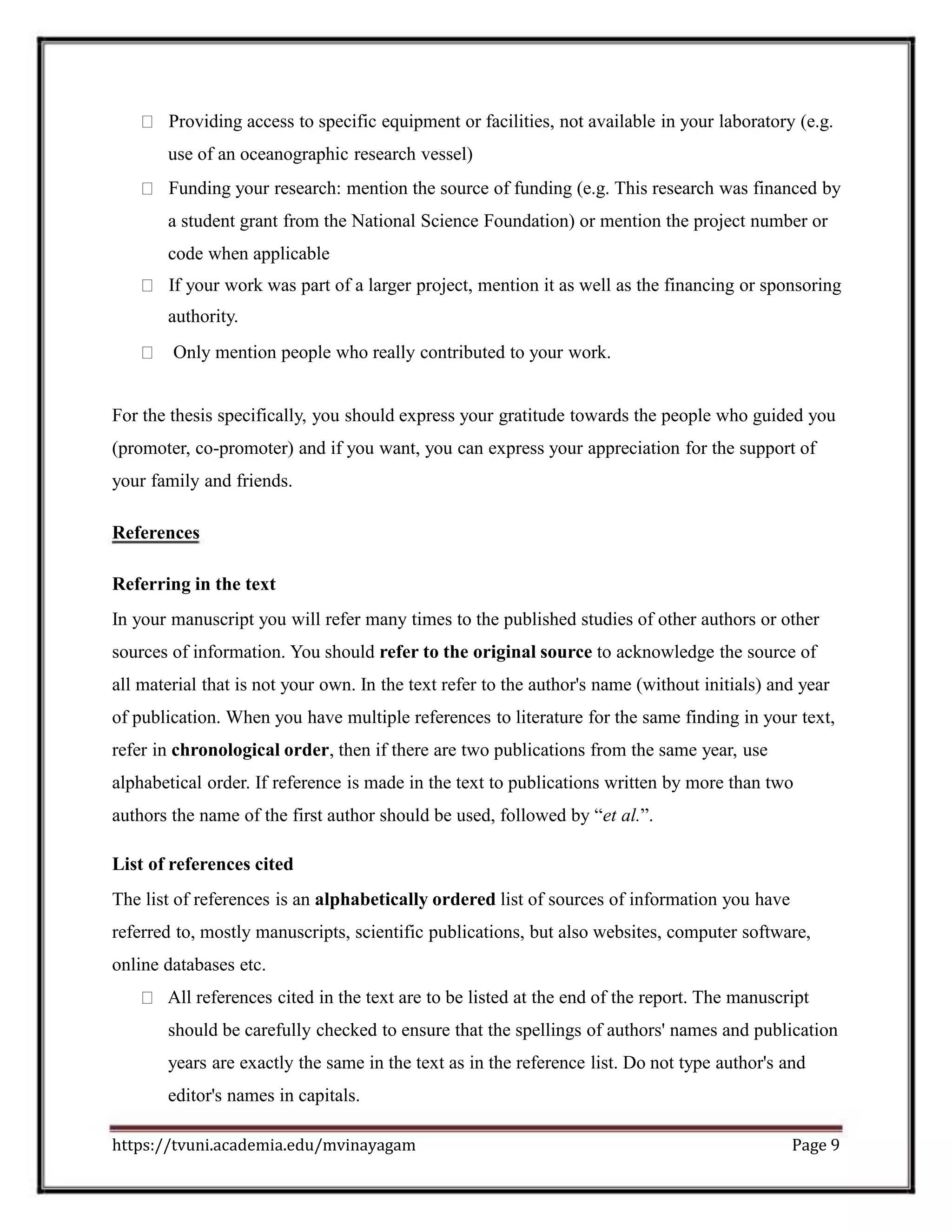
Example 1 (completely fictive data):
Table - Percentage survival of different organisms undergoing different salinity and
temperature treatments
Treatments
Salinity (ppt) Temperature (°C)
Organism 20 30 40 50 15 20 25 30
Asterias
rubens 70.6 80.9 95.6 20.4 45.8 90.4 44.6 21.6
Actinia
acticans 60.7 NDa 50.2 33.9 67.9 23.4 24.5 80.6
Rubella
vulgaris 59.7 29.4 89.3 99.5 22.4 90.2 32.7 78.5
aNot Determined.
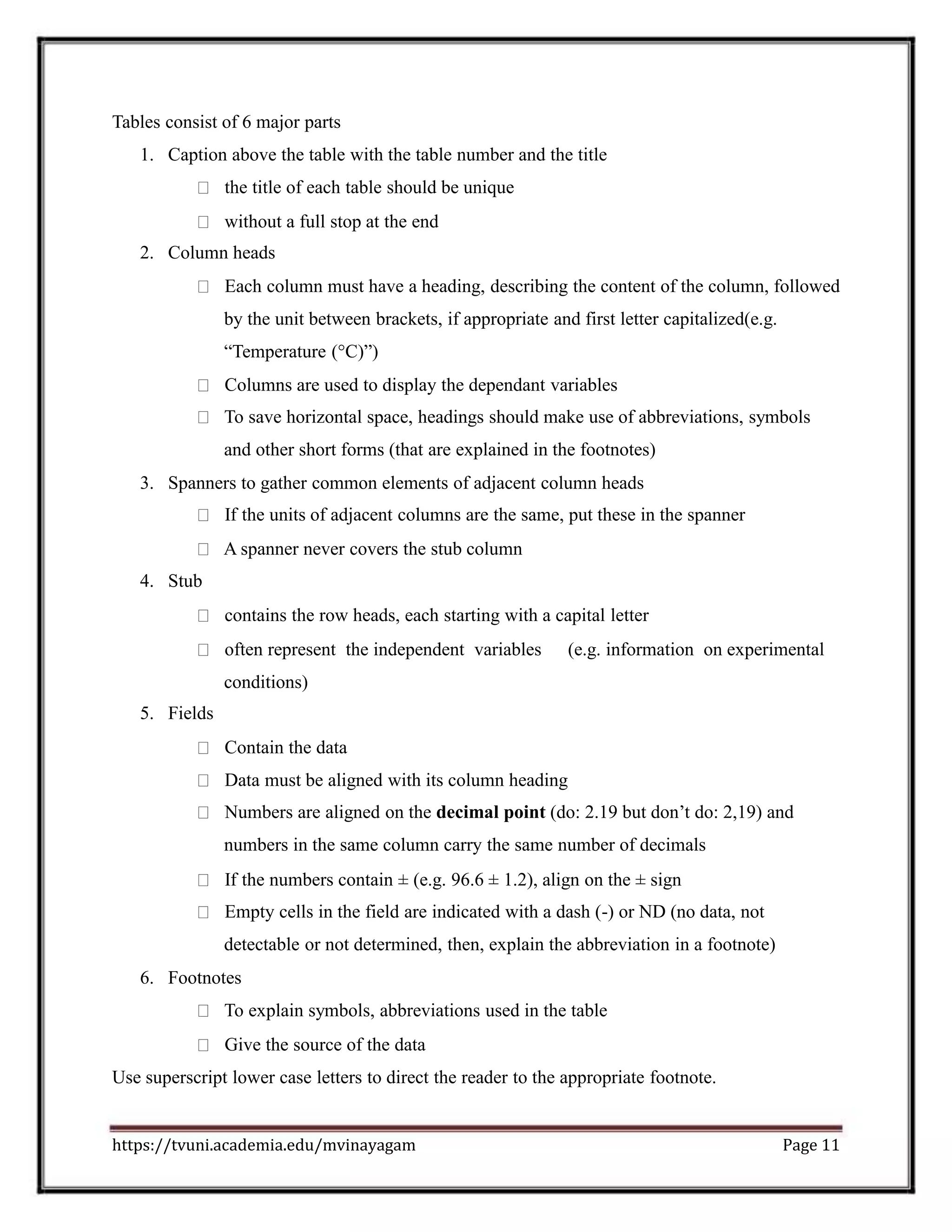
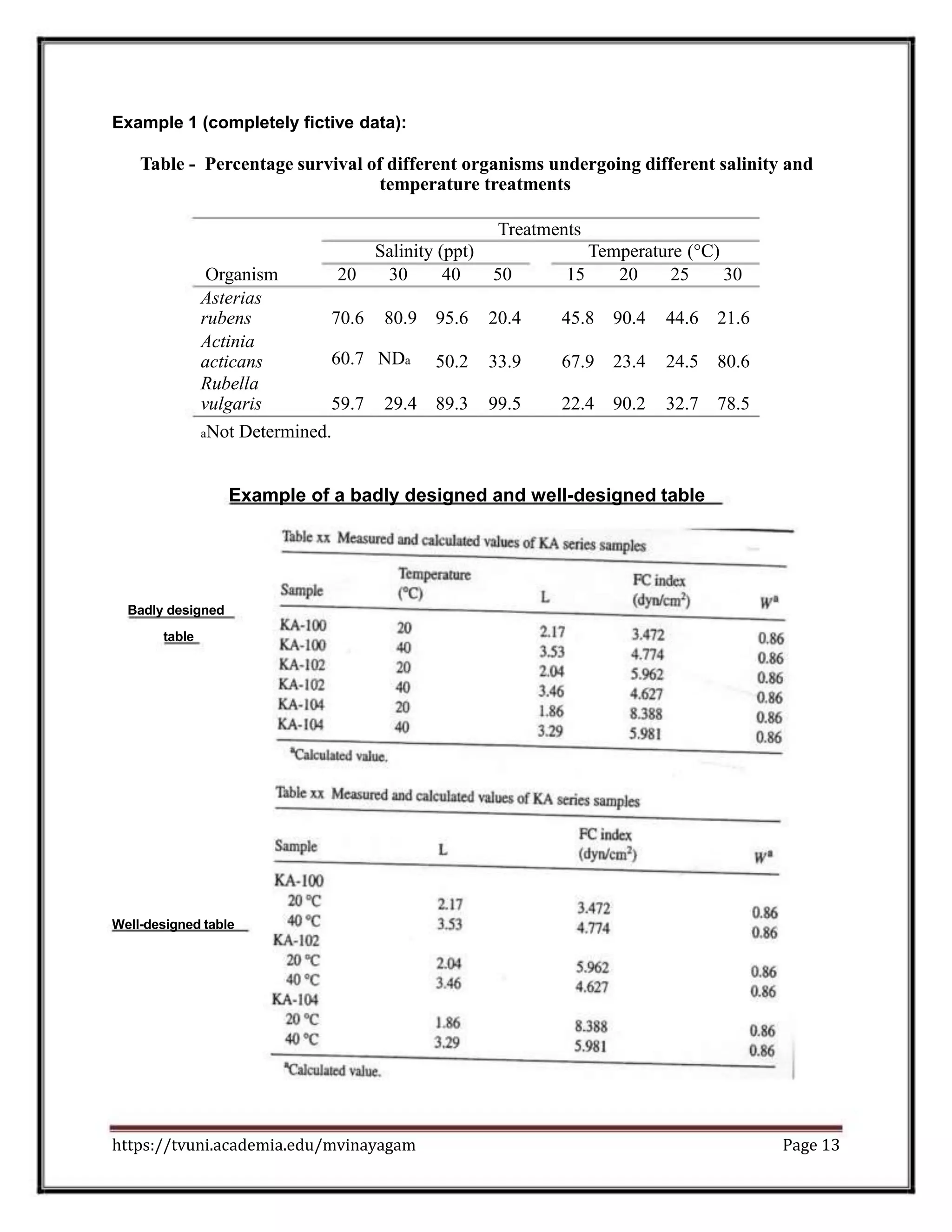
Example of a badly designed and well-designed table
Badly designed
table
Well-designed table
https://tvuni.academia.edu/mvinayagam Page 13
Figures
Some considerations:
Captions should be put below the figure
Figures should be self-explanatory
Figures should be placed as closely as possible after being referred to in the text for the
first time
Use the same abbreviations as used in the text and the tables
Graphs
Are used to represent data for which trends or proportions are important characteristics.
General considerations:
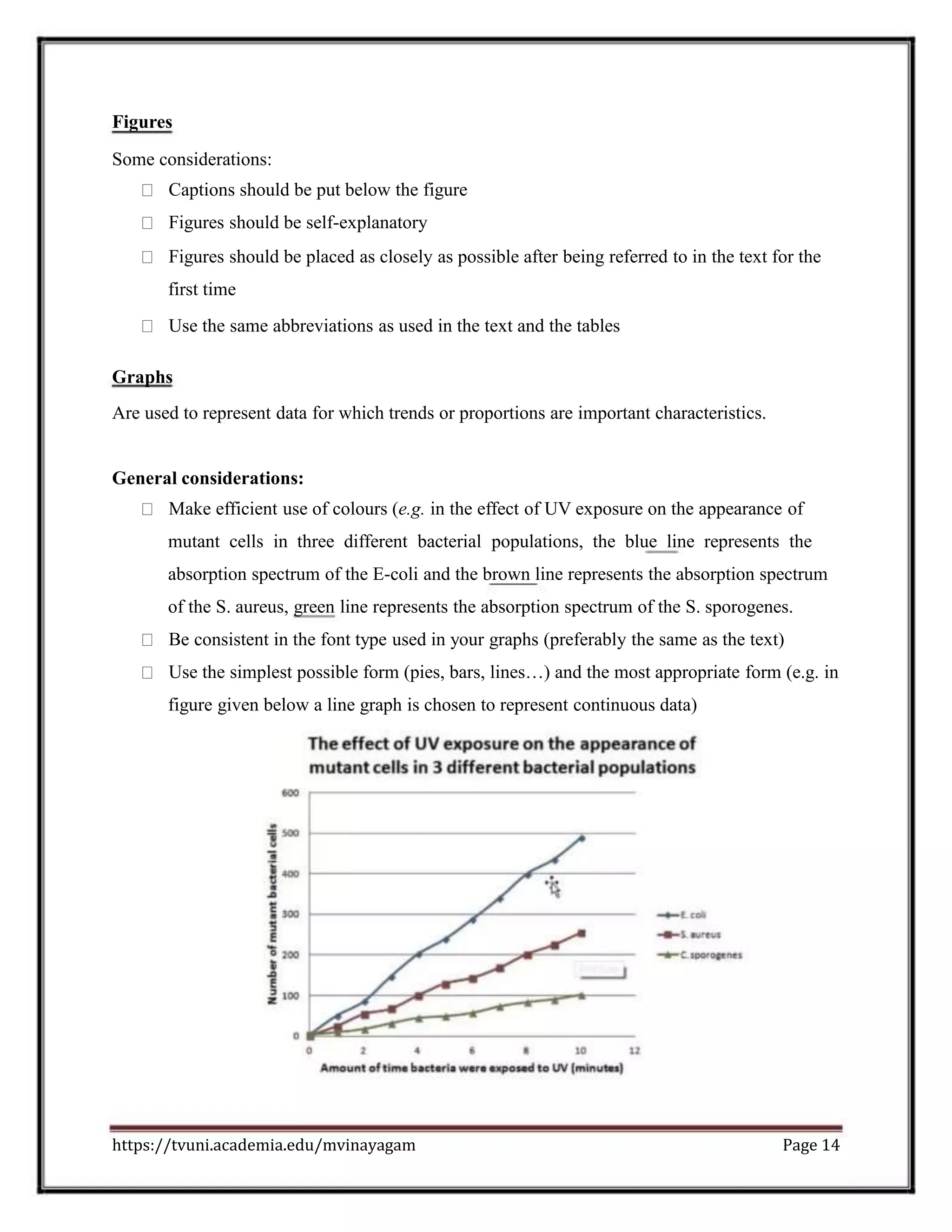
Make efficient use of colours (e.g. in the effect of UV exposure on the appearance of
mutant cells in three different bacterial populations, the blue line represents the
absorption spectrum of the E-coli and the brown line represents the absorption spectrum
of the S. aureus, green line represents the absorption spectrum of the S. sporogenes.
Be consistent in the font type used in your graphs (preferably the same as the text)
Use the simplest possible form (pies, bars, lines…) and the most appropriate form (e.g. in
figure given below a line graph is chosen to represent continuous data)
https://tvuni.academia.edu/mvinayagam Page 14
Line graphs
To represent trends, continuous data
Limit the number of curves to 3-5 curves and identify the curves clearly with symbols
(eg. ◊, □, ○).
Plot the independent variable on the X-axis and the dependent variable on the Y-axis
Label all axis carefully and show the units of measure
Use ticks and sub ticks to divide the axis so that you don’t overload it with numbers
Use whiskers for showing standard deviations of point measurements (eg. above Error!
Reference source not found.)
Pie charts
Are well suited to represent proportions
Example given in recommended diet given below.
Bar graphs
Can be presented for data collected at even or uneven
intervals
Bars should be wider than the spaces between them
Use whiskers for showing standard deviations of point measurements (eg No of people
like nicest fruits given below.
https://tvuni.academia.edu/mvinayagam Page 15
Flowcharts
Are visual aids to understand complex concepts or procedures, experimental set-ups etc.
Photographs
Are used to illustrate the organism under study, the study site, the apparatus used etc
https://tvuni.academia.edu/mvinayagam Page 16
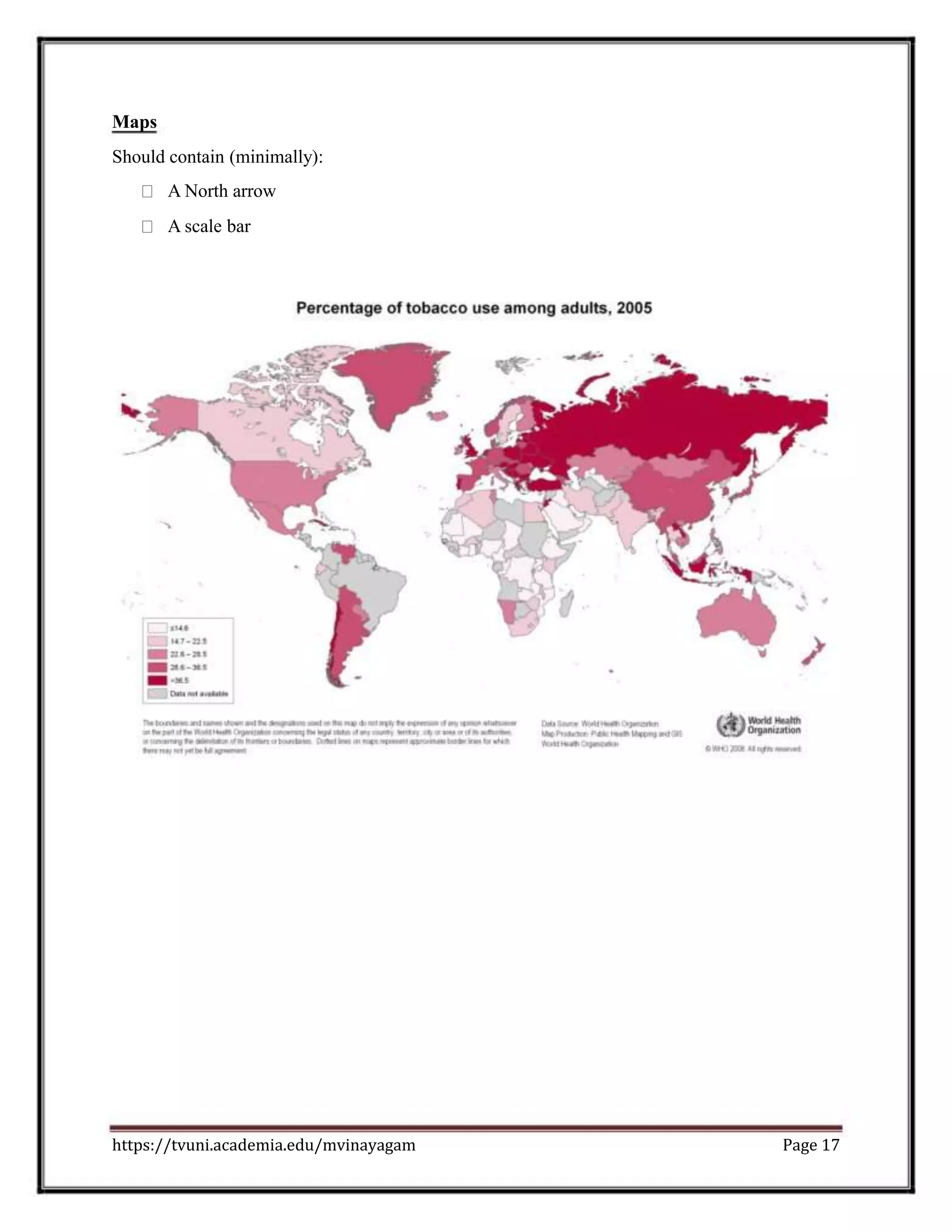
Maps
Should contain (minimally):
A North arrow
A scale bar
https://tvuni.academia.edu/mvinayagam Page 17
Appendix 1: Verbosity
Source: Scientific Style and Format. The CBE Manual for Authors, Editors and Publishers,
1994. The Council of Biology Editors (now Council of Science Editors), 6th Edition, 825 pp.
(ISBN: 0-521-47154-0).
A text with unneeded words and phrases slows the reader, and they should be eliminated. A
phrase such as "it is interesting to note that" adds no information and only delays getting to the
point of the sentence. Expressions such as "It is reported by Smith that. . :' can be shortened, for
example, to "Smith reported that. . .". Many such widely used wordy phrases can be shortened
to simpler forms.
[Wordy] [Concise]
a majority of most
a number of few, many, several, some
accounted for the fact that because
along the lines of like
an innumerable number innumerable, countless, many
of an order of magnitude 10 times
are of the same opinion agree
as a consequence of because of
as far as our own observations are concerned, we observed
they show
ascertain the location of find
at the present moment, at this point in time now
bright green in colour bright green
by means of by, with
caused injuries to injured
completely filled filled
[We] conducted inoculation inoculated
definitely proved proved
despite the fact that although
due to the fact that because, due to
during the course of during, while
during the time that while, when
fewer in number fewer
for the purpose of examining to examine
for the reason that because
https://tvuni.academia.edu/mvinayagam Page 18
future plans plans
give rise to cause
goes under the name of is called
has the capability of can, is able
if conditions are such that if, when
in a satisfactory manner, in an adequate satisfactorily, adequately
manner
in all cases always, invariably
in case if
in close proximity to near
in connection with about, concerning
in [my, our] opinion it is not an unjustifiable [I. We] think.
assumption that
inorder to To
in the course of during, while
in the event that if
in the near future soon
in the vicinity of near
in view of the fact that because
is in a position to can, may
it has been reported by Jones Jones reported
it is believed that [omit]
it is often the case that often
it is possible that the cause is it is this that the cause may be this
it is worth pointing out that note that
it would thus appear that apparently
lacked the ability to could not
large amounts of much
large in size large
large numbers of many
lenticular in character lenticular
located in, located near in, near
masses are of large size masses are large, large
necessitates the inclusion of masses needs, requires
of such hardness that so hard that
https://tvuni.academia.edu/mvinayagam Page 19
on account of because
on behalf of for
on the basis of from, by, because
on the grounds that because
original source source
oval in shape, oval-shaped oval
owing to the fact that because, due to
past history history
plants exhibited good growth plants grew well
prior to [in time] before
referred to as called
results so far achieved results so far, results to date
round in shape round
serves the function of being is
smaller in size smaller
subsequent to after
take into consideration consider
the fish in question this fish, these fish
the question as to whether whether
the tests have not as yet the tests have not
the treatment having been performed after treatment
there can be little doubt that this is this probably is
through the use of by, with [not "via"]
throughout the entire area throughout the area
throughout the whole of the experiment throughoutthe experiment
two equal halves halves
was of the opinion that believed
with a view to getting to get
with reference to about [or omit]
with regard to about, concerning
with the result that so that
https://tvuni.academia.edu/mvinayagam Page 20
Appendix - 2 (COVER PAGE OF THE THESIS)
An informative and concise title in a font of your choice
(TITLE)
Thesis submitted to XXXXXXX University
in partial fulfillment of the requirements
for the degree of
DOCTOR OF PHILOSOPHY IN BIOCHEMISTRY
By
XXXXXXXXXXX (NAME., M.Sc., M.Phil.,)
Under the Guidance of
XXXXXXX (NAME)., M. Sc., M.Phil., Ph.D.,
EMBLEM
PG & RESEARCH DEPARTMENT OF BIOCHEMISTRY,
XXXXXXXXXXXXXXXXXXX NAME OF THE UNIVERSITY/COLLEGE
XXXXXXXXXXXXX ADDRESS
INDIA.
MONTH & YEAR - 2016
https://tvuni.academia.edu/mvinayagam Page 21
Appendix - 3 (CERTIFICATE)
XXXXXXXXX
Assistant Professor,
PG & Research Department of Biochemistry,
Islamiah College (Autonomous),
Vaniyambadi,
Vellore District - 635751,
Tamilnadu, India.
Phone: xxxxxxxx (Off); +xxxxxxxxx (Cell); Fax: xxxxxxxxxx (0ffice); Email: xxxxxxxxxxxx
CERTIFICATE
This is to certify that the thesis entitled
“XXXXXXXXXXXXXXXXXXXXXXXXXXXXXXXXXXXXXXXXXXXXXXXXXXXXXXXXXXXXX
XXXXXXXXXXXXXXXXXXXXXXXXXXX” submitted to XXXXXXXXXXXXX University for
the award of degree of Doctor of Philosophy in Biochemistry is a bonafide research
work carried out by XXXXXXXXXXXXXXXXXXXX., M.Sc., M.Phil., under my guidance
and supervision and the thesis has not previously formed the basis for the award of any
degree, diploma, associateship, fellowship or any other similar title, in this or any other
University or institution of higher learning.
(XXXXXXXXXXXXX)
(Supervisor)
Place :
Date :
https://tvuni.academia.edu/mvinayagam Page 22
Appendix - 4 (DECLARATION)
V. Magendira Mani
Assistant Professor,
PG & Research Department of Biochemistry,
Islamiah College (Autonomous),
Vaniyambadi,
Vellore District - 635751,
Tamilnadu, India.
magendiramani@rediffmail.com.
Phone: xxxxxxxx (Off); +xxxxxxxxx (Cell); Fax: xxxxxxxxxx (0ffice); Email: xxxxxxxxxxxx
DECLARATION
I declare that the thesis entitled
“XXXXXXXXXXXXXXXXXXXXXXXXXXXXXXXXXXXXXXXXXXXXXXXXXXXXXXXXXXXXX
XXXXXXXXXXXXXXXXXXXXXXXXXXX” submitted by me for the degree of Doctor of
Philosophy is the record of work carried out by me during the period from 2012 to 2016
under the guidance of XXXXXXXXXXXXXX., M.Sc., M.Phil., Ph.D., Principal and Head,
Department of Biochemistry, XXXXXXXXXXXXX, XXXXXXXXXX, India, and has not formed
the basis for the award of any degree, Diploma, associateship, fellowship, titles in this or
any other University or other similar institution of Higher learning.
(XXXXXXXXX)
Place :
Date :
https://tvuni.academia.edu/mvinayagam Page 23
Appendix - 5 (ACKNOWLEDGMENT)
First and foremost I would like to express my gratitude and heartiest deep-felt
thanks to almighty GOD, the creator of the mankind for giving me the opportunity to
carry on research and making all my paths free of obstacles. I thank almighty GOD for
his blessings as without the will of almighty GOD the completion of my work would not
have been possible.
I would like to take this opportunity to acknowledge my indebtedness to my
supervisor XXXXXXXX., M.Sc., M.Phil., Ph.D., Principal and Head of the Department of
Biochemistry, XXXXXXXXXXX, for his exceptional love, encouragement, deep interest,
valuable suggestions, critical comments, vigilant guidance, constant encouragement,
gentle and caring attitude throughout my research period.
My parents deserve special mention for their inseparable support and prayers.
My Father, XXXXXX, in the first place is the person who put the fundament, my learning
character, showing me the joy of intellectual pursuit ever since I was a child. My Mother,
XXXXXX, is the one who sincerely raised me with her caring and gentle love. I owe my
deepest gratitude to my Sister XXXXXXX M.Sc., and Brothers, XXXXXXX and for their
sacrifices, unconditional support and prayers thanks for being supportive and caring
siblings.
Last but not least, I was extraordinarily fortunate in have my wife XXXXXXX., M.A.
XXXXXX., she has lost a lot due to my continuous engagement in research. Without her
encouragement and understanding it would have been impossible for me to finish this
work.
I express my gratitude to all persons who have contributed either directly or
indirectly to the compilation of this study. (XXXXXXXX)
https://tvuni.academia.edu/mvinayagam Page 24
Appendix - 6 (TABLE OF CONTENTS)
List all headings and subheadings with page numbers
Indent subheadings
It will look something like this:
Page No
List of Figures xxx
List of Tables
Introduction xxx
subheads ...?
Methods xxx
subheads ...?
Results xxx
subheads ...?
Discussion xxx
subheads ...?
Conclusion xxx
Recommendations xxx
Acknowledgments
References xxx
Appendices xxx
List of Figures
List page numbers of all figures.
The list should include a short title for each figure but not the whole caption.
List of Tables
List page numbers of all tables.
The list should include a short title for each table but not the whole caption.
https://tvuni.academia.edu/mvinayagam Page 25
Appendix - 7 (DEDICATION)
Dedicated
to
my
Beloved Family members
& Friends
https://tvuni.academia.edu/mvinayagam Page 26
Appendix - 8 (LIST OF ABBREVIATIONS)
% - Percentage
µg - Microgram
µmoles - Micromoles
•OH - Hydroxyl radical
AD - Alzheimer’s disease
ANOVA - Analysis of variance
ASD - Autism spectrum disorders
B.W. - Body weight
WHO - World Health Organization
α - Alpha
β - Beta
γ - Gamma
μm - Micrometre
UV - Ultraviolet
v/v - Volume/Volume
w/v - Weight/volume
w/w - Weight/weight
Appendix - 9 (RECOMMENDATIONS)
Recommendations
Include when appropriate (most of the time)
Remedial action to solve the problem.
Further research to fill in gaps in our understanding.
Directions for future investigations on this or related topics.
https://tvuni.academia.edu/mvinayagam Page 27
Appendix - 10 (LIST OF PUBLICATIONS)
S. No Research article Publication Journal
Month/
Year
Impact
factor
value
Pyrethroid Deltamethrin induced developmental
neurodegenerative cerebral injury and ameliorating Biomedicine
1 effect of dietary glycoside Naringin in male Wistar and Aging
rats. Volume 4, Issue 1, January-March 2014, Pages Pathology
1-8. doi:10.1016/j.biomag.2013.11.001.
Jan
2014*a
2.367
Naringin modulates the impairment of memory,
anxiety, locomotor, and emotionality behaviors in
rats exposed to deltamethrin; a possible mechanism Biomedicine
2 association with oxidative stress, acetyl and Preventive
cholinesterase and ATPase. Volume 4, Issue 4, Oct - Nutrition
Dec 2014, Pages 527-533.
doi:10.1016/j.bionut.2014.08.006.
Dec
2014*b
2.512
3
4
5
Citation index
*a this work was cited in the Journal of Molecular Neuroscience - by Yassine Chtourou et al., 2015 (April).
*b this work was cited in the Journal of Neurotoxicology and Teratology- by Hanan et al., 2015 (July).
*b this work was cited in the Journal of Gene - by Wei Liu et al., 2016 (February).
Reference: https://scholar.google.co.in/citations?user=WRe7INoAAAAJ&hl=en
Appendix - 11
PAPER PRESENTED IN SEMINAR/ CONFERENCE
Paper presented
S. No Title of the paper in Seminar/
Conference
Month/
Year
1
“Pyrethroid Pesticide Poisoning - Cognitive Brain &
Issues”
ICMR sponsored national level seminar on
“Cognitive Brain & Issues” - (CBIS -2014).
Department of Apr 2014
Biochemistry, Indo
American (Won first
College, Cheyyar. prize)
“Pyrethroid Deltamethrin Pesticide Poisoning -
Cognitive Brain & Issues Department of
Phyto therapeutic approaches of Flavonoid Biochemistry,
2 naringin” Islamiah College
UGC Sponsored national level seminar on (Autonomous),
“Nanomedicine and Phytotherapy - Current Vaniyambadi
Scenario and Future Prospects” - (NMPT -2015).
Mar 2015
(Won third
prize)
https://tvuni.academia.edu/mvinayagam Page 28
Appendix - 12 (APPENDICES)
Include all your data in the appendix.
Reference data/materials not easily available (these are used as a resource by the
department and other students).
Tables (where more than 12 pages).
Calculations (where more than 12 pages).
You may include a key article as appendix.
If you consulted a large number of references but did not cite all of them, you might want
to include a list of additional resource material, etc.
List of equipment used for an experiment or details of complicated procedures.
Note: Figures and tables, including captions, should be embedded in the text and not in
an appendix, unless they are more than 12 pages and are not critical to your argument.
V. Magendira Mani
Assistant Professor,
PG & Research Department of Biochemistry,
Islamiah College (Autonomous),
Vaniyambadi,
Vellore District - 635751,
Tamilnadu, India.
magendiramani@rediffmail.com ;
https://tvuni.academia.edu/mvinayagam
https://tvuni.academia.edu/mvinayagam Page 29

Guidelines to scientific writing thesis (1)

  • 1.
    Guidelines to ScientificWriting - logical format for writing thesis Compiled by V. Magendira Mani Assistant Professor, PG & Research Department of Biochemistry, Islamiah College (Autonomous), Vaniyambadi, Vellore District - 635751, Tamilnadu, India. magendiramani@rediffmail.com Download at: https://tvuni.academia.edu/mvinayagam https://tvuni.academia.edu/mvinayagam Page 1
  • 2.
    Guidelines to ScientificWriting - logical format for writing thesis Basic principles in scientific writing ALL scientific writing should follow the 7 C’s-rule, i.e. scientific writing should be: 1. Clear: Unmistakable, not leading to confusion 2. Correct: Accurate, free from error a. Not prone to interpretation (explanation) b. Not prone to speculation (assumption) 3. Complete: Contain all necessary parts and information to be clearly understood 4. Concise: to the point, devoid of redundant information and words (avoid verbosity) Appendix - 1 5. Conform to the requirements set by the university (thesis)/journal (journal publication)/employer/… and to the standard conventions and basic principles in: a. Style: units, rules of abbreviations, literature citations etc. and b. Format: shape, size, general make-up of a publication 6. Consistent: uniform throughout the text in spelling, structure, style, format, layout, typography, etc. 7. Common sense prevails Format of scientific writing Thesis There is no minimum or maximum number of pages for your thesis manuscript, but is also depends of the College/University etc. Don’t try to fill pages and pages with text and words that have little to do with your thesis research. Instead, be concise and follow the rule of the 7C’s, as explained previously. https://tvuni.academia.edu/mvinayagam Page 2
  • 3.
    Your thesis shouldhave the following organization: Cover page Appendix - 2 Title page (same as cover page but in black and white) Certificate Appendix - 3 Declaration Appendix - 4 Now you start numbering your pages with roman numbers: i, ii, iii, iv, v, etc. Acknowledgements Appendix - 5 Table of contents Appendix - 6 List of tables Appendix - 6 List of figures Appendix - 6 Dedication (optional) Appendix - 7 List of abbreviations etc. Appendix - 8 Abstract Now you start numbering your pages with Arabic numbers: 1, 2, 3 etc. Introduction Literature review (optional) Materials and Methods Results Discussion Conclusion Recommendation(s) Appendix - 9 Literature cited References Now you stop numbering your pages List of publications Appendix - 10 List of scientific presented papers/workshop/seminar participated/presented etc. Appendix - 11 Annexes (=plural of Annex)/Appendices (=plural of Appendix) Appendix - 12 Index (optional, don’t include an index for a short report of 10-20 pages) https://tvuni.academia.edu/mvinayagam Page 3
  • 4.
    Structure of yourthesis A research paper or thesis is a report of original findings organized into several sections according to a format that reflects the logic of a scientific argument. First the author states the purpose of the investigation, placing the work in a broader scientific context (Introduction). Then the procedure is described (Materials and Methods). Afterwards, the findings are presented (Results), interpreted (Discussion) and summarized (Conclusion). Title and abstract Both the title and the abstract are very important parts of your thesis, since these will be read most often by many readers. They serve two purposes for your readers: 1. To disclose the basic information of your research 2. To help readers decide whether or not to read the entire paper. Title The title should attract attention, but most important, it should be informative and concise. A good title indicates the main point of your study, so use: The most precise words possible (e.g. appropriate taxonomic information) Words that lend themselves to indexing the subject (your title is the first source for key words for indexing services). On the other hand, be sure your title will make sense to someone not familiar with your subject. Provide adequate information, but don’t make your title too long 8-12 words are a good range. Example of good Vs bad titles Bad title Good title Ecological Studies of Some Northern Lakes Seasonal Algal Succession and Cultural Euthrophication in Three Northern Temperate Lakes Effect of Hormones and Vitamin B on Effect of Hormones and Vitamin B on Gametophyte Development in a Moss Gemtophyte Development in the Moss Pylaisiella selwyni Studies on the Reproductive Biology of Sperm Transfer, Storage and Utilization in Drosophila, Including Sperm Transfer, Sperm Drosophila Storage, and Sperm Utilization https://tvuni.academia.edu/mvinayagam Page 4
  • 5.
    Abstract The abstract givesthe reader a clear idea of the subject studied, it helps him to decide whether or not to read the full thesis/paper and it provides words for indexing. The abstract is a concise (max. 1 page, condensation of the content of the full report by 95%), complete report of your work that can stand alone without further explanation. It should include: The objectives/hypothesis of the study and justification for conducting the investigation (What?, When?, Why?) The basic materials and methods used (How?) The main results obtained and significant conclusions that can be drawn The abstract should not include: A discussion of your results References Tabulated data Any abbreviations, unless they are understood when standing alone (e.g. “DNA”, “pH”, “USA”) Keywords Keywords are usually not required for a thesis, but most journals ask the author of a scientific article to include research keywords for indexing and possible readers can easily screen the content of the publication. If you decide to add keywords to your manuscript, put them right below the abstract (on the same page). Three to five keywords is enough. Keywords are the most pertinent informative words pertaining to the research done that did not occur in the abstract. Introduction =WHAT? The introduction sets the stage for your scientific argument. It places the work you have done in a broad theoretical context and provides the reader with enough information to appreciate and understand the relevance your objectives. For example, if your thesis work is carried out in the framework of a larger research project; describe the project and your part in it. https://tvuni.academia.edu/mvinayagam Page 5
  • 6.
    The introduction should beinformative explain the rationale for the study and your major objectives clearly identify the subject of your research state the hypothesis you are investigating or define the problem you are trying to solve bring the reader up-to-date on what has already been done provide background information on the research subject give a concise literature review (unless you have a separate “literature review” section) to orient the reader by summarizing pertinent literature in your field be written in the present tense Literature review In case of a thesis manuscript, a review of the relevant literature can be done in a separate section, but, in case of a scientific article, the literature review is generally included in the introduction. It should be written in the present tense. The general rule on which tense to use is that you use the past tense when reporting your own findings (Materials and Methods, Results) and the present tense when discussing the published work of others (Introduction, Literature review, Discussion). Materials and methods = WHERE and HOW? Your methodology creates the context for evaluating your data. How you took your samples and did your measurements, what controls you used, what variables you did and did not consider, which assumptions you made; all these things play an important role in the interpretation of the results. This section should provide information such that your study can be duplicated/repeated by others Describe procedures and methods used, e.g. sampling strategy/frequency/location/date, experimental design, tools and sampling devices used, manipulation of the samples, https://tvuni.academia.edu/mvinayagam Page 6
  • 7.
    statistical analysis, completetaxonomic information of the organisms used, data quality assurance etc. where appropriate, use flowcharts to visualize the processing methods and handling of your materials be organized logically and orderly be written in the past tense If you used a well-known method, name it and refer to the paper in which it is described. If you modified the well-known method, describe how and why you modified it. Results =WHAT DID YOU FIND? This is the most important part of your thesis. The Results section should summarize the data, emphasizing important patterns or trends, and illustrate and support your generalizations with explanatory details, statistics, examples of representative or atypical cases and references to tables and figures. Use the past tense. Do: Present your results in a logical and orderly fashion and use the same sequence as in the Materials and Methods section Be complete, but concise Make maximal use of tables and figures. One good graph can be worth a 1000 words. Give final and meaningful data only (no raw data), e.g. after statistical processing Do NOT: Give the same results twice or more, e.g. in the text, a table and a graph, but chose the most appropriate way for presentation Omit data that you consider negative (in the sense that they don’t comply to your hypothesis) Give primary (raw, unprocessed) data Interpret the data or draw major conclusions; this should be done in the Discussion and Conclusion sections, respectively. https://tvuni.academia.edu/mvinayagam Page 7
  • 8.
    Discussion =WHAT DO ALLTHESE RESULTS MEAN? The Discussion section should Relate your results to your hypothesis: do your results prove that your hypothesis is correct or not, and how/why? Interpret the results with emphasis on the problem, question or hypothesis you put forward in the introduction Relate the data to their causes: i.e. why the data are what they are Relate your findings to those obtained by other researchers: whether they corroborate your results or whether they don’t and support this with evidence Be careful with extrapolating your results too broadly: avoid speculation and generalization Conclusions What conclusions can you draw from your findings (these can be enumerated)? What is their significance with regard to the problem you tried to solve? State briefly any implications for practical applications or future studies if appropriate Eventually recommendations (if appropriate) Many scientific journals do not publish a separate Conclusions section, instead, Discussion and Conclusions are combined, but for a thesis, keep them separated. Acknowledgements Briefly (max 1 -1.5 pages) thank people who helped you professionally, namely with: Sampling Reviewing your manuscript Statistical analysis Lab work (technicians) https://tvuni.academia.edu/mvinayagam Page 8
  • 9.
    Providing access tospecific equipment or facilities, not available in your laboratory (e.g. use of an oceanographic research vessel) Funding your research: mention the source of funding (e.g. This research was financed by a student grant from the National Science Foundation) or mention the project number or code when applicable If your work was part of a larger project, mention it as well as the financing or sponsoring authority. Only mention people who really contributed to your work. For the thesis specifically, you should express your gratitude towards the people who guided you (promoter, co-promoter) and if you want, you can express your appreciation for the support of your family and friends. References Referring in the text In your manuscript you will refer many times to the published studies of other authors or other sources of information. You should refer to the original source to acknowledge the source of all material that is not your own. In the text refer to the author's name (without initials) and year of publication. When you have multiple references to literature for the same finding in your text, refer in chronological order, then if there are two publications from the same year, use alphabetical order. If reference is made in the text to publications written by more than two authors the name of the first author should be used, followed by “et al.”. List of references cited The list of references is an alphabetically ordered list of sources of information you have referred to, mostly manuscripts, scientific publications, but also websites, computer software, online databases etc. All references cited in the text are to be listed at the end of the report. The manuscript should be carefully checked to ensure that the spellings of authors' names and publication years are exactly the same in the text as in the reference list. Do not type author's and editor's names in capitals. https://tvuni.academia.edu/mvinayagam Page 9
  • 10.
    The indication “etal.” that is used in the text (see previous section) should never be used in the list of references. In this list names of authors and all co-authors must be given in full. The list of references should be arranged alphabetically by authors' names, and chronologically per author. If an author's name in the list is also mentioned with co- authors, the following order should be used:(1) publications of the single author, arranged according to publication year (2) publications of the same author with one co- author, arranged according to publication year Appendix/Appendices The Appendix contains related materials/data that provide additional information but are not essential for understanding the thesis/report. E.g. tables with raw data, intermediate statistical results, figures, photos. Common for a thesis, but scientific articles rarely have an appendix. Give only appendices if necessary, not to increase the number of pages of your thesis. In fact, you should not paginate your appendices. Accessories to the text Tables Tables can be used for various kinds of information: To show precise numerical values to summarize or emphasize verbal information in compact form to organize numerical data in an easy and understandable way A table should be: clear and easy to read understandable on its own orderly and logically organized in agreement with the rest of the text (i.e. use the same units/symbols etc. as in the text) https://tvuni.academia.edu/mvinayagam Page 10
  • 11.
    Tables consist of6 major parts 1. Caption above the table with the table number and the title the title of each table should be unique without a full stop at the end 2. Column heads Each column must have a heading, describing the content of the column, followed by the unit between brackets, if appropriate and first letter capitalized(e.g. “Temperature (°C)”) Columns are used to display the dependant variables To save horizontal space, headings should make use of abbreviations, symbols and other short forms (that are explained in the footnotes) 3. Spanners to gather common elements of adjacent column heads If the units of adjacent columns are the same, put these in the spanner A spanner never covers the stub column 4. Stub contains the row heads, each starting with a capital letter often represent the independent variables (e.g. information on experimental conditions) 5. Fields Contain the data Data must be aligned with its column heading Numbers are aligned on the decimal point (do: 2.19 but don’t do: 2,19) and numbers in the same column carry the same number of decimals If the numbers contain ± (e.g. 96.6 ± 1.2), align on the ± sign Empty cells in the field are indicated with a dash (-) or ND (no data, not detectable or not determined, then, explain the abbreviation in a footnote) 6. Footnotes To explain symbols, abbreviations used in the table Give the source of the data Use superscript lower case letters to direct the reader to the appropriate footnote. https://tvuni.academia.edu/mvinayagam Page 11
  • 12.
    Major parts ofa table (Source: Scientific Style and Format. The CBE Manual for Authors, Editors and Publishers, 1994. The Council of Biology Editors, 6th Edition, 825 pp.) Some tips: 3 full width horizontal lines: (1) to separate the caption from the table, (2) to separate the headings from the fields and (3) to separate the table from the footnotes The use vertical lines is not recommended Try to fit a table on 1 page (you can change the page orientation), if it doesn’t work out, continue on the next page and give as caption: “Table 2. Continued” (without title) and repeat the column headings Centre your tables on the page Tables should be put as closely as possible after being referred to in the text for the first time https://tvuni.academia.edu/mvinayagam Page 12
  • 13.
    Example 1 (completelyfictive data): Table - Percentage survival of different organisms undergoing different salinity and temperature treatments Treatments Salinity (ppt) Temperature (°C) Organism 20 30 40 50 15 20 25 30 Asterias rubens 70.6 80.9 95.6 20.4 45.8 90.4 44.6 21.6 Actinia acticans 60.7 NDa 50.2 33.9 67.9 23.4 24.5 80.6 Rubella vulgaris 59.7 29.4 89.3 99.5 22.4 90.2 32.7 78.5 aNot Determined. Example of a badly designed and well-designed table Badly designed table Well-designed table https://tvuni.academia.edu/mvinayagam Page 13
  • 14.
    Figures Some considerations: Captions shouldbe put below the figure Figures should be self-explanatory Figures should be placed as closely as possible after being referred to in the text for the first time Use the same abbreviations as used in the text and the tables Graphs Are used to represent data for which trends or proportions are important characteristics. General considerations: Make efficient use of colours (e.g. in the effect of UV exposure on the appearance of mutant cells in three different bacterial populations, the blue line represents the absorption spectrum of the E-coli and the brown line represents the absorption spectrum of the S. aureus, green line represents the absorption spectrum of the S. sporogenes. Be consistent in the font type used in your graphs (preferably the same as the text) Use the simplest possible form (pies, bars, lines…) and the most appropriate form (e.g. in figure given below a line graph is chosen to represent continuous data) https://tvuni.academia.edu/mvinayagam Page 14
  • 15.
    Line graphs To representtrends, continuous data Limit the number of curves to 3-5 curves and identify the curves clearly with symbols (eg. ◊, □, ○). Plot the independent variable on the X-axis and the dependent variable on the Y-axis Label all axis carefully and show the units of measure Use ticks and sub ticks to divide the axis so that you don’t overload it with numbers Use whiskers for showing standard deviations of point measurements (eg. above Error! Reference source not found.) Pie charts Are well suited to represent proportions Example given in recommended diet given below. Bar graphs Can be presented for data collected at even or uneven intervals Bars should be wider than the spaces between them Use whiskers for showing standard deviations of point measurements (eg No of people like nicest fruits given below. https://tvuni.academia.edu/mvinayagam Page 15
  • 16.
    Flowcharts Are visual aidsto understand complex concepts or procedures, experimental set-ups etc. Photographs Are used to illustrate the organism under study, the study site, the apparatus used etc https://tvuni.academia.edu/mvinayagam Page 16
  • 17.
    Maps Should contain (minimally): ANorth arrow A scale bar https://tvuni.academia.edu/mvinayagam Page 17
  • 18.
    Appendix 1: Verbosity Source:Scientific Style and Format. The CBE Manual for Authors, Editors and Publishers, 1994. The Council of Biology Editors (now Council of Science Editors), 6th Edition, 825 pp. (ISBN: 0-521-47154-0). A text with unneeded words and phrases slows the reader, and they should be eliminated. A phrase such as "it is interesting to note that" adds no information and only delays getting to the point of the sentence. Expressions such as "It is reported by Smith that. . :' can be shortened, for example, to "Smith reported that. . .". Many such widely used wordy phrases can be shortened to simpler forms. [Wordy] [Concise] a majority of most a number of few, many, several, some accounted for the fact that because along the lines of like an innumerable number innumerable, countless, many of an order of magnitude 10 times are of the same opinion agree as a consequence of because of as far as our own observations are concerned, we observed they show ascertain the location of find at the present moment, at this point in time now bright green in colour bright green by means of by, with caused injuries to injured completely filled filled [We] conducted inoculation inoculated definitely proved proved despite the fact that although due to the fact that because, due to during the course of during, while during the time that while, when fewer in number fewer for the purpose of examining to examine for the reason that because https://tvuni.academia.edu/mvinayagam Page 18
  • 19.
    future plans plans giverise to cause goes under the name of is called has the capability of can, is able if conditions are such that if, when in a satisfactory manner, in an adequate satisfactorily, adequately manner in all cases always, invariably in case if in close proximity to near in connection with about, concerning in [my, our] opinion it is not an unjustifiable [I. We] think. assumption that inorder to To in the course of during, while in the event that if in the near future soon in the vicinity of near in view of the fact that because is in a position to can, may it has been reported by Jones Jones reported it is believed that [omit] it is often the case that often it is possible that the cause is it is this that the cause may be this it is worth pointing out that note that it would thus appear that apparently lacked the ability to could not large amounts of much large in size large large numbers of many lenticular in character lenticular located in, located near in, near masses are of large size masses are large, large necessitates the inclusion of masses needs, requires of such hardness that so hard that https://tvuni.academia.edu/mvinayagam Page 19
  • 20.
    on account ofbecause on behalf of for on the basis of from, by, because on the grounds that because original source source oval in shape, oval-shaped oval owing to the fact that because, due to past history history plants exhibited good growth plants grew well prior to [in time] before referred to as called results so far achieved results so far, results to date round in shape round serves the function of being is smaller in size smaller subsequent to after take into consideration consider the fish in question this fish, these fish the question as to whether whether the tests have not as yet the tests have not the treatment having been performed after treatment there can be little doubt that this is this probably is through the use of by, with [not "via"] throughout the entire area throughout the area throughout the whole of the experiment throughoutthe experiment two equal halves halves was of the opinion that believed with a view to getting to get with reference to about [or omit] with regard to about, concerning with the result that so that https://tvuni.academia.edu/mvinayagam Page 20
  • 21.
    Appendix - 2(COVER PAGE OF THE THESIS) An informative and concise title in a font of your choice (TITLE) Thesis submitted to XXXXXXX University in partial fulfillment of the requirements for the degree of DOCTOR OF PHILOSOPHY IN BIOCHEMISTRY By XXXXXXXXXXX (NAME., M.Sc., M.Phil.,) Under the Guidance of XXXXXXX (NAME)., M. Sc., M.Phil., Ph.D., EMBLEM PG & RESEARCH DEPARTMENT OF BIOCHEMISTRY, XXXXXXXXXXXXXXXXXXX NAME OF THE UNIVERSITY/COLLEGE XXXXXXXXXXXXX ADDRESS INDIA. MONTH & YEAR - 2016 https://tvuni.academia.edu/mvinayagam Page 21
  • 22.
    Appendix - 3(CERTIFICATE) XXXXXXXXX Assistant Professor, PG & Research Department of Biochemistry, Islamiah College (Autonomous), Vaniyambadi, Vellore District - 635751, Tamilnadu, India. Phone: xxxxxxxx (Off); +xxxxxxxxx (Cell); Fax: xxxxxxxxxx (0ffice); Email: xxxxxxxxxxxx CERTIFICATE This is to certify that the thesis entitled “XXXXXXXXXXXXXXXXXXXXXXXXXXXXXXXXXXXXXXXXXXXXXXXXXXXXXXXXXXXXX XXXXXXXXXXXXXXXXXXXXXXXXXXX” submitted to XXXXXXXXXXXXX University for the award of degree of Doctor of Philosophy in Biochemistry is a bonafide research work carried out by XXXXXXXXXXXXXXXXXXXX., M.Sc., M.Phil., under my guidance and supervision and the thesis has not previously formed the basis for the award of any degree, diploma, associateship, fellowship or any other similar title, in this or any other University or institution of higher learning. (XXXXXXXXXXXXX) (Supervisor) Place : Date : https://tvuni.academia.edu/mvinayagam Page 22
  • 23.
    Appendix - 4(DECLARATION) V. Magendira Mani Assistant Professor, PG & Research Department of Biochemistry, Islamiah College (Autonomous), Vaniyambadi, Vellore District - 635751, Tamilnadu, India. magendiramani@rediffmail.com. Phone: xxxxxxxx (Off); +xxxxxxxxx (Cell); Fax: xxxxxxxxxx (0ffice); Email: xxxxxxxxxxxx DECLARATION I declare that the thesis entitled “XXXXXXXXXXXXXXXXXXXXXXXXXXXXXXXXXXXXXXXXXXXXXXXXXXXXXXXXXXXXX XXXXXXXXXXXXXXXXXXXXXXXXXXX” submitted by me for the degree of Doctor of Philosophy is the record of work carried out by me during the period from 2012 to 2016 under the guidance of XXXXXXXXXXXXXX., M.Sc., M.Phil., Ph.D., Principal and Head, Department of Biochemistry, XXXXXXXXXXXXX, XXXXXXXXXX, India, and has not formed the basis for the award of any degree, Diploma, associateship, fellowship, titles in this or any other University or other similar institution of Higher learning. (XXXXXXXXX) Place : Date : https://tvuni.academia.edu/mvinayagam Page 23
  • 24.
    Appendix - 5(ACKNOWLEDGMENT) First and foremost I would like to express my gratitude and heartiest deep-felt thanks to almighty GOD, the creator of the mankind for giving me the opportunity to carry on research and making all my paths free of obstacles. I thank almighty GOD for his blessings as without the will of almighty GOD the completion of my work would not have been possible. I would like to take this opportunity to acknowledge my indebtedness to my supervisor XXXXXXXX., M.Sc., M.Phil., Ph.D., Principal and Head of the Department of Biochemistry, XXXXXXXXXXX, for his exceptional love, encouragement, deep interest, valuable suggestions, critical comments, vigilant guidance, constant encouragement, gentle and caring attitude throughout my research period. My parents deserve special mention for their inseparable support and prayers. My Father, XXXXXX, in the first place is the person who put the fundament, my learning character, showing me the joy of intellectual pursuit ever since I was a child. My Mother, XXXXXX, is the one who sincerely raised me with her caring and gentle love. I owe my deepest gratitude to my Sister XXXXXXX M.Sc., and Brothers, XXXXXXX and for their sacrifices, unconditional support and prayers thanks for being supportive and caring siblings. Last but not least, I was extraordinarily fortunate in have my wife XXXXXXX., M.A. XXXXXX., she has lost a lot due to my continuous engagement in research. Without her encouragement and understanding it would have been impossible for me to finish this work. I express my gratitude to all persons who have contributed either directly or indirectly to the compilation of this study. (XXXXXXXX) https://tvuni.academia.edu/mvinayagam Page 24
  • 25.
    Appendix - 6(TABLE OF CONTENTS) List all headings and subheadings with page numbers Indent subheadings It will look something like this: Page No List of Figures xxx List of Tables Introduction xxx subheads ...? Methods xxx subheads ...? Results xxx subheads ...? Discussion xxx subheads ...? Conclusion xxx Recommendations xxx Acknowledgments References xxx Appendices xxx List of Figures List page numbers of all figures. The list should include a short title for each figure but not the whole caption. List of Tables List page numbers of all tables. The list should include a short title for each table but not the whole caption. https://tvuni.academia.edu/mvinayagam Page 25
  • 26.
    Appendix - 7(DEDICATION) Dedicated to my Beloved Family members & Friends https://tvuni.academia.edu/mvinayagam Page 26
  • 27.
    Appendix - 8(LIST OF ABBREVIATIONS) % - Percentage µg - Microgram µmoles - Micromoles •OH - Hydroxyl radical AD - Alzheimer’s disease ANOVA - Analysis of variance ASD - Autism spectrum disorders B.W. - Body weight WHO - World Health Organization α - Alpha β - Beta γ - Gamma μm - Micrometre UV - Ultraviolet v/v - Volume/Volume w/v - Weight/volume w/w - Weight/weight Appendix - 9 (RECOMMENDATIONS) Recommendations Include when appropriate (most of the time) Remedial action to solve the problem. Further research to fill in gaps in our understanding. Directions for future investigations on this or related topics. https://tvuni.academia.edu/mvinayagam Page 27
  • 28.
    Appendix - 10(LIST OF PUBLICATIONS) S. No Research article Publication Journal Month/ Year Impact factor value Pyrethroid Deltamethrin induced developmental neurodegenerative cerebral injury and ameliorating Biomedicine 1 effect of dietary glycoside Naringin in male Wistar and Aging rats. Volume 4, Issue 1, January-March 2014, Pages Pathology 1-8. doi:10.1016/j.biomag.2013.11.001. Jan 2014*a 2.367 Naringin modulates the impairment of memory, anxiety, locomotor, and emotionality behaviors in rats exposed to deltamethrin; a possible mechanism Biomedicine 2 association with oxidative stress, acetyl and Preventive cholinesterase and ATPase. Volume 4, Issue 4, Oct - Nutrition Dec 2014, Pages 527-533. doi:10.1016/j.bionut.2014.08.006. Dec 2014*b 2.512 3 4 5 Citation index *a this work was cited in the Journal of Molecular Neuroscience - by Yassine Chtourou et al., 2015 (April). *b this work was cited in the Journal of Neurotoxicology and Teratology- by Hanan et al., 2015 (July). *b this work was cited in the Journal of Gene - by Wei Liu et al., 2016 (February). Reference: https://scholar.google.co.in/citations?user=WRe7INoAAAAJ&hl=en Appendix - 11 PAPER PRESENTED IN SEMINAR/ CONFERENCE Paper presented S. No Title of the paper in Seminar/ Conference Month/ Year 1 “Pyrethroid Pesticide Poisoning - Cognitive Brain & Issues” ICMR sponsored national level seminar on “Cognitive Brain & Issues” - (CBIS -2014). Department of Apr 2014 Biochemistry, Indo American (Won first College, Cheyyar. prize) “Pyrethroid Deltamethrin Pesticide Poisoning - Cognitive Brain & Issues Department of Phyto therapeutic approaches of Flavonoid Biochemistry, 2 naringin” Islamiah College UGC Sponsored national level seminar on (Autonomous), “Nanomedicine and Phytotherapy - Current Vaniyambadi Scenario and Future Prospects” - (NMPT -2015). Mar 2015 (Won third prize) https://tvuni.academia.edu/mvinayagam Page 28
  • 29.
    Appendix - 12(APPENDICES) Include all your data in the appendix. Reference data/materials not easily available (these are used as a resource by the department and other students). Tables (where more than 12 pages). Calculations (where more than 12 pages). You may include a key article as appendix. If you consulted a large number of references but did not cite all of them, you might want to include a list of additional resource material, etc. List of equipment used for an experiment or details of complicated procedures. Note: Figures and tables, including captions, should be embedded in the text and not in an appendix, unless they are more than 12 pages and are not critical to your argument. V. Magendira Mani Assistant Professor, PG & Research Department of Biochemistry, Islamiah College (Autonomous), Vaniyambadi, Vellore District - 635751, Tamilnadu, India. magendiramani@rediffmail.com ; https://tvuni.academia.edu/mvinayagam https://tvuni.academia.edu/mvinayagam Page 29