GUIDELINES FOR SCIENTIFIC
WRITING
RESEARCH
 “Creative and systemic work”
 Simple term - Searching for knowledge and searching for truth
involves the collection, organization and analysis of information to
increase understanding of a specific topic.
provide information about the definition, classification and methodology
of scientific research.
RESEARCH
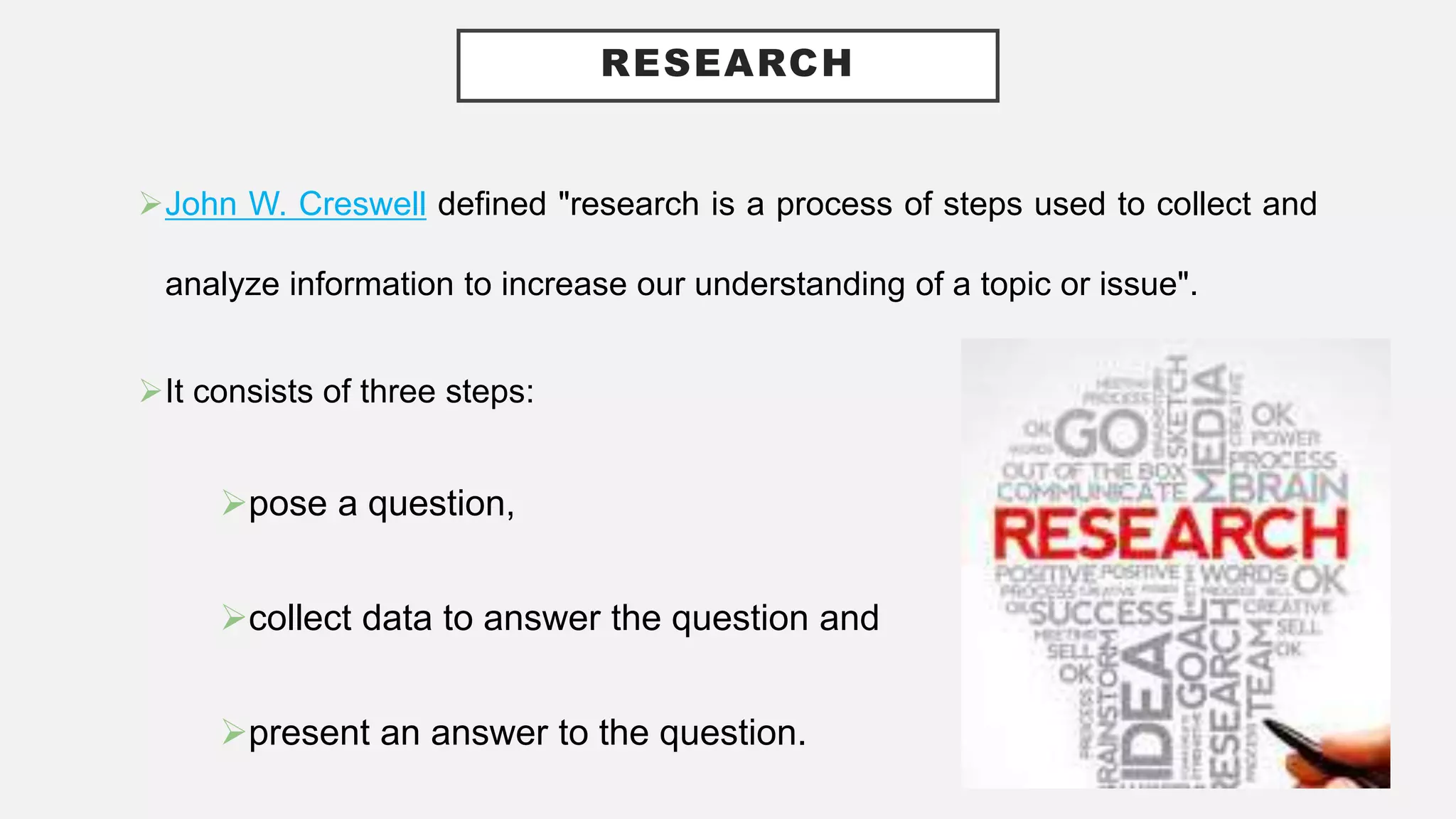
John W. Creswell defined "research is a process of steps used to collect and
analyze information to increase our understanding of a topic or issue".
It consists of three steps:
pose a question,
collect data to answer the question and
present an answer to the question.
IMPORTANCE OF RESEARCH
 Research helps to achieve your goal
 Research reveals new ideas and facts
 Research develops understanding and decision-making
 Research helps understand what's not working
 Research builds credibility
RESEARCH PAPER
 most common medium used by scientists to communicate findings to
the research community
 tell others what an investigator has done &, sometimes, persuade
them that the work is valid & useful
 common format is referred to as IMRAD (Introduction, Methods,
Results, And Discussion)
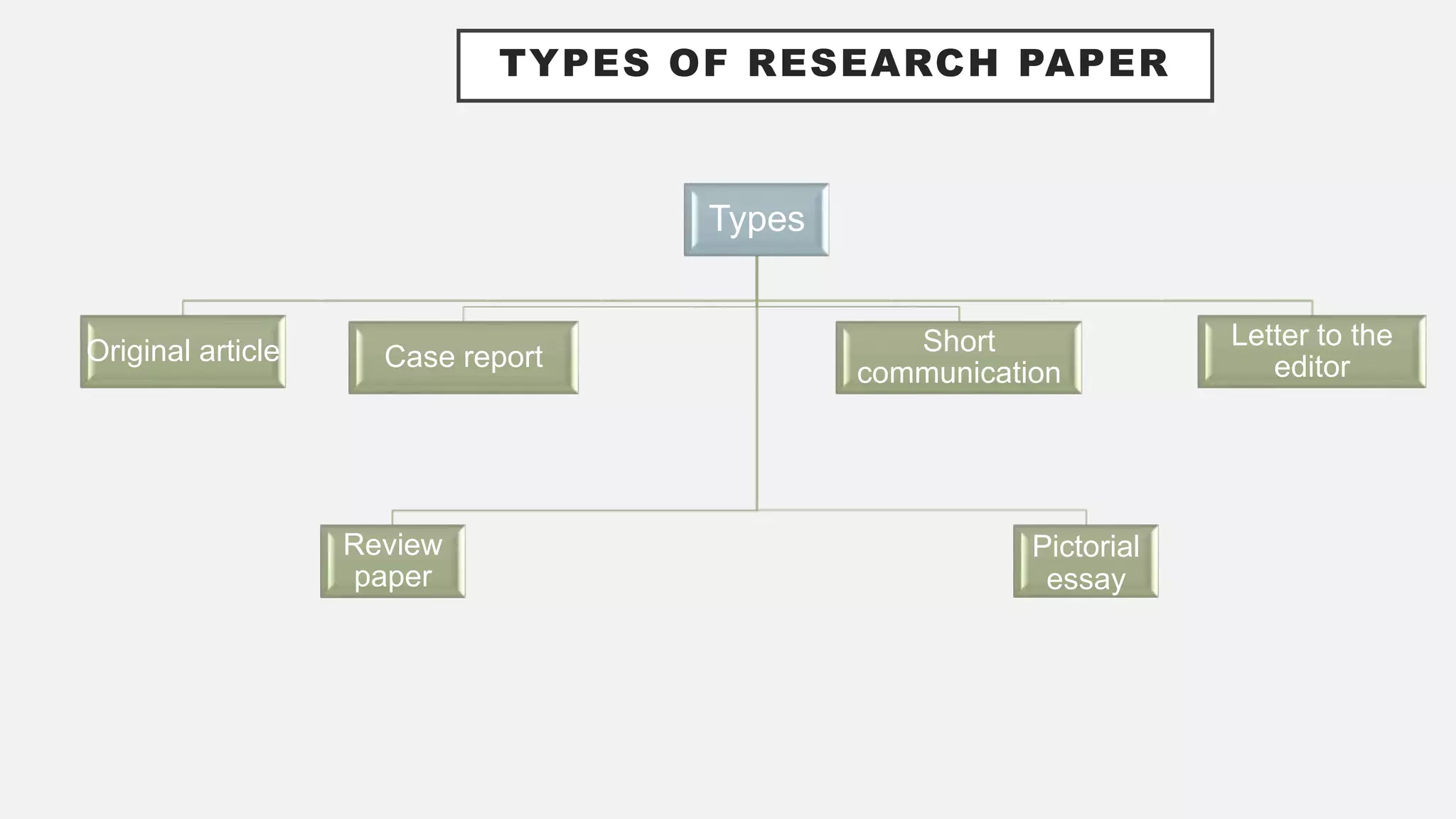
TYPES OF RESEARCH PAPER
Types
Original article
Review
paper
Case report
Short
communication
Pictorial
essay
Letter to the
editor
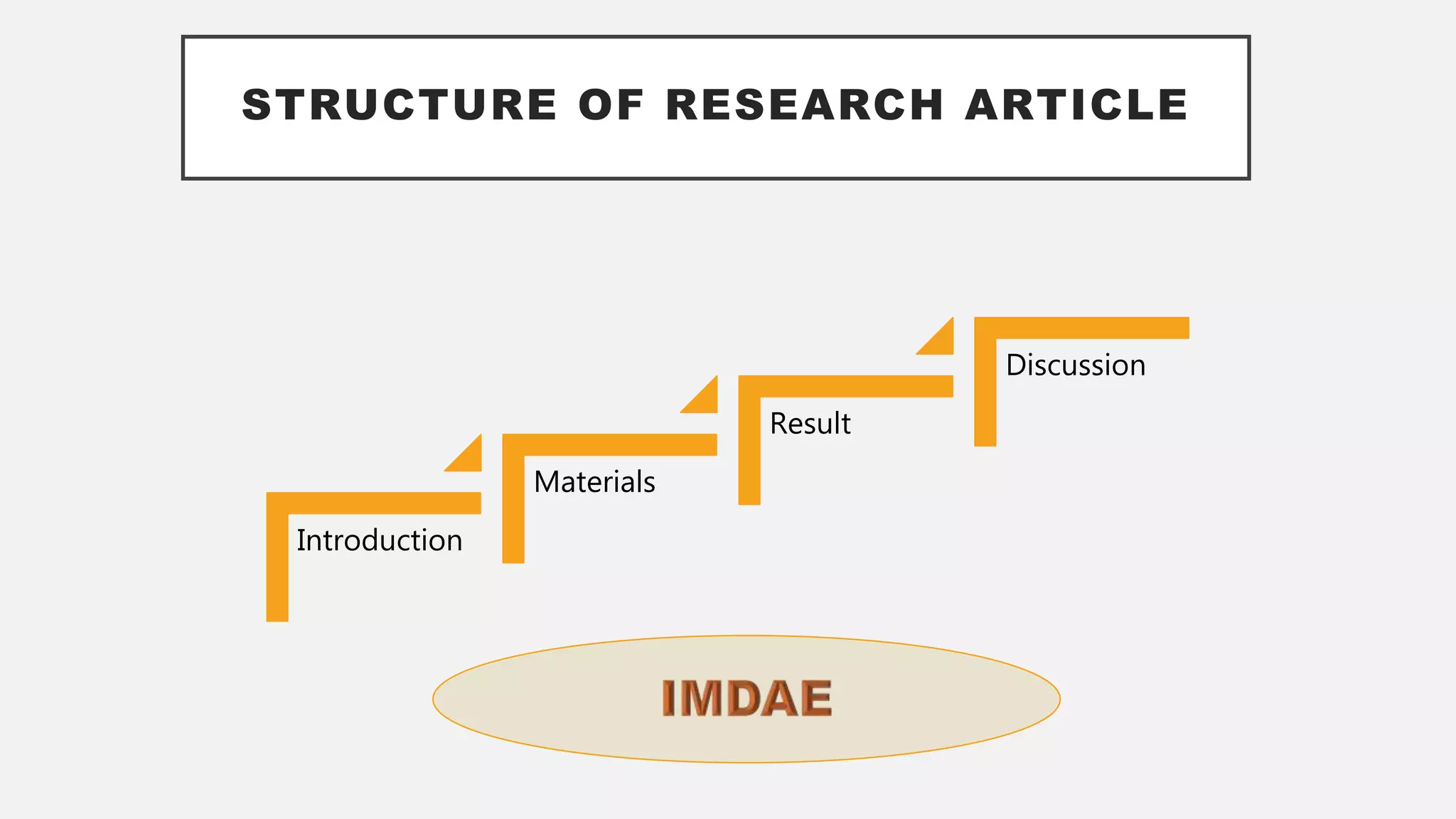
STRUCTURE OF RESEARCH ARTICLE
Introduction
Materials
Result
Discussion
STRUCTURE OF RESEARCH ARTICLE
 Introduction - describes state of knowledge that gave rise to
hypothesis being tested (or question being asked) and states
hypothesis (or question).
 Methods - describes research design, the methods & materials
used, & how findings were analysed.
 Results - provide data & results of analyses. Tables & figures are often
used.
 Discussion
 brief summary of decisive findings & tentative conclusions
 examination of other evidence supporting or contradicting the
tentative conclusions
 consideration of how general your conclusions are
 implications for further research.
 Literature Cited - references cited
ASPECTS OF SCIENTIFIC WRITING
 Clarity – work is unambiguous and free of extraneous detail or
conjecture.
 Simplicity – Language and sentence and paragraph structure are easy
to understand and follow without losing authority or scientific credibility.
 Accuracy – Data, Tables and Figures, and References and Citations
are represented honestly and verifiably.
IMPORTANCE OF RESEARCH PAPER
 Good reading skills
 Good writing skills
 A sense of achievement
 Knowledge about your subject area
 Exercise critical thinking
ADVANTAGES OF SCIENTIFIC WRITING
 It builds your academic profile
 As an author, it increases your credibility
 Your research works will receive more exposure
 Most importantly, you will gain more insights into the subject
 Builds your professional connection with other researchers and
authors
 Improves your writing and research skills
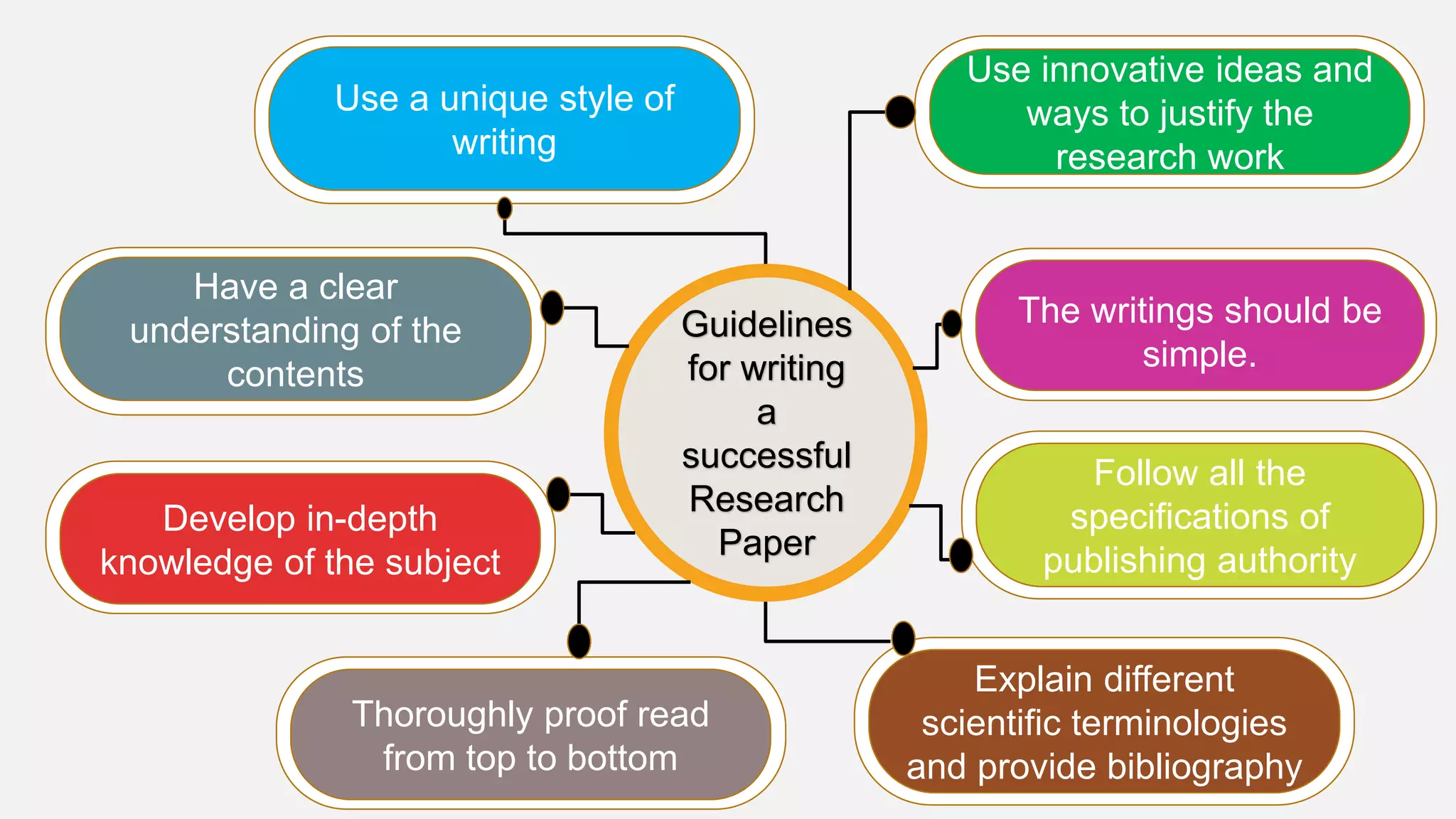
Guidelines
for writing
a
successful
Research
Paper
Use innovative ideas and
ways to justify the
research work
Develop in-depth
knowledge of the subject
Have a clear
understanding of the
contents
Use a unique style of
writing
Explain different
scientific terminologies
and provide bibliography
The writings should be
simple.
Thoroughly proof read
from top to bottom
Follow all the
specifications of
publishing authority
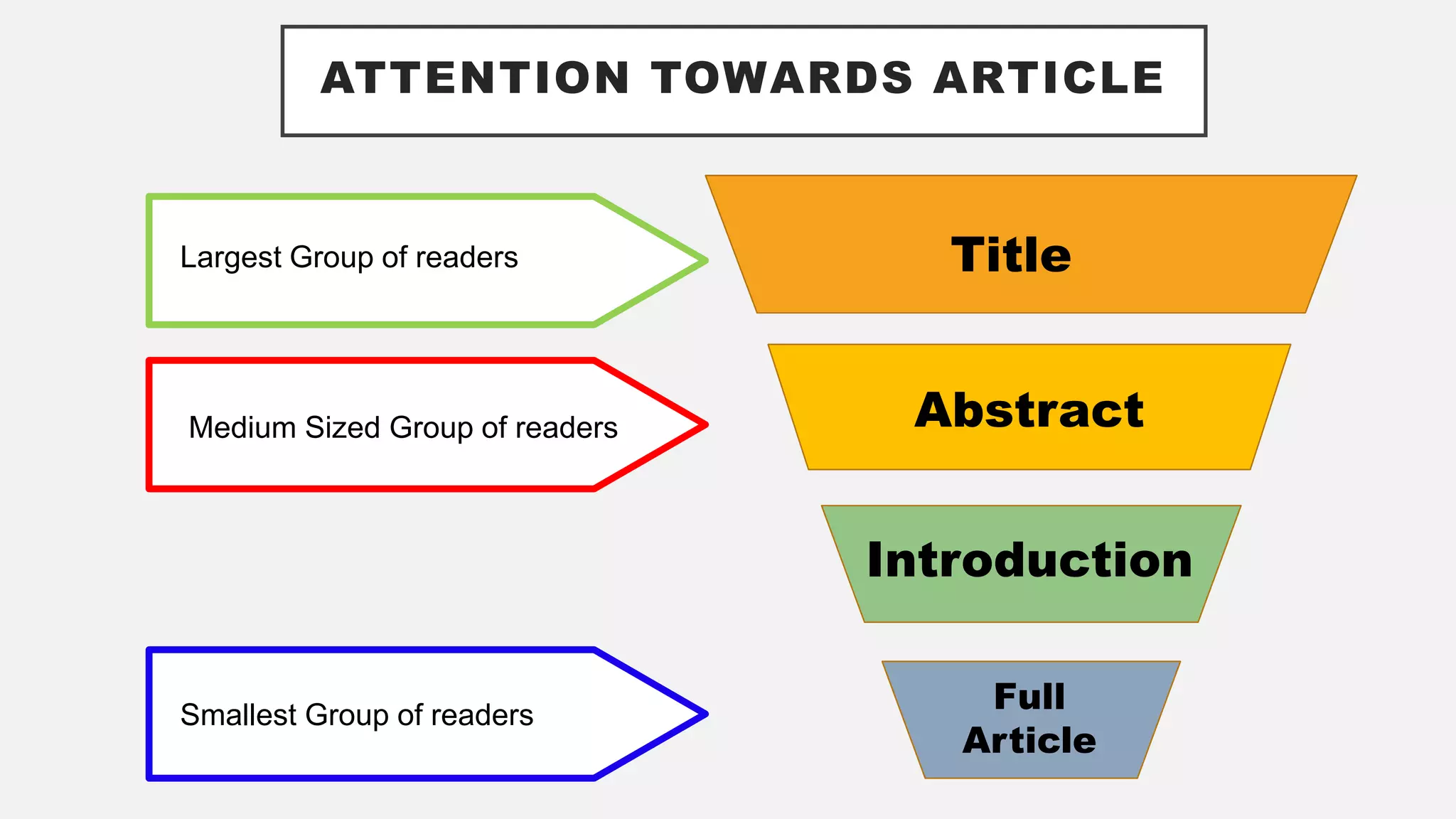
Medium Sized Group of readers
Largest Group of readers
Smallest Group of readers
Title
Abstract
Introduction
Full
Article
ATTENTION TOWARDS ARTICLE
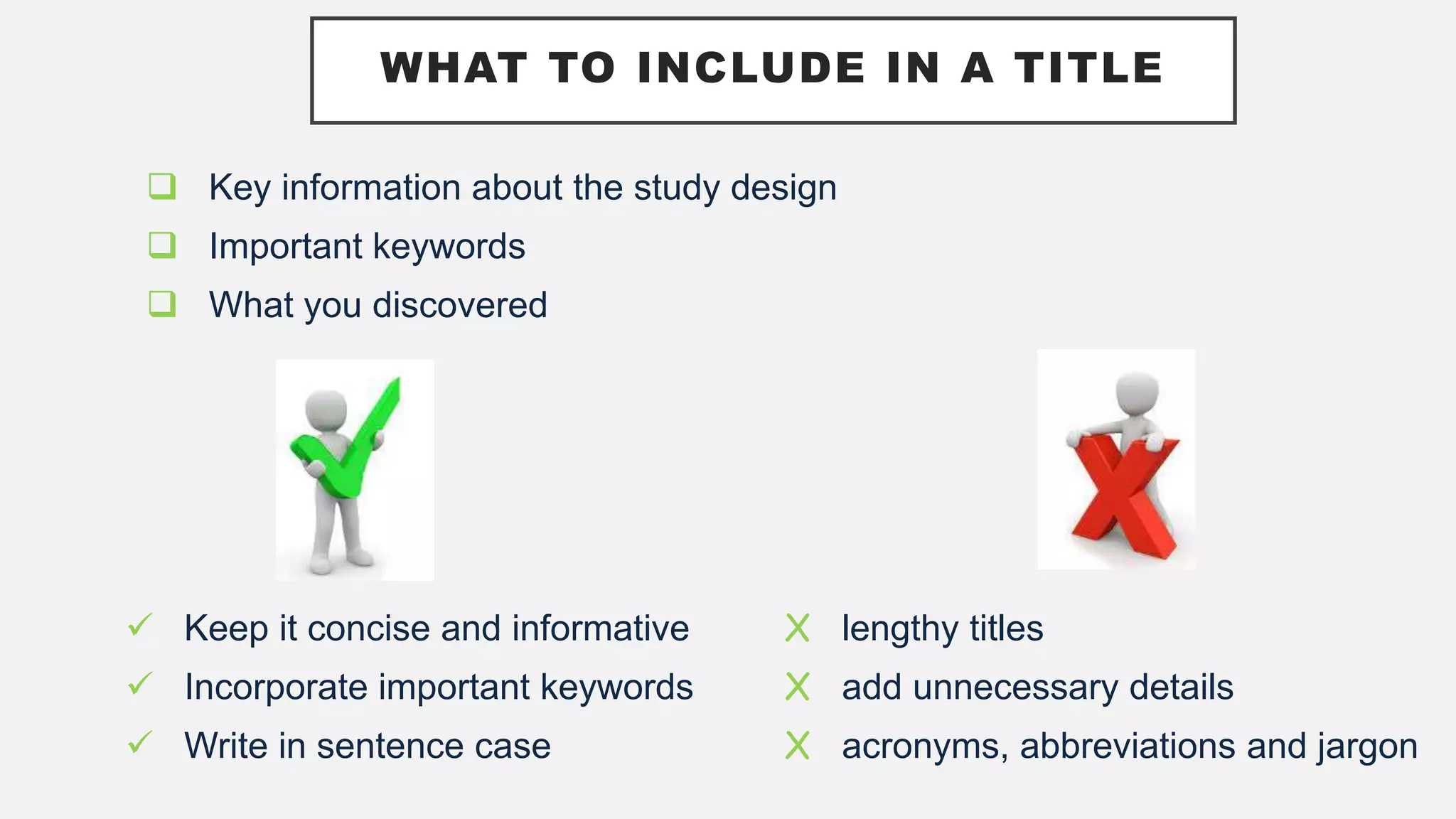
WHAT TO INCLUDE IN A TITLE
 Key information about the study design
 Important keywords
 What you discovered
 Keep it concise and informative
 Incorporate important keywords
 Write in sentence case
X lengthy titles
X add unnecessary details
X acronyms, abbreviations and jargon
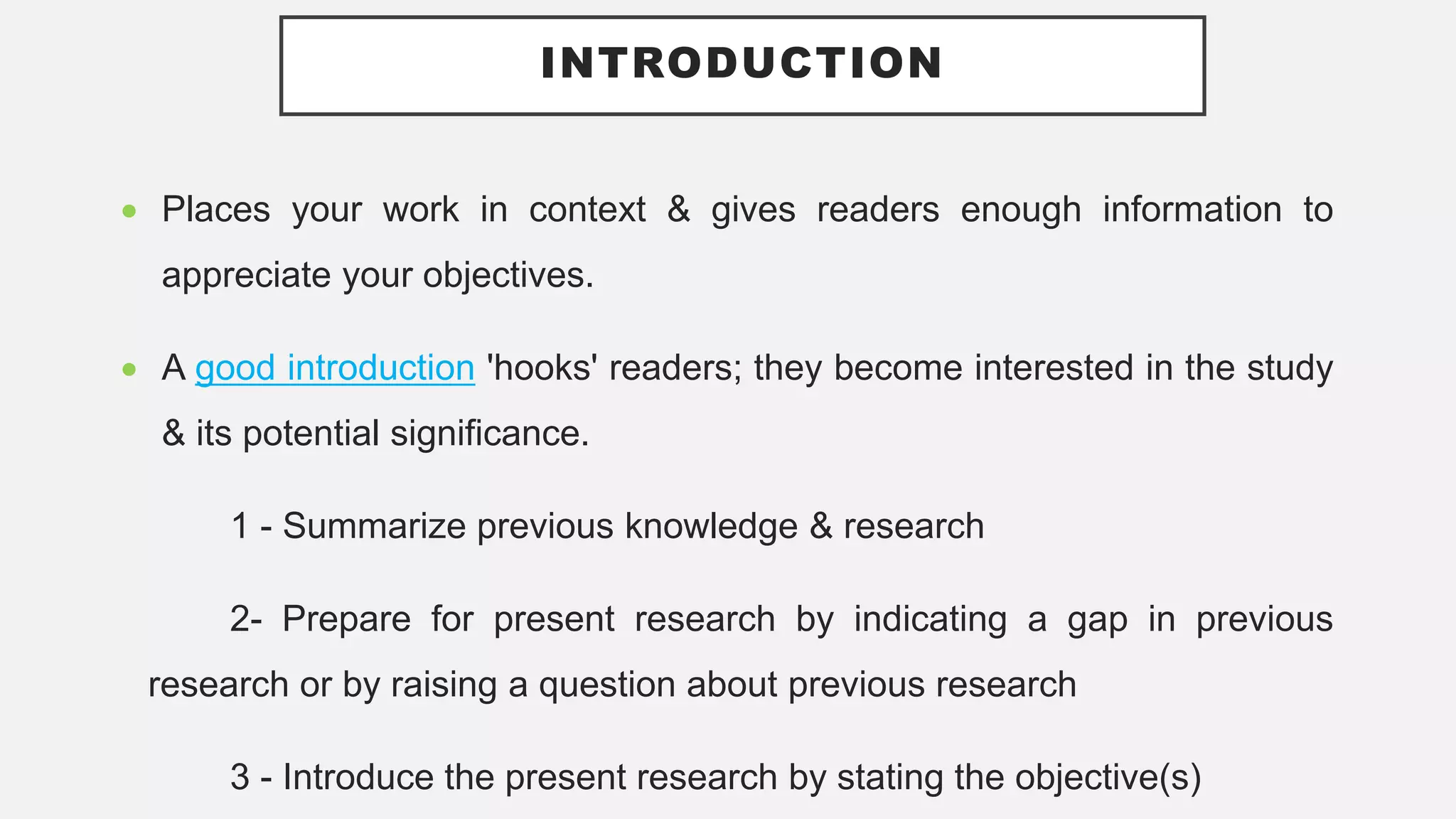
INTRODUCTION
 Places your work in context & gives readers enough information to
appreciate your objectives.
 A good introduction 'hooks' readers; they become interested in the study
& its potential significance.
1 - Summarize previous knowledge & research
2- Prepare for present research by indicating a gap in previous
research or by raising a question about previous research
3 - Introduce the present research by stating the objective(s)
KEY GOALS OF INTRODUCTION
 Present your topic and get the reader interested
 Provide background or summarize existing research
 Position your own approach
Detail your specific research problem
Give an overview of the paper’s structure
 Abbreviations should be given following their explanations in the
‘Introduction’ section.
 Simple present tense should be used.
 References should be selected from updated publication with a higher
impact factor, and prestigious source books.
 Avoid mysterious, and confounding expressions, construct clear sentences
aiming at problematic issues, and their solutions.
 The sentences should be attractive, tempting, and comprehensible.
 Firstly general, then subject-specific information should be given. Finally
our aim should be clearly explained.
MATERIALS AND METHODS
 most easily written or will be written section.
 30% of the reasons for rejection are related to this section
 describe experimental design and provide sufficient details.
 use questions like “what”, “how much”, “How often”, “where”,
“When”, and “why” to guide your explanations.
 tread the line between completeness and brevity.
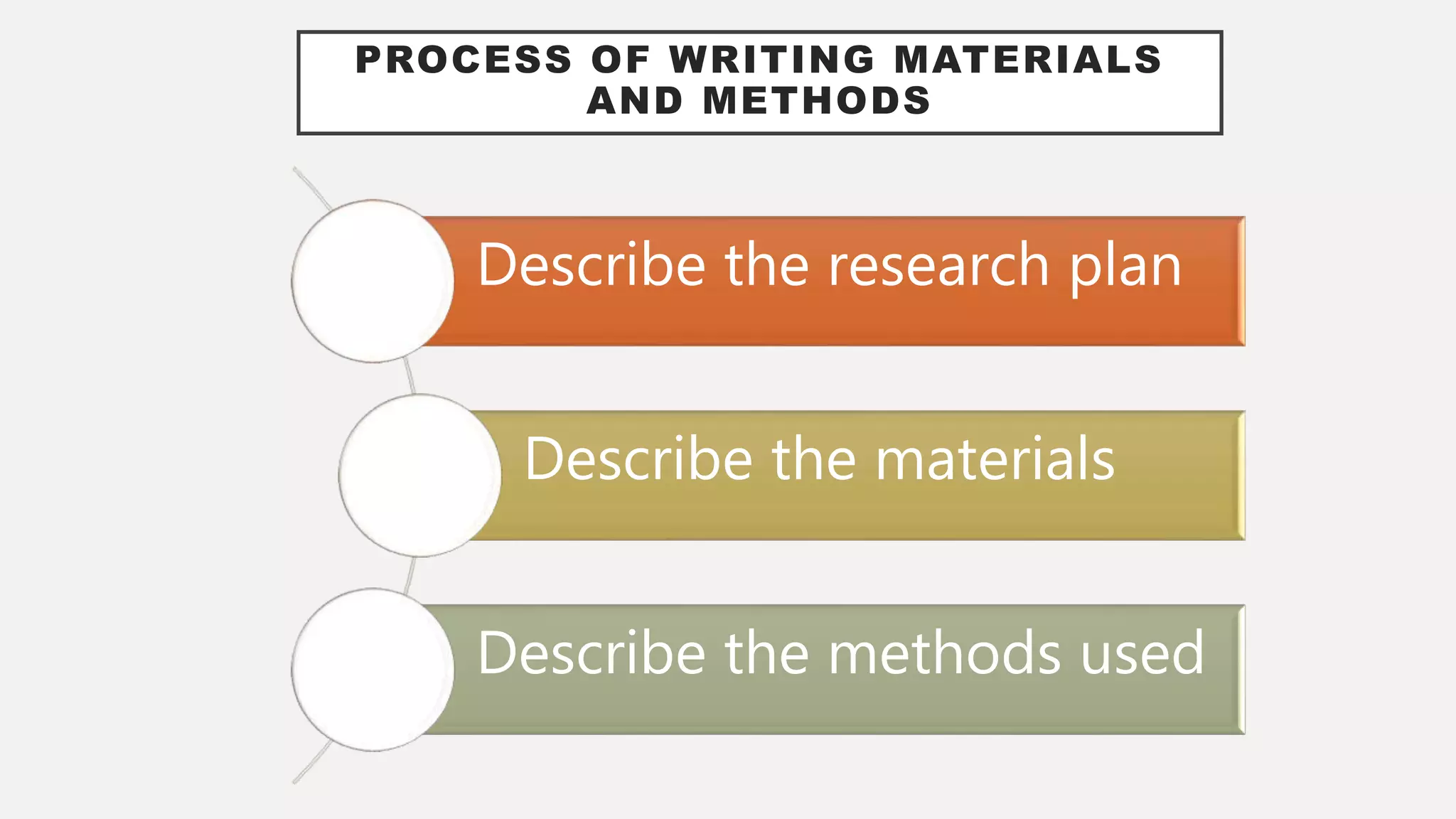
PROCESS OF WRITING MATERIALS
AND METHODS
Describe the research plan
Describe the materials
Describe the methods used
GUIDELINES
Review the journal's Instructions to Authors or Author Guidelines before
beginning to write this section. Here are some general guidelines:
 For human -related studies, the first paragraph should indicate if
institutional review board approval and patient informed consent were
obtained. If not, it should be clear that any studies conducted were so
performed for accepted clinical indications and that the studies themselves
are considered acceptable and ethical for patient care.
 For animal experiments, include a statement regarding approval by the
institutional animal care committee or appropriate body.
GUIDELINES
 Identify the methods, instrumentation (trade names and manufacturer's
name and location in parentheses), and procedures in sufficient detail to
allow other researchers to reproduce the study.
 Give references to established methods and provide statements on the
availability of materials.
 Briefly state the statistical tests used to analyse the data. Usual, common
statistical methods could be stated without providing a reference; for
advanced or unusual methods, a reference or citation is required.
THINGS TO REMEMBER
 Information is usually presented in past tense, either active voice or
passive.
 Complete taxonomic information (e.g., subspecies or strains), on
organism(s) used, if relevant, also how, where, & when organisms were
obtained.
 If the Methods section is long & covers different topics, it would probably
be wise to use subheadings that clearly break the text into several labelled
sections.
RESULT
 The results section of the research paper is where you report the
findings of your study based upon the information gathered as a result
of the methodology you applied.
 lay the foundation for the Discussion section, where those data are
subjectively interpreted.
 craft a descriptive sentence or two that summarizes each result,
referring to the corresponding table and figure numbers.
IMPORTANCE OF GOOD RESULT
 When formulating the results section, it's important to remember that
the results of a study do not prove anything.
 The page length of this section is set by the amount and types of data
to be reported.
 Avoid providing data that is not critical to answering the research
question.
KEY ASPECTS FOR FINDINGS
 Use past tense!
 Summarize data & generalize from data! Generalize with
explanatory details, statistics, tables, & figures.
 Tables and Figures are important tools for reporting results, but
tables & figures only present data;
 Do not interpret the data or draw conclusions in the Results.
 If some of your results fail to support your hypothesis, do not ignore
them.
KEY ASPECTS FOR FINDINGS
 Mean values presented in text should be accompanied by
standard deviation, standard error, or confidence intervals; range
may also be presented, if relevant.
 When reporting results of statistical analyses, provide the test
statistic (e.g., F value, z value, t value, or chi square value),
degrees of freedom, and probability level (P value).
KEY ASPECTS FOR FINDINGS
 Use accepted abbreviations and symbols. These may vary
somewhat among disciplines.
 Do not begin sentences with numbers. Either write out the number
or, better, revise the sentence.
 Use the word significant only when reporting statistical
significance. Use the word correlated only when two variables are
statistically correlated.
DISCUSSION
 The Discussion section usually requires the most consideration, as
this is where you interpret your results.
 Purpose of the discussion is to interpret and describe the significance
of your findings.
 Begin by explicitly stating the main finding(s) of your research.
Compare your results with related research.
SNIPPETS OF EFFECTIVE DISCUSSION
 Summarize the key findings in clear and concise language.
 Acknowledge when a hypothesis maybe wrong.
 Place your study within the context of previous studies.
 Discuss potential future research.
Provide the reader with a “take away” statement to end the
manuscript.
SNIPPETS OF EFFECTIVE DISCUSSION
 Summarize the key findings in clear and concise language.
 Acknowledge when a hypothesis maybe wrong.
 Place your study within the context of previous studies.
 Discuss potential future research.
Provide the reader with a “take away” statement to end the
manuscript.
SNIPPETS OF EFFECTIVE DISCUSSION
 Do not be verbose or repetitive.
 Be concise and make your points clearly.
 Avoid using jargon.
 Follow a logical stream of thought.
 Use the present verb tense, especially for established facts; however,
refer to specific works and references in the past tense.
 If needed, use subheadings to help organize your presentation or to
group your interpretations into themes.
CONCLUSION
o The conclusion is intended to help the reader understand why your research
should matter to them after they have finished reading the paper.
o A conclusion is not merely a summary of your points or a re-statement of
your research problem but a synthesis of key points.
o For most essays, one well-developed paragraph is sufficient for a
conclusion, although in some cases, a two-or-three paragraph conclusion
may be required.
GOOD CONCLUSION
A well-written conclusion provides you with several important opportunities to
demonstrate your overall understanding of the research problem to the
reader. These include:
 Presenting the last word on the issues you raised in your paper. Just
as the introduction gives a first impression to your reader, the conclusion
offers a chance to leave a lasting impression. Do this, for example, by
highlighting key points in your analysis or findings.
 Summarizing your thoughts and conveying the larger implications of your
study. The conclusion is an opportunity to succinctly answer the "so what?"
question by placing the study within the context of past research about the topic
you've investigated.
 Demonstrating the importance of your ideas. Don't be shy. The conclusion
offers you a chance to elaborate on the significance of your findings.
 Introducing possible new or expanded ways of thinking about the research
problem. This does not refer to introducing new information, but to offer new
insight and creative approaches for framing/contextualizing the research problem
based on the results of your study.
RULES OF CONCLUSION
 State your conclusions in clear, simple language.
 Do not simply reiterate your results or the discussion.
 Indicate opportunities for future research, as long as you haven't already
done so in the discussion section of your paper.
PROOF READING
o Proofreading is the act of searching for errors before you hand in the your final researchpaper.
o Errors can beboth grammatical and typographical in nature.
o also beused to identify problems with the flow of your paperand to find any word processing errors.
To help ensure that you identify all the errors in your paper, consider the
following:
• Work from a printout, not a computer screen
• Circle or highlight every punctuation mark in your paper.
• Use the search function of the computer to find mistakes you're likely to
make.
• If you tend to make many mistakes, check separately for each kind of error,
• End with using a computer spell checker.
• Leave yourself enough time.
• Ask a friend to read your paper
“WITHOUT PUBLICATION,
SCIENCE IS DEAD”
Gerard Piel

Write your paper.ppt

  • 1.
  • 2.
    RESEARCH  “Creative andsystemic work”  Simple term - Searching for knowledge and searching for truth involves the collection, organization and analysis of information to increase understanding of a specific topic. provide information about the definition, classification and methodology of scientific research.
  • 3.
    RESEARCH John W. Creswelldefined "research is a process of steps used to collect and analyze information to increase our understanding of a topic or issue". It consists of three steps: pose a question, collect data to answer the question and present an answer to the question.
  • 4.
    IMPORTANCE OF RESEARCH Research helps to achieve your goal  Research reveals new ideas and facts  Research develops understanding and decision-making  Research helps understand what's not working  Research builds credibility
  • 5.
    RESEARCH PAPER  mostcommon medium used by scientists to communicate findings to the research community  tell others what an investigator has done &, sometimes, persuade them that the work is valid & useful  common format is referred to as IMRAD (Introduction, Methods, Results, And Discussion)
  • 6.
    TYPES OF RESEARCHPAPER Types Original article Review paper Case report Short communication Pictorial essay Letter to the editor
  • 7.
    STRUCTURE OF RESEARCHARTICLE Introduction Materials Result Discussion
  • 8.
    STRUCTURE OF RESEARCHARTICLE  Introduction - describes state of knowledge that gave rise to hypothesis being tested (or question being asked) and states hypothesis (or question).  Methods - describes research design, the methods & materials used, & how findings were analysed.
  • 9.
     Results -provide data & results of analyses. Tables & figures are often used.  Discussion  brief summary of decisive findings & tentative conclusions  examination of other evidence supporting or contradicting the tentative conclusions  consideration of how general your conclusions are  implications for further research.  Literature Cited - references cited
  • 10.
    ASPECTS OF SCIENTIFICWRITING  Clarity – work is unambiguous and free of extraneous detail or conjecture.  Simplicity – Language and sentence and paragraph structure are easy to understand and follow without losing authority or scientific credibility.  Accuracy – Data, Tables and Figures, and References and Citations are represented honestly and verifiably.
  • 11.
    IMPORTANCE OF RESEARCHPAPER  Good reading skills  Good writing skills  A sense of achievement  Knowledge about your subject area  Exercise critical thinking
  • 12.
    ADVANTAGES OF SCIENTIFICWRITING  It builds your academic profile  As an author, it increases your credibility  Your research works will receive more exposure  Most importantly, you will gain more insights into the subject  Builds your professional connection with other researchers and authors  Improves your writing and research skills
  • 13.
    Guidelines for writing a successful Research Paper Use innovativeideas and ways to justify the research work Develop in-depth knowledge of the subject Have a clear understanding of the contents Use a unique style of writing Explain different scientific terminologies and provide bibliography The writings should be simple. Thoroughly proof read from top to bottom Follow all the specifications of publishing authority
  • 14.
    Medium Sized Groupof readers Largest Group of readers Smallest Group of readers Title Abstract Introduction Full Article ATTENTION TOWARDS ARTICLE
  • 15.
    WHAT TO INCLUDEIN A TITLE  Key information about the study design  Important keywords  What you discovered  Keep it concise and informative  Incorporate important keywords  Write in sentence case X lengthy titles X add unnecessary details X acronyms, abbreviations and jargon
  • 16.
    INTRODUCTION  Places yourwork in context & gives readers enough information to appreciate your objectives.  A good introduction 'hooks' readers; they become interested in the study & its potential significance. 1 - Summarize previous knowledge & research 2- Prepare for present research by indicating a gap in previous research or by raising a question about previous research 3 - Introduce the present research by stating the objective(s)
  • 17.
    KEY GOALS OFINTRODUCTION  Present your topic and get the reader interested  Provide background or summarize existing research  Position your own approach Detail your specific research problem Give an overview of the paper’s structure
  • 18.
     Abbreviations shouldbe given following their explanations in the ‘Introduction’ section.  Simple present tense should be used.  References should be selected from updated publication with a higher impact factor, and prestigious source books.  Avoid mysterious, and confounding expressions, construct clear sentences aiming at problematic issues, and their solutions.  The sentences should be attractive, tempting, and comprehensible.  Firstly general, then subject-specific information should be given. Finally our aim should be clearly explained.
  • 19.
    MATERIALS AND METHODS most easily written or will be written section.  30% of the reasons for rejection are related to this section  describe experimental design and provide sufficient details.  use questions like “what”, “how much”, “How often”, “where”, “When”, and “why” to guide your explanations.  tread the line between completeness and brevity.
  • 20.
    PROCESS OF WRITINGMATERIALS AND METHODS Describe the research plan Describe the materials Describe the methods used
  • 21.
    GUIDELINES Review the journal'sInstructions to Authors or Author Guidelines before beginning to write this section. Here are some general guidelines:  For human -related studies, the first paragraph should indicate if institutional review board approval and patient informed consent were obtained. If not, it should be clear that any studies conducted were so performed for accepted clinical indications and that the studies themselves are considered acceptable and ethical for patient care.  For animal experiments, include a statement regarding approval by the institutional animal care committee or appropriate body.
  • 22.
    GUIDELINES  Identify themethods, instrumentation (trade names and manufacturer's name and location in parentheses), and procedures in sufficient detail to allow other researchers to reproduce the study.  Give references to established methods and provide statements on the availability of materials.  Briefly state the statistical tests used to analyse the data. Usual, common statistical methods could be stated without providing a reference; for advanced or unusual methods, a reference or citation is required.
  • 23.
    THINGS TO REMEMBER Information is usually presented in past tense, either active voice or passive.  Complete taxonomic information (e.g., subspecies or strains), on organism(s) used, if relevant, also how, where, & when organisms were obtained.  If the Methods section is long & covers different topics, it would probably be wise to use subheadings that clearly break the text into several labelled sections.
  • 24.
    RESULT  The resultssection of the research paper is where you report the findings of your study based upon the information gathered as a result of the methodology you applied.  lay the foundation for the Discussion section, where those data are subjectively interpreted.  craft a descriptive sentence or two that summarizes each result, referring to the corresponding table and figure numbers.
  • 25.
    IMPORTANCE OF GOODRESULT  When formulating the results section, it's important to remember that the results of a study do not prove anything.  The page length of this section is set by the amount and types of data to be reported.  Avoid providing data that is not critical to answering the research question.
  • 26.
    KEY ASPECTS FORFINDINGS  Use past tense!  Summarize data & generalize from data! Generalize with explanatory details, statistics, tables, & figures.  Tables and Figures are important tools for reporting results, but tables & figures only present data;  Do not interpret the data or draw conclusions in the Results.  If some of your results fail to support your hypothesis, do not ignore them.
  • 27.
    KEY ASPECTS FORFINDINGS  Mean values presented in text should be accompanied by standard deviation, standard error, or confidence intervals; range may also be presented, if relevant.  When reporting results of statistical analyses, provide the test statistic (e.g., F value, z value, t value, or chi square value), degrees of freedom, and probability level (P value).
  • 28.
    KEY ASPECTS FORFINDINGS  Use accepted abbreviations and symbols. These may vary somewhat among disciplines.  Do not begin sentences with numbers. Either write out the number or, better, revise the sentence.  Use the word significant only when reporting statistical significance. Use the word correlated only when two variables are statistically correlated.
  • 29.
    DISCUSSION  The Discussionsection usually requires the most consideration, as this is where you interpret your results.  Purpose of the discussion is to interpret and describe the significance of your findings.  Begin by explicitly stating the main finding(s) of your research. Compare your results with related research.
  • 30.
    SNIPPETS OF EFFECTIVEDISCUSSION  Summarize the key findings in clear and concise language.  Acknowledge when a hypothesis maybe wrong.  Place your study within the context of previous studies.  Discuss potential future research. Provide the reader with a “take away” statement to end the manuscript.
  • 31.
    SNIPPETS OF EFFECTIVEDISCUSSION  Summarize the key findings in clear and concise language.  Acknowledge when a hypothesis maybe wrong.  Place your study within the context of previous studies.  Discuss potential future research. Provide the reader with a “take away” statement to end the manuscript.
  • 32.
    SNIPPETS OF EFFECTIVEDISCUSSION  Do not be verbose or repetitive.  Be concise and make your points clearly.  Avoid using jargon.  Follow a logical stream of thought.  Use the present verb tense, especially for established facts; however, refer to specific works and references in the past tense.  If needed, use subheadings to help organize your presentation or to group your interpretations into themes.
  • 33.
    CONCLUSION o The conclusionis intended to help the reader understand why your research should matter to them after they have finished reading the paper. o A conclusion is not merely a summary of your points or a re-statement of your research problem but a synthesis of key points. o For most essays, one well-developed paragraph is sufficient for a conclusion, although in some cases, a two-or-three paragraph conclusion may be required.
  • 34.
    GOOD CONCLUSION A well-writtenconclusion provides you with several important opportunities to demonstrate your overall understanding of the research problem to the reader. These include:  Presenting the last word on the issues you raised in your paper. Just as the introduction gives a first impression to your reader, the conclusion offers a chance to leave a lasting impression. Do this, for example, by highlighting key points in your analysis or findings.
  • 35.
     Summarizing yourthoughts and conveying the larger implications of your study. The conclusion is an opportunity to succinctly answer the "so what?" question by placing the study within the context of past research about the topic you've investigated.  Demonstrating the importance of your ideas. Don't be shy. The conclusion offers you a chance to elaborate on the significance of your findings.  Introducing possible new or expanded ways of thinking about the research problem. This does not refer to introducing new information, but to offer new insight and creative approaches for framing/contextualizing the research problem based on the results of your study.
  • 36.
    RULES OF CONCLUSION State your conclusions in clear, simple language.  Do not simply reiterate your results or the discussion.  Indicate opportunities for future research, as long as you haven't already done so in the discussion section of your paper.
  • 37.
    PROOF READING o Proofreadingis the act of searching for errors before you hand in the your final researchpaper. o Errors can beboth grammatical and typographical in nature. o also beused to identify problems with the flow of your paperand to find any word processing errors.
  • 38.
    To help ensurethat you identify all the errors in your paper, consider the following: • Work from a printout, not a computer screen • Circle or highlight every punctuation mark in your paper. • Use the search function of the computer to find mistakes you're likely to make. • If you tend to make many mistakes, check separately for each kind of error, • End with using a computer spell checker. • Leave yourself enough time. • Ask a friend to read your paper
  • 39.