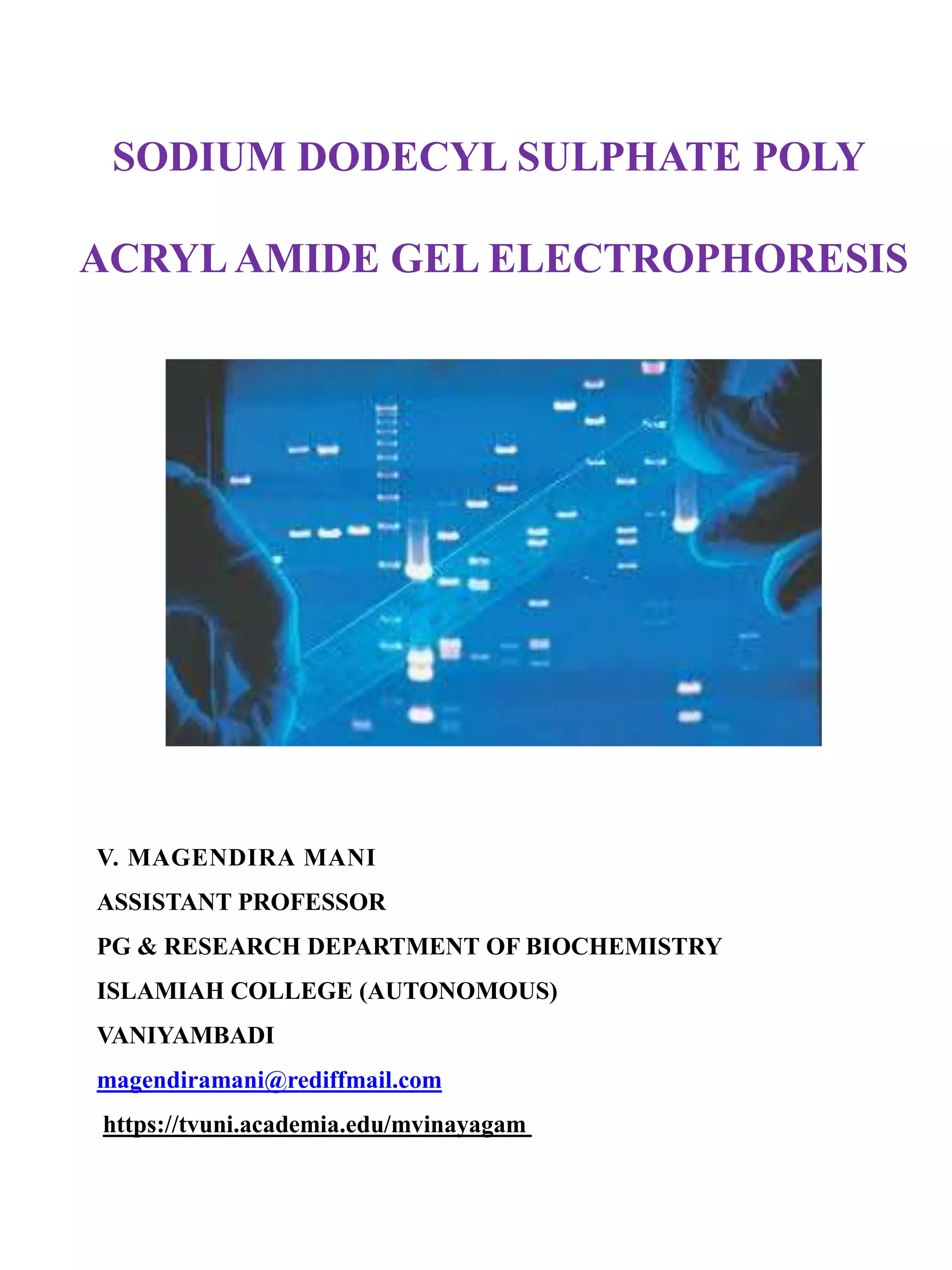
SODIUM DODECYL SULPHATE POLY
ACRYL AMIDE GEL ELECTROPHORESIS
V. MAGENDIRA MANI
ASSISTANT PROFESSOR
PG & RESEARCH DEPARTMENT OF BIOCHEMISTRY
ISLAMIAH COLLEGE (AUTONOMOUS)
VANIYAMBADI
magendiramani@rediffmail.com
https://tvuni.academia.edu/mvinayagam
SODIUMDODECYLSULPHATE POLY
ACRYL AMIDE GEL ELECTROPHORESIS
Principle
SDS PAGE is widely used method for separating
protein mixture and for determining the molecular weights.
SDS - is an anionic detergent
Binds strongly to protein
Causes their Denaturation
Polymerization
Cross linked poly acryl amide gel are formed by
polymerization of acryl amide monomer and N, N’ Methylene
Bisacryl amide in the presence of ammonium per sulphate and
TEMED (Tetra Methylene Diamine). Ammonium per sulphate
acts as free radical catalyst and TEMED acts as initiator.
Photopolymerization
Photopolymerization is an alternative method that can be
used to polymerise Acryl amide gels. Ammonium per
sulphate, TEMED are replaced by Riboflavin. When the
gel is poured it is placed in front of bright light for 2 – 3
hrs. Photopolymerization of riboflavin generates a free
radical that initiates polymerization.
Pore size of the PAGE
Pore size of the gel can be varied by changing the concentration
of both Acryl amide and Methylene Bisacryl amide. PAGE can
be made with content of 3 % to 30 %. Low percentage of gel 3
% have large pore size and used for separation of proteins and
DNA. High percentage of gel 10 -20 % have smaller pore size
and used for SDS PAGE.
Sample preparation
 The sample is boiled with the buffer containing β-
mercaptoethanol and SDS for 5 min. β-mercaptoethanol
reduces any disulfide bridges in protein that are holding
tertiary structure of protein.
 SDS binds strongly to proteins and denature the protein
 On average one SDS molecule binds to every two amino
acids. So the native charge of the molecule is completely
swamped by SDS molecule (negative)
 Each protein molecule will be fully denatured, opens in to a
rod shaped structure with a series of – ve charged SDS
molecule along with polypeptide chain.
Gel preparation
 Gels used are vertical slabs, because it is more economical and
more sample can be compared with each other when run under
identical conditions (eg. 20 different samples)
 Gels are prepared in glass containers in which they are to be
used. The two glass plates are held together but held apart from
each other by plastic spacer, vertical slab gels are run along with
the glass plate.
 Choice of percentage of gel to be used depends on the size of
the protein sample. Separating gel used may vary from 10 %
PAGE to 15 % PAGE. 15 % of gel used for separation of protein
having molecular weight 10,000 to 1, 00,000 and 10 % of gel
used for separation of protein having molecular weight 1,
50,000.
Sample application
 Dissolved samples can be applied using a micro syringe into wells
of the gel.
 Sample buffer containing 10-15 % Sucrose or Glycerol, which
increase the density of the buffer and ensures the sinking of the
sample in to the wells.
 It also prevents the sample from mixing with buffer in the upper
buffer reservoir.
 Sample buffer contain marker/tracker dye Bromophenol blue. It
is a small molecule and it moves freely and indicates the
electrophoretic migration.
 Urea, SDS, Disulfide reducing agent such as β-Mercaptoethanol
are added to protein sample to facilitate their solubilisation.
 Protein sample can be loaded in the form of sharp band by using
a staking gel over the separating gel.
 Only µ g of sample are used for analyzing.
Running the gel
 The gel slab sandwiched in between the glass plate is placed in
the lower reservoir with the top of the gel in contact with the
buffer in the upper reservoir.
 Thus the gel completes the electrical circuit between the lower
and upper compartments. Although the buffer dissipates the heat
generated, additional cooling may be needed.
 In sample small protein can more easily pass through the pores
and larger proteins are successively retarded by frictional
resistance due to sieving effect of the gel.
 Precise voltage and time required for the optimal separation
Voltage: 30 mA; Time; 3 hrs
Detection
 When tracker dye reaches the bottom of the gel the current is
turned off.
 Gel slabs are removed without any pressure, after removal
gel is immersed in 7 % acetic acid to minimize diffusion of
components.
 Then the gel is shaken well in an appropriate stain solution.
Usually Commassive Brilliant Blue R250 is used and the gel
is immersed for few hours.
 Then the gel is transferred in to a destain solution and kept
for overnight.
 Destain solution removes unbound background dye from gel
leaving stain protein visible as blue bands on a clear
background.
Staining solution (100 ml)
a. Coomassie Brilliant Blue R-250: 250 mg
b. Methanol: 50 %
c. Acetic acid: 10 %
d. Distilled water: 40 %
De-staining solution (100 ml)
a. Methanol: 50 %
b. Acetic acid: 10 %
c. Distilled water: 40 %
Time required for electrophoresis
Gel preparation - 1– 1 ½ hrs
Running the gel - 3 hrs
Staining - 2– 3 hrs
De-staining - overnight
Determination of Molecular weight (PROTEIN) by SDS
PAGE.
 The Molecular weight can be determined comparing mobility
of standard protein of known Molecular weight with of
unknown Molecular weight that is run on the same gel.
 A calibration curve is constructed for standard protein of
known Molecular weight by
 Distance migrated Vs Molecular weight x 104
 The migration of unknown is measured are extrapolating this
value in the calibration curve, the molecular weight of
unknown can be determined.
V. MAGENDIRA MANI
ASSISTANT PROFESSOR
PG & RESEARCH DEPARTMENT OF BIOCHEMISTRY
ISLAMIAH COLLEGE (AUTONOMOUS)
VANIYAMBADI
magendiramani@rediffmail.com
https://tvuni.academia.edu/mvinayagam

Sodium Dodecyl Poly Acryl AMide Gel electrophoresis (SDS-PAGE)

  • 1.
    SODIUM DODECYL SULPHATEPOLY ACRYL AMIDE GEL ELECTROPHORESIS V. MAGENDIRA MANI ASSISTANT PROFESSOR PG & RESEARCH DEPARTMENT OF BIOCHEMISTRY ISLAMIAH COLLEGE (AUTONOMOUS) VANIYAMBADI magendiramani@rediffmail.com https://tvuni.academia.edu/mvinayagam
  • 2.
  • 3.
    Principle SDS PAGE iswidely used method for separating protein mixture and for determining the molecular weights. SDS - is an anionic detergent Binds strongly to protein Causes their Denaturation Polymerization Cross linked poly acryl amide gel are formed by polymerization of acryl amide monomer and N, N’ Methylene Bisacryl amide in the presence of ammonium per sulphate and TEMED (Tetra Methylene Diamine). Ammonium per sulphate acts as free radical catalyst and TEMED acts as initiator.
  • 4.
    Photopolymerization Photopolymerization is analternative method that can be used to polymerise Acryl amide gels. Ammonium per sulphate, TEMED are replaced by Riboflavin. When the gel is poured it is placed in front of bright light for 2 – 3 hrs. Photopolymerization of riboflavin generates a free radical that initiates polymerization.
  • 5.
    Pore size ofthe PAGE Pore size of the gel can be varied by changing the concentration of both Acryl amide and Methylene Bisacryl amide. PAGE can be made with content of 3 % to 30 %. Low percentage of gel 3 % have large pore size and used for separation of proteins and DNA. High percentage of gel 10 -20 % have smaller pore size and used for SDS PAGE.
  • 6.
    Sample preparation  Thesample is boiled with the buffer containing β- mercaptoethanol and SDS for 5 min. β-mercaptoethanol reduces any disulfide bridges in protein that are holding tertiary structure of protein.  SDS binds strongly to proteins and denature the protein  On average one SDS molecule binds to every two amino acids. So the native charge of the molecule is completely swamped by SDS molecule (negative)  Each protein molecule will be fully denatured, opens in to a rod shaped structure with a series of – ve charged SDS molecule along with polypeptide chain.
  • 7.
    Gel preparation  Gelsused are vertical slabs, because it is more economical and more sample can be compared with each other when run under identical conditions (eg. 20 different samples)  Gels are prepared in glass containers in which they are to be used. The two glass plates are held together but held apart from each other by plastic spacer, vertical slab gels are run along with the glass plate.  Choice of percentage of gel to be used depends on the size of the protein sample. Separating gel used may vary from 10 % PAGE to 15 % PAGE. 15 % of gel used for separation of protein having molecular weight 10,000 to 1, 00,000 and 10 % of gel used for separation of protein having molecular weight 1, 50,000.
  • 8.
    Sample application  Dissolvedsamples can be applied using a micro syringe into wells of the gel.  Sample buffer containing 10-15 % Sucrose or Glycerol, which increase the density of the buffer and ensures the sinking of the sample in to the wells.  It also prevents the sample from mixing with buffer in the upper buffer reservoir.  Sample buffer contain marker/tracker dye Bromophenol blue. It is a small molecule and it moves freely and indicates the electrophoretic migration.  Urea, SDS, Disulfide reducing agent such as β-Mercaptoethanol are added to protein sample to facilitate their solubilisation.  Protein sample can be loaded in the form of sharp band by using a staking gel over the separating gel.  Only µ g of sample are used for analyzing.
  • 11.
    Running the gel The gel slab sandwiched in between the glass plate is placed in the lower reservoir with the top of the gel in contact with the buffer in the upper reservoir.  Thus the gel completes the electrical circuit between the lower and upper compartments. Although the buffer dissipates the heat generated, additional cooling may be needed.  In sample small protein can more easily pass through the pores and larger proteins are successively retarded by frictional resistance due to sieving effect of the gel.  Precise voltage and time required for the optimal separation Voltage: 30 mA; Time; 3 hrs
  • 13.
    Detection  When trackerdye reaches the bottom of the gel the current is turned off.  Gel slabs are removed without any pressure, after removal gel is immersed in 7 % acetic acid to minimize diffusion of components.  Then the gel is shaken well in an appropriate stain solution. Usually Commassive Brilliant Blue R250 is used and the gel is immersed for few hours.  Then the gel is transferred in to a destain solution and kept for overnight.  Destain solution removes unbound background dye from gel leaving stain protein visible as blue bands on a clear background.
  • 15.
    Staining solution (100ml) a. Coomassie Brilliant Blue R-250: 250 mg b. Methanol: 50 % c. Acetic acid: 10 % d. Distilled water: 40 % De-staining solution (100 ml) a. Methanol: 50 % b. Acetic acid: 10 % c. Distilled water: 40 % Time required for electrophoresis Gel preparation - 1– 1 ½ hrs Running the gel - 3 hrs Staining - 2– 3 hrs De-staining - overnight
  • 16.
    Determination of Molecularweight (PROTEIN) by SDS PAGE.  The Molecular weight can be determined comparing mobility of standard protein of known Molecular weight with of unknown Molecular weight that is run on the same gel.  A calibration curve is constructed for standard protein of known Molecular weight by  Distance migrated Vs Molecular weight x 104  The migration of unknown is measured are extrapolating this value in the calibration curve, the molecular weight of unknown can be determined.
  • 18.
    V. MAGENDIRA MANI ASSISTANTPROFESSOR PG & RESEARCH DEPARTMENT OF BIOCHEMISTRY ISLAMIAH COLLEGE (AUTONOMOUS) VANIYAMBADI magendiramani@rediffmail.com https://tvuni.academia.edu/mvinayagam