
Guide to the New York
Startup Scene
Table of Contents
Section One: About New York
Emerging Tech Hub – Background on the history of the city and information as it
relates to the tech community here.
Section Two: Notable Startups
A who’s who guide to the growing NY startup scene. Find out who they are
and why they’re successful.
Section Three: Where NYC Startups Live
Info on where startups are growing their businesses and how they’re doing it.
Section Four: How to Attract Funding
Marketing strategies on showing “velocity” to potential venture capital firms.
Section Five: You’re Ready for Funding. What Now?
A non-exhaustive list of VCs for all stages of funding.
About New York –
Emerging Tech Hub
Section One: About New York
Why New York?
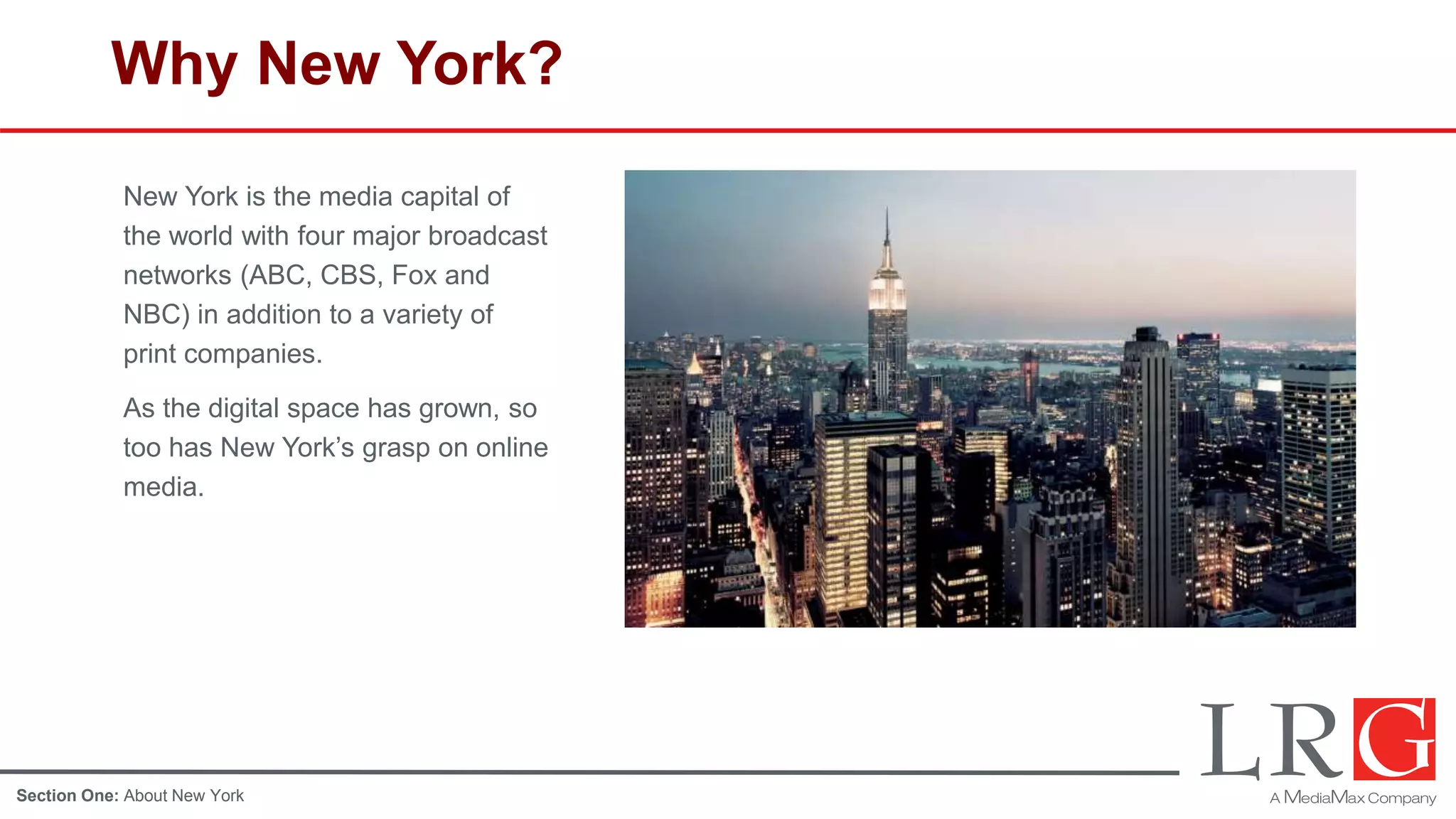
New York is the media capital of
the world with four major broadcast
networks (ABC, CBS, Fox and
NBC) in addition to a variety of
print companies.
As the digital space has grown, so
too has New York’s grasp on online
media.
Section One: About New York
Why New York?
The Big Apple is also famous for its fashion
and art. As a result, retailers are also riding
the digital wave by trying to improve the
commerce experience.
Section One: About New York
Innovation in New York
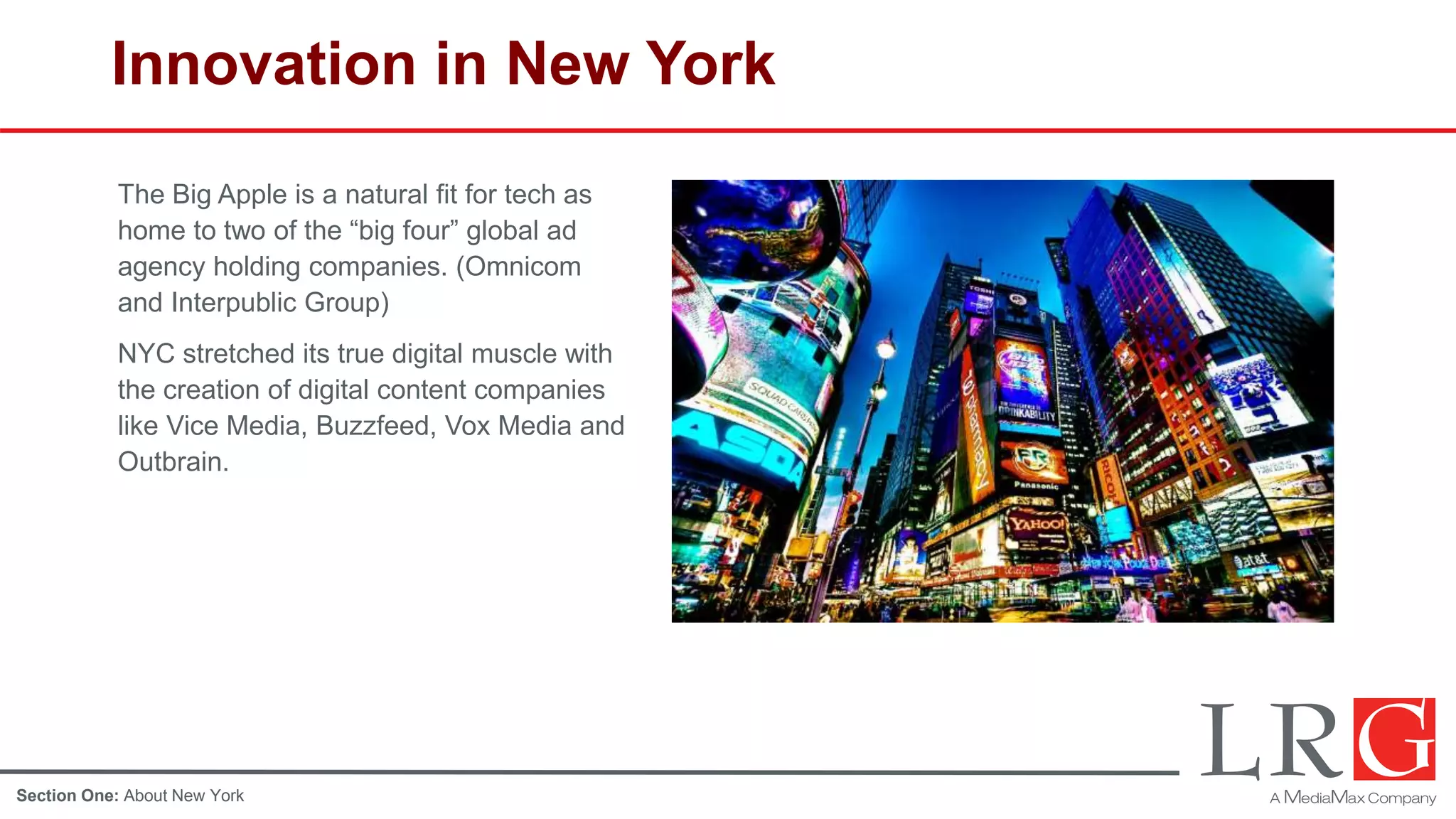
The Big Apple is a natural fit for tech as
home to two of the “big four” global ad
agency holding companies. (Omnicom
and Interpublic Group)
NYC stretched its true digital muscle with
the creation of digital content companies
like Vice Media, Buzzfeed, Vox Media and
Outbrain.
Section One: About New York
New York Bursts onto the Tech Scene
In 1993, Prodigy provided access to the
internet via dial-up and NY-based companies
such as Razorfish, DoubleClick and The
Mining Company (About.com) were soon
created and became leaders of the dot.com
bubble.
In 2003, David S. Rose led a group of
Investors to revitalize the New York Angels
group. Learn more about Rose here.
All this earned NY the nickname “Silicon Alley”
playing off California’s Silicon Valley.
Section One: About New York
Quotes on “Silicon Alley’s” Impact
“New York City has surpassed [Silicon Valley] in
startup funding requests. The tech ecosystem
here provides nearly 300,000 jobs and generates
over $30 billion in wages annually.”
– NYC Mayor Bill de Blasio
Section One: About New York
Quotes on “Silicon Alley’s” Impact
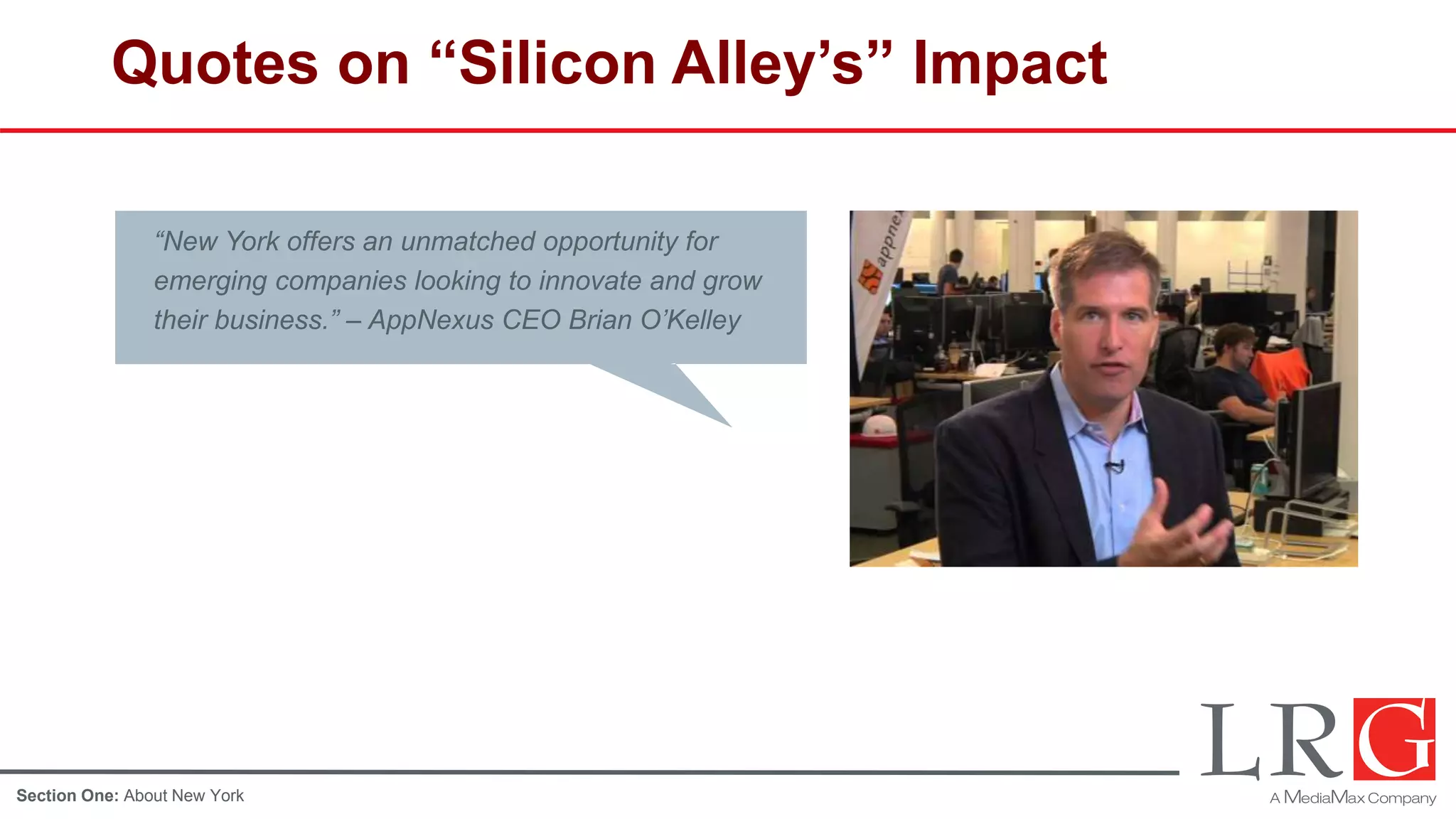
“New York offers an unmatched opportunity for
emerging companies looking to innovate and grow
their business.” – AppNexus CEO Brian O’Kelley
Section One: About New York
Quotes on “Silicon Alley’s” Impact
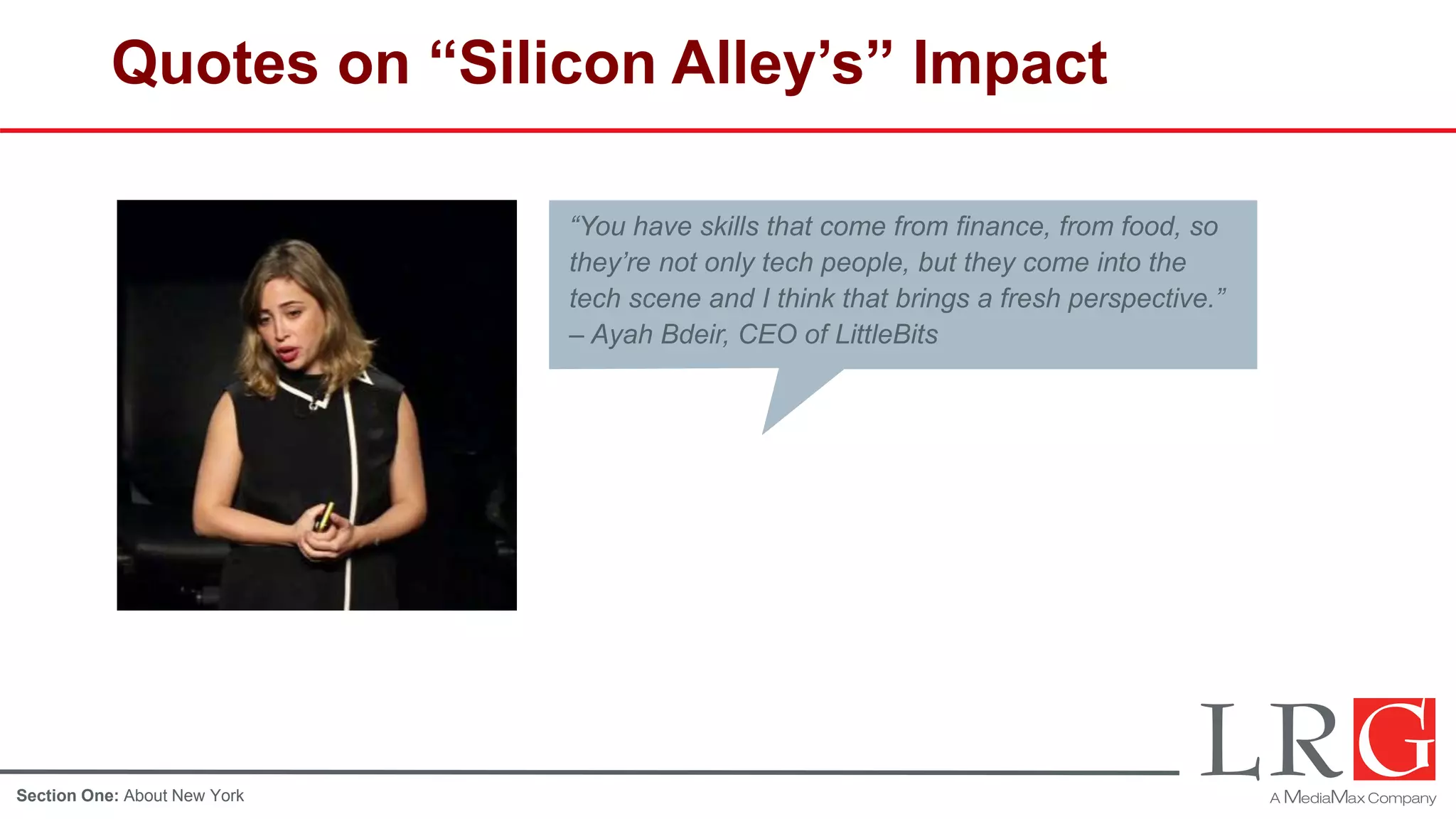
“You have skills that come from finance, from food, so
they’re not only tech people, but they come into the
tech scene and I think that brings a fresh perspective.”
– Ayah Bdeir, CEO of LittleBits
Section One: About New York
Quotes on “Silicon Alley’s” Impact
“[Startups] match our DNA perfectly. We are
the city of risk takers, of a million choices and
cutthroat competition.” – Alex Iskold,
Managing Director of Techstars NYC
Section One: About New York
History of New York Startups
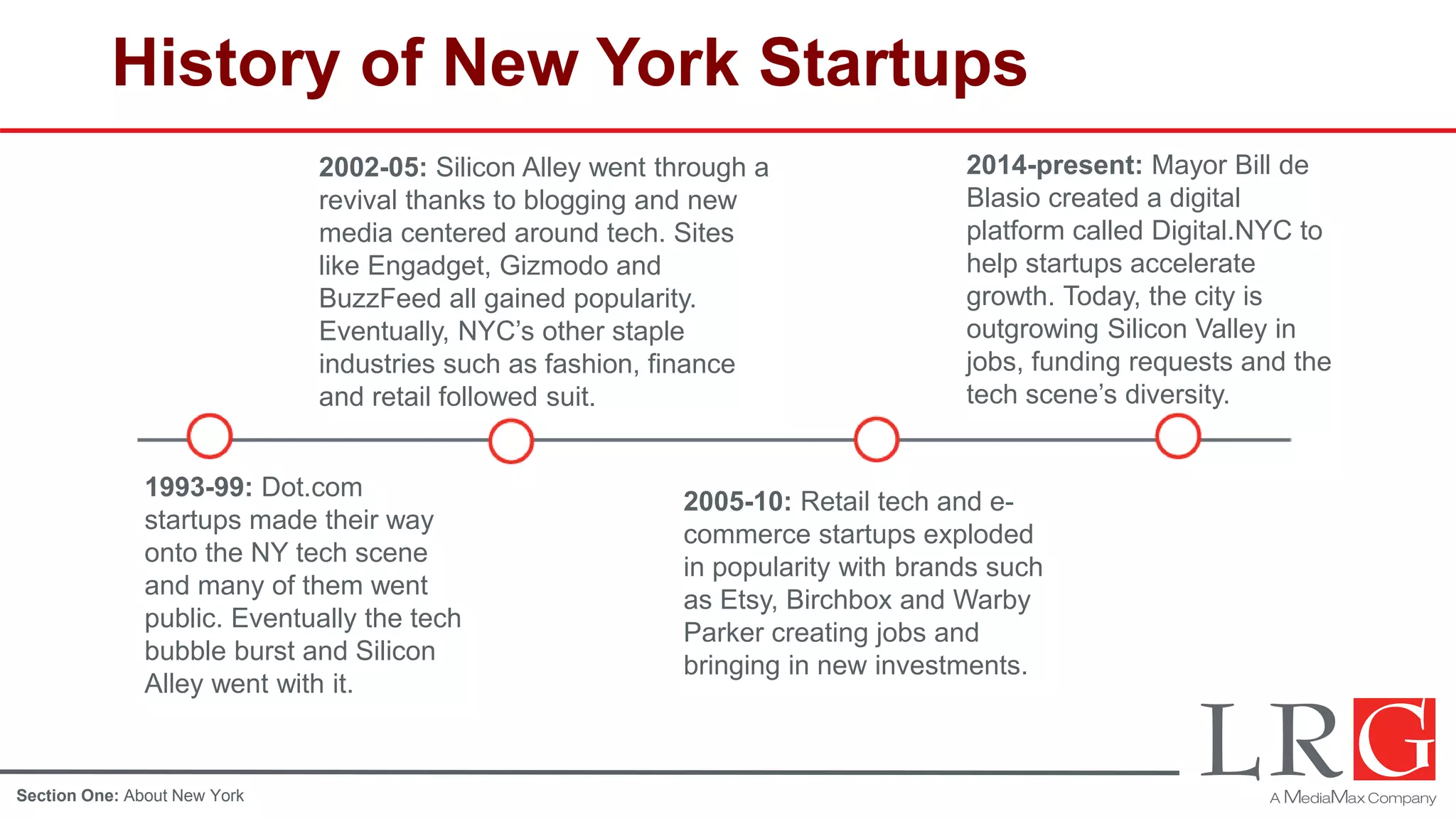
1993-99: Dot.com
startups made their way
onto the NY tech scene
and many of them went
public. Eventually the tech
bubble burst and Silicon
Alley went with it.
2002-05: Silicon Alley went through a
revival thanks to blogging and new
media centered around tech. Sites
like Engadget, Gizmodo and
BuzzFeed all gained popularity.
Eventually, NYC’s other staple
industries such as fashion, finance
and retail followed suit.
2005-10: Retail tech and e-
commerce startups exploded
in popularity with brands such
as Etsy, Birchbox and Warby
Parker creating jobs and
bringing in new investments.
2014-present: Mayor Bill de
Blasio created a digital
platform called Digital.NYC to
help startups accelerate
growth. Today, the city is
outgrowing Silicon Valley in
jobs, funding requests and the
tech scene’s diversity.
Section One: About New York
Market Overview
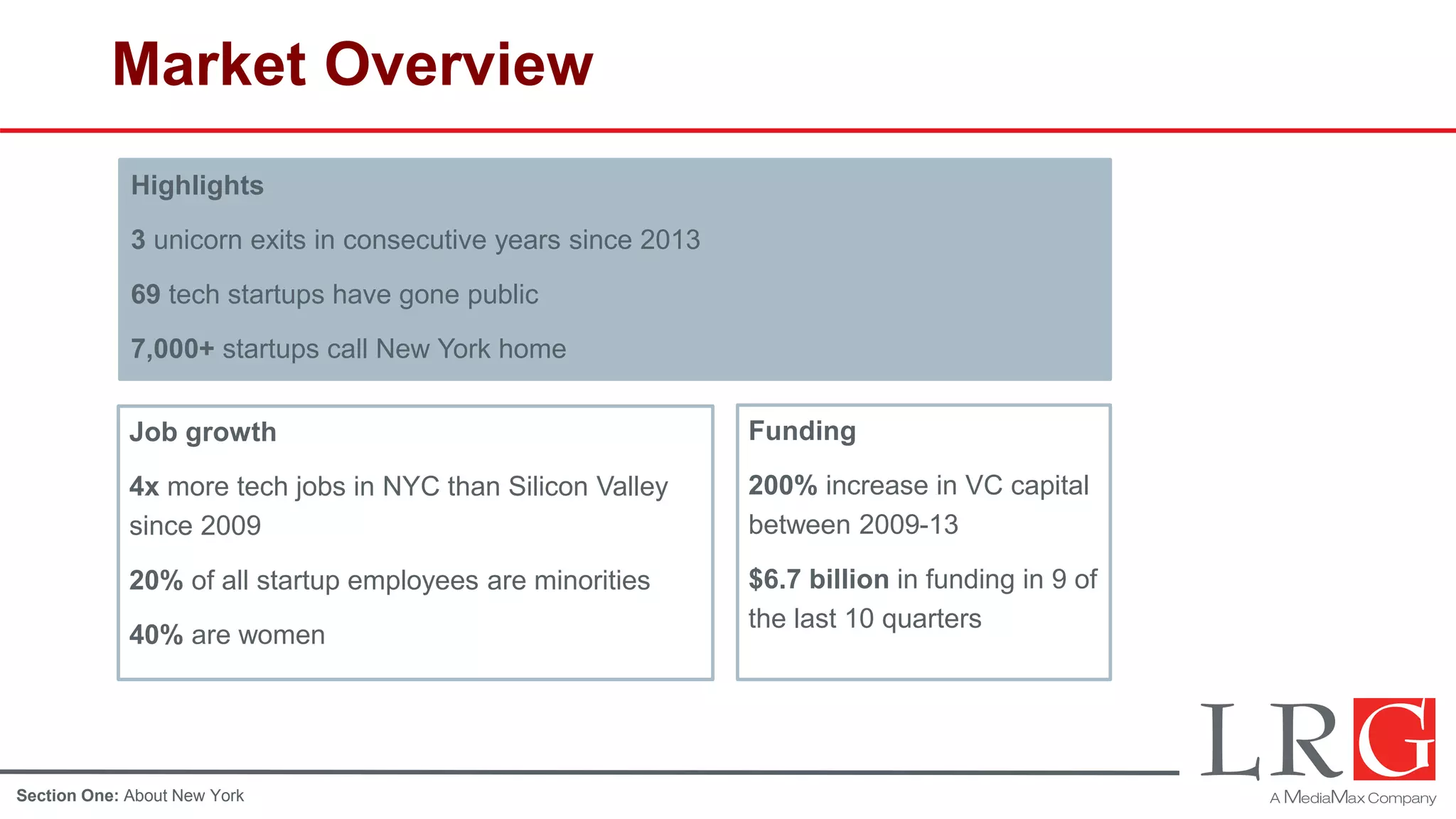
Highlights
3 unicorn exits in consecutive years since 2013
69 tech startups have gone public
7,000+ startups call New York home
Funding
200% increase in VC capital
between 2009-13
$6.7 billion in funding in 9 of
the last 10 quarters
Job growth
4x more tech jobs in NYC than Silicon Valley
since 2009
20% of all startup employees are minorities
40% are women
Section One: About New York
Notable NY-Based
Startups
Section Two: Notable Startups
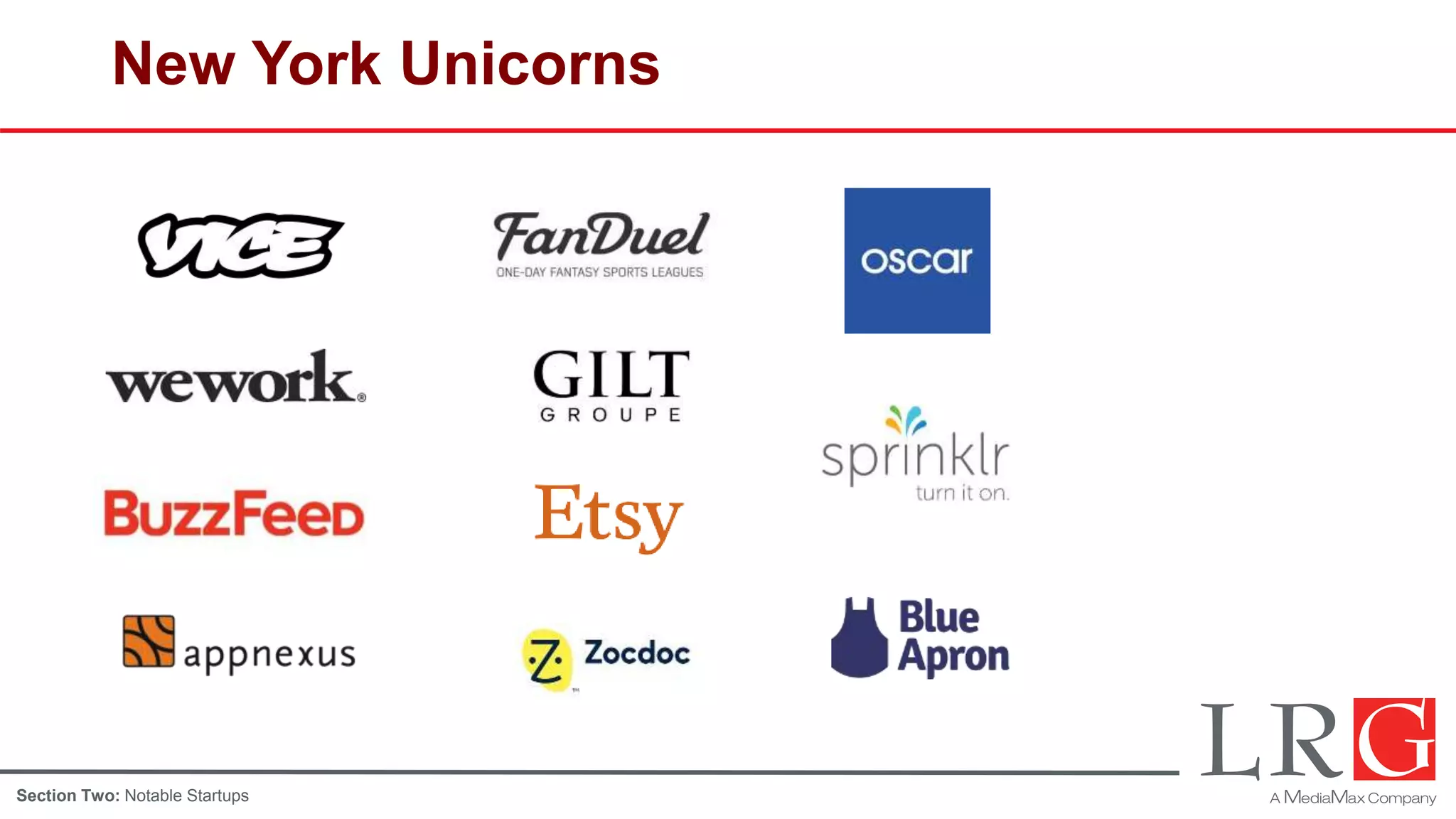
New York Unicorns
Section Two: Notable Startups
Unicorn Case Studies
Enterprise social media management platform founded in 2009
and has nearly 800 of the top Fortune 1000 companies.
Most recent funding was $46M Series E to tap into paid social.
Has at least 20k fans/followers per social channel and honored as
one of LRG Marketing’s “3 B2B New York startups killing it on social.”
Section Two: Notable Startups
Unicorn Case Studies
Cloud-based software platform that enables and optimizes
programmatic online advertising.
Recently completed a $63M Series F funding.
Has nearly 20k Twitter followers, and over 21k on LinkedIn.
Section Two: Notable Startups
Unicorn Case Studies
Social news and entertainment company that has recently
moved into B2B by using content-driven publishing technology
to sell advertising to Fortune 500 companies.
Received $200M in PE funding from NBC Universal.
Has nearly 3 million followers on Twitter and 6.5 million
Facebook fans.
Section Two: Notable Startups
Key Insights
While the media landscape is changing, the industry is getting bigger than ever in New York.
Section Two: Notable Startups
Key Insights
Investors are funding startups that naturally
produce a lot of content and demonstrate
thought leadership in their industry.
Section Two: Notable Startups
Key Insights
B2B startups are producing a lot of content quickly
and investing heavily in follower building to increase
their audience at a low cost. This is also becoming
one of many indicators VCs use to judge a company’s
trajectory.
Section Two: Notable Startups
NY Companies on the Rise
Section Two: Notable Startups
Why They Stand Out
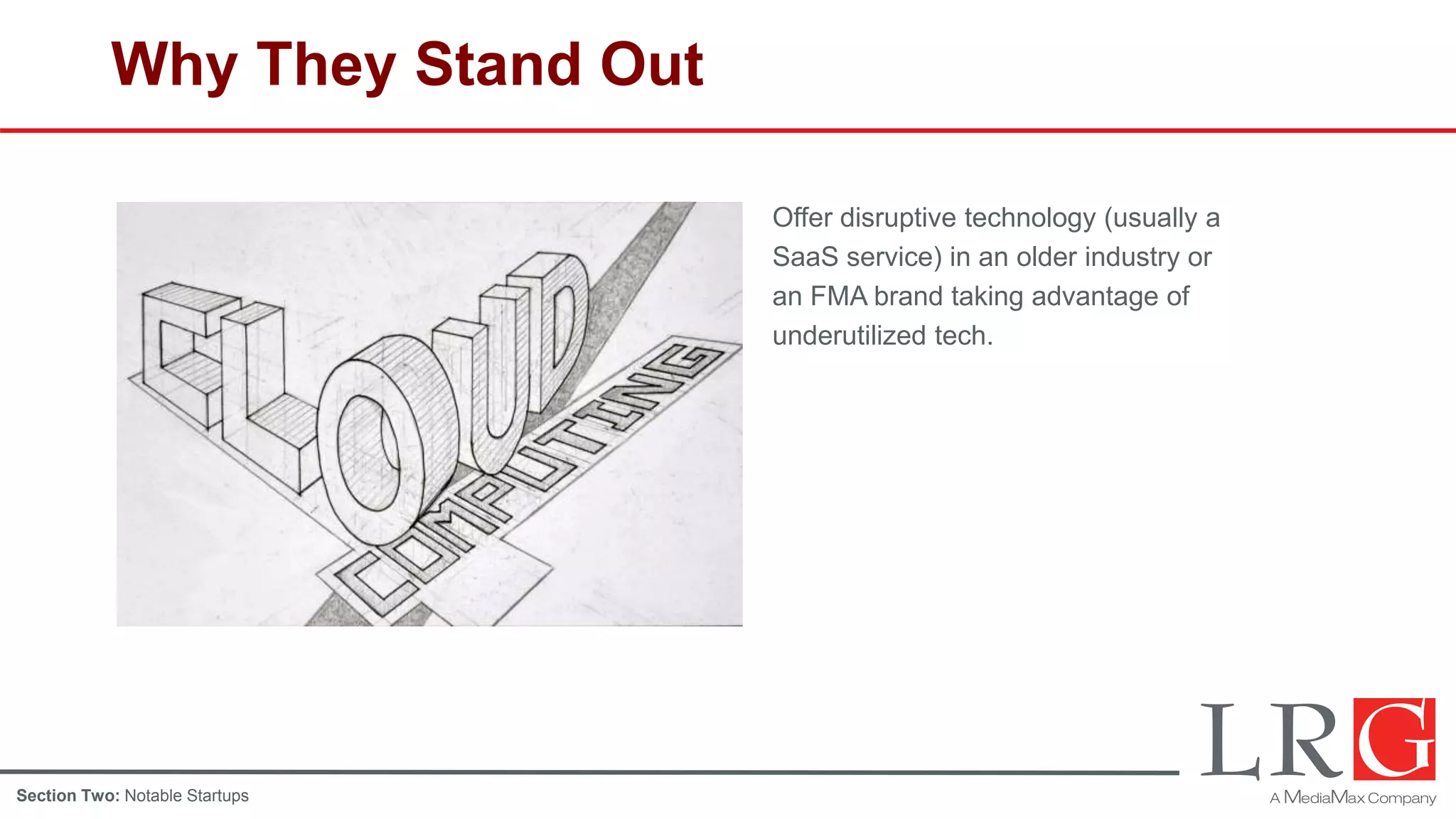
Offer disruptive technology (usually a
SaaS service) in an older industry or
an FMA brand taking advantage of
underutilized tech.
Section Two: Notable Startups
Why They Stand Out
Market with large potential that is mostly
untapped or a problem the competition
hasn’t yet solved.
Section Two: Notable Startups
Why They Stand Out
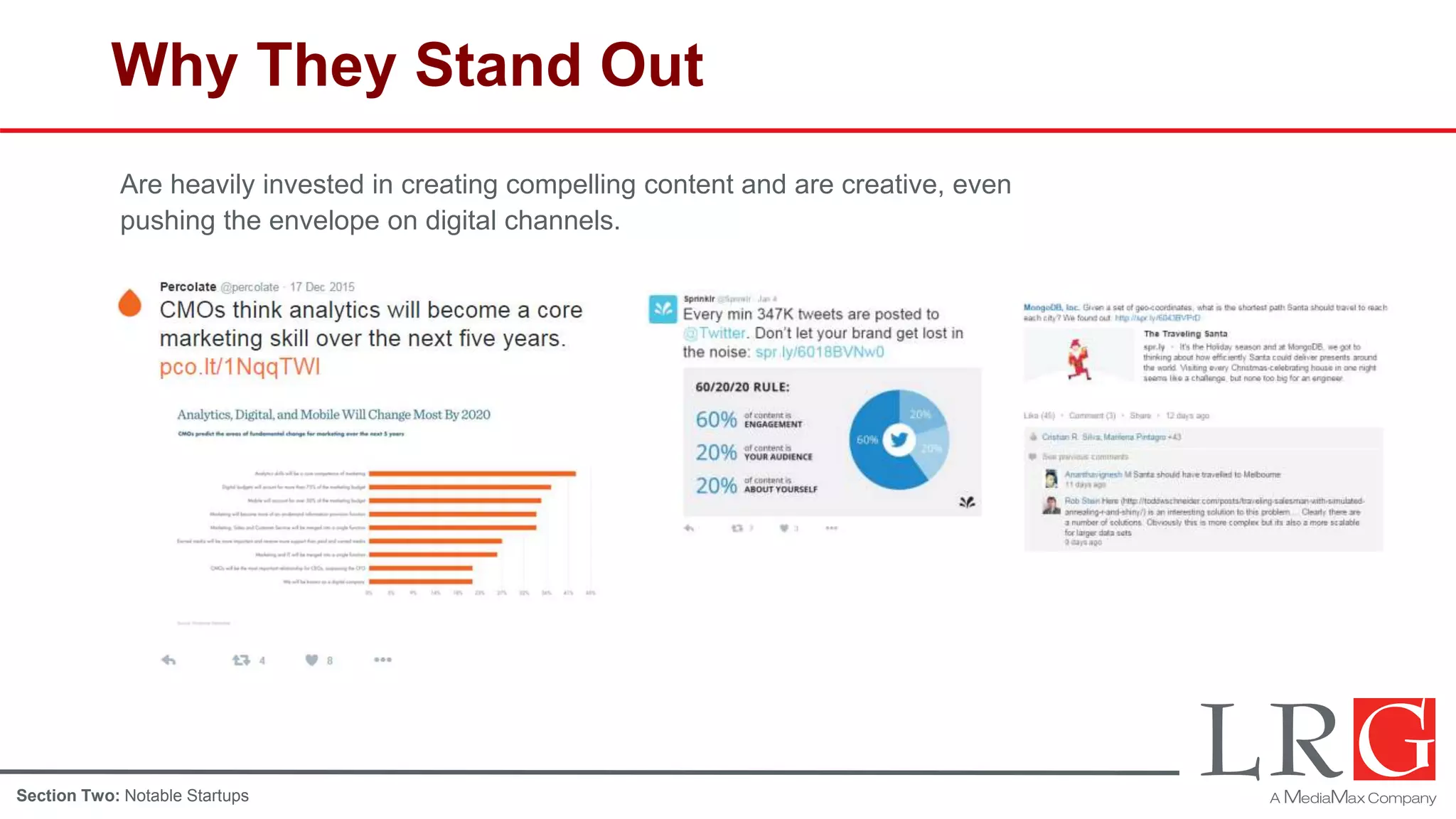
Are heavily invested in creating compelling content and are creative, even
pushing the envelope on digital channels.
Section Two: Notable Startups
Why They Stand Out
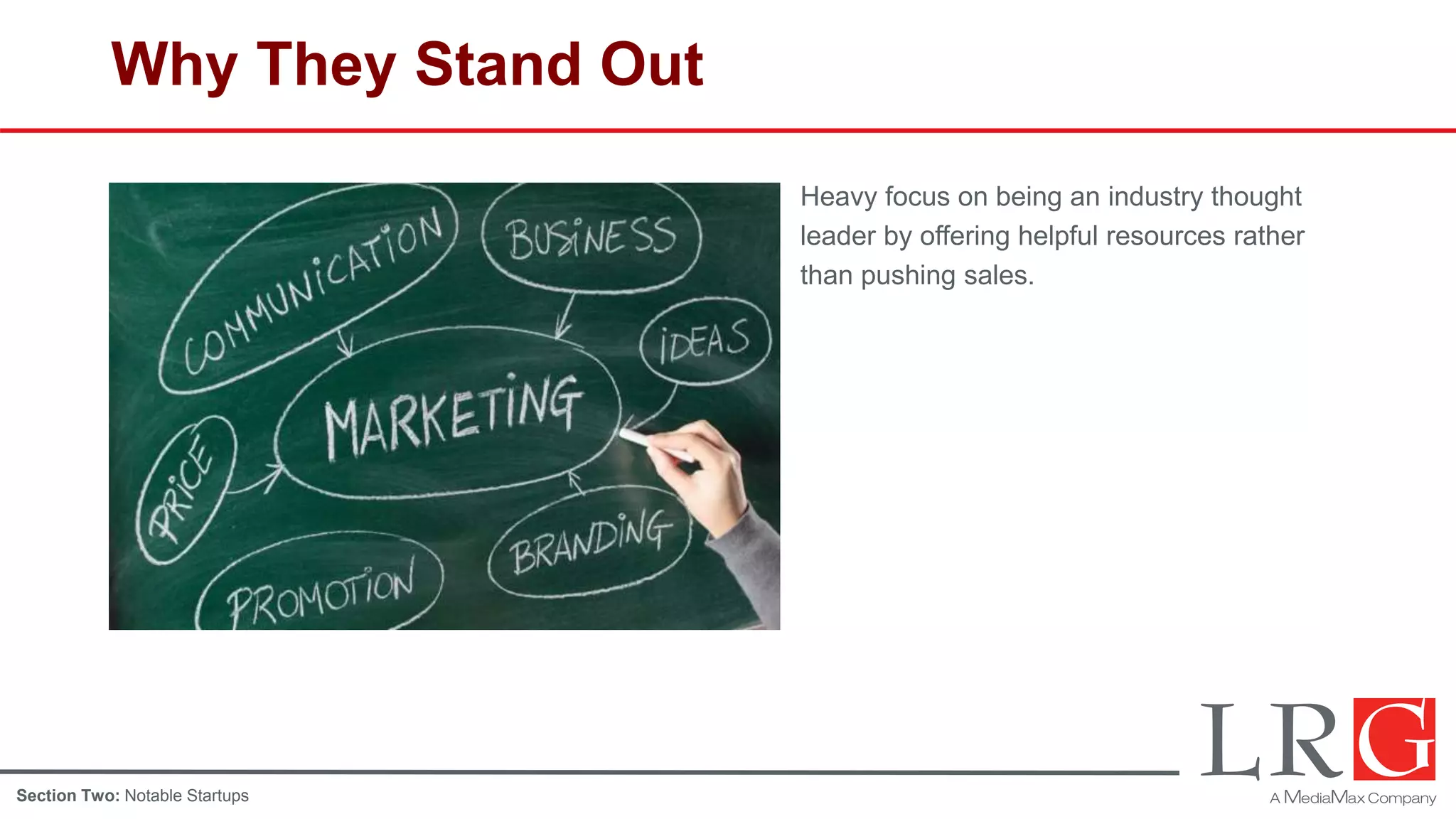
Heavy focus on being an industry thought
leader by offering helpful resources rather
than pushing sales.
Section Two: Notable Startups
Where NYC
Startups Live
Section Three: Where NYC Startups Live
Neighborhoods
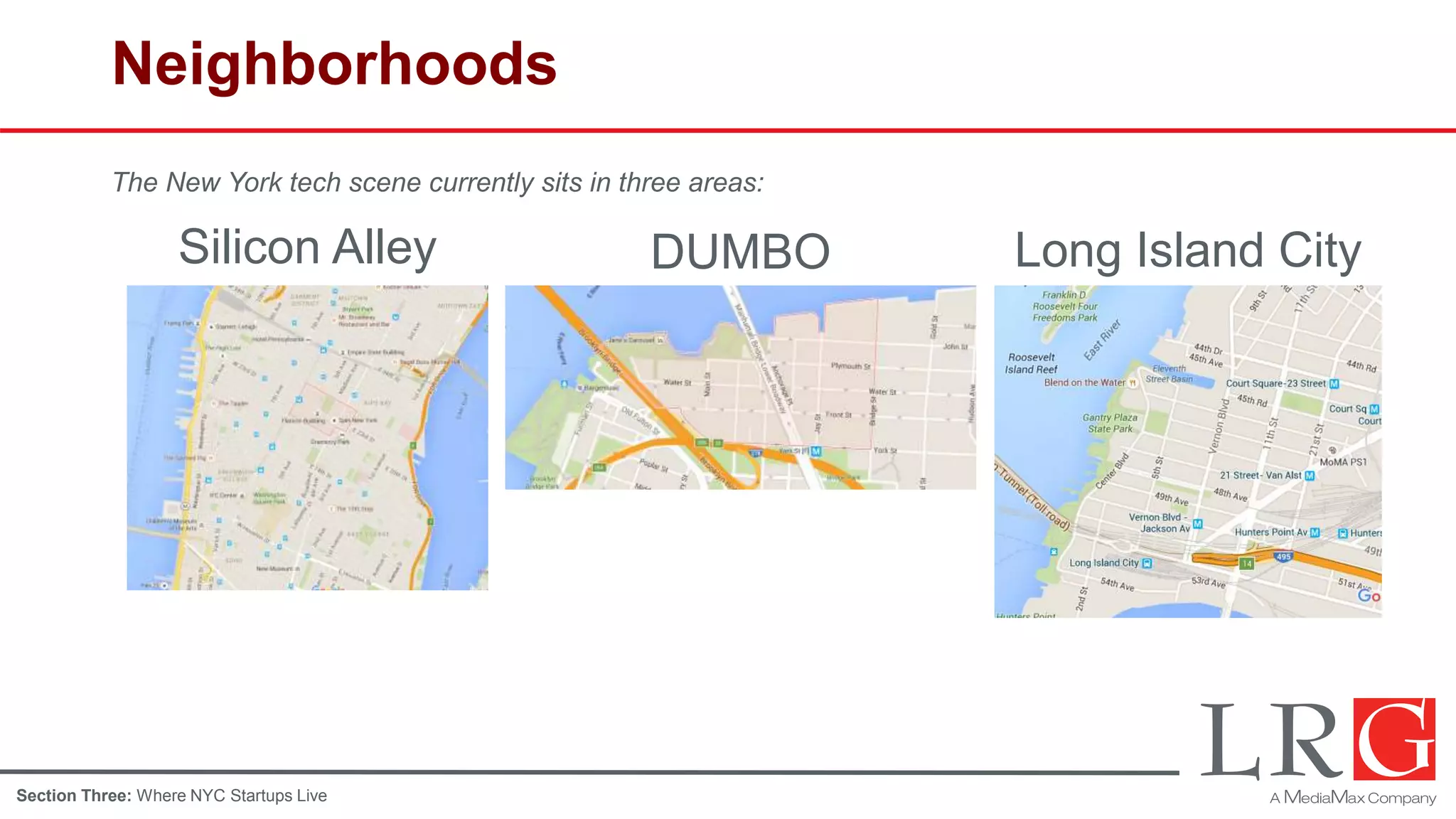
The New York tech scene currently sits in three areas:
Silicon Alley DUMBO Long Island City
Section Three: Where NYC Startups Live
Why Silicon Alley?
Online advertising and tech media
startups first launched here and Google
opened an office in 2006.
Influenced by David S. Rose for a wide
variety of angel investments.
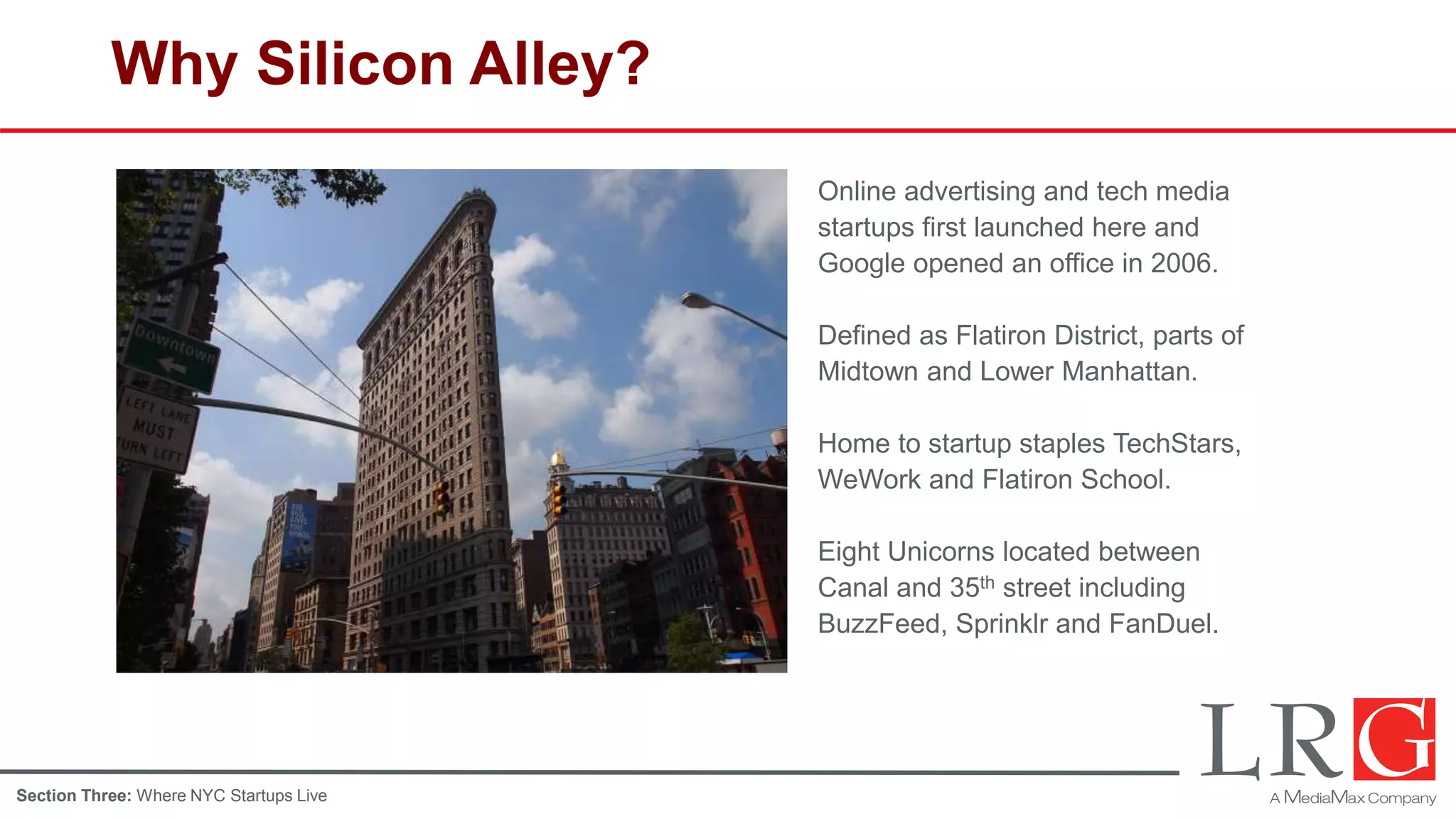
Defined as Flatiron District, parts of
Midtown and Lower Manhattan.
Home to startup staples TechStars,
WeWork and Flatiron School.
Eight Unicorns located between Canal
and 35th street including BuzzFeed,
Sprinklr and FanDuel.
Section Three: Where NYC Startups Live
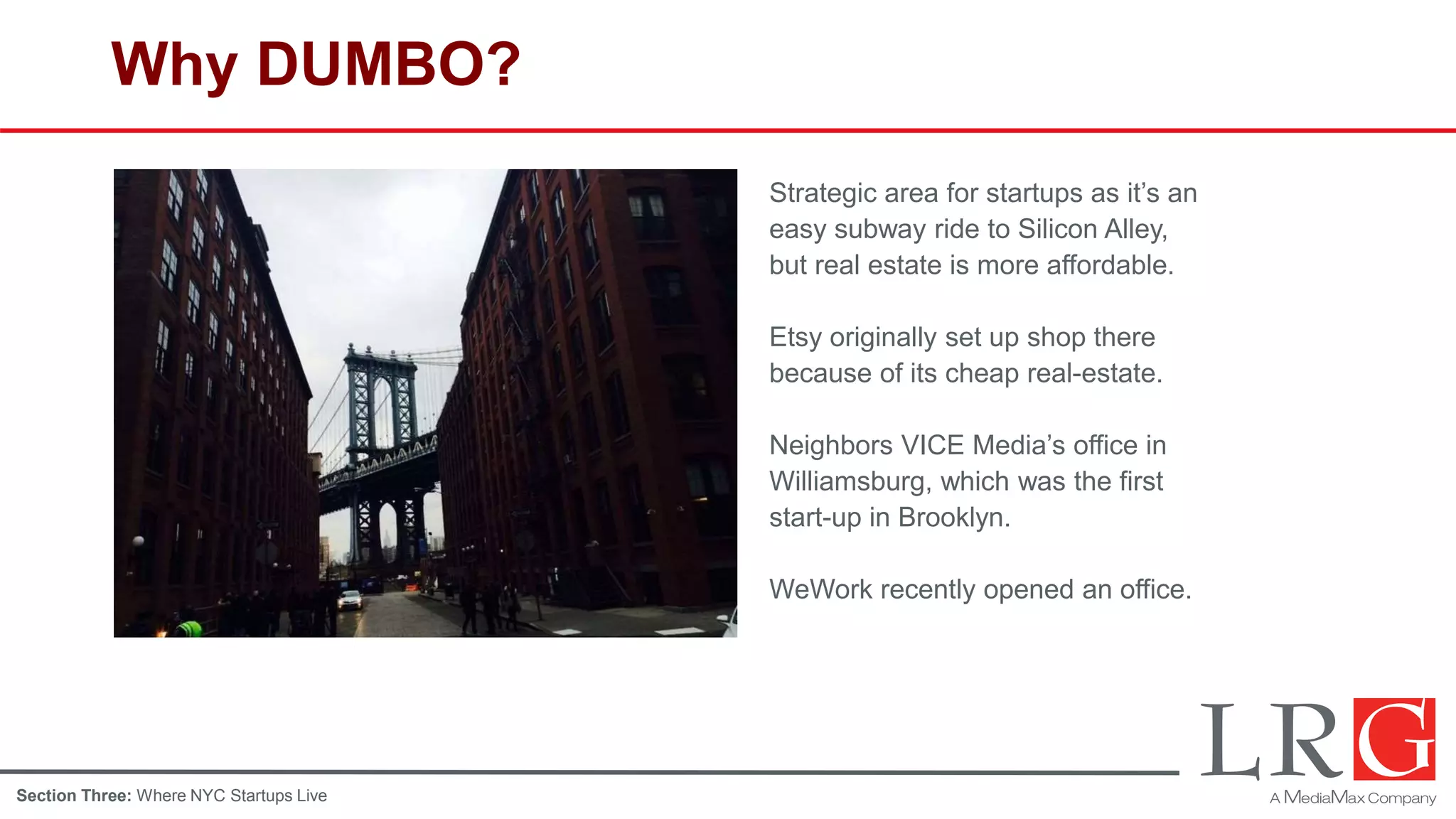
Why DUMBO?
Strategic area for startups as it’s an
easy subway ride to Silicon Alley,
but real estate is more affordable.
Etsy originally set up shop there
because of its cheap real-estate.
Neighbors VICE Media’s office in
Williamsburg, which was the first
start-up in Brooklyn.
WeWork recently opened an office.
Section Three: Where NYC Startups Live
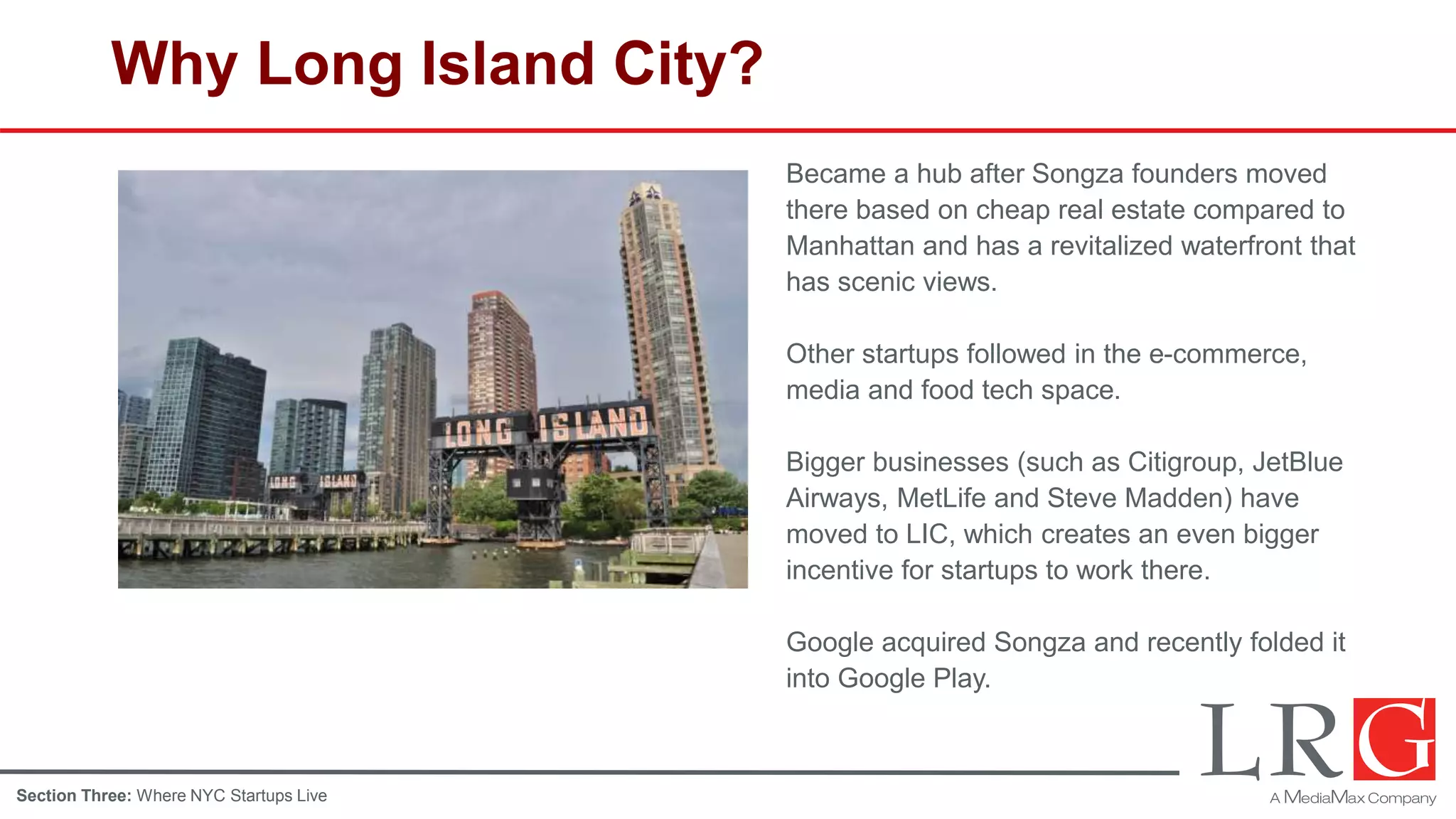
Why Long Island City?
Became a hub after Songza founders moved
there based on cheap real estate compared to
Manhattan and has a revitalized waterfront that
has scenic views.
Other startups followed in the e-commerce,
media and food tech space.
Bigger businesses (such as Citigroup, JetBlue
Airways, MetLife and Steve Madden) have
moved to LIC, which creates an even bigger
incentive for startups to work there.
Google acquired Songza and recently folded it
into Google Play.
Section Three: Where NYC Startups Live
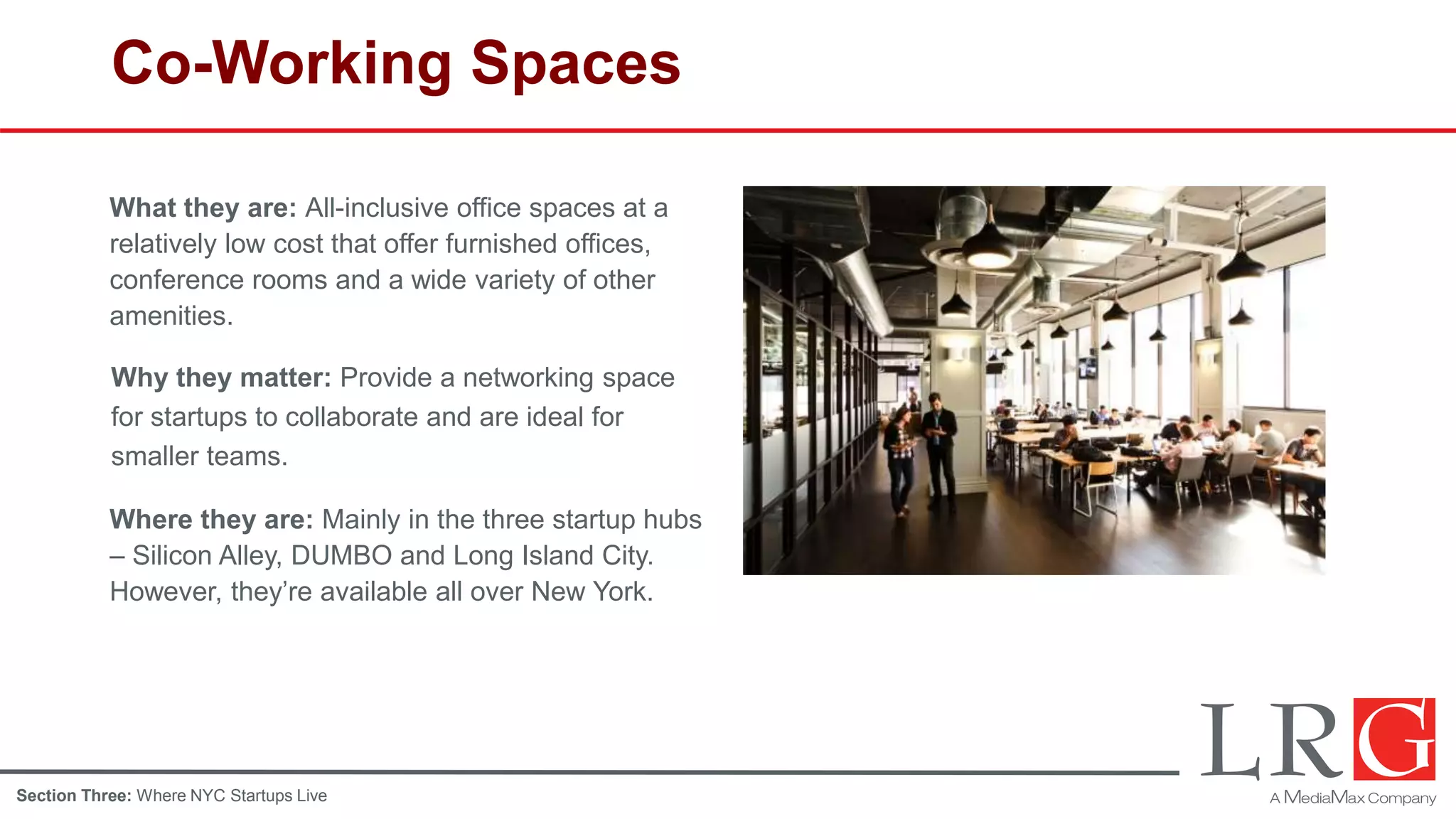
Co-Working Spaces
What they are: All-inclusive office spaces at a
relatively low cost that offer furnished offices,
conference rooms and a wide variety of other
amenities.
Why they matter: Provide a networking space
for startups to collaborate and are ideal for
smaller teams.
Where they are: Mainly in the three startup hubs
– Silicon Alley, DUMBO and Long Island City.
However, they’re available all over New York.
Section Three: Where NYC Startups Live
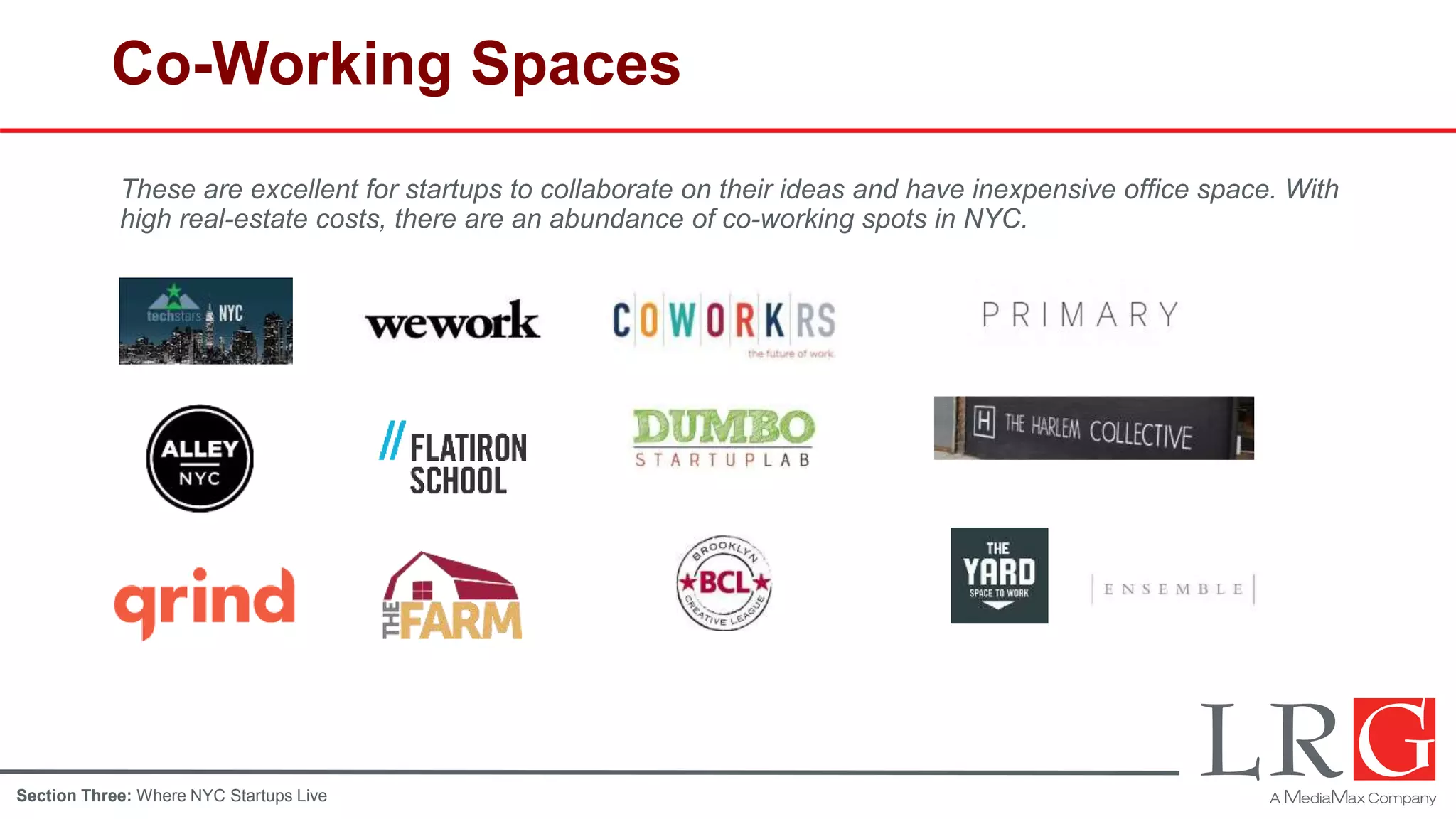
Co-Working Spaces
These are excellent for startups to collaborate on their ideas and have inexpensive office space. With
high real-estate costs, there are an abundance of co-working spots in NYC.
Section Three: Where NYC Startups Live
Meet-Up Groups
• Startup Weekend
• NYC Tech Talks
• Tech in Motion: New York City
• NY Tech Women
• #STARTUP
• Inside Startups Club
• Startup Grind
• Be Social Change
• New York Entrepreneurs & Startup Network
• NYC Startup Community
• NYC Technology Startups
• NY Tech Meetup
• NYEdTech
• New York Silicon Alley
• Brooklyn Tech Meetup
Looking to meet other startups or venture capital firms? These groups are perfect for you. Whether
you’re new, or just looking for someone to partner with, these meetups are extremely valuable.
Section Three: Where NYC Startups Live
Startup Education
• General Assembly – Graduate school type program to improve skills in design, marketing, tech and big data.
• Full Stack Academy – Specializes in teaching JavaScript and database fluency within SQL, NoSQL and ORM
languages.
• Flatiron School – Program that focuses on iOS mobile app development and web development within Ruby
and JavaScript. Also offers an extremely competitive fellowship for non-college graduates.
• Dev Bootcamp – Intensive 19-week program that teaches Ruby, JavaScript, HTML and CSS.
• App Academy – Software development bootcamp that doesn’t charge money until students are hired.
• Startup Institute – Eight-week program that provides the skills to work in anything from web design to account
management at a startup.
• Recurse – Free 12-week “retreat” that helps programmers improve their coding skills.
• Byte Academy – Python coding school specialized for FinTech, Big Data and MedTech industries.
• Turn to Tech – Coding bootcamp focused on iOS and Android development to get students ready for working
at startups.
While many startup founders hail from the likes of Columbia and NYU, the education space is also
witnessing disruption with institutions like these making six-figure salaries more accessible than ever before.
Section Three: Where NYC Startups Live
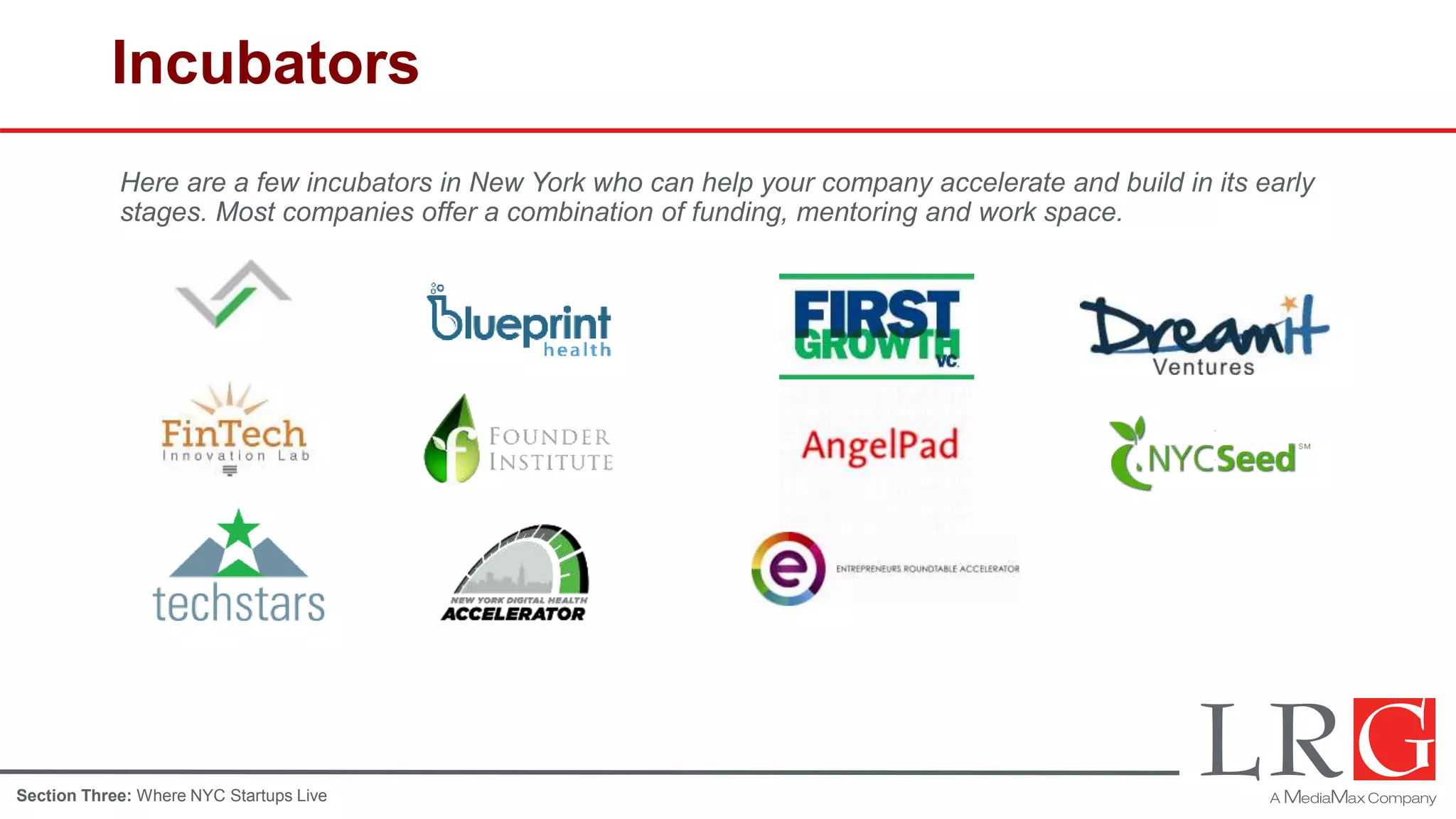
Incubators
Here are a few incubators in New York who can help your company accelerate and build in its early
stages. Most companies offer a combination of funding, mentoring and work space.
Section Three: Where NYC Startups Live
How to
Attract Funding
Section Four: How to Attract Funding
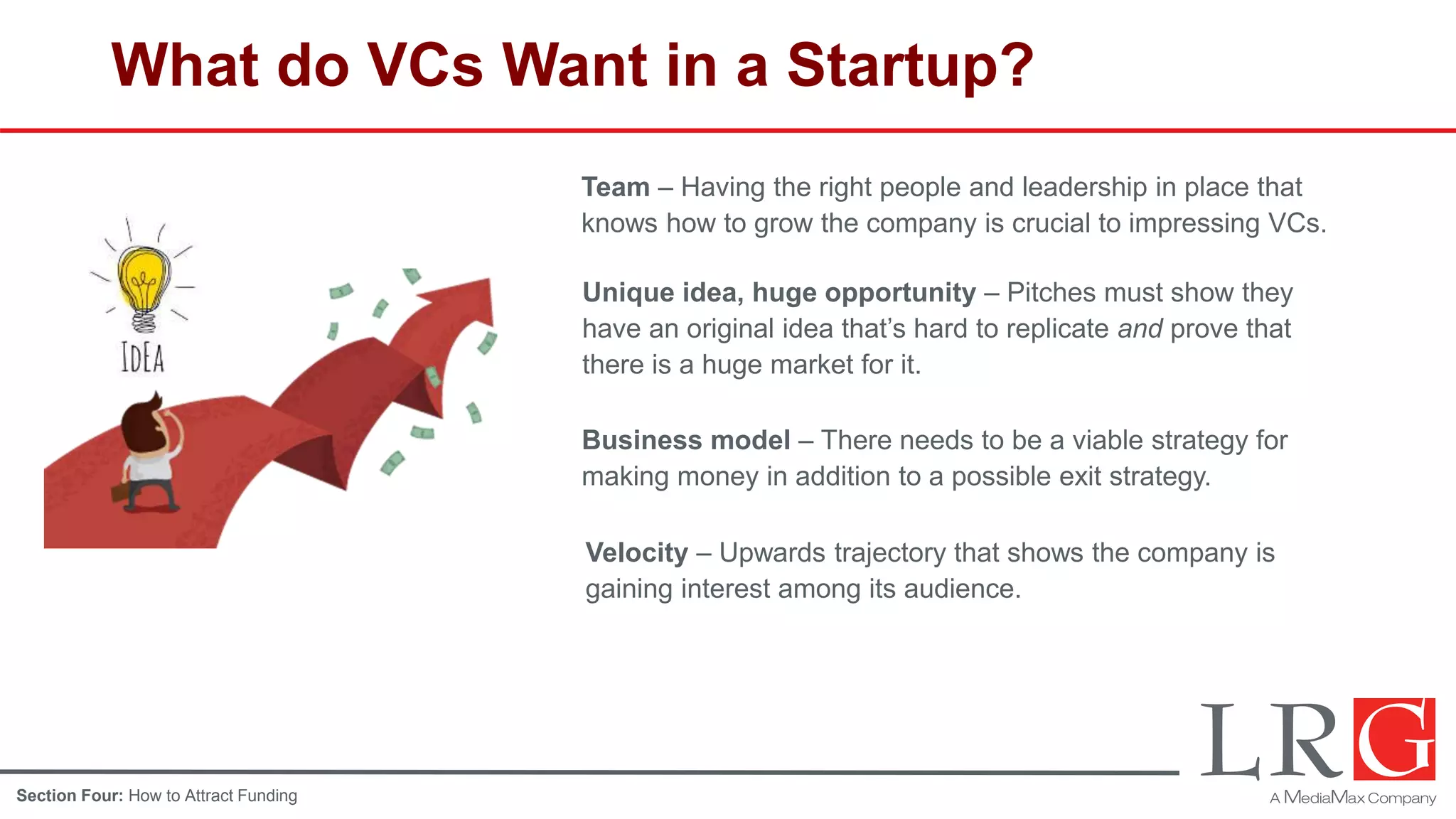
What do VCs Want in a Startup?
Team – Having the right people and leadership in place that
knows how to grow the company is crucial to impressing VCs.
Unique idea, huge opportunity – Pitches must show they
have an original idea that’s hard to replicate and prove that
there is a huge market for it.
Business model – There needs to be a viable strategy for
making money in addition to a possible exit strategy.
Velocity – Upwards trajectory that shows the company is
gaining interest among its audience.
Section Four: How to Attract Funding
How to Show Velocity
• Increase in users
• Sales
• Web traffic
• Conversions
• Anything that proves your solution is here to
stay and won’t fizzle out
From our point of view, showing velocity is the most compelling way to attract
funding and is also ambiguous. How does a startup show velocity?
Section Four: How to Attract Funding
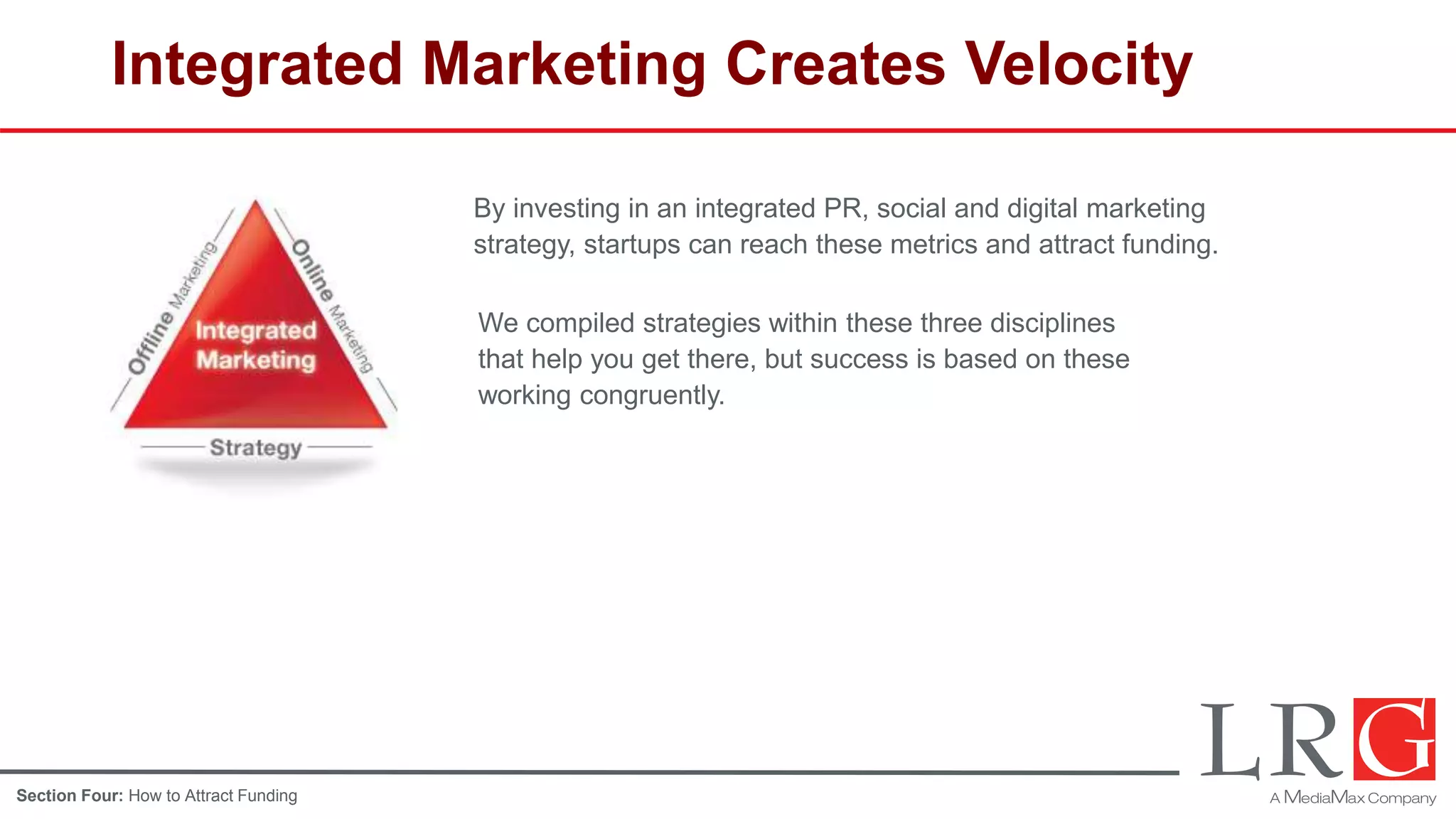
Integrated Marketing Creates Velocity
By investing in an integrated PR, social and digital marketing
strategy, startups can reach these metrics and attract funding.
We compiled strategies within these three disciplines
that help you get there, but success is based on these
working congruently.
Section Four: How to Attract Funding
PR Strategies for Showing Velocity
Establish relationships: Identify target influencers and reporters in your market
early on and engage them every step of the way.
Designate a thought leader: Find a person who will be the voice of your company and
have them (or a ghost-writer) write contributed articles on industry pain-points.
Get third-party validation: Reviews and demos are an effective
way to prove to VCs that your product or service is legit.
Reviews offer the social proof investors look for before investing.
Newsjacking: Look for news events relevant to your brand
and have your expert ready to provide thoughtful commentary.
Section Four: How to Attract Funding
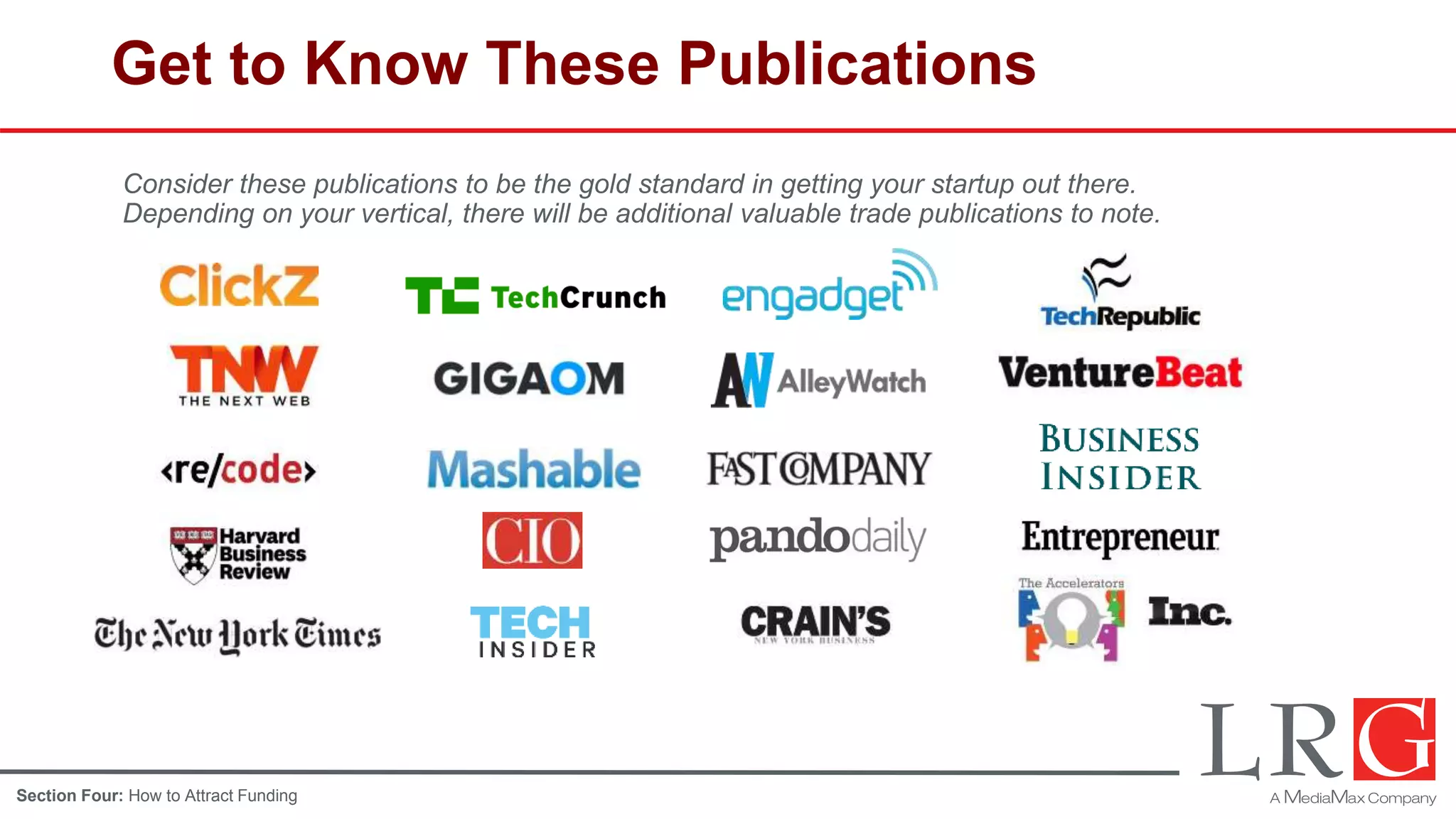
Get to Know These Publications
Consider these publications to be the gold standard in getting your startup out there.
Depending on your vertical, there will be additional valuable trade publications to note.
Section Four: How to Attract Funding
Digital Strategies for Showing Velocity
Make your website user friendly – If your website
doesn’t steer your audience the way you want it to,
all other strategies are moot. Your website should be
both aesthetically pleasing and functional with clear
calls to action.
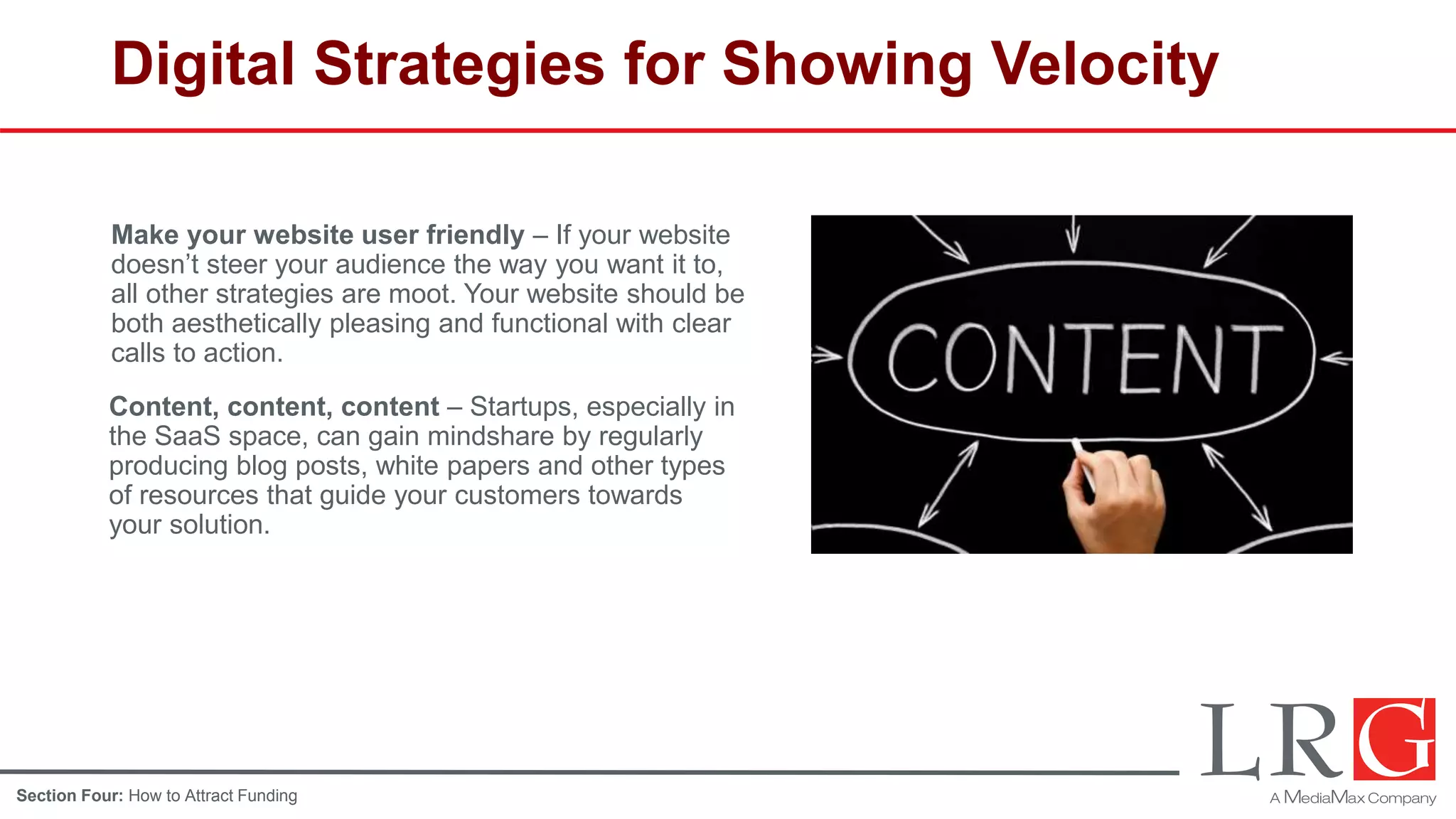
Content, content, content – Startups, especially in
the SaaS space, can gain mindshare by regularly
producing blog posts, white papers and other types
of resources that guide your customers towards
your solution.
Section Four: How to Attract Funding
Digital Strategies for Showing Velocity
Invest in PPC – A good PPC strategy will ultimately drive
traffic to your website and get you closer to user adoption
through conversions.
Don’t forget organic search – All of these strategies should
feed into ensuring customers can easily find you on Google.
SEO is no longer about optimizing for single keywords, rather
it’s about understanding which search phrases customers are
most likely to use in order to find you.
Section Four: How to Attract Funding
Social Media Strategies for Showing Velocity
“Friend” your Facebook presence – While B2B
companies are typically hesitant to engage on Facebook
with low organic reach, startups can get downloads for an
app or white paper at a low cost and get instant feedback
through people’s reactions.
Publish on LinkedIn – By publishing long-form content on
LinkedIn, you can establish thought leadership, increase
brand awareness and let your network know what your
brand is up to. Read our blog post to further learn about the
benefits to publishing on LinkedIn.
Section Four: How to Attract Funding
Social Media Strategies for Showing Velocity
Invest in paid social across platforms – Looking at social media
as if it’s owned media is an outdated strategy. In order to get the
shared aspect you want in your social media program, it involves
taking advantage of this one-of-a-kind opportunity. You can even
use our guide to it if you’re not sure where to get started.
Empower your team – If your employees truly stand behind your
vision, there’s no better place to leverage that than on social media.
Ask them to consider their LinkedIn profile as a blend of who they
are personally and professionally so investors and customers get a
better feel for what your brand stands for. Sharing PR placements
on Twitter is another way to accomplish this as well.
Section Four: How to Attract Funding
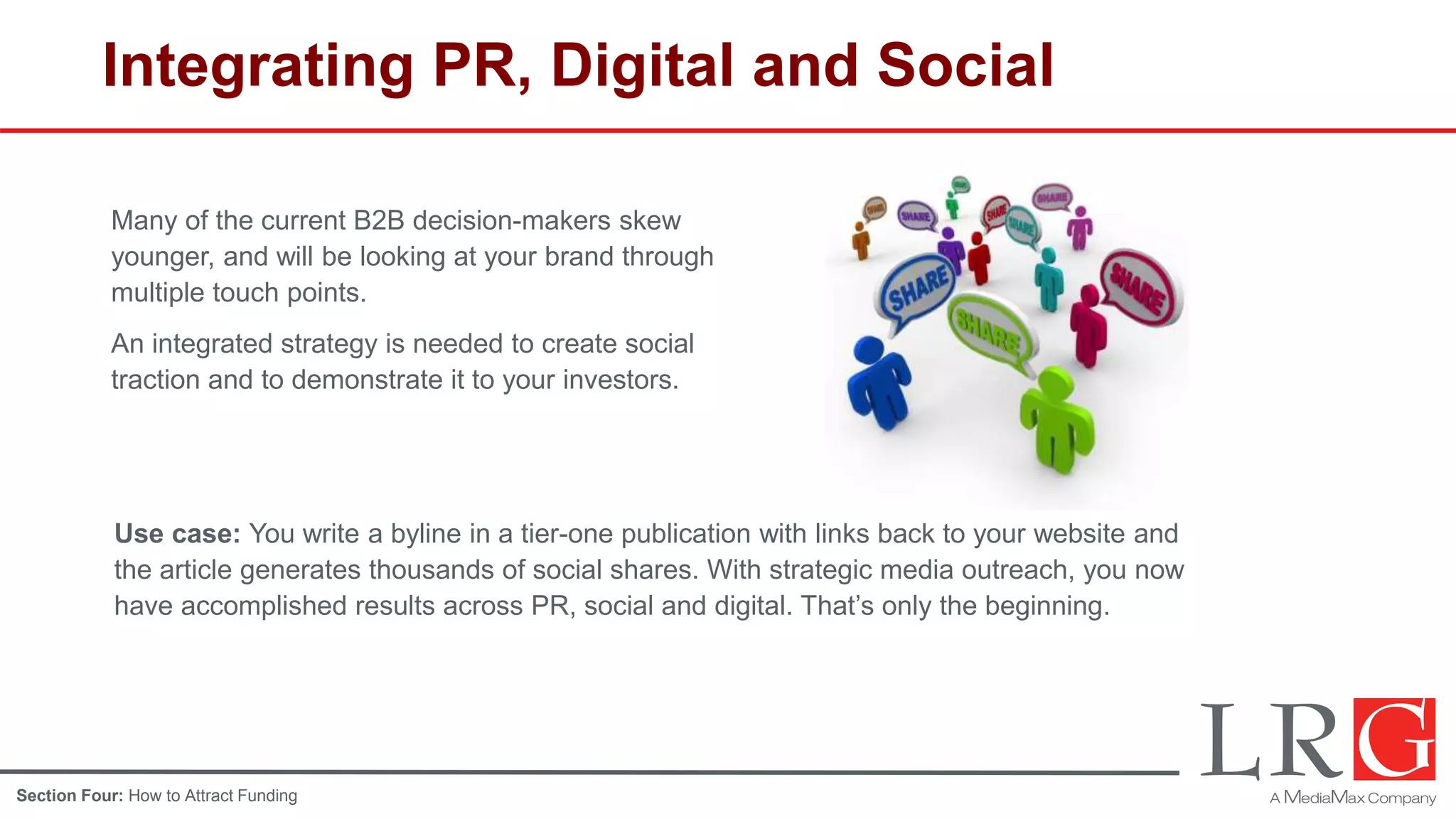
Integrating PR, Digital and Social
Many of the current B2B decision-makers skew
younger, and will be looking at your brand through
multiple touch points.
An integrated strategy is needed to create social
traction and to demonstrate it to your investors.
Use case: You write a byline in a tier-one publication with links back to your website and
the article generates thousands of social shares. With strategic media outreach, you now
have accomplished results across PR, social and digital. That’s only the beginning.
Section Four: How to Attract Funding
You’re Ready for
Funding. What Now?
Section Five: You’re Ready for Funding. What Now?
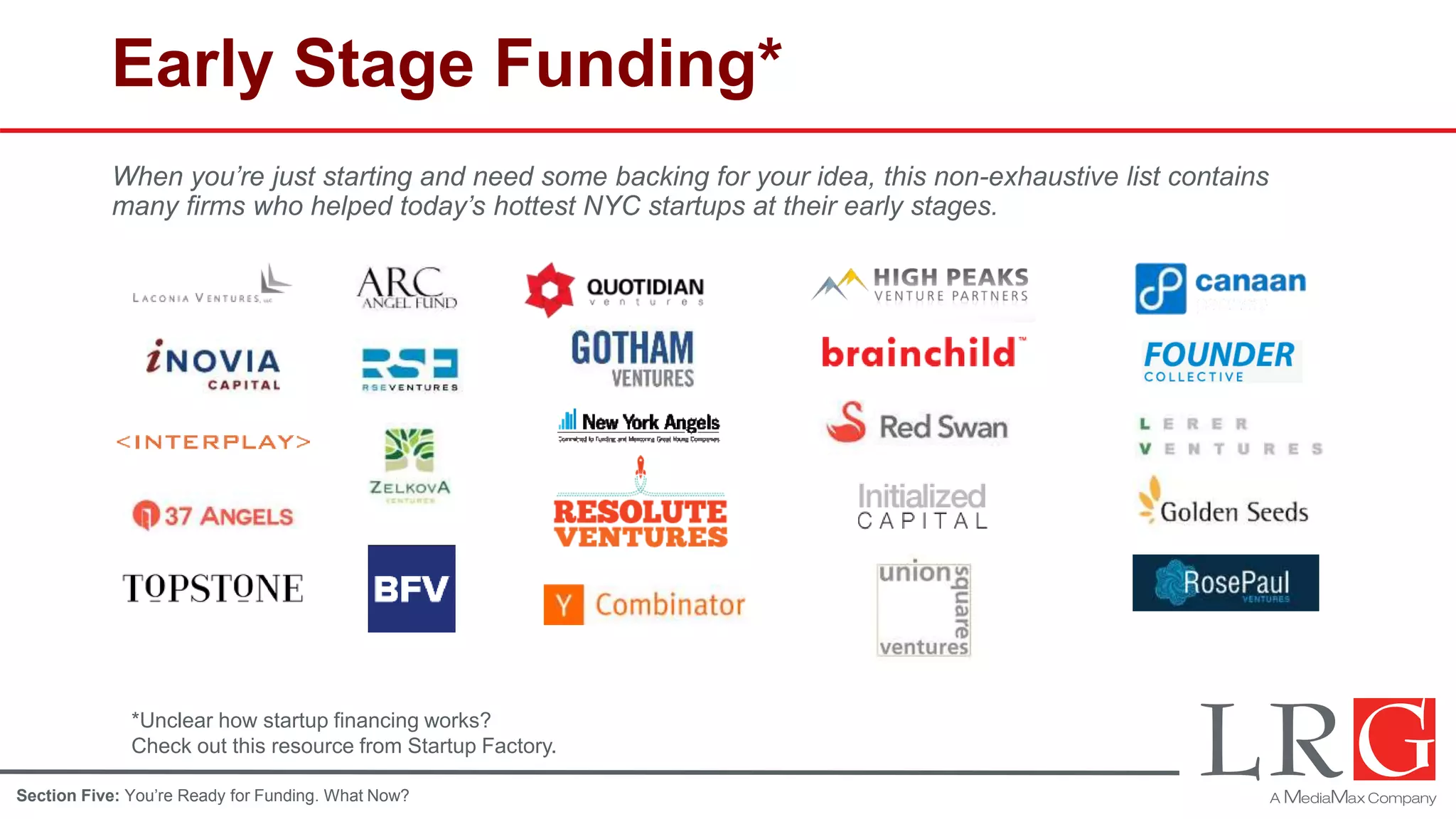
Early Stage Funding*
When you’re just starting and need some backing for your idea, this non-exhaustive list contains
many firms who helped today’s hottest NYC startups at their early stages.
*Unclear how startup financing works?
Check out this resource from Startup Factory.
Section Five: You’re Ready for Funding. What Now?
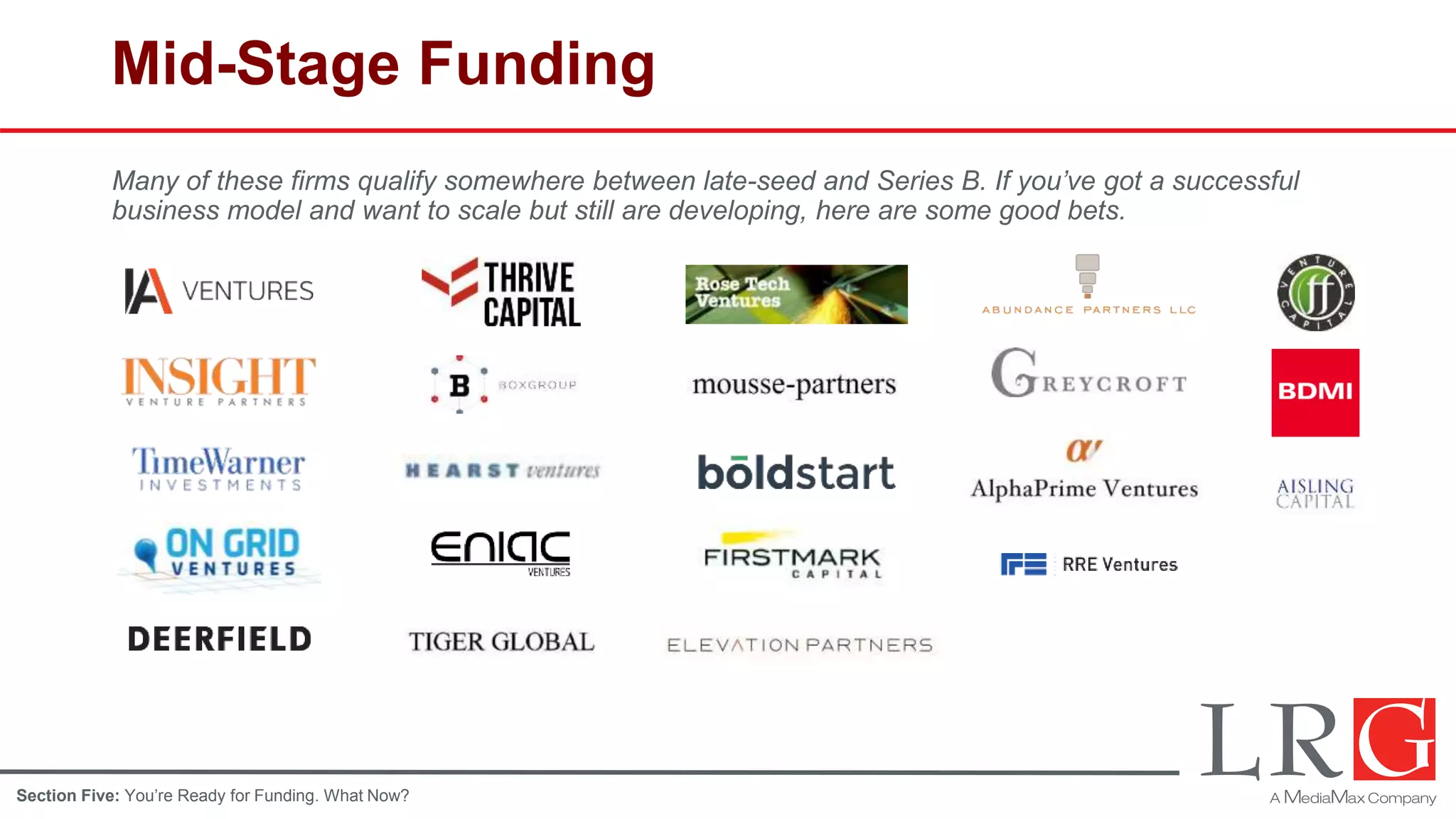
Mid-Stage Funding
Many of these firms qualify somewhere between late-seed and Series B. If you’ve got a successful
business model and want to scale but still are developing, here are some good bets.
Section Five: You’re Ready for Funding. What Now?
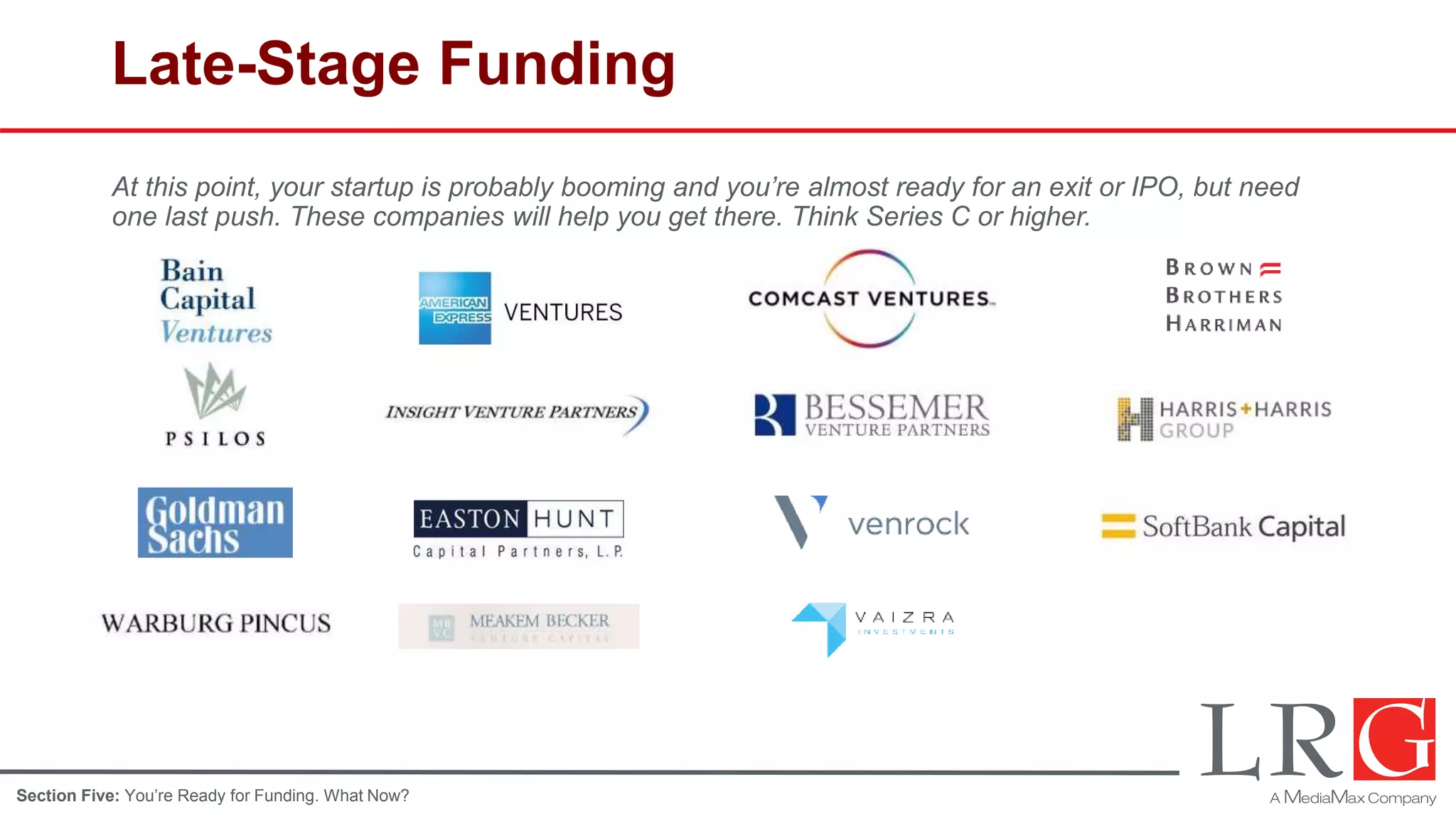
Late-Stage Funding
At this point, your startup is probably booming and you’re almost ready for an exit or IPO, but need
one last push. These companies will help you get there. Think Series C or higher.
Section Five: You’re Ready for Funding. What Now?
Thank You
A big thank you to several sources used for compiling the
information in this presentation including:
CNET, Built in NYC, Tech.CO, Digital.NYC, CrunchBase,
Founders Grid, Under 30 CEO, AlleyWatch, Forbes,
Entrepreneur, Startup Factory and Crain’s
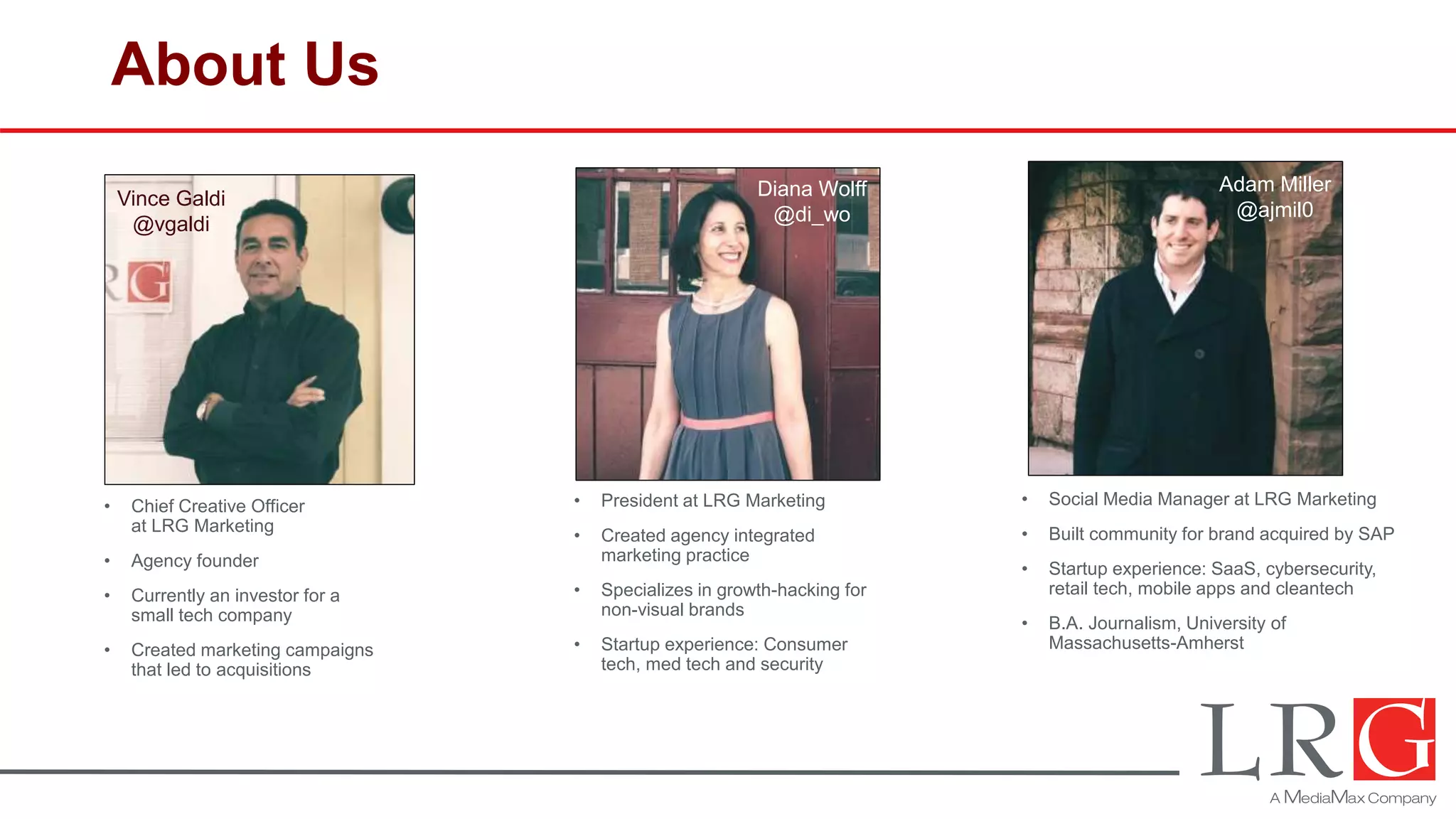
About Us
• Social Media Manager at LRG Marketing
• Built community for brand acquired by SAP
• Startup experience: SaaS, cybersecurity,
retail tech, mobile apps and cleantech
• B.A. Journalism, University of
Massachusetts-Amherst
• President at LRG Marketing
• Created agency integrated
marketing practice
• Specializes in growth-hacking for
non-visual brands
• Startup experience: Consumer
tech, med tech and security
Adam Miller
@ajmil0
Diana Wolff
@di_wo
Vince Galdi
@vgaldi
• Chief Creative Officer
at LRG Marketing
• Agency founder
• Currently an investor for a
small tech company
• Created marketing campaigns
that led to acquisitions
Questions?
Vince at vgaldi@lrgmarketing.com
Diana at dwolff@lrgmarketing.com
Adam at amiller@lrgmarketing.com
Learn more about us by visiting our website LRGMarketing.com.

Guide to the New York Startup Scene

  • 1.
    Guide to theNew York Startup Scene
  • 2.
    Table of Contents SectionOne: About New York Emerging Tech Hub – Background on the history of the city and information as it relates to the tech community here. Section Two: Notable Startups A who’s who guide to the growing NY startup scene. Find out who they are and why they’re successful. Section Three: Where NYC Startups Live Info on where startups are growing their businesses and how they’re doing it. Section Four: How to Attract Funding Marketing strategies on showing “velocity” to potential venture capital firms. Section Five: You’re Ready for Funding. What Now? A non-exhaustive list of VCs for all stages of funding.
  • 3.
    About New York– Emerging Tech Hub Section One: About New York
  • 4.
    Why New York? NewYork is the media capital of the world with four major broadcast networks (ABC, CBS, Fox and NBC) in addition to a variety of print companies. As the digital space has grown, so too has New York’s grasp on online media. Section One: About New York
  • 5.
    Why New York? TheBig Apple is also famous for its fashion and art. As a result, retailers are also riding the digital wave by trying to improve the commerce experience. Section One: About New York
  • 6.
    Innovation in NewYork The Big Apple is a natural fit for tech as home to two of the “big four” global ad agency holding companies. (Omnicom and Interpublic Group) NYC stretched its true digital muscle with the creation of digital content companies like Vice Media, Buzzfeed, Vox Media and Outbrain. Section One: About New York
  • 7.
    New York Burstsonto the Tech Scene In 1993, Prodigy provided access to the internet via dial-up and NY-based companies such as Razorfish, DoubleClick and The Mining Company (About.com) were soon created and became leaders of the dot.com bubble. In 2003, David S. Rose led a group of Investors to revitalize the New York Angels group. Learn more about Rose here. All this earned NY the nickname “Silicon Alley” playing off California’s Silicon Valley. Section One: About New York
  • 8.
    Quotes on “SiliconAlley’s” Impact “New York City has surpassed [Silicon Valley] in startup funding requests. The tech ecosystem here provides nearly 300,000 jobs and generates over $30 billion in wages annually.” – NYC Mayor Bill de Blasio Section One: About New York
  • 9.
    Quotes on “SiliconAlley’s” Impact “New York offers an unmatched opportunity for emerging companies looking to innovate and grow their business.” – AppNexus CEO Brian O’Kelley Section One: About New York
  • 10.
    Quotes on “SiliconAlley’s” Impact “You have skills that come from finance, from food, so they’re not only tech people, but they come into the tech scene and I think that brings a fresh perspective.” – Ayah Bdeir, CEO of LittleBits Section One: About New York
  • 11.
    Quotes on “SiliconAlley’s” Impact “[Startups] match our DNA perfectly. We are the city of risk takers, of a million choices and cutthroat competition.” – Alex Iskold, Managing Director of Techstars NYC Section One: About New York
  • 12.
    History of NewYork Startups 1993-99: Dot.com startups made their way onto the NY tech scene and many of them went public. Eventually the tech bubble burst and Silicon Alley went with it. 2002-05: Silicon Alley went through a revival thanks to blogging and new media centered around tech. Sites like Engadget, Gizmodo and BuzzFeed all gained popularity. Eventually, NYC’s other staple industries such as fashion, finance and retail followed suit. 2005-10: Retail tech and e- commerce startups exploded in popularity with brands such as Etsy, Birchbox and Warby Parker creating jobs and bringing in new investments. 2014-present: Mayor Bill de Blasio created a digital platform called Digital.NYC to help startups accelerate growth. Today, the city is outgrowing Silicon Valley in jobs, funding requests and the tech scene’s diversity. Section One: About New York
  • 13.
    Market Overview Highlights 3 unicornexits in consecutive years since 2013 69 tech startups have gone public 7,000+ startups call New York home Funding 200% increase in VC capital between 2009-13 $6.7 billion in funding in 9 of the last 10 quarters Job growth 4x more tech jobs in NYC than Silicon Valley since 2009 20% of all startup employees are minorities 40% are women Section One: About New York
  • 14.
  • 15.
    New York Unicorns SectionTwo: Notable Startups
  • 16.
    Unicorn Case Studies Enterprisesocial media management platform founded in 2009 and has nearly 800 of the top Fortune 1000 companies. Most recent funding was $46M Series E to tap into paid social. Has at least 20k fans/followers per social channel and honored as one of LRG Marketing’s “3 B2B New York startups killing it on social.” Section Two: Notable Startups
  • 17.
    Unicorn Case Studies Cloud-basedsoftware platform that enables and optimizes programmatic online advertising. Recently completed a $63M Series F funding. Has nearly 20k Twitter followers, and over 21k on LinkedIn. Section Two: Notable Startups
  • 18.
    Unicorn Case Studies Socialnews and entertainment company that has recently moved into B2B by using content-driven publishing technology to sell advertising to Fortune 500 companies. Received $200M in PE funding from NBC Universal. Has nearly 3 million followers on Twitter and 6.5 million Facebook fans. Section Two: Notable Startups
  • 19.
    Key Insights While themedia landscape is changing, the industry is getting bigger than ever in New York. Section Two: Notable Startups
  • 20.
    Key Insights Investors arefunding startups that naturally produce a lot of content and demonstrate thought leadership in their industry. Section Two: Notable Startups
  • 21.
    Key Insights B2B startupsare producing a lot of content quickly and investing heavily in follower building to increase their audience at a low cost. This is also becoming one of many indicators VCs use to judge a company’s trajectory. Section Two: Notable Startups
  • 22.
    NY Companies onthe Rise Section Two: Notable Startups
  • 23.
    Why They StandOut Offer disruptive technology (usually a SaaS service) in an older industry or an FMA brand taking advantage of underutilized tech. Section Two: Notable Startups
  • 24.
    Why They StandOut Market with large potential that is mostly untapped or a problem the competition hasn’t yet solved. Section Two: Notable Startups
  • 25.
    Why They StandOut Are heavily invested in creating compelling content and are creative, even pushing the envelope on digital channels. Section Two: Notable Startups
  • 26.
    Why They StandOut Heavy focus on being an industry thought leader by offering helpful resources rather than pushing sales. Section Two: Notable Startups
  • 27.
    Where NYC Startups Live SectionThree: Where NYC Startups Live
  • 28.
    Neighborhoods The New Yorktech scene currently sits in three areas: Silicon Alley DUMBO Long Island City Section Three: Where NYC Startups Live
  • 29.
    Why Silicon Alley? Onlineadvertising and tech media startups first launched here and Google opened an office in 2006. Influenced by David S. Rose for a wide variety of angel investments. Defined as Flatiron District, parts of Midtown and Lower Manhattan. Home to startup staples TechStars, WeWork and Flatiron School. Eight Unicorns located between Canal and 35th street including BuzzFeed, Sprinklr and FanDuel. Section Three: Where NYC Startups Live
  • 30.
    Why DUMBO? Strategic areafor startups as it’s an easy subway ride to Silicon Alley, but real estate is more affordable. Etsy originally set up shop there because of its cheap real-estate. Neighbors VICE Media’s office in Williamsburg, which was the first start-up in Brooklyn. WeWork recently opened an office. Section Three: Where NYC Startups Live
  • 31.
    Why Long IslandCity? Became a hub after Songza founders moved there based on cheap real estate compared to Manhattan and has a revitalized waterfront that has scenic views. Other startups followed in the e-commerce, media and food tech space. Bigger businesses (such as Citigroup, JetBlue Airways, MetLife and Steve Madden) have moved to LIC, which creates an even bigger incentive for startups to work there. Google acquired Songza and recently folded it into Google Play. Section Three: Where NYC Startups Live
  • 32.
    Co-Working Spaces What theyare: All-inclusive office spaces at a relatively low cost that offer furnished offices, conference rooms and a wide variety of other amenities. Why they matter: Provide a networking space for startups to collaborate and are ideal for smaller teams. Where they are: Mainly in the three startup hubs – Silicon Alley, DUMBO and Long Island City. However, they’re available all over New York. Section Three: Where NYC Startups Live
  • 33.
    Co-Working Spaces These areexcellent for startups to collaborate on their ideas and have inexpensive office space. With high real-estate costs, there are an abundance of co-working spots in NYC. Section Three: Where NYC Startups Live
  • 34.
    Meet-Up Groups • StartupWeekend • NYC Tech Talks • Tech in Motion: New York City • NY Tech Women • #STARTUP • Inside Startups Club • Startup Grind • Be Social Change • New York Entrepreneurs & Startup Network • NYC Startup Community • NYC Technology Startups • NY Tech Meetup • NYEdTech • New York Silicon Alley • Brooklyn Tech Meetup Looking to meet other startups or venture capital firms? These groups are perfect for you. Whether you’re new, or just looking for someone to partner with, these meetups are extremely valuable. Section Three: Where NYC Startups Live
  • 35.
    Startup Education • GeneralAssembly – Graduate school type program to improve skills in design, marketing, tech and big data. • Full Stack Academy – Specializes in teaching JavaScript and database fluency within SQL, NoSQL and ORM languages. • Flatiron School – Program that focuses on iOS mobile app development and web development within Ruby and JavaScript. Also offers an extremely competitive fellowship for non-college graduates. • Dev Bootcamp – Intensive 19-week program that teaches Ruby, JavaScript, HTML and CSS. • App Academy – Software development bootcamp that doesn’t charge money until students are hired. • Startup Institute – Eight-week program that provides the skills to work in anything from web design to account management at a startup. • Recurse – Free 12-week “retreat” that helps programmers improve their coding skills. • Byte Academy – Python coding school specialized for FinTech, Big Data and MedTech industries. • Turn to Tech – Coding bootcamp focused on iOS and Android development to get students ready for working at startups. While many startup founders hail from the likes of Columbia and NYU, the education space is also witnessing disruption with institutions like these making six-figure salaries more accessible than ever before. Section Three: Where NYC Startups Live
  • 36.
    Incubators Here are afew incubators in New York who can help your company accelerate and build in its early stages. Most companies offer a combination of funding, mentoring and work space. Section Three: Where NYC Startups Live
  • 37.
    How to Attract Funding SectionFour: How to Attract Funding
  • 38.
    What do VCsWant in a Startup? Team – Having the right people and leadership in place that knows how to grow the company is crucial to impressing VCs. Unique idea, huge opportunity – Pitches must show they have an original idea that’s hard to replicate and prove that there is a huge market for it. Business model – There needs to be a viable strategy for making money in addition to a possible exit strategy. Velocity – Upwards trajectory that shows the company is gaining interest among its audience. Section Four: How to Attract Funding
  • 39.
    How to ShowVelocity • Increase in users • Sales • Web traffic • Conversions • Anything that proves your solution is here to stay and won’t fizzle out From our point of view, showing velocity is the most compelling way to attract funding and is also ambiguous. How does a startup show velocity? Section Four: How to Attract Funding
  • 40.
    Integrated Marketing CreatesVelocity By investing in an integrated PR, social and digital marketing strategy, startups can reach these metrics and attract funding. We compiled strategies within these three disciplines that help you get there, but success is based on these working congruently. Section Four: How to Attract Funding
  • 41.
    PR Strategies forShowing Velocity Establish relationships: Identify target influencers and reporters in your market early on and engage them every step of the way. Designate a thought leader: Find a person who will be the voice of your company and have them (or a ghost-writer) write contributed articles on industry pain-points. Get third-party validation: Reviews and demos are an effective way to prove to VCs that your product or service is legit. Reviews offer the social proof investors look for before investing. Newsjacking: Look for news events relevant to your brand and have your expert ready to provide thoughtful commentary. Section Four: How to Attract Funding
  • 42.
    Get to KnowThese Publications Consider these publications to be the gold standard in getting your startup out there. Depending on your vertical, there will be additional valuable trade publications to note. Section Four: How to Attract Funding
  • 43.
    Digital Strategies forShowing Velocity Make your website user friendly – If your website doesn’t steer your audience the way you want it to, all other strategies are moot. Your website should be both aesthetically pleasing and functional with clear calls to action. Content, content, content – Startups, especially in the SaaS space, can gain mindshare by regularly producing blog posts, white papers and other types of resources that guide your customers towards your solution. Section Four: How to Attract Funding
  • 44.
    Digital Strategies forShowing Velocity Invest in PPC – A good PPC strategy will ultimately drive traffic to your website and get you closer to user adoption through conversions. Don’t forget organic search – All of these strategies should feed into ensuring customers can easily find you on Google. SEO is no longer about optimizing for single keywords, rather it’s about understanding which search phrases customers are most likely to use in order to find you. Section Four: How to Attract Funding
  • 45.
    Social Media Strategiesfor Showing Velocity “Friend” your Facebook presence – While B2B companies are typically hesitant to engage on Facebook with low organic reach, startups can get downloads for an app or white paper at a low cost and get instant feedback through people’s reactions. Publish on LinkedIn – By publishing long-form content on LinkedIn, you can establish thought leadership, increase brand awareness and let your network know what your brand is up to. Read our blog post to further learn about the benefits to publishing on LinkedIn. Section Four: How to Attract Funding
  • 46.
    Social Media Strategiesfor Showing Velocity Invest in paid social across platforms – Looking at social media as if it’s owned media is an outdated strategy. In order to get the shared aspect you want in your social media program, it involves taking advantage of this one-of-a-kind opportunity. You can even use our guide to it if you’re not sure where to get started. Empower your team – If your employees truly stand behind your vision, there’s no better place to leverage that than on social media. Ask them to consider their LinkedIn profile as a blend of who they are personally and professionally so investors and customers get a better feel for what your brand stands for. Sharing PR placements on Twitter is another way to accomplish this as well. Section Four: How to Attract Funding
  • 47.
    Integrating PR, Digitaland Social Many of the current B2B decision-makers skew younger, and will be looking at your brand through multiple touch points. An integrated strategy is needed to create social traction and to demonstrate it to your investors. Use case: You write a byline in a tier-one publication with links back to your website and the article generates thousands of social shares. With strategic media outreach, you now have accomplished results across PR, social and digital. That’s only the beginning. Section Four: How to Attract Funding
  • 48.
    You’re Ready for Funding.What Now? Section Five: You’re Ready for Funding. What Now?
  • 49.
    Early Stage Funding* Whenyou’re just starting and need some backing for your idea, this non-exhaustive list contains many firms who helped today’s hottest NYC startups at their early stages. *Unclear how startup financing works? Check out this resource from Startup Factory. Section Five: You’re Ready for Funding. What Now?
  • 50.
    Mid-Stage Funding Many ofthese firms qualify somewhere between late-seed and Series B. If you’ve got a successful business model and want to scale but still are developing, here are some good bets. Section Five: You’re Ready for Funding. What Now?
  • 51.
    Late-Stage Funding At thispoint, your startup is probably booming and you’re almost ready for an exit or IPO, but need one last push. These companies will help you get there. Think Series C or higher. Section Five: You’re Ready for Funding. What Now?
  • 52.
    Thank You A bigthank you to several sources used for compiling the information in this presentation including: CNET, Built in NYC, Tech.CO, Digital.NYC, CrunchBase, Founders Grid, Under 30 CEO, AlleyWatch, Forbes, Entrepreneur, Startup Factory and Crain’s
  • 53.
    About Us • SocialMedia Manager at LRG Marketing • Built community for brand acquired by SAP • Startup experience: SaaS, cybersecurity, retail tech, mobile apps and cleantech • B.A. Journalism, University of Massachusetts-Amherst • President at LRG Marketing • Created agency integrated marketing practice • Specializes in growth-hacking for non-visual brands • Startup experience: Consumer tech, med tech and security Adam Miller @ajmil0 Diana Wolff @di_wo Vince Galdi @vgaldi • Chief Creative Officer at LRG Marketing • Agency founder • Currently an investor for a small tech company • Created marketing campaigns that led to acquisitions
  • 54.
    Questions? Vince at vgaldi@lrgmarketing.com Dianaat dwolff@lrgmarketing.com Adam at amiller@lrgmarketing.com Learn more about us by visiting our website LRGMarketing.com.