1
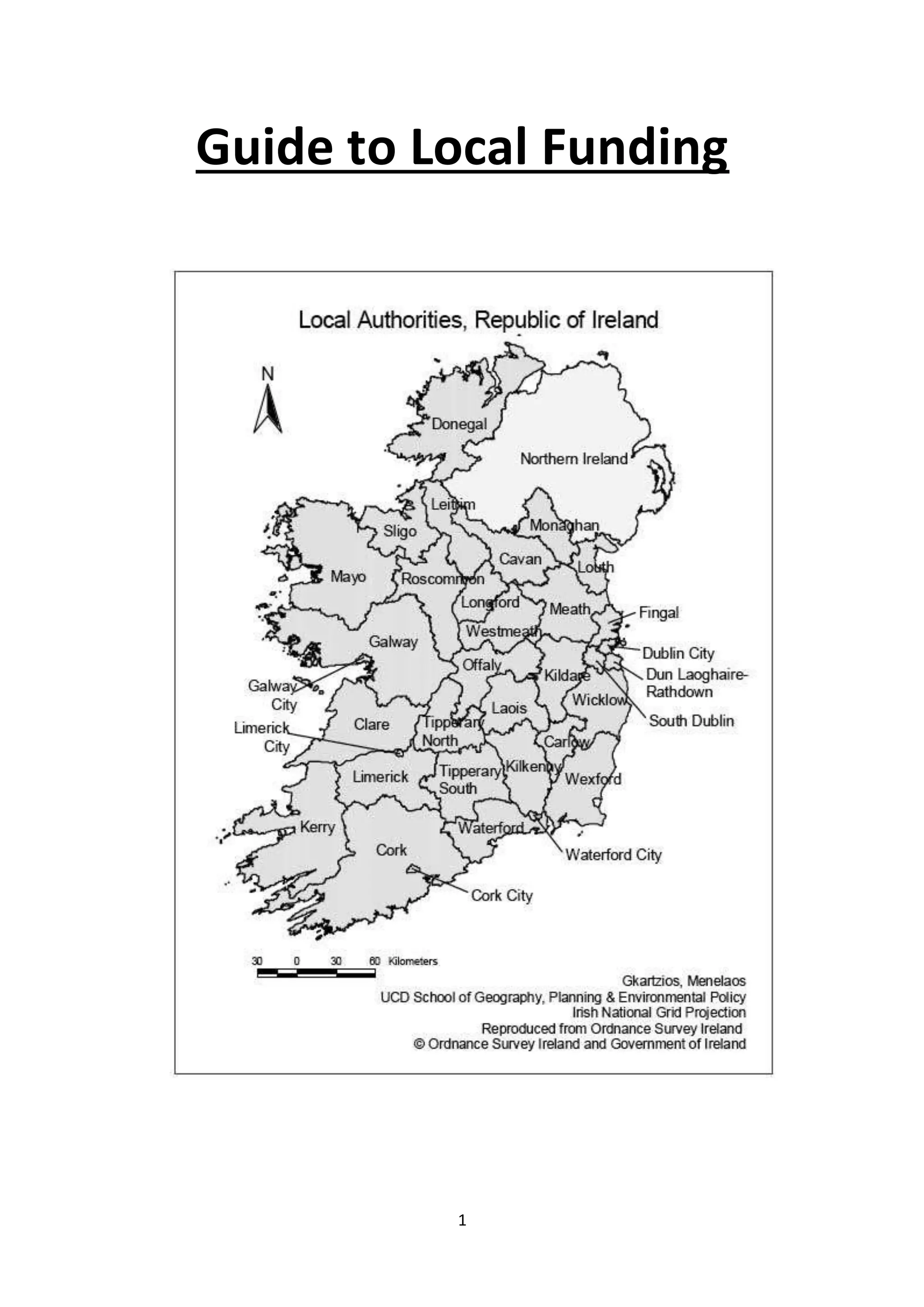
Guide to Local Funding
2
Table of Contents
I. Introduction-page 3
II. Sources of Funding– page 4
III. Homeless Services- page 6
IV. Ghost Estates- page 8
V. Local & Regional Road Maintenanceand
Improvement- page 11
VI. Staffing- page 14
VII. Libraries- page 16
VIII. Public Swimming Pools- page 18
IX. Resources- page 21
3
Introduction
Local governmentalfundinghasa direct impacton an individual’slife.
Local governments provideserviceswithin the community, assistin
economic development, and supportlocalinitiatives.
In order for constituents to remain well-informed, it may be usefulto
comparehow one’s own local authority comparesto others. This document
is intended to providea basic understandingof how KildareCounty Council
comparesto other local authorities in terms of funding and resources
offered. The other local authorities that will be focused on are: Carlow,
Dublin City, Dún Laoghaire- Rathdown, Galway, Kerry, Mayo, Meath, and
Wicklow.
This documentwill concentrate on homeless services, ghost estates, local &
regional roads, staffing, libraries and public swimmingpools.
4
Sources of Funding
Local authorities are funded by multiple revenue streams. The detailed information
below has been taken directly from http://www.environ.ie/en/LGFinance/.
1. Local Government Fund - General Purpose Grant
“The Local Government Fund (LGF) is a special central fund which was established in
1999 under the Local Government Act 1998. It is financed by the full proceeds of motor
tax and an Exchequer contribution. The Fund provides local authorities with the finance
for general discretionary funding of their day-to-day activities and for non-national
roads, and funding for certain local government initiatives.” The General Purpose Grant,
previously totalling €999 million in 2009, has since been reduced to €0 in 2014.
2. Specific State Grants
“Specific State grants are paid to local authorities in respect of specific
services/schemes, for example higher education grants, road maintenance grants, etc by
a number of government departments.”
3. Charges for Goods and Services
“Local authorities have powers to charge for services which they provide, for example,
commercial water charges, housing rents, waste charges, parking charges, planning
application fees. In most cases the charge or fee is set locally although certain charges or
fees are fixed at national level.”
4. Rates
“Rates, as well as charges for goods and services, are local sources of income over which
local authorities have a considerable measure of control. As a general rule, rates are
levied on the occupiers of commercial property. The valuation of such property for
rating purposes is carried out by a central government agency, the Valuation Office,
with a right of appeal to a Valuation Tribunal. Each year the level of the rate (known as
the Annual Rate on Valuation or ARV) is determined by the elected council as part of the
budgetary process. The annual rates bill for commercial premises is calculated by
applying this ARV to the valuation of the property concerned. (See Key Financial
Data/Charts under for detailed information on local authority ARVs).”
5. Community Fund/Community Initiative Scheme
“An elected council may, by resolution, establish a separate ‘community fund’ to support
specific community initiatives such as amenity, recreational, environmental or
community development projects of benefit to the area concerned.”
6. Non Principal Private Residence Charge – Household Charge – Local
Property Tax
“The Non- Principal Private Residence Charge (NPPR) was an annual charge payable
from 2009 to 2013 in respect of residential property that was not the owner’s main
residence. The NPPR will no longer be charged for the years after 2013, but any
outstanding liabilities and payments will still remain payable to the local authority in
5
whose area the property concerned is located. The onus is on the property owner to
come forward and pay the charge to the local authority in which the property is located
and the money goes towards funding local authority services in that area.
An individual was held responsible for paying the NPPR if “he/she owned more than
one home, owned only one home and it was not his/her principal private residence, or
lived abroad and owned residential property in Ireland.” The annual charge of €200 per
non-principal private residencies needed to be paid in full by 31 August 2014, or else an
additional late payment fee of €120 would be applied. According to the NPPR website,
“both the NPPR charge and any accumulated late payment fee will be a charge against
the property concerned and will continue to be such for twelve years after the charge or
late payment fees concerned became due. “
Payment is accepted on behalf of any local authority through the Non Principal Private
Residence web-site (external link) . Payment is also accepted locally in local authority
offices. Further information on the charge is available on our website at the Non
Principal Private Residence website (external link).”
In addition to terminating the NPPR, the Household Charge of €100 in 2012 has now been
replaced by the Local Property Tax (LPT). Local authorities have the ability to vary the
LPT by +/- 15%. There are designated properties that are exempt from the LPT,
including dwellings that are not considered suitable for living, certain ghost estates and
mobile homes, for example.
6
Homeless Services
Local Authority
Administration
of Homeless
Service
Expenditure
Per
Capita
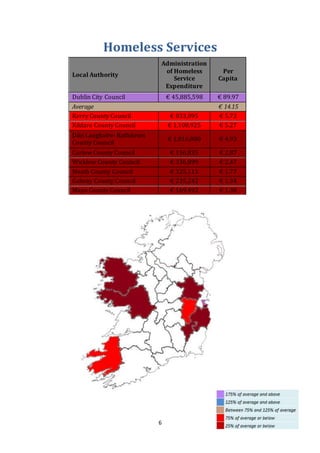
Dublin City Council € 45,885,598 € 89.97
Average € 14.15
Kerry County Council € 833,095 € 5.73
Kildare County Council € 1,108,925 € 5.27
Dún Laoghaire- Rathdown
County Council
€ 1,016,000 € 4.93
Carlow County Council € 156,835 € 2.87
Wicklow County Council € 336,899 € 2.47
Meath County Council € 325,111 € 1.77
Galway County Council € 235,242 € 1.34
Mayo County Council € 169,492 € 1.30
7
Homelessness is an unfortunate problem throughout Ireland. Ever since the economic
decline that caused a halt in the construction of housing, citizens have been forced to
find alternative places to live. Additionally, the rise in rent prices has cause a spike in
homelessness. In the past, homelessness has been viewed as an individual problem.
However, nowadays it can be seen as an institutional or structural problem, including
“unemployment, a lack of housing options and poverty.” Because of this, it is crucial that
homeless services have become more readily available.
2011 Census Demographics
 On Census Night, 3,808 individuals were counted as either sleeping rough or in a
shelter for homeless persons.
 Of the 3,808 individuals listed as homeless on Census night, 1 in 7 were children.
 The Dublin Region (Dublin City, Dún Laoghaire-Rathdown, Fingal, South Dublin)
is impacted the most by homelessness, containing 60% of homeless persons.
 The South East Region (Waterford City, Waterford County, Carlow, Kilkenny,
South Tipperary, Wexford) is the second most impacted, containing 11% of
homeless persons.
 The Mid East Region (Kildare, Meath, Wicklow) had the lowest total homeless
population: 32 individuals.
 296 family units (total of 905 persons) were counted as homeless.
 Individuals between the ages of 20-59 made up three-fourths of the homeless
population.
 Three-fourths of the homeless population described their ethnicity as “White
Irish.”
Per capita, Dublin City has the largest allocation of homeless services funds in total. The
other eight county councils have a much lower allocation, varying from about €1 to €6
per capita.
Kildare County has been designated as the lead Local Authority in the Mid-East
Homeless Action Plan. The other local authorities that are a part of the Plan are Meath
and Wicklow. The goals of this plan are to eliminate long-term homelessness, the need
to sleep rough, and to ultimately prevent homelessness. This document is beneficial to
understand because it provides the various causes of homelessness, the policies that are
in place for homeless individuals, and how local authorities can monitor the progress of
eliminating homelessness in the future.
The government announced its social housing strategy on 26 November 2014. The
strategy commits to providing 35,000 additional social housing units over the next six
years, reforming social housing delivery and management, and accommodating
everyone on the housing waiting lists by 2020.
8
Ghost Estates & Funding
Local Authority
Total
Number of
Households
(taken from
2011
Census Area
Profiles)
Number of
Vacant
Households
(taken from
2011 Census)
Ghost Estate
Funding (of
€10 million)
Ratio of
Vacant
Households
to Total
Number of
Households
Dún Laoghaire- Rathdown
County Council
85,896 6,616 € 0 0.08
Kildare County Council 78,794 6,311 € 0 0.08
Meath County Council 69,697 6,173 € 187,500 0.09
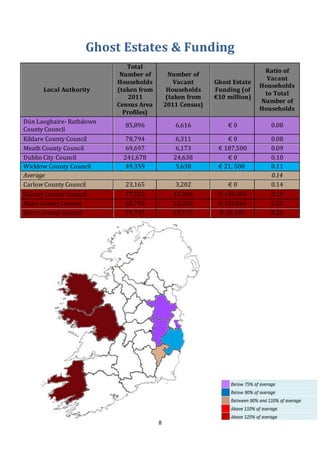
Dublin City Council 241,678 24,638 € 0 0.10
Wicklow County Council 49,359 5,638 € 21, 500 0.11
Average 0.14
Carlow County Council 23,165 3,202 € 0 0.14
Galway County Council 77,522 15,066 € 196,345 0.19
Mayo County Council 65,792 16,230 € 122,864 0.25
Kerry County Council 74,747 19,719 € 26,105 0.26
9
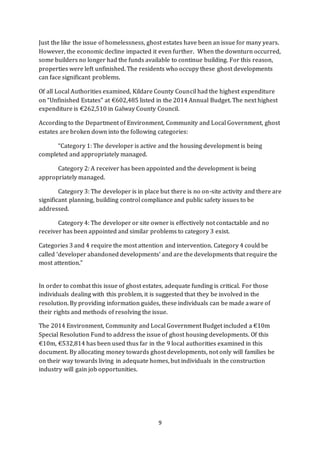
Just the like the issue of homelessness, ghost estates have been an issue for many years.
However, the economic decline impacted it even further. When the downturn occurred,
some builders no longer had the funds available to continue building. For this reason,
properties were left unfinished. The residents who occupy these ghost developments
can face significant problems.
Of all Local Authorities examined, Kildare County Council had the highest expenditure
on “Unfinished Estates” at €602,485 listed in the 2014 Annual Budget. The next highest
expenditure is €262,510 in Galway County Council.
According to the Department of Environment, Community and Local Government, ghost
estates are broken down into the following categories:
“Category 1: The developer is active and the housing development is being
completed and appropriately managed.
Category 2: A receiver has been appointed and the development is being
appropriately managed.
Category 3: The developer is in place but there is no on-site activity and there are
significant planning, building control compliance and public safety issues to be
addressed.
Category 4: The developer or site owner is effectively not contactable and no
receiver has been appointed and similar problems to category 3 exist.
Categories 3 and 4 require the most attention and intervention. Category 4 could be
called ‘developer abandoned developments’ and are the developments that require the
most attention.”
In order to combat this issue of ghost estates, adequate funding is critical. For those
individuals dealing with this problem, it is suggested that they be involved in the
resolution. By providing information guides, these individuals can be made aware of
their rights and methods of resolving the issue.
The 2014 Environment, Community and Local Government Budget included a €10m
Special Resolution Fund to address the issue of ghost housing developments. Of this
€10m, €532,814 has been used thus far in the 9 local authorities examined in this
document. By allocating money towards ghost developments, not only will families be
on their way towards living in adequate homes, but individuals in the construction
industry will gain job opportunities.
10
The Department of Environment, Community and Local Government, introduced a
Remedial Works Scheme in the mid-1980s in order to help assist and fund local
authorities with major refurbishment projects that cannot be financed through their
own resources. In order for properties to qualify, the local authority must “implement
improved management and maintenance procedures for the estates involved.”
“The dwellings [that qualify] fall into two categories: dwellings with serious design or
construction defects, and run-down urban estates, in particular, inner city flat
complexes.”
Certain ghost estates listed in the Department of Environment, Community and Local
Government’s 2013 Finance (Local Property Tax) Regulations are exempt from local
property taxes.
11
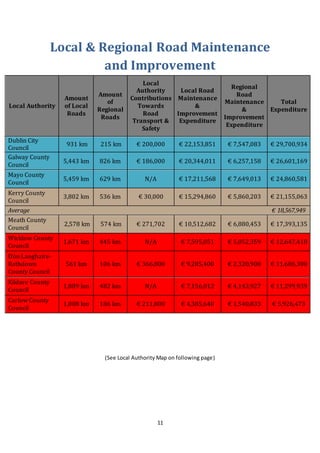
Local & Regional Road Maintenance
and Improvement
Local Authority
Amount
of Local
Roads
Amount
of
Regional
Roads
Local
Authority
Contributions
Towards
Road
Transport &
Safety
Local Road
Maintenance
&
Improvement
Expenditure
Regional
Road
Maintenance
&
Improvement
Expenditure
Total
Expenditure
Dublin City
Council
931 km 215 km € 200,000 € 22,153,851 € 7,547,083 € 29,700,934
Galway County
Council
5,443 km 826 km € 186,000 € 20,344,011 € 6,257,158 € 26,601,169
Mayo County
Council
5,459 km 629 km N/A € 17,211,568 € 7,649,013 € 24,860,581
Kerry County
Council
3,802 km 536 km € 30,000 € 15,294,860 € 5,860,203 € 21,155,063
Average € 18,567,949
Meath County
Council
2,578 km 574 km € 271,702 € 10,512,682 € 6,880,453 € 17,393,135
Wicklow County
Council
1,671 km 445 km N/A € 7,595,051 € 5,052,359 € 12,647,410
Dún Laoghaire-
Rathdown
County Council
561 km 106 km € 366,800 € 9,285,400 € 2,320,900 € 11,606,300
Kildare County
Council
1,889 km 482 km N/A € 7,156,012 € 4,143,927 € 11,299,939
Carlow County
Council
1,008 km 186 km € 211,800 € 4,385,640 € 1,540,833 € 5,926,473
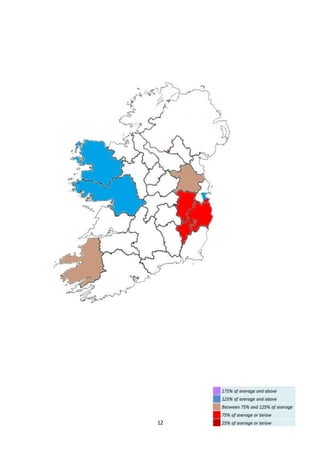
(See Local Authority Map on following page)
12
13
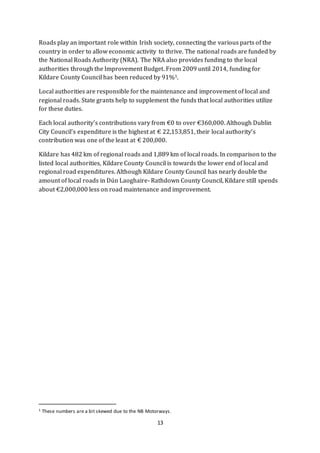
Roads play an important role within Irish society, connecting the various parts of the
country in order to allow economic activity to thrive. The national roads are funded by
the National Roads Authority (NRA). The NRA also provides funding to the local
authorities through the Improvement Budget. From 2009 until 2014, funding for
Kildare County Council has been reduced by 91%1.
Local authorities are responsible for the maintenance and improvement of local and
regional roads. State grants help to supplement the funds that local authorities utilize
for these duties.
Each local authority’s contributions vary from €0 to over €360,000. Although Dublin
City Council’s expenditure is the highest at € 22,153,851, their local authority’s
contribution was one of the least at € 200,000.
Kildare has 482 km of regional roads and 1,889 km of local roads. In comparison to the
listed local authorities, Kildare County Council is towards the lower end of local and
regional road expenditures. Although Kildare County Council has nearly double the
amount of local roads in Dún Laoghaire- Rathdown County Council, Kildare still spends
about €2,000,000 less on road maintenance and improvement.
1 These numbers are a bit skewed due to the NB Motorways.
14
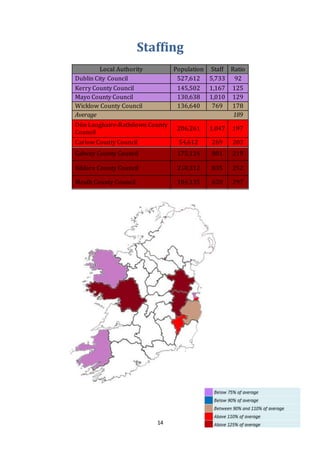
Staffing
Local Authority Population Staff Ratio
Dublin City Council 527,612 5,733 92
Kerry County Council 145,502 1,167 125
Mayo County Council 130,638 1,010 129
Wicklow County Council 136,640 769 178
Average 189
Dún Laoghaire-Rathdown County
Council
206,261 1,047 197
Carlow County Council 54,612 269 203
Galway County Council 175,124 801 219
Kildare County Council 210,312 835 252
Meath County Council 184,135 620 297
15
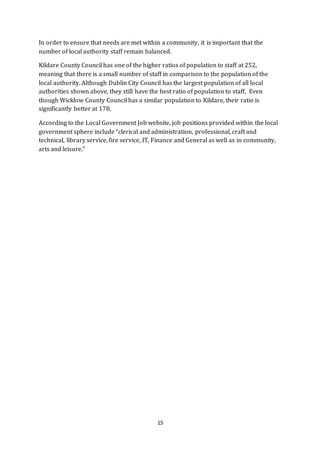
In order to ensure that needs are met within a community, it is important that the
number of local authority staff remain balanced.
Kildare County Council has one of the higher ratios of population to staff at 252,
meaning that there is a small number of staff in comparison to the population of the
local authority. Although Dublin City Council has the largest population of all local
authorities shown above, they still have the best ratio of population to staff. Even
though Wicklow County Council has a similar population to Kildare, their ratio is
significantly better at 178.
According to the Local Government Job website, job positions provided within the local
government sphere include “clerical and administration, professional, craft and
technical, library service, fire service, IT, Finance and General as well as in community,
arts and leisure.”
16
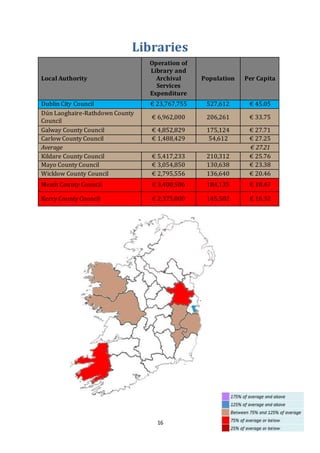
Libraries
Local Authority
Operation of
Library and
Archival
Services
Expenditure
Population Per Capita
Dublin City Council € 23,767,755 527,612 € 45.05
Dún Laoghaire-Rathdown County
Council
€ 6,962,000 206,261 € 33.75
Galway County Council € 4,852,829 175,124 € 27.71
Carlow County Council € 1,488,429 54,612 € 27.25
Average € 27.21
Kildare County Council € 5,417,233 210,312 € 25.76
Mayo County Council € 3,054,850 130,638 € 23.38
Wicklow County Council € 2,795,556 136,640 € 20.46
Meath County Council € 3,400,506 184,135 € 18.47
Kerry County Council € 2,375,000 145,502 € 16.32
17
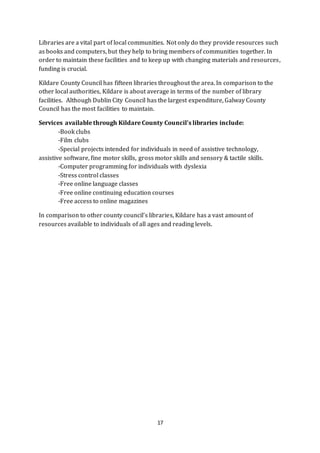
Libraries are a vital part of local communities. Not only do they provide resources such
as books and computers, but they help to bring members of communities together. In
order to maintain these facilities and to keep up with changing materials and resources,
funding is crucial.
Kildare County Council has fifteen libraries throughout the area. In comparison to the
other local authorities, Kildare is about average in terms of the number of library
facilities. Although Dublin City Council has the largest expenditure, Galway County
Council has the most facilities to maintain.
Services available through Kildare County Council’s libraries include:
-Book clubs
-Film clubs
-Special projects intended for individuals in need of assistive technology,
assistive software, fine motor skills, gross motor skills and sensory & tactile skills.
-Computer programming for individuals with dyslexia
-Stress control classes
-Free online language classes
-Free online continuing education courses
-Free access to online magazines
In comparison to other county council’s libraries, Kildare has a vast amount of
resources available to individuals of all ages and reading levels.
18
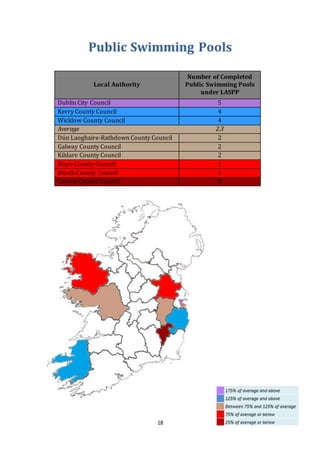
Public Swimming Pools
Local Authority
Number of Completed
Public Swimming Pools
under LASPP
Dublin City Council 5
Kerry County Council 4
Wicklow County Council 4
Average 2.3
Dún Laoghaire-Rathdown County Council 2
Galway County Council 2
Kildare County Council 2
Mayo County Council 1
Meath County Council 1
Carlow County Council 0
19
The Department of Transport, Tourism and Sport is responsible for the Local Authority
Swimming Pool Programme (LASPP). The LASPP provides funding to local authorities
for the construction of new swimming pool facilities or the refurbishment of already
existing swimming pool facilities. The Programme was closed to new applicants in July
of 2000. 58 applications were accepted, with 49 of these swimming pool facilities
already completed to date. The Programme has not yet reopened for new applications.
Deputy Michael Ring, the Minister of State at the Department of Transport, Tourism and
Sport, was asked in June of 2012 when the Programme would reopen for new
applications. He commented that the Programme has not yet reopened because he first
wants to finish the remaining projects that were accepted in the year 2000. Additionally,
he stated that there is little or no need for new swimming pools, but rather a demand
for refurbishing older swimming pools.
Swimming pool facilities are seen as “vital to the well-being” of the community. Not only
do pools provide a location for exercise, but they also allow for socializing amongst
varying age groups.
Kildare’s Local Authority has two swimming pool locations, K Leisure Naas and K
Leisure Athy. K Leisure Naas was constructed in 1971and K Leisure Athy was
constructed in 1977, with a reconstruction that took place in 1995 due to the LASPP.
20
21
Resources
Local Authority 2014 Budgets:
Carlow County Council 2014 Budget
Dublin City Council 2014 Budget
Dún Laoghaire- Rathdown County Council 2014 Budget
Galway County Council 2014 Budget
Kerry County Council 2014 Budget
Kildare County Council 2014 Budget
Mayo County Council 2014 Budget
Meath County Council 2014 Budget
Wicklow County Council 2014 Budget
Sourcesof Funding
https://www.nppr.ie/default.aspx
http://www.citizensinformation.ie/en/money_and_tax/tax/housing_taxes_and_reliefs/l
ocal_property_tax_exemptions.html
All other information was obtained from: http://www.environ.ie/en/LGFinance/
Homeless Services
http://www.focusireland.ie/files/focus%20ireland%20annual%20report%202012.pdf
http://www.merrionstreet.ie/en/ImageLibrary/Social_Strategy_Document_20141126.
pdf
All other information was obtained from each Local Authority’s 2014 Annual Budget
and the 2011 Census.
Ghost Estates& Funding
Parliamentary Question 256: https://www.kildarestreet.com/wrans/?id=2014-10-
09a.625
22
The Department of Environment, Community and Local Government’s document:
http://www.environ.ie/en/Publications/DevelopmentandHousing/Housing/FileDown
Load,26678,en.pdf
http://www.environ.ie/en/DevelopmentHousing/Housing/SocialHousingSupport/Rem
edialWorksScheme/
http://www.environ.ie/en/DevelopmentHousing/Housing/SocialHousingSupport/Rem
edialWorksScheme/PublicationsDocuments/FileDownLoad,2454,en.pdf
All other information was obtained from each Local Authority’s 2014 Annual Budget.
Local & Regional Road Maintenanceand Improvement
All information was obtained from each Local Authority’s 2014 Annual Budget.
Parliamentary Question 247:
http://oireachtasdebates.oireachtas.ie/debates%20authoring/debateswebpack.nsf/tak
es/dail2014111300049?opendocument#WRBB00200
Staffing
http://www.localgovernmentjobs.ie/
All other information was obtained from Eoin Wilson, Deputy Catherine Murphy’s
Parliamentary Assistant.
Libraries
Kildare County Council Library and Arts Services Website:
http://www.kildare.ie/Library/index.html
All other information was obtained from each Local Authority’s 2014 Annual Budget.
Public Swimming Pools
Parliamentary Question 248:
http://oireachtasdebates.oireachtas.ie/debates%20authoring/debateswebpack.nsf/tak
es/dail2014111300049?opendocument#WRBB00500
http://www.dttas.ie/sites/default/files/publications/sport/english/value-money-and-
policy-review-report-local-authority-swimming-pool-programme/value-money-and-
policy-review-report-local-authority-swimming-pool-programme.pdf (2008)
http://oireachtasdebates.oireachtas.ie/debates%20authoring/debateswebpack.nsf/tak
es/dail2012062700201?opendocument&highlight=pool (2012)

Guide to Local Funding Final

  • 1.
  • 2.
    2 Table of Contents I.Introduction-page 3 II. Sources of Funding– page 4 III. Homeless Services- page 6 IV. Ghost Estates- page 8 V. Local & Regional Road Maintenanceand Improvement- page 11 VI. Staffing- page 14 VII. Libraries- page 16 VIII. Public Swimming Pools- page 18 IX. Resources- page 21
  • 3.
    3 Introduction Local governmentalfundinghasa directimpacton an individual’slife. Local governments provideserviceswithin the community, assistin economic development, and supportlocalinitiatives. In order for constituents to remain well-informed, it may be usefulto comparehow one’s own local authority comparesto others. This document is intended to providea basic understandingof how KildareCounty Council comparesto other local authorities in terms of funding and resources offered. The other local authorities that will be focused on are: Carlow, Dublin City, Dún Laoghaire- Rathdown, Galway, Kerry, Mayo, Meath, and Wicklow. This documentwill concentrate on homeless services, ghost estates, local & regional roads, staffing, libraries and public swimmingpools.
  • 4.
    4 Sources of Funding Localauthorities are funded by multiple revenue streams. The detailed information below has been taken directly from http://www.environ.ie/en/LGFinance/. 1. Local Government Fund - General Purpose Grant “The Local Government Fund (LGF) is a special central fund which was established in 1999 under the Local Government Act 1998. It is financed by the full proceeds of motor tax and an Exchequer contribution. The Fund provides local authorities with the finance for general discretionary funding of their day-to-day activities and for non-national roads, and funding for certain local government initiatives.” The General Purpose Grant, previously totalling €999 million in 2009, has since been reduced to €0 in 2014. 2. Specific State Grants “Specific State grants are paid to local authorities in respect of specific services/schemes, for example higher education grants, road maintenance grants, etc by a number of government departments.” 3. Charges for Goods and Services “Local authorities have powers to charge for services which they provide, for example, commercial water charges, housing rents, waste charges, parking charges, planning application fees. In most cases the charge or fee is set locally although certain charges or fees are fixed at national level.” 4. Rates “Rates, as well as charges for goods and services, are local sources of income over which local authorities have a considerable measure of control. As a general rule, rates are levied on the occupiers of commercial property. The valuation of such property for rating purposes is carried out by a central government agency, the Valuation Office, with a right of appeal to a Valuation Tribunal. Each year the level of the rate (known as the Annual Rate on Valuation or ARV) is determined by the elected council as part of the budgetary process. The annual rates bill for commercial premises is calculated by applying this ARV to the valuation of the property concerned. (See Key Financial Data/Charts under for detailed information on local authority ARVs).” 5. Community Fund/Community Initiative Scheme “An elected council may, by resolution, establish a separate ‘community fund’ to support specific community initiatives such as amenity, recreational, environmental or community development projects of benefit to the area concerned.” 6. Non Principal Private Residence Charge – Household Charge – Local Property Tax “The Non- Principal Private Residence Charge (NPPR) was an annual charge payable from 2009 to 2013 in respect of residential property that was not the owner’s main residence. The NPPR will no longer be charged for the years after 2013, but any outstanding liabilities and payments will still remain payable to the local authority in
  • 5.
    5 whose area theproperty concerned is located. The onus is on the property owner to come forward and pay the charge to the local authority in which the property is located and the money goes towards funding local authority services in that area. An individual was held responsible for paying the NPPR if “he/she owned more than one home, owned only one home and it was not his/her principal private residence, or lived abroad and owned residential property in Ireland.” The annual charge of €200 per non-principal private residencies needed to be paid in full by 31 August 2014, or else an additional late payment fee of €120 would be applied. According to the NPPR website, “both the NPPR charge and any accumulated late payment fee will be a charge against the property concerned and will continue to be such for twelve years after the charge or late payment fees concerned became due. “ Payment is accepted on behalf of any local authority through the Non Principal Private Residence web-site (external link) . Payment is also accepted locally in local authority offices. Further information on the charge is available on our website at the Non Principal Private Residence website (external link).” In addition to terminating the NPPR, the Household Charge of €100 in 2012 has now been replaced by the Local Property Tax (LPT). Local authorities have the ability to vary the LPT by +/- 15%. There are designated properties that are exempt from the LPT, including dwellings that are not considered suitable for living, certain ghost estates and mobile homes, for example.
  • 6.
    6 Homeless Services Local Authority Administration ofHomeless Service Expenditure Per Capita Dublin City Council € 45,885,598 € 89.97 Average € 14.15 Kerry County Council € 833,095 € 5.73 Kildare County Council € 1,108,925 € 5.27 Dún Laoghaire- Rathdown County Council € 1,016,000 € 4.93 Carlow County Council € 156,835 € 2.87 Wicklow County Council € 336,899 € 2.47 Meath County Council € 325,111 € 1.77 Galway County Council € 235,242 € 1.34 Mayo County Council € 169,492 € 1.30
  • 7.
    7 Homelessness is anunfortunate problem throughout Ireland. Ever since the economic decline that caused a halt in the construction of housing, citizens have been forced to find alternative places to live. Additionally, the rise in rent prices has cause a spike in homelessness. In the past, homelessness has been viewed as an individual problem. However, nowadays it can be seen as an institutional or structural problem, including “unemployment, a lack of housing options and poverty.” Because of this, it is crucial that homeless services have become more readily available. 2011 Census Demographics  On Census Night, 3,808 individuals were counted as either sleeping rough or in a shelter for homeless persons.  Of the 3,808 individuals listed as homeless on Census night, 1 in 7 were children.  The Dublin Region (Dublin City, Dún Laoghaire-Rathdown, Fingal, South Dublin) is impacted the most by homelessness, containing 60% of homeless persons.  The South East Region (Waterford City, Waterford County, Carlow, Kilkenny, South Tipperary, Wexford) is the second most impacted, containing 11% of homeless persons.  The Mid East Region (Kildare, Meath, Wicklow) had the lowest total homeless population: 32 individuals.  296 family units (total of 905 persons) were counted as homeless.  Individuals between the ages of 20-59 made up three-fourths of the homeless population.  Three-fourths of the homeless population described their ethnicity as “White Irish.” Per capita, Dublin City has the largest allocation of homeless services funds in total. The other eight county councils have a much lower allocation, varying from about €1 to €6 per capita. Kildare County has been designated as the lead Local Authority in the Mid-East Homeless Action Plan. The other local authorities that are a part of the Plan are Meath and Wicklow. The goals of this plan are to eliminate long-term homelessness, the need to sleep rough, and to ultimately prevent homelessness. This document is beneficial to understand because it provides the various causes of homelessness, the policies that are in place for homeless individuals, and how local authorities can monitor the progress of eliminating homelessness in the future. The government announced its social housing strategy on 26 November 2014. The strategy commits to providing 35,000 additional social housing units over the next six years, reforming social housing delivery and management, and accommodating everyone on the housing waiting lists by 2020.
  • 8.
    8 Ghost Estates &Funding Local Authority Total Number of Households (taken from 2011 Census Area Profiles) Number of Vacant Households (taken from 2011 Census) Ghost Estate Funding (of €10 million) Ratio of Vacant Households to Total Number of Households Dún Laoghaire- Rathdown County Council 85,896 6,616 € 0 0.08 Kildare County Council 78,794 6,311 € 0 0.08 Meath County Council 69,697 6,173 € 187,500 0.09 Dublin City Council 241,678 24,638 € 0 0.10 Wicklow County Council 49,359 5,638 € 21, 500 0.11 Average 0.14 Carlow County Council 23,165 3,202 € 0 0.14 Galway County Council 77,522 15,066 € 196,345 0.19 Mayo County Council 65,792 16,230 € 122,864 0.25 Kerry County Council 74,747 19,719 € 26,105 0.26
  • 9.
    9 Just the likethe issue of homelessness, ghost estates have been an issue for many years. However, the economic decline impacted it even further. When the downturn occurred, some builders no longer had the funds available to continue building. For this reason, properties were left unfinished. The residents who occupy these ghost developments can face significant problems. Of all Local Authorities examined, Kildare County Council had the highest expenditure on “Unfinished Estates” at €602,485 listed in the 2014 Annual Budget. The next highest expenditure is €262,510 in Galway County Council. According to the Department of Environment, Community and Local Government, ghost estates are broken down into the following categories: “Category 1: The developer is active and the housing development is being completed and appropriately managed. Category 2: A receiver has been appointed and the development is being appropriately managed. Category 3: The developer is in place but there is no on-site activity and there are significant planning, building control compliance and public safety issues to be addressed. Category 4: The developer or site owner is effectively not contactable and no receiver has been appointed and similar problems to category 3 exist. Categories 3 and 4 require the most attention and intervention. Category 4 could be called ‘developer abandoned developments’ and are the developments that require the most attention.” In order to combat this issue of ghost estates, adequate funding is critical. For those individuals dealing with this problem, it is suggested that they be involved in the resolution. By providing information guides, these individuals can be made aware of their rights and methods of resolving the issue. The 2014 Environment, Community and Local Government Budget included a €10m Special Resolution Fund to address the issue of ghost housing developments. Of this €10m, €532,814 has been used thus far in the 9 local authorities examined in this document. By allocating money towards ghost developments, not only will families be on their way towards living in adequate homes, but individuals in the construction industry will gain job opportunities.
  • 10.
    10 The Department ofEnvironment, Community and Local Government, introduced a Remedial Works Scheme in the mid-1980s in order to help assist and fund local authorities with major refurbishment projects that cannot be financed through their own resources. In order for properties to qualify, the local authority must “implement improved management and maintenance procedures for the estates involved.” “The dwellings [that qualify] fall into two categories: dwellings with serious design or construction defects, and run-down urban estates, in particular, inner city flat complexes.” Certain ghost estates listed in the Department of Environment, Community and Local Government’s 2013 Finance (Local Property Tax) Regulations are exempt from local property taxes.
  • 11.
    11 Local & RegionalRoad Maintenance and Improvement Local Authority Amount of Local Roads Amount of Regional Roads Local Authority Contributions Towards Road Transport & Safety Local Road Maintenance & Improvement Expenditure Regional Road Maintenance & Improvement Expenditure Total Expenditure Dublin City Council 931 km 215 km € 200,000 € 22,153,851 € 7,547,083 € 29,700,934 Galway County Council 5,443 km 826 km € 186,000 € 20,344,011 € 6,257,158 € 26,601,169 Mayo County Council 5,459 km 629 km N/A € 17,211,568 € 7,649,013 € 24,860,581 Kerry County Council 3,802 km 536 km € 30,000 € 15,294,860 € 5,860,203 € 21,155,063 Average € 18,567,949 Meath County Council 2,578 km 574 km € 271,702 € 10,512,682 € 6,880,453 € 17,393,135 Wicklow County Council 1,671 km 445 km N/A € 7,595,051 € 5,052,359 € 12,647,410 Dún Laoghaire- Rathdown County Council 561 km 106 km € 366,800 € 9,285,400 € 2,320,900 € 11,606,300 Kildare County Council 1,889 km 482 km N/A € 7,156,012 € 4,143,927 € 11,299,939 Carlow County Council 1,008 km 186 km € 211,800 € 4,385,640 € 1,540,833 € 5,926,473 (See Local Authority Map on following page)
  • 12.
  • 13.
    13 Roads play animportant role within Irish society, connecting the various parts of the country in order to allow economic activity to thrive. The national roads are funded by the National Roads Authority (NRA). The NRA also provides funding to the local authorities through the Improvement Budget. From 2009 until 2014, funding for Kildare County Council has been reduced by 91%1. Local authorities are responsible for the maintenance and improvement of local and regional roads. State grants help to supplement the funds that local authorities utilize for these duties. Each local authority’s contributions vary from €0 to over €360,000. Although Dublin City Council’s expenditure is the highest at € 22,153,851, their local authority’s contribution was one of the least at € 200,000. Kildare has 482 km of regional roads and 1,889 km of local roads. In comparison to the listed local authorities, Kildare County Council is towards the lower end of local and regional road expenditures. Although Kildare County Council has nearly double the amount of local roads in Dún Laoghaire- Rathdown County Council, Kildare still spends about €2,000,000 less on road maintenance and improvement. 1 These numbers are a bit skewed due to the NB Motorways.
  • 14.
    14 Staffing Local Authority PopulationStaff Ratio Dublin City Council 527,612 5,733 92 Kerry County Council 145,502 1,167 125 Mayo County Council 130,638 1,010 129 Wicklow County Council 136,640 769 178 Average 189 Dún Laoghaire-Rathdown County Council 206,261 1,047 197 Carlow County Council 54,612 269 203 Galway County Council 175,124 801 219 Kildare County Council 210,312 835 252 Meath County Council 184,135 620 297
  • 15.
    15 In order toensure that needs are met within a community, it is important that the number of local authority staff remain balanced. Kildare County Council has one of the higher ratios of population to staff at 252, meaning that there is a small number of staff in comparison to the population of the local authority. Although Dublin City Council has the largest population of all local authorities shown above, they still have the best ratio of population to staff. Even though Wicklow County Council has a similar population to Kildare, their ratio is significantly better at 178. According to the Local Government Job website, job positions provided within the local government sphere include “clerical and administration, professional, craft and technical, library service, fire service, IT, Finance and General as well as in community, arts and leisure.”
  • 16.
    16 Libraries Local Authority Operation of Libraryand Archival Services Expenditure Population Per Capita Dublin City Council € 23,767,755 527,612 € 45.05 Dún Laoghaire-Rathdown County Council € 6,962,000 206,261 € 33.75 Galway County Council € 4,852,829 175,124 € 27.71 Carlow County Council € 1,488,429 54,612 € 27.25 Average € 27.21 Kildare County Council € 5,417,233 210,312 € 25.76 Mayo County Council € 3,054,850 130,638 € 23.38 Wicklow County Council € 2,795,556 136,640 € 20.46 Meath County Council € 3,400,506 184,135 € 18.47 Kerry County Council € 2,375,000 145,502 € 16.32
  • 17.
    17 Libraries are avital part of local communities. Not only do they provide resources such as books and computers, but they help to bring members of communities together. In order to maintain these facilities and to keep up with changing materials and resources, funding is crucial. Kildare County Council has fifteen libraries throughout the area. In comparison to the other local authorities, Kildare is about average in terms of the number of library facilities. Although Dublin City Council has the largest expenditure, Galway County Council has the most facilities to maintain. Services available through Kildare County Council’s libraries include: -Book clubs -Film clubs -Special projects intended for individuals in need of assistive technology, assistive software, fine motor skills, gross motor skills and sensory & tactile skills. -Computer programming for individuals with dyslexia -Stress control classes -Free online language classes -Free online continuing education courses -Free access to online magazines In comparison to other county council’s libraries, Kildare has a vast amount of resources available to individuals of all ages and reading levels.
  • 18.
    18 Public Swimming Pools LocalAuthority Number of Completed Public Swimming Pools under LASPP Dublin City Council 5 Kerry County Council 4 Wicklow County Council 4 Average 2.3 Dún Laoghaire-Rathdown County Council 2 Galway County Council 2 Kildare County Council 2 Mayo County Council 1 Meath County Council 1 Carlow County Council 0
  • 19.
    19 The Department ofTransport, Tourism and Sport is responsible for the Local Authority Swimming Pool Programme (LASPP). The LASPP provides funding to local authorities for the construction of new swimming pool facilities or the refurbishment of already existing swimming pool facilities. The Programme was closed to new applicants in July of 2000. 58 applications were accepted, with 49 of these swimming pool facilities already completed to date. The Programme has not yet reopened for new applications. Deputy Michael Ring, the Minister of State at the Department of Transport, Tourism and Sport, was asked in June of 2012 when the Programme would reopen for new applications. He commented that the Programme has not yet reopened because he first wants to finish the remaining projects that were accepted in the year 2000. Additionally, he stated that there is little or no need for new swimming pools, but rather a demand for refurbishing older swimming pools. Swimming pool facilities are seen as “vital to the well-being” of the community. Not only do pools provide a location for exercise, but they also allow for socializing amongst varying age groups. Kildare’s Local Authority has two swimming pool locations, K Leisure Naas and K Leisure Athy. K Leisure Naas was constructed in 1971and K Leisure Athy was constructed in 1977, with a reconstruction that took place in 1995 due to the LASPP.
  • 20.
  • 21.
    21 Resources Local Authority 2014Budgets: Carlow County Council 2014 Budget Dublin City Council 2014 Budget Dún Laoghaire- Rathdown County Council 2014 Budget Galway County Council 2014 Budget Kerry County Council 2014 Budget Kildare County Council 2014 Budget Mayo County Council 2014 Budget Meath County Council 2014 Budget Wicklow County Council 2014 Budget Sourcesof Funding https://www.nppr.ie/default.aspx http://www.citizensinformation.ie/en/money_and_tax/tax/housing_taxes_and_reliefs/l ocal_property_tax_exemptions.html All other information was obtained from: http://www.environ.ie/en/LGFinance/ Homeless Services http://www.focusireland.ie/files/focus%20ireland%20annual%20report%202012.pdf http://www.merrionstreet.ie/en/ImageLibrary/Social_Strategy_Document_20141126. pdf All other information was obtained from each Local Authority’s 2014 Annual Budget and the 2011 Census. Ghost Estates& Funding Parliamentary Question 256: https://www.kildarestreet.com/wrans/?id=2014-10- 09a.625
  • 22.
    22 The Department ofEnvironment, Community and Local Government’s document: http://www.environ.ie/en/Publications/DevelopmentandHousing/Housing/FileDown Load,26678,en.pdf http://www.environ.ie/en/DevelopmentHousing/Housing/SocialHousingSupport/Rem edialWorksScheme/ http://www.environ.ie/en/DevelopmentHousing/Housing/SocialHousingSupport/Rem edialWorksScheme/PublicationsDocuments/FileDownLoad,2454,en.pdf All other information was obtained from each Local Authority’s 2014 Annual Budget. Local & Regional Road Maintenanceand Improvement All information was obtained from each Local Authority’s 2014 Annual Budget. Parliamentary Question 247: http://oireachtasdebates.oireachtas.ie/debates%20authoring/debateswebpack.nsf/tak es/dail2014111300049?opendocument#WRBB00200 Staffing http://www.localgovernmentjobs.ie/ All other information was obtained from Eoin Wilson, Deputy Catherine Murphy’s Parliamentary Assistant. Libraries Kildare County Council Library and Arts Services Website: http://www.kildare.ie/Library/index.html All other information was obtained from each Local Authority’s 2014 Annual Budget. Public Swimming Pools Parliamentary Question 248: http://oireachtasdebates.oireachtas.ie/debates%20authoring/debateswebpack.nsf/tak es/dail2014111300049?opendocument#WRBB00500 http://www.dttas.ie/sites/default/files/publications/sport/english/value-money-and- policy-review-report-local-authority-swimming-pool-programme/value-money-and- policy-review-report-local-authority-swimming-pool-programme.pdf (2008) http://oireachtasdebates.oireachtas.ie/debates%20authoring/debateswebpack.nsf/tak es/dail2012062700201?opendocument&highlight=pool (2012)