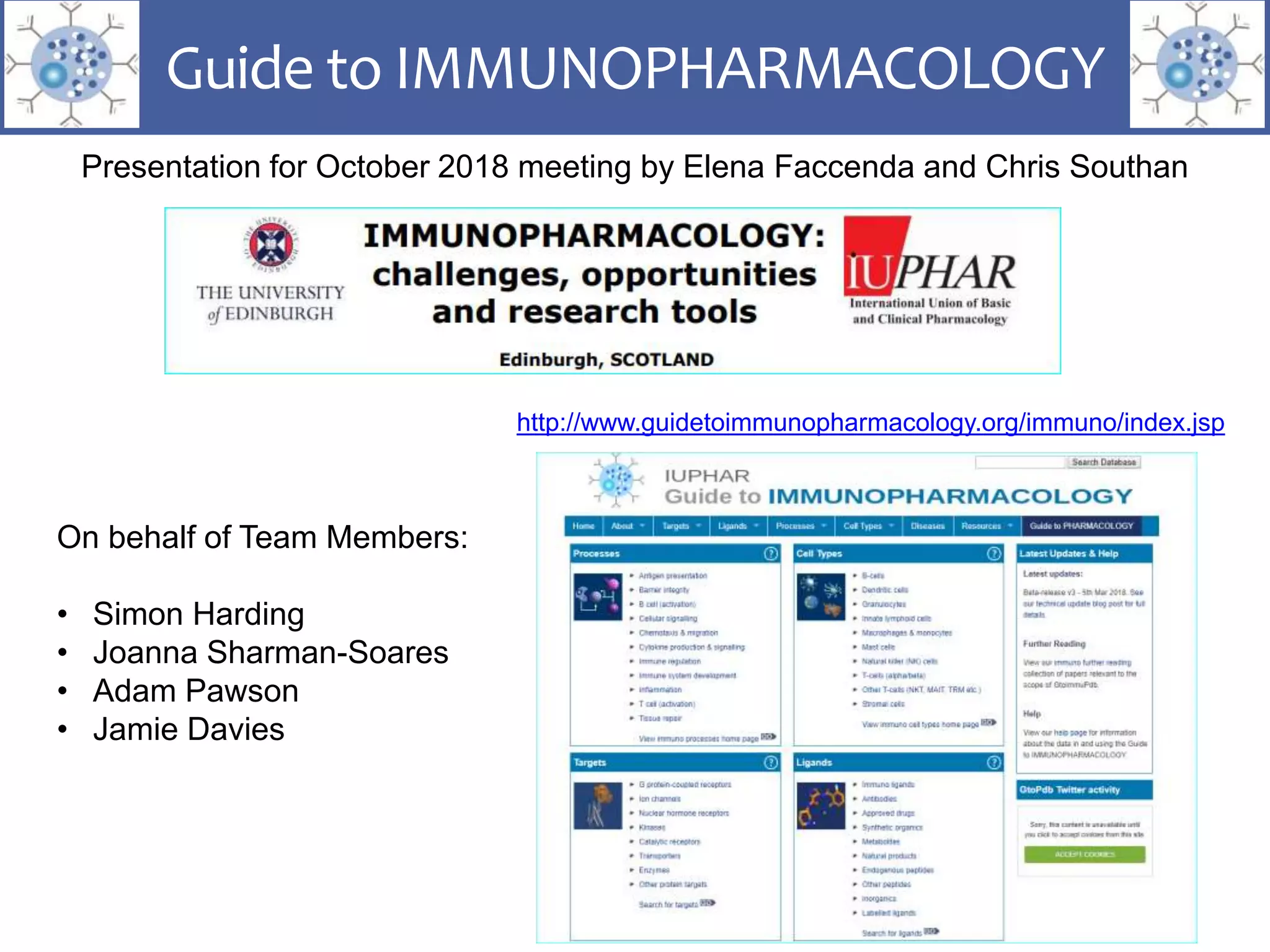
Presentation for October 2018 meeting by Elena Faccenda and Chris Southan
Guide to IMMUNOPHARMACOLOGY
On behalf of Team Members:
• Simon Harding
• Joanna Sharman-Soares
• Adam Pawson
• Jamie Davies
http://www.guidetoimmunopharmacology.org/immuno/index.jsp
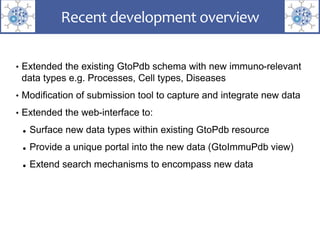
• Extended the existing GtoPdb schema with new immuno-relevant
data types e.g. Processes, Cell types, Diseases
• Modification of submission tool to capture and integrate new data
• Extended the web-interface to:
 Surface new data types within existing GtoPdb resource
 Provide a unique portal into the new data (GtoImmuPdb view)
 Extend search mechanisms to encompass new data
Recent development overview
Curation sources
• Focussed literature searches
• Pharma companies pipeline portfolios
• Pharma and academic press releases
• Clinical trial registries
• Selected Twitter sources
• INN lists
• Patent documents
• ArchiveX pre-prints (just initiated)
Literature searching
• Most methods we explored worked but had different levels of recall, specificity
and efficiency
• Magnitude of the challenge indicated by monthly PubMed alert of: “immunology
OR "immune system" AND immunomodulation OR immunosuppression OR
immunostimulation OR inflammation” typically returning ~ 5000 hits (good recall)
• Highest specificity was browsing the contents pages of Journal of Medicinal
Chemistry
• Highest efficiency was via Twitter from selected journals and immunology society
feeds and newsletters
• Good specificity during curation of any paper by browsing PubMed “Similar
articles” and “Cited by”
• The counter-intuative take home was that only a minority of our curated primary
reverences came from what we might classify as the ”immunopharmacolgy”
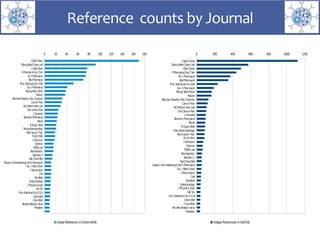
literature (see journal distribution in later slide)
Triage and pre-curation
• Becomes a shared reference collection with curatable entities as targets and ligands
• Common tags allow retrieval of combined efforts
• Add pre-curation comments (e.g. CIDs, SMILES etc. for ligands; Uniprot IDs for new targets)
• Add personal PDFs for full curation
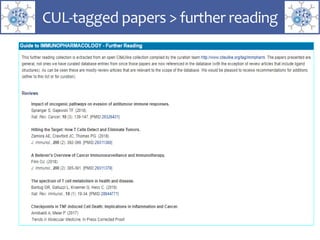
• Repository of useful reviews and Hot Topics as further reading
• System is open and tags can be shared with anyone
• Not restricted to papers (can add any form of text reference)
• Caveats
• Need to avoid common tags (i.e. use semi-cryptic personal tags)
• Inability to cross-comment between users (have to duplicate comments and/or other
curator adds separate comments)
• No explicit linking between CUL IDs, DOIs, PubMed IDs and our database references
• Little active development and Elsevier persistence dependency
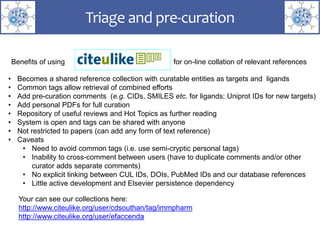
Benefits of using for on-line collation of relevant references
Your can see our collections here:
http://www.citeulike.org/user/cdsouthan/tag/immpharm
http://www.citeulike.org/user/efaccenda
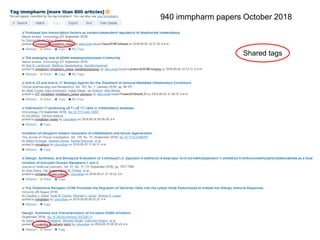
Shared tags
940 immpharm papers October 2018
Reference counts by Journal
CUL-tagged papers > further reading
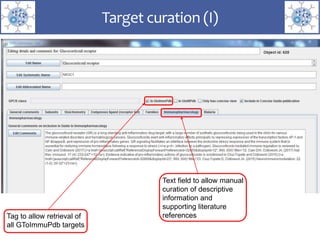
Target CurationTarget curation (I)
Tag to allow retrieval of
all GToImmuPdb targets
Text field to allow manual
curation of descriptive
information and
supporting literature
references
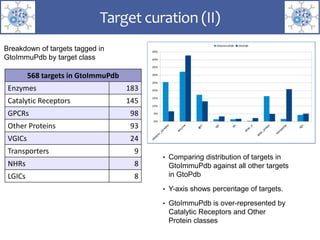
568 targets in GtoImmuPdb
Enzymes 183
Catalytic Receptors 145
GPCRs 98
Other Proteins 93
VGICs 24
Transporters 9
NHRs 8
LGICs 8
Breakdown of targets tagged in
GtoImmuPdb by target class
• Comparing distribution of targets in
GtoImmuPdb against all other targets
in GtoPdb
• Y-axis shows percentage of targets.
• GtoImmuPdb is over-represented by
Catalytic Receptors and Other
Protein classes
Target curation (II)
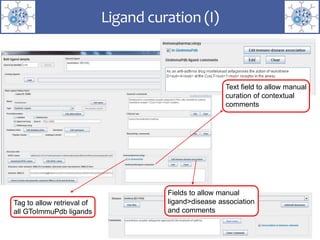
Ligand curation (I)
Tag to allow retrieval of
all GToImmuPdb ligands
Text field to allow manual
curation of contextual
comments
Fields to allow manual
ligand>disease association
and comments
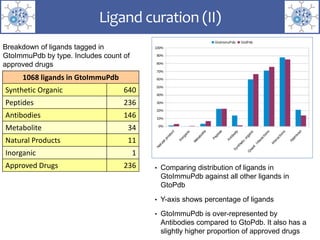
1068 ligands in GtoImmuPdb
Synthetic Organic 640
Peptides 236
Antibodies 146
Metabolite 34
Natural Products 11
Inorganic 1
Approved Drugs 236 • Comparing distribution of ligands in
GtoImmuPdb against all other ligands in
GtoPdb
• Y-axis shows percentage of ligands
• GtoImmuPdb is over-represented by
Antibodies compared to GtoPdb. It also has a
slightly higher proportion of approved drugs
Breakdown of ligands tagged in
GtoImmuPdb by type. Includes count of
approved drugs
Ligand curation (II)
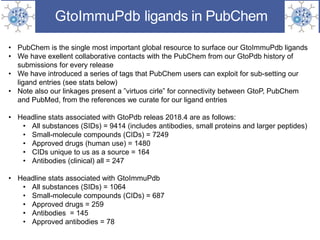
GtoImmuPdb ligands in PubChem
• PubChem is the single most important global resource to surface our GtoImmuPdb ligands
• We have exellent collaborative contacts with the PubChem from our GtoPdb history of
submissions for every release
• We have introduced a series of tags that PubChem users can exploit for sub-setting our
ligand entries (see stats below)
• Note also our linkages present a ”virtuos cirle” for connectivity between GtoP, PubChem
and PubMed, from the references we curate for our ligand entries
• Headline stats associated with GtoPdb releas 2018.4 are as follows:
• All substances (SIDs) = 9414 (includes antibodies, small proteins and larger peptides)
• Small-molecule compounds (CIDs) = 7249
• Approved drugs (human use) = 1480
• CIDs unique to us as a source = 164
• Antibodies (clinical) all = 247
• Headline stats associated with GtoImmuPdb
• All substances (SIDs) = 1064
• Small-molecule compounds (CIDs) = 687
• Approved drugs = 259
• Antibodies = 145
• Approved antibodies = 78
PubChem antibodies
• Substance side query: "IUPHAR/BPS Guide to PHARMACOLOGY"[SourceName]” AND
”immunopharmacology” AND “approved” AND “antibody”
PubChem small-molecules
• Query "IUPHAR/BPS Guide to PHARMACOLOGY"[SourceName]” as CIDs from
“immunopharmacology, select for unique to us and sorted by date
195
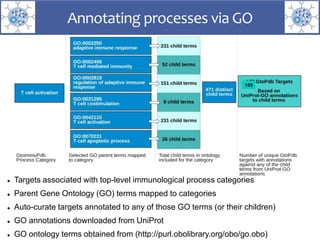
 Targets associated with top-level immunological process categories
 Parent Gene Ontology (GO) terms mapped to categories
 Auto-curate targets annotated to any of those GO terms (or their children)
 GO annotations downloaded from UniProt
 GO ontology terms obtained from (http://purl.obolibrary.org/obo/go.obo)
Annotating processes via GO
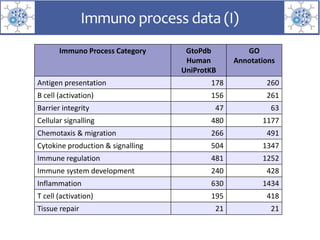
Immuno Process Category GtoPdb
Human
UniProtKB
GO
Annotations
Antigen presentation 178 260
B cell (activation) 156 261
Barrier integrity 47 63
Cellular signalling 480 1177
Chemotaxis & migration 266 491
Cytokine production & signalling 504 1347
Immune regulation 481 1252
Immune system development 240 428
Inflammation 630 1434
T cell (activation) 195 418
Tissue repair 21 21
Immuno process data (I)
Immuno process data (II)
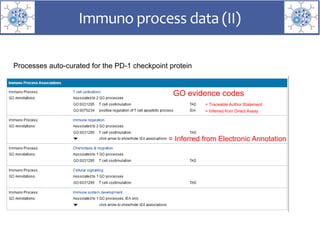
Processes auto-curated for the PD-1 checkpoint protein
GO evidence codes
= Traceable Author Statement
= Inferred from Direct Assay
= Inferred from Electronic Annotation
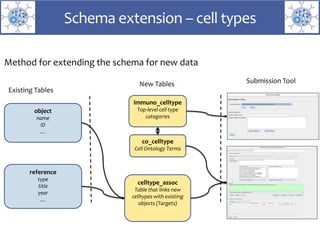
Schema extension – cell types
Method for extending the schema for new data
object
name
ID
…
reference
type
title
year
…
celltype_assoc
Table that links new
celltypes with existing
objects (Targets)
co_celltype
Cell Ontology Terms
immuno_celltype
Top-level cell type
categories
Submission Tool
Existing Tables
New Tables
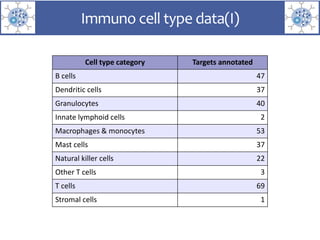
Cell type category Targets annotated
B cells 47
Dendritic cells 37
Granulocytes 40
Innate lymphoid cells 2
Macrophages & monocytes 53
Mast cells 37
Natural killer cells 22
Other T cells 3
T cells 69
Stromal cells 1
Immuno cell type data(I)
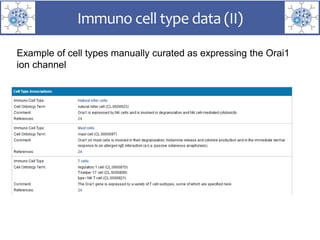
Immuno cell type data (II)
Example of cell types manually curated as expressing the Orai1
ion channel
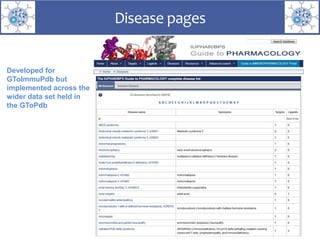
Disease pages
Developed for
GToImmuPdb but
implemented across the
wider data set held in
the GToPdb
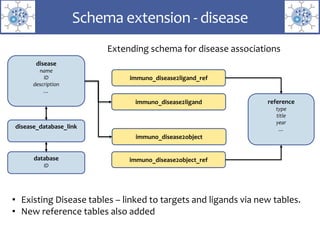
Schema extension - disease
disease
name
ID
description
…
disease_database_link
database
ID
reference
type
title
year
…
immuno_disease2object
immuno_disease2ligand
immuno_disease2ligand_ref
immuno_disease2object_ref
Extending schema for disease associations
• Existing Disease tables – linked to targets and ligands via new tables.
• New reference tables also added
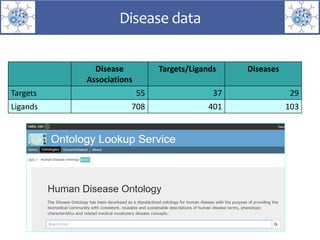
Disease
Associations
Targets/Ligands Diseases
Targets 55 37 29
Ligands 708 401 103
Disease data
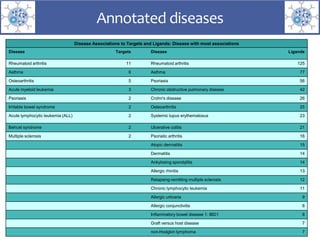
Disease Associations to Targets and Ligands: Disease with most associations
Disease Targets Disease Ligands
Rheumatoid arthritis 11 Rheumatoid arthritis 125
Asthma 6 Asthma 77
Osteoarthritis 5 Psoriasis 56
Acute myeloid leukemia 3 Chronic obstructive pulmonary disease 42
Psoriasis 2 Crohn's disease 26
Irritable bowel syndrome 2 Osteoarthritis 25
Acute lymphocytic leukemia (ALL) 2 Systemic lupus erythematosus 23
Behcet syndrome 2 Ulcerative colitis 21
Multiple sclerosis 2 Psoriatic arthritis 16
Atopic dermatitis 15
Dermatitis 14
Ankylosing spondylitis 14
Allergic rhinitis 13
Relapsing-remitting multiple sclerosis 12
Chronic lymphocytic leukemia 11
Allergic urticaria 9
Allergic conjunctivitis 8
Inflammatory bowel disease 1; IBD1 8
Graft versus host disease 7
non-Hodgkin lymphoma 7
Annotated diseases
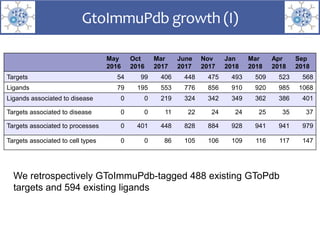
May
2016
Oct
2016
Mar
2017
June
2017
Nov
2017
Jan
2018
Mar
2018
Apr
2018
Sep
2018
Targets 54 99 406 448 475 493 509 523 568
Ligands 79 195 553 776 856 910 920 985 1068
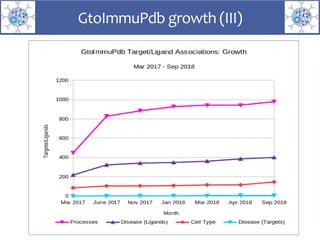
Ligands associated to disease 0 0 219 324 342 349 362 386 401
Targets associated to disease 0 0 11 22 24 24 25 35 37
Targets associated to processes 0 401 448 828 884 928 941 941 979
Targets associated to cell types 0 0 86 105 106 109 116 117 147
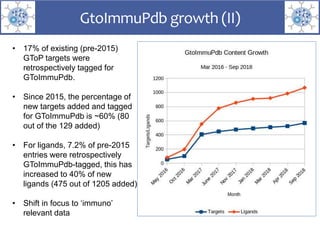
GtoImmuPdb growth (I)
We retrospectively GToImmuPdb-tagged 488 existing GToPdb
targets and 594 existing ligands
• 17% of existing (pre-2015)
GToP targets were
retrospectively tagged for
GToImmuPdb.
• Since 2015, the percentage of
new targets added and tagged
for GToImmuPdb is ~60% (80
out of the 129 added)
• For ligands, 7.2% of pre-2015
entries were retrospectively
GToImmuPdb-tagged, this has
increased to 40% of new
ligands (475 out of 1205 added)
• Shift in focus to ‘immuno’
relevant data
GtoImmuPdb growth (II)
GtoImmuPdb growth (III)
Technical issues and challenges
• Assessing publication quality in immunopharmacology is even more
difficult than for general pharmacology
• Ditto for the “reproducibility crisis” w.r.t. to ligand quantitative activity
• As ever, the rate of blinding for pharma development candidates is
~40% (i.e. no name-to-structure)
• We do not curate without a defined molecular structure for ligands
(even if we have to dig out an antibody sequence from a patent)
• Difficult for users to differentiate where the target has different (or
even the same) ligands published in both immunopharmacolgy and
other therapeutic contexts
• Diseases that are mechanistically “grey” but potentially large (e.g.
fibrosis as immunological causality)
• Single-cell expression data will eventually split our cell hierachies
Achievements and plans
• Achievements outlined in external slides, posters (see slideshare),
database report and NAR paper (PMID: 29149325)
• Good progress leading up to beta release
• Need to broaden feedback
• Need more committee (and other expert) inputs for
• Triaging “Further Reading” for the birds eye picture
• More dot-joining on “big themes” (e.g. athero, AD, depression)
• Check false-negatives (i.e. do we have a “coverage gap”)
• Engage with key wet labs (e.g. for ligand testing in new systems)
• Continue getting the word out (e.g. papers and press release)
• Explore crowd-source options (e.g. call for papers)

Guide to Immunopharmacology update

  • 1.
    Presentation for October2018 meeting by Elena Faccenda and Chris Southan Guide to IMMUNOPHARMACOLOGY On behalf of Team Members: • Simon Harding • Joanna Sharman-Soares • Adam Pawson • Jamie Davies http://www.guidetoimmunopharmacology.org/immuno/index.jsp
  • 2.
    • Extended theexisting GtoPdb schema with new immuno-relevant data types e.g. Processes, Cell types, Diseases • Modification of submission tool to capture and integrate new data • Extended the web-interface to:  Surface new data types within existing GtoPdb resource  Provide a unique portal into the new data (GtoImmuPdb view)  Extend search mechanisms to encompass new data Recent development overview
  • 3.
    Curation sources • Focussedliterature searches • Pharma companies pipeline portfolios • Pharma and academic press releases • Clinical trial registries • Selected Twitter sources • INN lists • Patent documents • ArchiveX pre-prints (just initiated)
  • 4.
    Literature searching • Mostmethods we explored worked but had different levels of recall, specificity and efficiency • Magnitude of the challenge indicated by monthly PubMed alert of: “immunology OR "immune system" AND immunomodulation OR immunosuppression OR immunostimulation OR inflammation” typically returning ~ 5000 hits (good recall) • Highest specificity was browsing the contents pages of Journal of Medicinal Chemistry • Highest efficiency was via Twitter from selected journals and immunology society feeds and newsletters • Good specificity during curation of any paper by browsing PubMed “Similar articles” and “Cited by” • The counter-intuative take home was that only a minority of our curated primary reverences came from what we might classify as the ”immunopharmacolgy” literature (see journal distribution in later slide)
  • 5.
    Triage and pre-curation •Becomes a shared reference collection with curatable entities as targets and ligands • Common tags allow retrieval of combined efforts • Add pre-curation comments (e.g. CIDs, SMILES etc. for ligands; Uniprot IDs for new targets) • Add personal PDFs for full curation • Repository of useful reviews and Hot Topics as further reading • System is open and tags can be shared with anyone • Not restricted to papers (can add any form of text reference) • Caveats • Need to avoid common tags (i.e. use semi-cryptic personal tags) • Inability to cross-comment between users (have to duplicate comments and/or other curator adds separate comments) • No explicit linking between CUL IDs, DOIs, PubMed IDs and our database references • Little active development and Elsevier persistence dependency Benefits of using for on-line collation of relevant references Your can see our collections here: http://www.citeulike.org/user/cdsouthan/tag/immpharm http://www.citeulike.org/user/efaccenda
  • 6.
    Shared tags 940 immpharmpapers October 2018
  • 7.
  • 8.
    CUL-tagged papers >further reading
  • 9.
    Target CurationTarget curation(I) Tag to allow retrieval of all GToImmuPdb targets Text field to allow manual curation of descriptive information and supporting literature references
  • 10.
    568 targets inGtoImmuPdb Enzymes 183 Catalytic Receptors 145 GPCRs 98 Other Proteins 93 VGICs 24 Transporters 9 NHRs 8 LGICs 8 Breakdown of targets tagged in GtoImmuPdb by target class • Comparing distribution of targets in GtoImmuPdb against all other targets in GtoPdb • Y-axis shows percentage of targets. • GtoImmuPdb is over-represented by Catalytic Receptors and Other Protein classes Target curation (II)
  • 11.
    Ligand curation (I) Tagto allow retrieval of all GToImmuPdb ligands Text field to allow manual curation of contextual comments Fields to allow manual ligand>disease association and comments
  • 12.
    1068 ligands inGtoImmuPdb Synthetic Organic 640 Peptides 236 Antibodies 146 Metabolite 34 Natural Products 11 Inorganic 1 Approved Drugs 236 • Comparing distribution of ligands in GtoImmuPdb against all other ligands in GtoPdb • Y-axis shows percentage of ligands • GtoImmuPdb is over-represented by Antibodies compared to GtoPdb. It also has a slightly higher proportion of approved drugs Breakdown of ligands tagged in GtoImmuPdb by type. Includes count of approved drugs Ligand curation (II)
  • 13.
    GtoImmuPdb ligands inPubChem • PubChem is the single most important global resource to surface our GtoImmuPdb ligands • We have exellent collaborative contacts with the PubChem from our GtoPdb history of submissions for every release • We have introduced a series of tags that PubChem users can exploit for sub-setting our ligand entries (see stats below) • Note also our linkages present a ”virtuos cirle” for connectivity between GtoP, PubChem and PubMed, from the references we curate for our ligand entries • Headline stats associated with GtoPdb releas 2018.4 are as follows: • All substances (SIDs) = 9414 (includes antibodies, small proteins and larger peptides) • Small-molecule compounds (CIDs) = 7249 • Approved drugs (human use) = 1480 • CIDs unique to us as a source = 164 • Antibodies (clinical) all = 247 • Headline stats associated with GtoImmuPdb • All substances (SIDs) = 1064 • Small-molecule compounds (CIDs) = 687 • Approved drugs = 259 • Antibodies = 145 • Approved antibodies = 78
  • 14.
    PubChem antibodies • Substanceside query: "IUPHAR/BPS Guide to PHARMACOLOGY"[SourceName]” AND ”immunopharmacology” AND “approved” AND “antibody”
  • 15.
    PubChem small-molecules • Query"IUPHAR/BPS Guide to PHARMACOLOGY"[SourceName]” as CIDs from “immunopharmacology, select for unique to us and sorted by date
  • 16.
    195  Targets associatedwith top-level immunological process categories  Parent Gene Ontology (GO) terms mapped to categories  Auto-curate targets annotated to any of those GO terms (or their children)  GO annotations downloaded from UniProt  GO ontology terms obtained from (http://purl.obolibrary.org/obo/go.obo) Annotating processes via GO
  • 17.
    Immuno Process CategoryGtoPdb Human UniProtKB GO Annotations Antigen presentation 178 260 B cell (activation) 156 261 Barrier integrity 47 63 Cellular signalling 480 1177 Chemotaxis & migration 266 491 Cytokine production & signalling 504 1347 Immune regulation 481 1252 Immune system development 240 428 Inflammation 630 1434 T cell (activation) 195 418 Tissue repair 21 21 Immuno process data (I)
  • 18.
    Immuno process data(II) Processes auto-curated for the PD-1 checkpoint protein GO evidence codes = Traceable Author Statement = Inferred from Direct Assay = Inferred from Electronic Annotation
  • 19.
    Schema extension –cell types Method for extending the schema for new data object name ID … reference type title year … celltype_assoc Table that links new celltypes with existing objects (Targets) co_celltype Cell Ontology Terms immuno_celltype Top-level cell type categories Submission Tool Existing Tables New Tables
  • 20.
    Cell type categoryTargets annotated B cells 47 Dendritic cells 37 Granulocytes 40 Innate lymphoid cells 2 Macrophages & monocytes 53 Mast cells 37 Natural killer cells 22 Other T cells 3 T cells 69 Stromal cells 1 Immuno cell type data(I)
  • 21.
    Immuno cell typedata (II) Example of cell types manually curated as expressing the Orai1 ion channel
  • 22.
    Disease pages Developed for GToImmuPdbbut implemented across the wider data set held in the GToPdb
  • 23.
    Schema extension -disease disease name ID description … disease_database_link database ID reference type title year … immuno_disease2object immuno_disease2ligand immuno_disease2ligand_ref immuno_disease2object_ref Extending schema for disease associations • Existing Disease tables – linked to targets and ligands via new tables. • New reference tables also added
  • 24.
    Disease Associations Targets/Ligands Diseases Targets 5537 29 Ligands 708 401 103 Disease data
  • 25.
    Disease Associations toTargets and Ligands: Disease with most associations Disease Targets Disease Ligands Rheumatoid arthritis 11 Rheumatoid arthritis 125 Asthma 6 Asthma 77 Osteoarthritis 5 Psoriasis 56 Acute myeloid leukemia 3 Chronic obstructive pulmonary disease 42 Psoriasis 2 Crohn's disease 26 Irritable bowel syndrome 2 Osteoarthritis 25 Acute lymphocytic leukemia (ALL) 2 Systemic lupus erythematosus 23 Behcet syndrome 2 Ulcerative colitis 21 Multiple sclerosis 2 Psoriatic arthritis 16 Atopic dermatitis 15 Dermatitis 14 Ankylosing spondylitis 14 Allergic rhinitis 13 Relapsing-remitting multiple sclerosis 12 Chronic lymphocytic leukemia 11 Allergic urticaria 9 Allergic conjunctivitis 8 Inflammatory bowel disease 1; IBD1 8 Graft versus host disease 7 non-Hodgkin lymphoma 7 Annotated diseases
  • 26.
    May 2016 Oct 2016 Mar 2017 June 2017 Nov 2017 Jan 2018 Mar 2018 Apr 2018 Sep 2018 Targets 54 99406 448 475 493 509 523 568 Ligands 79 195 553 776 856 910 920 985 1068 Ligands associated to disease 0 0 219 324 342 349 362 386 401 Targets associated to disease 0 0 11 22 24 24 25 35 37 Targets associated to processes 0 401 448 828 884 928 941 941 979 Targets associated to cell types 0 0 86 105 106 109 116 117 147 GtoImmuPdb growth (I) We retrospectively GToImmuPdb-tagged 488 existing GToPdb targets and 594 existing ligands
  • 27.
    • 17% ofexisting (pre-2015) GToP targets were retrospectively tagged for GToImmuPdb. • Since 2015, the percentage of new targets added and tagged for GToImmuPdb is ~60% (80 out of the 129 added) • For ligands, 7.2% of pre-2015 entries were retrospectively GToImmuPdb-tagged, this has increased to 40% of new ligands (475 out of 1205 added) • Shift in focus to ‘immuno’ relevant data GtoImmuPdb growth (II)
  • 28.
  • 29.
    Technical issues andchallenges • Assessing publication quality in immunopharmacology is even more difficult than for general pharmacology • Ditto for the “reproducibility crisis” w.r.t. to ligand quantitative activity • As ever, the rate of blinding for pharma development candidates is ~40% (i.e. no name-to-structure) • We do not curate without a defined molecular structure for ligands (even if we have to dig out an antibody sequence from a patent) • Difficult for users to differentiate where the target has different (or even the same) ligands published in both immunopharmacolgy and other therapeutic contexts • Diseases that are mechanistically “grey” but potentially large (e.g. fibrosis as immunological causality) • Single-cell expression data will eventually split our cell hierachies
  • 30.
    Achievements and plans •Achievements outlined in external slides, posters (see slideshare), database report and NAR paper (PMID: 29149325) • Good progress leading up to beta release • Need to broaden feedback • Need more committee (and other expert) inputs for • Triaging “Further Reading” for the birds eye picture • More dot-joining on “big themes” (e.g. athero, AD, depression) • Check false-negatives (i.e. do we have a “coverage gap”) • Engage with key wet labs (e.g. for ligand testing in new systems) • Continue getting the word out (e.g. papers and press release) • Explore crowd-source options (e.g. call for papers)