GUIDE FOR
CREATING A
CHURCH
BUDGET
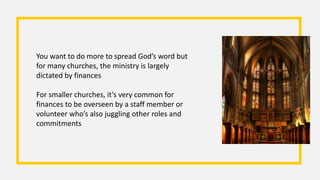
You want to do more to spread God’s word but
for many churches, the ministry is largely
dictated by finances
For smaller churches, it’s very common for
finances to be overseen by a staff member or
volunteer who’s also juggling other roles and
commitments
I
Before You Set
Up Your Church
Budget
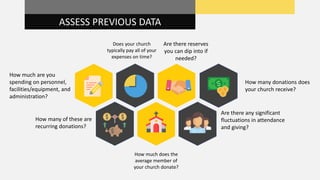
ASSESS PREVIOUS DATA
How much are you
spending on personnel,
facilities/equipment, and
administration?
Does your church
typically pay all of your
expenses on time?
Are there reserves
you can dip into if
needed?
How many donations does
your church receive?
How much does the
average member of
your church donate?
How many of these are
recurring donations?
Are there any significant
fluctuations in attendance
and giving?
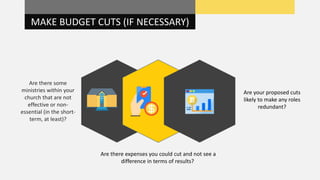
MAKE BUDGET CUTS (IF NECESSARY)
Are there some
ministries within your
church that are not
effective or non-
essential (in the short-
term, at least)?
Are there expenses you could cut and not see a
difference in terms of results?
Are your proposed cuts
likely to make any roles
redundant?
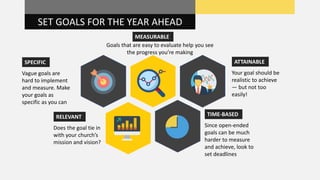
SET GOALS FOR THE YEAR AHEAD
SPECIFIC
Vague goals are
hard to implement
and measure. Make
your goals as
specific as you can
MEASURABLE
Goals that are easy to evaluate help you see
the progress you’re making
ATTAINABLE
Your goal should be
realistic to achieve
— but not too
easily!
RELEVANT
Does the goal tie in
with your church’s
mission and vision?
TIME-BASED
Since open-ended
goals can be much
harder to measure
and achieve, look to
set deadlines
II
Budget Types
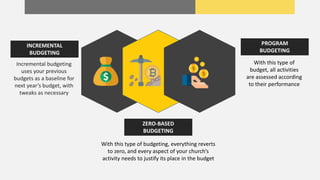
Incremental budgeting
uses your previous
budgets as a baseline for
next year’s budget, with
tweaks as necessary
With this type of budgeting, everything reverts
to zero, and every aspect of your church’s
activity needs to justify its place in the budget
With this type of
budget, all activities
are assessed according
to their performance
INCREMENTAL
BUDGETING
PROGRAM
BUDGETING
ZERO-BASED
BUDGETING
III
What To Include
In Your Budget
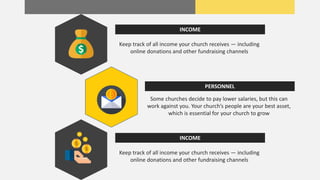
Keep track of all income your church receives — including
online donations and other fundraising channels
INCOME
Some churches decide to pay lower salaries, but this can
work against you. Your church’s people are your best asset,
which is essential for your church to grow
PERSONNEL
Keep track of all income your church receives — including
online donations and other fundraising channels
INCOME
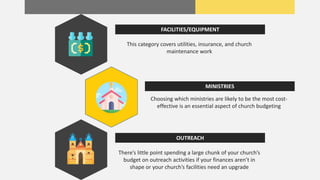
This category covers utilities, insurance, and church
maintenance work
FACILITIES/EQUIPMENT
Choosing which ministries are likely to be the most cost-
effective is an essential aspect of church budgeting
MINISTRIES
There’s little point spending a large chunk of your church’s
budget on outreach activities if your finances aren’t in
shape or your church’s facilities need an upgrade
OUTREACH
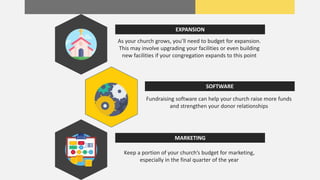
As your church grows, you’ll need to budget for expansion.
This may involve upgrading your facilities or even building
new facilities if your congregation expands to this point
EXPANSION
Fundraising software can help your church raise more funds
and strengthen your donor relationships
SOFTWARE
Keep a portion of your church’s budget for marketing,
especially in the final quarter of the year
MARKETING
IV
Pull Monthly
Budget Reports
This is very easy to do if you’re using donor
management software. With Donorbox, you can
pull donation reports quickly and easily to see
how your income stacks up against your budget
V
Account For
Seasonal Shifts
For most churches, there are fluctuations in
attendance at certain times of the year.
December usually sees a spike, for example.
When you create your church budget, factor
these shifts into account and use them to avoid
tough times.
VI
Have a Plan for
Maintenance
Work
If you haven’t factored maintenance into your
budget, it can also be financially devastating.
Putting a portion of your church’s income aside
for maintenance work can avoid financial
headaches
https://donorbox.org/nonprofit-
blog/church-budgeting-tips/
READ THE
ENTIRE ARTICLE

Guide for creating a church budget

  • 1.
  • 2.
    You want todo more to spread God’s word but for many churches, the ministry is largely dictated by finances For smaller churches, it’s very common for finances to be overseen by a staff member or volunteer who’s also juggling other roles and commitments
  • 3.
    I Before You Set UpYour Church Budget
  • 4.
    ASSESS PREVIOUS DATA Howmuch are you spending on personnel, facilities/equipment, and administration? Does your church typically pay all of your expenses on time? Are there reserves you can dip into if needed? How many donations does your church receive? How much does the average member of your church donate? How many of these are recurring donations? Are there any significant fluctuations in attendance and giving?
  • 5.
    MAKE BUDGET CUTS(IF NECESSARY) Are there some ministries within your church that are not effective or non- essential (in the short- term, at least)? Are there expenses you could cut and not see a difference in terms of results? Are your proposed cuts likely to make any roles redundant?
  • 6.
    SET GOALS FORTHE YEAR AHEAD SPECIFIC Vague goals are hard to implement and measure. Make your goals as specific as you can MEASURABLE Goals that are easy to evaluate help you see the progress you’re making ATTAINABLE Your goal should be realistic to achieve — but not too easily! RELEVANT Does the goal tie in with your church’s mission and vision? TIME-BASED Since open-ended goals can be much harder to measure and achieve, look to set deadlines
  • 7.
  • 8.
    Incremental budgeting uses yourprevious budgets as a baseline for next year’s budget, with tweaks as necessary With this type of budgeting, everything reverts to zero, and every aspect of your church’s activity needs to justify its place in the budget With this type of budget, all activities are assessed according to their performance INCREMENTAL BUDGETING PROGRAM BUDGETING ZERO-BASED BUDGETING
  • 9.
  • 10.
    Keep track ofall income your church receives — including online donations and other fundraising channels INCOME Some churches decide to pay lower salaries, but this can work against you. Your church’s people are your best asset, which is essential for your church to grow PERSONNEL Keep track of all income your church receives — including online donations and other fundraising channels INCOME
  • 11.
    This category coversutilities, insurance, and church maintenance work FACILITIES/EQUIPMENT Choosing which ministries are likely to be the most cost- effective is an essential aspect of church budgeting MINISTRIES There’s little point spending a large chunk of your church’s budget on outreach activities if your finances aren’t in shape or your church’s facilities need an upgrade OUTREACH
  • 12.
    As your churchgrows, you’ll need to budget for expansion. This may involve upgrading your facilities or even building new facilities if your congregation expands to this point EXPANSION Fundraising software can help your church raise more funds and strengthen your donor relationships SOFTWARE Keep a portion of your church’s budget for marketing, especially in the final quarter of the year MARKETING
  • 13.
  • 14.
    This is veryeasy to do if you’re using donor management software. With Donorbox, you can pull donation reports quickly and easily to see how your income stacks up against your budget
  • 15.
  • 16.
    For most churches,there are fluctuations in attendance at certain times of the year. December usually sees a spike, for example. When you create your church budget, factor these shifts into account and use them to avoid tough times.
  • 17.
    VI Have a Planfor Maintenance Work
  • 18.
    If you haven’tfactored maintenance into your budget, it can also be financially devastating. Putting a portion of your church’s income aside for maintenance work can avoid financial headaches
  • 19.