Guide D Transportation Systems In Buildings 2010
Cibse Guide 4th Revised Edition Cibse download
https://ebookbell.com/product/guide-d-transportation-systems-in-
buildings-2010-cibse-guide-4th-revised-edition-cibse-33982142
Explore and download more ebooks at ebookbell.com
Here are some recommended products that we believe you will be
interested in. You can click the link to download.
Guide To Project Management Strategies For Complex Projects Gransberg
https://ebookbell.com/product/guide-to-project-management-strategies-
for-complex-projects-gransberg-6998302
Getting Started With Microsoft Viva An End User Guide To Business
Transformation 1st Edition Darce Hess
https://ebookbell.com/product/getting-started-with-microsoft-viva-an-
end-user-guide-to-business-transformation-1st-edition-darce-
hess-47554262
Journey Into Yoga A Guide For Transformation And Discovery Kanzer
https://ebookbell.com/product/journey-into-yoga-a-guide-for-
transformation-and-discovery-kanzer-232650290
Entropy Guided Transformation Learning Algorithms And Applications 1st
Edition Ccero Nogueira Dos Santos
https://ebookbell.com/product/entropy-guided-transformation-learning-
algorithms-and-applications-1st-edition-ccero-nogueira-dos-
santos-4202730
Cosmic Prayer And Guided Transformation Robert Govaerts
https://ebookbell.com/product/cosmic-prayer-and-guided-transformation-
robert-govaerts-59406742
Healing And Transformation Through Self Guided Imagery Leslie
Davenport
https://ebookbell.com/product/healing-and-transformation-through-self-
guided-imagery-leslie-davenport-46363670
The Blooming Of A Lotus Revised Expanded Essential Guided Meditations
For Mindfulness Healing And Transformation Thich Nhat Hanh
https://ebookbell.com/product/the-blooming-of-a-lotus-revised-
expanded-essential-guided-meditations-for-mindfulness-healing-and-
transformation-thich-nhat-hanh-46264852
Homicide Investigation Field Guide Dmichelle P Dupre Auth
https://ebookbell.com/product/homicide-investigation-field-guide-
dmichelle-p-dupre-auth-4409950
Platos Republic An Edinburgh Philosophical Guide Dj Sheppard
https://ebookbell.com/product/platos-republic-an-edinburgh-
philosophical-guide-dj-sheppard-1916404
The Chartered Institution of Building Services Engineers
222 Balham High Road, London SW12 9BS
+44 (0) 20 8675 5211
www.cibse.org
Transportation systems
in buildings
CIBSE
Guide
D:
Transportation
systems
in
buildings
2010
CIBSE Guide D: 2010
9 7 8 1 9 0 6 8 4 6 1 6 9
ISBN 978-1-906846-16-9
cover spread v3:cover spread 26/08/2010 12:42 Page 1
Transportation systems in
buildings
CIBSE Guide D: 2010
The rights of publication or translation are reserved.
No part of this publication may be reproduced, stored in a
retrieval system or transmitted in any form or by any means
without the prior permission of the Institution.
© September 2010 (4th edition) The authors/The Chartered
Institution of Building Services Engineers London
Registered charity number 278104
ISBN: 978-1-906846-16-9
This document is based on the best knowledge available at
the time of publication. However no responsibility of any
kind for any injury, death, loss, damage or delay however
caused resulting from the use of these recommendations can
be accepted by the Chartered Institution of Building Services
Engineers, the authors or others involved in its publication.
In adopting these recommendations for use each adopter by
doing so agrees to accept full responsibility for any personal
injury, death, loss, damage or delay arising out of or in
connection with their use by or on behalf of such adopter
irrespective of the cause or reason therefore and agrees to
defend, indemnify and hold harmless the Chartered
Institution of Building Services Engineers, the authors and
others involved in their publication from any and all liability
arising out of or in connection with such use as aforesaid
and irrespective of any negligence on the part of those
indemnified.
Typeset by CIBSE Publications Department
Printed in Great Britain by Page Bros. (Norwich) Ltd.,
Norwich, Norfolk NR6 6SA
Cover design by Suzanne McCoy (Elevation Magazine); images (from top): Escalator in
motion (© Nikada), Elevators inside an office building (© vm), Lift in a futuristic building
(© Nikada), Lloyds of London and Tower 42 (© Sean Randall); images sourced through
www.iStockphoto.com
Note from the publisher
This publication is primarily intended to provide guidance to those responsible for the
design, installation, commissioning, operation and maintenance of building services. It is
not intended to be exhaustive or definitive and it will be necessary for users of the guidance
given to exercise their own professional judgement when deciding whether to abide by or
depart from it.
Any commercial products depicted or described within this publication are included for
the purposes of illustration only and their inclusion does not constitute endorsement or
recommendation by the Institution.
Foreword
It is with great pleasure that I find myself writing the foreword to what is now the fourth
edition of the CIBSE Guide D: Transportation systems in buildings. Since its inception some
15 years ago, Guide D has become the de facto reference for many people involved in the
broad and varied world of vertical transportation.
Guide D offers the reader a wealth of information and recommendations on the key issues
affecting the design, installation, commissioning, maintenance and renewal of vertical
transportation systems. Of particular note in this edition are the extensive revisions to the
guidance on traffic planning, which should prove of particular interest to developers and
their design teams focussed on maximising floorplate efficiencies.
Energy efficiency and conservation remains a challenge that we all should be taking and the
Guide offers significantly expanded information on the latest initiatives and technology in
this rapidly changing area.
Guidance on the effective commissioning, maintenance and testing of lifts and escalators
has been extensively updated and the entire document brought into line with the latest
codes and standards.
Such a comprehensive source of information as this does not come about without the
concerted efforts of the skilled and experienced professionals of the Steering Committee, to
whom I extend my thanks and congratulations for delivering yet another excellent edition
of Guide D.
Adam J Scott
Chairman, CIBSE Guide D Steering Committee
Message from the President
This revised edition of Guide D demonstrates how successful transportation systems in
buildings require a blend of architectural, engineering and operational thinking.
It shows how the industry needs understanding of movement strategy, capacity planning
and calculation, engineering detail, operational detail and all with the overriding objective
of maintaining safety.
The Guide also identifies that there is also a clear need for significant collaboration in order
to deliver successful transportation systems in buildings.
I believe that this edition of Guide D will continue to inform the need for understanding
and collaboration and I hope also that the Guide will help to encourage new members to
join the ranks of those who have contributed so generously to the content of Guide D to
date.
Rob Manning
CIBSE President 2010–2011
Guide D Steering Committee
Adam Scott (Roger Preston & Partners) (Chairman)
Dr Gina Barney (Gina Barney Associates)
John Carroll (Norman, Disney & Young)
David Cooper (LECS (UK) Ltd.)
Greg Gnyp (Terry Group Ltd.)
Ian Jones (Otis Ltd.)
Dr Richard Peters (Peters Research Ltd.)
Adrian Shiner (KONE plc)
Derek Smith (Lift and Escalator Industry Association)
Principal authors and contributors (4th edition)
Dr Gina Barney (Gina Barney Associates), John Carroll (Norman, Disney & Young), David
Cooper (LECS (UK) Ltd.), Greg Gnyp (Terry Group Ltd.), Kevin Goodacre (Terry Group
Ltd.), Ian Jones (Otis Ltd.), Dr Richard Peters (Peters Research Ltd.), Adam Scott (Roger
Preston & Partners), Adrian Shiner (KONE plc), Derek Smith (Lift and Escalator Industry
Association).
Authors and contributors (1st, 2nd and 3rd editions)
Guide D is a continuing publication and each successive edition relies on material provided
for previous editions. The Institution acknowledges the material provided by previous
authors and contributors, including the following (the company affiliations are those at the
time of their contribution): Dr Lutfi Al-Sharif (Al-Sharif-VTC), Roy Bailey (Watkins
Payne and Partners), Paul Baker (Otis Ltd), Dr Gina Barney (Gina Barney Associates),
John Bashford (J Bashford & Associates), Jerry Brace (Otis Handling and Axess4All), Ish
Buckingham (Elevation), Dennis Burrell (TVC Monitoring), John Carroll (Hoare Lea), Bob
Challans (Faber Consulting Engineers), Chris Chapman (Trend Control Systems Ltd.),
David Cooper (LECS (UK) Ltd.), Peter Day (former chairman of Guide D Steering
Committee), P Eagling (Kone Lifts Ltd.), Stuart East (John Noad (Building Environment)
Ltd.), John Gale (Elevator World), Simon Gray (Geoffrey Wilkinson (City) Ltd.), Gerald
Honey (The Gerald Honey Partnership), Roger Howkins (Arup), John Inglis (Amron
Resources), Paul Johnson (Mitsubishi), Peter Jones (PJ Lift Consultancy), Michael Ling
(deceased) (Alimak Ltd.), Patrick Moore (BSC Consulting Ltd.), Stuart Morgan (Hann
Tucker Associates), Anthony Neighbour (Schindler Ltd.), John Newbold (SVM Lift
Consult Ltd.), Craig Pearce (Arup Australia), Dr Richard Peters (Peters Research Ltd.), D
Rich (Schindler Ltd.), Simon Russett (Hoare Lea), Charles Salter (Artisan Control
Equipment), Adrian Shiner (KONE plc), Derek Smith (Otis Ltd.), John Snowball (Steven
Morris Associates), Dr Albert So (City University of Hong Kong), Steve Taylor (SVM Lift
Consult Ltd.), E Studer (Telefuni-AG), Barry Wheeler (Otis Ltd.)
Acknowledgements
The Institution is grateful to the panel of reviewers who provided valuable feedback during
the drafting of this Guide. Members of the review panel included the following: John
Bashford (J Bashford & Associates), John Bentley (ANSA Elevators), Michael Bottomley
(Lerch Bates), Alex Carmichael (Bureau Veritas), Dr. Theresa Christy (Otis Elevator
Company), Vaughan Cole (HSE), Robert Cooper (Health and Safety Executive), Paul
Davidson (BRE), Peter Day (former chairman, Guide D Steering Committee), Mike Dodds
(Department for Business, Innovation & Skills), Lionel Hutt (Kollmorgen), Stefan
Kacmarczyk (University of Northampton), Carl Keyser (Roger Preston & Partners), Andy
Lewry (BRE), Nick Mellor (Pickerings Europe Ltd.), Peter Lorton, Nick Luckett
(Minivator Ltd.), Tony Miller (Transport for London), Lars Odlen (Safeline UK Ltd.),
Julian Olley (Arup), Raj Patel (Windcrest Liftbits Ltd.), Craig Pilkington (Wessex Lift Co.
Ltd.), Dr Bruce Powell (The Bruce Powell Company Inc.), Kevin Seaborne (London
Underground), Vincent Sharpe (ACE), Dr Marja-Liisa Siikonen (KONE plc), Rory Smith
(ThyssenKrupp Elevator UK), Dr Tony Sung (NG Bailey Ltd.).
Chapter 18 is based on guidelines to the CDM Regulations produced by the Lift and
Escalator Industry Association. The CIBSE gratefully acknowledges the LEIA for
permission to reproduce these guidelines in full.
Appendix A1 is reproduced from the Elevator and Escalator Micropaedia by G C Barney,
D A Cooper and J Inglis, published by GBA Publications. The CIBSE gratefully
acknowledges the authors for permission to reproduce this glossary in full.
The CIBSE gratefully acknowledges Wittur K+S GmbH for permission to reproduce
illustrations from their technical literature (Figures 7.12 and 7.37).
Permission to reproduce extracts from BS EN 81-1/2, BS EN 81-28, BS EN 81-72 and DD
265 is granted by BSI. British Standards can be obtained in PDF or hard copy formats from
the BSI online shop: www.bsigroup.com/Shop or by contacting BSI Customer Services for
hardcopies only: tel: +44 (0)20 8996 9001, e-mail: cservices@bsigroup.com.
Technical editor
Dr Gina Barney (Gina Barney Associates)
Editor
Ken Butcher
CIBSE Director of Information
Jacqueline Balian
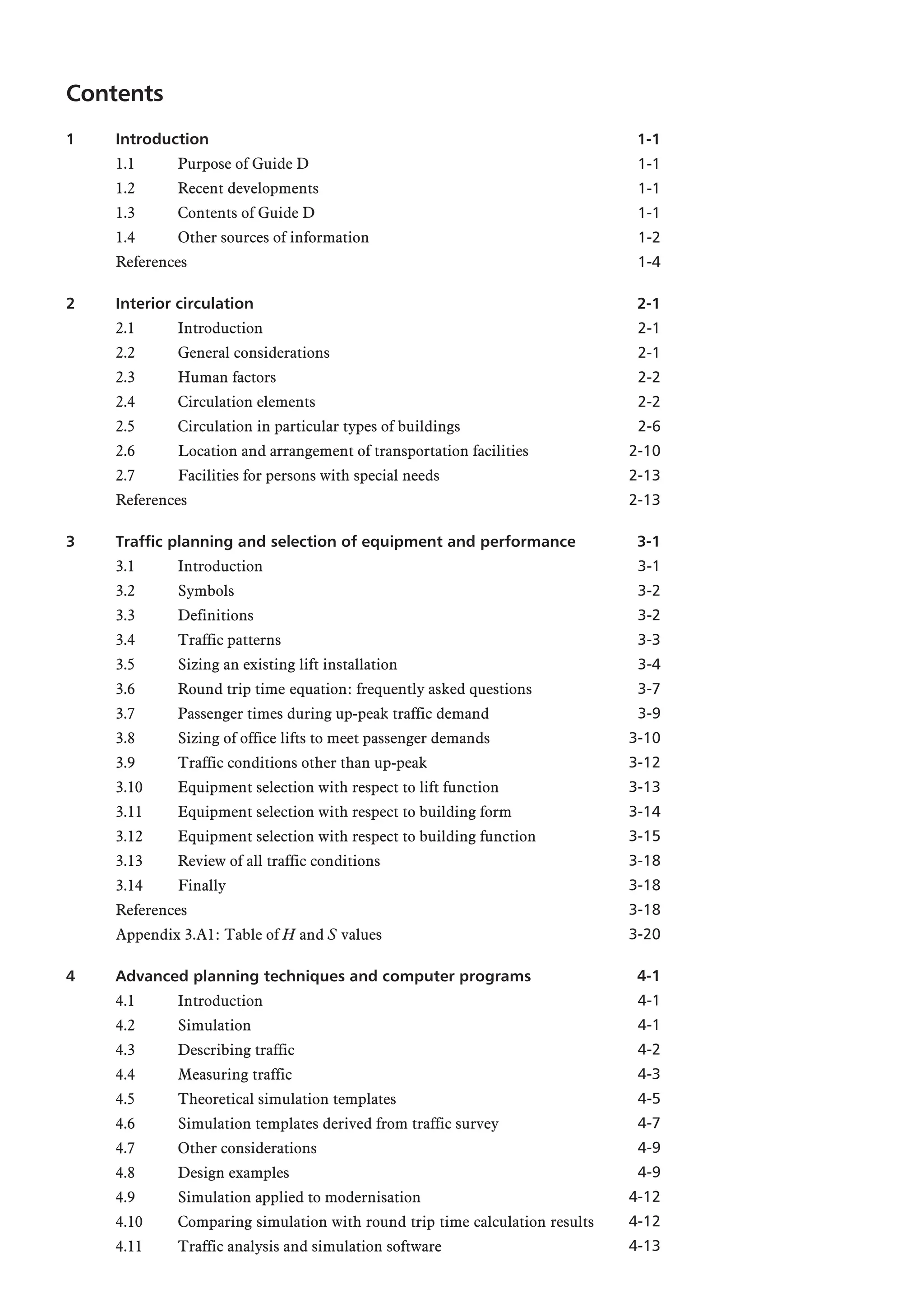
Contents
1 Introduction
1.1 Purpose of Guide D
1.2 Recent developments
1.3 Contents of Guide D
1.4 Other sources of information
References
2 Interior circulation
2.1 Introduction
2.2 General considerations
2.3 Human factors
2.4 Circulation elements
2.5 Circulation in particular types of buildings
2.6 Location and arrangement of transportation facilities
2.7 Facilities for persons with special needs
References
3 Traffic planning and selection of equipment and performance
3.1 Introduction
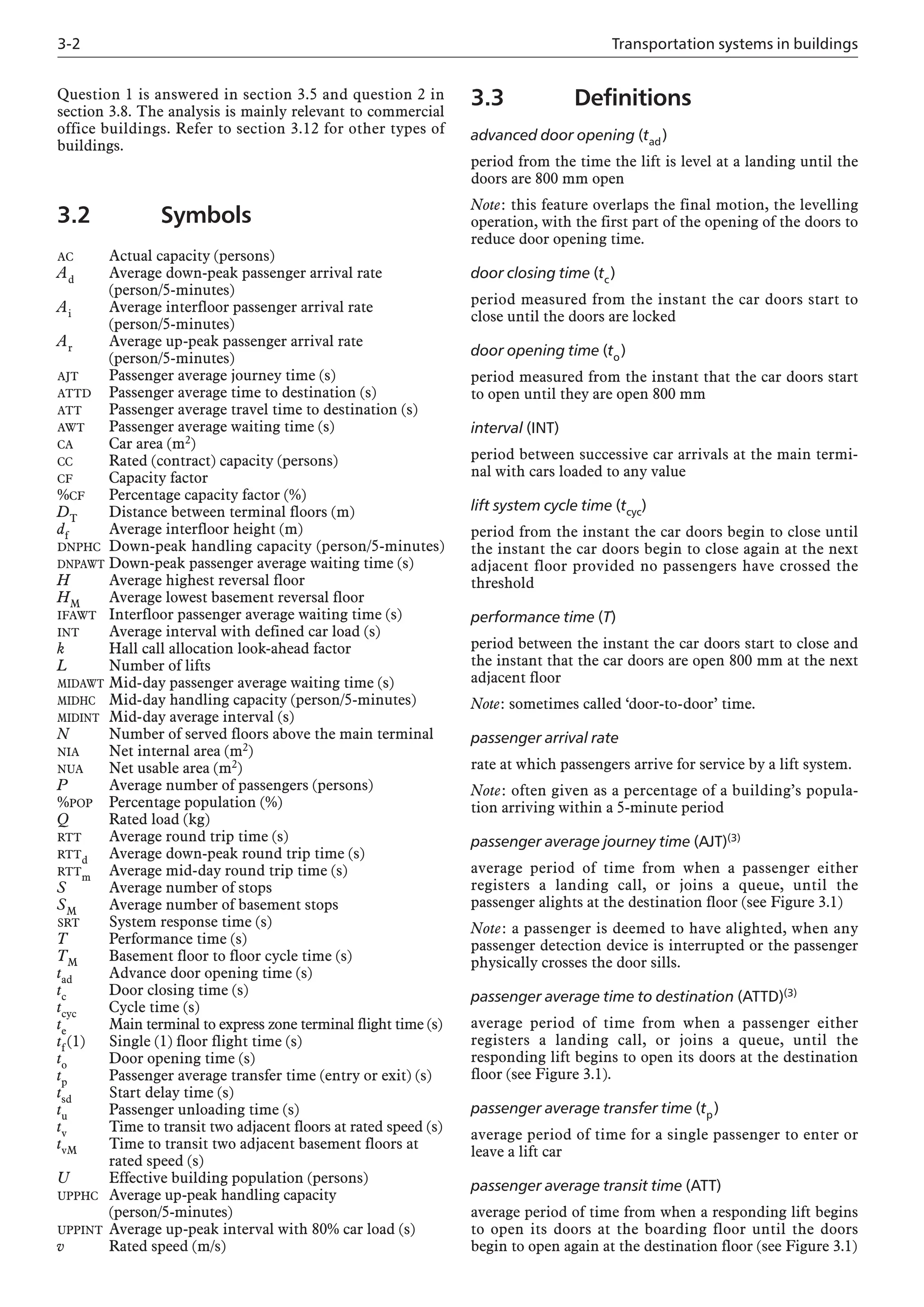
3.2 Symbols
3.3 Definitions
3.4 Traffic patterns
3.5 Sizing an existing lift installation
3.6 Round trip time equation: frequently asked questions
3.7 Passenger times during up-peak traffic demand
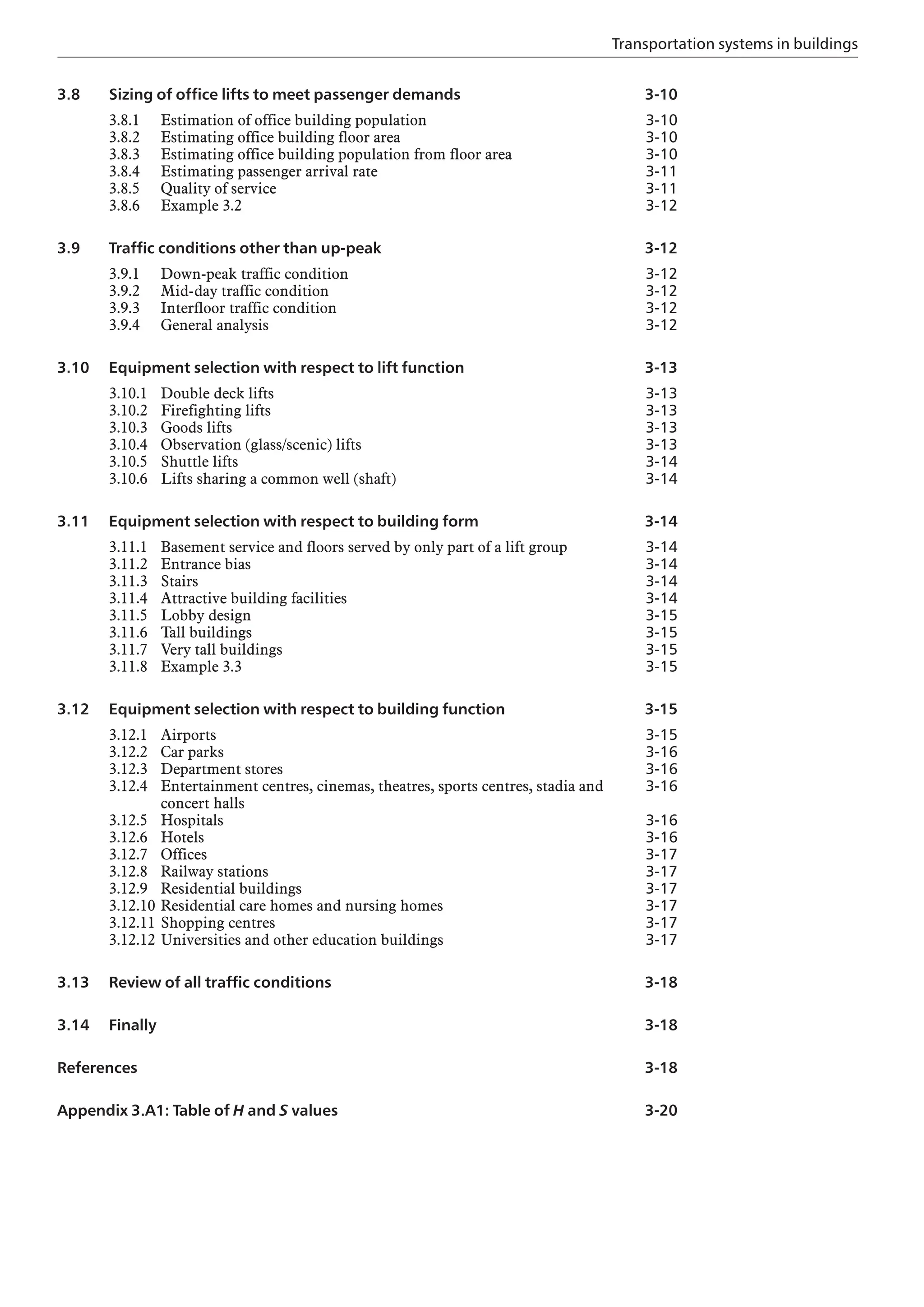
3.8 Sizing of office lifts to meet passenger demands
3.9 Traffic conditions other than up-peak
3.10 Equipment selection with respect to lift function
3.11 Equipment selection with respect to building form
3.12 Equipment selection with respect to building function
3.13 Review of all traffic conditions
3.14 Finally
References
Appendix 3.A1: Table of H and S values
4 Advanced planning techniques and computer programs
4.1 Introduction
4.2 Simulation
4.3 Describing traffic
4.4 Measuring traffic
4.5 Theoretical simulation templates
4.6 Simulation templates derived from traffic survey
4.7 Other considerations
4.8 Design examples
4.9 Simulation applied to modernisation
4.10 Comparing simulation with round trip time calculation results
4.11 Traffic analysis and simulation software
1-1
1-1
1-1
1-1
1-2
1-4
2-1
2-1
2-1
2-2
2-2
2-6
2-10
2-13
2-13
3-1
3-1
3-2
3-2
3-3
3-4
3-7
3-9
3-10
3-12
3-13
3-14
3-15
3-18
3-18
3-18
3-20
4-1
4-1
4-1
4-2
4-3
4-5
4-7
4-9
4-9
4-12
4-12
4-13
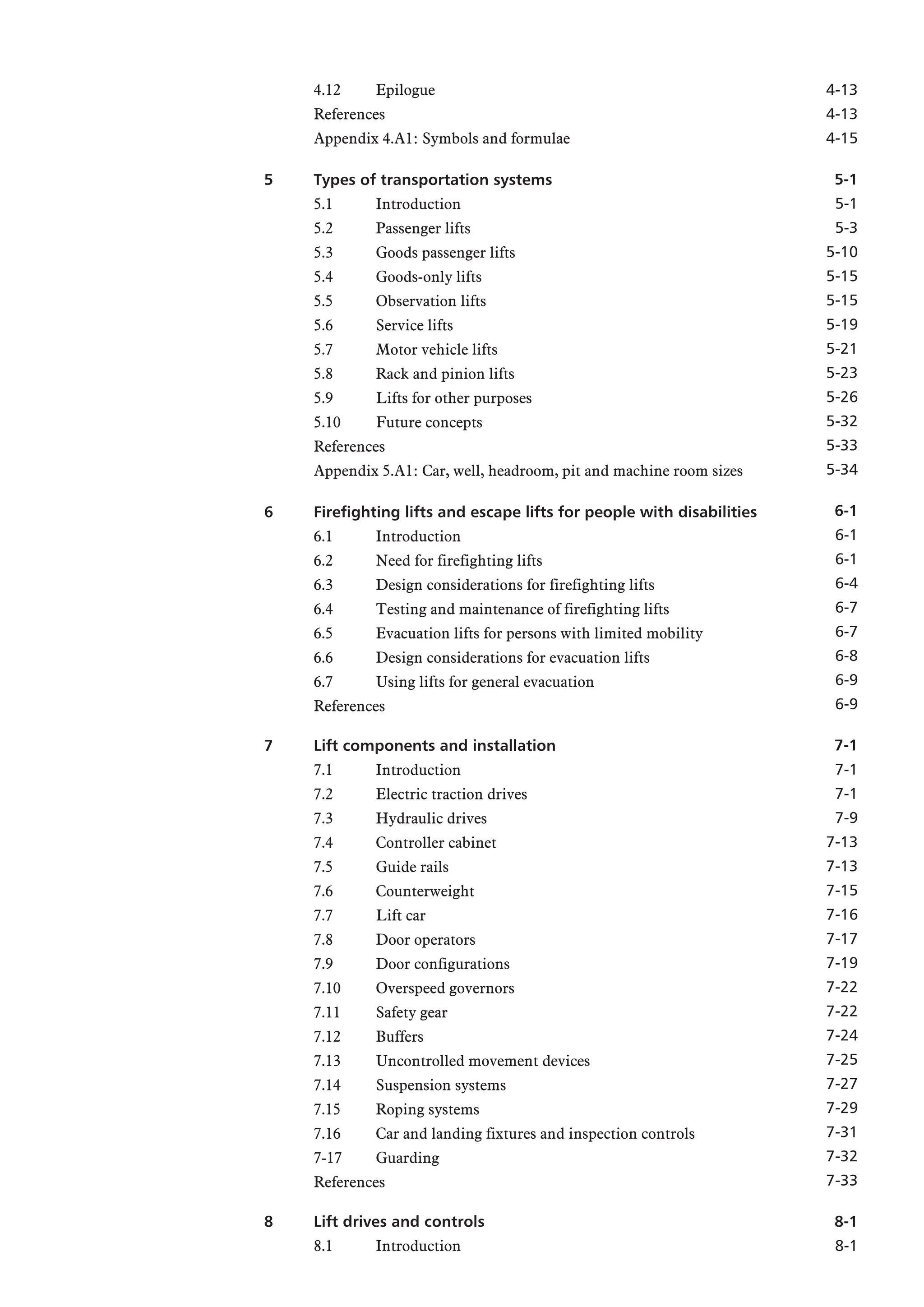
4.12 Epilogue
References
Appendix 4.A1: Symbols and formulae
5 Types of transportation systems
5.1 Introduction
5.2 Passenger lifts
5.3 Goods passenger lifts
5.4 Goods-only lifts
5.5 Observation lifts
5.6 Service lifts
5.7 Motor vehicle lifts
5.8 Rack and pinion lifts
5.9 Lifts for other purposes
5.10 Future concepts
References
Appendix 5.A1: Car, well, headroom, pit and machine room sizes
6 Firefighting lifts and escape lifts for people with disabilities
6.1 Introduction
6.2 Need for firefighting lifts
6.3 Design considerations for firefighting lifts
6.4 Testing and maintenance of firefighting lifts
6.5 Evacuation lifts for persons with limited mobility
6.6 Design considerations for evacuation lifts
6.7 Using lifts for general evacuation
References
7 Lift components and installation
7.1 Introduction
7.2 Electric traction drives
7.3 Hydraulic drives
7.4 Controller cabinet
7.5 Guide rails
7.6 Counterweight
7.7 Lift car
7.8 Door operators
7.9 Door configurations
7.10 Overspeed governors
7.11 Safety gear
7.12 Buffers
7.13 Uncontrolled movement devices
7.14 Suspension systems
7.15 Roping systems
7.16 Car and landing fixtures and inspection controls
7-17 Guarding
References
8 Lift drives and controls
8.1 Introduction
4-13
4-13
4-15
5-1
5-1
5-3
5-10
5-15
5-15
5-19
5-21
5-23
5-26
5-32
5-33
5-34
6-1
6-1
6-1
6-4
6-7
6-7
6-8
6-9
6-9
7-1
7-1
7-1
7-9
7-13
7-13
7-15
7-16
7-17
7-19
7-22
7-22
7-24
7-25
7-27
7-29
7-31
7-32
7-33
8-1
8-1
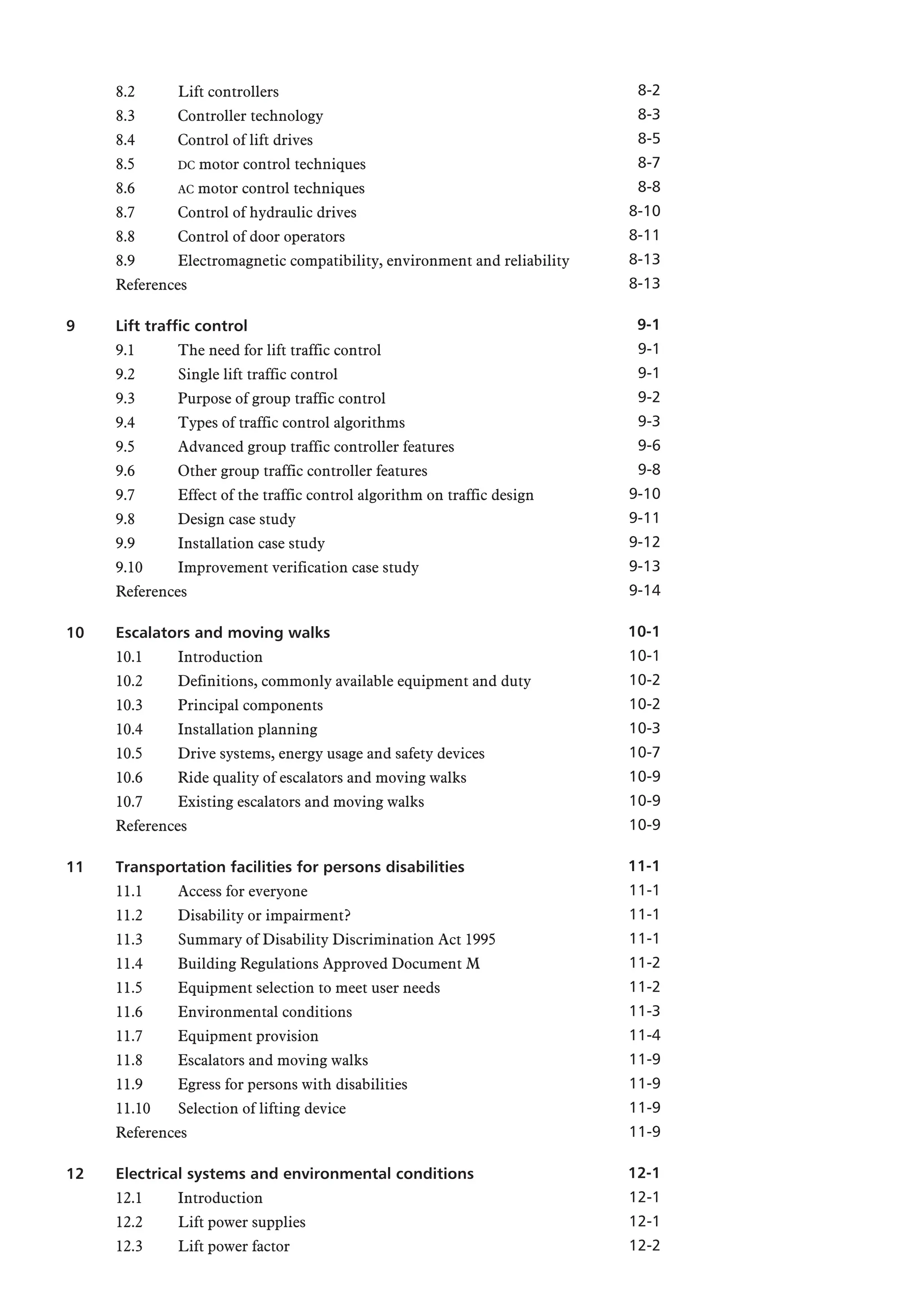
8.2 Lift controllers
8.3 Controller technology
8.4 Control of lift drives
8.5 DC motor control techniques
8.6 AC motor control techniques
8.7 Control of hydraulic drives
8.8 Control of door operators
8.9 Electromagnetic compatibility, environment and reliability
References
9 Lift traffic control
9.1 The need for lift traffic control
9.2 Single lift traffic control
9.3 Purpose of group traffic control
9.4 Types of traffic control algorithms
9.5 Advanced group traffic controller features
9.6 Other group traffic controller features
9.7 Effect of the traffic control algorithm on traffic design
9.8 Design case study
9.9 Installation case study
9.10 Improvement verification case study
References
10 Escalators and moving walks
10.1 Introduction
10.2 Definitions, commonly available equipment and duty
10.3 Principal components
10.4 Installation planning
10.5 Drive systems, energy usage and safety devices
10.6 Ride quality of escalators and moving walks
10.7 Existing escalators and moving walks
References
11 Transportation facilities for persons disabilities
11.1 Access for everyone
11.2 Disability or impairment?
11.3 Summary of Disability Discrimination Act 1995
11.4 Building Regulations Approved Document M
11.5 Equipment selection to meet user needs
11.6 Environmental conditions
11.7 Equipment provision
11.8 Escalators and moving walks
11.9 Egress for persons with disabilities
11.10 Selection of lifting device
References
12 Electrical systems and environmental conditions
12.1 Introduction
12.2 Lift power supplies
12.3 Lift power factor
8-2
8-3
8-5
8-7
8-8
8-10
8-11
8-13
8-13
9-1
9-1
9-1
9-2
9-3
9-6
9-8
9-10
9-11
9-12
9-13
9-14
10-1
10-1
10-2
10-2
10-3
10-7
10-9
10-9
10-9
11-1
11-1
11-1
11-1
11-2
11-2
11-3
11-4
11-9
11-9
11-9
11-9
12-1
12-1
12-1
12-2
12.4 Protection of supplies
12.5 Standby power
12.6 Isolating switches, lighting and socket outlets
12.7 Harmonic distortion
12.8 Electromagnetic interference
12.9 Cabling and wiring
12.10 Machine room environment
12.11 Lift well environment
12.12 Lift car environment
12.13 Human comfort considerations
12.14 Environment for maintenance
12.15 Lightning protection
References
Appendix 12.A1: Schedules for electrical system requirements
13 Energy consumption of lifts, escalators and moving walks
13.1 Legislative provisions
13.2 Energy consumption and energy efficiency
13.3 Energy consumption of lifts
13.4 Factors affecting lift energy consumption
13.5 Measuring the energy consumption of lifts
13.6 Estimating the energy consumption of lifts
13.7 Factors affecting energy consumption of escalators and
moving walks
13.8 Estimating the energy consumption of escalators and
moving walks
13.9 Measuring the energy consumption of escalators and
moving walks
13.10 Measures to conserve energy
13.11 Building energy classification systems
13.12 Future legislation
13.13 Conclusions
References
14 Remote monitoring and alarms
14.1 Reasons for remote alarms and remote monitoring
14.2 Remote lift alarms
14.3 Remote lift monitoring systems
14.4 Building management systems
14.5 Escalators and moving walks
References
15 Commissioning, preventative maintenance, testing and
thorough examination of lifts, escalator and moving walks
15.1 Introduction
15.2 Commissioning
15.3 Preventative maintenance
15.4 Thorough examination and testing
15.5 Documentation
References
12-2
12-3
12-3
12-4
12-4
12-4
12-6
12-9
12-9
12-9
12-11
12-12
12-13
12-14
13-1
13-1
13-1
13-2
13-4
13-5
13-7
13-7
13-7
13-8
13-8
13-9
13-10
13-10
13-11
14-1
14-1
14-1
14-5
14-6
14-8
14-8
15-1
15-1
15-1
15-4
15-7
15-12
15-12
16 Upgrading of safety, performance and equipment for
existing lifts
16.1 Introduction
16.2 Life cycle considerations
16.3 Influencing factors to upgrading
16.4 Relevant legislation, standards and codes of practice
16.5 Undertaking modifications to lifts installed before 1 July 1999
16.6 Undertaking modifications to lifts installed after 1 July 1999
16.7 Important considerations when undertaking modifications to
existing lifts
16.8 Step-by-step approach to improving the safety of existing lifts
16.9 Improvement in accessibility
16.10 Improvement in protection from vandalism
16.11 Improvement in performance
16.12 Improvement by (minor) replacements of major components
16.13 Summary of modifications undertaken to existing lifts
16.10 Tests and records
References
17 European Directives, legislation, standards and codes
of practice
17.1 Important note
17.2 European Directives
17.3 Acts of Parliament
17.4 Regulations
17.5 Standards and codes of practice
References
18 Construction (Design and Management) Regulations 2007
18.1 General
18.2 Introduction
18.3 Summary of Part 4: Duties relating to health and safety
on construction sites
References
Appendix 18.A1: Duties of duty holders
Appendix A1: Glossary of terms
Appendix A2: Lift kinematics
Appendix A3: Legislation and standards related to lifts, escalators
and moving walks
Index
16-1
16-1
16-1
16-2
16-2
16-2
16-2
16-3
16-5
16-8
16-9
16-10
16-10
16-10
16-11
16-18
17-1
17-1
17-1
17-2
17-2
17-6
17-7
18-1
18-1
18-1
18-2
18-4
18-5
A1-1
A2-1
A3-1
I-1
Principal author
Adam Scott (Roger Preston & Partners)
Chapter contents
1.1 Purpose of Guide D
1.2 Recent developments
1.3 Contents of Guide D
1.4 Other sources of information
References
1 Introduction
1-1
1-1
1-1
1-2
1-4
Transportation systems in buildings
Introduction 1-1
1.1 Purpose of Guide D
The purpose of the CIBSE Guide D: Transportation systems
in buildings is to provide guidance to practitioners involved
in such systems. Guide D should also be of interest to
architects and developers, along with facilities and
building managers who may not be directly concerned
with the design and installation of lifts and escalators but
need to understand the advice offered to them by
specialists. Not least, the Guide should be of value to
students embarking on a career in mechanical, electrical
or building services engineering and those already
practising in these disciplines who wish to enhance their
knowledge through a programme of continuing profes-
sional development.
1.2 Recent developments
During recent years we have seen the machine room-less
lift (MRL) become firmly established in the global market-
place with an ever broadening range of applications,
speeds and duty loads. Now, for many buildings, the MRL
lift is an appropriate provision offering significant benefits
in terms of reduced space and capital cost.
Destination control technology (hall call allocation) has
also continued to establish itself in the marketplace,
especially in ‘high-end’ office developments where its
benefits are typically of most value. This prevalence of
destination control systems has in turn catalysed debate
on traffic planning and the need for revised design criteria
to acknowledge the characteristics and capabilities of such
systems, see chapters 3 and 4.
The impact of climate change continues to occupy the
minds of many and the vertical transportation industry
has continued to develop energy conservation initiatives
in order to play its part. The use of variable speed systems,
regenerative drive systems, intelligent control and off-
peak dormancy are all becoming more prevalent as
developers and clients see tangible benefits and shorter
payback periods, see chapter 13. The legislative back-
ground to energy conservation has evolved considerably
and will continue to do so if the aggressive targets agreed
by governments around the world are to be met.
The safety of buildings in the event of fire or other
potentially catastrophic events has been the subject of a
major regulatory and standard revision resulting in the
issue of BS 9999: Code of practice for fire safety in the design,
management and use of buildings(1). This standard
supersedes most of the old BS 5588 family of standards
consolidating them for the first time into a single
document, see chapter 6.
As our society rightfully embraces ‘accessibility for all’
principles, the spotlight continues to fall on the lift as a
means of meeting some of the key legislative and social
requirements. Chapter 11 has been aligned with the
recently revised British Standard Code of Practice BS
8300: Design of buildings and their approaches to meet the
needs of disabled people(2) and the new management
principles set out in BS 9999.
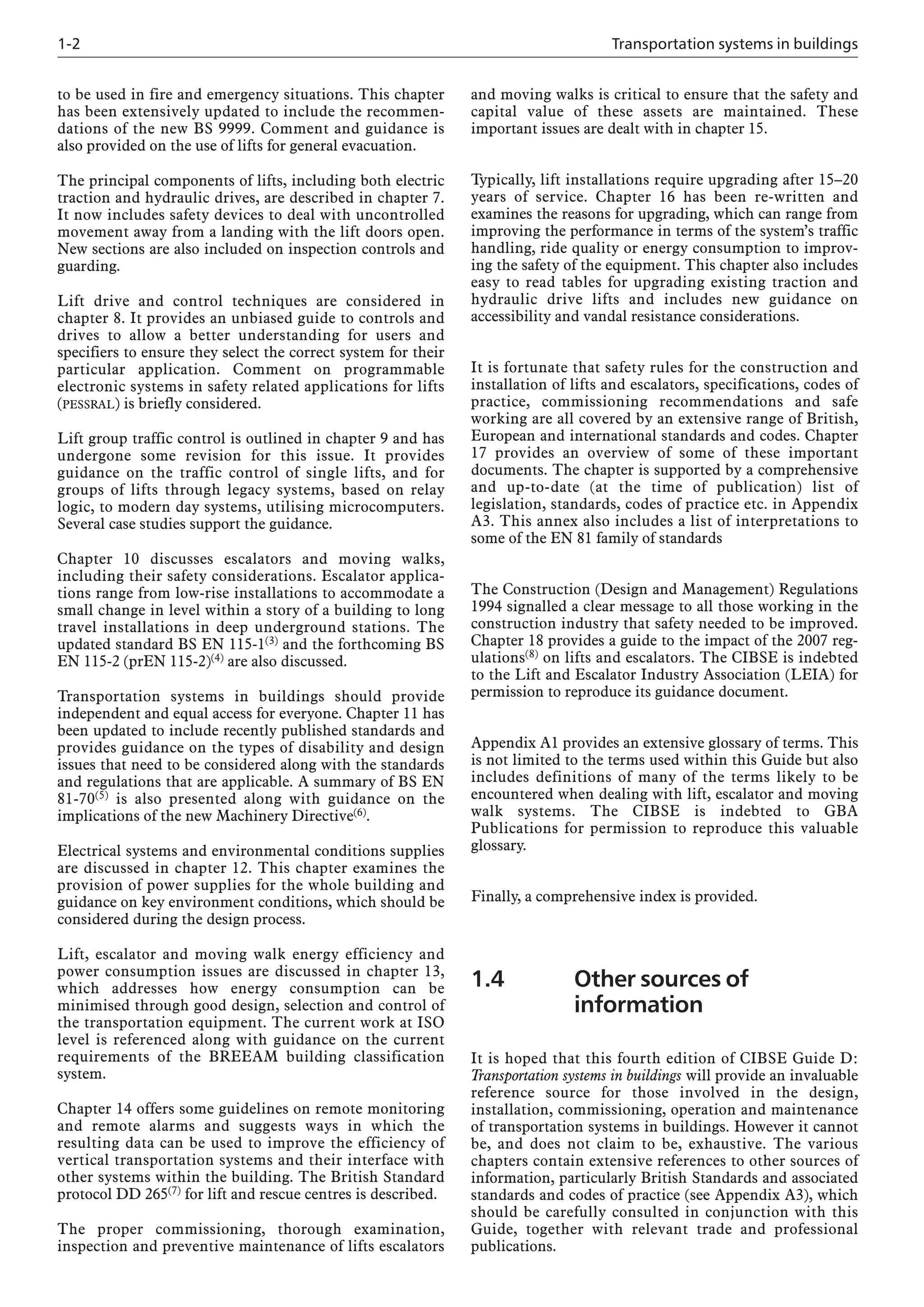
1.3 Contents of Guide D
The design of any lift or escalator system must commence
with a consideration of the traffic flows through the
building for which the system is intended. The relevant
factors, along with guidance on the location and
arrangement of lifts, escalators and moving walks within
buildings, are discussed in chapter 2, which considers a
range of building types along with some additional
guidance principles for disabled circulation.
The assessment of demand and fundamental principles of
traffic planning and selection of lift equipment are
considered in chapter 3. Guidance tables have been
updated to align with current thinking, particularly the
trend towards simulation, and to link with the twelve
building types considered in chapters 2 and 5. The
mathematics has been minimised by the use of referenced
material and additional advice provided on system
response times for office buildings.
Chapter 4 covers advanced planning techniques and the
use of computer simulation. This chapter has been
extensively revised to align with current thinking and
simplified to remove much of the supporting mathematics
now referenced elsewhere. The findings of recent surveys
into actual passenger demand in buildings are presented
along with new demand templates for use in computer
simulations. The value of simulation in assessing potential
benefits of modernisation is also discussed. Lift kine-
matics, supporting chapter 4, is provided in Appendix A2.
Chapter 5 should be considered a pivotal chapter as it
gives a thorough review of 16 types of vertical transporta-
tion. This chapter should be the first port of call for new
entrants into the industry. It presents an overview of the
various types of lifting systems and provides advice on
planning and design principles. The chapter examines the
standard traction drive and hydraulic drive lifts, including
machine room-less lifts and the appendix provides
guidance on structural well sizing and links with the 12
building types described in chapters 2 and 3.
Firefighting lifts and escape lifts for people with
disabilities are particularly important categories. For this
reason these are treated separately in chapter 6, which
explains the basic requirements for lifts that are intended
1 Introduction
1-2 Transportation systems in buildings
to be used in fire and emergency situations. This chapter
has been extensively updated to include the recommen-
dations of the new BS 9999. Comment and guidance is
also provided on the use of lifts for general evacuation.
The principal components of lifts, including both electric
traction and hydraulic drives, are described in chapter 7.
It now includes safety devices to deal with uncontrolled
movement away from a landing with the lift doors open.
New sections are also included on inspection controls and
guarding.
Lift drive and control techniques are considered in
chapter 8. It provides an unbiased guide to controls and
drives to allow a better understanding for users and
specifiers to ensure they select the correct system for their
particular application. Comment on programmable
electronic systems in safety related applications for lifts
(PESSRAL) is briefly considered.
Lift group traffic control is outlined in chapter 9 and has
undergone some revision for this issue. It provides
guidance on the traffic control of single lifts, and for
groups of lifts through legacy systems, based on relay
logic, to modern day systems, utilising microcomputers.
Several case studies support the guidance.
Chapter 10 discusses escalators and moving walks,
including their safety considerations. Escalator applica-
tions range from low-rise installations to accommodate a
small change in level within a story of a building to long
travel installations in deep underground stations. The
updated standard BS EN 115-1(3) and the forthcoming BS
EN 115-2 (prEN 115-2)(4) are also discussed.
Transportation systems in buildings should provide
independent and equal access for everyone. Chapter 11 has
been updated to include recently published standards and
provides guidance on the types of disability and design
issues that need to be considered along with the standards
and regulations that are applicable. A summary of BS EN
81-70(5) is also presented along with guidance on the
implications of the new Machinery Directive(6).
Electrical systems and environmental conditions supplies
are discussed in chapter 12. This chapter examines the
provision of power supplies for the whole building and
guidance on key environment conditions, which should be
considered during the design process.
Lift, escalator and moving walk energy efficiency and
power consumption issues are discussed in chapter 13,
which addresses how energy consumption can be
minimised through good design, selection and control of
the transportation equipment. The current work at ISO
level is referenced along with guidance on the current
requirements of the BREEAM building classification
system.
Chapter 14 offers some guidelines on remote monitoring
and remote alarms and suggests ways in which the
resulting data can be used to improve the efficiency of
vertical transportation systems and their interface with
other systems within the building. The British Standard
protocol DD 265(7) for lift and rescue centres is described.
The proper commissioning, thorough examination,
inspection and preventive maintenance of lifts escalators
and moving walks is critical to ensure that the safety and
capital value of these assets are maintained. These
important issues are dealt with in chapter 15.
Typically, lift installations require upgrading after 15–20
years of service. Chapter 16 has been re-written and
examines the reasons for upgrading, which can range from
improving the performance in terms of the system’s traffic
handling, ride quality or energy consumption to improv-
ing the safety of the equipment. This chapter also includes
easy to read tables for upgrading existing traction and
hydraulic drive lifts and includes new guidance on
accessibility and vandal resistance considerations.
It is fortunate that safety rules for the construction and
installation of lifts and escalators, specifications, codes of
practice, commissioning recommendations and safe
working are all covered by an extensive range of British,
European and international standards and codes. Chapter
17 provides an overview of some of these important
documents. The chapter is supported by a comprehensive
and up-to-date (at the time of publication) list of
legislation, standards, codes of practice etc. in Appendix
A3. This annex also includes a list of interpretations to
some of the EN 81 family of standards
The Construction (Design and Management) Regulations
1994 signalled a clear message to all those working in the
construction industry that safety needed to be improved.
Chapter 18 provides a guide to the impact of the 2007 reg-
ulations(8) on lifts and escalators. The CIBSE is indebted
to the Lift and Escalator Industry Association (LEIA) for
permission to reproduce its guidance document.
Appendix A1 provides an extensive glossary of terms. This
is not limited to the terms used within this Guide but also
includes definitions of many of the terms likely to be
encountered when dealing with lift, escalator and moving
walk systems. The CIBSE is indebted to GBA
Publications for permission to reproduce this valuable
glossary.
Finally, a comprehensive index is provided.
1.4 Other sources of
information
It is hoped that this fourth edition of CIBSE Guide D:
Transportation systems in buildings will provide an invaluable
reference source for those involved in the design,
installation, commissioning, operation and maintenance
of transportation systems in buildings. However it cannot
be, and does not claim to be, exhaustive. The various
chapters contain extensive references to other sources of
information, particularly British Standards and associated
standards and codes of practice (see Appendix A3), which
should be carefully consulted in conjunction with this
Guide, together with relevant trade and professional
publications.
Introduction 1-3
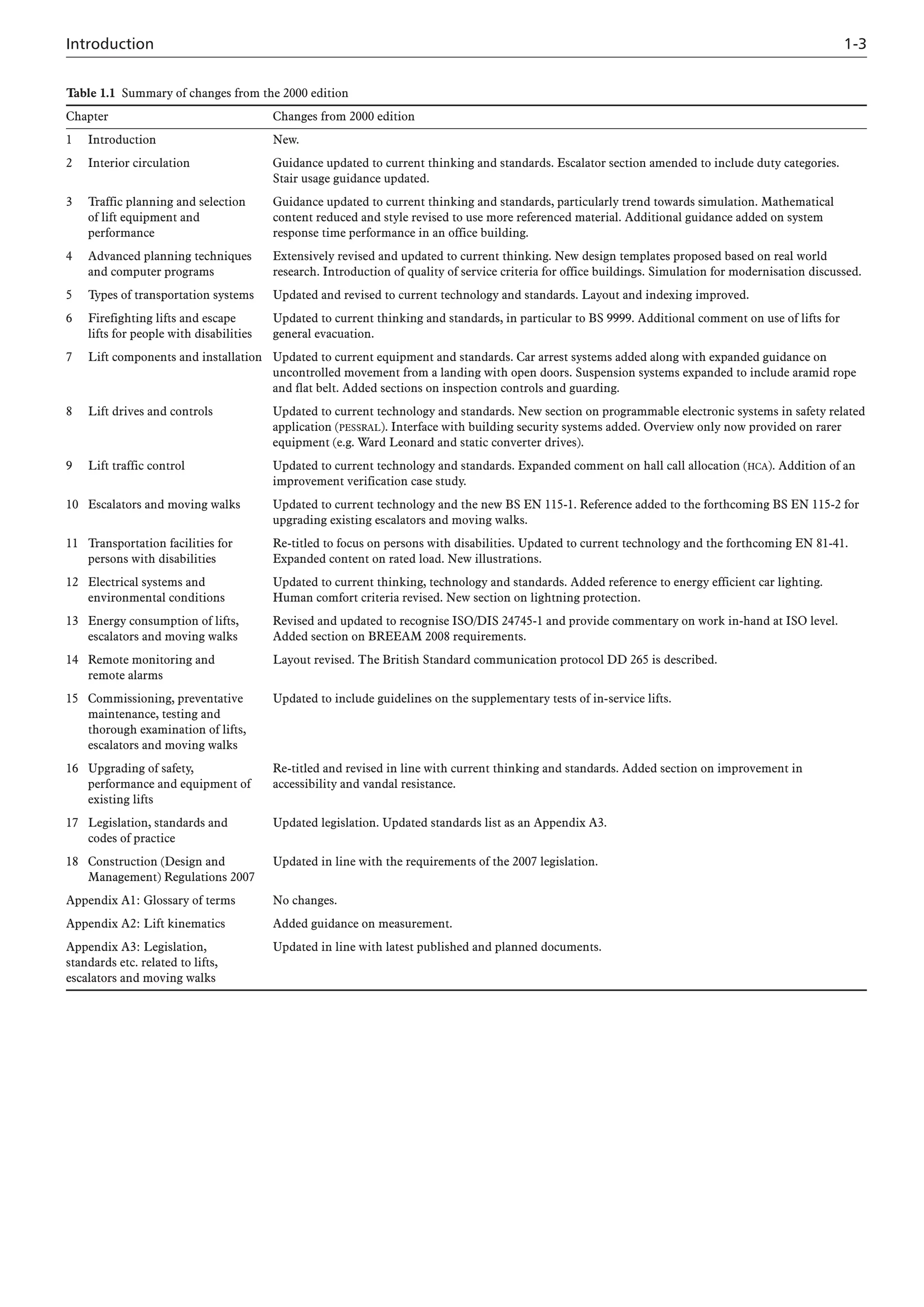
Table 1.1 Summary of changes from the 2000 edition
Chapter Changes from 2000 edition
1 Introduction New.
2 Interior circulation Guidance updated to current thinking and standards. Escalator section amended to include duty categories.
Stair usage guidance updated.
3 Traffic planning and selection Guidance updated to current thinking and standards, particularly trend towards simulation. Mathematical
of lift equipment and content reduced and style revised to use more referenced material. Additional guidance added on system
performance response time performance in an office building.
4 Advanced planning techniques Extensively revised and updated to current thinking. New design templates proposed based on real world
and computer programs research. Introduction of quality of service criteria for office buildings. Simulation for modernisation discussed.
5 Types of transportation systems Updated and revised to current technology and standards. Layout and indexing improved.
6 Firefighting lifts and escape Updated to current thinking and standards, in particular to BS 9999. Additional comment on use of lifts for
lifts for people with disabilities general evacuation.
7 Lift components and installation Updated to current equipment and standards. Car arrest systems added along with expanded guidance on
uncontrolled movement from a landing with open doors. Suspension systems expanded to include aramid rope
and flat belt. Added sections on inspection controls and guarding.
8 Lift drives and controls Updated to current technology and standards. New section on programmable electronic systems in safety related
application (PESSRAL). Interface with building security systems added. Overview only now provided on rarer
equipment (e.g. Ward Leonard and static converter drives).
9 Lift traffic control Updated to current technology and standards. Expanded comment on hall call allocation (HCA). Addition of an
improvement verification case study.
10 Escalators and moving walks Updated to current technology and the new BS EN 115-1. Reference added to the forthcoming BS EN 115-2 for
upgrading existing escalators and moving walks.
11 Transportation facilities for Re-titled to focus on persons with disabilities. Updated to current technology and the forthcoming EN 81-41.
persons with disabilities Expanded content on rated load. New illustrations.
12 Electrical systems and Updated to current thinking, technology and standards. Added reference to energy efficient car lighting.
environmental conditions Human comfort criteria revised. New section on lightning protection.
13 Energy consumption of lifts, Revised and updated to recognise ISO/DIS 24745-1 and provide commentary on work in-hand at ISO level.
escalators and moving walks Added section on BREEAM 2008 requirements.
14 Remote monitoring and Layout revised. The British Standard communication protocol DD 265 is described.
remote alarms
15 Commissioning, preventative Updated to include guidelines on the supplementary tests of in-service lifts.
maintenance, testing and
thorough examination of lifts,
escalators and moving walks
16 Upgrading of safety, Re-titled and revised in line with current thinking and standards. Added section on improvement in
performance and equipment of accessibility and vandal resistance.
existing lifts
17 Legislation, standards and Updated legislation. Updated standards list as an Appendix A3.
codes of practice
18 Construction (Design and Updated in line with the requirements of the 2007 legislation.
Management) Regulations 2007
Appendix A1: Glossary of terms No changes.
Appendix A2: Lift kinematics Added guidance on measurement.
Appendix A3: Legislation, Updated in line with latest published and planned documents.
standards etc. related to lifts,
escalators and moving walks
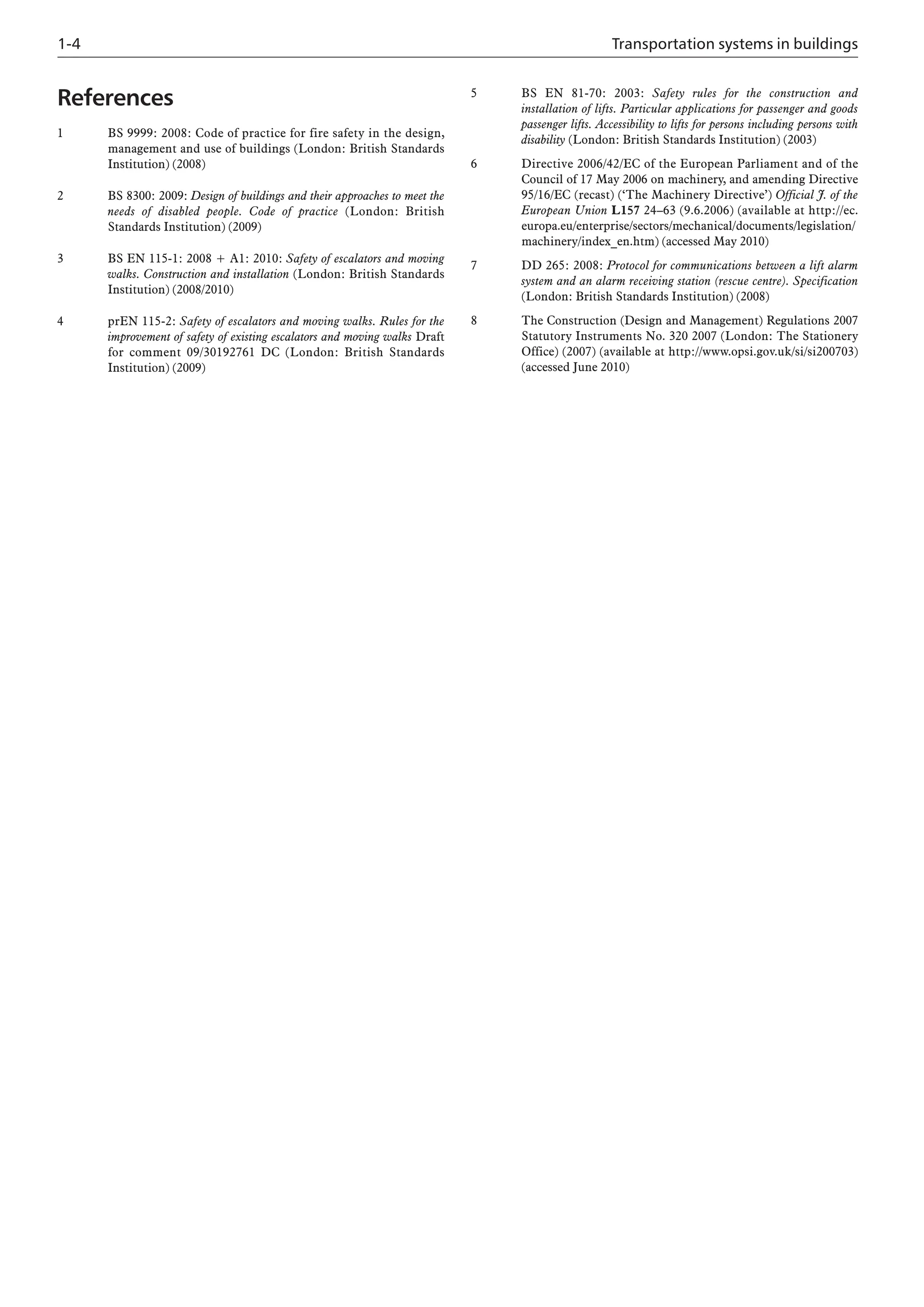
References
1 BS 9999: 2008: Code of practice for fire safety in the design,
management and use of buildings (London: British Standards
Institution) (2008)
2 BS 8300: 2009: Design of buildings and their approaches to meet the
needs of disabled people. Code of practice (London: British
Standards Institution) (2009)
3 BS EN 115-1: 2008 + A1: 2010: Safety of escalators and moving
walks. Construction and installation (London: British Standards
Institution) (2008/2010)
4 prEN 115-2: Safety of escalators and moving walks. Rules for the
improvement of safety of existing escalators and moving walks Draft
for comment 09/30192761 DC (London: British Standards
Institution) (2009)
5 BS EN 81-70: 2003: Safety rules for the construction and
installation of lifts. Particular applications for passenger and goods
passenger lifts. Accessibility to lifts for persons including persons with
disability (London: British Standards Institution) (2003)
6 Directive 2006/42/EC of the European Parliament and of the
Council of 17 May 2006 on machinery, and amending Directive
95/16/EC (recast) (‘The Machinery Directive’) Official J. of the
European Union L157 24–63 (9.6.2006) (available at http://ec.
europa.eu/enterprise/sectors/mechanical/documents/legislation/
machinery/index_en.htm) (accessed May 2010)
7 DD 265: 2008: Protocol for communications between a lift alarm
system and an alarm receiving station (rescue centre). Specification
(London: British Standards Institution) (2008)
8 The Construction (Design and Management) Regulations 2007
Statutory Instruments No. 320 2007 (London: The Stationery
Office) (2007) (available at http://www.opsi.gov.uk/si/si200703)
(accessed June 2010)
1-4 Transportation systems in buildings
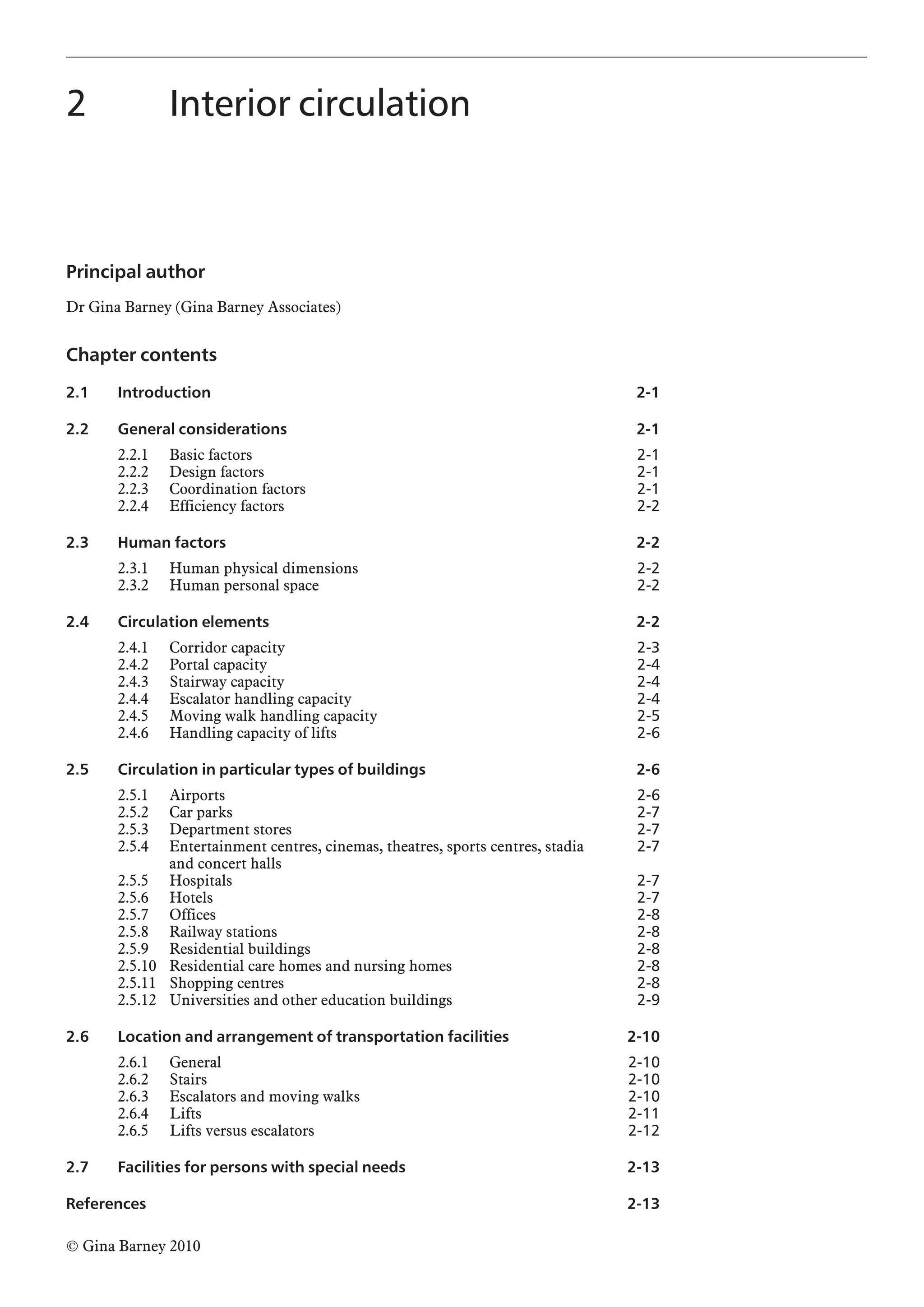
Principal author
Dr Gina Barney (Gina Barney Associates)
Chapter contents
2.1 Introduction
2.2 General considerations
2.2.1 Basic factors
2.2.2 Design factors
2.2.3 Coordination factors
2.2.4 Efficiency factors
2.3 Human factors
2.3.1 Human physical dimensions
2.3.2 Human personal space
2.4 Circulation elements
2.4.1 Corridor capacity
2.4.2 Portal capacity
2.4.3 Stairway capacity
2.4.4 Escalator handling capacity
2.4.5 Moving walk handling capacity
2.4.6 Handling capacity of lifts
2.5 Circulation in particular types of buildings
2.5.1 Airports
2.5.2 Car parks
2.5.3 Department stores
2.5.4 Entertainment centres, cinemas, theatres, sports centres, stadia
and concert halls
2.5.5 Hospitals
2.5.6 Hotels
2.5.7 Offices
2.5.8 Railway stations
2.5.9 Residential buildings
2.5.10 Residential care homes and nursing homes
2.5.11 Shopping centres
2.5.12 Universities and other education buildings
2.6 Location and arrangement of transportation facilities
2.6.1 General
2.6.2 Stairs
2.6.3 Escalators and moving walks
2.6.4 Lifts
2.6.5 Lifts versus escalators
2.7 Facilities for persons with special needs
References
2 Interior circulation
© Gina Barney 2010
2-1
2-1
2-1
2-1
2-1
2-2
2-2
2-2
2-2
2-2
2-3
2-4
2-4
2-4
2-5
2-6
2-6
2-6
2-7
2-7
2-7
2-7
2-7
2-8
2-8
2-8
2-8
2-8
2-9
2-10
2-10
2-10
2-10
2-11
2-12
2-13
2-13
Transportation systems in buildings
Interior circulation 2-1
2.1 Introduction
This chapter provides general guidance regarding the
movement of people in buildings. Because it deals with
people, many of the recommendations are based on
empirical data acquired by observation and the experience
gained in their application. Much of what follows cannot
be proved theoretically and many of the conclusions have
been drawn from the observations made. Reasons are
given for the conclusions so that if new evidence comes to
hand (or opinions change) the results can be modified.
National and local regulations may also affect the
circulation design, such as fire and safety codes, and these
should be taken into account. Readers are referred to
Barney(2) and Fruin(14) for fuller expositions and case
studies.
Whilst the reader may apply the guidance given here,
specialist design assistance may be needed for complex or
unusual situations. Throughout the chapter people are
called ‘pedestrians’ when on foot, and called ‘passengers’
when being mechanically transported.
Warning: all the tables in this chapter give empirical
values and should be considered to be average values only.
2.2 General considerations
2.2.1 Basic factors
The circulation of people in the interior of buildings is a
complicated activity (Dober, 1969)(13) and is affected by a
number of basic factors:
— Mode: horizontal and vertical movement
People generally move horizontally, except where
they are using inclined moving walks, they then
change to vertical movement to reach a higher or
lower level. To change mode they can use stairs,
escalators or lifts.
— Movement type: natural or mechanically assisted
People are moving naturally when walking along
corridors and through portals and are mechan-
ically assisted when using escalators, moving walks
and lifts.
— Complications: human behaviour
The movement of people around a building is
complex because people are complex. Individuals
have their concepts of route, their purpose for
travel, their level of urgency, their personal
characteristics of age, gender, culture, handicaps,
etc. There is always unpredictability in human
behaviour.
2.2.2 Design factors
A number of design factors affect the interior circulation
in a building:
— Consider all circulation routes: these include princi-
pal and secondary circulation areas, escape routes,
service routes and areas.
— Provide clear and obvious routes: pedestrians should
be able to see the route to take and be assisted by
good signage and open vistas.
— Ensure that the circulation patterns are rational: an
example is the avoidance of pedestrians passing
through a lift lobby, where other persons are
waiting.
— Ensure that incompatible types of circulation do not
coincide: this would apply to pushing goods
trolleys across a pedestrian mall in a shopping
centre.
— Minimise the movement of people and goods: the
location of related or associated activities is
essential, e.g. sales and marketing, and personnel
(human resources) and training in an office
building.
2.2.3 Coordination factors
The design and location of portals (defined here as
entrances, doorways, gates, etc.), corridors, stairs and
mechanical handling equipment (horizontal and inclined
pedestrian conveyors, escalators, lifts) should be coordi-
nated, i.e:
— The free flow of people, goods and vehicles: levels of
occupancy and density of usage should be such as
to permit the free movement of people and goods.
— The occupation of the minimum space: a building
owner/tenant wishes to maximise the area in
which people may occupy.
— Bottlenecks and pinch points are prevented: a
bottleneck or pinch point reduces the free
movement of people and goods.
— Sizing of circulation elements: it is important to size
each circulation element. The handling capacities
of corridors, which lead to stairs, which in turn
lead to a lift, should be adequately sized for their
anticipated demand.
(Note: the term ‘handling capacity’ is used here for
passive (i.e. non-mechanical) building elements in
the same way as it is applied to the mechanical
elements and the term ‘demand’ is used to indicate
the level of usage.)
2 Interior circulation
2-2 Transportation systems in buildings
— Movement space: in a shopping centre a consider-
ation is the requirement to provide space for the
movement of shopping trolleys, wheelchairs,
mobility aids and retailers carts. In offices, it may
be necessary to make provision for the occasional
movement of equipment, plant and refurbishment
materials.
2.2.4 Efficiency factors
The efficiency of interior circulation is dependant on
building shape. Tall/slender and low/squat buildings are
generally inefficient. The ideal shape is ‘compact’.
Efficiency is also affected by a number of other factors, i.e:
— the relative location of rooms
— the relationship of major spaces with entrances
and mechanical people-handling equipment
— the importance of the journey undertaken (e.g.
hospital theatre traffic)
— the separation of different traffic types (e.g.
clean/dirty)
— the need to group some spaces together
— the conflict of vertical and horizontal circulation
modes.
2.3 Human factors
2.3.1 Human physical dimensions
The physical dimensions of the human body vary widely.
Females are generally smaller than males. The space an
individual occupies depends on the clothing worn and
what they might be carrying. To allow for all these factors
and other circumstances, such as body sway, it is
recommended that the typical occupancy template be
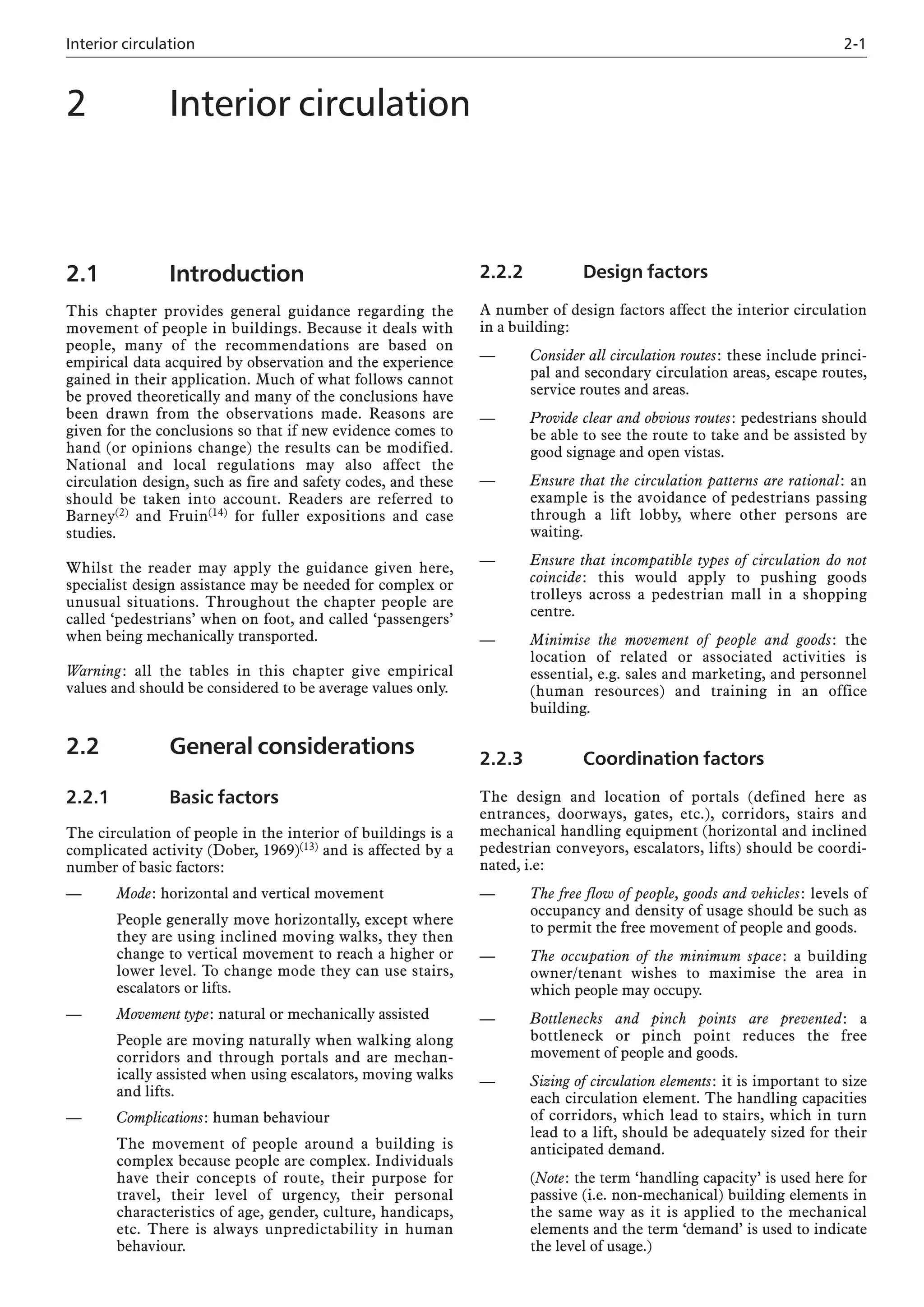
considered to be an ellipse ‘covering’ an area of 0.21 m2,
see Figure 2.1.
The ellipse is 600 mm wide by 450 mm high. It should be
noted that the actual body template of the individual does
not fill the ellipse.
If the typical occupancy template is used to represent the
average individual, then the larger males and females may
be compensated for by smaller males and the females who
may be present.
The occupancy ellipse shown in Figure 2.1 is typical for
European and North American people. There is growing
evidence that over the last few decades more European
and North American people have become bigger and
taller. Some have become overweight, obese and clinically
obese as evidenced by changes in their body mass index
(BMI). The average used in this chapter follows Figure 2.1,
with an average person considered to weigh 75 kg.
In other parts of the world people are different sizes. For
guidance a 65 kg person may occupy 0.18 m2, a 68 kg
person may occupy 0.19 m2 and an 80 kg person may
occupy 0.22 m2. These sizes need to be considered when
designing outside Europe/North America (see chapter 3,
Table 3.1).
2.3.2 Human personal space
Humans value personal space (Hall, 1966)(15). This is
measured by a personal buffer zone around each individ-
ual. The actual size of the buffer zone varies according to
an individual’s culture, age, status, gender, handicaps, etc.
It has been observed that individual female subjects are
comfortable with a personal buffer zone of 0.5 m2 (i.e. a
circle of 0.8 m diameter) and individual male subjects with
a personal buffer zone of 0.8 m2 (i.e. a circle of 1.0 m
diameter). To visualise these sizes a woman’s umbrella
occupies an area of approximately 0.5 m2 and a man’s
umbrella occupies approximately 0.9 m2.
These factors should be borne in mind when designing
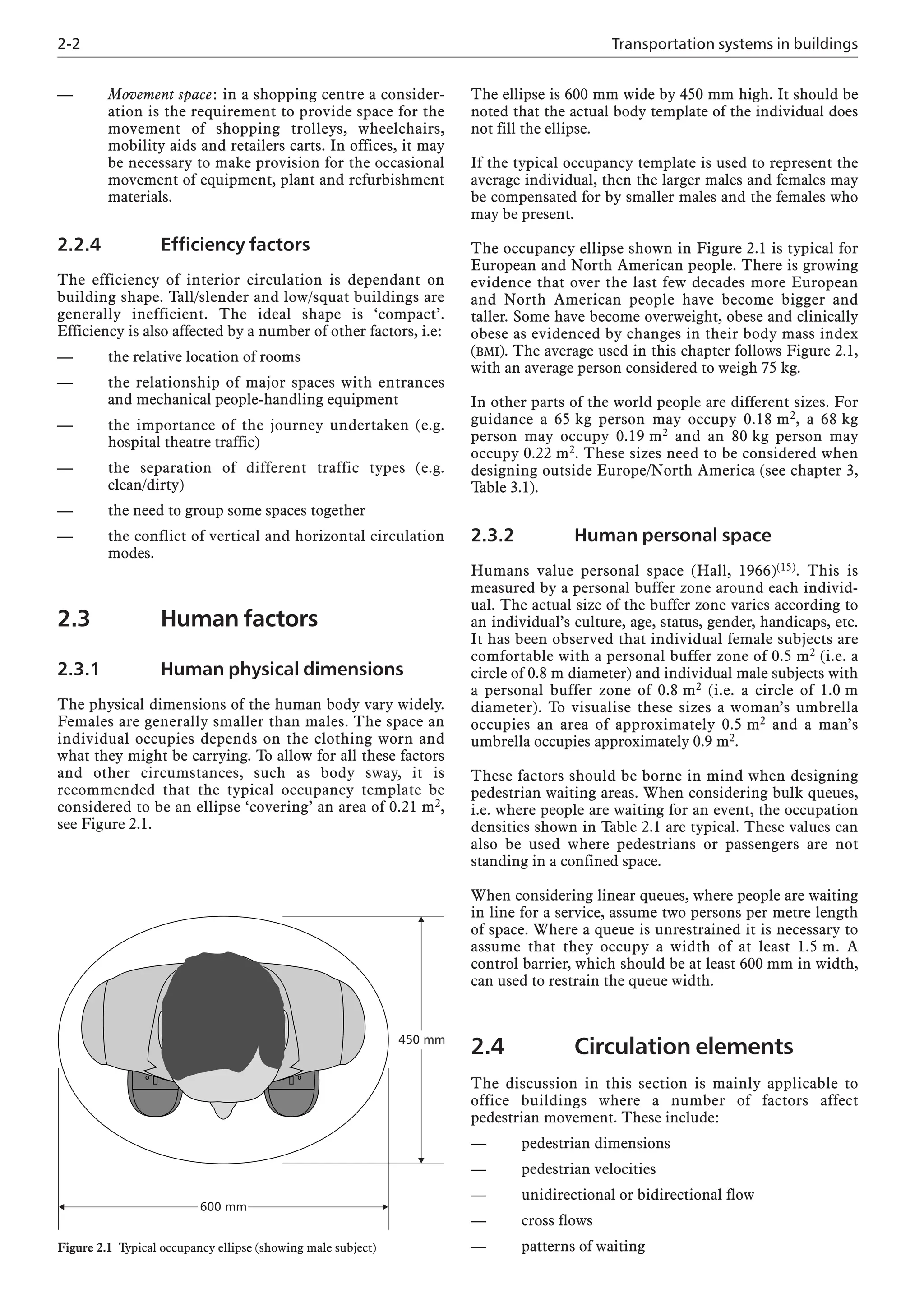
pedestrian waiting areas. When considering bulk queues,
i.e. where people are waiting for an event, the occupation
densities shown in Table 2.1 are typical. These values can
also be used where pedestrians or passengers are not
standing in a confined space.
When considering linear queues, where people are waiting
in line for a service, assume two persons per metre length
of space. Where a queue is unrestrained it is necessary to
assume that they occupy a width of at least 1.5 m. A
control barrier, which should be at least 600 mm in width,
can used to restrain the queue width.
2.4 Circulation elements
The discussion in this section is mainly applicable to
office buildings where a number of factors affect
pedestrian movement. These include:
— pedestrian dimensions
— pedestrian velocities
— unidirectional or bidirectional flow
— cross flows
— patterns of waiting
Figure 2.1 Typical occupancy ellipse (showing male subject)
450 mm
600 mm
Interior circulation 2-3
— site and environmental conditions
— statutory requirements.
2.4.1 Corridor capacity
The term ‘corridor’ is defined here to include passage-
ways, walkways, subways, etc.; i.e. areas whose main
function is to provide a connection between major spaces
and operational areas. They do not include areas where
waiting can occur, such as shopping malls. These are dealt
with in section 2.5.
The capacity of a straight corridor can be given as:
Cc = 60 v D Wc (2.1)
where Cc is the corridor handling capacity (persons/minute),
v is average horizontal pedestrian speed (m/s), D is the
average pedestrian density (persons/m2) and Wc is the
effective corridor width (m).
Equation 2.1 is an empirical relationship with a number of
qualifications. Pedestrian speed and density are not
independent of each other. For densities below 0.3 persons
per square metre pedestrians can walk freely, called ‘free
flow’ design. When densities increase above 0.5 persons
per square metre there is an approximately linear decrease
of average walking speed up to a density of about
3.0 persons per square metre, when walking is reduced to a
shuffle. The throughput peaks at densities of about
1.4 persons per square metre, called ‘full flow’ design.
Walking speeds vary systematically (statistically) with type
of population (age, gender, grouping, purpose), ability
(fitness, handicap), gradient, flow direction, air tempera-
ture, floor finish, etc. Within each group there can be
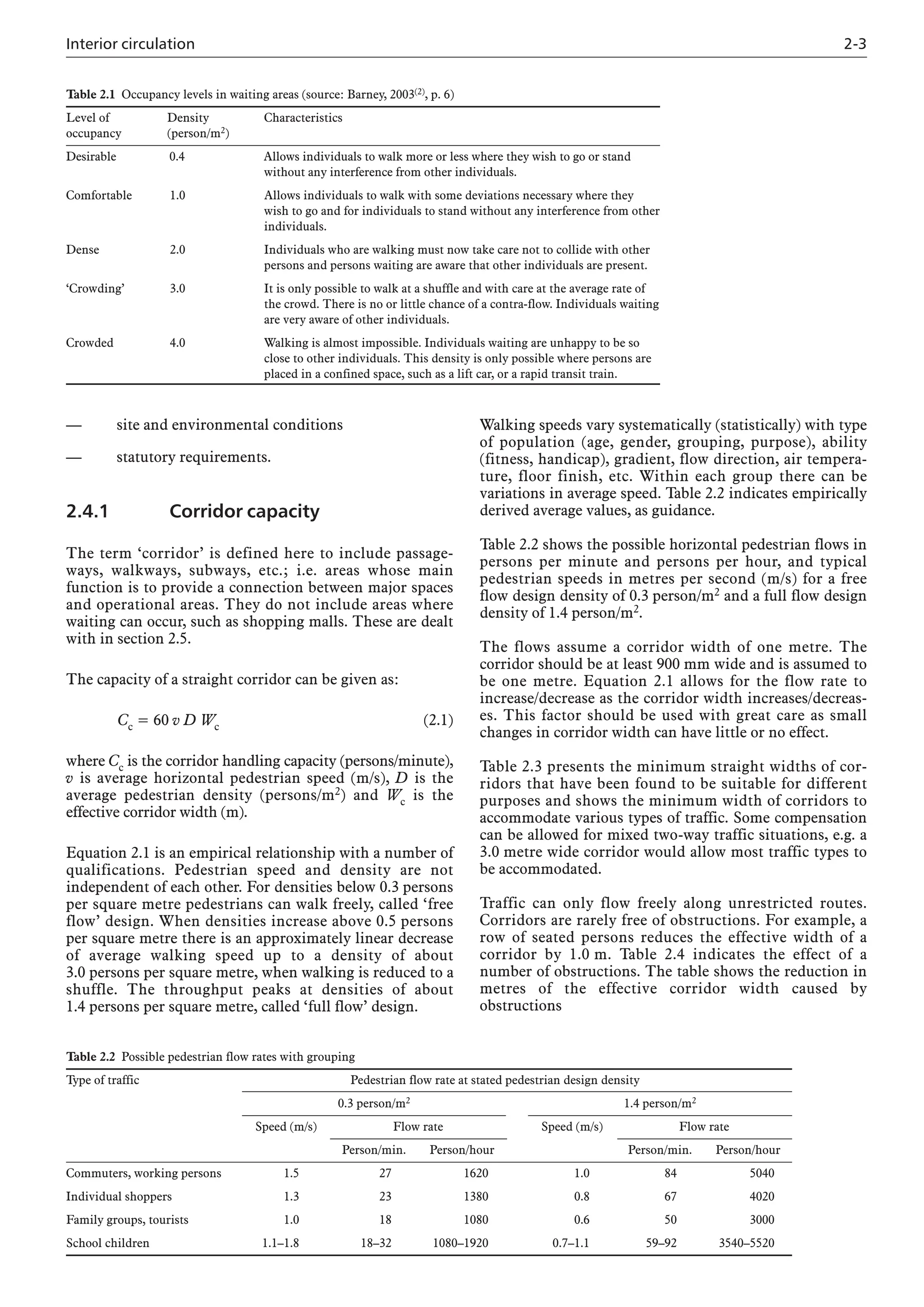
variations in average speed. Table 2.2 indicates empirically
derived average values, as guidance.
Table 2.2 shows the possible horizontal pedestrian flows in
persons per minute and persons per hour, and typical
pedestrian speeds in metres per second (m/s) for a free
flow design density of 0.3 person/m2 and a full flow design
density of 1.4 person/m2.
The flows assume a corridor width of one metre. The
corridor should be at least 900 mm wide and is assumed to
be one metre. Equation 2.1 allows for the flow rate to
increase/decrease as the corridor width increases/decreas-
es. This factor should be used with great care as small
changes in corridor width can have little or no effect.
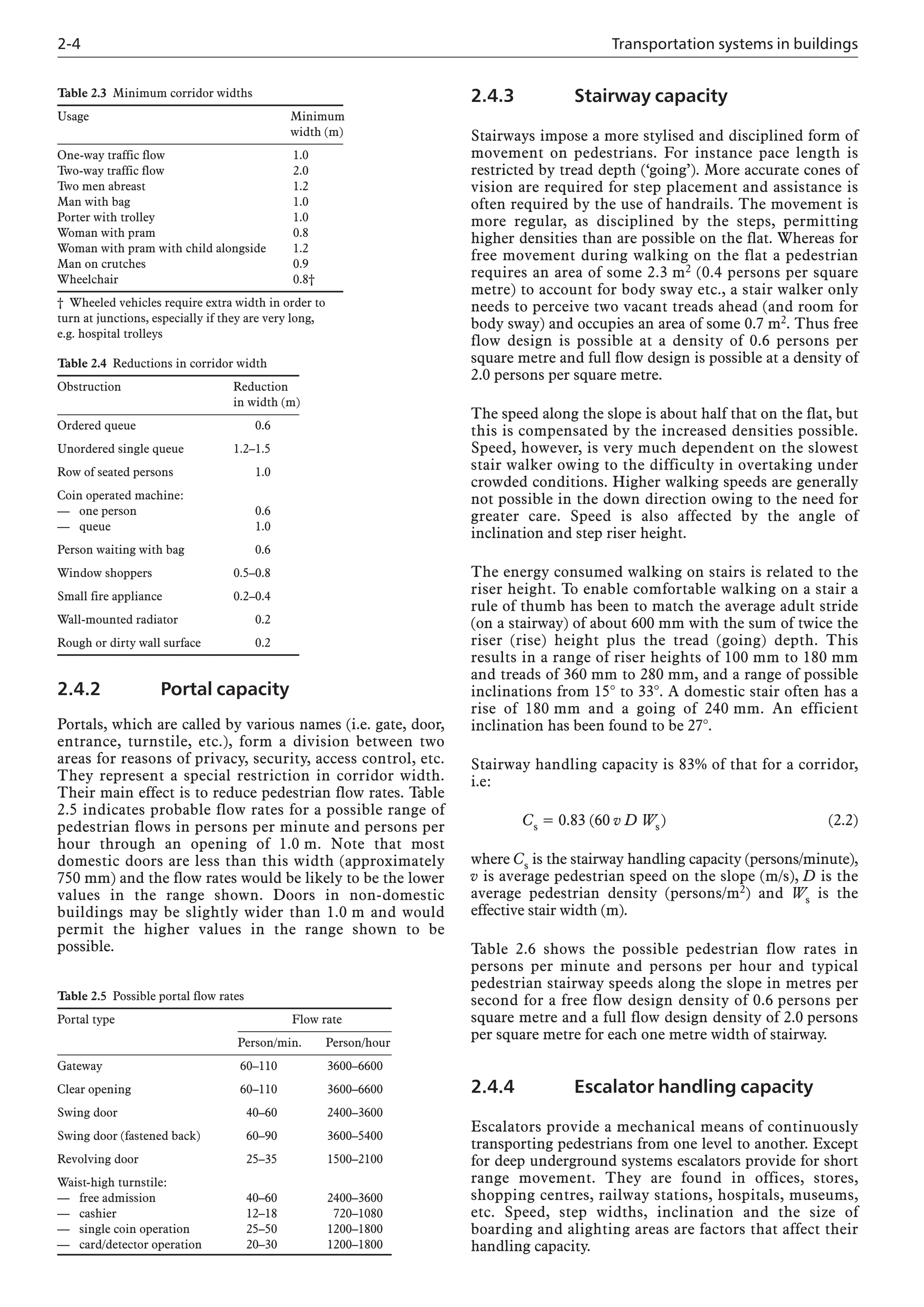
Table 2.3 presents the minimum straight widths of cor-
ridors that have been found to be suitable for different
purposes and shows the minimum width of corridors to
accommodate various types of traffic. Some compensation
can be allowed for mixed two-way traffic situations, e.g. a
3.0 metre wide corridor would allow most traffic types to
be accommodated.
Traffic can only flow freely along unrestricted routes.
Corridors are rarely free of obstructions. For example, a
row of seated persons reduces the effective width of a
corridor by 1.0 m. Table 2.4 indicates the effect of a
number of obstructions. The table shows the reduction in
metres of the effective corridor width caused by
obstructions
Table 2.1 Occupancy levels in waiting areas (source: Barney, 2003(2), p. 6)
Level of Density Characteristics
occupancy (person/m2)
Desirable 0.4 Allows individuals to walk more or less where they wish to go or stand
without any interference from other individuals.
Comfortable 1.0 Allows individuals to walk with some deviations necessary where they
wish to go and for individuals to stand without any interference from other
individuals.
Dense 2.0 Individuals who are walking must now take care not to collide with other
persons and persons waiting are aware that other individuals are present.
‘Crowding’ 3.0 It is only possible to walk at a shuffle and with care at the average rate of
the crowd. There is no or little chance of a contra-flow. Individuals waiting
are very aware of other individuals.
Crowded 4.0 Walking is almost impossible. Individuals waiting are unhappy to be so
close to other individuals. This density is only possible where persons are
placed in a confined space, such as a lift car, or a rapid transit train.
Table 2.2 Possible pedestrian flow rates with grouping
Type of traffic Pedestrian flow rate at stated pedestrian design density
0.3 person/m2 1.4 person/m2
Speed (m/s) Flow rate Speed (m/s) Flow rate
Person/min. Person/hour Person/min. Person/hour
Commuters, working persons 1.5 27 1620 1.0 84 5040
Individual shoppers 1.3 23 1380 0.8 67 4020
Family groups, tourists 1.0 18 1080 0.6 50 3000
School children 1.1–1.8 18–32 1080–1920 0.7–1.1 59–92 3540–5520
2-4 Transportation systems in buildings
2.4.3 Stairway capacity
Stairways impose a more stylised and disciplined form of
movement on pedestrians. For instance pace length is
restricted by tread depth (‘going’). More accurate cones of
vision are required for step placement and assistance is
often required by the use of handrails. The movement is
more regular, as disciplined by the steps, permitting
higher densities than are possible on the flat. Whereas for
free movement during walking on the flat a pedestrian
requires an area of some 2.3 m2 (0.4 persons per square
metre) to account for body sway etc., a stair walker only
needs to perceive two vacant treads ahead (and room for
body sway) and occupies an area of some 0.7 m2. Thus free
flow design is possible at a density of 0.6 persons per
square metre and full flow design is possible at a density of
2.0 persons per square metre.
The speed along the slope is about half that on the flat, but
this is compensated by the increased densities possible.
Speed, however, is very much dependent on the slowest
stair walker owing to the difficulty in overtaking under
crowded conditions. Higher walking speeds are generally
not possible in the down direction owing to the need for
greater care. Speed is also affected by the angle of
inclination and step riser height.
The energy consumed walking on stairs is related to the
riser height. To enable comfortable walking on a stair a
rule of thumb has been to match the average adult stride
(on a stairway) of about 600 mm with the sum of twice the
riser (rise) height plus the tread (going) depth. This
results in a range of riser heights of 100 mm to 180 mm
and treads of 360 mm to 280 mm, and a range of possible
inclinations from 15° to 33°. A domestic stair often has a
rise of 180 mm and a going of 240 mm. An efficient
inclination has been found to be 27°.
Stairway handling capacity is 83% of that for a corridor,
i.e:
Cs = 0.83 (60 v D Ws) (2.2)
where Cs is the stairway handling capacity (persons/minute),
v is average pedestrian speed on the slope (m/s), D is the
average pedestrian density (persons/m2) and Ws is the
effective stair width (m).
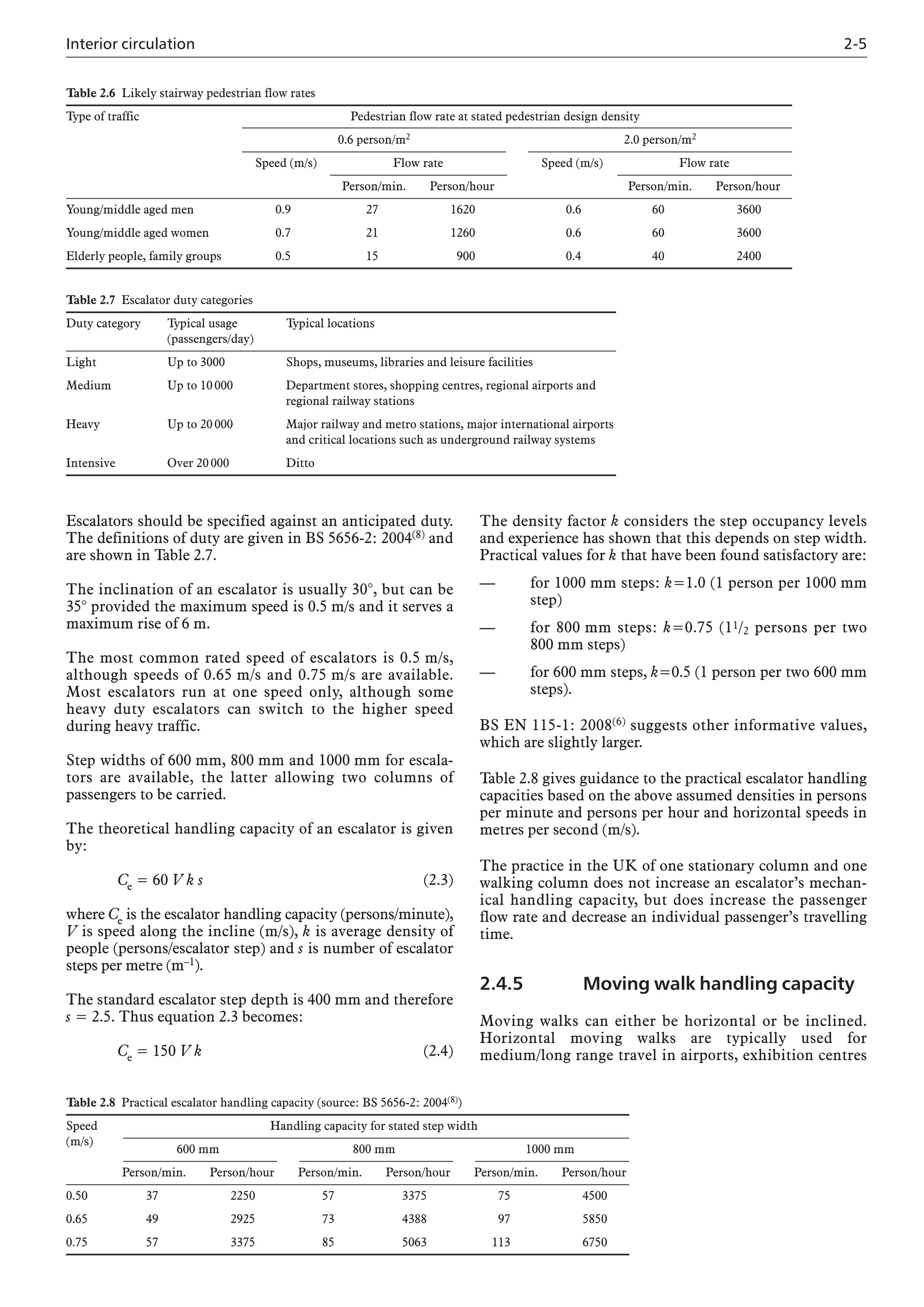
Table 2.6 shows the possible pedestrian flow rates in
persons per minute and persons per hour and typical
pedestrian stairway speeds along the slope in metres per
second for a free flow design density of 0.6 persons per
square metre and a full flow design density of 2.0 persons
per square metre for each one metre width of stairway.
2.4.4 Escalator handling capacity
Escalators provide a mechanical means of continuously
transporting pedestrians from one level to another. Except
for deep underground systems escalators provide for short
range movement. They are found in offices, stores,
shopping centres, railway stations, hospitals, museums,
etc. Speed, step widths, inclination and the size of
boarding and alighting areas are factors that affect their
handling capacity.
Table 2.3 Minimum corridor widths
Usage Minimum
width (m)
One-way traffic flow 1.0
Two-way traffic flow 2.0
Two men abreast 1.2
Man with bag 1.0
Porter with trolley 1.0
Woman with pram 0.8
Woman with pram with child alongside 1.2
Man on crutches 0.9
Wheelchair 0.8†
† Wheeled vehicles require extra width in order to
turn at junctions, especially if they are very long,
e.g. hospital trolleys
Table 2.4 Reductions in corridor width
Obstruction Reduction
in width (m)
Ordered queue 0.6
Unordered single queue 1.2–1.5
Row of seated persons 1.0
Coin operated machine:
–– one person 0.6
–– queue 1.0
Person waiting with bag 0.6
Window shoppers 0.5–0.8
Small fire appliance 0.2–0.4
Wall-mounted radiator 0.2
Rough or dirty wall surface 0.2
2.4.2 Portal capacity
Portals, which are called by various names (i.e. gate, door,
entrance, turnstile, etc.), form a division between two
areas for reasons of privacy, security, access control, etc.
They represent a special restriction in corridor width.
Their main effect is to reduce pedestrian flow rates. Table
2.5 indicates probable flow rates for a possible range of
pedestrian flows in persons per minute and persons per
hour through an opening of 1.0 m. Note that most
domestic doors are less than this width (approximately
750 mm) and the flow rates would be likely to be the lower
values in the range shown. Doors in non-domestic
buildings may be slightly wider than 1.0 m and would
permit the higher values in the range shown to be
possible.
Table 2.5 Possible portal flow rates
Portal type Flow rate
Person/min. Person/hour
Gateway 60–110 3600–6600
Clear opening 60–110 3600–6600
Swing door 40–60 2400–3600
Swing door (fastened back) 60–90 3600–5400
Revolving door 25–35 1500–2100
Waist-high turnstile:
–– free admission 40–60 2400–3600
–– cashier 12–18 720–1080
–– single coin operation 25–50 1200–1800
— card/detector operation 20–30 1200–1800
Interior circulation 2-5
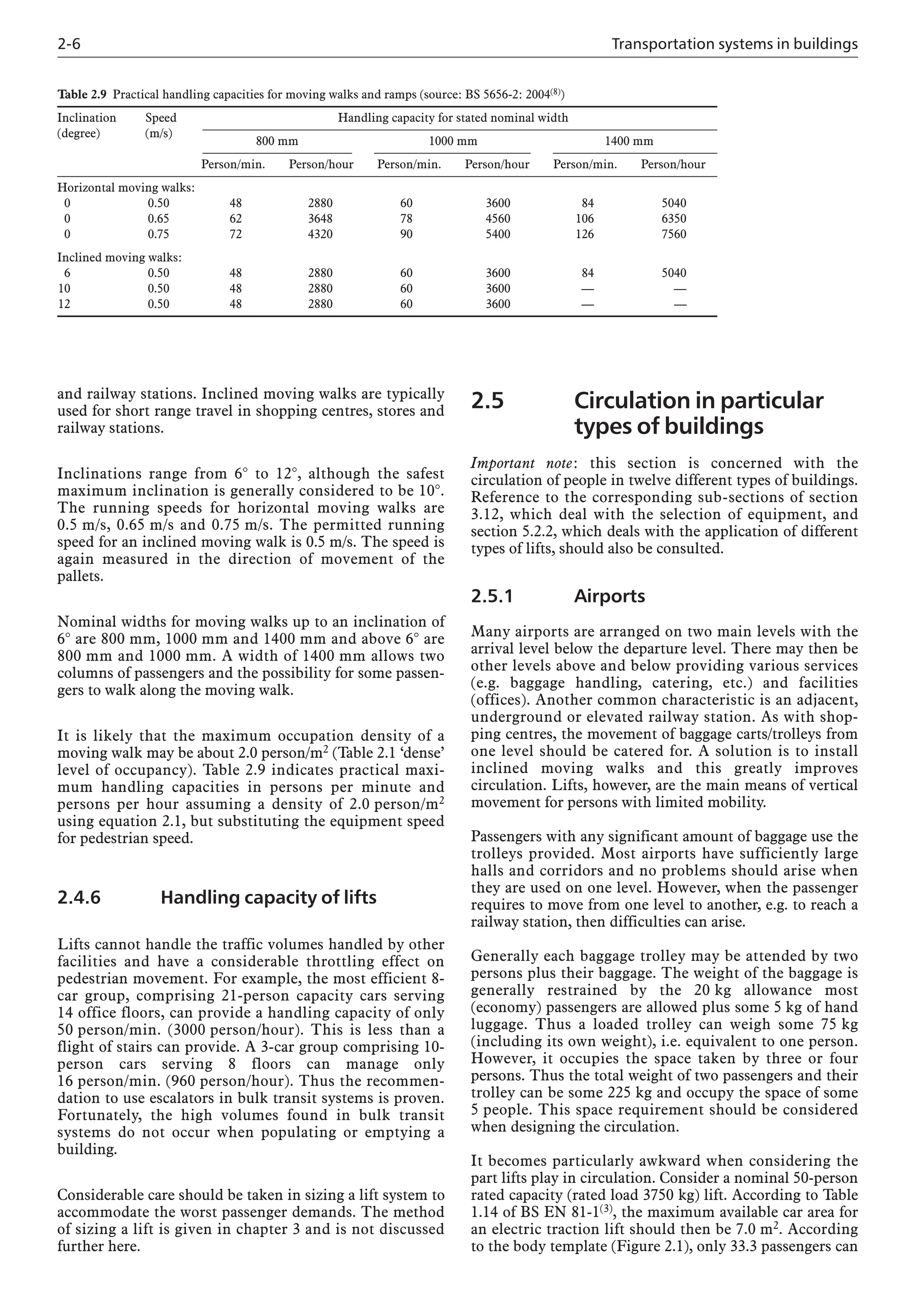
Escalators should be specified against an anticipated duty.
The definitions of duty are given in BS 5656-2: 2004(8) and
are shown in Table 2.7.
The inclination of an escalator is usually 30°, but can be
35° provided the maximum speed is 0.5 m/s and it serves a
maximum rise of 6 m.
The most common rated speed of escalators is 0.5 m/s,
although speeds of 0.65 m/s and 0.75 m/s are available.
Most escalators run at one speed only, although some
heavy duty escalators can switch to the higher speed
during heavy traffic.
Step widths of 600 mm, 800 mm and 1000 mm for escala-
tors are available, the latter allowing two columns of
passengers to be carried.
The theoretical handling capacity of an escalator is given
by:
Ce = 60 V k s (2.3)
where Ce is the escalator handling capacity (persons/minute),
V is speed along the incline (m/s), k is average density of
people (persons/escalator step) and s is number of escalator
steps per metre (m–1).
The standard escalator step depth is 400 mm and therefore
s = 2.5. Thus equation 2.3 becomes:
Ce = 150 V k (2.4)
The density factor k considers the step occupancy levels
and experience has shown that this depends on step width.
Practical values for k that have been found satisfactory are:
— for 1000 mm steps: k=1.0 (1 person per 1000 mm
step)
— for 800 mm steps: k=0.75 (11/2 persons per two
800 mm steps)
— for 600 mm steps, k=0.5 (1 person per two 600 mm
steps).
BS EN 115-1: 2008(6) suggests other informative values,
which are slightly larger.
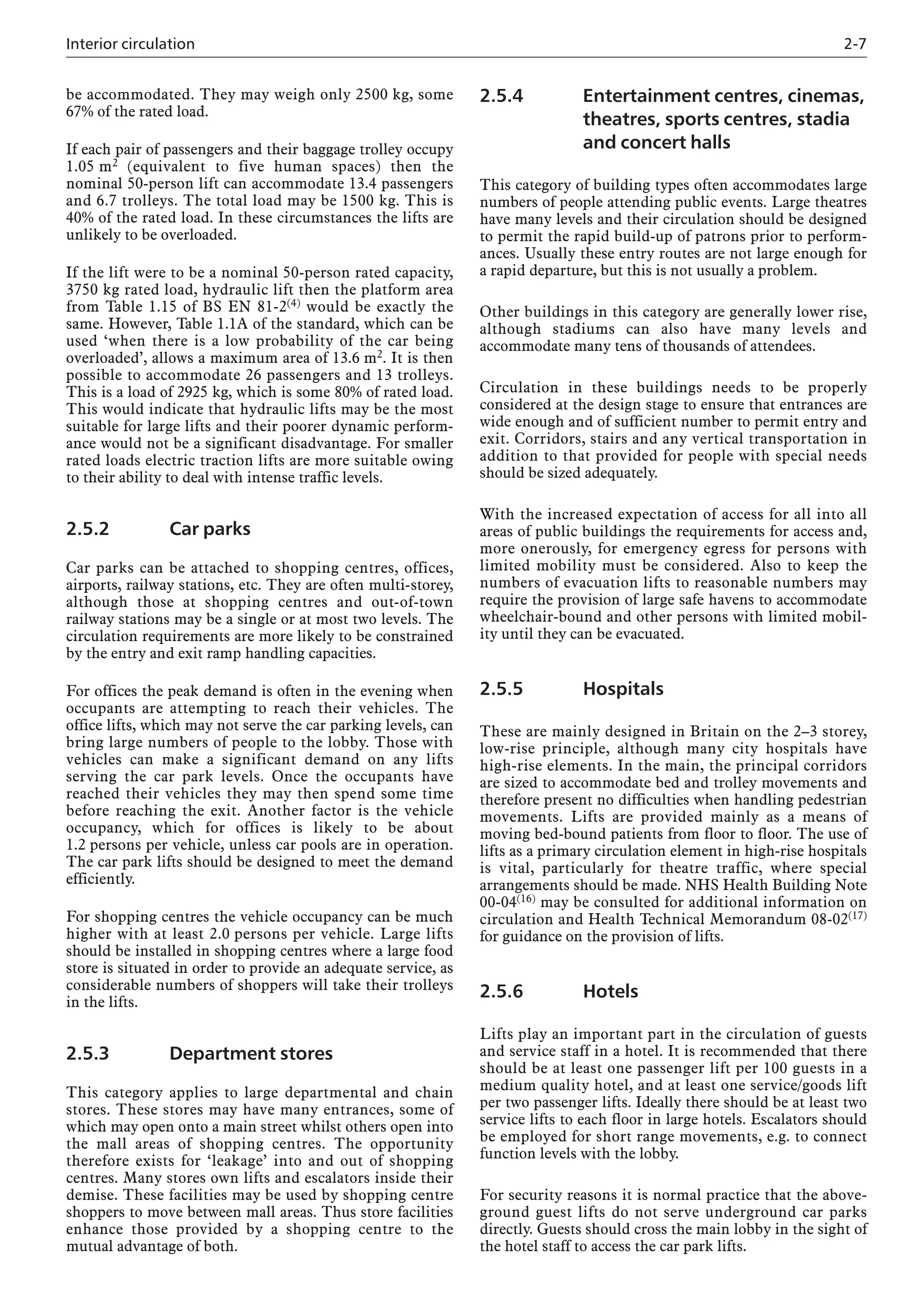
Table 2.8 gives guidance to the practical escalator handling
capacities based on the above assumed densities in persons
per minute and persons per hour and horizontal speeds in
metres per second (m/s).
The practice in the UK of one stationary column and one
walking column does not increase an escalator’s mechan-
ical handling capacity, but does increase the passenger
flow rate and decrease an individual passenger’s travelling
time.
2.4.5 Moving walk handling capacity
Moving walks can either be horizontal or be inclined.
Horizontal moving walks are typically used for
medium/long range travel in airports, exhibition centres
Table 2.6 Likely stairway pedestrian flow rates
Type of traffic Pedestrian flow rate at stated pedestrian design density
0.6 person/m2 2.0 person/m2
Speed (m/s) Flow rate Speed (m/s) Flow rate
Person/min. Person/hour Person/min. Person/hour
Young/middle aged men 0.9 27 1620 0.6 60 3600
Young/middle aged women 0.7 21 1260 0.6 60 3600
Elderly people, family groups 0.5 15 900 0.4 40 2400
Table 2.7 Escalator duty categories
Duty category Typical usage Typical locations
(passengers/day)
Light Up to 3000 Shops, museums, libraries and leisure facilities
Medium Up to 10000 Department stores, shopping centres, regional airports and
regional railway stations
Heavy Up to 20000 Major railway and metro stations, major international airports
and critical locations such as underground railway systems
Intensive Over 20000 Ditto
Table 2.8 Practical escalator handling capacity (source: BS 5656-2: 2004(8))
Speed Handling capacity for stated step width
(m/s)
600 mm 800 mm 1000 mm
Person/min. Person/hour Person/min. Person/hour Person/min. Person/hour
0.50 37 2250 57 3375 75 4500
0.65 49 2925 73 4388 97 5850
0.75 57 3375 85 5063 113 6750
2-6 Transportation systems in buildings
and railway stations. Inclined moving walks are typically
used for short range travel in shopping centres, stores and
railway stations.
Inclinations range from 6° to 12°, although the safest
maximum inclination is generally considered to be 10°.
The running speeds for horizontal moving walks are
0.5 m/s, 0.65 m/s and 0.75 m/s. The permitted running
speed for an inclined moving walk is 0.5 m/s. The speed is
again measured in the direction of movement of the
pallets.
Nominal widths for moving walks up to an inclination of
6° are 800 mm, 1000 mm and 1400 mm and above 6° are
800 mm and 1000 mm. A width of 1400 mm allows two
columns of passengers and the possibility for some passen-
gers to walk along the moving walk.
It is likely that the maximum occupation density of a
moving walk may be about 2.0 person/m2 (Table 2.1 ‘dense’
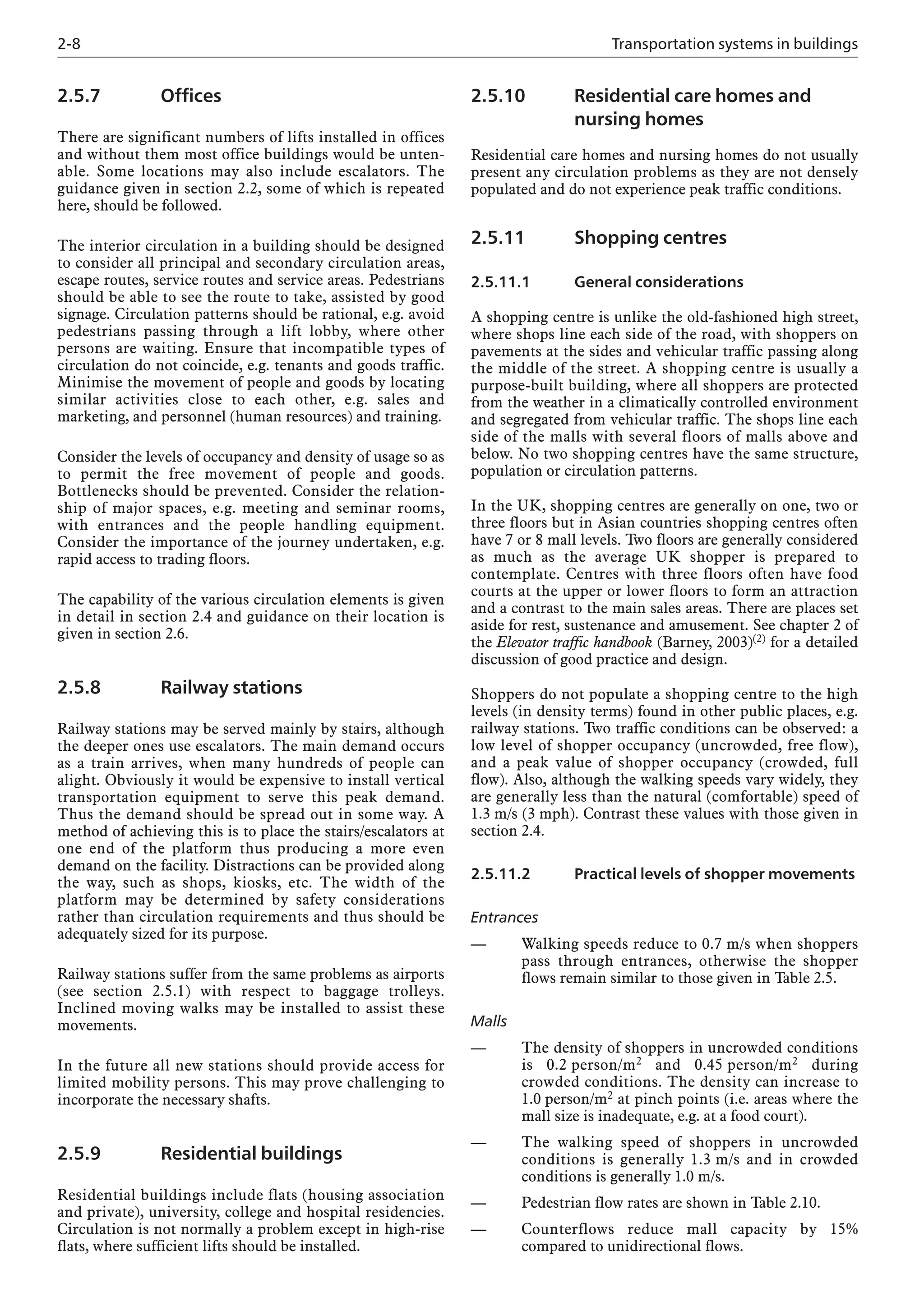
level of occupancy). Table 2.9 indicates practical maxi-
mum handling capacities in persons per minute and
persons per hour assuming a density of 2.0 person/m2
using equation 2.1, but substituting the equipment speed
for pedestrian speed.
2.4.6 Handling capacity of lifts
Lifts cannot handle the traffic volumes handled by other
facilities and have a considerable throttling effect on
pedestrian movement. For example, the most efficient 8-
car group, comprising 21-person capacity cars serving
14 office floors, can provide a handling capacity of only
50 person/min. (3000 person/hour). This is less than a
flight of stairs can provide. A 3-car group comprising 10-
person cars serving 8 floors can manage only
16 person/min. (960 person/hour). Thus the recommen-
dation to use escalators in bulk transit systems is proven.
Fortunately, the high volumes found in bulk transit
systems do not occur when populating or emptying a
building.
Considerable care should be taken in sizing a lift system to
accommodate the worst passenger demands. The method
of sizing a lift is given in chapter 3 and is not discussed
further here.
2.5 Circulation in particular
types of buildings
Important note: this section is concerned with the
circulation of people in twelve different types of buildings.
Reference to the corresponding sub-sections of section
3.12, which deal with the selection of equipment, and
section 5.2.2, which deals with the application of different
types of lifts, should also be consulted.
2.5.1 Airports
Many airports are arranged on two main levels with the
arrival level below the departure level. There may then be
other levels above and below providing various services
(e.g. baggage handling, catering, etc.) and facilities
(offices). Another common characteristic is an adjacent,
underground or elevated railway station. As with shop-
ping centres, the movement of baggage carts/trolleys from
one level should be catered for. A solution is to install
inclined moving walks and this greatly improves
circulation. Lifts, however, are the main means of vertical
movement for persons with limited mobility.
Passengers with any significant amount of baggage use the
trolleys provided. Most airports have sufficiently large
halls and corridors and no problems should arise when
they are used on one level. However, when the passenger
requires to move from one level to another, e.g. to reach a
railway station, then difficulties can arise.
Generally each baggage trolley may be attended by two
persons plus their baggage. The weight of the baggage is
generally restrained by the 20 kg allowance most
(economy) passengers are allowed plus some 5 kg of hand
luggage. Thus a loaded trolley can weigh some 75 kg
(including its own weight), i.e. equivalent to one person.
However, it occupies the space taken by three or four
persons. Thus the total weight of two passengers and their
trolley can be some 225 kg and occupy the space of some
5 people. This space requirement should be considered
when designing the circulation.
It becomes particularly awkward when considering the
part lifts play in circulation. Consider a nominal 50-person
rated capacity (rated load 3750 kg) lift. According to Table
1.14 of BS EN 81-1(3), the maximum available car area for
an electric traction lift should then be 7.0 m2. According
to the body template (Figure 2.1), only 33.3 passengers can
Table 2.9 Practical handling capacities for moving walks and ramps (source: BS 5656-2: 2004(8))
Inclination Speed Handling capacity for stated nominal width
(degree) (m/s)
800 mm 1000 mm 1400 mm
Person/min. Person/hour Person/min. Person/hour Person/min. Person/hour
Horizontal moving walks:
0 0.50 48 2880 60 3600 84 5040
0 0.65 62 3648 78 4560 106 6350
0 0.75 72 4320 90 5400 126 7560
Inclined moving walks:
6 0.50 48 2880 60 3600 84 5040
10 0.50 48 2880 60 3600 — —
12 0.50 48 2880 60 3600 — —
Interior circulation 2-7
be accommodated. They may weigh only 2500 kg, some
67% of the rated load.
If each pair of passengers and their baggage trolley occupy
1.05 m2 (equivalent to five human spaces) then the
nominal 50-person lift can accommodate 13.4 passengers
and 6.7 trolleys. The total load may be 1500 kg. This is
40% of the rated load. In these circumstances the lifts are
unlikely to be overloaded.
If the lift were to be a nominal 50-person rated capacity,
3750 kg rated load, hydraulic lift then the platform area
from Table 1.15 of BS EN 81-2(4) would be exactly the
same. However, Table 1.1A of the standard, which can be
used ‘when there is a low probability of the car being
overloaded’, allows a maximum area of 13.6 m2. It is then
possible to accommodate 26 passengers and 13 trolleys.
This is a load of 2925 kg, which is some 80% of rated load.
This would indicate that hydraulic lifts may be the most
suitable for large lifts and their poorer dynamic perform-
ance would not be a significant disadvantage. For smaller
rated loads electric traction lifts are more suitable owing
to their ability to deal with intense traffic levels.
2.5.2 Car parks
Car parks can be attached to shopping centres, offices,
airports, railway stations, etc. They are often multi-storey,
although those at shopping centres and out-of-town
railway stations may be a single or at most two levels. The
circulation requirements are more likely to be constrained
by the entry and exit ramp handling capacities.
For offices the peak demand is often in the evening when
occupants are attempting to reach their vehicles. The
office lifts, which may not serve the car parking levels, can
bring large numbers of people to the lobby. Those with
vehicles can make a significant demand on any lifts
serving the car park levels. Once the occupants have
reached their vehicles they may then spend some time
before reaching the exit. Another factor is the vehicle
occupancy, which for offices is likely to be about
1.2 persons per vehicle, unless car pools are in operation.
The car park lifts should be designed to meet the demand
efficiently.
For shopping centres the vehicle occupancy can be much
higher with at least 2.0 persons per vehicle. Large lifts
should be installed in shopping centres where a large food
store is situated in order to provide an adequate service, as
considerable numbers of shoppers will take their trolleys
in the lifts.
2.5.3 Department stores
This category applies to large departmental and chain
stores. These stores may have many entrances, some of
which may open onto a main street whilst others open into
the mall areas of shopping centres. The opportunity
therefore exists for ‘leakage’ into and out of shopping
centres. Many stores own lifts and escalators inside their
demise. These facilities may be used by shopping centre
shoppers to move between mall areas. Thus store facilities
enhance those provided by a shopping centre to the
mutual advantage of both.
2.5.4 Entertainment centres, cinemas,
theatres, sports centres, stadia
and concert halls
This category of building types often accommodates large
numbers of people attending public events. Large theatres
have many levels and their circulation should be designed
to permit the rapid build-up of patrons prior to perform-
ances. Usually these entry routes are not large enough for
a rapid departure, but this is not usually a problem.
Other buildings in this category are generally lower rise,
although stadiums can also have many levels and
accommodate many tens of thousands of attendees.
Circulation in these buildings needs to be properly
considered at the design stage to ensure that entrances are
wide enough and of sufficient number to permit entry and
exit. Corridors, stairs and any vertical transportation in
addition to that provided for people with special needs
should be sized adequately.
With the increased expectation of access for all into all
areas of public buildings the requirements for access and,
more onerously, for emergency egress for persons with
limited mobility must be considered. Also to keep the
numbers of evacuation lifts to reasonable numbers may
require the provision of large safe havens to accommodate
wheelchair-bound and other persons with limited mobil-
ity until they can be evacuated.
2.5.5 Hospitals
These are mainly designed in Britain on the 2–3 storey,
low-rise principle, although many city hospitals have
high-rise elements. In the main, the principal corridors
are sized to accommodate bed and trolley movements and
therefore present no difficulties when handling pedestrian
movements. Lifts are provided mainly as a means of
moving bed-bound patients from floor to floor. The use of
lifts as a primary circulation element in high-rise hospitals
is vital, particularly for theatre traffic, where special
arrangements should be made. NHS Health Building Note
00-04(16) may be consulted for additional information on
circulation and Health Technical Memorandum 08-02(17)
for guidance on the provision of lifts.
2.5.6 Hotels
Lifts play an important part in the circulation of guests
and service staff in a hotel. It is recommended that there
should be at least one passenger lift per 100 guests in a
medium quality hotel, and at least one service/goods lift
per two passenger lifts. Ideally there should be at least two
service lifts to each floor in large hotels. Escalators should
be employed for short range movements, e.g. to connect
function levels with the lobby.
For security reasons it is normal practice that the above-
ground guest lifts do not serve underground car parks
directly. Guests should cross the main lobby in the sight of
the hotel staff to access the car park lifts.
2-8 Transportation systems in buildings
2.5.7 Offices
There are significant numbers of lifts installed in offices
and without them most office buildings would be unten-
able. Some locations may also include escalators. The
guidance given in section 2.2, some of which is repeated
here, should be followed.
The interior circulation in a building should be designed
to consider all principal and secondary circulation areas,
escape routes, service routes and service areas. Pedestrians
should be able to see the route to take, assisted by good
signage. Circulation patterns should be rational, e.g. avoid
pedestrians passing through a lift lobby, where other
persons are waiting. Ensure that incompatible types of
circulation do not coincide, e.g. tenants and goods traffic.
Minimise the movement of people and goods by locating
similar activities close to each other, e.g. sales and
marketing, and personnel (human resources) and training.
Consider the levels of occupancy and density of usage so as
to permit the free movement of people and goods.
Bottlenecks should be prevented. Consider the relation-
ship of major spaces, e.g. meeting and seminar rooms,
with entrances and the people handling equipment.
Consider the importance of the journey undertaken, e.g.
rapid access to trading floors.
The capability of the various circulation elements is given
in detail in section 2.4 and guidance on their location is
given in section 2.6.
2.5.8 Railway stations
Railway stations may be served mainly by stairs, although
the deeper ones use escalators. The main demand occurs
as a train arrives, when many hundreds of people can
alight. Obviously it would be expensive to install vertical
transportation equipment to serve this peak demand.
Thus the demand should be spread out in some way. A
method of achieving this is to place the stairs/escalators at
one end of the platform thus producing a more even
demand on the facility. Distractions can be provided along
the way, such as shops, kiosks, etc. The width of the
platform may be determined by safety considerations
rather than circulation requirements and thus should be
adequately sized for its purpose.
Railway stations suffer from the same problems as airports
(see section 2.5.1) with respect to baggage trolleys.
Inclined moving walks may be installed to assist these
movements.
In the future all new stations should provide access for
limited mobility persons. This may prove challenging to
incorporate the necessary shafts.
2.5.9 Residential buildings
Residential buildings include flats (housing association
and private), university, college and hospital residencies.
Circulation is not normally a problem except in high-rise
flats, where sufficient lifts should be installed.
2.5.10 Residential care homes and
nursing homes
Residential care homes and nursing homes do not usually
present any circulation problems as they are not densely
populated and do not experience peak traffic conditions.
2.5.11 Shopping centres
2.5.11.1 General considerations
A shopping centre is unlike the old-fashioned high street,
where shops line each side of the road, with shoppers on
pavements at the sides and vehicular traffic passing along
the middle of the street. A shopping centre is usually a
purpose-built building, where all shoppers are protected
from the weather in a climatically controlled environment
and segregated from vehicular traffic. The shops line each
side of the malls with several floors of malls above and
below. No two shopping centres have the same structure,
population or circulation patterns.
In the UK, shopping centres are generally on one, two or
three floors but in Asian countries shopping centres often
have 7 or 8 mall levels. Two floors are generally considered
as much as the average UK shopper is prepared to
contemplate. Centres with three floors often have food
courts at the upper or lower floors to form an attraction
and a contrast to the main sales areas. There are places set
aside for rest, sustenance and amusement. See chapter 2 of
the Elevator traffic handbook (Barney, 2003)(2) for a detailed
discussion of good practice and design.
Shoppers do not populate a shopping centre to the high
levels (in density terms) found in other public places, e.g.
railway stations. Two traffic conditions can be observed: a
low level of shopper occupancy (uncrowded, free flow),
and a peak value of shopper occupancy (crowded, full
flow). Also, although the walking speeds vary widely, they
are generally less than the natural (comfortable) speed of
1.3 m/s (3 mph). Contrast these values with those given in
section 2.4.
2.5.11.2 Practical levels of shopper movements
Entrances
— Walking speeds reduce to 0.7 m/s when shoppers
pass through entrances, otherwise the shopper
flows remain similar to those given in Table 2.5.
Malls
— The density of shoppers in uncrowded conditions
is 0.2 person/m2 and 0.45 person/m2 during
crowded conditions. The density can increase to
1.0 person/m2 at pinch points (i.e. areas where the
mall size is inadequate, e.g. at a food court).
— The walking speed of shoppers in uncrowded
conditions is generally 1.3 m/s and in crowded
conditions is generally 1.0 m/s.
— Pedestrian flow rates are shown in Table 2.10.
— Counterflows reduce mall capacity by 15%
compared to unidirectional flows.
Interior circulation 2-9
— The effective mall width reduces (equal to actual
mall width minus street furniture and window
shoppers), as the condition changes from
uncrowded to crowded. This results from more
stationary shoppers looking into shop windows.
— Mall widths should be of the order of 6–8 m wide
as a compromise between too wide to cross and too
narrow to pass along.
Stairs
— Uncrowded density on stairs is found to be
approximately 0.4 person/m2 and crowded density
on stairs reaches 0.8 person/m2.
— Shoppers’ speeds when using stairs varies
according to traffic type.
— The stair capacity under uncrowded conditions
and under crowded conditions varies according to
traffic type, see Table 2.11.
— There is a tendency for more down traffic than up
traffic in the ratio 60:40.
— A minor contraflow can reduce a major flow by
effectively reducing the stairway width by some
750 mm.
Lifts
Observation (scenic) lifts, pram lifts, car park and other
lifts are provided in shopping centres, but not in sufficient
quantities to serve more than a fraction of the shoppers.
They are mainly used by the elderly, infirm, disabled,
mothers with children and push chairs, and people with
heavy packages. Observation lifts are sometimes installed
as a feature to provide a visual impact in retail complexes.
They do contribute to the circulation aspects of a shop-
ping centre, but cannot be considered as a major handling
capacity provider as passengers often use one simply for
the ride.
2.5.12 Universities and other education
buildings
Most university buildings can be classified as institutional
buildings, where the occupants receive a service. A
university campus often has a mixed collection of lecture
blocks, office type buildings, halls of residence, catering
services and factory-like units containing teaching and
research equipment (e.g. reactors, high voltage labora-
tories, telescopes). Where universities occupy city sites
many have tall buildings (10–20 stories) and even those on
out-of-town sites follow suit in order to reduce land use
and keep a compact campus. The office type buildings can
be treated in the same way as detailed earlier in section
2.4. Halls of residence can be treated in a similar way to
hotels, although perhaps at lower levels of demand and
performance. The catering services can be attached to
either the office type buildings or halls of residence and
should be treated as office facilities or hotel facilities. The
factory-like buildings may be low-rise and may be subject
to special movement provisions associated with the
equipment installed, e.g. barriers to radioactive areas.
The main feature of the university campus is the lecture
changeover periods. There are hourly cycles of 10 minutes
of demand at the end of each 50-minute lecture, tutorial or
seminar. In between the peaks the activity levels are low.
To install lifts in a tall building to suit this demand is not
cost effective (and universities do not have large capital
Table 2.11 Stairway pedestrian flows per metre width of stair
Traffic type Speed (m/s) Uncrowded Crowded
(0.4 person/m2) (0.8 person/m2)
Men 0.8 960 1920
Elderly men 0.5 600 1200
Women 0.7 840 1680
Elderly women 0.6 720 1440
Children 0.8 960 1920
Push chairs 0.5 600 1200
Table 2.10 Actual mall pedestrian flow rates per metre width of
mall
Traffic type Uncrowded Crowded
(0.2 person/m2) (0.45 person/m2)
Speed Flow rate Speed Flow rate
(m/s) (person/h) (m/s) (person/h)
All shoppers 1.3 936 1.0 1620
Table 2.12 Actual escalator handling capacity
Speed (m/s) Handling capacity (person/h)
for 800 mm step
Uncrowded Crowded
0.50 2250 4500
Escalators and moving walks
— About 80% of shoppers may use the escalators to
quickly reach other floors in a shopping centre, as
they rarely have to wait.
— The 800 mm step width escalators (commonly
used in stores) have a theoretical step utilisation of
k = 1.5. However, shopping centre escalators are
observed to load to only k = 0.5 step utilisation
under uncrowded conditions and to k = 1.0 step
utilisation under very crowded conditions. The
width of an 800 mm step is not large enough to
accommodate two adult people side by side. To
achieve this, an escalator with a step width of
1000 mm (commonly used in malls) is required,
when a higher step utilisation can be achieved.
Escalator handling capacities are shown in Table
2.12.
— In some shops only an up-travelling escalator is
provided, with stairs alongside for downward
circulation.
— There is a tendency for stores and shopping
centres to install inclined moving walks, which
allows shoppers to keep their purchases with them
in trolleys as they circulate. For safety, the moving
walks should be designed to accept trolleys that
lock onto the pallets.
2-10 Transportation systems in buildings
budgets). A better solution is to try to re-arrange the
activities in the building to reduce the load on the lifts. An
example in Adler(1) illustrates the relationship chart for a
small firm; a similar set of relationships can be formed for
a university building. It would be possible to reduce the
demands made for 10 minutes every hour by the
following:
— Place lecture facilities on the lower levels, say
basement, ground and three to four floors above
the entrance level. Students can be encouraged to
use stairs if they are wide, well lit and visible.
— Laboratory, bulk service facilities (computer
clusters, libraries) and student administration
(registrar, bursar, careers advisory, etc. can be
placed from the fourth floor upwards. These are
either used for periods longer than one hour
(laboratories), shorter than one hour (adminis-
tration) or randomly (libraries).
— Offices should be placed at the top of the building.
Their occupants generally use the lifts on a more
random basis.
2.6 Location and arrangement
of transportation facilities
2.6.1 General
Having discussed the various passive circulation elements
(corridors, stairs, portals, etc.) and the active circulation
elements (moving walks, escalators and lifts) in the
previous sections, it is now necessary to consider their
location and arrangement, which should take account of:
— the location of entrances and stairs
— the location of lifts, escalators and moving walks
— the distribution of the occupants in the building
— safe circulation
— car parks with minimum or no facilities at ground
level.
The main principles, as given in section 2.2, are:
— to minimise the movements of people
— to minimise the movements of goods
— to prevent clashes between people and goods
— to prevent bottlenecks.
Ideally, all circulation activities should be centralised in a
main core of a building. This is clearly not always possible
when access into a building is considered. Sometimes the
main lobby is close to the main entrance and sometimes
the main lobby is some distance into the building. This
latter case requires occupants and visitors to walk some
distance in order to reach the transportation facilities.
However, it may be better for occupants to walk to the
centre of a building to access stairs and lifts, since their
central location during the day may outweigh the
comparative inconvenience during arrival and departure.
Generally the maximum distance to a lift or stair from an
occupant’s work place should not exceed 60 m with a
distance of less than 45 m being preferred. Emergency
escape routes are usually closer, but do not necessarily
form part of the normally used circulatory routes.
2.6.2 Stairs
Stairs should not lead directly off corridors, but be
accessed from landing and lobby areas where people may
congregate without obstructing a circulation route. Thus
the vertical and horizontal modes of circulation can be
allowed to merge smoothly. If it is the intention to
encourage the use of stairs for short journeys to/from
adjacent floors (interfloor movement), then the stairs
should be of sufficient size, clearly visible, adequately
signed, and encountered before reaching the lifts.
The provision of well signed and positioned stairs can
considerably lessen the demands made on the lifts. In
general lifts may be used for travel over a large number of
floors and stairs for travel over a small number of floors. A
judgement is made by the passenger with respect to the
waiting time for a lift versus the walking time (and
walking effort) with respect to stairs. In office environ-
ments they can be a advantageous where (say) heavily
populated trading floors need to be accessed. They are also
very useful for access to car parks, relieving the lifts of
travelling below the main terminal, and may be used for
access to double-deck lifts.
Table 2.13 provides guidance on the division of passenger
demand between lifts and stairs. Although stairs are an
‘always available’ facility, their attraction diminishes with
the number of floors a person needs to travel. Designers
should take these factors into account.
Table 2.13 Comparison of usage of
stairs and lift
Floors Usage (stair:lift)
travelled
Up (%) Down (%)
1 10:90 15:85
2 5:95 10:90
2.6.3 Escalators and moving walks
Escalators are typically used for short range movement
between adjacent floors (except in underground railway
systems). They are found in offices between principal
levels, in shops between trading floors, in shopping
centres between malls and elsewhere such as railway
stations, hospitals, museums, etc. They are usually sited in
an obvious circulation path making it easy for pedestrians
to board them.
Escalators and moving walks should only be accessed from
adjacent corridors/walkways, landing and lobby areas,
where people do not obstruct other pedestrian circulation
routes. Space should be available to accommodate queuing
at the boarding point. Again the intention is to ensure that
the vertical and horizontal modes of circulation can merge
smoothly.
It is especially important that the boarding and alighting
areas adjacent to an escalator or moving walk are not part
Interior circulation 2-11
of another circulation route, in order to provide a safe area
for passengers to board and alight. This obligation is
required by Annex A.2.5 of BS EN 115-1: 2008(6), which
requires a sufficient unrestricted area be available to
accommodate passengers at the landings. The area of this
space is defined as the distance between the handrails plus
160 mm, multiplied by a depth of from 2.0 m to 2.5 m,
depending on the configuration of the escalator or moving
walk.
Figure 2.2 illustrates Clause A.2.5 with Option 1 being a
2.5 m landing depth and Option 2 being a 2.0 m landing
depth. Where successive units(8) are installed each
successive escalator, or moving walk, should have its own
individual unrestricted area.
Escalators occupy more space than stairs in order to
accommodate their inclination. There are several standard
escalator arrangements as shown in Figure 2.3. Types (a)
and (b) provide efficient circulation by providing the
shortest transition path and time from one escalator and
the next. Type (b) requires a larger structural opening than
types (a) and (c) and presents users with a higher risk of
falling into the void. Type (c) is typical of a store as it
allows the store to lengthen the circulation route past
goods for sale. This configuration also takes up less space.
Some moving walks are adapted to receive and lock-on
shopping/baggage trolleys. In these cases the unrestricted
area at the landings should be increased to at least five
metres and the number of flat/horizontal steps at the
boarding and alighting points increased. The most
significant effect is the increased footprint required for the
equipment. Shopping/baggage trolleys are not permitted
on escalators.
In order to encourage pedestrian confidence and to assist
the efficient and safe boarding and alighting of escalators,
the start and end of the escalator should present a number
of horizontal (flat) steps. BS EN 115-1: 2008(6) specifies at
least two flat steps are provided for escalator speeds up to
0.5 m/s, at least three flat steps for speeds above 0.5 m/s
and up to 0.65 m/s and at least four flat steps for speeds
above 0.65 m/s. In locations where it is anticipated that the
escalators may be used by persons with impaired mobility
additional flat steps should be considered.
2.6.4 Lifts
The grouping of passenger lifts is particularly important
where they provide the main means of vertical transporta-
tion within a building. Lifts should always be placed
together rather than distributed around a building. This
provides a better service (shorter intervals), mitigates the
failure of one car (availability of adjacent cars) and leads to
improved traffic control (group systems). Eight lifts are
the recommended maximum number of lifts that should
be grouped together, using conventional landing call
stations(2), especially if large lifts are used (>2000 kg).
This allows passengers to determine when a lift arrives
(from the lantern and gong signals), to walk to the car
(across the lobby) and to enter it before the lift doors start
to close.
The distance across a lobby is usually 1½ to 2 times the
car depth. According to BS ISO 4190-1(7) where lifts are
placed side by side this distance should not be less than
2400 mm and, where facing, not less than 4500 mm.
However, if the lift lobby is too large, passengers have too
far to walk and the closure of the car doors has to be
delayed (increased door dwell time) to accommodate the
increased walking time.
Lift lobbies should not be part of a through circulation
route, either to other lifts, or other areas in the building.
Lobbies should be provided that are dedicated to
Twice
width of
handrails
+ 0.16 m
Width of
handrails
+ 0.16 m
2·5 m
2·0 m
Option 1
Option 2
Figure 2.2 Illustration of unrestricted free space according to BS EN 115-
1: 2008(6)
Down
Up
Up
Down
A
C
C
A
B
B
A
C
A
B'
C
B'
A
B
A'
B
C'
B
Down
Up
Up
Down
A
C
B'
B
Up
Down
B
B' A
A'
C'
(a)
(b)
(c)
Figure 2.3 Escalator configurations; (a) parallel, (b) cross-over, (c) walk
round
2-12 Transportation systems in buildings
passengers waiting for the lifts. The ideal lobby size would
be one that could accommodate one full car load of
passengers waiting and permit the simultaneous disem-
barkation of one full car load of arriving passengers. This
area can be calculated using the density information given
in section 2.2.2 at between ‘comfortable’ and ‘dense’ (say
1.4 person/m2).
The shape of lobbies is most important. For example, a
group of lifts whose doors are fitted to a convex shaped
lobby would be most inefficient, whereas if the doors were
fitted to a concave shaped lobby the lobby design would be
nearly perfect. Zoning a building requires more lobby
space at the main terminal level. The positioning of the
groups is very important. Adequate signs should be
provided to quickly and simply direct the passengers to
the correct group.
Some buildings may be designed with their main entry
points at more than one level. The presence of more than
one main terminal level for the lift system does not lead to
efficient circulation and, where possible, buildings should
not be designed in this way. Means should be provided to
bring the two entrance routes together at a single lift
lobby. Except in special cases it is recommended that the
main terminal floor should be used as an interchange for
the different circulation modes.
BS 5655-6(9) gives recommended layouts and limitations
for groups of lifts. The preferred arrangements of between
two and four lifts arranged in line are given in Figure 2.4
and between two and eight lifts arranged opposite each
other are shown in Figure 2.5. Note all the lobbies
(indicated by ‘L
’) are waiting areas with no through
circulation.
It is suggested that the position of any central lift core
should be towards the centre of the building in order to
reduce the walking distances from any point in the
building.
Some floor plates are very large. Ideally all circulation
activities should be centralised in a main core of a
building. This is not always possible when access into a
building is considered. Sometimes the main lobby is close
to the main entrance; sometimes the building design
places the main lobby some distance into the building.
This latter case involves occupants and visitors in a long
walk to reach the transportation facilities. However it may
be better for occupants to walk to the centre of a building
to access stairs and lifts, since their usage during the day
may outweigh the comparative inconvenience during
arrival and departure.
Generally the maximum distance to a lift or stair from an
occupant’s work place should not exceed 60 m with a
distance of less than 45 m being preferred. Emergency
escape routes are usually closer, but do not necessarily
form part of the normally used circulation routes.
Where a building layout cannot accommodate these
arrangements the following factors should be considered
to optimise the accessibility and visual links to all lifts
within a group to the passengers:
— lobby size
— location of push buttons
— location and type of landing indicators
— walking distances to lift entrances in a lift lobby
— additional structural costs of fragmented lift cores.
2.6.5 Lifts versus escalators
In general lifts are used for travel over a large number of
floors and escalators for travel over a small number of
floors. A judgement is made by the passenger with respect
to the waiting time for a lift versus the length of time
walking (and walking effort) with respect to escalators.
Low-rise structures such as shopping centres, sports
complexes, conference and exhibition centres, railway
stations, airports, hospitals, etc. are good examples of
buildings where the provision of escalators considerably
aids circulation (and is used by the passengers).
In office environments the usefulness of escalators is
lessened, although they can be a advantageous where (say)
heavily populated trading floors need to be assessed. They
are also very useful for access to car parks, relieving the
lifts of travelling below the main terminal, and may be
used for access to double-deck lifts. Table 2.14 provides
some guidance on the division of traffic between lifts and
escalators.
1 2
2 cars
(L)
1 2 3
3 cars
(L)
1 2 3 4
4 cars
(L)
(L) = lobby
Figure 2.4 Preferred arrangement for 2 to 4 lifts (in line)
8
7
6
5
1
2
3
4
6
5
4
1
2
3
4
3
1
2 2 1
(L)
(L)
(L)
(L)
8 cars (for 7 cars
omit car 1 or 8)
6 cars (for 5 cars
omit car 1 or 6)
4 cars (for 3 cars
omit car 1 or 4)
2 cars
(L) = lobby
Figure 2.5 Preferred
arrangement for 2 to 8 lifts
(facing)
Table 2.14 Likely division of traffic between
lifts and escalators
Floors travelled Escalator (%) Lift (%)
1 90 10
2 75 25
3 50 50
4 25 75
5 10 90
Interior circulation 2-13
2.7 Facilities for persons with
special needs
The discussion so far has assumed that all persons
circulating in a building are fully able-bodied. However, a
large proportion of the population are disadvantaged in
some way. BS EN 81-70: 2003: Accessibility to lifts for persons
including persons with disability(5) categorises disabilities
into physical, sensory and intellectual. BS 8300: 2009:
Design of buildings and their approaches to meet the needs of
disabled people(10) gives some guidance for facilities within
buildings. The Disability Discrimination Acts 1995(11)
and 2005(12) lay down various provisions, regulations and
penalties for non-conformance. Building Regulations
Approved Document M(18) provides guidance on
compliance in the UK.
Generally, arrangements made to allow persons with
special needs to make use of circulation elements assist the
able-bodied and should be implemented wherever
possible. Chapter 11 of this Guide discusses lifting
facilities for persons with special needs.
References
1 Adler D Metric handbook (London: Architectural Press) (1999)
2 Barney G C Elevator traffic handbook (London: Spon Press)
(2003)
3 BS EN 81-1: 1998 + A3: 2009: Safety rules for the construction
and installation of lifts. Electric lifts (London: British Standards
Institution) (1998/2009)
4 BS EN 81-2: 1998 + A3: 2009: Safety rules for the construction
and installation of lifts. Hydraulic lifts (London: British Standards
Institution) (1998/2009)
5 BS EN 81-70: 2003: Safety rules for the construction and
installation of lifts. Particular applications for passenger and goods
passenger lifts. Accessibility to lifts for persons including persons with
disability (London: British Standards Institution) (2003)
6 BS EN 115-1: 2008 + A1: 2010: Safety rules for the construction
and installation of escalators and moving walks (London: British
Standards Institution) (2008)
7 BS ISO 4190-1: 2010: Lift (Elevator) installation. Class I, II, III
and VI lifts (London: British Standards Institution) (2010)
8 BS 5656-2: 2004: Selection, installation and location of escalators
and moving walks (London: British Standards Institution)
(2004)
9 BS 5655-6: 2002: Selection and installation of new lifts (London:
British Standards Institution) (2002) (under revision)
10 BS 8300: 2009: Design of buildings and their approaches to meet the
needs of disabled people (London: British Standards Institution)
(2009)
11 Disability Discrimination Act 1995 Elizabeth II Chapter 50
(London: The Stationary Office) (2002) (available at http://
www.opsi.gov.uk/acts/acts1995a) (accessed March 2010)
12 Disability Discrimination Act 2005 Elizabeth II Chapter 13
(London: The Stationery Office) (2005) (available at
http://www.opsi.gov.uk/acts/acts2005a) (accessed July 2010)
13 Dober R P Environmental design (London: Van Nostrad
Reinhold) (1969)
14 Fruin J J Pedestrian planning and design (Mobile AL: Elevator
World) (1971)
15 Hall E T The hidden dimension (New York NY: Doubleday)
(1966)
16 HBN 00-04 Circulation and communication spaces Health
Building Note 00-04 (London: The Stationery Office) (2007)
(available at https://publications.spaceforhealth.nhs.uk)
(accessed July 2010)
17 HTM 08-02 Lifts Health Technical Memorandum 08-02
(Leeds: Department of Health) (2009) (available at
https://publications.spaceforhealth.nhs.uk) (accessed July 2010)
18 ‘Part M’ Access to and use of buildings The Building Regulations
2000 Approved document M (London: NBS/RIBA
Enterprises) (2006) (available at http://www.planningportal.
gov.uk/england/professionals/buildingregs/technicalguidance/
bcaccesstopartm/bcapproveddocuments10) (accessed July 2010)
Principal author
Dr Gina Barney (Gina Barney Associates)
Chapter contents
3.1 Introduction
3.2 Symbols
3.3 Definitions
3.4 Traffic patterns
3.5 Sizing an existing lift installation
3.5.1 The round trip time (RTT) equation
3.5.2 Evaluating up-peak interval, up-peak handling capacity and
percentage population served
3.5.3 Values for highest reversal floor (H) and average number of
stops (S)
3.5.4 Value for number of floors (N)
3.5.5 Value for average number of passengers (P)
3.5.6 Value for floor transit time (tv)
3.5.7 Value for rated speed (v)
3.5.8 Value for performance time (T)
3.5.9 Value for single floor flight time (tf(1))
3.5.10 Value for start delay (tsd)
3.5.11 Values for door closing (tc) and door opening (to) times
3.5.12 Value for advance door opening time (tad)
3.5.13 Value for average one-way single passenger transfer time (tp)
3.6 Round trip time equation: frequently asked questions
3.6.1 Do passengers arrive uniformly in time?
3.6.2 Are lifts loaded to an average load of 80%?
3.6.3 Are all floors equally populated?
3.6.4 Is rated speed reached in a single floor jump and are interfloor
heights equal?
3.6.5 What are landing and car call dwell times?
3.6.6 What are lobby loading times?
3.6.7 Is the traffic controller ideal?
3.6.8 Footnote to up-peak round trip time calculations
3.6.9 Example 3.1
3.7 Passenger times during up-peak traffic demand
3.7.1 Passenger average waiting time (AWT)
3.7.2 Passenger average transit time (ATT)
3.7.3 Passenger average travel time to destination (ATTD)
3.7.4 Passenger average journey time (AJT)
3.7.5 Target passenger times and lift system response times
3 Traffic planning and selection of lift
equipment and performance
3-1
3-2
3-2
3-3
3-4
3-4
3-4
3-4
3-4
3-4
3-5
3-5
3-5
3-6
3-6
3-6
3-6
3-6
3-7
3-7
3-7
3-7
3-7
3-7
3-8
3-8
3-8
3-9
3-9
3-9
3-9
3-9
3-9
3-9
© Gina Barney 2010
Contents continue
Transportation systems in buildings
3.8 Sizing of office lifts to meet passenger demands
3.8.1 Estimation of office building population
3.8.2 Estimating office building floor area
3.8.3 Estimating office building population from floor area
3.8.4 Estimating passenger arrival rate
3.8.5 Quality of service
3.8.6 Example 3.2
3.9 Traffic conditions other than up-peak
3.9.1 Down-peak traffic condition
3.9.2 Mid-day traffic condition
3.9.3 Interfloor traffic condition
3.9.4 General analysis
3.10 Equipment selection with respect to lift function
3.10.1 Double deck lifts
3.10.2 Firefighting lifts
3.10.3 Goods lifts
3.10.4 Observation (glass/scenic) lifts
3.10.5 Shuttle lifts
3.10.6 Lifts sharing a common well (shaft)
3.11 Equipment selection with respect to building form
3.11.1 Basement service and floors served by only part of a lift group
3.11.2 Entrance bias
3.11.3 Stairs
3.11.4 Attractive building facilities
3.11.5 Lobby design
3.11.6 Tall buildings
3.11.7 Very tall buildings
3.11.8 Example 3.3
3.12 Equipment selection with respect to building function
3.12.1 Airports
3.12.2 Car parks
3.12.3 Department stores
3.12.4 Entertainment centres, cinemas, theatres, sports centres, stadia and
concert halls
3.12.5 Hospitals
3.12.6 Hotels
3.12.7 Offices
3.12.8 Railway stations
3.12.9 Residential buildings
3.12.10 Residential care homes and nursing homes
3.12.11 Shopping centres
3.12.12 Universities and other education buildings
3.13 Review of all traffic conditions
3.14 Finally
References
Appendix 3.A1: Table of H and S values
3-10
3-10
3-10
3-10
3-11
3-11
3-12
3-12
3-12
3-12
3-12
3-12
3-13
3-13
3-13
3-13
3-13
3-14
3-14
3-14
3-14
3-14
3-14
3-14
3-15
3-15
3-15
3-15
3-15
3-15
3-16
3-16
3-16
3-16
3-16
3-17
3-17
3-17
3-17
3-17
3-17
3-18
3-18
3-18
3-20
Traffic planning and selection of lift equipment and performance 3-1
3.1 Introduction
This chapter provides a general guide to UK and
European practice, which may differ from North
American practice (Strakosch, 1998)(14). It is recom-
mended that Barney (2003)(2) be consulted for the detailed
theory and as a source of the primary references. The
various terms commonly encountered are defined in
section 3.2, and other definitions may be found in the
glossary (Appendix A1 to this Guide).
The transportation capacity of the lift group in a building
is a major factor in the success or failure of a building as a
place to work, to live or to receive a service. Building
occupants expect lifts to be available and easy to use
without a second thought. Unfortunately this is not always
the case and speculative building often results in the
installation of an imperfect lift system.
The planning and selection of transportation equipment is
a very involved subject. Although the basic calculations
are relatively simple, the theory on which they are based is
complex. The results obtained should always be tempered
with a great deal of working experience of existing
buildings, in order to ensure that a satisfactory design
results.
The difficulty in planning a lift installation is not in
calculating its probable performance, but in estimating the
passenger demand that is likely to occur. Quite often the
building has yet to be built and estimates have to be based
on the experience gained with previous similar structures.
Existing buildings can be surveyed, by observation, or by
means of an attached data logger, to determine the current
activity. However, even this is prone to error as the
building's population may have adapted to a poor (or
good) lift performance.
It is essential, therefore, that all the parties involved in the
planning of a lift installation should have a clear under-
standing of the basis for the planning. The architect or
planner should establish the lift system required at a very
early stage, in consultation with a lift specialist, and not
after the rest of the building has been designed, as has
often happened in the past.
A design that is tightly planned, may prove inadequate
once a new building becomes fully occupied. It is impor-
tant to remember that the distribution and size of the
population of any large building can alter regularly, for
example, as tenants change. To understand the effect of
any of these changes on a building, it is essential to
document the design criteria and the reasons for decisions
taken at all stages of a design.
Two key factors affect the demand that a building’s
occupants may make on a lift system: the quantity of
service and the quality of service required. The quantity of
service factor (i.e. how many people might use the lift
system over a defined period of time) is represented by the
handling capacity. The quality of service factor (i.e. how
well the lift system deals with its passengers) is repre-
sented by passenger waiting time and lobby queuing.
These factors are interrelated and depend, amongst other
things, on the type of building and its use, and on the type
of occupier. This makes the design task very difficult for
buildings of a speculative nature.
Two models can be used for lift traffic design and analysis:
— The first model uses a calculation method based
on mathematical formulae. This classical model
has been used for nearly 80 years and results in a
satisfactory solution for 90–95% of designs. The
pure up-peak traffic condition (i.e. only incoming
traffic) is used for this method as it provides a well
defined, simple traffic pattern, amenable to
mathematical analysis. These calculations can be
carried out by hand, using a program, a spread-
sheet or a simulation program. The fastest method
is a spreadsheet, an example of which is used to
illustrate this chapter. It provides instant results to
each change of input.
— The second model, which has been used for over
45 years, is based on a discrete digital simulation
of the movement of lifts in a building and the
passenger dynamics. This simulation model allows
very complex situations to be analysed. At present,
simulations are very slow to carry out compared to
the instant answers provided using a spreadsheet.
For example, the simulation of Example 3.1,
averaged over 10 runs (for accuracy), takes some 40
seconds. An 8-car group serving 15 floors with a
hall call allocation control system (see chapter 9)
takes 250 seconds.
It is recommended that calculations should always be
carried out in order to refine a design and obtain an
understanding of the various, sometimes conflicting,
factors. A simulation may then be performed if the system
being considered has any unusual aspects, or in order to
obtain information not provided by the calculation
method, e.g. passenger queues etc.
This chapter deals with the classical model based on
calculation. Chapter 4 deals with the simulation model.
The two most frequently asked questions, when sizing a
lift system are:
— Question 1: What is the handling capacity of the
lift?
— Question 2: What size of lift installation is needed?
3 Traffic planning and selection of lift
equipment and performance
3-2 Transportation systems in buildings
Question 1 is answered in section 3.5 and question 2 in
section 3.8. The analysis is mainly relevant to commercial
office buildings. Refer to section 3.12 for other types of
buildings.
3.2 Symbols
AC Actual capacity (persons)
Ad Average down-peak passenger arrival rate
(person/5-minutes)
Ai Average interfloor passenger arrival rate
(person/5-minutes)
Ar Average up-peak passenger arrival rate
(person/5-minutes)
AJT Passenger average journey time (s)
ATTD Passenger average time to destination (s)
ATT Passenger average travel time to destination (s)
AWT Passenger average waiting time (s)
CA Car area (m2)
CC Rated (contract) capacity (persons)
CF Capacity factor
%CF Percentage capacity factor (%)
DT Distance between terminal floors (m)
df Average interfloor height (m)
DNPHC Down-peak handling capacity (person/5-minutes)
DNPAWT Down-peak passenger average waiting time (s)
H Average highest reversal floor
HM Average lowest basement reversal floor
IFAWT Interfloor passenger average waiting time (s)
INT Average interval with defined car load (s)
k Hall call allocation look-ahead factor
L Number of lifts
MIDAWT Mid-day passenger average waiting time (s)
MIDHC Mid-day handling capacity (person/5-minutes)
MIDINT Mid-day average interval (s)
N Number of served floors above the main terminal
NIA Net internal area (m2)
NUA Net usable area (m2)
P Average number of passengers (persons)
%POP Percentage population (%)
Q Rated load (kg)
RTT Average round trip time (s)
RTTd Average down-peak round trip time (s)
RTTm Average mid-day round trip time (s)
S Average number of stops
SM Average number of basement stops
SRT System response time (s)
T Performance time (s)
TM Basement floor to floor cycle time (s)
tad Advance door opening time (s)
tc Door closing time (s)
tcyc Cycle time (s)
te Main terminal to express zone terminal flight time (s)
tf (1) Single (1) floor flight time (s)
to Door opening time (s)
tp Passenger average transfer time (entry or exit) (s)
tsd Start delay time (s)
tu Passenger unloading time (s)
tv Time to transit two adjacent floors at rated speed (s)
tvM Time to transit two adjacent basement floors at
rated speed (s)
U Effective building population (persons)
UPPHC Average up-peak handling capacity
(person/5-minutes)
UPPINT Average up-peak interval with 80% car load (s)
v Rated speed (m/s)
3.3 Definitions
advanced door opening (tad)
period from the time the lift is level at a landing until the
doors are 800 mm open
Note: this feature overlaps the final motion, the levelling
operation, with the first part of the opening of the doors to
reduce door opening time.
door closing time (tc)
period measured from the instant the car doors start to
close until the doors are locked
door opening time (to)
period measured from the instant that the car doors start
to open until they are open 800 mm
interval (INT)
period between successive car arrivals at the main termi-
nal with cars loaded to any value
lift system cycle time (tcyc)
period from the instant the car doors begin to close until
the instant the car doors begin to close again at the next
adjacent floor provided no passengers have crossed the
threshold
performance time (T)
period between the instant the car doors start to close and
the instant that the car doors are open 800 mm at the next
adjacent floor
Note: sometimes called ‘door-to-door’ time.
passenger arrival rate
rate at which passengers arrive for service by a lift system.
Note: often given as a percentage of a building’s popula-
tion arriving within a 5-minute period
passenger average journey time (AJT)(3)
average period of time from when a passenger either
registers a landing call, or joins a queue, until the
passenger alights at the destination floor (see Figure 3.1)
Note: a passenger is deemed to have alighted, when any
passenger detection device is interrupted or the passenger
physically crosses the door sills.
passenger average time to destination (ATTD)(3)
average period of time from when a passenger either
registers a landing call, or joins a queue, until the
responding lift begins to open its doors at the destination
floor (see Figure 3.1).
passenger average transfer time (tp)
average period of time for a single passenger to enter or
leave a lift car
passenger average transit time (ATT)
average period of time from when a responding lift begins
to open its doors at the boarding floor until the doors
begin to open again at the destination floor (see Figure 3.1)
Traffic planning and selection of lift equipment and performance 3-3
Note: the passenger transit time commences, if the
responding lift doors are open, when a passenger arrives.
passenger average waiting time (AWT)
average period of time from when a passenger either
registers a landing call, or joins a queue, until the
responding lift begins to open its doors at the boarding
floor (see Figure 3.1)
Notes:
(1) The passenger waiting time continues if a
passenger does not enter the responding lift, e.g.
because the lift is full.
(2) The passenger waiting time is zero if the
responding lift doors are open when a passenger
arrives.
(3) If a passenger may register a destination call before
arriving at the lift lobby, waiting time may be
divided into two components: walking time (time
to reach the lobby) and standing time (time
waiting in the lobby).
single floor flight time (tf(1))
period of time measured from the instant that the car
doors are locked until the lift is level at the next adjacent
floor
system response time (SRT)
time that it takes a lift group to respond to the first
registered landing call at a floor
Note: sometimes taken as the period between a passenger
registering a call at a landing and the subsequent
cancellation of that call by the traffic controller.
up-peak handling capacity (UPPHC)
number of passengers that a lift system can theoretically
transport during the up-peak traffic condition with a car
occupancy of 80% of the actual capacity
Note: this is calculated by determining the number of trips
made by the lifts, which occur over the worst five minute
(300 second) period and then multiplying it by the average
number of passengers (P) carried in that five minutes.
up-peak interval (UPPINT)
average time between successive car arrivals at the main
terminal (or other defined) floor with cars assumed to be
loaded to 80% of actual capacity during the up-peak traffic
condition
3.4 Traffic patterns
Figure 3.2 illustrates a classical traffic pattern of passenger
demand in an office building as would be seen from the
main terminal, or main access, floor. It shows the number
of up landing calls and down landing calls registered
during the working day. Today this pattern is rarely
observed as shown, as many companies have adopted a
‘flexitime’ attendance regime. It does, however, serve as a
model for discussion.
Figure 3.1 shows four distinct classic traffic patterns:
— At the start of the day there are a larger than
average number of up landing calls. This demand
is due to the building’s occupants arriving to start
work. This traffic pattern is called the morning
up-peak. Industry practice is to size a lift
installation to handle the number of passengers
requesting service during the heaviest five minutes
of the up-peak traffic condition. This is a sound
recommendation. To size the lift system to handle
the actual peak would require too large a system,
which would be very expensive and much of the
equipment would be under-utilised during large
periods of the working day. The duration of the
classical up-peak traffic condition is typically five
minutes.
— Late in the day there is a larger than average
number of down landing calls. This demand is due
to the building’s population leaving at the end of
the working day. This traffic pattern is called the
evening down-peak. The profile of the down-peak
traffic is larger in size and longer in duration than
the up-peak profile. Fortunately a lift system
inherently possesses about 60% more handling
capacity during down-peak than during up-peak.
This is due to lifts filling to capacity at three to
five floors and then making an express run to the
main terminal. This reduction in the number of
stops allows the lift to serve other waiting
passengers more quickly. The duration of the clas-
sical down-peak condition is typically 10 minutes.
— In the middle of the day there may be a number of
up-peaks and down-peaks. This represents a
situation where the occupants of the building take
their lunch breaks. This pattern is called mid-day
traffic. Today this traffic pattern can be very
0800 1000 1200 1400 1600 1800Time of day
15
10
5
0
0
5
10
15
20
25
Passenger
demand
rate
(%)
(5
min
percentage
of
building
population)
Up peak
Lunch (in)
Morning
interfloor
Down peak
Lunch (out)
Afternoon
interfloor
Down traffic
Up traffic
Figure 3.2 Passenger demand for an office building over a working day
Doors opening
Time to destination
Transit time
Waiting time
Journey time
Call registration
Passenger arrives
Doors opening
Passenger alights
Figure 3.1 Illustration of
passenger time relationships
3-4 Transportation systems in buildings
intense and is often more demanding than either
the up-peak or the down-peak, with strong patterns
of simultaneous up and down traffic together with
some interfloor traffic. This traffic condition may
typically exist for one to two hours dependent on
the arrangements for the mid-day break.
— During the rest of the day the numbers of up and
down landing calls are much smaller than during
the peak periods. They have similar up and down
demand values and over a period of time they
balance out. This traffic pattern is called interfloor
traffic, sometimes qualified as balanced interfloor
traffic. Interfloor traffic exists for most of the
working day and is a very important traffic
demand.
Generally, if the lift system, which uses a conventional
landing call system (i.e. not hall call allocation signalling
systems) is sized correctly for the up-peak traffic pattern,
all other traffic patterns should be adequately served.
There are exceptions to this comment. These include
hotels, where meal times clash with check-in/check-out,
hospitals at visiting times, buildings with trading floors
(insurance and stock markets) that open at specified times,
buildings where restaurants are high in the building and
residential buildings.
3.5 Sizing an existing lift
installation
See section 3.2 for definitions of symbols.
Figure 3.3 shows that a lift round trip is characterised by
passengers arriving at the main terminal for transporta-
tion to the upper floors. The lift travels around the
building making stops to allow passengers to alight,
eventually reaching the highest requested floor at which
time the lift reverses direction and then travels non-stop
back to the main terminal floor.
3.5.1 The round trip time (RTT)
equation
The calculation method, to size a given lift installation,
requires the determination of the time, in seconds, that it
takes for a single lift to make a round trip around a
building during the up-peak traffic condition. This is
called the round trip time (RTT). Figure 3.3 illustrates the
spatial movements of a round trip.
The round trip time of a single lift during up-peak traffic
(Barney and Dos Santos, 1975)(4) is given by:
RTT = 2 H tv + (S + 1) (T – tv) + 2 P tp (3.1)
3.5.2 Evaluating up-peak interval,up-
peak handling capacity and
percentage population served
Using the value obtained for RTT the up-peak interval
(UPPINT) can be calculated by dividing it by the number of
lifts (L) in the installation. In a system of L cars the up-
peak interval is given by equation 3.2:
RTT
UPPINT = —— (3.2)
L
Note: in an installation of only one car, the up-peak
interval (UPPINT) is equal to the round trip time (RTT).
The up-peak handling capacity (UPPHC) can be calculated
using the average car occupancy of passengers (P). The
up-peak handling capacity (UPPHC) is given by equation
3.3:
300 P
UPPHC = ——–– (3.3)
UPPINT
The percentage of building population that can be
handled (%POP) is obtained by dividing the UPPHC value
by the building’s effective population (U). The percentage
population (%POP) handled is given by equation 3.4:
UPPHC × 100
%POP = —————– (3.4)
UPPINT
To carry out a design the component parts of equation 3.1
need to be determined.
3.5.3 Values for average highest
reversal floor (H) and average
number of stops (S)
There are three variables: H, S and P; and three time
values: tv , T, tp. The values for H (Schroeder, 1955)(13) and
S (Basset Jones, 1923)(5) can be obtained from equations
3.5 and 3.6.
The evaluation of H and S requires values for the number
of floors above the main terminal (N) and the average
number of passengers in the car (P).
(3.5)
H N
i
N
P
i
N
= −
⎛
⎝
⎜
⎞
⎠
⎟
=
−
∑
1
1
Time
30 min
1 hour
Starting
time
30 min
handling
capacity
1 hour
handling
capacity
5 min
handling
capacity
Rate of
arrivals
Figure 3.3 Components of a round trip for a single lift during peak up-
peak traffic
Traffic planning and selection of lift equipment and performance 3-5
weights. For example, 65 kg is often used in Singapore,
68 kg is often used in Australia and 80 kg is often used in
Russia.
Note: average values of H, S and P are often not integer
values.
3.5.6 Value for floor transit time (tv)
To obtain a value for tv, the average interfloor distance (df)
and the rated speed (v) of the lift are required. The floor
transit time is then given by equation 3.8:
df
tv = —– (3.8)
v
The average interfloor distance can be obtained by
dividing the total travel from the main terminal to the
highest served floor (DT) by the number of served floors:
DT
df = —– (3.9)
N
Warning: the average interfloor distance may contain
significantly different non-standard floor heights, e.g.
main terminal, specialist floors etc. Where this is the case
the value obtained for tv may need overstated.
3.5.7 Value for rated speed (v)
This may be provided by the lift installer. If not then a
generally accepted rule of thumb for offices is that a lift
should be able to travel between terminal floors in 20
seconds for prestige class buildings or 30 seconds for
speculative buildings.
For offices, Table 3.2 indicates maximum suggested travels
for the ISO-specified range of rated speeds. Values for
other building types are given in Table 3.3
Warning: the evaluation of the round trip time assumes
that the rated speed is reached in the distance of a single
(3.6)
Values for H and S have been tabulated in Appendix 3.A1
for a range of values for P.
3.5.4 Value for number of floors (N)
The number of floors above the main terminal is a known
value. However, not all floors may be served and the value
for N should be the number of served floors.
3.5.5 Value for average number of
passengers (P)
For the calculation of RTT the average number of
passengers in the car (P) should be taken as 80% of the
maximum actual car capacity (AC).
P = 0.8 × AC (3.7)
For safety reasons, lifts are required by BS EN 81-1/2(7,8) to
be sized to carry a rated load in kilograms. A safe nominal
number of passengers that a lift can carry may be found by
dividing the rated load by a figure representing the aver-
age weight of persons in the region where the lift is to be
installed. In Europe this is taken in the standards as 75 kg.
Warning: this nominal value should not be used for traffic
calculations as the physical size of the passengers (i.e. the
volume occupied) often exceeds the space available.
Associated with the rated load is an available car area (for
traction lifts see BS EN 81-1, Table 1.1, and for hydraulic
lifts BS EN 81-2, Tables 1.1 and 1.1A). If a 75 kg person is
assumed to occupy a floor area of 0.21 m2 (see section
2.3.1) then the maximum (actual) passenger occupancy
(AC) of a lift can be obtained. For European traffic designs
see columns 3 and 4 of Table 3.1 for persons assumed to
weigh 75 kg. Table 3.1 also shows the actual capacity and
the design value for P for other assumed passenger
S N
N
P
= − −
⎛
⎝
⎜
⎞
⎠
⎟
⎛
⎝
⎜
⎜
⎞
⎠
⎟
⎟
1 1
1
Table 3.1 Car capacity
(1) (2) (3) (4) (5) (6) (7) (8) (9) (10)
Rated load Max. area Passenger weight = 75 kg Passenger weight = 65 kg Passenger weight = 68 kg Passenger weight = 80 kg
(RL) (kg) (CA) (m2) Occupancy = 0.21 m2 Occupancy = 0.18 m2 Occupancy = 0.19 m2 Occupancy = 0.22 m2
Actual Value for P Actual Value for P Actual Value for P Actual Value for P
capacity (AC) for calcs. capacity (AC) for calcs. capacity (AC) for calcs. capacity (AC) for calcs.
(persons) (persons) (persons) (persons)
450 1.30 6.2 4.9 7.2 5.8 6.8 5.5 5.9 4.7
630 1.66 7.9 6.3 9.2 7.4 8.7 7.0 7.5 6.0
800 2.00 9.5 7.6 11.1 8.9 10.5 8.4 9.1 7.3
1000 2.40 11.4 9.1 13.3 10.7 12.6 10.1 10.9 8.7
1275 2.90 13.8 11.0 16.1 12.9 15.3 12.2 13.2 10.5
1600 3.56 16.9 13.6 19.8 15.8 18.7 15.0 16.2 12.9
1800 3.92 18.7 14.9 21.8 17.4 20.6 16.5 17.8 14.3
2000 4.20 20.0 16.0 23.3 18.7 22.1 17.7 19.1 15.3
2500 5.00 23.8 19.1 27.8 22.2 26.3 21.1 22.7 18.2
Notes: col. 1: rated load (RL) range taken from BS ISO 4190-1(9); col 2: maximum car area (CA) values taken from BS EN 81-1/2(7,8), Table 1.1;
cols. 3/5/7/9: actual capacity (AC) calculated by dividing car area (CA) by indicated passenger weight; cols. 4/6/8/10: value for P is 80% of AC for indicated
passenger weight
3-6 Transportation systems in buildings
floor jump. In approximate terms this is given by v2
metres. Lifts with rated speeds over 1.6 m/s may not reach
the rated speed over a typical floor height.
3.5.8 Value for performance time (T)
This time may be provided by the lift installer. The
components of performance time (see equation 3.10) need
to be carefully selected in order to achieve the correct
handling capacity for the lift installation. At the tender
stage, the lift maker should state contractual values for
these times and the maintenance contractor should be
required to keep them at the contract values throughout
the life of the lift installation. Failure to do this can
invalidate any traffic design.
Warning: some lift companies state the performance time
(T) to be the time from the instant the doors start to close
until the instant the doors start to open, even if the lift is
still moving.
The performance time (T) is composed of a number of
independent time values:
T = tf(1) + tsd + tc + to – tad (3.10)
Design tip: the variable T is made up of five terms. When
any measurements are made on existing installations each
term is subject to measurement error. Their subsequent
summation can lead to significant inaccuracies. Although
it is important to know their nominal values, a much more
accurate value can be obtained by measuring T directly.
Design tip: of the three terms in the round trip time
equation, the central term is the most influential and the
saving of one second on the value of T can increase the
handling capacity by about 5%.
3.5.9 Value for single floor flight time
(tf(1))
This may be provided by the lift installer. The relation-
ships between distance travelled, velocity, acceleration and
jerk are complex and are given in detail in Appendix A2.
Using the equations of motion given in Appendix A2,
Table 3.4 Single floor flight times
Rated speed Acceleration Jerk Single floor flight time (s)
(m/s) (m/s2) (m/s3)
3.5 m 4.5 m 5.5 m
1.00 0.4-0.7 0.75 6.1 7.1 8.1
1.60 0.7-0.8 0.9 5.2 5.8 6.4
2.50 0.8-0.9 1.0 5.0 5.5 6.0
3.00 1.0 1.25 4.6 5.1 5.6
5.00 1.2 1.5 4.3 4.8 5.2
6.00 1.2 1.8 4.1 4.6 5.0
flight times can be obtained, by calculation or by using a
spreadsheet, for any distance or number of floors travelled.
Alternatively, Table 3.4 indicates some possible values for
the assumed values of acceleration/deceleration, jerk and
three average interfloor distances.
3.5.10 Value for start delay (tsd)
This time may be provided by the lift installer. Otherwise
assume 0.5 seconds.
3.5.11 Values for door closing (tc) and
door opening (to) times
These times may be provided by the lift installer.
Otherwise some typical values are shown in Table 3.5 and
also Table 7.1 (see chapter 7).
Table 3.5 Door times
Door Door width (mm)
type
800 1100 800 1100
Opening time (s) Closing time (s)
Side 3.0 4.0 2.5 3.0
Centre 2.0 3.0 2.0 2.5
Table 3.2 Maximum travel for various rated speeds
Rated speed Maximum travel (m) Maximum travel (m)
(m/s) for 20 s travel time for 30 s travel time
1.00 20 30
1.60 32 48
2.50 50 75
4.00 80 120
5.00 100 150
6.00 120 180
Table 3.3 Total times for building types other than offices
Building type Travel time (s)
Large hotels 20
Small hotels 30
Hospitals, nursing/residential homes, etc. 24
Residential buildings 20–30
Factories, warehouses, shops, etc. 24–40
3.5.12 Value for advance door opening
time (tad)
Also known as pre-opening time, this time may be
provided by the lift installer. Otherwise assume 1.0 s.
3.5.13 Value for average one-way single
passenger transfer time (tp)
The passenger transfer time can vary considerably and is
affected by the shape of the car, the size and type of car
entrance, environment (i.e. commercial, institutional, resi-
dential), type of passenger (i.e. age, gender, agility,
purpose), car loading.
General rules can be suggested. If the car door width is
1000 mm, or less, assume passengers enter or exit in single
file. For door widths of 1100 mm and wider assume the
first six passengers enter or exit in single file and the
remainder in double file. For offices consider 1.2 s to be
the one-way single passenger transfer time. Where passen-
gers have no reason to rush or are elderly, the transfer
times should be increased to about 2.0 s.
Warning: the value to be assigned to tp is the average for all
passengers that are transferring. For example a 2000 kg lift
Traffic planning and selection of lift equipment and performance 3-7
may load 16 passengers. Each passenger may have a
transfer time of 1.2 s. But the first six passengers take
6 × 1.2 = 7.2 s, then the next 10 passengers exit in pairs,
i.e. in 6.0 s. The total transfer time for all passengers is thus
13.2 s and the average transfer time is 13.2/16 = 0.83 s.
This is the figure is entered in equation 3.1.
See Table 3.6 for suggested passenger average transfer
times (tp) for offices, taking into account door width and
car capacity. Note it has been observed that passengers
often exit lift cars quicker than they enter. This effect can
be accounted for by averaging.
3.6.3 Are all floors are equally
populated?
Generally the floors of a building are not equally popu-
lated. It is possible(2c) to derive quite complex formulae
for S and H. If calculations are carried out for a building
where most of the population occupies the higher floors
then it is found that the value for H rises and the value for
S falls. Conversely if most of a building’s population
occupies the lower floors of a building the value for H falls
significantly and the value for S also falls. The effect in
both cases compared to a building with each floor being
equally populated is that the value for the round trip time
falls. Therefore the effect of an unequal population is gen-
erally favourable to the conservative sizing of a lift system.
3.6.4 Is rated speed reached in a
single floor jump and are
interfloor heights equal?
These two assumptions are related. For lifts with speeds
greater than 1.6 m/s the first assumption is not valid. Most
buildings have irregular interfloor distances, e.g. main
entrance floors, service floors, conference floors, making
the second assumption invalid. It has been found(2d), that
if the flight time to travel the average interfloor distance is
determined and this time is used as tf(1) in the round trip
time calculation, then an error in the calculation of only a
few percent occurs.
3.6.5 What are landing and car call
dwell times?
Some door control systems cause the lift doors to (dwell)
open for a fixed length of time after a lift arrives at a floor.
Passengers can then leave a lift (for a car call), or board a
lift (for a landing call), without the doors closing on them.
Typical office building door dwell times are 2.0–3.0
seconds for a car call stop and 3.0–4.0 seconds for a
landing call stop. The longer landing call dwell times
allow waiting passengers to walk across a large lobby to
the waiting lift. Where passenger detection systems are
fitted to the car doors, these times can be automatically
shortened to 0.5 seconds once the first passenger crosses
the threshold. This is called differential door timing. The
lift doors can then close only when the threshold is clear
of passengers. Where disabled access is required the dwell
time is set at 5.0 seconds minimum. In residential
buildings it is common to set dwell times to 7.0 seconds to
allow for prams and bicycles to be manoeuvred into and
out of the lift. Good control systems should reduce the
dwell times when a car call is registered or re-registered,
or when the door close button is operated.
Where a door dwell time is longer than the calculated
passenger transfer time the round trip time equation needs
to be adjusted to account for this. This introduces the
concept of a lift system cycle time (tcyc). The cycle time
can be applied to the round trip time equation by deleting
the term (2 P tp ) and adding the value of the dwell time to
the value of the performance time (T).
Caution: where this is the case a simulation study may
need to be carried out to verify the calculated design.
Table 3.6 Passenger average
transfer times (tp) for offices
Rated load (kg) tp (s)
320–800 1.2
1000 1.0
1275 0.9
1600–2500 0.8
3.6 Round trip time equation:
frequently asked questions
A number of assumptions are made in order to derive the
round trip time equation (equation 3.1). These can place
limits on the validity of the method. It is important for a
designer to be aware of these limitations, especially when
using computerised design methods, in order to ensure a
correct design.
3.6.1 Do passengers arrive uniformly
in time?
The derivation of the round trip time equation assumes
that passengers arrived at a lift system for transportation,
according to a rectangular probability distribution
function (PDF). However, it is more likely that the arrival
processes can be according to a Poisson PDF.
It has been shown(2a) that values for S and H derived using
the Poisson PDF are always smaller than with a rectangular
PDFs. Thus the use of formulae based on the rectangular
PDF produces slightly conservative designs when
compared to designs using formulae derived from other
PDFs.
3.6.2 Are lifts loaded to an average
load of 80%?
In the round trip time calculation the lifts are assumed to
fill to 80% of the actual capacity (see Table 3.1). This has
been shown(2b) to be a reasonable statistical assumption
and allows some lifts to fill to capacity and others to lower
values, giving an average of 80%. The number of passen-
gers as a percentage of the actual capacity is called the
percentage capacity factor (%CF), and is given by:
P
%CF = —– (3.11)
AC
3-8 Transportation systems in buildings
3.6.6 What are lobby loading times?
Many control systems operate a lobby loading time at the
main terminal floor during up-peak. This prevents the lift
closing its doors and moving away with only one passen-
ger, once that passenger has entered and registered a car
call. The lobby loading time should be set to be equal to
the time for a reasonable number of passengers to board
the car, this can be taken as 60% car loading. There may
then be no effect on the round trip time calculation due to
the lobby loading time.
Caution: if the lobby loading time does not reduce to
standard dwell time values during off-peak periods,
passenger service times may be increased.
3.6.7 Is the traffic controller ideal?
The traffic control system (dispatcher) is assumed to be
ideal. On older scheduled (timed) systems, it is possible
for the wrong control algorithm to be switched on for the
prevailing traffic pattern; for example, the down-peak
program during up-peak. Modern on-call traffic con-
trollers utilise load and direction detection systems to
determine the prevailing traffic pattern. Some designers
add 5% or 10% (losses) to the round trip time to account
for this inefficiency. This is not a recommended practice
as the value used may not be known to all parties to a
design.
Up-peak performance can be boosted by traffic control
techniques(2e) such as up-peak zoning, up-peak sectoring,
landing call allocation and landing call allocation with up-
peak subzoning (see section 9.7). Formulae for H and S to
be used in the calculation of the round trip time when a
hall call allocation(2f) traffic control is employed are:
(3.12)
(3.13)
where k is the system look-ahead (usually a value of 2 or 3).
3.6.8 Footnote to up-peak round trip
time calculations
The up-peak traffic pattern is defined absolutely, but real
morning peak arrivals are never as precise. Often, there
can be some down travelling and interfloor traffic during
the up-peak period. Some designers attempt to include
these in their calculations but, with such a variety of
possible assumptions, no general benchmark condition
can be defined. It is recommended that all up-peak
calculations are ‘pure’ with no other traffic considered.
Then the calculation can be used as a benchmark to
compare different designs and competitive tenders.
The pure up-peak calculation gives a value for the under-
lying capability of the lift installation. It may be that a
morning peak of only 10% of a building population is
observed. However, there may be a further 5% of activity
H N
i
N
S
i
N
= −
⎛
⎝
⎜
⎞
⎠
⎟
=
−
∑
1
1
S
N
k
N
N
k P
= −
−
⎛
⎝
⎜
⎞
⎠
⎟
⎛
⎝
⎜
⎜
⎞
⎠
⎟
⎟
1
1
in the down direction and between floors. In this case a
design for a 15% handling capacity would be justified.
Where better evaluations are required a simulation should
be carried out (see chapter 4), but only after a thorough
understanding of the design has been obtained by
calculation.
3.6.9 Example 3.1
Example calculation using a spreadsheet, see Figure 3.4.
Requirements:
— %POP: 12%
— UPPINT: 30 s
Given data:
— Number of floors above main terminal (N): 10
— Rated load (Q): 1000 kg
— Number of lifts (L): 4
— Rated speed (v): 1.6 m/s
— Building population (POP): 750 persons
— Interfloor distance (df): 4.0 m
A B
INPUT DATA Value
Number of floors 10
Rated load 1000
Actual car capacity 11.4
Number of passengers 8.8
Number of lifts 4
Rated speed 1.6
Building population 750
Interfloor distance 4
Express jump 0
Express additional time 0
Single floor flight time 5.5
Door close time 3
Door open time 2
Advance door opening 1
Start delay 0.5
Passenger transfer time 1
RESULTS Value
Number of passengers 8.8
Highest reversal floor 9.4
Number of stops 6.0
Performance time 10.0
Round trip time 117.5
Interval 29.4
Handling capacity 90
Percentage population 12.0
Capacity factor (%) 77
Uppeak average waiting time 23
Down peak handling capacity 145
Midday peak handling capacity 122
11
12
13
14
15
16
17
18
19
20
21
22
23
24
25
26
27
28
29
30
31
32
33
34
35
36
37
38
39
40
41
Figure 3.4 Example 3.1: spreadsheet output
Traffic planning and selection of lift equipment and performance 3-9
— Single floor flight time (tf(1)): 5.5 s
— Door close time (tc): 3.0 s
— Door open time (to): 2.0 s
— Advance door opening (tad): 1.0 s
— Start delay (tsd): 0.5 s
— Assumed one way passenger transfer time (tp): 1.0 s
Procedure:
(1) Enter data into cells B12, B13.
(2) From Table 3.1 select actual car capacity (11.4) and
the value for P (9.1) and enter into input cells B14,
B15. Note that results cells B30–B32 (P
, H, S) are
updated.
(3) Enter data into cells B16–19, B22–B27. Note
results cells B33–B38 (T, RTT, UPPINT, UPPHC,
%POP, %CF) are updated.
(4) Set input cells B20–B21 as zero.
(5) Adjust value of P in input cell B15 from 9.1 to 8.8
to achieve a %POP served of 12% in results cell B37.
Derived data:
— %POP = 12.0% (cell B37)
— UPPINT = 117.5 / 4 = 29.4 s (cell B35)
— RTT = 117.5 s (cell B34)
— UPPHC = 90.0 persons/5-minutes (cell B36)
Note: percentage capacity factor by area (results cell B38)
is 77%, which is slightly below the target of 80%.
Ignore results cells B39–B41, see sections 3.7.1, 3.9.1 and
3.9.2.
3.7 Passenger times during
up-peak traffic demand
Figure 3.1 illustrates the relationships between the
passenger times.
Caution: all the formulae below are based on a math-
ematical model. To determine more accurate time values a
simulation study should be carried out, see chapter 4.
3.7.1 Passenger average waiting
time (AWT)
An equation can be derived for the passenger average
passenger waiting time(2g). For passenger loads (P) from
50% to 80% of rated capacity (CC), AWT is given by:
AWT = [0.4 + (1.8 P / CC – 0.77)2] INT (3.14)
For car loads less than 50%, AWT is 40% of the interval
(INT). Car loads above 80% are not considered.
On the spreadsheets for Examples 3.1 and 3.3 a value of
AWT is presented in cell B39.
Caution: some lift companies state AWT as half the interval.
Others state incorrectly that the time for the lift to
respond to a first landing call registered, sometimes called
system response time (SRT), is the passenger average
waiting time. These times are often inaccurate as some lift
companies cancel the call registration as much as eight
seconds before the lift actually starts to open its doors at a
landing.
3.7.2 Passenger average transit
time (ATT)(2h)
An estimate of how long it takes the average passenger to
reach their destination whilst in the car is obtained by
calculating ATT to the midpoint of the local travel for any
group of lifts. This implies travel for a distance of H/2
with the number of stops being S/2 and a transfer of P
passengers boarding the lift and P/2 passengers alighting
before the average passenger alights. The formula is:
ATT = 0.5 H tv + 0.5 S ts + 1.5 P tp (3.15)
3.7.3 Passenger average travel time to
destination (ATTD)(2i)
The average time it would take for an average passenger to
reach their destination floor is obtained by adding the
primary physiological consideration of average passenger
waiting time (AWT) to the secondary physiological
consideration of average passenger transit time (ATT) to
give a average passenger time to destination (ATTD). The
formula is:
ATT = 0.5 H tv + 0.5 S ts + 1.5 P tp+ AWT (3.16)
3.7.4 Passenger average journey
time (AJT)
This is longer than the passenger average travel time to
destination (ATTD) by the time required to open the lift
doors and the passenger to cross the threshold.
3.7.5 Target passenger times and lift
system response times
To achieve satisfactory passenger experiences the target
times shown in Table 3.7 are recommended.
The times indicated in Table 3.7 can be calculated, but
more reliable values may be obtained by simulation.
The grade of service provided by an installed lift system in
an office building can be expressed as either the
percentage of calls answered in specified time intervals, or
the time to answer a specified percentage of calls.
Table 3.7 Target passenger average times for office
buildings
Passenger time Target Poor
Average waiting time (AWT) <25 s >30 s
Average transit time (ATT) <60 s >70 s
Average journey time (AJT) <80 s > 90 s
3-10 Transportation systems in buildings
Table 3.8 gives recommended target times for several
grades of service, averaged over one hour of peak activity,
in an office building using system response time as a
quality indicator. Although system response times cannot
be calculated they may be obtained by simulation.
However, actual system response times can be measured
using a stopwatch or data logger on an installed lift
system.
This is so for Example 3.1. Here the maximum actual car
capacity is 11.4 persons (Table 3.1) giving the 80% value as
9.1 passengers. A calculation gives an interval of 29.8 s, a
handling capacity of 92 persons/5-minutes, and a
percentage population of 12.2%. However, the design only
called for 12% arrival rate. Generally this can achieved
with a lower car load of 8.8 persons, i.e. a 77% car loading.
Design tip: the use of an interactive program or spread-
sheet exactly balances the lift’s handling capacity to the
arrival rate by an iterative calculation and then presents
the percentage capacity factor by area (%CF). This should
not exceed 80%.
3.8.1 Estimation of office building
population
The size of the intended population should be obtained,
either from the building owner, or from the proposed
occupier. If the population value is available, go to section
3.8.4.
3.8.2 Estimating office building
floor area
If the floor area is available, go to section 3.8.3. If the
office population is not available, or the office building is
a speculative one, then an estimation should be made
using floor areas(6).
Most estimates start from a knowledge of the net usable
area (NUA), i.e. the area which can be usefully occupied.
The NUA excludes circulation space (stairs, corridors,
waiting areas, escape routes), structural intrusions (steel-
work, space heating, architectural features, ductwork), and
facilities (training rooms, smoking rooms, kitchens,
toilets, cleaners’ areas etc.).
The net internal area (NIA), sometimes called the ‘rentable
area’, is larger than the usable area as it includes tenants’
facilities such as kitchens and cleaners’ cupboards and
some of the circulation space.
The ratio of usable area (NUA) to rentable area (NIA) might
be 80–85%.
3.8.3 Estimating office building
population from floor area
If the expected density of occupation is known, go to
section 3.8.4.
The number of people occupying the usable area can vary
according to the quality of the accommodation (prestige,
standard or speculative) and the type of occupancy (single,
sector or mixed tenancy).
Buildings based on open plan layouts have higher popu-
lations than those with cellular offices.
For cellular offices, occupancy can range from 10 m2 to
14 m2 per person of NIA. As a starting point assume an
occupancy of 12 m2 per person. For prestige buildings, add
It should be possible to obtain the grades of service
indicated in the table during the worst hour of activity.
This might occur during the mid-day break rather than
during the intense, but shorter, up-peak and down-peak
periods at the beginning and end of the working day.
During a shorter period of activity of (say) fifteen minutes,
e.g. during down-peak, the grade of service might fall to
the next level.
During an even shorter period of activity of (say) five
minutes, e.g. during up-peak, the grade of service might
fall to the next level.
3.8 Sizing of office lifts to
meet passenger demands
The method described below sizes a lift system to serve
the demands of a building’s occupants by matching the
passenger demands for transportation with the handling
capacity of the installed lift system for the worst 5-minute
period during the morning up-peak traffic condition. The
method provides the means of calculation and analysis for
the planning and selection of lifts mainly for office
buildings.
Warning: the building population may change over time.
Passenger demand is dependent on the population of a
building. The size of the demand may be measured in
terms of the arrival rate of either a specified number of
persons/5-minutes (Ar) or a specified percentage of the
building population (%POP) assumed to arrive in the peak
5-minutes. The traffic design should select a lift system to
meet these ‘quantity of service’ criteria.
The round trip time equation (3.1) assumes that cars load
to 80% of the actual capacity (AC). The value obtained for
UPPHC relies on the same assumption. But this is only
correct if the arrival rate (Ar) exactly equals UPPHC. If too
few, or too many, passengers arrive the car load may not be
80% and the values for S, H, RTT and the interval may
alter.
Table 3.8 Average system response time performance in an office
building
Quality of service Percentage of calls (%) Time to answer stated
answered in stated time percentage of calls (s)
30 s 60 s 50% 90%
Excellent >75 >98 20.0 45
Good >70 >95 22.5 50
Fair >65 >92 25.0 55
Poor/unacceptable <65 <92 >25.0 >55
Note: an hour of peak activity is taken in order to obtain practical results
Traffic planning and selection of lift equipment and performance 3-11
2 m2 per person and for speculative buildings deduct 2 m2
per person.
For open plan offices, occupancy can range from 8 m2 to
12 m2 of NIA. As a starting point assume an occupancy of
10 m2 per person. For prestige buildings, add 2 m2 per
person and for speculative buildings deduct 2 m2 per
person.
For some task based activities (e.g. trading desks and call-
centre workstations) the space per person may range from
4 m2 to 6 m2. Mixed arrangements would require separate
consideration to obtain a total occupancy value.
Design tip: various studies have shown that in many
buildings it is unlikely that all the total population is
present on any one day. Where this is known to be the case
the total building population can be reduced by 10–20% to
account for persons working at home, on holiday, sick,
away on company business, vacant posts, ‘hot desking’ etc.
3.8.4 Estimating passenger
arrival rate
The passenger arrival rate should be obtained, either from
the building owner, or from the proposed occupier. If the
value for the passenger arrival rate is available, go to
section 3.8.5.
The 5-minute up-peak arrival rate can vary depending on
the type of building occupancy (different business
interests or single tenant), the starting regime (unified or
flexitime), and the distance to bulk transit facilities such
as buses and trains.
The apparent morning arrival rate may appear to be low,
but during the peak period the lifts are generally serving
other interfloor and down travelling traffic. The design
arrival rate might range from 11% to 15%. As a starting
point assume an arrival rate of 12%. For mixed tenancy
deduct 1%; for prestige buildings add 1%.
The value obtained for the passenger arrival rate should be
used as the target handling capacity of the installed lift
system.
3.8.5 Quality of service
The quality of service criterion is represented by the
passenger average waiting time. For most office buildings
this can range from 25 s to 30 s. For a wider range of
quality values see Table 4.3. Unfortunately, passenger
average waiting times cannot be easily measured, owing to
the difficulty of determining the exact instant of arrival
for each passenger. The time the lift system takes to
respond to the landing call registered by the first arriving
passenger can be measured. During up-peak traffic this
time is called the interval, and is the average time between
successive arrivals of the lift, or lifts, at the main terminal.
Table 3.9 indicates a relationship between quality of
service and interval. These values are similar to those
given in BS 5655-6: 2002(10).
A target value for the average interval may be provided
either by the building owner or the developer.
Caution: when using the interval as a quality indicator,
passenger waiting time depends on car occupancy, i.e. the
number of passengers in the lift. In general, a passenger
average waiting time of 85% of the calculated interval
occurs when the average car occupancy is 80% of actual lift
capacity. If cars are allowed to load above 80% then the
passenger average waiting time increases substantially and
it rapidly becomes unacceptable.
Simulation can be used to obtain more definitive values
for passenger average waiting (see chapter 4).
Design tip: a useful rule of thumb for the general level of
service provided by a single lift serving several floors is:
— excellent service: one lift per 3 floors
— average service: one lift per 4 floors
— below average service: one lift per 5 floors.
The performance time (T) has the most effect on the
round trip time (equation 3.1). Reducing the value of T by
one second can increase the handling capacity of a lift
installation by about 5%. Quality of service may be judged
by the value selected for T. Table 3.10 gives the values of T
for an interfloor height of 3.5 m, which can indicate the
probable performance of an installed lift system.
The above two rules of thumb may need to be ignored in
order to achieve, for example, either a specified interval or
a specified handling capacity.
Table 3.9 Probable quality of service in
office buildings
Interval (s) Quality of service
<20 Excellent system
25 Very good system
30 Good system
40 Poor system
>50 Unsatisfactory system
Table 3.10 Performance time (T) as an indicator
of quality of service
Value of T (s) Comment
8.0–9.0 Excellent system
9.0–10.0 Good system
10.0–11.0 Average system
11.0–12.0 Poor system
>12.0 Consider system replacement
3.8.6 Example 3.2
It is required to design a suitable lift installation for a 10-
floor office building with a net internal area of 6840 m2 for
a single speculative tenant with open plan accommo-
dation.
Using section 3.8.3, assume 8 m2 per person. Hence
maximum population = 6840/8 = 855 persons.
Assume 10% absenteeism (section 3.8.3). Therefore actual
population = 855 × 0.9 = 770 persons.
Using section 3.8.4, assume 13% arrival rate. Therefore
arrival rate = 770 × 0.13 = 100 persons/5-minutes.
3-12 Transportation systems in buildings
Using section 3.8.5, assume interval is 30 s (i.e. ‘good’
system).
What size of lift (rated load) should be considered?
In simple terms, there will be 10 trips in 5-minutes at an
interval of 30 s. To transport 100 persons in 10 trips
requires an average car occupancy of 10 persons. From
Table 3.1 chose a 1000 kg lift. See Example 3.1 for the
calculation of a suitable lift installation.
3.9 Traffic conditions other
than up-peak
Formulae to calculate the other traffic conditions can be
obtained in the similar way to that for up-peak. They can
be used to estimate performance. However, a more
accurate prediction of performance requires a study of all
the circumstances by simulation (see chapter 4).
3.9.1 Down-peak traffic condition(2j)
The down-peak round trip time (RTTd) can be obtained
using:
RTTd = N tv + (0.5 S +1) ts + 2 P tp (3.17)
The underlying down-peak handling capacity can then be
calculated from the value of RTTd.
The down-peak passenger average waiting time (DNPAWT)
in terms of the up-peak interval (UPPINT), up-peak
handling capacity (UPPHC) and the number of passengers
arriving during the down-peak period (Ad) can be
estimated using:
UPPINT
DNPAWT = 0.85 Ad ——–– (3.18)
UPPHC
On the spreadsheets for Examples 3.1 and 3.3, a value of
DNPAWT is presented in cell B40.
3.9.2 Mid-day traffic condition(2k)
The mid-day round trip time (RTTm) can be obtained
using:
RTTm = 2 H tv + 2 S ts + 4 P tp (3.19)
The underlying mid-day handling capacity (MIDHC) can
then be calculated from the value of RTTm.
On the spreadsheets for Examples 3.1 and 3.3 a value of
MIDHC is presented in cell B41.
An estimate of the mid-day passenger average waiting
time (MIDAWT) can be made from:
MIDAWT = 0.85 MIDINT (3.20)
3.9.3 Interfloor traffic condition(2l)
The interfloor passenger average waiting time (IFAWT) in
terms of the up-peak interval (UPPINT), up-peak handling
capacity (UPPHC) and the number of passengers arriving
during the interfloor period (Ai) can be obtained using:
Ai
IFAWT = UPPINT
(0.22 + 1.78 ——––
) (3.21)
UPPHC
The passenger demands during off-peak traffic periods are
modest. These can be equivalent to a 5-minute demand as
low as 3% of the building’s population, which is well
within the underlying capability of a properly designed
lift system.
3.9.4 General analysis
Alexandris et al. (1979)(1) analysed traffic patterns other
than up-peak, but they made a large number of assump-
tions. Peters (1990)(12) developed the ‘general analysis’ (GA)
method to overcome these problems. The mathematics is
complex and has been reported in an earlier edition of this
Guide(15).
General analysis allows round trip time calculations to be
performed for any peak traffic flow. This overcomes most
of the limitations associated with conventional up peak
calculations. For example, GA allows assessment of:
— office buildings with car parks and basements
— hotel or residential buildings with two-way peak
traffic
— shopping centres with heavy interfloor traffic
— offices with restaurants causing heavy peaks at
lunch times
— double deck lifts.
The GA technique can be programmed into a computer. A
full implementation of the GA method allows individual
floor populations to be considered and for the specifi-
cation of differing arrival rates at all floors.
It is important to note, however, that all RTT calculations
are designed to analyse ‘peak’ traffic situations, where
there are traffic flows to and/or from the main terminal
floor. If the traffic levels are low relative to the underlying
handling capacity of the system being considered, the
mathematical basis of the RTT calculation may be no
longer valid. Using the GA method may result in low or
zero results being obtained. This is a limitation of all
round trip time calculations as non-peak traffic can only
be analysed using simulation techniques.
General analysis can be used to analyse up-peak, down-
peak and mid-day traffic as these are heavy traffic
conditions. The method can provide improved results
compared to the classical method described in this
chapter.
Traffic planning and selection of lift equipment and performance 3-13
3.10 Equipment selection with
respect to lift function
3.10.1 Double deck lifts
There are some 600 double-deck lifts installed world wide,
mostly in the USA, with about 30 in Europe. They are
used mainly in very tall buildings and comprise two
passenger cabs, one above the other, connected to a single
suspension/drive system. The upper and lower cabs can
serve two adjacent floors simultaneously. During peak
periods the cabs are arranged to serve even and odd floors
respectively with passengers guided into the appropriate
cab for their destination. Special arrangements are made at
the lobby for passengers to walk up/down a half flight of
stairs/escalators to reach the lower or upper main lobby.
The advantage for double-deck lifts is that the shaft
handling capacity is improved as, effectively, there are two
lifts in each shaft. The disadvantage is for the passengers
during off-peak periods, when one cab may stop for a call
with no call registered for the other cab. Special control
systems are available, such as only using one deck during
off-peak periods. The round trip time for double deck
system can be obtained using(2m):
(3.22)
The use of double-deck lifts is rare in the UK and their
traffic design is a specialised procedure requiring the use
of simulation software (see chapter 4).
3.10.2 Firefighting lifts
Firefighting lifts are discussed in detail in chapter 6 and
are usually single lifts situated around the floor plate.
Their rated load is often only 630 kg and their rated speed
sufficient only to reach the highest occupied floor in 60 s.
Therefore their handling capacity is low. They do provide
a small, but useful addition to the vertical transportation
services of a building, especially those with large floor
plates. Where a firefighting lift is part of a group, extra
precautions are made to protect it, i.e. fire-protected
stairways, through-car doors etc. These precautions may
affect the traffic handling of these lifts and this should be
taken into account when calculating the handling capacity
of such a group.
3.10.3 Goods lifts
The need for goods lifts has increased substantially in
recent years. Despite the computer revolution the amount
of paper in and scrap paper out has increased. Also it is
quite common to find in any type of building one or more
floors under refurbishment, with the requirement to bring
in equipment and to remove rubbish and debris. All
buildings should be served by an adequate number of
goods lifts of a suitable size. This should ensure that the
passenger lifts are used for their designed purpose and not
used as goods transporters to the detriment of the
passenger service.
RTT
v p
= + −
⎛
⎝
⎜
⎞
⎠
⎟ +
⎛
⎝
⎜
⎞
⎠
⎟ − + + −
⎛
⎝
⎜
2 2 1 2
Ht S
S
N
T t P t P
S
N
v
( )
⎞
⎞
⎠
⎟ tp
It is recommended that all office buildings contain at least
one dedicated goods lift for usable floor areas up to
10000 m2. For larger buildings, an additional goods lift
should be provided for each additional 20 000 m2 gross
floor area. Dedicated goods lifts should have a minimum
rated capacity of 1600 kg. Consideration should be given
to providing goods lifts with rated loads up to 2500 kg.
Where passenger lifts are used as goods lifts, either
generally, or in an emergency, the interiors should always
be protected by suitable drapes.
3.10.4 Observation (glass/scenic) lifts
Observation lifts are often installed in hotels and shop-
ping complexes to provide a feature or visual impact. They
may attract a large percentage of pleasure riders. They
contribute to the vertical transportation system of a
building. Generally they have longer flight and door
times, which reduces their traffic handling performance.
Also the car interiors are shaped for aesthetic and viewing
purposes rather than easy circulation in the car. They
should be considered to be occupied at a reduced
occupancy of (say) 60% in comparison to the 80% used for
a conventional lift.
3.10.5 Shuttle lifts
Shuttle lifts generally serve two stops, such as at a railway
station, underground station or in a tall building, which
are divided into zones with service direct from the main
lobby to an upper lobby. Calculation of their traffic
performance is simple, as they only serve two floors, and is
given by:
RTT = 2 T + 2 P tp (3.23)
When installed in tall or very tall buildings, shuttle lifts
are usually quite large and fast and are an important
transportation facility. Here their traffic design is a
specialised procedure as they often transport passengers
to/from a sky lobby, where further groups of lifts serve
another section of the building.
3.10.6 Lifts sharing a common
well (shaft)
Here two independent lifts are installed in the same shaft.
Usually the upper cab runs at a higher rated speed than
the lower cab. Special precautions have to be adopted to
ensure the two cabs do not collide. They are installed with
the intention to reduce the number of shafts penetrating
the total height of the building and thus release rentable
space. For instance a 4-car group serving a low zone and a
4-car group serving a high zone can be reduced to four
pairs in four shafts. The size of the wells is larger through-
out the building and it may be found necessary to install
an additional pair in a fifth shaft to achieve an equivalent
performance, thus reducing the ‘saved’ space.
This type of installation is not easily analysed mathemat-
ically and traffic design needs to be carried out using
simulation, see chapter 4.
3-14 Transportation systems in buildings
3.11 Equipment selection with
respect to building form
3.11.1 Basement service and floors
served by only part of a lift
group(2n)
Buildings are sometimes designed with car parks or with a
service facility, such as restaurant or leisure area, below
the main terminal at basement levels. Often not all floors
below the main terminal floor are served by all lifts in a
group. While this saves capital expenditure, it is not
recommended as it violates the general rule that all lifts in
a group should serve the same floors. Passengers may
experience difficulty in selecting the correct lifts out of a
group, which serve a basement, unless special signalling
arrangements are made. In the event that only one lift out
of a group serves all floors, the waiting time that passen-
gers experience may be long. It may then be better to
provide basement service to the main terminal floor by a
separate lift or lifts. This solution can avoid seriously
affecting the traffic handling capabilities of the main lift
group.
Serving floors below the main terminal has an effect on
the up-peak, down-peak and mid-day traffic patterns. One
effect of service to the basement area is that during up-
peak cars arrive at the main terminal already partly full,
causing confusion. The time penalty to be added to the
round trip time can be between 15 s to 30 s or more,
depending on the number of basement stops. Designers
should take account of these factors, when sizing an
installation with served levels below the main terminal.
A calculation of the basement probable stops (SM) and
basement reversal floor (HM) can be carried out in a
similar way to the upward service. The resulting
additional time can then be added to the normal round
trip time. The round trip, equation 3.1, is modified to:
RTT = 2 H tv + (S + 1) (T – tv) + 2 P tp
+ 2 HM + SM (TM – tvM) (3.24)
where transit time tvM and the performance time TM are
evaluated for the basement interfloor distance.
3.11.2 Entrance bias
Some buildings have more than one main entrance (at a
common level) and each entrance may be served by its
own group of lifts. Or there may be a large lobby area with
two groups of lifts on either side serving the same floors.
The difficulty here is deciding whether or not the build-
ing population use these entrances (and their associated
group of lifts) on a 50/50 basis. In the absence of any
guidance designers should assume an entrance bias of
60/60 and size the lift groups to meet this demand.
3.11.3 Stairs
The provision of well signed and easily accessible stairs
can considerably lessen the demands made on the lifts.
Table 3.11 provides guidance to the division of passenger
demand between lifts and stairs. Designers should take the
stair usage factor into account.
3.11.4 Attractive building facilities
There may be facilities in buildings which can distort
traffic movements. Examples are restaurants (positioned at
the top of the building, in the basement, even half way up
the building); drinks and sandwich machines; leisure club
facilities (swimming pools, gymnasia), facilities floors
(bank, travel agent, shops), toilet facilities; post rooms;
trading floors etc. These floors may provide a powerful
attraction at different times of the day and should be
considered in the traffic design.
The effect of ‘magnet’ floors on lift performance can be
studied using simulation, see chapter 4.
3.11.5 Lobby design
Lobby design (see section 2.6.4) can have an effect on the
round trip equation. If lifts are served from large lobbies
then the lobby door dwell time may need to be increased.
Alternatively, an increase in the passenger transfer time
(tp) used in equation 3.1 by 10% may be considered to
account for any loading inefficiency. In severe situations
some designers add 10% to the round trip time.
3.11.6 Tall buildings
Examination of Table 3.A1.1 (Appendix 3.A1) indicates
that for a specified size of car the number of stops (S)
increases as the number of served floors (N) increases. As
the round trip time in equation 3.1 is dominated by the
central term, which includes S, the effect is to increase the
round trip time, which in turn increases the up-peak
interval, the passenger waiting time and the passenger
journey time. A similar deterioration of performance
occurs for the other traffic conditions. The solution is to
limit the number of floors served by the lifts. A rule of
thumb is to serve a maximum of 15–16 floors with a lift or
a group of lifts. This introduces the concept of zoning,
whereby a building is divided so that a lift or group of lifts
is constrained to serve a designated set of floors. There are
two forms of zoning:
— Interleaved zoning: an interleaved zone is where the
whole building is served by lifts, which serve,
either even floors, or odd floors. This arrangement
is not recommended today
— Stacked zoning: where a tall building is divided
into horizontal layers. This in effect stacks several
buildings on top of each other, with a common
footprint, in order to save ground level space. It is
a common and recommended practice for office
and institutional buildings. Each zone can be
treated differently with regard to shared or
separate lobby arrangements, grade of service etc.
Table 3.11 Stair usage
Floors Usage up Usage down
travelled (%) (%)
1 10 15
2 5 10
Discovering Diverse Content Through
Random Scribd Documents
The Project Gutenberg eBook of Johnny
Ludlow, Second Series
This ebook is for the use of anyone anywhere in the United
States and most other parts of the world at no cost and with
almost no restrictions whatsoever. You may copy it, give it away
or re-use it under the terms of the Project Gutenberg License
included with this ebook or online at www.gutenberg.org. If you
are not located in the United States, you will have to check the
laws of the country where you are located before using this
eBook.
Title: Johnny Ludlow, Second Series
Author: Mrs. Henry Wood
Release date: October 3, 2012 [eBook #40928]
Most recently updated: October 23, 2024
Language: English
Credits: E-text prepared by David Edwards, eagkw, and the
Online Distributed Proofreading Team
(http://www.pgdp.net) from page images generously
made available by Internet Archive (http://archive.org)
*** START OF THE PROJECT GUTENBERG EBOOK JOHNNY
LUDLOW, SECOND SERIES ***
The Project Gutenberg eBook, Johnny Ludlow, Second Series, by
Mrs. Henry Wood
Note: Images of the original pages are available through
Internet Archive. See
http://archive.org/details/johnnyludlowshor02wood
JOHNNY LUDLOW.
JOHNNY LUDLOW.
BY
MRS. HENRY WOOD,
AUTHOR OF “EAST LYNNE,” “THE CHANNINGS,” ETC., ETC.
SECOND SERIES
Thirty-third Thousand.
LONDON:
RICHARD BENTLEY AND SON,
Publishers in Ordinary to Her Majesty the Queen.
1896.
(All rights reserved.)
LONDON:
PRINTED BY WILLIAM CLOWES AND SONS, LIMITED,
STAMFORD STREET AND CHARING CROSS.
CONTENTS.
PAGE
I. Lost in the Post 1
II. A Life of Trouble 19
III. Hester Reed’s Pills 36
IV. Abel Crew 56
V. Robert Ashton’s Wedding-Day 75
VI. Hardly worth Telling 92
VII. Charles van Rheyn 109
VIII. Mrs. Todhetley’s Earrings 133
IX. A Tale of Sin 153
X. A Day of Pleasure 231
XI. The Final Ending to it 250
XII. Margaret Rymer 272
XIII. The Other Earring 289
XIV. Anne 310
XV. The Key of the Church 367
XVI. The Syllabub Feast 387
XVII. Seen in the Moonlight 408
XVIII. Rose Lodge 427
XIX. Lee, the Letter Man 446
JOHNNY LUDLOW.
I.
LOST IN THE POST.
Many a true tale has been told of the disappearance of money in
passing through the post. Sometimes the loss is never cleared up,
but remains a mystery to the end. One of these losses happened to
us, and the circumstances were so curious that they would have
puzzled a bench of judges. It was a regular mystery, and could not
be accounted for in any way.
If you chanced to read the first series of these papers, it may
scarcely be necessary to recall certain points to your recollection—
that Mr. Todhetley, commonly called the Squire, had two estates.
The chief one, Dyke Manor, lay on the borders of Worcestershire and
Warwickshire, partly in both counties; the other, Crabb Cot, was a
smaller place altogether, and much nearer Worcester. Sometimes we
stayed at one place, sometimes at the other. By an arrangement
with Mr. Brandon, my guardian and the trustee to my property, I,
Johnny Ludlow, lived with the Todhetleys. Mrs. Todhetley, the
Squire’s present wife, was my stepmother, my father having married
her after my own mother’s death. After my father’s death—which
took place speedily—she became the second wife of Squire
Todhetley, and the stepmother of his only son and heir, Joseph. Two
children were subsequently born to them, Hugh and Lena, to whom
Joseph was of course half-brother. Joseph, unlike myself, had been
old enough to resent the advent of a stepmother when she came.
Indulged and haughty, he did not like the gentle control she
brought; though she was good as gold, as loving to him as he would
let her be, and kind to everybody. I don’t say but that she was tall
and thin as a lamp-post, with a mild face, given to having aches in
it, scanty light hair, and kindly blue eyes; so she had not much to
boast of in the way of appearance. Joe and I grew up together like
brothers. He was several years the elder, and domineered over me
absolutely. At school he was always called “Tod;” and I fell into the
same habit. Perhaps that is sufficient explanation.
“And if you don’t come back to-night, you had better send me a five-
pound note in a letter,” said Mrs. Todhetley.
“All right,” replied the Squire.
This was said on the platform of Timberdale Station. We were
staying at Crabb Cot, and were taking the train at Timberdale
instead of that at South Crabb. The Squire was going to Worcester,
and was taking Tod and myself with him. It was a fine morning in
April, and Mrs. Todhetley and little Hugh had come with us through
the Ravine for the sake of the walk. Our returning at night, or not,
was left an open question, contingent upon the Squire’s business at
Worcester being over.
“Bring me a whip, and a new bird-cage for my thrush, and a pot of
marmalade, papa,” called out Hugh.
“What else would you like, sir?” retorted the Squire.
“You bring ’em, Joe.”
“I dare say!” said Tod.
The train puffed off, drowning Hugh’s further commands. We saw
him throw his cap at the train, and Mrs. Todhetley holding him back
from running after it.
“That young gentleman wants to be sent to school,” remarked the
Squire. “I’m afraid you two boys make him worse than he would be.”
We reached Worcester about twelve, and went to the Star and
Garter. The Squire had no end of matters on hand that day: but the
two chief things that had brought him to Worcester were—to draw
some money from the bank, and to negotiate with Mr. Prothero, a
corn-dealer, for the sale of a load of wheat. Mr. Prothero was a close
man to deal with: he wanted the wheat at one price, the Squire said
it should only go at another: if he held out, the Squire meant to hold
out, even though it involved staying the night in Worcester.
It was Wednesday; market-day. Not so large a market as the
Saturday’s, but the town looked pretty full. The first thing the Squire
did was to go to the Old Bank. At the door he turned round and said
there was no need for three of us to crowd into the place. However,
we were then inside, and so went on with him.
He had something particular to say to Mr. Isaac, and asked for him.
They were talking together in private for a minute or two, and then
the Squire took out his cheque for fifty pounds, and laid it on the
counter.
“How will you take it?” asked Mr. Isaac.
“In five-pound notes.”
Mr. Isaac brought the money himself. The Squire put it in his pocket-
book, and we said good-morning, and departed. There were shops
to call at and people to see: and of course the market to walk
through. You wouldn’t get the Squire to keep himself out of the
market-house, when in Worcester on market-day: he’d go about
asking the price of butter and fowls like any old woman. A little after
four o’clock we got back to the Star; and found Mr. Prothero had not
made his appearance.
“Just like him!” cried the Squire. “His appointment was for four
o’clock sharp. He means to hold out against my price; that’s what he
thinks to do. Let him! he won’t get the wheat at less.”
“I’d see him a jolly long way before he should have it at all,” said
haughty Tod. “Do you hear, sir?”
“Hold your tongue, Joe,” was the Squire’s answer.
“Anyway, sir, Prothero gives you more trouble than all the rest of the
buyers put together. He’s a stingy, close-fisted fellow.”
“But his money’s safe and sure. Prothero is a respectable man, Joe;
his word’s as good as his bond.”
Half-past four, and no Prothero. The Squire began to fume a little: if
he hated one thing more than another it was to be kept waiting.
“Look here, boys, I’ll send that note to your mother,” he said, taking
out his pocket-book. “There’s not much chance of our going home
to-night at this rate. Ring, one of you, for some paper and
envelopes.”
Separating one of the notes from the roll Mr. Isaac had handed to
him, he gave it to me to put up. I asked him if I should take down
the number.
“I don’t think it matters, Johnny.”
But I took it down, perhaps through some unconscious instinct—for I
don’t suppose I am more cautious than other people. In my pocket
was a letter from Anna Whitney: and I pencilled on it the number of
the note.
“Write inside the envelope ‘Not home till to-morrow,’” growled the
Squire, forgetting that it could not be there till the morning. But he
was in an ill-humour.
I wrote it at his bidding, enclosed the bank-note, and addressed the
letter to Mrs. Todhetley at Crabb Cot. Tod and I went out to post it,
and began laying plans as to how we should spend the evening at
Worcester.
The post-office is not far from the Star, as everybody knows: and
though we met a fellow who used to go to school with us, a doctor’s
son, and stayed talking with him, not ten minutes elapsed before we
were back again. And behold in that short time there was a change
in the programme. Old Prothero had been in, the bargain about the
wheat was concluded, and the Squire intended to start for home as
soon as dinner was over. Tod resented the change.
“Johnny and I were going to that advertised séance—or whatever
they call the thing—on electro-biology, sir. It will be first-rate fun,
they say.”
“Very sorry for you and Johnny. You’ll have to go home instead.
Prothero has bought the wheat: and that’s all I should have had to
stay here for.”
“At his own price!” cried Tod, rather mockingly.
“No, Mr. Joe; at mine.”
“Well, it’s an awful sell for us,” grumbled Tod. “It’s not so often we
get a night at Worcester, that we should be done out of this chance.”
“The fact is, I don’t feel well,” said the Squire, “and should most
likely have gone home, whether Prothero had come in or not. I’m
afraid I have caught cold, Joe.”
There was not any more to be said. The Squire’s colds were no joke:
once he caught one, he would be downright ill; laid up for days. We
went back by rail to Timberdale, and took a fly home.
The next morning the Squire did not get up. Sure enough he had a
cold, and was feverish. At breakfast Mrs. Todhetley said one of us
should go over to South Crabb and ask Mr. Cole to call and see him.
“Why, the pater hates doctors!” exclaimed Tod.
“I know he does,” she answered. “But I feel sure that if he would
only take remedies for his colds in time, they would not be so bad as
they usually are, Joseph. Who’s that?” she added—for she was
seated where she could not see out, and had heard the gate click.
It was the postman: so I opened the glass doors.
“Only one, sir,” said he, handing me the letter we had posted at
Worcester the previous afternoon.
Mrs. Todhetley laughed as she opened it, saying it would have come
sooner had we brought it with us. Looking to see that the bank-note
was safe, she left it in the envelope on the breakfast-table.
“You may as well get it changed for me at Salmon’s,” she said,
handing it to Tod as we were going out, “and then I need not disturb
your father. But you must make haste back, for you know I want the
money.”
She had no money in the house except a few shillings: and this was
why the note was to be posted to her if we stayed at Worcester. You
are often run short of money in rural country places: it’s quite
different from town, where the banks are at hand.
We went through North Crabb, and met the doctor coming out at his
door. Tod told him the Squire wanted some physicking.
“Caught a cold, has he?” cried Cole. “If he will only be reasonable
and keep himself warm in bed, we’ll soon have that out of him.”
Cole lived close upon South Crabb—I think I’ve said so before. A few
yards beyond his house the shops began. Salmon’s was the fifth
from the corner: a double shop, grocer’s and draper’s. The savings’
bank was at Salmon’s, and the post-office: he was the busiest
tradesman in South Crabb, rather conceited over it, but very
intelligent. His brother was in business at Timberdale. This is what
occurred.
“Will you be good enough to change this five-pound note for me, Mr.
Salmon?” said Tod, laying the note down on the grocer’s counter, on
the left of the door, behind which Salmon stood, his grey hair
carefully brushed and a white apron on.
Salmon took the note up for a moment, and then unlocked the inner
drawer of his till, where he kept his gold. He was counting out the
five sovereigns when he paused; put them down, and picked up the
note again quickly. I had seen his eyes fall on it.
“Where did you get this note from, sir?” asked he of Tod.
“From the Old Bank at Worcester.”
“Well, it’s one of them notes that was lost in the robbery at
Tewkesbury, unless I’m much mistaken,” cried Salmon, beginning to
turn over the leaves of a small account-book that he fetched from
the post-office desk. “Ay, I thought I was right,” he adds, running his
finger across some figures on one of the pages. “I had the numbers
correct enough in my head.”
“You must be out of your mind, Salmon,” retorted Tod, in his defiant
way. “That note was paid to my father yesterday at Worcester Old
Bank.”
“I don’t think it was, sir.”
“You don’t think it was! Why, I was present. I saw Mr. Isaac count
the notes out himself. Ten; and that was one of them.”
“Mr. Isaac never counted out this note,” persisted Salmon.
He smoothed it out on the counter as he spoke. I had not noticed it
before: but it struck me now as I looked at it that it was not the note
I had put into the envelope at Worcester. That was a new, crisp
note; this was not crisp, and it looked a little soiled. Tod turned
passionate over it: he was just like the Squire in some things.
“I don’t understand your behaviour, Salmon. I can swear that this
note was one given with the other nine at the bank yesterday, and
given by Mr. Isaac.”
Salmon shook his head. As much as to say he knew to the contrary.
“You’d better accuse Mr. Isaac of dealing in stolen notes—or me,”
cried hot Tod.
“You’d neither of you be likely to deal in them, Mr. Todhetley. There’s
a mistake somewhere. That’s what it is. Mr. Isaac would be too glad
to get this note into his possession to pay it away again. No people
are more severe against money-robberies than bankers.”
Salmon talked, and Tod talked; but they could not agree. The
apprentice behind the counter on the drapery side listened with
admiration, evidently not knowing which side to take. I spoke then,
saying that the note did not appear to be the same as the one I had
enclosed in the letter; and Tod looked as though he could have
knocked me down for saying it. I had changed my clothes and had
not Anna Whitney’s letter with me.
“Tod, it is of no use your taking it up in this way. If the thing is so, it
is. And it can soon be proved. I say I don’t think it is the same note,
or the same numbers.”
“If I had taken down the numbers of a bank-note, I could remember
what they were; so would any one but a muff, Johnny,” said he,
sarcastically.
“I don’t remember what they were. But I do seem to remember that
they were not these.”
Tod flung out of the shop in a passion: to him it seemed impossible
that anything could be wrong with a note had direct from the bank.
As to its not being the same note, he scouted it utterly. Had it
dropped through the envelope and changed itself en route from
Worcester? he sarcastically demanded—coming in again to ask it.
Salmon was quietly going over the circumstances of the Tewkesbury
robbery to me. About three weeks before, a butcher’s shop was
robbed in Tewkesbury—the till carried off in open day. It had gold
and silver in it and two five-pound notes. The numbers of the notes
happened to be known, and notice of them was circulated, to put
people on their guard against taking them.
“Look here, Mr. Ludlow,” said Salmon, showing me the numbers of
the stolen notes written down in his book, and comparing the one
with the bank-note we had taken to him. “It’s the same, you see.
Reason’s reason, sir.”
“But I don’t see how it’s practicable,” cried Tod, coming round the
least bit in the world, as he condescended to look himself at the
numbers.
“Well, sir, neither do I—the facts being as you state them,”
acknowledged Salmon. “But here’s the proof to stagger us, you
observe. It’s in black and white.”
“There must be two notes with the same numbers,” said Tod.
Salmon smiled: great in his assumption of superior knowledge.
“There never was yet, Mr. Todhetley.”
“Who numbers the notes, I wonder? I suppose mistakes are not
impossible to those who do it, any more than to other people.”
“No fear of that, sir, with their system. The note has been changed
in the post.”
“Nonsense!” retorted Tod.
They’d have cavilled until night, with no result, one holding out
against the other. Tod brought away the note and the five sovereigns
—which Salmon offered. We could send over another note at leisure,
he said. I examined the envelope after we had hastened home: it
was the same we had posted at Worcester, and did not appear to
have been tampered with.
Getting Anna Whitney’s letter out of my best clothes’ pocket, I
brought it to Tod. The numbers were quite different from the note’s.
He stared like one bewildered: his eyes passing from those on the
letter to those on the note.
“Johnny, this beats bull-baiting.”
So it did—for mystification.
“Are you sure you copied the figures correctly, old fellow?”
“Now, Tod! Of course I did.”
“Let us go up to the pater.”
The pater was getting up, in defiance of old Cole and Mrs. Todhetley,
and was dressed, up to his coat. He had a fire in his room and his
white night-cap on. I told him about the note. Tod was outside,
telling Mrs. Todhetley. He did not receive the news kindly.
“The note I gave you to put into the envelope was one of those
stolen from the butcher at Tewkesbury! How dare you bring your
rubbishing stories to me, Mr. Johnny!”
I tried to explain how it was—that it was not the same note; as the
numbers proved. He would hear nothing at first, only went on at me,
stamping his slippers and nodding his head, the big white tassel of
the night-cap bobbing up and down. If Salmon dared to say he had
sent him a stolen note to change, he’d teach Salmon what slander
meant the next time the magistrates sat.
Tod came in then with Mrs. Todhetley. The Squire had talked himself
quiet, and I got a hearing: showing him the numbers I had taken
down outside Anna’s letter and the numbers on the stolen bank-
note. It brought him to reason.
“Why, bless my heart! How can they have been changed, Johnny?”
Taking the packet of notes out of his pocket-book, he went over
their numbers. They were all consecutive, the nine of them; and so
was the tenth, the one I had taken down. He pushed his night-cap
back and stared at us.
“Did you two get larking yesterday and drop the letter on your way
to the post?”
“We took it straight to the post, sir, and put it safely in.”
“I don’t know that I’d answer for that,” stormed the Squire. “Once
dropped in the street, there’s no knowing who might pick it up, or
what tricks might be played with it. Hold your tongues, you two.
How else do you suppose it could have been done? We don’t live in
the days of miracles.”
Off went his night-cap, on went his coat. Ringing the bell, he
ordered the phaeton to be got ready on the instant, to take him to
the station: he was going to Worcester. Mrs. Todhetley quite
implored him not to go; as good as went down on her knees: he
would increase his cold, and perhaps be laid up. But he wouldn’t
listen. “Hang the cold!” he said: “he had no cold; it was gone. People
shouldn’t have it to say that tricks could be played on him with
impunity, and stolen notes substituted for honest ones.”
“What a way he puts himself into!” laughed Tod, when he had
ordered us off to make ready.
“I know somebody else who does just the same.”
“You’ll get it presently, Johnny.”
Away we went to the station, Bob and Blister spanking along and
Tod driving; the Squire, wrapped in about a dozen rugs and
comforters, sitting beside him. The groom, Dwarf Giles, was behind
with me: he would have to take the carriage back again. A train
came up pretty soon, and we reached Worcester.
Of all commotions, the Squire made the worst. When he got to the
bank, Mr. Isaac was out: would not be in till three o’clock: and that
put the finishing stroke to the pater’s impatience. Next he went to
the Star, and told of the matter there, gathering half the house
about him. The post-office was taken next. They seemed to know
nothing whatever about the letter—and I don’t think they did—had
not particularly noticed it in sorting: could not have seemed to see
less had they been in a fog at sea: except one thing, and that they’d
swear to—that every letter posted at the office the previous day, and
Welcome to our website – the perfect destination for book lovers and
knowledge seekers. We believe that every book holds a new world,
offering opportunities for learning, discovery, and personal growth.
That’s why we are dedicated to bringing you a diverse collection of
books, ranging from classic literature and specialized publications to
self-development guides and children's books.
More than just a book-buying platform, we strive to be a bridge
connecting you with timeless cultural and intellectual values. With an
elegant, user-friendly interface and a smart search system, you can
quickly find the books that best suit your interests. Additionally,
our special promotions and home delivery services help you save time
and fully enjoy the joy of reading.
Join us on a journey of knowledge exploration, passion nurturing, and
personal growth every day!
ebookbell.com

Guide D Transportation Systems In Buildings 2010 Cibse Guide 4th Revised Edition Cibse

  • 1.
    Guide D TransportationSystems In Buildings 2010 Cibse Guide 4th Revised Edition Cibse download https://ebookbell.com/product/guide-d-transportation-systems-in- buildings-2010-cibse-guide-4th-revised-edition-cibse-33982142 Explore and download more ebooks at ebookbell.com

  • 2.
    Here are somerecommended products that we believe you will be interested in. You can click the link to download. Guide To Project Management Strategies For Complex Projects Gransberg https://ebookbell.com/product/guide-to-project-management-strategies- for-complex-projects-gransberg-6998302 Getting Started With Microsoft Viva An End User Guide To Business Transformation 1st Edition Darce Hess https://ebookbell.com/product/getting-started-with-microsoft-viva-an- end-user-guide-to-business-transformation-1st-edition-darce- hess-47554262 Journey Into Yoga A Guide For Transformation And Discovery Kanzer https://ebookbell.com/product/journey-into-yoga-a-guide-for- transformation-and-discovery-kanzer-232650290 Entropy Guided Transformation Learning Algorithms And Applications 1st Edition Ccero Nogueira Dos Santos https://ebookbell.com/product/entropy-guided-transformation-learning- algorithms-and-applications-1st-edition-ccero-nogueira-dos- santos-4202730
  • 3.
    Cosmic Prayer AndGuided Transformation Robert Govaerts https://ebookbell.com/product/cosmic-prayer-and-guided-transformation- robert-govaerts-59406742 Healing And Transformation Through Self Guided Imagery Leslie Davenport https://ebookbell.com/product/healing-and-transformation-through-self- guided-imagery-leslie-davenport-46363670 The Blooming Of A Lotus Revised Expanded Essential Guided Meditations For Mindfulness Healing And Transformation Thich Nhat Hanh https://ebookbell.com/product/the-blooming-of-a-lotus-revised- expanded-essential-guided-meditations-for-mindfulness-healing-and- transformation-thich-nhat-hanh-46264852 Homicide Investigation Field Guide Dmichelle P Dupre Auth https://ebookbell.com/product/homicide-investigation-field-guide- dmichelle-p-dupre-auth-4409950 Platos Republic An Edinburgh Philosophical Guide Dj Sheppard https://ebookbell.com/product/platos-republic-an-edinburgh- philosophical-guide-dj-sheppard-1916404
  • 5.
    The Chartered Institutionof Building Services Engineers 222 Balham High Road, London SW12 9BS +44 (0) 20 8675 5211 www.cibse.org Transportation systems in buildings CIBSE Guide D: Transportation systems in buildings 2010 CIBSE Guide D: 2010 9 7 8 1 9 0 6 8 4 6 1 6 9 ISBN 978-1-906846-16-9 cover spread v3:cover spread 26/08/2010 12:42 Page 1
  • 7.
  • 8.
    The rights ofpublication or translation are reserved. No part of this publication may be reproduced, stored in a retrieval system or transmitted in any form or by any means without the prior permission of the Institution. © September 2010 (4th edition) The authors/The Chartered Institution of Building Services Engineers London Registered charity number 278104 ISBN: 978-1-906846-16-9 This document is based on the best knowledge available at the time of publication. However no responsibility of any kind for any injury, death, loss, damage or delay however caused resulting from the use of these recommendations can be accepted by the Chartered Institution of Building Services Engineers, the authors or others involved in its publication. In adopting these recommendations for use each adopter by doing so agrees to accept full responsibility for any personal injury, death, loss, damage or delay arising out of or in connection with their use by or on behalf of such adopter irrespective of the cause or reason therefore and agrees to defend, indemnify and hold harmless the Chartered Institution of Building Services Engineers, the authors and others involved in their publication from any and all liability arising out of or in connection with such use as aforesaid and irrespective of any negligence on the part of those indemnified. Typeset by CIBSE Publications Department Printed in Great Britain by Page Bros. (Norwich) Ltd., Norwich, Norfolk NR6 6SA Cover design by Suzanne McCoy (Elevation Magazine); images (from top): Escalator in motion (© Nikada), Elevators inside an office building (© vm), Lift in a futuristic building (© Nikada), Lloyds of London and Tower 42 (© Sean Randall); images sourced through www.iStockphoto.com Note from the publisher This publication is primarily intended to provide guidance to those responsible for the design, installation, commissioning, operation and maintenance of building services. It is not intended to be exhaustive or definitive and it will be necessary for users of the guidance given to exercise their own professional judgement when deciding whether to abide by or depart from it. Any commercial products depicted or described within this publication are included for the purposes of illustration only and their inclusion does not constitute endorsement or recommendation by the Institution.

  • 9.
    Foreword It is withgreat pleasure that I find myself writing the foreword to what is now the fourth edition of the CIBSE Guide D: Transportation systems in buildings. Since its inception some 15 years ago, Guide D has become the de facto reference for many people involved in the broad and varied world of vertical transportation. Guide D offers the reader a wealth of information and recommendations on the key issues affecting the design, installation, commissioning, maintenance and renewal of vertical transportation systems. Of particular note in this edition are the extensive revisions to the guidance on traffic planning, which should prove of particular interest to developers and their design teams focussed on maximising floorplate efficiencies. Energy efficiency and conservation remains a challenge that we all should be taking and the Guide offers significantly expanded information on the latest initiatives and technology in this rapidly changing area. Guidance on the effective commissioning, maintenance and testing of lifts and escalators has been extensively updated and the entire document brought into line with the latest codes and standards. Such a comprehensive source of information as this does not come about without the concerted efforts of the skilled and experienced professionals of the Steering Committee, to whom I extend my thanks and congratulations for delivering yet another excellent edition of Guide D. Adam J Scott Chairman, CIBSE Guide D Steering Committee Message from the President This revised edition of Guide D demonstrates how successful transportation systems in buildings require a blend of architectural, engineering and operational thinking. It shows how the industry needs understanding of movement strategy, capacity planning and calculation, engineering detail, operational detail and all with the overriding objective of maintaining safety. The Guide also identifies that there is also a clear need for significant collaboration in order to deliver successful transportation systems in buildings. I believe that this edition of Guide D will continue to inform the need for understanding and collaboration and I hope also that the Guide will help to encourage new members to join the ranks of those who have contributed so generously to the content of Guide D to date. Rob Manning CIBSE President 2010–2011 Guide D Steering Committee Adam Scott (Roger Preston & Partners) (Chairman) Dr Gina Barney (Gina Barney Associates) John Carroll (Norman, Disney & Young) David Cooper (LECS (UK) Ltd.) Greg Gnyp (Terry Group Ltd.) Ian Jones (Otis Ltd.) Dr Richard Peters (Peters Research Ltd.) Adrian Shiner (KONE plc) Derek Smith (Lift and Escalator Industry Association) Principal authors and contributors (4th edition) Dr Gina Barney (Gina Barney Associates), John Carroll (Norman, Disney & Young), David Cooper (LECS (UK) Ltd.), Greg Gnyp (Terry Group Ltd.), Kevin Goodacre (Terry Group Ltd.), Ian Jones (Otis Ltd.), Dr Richard Peters (Peters Research Ltd.), Adam Scott (Roger Preston & Partners), Adrian Shiner (KONE plc), Derek Smith (Lift and Escalator Industry Association).
  • 10.
    Authors and contributors(1st, 2nd and 3rd editions) Guide D is a continuing publication and each successive edition relies on material provided for previous editions. The Institution acknowledges the material provided by previous authors and contributors, including the following (the company affiliations are those at the time of their contribution): Dr Lutfi Al-Sharif (Al-Sharif-VTC), Roy Bailey (Watkins Payne and Partners), Paul Baker (Otis Ltd), Dr Gina Barney (Gina Barney Associates), John Bashford (J Bashford & Associates), Jerry Brace (Otis Handling and Axess4All), Ish Buckingham (Elevation), Dennis Burrell (TVC Monitoring), John Carroll (Hoare Lea), Bob Challans (Faber Consulting Engineers), Chris Chapman (Trend Control Systems Ltd.), David Cooper (LECS (UK) Ltd.), Peter Day (former chairman of Guide D Steering Committee), P Eagling (Kone Lifts Ltd.), Stuart East (John Noad (Building Environment) Ltd.), John Gale (Elevator World), Simon Gray (Geoffrey Wilkinson (City) Ltd.), Gerald Honey (The Gerald Honey Partnership), Roger Howkins (Arup), John Inglis (Amron Resources), Paul Johnson (Mitsubishi), Peter Jones (PJ Lift Consultancy), Michael Ling (deceased) (Alimak Ltd.), Patrick Moore (BSC Consulting Ltd.), Stuart Morgan (Hann Tucker Associates), Anthony Neighbour (Schindler Ltd.), John Newbold (SVM Lift Consult Ltd.), Craig Pearce (Arup Australia), Dr Richard Peters (Peters Research Ltd.), D Rich (Schindler Ltd.), Simon Russett (Hoare Lea), Charles Salter (Artisan Control Equipment), Adrian Shiner (KONE plc), Derek Smith (Otis Ltd.), John Snowball (Steven Morris Associates), Dr Albert So (City University of Hong Kong), Steve Taylor (SVM Lift Consult Ltd.), E Studer (Telefuni-AG), Barry Wheeler (Otis Ltd.) Acknowledgements The Institution is grateful to the panel of reviewers who provided valuable feedback during the drafting of this Guide. Members of the review panel included the following: John Bashford (J Bashford & Associates), John Bentley (ANSA Elevators), Michael Bottomley (Lerch Bates), Alex Carmichael (Bureau Veritas), Dr. Theresa Christy (Otis Elevator Company), Vaughan Cole (HSE), Robert Cooper (Health and Safety Executive), Paul Davidson (BRE), Peter Day (former chairman, Guide D Steering Committee), Mike Dodds (Department for Business, Innovation & Skills), Lionel Hutt (Kollmorgen), Stefan Kacmarczyk (University of Northampton), Carl Keyser (Roger Preston & Partners), Andy Lewry (BRE), Nick Mellor (Pickerings Europe Ltd.), Peter Lorton, Nick Luckett (Minivator Ltd.), Tony Miller (Transport for London), Lars Odlen (Safeline UK Ltd.), Julian Olley (Arup), Raj Patel (Windcrest Liftbits Ltd.), Craig Pilkington (Wessex Lift Co. Ltd.), Dr Bruce Powell (The Bruce Powell Company Inc.), Kevin Seaborne (London Underground), Vincent Sharpe (ACE), Dr Marja-Liisa Siikonen (KONE plc), Rory Smith (ThyssenKrupp Elevator UK), Dr Tony Sung (NG Bailey Ltd.). Chapter 18 is based on guidelines to the CDM Regulations produced by the Lift and Escalator Industry Association. The CIBSE gratefully acknowledges the LEIA for permission to reproduce these guidelines in full. Appendix A1 is reproduced from the Elevator and Escalator Micropaedia by G C Barney, D A Cooper and J Inglis, published by GBA Publications. The CIBSE gratefully acknowledges the authors for permission to reproduce this glossary in full. The CIBSE gratefully acknowledges Wittur K+S GmbH for permission to reproduce illustrations from their technical literature (Figures 7.12 and 7.37). Permission to reproduce extracts from BS EN 81-1/2, BS EN 81-28, BS EN 81-72 and DD 265 is granted by BSI. British Standards can be obtained in PDF or hard copy formats from the BSI online shop: www.bsigroup.com/Shop or by contacting BSI Customer Services for hardcopies only: tel: +44 (0)20 8996 9001, e-mail: cservices@bsigroup.com. Technical editor Dr Gina Barney (Gina Barney Associates) Editor Ken Butcher CIBSE Director of Information Jacqueline Balian
  • 11.
    Contents 1 Introduction 1.1 Purposeof Guide D 1.2 Recent developments 1.3 Contents of Guide D 1.4 Other sources of information References 2 Interior circulation 2.1 Introduction 2.2 General considerations 2.3 Human factors 2.4 Circulation elements 2.5 Circulation in particular types of buildings 2.6 Location and arrangement of transportation facilities 2.7 Facilities for persons with special needs References 3 Traffic planning and selection of equipment and performance 3.1 Introduction 3.2 Symbols 3.3 Definitions 3.4 Traffic patterns 3.5 Sizing an existing lift installation 3.6 Round trip time equation: frequently asked questions 3.7 Passenger times during up-peak traffic demand 3.8 Sizing of office lifts to meet passenger demands 3.9 Traffic conditions other than up-peak 3.10 Equipment selection with respect to lift function 3.11 Equipment selection with respect to building form 3.12 Equipment selection with respect to building function 3.13 Review of all traffic conditions 3.14 Finally References Appendix 3.A1: Table of H and S values 4 Advanced planning techniques and computer programs 4.1 Introduction 4.2 Simulation 4.3 Describing traffic 4.4 Measuring traffic 4.5 Theoretical simulation templates 4.6 Simulation templates derived from traffic survey 4.7 Other considerations 4.8 Design examples 4.9 Simulation applied to modernisation 4.10 Comparing simulation with round trip time calculation results 4.11 Traffic analysis and simulation software 1-1 1-1 1-1 1-1 1-2 1-4 2-1 2-1 2-1 2-2 2-2 2-6 2-10 2-13 2-13 3-1 3-1 3-2 3-2 3-3 3-4 3-7 3-9 3-10 3-12 3-13 3-14 3-15 3-18 3-18 3-18 3-20 4-1 4-1 4-1 4-2 4-3 4-5 4-7 4-9 4-9 4-12 4-12 4-13
  • 12.
    4.12 Epilogue References Appendix 4.A1:Symbols and formulae 5 Types of transportation systems 5.1 Introduction 5.2 Passenger lifts 5.3 Goods passenger lifts 5.4 Goods-only lifts 5.5 Observation lifts 5.6 Service lifts 5.7 Motor vehicle lifts 5.8 Rack and pinion lifts 5.9 Lifts for other purposes 5.10 Future concepts References Appendix 5.A1: Car, well, headroom, pit and machine room sizes 6 Firefighting lifts and escape lifts for people with disabilities 6.1 Introduction 6.2 Need for firefighting lifts 6.3 Design considerations for firefighting lifts 6.4 Testing and maintenance of firefighting lifts 6.5 Evacuation lifts for persons with limited mobility 6.6 Design considerations for evacuation lifts 6.7 Using lifts for general evacuation References 7 Lift components and installation 7.1 Introduction 7.2 Electric traction drives 7.3 Hydraulic drives 7.4 Controller cabinet 7.5 Guide rails 7.6 Counterweight 7.7 Lift car 7.8 Door operators 7.9 Door configurations 7.10 Overspeed governors 7.11 Safety gear 7.12 Buffers 7.13 Uncontrolled movement devices 7.14 Suspension systems 7.15 Roping systems 7.16 Car and landing fixtures and inspection controls 7-17 Guarding References 8 Lift drives and controls 8.1 Introduction 4-13 4-13 4-15 5-1 5-1 5-3 5-10 5-15 5-15 5-19 5-21 5-23 5-26 5-32 5-33 5-34 6-1 6-1 6-1 6-4 6-7 6-7 6-8 6-9 6-9 7-1 7-1 7-1 7-9 7-13 7-13 7-15 7-16 7-17 7-19 7-22 7-22 7-24 7-25 7-27 7-29 7-31 7-32 7-33 8-1 8-1
  • 13.
    8.2 Lift controllers 8.3Controller technology 8.4 Control of lift drives 8.5 DC motor control techniques 8.6 AC motor control techniques 8.7 Control of hydraulic drives 8.8 Control of door operators 8.9 Electromagnetic compatibility, environment and reliability References 9 Lift traffic control 9.1 The need for lift traffic control 9.2 Single lift traffic control 9.3 Purpose of group traffic control 9.4 Types of traffic control algorithms 9.5 Advanced group traffic controller features 9.6 Other group traffic controller features 9.7 Effect of the traffic control algorithm on traffic design 9.8 Design case study 9.9 Installation case study 9.10 Improvement verification case study References 10 Escalators and moving walks 10.1 Introduction 10.2 Definitions, commonly available equipment and duty 10.3 Principal components 10.4 Installation planning 10.5 Drive systems, energy usage and safety devices 10.6 Ride quality of escalators and moving walks 10.7 Existing escalators and moving walks References 11 Transportation facilities for persons disabilities 11.1 Access for everyone 11.2 Disability or impairment? 11.3 Summary of Disability Discrimination Act 1995 11.4 Building Regulations Approved Document M 11.5 Equipment selection to meet user needs 11.6 Environmental conditions 11.7 Equipment provision 11.8 Escalators and moving walks 11.9 Egress for persons with disabilities 11.10 Selection of lifting device References 12 Electrical systems and environmental conditions 12.1 Introduction 12.2 Lift power supplies 12.3 Lift power factor 8-2 8-3 8-5 8-7 8-8 8-10 8-11 8-13 8-13 9-1 9-1 9-1 9-2 9-3 9-6 9-8 9-10 9-11 9-12 9-13 9-14 10-1 10-1 10-2 10-2 10-3 10-7 10-9 10-9 10-9 11-1 11-1 11-1 11-1 11-2 11-2 11-3 11-4 11-9 11-9 11-9 11-9 12-1 12-1 12-1 12-2
  • 14.
    12.4 Protection ofsupplies 12.5 Standby power 12.6 Isolating switches, lighting and socket outlets 12.7 Harmonic distortion 12.8 Electromagnetic interference 12.9 Cabling and wiring 12.10 Machine room environment 12.11 Lift well environment 12.12 Lift car environment 12.13 Human comfort considerations 12.14 Environment for maintenance 12.15 Lightning protection References Appendix 12.A1: Schedules for electrical system requirements 13 Energy consumption of lifts, escalators and moving walks 13.1 Legislative provisions 13.2 Energy consumption and energy efficiency 13.3 Energy consumption of lifts 13.4 Factors affecting lift energy consumption 13.5 Measuring the energy consumption of lifts 13.6 Estimating the energy consumption of lifts 13.7 Factors affecting energy consumption of escalators and moving walks 13.8 Estimating the energy consumption of escalators and moving walks 13.9 Measuring the energy consumption of escalators and moving walks 13.10 Measures to conserve energy 13.11 Building energy classification systems 13.12 Future legislation 13.13 Conclusions References 14 Remote monitoring and alarms 14.1 Reasons for remote alarms and remote monitoring 14.2 Remote lift alarms 14.3 Remote lift monitoring systems 14.4 Building management systems 14.5 Escalators and moving walks References 15 Commissioning, preventative maintenance, testing and thorough examination of lifts, escalator and moving walks 15.1 Introduction 15.2 Commissioning 15.3 Preventative maintenance 15.4 Thorough examination and testing 15.5 Documentation References 12-2 12-3 12-3 12-4 12-4 12-4 12-6 12-9 12-9 12-9 12-11 12-12 12-13 12-14 13-1 13-1 13-1 13-2 13-4 13-5 13-7 13-7 13-7 13-8 13-8 13-9 13-10 13-10 13-11 14-1 14-1 14-1 14-5 14-6 14-8 14-8 15-1 15-1 15-1 15-4 15-7 15-12 15-12
  • 15.
    16 Upgrading ofsafety, performance and equipment for existing lifts 16.1 Introduction 16.2 Life cycle considerations 16.3 Influencing factors to upgrading 16.4 Relevant legislation, standards and codes of practice 16.5 Undertaking modifications to lifts installed before 1 July 1999 16.6 Undertaking modifications to lifts installed after 1 July 1999 16.7 Important considerations when undertaking modifications to existing lifts 16.8 Step-by-step approach to improving the safety of existing lifts 16.9 Improvement in accessibility 16.10 Improvement in protection from vandalism 16.11 Improvement in performance 16.12 Improvement by (minor) replacements of major components 16.13 Summary of modifications undertaken to existing lifts 16.10 Tests and records References 17 European Directives, legislation, standards and codes of practice 17.1 Important note 17.2 European Directives 17.3 Acts of Parliament 17.4 Regulations 17.5 Standards and codes of practice References 18 Construction (Design and Management) Regulations 2007 18.1 General 18.2 Introduction 18.3 Summary of Part 4: Duties relating to health and safety on construction sites References Appendix 18.A1: Duties of duty holders Appendix A1: Glossary of terms Appendix A2: Lift kinematics Appendix A3: Legislation and standards related to lifts, escalators and moving walks Index 16-1 16-1 16-1 16-2 16-2 16-2 16-2 16-3 16-5 16-8 16-9 16-10 16-10 16-10 16-11 16-18 17-1 17-1 17-1 17-2 17-2 17-6 17-7 18-1 18-1 18-1 18-2 18-4 18-5 A1-1 A2-1 A3-1 I-1
  • 17.
    Principal author Adam Scott(Roger Preston & Partners) Chapter contents 1.1 Purpose of Guide D 1.2 Recent developments 1.3 Contents of Guide D 1.4 Other sources of information References 1 Introduction 1-1 1-1 1-1 1-2 1-4
  • 18.
  • 19.
    Introduction 1-1 1.1 Purposeof Guide D The purpose of the CIBSE Guide D: Transportation systems in buildings is to provide guidance to practitioners involved in such systems. Guide D should also be of interest to architects and developers, along with facilities and building managers who may not be directly concerned with the design and installation of lifts and escalators but need to understand the advice offered to them by specialists. Not least, the Guide should be of value to students embarking on a career in mechanical, electrical or building services engineering and those already practising in these disciplines who wish to enhance their knowledge through a programme of continuing profes- sional development. 1.2 Recent developments During recent years we have seen the machine room-less lift (MRL) become firmly established in the global market- place with an ever broadening range of applications, speeds and duty loads. Now, for many buildings, the MRL lift is an appropriate provision offering significant benefits in terms of reduced space and capital cost. Destination control technology (hall call allocation) has also continued to establish itself in the marketplace, especially in ‘high-end’ office developments where its benefits are typically of most value. This prevalence of destination control systems has in turn catalysed debate on traffic planning and the need for revised design criteria to acknowledge the characteristics and capabilities of such systems, see chapters 3 and 4. The impact of climate change continues to occupy the minds of many and the vertical transportation industry has continued to develop energy conservation initiatives in order to play its part. The use of variable speed systems, regenerative drive systems, intelligent control and off- peak dormancy are all becoming more prevalent as developers and clients see tangible benefits and shorter payback periods, see chapter 13. The legislative back- ground to energy conservation has evolved considerably and will continue to do so if the aggressive targets agreed by governments around the world are to be met. The safety of buildings in the event of fire or other potentially catastrophic events has been the subject of a major regulatory and standard revision resulting in the issue of BS 9999: Code of practice for fire safety in the design, management and use of buildings(1). This standard supersedes most of the old BS 5588 family of standards consolidating them for the first time into a single document, see chapter 6. As our society rightfully embraces ‘accessibility for all’ principles, the spotlight continues to fall on the lift as a means of meeting some of the key legislative and social requirements. Chapter 11 has been aligned with the recently revised British Standard Code of Practice BS 8300: Design of buildings and their approaches to meet the needs of disabled people(2) and the new management principles set out in BS 9999. 1.3 Contents of Guide D The design of any lift or escalator system must commence with a consideration of the traffic flows through the building for which the system is intended. The relevant factors, along with guidance on the location and arrangement of lifts, escalators and moving walks within buildings, are discussed in chapter 2, which considers a range of building types along with some additional guidance principles for disabled circulation. The assessment of demand and fundamental principles of traffic planning and selection of lift equipment are considered in chapter 3. Guidance tables have been updated to align with current thinking, particularly the trend towards simulation, and to link with the twelve building types considered in chapters 2 and 5. The mathematics has been minimised by the use of referenced material and additional advice provided on system response times for office buildings. Chapter 4 covers advanced planning techniques and the use of computer simulation. This chapter has been extensively revised to align with current thinking and simplified to remove much of the supporting mathematics now referenced elsewhere. The findings of recent surveys into actual passenger demand in buildings are presented along with new demand templates for use in computer simulations. The value of simulation in assessing potential benefits of modernisation is also discussed. Lift kine- matics, supporting chapter 4, is provided in Appendix A2. Chapter 5 should be considered a pivotal chapter as it gives a thorough review of 16 types of vertical transporta- tion. This chapter should be the first port of call for new entrants into the industry. It presents an overview of the various types of lifting systems and provides advice on planning and design principles. The chapter examines the standard traction drive and hydraulic drive lifts, including machine room-less lifts and the appendix provides guidance on structural well sizing and links with the 12 building types described in chapters 2 and 3. Firefighting lifts and escape lifts for people with disabilities are particularly important categories. For this reason these are treated separately in chapter 6, which explains the basic requirements for lifts that are intended 1 Introduction
  • 20.
    1-2 Transportation systemsin buildings to be used in fire and emergency situations. This chapter has been extensively updated to include the recommen- dations of the new BS 9999. Comment and guidance is also provided on the use of lifts for general evacuation. The principal components of lifts, including both electric traction and hydraulic drives, are described in chapter 7. It now includes safety devices to deal with uncontrolled movement away from a landing with the lift doors open. New sections are also included on inspection controls and guarding. Lift drive and control techniques are considered in chapter 8. It provides an unbiased guide to controls and drives to allow a better understanding for users and specifiers to ensure they select the correct system for their particular application. Comment on programmable electronic systems in safety related applications for lifts (PESSRAL) is briefly considered. Lift group traffic control is outlined in chapter 9 and has undergone some revision for this issue. It provides guidance on the traffic control of single lifts, and for groups of lifts through legacy systems, based on relay logic, to modern day systems, utilising microcomputers. Several case studies support the guidance. Chapter 10 discusses escalators and moving walks, including their safety considerations. Escalator applica- tions range from low-rise installations to accommodate a small change in level within a story of a building to long travel installations in deep underground stations. The updated standard BS EN 115-1(3) and the forthcoming BS EN 115-2 (prEN 115-2)(4) are also discussed. Transportation systems in buildings should provide independent and equal access for everyone. Chapter 11 has been updated to include recently published standards and provides guidance on the types of disability and design issues that need to be considered along with the standards and regulations that are applicable. A summary of BS EN 81-70(5) is also presented along with guidance on the implications of the new Machinery Directive(6). Electrical systems and environmental conditions supplies are discussed in chapter 12. This chapter examines the provision of power supplies for the whole building and guidance on key environment conditions, which should be considered during the design process. Lift, escalator and moving walk energy efficiency and power consumption issues are discussed in chapter 13, which addresses how energy consumption can be minimised through good design, selection and control of the transportation equipment. The current work at ISO level is referenced along with guidance on the current requirements of the BREEAM building classification system. Chapter 14 offers some guidelines on remote monitoring and remote alarms and suggests ways in which the resulting data can be used to improve the efficiency of vertical transportation systems and their interface with other systems within the building. The British Standard protocol DD 265(7) for lift and rescue centres is described. The proper commissioning, thorough examination, inspection and preventive maintenance of lifts escalators and moving walks is critical to ensure that the safety and capital value of these assets are maintained. These important issues are dealt with in chapter 15. Typically, lift installations require upgrading after 15–20 years of service. Chapter 16 has been re-written and examines the reasons for upgrading, which can range from improving the performance in terms of the system’s traffic handling, ride quality or energy consumption to improv- ing the safety of the equipment. This chapter also includes easy to read tables for upgrading existing traction and hydraulic drive lifts and includes new guidance on accessibility and vandal resistance considerations. It is fortunate that safety rules for the construction and installation of lifts and escalators, specifications, codes of practice, commissioning recommendations and safe working are all covered by an extensive range of British, European and international standards and codes. Chapter 17 provides an overview of some of these important documents. The chapter is supported by a comprehensive and up-to-date (at the time of publication) list of legislation, standards, codes of practice etc. in Appendix A3. This annex also includes a list of interpretations to some of the EN 81 family of standards The Construction (Design and Management) Regulations 1994 signalled a clear message to all those working in the construction industry that safety needed to be improved. Chapter 18 provides a guide to the impact of the 2007 reg- ulations(8) on lifts and escalators. The CIBSE is indebted to the Lift and Escalator Industry Association (LEIA) for permission to reproduce its guidance document. Appendix A1 provides an extensive glossary of terms. This is not limited to the terms used within this Guide but also includes definitions of many of the terms likely to be encountered when dealing with lift, escalator and moving walk systems. The CIBSE is indebted to GBA Publications for permission to reproduce this valuable glossary. Finally, a comprehensive index is provided. 1.4 Other sources of information It is hoped that this fourth edition of CIBSE Guide D: Transportation systems in buildings will provide an invaluable reference source for those involved in the design, installation, commissioning, operation and maintenance of transportation systems in buildings. However it cannot be, and does not claim to be, exhaustive. The various chapters contain extensive references to other sources of information, particularly British Standards and associated standards and codes of practice (see Appendix A3), which should be carefully consulted in conjunction with this Guide, together with relevant trade and professional publications.
  • 21.
    Introduction 1-3 Table 1.1Summary of changes from the 2000 edition Chapter Changes from 2000 edition 1 Introduction New. 2 Interior circulation Guidance updated to current thinking and standards. Escalator section amended to include duty categories. Stair usage guidance updated. 3 Traffic planning and selection Guidance updated to current thinking and standards, particularly trend towards simulation. Mathematical of lift equipment and content reduced and style revised to use more referenced material. Additional guidance added on system performance response time performance in an office building. 4 Advanced planning techniques Extensively revised and updated to current thinking. New design templates proposed based on real world and computer programs research. Introduction of quality of service criteria for office buildings. Simulation for modernisation discussed. 5 Types of transportation systems Updated and revised to current technology and standards. Layout and indexing improved. 6 Firefighting lifts and escape Updated to current thinking and standards, in particular to BS 9999. Additional comment on use of lifts for lifts for people with disabilities general evacuation. 7 Lift components and installation Updated to current equipment and standards. Car arrest systems added along with expanded guidance on uncontrolled movement from a landing with open doors. Suspension systems expanded to include aramid rope and flat belt. Added sections on inspection controls and guarding. 8 Lift drives and controls Updated to current technology and standards. New section on programmable electronic systems in safety related application (PESSRAL). Interface with building security systems added. Overview only now provided on rarer equipment (e.g. Ward Leonard and static converter drives). 9 Lift traffic control Updated to current technology and standards. Expanded comment on hall call allocation (HCA). Addition of an improvement verification case study. 10 Escalators and moving walks Updated to current technology and the new BS EN 115-1. Reference added to the forthcoming BS EN 115-2 for upgrading existing escalators and moving walks. 11 Transportation facilities for Re-titled to focus on persons with disabilities. Updated to current technology and the forthcoming EN 81-41. persons with disabilities Expanded content on rated load. New illustrations. 12 Electrical systems and Updated to current thinking, technology and standards. Added reference to energy efficient car lighting. environmental conditions Human comfort criteria revised. New section on lightning protection. 13 Energy consumption of lifts, Revised and updated to recognise ISO/DIS 24745-1 and provide commentary on work in-hand at ISO level. escalators and moving walks Added section on BREEAM 2008 requirements. 14 Remote monitoring and Layout revised. The British Standard communication protocol DD 265 is described. remote alarms 15 Commissioning, preventative Updated to include guidelines on the supplementary tests of in-service lifts. maintenance, testing and thorough examination of lifts, escalators and moving walks 16 Upgrading of safety, Re-titled and revised in line with current thinking and standards. Added section on improvement in performance and equipment of accessibility and vandal resistance. existing lifts 17 Legislation, standards and Updated legislation. Updated standards list as an Appendix A3. codes of practice 18 Construction (Design and Updated in line with the requirements of the 2007 legislation. Management) Regulations 2007 Appendix A1: Glossary of terms No changes. Appendix A2: Lift kinematics Added guidance on measurement. Appendix A3: Legislation, Updated in line with latest published and planned documents. standards etc. related to lifts, escalators and moving walks
  • 22.
    References 1 BS 9999:2008: Code of practice for fire safety in the design, management and use of buildings (London: British Standards Institution) (2008) 2 BS 8300: 2009: Design of buildings and their approaches to meet the needs of disabled people. Code of practice (London: British Standards Institution) (2009) 3 BS EN 115-1: 2008 + A1: 2010: Safety of escalators and moving walks. Construction and installation (London: British Standards Institution) (2008/2010) 4 prEN 115-2: Safety of escalators and moving walks. Rules for the improvement of safety of existing escalators and moving walks Draft for comment 09/30192761 DC (London: British Standards Institution) (2009) 5 BS EN 81-70: 2003: Safety rules for the construction and installation of lifts. Particular applications for passenger and goods passenger lifts. Accessibility to lifts for persons including persons with disability (London: British Standards Institution) (2003) 6 Directive 2006/42/EC of the European Parliament and of the Council of 17 May 2006 on machinery, and amending Directive 95/16/EC (recast) (‘The Machinery Directive’) Official J. of the European Union L157 24–63 (9.6.2006) (available at http://ec. europa.eu/enterprise/sectors/mechanical/documents/legislation/ machinery/index_en.htm) (accessed May 2010) 7 DD 265: 2008: Protocol for communications between a lift alarm system and an alarm receiving station (rescue centre). Specification (London: British Standards Institution) (2008) 8 The Construction (Design and Management) Regulations 2007 Statutory Instruments No. 320 2007 (London: The Stationery Office) (2007) (available at http://www.opsi.gov.uk/si/si200703) (accessed June 2010) 1-4 Transportation systems in buildings
  • 23.
    Principal author Dr GinaBarney (Gina Barney Associates) Chapter contents 2.1 Introduction 2.2 General considerations 2.2.1 Basic factors 2.2.2 Design factors 2.2.3 Coordination factors 2.2.4 Efficiency factors 2.3 Human factors 2.3.1 Human physical dimensions 2.3.2 Human personal space 2.4 Circulation elements 2.4.1 Corridor capacity 2.4.2 Portal capacity 2.4.3 Stairway capacity 2.4.4 Escalator handling capacity 2.4.5 Moving walk handling capacity 2.4.6 Handling capacity of lifts 2.5 Circulation in particular types of buildings 2.5.1 Airports 2.5.2 Car parks 2.5.3 Department stores 2.5.4 Entertainment centres, cinemas, theatres, sports centres, stadia and concert halls 2.5.5 Hospitals 2.5.6 Hotels 2.5.7 Offices 2.5.8 Railway stations 2.5.9 Residential buildings 2.5.10 Residential care homes and nursing homes 2.5.11 Shopping centres 2.5.12 Universities and other education buildings 2.6 Location and arrangement of transportation facilities 2.6.1 General 2.6.2 Stairs 2.6.3 Escalators and moving walks 2.6.4 Lifts 2.6.5 Lifts versus escalators 2.7 Facilities for persons with special needs References 2 Interior circulation © Gina Barney 2010 2-1 2-1 2-1 2-1 2-1 2-2 2-2 2-2 2-2 2-2 2-3 2-4 2-4 2-4 2-5 2-6 2-6 2-6 2-7 2-7 2-7 2-7 2-7 2-8 2-8 2-8 2-8 2-8 2-9 2-10 2-10 2-10 2-10 2-11 2-12 2-13 2-13
  • 24.
  • 25.
    Interior circulation 2-1 2.1Introduction This chapter provides general guidance regarding the movement of people in buildings. Because it deals with people, many of the recommendations are based on empirical data acquired by observation and the experience gained in their application. Much of what follows cannot be proved theoretically and many of the conclusions have been drawn from the observations made. Reasons are given for the conclusions so that if new evidence comes to hand (or opinions change) the results can be modified. National and local regulations may also affect the circulation design, such as fire and safety codes, and these should be taken into account. Readers are referred to Barney(2) and Fruin(14) for fuller expositions and case studies. Whilst the reader may apply the guidance given here, specialist design assistance may be needed for complex or unusual situations. Throughout the chapter people are called ‘pedestrians’ when on foot, and called ‘passengers’ when being mechanically transported. Warning: all the tables in this chapter give empirical values and should be considered to be average values only. 2.2 General considerations 2.2.1 Basic factors The circulation of people in the interior of buildings is a complicated activity (Dober, 1969)(13) and is affected by a number of basic factors: — Mode: horizontal and vertical movement People generally move horizontally, except where they are using inclined moving walks, they then change to vertical movement to reach a higher or lower level. To change mode they can use stairs, escalators or lifts. — Movement type: natural or mechanically assisted People are moving naturally when walking along corridors and through portals and are mechan- ically assisted when using escalators, moving walks and lifts. — Complications: human behaviour The movement of people around a building is complex because people are complex. Individuals have their concepts of route, their purpose for travel, their level of urgency, their personal characteristics of age, gender, culture, handicaps, etc. There is always unpredictability in human behaviour. 2.2.2 Design factors A number of design factors affect the interior circulation in a building: — Consider all circulation routes: these include princi- pal and secondary circulation areas, escape routes, service routes and areas. — Provide clear and obvious routes: pedestrians should be able to see the route to take and be assisted by good signage and open vistas. — Ensure that the circulation patterns are rational: an example is the avoidance of pedestrians passing through a lift lobby, where other persons are waiting. — Ensure that incompatible types of circulation do not coincide: this would apply to pushing goods trolleys across a pedestrian mall in a shopping centre. — Minimise the movement of people and goods: the location of related or associated activities is essential, e.g. sales and marketing, and personnel (human resources) and training in an office building. 2.2.3 Coordination factors The design and location of portals (defined here as entrances, doorways, gates, etc.), corridors, stairs and mechanical handling equipment (horizontal and inclined pedestrian conveyors, escalators, lifts) should be coordi- nated, i.e: — The free flow of people, goods and vehicles: levels of occupancy and density of usage should be such as to permit the free movement of people and goods. — The occupation of the minimum space: a building owner/tenant wishes to maximise the area in which people may occupy. — Bottlenecks and pinch points are prevented: a bottleneck or pinch point reduces the free movement of people and goods. — Sizing of circulation elements: it is important to size each circulation element. The handling capacities of corridors, which lead to stairs, which in turn lead to a lift, should be adequately sized for their anticipated demand. (Note: the term ‘handling capacity’ is used here for passive (i.e. non-mechanical) building elements in the same way as it is applied to the mechanical elements and the term ‘demand’ is used to indicate the level of usage.) 2 Interior circulation
  • 26.
    2-2 Transportation systemsin buildings — Movement space: in a shopping centre a consider- ation is the requirement to provide space for the movement of shopping trolleys, wheelchairs, mobility aids and retailers carts. In offices, it may be necessary to make provision for the occasional movement of equipment, plant and refurbishment materials. 2.2.4 Efficiency factors The efficiency of interior circulation is dependant on building shape. Tall/slender and low/squat buildings are generally inefficient. The ideal shape is ‘compact’. Efficiency is also affected by a number of other factors, i.e: — the relative location of rooms — the relationship of major spaces with entrances and mechanical people-handling equipment — the importance of the journey undertaken (e.g. hospital theatre traffic) — the separation of different traffic types (e.g. clean/dirty) — the need to group some spaces together — the conflict of vertical and horizontal circulation modes. 2.3 Human factors 2.3.1 Human physical dimensions The physical dimensions of the human body vary widely. Females are generally smaller than males. The space an individual occupies depends on the clothing worn and what they might be carrying. To allow for all these factors and other circumstances, such as body sway, it is recommended that the typical occupancy template be considered to be an ellipse ‘covering’ an area of 0.21 m2, see Figure 2.1. The ellipse is 600 mm wide by 450 mm high. It should be noted that the actual body template of the individual does not fill the ellipse. If the typical occupancy template is used to represent the average individual, then the larger males and females may be compensated for by smaller males and the females who may be present. The occupancy ellipse shown in Figure 2.1 is typical for European and North American people. There is growing evidence that over the last few decades more European and North American people have become bigger and taller. Some have become overweight, obese and clinically obese as evidenced by changes in their body mass index (BMI). The average used in this chapter follows Figure 2.1, with an average person considered to weigh 75 kg. In other parts of the world people are different sizes. For guidance a 65 kg person may occupy 0.18 m2, a 68 kg person may occupy 0.19 m2 and an 80 kg person may occupy 0.22 m2. These sizes need to be considered when designing outside Europe/North America (see chapter 3, Table 3.1). 2.3.2 Human personal space Humans value personal space (Hall, 1966)(15). This is measured by a personal buffer zone around each individ- ual. The actual size of the buffer zone varies according to an individual’s culture, age, status, gender, handicaps, etc. It has been observed that individual female subjects are comfortable with a personal buffer zone of 0.5 m2 (i.e. a circle of 0.8 m diameter) and individual male subjects with a personal buffer zone of 0.8 m2 (i.e. a circle of 1.0 m diameter). To visualise these sizes a woman’s umbrella occupies an area of approximately 0.5 m2 and a man’s umbrella occupies approximately 0.9 m2. These factors should be borne in mind when designing pedestrian waiting areas. When considering bulk queues, i.e. where people are waiting for an event, the occupation densities shown in Table 2.1 are typical. These values can also be used where pedestrians or passengers are not standing in a confined space. When considering linear queues, where people are waiting in line for a service, assume two persons per metre length of space. Where a queue is unrestrained it is necessary to assume that they occupy a width of at least 1.5 m. A control barrier, which should be at least 600 mm in width, can used to restrain the queue width. 2.4 Circulation elements The discussion in this section is mainly applicable to office buildings where a number of factors affect pedestrian movement. These include: — pedestrian dimensions — pedestrian velocities — unidirectional or bidirectional flow — cross flows — patterns of waiting Figure 2.1 Typical occupancy ellipse (showing male subject) 450 mm 600 mm
  • 27.
    Interior circulation 2-3 —site and environmental conditions — statutory requirements. 2.4.1 Corridor capacity The term ‘corridor’ is defined here to include passage- ways, walkways, subways, etc.; i.e. areas whose main function is to provide a connection between major spaces and operational areas. They do not include areas where waiting can occur, such as shopping malls. These are dealt with in section 2.5. The capacity of a straight corridor can be given as: Cc = 60 v D Wc (2.1) where Cc is the corridor handling capacity (persons/minute), v is average horizontal pedestrian speed (m/s), D is the average pedestrian density (persons/m2) and Wc is the effective corridor width (m). Equation 2.1 is an empirical relationship with a number of qualifications. Pedestrian speed and density are not independent of each other. For densities below 0.3 persons per square metre pedestrians can walk freely, called ‘free flow’ design. When densities increase above 0.5 persons per square metre there is an approximately linear decrease of average walking speed up to a density of about 3.0 persons per square metre, when walking is reduced to a shuffle. The throughput peaks at densities of about 1.4 persons per square metre, called ‘full flow’ design. Walking speeds vary systematically (statistically) with type of population (age, gender, grouping, purpose), ability (fitness, handicap), gradient, flow direction, air tempera- ture, floor finish, etc. Within each group there can be variations in average speed. Table 2.2 indicates empirically derived average values, as guidance. Table 2.2 shows the possible horizontal pedestrian flows in persons per minute and persons per hour, and typical pedestrian speeds in metres per second (m/s) for a free flow design density of 0.3 person/m2 and a full flow design density of 1.4 person/m2. The flows assume a corridor width of one metre. The corridor should be at least 900 mm wide and is assumed to be one metre. Equation 2.1 allows for the flow rate to increase/decrease as the corridor width increases/decreas- es. This factor should be used with great care as small changes in corridor width can have little or no effect. Table 2.3 presents the minimum straight widths of cor- ridors that have been found to be suitable for different purposes and shows the minimum width of corridors to accommodate various types of traffic. Some compensation can be allowed for mixed two-way traffic situations, e.g. a 3.0 metre wide corridor would allow most traffic types to be accommodated. Traffic can only flow freely along unrestricted routes. Corridors are rarely free of obstructions. For example, a row of seated persons reduces the effective width of a corridor by 1.0 m. Table 2.4 indicates the effect of a number of obstructions. The table shows the reduction in metres of the effective corridor width caused by obstructions Table 2.1 Occupancy levels in waiting areas (source: Barney, 2003(2), p. 6) Level of Density Characteristics occupancy (person/m2) Desirable 0.4 Allows individuals to walk more or less where they wish to go or stand without any interference from other individuals. Comfortable 1.0 Allows individuals to walk with some deviations necessary where they wish to go and for individuals to stand without any interference from other individuals. Dense 2.0 Individuals who are walking must now take care not to collide with other persons and persons waiting are aware that other individuals are present. ‘Crowding’ 3.0 It is only possible to walk at a shuffle and with care at the average rate of the crowd. There is no or little chance of a contra-flow. Individuals waiting are very aware of other individuals. Crowded 4.0 Walking is almost impossible. Individuals waiting are unhappy to be so close to other individuals. This density is only possible where persons are placed in a confined space, such as a lift car, or a rapid transit train. Table 2.2 Possible pedestrian flow rates with grouping Type of traffic Pedestrian flow rate at stated pedestrian design density 0.3 person/m2 1.4 person/m2 Speed (m/s) Flow rate Speed (m/s) Flow rate Person/min. Person/hour Person/min. Person/hour Commuters, working persons 1.5 27 1620 1.0 84 5040 Individual shoppers 1.3 23 1380 0.8 67 4020 Family groups, tourists 1.0 18 1080 0.6 50 3000 School children 1.1–1.8 18–32 1080–1920 0.7–1.1 59–92 3540–5520
  • 28.
    2-4 Transportation systemsin buildings 2.4.3 Stairway capacity Stairways impose a more stylised and disciplined form of movement on pedestrians. For instance pace length is restricted by tread depth (‘going’). More accurate cones of vision are required for step placement and assistance is often required by the use of handrails. The movement is more regular, as disciplined by the steps, permitting higher densities than are possible on the flat. Whereas for free movement during walking on the flat a pedestrian requires an area of some 2.3 m2 (0.4 persons per square metre) to account for body sway etc., a stair walker only needs to perceive two vacant treads ahead (and room for body sway) and occupies an area of some 0.7 m2. Thus free flow design is possible at a density of 0.6 persons per square metre and full flow design is possible at a density of 2.0 persons per square metre. The speed along the slope is about half that on the flat, but this is compensated by the increased densities possible. Speed, however, is very much dependent on the slowest stair walker owing to the difficulty in overtaking under crowded conditions. Higher walking speeds are generally not possible in the down direction owing to the need for greater care. Speed is also affected by the angle of inclination and step riser height. The energy consumed walking on stairs is related to the riser height. To enable comfortable walking on a stair a rule of thumb has been to match the average adult stride (on a stairway) of about 600 mm with the sum of twice the riser (rise) height plus the tread (going) depth. This results in a range of riser heights of 100 mm to 180 mm and treads of 360 mm to 280 mm, and a range of possible inclinations from 15° to 33°. A domestic stair often has a rise of 180 mm and a going of 240 mm. An efficient inclination has been found to be 27°. Stairway handling capacity is 83% of that for a corridor, i.e: Cs = 0.83 (60 v D Ws) (2.2) where Cs is the stairway handling capacity (persons/minute), v is average pedestrian speed on the slope (m/s), D is the average pedestrian density (persons/m2) and Ws is the effective stair width (m). Table 2.6 shows the possible pedestrian flow rates in persons per minute and persons per hour and typical pedestrian stairway speeds along the slope in metres per second for a free flow design density of 0.6 persons per square metre and a full flow design density of 2.0 persons per square metre for each one metre width of stairway. 2.4.4 Escalator handling capacity Escalators provide a mechanical means of continuously transporting pedestrians from one level to another. Except for deep underground systems escalators provide for short range movement. They are found in offices, stores, shopping centres, railway stations, hospitals, museums, etc. Speed, step widths, inclination and the size of boarding and alighting areas are factors that affect their handling capacity. Table 2.3 Minimum corridor widths Usage Minimum width (m) One-way traffic flow 1.0 Two-way traffic flow 2.0 Two men abreast 1.2 Man with bag 1.0 Porter with trolley 1.0 Woman with pram 0.8 Woman with pram with child alongside 1.2 Man on crutches 0.9 Wheelchair 0.8† † Wheeled vehicles require extra width in order to turn at junctions, especially if they are very long, e.g. hospital trolleys Table 2.4 Reductions in corridor width Obstruction Reduction in width (m) Ordered queue 0.6 Unordered single queue 1.2–1.5 Row of seated persons 1.0 Coin operated machine: –– one person 0.6 –– queue 1.0 Person waiting with bag 0.6 Window shoppers 0.5–0.8 Small fire appliance 0.2–0.4 Wall-mounted radiator 0.2 Rough or dirty wall surface 0.2 2.4.2 Portal capacity Portals, which are called by various names (i.e. gate, door, entrance, turnstile, etc.), form a division between two areas for reasons of privacy, security, access control, etc. They represent a special restriction in corridor width. Their main effect is to reduce pedestrian flow rates. Table 2.5 indicates probable flow rates for a possible range of pedestrian flows in persons per minute and persons per hour through an opening of 1.0 m. Note that most domestic doors are less than this width (approximately 750 mm) and the flow rates would be likely to be the lower values in the range shown. Doors in non-domestic buildings may be slightly wider than 1.0 m and would permit the higher values in the range shown to be possible. Table 2.5 Possible portal flow rates Portal type Flow rate Person/min. Person/hour Gateway 60–110 3600–6600 Clear opening 60–110 3600–6600 Swing door 40–60 2400–3600 Swing door (fastened back) 60–90 3600–5400 Revolving door 25–35 1500–2100 Waist-high turnstile: –– free admission 40–60 2400–3600 –– cashier 12–18 720–1080 –– single coin operation 25–50 1200–1800 — card/detector operation 20–30 1200–1800
  • 29.
    Interior circulation 2-5 Escalatorsshould be specified against an anticipated duty. The definitions of duty are given in BS 5656-2: 2004(8) and are shown in Table 2.7. The inclination of an escalator is usually 30°, but can be 35° provided the maximum speed is 0.5 m/s and it serves a maximum rise of 6 m. The most common rated speed of escalators is 0.5 m/s, although speeds of 0.65 m/s and 0.75 m/s are available. Most escalators run at one speed only, although some heavy duty escalators can switch to the higher speed during heavy traffic. Step widths of 600 mm, 800 mm and 1000 mm for escala- tors are available, the latter allowing two columns of passengers to be carried. The theoretical handling capacity of an escalator is given by: Ce = 60 V k s (2.3) where Ce is the escalator handling capacity (persons/minute), V is speed along the incline (m/s), k is average density of people (persons/escalator step) and s is number of escalator steps per metre (m–1). The standard escalator step depth is 400 mm and therefore s = 2.5. Thus equation 2.3 becomes: Ce = 150 V k (2.4) The density factor k considers the step occupancy levels and experience has shown that this depends on step width. Practical values for k that have been found satisfactory are: — for 1000 mm steps: k=1.0 (1 person per 1000 mm step) — for 800 mm steps: k=0.75 (11/2 persons per two 800 mm steps) — for 600 mm steps, k=0.5 (1 person per two 600 mm steps). BS EN 115-1: 2008(6) suggests other informative values, which are slightly larger. Table 2.8 gives guidance to the practical escalator handling capacities based on the above assumed densities in persons per minute and persons per hour and horizontal speeds in metres per second (m/s). The practice in the UK of one stationary column and one walking column does not increase an escalator’s mechan- ical handling capacity, but does increase the passenger flow rate and decrease an individual passenger’s travelling time. 2.4.5 Moving walk handling capacity Moving walks can either be horizontal or be inclined. Horizontal moving walks are typically used for medium/long range travel in airports, exhibition centres Table 2.6 Likely stairway pedestrian flow rates Type of traffic Pedestrian flow rate at stated pedestrian design density 0.6 person/m2 2.0 person/m2 Speed (m/s) Flow rate Speed (m/s) Flow rate Person/min. Person/hour Person/min. Person/hour Young/middle aged men 0.9 27 1620 0.6 60 3600 Young/middle aged women 0.7 21 1260 0.6 60 3600 Elderly people, family groups 0.5 15 900 0.4 40 2400 Table 2.7 Escalator duty categories Duty category Typical usage Typical locations (passengers/day) Light Up to 3000 Shops, museums, libraries and leisure facilities Medium Up to 10000 Department stores, shopping centres, regional airports and regional railway stations Heavy Up to 20000 Major railway and metro stations, major international airports and critical locations such as underground railway systems Intensive Over 20000 Ditto Table 2.8 Practical escalator handling capacity (source: BS 5656-2: 2004(8)) Speed Handling capacity for stated step width (m/s) 600 mm 800 mm 1000 mm Person/min. Person/hour Person/min. Person/hour Person/min. Person/hour 0.50 37 2250 57 3375 75 4500 0.65 49 2925 73 4388 97 5850 0.75 57 3375 85 5063 113 6750
  • 30.
    2-6 Transportation systemsin buildings and railway stations. Inclined moving walks are typically used for short range travel in shopping centres, stores and railway stations. Inclinations range from 6° to 12°, although the safest maximum inclination is generally considered to be 10°. The running speeds for horizontal moving walks are 0.5 m/s, 0.65 m/s and 0.75 m/s. The permitted running speed for an inclined moving walk is 0.5 m/s. The speed is again measured in the direction of movement of the pallets. Nominal widths for moving walks up to an inclination of 6° are 800 mm, 1000 mm and 1400 mm and above 6° are 800 mm and 1000 mm. A width of 1400 mm allows two columns of passengers and the possibility for some passen- gers to walk along the moving walk. It is likely that the maximum occupation density of a moving walk may be about 2.0 person/m2 (Table 2.1 ‘dense’ level of occupancy). Table 2.9 indicates practical maxi- mum handling capacities in persons per minute and persons per hour assuming a density of 2.0 person/m2 using equation 2.1, but substituting the equipment speed for pedestrian speed. 2.4.6 Handling capacity of lifts Lifts cannot handle the traffic volumes handled by other facilities and have a considerable throttling effect on pedestrian movement. For example, the most efficient 8- car group, comprising 21-person capacity cars serving 14 office floors, can provide a handling capacity of only 50 person/min. (3000 person/hour). This is less than a flight of stairs can provide. A 3-car group comprising 10- person cars serving 8 floors can manage only 16 person/min. (960 person/hour). Thus the recommen- dation to use escalators in bulk transit systems is proven. Fortunately, the high volumes found in bulk transit systems do not occur when populating or emptying a building. Considerable care should be taken in sizing a lift system to accommodate the worst passenger demands. The method of sizing a lift is given in chapter 3 and is not discussed further here. 2.5 Circulation in particular types of buildings Important note: this section is concerned with the circulation of people in twelve different types of buildings. Reference to the corresponding sub-sections of section 3.12, which deal with the selection of equipment, and section 5.2.2, which deals with the application of different types of lifts, should also be consulted. 2.5.1 Airports Many airports are arranged on two main levels with the arrival level below the departure level. There may then be other levels above and below providing various services (e.g. baggage handling, catering, etc.) and facilities (offices). Another common characteristic is an adjacent, underground or elevated railway station. As with shop- ping centres, the movement of baggage carts/trolleys from one level should be catered for. A solution is to install inclined moving walks and this greatly improves circulation. Lifts, however, are the main means of vertical movement for persons with limited mobility. Passengers with any significant amount of baggage use the trolleys provided. Most airports have sufficiently large halls and corridors and no problems should arise when they are used on one level. However, when the passenger requires to move from one level to another, e.g. to reach a railway station, then difficulties can arise. Generally each baggage trolley may be attended by two persons plus their baggage. The weight of the baggage is generally restrained by the 20 kg allowance most (economy) passengers are allowed plus some 5 kg of hand luggage. Thus a loaded trolley can weigh some 75 kg (including its own weight), i.e. equivalent to one person. However, it occupies the space taken by three or four persons. Thus the total weight of two passengers and their trolley can be some 225 kg and occupy the space of some 5 people. This space requirement should be considered when designing the circulation. It becomes particularly awkward when considering the part lifts play in circulation. Consider a nominal 50-person rated capacity (rated load 3750 kg) lift. According to Table 1.14 of BS EN 81-1(3), the maximum available car area for an electric traction lift should then be 7.0 m2. According to the body template (Figure 2.1), only 33.3 passengers can Table 2.9 Practical handling capacities for moving walks and ramps (source: BS 5656-2: 2004(8)) Inclination Speed Handling capacity for stated nominal width (degree) (m/s) 800 mm 1000 mm 1400 mm Person/min. Person/hour Person/min. Person/hour Person/min. Person/hour Horizontal moving walks: 0 0.50 48 2880 60 3600 84 5040 0 0.65 62 3648 78 4560 106 6350 0 0.75 72 4320 90 5400 126 7560 Inclined moving walks: 6 0.50 48 2880 60 3600 84 5040 10 0.50 48 2880 60 3600 — — 12 0.50 48 2880 60 3600 — —
  • 31.
    Interior circulation 2-7 beaccommodated. They may weigh only 2500 kg, some 67% of the rated load. If each pair of passengers and their baggage trolley occupy 1.05 m2 (equivalent to five human spaces) then the nominal 50-person lift can accommodate 13.4 passengers and 6.7 trolleys. The total load may be 1500 kg. This is 40% of the rated load. In these circumstances the lifts are unlikely to be overloaded. If the lift were to be a nominal 50-person rated capacity, 3750 kg rated load, hydraulic lift then the platform area from Table 1.15 of BS EN 81-2(4) would be exactly the same. However, Table 1.1A of the standard, which can be used ‘when there is a low probability of the car being overloaded’, allows a maximum area of 13.6 m2. It is then possible to accommodate 26 passengers and 13 trolleys. This is a load of 2925 kg, which is some 80% of rated load. This would indicate that hydraulic lifts may be the most suitable for large lifts and their poorer dynamic perform- ance would not be a significant disadvantage. For smaller rated loads electric traction lifts are more suitable owing to their ability to deal with intense traffic levels. 2.5.2 Car parks Car parks can be attached to shopping centres, offices, airports, railway stations, etc. They are often multi-storey, although those at shopping centres and out-of-town railway stations may be a single or at most two levels. The circulation requirements are more likely to be constrained by the entry and exit ramp handling capacities. For offices the peak demand is often in the evening when occupants are attempting to reach their vehicles. The office lifts, which may not serve the car parking levels, can bring large numbers of people to the lobby. Those with vehicles can make a significant demand on any lifts serving the car park levels. Once the occupants have reached their vehicles they may then spend some time before reaching the exit. Another factor is the vehicle occupancy, which for offices is likely to be about 1.2 persons per vehicle, unless car pools are in operation. The car park lifts should be designed to meet the demand efficiently. For shopping centres the vehicle occupancy can be much higher with at least 2.0 persons per vehicle. Large lifts should be installed in shopping centres where a large food store is situated in order to provide an adequate service, as considerable numbers of shoppers will take their trolleys in the lifts. 2.5.3 Department stores This category applies to large departmental and chain stores. These stores may have many entrances, some of which may open onto a main street whilst others open into the mall areas of shopping centres. The opportunity therefore exists for ‘leakage’ into and out of shopping centres. Many stores own lifts and escalators inside their demise. These facilities may be used by shopping centre shoppers to move between mall areas. Thus store facilities enhance those provided by a shopping centre to the mutual advantage of both. 2.5.4 Entertainment centres, cinemas, theatres, sports centres, stadia and concert halls This category of building types often accommodates large numbers of people attending public events. Large theatres have many levels and their circulation should be designed to permit the rapid build-up of patrons prior to perform- ances. Usually these entry routes are not large enough for a rapid departure, but this is not usually a problem. Other buildings in this category are generally lower rise, although stadiums can also have many levels and accommodate many tens of thousands of attendees. Circulation in these buildings needs to be properly considered at the design stage to ensure that entrances are wide enough and of sufficient number to permit entry and exit. Corridors, stairs and any vertical transportation in addition to that provided for people with special needs should be sized adequately. With the increased expectation of access for all into all areas of public buildings the requirements for access and, more onerously, for emergency egress for persons with limited mobility must be considered. Also to keep the numbers of evacuation lifts to reasonable numbers may require the provision of large safe havens to accommodate wheelchair-bound and other persons with limited mobil- ity until they can be evacuated. 2.5.5 Hospitals These are mainly designed in Britain on the 2–3 storey, low-rise principle, although many city hospitals have high-rise elements. In the main, the principal corridors are sized to accommodate bed and trolley movements and therefore present no difficulties when handling pedestrian movements. Lifts are provided mainly as a means of moving bed-bound patients from floor to floor. The use of lifts as a primary circulation element in high-rise hospitals is vital, particularly for theatre traffic, where special arrangements should be made. NHS Health Building Note 00-04(16) may be consulted for additional information on circulation and Health Technical Memorandum 08-02(17) for guidance on the provision of lifts. 2.5.6 Hotels Lifts play an important part in the circulation of guests and service staff in a hotel. It is recommended that there should be at least one passenger lift per 100 guests in a medium quality hotel, and at least one service/goods lift per two passenger lifts. Ideally there should be at least two service lifts to each floor in large hotels. Escalators should be employed for short range movements, e.g. to connect function levels with the lobby. For security reasons it is normal practice that the above- ground guest lifts do not serve underground car parks directly. Guests should cross the main lobby in the sight of the hotel staff to access the car park lifts.
  • 32.
    2-8 Transportation systemsin buildings 2.5.7 Offices There are significant numbers of lifts installed in offices and without them most office buildings would be unten- able. Some locations may also include escalators. The guidance given in section 2.2, some of which is repeated here, should be followed. The interior circulation in a building should be designed to consider all principal and secondary circulation areas, escape routes, service routes and service areas. Pedestrians should be able to see the route to take, assisted by good signage. Circulation patterns should be rational, e.g. avoid pedestrians passing through a lift lobby, where other persons are waiting. Ensure that incompatible types of circulation do not coincide, e.g. tenants and goods traffic. Minimise the movement of people and goods by locating similar activities close to each other, e.g. sales and marketing, and personnel (human resources) and training. Consider the levels of occupancy and density of usage so as to permit the free movement of people and goods. Bottlenecks should be prevented. Consider the relation- ship of major spaces, e.g. meeting and seminar rooms, with entrances and the people handling equipment. Consider the importance of the journey undertaken, e.g. rapid access to trading floors. The capability of the various circulation elements is given in detail in section 2.4 and guidance on their location is given in section 2.6. 2.5.8 Railway stations Railway stations may be served mainly by stairs, although the deeper ones use escalators. The main demand occurs as a train arrives, when many hundreds of people can alight. Obviously it would be expensive to install vertical transportation equipment to serve this peak demand. Thus the demand should be spread out in some way. A method of achieving this is to place the stairs/escalators at one end of the platform thus producing a more even demand on the facility. Distractions can be provided along the way, such as shops, kiosks, etc. The width of the platform may be determined by safety considerations rather than circulation requirements and thus should be adequately sized for its purpose. Railway stations suffer from the same problems as airports (see section 2.5.1) with respect to baggage trolleys. Inclined moving walks may be installed to assist these movements. In the future all new stations should provide access for limited mobility persons. This may prove challenging to incorporate the necessary shafts. 2.5.9 Residential buildings Residential buildings include flats (housing association and private), university, college and hospital residencies. Circulation is not normally a problem except in high-rise flats, where sufficient lifts should be installed. 2.5.10 Residential care homes and nursing homes Residential care homes and nursing homes do not usually present any circulation problems as they are not densely populated and do not experience peak traffic conditions. 2.5.11 Shopping centres 2.5.11.1 General considerations A shopping centre is unlike the old-fashioned high street, where shops line each side of the road, with shoppers on pavements at the sides and vehicular traffic passing along the middle of the street. A shopping centre is usually a purpose-built building, where all shoppers are protected from the weather in a climatically controlled environment and segregated from vehicular traffic. The shops line each side of the malls with several floors of malls above and below. No two shopping centres have the same structure, population or circulation patterns. In the UK, shopping centres are generally on one, two or three floors but in Asian countries shopping centres often have 7 or 8 mall levels. Two floors are generally considered as much as the average UK shopper is prepared to contemplate. Centres with three floors often have food courts at the upper or lower floors to form an attraction and a contrast to the main sales areas. There are places set aside for rest, sustenance and amusement. See chapter 2 of the Elevator traffic handbook (Barney, 2003)(2) for a detailed discussion of good practice and design. Shoppers do not populate a shopping centre to the high levels (in density terms) found in other public places, e.g. railway stations. Two traffic conditions can be observed: a low level of shopper occupancy (uncrowded, free flow), and a peak value of shopper occupancy (crowded, full flow). Also, although the walking speeds vary widely, they are generally less than the natural (comfortable) speed of 1.3 m/s (3 mph). Contrast these values with those given in section 2.4. 2.5.11.2 Practical levels of shopper movements Entrances — Walking speeds reduce to 0.7 m/s when shoppers pass through entrances, otherwise the shopper flows remain similar to those given in Table 2.5. Malls — The density of shoppers in uncrowded conditions is 0.2 person/m2 and 0.45 person/m2 during crowded conditions. The density can increase to 1.0 person/m2 at pinch points (i.e. areas where the mall size is inadequate, e.g. at a food court). — The walking speed of shoppers in uncrowded conditions is generally 1.3 m/s and in crowded conditions is generally 1.0 m/s. — Pedestrian flow rates are shown in Table 2.10. — Counterflows reduce mall capacity by 15% compared to unidirectional flows.
  • 33.
    Interior circulation 2-9 —The effective mall width reduces (equal to actual mall width minus street furniture and window shoppers), as the condition changes from uncrowded to crowded. This results from more stationary shoppers looking into shop windows. — Mall widths should be of the order of 6–8 m wide as a compromise between too wide to cross and too narrow to pass along. Stairs — Uncrowded density on stairs is found to be approximately 0.4 person/m2 and crowded density on stairs reaches 0.8 person/m2. — Shoppers’ speeds when using stairs varies according to traffic type. — The stair capacity under uncrowded conditions and under crowded conditions varies according to traffic type, see Table 2.11. — There is a tendency for more down traffic than up traffic in the ratio 60:40. — A minor contraflow can reduce a major flow by effectively reducing the stairway width by some 750 mm. Lifts Observation (scenic) lifts, pram lifts, car park and other lifts are provided in shopping centres, but not in sufficient quantities to serve more than a fraction of the shoppers. They are mainly used by the elderly, infirm, disabled, mothers with children and push chairs, and people with heavy packages. Observation lifts are sometimes installed as a feature to provide a visual impact in retail complexes. They do contribute to the circulation aspects of a shop- ping centre, but cannot be considered as a major handling capacity provider as passengers often use one simply for the ride. 2.5.12 Universities and other education buildings Most university buildings can be classified as institutional buildings, where the occupants receive a service. A university campus often has a mixed collection of lecture blocks, office type buildings, halls of residence, catering services and factory-like units containing teaching and research equipment (e.g. reactors, high voltage labora- tories, telescopes). Where universities occupy city sites many have tall buildings (10–20 stories) and even those on out-of-town sites follow suit in order to reduce land use and keep a compact campus. The office type buildings can be treated in the same way as detailed earlier in section 2.4. Halls of residence can be treated in a similar way to hotels, although perhaps at lower levels of demand and performance. The catering services can be attached to either the office type buildings or halls of residence and should be treated as office facilities or hotel facilities. The factory-like buildings may be low-rise and may be subject to special movement provisions associated with the equipment installed, e.g. barriers to radioactive areas. The main feature of the university campus is the lecture changeover periods. There are hourly cycles of 10 minutes of demand at the end of each 50-minute lecture, tutorial or seminar. In between the peaks the activity levels are low. To install lifts in a tall building to suit this demand is not cost effective (and universities do not have large capital Table 2.11 Stairway pedestrian flows per metre width of stair Traffic type Speed (m/s) Uncrowded Crowded (0.4 person/m2) (0.8 person/m2) Men 0.8 960 1920 Elderly men 0.5 600 1200 Women 0.7 840 1680 Elderly women 0.6 720 1440 Children 0.8 960 1920 Push chairs 0.5 600 1200 Table 2.10 Actual mall pedestrian flow rates per metre width of mall Traffic type Uncrowded Crowded (0.2 person/m2) (0.45 person/m2) Speed Flow rate Speed Flow rate (m/s) (person/h) (m/s) (person/h) All shoppers 1.3 936 1.0 1620 Table 2.12 Actual escalator handling capacity Speed (m/s) Handling capacity (person/h) for 800 mm step Uncrowded Crowded 0.50 2250 4500 Escalators and moving walks — About 80% of shoppers may use the escalators to quickly reach other floors in a shopping centre, as they rarely have to wait. — The 800 mm step width escalators (commonly used in stores) have a theoretical step utilisation of k = 1.5. However, shopping centre escalators are observed to load to only k = 0.5 step utilisation under uncrowded conditions and to k = 1.0 step utilisation under very crowded conditions. The width of an 800 mm step is not large enough to accommodate two adult people side by side. To achieve this, an escalator with a step width of 1000 mm (commonly used in malls) is required, when a higher step utilisation can be achieved. Escalator handling capacities are shown in Table 2.12. — In some shops only an up-travelling escalator is provided, with stairs alongside for downward circulation. — There is a tendency for stores and shopping centres to install inclined moving walks, which allows shoppers to keep their purchases with them in trolleys as they circulate. For safety, the moving walks should be designed to accept trolleys that lock onto the pallets.
  • 34.
    2-10 Transportation systemsin buildings budgets). A better solution is to try to re-arrange the activities in the building to reduce the load on the lifts. An example in Adler(1) illustrates the relationship chart for a small firm; a similar set of relationships can be formed for a university building. It would be possible to reduce the demands made for 10 minutes every hour by the following: — Place lecture facilities on the lower levels, say basement, ground and three to four floors above the entrance level. Students can be encouraged to use stairs if they are wide, well lit and visible. — Laboratory, bulk service facilities (computer clusters, libraries) and student administration (registrar, bursar, careers advisory, etc. can be placed from the fourth floor upwards. These are either used for periods longer than one hour (laboratories), shorter than one hour (adminis- tration) or randomly (libraries). — Offices should be placed at the top of the building. Their occupants generally use the lifts on a more random basis. 2.6 Location and arrangement of transportation facilities 2.6.1 General Having discussed the various passive circulation elements (corridors, stairs, portals, etc.) and the active circulation elements (moving walks, escalators and lifts) in the previous sections, it is now necessary to consider their location and arrangement, which should take account of: — the location of entrances and stairs — the location of lifts, escalators and moving walks — the distribution of the occupants in the building — safe circulation — car parks with minimum or no facilities at ground level. The main principles, as given in section 2.2, are: — to minimise the movements of people — to minimise the movements of goods — to prevent clashes between people and goods — to prevent bottlenecks. Ideally, all circulation activities should be centralised in a main core of a building. This is clearly not always possible when access into a building is considered. Sometimes the main lobby is close to the main entrance and sometimes the main lobby is some distance into the building. This latter case requires occupants and visitors to walk some distance in order to reach the transportation facilities. However, it may be better for occupants to walk to the centre of a building to access stairs and lifts, since their central location during the day may outweigh the comparative inconvenience during arrival and departure. Generally the maximum distance to a lift or stair from an occupant’s work place should not exceed 60 m with a distance of less than 45 m being preferred. Emergency escape routes are usually closer, but do not necessarily form part of the normally used circulatory routes. 2.6.2 Stairs Stairs should not lead directly off corridors, but be accessed from landing and lobby areas where people may congregate without obstructing a circulation route. Thus the vertical and horizontal modes of circulation can be allowed to merge smoothly. If it is the intention to encourage the use of stairs for short journeys to/from adjacent floors (interfloor movement), then the stairs should be of sufficient size, clearly visible, adequately signed, and encountered before reaching the lifts. The provision of well signed and positioned stairs can considerably lessen the demands made on the lifts. In general lifts may be used for travel over a large number of floors and stairs for travel over a small number of floors. A judgement is made by the passenger with respect to the waiting time for a lift versus the walking time (and walking effort) with respect to stairs. In office environ- ments they can be a advantageous where (say) heavily populated trading floors need to be accessed. They are also very useful for access to car parks, relieving the lifts of travelling below the main terminal, and may be used for access to double-deck lifts. Table 2.13 provides guidance on the division of passenger demand between lifts and stairs. Although stairs are an ‘always available’ facility, their attraction diminishes with the number of floors a person needs to travel. Designers should take these factors into account. Table 2.13 Comparison of usage of stairs and lift Floors Usage (stair:lift) travelled Up (%) Down (%) 1 10:90 15:85 2 5:95 10:90 2.6.3 Escalators and moving walks Escalators are typically used for short range movement between adjacent floors (except in underground railway systems). They are found in offices between principal levels, in shops between trading floors, in shopping centres between malls and elsewhere such as railway stations, hospitals, museums, etc. They are usually sited in an obvious circulation path making it easy for pedestrians to board them. Escalators and moving walks should only be accessed from adjacent corridors/walkways, landing and lobby areas, where people do not obstruct other pedestrian circulation routes. Space should be available to accommodate queuing at the boarding point. Again the intention is to ensure that the vertical and horizontal modes of circulation can merge smoothly. It is especially important that the boarding and alighting areas adjacent to an escalator or moving walk are not part
  • 35.
    Interior circulation 2-11 ofanother circulation route, in order to provide a safe area for passengers to board and alight. This obligation is required by Annex A.2.5 of BS EN 115-1: 2008(6), which requires a sufficient unrestricted area be available to accommodate passengers at the landings. The area of this space is defined as the distance between the handrails plus 160 mm, multiplied by a depth of from 2.0 m to 2.5 m, depending on the configuration of the escalator or moving walk. Figure 2.2 illustrates Clause A.2.5 with Option 1 being a 2.5 m landing depth and Option 2 being a 2.0 m landing depth. Where successive units(8) are installed each successive escalator, or moving walk, should have its own individual unrestricted area. Escalators occupy more space than stairs in order to accommodate their inclination. There are several standard escalator arrangements as shown in Figure 2.3. Types (a) and (b) provide efficient circulation by providing the shortest transition path and time from one escalator and the next. Type (b) requires a larger structural opening than types (a) and (c) and presents users with a higher risk of falling into the void. Type (c) is typical of a store as it allows the store to lengthen the circulation route past goods for sale. This configuration also takes up less space. Some moving walks are adapted to receive and lock-on shopping/baggage trolleys. In these cases the unrestricted area at the landings should be increased to at least five metres and the number of flat/horizontal steps at the boarding and alighting points increased. The most significant effect is the increased footprint required for the equipment. Shopping/baggage trolleys are not permitted on escalators. In order to encourage pedestrian confidence and to assist the efficient and safe boarding and alighting of escalators, the start and end of the escalator should present a number of horizontal (flat) steps. BS EN 115-1: 2008(6) specifies at least two flat steps are provided for escalator speeds up to 0.5 m/s, at least three flat steps for speeds above 0.5 m/s and up to 0.65 m/s and at least four flat steps for speeds above 0.65 m/s. In locations where it is anticipated that the escalators may be used by persons with impaired mobility additional flat steps should be considered. 2.6.4 Lifts The grouping of passenger lifts is particularly important where they provide the main means of vertical transporta- tion within a building. Lifts should always be placed together rather than distributed around a building. This provides a better service (shorter intervals), mitigates the failure of one car (availability of adjacent cars) and leads to improved traffic control (group systems). Eight lifts are the recommended maximum number of lifts that should be grouped together, using conventional landing call stations(2), especially if large lifts are used (>2000 kg). This allows passengers to determine when a lift arrives (from the lantern and gong signals), to walk to the car (across the lobby) and to enter it before the lift doors start to close. The distance across a lobby is usually 1½ to 2 times the car depth. According to BS ISO 4190-1(7) where lifts are placed side by side this distance should not be less than 2400 mm and, where facing, not less than 4500 mm. However, if the lift lobby is too large, passengers have too far to walk and the closure of the car doors has to be delayed (increased door dwell time) to accommodate the increased walking time. Lift lobbies should not be part of a through circulation route, either to other lifts, or other areas in the building. Lobbies should be provided that are dedicated to Twice width of handrails + 0.16 m Width of handrails + 0.16 m 2·5 m 2·0 m Option 1 Option 2 Figure 2.2 Illustration of unrestricted free space according to BS EN 115- 1: 2008(6) Down Up Up Down A C C A B B A C A B' C B' A B A' B C' B Down Up Up Down A C B' B Up Down B B' A A' C' (a) (b) (c) Figure 2.3 Escalator configurations; (a) parallel, (b) cross-over, (c) walk round
  • 36.
    2-12 Transportation systemsin buildings passengers waiting for the lifts. The ideal lobby size would be one that could accommodate one full car load of passengers waiting and permit the simultaneous disem- barkation of one full car load of arriving passengers. This area can be calculated using the density information given in section 2.2.2 at between ‘comfortable’ and ‘dense’ (say 1.4 person/m2). The shape of lobbies is most important. For example, a group of lifts whose doors are fitted to a convex shaped lobby would be most inefficient, whereas if the doors were fitted to a concave shaped lobby the lobby design would be nearly perfect. Zoning a building requires more lobby space at the main terminal level. The positioning of the groups is very important. Adequate signs should be provided to quickly and simply direct the passengers to the correct group. Some buildings may be designed with their main entry points at more than one level. The presence of more than one main terminal level for the lift system does not lead to efficient circulation and, where possible, buildings should not be designed in this way. Means should be provided to bring the two entrance routes together at a single lift lobby. Except in special cases it is recommended that the main terminal floor should be used as an interchange for the different circulation modes. BS 5655-6(9) gives recommended layouts and limitations for groups of lifts. The preferred arrangements of between two and four lifts arranged in line are given in Figure 2.4 and between two and eight lifts arranged opposite each other are shown in Figure 2.5. Note all the lobbies (indicated by ‘L ’) are waiting areas with no through circulation. It is suggested that the position of any central lift core should be towards the centre of the building in order to reduce the walking distances from any point in the building. Some floor plates are very large. Ideally all circulation activities should be centralised in a main core of a building. This is not always possible when access into a building is considered. Sometimes the main lobby is close to the main entrance; sometimes the building design places the main lobby some distance into the building. This latter case involves occupants and visitors in a long walk to reach the transportation facilities. However it may be better for occupants to walk to the centre of a building to access stairs and lifts, since their usage during the day may outweigh the comparative inconvenience during arrival and departure. Generally the maximum distance to a lift or stair from an occupant’s work place should not exceed 60 m with a distance of less than 45 m being preferred. Emergency escape routes are usually closer, but do not necessarily form part of the normally used circulation routes. Where a building layout cannot accommodate these arrangements the following factors should be considered to optimise the accessibility and visual links to all lifts within a group to the passengers: — lobby size — location of push buttons — location and type of landing indicators — walking distances to lift entrances in a lift lobby — additional structural costs of fragmented lift cores. 2.6.5 Lifts versus escalators In general lifts are used for travel over a large number of floors and escalators for travel over a small number of floors. A judgement is made by the passenger with respect to the waiting time for a lift versus the length of time walking (and walking effort) with respect to escalators. Low-rise structures such as shopping centres, sports complexes, conference and exhibition centres, railway stations, airports, hospitals, etc. are good examples of buildings where the provision of escalators considerably aids circulation (and is used by the passengers). In office environments the usefulness of escalators is lessened, although they can be a advantageous where (say) heavily populated trading floors need to be assessed. They are also very useful for access to car parks, relieving the lifts of travelling below the main terminal, and may be used for access to double-deck lifts. Table 2.14 provides some guidance on the division of traffic between lifts and escalators. 1 2 2 cars (L) 1 2 3 3 cars (L) 1 2 3 4 4 cars (L) (L) = lobby Figure 2.4 Preferred arrangement for 2 to 4 lifts (in line) 8 7 6 5 1 2 3 4 6 5 4 1 2 3 4 3 1 2 2 1 (L) (L) (L) (L) 8 cars (for 7 cars omit car 1 or 8) 6 cars (for 5 cars omit car 1 or 6) 4 cars (for 3 cars omit car 1 or 4) 2 cars (L) = lobby Figure 2.5 Preferred arrangement for 2 to 8 lifts (facing) Table 2.14 Likely division of traffic between lifts and escalators Floors travelled Escalator (%) Lift (%) 1 90 10 2 75 25 3 50 50 4 25 75 5 10 90
  • 37.
    Interior circulation 2-13 2.7Facilities for persons with special needs The discussion so far has assumed that all persons circulating in a building are fully able-bodied. However, a large proportion of the population are disadvantaged in some way. BS EN 81-70: 2003: Accessibility to lifts for persons including persons with disability(5) categorises disabilities into physical, sensory and intellectual. BS 8300: 2009: Design of buildings and their approaches to meet the needs of disabled people(10) gives some guidance for facilities within buildings. The Disability Discrimination Acts 1995(11) and 2005(12) lay down various provisions, regulations and penalties for non-conformance. Building Regulations Approved Document M(18) provides guidance on compliance in the UK. Generally, arrangements made to allow persons with special needs to make use of circulation elements assist the able-bodied and should be implemented wherever possible. Chapter 11 of this Guide discusses lifting facilities for persons with special needs. References 1 Adler D Metric handbook (London: Architectural Press) (1999) 2 Barney G C Elevator traffic handbook (London: Spon Press) (2003) 3 BS EN 81-1: 1998 + A3: 2009: Safety rules for the construction and installation of lifts. Electric lifts (London: British Standards Institution) (1998/2009) 4 BS EN 81-2: 1998 + A3: 2009: Safety rules for the construction and installation of lifts. Hydraulic lifts (London: British Standards Institution) (1998/2009) 5 BS EN 81-70: 2003: Safety rules for the construction and installation of lifts. Particular applications for passenger and goods passenger lifts. Accessibility to lifts for persons including persons with disability (London: British Standards Institution) (2003) 6 BS EN 115-1: 2008 + A1: 2010: Safety rules for the construction and installation of escalators and moving walks (London: British Standards Institution) (2008) 7 BS ISO 4190-1: 2010: Lift (Elevator) installation. Class I, II, III and VI lifts (London: British Standards Institution) (2010) 8 BS 5656-2: 2004: Selection, installation and location of escalators and moving walks (London: British Standards Institution) (2004) 9 BS 5655-6: 2002: Selection and installation of new lifts (London: British Standards Institution) (2002) (under revision) 10 BS 8300: 2009: Design of buildings and their approaches to meet the needs of disabled people (London: British Standards Institution) (2009) 11 Disability Discrimination Act 1995 Elizabeth II Chapter 50 (London: The Stationary Office) (2002) (available at http:// www.opsi.gov.uk/acts/acts1995a) (accessed March 2010) 12 Disability Discrimination Act 2005 Elizabeth II Chapter 13 (London: The Stationery Office) (2005) (available at http://www.opsi.gov.uk/acts/acts2005a) (accessed July 2010) 13 Dober R P Environmental design (London: Van Nostrad Reinhold) (1969) 14 Fruin J J Pedestrian planning and design (Mobile AL: Elevator World) (1971) 15 Hall E T The hidden dimension (New York NY: Doubleday) (1966) 16 HBN 00-04 Circulation and communication spaces Health Building Note 00-04 (London: The Stationery Office) (2007) (available at https://publications.spaceforhealth.nhs.uk) (accessed July 2010) 17 HTM 08-02 Lifts Health Technical Memorandum 08-02 (Leeds: Department of Health) (2009) (available at https://publications.spaceforhealth.nhs.uk) (accessed July 2010) 18 ‘Part M’ Access to and use of buildings The Building Regulations 2000 Approved document M (London: NBS/RIBA Enterprises) (2006) (available at http://www.planningportal. gov.uk/england/professionals/buildingregs/technicalguidance/ bcaccesstopartm/bcapproveddocuments10) (accessed July 2010)
  • 39.
    Principal author Dr GinaBarney (Gina Barney Associates) Chapter contents 3.1 Introduction 3.2 Symbols 3.3 Definitions 3.4 Traffic patterns 3.5 Sizing an existing lift installation 3.5.1 The round trip time (RTT) equation 3.5.2 Evaluating up-peak interval, up-peak handling capacity and percentage population served 3.5.3 Values for highest reversal floor (H) and average number of stops (S) 3.5.4 Value for number of floors (N) 3.5.5 Value for average number of passengers (P) 3.5.6 Value for floor transit time (tv) 3.5.7 Value for rated speed (v) 3.5.8 Value for performance time (T) 3.5.9 Value for single floor flight time (tf(1)) 3.5.10 Value for start delay (tsd) 3.5.11 Values for door closing (tc) and door opening (to) times 3.5.12 Value for advance door opening time (tad) 3.5.13 Value for average one-way single passenger transfer time (tp) 3.6 Round trip time equation: frequently asked questions 3.6.1 Do passengers arrive uniformly in time? 3.6.2 Are lifts loaded to an average load of 80%? 3.6.3 Are all floors equally populated? 3.6.4 Is rated speed reached in a single floor jump and are interfloor heights equal? 3.6.5 What are landing and car call dwell times? 3.6.6 What are lobby loading times? 3.6.7 Is the traffic controller ideal? 3.6.8 Footnote to up-peak round trip time calculations 3.6.9 Example 3.1 3.7 Passenger times during up-peak traffic demand 3.7.1 Passenger average waiting time (AWT) 3.7.2 Passenger average transit time (ATT) 3.7.3 Passenger average travel time to destination (ATTD) 3.7.4 Passenger average journey time (AJT) 3.7.5 Target passenger times and lift system response times 3 Traffic planning and selection of lift equipment and performance 3-1 3-2 3-2 3-3 3-4 3-4 3-4 3-4 3-4 3-4 3-5 3-5 3-5 3-6 3-6 3-6 3-6 3-6 3-7 3-7 3-7 3-7 3-7 3-7 3-8 3-8 3-8 3-9 3-9 3-9 3-9 3-9 3-9 3-9 © Gina Barney 2010 Contents continue
  • 40.
    Transportation systems inbuildings 3.8 Sizing of office lifts to meet passenger demands 3.8.1 Estimation of office building population 3.8.2 Estimating office building floor area 3.8.3 Estimating office building population from floor area 3.8.4 Estimating passenger arrival rate 3.8.5 Quality of service 3.8.6 Example 3.2 3.9 Traffic conditions other than up-peak 3.9.1 Down-peak traffic condition 3.9.2 Mid-day traffic condition 3.9.3 Interfloor traffic condition 3.9.4 General analysis 3.10 Equipment selection with respect to lift function 3.10.1 Double deck lifts 3.10.2 Firefighting lifts 3.10.3 Goods lifts 3.10.4 Observation (glass/scenic) lifts 3.10.5 Shuttle lifts 3.10.6 Lifts sharing a common well (shaft) 3.11 Equipment selection with respect to building form 3.11.1 Basement service and floors served by only part of a lift group 3.11.2 Entrance bias 3.11.3 Stairs 3.11.4 Attractive building facilities 3.11.5 Lobby design 3.11.6 Tall buildings 3.11.7 Very tall buildings 3.11.8 Example 3.3 3.12 Equipment selection with respect to building function 3.12.1 Airports 3.12.2 Car parks 3.12.3 Department stores 3.12.4 Entertainment centres, cinemas, theatres, sports centres, stadia and concert halls 3.12.5 Hospitals 3.12.6 Hotels 3.12.7 Offices 3.12.8 Railway stations 3.12.9 Residential buildings 3.12.10 Residential care homes and nursing homes 3.12.11 Shopping centres 3.12.12 Universities and other education buildings 3.13 Review of all traffic conditions 3.14 Finally References Appendix 3.A1: Table of H and S values 3-10 3-10 3-10 3-10 3-11 3-11 3-12 3-12 3-12 3-12 3-12 3-12 3-13 3-13 3-13 3-13 3-13 3-14 3-14 3-14 3-14 3-14 3-14 3-14 3-15 3-15 3-15 3-15 3-15 3-15 3-16 3-16 3-16 3-16 3-16 3-17 3-17 3-17 3-17 3-17 3-17 3-18 3-18 3-18 3-20
  • 41.
    Traffic planning andselection of lift equipment and performance 3-1 3.1 Introduction This chapter provides a general guide to UK and European practice, which may differ from North American practice (Strakosch, 1998)(14). It is recom- mended that Barney (2003)(2) be consulted for the detailed theory and as a source of the primary references. The various terms commonly encountered are defined in section 3.2, and other definitions may be found in the glossary (Appendix A1 to this Guide). The transportation capacity of the lift group in a building is a major factor in the success or failure of a building as a place to work, to live or to receive a service. Building occupants expect lifts to be available and easy to use without a second thought. Unfortunately this is not always the case and speculative building often results in the installation of an imperfect lift system. The planning and selection of transportation equipment is a very involved subject. Although the basic calculations are relatively simple, the theory on which they are based is complex. The results obtained should always be tempered with a great deal of working experience of existing buildings, in order to ensure that a satisfactory design results. The difficulty in planning a lift installation is not in calculating its probable performance, but in estimating the passenger demand that is likely to occur. Quite often the building has yet to be built and estimates have to be based on the experience gained with previous similar structures. Existing buildings can be surveyed, by observation, or by means of an attached data logger, to determine the current activity. However, even this is prone to error as the building's population may have adapted to a poor (or good) lift performance. It is essential, therefore, that all the parties involved in the planning of a lift installation should have a clear under- standing of the basis for the planning. The architect or planner should establish the lift system required at a very early stage, in consultation with a lift specialist, and not after the rest of the building has been designed, as has often happened in the past. A design that is tightly planned, may prove inadequate once a new building becomes fully occupied. It is impor- tant to remember that the distribution and size of the population of any large building can alter regularly, for example, as tenants change. To understand the effect of any of these changes on a building, it is essential to document the design criteria and the reasons for decisions taken at all stages of a design. Two key factors affect the demand that a building’s occupants may make on a lift system: the quantity of service and the quality of service required. The quantity of service factor (i.e. how many people might use the lift system over a defined period of time) is represented by the handling capacity. The quality of service factor (i.e. how well the lift system deals with its passengers) is repre- sented by passenger waiting time and lobby queuing. These factors are interrelated and depend, amongst other things, on the type of building and its use, and on the type of occupier. This makes the design task very difficult for buildings of a speculative nature. Two models can be used for lift traffic design and analysis: — The first model uses a calculation method based on mathematical formulae. This classical model has been used for nearly 80 years and results in a satisfactory solution for 90–95% of designs. The pure up-peak traffic condition (i.e. only incoming traffic) is used for this method as it provides a well defined, simple traffic pattern, amenable to mathematical analysis. These calculations can be carried out by hand, using a program, a spread- sheet or a simulation program. The fastest method is a spreadsheet, an example of which is used to illustrate this chapter. It provides instant results to each change of input. — The second model, which has been used for over 45 years, is based on a discrete digital simulation of the movement of lifts in a building and the passenger dynamics. This simulation model allows very complex situations to be analysed. At present, simulations are very slow to carry out compared to the instant answers provided using a spreadsheet. For example, the simulation of Example 3.1, averaged over 10 runs (for accuracy), takes some 40 seconds. An 8-car group serving 15 floors with a hall call allocation control system (see chapter 9) takes 250 seconds. It is recommended that calculations should always be carried out in order to refine a design and obtain an understanding of the various, sometimes conflicting, factors. A simulation may then be performed if the system being considered has any unusual aspects, or in order to obtain information not provided by the calculation method, e.g. passenger queues etc. This chapter deals with the classical model based on calculation. Chapter 4 deals with the simulation model. The two most frequently asked questions, when sizing a lift system are: — Question 1: What is the handling capacity of the lift? — Question 2: What size of lift installation is needed? 3 Traffic planning and selection of lift equipment and performance
  • 42.
    3-2 Transportation systemsin buildings Question 1 is answered in section 3.5 and question 2 in section 3.8. The analysis is mainly relevant to commercial office buildings. Refer to section 3.12 for other types of buildings. 3.2 Symbols AC Actual capacity (persons) Ad Average down-peak passenger arrival rate (person/5-minutes) Ai Average interfloor passenger arrival rate (person/5-minutes) Ar Average up-peak passenger arrival rate (person/5-minutes) AJT Passenger average journey time (s) ATTD Passenger average time to destination (s) ATT Passenger average travel time to destination (s) AWT Passenger average waiting time (s) CA Car area (m2) CC Rated (contract) capacity (persons) CF Capacity factor %CF Percentage capacity factor (%) DT Distance between terminal floors (m) df Average interfloor height (m) DNPHC Down-peak handling capacity (person/5-minutes) DNPAWT Down-peak passenger average waiting time (s) H Average highest reversal floor HM Average lowest basement reversal floor IFAWT Interfloor passenger average waiting time (s) INT Average interval with defined car load (s) k Hall call allocation look-ahead factor L Number of lifts MIDAWT Mid-day passenger average waiting time (s) MIDHC Mid-day handling capacity (person/5-minutes) MIDINT Mid-day average interval (s) N Number of served floors above the main terminal NIA Net internal area (m2) NUA Net usable area (m2) P Average number of passengers (persons) %POP Percentage population (%) Q Rated load (kg) RTT Average round trip time (s) RTTd Average down-peak round trip time (s) RTTm Average mid-day round trip time (s) S Average number of stops SM Average number of basement stops SRT System response time (s) T Performance time (s) TM Basement floor to floor cycle time (s) tad Advance door opening time (s) tc Door closing time (s) tcyc Cycle time (s) te Main terminal to express zone terminal flight time (s) tf (1) Single (1) floor flight time (s) to Door opening time (s) tp Passenger average transfer time (entry or exit) (s) tsd Start delay time (s) tu Passenger unloading time (s) tv Time to transit two adjacent floors at rated speed (s) tvM Time to transit two adjacent basement floors at rated speed (s) U Effective building population (persons) UPPHC Average up-peak handling capacity (person/5-minutes) UPPINT Average up-peak interval with 80% car load (s) v Rated speed (m/s) 3.3 Definitions advanced door opening (tad) period from the time the lift is level at a landing until the doors are 800 mm open Note: this feature overlaps the final motion, the levelling operation, with the first part of the opening of the doors to reduce door opening time. door closing time (tc) period measured from the instant the car doors start to close until the doors are locked door opening time (to) period measured from the instant that the car doors start to open until they are open 800 mm interval (INT) period between successive car arrivals at the main termi- nal with cars loaded to any value lift system cycle time (tcyc) period from the instant the car doors begin to close until the instant the car doors begin to close again at the next adjacent floor provided no passengers have crossed the threshold performance time (T) period between the instant the car doors start to close and the instant that the car doors are open 800 mm at the next adjacent floor Note: sometimes called ‘door-to-door’ time. passenger arrival rate rate at which passengers arrive for service by a lift system. Note: often given as a percentage of a building’s popula- tion arriving within a 5-minute period passenger average journey time (AJT)(3) average period of time from when a passenger either registers a landing call, or joins a queue, until the passenger alights at the destination floor (see Figure 3.1) Note: a passenger is deemed to have alighted, when any passenger detection device is interrupted or the passenger physically crosses the door sills. passenger average time to destination (ATTD)(3) average period of time from when a passenger either registers a landing call, or joins a queue, until the responding lift begins to open its doors at the destination floor (see Figure 3.1). passenger average transfer time (tp) average period of time for a single passenger to enter or leave a lift car passenger average transit time (ATT) average period of time from when a responding lift begins to open its doors at the boarding floor until the doors begin to open again at the destination floor (see Figure 3.1)
  • 43.
    Traffic planning andselection of lift equipment and performance 3-3 Note: the passenger transit time commences, if the responding lift doors are open, when a passenger arrives. passenger average waiting time (AWT) average period of time from when a passenger either registers a landing call, or joins a queue, until the responding lift begins to open its doors at the boarding floor (see Figure 3.1) Notes: (1) The passenger waiting time continues if a passenger does not enter the responding lift, e.g. because the lift is full. (2) The passenger waiting time is zero if the responding lift doors are open when a passenger arrives. (3) If a passenger may register a destination call before arriving at the lift lobby, waiting time may be divided into two components: walking time (time to reach the lobby) and standing time (time waiting in the lobby). single floor flight time (tf(1)) period of time measured from the instant that the car doors are locked until the lift is level at the next adjacent floor system response time (SRT) time that it takes a lift group to respond to the first registered landing call at a floor Note: sometimes taken as the period between a passenger registering a call at a landing and the subsequent cancellation of that call by the traffic controller. up-peak handling capacity (UPPHC) number of passengers that a lift system can theoretically transport during the up-peak traffic condition with a car occupancy of 80% of the actual capacity Note: this is calculated by determining the number of trips made by the lifts, which occur over the worst five minute (300 second) period and then multiplying it by the average number of passengers (P) carried in that five minutes. up-peak interval (UPPINT) average time between successive car arrivals at the main terminal (or other defined) floor with cars assumed to be loaded to 80% of actual capacity during the up-peak traffic condition 3.4 Traffic patterns Figure 3.2 illustrates a classical traffic pattern of passenger demand in an office building as would be seen from the main terminal, or main access, floor. It shows the number of up landing calls and down landing calls registered during the working day. Today this pattern is rarely observed as shown, as many companies have adopted a ‘flexitime’ attendance regime. It does, however, serve as a model for discussion. Figure 3.1 shows four distinct classic traffic patterns: — At the start of the day there are a larger than average number of up landing calls. This demand is due to the building’s occupants arriving to start work. This traffic pattern is called the morning up-peak. Industry practice is to size a lift installation to handle the number of passengers requesting service during the heaviest five minutes of the up-peak traffic condition. This is a sound recommendation. To size the lift system to handle the actual peak would require too large a system, which would be very expensive and much of the equipment would be under-utilised during large periods of the working day. The duration of the classical up-peak traffic condition is typically five minutes. — Late in the day there is a larger than average number of down landing calls. This demand is due to the building’s population leaving at the end of the working day. This traffic pattern is called the evening down-peak. The profile of the down-peak traffic is larger in size and longer in duration than the up-peak profile. Fortunately a lift system inherently possesses about 60% more handling capacity during down-peak than during up-peak. This is due to lifts filling to capacity at three to five floors and then making an express run to the main terminal. This reduction in the number of stops allows the lift to serve other waiting passengers more quickly. The duration of the clas- sical down-peak condition is typically 10 minutes. — In the middle of the day there may be a number of up-peaks and down-peaks. This represents a situation where the occupants of the building take their lunch breaks. This pattern is called mid-day traffic. Today this traffic pattern can be very 0800 1000 1200 1400 1600 1800Time of day 15 10 5 0 0 5 10 15 20 25 Passenger demand rate (%) (5 min percentage of building population) Up peak Lunch (in) Morning interfloor Down peak Lunch (out) Afternoon interfloor Down traffic Up traffic Figure 3.2 Passenger demand for an office building over a working day Doors opening Time to destination Transit time Waiting time Journey time Call registration Passenger arrives Doors opening Passenger alights Figure 3.1 Illustration of passenger time relationships
  • 44.
    3-4 Transportation systemsin buildings intense and is often more demanding than either the up-peak or the down-peak, with strong patterns of simultaneous up and down traffic together with some interfloor traffic. This traffic condition may typically exist for one to two hours dependent on the arrangements for the mid-day break. — During the rest of the day the numbers of up and down landing calls are much smaller than during the peak periods. They have similar up and down demand values and over a period of time they balance out. This traffic pattern is called interfloor traffic, sometimes qualified as balanced interfloor traffic. Interfloor traffic exists for most of the working day and is a very important traffic demand. Generally, if the lift system, which uses a conventional landing call system (i.e. not hall call allocation signalling systems) is sized correctly for the up-peak traffic pattern, all other traffic patterns should be adequately served. There are exceptions to this comment. These include hotels, where meal times clash with check-in/check-out, hospitals at visiting times, buildings with trading floors (insurance and stock markets) that open at specified times, buildings where restaurants are high in the building and residential buildings. 3.5 Sizing an existing lift installation See section 3.2 for definitions of symbols. Figure 3.3 shows that a lift round trip is characterised by passengers arriving at the main terminal for transporta- tion to the upper floors. The lift travels around the building making stops to allow passengers to alight, eventually reaching the highest requested floor at which time the lift reverses direction and then travels non-stop back to the main terminal floor. 3.5.1 The round trip time (RTT) equation The calculation method, to size a given lift installation, requires the determination of the time, in seconds, that it takes for a single lift to make a round trip around a building during the up-peak traffic condition. This is called the round trip time (RTT). Figure 3.3 illustrates the spatial movements of a round trip. The round trip time of a single lift during up-peak traffic (Barney and Dos Santos, 1975)(4) is given by: RTT = 2 H tv + (S + 1) (T – tv) + 2 P tp (3.1) 3.5.2 Evaluating up-peak interval,up- peak handling capacity and percentage population served Using the value obtained for RTT the up-peak interval (UPPINT) can be calculated by dividing it by the number of lifts (L) in the installation. In a system of L cars the up- peak interval is given by equation 3.2: RTT UPPINT = —— (3.2) L Note: in an installation of only one car, the up-peak interval (UPPINT) is equal to the round trip time (RTT). The up-peak handling capacity (UPPHC) can be calculated using the average car occupancy of passengers (P). The up-peak handling capacity (UPPHC) is given by equation 3.3: 300 P UPPHC = ——–– (3.3) UPPINT The percentage of building population that can be handled (%POP) is obtained by dividing the UPPHC value by the building’s effective population (U). The percentage population (%POP) handled is given by equation 3.4: UPPHC × 100 %POP = —————– (3.4) UPPINT To carry out a design the component parts of equation 3.1 need to be determined. 3.5.3 Values for average highest reversal floor (H) and average number of stops (S) There are three variables: H, S and P; and three time values: tv , T, tp. The values for H (Schroeder, 1955)(13) and S (Basset Jones, 1923)(5) can be obtained from equations 3.5 and 3.6. The evaluation of H and S requires values for the number of floors above the main terminal (N) and the average number of passengers in the car (P). (3.5) H N i N P i N = − ⎛ ⎝ ⎜ ⎞ ⎠ ⎟ = − ∑ 1 1 Time 30 min 1 hour Starting time 30 min handling capacity 1 hour handling capacity 5 min handling capacity Rate of arrivals Figure 3.3 Components of a round trip for a single lift during peak up- peak traffic
  • 45.
    Traffic planning andselection of lift equipment and performance 3-5 weights. For example, 65 kg is often used in Singapore, 68 kg is often used in Australia and 80 kg is often used in Russia. Note: average values of H, S and P are often not integer values. 3.5.6 Value for floor transit time (tv) To obtain a value for tv, the average interfloor distance (df) and the rated speed (v) of the lift are required. The floor transit time is then given by equation 3.8: df tv = —– (3.8) v The average interfloor distance can be obtained by dividing the total travel from the main terminal to the highest served floor (DT) by the number of served floors: DT df = —– (3.9) N Warning: the average interfloor distance may contain significantly different non-standard floor heights, e.g. main terminal, specialist floors etc. Where this is the case the value obtained for tv may need overstated. 3.5.7 Value for rated speed (v) This may be provided by the lift installer. If not then a generally accepted rule of thumb for offices is that a lift should be able to travel between terminal floors in 20 seconds for prestige class buildings or 30 seconds for speculative buildings. For offices, Table 3.2 indicates maximum suggested travels for the ISO-specified range of rated speeds. Values for other building types are given in Table 3.3 Warning: the evaluation of the round trip time assumes that the rated speed is reached in the distance of a single (3.6) Values for H and S have been tabulated in Appendix 3.A1 for a range of values for P. 3.5.4 Value for number of floors (N) The number of floors above the main terminal is a known value. However, not all floors may be served and the value for N should be the number of served floors. 3.5.5 Value for average number of passengers (P) For the calculation of RTT the average number of passengers in the car (P) should be taken as 80% of the maximum actual car capacity (AC). P = 0.8 × AC (3.7) For safety reasons, lifts are required by BS EN 81-1/2(7,8) to be sized to carry a rated load in kilograms. A safe nominal number of passengers that a lift can carry may be found by dividing the rated load by a figure representing the aver- age weight of persons in the region where the lift is to be installed. In Europe this is taken in the standards as 75 kg. Warning: this nominal value should not be used for traffic calculations as the physical size of the passengers (i.e. the volume occupied) often exceeds the space available. Associated with the rated load is an available car area (for traction lifts see BS EN 81-1, Table 1.1, and for hydraulic lifts BS EN 81-2, Tables 1.1 and 1.1A). If a 75 kg person is assumed to occupy a floor area of 0.21 m2 (see section 2.3.1) then the maximum (actual) passenger occupancy (AC) of a lift can be obtained. For European traffic designs see columns 3 and 4 of Table 3.1 for persons assumed to weigh 75 kg. Table 3.1 also shows the actual capacity and the design value for P for other assumed passenger S N N P = − − ⎛ ⎝ ⎜ ⎞ ⎠ ⎟ ⎛ ⎝ ⎜ ⎜ ⎞ ⎠ ⎟ ⎟ 1 1 1 Table 3.1 Car capacity (1) (2) (3) (4) (5) (6) (7) (8) (9) (10) Rated load Max. area Passenger weight = 75 kg Passenger weight = 65 kg Passenger weight = 68 kg Passenger weight = 80 kg (RL) (kg) (CA) (m2) Occupancy = 0.21 m2 Occupancy = 0.18 m2 Occupancy = 0.19 m2 Occupancy = 0.22 m2 Actual Value for P Actual Value for P Actual Value for P Actual Value for P capacity (AC) for calcs. capacity (AC) for calcs. capacity (AC) for calcs. capacity (AC) for calcs. (persons) (persons) (persons) (persons) 450 1.30 6.2 4.9 7.2 5.8 6.8 5.5 5.9 4.7 630 1.66 7.9 6.3 9.2 7.4 8.7 7.0 7.5 6.0 800 2.00 9.5 7.6 11.1 8.9 10.5 8.4 9.1 7.3 1000 2.40 11.4 9.1 13.3 10.7 12.6 10.1 10.9 8.7 1275 2.90 13.8 11.0 16.1 12.9 15.3 12.2 13.2 10.5 1600 3.56 16.9 13.6 19.8 15.8 18.7 15.0 16.2 12.9 1800 3.92 18.7 14.9 21.8 17.4 20.6 16.5 17.8 14.3 2000 4.20 20.0 16.0 23.3 18.7 22.1 17.7 19.1 15.3 2500 5.00 23.8 19.1 27.8 22.2 26.3 21.1 22.7 18.2 Notes: col. 1: rated load (RL) range taken from BS ISO 4190-1(9); col 2: maximum car area (CA) values taken from BS EN 81-1/2(7,8), Table 1.1; cols. 3/5/7/9: actual capacity (AC) calculated by dividing car area (CA) by indicated passenger weight; cols. 4/6/8/10: value for P is 80% of AC for indicated passenger weight
  • 46.
    3-6 Transportation systemsin buildings floor jump. In approximate terms this is given by v2 metres. Lifts with rated speeds over 1.6 m/s may not reach the rated speed over a typical floor height. 3.5.8 Value for performance time (T) This time may be provided by the lift installer. The components of performance time (see equation 3.10) need to be carefully selected in order to achieve the correct handling capacity for the lift installation. At the tender stage, the lift maker should state contractual values for these times and the maintenance contractor should be required to keep them at the contract values throughout the life of the lift installation. Failure to do this can invalidate any traffic design. Warning: some lift companies state the performance time (T) to be the time from the instant the doors start to close until the instant the doors start to open, even if the lift is still moving. The performance time (T) is composed of a number of independent time values: T = tf(1) + tsd + tc + to – tad (3.10) Design tip: the variable T is made up of five terms. When any measurements are made on existing installations each term is subject to measurement error. Their subsequent summation can lead to significant inaccuracies. Although it is important to know their nominal values, a much more accurate value can be obtained by measuring T directly. Design tip: of the three terms in the round trip time equation, the central term is the most influential and the saving of one second on the value of T can increase the handling capacity by about 5%. 3.5.9 Value for single floor flight time (tf(1)) This may be provided by the lift installer. The relation- ships between distance travelled, velocity, acceleration and jerk are complex and are given in detail in Appendix A2. Using the equations of motion given in Appendix A2, Table 3.4 Single floor flight times Rated speed Acceleration Jerk Single floor flight time (s) (m/s) (m/s2) (m/s3) 3.5 m 4.5 m 5.5 m 1.00 0.4-0.7 0.75 6.1 7.1 8.1 1.60 0.7-0.8 0.9 5.2 5.8 6.4 2.50 0.8-0.9 1.0 5.0 5.5 6.0 3.00 1.0 1.25 4.6 5.1 5.6 5.00 1.2 1.5 4.3 4.8 5.2 6.00 1.2 1.8 4.1 4.6 5.0 flight times can be obtained, by calculation or by using a spreadsheet, for any distance or number of floors travelled. Alternatively, Table 3.4 indicates some possible values for the assumed values of acceleration/deceleration, jerk and three average interfloor distances. 3.5.10 Value for start delay (tsd) This time may be provided by the lift installer. Otherwise assume 0.5 seconds. 3.5.11 Values for door closing (tc) and door opening (to) times These times may be provided by the lift installer. Otherwise some typical values are shown in Table 3.5 and also Table 7.1 (see chapter 7). Table 3.5 Door times Door Door width (mm) type 800 1100 800 1100 Opening time (s) Closing time (s) Side 3.0 4.0 2.5 3.0 Centre 2.0 3.0 2.0 2.5 Table 3.2 Maximum travel for various rated speeds Rated speed Maximum travel (m) Maximum travel (m) (m/s) for 20 s travel time for 30 s travel time 1.00 20 30 1.60 32 48 2.50 50 75 4.00 80 120 5.00 100 150 6.00 120 180 Table 3.3 Total times for building types other than offices Building type Travel time (s) Large hotels 20 Small hotels 30 Hospitals, nursing/residential homes, etc. 24 Residential buildings 20–30 Factories, warehouses, shops, etc. 24–40 3.5.12 Value for advance door opening time (tad) Also known as pre-opening time, this time may be provided by the lift installer. Otherwise assume 1.0 s. 3.5.13 Value for average one-way single passenger transfer time (tp) The passenger transfer time can vary considerably and is affected by the shape of the car, the size and type of car entrance, environment (i.e. commercial, institutional, resi- dential), type of passenger (i.e. age, gender, agility, purpose), car loading. General rules can be suggested. If the car door width is 1000 mm, or less, assume passengers enter or exit in single file. For door widths of 1100 mm and wider assume the first six passengers enter or exit in single file and the remainder in double file. For offices consider 1.2 s to be the one-way single passenger transfer time. Where passen- gers have no reason to rush or are elderly, the transfer times should be increased to about 2.0 s. Warning: the value to be assigned to tp is the average for all passengers that are transferring. For example a 2000 kg lift
  • 47.
    Traffic planning andselection of lift equipment and performance 3-7 may load 16 passengers. Each passenger may have a transfer time of 1.2 s. But the first six passengers take 6 × 1.2 = 7.2 s, then the next 10 passengers exit in pairs, i.e. in 6.0 s. The total transfer time for all passengers is thus 13.2 s and the average transfer time is 13.2/16 = 0.83 s. This is the figure is entered in equation 3.1. See Table 3.6 for suggested passenger average transfer times (tp) for offices, taking into account door width and car capacity. Note it has been observed that passengers often exit lift cars quicker than they enter. This effect can be accounted for by averaging. 3.6.3 Are all floors are equally populated? Generally the floors of a building are not equally popu- lated. It is possible(2c) to derive quite complex formulae for S and H. If calculations are carried out for a building where most of the population occupies the higher floors then it is found that the value for H rises and the value for S falls. Conversely if most of a building’s population occupies the lower floors of a building the value for H falls significantly and the value for S also falls. The effect in both cases compared to a building with each floor being equally populated is that the value for the round trip time falls. Therefore the effect of an unequal population is gen- erally favourable to the conservative sizing of a lift system. 3.6.4 Is rated speed reached in a single floor jump and are interfloor heights equal? These two assumptions are related. For lifts with speeds greater than 1.6 m/s the first assumption is not valid. Most buildings have irregular interfloor distances, e.g. main entrance floors, service floors, conference floors, making the second assumption invalid. It has been found(2d), that if the flight time to travel the average interfloor distance is determined and this time is used as tf(1) in the round trip time calculation, then an error in the calculation of only a few percent occurs. 3.6.5 What are landing and car call dwell times? Some door control systems cause the lift doors to (dwell) open for a fixed length of time after a lift arrives at a floor. Passengers can then leave a lift (for a car call), or board a lift (for a landing call), without the doors closing on them. Typical office building door dwell times are 2.0–3.0 seconds for a car call stop and 3.0–4.0 seconds for a landing call stop. The longer landing call dwell times allow waiting passengers to walk across a large lobby to the waiting lift. Where passenger detection systems are fitted to the car doors, these times can be automatically shortened to 0.5 seconds once the first passenger crosses the threshold. This is called differential door timing. The lift doors can then close only when the threshold is clear of passengers. Where disabled access is required the dwell time is set at 5.0 seconds minimum. In residential buildings it is common to set dwell times to 7.0 seconds to allow for prams and bicycles to be manoeuvred into and out of the lift. Good control systems should reduce the dwell times when a car call is registered or re-registered, or when the door close button is operated. Where a door dwell time is longer than the calculated passenger transfer time the round trip time equation needs to be adjusted to account for this. This introduces the concept of a lift system cycle time (tcyc). The cycle time can be applied to the round trip time equation by deleting the term (2 P tp ) and adding the value of the dwell time to the value of the performance time (T). Caution: where this is the case a simulation study may need to be carried out to verify the calculated design. Table 3.6 Passenger average transfer times (tp) for offices Rated load (kg) tp (s) 320–800 1.2 1000 1.0 1275 0.9 1600–2500 0.8 3.6 Round trip time equation: frequently asked questions A number of assumptions are made in order to derive the round trip time equation (equation 3.1). These can place limits on the validity of the method. It is important for a designer to be aware of these limitations, especially when using computerised design methods, in order to ensure a correct design. 3.6.1 Do passengers arrive uniformly in time? The derivation of the round trip time equation assumes that passengers arrived at a lift system for transportation, according to a rectangular probability distribution function (PDF). However, it is more likely that the arrival processes can be according to a Poisson PDF. It has been shown(2a) that values for S and H derived using the Poisson PDF are always smaller than with a rectangular PDFs. Thus the use of formulae based on the rectangular PDF produces slightly conservative designs when compared to designs using formulae derived from other PDFs. 3.6.2 Are lifts loaded to an average load of 80%? In the round trip time calculation the lifts are assumed to fill to 80% of the actual capacity (see Table 3.1). This has been shown(2b) to be a reasonable statistical assumption and allows some lifts to fill to capacity and others to lower values, giving an average of 80%. The number of passen- gers as a percentage of the actual capacity is called the percentage capacity factor (%CF), and is given by: P %CF = —– (3.11) AC
  • 48.
    3-8 Transportation systemsin buildings 3.6.6 What are lobby loading times? Many control systems operate a lobby loading time at the main terminal floor during up-peak. This prevents the lift closing its doors and moving away with only one passen- ger, once that passenger has entered and registered a car call. The lobby loading time should be set to be equal to the time for a reasonable number of passengers to board the car, this can be taken as 60% car loading. There may then be no effect on the round trip time calculation due to the lobby loading time. Caution: if the lobby loading time does not reduce to standard dwell time values during off-peak periods, passenger service times may be increased. 3.6.7 Is the traffic controller ideal? The traffic control system (dispatcher) is assumed to be ideal. On older scheduled (timed) systems, it is possible for the wrong control algorithm to be switched on for the prevailing traffic pattern; for example, the down-peak program during up-peak. Modern on-call traffic con- trollers utilise load and direction detection systems to determine the prevailing traffic pattern. Some designers add 5% or 10% (losses) to the round trip time to account for this inefficiency. This is not a recommended practice as the value used may not be known to all parties to a design. Up-peak performance can be boosted by traffic control techniques(2e) such as up-peak zoning, up-peak sectoring, landing call allocation and landing call allocation with up- peak subzoning (see section 9.7). Formulae for H and S to be used in the calculation of the round trip time when a hall call allocation(2f) traffic control is employed are: (3.12) (3.13) where k is the system look-ahead (usually a value of 2 or 3). 3.6.8 Footnote to up-peak round trip time calculations The up-peak traffic pattern is defined absolutely, but real morning peak arrivals are never as precise. Often, there can be some down travelling and interfloor traffic during the up-peak period. Some designers attempt to include these in their calculations but, with such a variety of possible assumptions, no general benchmark condition can be defined. It is recommended that all up-peak calculations are ‘pure’ with no other traffic considered. Then the calculation can be used as a benchmark to compare different designs and competitive tenders. The pure up-peak calculation gives a value for the under- lying capability of the lift installation. It may be that a morning peak of only 10% of a building population is observed. However, there may be a further 5% of activity H N i N S i N = − ⎛ ⎝ ⎜ ⎞ ⎠ ⎟ = − ∑ 1 1 S N k N N k P = − − ⎛ ⎝ ⎜ ⎞ ⎠ ⎟ ⎛ ⎝ ⎜ ⎜ ⎞ ⎠ ⎟ ⎟ 1 1 in the down direction and between floors. In this case a design for a 15% handling capacity would be justified. Where better evaluations are required a simulation should be carried out (see chapter 4), but only after a thorough understanding of the design has been obtained by calculation. 3.6.9 Example 3.1 Example calculation using a spreadsheet, see Figure 3.4. Requirements: — %POP: 12% — UPPINT: 30 s Given data: — Number of floors above main terminal (N): 10 — Rated load (Q): 1000 kg — Number of lifts (L): 4 — Rated speed (v): 1.6 m/s — Building population (POP): 750 persons — Interfloor distance (df): 4.0 m A B INPUT DATA Value Number of floors 10 Rated load 1000 Actual car capacity 11.4 Number of passengers 8.8 Number of lifts 4 Rated speed 1.6 Building population 750 Interfloor distance 4 Express jump 0 Express additional time 0 Single floor flight time 5.5 Door close time 3 Door open time 2 Advance door opening 1 Start delay 0.5 Passenger transfer time 1 RESULTS Value Number of passengers 8.8 Highest reversal floor 9.4 Number of stops 6.0 Performance time 10.0 Round trip time 117.5 Interval 29.4 Handling capacity 90 Percentage population 12.0 Capacity factor (%) 77 Uppeak average waiting time 23 Down peak handling capacity 145 Midday peak handling capacity 122 11 12 13 14 15 16 17 18 19 20 21 22 23 24 25 26 27 28 29 30 31 32 33 34 35 36 37 38 39 40 41 Figure 3.4 Example 3.1: spreadsheet output
  • 49.
    Traffic planning andselection of lift equipment and performance 3-9 — Single floor flight time (tf(1)): 5.5 s — Door close time (tc): 3.0 s — Door open time (to): 2.0 s — Advance door opening (tad): 1.0 s — Start delay (tsd): 0.5 s — Assumed one way passenger transfer time (tp): 1.0 s Procedure: (1) Enter data into cells B12, B13. (2) From Table 3.1 select actual car capacity (11.4) and the value for P (9.1) and enter into input cells B14, B15. Note that results cells B30–B32 (P , H, S) are updated. (3) Enter data into cells B16–19, B22–B27. Note results cells B33–B38 (T, RTT, UPPINT, UPPHC, %POP, %CF) are updated. (4) Set input cells B20–B21 as zero. (5) Adjust value of P in input cell B15 from 9.1 to 8.8 to achieve a %POP served of 12% in results cell B37. Derived data: — %POP = 12.0% (cell B37) — UPPINT = 117.5 / 4 = 29.4 s (cell B35) — RTT = 117.5 s (cell B34) — UPPHC = 90.0 persons/5-minutes (cell B36) Note: percentage capacity factor by area (results cell B38) is 77%, which is slightly below the target of 80%. Ignore results cells B39–B41, see sections 3.7.1, 3.9.1 and 3.9.2. 3.7 Passenger times during up-peak traffic demand Figure 3.1 illustrates the relationships between the passenger times. Caution: all the formulae below are based on a math- ematical model. To determine more accurate time values a simulation study should be carried out, see chapter 4. 3.7.1 Passenger average waiting time (AWT) An equation can be derived for the passenger average passenger waiting time(2g). For passenger loads (P) from 50% to 80% of rated capacity (CC), AWT is given by: AWT = [0.4 + (1.8 P / CC – 0.77)2] INT (3.14) For car loads less than 50%, AWT is 40% of the interval (INT). Car loads above 80% are not considered. On the spreadsheets for Examples 3.1 and 3.3 a value of AWT is presented in cell B39. Caution: some lift companies state AWT as half the interval. Others state incorrectly that the time for the lift to respond to a first landing call registered, sometimes called system response time (SRT), is the passenger average waiting time. These times are often inaccurate as some lift companies cancel the call registration as much as eight seconds before the lift actually starts to open its doors at a landing. 3.7.2 Passenger average transit time (ATT)(2h) An estimate of how long it takes the average passenger to reach their destination whilst in the car is obtained by calculating ATT to the midpoint of the local travel for any group of lifts. This implies travel for a distance of H/2 with the number of stops being S/2 and a transfer of P passengers boarding the lift and P/2 passengers alighting before the average passenger alights. The formula is: ATT = 0.5 H tv + 0.5 S ts + 1.5 P tp (3.15) 3.7.3 Passenger average travel time to destination (ATTD)(2i) The average time it would take for an average passenger to reach their destination floor is obtained by adding the primary physiological consideration of average passenger waiting time (AWT) to the secondary physiological consideration of average passenger transit time (ATT) to give a average passenger time to destination (ATTD). The formula is: ATT = 0.5 H tv + 0.5 S ts + 1.5 P tp+ AWT (3.16) 3.7.4 Passenger average journey time (AJT) This is longer than the passenger average travel time to destination (ATTD) by the time required to open the lift doors and the passenger to cross the threshold. 3.7.5 Target passenger times and lift system response times To achieve satisfactory passenger experiences the target times shown in Table 3.7 are recommended. The times indicated in Table 3.7 can be calculated, but more reliable values may be obtained by simulation. The grade of service provided by an installed lift system in an office building can be expressed as either the percentage of calls answered in specified time intervals, or the time to answer a specified percentage of calls. Table 3.7 Target passenger average times for office buildings Passenger time Target Poor Average waiting time (AWT) <25 s >30 s Average transit time (ATT) <60 s >70 s Average journey time (AJT) <80 s > 90 s
  • 50.
    3-10 Transportation systemsin buildings Table 3.8 gives recommended target times for several grades of service, averaged over one hour of peak activity, in an office building using system response time as a quality indicator. Although system response times cannot be calculated they may be obtained by simulation. However, actual system response times can be measured using a stopwatch or data logger on an installed lift system. This is so for Example 3.1. Here the maximum actual car capacity is 11.4 persons (Table 3.1) giving the 80% value as 9.1 passengers. A calculation gives an interval of 29.8 s, a handling capacity of 92 persons/5-minutes, and a percentage population of 12.2%. However, the design only called for 12% arrival rate. Generally this can achieved with a lower car load of 8.8 persons, i.e. a 77% car loading. Design tip: the use of an interactive program or spread- sheet exactly balances the lift’s handling capacity to the arrival rate by an iterative calculation and then presents the percentage capacity factor by area (%CF). This should not exceed 80%. 3.8.1 Estimation of office building population The size of the intended population should be obtained, either from the building owner, or from the proposed occupier. If the population value is available, go to section 3.8.4. 3.8.2 Estimating office building floor area If the floor area is available, go to section 3.8.3. If the office population is not available, or the office building is a speculative one, then an estimation should be made using floor areas(6). Most estimates start from a knowledge of the net usable area (NUA), i.e. the area which can be usefully occupied. The NUA excludes circulation space (stairs, corridors, waiting areas, escape routes), structural intrusions (steel- work, space heating, architectural features, ductwork), and facilities (training rooms, smoking rooms, kitchens, toilets, cleaners’ areas etc.). The net internal area (NIA), sometimes called the ‘rentable area’, is larger than the usable area as it includes tenants’ facilities such as kitchens and cleaners’ cupboards and some of the circulation space. The ratio of usable area (NUA) to rentable area (NIA) might be 80–85%. 3.8.3 Estimating office building population from floor area If the expected density of occupation is known, go to section 3.8.4. The number of people occupying the usable area can vary according to the quality of the accommodation (prestige, standard or speculative) and the type of occupancy (single, sector or mixed tenancy). Buildings based on open plan layouts have higher popu- lations than those with cellular offices. For cellular offices, occupancy can range from 10 m2 to 14 m2 per person of NIA. As a starting point assume an occupancy of 12 m2 per person. For prestige buildings, add It should be possible to obtain the grades of service indicated in the table during the worst hour of activity. This might occur during the mid-day break rather than during the intense, but shorter, up-peak and down-peak periods at the beginning and end of the working day. During a shorter period of activity of (say) fifteen minutes, e.g. during down-peak, the grade of service might fall to the next level. During an even shorter period of activity of (say) five minutes, e.g. during up-peak, the grade of service might fall to the next level. 3.8 Sizing of office lifts to meet passenger demands The method described below sizes a lift system to serve the demands of a building’s occupants by matching the passenger demands for transportation with the handling capacity of the installed lift system for the worst 5-minute period during the morning up-peak traffic condition. The method provides the means of calculation and analysis for the planning and selection of lifts mainly for office buildings. Warning: the building population may change over time. Passenger demand is dependent on the population of a building. The size of the demand may be measured in terms of the arrival rate of either a specified number of persons/5-minutes (Ar) or a specified percentage of the building population (%POP) assumed to arrive in the peak 5-minutes. The traffic design should select a lift system to meet these ‘quantity of service’ criteria. The round trip time equation (3.1) assumes that cars load to 80% of the actual capacity (AC). The value obtained for UPPHC relies on the same assumption. But this is only correct if the arrival rate (Ar) exactly equals UPPHC. If too few, or too many, passengers arrive the car load may not be 80% and the values for S, H, RTT and the interval may alter. Table 3.8 Average system response time performance in an office building Quality of service Percentage of calls (%) Time to answer stated answered in stated time percentage of calls (s) 30 s 60 s 50% 90% Excellent >75 >98 20.0 45 Good >70 >95 22.5 50 Fair >65 >92 25.0 55 Poor/unacceptable <65 <92 >25.0 >55 Note: an hour of peak activity is taken in order to obtain practical results
  • 51.
    Traffic planning andselection of lift equipment and performance 3-11 2 m2 per person and for speculative buildings deduct 2 m2 per person. For open plan offices, occupancy can range from 8 m2 to 12 m2 of NIA. As a starting point assume an occupancy of 10 m2 per person. For prestige buildings, add 2 m2 per person and for speculative buildings deduct 2 m2 per person. For some task based activities (e.g. trading desks and call- centre workstations) the space per person may range from 4 m2 to 6 m2. Mixed arrangements would require separate consideration to obtain a total occupancy value. Design tip: various studies have shown that in many buildings it is unlikely that all the total population is present on any one day. Where this is known to be the case the total building population can be reduced by 10–20% to account for persons working at home, on holiday, sick, away on company business, vacant posts, ‘hot desking’ etc. 3.8.4 Estimating passenger arrival rate The passenger arrival rate should be obtained, either from the building owner, or from the proposed occupier. If the value for the passenger arrival rate is available, go to section 3.8.5. The 5-minute up-peak arrival rate can vary depending on the type of building occupancy (different business interests or single tenant), the starting regime (unified or flexitime), and the distance to bulk transit facilities such as buses and trains. The apparent morning arrival rate may appear to be low, but during the peak period the lifts are generally serving other interfloor and down travelling traffic. The design arrival rate might range from 11% to 15%. As a starting point assume an arrival rate of 12%. For mixed tenancy deduct 1%; for prestige buildings add 1%. The value obtained for the passenger arrival rate should be used as the target handling capacity of the installed lift system. 3.8.5 Quality of service The quality of service criterion is represented by the passenger average waiting time. For most office buildings this can range from 25 s to 30 s. For a wider range of quality values see Table 4.3. Unfortunately, passenger average waiting times cannot be easily measured, owing to the difficulty of determining the exact instant of arrival for each passenger. The time the lift system takes to respond to the landing call registered by the first arriving passenger can be measured. During up-peak traffic this time is called the interval, and is the average time between successive arrivals of the lift, or lifts, at the main terminal. Table 3.9 indicates a relationship between quality of service and interval. These values are similar to those given in BS 5655-6: 2002(10). A target value for the average interval may be provided either by the building owner or the developer. Caution: when using the interval as a quality indicator, passenger waiting time depends on car occupancy, i.e. the number of passengers in the lift. In general, a passenger average waiting time of 85% of the calculated interval occurs when the average car occupancy is 80% of actual lift capacity. If cars are allowed to load above 80% then the passenger average waiting time increases substantially and it rapidly becomes unacceptable. Simulation can be used to obtain more definitive values for passenger average waiting (see chapter 4). Design tip: a useful rule of thumb for the general level of service provided by a single lift serving several floors is: — excellent service: one lift per 3 floors — average service: one lift per 4 floors — below average service: one lift per 5 floors. The performance time (T) has the most effect on the round trip time (equation 3.1). Reducing the value of T by one second can increase the handling capacity of a lift installation by about 5%. Quality of service may be judged by the value selected for T. Table 3.10 gives the values of T for an interfloor height of 3.5 m, which can indicate the probable performance of an installed lift system. The above two rules of thumb may need to be ignored in order to achieve, for example, either a specified interval or a specified handling capacity. Table 3.9 Probable quality of service in office buildings Interval (s) Quality of service <20 Excellent system 25 Very good system 30 Good system 40 Poor system >50 Unsatisfactory system Table 3.10 Performance time (T) as an indicator of quality of service Value of T (s) Comment 8.0–9.0 Excellent system 9.0–10.0 Good system 10.0–11.0 Average system 11.0–12.0 Poor system >12.0 Consider system replacement 3.8.6 Example 3.2 It is required to design a suitable lift installation for a 10- floor office building with a net internal area of 6840 m2 for a single speculative tenant with open plan accommo- dation. Using section 3.8.3, assume 8 m2 per person. Hence maximum population = 6840/8 = 855 persons. Assume 10% absenteeism (section 3.8.3). Therefore actual population = 855 × 0.9 = 770 persons. Using section 3.8.4, assume 13% arrival rate. Therefore arrival rate = 770 × 0.13 = 100 persons/5-minutes.
  • 52.
    3-12 Transportation systemsin buildings Using section 3.8.5, assume interval is 30 s (i.e. ‘good’ system). What size of lift (rated load) should be considered? In simple terms, there will be 10 trips in 5-minutes at an interval of 30 s. To transport 100 persons in 10 trips requires an average car occupancy of 10 persons. From Table 3.1 chose a 1000 kg lift. See Example 3.1 for the calculation of a suitable lift installation. 3.9 Traffic conditions other than up-peak Formulae to calculate the other traffic conditions can be obtained in the similar way to that for up-peak. They can be used to estimate performance. However, a more accurate prediction of performance requires a study of all the circumstances by simulation (see chapter 4). 3.9.1 Down-peak traffic condition(2j) The down-peak round trip time (RTTd) can be obtained using: RTTd = N tv + (0.5 S +1) ts + 2 P tp (3.17) The underlying down-peak handling capacity can then be calculated from the value of RTTd. The down-peak passenger average waiting time (DNPAWT) in terms of the up-peak interval (UPPINT), up-peak handling capacity (UPPHC) and the number of passengers arriving during the down-peak period (Ad) can be estimated using: UPPINT DNPAWT = 0.85 Ad ——–– (3.18) UPPHC On the spreadsheets for Examples 3.1 and 3.3, a value of DNPAWT is presented in cell B40. 3.9.2 Mid-day traffic condition(2k) The mid-day round trip time (RTTm) can be obtained using: RTTm = 2 H tv + 2 S ts + 4 P tp (3.19) The underlying mid-day handling capacity (MIDHC) can then be calculated from the value of RTTm. On the spreadsheets for Examples 3.1 and 3.3 a value of MIDHC is presented in cell B41. An estimate of the mid-day passenger average waiting time (MIDAWT) can be made from: MIDAWT = 0.85 MIDINT (3.20) 3.9.3 Interfloor traffic condition(2l) The interfloor passenger average waiting time (IFAWT) in terms of the up-peak interval (UPPINT), up-peak handling capacity (UPPHC) and the number of passengers arriving during the interfloor period (Ai) can be obtained using: Ai IFAWT = UPPINT (0.22 + 1.78 ——–– ) (3.21) UPPHC The passenger demands during off-peak traffic periods are modest. These can be equivalent to a 5-minute demand as low as 3% of the building’s population, which is well within the underlying capability of a properly designed lift system. 3.9.4 General analysis Alexandris et al. (1979)(1) analysed traffic patterns other than up-peak, but they made a large number of assump- tions. Peters (1990)(12) developed the ‘general analysis’ (GA) method to overcome these problems. The mathematics is complex and has been reported in an earlier edition of this Guide(15). General analysis allows round trip time calculations to be performed for any peak traffic flow. This overcomes most of the limitations associated with conventional up peak calculations. For example, GA allows assessment of: — office buildings with car parks and basements — hotel or residential buildings with two-way peak traffic — shopping centres with heavy interfloor traffic — offices with restaurants causing heavy peaks at lunch times — double deck lifts. The GA technique can be programmed into a computer. A full implementation of the GA method allows individual floor populations to be considered and for the specifi- cation of differing arrival rates at all floors. It is important to note, however, that all RTT calculations are designed to analyse ‘peak’ traffic situations, where there are traffic flows to and/or from the main terminal floor. If the traffic levels are low relative to the underlying handling capacity of the system being considered, the mathematical basis of the RTT calculation may be no longer valid. Using the GA method may result in low or zero results being obtained. This is a limitation of all round trip time calculations as non-peak traffic can only be analysed using simulation techniques. General analysis can be used to analyse up-peak, down- peak and mid-day traffic as these are heavy traffic conditions. The method can provide improved results compared to the classical method described in this chapter.
  • 53.
    Traffic planning andselection of lift equipment and performance 3-13 3.10 Equipment selection with respect to lift function 3.10.1 Double deck lifts There are some 600 double-deck lifts installed world wide, mostly in the USA, with about 30 in Europe. They are used mainly in very tall buildings and comprise two passenger cabs, one above the other, connected to a single suspension/drive system. The upper and lower cabs can serve two adjacent floors simultaneously. During peak periods the cabs are arranged to serve even and odd floors respectively with passengers guided into the appropriate cab for their destination. Special arrangements are made at the lobby for passengers to walk up/down a half flight of stairs/escalators to reach the lower or upper main lobby. The advantage for double-deck lifts is that the shaft handling capacity is improved as, effectively, there are two lifts in each shaft. The disadvantage is for the passengers during off-peak periods, when one cab may stop for a call with no call registered for the other cab. Special control systems are available, such as only using one deck during off-peak periods. The round trip time for double deck system can be obtained using(2m): (3.22) The use of double-deck lifts is rare in the UK and their traffic design is a specialised procedure requiring the use of simulation software (see chapter 4). 3.10.2 Firefighting lifts Firefighting lifts are discussed in detail in chapter 6 and are usually single lifts situated around the floor plate. Their rated load is often only 630 kg and their rated speed sufficient only to reach the highest occupied floor in 60 s. Therefore their handling capacity is low. They do provide a small, but useful addition to the vertical transportation services of a building, especially those with large floor plates. Where a firefighting lift is part of a group, extra precautions are made to protect it, i.e. fire-protected stairways, through-car doors etc. These precautions may affect the traffic handling of these lifts and this should be taken into account when calculating the handling capacity of such a group. 3.10.3 Goods lifts The need for goods lifts has increased substantially in recent years. Despite the computer revolution the amount of paper in and scrap paper out has increased. Also it is quite common to find in any type of building one or more floors under refurbishment, with the requirement to bring in equipment and to remove rubbish and debris. All buildings should be served by an adequate number of goods lifts of a suitable size. This should ensure that the passenger lifts are used for their designed purpose and not used as goods transporters to the detriment of the passenger service. RTT v p = + − ⎛ ⎝ ⎜ ⎞ ⎠ ⎟ + ⎛ ⎝ ⎜ ⎞ ⎠ ⎟ − + + − ⎛ ⎝ ⎜ 2 2 1 2 Ht S S N T t P t P S N v ( ) ⎞ ⎞ ⎠ ⎟ tp It is recommended that all office buildings contain at least one dedicated goods lift for usable floor areas up to 10000 m2. For larger buildings, an additional goods lift should be provided for each additional 20 000 m2 gross floor area. Dedicated goods lifts should have a minimum rated capacity of 1600 kg. Consideration should be given to providing goods lifts with rated loads up to 2500 kg. Where passenger lifts are used as goods lifts, either generally, or in an emergency, the interiors should always be protected by suitable drapes. 3.10.4 Observation (glass/scenic) lifts Observation lifts are often installed in hotels and shop- ping complexes to provide a feature or visual impact. They may attract a large percentage of pleasure riders. They contribute to the vertical transportation system of a building. Generally they have longer flight and door times, which reduces their traffic handling performance. Also the car interiors are shaped for aesthetic and viewing purposes rather than easy circulation in the car. They should be considered to be occupied at a reduced occupancy of (say) 60% in comparison to the 80% used for a conventional lift. 3.10.5 Shuttle lifts Shuttle lifts generally serve two stops, such as at a railway station, underground station or in a tall building, which are divided into zones with service direct from the main lobby to an upper lobby. Calculation of their traffic performance is simple, as they only serve two floors, and is given by: RTT = 2 T + 2 P tp (3.23) When installed in tall or very tall buildings, shuttle lifts are usually quite large and fast and are an important transportation facility. Here their traffic design is a specialised procedure as they often transport passengers to/from a sky lobby, where further groups of lifts serve another section of the building. 3.10.6 Lifts sharing a common well (shaft) Here two independent lifts are installed in the same shaft. Usually the upper cab runs at a higher rated speed than the lower cab. Special precautions have to be adopted to ensure the two cabs do not collide. They are installed with the intention to reduce the number of shafts penetrating the total height of the building and thus release rentable space. For instance a 4-car group serving a low zone and a 4-car group serving a high zone can be reduced to four pairs in four shafts. The size of the wells is larger through- out the building and it may be found necessary to install an additional pair in a fifth shaft to achieve an equivalent performance, thus reducing the ‘saved’ space. This type of installation is not easily analysed mathemat- ically and traffic design needs to be carried out using simulation, see chapter 4.
  • 54.
    3-14 Transportation systemsin buildings 3.11 Equipment selection with respect to building form 3.11.1 Basement service and floors served by only part of a lift group(2n) Buildings are sometimes designed with car parks or with a service facility, such as restaurant or leisure area, below the main terminal at basement levels. Often not all floors below the main terminal floor are served by all lifts in a group. While this saves capital expenditure, it is not recommended as it violates the general rule that all lifts in a group should serve the same floors. Passengers may experience difficulty in selecting the correct lifts out of a group, which serve a basement, unless special signalling arrangements are made. In the event that only one lift out of a group serves all floors, the waiting time that passen- gers experience may be long. It may then be better to provide basement service to the main terminal floor by a separate lift or lifts. This solution can avoid seriously affecting the traffic handling capabilities of the main lift group. Serving floors below the main terminal has an effect on the up-peak, down-peak and mid-day traffic patterns. One effect of service to the basement area is that during up- peak cars arrive at the main terminal already partly full, causing confusion. The time penalty to be added to the round trip time can be between 15 s to 30 s or more, depending on the number of basement stops. Designers should take account of these factors, when sizing an installation with served levels below the main terminal. A calculation of the basement probable stops (SM) and basement reversal floor (HM) can be carried out in a similar way to the upward service. The resulting additional time can then be added to the normal round trip time. The round trip, equation 3.1, is modified to: RTT = 2 H tv + (S + 1) (T – tv) + 2 P tp + 2 HM + SM (TM – tvM) (3.24) where transit time tvM and the performance time TM are evaluated for the basement interfloor distance. 3.11.2 Entrance bias Some buildings have more than one main entrance (at a common level) and each entrance may be served by its own group of lifts. Or there may be a large lobby area with two groups of lifts on either side serving the same floors. The difficulty here is deciding whether or not the build- ing population use these entrances (and their associated group of lifts) on a 50/50 basis. In the absence of any guidance designers should assume an entrance bias of 60/60 and size the lift groups to meet this demand. 3.11.3 Stairs The provision of well signed and easily accessible stairs can considerably lessen the demands made on the lifts. Table 3.11 provides guidance to the division of passenger demand between lifts and stairs. Designers should take the stair usage factor into account. 3.11.4 Attractive building facilities There may be facilities in buildings which can distort traffic movements. Examples are restaurants (positioned at the top of the building, in the basement, even half way up the building); drinks and sandwich machines; leisure club facilities (swimming pools, gymnasia), facilities floors (bank, travel agent, shops), toilet facilities; post rooms; trading floors etc. These floors may provide a powerful attraction at different times of the day and should be considered in the traffic design. The effect of ‘magnet’ floors on lift performance can be studied using simulation, see chapter 4. 3.11.5 Lobby design Lobby design (see section 2.6.4) can have an effect on the round trip equation. If lifts are served from large lobbies then the lobby door dwell time may need to be increased. Alternatively, an increase in the passenger transfer time (tp) used in equation 3.1 by 10% may be considered to account for any loading inefficiency. In severe situations some designers add 10% to the round trip time. 3.11.6 Tall buildings Examination of Table 3.A1.1 (Appendix 3.A1) indicates that for a specified size of car the number of stops (S) increases as the number of served floors (N) increases. As the round trip time in equation 3.1 is dominated by the central term, which includes S, the effect is to increase the round trip time, which in turn increases the up-peak interval, the passenger waiting time and the passenger journey time. A similar deterioration of performance occurs for the other traffic conditions. The solution is to limit the number of floors served by the lifts. A rule of thumb is to serve a maximum of 15–16 floors with a lift or a group of lifts. This introduces the concept of zoning, whereby a building is divided so that a lift or group of lifts is constrained to serve a designated set of floors. There are two forms of zoning: — Interleaved zoning: an interleaved zone is where the whole building is served by lifts, which serve, either even floors, or odd floors. This arrangement is not recommended today — Stacked zoning: where a tall building is divided into horizontal layers. This in effect stacks several buildings on top of each other, with a common footprint, in order to save ground level space. It is a common and recommended practice for office and institutional buildings. Each zone can be treated differently with regard to shared or separate lobby arrangements, grade of service etc. Table 3.11 Stair usage Floors Usage up Usage down travelled (%) (%) 1 10 15 2 5 10
  • 55.
    Discovering Diverse ContentThrough Random Scribd Documents
  • 59.
    The Project GutenbergeBook of Johnny Ludlow, Second Series
  • 60.
    This ebook isfor the use of anyone anywhere in the United States and most other parts of the world at no cost and with almost no restrictions whatsoever. You may copy it, give it away or re-use it under the terms of the Project Gutenberg License included with this ebook or online at www.gutenberg.org. If you are not located in the United States, you will have to check the laws of the country where you are located before using this eBook. Title: Johnny Ludlow, Second Series Author: Mrs. Henry Wood Release date: October 3, 2012 [eBook #40928] Most recently updated: October 23, 2024 Language: English Credits: E-text prepared by David Edwards, eagkw, and the Online Distributed Proofreading Team (http://www.pgdp.net) from page images generously made available by Internet Archive (http://archive.org) *** START OF THE PROJECT GUTENBERG EBOOK JOHNNY LUDLOW, SECOND SERIES ***
  • 61.
    The Project GutenbergeBook, Johnny Ludlow, Second Series, by Mrs. Henry Wood Note: Images of the original pages are available through Internet Archive. See http://archive.org/details/johnnyludlowshor02wood JOHNNY LUDLOW.
  • 62.
    JOHNNY LUDLOW. BY MRS. HENRYWOOD, AUTHOR OF “EAST LYNNE,” “THE CHANNINGS,” ETC., ETC. SECOND SERIES Thirty-third Thousand. LONDON: RICHARD BENTLEY AND SON, Publishers in Ordinary to Her Majesty the Queen.
  • 63.
    1896. (All rights reserved.) LONDON: PRINTEDBY WILLIAM CLOWES AND SONS, LIMITED, STAMFORD STREET AND CHARING CROSS.
  • 64.
    CONTENTS. PAGE I. Lost inthe Post 1 II. A Life of Trouble 19 III. Hester Reed’s Pills 36 IV. Abel Crew 56 V. Robert Ashton’s Wedding-Day 75 VI. Hardly worth Telling 92 VII. Charles van Rheyn 109 VIII. Mrs. Todhetley’s Earrings 133 IX. A Tale of Sin 153 X. A Day of Pleasure 231 XI. The Final Ending to it 250 XII. Margaret Rymer 272 XIII. The Other Earring 289 XIV. Anne 310 XV. The Key of the Church 367 XVI. The Syllabub Feast 387 XVII. Seen in the Moonlight 408 XVIII. Rose Lodge 427 XIX. Lee, the Letter Man 446 JOHNNY LUDLOW.
  • 65.
    I. LOST IN THEPOST. Many a true tale has been told of the disappearance of money in passing through the post. Sometimes the loss is never cleared up, but remains a mystery to the end. One of these losses happened to us, and the circumstances were so curious that they would have puzzled a bench of judges. It was a regular mystery, and could not be accounted for in any way. If you chanced to read the first series of these papers, it may scarcely be necessary to recall certain points to your recollection— that Mr. Todhetley, commonly called the Squire, had two estates. The chief one, Dyke Manor, lay on the borders of Worcestershire and Warwickshire, partly in both counties; the other, Crabb Cot, was a smaller place altogether, and much nearer Worcester. Sometimes we stayed at one place, sometimes at the other. By an arrangement with Mr. Brandon, my guardian and the trustee to my property, I, Johnny Ludlow, lived with the Todhetleys. Mrs. Todhetley, the Squire’s present wife, was my stepmother, my father having married her after my own mother’s death. After my father’s death—which took place speedily—she became the second wife of Squire Todhetley, and the stepmother of his only son and heir, Joseph. Two children were subsequently born to them, Hugh and Lena, to whom Joseph was of course half-brother. Joseph, unlike myself, had been old enough to resent the advent of a stepmother when she came. Indulged and haughty, he did not like the gentle control she brought; though she was good as gold, as loving to him as he would let her be, and kind to everybody. I don’t say but that she was tall and thin as a lamp-post, with a mild face, given to having aches in
  • 66.
    it, scanty lighthair, and kindly blue eyes; so she had not much to boast of in the way of appearance. Joe and I grew up together like brothers. He was several years the elder, and domineered over me absolutely. At school he was always called “Tod;” and I fell into the same habit. Perhaps that is sufficient explanation. “And if you don’t come back to-night, you had better send me a five- pound note in a letter,” said Mrs. Todhetley. “All right,” replied the Squire. This was said on the platform of Timberdale Station. We were staying at Crabb Cot, and were taking the train at Timberdale instead of that at South Crabb. The Squire was going to Worcester, and was taking Tod and myself with him. It was a fine morning in April, and Mrs. Todhetley and little Hugh had come with us through the Ravine for the sake of the walk. Our returning at night, or not, was left an open question, contingent upon the Squire’s business at Worcester being over. “Bring me a whip, and a new bird-cage for my thrush, and a pot of marmalade, papa,” called out Hugh. “What else would you like, sir?” retorted the Squire. “You bring ’em, Joe.” “I dare say!” said Tod. The train puffed off, drowning Hugh’s further commands. We saw him throw his cap at the train, and Mrs. Todhetley holding him back from running after it. “That young gentleman wants to be sent to school,” remarked the Squire. “I’m afraid you two boys make him worse than he would be.” We reached Worcester about twelve, and went to the Star and Garter. The Squire had no end of matters on hand that day: but the two chief things that had brought him to Worcester were—to draw
  • 67.
    some money fromthe bank, and to negotiate with Mr. Prothero, a corn-dealer, for the sale of a load of wheat. Mr. Prothero was a close man to deal with: he wanted the wheat at one price, the Squire said it should only go at another: if he held out, the Squire meant to hold out, even though it involved staying the night in Worcester. It was Wednesday; market-day. Not so large a market as the Saturday’s, but the town looked pretty full. The first thing the Squire did was to go to the Old Bank. At the door he turned round and said there was no need for three of us to crowd into the place. However, we were then inside, and so went on with him. He had something particular to say to Mr. Isaac, and asked for him. They were talking together in private for a minute or two, and then the Squire took out his cheque for fifty pounds, and laid it on the counter. “How will you take it?” asked Mr. Isaac. “In five-pound notes.” Mr. Isaac brought the money himself. The Squire put it in his pocket- book, and we said good-morning, and departed. There were shops to call at and people to see: and of course the market to walk through. You wouldn’t get the Squire to keep himself out of the market-house, when in Worcester on market-day: he’d go about asking the price of butter and fowls like any old woman. A little after four o’clock we got back to the Star; and found Mr. Prothero had not made his appearance. “Just like him!” cried the Squire. “His appointment was for four o’clock sharp. He means to hold out against my price; that’s what he thinks to do. Let him! he won’t get the wheat at less.” “I’d see him a jolly long way before he should have it at all,” said haughty Tod. “Do you hear, sir?” “Hold your tongue, Joe,” was the Squire’s answer.
  • 68.
    “Anyway, sir, Protherogives you more trouble than all the rest of the buyers put together. He’s a stingy, close-fisted fellow.” “But his money’s safe and sure. Prothero is a respectable man, Joe; his word’s as good as his bond.” Half-past four, and no Prothero. The Squire began to fume a little: if he hated one thing more than another it was to be kept waiting. “Look here, boys, I’ll send that note to your mother,” he said, taking out his pocket-book. “There’s not much chance of our going home to-night at this rate. Ring, one of you, for some paper and envelopes.” Separating one of the notes from the roll Mr. Isaac had handed to him, he gave it to me to put up. I asked him if I should take down the number. “I don’t think it matters, Johnny.” But I took it down, perhaps through some unconscious instinct—for I don’t suppose I am more cautious than other people. In my pocket was a letter from Anna Whitney: and I pencilled on it the number of the note. “Write inside the envelope ‘Not home till to-morrow,’” growled the Squire, forgetting that it could not be there till the morning. But he was in an ill-humour. I wrote it at his bidding, enclosed the bank-note, and addressed the letter to Mrs. Todhetley at Crabb Cot. Tod and I went out to post it, and began laying plans as to how we should spend the evening at Worcester. The post-office is not far from the Star, as everybody knows: and though we met a fellow who used to go to school with us, a doctor’s son, and stayed talking with him, not ten minutes elapsed before we were back again. And behold in that short time there was a change in the programme. Old Prothero had been in, the bargain about the
  • 69.
    wheat was concluded,and the Squire intended to start for home as soon as dinner was over. Tod resented the change. “Johnny and I were going to that advertised séance—or whatever they call the thing—on electro-biology, sir. It will be first-rate fun, they say.” “Very sorry for you and Johnny. You’ll have to go home instead. Prothero has bought the wheat: and that’s all I should have had to stay here for.” “At his own price!” cried Tod, rather mockingly. “No, Mr. Joe; at mine.” “Well, it’s an awful sell for us,” grumbled Tod. “It’s not so often we get a night at Worcester, that we should be done out of this chance.” “The fact is, I don’t feel well,” said the Squire, “and should most likely have gone home, whether Prothero had come in or not. I’m afraid I have caught cold, Joe.” There was not any more to be said. The Squire’s colds were no joke: once he caught one, he would be downright ill; laid up for days. We went back by rail to Timberdale, and took a fly home. The next morning the Squire did not get up. Sure enough he had a cold, and was feverish. At breakfast Mrs. Todhetley said one of us should go over to South Crabb and ask Mr. Cole to call and see him. “Why, the pater hates doctors!” exclaimed Tod. “I know he does,” she answered. “But I feel sure that if he would only take remedies for his colds in time, they would not be so bad as they usually are, Joseph. Who’s that?” she added—for she was seated where she could not see out, and had heard the gate click. It was the postman: so I opened the glass doors.
  • 70.
    “Only one, sir,”said he, handing me the letter we had posted at Worcester the previous afternoon. Mrs. Todhetley laughed as she opened it, saying it would have come sooner had we brought it with us. Looking to see that the bank-note was safe, she left it in the envelope on the breakfast-table. “You may as well get it changed for me at Salmon’s,” she said, handing it to Tod as we were going out, “and then I need not disturb your father. But you must make haste back, for you know I want the money.” She had no money in the house except a few shillings: and this was why the note was to be posted to her if we stayed at Worcester. You are often run short of money in rural country places: it’s quite different from town, where the banks are at hand. We went through North Crabb, and met the doctor coming out at his door. Tod told him the Squire wanted some physicking. “Caught a cold, has he?” cried Cole. “If he will only be reasonable and keep himself warm in bed, we’ll soon have that out of him.” Cole lived close upon South Crabb—I think I’ve said so before. A few yards beyond his house the shops began. Salmon’s was the fifth from the corner: a double shop, grocer’s and draper’s. The savings’ bank was at Salmon’s, and the post-office: he was the busiest tradesman in South Crabb, rather conceited over it, but very intelligent. His brother was in business at Timberdale. This is what occurred. “Will you be good enough to change this five-pound note for me, Mr. Salmon?” said Tod, laying the note down on the grocer’s counter, on the left of the door, behind which Salmon stood, his grey hair carefully brushed and a white apron on. Salmon took the note up for a moment, and then unlocked the inner drawer of his till, where he kept his gold. He was counting out the
  • 71.
    five sovereigns whenhe paused; put them down, and picked up the note again quickly. I had seen his eyes fall on it. “Where did you get this note from, sir?” asked he of Tod. “From the Old Bank at Worcester.” “Well, it’s one of them notes that was lost in the robbery at Tewkesbury, unless I’m much mistaken,” cried Salmon, beginning to turn over the leaves of a small account-book that he fetched from the post-office desk. “Ay, I thought I was right,” he adds, running his finger across some figures on one of the pages. “I had the numbers correct enough in my head.” “You must be out of your mind, Salmon,” retorted Tod, in his defiant way. “That note was paid to my father yesterday at Worcester Old Bank.” “I don’t think it was, sir.” “You don’t think it was! Why, I was present. I saw Mr. Isaac count the notes out himself. Ten; and that was one of them.” “Mr. Isaac never counted out this note,” persisted Salmon. He smoothed it out on the counter as he spoke. I had not noticed it before: but it struck me now as I looked at it that it was not the note I had put into the envelope at Worcester. That was a new, crisp note; this was not crisp, and it looked a little soiled. Tod turned passionate over it: he was just like the Squire in some things. “I don’t understand your behaviour, Salmon. I can swear that this note was one given with the other nine at the bank yesterday, and given by Mr. Isaac.” Salmon shook his head. As much as to say he knew to the contrary. “You’d better accuse Mr. Isaac of dealing in stolen notes—or me,” cried hot Tod.
  • 72.
    “You’d neither ofyou be likely to deal in them, Mr. Todhetley. There’s a mistake somewhere. That’s what it is. Mr. Isaac would be too glad to get this note into his possession to pay it away again. No people are more severe against money-robberies than bankers.” Salmon talked, and Tod talked; but they could not agree. The apprentice behind the counter on the drapery side listened with admiration, evidently not knowing which side to take. I spoke then, saying that the note did not appear to be the same as the one I had enclosed in the letter; and Tod looked as though he could have knocked me down for saying it. I had changed my clothes and had not Anna Whitney’s letter with me. “Tod, it is of no use your taking it up in this way. If the thing is so, it is. And it can soon be proved. I say I don’t think it is the same note, or the same numbers.” “If I had taken down the numbers of a bank-note, I could remember what they were; so would any one but a muff, Johnny,” said he, sarcastically. “I don’t remember what they were. But I do seem to remember that they were not these.” Tod flung out of the shop in a passion: to him it seemed impossible that anything could be wrong with a note had direct from the bank. As to its not being the same note, he scouted it utterly. Had it dropped through the envelope and changed itself en route from Worcester? he sarcastically demanded—coming in again to ask it. Salmon was quietly going over the circumstances of the Tewkesbury robbery to me. About three weeks before, a butcher’s shop was robbed in Tewkesbury—the till carried off in open day. It had gold and silver in it and two five-pound notes. The numbers of the notes happened to be known, and notice of them was circulated, to put people on their guard against taking them.
  • 73.
    “Look here, Mr.Ludlow,” said Salmon, showing me the numbers of the stolen notes written down in his book, and comparing the one with the bank-note we had taken to him. “It’s the same, you see. Reason’s reason, sir.” “But I don’t see how it’s practicable,” cried Tod, coming round the least bit in the world, as he condescended to look himself at the numbers. “Well, sir, neither do I—the facts being as you state them,” acknowledged Salmon. “But here’s the proof to stagger us, you observe. It’s in black and white.” “There must be two notes with the same numbers,” said Tod. Salmon smiled: great in his assumption of superior knowledge. “There never was yet, Mr. Todhetley.” “Who numbers the notes, I wonder? I suppose mistakes are not impossible to those who do it, any more than to other people.” “No fear of that, sir, with their system. The note has been changed in the post.” “Nonsense!” retorted Tod. They’d have cavilled until night, with no result, one holding out against the other. Tod brought away the note and the five sovereigns —which Salmon offered. We could send over another note at leisure, he said. I examined the envelope after we had hastened home: it was the same we had posted at Worcester, and did not appear to have been tampered with. Getting Anna Whitney’s letter out of my best clothes’ pocket, I brought it to Tod. The numbers were quite different from the note’s. He stared like one bewildered: his eyes passing from those on the letter to those on the note. “Johnny, this beats bull-baiting.”
  • 74.
    So it did—formystification. “Are you sure you copied the figures correctly, old fellow?” “Now, Tod! Of course I did.” “Let us go up to the pater.” The pater was getting up, in defiance of old Cole and Mrs. Todhetley, and was dressed, up to his coat. He had a fire in his room and his white night-cap on. I told him about the note. Tod was outside, telling Mrs. Todhetley. He did not receive the news kindly. “The note I gave you to put into the envelope was one of those stolen from the butcher at Tewkesbury! How dare you bring your rubbishing stories to me, Mr. Johnny!” I tried to explain how it was—that it was not the same note; as the numbers proved. He would hear nothing at first, only went on at me, stamping his slippers and nodding his head, the big white tassel of the night-cap bobbing up and down. If Salmon dared to say he had sent him a stolen note to change, he’d teach Salmon what slander meant the next time the magistrates sat. Tod came in then with Mrs. Todhetley. The Squire had talked himself quiet, and I got a hearing: showing him the numbers I had taken down outside Anna’s letter and the numbers on the stolen bank- note. It brought him to reason. “Why, bless my heart! How can they have been changed, Johnny?” Taking the packet of notes out of his pocket-book, he went over their numbers. They were all consecutive, the nine of them; and so was the tenth, the one I had taken down. He pushed his night-cap back and stared at us. “Did you two get larking yesterday and drop the letter on your way to the post?” “We took it straight to the post, sir, and put it safely in.”
  • 75.
    “I don’t knowthat I’d answer for that,” stormed the Squire. “Once dropped in the street, there’s no knowing who might pick it up, or what tricks might be played with it. Hold your tongues, you two. How else do you suppose it could have been done? We don’t live in the days of miracles.” Off went his night-cap, on went his coat. Ringing the bell, he ordered the phaeton to be got ready on the instant, to take him to the station: he was going to Worcester. Mrs. Todhetley quite implored him not to go; as good as went down on her knees: he would increase his cold, and perhaps be laid up. But he wouldn’t listen. “Hang the cold!” he said: “he had no cold; it was gone. People shouldn’t have it to say that tricks could be played on him with impunity, and stolen notes substituted for honest ones.” “What a way he puts himself into!” laughed Tod, when he had ordered us off to make ready. “I know somebody else who does just the same.” “You’ll get it presently, Johnny.” Away we went to the station, Bob and Blister spanking along and Tod driving; the Squire, wrapped in about a dozen rugs and comforters, sitting beside him. The groom, Dwarf Giles, was behind with me: he would have to take the carriage back again. A train came up pretty soon, and we reached Worcester. Of all commotions, the Squire made the worst. When he got to the bank, Mr. Isaac was out: would not be in till three o’clock: and that put the finishing stroke to the pater’s impatience. Next he went to the Star, and told of the matter there, gathering half the house about him. The post-office was taken next. They seemed to know nothing whatever about the letter—and I don’t think they did—had not particularly noticed it in sorting: could not have seemed to see less had they been in a fog at sea: except one thing, and that they’d swear to—that every letter posted at the office the previous day, and
  • 76.
    Welcome to ourwebsite – the perfect destination for book lovers and knowledge seekers. We believe that every book holds a new world, offering opportunities for learning, discovery, and personal growth. That’s why we are dedicated to bringing you a diverse collection of books, ranging from classic literature and specialized publications to self-development guides and children's books. More than just a book-buying platform, we strive to be a bridge connecting you with timeless cultural and intellectual values. With an elegant, user-friendly interface and a smart search system, you can quickly find the books that best suit your interests. Additionally, our special promotions and home delivery services help you save time and fully enjoy the joy of reading. Join us on a journey of knowledge exploration, passion nurturing, and personal growth every day! ebookbell.com