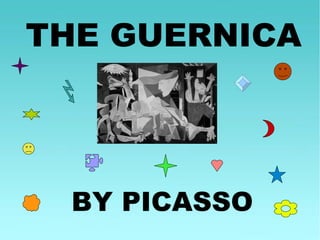
THE GUERNICA
BY PICASSO
SYMBOLS
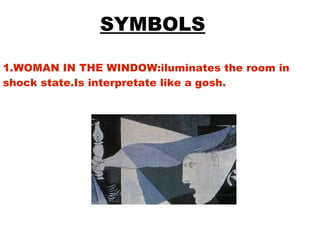
1.WOMAN IN THE WINDOW:iluminates the room in
shock state.Is interpretate like a gosh.
2.LIGHT BULB:represented the advance electronic
used to destructionas as a bomb.
3.BULL:it represent darkness and brutality
or the shelfportrate of Picasso.
4.WOMAN WITH HER CHILD:she hold in her hands her
son died in the ware.
5.PIGEON:it is represented such as the symbol of the
broken peace.
6.HORSE:it represent the hurt of the ware.
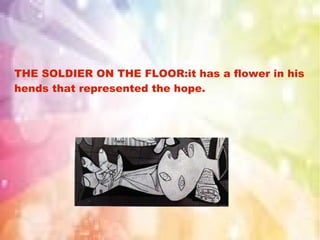
THE SOLDIER ON THE FLOOR:it has a flower in his
hends that represented the hope.
ARTS AND CRAFTS
UNITS 5 AND 6
º
1. Answer the following questions about Technical
Drawing:
1.a.- What angles can you draw using a 45º triangular
set square? And with a 60º triangular set square?
1.b.- Divide a 77 mm segment into two equal parts,
using your compass.
1.c.- Draw a straight line r and any point A on it.
Starting at point A, draw a 72º angle off the line using a
protractor.
1.d.- A straight line can create a sense of volume. On
a sheet of paper, draw a composition showing this
effect :
1.e.- Look for a picture painted by Josef Albers which
he uses only black and red straight lines, and for the
picture named "Homage To The Square: Glow" painted
in 1966 by the same author. In which one does the
painter create a sense of depth?
It doesn`t create
sense of depth
It creates a sense
of depth
http://www.hirshhorn.si.edu/collection/home/#collection=josef-albers&detail
=http%3A//www.hirshhorn.si.edu/bio/josef-albers-innovation-and-inspiration/
http://www.hirshhorn.si.edu/search-results/?edan_search_value=albers
UNIT 6
1. Answer the following questions about Polygonal
shapes: triangles and quadrilaterals:
1.a.- What is a triangle? Write a definition.
DEFINITION:a triangleis a flat shape formed by three
straight lines that intersect each other.
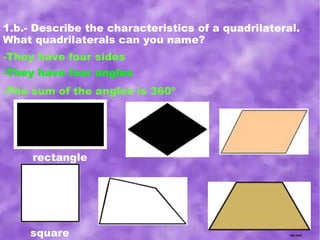
1.b.- Describe the characteristics of a quadrilateral.
What quadrilaterals can you name?
-They have four angles
-The sum of the angles is 360º
-They have four sides
rectangle
square
1.c.- Name and define the important lines of a triangle.
Hypotenuse:is the largest side.
Other sides(called “catetos” in spanish):are the two
shortest sides.
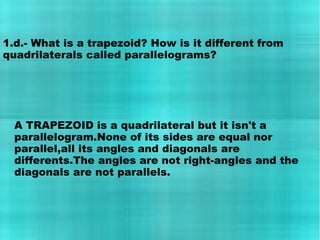
1.d.- What is a trapezoid? How is it different from
quadrilaterals called parallelograms?
A TRAPEZOID is a quadrilateral but it isn't a
parallelogram.None of its sides are equal nor
parallel,all its angles and diagonals are
differents.The angles are not right-angles and the
diagonals are not parallels.
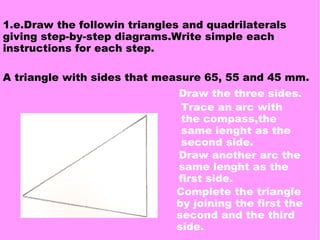
A triangle with sides that measure 65, 55 and 45 mm.
1.e.Draw the followin triangles and quadrilaterals
giving step-by-step diagrams.Write simple each
instructions for each step.
Draw the three sides.
Trace an arc with
the compass,the
same lenght as the
second side.
Draw another arc the
same lenght as the
first side.
Complete the triangle
by joining the first the
second and the third
side.
A diamond with the longest diagonal measuring 60mm
and its smallest diagonal measuring 50mm.
Use the compassto
trace the arcs.
Then join the
points.
Draw two straight
lines
perpendicular to
each other.
A trapezoid with sides measuring 45, 40, 35 and 30
mm and a diagonal of 50 mm
Draw the known diagonal.
Using a compass trace arcs
which are the same lenght
as all the known sides,
from each endpoint of the
diagonal.The four vertices
are where the arcs
intersect.
Join points to make the
trapezoid.
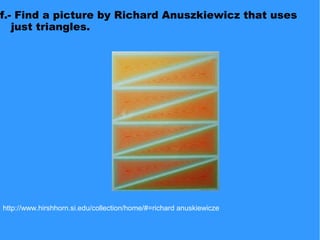
f.- Find a picture by Richard Anuszkiewicz that uses
just triangles.
http://www.hirshhorn.si.edu/collection/home/#=richard anuskiewicze
1.g.- Look for the picture "Grande Toile Grise Pour
Kassel" painted by Antoni Tapies in 1964. What
polygonal shapes can you see?
http://www.artium.org/Castellano/Colecci%C3%B3n/Exposiciones/LaColecci
%C3%B3nenArtium/tabid/153/language/es-ES/Default.aspx
I can see:squares,rectangles.
h.- Look for a Basque Sculptor who uses mostly
polygonal shapes in his works.
This sculpture
is from Jorge
Oteiza.
http://www.guggenheim.org/new-york/collections/collection-online/show-list/do-search/
i.- Look for Pablo Picasso's "Accordionist" painted in
1911 and Georges Braque's "Violin and Palette"
painted in 1909. What movement do they belong to?
What similarities can you see?
http://www.guggenheim.org/new-
york/collections/collection-
online/show-list/do-search/
http://www.guggenheim.org/new-
york/collections/collection-online/show-
list/do-search/
Cubism
Both used geometrical shapes that express breaking
lines and surfaces.
Accordionist
Violin and Palette

Guernica y quest

  • 1.
  • 2.
    SYMBOLS 1.WOMAN IN THEWINDOW:iluminates the room in shock state.Is interpretate like a gosh.
  • 3.
    2.LIGHT BULB:represented theadvance electronic used to destructionas as a bomb.
  • 4.
    3.BULL:it represent darknessand brutality or the shelfportrate of Picasso.
  • 5.
    4.WOMAN WITH HERCHILD:she hold in her hands her son died in the ware.
  • 6.
    5.PIGEON:it is representedsuch as the symbol of the broken peace.
  • 7.
    6.HORSE:it represent thehurt of the ware.
  • 8.
    THE SOLDIER ONTHE FLOOR:it has a flower in his hends that represented the hope.
  • 9.
  • 10.
    º 1. Answer thefollowing questions about Technical Drawing: 1.a.- What angles can you draw using a 45º triangular set square? And with a 60º triangular set square?
  • 11.
    1.b.- Divide a77 mm segment into two equal parts, using your compass.
  • 12.
    1.c.- Draw astraight line r and any point A on it. Starting at point A, draw a 72º angle off the line using a protractor.
  • 13.
    1.d.- A straightline can create a sense of volume. On a sheet of paper, draw a composition showing this effect :
  • 14.
    1.e.- Look fora picture painted by Josef Albers which he uses only black and red straight lines, and for the picture named "Homage To The Square: Glow" painted in 1966 by the same author. In which one does the painter create a sense of depth? It doesn`t create sense of depth It creates a sense of depth http://www.hirshhorn.si.edu/collection/home/#collection=josef-albers&detail =http%3A//www.hirshhorn.si.edu/bio/josef-albers-innovation-and-inspiration/ http://www.hirshhorn.si.edu/search-results/?edan_search_value=albers
  • 15.
  • 16.
    1. Answer thefollowing questions about Polygonal shapes: triangles and quadrilaterals: 1.a.- What is a triangle? Write a definition. DEFINITION:a triangleis a flat shape formed by three straight lines that intersect each other.
  • 17.
    1.b.- Describe thecharacteristics of a quadrilateral. What quadrilaterals can you name? -They have four angles -The sum of the angles is 360º -They have four sides rectangle square
  • 18.
    1.c.- Name anddefine the important lines of a triangle. Hypotenuse:is the largest side. Other sides(called “catetos” in spanish):are the two shortest sides.
  • 19.
    1.d.- What isa trapezoid? How is it different from quadrilaterals called parallelograms? A TRAPEZOID is a quadrilateral but it isn't a parallelogram.None of its sides are equal nor parallel,all its angles and diagonals are differents.The angles are not right-angles and the diagonals are not parallels.
  • 20.
    A triangle withsides that measure 65, 55 and 45 mm. 1.e.Draw the followin triangles and quadrilaterals giving step-by-step diagrams.Write simple each instructions for each step. Draw the three sides. Trace an arc with the compass,the same lenght as the second side. Draw another arc the same lenght as the first side. Complete the triangle by joining the first the second and the third side.
  • 21.
    A diamond withthe longest diagonal measuring 60mm and its smallest diagonal measuring 50mm. Use the compassto trace the arcs. Then join the points. Draw two straight lines perpendicular to each other.
  • 22.
    A trapezoid withsides measuring 45, 40, 35 and 30 mm and a diagonal of 50 mm Draw the known diagonal. Using a compass trace arcs which are the same lenght as all the known sides, from each endpoint of the diagonal.The four vertices are where the arcs intersect. Join points to make the trapezoid.
  • 23.
    f.- Find apicture by Richard Anuszkiewicz that uses just triangles. http://www.hirshhorn.si.edu/collection/home/#=richard anuskiewicze
  • 24.
    1.g.- Look forthe picture "Grande Toile Grise Pour Kassel" painted by Antoni Tapies in 1964. What polygonal shapes can you see? http://www.artium.org/Castellano/Colecci%C3%B3n/Exposiciones/LaColecci %C3%B3nenArtium/tabid/153/language/es-ES/Default.aspx I can see:squares,rectangles.
  • 25.
    h.- Look fora Basque Sculptor who uses mostly polygonal shapes in his works. This sculpture is from Jorge Oteiza. http://www.guggenheim.org/new-york/collections/collection-online/show-list/do-search/
  • 26.
    i.- Look forPablo Picasso's "Accordionist" painted in 1911 and Georges Braque's "Violin and Palette" painted in 1909. What movement do they belong to? What similarities can you see? http://www.guggenheim.org/new- york/collections/collection- online/show-list/do-search/ http://www.guggenheim.org/new- york/collections/collection-online/show- list/do-search/ Cubism Both used geometrical shapes that express breaking lines and surfaces. Accordionist Violin and Palette