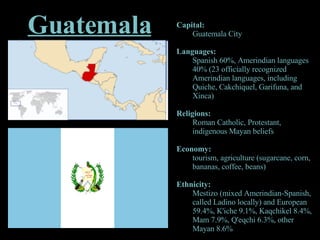
Capital:  Guatemala City Languages:  Spanish 60%, Amerindian languages 40% (23 officially recognized Amerindian languages, including Quiche, Cakchiquel, Garifuna, and Xinca) Religions:  Roman Catholic, Protestant, indigenous Mayan beliefs Economy:  tourism, agriculture (sugarcane, corn, bananas, coffee, beans)  Ethnicity:  Mestizo (mixed Amerindian-Spanish, called Ladino locally) and European 59.4%, K'iche 9.1%, Kaqchikel 8.4%, Mam 7.9%, Q'eqchi 6.3%, other Mayan 8.6% Guatemala
Guatemala Size:  Total 42,042   mi²,  slightly smaller than Tennessee Population:  2008 est. 13,002,206 Density : 134.6/km² 348.6/sq mi Per Capita Income:  $5,000 in 2006 Infant Mortality 2007  29.8 per 1000 births  Life Expectancy 2007 69.7 United States Size:  Total  3,718,691  mi² Population:  2007 est.  301,139,947  Density : 31/km² 80/sq mi Per Capita Income:  $41,800 Infant Mortality 2007 6.4 per 1000 births  Life Expectancy 2007 78.0
The Mayan civilization flourished in Guatemala and surrounding regions during the first millennium A.D.
After almost three centuries as a Spanish colony, Guatemala won its independence in 1821.
Over 2000 yrs old the ancient ruins of the Mayan civilization still stand..


Before The Peace agreement in 1996 40% of the indigenous people had no access to health care, and 60% had no access to safe drinking water.  Education in rural areas was non-existent, with the result that 50% of the people were illiterate.  Half of the country's children suffered from malnutrition.  The real power in Guatemala was in the hands of the Army, and that power had been used to violently control the people, resulting in the worst human rights record in the hemisphere.  Guatemala had been headed by military dictators and figurehead-presidents and was run by an oligarchy of wealthy landowners and big business interests that reaped the country's agricultural and commercial rewards at the expense of the rest of the population.  On coffee plantations, peasants, descendants of the ancient Maya, had lived in concentration camp-like conditions, as de facto slaves.
During the 35 years of civil war,  over 150,000 Guatemalans had been killed or disappeared,  tens-of-thousands had been forced to flee to Mexico,  1 million were displaced within the country,  and more than 700 Indian villages were destroyed.  And, for more than four decades, the  United States government  had consistently supported the Guatemalan Army and the ruling class in their policies of repression.


Guatemala: Making a Difference 2 minute presentation  Jessica Tiver


With less than 1 percent of the adult population estimated to be HIV-positive,  Guatemala is considered to have a concentrated epidemic.  Guatemala – accounts for nearly one-sixth of Central America’s HIV- infected population.  Since the country’s first case of HIV was reported in 1984, infections have occurred primarily among men who have sex with men and sex workers.  According to the National AIDS Program in the Ministry of Health, as of April 2007,  Guatemala had 10,304 officially reported cases of HIV/AIDS. UNAIDS estimates that 61,000 people are living with HIV in Guatemala and 2,700 deaths have occurred due to AIDS.   Remember that:  Guatemala  is Central America’s largest country


Resources First Hand information while in Guatemala CIA - The World  Factbook LA Literacy Rates .  UNESCO Institute for Statistics  (September 2006). Trigger, Bruce G. and Washburn, Wilcomb E. and Adams, Richard E. W.  The Cambridge History of the Native Peoples of the Americas . 2000, page 212.  http://www.ruralpovertyportal.org/english/regions/americas/gtm/statistics.htm http://www.voanews.com/english/archive/2007-11/2007-11-16-voa47.cfm http://papers.ssrn.com/sol3/papers.cfm?abstract_id=636328 http://www.nationmaster.com/encyclopedia/Guatemala/Transnational-issues http://www.infoplease.com/ipa/A0107596.html http://ideas.repec.org/p/wbk/wbrwps/2966.html   http://www.everyculture.com http://www.unicef.org/infobycountry/guatemala_statistics.html http://www.paho.org/english/sha/prflgut.htm http://earthtrends.wri.org/povlinks/country/guatemala.php

Guatemala 1

  • 1.
    Capital: GuatemalaCity Languages: Spanish 60%, Amerindian languages 40% (23 officially recognized Amerindian languages, including Quiche, Cakchiquel, Garifuna, and Xinca) Religions: Roman Catholic, Protestant, indigenous Mayan beliefs Economy: tourism, agriculture (sugarcane, corn, bananas, coffee, beans) Ethnicity: Mestizo (mixed Amerindian-Spanish, called Ladino locally) and European 59.4%, K'iche 9.1%, Kaqchikel 8.4%, Mam 7.9%, Q'eqchi 6.3%, other Mayan 8.6% Guatemala
  • 2.
    Guatemala Size: Total 42,042 mi², slightly smaller than Tennessee Population: 2008 est. 13,002,206 Density : 134.6/km² 348.6/sq mi Per Capita Income: $5,000 in 2006 Infant Mortality 2007 29.8 per 1000 births Life Expectancy 2007 69.7 United States Size: Total 3,718,691 mi² Population: 2007 est. 301,139,947 Density : 31/km² 80/sq mi Per Capita Income: $41,800 Infant Mortality 2007 6.4 per 1000 births Life Expectancy 2007 78.0
  • 3.
    The Mayan civilizationflourished in Guatemala and surrounding regions during the first millennium A.D.
  • 4.
    After almost threecenturies as a Spanish colony, Guatemala won its independence in 1821.
  • 5.
    Over 2000 yrsold the ancient ruins of the Mayan civilization still stand..
  • 6.
  • 7.
  • 8.
  • 9.
  • 10.
  • 11.
  • 12.
  • 13.
    Before The Peaceagreement in 1996 40% of the indigenous people had no access to health care, and 60% had no access to safe drinking water. Education in rural areas was non-existent, with the result that 50% of the people were illiterate. Half of the country's children suffered from malnutrition. The real power in Guatemala was in the hands of the Army, and that power had been used to violently control the people, resulting in the worst human rights record in the hemisphere. Guatemala had been headed by military dictators and figurehead-presidents and was run by an oligarchy of wealthy landowners and big business interests that reaped the country's agricultural and commercial rewards at the expense of the rest of the population. On coffee plantations, peasants, descendants of the ancient Maya, had lived in concentration camp-like conditions, as de facto slaves.
  • 14.
    During the 35years of civil war, over 150,000 Guatemalans had been killed or disappeared, tens-of-thousands had been forced to flee to Mexico, 1 million were displaced within the country, and more than 700 Indian villages were destroyed. And, for more than four decades, the United States government had consistently supported the Guatemalan Army and the ruling class in their policies of repression.
  • 15.
  • 16.
  • 17.
  • 18.
  • 19.
  • 20.
  • 21.
  • 22.
  • 23.
  • 24.
  • 25.
  • 26.
  • 27.
  • 28.
  • 29.
  • 30.
  • 31.
  • 32.
  • 33.
  • 34.
  • 35.
  • 36.
    Guatemala: Making aDifference 2 minute presentation Jessica Tiver
  • 37.
  • 38.
  • 39.
  • 40.
  • 41.
  • 42.
    With less than1 percent of the adult population estimated to be HIV-positive, Guatemala is considered to have a concentrated epidemic. Guatemala – accounts for nearly one-sixth of Central America’s HIV- infected population. Since the country’s first case of HIV was reported in 1984, infections have occurred primarily among men who have sex with men and sex workers. According to the National AIDS Program in the Ministry of Health, as of April 2007, Guatemala had 10,304 officially reported cases of HIV/AIDS. UNAIDS estimates that 61,000 people are living with HIV in Guatemala and 2,700 deaths have occurred due to AIDS. Remember that: Guatemala is Central America’s largest country
  • 43.
  • 44.
  • 45.
  • 46.
  • 47.
  • 48.
  • 49.
  • 50.
  • 51.
  • 52.
  • 53.
  • 54.
    Resources First Handinformation while in Guatemala CIA - The World Factbook LA Literacy Rates . UNESCO Institute for Statistics (September 2006). Trigger, Bruce G. and Washburn, Wilcomb E. and Adams, Richard E. W. The Cambridge History of the Native Peoples of the Americas . 2000, page 212. http://www.ruralpovertyportal.org/english/regions/americas/gtm/statistics.htm http://www.voanews.com/english/archive/2007-11/2007-11-16-voa47.cfm http://papers.ssrn.com/sol3/papers.cfm?abstract_id=636328 http://www.nationmaster.com/encyclopedia/Guatemala/Transnational-issues http://www.infoplease.com/ipa/A0107596.html http://ideas.repec.org/p/wbk/wbrwps/2966.html http://www.everyculture.com http://www.unicef.org/infobycountry/guatemala_statistics.html http://www.paho.org/english/sha/prflgut.htm http://earthtrends.wri.org/povlinks/country/guatemala.php