WORK
IDENTITY
CLIENT
VARIOUS
Gti have worked extensively
for a variety of public
and private organisations
designing brands that
are simple, attractive and
effective.
From basic logo design to
identity suite to full brand
strategy and development,
we engage your audience
with distinctive, memorable
solutions that work across all
media and communication
channels.
In-situ examples.
Our planning
system: a new
way forward
Our planning system
– a new way forward
Your planning
system: our future
Plan together
– building the
future of NSW
Our planning
system: building
the future together
OUR PLANNING SYSTEM
our future
Alternate logotypes
Plan together
– building the
future of NSW
Our plannin
system: bui
the future to
way forward
Plan together
– building the
future of NSW
OUR PLANNING SYSTEM
our future
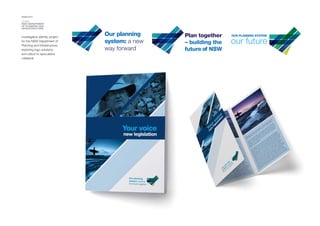
IDENTITY
CLIENT
NSW DEPARTMENT
OF PLANNING AND
INFRASTRUCTURE
Investigative identity project
for the NSW Department of
Planning and Infrastructure,
exploring logo solutions
and rollout to speculative
collateral.
E-MARKETING
CLIENT
INVESTEC / ARUP /CSR /CCENTRIC
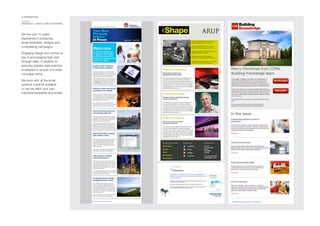
Gti has over 10 years’
experience in producing
email templates, designs and
e-marketing campaigns.
Engaging design and content is
key in encouraging high click-
through rates, in addition to
ensuring industry best-practice
is adhered to as part of a wider
campaign ethos.
We work with all the email
systems currently available
or can we tailor your own
individual templates and emails.
INFORMATION DESIGN /
COLLATERAL
CLIENT
NSW GOVERNMENT
DEPT OF PLANNING AND
INFRASTRUCTURE
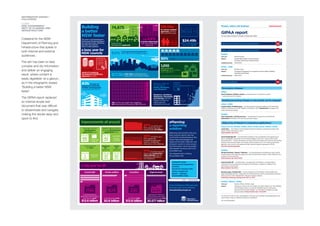
Collateral for the NSW
Department of Planning and
Infrastructure that speak to
both internal and external
audiences.
The aim has been to take
complex and dry information
and deliver an engaging
result, where content is
easily digestible ‘at a glance’,
as in the infographic-based
‘Building a better NSW
faster’.
The GIPAA report replaced
an internal simple text
document that was difficult
to disseminate and navigate,
making the results easy and
quick to find.
Building
a better
NSW faster
74,875
54%
$17.9b
Total of local
development approved
Only 2.4%
of all DAs determined
are new residential
multi-unit
increase in complying development
new secondary
dwellings (granny flats)
were approved
Blacktown, Woollahra,
Bankstown, Parramatta
and Hornsby had the
highest number of
approved new
residential multi unit
Highest number of
DA activity at
Sydney, Blacktown,
Lake Macquarie
of all approved developments in
NSW were for the Sydney region
total value of developments
approved in the Sydney region
79% of DAs are single new dwellings;
14% new second occupancy; 7% multi unit
worth of Complying
Development Certificates
approved, up 35%
128 DAs
for seniors resident
approved, up from
96 in previous year
worth of development
approved, up 11%
This year’s Local Development
Performance Monitoring Report
has uncovered many milestones
the state has achieved.
Here is a quick glimpse…
a busy year for
NSW councils
$24.49b
50%
1,010
$3.03b
increase of
approved community
facilities developments
compared with 2011-12
4.1%
People, culture and business MEMORANDUM
GIPAA report
for the week ending Thursday 5 December 2013
DAS&A
APPLICANT Michael Boulton
REQUEST Original determination for the seawall at
6 Cowper Wharf Road, Woolloomooloo.
DETERMINATION DUE 03/01/2014
PC&B — BPB
APPLICANT Natasha Vasey
REQUEST Complaint Investigation for Complaint No 100-12 William Nettleton
regarding Harriet Street.
DETERMINATION DUE 06/01/2014
GP&D
Patrick Ibbotson, Maddox Lawyers, correspondence re Canberra Airport
— see attachment for details.
AS&A, GP&D
Angela Penklis, PenklisLawyers — All development consents relating to 42 Friendship
Road Port Botany, Lot 50 DP 1182618, including DA 113/79 Determined full release 21/11;
await processing charges.
DAS&A
Chris Outtersides, City Plan Services — Development Consent for DA 96-06-99;
Determined full release 21/11; await processing charges.
these involve DAS&A, GP&D, ODG, PC&B and/or PR&GC GP&D
Laurie Eyes — All contents of the Departmental files relating to proposed central coast
airport. Scope narrowed on 26/11.
Determination due 16/12.
David Shoebridge MP — All information relating to the consideration and granting of a
Site Compatibility Certificate for the Harbord Diggers Club from 1 January 2012 to 30
December 2012 — Scope narrowed to exclude all communications from and to third parties
however (this exclusion does not include communications to or from other government
agencies, the council or the applicant itself. Advance deposit requested on 18/10.
Decision period suspended.
DAS&A
Michael McKinnon, Channel 7 Network — all correspondence, briefings and diary entries
shared between the planning department and the planning minister’s office relating to the
Coalpac mine during 2012.
Determination due 20/12/2013
Greg Donnelly MP — All information including but not limited to correspondence,
submissions, briefs and advice provided to the Minister in relation to Coalpac mine
Information received 25/1.
Determination due 18/12.
Bernard Lagan of Global Mail — Communications to the Minister re Mining SEPP and
Bulge Milbrodale decision; Application for External Review at the Administrative Decisions
Tribunal (ADT) of the Department’s refusal to release material.
Preliminary Planning meeting at the ADT on 17/12
DAS&A, PR&GC, GP&D
APPLICANT Graham Werry, Weriton Legal
REQUEST Inspection of file re DA 54-3-2004, 33 Collins Street (Lot 1 DP 743509)
and 23 Meares Place (Lot 202 DP 1054190), Kiama; Information
received from Southern Region, no information available at Legal
Services Branch Determination due: 17/12/2013
For those who wish to see a spreadsheet of all open and recently closed applications and
those under review an Objective reference is attached.
For your information.
Number of open formal applications
New applications received this week
Determinations
Documents released
Awaiting processing charges so documents can be released
Likely to be of interest or contentious applications
12
2
0
ePlanning will transform the way
that councils interact with the
community and businesses in the
future. New technologies will
speed up the data collection and
analysis in years to come, ensure
this information can be provided
with greater accuracy and in an
accessible way.
The Department is making
this possible with:
Facts and figures of this year and
the years past can be found at
www.planning.nsw.gov.au
Interactive maps
Development Application
tracking
Electronic Housing Code
Online Lodgement
BASIX — Building
Sustainability Index
3 faster than
in 2011-12
Average time for
development
applications was
determined
77.8%
determined
18.7%
determined
2.9%
determined just
24.9%
Council staff Private certifiers Councillors Regional panels
of all development
applications and complying
development worth
$12.6 billion
of development worth
$2.6 billion
for 2012-13 worth
$12.6 billion
applications in NSW, but
because these were larger
developments,theywereworth
$5.577 billion
68DAYS
for 2012-13
Median determination
time for development
applications was
97%of all DA and
CDC approvals were
valued under $1 million
53%of all DA and
CDC approvals
residential approvals
were for residential
alterations and additions
17%of all DA and CDC
approvals construction
value estimate was for
residential alterations
and additions
(45 days
in 2011-12)
42DAYS
Regional
DA
approval
37DAYS
57DAYS
Urban
DA
approval
v
Improvements all around
A big year for all
ePlanning
a reporting
solution
faster than
in 2011-12
Average time
for CDC
1DAY
INFORMATION DESIGN /
COLLATERAL
CLIENT
NSW GOVERNMENT
DEPT OF TRANSPORT
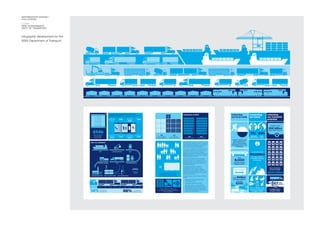
Infographic development for the
NSW Department of Transport.
of containers
carried by rail
Volume and type of household goods imported in
containers at Port Botany: Annual TEU and % of households
goods imports (annual average 2008-09 to 2011-12)
of containers
carried by trucks
Value of imported
and exported
goods in NSW
ship
importer/exporter
manufacturing/retail
container terminal
truck
empty container parks
train
2013
7.4 million people
2021
8.1 million people
2021
3m containers
through Port Botany
2013
1.8m containers
through Port Botany
=
By 2021 NSW’s population will have increased
from 7.4 million to 8.1 million. This means that
there will be more demand for goods that
come in by container at Port Botany.
If we continue operating with only 14% of our
containers moved by rail, we will have more
trucks and cars on our roads in Sydney’s
already at-capacity road network and we will
significantly decrease productivity in getting
goods to and from market.
To ensure this situation does not happen,
we need to work now to improve our rail
network so that we can maximise use of our
existing network capacity and enable us to
meet future capacity.
The NSW Government is currently
implementing ways to convert road
movements to rail to reduce congestion,
emissions and noise pollution. We have set a
target of doubling the amount of containers
moved by rail by 2021.
In order to reach our 28% target in 2021 we
need to:
✓3 Develop the NSW Cargo Movement
Coordination Centre
✓3 Implement Fast tracking Freight
✓3 Maintain business as usual activities
including road and rail network capacity
improvements, access for freight trains
on the network and land use planning to
support IMT development.
intermodal terminal
agricultural exports
exports
imports
Life of a container
Population of NSW
Hygiene and
cleaning
24,000
Pharmaceutical
15,000
White goods
and electronics
50,000
Miscellaneous
12,000
Clothing
and footwear
57,000
Paper
19,000
Food and
beverages
92,000
Furniture
71,000
14% 86%
$54b
More containers on NSW roads
will create more congestion, emissions
and noise pollution
On average, one import container
of household goods is consumed
by 7.2 NSW households per year
Local roads cover
160,000km
the same distance
as travelling half way
to the moon
Improving
our local roads
State and
National Roads
Local
Roads
Country councils and
shires spend up to
50% of their budget
maintaining local roads
and bridges
Freight is worth
$58 billion
to the NSW economy
Over
8,000
local government
bridges in NSW
Every100km
out of a truck driver’s
way costs
$200
Over 72 different types
of produce transported
by freight in NSW
of freight moved
annually in NSW
Value of products
moved by freight
11%
$200 billion
89%
Connecting
our towns
Unlocking
our economic
potential
billion
tonne/km67
IDENTITY / DIGITAL /
PUBLISHING
CLIENT
ARUP
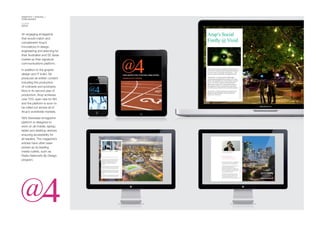
An engaging emagazine
that would match and
complement Arup’s
innovations in design,
engineering and planning for
their Australian and SE Asian
market as their signature
communications platform.
In addition to the graphic
design and IT build, Gti
produces all written content
including the production
of vodcasts and podcasts.
Now in its second year of
production, Arup achieves
over 70% open rate for @4
and the platform is soon to
be rolled out across all of
Arup’s worldwide markets.
Gti’s Swwwipe emagazine
platform is designed to
work on all mobile, laptop,
tablet and desktop devices
ensuring accessibility for
all readers. The magazine’s
articles have often been
picked up by leading
media outlets, such as
Radio National’s By Design
program.
DIGITAL / PUBLISHING
CLIENT
IBM
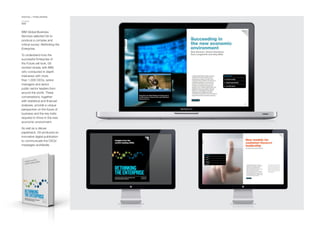
IBM Global Business
Services selected Gti to
produce a complex and
critical survey: Rethinking the
Enterprise.
To understand how the
successful Enterprise of
the Future will look, Gti
worked closely with IBM,
who conducted in-depth
interviews with more
than 1,000 CEOs, senior
managers and senior
public sector leaders from
around the world. These
conversations, together
with statistical and financial
analyses, provide a unique
perspective on the future of
business and the key traits
required to thrive in the new
economic environment.
As well as a deluxe
paperback, Gti produced an
innovative digital publication
to communicate the CEOs’
messages worldwide.
DIGITAL
CLIENT
ARUP
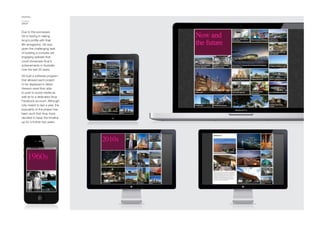
Due to the successes
Gti is having in raising
Arup’s profile with their
@4 emagazine, Gti was
given the challenging task
of building a complex yet
engaging website that
could showcase Arup’s
achievements in Australia
over the last 50 years.
Gti built a software program
that allowed each project
to be displayed in detail.
Viewers were then able
to post to social media as
well as to a dedicated Arup
Facebook account. Although
only meant to last a year, the
popularity of the project has
been such that Arup have
decided to keep the timeline
up for a further two years.
DIGITAL
CLIENT
NSW GOVERNMENT
DEPT OF PLANNING AND
INFRASTRUCTURE
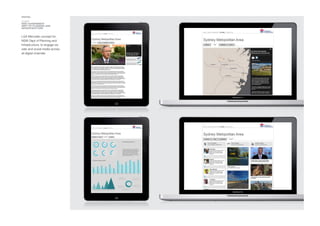
LGA Microsite concept for
NSW Dept of Planning and
Infrastructure, to engage via
web and social media across
all digital channels.
MOTION GRAPHICS
CLIENT
NSW GOVERNMENT
DEPT OF PLANNING AND
INFRASTRUCTURE
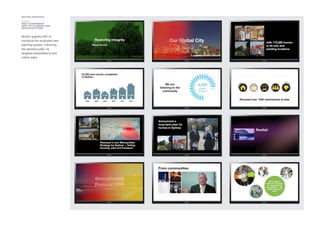
Motion graphics film to
introduce the proposed new
planning system, informing
the general public via
targeted presentations and
online video.
COLLATERAL / DIGITAL
CLIENT
NSW GOVERNMENT DEPT OF
PLANNING AND INFRASTRUCTURE
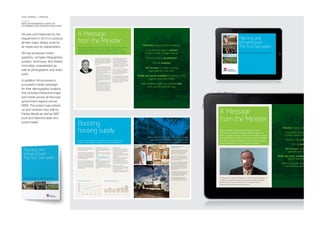
Gti was commissioned by the
Department in 2013 to produce
all their major design work for
all media and its stakeholders.
Gti has produced motion
graphics, complex infographics,
posters, brochures, fact sheets,
microsites, enewsletters as
well as photographic and video
work.
In addition Gti produced a
successful media campaign
for their demographic projects
that included interactive maps
and charts across all the local
government regions across
NSW. The project was picked
up and received very well by
Fairfax Media as well as ABC
local and National radio and
social media.
Planning and
Infrastructure:
The first two years
Restoring integrity, delivering growth
A Message
from the Minister
The Government – through the Department of Planning and Infrastructure – is
changing this by delivering a planning system that encourages sustainable
growth, boosts housing and creates jobs in a transparent manner in
partnership with local councils and communities.
Before the NSW Government was elected in March
2011, investors and the community had lost faith in the
planning system. Housing construction had faltered, further
weakening NSW’s economy. Infrastructure was not keeping
pace with our growing population and the community was
angry at being left out of major planning decisions.
Restoring integrity and transparency
Local planning powers restored
to communities through councils
Decision-making de-politicised
Part 3A abolished
25% increase in Sydney housing
approvals over two years
18,186 new homes completed in Sydney in 201
(highest level since 2006)
Made fire sprinkler systems mandatory
in all residential aged care facilities
We identified that the housing shortfall of
72,000 homes over the previous five years had
to be turned around urgently.
We responded by setting up a powerful Cabinet
committee to clear the way for thousands more
new homes in the right locations. Some are in
establishedsurburbs,someingreenfieldsites–
but importantly they both provide choice, and
options for different budgets.
You told us that new homes need to be near
jobs, shops, schools and transport. As a result,
the Government is now delivering thousands
more home sites near key infrastructure. Where
more infrastructure is needed, we are getting on
with the job of delivering it to create attractive,
liveable communities.
MORE HOMES AND HOME SITES
3 Facilitated a 25% jump in Sydney housing
approvals over two years to 24,390 in
2011-12
3 Facilitated construction of 18,186 homes in
Sydney in 2012 – the highest number since
2006
3 Announced a long-term plan to deliver
up to 172,000 new homes near jobs
and infrastructure in 44 new and existing
locations
3 Rezoning land for thousands more homes
across NSW in partnership with councils
through Standard Instrument Local
Environmental Plans (SILEPs). Delivered an
annual average of 37 SILEPS – compared to
the previous government’s annual average of
6 SILEPS.
CUTTING RED TAPE
3 Expanded the range of homes that could
be approved within 10 days by including
houses on smaller lots and rural homes in
the general housing codes
3 Streamlinedthebushfireassessmentprocess
to deliver housing more quickly in Sydney's
Growth Centres
3 Simplified the assessment process for new
homes by reducing overly complex and
conflicting development controls
3 Finalised a scheme to create potential home
sites across NSW from land locked up in
irregular and restrictive 'paper' subdivisions.
BOOSTING THE ECONOMY
3 Promoted delivery of more new apartments
and townhouses in existing suburbs, making
homes more affordable
3 Reduced infrastructure costs by up to $5000
per residential lot in the Growth Centres.
Boosting
housing supply
For most of the past decade, housing supply in NSW hasn’t kept pace with
population growth, leading to shortages in many areas and higher prices.
Michelle Grima and her fiancé Jason are getting
married soon, and the opportunity to buy, design
and build their own house near family and
friends was a dream start to their new life.
“Jason and I are both Penrith locals and we were
hoping for a new housing development close
by. When we heard about Caddens, we couldn’t
believe our luck,” Michelle said.
Caddensisanewresidentialcommunityplanned
by UrbanGrowth NSW. Located east of Penrith
near the University of Western Sydney, the new
release area will accommodate about 1,250
dwellings when completed. UrbanGrowth NSW
is also developing land nearby with space for
2,500 ongoing jobs.
“We really wanted to stay in the local area. We
know that western Sydney will only continue to
grow, so we both feel comfortable embarking on
our first big project together,” she said.
“The fact Caddens is being developed by
UrbanGrowth NSW gives us extra confidence,
knowing the development will be a quality one.”
BOOSTING HOUSING SUPPLY
– A CASE STUDY
We’ve heard the message – not only do people
want more new housing, it needs to be near
jobs, shops, schools and transport
SYDNEY DWELLING COMPLETIONS
2007 2008 2009 2010 2011 2012
SYDNEY HOUSING APPROVALS
0
5,000
10,000
15,000
20,000
25,000
30,000
2007/8 2008/9 2009/10 2010/11 2011/12
76
13,790 14,267 13,752 14,652 15,468 18,186
The Government – through the Department of
Planning and Infrastructure – is changing this
bydeliveringaplanningsystemthatencourages
sustainable growth, boosts housing and creates
jobs in partnership with local councils and
communities.
3 We've returned decisions about many local
matters to councils, and restored confidence
in planning by increasing transparency and
engaging more with communities. Investors
and the community can now have full
confidence that all proposals are determined
purely on their merits
3 We've de-politicised the decision-making
process by having almost all major projects
decided by independent bodies such as the
Planning Assessment Commission or Joint
Regional Planning Panels, rather than the
Minister
3 We’ve embarked on major reform of the
State’s planning laws, led by two respected
former Liberal and Labor ministers – Tim
Moore and Ron Dyer. Their bipartisan and
unprecedented level of consultation across
the state allowed them to hear firsthand
from the community and a wide range of
stakeholders about what change is needed
3 We’ve boosted housing, jobs and economic
activity by removing obstacles in the
planning process. Annual dwelling approvals
reached their highest level in Sydney since
2003-04. The construction sector alone
contributed an extra $578 million to the state’s
economy in 2011-12. This is very encouraging
and shows we are on the right path.
We continue to listen to what you've told us,
and we are now delivering on our commitment
to make the state's planning system a key
economic driver that boosts investment and
jobs and eases the cost of living.
This booklet highlights the planning initiatives
the Government has taken to enhance the lives
of people in NSW over the past two years. We
are putting in place a new framework to deliver
more housing and jobs to create vibrant places
in which to live, work and relax.
A Message
from the Minister
Before the NSW Government was elected in March 2011, investors and the community
had lost faith in the planning system. Housing construction had faltered, further
weakening NSW’s economy. Infrastructure was not keeping pace with our growing
population and the community was angry at being left out of major planning decisions.
32
Restoring integrity and transparency
Local planning powers restored
to communities through councils
Decision-making de-politicised
Part 3A abolished
25% increase in Sydney housing
approvals over two years
18,186 new homes completed in Sydney in 2012
(highest level since 2006)
Made residential aged care facilities safer,
with new fire sprinkler laws
COLLATERAL
CLIENT
UNIVERSITY OF WOLLONGONG
INFORMATICS FACULTY
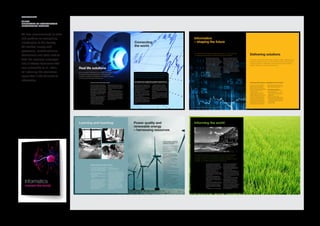
Gti was commissioned to write
and produce an compelling
introduction to the Faculty.
Gti worked closely with
professors, mathematicians,
statisticians and other staff to
distil the complex messages
into a takeout document that
was accessible to all, while
still retaining the intellectual
rigour that is the hallmark of
informatics.
Power quality and
renewable energy
– harnessing resources
Learning and teaching
The Faculty works in the area of distribution
and transmission systems of power quality,
reliability and renewable energy systems,
aligning closely with the power and energy
sector via an array of post graduate courses
for industry employees.
The areas of research vary across
fields such as power quality, reliability,
distributed generation and renewable
energy and include:
> Power quality surveying methodology
> Power quality data analysis and reporting
> Flicker propagation and transfer
> Harmonic allocation to distribution and
transmission Systems
> Standards interpretation and development
> Effect of photovoltaic inverter systems on
distribution systems
> Power quality data mining
> Voltage unbalance on transmission networks
> Load control ripple signal amplification and
mitigation
> Power quality instrumentation operation and
standards
> Equipment immunity to PQ disturbances
> Achievable sag characteristics and limits for
distribution systems
> Cost of sags to customers
> Database structure for power quality data
> Reliability improvement for MV feeders
> Simplifying reliability reporting tools
> Identifying state-of-the-art reliability practices
> Improving/creating computer models of
equipment such as wind turbines and
induction motors.
The University of Wollongong is internationally
recognised and is consistently ranked in the
top two per cent of universities in the world in
the three prestigious international rankings:
> QS World University Rankings
> Shanghai Jiao Tong Academic Ranking of
World Universities
> Times Higher Education World University
Rankings
These rankings provide a comprehensive
assessment of universities across a range
of criteria, including research excellence,
employer reviews and degree quality.
The University of Wollongong has a strong
tradition in providing a five-star education
across a wide range of disciplines with
excellent ratings in the areas of:
> Learning and Teaching
> Getting a Job
> Positive Graduate Outcomes
> Graduate Starting Salaries
The Faculty of Informatics is well known for
producing market-ready graduates. The Faculty
delivers an uncompromisingly strong technical
foundation, supported by practical and industry-
focused subjects. The learning experience is led
by cutting edge research to ensure relevance,
currency and employment, creating industry-
prepared information professionals. Informatics
at UOW delivers excellent employment rates,
high salaries and flexible career options.
Informatics studies at UOW and the
appropriately contextualised, multi-layered
skills acquired in the Faculty’s schools are
the ideal preparation for a highly successful,
specialist involvement in the Australian and
global digital economy.
ACCESS TO RELIABLE COST EFFECTIVE,
CLEAN AND EFFICIENT POWER IS A KEY
CHALLENGE OF THE CENTURY
INFORMATICS DELIVERS THE SKILL SETS FOR THE FUTURE
Informing the world
The University (UOW) has an excellent and
growing reputation for the highest quality
teaching and research in Australia, the Asia
Pacific region and more and more, throughout
the world. The research environment is truly
multidisciplinary and clearly focuses on
outcomes for a smarter future.
Importantly, the University provides
substantial opportunities to build and maintain
successful relationships with business, industry
and the community.
The features of UOW partnerships are
personal closeness, timeliness and mutual
benefit. They are made possible by another
important partnership – with and between our
staff members.
UOW comfortably sustains a position in the
top two per cent of world research universities
and remains a national leader in learning
and teaching performance with the highest
ratings for student experience and graduate
outcomes.
The University has built its strong research
foundation through consolidating five key
themes: Environmental Sustainability;
Innovative Materials, Engineering &
Manufacturing; Health & Medical Research;
Information & Mathematical Sciences; and
Society, Policy and Culture.
UOW also has a particular definition of
excellence: as an active not a passive concept.
The University has consistently gone beyond
expectations for an institution of its current size
and stands proud and independent on its own
merits and successes.
The University continually demonstrates
a capacity to address social and business
priorities by aligning undergraduate and
postgraduate programs more closely with
its research strengths, relying on expertise
and innovation. As an added bonus for
students, staff, researchers and visitors, UOW
is located in one of Australia’s most beautiful
and memorable coastal settings, beneath
spectacular escarpment landforms, just over
an hour south of Sydney.
The University of Wollongong’s expressed vision is to be an international
university recognised for its interdisciplinary research, originality and
enterprise in exploring, communicating and applying knowledge to enrich
individuals, communities, business and the environment.
Real life solutions
Connecting
the world
At the University of Wollongong, the Faculty of Informatics
has developed specific approaches in its courses and
programs to address the challenges of the rapidly changing
technology and information environments.
The Faculty of Informatics comprises several
schools: all committed to the real-life application
of information technology to solve both common
and complex problems. By bringing together the
separate disciplines that intersect in the various
fields of information and technology, the Faculty
brings a sharp focus to understanding, planning
and managing the complexities of organisations
and society, creating real solutions to bring
positive change.
Importantly, the Faculty encourages social
as well as technological perspectives on
information its systems and applications —
an approach that facilitates the exploration
of multiple information and technology
possibilities across the widest range of
professional and societal domains.
As well as regularly and necessarily
intersecting with each other, Informatics
disciplines contribute significantly to other key
areas of University study such as medicine,
the creative arts, infrastructure, health and
engineering.
Informatics embodies the study and
application of information and communication
technologies to the arts, sciences and
professions. Students study the fundamentals
of ICT, mathematics and statistics, and gain
experience through practice and exposure to
real world problems. Informatics harnesses
the power of technology to bring benefit to all
sectors of the economy.
STATISTICS IS NOW THE SEXIEST SUBJECT AROUND
The extraordinary growth of the internet and the global
digital economy confirms the crucial role to be played by
Informatics in nearly all aspects of economic growth.
The rollout of the national broadband network
(NBN) in Australia means an even faster growth
of the digital economy via access to high speed
broadband communications for business,
government and the community.
The NBN is intended to drive productivity,
speed the growth of our economy and provide
all business sectors — large, mid-sized and
small — with the local, regional and worldwide
opportunities that are so essential to business
and community prosperity.
The use of the internet, offered by greater
broadband coverage, will also grow as the range
of services offered online increases, such as
online entertainment, communications, buying
and selling, banking and general government
services.
The National Digital Economy Strategy
has targeted increasing use of the internet in
Australia, setting goals for increasing access
to smart technology for managing energy use,
tele-health and online education; and increasing
internet or online engagement with government
and business.
Deloitte Access Economics projects that the
direct contribution of the internet to the Australian
economy will grow at least twice as quickly as
the forecast GDP growth over the next five years,
increasing from $50 billion to approximately $70
billion by 2016
IN AN UNCHARTED WORLD OF BOUNDLESS DATA, INFORMATION DESIGNERS ARE OUR
NEW NAVIGATORS TO HELP COMPANIES AND CONSUMERS CUT THROUGH THE CLUTTER
Informatics
– shaping the future
Delivering solutionsThe Web means that it doesn’t matter where you are … you can live here
in Australia and build products for the world thanks to the internet.
The impact of the Faculty of Informatics’ academic leaders, researchers and
students is evident across the economic and social fabric of the world with
pioneering research in collaboration with partners from tertiary institutions,
research organisations, industry and government.
Over the past 20 years we have seen
the emergence of the digital economy. In
this new economy, digital networking and
communication infrastructures provide a global
platform from which people and organisations
devise strategies, interact, communicate,
collaborate and search for information.
Participation in the digital economy is
essential to national productivity growth, global
competitive standing and improved social
wellbeing. Increasingly, ‘smart technology’
is being utilised to change behaviours and
manage infrastructure in ways that can also
benefit the environment. It can make better
use of natural resources, such as greater water
efficiency and reducing our energy demands.
The digital economy is highly dynamic. It
will ultimately encompass the entire economy
and many, if not all, facets of society. The
digital economy presents Australia with a
unique opportunity to shrink the distances
that have historically dominated our domestic
and international relationships, open up new
markets for engagement and growth.
The impact of the digital economy includes
new and emerging uses of technology, such
as remote specialist diagnosis of patients, as
well as uses that have yet to be imagined.
The digital economy is about the activities that
networked technology makes possible. It is the
demonstration of how the whole is greater than
the sum of its parts.1
The mission of this work is to lift statistical
thinking and practice, through research
leadership, teaching, and postgraduate
supervision in partnership with governments
and industry. The strong links with government
and industry provide the Faculty with a
significant differentiator.
Statistical and survey methodology is
a research strength of UOW, a centre of
excellence in design and analysis for complex
populations with expertise in: survey design
and analysis; complex data analysis and
estimation methods; experimental design
and analysis; data mining; spatial and small
area statistics; statistics in quality; privacy
and confidentiality; combining and analysing
data from different sources, bioinfomatics
and statistical education. This work crosses
multiple sectors and industries: agriculture,
medicine, health sciences, population studies,
transport, meteorology, demographics …
Current research encompasses:
> statistical design, including survey design
and experimental design
> analysis of data from complex populations,
including survey, longitudinal, spatial and
aggregated data
> data quality and survey methods
> statistical modelling and analysis, including
semi-parametric methods, generalised linear
mixed models, estimating equations, Monte
Carlo methods, computational statistics and
time series analysis
> statistical education.
STATISTICS AND SURVEY METHODOLOGY – UNDERSTANDING THE WORLD AND ITS PEOPLE
1 http://www.dbcde.gov.au/digital_economy/what_is_the_digital_economy/australias_digital_economy_future_directions
PUBLISHING
CLIENT
GTI MEDIA
Transforming Australia
The Broadband Revolution
and the Digital Economy
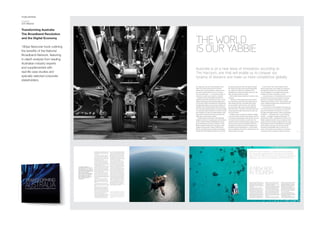
180pp flexicover book outlining
the benefits of the National
Broadband Network, featuring
in-depth analysis from leading
Australian industry experts
and supplemented with
real-life case studies and
specially selected corporate
stakeholders.
44 45
best digitally switched-on farmers are doing in my area.
A narrative must be locally created, locally articulated,
by community leaders in industry, government and the
community itself.
“Third, I believe every region needs a ‘digital futures
plan’. Some communities refer to this as a ‘digital
economy plan’ because, I believe, this puts all the focus
on the economy and business — where there are many
gains to be made in the community, non-government
organisations and government itself.”
One regional city that is working towards its digital
future is Kiama on the NSW south coast. The local
municipal council announced in November last year
that it was the first council on mainland Australia to be
connected to the NBN, with rollout to the majority of the
municipality expected by the end of 2012.
Sandra McCarthy, Mayor of the Council, says that the
NBN will have a significant influence in the near future
in the way that many Council staff currently operate: it
will enable IT solutions that use cloud technology, and
devices such as tablets and smart phones will allow the
mobile or out-of-the-office user to still operate as if they
are in the office sitting at their desk.
McCarthy adds that the rollout of the NBN presents
local councils with an opportunity to look at public
infrastructure uses and the needs of the community in
a new way. The project is a major change in the way
councils communicate with the Federal government and
transcends traditional boundaries and borders for a truly
regional response.
She says that the Council’s implementation plans
included a focus on strong community and media
engagement to ensure Kiama Council is proactive and
positive about the opportunities offered by the rollout of
the NBN.
It is not just the client communities that will see
benefit from the NBN. The NSW far south coast town of
Merimbula will be playing an active role in the network’s
operation.
NBN Co has chosen the town as the site of its first
satellite ground station gateway. The new facility will
transmit high-speed Internet for the NBN’s long-term
satellite service to homes, farms and businesses in re-
mote parts of Australia, including Norfolk and Christmas
Islands. The first of 10 such satellite facilities, construc-
tion at Merimbula is set to begin next year and it is
scheduled to be up and running in 2015.
The site for the ground station gateway and six satel-
lite dishes in Wolumla, approximately 15 kilometres
north-west of Merimbula, was selected following exten-
sive consultation with Bega Valley Shire Council.
Tony Allen, mayor of the Council, says that “NBN
Co’s decision to site the satellite ground station gateway
at Wolumla is a very positive thing for the Shire. We’re
now seeing the broad community benefits. There will be
opportunity for local businesses to reap the benefits of
high-speed broadband Internet and for other residents
and businesses to be drawn to the Shire, taking advan-
tage of our lifestyle over the congestion of city living.”
Bartlett adds, however, that not every community will
attract a data centre or build a significant IT industry, nor
become the “Silicon Valley of the south”.
“But, to me, that’s not what the NBN is about. It
is about creating extraordinary new ways of creating
wealth. It is about transformative new ways to have two
way conversations with our customers, constituents,
communities. And it is about solving old and wicked
public policy and community problems that have previ-
ously stumped us. All of these things are great opportu-
nities for communities to benefit from the NBN.
“Much of the gains that will be made will be at the
intersection of a region’s traditional strengths and broad-
band. If tourism is a traditional strength, the region’s
digital futures plan should of course have a focus on
that sector. However, I believe there are actually around
a dozen key areas of community life that need to be
understood and planned for in broadband/digital terms.
Things like sustainable living, community safety, small
business, open democracy, cultural and vibrant living ...
all of these areas can be enhanced and developed when
underpinned by ubiquitous high-speed broadband.”
Despite the challenges and sometimes misgivings ex-
pressed by various parties in the media and elsewhere,
Bartlett is convinced that Australia is on the right track.
“In 2010, I spoke in Washington DC at the US
Australia leadership dialogue about the NBN. They were
gobsmacked at the breadth and depth of Australia’s
NBN. Having, said that, our nearer neighbours like
Korea and Singapore are already way ahead in this area.
The NBN is necessary for us to compete.”
“IT IS ABOUT CREATING
EXTRAORDINARY NEW WAYS OF
CREATING WEALTH. IT IS ABOUT
TRANSFORMATIVE NEW WAYS TO
HAVE TWO WAY CONVERSATIONS
WITH OUR CUSTOMERS,
CONSTITUENTS, COMMUNITIES.
AND IT IS ABOUT SOLVING OLD
AND WICKED PUBLIC POLICY
AND COMMUNITY PROBLEMS
THAT HAVE PREVIOUSLY
STUMPED US.”
Tim Mendham is an experienced journalist, editor and copywriter,
with 30 years in business-to-business publications. He has written
extensively on IT, technology, R&D, business finance and marketing
issues. During his career he has edited a number of publications,
including Lab News, a technical journal for the R&D community;
CFO, Australia’s leading publication for senior finance executives;
Fast Thinking, a quarterly publication devoted to innovation issues;
and most recently CIO, Australia’s leading magazine for senior
IT management. 2 3
The initial 20-year period of growth up until the mid-
1980s largely concentrated on domestic tourism which,
in 2012, still accounts for nearly three quarters of the
estimated $95 billion tourism revenue. However, for
more than 25 years, inbound tourism has been the main
driver of growth.
The tourism market – inbound and domestic –
generates almost $100 billion in revenue, contributes
$35 billion to Australia’s GDP, and employs over
500,000 individuals. It also caters for over six million
inbound tourists and over 70 million visitor nights.
It is Australia’s fourth most profitable industry, our
largest export service industry and one that will rival
mining industry exports within the next 20 years. And
what will contribute to this dramatic increase in inbound
tourism is fast broadband and advanced software.
Tourism operators will increasingly use online and
Internet technologies to connect their customers with
an operator. Consumers will also have more options to
research, plan or buy a tourism product or service.
The greatest surge in inbound tourism for Australia
will come from its Asian neighbours.
Asia, made up of the Asia Pacific and the Indian sub-
Continent, already accounts for two thirds of Australia’s
inbound tourists. It is expected that this share of the
market will increase to at least 80 percent by 2020.
Tourism is also an important factor in international
relations and the burgeoning economies of China and
India with its new found wealth is eyeing off Australia
as a new travel destination. While populous and fast
growing economies such as South Korea will help to
drive Australia’s inbound tourism, China will become our
primary market in the future (see Inbound Tourists by
Origin chart).
Boeing’s forecast in 2011 that there could be over
110 million outbound tourists from China represents a
major opportunity for Australian tourism. The question
is: ‘how many of these tourists can Australian tourist
operators capture?’ Capitalising on this opportunity by
adopting the NBN and delivering more sophisticated
techniques and a richer multimedia experience for
potential travellers will be the major attractor.
If Boeing’s forecast was not realised until some five
years further on, Australia would have added over 11
billion individuals to its current total tourist intake of six
billion in 2011 plus the growth in other existing and
new sources of inbound tourists.
As more tourists use the Internet to source
information, smart tourist operators will be using the
NBN technology to target countries such as China and
India, particularly as they represent two of the world’s
largest and fastest growing economies.
The tourism industry in Australia is segmented into
a number of disparate industries that revolve around
A new Age
in tourism
Australia’s tourism market is a relatively new age industry
that has grown significantly from the end of the Industrial
Age in the mid-1960s into the current Infotronics Age that is
expected to last until the late 2040s, writes Phil Ruthven*.
108 109
As a large land mass with a small population at the
bottom of the world Australians have often been
obsessed with conquering distance. Australia may be
the world’s smallest continent, but it is a continent
that is the whole nation — or in the famous phrase, “a
continent for a nation and a nation for a continent”.
Australia is also the world’s largest island with vast
distances to travel within and beyond our shores. It is this
obsession with distance that has made Australians think
so much about transport and infrastructure. Shipping lines
and freight rates matter so much not just to exporters and
importers but to the whole Australian nation; the advance
of air travel really benefited Australia. For example, the large
747 jumbo jets caused a revolution for our tourism industry
and immigration and, there are constant debates in public
policy about new roads and rail links not to mention the
chatter about a second airport in Sydney.
Australia’s obsession with distance was intellectually
brought to the fore of our national psyche when the famous
economic historian Professor Geoffrey Blainey wrote his
ground breaking book The Tyranny of Distance in 1966.
Blainey covered the length of time it took ships to bring
supplies to the early convict colonies of NSW and Van
Diemen’s Land (Tasmania), the importance of whaling in
the early days of the Australian economy, how we moved
the whole clip around the world, the impact of transport
from Cobb and Co horse and cart around the gold fields
and, sailing in the 1850s to the introduction of the
passenger liner, the steam train and the motor car in later
years, even before the dawn of aviation.
When Geoffrey Blainey reflected on his seminal work,
he opined:
“Sometimes I think people take the phrase further
than it should have been taken and certainly than the
book intended. My book is essentially about people
and commodities, and for them the cost of distance
has actually been high. But for ideas the freight has
often been cheap. In the history of this land, ideas have
usually leaped with relative ease across the ocean and
even across inland.”
As Blainey notes, the capacity of Australia to engage
in the world of ideas has been cheap relative to the cost
of transporting physical goods across the globe. But even
in the world of communications, we have seen mini-
revolutions that have helped Australians engage with the
world of commerce and the whole global community.
And trade and investment has been an integral part of
the different waves of development in communications
that has brought the world closer to Australia and in turn
Australia closer to the world.
In the first wave, back in the nineteenth century,
Siemens helped open up the outback by providing the
technology and infrastructure to allow the Adelaide
to Darwin telegraph to be completed thereby linking
Australia with London and therefore, the world.
In the second wave, in the twentieth century, we saw
the advance of short wave radio, television, and other
advances to accompany the great leaps in transport
infrastructure so familiar to us all. Further advances were
made in satellite technology which accelerated the pace
of communications further.
In the third wave, as the twentieth century gave way
to a new century and a new millennium, the information
age and the introduction of the Internet, e-commerce
and digital technologies allowed a whole new generation
of exporters — particularly those in rural and regional
Australia — to engage in the global market place. For
example, Mary Nenke, a Yabbie grower in Kukerin in the
Western Australia wheat belt, set up a website to sell her
produce to Perth and ended up getting orders from Hong
Kong, Singapore and the United States and ‘accidentally’
became exporter of the year. And she was not alone.
According to Austrade/ABS research at the time, 50
percent of all exporters were ‘accidental’ as the advance
of ecommerce made it possible to market to the world.
The world
is our yabbie
Australia is on a new wave of innovation, according to
Tim Harcourt, one that will enable us to conquer our
tyranny of distance and make us more competitive globally.
PUBLISHING
CLIENT
EVENTS NSW
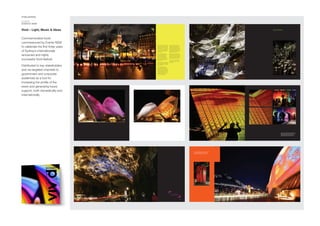
Vivid – Light, Music & Ideas
Commemorative book
commissioned by Events NSW
to celebrate the first three years
of Sydney’s internationally
renowned and highly
successful Vivid festival.
Distributed to key stakeholders
and via targeted channels to
government and corporate
audiences as a tool for
increasing the profile of the
event and generating future
support, both domestically and
internationally.
61
Inspired creativity realised
through the medium of light.
5352
11
Meanwhile another facet of the festival
was also taking shape. Vivid Sydney
would not only be a festival of light and
a festival of live music – it would also be
a forum at which creative people from
around the world could come together
to share their work, to interact and
exchange ideas.
It was a natural extension to the
festival given Sydney’s extraordinary
concentration of creative skills
which encompass industries such
as architecture, digital design and
production, lighting, music, visual arts,
media, film and television and the
performing arts.
There was a very natural convergence of
strategic objectives, the result of which
was the uniquely multi-faceted creative
festival, Vivid Sydney.
Since its first staging in 2009 this
ground-breaking Sydney event has
continued to shine in the international
spotlight. Each year Vivid evolves with
artistic directors adding new dimensions
and exploring new creative directions
for exhibits, performances, ideas and
forums and the intersection of art,
commerce and technology.
Destination NSW, the government’s
lead tourism and events agency, owns,
manages and markets the event and
works collaboratively with the City of
Sydney, the Sydney Opera House, NSW
government departments, corporate
sponsors and a host of creative and arts
organisations and institutions.
Vivid also attracts some of the world’s
best artists, directors, technicians and
creative minds to Sydney who contribute
their ideas, their vision and their skills to
making each event unique – each year
different – but always cutting edge.
Vivid Sydney is an 18-day celebration
of light, music and ideas – come join
the celebration!
62
Over 18 nights, between the hours of 6pm to midnight
the city reveals its true colours with a spectacular
show of light – helped along by the city’s icons.
55
During the three weeks of the Vivid Sydney festival,
light projections, illuminations and sculptural
installations transform The Rocks, Circular Quay,
Sydney Opera House and city boulevards.
2120
Buildings become lightscapes and
trees become sculpture gardens.
PUBLISHING
CLIENT
GTI MEDIA
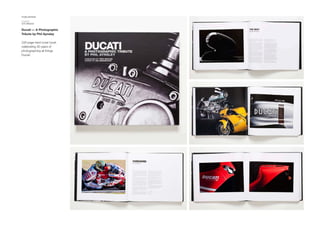
Ducati — A Photographic
Tribute by Phil Aynsley
228 page hard cover book
celebrating 30 years of
photographing all things
Ducati.
PUBLISHING
CLIENT
GTI MEDIA
Ducati — A Photographic
Tribute by Phil Aynsley
Special edition box set,
signed by Phil Aynsley and
Troy Bayliss featuring limited
edition prints, certificate and
handling gloves.

Gti Folio-lr

  • 1.
  • 2.
    IDENTITY CLIENT VARIOUS Gti have workedextensively for a variety of public and private organisations designing brands that are simple, attractive and effective. From basic logo design to identity suite to full brand strategy and development, we engage your audience with distinctive, memorable solutions that work across all media and communication channels.
  • 3.
    In-situ examples. Our planning system:a new way forward Our planning system – a new way forward Your planning system: our future Plan together – building the future of NSW Our planning system: building the future together OUR PLANNING SYSTEM our future Alternate logotypes Plan together – building the future of NSW Our plannin system: bui the future to way forward Plan together – building the future of NSW OUR PLANNING SYSTEM our future IDENTITY CLIENT NSW DEPARTMENT OF PLANNING AND INFRASTRUCTURE Investigative identity project for the NSW Department of Planning and Infrastructure, exploring logo solutions and rollout to speculative collateral.
  • 4.
    E-MARKETING CLIENT INVESTEC / ARUP/CSR /CCENTRIC Gti has over 10 years’ experience in producing email templates, designs and e-marketing campaigns. Engaging design and content is key in encouraging high click- through rates, in addition to ensuring industry best-practice is adhered to as part of a wider campaign ethos. We work with all the email systems currently available or can we tailor your own individual templates and emails.
  • 5.
    INFORMATION DESIGN / COLLATERAL CLIENT NSWGOVERNMENT DEPT OF PLANNING AND INFRASTRUCTURE Collateral for the NSW Department of Planning and Infrastructure that speak to both internal and external audiences. The aim has been to take complex and dry information and deliver an engaging result, where content is easily digestible ‘at a glance’, as in the infographic-based ‘Building a better NSW faster’. The GIPAA report replaced an internal simple text document that was difficult to disseminate and navigate, making the results easy and quick to find. Building a better NSW faster 74,875 54% $17.9b Total of local development approved Only 2.4% of all DAs determined are new residential multi-unit increase in complying development new secondary dwellings (granny flats) were approved Blacktown, Woollahra, Bankstown, Parramatta and Hornsby had the highest number of approved new residential multi unit Highest number of DA activity at Sydney, Blacktown, Lake Macquarie of all approved developments in NSW were for the Sydney region total value of developments approved in the Sydney region 79% of DAs are single new dwellings; 14% new second occupancy; 7% multi unit worth of Complying Development Certificates approved, up 35% 128 DAs for seniors resident approved, up from 96 in previous year worth of development approved, up 11% This year’s Local Development Performance Monitoring Report has uncovered many milestones the state has achieved. Here is a quick glimpse… a busy year for NSW councils $24.49b 50% 1,010 $3.03b increase of approved community facilities developments compared with 2011-12 4.1% People, culture and business MEMORANDUM GIPAA report for the week ending Thursday 5 December 2013 DAS&A APPLICANT Michael Boulton REQUEST Original determination for the seawall at 6 Cowper Wharf Road, Woolloomooloo. DETERMINATION DUE 03/01/2014 PC&B — BPB APPLICANT Natasha Vasey REQUEST Complaint Investigation for Complaint No 100-12 William Nettleton regarding Harriet Street. DETERMINATION DUE 06/01/2014 GP&D Patrick Ibbotson, Maddox Lawyers, correspondence re Canberra Airport — see attachment for details. AS&A, GP&D Angela Penklis, PenklisLawyers — All development consents relating to 42 Friendship Road Port Botany, Lot 50 DP 1182618, including DA 113/79 Determined full release 21/11; await processing charges. DAS&A Chris Outtersides, City Plan Services — Development Consent for DA 96-06-99; Determined full release 21/11; await processing charges. these involve DAS&A, GP&D, ODG, PC&B and/or PR&GC GP&D Laurie Eyes — All contents of the Departmental files relating to proposed central coast airport. Scope narrowed on 26/11. Determination due 16/12. David Shoebridge MP — All information relating to the consideration and granting of a Site Compatibility Certificate for the Harbord Diggers Club from 1 January 2012 to 30 December 2012 — Scope narrowed to exclude all communications from and to third parties however (this exclusion does not include communications to or from other government agencies, the council or the applicant itself. Advance deposit requested on 18/10. Decision period suspended. DAS&A Michael McKinnon, Channel 7 Network — all correspondence, briefings and diary entries shared between the planning department and the planning minister’s office relating to the Coalpac mine during 2012. Determination due 20/12/2013 Greg Donnelly MP — All information including but not limited to correspondence, submissions, briefs and advice provided to the Minister in relation to Coalpac mine Information received 25/1. Determination due 18/12. Bernard Lagan of Global Mail — Communications to the Minister re Mining SEPP and Bulge Milbrodale decision; Application for External Review at the Administrative Decisions Tribunal (ADT) of the Department’s refusal to release material. Preliminary Planning meeting at the ADT on 17/12 DAS&A, PR&GC, GP&D APPLICANT Graham Werry, Weriton Legal REQUEST Inspection of file re DA 54-3-2004, 33 Collins Street (Lot 1 DP 743509) and 23 Meares Place (Lot 202 DP 1054190), Kiama; Information received from Southern Region, no information available at Legal Services Branch Determination due: 17/12/2013 For those who wish to see a spreadsheet of all open and recently closed applications and those under review an Objective reference is attached. For your information. Number of open formal applications New applications received this week Determinations Documents released Awaiting processing charges so documents can be released Likely to be of interest or contentious applications 12 2 0 ePlanning will transform the way that councils interact with the community and businesses in the future. New technologies will speed up the data collection and analysis in years to come, ensure this information can be provided with greater accuracy and in an accessible way. The Department is making this possible with: Facts and figures of this year and the years past can be found at www.planning.nsw.gov.au Interactive maps Development Application tracking Electronic Housing Code Online Lodgement BASIX — Building Sustainability Index 3 faster than in 2011-12 Average time for development applications was determined 77.8% determined 18.7% determined 2.9% determined just 24.9% Council staff Private certifiers Councillors Regional panels of all development applications and complying development worth $12.6 billion of development worth $2.6 billion for 2012-13 worth $12.6 billion applications in NSW, but because these were larger developments,theywereworth $5.577 billion 68DAYS for 2012-13 Median determination time for development applications was 97%of all DA and CDC approvals were valued under $1 million 53%of all DA and CDC approvals residential approvals were for residential alterations and additions 17%of all DA and CDC approvals construction value estimate was for residential alterations and additions (45 days in 2011-12) 42DAYS Regional DA approval 37DAYS 57DAYS Urban DA approval v Improvements all around A big year for all ePlanning a reporting solution faster than in 2011-12 Average time for CDC 1DAY
  • 6.
    INFORMATION DESIGN / COLLATERAL CLIENT NSWGOVERNMENT DEPT OF TRANSPORT Infographic development for the NSW Department of Transport. of containers carried by rail Volume and type of household goods imported in containers at Port Botany: Annual TEU and % of households goods imports (annual average 2008-09 to 2011-12) of containers carried by trucks Value of imported and exported goods in NSW ship importer/exporter manufacturing/retail container terminal truck empty container parks train 2013 7.4 million people 2021 8.1 million people 2021 3m containers through Port Botany 2013 1.8m containers through Port Botany = By 2021 NSW’s population will have increased from 7.4 million to 8.1 million. This means that there will be more demand for goods that come in by container at Port Botany. If we continue operating with only 14% of our containers moved by rail, we will have more trucks and cars on our roads in Sydney’s already at-capacity road network and we will significantly decrease productivity in getting goods to and from market. To ensure this situation does not happen, we need to work now to improve our rail network so that we can maximise use of our existing network capacity and enable us to meet future capacity. The NSW Government is currently implementing ways to convert road movements to rail to reduce congestion, emissions and noise pollution. We have set a target of doubling the amount of containers moved by rail by 2021. In order to reach our 28% target in 2021 we need to: ✓3 Develop the NSW Cargo Movement Coordination Centre ✓3 Implement Fast tracking Freight ✓3 Maintain business as usual activities including road and rail network capacity improvements, access for freight trains on the network and land use planning to support IMT development. intermodal terminal agricultural exports exports imports Life of a container Population of NSW Hygiene and cleaning 24,000 Pharmaceutical 15,000 White goods and electronics 50,000 Miscellaneous 12,000 Clothing and footwear 57,000 Paper 19,000 Food and beverages 92,000 Furniture 71,000 14% 86% $54b More containers on NSW roads will create more congestion, emissions and noise pollution On average, one import container of household goods is consumed by 7.2 NSW households per year Local roads cover 160,000km the same distance as travelling half way to the moon Improving our local roads State and National Roads Local Roads Country councils and shires spend up to 50% of their budget maintaining local roads and bridges Freight is worth $58 billion to the NSW economy Over 8,000 local government bridges in NSW Every100km out of a truck driver’s way costs $200 Over 72 different types of produce transported by freight in NSW of freight moved annually in NSW Value of products moved by freight 11% $200 billion 89% Connecting our towns Unlocking our economic potential billion tonne/km67
  • 7.
    IDENTITY / DIGITAL/ PUBLISHING CLIENT ARUP An engaging emagazine that would match and complement Arup’s innovations in design, engineering and planning for their Australian and SE Asian market as their signature communications platform. In addition to the graphic design and IT build, Gti produces all written content including the production of vodcasts and podcasts. Now in its second year of production, Arup achieves over 70% open rate for @4 and the platform is soon to be rolled out across all of Arup’s worldwide markets. Gti’s Swwwipe emagazine platform is designed to work on all mobile, laptop, tablet and desktop devices ensuring accessibility for all readers. The magazine’s articles have often been picked up by leading media outlets, such as Radio National’s By Design program.
  • 8.
    DIGITAL / PUBLISHING CLIENT IBM IBMGlobal Business Services selected Gti to produce a complex and critical survey: Rethinking the Enterprise. To understand how the successful Enterprise of the Future will look, Gti worked closely with IBM, who conducted in-depth interviews with more than 1,000 CEOs, senior managers and senior public sector leaders from around the world. These conversations, together with statistical and financial analyses, provide a unique perspective on the future of business and the key traits required to thrive in the new economic environment. As well as a deluxe paperback, Gti produced an innovative digital publication to communicate the CEOs’ messages worldwide.
  • 9.
    DIGITAL CLIENT ARUP Due to thesuccesses Gti is having in raising Arup’s profile with their @4 emagazine, Gti was given the challenging task of building a complex yet engaging website that could showcase Arup’s achievements in Australia over the last 50 years. Gti built a software program that allowed each project to be displayed in detail. Viewers were then able to post to social media as well as to a dedicated Arup Facebook account. Although only meant to last a year, the popularity of the project has been such that Arup have decided to keep the timeline up for a further two years.
  • 10.
    DIGITAL CLIENT NSW GOVERNMENT DEPT OFPLANNING AND INFRASTRUCTURE LGA Microsite concept for NSW Dept of Planning and Infrastructure, to engage via web and social media across all digital channels.
  • 11.
    MOTION GRAPHICS CLIENT NSW GOVERNMENT DEPTOF PLANNING AND INFRASTRUCTURE Motion graphics film to introduce the proposed new planning system, informing the general public via targeted presentations and online video.
  • 12.
    COLLATERAL / DIGITAL CLIENT NSWGOVERNMENT DEPT OF PLANNING AND INFRASTRUCTURE Gti was commissioned by the Department in 2013 to produce all their major design work for all media and its stakeholders. Gti has produced motion graphics, complex infographics, posters, brochures, fact sheets, microsites, enewsletters as well as photographic and video work. In addition Gti produced a successful media campaign for their demographic projects that included interactive maps and charts across all the local government regions across NSW. The project was picked up and received very well by Fairfax Media as well as ABC local and National radio and social media. Planning and Infrastructure: The first two years Restoring integrity, delivering growth A Message from the Minister The Government – through the Department of Planning and Infrastructure – is changing this by delivering a planning system that encourages sustainable growth, boosts housing and creates jobs in a transparent manner in partnership with local councils and communities. Before the NSW Government was elected in March 2011, investors and the community had lost faith in the planning system. Housing construction had faltered, further weakening NSW’s economy. Infrastructure was not keeping pace with our growing population and the community was angry at being left out of major planning decisions. Restoring integrity and transparency Local planning powers restored to communities through councils Decision-making de-politicised Part 3A abolished 25% increase in Sydney housing approvals over two years 18,186 new homes completed in Sydney in 201 (highest level since 2006) Made fire sprinkler systems mandatory in all residential aged care facilities We identified that the housing shortfall of 72,000 homes over the previous five years had to be turned around urgently. We responded by setting up a powerful Cabinet committee to clear the way for thousands more new homes in the right locations. Some are in establishedsurburbs,someingreenfieldsites– but importantly they both provide choice, and options for different budgets. You told us that new homes need to be near jobs, shops, schools and transport. As a result, the Government is now delivering thousands more home sites near key infrastructure. Where more infrastructure is needed, we are getting on with the job of delivering it to create attractive, liveable communities. MORE HOMES AND HOME SITES 3 Facilitated a 25% jump in Sydney housing approvals over two years to 24,390 in 2011-12 3 Facilitated construction of 18,186 homes in Sydney in 2012 – the highest number since 2006 3 Announced a long-term plan to deliver up to 172,000 new homes near jobs and infrastructure in 44 new and existing locations 3 Rezoning land for thousands more homes across NSW in partnership with councils through Standard Instrument Local Environmental Plans (SILEPs). Delivered an annual average of 37 SILEPS – compared to the previous government’s annual average of 6 SILEPS. CUTTING RED TAPE 3 Expanded the range of homes that could be approved within 10 days by including houses on smaller lots and rural homes in the general housing codes 3 Streamlinedthebushfireassessmentprocess to deliver housing more quickly in Sydney's Growth Centres 3 Simplified the assessment process for new homes by reducing overly complex and conflicting development controls 3 Finalised a scheme to create potential home sites across NSW from land locked up in irregular and restrictive 'paper' subdivisions. BOOSTING THE ECONOMY 3 Promoted delivery of more new apartments and townhouses in existing suburbs, making homes more affordable 3 Reduced infrastructure costs by up to $5000 per residential lot in the Growth Centres. Boosting housing supply For most of the past decade, housing supply in NSW hasn’t kept pace with population growth, leading to shortages in many areas and higher prices. Michelle Grima and her fiancé Jason are getting married soon, and the opportunity to buy, design and build their own house near family and friends was a dream start to their new life. “Jason and I are both Penrith locals and we were hoping for a new housing development close by. When we heard about Caddens, we couldn’t believe our luck,” Michelle said. Caddensisanewresidentialcommunityplanned by UrbanGrowth NSW. Located east of Penrith near the University of Western Sydney, the new release area will accommodate about 1,250 dwellings when completed. UrbanGrowth NSW is also developing land nearby with space for 2,500 ongoing jobs. “We really wanted to stay in the local area. We know that western Sydney will only continue to grow, so we both feel comfortable embarking on our first big project together,” she said. “The fact Caddens is being developed by UrbanGrowth NSW gives us extra confidence, knowing the development will be a quality one.” BOOSTING HOUSING SUPPLY – A CASE STUDY We’ve heard the message – not only do people want more new housing, it needs to be near jobs, shops, schools and transport SYDNEY DWELLING COMPLETIONS 2007 2008 2009 2010 2011 2012 SYDNEY HOUSING APPROVALS 0 5,000 10,000 15,000 20,000 25,000 30,000 2007/8 2008/9 2009/10 2010/11 2011/12 76 13,790 14,267 13,752 14,652 15,468 18,186 The Government – through the Department of Planning and Infrastructure – is changing this bydeliveringaplanningsystemthatencourages sustainable growth, boosts housing and creates jobs in partnership with local councils and communities. 3 We've returned decisions about many local matters to councils, and restored confidence in planning by increasing transparency and engaging more with communities. Investors and the community can now have full confidence that all proposals are determined purely on their merits 3 We've de-politicised the decision-making process by having almost all major projects decided by independent bodies such as the Planning Assessment Commission or Joint Regional Planning Panels, rather than the Minister 3 We’ve embarked on major reform of the State’s planning laws, led by two respected former Liberal and Labor ministers – Tim Moore and Ron Dyer. Their bipartisan and unprecedented level of consultation across the state allowed them to hear firsthand from the community and a wide range of stakeholders about what change is needed 3 We’ve boosted housing, jobs and economic activity by removing obstacles in the planning process. Annual dwelling approvals reached their highest level in Sydney since 2003-04. The construction sector alone contributed an extra $578 million to the state’s economy in 2011-12. This is very encouraging and shows we are on the right path. We continue to listen to what you've told us, and we are now delivering on our commitment to make the state's planning system a key economic driver that boosts investment and jobs and eases the cost of living. This booklet highlights the planning initiatives the Government has taken to enhance the lives of people in NSW over the past two years. We are putting in place a new framework to deliver more housing and jobs to create vibrant places in which to live, work and relax. A Message from the Minister Before the NSW Government was elected in March 2011, investors and the community had lost faith in the planning system. Housing construction had faltered, further weakening NSW’s economy. Infrastructure was not keeping pace with our growing population and the community was angry at being left out of major planning decisions. 32 Restoring integrity and transparency Local planning powers restored to communities through councils Decision-making de-politicised Part 3A abolished 25% increase in Sydney housing approvals over two years 18,186 new homes completed in Sydney in 2012 (highest level since 2006) Made residential aged care facilities safer, with new fire sprinkler laws
  • 13.
    COLLATERAL CLIENT UNIVERSITY OF WOLLONGONG INFORMATICSFACULTY Gti was commissioned to write and produce an compelling introduction to the Faculty. Gti worked closely with professors, mathematicians, statisticians and other staff to distil the complex messages into a takeout document that was accessible to all, while still retaining the intellectual rigour that is the hallmark of informatics. Power quality and renewable energy – harnessing resources Learning and teaching The Faculty works in the area of distribution and transmission systems of power quality, reliability and renewable energy systems, aligning closely with the power and energy sector via an array of post graduate courses for industry employees. The areas of research vary across fields such as power quality, reliability, distributed generation and renewable energy and include: > Power quality surveying methodology > Power quality data analysis and reporting > Flicker propagation and transfer > Harmonic allocation to distribution and transmission Systems > Standards interpretation and development > Effect of photovoltaic inverter systems on distribution systems > Power quality data mining > Voltage unbalance on transmission networks > Load control ripple signal amplification and mitigation > Power quality instrumentation operation and standards > Equipment immunity to PQ disturbances > Achievable sag characteristics and limits for distribution systems > Cost of sags to customers > Database structure for power quality data > Reliability improvement for MV feeders > Simplifying reliability reporting tools > Identifying state-of-the-art reliability practices > Improving/creating computer models of equipment such as wind turbines and induction motors. The University of Wollongong is internationally recognised and is consistently ranked in the top two per cent of universities in the world in the three prestigious international rankings: > QS World University Rankings > Shanghai Jiao Tong Academic Ranking of World Universities > Times Higher Education World University Rankings These rankings provide a comprehensive assessment of universities across a range of criteria, including research excellence, employer reviews and degree quality. The University of Wollongong has a strong tradition in providing a five-star education across a wide range of disciplines with excellent ratings in the areas of: > Learning and Teaching > Getting a Job > Positive Graduate Outcomes > Graduate Starting Salaries The Faculty of Informatics is well known for producing market-ready graduates. The Faculty delivers an uncompromisingly strong technical foundation, supported by practical and industry- focused subjects. The learning experience is led by cutting edge research to ensure relevance, currency and employment, creating industry- prepared information professionals. Informatics at UOW delivers excellent employment rates, high salaries and flexible career options. Informatics studies at UOW and the appropriately contextualised, multi-layered skills acquired in the Faculty’s schools are the ideal preparation for a highly successful, specialist involvement in the Australian and global digital economy. ACCESS TO RELIABLE COST EFFECTIVE, CLEAN AND EFFICIENT POWER IS A KEY CHALLENGE OF THE CENTURY INFORMATICS DELIVERS THE SKILL SETS FOR THE FUTURE Informing the world The University (UOW) has an excellent and growing reputation for the highest quality teaching and research in Australia, the Asia Pacific region and more and more, throughout the world. The research environment is truly multidisciplinary and clearly focuses on outcomes for a smarter future. Importantly, the University provides substantial opportunities to build and maintain successful relationships with business, industry and the community. The features of UOW partnerships are personal closeness, timeliness and mutual benefit. They are made possible by another important partnership – with and between our staff members. UOW comfortably sustains a position in the top two per cent of world research universities and remains a national leader in learning and teaching performance with the highest ratings for student experience and graduate outcomes. The University has built its strong research foundation through consolidating five key themes: Environmental Sustainability; Innovative Materials, Engineering & Manufacturing; Health & Medical Research; Information & Mathematical Sciences; and Society, Policy and Culture. UOW also has a particular definition of excellence: as an active not a passive concept. The University has consistently gone beyond expectations for an institution of its current size and stands proud and independent on its own merits and successes. The University continually demonstrates a capacity to address social and business priorities by aligning undergraduate and postgraduate programs more closely with its research strengths, relying on expertise and innovation. As an added bonus for students, staff, researchers and visitors, UOW is located in one of Australia’s most beautiful and memorable coastal settings, beneath spectacular escarpment landforms, just over an hour south of Sydney. The University of Wollongong’s expressed vision is to be an international university recognised for its interdisciplinary research, originality and enterprise in exploring, communicating and applying knowledge to enrich individuals, communities, business and the environment. Real life solutions Connecting the world At the University of Wollongong, the Faculty of Informatics has developed specific approaches in its courses and programs to address the challenges of the rapidly changing technology and information environments. The Faculty of Informatics comprises several schools: all committed to the real-life application of information technology to solve both common and complex problems. By bringing together the separate disciplines that intersect in the various fields of information and technology, the Faculty brings a sharp focus to understanding, planning and managing the complexities of organisations and society, creating real solutions to bring positive change. Importantly, the Faculty encourages social as well as technological perspectives on information its systems and applications — an approach that facilitates the exploration of multiple information and technology possibilities across the widest range of professional and societal domains. As well as regularly and necessarily intersecting with each other, Informatics disciplines contribute significantly to other key areas of University study such as medicine, the creative arts, infrastructure, health and engineering. Informatics embodies the study and application of information and communication technologies to the arts, sciences and professions. Students study the fundamentals of ICT, mathematics and statistics, and gain experience through practice and exposure to real world problems. Informatics harnesses the power of technology to bring benefit to all sectors of the economy. STATISTICS IS NOW THE SEXIEST SUBJECT AROUND The extraordinary growth of the internet and the global digital economy confirms the crucial role to be played by Informatics in nearly all aspects of economic growth. The rollout of the national broadband network (NBN) in Australia means an even faster growth of the digital economy via access to high speed broadband communications for business, government and the community. The NBN is intended to drive productivity, speed the growth of our economy and provide all business sectors — large, mid-sized and small — with the local, regional and worldwide opportunities that are so essential to business and community prosperity. The use of the internet, offered by greater broadband coverage, will also grow as the range of services offered online increases, such as online entertainment, communications, buying and selling, banking and general government services. The National Digital Economy Strategy has targeted increasing use of the internet in Australia, setting goals for increasing access to smart technology for managing energy use, tele-health and online education; and increasing internet or online engagement with government and business. Deloitte Access Economics projects that the direct contribution of the internet to the Australian economy will grow at least twice as quickly as the forecast GDP growth over the next five years, increasing from $50 billion to approximately $70 billion by 2016 IN AN UNCHARTED WORLD OF BOUNDLESS DATA, INFORMATION DESIGNERS ARE OUR NEW NAVIGATORS TO HELP COMPANIES AND CONSUMERS CUT THROUGH THE CLUTTER Informatics – shaping the future Delivering solutionsThe Web means that it doesn’t matter where you are … you can live here in Australia and build products for the world thanks to the internet. The impact of the Faculty of Informatics’ academic leaders, researchers and students is evident across the economic and social fabric of the world with pioneering research in collaboration with partners from tertiary institutions, research organisations, industry and government. Over the past 20 years we have seen the emergence of the digital economy. In this new economy, digital networking and communication infrastructures provide a global platform from which people and organisations devise strategies, interact, communicate, collaborate and search for information. Participation in the digital economy is essential to national productivity growth, global competitive standing and improved social wellbeing. Increasingly, ‘smart technology’ is being utilised to change behaviours and manage infrastructure in ways that can also benefit the environment. It can make better use of natural resources, such as greater water efficiency and reducing our energy demands. The digital economy is highly dynamic. It will ultimately encompass the entire economy and many, if not all, facets of society. The digital economy presents Australia with a unique opportunity to shrink the distances that have historically dominated our domestic and international relationships, open up new markets for engagement and growth. The impact of the digital economy includes new and emerging uses of technology, such as remote specialist diagnosis of patients, as well as uses that have yet to be imagined. The digital economy is about the activities that networked technology makes possible. It is the demonstration of how the whole is greater than the sum of its parts.1 The mission of this work is to lift statistical thinking and practice, through research leadership, teaching, and postgraduate supervision in partnership with governments and industry. The strong links with government and industry provide the Faculty with a significant differentiator. Statistical and survey methodology is a research strength of UOW, a centre of excellence in design and analysis for complex populations with expertise in: survey design and analysis; complex data analysis and estimation methods; experimental design and analysis; data mining; spatial and small area statistics; statistics in quality; privacy and confidentiality; combining and analysing data from different sources, bioinfomatics and statistical education. This work crosses multiple sectors and industries: agriculture, medicine, health sciences, population studies, transport, meteorology, demographics … Current research encompasses: > statistical design, including survey design and experimental design > analysis of data from complex populations, including survey, longitudinal, spatial and aggregated data > data quality and survey methods > statistical modelling and analysis, including semi-parametric methods, generalised linear mixed models, estimating equations, Monte Carlo methods, computational statistics and time series analysis > statistical education. STATISTICS AND SURVEY METHODOLOGY – UNDERSTANDING THE WORLD AND ITS PEOPLE 1 http://www.dbcde.gov.au/digital_economy/what_is_the_digital_economy/australias_digital_economy_future_directions
  • 14.
    PUBLISHING CLIENT GTI MEDIA Transforming Australia TheBroadband Revolution and the Digital Economy 180pp flexicover book outlining the benefits of the National Broadband Network, featuring in-depth analysis from leading Australian industry experts and supplemented with real-life case studies and specially selected corporate stakeholders. 44 45 best digitally switched-on farmers are doing in my area. A narrative must be locally created, locally articulated, by community leaders in industry, government and the community itself. “Third, I believe every region needs a ‘digital futures plan’. Some communities refer to this as a ‘digital economy plan’ because, I believe, this puts all the focus on the economy and business — where there are many gains to be made in the community, non-government organisations and government itself.” One regional city that is working towards its digital future is Kiama on the NSW south coast. The local municipal council announced in November last year that it was the first council on mainland Australia to be connected to the NBN, with rollout to the majority of the municipality expected by the end of 2012. Sandra McCarthy, Mayor of the Council, says that the NBN will have a significant influence in the near future in the way that many Council staff currently operate: it will enable IT solutions that use cloud technology, and devices such as tablets and smart phones will allow the mobile or out-of-the-office user to still operate as if they are in the office sitting at their desk. McCarthy adds that the rollout of the NBN presents local councils with an opportunity to look at public infrastructure uses and the needs of the community in a new way. The project is a major change in the way councils communicate with the Federal government and transcends traditional boundaries and borders for a truly regional response. She says that the Council’s implementation plans included a focus on strong community and media engagement to ensure Kiama Council is proactive and positive about the opportunities offered by the rollout of the NBN. It is not just the client communities that will see benefit from the NBN. The NSW far south coast town of Merimbula will be playing an active role in the network’s operation. NBN Co has chosen the town as the site of its first satellite ground station gateway. The new facility will transmit high-speed Internet for the NBN’s long-term satellite service to homes, farms and businesses in re- mote parts of Australia, including Norfolk and Christmas Islands. The first of 10 such satellite facilities, construc- tion at Merimbula is set to begin next year and it is scheduled to be up and running in 2015. The site for the ground station gateway and six satel- lite dishes in Wolumla, approximately 15 kilometres north-west of Merimbula, was selected following exten- sive consultation with Bega Valley Shire Council. Tony Allen, mayor of the Council, says that “NBN Co’s decision to site the satellite ground station gateway at Wolumla is a very positive thing for the Shire. We’re now seeing the broad community benefits. There will be opportunity for local businesses to reap the benefits of high-speed broadband Internet and for other residents and businesses to be drawn to the Shire, taking advan- tage of our lifestyle over the congestion of city living.” Bartlett adds, however, that not every community will attract a data centre or build a significant IT industry, nor become the “Silicon Valley of the south”. “But, to me, that’s not what the NBN is about. It is about creating extraordinary new ways of creating wealth. It is about transformative new ways to have two way conversations with our customers, constituents, communities. And it is about solving old and wicked public policy and community problems that have previ- ously stumped us. All of these things are great opportu- nities for communities to benefit from the NBN. “Much of the gains that will be made will be at the intersection of a region’s traditional strengths and broad- band. If tourism is a traditional strength, the region’s digital futures plan should of course have a focus on that sector. However, I believe there are actually around a dozen key areas of community life that need to be understood and planned for in broadband/digital terms. Things like sustainable living, community safety, small business, open democracy, cultural and vibrant living ... all of these areas can be enhanced and developed when underpinned by ubiquitous high-speed broadband.” Despite the challenges and sometimes misgivings ex- pressed by various parties in the media and elsewhere, Bartlett is convinced that Australia is on the right track. “In 2010, I spoke in Washington DC at the US Australia leadership dialogue about the NBN. They were gobsmacked at the breadth and depth of Australia’s NBN. Having, said that, our nearer neighbours like Korea and Singapore are already way ahead in this area. The NBN is necessary for us to compete.” “IT IS ABOUT CREATING EXTRAORDINARY NEW WAYS OF CREATING WEALTH. IT IS ABOUT TRANSFORMATIVE NEW WAYS TO HAVE TWO WAY CONVERSATIONS WITH OUR CUSTOMERS, CONSTITUENTS, COMMUNITIES. AND IT IS ABOUT SOLVING OLD AND WICKED PUBLIC POLICY AND COMMUNITY PROBLEMS THAT HAVE PREVIOUSLY STUMPED US.” Tim Mendham is an experienced journalist, editor and copywriter, with 30 years in business-to-business publications. He has written extensively on IT, technology, R&D, business finance and marketing issues. During his career he has edited a number of publications, including Lab News, a technical journal for the R&D community; CFO, Australia’s leading publication for senior finance executives; Fast Thinking, a quarterly publication devoted to innovation issues; and most recently CIO, Australia’s leading magazine for senior IT management. 2 3 The initial 20-year period of growth up until the mid- 1980s largely concentrated on domestic tourism which, in 2012, still accounts for nearly three quarters of the estimated $95 billion tourism revenue. However, for more than 25 years, inbound tourism has been the main driver of growth. The tourism market – inbound and domestic – generates almost $100 billion in revenue, contributes $35 billion to Australia’s GDP, and employs over 500,000 individuals. It also caters for over six million inbound tourists and over 70 million visitor nights. It is Australia’s fourth most profitable industry, our largest export service industry and one that will rival mining industry exports within the next 20 years. And what will contribute to this dramatic increase in inbound tourism is fast broadband and advanced software. Tourism operators will increasingly use online and Internet technologies to connect their customers with an operator. Consumers will also have more options to research, plan or buy a tourism product or service. The greatest surge in inbound tourism for Australia will come from its Asian neighbours. Asia, made up of the Asia Pacific and the Indian sub- Continent, already accounts for two thirds of Australia’s inbound tourists. It is expected that this share of the market will increase to at least 80 percent by 2020. Tourism is also an important factor in international relations and the burgeoning economies of China and India with its new found wealth is eyeing off Australia as a new travel destination. While populous and fast growing economies such as South Korea will help to drive Australia’s inbound tourism, China will become our primary market in the future (see Inbound Tourists by Origin chart). Boeing’s forecast in 2011 that there could be over 110 million outbound tourists from China represents a major opportunity for Australian tourism. The question is: ‘how many of these tourists can Australian tourist operators capture?’ Capitalising on this opportunity by adopting the NBN and delivering more sophisticated techniques and a richer multimedia experience for potential travellers will be the major attractor. If Boeing’s forecast was not realised until some five years further on, Australia would have added over 11 billion individuals to its current total tourist intake of six billion in 2011 plus the growth in other existing and new sources of inbound tourists. As more tourists use the Internet to source information, smart tourist operators will be using the NBN technology to target countries such as China and India, particularly as they represent two of the world’s largest and fastest growing economies. The tourism industry in Australia is segmented into a number of disparate industries that revolve around A new Age in tourism Australia’s tourism market is a relatively new age industry that has grown significantly from the end of the Industrial Age in the mid-1960s into the current Infotronics Age that is expected to last until the late 2040s, writes Phil Ruthven*. 108 109 As a large land mass with a small population at the bottom of the world Australians have often been obsessed with conquering distance. Australia may be the world’s smallest continent, but it is a continent that is the whole nation — or in the famous phrase, “a continent for a nation and a nation for a continent”. Australia is also the world’s largest island with vast distances to travel within and beyond our shores. It is this obsession with distance that has made Australians think so much about transport and infrastructure. Shipping lines and freight rates matter so much not just to exporters and importers but to the whole Australian nation; the advance of air travel really benefited Australia. For example, the large 747 jumbo jets caused a revolution for our tourism industry and immigration and, there are constant debates in public policy about new roads and rail links not to mention the chatter about a second airport in Sydney. Australia’s obsession with distance was intellectually brought to the fore of our national psyche when the famous economic historian Professor Geoffrey Blainey wrote his ground breaking book The Tyranny of Distance in 1966. Blainey covered the length of time it took ships to bring supplies to the early convict colonies of NSW and Van Diemen’s Land (Tasmania), the importance of whaling in the early days of the Australian economy, how we moved the whole clip around the world, the impact of transport from Cobb and Co horse and cart around the gold fields and, sailing in the 1850s to the introduction of the passenger liner, the steam train and the motor car in later years, even before the dawn of aviation. When Geoffrey Blainey reflected on his seminal work, he opined: “Sometimes I think people take the phrase further than it should have been taken and certainly than the book intended. My book is essentially about people and commodities, and for them the cost of distance has actually been high. But for ideas the freight has often been cheap. In the history of this land, ideas have usually leaped with relative ease across the ocean and even across inland.” As Blainey notes, the capacity of Australia to engage in the world of ideas has been cheap relative to the cost of transporting physical goods across the globe. But even in the world of communications, we have seen mini- revolutions that have helped Australians engage with the world of commerce and the whole global community. And trade and investment has been an integral part of the different waves of development in communications that has brought the world closer to Australia and in turn Australia closer to the world. In the first wave, back in the nineteenth century, Siemens helped open up the outback by providing the technology and infrastructure to allow the Adelaide to Darwin telegraph to be completed thereby linking Australia with London and therefore, the world. In the second wave, in the twentieth century, we saw the advance of short wave radio, television, and other advances to accompany the great leaps in transport infrastructure so familiar to us all. Further advances were made in satellite technology which accelerated the pace of communications further. In the third wave, as the twentieth century gave way to a new century and a new millennium, the information age and the introduction of the Internet, e-commerce and digital technologies allowed a whole new generation of exporters — particularly those in rural and regional Australia — to engage in the global market place. For example, Mary Nenke, a Yabbie grower in Kukerin in the Western Australia wheat belt, set up a website to sell her produce to Perth and ended up getting orders from Hong Kong, Singapore and the United States and ‘accidentally’ became exporter of the year. And she was not alone. According to Austrade/ABS research at the time, 50 percent of all exporters were ‘accidental’ as the advance of ecommerce made it possible to market to the world. The world is our yabbie Australia is on a new wave of innovation, according to Tim Harcourt, one that will enable us to conquer our tyranny of distance and make us more competitive globally.
  • 15.
    PUBLISHING CLIENT EVENTS NSW Vivid –Light, Music & Ideas Commemorative book commissioned by Events NSW to celebrate the first three years of Sydney’s internationally renowned and highly successful Vivid festival. Distributed to key stakeholders and via targeted channels to government and corporate audiences as a tool for increasing the profile of the event and generating future support, both domestically and internationally. 61 Inspired creativity realised through the medium of light. 5352 11 Meanwhile another facet of the festival was also taking shape. Vivid Sydney would not only be a festival of light and a festival of live music – it would also be a forum at which creative people from around the world could come together to share their work, to interact and exchange ideas. It was a natural extension to the festival given Sydney’s extraordinary concentration of creative skills which encompass industries such as architecture, digital design and production, lighting, music, visual arts, media, film and television and the performing arts. There was a very natural convergence of strategic objectives, the result of which was the uniquely multi-faceted creative festival, Vivid Sydney. Since its first staging in 2009 this ground-breaking Sydney event has continued to shine in the international spotlight. Each year Vivid evolves with artistic directors adding new dimensions and exploring new creative directions for exhibits, performances, ideas and forums and the intersection of art, commerce and technology. Destination NSW, the government’s lead tourism and events agency, owns, manages and markets the event and works collaboratively with the City of Sydney, the Sydney Opera House, NSW government departments, corporate sponsors and a host of creative and arts organisations and institutions. Vivid also attracts some of the world’s best artists, directors, technicians and creative minds to Sydney who contribute their ideas, their vision and their skills to making each event unique – each year different – but always cutting edge. Vivid Sydney is an 18-day celebration of light, music and ideas – come join the celebration! 62 Over 18 nights, between the hours of 6pm to midnight the city reveals its true colours with a spectacular show of light – helped along by the city’s icons. 55 During the three weeks of the Vivid Sydney festival, light projections, illuminations and sculptural installations transform The Rocks, Circular Quay, Sydney Opera House and city boulevards. 2120 Buildings become lightscapes and trees become sculpture gardens.
  • 16.
    PUBLISHING CLIENT GTI MEDIA Ducati —A Photographic Tribute by Phil Aynsley 228 page hard cover book celebrating 30 years of photographing all things Ducati.
  • 17.
    PUBLISHING CLIENT GTI MEDIA Ducati —A Photographic Tribute by Phil Aynsley Special edition box set, signed by Phil Aynsley and Troy Bayliss featuring limited edition prints, certificate and handling gloves.