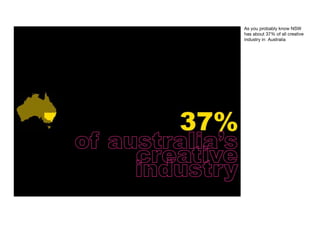
As you probably know NSW
has about 37% of all creative
industry in Australia
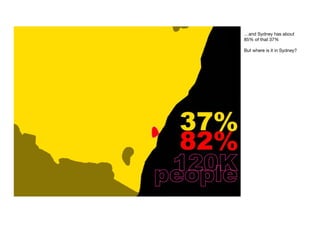
…and Sydney has about
85% of that 37%

But where is it in Sydney?
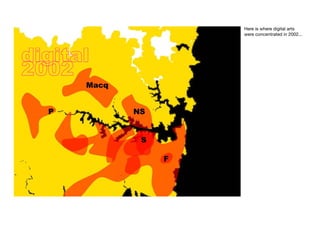
Here is where digital arts
were concentrated in 2002...
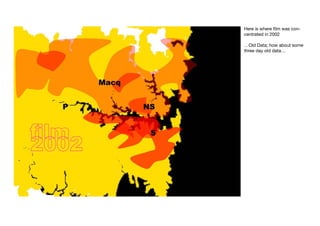
Here is where film was con-
centrated in 2002

…Old Data; how about some
three day old data…
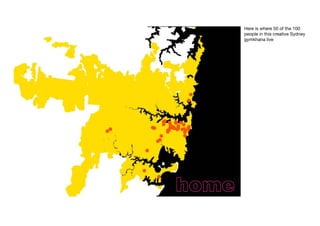
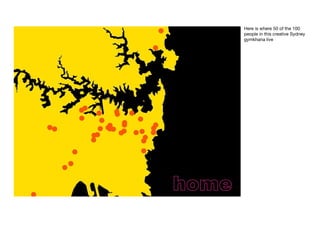
Here is where 50 of the 100
people in this creative Sydney
gymkhana live
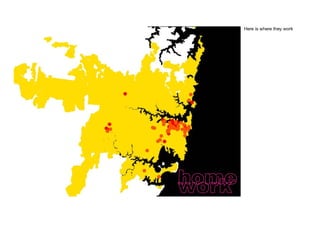
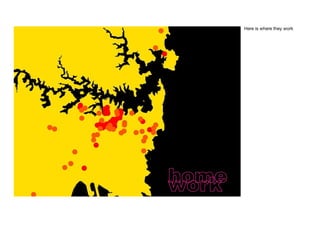
Here is where they work
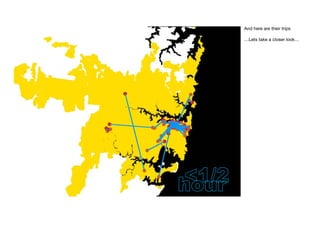
And here are their trips

…Lets take a closer look…
Here is where 50 of the 100
people in this creative Sydney
gymkhana live
Here is where they work
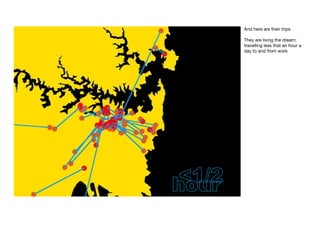
And here are their trips

They are living the dream;
travelling less that an hour a
day to and from work
From 2002 Surry Hills is still
looking good; I know it is a
small sample and statisticians
will give me a hard time, but
apart from the mystery ac-
tion happening in Fairfield
and Manly which is not much
of a surprise what is it about
Surry Hills?

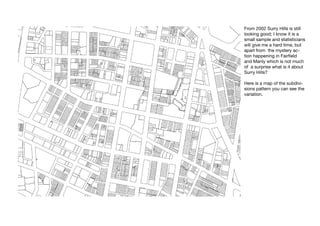
Here is a map of the subdivi-
sions pattern you can see the
variation.
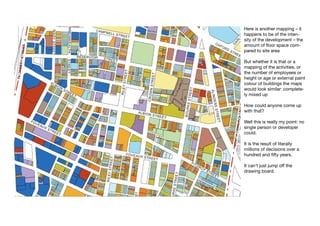
Here is another mapping – it
happens to be of the inten-
sity of the development – the
amount of floor space com-
pared to site area

But whether it is that or a
mapping of the activities, or
the number of employees or
height or age or external paint
colour of buildings the maps
would look similar: complete-
ly mixed up

How could anyone come up
with that?

Well this is really my point: no
single person or developer
could.

It is the result of literally
millions of decisions over a
hundred and fifty years.

It can’t just jump off the
drawing board.
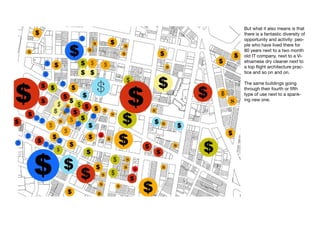
But what it also means is that
there is a fantastic diversity of
opportunity and activity: peo-
ple who have lived there for
80 years next to a two month
old IT company, next to a Vi-
etnamese dry cleaner next to
a top flight architecture prac-
tice and so on and on.

The same buildings going
through their fourth or fifth
type of use next to a spank-
ing new one.
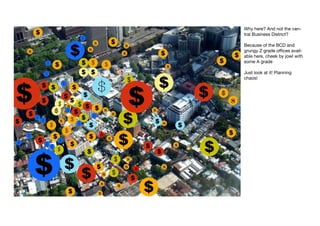
Why here? And not the cen-
tral Business District?

Because of the BCD and
grungy Z grade offices avail-
able here, cheek by jowl with
some A grade

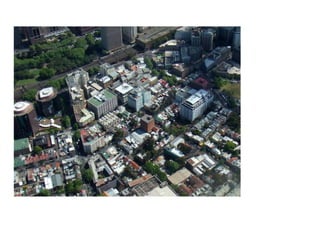
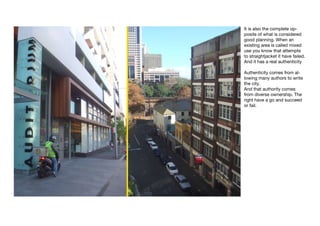
Just look at it! Planning
chaos!
It is also the complete op-
posite of what is considered
good planning. When an
existing area is called mixed
use you know that attempts
to straightjacket it have failed.
And it has a real authenticity

Authenticity comes from al-
lowing many authors to write
the city.
And that authority comes
from diverse ownership. The
right have a go and succeed
or fail.
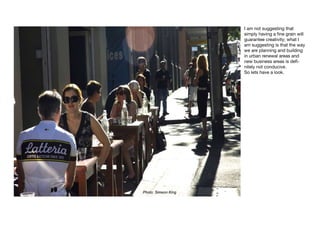
I am not suggesting that
simply having a fine grain will
guarantee creativity; what I
am suggesting is that the way
we are planning and building
in urban renewal areas and
new business areas is defi-
nitely not conducive.
So lets have a look.
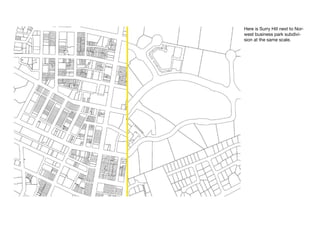
Here is Surry Hill next to Nor-
west business park subdivi-
sion at the same scale.
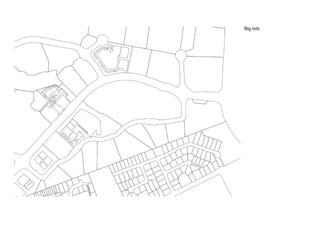
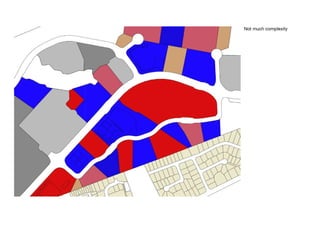
Big lots
Not much complexity
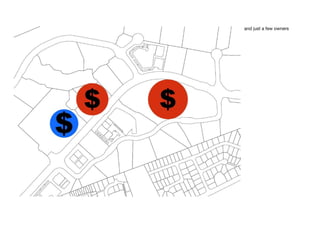
and just a few owners
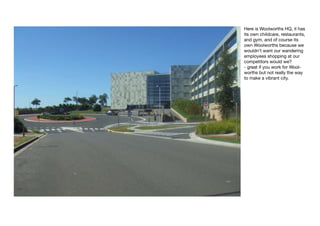
Here is Woolworths HQ, it has
its own childcare, restaurants,
and gym, and of course its
own Woolworths because we
wouldn’t want our wandering
employees shopping at our
competitors would we?
- great if you work for Wool-
worths but not really the way
to make a vibrant city.
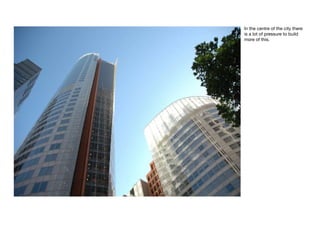
In the centre of the city there
is a lot of pressure to build
more of this.
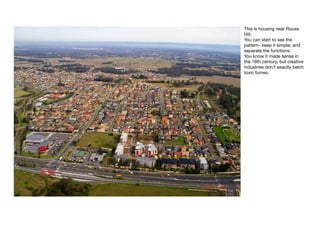
This is housing near Rouse
Hill.
You can start to see the
pattern- keep it simple, and
separate the functions-
You know it made sense in
the 18th century, but creative
industries don’t exactly belch
toxic fumes.
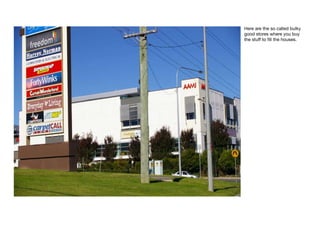
Here are the so called bulky
good stores where you buy
the stuff to fill the houses.
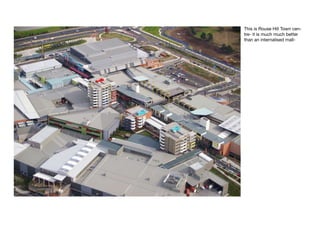
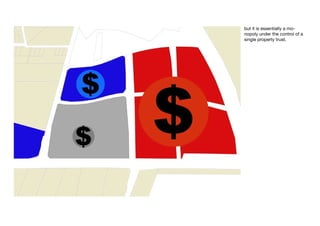
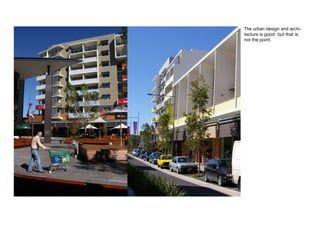
This is Rouse Hill Town cen-
tre- it is much much better
than an internalised mall-
but it is essentially a mo-
nopoly under the control of a
single property trust.
The urban design and archi-
tecture is good- but that is
not the point.
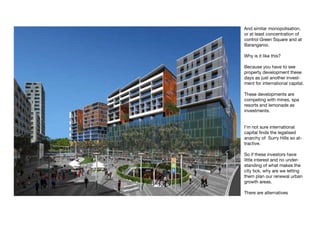
And similar monopolisation,
or at least concentration of
control Green Square and at
Barangaroo.

Why is it like this?

Because you have to see
property development these
days as just another invest-
ment for international capital.

These developments are
competing with mines, spa
resorts and lemonade as
investments.


I’m not sure international
capital finds the legalised
anarchy of Surry Hills so at-
tractive.

So if these investors have
little interest and no under-
standing of what makes the
city tick, why are we letting
them plan our renewal urban
growth areas.

There are alternatives
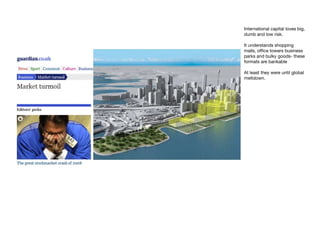
International capital loves big,
dumb and low risk.

It understands shopping
malls, office towers business
parks and bulky goods- these
formats are bankable

At least they were until global
meltdown.
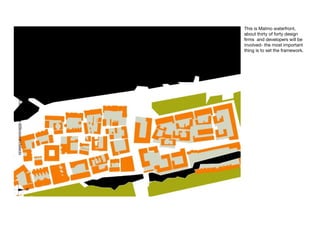
This is Malmo waterfront,
about thirty of forty design
firms and developers will be
involved- the most important
thing is to set the framework.
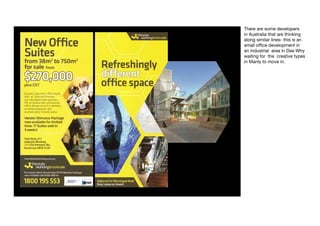
There are some developers
in Australia that are thinking
along similar lines- this is an
small office development in
an industrial area in Dee Why
waiting for the creative types
in Manly to move in.
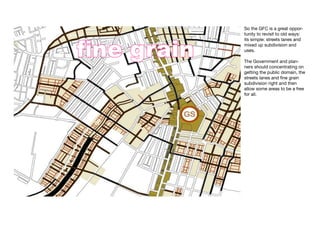
So the GFC is a great oppor-
             tunity to revisit to old ways:


fine grain
             its simple: streets lanes and
             mixed up subdivision and
             uses.

             The Government and plan-
             ners should concentrating on
             getting the public domain, the
             streets lanes and fine grain
             subdivision right and then
             allow some areas to be a free
             for all.
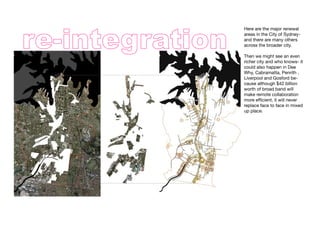
Here are the major renewal
areas in the City of Sydney-
and there are many others
across the broader city.

Then we might see an even
richer city and who knows- it
could also happen in Dee
Why, Cabramatta, Penrith ,
Liverpool and Gosford be-
cause although $42 billion
worth of broad band will
make remote collaboration
more efficient, it will never
replace face to face in mixed
up place.

Creative Sydney's Three Minute Sydney - Presentation by Rod Simpson

  • 2.
    As you probablyknow NSW has about 37% of all creative industry in Australia
  • 3.
    …and Sydney hasabout 85% of that 37% But where is it in Sydney?
  • 4.
    Here is wheredigital arts were concentrated in 2002...
  • 5.
    Here is wherefilm was con- centrated in 2002 …Old Data; how about some three day old data…
  • 6.
    Here is where50 of the 100 people in this creative Sydney gymkhana live
  • 7.
    Here is wherethey work
  • 8.
    And here aretheir trips …Lets take a closer look…
  • 9.
    Here is where50 of the 100 people in this creative Sydney gymkhana live
  • 10.
    Here is wherethey work
  • 11.
    And here aretheir trips They are living the dream; travelling less that an hour a day to and from work
  • 12.
    From 2002 SurryHills is still looking good; I know it is a small sample and statisticians will give me a hard time, but apart from the mystery ac- tion happening in Fairfield and Manly which is not much of a surprise what is it about Surry Hills? Here is a map of the subdivi- sions pattern you can see the variation.
  • 13.
    Here is anothermapping – it happens to be of the inten- sity of the development – the amount of floor space com- pared to site area But whether it is that or a mapping of the activities, or the number of employees or height or age or external paint colour of buildings the maps would look similar: complete- ly mixed up How could anyone come up with that? Well this is really my point: no single person or developer could. It is the result of literally millions of decisions over a hundred and fifty years. It can’t just jump off the drawing board.
  • 14.
    But what italso means is that there is a fantastic diversity of opportunity and activity: peo- ple who have lived there for 80 years next to a two month old IT company, next to a Vi- etnamese dry cleaner next to a top flight architecture prac- tice and so on and on. The same buildings going through their fourth or fifth type of use next to a spank- ing new one.
  • 15.
    Why here? Andnot the cen- tral Business District? Because of the BCD and grungy Z grade offices avail- able here, cheek by jowl with some A grade Just look at it! Planning chaos!
  • 17.
    It is alsothe complete op- posite of what is considered good planning. When an existing area is called mixed use you know that attempts to straightjacket it have failed. And it has a real authenticity Authenticity comes from al- lowing many authors to write the city. And that authority comes from diverse ownership. The right have a go and succeed or fail.
  • 18.
    I am notsuggesting that simply having a fine grain will guarantee creativity; what I am suggesting is that the way we are planning and building in urban renewal areas and new business areas is defi- nitely not conducive. So lets have a look.
  • 19.
    Here is SurryHill next to Nor- west business park subdivi- sion at the same scale.
  • 20.
  • 21.
  • 22.
    and just afew owners
  • 23.
    Here is WoolworthsHQ, it has its own childcare, restaurants, and gym, and of course its own Woolworths because we wouldn’t want our wandering employees shopping at our competitors would we? - great if you work for Wool- worths but not really the way to make a vibrant city.
  • 24.
    In the centreof the city there is a lot of pressure to build more of this.
  • 25.
    This is housingnear Rouse Hill. You can start to see the pattern- keep it simple, and separate the functions- You know it made sense in the 18th century, but creative industries don’t exactly belch toxic fumes.
  • 26.
    Here are theso called bulky good stores where you buy the stuff to fill the houses.
  • 27.
    This is RouseHill Town cen- tre- it is much much better than an internalised mall-
  • 28.
    but it isessentially a mo- nopoly under the control of a single property trust.
  • 29.
    The urban designand archi- tecture is good- but that is not the point.
  • 30.
    And similar monopolisation, orat least concentration of control Green Square and at Barangaroo. Why is it like this? Because you have to see property development these days as just another invest- ment for international capital. These developments are competing with mines, spa resorts and lemonade as investments. I’m not sure international capital finds the legalised anarchy of Surry Hills so at- tractive. So if these investors have little interest and no under- standing of what makes the city tick, why are we letting them plan our renewal urban growth areas. There are alternatives
  • 31.
    International capital lovesbig, dumb and low risk. It understands shopping malls, office towers business parks and bulky goods- these formats are bankable At least they were until global meltdown.
  • 32.
    This is Malmowaterfront, about thirty of forty design firms and developers will be involved- the most important thing is to set the framework.
  • 33.
    There are somedevelopers in Australia that are thinking along similar lines- this is an small office development in an industrial area in Dee Why waiting for the creative types in Manly to move in.
  • 34.
    So the GFCis a great oppor- tunity to revisit to old ways: fine grain its simple: streets lanes and mixed up subdivision and uses. The Government and plan- ners should concentrating on getting the public domain, the streets lanes and fine grain subdivision right and then allow some areas to be a free for all.
  • 35.
    Here are themajor renewal areas in the City of Sydney- and there are many others across the broader city. Then we might see an even richer city and who knows- it could also happen in Dee Why, Cabramatta, Penrith , Liverpool and Gosford be- cause although $42 billion worth of broad band will make remote collaboration more efficient, it will never replace face to face in mixed up place.