GST
Understanding the basics of GST(Goods & Services Tax)
A new law has been proposed which is set to reform how people do business
and the way goods and services are taxed in India.
P Prepared By: Rojer Chaudhary
Whom does it apply to?
To every person who supplies goods and/or services of value exceeding Rs 20 lakh in a
financial year. (Limit is Rs 10 lakh for some special category states). Compulsory registration
for these. And GST must be paid when turnover exceeds Rs 20 lakh (Rs 10 lakh for some
special category states).
To any person making inter-state taxable supply of goods and/or services
Every e-commerce operator
Every person who supplies goods and/or services, other than branded services, through e-
commerce operator
Aggregators who supply services under their own brand name
Casual Taxable Person
Non-Resident Taxable Person
• Continue on next slide………
…….continue
Person required to deduct/collect tax (TDS/TCS)
Input Service Distributor
Person supplying online information and database access or retrieval services from a place
outside India to a person in india, other than a registered taxable person.
Person required to pay tax under Reverse Charge
Person supplying the goods on behalf of other taxable person (eg. Agent)
GST does NOT apply to Agriculturists
GST does not apply to any person engaged exclusively in the business of supplying goods
and/or services that are not liable to tax or are wholly exempt from tax under this Act
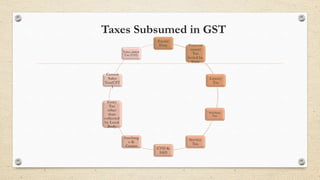
Taxes Subsumed in GST
Excise
Duty Entertai
nment
Tax
levied by
State
Luxury
Tax
Purchase
Tax
Service
Tax
CVD &
SAD
Surcharg
e &
Cesses
Entry
Tax
other
than
collected
by Local
Body
Central
Sales
Tax(CST
)
Value added
Tax (VAT)
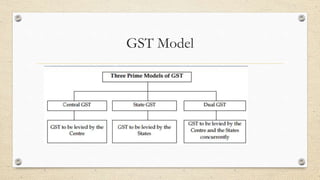
GST Model
GST Framework as per new Law
GST is expected to replace a myriad of indirect taxes such as VAT, customs duty, Excise, CST, Service
Tax, Entertainment Tax with a single tax called the Goods and Services Tax(GST)
Broadly there will be 2 forms of GST in India.
At the intra-state level (when goods travel within a state) and at the inter-state level (when goods
travel between states).
At the intra-state level two types of GST shall be levied CGST (Central Goods and Services Tax)
and SGST (State Goods and Services Tax).
At the inter-state level IGST (Or Integrated Goods and Services Tax) shall be levied.
Imports shall be considered as inter-state supply.i.e.,(IGST) applicable
Exports shall be zero rated.
Supplies to SEZ will be Zero-rated
Will the new GST allow tax cascading benefits?
• Many of us are aware that service tax and VAT have cascading benefits, which means
you can avail credit of tax paid by you on inputs. For example in case of service tax –
you levy service tax on services you sell and while depositing this tax you can take
credit of service tax paid by you on services used as inputs.
• This cascading benefit shall also be available in case of GST.
• Here is how set off works in case of GST –
• IGST payments can be set off against – IGST, CGST, SGST on inputs
• CGST payments can be set off against – IGST and CGST on inputs
• SGST payments can be set off against – IGST and SGST on inputs
Exemptions from GST
• Who does GST NOT apply to?
• GST does not apply to agriculturists. If you grow your own flowers and sell
them, for example, then GST does not apply to you.
• If you deal in exempted goods/services then GST does not apply to you
• GST exempt supplies include alcohol for human consumption and five
petroleum products (crude, petrol, diesel, ATF & natural gas).
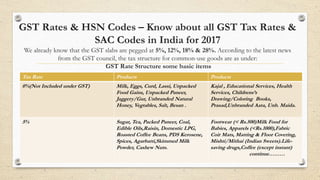
GST Rates & HSN Codes – Know about all GST Tax Rates &
SAC Codes in India for 2017
We already know that the GST slabs are pegged at 5%, 12%, 18% & 28%. According to the latest news
from the GST council, the tax structure for common-use goods are as under:
GST Rate Structure some basic items
Tax Rate Products Products
0%(Not Included under GST) Milk, Eggs, Curd, Lassi, Unpacked
Food Gains, Unpacked Paneer,
Jaggery/Gur, Unbranded Natural
Honey, Vegtables, Salt, Besan .
Kajal , Educational Services, Health
Services, Childrens’s
Drawing/Coloring Books,
Prasad,Unbranded Aata, Unb. Maida.
5% Sugar, Tea, Packed Paneer, Coal,
Edible Oils,Raisin, Domestic LPG,
Roasted Coffee Beans, PDS Kerosene,
Spices, Agarbatti,Skimmed Milk
Powder, Cashew Nuts.
Footwear (< Rs.500)Milk Food for
Babies, Apparels (<Rs.1000),Fabric
Coir Mats, Matting & Floor Covering,
Mishti/Mithai (Indian Sweets).Life-
saving drugs,Coffee (except instant)
continue………
Tax Rate/Slab Products Products
12% Butter, Computers, Ghee,
Processed food, Almonds,
Mobiles, Fruit Juice, Preparations
of Vegetables, Fruits.
Nuts or other parts of Plants
including Pickle, Murabba,
Chutney, Jam, Jelly, Packed
Coconut Water, Umbrella.
18% Hair Oil ,Capital goods,
Toothpaste, Industrial
Intermediaries, Soaps.
Ice-cream,Pasta,Toiletries,
Corn Flakes, Computers,
Soups,Printers.
28% Small cars (+1% or 3% cess)High-
end motorcycles (+15% cess)
Consumer durables such as AC
and fridge.
Beedis are NOT included
here,Luxury & sin items like
BMWs, cigarettes and aerated
drinks (+15% cess)

GST BASICS

  • 1.
    GST Understanding the basicsof GST(Goods & Services Tax) A new law has been proposed which is set to reform how people do business and the way goods and services are taxed in India. P Prepared By: Rojer Chaudhary
  • 2.
    Whom does itapply to? To every person who supplies goods and/or services of value exceeding Rs 20 lakh in a financial year. (Limit is Rs 10 lakh for some special category states). Compulsory registration for these. And GST must be paid when turnover exceeds Rs 20 lakh (Rs 10 lakh for some special category states). To any person making inter-state taxable supply of goods and/or services Every e-commerce operator Every person who supplies goods and/or services, other than branded services, through e- commerce operator Aggregators who supply services under their own brand name Casual Taxable Person Non-Resident Taxable Person • Continue on next slide………
  • 3.
    …….continue Person required todeduct/collect tax (TDS/TCS) Input Service Distributor Person supplying online information and database access or retrieval services from a place outside India to a person in india, other than a registered taxable person. Person required to pay tax under Reverse Charge Person supplying the goods on behalf of other taxable person (eg. Agent) GST does NOT apply to Agriculturists GST does not apply to any person engaged exclusively in the business of supplying goods and/or services that are not liable to tax or are wholly exempt from tax under this Act
  • 4.
    Taxes Subsumed inGST Excise Duty Entertai nment Tax levied by State Luxury Tax Purchase Tax Service Tax CVD & SAD Surcharg e & Cesses Entry Tax other than collected by Local Body Central Sales Tax(CST ) Value added Tax (VAT)
  • 5.
  • 6.
    GST Framework asper new Law GST is expected to replace a myriad of indirect taxes such as VAT, customs duty, Excise, CST, Service Tax, Entertainment Tax with a single tax called the Goods and Services Tax(GST) Broadly there will be 2 forms of GST in India. At the intra-state level (when goods travel within a state) and at the inter-state level (when goods travel between states). At the intra-state level two types of GST shall be levied CGST (Central Goods and Services Tax) and SGST (State Goods and Services Tax). At the inter-state level IGST (Or Integrated Goods and Services Tax) shall be levied. Imports shall be considered as inter-state supply.i.e.,(IGST) applicable Exports shall be zero rated. Supplies to SEZ will be Zero-rated
  • 7.
    Will the newGST allow tax cascading benefits? • Many of us are aware that service tax and VAT have cascading benefits, which means you can avail credit of tax paid by you on inputs. For example in case of service tax – you levy service tax on services you sell and while depositing this tax you can take credit of service tax paid by you on services used as inputs. • This cascading benefit shall also be available in case of GST. • Here is how set off works in case of GST – • IGST payments can be set off against – IGST, CGST, SGST on inputs • CGST payments can be set off against – IGST and CGST on inputs • SGST payments can be set off against – IGST and SGST on inputs
  • 8.
    Exemptions from GST •Who does GST NOT apply to? • GST does not apply to agriculturists. If you grow your own flowers and sell them, for example, then GST does not apply to you. • If you deal in exempted goods/services then GST does not apply to you • GST exempt supplies include alcohol for human consumption and five petroleum products (crude, petrol, diesel, ATF & natural gas).
  • 9.
    GST Rates &HSN Codes – Know about all GST Tax Rates & SAC Codes in India for 2017 We already know that the GST slabs are pegged at 5%, 12%, 18% & 28%. According to the latest news from the GST council, the tax structure for common-use goods are as under: GST Rate Structure some basic items Tax Rate Products Products 0%(Not Included under GST) Milk, Eggs, Curd, Lassi, Unpacked Food Gains, Unpacked Paneer, Jaggery/Gur, Unbranded Natural Honey, Vegtables, Salt, Besan . Kajal , Educational Services, Health Services, Childrens’s Drawing/Coloring Books, Prasad,Unbranded Aata, Unb. Maida. 5% Sugar, Tea, Packed Paneer, Coal, Edible Oils,Raisin, Domestic LPG, Roasted Coffee Beans, PDS Kerosene, Spices, Agarbatti,Skimmed Milk Powder, Cashew Nuts. Footwear (< Rs.500)Milk Food for Babies, Apparels (<Rs.1000),Fabric Coir Mats, Matting & Floor Covering, Mishti/Mithai (Indian Sweets).Life- saving drugs,Coffee (except instant) continue………
  • 10.
    Tax Rate/Slab ProductsProducts 12% Butter, Computers, Ghee, Processed food, Almonds, Mobiles, Fruit Juice, Preparations of Vegetables, Fruits. Nuts or other parts of Plants including Pickle, Murabba, Chutney, Jam, Jelly, Packed Coconut Water, Umbrella. 18% Hair Oil ,Capital goods, Toothpaste, Industrial Intermediaries, Soaps. Ice-cream,Pasta,Toiletries, Corn Flakes, Computers, Soups,Printers. 28% Small cars (+1% or 3% cess)High- end motorcycles (+15% cess) Consumer durables such as AC and fridge. Beedis are NOT included here,Luxury & sin items like BMWs, cigarettes and aerated drinks (+15% cess)