Groupon, Kickstarter,
Pledgebank: when does
conditional commitment work?
Roger Hallam
Culture, Media, and Creative
Industries, Kings College London.
Radical Think Tank (UK).
The Collective Action Problem
• In political science (Olson 1965) this problem
is formulated as follows:
There are situations where it is in the collective
interest of a group of individuals to act
together to acquire a collective good. But is
not in the interest of an individual to act on
their own. Therefore no one acts and so the
collective good is not acquired
So latent groups “suffer in silence” (p134).
The Basic thesis: Conditional
Commitment Works.
• The new communication technologies have
dramatically reduced the costs of
communication.
• This enables groups to overcome the
collective action problem by pre-organising
critical masses of participation in collective
activity.
• This can “revolutionise democracy” as much
as majority vote elections!
Two types of collective organisation
• Type 1 (T1). Individuals act without knowing
how many others will act with them
• Type 2 (T2). Individuals know that a set
number of other individuals will act if they act
as well.
Eg T1 = wild cat strikes. T2 = majority vote
ballots of labour union strikes.
Three communications with T2
• The setting of the TARGET for the collective
action to go ahead
• The giving of conditional commitments to take
part in the action if the target is reached
• If and when the target is reached people
giving the conditional commitment are
informed and the collective action goes ahead
ICTs make this easy, quick and cheap.
Groupon
• Originally “The Point” – T2 conditional
commitment organising website
• Change from social/political to economic with
Groupon: 2 pizzas for 1 if go to the restaurant at
off peak time. Target for go ahead: 20 people.
• “Fastest grown company in the history of
capitalism” (Forbes). In three years worth $30
billion with 180 million users.
“They have cracked the code” Schultz.
The code is T2
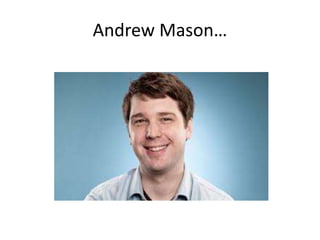
Andrew Mason…
Kickstarter
• T2 fundraising design for cultural/artistic
collective projects.
• Put up project; target figure; conditional
commitments; if and when target hit project goes
ahead.
• Within four years raises $850 million from 5
million people for 50,000 projects.
“the most democratic way art has ever been made”
Heleker 2013
Pledgebank
• Set up in 2005
• Slogan “ I will do it but only if you help me do
it”
• Proposals: personal, charitable or political
• 1,300 proposals in UK: 15,000 Internationally
Aim to “Revolutionise Democracy”
Irving 2012
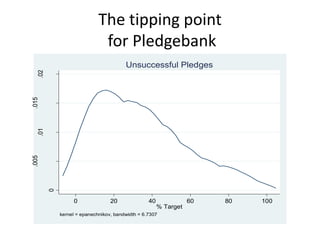
The tipping point
for Pledgebank0
.005
.01
.015
.02
Density
0 20 40 60 80 100
% Target
kernel = epanechnikov, bandwidth = 6.7307
Unsuccessful Pledges
Proposed group typology
• Altruists – will do it anyway
• Moderate rationalists – will conditionally
commit to all collective actions they will
benefit from
• Reflexive observers – react to information
effects, what others are doing
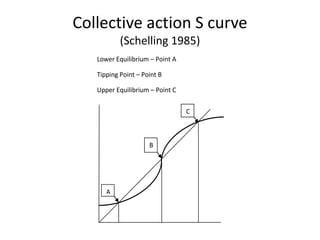
Collective action S curve
(Schelling 1985)
Lower Equilibrium – Point A
Tipping Point – Point B
Upper Equilibrium – Point C
A
B
C
So why doesn’t it happen?
• Noise of the internet – getting attention
• “Cultural lag” lack of social information –
people don’t use it because people don’t use
it
• Therefore subject to its own collective action
problem.
2016 UCL Rent Strike: Design
• Canvass student tenants: “would you be
prepared to not pay your rent if 1000 other
students did the same?”
• Focus on one hall: “ for this strike to go ahead
there needs to be a 100 tenants in this hall
committed to it – there are 60 now – can you
give a commitment as well?”
• In a randomised controlled trial commitment
to strike without CC was 49% - with CC 80%!
UCL Rent Strike: The Results
• 115 conditional commitments by the deadline –
it’s on! 150 in total following the deadline, out of
300 tenants. First pre planned rent strike in
London since the 1970s.
• Publicity goes viral online – top Guardian story –
35,000 shares
• Collective action passed tipping point – 700 more
tenants commit to strike – half on line, half from
off line canvassing. Happening this week!
2016 UK national tax strike: Design
• In response to Panama Paper scandal
• Proposed Collective action: refuse to pay £50
of your tax bill.
• 5000 conditional commitments to go ahead
• All conditional commitments made on online
platform
• National promotion in the Press
UK national tax strike: Results
• After 1 week
• 1500 views of site/promotional video
• 25 people make a conditional commitment.
(its not going to get to critical mass of 1,500 –
i.e. 30%)
Hybrid model of conditional
commitment design for medium risk
political collective action
• Off line communication of collective action
target
• Off line/ on line collection of conditional
commitments – viable 30% critical mass.
• On line conformation that target has been
reached and collective action is going ahead.
• Goes viral on line due to social information/
demonstration effects
Conclusion
• Successful collective action requires kickstarting
conditional commitments off line FIRST.
• Then progressively supplementing it with online
promotion.
• … through progressive iterations, conditional
commitment becomes part of the new
“repertoire of contention” for the digital age.
(no more “suffering in silence”)
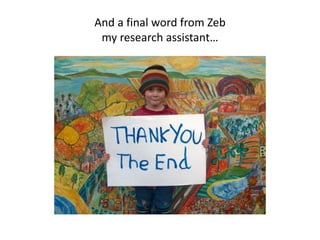
And a final word from Zeb
my research assistant…
Papers/References/Links
go to radicalthinktank.wordpress.com

Groupon, Kickstarter, Pledgebank: when does conditional commitment work?

  • 1.
    Groupon, Kickstarter, Pledgebank: whendoes conditional commitment work? Roger Hallam Culture, Media, and Creative Industries, Kings College London. Radical Think Tank (UK).
  • 2.
    The Collective ActionProblem • In political science (Olson 1965) this problem is formulated as follows: There are situations where it is in the collective interest of a group of individuals to act together to acquire a collective good. But is not in the interest of an individual to act on their own. Therefore no one acts and so the collective good is not acquired So latent groups “suffer in silence” (p134).
  • 3.
    The Basic thesis:Conditional Commitment Works. • The new communication technologies have dramatically reduced the costs of communication. • This enables groups to overcome the collective action problem by pre-organising critical masses of participation in collective activity. • This can “revolutionise democracy” as much as majority vote elections!
  • 4.
    Two types ofcollective organisation • Type 1 (T1). Individuals act without knowing how many others will act with them • Type 2 (T2). Individuals know that a set number of other individuals will act if they act as well. Eg T1 = wild cat strikes. T2 = majority vote ballots of labour union strikes.
  • 5.
    Three communications withT2 • The setting of the TARGET for the collective action to go ahead • The giving of conditional commitments to take part in the action if the target is reached • If and when the target is reached people giving the conditional commitment are informed and the collective action goes ahead ICTs make this easy, quick and cheap.
  • 6.
    Groupon • Originally “ThePoint” – T2 conditional commitment organising website • Change from social/political to economic with Groupon: 2 pizzas for 1 if go to the restaurant at off peak time. Target for go ahead: 20 people. • “Fastest grown company in the history of capitalism” (Forbes). In three years worth $30 billion with 180 million users. “They have cracked the code” Schultz. The code is T2
  • 7.
  • 8.
    Kickstarter • T2 fundraisingdesign for cultural/artistic collective projects. • Put up project; target figure; conditional commitments; if and when target hit project goes ahead. • Within four years raises $850 million from 5 million people for 50,000 projects. “the most democratic way art has ever been made” Heleker 2013
  • 9.
    Pledgebank • Set upin 2005 • Slogan “ I will do it but only if you help me do it” • Proposals: personal, charitable or political • 1,300 proposals in UK: 15,000 Internationally Aim to “Revolutionise Democracy” Irving 2012
  • 10.
    The tipping point forPledgebank0 .005 .01 .015 .02 Density 0 20 40 60 80 100 % Target kernel = epanechnikov, bandwidth = 6.7307 Unsuccessful Pledges
  • 11.
    Proposed group typology •Altruists – will do it anyway • Moderate rationalists – will conditionally commit to all collective actions they will benefit from • Reflexive observers – react to information effects, what others are doing
  • 12.
    Collective action Scurve (Schelling 1985) Lower Equilibrium – Point A Tipping Point – Point B Upper Equilibrium – Point C A B C
  • 13.
    So why doesn’tit happen? • Noise of the internet – getting attention • “Cultural lag” lack of social information – people don’t use it because people don’t use it • Therefore subject to its own collective action problem.
  • 14.
    2016 UCL RentStrike: Design • Canvass student tenants: “would you be prepared to not pay your rent if 1000 other students did the same?” • Focus on one hall: “ for this strike to go ahead there needs to be a 100 tenants in this hall committed to it – there are 60 now – can you give a commitment as well?” • In a randomised controlled trial commitment to strike without CC was 49% - with CC 80%!
  • 15.
    UCL Rent Strike:The Results • 115 conditional commitments by the deadline – it’s on! 150 in total following the deadline, out of 300 tenants. First pre planned rent strike in London since the 1970s. • Publicity goes viral online – top Guardian story – 35,000 shares • Collective action passed tipping point – 700 more tenants commit to strike – half on line, half from off line canvassing. Happening this week!
  • 16.
    2016 UK nationaltax strike: Design • In response to Panama Paper scandal • Proposed Collective action: refuse to pay £50 of your tax bill. • 5000 conditional commitments to go ahead • All conditional commitments made on online platform • National promotion in the Press
  • 17.
    UK national taxstrike: Results • After 1 week • 1500 views of site/promotional video • 25 people make a conditional commitment. (its not going to get to critical mass of 1,500 – i.e. 30%)
  • 18.
    Hybrid model ofconditional commitment design for medium risk political collective action • Off line communication of collective action target • Off line/ on line collection of conditional commitments – viable 30% critical mass. • On line conformation that target has been reached and collective action is going ahead. • Goes viral on line due to social information/ demonstration effects
  • 19.
    Conclusion • Successful collectiveaction requires kickstarting conditional commitments off line FIRST. • Then progressively supplementing it with online promotion. • … through progressive iterations, conditional commitment becomes part of the new “repertoire of contention” for the digital age. (no more “suffering in silence”)
  • 20.
    And a finalword from Zeb my research assistant…
  • 21.

Editor's Notes

  • #2 The internet – bit tricky..
  • #3 Latent groups, also verba etc , game theory – prisioner dilemma, thomas schelling etc. – rationalistic traditions. Only in particular situation – not scarity Individual cultural economic and political problems Go on a picnic to golden warming Of course socialisation – information effects – and .. Rationality.. Not going to get bogged down in it!!
  • #6 So rationally overcome the CAP!! – technological Eg pre internet no possible – costs of communication over space.
  • #7 Economic CAP Overwelem not need T2..
  • #8 180 million Plan to write to him
  • #12 Key group rationalists; Pledge bank on extreme rationalists – Beyond rational and irrational actor
  • #21 Sunny in wales