GROUP MEMBERS.
• ChristonMuriuki- BSN-1-8786-3/2018
• Ivy Kerubo BSN-1-0733-3/2023
• Abdia Ahmed BSN-1-0830-3/2023
• Msanzu Kapola BSN-1-0692-3/2022
• Collins Kyengo BSN-1-5511-3/2023
• Tatu Douglas BSN-1-0851-3/2023
• Lavender Akinyi BSN-1-5134-3/2023
• Omondi Silper BSN-1-5516-3/2023
• Lawi Mwita BSN-1-5550-3/2023
• Kangogo Meshack BSN-1-5513-3/2023
• Elizabeth Ndulu Wambua BSN-1-0576-3/2022
• Francis Kapola BSN-1-0692-3/2022
3.
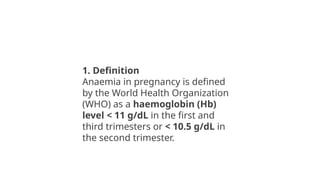
1. Definition
Anaemia inpregnancy is defined
by the World Health Organization
(WHO) as a haemoglobin (Hb)
level < 11 g/dL in the first and
third trimesters or < 10.5 g/dL in
the second trimester.
4.
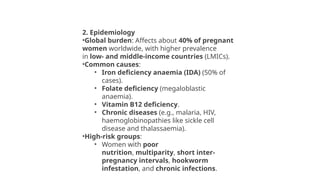
2. Epidemiology
•Global burden:Affects about 40% of pregnant
women worldwide, with higher prevalence
in low- and middle-income countries (LMICs).
•Common causes:
• Iron deficiency anaemia (IDA) (50% of
cases).
• Folate deficiency (megaloblastic
anaemia).
• Vitamin B12 deficiency.
• Chronic diseases (e.g., malaria, HIV,
haemoglobinopathies like sickle cell
disease and thalassaemia).
•High-risk groups:
• Women with poor
nutrition, multiparity, short inter-
pregnancy intervals, hookworm
infestation, and chronic infections.
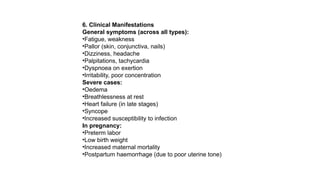
6. Clinical Manifestations
Generalsymptoms (across all types):
•Fatigue, weakness
•Pallor (skin, conjunctiva, nails)
•Dizziness, headache
•Palpitations, tachycardia
•Dyspnoea on exertion
•Irritability, poor concentration
Severe cases:
•Oedema
•Breathlessness at rest
•Heart failure (in late stages)
•Syncope
•Increased susceptibility to infection
In pregnancy:
•Preterm labor
•Low birth weight
•Increased maternal mortality
•Postpartum haemorrhage (due to poor uterine tone)
9.
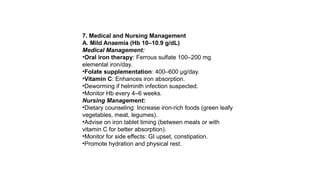
7. Medical andNursing Management
A. Mild Anaemia (Hb 10–10.9 g/dL)
Medical Management:
•Oral iron therapy: Ferrous sulfate 100–200 mg
elemental iron/day.
•Folate supplementation: 400–600 µg/day.
•Vitamin C: Enhances iron absorption.
•Deworming if helminth infection suspected.
•Monitor Hb every 4–6 weeks.
Nursing Management:
•Dietary counseling: Increase iron-rich foods (green leafy
vegetables, meat, legumes).
•Advise on iron tablet timing (between meals or with
vitamin C for better absorption).
•Monitor for side effects: GI upset, constipation.
•Promote hydration and physical rest.
10.
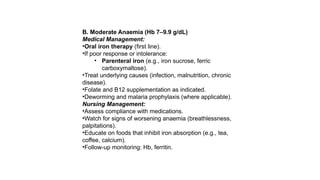
B. Moderate Anaemia(Hb 7–9.9 g/dL)
Medical Management:
•Oral iron therapy (first line).
•If poor response or intolerance:
• Parenteral iron (e.g., iron sucrose, ferric
carboxymaltose).
•Treat underlying causes (infection, malnutrition, chronic
disease).
•Folate and B12 supplementation as indicated.
•Deworming and malaria prophylaxis (where applicable).
Nursing Management:
•Assess compliance with medications.
•Watch for signs of worsening anaemia (breathlessness,
palpitations).
•Educate on foods that inhibit iron absorption (e.g., tea,
coffee, calcium).
•Follow-up monitoring: Hb, ferritin.
11.
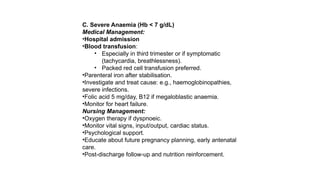
C. Severe Anaemia(Hb < 7 g/dL)
Medical Management:
•Hospital admission
•Blood transfusion:
• Especially in third trimester or if symptomatic
(tachycardia, breathlessness).
• Packed red cell transfusion preferred.
•Parenteral iron after stabilisation.
•Investigate and treat cause: e.g., haemoglobinopathies,
severe infections.
•Folic acid 5 mg/day, B12 if megaloblastic anaemia.
•Monitor for heart failure.
Nursing Management:
•Oxygen therapy if dyspnoeic.
•Monitor vital signs, input/output, cardiac status.
•Psychological support.
•Educate about future pregnancy planning, early antenatal
care.
•Post-discharge follow-up and nutrition reinforcement.
12.
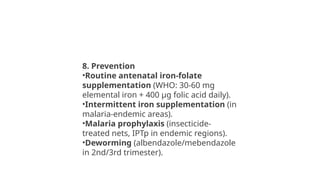
8. Prevention
•Routine antenataliron-folate
supplementation (WHO: 30-60 mg
elemental iron + 400 µg folic acid daily).
•Intermittent iron supplementation (in
malaria-endemic areas).
•Malaria prophylaxis (insecticide-
treated nets, IPTp in endemic regions).
•Deworming (albendazole/mebendazole
in 2nd/3rd trimester).
13.
Conclusion
Anaemia in pregnancyis a major public
health concern, leading to maternal
mortality, preterm birth, and low birth
weight. Early detection, iron
supplementation, and appropriate
management (oral/parenteral iron,
transfusion if severe) are
crucial. Nursing care focuses on
monitoring, education, and
preventing complications.



![ONFH[AVN HIP] -TRIPLE REGIME -A NOVAL SURGICAL CONCEPT .pptx](https://cdn.slidesharecdn.com/ss_thumbnails/onfhavnhip2026koaconcalicutdrgokuldevdrmashraf-260210064517-213ec005-thumbnail.jpg?width=640&height=640&fit=bounds)