Group3 AI Wizards Final Capstone Project Report (1).pdf
1.
1
Transformative Business Solutionspowered by Analytics Driven Insights
[General Management Programme for Business Excellence Batch 06 , Group 3 - AI Wizards Team]
2.
2
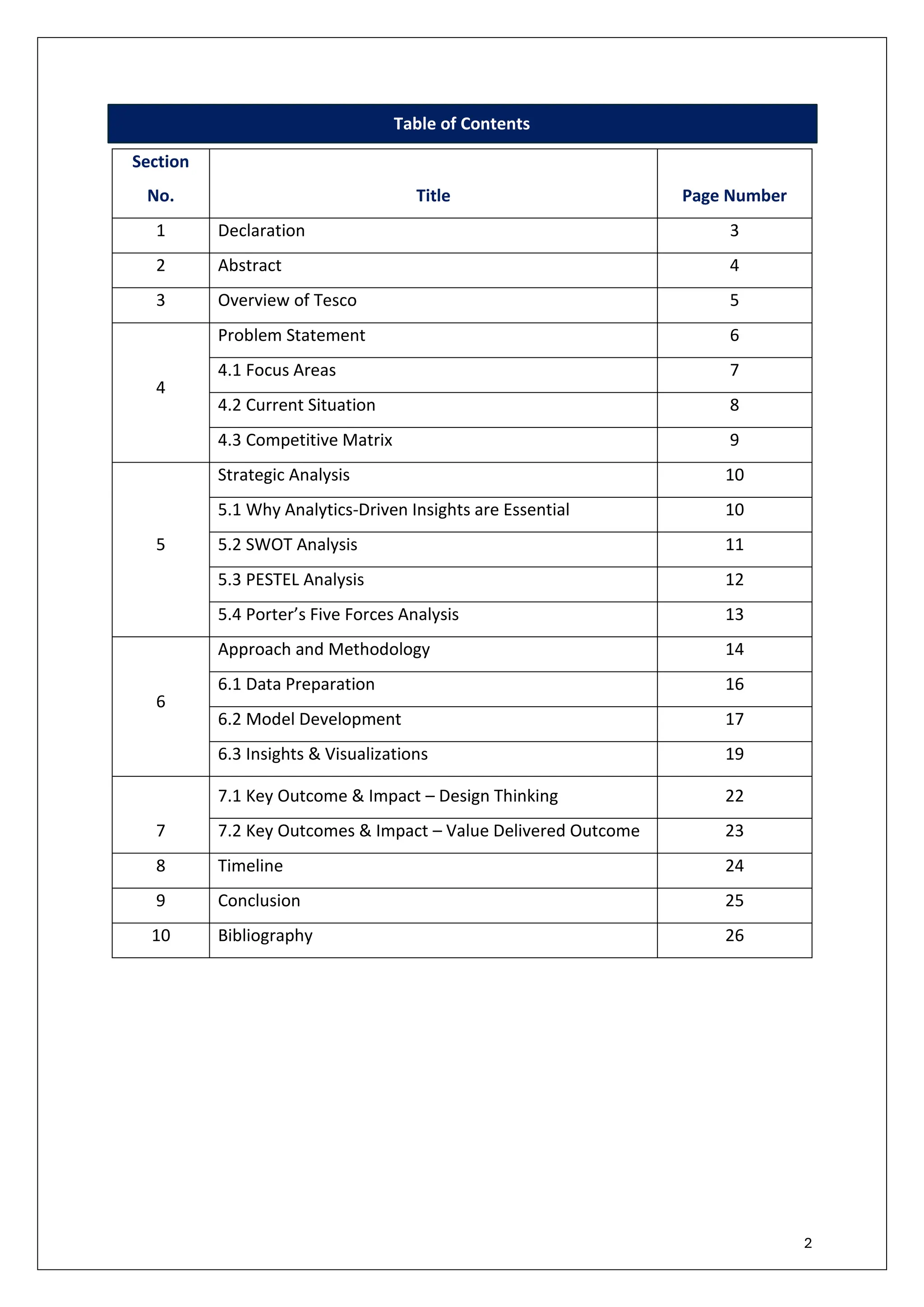
Table of Contents
Section
No.Title Page Number
1 Declaration 3
2 Abstract 4
3 Overview of Tesco 5
4
Problem Statement 6
4.1 Focus Areas 7
4.2 Current Situation 8
4.3 Competitive Matrix 9
5
Strategic Analysis 10
5.1 Why Analytics-Driven Insights are Essential 10
5.2 SWOT Analysis 11
5.3 PESTEL Analysis 12
5.4 Porter’s Five Forces Analysis 13
6
Approach and Methodology 14
6.1 Data Preparation 16
6.2 Model Development 17
6.3 Insights & Visualizations 19
7
7.1 Key Outcome & Impact – Design Thinking 22
7.2 Key Outcomes & Impact – Value Delivered Outcome 23
8 Timeline 24
9 Conclusion 25
10 Bibliography 26
3.
3
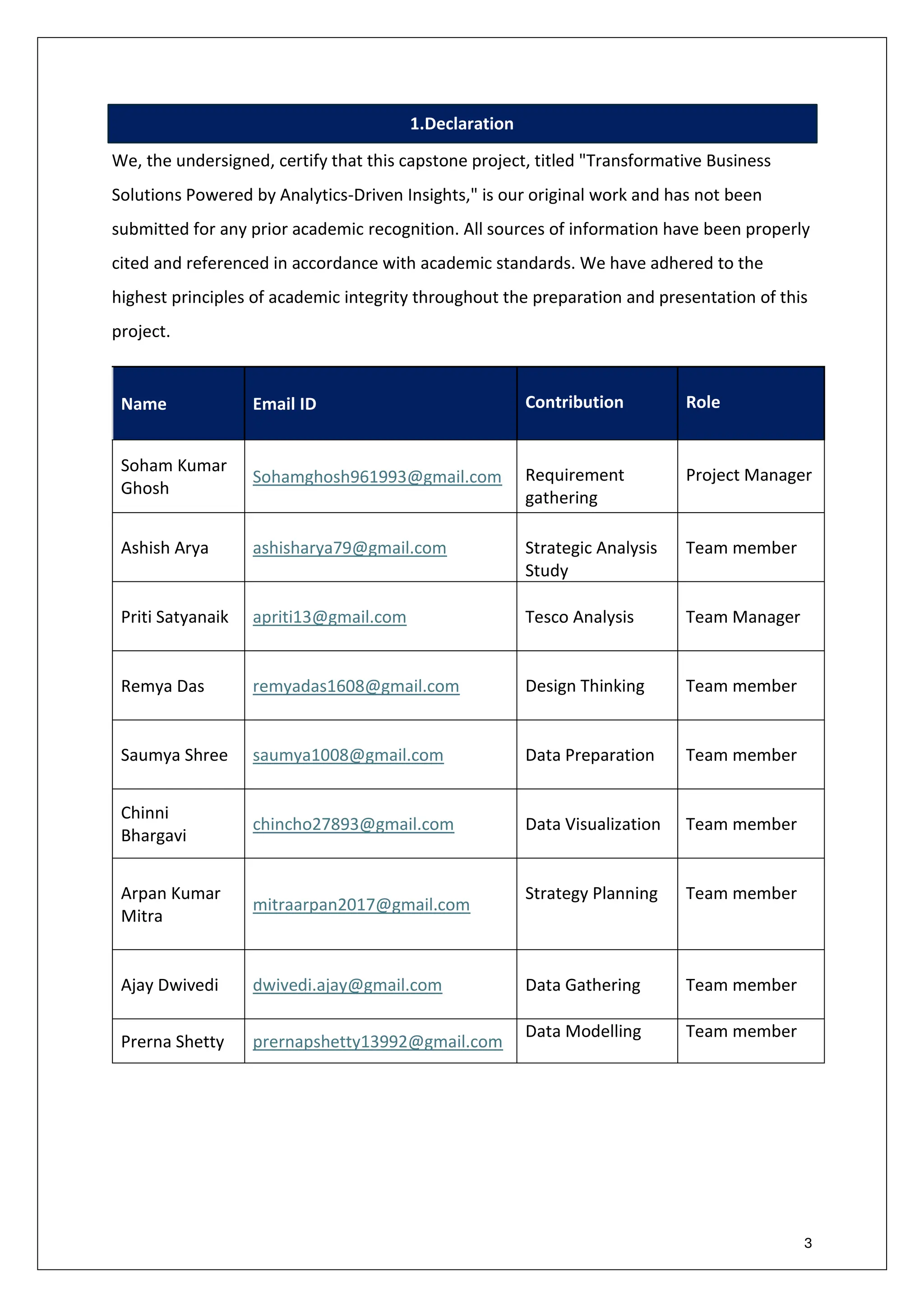
1.Declaration
We, the undersigned,certify that this capstone project, titled "Transformative Business
Solutions Powered by Analytics-Driven Insights," is our original work and has not been
submitted for any prior academic recognition. All sources of information have been properly
cited and referenced in accordance with academic standards. We have adhered to the
highest principles of academic integrity throughout the preparation and presentation of this
project.
Name Email ID Contribution Role
Soham Kumar
Ghosh
Sohamghosh961993@gmail.com Requirement
gathering
Project Manager
Ashish Arya ashisharya79@gmail.com Strategic Analysis
Study
Team member
Priti Satyanaik apriti13@gmail.com Tesco Analysis Team Manager
Remya Das remyadas1608@gmail.com Design Thinking Team member
Saumya Shree saumya1008@gmail.com Data Preparation Team member
Chinni
Bhargavi
chincho27893@gmail.com Data Visualization Team member
Arpan Kumar
Mitra
mitraarpan2017@gmail.com
Strategy Planning Team member
Ajay Dwivedi dwivedi.ajay@gmail.com Data Gathering Team member
Prerna Shetty prernapshetty13992@gmail.com
Data Modelling Team member
4.
4
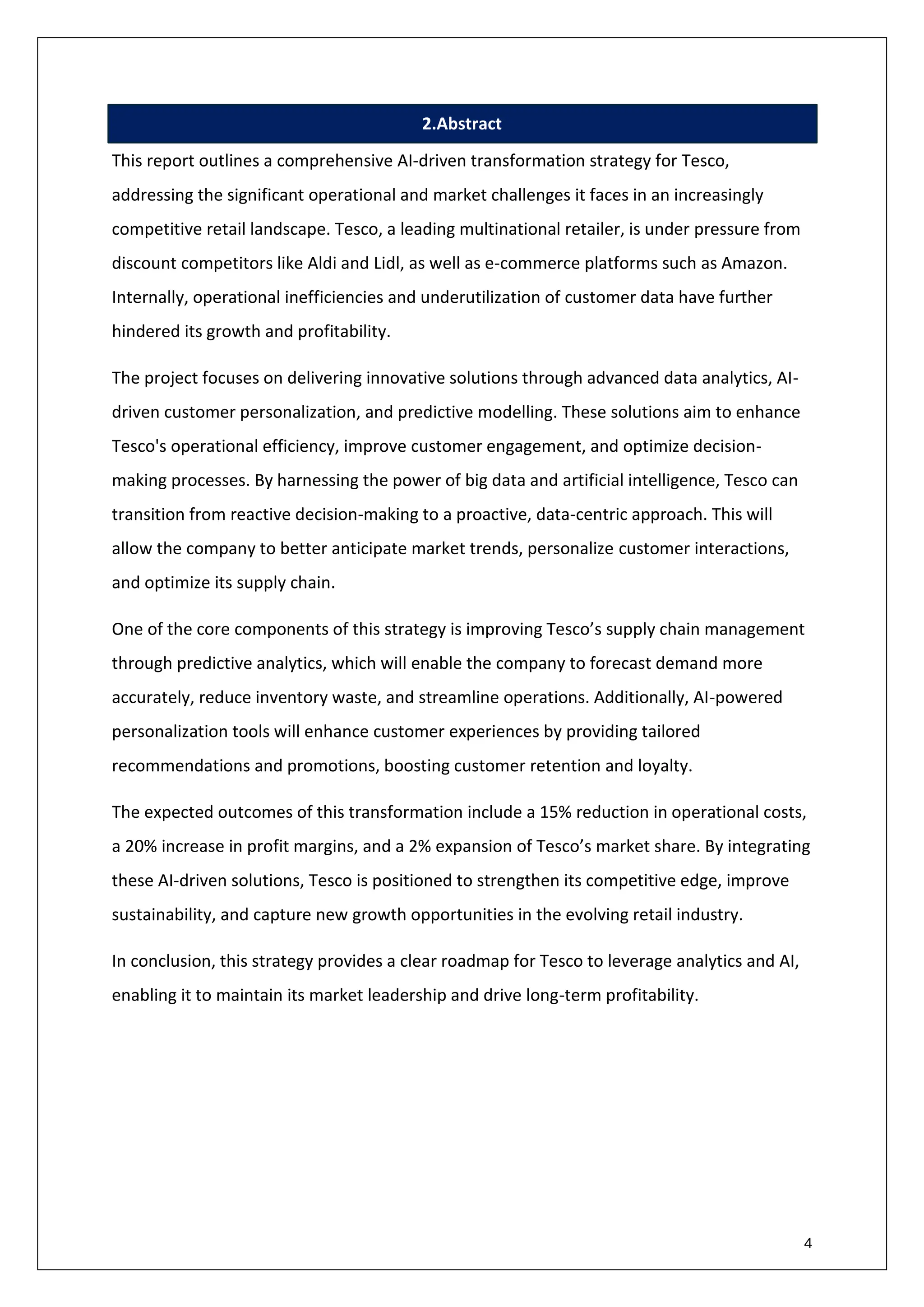
2.Abstract
This report outlinesa comprehensive AI-driven transformation strategy for Tesco,
addressing the significant operational and market challenges it faces in an increasingly
competitive retail landscape. Tesco, a leading multinational retailer, is under pressure from
discount competitors like Aldi and Lidl, as well as e-commerce platforms such as Amazon.
Internally, operational inefficiencies and underutilization of customer data have further
hindered its growth and profitability.
The project focuses on delivering innovative solutions through advanced data analytics, AI-
driven customer personalization, and predictive modelling. These solutions aim to enhance
Tesco's operational efficiency, improve customer engagement, and optimize decision-
making processes. By harnessing the power of big data and artificial intelligence, Tesco can
transition from reactive decision-making to a proactive, data-centric approach. This will
allow the company to better anticipate market trends, personalize customer interactions,
and optimize its supply chain.
One of the core components of this strategy is improving Tesco’s supply chain management
through predictive analytics, which will enable the company to forecast demand more
accurately, reduce inventory waste, and streamline operations. Additionally, AI-powered
personalization tools will enhance customer experiences by providing tailored
recommendations and promotions, boosting customer retention and loyalty.
The expected outcomes of this transformation include a 15% reduction in operational costs,
a 20% increase in profit margins, and a 2% expansion of Tesco’s market share. By integrating
these AI-driven solutions, Tesco is positioned to strengthen its competitive edge, improve
sustainability, and capture new growth opportunities in the evolving retail industry.
In conclusion, this strategy provides a clear roadmap for Tesco to leverage analytics and AI,
enabling it to maintain its market leadership and drive long-term profitability.
5.
5
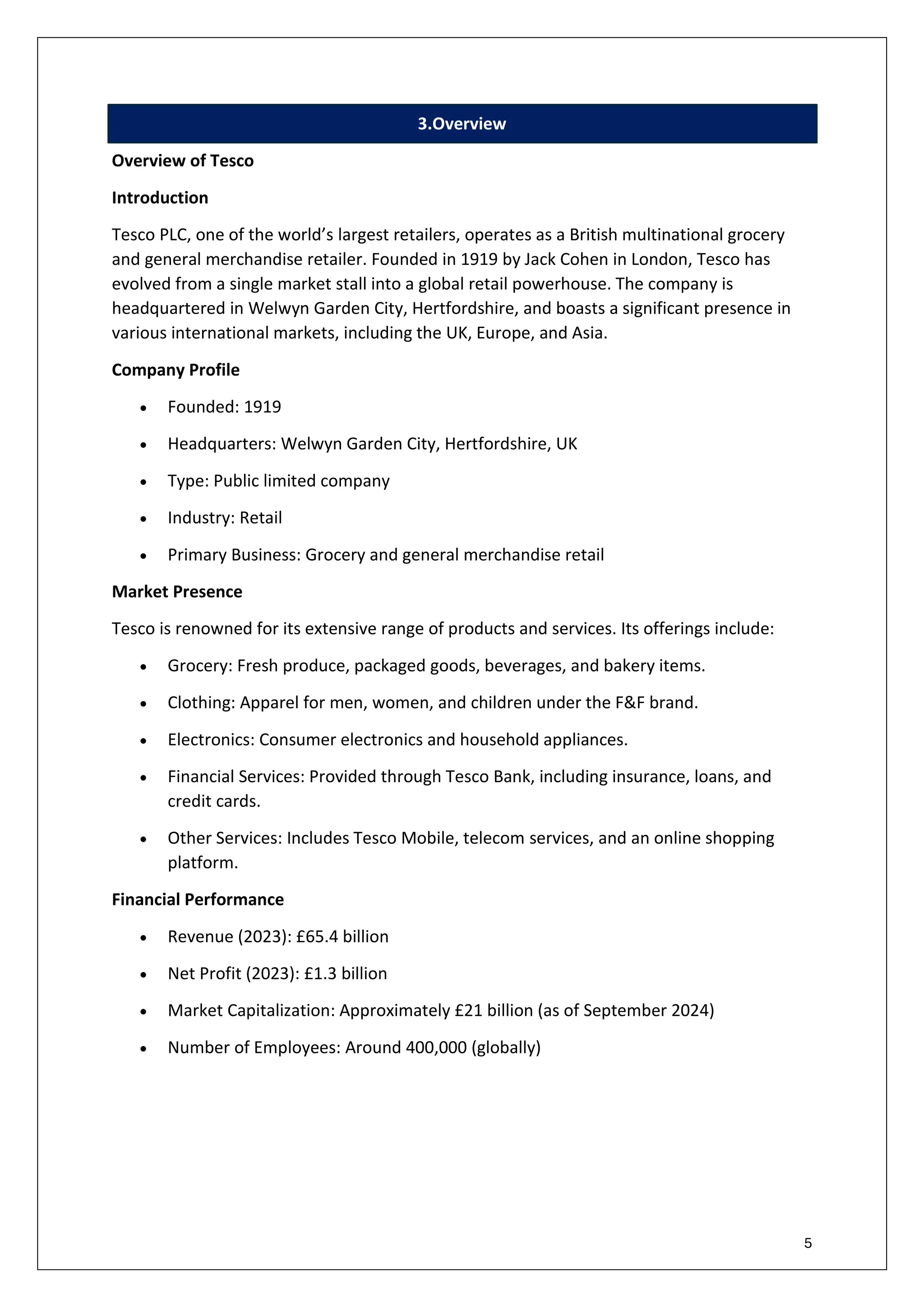
3.Overview
Overview of Tesco
Introduction
TescoPLC, one of the world’s largest retailers, operates as a British multinational grocery
and general merchandise retailer. Founded in 1919 by Jack Cohen in London, Tesco has
evolved from a single market stall into a global retail powerhouse. The company is
headquartered in Welwyn Garden City, Hertfordshire, and boasts a significant presence in
various international markets, including the UK, Europe, and Asia.
Company Profile
• Founded: 1919
• Headquarters: Welwyn Garden City, Hertfordshire, UK
• Type: Public limited company
• Industry: Retail
• Primary Business: Grocery and general merchandise retail
Market Presence
Tesco is renowned for its extensive range of products and services. Its offerings include:
• Grocery: Fresh produce, packaged goods, beverages, and bakery items.
• Clothing: Apparel for men, women, and children under the F&F brand.
• Electronics: Consumer electronics and household appliances.
• Financial Services: Provided through Tesco Bank, including insurance, loans, and
credit cards.
• Other Services: Includes Tesco Mobile, telecom services, and an online shopping
platform.
Financial Performance
• Revenue (2023): £65.4 billion
• Net Profit (2023): £1.3 billion
• Market Capitalization: Approximately £21 billion (as of September 2024)
• Number of Employees: Around 400,000 (globally)
6.
6
4.Problem Statement
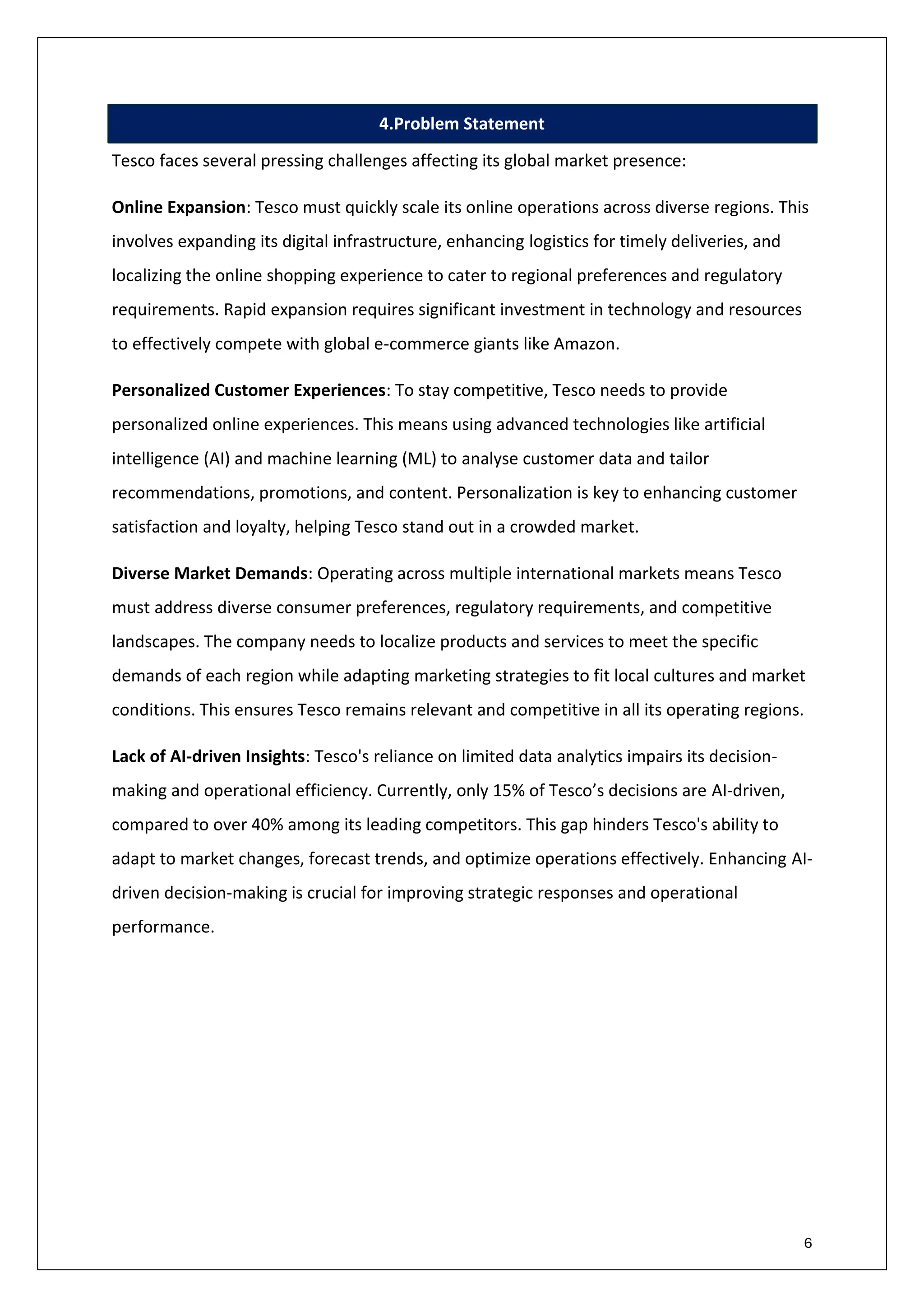
Tesco facesseveral pressing challenges affecting its global market presence:
Online Expansion: Tesco must quickly scale its online operations across diverse regions. This
involves expanding its digital infrastructure, enhancing logistics for timely deliveries, and
localizing the online shopping experience to cater to regional preferences and regulatory
requirements. Rapid expansion requires significant investment in technology and resources
to effectively compete with global e-commerce giants like Amazon.
Personalized Customer Experiences: To stay competitive, Tesco needs to provide
personalized online experiences. This means using advanced technologies like artificial
intelligence (AI) and machine learning (ML) to analyse customer data and tailor
recommendations, promotions, and content. Personalization is key to enhancing customer
satisfaction and loyalty, helping Tesco stand out in a crowded market.
Diverse Market Demands: Operating across multiple international markets means Tesco
must address diverse consumer preferences, regulatory requirements, and competitive
landscapes. The company needs to localize products and services to meet the specific
demands of each region while adapting marketing strategies to fit local cultures and market
conditions. This ensures Tesco remains relevant and competitive in all its operating regions.
Lack of AI-driven Insights: Tesco's reliance on limited data analytics impairs its decision-
making and operational efficiency. Currently, only 15% of Tesco’s decisions are AI-driven,
compared to over 40% among its leading competitors. This gap hinders Tesco's ability to
adapt to market changes, forecast trends, and optimize operations effectively. Enhancing AI-
driven decision-making is crucial for improving strategic responses and operational
performance.
7.
7
4.1 Focus Areas
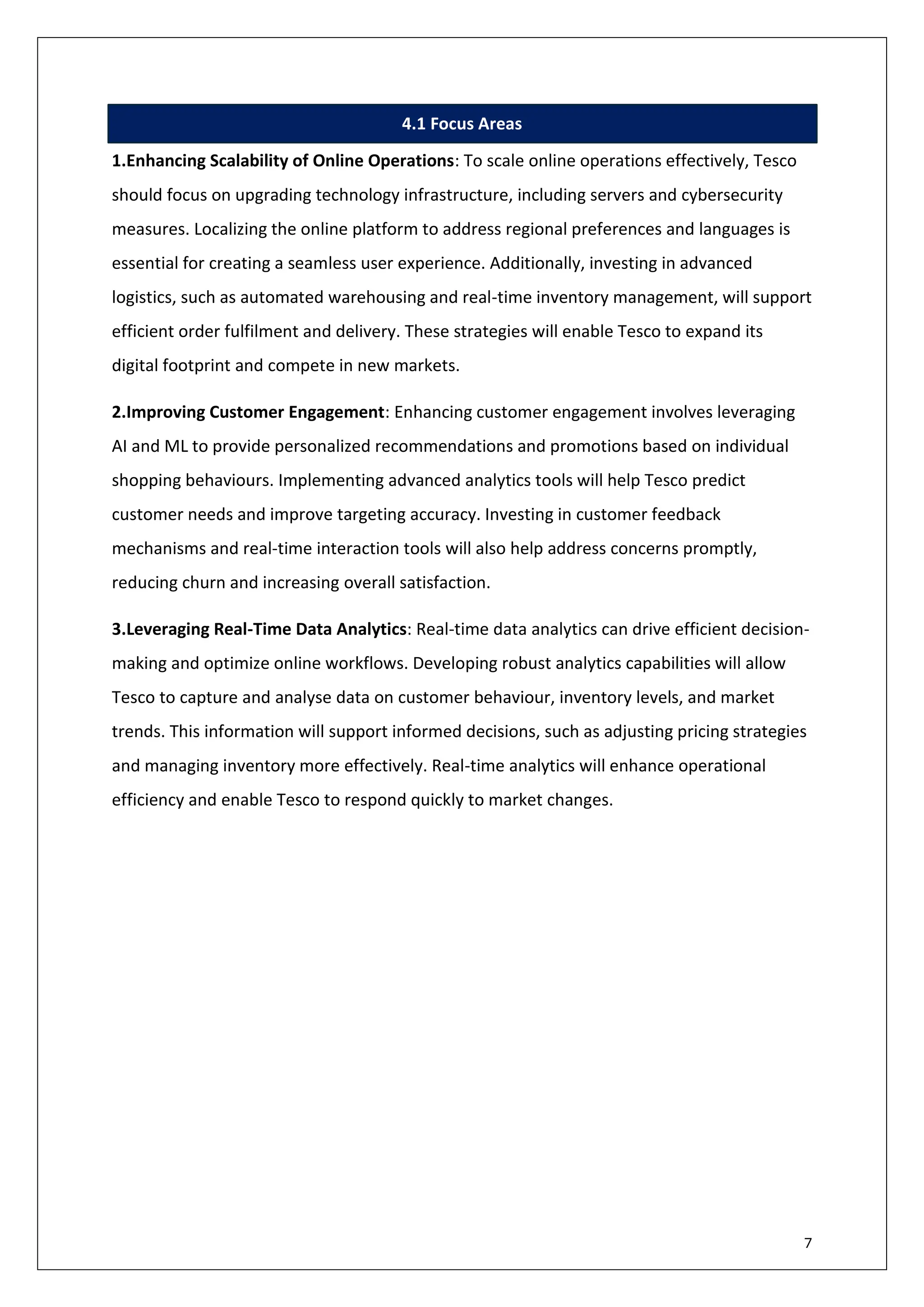
1.EnhancingScalability of Online Operations: To scale online operations effectively, Tesco
should focus on upgrading technology infrastructure, including servers and cybersecurity
measures. Localizing the online platform to address regional preferences and languages is
essential for creating a seamless user experience. Additionally, investing in advanced
logistics, such as automated warehousing and real-time inventory management, will support
efficient order fulfilment and delivery. These strategies will enable Tesco to expand its
digital footprint and compete in new markets.
2.Improving Customer Engagement: Enhancing customer engagement involves leveraging
AI and ML to provide personalized recommendations and promotions based on individual
shopping behaviours. Implementing advanced analytics tools will help Tesco predict
customer needs and improve targeting accuracy. Investing in customer feedback
mechanisms and real-time interaction tools will also help address concerns promptly,
reducing churn and increasing overall satisfaction.
3.Leveraging Real-Time Data Analytics: Real-time data analytics can drive efficient decision-
making and optimize online workflows. Developing robust analytics capabilities will allow
Tesco to capture and analyse data on customer behaviour, inventory levels, and market
trends. This information will support informed decisions, such as adjusting pricing strategies
and managing inventory more effectively. Real-time analytics will enhance operational
efficiency and enable Tesco to respond quickly to market changes.
8.
8
4.2 Tesco’s CurrentSituation
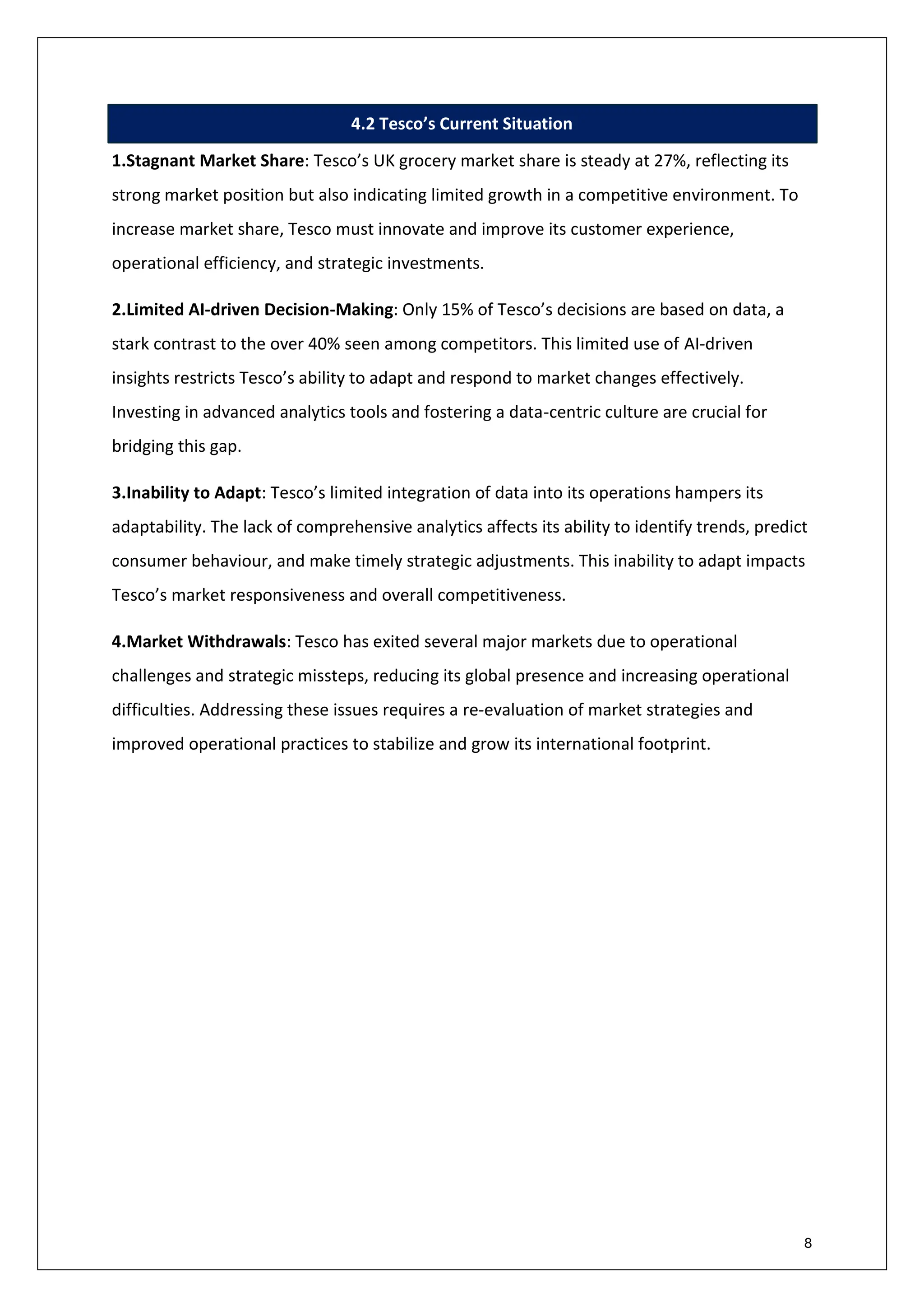
1.Stagnant Market Share: Tesco’s UK grocery market share is steady at 27%, reflecting its
strong market position but also indicating limited growth in a competitive environment. To
increase market share, Tesco must innovate and improve its customer experience,
operational efficiency, and strategic investments.
2.Limited AI-driven Decision-Making: Only 15% of Tesco’s decisions are based on data, a
stark contrast to the over 40% seen among competitors. This limited use of AI-driven
insights restricts Tesco’s ability to adapt and respond to market changes effectively.
Investing in advanced analytics tools and fostering a data-centric culture are crucial for
bridging this gap.
3.Inability to Adapt: Tesco’s limited integration of data into its operations hampers its
adaptability. The lack of comprehensive analytics affects its ability to identify trends, predict
consumer behaviour, and make timely strategic adjustments. This inability to adapt impacts
Tesco’s market responsiveness and overall competitiveness.
4.Market Withdrawals: Tesco has exited several major markets due to operational
challenges and strategic missteps, reducing its global presence and increasing operational
difficulties. Addressing these issues requires a re-evaluation of market strategies and
improved operational practices to stabilize and grow its international footprint.
9.
9
4.3 Tesco’s CompetitiveLandscape
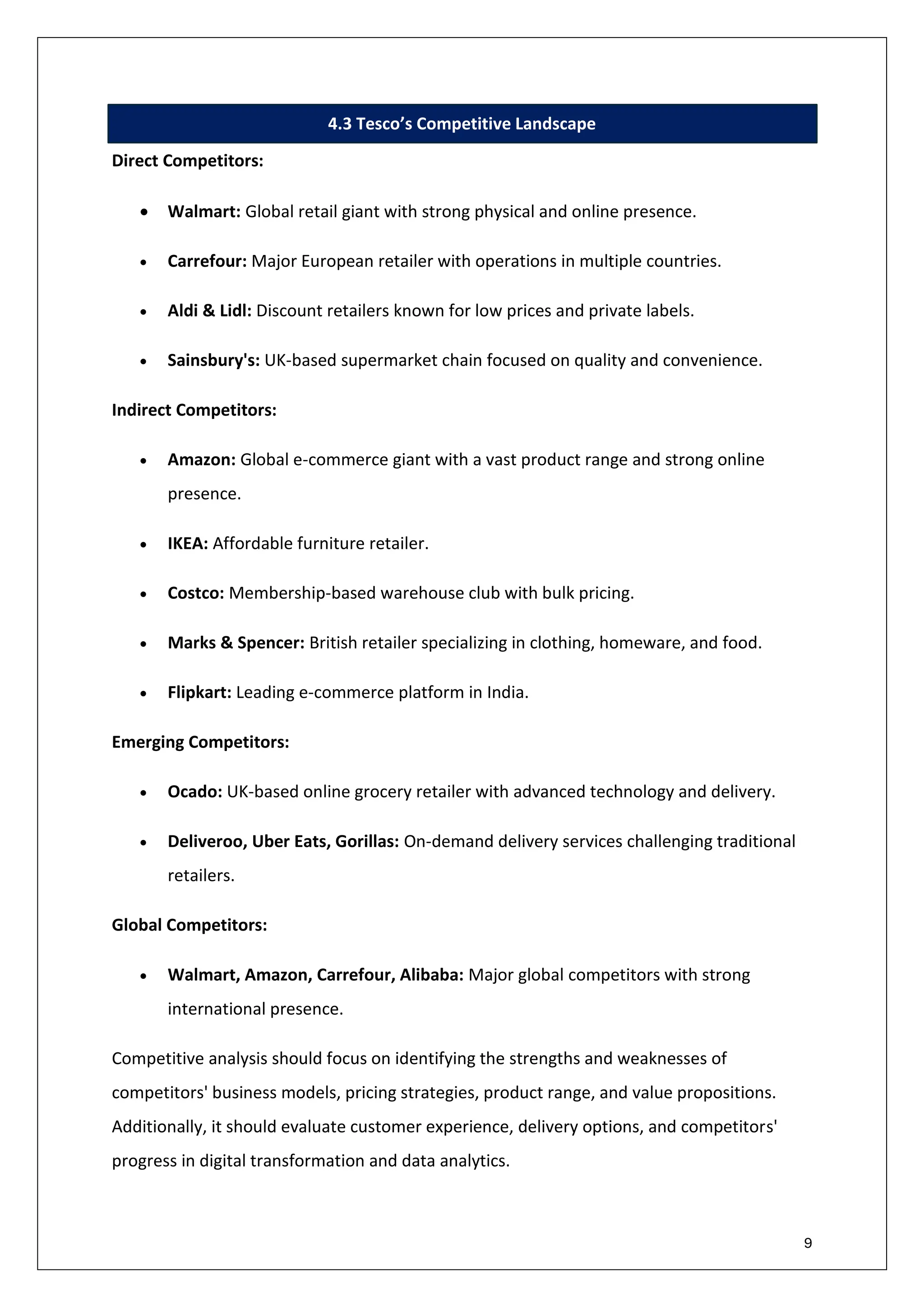
Direct Competitors:
• Walmart: Global retail giant with strong physical and online presence.
• Carrefour: Major European retailer with operations in multiple countries.
• Aldi & Lidl: Discount retailers known for low prices and private labels.
• Sainsbury's: UK-based supermarket chain focused on quality and convenience.
Indirect Competitors:
• Amazon: Global e-commerce giant with a vast product range and strong online
presence.
• IKEA: Affordable furniture retailer.
• Costco: Membership-based warehouse club with bulk pricing.
• Marks & Spencer: British retailer specializing in clothing, homeware, and food.
• Flipkart: Leading e-commerce platform in India.
Emerging Competitors:
• Ocado: UK-based online grocery retailer with advanced technology and delivery.
• Deliveroo, Uber Eats, Gorillas: On-demand delivery services challenging traditional
retailers.
Global Competitors:
• Walmart, Amazon, Carrefour, Alibaba: Major global competitors with strong
international presence.
Competitive analysis should focus on identifying the strengths and weaknesses of
competitors' business models, pricing strategies, product range, and value propositions.
Additionally, it should evaluate customer experience, delivery options, and competitors'
progress in digital transformation and data analytics.
10.
10
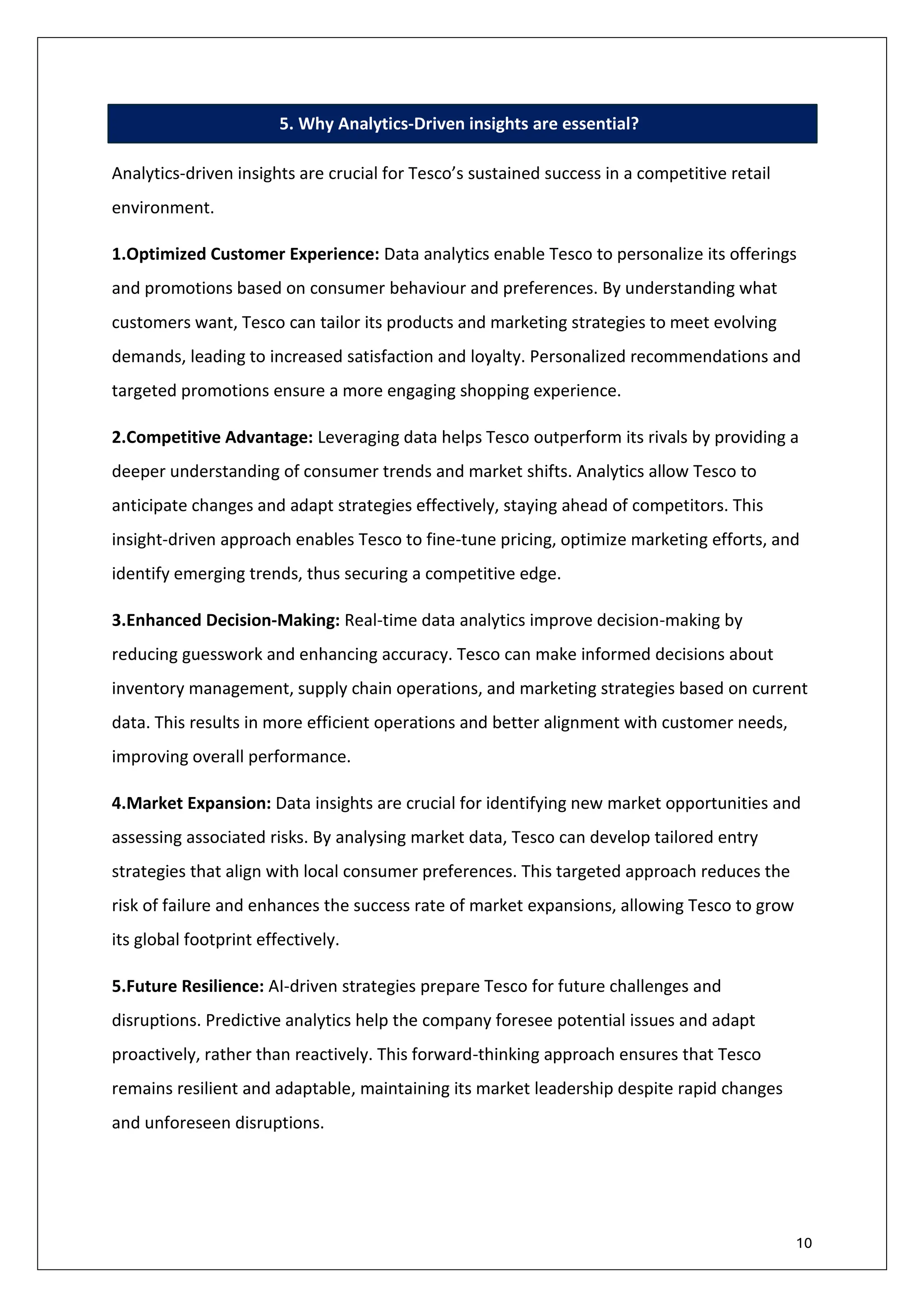
5. Why Analytics-Driveninsights are essential?
Analytics-driven insights are crucial for Tesco’s sustained success in a competitive retail
environment.
1.Optimized Customer Experience: Data analytics enable Tesco to personalize its offerings
and promotions based on consumer behaviour and preferences. By understanding what
customers want, Tesco can tailor its products and marketing strategies to meet evolving
demands, leading to increased satisfaction and loyalty. Personalized recommendations and
targeted promotions ensure a more engaging shopping experience.
2.Competitive Advantage: Leveraging data helps Tesco outperform its rivals by providing a
deeper understanding of consumer trends and market shifts. Analytics allow Tesco to
anticipate changes and adapt strategies effectively, staying ahead of competitors. This
insight-driven approach enables Tesco to fine-tune pricing, optimize marketing efforts, and
identify emerging trends, thus securing a competitive edge.
3.Enhanced Decision-Making: Real-time data analytics improve decision-making by
reducing guesswork and enhancing accuracy. Tesco can make informed decisions about
inventory management, supply chain operations, and marketing strategies based on current
data. This results in more efficient operations and better alignment with customer needs,
improving overall performance.
4.Market Expansion: Data insights are crucial for identifying new market opportunities and
assessing associated risks. By analysing market data, Tesco can develop tailored entry
strategies that align with local consumer preferences. This targeted approach reduces the
risk of failure and enhances the success rate of market expansions, allowing Tesco to grow
its global footprint effectively.
5.Future Resilience: AI-driven strategies prepare Tesco for future challenges and
disruptions. Predictive analytics help the company foresee potential issues and adapt
proactively, rather than reactively. This forward-thinking approach ensures that Tesco
remains resilient and adaptable, maintaining its market leadership despite rapid changes
and unforeseen disruptions.
11.
11
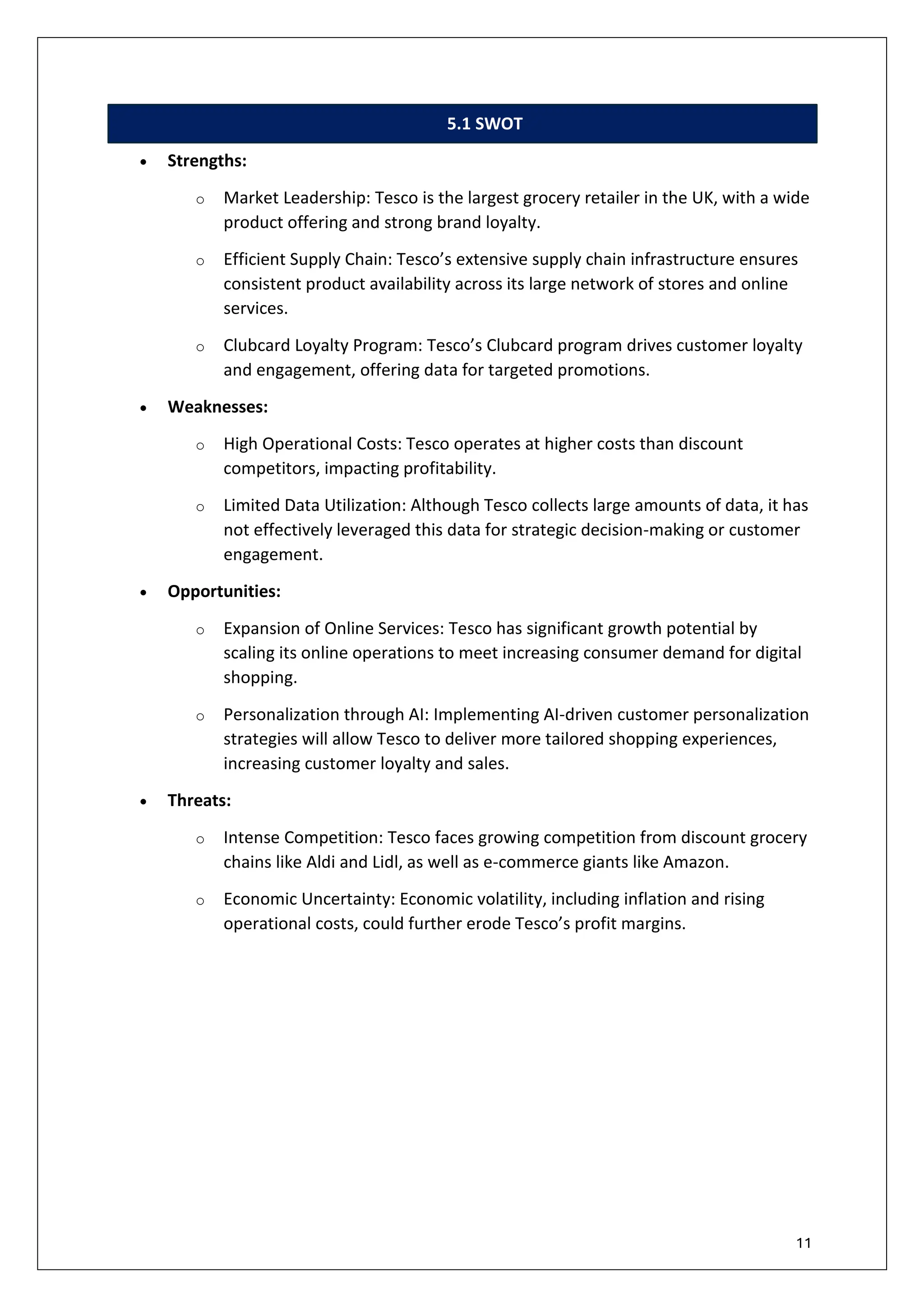
5.1 SWOT
• Strengths:
oMarket Leadership: Tesco is the largest grocery retailer in the UK, with a wide
product offering and strong brand loyalty.
o Efficient Supply Chain: Tesco’s extensive supply chain infrastructure ensures
consistent product availability across its large network of stores and online
services.
o Clubcard Loyalty Program: Tesco’s Clubcard program drives customer loyalty
and engagement, offering data for targeted promotions.
• Weaknesses:
o High Operational Costs: Tesco operates at higher costs than discount
competitors, impacting profitability.
o Limited Data Utilization: Although Tesco collects large amounts of data, it has
not effectively leveraged this data for strategic decision-making or customer
engagement.
• Opportunities:
o Expansion of Online Services: Tesco has significant growth potential by
scaling its online operations to meet increasing consumer demand for digital
shopping.
o Personalization through AI: Implementing AI-driven customer personalization
strategies will allow Tesco to deliver more tailored shopping experiences,
increasing customer loyalty and sales.
• Threats:
o Intense Competition: Tesco faces growing competition from discount grocery
chains like Aldi and Lidl, as well as e-commerce giants like Amazon.
o Economic Uncertainty: Economic volatility, including inflation and rising
operational costs, could further erode Tesco’s profit margins.
12.
12
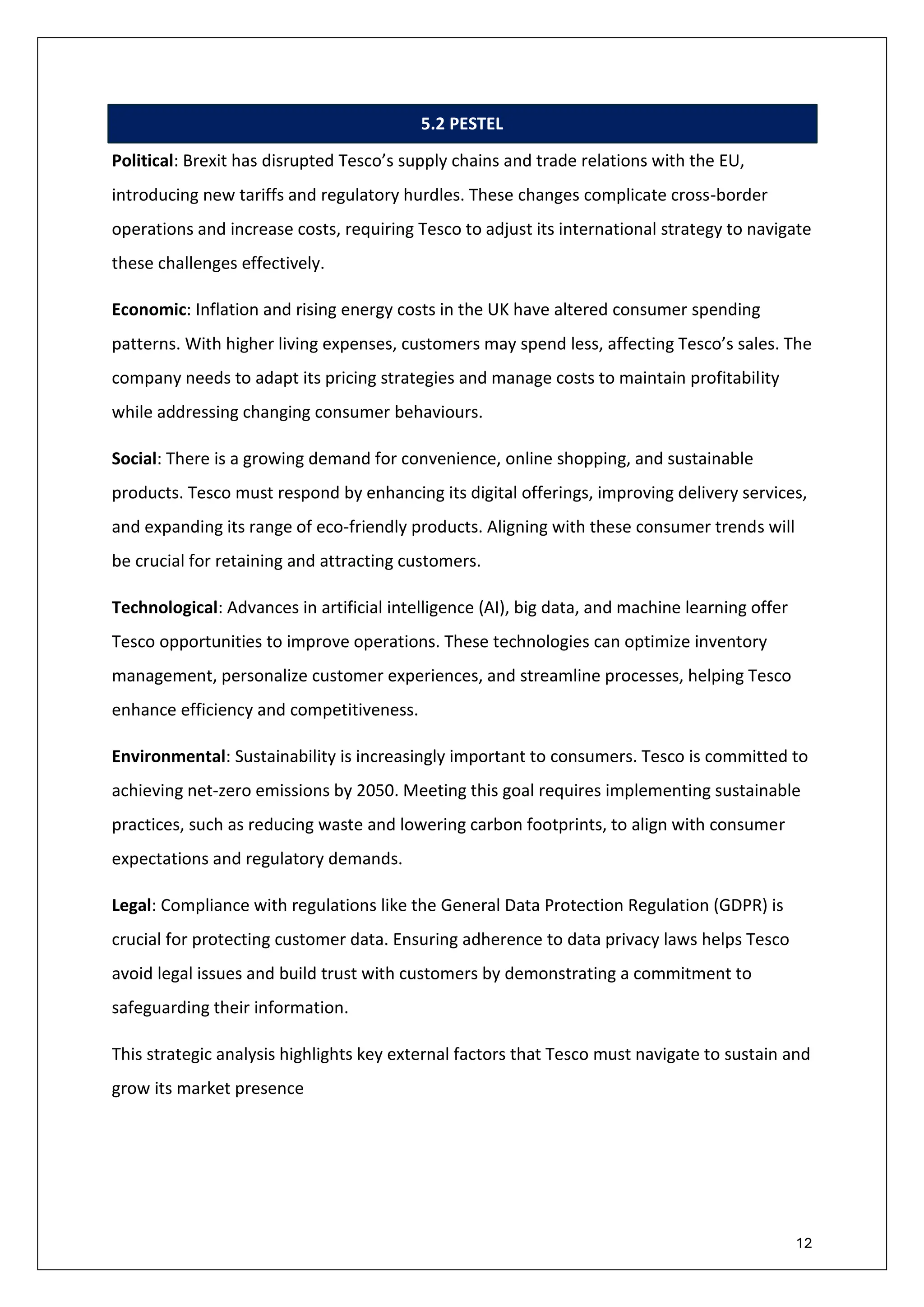
5.2 PESTEL
Political: Brexithas disrupted Tesco’s supply chains and trade relations with the EU,
introducing new tariffs and regulatory hurdles. These changes complicate cross-border
operations and increase costs, requiring Tesco to adjust its international strategy to navigate
these challenges effectively.
Economic: Inflation and rising energy costs in the UK have altered consumer spending
patterns. With higher living expenses, customers may spend less, affecting Tesco’s sales. The
company needs to adapt its pricing strategies and manage costs to maintain profitability
while addressing changing consumer behaviours.
Social: There is a growing demand for convenience, online shopping, and sustainable
products. Tesco must respond by enhancing its digital offerings, improving delivery services,
and expanding its range of eco-friendly products. Aligning with these consumer trends will
be crucial for retaining and attracting customers.
Technological: Advances in artificial intelligence (AI), big data, and machine learning offer
Tesco opportunities to improve operations. These technologies can optimize inventory
management, personalize customer experiences, and streamline processes, helping Tesco
enhance efficiency and competitiveness.
Environmental: Sustainability is increasingly important to consumers. Tesco is committed to
achieving net-zero emissions by 2050. Meeting this goal requires implementing sustainable
practices, such as reducing waste and lowering carbon footprints, to align with consumer
expectations and regulatory demands.
Legal: Compliance with regulations like the General Data Protection Regulation (GDPR) is
crucial for protecting customer data. Ensuring adherence to data privacy laws helps Tesco
avoid legal issues and build trust with customers by demonstrating a commitment to
safeguarding their information.
This strategic analysis highlights key external factors that Tesco must navigate to sustain and
grow its market presence
13.
13
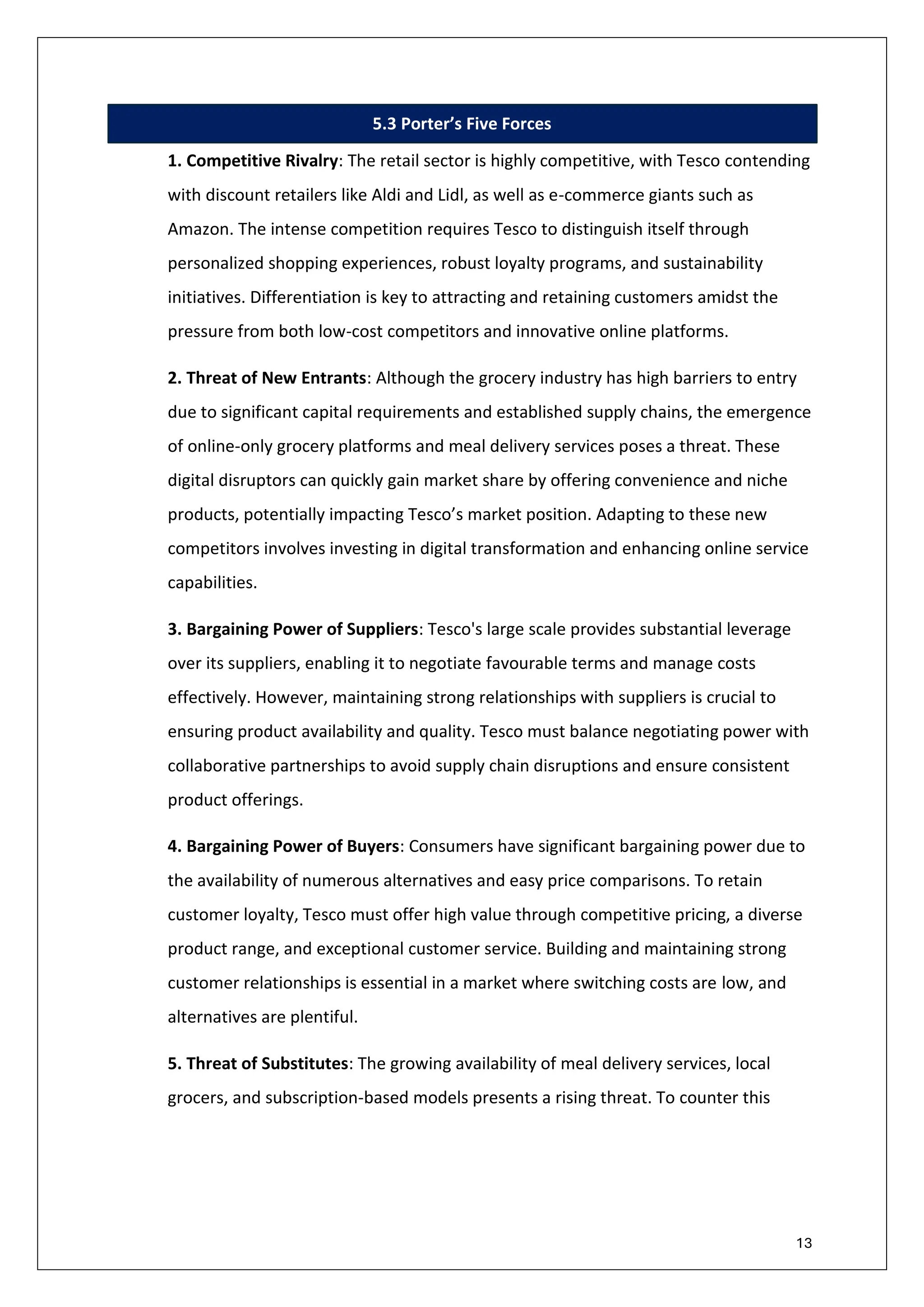
5.3 Porter’s FiveForces
1. Competitive Rivalry: The retail sector is highly competitive, with Tesco contending
with discount retailers like Aldi and Lidl, as well as e-commerce giants such as
Amazon. The intense competition requires Tesco to distinguish itself through
personalized shopping experiences, robust loyalty programs, and sustainability
initiatives. Differentiation is key to attracting and retaining customers amidst the
pressure from both low-cost competitors and innovative online platforms.
2. Threat of New Entrants: Although the grocery industry has high barriers to entry
due to significant capital requirements and established supply chains, the emergence
of online-only grocery platforms and meal delivery services poses a threat. These
digital disruptors can quickly gain market share by offering convenience and niche
products, potentially impacting Tesco’s market position. Adapting to these new
competitors involves investing in digital transformation and enhancing online service
capabilities.
3. Bargaining Power of Suppliers: Tesco's large scale provides substantial leverage
over its suppliers, enabling it to negotiate favourable terms and manage costs
effectively. However, maintaining strong relationships with suppliers is crucial to
ensuring product availability and quality. Tesco must balance negotiating power with
collaborative partnerships to avoid supply chain disruptions and ensure consistent
product offerings.
4. Bargaining Power of Buyers: Consumers have significant bargaining power due to
the availability of numerous alternatives and easy price comparisons. To retain
customer loyalty, Tesco must offer high value through competitive pricing, a diverse
product range, and exceptional customer service. Building and maintaining strong
customer relationships is essential in a market where switching costs are low, and
alternatives are plentiful.
5. Threat of Substitutes: The growing availability of meal delivery services, local
grocers, and subscription-based models presents a rising threat. To counter this
14.
14
6.Approach and Methodology– Strategic Opportunities & Initiatives
1. Strategic Initiatives:
o This focuses on leveraging Digital Transformation and Global E-commerce
Expansion. Key elements include adopting advanced technologies like
automation, AI, and cloud computing to streamline operations and enhance
productivity. Businesses are encouraged to foster an AI-driven culture,
ensuring decision-making is backed by actionable insights. Companies are
advised to capitalize on emerging markets to tap into new customer bases
and opportunities, aligning their e-commerce strategies to global market
demands.
2. Customer-Centric Approach:
o This strategy emphasizes understanding and meeting customer needs using
AI-powered customer insights and personalized experiences. With the help
of AI, businesses can predict customer behaviour, offering tailored
recommendations that enhance satisfaction. Deepening customer
understanding enables brands to engage customers better, fostering loyalty.
Personalized experiences are critical in ensuring customers feel valued, which
directly correlates with higher retention and brand advocacy.
3. AI-driven Optimization:
o Focused on optimizing business operations through Predictive Sales Analysis
and the RFM (Recency, Frequency, and Monetary) Model. Predictive
analytics allows businesses to anticipate sales trends, facilitating better
inventory and resource planning. Customer segmentation ensures marketing
efforts are more focused and effective, while optimizing supply chains
enhances operational efficiency. The RFM model helps to tailor marketing
efforts by identifying the most valuable customers based on their purchasing
behaviour.
15.
15
6.Approach and Methodology– Solution Overview
1. Data Preparation:
o The first phase focuses on gathering relevant data from multiple sources.
This involves collecting a wide array of data points needed for analysis. The
process includes removing duplicates and correcting inaccuracies, ensuring
that the data is clean and ready for use. Additionally, it involves verifying the
consistency and completeness of the data, which is crucial for obtaining
accurate and reliable results in later stages. The goal of this step is to ensure
that the data is of high quality and suitable for analysis.
2. Model Development:
o In the second phase, models are created and refined through iterative
testing. This ensures that the models produce robust and reliable results.
Key models employed include the RFM (Recency, Frequency, Monetization)
Model, which helps in understanding customer behaviour based on
purchasing patterns. The use of Predictive Sales Analysis allows the business
to forecast future trends, while understanding customer behaviour further
aids in making AI-driven decisions. Tools like Jupyter, Anaconda, and Python
are used for model development, enhancing the analytical rigor of this phase.
3. Visualization and Insights:
o The final phase involves importing the cleaned data into Power BI, a
business intelligence tool. In Power BI, interactive dashboards are designed
and configured, enabling decision-makers to easily explore and visualize the
data. These dashboards make it simple to identify trends, insights, and
anomalies, providing a visual interface that can be shared across teams for
effective communication of AI-driven strategies.
Overall, this approach transforms raw data into meaningful insights through a structured,
analytical process.
16.
16
6.1 Approach andMethodology – Data Preparation
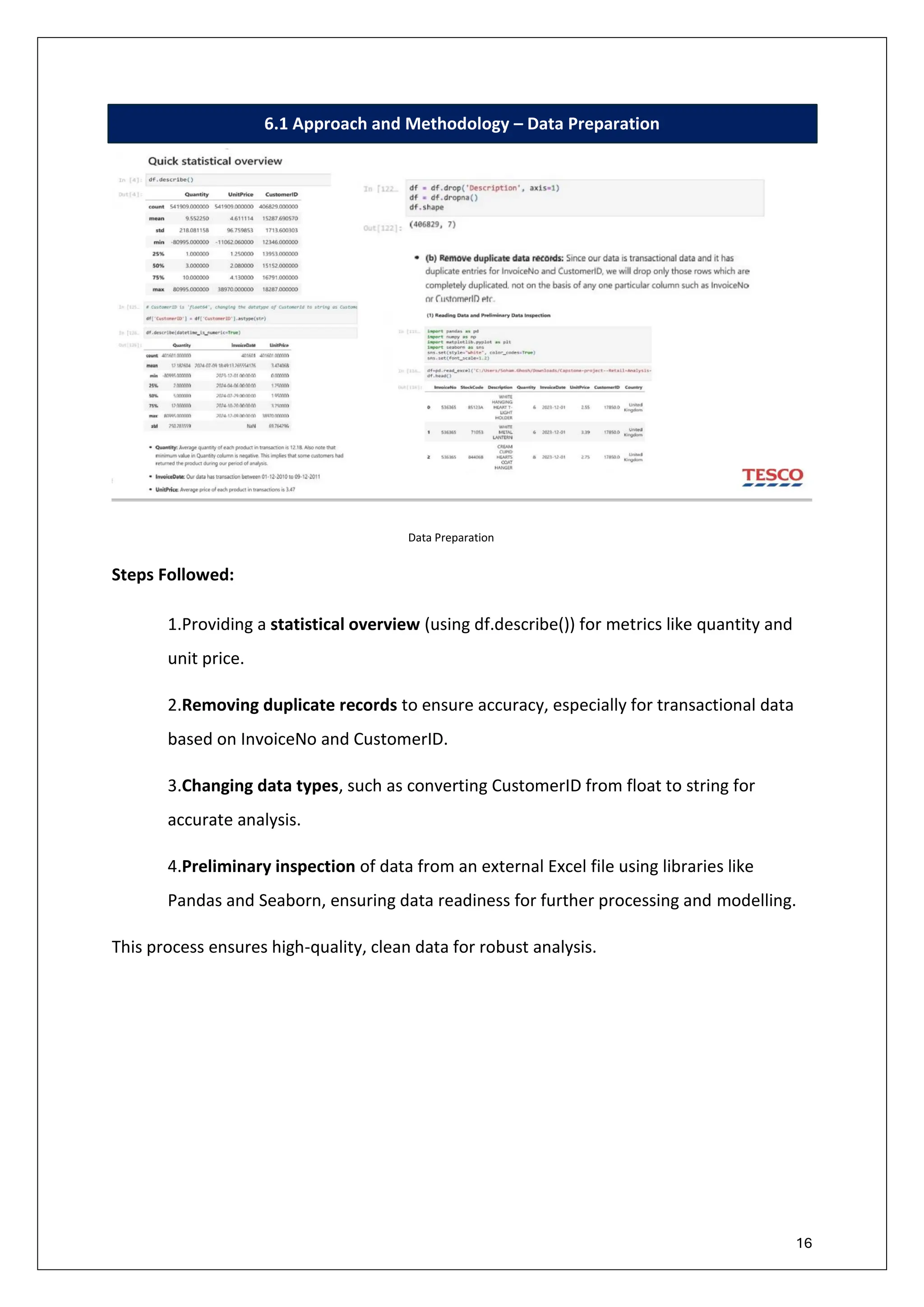
Data Preparation
Steps Followed:
1.Providing a statistical overview (using df.describe()) for metrics like quantity and
unit price.
2.Removing duplicate records to ensure accuracy, especially for transactional data
based on InvoiceNo and CustomerID.
3.Changing data types, such as converting CustomerID from float to string for
accurate analysis.
4.Preliminary inspection of data from an external Excel file using libraries like
Pandas and Seaborn, ensuring data readiness for further processing and modelling.
This process ensures high-quality, clean data for robust analysis.
17.
17
6.2 Approach andMethodology – Model Development
1.Customer Behaviour Model
The Customer Behaviour Model outlines the stages customers go through when interacting
with a business. It starts with Awareness, where customers learn about a product through
marketing or social media. In the Consideration stage, customers research and compare
options. During the Purchase stage, they make the transaction, including decisions about
payment and delivery. After purchase, customers enter the Post-Purchase Evaluation
phase, where they assess their satisfaction, influencing future behaviour and brand loyalty.
Satisfied customers may reach the Loyalty and Advocacy stage, becoming repeat buyers
and recommending the product, which enhances brand loyalty.
2.RFM Model
The RFM (Recency, Frequency, Monetary) Model is a method for segmenting customers
based on their purchasing behaviour. Recency measures how recently a customer made a
purchase, with recent buyers often being more engaged. Frequency tracks how often a
customer makes a purchase, indicating loyalty. Monetary assesses the total amount spent,
identifying high-value customers. Segments are categorized as:
• High Recency, High Frequency, High Monetary: Best customers who are recent,
frequent, and high spenders.
• High Recency, High Frequency, Low Monetary: Frequent buyers who spend less.
• Low Recency, High Frequency, High Monetary: Previous high spenders who haven’t
bought recently.
• Low Recency, Low Frequency, Low Monetary: Least engaged customers.
Applications include targeted marketing and customer retention strategies, such as
personalized offers and re-engagement campaigns.
18.
18
6.2 Approach andMethodology – Model Development (Cont.)
3.Predictive Modelling uses historical data and statistical techniques to forecast future
customer behaviour. It involves Data Collection of past purchases and interactions, Feature
Selection for relevant variables, and Model Training using methods like regression analysis,
classification algorithms, and time series analysis. Model Evaluation assesses accuracy, and
Implementation applies predictions to scenarios like customer segmentation and inventory
management. Benefits include improved decision-making, enhanced customer experience,
and increased efficiency by anticipating trends and optimizing resources.
4.Data Governance refers to the management framework that ensures data within an
organization is accurate, consistent, secure, and used responsibly. It encompasses policies,
procedures, and standards that govern how data is collected, stored, accessed, and utilized
to ensure its integrity, quality, and compliance with regulatory requirements.
Summary
The Customer Behaviour Model explains the customer journey, the RFM Model segments
based on purchase behaviour, and Predictive Modelling forecasts future behaviour to guide
strategic decisions.
19.
19
6.3.1 Approach andMethodology – Insights & Visualisations
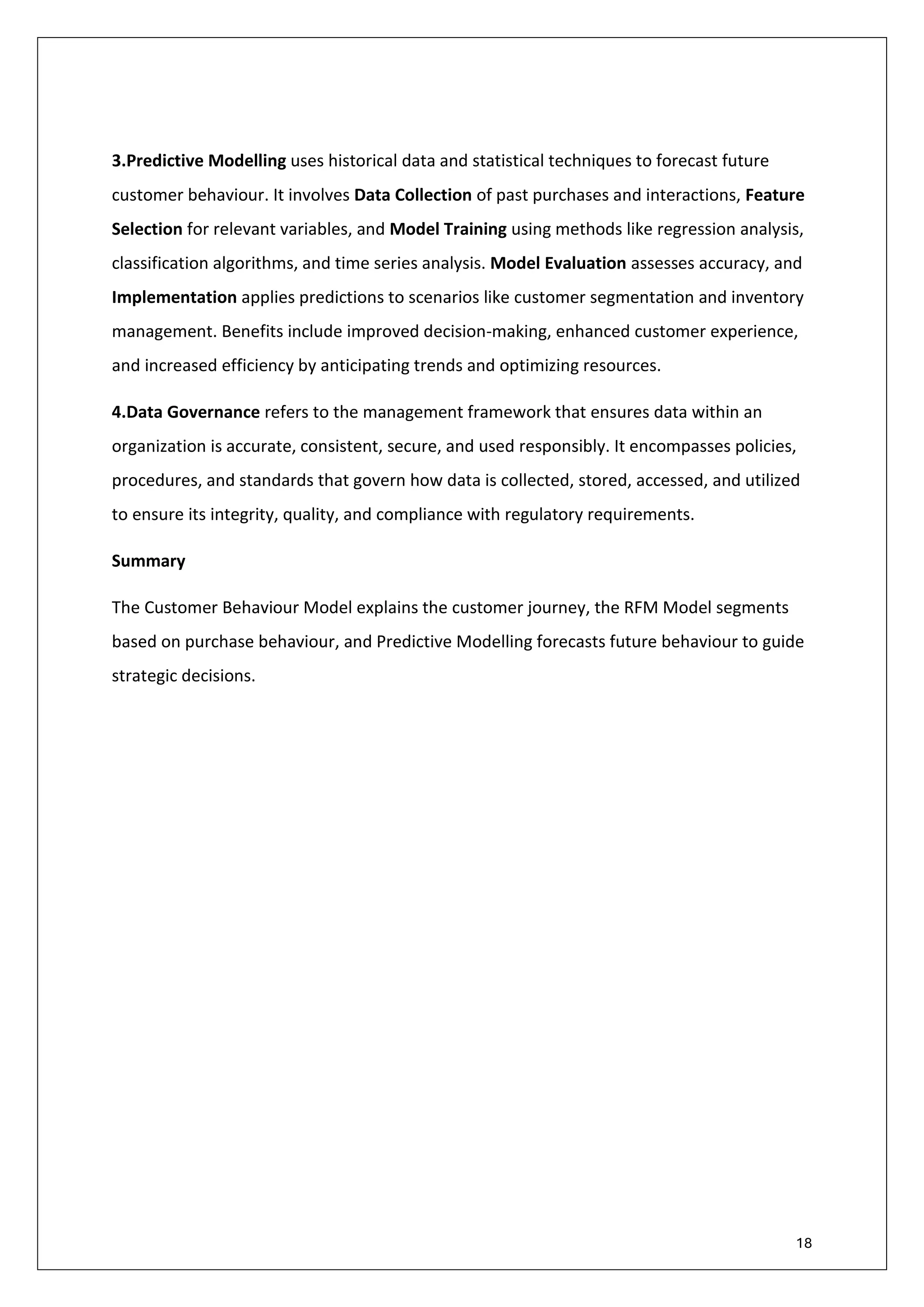
RFM Model Visualization - Link
Key Findings:
• Customer Clustering: The "Clusters by Inertia" chart reveals distinct customer
segments based on their RFM scores.
• RFM Analysis: The "Recency by Cluster ID," "Frequency by Cluster ID," and
"Monetary by Cluster ID" charts provide insights into the characteristics of each
cluster.
• Customer Distribution: The "Count of CustomerID by Country" chart shows the
geographic distribution of customers within each cluster.
• Cluster Analysis: The remaining charts (e.g., "Count of rfm_score by Cluster ID,"
"Monetary by Cluster ID") offer a deeper dive into the specific attributes and
behaviours of each cluster.
Inferences:
Leverage RFM segmentation to identify high-value customers and tailor marketing
campaigns, implement loyalty programs and personalized experiences to retain customers,
and optimize product offerings and recommendations based on customer preferences and
behaviour patterns to enhance customer engagement and drive revenue.
20.
20
6.3.2 Approach andMethodology – Insights & Visualisations
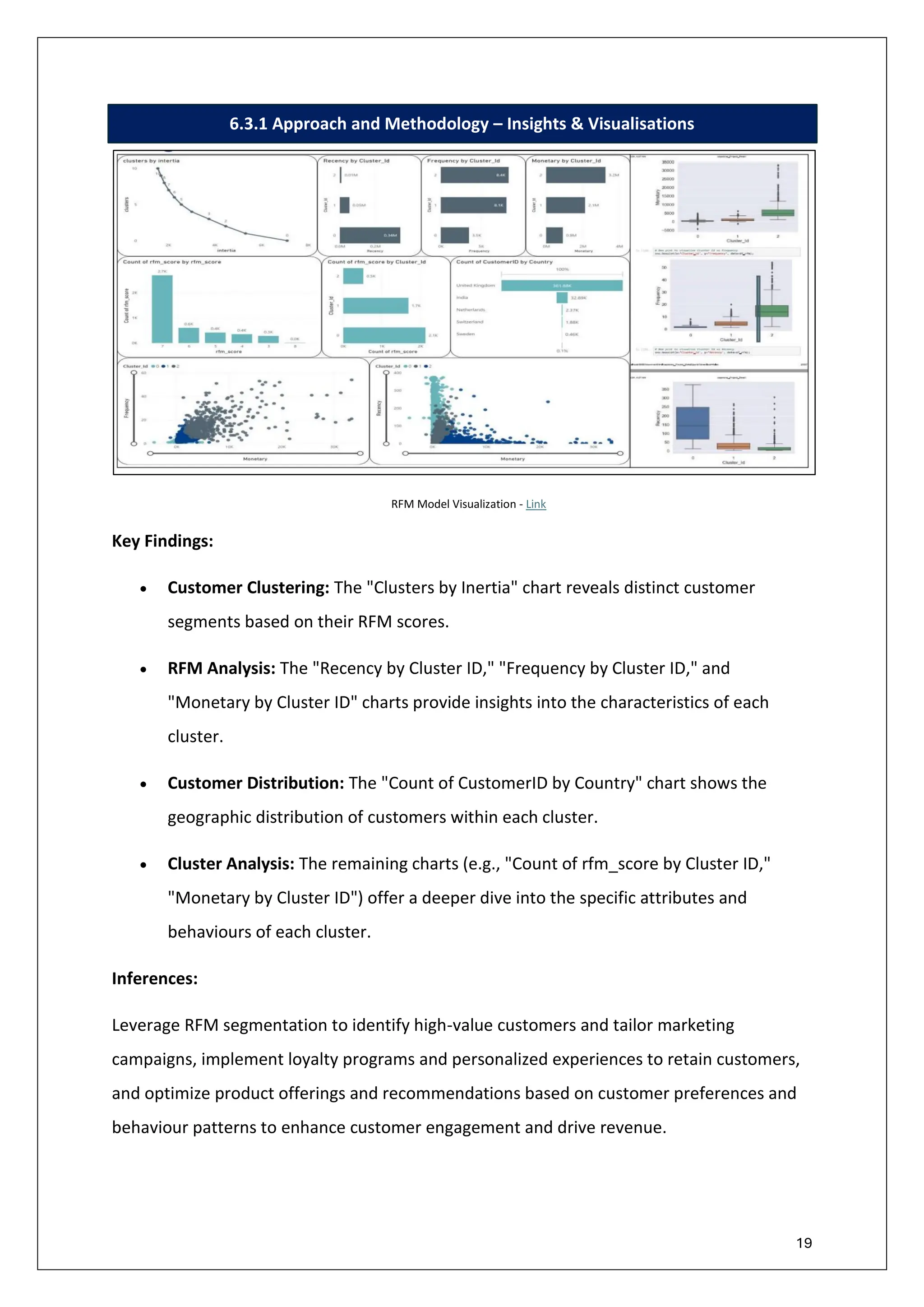
Demographic Analysis -Link
• Invoice No by Country: The bar chart shows the total number of invoices generated
in each country. The United Kingdom has the highest number of invoices, followed
by India and the Netherlands.
• Quantity by Country: The bar chart and map visualization illustrate the quantity of
products sold in each country. The United Kingdom has the highest quantity sold,
followed by India and the Netherlands.
Key Findings:
• Geographic Concentration: Most sales are concentrated in European countries,
particularly the United Kingdom, India, and the Netherlands.
• Market Potential: Countries like India, Poland, Lithuania, and Saudi Arabia may
represent untapped market potential with relatively low sales volumes.
• Regional Variations: There are significant variations in sales quantity across different
countries, indicating varying market demand and penetration.
Inferences:
To drive growth, focus on market expansion in high-potential countries like India, Poland,
Lithuania, and Saudi Arabia, implement localized strategies tailored to regional customer
needs.
21.
21
6.3.3 Approach andMethodology – Insights & Visualisations
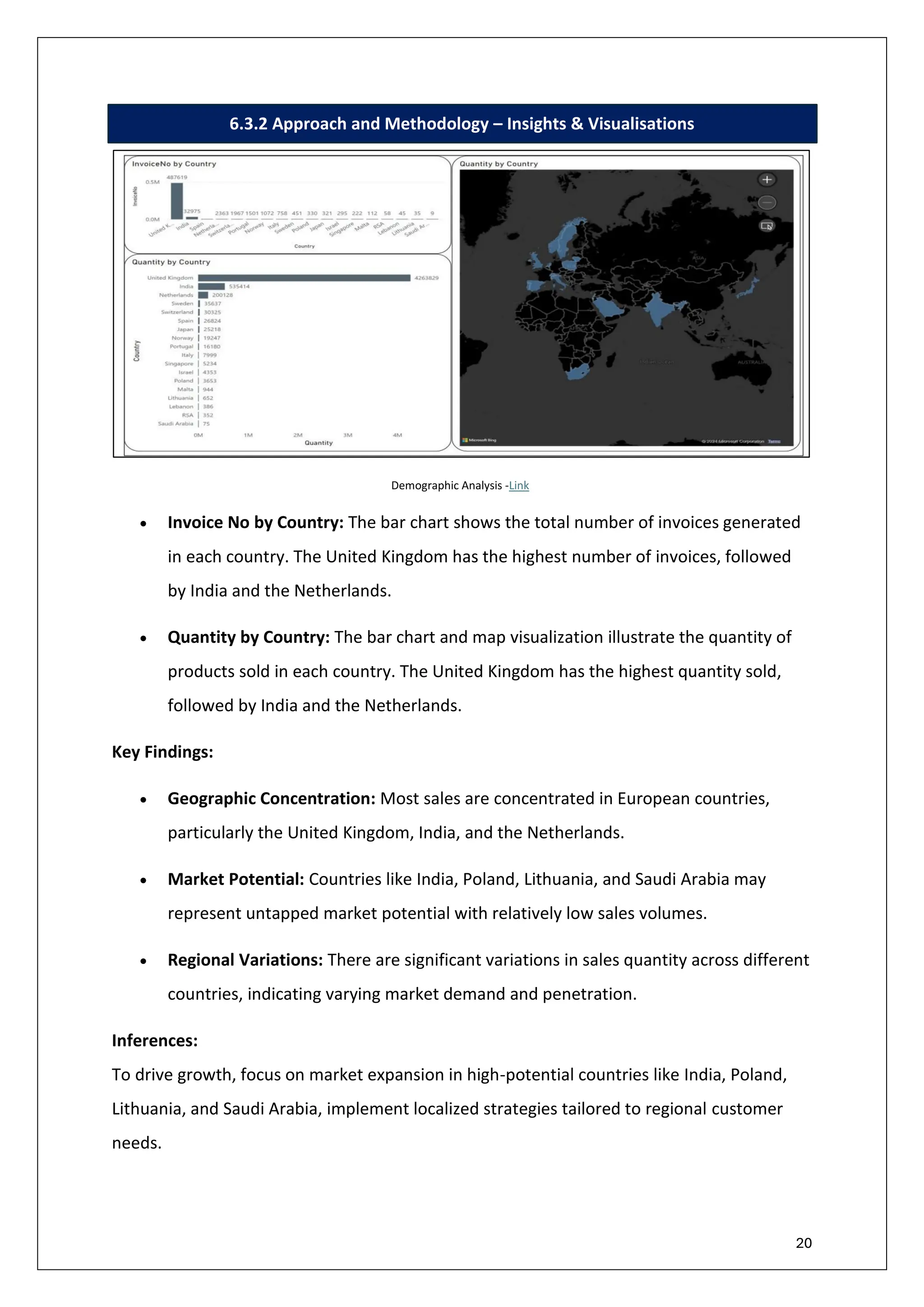
Product Diversity - Link
The visualizations present a comprehensive analysis of product sales data across India, the
UK, and the Netherlands. Key insights include:
• Top-Selling Products: Identify top-selling products in each country for inventory
management and product recommendations.
• Product Subcategory Analysis: Analyse the popularity of different product
categories to identify market opportunities.
• Customer Segmentation: Understand customer preferences and demographics to
tailor marketing campaigns.
Recommendations:
• Product Localization: Tailor product offerings to meet local needs and preferences.
• Targeted Marketing: Develop targeted campaigns based on product popularity and
customer demographics.
• Inventory Optimization: Optimize inventory levels to ensure product availability and
minimize costs.
22.
22
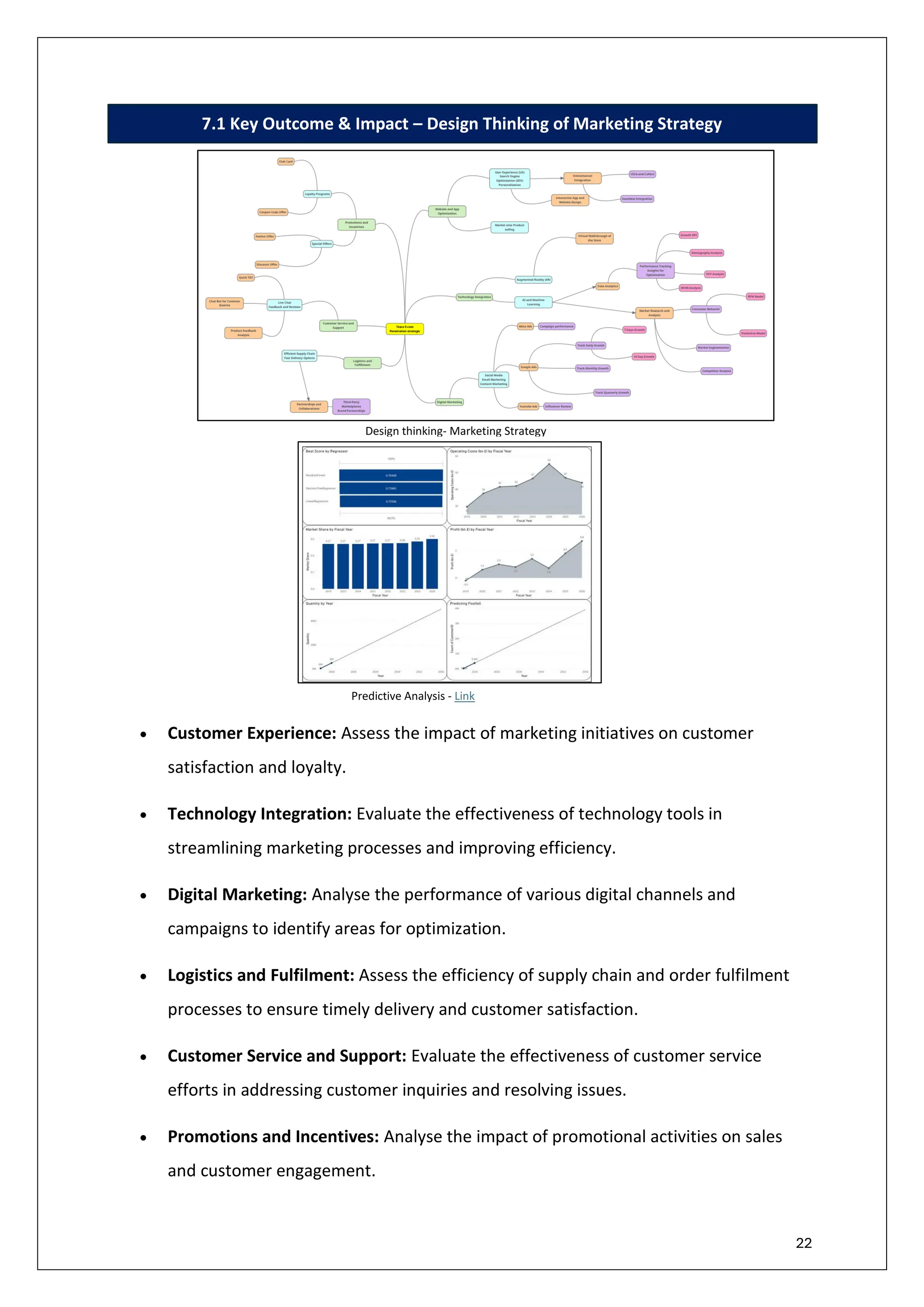
Design thinking- MarketingStrategy
7.1 Key Outcome & Impact – Design Thinking of Marketing Strategy
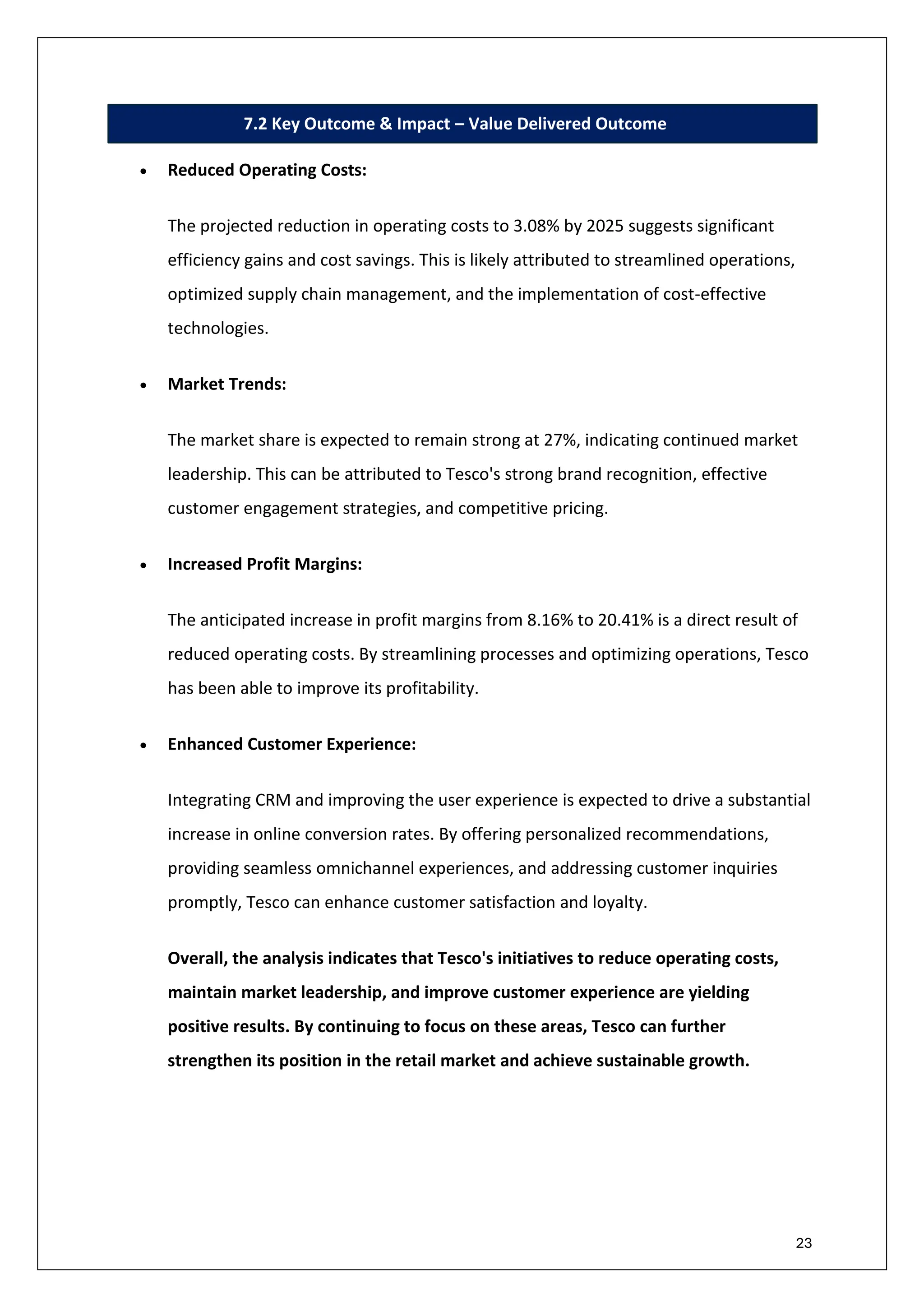
Predictive Analysis - Link
• Customer Experience: Assess the impact of marketing initiatives on customer
satisfaction and loyalty.
• Technology Integration: Evaluate the effectiveness of technology tools in
streamlining marketing processes and improving efficiency.
• Digital Marketing: Analyse the performance of various digital channels and
campaigns to identify areas for optimization.
• Logistics and Fulfilment: Assess the efficiency of supply chain and order fulfilment
processes to ensure timely delivery and customer satisfaction.
• Customer Service and Support: Evaluate the effectiveness of customer service
efforts in addressing customer inquiries and resolving issues.
• Promotions and Incentives: Analyse the impact of promotional activities on sales
and customer engagement.
23.
23
7.2 Key Outcome& Impact – Value Delivered Outcome
• Reduced Operating Costs:
The projected reduction in operating costs to 3.08% by 2025 suggests significant
efficiency gains and cost savings. This is likely attributed to streamlined operations,
optimized supply chain management, and the implementation of cost-effective
technologies.
• Market Trends:
The market share is expected to remain strong at 27%, indicating continued market
leadership. This can be attributed to Tesco's strong brand recognition, effective
customer engagement strategies, and competitive pricing.
• Increased Profit Margins:
The anticipated increase in profit margins from 8.16% to 20.41% is a direct result of
reduced operating costs. By streamlining processes and optimizing operations, Tesco
has been able to improve its profitability.
• Enhanced Customer Experience:
Integrating CRM and improving the user experience is expected to drive a substantial
increase in online conversion rates. By offering personalized recommendations,
providing seamless omnichannel experiences, and addressing customer inquiries
promptly, Tesco can enhance customer satisfaction and loyalty.
Overall, the analysis indicates that Tesco's initiatives to reduce operating costs,
maintain market leadership, and improve customer experience are yielding
positive results. By continuing to focus on these areas, Tesco can further
strengthen its position in the retail market and achieve sustainable growth.
25
9. Conclusion
In conclusion,integrating RFM analysis, predictive modelling, and customer behaviour
analysis will empower Tesco to deliver personalized marketing, enhance customer
engagement, and streamline resource allocation. This data-driven strategy ensures Tesco's
agility in adapting to market changes, securing a competitive edge and uncovering growth
opportunities. By 2025, Tesco is poised to reduce operating costs by 3.08%, increase market
share by 2%, boost profit margins from 8.16% to 20.41%, and achieve a 30.75% rise in online
conversions, positioning the company for sustained success.
26.
26
10. Bibliography
1. CurrentSituation -https://d3.harvard.edu/platform-rctom/submission/tesco-a-digital-
transformation/
2. "SWOT Analysis of Tesco." Tesco's Internal Report, 2023.
3."Porter's Five Forces in Retail: Competitive Landscape." International Retail Journal, 2023.
4.PESTEL Analysis of Tesco, Global Insights Magazine, 2024.
.Tesco PLC Annual Report (2023). Financial Overview & Market Performance.
![1
Transformative Business Solutions powered by Analytics Driven Insights
[General Management Programme for Business Excellence Batch 06 , Group 3 - AI Wizards Team]](https://image.slidesharecdn.com/group3aiwizardsfinalcapstoneprojectreport1-250526115541-8b17685c/75/Group3-AI-Wizards-Final-Capstone-Project-Report-1-pdf-1-2048.jpg)


![[DNTS2019 - Hyper Junior] TÀI LIỆU THUYẾT TRÌNH VÒNG 1 CHUNG KẾT](https://cdn.slidesharecdn.com/ss_thumbnails/ket-201029091717-thumbnail.jpg?width=640&height=640&fit=bounds)


