PRONOUN
Group 2
PRONOU
N
A pronoun is a word used in
place of one or more nouns.
For example:
Mara looked into the box and
found it empty.
2023 Pronoun 2
PERSONAL PRONOUN
A personal pronoun is a short word we use as a simple substitute for the proper
name of a person. Each of the English personal pronouns shows us the
grammatical person, gender, number, and case of the noun it replaces.
First person (the person speaking)
Singular: I, my, mine, me
Plural: we, our, ours, us
Second person (the person spoken to)
Singular: you, your, yours
Plural: you, your, yours
Third person (some other person or thing)
Singular: he, his, him, she, her, hers, it, its
Plural: they, their, theirs, them
2023 Pronoun 3
RELATIVE PRONOUN
A relative pronoun is a word that introduces a dependent (or relative) clause and
connects it to an independent clause. A clause beginning with a relative pronoun is
poised to answer questions such as Which one? How many? or What kind? Who,
whom, whose, which, and that.
Who: Refers to a person (as the verb’s subject)
Whom: Refers to a person (as the verb’s object)
Which: Refers to an animal or thing
What: Refers to a nonliving thing
That: Refers to a person, animal, or thing
For example:
The woman who came to the door left flowers for you.
I am not sure whom this book belongs to.
2023 Pronoun 4
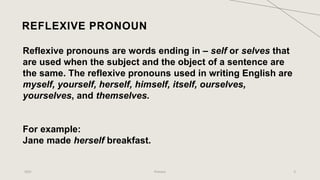
REFLEXIVE PRONOUN
2023 Pronoun 5
Reflexive pronouns are words ending in – self or selves that
are used when the subject and the object of a sentence are
the same. The reflexive pronouns used in writing English are
myself, yourself, herself, himself, itself, ourselves,
yourselves, and themselves.
For example:
Jane made herself breakfast.
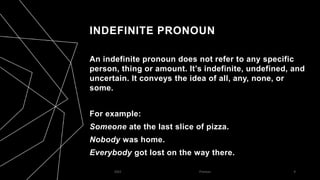
INDEFINITE PRONOUN
An indefinite pronoun does not refer to any specific
person, thing or amount. It’s indefinite, undefined, and
uncertain. It conveys the idea of all, any, none, or
some.
For example:
Someone ate the last slice of pizza.
Nobody was home.
Everybody got lost on the way there.
2023 Pronoun 6
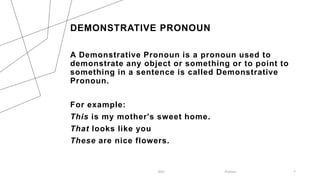
DEMONSTRATIVE PRONOUN
A Demonstrative Pronoun is a pronoun used to
demonstrate any object or something or to point to
something in a sentence is called Demonstrative
Pronoun.
For example:
This is my mother's sweet home.
That looks like you
These are nice flowers.
2023 Pronoun 7
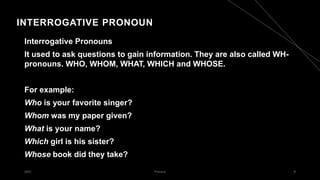
INTERROGATIVE PRONOUN
Interrogative Pronouns
It used to ask questions to gain information. They are also called WH-
pronouns. WHO, WHOM, WHAT, WHICH and WHOSE.
For example:
Who is your favorite singer?
Whom was my paper given?
What is your name?
Which girl is his sister?
Whose book did they take?
2023 Pronoun 8
INTENSIVE PRONOUN
A type of pronoun that references back to the antecedent
or subject of the sentence to emphasize who completed
the action in sentence.
For example:
Shiela approved the purchase herself.
I’ll finish the mural myself.
2023 Pronoun 9
POSSESSIVE PRONOUN
Possessive pronouns describe what things belong to which
people, like “her shoe” or “the book is mine.” Possessive
pronouns can be adjectives, like “his bicycle” or they can
stand in for nouns, like “the seats are theirs.” Neither of
these forms should have apostrophes to show possession,
so it's ours (not our's) and yours (not your’s).
For example:
That is her car and this one here is mine.
Let’s see if Dave’s arm is longer than yours.
2023 Pronoun 10
ARTICLE
Group 2
ARTICLE
An article is a word that
modifies or describes the
Noun. It is used before the
noun to show whether it
refers to something specific
or not.
2023 Article 12
DEFINITE ARTICLE
Definite means to be clear, exact or obvious about
something. It is called definite because it is used in relation
to a particular thing or person. The is the definite article in
English, which is used to refer to particular nouns, the
identities of which are known. The definite article indicates
that the noun is specific. The speaker talks about a particular
thing.
For example:
I’ll pick you up at the airport.
Do you like the other kids in your class?
2023 Article 13
INDEFINITE ARTICLE
Indefinite means something which is not clear, obvious or exact. They
are called indefinite because the identity of the thing or person being
spoken about is left unclear or indefinite. The indefinite articles in
English are “a” and “an.”
For example:
Do you have a pencil?
I want to have an apple.
2023 Article 14
THANK YOU!!
Group 2
Corsino, Zamara Kim E.
Dela Cruz, John Michael
Delos Santos, Johnna Marielis
Francisco, Allen Iverson
Galbo, Ginalyn
Lamata, Jocelyn Estrella
Lisbo, Jelloyd
Lumasay, Jasmin Grace
2023 Pronoun/Article 15
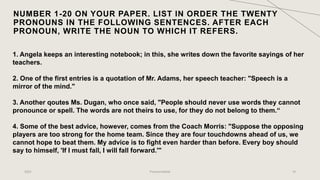
NUMBER 1-20 ON YOUR PAPER. LIST IN ORDER THE TWENTY
PRONOUNS IN THE FOLLOWING SENTENCES. AFTER EACH
PRONOUN, WRITE THE NOUN TO WHICH IT REFERS.
2023 Pronoun/Article 16
1. Angela keeps an interesting notebook; in this, she writes down the favorite sayings of her
teachers.
2. One of the first entries is a quotation of Mr. Adams, her speech teacher: "Speech is a
mirror of the mind."
3. Another qoutes Ms. Dugan, who once said, "People should never use words they cannot
pronounce or spell. The words are not theirs to use, for they do not belong to them.“
4. Some of the best advice, however, comes from the Coach Morris: "Suppose the opposing
players are too strong for the home team. Since they are four touchdowns ahead of us, we
cannot hope to beat them. My advice is to fight even harder than before. Every boy should
say to himself, 'If I must fall, I will fall forward.'"

GROUP-2-PURPOSIVE-COMM.pptx

  • 1.
  • 2.
    PRONOU N A pronoun isa word used in place of one or more nouns. For example: Mara looked into the box and found it empty. 2023 Pronoun 2
  • 3.
    PERSONAL PRONOUN A personalpronoun is a short word we use as a simple substitute for the proper name of a person. Each of the English personal pronouns shows us the grammatical person, gender, number, and case of the noun it replaces. First person (the person speaking) Singular: I, my, mine, me Plural: we, our, ours, us Second person (the person spoken to) Singular: you, your, yours Plural: you, your, yours Third person (some other person or thing) Singular: he, his, him, she, her, hers, it, its Plural: they, their, theirs, them 2023 Pronoun 3
  • 4.
    RELATIVE PRONOUN A relativepronoun is a word that introduces a dependent (or relative) clause and connects it to an independent clause. A clause beginning with a relative pronoun is poised to answer questions such as Which one? How many? or What kind? Who, whom, whose, which, and that. Who: Refers to a person (as the verb’s subject) Whom: Refers to a person (as the verb’s object) Which: Refers to an animal or thing What: Refers to a nonliving thing That: Refers to a person, animal, or thing For example: The woman who came to the door left flowers for you. I am not sure whom this book belongs to. 2023 Pronoun 4
  • 5.
    REFLEXIVE PRONOUN 2023 Pronoun5 Reflexive pronouns are words ending in – self or selves that are used when the subject and the object of a sentence are the same. The reflexive pronouns used in writing English are myself, yourself, herself, himself, itself, ourselves, yourselves, and themselves. For example: Jane made herself breakfast.
  • 6.
    INDEFINITE PRONOUN An indefinitepronoun does not refer to any specific person, thing or amount. It’s indefinite, undefined, and uncertain. It conveys the idea of all, any, none, or some. For example: Someone ate the last slice of pizza. Nobody was home. Everybody got lost on the way there. 2023 Pronoun 6
  • 7.
    DEMONSTRATIVE PRONOUN A DemonstrativePronoun is a pronoun used to demonstrate any object or something or to point to something in a sentence is called Demonstrative Pronoun. For example: This is my mother's sweet home. That looks like you These are nice flowers. 2023 Pronoun 7
  • 8.
    INTERROGATIVE PRONOUN Interrogative Pronouns Itused to ask questions to gain information. They are also called WH- pronouns. WHO, WHOM, WHAT, WHICH and WHOSE. For example: Who is your favorite singer? Whom was my paper given? What is your name? Which girl is his sister? Whose book did they take? 2023 Pronoun 8
  • 9.
    INTENSIVE PRONOUN A typeof pronoun that references back to the antecedent or subject of the sentence to emphasize who completed the action in sentence. For example: Shiela approved the purchase herself. I’ll finish the mural myself. 2023 Pronoun 9
  • 10.
    POSSESSIVE PRONOUN Possessive pronounsdescribe what things belong to which people, like “her shoe” or “the book is mine.” Possessive pronouns can be adjectives, like “his bicycle” or they can stand in for nouns, like “the seats are theirs.” Neither of these forms should have apostrophes to show possession, so it's ours (not our's) and yours (not your’s). For example: That is her car and this one here is mine. Let’s see if Dave’s arm is longer than yours. 2023 Pronoun 10
  • 11.
  • 12.
    ARTICLE An article isa word that modifies or describes the Noun. It is used before the noun to show whether it refers to something specific or not. 2023 Article 12
  • 13.
    DEFINITE ARTICLE Definite meansto be clear, exact or obvious about something. It is called definite because it is used in relation to a particular thing or person. The is the definite article in English, which is used to refer to particular nouns, the identities of which are known. The definite article indicates that the noun is specific. The speaker talks about a particular thing. For example: I’ll pick you up at the airport. Do you like the other kids in your class? 2023 Article 13
  • 14.
    INDEFINITE ARTICLE Indefinite meanssomething which is not clear, obvious or exact. They are called indefinite because the identity of the thing or person being spoken about is left unclear or indefinite. The indefinite articles in English are “a” and “an.” For example: Do you have a pencil? I want to have an apple. 2023 Article 14
  • 15.
    THANK YOU!! Group 2 Corsino,Zamara Kim E. Dela Cruz, John Michael Delos Santos, Johnna Marielis Francisco, Allen Iverson Galbo, Ginalyn Lamata, Jocelyn Estrella Lisbo, Jelloyd Lumasay, Jasmin Grace 2023 Pronoun/Article 15
  • 16.
    NUMBER 1-20 ONYOUR PAPER. LIST IN ORDER THE TWENTY PRONOUNS IN THE FOLLOWING SENTENCES. AFTER EACH PRONOUN, WRITE THE NOUN TO WHICH IT REFERS. 2023 Pronoun/Article 16 1. Angela keeps an interesting notebook; in this, she writes down the favorite sayings of her teachers. 2. One of the first entries is a quotation of Mr. Adams, her speech teacher: "Speech is a mirror of the mind." 3. Another qoutes Ms. Dugan, who once said, "People should never use words they cannot pronounce or spell. The words are not theirs to use, for they do not belong to them.“ 4. Some of the best advice, however, comes from the Coach Morris: "Suppose the opposing players are too strong for the home team. Since they are four touchdowns ahead of us, we cannot hope to beat them. My advice is to fight even harder than before. Every boy should say to himself, 'If I must fall, I will fall forward.'"