1
The brewing industry has failed to keep pace with
the changes in consumers’ preferences for drinks.
This has created a mainstream category that is
under pressure from other drinks.
Grolsch believes in the strength of beer in the
drinks market.
VISION MISSION
Grolsch is going to break through the mainstream
and restore beer’s premium status.
22
GROLSCH PREMIUM LAGER
SWINGTOP
BOTTLE
NEW
BOTTLE
CANS
OTHER PRODUCTS
AMBERALE
PREMIUM
WEIZEN
PREMIUM
BLONDE
AMSTERDAMRANGE
3
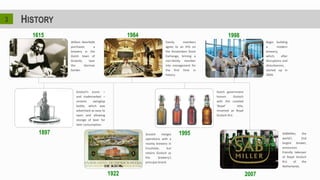
Willem Neerfedlt
purchases a
brewery in the
Dutch town of
Groenlo, near
the German
border.
1615
Grolsch’s iconic –
and trademarked –
ceramic swingtop
bottle, which was
advertised as easy to
open and allowing
storage of beer for
later consumption.
1897
1922
Family members
agree to an IPO on
the Amsterdam Stock
Exchange, brining a
non-family member
into management for
the first time in
history.
1984
Groslch merges
operations with a
nearby brewery in
Enschede, but
retains Grolsch as
the brewery’s
principal brand.
1995
Dutch government
honors Grolsch
with the coveted
‘Royal’ title,
renamed as Royal
Grolsch N.V..
Begin building
a modern
brewery,
which, after
disruptions and
disturbances,
started up in
2004.
1998
2007
SABMiller, the
world’s 2nd
largest brewer,
announces
friendly takeover
of Royal Grolsch
N.V. of the
Netherlands.
4
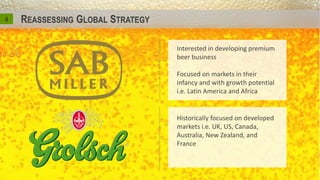
Historically focused on developed
markets i.e. UK, US, Canada,
Australia, New Zealand, and
France
Interested in developing premium
beer business
Focused on markets in their
infancy and with growth potential
i.e. Latin America and Africa
26
• Global demand grew at 2.7%
• Growth driven by developing regions – APAC,
Central & South America, & Eastern Europe
• Developed regions growth either flat or decreased
0
100
200
300
400
500
2000 2005
HLinMM
WEST EUROPE (TOP 10) EAST EUROPE (TOP 5)
CENTRAL & SOUTH AMERICA (TOP 5) NORTH AMERICA
ASIA (TOP 5) AUSTRALASIA
MIDDLE EAST/NORTH AFRICA (TOP 5) REST OF AFRICA (TOP 5)
2000-2005 HECTOLITERS CONSUMED BY REGION
27
• High Degree of Rivalry
• Moderate forces for Supplier, Buyer, Entrants, and Substitutes
0
1
2
3
4
5
Buyer Power
Degree of Rivalry
New EntrantsSubstitues
Supplier Power
Five Forces Summary
28
0
1
2
3
4
5
Backwards
Integration
Buyer Independence
Buyer Size
Financial Muscle
Low-Cost Switching
Oligopsony Threat
Price Sensitivty
Product
Dispensibility
Tendency to Switch
Undifferentiated
Product
BUYER POWER
0
1
2
3
4
5
Comptetior Size
Easy to Expand
Hard to Exit
Lack of Diversity
Low Cost Switching
Low Fixed CostNumber of Players
Similarity of Players
Storage Costs
Undifferentiated
Product
Zero Sum Game
RIVALRY
0
1
2
3
4
5
Beneficial
Alternative
Low Cost
Switching
Cheap Alternative
SUBSTITUTES
0
1
2
3
4
5
Differentiated
Input
Forward
Integration
Importance of
Quality/Cost
No Substitute
Inputs
Oligopoly Threat
Player
Dispensability
Player
Independence
Supplier Size
Switching Costs
SUPPLIER POWER
0
1
2
3
4
5
Distribution
Accessible
Incumbents
Acquiescent
Little IP Involved
Little Regulation
Low Fixed Costs
Low-Cost
Switching
Market Growth
Scale
Unimportant
Suppliers
Accessible
Undifferentiated
Product
Weak Brands
NEW ENTRANTS
29
GLOBAL POPULATION OF PEOPLE IN 18 to 34 AGE RANGE
WORLD PRICE OF WHEAT
WORLD PRICE OF GLASS
GLOBAL CONSUMER SPENDING
WORLD PRICE OF ALUMINUM
210
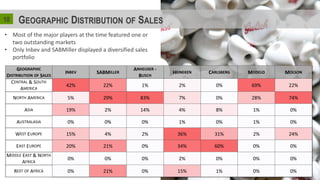
GEOGRAPHIC
DISTRIBUTION OF SALES
INBEV SABMILLER
ANHEUSER -
BUSCH
HEINEKEN CARLSBERG MODELO MOLSON
CENTRAL & SOUTH
AMERICA
42% 22% 1% 2% 0% 69% 22%
NORTH AMERICA 5% 29% 83% 7% 0% 28% 74%
ASIA 19% 2% 14% 4% 8% 1% 0%
AUSTRALASIA 0% 0% 0% 1% 0% 1% 0%
WEST EUROPE 15% 4% 2% 36% 31% 2% 24%
EAST EUROPE 20% 21% 0% 34% 60% 0% 0%
MIDDLE EAST & NORTH
AFRICA
0% 0% 0% 2% 0% 0% 0%
REST OF AFRICA 0% 21% 0% 15% 1% 0% 0%
• Most of the major players at the time featured one or
two outstanding markets
• Only Inbev and SABMiller displayed a diversified sales
portfolio
211
Anheuser-Busch
InBev
19.60%
SABMiller
13.30%
Heineken N.V.
9.40%Carlsberg A/S
7.30%
Other
50.40%
2010 GLOBAL MARKET SHARE
Anheuser - Busch
9%
SABMiller
9%
Heineken
6%
Carlsberg
5%
Modelo
3%Molson
3%
Inbev
13%
Other
53%
2006 GLOBAL MARKET SHARE
Anheuser-Busch
InBev
33%
SABMiller
17%
Heineken N.V.
17%
Carlsberg A/S
6%
Other
27%
2015 MARKET SHARE
• No 1 or 2 position in 75
countries in 6 continents,
mostly developing markets
• 200+ beverage brands
• Expertise in local value
creation
• Largest Coca-Cola bottler in
Africa
• No strong northern European
beer brand on its portfolio
• No presence in Western
European markets
• Overall volume growth in
emerging markets
• Introduce the Premium beer
category into its existing
markets
• Optimize manufacturing and
distribution costs
• Volumes of Standard beer are
stagnant
• Industry consolidation mode.
Prime targets for acquisition
are more and more scarce
• Become a potential target for
an uninvited acquisition
25
STRENGTHS
• Premium Product (Taste,
Quality)
• Historic brand with official
Royal recognition (Royal
Groslch)
• Patented Swingtop bottle
WEAKNESSES
• Distribution in International
Markets
• International Execution
• Mostly unknown outside of
northern Europe
OPPORTUNITIES
• Amsterdam economy brand
• Very low participation in
North American markets
• Developing markets in Asia,
Latin America and Africa
• New plant in the Netherlands
THREATS
• Markets shrinking in
developed markets
• Entrance of new brands in the
traditional Grolsch territory in
eastern Netherland
• New craft beers entering the
premium segment
14
SAB IMPORT
SAB OPERATION
GROLSCH MARKET
AMSTERDAM MARKET
213
10% 10%
8%
6%
0
4%
2%
8%
6%
4%
2%
100%
20%
40%
60%
80%
ADAPTATION AGGREGATION
ARBITRAGE
215
MARKET ATTRACTIVENESS BUSINESS ASSESSMENT
Analyzed:
• Total Volume and Volume Growth of Grolsch
premium lager
• Variable Commercial Contribution
• Grolsch’s share of premium lager segment
Analyzed :
• Total Volume and Volume Growth (International
Premium Lager Segment)
• Price Premium between Brands
• Geographic & Cultural Distances
• Measured differences in:
• Difference in Languages
• Non-Membership v. Membership in EU
• Cost of Transport
• Difference in GDP per Capita
216
Sources:
1- http://geert-hofstede.com/netherlands.html
2-http://www.dutycalculator.com/hs-lookup/626889/hs-tariff-code-for-beer/
3- http://hts.usitc.gov/
| SOUTH AFRICA
: Former Dutch Colony
: Similar language
: Emerging Market
: High levels of Indulgence1
: Existing presence SABMiller
C: [not significant]
A: [not significant]
G: Physical Distance
E: Different currencies
+
| COLOMBIA
: Existing presence SABMiller
: Emerging Market
: High levels of Indulgence1
: Virgin Premium Beer market
C: Different languages
A: [not significant]
G: Physical Distance
E: Different currencies &
Import Tariffs2
+
| USA
: Existing presence SABMiller
: No import tariffs on beer3
: High levels of Indulgence1
: American preference for
Imported beer
C: Different languages
A: Existence of Dry Laws
G: Physical Distance
E: Developed Market
+
| POLAND
: Relatively close
: Growing demand
: Familiar market
: Learn from past experience
C: Language, Indulgence
A: [not significant]
G: [not significant]
E: Different currencies
+
217
RE-LAUNCH AND EXPORT
GROLSCH TO UNITED STATES
SELL AMSTERDAM BRAND
INTRODUCE GROLSCH TO COLOMBIA
AND OTHER ANDEAN COUNTRIES
BREW GROLSCH IN SOUTH AFRICA
RE-ATTEMPT TO POSITION GROLSCH IN
POLAND
220
What lessons can be drawn from
where Grolsch has been most
successful?
Did the merger with SABMiller
add value? If so, how?
What additional
recommendations on strategy
would you make?
What changes has Grolsch made
to address the challenges faced?
How can Grolsch enter and
compete in targeted markets? ●●●
●●●
●●●
Grolsch: Growing Globally Case Analysis

Grolsch: Growing Globally Case Analysis

  • 2.
    1 The brewing industryhas failed to keep pace with the changes in consumers’ preferences for drinks. This has created a mainstream category that is under pressure from other drinks. Grolsch believes in the strength of beer in the drinks market. VISION MISSION Grolsch is going to break through the mainstream and restore beer’s premium status.
  • 3.
    22 GROLSCH PREMIUM LAGER SWINGTOP BOTTLE NEW BOTTLE CANS OTHERPRODUCTS AMBERALE PREMIUM WEIZEN PREMIUM BLONDE AMSTERDAMRANGE
  • 4.
    3 Willem Neerfedlt purchases a breweryin the Dutch town of Groenlo, near the German border. 1615 Grolsch’s iconic – and trademarked – ceramic swingtop bottle, which was advertised as easy to open and allowing storage of beer for later consumption. 1897 1922 Family members agree to an IPO on the Amsterdam Stock Exchange, brining a non-family member into management for the first time in history. 1984 Groslch merges operations with a nearby brewery in Enschede, but retains Grolsch as the brewery’s principal brand. 1995 Dutch government honors Grolsch with the coveted ‘Royal’ title, renamed as Royal Grolsch N.V.. Begin building a modern brewery, which, after disruptions and disturbances, started up in 2004. 1998 2007 SABMiller, the world’s 2nd largest brewer, announces friendly takeover of Royal Grolsch N.V. of the Netherlands.
  • 5.
    4 Historically focused ondeveloped markets i.e. UK, US, Canada, Australia, New Zealand, and France Interested in developing premium beer business Focused on markets in their infancy and with growth potential i.e. Latin America and Africa
  • 6.
    26 • Global demandgrew at 2.7% • Growth driven by developing regions – APAC, Central & South America, & Eastern Europe • Developed regions growth either flat or decreased 0 100 200 300 400 500 2000 2005 HLinMM WEST EUROPE (TOP 10) EAST EUROPE (TOP 5) CENTRAL & SOUTH AMERICA (TOP 5) NORTH AMERICA ASIA (TOP 5) AUSTRALASIA MIDDLE EAST/NORTH AFRICA (TOP 5) REST OF AFRICA (TOP 5) 2000-2005 HECTOLITERS CONSUMED BY REGION
  • 7.
    27 • High Degreeof Rivalry • Moderate forces for Supplier, Buyer, Entrants, and Substitutes 0 1 2 3 4 5 Buyer Power Degree of Rivalry New EntrantsSubstitues Supplier Power Five Forces Summary
  • 8.
    28 0 1 2 3 4 5 Backwards Integration Buyer Independence Buyer Size FinancialMuscle Low-Cost Switching Oligopsony Threat Price Sensitivty Product Dispensibility Tendency to Switch Undifferentiated Product BUYER POWER 0 1 2 3 4 5 Comptetior Size Easy to Expand Hard to Exit Lack of Diversity Low Cost Switching Low Fixed CostNumber of Players Similarity of Players Storage Costs Undifferentiated Product Zero Sum Game RIVALRY 0 1 2 3 4 5 Beneficial Alternative Low Cost Switching Cheap Alternative SUBSTITUTES 0 1 2 3 4 5 Differentiated Input Forward Integration Importance of Quality/Cost No Substitute Inputs Oligopoly Threat Player Dispensability Player Independence Supplier Size Switching Costs SUPPLIER POWER 0 1 2 3 4 5 Distribution Accessible Incumbents Acquiescent Little IP Involved Little Regulation Low Fixed Costs Low-Cost Switching Market Growth Scale Unimportant Suppliers Accessible Undifferentiated Product Weak Brands NEW ENTRANTS
  • 9.
    29 GLOBAL POPULATION OFPEOPLE IN 18 to 34 AGE RANGE WORLD PRICE OF WHEAT WORLD PRICE OF GLASS GLOBAL CONSUMER SPENDING WORLD PRICE OF ALUMINUM
  • 10.
    210 GEOGRAPHIC DISTRIBUTION OF SALES INBEVSABMILLER ANHEUSER - BUSCH HEINEKEN CARLSBERG MODELO MOLSON CENTRAL & SOUTH AMERICA 42% 22% 1% 2% 0% 69% 22% NORTH AMERICA 5% 29% 83% 7% 0% 28% 74% ASIA 19% 2% 14% 4% 8% 1% 0% AUSTRALASIA 0% 0% 0% 1% 0% 1% 0% WEST EUROPE 15% 4% 2% 36% 31% 2% 24% EAST EUROPE 20% 21% 0% 34% 60% 0% 0% MIDDLE EAST & NORTH AFRICA 0% 0% 0% 2% 0% 0% 0% REST OF AFRICA 0% 21% 0% 15% 1% 0% 0% • Most of the major players at the time featured one or two outstanding markets • Only Inbev and SABMiller displayed a diversified sales portfolio
  • 11.
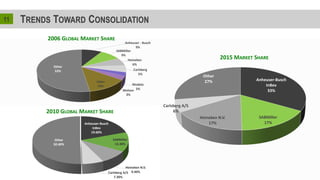
    211 Anheuser-Busch InBev 19.60% SABMiller 13.30% Heineken N.V. 9.40%Carlsberg A/S 7.30% Other 50.40% 2010GLOBAL MARKET SHARE Anheuser - Busch 9% SABMiller 9% Heineken 6% Carlsberg 5% Modelo 3%Molson 3% Inbev 13% Other 53% 2006 GLOBAL MARKET SHARE Anheuser-Busch InBev 33% SABMiller 17% Heineken N.V. 17% Carlsberg A/S 6% Other 27% 2015 MARKET SHARE
  • 12.
    • No 1or 2 position in 75 countries in 6 continents, mostly developing markets • 200+ beverage brands • Expertise in local value creation • Largest Coca-Cola bottler in Africa • No strong northern European beer brand on its portfolio • No presence in Western European markets • Overall volume growth in emerging markets • Introduce the Premium beer category into its existing markets • Optimize manufacturing and distribution costs • Volumes of Standard beer are stagnant • Industry consolidation mode. Prime targets for acquisition are more and more scarce • Become a potential target for an uninvited acquisition 25 STRENGTHS • Premium Product (Taste, Quality) • Historic brand with official Royal recognition (Royal Groslch) • Patented Swingtop bottle WEAKNESSES • Distribution in International Markets • International Execution • Mostly unknown outside of northern Europe OPPORTUNITIES • Amsterdam economy brand • Very low participation in North American markets • Developing markets in Asia, Latin America and Africa • New plant in the Netherlands THREATS • Markets shrinking in developed markets • Entrance of new brands in the traditional Grolsch territory in eastern Netherland • New craft beers entering the premium segment
  • 13.
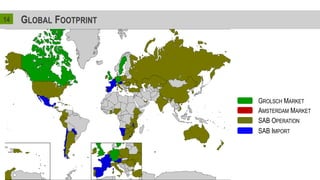
    14 SAB IMPORT SAB OPERATION GROLSCHMARKET AMSTERDAM MARKET
  • 14.
  • 15.
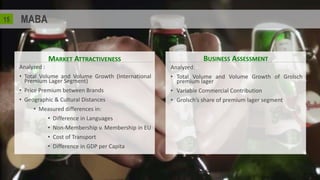
    215 MARKET ATTRACTIVENESS BUSINESSASSESSMENT Analyzed: • Total Volume and Volume Growth of Grolsch premium lager • Variable Commercial Contribution • Grolsch’s share of premium lager segment Analyzed : • Total Volume and Volume Growth (International Premium Lager Segment) • Price Premium between Brands • Geographic & Cultural Distances • Measured differences in: • Difference in Languages • Non-Membership v. Membership in EU • Cost of Transport • Difference in GDP per Capita
  • 16.
    216 Sources: 1- http://geert-hofstede.com/netherlands.html 2-http://www.dutycalculator.com/hs-lookup/626889/hs-tariff-code-for-beer/ 3- http://hts.usitc.gov/ |SOUTH AFRICA : Former Dutch Colony : Similar language : Emerging Market : High levels of Indulgence1 : Existing presence SABMiller C: [not significant] A: [not significant] G: Physical Distance E: Different currencies + | COLOMBIA : Existing presence SABMiller : Emerging Market : High levels of Indulgence1 : Virgin Premium Beer market C: Different languages A: [not significant] G: Physical Distance E: Different currencies & Import Tariffs2 + | USA : Existing presence SABMiller : No import tariffs on beer3 : High levels of Indulgence1 : American preference for Imported beer C: Different languages A: Existence of Dry Laws G: Physical Distance E: Developed Market + | POLAND : Relatively close : Growing demand : Familiar market : Learn from past experience C: Language, Indulgence A: [not significant] G: [not significant] E: Different currencies +
  • 17.
    217 RE-LAUNCH AND EXPORT GROLSCHTO UNITED STATES SELL AMSTERDAM BRAND INTRODUCE GROLSCH TO COLOMBIA AND OTHER ANDEAN COUNTRIES BREW GROLSCH IN SOUTH AFRICA RE-ATTEMPT TO POSITION GROLSCH IN POLAND
  • 19.
    220 What lessons canbe drawn from where Grolsch has been most successful? Did the merger with SABMiller add value? If so, how? What additional recommendations on strategy would you make? What changes has Grolsch made to address the challenges faced? How can Grolsch enter and compete in targeted markets? ●●● ●●● ●●●

Editor's Notes

  • #2 Intro: Grolsch Growing Globally, Case Study
  • #3 **Francheska** Grolsch, recognized as one of the world’s largest global beers, brewed in the Netherlands. The brand's strength is its iconic swing-top bottle. Grolsch places the strong Grolsch premium beer brand at center stage. Grolsch had been incorporated as a two-tier company: a Netherlands subsidiary (handled sales and marketing of Grolsch in the Netherlands and housed production, logistics and facilities) and grolsch international: responsible for worldwide sales and marketing outside Netherlands, UK, and Ireland.
  • #4 **Francheska** Grolsch’s product line is divided into two main brand families: Grolsch and Amsterdam The Grolsch product line was the centerpiece of the company’s strategy and its flagship product was Grolsch Premium Lager, representing 90% of the company’s domestic volume. Grolsch also devoted attention to its packaging offering 3 different types of packaging for its premium lager: swingtop bottle, new bottle and cans. It’s iconic swingtop bottle was key in entering foreign markets to differentiate the brand in crowded markets. Once volume in that market starts picking up, they would introduce crown cork bottles. Bottle shown was introduced in 2007, cown cork bottle with an upgraded look that includes embossed Grolsch logo. Cans accounted for 30% of total volume. Amsterdam: non-premium brand Sold mostly in cans at supermarkets and small shops. Available in 5 varieties and known for its smooth taste. Four markets: France, Russia, Australia, and Africa accounted for 95% of Amsterdam’s volume.
  • #5 **Francheska** Grolsch is a company with a rich history dating back to 1615. late 19800s the brewery came under control of the De Groen family. The brewer started out in the east of the Netherlands, in Groenlo, and is now based in Enschede. Its home market is the Netherlands and that is where its commercial activities are concentrated. In 1897, the swingtop bottle was introduced: advertised as easy to open and allowing storage of beer for later consumption. In 1922, the Groenlo operation merged with a brewery in the nearby town of Eschede: retaining Grolsch as the main brand. By the 1960’s, Grolsch had become the second most popular beer in the country, behind Heineken. IPO in 1984 1995- received Dutch government honor with “Royal” title and ocmpany renamed Royal Grolsch NV 1997 – celebrated 100 years of the swingtop bottle, its main differentiator. 1998 – company decided to build a modern brewery that started up in 2004 after a series of disruptions and delays. **Highlight acquisition In February 2008, Grolsch officially became an independent subsidiary of SABMiller
  • #6 **Francheska** Question: what changes if any in global strategy? **Reassess strategy & leverage SABMillers strengths to enhance theirs** Prior to the takeover by SABMiller, Grolsch had emphasized growing faster than its key markets while achieving an ROI that exceeded its average cost of capital (by increasing earnings and dividends per share, and maintaining healthy balance sheet). Grolsch reassesses its international strategy in light of the company's recent acquisition by SABMiller, the world's second-largest brewer. Grolsch was the 21st-largest global beer brand, sold 51.5 percent of its volume in international markets, and exported to 70 countries. However, its poor profitability in international markets--four countries alone accounting for two-thirds of foreign sales--and churn of markets and distribution partners raised concerns about the company's international strategy and execution. Grolsch's 60 years of history in foreign markets provide a rich backdrop to introduce a range of international strategy topics, including performance assessment, rationale for expansion, market selection, and choice of entry mode.
  • #7 **Jorge** For Grolsch, Western Europe accounts for 88% of Revenue and 94% of contribution margins. Netherlands, accounts for nearly 50% of total volume, and 65% of revenues Shrinking consumption (both hectoliters and per capita) in traditional key markets, will force cultivating business in emerging markets 2005 Global Beer volumes reached 1.5BB hectoliters or 39.6BB gallons - equating to 60,000 Olympic Swimming pools of beer Total retail value of an estimated €354BB. Global volumes grew at 2.7% and Global Value increased at 4.7% Developed regions growth either flat or decreased. Growth driven by developing regions – APAC & Eastern Europe
  • #8 **Jorge**
  • #9 **Jorge** New Entrants- Possible to enter market as a microbrewer Large scale operation requires significant capital outlay Consolidation of brewers and distributors, can create challenges for entrants to grow their brand Supplier Power- Traditionally, sector did not feature vertical integration Consolidation across multinationals has led some brewers (SABMiller) to vertically integrate supply chain Hop growers are numerous and smaller operations, yet barley growers can find alternate markets Buyer Power- Buyers – Supermarkets, Specialist Retailers, and On-trade companies Resellers unlikely brand loyal, however, end-consumers loyalty can mitigate Brewers can differentiate product reducing some buyer’s power Substitutes- Possible substitutes include other spirits, rival brands of beer Specialty retailers may find higher returns on shelf space in spirits vs. beer On-trade sites (bars, restaurants, etc.) are exposed to levels of disposable income – Purchasing at supermarket vs. a night out Rivalry- Global sector fragmented yet trending towards consolidation Bulk of market remains in mass market products despite growth of specialty beers Large incumbents, High Fixed Costs, low-switching costs for consumers, and fierce marketing make competition high
  • #10 **Jorge** As Identified by IBIS Worldwide, the age demographic is the chief source of revenue for the industry. Continued growth in this segment is paramount. Market outlook for this demographic is slow growth. Disposable income is paramount to non-essential good such as beer. Especially in developing economies. Worth noting, in the last 15 years, there have been only two years successive years of flat or negative growth in the beer market. 2008 (0.1%) growth and 2009 (-14.5% decline). Proving even beer isn’t recession proof. World price of aluminum, brewers who use cans are exposed to the fluctuating commodity price of aluminum. Given the competitive nature of the business, often times brewers are forced to absorb rising aluminum prices. World price of wheat is of concern to brewers who make a wheat malt. Additionally, price of wheat can serve as a proxy for projecting changes in many other grains.
  • #11 **Jorge** Heat map of geo distribution of sales. Across the major players in the beer market, almost all were concentrated in 2-3 markets. Inbev, second most diverse with strong performance in Asia, West & East Europe SABMiller features the most diversified sales. Strong present in established US market, as well emerging Africa, East Europe, Central & South America
  • #12 **Jorge** Trends towards consolidation- In 2006 seven major players made up 47% of the market. Just 4 years later, four companies make up nearly 50% of the market. Trend consolidation continues today. Per Ibis World, today 4 companies own 72.6% of the market. Stalling demand of premium beers with relatively low interest rates mean continued M&A activity is likely. Lastly, organic growth in developed markets has stalled due the popularity of other alcoholic beverages.
  • #13 **Luis**
  • #14 **Luis**
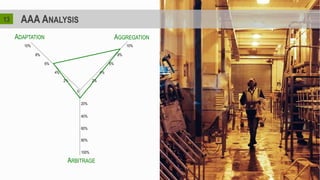
  • #15 ***Danielle*** Aggregation Two-tiered structure allows for more global approach to sales and marketing Grolsch Premium Lager brand as centerpiece Main export driver, accounting for two-thirds of all exports Only available product in many markets Arbitrage Localized production and distribution reduce administrative costs such as import taxes Adaptation Pricing, distribution, marketing, advertising differ by market Wide array of promotional activities, campaigns adapted to cultural differences
  • #16 ***Elise*** HIGHLIGHT THAT THEY DO THEIR HW, THEY DO THEIR ANALYSIS, BUT WHY DID THEY FAIL? HOLES IN ANALYSIS- NOT ANALYZING ALL CULTURAL ELEMENTS, FOR EXAMPLE. ARE THEY LOOKING AT ALL OF THE BEST MARKETS? Used to assess international opportunities Difference in Languages (Cultural) Non-Membership v. Membership in EU (Administrative & Economic) Cost of Transport (Geographic) Difference in GDP per Capita (Economic) Example of shipping costs Shipping to markets within EU: 1.47 euros/hectolitre to Germany Outside of EU: 6.68 to Spain All other markets by ship: 10-15 euros per hectolitre SABMiller developed an aggregate score based on these calculations High scores were “key” segments Middle scored were “seeding” segments Low scores were “trading” segments
  • #17 SOUTH AFRICA PROS: -Former Dutch Colony -Similar language: Afrikaans is an offshoot of various Dutch dialects -Emerging Market/Inc. Demand -Existing presence of SABMiller with Miller Genuine Draft & Castle Lager CONS: CAGE: A: Different currencies G: Geographical Distance: 5819 miles (4669 miles from Netherlands to US ($12.06/hectrolitre) E: Differet Currencies: Euro vs. S.A. rand COLOMBIA PROS: Existing distribution channel (Bavaria) CONS: Duty- 15%, Sales Tax- 16%, Excise Tax COL$ 1064/liter People in societies classified by a high score in Indulgence generally exhibit a willingness to realise their impulses and desires with regard to enjoying life and having fun. They possess a positive attitude and have a tendency towards optimism. In addition, they place a higher degree of importance on leisure time, act as they please and spend money as they wish
  • #18 ***Elise***
  • #19 ***Francheska*** Grolsch brews only beer and now focuses on the premium segment of the market, placing the strong Grolsch brand at center stage. The brand's strength is rooted in the motto 'Craftsmanship is Mastery' and in its iconic swing-top bottle. Innovation and creativity are further key strengths, playing a crucial role in responding to changes in demand, particularly in highly developed beer markets. The Grolsch organization is professional, powerful and flexible. Besides commercial success, the company also enjoys strong financial results, thanks to the fact that it is a well respected and appealing employer and thanks to its substantial social engagement. Since 2008, Grolsch is a subsidiary of SABMiller plc. Innovation and creativity are further key strengths, playing a crucial role in responding to changes in demand, particularly in highly developed beer markets. The Grolsch organization is professional, powerful and flexible. Besides commercial success, the company also enjoys strong financial results, thanks to the fact that it is a well respected and appealing employer and thanks to its substantial social engagement. This year, Grolsch celebrates 400 years of creativity Celebrating is 400th anniversary, Grolsch is focusing their celebration on its patronage of the creative arts. The centerpiece of the campaign is a mosaic of canvases featuring the work of contemporary artists from around the world, brought together earlier this year at the Grolsch Creative Hub in Amsterdam for three days of creation and inspiration. Each of the 400 canvases draws inspiration from the iconic Grolsch Swingtop and are featured on special edition packs of Grolsch, available in stores around the world.  In addition, Grolsch is making consumers part of this celebration by sponsoring a three-month competition inviting budding artists to download a ‘canvas’ template from the website Canvas by Grolsch and post their re-imagining of the Swingtop via social media. Other celebratory collaborations include a project to build a hotel room – complete with its own Grolsch bar – using only 3D printing. The room will be part of Amsterdam’s celebrated 3D Print Canal House, which has been wowing visitors since it was unveiled by DUS Architects in May 2014. And Grolsch is teaming up with hot jeans label Denham to bring a new look to the worker’s wardrobe, including denim workwear that will be designed for a Grolsch brewmaster. There will be numerous other activities in the fields of art, music, film and design in the months and years to come, as Grolsch continues to stamp its mark on the urban creative community. Today’s Grolsch may be very different to what Willem Neerfeldt set in motion back in 1615, but the brewery’s founding father would surely recognise the creativity and innovative thinking that is becoming the hallmark of this 400-year-old Dutch institution.
  • #20 ***Francheska*** Discussion Questions