Grid 2.0- Electricity2 0 Etech Primer.Key

Editor's Notes

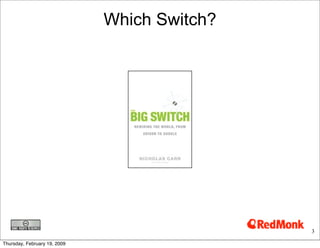
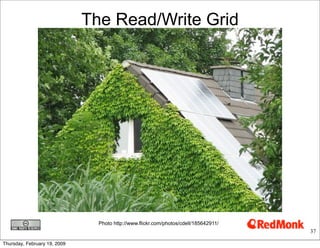
  • #3 Most electricity companies don't allow you to sell electricity back to the grid and are only interested in selling you electricity.
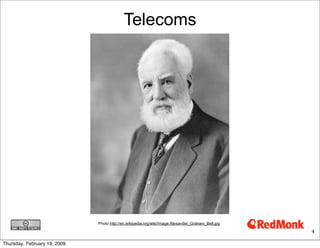
  • #5 Most electricity companies don't allow you to sell electricity back to the grid and are only interested in selling you electricity.
  • #6 Most electricity companies don't allow you to sell electricity back to the grid and are only interested in selling you electricity.
  • #7 Most electricity companies don't allow you to sell electricity back to the grid and are only interested in selling you electricity.
  • #8 Most electricity companies don't allow you to sell electricity back to the grid and are only interested in selling you electricity.
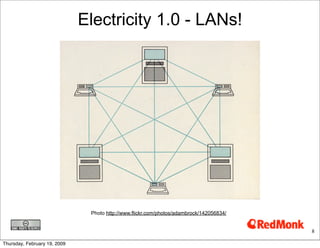
  • #9 Lots of LANS, not a WAN   Most country grids are isolated, i.e. not connected to other countries   Lots of Grids operated by hundreds of different companies - even within the US! In the US about 200,000 miles of power lines are divided among 500 owners.      Big transmission upgrades often involve multiple companies, many state governments and numerous permits
  • #10 Most electricity companies don't allow you to sell electricity back to the grid and are only interested in selling you electricity.
  • #11 Highly regulated and controlled by a select few companies in any market
  • #12 Blackouts/brownouts are not uncommon
  • #13 Alternative \"Dumb!\" image - may be more appropriate for the Berlin crowd!
  • #14 Closed as in it is very difficult for micro-generators to add energy they generate to the grid
  • #15 Designed for a situation where supply is constant and controllable but demand is variable but predictable   Now with the requirement of adding renewables -  Supply is becoming variable and unpredictable   With supply and demand both variable comes increased instability - remember you can't store surplus and under-supply => brownouts or blackouts We are moving from an era of: flexible electricity supply feeding inflexible but predictable demand    to one of : inflexible supply.    We must therefore introduce some flexibility into our demand.
  • #16   Buggy: CA rolling brownouts and East Coast \"cascading failure\" To name just two!
  • #17   Buggy: CA rolling brownouts and East Coast \"cascading failure\" To name just two!
  • #18   Buggy: CA rolling brownouts and East Coast \"cascading failure\" To name just two!
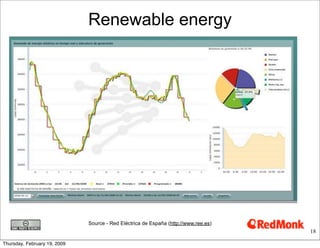
  • #19 This is the Spanish Electricity market At the time this screenshot was taken wind was producing 5gW (or 17.4% of demand). In January 2008 there was 15.1gW of installed wind energy facilities in Spain. The govt has committed to increasing this to 20gW by 2010. In contrast there is currently 400mw of solar plant installed in Spain Source - Red Eléctrica de España (ree.es)
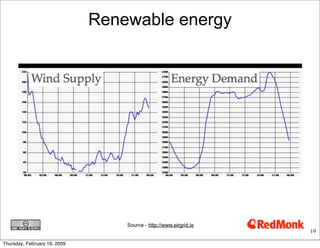
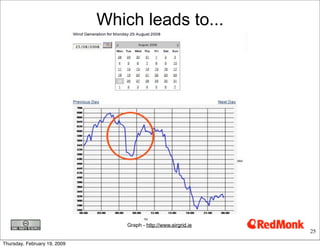
  • #20 Supply of renewables is often almost exactly out of synch with demand Wind typically blows strongest overnight when energy demand is lowest Source - Eirgrid.ie
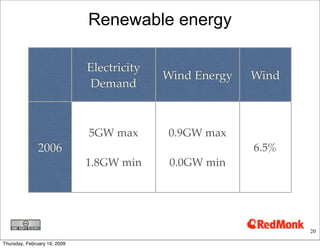
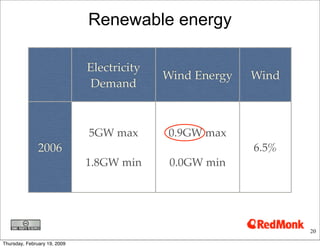
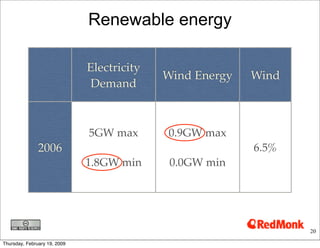
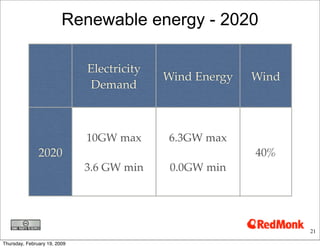
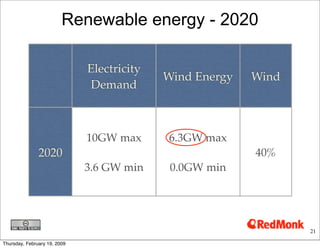
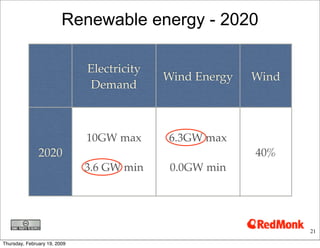
  • #21 In Ireland in 2007 wind's contribution varied from 0GW to 0.9GW. Or from 0% of demand to almost 50% The yearly average was 6.5% The Irish govt has committed to going to 30% by 2020. At that time the 50% figure above will have moved to 200% Without storage, what do you do with surplus 3GW? Source - Eirgrid.ie
  • #22 In Ireland in 2007 wind's contribution varied from 0GW to 0.9GW. Or from 0% of demand to almost 50% The yearly average was 6.5% The Irish govt has committed to going to 30% by 2020. At that time the 50% figure above will have moved to 200% Without storage, what do you do with surplus 3GW? Source - Eirgrid.ie
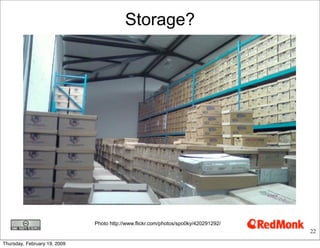
  • #23 It is not as if you can store surplus electricity - put it in a box and stick it on a shelf until there is a higher demand!
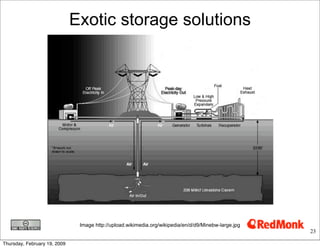
  • #24 Compressed air energy storage - more theory than practice for now. May work as a storage mechanism for limited amounts of energy. Large capital cost and requires certain geological structures (large caverns underground)
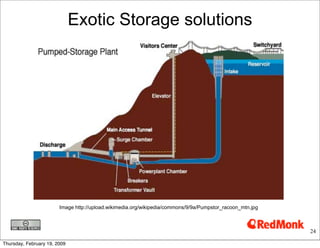
  • #25 Pumped hydro storage is a mature technology However large capital cost (€ billions) Requires specific geological conditions (two lakes separated by about 400m height) Amt of storage dictated by geography not by needs!
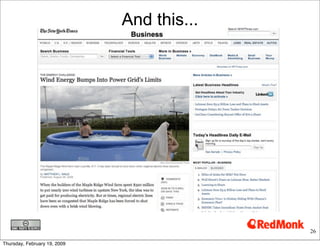
  • #26 Wind energy being shut down by the grid operators - in favour of fossil fuels! Cheaper to shut down wind farms (no shut down and startup costs) and can be done quickly. Approx 600 MW hours of energy was shed in this event.    A quick calculation says that about 100 tons of carbon dioxide could have been displaced by using that energy.    And the wind farms that were curtailed lost €40,000 in revenue for this one event. This
  • #27 This is Maple ridge Wind Farm in NY and it is curtailed at times of excess energy.
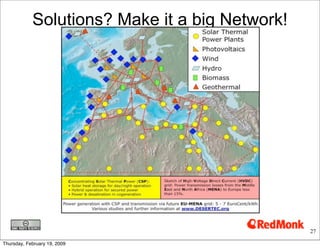
  • #28 Join up disparate, disconnected electrical grids to give us one global electricity super-grid like the Internet Work is already underway on a scaled down version of this just encompassing EMEA   The Trans-Mediterranean Renewable Energy Cooperation (TREC) was founded in 2003 by The Club of Rome, the Hamburg Climate Protection Foundation and the National Energy Research Center of Jordan (NERC).  TREC, together with the German Aerospace Center (DLR) has developed the DESERTEC Concept and completed the necessary research.  TREC is now making this concept a reality in cooperation with people in politics, industry and the world of finance. If there is no wind blowing in Ireland/UK, import geothermal from Iceland and/or solar from North Africa
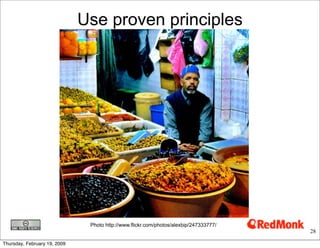
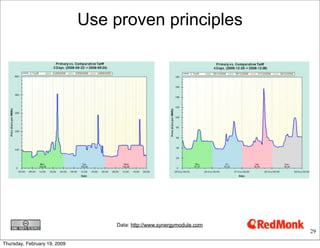
  • #29 Turn electricity into a market Real-time dynamic pricing based solely on supply and demand In times of heavy supply and light demand electricity v cheap or negative to stimulate demand. Avoids curtailment of renewables.   Stimulates usage by unlikely energy stores (swimming pools, refrigeration plants, PHEVs) When demand heavy and supply light - electricity expensive. DCs go on diesel generators/battery, refrigeration plants, water heaters adjust thermostats, AC adjusts thermostat
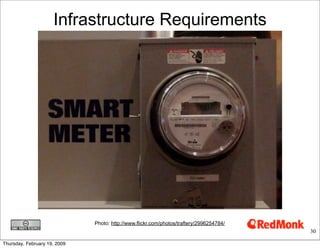
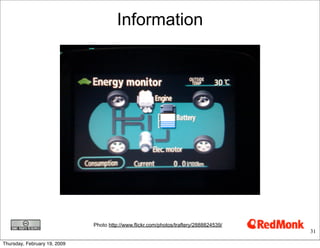
  • #31 Smart grid publishing realtime pricing connected to    smart meters capable of taking real-time price info and acting on it connected to   Cisco in business and even at city level smart home with smart appliances capable of acting on up/down or on/off instructions depending on varying pricing
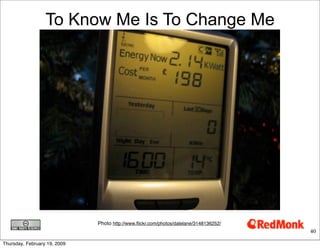
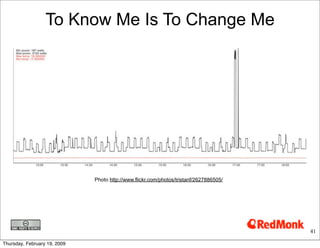
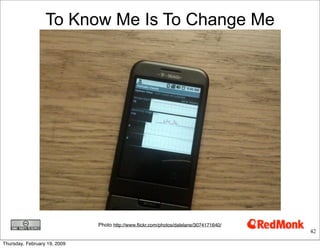
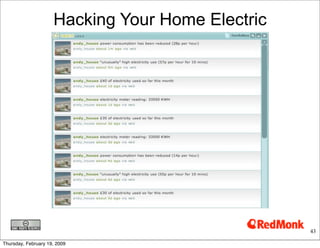
  • #32 using information feedback to alter people’s behaviour
  • #33 When electricity is in high demand (expensive) it can be cheaper for some facilities to run off their diesel generators than from the grid. Esp if they can sell power and/or demand side units to the grid - as Amory Lovins calls them NegaWatts
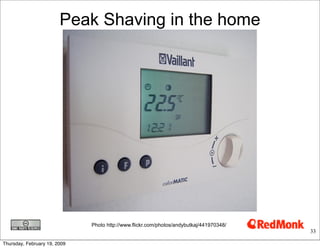
  • #34 Peak shaving:  in a domestic situation, on receiving a high price signal, thermostats adjust accordingly to use less power.   Immersion thermostat drops a few degrees Fridges compressors come on at a higher temp Dishwashers, clothes washers, dryers warn owners of high price when set to wash/dry and offer to work later
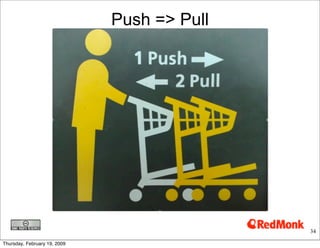
  • #35 Signifies a movement from push -> pull as were have already seen in the Internet
  • #36 Demand stimulation can be used by swimming pool owners to heat pools when energy is cheap (typically overnight) using water's high thermal capacity as an energy store By refrigeration plants to create ice/chill foods etc. when energy is cheap By energy companies to create hydrogen (for burning to create clean energy when energy is expensive)
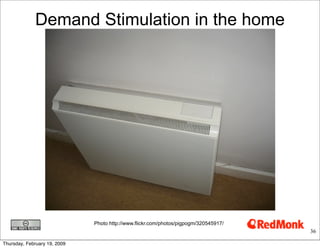
  • #37 Demand stimulation: In a domestic situation storage heaters etc. can be charged up. As can phones, laptops, etc.    Electric immersion, dish washer, washing machine, clothes dryer, can be programmed to come on at certain price points and/or times If electricity goes negative in price you could end up being paid to use the power!
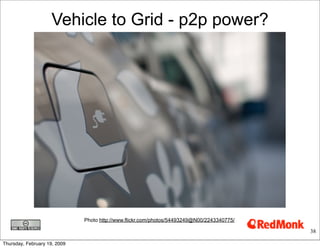
  • #39 Plug-in Hybrid Electric vehicles will be able to take in electricity when it is cheapest (overnight typically) and potentially sell it back to the grid when it is expensive - thereby becoming a large distributed battery bank! Hackability
  • #45 There are NO technical barriers to this being rolled out Electricity is highly regulated, full of incumbent companies often with near monopolies and no will/incentive to change Electricity 2.0 will only happen if it is legislated for!