
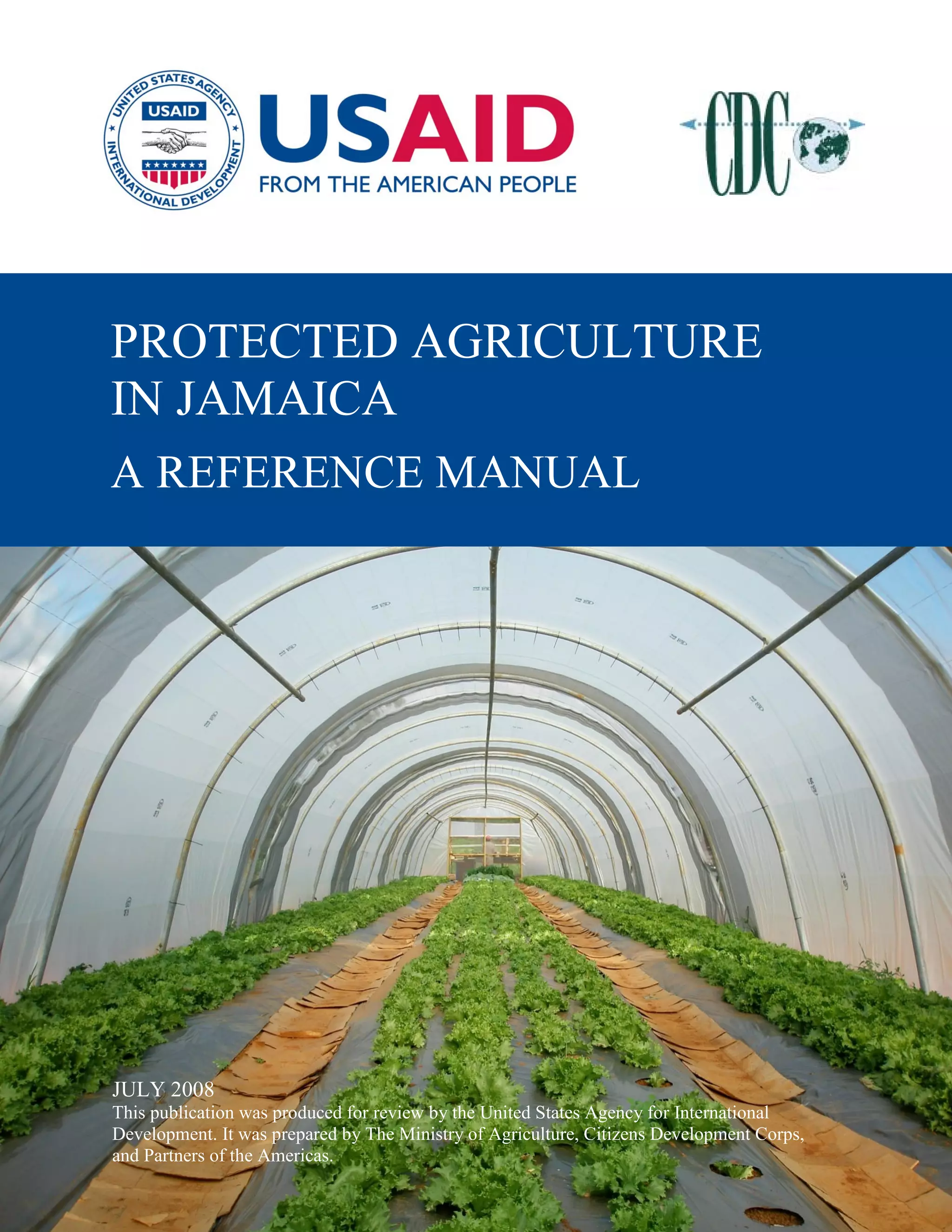





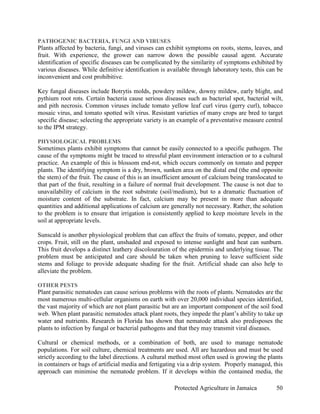
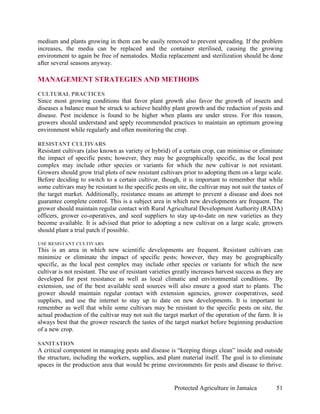
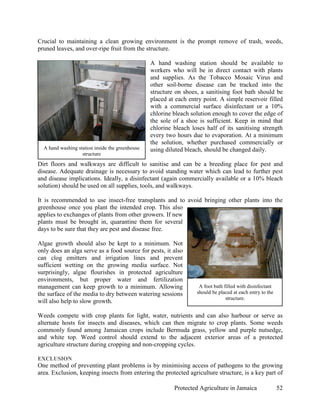
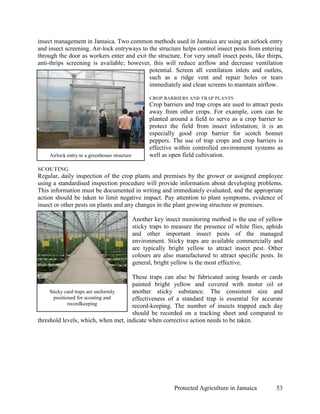











PROTECTED AGRICULTURE
IN JAMAICA
 JUNE 2008
A REFERENCE MANUAL
 This publication was produced for review by the United States Agency for International
 Development. It was prepared by The Ministry of Agriculture, Citizens Development Corps,
 and Partners of the Americas.


JULY 2008
This publication was produced for review by the United States Agency for International
Development. It was prepared by The Ministry of Agriculture, Citizens Development Corps,
and Partners of the Americas.
PROTECTED AGRICULTURE
IN JAMAICA
A REFERENCE MANUAL


DISCLAIMER
The author’s views expressed in this publication do not necessarily reflect the views of the
United Stated Agency for International Development or the United States Government.
ACKNOWLEDGMENTS

 ORGANIZATIONS
 Caribbean Agricultural Research Development Institute (CARDI)
 Christiana Potato Grower’s Cooperative Association (CPGCA)
 Citizen Development Corps (CDC)
 John Ogonowski Farmer-to-Farmer Program (FtF)
 Government of Jamaica (GOJ)
 Ebony Park HEART Academy
 Inter-American Institute for Cooperation on Agriculture (IICA)
 Jamaica Farmers Access to Regional Markets (JA FARMS)
 Jamaica Greenhouse Growers Association (JGGA)
 Ministry of Agriculture (MOA)
 Partners of the Americas (POA)
 Rural Agriculture Development Authority (RADA)

 INDIVIDUALS
 Lenworth Blake
 Stephanie Campbell
 Ted Carey
 Phillip Chung
 Dianne Dormer
 Thera Edwards
 Blake Hinderyckx
 Juliana Goodlaw-Morris
 Byron Henry
 Janet Lawrence
 Luke Lee
 Amanda MacArthur
 Mohyuddin Mirza
 Weston Moses
 Jervis Rowe
 Hopeton Singh
 Derrick Smith
 Marci Spaw
 Downie Walker
 Pete Woroweic


 *Photographs courtesy of Luke Lee, Marci Spaw, Kim Williams, and Autopot Systems.


                                             Protected Agriculture in Jamaica        3
In Support of Protected Agriculture


Protected Agriculture strategies have proven to increase certainty for food production through adverse
weather conditions while providing viable alternative livelihood opportunities to rural communities. As
the revitalization of the agricultural sector continues, the Ministry of Agriculture is adopting new
technologies and farming techniques to meet the evolving needs of the sector.

The United States Agency for International Development (USAID), in collaboration with the Rural
Agricultural Development Authority (RADA), has created this manual- Protected Agriculture in Jamaica,
at a pivotal time in the development of Protected Agriculture in Jamaica.

As the Ministry is promoting the ‘Grow What You Eat and Eat What You Grow’ campaign and USAID is
working to revitalize and support the protected agriculture sector, this reference manual serves to fill the
technical gap in the industry.

It is a shining example of a bi-lateral donor and the
Government of Jamaica collaborating to meet a need
within the extension service and with growers alike.
It is a homegrown effort that will serve not only
USAID projects but the people of Jamaica and
stakeholders who are investing their time, resources,
and expertise in the development of Protected
Agriculture.

USAID must be commended for its contributions to
the revitalization of Protected Agriculture through
the ‘USAID Jamaica Business Recovery Project’
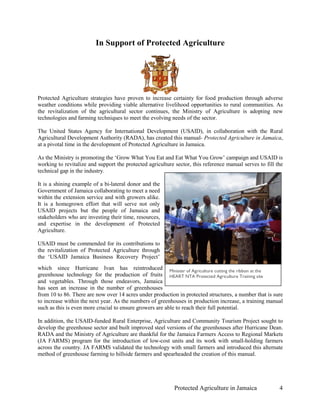
which since Hurricane Ivan has reintroduced Minister of Agriculture cutting the ribbon at the
greenhouse technology for the production of fruits HEART NTA Protected Agriculture Training site
and vegetables. Through those endeavors, Jamaica
has seen an increase in the number of greenhouses
from 10 to 86. There are now over 14 acres under production in protected structures, a number that is sure
to increase within the next year. As the numbers of greenhouses in production increase, a training manual
such as this is even more crucial to ensure growers are able to reach their full potential.

In addition, the USAID-funded Rural Enterprise, Agriculture and Community Tourism Project sought to
develop the greenhouse sector and built improved steel versions of the greenhouses after Hurricane Dean.
RADA and the Ministry of Agriculture are thankful for the Jamaica Farmers Access to Regional Markets
(JA FARMS) program for the introduction of low-cost units and its work with small-holding farmers
across the country. JA FARMS validated the technology with small farmers and introduced this alternate
method of greenhouse farming to hillside farmers and spearheaded the creation of this manual.


                                                            Protected Agriculture in Jamaica              4
In addition, the Integrated Pest Management Collaborative Research Support Program (IPM CRSP)
worked closely with the Caribbean Agricultural Research and Development Institute to develop the
Exclusion Cages for environmentally-friendly production of callaloo which has positive food safety
effects for the consumer.

Overall USAID and its partners have done a commendable job on this manual and the Ministry of
Agriculture thanks them for their efforts. I fully endorse this reference manual and the validity of its
usefulness among our extension staff and greenhouse growers alike.


Dr Christopher Tufton
Minister of Agriculture
October 26, 2008


                                                         Protected Agriculture in Jamaica             5
TABLE OF CONTENTS
 INTRODUCTION ............................................................................................10

 PROTECTED AGRICULTURE STRUCTURES ....................................... 12
     INTRODUCTION .............................................................................................................12

     STRUCTURE TYPES .......................................................................................................13

     VENTILATION .................................................................................................................15

     STRUCTURAL LOADS ...................................................................................................16

     SITE SELECTION ............................................................................................................16

     CONSTRUCTION MATERIALS .....................................................................................18

     COVERING MATERIALS ...............................................................................................19

     ADDITIONAL CONSIDERATIONS ...............................................................................21

     RESOURCES ....................................................................................................................23

 PRODUCTION SYSTEMS ............................................................................. 24
     THE PLANT GROWING ENVIRONMENT ...................................................................24

     MONITORING ENVIRONMENTAL FACTORS ...........................................................26

     RESOURCE.......................................................................................................................28

     GROWING MEDIUM.......................................................................................................28

 PLANT PRODUCTION COMPONENTS .....................................................32
     INTRODUCTION .............................................................................................................32

     PROPAGATION TECHNIQUES .....................................................................................32

     CROP AND VARIETY SELECTION ..............................................................................33

     SEED PROPAGATION ....................................................................................................33

 NUTRIENT MANAGEMENT ........................................................................ 38


                                                                        Protected Agriculture in Jamaica                            6
INTRODUCTION .............................................................................................................38

   PLANT NUTRIENT REQUIREMENTS ..........................................................................38

   FERTILISER SOURCES ..................................................................................................39

   FERTILISER APPLICATION TYPES .............................................................................40

   METHODS OF MIXING FERTILISERS .........................................................................41

NUTRIENT MONITORING ........................................................................... 43
   INTRODUCTION .............................................................................................................43

   WATER QUALITY...........................................................................................................43

   SOIL TESTS ......................................................................................................................45

   TISSUE ANALYSES ........................................................................................................45

   GROWER OBSERVATIONS ...........................................................................................45

   NUTRIENT DISORDERS ................................................................................................46

INTEGRATED PEST MANAGEMENT .......................................................49
   INTRODUCTION .............................................................................................................49

   TYPES OF PESTS.............................................................................................................49

   MANAGEMENT STRATEGIES AND METHODS........................................................51

   DISEASE MONITORING ................................................................................................54

   PEST AND DISEASE PROFILES ....................................................................................56

   FUNGUS DISEASES ........................................................................................................63

   BACTERIAL DISEASES .................................................................................................65

   VIRUS DISEASES ............................................................................................................65

   RESOURCE.......................................................................................................................66

BUSINESS MANAGEMENT .......................................................................... 67
   INTRODUCTION .............................................................................................................67

   BUSINESS PLANS ...........................................................................................................67


                                                                       Protected Agriculture in Jamaica                             7
CREDIT .............................................................................................................................69

    TYPES OF RECORDS ......................................................................................................69

    MARKET INFORMATION OF PROTECTED AGRICULTURE CROPS.....................70

    RESOURCES ....................................................................................................................74

ECOLOGICAL CONSERVATION ...............................................................75
    INTRODUCTION .............................................................................................................75

    HISTORY ..........................................................................................................................75

    BASIC ECOLOGY ............................................................................................................76

CROP CULTURE.............................................................................................83
    INTRODUCTION .............................................................................................................83

    TOMATO (Lycoperson esculentum Mill) .........................................................................83

    RESOURCE.......................................................................................................................89

    SWEET PEPPER (Capsicum annuum) .............................................................................89

    RESOURCE.......................................................................................................................91

    CUCUMBER (Cucumis sativus L) ....................................................................................93

    RESOURCE.......................................................................................................................95

TECHNOLOGY TRANSFER ......................................................................... 96
    INTRODUCTION .............................................................................................................96

    TRAINING NEEDS ANALYSIS......................................................................................96

    TRAINING RESOURCES AND METHODS ..................................................................97

    EVALUATION OF TRAININGS .....................................................................................99

    RESOURCES & References............................................................................................101

RESOURCES .................................................................................................. 102
    CONTACT INFORMATION..........................................................................................102

    PUBLICATIONS .............................................................................................................103

                                                                         Protected Agriculture in Jamaica                               8
WEBSITES ......................................................................................................................104

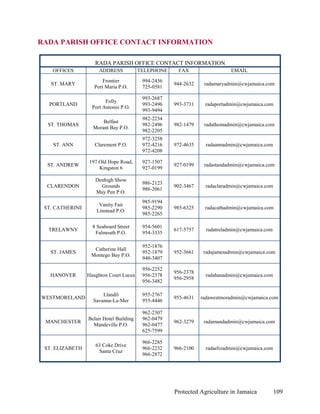
RADA PARISH OFFICE CONTACT INFORMATION ...............................................109


                                                                   Protected Agriculture in Jamaica                             9
INTRODUCTION
In the 1980s, Jamaica’s protected agriculture sub-sector primarily consisted of producing cut
flowers for export. However, it experienced a shift when increased competition from South
America and an influx of disease caused the majority of these agri-businesses to close.

More recently, increases in hurricane activity in the Caribbean Basin and other adverse weather
conditions, international market competition, and plant disease have threatened the quality and
consistency of Jamaican food production as well as domestic food security. As Jamaica works to
meet new challenges in the global marketplace and seeks to address growing domestic and
export market demand, the agriculture sector has the potential to benefit greatly from increased
usage of agro-technologies such as greenhouses and other protected agriculture structures while
developing a stronger, more reliable network of agricultural supply chains.

Protected agriculture technology includes more traditional style greenhouses as well as high
tunnel houses and is the central component in the establishment of a more unified strategy for
continued growth in the country’s agriculture sector. The sustainability of such development will
essentially rely on the effective transfer of knowledge. This manual is designed to build the
knowledge base of the Jamaican agricultural extension service, the Rural Agriculture
Development Authority (RADA), so that it in turn can provide support and training to the
members of Jamaica’s burgeoning agricultural sector.

Incorporated into this manual are North American concepts, the local Jamaican experience, and
lessons learned from Central America to provide the most up-to-date knowledge and technology
currently available. The manual has undergone extensive reviews by expert local practitioners,
agriculturalists, researchers and academics. A Curriculum Review Committee was established
comprising of local growers, agriculture officials from the Ministry of Agriculture (MOA),
RADA officers and overseas specialists in the United States of America and Canada. This
committee provided invaluable feedback to ensure that the content of this manual is suitable for
the Jamaican context.

The Protected Agriculture Training Manual serves to close the present gap in knowledge and
technology transfer in three ways:

1) It serves as a single repository of knowledge, best practices and lessons learned in protected
   agriculture;

2) It serves as a training manual designed to be implemented through the RADA training
   division to upgrade Extension Officers’ skills; and

3) It serves as a reference point for a local comprehensive certification program in Modified
   Environment Agriculture at the HEART Ebony Park Academy, the first of its kind in Jamaica.

All three uses share the underlying goal of encouraging the local population to embrace the
opportunities and benefits of the growing sub-sector. The following protected agriculture


                                                      Protected Agriculture in Jamaica        10
benefits are currently being realized in both North and Central America and are replicable in
Jamaica:

   •   Increased yields;
   •   Improved quality and consistency of crops;
   •   Improved land and water use efficiency;
   •   Increased control over crop nutrition;
   •   Decreased use of chemicals and pesticides;
   •   Improved resistance to adverse weather conditions;
   •   Increased control over insects and diseases;
   •   Reduced external and biological crop threats.

The Protected Agriculture Training Manual seeks not only to ensure the sustainable use of the
technology, but also to ensure that investors in greenhouse structures will receive the required
technical assistance from RADA. The manual uses a holistic approach to protected agriculture
and embraces agro-ecological principles. This approach is not only environmentally friendly in
addressing food safety concerns, but also serves to further conservation objectives in
ecologically significant areas of Jamaica.

The manual is deliberately designed as a “living document”; as Jamaica embarks on its plan to
increase food security through use of appropriate agro-technology, the government will be able
to update the manual to capture future lessons learned for both the short and long term. The
modular design of the manual ensures that as technologies evolve and protected agriculture
expands in Jamaica, this invaluable resource can be easily updated and allowed to grow with the
sector. RADA extension officers participating in protected agriculture trainings will benefit
from a well-integrated training curriculum consisting of crop bulletins, hands-on training in
greenhouses, classroom training and additional technical hand-outs.

Capitalizing on these developments in protected agriculture will strengthen the agriculture sector
in Jamaica and will subsequently generate growth in other sectors.


                                                      Protected Agriculture in Jamaica         11
Module 1

PROTECTED AGRICULTURE
STRUCTURES
INTRODUCTION
Throughout the world various structures have been used to manage the ‘growing environment’ in
order to increase control over quality and productivity. In recent years, the recognition that
Jamaica could benefit from such a managed environment has brought increased interest in
protected agriculture structures. In Jamaica, these structures are being designed to achieve
optimal growth conditions as well as to mitigate damage to the structure from external conditions
and to speed crop recovery time in the event of a hurricane or other severe weather event.

In Jamaica, as in other parts of the world, the local climatic conditions as well as the topography
are important in selecting the style of protected agriculture to construct. For example, at higher
elevations (above 400 m/1,312 ft), such as the mountainous regions around Christiana
(Manchester) and Mount Airy to Mavis Bank (St. Andrew) cooler temperatures prevail. These
conditions are particularly well-suited for an antiviral mesh covering to exclude insects (and
insect-borne viruses).

At lower elevations, higher temperatures limit the practical use of antiviral mesh because it
impedes ventilation resulting in heat build-up inside the structure. Average daily temperatures
above 35°C (96°F) will hamper crop performance and restrict productivity. Consequently, open-
siding or shade cloth are preferred coverings to allow increased airflow for cooling. Protection
from pests in these areas will rely on the use of pesticides and/or virus-resistant cultivars.

The structure’s form, its orientation, materials used, unit cost, and the type of crop to be grown
are additional important factors to consider in planning and construction decisions. This
consideration includes recognizing that all factors are interdependent. For example, in
establishing the orientation of your structure you must consider both ventilation needs and light
requirements.

This module covers:
   1. Structure Types
   2. Ventilation
   3. Structural Loads
   4. Site Selection
   5. Construction Materials
   6. Covering Materials
   7. Additional Considerations


                                                       Protected Agriculture in Jamaica         12
STRUCTURE TYPES
Protected agriculture structures can be constructed in a variety of styles that range from shade
houses to high tunnels to large gutter-connected houses. Small stand-alone houses typically
utilize a two-roof single ridge construction and offer the advantages of a low overall initial
investment and flexibility of operation. However, they are generally more expensive to construct
on a square foot basis. By connecting individual units or bays at the eave or gutter a gutter-
connected structure can be formed. Each bay’s roof can be either a gable or an arched structure
or can be sloped to form a saw-toothed roof.

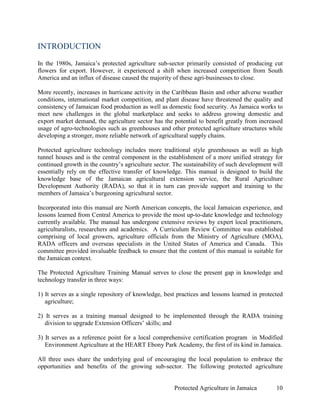
                                                  LOW TUNNEL STRUCTURES
                                                  Low tunnels, also known as mini-tunnels, are
                                                  only 0.6–1.0 m (24-39 in) in height and cover
                                                  low growing crops such as cabbage and
                                                  lettuce. Mini-tunnels are created by hoops
                                                  covered with a lightweight, synthetic fabric.
                                                  The structures utilize floating row cover
                                                  material supported by small hoops with the
                                                  floating material usually secured by covering
                                                  the edges with dirt. The use of mini-tunnels
                                                  protects plants from pests like aphids, thrips,
                                                  and leaf-feeding beetles and can also be used
              Low Tunnel Structure                as a temporary sun-shade.


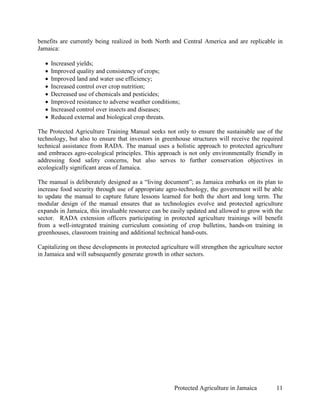
HIGH TUNNEL STRUCTURES
The term ‘high tunnel’ generally refers to a
structure that is passively ventilated and no
more than 9m (30ft) wide. Most high tunnels
are ventilated via roll-up sidewalls and end
walls that can be opened or removed. They
are considered temporary structures because
they can be easily dismantled for movement
to a different location or in times of severe
weather. High tunnels are tall enough to walk
in comfortably and to grow tall, trellised
crops such as tomatoes. In Jamaica, they
usually include mesh screens at the ends for
venting and pest control.                                      High Tunnel House

RIDGE VENTILATED STRUCTURES
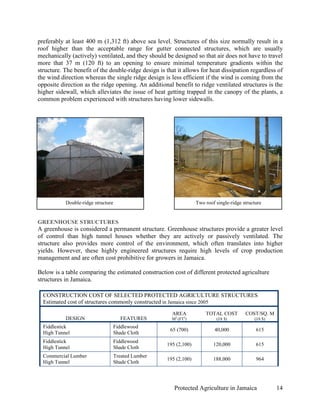
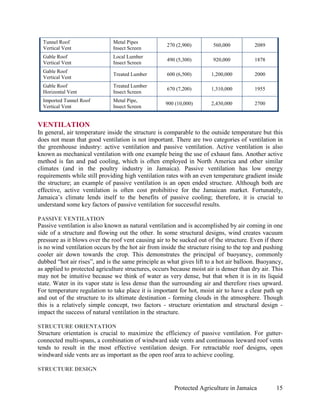
Ridge ventilated structures, which can have a single or double ridge, have a relatively large,
continuous, open roof ridge to provide ventilation. Single-ridge and double-ridge are two
relevant design types. The two roof single-ridge structures are normally 9-12 m (30-40 ft) wide
and 29-61 m (96-200 ft) long. Commercially available polyethylene sheets easily cover this size.
These structures are naturally (passively) ventilated and are better suited to higher elevations,


                                                      Protected Agriculture in Jamaica        13
preferably at least 400 m (1,312 ft) above sea level. Structures of this size normally result in a
roof higher than the acceptable range for gutter connected structures, which are usually
mechanically (actively) ventilated, and they should be designed so that air does not have to travel
more that 37 m (120 ft) to an opening to ensure minimal temperature gradients within the
structure. The benefit of the double-ridge design is that it allows for heat dissipation regardless of
the wind direction whereas the single ridge design is less efficient if the wind is coming from the
opposite direction as the ridge opening. An additional benefit to ridge ventilated structures is the
higher sidewall, which alleviates the issue of heat getting trapped in the canopy of the plants, a
common problem experienced with structures having lower sidewalls.


           Double-ridge structure                                  Two roof single-ridge structure


GREENHOUSE STRUCTURES
A greenhouse is considered a permanent structure. Greenhouse structures provide a greater level
of control than high tunnel houses whether they are actively or passively ventilated. The
structure also provides more control of the environment, which often translates into higher
yields. However, these highly engineered structures require high levels of crop production
management and are often cost prohibitive for growers in Jamaica.

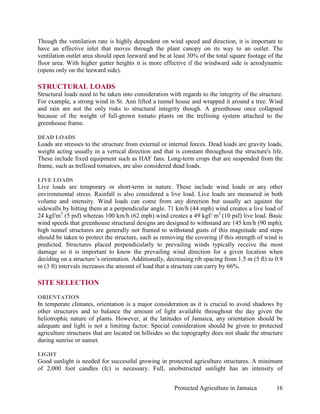
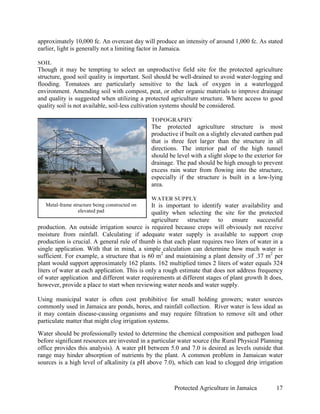
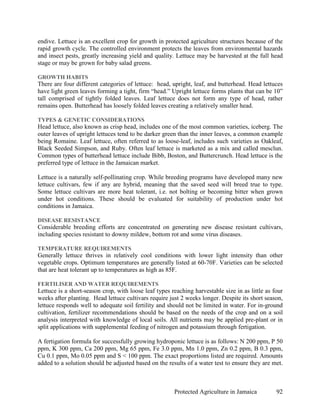
Below is a table comparing the estimated construction cost of different protected agriculture
structures in Jamaica.

  CONSTRUCTION COST OF SELECTED PROTECTED AGRICULTURE STRUCTURES
  Estimated cost of structures commonly constructed in Jamaica since 2005
                                                       AREA            TOTAL COST         COST/SQ. M
           DESIGN                      FEATURES        M2 (FT2)             (JA $)            (JA $)
  Fiddlestick                       Fiddlewood
                                                       65 (700)            40,000              615
  High Tunnel                       Shade Cloth
  Fiddlestick                       Fiddlewood
                                                     195 (2,100)           120,000             615
  High Tunnel                       Shade Cloth
  Commercial Lumber                 Treated Lumber
                                                     195 (2,100)           188,000             964
  High Tunnel                       Shade Cloth


                                                        Protected Agriculture in Jamaica               14
Tunnel Roof                  Metal Pipes
                                                     270 (2,900)        560,000          2089
  Vertical Vent                Insect Screen
  Gable Roof                   Local Lumber
                                                     490 (5,300)        920,000          1878
  Vertical Vent                Insect Screen
  Gable Roof
                               Treated Lumber        600 (6,500)       1,200,000         2000
  Vertical Vent
  Gable Roof                   Treated Lumber
                                                     670 (7,200)       1,310,000         1955
  Horizontal Vent              Insect Screen
  Imported Tunnel Roof         Metal Pipe,
                                                    900 (10,000)       2,430,000         2700
  Vertical Vent                Insect Screen


VENTILATION
In general, air temperature inside the structure is comparable to the outside temperature but this
does not mean that good ventilation is not important. There are two categories of ventilation in
the greenhouse industry: active ventilation and passive ventilation. Active ventilation is also
known as mechanical ventilation with one example being the use of exhaust fans. Another active
method is fan and pad cooling, which is often employed in North America and other similar
climates (and in the poultry industry in Jamaica). Passive ventilation has low energy
requirements while still providing high ventilation rates with an even temperature gradient inside
the structure; an example of passive ventilation is an open ended structure. Although both are
effective, active ventilation is often cost prohibitive for the Jamaican market. Fortunately,
Jamaica’s climate lends itself to the benefits of passive cooling; therefore, it is crucial to
understand some key factors of passive ventilation for successful results.

PASSIVE VENTILATION
Passive ventilation is also known as natural ventilation and is accomplished by air coming in one
side of a structure and flowing out the other. In some structural designs, wind creates vacuum
pressure as it blows over the roof vent causing air to be sucked out of the structure. Even if there
is no wind ventilation occurs by the hot air from inside the structure rising to the top and pushing
cooler air down towards the crop. This demonstrates the principal of buoyancy, commonly
dubbed “hot air rises”, and is the same principle as what gives lift to a hot air balloon. Buoyancy,
as applied to protected agriculture structures, occurs because moist air is denser than dry air. This
may not be intuitive because we think of water as very dense, but that when it is in its liquid
state. Water in its vapor state is less dense than the surrounding air and therefore rises upward.
For temperature regulation to take place it is important for hot, moist air to have a clear path up
and out of the structure to its ultimate destination - forming clouds in the atmosphere. Though
this is a relatively simple concept, two factors - structure orientation and structural design -
impact the success of natural ventilation in the structure.

STRUCTURE ORIENTATION
Structure orientation is crucial to maximize the efficiency of passive ventilation. For gutter-
connected multi-spans, a combination of windward side vents and continuous leeward roof vents
tends to result in the most effective ventilation design. For retractable roof designs, open
windward side vents are as important as the open roof area to achieve cooling.

STRUCTURE DESIGN


                                                        Protected Agriculture in Jamaica          15
Though the ventilation rate is highly dependent on wind speed and direction, it is important to
have an effective inlet that moves through the plant canopy on its way to an outlet. The
ventilation outlet area should open leeward and be at least 30% of the total square footage of the
floor area. With higher gutter heights it is more effective if the windward side is aerodynamic
(opens only on the leeward side).

STRUCTURAL LOADS
Structural loads need to be taken into consideration with regards to the integrity of the structure.
For example, a strong wind in St. Ann lifted a tunnel house and wrapped it around a tree. Wind
and rain are not the only risks to structural integrity though. A greenhouse once collapsed
because of the weight of full-grown tomato plants on the trellising system attached to the
greenhouse frame.

DEAD LOADS
Loads are stresses to the structure from external or internal forces. Dead loads are gravity loads,
weight acting usually in a vertical direction and that is constant throughout the structure's life.
These include fixed equipment such as HAF fans. Long-term crops that are suspended from the
frame, such as trellised tomatoes, are also considered dead loads.

LIVE LOADS
Live loads are temporary or short-term in nature. These include wind loads or any other
environmental stress. Rainfall is also considered a live load. Live loads are measured in both
volume and intensity. Wind loads can come from any direction but usually act against the
sidewalls by hitting them at a perpendicular angle. 71 km/h (44 mph) wind creates a live load of
24 kgf/m2 (5 psf) whereas 100 km/h (62 mph) wind creates a 49 kgf/ m2 (10 psf) live load. Basic
wind speeds that greenhouse structural designs are designed to withstand are 145 km/h (90 mph);
high tunnel structures are generally not framed to withstand gusts of this magnitude and steps
should be taken to protect the structure, such as removing the covering if this strength of wind is
predicted. Structures placed perpendicularly to prevailing winds typically receive the most
damage so it is important to know the prevailing wind direction for a given location when
deciding on a structure’s orientation. Additionally, decreasing rib spacing from 1.5 m (5 ft) to 0.9
m (3 ft) intervals increases the amount of load that a structure can carry by 66%.

SITE SELECTION
ORIENTATION
In temperate climates, orientation is a major consideration as it is crucial to avoid shadows by
other structures and to balance the amount of light available throughout the day given the
heliotrophic nature of plants. However, at the latitudes of Jamaica, any orientation should be
adequate and light is not a limiting factor. Special consideration should be given to protected
agriculture structures that are located on hillsides so the topography does not shade the structure
during sunrise or sunset.

LIGHT
Good sunlight is needed for successful growing in protected agriculture structures. A minimum
of 2,000 foot candles (fc) is necessary. Full, unobstructed sunlight has an intensity of


                                                       Protected Agriculture in Jamaica          16
approximately 10,000 fc. An overcast day will produce an intensity of around 1,000 fc. As stated
earlier, light is generally not a limiting factor in Jamaica.

SOIL
Though it may be tempting to select an unproductive field site for the protected agriculture
structure, good soil quality is important. Soil should be well-drained to avoid water-logging and
flooding. Tomatoes are particularly sensitive to the lack of oxygen in a waterlogged
environment. Amending soil with compost, peat, or other organic materials to improve drainage
and quality is suggested when utilizing a protected agriculture structure. Where access to good
quality soil is not available, soil-less cultivation systems should be considered.

                                                TOPOGRAPHY
                                                The protected agriculture structure is most
                                                productive if built on a slightly elevated earthen pad
                                                that is three feet larger than the structure in all
                                                directions. The interior pad of the high tunnel
                                                should be level with a slight slope to the exterior for
                                                drainage. The pad should be high enough to prevent
                                                excess rain water from flowing into the structure,
                                                especially if the structure is built in a low-lying
                                                area.

                                                WATER SUPPLY
   Metal-frame structure being constructed on  It is important to identify water availability and
                  elevated pad                 quality when selecting the site for the protected
                                               agriculture structure to ensure successful
production. An outside irrigation source is required because crops will obviously not receive
moisture from rainfall. Calculating if adequate water supply is available to support crop
production is crucial. A general rule of thumb is that each plant requires two liters of water in a
single application. With that in mind, a simple calculation can determine how much water is
sufficient. For example, a structure that is 60 m2 and maintaining a plant density of .37 m2 per
plant would support approximately 162 plants. 162 multiplied times 2 liters of water equals 324
liters of water at each application. This is only a rough estimate that does not address frequency
of water application and different water requirements at different stages of plant growth It does,
however, provide a place to start when reviewing water needs and water supply.

Using municipal water is often cost prohibitive for small holding growers; water sources
commonly used in Jamaica are ponds, bores, and rainfall collection. River water is less ideal as
it may contain disease-causing organisms and may require filtration to remove silt and other
particulate matter that might clog irrigation systems.

Water should be professionally tested to determine the chemical composition and pathogen load
before significant resources are invested in a particular water source (the Rural Physical Planning
office provides this analysis). A water pH between 5.0 and 7.0 is desired as levels outside that
range may hinder absorption of nutrients by the plant. A common problem in Jamaican water
sources is a high level of alkalinity (a pH above 7.0), which can lead to clogged drip irrigation


                                                         Protected Agriculture in Jamaica           17
lines and crop growth problems related to high pH. Additional criteria for good water quality are
discussed in Module 5: Nutrient Monitoring.

CONSTRUCTION MATERIALS
Construction materials must fit the requirements of
the structure and allow for the needs of the plants to
be grown in a specific environment. Note that
interactions between some materials such as
polyethylene and PVC pipe may be incompatible and
will shorten the lifespan of materials.

FRAME & FRAMING MATERIALS
The frame supports the structure and must withstand
various stresses or "loads." To add strength to the
frame, a number of strategies can be employed:
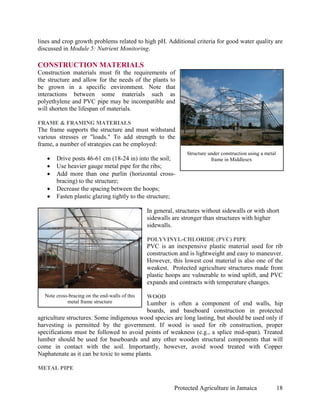
                                                                Structure under construction using a metal
   •   Drive posts 46-61 cm (18-24 in) into the soil;                      frame in Middlesex
   •   Use heavier gauge metal pipe for the ribs;
   •   Add more than one purlin (horizontal cross-
       bracing) to the structure;
   •   Decrease the spacing between the hoops;
   •   Fasten plastic glazing tightly to the structure;

                                                In general, structures without sidewalls or with short
                                                sidewalls are stronger than structures with higher
                                                sidewalls.

                                                POLYVINYL-CHLORIDE (PVC) PIPE
                                                PVC is an inexpensive plastic material used for rib
                                                construction and is lightweight and easy to maneuver.
                                                However, this lowest cost material is also one of the
                                                weakest. Protected agriculture structures made from
                                                plastic hoops are vulnerable to wind uplift, and PVC
                                                expands and contracts with temperature changes.

  Note cross-bracing on the end-walls of this   WOOD
            metal frame structure          Lumber is often a component of end walls, hip
                                           boards, and baseboard construction in protected
agriculture structures. Some indigenous wood species are long lasting, but should be used only if
harvesting is permitted by the government. If wood is used for rib construction, proper
specifications must be followed to avoid points of weakness (e.g., a splice mid-span). Treated
lumber should be used for baseboards and any other wooden structural components that will
come in contact with the soil. Importantly, however, avoid wood treated with Copper
Naphatenate as it can be toxic to some plants.

METAL PIPE


                                                           Protected Agriculture in Jamaica                  18
Metal pipe is the strongest framing material for rib construction. Quality ranges from electrical
conduit pipe on the weakest end to 4.8 cm (1.9 in) OD (outside diameter) thick steel or schedule
80 water pipe as the strongest materials used for protected agriculture construction. Schedule 40
(3/4" galvanized water pipe) is commonly used but results in a 20% weaker structure compared
to using Schedule 80 pipe. A negative of using metal pipes is that metal ribs make the structure
very heavy and difficult to maneuver.

Metal framing components are beginning to be manufactured on the island. This creates
economic benefits in other sectors of industry in Jamaica.


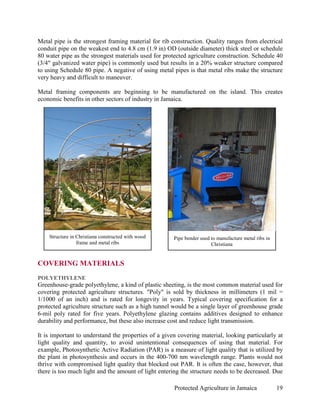
    Structure in Christiana constructed with wood     Pipe bender used to manufacture metal ribs in
                 frame and metal ribs                                  Christiana


COVERING MATERIALS
POLYETHYLENE
Greenhouse-grade polyethylene, a kind of plastic sheeting, is the most common material used for
covering protected agriculture structures. "Poly" is sold by thickness in millimeters (1 mil =
1/1000 of an inch) and is rated for longevity in years. Typical covering specification for a
protected agriculture structure such as a high tunnel would be a single layer of greenhouse grade
6-mil poly rated for five years. Polyethylene glazing contains additives designed to enhance
durability and performance, but these also increase cost and reduce light transmission.

It is important to understand the properties of a given covering material, looking particularly at
light quality and quantity, to avoid unintentional consequences of using that material. For
example, Photosynthetic Active Radiation (PAR) is a measure of light quality that is utilized by
the plant in photosynthesis and occurs in the 400-700 nm wavelength range. Plants would not
thrive with compromised light quality that blocked out PAR. It is often the case, however, that
there is too much light and the amount of light entering the structure needs to be decreased. Due

                                                      Protected Agriculture in Jamaica                19
to the abundant amount of sunlight, or light quantity, available in Jamaica, polyethylene covers
containing green shade or opaque materials should be considered for covering protected
agriculture structures. Put simply, do not block out light used in photosynthesis when shading a
crop. Use of the following materials can help to reduce inside temperature without causing loss
of plant yields.

ULTRA-VIOLET STABILIZING ADDITIVES
Ultra-Violet (UV) stabilizing additives block UV light to slow degradation and hardening of
plastic. It also optimizes the useable light spectrum by screening out growth-restricting UV rays.
Avoid purchasing construction grade plastic because it does not contain a UV-inhibitor and will
only last one growing season.

PHOTO-SELECTIVE FILM
Photo-selective film absorbs or reflects a specific range of wavelengths to manipulate plant
growth. For example, installing a poly with a photo-selective film that blocks 280-320 nm UV
light may prevent Botrytis cineraria, because this light range is essential for sporulation of this
disease.

SHADE CLOTH
Shade cloth is made from knitted polyethylene strands or woven polyester and is water
permeable. As such shade cloth is used to reduce light intensity, temperature, and plant exposure
to wind, but allows in rainwater. Shade cloth is often used in combination with plastic covering,
but in some applications it is used as the sole covering for a structure. Black, white and various
shades of green and brown can be used depending on the environment and the crops being grown
in the structure. White shade cloth may have a greater cooling effect than black and other darker
colors of shade cloth because it reflects more light. Shade cloth is purchased by percent light
blocked, 20-90% are commonly available. For example, air temperatures can be reduced by four
degrees Fahrenheit with 30% shade cloth.

Crop species requirements dictate what percent shade cloth should be used for a structure. If used
in conjunction with polyethylene, shade cloth may be installed on the inside or outside of the
protected agriculture structure. When using shade cloth inside, light is converted to heat inside
the greenhouse so while plants still get less light, the internal temperature is increased. With
shade cloth that is installed outside of the structure, sunlight is converted to heat before entering
the greenhouse, keeping internal temperatures lower.

INSECT SCREEN
Insect screen is intended to exclude insect pests and in some cases to prevent beneficial insects
from escaping the crop growing environment. The fine weave of screening may reduce air
circulation, however, leading to problems with high temperatures and humidity. Therefore,
planning for adequate ventilation of the crop is necessary when screening is used. While
selecting insect screens, proper ventilation takes priority over insect management because poor
air circulation will place the plants will under constant stress, thereby decreasing yields and
quality. Insects can be managed by other means such as resistant cultivars or pesticides.


                                                        Protected Agriculture in Jamaica          20
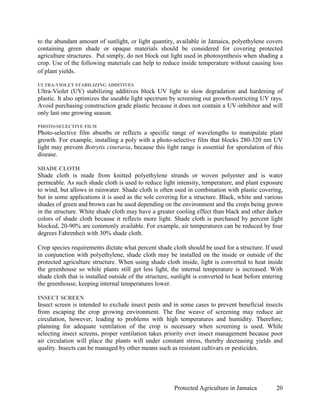
ANTI-VIRAL SCREENING
The diameter of the holes in this screening material
measures 0.2181 mm2, which will exclude Leafminers
(0.6350 mm), Aphids (0.3302 mm), and White Flies
(0.4572 mm). The minimum recommended altitude for
utilizing anti-viral screen is 400 meters (1,312 ft)
above sea level. Below this elevation anti-viral netting
should not be used unless additional equipment for
cooling is added.

ANTI-THRIPS SCREENING
The screen hole diameter in this material is 0.0225
mm2, which will exclude Thrips (0.1905 mm) as well
as the other pests blocked by Anti-Viral Screening.

ADDITIONAL CONSIDERATIONS
                                                              Anti-viral screen covering a double ridge
ATTACHMENT TECHNIQUES                                                            vent.
Secure attachment of the covering material is
necessary to avoid tearing and excessive wear that
shortens its longevity. Fastening poly between two boards such as the hip board and batten board
is the least expensive method of attaching it to the structure; however, this method may be the
least secure, depending on the type of screws, spacing and installation technique used. Wiggle
wire, a continuously s-curving wire that is placed into the channel by "wiggling" it back and
forth, nestled in an aluminum channel offers continuous force along the surface of plastic and is
relatively easy to install. Many channel and clip systems are manufactured, including Poly Clip,
                                   Agrilock, and Surelock, and are available on the Jamaican
                                   market. These are the most secure and most expensive poly
                                   attachment systems; importantly though, they do not allow for
                                   quick removal in the event of a hurricane. In addition, some
                                   designs have been reported to rip the plastic at the attachment
                                   site.

                                     HORIZONTAL AIR FLOW FANS
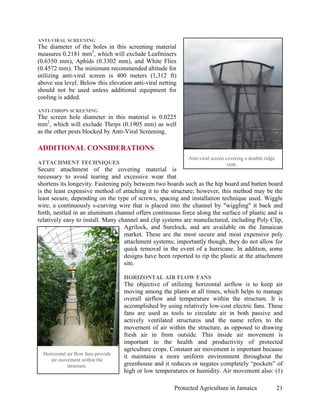
                                     The objective of utilizing horizontal airflow is to keep air
                                     moving among the plants at all times, which helps to manage
                                     overall airflow and temperature within the structure. It is
                                     accomplished by using relatively low-cost electric fans. These
                                     fans are used as tools to circulate air in both passive and
                                     actively ventilated structures and the name refers to the
                                     movement of air within the structure, as opposed to drawing
                                     fresh air in from outside. This inside air movement is
                                     important to the health and productivity of protected
                                     agriculture crops. Constant air movement is important because
  Horizontal air flow fans provide
                                     it maintains a more uniform environment throughout the
     air movement within the
             structure.              greenhouse and it reduces or negates completely “pockets” of
                                     high or low temperatures or humidity. Air movement also: (1)

                                                        Protected Agriculture in Jamaica                  21
helps to keep leaf surfaces dry so that diseases are less likely to develop and (2) it supports
photosynthesis by preventing air from becoming stagnant and thus hindering the formation of
carbon dioxide, which is essential for photosynthesis to take place.

IRRIGATION EQUIPMENT
Irrigation equipment needs is also a consideration during planning and construction. The type of
production system dictates the equipment needed. For example, a fertigation system would
require an injector, water tanks, drip tape, and filters while an overhead sprinkler system would
require hoses and sprinklers.

HURRICANE PREPAREDNESS
Jamaica lies within the Atlantic hurricane belt, which has a hurricane season running from June
to November. Greenhouses are unable to withstand winds of such magnitude so sites should be
selected with this in mind. With all but the most rigid growing structures, the best strategy for
withstanding a hurricane is to enable rapid dismantling of part or all of the structure in order to
save the structure and to avoid losing expensive covering materials and components.

The following factors should be considered at the time of construction design in hurricane-prone
regions:
    • Shade cloth, if used, should be attached so as to be easily removable and secured.
    • The polyethylene glazing and any insect screen should be attached with quick attachment
       components, such as wiggle wire or rope, which can be rapidly removed. The less costly
       approach of securing poly with lath nailed to base or shoulder boards will be slow to
       remove and will likely result in damage to the poly.
    • Allow 15-20 cm (6-8 in) of excess poly or insect screen during initial installation so that
       there will be sufficient material to hold onto when reapplying these materials to
       structures.
    • Ideally, indoor storage space for poly and other coverings and seedling trays should be
       available to minimize debris and wind damage after they have been removed from the
       structure.
    • Design the trellis system so it can be lowered carefully to the ground and covered with a
       tarp or with the plastic that has just been remove. The edges should be weighed down and
    • Consider if a fuel pump and/or stand-by generator is necessary to power water pumps or
       other systems after the hurricane has passed and electricity is not immediately restored.

USAID/JBRP Production Bulletin #14 gives the following recommendations for hurricane
preparedness:

   •   If the plastic and/or antiviral mesh has not been placed on the structure, wait until the
       hurricane is gone to do so.
   •   Any seedling trays kept in the greenhouse should be taken to a secure location.
   •   Clean and deepen the trenches around the greenhouse. All of the soil that is removed
       must be placed over the bottom of the antiviral mesh to secure it against the heavy winds.
   •   Note that is cheaper to replace the plastic than the whole structure. If the plastic is already
       set-up on the greenhouse, be ready to remove it if approaching winds are strong. This will
       reduce wind pressure under the structure.

                                                        Protected Agriculture in Jamaica           22
•   Make sure the water tanks are completely full. This way, they will be heavy enough to
       withstand strong winds.
   •   Before the storm be sure to apply a fungicide/bactericide to your crop. Use a systemic
       fungicide. This should be repeated following the storm.

RESOURCES
Ferguson, Amanda. How to Build a High Tunnel, Department of Horticulture, University of
Kentucky.

Goodlaw, Juliana. Fundamentals of Greenhouse Agriculture: A Teacher’s Manual, Santoy
Farmer’s Cooperative.

Goodlaw, Juliana and Santoy Farmers’ Cooperative. The High Tunnel House Construction
Manual.

Production Manual 04: Greenhouse Production, Fintrac Inc, USAID Jamaica Business
Recovery Program, 2005.

Wotowiec, Pete and Ted Carey. “Managed Environment Agriculture”. Partners of America,
Farmer to Farmer, in collaboration with HEART Ebony Park Academy, Clarendon, Jamaica,
2007.


                                                   Protected Agriculture in Jamaica       23
Module 2
PRODUCTION SYSTEMS
INTRODUCTION
When provided an optimum growing environment, a plant will produce the highest yield of the
highest quality. It is essential to understand the factors that contribute to such an environment to
provide for optimum growth and development. This knowledge assists the grower to develop an
appropriate production system that maximizes plant growth and which ultimately translates into
an economic advantage. In many cases creating the ideal growing environment will involve both
the proper use of protective structures and an array of specialized cultural practices.

For example, at a particular location, a tomato grower may require a relatively simple structure,
relying on passive ventilation and shade netting. At another location, more active ventilation may
be required along with complete protection of the crop inside through the use of antiviral netting.
A sound understanding of environmental factors can give a grower an economic edge, enabling
him to optimize plant growth with the appropriate available resources.

This module covers:
   1. The Plant Growing Environment
   2. Monitoring Environmental Factors
   3. Growing Mediums
   4. Irrigation Systems

THE PLANT GROWING ENVIRONMENT
The environmental requirements of plants vary with species, cultivar (a plant variety used for
cultivation), and the stage of growth. Extremes of any factor can be very damaging to a crop;
moreover, even subtle variations of a given factor can impact crop quality and yield. It is also
important to remember that environmental factors impact one another in visible and invisible
ways; something that impacts the above ground plant parts will also have effect on the roots
below ground.

For example, when the temperature rises, the moisture requirements of plants increase. When
light intensity increases, the temperature rises, increasing not only the need for moisture, but also
the need for minerals for plant growth. During daylight hours, a closed growing structure will
trap heat and air and limit circulation, resulting in increased temperatures, humidity, and the
development of an environment conducive to plant diseases.

Gentle breezes over a plant will increase the transpiration rate (the rate of emission of water
vapor though the leaves of a plant), which in turn, will increase its need for moisture and
minerals. The same breeze will also tend to reduce air and leaf temperatures and to lower the
humidity in the structure.


                                                        Protected Agriculture in Jamaica          24
LIGHT
Three aspects of light affect plant growth: intensity, duration, and quality. Intensity refers to the
brightness of the light. Duration refers to how long daylight is available for plants to
photosynthesize. This is also called the photoperiod. Light quality, in this case, refers to the
relative abundance of particular wavelengths or ranges of wavelengths (infra-red, visible,
photosynthetic active, ultraviolet). The portion of the electromagnetic spectrum that falls
between 400 - 700 nm, is referred to as the spectrum of visible light. Photosynthetic Active
Radiation (PAR) is light that is utilized by the plant in photosynthesis and occurs in the 400 - 700
nm wavelength range.

TEMPERATURE
Temperature can effect plant growth in a number of ways, particularly through its effects on
leaves and roots. The temperature of the air, growing medium, and the water used for irrigation
can directly impact the temperature of the plant. Another important aspect for crop growth is
daily minimum and maximum temperatures.

Temperature is not an independent parameter; it is dependent on the light intensity and quality
inside a structure temperature, which is dependent on the amount of light which comes into the
structure. It is the infrared component of light which makes significant contribution to
temperature. External shades over the structure’s roof may be of value to reduce the inside
temperature by blocking the amount of light entering into it.

MOISTURE

WATER
Water is a major driver of plant growth. It transfers minerals from the soil or other growing
medium to the plant and creates turgor pressure. Turgor is a force exerted outward on a plant
cell wall by the water contained in the cell. This force keeps the plant rigid, and may help to keep
it erect. The following aspects are important when considering moisture in relation to crop
production: volume; rate of application; temperature; quality (soluble salts); and pH.

RELATIVE HUMIDITY
Monitoring relative humidity is important to maintaining plant hydration. If high relative
humidity is paired with a high internal temperature, the ability of a plant to move water from its
roots to its leaves is reduced, causing reduced circulation of needed minerals.

MINERALS
Minerals are the raw materials from which the plant synthesizes complex nutrients. The proper
types, amounts and rates of mineral application by the grower are critical to successful
cultivation.

OXYGEN
Air is essential for all aerobic organisms, including crops. In the managed environment, air
movement within the protected environment requires particular attention since structures can
tend to limit free air movement. Good aeration of soils and/or other growing media is of equal
importance.


                                                        Protected Agriculture in Jamaica          25
BIOLOGICAL FACTORS
Crops interact with other organisms, including the growers who tend them, pests that eat them,
and a host of beneficial or benign organisms above or below the soil surface that may assist or
hinder nutrient uptake and defense against disease. Macro-organisms can be seen with the naked
eye while micro-organisms can only be seen under high magnification. Micro-organisms can fill
the plants environment in astonishing numbers. For example, a gram of soil contains up to a
billion microorganisms. Other factors such as soil structure and pH are also important and are
covered in further detail in Module 4: Nutrient Management.

MONITORING ENVIRONMENTAL FACTORS
Human senses, in general, are not sensitive enough to monitor the specific levels of each
environmental factor for each crop; various instruments are used to assist in this. These
instruments are of limited use, however, unless baseline data for optimum culture of the crop is
known, which allows the grower to decide whether and how to take corrective measures. In
                          Jamaica where smaller growers may not be able to afford to analyze
                          soil and water on a regular basis, pH and E.C. meters could be the two
                          most valuable tools to monitor fertility in crops and to make informed
                          decisions.

                         All instrument measurements and observations of the environment
                         need to be referenced against known baseline data for optimum crop
                         production. Once data is compared, steps must be taken to bring the
                         actual production conditions in line with those known standards.
                         Publications and other references should be used to determine and
                         understand the baseline information and, since new research may bring
                         to light new information, it is important to seek up-to-date information
                         through publications and growers associations. It is also useful for the
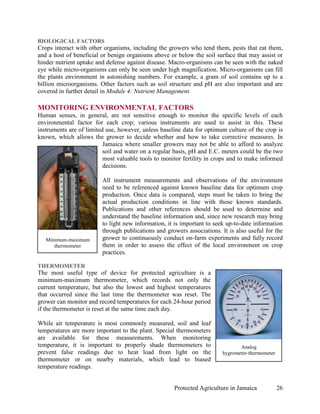
   Minimum-maximum       grower to continuously conduct on-farm experiments and fully record
      thermometer        them in order to assess the effect of the local environment on crop
                         practices.

THERMOMETER
The most useful type of device for protected agriculture is a
minimum-maximum thermometer, which records not only the
current temperature, but also the lowest and highest temperatures
that occurred since the last time the thermometer was reset. The
grower can monitor and record temperatures for each 24-hour period
if the thermometer is reset at the same time each day.

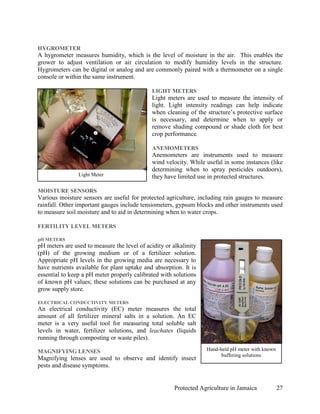
While air temperature is most commonly measured, soil and leaf
temperatures are more important to the plant. Special thermometers
are available for these measurements. When monitoring
temperature, it is important to properly shade thermometers to                 Analog
prevent false readings due to heat load from light on the               hygrometer-thermometer
thermometer or on nearby materials, which lead to biased
temperature readings.


                                                     Protected Agriculture in Jamaica            26
HYGROMETER
A hygrometer measures humidity, which is the level of moisture in the air. This enables the
grower to adjust ventilation or air circulation to modify humidity levels in the structure.
Hygrometers can be digital or analog and are commonly paired with a thermometer on a single
console or within the same instrument.

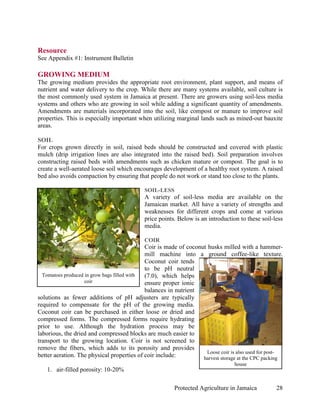
                                              LIGHT METERS
                                              Light meters are used to measure the intensity of
                                              light. Light intensity readings can help indicate
                                              when cleaning of the structure’s protective surface
                                              is necessary, and determine when to apply or
                                              remove shading compound or shade cloth for best
                                              crop performance.

                                              ANEMOMETERS
                                              Anemometers are instruments used to measure
                                              wind velocity. While useful in some instances (like
                                              determining when to spray pesticides outdoors),
                Light Meter                   they have limited use in protected structures.

MOISTURE SENSORS
Various moisture sensors are useful for protected agriculture, including rain gauges to measure
rainfall. Other important gauges include tensiometers, gypsum blocks and other instruments used
to measure soil moisture and to aid in determining when to water crops.

FERTILITY LEVEL METERS

pH METERS
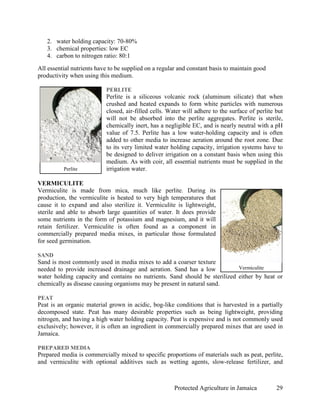
pH meters are used to measure the level of acidity or alkalinity
(pH) of the growing medium or of a fertilizer solution.
Appropriate pH levels in the growing media are necessary to
have nutrients available for plant uptake and absorption. It is
essential to keep a pH meter properly calibrated with solutions
of known pH values; these solutions can be purchased at any
grow supply store.

ELECTRICAL CONDUCTIVITY METERS
An electrical conductivity (EC) meter measures the total
amount of all fertilizer mineral salts in a solution. An EC
meter is a very useful tool for measuring total soluble salt
levels in water, fertilizer solutions, and leachates (liquids
running through composting or waste piles).

MAGNIFYING LENSES                                                  Hand-held pH meter with known
                                                                         buffering solutions
Magnifying lenses are used to observe and identify insect
pests and disease symptoms.


                                                       Protected Agriculture in Jamaica            27
Resource
See Appendix #1: Instrument Bulletin

GROWING MEDIUM
The growing medium provides the appropriate root environment, plant support, and means of
nutrient and water delivery to the crop. While there are many systems available, soil culture is
the most commonly used system in Jamaica at present. There are growers using soil-less media
systems and others who are growing in soil while adding a significant quantity of amendments.
Amendments are materials incorporated into the soil, like compost or manure to improve soil
properties. This is especially important when utilizing marginal lands such as mined-out bauxite
areas.

SOIL
For crops grown directly in soil, raised beds should be constructed and covered with plastic
mulch (drip irrigation lines are also integrated into the raised bed). Soil preparation involves
constructing raised beds with amendments such as chicken mature or compost. The goal is to
create a well-aerated loose soil which encourages development of a healthy root system. A raised
bed also avoids compaction by ensuring that people do not work or stand too close to the plants.

                                            SOIL-LESS
                                            A variety of soil-less media are available on the
                                            Jamaican market. All have a variety of strengths and
                                            weaknesses for different crops and come at various
                                            price points. Below is an introduction to these soil-less
                                            media.

                                            COIR
                                             Coir is made of coconut husks milled with a hammer-
                                             mill machine into a ground coffee-like texture.
                                             Coconut coir tends
                                             to be pH neutral
  Tomatoes produced in grow bags filled with (7.0), which helps
                    coir                     ensure proper ionic
                                             balances in nutrient
solutions as fewer additions of pH adjusters are typically
required to compensate for the pH of the growing media.
Coconut coir can be purchased in either loose or dried and
compressed forms. The compressed forms require hydrating
prior to use. Although the hydration process may be
laborious, the dried and compressed blocks are much easier to
transport to the growing location. Coir is not screened to
remove the fibers, which adds to its porosity and provides
                                                                     Loose coir is also used for post-
better aeration. The physical properties of coir include:          harvest storage at the CPC packing
                                                                                 house
   1. air-filled porosity: 10-20%

                                                        Protected Agriculture in Jamaica           28
2. water holding capacity: 70-80%
   3. chemical properties: low EC
   4. carbon to nitrogen ratio: 80:1

All essential nutrients have to be supplied on a regular and constant basis to maintain good
productivity when using this medium.

                           PERLITE
                           Perlite is a siliceous volcanic rock (aluminum silicate) that when
                           crushed and heated expands to form white particles with numerous
                           closed, air-filled cells. Water will adhere to the surface of perlite but
                           will not be absorbed into the perlite aggregates. Perlite is sterile,
                           chemically inert, has a negligible EC, and is nearly neutral with a pH
                           value of 7.5. Perlite has a low water-holding capacity and is often
                           added to other media to increase aeration around the root zone. Due
                           to its very limited water holding capacity, irrigation systems have to
                           be designed to deliver irrigation on a constant basis when using this
                           medium. As with coir, all essential nutrients must be supplied in the
          Perlite          irrigation water.

VERMICULITE
Vermiculite is made from mica, much like perlite. During its
production, the vermiculite is heated to very high temperatures that
cause it to expand and also sterilize it. Vermiculite is lightweight,
sterile and able to absorb large quantities of water. It does provide
some nutrients in the form of potassium and magnesium, and it will
retain fertilizer. Vermiculite is often found as a component in
commercially prepared media mixes, in particular those formulated
for seed germination.

SAND
Sand is most commonly used in media mixes to add a coarser texture
needed to provide increased drainage and aeration. Sand has a low           Vermiculite
water holding capacity and contains no nutrients. Sand should be sterilized either by heat or
chemically as disease causing organisms may be present in natural sand.

PEAT
Peat is an organic material grown in acidic, bog-like conditions that is harvested in a partially
decomposed state. Peat has many desirable properties such as being lightweight, providing
nitrogen, and having a high water holding capacity. Peat is expensive and is not commonly used
exclusively; however, it is often an ingredient in commercially prepared mixes that are used in
Jamaica.

PREPARED MEDIA
Prepared media is commercially mixed to specific proportions of materials such as peat, perlite,
and vermiculite with optional additives such as wetting agents, slow-release fertilizer, and


                                                       Protected Agriculture in Jamaica          29
mycorrhizae (a root growth promoting fungus).,Pro-Mix is a trade name of one mix with
different formulations that is available in Jamaica.

WATER
When growing in water, plants are positioned in troughs (often using gutters) through which a
constant flow of nutrient solution keeps the lower portion of the roots wet. This is referred to as
hydroponics, which includes the Nutrient Film Technique (NFT) and bag or container culture,
which uses an additional substrate such as perlite. NFT systems are well suited for the production
of leafy vegetables.

IRRIGATION SYSTEMS
When soil becomes too wet, it becomes anaerobic. This is a condition which allows for the
growth of harmful fungi and molds, causes rotting of the roots and slows or stops completely the
growth of root hairs responsible for the absorption of nutrients. An excess of moisture in the soil
also causes the soil temperature to drop with negative implications for crop growth. Conversely,
soil that has received too little moisture can have as much trouble as waterlogged soil. In overly
dry soil, the root hairs die from a lack of moisture and nutrients become “locked-up” and
unavailable to the plant.

                               When soil moisture is kept at a constant level beneficial soil
                               organisms thrive and create more humus. Humus is the end
                               product of decomposition of organic material and is what makes
                               the soil loose and able to hold moisture while simultaneously
                               bonding nutrients so they are not leached away. Humus thrives in
                               conditions which provide a thin film of moisture; when
                               conditions are too dry the nutrients remain locked within the
                               humus particles. When water is applied following a dry period
                               there is a delay before the nutrients are again available to the root
                               hairs for absorption. The healthiest growth and greatest yields
                               occur when there is a consistent moisture level, not when there
                               are cyclical wet and dry conditions.

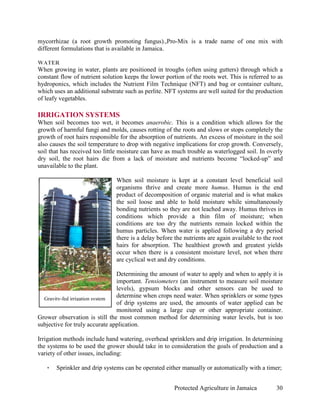
                                Determining the amount of water to apply and when to apply it is
                                important. Tensiometers (an instrument to measure soil moisture
                                levels), gypsum blocks and other sensors can be used to
  Gravity-fed irrigation system
                                determine when crops need water. When sprinklers or some types
                                of drip systems are used, the amounts of water applied can be
                                monitored using a large cup or other appropriate container.
Grower observation is still the most common method for determining water levels, but is too
subjective for truly accurate application.

Irrigation methods include hand watering, overhead sprinklers and drip irrigation. In determining
the systems to be used the grower should take in to consideration the goals of production and a
variety of other issues, including:

   •   Sprinkler and drip systems can be operated either manually or automatically with a timer;


                                                       Protected Agriculture in Jamaica          30
•   Drip irrigation reduces foliar diseases while overhead irrigation increases cooling effects;
   •   Sprinkler systems use water inefficiently due to evaporation before water reaches the
       plant;
   •   Sprinkler systems contribute to foliar disease because of the moist environment created in
       the foliage canopy;
   •   The cost of a given system; and
   •   The crops to be cultivated.

If soluble fertiliser will be injected through irrigation lines, consider the compatibility of the
water supply, delivery system, and type of fertiliser injector. Additionally, water quality,
temperature, volume, and timing are important issues to consider when selecting the appropriate
irrigation method.

In protected agriculture production, the most common delivery system is drip irrigation, of which
there are several versions. Drip irrigation involves a low-pressure water source attached to tubing
which is placed on the ground along a row of plants. Water emitters are built into the tubing at
regular intervals. In container or bag culture systems, spaghetti tubing and specialized emitters
are used to irrigate crops. Drip systems are designed to provide water directly to the plant root
zone in very controlled volumes. There are many advantages inherent to a drip irrigation system,
including the reduction of water usage by almost 50%. In addition, the lengthy, slow trickle
provided by a drip system has been shown to increase yields 84% over other methods of
watering.

Proper filtration and clean water are essential to the efficient operation of low volume irrigation
systems. Contaminants present in the irrigation water source will lead to clogged emitters and
reduction in system efficiency. Screen filters are excellent for removing hard particulates
including trash, algae, sand, and silt, though they are not sufficient for removing organic
materials such as algae, mould, and slime. These non-solid materials tend to embed themselves
in the screen material where they are very difficult to remove. In other cases they simply slide
through the holes in the screen by temporarily deforming their shape. Several methods of
flushing are common with the simplest being to flush the valve outlet at the bottom of the filter.

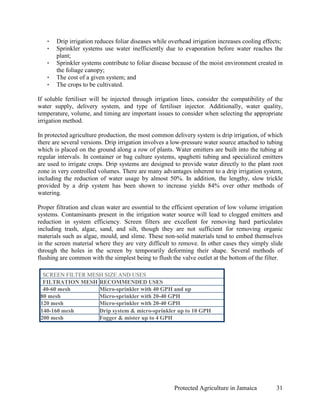
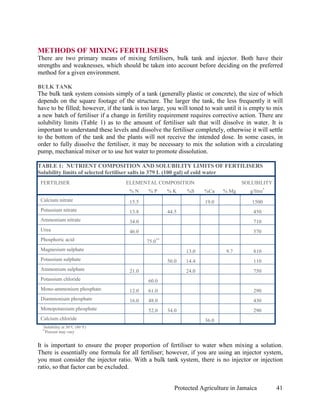
  SCREEN FILTER MESH SIZE AND USES
  FILTRATION MESH RECOMMENDED USES
  40-60 mesh       Micro-sprinkler with 40 GPH and up
 80 mesh           Micro-sprinkler with 20-40 GPH
 120 mesh          Micro-sprinkler with 20-40 GPH
 140-160 mesh      Drip system & micro-sprinkler up to 10 GPH
 200 mesh          Fogger & mister up to 4 GPH


                                                       Protected Agriculture in Jamaica         31
Module 3
PLANT PRODUCTION
COMPONENTS
INTRODUCTION
It is important to understand the basic components of introductory plant production prior to
addressing more technical and scientific issues related to plant health. An overall knowledge of
what is essential for a successful grower will assist the Rural Agricultural Development
Authority (RADA) officer in servicing the protected agriculture sub-sector. Many of the topics
introduced in this module will be expanded upon in later modules.

This module covers:
   1. Propagation Techniques
   2. Crop and Variety Selection
   3. Seed Propagation
   4. Planting Care and Harvesting

PROPAGATION TECHNIQUES
There are two main types of plant propagation:
asexual and sexual. Asexual techniques include
vegetative, grafting, and micro-propagation; sexual
propagation refers to growing plants from seed.
Raising plants from seed has the potential to
provide large numbers of uniform, high quality
seedlings. Seed propagation is the most common
method for vegetable crop production in Jamaica.
For asexual production, grafting is a common
practice in fruit and nut tree propagation for hard-
to-propagate varieties or those which have an
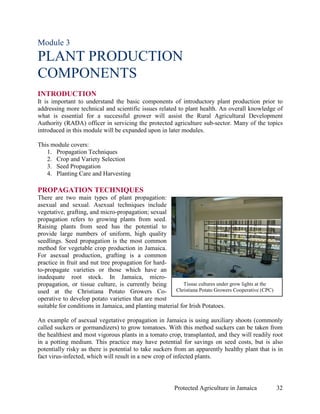
inadequate root stock. In Jamaica, micro-
propagation, or tissue culture, is currently being         Tissue cultures under grow lights at the
used at the Christiana Potato Growers Co-               Christiana Potato Growers Cooperative (CPC)
operative to develop potato varieties that are most
suitable for conditions in Jamaica, and planting material for Irish Potatoes.

An example of asexual vegetative propagation in Jamaica is using auxiliary shoots (commonly
called suckers or gormandizers) to grow tomatoes. With this method suckers can be taken from
the healthiest and most vigorous plants in a tomato crop, transplanted, and they will readily root
in a potting medium. This practice may have potential for savings on seed costs, but is also
potentially risky as there is potential to take suckers from an apparently healthy plant that is in
fact virus-infected, which will result in a new crop of infected plants.


                                                         Protected Agriculture in Jamaica             32
CROP AND VARIETY SELECTION
Although most growers know what crop they are
going to grow as they embark on the planning and
construction of the protected agriculture structure, it
is important to continuously evaluate market
demand for a particular crop species. Equally
important is choosing a cultivar of that species. The
term cultivar comes from the phrase cultivated
variety. Cultivar is often abbreviated “cv” and is also
known as a variety or a hybrid. Growers should
choose a variety of a selected species that is most
appropriate for the conditions of the production
system and which is appealing to the market.
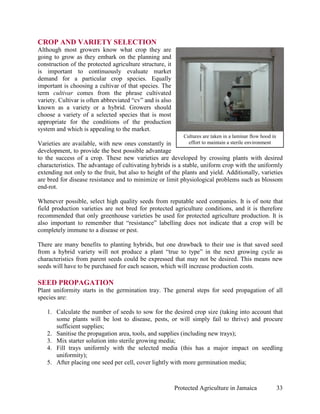
                                                             Cultures are taken in a laminar flow hood in
Varieties are available, with new ones constantly in           effort to maintain a sterile environment
development, to provide the best possible advantage
to the success of a crop. These new varieties are developed by crossing plants with desired
characteristics. The advantage of cultivating hybrids is a stable, uniform crop with the uniformly
extending not only to the fruit, but also to height of the plants and yield. Additionally, varieties
are bred for disease resistance and to minimize or limit physiological problems such as blossom
end-rot.

Whenever possible, select high quality seeds from reputable seed companies. It is of note that
field production varieties are not bred for protected agriculture conditions, and it is therefore
recommended that only greenhouse varieties be used for protected agriculture production. It is
also important to remember that “resistance” labelling does not indicate that a crop will be
completely immune to a disease or pest.

There are many benefits to planting hybrids, but one drawback to their use is that saved seed
from a hybrid variety will not produce a plant “true to type” in the next growing cycle as
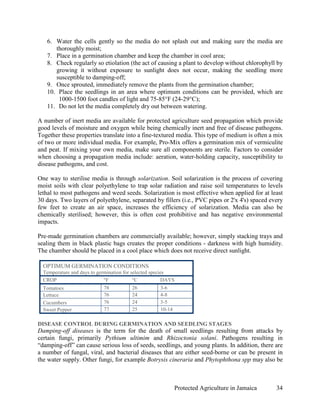
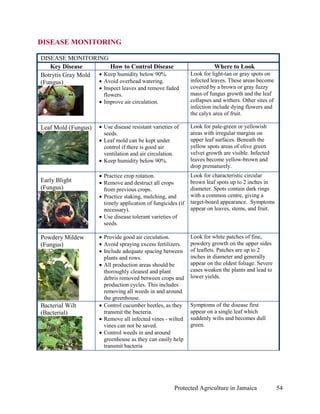
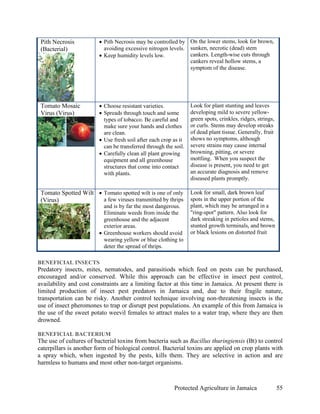
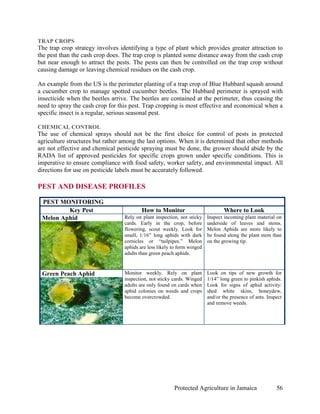
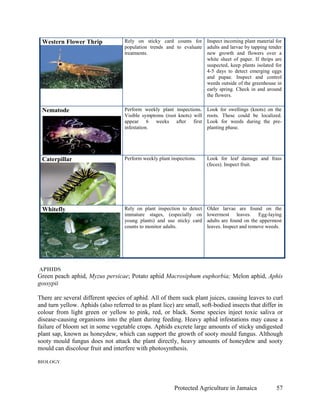
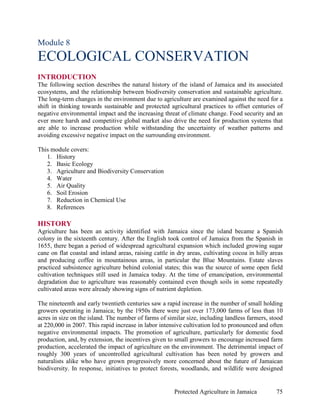
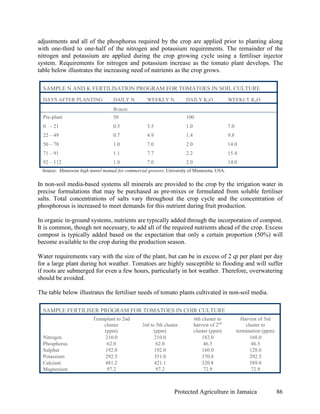
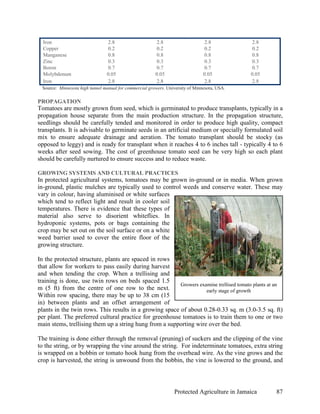
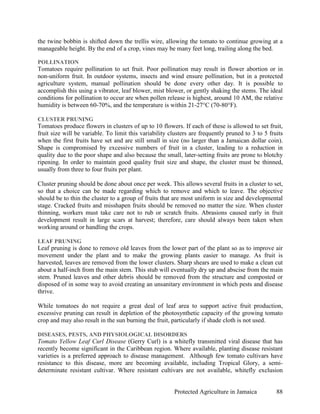
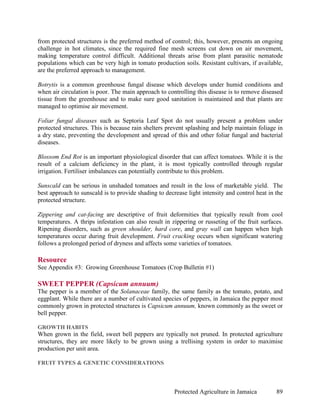
characteristics from parent seeds could be expressed that may not be desired. This means new
seeds will have to be purchased for each season, which will increase production costs.

SEED PROPAGATION
Plant uniformity starts in the germination tray. The general steps for seed propagation of all
species are:

   1. Calculate the number of seeds to sow for the desired crop size (taking into account that
      some plants will be lost to disease, pests, or will simply fail to thrive) and procure
      sufficient supplies;
   2. Sanitise the propagation area, tools, and supplies (including new trays);
   3. Mix starter solution into sterile growing media;
   4. Fill trays uniformly with the selected media (this has a major impact on seedling
      uniformity);
   5. After placing one seed per cell, cover lightly with more germination media;


                                                          Protected Agriculture in Jamaica                  33
6. Water the cells gently so the media do not splash out and making sure the media are
      thoroughly moist;
   7. Place in a germination chamber and keep the chamber in cool area;
   8. Check regularly so etiolation (the act of causing a plant to develop without chlorophyll by
      growing it without exposure to sunlight does not occur, making the seedling more
      susceptible to damping-off;
   9. Once sprouted, immediately remove the plants from the germination chamber;
   10. Place the seedlings in an area where optimum conditions can be provided, which are
       1000-1500 foot candles of light and 75-85°F (24-29°C);
   11. Do not let the media completely dry out between watering.

A number of inert media are available for protected agriculture seed propagation which provide
good levels of moisture and oxygen while being chemically inert and free of disease pathogens.
Together these properties translate into a fine-textured media. This type of medium is often a mix
of two or more individual media. For example, Pro-Mix offers a germination mix of vermiculite
and peat. If mixing your own media, make sure all components are sterile. Factors to consider
when choosing a propagation media include: aeration, water-holding capacity, susceptibility to
disease pathogens, and cost.

One way to sterilise media is through solarization. Soil solarization is the process of covering
moist soils with clear polyethylene to trap solar radiation and raise soil temperatures to levels
lethal to most pathogens and weed seeds. Solarization is most effective when applied for at least
30 days. Two layers of polyethylene, separated by fillers (i.e., PVC pipes or 2'x 4's) spaced every
few feet to create an air space, increases the efficiency of solarization. Media can also be
chemically sterilised; however, this is often cost prohibitive and has negative environmental
impacts.

Pre-made germination chambers are commercially available; however, simply stacking trays and
sealing them in black plastic bags creates the proper conditions - darkness with high humidity.
The chamber should be placed in a cool place which does not receive direct sunlight.

  OPTIMUM GERMINATION CONDITIONS
  Temperature and days to germination for selected species
  CROP                       °F            °C           DAYS
  Tomatoes                  78           26          3-6
  Lettuce                   76           24          4-8
  Cucumbers                 76           24          3-5
  Sweet Pepper              77           25          10-14

DISEASE CONTROL DURING GERMINATION AND SEEDLING STAGES
Damping-off diseases is the term for the death of small seedlings resulting from attacks by
certain fungi, primarily Pythium ultimim and Rhizoctonia solani. Pathogens resulting in
“damping-off” can cause serious loss of seeds, seedlings, and young plants. In addition, there are
a number of fungal, viral, and bacterial diseases that are either seed-borne or can be present in
the water supply. Other fungi, for example Botrysis cineraria and Phytophthona spp may also be


                                                             Protected Agriculture in Jamaica   34
present and interactwith Pythium and Phytophophona to produce spores that move about in
water.

Damping-off occurs at various stages during seed germination and subsequent seedling growth:

   1. Pre-emergence damping-off: The seed may decay or the seedling stem may rot before
      the seedling pushes through the surface of the media. This results in a partial or even total
      lack of seedling emergence.
   2. Post-emergence damping-off: The seedling develops a stem that rots near the surface of
      the media and falls over.
   3. The seedling may remain alive and standing, but the stem will become girdled and the
      plant stunted, eventually dying.

The environmental conditions prevailing during the germination period will affect the growth
rate of both the attacking fungi and the seedling. The optimum temperature for the growth of
Pythium and Rhizoctonia is between 20-30°C (68-86°F). The moisture content of the
germination media are of great importance in determining the incidence of damping-off. Typical
conditions associated with damping-off include over-watering and poor drainage.

TREATMENT FOR DAMPING-OFF DISEASES
Disease prevention is crucial and it is important to use sterile media and fungicide sprays in an
effort to eliminate pathogens during propagation. The close control of plant growth and
environmental conditions will minimize the effects of damping-off, will at least until the
seedlings have passed their initial vulnerable stages of growth. If damping-off begins after
seedlings are growing, it may be controlled by treating that area of the media with a fungicide
mixture which includes metalaxyl (trade name: Ridomil) and thiophanate methyl (trade name:
Topsin).

TRANSPLANTING
In general, it is time to transplant the seedling from the germination tray to the final growing
container when the seedling has met several developmental milestones. With both tomato and
sweet pepper the seedlings should be 10-15 cm (4-6 in) tall and have at least 3-4 true leaves
developed prior to transplanting. Roots should be well developed, and, when removed from the
germination tray, the “plug” should stay mostly intact.

In tomato culture, when using grow bags, the bags should be placed in their final location and
spaced appropriately, and then the transplants should be taken to the bags. To remove the plugs,
wet the germination tray completely and squeeze from the bottom to push the seedlings out
without nicks, cuts or other damage that could occur to the plant or root system if pulled by the
leaves. Precautions should be taken to transplant seedlings when it is not very hot, preferably on
cloudy days or late afternoon so seedlings can adjust to temperature changes overnight. Make
sure that the soil or the growing media are not dry. If using coir, bags should be pre-moistened as
well.

PLANT SPACING
When growing crops in protected structures, it is important to use the proper planting density.
For example, for best results, tomatoes need to have at least four square feet per plant. To

                                                       Protected Agriculture in Jamaica         35
determine how many plants can be grown in a structure, multiply the length of the structure by
the width and then divide by four or five. When calculating, it is important to remember that if
some of the floor space will be used for other purposes, this area must be subtracted from the
total before dividing by four or five.

Using a higher plant density will cause the yield per plant to decrease; this is due primarily to
plants shading each other. Overcrowding plants also tends to promote disease development since
foliage does not dry as readily once wet and sprays cannot easily penetrate the thick foliage.
Ideally plants should be staggered in double rows, about four feet apart on centres. The term on
centres is used in regard to the method of measuring plant spacing, it means to measure from the
main stem of one plant to the main stem of another. Within a
row, tomato and sweet pepper plants should average 36-41 cm
(14-16 in) between stems. For specific information on spacing
other greenhouse crops see the crop-specific section in Module
9.

POLLINATION, TRELLISING, AND PRUNING
Pollination, trellising, and pruning are three labour intensive
activities that increase yield and over-all quality of most crops
grown in protected agriculture structures.
Pollination must be performed by the grower in a protected
agriculture structure as natural pollinators such as bees are
excluded. Additional steps must be taken to ensure pollen
successful transfer within the structure.

Trellising of plants supports them in order to keep the stems
from lying on the ground, and to allow the plants to occupy         Trellised tomato plants at a middle
vertical space in the protected structure rather than spread                  stage of growth.
horizontally. Wooden stakes, twine, and various clips and
wrappers are used to support the plants.

Pruning removes excess leaves that are not necessary for plant
growth and that can cause excessive shade for surrounding
plants or attract pests.

Specific pollination, trellising, and pruning techniques for
tomato and sweet pepper are described in further detail in
Module 9: Crop Culture.

HARVEST AND POST-HARVEST MANAGEMENT
As crops mature, another crucial aspect of a successful season
must be considered: how to manage the harvest and handling
of the ripe crop. Ideal harvest conditions are in the morning
when cool temperatures cause the plants to transpire at a lower
rate. Harvesting should be done with the utmost care to avoid         Trellised tomato plants further
bruises and nicks. Attempts should be made to keep the                             along


                                                       Protected Agriculture in Jamaica                 36
produce cool during transportation in order to extend shelf life.
                                 Storage life can be shortened by moisture loss and chilling
                                 injury. As an example, harvested sweet peppers should be kept
                                 at 7-10°C and 95% relative humidity. Temperatures below 7°C
                                 will result in chilling injury. Under properly managed
                                 conditions, peppers have a storage life of 3-5 weeks. Contact
                                 RADA for information on crop-specific optimum storage
                                 conditions.

                                 STORAGE DISEASES
                                 Post-harvest storage diseases include Alternaria, Botrytis and
                                 Phytophora rots. These fungal rots can be controlled by quickly
                                 cooling harvested fruit and by avoiding bruising and injury
                                 during harvesting. Additional techniques include hot water dips
                                 and post-harvest application of antimicrobials. Contact RADA
Tomatoes waiting for transport   for additional, up-to-date information on harvest and post-
         to market               harvest management, including lists of registered fungicides for
                                 vegetable crops.


                                                      Protected Agriculture in Jamaica         37
Module 4
NUTRIENT MANAGEMENT
INTRODUCTION
Agriculture is a science and its subjects are not static. Producers must rely on keen observation
and daily interaction with the plants to ensure a healthy harvest. Nutrient management requires
knowledge of the requirements of specific crops and the source(s) of fertiliser that will most
effectively meet those requirements. It is also essential to understand fertiliser delivery systems
and the methods by which you will mix fertiliser.

This module covers:
   1. Plant Nutrient Requirements
   2. Fertiliser Sources
   3. Fertiliser Application Types
   4. Methods of Mixing Fertilisers

PLANT NUTRIENT REQUIREMENTS
METABOLISM
The complex process which leads to plant growth is referred to as metabolism. The grower must
possess a fundamental understanding that plants are living entities and as such, interact with their
environment to sustain life. Plants manufacture their own food through the process of
photosynthesis, the capturing of energy present in light waves, the consumption of carbon
dioxide, and the conversion of water into a simple sugar. This sugar is further metabolised into
other carbohydrates, fats, proteins and other foods; however, this synthesis occurs only if certain
minerals, along with proper environmental conditions, are present.

Minerals are absorbed while in a water-based solution, usually through the roots, and are
translocated to the parts of the plant where they are incorporated during growth. Minerals occur
naturally in soils in varying amounts. Intensive agricultural production can deplete these
naturally-occurring minerals and if production is to be sustained they must be replaced in the
soil. Since the components of many artificial media are inert and contain no soluble minerals,
necessary minerals are initially provided by the grower through the introduction of fertilisers of
various kinds – chemical and/or organic - which the plants are then able to utilize.

Energy the plant uses for the growth process comes from the various foods the plant has
synthesised. This energy is released from the food products through a process called respiration.
In an appropriate environment, the metabolic cycle of energy capture (photosynthesis), food
synthesis, and energy release (respiration) occur, thus enabling life, growth and reproduction.
Since many animals, including humans, cannot survive without plants in their diet, they are
ultimately dependent on the successful metabolic cycle of plants.

From seed to maturity, plants require different amounts for mineral nutrients for optimal growth.
Growth stages such as vegetative, bud initiation and fruit set are all a result of distinctive


                                                       Protected Agriculture in Jamaica          38
metabolic processes that require different amounts of mineral nutrients, Therefore, recommended
fertilisation rates to meet mineral requirements vary not only by plant species, but also by the
stage of development of the plant.

MINERAL REQUIREMENTS
Thirteen minerals have been identified as essential to plant growth. These are classified in
several ways but the essential understanding is that different species use them in different
quantities, and that these requirements are further influenced by the environmental conditions in
which the plants are grown. Some studies have suggested that other minerals may impact plant
growth, but these have not been validated at the grower level. The nutrients required for plant
growth are as follows:

   •   Macro-nutrients:
          • nitrogen (N)
          • phosphorus (P)
          • potassium (K)
          • calcium (Ca)
          • magnesium (Mg)
   •   Micro-nutrients:
          • sulfur (S)
          • boron (B)
          • copper (Cu)
          • iron (Fe)
          • chlorine (Cl)
          • manganese (Mn)
          • molybdenum (Mo)
          • zinc (Zn)

FERTILISER SOURCES
CHEMICAL FERTILISER
Minerals are used by plants in different quantities; nitrogen, phosphorus and potassium are used
in the largest amounts and are usually referred to as primary, macro-nutrients or macro-elements.
The most often applied fertilisers contain one, two, or all three of these macro-elements (in
different proportions) in their composition. The label on the fertiliser bag lists them in the order
N, P, K along with the percentages of each present in the makeup of the fertiliser. For example, a
fertiliser listed as 10-5-15 is 10% N, 5% P (actually P2O5) and 15% K (actually K2O). The
remaining 70% of the fertiliser is inert carrier material. Controlled release solid fertiliser
formulations allow for the release of soluble fertilisers over a period of time.

Other fertiliser minerals are applied in certain conditions, but in lesser quantities. Calcium,
magnesium, and sulphur are part of a group of them known as secondary macro-elements. Some
minerals are used by plants in very small amounts and are referred to as micro-nutrients or trace
elements. The micro-nutrients group is made up of boron, chlorine, copper, iron, manganese,
molybdenum and zinc. The elements carbon, hydrogen, and oxygen are also required for plant


                                                       Protected Agriculture in Jamaica          39
growth but are available from air and water in the quantities needed for plant growth. For this
reason they are not included in pre-packaged fertilisers. Carbon, however, when applied as
organic matter to soil, can make a positive contribution to plant growth.

Regardless of which mineral is required for growth, each one mentioned above, in its appropriate
proportion, is absolutely necessary for plants to survive and thrive.

ORGANIC FERTILISER
Compost can be comprised of any organic material which has decomposed under managed
conditions which cause or allow for the compost pile to heat up to a temperature at which weed
seeds and many pathogenic organisms are killed. Minerals from the composted material are then
more readily available when mixed into or on top of the soil. Properly made compost also
contains beneficial microorganisms.

Fresh, organic sources of minerals are usually applied over a period of months or years. Prior to
planting the crop, natural organic materials, including manure, must decompose in the soil or be
composted in order to release minerals. Compost is usually applied to crops growing in soil
rather than artificial media. Organic sources tend not to have consistent levels of minerals from
batch to batch and manures from different livestock or poultry can vary in mineral content as
well, mostly due to the feeding methods used for the animals.

FERTILISER APPLICATION TYPES
PRE-PLANT
Both organic and chemical fertiliser can be applied to the growth medium prior to planting the
crop. This “pre-plant” method requires that the fertiliser be worked into the soil. This will trigger
the decomposition process for organic matter or, if using chemical fertiliser, will allow the dry
chemical to dissolve in the soil solution. Rarely are liquid fertilisers applied pre-plant.

FOLIAR FEEDING
Plant leaves and stems absorb water and nutrients, and exchange oxygen and carbon dioxide
through small pore-like openings called stomata. Foliar feeding, spraying an appropriately
diluted fertiliser solution over the foliage of the crop, takes advantage of this natural
phenomenon. It is an efficient way to apply fertiliser to plants because the fertiliser is absorbed
directly by the plant canopy rather than absorbed by the roots and later translocated to the leaves.
Foliar feeding is an especially useful technique to quickly correct deficiencies (such as a
magnesium deficiency) or to introduce nutrients that do not translocate inside the plant (such as
phosphorus and iron). A note of caution: it is easy to overfeed using this method, especially in
the case of multiple applications in a short timeframe.

FERTIGATION
Fertigation involves applying fertiliser dissolved in irrigation water at each watering. This
method can be used with crops grown in soil beds or in artificial media growing systems.
Fertigation provides an accurate method to deliver nutrients while providing labour savings and
consistency in distribution. A properly managed system will eliminate waste and reduce run-off,
thereby diminishing adverse environmental impacts.


                                                        Protected Agriculture in Jamaica          40
METHODS OF MIXING FERTILISERS
There are two primary means of mixing fertilisers, bulk tank and injector. Both have their
strengths and weaknesses, which should be taken into account before deciding on the preferred
method for a given environment.

BULK TANK
The bulk tank system consists simply of a tank (generally plastic or concrete), the size of which
depends on the square footage of the structure. The larger the tank, the less frequently it will
have to be filled; however, if the tank is too large, you will toned to wait until it is empty to mix
a new batch of fertiliser if a change in fertility requirement requires corrective action. There are
solubility limits (Table 1) as to the amount of fertiliser salt that will dissolve in water. It is
important to understand these levels and dissolve the fertiliser completely, otherwise it will settle
to the bottom of the tank and the plants will not receive the intended dose. In some cases, in
order to fully dissolve the fertiliser, it may be necessary to mix the solution with a circulating
pump, mechanical mixer or to use hot water to promote dissolution.

TABLE 1: NUTRIENT COMPOSITION AND SOLUBILITY LIMITS OF FERTILISERS
Solubility limits of selected fertiliser salts in 379 L (100 gal) of cold water
 FERTILISER                         ELEMENTAL COMPOSITION                          SOLUBILITY
                                     %N      %P      %K      %S     %Ca     % Mg       g/litre*
 Calcium nitrate                     15.5                           19.0                1500
 Potassium nitrate                   13.8            44.5                               450
 Ammonium nitrate                    34.0                                               710
 Urea                                46.0                                               570
 Phosphoric acid                            75.0**
 Magnesium sulphate                                          13.0            9.7        810
 Potassium sulphate                                  50.0    14.4                       110
 Ammonium sulphate                   21.0                    24.0                       750
 Potassium chloride                          60.0
 Mono-ammonium phosphate             12.0    61.0                                       290
 Diammonium phosphate                16.0    48.0                                       430
 Monopotassium phosphate                     52.0    34.0                               290
 Calcium chloride                                                   36.0
 *
  Solubility at 30°C (86°F)
 **
   Percent may vary


It is important to ensure the proper proportion of fertiliser to water when mixing a solution.
There is essentially one formula for all fertiliser; however, if you are using an injector system,
you must consider the injector ratio. With a bulk tank system, there is no injector or injection
ratio, so that factor can be excluded.


                                                        Protected Agriculture in Jamaica          41
Bulk System Formula: ppm = (% fertiliser) x (lb. added to tank) x (16 oz per lb.) x (.75) x (100 /
gal. of bulk tank)

Bulk System Example: If using a bulk tank system with 15 pounds of 8-5-16 fertiliser mix and
the bulk tank holds 600 gallons of fertiliser, 10 pounds of potassium nitrate (13.75% N) should
be added to ensure the plants get plenty of nitrogen. To determine the amount of nitrogen the
plants are receiving, the following ratio should be utilized:

With a bulk tank system, leave out the ratio factor ppm from 8-5-16 = (8) x (15) x (16) x (.75) x
(100/600) = 240 ppm N ppm from KNO3 = (13.75) x (10) x (16) x (.75) x (100/600) = 275 ppm
N Total ppm N = 240 + 275 = 515 (which is too high for tomatoes, around 200 ppm is the upper
limit)

INJECTOR
                              A fertiliser injector, also referred to as a proportioner, is a device
                              that mixes precise volumes of concentrated fertiliser solution and
                              water together. A knob or dial on the injector can be turned to
                              increase or decrease the ratio of fertiliser solution going from the
                              concentrated tank to the injector, where it is diluted by water being
                              delivered into the irrigation system. The concentrate is held in
                              small containers of 38-189 L (10-50 gal). The advantage of an
                              adjustable rate injector is that the same fertiliser concentrate can be
                              applied at different concentrations to plants at different stages of
                              growth.

                               Chemical interaction must be taken into consideration when
                               dealing with high concentrations. For example, at high
                               concentrations calcium combined with phosphate or sulphate
       Fertilizer Injector     forms a precipitate that not only makes the nutrients unavailable to
                               the plant but also clogs injectors. Two heads and two
concentration tanks are needed - one for the calcium nitrate (tank A) and the other for all other
nutrients (tank B) – to avoid this problem. Additionally, a third head is recommended to inject
acid (phosphoric, sulphuric, or nitric) if the pH of the water is above.6.8.

Injector System Formula: ppm = (% fertiliser) x (lb. added to tank) x (16 oz per lb.) x (.75) x
(100 / gal of concentrate) x (1 / ratio of injector).

Injector System Example: Place 25 pounds of a 15-11-29 fertiliser mix in a 30-gallon
concentrate tank and then use a 1:100 injector. How much nitrogen are your plants getting? Since
you have an injector system, be sure to use the injector ratio. ppm = (15) x (25) x (16) x (.75) x
(100/30) x (1/100) ppm = 150 ppm nitrogen

Electrical conductivity (EC) is a measure of the ability of a solution to conduct electricity. The
more concentrated the fertiliser solution, the more electricity it will conduct and the higher the
reading will be. EC is measured in micro Siemens per centimetre (µS/cm) that is equivalent to
micro-mhos per centimetre (µmho/cm).

                                                       Protected Agriculture in Jamaica           42
Module 5
NUTRIENT MONITORING
INTRODUCTION
Nutrient monitoring is especially important in a protected agriculture environment to ensure
plant health and the success of a crop. Understanding plant nutrition is crucial to successful
cultivation and managing plant nutrition is a skill that can be developed to result in increased
yields and quality of produce. Nutrient monitoring does depend heavily on grower observation,
but also utilizes water, soil, and tissue analysis, which are available through government
agencies.

This module covers:
   1. Water Quality
   2. Soil Tests
   3. Tissue Analysis
   4. Grower Observations
   5. Nutrient Disorders

WATER QUALITY
Water quality is a key factor in the production of greenhouse crops. Before any crop production
plans are made for a specific site, the quality of available water should be determined. A
laboratory analysis can be used to determine water quality. In Jamaica, the Rural Physical
Planning Division (RPPD) of the Ministry of Agriculture, Scientific Research Council (S.R.C.)
and some commercial laboratories conduct water analyses on a fee-for-service basis. Following
the initial testing, it is important to monitor quality standards on a frequent basis to avoid
potential problems. Discussed below are quality factors as well as use guidelines which may be
used to determine the effect water will have on plant growth.

COMPONENTS OF WATER QUALITY
The chemical properties which are measured to determine water quality are defined by a
complex mixture of nutrients that have specific impact on crops. Water quality factors that are
given the most focus from a grower’s standpoint are soluble salts, sodium and chloride
concentration, hardness, pH, and alkalinity. Water with high soluble salts (also known as saline
water) or with high levels of certain minerals may not be suitable for crop irrigation unless
corrective measures are taken.

SOLUBLE SALT MEASUREMENT
When using fertigation, soluble salts can be measured with an electrical conductivity (EC) meter
to determine the total concentration of soluble salts of the solution, which can then be compared
to optimum soluble salt level information. This information can then be converted to parts per
million (ppm) for use in other measurements. The meter does not measure the individual
minerals, only the total combination of them in the solution, which is registered as salt
concentration. Therefore, the grower must prepare the solutions with appropriate proportions for
the crop being grown. As individual minerals are used by the crop or impacted by other factors,


                                                      Protected Agriculture in Jamaica        43
the total soluble salts reading will decline. This method is particularly useful with crops grown in
artificial media, which require more accurate fertilization management than crops grown in soil.

SODIUM (Na)
Sodium is a cation (a positively charged ion) occurring in most irrigation water. Sodium is often
responsible for salinity problems when linked to chloride (Cl) and sulphide (SO4). Sodium
concentration is expressed in terms of Sodium Absorption Rates (SAR). High sodium levels are
of concern because they contribute to salinity problems that interfere with plant nutrient
availability - especially the availability of magnesium and calcium.

CHLORIDE (Cl)
Chloride is an anion (a negatively charged ion) of the element chlorine found in irrigation water.
Elevated levels of chloride can be toxic to a plant. Chloride determinations are used to establish
the relationship to the total acidity as well as to indicate possible toxicities to sensitive crops.

HARDNESS
Water with a high concentration of calcium and magnesium is termed “hard.” The problem with
hard water is that magnesium and calcium can combine with bicarbonate and form insoluble
salts. Once these salts form they can impact the pH of the growing media (not the water pH- as
insoluble salts they are no longer in the water solution). Also, these salts reduce the amount of
sodium available to the plant.

pH
PH is a measurement of the concentration of hydrogen ions (H+) and has no direct impact on
plant growth. However, it does affect the form/availability of nutrient elements in irrigation
water, fertiliser solutions and growing media. The pH of irrigation water should usually be
within the range of 5.2-6.8. This level enhances the solubility of most micronutrients and avoids
a steady increase in the pH of the growing media that can sometimes occur. This pH range also
optimises the solubility of nutrients in concentrated fertiliser stock solutions.

ALKALINITY
Alkalinity is not the same as alkaline. Alkaline refers to a pH level greater than 7; alkalinity is a
measurement of water’s capacity to resist changes in pH, the power to neutralize acids. This is
sometimes referred to as buffering capacity. Another way to think about alkalinity is if an acid
were added to water, the pH of the water would decrease. If the water had high alkalinity, the
decrease in pH would be much slower than if the water had low alkalinity.

What determines if water has high or low alkalinity is the amount of carbonates, bicarbonates
and hydroxyl ions. The greater the measurement of these compounds is, the greater the alkalinity
of the water. Generally speaking, water is considered to be of high alkalinity if it has more than
100 ppm of calcium carbonate. At that point, a grower should consider using an acid-based
fertiliser such as ammonium nitrate (rather than a calcium-based fertiliser). Water with high
alkalinity is a concern to growers using container production because it will gradually increase
the pH of the media (not the water pH) over time. This means more acid will need to be injected
into the water to counteract high pH in the media.


                                                        Protected Agriculture in Jamaica          44
WATER QUALITY STANDARDS
                                                   SOLUABLE SODIUM
                                  EC               SALTS    CONTENT         SAR         pH
                                  (millmho)        (ppm)    (% Na)
  EXCELLENT                       0.25             175          20          3           6.5
  GOOD                            0.25-0.75        175-525      20-40       3-5         6.5-6.8
  PERMISSIBLE                     0.75-2.0         525-1400     40-60       5-10        6.8-7.0
  DOUBTFUL                        2.0-3.0          1400-2100    60-80       10-15       7.0-8.0
  UNSUITABLE                      3.0              2100         80          15          8.0


SOIL TESTS
If the crop is to be grown in soil, as opposed to an artificial media, a laboratory soil test should
be undertaken to determine its fertility level. Recommendations for a fertilisation program
should then be developed based on the existing soil fertility levels and with regard to the crop to
be grown. At a minimum, natural or amended soil should be tested prior to each crop planting. In
Jamaica, the Scientific Research Council (S.R.C.) provides soil analysis services.

TISSUE ANALYSES
It is possible that although soil fertility levels are adequate, the plants do not uptake the
                                                   necessary minerals. Though soil tests can
                                                   determine the fertility level of soils, they do
                                                   not indicate the uptake rates and levels of
                                                   minerals in the plants themselves. Tissue
                                                   analysis gives a “snapshot” of the state of the
                                                   plant tissue at the time the test is taken and is
                                                   recommended to determine the nutrient levels
                                                   in the crop. For this test, an actively growing
                                                   part of the plant is removed and tested for
                                                   nutrient levels. All the minerals in the plant
                                                   part are identified and compared to baseline
                                                   data. The resulting report will outline any
                                                   reparative steps that might need to be taken to
                                                   improve growth. In Jamaica, the Rural
                                                   Physical Planning Division (RPPD) also
                                                   provides tissue analysis services for a fee.

                                                             GROWER OBSERVATIONS
                                                             The keys to successful management of plant
                                                             nutrition are an awareness of standards,
                                                             attention to details, and constant observation
                                                             of the plants and growing systems. The crop
                                                             should be observed daily to note any changes
                                                             in growth or appearance, which could indicate
       Nutrient Availability and pH of Substrate             larger problems. It is important to keep
                                                             consistent and accurate records of these

                                                                Protected Agriculture in Jamaica        45
observations to be able to note changes in the crop over time.

NUTRIENT DISORDERS
It is imperative to understand the baseline mineral needs of the crop and to manage the
fertilization strategy to meet those needs. Minor levels of mineral imbalance will impede plant
growth, but significant imbalances can lead to more serious problems and place stress on the
plants, which can increase susceptibility to insect and disease damage.

pH levels can be influenced by the components of the growing media, fertiliser, irrigation water
quality/condition, and by weather factors. The pH of the growing media can also have a serious
impact on mineral imbalance. The substrate pH should be checked prior to planting a crop and a
weekly testing routine should be established post-planting. The pH must stay within the range
identified for that crop as any variation will result in the unavailability of certain minerals to the
plants, even though they may be present in the growing media.

Deficiencies or excesses of certain minerals can produce visible symptoms, which can help
identify to the imbalance (see Common Nutrient Disorders Table below). While visual scouting
can alert the grower that a problem is developing, several problems often occur simultaneously
(i.e., mineral deficiency, pest infestation, etc.) which can lead to an inaccurate interpretation of
the root issue. It is much safer to rely on the appropriate tests for an accurate reading of
symptoms.

  COMMON NUTRIENT DISORDERS
                      DEFICIENT                                      EXCESS
  COPPER              Stunted growth, distorted       younger        Induces iron deficiency.
                      leaves, growing tip dies.


  CALCIUM             The tips of the shoots and roots turn          Causes either magnesium or potassium
                      brown and die. Causes blossom end rot          deficiency symptoms.
                      in tomatoes and tip burn in lettuce.


  MAGNESIUM           Yellowing of older leaves between veins.       No specific symptoms
                      Severe deficiency produces death of older
                      leaves and chlorosis (paling or yellowing of
                      leaves from insufficient chlorophyll) of the
                      entire plant.


                                                            Protected Agriculture in Jamaica           46
SULFUR       Light yellowing most pronounced in the          Premature leaf death.
             younger leaves. Very similar to nitrogen
             deficiency. Roots longer that usual, stems
             become woody.


IRON         Yellowing, inter-veinal chlorosis of younger    No symptoms.
             leaves.


MANGANESE    Stunted growth, inter-veinal chlorosis of       Older leaves develop small brown spots
             younger leaves.                                 surrounded by a yellow chlorotic zone


BORON        Growing points become abnormal,                 Leaf tips become yellow, then scorched
             becoming stunted and dying. Leaves and          and eventually leaf falls off.
             stems become brittle.


ZINC         Inter-veinal chlorosis of young leaves, plant   No common symptoms.
             growth stunted leaves die and fall off.


PHOSPHORUS   Slow growing, stunted and dark green            Causes iron and/or zinc deficiency.
             plants. Older leaves may show purple
             coloration - occurs in older leaves first.


                                                    Protected Agriculture in Jamaica               47
NITROGEN    Plants are slow growing, weak and stunted.     Plants are dark green, soft, succulent
            Leaf colour light green to yellow seen on      foliage. Fruit and seed crops may fail to
            older leaves first. Plants mature early,       yield.
            reducing yield.


POTASSIUM   Scorch along margins of older leaves.          Causes magnesium deficiency.


                                                    Protected Agriculture in Jamaica              48
Module 6
INTEGRATED PEST MANAGEMENT
INTRODUCTION
Many diseases and insects can attack crops grown in protected agriculture structures, which can
severely affect production and quality. It is important to accurately scout for and identify these
pests and know how to effectively, economically, and responsibly control them. One approach is
the use of Integrated Pest Management (IPM), which is the use of multiple tactics including
biological, cultural and chemical methods, to suppress pest population. This approach differs
from a single attack method such as repeated insecticide use. An integrated approach uses
preventative measures to avoid likely insects and diseases while routine crop monitoring and
record keeping allows for early detection. In general IPM aims to use biological control when
possible, and insecticides only when needed. This strategy can reduce pesticide use while
improving pest control.

This module covers:
   1. Types of Pests
   2. Management Strategies and Methods
   3. Pest and Disease Profiles
   4. Fungus Diseases
   5. Bacterial Diseases
   6. Virus Diseases

TYPES OF PESTS
INSECTS AND MITES
Insect pests cause crop damage by feeding on the plants and can also be vectors of viruses and
other detrimental diseases detrimental. Some of the harmful insects which affect crops grown in
protected agricultural structures include mites, white flies, aphids, thrips, moth larvae, and the
tomato fruit worm. Not all insects and mites are damaging to crops, however. Some feed on the
harmful insects and are considered beneficial to the crop. Beneficial insects include ladybugs and
lacewings, which feed on soft-bodied insects such as aphids. Predatory mites feed on thrips, and
other mites are extensively used for biological control in North American greenhouses. Some of
these may be available in Jamaica for control of specific pests.

Wherever insect pests are found, there are native predatory insects that feed on them. For
example, parasitic wasps, Encarsia formosa, attack the greenhouse whitefly, but do not attack
the sweet potato whitefly. Accurate pest identification before introducing Encarsia wasps to
control whiteflies is therefore essential. Pest populations can increase rapidly and can outpace
their predators, in which case alternative strategies such as pesticides must be used.


                                                      Protected Agriculture in Jamaica         49
PATHOGENIC BACTERIA, FUNGI AND VIRUSES
Plants affected by bacteria, fungi, and viruses can exhibit symptoms on roots, stems, leaves, and
fruit. With experience, the grower can narrow down the possible causal agent. Accurate
identification of specific diseases can be complicated by the similarity of symptoms exhibited by
various diseases. While definitive identification is available through laboratory tests, this can be
inconvenient and cost prohibitive.

Key fungal diseases include Botrytis molds, powdery mildew, downy mildew, early blight, and
pythium root rots. Certain bacteria cause serious diseases such as bacterial spot, bacterial wilt,
and pith necrosis. Common viruses include tomato yellow leaf curl virus (gerry curl), tobacco
mosaic virus, and tomato spotted wilt virus. Resistant varieties of many crops are bred to target
specific disease; selecting the appropriate variety is an example of a preventative measure central
to the IPM strategy.

PHYSIOLOGICAL PROBLEMS
Sometimes plants exhibit symptoms that cannot be easily connected to a specific pathogen. The
cause of the symptoms might be traced to stressful plant environment interaction or to a cultural
practice. An example of this is blossom end-rot, which occurs commonly on tomato and pepper
plants. The identifying symptom is a dry, brown, sunken area on the distal end (the end opposite
the stem) of the fruit. The cause of this is an insufficient amount of calcium being translocated to
that part of the fruit, resulting in a failure of normal fruit development. The cause is not due to
unavailability of calcium in the root substrate (soil/medium), but to a dramatic fluctuation of
moisture content of the substrate. In fact, calcium may be present in more than adequate
quantities and additional applications of calcium are generally not necessary. Rather, the solution
to the problem is to ensure that irrigation is consistently applied to keep moisture levels in the
soil at appropriate levels.

Sunscald is another physiological problem that can affect the fruits of tomato, pepper, and other
crops. Fruit, still on the plant, unshaded and exposed to intense sunlight and heat can sunburn.
This fruit develops a distinct leathery discolouration of the epidermis and underlying tissue. The
problem must be anticipated and care should be taken when pruning to leave sufficient side
stems and foliage to provide adequate shading for the fruit. Artificial shade can also help to
alleviate the problem.

OTHER PESTS
Plant parasitic nematodes can cause serious problems with the roots of plants. Nematodes are the
most numerous multi-cellular organisms on earth with over 20,000 individual species identified,
the vast majority of which are not plant parasitic but are an important component of the soil food
web. When plant parasitic nematodes attack plant roots, they impede the plant’s ability to take up
water and nutrients. Research in Florida has shown that nematode attack also predisposes the
plants to infection by fungal or bacterial pathogens and that they may transmit viral diseases.

Cultural or chemical methods, or a combination of both, are used to manage nematode
populations. For soil culture, chemical treatments are used. All are hazardous and must be used
strictly according to the label directions. A cultural method most often used is growing the plants
in containers or bags of artificial media and fertigating via a drip system. Properly managed, this
approach can minimise the nematode problem. If it develops within the contained media, the

                                                       Protected Agriculture in Jamaica          50
medium and plants growing in them can be easily removed to prevent spreading. If the problem
increases, the media can be replaced and the container sterilised, causing the growing
environment to again be free of nematodes. Media replacement and sterilization should be done
after several seasons anyway.

MANAGEMENT STRATEGIES AND METHODS
CULTURAL PRACTICES
Since most growing conditions that favor plant growth also favor the growth of insects and
diseases a balance must be struck to achieve healthy plant growth and the reduction of pests and
disease. Pest incidence is found to be higher when plants are under stress. For this reason,
growers should understand and apply recommended practices to maintain an optimum growing
environment while regularly and often monitoring the crop.

RESISTANT CULTIVARS
Resistant cultivars (also known as variety or hybrid) of a certain crop, can minimise or eliminate
the impact of specific pests; however, they may be geographically specific, as the local pest
complex may include other species or variants for which the new cultivar is not resistant.
Growers should grow trial plots of new resistant cultivars prior to adopting them on a large scale.
Before deciding to switch to a certain cultivar, though, it is important to remember that while
some cultivars may be resistant to the specific pests on site, the cultivar may not suit the tastes of
the target market. Additionally, resistance means an attempt to prevent a disease and does not
guarantee complete control. This is a subject area in which new developments are frequent. The
grower should maintain regular contact with Rural Agricultural Development Authority (RADA)
officers, grower co-operatives, and seed suppliers to stay up-to-date on new varieties as they
become available. It is advised that prior to adopting a new cultivar on a large scale, growers
should plant a trial patch if possible.

USE RESISTANT CULTIVARS
This is an area in which new scientific developments are frequent. Resistant cultivars can
minimize or eliminate the impact of specific pests; however, they may be geographically
specific, as the local pest complex may include other species or variants for which the new
cultivar is not resistant. The use of resistant varieties greatly increases harvest success as they are
developed for pest resistance as well as local climatic and environmental conditions. By
extension, use of the best available seed sources will also ensure a good start to plants. The
grower should maintain regular contact with extension agencies, grower cooperatives, seed
suppliers, and use the internet to stay up to date on new developments. It is important to
remember as well that while some cultivars may be resistant to the specific pests on site, the
actual production of the cultivar may not suit the target market of the operation of the farm. It is
always best that the grower research the tastes of the target market before beginning production
of a new crop.

SANITATION
A critical component in managing pests and disease is “keeping things clean” inside and outside
the structure, including the workers, supplies, and plant material itself. The goal is to eliminate
spaces in the production area that would be prime environments for pests and disease to thrive.


                                                         Protected Agriculture in Jamaica           51
Crucial to maintaining a clean growing environment is the prompt remove of trash, weeds,
pruned leaves, and over-ripe fruit from the structure.

                                                 A hand washing station should be available to
                                                 workers who will be in direct contact with plants
                                                 and supplies. As the Tobacco Mosaic Virus and
                                                 other soil-borne disease can be tracked into the
                                                 structure on shoes, a sanitising foot bath should be
                                                 placed at each entry point. A simple reservoir filled
                                                 with a commercial surface disinfectant or a 10%
                                                 chlorine bleach solution enough to cover the edge of
                                                 the sole of a shoe is sufficient. Keep in mind that
                                                 chlorine bleach loses half of its sanitising strength
                                                 every two hours due to evaporation. At a minimum
                                                 the solution, whether purchased commercially or
  A hand washing station inside the greenhouse   using diluted bleach, should be changed daily.
                   structure

Dirt floors and walkways are difficult to sanitise and can be a breeding place for pest and
disease. Adequate drainage is necessary to avoid standing water which can lead to further pest
and disease implications. Ideally, a disinfectant (again commercially available or a 10% bleach
solution) should be used on all supplies, tools, and walkways.

It is recommended to use insect-free transplants and to avoid bringing other plants into the
greenhouse once you plant the intended crop. This also
applies to exchanges of plants from other growers. If new
plants must be brought in, quarantine them for several
days to be sure that they are pest and disease free.

Algae growth should also be kept to a minimum. Not
only does an alga serve as a food source for pests, it also
can clog emitters and irrigation lines and prevent
sufficient wetting on the growing media surface. Not
surprisingly, algae flourishes in protected agriculture
environments, but proper water and fertilization
management can keep growth to a minimum. Allowing                   A foot bath filled with disinfectant
the surface of the media to dry between watering sessions          should be placed at each entry to the
                                                                                 structure.
will also help to slow growth.

Weeds compete with crop plants for light, water, nutrients and can also harbour or serve as
alternate hosts for insects and diseases, which can then migrate to crop plants. Some weeds
commonly found among Jamaican crops include Bermuda grass, yellow and purple nutsedge,
and white top. Weed control should extend to the adjacent exterior areas of a protected
agriculture structure during cropping and non-cropping cycles.

EXCLUSION
One method of preventing plant problems is by minimising access of pathogens to the growing
area. Exclusion, keeping insects from entering the protected agriculture structure, is a key part of

                                                          Protected Agriculture in Jamaica                 52
insect management in Jamaica. Two common methods used in Jamaica are using an airlock entry
and insect screening. Air-lock entryways to the structure helps control insect pests from entering
through the door as workers enter and exit the structure. For very small insect pests, like thirps,
anti-thrips screening is available; however, this will reduce airflow and decrease ventilation
                                            potential. Screen all ventilation inlets and outlets,
                                            such as a ridge vent and repair holes or tears
                                            immediately and clean screens to maintain airflow.

                                                    CROP BARRIERS AND TRAP PLANTS
                                                    Crop barriers and trap crops are used to attract pests
                                                    away from other crops. For example, corn can be
                                                    planted around a field to serve as a crop barrier to
                                                    protect the field from insect infestation; it is an
                                                    especially good crop barrier for scotch bonnet
                                                    peppers. The use of trap crops and crop barriers is
                                                    effective within controlled environment systems as
    Airlock entry to a greenhouse structure         well as open field cultivation.

SCOUTING
Regular, daily inspection of the crop plants and premises by the grower or assigned employee
using a standardised inspection procedure will provide information about developing problems.
This information must be documented in writing and immediately evaluated, and the appropriate
action should be taken to limit negative impact. Pay attention to plant symptoms, evidence of
insect or other pests on plants and any changes in the plant growing structure or premises.

                                              Another key insect monitoring method is the use of yellow
                                              sticky traps to measure the presence of white flies, aphids
                                              and other important insect pests of the managed
                                              environment. Sticky traps are available commercially and
                                              are typically bright yellow to attract insect pest. Other
                                              colours are also manufactured to attract specific pests. In
                                              general, bright yellow is the most effective.

                                     These traps can also be fabricated using boards or cards
                                     painted bright yellow and covered with motor oil or
     Sticky card traps are uniformly another sticky substance. The consistent size and
       positioned for scouting and   effectiveness of a standard trap is essential for accurate
              recordkeeping          record-keeping. The number of insects trapped each day
                                     should be recorded on a tracking sheet and compared to
threshold levels, which, when met, indicate when corrective action needs to be taken.


                                                              Protected Agriculture in Jamaica         53
DISEASE MONITORING

DISEASE MONITORING
   Key Disease         How to Control Disease                           Where to Look
Botrytis Gray Mold • Keep humidity below 90%.                 Look for light-tan or gray spots on
(Fungus)           • Avoid overhead watering.                 infected leaves. These areas become
                     • Inspect leaves and remove faded        covered by a brown or gray fuzzy
                       flowers.                               mass of fungus growth and the leaf
                     • Improve air circulation.               collapses and withers. Other sites of
                                                              infection include dying flowers and
                                                              the calyx area of fruit.

Leaf Mold (Fungus)   • Use disease resistant varieties of     Look for pale-green or yellowish
                       seeds.                                 areas with irregular margins on
                     • Leaf mold can be kept under            upper leaf surfaces. Beneath the
                       control if there is good air           yellow spots areas of olive green
                       ventilation and air circulation.       velvet growth are visible. Infected
                     • Keep humidity below 90%.               leaves become yellow-brown and
                                                              drop prematurely.
                     • Practice crop rotation.                Look for characteristic circular
Early Blight         • Remove and destruct all crops          brown leaf spots up to 2 inches in
(Fungus)               from previous crops.                   diameter. Spots contain dark rings
                     • Practice staking, mulching, and        with a common centre, giving a
                       timely application of fungicides (if   target-board appearance. Symptoms
                       necessary).                            appear on leaves, stems, and fruit.
                     • Use disease tolerant varieties of
                       seeds.

Powdery Mildew       • Provide good air circulation.          Look for white patches of fine,
(Fungus)             • Avoid spraying excess fertilizers.     powdery growth on the upper sides
                     • Include adequate spacing between       of leaflets. Patches are up to 2
                       plants and rows.                       inches in diameter and generally
                     • All production areas should be         appear on the oldest foliage. Severe
                       thoroughly cleaned and plant           cases weaken the plants and lead to
                       debris removed between crops and       lower yields.
                       production cycles. This includes
                       removing all weeds in and around
                       the greenhouse.
Bacterial Wilt       • Control cucumber beetles, as they      Symptoms of the disease first
(Bacterial)            transmit the bacteria.                 appear on a single leaf which
                     • Remove all infected vines - wilted     suddenly wilts and becomes dull
                       vines can not be saved.                green.
                     • Control weeds in and around
                       greenhouse as they can easily help
                       transmit bacteria


                                                      Protected Agriculture in Jamaica                54
Pith Necrosis           • Pith Necrosis may be controlled by On the lower stems, look for brown,
 (Bacterial)               avoiding excessive nitrogen levels. sunken, necrotic (dead) stem
                         • Keep humidity levels low.           cankers. Length-wise cuts through
                                                               cankers reveal hollow stems, a
                                                               symptom of the disease.


 Tomato Mosaic           • Choose resistant varieties.            Look for plant stunting and leaves
 Virus (Virus)           • Spreads through touch and some         developing mild to severe yellow-
                           types of tobacco. Be careful and       green spots, crinkles, ridges, strings,
                           make sure your hands and clothes       or curls. Stems may develop streaks
                           are clean.                             of dead plant tissue. Generally, fruit
                         • Use fresh soil after each crop as it   shows no symptoms, although
                           can be transferred through the soil.   severe strains may cause internal
                         • Carefully clean all plant growing      browning, pitting, or severe
                           equipment and all greenhouse           mottling. When you suspect the
                           structures that come into contact      disease is present, you need to get
                           with plants.                           an accurate diagnosis and remove
                                                                  diseased plants promptly.

 Tomato Spotted Wilt • Tomato spotted wilt is one of only         Look for small, dark brown leaf
 (Virus)               a few viruses transmitted by thrips        spots in the upper portion of the
                           and is by far the most dangerous.      plant, which may be arranged in a
                           Eliminate weeds from inside the        "ring-spot" pattern. Also look for
                           greenhouse and the adjacent            dark streaking in petioles and stems,
                           exterior areas.                        stunted growth terminals, and brown
                         • Greenhouse workers should avoid        or black lesions on distorted fruit
                           wearing yellow or blue clothing to
                           deter the spread of thrips.

BENEFICIAL INSECTS
Predatory insects, mites, nematodes, and parasitiods which feed on pests can be purchased,
encouraged and/or conserved. While this approach can be effective in insect pest control,
availability and cost constraints are a limiting factor at this time in Jamaica. At present there is
limited production of insect pest predators in Jamaica and, due to their fragile nature,
transportation can be risky. Another control technique involving non-threatening insects is the
use of insect pheromones to trap or disrupt pest populations. An example of this from Jamaica is
the use of the sweet potato weevil females to attract males to a water trap, where they are then
drowned.

BENEFICIAL BACTERIUM
The use of cultures of bacterial toxins from bacteria such as Bacillus thuringiensis (Bt) to control
caterpillars is another form of biological control. Bacterial toxins are applied on crop plants with
a spray which, when ingested by the pests, kills them. They are selective in action and are
harmless to humans and most other non-target organisms.


                                                          Protected Agriculture in Jamaica                  55
TRAP CROPS
The trap crop strategy involves identifying a type of plant which provides greater attraction to
the pest than the cash crop does. The trap crop is planted some distance away from the cash crop
but near enough to attract the pests. The pests can then be controlled on the trap crop without
causing damage or leaving chemical residues on the cash crop.

An example from the US is the perimeter planting of a trap crop of Blue Hubbard squash around
a cucumber crop to manage spotted cucumber beetles. The Hubbard perimeter is sprayed with
insecticide when the beetles arrive. The beetles are contained at the perimeter, thus ceasing the
need to spray the cash crop for this pest. Trap cropping is most effective and economical when a
specific insect is a regular, serious seasonal pest.

CHEMICAL CONTROL
The use of chemical sprays should not be the first choice for control of pests in protected
agriculture structures but rather among the last options. When it is determined that other methods
are not effective and chemical pesticide spraying must be done, the grower should abide by the
RADA list of approved pesticides for specific crops grown under specific conditions. This is
imperative to ensure compliance with food safety, worker safety, and environmental impact. All
directions for use on pesticide labels must be accurately followed.

PEST AND DISEASE PROFILES

 PEST MONITORING
         Key Pest                         How to Monitor                          Where to Look
 Melon Aphid                      Rely on plant inspection, not sticky    Inspect incoming plant material on
                                  cards. Early in the crop, before        underside of leaves and stems.
                                  flowering, scout weekly. Look for       Melon Aphids are more likely to
                                  small, 1/16” long aphids with dark      be found along the plant stem than
                                  cornicles or “tailpipes.” Melon         on the growing tip.
                                  aphids are less likely to form winged
                                  adults than green peach aphids.


 Green Peach Aphid                Monitor weekly. Rely on plant           Look on tips of new growth for
                                  inspection, not sticky cards. Winged    1/14” long green to pinkish aphids.
                                  adults are only found on cards when     Look for signs of aphid activity:
                                  aphid colonies on weeds and crops       shed white skins, honeydew,
                                  become overcrowded.                     and/or the presence of ants. Inspect
                                                                          and remove weeds.


                                                         Protected Agriculture in Jamaica                  56
Western Flower Thrip               Rely on sticky card counts for Inspect incoming plant material for
                                    population trends and to evaluate adults and larvae by tapping tender
                                    treatments.                       new growth and flowers over a
                                                                      white sheet of paper. If thrips are
                                                                      suspected, keep plants isolated for
                                                                      4-5 days to detect emerging eggs
                                                                      and pupae. Inspect and control
                                                                      weeds outside of the greenhouse in
                                                                      early spring. Check in and around
                                                                      the flowers.

 Nematode                           Perform weekly plant inspections.    Look for swellings (knots) on the
                                    Visible symptoms (root knots) will   roots. These could be localized.
                                    appear 6 weeks after first           Look for weeds during the pre-
                                    infestation.                         planting phase.


 Caterpillar                        Perform weekly plant inspections.    Look for leaf damage and frass
                                                                         (feces). Inspect fruit.


 Whitefly                           Rely on plant inspection to detect   Older larvae are found on the
                                    immature stages, (especially on      lowermost leaves. Egg-laying
                                    young plants) and use sticky card    adults are found on the uppermost
                                    counts to monitor adults.            leaves. Inspect and remove weeds.


APHIDS
Green peach aphid, Myzus persicae; Potato aphid Macrosiphum euphorbia; Melon aphid, Aphis
gossypii

There are several different species of aphid. All of them suck plant juices, causing leaves to curl
and turn yellow. Aphids (also referred to as plant lice) are small, soft-bodied insects that differ in
colour from light green or yellow to pink, red, or black. Some species inject toxic saliva or
disease-causing organisms into the plant during feeding. Heavy aphid infestations may cause a
failure of bloom set in some vegetable crops. Aphids excrete large amounts of sticky undigested
plant sap, known as honeydew, which can support the growth of sooty mould fungus. Although
sooty mould fungus does not attack the plant directly, heavy amounts of honeydew and sooty
mould can discolour fruit and interfere with photosynthesis.

BIOLOGY


                                                          Protected Agriculture in Jamaica             57
Most aphid species reproduce without mating and give birth to live aphid nymphs rather than
laying eggs. Under the best conditions, the nymphs, which are usually all females, can reach
maturity and begin bearing young of their own within seven days. Due to this high reproductive
rate, heavy infestations can develop quickly. Mature females may be winged or wingless
depending on environmental conditions, and infestations are easily spread through the wind-
assisted flight of winged females. Although aphids usually have a fairly narrow host range, many
species occur on a number of vegetable plants as well as on certain common weeds.

Outdoors, aphids are preyed upon and parasitised by many beneficial insects, such as ladybugs,
and this naturally occurring biological control normally keeps aphid populations in check.
Outbreaks occur when aphid populations get ahead of biological controls or when this control is
disrupted by insecticide treatments targeted toward other pests. Aphid infestations often begin in
isolated areas within the greenhouse and prompt spot treatments can eliminate these infestations
before they spread. Several biological control agents are available for use against aphids in
greenhouses, including generalist predators such as lacewings, lady beetles and several species of
parasitic wasps.

MANAGEMENT
Exclusion and sanitation are important in avoiding aphid infestations. Proper screening of
ventilation fans and maintaining a “bug tight” greenhouse will prevent entry of wind-borne
females. Do not allow weeds and other plants to grow in the greenhouse during non-crop periods
and maintain control of broadleaf weeds around the outside edges of the greenhouse to further
limit infestation risk. Also, do not allow other plants to be brought into the greenhouse when a
crop is in production.

INSECTICIDES FOR APHID CONTROL
An aphid infestation is a challenge to control with chemicals in protected agriculture structures.
They are resistant to many insecticides and have a high reproductive rate. Due to this resistance
research is being done on other methods of control, much of it focused on the effects of releasing
the aphid’s natural enemies into the structure. In Jamaica, unfortunately, this practice is currently
limited by supply and shipping issues. Some insecticides that are registered for aphid control
include Azadirachtin ,Malathion, and pyrethrims. Malathion is an extremely toxic contact
insecticide. Less toxic insecticide methods include Beauvaria bassiana, insecticidal soaps,
horticultural oil, and natural pyrethrums. The biopesticide Beauvaria bassiana is a fungal disease
that infects aphids.

WHITEFLIES
Silverleaf whitefly, Bemesia argentifolii; Greenhouse whitefly, Trialeurodes vaporariorum

Despite their name, whiteflies are not true flies but rather are closely related to aphids. Adults are
about 1/16 inch long and have four wings covered with a white, powdery material. They rest
with their wings folded tent-like over their backs and are weak fliers. Immature whiteflies are
very different from adults. Except for the newly hatched crawlers, immature flies are immobile
and resemble tiny, oval scales attached to the underside of leaves. Whiteflies cause damage by
sucking sap from plants and producing honeydew, which supports the growth of sooty mould.
These insects can build up large populations in protected greenhouse environments and are
capable of causing severe crop loss.


                                                        Protected Agriculture in Jamaica           58
There are several different species of whiteflies but the two most common species in greenhouse
tomatoes are the greenhouse whitefly and the silverleaf whitefly. Of these, the silverleaf whitefly
is the bigger threat and is the more difficult to control. Silverleaf whiteflies can transmit several
serious tomato viral diseases and they also cause a problem known as irregular ripening. This is
thought to be physiologically induced, meaning that it is not caused by a disease itself but is an
indirect result of the whitefly infestation. It is important to know which species of whitefly you
are dealing with before implementing treatments. Proper species identification is especially
important when using biological controls because many biological control agents only work on a
certain species. The parasitic wasp Encarsia formosa is especially effective against greenhouse
whiteflies, but other parasites are more effective against silverleaf whiteflies.

BIOLOGY
Female whiteflies lay about 150 eggs at a time, usually attached to the undersides of leaves. In
greenhouses, eggs hatch in 4-7 days and tiny, white, oval crawlers emerge. These move a short
distance, insert their mouth-parts into the plant tissue, produce a protective scale-like covering,
and do not move for the rest of their nymphal development. Nymphs go through three instars and
a pupa stage before reaching adulthood. The winged adults emerge through a slit in the pupae
covering after 25 to 30 days. Adults may live up to 30 days.

MANAGEMENT
Yellow sticky cards placed in the upper plant canopy are useful for monitoring whitefly
populations. Exclusion and sanitation are the keys to whitefly management. You can also buy
and release certain predators and parasites into the greenhouse system to manage whiteflies. To
be effective, though, biological controls must be well planned and put in place when whitefly
populations are low.

It is important to know which species of whitefly you are targeting with bio-control efforts. For
example, Encarsia formosa can provide good control of greenhouse whiteflies, but Eretmocerus
wasps more effectively control silverleaf whiteflies. There are also some predatory insects, such
as the tiny lady beetle Delphastus pusillus that attack whiteflies. Bio-pesticides, such as
Beauveria bassiana fungus, are also useful in controlling whiteflies. Although biological
controls can be initiated when the whitefly population is small, good exclusion practices are still
important. If other pests are present, the grower may have to apply insecticide that would disrupt
the biological control program. Properly screened greenhouses also keep expensive biological
agents from escaping after their release.

INSECTICIDES FOR WHITEFLY CONTROL
Azadirachtin, Beauvaria bassiana, buprofezin, imidacloprid, paraffinic oil, potassium salts of
fatty acids, pyrethrins, pyriproxyfen {acetamiprid}, spiromesifen are useful insecticides for
whitefly control.

Effective control of whiteflies depends on controlling the immature stages. Azadirachtin is a
botanical insect growth regulator useful against whiteflies. It controls the larvae and has a short
pre-harvest interval (PHI). Buprofezin (Talus) and pyriproxyfen (Distance) are insect growth
regulators that are very useful against whiteflies. Imidacloprid and acetamiprid are useful
systemic insecticides that control larvae as well as adults. Imidacloprid (as Provado) has a very


                                                        Protected Agriculture in Jamaica          59
short PHI when applied as a foliar spray. Imidacloprid (as Admire) may also be applied one time
per crop as a media drench, with a 0-day PHI. Paraffinic oil and potassium salts of fatty acids
provide contact control of adults and crawlers. Pyrethrins will provide short-term control of
adults but these products will not control immature whiteflies.

Regular scouting and undertaking control efforts when whiteflies are first detected is crucial.
Whiteflies are difficult to control with insecticides because the eggs and non-feeding pupae are
not controlled by either contact or systemic treatments. The actively feeding nymphs are hard to
control with contact insecticides. There are several insecticides that kill exposed adult whiteflies,
but effective control of whiteflies depends on controlling the immature stages. Fortunately,
greenhouse growers now have access to several systemic or insect growth regulator products that
are effective against whiteflies. The growth regulators buprofezin (Talus) and pyriproxyfen
(Distance) and the systemic insecticide imidacloprid (Admire) are especially useful whitefly
control tools. When applying foliar sprays for whiteflies, it is best to spray when the temperature
is 70 to 80 °F. Because whiteflies can quickly develop resistance to insecticides they are exposed
to repeatedly, pay close attention to information on labels about resistance management and
alternate insecticide use.

THRIPS
Western flower thrips, Frankliniella occidentalis; Tobacco thrips Frankliniella fusca; Onion
thrips Thrips tabac.

Thrips are tiny insects, less than 1/16 inch in length, that feed on plant leaves, blooms, and fruit
with “punch and lap” mouth-parts. There are several different species of thrips but western
flower thrips, onion thrips, and tobacco thrips are the most common in Jamaica. Although they
do not often occur in greenhouse tomatoes in large enough numbers to cause serious injury,
thrips are important pests to learn about because they can vector tomato spotted wilt virus
(TSWV). Thrips can also scar and distort fruit by feeding on it at a young stage.

BIOLOGY
Thrips reproduce on a large number of crops and weeds, many of which serve as hosts of TSWV.
The eggs, which are inserted into plant tissue, hatch into elongated, spindle-shaped larvae. They
begin feeding on the undersides of leaves by puncturing cells with their ice pick-like mandible
and lapping up the outflowing plant fluid. The larvae feed in this fashion for 8 to 12 days before
moving to the ground, finding a protected location, and entering the pupa stage, which lasts 3 to
7 days.

Adult thrips, which have fringed wings, return to host plants to feed in the same manner as the
larvae and to deposit eggs. Although they are small and relatively weak fliers, adult thrips are
easily windblown and can migrate long distances. Adult flower thrips often gather in blooms
where they feed on pollen. Immature thrips become infected with TSWV when feeding on
infected plants. Migrating adults remain infected for the rest of their lives and spread the virus to
other hosts.

MANAGEMENT
Because thrips can vector TSWV, exclusion and sanitation are the best methods of control. A
very fine mesh screening to needed to exclude the pests due to their small size. Screening and


                                                        Protected Agriculture in Jamaica          60
other exclusion practices will also prevent entry of other greenhouse insect pests. Blue or yellow
sticky cards are useful monitoring tools; blue cards are most attractive to thrips, but yellow cards
attract a wider range of pests, including thrips.

Be careful to avoid bringing thrips or TSWV-infested plants into the greenhouse. It is also
important to control and prevent the growth of broadleaf weeds around the greenhouse because
these weeds can serve as hosts for both thrips and TSWV. When insecticide treatment is needed,
contact insecticides such as spinosad or Malathion can provide effective control. Other control
options such as Beauveria bassiana may be more compatible in greenhouses where biological
control is used. Several species of predatory mites prey on immature thrips.

INSECTICIDES FOR THRIPS CONTROL
Azadirachtin, Beauvaria bassiana, chlorfenapyr, Malathion, paraffinic oil, potassium salts of
fatty acids, pyrethrins, spinosad are useful for controlling a thrip infestation. Although spinosad
is mainly used to control caterpillar pests, it is also one of the best products for thrips control.
Malathion, paraffinic oil, potassium salts of fatty acids and pyrethrins provide contact control of
thrips. Azadirachtin is a botanically derived insect growth regulator. Beauvaria bassiana is a bio-
pesticide mainly used to control whiteflies, but it also provides some control of thrips.

LEAFMINERS
Vegetable leafminer, Liriomyza sativae; Serpentine leafminer, Liriomyza trifolii.

Leafminers feed on a variety of weeds and vegetable crops, including tomatoes. In the outdoors,
naturally occurring parasites and predators often keep leafminer populations in check; however,
leafminers can be significant pests in greenhouses where the naturally occurring parasites and
predators are excluded. The leafminers most commonly encountered around greenhouse
tomatoes are vegetable leafminers, Liriomyza sativae, and serpentine leafminers, Liriomyza
trifolii. Adults of both species are small flies about 1/12 of an inch long that are black with
yellow markings. Their overall appearance is similar to that of fruit flies.

These pests never attack the fruit directly. Damage is caused by the larvae, which mine in the
leaves, causing winding or blotch-shaped mines that reduce leaf area and interfere with
translocation of minerals and nutrients within the leaf. Although light infestations (one to two
mines per leaf) have little negative effect, heavy infestations can decrease the functional leaf area
and overall productivity of the plant. Heavy infestations are usually found in the lower portion of
the plant, fortunately reducing negative impact on the yield in comparison to an attack on the
newer, higher leaves.

BIOLOGY
Egg laying is concentrated in the middle and lower parts of the plant as leafminers prefer to
deposit their eggs in mature leaves. The female flies insert their eggs into the leaf tissue
individually, laying several hundred eggs over a lifetime. The eggs hatch in about 3 days and the
small larvae begin feeding between the upper and lower leaf surfaces, creating narrow, winding
mines. As larvae grow, the width of the mines increases and mines often become blotch-shaped.
Depending on temperature and other environmental conditions, the leafmining stage lasts 5 - 12
days. Larvae then emerge from the leaf to form yellowish-orange, oval-shaped pupae, which


                                                        Protected Agriculture in Jamaica          61
usually roll off the foliage onto the ground. A new generation is produced about every 23 days,
but there is usually great overlap of generations in greenhouse infestations.

MANAGEMENT
Pruning lower leaves is a standard production practice that helps control diseases as well as
leafminers. For success, pruned leaves must be promptly removed from the greenhouse
environment. Plastic sheets placed over the surface of the growing medium can prevent pupae
from falling in the growing media and cause them to roll into the aisle where they can be more
easily removed with sweeping or vacuuming. In addition, Diglyphus isaea and Dacnusa siberica
are two species of parasitic wasps commonly used for biological control of leafminers.

INSECTICIDES FOR LEAFMINER CONTROL
Azadirachtin, pyrethrins, and spinosad are useful in controlling leafminers. Although spinosad is
mainly used to control caterpillar pests, it also is effective against leafminers. Malathion and
pyrethrins are used to control adult leafminers. Because they are protected inside the leaf, larval
leafminers can be difficult to control. Leafminers often quickly develop resistance to insecticides
after repeated exposure.

SPIDER MITES
Two-spotted spider mite, Tetranychus urticae

Spider mites are not insects but tiny, eight-legged pests that feed on the undersides of leaves.
Species include the Two-spotted spider mite, Tetranychus urticae. Although spider mites are
visible to the naked eye, it takes a 10X or higher power hand lens to see these pests well.
Damage is caused by both adults and larvae, which feed on the undersides of the leaves,
removing sap and causing the leaves to become discoloured. Where populations are heavy, they
can cause leaves to drop off of the plant.

Spider mite species range in colour from light green to red. Two-spotted spider mites are
probably the most common species in Jamaica and are also one of the most difficult to control.
Spider mites are most likely to reach damaging population levels under hot, dry conditions;
initial signs of infestation include leaves that look stippled, or dotted. Close examination of the
undersides of leaves with a hand lens will reveal all stages of mites and eggs.

When infestations are heavy, a fine webbing of silk will often be present and mites may be found
on the upper surface of the leaves. Infestations often begin in isolated spots within the
greenhouse and prompt application of spot treatments will usually prevent spread to the
remainder of the house. Although they are wingless, mites can easily migrate throughout the
house on workers performing normal maintenance operations. Mites can also be brought into the
greenhouse on the clothing of workers or on new plants.

BIOLOGY
Eggs are deposited on the undersides of leaves where they hatch into six-legged larvae. These
begin feeding on leaf tissue and soon molt into eight-legged nymphs. The nymphs then develop
into sexually mature adults. The rate of development is strongly influenced by temperature and
other environmental conditions; under optimum conditions, two-spotted spider mites can


                                                       Protected Agriculture in Jamaica         62
complete a generation in as little as 5 to 7 days. Adult females may live 1 to 2 weeks and deposit
up to 100 eggs per female.

MANAGEMENT
Because populations of spider mites can develop on many species of plants, good sanitation
practices are crucial to avoiding infestations. Care should be taken to control broadleaf weeds
around the outside of the structure and not to let weeds grow inside the house. Several species of
predatory mites, such as Phytoseiulus persimilis, are available for use in biological control
programs.

TOMATO RUSSET MITES
The Latin name for this pest is aculops lycopersici. Tomato russet mites are much smaller than
spider mites and can only be seen easily under a microscope or through a strong hand lens.
Adults are about 0.2 mm long and are yellow, cigar-shaped creatures with two pairs of legs
located near the larger end of the body were the head is. These mites belong to the family known
as eriophyidae and differ greatly from spider mites. Since these mites are quite difficult to see
with the naked eye, the damage they cause is often mistaken for disease or nutritional deficiency.

As their name implies, injury symptoms are leaf and stem russeting, or bronzing and leaf curling.
The leaf curling is due to the large numbers of tiny mites feeding on the leaves. Tomato russet
mites can survive and reproduce throughout the country in greenhouse-grown tomatoes; they are
particularly aggressive in field grown tomatoes in the southern areas of the country where warm
conditions allow continuous survival of favourable hosts.

BIOLOGY
Tomato russet mites are wingless. They spread by wind movement and are carried on clothing,
birds, or insects. They have a relatively narrow range of host plants, occurring on solanaceous
crops such as tomato, eggplant and peppers as well as on solanaceous weeds like nightshade and
jimson weed. Eggs are deposited on the surfaces of leaves and stems where they hatch into tiny
nymphs that immediately begin feeding and quickly grow to adults. They can complete a
generation in as little as 7 days.

MANAGEMENT
Sanitation is the key to avoiding infestations of tomato russet mites. Do not allow weeds to grow
in greenhouses between crops as these can serve as hosts. Likewise, maintain good control of
weeds in the area immediately surrounding the greenhouse and do not allow potential host plants
to be brought into the greenhouse when a crop is being grown.

MITICIDES FOR TOMATO RUSSET MITE CONTROL
Chlorofenapyr Sulphur is one of the products traditionally recommended for chemical control of
tomato russet mites, but more specific miticides, such as Vertimec, provide better control.

FUNGUS DISEASES
BOTRYTIS GRAY MOLD (Botrytis cinerea)
Botrytis Gray Mold is probably the most common and troublesome disease to attack greenhouse
tomatoes. This is because botrytis-resistant tomato varieties are not available and the fungus is


                                                      Protected Agriculture in Jamaica         63
present in all greenhouses. Infection by the gray mold fungus occurs when the relative humidity
is 90 percent or higher. All plant parts can be invaded. Plants are generally more vulnerable
during fruit bearing.

KEY SYMPTOM
Look for light tan or gray spots on infected leaves. These areas become covered by a brown or
gray fuzzy mass of fungus growth and the leaf eventually collapses and withers. Other sites of
infection include dying flowers and the calyx area of fruit. From the calyx, infection proceeds
into fruit, which quickly becomes water-soaked and soft. Under a hand lens you can see spore-
bearing structures that look like bunches of grapes on the infected tissue. Since the causal fungus
does not actively attack healthy tissue, stem invasion occurs through branch stubs resulting from
pruning or other injured sites along the stem. The tan cankers that form along the stem may be
large and often cause early plant death. Under humid conditions, distinct masses of fungus
growth form on canker surfaces.

LEAF MOLD (Fulvia fulva)
Leaf Mold was a common and severe problem in the early 1970’s because resistant varietals
were not available. Today, most modern varieties have complete resistance to all races of the leaf
mold fungus. Varieties with incomplete resistance are often affected by leaf mold under humid
conditions. A grower must scout these varieties frequently for early symptoms of this disease.
This disease is favoured by the same conditions that encourage gray mold development.
Infection occurs when relative humidity remains at 90% or higher for several hours. Leaf Mold
symptoms begin on lower, older leaves and progress to younger foliage over time.

KEY SYMPTOM
Look for pale green or yellowish areas with irregular margins on upper leaf surfaces. Beneath the
yellow spots, areas of olive green velvet growth are visible. Infected leaves become yellow-
brown and drop prematurely with defoliation ultimately progressing up the plant as the
infestation worsens.

EARLY BLIGHT (Alternaria solani)
Early Blight sometimes causes problems in greenhouse tomatoes. Symptoms appear on leaves,
stems, and fruit.

KEY SYMPTOM
Look for characteristic circular brown leaf spots up to 2 inches in diameter. Spots contain dark
rings with a common centre, giving a target-board appearance.

POWDERY MILDEW (Erysiphye sp.)
Powdery mildew is a fungal disease that does not present a widespread problem in greenhouse
tomatoes.

KEY SYMPTOM
Powdery mildew is identified by white patches of fine, powdery growth on the upper sides of
leaflets. Patches are up to 2 inches in diameter and generally appear on the oldest foliage. Severe
cases weaken the plants and lead to lower yields.


                                                       Protected Agriculture in Jamaica         64
BACTERIAL DISEASES
BACTERIAL WILT (Pseudomonas solanacearum)
Plants affected by these bacteria will rapidly wilt and die without yellowing or showing leaf
necrosis. When a wilted plant is cut near the soil line, the inside of the stem looks dark and
water-soaked, though, these symptoms are not always easy to detect.

KEY SYMPTOM
The grower should examine a cross-section of the lower stem for sap that could be squeezed out
were the stem to be pressed. In late stages, the stem may become hollow.

PITH NECROSIS (Pseudomonas corrugata)
Pith Necrosis is sometimes referred to as bacterial hollow stem. Affected plants often wilt and
show a slight yellowing of lower foliage.

KEY SYMPTOM
On the lower stems, look for brown, sunken, necrotic (dead) stem cankers. Length-wise cuts
through cankers will reveal hollow stems, a symptom of the disease.

VIRUS DISEASES
TOMATO MOSAIC VIRUS (ToMV)
ToMV was a major threat to protected cultivation until the introduction of resistant varieties of
tomato in the early 1980s. Today, most modern varieties are resistant to ToMV, a strain of
Tobacco Mosaic Virus (TMV), and this disease is no longer a serious menace to production.
Those growers who use vulnerable varieties need to become familiar with ToMV in case the
disease attacks and plant removal becomes necessary. ToMV diagnosis may be difficult;
symptoms depend on variety, age of plant at time of infection, and environmental conditions.

When infected, plants become stunted and leaves may develop mild to severe yellow-green
spots, crinkles, ridges, strings, or curls. Stems may develop streaks of dead plant tissue.
Generally, fruit shows no symptoms, although severe strains may cause internal browning,
pitting, or severe mottling. With such a wide array of possible symptoms, there are no key
symptoms to scout. ToMV spreads easily through pruning, fruit harvesting, and other routine
activities, and when the disease is suspected, it is imperative that the grower get an accurate
diagnosis and remove diseased plants promptly.

TOMATO SPOTTED WILT VIRUS (TSWV)
TSWV can be a widespread problem in greenhouse tomatoes. Like ToMV, diagnosis of TSWV
in greenhouse tomatoes can be difficult as symptoms can be many and varied. TSWV symptoms
can also be confused with those caused by other viral, fungal or bacterial pathogens, or
nutritional disorders. Scouting for and controlling thrips populations is important to prevent the
spread of TSWV. Many weedy plants can harbour the virus, thus it is important to keep a weed-
free perimeter around the greenhouse. Test kits are available to check for the presence of TSWV
in tomatoes.

KEY SYMPTOM


                                                      Protected Agriculture in Jamaica         65
If you suspect TSWV, look for small, dark brown leaf spots in the upper portion of the plant,
which may be arranged in a "ring-spot" pattern. Also look for dark streaking in petioles and
stems, stunted growth terminals, and brown or black lesions on distorted fruit. Remove suspect
plants immediately.

The preceding Pest and Disease Profiles are adapted from Greenhouse Tomatoes Pest Management in Mississippi,
a Mississippi State University Extension Publication #1861, Blake Layton and David Ingram.


Resource
See Appendix #2: Pest and Disease Management inside the Greenhouse (Crop Bulletin #5)


                                                            Protected Agriculture in Jamaica             66
Module 7

BUSINESS MANAGEMENT
INTRODUCTION
The concept of good business management can be summed up as having a solid plan to reach a
reasonable goal and the resources and knowledge to act on that plan. In this case, successfully
producing a crop and selling it to the market for a profit is the goal. Business management can be
considered to have five basic components: planning, organizing, leading, coordinating, and
controlling. In this module, the widely recognized tool for planning - a business plan - will be
presented. Types of record keeping that aid in organization and coordination across different
aspects of a business will be distinguished. This type of coordination will lead to easier control
of the decisions a business should take to manage an operation that is profitable. Also included is
an introduction to credit options in Jamaica, current market information, and external web
resources that provide detailed information, advice, and templates for business management
documents such as business plans, record keeping, and financial applications.

For the Rural Agricultural Development Authority (RADA) extension officer, it is necessary to
have a wide range of knowledge when assisting protected agriculture growers. Just as the
environment and agriculture are inextricably linked, economics has significant effect on the
success of small holding growers. Assisting growers who are using protected agriculture to turn a
profit is an important part of helping to avoid environmentally damaging practices of agriculture
around Jamaica. The RADA marketing division can play a key role in assisting extension
officers with business related issues that the grower may experience.

This module covers:
   1. Business Plans
   2. Credit
   3. Types of Records
   4. Market Information
   5. Resources

BUSINESS PLANS
A business plan is a written document that summarizes the operational and financial goals of a
business – in this case a farm using protected agriculture techniques. Ideally, the business plan
will contain detailed plans and budgets that act as a roadmap, showing how the objectives are to
be realized. The plan describes the nature of the business, marketing strategy, and financial
background of the farm. While a business plan is commonly thought of as a crucial tool for
banks, stockholders and investors to determine the status and future of a venture, it is also a
beneficial tool for the owner of a business. The process of preparing a business plan can reveal
strengths and weaknesses of an operation and allow for analysis of a business in a methodical
and strategic way. Although there are variations to the format of a business plan, the basic
components are generally the same.


                                                       Protected Agriculture in Jamaica         67
COMPONENTS OF A BUSINESS PLAN

EXECUTIVE SUMMARY
The executive summary is considered the most important part of the plan because it
communicates the size and scope of your business and how it will fulfill a need in the market.
The summary should get the reader’s attention and be easy to read, generally less than two pages
long. It is most effective to write this section last when you have already worked out the details
of the plan and can better summarize them.

BUSINESS SECTION
The business section usually starts with a short description of the sub-sector in which the
business operates, relevant current trends, and why the business planner has decided to pursue
the given line of business or the activity for which the plan is being developed, if applicable.
This section includes details about products and services, in this case crops to be grown and the
market to which they will be marketed, business management, business organization, legal
structure, and an operational plan.

An operational plan describes the day-to-day activities of employees (including job descriptions)
in the business. For example, who is in charge of irrigation, who troubleshoots nutritional
disorders, who scouts for pests, who maintains market contact, and who pays the bills.

MARKETING SECTION
The goal of the marketing section is to outline the strategy the business owner uses to sell the
product and, ultimately, to make a profit. In order to make this outline complete, it is necessary
to cover such topics as: current trends in the sub-sector, target market, uniqueness and market
demand of your product, competition, and advertising. The section is also expected to identify
barriers to entering the market and what plan, if any, there is to surmount them. For example,
transportation barriers including access to roads and refrigerated trucks to maintain produce
quality in the post-harvest stage should be addressed.

It is appropriate to present personal observations, and crucial to provide secondary sources of
information. Personal, primary sources reveal the understanding of the sub-sector as a whole and
how a grower fits into the market. Secondary sources provide objective data and include
published information found in technical sheets from the government agencies, newspapers,
trade journals, industry association proceedings and vendor records.

FINANCIAL SECTION
The financial section communicates how to finance (“pay-for”) the overall vision of the business
venture. If accurately done, it becomes a reasonable estimate of how and how quickly the
operation will turn a profit. Details about the amount of capital needed and whether personal
funds or outside financing will assist in project start-up are crucial. If applying for a loan, clearly
state the amount needed, how it will be used, and how it will make your business more profitable
(which is how the loan will be repaid).

All statements in the financial section should be supported by standardized business documents
and worksheets such as personal financial statement, annual income projections, a break-even
analysis, a balance sheet, and cash flow statements. Similar to the business plan, these documents


                                                         Protected Agriculture in Jamaica           68
are required by investors and stakeholders, but are also immensely beneficial to the owner. The
process of creating them often reveals areas of financial weakness in the business.

CREDIT
It is the responsibility of the loan recipient to foster and maintain a good relationship with his or
her creditors. Lenders must be provided with accurate and current personal and business
financial statements as well as other materials as requested. The process of applying for a loan
can be significantly eased by providing the lender with balance sheets, income statements and
cash statements for your business in addition to business and marketing plans, as discussed in the
last section. These plans give your lender a better feel for your operation, where it is headed, and
how well you have planned your business for challenges that could occur in the future.

In Jamaica, there are several credit options. Traditional loans, which typically require collateral
and a down payment, generally offer competitive interest rates. Credit availability has been
enhanced through a Scotia Bank-initiated, single digit interest rate fund, available through the
People’s Cooperative Banking System and the Development Bank of Jamaica. Commercial
banks and other lending institutions offer loans at higher rates. For example, in April 2008
traditional loan terms hovered around 7.8% annual percentage rate (APR) for JA $100,000 to JA
$5,000,000. Other loan structures require no collateral or down payment; however, the terms of
the loan are different than a more traditional loan. For example, interest may be calculated with a
monthly percentage rate instead of an annual rate, meaning that a 3% monthly rate can become a
very expensive 36% annual rate if the loan is not paid off quickly. Other financing options
include loans offered directly from a company providing services or supplies. An example of this
would be a drip irrigation company which provides the financing for consultation and supplies.

TYPES OF RECORDS
Record keeping requires time and effort but is crucial to operating and growing a successful
business, be it a small holding farm with one employee or a large agro-processing start-up that
will employ 20 people. Systematic record keeping tracks progress and allows the recorder to
learn from mistakes. It is important to recognize that records are important in all aspects of your
operation, not just financial areas. Production records, for example, can track the performance of
different cultivars to take the guess work out of ordering seed for the next crop cycle.

INVENTORY RECORDS
An inventory should be kept of all stock items such as fertilizers, tools, buildings and machinery
for insurance and loan purposes. Inventory records make ordering supplies fast, efficient and
accurate.

FINANCIAL RECORDS
Financial records are crucial to a profitable operation and provide an assessment of the
profitability of the growing operation. They should include all transactions (in coming and out
going) that occur in the course of business. Some examples of important financial records are a
balance sheet and income statement. A balance sheet determines the financial state of the farm at
a given point in time. An income statement demonstrates the financial in-flow and out-flow, or
income and expenses, of the business over a determined period of time.


                                                        Protected Agriculture in Jamaica          69
PRODUCTION RECORDS
These documents provide information on quantity of produce harvested and sold, fertilizer
applied, comparisons between past yields, and other information necessary for specific crops,
cultivars and conditions. These records are particularly useful overtime to track long term trends
in productivity.

LABOR RECORDS
Labor records provide information pertaining to a farm’s paid workers. This includes, but is not
limited to, wages, hours worked on specific tasks and type of work. Objective information
regarding specific tasks a worker performs also allows for fair expectations of productivity.

CROP RECORDS
These documents provide information pertaining to general plant health and the environment
including:

   •    daily minimum and maximum temperatures;
   •    relative humidity measurements of plant growth and development;
   •    pH and EC of growing media;
   •    general root health and other crop specific observations;
   •    insect scouting totals; and
   •    counts from monitored plants.

MARKET INFORMATION OF PROTECTED AGRICULTURE CROPS
The case has been widely made that purchasing managers in Jamaica prefer protected
agriculture-produced crops. The information provided in this section of the module outlines the
main findings from the USAID-funded JA FARMS project Market Survey.

The Market Survey was targeted at prominent agro-processors, bulk produce buyers (restaurants,
grocers, resorts), and small producers to determine their supply chain needs and to identify
potential new markets for the expanding sub-sector of protected agriculture growers in Jamaica.
The breakdown of participating industries is illustrated in the chart below.


  How would you describe the sector to which your firm belongs?


  ANSWER OPTIONS                                                   RESPONSE PERCENT
  Restaurant                                                       28.60%

  Hotel/Resort                                                     28.60%

  Grocery/Supermarket                                              23.80%

  Grower/Producer/Processor                                        38.10%

  Other (please specify)                                           Airline caterer


                                                      Protected Agriculture in Jamaica         70
Key Findings:
The respondent firms are well aware of, and well connected to, the island’s local growers. The
majority of firms – across all produce-buying industries – want to buy locally and already source
a significant percentage of their produce domestically. Most of the firms interviewed for this
survey indicated that their consumers preferred to eat local produce, and that the flavor found in
local produce far exceeds that of imported produce, even as there continues to be a role for the
import market in supplying items not indigenous to Jamaica and in managing interruptions in
supply. The two exceptions to this rule were an importer and a foreign-owned grocery store, who
both expressed deep frustration with the local produce market’s lack of consistent supply and in
some cases, poor quality.

This question asks firms how many small growers are already supplying them:

  What percentage of your current suppliers would be considered domestic, small (fewer than 50
  employees), micro or cooperative enterprises?

  ANSWER OPTIONS                                                   RESPONSE PERCENT
  0-25%                                                            11.80%

  25-50%                                                           29.40%

  51-75%                                                           11.80%

  51-75%                                                           11.80%

  76-100%                                                          47.10%


Despite the interest of most firms to buy locally, several obstacles exist which must be overcome
before the sector will be able to deliver the consistency of supply and the quality of the produce
that the market as a whole requires. These obstacles center around disruption caused by storms,
the weak farming practices of many small growers, limited access to technology, and the limited
access to capital many small growers require to run a reliable farming operation.

Firms are already spending substantial sums of money on produce, a portion of which could be
sourced from greenhouses. The firms that responded to this question jointly spent forty one
million JD last year on cabbage alone, sixty three percent of which was sourced domestically.
Seventy one million JD was spent on callaloo, of which virtually all was sourced domestically.
Thirty six million JD was spent on scallion, of which ninety seven percent was sourced
domestically.

The following were the items on the produce list ranked by expenditure in the left column
(excluding Other categories).


                                                      Protected Agriculture in Jamaica         71
How much money does your firm spend purchasing each product annually?


  RANK         ANSWER OPTIONS                                 RESPONSE PERCENT
      1       Callaloo                                            $72,685,288
      2       Cabbage                                             $41,639,000
      3       Escalion                                            $38,165,241
      4       Tomato                                              $19,500,000
      5       Lettuce – Iceberg                                   $15,492,000
      6       Sweet Pepper                                         $2,950,000
      7       Cantaloupe                                           $2,805,000
      8       Cucumbers                                            $1,756,000
      9       Broccoli                                             $1,530,000
      10      Cauliflower                                          $1,176,000
      11      Squash                                               $1,090,000
      12      Zucchini                                              $560,000
      13      Lettuce – Romaine                                     $540,000
      14      Snow Peas                                             $250,000
              Other 1                                              $2,468,881
              Other 2                                              $1,068,192
              Other 3                                              $5,890,180


These additional items are also in high demand:

1.         Carrot
2.         Scotch bonnet pepper
3.         Ginger
4.         Thyme
5.         Onion
6.         Sorrel
7.         Pumpkin
8.         Irish potato
9.         Melon
10.        Pigeon peas
11.        Mushrooms
12.        Herbs


                                                  Protected Agriculture in Jamaica   72
*Also listed were many fruits that cannot be grown in greenhouses.

While many purchasers currently do not use greenhouse growers to supply their businesses, they
do believe that there is room for a successful greenhouse sub-sector in Jamaica and would be
interested in building relationships with high-quality growers in the future. While a number of
firms were excited at the thought of a burgeoning greenhouse sub-sector, noting that it would
increase the quality and the volume of produce, many firms expressed concern that greenhouse
produce would be too expensive in an already expensive marketplace. Firms also cited concerns
that while greenhouses may improve the quality of the produce, they would not address the
equally vexing problem of consistency of supply and would take business away from the
smallest and poorest of the growers.


  In what ways have you considered expanding your supply chain?


  ANSWER OPTIONS                                                            RESPONSE PERCENT
  Hiring local famers and cooperatives.                                     84.60%

  Building relationships with domestic greenhouse                           69.20%

  Building relationships with major importing companies.                    61.50%

  Developing self-managed farms.                                            53.80%

  Other (please specify)                                                    76.90%


Most participants responded that local small producers provide the best overall value for their
goods, despite significant challenges with consistency of supply and quality. Though frustrations,
including negotiating a fair price and praedial larceny (theft of things attached to the land or a
farm), plague the industry, most participants still felt that local growers provided the best overall
value for their produce.

This next question sought to find out which suppliers provide the best overall value (price,
quality, consistency of supply).


  In what ways have you considered expanding your supply chain?

                              DOMESTIC                     DOMESTIC                  IMPORTED
  ANSWER OPTIONS              SMALL PRODUCER               GREENHOUSE GROWER         USA
  Cabbage                     8                            2                         2
  Lettuce - Iceberg           6                            4                         2
  Lettuce - Romaine           3                            1                         5
  Sweet Pepper                6                            2                         5
  Tomato                      4                            6                         3
  Squash                      2                            0                         6


                                                               Protected Agriculture in Jamaica   73
Zucchini                4                       1                          3
  Callaloo                10                      2                          2
  Broccoli                3                       0                         7
  Cauliflower             2                       0                         5
  Cucumbers               7                       0                         2
  Snow Peas               3                       1                         3
  Cantaloupe              6                       0                         3
  Scallion                11                      2                         2
  Other 1                 7                       1                         0
  Other 2                 4                       1                         0
  Other 3                 4                       1                         0


More information regarding the market survey can be obtained through the RADA Marketing
division by requesting the JA FARMS Market Survey for Protected Agriculture crops.

RESOURCES
The following websites provide online assistance and templates for creating a simple business
plan:

www.score.org
SCORE is a non-profit association dedicated to educating entrepreneurs nationwide. SCORE is a
resource partner with the United States Small Business Administration.

www.sba.gov
United States Small Business Resources includes resources such as planners and form templates

www.entrepreneur.com
Entrepreneur.com includes articles, advice, and resources for small business owners


                                                      Protected Agriculture in Jamaica     74
Module 8
ECOLOGICAL CONSERVATION
INTRODUCTION
The following section describes the natural history of the island of Jamaica and its associated
ecosystems, and the relationship between biodiversity conservation and sustainable agriculture.
The long-term changes in the environment due to agriculture are examined against the need for a
shift in thinking towards sustainable and protected agricultural practices to offset centuries of
negative environmental impact and the increasing threat of climate change. Food security and an
ever more harsh and competitive global market also drive the need for production systems that
are able to increase production while withstanding the uncertainty of weather patterns and
avoiding excessive negative impact on the surrounding environment.

This module covers:
   1. History
   2. Basic Ecology
   3. Agriculture and Biodiversity Conservation
   4. Water
   5. Air Quality
   6. Soil Erosion
   7. Reduction in Chemical Use
   8. References

HISTORY
Agriculture has been an activity identified with Jamaica since the island became a Spanish
colony in the sixteenth century. After the English took control of Jamaica from the Spanish in
1655, there began a period of widespread agricultural expansion which included growing sugar
cane on flat coastal and inland areas, raising cattle in dry areas, cultivating cocoa in hilly areas
and producing coffee in mountainous areas, in particular the Blue Mountains. Estate slaves
practiced subsistence agriculture behind colonial states; this was the source of some open field
cultivation techniques still used in Jamaica today. At the time of emancipation, environmental
degradation due to agriculture was reasonably contained even though soils in some repeatedly
cultivated areas were already showing signs of nutrient depletion.

The nineteenth and early twentieth centuries saw a rapid increase in the number of small holding
growers operating in Jamaica; by the 1950s there were just over 173,000 farms of less than 10
acres in size on the island. The number of farms of similar size, including landless farmers, stood
at 220,000 in 2007. This rapid increase in labor intensive cultivation led to pronounced and often
negative environmental impacts. The promotion of agriculture, particularly for domestic food
production, and, by extension, the incentives given to small growers to encourage increased farm
production, accelerated the impact of agriculture on the environment. The detrimental impact of
roughly 300 years of uncontrolled agricultural cultivation has been noted by growers and
naturalists alike who have grown progressively more concerned about the future of Jamaican
biodiversity. In response, initiatives to protect forests, woodlands, and wildlife were designed


                                                       Protected Agriculture in Jamaica          75
and implemented in rural Jamaica in the last quarter century. The designation of game and forest
reserves and the launch of a number of major conservation programs and projects have been
overseen by the Jamaican government to address the growing danger to the island’s biodiversity
from farming/agricultural land use. These programs include:

   •   the Land Authorities Programmes in Yallahs and Christiana, under the Land Authorities
       Act of 1952;
   •   the Farm Development Scheme;
   •   the Integrated Rural Development Project;
   •   the Jamaica Watershed Management, Forestry and Irrigation Project;
   •   the Hillside Agriculture Development Project;
   •   the Morant Yallahs Agriculture Development Project; and
   •   the Eastern Jamaica Agriculture Support Project.

In addition to the areas designated under local legislation as protected, several wetlands have ben
declared “Wetlands of International Importance” under the Ramsar Convention. These projects
have had various objectives but share the common goals of increased food protection, improved
standards of living in rural areas, soil conservation, reduced deforestation and increased tree
cover.

In Jamaica, both the National Biodiversity Strategy and the resulting Action Plan recognize that
unsustainable agriculture is a major challenge to biodiversity on the island. Respectively, they
propose and outline the implementation of steps to address this major challenge. Improper
agricultural practices, such as slash and burn, inappropriate crops and the introduction of exotic
species, which lead to soil erosion, forest incursion and high water consumption, are all included
in the documents as issues to be addressed now and moving forward.

BASIC ECOLOGY
The science of ecology studies the distribution and abundance of living organisms and the
interactions between these and the environment. The environment of an organism includes
physical properties, which can be described as the sum of local abiotic (non-living) factors, such
as sunlight, the climate, and geology, and biotic (living) factors, or other organisms that share the
same habitat.

Biological diversity, or biodiversity, is defined as the variability among living organisms from all
environments, to include terrestrial, marine, and other aquatic ecosystems and the ecological
processes of which they are part. Thus, biodiversity includes the variety of genera, species, and
habitat types within a given environment.

An ecosystem is a functional unit of an environment that consists of all plants, animals and
micro-organisms interacting. The interaction of these organisms with each other and with the
abiotic elements of the environment comprises the ecosystem. In Jamaica, typical land-based
ecosystems include montane forests, limestone forests (wet or dry), coastal scrub, thorn thickets,
mangroves, swamps, rocky shorelines, and beaches; sea grass beds and coral reefs are typical
marine-based (salt water) ecosystems and rivers are aquatic (fresh water) ecosystems. The
ecosystems described above are natural ecosystems, meaning that they have developed and


                                                        Protected Agriculture in Jamaica          76
thrive without human input. Farms are recognized as a kind of ecosystem as well and are called
agro-ecosystems. An agro-ecosystem is an ecological and socio-economic system comprised of
domesticated plants and/or animals that produce food or other agricultural products under human
guidance.

Within ecosystems, there are communities. A community is a collection of plants or animals that
share a distinctive combination of biological characteristics. Within communities, there are
habitats. A habitat is the natural environment in which a plant or animal lives, or the physical
conditions by which they are surrounded and on which they depend to survive. Habitats are often
characterized by their climate or physical conditions, and can be natural or human-controlled.

Flora refers to all plant life on the planet, regardless of the medium in which it occurs; fauna
refers to all animal life, from whales to amebas. Both flora and fauna are subdivided into species.
A species is a single, distinct class of living organisms with unique and distinguishable features.
Among other characteristics, members of each species are capable of interbreeding among
themselves, but not with other species.

The term endemic refers to a plant or an animal found only in a particular geographic location.
Endemicity is the percentage of endemic flora and fauna in a given location and is a measure of
the uniqueness of the biodiversity in that area.

AGRICULTURE AND BIODIVERSITY CONSERVATION
ECOLOGY CONSERVATION
As noted in the introduction, there have been various programs established by the Jamaican
government to address ecological conservation, both in natural systems and in agricultural
systems. Jamaica has been aware of the endangered status of watersheds and the lands in the
elevated regions of the island from as early as the late 1800s.

It is important to increase our understanding of how ecological systems work and to find ways to
apply ecological principles in the design of managed systems. Agricultural practices during the
second half of the last century demonstrated how the lack of ecological understanding can be
highly detrimental to the natural environment and, ultimately, have negative economic
implications for the sector as a whole. Specifically, intensive and highly mechanized agricultural
practices have threatened or damaged the soil, bodies of water, and wildlife. Over time, these
negative effects have had an impact on agriculture itself, including pesticide resistance in crops
and genetic mutation. To alleviate these problems, it has become necessary to facilitate a change
in the way that growers view the land and to develop and implement ecologically based
agricultural practices. Fundamental to this shift is the view of farms as ecosystems, known as
agro-ecosystems.

PRESERVING BIODIVERSITY
The biodiversity present within an ecosystem has an essential, though not always notable, role in
regulating the chemistry of the atmosphere, pollinating crops and controlling the course of the
water supply. As well, biodiversity is directly involved in the recycling of nutrients and
maintaining the fertility of soil. The total value of the ‘services’ provided by biodiversity to the
ecosystem in which it thrives would amount to trillions of dollars per annum. Data collected


                                                       Protected Agriculture in Jamaica          77
outside of Jamaica indicates that the honey bee pollination is estimated to provide the equivalent
of between US$10 and US$18 billion worth of pollination performed by humans.

Current thinking in biodiversity preservation focuses on reducing the rate of degradation of
natural and agricultural ecosystems. A sustainable agricultural system protects the integrity of
natural systems so that natural resources are continually regenerated. An agricultural system is
not sustainable unless it supports the decrease of environmental degradation. To this end,
sustainable agricultural systems should aim to maintain or improve their surrounding
environments in ways such as managing groundwater and surface water quality and regenerating
healthy agricultural soils.

AGRICULTURE CAN SUPPORT BIODIVERSITY
Biodiversity conservation/protection within a sustainable agriculture framework requires
strategies to be developed and implemented on many levels. These strategies should include
farming using protected agriculture systems, partnering with non-governmental organizations
involved in conservation or other entities that work to preserve local interests, and establishing
an open dialogue with policy makers and institutions responsible for ecological oversight.
Partnerships to protect local biodiversity can involve growers’ associations that are formed to
protect the natural resource base of their area, organizations with delegated authority to monitor
the resources of a protected area, or even with individual communities to create demonstration
sites where training can be held.

The link between agriculture and biodiversity is complex and clear identification of threats as
well as a carefully articulated conservation strategy are required to address the relationship on all
levels. It is often said that agricultural intensification contributes to biodiversity conservation by
reducing the need to exploit natural areas; however, experience shows that intensification can
have both positive and negative impacts on biodiversity. The link between agricultural activities
and conservation should be clearly identified and result in appropriate monitoring mechanisms
being put in place to measure all impacts.

Sustainable agricultural activities that are clearly and directly linked to the conservation of
biologically significant areas may be considered biodiversity conservation activities, even if
those areas are not formally recognized as biologically significant. Protected agriculture
structures, such as greenhouses, have been identified as positive intervention method to mitigate
threats to biodiversity in and around biologically significant areas. They offer an alternative to
clearing land for cultivation on steep slopes and can limit further incursion into natural areas in
relatively flat lands.

The Jamaican Ministry of Agriculture, in particular the Rural Agriculture Development
Authority and the USAID-funded JA FARMS and REACT projects, have promoted the use of
protected agriculture technology for intensive production of high-value vegetable crops for the
last several years. As a result, growers utilizing protected agriculture structures have experienced
a significant increase in yields, length of season, and resilience to climate and pests. The
increase in yields has translated directly into less land area required to generate the same
household income.

BIODIVERSITY CAN SUPPORT AGRICULTURE


                                                        Protected Agriculture in Jamaica           78
Biodiversity has played a vital role in enabling agriculture to develop into its current productive
state. Genetic variation has allowed plant breeders to select desirable plant characteristics and
manipulate plant DNA. Maintaining genetic diversity will be a significant factor in the stability
and future development of agriculture. Additionally, modern biotechnology is likely to pave the
way for cultivation of new crops and alternative crop strains needed for food security and
industrial development.

The maintenance of biodiversity also benefits the maintenance of commercial agriculture
practices. An example of this is the biological control of pests, which functions effectively due to
the structure of ecosystems and the predator/prey relationship. Such controls have allowed for a
reduction in the use of pesticides, benefitting the ecosystem surrounding the agricultural system.

Biodiversity and agricultural development can co-exist peaceably through land management
policies and practices that consider the protection of wildlife. Such policies specifically aim to:

   1.   Protect and maintain existing wildlife features and habitats, which are important for
        biodiversity;
   2.   Enhance the wildlife value of farmland, which is of low biodiversity at present;
   3.   Take advantage of opportunities to establish new, permanent areas of conservation
        value, especially when identifying alternative uses for idle or mined out lands.

Conversely, biodiversity conservation policies can advocate and support agricultural practices
that protect biodiversity and the environment. Such policies include aim to:

   •    Recognize and strengthen those regional and local farming and land management
        practices that enhance the national diversity of flora and fauna, habitats, landscapes,
        historical features and character; and which will help to strengthen links between land use
        and local community identity;
   •    Improve livestock management to minimize pollution from wastes and establishing
        stocking densities which are related more closely to the environmental carrying capacity
        of the land;
   •    Improve crop management to reduce the need for fertilizers and pesticides;
   •    Encourage the use of traditional, long established livestock breeds and crop varieties,
        which are adapted to the climate and topography of each region;
   •    Recognize the importance of those traditional skills and practices used by those who
        manage land and upon which many valued habitats depend;
   •    Introduce greater diversity on the farm, for example through the encouragement of
        reversion of arable land to pastoral use in appropriate areas and the wider use of rotations
        in arable farming;
   •    Maintain hedges, where possible and appropriate to the area concerned; and/or
   •    Withdraw from productive agriculture altogether in selected areas and allowing natural
        succession to take its course.

ENVIRONMENTAL MANAGEMENT AND SUSTAINABLE AGRICULTURE
Environmental management is not, as the phrase could suggest, the management of the
environment as such but rather the management of human interaction with and impact upon the


                                                       Protected Agriculture in Jamaica          79
environment. A central concept of environmental management is the measure of carrying
capacity. Carrying capacity refers to the maximum number of individuals a particular resource
can sustain. Environmental management is therefore important not only the conservation of the
environment the environment's sake, but also for humankind's sake. It involves the management
of all components of the bio-physical environment, both biotic and abiotic.

Sustainable agriculture is one method to keep humans living within the carrying capacity of their
local environment. Sustainable agricultural production practices involve a variety of approaches
that take into account topography, soil characteristics, climate, pests, local availability of inputs
and the individual grower's goals. Despite the site-specific and individual nature of sustainable
agriculture, several general principles are followed by growers to select appropriate management
practices for their local environment:

   1. Selection of species and varieties that are well suited to the site and to conditions on the
      farm or in the protected agriculture system;
   2. Consideration of factors such as soil type and depth, previous crop history, and location
      (e.g. climate, topography) before planting, when site selection is an option;
   3. Diversification of crops (including livestock) and cultural practices to enhance the
      biological and economic stability of the farm;
   4. Management of the soil to enhance and protect soil quality;
   5. Efficient and ecologically sensitive use of inputs; and
   6. Consideration of growers' goals and lifestyle choices.

Diversified farms, or those growing several different crops, are usually more economically and
ecologically resilient. While monoculture farming has advantages in terms of efficiency and ease
of management, the loss of the crop in any one year can put the farm out of business and/or
seriously disrupt the stability of a community dependent on that crop. By growing a variety of
crops, growers spread economic risk across several investments and are less susceptible to the
radical price fluctuations associated with changes in supply and demand. Diversification using
protected agriculture within a larger farming system can help growers to reduce exposure to
extreme weather and thereby reduce the risk of associated losses.

Transition to new ways of performing a long practiced activity can be challenging. Incentives in
may be necessary to coax some people into new practices and attitudes. Making the transition to
sustainable agriculture is an ongoing process and will require a series of small, realistic steps that
can be undertaken in several areas. There several general areas where a grower can start to make
this transition: Water, Air Quality, Soil Erosion, and Reduction in Chemical Usage.

WATER
Water conservation is crucial to sustained ecological well-being for all ecosystems; the
implementation of water conservation policies that both limit waste and chemical run-off is a
significant way that growers can limit negative impact on the environment. The most immediate
problems related to water quality involve salinization and contamination of ground and surface
waters by pesticides, nitrates and other chemical compounds.


                                                        Protected Agriculture in Jamaica           80
In Jamaica, the relatively recent establishment of water user groups, water user associations and
individual irrigation systems under the amended Irrigation Act is a reflection of the new
approach to involving growers in the management of natural resources. Many practices
associated with protected agriculture, ranging from simple row covers and mulching to more
sophisticated systems such as greenhouses and advanced controlled environment agriculture,
help to reduce water loss and water consumption. Drip irrigation when added to these systems
further improves water efficiency. Hydroponic systems in which plants are grown in a nutrient
solution with or without the use of an artificial medium can promote water efficiency, especially
if the system is closed so that the nutrient solution is recovered and reused.

With respect to water consumption, growers can immediately reduce negative environmental
impact by:

   •   Improving water conservation and storage measures;
   •   Using reduced-volume irrigation systems; and
   •   Managing crops to reduce water loss and chemical run-off.

AIR QUALITY
Air quality also needs to be addressed as many agricultural activities have a direct effect on it.
Smoke from agricultural burning, dust from tillage, traffic and harvest, pesticide drift from
spraying, and nitrous oxide emissions from the use of nitrogen fertilizer are all released into the
air around a farm and effect more than just the growers involved as the wind carries the
pollutants across the island. Options in open field systems to improve air quality include
incorporating crop residue into the soil, using appropriate levels of tillage, and planting wind
breaks, cover crops or strips of native perennial grasses to reduce dust. Protected agriculture
systems mitigate many of these effects; the enclosed system reduces pesticide drift into the
outside environment, prevents pests from attacking plants thereby reducing the overall need for
pesticides, and produces minimal dust from farm machines or tillage.

SOIL EROSION
Soil erosion continues to be a serious threat to the food security of the island. The Jamaican land
mass is characterized by steep slopes with more than 50% of the island over 1600m above sea
level and sloped in excess of 20o. This is a prime case for severe land erosion. The situation is
further aggravated by susceptible soils and high intensity rainfall. A large population of small
growers using natural resources on the upper slopes exerts further pressure on the already fragile
system.

Numerous practices have been developed to keep soil in place, which include:
  • reducing or eliminating tillage;
  • managing irrigation to reduce runoff;
  • erecting physical barriers;
  • terracing; and
  • keeping the soil covered with plants or mulch.


                                                       Protected Agriculture in Jamaica         81
REDUCTION OF CHEMICAL USE
A highly debated issue in sustainable agriculture is the use of chemical pesticides. Integrated
Pest Management (IPM) and protected agriculture systems are strategies to address threats to
agricultural crops, which utilize varied but complementary methods in an ecologically sensitive
manner. IPM is the coordinated use of available pest control methods and ecological information
to prevent unacceptable levels of crop damage at a reasonable cost and with the least possible
hazard to people, property, and the environment. Refer to Module 6 for details of management
strategies of IPM.

REFERENCES
Bedasse, Janet. “A Case Study of Processes of Community Engagement and the Development of
a Sustainable Nature/Heritage Tourism”, The Bowden Pen Farmer’s Association, 2004.

Edwards, David T. “Protection of the hillsides occupied by small farmers in Jamaica: Lessons of
History and prospects for public initiatives” from Resource Sustainability and Caribbean
Development. Edited by McGregor, Duncan F., Barker, David, and Sally Lloyd Evans. The
Press, University of The West Indies, Mona, 1998.

Edwards, David T. “Small Farmers and the Protection of the Watersheds: The experience of
Jamaica since the 1950s”. UWI Centre for Environment and Development Occasional Paper
Series No 1, Canoe Press, 1995.

“National Strategy and Action Plan on Biological Diversity in Jamaica”. Natural Resources
Conservation Authority/National Environment and Planning Agency, 2001

“Interpreting USAID's Biodiversity Code: The Biodiversity Team's Lessons for USAID
Managers”. United States Agency for International Development, 2007.

http://www.usaid.gov/our_work/environment/biodiversity/

http://www.usaid.gov/our_work/environment/biodiversity/commun_nrm.html

http://www.usaid.gov/our_work/environment/biodiversity/enterprise_dev.html


                                                    Protected Agriculture in Jamaica        82
MODULE 9
CROP CULTURE
INTRODUCTION
When growing crops in a protected agriculture structure it is important to understand the basics
of the plant in order to make the necessary adjustments that will lead to success. Outlined below
is information about several of the most common greenhouse-grown crops in Jamaica. Crops
covered in this module include: tomato, sweet pepper, cucumber and lettuce; the topics listed
below are covered for each crop.

This module covers:
   9. Tomato
   10. Sweet Pepper
   11. Lettuce
   12. Cucumber

TOMATO (Lycoperson esculentum Mill)
The tomato is a member of the Solanceae family, which includes a number of other important
food crops, such as the Irish potato, peppers, and eggplants. In Jamaica, tomato is one of the
most commonly produced vegetables in protected agriculture structures. If the proper cultural
practices are followed, one tomato plant can remain productive for nine months to one year.

GROWTH HABITS
Categories of tomato growth habits range from indeterminate types, characterized by a vining
growth, to semi-determinate or determinate types that have a more compact growth habit.
Indeterminate types are commonly cultivated in greenhouses where they are well-suited to
trellising and training for continuous production over a long period of time. An example of this
type of growth habit includes the Alboran variety which is commonly grown in protected
agriculture structures in Jamaica. Based upon their regular growth and flowering habits,
indeterminate types can yield fruit consistently over a growing season. Comparatively, semi-
determinate types generally build to a large initial yield that can be followed by an extended
period of moderate yield.

FRUIT TYPES & GENETIC CONSIDERATIONS
Tomato is a variable crop, producing a broad range of fruit types. Common fruit types of tomato
include small grape, cherry, saladette, plum, standard, and beefsteak. As with many other crops,
tomato cultivars may either be hybrid or non-hybrid (open pollinated). Tomato crops are
naturally self-pollinating; an open pollinated seed typically breeds true-to-type. Heirloom is a
term to describe one category of non-hybrid tomatoes. Rather than it being necessary to buy seed
from a commercial seed supplier, a grower could save seed from a heirloom plant with
confidence that it would produce true-to-type fruit in the next production cycle. The term
heirloom tomato originated from the practice of growers passing down seeds from generation to
generation. Heirlooms cover the gamut of fruit types in regards to size and other characteristics;
the types include those which are hollow (often prepared stuffed) and which may have large non-


                                                      Protected Agriculture in Jamaica         83
uniform fruit comprising a diversity of colours ranging from white through yellow, orange, the
standard red and to a deep burgundy referred to as black

Many modern tomato cultivars are hybrids, being produced by the controlled crossing of two
parent lines to encourage specific, positive traits. Hybrids tend to be uniform, high yielding, and
typically resistant to multiple diseases, but they do not breed true-to-type. Seeds saved from
hybrids will produce a variable crop of mixed genotypes, segregating from the many attributes
found in the parent hybrid.

A number of specific traits are present in some tomato cultivars, including:

    • Hot-set genes: these prevent fruit abortion at higher temperatures than normal cultivars;
    • Long shelf life: this characteristic naturally slows the ripening process at the red stage,
      maintaining a firm fruit for some time longer than for cultivars that do not possess this
      trait;
    • Uniform ripening: this trait eliminates the tendency for tomatoes to produce green
      shoulders, particularly under high temperature conditions;
    • High Lycopene: recently released on the market, this cultivar has high levels of the anti-
      oxidant lycopene. This may mark the beginning efforts by breeders to cater to consumer
      interests in enhanced health benefits from their fresh fruit and vegetables.

DISEASE RESISTANCE
Genetically disease resistant tomatoes are of great value to the reduction in the use of pesticides.
For this reason tomato breeding programs work hard to identify resistance to key diseases.
Several cultivars are manifestly resistant or tolerant to diseases and pests, including Verticillium
Wilt, Fusarim Wilt races 1, 2 and, to a lesser extent, 3, Root Knot Nematodes and viruses such as
Tobacco Mosaic (see table below). Cultivars resistant to Tomato Yellow Leaf Curl (Gerry Curl),
such as Tropical Delight, are now becoming available in Jamaica.

There are still many significant diseases, particularly the foliar bacterial and fungal diseases,
such as Septoria Leaf Spot and Early Blight, for which there is little or no resistance in tomato.
Diseases such as these can rapidly devastate field grown tomato crops in rainy seasons and are
virtually eliminated by growing tomatoes under the protection of a covered structure.

 COMMON TOMATO VARIETIES GROWN IN JAMAICA
                             FRUIT
                                   GREEN-     VIRUS          FUNGI           NEMATODE
VARIETY         SOURCE        SIZE                                                       COMMENTS
                                    BACK    RESISTANT      RESISTANT         RESISTANT
                            (GRAM)
Cocktail Type

 Picolino       De Ruiter                      No               No              No

 Flavorino      De Ruiter                      No               No              No

Standard Type
                                                        CF:-, Fol:0,1,For,
  Alboran    Rijk Zwaan     140-160   Yes     ToMV                              No
                                                             Sbl, Va


                                                        Protected Agriculture in Jamaica         84
Beefsteak Type

                                                              Fol:0,1 For, Mi,
  Beverly   Rijk Zwaan   160-180      Yes     ToMV, TSWV                             No
                                                                Va, Cf:-, Sbl
                                                              F1, F2, FCCR
                                                                                               Clusters should be
   Ivone                 220-240      No         ToMV          Leaf Mold             No       pruned to 4-5 fruits,
                                                               Verticullium                       smooth skin
                                                               Wilt, Race1
                                                              FCCR, Ff1-5,
                                                              Fol:1, For, On,                  Large beefsteak,
                                                                Va, Vd/Si,                    vigorous plant with
                                                                                               generative habit,
 Geronimo    De Ruiter     240        No         ToMV        Powdery Mildew,         No          high yield, not
                                                               Verticillium                        sensitive to
                                                               Albo-atrum,                       cracking, good
                                                               Verticillium                     flavor and color
                                                              Dahlie, silvering
                                                                                                Firm fruit, good
                                              Gemini (Geri
  Tyranus     Seminis                 No                           F1, F2           Yes          shelf life, heat
                                                 Curl)
                                                                                                    tolerant
   Blitz     De Ruiter   198-255      No                             No              No
F1= Fusarium Race 1, F2= Fusarium Race 2, FCCR=Fusarium Crown and Root Rot, ToMV= Tobacco Mosaic Virus, TSWV=
Tomato Spotted Vilt Virus

ENVIRONMENTAL REQUIREMENTS

TEMPERATURE
Mature tomato plants thrive when daytime temperatures are between 80˚F and 85˚F and when
night time temperatures are between 62˚F and 72˚F. Tomato fruit sets can cease when day
temperatures exceed 95˚F and when night temperatures do not fall below 75˚F. Temperatures
below 55˚F also inhibit fruit sets resulting in deformed (cat faced) fruit.

LIGHT
As well, high light intensity at temperatures over 90˚F can be damaging to the crop. Indeed,
during the hottest season, the crop benefits only 50% from shade.

FERTILISER AND WATER REQUIREMENTS
Requirements for fertiliser and water vary with the stage of growth and perhaps by cultivar.
Requirements for the former are determined by the amount of nutrients that the crop removes
from the soil or growing media. A ton (2000 lb.) of fresh tomato fruit and vines contains about 6
lb. of N (Nitrogen), 0.8 lb. of P (Phosphorus) and 9.4 lb. of K (Potassium). Tomato requirements
for potassium increase markedly after fruiting begins, and thus, nutrient formulations may vary,
depending on the stage of crop growth. In a soil-based culture, nutrients come from both the soil
and from added fertiliser, whereas in media-based growing systems, the grower provides for all
of the plant’s mineral requirements through fertigation.

In soil-based systems, application rates of fertiliser should be based on soil tests and
recommendations, according to the nature and properties of local soils. Typically, pH


                                                             Protected Agriculture in Jamaica              85
adjustments and all of the phosphorus required by the crop are applied prior to planting along
with one-third to one-half of the nitrogen and potassium requirements. The remainder of the
nitrogen and potassium are applied during the crop growing cycle using a fertiliser injector
system. Requirements for nitrogen and potassium increase as the tomato plant develops. The
table below illustrates the increasing need of nutrients as the crop grows.

  SAMPLE N AND K FERTILISATION PROGRAM FOR TOMATOES IN SOIL CULTURE
  DAYS AFTER PLANTING              DAILY N          WEEKLY N           DAILY K2O              WEEKLY K2O
                                   lb/acre
  Pre-plant                        50                                  100
  0 – 21                           0.5              3.5                1.0                    7.0
  22 – 49                          0.7              4.9                1.4                    9.8
  50 – 70                          1.0              7.0                2.0                    14.0
  71 – 91                          1.1              7.7                2.2                    15.4
  92 – 112                         1.0              7.0                2.0                    14.0
 Source: Minnesota high tunnel manual for commercial growers. University of Minnesota, USA.

In non-soil media-based systems all minerals are provided to the crop by the irrigation water in
precise formulations that may be purchased as pre-mixes or formulated from soluble fertiliser
salts. Total concentrations of salts vary throughout the crop cycle and the concentration of
phosphorous is increased to meet demands for this nutrient during fruit production.

In organic in-ground systems, nutrients are typically added through the incorporation of compost.
It is common, though not necessary, to add all of the required nutrients ahead of the crop. Excess
compost is typically added based on the expectation that only a certain proportion (50%) will
become available to the crop during the production season.

Water requirements vary with the size of the plant, but can be in excess of 2 qt per plant per day
for a large plant during hot weather. Tomatoes are highly susceptible to flooding and will suffer
if roots are submerged for even a few hours, particularly in hot weather. Therefore, overwatering
should be avoided.

The table below illustrates the fertiliser needs of tomato plants cultivated in non-soil media.

  SAMPLE FERTILISER PROGRAM FOR TOMATOES IN COIR CULTURE
                         Transplant to 2nd                                   6th cluster to           Harvest of 3rd
                              cluster             3rd to 5th cluster         harvest of 2nd             cluster to
                              (ppm)                     (ppm)                cluster (ppm)          termination (ppm)
  Nitrogen                    210.0                     210.0                    182.0                    168.0
  Phosphorus                   62.0                      62.0                     46.5                     46.5
  Sulphur                     192.0                     192.0                    160.0                    128.0
  Potassium                   292.5                     351.0                    370.8                    292.5
  Calcium                     481.2                     421.1                    320.8                    389.0
  Magnesium                    97.2                      97.2                     72.9                     72.9


                                                                  Protected Agriculture in Jamaica                      86
Iron                           2.8                     2.8                     2.8            2.8
  Copper                         0.2                     0.2                     0.2            0.2
  Manganese                      0.8                     0.8                     0.8            0.8
  Zinc                           0.3                     0.3                     0.3            0.3
  Boron                          0.7                     0.7                     0.7            0.7
  Molybdenum                    0.05                    0.05                    0.05           0.05
  Iron                           2.8                     2.8                     2.8            2.8
 Source: Minnesota high tunnel manual for commercial growers. University of Minnesota, USA.

PROPAGATION
Tomatoes are mostly grown from seed, which is germinated to produce transplants, typically in a
propagation house separate from the main production structure. In the propagation structure,
seedlings should be carefully tended and monitored in order to produce high quality, compact
transplants. It is advisable to germinate seeds in an artificial medium or specially formulated soil
mix to ensure adequate drainage and aeration. The tomato transplant should be stocky (as
opposed to leggy) and is ready for transplant when it reaches 4 to 6 inches tall - typically 4 to 6
weeks after seed sowing. The cost of greenhouse tomato seed can be very high so each plant
should be carefully nurtured to ensure success and to reduce waste.

GROWING SYSTEMS AND CULTURAL PRACTICES
In protected agricultural systems, tomatoes may be grown in-ground or in media. When grown
in-ground, plastic mulches are typically used to control weeds and conserve water. These may
vary in colour, having aluminised or white surfaces
which tend to reflect light and result in cooler soil
temperatures. There is evidence that these types of
material also serve to disorient whiteflies. In
hydroponic systems, pots or bags containing the
crop may be set out on the soil surface or on a white
weed barrier used to cover the entire floor of the
growing structure.

In the protected structure, plants are spaced in rows
that allow for workers to pass easily during harvest
and when tending the crop. When a trellising and
training is done, use twin rows on beds spaced 1.5
                                                         Growers examine trellised tomato plants at an
m (5 ft) from the centre of one row to the next.                    early stage of growth
Within row spacing, there may be up to 38 cm (15
in) between plants and an offset arrangement of
plants in the twin rows. This results in a growing space of about 0.28-0.33 sq. m (3.0-3.5 sq. ft)
per plant. The preferred cultural practice for greenhouse tomatoes is to train them to one or two
main stems, trellising them up a string hung from a supporting wire over the bed.

The training is done either through the removal (pruning) of suckers and the clipping of the vine
to the string, or by wrapping the vine around the string. For indeterminate tomatoes, extra string
is wrapped on a bobbin or tomato hook hung from the overhead wire. As the vine grows and the
crop is harvested, the string is unwound from the bobbin, the vine is lowered to the ground, and


                                                                  Protected Agriculture in Jamaica    87
the twine bobbin is shifted down the trellis wire, allowing the tomato to continue growing at a
manageable height. By the end of a crop, vines may be many feet long, trailing along the bed.

POLLINATION
Tomatoes require pollination to set fruit. Poor pollination may result in flower abortion or in
non-uniform fruit. In outdoor systems, insects and wind ensure pollination, but in a protected
agriculture system, manual pollination should be done every other day. It is possible to
accomplish this using a vibrator, leaf blower, mist blower, or gently shaking the stems. The ideal
conditions for pollination to occur are when pollen release is highest, around 10 AM, the relative
humidity is between 60-70%, and the temperature is within 21-27°C (70-80°F).

CLUSTER PRUNING
Tomatoes produce flowers in clusters of up to 10 flowers. If each of these is allowed to set fruit,
fruit size will be variable. To limit this variability clusters are frequently pruned to 3 to 5 fruits
when the first fruits have set and are still small in size (no larger than a Jamaican dollar coin).
Shape is compromised by excessive numbers of fruit in a cluster, leading to a reduction in
quality due to the poor shape and also because the small, later-setting fruits are prone to blotchy
ripening. In order to maintain good quality fruit size and shape, the cluster must be thinned,
usually from three to four fruits per plant.

Cluster pruning should be done about once per week. This allows several fruits in a cluster to set,
so that a choice can be made regarding which to remove and which to leave. The objective
should be to thin the cluster to a group of fruits that are most uniform in size and developmental
stage. Cracked fruits and misshapen fruits should be removed no matter the size. When cluster
thinning, workers must take care not to rub or scratch fruits. Abrasions caused early in fruit
development result in large scars at harvest; therefore, care should always been taken when
working around or handling the crops.

LEAF PRUNING
Leaf pruning is done to remove old leaves from the lower part of the plant so as to improve air
movement under the plant and to make the growing plants easier to manage. As fruit is
harvested, leaves are removed from the lower clusters. Sharp shears are used to make a clean cut
about a half-inch from the main stem. This stub will eventually dry up and abscise from the main
stem. Pruned leaves and other debris should be removed from the structure and composted or
disposed of in some way to avoid creating an unsanitary environment in which pests and disease
thrive.

While tomatoes do not require a great deal of leaf area to support active fruit production,
excessive pruning can result in depletion of the photosynthetic capacity of the growing tomato
crop and may also result in the sun burning the fruit, particularly if shade cloth is not used.

DISEASES, PESTS, AND PHYSIOLOGICAL DISORDERS
Tomato Yellow Leaf Curl Disease (Gerry Curl) is a whitefly transmitted viral disease that has
recently become significant in the Caribbean region. Where available, planting disease resistant
varieties is a preferred approach to disease management. Although few tomato cultivars have
resistance to this disease, more are becoming available, including Tropical Glory, a semi-
determinate resistant cultivar. Where resistant cultivars are not available, whitefly exclusion


                                                        Protected Agriculture in Jamaica           88
from protected structures is the preferred method of control; this, however, presents an ongoing
challenge in hot climates, since the required fine mesh screens cut down on air movement,
making temperature control difficult. Additional threats arise from plant parasitic nematode
populations which can be very high in tomato production soils. Resistant cultivars, if available,
are the preferred approach to management.

Botrytis is a common greenhouse fungal disease which develops under humid conditions and
when air circulation is poor. The main approach to controlling this disease is to remove diseased
tissue from the greenhouse and to make sure good sanitation is maintained and that plants are
managed to optimise air movement.

Foliar fungal diseases such as Septoria Leaf Spot do not usually present a problem under
protected structures. This is because rain shelters prevent splashing and help maintain foliage in
a dry state, preventing the development and spread of this and other foliar fungal and bacterial
diseases.

Blossom End Rot is an important physiological disorder that can affect tomatoes. While it is the
result of a calcium deficiency in the plant, it is most typically controlled through regular
irrigation. Fertiliser imbalances can potentially contribute to this problem.

Sunscald can be serious in unshaded tomatoes and result in the loss of marketable yield. The
best approach to sunscald is to provide shading to decrease light intensity and control heat in the
protected structure.

Zippering and cat-facing are descriptive of fruit deformities that typically result from cool
temperatures. A thrips infestation can also result in zippering or russeting of the fruit surfaces.
Ripening disorders, such as green shoulder, hard core, and gray wall can happen when high
temperatures occur during fruit development. Fruit cracking occurs when significant watering
follows a prolonged period of dryness and affects some varieties of tomatoes.

Resource
See Appendix #3: Growing Greenhouse Tomatoes (Crop Bulletin #1)

SWEET PEPPER (Capsicum annuum)
The pepper is a member of the Solanaceae family, the same family as the tomato, potato, and
eggplant. While there are a number of cultivated species of peppers, in Jamaica the pepper most
commonly grown in protected structures is Capsicum annuum, known commonly as the sweet or
bell pepper.

GROWTH HABITS
When grown in the field, sweet bell peppers are typically not pruned. In protected agriculture
structures, they are more likely to be grown using a trellising system in order to maximise
production per unit area.

FRUIT TYPES & GENETIC CONSIDERATIONS


                                                       Protected Agriculture in Jamaica         89
There is a large range of pepper types. Knowledge of and demand for speciality types are
increasing in many areas as consumers become familiar with the different varieties. Currently in
Jamaica, protected agriculture structures are primarily used for the production of sweet bell
peppers, particularly red, yellow or orange coloured fruit that usually secures a high market price
in the hotel trade. Local markets, on the other hand, often demand the more affordable, smaller,
green fruit.

Genetic considerations for peppers are similar to those of tomatoes. The crop tends to be self-
pollinating, although open-pollinated cultivars do exist. Though the crop will self-pollinate and
produce fruit, it does benefit from mechanical or bee pollination. Humidity does not inhibit
pepper pollination. Many modern pepper cultivars are hybrids, meaning that seeds originating
from these cannot be saved or bred to be true to their parent type.

TEMPERATURE REQUIREMENTS
Sweet bell peppers grow best in the range of 21-24°C (70-75°F). Below 18°C (64°F) and above
27°C (81°F), growth will decrease. Peppers can tolerate daytime temperatures of over 30°C
(86°F) if night temperatures fall to the 21-24°C (70-75°F) range.

FERTILISER AND WATER REQUIREMENTS
Sweet bell peppers have higher general requirements for fertilizer than tomatoes. A ton (2000
lb.) of fresh pepper plants will contain 12.4 lb. N, 1.2 lb. P and 12.4 lb. K. As with tomatoes,
requirements for potassium and nitrogen increase with plant growth and fruiting.

In soil-based systems, rates of fertilizer application should be based on soil tests plus
recommendations made by individuals with knowledge of the nature and properties of the local
soil types. Phosphorus applications and pH adjustments should be made prior to planting, and
one-half to two-thirds of the nitrogen and potassium may be applied through fertigation during
crop growth.

In hydroponic systems, the concentrations and proportions of nutrients in the solution provided
to the plants is varied during the growth cycle, starting low and increasing in concentration as the
crop grows. The University of Florida recommends irrigating up to 10 times/day providing 1.3
oz per plant per irrigation event; as plants mature, irrigation should occur up to 40 times/day at
2.5 oz per plant per irrigation event.

PROPAGATION
Like tomatoes, peppers are seed propagated; however, peppers are not amenable to vegetative
propagation in the way that tomatoes are because they do not produce “suckers.” Seedlings are
transplanted when they have 4-5 true leaves, usually occurring up to 4-6 weeks after seeding.

GROWING SYSTEMS AND CULTURAL PRACTICES
Peppers are grown in-ground or in media (pots, bags or nutrient film technique (NFT)).
Typically, peppers are grown in single or double rows in beds 5’ on centre, with 22” between
offset rows of plants, and 18” between plants in those rows. Trellising and support systems for
peppers typically involve training to two stems. Studies have shown that similar yields and fruit
sizes can also be obtained using the “Spanish” system, where plants are not pruned, but rather
held in place with a support system of poles and horizontal twines.


                                                       Protected Agriculture in Jamaica          90
DISEASES, PESTS, AND PHYSIOLOGICAL DISORDERS
Mites, thrips, whiteflies, aphids and some lepidopterans can attack peppers. Peppers are very
sensitive to the use of horticultural oils so care should be exercised if these are used for pest
control. Under high temperatures, peppers may develop colour spots that turn yellow as the fruit
matures, causing a blemish. Cracking and russetting of peppers can also occur, as can blossom
end-rot. Some of these issues can be controlled through adequate watering and selection of
cultivars that are less prone to these problems.

  COMMON SWEET PEPPER VARIETIES GROWN IN JAMAICA
                                     FRUIT
                          FRUIT      SIZE   DISEASE
  VARIETY      SOURCE     COLOR      (GRAM) RESISTANT                  COMMENTS

                                                                       Vigorous, excellent deep red color,
  Lorca        DeRuiter   Red        230    TM2                        sets easily


  Lullaby      DeRuiter   Yellow     220    TM3
                                                                       Vigorous, broadly adaptable, long
                                                                       cropping period, good against
                                                                       sunscald and blossom end rot,
                                                                       sensitive to cracking under high
                                                                       temperatures, sets easily, very sweet
  Paramo       DeRuiter   Orange     220    TM2                        fruit

                                            Bacterial Spot   Races
  Allaolin     Seminis    Yellow            1,2,3
                                            Bacterial Spot    Races
                                            1,2,3; Potato     Virus
  Early                                     Yellow; some     strains
  Sunsation    Seminis    Yellow            of TMV
                                                                 High yield, developed for the hot
                                            Bacterial Spot Races humid conditions of the tropics,
  King Henry Seminis      Red               1,2,3                firm, blocky fruit

                                            Bacterial Spot Races
  Lexington    Seminis    Red,              1,2,3; TMV           Vigorous, blocky dark green fruit
                                                                 Heavy fruit set, dark green, large
                                            Bacterial Spot Races blocky shape, excellent uniformity
                          Green to          1,2,3; PeMV; PVY; and size, .76-.91 m (2.5-3.0 Ft) tall,
  Revelation   Seminis    Red               Tobamo Po            heat tolerant


Resource
See Appendix # 4: Growing Greenhouse Sweet Peppers (Crop Bulletin # 2)

LETTUCE (Lactuca sativa L)
Lettuce is a member of the Asteraceae family also known as the Compositae family. Asteraceae
is commonly referred to as the daisy family and includes other food crops such as artichokes and


                                                       Protected Agriculture in Jamaica                    91
endive. Lettuce is an excellent crop for growth in protected agriculture structures because of the
rapid growth cycle. The controlled environment protects the leaves from environmental hazards
and insect pests, greatly increasing yield and quality. Lettuce may be harvested at the full head
stage or may be grown for baby salad greens.

GROWTH HABITS
There are four different categories of lettuce: head, upright, leaf, and butterhead. Head lettuces
have light green leaves forming a tight, firm “head.” Upright lettuce forms plants that can be 10”
tall comprised of tightly folded leaves. Leaf lettuce does not form any type of head, rather
remains open. Butterhead has loosely folded leaves creating a relatively smaller head.

TYPES & GENETIC CONSIDERATIONS
Head lettuce, also known as crisp head, includes one of the most common varieties, iceberg. The
outer leaves of upright lettuces tend to be darker green than the inner leaves, a common example
being Romaine. Leaf lettuce, often referred to as loose-leaf, includes such varieties as Oakleaf,
Black Seeded Simpson, and Ruby. Often leaf lettuce is marketed as a mix and called mesclun.
Common types of butterhead lettuce include Bibb, Boston, and Buttercrunch. Head lettuce is the
preferred type of lettuce in the Jamaican market.

Lettuce is a naturally self-pollinating crop. While breeding programs have developed many new
lettuce cultivars, few if any are hybrid, meaning that the saved seed will breed true to type.
Some lettuce cultivars are more heat tolerant, i.e. not bolting or becoming bitter when grown
under hot conditions. These should be evaluated for suitability of production under hot
conditions in Jamaica.

DISEASE RESISTANCE
Considerable breeding efforts are concentrated on generating new disease resistant cultivars,
including species resistant to downy mildew, bottom rot and some virus diseases.

TEMPERATURE REQUIREMENTS
Generally lettuce thrives in relatively cool conditions with lower light intensity than other
vegetable crops. Optimum temperatures are generally listed at 60-70F. Varieties can be selected
that are heat tolerant up to temperatures as high as 85F.

FERTILISER AND WATER REQUIREMENTS
Lettuce is a short-season crop, with loose leaf types reaching harvestable size in as little as four
weeks after planting. Head lettuce cultivars require just 2 weeks longer. Despite its short season,
lettuce responds well to adequate soil fertility and should not be limited in water. For in-ground
cultivation, fertilizer recommendations should be based on the needs of the crop and on a soil
analysis interpreted with knowledge of local soils. All nutrients may be applied pre-plant or in
split applications with supplemental feeding of nitrogen and potassium through fertigation.

A fertigation formula for successfully growing hydroponic lettuce is as follows: N 200 ppm, P 50
ppm, K 300 ppm, Ca 200 ppm, Mg 65 ppm, Fe 3.0 ppm, Mn 1.0 ppm, Zn 0.2 ppm, B 0.3 ppm,
Cu 0.1 ppm, Mo 0.05 ppm and S < 100 ppm. The exact proportions listed are required. Amounts
added to a solution should be adjusted based on the results of a water test to ensure they are met.


                                                       Protected Agriculture in Jamaica          92
Nitrogen for lettuce production should be predominantly in the nitrate form, with no more than
15% in the ammonium form.

PROPAGATION
Some lettuce seeds require light for germination and should be planted only very shallowly.
Additionally, lettuce can become dormant if high temperatures occur during germination.
Growers often seed in the late afternoon or early evening and maintain seeds in a moist and cool
environment during the evening hours. Seeds will germinate within 24 hours given appropriate
temperature conditions. Lettuce can be direct seeded and thinned or can be grown from
transplants.

GROWING SYSTEMS AND CULTURAL PRACTICES
Lettuce grows well in in-ground and hydroponics systems. In hot environments, the use of white
plastic mulch and/or bags and irrigation components can help keep temperatures cool and also
aid in growth. In protected structures, shade cloth may be used to keep crop and soil
temperatures relatively cool.

DISEASES, PESTS AND OTHER DISORDERS
Tip burn is a physiological disorder of lettuce that occurs when temperatures are high. Some
cultivars are more susceptible than others to this problem.

Resource
See Appendix #5: Growing Greenhouse Lettuce (Crop Bulletin #3)

CUCUMBER (Cucumis sativus L)
The cucumber is a member of the Cucurbitaceae family, which includes a number of other
important food crops including pumpkins, squash, melons and chocho (chayote). Although not in
large scale production in Jamaica, growers are finding and emerging market as a supplier for
restaurants and hotels.

GROWTH HABITS
Cucumbers are vine crops and, while there is variation in growth habit within the species, types
grown in protected structures mostly have the tendency to produce multiple, rapidly growing
vines. These will tend to produce lateral branches, resulting in a dense mat of foliage if not
pruned or trellised.

FRUIT TYPES & GENETIC CONSIDERATIONS
Cucumber fruit types cover a considerable range, from those indigenous to various parts of the
world to those bred for specific uses, such as pickling and slicing. Cucumbers vary in skin
colour, shape, size, skin thickness and degree of shininess. Different markets demand specific
types of cucumbers and the local market demand should be understood prior to deciding on the
varieties to grow.

With separate male and female flowers, cucumbers are primarily a cross-pollinated crop.
Traditional cultivars tended to be open-pollinated while modern types are hybrids. The normal
tendency of cucumbers and other cucurbits is to initially produce male flowers, followed by the


                                                     Protected Agriculture in Jamaica        93
production of female flowers. The female flower produces the fruit. Some cucumber genotypes
are highly gynoeceous (meaning they have a tendency to produce female flowers from the
beginning of flowering). Also, many greenhouse cultivars tend to be parthenocarpic (can
produce fruit without pollination). Major greenhouse cultivars are gynoeceous and
parthenocarpic. For example, the Beit Alpha variety of cucumber is both parthenocarpic and
gynoeceous, but has the tendency to produce multiple fruit at each node. This is in contrast to
standard types that produce only one flower and one fruit at each node. Parthenocarpic
cucumbers will set seed if pollinated and may become distorted and bitter; hence, structures
where they are grown are often screened to exclude pollinators.

TEMPERATURE REQUIREMENTS
The optimum growth temperature for cucumber culture varies by type. Heat tolerant types are
most suitable for tropical climates. The Dutch type grows between 18-32°C (65-90°F) and the
Beit Alpha type grows from 10-38°C (50-100°F).

FERTILISER
Cucumber as a species is a heavy feeder, growing very rapidly and requiring relatively large
amounts of fertilization. In hydroponic systems, the following formula is recommended for
cucumber: N 100 ppm after transplant, shifting to 180 ppm at first harvest, P 50 ppm, K 150
ppm, Ca 135 ppm, Mg 50 ppm, S 65 ppm, Fe 3 ppm, Cu 0.2 ppm, Mn 0.8 ppm, Zn 0.3 ppm, B
0.7 ppm, Mo 0.06 ppm. pH should be between 5.5 and 6.5 and EC between 1.5 and 2.5.

PROPAGATION
Cucumber seeds germinate within 2 -3 days of planting when the temperature is at a constant
29°C (84°F). Once germinated, lower temperatures are preferred for optimal seedling growth –
around 25°C (77°F). Transplants should not be allowed to become water or nutrient stressed and
should be transplanted at the 3-4 leaf stage.

GROWING SYSTEMS AND CULTURAL PRACTICES
Cucumbers can be grown in-ground or hydroponically in media or bag systems. They may be
planted in double rows in beds 5’ apart or in single rows. In a double row system, the distance
between plants is ideally 2’ apart with offset rows. In single row plantings, the distance between
plants ideally would be 18”. Cucumber plants are trained to a single leader and trellised to a
string to which they may be wrapped around and/or clipped. In order to encourage vegetative
growth, initial fruits are typically pruned off up to the 8th node. After that, with Dutch
greenhouse type cultivars, a fruit is allowed to set every other node. The leader may be tipped at
the top of the trellis and two laterals allowed to grow back down to the ground in a vertical
cordon system.

Cucumbers may also be grown in a v-cordon system, in which alternate plants are trained to
grow at an incline in opposite directions. The Beit Alpha type is trained to a single leader and
lower fruit is removed to the 6th or 8th node. With this type, laterals are allowed to develop as
they produce fruit, but are pruned to the second node. Cucumbers benefit from careful sanitation,
with removal of all debris from the protected structure being crucial. Screening will help keep
out pollinators and will also exclude insect pests.

DISEASES, PESTS AND OTHER DISORDERS


                                                      Protected Agriculture in Jamaica         94
Pests and diseases can have negative impacts on the cucumber crop in a protected agriculture
structure. The most common pests include aphids, whiteflies, thrips, mites and Lepidoptera.
Additionally, root rots caused by Fusarium and Pythium can be a problem in hydroponic
systems. Biological control agents are increasingly available for use as root inoculates, and more
information about their efficacy for the control of problems in managed environment agriculture
specific to Jamaica will certainly be forthcoming as use increases. For in-ground culture
rotations, 2-year rotations may be desirable.

Resource
See Appendix #6: Growing Greenhouse Cucumbers (Crop Bulletin #4)


                                                      Protected Agriculture in Jamaica         95
Module 10
TECHNOLOGY TRANSFER
INTRODUCTION
When planning any training session, three key things must be taken into consideration: what
does the audience already know, how best can I teach what the audience members don’t know,
and how can I measure what was learned. This module will introduce methods by which a trainer
may answer all of these questions and plan a high-impact, high-retention training series.

This module covers:
   1. Training Needs Analysis
   2. Trainings Resources and Methods
   3. Evaluation of Trainings

TRAINING NEEDS ANALYSIS
Sometimes certain information or concepts must be taught prior to others due to their immediate
applicability to a given situation or the need to establish basic or foundational techniques before
introducing more complex ones. Such priorities can be determined by a training needs analysis.
One model to use in determining the needs of a given region or target audience is to conduct a
needs analysis to target the most pertinent information to the participants. Targeted messages can
then be more successfully delivered, especially in the grower participatory subjects. For
example, advances in ventilation techniques would not be as pertinent to growers at relatively
high elevations, but might be necessary in other locations due to increased ventilation needs.

Ideally, the needs assessment would include:
    • existing and potential use of protected agriculture structures;
    • protected agriculture systems;
    • main commodities;
    • central issues of production; and
    • negative impacts

For example, a central issue of water availability impacts on-farm management capacity (as
shown in Table 1). A detailed needs analysis could serve as a modified Agro-Ecosystem
Assessment (AESA). An AESA is an extensive assessment of all stakeholders that evaluates the
performance of improved management strategies (herbicide application, tilling, water use, etc.)
and sets benchmarks to see if they work. While a training needs analysis would not represent a
full AESA, it would serve as a starting point to justify the need for an AESA. A needs analysis
provides baseline information to quantify needed improvements, identify what is working and
what is not, and provides tangible evidence to report to funding agencies.


 TABLE 1: EXAMPLES OF CENTRAL ISSUES TO COVER IN A NEEDS ASSESSMENT
 CENTRAL ISSUE                 TOPICS TO ADDRESS


                                                       Protected Agriculture in Jamaica         96
Soil Degradation               Low Soil Fertility, Low Soil Organic Matter, Erosion
 Soil Fertility                 Decreased Yields
 Water Quality                  Acidification, Alkalinity
 Water Availability             On-Farm Water Management Capacity
 Lack of PA Technologies        Inappropriate Structure for Required/Proposed Function
 Structure Ventilation          Pests, Disease, Heat Build-up
 Hurricane Preparedness         Crop Damage, Structure Damage, Flooding
 Irrigation Management          Salinity, Nutrient Leaching
 Fertigation                    Tank Mixing, Injector Controls
 Integrated Pest Management     Exclusion Techniques, Chemical Control, Pests & Diseases
 Nutrient Management            Diagnosis, Corrective Actions
 Compost                        Carbon Limitations, Proper Tools
 Market Development             Identification, Branding
 Record-keeping                 Framework, Justification
 Biodiversity                   Identifying Zone, Threats


TRAINING RESOURCES AND METHODS
REFERENCE MANUAL
One of the more important tools to have when conducting a training course is a well-developed and
validated reference manual, which should be provided to both trainers and trainees (growers) for
use during the course and for the future. Several reference manuals exist in addition to Protected
Agriculture in Jamaica, all serving unique purposes. These manuals include but are not limited
to:

    1.   Managed Environment Agriculture;
    2.   Production Manual 04: Greenhouse Production;
    3.   Fundamentals of Greenhouse Agriculture- A Teachers Manual; and
    4.   The High Tunnel House Construction Manual.

OTHER MATERIALS
Depending on the type of training being undertaken, a variety of other reference materials may
be appropriate. As with the reference manual, it is important to understand the audience and to
tailor the format and information to meet its needs. Examples of training materials include, but
are not limited to:

POWERPOINT PRESENTATIONS
These are most useful in a workshop or seminar setting. When designing a PowerPoint, each
slide should highlight only one point or idea. A mistake many presenters or trainers make is to
include too much information on each slide or to read directly from the slide. This belies the


                                                            Protected Agriculture in Jamaica   97
point of the technology, which is to present key points in an easily digestible visual manner. It is
also useful to include photographs, diagrams or other graphics to better support the topics.

BROCHURES
Brochures are a good way of getting specific information across in a concise manner that is
available for reference following a training session. Ideally, they should be no more than a few
pages long and should address a unique and specific topic. Again, presenting the information in
easily digestible doses is best, and using graphics or photographs is a good way to illustrate a
specific or technical idea.

LECTURE NOTES/OUTLINES
When providing a straight lecture, it is useful to provide participants with an outline of the
information to be presented so they can follow along. Key concepts or ideas to take away from
the session should also be included in this material.

DIAGRAMS AND FLIP-CHARTS
Even in on-farm participatory training sessions, some points are best taught through illustrations
and other visual aids. Diagrams and illustrations of specific and/or technical ideas should be
reserved to a single sheet as much as possible.

KNOW YOUR AUDIENCE
When approaching any training session, be it directed towards practical users or a group of
trainers, it is crucial to understand the target audience and to structure the training and materials
in such a way that is most appropriate to its average skill level as well as the cultural context in
which you are presenting the material. For example, when presenting to a group with limited
literacy, it is best to take a primarily hands-on, practical application approach and to keep written
materials to a minimum though some sort of reference manual would probably be appropriate.
For a training of trainers course in which specific technical knowledge is the end result, a
combination of classroom and practical training would likely be more appropriate.

GROWER PARTICIPATORY METHODS
Participatory learning methods are recognized in all sectors of adult education. Benefits to using
them include a deeper understanding of technical skills and an understanding as to why
something is done a certain way. In grower participatory methods of training, the training ideally
takes place on a grower’s site or at a selected greenhouse cluster in a convenient location for
consistent attendance by the trainees. The intention of a participatory training is to foster hands-
on and practical engagement between trainers and trainees when approaching the target material.
The group dynamics of on-site participatory methods lend themselves to spontaneous or non-
formal discussions between growers and trainers, and serve to expand the learning experience for
all involved. This is often a time when growers can share their first-hand experiences, including
successes and failures in their experimentations and innovations, allowing them to build on each
other’s knowledge.

Due to the hands-on nature of the training, this method requires less written explanation of the
proposed techniques. The trainees are able to witness and participate in tasks throughout the
training, grounding the newly acquired knowledge in reality. However, this method takes more
time and resources in planning and implementation as well as additional capital for
demonstration supplies. To encourage participation and ownership of the training, one option


                                                        Protected Agriculture in Jamaica          98
would be for the grower who offers the site to receive any built structures or tangible product
gratis.

TRADITIONAL METHODS
For some topics and audiences traditional workshop methods are more appropriate; yet, they can
and should still incorporate the principals of participatory methods. Traditional methods include
workshops or seminars dedicated to a specific topic and on-going courses that take place on a
regular basis and cover a wider range of topics. By inviting growers to classroom workshops, all
the participants reap the benefits of the group dynamic and interaction. In this way, RADA
officers can more effectively address their needs. When possible, PowerPoint and other
presentation materials included in traditional delivery method (such as diagrams and worksheets)
are useful in presenting information in an easily accessible manner.

Whatever type of training is selected as most appropriate for a specific group, a reference manual
outlining important topics and including specific reference information (i.e. fertilizer
calculations, soil, water and tissue analysis, etc.) should be provided (Table 2). Throughout the
training, participants should always be encouraged to ask questions for clarification. As well,
open, relevant discussion should be encouraged, but controlled by the trainer; limiting discussion
ensures that the trainer can deliver all the information in the allotted time.


  TABLE 2: TRAINING METHODS FOR PA TECHNOLOGY TRANSFER TOPICS
  UTILIZING TRADITIONAL METHODS                 UTILIZING PARTICIPATORY METHOD
  PA Structure- Form follows Function           PA Structure Planning Considerations
  Fertiliser Calculations                       PA Structure Construction
  Water Analysis Interpretations                Nutritional Monitoring
  Soil Analysis Interpretations                 Tank Mixing & Injector Basics
  Tissue Analysis Interpretations               Crop and Variety Selection
  Principals of IPM                             Seed Propagation and Transplant
  Developing a Business Plan & Credit Options   Pruning, Trellising, Pollination
  Market Analysis & Branding                    Harvesting and Post-Harvest
  Record-keeping & Costs of Production          Compost & Soil
  Principals of Ecological Conservation         Hurricane Preparedness


EVALUATION OF TRAININGS
KNOWLEDGE, SKILL, ATTITUDE, ASPIRATIONS ASSESSMENT
The Knowledge, Skill, Attitude, Aspirations (KSAA) methodology provides an assessment tool
to measure changes in participants’ theoretical and practical knowledge resulting from a specific
training course. For the purpose of teaching protected agricultural techniques, Knowledge and
Skills define the specific ideas and techniques to be taught; Attitude addresses the level of
success to be expected considering the motivation of the audience; and Aspirations identifies
what is needed to expand the Knowledge and Skills of the audience beyond the scope of the
training itself.


                                                        Protected Agriculture in Jamaica       99
To utilize the KSAA method, a simple questionnaire should be designed and passed out to the
training participants to be completed at the conclusion of each training session. This
questionnaire will help to assess participant understanding and retention of the subject matter. To
simplify the analysis of the questionnaire results, a Likert Scale (Table 3) is utilized to assess
changes in attitude stemming from the course. Students are asked to respond to statements
regarding the session on a scale from strongly disagree to strongly agree. In addition to gathering
data about stated objectives, this tool allows the trainer to average scores across all related
subjects to gauge the overall shift in attitudes about a given topic. Additionally, multiple choice
and open-ended questions should be included on the questionnaire to provide anecdotal data and
to illicit feedback for planning of future sessions. Examples of open-ended questions include:
What did you find most helpful? What is an issue that could have been explained in further
detail? From what you have learned today, what can you apply immediately?

 TABLE 3: SAMPLE KSAA QUESTIONNAIRE
  Example of a Likert scale to administer after a training session on fertilizer calculations
                                                                          NEITHER
                                       STRONGLY         SOMEWHAT         AGREE NOR       SOMEWHAT   STRONGLY
                                       DISAGREE          DISAGREE         DISAGREE         AGREE      AGREE
 I learned something new at this
 session.
 From the information presented
 today I can apply something
 immediately.
 From the information presented
 today I can apply something in
 the long-term.
 I have a better understanding
 between the difference ppm and
 % active ingredient.
 I feel confident I could complete
 a fertilizer calculation.


FARM PRACTICE INSPECTION
On-site farm training does not lend itself as easily to questionnaire-based data collection. One
method that is useful in a farm setting is to make a baseline assessment of the technology being
transferred. In subsequent visits, the trainer can observe the staying power of the technology and
even the level of success in implementing the technology at other growers’ sites nearby. Ideally,
a form should be developed that provides a checklist of items for review so that this information
is collected uniformly across a variety of sites. Representative data for this broad level of
assessment would include data such as “60% of the growers in the region adopted nutrient
monitoring in the one year after the information was disseminated.” For accuracy, this type of
observational assessment should be undertaken over a significant span of time, even up to1-2
years if necessary and reasonable.

Another type of assessment useful for practical training is a logistics assessment which records
participant involvement in training sessions. Results of such an assessment might include “a total
of 75 growers and RADA officers attended seven workshops”. This type of assessment tool


                                                                   Protected Agriculture in Jamaica       100
generates information regarding specific indicators across a potentially wide geographic area. It
also provides a basis for understanding the interest level for a specific type of technology
transfer. Through analysis, it enables trainers to better understand how to expand the reach of
the trainings.

RESOURCES & References
Jaax, Ross. Training and Technology Transfer: Agriculture Technical Transfer through Farmer
Field Schools. ACDI/VOCA.

Kaihura, F.B.S. Participatory Technology Development and Dissemination: A Methodology for
PLEC-Tanzania.

“An Example of How Bennett’s Hierarchy can be used for Reporting”. Roberts Evaluation Pty.
Ltd., 2007. www.robertsevaluation.com.au

“Technology Assessment and Transfer for Sustainable Agriculture and Rural Development in the
Asia-Pacific Region”. FAO, 1994.

“Technology Transfer and Impact Assessment”. National Agricultural Research System.


                                                      Protected Agriculture in Jamaica       101
RESOURCES
CONTACT INFORMATION
REGIONAL AGENCIES
Caribbean Agribusiness Association (CABA)
Hope Gardens
P.O. Box 349, Kingston 6
876-970-33105
www.cabaregional.org

Caribbean Agriculture Research and Development Institute (CARDI)
P.O. Box 113 Mona
Kingston 7
876-927-1231
876-977-1222
Fax 876-927-2099
www.cardi.org

Inter-American Institute for Cooperation on Agriculture (IICA)
www.agroinfo.org/caribbean/iicacarc/

Jamaica Greenhouse Growers Association (JGHGA)
RADA Building
Caledonia Road
Mandeville
Jgga01@gmail.com

Jamaica Business Recovery Program (JBRP)
www.jbrp.org

Ministry of Agriculture
Hope Gardens
Kingston 6
876-927-1731
www.moa.jm

Rural Agricultural Development Authority (RADA)
www.rada.gov.jm/

SUPPLIERS IN JAMAICA
Jamaica Drip Irrigation Ltd.
876-962-9610


                                                     Protected Agriculture in Jamaica   102
AgroGrace Ltd.
www.agrograce.com
876-765-9259

PUBLICATIONS
CONSTRUCTION & PRODUCTION PUBLICATIONS
“Embracing Greenhouse Technology”. RADA Technical Information Sheet, 2007.

Ferguson, Amanda. How to Build a High Tunnel. Department of Horticulture, University of
Kentucky.

Goodlaw, Juliana. Fundamentals of Greenhouse Agriculture: A Teacher’s Manual.

Goodlaw, Juliana and Santoy Farmers’ Cooperative. The High Tunnel House Construction
Manual.

 “Growing West Indies Red Pepper”. Caribbean Agricultural Research and Development
Institute.

“Investing in Greenhouse Horticulture Important Considerations”. RADA Technical Information
Sheet, 2007.

Layton, Blake and David Ingram. “Greenhouse Tomatoes Pest Management in Mississippi”.
Mississippi State University Extension Service.

Morgan, Lynette and Simon Lennard. Hydroponic Lettuce Production - A Comprehensive,
Practical and Scientific Guide to Commercial Hydroponic Lettuce Production. Casper
Publications, Australia, 1999.

Morgan, Lynette and Simon Lennard. Hydroponic Capsium Production - A Comprehensive,
Practical and Scientific Guide to Commercial Hydroponic Capsium Production. Casper
Publications, Australia, 2000.

Nelson, Paul V. Greenhouse Operation and Management. Prentice Hall Inc., 5th edition, 1998.

Production Manual 04: Greenhouse Production, Fintrac Inc, USAID Jamaica Business
Recovery Program, 2005.

“Protecting your Farm and Crops from Extreme Weather - Bulletin #15”. Jamaica Business
Recovery Program, 2005.

Wotowiec, Pete and Ted Carey. “Managed Environment Agriculture”. Partners of America,
Farmer to Farmer, 2007

PEST MANAGEMENT PUBLICATIONS


                                                    Protected Agriculture in Jamaica      103
“General Strategies for Greenhouse Insect and Mite Management”. RADA Technical
Information Guide Sheet, 2007.

“Integrated pest management for greenhouse operation”. RADA PowerPoint presentation, 2007.

“List of Fungicides Approved for Greenhouse Use on Tomato and Sweet Pepper”. RADA
publication, 2007.

“List of insecticides Approved for Use on Vegetables in Jamaica”. RADA publication, 2007.

Safe and Effective Use of Pesticides. RADA Training Manual, 2007.

“Sweet Pepper and Tomato Disease Management”. RADA Technical Information Guide Sheet,
2007.

Smith, Derrick. Jamaica Greenhouse Growers Association Handbook: Basic Principles of Low
Cost Greenhouse Production in Jamaica. Edited by Jervis Rowe. 2008 (in production)

Snyder, Richard G. Greenhouse Tomato Handbook. Mississippi State University.

Taylor, T.M. Secrets to a Successful Greenhouse and Business.

TECHNOLOGY TRANSFER PUBLICATIONS
An Example of How Bennett’s Hierarchy Can be Used for Reporting, Roberts Evaluation Pty.
Ltd., 2007. www.robertsevaluation.com.au

Training and Technology Transfer: Agriculture Technical Transfer through Farmer Field
Schools, Ross Jaax, ACDI/VOCA.

Participatory Technology Development and Dissemination: A Methodology for PLEC-
Tanzania, F.B.S. Kaihura,

Technology Assessment and Transfer for Sustainable Agriculture and Rural Development in the
Asia-Pacific Region, FAO, 1994.

Technology Transfer and Impact Assessment, National Agricultural Research System.

WEBSITES
GENERAL INFORMATION
High Tunnels
www.hightunnels.org

American Society for Plasticulture
www.plasticulture.org/


                                                    Protected Agriculture in Jamaica        104
Appropriate Technology Transfer for Rural Areas
www.attra.org/

Cornell University & Regional Farm and Food Project
www.uvm.edu/sustainableagriculture/hightunnels.html

Noble Foundation
www.noble.org/

Rutgers University
www.aesop.rutgers.edu/~horteng/

Penn State University
www.plasticulture.cas.psu.edu/H-tunnels.htm

Washington State University
www.hortla.wsu.edu/links/plasticulture.html

DISEASE & INSECT MANAGEMENT INFORMATION
Cornell University (Ithaca, New York, USA)
www.vegetablemdonline.ppath.cornell.edu/NewsArticles/HighTunn/htm

GENERAL & STRUCTURE SUPPLIERS
CropKing, Inc. (Seville, Ohio, USA)
www.cropking.com/

FarmTek (Dyersville, Iowa, USA)
www.farmtek.com/

Grow-It Greenhouse (West Haven, Connecticut, USA)
www.growitgreenhouses.com/

Haygrove Tunnels (Elizabethtown, Pennsylvania, USA)
www.haygrove.co.uk

International Greenhouse Company (Georgetown, Illinois, USA)
www.igcusa.com

Jaderloon (Irmo, South Carolina, USA
www.jaderloon.com

Keeler Glasgow (Hartford, Michigan, USA)
www.keeler-glasgow.com

Ludy Greenhouses (New Madison, Ohio, USA)
www.ludy.com/


                                                  Protected Agriculture in Jamaica   105
Paul Boers Ltd. (Vineland Station, Ontario, Canada)
www.paulboers.com/

Plastitech (Saint-Remi, Quebec, Canada)
www.plastitech.com/

Poly-Tex Inc. (Castlerock, Minnesota, USA)
www.poly-tex.com

Quiedan Company (Salinas, California, USA)
www.quiedan.com/

Rimol Greenhouse Systems (Hookesett, New Hampshire, USA)
www.rimol.com

Speedling Inc. (Sun City, Florida, USA)
www.speedling.com

Stuppy Greenhouse Mfg (Kansas City, Missouri, USA)
www.stuppy.com

Tunnel Tech (LaSalette, Ontario Canada)
www.tunneltech.ca

Turner Greenhouses (Goldsboro, North Carolina, USA)
www.turnergreenhouses.com

XS Smith (Eatontown, New Jersey, USA)
www.xssmith.com

Agra Tech, Inc
www.agra-tech.com/

KEN-BAR, Inc.
www.ken-bar.com/

PAK Unlimited, Inc
www.pakunlimited.com

DRIP IRRIGATION SUPPLIERS
DripWorks
www.dripworksusa.com/

Hummert International
www.hummert.com/

Irrigation-Mart, Inc.


                                                      Protected Agriculture in Jamaica   106
www.irrigation-mart.com/

Netafim USA
www.netafim-usa.com/

Spring Brook Irrigation
www.springbrookirrigation.com/

T-Systems Intl.
www.t-tape.com/

SEED SUPPLIERS
Abbott & Cobb Inc.
www.acseed.com/

AgriSales Inc.
www.agrisales.com/

Burpee Seeds
www.burpees.com/

Chesmore Seeds
www.chesmore.com

DeRuiter Seeds
www.deruiterusa.com

Fedco Seeds
www.fedcoseeds.com/

Harris Seed
www.harrisseeds.com/

Johnny's Selected Seeds
www.johnnyseeds.com/

Seeds From Italy
www.growitalian.com/

Seed Movement
www.seedmovement.com/

Seed Savers Exchange
www.seedsavers.org/

SeedWay
www.seedway.com/


                                 Protected Agriculture in Jamaica   107
Siegers Seed Company
www.siegers.com/

Stokes Seeds Inc.
www.stokeseeds.com/

Tomato Grower’s Supply
www.tomatogrowers.com/


                         Protected Agriculture in Jamaica   108
RADA PARISH OFFICE CONTACT INFORMATION

                    RADA PARISH OFFICE CONTACT INFORMATION
   OFFICES            ADDRESS            TELEPHONE    FAX                   EMAIL
                        Frontier          994-2436
   ST. MARY                                          944-2632    radamaryadmin@cwjamaica.com
                    Port Maria P.O.       725-0581

                                          993-2687
                         Folly
  PORTLAND                                993-2496   993-3731    radaportadmin@cwjamaica.com
                   Port Antonio P.O.
                                          993-9494
                                          982-2234
                       Belfast
  ST. THOMAS                              982-2496   982-1479    radathomadmin@cwjamaica.com
                   Morant Bay P.O.
                                          982-2205
                                          972-3258
    ST. ANN         Clarement P.O.        972-4216   972-4635     radaannadmin@cwjamaica.com
                                          972-4208

                 197 Old Hope Road,       927-1507
  ST. ANDREW                                         927-0199    radastandadmin@cwjamaica.com
                     Kingston 6           927-0199

                    Denbigh Show
                                          986-2123
  CLARENDON           Grounds                        902-3467    radaclaradmin@cwjamaica.com
                                          986-2061
                    May Pen P.O.
                                          985-9194
                      Vanity Fair
 ST. CATHERINE                            985-2290   985-6325    radacathadmin@cwjamaica.com
                     Linstead P.O.
                                          985-2265

                   8 Seaboard Street      954-5601
  TRELAWNY                                           617-5757     radatreladmin@cwjamaica.com
                    Falmouth P.O.         954-3335

                                          952-1876
                   Catherine Hall
   ST. JAMES                              952-1879   952-3661    radajamesadmin@cwjamaica.com
                  Montego Bay P.O.
                                          940-3407

                                          956-2252
                                                     956-2378
   HANOVER       Haughton Court Lucea     956-2378                radahanadmin@cwjamaica.com
                                                     956-2958
                                          956-3482

                       Llandil            955-2767
WESTMORELAND                                         955-4631   radawestmoradmin@cwjamaica.com
                   Savanna-La-Mer         955-4446

                                          962-2307
                 Belair Hotel Building    962-0479
 MANCHESTER                                          962-3279    radamandadmin@cwjamaica.com
                   Mandeville P.O.        962-0477
                                          625-7599

                                          966-2285
                    63 Coke Drive
 ST. ELIZABETH                            966-2232   966-2100     radaelizadmin@cwjamaica.com
                     Santa Cruz
                                          966-2872


                                                     Protected Agriculture in Jamaica           109

Greenhouses in-the-islands

  • 1.
    PROTECTED AGRICULTURE IN JAMAICA JUNE 2008 A REFERENCE MANUAL This publication was produced for review by the United States Agency for International Development. It was prepared by The Ministry of Agriculture, Citizens Development Corps, and Partners of the Americas. JULY 2008 This publication was produced for review by the United States Agency for International Development. It was prepared by The Ministry of Agriculture, Citizens Development Corps, and Partners of the Americas.
  • 2.
    PROTECTED AGRICULTURE IN JAMAICA AREFERENCE MANUAL DISCLAIMER The author’s views expressed in this publication do not necessarily reflect the views of the United Stated Agency for International Development or the United States Government.
  • 3.
    ACKNOWLEDGMENTS ORGANIZATIONS CaribbeanAgricultural Research Development Institute (CARDI) Christiana Potato Grower’s Cooperative Association (CPGCA) Citizen Development Corps (CDC) John Ogonowski Farmer-to-Farmer Program (FtF) Government of Jamaica (GOJ) Ebony Park HEART Academy Inter-American Institute for Cooperation on Agriculture (IICA) Jamaica Farmers Access to Regional Markets (JA FARMS) Jamaica Greenhouse Growers Association (JGGA) Ministry of Agriculture (MOA) Partners of the Americas (POA) Rural Agriculture Development Authority (RADA) INDIVIDUALS Lenworth Blake Stephanie Campbell Ted Carey Phillip Chung Dianne Dormer Thera Edwards Blake Hinderyckx Juliana Goodlaw-Morris Byron Henry Janet Lawrence Luke Lee Amanda MacArthur Mohyuddin Mirza Weston Moses Jervis Rowe Hopeton Singh Derrick Smith Marci Spaw Downie Walker Pete Woroweic *Photographs courtesy of Luke Lee, Marci Spaw, Kim Williams, and Autopot Systems. Protected Agriculture in Jamaica 3
  • 4.
    In Support ofProtected Agriculture Protected Agriculture strategies have proven to increase certainty for food production through adverse weather conditions while providing viable alternative livelihood opportunities to rural communities. As the revitalization of the agricultural sector continues, the Ministry of Agriculture is adopting new technologies and farming techniques to meet the evolving needs of the sector. The United States Agency for International Development (USAID), in collaboration with the Rural Agricultural Development Authority (RADA), has created this manual- Protected Agriculture in Jamaica, at a pivotal time in the development of Protected Agriculture in Jamaica. As the Ministry is promoting the ‘Grow What You Eat and Eat What You Grow’ campaign and USAID is working to revitalize and support the protected agriculture sector, this reference manual serves to fill the technical gap in the industry. It is a shining example of a bi-lateral donor and the Government of Jamaica collaborating to meet a need within the extension service and with growers alike. It is a homegrown effort that will serve not only USAID projects but the people of Jamaica and stakeholders who are investing their time, resources, and expertise in the development of Protected Agriculture. USAID must be commended for its contributions to the revitalization of Protected Agriculture through the ‘USAID Jamaica Business Recovery Project’ which since Hurricane Ivan has reintroduced Minister of Agriculture cutting the ribbon at the greenhouse technology for the production of fruits HEART NTA Protected Agriculture Training site and vegetables. Through those endeavors, Jamaica has seen an increase in the number of greenhouses from 10 to 86. There are now over 14 acres under production in protected structures, a number that is sure to increase within the next year. As the numbers of greenhouses in production increase, a training manual such as this is even more crucial to ensure growers are able to reach their full potential. In addition, the USAID-funded Rural Enterprise, Agriculture and Community Tourism Project sought to develop the greenhouse sector and built improved steel versions of the greenhouses after Hurricane Dean. RADA and the Ministry of Agriculture are thankful for the Jamaica Farmers Access to Regional Markets (JA FARMS) program for the introduction of low-cost units and its work with small-holding farmers across the country. JA FARMS validated the technology with small farmers and introduced this alternate method of greenhouse farming to hillside farmers and spearheaded the creation of this manual. Protected Agriculture in Jamaica 4
  • 5.
    In addition, theIntegrated Pest Management Collaborative Research Support Program (IPM CRSP) worked closely with the Caribbean Agricultural Research and Development Institute to develop the Exclusion Cages for environmentally-friendly production of callaloo which has positive food safety effects for the consumer. Overall USAID and its partners have done a commendable job on this manual and the Ministry of Agriculture thanks them for their efforts. I fully endorse this reference manual and the validity of its usefulness among our extension staff and greenhouse growers alike. Dr Christopher Tufton Minister of Agriculture October 26, 2008 Protected Agriculture in Jamaica 5
  • 6.
    TABLE OF CONTENTS INTRODUCTION ............................................................................................10 PROTECTED AGRICULTURE STRUCTURES ....................................... 12 INTRODUCTION .............................................................................................................12 STRUCTURE TYPES .......................................................................................................13 VENTILATION .................................................................................................................15 STRUCTURAL LOADS ...................................................................................................16 SITE SELECTION ............................................................................................................16 CONSTRUCTION MATERIALS .....................................................................................18 COVERING MATERIALS ...............................................................................................19 ADDITIONAL CONSIDERATIONS ...............................................................................21 RESOURCES ....................................................................................................................23 PRODUCTION SYSTEMS ............................................................................. 24 THE PLANT GROWING ENVIRONMENT ...................................................................24 MONITORING ENVIRONMENTAL FACTORS ...........................................................26 RESOURCE.......................................................................................................................28 GROWING MEDIUM.......................................................................................................28 PLANT PRODUCTION COMPONENTS .....................................................32 INTRODUCTION .............................................................................................................32 PROPAGATION TECHNIQUES .....................................................................................32 CROP AND VARIETY SELECTION ..............................................................................33 SEED PROPAGATION ....................................................................................................33 NUTRIENT MANAGEMENT ........................................................................ 38 Protected Agriculture in Jamaica 6
  • 7.
    INTRODUCTION .............................................................................................................38 PLANT NUTRIENT REQUIREMENTS ..........................................................................38 FERTILISER SOURCES ..................................................................................................39 FERTILISER APPLICATION TYPES .............................................................................40 METHODS OF MIXING FERTILISERS .........................................................................41 NUTRIENT MONITORING ........................................................................... 43 INTRODUCTION .............................................................................................................43 WATER QUALITY...........................................................................................................43 SOIL TESTS ......................................................................................................................45 TISSUE ANALYSES ........................................................................................................45 GROWER OBSERVATIONS ...........................................................................................45 NUTRIENT DISORDERS ................................................................................................46 INTEGRATED PEST MANAGEMENT .......................................................49 INTRODUCTION .............................................................................................................49 TYPES OF PESTS.............................................................................................................49 MANAGEMENT STRATEGIES AND METHODS........................................................51 DISEASE MONITORING ................................................................................................54 PEST AND DISEASE PROFILES ....................................................................................56 FUNGUS DISEASES ........................................................................................................63 BACTERIAL DISEASES .................................................................................................65 VIRUS DISEASES ............................................................................................................65 RESOURCE.......................................................................................................................66 BUSINESS MANAGEMENT .......................................................................... 67 INTRODUCTION .............................................................................................................67 BUSINESS PLANS ...........................................................................................................67 Protected Agriculture in Jamaica 7
  • 8.
    CREDIT .............................................................................................................................69 TYPES OF RECORDS ......................................................................................................69 MARKET INFORMATION OF PROTECTED AGRICULTURE CROPS.....................70 RESOURCES ....................................................................................................................74 ECOLOGICAL CONSERVATION ...............................................................75 INTRODUCTION .............................................................................................................75 HISTORY ..........................................................................................................................75 BASIC ECOLOGY ............................................................................................................76 CROP CULTURE.............................................................................................83 INTRODUCTION .............................................................................................................83 TOMATO (Lycoperson esculentum Mill) .........................................................................83 RESOURCE.......................................................................................................................89 SWEET PEPPER (Capsicum annuum) .............................................................................89 RESOURCE.......................................................................................................................91 CUCUMBER (Cucumis sativus L) ....................................................................................93 RESOURCE.......................................................................................................................95 TECHNOLOGY TRANSFER ......................................................................... 96 INTRODUCTION .............................................................................................................96 TRAINING NEEDS ANALYSIS......................................................................................96 TRAINING RESOURCES AND METHODS ..................................................................97 EVALUATION OF TRAININGS .....................................................................................99 RESOURCES & References............................................................................................101 RESOURCES .................................................................................................. 102 CONTACT INFORMATION..........................................................................................102 PUBLICATIONS .............................................................................................................103 Protected Agriculture in Jamaica 8
  • 9.
    WEBSITES ......................................................................................................................104 RADA PARISHOFFICE CONTACT INFORMATION ...............................................109 Protected Agriculture in Jamaica 9
  • 10.
    INTRODUCTION In the 1980s,Jamaica’s protected agriculture sub-sector primarily consisted of producing cut flowers for export. However, it experienced a shift when increased competition from South America and an influx of disease caused the majority of these agri-businesses to close. More recently, increases in hurricane activity in the Caribbean Basin and other adverse weather conditions, international market competition, and plant disease have threatened the quality and consistency of Jamaican food production as well as domestic food security. As Jamaica works to meet new challenges in the global marketplace and seeks to address growing domestic and export market demand, the agriculture sector has the potential to benefit greatly from increased usage of agro-technologies such as greenhouses and other protected agriculture structures while developing a stronger, more reliable network of agricultural supply chains. Protected agriculture technology includes more traditional style greenhouses as well as high tunnel houses and is the central component in the establishment of a more unified strategy for continued growth in the country’s agriculture sector. The sustainability of such development will essentially rely on the effective transfer of knowledge. This manual is designed to build the knowledge base of the Jamaican agricultural extension service, the Rural Agriculture Development Authority (RADA), so that it in turn can provide support and training to the members of Jamaica’s burgeoning agricultural sector. Incorporated into this manual are North American concepts, the local Jamaican experience, and lessons learned from Central America to provide the most up-to-date knowledge and technology currently available. The manual has undergone extensive reviews by expert local practitioners, agriculturalists, researchers and academics. A Curriculum Review Committee was established comprising of local growers, agriculture officials from the Ministry of Agriculture (MOA), RADA officers and overseas specialists in the United States of America and Canada. This committee provided invaluable feedback to ensure that the content of this manual is suitable for the Jamaican context. The Protected Agriculture Training Manual serves to close the present gap in knowledge and technology transfer in three ways: 1) It serves as a single repository of knowledge, best practices and lessons learned in protected agriculture; 2) It serves as a training manual designed to be implemented through the RADA training division to upgrade Extension Officers’ skills; and 3) It serves as a reference point for a local comprehensive certification program in Modified Environment Agriculture at the HEART Ebony Park Academy, the first of its kind in Jamaica. All three uses share the underlying goal of encouraging the local population to embrace the opportunities and benefits of the growing sub-sector. The following protected agriculture Protected Agriculture in Jamaica 10
  • 11.
    benefits are currentlybeing realized in both North and Central America and are replicable in Jamaica: • Increased yields; • Improved quality and consistency of crops; • Improved land and water use efficiency; • Increased control over crop nutrition; • Decreased use of chemicals and pesticides; • Improved resistance to adverse weather conditions; • Increased control over insects and diseases; • Reduced external and biological crop threats. The Protected Agriculture Training Manual seeks not only to ensure the sustainable use of the technology, but also to ensure that investors in greenhouse structures will receive the required technical assistance from RADA. The manual uses a holistic approach to protected agriculture and embraces agro-ecological principles. This approach is not only environmentally friendly in addressing food safety concerns, but also serves to further conservation objectives in ecologically significant areas of Jamaica. The manual is deliberately designed as a “living document”; as Jamaica embarks on its plan to increase food security through use of appropriate agro-technology, the government will be able to update the manual to capture future lessons learned for both the short and long term. The modular design of the manual ensures that as technologies evolve and protected agriculture expands in Jamaica, this invaluable resource can be easily updated and allowed to grow with the sector. RADA extension officers participating in protected agriculture trainings will benefit from a well-integrated training curriculum consisting of crop bulletins, hands-on training in greenhouses, classroom training and additional technical hand-outs. Capitalizing on these developments in protected agriculture will strengthen the agriculture sector in Jamaica and will subsequently generate growth in other sectors. Protected Agriculture in Jamaica 11
  • 12.
    Module 1 PROTECTED AGRICULTURE STRUCTURES INTRODUCTION Throughoutthe world various structures have been used to manage the ‘growing environment’ in order to increase control over quality and productivity. In recent years, the recognition that Jamaica could benefit from such a managed environment has brought increased interest in protected agriculture structures. In Jamaica, these structures are being designed to achieve optimal growth conditions as well as to mitigate damage to the structure from external conditions and to speed crop recovery time in the event of a hurricane or other severe weather event. In Jamaica, as in other parts of the world, the local climatic conditions as well as the topography are important in selecting the style of protected agriculture to construct. For example, at higher elevations (above 400 m/1,312 ft), such as the mountainous regions around Christiana (Manchester) and Mount Airy to Mavis Bank (St. Andrew) cooler temperatures prevail. These conditions are particularly well-suited for an antiviral mesh covering to exclude insects (and insect-borne viruses). At lower elevations, higher temperatures limit the practical use of antiviral mesh because it impedes ventilation resulting in heat build-up inside the structure. Average daily temperatures above 35°C (96°F) will hamper crop performance and restrict productivity. Consequently, open- siding or shade cloth are preferred coverings to allow increased airflow for cooling. Protection from pests in these areas will rely on the use of pesticides and/or virus-resistant cultivars. The structure’s form, its orientation, materials used, unit cost, and the type of crop to be grown are additional important factors to consider in planning and construction decisions. This consideration includes recognizing that all factors are interdependent. For example, in establishing the orientation of your structure you must consider both ventilation needs and light requirements. This module covers: 1. Structure Types 2. Ventilation 3. Structural Loads 4. Site Selection 5. Construction Materials 6. Covering Materials 7. Additional Considerations Protected Agriculture in Jamaica 12
  • 13.
    STRUCTURE TYPES Protected agriculturestructures can be constructed in a variety of styles that range from shade houses to high tunnels to large gutter-connected houses. Small stand-alone houses typically utilize a two-roof single ridge construction and offer the advantages of a low overall initial investment and flexibility of operation. However, they are generally more expensive to construct on a square foot basis. By connecting individual units or bays at the eave or gutter a gutter- connected structure can be formed. Each bay’s roof can be either a gable or an arched structure or can be sloped to form a saw-toothed roof. LOW TUNNEL STRUCTURES Low tunnels, also known as mini-tunnels, are only 0.6–1.0 m (24-39 in) in height and cover low growing crops such as cabbage and lettuce. Mini-tunnels are created by hoops covered with a lightweight, synthetic fabric. The structures utilize floating row cover material supported by small hoops with the floating material usually secured by covering the edges with dirt. The use of mini-tunnels protects plants from pests like aphids, thrips, and leaf-feeding beetles and can also be used Low Tunnel Structure as a temporary sun-shade. HIGH TUNNEL STRUCTURES The term ‘high tunnel’ generally refers to a structure that is passively ventilated and no more than 9m (30ft) wide. Most high tunnels are ventilated via roll-up sidewalls and end walls that can be opened or removed. They are considered temporary structures because they can be easily dismantled for movement to a different location or in times of severe weather. High tunnels are tall enough to walk in comfortably and to grow tall, trellised crops such as tomatoes. In Jamaica, they usually include mesh screens at the ends for venting and pest control. High Tunnel House RIDGE VENTILATED STRUCTURES Ridge ventilated structures, which can have a single or double ridge, have a relatively large, continuous, open roof ridge to provide ventilation. Single-ridge and double-ridge are two relevant design types. The two roof single-ridge structures are normally 9-12 m (30-40 ft) wide and 29-61 m (96-200 ft) long. Commercially available polyethylene sheets easily cover this size. These structures are naturally (passively) ventilated and are better suited to higher elevations, Protected Agriculture in Jamaica 13
  • 14.
    preferably at least400 m (1,312 ft) above sea level. Structures of this size normally result in a roof higher than the acceptable range for gutter connected structures, which are usually mechanically (actively) ventilated, and they should be designed so that air does not have to travel more that 37 m (120 ft) to an opening to ensure minimal temperature gradients within the structure. The benefit of the double-ridge design is that it allows for heat dissipation regardless of the wind direction whereas the single ridge design is less efficient if the wind is coming from the opposite direction as the ridge opening. An additional benefit to ridge ventilated structures is the higher sidewall, which alleviates the issue of heat getting trapped in the canopy of the plants, a common problem experienced with structures having lower sidewalls. Double-ridge structure Two roof single-ridge structure GREENHOUSE STRUCTURES A greenhouse is considered a permanent structure. Greenhouse structures provide a greater level of control than high tunnel houses whether they are actively or passively ventilated. The structure also provides more control of the environment, which often translates into higher yields. However, these highly engineered structures require high levels of crop production management and are often cost prohibitive for growers in Jamaica. Below is a table comparing the estimated construction cost of different protected agriculture structures in Jamaica. CONSTRUCTION COST OF SELECTED PROTECTED AGRICULTURE STRUCTURES Estimated cost of structures commonly constructed in Jamaica since 2005 AREA TOTAL COST COST/SQ. M DESIGN FEATURES M2 (FT2) (JA $) (JA $) Fiddlestick Fiddlewood 65 (700) 40,000 615 High Tunnel Shade Cloth Fiddlestick Fiddlewood 195 (2,100) 120,000 615 High Tunnel Shade Cloth Commercial Lumber Treated Lumber 195 (2,100) 188,000 964 High Tunnel Shade Cloth Protected Agriculture in Jamaica 14
  • 15.
    Tunnel Roof Metal Pipes 270 (2,900) 560,000 2089 Vertical Vent Insect Screen Gable Roof Local Lumber 490 (5,300) 920,000 1878 Vertical Vent Insect Screen Gable Roof Treated Lumber 600 (6,500) 1,200,000 2000 Vertical Vent Gable Roof Treated Lumber 670 (7,200) 1,310,000 1955 Horizontal Vent Insect Screen Imported Tunnel Roof Metal Pipe, 900 (10,000) 2,430,000 2700 Vertical Vent Insect Screen VENTILATION In general, air temperature inside the structure is comparable to the outside temperature but this does not mean that good ventilation is not important. There are two categories of ventilation in the greenhouse industry: active ventilation and passive ventilation. Active ventilation is also known as mechanical ventilation with one example being the use of exhaust fans. Another active method is fan and pad cooling, which is often employed in North America and other similar climates (and in the poultry industry in Jamaica). Passive ventilation has low energy requirements while still providing high ventilation rates with an even temperature gradient inside the structure; an example of passive ventilation is an open ended structure. Although both are effective, active ventilation is often cost prohibitive for the Jamaican market. Fortunately, Jamaica’s climate lends itself to the benefits of passive cooling; therefore, it is crucial to understand some key factors of passive ventilation for successful results. PASSIVE VENTILATION Passive ventilation is also known as natural ventilation and is accomplished by air coming in one side of a structure and flowing out the other. In some structural designs, wind creates vacuum pressure as it blows over the roof vent causing air to be sucked out of the structure. Even if there is no wind ventilation occurs by the hot air from inside the structure rising to the top and pushing cooler air down towards the crop. This demonstrates the principal of buoyancy, commonly dubbed “hot air rises”, and is the same principle as what gives lift to a hot air balloon. Buoyancy, as applied to protected agriculture structures, occurs because moist air is denser than dry air. This may not be intuitive because we think of water as very dense, but that when it is in its liquid state. Water in its vapor state is less dense than the surrounding air and therefore rises upward. For temperature regulation to take place it is important for hot, moist air to have a clear path up and out of the structure to its ultimate destination - forming clouds in the atmosphere. Though this is a relatively simple concept, two factors - structure orientation and structural design - impact the success of natural ventilation in the structure. STRUCTURE ORIENTATION Structure orientation is crucial to maximize the efficiency of passive ventilation. For gutter- connected multi-spans, a combination of windward side vents and continuous leeward roof vents tends to result in the most effective ventilation design. For retractable roof designs, open windward side vents are as important as the open roof area to achieve cooling. STRUCTURE DESIGN Protected Agriculture in Jamaica 15
  • 16.
    Though the ventilationrate is highly dependent on wind speed and direction, it is important to have an effective inlet that moves through the plant canopy on its way to an outlet. The ventilation outlet area should open leeward and be at least 30% of the total square footage of the floor area. With higher gutter heights it is more effective if the windward side is aerodynamic (opens only on the leeward side). STRUCTURAL LOADS Structural loads need to be taken into consideration with regards to the integrity of the structure. For example, a strong wind in St. Ann lifted a tunnel house and wrapped it around a tree. Wind and rain are not the only risks to structural integrity though. A greenhouse once collapsed because of the weight of full-grown tomato plants on the trellising system attached to the greenhouse frame. DEAD LOADS Loads are stresses to the structure from external or internal forces. Dead loads are gravity loads, weight acting usually in a vertical direction and that is constant throughout the structure's life. These include fixed equipment such as HAF fans. Long-term crops that are suspended from the frame, such as trellised tomatoes, are also considered dead loads. LIVE LOADS Live loads are temporary or short-term in nature. These include wind loads or any other environmental stress. Rainfall is also considered a live load. Live loads are measured in both volume and intensity. Wind loads can come from any direction but usually act against the sidewalls by hitting them at a perpendicular angle. 71 km/h (44 mph) wind creates a live load of 24 kgf/m2 (5 psf) whereas 100 km/h (62 mph) wind creates a 49 kgf/ m2 (10 psf) live load. Basic wind speeds that greenhouse structural designs are designed to withstand are 145 km/h (90 mph); high tunnel structures are generally not framed to withstand gusts of this magnitude and steps should be taken to protect the structure, such as removing the covering if this strength of wind is predicted. Structures placed perpendicularly to prevailing winds typically receive the most damage so it is important to know the prevailing wind direction for a given location when deciding on a structure’s orientation. Additionally, decreasing rib spacing from 1.5 m (5 ft) to 0.9 m (3 ft) intervals increases the amount of load that a structure can carry by 66%. SITE SELECTION ORIENTATION In temperate climates, orientation is a major consideration as it is crucial to avoid shadows by other structures and to balance the amount of light available throughout the day given the heliotrophic nature of plants. However, at the latitudes of Jamaica, any orientation should be adequate and light is not a limiting factor. Special consideration should be given to protected agriculture structures that are located on hillsides so the topography does not shade the structure during sunrise or sunset. LIGHT Good sunlight is needed for successful growing in protected agriculture structures. A minimum of 2,000 foot candles (fc) is necessary. Full, unobstructed sunlight has an intensity of Protected Agriculture in Jamaica 16
  • 17.
    approximately 10,000 fc.An overcast day will produce an intensity of around 1,000 fc. As stated earlier, light is generally not a limiting factor in Jamaica. SOIL Though it may be tempting to select an unproductive field site for the protected agriculture structure, good soil quality is important. Soil should be well-drained to avoid water-logging and flooding. Tomatoes are particularly sensitive to the lack of oxygen in a waterlogged environment. Amending soil with compost, peat, or other organic materials to improve drainage and quality is suggested when utilizing a protected agriculture structure. Where access to good quality soil is not available, soil-less cultivation systems should be considered. TOPOGRAPHY The protected agriculture structure is most productive if built on a slightly elevated earthen pad that is three feet larger than the structure in all directions. The interior pad of the high tunnel should be level with a slight slope to the exterior for drainage. The pad should be high enough to prevent excess rain water from flowing into the structure, especially if the structure is built in a low-lying area. WATER SUPPLY Metal-frame structure being constructed on It is important to identify water availability and elevated pad quality when selecting the site for the protected agriculture structure to ensure successful production. An outside irrigation source is required because crops will obviously not receive moisture from rainfall. Calculating if adequate water supply is available to support crop production is crucial. A general rule of thumb is that each plant requires two liters of water in a single application. With that in mind, a simple calculation can determine how much water is sufficient. For example, a structure that is 60 m2 and maintaining a plant density of .37 m2 per plant would support approximately 162 plants. 162 multiplied times 2 liters of water equals 324 liters of water at each application. This is only a rough estimate that does not address frequency of water application and different water requirements at different stages of plant growth It does, however, provide a place to start when reviewing water needs and water supply. Using municipal water is often cost prohibitive for small holding growers; water sources commonly used in Jamaica are ponds, bores, and rainfall collection. River water is less ideal as it may contain disease-causing organisms and may require filtration to remove silt and other particulate matter that might clog irrigation systems. Water should be professionally tested to determine the chemical composition and pathogen load before significant resources are invested in a particular water source (the Rural Physical Planning office provides this analysis). A water pH between 5.0 and 7.0 is desired as levels outside that range may hinder absorption of nutrients by the plant. A common problem in Jamaican water sources is a high level of alkalinity (a pH above 7.0), which can lead to clogged drip irrigation Protected Agriculture in Jamaica 17
  • 18.
    lines and cropgrowth problems related to high pH. Additional criteria for good water quality are discussed in Module 5: Nutrient Monitoring. CONSTRUCTION MATERIALS Construction materials must fit the requirements of the structure and allow for the needs of the plants to be grown in a specific environment. Note that interactions between some materials such as polyethylene and PVC pipe may be incompatible and will shorten the lifespan of materials. FRAME & FRAMING MATERIALS The frame supports the structure and must withstand various stresses or "loads." To add strength to the frame, a number of strategies can be employed: Structure under construction using a metal • Drive posts 46-61 cm (18-24 in) into the soil; frame in Middlesex • Use heavier gauge metal pipe for the ribs; • Add more than one purlin (horizontal cross- bracing) to the structure; • Decrease the spacing between the hoops; • Fasten plastic glazing tightly to the structure; In general, structures without sidewalls or with short sidewalls are stronger than structures with higher sidewalls. POLYVINYL-CHLORIDE (PVC) PIPE PVC is an inexpensive plastic material used for rib construction and is lightweight and easy to maneuver. However, this lowest cost material is also one of the weakest. Protected agriculture structures made from plastic hoops are vulnerable to wind uplift, and PVC expands and contracts with temperature changes. Note cross-bracing on the end-walls of this WOOD metal frame structure Lumber is often a component of end walls, hip boards, and baseboard construction in protected agriculture structures. Some indigenous wood species are long lasting, but should be used only if harvesting is permitted by the government. If wood is used for rib construction, proper specifications must be followed to avoid points of weakness (e.g., a splice mid-span). Treated lumber should be used for baseboards and any other wooden structural components that will come in contact with the soil. Importantly, however, avoid wood treated with Copper Naphatenate as it can be toxic to some plants. METAL PIPE Protected Agriculture in Jamaica 18
  • 19.
    Metal pipe isthe strongest framing material for rib construction. Quality ranges from electrical conduit pipe on the weakest end to 4.8 cm (1.9 in) OD (outside diameter) thick steel or schedule 80 water pipe as the strongest materials used for protected agriculture construction. Schedule 40 (3/4" galvanized water pipe) is commonly used but results in a 20% weaker structure compared to using Schedule 80 pipe. A negative of using metal pipes is that metal ribs make the structure very heavy and difficult to maneuver. Metal framing components are beginning to be manufactured on the island. This creates economic benefits in other sectors of industry in Jamaica. Structure in Christiana constructed with wood Pipe bender used to manufacture metal ribs in frame and metal ribs Christiana COVERING MATERIALS POLYETHYLENE Greenhouse-grade polyethylene, a kind of plastic sheeting, is the most common material used for covering protected agriculture structures. "Poly" is sold by thickness in millimeters (1 mil = 1/1000 of an inch) and is rated for longevity in years. Typical covering specification for a protected agriculture structure such as a high tunnel would be a single layer of greenhouse grade 6-mil poly rated for five years. Polyethylene glazing contains additives designed to enhance durability and performance, but these also increase cost and reduce light transmission. It is important to understand the properties of a given covering material, looking particularly at light quality and quantity, to avoid unintentional consequences of using that material. For example, Photosynthetic Active Radiation (PAR) is a measure of light quality that is utilized by the plant in photosynthesis and occurs in the 400-700 nm wavelength range. Plants would not thrive with compromised light quality that blocked out PAR. It is often the case, however, that there is too much light and the amount of light entering the structure needs to be decreased. Due Protected Agriculture in Jamaica 19
  • 20.
    to the abundantamount of sunlight, or light quantity, available in Jamaica, polyethylene covers containing green shade or opaque materials should be considered for covering protected agriculture structures. Put simply, do not block out light used in photosynthesis when shading a crop. Use of the following materials can help to reduce inside temperature without causing loss of plant yields. ULTRA-VIOLET STABILIZING ADDITIVES Ultra-Violet (UV) stabilizing additives block UV light to slow degradation and hardening of plastic. It also optimizes the useable light spectrum by screening out growth-restricting UV rays. Avoid purchasing construction grade plastic because it does not contain a UV-inhibitor and will only last one growing season. PHOTO-SELECTIVE FILM Photo-selective film absorbs or reflects a specific range of wavelengths to manipulate plant growth. For example, installing a poly with a photo-selective film that blocks 280-320 nm UV light may prevent Botrytis cineraria, because this light range is essential for sporulation of this disease. SHADE CLOTH Shade cloth is made from knitted polyethylene strands or woven polyester and is water permeable. As such shade cloth is used to reduce light intensity, temperature, and plant exposure to wind, but allows in rainwater. Shade cloth is often used in combination with plastic covering, but in some applications it is used as the sole covering for a structure. Black, white and various shades of green and brown can be used depending on the environment and the crops being grown in the structure. White shade cloth may have a greater cooling effect than black and other darker colors of shade cloth because it reflects more light. Shade cloth is purchased by percent light blocked, 20-90% are commonly available. For example, air temperatures can be reduced by four degrees Fahrenheit with 30% shade cloth. Crop species requirements dictate what percent shade cloth should be used for a structure. If used in conjunction with polyethylene, shade cloth may be installed on the inside or outside of the protected agriculture structure. When using shade cloth inside, light is converted to heat inside the greenhouse so while plants still get less light, the internal temperature is increased. With shade cloth that is installed outside of the structure, sunlight is converted to heat before entering the greenhouse, keeping internal temperatures lower. INSECT SCREEN Insect screen is intended to exclude insect pests and in some cases to prevent beneficial insects from escaping the crop growing environment. The fine weave of screening may reduce air circulation, however, leading to problems with high temperatures and humidity. Therefore, planning for adequate ventilation of the crop is necessary when screening is used. While selecting insect screens, proper ventilation takes priority over insect management because poor air circulation will place the plants will under constant stress, thereby decreasing yields and quality. Insects can be managed by other means such as resistant cultivars or pesticides. Protected Agriculture in Jamaica 20
  • 21.
    ANTI-VIRAL SCREENING The diameterof the holes in this screening material measures 0.2181 mm2, which will exclude Leafminers (0.6350 mm), Aphids (0.3302 mm), and White Flies (0.4572 mm). The minimum recommended altitude for utilizing anti-viral screen is 400 meters (1,312 ft) above sea level. Below this elevation anti-viral netting should not be used unless additional equipment for cooling is added. ANTI-THRIPS SCREENING The screen hole diameter in this material is 0.0225 mm2, which will exclude Thrips (0.1905 mm) as well as the other pests blocked by Anti-Viral Screening. ADDITIONAL CONSIDERATIONS Anti-viral screen covering a double ridge ATTACHMENT TECHNIQUES vent. Secure attachment of the covering material is necessary to avoid tearing and excessive wear that shortens its longevity. Fastening poly between two boards such as the hip board and batten board is the least expensive method of attaching it to the structure; however, this method may be the least secure, depending on the type of screws, spacing and installation technique used. Wiggle wire, a continuously s-curving wire that is placed into the channel by "wiggling" it back and forth, nestled in an aluminum channel offers continuous force along the surface of plastic and is relatively easy to install. Many channel and clip systems are manufactured, including Poly Clip, Agrilock, and Surelock, and are available on the Jamaican market. These are the most secure and most expensive poly attachment systems; importantly though, they do not allow for quick removal in the event of a hurricane. In addition, some designs have been reported to rip the plastic at the attachment site. HORIZONTAL AIR FLOW FANS The objective of utilizing horizontal airflow is to keep air moving among the plants at all times, which helps to manage overall airflow and temperature within the structure. It is accomplished by using relatively low-cost electric fans. These fans are used as tools to circulate air in both passive and actively ventilated structures and the name refers to the movement of air within the structure, as opposed to drawing fresh air in from outside. This inside air movement is important to the health and productivity of protected agriculture crops. Constant air movement is important because Horizontal air flow fans provide it maintains a more uniform environment throughout the air movement within the structure. greenhouse and it reduces or negates completely “pockets” of high or low temperatures or humidity. Air movement also: (1) Protected Agriculture in Jamaica 21
  • 22.
    helps to keepleaf surfaces dry so that diseases are less likely to develop and (2) it supports photosynthesis by preventing air from becoming stagnant and thus hindering the formation of carbon dioxide, which is essential for photosynthesis to take place. IRRIGATION EQUIPMENT Irrigation equipment needs is also a consideration during planning and construction. The type of production system dictates the equipment needed. For example, a fertigation system would require an injector, water tanks, drip tape, and filters while an overhead sprinkler system would require hoses and sprinklers. HURRICANE PREPAREDNESS Jamaica lies within the Atlantic hurricane belt, which has a hurricane season running from June to November. Greenhouses are unable to withstand winds of such magnitude so sites should be selected with this in mind. With all but the most rigid growing structures, the best strategy for withstanding a hurricane is to enable rapid dismantling of part or all of the structure in order to save the structure and to avoid losing expensive covering materials and components. The following factors should be considered at the time of construction design in hurricane-prone regions: • Shade cloth, if used, should be attached so as to be easily removable and secured. • The polyethylene glazing and any insect screen should be attached with quick attachment components, such as wiggle wire or rope, which can be rapidly removed. The less costly approach of securing poly with lath nailed to base or shoulder boards will be slow to remove and will likely result in damage to the poly. • Allow 15-20 cm (6-8 in) of excess poly or insect screen during initial installation so that there will be sufficient material to hold onto when reapplying these materials to structures. • Ideally, indoor storage space for poly and other coverings and seedling trays should be available to minimize debris and wind damage after they have been removed from the structure. • Design the trellis system so it can be lowered carefully to the ground and covered with a tarp or with the plastic that has just been remove. The edges should be weighed down and • Consider if a fuel pump and/or stand-by generator is necessary to power water pumps or other systems after the hurricane has passed and electricity is not immediately restored. USAID/JBRP Production Bulletin #14 gives the following recommendations for hurricane preparedness: • If the plastic and/or antiviral mesh has not been placed on the structure, wait until the hurricane is gone to do so. • Any seedling trays kept in the greenhouse should be taken to a secure location. • Clean and deepen the trenches around the greenhouse. All of the soil that is removed must be placed over the bottom of the antiviral mesh to secure it against the heavy winds. • Note that is cheaper to replace the plastic than the whole structure. If the plastic is already set-up on the greenhouse, be ready to remove it if approaching winds are strong. This will reduce wind pressure under the structure. Protected Agriculture in Jamaica 22
  • 23.
    Make sure the water tanks are completely full. This way, they will be heavy enough to withstand strong winds. • Before the storm be sure to apply a fungicide/bactericide to your crop. Use a systemic fungicide. This should be repeated following the storm. RESOURCES Ferguson, Amanda. How to Build a High Tunnel, Department of Horticulture, University of Kentucky. Goodlaw, Juliana. Fundamentals of Greenhouse Agriculture: A Teacher’s Manual, Santoy Farmer’s Cooperative. Goodlaw, Juliana and Santoy Farmers’ Cooperative. The High Tunnel House Construction Manual. Production Manual 04: Greenhouse Production, Fintrac Inc, USAID Jamaica Business Recovery Program, 2005. Wotowiec, Pete and Ted Carey. “Managed Environment Agriculture”. Partners of America, Farmer to Farmer, in collaboration with HEART Ebony Park Academy, Clarendon, Jamaica, 2007. Protected Agriculture in Jamaica 23
  • 24.
    Module 2 PRODUCTION SYSTEMS INTRODUCTION Whenprovided an optimum growing environment, a plant will produce the highest yield of the highest quality. It is essential to understand the factors that contribute to such an environment to provide for optimum growth and development. This knowledge assists the grower to develop an appropriate production system that maximizes plant growth and which ultimately translates into an economic advantage. In many cases creating the ideal growing environment will involve both the proper use of protective structures and an array of specialized cultural practices. For example, at a particular location, a tomato grower may require a relatively simple structure, relying on passive ventilation and shade netting. At another location, more active ventilation may be required along with complete protection of the crop inside through the use of antiviral netting. A sound understanding of environmental factors can give a grower an economic edge, enabling him to optimize plant growth with the appropriate available resources. This module covers: 1. The Plant Growing Environment 2. Monitoring Environmental Factors 3. Growing Mediums 4. Irrigation Systems THE PLANT GROWING ENVIRONMENT The environmental requirements of plants vary with species, cultivar (a plant variety used for cultivation), and the stage of growth. Extremes of any factor can be very damaging to a crop; moreover, even subtle variations of a given factor can impact crop quality and yield. It is also important to remember that environmental factors impact one another in visible and invisible ways; something that impacts the above ground plant parts will also have effect on the roots below ground. For example, when the temperature rises, the moisture requirements of plants increase. When light intensity increases, the temperature rises, increasing not only the need for moisture, but also the need for minerals for plant growth. During daylight hours, a closed growing structure will trap heat and air and limit circulation, resulting in increased temperatures, humidity, and the development of an environment conducive to plant diseases. Gentle breezes over a plant will increase the transpiration rate (the rate of emission of water vapor though the leaves of a plant), which in turn, will increase its need for moisture and minerals. The same breeze will also tend to reduce air and leaf temperatures and to lower the humidity in the structure. Protected Agriculture in Jamaica 24
  • 25.
    LIGHT Three aspects oflight affect plant growth: intensity, duration, and quality. Intensity refers to the brightness of the light. Duration refers to how long daylight is available for plants to photosynthesize. This is also called the photoperiod. Light quality, in this case, refers to the relative abundance of particular wavelengths or ranges of wavelengths (infra-red, visible, photosynthetic active, ultraviolet). The portion of the electromagnetic spectrum that falls between 400 - 700 nm, is referred to as the spectrum of visible light. Photosynthetic Active Radiation (PAR) is light that is utilized by the plant in photosynthesis and occurs in the 400 - 700 nm wavelength range. TEMPERATURE Temperature can effect plant growth in a number of ways, particularly through its effects on leaves and roots. The temperature of the air, growing medium, and the water used for irrigation can directly impact the temperature of the plant. Another important aspect for crop growth is daily minimum and maximum temperatures. Temperature is not an independent parameter; it is dependent on the light intensity and quality inside a structure temperature, which is dependent on the amount of light which comes into the structure. It is the infrared component of light which makes significant contribution to temperature. External shades over the structure’s roof may be of value to reduce the inside temperature by blocking the amount of light entering into it. MOISTURE WATER Water is a major driver of plant growth. It transfers minerals from the soil or other growing medium to the plant and creates turgor pressure. Turgor is a force exerted outward on a plant cell wall by the water contained in the cell. This force keeps the plant rigid, and may help to keep it erect. The following aspects are important when considering moisture in relation to crop production: volume; rate of application; temperature; quality (soluble salts); and pH. RELATIVE HUMIDITY Monitoring relative humidity is important to maintaining plant hydration. If high relative humidity is paired with a high internal temperature, the ability of a plant to move water from its roots to its leaves is reduced, causing reduced circulation of needed minerals. MINERALS Minerals are the raw materials from which the plant synthesizes complex nutrients. The proper types, amounts and rates of mineral application by the grower are critical to successful cultivation. OXYGEN Air is essential for all aerobic organisms, including crops. In the managed environment, air movement within the protected environment requires particular attention since structures can tend to limit free air movement. Good aeration of soils and/or other growing media is of equal importance. Protected Agriculture in Jamaica 25
  • 26.
    BIOLOGICAL FACTORS Crops interactwith other organisms, including the growers who tend them, pests that eat them, and a host of beneficial or benign organisms above or below the soil surface that may assist or hinder nutrient uptake and defense against disease. Macro-organisms can be seen with the naked eye while micro-organisms can only be seen under high magnification. Micro-organisms can fill the plants environment in astonishing numbers. For example, a gram of soil contains up to a billion microorganisms. Other factors such as soil structure and pH are also important and are covered in further detail in Module 4: Nutrient Management. MONITORING ENVIRONMENTAL FACTORS Human senses, in general, are not sensitive enough to monitor the specific levels of each environmental factor for each crop; various instruments are used to assist in this. These instruments are of limited use, however, unless baseline data for optimum culture of the crop is known, which allows the grower to decide whether and how to take corrective measures. In Jamaica where smaller growers may not be able to afford to analyze soil and water on a regular basis, pH and E.C. meters could be the two most valuable tools to monitor fertility in crops and to make informed decisions. All instrument measurements and observations of the environment need to be referenced against known baseline data for optimum crop production. Once data is compared, steps must be taken to bring the actual production conditions in line with those known standards. Publications and other references should be used to determine and understand the baseline information and, since new research may bring to light new information, it is important to seek up-to-date information through publications and growers associations. It is also useful for the Minimum-maximum grower to continuously conduct on-farm experiments and fully record thermometer them in order to assess the effect of the local environment on crop practices. THERMOMETER The most useful type of device for protected agriculture is a minimum-maximum thermometer, which records not only the current temperature, but also the lowest and highest temperatures that occurred since the last time the thermometer was reset. The grower can monitor and record temperatures for each 24-hour period if the thermometer is reset at the same time each day. While air temperature is most commonly measured, soil and leaf temperatures are more important to the plant. Special thermometers are available for these measurements. When monitoring temperature, it is important to properly shade thermometers to Analog prevent false readings due to heat load from light on the hygrometer-thermometer thermometer or on nearby materials, which lead to biased temperature readings. Protected Agriculture in Jamaica 26
  • 27.
    HYGROMETER A hygrometer measureshumidity, which is the level of moisture in the air. This enables the grower to adjust ventilation or air circulation to modify humidity levels in the structure. Hygrometers can be digital or analog and are commonly paired with a thermometer on a single console or within the same instrument. LIGHT METERS Light meters are used to measure the intensity of light. Light intensity readings can help indicate when cleaning of the structure’s protective surface is necessary, and determine when to apply or remove shading compound or shade cloth for best crop performance. ANEMOMETERS Anemometers are instruments used to measure wind velocity. While useful in some instances (like determining when to spray pesticides outdoors), Light Meter they have limited use in protected structures. MOISTURE SENSORS Various moisture sensors are useful for protected agriculture, including rain gauges to measure rainfall. Other important gauges include tensiometers, gypsum blocks and other instruments used to measure soil moisture and to aid in determining when to water crops. FERTILITY LEVEL METERS pH METERS pH meters are used to measure the level of acidity or alkalinity (pH) of the growing medium or of a fertilizer solution. Appropriate pH levels in the growing media are necessary to have nutrients available for plant uptake and absorption. It is essential to keep a pH meter properly calibrated with solutions of known pH values; these solutions can be purchased at any grow supply store. ELECTRICAL CONDUCTIVITY METERS An electrical conductivity (EC) meter measures the total amount of all fertilizer mineral salts in a solution. An EC meter is a very useful tool for measuring total soluble salt levels in water, fertilizer solutions, and leachates (liquids running through composting or waste piles). MAGNIFYING LENSES Hand-held pH meter with known buffering solutions Magnifying lenses are used to observe and identify insect pests and disease symptoms. Protected Agriculture in Jamaica 27
  • 28.
    Resource See Appendix #1:Instrument Bulletin GROWING MEDIUM The growing medium provides the appropriate root environment, plant support, and means of nutrient and water delivery to the crop. While there are many systems available, soil culture is the most commonly used system in Jamaica at present. There are growers using soil-less media systems and others who are growing in soil while adding a significant quantity of amendments. Amendments are materials incorporated into the soil, like compost or manure to improve soil properties. This is especially important when utilizing marginal lands such as mined-out bauxite areas. SOIL For crops grown directly in soil, raised beds should be constructed and covered with plastic mulch (drip irrigation lines are also integrated into the raised bed). Soil preparation involves constructing raised beds with amendments such as chicken mature or compost. The goal is to create a well-aerated loose soil which encourages development of a healthy root system. A raised bed also avoids compaction by ensuring that people do not work or stand too close to the plants. SOIL-LESS A variety of soil-less media are available on the Jamaican market. All have a variety of strengths and weaknesses for different crops and come at various price points. Below is an introduction to these soil-less media. COIR Coir is made of coconut husks milled with a hammer- mill machine into a ground coffee-like texture. Coconut coir tends to be pH neutral Tomatoes produced in grow bags filled with (7.0), which helps coir ensure proper ionic balances in nutrient solutions as fewer additions of pH adjusters are typically required to compensate for the pH of the growing media. Coconut coir can be purchased in either loose or dried and compressed forms. The compressed forms require hydrating prior to use. Although the hydration process may be laborious, the dried and compressed blocks are much easier to transport to the growing location. Coir is not screened to remove the fibers, which adds to its porosity and provides Loose coir is also used for post- better aeration. The physical properties of coir include: harvest storage at the CPC packing house 1. air-filled porosity: 10-20% Protected Agriculture in Jamaica 28
  • 29.
    2. water holdingcapacity: 70-80% 3. chemical properties: low EC 4. carbon to nitrogen ratio: 80:1 All essential nutrients have to be supplied on a regular and constant basis to maintain good productivity when using this medium. PERLITE Perlite is a siliceous volcanic rock (aluminum silicate) that when crushed and heated expands to form white particles with numerous closed, air-filled cells. Water will adhere to the surface of perlite but will not be absorbed into the perlite aggregates. Perlite is sterile, chemically inert, has a negligible EC, and is nearly neutral with a pH value of 7.5. Perlite has a low water-holding capacity and is often added to other media to increase aeration around the root zone. Due to its very limited water holding capacity, irrigation systems have to be designed to deliver irrigation on a constant basis when using this medium. As with coir, all essential nutrients must be supplied in the Perlite irrigation water. VERMICULITE Vermiculite is made from mica, much like perlite. During its production, the vermiculite is heated to very high temperatures that cause it to expand and also sterilize it. Vermiculite is lightweight, sterile and able to absorb large quantities of water. It does provide some nutrients in the form of potassium and magnesium, and it will retain fertilizer. Vermiculite is often found as a component in commercially prepared media mixes, in particular those formulated for seed germination. SAND Sand is most commonly used in media mixes to add a coarser texture needed to provide increased drainage and aeration. Sand has a low Vermiculite water holding capacity and contains no nutrients. Sand should be sterilized either by heat or chemically as disease causing organisms may be present in natural sand. PEAT Peat is an organic material grown in acidic, bog-like conditions that is harvested in a partially decomposed state. Peat has many desirable properties such as being lightweight, providing nitrogen, and having a high water holding capacity. Peat is expensive and is not commonly used exclusively; however, it is often an ingredient in commercially prepared mixes that are used in Jamaica. PREPARED MEDIA Prepared media is commercially mixed to specific proportions of materials such as peat, perlite, and vermiculite with optional additives such as wetting agents, slow-release fertilizer, and Protected Agriculture in Jamaica 29
  • 30.
    mycorrhizae (a rootgrowth promoting fungus).,Pro-Mix is a trade name of one mix with different formulations that is available in Jamaica. WATER When growing in water, plants are positioned in troughs (often using gutters) through which a constant flow of nutrient solution keeps the lower portion of the roots wet. This is referred to as hydroponics, which includes the Nutrient Film Technique (NFT) and bag or container culture, which uses an additional substrate such as perlite. NFT systems are well suited for the production of leafy vegetables. IRRIGATION SYSTEMS When soil becomes too wet, it becomes anaerobic. This is a condition which allows for the growth of harmful fungi and molds, causes rotting of the roots and slows or stops completely the growth of root hairs responsible for the absorption of nutrients. An excess of moisture in the soil also causes the soil temperature to drop with negative implications for crop growth. Conversely, soil that has received too little moisture can have as much trouble as waterlogged soil. In overly dry soil, the root hairs die from a lack of moisture and nutrients become “locked-up” and unavailable to the plant. When soil moisture is kept at a constant level beneficial soil organisms thrive and create more humus. Humus is the end product of decomposition of organic material and is what makes the soil loose and able to hold moisture while simultaneously bonding nutrients so they are not leached away. Humus thrives in conditions which provide a thin film of moisture; when conditions are too dry the nutrients remain locked within the humus particles. When water is applied following a dry period there is a delay before the nutrients are again available to the root hairs for absorption. The healthiest growth and greatest yields occur when there is a consistent moisture level, not when there are cyclical wet and dry conditions. Determining the amount of water to apply and when to apply it is important. Tensiometers (an instrument to measure soil moisture levels), gypsum blocks and other sensors can be used to Gravity-fed irrigation system determine when crops need water. When sprinklers or some types of drip systems are used, the amounts of water applied can be monitored using a large cup or other appropriate container. Grower observation is still the most common method for determining water levels, but is too subjective for truly accurate application. Irrigation methods include hand watering, overhead sprinklers and drip irrigation. In determining the systems to be used the grower should take in to consideration the goals of production and a variety of other issues, including: • Sprinkler and drip systems can be operated either manually or automatically with a timer; Protected Agriculture in Jamaica 30
  • 31.
    Drip irrigation reduces foliar diseases while overhead irrigation increases cooling effects; • Sprinkler systems use water inefficiently due to evaporation before water reaches the plant; • Sprinkler systems contribute to foliar disease because of the moist environment created in the foliage canopy; • The cost of a given system; and • The crops to be cultivated. If soluble fertiliser will be injected through irrigation lines, consider the compatibility of the water supply, delivery system, and type of fertiliser injector. Additionally, water quality, temperature, volume, and timing are important issues to consider when selecting the appropriate irrigation method. In protected agriculture production, the most common delivery system is drip irrigation, of which there are several versions. Drip irrigation involves a low-pressure water source attached to tubing which is placed on the ground along a row of plants. Water emitters are built into the tubing at regular intervals. In container or bag culture systems, spaghetti tubing and specialized emitters are used to irrigate crops. Drip systems are designed to provide water directly to the plant root zone in very controlled volumes. There are many advantages inherent to a drip irrigation system, including the reduction of water usage by almost 50%. In addition, the lengthy, slow trickle provided by a drip system has been shown to increase yields 84% over other methods of watering. Proper filtration and clean water are essential to the efficient operation of low volume irrigation systems. Contaminants present in the irrigation water source will lead to clogged emitters and reduction in system efficiency. Screen filters are excellent for removing hard particulates including trash, algae, sand, and silt, though they are not sufficient for removing organic materials such as algae, mould, and slime. These non-solid materials tend to embed themselves in the screen material where they are very difficult to remove. In other cases they simply slide through the holes in the screen by temporarily deforming their shape. Several methods of flushing are common with the simplest being to flush the valve outlet at the bottom of the filter. SCREEN FILTER MESH SIZE AND USES FILTRATION MESH RECOMMENDED USES 40-60 mesh Micro-sprinkler with 40 GPH and up 80 mesh Micro-sprinkler with 20-40 GPH 120 mesh Micro-sprinkler with 20-40 GPH 140-160 mesh Drip system & micro-sprinkler up to 10 GPH 200 mesh Fogger & mister up to 4 GPH Protected Agriculture in Jamaica 31
  • 32.
    Module 3 PLANT PRODUCTION COMPONENTS INTRODUCTION Itis important to understand the basic components of introductory plant production prior to addressing more technical and scientific issues related to plant health. An overall knowledge of what is essential for a successful grower will assist the Rural Agricultural Development Authority (RADA) officer in servicing the protected agriculture sub-sector. Many of the topics introduced in this module will be expanded upon in later modules. This module covers: 1. Propagation Techniques 2. Crop and Variety Selection 3. Seed Propagation 4. Planting Care and Harvesting PROPAGATION TECHNIQUES There are two main types of plant propagation: asexual and sexual. Asexual techniques include vegetative, grafting, and micro-propagation; sexual propagation refers to growing plants from seed. Raising plants from seed has the potential to provide large numbers of uniform, high quality seedlings. Seed propagation is the most common method for vegetable crop production in Jamaica. For asexual production, grafting is a common practice in fruit and nut tree propagation for hard- to-propagate varieties or those which have an inadequate root stock. In Jamaica, micro- propagation, or tissue culture, is currently being Tissue cultures under grow lights at the used at the Christiana Potato Growers Co- Christiana Potato Growers Cooperative (CPC) operative to develop potato varieties that are most suitable for conditions in Jamaica, and planting material for Irish Potatoes. An example of asexual vegetative propagation in Jamaica is using auxiliary shoots (commonly called suckers or gormandizers) to grow tomatoes. With this method suckers can be taken from the healthiest and most vigorous plants in a tomato crop, transplanted, and they will readily root in a potting medium. This practice may have potential for savings on seed costs, but is also potentially risky as there is potential to take suckers from an apparently healthy plant that is in fact virus-infected, which will result in a new crop of infected plants. Protected Agriculture in Jamaica 32
  • 33.
    CROP AND VARIETYSELECTION Although most growers know what crop they are going to grow as they embark on the planning and construction of the protected agriculture structure, it is important to continuously evaluate market demand for a particular crop species. Equally important is choosing a cultivar of that species. The term cultivar comes from the phrase cultivated variety. Cultivar is often abbreviated “cv” and is also known as a variety or a hybrid. Growers should choose a variety of a selected species that is most appropriate for the conditions of the production system and which is appealing to the market. Cultures are taken in a laminar flow hood in Varieties are available, with new ones constantly in effort to maintain a sterile environment development, to provide the best possible advantage to the success of a crop. These new varieties are developed by crossing plants with desired characteristics. The advantage of cultivating hybrids is a stable, uniform crop with the uniformly extending not only to the fruit, but also to height of the plants and yield. Additionally, varieties are bred for disease resistance and to minimize or limit physiological problems such as blossom end-rot. Whenever possible, select high quality seeds from reputable seed companies. It is of note that field production varieties are not bred for protected agriculture conditions, and it is therefore recommended that only greenhouse varieties be used for protected agriculture production. It is also important to remember that “resistance” labelling does not indicate that a crop will be completely immune to a disease or pest. There are many benefits to planting hybrids, but one drawback to their use is that saved seed from a hybrid variety will not produce a plant “true to type” in the next growing cycle as characteristics from parent seeds could be expressed that may not be desired. This means new seeds will have to be purchased for each season, which will increase production costs. SEED PROPAGATION Plant uniformity starts in the germination tray. The general steps for seed propagation of all species are: 1. Calculate the number of seeds to sow for the desired crop size (taking into account that some plants will be lost to disease, pests, or will simply fail to thrive) and procure sufficient supplies; 2. Sanitise the propagation area, tools, and supplies (including new trays); 3. Mix starter solution into sterile growing media; 4. Fill trays uniformly with the selected media (this has a major impact on seedling uniformity); 5. After placing one seed per cell, cover lightly with more germination media; Protected Agriculture in Jamaica 33
  • 34.
    6. Water thecells gently so the media do not splash out and making sure the media are thoroughly moist; 7. Place in a germination chamber and keep the chamber in cool area; 8. Check regularly so etiolation (the act of causing a plant to develop without chlorophyll by growing it without exposure to sunlight does not occur, making the seedling more susceptible to damping-off; 9. Once sprouted, immediately remove the plants from the germination chamber; 10. Place the seedlings in an area where optimum conditions can be provided, which are 1000-1500 foot candles of light and 75-85°F (24-29°C); 11. Do not let the media completely dry out between watering. A number of inert media are available for protected agriculture seed propagation which provide good levels of moisture and oxygen while being chemically inert and free of disease pathogens. Together these properties translate into a fine-textured media. This type of medium is often a mix of two or more individual media. For example, Pro-Mix offers a germination mix of vermiculite and peat. If mixing your own media, make sure all components are sterile. Factors to consider when choosing a propagation media include: aeration, water-holding capacity, susceptibility to disease pathogens, and cost. One way to sterilise media is through solarization. Soil solarization is the process of covering moist soils with clear polyethylene to trap solar radiation and raise soil temperatures to levels lethal to most pathogens and weed seeds. Solarization is most effective when applied for at least 30 days. Two layers of polyethylene, separated by fillers (i.e., PVC pipes or 2'x 4's) spaced every few feet to create an air space, increases the efficiency of solarization. Media can also be chemically sterilised; however, this is often cost prohibitive and has negative environmental impacts. Pre-made germination chambers are commercially available; however, simply stacking trays and sealing them in black plastic bags creates the proper conditions - darkness with high humidity. The chamber should be placed in a cool place which does not receive direct sunlight. OPTIMUM GERMINATION CONDITIONS Temperature and days to germination for selected species CROP °F °C DAYS Tomatoes 78 26 3-6 Lettuce 76 24 4-8 Cucumbers 76 24 3-5 Sweet Pepper 77 25 10-14 DISEASE CONTROL DURING GERMINATION AND SEEDLING STAGES Damping-off diseases is the term for the death of small seedlings resulting from attacks by certain fungi, primarily Pythium ultimim and Rhizoctonia solani. Pathogens resulting in “damping-off” can cause serious loss of seeds, seedlings, and young plants. In addition, there are a number of fungal, viral, and bacterial diseases that are either seed-borne or can be present in the water supply. Other fungi, for example Botrysis cineraria and Phytophthona spp may also be Protected Agriculture in Jamaica 34
  • 35.
    present and interactwithPythium and Phytophophona to produce spores that move about in water. Damping-off occurs at various stages during seed germination and subsequent seedling growth: 1. Pre-emergence damping-off: The seed may decay or the seedling stem may rot before the seedling pushes through the surface of the media. This results in a partial or even total lack of seedling emergence. 2. Post-emergence damping-off: The seedling develops a stem that rots near the surface of the media and falls over. 3. The seedling may remain alive and standing, but the stem will become girdled and the plant stunted, eventually dying. The environmental conditions prevailing during the germination period will affect the growth rate of both the attacking fungi and the seedling. The optimum temperature for the growth of Pythium and Rhizoctonia is between 20-30°C (68-86°F). The moisture content of the germination media are of great importance in determining the incidence of damping-off. Typical conditions associated with damping-off include over-watering and poor drainage. TREATMENT FOR DAMPING-OFF DISEASES Disease prevention is crucial and it is important to use sterile media and fungicide sprays in an effort to eliminate pathogens during propagation. The close control of plant growth and environmental conditions will minimize the effects of damping-off, will at least until the seedlings have passed their initial vulnerable stages of growth. If damping-off begins after seedlings are growing, it may be controlled by treating that area of the media with a fungicide mixture which includes metalaxyl (trade name: Ridomil) and thiophanate methyl (trade name: Topsin). TRANSPLANTING In general, it is time to transplant the seedling from the germination tray to the final growing container when the seedling has met several developmental milestones. With both tomato and sweet pepper the seedlings should be 10-15 cm (4-6 in) tall and have at least 3-4 true leaves developed prior to transplanting. Roots should be well developed, and, when removed from the germination tray, the “plug” should stay mostly intact. In tomato culture, when using grow bags, the bags should be placed in their final location and spaced appropriately, and then the transplants should be taken to the bags. To remove the plugs, wet the germination tray completely and squeeze from the bottom to push the seedlings out without nicks, cuts or other damage that could occur to the plant or root system if pulled by the leaves. Precautions should be taken to transplant seedlings when it is not very hot, preferably on cloudy days or late afternoon so seedlings can adjust to temperature changes overnight. Make sure that the soil or the growing media are not dry. If using coir, bags should be pre-moistened as well. PLANT SPACING When growing crops in protected structures, it is important to use the proper planting density. For example, for best results, tomatoes need to have at least four square feet per plant. To Protected Agriculture in Jamaica 35
  • 36.
    determine how manyplants can be grown in a structure, multiply the length of the structure by the width and then divide by four or five. When calculating, it is important to remember that if some of the floor space will be used for other purposes, this area must be subtracted from the total before dividing by four or five. Using a higher plant density will cause the yield per plant to decrease; this is due primarily to plants shading each other. Overcrowding plants also tends to promote disease development since foliage does not dry as readily once wet and sprays cannot easily penetrate the thick foliage. Ideally plants should be staggered in double rows, about four feet apart on centres. The term on centres is used in regard to the method of measuring plant spacing, it means to measure from the main stem of one plant to the main stem of another. Within a row, tomato and sweet pepper plants should average 36-41 cm (14-16 in) between stems. For specific information on spacing other greenhouse crops see the crop-specific section in Module 9. POLLINATION, TRELLISING, AND PRUNING Pollination, trellising, and pruning are three labour intensive activities that increase yield and over-all quality of most crops grown in protected agriculture structures. Pollination must be performed by the grower in a protected agriculture structure as natural pollinators such as bees are excluded. Additional steps must be taken to ensure pollen successful transfer within the structure. Trellising of plants supports them in order to keep the stems from lying on the ground, and to allow the plants to occupy Trellised tomato plants at a middle vertical space in the protected structure rather than spread stage of growth. horizontally. Wooden stakes, twine, and various clips and wrappers are used to support the plants. Pruning removes excess leaves that are not necessary for plant growth and that can cause excessive shade for surrounding plants or attract pests. Specific pollination, trellising, and pruning techniques for tomato and sweet pepper are described in further detail in Module 9: Crop Culture. HARVEST AND POST-HARVEST MANAGEMENT As crops mature, another crucial aspect of a successful season must be considered: how to manage the harvest and handling of the ripe crop. Ideal harvest conditions are in the morning when cool temperatures cause the plants to transpire at a lower rate. Harvesting should be done with the utmost care to avoid Trellised tomato plants further bruises and nicks. Attempts should be made to keep the along Protected Agriculture in Jamaica 36
  • 37.
    produce cool duringtransportation in order to extend shelf life. Storage life can be shortened by moisture loss and chilling injury. As an example, harvested sweet peppers should be kept at 7-10°C and 95% relative humidity. Temperatures below 7°C will result in chilling injury. Under properly managed conditions, peppers have a storage life of 3-5 weeks. Contact RADA for information on crop-specific optimum storage conditions. STORAGE DISEASES Post-harvest storage diseases include Alternaria, Botrytis and Phytophora rots. These fungal rots can be controlled by quickly cooling harvested fruit and by avoiding bruising and injury during harvesting. Additional techniques include hot water dips and post-harvest application of antimicrobials. Contact RADA Tomatoes waiting for transport for additional, up-to-date information on harvest and post- to market harvest management, including lists of registered fungicides for vegetable crops. Protected Agriculture in Jamaica 37
  • 38.
    Module 4 NUTRIENT MANAGEMENT INTRODUCTION Agricultureis a science and its subjects are not static. Producers must rely on keen observation and daily interaction with the plants to ensure a healthy harvest. Nutrient management requires knowledge of the requirements of specific crops and the source(s) of fertiliser that will most effectively meet those requirements. It is also essential to understand fertiliser delivery systems and the methods by which you will mix fertiliser. This module covers: 1. Plant Nutrient Requirements 2. Fertiliser Sources 3. Fertiliser Application Types 4. Methods of Mixing Fertilisers PLANT NUTRIENT REQUIREMENTS METABOLISM The complex process which leads to plant growth is referred to as metabolism. The grower must possess a fundamental understanding that plants are living entities and as such, interact with their environment to sustain life. Plants manufacture their own food through the process of photosynthesis, the capturing of energy present in light waves, the consumption of carbon dioxide, and the conversion of water into a simple sugar. This sugar is further metabolised into other carbohydrates, fats, proteins and other foods; however, this synthesis occurs only if certain minerals, along with proper environmental conditions, are present. Minerals are absorbed while in a water-based solution, usually through the roots, and are translocated to the parts of the plant where they are incorporated during growth. Minerals occur naturally in soils in varying amounts. Intensive agricultural production can deplete these naturally-occurring minerals and if production is to be sustained they must be replaced in the soil. Since the components of many artificial media are inert and contain no soluble minerals, necessary minerals are initially provided by the grower through the introduction of fertilisers of various kinds – chemical and/or organic - which the plants are then able to utilize. Energy the plant uses for the growth process comes from the various foods the plant has synthesised. This energy is released from the food products through a process called respiration. In an appropriate environment, the metabolic cycle of energy capture (photosynthesis), food synthesis, and energy release (respiration) occur, thus enabling life, growth and reproduction. Since many animals, including humans, cannot survive without plants in their diet, they are ultimately dependent on the successful metabolic cycle of plants. From seed to maturity, plants require different amounts for mineral nutrients for optimal growth. Growth stages such as vegetative, bud initiation and fruit set are all a result of distinctive Protected Agriculture in Jamaica 38
  • 39.
    metabolic processes thatrequire different amounts of mineral nutrients, Therefore, recommended fertilisation rates to meet mineral requirements vary not only by plant species, but also by the stage of development of the plant. MINERAL REQUIREMENTS Thirteen minerals have been identified as essential to plant growth. These are classified in several ways but the essential understanding is that different species use them in different quantities, and that these requirements are further influenced by the environmental conditions in which the plants are grown. Some studies have suggested that other minerals may impact plant growth, but these have not been validated at the grower level. The nutrients required for plant growth are as follows: • Macro-nutrients: • nitrogen (N) • phosphorus (P) • potassium (K) • calcium (Ca) • magnesium (Mg) • Micro-nutrients: • sulfur (S) • boron (B) • copper (Cu) • iron (Fe) • chlorine (Cl) • manganese (Mn) • molybdenum (Mo) • zinc (Zn) FERTILISER SOURCES CHEMICAL FERTILISER Minerals are used by plants in different quantities; nitrogen, phosphorus and potassium are used in the largest amounts and are usually referred to as primary, macro-nutrients or macro-elements. The most often applied fertilisers contain one, two, or all three of these macro-elements (in different proportions) in their composition. The label on the fertiliser bag lists them in the order N, P, K along with the percentages of each present in the makeup of the fertiliser. For example, a fertiliser listed as 10-5-15 is 10% N, 5% P (actually P2O5) and 15% K (actually K2O). The remaining 70% of the fertiliser is inert carrier material. Controlled release solid fertiliser formulations allow for the release of soluble fertilisers over a period of time. Other fertiliser minerals are applied in certain conditions, but in lesser quantities. Calcium, magnesium, and sulphur are part of a group of them known as secondary macro-elements. Some minerals are used by plants in very small amounts and are referred to as micro-nutrients or trace elements. The micro-nutrients group is made up of boron, chlorine, copper, iron, manganese, molybdenum and zinc. The elements carbon, hydrogen, and oxygen are also required for plant Protected Agriculture in Jamaica 39
  • 40.
    growth but areavailable from air and water in the quantities needed for plant growth. For this reason they are not included in pre-packaged fertilisers. Carbon, however, when applied as organic matter to soil, can make a positive contribution to plant growth. Regardless of which mineral is required for growth, each one mentioned above, in its appropriate proportion, is absolutely necessary for plants to survive and thrive. ORGANIC FERTILISER Compost can be comprised of any organic material which has decomposed under managed conditions which cause or allow for the compost pile to heat up to a temperature at which weed seeds and many pathogenic organisms are killed. Minerals from the composted material are then more readily available when mixed into or on top of the soil. Properly made compost also contains beneficial microorganisms. Fresh, organic sources of minerals are usually applied over a period of months or years. Prior to planting the crop, natural organic materials, including manure, must decompose in the soil or be composted in order to release minerals. Compost is usually applied to crops growing in soil rather than artificial media. Organic sources tend not to have consistent levels of minerals from batch to batch and manures from different livestock or poultry can vary in mineral content as well, mostly due to the feeding methods used for the animals. FERTILISER APPLICATION TYPES PRE-PLANT Both organic and chemical fertiliser can be applied to the growth medium prior to planting the crop. This “pre-plant” method requires that the fertiliser be worked into the soil. This will trigger the decomposition process for organic matter or, if using chemical fertiliser, will allow the dry chemical to dissolve in the soil solution. Rarely are liquid fertilisers applied pre-plant. FOLIAR FEEDING Plant leaves and stems absorb water and nutrients, and exchange oxygen and carbon dioxide through small pore-like openings called stomata. Foliar feeding, spraying an appropriately diluted fertiliser solution over the foliage of the crop, takes advantage of this natural phenomenon. It is an efficient way to apply fertiliser to plants because the fertiliser is absorbed directly by the plant canopy rather than absorbed by the roots and later translocated to the leaves. Foliar feeding is an especially useful technique to quickly correct deficiencies (such as a magnesium deficiency) or to introduce nutrients that do not translocate inside the plant (such as phosphorus and iron). A note of caution: it is easy to overfeed using this method, especially in the case of multiple applications in a short timeframe. FERTIGATION Fertigation involves applying fertiliser dissolved in irrigation water at each watering. This method can be used with crops grown in soil beds or in artificial media growing systems. Fertigation provides an accurate method to deliver nutrients while providing labour savings and consistency in distribution. A properly managed system will eliminate waste and reduce run-off, thereby diminishing adverse environmental impacts. Protected Agriculture in Jamaica 40
  • 41.
    METHODS OF MIXINGFERTILISERS There are two primary means of mixing fertilisers, bulk tank and injector. Both have their strengths and weaknesses, which should be taken into account before deciding on the preferred method for a given environment. BULK TANK The bulk tank system consists simply of a tank (generally plastic or concrete), the size of which depends on the square footage of the structure. The larger the tank, the less frequently it will have to be filled; however, if the tank is too large, you will toned to wait until it is empty to mix a new batch of fertiliser if a change in fertility requirement requires corrective action. There are solubility limits (Table 1) as to the amount of fertiliser salt that will dissolve in water. It is important to understand these levels and dissolve the fertiliser completely, otherwise it will settle to the bottom of the tank and the plants will not receive the intended dose. In some cases, in order to fully dissolve the fertiliser, it may be necessary to mix the solution with a circulating pump, mechanical mixer or to use hot water to promote dissolution. TABLE 1: NUTRIENT COMPOSITION AND SOLUBILITY LIMITS OF FERTILISERS Solubility limits of selected fertiliser salts in 379 L (100 gal) of cold water FERTILISER ELEMENTAL COMPOSITION SOLUBILITY %N %P %K %S %Ca % Mg g/litre* Calcium nitrate 15.5 19.0 1500 Potassium nitrate 13.8 44.5 450 Ammonium nitrate 34.0 710 Urea 46.0 570 Phosphoric acid 75.0** Magnesium sulphate 13.0 9.7 810 Potassium sulphate 50.0 14.4 110 Ammonium sulphate 21.0 24.0 750 Potassium chloride 60.0 Mono-ammonium phosphate 12.0 61.0 290 Diammonium phosphate 16.0 48.0 430 Monopotassium phosphate 52.0 34.0 290 Calcium chloride 36.0 * Solubility at 30°C (86°F) ** Percent may vary It is important to ensure the proper proportion of fertiliser to water when mixing a solution. There is essentially one formula for all fertiliser; however, if you are using an injector system, you must consider the injector ratio. With a bulk tank system, there is no injector or injection ratio, so that factor can be excluded. Protected Agriculture in Jamaica 41
  • 42.
    Bulk System Formula:ppm = (% fertiliser) x (lb. added to tank) x (16 oz per lb.) x (.75) x (100 / gal. of bulk tank) Bulk System Example: If using a bulk tank system with 15 pounds of 8-5-16 fertiliser mix and the bulk tank holds 600 gallons of fertiliser, 10 pounds of potassium nitrate (13.75% N) should be added to ensure the plants get plenty of nitrogen. To determine the amount of nitrogen the plants are receiving, the following ratio should be utilized: With a bulk tank system, leave out the ratio factor ppm from 8-5-16 = (8) x (15) x (16) x (.75) x (100/600) = 240 ppm N ppm from KNO3 = (13.75) x (10) x (16) x (.75) x (100/600) = 275 ppm N Total ppm N = 240 + 275 = 515 (which is too high for tomatoes, around 200 ppm is the upper limit) INJECTOR A fertiliser injector, also referred to as a proportioner, is a device that mixes precise volumes of concentrated fertiliser solution and water together. A knob or dial on the injector can be turned to increase or decrease the ratio of fertiliser solution going from the concentrated tank to the injector, where it is diluted by water being delivered into the irrigation system. The concentrate is held in small containers of 38-189 L (10-50 gal). The advantage of an adjustable rate injector is that the same fertiliser concentrate can be applied at different concentrations to plants at different stages of growth. Chemical interaction must be taken into consideration when dealing with high concentrations. For example, at high concentrations calcium combined with phosphate or sulphate Fertilizer Injector forms a precipitate that not only makes the nutrients unavailable to the plant but also clogs injectors. Two heads and two concentration tanks are needed - one for the calcium nitrate (tank A) and the other for all other nutrients (tank B) – to avoid this problem. Additionally, a third head is recommended to inject acid (phosphoric, sulphuric, or nitric) if the pH of the water is above.6.8. Injector System Formula: ppm = (% fertiliser) x (lb. added to tank) x (16 oz per lb.) x (.75) x (100 / gal of concentrate) x (1 / ratio of injector). Injector System Example: Place 25 pounds of a 15-11-29 fertiliser mix in a 30-gallon concentrate tank and then use a 1:100 injector. How much nitrogen are your plants getting? Since you have an injector system, be sure to use the injector ratio. ppm = (15) x (25) x (16) x (.75) x (100/30) x (1/100) ppm = 150 ppm nitrogen Electrical conductivity (EC) is a measure of the ability of a solution to conduct electricity. The more concentrated the fertiliser solution, the more electricity it will conduct and the higher the reading will be. EC is measured in micro Siemens per centimetre (µS/cm) that is equivalent to micro-mhos per centimetre (µmho/cm). Protected Agriculture in Jamaica 42
  • 43.
    Module 5 NUTRIENT MONITORING INTRODUCTION Nutrientmonitoring is especially important in a protected agriculture environment to ensure plant health and the success of a crop. Understanding plant nutrition is crucial to successful cultivation and managing plant nutrition is a skill that can be developed to result in increased yields and quality of produce. Nutrient monitoring does depend heavily on grower observation, but also utilizes water, soil, and tissue analysis, which are available through government agencies. This module covers: 1. Water Quality 2. Soil Tests 3. Tissue Analysis 4. Grower Observations 5. Nutrient Disorders WATER QUALITY Water quality is a key factor in the production of greenhouse crops. Before any crop production plans are made for a specific site, the quality of available water should be determined. A laboratory analysis can be used to determine water quality. In Jamaica, the Rural Physical Planning Division (RPPD) of the Ministry of Agriculture, Scientific Research Council (S.R.C.) and some commercial laboratories conduct water analyses on a fee-for-service basis. Following the initial testing, it is important to monitor quality standards on a frequent basis to avoid potential problems. Discussed below are quality factors as well as use guidelines which may be used to determine the effect water will have on plant growth. COMPONENTS OF WATER QUALITY The chemical properties which are measured to determine water quality are defined by a complex mixture of nutrients that have specific impact on crops. Water quality factors that are given the most focus from a grower’s standpoint are soluble salts, sodium and chloride concentration, hardness, pH, and alkalinity. Water with high soluble salts (also known as saline water) or with high levels of certain minerals may not be suitable for crop irrigation unless corrective measures are taken. SOLUBLE SALT MEASUREMENT When using fertigation, soluble salts can be measured with an electrical conductivity (EC) meter to determine the total concentration of soluble salts of the solution, which can then be compared to optimum soluble salt level information. This information can then be converted to parts per million (ppm) for use in other measurements. The meter does not measure the individual minerals, only the total combination of them in the solution, which is registered as salt concentration. Therefore, the grower must prepare the solutions with appropriate proportions for the crop being grown. As individual minerals are used by the crop or impacted by other factors, Protected Agriculture in Jamaica 43
  • 44.
    the total solublesalts reading will decline. This method is particularly useful with crops grown in artificial media, which require more accurate fertilization management than crops grown in soil. SODIUM (Na) Sodium is a cation (a positively charged ion) occurring in most irrigation water. Sodium is often responsible for salinity problems when linked to chloride (Cl) and sulphide (SO4). Sodium concentration is expressed in terms of Sodium Absorption Rates (SAR). High sodium levels are of concern because they contribute to salinity problems that interfere with plant nutrient availability - especially the availability of magnesium and calcium. CHLORIDE (Cl) Chloride is an anion (a negatively charged ion) of the element chlorine found in irrigation water. Elevated levels of chloride can be toxic to a plant. Chloride determinations are used to establish the relationship to the total acidity as well as to indicate possible toxicities to sensitive crops. HARDNESS Water with a high concentration of calcium and magnesium is termed “hard.” The problem with hard water is that magnesium and calcium can combine with bicarbonate and form insoluble salts. Once these salts form they can impact the pH of the growing media (not the water pH- as insoluble salts they are no longer in the water solution). Also, these salts reduce the amount of sodium available to the plant. pH PH is a measurement of the concentration of hydrogen ions (H+) and has no direct impact on plant growth. However, it does affect the form/availability of nutrient elements in irrigation water, fertiliser solutions and growing media. The pH of irrigation water should usually be within the range of 5.2-6.8. This level enhances the solubility of most micronutrients and avoids a steady increase in the pH of the growing media that can sometimes occur. This pH range also optimises the solubility of nutrients in concentrated fertiliser stock solutions. ALKALINITY Alkalinity is not the same as alkaline. Alkaline refers to a pH level greater than 7; alkalinity is a measurement of water’s capacity to resist changes in pH, the power to neutralize acids. This is sometimes referred to as buffering capacity. Another way to think about alkalinity is if an acid were added to water, the pH of the water would decrease. If the water had high alkalinity, the decrease in pH would be much slower than if the water had low alkalinity. What determines if water has high or low alkalinity is the amount of carbonates, bicarbonates and hydroxyl ions. The greater the measurement of these compounds is, the greater the alkalinity of the water. Generally speaking, water is considered to be of high alkalinity if it has more than 100 ppm of calcium carbonate. At that point, a grower should consider using an acid-based fertiliser such as ammonium nitrate (rather than a calcium-based fertiliser). Water with high alkalinity is a concern to growers using container production because it will gradually increase the pH of the media (not the water pH) over time. This means more acid will need to be injected into the water to counteract high pH in the media. Protected Agriculture in Jamaica 44
  • 45.
    WATER QUALITY STANDARDS SOLUABLE SODIUM EC SALTS CONTENT SAR pH (millmho) (ppm) (% Na) EXCELLENT 0.25 175 20 3 6.5 GOOD 0.25-0.75 175-525 20-40 3-5 6.5-6.8 PERMISSIBLE 0.75-2.0 525-1400 40-60 5-10 6.8-7.0 DOUBTFUL 2.0-3.0 1400-2100 60-80 10-15 7.0-8.0 UNSUITABLE 3.0 2100 80 15 8.0 SOIL TESTS If the crop is to be grown in soil, as opposed to an artificial media, a laboratory soil test should be undertaken to determine its fertility level. Recommendations for a fertilisation program should then be developed based on the existing soil fertility levels and with regard to the crop to be grown. At a minimum, natural or amended soil should be tested prior to each crop planting. In Jamaica, the Scientific Research Council (S.R.C.) provides soil analysis services. TISSUE ANALYSES It is possible that although soil fertility levels are adequate, the plants do not uptake the necessary minerals. Though soil tests can determine the fertility level of soils, they do not indicate the uptake rates and levels of minerals in the plants themselves. Tissue analysis gives a “snapshot” of the state of the plant tissue at the time the test is taken and is recommended to determine the nutrient levels in the crop. For this test, an actively growing part of the plant is removed and tested for nutrient levels. All the minerals in the plant part are identified and compared to baseline data. The resulting report will outline any reparative steps that might need to be taken to improve growth. In Jamaica, the Rural Physical Planning Division (RPPD) also provides tissue analysis services for a fee. GROWER OBSERVATIONS The keys to successful management of plant nutrition are an awareness of standards, attention to details, and constant observation of the plants and growing systems. The crop should be observed daily to note any changes in growth or appearance, which could indicate Nutrient Availability and pH of Substrate larger problems. It is important to keep consistent and accurate records of these Protected Agriculture in Jamaica 45
  • 46.
    observations to beable to note changes in the crop over time. NUTRIENT DISORDERS It is imperative to understand the baseline mineral needs of the crop and to manage the fertilization strategy to meet those needs. Minor levels of mineral imbalance will impede plant growth, but significant imbalances can lead to more serious problems and place stress on the plants, which can increase susceptibility to insect and disease damage. pH levels can be influenced by the components of the growing media, fertiliser, irrigation water quality/condition, and by weather factors. The pH of the growing media can also have a serious impact on mineral imbalance. The substrate pH should be checked prior to planting a crop and a weekly testing routine should be established post-planting. The pH must stay within the range identified for that crop as any variation will result in the unavailability of certain minerals to the plants, even though they may be present in the growing media. Deficiencies or excesses of certain minerals can produce visible symptoms, which can help identify to the imbalance (see Common Nutrient Disorders Table below). While visual scouting can alert the grower that a problem is developing, several problems often occur simultaneously (i.e., mineral deficiency, pest infestation, etc.) which can lead to an inaccurate interpretation of the root issue. It is much safer to rely on the appropriate tests for an accurate reading of symptoms. COMMON NUTRIENT DISORDERS DEFICIENT EXCESS COPPER Stunted growth, distorted younger Induces iron deficiency. leaves, growing tip dies. CALCIUM The tips of the shoots and roots turn Causes either magnesium or potassium brown and die. Causes blossom end rot deficiency symptoms. in tomatoes and tip burn in lettuce. MAGNESIUM Yellowing of older leaves between veins. No specific symptoms Severe deficiency produces death of older leaves and chlorosis (paling or yellowing of leaves from insufficient chlorophyll) of the entire plant. Protected Agriculture in Jamaica 46
  • 47.
    SULFUR Light yellowing most pronounced in the Premature leaf death. younger leaves. Very similar to nitrogen deficiency. Roots longer that usual, stems become woody. IRON Yellowing, inter-veinal chlorosis of younger No symptoms. leaves. MANGANESE Stunted growth, inter-veinal chlorosis of Older leaves develop small brown spots younger leaves. surrounded by a yellow chlorotic zone BORON Growing points become abnormal, Leaf tips become yellow, then scorched becoming stunted and dying. Leaves and and eventually leaf falls off. stems become brittle. ZINC Inter-veinal chlorosis of young leaves, plant No common symptoms. growth stunted leaves die and fall off. PHOSPHORUS Slow growing, stunted and dark green Causes iron and/or zinc deficiency. plants. Older leaves may show purple coloration - occurs in older leaves first. Protected Agriculture in Jamaica 47
  • 48.
    NITROGEN Plants are slow growing, weak and stunted. Plants are dark green, soft, succulent Leaf colour light green to yellow seen on foliage. Fruit and seed crops may fail to older leaves first. Plants mature early, yield. reducing yield. POTASSIUM Scorch along margins of older leaves. Causes magnesium deficiency. Protected Agriculture in Jamaica 48
  • 49.
    Module 6 INTEGRATED PESTMANAGEMENT INTRODUCTION Many diseases and insects can attack crops grown in protected agriculture structures, which can severely affect production and quality. It is important to accurately scout for and identify these pests and know how to effectively, economically, and responsibly control them. One approach is the use of Integrated Pest Management (IPM), which is the use of multiple tactics including biological, cultural and chemical methods, to suppress pest population. This approach differs from a single attack method such as repeated insecticide use. An integrated approach uses preventative measures to avoid likely insects and diseases while routine crop monitoring and record keeping allows for early detection. In general IPM aims to use biological control when possible, and insecticides only when needed. This strategy can reduce pesticide use while improving pest control. This module covers: 1. Types of Pests 2. Management Strategies and Methods 3. Pest and Disease Profiles 4. Fungus Diseases 5. Bacterial Diseases 6. Virus Diseases TYPES OF PESTS INSECTS AND MITES Insect pests cause crop damage by feeding on the plants and can also be vectors of viruses and other detrimental diseases detrimental. Some of the harmful insects which affect crops grown in protected agricultural structures include mites, white flies, aphids, thrips, moth larvae, and the tomato fruit worm. Not all insects and mites are damaging to crops, however. Some feed on the harmful insects and are considered beneficial to the crop. Beneficial insects include ladybugs and lacewings, which feed on soft-bodied insects such as aphids. Predatory mites feed on thrips, and other mites are extensively used for biological control in North American greenhouses. Some of these may be available in Jamaica for control of specific pests. Wherever insect pests are found, there are native predatory insects that feed on them. For example, parasitic wasps, Encarsia formosa, attack the greenhouse whitefly, but do not attack the sweet potato whitefly. Accurate pest identification before introducing Encarsia wasps to control whiteflies is therefore essential. Pest populations can increase rapidly and can outpace their predators, in which case alternative strategies such as pesticides must be used. Protected Agriculture in Jamaica 49
  • 50.
    PATHOGENIC BACTERIA, FUNGIAND VIRUSES Plants affected by bacteria, fungi, and viruses can exhibit symptoms on roots, stems, leaves, and fruit. With experience, the grower can narrow down the possible causal agent. Accurate identification of specific diseases can be complicated by the similarity of symptoms exhibited by various diseases. While definitive identification is available through laboratory tests, this can be inconvenient and cost prohibitive. Key fungal diseases include Botrytis molds, powdery mildew, downy mildew, early blight, and pythium root rots. Certain bacteria cause serious diseases such as bacterial spot, bacterial wilt, and pith necrosis. Common viruses include tomato yellow leaf curl virus (gerry curl), tobacco mosaic virus, and tomato spotted wilt virus. Resistant varieties of many crops are bred to target specific disease; selecting the appropriate variety is an example of a preventative measure central to the IPM strategy. PHYSIOLOGICAL PROBLEMS Sometimes plants exhibit symptoms that cannot be easily connected to a specific pathogen. The cause of the symptoms might be traced to stressful plant environment interaction or to a cultural practice. An example of this is blossom end-rot, which occurs commonly on tomato and pepper plants. The identifying symptom is a dry, brown, sunken area on the distal end (the end opposite the stem) of the fruit. The cause of this is an insufficient amount of calcium being translocated to that part of the fruit, resulting in a failure of normal fruit development. The cause is not due to unavailability of calcium in the root substrate (soil/medium), but to a dramatic fluctuation of moisture content of the substrate. In fact, calcium may be present in more than adequate quantities and additional applications of calcium are generally not necessary. Rather, the solution to the problem is to ensure that irrigation is consistently applied to keep moisture levels in the soil at appropriate levels. Sunscald is another physiological problem that can affect the fruits of tomato, pepper, and other crops. Fruit, still on the plant, unshaded and exposed to intense sunlight and heat can sunburn. This fruit develops a distinct leathery discolouration of the epidermis and underlying tissue. The problem must be anticipated and care should be taken when pruning to leave sufficient side stems and foliage to provide adequate shading for the fruit. Artificial shade can also help to alleviate the problem. OTHER PESTS Plant parasitic nematodes can cause serious problems with the roots of plants. Nematodes are the most numerous multi-cellular organisms on earth with over 20,000 individual species identified, the vast majority of which are not plant parasitic but are an important component of the soil food web. When plant parasitic nematodes attack plant roots, they impede the plant’s ability to take up water and nutrients. Research in Florida has shown that nematode attack also predisposes the plants to infection by fungal or bacterial pathogens and that they may transmit viral diseases. Cultural or chemical methods, or a combination of both, are used to manage nematode populations. For soil culture, chemical treatments are used. All are hazardous and must be used strictly according to the label directions. A cultural method most often used is growing the plants in containers or bags of artificial media and fertigating via a drip system. Properly managed, this approach can minimise the nematode problem. If it develops within the contained media, the Protected Agriculture in Jamaica 50
  • 51.
    medium and plantsgrowing in them can be easily removed to prevent spreading. If the problem increases, the media can be replaced and the container sterilised, causing the growing environment to again be free of nematodes. Media replacement and sterilization should be done after several seasons anyway. MANAGEMENT STRATEGIES AND METHODS CULTURAL PRACTICES Since most growing conditions that favor plant growth also favor the growth of insects and diseases a balance must be struck to achieve healthy plant growth and the reduction of pests and disease. Pest incidence is found to be higher when plants are under stress. For this reason, growers should understand and apply recommended practices to maintain an optimum growing environment while regularly and often monitoring the crop. RESISTANT CULTIVARS Resistant cultivars (also known as variety or hybrid) of a certain crop, can minimise or eliminate the impact of specific pests; however, they may be geographically specific, as the local pest complex may include other species or variants for which the new cultivar is not resistant. Growers should grow trial plots of new resistant cultivars prior to adopting them on a large scale. Before deciding to switch to a certain cultivar, though, it is important to remember that while some cultivars may be resistant to the specific pests on site, the cultivar may not suit the tastes of the target market. Additionally, resistance means an attempt to prevent a disease and does not guarantee complete control. This is a subject area in which new developments are frequent. The grower should maintain regular contact with Rural Agricultural Development Authority (RADA) officers, grower co-operatives, and seed suppliers to stay up-to-date on new varieties as they become available. It is advised that prior to adopting a new cultivar on a large scale, growers should plant a trial patch if possible. USE RESISTANT CULTIVARS This is an area in which new scientific developments are frequent. Resistant cultivars can minimize or eliminate the impact of specific pests; however, they may be geographically specific, as the local pest complex may include other species or variants for which the new cultivar is not resistant. The use of resistant varieties greatly increases harvest success as they are developed for pest resistance as well as local climatic and environmental conditions. By extension, use of the best available seed sources will also ensure a good start to plants. The grower should maintain regular contact with extension agencies, grower cooperatives, seed suppliers, and use the internet to stay up to date on new developments. It is important to remember as well that while some cultivars may be resistant to the specific pests on site, the actual production of the cultivar may not suit the target market of the operation of the farm. It is always best that the grower research the tastes of the target market before beginning production of a new crop. SANITATION A critical component in managing pests and disease is “keeping things clean” inside and outside the structure, including the workers, supplies, and plant material itself. The goal is to eliminate spaces in the production area that would be prime environments for pests and disease to thrive. Protected Agriculture in Jamaica 51
  • 52.
    Crucial to maintaininga clean growing environment is the prompt remove of trash, weeds, pruned leaves, and over-ripe fruit from the structure. A hand washing station should be available to workers who will be in direct contact with plants and supplies. As the Tobacco Mosaic Virus and other soil-borne disease can be tracked into the structure on shoes, a sanitising foot bath should be placed at each entry point. A simple reservoir filled with a commercial surface disinfectant or a 10% chlorine bleach solution enough to cover the edge of the sole of a shoe is sufficient. Keep in mind that chlorine bleach loses half of its sanitising strength every two hours due to evaporation. At a minimum the solution, whether purchased commercially or A hand washing station inside the greenhouse using diluted bleach, should be changed daily. structure Dirt floors and walkways are difficult to sanitise and can be a breeding place for pest and disease. Adequate drainage is necessary to avoid standing water which can lead to further pest and disease implications. Ideally, a disinfectant (again commercially available or a 10% bleach solution) should be used on all supplies, tools, and walkways. It is recommended to use insect-free transplants and to avoid bringing other plants into the greenhouse once you plant the intended crop. This also applies to exchanges of plants from other growers. If new plants must be brought in, quarantine them for several days to be sure that they are pest and disease free. Algae growth should also be kept to a minimum. Not only does an alga serve as a food source for pests, it also can clog emitters and irrigation lines and prevent sufficient wetting on the growing media surface. Not surprisingly, algae flourishes in protected agriculture environments, but proper water and fertilization management can keep growth to a minimum. Allowing A foot bath filled with disinfectant the surface of the media to dry between watering sessions should be placed at each entry to the structure. will also help to slow growth. Weeds compete with crop plants for light, water, nutrients and can also harbour or serve as alternate hosts for insects and diseases, which can then migrate to crop plants. Some weeds commonly found among Jamaican crops include Bermuda grass, yellow and purple nutsedge, and white top. Weed control should extend to the adjacent exterior areas of a protected agriculture structure during cropping and non-cropping cycles. EXCLUSION One method of preventing plant problems is by minimising access of pathogens to the growing area. Exclusion, keeping insects from entering the protected agriculture structure, is a key part of Protected Agriculture in Jamaica 52
  • 53.
    insect management inJamaica. Two common methods used in Jamaica are using an airlock entry and insect screening. Air-lock entryways to the structure helps control insect pests from entering through the door as workers enter and exit the structure. For very small insect pests, like thirps, anti-thrips screening is available; however, this will reduce airflow and decrease ventilation potential. Screen all ventilation inlets and outlets, such as a ridge vent and repair holes or tears immediately and clean screens to maintain airflow. CROP BARRIERS AND TRAP PLANTS Crop barriers and trap crops are used to attract pests away from other crops. For example, corn can be planted around a field to serve as a crop barrier to protect the field from insect infestation; it is an especially good crop barrier for scotch bonnet peppers. The use of trap crops and crop barriers is effective within controlled environment systems as Airlock entry to a greenhouse structure well as open field cultivation. SCOUTING Regular, daily inspection of the crop plants and premises by the grower or assigned employee using a standardised inspection procedure will provide information about developing problems. This information must be documented in writing and immediately evaluated, and the appropriate action should be taken to limit negative impact. Pay attention to plant symptoms, evidence of insect or other pests on plants and any changes in the plant growing structure or premises. Another key insect monitoring method is the use of yellow sticky traps to measure the presence of white flies, aphids and other important insect pests of the managed environment. Sticky traps are available commercially and are typically bright yellow to attract insect pest. Other colours are also manufactured to attract specific pests. In general, bright yellow is the most effective. These traps can also be fabricated using boards or cards painted bright yellow and covered with motor oil or Sticky card traps are uniformly another sticky substance. The consistent size and positioned for scouting and effectiveness of a standard trap is essential for accurate recordkeeping record-keeping. The number of insects trapped each day should be recorded on a tracking sheet and compared to threshold levels, which, when met, indicate when corrective action needs to be taken. Protected Agriculture in Jamaica 53
  • 54.
    DISEASE MONITORING DISEASE MONITORING Key Disease How to Control Disease Where to Look Botrytis Gray Mold • Keep humidity below 90%. Look for light-tan or gray spots on (Fungus) • Avoid overhead watering. infected leaves. These areas become • Inspect leaves and remove faded covered by a brown or gray fuzzy flowers. mass of fungus growth and the leaf • Improve air circulation. collapses and withers. Other sites of infection include dying flowers and the calyx area of fruit. Leaf Mold (Fungus) • Use disease resistant varieties of Look for pale-green or yellowish seeds. areas with irregular margins on • Leaf mold can be kept under upper leaf surfaces. Beneath the control if there is good air yellow spots areas of olive green ventilation and air circulation. velvet growth are visible. Infected • Keep humidity below 90%. leaves become yellow-brown and drop prematurely. • Practice crop rotation. Look for characteristic circular Early Blight • Remove and destruct all crops brown leaf spots up to 2 inches in (Fungus) from previous crops. diameter. Spots contain dark rings • Practice staking, mulching, and with a common centre, giving a timely application of fungicides (if target-board appearance. Symptoms necessary). appear on leaves, stems, and fruit. • Use disease tolerant varieties of seeds. Powdery Mildew • Provide good air circulation. Look for white patches of fine, (Fungus) • Avoid spraying excess fertilizers. powdery growth on the upper sides • Include adequate spacing between of leaflets. Patches are up to 2 plants and rows. inches in diameter and generally • All production areas should be appear on the oldest foliage. Severe thoroughly cleaned and plant cases weaken the plants and lead to debris removed between crops and lower yields. production cycles. This includes removing all weeds in and around the greenhouse. Bacterial Wilt • Control cucumber beetles, as they Symptoms of the disease first (Bacterial) transmit the bacteria. appear on a single leaf which • Remove all infected vines - wilted suddenly wilts and becomes dull vines can not be saved. green. • Control weeds in and around greenhouse as they can easily help transmit bacteria Protected Agriculture in Jamaica 54
  • 55.
    Pith Necrosis • Pith Necrosis may be controlled by On the lower stems, look for brown, (Bacterial) avoiding excessive nitrogen levels. sunken, necrotic (dead) stem • Keep humidity levels low. cankers. Length-wise cuts through cankers reveal hollow stems, a symptom of the disease. Tomato Mosaic • Choose resistant varieties. Look for plant stunting and leaves Virus (Virus) • Spreads through touch and some developing mild to severe yellow- types of tobacco. Be careful and green spots, crinkles, ridges, strings, make sure your hands and clothes or curls. Stems may develop streaks are clean. of dead plant tissue. Generally, fruit • Use fresh soil after each crop as it shows no symptoms, although can be transferred through the soil. severe strains may cause internal • Carefully clean all plant growing browning, pitting, or severe equipment and all greenhouse mottling. When you suspect the structures that come into contact disease is present, you need to get with plants. an accurate diagnosis and remove diseased plants promptly. Tomato Spotted Wilt • Tomato spotted wilt is one of only Look for small, dark brown leaf (Virus) a few viruses transmitted by thrips spots in the upper portion of the and is by far the most dangerous. plant, which may be arranged in a Eliminate weeds from inside the "ring-spot" pattern. Also look for greenhouse and the adjacent dark streaking in petioles and stems, exterior areas. stunted growth terminals, and brown • Greenhouse workers should avoid or black lesions on distorted fruit wearing yellow or blue clothing to deter the spread of thrips. BENEFICIAL INSECTS Predatory insects, mites, nematodes, and parasitiods which feed on pests can be purchased, encouraged and/or conserved. While this approach can be effective in insect pest control, availability and cost constraints are a limiting factor at this time in Jamaica. At present there is limited production of insect pest predators in Jamaica and, due to their fragile nature, transportation can be risky. Another control technique involving non-threatening insects is the use of insect pheromones to trap or disrupt pest populations. An example of this from Jamaica is the use of the sweet potato weevil females to attract males to a water trap, where they are then drowned. BENEFICIAL BACTERIUM The use of cultures of bacterial toxins from bacteria such as Bacillus thuringiensis (Bt) to control caterpillars is another form of biological control. Bacterial toxins are applied on crop plants with a spray which, when ingested by the pests, kills them. They are selective in action and are harmless to humans and most other non-target organisms. Protected Agriculture in Jamaica 55
  • 56.
    TRAP CROPS The trapcrop strategy involves identifying a type of plant which provides greater attraction to the pest than the cash crop does. The trap crop is planted some distance away from the cash crop but near enough to attract the pests. The pests can then be controlled on the trap crop without causing damage or leaving chemical residues on the cash crop. An example from the US is the perimeter planting of a trap crop of Blue Hubbard squash around a cucumber crop to manage spotted cucumber beetles. The Hubbard perimeter is sprayed with insecticide when the beetles arrive. The beetles are contained at the perimeter, thus ceasing the need to spray the cash crop for this pest. Trap cropping is most effective and economical when a specific insect is a regular, serious seasonal pest. CHEMICAL CONTROL The use of chemical sprays should not be the first choice for control of pests in protected agriculture structures but rather among the last options. When it is determined that other methods are not effective and chemical pesticide spraying must be done, the grower should abide by the RADA list of approved pesticides for specific crops grown under specific conditions. This is imperative to ensure compliance with food safety, worker safety, and environmental impact. All directions for use on pesticide labels must be accurately followed. PEST AND DISEASE PROFILES PEST MONITORING Key Pest How to Monitor Where to Look Melon Aphid Rely on plant inspection, not sticky Inspect incoming plant material on cards. Early in the crop, before underside of leaves and stems. flowering, scout weekly. Look for Melon Aphids are more likely to small, 1/16” long aphids with dark be found along the plant stem than cornicles or “tailpipes.” Melon on the growing tip. aphids are less likely to form winged adults than green peach aphids. Green Peach Aphid Monitor weekly. Rely on plant Look on tips of new growth for inspection, not sticky cards. Winged 1/14” long green to pinkish aphids. adults are only found on cards when Look for signs of aphid activity: aphid colonies on weeds and crops shed white skins, honeydew, become overcrowded. and/or the presence of ants. Inspect and remove weeds. Protected Agriculture in Jamaica 56
  • 57.
    Western Flower Thrip Rely on sticky card counts for Inspect incoming plant material for population trends and to evaluate adults and larvae by tapping tender treatments. new growth and flowers over a white sheet of paper. If thrips are suspected, keep plants isolated for 4-5 days to detect emerging eggs and pupae. Inspect and control weeds outside of the greenhouse in early spring. Check in and around the flowers. Nematode Perform weekly plant inspections. Look for swellings (knots) on the Visible symptoms (root knots) will roots. These could be localized. appear 6 weeks after first Look for weeds during the pre- infestation. planting phase. Caterpillar Perform weekly plant inspections. Look for leaf damage and frass (feces). Inspect fruit. Whitefly Rely on plant inspection to detect Older larvae are found on the immature stages, (especially on lowermost leaves. Egg-laying young plants) and use sticky card adults are found on the uppermost counts to monitor adults. leaves. Inspect and remove weeds. APHIDS Green peach aphid, Myzus persicae; Potato aphid Macrosiphum euphorbia; Melon aphid, Aphis gossypii There are several different species of aphid. All of them suck plant juices, causing leaves to curl and turn yellow. Aphids (also referred to as plant lice) are small, soft-bodied insects that differ in colour from light green or yellow to pink, red, or black. Some species inject toxic saliva or disease-causing organisms into the plant during feeding. Heavy aphid infestations may cause a failure of bloom set in some vegetable crops. Aphids excrete large amounts of sticky undigested plant sap, known as honeydew, which can support the growth of sooty mould fungus. Although sooty mould fungus does not attack the plant directly, heavy amounts of honeydew and sooty mould can discolour fruit and interfere with photosynthesis. BIOLOGY Protected Agriculture in Jamaica 57
  • 58.
    Most aphid speciesreproduce without mating and give birth to live aphid nymphs rather than laying eggs. Under the best conditions, the nymphs, which are usually all females, can reach maturity and begin bearing young of their own within seven days. Due to this high reproductive rate, heavy infestations can develop quickly. Mature females may be winged or wingless depending on environmental conditions, and infestations are easily spread through the wind- assisted flight of winged females. Although aphids usually have a fairly narrow host range, many species occur on a number of vegetable plants as well as on certain common weeds. Outdoors, aphids are preyed upon and parasitised by many beneficial insects, such as ladybugs, and this naturally occurring biological control normally keeps aphid populations in check. Outbreaks occur when aphid populations get ahead of biological controls or when this control is disrupted by insecticide treatments targeted toward other pests. Aphid infestations often begin in isolated areas within the greenhouse and prompt spot treatments can eliminate these infestations before they spread. Several biological control agents are available for use against aphids in greenhouses, including generalist predators such as lacewings, lady beetles and several species of parasitic wasps. MANAGEMENT Exclusion and sanitation are important in avoiding aphid infestations. Proper screening of ventilation fans and maintaining a “bug tight” greenhouse will prevent entry of wind-borne females. Do not allow weeds and other plants to grow in the greenhouse during non-crop periods and maintain control of broadleaf weeds around the outside edges of the greenhouse to further limit infestation risk. Also, do not allow other plants to be brought into the greenhouse when a crop is in production. INSECTICIDES FOR APHID CONTROL An aphid infestation is a challenge to control with chemicals in protected agriculture structures. They are resistant to many insecticides and have a high reproductive rate. Due to this resistance research is being done on other methods of control, much of it focused on the effects of releasing the aphid’s natural enemies into the structure. In Jamaica, unfortunately, this practice is currently limited by supply and shipping issues. Some insecticides that are registered for aphid control include Azadirachtin ,Malathion, and pyrethrims. Malathion is an extremely toxic contact insecticide. Less toxic insecticide methods include Beauvaria bassiana, insecticidal soaps, horticultural oil, and natural pyrethrums. The biopesticide Beauvaria bassiana is a fungal disease that infects aphids. WHITEFLIES Silverleaf whitefly, Bemesia argentifolii; Greenhouse whitefly, Trialeurodes vaporariorum Despite their name, whiteflies are not true flies but rather are closely related to aphids. Adults are about 1/16 inch long and have four wings covered with a white, powdery material. They rest with their wings folded tent-like over their backs and are weak fliers. Immature whiteflies are very different from adults. Except for the newly hatched crawlers, immature flies are immobile and resemble tiny, oval scales attached to the underside of leaves. Whiteflies cause damage by sucking sap from plants and producing honeydew, which supports the growth of sooty mould. These insects can build up large populations in protected greenhouse environments and are capable of causing severe crop loss. Protected Agriculture in Jamaica 58
  • 59.
    There are severaldifferent species of whiteflies but the two most common species in greenhouse tomatoes are the greenhouse whitefly and the silverleaf whitefly. Of these, the silverleaf whitefly is the bigger threat and is the more difficult to control. Silverleaf whiteflies can transmit several serious tomato viral diseases and they also cause a problem known as irregular ripening. This is thought to be physiologically induced, meaning that it is not caused by a disease itself but is an indirect result of the whitefly infestation. It is important to know which species of whitefly you are dealing with before implementing treatments. Proper species identification is especially important when using biological controls because many biological control agents only work on a certain species. The parasitic wasp Encarsia formosa is especially effective against greenhouse whiteflies, but other parasites are more effective against silverleaf whiteflies. BIOLOGY Female whiteflies lay about 150 eggs at a time, usually attached to the undersides of leaves. In greenhouses, eggs hatch in 4-7 days and tiny, white, oval crawlers emerge. These move a short distance, insert their mouth-parts into the plant tissue, produce a protective scale-like covering, and do not move for the rest of their nymphal development. Nymphs go through three instars and a pupa stage before reaching adulthood. The winged adults emerge through a slit in the pupae covering after 25 to 30 days. Adults may live up to 30 days. MANAGEMENT Yellow sticky cards placed in the upper plant canopy are useful for monitoring whitefly populations. Exclusion and sanitation are the keys to whitefly management. You can also buy and release certain predators and parasites into the greenhouse system to manage whiteflies. To be effective, though, biological controls must be well planned and put in place when whitefly populations are low. It is important to know which species of whitefly you are targeting with bio-control efforts. For example, Encarsia formosa can provide good control of greenhouse whiteflies, but Eretmocerus wasps more effectively control silverleaf whiteflies. There are also some predatory insects, such as the tiny lady beetle Delphastus pusillus that attack whiteflies. Bio-pesticides, such as Beauveria bassiana fungus, are also useful in controlling whiteflies. Although biological controls can be initiated when the whitefly population is small, good exclusion practices are still important. If other pests are present, the grower may have to apply insecticide that would disrupt the biological control program. Properly screened greenhouses also keep expensive biological agents from escaping after their release. INSECTICIDES FOR WHITEFLY CONTROL Azadirachtin, Beauvaria bassiana, buprofezin, imidacloprid, paraffinic oil, potassium salts of fatty acids, pyrethrins, pyriproxyfen {acetamiprid}, spiromesifen are useful insecticides for whitefly control. Effective control of whiteflies depends on controlling the immature stages. Azadirachtin is a botanical insect growth regulator useful against whiteflies. It controls the larvae and has a short pre-harvest interval (PHI). Buprofezin (Talus) and pyriproxyfen (Distance) are insect growth regulators that are very useful against whiteflies. Imidacloprid and acetamiprid are useful systemic insecticides that control larvae as well as adults. Imidacloprid (as Provado) has a very Protected Agriculture in Jamaica 59
  • 60.
    short PHI whenapplied as a foliar spray. Imidacloprid (as Admire) may also be applied one time per crop as a media drench, with a 0-day PHI. Paraffinic oil and potassium salts of fatty acids provide contact control of adults and crawlers. Pyrethrins will provide short-term control of adults but these products will not control immature whiteflies. Regular scouting and undertaking control efforts when whiteflies are first detected is crucial. Whiteflies are difficult to control with insecticides because the eggs and non-feeding pupae are not controlled by either contact or systemic treatments. The actively feeding nymphs are hard to control with contact insecticides. There are several insecticides that kill exposed adult whiteflies, but effective control of whiteflies depends on controlling the immature stages. Fortunately, greenhouse growers now have access to several systemic or insect growth regulator products that are effective against whiteflies. The growth regulators buprofezin (Talus) and pyriproxyfen (Distance) and the systemic insecticide imidacloprid (Admire) are especially useful whitefly control tools. When applying foliar sprays for whiteflies, it is best to spray when the temperature is 70 to 80 °F. Because whiteflies can quickly develop resistance to insecticides they are exposed to repeatedly, pay close attention to information on labels about resistance management and alternate insecticide use. THRIPS Western flower thrips, Frankliniella occidentalis; Tobacco thrips Frankliniella fusca; Onion thrips Thrips tabac. Thrips are tiny insects, less than 1/16 inch in length, that feed on plant leaves, blooms, and fruit with “punch and lap” mouth-parts. There are several different species of thrips but western flower thrips, onion thrips, and tobacco thrips are the most common in Jamaica. Although they do not often occur in greenhouse tomatoes in large enough numbers to cause serious injury, thrips are important pests to learn about because they can vector tomato spotted wilt virus (TSWV). Thrips can also scar and distort fruit by feeding on it at a young stage. BIOLOGY Thrips reproduce on a large number of crops and weeds, many of which serve as hosts of TSWV. The eggs, which are inserted into plant tissue, hatch into elongated, spindle-shaped larvae. They begin feeding on the undersides of leaves by puncturing cells with their ice pick-like mandible and lapping up the outflowing plant fluid. The larvae feed in this fashion for 8 to 12 days before moving to the ground, finding a protected location, and entering the pupa stage, which lasts 3 to 7 days. Adult thrips, which have fringed wings, return to host plants to feed in the same manner as the larvae and to deposit eggs. Although they are small and relatively weak fliers, adult thrips are easily windblown and can migrate long distances. Adult flower thrips often gather in blooms where they feed on pollen. Immature thrips become infected with TSWV when feeding on infected plants. Migrating adults remain infected for the rest of their lives and spread the virus to other hosts. MANAGEMENT Because thrips can vector TSWV, exclusion and sanitation are the best methods of control. A very fine mesh screening to needed to exclude the pests due to their small size. Screening and Protected Agriculture in Jamaica 60
  • 61.
    other exclusion practiceswill also prevent entry of other greenhouse insect pests. Blue or yellow sticky cards are useful monitoring tools; blue cards are most attractive to thrips, but yellow cards attract a wider range of pests, including thrips. Be careful to avoid bringing thrips or TSWV-infested plants into the greenhouse. It is also important to control and prevent the growth of broadleaf weeds around the greenhouse because these weeds can serve as hosts for both thrips and TSWV. When insecticide treatment is needed, contact insecticides such as spinosad or Malathion can provide effective control. Other control options such as Beauveria bassiana may be more compatible in greenhouses where biological control is used. Several species of predatory mites prey on immature thrips. INSECTICIDES FOR THRIPS CONTROL Azadirachtin, Beauvaria bassiana, chlorfenapyr, Malathion, paraffinic oil, potassium salts of fatty acids, pyrethrins, spinosad are useful for controlling a thrip infestation. Although spinosad is mainly used to control caterpillar pests, it is also one of the best products for thrips control. Malathion, paraffinic oil, potassium salts of fatty acids and pyrethrins provide contact control of thrips. Azadirachtin is a botanically derived insect growth regulator. Beauvaria bassiana is a bio- pesticide mainly used to control whiteflies, but it also provides some control of thrips. LEAFMINERS Vegetable leafminer, Liriomyza sativae; Serpentine leafminer, Liriomyza trifolii. Leafminers feed on a variety of weeds and vegetable crops, including tomatoes. In the outdoors, naturally occurring parasites and predators often keep leafminer populations in check; however, leafminers can be significant pests in greenhouses where the naturally occurring parasites and predators are excluded. The leafminers most commonly encountered around greenhouse tomatoes are vegetable leafminers, Liriomyza sativae, and serpentine leafminers, Liriomyza trifolii. Adults of both species are small flies about 1/12 of an inch long that are black with yellow markings. Their overall appearance is similar to that of fruit flies. These pests never attack the fruit directly. Damage is caused by the larvae, which mine in the leaves, causing winding or blotch-shaped mines that reduce leaf area and interfere with translocation of minerals and nutrients within the leaf. Although light infestations (one to two mines per leaf) have little negative effect, heavy infestations can decrease the functional leaf area and overall productivity of the plant. Heavy infestations are usually found in the lower portion of the plant, fortunately reducing negative impact on the yield in comparison to an attack on the newer, higher leaves. BIOLOGY Egg laying is concentrated in the middle and lower parts of the plant as leafminers prefer to deposit their eggs in mature leaves. The female flies insert their eggs into the leaf tissue individually, laying several hundred eggs over a lifetime. The eggs hatch in about 3 days and the small larvae begin feeding between the upper and lower leaf surfaces, creating narrow, winding mines. As larvae grow, the width of the mines increases and mines often become blotch-shaped. Depending on temperature and other environmental conditions, the leafmining stage lasts 5 - 12 days. Larvae then emerge from the leaf to form yellowish-orange, oval-shaped pupae, which Protected Agriculture in Jamaica 61
  • 62.
    usually roll offthe foliage onto the ground. A new generation is produced about every 23 days, but there is usually great overlap of generations in greenhouse infestations. MANAGEMENT Pruning lower leaves is a standard production practice that helps control diseases as well as leafminers. For success, pruned leaves must be promptly removed from the greenhouse environment. Plastic sheets placed over the surface of the growing medium can prevent pupae from falling in the growing media and cause them to roll into the aisle where they can be more easily removed with sweeping or vacuuming. In addition, Diglyphus isaea and Dacnusa siberica are two species of parasitic wasps commonly used for biological control of leafminers. INSECTICIDES FOR LEAFMINER CONTROL Azadirachtin, pyrethrins, and spinosad are useful in controlling leafminers. Although spinosad is mainly used to control caterpillar pests, it also is effective against leafminers. Malathion and pyrethrins are used to control adult leafminers. Because they are protected inside the leaf, larval leafminers can be difficult to control. Leafminers often quickly develop resistance to insecticides after repeated exposure. SPIDER MITES Two-spotted spider mite, Tetranychus urticae Spider mites are not insects but tiny, eight-legged pests that feed on the undersides of leaves. Species include the Two-spotted spider mite, Tetranychus urticae. Although spider mites are visible to the naked eye, it takes a 10X or higher power hand lens to see these pests well. Damage is caused by both adults and larvae, which feed on the undersides of the leaves, removing sap and causing the leaves to become discoloured. Where populations are heavy, they can cause leaves to drop off of the plant. Spider mite species range in colour from light green to red. Two-spotted spider mites are probably the most common species in Jamaica and are also one of the most difficult to control. Spider mites are most likely to reach damaging population levels under hot, dry conditions; initial signs of infestation include leaves that look stippled, or dotted. Close examination of the undersides of leaves with a hand lens will reveal all stages of mites and eggs. When infestations are heavy, a fine webbing of silk will often be present and mites may be found on the upper surface of the leaves. Infestations often begin in isolated spots within the greenhouse and prompt application of spot treatments will usually prevent spread to the remainder of the house. Although they are wingless, mites can easily migrate throughout the house on workers performing normal maintenance operations. Mites can also be brought into the greenhouse on the clothing of workers or on new plants. BIOLOGY Eggs are deposited on the undersides of leaves where they hatch into six-legged larvae. These begin feeding on leaf tissue and soon molt into eight-legged nymphs. The nymphs then develop into sexually mature adults. The rate of development is strongly influenced by temperature and other environmental conditions; under optimum conditions, two-spotted spider mites can Protected Agriculture in Jamaica 62
  • 63.
    complete a generationin as little as 5 to 7 days. Adult females may live 1 to 2 weeks and deposit up to 100 eggs per female. MANAGEMENT Because populations of spider mites can develop on many species of plants, good sanitation practices are crucial to avoiding infestations. Care should be taken to control broadleaf weeds around the outside of the structure and not to let weeds grow inside the house. Several species of predatory mites, such as Phytoseiulus persimilis, are available for use in biological control programs. TOMATO RUSSET MITES The Latin name for this pest is aculops lycopersici. Tomato russet mites are much smaller than spider mites and can only be seen easily under a microscope or through a strong hand lens. Adults are about 0.2 mm long and are yellow, cigar-shaped creatures with two pairs of legs located near the larger end of the body were the head is. These mites belong to the family known as eriophyidae and differ greatly from spider mites. Since these mites are quite difficult to see with the naked eye, the damage they cause is often mistaken for disease or nutritional deficiency. As their name implies, injury symptoms are leaf and stem russeting, or bronzing and leaf curling. The leaf curling is due to the large numbers of tiny mites feeding on the leaves. Tomato russet mites can survive and reproduce throughout the country in greenhouse-grown tomatoes; they are particularly aggressive in field grown tomatoes in the southern areas of the country where warm conditions allow continuous survival of favourable hosts. BIOLOGY Tomato russet mites are wingless. They spread by wind movement and are carried on clothing, birds, or insects. They have a relatively narrow range of host plants, occurring on solanaceous crops such as tomato, eggplant and peppers as well as on solanaceous weeds like nightshade and jimson weed. Eggs are deposited on the surfaces of leaves and stems where they hatch into tiny nymphs that immediately begin feeding and quickly grow to adults. They can complete a generation in as little as 7 days. MANAGEMENT Sanitation is the key to avoiding infestations of tomato russet mites. Do not allow weeds to grow in greenhouses between crops as these can serve as hosts. Likewise, maintain good control of weeds in the area immediately surrounding the greenhouse and do not allow potential host plants to be brought into the greenhouse when a crop is being grown. MITICIDES FOR TOMATO RUSSET MITE CONTROL Chlorofenapyr Sulphur is one of the products traditionally recommended for chemical control of tomato russet mites, but more specific miticides, such as Vertimec, provide better control. FUNGUS DISEASES BOTRYTIS GRAY MOLD (Botrytis cinerea) Botrytis Gray Mold is probably the most common and troublesome disease to attack greenhouse tomatoes. This is because botrytis-resistant tomato varieties are not available and the fungus is Protected Agriculture in Jamaica 63
  • 64.
    present in allgreenhouses. Infection by the gray mold fungus occurs when the relative humidity is 90 percent or higher. All plant parts can be invaded. Plants are generally more vulnerable during fruit bearing. KEY SYMPTOM Look for light tan or gray spots on infected leaves. These areas become covered by a brown or gray fuzzy mass of fungus growth and the leaf eventually collapses and withers. Other sites of infection include dying flowers and the calyx area of fruit. From the calyx, infection proceeds into fruit, which quickly becomes water-soaked and soft. Under a hand lens you can see spore- bearing structures that look like bunches of grapes on the infected tissue. Since the causal fungus does not actively attack healthy tissue, stem invasion occurs through branch stubs resulting from pruning or other injured sites along the stem. The tan cankers that form along the stem may be large and often cause early plant death. Under humid conditions, distinct masses of fungus growth form on canker surfaces. LEAF MOLD (Fulvia fulva) Leaf Mold was a common and severe problem in the early 1970’s because resistant varietals were not available. Today, most modern varieties have complete resistance to all races of the leaf mold fungus. Varieties with incomplete resistance are often affected by leaf mold under humid conditions. A grower must scout these varieties frequently for early symptoms of this disease. This disease is favoured by the same conditions that encourage gray mold development. Infection occurs when relative humidity remains at 90% or higher for several hours. Leaf Mold symptoms begin on lower, older leaves and progress to younger foliage over time. KEY SYMPTOM Look for pale green or yellowish areas with irregular margins on upper leaf surfaces. Beneath the yellow spots, areas of olive green velvet growth are visible. Infected leaves become yellow- brown and drop prematurely with defoliation ultimately progressing up the plant as the infestation worsens. EARLY BLIGHT (Alternaria solani) Early Blight sometimes causes problems in greenhouse tomatoes. Symptoms appear on leaves, stems, and fruit. KEY SYMPTOM Look for characteristic circular brown leaf spots up to 2 inches in diameter. Spots contain dark rings with a common centre, giving a target-board appearance. POWDERY MILDEW (Erysiphye sp.) Powdery mildew is a fungal disease that does not present a widespread problem in greenhouse tomatoes. KEY SYMPTOM Powdery mildew is identified by white patches of fine, powdery growth on the upper sides of leaflets. Patches are up to 2 inches in diameter and generally appear on the oldest foliage. Severe cases weaken the plants and lead to lower yields. Protected Agriculture in Jamaica 64
  • 65.
    BACTERIAL DISEASES BACTERIAL WILT(Pseudomonas solanacearum) Plants affected by these bacteria will rapidly wilt and die without yellowing or showing leaf necrosis. When a wilted plant is cut near the soil line, the inside of the stem looks dark and water-soaked, though, these symptoms are not always easy to detect. KEY SYMPTOM The grower should examine a cross-section of the lower stem for sap that could be squeezed out were the stem to be pressed. In late stages, the stem may become hollow. PITH NECROSIS (Pseudomonas corrugata) Pith Necrosis is sometimes referred to as bacterial hollow stem. Affected plants often wilt and show a slight yellowing of lower foliage. KEY SYMPTOM On the lower stems, look for brown, sunken, necrotic (dead) stem cankers. Length-wise cuts through cankers will reveal hollow stems, a symptom of the disease. VIRUS DISEASES TOMATO MOSAIC VIRUS (ToMV) ToMV was a major threat to protected cultivation until the introduction of resistant varieties of tomato in the early 1980s. Today, most modern varieties are resistant to ToMV, a strain of Tobacco Mosaic Virus (TMV), and this disease is no longer a serious menace to production. Those growers who use vulnerable varieties need to become familiar with ToMV in case the disease attacks and plant removal becomes necessary. ToMV diagnosis may be difficult; symptoms depend on variety, age of plant at time of infection, and environmental conditions. When infected, plants become stunted and leaves may develop mild to severe yellow-green spots, crinkles, ridges, strings, or curls. Stems may develop streaks of dead plant tissue. Generally, fruit shows no symptoms, although severe strains may cause internal browning, pitting, or severe mottling. With such a wide array of possible symptoms, there are no key symptoms to scout. ToMV spreads easily through pruning, fruit harvesting, and other routine activities, and when the disease is suspected, it is imperative that the grower get an accurate diagnosis and remove diseased plants promptly. TOMATO SPOTTED WILT VIRUS (TSWV) TSWV can be a widespread problem in greenhouse tomatoes. Like ToMV, diagnosis of TSWV in greenhouse tomatoes can be difficult as symptoms can be many and varied. TSWV symptoms can also be confused with those caused by other viral, fungal or bacterial pathogens, or nutritional disorders. Scouting for and controlling thrips populations is important to prevent the spread of TSWV. Many weedy plants can harbour the virus, thus it is important to keep a weed- free perimeter around the greenhouse. Test kits are available to check for the presence of TSWV in tomatoes. KEY SYMPTOM Protected Agriculture in Jamaica 65
  • 66.
    If you suspectTSWV, look for small, dark brown leaf spots in the upper portion of the plant, which may be arranged in a "ring-spot" pattern. Also look for dark streaking in petioles and stems, stunted growth terminals, and brown or black lesions on distorted fruit. Remove suspect plants immediately. The preceding Pest and Disease Profiles are adapted from Greenhouse Tomatoes Pest Management in Mississippi, a Mississippi State University Extension Publication #1861, Blake Layton and David Ingram. Resource See Appendix #2: Pest and Disease Management inside the Greenhouse (Crop Bulletin #5) Protected Agriculture in Jamaica 66
  • 67.
    Module 7 BUSINESS MANAGEMENT INTRODUCTION Theconcept of good business management can be summed up as having a solid plan to reach a reasonable goal and the resources and knowledge to act on that plan. In this case, successfully producing a crop and selling it to the market for a profit is the goal. Business management can be considered to have five basic components: planning, organizing, leading, coordinating, and controlling. In this module, the widely recognized tool for planning - a business plan - will be presented. Types of record keeping that aid in organization and coordination across different aspects of a business will be distinguished. This type of coordination will lead to easier control of the decisions a business should take to manage an operation that is profitable. Also included is an introduction to credit options in Jamaica, current market information, and external web resources that provide detailed information, advice, and templates for business management documents such as business plans, record keeping, and financial applications. For the Rural Agricultural Development Authority (RADA) extension officer, it is necessary to have a wide range of knowledge when assisting protected agriculture growers. Just as the environment and agriculture are inextricably linked, economics has significant effect on the success of small holding growers. Assisting growers who are using protected agriculture to turn a profit is an important part of helping to avoid environmentally damaging practices of agriculture around Jamaica. The RADA marketing division can play a key role in assisting extension officers with business related issues that the grower may experience. This module covers: 1. Business Plans 2. Credit 3. Types of Records 4. Market Information 5. Resources BUSINESS PLANS A business plan is a written document that summarizes the operational and financial goals of a business – in this case a farm using protected agriculture techniques. Ideally, the business plan will contain detailed plans and budgets that act as a roadmap, showing how the objectives are to be realized. The plan describes the nature of the business, marketing strategy, and financial background of the farm. While a business plan is commonly thought of as a crucial tool for banks, stockholders and investors to determine the status and future of a venture, it is also a beneficial tool for the owner of a business. The process of preparing a business plan can reveal strengths and weaknesses of an operation and allow for analysis of a business in a methodical and strategic way. Although there are variations to the format of a business plan, the basic components are generally the same. Protected Agriculture in Jamaica 67
  • 68.
    COMPONENTS OF ABUSINESS PLAN EXECUTIVE SUMMARY The executive summary is considered the most important part of the plan because it communicates the size and scope of your business and how it will fulfill a need in the market. The summary should get the reader’s attention and be easy to read, generally less than two pages long. It is most effective to write this section last when you have already worked out the details of the plan and can better summarize them. BUSINESS SECTION The business section usually starts with a short description of the sub-sector in which the business operates, relevant current trends, and why the business planner has decided to pursue the given line of business or the activity for which the plan is being developed, if applicable. This section includes details about products and services, in this case crops to be grown and the market to which they will be marketed, business management, business organization, legal structure, and an operational plan. An operational plan describes the day-to-day activities of employees (including job descriptions) in the business. For example, who is in charge of irrigation, who troubleshoots nutritional disorders, who scouts for pests, who maintains market contact, and who pays the bills. MARKETING SECTION The goal of the marketing section is to outline the strategy the business owner uses to sell the product and, ultimately, to make a profit. In order to make this outline complete, it is necessary to cover such topics as: current trends in the sub-sector, target market, uniqueness and market demand of your product, competition, and advertising. The section is also expected to identify barriers to entering the market and what plan, if any, there is to surmount them. For example, transportation barriers including access to roads and refrigerated trucks to maintain produce quality in the post-harvest stage should be addressed. It is appropriate to present personal observations, and crucial to provide secondary sources of information. Personal, primary sources reveal the understanding of the sub-sector as a whole and how a grower fits into the market. Secondary sources provide objective data and include published information found in technical sheets from the government agencies, newspapers, trade journals, industry association proceedings and vendor records. FINANCIAL SECTION The financial section communicates how to finance (“pay-for”) the overall vision of the business venture. If accurately done, it becomes a reasonable estimate of how and how quickly the operation will turn a profit. Details about the amount of capital needed and whether personal funds or outside financing will assist in project start-up are crucial. If applying for a loan, clearly state the amount needed, how it will be used, and how it will make your business more profitable (which is how the loan will be repaid). All statements in the financial section should be supported by standardized business documents and worksheets such as personal financial statement, annual income projections, a break-even analysis, a balance sheet, and cash flow statements. Similar to the business plan, these documents Protected Agriculture in Jamaica 68
  • 69.
    are required byinvestors and stakeholders, but are also immensely beneficial to the owner. The process of creating them often reveals areas of financial weakness in the business. CREDIT It is the responsibility of the loan recipient to foster and maintain a good relationship with his or her creditors. Lenders must be provided with accurate and current personal and business financial statements as well as other materials as requested. The process of applying for a loan can be significantly eased by providing the lender with balance sheets, income statements and cash statements for your business in addition to business and marketing plans, as discussed in the last section. These plans give your lender a better feel for your operation, where it is headed, and how well you have planned your business for challenges that could occur in the future. In Jamaica, there are several credit options. Traditional loans, which typically require collateral and a down payment, generally offer competitive interest rates. Credit availability has been enhanced through a Scotia Bank-initiated, single digit interest rate fund, available through the People’s Cooperative Banking System and the Development Bank of Jamaica. Commercial banks and other lending institutions offer loans at higher rates. For example, in April 2008 traditional loan terms hovered around 7.8% annual percentage rate (APR) for JA $100,000 to JA $5,000,000. Other loan structures require no collateral or down payment; however, the terms of the loan are different than a more traditional loan. For example, interest may be calculated with a monthly percentage rate instead of an annual rate, meaning that a 3% monthly rate can become a very expensive 36% annual rate if the loan is not paid off quickly. Other financing options include loans offered directly from a company providing services or supplies. An example of this would be a drip irrigation company which provides the financing for consultation and supplies. TYPES OF RECORDS Record keeping requires time and effort but is crucial to operating and growing a successful business, be it a small holding farm with one employee or a large agro-processing start-up that will employ 20 people. Systematic record keeping tracks progress and allows the recorder to learn from mistakes. It is important to recognize that records are important in all aspects of your operation, not just financial areas. Production records, for example, can track the performance of different cultivars to take the guess work out of ordering seed for the next crop cycle. INVENTORY RECORDS An inventory should be kept of all stock items such as fertilizers, tools, buildings and machinery for insurance and loan purposes. Inventory records make ordering supplies fast, efficient and accurate. FINANCIAL RECORDS Financial records are crucial to a profitable operation and provide an assessment of the profitability of the growing operation. They should include all transactions (in coming and out going) that occur in the course of business. Some examples of important financial records are a balance sheet and income statement. A balance sheet determines the financial state of the farm at a given point in time. An income statement demonstrates the financial in-flow and out-flow, or income and expenses, of the business over a determined period of time. Protected Agriculture in Jamaica 69
  • 70.
    PRODUCTION RECORDS These documentsprovide information on quantity of produce harvested and sold, fertilizer applied, comparisons between past yields, and other information necessary for specific crops, cultivars and conditions. These records are particularly useful overtime to track long term trends in productivity. LABOR RECORDS Labor records provide information pertaining to a farm’s paid workers. This includes, but is not limited to, wages, hours worked on specific tasks and type of work. Objective information regarding specific tasks a worker performs also allows for fair expectations of productivity. CROP RECORDS These documents provide information pertaining to general plant health and the environment including: • daily minimum and maximum temperatures; • relative humidity measurements of plant growth and development; • pH and EC of growing media; • general root health and other crop specific observations; • insect scouting totals; and • counts from monitored plants. MARKET INFORMATION OF PROTECTED AGRICULTURE CROPS The case has been widely made that purchasing managers in Jamaica prefer protected agriculture-produced crops. The information provided in this section of the module outlines the main findings from the USAID-funded JA FARMS project Market Survey. The Market Survey was targeted at prominent agro-processors, bulk produce buyers (restaurants, grocers, resorts), and small producers to determine their supply chain needs and to identify potential new markets for the expanding sub-sector of protected agriculture growers in Jamaica. The breakdown of participating industries is illustrated in the chart below. How would you describe the sector to which your firm belongs? ANSWER OPTIONS RESPONSE PERCENT Restaurant 28.60% Hotel/Resort 28.60% Grocery/Supermarket 23.80% Grower/Producer/Processor 38.10% Other (please specify) Airline caterer Protected Agriculture in Jamaica 70
  • 71.
    Key Findings: The respondentfirms are well aware of, and well connected to, the island’s local growers. The majority of firms – across all produce-buying industries – want to buy locally and already source a significant percentage of their produce domestically. Most of the firms interviewed for this survey indicated that their consumers preferred to eat local produce, and that the flavor found in local produce far exceeds that of imported produce, even as there continues to be a role for the import market in supplying items not indigenous to Jamaica and in managing interruptions in supply. The two exceptions to this rule were an importer and a foreign-owned grocery store, who both expressed deep frustration with the local produce market’s lack of consistent supply and in some cases, poor quality. This question asks firms how many small growers are already supplying them: What percentage of your current suppliers would be considered domestic, small (fewer than 50 employees), micro or cooperative enterprises? ANSWER OPTIONS RESPONSE PERCENT 0-25% 11.80% 25-50% 29.40% 51-75% 11.80% 51-75% 11.80% 76-100% 47.10% Despite the interest of most firms to buy locally, several obstacles exist which must be overcome before the sector will be able to deliver the consistency of supply and the quality of the produce that the market as a whole requires. These obstacles center around disruption caused by storms, the weak farming practices of many small growers, limited access to technology, and the limited access to capital many small growers require to run a reliable farming operation. Firms are already spending substantial sums of money on produce, a portion of which could be sourced from greenhouses. The firms that responded to this question jointly spent forty one million JD last year on cabbage alone, sixty three percent of which was sourced domestically. Seventy one million JD was spent on callaloo, of which virtually all was sourced domestically. Thirty six million JD was spent on scallion, of which ninety seven percent was sourced domestically. The following were the items on the produce list ranked by expenditure in the left column (excluding Other categories). Protected Agriculture in Jamaica 71
  • 72.
    How much moneydoes your firm spend purchasing each product annually? RANK ANSWER OPTIONS RESPONSE PERCENT 1 Callaloo $72,685,288 2 Cabbage $41,639,000 3 Escalion $38,165,241 4 Tomato $19,500,000 5 Lettuce – Iceberg $15,492,000 6 Sweet Pepper $2,950,000 7 Cantaloupe $2,805,000 8 Cucumbers $1,756,000 9 Broccoli $1,530,000 10 Cauliflower $1,176,000 11 Squash $1,090,000 12 Zucchini $560,000 13 Lettuce – Romaine $540,000 14 Snow Peas $250,000 Other 1 $2,468,881 Other 2 $1,068,192 Other 3 $5,890,180 These additional items are also in high demand: 1. Carrot 2. Scotch bonnet pepper 3. Ginger 4. Thyme 5. Onion 6. Sorrel 7. Pumpkin 8. Irish potato 9. Melon 10. Pigeon peas 11. Mushrooms 12. Herbs Protected Agriculture in Jamaica 72
  • 73.
    *Also listed weremany fruits that cannot be grown in greenhouses. While many purchasers currently do not use greenhouse growers to supply their businesses, they do believe that there is room for a successful greenhouse sub-sector in Jamaica and would be interested in building relationships with high-quality growers in the future. While a number of firms were excited at the thought of a burgeoning greenhouse sub-sector, noting that it would increase the quality and the volume of produce, many firms expressed concern that greenhouse produce would be too expensive in an already expensive marketplace. Firms also cited concerns that while greenhouses may improve the quality of the produce, they would not address the equally vexing problem of consistency of supply and would take business away from the smallest and poorest of the growers. In what ways have you considered expanding your supply chain? ANSWER OPTIONS RESPONSE PERCENT Hiring local famers and cooperatives. 84.60% Building relationships with domestic greenhouse 69.20% Building relationships with major importing companies. 61.50% Developing self-managed farms. 53.80% Other (please specify) 76.90% Most participants responded that local small producers provide the best overall value for their goods, despite significant challenges with consistency of supply and quality. Though frustrations, including negotiating a fair price and praedial larceny (theft of things attached to the land or a farm), plague the industry, most participants still felt that local growers provided the best overall value for their produce. This next question sought to find out which suppliers provide the best overall value (price, quality, consistency of supply). In what ways have you considered expanding your supply chain? DOMESTIC DOMESTIC IMPORTED ANSWER OPTIONS SMALL PRODUCER GREENHOUSE GROWER USA Cabbage 8 2 2 Lettuce - Iceberg 6 4 2 Lettuce - Romaine 3 1 5 Sweet Pepper 6 2 5 Tomato 4 6 3 Squash 2 0 6 Protected Agriculture in Jamaica 73
  • 74.
    Zucchini 4 1 3 Callaloo 10 2 2 Broccoli 3 0 7 Cauliflower 2 0 5 Cucumbers 7 0 2 Snow Peas 3 1 3 Cantaloupe 6 0 3 Scallion 11 2 2 Other 1 7 1 0 Other 2 4 1 0 Other 3 4 1 0 More information regarding the market survey can be obtained through the RADA Marketing division by requesting the JA FARMS Market Survey for Protected Agriculture crops. RESOURCES The following websites provide online assistance and templates for creating a simple business plan: www.score.org SCORE is a non-profit association dedicated to educating entrepreneurs nationwide. SCORE is a resource partner with the United States Small Business Administration. www.sba.gov United States Small Business Resources includes resources such as planners and form templates www.entrepreneur.com Entrepreneur.com includes articles, advice, and resources for small business owners Protected Agriculture in Jamaica 74
  • 75.
    Module 8 ECOLOGICAL CONSERVATION INTRODUCTION Thefollowing section describes the natural history of the island of Jamaica and its associated ecosystems, and the relationship between biodiversity conservation and sustainable agriculture. The long-term changes in the environment due to agriculture are examined against the need for a shift in thinking towards sustainable and protected agricultural practices to offset centuries of negative environmental impact and the increasing threat of climate change. Food security and an ever more harsh and competitive global market also drive the need for production systems that are able to increase production while withstanding the uncertainty of weather patterns and avoiding excessive negative impact on the surrounding environment. This module covers: 1. History 2. Basic Ecology 3. Agriculture and Biodiversity Conservation 4. Water 5. Air Quality 6. Soil Erosion 7. Reduction in Chemical Use 8. References HISTORY Agriculture has been an activity identified with Jamaica since the island became a Spanish colony in the sixteenth century. After the English took control of Jamaica from the Spanish in 1655, there began a period of widespread agricultural expansion which included growing sugar cane on flat coastal and inland areas, raising cattle in dry areas, cultivating cocoa in hilly areas and producing coffee in mountainous areas, in particular the Blue Mountains. Estate slaves practiced subsistence agriculture behind colonial states; this was the source of some open field cultivation techniques still used in Jamaica today. At the time of emancipation, environmental degradation due to agriculture was reasonably contained even though soils in some repeatedly cultivated areas were already showing signs of nutrient depletion. The nineteenth and early twentieth centuries saw a rapid increase in the number of small holding growers operating in Jamaica; by the 1950s there were just over 173,000 farms of less than 10 acres in size on the island. The number of farms of similar size, including landless farmers, stood at 220,000 in 2007. This rapid increase in labor intensive cultivation led to pronounced and often negative environmental impacts. The promotion of agriculture, particularly for domestic food production, and, by extension, the incentives given to small growers to encourage increased farm production, accelerated the impact of agriculture on the environment. The detrimental impact of roughly 300 years of uncontrolled agricultural cultivation has been noted by growers and naturalists alike who have grown progressively more concerned about the future of Jamaican biodiversity. In response, initiatives to protect forests, woodlands, and wildlife were designed Protected Agriculture in Jamaica 75
  • 76.
    and implemented inrural Jamaica in the last quarter century. The designation of game and forest reserves and the launch of a number of major conservation programs and projects have been overseen by the Jamaican government to address the growing danger to the island’s biodiversity from farming/agricultural land use. These programs include: • the Land Authorities Programmes in Yallahs and Christiana, under the Land Authorities Act of 1952; • the Farm Development Scheme; • the Integrated Rural Development Project; • the Jamaica Watershed Management, Forestry and Irrigation Project; • the Hillside Agriculture Development Project; • the Morant Yallahs Agriculture Development Project; and • the Eastern Jamaica Agriculture Support Project. In addition to the areas designated under local legislation as protected, several wetlands have ben declared “Wetlands of International Importance” under the Ramsar Convention. These projects have had various objectives but share the common goals of increased food protection, improved standards of living in rural areas, soil conservation, reduced deforestation and increased tree cover. In Jamaica, both the National Biodiversity Strategy and the resulting Action Plan recognize that unsustainable agriculture is a major challenge to biodiversity on the island. Respectively, they propose and outline the implementation of steps to address this major challenge. Improper agricultural practices, such as slash and burn, inappropriate crops and the introduction of exotic species, which lead to soil erosion, forest incursion and high water consumption, are all included in the documents as issues to be addressed now and moving forward. BASIC ECOLOGY The science of ecology studies the distribution and abundance of living organisms and the interactions between these and the environment. The environment of an organism includes physical properties, which can be described as the sum of local abiotic (non-living) factors, such as sunlight, the climate, and geology, and biotic (living) factors, or other organisms that share the same habitat. Biological diversity, or biodiversity, is defined as the variability among living organisms from all environments, to include terrestrial, marine, and other aquatic ecosystems and the ecological processes of which they are part. Thus, biodiversity includes the variety of genera, species, and habitat types within a given environment. An ecosystem is a functional unit of an environment that consists of all plants, animals and micro-organisms interacting. The interaction of these organisms with each other and with the abiotic elements of the environment comprises the ecosystem. In Jamaica, typical land-based ecosystems include montane forests, limestone forests (wet or dry), coastal scrub, thorn thickets, mangroves, swamps, rocky shorelines, and beaches; sea grass beds and coral reefs are typical marine-based (salt water) ecosystems and rivers are aquatic (fresh water) ecosystems. The ecosystems described above are natural ecosystems, meaning that they have developed and Protected Agriculture in Jamaica 76
  • 77.
    thrive without humaninput. Farms are recognized as a kind of ecosystem as well and are called agro-ecosystems. An agro-ecosystem is an ecological and socio-economic system comprised of domesticated plants and/or animals that produce food or other agricultural products under human guidance. Within ecosystems, there are communities. A community is a collection of plants or animals that share a distinctive combination of biological characteristics. Within communities, there are habitats. A habitat is the natural environment in which a plant or animal lives, or the physical conditions by which they are surrounded and on which they depend to survive. Habitats are often characterized by their climate or physical conditions, and can be natural or human-controlled. Flora refers to all plant life on the planet, regardless of the medium in which it occurs; fauna refers to all animal life, from whales to amebas. Both flora and fauna are subdivided into species. A species is a single, distinct class of living organisms with unique and distinguishable features. Among other characteristics, members of each species are capable of interbreeding among themselves, but not with other species. The term endemic refers to a plant or an animal found only in a particular geographic location. Endemicity is the percentage of endemic flora and fauna in a given location and is a measure of the uniqueness of the biodiversity in that area. AGRICULTURE AND BIODIVERSITY CONSERVATION ECOLOGY CONSERVATION As noted in the introduction, there have been various programs established by the Jamaican government to address ecological conservation, both in natural systems and in agricultural systems. Jamaica has been aware of the endangered status of watersheds and the lands in the elevated regions of the island from as early as the late 1800s. It is important to increase our understanding of how ecological systems work and to find ways to apply ecological principles in the design of managed systems. Agricultural practices during the second half of the last century demonstrated how the lack of ecological understanding can be highly detrimental to the natural environment and, ultimately, have negative economic implications for the sector as a whole. Specifically, intensive and highly mechanized agricultural practices have threatened or damaged the soil, bodies of water, and wildlife. Over time, these negative effects have had an impact on agriculture itself, including pesticide resistance in crops and genetic mutation. To alleviate these problems, it has become necessary to facilitate a change in the way that growers view the land and to develop and implement ecologically based agricultural practices. Fundamental to this shift is the view of farms as ecosystems, known as agro-ecosystems. PRESERVING BIODIVERSITY The biodiversity present within an ecosystem has an essential, though not always notable, role in regulating the chemistry of the atmosphere, pollinating crops and controlling the course of the water supply. As well, biodiversity is directly involved in the recycling of nutrients and maintaining the fertility of soil. The total value of the ‘services’ provided by biodiversity to the ecosystem in which it thrives would amount to trillions of dollars per annum. Data collected Protected Agriculture in Jamaica 77
  • 78.
    outside of Jamaicaindicates that the honey bee pollination is estimated to provide the equivalent of between US$10 and US$18 billion worth of pollination performed by humans. Current thinking in biodiversity preservation focuses on reducing the rate of degradation of natural and agricultural ecosystems. A sustainable agricultural system protects the integrity of natural systems so that natural resources are continually regenerated. An agricultural system is not sustainable unless it supports the decrease of environmental degradation. To this end, sustainable agricultural systems should aim to maintain or improve their surrounding environments in ways such as managing groundwater and surface water quality and regenerating healthy agricultural soils. AGRICULTURE CAN SUPPORT BIODIVERSITY Biodiversity conservation/protection within a sustainable agriculture framework requires strategies to be developed and implemented on many levels. These strategies should include farming using protected agriculture systems, partnering with non-governmental organizations involved in conservation or other entities that work to preserve local interests, and establishing an open dialogue with policy makers and institutions responsible for ecological oversight. Partnerships to protect local biodiversity can involve growers’ associations that are formed to protect the natural resource base of their area, organizations with delegated authority to monitor the resources of a protected area, or even with individual communities to create demonstration sites where training can be held. The link between agriculture and biodiversity is complex and clear identification of threats as well as a carefully articulated conservation strategy are required to address the relationship on all levels. It is often said that agricultural intensification contributes to biodiversity conservation by reducing the need to exploit natural areas; however, experience shows that intensification can have both positive and negative impacts on biodiversity. The link between agricultural activities and conservation should be clearly identified and result in appropriate monitoring mechanisms being put in place to measure all impacts. Sustainable agricultural activities that are clearly and directly linked to the conservation of biologically significant areas may be considered biodiversity conservation activities, even if those areas are not formally recognized as biologically significant. Protected agriculture structures, such as greenhouses, have been identified as positive intervention method to mitigate threats to biodiversity in and around biologically significant areas. They offer an alternative to clearing land for cultivation on steep slopes and can limit further incursion into natural areas in relatively flat lands. The Jamaican Ministry of Agriculture, in particular the Rural Agriculture Development Authority and the USAID-funded JA FARMS and REACT projects, have promoted the use of protected agriculture technology for intensive production of high-value vegetable crops for the last several years. As a result, growers utilizing protected agriculture structures have experienced a significant increase in yields, length of season, and resilience to climate and pests. The increase in yields has translated directly into less land area required to generate the same household income. BIODIVERSITY CAN SUPPORT AGRICULTURE Protected Agriculture in Jamaica 78
  • 79.
    Biodiversity has playeda vital role in enabling agriculture to develop into its current productive state. Genetic variation has allowed plant breeders to select desirable plant characteristics and manipulate plant DNA. Maintaining genetic diversity will be a significant factor in the stability and future development of agriculture. Additionally, modern biotechnology is likely to pave the way for cultivation of new crops and alternative crop strains needed for food security and industrial development. The maintenance of biodiversity also benefits the maintenance of commercial agriculture practices. An example of this is the biological control of pests, which functions effectively due to the structure of ecosystems and the predator/prey relationship. Such controls have allowed for a reduction in the use of pesticides, benefitting the ecosystem surrounding the agricultural system. Biodiversity and agricultural development can co-exist peaceably through land management policies and practices that consider the protection of wildlife. Such policies specifically aim to: 1. Protect and maintain existing wildlife features and habitats, which are important for biodiversity; 2. Enhance the wildlife value of farmland, which is of low biodiversity at present; 3. Take advantage of opportunities to establish new, permanent areas of conservation value, especially when identifying alternative uses for idle or mined out lands. Conversely, biodiversity conservation policies can advocate and support agricultural practices that protect biodiversity and the environment. Such policies include aim to: • Recognize and strengthen those regional and local farming and land management practices that enhance the national diversity of flora and fauna, habitats, landscapes, historical features and character; and which will help to strengthen links between land use and local community identity; • Improve livestock management to minimize pollution from wastes and establishing stocking densities which are related more closely to the environmental carrying capacity of the land; • Improve crop management to reduce the need for fertilizers and pesticides; • Encourage the use of traditional, long established livestock breeds and crop varieties, which are adapted to the climate and topography of each region; • Recognize the importance of those traditional skills and practices used by those who manage land and upon which many valued habitats depend; • Introduce greater diversity on the farm, for example through the encouragement of reversion of arable land to pastoral use in appropriate areas and the wider use of rotations in arable farming; • Maintain hedges, where possible and appropriate to the area concerned; and/or • Withdraw from productive agriculture altogether in selected areas and allowing natural succession to take its course. ENVIRONMENTAL MANAGEMENT AND SUSTAINABLE AGRICULTURE Environmental management is not, as the phrase could suggest, the management of the environment as such but rather the management of human interaction with and impact upon the Protected Agriculture in Jamaica 79
  • 80.
    environment. A centralconcept of environmental management is the measure of carrying capacity. Carrying capacity refers to the maximum number of individuals a particular resource can sustain. Environmental management is therefore important not only the conservation of the environment the environment's sake, but also for humankind's sake. It involves the management of all components of the bio-physical environment, both biotic and abiotic. Sustainable agriculture is one method to keep humans living within the carrying capacity of their local environment. Sustainable agricultural production practices involve a variety of approaches that take into account topography, soil characteristics, climate, pests, local availability of inputs and the individual grower's goals. Despite the site-specific and individual nature of sustainable agriculture, several general principles are followed by growers to select appropriate management practices for their local environment: 1. Selection of species and varieties that are well suited to the site and to conditions on the farm or in the protected agriculture system; 2. Consideration of factors such as soil type and depth, previous crop history, and location (e.g. climate, topography) before planting, when site selection is an option; 3. Diversification of crops (including livestock) and cultural practices to enhance the biological and economic stability of the farm; 4. Management of the soil to enhance and protect soil quality; 5. Efficient and ecologically sensitive use of inputs; and 6. Consideration of growers' goals and lifestyle choices. Diversified farms, or those growing several different crops, are usually more economically and ecologically resilient. While monoculture farming has advantages in terms of efficiency and ease of management, the loss of the crop in any one year can put the farm out of business and/or seriously disrupt the stability of a community dependent on that crop. By growing a variety of crops, growers spread economic risk across several investments and are less susceptible to the radical price fluctuations associated with changes in supply and demand. Diversification using protected agriculture within a larger farming system can help growers to reduce exposure to extreme weather and thereby reduce the risk of associated losses. Transition to new ways of performing a long practiced activity can be challenging. Incentives in may be necessary to coax some people into new practices and attitudes. Making the transition to sustainable agriculture is an ongoing process and will require a series of small, realistic steps that can be undertaken in several areas. There several general areas where a grower can start to make this transition: Water, Air Quality, Soil Erosion, and Reduction in Chemical Usage. WATER Water conservation is crucial to sustained ecological well-being for all ecosystems; the implementation of water conservation policies that both limit waste and chemical run-off is a significant way that growers can limit negative impact on the environment. The most immediate problems related to water quality involve salinization and contamination of ground and surface waters by pesticides, nitrates and other chemical compounds. Protected Agriculture in Jamaica 80
  • 81.
    In Jamaica, therelatively recent establishment of water user groups, water user associations and individual irrigation systems under the amended Irrigation Act is a reflection of the new approach to involving growers in the management of natural resources. Many practices associated with protected agriculture, ranging from simple row covers and mulching to more sophisticated systems such as greenhouses and advanced controlled environment agriculture, help to reduce water loss and water consumption. Drip irrigation when added to these systems further improves water efficiency. Hydroponic systems in which plants are grown in a nutrient solution with or without the use of an artificial medium can promote water efficiency, especially if the system is closed so that the nutrient solution is recovered and reused. With respect to water consumption, growers can immediately reduce negative environmental impact by: • Improving water conservation and storage measures; • Using reduced-volume irrigation systems; and • Managing crops to reduce water loss and chemical run-off. AIR QUALITY Air quality also needs to be addressed as many agricultural activities have a direct effect on it. Smoke from agricultural burning, dust from tillage, traffic and harvest, pesticide drift from spraying, and nitrous oxide emissions from the use of nitrogen fertilizer are all released into the air around a farm and effect more than just the growers involved as the wind carries the pollutants across the island. Options in open field systems to improve air quality include incorporating crop residue into the soil, using appropriate levels of tillage, and planting wind breaks, cover crops or strips of native perennial grasses to reduce dust. Protected agriculture systems mitigate many of these effects; the enclosed system reduces pesticide drift into the outside environment, prevents pests from attacking plants thereby reducing the overall need for pesticides, and produces minimal dust from farm machines or tillage. SOIL EROSION Soil erosion continues to be a serious threat to the food security of the island. The Jamaican land mass is characterized by steep slopes with more than 50% of the island over 1600m above sea level and sloped in excess of 20o. This is a prime case for severe land erosion. The situation is further aggravated by susceptible soils and high intensity rainfall. A large population of small growers using natural resources on the upper slopes exerts further pressure on the already fragile system. Numerous practices have been developed to keep soil in place, which include: • reducing or eliminating tillage; • managing irrigation to reduce runoff; • erecting physical barriers; • terracing; and • keeping the soil covered with plants or mulch. Protected Agriculture in Jamaica 81
  • 82.
    REDUCTION OF CHEMICALUSE A highly debated issue in sustainable agriculture is the use of chemical pesticides. Integrated Pest Management (IPM) and protected agriculture systems are strategies to address threats to agricultural crops, which utilize varied but complementary methods in an ecologically sensitive manner. IPM is the coordinated use of available pest control methods and ecological information to prevent unacceptable levels of crop damage at a reasonable cost and with the least possible hazard to people, property, and the environment. Refer to Module 6 for details of management strategies of IPM. REFERENCES Bedasse, Janet. “A Case Study of Processes of Community Engagement and the Development of a Sustainable Nature/Heritage Tourism”, The Bowden Pen Farmer’s Association, 2004. Edwards, David T. “Protection of the hillsides occupied by small farmers in Jamaica: Lessons of History and prospects for public initiatives” from Resource Sustainability and Caribbean Development. Edited by McGregor, Duncan F., Barker, David, and Sally Lloyd Evans. The Press, University of The West Indies, Mona, 1998. Edwards, David T. “Small Farmers and the Protection of the Watersheds: The experience of Jamaica since the 1950s”. UWI Centre for Environment and Development Occasional Paper Series No 1, Canoe Press, 1995. “National Strategy and Action Plan on Biological Diversity in Jamaica”. Natural Resources Conservation Authority/National Environment and Planning Agency, 2001 “Interpreting USAID's Biodiversity Code: The Biodiversity Team's Lessons for USAID Managers”. United States Agency for International Development, 2007. http://www.usaid.gov/our_work/environment/biodiversity/ http://www.usaid.gov/our_work/environment/biodiversity/commun_nrm.html http://www.usaid.gov/our_work/environment/biodiversity/enterprise_dev.html Protected Agriculture in Jamaica 82
  • 83.
    MODULE 9 CROP CULTURE INTRODUCTION Whengrowing crops in a protected agriculture structure it is important to understand the basics of the plant in order to make the necessary adjustments that will lead to success. Outlined below is information about several of the most common greenhouse-grown crops in Jamaica. Crops covered in this module include: tomato, sweet pepper, cucumber and lettuce; the topics listed below are covered for each crop. This module covers: 9. Tomato 10. Sweet Pepper 11. Lettuce 12. Cucumber TOMATO (Lycoperson esculentum Mill) The tomato is a member of the Solanceae family, which includes a number of other important food crops, such as the Irish potato, peppers, and eggplants. In Jamaica, tomato is one of the most commonly produced vegetables in protected agriculture structures. If the proper cultural practices are followed, one tomato plant can remain productive for nine months to one year. GROWTH HABITS Categories of tomato growth habits range from indeterminate types, characterized by a vining growth, to semi-determinate or determinate types that have a more compact growth habit. Indeterminate types are commonly cultivated in greenhouses where they are well-suited to trellising and training for continuous production over a long period of time. An example of this type of growth habit includes the Alboran variety which is commonly grown in protected agriculture structures in Jamaica. Based upon their regular growth and flowering habits, indeterminate types can yield fruit consistently over a growing season. Comparatively, semi- determinate types generally build to a large initial yield that can be followed by an extended period of moderate yield. FRUIT TYPES & GENETIC CONSIDERATIONS Tomato is a variable crop, producing a broad range of fruit types. Common fruit types of tomato include small grape, cherry, saladette, plum, standard, and beefsteak. As with many other crops, tomato cultivars may either be hybrid or non-hybrid (open pollinated). Tomato crops are naturally self-pollinating; an open pollinated seed typically breeds true-to-type. Heirloom is a term to describe one category of non-hybrid tomatoes. Rather than it being necessary to buy seed from a commercial seed supplier, a grower could save seed from a heirloom plant with confidence that it would produce true-to-type fruit in the next production cycle. The term heirloom tomato originated from the practice of growers passing down seeds from generation to generation. Heirlooms cover the gamut of fruit types in regards to size and other characteristics; the types include those which are hollow (often prepared stuffed) and which may have large non- Protected Agriculture in Jamaica 83
  • 84.
    uniform fruit comprisinga diversity of colours ranging from white through yellow, orange, the standard red and to a deep burgundy referred to as black Many modern tomato cultivars are hybrids, being produced by the controlled crossing of two parent lines to encourage specific, positive traits. Hybrids tend to be uniform, high yielding, and typically resistant to multiple diseases, but they do not breed true-to-type. Seeds saved from hybrids will produce a variable crop of mixed genotypes, segregating from the many attributes found in the parent hybrid. A number of specific traits are present in some tomato cultivars, including: • Hot-set genes: these prevent fruit abortion at higher temperatures than normal cultivars; • Long shelf life: this characteristic naturally slows the ripening process at the red stage, maintaining a firm fruit for some time longer than for cultivars that do not possess this trait; • Uniform ripening: this trait eliminates the tendency for tomatoes to produce green shoulders, particularly under high temperature conditions; • High Lycopene: recently released on the market, this cultivar has high levels of the anti- oxidant lycopene. This may mark the beginning efforts by breeders to cater to consumer interests in enhanced health benefits from their fresh fruit and vegetables. DISEASE RESISTANCE Genetically disease resistant tomatoes are of great value to the reduction in the use of pesticides. For this reason tomato breeding programs work hard to identify resistance to key diseases. Several cultivars are manifestly resistant or tolerant to diseases and pests, including Verticillium Wilt, Fusarim Wilt races 1, 2 and, to a lesser extent, 3, Root Knot Nematodes and viruses such as Tobacco Mosaic (see table below). Cultivars resistant to Tomato Yellow Leaf Curl (Gerry Curl), such as Tropical Delight, are now becoming available in Jamaica. There are still many significant diseases, particularly the foliar bacterial and fungal diseases, such as Septoria Leaf Spot and Early Blight, for which there is little or no resistance in tomato. Diseases such as these can rapidly devastate field grown tomato crops in rainy seasons and are virtually eliminated by growing tomatoes under the protection of a covered structure. COMMON TOMATO VARIETIES GROWN IN JAMAICA FRUIT GREEN- VIRUS FUNGI NEMATODE VARIETY SOURCE SIZE COMMENTS BACK RESISTANT RESISTANT RESISTANT (GRAM) Cocktail Type Picolino De Ruiter No No No Flavorino De Ruiter No No No Standard Type CF:-, Fol:0,1,For, Alboran Rijk Zwaan 140-160 Yes ToMV No Sbl, Va Protected Agriculture in Jamaica 84
  • 85.
    Beefsteak Type Fol:0,1 For, Mi, Beverly Rijk Zwaan 160-180 Yes ToMV, TSWV No Va, Cf:-, Sbl F1, F2, FCCR Clusters should be Ivone 220-240 No ToMV Leaf Mold No pruned to 4-5 fruits, Verticullium smooth skin Wilt, Race1 FCCR, Ff1-5, Fol:1, For, On, Large beefsteak, Va, Vd/Si, vigorous plant with generative habit, Geronimo De Ruiter 240 No ToMV Powdery Mildew, No high yield, not Verticillium sensitive to Albo-atrum, cracking, good Verticillium flavor and color Dahlie, silvering Firm fruit, good Gemini (Geri Tyranus Seminis No F1, F2 Yes shelf life, heat Curl) tolerant Blitz De Ruiter 198-255 No No No F1= Fusarium Race 1, F2= Fusarium Race 2, FCCR=Fusarium Crown and Root Rot, ToMV= Tobacco Mosaic Virus, TSWV= Tomato Spotted Vilt Virus ENVIRONMENTAL REQUIREMENTS TEMPERATURE Mature tomato plants thrive when daytime temperatures are between 80˚F and 85˚F and when night time temperatures are between 62˚F and 72˚F. Tomato fruit sets can cease when day temperatures exceed 95˚F and when night temperatures do not fall below 75˚F. Temperatures below 55˚F also inhibit fruit sets resulting in deformed (cat faced) fruit. LIGHT As well, high light intensity at temperatures over 90˚F can be damaging to the crop. Indeed, during the hottest season, the crop benefits only 50% from shade. FERTILISER AND WATER REQUIREMENTS Requirements for fertiliser and water vary with the stage of growth and perhaps by cultivar. Requirements for the former are determined by the amount of nutrients that the crop removes from the soil or growing media. A ton (2000 lb.) of fresh tomato fruit and vines contains about 6 lb. of N (Nitrogen), 0.8 lb. of P (Phosphorus) and 9.4 lb. of K (Potassium). Tomato requirements for potassium increase markedly after fruiting begins, and thus, nutrient formulations may vary, depending on the stage of crop growth. In a soil-based culture, nutrients come from both the soil and from added fertiliser, whereas in media-based growing systems, the grower provides for all of the plant’s mineral requirements through fertigation. In soil-based systems, application rates of fertiliser should be based on soil tests and recommendations, according to the nature and properties of local soils. Typically, pH Protected Agriculture in Jamaica 85
  • 86.
    adjustments and allof the phosphorus required by the crop are applied prior to planting along with one-third to one-half of the nitrogen and potassium requirements. The remainder of the nitrogen and potassium are applied during the crop growing cycle using a fertiliser injector system. Requirements for nitrogen and potassium increase as the tomato plant develops. The table below illustrates the increasing need of nutrients as the crop grows. SAMPLE N AND K FERTILISATION PROGRAM FOR TOMATOES IN SOIL CULTURE DAYS AFTER PLANTING DAILY N WEEKLY N DAILY K2O WEEKLY K2O lb/acre Pre-plant 50 100 0 – 21 0.5 3.5 1.0 7.0 22 – 49 0.7 4.9 1.4 9.8 50 – 70 1.0 7.0 2.0 14.0 71 – 91 1.1 7.7 2.2 15.4 92 – 112 1.0 7.0 2.0 14.0 Source: Minnesota high tunnel manual for commercial growers. University of Minnesota, USA. In non-soil media-based systems all minerals are provided to the crop by the irrigation water in precise formulations that may be purchased as pre-mixes or formulated from soluble fertiliser salts. Total concentrations of salts vary throughout the crop cycle and the concentration of phosphorous is increased to meet demands for this nutrient during fruit production. In organic in-ground systems, nutrients are typically added through the incorporation of compost. It is common, though not necessary, to add all of the required nutrients ahead of the crop. Excess compost is typically added based on the expectation that only a certain proportion (50%) will become available to the crop during the production season. Water requirements vary with the size of the plant, but can be in excess of 2 qt per plant per day for a large plant during hot weather. Tomatoes are highly susceptible to flooding and will suffer if roots are submerged for even a few hours, particularly in hot weather. Therefore, overwatering should be avoided. The table below illustrates the fertiliser needs of tomato plants cultivated in non-soil media. SAMPLE FERTILISER PROGRAM FOR TOMATOES IN COIR CULTURE Transplant to 2nd 6th cluster to Harvest of 3rd cluster 3rd to 5th cluster harvest of 2nd cluster to (ppm) (ppm) cluster (ppm) termination (ppm) Nitrogen 210.0 210.0 182.0 168.0 Phosphorus 62.0 62.0 46.5 46.5 Sulphur 192.0 192.0 160.0 128.0 Potassium 292.5 351.0 370.8 292.5 Calcium 481.2 421.1 320.8 389.0 Magnesium 97.2 97.2 72.9 72.9 Protected Agriculture in Jamaica 86
  • 87.
    Iron 2.8 2.8 2.8 2.8 Copper 0.2 0.2 0.2 0.2 Manganese 0.8 0.8 0.8 0.8 Zinc 0.3 0.3 0.3 0.3 Boron 0.7 0.7 0.7 0.7 Molybdenum 0.05 0.05 0.05 0.05 Iron 2.8 2.8 2.8 2.8 Source: Minnesota high tunnel manual for commercial growers. University of Minnesota, USA. PROPAGATION Tomatoes are mostly grown from seed, which is germinated to produce transplants, typically in a propagation house separate from the main production structure. In the propagation structure, seedlings should be carefully tended and monitored in order to produce high quality, compact transplants. It is advisable to germinate seeds in an artificial medium or specially formulated soil mix to ensure adequate drainage and aeration. The tomato transplant should be stocky (as opposed to leggy) and is ready for transplant when it reaches 4 to 6 inches tall - typically 4 to 6 weeks after seed sowing. The cost of greenhouse tomato seed can be very high so each plant should be carefully nurtured to ensure success and to reduce waste. GROWING SYSTEMS AND CULTURAL PRACTICES In protected agricultural systems, tomatoes may be grown in-ground or in media. When grown in-ground, plastic mulches are typically used to control weeds and conserve water. These may vary in colour, having aluminised or white surfaces which tend to reflect light and result in cooler soil temperatures. There is evidence that these types of material also serve to disorient whiteflies. In hydroponic systems, pots or bags containing the crop may be set out on the soil surface or on a white weed barrier used to cover the entire floor of the growing structure. In the protected structure, plants are spaced in rows that allow for workers to pass easily during harvest and when tending the crop. When a trellising and training is done, use twin rows on beds spaced 1.5 Growers examine trellised tomato plants at an m (5 ft) from the centre of one row to the next. early stage of growth Within row spacing, there may be up to 38 cm (15 in) between plants and an offset arrangement of plants in the twin rows. This results in a growing space of about 0.28-0.33 sq. m (3.0-3.5 sq. ft) per plant. The preferred cultural practice for greenhouse tomatoes is to train them to one or two main stems, trellising them up a string hung from a supporting wire over the bed. The training is done either through the removal (pruning) of suckers and the clipping of the vine to the string, or by wrapping the vine around the string. For indeterminate tomatoes, extra string is wrapped on a bobbin or tomato hook hung from the overhead wire. As the vine grows and the crop is harvested, the string is unwound from the bobbin, the vine is lowered to the ground, and Protected Agriculture in Jamaica 87
  • 88.
    the twine bobbinis shifted down the trellis wire, allowing the tomato to continue growing at a manageable height. By the end of a crop, vines may be many feet long, trailing along the bed. POLLINATION Tomatoes require pollination to set fruit. Poor pollination may result in flower abortion or in non-uniform fruit. In outdoor systems, insects and wind ensure pollination, but in a protected agriculture system, manual pollination should be done every other day. It is possible to accomplish this using a vibrator, leaf blower, mist blower, or gently shaking the stems. The ideal conditions for pollination to occur are when pollen release is highest, around 10 AM, the relative humidity is between 60-70%, and the temperature is within 21-27°C (70-80°F). CLUSTER PRUNING Tomatoes produce flowers in clusters of up to 10 flowers. If each of these is allowed to set fruit, fruit size will be variable. To limit this variability clusters are frequently pruned to 3 to 5 fruits when the first fruits have set and are still small in size (no larger than a Jamaican dollar coin). Shape is compromised by excessive numbers of fruit in a cluster, leading to a reduction in quality due to the poor shape and also because the small, later-setting fruits are prone to blotchy ripening. In order to maintain good quality fruit size and shape, the cluster must be thinned, usually from three to four fruits per plant. Cluster pruning should be done about once per week. This allows several fruits in a cluster to set, so that a choice can be made regarding which to remove and which to leave. The objective should be to thin the cluster to a group of fruits that are most uniform in size and developmental stage. Cracked fruits and misshapen fruits should be removed no matter the size. When cluster thinning, workers must take care not to rub or scratch fruits. Abrasions caused early in fruit development result in large scars at harvest; therefore, care should always been taken when working around or handling the crops. LEAF PRUNING Leaf pruning is done to remove old leaves from the lower part of the plant so as to improve air movement under the plant and to make the growing plants easier to manage. As fruit is harvested, leaves are removed from the lower clusters. Sharp shears are used to make a clean cut about a half-inch from the main stem. This stub will eventually dry up and abscise from the main stem. Pruned leaves and other debris should be removed from the structure and composted or disposed of in some way to avoid creating an unsanitary environment in which pests and disease thrive. While tomatoes do not require a great deal of leaf area to support active fruit production, excessive pruning can result in depletion of the photosynthetic capacity of the growing tomato crop and may also result in the sun burning the fruit, particularly if shade cloth is not used. DISEASES, PESTS, AND PHYSIOLOGICAL DISORDERS Tomato Yellow Leaf Curl Disease (Gerry Curl) is a whitefly transmitted viral disease that has recently become significant in the Caribbean region. Where available, planting disease resistant varieties is a preferred approach to disease management. Although few tomato cultivars have resistance to this disease, more are becoming available, including Tropical Glory, a semi- determinate resistant cultivar. Where resistant cultivars are not available, whitefly exclusion Protected Agriculture in Jamaica 88
  • 89.
    from protected structuresis the preferred method of control; this, however, presents an ongoing challenge in hot climates, since the required fine mesh screens cut down on air movement, making temperature control difficult. Additional threats arise from plant parasitic nematode populations which can be very high in tomato production soils. Resistant cultivars, if available, are the preferred approach to management. Botrytis is a common greenhouse fungal disease which develops under humid conditions and when air circulation is poor. The main approach to controlling this disease is to remove diseased tissue from the greenhouse and to make sure good sanitation is maintained and that plants are managed to optimise air movement. Foliar fungal diseases such as Septoria Leaf Spot do not usually present a problem under protected structures. This is because rain shelters prevent splashing and help maintain foliage in a dry state, preventing the development and spread of this and other foliar fungal and bacterial diseases. Blossom End Rot is an important physiological disorder that can affect tomatoes. While it is the result of a calcium deficiency in the plant, it is most typically controlled through regular irrigation. Fertiliser imbalances can potentially contribute to this problem. Sunscald can be serious in unshaded tomatoes and result in the loss of marketable yield. The best approach to sunscald is to provide shading to decrease light intensity and control heat in the protected structure. Zippering and cat-facing are descriptive of fruit deformities that typically result from cool temperatures. A thrips infestation can also result in zippering or russeting of the fruit surfaces. Ripening disorders, such as green shoulder, hard core, and gray wall can happen when high temperatures occur during fruit development. Fruit cracking occurs when significant watering follows a prolonged period of dryness and affects some varieties of tomatoes. Resource See Appendix #3: Growing Greenhouse Tomatoes (Crop Bulletin #1) SWEET PEPPER (Capsicum annuum) The pepper is a member of the Solanaceae family, the same family as the tomato, potato, and eggplant. While there are a number of cultivated species of peppers, in Jamaica the pepper most commonly grown in protected structures is Capsicum annuum, known commonly as the sweet or bell pepper. GROWTH HABITS When grown in the field, sweet bell peppers are typically not pruned. In protected agriculture structures, they are more likely to be grown using a trellising system in order to maximise production per unit area. FRUIT TYPES & GENETIC CONSIDERATIONS Protected Agriculture in Jamaica 89
  • 90.
    There is alarge range of pepper types. Knowledge of and demand for speciality types are increasing in many areas as consumers become familiar with the different varieties. Currently in Jamaica, protected agriculture structures are primarily used for the production of sweet bell peppers, particularly red, yellow or orange coloured fruit that usually secures a high market price in the hotel trade. Local markets, on the other hand, often demand the more affordable, smaller, green fruit. Genetic considerations for peppers are similar to those of tomatoes. The crop tends to be self- pollinating, although open-pollinated cultivars do exist. Though the crop will self-pollinate and produce fruit, it does benefit from mechanical or bee pollination. Humidity does not inhibit pepper pollination. Many modern pepper cultivars are hybrids, meaning that seeds originating from these cannot be saved or bred to be true to their parent type. TEMPERATURE REQUIREMENTS Sweet bell peppers grow best in the range of 21-24°C (70-75°F). Below 18°C (64°F) and above 27°C (81°F), growth will decrease. Peppers can tolerate daytime temperatures of over 30°C (86°F) if night temperatures fall to the 21-24°C (70-75°F) range. FERTILISER AND WATER REQUIREMENTS Sweet bell peppers have higher general requirements for fertilizer than tomatoes. A ton (2000 lb.) of fresh pepper plants will contain 12.4 lb. N, 1.2 lb. P and 12.4 lb. K. As with tomatoes, requirements for potassium and nitrogen increase with plant growth and fruiting. In soil-based systems, rates of fertilizer application should be based on soil tests plus recommendations made by individuals with knowledge of the nature and properties of the local soil types. Phosphorus applications and pH adjustments should be made prior to planting, and one-half to two-thirds of the nitrogen and potassium may be applied through fertigation during crop growth. In hydroponic systems, the concentrations and proportions of nutrients in the solution provided to the plants is varied during the growth cycle, starting low and increasing in concentration as the crop grows. The University of Florida recommends irrigating up to 10 times/day providing 1.3 oz per plant per irrigation event; as plants mature, irrigation should occur up to 40 times/day at 2.5 oz per plant per irrigation event. PROPAGATION Like tomatoes, peppers are seed propagated; however, peppers are not amenable to vegetative propagation in the way that tomatoes are because they do not produce “suckers.” Seedlings are transplanted when they have 4-5 true leaves, usually occurring up to 4-6 weeks after seeding. GROWING SYSTEMS AND CULTURAL PRACTICES Peppers are grown in-ground or in media (pots, bags or nutrient film technique (NFT)). Typically, peppers are grown in single or double rows in beds 5’ on centre, with 22” between offset rows of plants, and 18” between plants in those rows. Trellising and support systems for peppers typically involve training to two stems. Studies have shown that similar yields and fruit sizes can also be obtained using the “Spanish” system, where plants are not pruned, but rather held in place with a support system of poles and horizontal twines. Protected Agriculture in Jamaica 90
  • 91.
    DISEASES, PESTS, ANDPHYSIOLOGICAL DISORDERS Mites, thrips, whiteflies, aphids and some lepidopterans can attack peppers. Peppers are very sensitive to the use of horticultural oils so care should be exercised if these are used for pest control. Under high temperatures, peppers may develop colour spots that turn yellow as the fruit matures, causing a blemish. Cracking and russetting of peppers can also occur, as can blossom end-rot. Some of these issues can be controlled through adequate watering and selection of cultivars that are less prone to these problems. COMMON SWEET PEPPER VARIETIES GROWN IN JAMAICA FRUIT FRUIT SIZE DISEASE VARIETY SOURCE COLOR (GRAM) RESISTANT COMMENTS Vigorous, excellent deep red color, Lorca DeRuiter Red 230 TM2 sets easily Lullaby DeRuiter Yellow 220 TM3 Vigorous, broadly adaptable, long cropping period, good against sunscald and blossom end rot, sensitive to cracking under high temperatures, sets easily, very sweet Paramo DeRuiter Orange 220 TM2 fruit Bacterial Spot Races Allaolin Seminis Yellow 1,2,3 Bacterial Spot Races 1,2,3; Potato Virus Early Yellow; some strains Sunsation Seminis Yellow of TMV High yield, developed for the hot Bacterial Spot Races humid conditions of the tropics, King Henry Seminis Red 1,2,3 firm, blocky fruit Bacterial Spot Races Lexington Seminis Red, 1,2,3; TMV Vigorous, blocky dark green fruit Heavy fruit set, dark green, large Bacterial Spot Races blocky shape, excellent uniformity Green to 1,2,3; PeMV; PVY; and size, .76-.91 m (2.5-3.0 Ft) tall, Revelation Seminis Red Tobamo Po heat tolerant Resource See Appendix # 4: Growing Greenhouse Sweet Peppers (Crop Bulletin # 2) LETTUCE (Lactuca sativa L) Lettuce is a member of the Asteraceae family also known as the Compositae family. Asteraceae is commonly referred to as the daisy family and includes other food crops such as artichokes and Protected Agriculture in Jamaica 91
  • 92.
    endive. Lettuce isan excellent crop for growth in protected agriculture structures because of the rapid growth cycle. The controlled environment protects the leaves from environmental hazards and insect pests, greatly increasing yield and quality. Lettuce may be harvested at the full head stage or may be grown for baby salad greens. GROWTH HABITS There are four different categories of lettuce: head, upright, leaf, and butterhead. Head lettuces have light green leaves forming a tight, firm “head.” Upright lettuce forms plants that can be 10” tall comprised of tightly folded leaves. Leaf lettuce does not form any type of head, rather remains open. Butterhead has loosely folded leaves creating a relatively smaller head. TYPES & GENETIC CONSIDERATIONS Head lettuce, also known as crisp head, includes one of the most common varieties, iceberg. The outer leaves of upright lettuces tend to be darker green than the inner leaves, a common example being Romaine. Leaf lettuce, often referred to as loose-leaf, includes such varieties as Oakleaf, Black Seeded Simpson, and Ruby. Often leaf lettuce is marketed as a mix and called mesclun. Common types of butterhead lettuce include Bibb, Boston, and Buttercrunch. Head lettuce is the preferred type of lettuce in the Jamaican market. Lettuce is a naturally self-pollinating crop. While breeding programs have developed many new lettuce cultivars, few if any are hybrid, meaning that the saved seed will breed true to type. Some lettuce cultivars are more heat tolerant, i.e. not bolting or becoming bitter when grown under hot conditions. These should be evaluated for suitability of production under hot conditions in Jamaica. DISEASE RESISTANCE Considerable breeding efforts are concentrated on generating new disease resistant cultivars, including species resistant to downy mildew, bottom rot and some virus diseases. TEMPERATURE REQUIREMENTS Generally lettuce thrives in relatively cool conditions with lower light intensity than other vegetable crops. Optimum temperatures are generally listed at 60-70F. Varieties can be selected that are heat tolerant up to temperatures as high as 85F. FERTILISER AND WATER REQUIREMENTS Lettuce is a short-season crop, with loose leaf types reaching harvestable size in as little as four weeks after planting. Head lettuce cultivars require just 2 weeks longer. Despite its short season, lettuce responds well to adequate soil fertility and should not be limited in water. For in-ground cultivation, fertilizer recommendations should be based on the needs of the crop and on a soil analysis interpreted with knowledge of local soils. All nutrients may be applied pre-plant or in split applications with supplemental feeding of nitrogen and potassium through fertigation. A fertigation formula for successfully growing hydroponic lettuce is as follows: N 200 ppm, P 50 ppm, K 300 ppm, Ca 200 ppm, Mg 65 ppm, Fe 3.0 ppm, Mn 1.0 ppm, Zn 0.2 ppm, B 0.3 ppm, Cu 0.1 ppm, Mo 0.05 ppm and S < 100 ppm. The exact proportions listed are required. Amounts added to a solution should be adjusted based on the results of a water test to ensure they are met. Protected Agriculture in Jamaica 92
  • 93.
    Nitrogen for lettuceproduction should be predominantly in the nitrate form, with no more than 15% in the ammonium form. PROPAGATION Some lettuce seeds require light for germination and should be planted only very shallowly. Additionally, lettuce can become dormant if high temperatures occur during germination. Growers often seed in the late afternoon or early evening and maintain seeds in a moist and cool environment during the evening hours. Seeds will germinate within 24 hours given appropriate temperature conditions. Lettuce can be direct seeded and thinned or can be grown from transplants. GROWING SYSTEMS AND CULTURAL PRACTICES Lettuce grows well in in-ground and hydroponics systems. In hot environments, the use of white plastic mulch and/or bags and irrigation components can help keep temperatures cool and also aid in growth. In protected structures, shade cloth may be used to keep crop and soil temperatures relatively cool. DISEASES, PESTS AND OTHER DISORDERS Tip burn is a physiological disorder of lettuce that occurs when temperatures are high. Some cultivars are more susceptible than others to this problem. Resource See Appendix #5: Growing Greenhouse Lettuce (Crop Bulletin #3) CUCUMBER (Cucumis sativus L) The cucumber is a member of the Cucurbitaceae family, which includes a number of other important food crops including pumpkins, squash, melons and chocho (chayote). Although not in large scale production in Jamaica, growers are finding and emerging market as a supplier for restaurants and hotels. GROWTH HABITS Cucumbers are vine crops and, while there is variation in growth habit within the species, types grown in protected structures mostly have the tendency to produce multiple, rapidly growing vines. These will tend to produce lateral branches, resulting in a dense mat of foliage if not pruned or trellised. FRUIT TYPES & GENETIC CONSIDERATIONS Cucumber fruit types cover a considerable range, from those indigenous to various parts of the world to those bred for specific uses, such as pickling and slicing. Cucumbers vary in skin colour, shape, size, skin thickness and degree of shininess. Different markets demand specific types of cucumbers and the local market demand should be understood prior to deciding on the varieties to grow. With separate male and female flowers, cucumbers are primarily a cross-pollinated crop. Traditional cultivars tended to be open-pollinated while modern types are hybrids. The normal tendency of cucumbers and other cucurbits is to initially produce male flowers, followed by the Protected Agriculture in Jamaica 93
  • 94.
    production of femaleflowers. The female flower produces the fruit. Some cucumber genotypes are highly gynoeceous (meaning they have a tendency to produce female flowers from the beginning of flowering). Also, many greenhouse cultivars tend to be parthenocarpic (can produce fruit without pollination). Major greenhouse cultivars are gynoeceous and parthenocarpic. For example, the Beit Alpha variety of cucumber is both parthenocarpic and gynoeceous, but has the tendency to produce multiple fruit at each node. This is in contrast to standard types that produce only one flower and one fruit at each node. Parthenocarpic cucumbers will set seed if pollinated and may become distorted and bitter; hence, structures where they are grown are often screened to exclude pollinators. TEMPERATURE REQUIREMENTS The optimum growth temperature for cucumber culture varies by type. Heat tolerant types are most suitable for tropical climates. The Dutch type grows between 18-32°C (65-90°F) and the Beit Alpha type grows from 10-38°C (50-100°F). FERTILISER Cucumber as a species is a heavy feeder, growing very rapidly and requiring relatively large amounts of fertilization. In hydroponic systems, the following formula is recommended for cucumber: N 100 ppm after transplant, shifting to 180 ppm at first harvest, P 50 ppm, K 150 ppm, Ca 135 ppm, Mg 50 ppm, S 65 ppm, Fe 3 ppm, Cu 0.2 ppm, Mn 0.8 ppm, Zn 0.3 ppm, B 0.7 ppm, Mo 0.06 ppm. pH should be between 5.5 and 6.5 and EC between 1.5 and 2.5. PROPAGATION Cucumber seeds germinate within 2 -3 days of planting when the temperature is at a constant 29°C (84°F). Once germinated, lower temperatures are preferred for optimal seedling growth – around 25°C (77°F). Transplants should not be allowed to become water or nutrient stressed and should be transplanted at the 3-4 leaf stage. GROWING SYSTEMS AND CULTURAL PRACTICES Cucumbers can be grown in-ground or hydroponically in media or bag systems. They may be planted in double rows in beds 5’ apart or in single rows. In a double row system, the distance between plants is ideally 2’ apart with offset rows. In single row plantings, the distance between plants ideally would be 18”. Cucumber plants are trained to a single leader and trellised to a string to which they may be wrapped around and/or clipped. In order to encourage vegetative growth, initial fruits are typically pruned off up to the 8th node. After that, with Dutch greenhouse type cultivars, a fruit is allowed to set every other node. The leader may be tipped at the top of the trellis and two laterals allowed to grow back down to the ground in a vertical cordon system. Cucumbers may also be grown in a v-cordon system, in which alternate plants are trained to grow at an incline in opposite directions. The Beit Alpha type is trained to a single leader and lower fruit is removed to the 6th or 8th node. With this type, laterals are allowed to develop as they produce fruit, but are pruned to the second node. Cucumbers benefit from careful sanitation, with removal of all debris from the protected structure being crucial. Screening will help keep out pollinators and will also exclude insect pests. DISEASES, PESTS AND OTHER DISORDERS Protected Agriculture in Jamaica 94
  • 95.
    Pests and diseasescan have negative impacts on the cucumber crop in a protected agriculture structure. The most common pests include aphids, whiteflies, thrips, mites and Lepidoptera. Additionally, root rots caused by Fusarium and Pythium can be a problem in hydroponic systems. Biological control agents are increasingly available for use as root inoculates, and more information about their efficacy for the control of problems in managed environment agriculture specific to Jamaica will certainly be forthcoming as use increases. For in-ground culture rotations, 2-year rotations may be desirable. Resource See Appendix #6: Growing Greenhouse Cucumbers (Crop Bulletin #4) Protected Agriculture in Jamaica 95
  • 96.
    Module 10 TECHNOLOGY TRANSFER INTRODUCTION Whenplanning any training session, three key things must be taken into consideration: what does the audience already know, how best can I teach what the audience members don’t know, and how can I measure what was learned. This module will introduce methods by which a trainer may answer all of these questions and plan a high-impact, high-retention training series. This module covers: 1. Training Needs Analysis 2. Trainings Resources and Methods 3. Evaluation of Trainings TRAINING NEEDS ANALYSIS Sometimes certain information or concepts must be taught prior to others due to their immediate applicability to a given situation or the need to establish basic or foundational techniques before introducing more complex ones. Such priorities can be determined by a training needs analysis. One model to use in determining the needs of a given region or target audience is to conduct a needs analysis to target the most pertinent information to the participants. Targeted messages can then be more successfully delivered, especially in the grower participatory subjects. For example, advances in ventilation techniques would not be as pertinent to growers at relatively high elevations, but might be necessary in other locations due to increased ventilation needs. Ideally, the needs assessment would include: • existing and potential use of protected agriculture structures; • protected agriculture systems; • main commodities; • central issues of production; and • negative impacts For example, a central issue of water availability impacts on-farm management capacity (as shown in Table 1). A detailed needs analysis could serve as a modified Agro-Ecosystem Assessment (AESA). An AESA is an extensive assessment of all stakeholders that evaluates the performance of improved management strategies (herbicide application, tilling, water use, etc.) and sets benchmarks to see if they work. While a training needs analysis would not represent a full AESA, it would serve as a starting point to justify the need for an AESA. A needs analysis provides baseline information to quantify needed improvements, identify what is working and what is not, and provides tangible evidence to report to funding agencies. TABLE 1: EXAMPLES OF CENTRAL ISSUES TO COVER IN A NEEDS ASSESSMENT CENTRAL ISSUE TOPICS TO ADDRESS Protected Agriculture in Jamaica 96
  • 97.
    Soil Degradation Low Soil Fertility, Low Soil Organic Matter, Erosion Soil Fertility Decreased Yields Water Quality Acidification, Alkalinity Water Availability On-Farm Water Management Capacity Lack of PA Technologies Inappropriate Structure for Required/Proposed Function Structure Ventilation Pests, Disease, Heat Build-up Hurricane Preparedness Crop Damage, Structure Damage, Flooding Irrigation Management Salinity, Nutrient Leaching Fertigation Tank Mixing, Injector Controls Integrated Pest Management Exclusion Techniques, Chemical Control, Pests & Diseases Nutrient Management Diagnosis, Corrective Actions Compost Carbon Limitations, Proper Tools Market Development Identification, Branding Record-keeping Framework, Justification Biodiversity Identifying Zone, Threats TRAINING RESOURCES AND METHODS REFERENCE MANUAL One of the more important tools to have when conducting a training course is a well-developed and validated reference manual, which should be provided to both trainers and trainees (growers) for use during the course and for the future. Several reference manuals exist in addition to Protected Agriculture in Jamaica, all serving unique purposes. These manuals include but are not limited to: 1. Managed Environment Agriculture; 2. Production Manual 04: Greenhouse Production; 3. Fundamentals of Greenhouse Agriculture- A Teachers Manual; and 4. The High Tunnel House Construction Manual. OTHER MATERIALS Depending on the type of training being undertaken, a variety of other reference materials may be appropriate. As with the reference manual, it is important to understand the audience and to tailor the format and information to meet its needs. Examples of training materials include, but are not limited to: POWERPOINT PRESENTATIONS These are most useful in a workshop or seminar setting. When designing a PowerPoint, each slide should highlight only one point or idea. A mistake many presenters or trainers make is to include too much information on each slide or to read directly from the slide. This belies the Protected Agriculture in Jamaica 97
  • 98.
    point of thetechnology, which is to present key points in an easily digestible visual manner. It is also useful to include photographs, diagrams or other graphics to better support the topics. BROCHURES Brochures are a good way of getting specific information across in a concise manner that is available for reference following a training session. Ideally, they should be no more than a few pages long and should address a unique and specific topic. Again, presenting the information in easily digestible doses is best, and using graphics or photographs is a good way to illustrate a specific or technical idea. LECTURE NOTES/OUTLINES When providing a straight lecture, it is useful to provide participants with an outline of the information to be presented so they can follow along. Key concepts or ideas to take away from the session should also be included in this material. DIAGRAMS AND FLIP-CHARTS Even in on-farm participatory training sessions, some points are best taught through illustrations and other visual aids. Diagrams and illustrations of specific and/or technical ideas should be reserved to a single sheet as much as possible. KNOW YOUR AUDIENCE When approaching any training session, be it directed towards practical users or a group of trainers, it is crucial to understand the target audience and to structure the training and materials in such a way that is most appropriate to its average skill level as well as the cultural context in which you are presenting the material. For example, when presenting to a group with limited literacy, it is best to take a primarily hands-on, practical application approach and to keep written materials to a minimum though some sort of reference manual would probably be appropriate. For a training of trainers course in which specific technical knowledge is the end result, a combination of classroom and practical training would likely be more appropriate. GROWER PARTICIPATORY METHODS Participatory learning methods are recognized in all sectors of adult education. Benefits to using them include a deeper understanding of technical skills and an understanding as to why something is done a certain way. In grower participatory methods of training, the training ideally takes place on a grower’s site or at a selected greenhouse cluster in a convenient location for consistent attendance by the trainees. The intention of a participatory training is to foster hands- on and practical engagement between trainers and trainees when approaching the target material. The group dynamics of on-site participatory methods lend themselves to spontaneous or non- formal discussions between growers and trainers, and serve to expand the learning experience for all involved. This is often a time when growers can share their first-hand experiences, including successes and failures in their experimentations and innovations, allowing them to build on each other’s knowledge. Due to the hands-on nature of the training, this method requires less written explanation of the proposed techniques. The trainees are able to witness and participate in tasks throughout the training, grounding the newly acquired knowledge in reality. However, this method takes more time and resources in planning and implementation as well as additional capital for demonstration supplies. To encourage participation and ownership of the training, one option Protected Agriculture in Jamaica 98
  • 99.
    would be forthe grower who offers the site to receive any built structures or tangible product gratis. TRADITIONAL METHODS For some topics and audiences traditional workshop methods are more appropriate; yet, they can and should still incorporate the principals of participatory methods. Traditional methods include workshops or seminars dedicated to a specific topic and on-going courses that take place on a regular basis and cover a wider range of topics. By inviting growers to classroom workshops, all the participants reap the benefits of the group dynamic and interaction. In this way, RADA officers can more effectively address their needs. When possible, PowerPoint and other presentation materials included in traditional delivery method (such as diagrams and worksheets) are useful in presenting information in an easily accessible manner. Whatever type of training is selected as most appropriate for a specific group, a reference manual outlining important topics and including specific reference information (i.e. fertilizer calculations, soil, water and tissue analysis, etc.) should be provided (Table 2). Throughout the training, participants should always be encouraged to ask questions for clarification. As well, open, relevant discussion should be encouraged, but controlled by the trainer; limiting discussion ensures that the trainer can deliver all the information in the allotted time. TABLE 2: TRAINING METHODS FOR PA TECHNOLOGY TRANSFER TOPICS UTILIZING TRADITIONAL METHODS UTILIZING PARTICIPATORY METHOD PA Structure- Form follows Function PA Structure Planning Considerations Fertiliser Calculations PA Structure Construction Water Analysis Interpretations Nutritional Monitoring Soil Analysis Interpretations Tank Mixing & Injector Basics Tissue Analysis Interpretations Crop and Variety Selection Principals of IPM Seed Propagation and Transplant Developing a Business Plan & Credit Options Pruning, Trellising, Pollination Market Analysis & Branding Harvesting and Post-Harvest Record-keeping & Costs of Production Compost & Soil Principals of Ecological Conservation Hurricane Preparedness EVALUATION OF TRAININGS KNOWLEDGE, SKILL, ATTITUDE, ASPIRATIONS ASSESSMENT The Knowledge, Skill, Attitude, Aspirations (KSAA) methodology provides an assessment tool to measure changes in participants’ theoretical and practical knowledge resulting from a specific training course. For the purpose of teaching protected agricultural techniques, Knowledge and Skills define the specific ideas and techniques to be taught; Attitude addresses the level of success to be expected considering the motivation of the audience; and Aspirations identifies what is needed to expand the Knowledge and Skills of the audience beyond the scope of the training itself. Protected Agriculture in Jamaica 99
  • 100.
    To utilize theKSAA method, a simple questionnaire should be designed and passed out to the training participants to be completed at the conclusion of each training session. This questionnaire will help to assess participant understanding and retention of the subject matter. To simplify the analysis of the questionnaire results, a Likert Scale (Table 3) is utilized to assess changes in attitude stemming from the course. Students are asked to respond to statements regarding the session on a scale from strongly disagree to strongly agree. In addition to gathering data about stated objectives, this tool allows the trainer to average scores across all related subjects to gauge the overall shift in attitudes about a given topic. Additionally, multiple choice and open-ended questions should be included on the questionnaire to provide anecdotal data and to illicit feedback for planning of future sessions. Examples of open-ended questions include: What did you find most helpful? What is an issue that could have been explained in further detail? From what you have learned today, what can you apply immediately? TABLE 3: SAMPLE KSAA QUESTIONNAIRE Example of a Likert scale to administer after a training session on fertilizer calculations NEITHER STRONGLY SOMEWHAT AGREE NOR SOMEWHAT STRONGLY DISAGREE DISAGREE DISAGREE AGREE AGREE I learned something new at this session. From the information presented today I can apply something immediately. From the information presented today I can apply something in the long-term. I have a better understanding between the difference ppm and % active ingredient. I feel confident I could complete a fertilizer calculation. FARM PRACTICE INSPECTION On-site farm training does not lend itself as easily to questionnaire-based data collection. One method that is useful in a farm setting is to make a baseline assessment of the technology being transferred. In subsequent visits, the trainer can observe the staying power of the technology and even the level of success in implementing the technology at other growers’ sites nearby. Ideally, a form should be developed that provides a checklist of items for review so that this information is collected uniformly across a variety of sites. Representative data for this broad level of assessment would include data such as “60% of the growers in the region adopted nutrient monitoring in the one year after the information was disseminated.” For accuracy, this type of observational assessment should be undertaken over a significant span of time, even up to1-2 years if necessary and reasonable. Another type of assessment useful for practical training is a logistics assessment which records participant involvement in training sessions. Results of such an assessment might include “a total of 75 growers and RADA officers attended seven workshops”. This type of assessment tool Protected Agriculture in Jamaica 100
  • 101.
    generates information regardingspecific indicators across a potentially wide geographic area. It also provides a basis for understanding the interest level for a specific type of technology transfer. Through analysis, it enables trainers to better understand how to expand the reach of the trainings. RESOURCES & References Jaax, Ross. Training and Technology Transfer: Agriculture Technical Transfer through Farmer Field Schools. ACDI/VOCA. Kaihura, F.B.S. Participatory Technology Development and Dissemination: A Methodology for PLEC-Tanzania. “An Example of How Bennett’s Hierarchy can be used for Reporting”. Roberts Evaluation Pty. Ltd., 2007. www.robertsevaluation.com.au “Technology Assessment and Transfer for Sustainable Agriculture and Rural Development in the Asia-Pacific Region”. FAO, 1994. “Technology Transfer and Impact Assessment”. National Agricultural Research System. Protected Agriculture in Jamaica 101
  • 102.
    RESOURCES CONTACT INFORMATION REGIONAL AGENCIES CaribbeanAgribusiness Association (CABA) Hope Gardens P.O. Box 349, Kingston 6 876-970-33105 www.cabaregional.org Caribbean Agriculture Research and Development Institute (CARDI) P.O. Box 113 Mona Kingston 7 876-927-1231 876-977-1222 Fax 876-927-2099 www.cardi.org Inter-American Institute for Cooperation on Agriculture (IICA) www.agroinfo.org/caribbean/iicacarc/ Jamaica Greenhouse Growers Association (JGHGA) RADA Building Caledonia Road Mandeville Jgga01@gmail.com Jamaica Business Recovery Program (JBRP) www.jbrp.org Ministry of Agriculture Hope Gardens Kingston 6 876-927-1731 www.moa.jm Rural Agricultural Development Authority (RADA) www.rada.gov.jm/ SUPPLIERS IN JAMAICA Jamaica Drip Irrigation Ltd. 876-962-9610 Protected Agriculture in Jamaica 102
  • 103.
    AgroGrace Ltd. www.agrograce.com 876-765-9259 PUBLICATIONS CONSTRUCTION &PRODUCTION PUBLICATIONS “Embracing Greenhouse Technology”. RADA Technical Information Sheet, 2007. Ferguson, Amanda. How to Build a High Tunnel. Department of Horticulture, University of Kentucky. Goodlaw, Juliana. Fundamentals of Greenhouse Agriculture: A Teacher’s Manual. Goodlaw, Juliana and Santoy Farmers’ Cooperative. The High Tunnel House Construction Manual. “Growing West Indies Red Pepper”. Caribbean Agricultural Research and Development Institute. “Investing in Greenhouse Horticulture Important Considerations”. RADA Technical Information Sheet, 2007. Layton, Blake and David Ingram. “Greenhouse Tomatoes Pest Management in Mississippi”. Mississippi State University Extension Service. Morgan, Lynette and Simon Lennard. Hydroponic Lettuce Production - A Comprehensive, Practical and Scientific Guide to Commercial Hydroponic Lettuce Production. Casper Publications, Australia, 1999. Morgan, Lynette and Simon Lennard. Hydroponic Capsium Production - A Comprehensive, Practical and Scientific Guide to Commercial Hydroponic Capsium Production. Casper Publications, Australia, 2000. Nelson, Paul V. Greenhouse Operation and Management. Prentice Hall Inc., 5th edition, 1998. Production Manual 04: Greenhouse Production, Fintrac Inc, USAID Jamaica Business Recovery Program, 2005. “Protecting your Farm and Crops from Extreme Weather - Bulletin #15”. Jamaica Business Recovery Program, 2005. Wotowiec, Pete and Ted Carey. “Managed Environment Agriculture”. Partners of America, Farmer to Farmer, 2007 PEST MANAGEMENT PUBLICATIONS Protected Agriculture in Jamaica 103
  • 104.
    “General Strategies forGreenhouse Insect and Mite Management”. RADA Technical Information Guide Sheet, 2007. “Integrated pest management for greenhouse operation”. RADA PowerPoint presentation, 2007. “List of Fungicides Approved for Greenhouse Use on Tomato and Sweet Pepper”. RADA publication, 2007. “List of insecticides Approved for Use on Vegetables in Jamaica”. RADA publication, 2007. Safe and Effective Use of Pesticides. RADA Training Manual, 2007. “Sweet Pepper and Tomato Disease Management”. RADA Technical Information Guide Sheet, 2007. Smith, Derrick. Jamaica Greenhouse Growers Association Handbook: Basic Principles of Low Cost Greenhouse Production in Jamaica. Edited by Jervis Rowe. 2008 (in production) Snyder, Richard G. Greenhouse Tomato Handbook. Mississippi State University. Taylor, T.M. Secrets to a Successful Greenhouse and Business. TECHNOLOGY TRANSFER PUBLICATIONS An Example of How Bennett’s Hierarchy Can be Used for Reporting, Roberts Evaluation Pty. Ltd., 2007. www.robertsevaluation.com.au Training and Technology Transfer: Agriculture Technical Transfer through Farmer Field Schools, Ross Jaax, ACDI/VOCA. Participatory Technology Development and Dissemination: A Methodology for PLEC- Tanzania, F.B.S. Kaihura, Technology Assessment and Transfer for Sustainable Agriculture and Rural Development in the Asia-Pacific Region, FAO, 1994. Technology Transfer and Impact Assessment, National Agricultural Research System. WEBSITES GENERAL INFORMATION High Tunnels www.hightunnels.org American Society for Plasticulture www.plasticulture.org/ Protected Agriculture in Jamaica 104
  • 105.
    Appropriate Technology Transferfor Rural Areas www.attra.org/ Cornell University & Regional Farm and Food Project www.uvm.edu/sustainableagriculture/hightunnels.html Noble Foundation www.noble.org/ Rutgers University www.aesop.rutgers.edu/~horteng/ Penn State University www.plasticulture.cas.psu.edu/H-tunnels.htm Washington State University www.hortla.wsu.edu/links/plasticulture.html DISEASE & INSECT MANAGEMENT INFORMATION Cornell University (Ithaca, New York, USA) www.vegetablemdonline.ppath.cornell.edu/NewsArticles/HighTunn/htm GENERAL & STRUCTURE SUPPLIERS CropKing, Inc. (Seville, Ohio, USA) www.cropking.com/ FarmTek (Dyersville, Iowa, USA) www.farmtek.com/ Grow-It Greenhouse (West Haven, Connecticut, USA) www.growitgreenhouses.com/ Haygrove Tunnels (Elizabethtown, Pennsylvania, USA) www.haygrove.co.uk International Greenhouse Company (Georgetown, Illinois, USA) www.igcusa.com Jaderloon (Irmo, South Carolina, USA www.jaderloon.com Keeler Glasgow (Hartford, Michigan, USA) www.keeler-glasgow.com Ludy Greenhouses (New Madison, Ohio, USA) www.ludy.com/ Protected Agriculture in Jamaica 105
  • 106.
    Paul Boers Ltd.(Vineland Station, Ontario, Canada) www.paulboers.com/ Plastitech (Saint-Remi, Quebec, Canada) www.plastitech.com/ Poly-Tex Inc. (Castlerock, Minnesota, USA) www.poly-tex.com Quiedan Company (Salinas, California, USA) www.quiedan.com/ Rimol Greenhouse Systems (Hookesett, New Hampshire, USA) www.rimol.com Speedling Inc. (Sun City, Florida, USA) www.speedling.com Stuppy Greenhouse Mfg (Kansas City, Missouri, USA) www.stuppy.com Tunnel Tech (LaSalette, Ontario Canada) www.tunneltech.ca Turner Greenhouses (Goldsboro, North Carolina, USA) www.turnergreenhouses.com XS Smith (Eatontown, New Jersey, USA) www.xssmith.com Agra Tech, Inc www.agra-tech.com/ KEN-BAR, Inc. www.ken-bar.com/ PAK Unlimited, Inc www.pakunlimited.com DRIP IRRIGATION SUPPLIERS DripWorks www.dripworksusa.com/ Hummert International www.hummert.com/ Irrigation-Mart, Inc. Protected Agriculture in Jamaica 106
  • 107.
    www.irrigation-mart.com/ Netafim USA www.netafim-usa.com/ Spring BrookIrrigation www.springbrookirrigation.com/ T-Systems Intl. www.t-tape.com/ SEED SUPPLIERS Abbott & Cobb Inc. www.acseed.com/ AgriSales Inc. www.agrisales.com/ Burpee Seeds www.burpees.com/ Chesmore Seeds www.chesmore.com DeRuiter Seeds www.deruiterusa.com Fedco Seeds www.fedcoseeds.com/ Harris Seed www.harrisseeds.com/ Johnny's Selected Seeds www.johnnyseeds.com/ Seeds From Italy www.growitalian.com/ Seed Movement www.seedmovement.com/ Seed Savers Exchange www.seedsavers.org/ SeedWay www.seedway.com/ Protected Agriculture in Jamaica 107
  • 108.
    Siegers Seed Company www.siegers.com/ StokesSeeds Inc. www.stokeseeds.com/ Tomato Grower’s Supply www.tomatogrowers.com/ Protected Agriculture in Jamaica 108
  • 109.
    RADA PARISH OFFICECONTACT INFORMATION RADA PARISH OFFICE CONTACT INFORMATION OFFICES ADDRESS TELEPHONE FAX EMAIL Frontier 994-2436 ST. MARY 944-2632 radamaryadmin@cwjamaica.com Port Maria P.O. 725-0581 993-2687 Folly PORTLAND 993-2496 993-3731 radaportadmin@cwjamaica.com Port Antonio P.O. 993-9494 982-2234 Belfast ST. THOMAS 982-2496 982-1479 radathomadmin@cwjamaica.com Morant Bay P.O. 982-2205 972-3258 ST. ANN Clarement P.O. 972-4216 972-4635 radaannadmin@cwjamaica.com 972-4208 197 Old Hope Road, 927-1507 ST. ANDREW 927-0199 radastandadmin@cwjamaica.com Kingston 6 927-0199 Denbigh Show 986-2123 CLARENDON Grounds 902-3467 radaclaradmin@cwjamaica.com 986-2061 May Pen P.O. 985-9194 Vanity Fair ST. CATHERINE 985-2290 985-6325 radacathadmin@cwjamaica.com Linstead P.O. 985-2265 8 Seaboard Street 954-5601 TRELAWNY 617-5757 radatreladmin@cwjamaica.com Falmouth P.O. 954-3335 952-1876 Catherine Hall ST. JAMES 952-1879 952-3661 radajamesadmin@cwjamaica.com Montego Bay P.O. 940-3407 956-2252 956-2378 HANOVER Haughton Court Lucea 956-2378 radahanadmin@cwjamaica.com 956-2958 956-3482 Llandil 955-2767 WESTMORELAND 955-4631 radawestmoradmin@cwjamaica.com Savanna-La-Mer 955-4446 962-2307 Belair Hotel Building 962-0479 MANCHESTER 962-3279 radamandadmin@cwjamaica.com Mandeville P.O. 962-0477 625-7599 966-2285 63 Coke Drive ST. ELIZABETH 966-2232 966-2100 radaelizadmin@cwjamaica.com Santa Cruz 966-2872 Protected Agriculture in Jamaica 109