GREEKPOD101.COM ALL ABOUT #3 1
LESSON NOTES
All About #3
Learn Greek Grammar
CONTENTS
Grammar
3
#
GREEKPOD101.COM ALL ABOUT #3 2
GRAMMAR
The Focus of This Lesson is Basic Greek Grammar
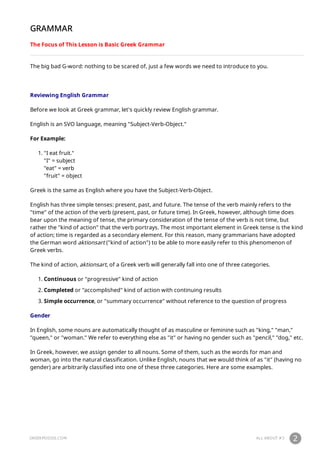
The big bad G-word: nothing to be scared of, just a few words we need to introduce to you.
Reviewing English Grammar
Before we look at Greek grammar, let's quickly review English grammar.
English is an SVO language, meaning "Subject-Verb-Object."
For Example:
1. "I eat fruit."
"I" = subject
"eat" = verb
"fruit" = object
Greek is the same as English where you have the Subject-Verb-Object.
English has three simple tenses: present, past, and future. The tense of the verb mainly refers to the
"time" of the action of the verb (present, past, or future time). In Greek, however, although time does
bear upon the meaning of tense, the primary consideration of the tense of the verb is not time, but
rather the "kind of action" that the verb portrays. The most important element in Greek tense is the kind
of action; time is regarded as a secondary element. For this reason, many grammarians have adopted
the German word aktionsart ("kind of action") to be able to more easily refer to this phenomenon of
Greek verbs.
The kind of action, aktionsart, of a Greek verb will generally fall into one of three categories.
1. Continuous or "progressive" kind of action
2. Completed or "accomplished" kind of action with continuing results
3. Simple occurrence, or "summary occurrence" without reference to the question of progress
Gender
In English, some nouns are automatically thought of as masculine or feminine such as "king," "man,"
"queen," or "woman." We refer to everything else as "it" or having no gender such as "pencil," "dog," etc.
In Greek, however, we assign gender to all nouns. Some of them, such as the words for man and
woman, go into the natural classification. Unlike English, nouns that we would think of as "it" (having no
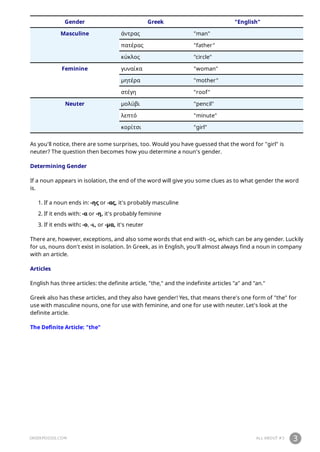
gender) are arbitrarily classified into one of these three categories. Here are some examples.
GREEKPOD101.COM ALL ABOUT #3 3
Gender Greek "English"
Masculine άντρας "man"
πατέρας "father"
κύκλος "circle"
Feminine γυναίκα "woman"
μητέρα "mother"
στέγη "roof"
Neuter μολύβι "pencil"
λεπτό "minute"
κορίτσι "girl"
As you'll notice, there are some surprises, too. Would you have guessed that the word for "girl" is
neuter? The question then becomes how you determine a noun's gender.
Determining Gender
If a noun appears in isolation, the end of the word will give you some clues as to what gender the word
is.
1. If a noun ends in: -ης or -ας, it's probably masculine
2. If it ends with: -α or -η, it's probably feminine
3. If it ends with: -ο, -ι, or -μα, it's neuter
There are, however, exceptions, and also some words that end with -ος, which can be any gender. Luckily
for us, nouns don't exist in isolation. In Greek, as in English, you'll almost always find a noun in company
with an article.
Articles
English has three articles: the definite article, "the," and the indefinite articles "a" and "an."
Greek also has these articles, and they also have gender! Yes, that means there's one form of "the" for
use with masculine nouns, one for use with feminine, and one for use with neuter. Let's look at the
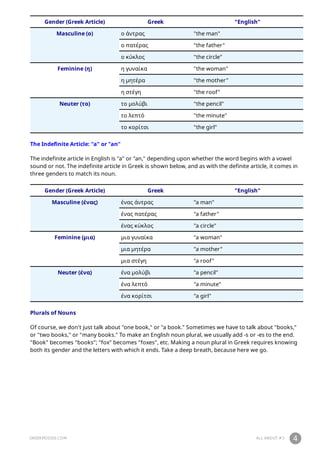
definite article.
The Definite Article: "the"
GREEKPOD101.COM ALL ABOUT #3 4
Gender (Greek Article) Greek "English"
Masculine (ο) ο άντρας "the man"
ο πατέρας "the father"
ο κύκλος "the circle"
Feminine (η) η γυναίκα "the woman"
η μητέρα "the mother"
η στέγη "the roof"
Neuter (το) το μολύβι "the pencil"
το λεπτό "the minute"
το κορίτσι "the girl"
The Indefinite Article: "a" or "an"
The indefinite article in English is "a" or "an," depending upon whether the word begins with a vowel
sound or not. The indefinite article in Greek is shown below, and as with the definite article, it comes in
three genders to match its noun.
Gender (Greek Article) Greek "English"
Masculine (ένας) ένας άντρας "a man"
ένας πατέρας "a father"
ένας κύκλος "a circle"
Feminine (μια) μια γυναίκα "a woman"
μια μητέρα "a mother"
μια στέγη "a roof"
Neuter (ένα) ένα μολύβι "a pencil"
ένα λεπτό "a minute"
ένα κορίτσι "a girl"
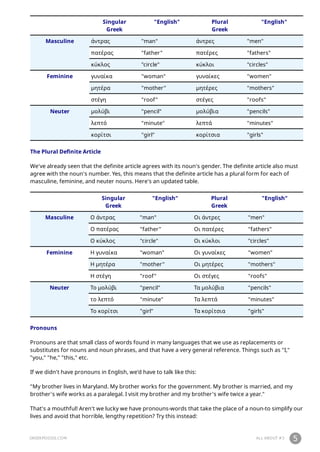
Plurals of Nouns
Of course, we don't just talk about "one book," or "a book." Sometimes we have to talk about "books,"
or "two books," or "many books." To make an English noun plural, we usually add -s or -es to the end.
"Book" becomes "books"; "fox" becomes "foxes", etc. Making a noun plural in Greek requires knowing
both its gender and the letters with which it ends. Take a deep breath, because here we go.
GREEKPOD101.COM ALL ABOUT #3 5
Singular
Greek
"English" Plural
Greek
"English"
Masculine άντρας "man" άντρες "men"
πατέρας "father" πατέρες "fathers"
κύκλος "circle" κύκλοι "circles"
Feminine γυναίκα "woman" γυναίκες "women"
μητέρα "mother" μητέρες "mothers"
στέγη "roof" στέγες "roofs"
Neuter μολύβι "pencil" μολύβια "pencils"
λεπτό "minute" λεπτά "minutes"
κορίτσι "girl" κορίτσια "girls"
The Plural Definite Article
We've already seen that the definite article agrees with its noun's gender. The definite article also must
agree with the noun's number. Yes, this means that the definite article has a plural form for each of
masculine, feminine, and neuter nouns. Here's an updated table.
Singular
Greek
"English" Plural
Greek
"English"
Masculine Ο άντρας "man" Οι άντρες "men"
Ο πατέρας "father" Οι πατέρες "fathers"
Ο κύκλος "circle" Οι κύκλοι "circles"
Feminine Η γυναίκα "woman" Οι γυναίκες "women"
Η μητέρα "mother" Οι μητέρες "mothers"
Η στέγη "roof" Οι στέγες "roofs"
Neuter Το μολύβι "pencil" Τα μολύβια "pencils"
το λεπτό "minute" Τα λεπτά "minutes"
Το κορίτσι "girl" Τα κορίτσια "girls"
Pronouns
Pronouns are that small class of words found in many languages that we use as replacements or
substitutes for nouns and noun phrases, and that have a very general reference. Things such as "I,"
"you," "he," "this," etc.
If we didn't have pronouns in English, we'd have to talk like this:
"My brother lives in Maryland. My brother works for the government. My brother is married, and my
brother's wife works as a paralegal. I visit my brother and my brother's wife twice a year."
That's a mouthful! Aren't we lucky we have pronouns-words that take the place of a noun-to simplify our
lives and avoid that horrible, lengthy repetition? Try this instead:
GREEKPOD101.COM ALL ABOUT #3 6
"My brother lives in Maryland. He works for the government. He is married, and his wife works as a
paralegal. I visit him and his wife twice a year."
Pronouns have person, which tell us who is talking or whom we're talking about. Here's a chart of the
English pronouns.
Singular Plural
First Person "I" "we"
Second Person "you" "you"
Third Person "he"
"she"
"it"
"they"
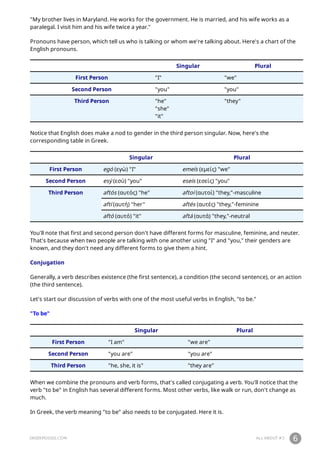
Notice that English does make a nod to gender in the third person singular. Now, here's the
corresponding table in Greek.
Singular Plural
First Person egó (εγώ) "I" emeís (εμείς) "we"
Second Person esý (εσύ) "you" eseís (εσείς) "you"
Third Person aftós (αυτός) "he" aftoí (αυτοί) "they,"-masculine
aftí (αυτή) "her" aftés (αυτές) "they,"-feminine
aftó (αυτό) "it" aftá (αυτά) "they,"-neutral
You'll note that first and second person don't have different forms for masculine, feminine, and neuter.
That's because when two people are talking with one another using "I" and "you," their genders are
known, and they don't need any different forms to give them a hint.
Conjugation
Generally, a verb describes existence (the first sentence), a condition (the second sentence), or an action
(the third sentence).
Let's start our discussion of verbs with one of the most useful verbs in English, "to be."
"To be"
Singular Plural
First Person "I am" "we are"
Second Person "you are" "you are"
Third Person "he, she, it is" "they are"
When we combine the pronouns and verb forms, that's called conjugating a verb. You'll notice that the
verb "to be" in English has several different forms. Most other verbs, like walk or run, don't change as
much.
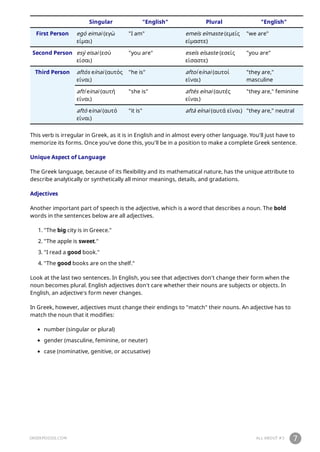
In Greek, the verb meaning "to be" also needs to be conjugated. Here it is.
GREEKPOD101.COM ALL ABOUT #3 7
Singular "English" Plural "English"
First Person egó eimai (εγώ
είμαι)
"I am" emeís eímaste (εμείς
είμαστε)
"we are"
Second Person esý eisai (εσύ
είσαι)
"you are" eseís eísaste (εσείς
είσαστε)
"you are"
Third Person aftós eínai (αυτός
είναι)
"he is" aftoí eínai (αυτοί
είναι)
"they are,"
masculine
aftí einai (αυτή
είναι)
"she is" aftés eínai (αυτές
είναι)
"they are," feminine
aftó einai (αυτό
είναι)
"it is" aftá eínai (αυτά είναι) "they are," neutral
This verb is irregular in Greek, as it is in English and in almost every other language. You'll just have to
memorize its forms. Once you've done this, you'll be in a position to make a complete Greek sentence.
Unique Aspect of Language
The Greek language, because of its flexibility and its mathematical nature, has the unique attribute to
describe analytically or synthetically all minor meanings, details, and gradations.
Adjectives
Another important part of speech is the adjective, which is a word that describes a noun. The bold
words in the sentences below are all adjectives.
1. "The big city is in Greece."
2. "The apple is sweet."
3. "I read a good book."
4. "The good books are on the shelf."
Look at the last two sentences. In English, you see that adjectives don't change their form when the
noun becomes plural. English adjectives don't care whether their nouns are subjects or objects. In
English, an adjective's form never changes.
In Greek, however, adjectives must change their endings to "match" their nouns. An adjective has to
match the noun that it modifies:
number (singular or plural)
gender (masculine, feminine, or neuter)
case (nominative, genitive, or accusative)

Greek study, greek study, greek study.pdf

  • 1.
    GREEKPOD101.COM ALL ABOUT#3 1 LESSON NOTES All About #3 Learn Greek Grammar CONTENTS Grammar 3 #
  • 2.
    GREEKPOD101.COM ALL ABOUT#3 2 GRAMMAR The Focus of This Lesson is Basic Greek Grammar The big bad G-word: nothing to be scared of, just a few words we need to introduce to you. Reviewing English Grammar Before we look at Greek grammar, let's quickly review English grammar. English is an SVO language, meaning "Subject-Verb-Object." For Example: 1. "I eat fruit." "I" = subject "eat" = verb "fruit" = object Greek is the same as English where you have the Subject-Verb-Object. English has three simple tenses: present, past, and future. The tense of the verb mainly refers to the "time" of the action of the verb (present, past, or future time). In Greek, however, although time does bear upon the meaning of tense, the primary consideration of the tense of the verb is not time, but rather the "kind of action" that the verb portrays. The most important element in Greek tense is the kind of action; time is regarded as a secondary element. For this reason, many grammarians have adopted the German word aktionsart ("kind of action") to be able to more easily refer to this phenomenon of Greek verbs. The kind of action, aktionsart, of a Greek verb will generally fall into one of three categories. 1. Continuous or "progressive" kind of action 2. Completed or "accomplished" kind of action with continuing results 3. Simple occurrence, or "summary occurrence" without reference to the question of progress Gender In English, some nouns are automatically thought of as masculine or feminine such as "king," "man," "queen," or "woman." We refer to everything else as "it" or having no gender such as "pencil," "dog," etc. In Greek, however, we assign gender to all nouns. Some of them, such as the words for man and woman, go into the natural classification. Unlike English, nouns that we would think of as "it" (having no gender) are arbitrarily classified into one of these three categories. Here are some examples.
  • 3.
    GREEKPOD101.COM ALL ABOUT#3 3 Gender Greek "English" Masculine άντρας "man" πατέρας "father" κύκλος "circle" Feminine γυναίκα "woman" μητέρα "mother" στέγη "roof" Neuter μολύβι "pencil" λεπτό "minute" κορίτσι "girl" As you'll notice, there are some surprises, too. Would you have guessed that the word for "girl" is neuter? The question then becomes how you determine a noun's gender. Determining Gender If a noun appears in isolation, the end of the word will give you some clues as to what gender the word is. 1. If a noun ends in: -ης or -ας, it's probably masculine 2. If it ends with: -α or -η, it's probably feminine 3. If it ends with: -ο, -ι, or -μα, it's neuter There are, however, exceptions, and also some words that end with -ος, which can be any gender. Luckily for us, nouns don't exist in isolation. In Greek, as in English, you'll almost always find a noun in company with an article. Articles English has three articles: the definite article, "the," and the indefinite articles "a" and "an." Greek also has these articles, and they also have gender! Yes, that means there's one form of "the" for use with masculine nouns, one for use with feminine, and one for use with neuter. Let's look at the definite article. The Definite Article: "the"
  • 4.
    GREEKPOD101.COM ALL ABOUT#3 4 Gender (Greek Article) Greek "English" Masculine (ο) ο άντρας "the man" ο πατέρας "the father" ο κύκλος "the circle" Feminine (η) η γυναίκα "the woman" η μητέρα "the mother" η στέγη "the roof" Neuter (το) το μολύβι "the pencil" το λεπτό "the minute" το κορίτσι "the girl" The Indefinite Article: "a" or "an" The indefinite article in English is "a" or "an," depending upon whether the word begins with a vowel sound or not. The indefinite article in Greek is shown below, and as with the definite article, it comes in three genders to match its noun. Gender (Greek Article) Greek "English" Masculine (ένας) ένας άντρας "a man" ένας πατέρας "a father" ένας κύκλος "a circle" Feminine (μια) μια γυναίκα "a woman" μια μητέρα "a mother" μια στέγη "a roof" Neuter (ένα) ένα μολύβι "a pencil" ένα λεπτό "a minute" ένα κορίτσι "a girl" Plurals of Nouns Of course, we don't just talk about "one book," or "a book." Sometimes we have to talk about "books," or "two books," or "many books." To make an English noun plural, we usually add -s or -es to the end. "Book" becomes "books"; "fox" becomes "foxes", etc. Making a noun plural in Greek requires knowing both its gender and the letters with which it ends. Take a deep breath, because here we go.
  • 5.
    GREEKPOD101.COM ALL ABOUT#3 5 Singular Greek "English" Plural Greek "English" Masculine άντρας "man" άντρες "men" πατέρας "father" πατέρες "fathers" κύκλος "circle" κύκλοι "circles" Feminine γυναίκα "woman" γυναίκες "women" μητέρα "mother" μητέρες "mothers" στέγη "roof" στέγες "roofs" Neuter μολύβι "pencil" μολύβια "pencils" λεπτό "minute" λεπτά "minutes" κορίτσι "girl" κορίτσια "girls" The Plural Definite Article We've already seen that the definite article agrees with its noun's gender. The definite article also must agree with the noun's number. Yes, this means that the definite article has a plural form for each of masculine, feminine, and neuter nouns. Here's an updated table. Singular Greek "English" Plural Greek "English" Masculine Ο άντρας "man" Οι άντρες "men" Ο πατέρας "father" Οι πατέρες "fathers" Ο κύκλος "circle" Οι κύκλοι "circles" Feminine Η γυναίκα "woman" Οι γυναίκες "women" Η μητέρα "mother" Οι μητέρες "mothers" Η στέγη "roof" Οι στέγες "roofs" Neuter Το μολύβι "pencil" Τα μολύβια "pencils" το λεπτό "minute" Τα λεπτά "minutes" Το κορίτσι "girl" Τα κορίτσια "girls" Pronouns Pronouns are that small class of words found in many languages that we use as replacements or substitutes for nouns and noun phrases, and that have a very general reference. Things such as "I," "you," "he," "this," etc. If we didn't have pronouns in English, we'd have to talk like this: "My brother lives in Maryland. My brother works for the government. My brother is married, and my brother's wife works as a paralegal. I visit my brother and my brother's wife twice a year." That's a mouthful! Aren't we lucky we have pronouns-words that take the place of a noun-to simplify our lives and avoid that horrible, lengthy repetition? Try this instead:
  • 6.
    GREEKPOD101.COM ALL ABOUT#3 6 "My brother lives in Maryland. He works for the government. He is married, and his wife works as a paralegal. I visit him and his wife twice a year." Pronouns have person, which tell us who is talking or whom we're talking about. Here's a chart of the English pronouns. Singular Plural First Person "I" "we" Second Person "you" "you" Third Person "he" "she" "it" "they" Notice that English does make a nod to gender in the third person singular. Now, here's the corresponding table in Greek. Singular Plural First Person egó (εγώ) "I" emeís (εμείς) "we" Second Person esý (εσύ) "you" eseís (εσείς) "you" Third Person aftós (αυτός) "he" aftoí (αυτοί) "they,"-masculine aftí (αυτή) "her" aftés (αυτές) "they,"-feminine aftó (αυτό) "it" aftá (αυτά) "they,"-neutral You'll note that first and second person don't have different forms for masculine, feminine, and neuter. That's because when two people are talking with one another using "I" and "you," their genders are known, and they don't need any different forms to give them a hint. Conjugation Generally, a verb describes existence (the first sentence), a condition (the second sentence), or an action (the third sentence). Let's start our discussion of verbs with one of the most useful verbs in English, "to be." "To be" Singular Plural First Person "I am" "we are" Second Person "you are" "you are" Third Person "he, she, it is" "they are" When we combine the pronouns and verb forms, that's called conjugating a verb. You'll notice that the verb "to be" in English has several different forms. Most other verbs, like walk or run, don't change as much. In Greek, the verb meaning "to be" also needs to be conjugated. Here it is.
  • 7.
    GREEKPOD101.COM ALL ABOUT#3 7 Singular "English" Plural "English" First Person egó eimai (εγώ είμαι) "I am" emeís eímaste (εμείς είμαστε) "we are" Second Person esý eisai (εσύ είσαι) "you are" eseís eísaste (εσείς είσαστε) "you are" Third Person aftós eínai (αυτός είναι) "he is" aftoí eínai (αυτοί είναι) "they are," masculine aftí einai (αυτή είναι) "she is" aftés eínai (αυτές είναι) "they are," feminine aftó einai (αυτό είναι) "it is" aftá eínai (αυτά είναι) "they are," neutral This verb is irregular in Greek, as it is in English and in almost every other language. You'll just have to memorize its forms. Once you've done this, you'll be in a position to make a complete Greek sentence. Unique Aspect of Language The Greek language, because of its flexibility and its mathematical nature, has the unique attribute to describe analytically or synthetically all minor meanings, details, and gradations. Adjectives Another important part of speech is the adjective, which is a word that describes a noun. The bold words in the sentences below are all adjectives. 1. "The big city is in Greece." 2. "The apple is sweet." 3. "I read a good book." 4. "The good books are on the shelf." Look at the last two sentences. In English, you see that adjectives don't change their form when the noun becomes plural. English adjectives don't care whether their nouns are subjects or objects. In English, an adjective's form never changes. In Greek, however, adjectives must change their endings to "match" their nouns. An adjective has to match the noun that it modifies: number (singular or plural) gender (masculine, feminine, or neuter) case (nominative, genitive, or accusative)