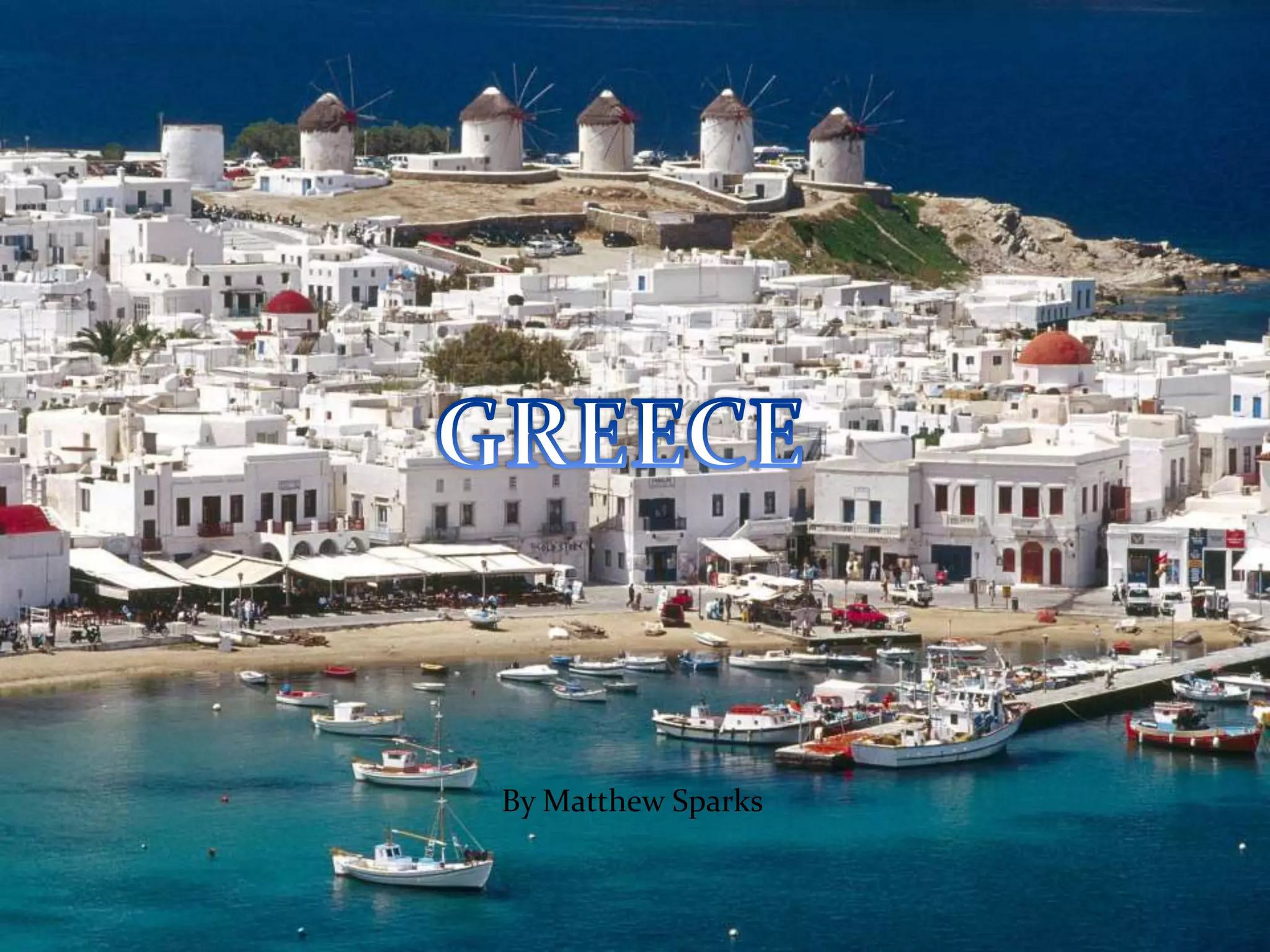
By Matthew Sparks
Physical Characteristics
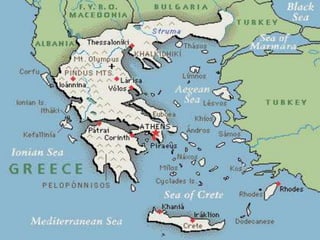
 Greece is about 131,957 sq km
 Western Greece has a number of lakes, rivers and
  wetlands. Off the coast of Greece, there are numerous
  islands, with some of the more famous including Crete
  and Rhodes.
 Greece is one of the most mountainous countries in
  Europe - in fact, 80% of the land is either mountains
  or hills.
Facts
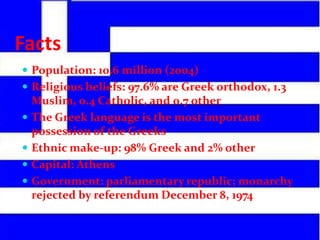
 Population: 10.6 million (2004)
 Religious beliefs: 97.6% are Greek orthodox, 1.3
    Muslim, 0.4 Catholic, and 0.7 other
   The Greek language is the most important
    possession of the Greeks
   Ethnic make-up: 98% Greek and 2% other
   Capital: Athens
   Government: parliamentary republic; monarchy
    rejected by referendum December 8, 1974
Customs & Traditions
 Traditions in Greece and Greek Islands are either religious or
  coming from paganism. Most of the traditions and festivals still
  followed and celebrated today are religious. That is why so many
  panygiria(Greek word for festival) are organized in the country,
  which are actually religious celebrations of saints followed by
  traditional music and dance in the square of the village.

 Many Greeks are very superstitious people and believe a lot in
  religion as well as in supernatural or paranormal occurences.
  This impresses many visitors who travel in Greece. For example,
  some people believe it is bad luck to see a black car, it is 7 years
  bad luck to break a glass or mirror, while others knock their
  fingers against wood if they have a bad thought.
Greek Mythology
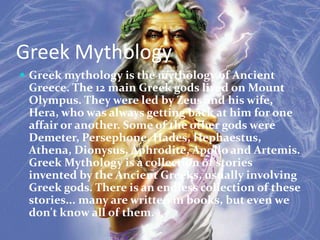
 Greek mythology is the mythology of Ancient
 Greece. The 12 main Greek gods lived on Mount
 Olympus. They were led by Zeus and his wife,
 Hera, who was always getting back at him for one
 affair or another. Some of the other gods were
 Demeter, Persephone, Hades, Hephaestus,
 Athena, Dionysus, Aphrodite, Apollo and Artemis.
 Greek Mythology is a collection of stories
 invented by the Ancient Greeks, usually involving
 Greek gods. There is an endless collection of these
 stories... many are written in books, but even we
 don't know all of them.
THE END

Greece presentation

  • 1.
  • 2.
    Physical Characteristics  Greeceis about 131,957 sq km  Western Greece has a number of lakes, rivers and wetlands. Off the coast of Greece, there are numerous islands, with some of the more famous including Crete and Rhodes.  Greece is one of the most mountainous countries in Europe - in fact, 80% of the land is either mountains or hills.
  • 4.
    Facts  Population: 10.6million (2004)  Religious beliefs: 97.6% are Greek orthodox, 1.3 Muslim, 0.4 Catholic, and 0.7 other  The Greek language is the most important possession of the Greeks  Ethnic make-up: 98% Greek and 2% other  Capital: Athens  Government: parliamentary republic; monarchy rejected by referendum December 8, 1974
  • 5.
    Customs & Traditions Traditions in Greece and Greek Islands are either religious or coming from paganism. Most of the traditions and festivals still followed and celebrated today are religious. That is why so many panygiria(Greek word for festival) are organized in the country, which are actually religious celebrations of saints followed by traditional music and dance in the square of the village.  Many Greeks are very superstitious people and believe a lot in religion as well as in supernatural or paranormal occurences. This impresses many visitors who travel in Greece. For example, some people believe it is bad luck to see a black car, it is 7 years bad luck to break a glass or mirror, while others knock their fingers against wood if they have a bad thought.
  • 6.
    Greek Mythology  Greekmythology is the mythology of Ancient Greece. The 12 main Greek gods lived on Mount Olympus. They were led by Zeus and his wife, Hera, who was always getting back at him for one affair or another. Some of the other gods were Demeter, Persephone, Hades, Hephaestus, Athena, Dionysus, Aphrodite, Apollo and Artemis. Greek Mythology is a collection of stories invented by the Ancient Greeks, usually involving Greek gods. There is an endless collection of these stories... many are written in books, but even we don't know all of them.
  • 7.