SWAMI VIVEKANAND COLLEGE OF PHARMACY,
INDORE
Presentation on
Gastro Retentive Drug Delivery System
Submitted by- Nishtha Ugave
M.Pharmacy (Ist Sem)
0826PY22MP23
CONTENTS
 Introduction
 Need of gastric retention
 Advantages
 Limitation
 Physiology of stomach
 Approaches of gastric retention
 Conclusion
INTRODUCTION
 Oral drug administration has been the predominant
route for drug delivery.
 Gastric residence is time which a drug resides in
stomach.
 Depends upon fluid and food intake.
 GRDDS are designed to delay gastric emptying.
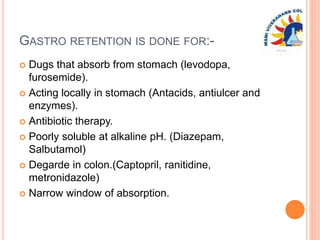
GASTRO RETENTION IS DONE FOR:-
 Dugs that absorb from stomach (levodopa,
furosemide).
 Acting locally in stomach (Antacids, antiulcer and
enzymes).
 Antibiotic therapy.
 Poorly soluble at alkaline pH. (Diazepam,
Salbutamol)
 Degarde in colon.(Captopril, ranitidine,
metronidazole)
 Narrow window of absorption.
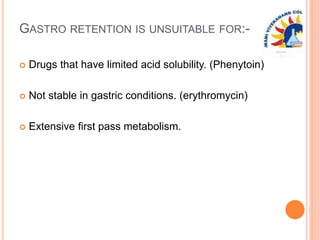
GASTRO RETENTION IS UNSUITABLE FOR:-
 Drugs that have limited acid solubility. (Phenytoin)
 Not stable in gastric conditions. (erythromycin)
 Extensive first pass metabolism.
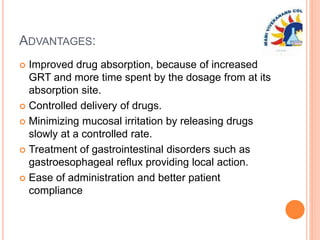
ADVANTAGES:
 Improved drug absorption, because of increased
GRT and more time spent by the dosage from at its
absorption site.
 Controlled delivery of drugs.
 Minimizing mucosal irritation by releasing drugs
slowly at a controlled rate.
 Treatment of gastrointestinal disorders such as
gastroesophageal reflux providing local action.
 Ease of administration and better patient
compliance
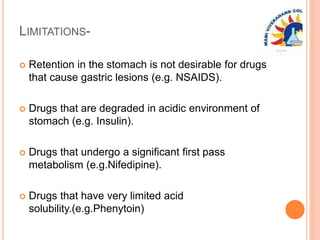
LIMITATIONS-
 Retention in the stomach is not desirable for drugs
that cause gastric lesions (e.g. NSAIDS).
 Drugs that are degraded in acidic environment of
stomach (e.g. Insulin).
 Drugs that undergo a significant first pass
metabolism (e.g.Nifedipine).
 Drugs that have very limited acid
solubility.(e.g.Phenytoin)
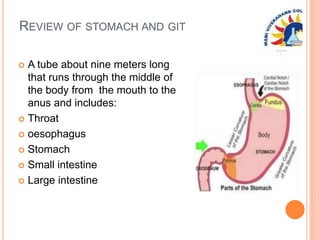
REVIEW OF STOMACH AND GIT
 A tube about nine meters long
that runs through the middle of
the body from the mouth to the
anus and includes:
 Throat
 oesophagus
 Stomach
 Small intestine
 Large intestine
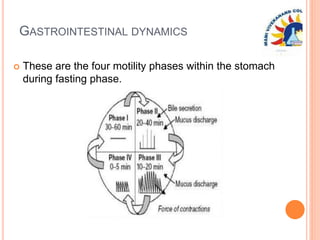
GASTROINTESTINAL DYNAMICS
 These are the four motility phases within the stomach
during fasting phase.
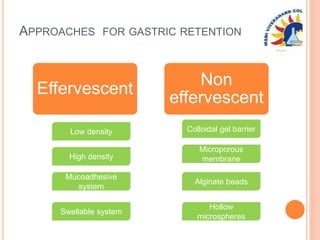
APPROACHES FOR GASTRIC RETENTION
Effervescent
Non
effervescent
Low density
Mucoadhesive
system
Swellable system
Hollow
microspheres
Alginate beads
Microporous
membrane
Colloidal gel barrier
High density
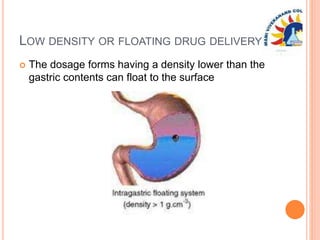
LOW DENSITY OR FLOATING DRUG DELIVERY
 The dosage forms having a density lower than the
gastric contents can float to the surface
HIGH DENSITY SYSTEM
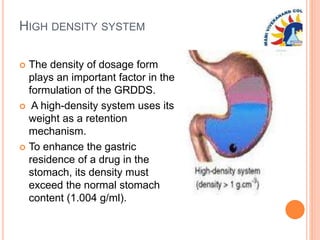
 The density of dosage form
plays an important factor in the
formulation of the GRDDS.
 A high-density system uses its
weight as a retention
mechanism.
 To enhance the gastric
residence of a drug in the
stomach, its density must
exceed the normal stomach
content (1.004 g/ml).
MUCOADHESION SYSTEM
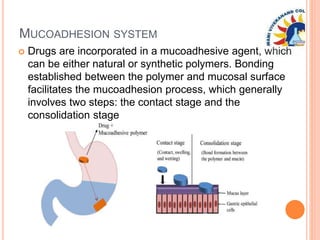
 Drugs are incorporated in a mucoadhesive agent, which
can be either natural or synthetic polymers. Bonding
established between the polymer and mucosal surface
facilitates the mucoadhesion process, which generally
involves two steps: the contact stage and the
consolidation stage
SWELLABLE SYSTEM
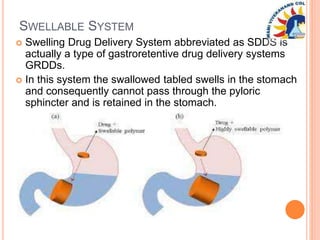
 Swelling Drug Delivery System abbreviated as SDDS is
actually a type of gastroretentive drug delivery systems
GRDDs.
 In this system the swallowed tabled swells in the stomach
and consequently cannot pass through the pyloric
sphincter and is retained in the stomach.
NON EFFERVESCENT SYSTEM
COLLOIDAL GEL BARRIER SYSTEM
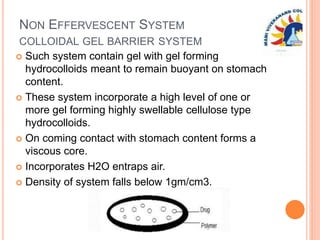
 Such system contain gel with gel forming
hydrocolloids meant to remain buoyant on stomach
content.
 These system incorporate a high level of one or
more gel forming highly swellable cellulose type
hydrocolloids.
 On coming contact with stomach content forms a
viscous core.
 Incorporates H2O entraps air.
 Density of system falls below 1gm/cm3.
MICRO POROUS MEMBRANE SYSTEM
 Based on the encapsulation of drug reservoir inside
a Microporous compartment.
 The peripheral walls of the drug reservoir
compartment are completely sealed to prevent any
direct contact of the gastric
 Mucosal surface with the undissolved drug.
 In stomach the floatation chamber containing
entrapped air causes the delivery system to float
over the gastric contents.
 Gastric fluid enters through the apertures, dissolves
the drug and carries the dissolve drug for
absorption.
ALGINATE BEADS
 Spherical beads of approximately 2.5 mm in
diameter can be prepared by dropping
 A sodium alginate solution in to aqueous solutions
of calcium chloride, causing precipitation
 Of calcium alginate.
 Sodium alginate + Calcium chloride calcium
alginate + NaCl.
 The beads are then separated snap and frozen in
liquid nitrogen, and freeze dried at -40 ⁰ C for 24
 Hours, leading to the formation of porous system.
 Maintain a floating force of over 12 hours.
HOLLOW MICROSPHERES
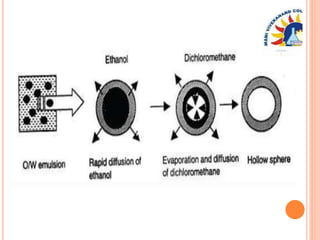
 Microballoons / hollow microsphere loaded with
drugs are prepared by simple
 Solvent by simple solvent evaporation method.
 Commonly used polymers to develop these
systems are polycarbonate, cellulose acetate,
 Calcium alginate, Eudragit S, agar and pectin etc.
 These systems have capacity to float on acidic
dissolution media containing surfactant for about 12
hours invito.
CONCLUSION
 GRDDS are the most preferable system in order to
deliver the drugs. Which have a narrow absorption
window near the gastric region. Now a days a
number of drug delivery. Devices are being
developed which aim at releasing the drug at
gastric region. Even though these drug. Delivery
systems have several advantages they also have
disadvantages like their in vitro-in vivo correlation is
very less
GRDDS.pptx

GRDDS.pptx

  • 1.
    SWAMI VIVEKANAND COLLEGEOF PHARMACY, INDORE Presentation on Gastro Retentive Drug Delivery System Submitted by- Nishtha Ugave M.Pharmacy (Ist Sem) 0826PY22MP23
  • 2.
    CONTENTS  Introduction  Needof gastric retention  Advantages  Limitation  Physiology of stomach  Approaches of gastric retention  Conclusion
  • 3.
    INTRODUCTION  Oral drugadministration has been the predominant route for drug delivery.  Gastric residence is time which a drug resides in stomach.  Depends upon fluid and food intake.  GRDDS are designed to delay gastric emptying.
  • 4.
    GASTRO RETENTION ISDONE FOR:-  Dugs that absorb from stomach (levodopa, furosemide).  Acting locally in stomach (Antacids, antiulcer and enzymes).  Antibiotic therapy.  Poorly soluble at alkaline pH. (Diazepam, Salbutamol)  Degarde in colon.(Captopril, ranitidine, metronidazole)  Narrow window of absorption.
  • 5.
    GASTRO RETENTION ISUNSUITABLE FOR:-  Drugs that have limited acid solubility. (Phenytoin)  Not stable in gastric conditions. (erythromycin)  Extensive first pass metabolism.
  • 6.
    ADVANTAGES:  Improved drugabsorption, because of increased GRT and more time spent by the dosage from at its absorption site.  Controlled delivery of drugs.  Minimizing mucosal irritation by releasing drugs slowly at a controlled rate.  Treatment of gastrointestinal disorders such as gastroesophageal reflux providing local action.  Ease of administration and better patient compliance
  • 7.
    LIMITATIONS-  Retention inthe stomach is not desirable for drugs that cause gastric lesions (e.g. NSAIDS).  Drugs that are degraded in acidic environment of stomach (e.g. Insulin).  Drugs that undergo a significant first pass metabolism (e.g.Nifedipine).  Drugs that have very limited acid solubility.(e.g.Phenytoin)
  • 8.
    REVIEW OF STOMACHAND GIT  A tube about nine meters long that runs through the middle of the body from the mouth to the anus and includes:  Throat  oesophagus  Stomach  Small intestine  Large intestine
  • 9.
    GASTROINTESTINAL DYNAMICS  Theseare the four motility phases within the stomach during fasting phase.
  • 10.
    APPROACHES FOR GASTRICRETENTION Effervescent Non effervescent Low density Mucoadhesive system Swellable system Hollow microspheres Alginate beads Microporous membrane Colloidal gel barrier High density
  • 11.
    LOW DENSITY ORFLOATING DRUG DELIVERY  The dosage forms having a density lower than the gastric contents can float to the surface
  • 12.
    HIGH DENSITY SYSTEM The density of dosage form plays an important factor in the formulation of the GRDDS.  A high-density system uses its weight as a retention mechanism.  To enhance the gastric residence of a drug in the stomach, its density must exceed the normal stomach content (1.004 g/ml).
  • 13.
    MUCOADHESION SYSTEM  Drugsare incorporated in a mucoadhesive agent, which can be either natural or synthetic polymers. Bonding established between the polymer and mucosal surface facilitates the mucoadhesion process, which generally involves two steps: the contact stage and the consolidation stage
  • 14.
    SWELLABLE SYSTEM  SwellingDrug Delivery System abbreviated as SDDS is actually a type of gastroretentive drug delivery systems GRDDs.  In this system the swallowed tabled swells in the stomach and consequently cannot pass through the pyloric sphincter and is retained in the stomach.
  • 15.
    NON EFFERVESCENT SYSTEM COLLOIDALGEL BARRIER SYSTEM  Such system contain gel with gel forming hydrocolloids meant to remain buoyant on stomach content.  These system incorporate a high level of one or more gel forming highly swellable cellulose type hydrocolloids.  On coming contact with stomach content forms a viscous core.  Incorporates H2O entraps air.  Density of system falls below 1gm/cm3.
  • 16.
    MICRO POROUS MEMBRANESYSTEM  Based on the encapsulation of drug reservoir inside a Microporous compartment.  The peripheral walls of the drug reservoir compartment are completely sealed to prevent any direct contact of the gastric  Mucosal surface with the undissolved drug.  In stomach the floatation chamber containing entrapped air causes the delivery system to float over the gastric contents.  Gastric fluid enters through the apertures, dissolves the drug and carries the dissolve drug for absorption.
  • 17.
    ALGINATE BEADS  Sphericalbeads of approximately 2.5 mm in diameter can be prepared by dropping  A sodium alginate solution in to aqueous solutions of calcium chloride, causing precipitation  Of calcium alginate.  Sodium alginate + Calcium chloride calcium alginate + NaCl.  The beads are then separated snap and frozen in liquid nitrogen, and freeze dried at -40 ⁰ C for 24  Hours, leading to the formation of porous system.  Maintain a floating force of over 12 hours.
  • 18.
    HOLLOW MICROSPHERES  Microballoons/ hollow microsphere loaded with drugs are prepared by simple  Solvent by simple solvent evaporation method.  Commonly used polymers to develop these systems are polycarbonate, cellulose acetate,  Calcium alginate, Eudragit S, agar and pectin etc.  These systems have capacity to float on acidic dissolution media containing surfactant for about 12 hours invito.
  • 20.
    CONCLUSION  GRDDS arethe most preferable system in order to deliver the drugs. Which have a narrow absorption window near the gastric region. Now a days a number of drug delivery. Devices are being developed which aim at releasing the drug at gastric region. Even though these drug. Delivery systems have several advantages they also have disadvantages like their in vitro-in vivo correlation is very less