CAPSTONE PROJECT PLANNING
In Partial Fulfillment & Diploma in Mechanical Engineering
Guided by : B. M. GITTE
Project Member
1.Pandit Sarthak Rajendra
2.Patange Samarth Umesh
3.Patil Saurabh Santosh
4.Pawar Hariom Bharat
GOVERNMENT POLYTECHNIC COLLEGE, BEED
TITLE OF PROJECT
GRAVITY BATTERY
INTRODUCTION
A gravity battery is a type of energy
storage system that harnesses the force
of gravity to store and release energy.
The concept is similar to traditional
pumped hydroelectric storage but uses a
different mechanism. Gravity batteries
work by raising a mass (such as a large
weight) to a certain height when excess
energy is available (e.g., from renewable
sources like wind or solar). This process
stores potential energy in the raised
mass. When energy is needed, the mass
is lowered, and the potential energy is
converted back into electricity, typically
through a generator.
MARKET SURVEY
The market for gravity batteries, a form of energy storage that leverages gravitational
potential energy, is experiencing significant growth due to the rising demand for
renewable energy storage solutions. Gravity batteries are particularly attractive for
their long-duration energy storage capabilities and minimal environmental impact.Key
players in the market include Energy Vault, Gravitricity, Gravity Power, and Advanced
Rail Energy Storage (ARES). These companies are driving innovation through various
technological advancements, such as scalable systems and integration with renewable
energy grids. For example, Energy Vault’s recent developments in modular gravity
battery systems have made the technology more commercially viable and adaptable to
different geographies
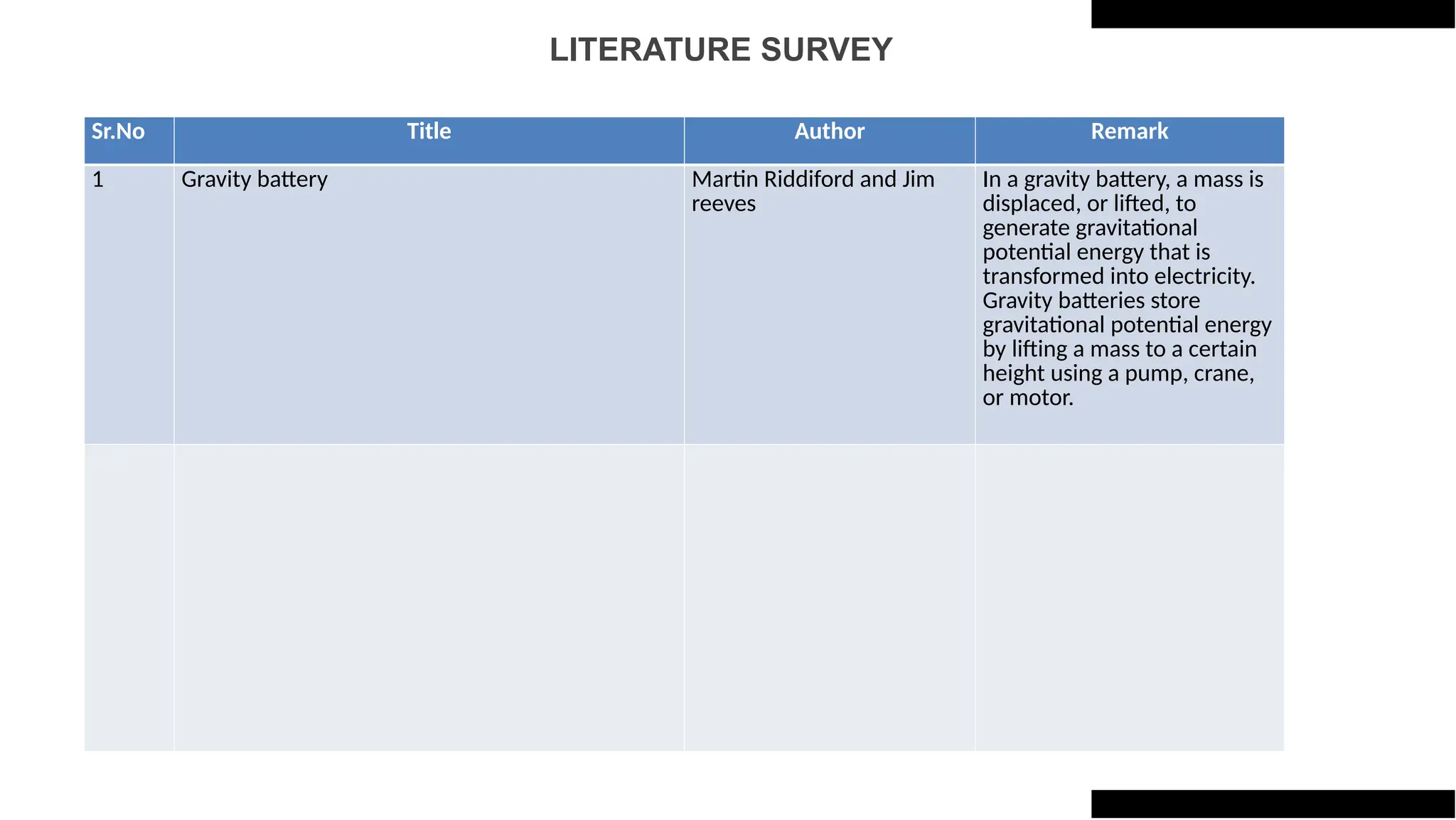
LITERATURE SURVEY
Sr.No Title Author Remark
1 Gravity battery Martin Riddiford and Jim
reeves
In a gravity battery, a mass is
displaced, or lifted, to
generate gravitational
potential energy that is
transformed into electricity.
Gravity batteries store
gravitational potential energy
by lifting a mass to a certain
height using a pump, crane,
or motor.
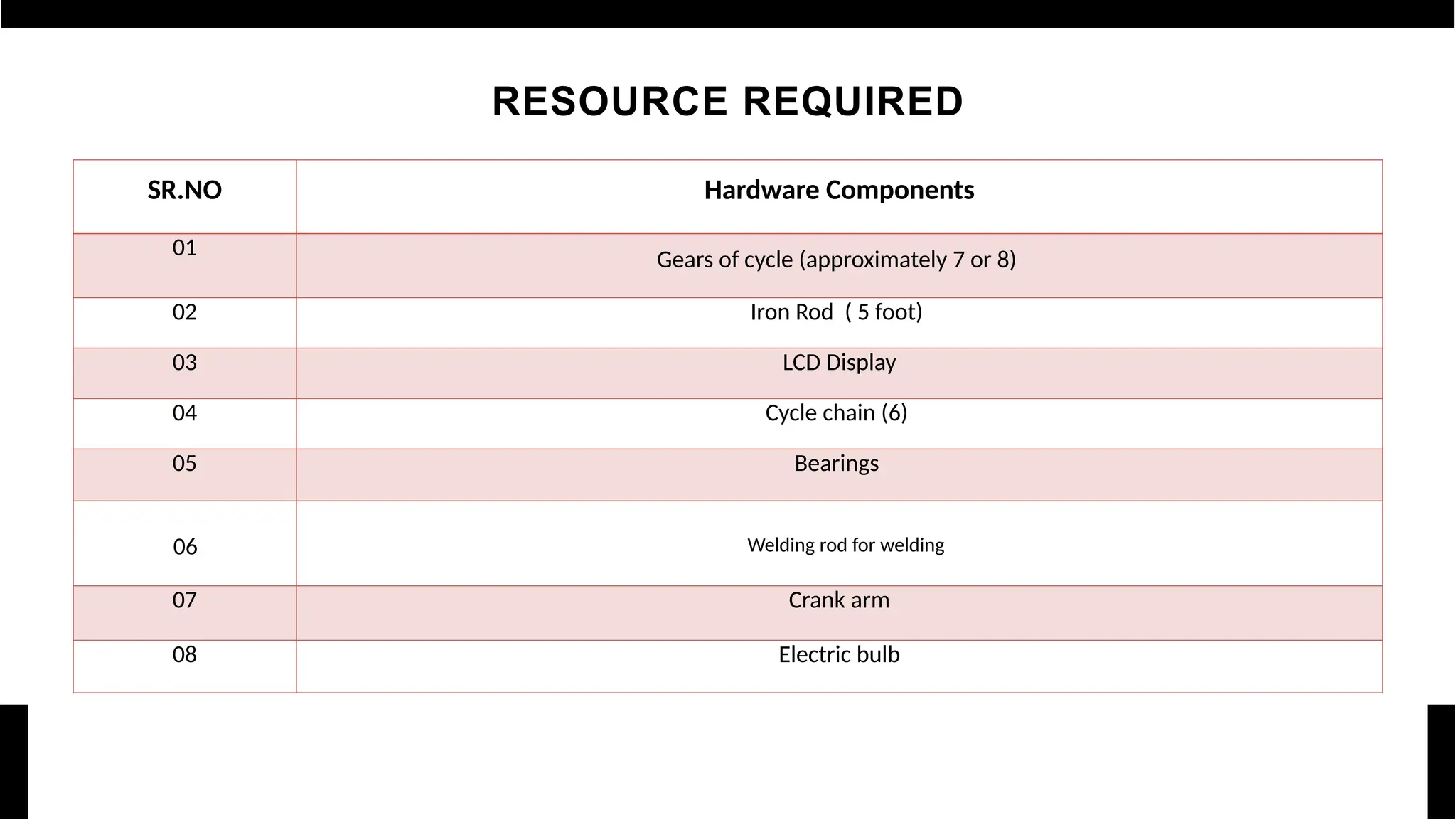
RESOURCE REQUIRED
SR.NO Hardware Components
01 Gears of cycle (approximately 7 or 8)
02 Iron Rod ( 5 foot)
03 LCD Display
04 Cycle chain (6)
05 Bearings
07 Crank arm
08 Electric bulb
Welding rod for welding
06
PROPOSED ACTION PLAN
Week 1: Research and design
Objective: Gather knowledge and finalize the design.
Tasks:
Study the basic principles of gravity batteries, especially their physics and engineering requirements.Research existing prototypes for inspiration (e.g.,
Energy Vault, Gravitricity).Identify potential materials and components you’ll need.Create a basic sketch or CAD model of the gravity battery system,
including the mechanism to lift/lower the weight and how it connects to a generator.Identify the storage medium (rocks, steel weights, or water).Develop a
budget and source materials.
Week 2: Sourcing and Preparing Materials
Objective: the materials and equipment necessary for construction
Tasks :Finalize a bill of materials (BOM) based on the design.Source materials such as weights, pulleys, ropes, gears, generators,
etc.Check if you need specialized equipment (e.g., cranes or winches) for lifting the weights.Arrange tools and a workspace for the
build.Test all the components for compatibility.
Week 3: Building the Structure and Lifting Mechanism
Objective: Construct the basic mechanical structure.
Tasks:Build the supporting frame and base of the gravity battery.Construct the pulley or gear system that will lift and lower the
weight.Install a reliable brake or clutch mechanism to control the lowering speed.
Week 4: Building the Energy Conversion System
Objective: Install the generator and energy conversion system
Tasks :Connect the mechanical components to a generator.Build or buy an alternator or dynamo capable of converting mechanical
energy into electrical energy.Ensure the rotation of the pulley system is compatible with the generator input.Install electrical components for
power output.Run tests by lifting and lowering the weight to see if energy is being stored and released effectively.
THANK YOU !

Gravity battery for free electricity generation using cycle and gear

  • 1.
    CAPSTONE PROJECT PLANNING InPartial Fulfillment & Diploma in Mechanical Engineering Guided by : B. M. GITTE Project Member 1.Pandit Sarthak Rajendra 2.Patange Samarth Umesh 3.Patil Saurabh Santosh 4.Pawar Hariom Bharat GOVERNMENT POLYTECHNIC COLLEGE, BEED
  • 2.
  • 3.
    INTRODUCTION A gravity batteryis a type of energy storage system that harnesses the force of gravity to store and release energy. The concept is similar to traditional pumped hydroelectric storage but uses a different mechanism. Gravity batteries work by raising a mass (such as a large weight) to a certain height when excess energy is available (e.g., from renewable sources like wind or solar). This process stores potential energy in the raised mass. When energy is needed, the mass is lowered, and the potential energy is converted back into electricity, typically through a generator.
  • 4.
    MARKET SURVEY The marketfor gravity batteries, a form of energy storage that leverages gravitational potential energy, is experiencing significant growth due to the rising demand for renewable energy storage solutions. Gravity batteries are particularly attractive for their long-duration energy storage capabilities and minimal environmental impact.Key players in the market include Energy Vault, Gravitricity, Gravity Power, and Advanced Rail Energy Storage (ARES). These companies are driving innovation through various technological advancements, such as scalable systems and integration with renewable energy grids. For example, Energy Vault’s recent developments in modular gravity battery systems have made the technology more commercially viable and adaptable to different geographies
  • 5.
    LITERATURE SURVEY Sr.No TitleAuthor Remark 1 Gravity battery Martin Riddiford and Jim reeves In a gravity battery, a mass is displaced, or lifted, to generate gravitational potential energy that is transformed into electricity. Gravity batteries store gravitational potential energy by lifting a mass to a certain height using a pump, crane, or motor.
  • 6.
    RESOURCE REQUIRED SR.NO HardwareComponents 01 Gears of cycle (approximately 7 or 8) 02 Iron Rod ( 5 foot) 03 LCD Display 04 Cycle chain (6) 05 Bearings 07 Crank arm 08 Electric bulb Welding rod for welding 06
  • 7.
    PROPOSED ACTION PLAN Week1: Research and design Objective: Gather knowledge and finalize the design. Tasks: Study the basic principles of gravity batteries, especially their physics and engineering requirements.Research existing prototypes for inspiration (e.g., Energy Vault, Gravitricity).Identify potential materials and components you’ll need.Create a basic sketch or CAD model of the gravity battery system, including the mechanism to lift/lower the weight and how it connects to a generator.Identify the storage medium (rocks, steel weights, or water).Develop a budget and source materials. Week 2: Sourcing and Preparing Materials Objective: the materials and equipment necessary for construction Tasks :Finalize a bill of materials (BOM) based on the design.Source materials such as weights, pulleys, ropes, gears, generators, etc.Check if you need specialized equipment (e.g., cranes or winches) for lifting the weights.Arrange tools and a workspace for the build.Test all the components for compatibility. Week 3: Building the Structure and Lifting Mechanism Objective: Construct the basic mechanical structure. Tasks:Build the supporting frame and base of the gravity battery.Construct the pulley or gear system that will lift and lower the weight.Install a reliable brake or clutch mechanism to control the lowering speed. Week 4: Building the Energy Conversion System Objective: Install the generator and energy conversion system Tasks :Connect the mechanical components to a generator.Build or buy an alternator or dynamo capable of converting mechanical energy into electrical energy.Ensure the rotation of the pulley system is compatible with the generator input.Install electrical components for power output.Run tests by lifting and lowering the weight to see if energy is being stored and released effectively.
  • 8.