1
2 
Table of Contents 
USING GRAPHIC NOVELS WITH CHILDREN 5 
A GUIDE FOR TEACHERS 5 
DEFINITION 5 
WHY DO WE USE GRAPHIC NOVELS? 5 
VISUAL FEATURES OF GRAPHIC NOVELS 6 
INTRODUCING THE BOOK 11 
REVOLVING AROUND THE TEXT 11 
EXPLORING THE FRONT COVER 11 
EXPLORING THE BACK COVER 12 
SYNOPSIS 13 
CHARACTERS IN THE BOOK 15 
SUPPORTING CHARACTERS 16 
DESCRIPTION 17 
SETTING/PLACE OF THE STORY 19 
EVENTS IN THE STORY 20 
MESSAGE/MORAL OF THE STORY 21 
REVOLVING AROUND THE TEXT 23 
WHAT’S ON THE COVER 23 
JUMBLED UP ANIMALS 27 
A WALK ALONG THE JUNGLE PATH 29 
SYPNOSIS 32 
WHAT HAPPENS NEXT? 32 
PICTURE ARRANGEMENT 35 
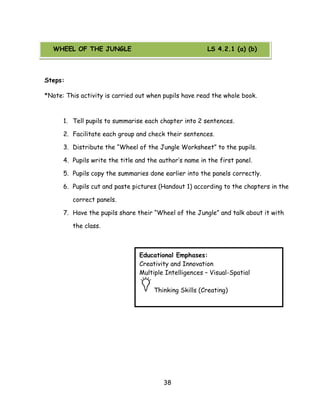
WHEEL OF THE JUNGLE 38 
CHARACTERS IN THE STORY 41 
CHARACTER REPORT CARD 41 
PRODUCING A MASK 44 
FREEZE AND GUESS 48 
MIRROR EXERCISE 49 
SETTINGS 50 
WHO LIVES IN THE CAVE? 50 
MEETING AKELA 52 
HERE OR THERE 54 
MY JUNGLE BOOK 56
3 
EVENTS IN THE STORY 59 
ROLE PLAY 59 
MONKEY POEM 60 
BEWARE MOWGLI 62 
THE RED FLOWER 63 
MOWGLI, MOWGLI WHAT DO YOU DO? 65 
TELL ME WHY 67 
LET’S GET SHERE KHAN 68 
AKELA’S DEATH 70 
LETTER TO MOWGLI 72 
MORAL VALUES / MESSAGE OF THE STORY 74 
CHARACTER BINGO 74 
MAKING A POSTER 77 
BRAINSTORMING 79 
GOING BEYOND THE TEXT 82 
SORT OF SORTS 82 
READERS’ THEATRE 84 
JUNGLE SCRAPBOOK 89 
CREATE YOUR OWN ANIMAL (ADVANCED PUPILS) 91 
THEATRICAL VOCABULARY WORD SEARCH (ADVANCED PUPILS) 92 
MOVIE POSTER (AVERAGE/ADVANCED PUPILS) 94 
CHORAL SPEAKING 95 
LIFE BEYOND THE JUNGLE 99 
SAMPLE LESSON PLANS 102 
LESSON PLAN 1 102 
LESSON PLAN 2 112 
LESSON PLAN 3 120 
EXAMPLES FOR ASSESSMENT 127 
PUPIL’S SELF REFLECTION 127
4
5 
USING GRAPHIC NOVELS WITH CHILDREN 
A Guide for Teachers 
Definition 
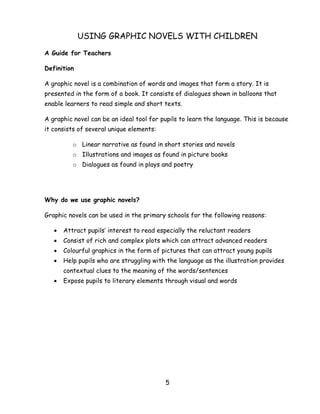
A graphic novel is a combination of words and images that form a story. It is presented in the form of a book. It consists of dialogues shown in balloons that enable learners to read simple and short texts. 
A graphic novel can be an ideal tool for pupils to learn the language. This is because it consists of several unique elements: 
o Linear narrative as found in short stories and novels 
o Illustrations and images as found in picture books 
o Dialogues as found in plays and poetry 
Why do we use graphic novels? 
Graphic novels can be used in the primary schools for the following reasons: 
 Attract pupils‘ interest to read especially the reluctant readers 
 Consist of rich and complex plots which can attract advanced readers 
 Colourful graphics in the form of pictures that can attract young pupils 
 Help pupils who are struggling with the language as the illustration provides contextual clues to the meaning of the words/sentences 
 Expose pupils to literary elements through visual and words
6 
Visual Features of Graphic Novels 
Graphic novels consist of various features which one needs to know. These features are elaborated below. 
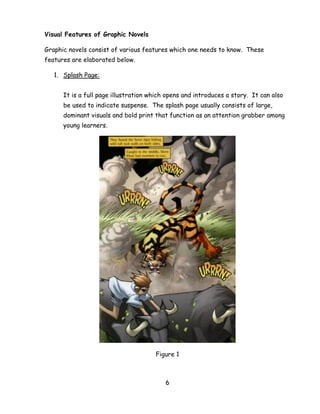
1. Splash Page: 
It is a full page illustration which opens and introduces a story. It can also be used to indicate suspense. The splash page usually consists of large, dominant visuals and bold print that function as an attention grabber among young learners. 
Figure 1
7 
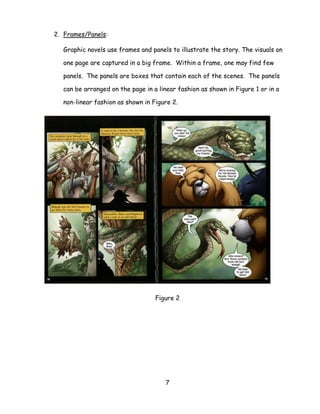
2. Frames/Panels: 
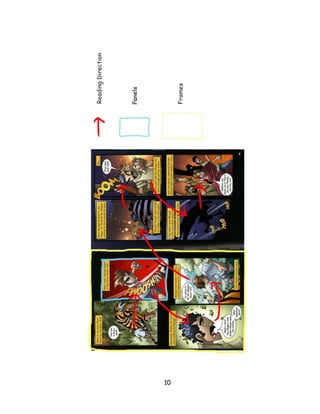
Graphic novels use frames and panels to illustrate the story. The visuals on one page are captured in a big frame. Within a frame, one may find few panels. The panels are boxes that contain each of the scenes. The panels can be arranged on the page in a linear fashion as shown in Figure 1 or in a non-linear fashion as shown in Figure 2. 
Figure 2
8 
3. Font Sizes, Colours, and Styles: 
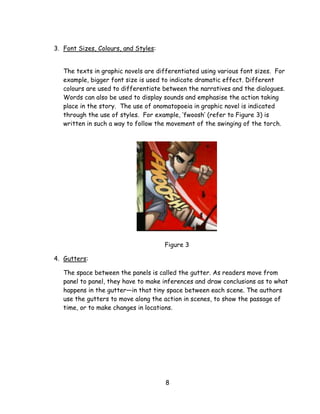
The texts in graphic novels are differentiated using various font sizes. For example, bigger font size is used to indicate dramatic effect. Different colours are used to differentiate between the narratives and the dialogues. Words can also be used to display sounds and emphasise the action taking place in the story. The use of onomatopoeia in graphic novel is indicated through the use of styles. For example, ‗fwoosh‘ (refer to Figure 3) is written in such a way to follow the movement of the swinging of the torch. 
Figure 3 
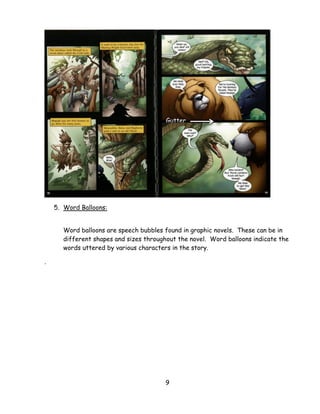
4. Gutters: 
The space between the panels is called the gutter. As readers move from panel to panel, they have to make inferences and draw conclusions as to what happens in the gutter—in that tiny space between each scene. The authors use the gutters to move along the action in scenes, to show the passage of time, or to make changes in locations.
9 
5. Word Balloons: 
Word balloons are speech bubbles found in graphic novels. These can be in different shapes and sizes throughout the novel. Word balloons indicate the words uttered by various characters in the story. 
. 
Gutter
10
11 
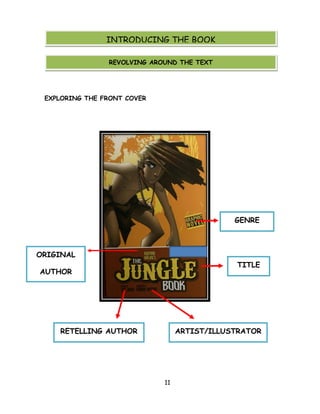
EXPLORING THE FRONT COVER 
INTRODUCING THE BOOK 
REVOLVING AROUND THE TEXT 
ORIGINAL 
AUTHOR 
TITLE 
RETELLING AUTHOR 
ARTIST/ILLUSTRATOR 
GENRE
12 
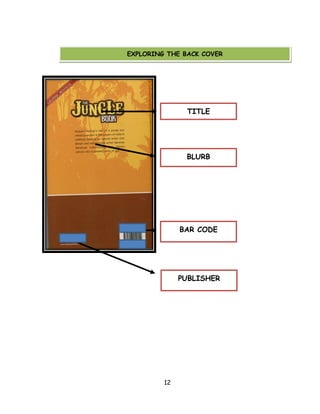
TITLE 
BAR CODE 
PUBLISHER 
BLURB 
EXPLORING THE BACK COVER
13 
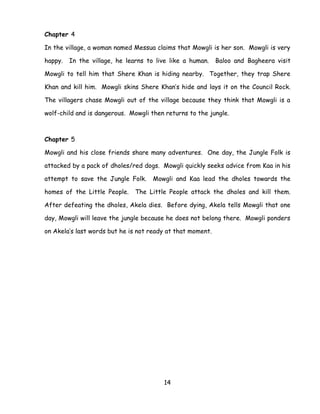
Chapter 1 
Mowgli, a little boy, takes refuge in a cave. He is adopted and brought up by two wolves, Father Wolf and Mother Wolf. Shere Khan, the tiger has killed Mowgli‘s parents and vows to kill Mowgli. Mother Wolf feels the need to keep Mowgli in the pack to protect him. At Council Rock, Akela asks if anyone will speak for Mowgli. Baloo, the bear and Bagheera, the panther suggest that Mowgli should stay. 
Chapter 2 
Mowgli‘s new ‗parents‘, Baloo, the bear and Bagheera, the panther, teach Mowgli the ways of the jungle and the laws and customs of the Jungle Folk. Mowgli develops a strong bond with his new friends, Baloo and Bagheera. He grows up into a strong young man. One day, Mowgli is kidnapped by a group of monkeys and taken to the Cold Lairs. Baloo and Bagheera seek help from Kaa, the rock snake and together, they manage to save Mowgli from the monkeys. 
Chapter 3 
Two wolf-friends warn Mowgli that Shere Khan still wants to kill him. Shere Khan tries to poison the young wolves‘ minds against Mowgli and Akela. Mowgli goes to the village and steals the Red Flower (a vessel containing fire). He lights a torch, warns the other young wolves not to listen to Shere Khan and accepts Akela as their leader. Shere Khan runs away into the jungle. Mowgli also leaves for the village. 
SYNOPSIS
14 
Chapter 4 
In the village, a woman named Messua claims that Mowgli is her son. Mowgli is very happy. In the village, he learns to live like a human. Baloo and Bagheera visit Mowgli to tell him that Shere Khan is hiding nearby. Together, they trap Shere Khan and kill him. Mowgli skins Shere Khan‘s hide and lays it on the Council Rock. The villagers chase Mowgli out of the village because they think that Mowgli is a wolf-child and is dangerous. Mowgli then returns to the jungle. 
Chapter 5 
Mowgli and his close friends share many adventures. One day, the Jungle Folk is attacked by a pack of dholes/red dogs. Mowgli quickly seeks advice from Kaa in his attempt to save the Jungle Folk. Mowgli and Kaa lead the dholes towards the homes of the Little People. The Little People attack the dholes and kill them. After defeating the dholes, Akela dies. Before dying, Akela tells Mowgli that one day, Mowgli will leave the jungle because he does not belong there. Mowgli ponders on Akela‘s last words but he is not ready at that moment.
15 
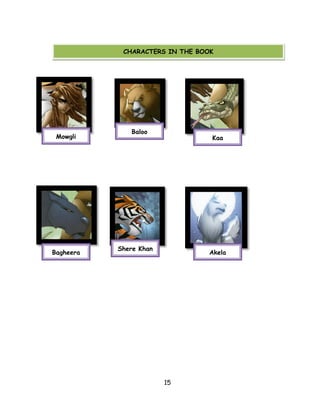
Kaa 
Shere Khan 
CHARACTERS IN THE BOOK 
Bagheera 
Baloo 
Akela 
Mowgli
16 
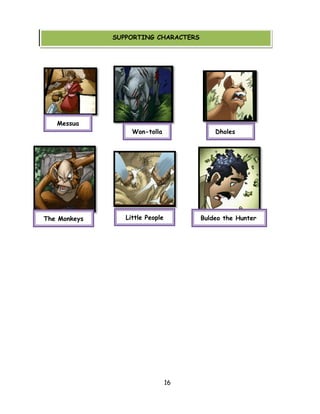
Won-tolla 
Messua 
Dholes 
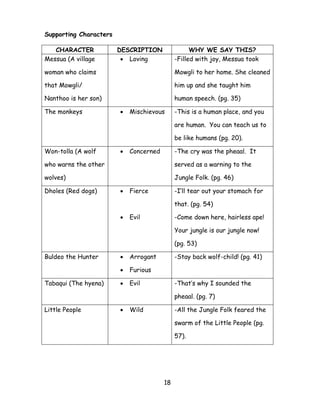
SUPPORTING CHARACTERS 
Little People 
The Monkeys 
Buldeo the Hunter
17 
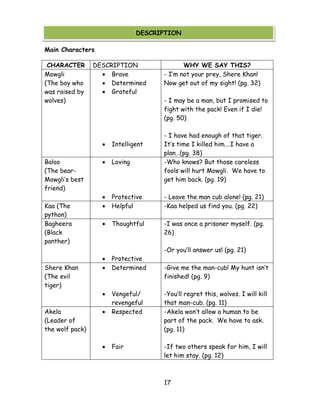
Main Characters 
CHARACTER 
DESCRIPTION 
WHY WE SAY THIS? 
Mowgli 
(The boy who was raised by wolves) 
 Brave 
 Determined 
 Grateful 
 Intelligent 
- I‘m not your prey, Shere Khan! Now get out of my sight! (pg. 32) 
- I may be a man, but I promised to fight with the pack! Even if I die! (pg. 50) 
- I have had enough of that tiger. It‘s time I killed him….I have a plan…(pg. 38) 
Baloo 
(The bear- Mowgli‘s best friend) 
 Loving 
 Protective 
-Who knows? But those careless fools will hurt Mowgli. We have to get him back. (pg. 19) 
- Leave the man cub alone! (pg. 21) 
Kaa (The python) 
 Helpful 
-Kaa helped us find you. (pg. 22) 
Bagheera 
(Black panther) 
 Thoughtful 
 Protective 
-I was once a prisoner myself. (pg. 26) 
-Or you‘ll answer us! (pg. 21) 
Shere Khan 
(The evil tiger) 
 Determined 
 Vengeful/ revengeful 
-Give me the man-cub! My hunt isn‘t finished! (pg. 9) 
-You‘ll regret this, wolves. I will kill that man-cub. (pg. 11) 
Akela 
(Leader of the wolf pack) 
 Respected 
 Fair 
-Akela won‘t allow a human to be part of the pack. We have to ask. (pg. 11) 
-If two others speak for him, I will let him stay. (pg. 12) 
DESCRIPTION
18 
Supporting Characters 
CHARACTER 
DESCRIPTION 
WHY WE SAY THIS? 
Messua (A village woman who claims that Mowgli/ Nanthoo is her son) 
 Loving 
-Filled with joy, Messua took Mowgli to her home. She cleaned him up and she taught him human speech. (pg. 35) 
The monkeys 
 Mischievous 
-This is a human place, and you are human. You can teach us to be like humans (pg. 20). 
Won-tolla (A wolf who warns the other wolves) 
 Concerned 
-The cry was the pheaal. It served as a warning to the Jungle Folk. (pg. 46) 
Dholes (Red dogs) 
 Fierce 
 Evil 
-I‘ll tear out your stomach for that. (pg. 54) 
-Come down here, hairless ape! Your jungle is our jungle now! (pg. 53) 
Buldeo the Hunter 
 Arrogant 
 Furious 
-Stay back wolf-child! (pg. 41) 
Tabaqui (The hyena) 
 Evil 
-That‘s why I sounded the pheaal. (pg. 7) 
Little People 
 Wild 
-All the Jungle Folk feared the swarm of the Little People (pg. 57).
19 
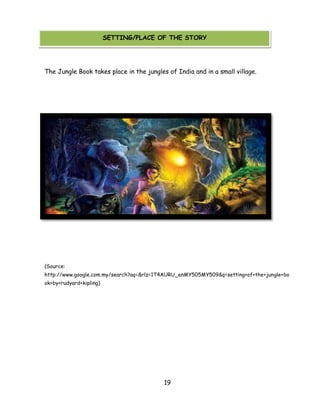
SETTING/PLACE OF THE STORY 
The Jungle Book takes place in the jungles of India and in a small village. 
(Source: http://www.google.com.my/search?aq=&rlz=1T4AURU_enMY505MY509&q=setting+of+the+jungle+book+by+rudyard+kipling) 
SETTING/PLACE OF THE STORY
20 
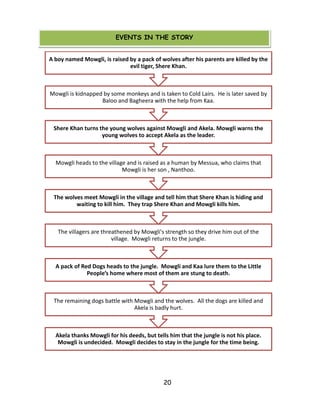
EVENTS IN THE STORY 
Akela thanks Mowgli for his deeds, but tells him that the jungle is not his place. Mowgli is undecided. Mowgli decides to stay in the jungle for the time being. 
The remaining dogs battle with Mowgli and the wolves. All the dogs are killed and Akela is badly hurt. 
A pack of Red Dogs heads to the jungle. Mowgli and Kaa lure them to the Little People’s home where most of them are stung to death. 
The villagers are threathened by Mowgli's strength so they drive him out of the village. Mowgli returns to the jungle. 
The wolves meet Mowgli in the village and tell him that Shere Khan is hiding and waiting to kill him. They trap Shere Khan and Mowgli kills him. 
Mowgli heads to the village and is raised as a human by Messua, who claims that Mowgli is her son , Nanthoo. 
Shere Khan turns the young wolves against Mowgli and Akela. Mowgli warns the young wolves to accept Akela as the leader. 
Mowgli is kidnapped by some monkeys and is taken to Cold Lairs. He is later saved by Baloo and Bagheera with the help from Kaa. 
A boy named Mowgli, is raised by a pack of wolves after his parents are killed by the evil tiger, Shere Khan. 
EVENTS IN THE STORY
21 
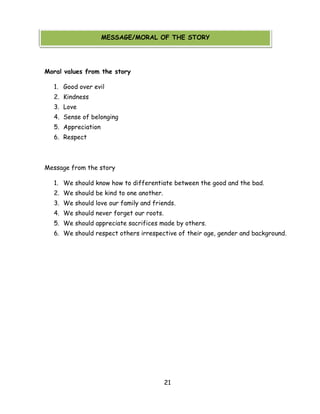
MESSAGE/MORAL OF THE STORY 
Moral values from the story 
1. Good over evil 
2. Kindness 
3. Love 
4. Sense of belonging 
5. Appreciation 
6. Respect 
Message from the story 
1. We should know how to differentiate between the good and the bad. 
2. We should be kind to one another. 
3. We should love our family and friends. 
4. We should never forget our roots. 
5. We should appreciate sacrifices made by others. 
6. We should respect others irrespective of their age, gender and background. 
MESSAGE/MORAL OF THE STORY
22 
SUGGESTED ACTIVITIES
23 
Steps: 
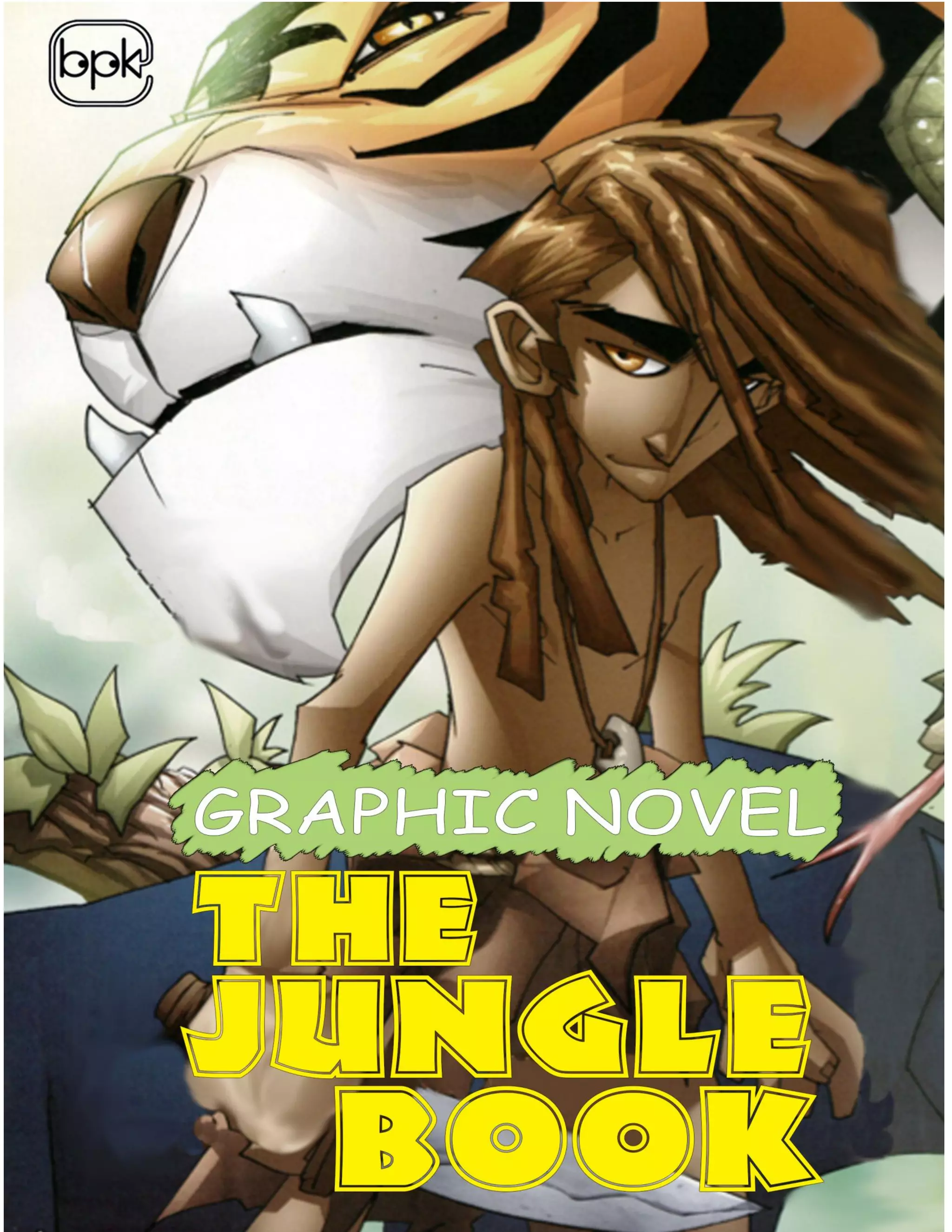
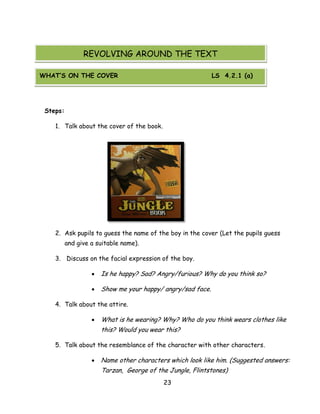
1. Talk about the cover of the book. 
2. Ask pupils to guess the name of the boy in the cover (Let the pupils guess and give a suitable name). 
3. Discuss on the facial expression of the boy. 
 Is he happy? Sad? Angry/furious? Why do you think so? 
 Show me your happy/ angry/sad face. 
4. Talk about the attire. 
 What is he wearing? Why? Who do you think wears clothes like this? Would you wear this? 
5. Talk about the resemblance of the character with other characters. 
 Name other characters which look like him. (Suggested answers: Tarzan, George of the Jungle, Flintstones) 
REVOLVING AROUND THE TEXT 
WHAT’S ON THE COVER LS 4.2.1 (a)
24 
*Note: Teacher shows pictures for those who are not familiar with these characters. 
6. Talk about the font size and the title of the book. 
 Look at the title and tell me what comes to your mind? 
 What can you find in the jungle? 
 What is the difference between a jungle and a forest? 
*Teacher can discuss the font size of the title of the book by focusing on these aspects: 
 Big and small alphabets represent the big and small trees in the jungle. 
 The shapes of the alphabets represent the trees. 
7. Ask pupils for other books, movies, cartoons or anime with the same words used for the title (E.g.: George of the Jungle). 
*Note: Teacher shows pictures for those who are not familiar with the examples provided. 
8. Get pupils to predict the story from the title. 
 From the word ‗jungle‘, what do you think is the story about? 
 What other characters do you think you can find in this story? 
 Where do you think the story took place? 
9. Elicit pupils‘ responses on the posture of the boy as seen on the cover page. 
 Look at how the boy is standing. 
 Why is he standing this way? 
 What can you tell about his character?
25 
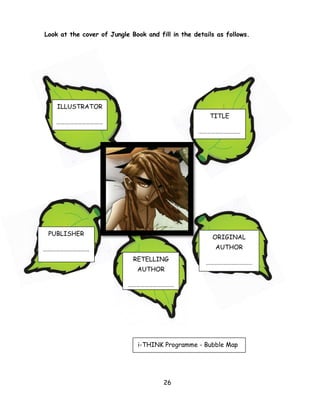
10. Ask pupils to complete the diagram based on the cover of the book. 
Educational Emphases: 
Constructivism 
i-THINK Programme - Bubble Map 
Multiple Intelligences – Intrapersonal 
Thinking Skills (Applying)
26 
Look at the cover of Jungle Book and fill in the details as follows. 
TITLE 
………………………… … 
PUBLISHER 
…………………………… 
ILLUSTRATOR 
…………………………… 
RETELLING AUTHOR 
…………………………… 
ORIGINAL AUTHOR 
…………………………… 
i-THINK Programme - Bubble Map
27 
Steps: 
1. Pupils work in groups. 
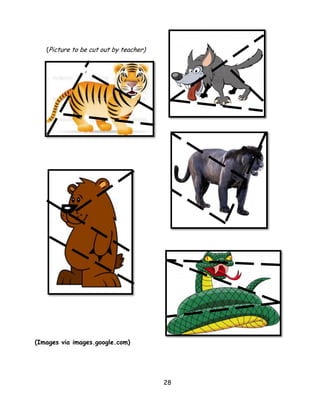
2. Distribute a display sheet and an envelope containing jumbled up body parts of five animals that pupils will come across in the novel (bear, wolf, panther, tiger and snake). 
3. In their respective groups, pupils are to arrange and paste the body parts correctly on the display sheet provided. 
4. Pupils label the body parts of the animals. 
5. The group that completes the task first will be rewarded (Teacher can turn this activities into a competition by giving a time frame for them to complete the task). 
6. Once completed, pupils display their work. 
7. Pupils discuss the features and characteristics of the animals. 
Educational Emphases: 
Constructivism 
Multiple Intelligences – Visual-Spatial / Bodily-Kinaesthetic Thinking Skills (Evaluating) 
JUMBLED UP ANIMALS LS 4.3.1
28 
(Picture to be cut out by teacher) 
(Images via images.google.com)
29 
A WALK ALONG THE JUNGLE PATH 
Steps: 
1. Introduce the sounds of some animals. 
(Bring recording of sounds made by various animals) 
2. Introduce the words used to describe the sounds made by animals and write them down on the board. 
3. Distribute worksheet to pupils to reinforce their understanding on various sounds of animals. 
Match the animals to their sounds: 
1. tigers howl 
2. wolves chatter 
3, elephants roar 
4. monkeys hiss 
5. snakes trumpet 
6. owls hoot 
4. Assign a few pupils to take the roles of these animals; tiger, wolf, bear, bird, monkey and snake. 
5. Pupils remember the sound of these animals and repeat them thrice whenever they hear their names. 
E.g.: Hoot, hoot, hoot 
Hiss, hiss, hiss 
6. Choose a pupil/s to be the narrator. 
A WALK ALONG THE JUNGLE PATH LS 4.3.1
30 
7. The other pupils stand in a big circle and the narrator stands in the centre. 
8. As the narrator reads the text, the pupils walk in a circle. 
9. When the pupils hear their names (animals) being mentioned in the text, they howl, hiss, roar or growl three times (giving special sound effect). 
Educational Emphases: 
Contextual Learning 
Multiple Intelligences - Bodily Kinaesthetic / Musical Thinking Skills (Applying)
31 
Text: 
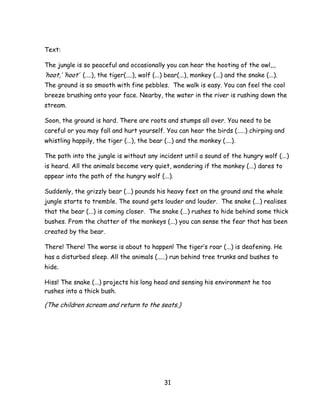
The jungle is so peaceful and occasionally you can hear the hooting of the owl,,, ‗hoot,‘ ‗hoot‘ (....), the tiger(....), wolf (...) bear(...), monkey (...) and the snake (...). The ground is so smooth with fine pebbles. The walk is easy. You can feel the cool breeze brushing onto your face. Nearby, the water in the river is rushing down the stream. 
Soon, the ground is hard. There are roots and stumps all over. You need to be careful or you may fall and hurt yourself. You can hear the birds (.....) chirping and whistling happily, the tiger (...), the bear (...) and the monkey (....). 
The path into the jungle is without any incident until a sound of the hungry wolf (...) is heard. All the animals become very quiet, wondering if the monkey (...) dares to appear into the path of the hungry wolf (...). 
Suddenly, the grizzly bear (...) pounds his heavy feet on the ground and the whole jungle starts to tremble. The sound gets louder and louder. The snake (...) realises that the bear (...) is coming closer. The snake (...) rushes to hide behind some thick bushes. From the chatter of the monkeys (...) you can sense the fear that has been created by the bear. 
There! There! The worse is about to happen! The tiger‘s roar (...) is deafening. He has a disturbed sleep. All the animals (.....) run behind tree trunks and bushes to hide. 
Hiss! The snake (...) projects his long head and sensing his environment he too rushes into a thick bush. 
(The children scream and return to the seats.)
32 
Steps: 
1. Pupils work in groups of 4 to 5. 
2. Each group is given an envelope containing strips of the synopsis of all five chapters of the story. (Each strip is numbered according to the chapters and folded to ensure that pupils do not read all strips before predicting). 
3. In respective groups, one pupil will read the first strip to his/her group members. 
4. Then, they discuss and predict what they think would happen next. 
5. Pupils write their prediction at the back of the first strip. 
6. Another pupil reads the second strip and the members listen. 
7. Pupils then compare what is read with their prediction. 
8. Steps 3 to 7 are repeated with the following strips until the end of the story. 
9. One representative may read out the first strip and continue with their predictions until the end of the story. 
SYPNOSIS 
WHAT HAPPENS NEXT? LS 4.2.1 (a) (b) 
Educational Emphases: 
Constructivism 
Multiple Intelligences- Interpersonal Thinking Skills (Applying)
33 
Strips of Synopsis 
Chapter 1 
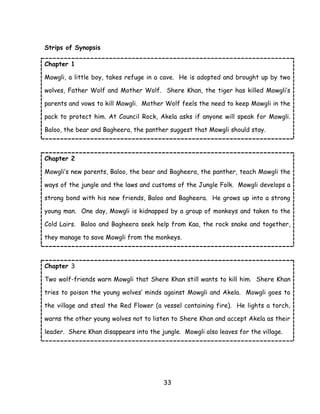
Mowgli, a little boy, takes refuge in a cave. He is adopted and brought up by two wolves, Father Wolf and Mother Wolf. Shere Khan, the tiger has killed Mowgli‘s parents and vows to kill Mowgli. Mother Wolf feels the need to keep Mowgli in the pack to protect him. At Council Rock, Akela asks if anyone will speak for Mowgli. Baloo, the bear and Bagheera, the panther suggest that Mowgli should stay. 
Chapter 2 
Mowgli‘s new parents, Baloo, the bear and Bagheera, the panther, teach Mowgli the ways of the jungle and the laws and customs of the Jungle Folk. Mowgli develops a strong bond with his new friends, Baloo and Bagheera. He grows up into a strong young man. One day, Mowgli is kidnapped by a group of monkeys and taken to the Cold Lairs. Baloo and Bagheera seek help from Kaa, the rock snake and together, they manage to save Mowgli from the monkeys. 
Chapter 3 
Two wolf-friends warn Mowgli that Shere Khan still wants to kill him. Shere Khan tries to poison the young wolves‘ minds against Mowgli and Akela. Mowgli goes to the village and steal the Red Flower (a vessel containing fire). He lights a torch, warns the other young wolves not to listen to Shere Khan and accept Akela as their leader. Shere Khan disappears into the jungle. Mowgli also leaves for the village.
34 
Chapter 4 
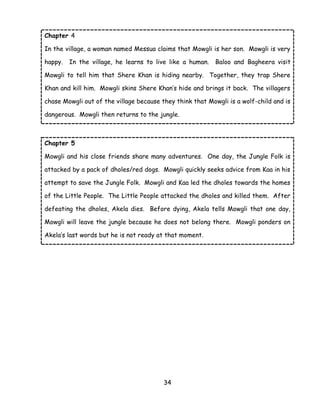
In the village, a woman named Messua claims that Mowgli is her son. Mowgli is very happy. In the village, he learns to live like a human. Baloo and Bagheera visit Mowgli to tell him that Shere Khan is hiding nearby. Together, they trap Shere Khan and kill him. Mowgli skins Shere Khan‘s hide and brings it back. The villagers chase Mowgli out of the village because they think that Mowgli is a wolf-child and is dangerous. Mowgli then returns to the jungle. 
Chapter 5 
Mowgli and his close friends share many adventures. One day, the Jungle Folk is attacked by a pack of dholes/red dogs. Mowgli quickly seeks advice from Kaa in his attempt to save the Jungle Folk. Mowgli and Kaa led the dholes towards the homes of the Little People. The Little People attacked the dholes and killed them. After defeating the dholes, Akela dies. Before dying, Akela tells Mowgli that one day, Mowgli will leave the jungle because he does not belong there. Mowgli ponders on Akela‘s last words but he is not ready at that moment.
35 
Steps: 
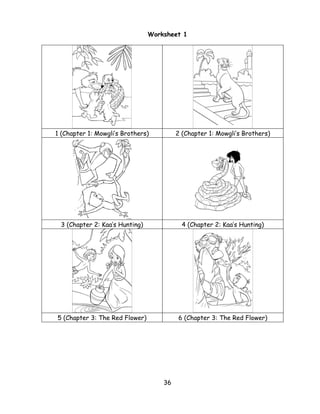
1. Make enough copies of pictures based on events in the chapters of the graphic novel (refer to Worksheet 1). 
2. Cut the pictures, jumble them up and place them in an envelope. 
3. Pupils work in groups of four. 
4. Distribute an envelope containing the pictures to each group. 
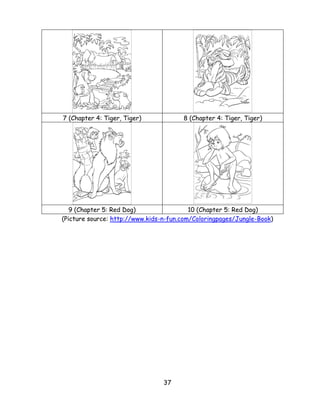
5. Pupils rearrange the pictures in the correct order according to the chapters (There are 2 pictures for each chapter). 
6. Pupils paste and colour the pictures on an A4 paper. 
7. Pupils present their work. 
Educational Emphases: 
Contextual Learning 
Multiple Intelligences – Visual- Spatial / Verbal Linguistic Thinking Skills (Applying) 
TITLE 
PICTURE ARRANGEMENT LS 4.2.1 (b)
36 
Worksheet 1 
1 (Chapter 1: Mowgli‘s Brothers) 
2 (Chapter 1: Mowgli‘s Brothers) 
3 (Chapter 2: Kaa‘s Hunting) 
4 (Chapter 2: Kaa‘s Hunting) 
5 (Chapter 3: The Red Flower) 
6 (Chapter 3: The Red Flower)
37 
7 (Chapter 4: Tiger, Tiger) 
8 (Chapter 4: Tiger, Tiger) 
9 (Chapter 5: Red Dog) 
10 (Chapter 5: Red Dog) 
(Picture source: http://www.kids-n-fun.com/Coloringpages/Jungle-Book)
38 
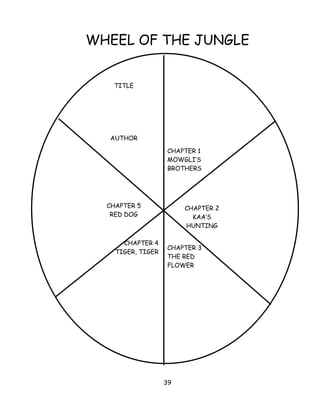
WHEEL OF THE JUNGLE 
Steps: 
*Note: This activity is carried out when pupils have read the whole book. 
1. Tell pupils to summarise each chapter into 2 sentences. 
2. Facilitate each group and check their sentences. 
3. Distribute the ―Wheel of the Jungle Worksheet‖ to the pupils. 
4. Pupils write the title and the author‘s name in the first panel. 
5. Pupils copy the summaries done earlier into the panels correctly. 
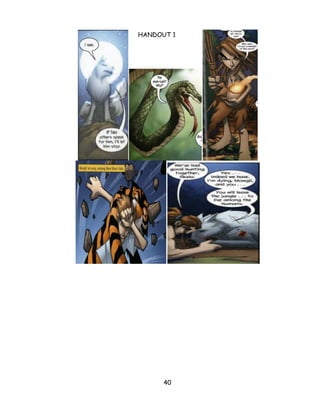
6. Pupils cut and paste pictures (Handout 1) according to the chapters in the correct panels. 
7. Have the pupils share their ―Wheel of the Jungle‖ and talk about it with the class. 
Educational Emphases: 
Creativity and Innovation 
Multiple Intelligences – Visual-Spatial Thinking Skills (Creating) 
WHEEL OF THE JUNGLE LS 4.2.1 (a) (b)
39 
WHEEL OF THE JUNGLE 
CHAPTER 1 
MOWGLI‘S BROTHERS 
CHAPTER 2 
KAA‘S HUNTING 
CHAPTER 3 
THE RED FLOWER 
CHAPTER 4 
TIGER, TIGER 
CHAPTER 5 
RED DOG 
TITLE 
AUTHOR
40 
HANDOUT 1
41 
Steps: 
1. Play recording of dialogues of 5 different characters from the story (or teacher can read out the dialogues). 
2. After playing/reading each of the dialogues, get pupils to guess the character. 
3. After guessing, paste/display the picture of the character and discuss briefly about the characters with the pupils. Ask questions to get them to respond. 
E.g.: 1. Who is this? (pointing at the picture) 
2. Do you like this character? Why? 
3. Can you describe this character in one word? 
4. After discussion, distribute two report cards and two sets of Label 1 to each pupil. 
5. Tell pupils that one report card is for the character they like and the other is for the character they dislike. 
6. Explain to pupils that they need to paste a grade (A, B or C) for each of the two characters. (A being the best character, B representing both good and bad character and C for bad character.) 
7. Then, pupils write two adjectives to describe each character. 
8. Pupils provide justification/reasons for awarding the specific grades to the characters they chose. 
9. Pupils display their report cards in their classroom. 
CHARACTERS IN THE STORY 
CHARACTER REPORT CARD LS 4.2.1 (a) 
Educational Emphases: 
Values and Citizenship 
Multiple Intelligences – Visual-Spatial Thinking Skills (Analysing)
42 
Label 1 
A B C 
Letters for grading
43 
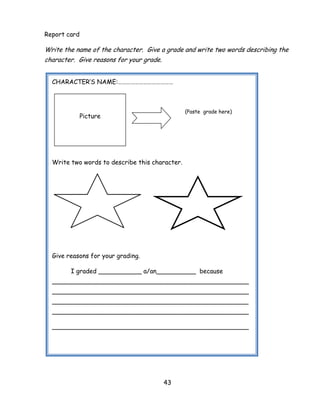
Report card 
Write the name of the character. Give a grade and write two words describing the character. Give reasons for your grade. 
CHARACTER‘S NAME:………………………………… 
(Paste grade here) 
Write two words to describe this character. 
Give reasons for your grading. 
I graded ___________ a/an__________ because __________________________________________________ __________________________________________________ __________________________________________________ __________________________________________________ 
__________________________________________________ 
Picture
44 
PRODUCING A MASK 
Steps: 
1. Pupils work in groups of 4 to 5. 
2. Distribute an envelope to each group. 
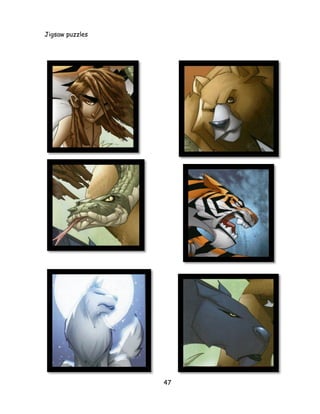
3. Each envelope contains puzzle pieces of a character for pupils to assemble. 
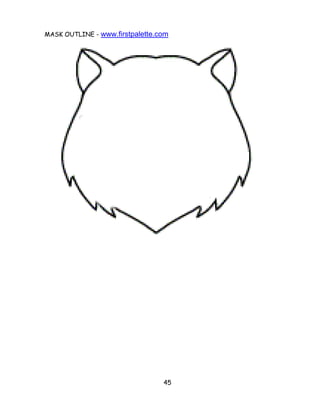
4. Once they have completed the puzzle, the representative informs the teacher the name of the character and gets the mask outline of the same character from the teacher. 
5. In their respective groups, pupils use the outline given to draw and colour the mask using their own creativity. (Pupils will be told to bring materials like colour pencils/crayons, colour papers and other relevant materials.) 
6. Once they have completed, a representative from each group wears the mask and displays it to the whole class. 
7. Another member from the same group provides the description of the particular character. 
Educational Emphases: 
Creativity and Innovation 
Multiple Intelligences – Visual-Spatial Thinking Skills (Creating) 
PRODUCING A MASK LS 4.3.1
45 
MASK OUTLINE - www.firstpalette.com
46
47 
Jigsaw puzzles
48 
Steps: 
1. Divide pupils into five groups and assign a chapter to each group. 
2. Ask each group to identify a significant scene from the particular chapter. 
3. Each group will perform a freeze frame of the particular scene. 
4. Other groups figure out what is happening with the scene and provide their opinion what the scene is all about. 
Note to teacher: A freeze frame is an activity where pupils select a significant scene and act it out. However, they have to freeze a position as a character for audience to understand and figure out what is going on in the scene. 
Educational Emphases: 
Creativity and Innovation 
Multiple Intelligences – Bodily-Kinaesthetic Thinking Skills (Creating) 
FREEZE AND GUESS LS 4.2.1 (a)
49 
Steps: 
1. Pupils work in pairs, where one would be pupil A and the other is pupil B. 
2. Pupil A is given a sentence strip consisting of one of the scenes found in the story. 
e.g.: 
 The monkeys carry Mowgli fiercely to the secret place. 
 Mowgli fights with Shere Khan. 
 Monkeys running away from Kaa the snake. 
 Dholes screaming in pain after being stung by little people. 
3. Pupil A is required to read the sentence strip and identify the emotion (feeling/expression) of the character (e.g. Monkeys – fierce, Dholes – in pain). 
4. Pupil A will perform the facial expression and pupil B will follow the expression made by pupil A (mirror). 
5. Next, pupil A becomes the mirror and pupil B performs the facial expression. 
Educational Emphases: 
Creativity and Innovation 
Multiple Intelligences – Bodily-Kinaesthetic 
Thinking Skills (Creating) 
MIRROR EXERCISE LS 4.2.1 (a)
50 
Steps: 
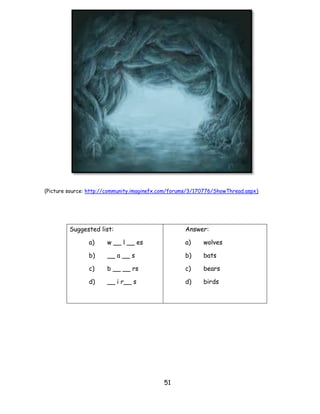
1. Show pupils a picture of a cave. 
2. Ask pupils where they may find caves in Malaysia. 
3. Ask pupils to write down 3 animals that live in caves. 
4. Ask pupils to fill in the missing letters to find out the animals which live in caves (refer to Suggested List & Answer). Discuss the answers. 
5. Ask pupils to imagine standing in a cave. 
6. Elicit their responses by asking the following questions: 
 What can you see? 
 What can you hear? 
 How do you feel? 
Educational Emphases: 
Knowledge Acquisition 
Multiple Intelligences - Bodily-Kinaesthetic 
Thinking Skills (Applying) 
WHO LIVES IN THE CAVE? LS 4.2.1 (b) 
SETTINGS
51 
(Picture source: http://community.imaginefx.com/forums/3/170776/ShowThread.aspx) 
Suggested list: 
a) w __ l __ es 
b) __ a __ s 
c) b __ __ rs 
d) __ i r__ s 
Answer: 
a) wolves 
b) bats 
c) bears 
d) birds
52 
Steps: 
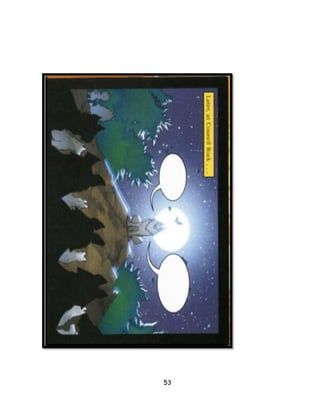
1. Show picture to pupils. 
2. Ask pupils to look at the picture and guess what Akela is telling to the Jungle Folk at Council Rock. 
3. Based on the story, discuss with pupils what the Council Rock is. 
 What is it used for? 
 What usually happens there? 
4. Ask pupils to work in fours. 
5. Ask pupils to imagine that they are a part of the Jungle Folk. 
6. Ask pupils to think of a complaint to be made at the Council Rock. 
7. Place masks of a few animals on the table. 
8. Call one pupil to wear the mask of Akela to sit in front of the class. 
9. Call one representative to put on the other animal masks. 
10. Pupils inform ―Akela‖ of their complaints. ―Akela‖ responds to their complaints by providing possible solutions. 
Educational Emphases: 
Knowledge Acquisition 
Multiple Intelligences – Bodily-Kinaesthetic 
Thinking Skills (Applying) 
MEETING AKELA LS 4.3.2
53
54 
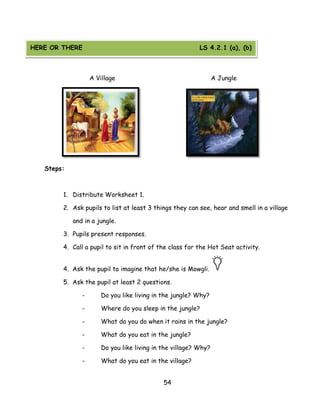
A Village 
Steps: 
A Jungle 
1. Distribute Worksheet 1. 
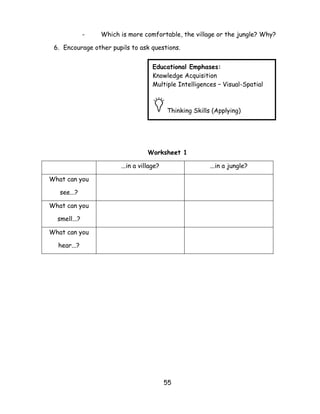
2. Ask pupils to list at least 3 things they can see, hear and smell in a village and in a jungle. 
3. Pupils present responses. 
4. Call a pupil to sit in front of the class for the Hot Seat activity. 
4. Ask the pupil to imagine that he/she is Mowgli. 
5. Ask the pupil at least 2 questions. 
- Do you like living in the jungle? Why? 
- Where do you sleep in the jungle? 
- What do you do when it rains in the jungle? 
- What do you eat in the jungle? 
- Do you like living in the village? Why? 
- What do you eat in the village? 
HERE OR THERE LS 4.2.1 (a), (b)
55 
- Which is more comfortable, the village or the jungle? Why? 
6. Encourage other pupils to ask questions. 
Worksheet 1 
...in a village? 
...in a jungle? 
What can you see...? 
What can you smell...? 
What can you hear...? 
Educational Emphases: 
Knowledge Acquisition 
Multiple Intelligences – Visual-Spatial 
Thinking Skills (Applying)
56 
MY JUNGLE BOOK 
Steps: 
1. Play sounds of various animals and other relevant sounds that could be heard in the jungle. 
2. Pupils close their eyes and listen to the sounds while imagining themselves being in the jungle. 
3. Once pupils have heard and guessed the sounds correctly, talk to them about the jungle in general. 
4. Link the topic to The Jungle Book by talking about Mowgli living in the jungle. 
5. Ask some questions to encourage pupils‘ participation. 
 Who is the main character in the story? 
 Where does he live? 
 Why does he live there? 
6. Pupils then work in groups of 5. 
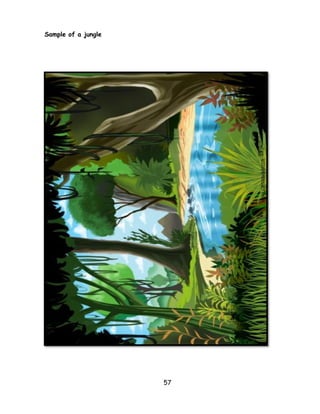
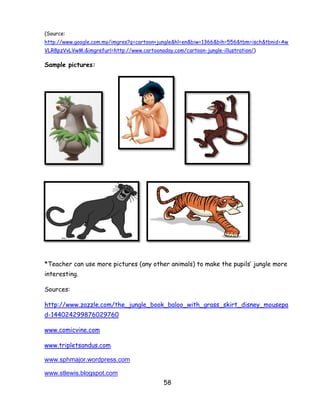
7. Distribute a picture of a jungle in A3 size paper and pictures of Mowgli and the various animals found in the story as well as other relevant pictures to each group. 
8. In groups, pupils create their own jungle by pasting various animals in the picture. 
9. Pupils display their work and talk about their jungle. 
Educational Emphases: 
Creativity and Innovation 
Multiple Intelligences – Bodily-Kinaesthetic / Musical 
Thinking Skills (Creating) 
MY JUNGLE BOOK LS 4.3.1
57 
Sample of a jungle
58 
(Source: http://www.google.com.my/imgres?q=cartoon+jungle&hl=en&biw=1366&bih=556&tbm=isch&tbnid=AwVLR8pzVvLVwM:&imgrefurl=http://www.cartoonaday.com/cartoon-jungle-illustration/) 
Sample pictures: 
*Teacher can use more pictures (any other animals) to make the pupils‘ jungle more interesting. 
Sources: 
http://www.zazzle.com/the_jungle_book_baloo_with_grass_skirt_disney_mousepad-144024299876029760 
www.comicvine.com 
www.tripletsandus.com 
www.sphmajor.wordpress.com 
www.stlewis.blogspot.com
59 
EVENTS IN THE STORY 
ROLE PLAY 
Steps: 
1. Play video. Link: http://www.youtube.com/watch?v=_Rt6hU58g08 
2. Pupils work in groups. 
3. Pupils predict what will happen next. 
4. Ask each group to prepare a role play based on their predictions. 
5. Pupils perform/present. 
Educational Emphases: 
Information and Communication Technology (ICT) 
Multiple Intelligences – Bodily-Kinaesthetic 
Thinking Skills (Creating) 
EVENTS IN THE STORY 
ROLE PLAY LS 4.3.2
60 
MONKEY POEM 
Steps: 
1. Pupils read the poem (Handout 1) with appropriate intonation and action. 
2. Discuss the content of the poem and talk about monkeys in general. 
3. Ask pupils to fill in the blanks with any appropriate words to create their own parallel poem (Worksheet 1). 
4. Pupils to present with the appropriate intonation, action and expression. 
Educational Emphases: 
Constructivism 
Multiple Intelligences – Bodily-Kinaesthetic 
Thinking Skills (Creating) 
MONKEY POEM LS 4.3.1
61 
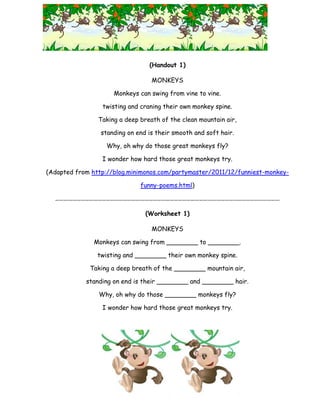
(Handout 1) 
MONKEYS Monkeys can swing from vine to vine. 
twisting and craning their own monkey spine. 
Taking a deep breath of the clean mountain air, 
standing on end is their smooth and soft hair. 
Why, oh why do those great monkeys fly? 
I wonder how hard those great monkeys try. 
(Adapted from http://blog.minimonos.com/partymaster/2011/12/funniest-monkey- funny-poems.html) 
…………………………………………………………………………………………………………………………………………… 
(Worksheet 1) 
MONKEYS Monkeys can swing from ________ to ________. 
twisting and ________ their own monkey spine. 
Taking a deep breath of the ________ mountain air, 
standing on end is their ________ and ________ hair. 
Why, oh why do those ________ monkeys fly? 
I wonder how hard those great monkeys try.
62 
CHAPTER 3: 
BEWARE MOWGLI 
Steps: 
1. Distribute the text (Activity can be done individually or in groups). 
2. Ask pupils to practise reading the text using different voices. 
3. Present to the class (masks can be used). 
4. Create jazz chant by using verbs found in the text. 
Example: 
Jumping, running, chasing 
Hunting too. 
I can jump, I can run, 
We can chase, can you too? 
Other possible verbs: 
Screaming, hiding, crying, howling, catching, fighting, swimming, cutting, sprinting, diving 
Educational Emphases: 
Creativity and Innovation 
Multiple Intelligences – Musical 
Thinking Skills (Creating) 
BEWARE MOWGLI LS 4.1.2
63 
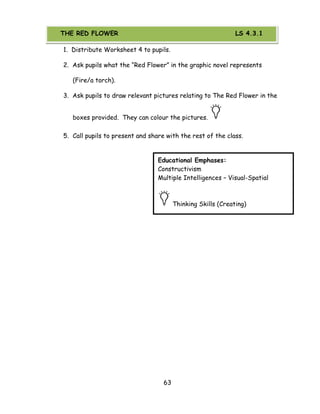
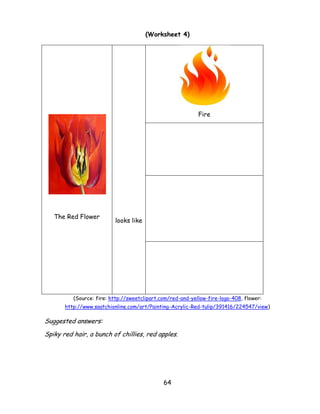
THE RED FLOWER 
1. Distribute Worksheet 4 to pupils. 
2. Ask pupils what the ―Red Flower‖ in the graphic novel represents 
(Fire/a torch). 
3. Ask pupils to draw relevant pictures relating to The Red Flower in the boxes provided. They can colour the pictures. 
5. Call pupils to present and share with the rest of the class. 
Educational Emphases: 
Constructivism 
Multiple Intelligences – Visual-Spatial 
Thinking Skills (Creating) 
THE RED FLOWER LS 4.3.1
64 
(Worksheet 4) 
The Red Flower 
looks like 
Fire 
(Source: fire: http://sweetclipart.com/red-and-yellow-fire-logo-408, flower: http://www.saatchionline.com/art/Painting-Acrylic-Red-tulip/391416/224547/view) 
Suggested answers: 
Spiky red hair, a bunch of chillies, red apples.
65 
Steps: 
1. Ask pupils to refer to the text on page 27 and 28. 
2. Ask pupils to complete the exercise based on the text. 
3. Pupils write down the things that Mowgli must do. 
Educational Emphases: 
Constructivism 
Multiple Intelligences– Visual-Spatial 
Thinking Skills (Analysing) 
MOWGLI, MOWGLI WHAT DO YOU DO? LS 4.2.1 (a)
66 
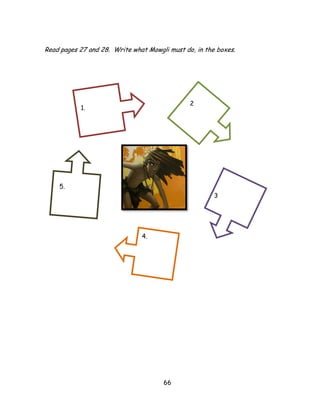
Read pages 27 and 28. Write what Mowgli must do, in the boxes. 
1. 
2 
3 
5. 
4.
67 
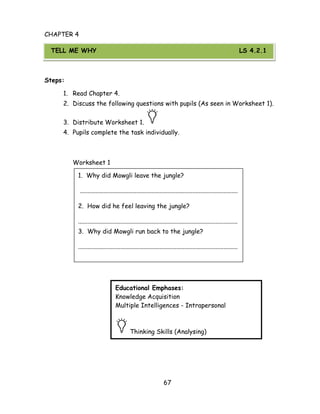
CHAPTER 4 
Steps: 
1. Read Chapter 4. 
2. Discuss the following questions with pupils (As seen in Worksheet 1). 
3. Distribute Worksheet 1. 
4. Pupils complete the task individually. 
Worksheet 1 
1. Why did Mowgli leave the jungle? 
..................................................................................................... 
2. How did he feel leaving the jungle? 
...................................................................................................... 3. Why did Mowgli run back to the jungle? 
...................................................................................................... 
Educational Emphases: 
Knowledge Acquisition 
Multiple Intelligences - Intrapersonal 
Thinking Skills (Analysing) 
TELL ME WHY LS 4.2.1
68 
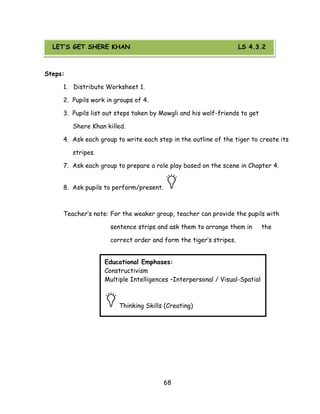
LET’S GET SHERE KHAN! 
Steps: 
1. Distribute Worksheet 1. 
2. Pupils work in groups of 4. 
3. Pupils list out steps taken by Mowgli and his wolf-friends to get 
Shere Khan killed. 
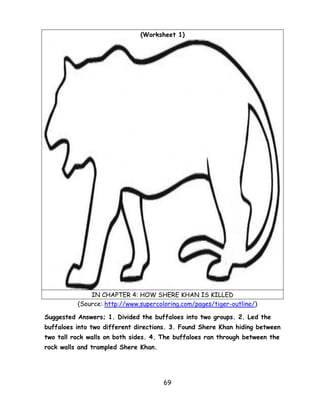
4. Ask each group to write each step in the outline of the tiger to create its stripes. 
7. Ask each group to prepare a role play based on the scene in Chapter 4. 
8. Ask pupils to perform/present. 
Teacher‘s note: For the weaker group, teacher can provide the pupils with sentence strips and ask them to arrange them in the correct order and form the tiger‘s stripes. 
Educational Emphases: 
Constructivism 
Multiple Intelligences –Interpersonal / Visual-Spatial 
Thinking Skills (Creating) 
LET’S GET SHERE KHAN LS 4.3.2
69 
(Worksheet 1) 
IN CHAPTER 4: HOW SHERE KHAN IS KILLED 
(Source: http://www.supercoloring.com/pages/tiger-outline/) 
Suggested Answers; 1. Divided the buffaloes into two groups. 2. Led the buffaloes into two different directions. 3. Found Shere Khan hiding between two tall rock walls on both sides. 4. The buffaloes ran through between the rock walls and trampled Shere Khan.
70 
CHAPTER 5 
Steps: 
1. Demonstrate reciting the poem using the correct pronunciation and intonation, and appropriate expression and action. 
2. Pupils recite the poem (Handout 1) with the correct pronunciation and intonation, and appropriate expression and action. 
3. Pupils work in groups. 
4. Pupils present the poem in groups with the correct pronunciation and intonation, and appropriate expression and action. 
Educational Emphases: 
Creativity and Innovation 
Multiple Intelligences – Interpersonal / Musical Thinking Skills (Creating) 
AKELA’S DEATH LS 4.3.2
71 
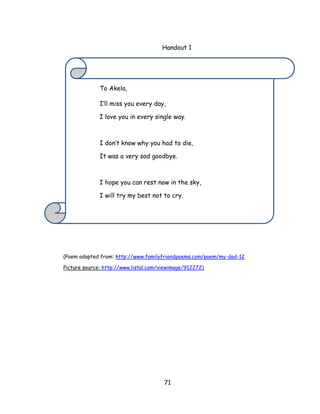
Handout 1 
(Poem adapted from: http://www.familyfriendpoems.com/poem/my-dad-12 
Picture source: http://www.listal.com/viewimage/912272) 
To Akela, 
I‘ll miss you every day, I love you in every single way. I don‘t know why you had to die, It was a very sad goodbye. 
I hope you can rest now in the sky, I will try my best not to cry.
72 
Steps: 
1. Pupils work in pairs. 
2. Ask pupils to discuss whether Mowgli should remain in the jungle or go back to the village. Pupils write their arguments in the worksheet provided (Worksheet 1). 
3. Pupils present their arguments to the rest of the class. 
4. At the end of the lesson, get a consensus of what the class thinks Mowgli should do. 
Educational Emphases: 
Constructivism 
Multiple Intelligences – Interpersonal / Verbal Linguistic 
Thinking Skills (Evaluating) 
LETTER TO MOWGLI LS 4.2.1 (c)
73 
Worksheet 1 
Source: http://www.dreamstime.com/stock-photography- 
old-parchment-paper-letter-background-image14437142 
Dear Mowgli, 
I think you should ________________ 
because _______________________ 
______________________________ 
______________________________ 
______________________________ 
______________________________ 
Yours sincerely, 
___________
74 
Steps: 
1. Divide the pupils into groups of five. 
2. Each group is given a short description of a character in the story. They read out descriptions about the character. 
(Handout 1). 
E.g.: (Mowgli) 
He is brave and high spirited. 
He loves his family and is willing to do anything for them. 
He has two good friends in the jungle. 
3. Pupils in the other groups guess the character. 
4. Paste the picture on the board after every guess. 
5. Each pupil is given a red and blue card each (Blue represents ‗like‘ and Red represents ‗dislike‘). 
6. After the information for each character is read out, ask pupils questions to elicit responses. 
E.g.: (Mowgli) 
 Where does Mowgli live? 
 Do you like Mowgli? 
 Do you want to be like Mowgli? 
CHARACTER BINGO LS 4.2.1 (c) 
MORAL VALUES / MESSAGE OF THE STORY
75 
7. For questions that require a ‗like‘ or ‗dislike‘ answers, pupils put up the green or red cards. 
8. After reading out and discussing all the characters, discuss the overall moral values/message of the story. 
9. Get pupils randomly to share what they have learnt from the story. 
Educational Emphases: 
Values and Citizenship 
Multiple Intelligences – Interpersonal/Visual-Spatial 
Thinking Skills (Evaluating)
76 
Handout 1 
Mowgli 
He is brave and high spirited. 
He loves his family and is willing to do anything for them. 
He has two good friends in the jungle. 
Akela 
He is a wise leader. 
He is loving and caring. 
He is respected by all in his pack. 
Baloo 
He is big and strong. 
He is loving and also protective. 
He is a wise teacher. 
Bagheera 
He is thoughtful. 
He is a skilled hunter. 
He is serious and protective. 
Shere Khan 
He is revengeful. 
He is rude and intrusive. 
He is evil and cunning.
77 
ACTIVITY 2: MAKING A POSTER 
Steps: 
1. Discuss the moral value/message of the story. 
2. Write it down on the board for pupils‘ reference for the later activity. 
3. Prepare a cut-out of the main characters on A4 sized papers that pupils can use to design their posters. 
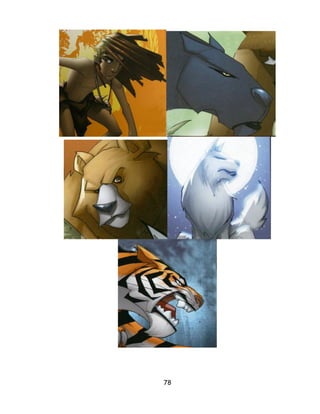
4. Individually, pupils design a poster based on the message learnt from the story. 
5. Pupils use the pictures they need for their poster based on the moral values/message that they chose. 
6. Pupils write the moral value/message on the poster. Pupils are free to design their poster based on their own creativity. 
7. Once pupils have completed their posters, get pupils to display their posters around the classroom. 
8. Pupils take a look at their friends‘ work by using the gallery walk technique. 
*Pupils are told to bring necessary materials beforehand. 
Educational Emphases: 
Values and Citizenship 
Creativity and Innovation 
Multiple Intelligences – Visual Spatial /Bodily-Kinaesthetic Thinking Skills (Creating) 
MAKING A POSTER LS 4.3.1
78
79 
ACTIVITY 3: BRAINSTORMING 
Steps: 
1. Pupils work in groups of four to five. 
2. Distribute short descriptions of each chapter to each group. 
3. In their respective groups, pupils discuss and write the moral value/message that they could think related to the short descriptions. 
4. Guide groups in eliciting the moral values. 
5. Once pupils have completed, get them to share what they have discussed. 
Educational Emphases: 
Values and Citizenship 
Multiple Intelligences – Interpersonal / Verbal Linguistic Thinking Skills (Evaluating) 
BRAINSTORMING LS 4.3.2
80 
Short Description of 5 Chapters 
Chapter 1 
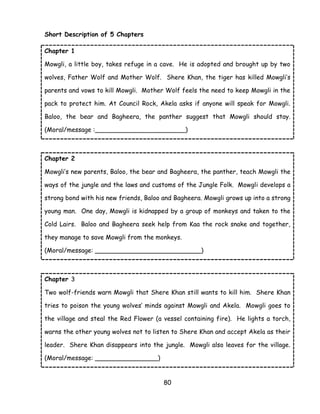
Mowgli, a little boy, takes refuge in a cave. He is adopted and brought up by two wolves, Father Wolf and Mother Wolf. Shere Khan, the tiger has killed Mowgli‘s parents and vows to kill Mowgli. Mother Wolf feels the need to keep Mowgli in the pack to protect him. At Council Rock, Akela asks if anyone will speak for Mowgli. Baloo, the bear and Bagheera, the panther suggest that Mowgli should stay. (Moral/message :_______________________) 
Chapter 2 
Mowgli‘s new parents, Baloo, the bear and Bagheera, the panther, teach Mowgli the ways of the jungle and the laws and customs of the Jungle Folk. Mowgli develops a strong bond with his new friends, Baloo and Bagheera. Mowgli grows up into a strong young man. One day, Mowgli is kidnapped by a group of monkeys and taken to the Cold Lairs. Baloo and Bagheera seek help from Kaa the rock snake and together, they manage to save Mowgli from the monkeys. 
(Moral/message: ___________________________) 
Chapter 3 
Two wolf-friends warn Mowgli that Shere Khan still wants to kill him. Shere Khan tries to poison the young wolves‘ minds against Mowgli and Akela. Mowgli goes to the village and steal the Red Flower (a vessel containing fire). He lights a torch, warns the other young wolves not to listen to Shere Khan and accept Akela as their leader. Shere Khan disappears into the jungle. Mowgli also leaves for the village. (Moral/message: ________________)
81 
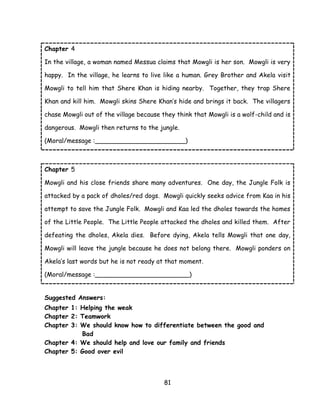
Chapter 4 
In the village, a woman named Messua claims that Mowgli is her son. Mowgli is very happy. In the village, he learns to live like a human. Grey Brother and Akela visit Mowgli to tell him that Shere Khan is hiding nearby. Together, they trap Shere Khan and kill him. Mowgli skins Shere Khan‘s hide and brings it back. The villagers chase Mowgli out of the village because they think that Mowgli is a wolf-child and is dangerous. Mowgli then returns to the jungle. 
(Moral/message :_______________________) 
Chapter 5 
Mowgli and his close friends share many adventures. One day, the Jungle Folk is attacked by a pack of dholes/red dogs. Mowgli quickly seeks advice from Kaa in his attempt to save the Jungle Folk. Mowgli and Kaa led the dholes towards the homes of the Little People. The Little People attacked the dholes and killed them. After defeating the dholes, Akela dies. Before dying, Akela tells Mowgli that one day, Mowgli will leave the jungle because he does not belong there. Mowgli ponders on Akela‘s last words but he is not ready at that moment. 
(Moral/message :________________________) 
Suggested Answers: 
Chapter 1: Helping the weak 
Chapter 2: Teamwork 
Chapter 3: We should know how to differentiate between the good and 
Bad 
Chapter 4: We should help and love our family and friends 
Chapter 5: Good over evil
82 
Steps: 
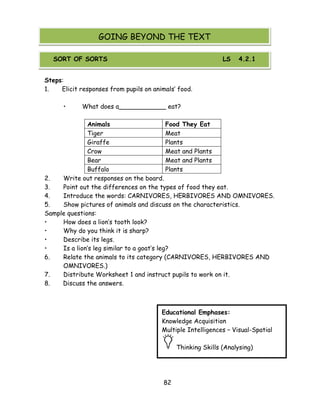
1. Elicit responses from pupils on animals‘ food. 
• What does a____________ eat? 
Animals 
Food They Eat 
Tiger 
Meat 
Giraffe 
Plants 
Crow 
Meat and Plants 
Bear 
Meat and Plants 
Buffalo 
Plants 
2. Write out responses on the board. 
3. Point out the differences on the types of food they eat. 
4. Introduce the words: CARNIVORES, HERBIVORES AND OMNIVORES. 
5. Show pictures of animals and discuss on the characteristics. 
Sample questions: 
• How does a lion‘s tooth look? 
• Why do you think it is sharp? 
• Describe its legs. 
• Is a lion‘s leg similar to a goat‘s leg? 
6. Relate the animals to its category (CARNIVORES, HERBIVORES AND OMNIVORES.) 
7. Distribute Worksheet 1 and instruct pupils to work on it. 
8. Discuss the answers. 
GOING BEYOND THE TEXT 
SORT OF SORTS LS 4.2.1 
Educational Emphases: 
Knowledge Acquisition 
Multiple Intelligences – Visual-Spatial Thinking Skills (Analysing)
83 
Worksheet 1 
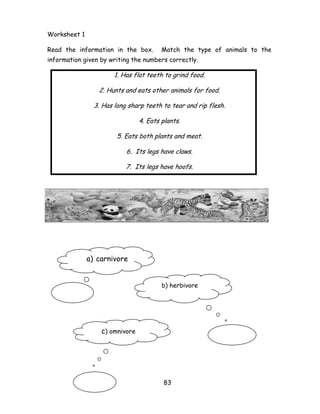
Read the information in the box. Match the type of animals to the information given by writing the numbers correctly. 
1. Has flat teeth to grind food. 
2. Hunts and eats other animals for food. 
3. Has long sharp teeth to tear and rip flesh. 
4. Eats plants. 
5. Eats both plants and meat. 
6. Its legs have claws. 
7. Its legs have hoofs. 
a)carnivore 
b) herbivore 
c) omnivore
84 
Steps: 
1. Divide class into five groups. Tell pupils they will be doing a reader‘s theatre for each chapter. 
2. Get pupils to choose a leader. The leader will choose a chapter. 
3. Give a leader a script (refer to the sample script) which is simplified by teacher according to the class ability. 
4. Each pupil takes a role from the given script. Some roles can be shared by two pupils if there are more members in a group. Every group is given about 15 minutes to practise reading as a group. 
5. When the group is ready to perform, each pupil can choose a mask to use for the reader‘s theatre. 
6. High stools (science lab stools/ music room stools) can be borrowed and used for this purpose. Every pupil reads his lines in a creative way. 
7. This performance can even be used as a competition. Pupils‘ appreciation of the text can be assessed based on this activity. 
Educational Emphases: 
Creativity and Innovation 
Multiple Intelligences – Interpersonal / Verbal Linguistic Thinking Skills (Creating) 
READERS’ THEATRE LS 4.3.2
85 
SAMPLE SCRIPT (CHAPTER 5: RED DOG) 
NARRATOR : Mowgli continued living in the jungle with his four wolf brothers. 
MOWGLI : Come my brothers. I will teach you how to survive in the jungle. 
YOUNG WOLVES : Yeh.. fun, fun, fun in the jungle. 
NARRATOR : Soon the young wolves were experts in hunting. Sometimes they were also joined by Bagheera and Baloo. Together they became fearless hunters. 
BAGHEERA : Mowgli, I see a rabbit behind the rock. Let‘s duck in. 
MOWGLI : Drat.... missed it. There it is. Come on quick. This way. 
YOUNG WOLF 1 : Got it, Big Brother. Yes! Yes! 
MOWGLI : Well done, I am so proud of you. Bagheera, Baloo, see how my brothers are so skilful. They will be the most powerful animals in this jungle kingdom. 
NARRATOR : Mowgli grows up to be a strong man. Mother Wolf is as proud of him as Mowgli is also a good brother to four young cubs. But one day... 
MOTHER WOLF : Mowgli, I will not stay long anymore. Father Wolf is calling me. I want you to take good care of your brothers. They are young. Protect them from hunters and the winds of death. Promise me? 
MOWGLI : Mother, you make me really sad. But I promise, my brothers will always be my eyes. I will never leave them. Just as how you protected me when I came to you, helpless and weak. 
NARRATOR : With that Mother Wolf dies. Mowgli is deeply saddened. He leaves her in a cave and rolls a big stone to cover the mouth of the cave. Many years later..... 
WONTOLLA : Pheeal.... Pheeal
86 
MOWGLI : Who sounded that? Let‘s head to the Council Rock. 
NARRATOR : All the animals head to the Council Rock. Won-Tolla, one of the young wolves is badly hurt and bleeding. 
WONTOLLA : The red dogs are on their way here. They did this to me. They are trailing me here. I came to warn you. Hide somewhere, Mowgli so that they will not find you. The others can stay and fight with them. 
MOWGLI : What! Over my dead body. I will never leave my family here. I must fight the enemy. My knife will be a fang for this pack. 
WON-TOLLA : It‘s not easy, Mowgli. There are about two hundred dogs trailing me here. It‘s impossible. 
MOWGLI : I know what to do. I will go south and see what‘s happening. 
NARRATOR : Mowgli ran towards the river. He met Kaa, the snake. 
KAA : Where are you heading, Mowgli? 
MOWGLI : Didn‘t you hear the pheeal, the dead shriek a while ago? Won- Tolla has been attacked by the red dogs. He is badly injured and he came to tell us. They are on their way now. We must fight them. 
KAA : I have an idea. You must lead the dogs to where the Little People live. This will get the dogs to be swarmed and stung by the Little People. 
NARRATOR : They both swim to the place of Death, where the dangerous hornets live. The hornets sting and kill anyone who pass their homes or disturb them. 
MOWGLI : Thank you, Kaa. You are very wise. Now go back to the jungle. Tell my pack to wait for me by the river. 
NARRATOR : Kaa returns to the jungle. Mowgli swims to the other side, passing the Little People‘s homes very carefully. He finds a tall
87 
tree and climbs it. From there he sees the dogs. He calls them to the tree. 
MOWGLI : Go home you cowards! 
RED DOG LEADER : Come down, you weak bones. Your jungle is ours now. 
NARRATOR : Mowgli annoyed them further. This angered the leader and he nearly caught Mowgli‘s leg. But Mowgli was quicker and managed to catch the dog and cut off his tail. 
MOWGLI : Ha ha. Go home and cry that a human has done this to you. You know who‘s stronger now. 
NARRATOR : This made them even angrier. By evening, Mowgli left the tree and started towards the Little People‘s homes. With such speed, he swung from tree to tree and even sprinted on the ground. He was too fast for the dogs. 
MOWGLI :The Little People‘s Homes are here. I must jump carefully without disturbing them. 
NARRATOR : But as he jumps over, some stones fall on the homes. The hornets charge and sting the dogs. But Mowgli manages to jump into the river and swim away. 
DOGS : Ouch, eeow. Oh Oh. My body aches. What are these? Hornets... aargh.Quick escape! Leave our weak friends here. 
NARRATOR : Many of the dogs are dead. Some are too weak to continue the fight. The remaining few however, chase Mowgli. The dogs gather around Mowgli. 
RED DOG : The Hunt is over. Time for us to tear your flesh off, human! 
MOWGLI : You are wrong. The hunt is about to begin. My brothers are waiting for you.
88 
NARRATOR : The dogs are weak and tired but the wolves are well rested. They fight and howl all night. Akela is badly hurt. Mowgli goes to see him. 
AKELA : Mowgli, I won‘t last long. I cared for you. Now you have paid your gratitude. You must go now to be with your kind. Live among humans. You don‘t belong here. 
MOWGLI : No! I will never. I belong here. Akela! Akela? 
NARRATOR : Akela dies. Now, Mowgli is the strongest among his pack. Yet, Akela‘ words trouble Mowgli's mind. Will he leave the jungle, his home? Maybe. But not today. Someday....perhaps.
89 
JUNGLE SCRAP BOOK 
Steps: 
1. Pupils choose an animal each from the story. 
2. Tell them they have to collect as much information about that animal. 
3. Information can come from the Internet, encyclopaedia, parents and teachers. 
4. Give each pupil a handout on circle map. 
5. Pupils need to write the information on the map. 
6. Provide guidance and facilitate this activity to help pupils with this activity. 
Educational Emphases: 
Information and Communication Technology Skills (ICT) 
Learning How to Learn Skills 
i-THINK Programme– Circle Map 
Multiple Intelligences – Visual-Spatial Thinking Skills (Analysing) 
JUNGLE SCRAPBOOK LS 4.3.1
90 
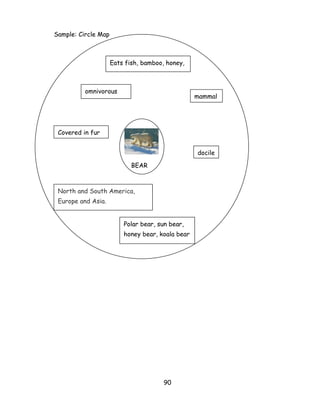
Sample: Circle Map 
: 
MA 
BEAR 
Library 
mammal 
omnivorous North and South America, Europe and Asia. 
docile 
Covered in fur 
Polar bear, sun bear, honey bear, koala bear 
Eats fish, bamboo, honey,
91 
CREATE YOUR OWN ANIMAL (Advanced) 
Steps: 
1. Pupils work individually. 
2. Distribute a guide for the task that pupils need to do. 
3. Explain the task. 
4. Using the guide, pupils are to write a short description about their animal. 
Guide for Pupils 
Using the guide provided below, write a short description about your animal... 
1) Give your animal a name. 
2) Describe what the animal looks like (fur, no fur, number of feet, height, weight, features, colour). 
3) Describe the personality of your animal (playful, gentle, mean, fearful, aggressive, etc.). 
4) Describe what kind of food your animal eats and why (plants, meat, berries, twigs, etc.). 
5) Describe where your animal lives (jungle, forest, domestic, cave, hole in the ground, etc.). 
6) Describe your animal‘s skills and why these skills are necessary for its survival (hunter, flier, runner, etc.) 
7) describe the advantages and disadvantages your animal has on a daily basis (sight, night animal, day animal, etc.). 
8) Draw a picture of your animal. 
Educational Emphases: 
Constructivism 
Creativity and Innovation 
Multiple Intelligences –Visual-Spatial Thinking Skills (Analysing) 
CREATE YOUR OWN ANIMAL (ADVANCED PUPILS) LS 4.3.1
92 
HEATRICAL VOCABULARY WORD SEARCH (Advanced) 
Steps: 
1. Distribute the Worksheet 1 to pupils. 
2. In pairs, pupils try to unscramble the letters to form words which are related to stage play/drama. 
3. Check the answers with them. 
4. Provide the correct answers. 
Educational Emphases: 
Contextual Learning 
Multiple Intelligences –Interpersonal Thinking Skills (Analysing) 
THEATRICAL VOCABULARY WORD SEARCH (ADVANCED PUPILS) LS 4.2.1
93 
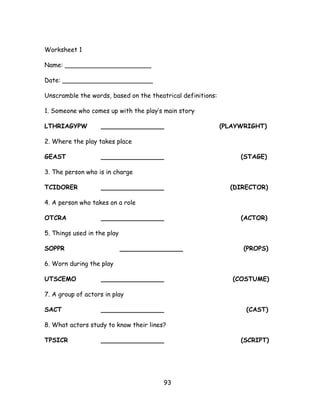
Worksheet 1 
Name: ______________________ 
Date: _______________________ 
Unscramble the words, based on the theatrical definitions: 
1. Someone who comes up with the play‘s main story 
LTHRIAGYPW ________________ (PLAYWRIGHT) 
2. Where the play takes place 
GEAST ________________ (STAGE) 
3. The person who is in charge 
TCIDORER ________________ (DIRECTOR) 
4. A person who takes on a role 
OTCRA ________________ (ACTOR) 
5. Things used in the play 
SOPPR ________________ (PROPS) 
6. Worn during the play 
UTSCEMO ________________ (COSTUME) 
7. A group of actors in play 
SACT ________________ (CAST) 
8. What actors study to know their lines? 
TPSICR ________________ (SCRIPT)
94 
MOVIE POSTER (Average or Advanced) 
Steps: 
1. Brainstorm pupils on the importance of movie posters - to inform people about a movie, information of the movie and the cast. 
2. Show pupils samples of movie posters. Tell pupils they have to produce a movie poster on ‗The Jungle Book‘. 
3. Pupils form groups of four. They discuss on what to include in the poster which can be done using A4 paper. 
4. Pupils start their project. They can use poster colours, crayons or even print from the Internet. 
5. Display every poster for the whole class to view. 
Educational Emphases: 
Creativity and Innovation 
Multiple Intelligences –Visual-Spatial / Interpersonal Thinking Skills (Creating) 
MOVIE POSTER (AVERAGE/ADVANCED PUPILS) LS 4.3.1
95 
CHORAL SPEAKING 
Steps: 
1. Give the choral speaking script to the pupils. 
2. Read the lines and get pupils to follow after the teacher. 
3. Get them to improvise if they want to. 
4. Give pupils time to rehearse well. 
5. Prepare pupils for a presentation during assembly. 
Educational Emphases: 
Creativity and Innovation 
Multiple Intelligences – Musical / Interpersonal 
Thinking Skills (Creating) 
CHORAL SPEAKING LS 4.3.2
96 
SAMPLE SCRIPT FOR CHORAL READING/SPEAKING 
(Teachers are free to improvise on this script to suit your class potential) 
In a dark gloomy cave (krik krik krik) boys 
Deep inside the jungle (oooh oooh ooh) 
Little Mowgli cries alone (ngen ngen ngen) all 
Akela comes to the rescue girls 
Four young cubs are his brothers now 
The Council Rock 
Sits for a meeting boys 
―I will teach him the laws of the jungle, shouts Baloo. a boy 
―I will bring a fat bull for you a boy 
If you keep the man-cub‖ echoes Bagheera a boy 
Big and strong grows Mowgli - (show actions) 
Monkeys drag him to Cold Lairs 
A kick and a punch whole class 
Mowgli escapes the stupid monkeys
97 
The Evil One, a girl 
The Bad One a girl 
The Instigator a girl 
None other than Shere Khan all 
Into the jungle Mowgli goes girls 
Girl with flower trembles and run 
Hey it‘s the flower 
The torch to scare Shere Khan. boys 
No more threats 
No more fears girls 
Only goodness and kindness all 
Mowgli leaves the jungle 
And heads for the village girls, boys, girls 
Jungle, village ,jungle ,village alternate 
Settle in the village 
Lives as a human girls 
Learning how to talk 
And tend the bulls
98 
Then comes Shere Khan 
Revenge, fury, challenge 
But Mowgli gets him boys  individual voices for sound effects 
Cornered by bulls 
No way to escape 
Shere Khan faces death 
In Mowgli‘s hands girls 
His skin covering the rock 
Mowgli rules 
Yehh yehh yehh all 
This is our jungle book 
By, Kalaimathy Irene George
99 
LIFE BEYOND THE JUNGLE 
Steps: 
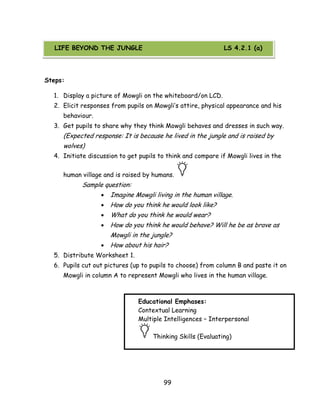
1. Display a picture of Mowgli on the whiteboard/on LCD. 
2. Elicit responses from pupils on Mowgli‘s attire, physical appearance and his behaviour. 
3. Get pupils to share why they think Mowgli behaves and dresses in such way. 
(Expected response: It is because he lived in the jungle and is raised by wolves) 
4. Initiate discussion to get pupils to think and compare if Mowgli lives in the human village and is raised by humans. 
Sample question: 
 Imagine Mowgli living in the human village. 
 How do you think he would look like? 
 What do you think he would wear? 
 How do you think he would behave? Will he be as brave as Mowgli in the jungle? 
 How about his hair? 
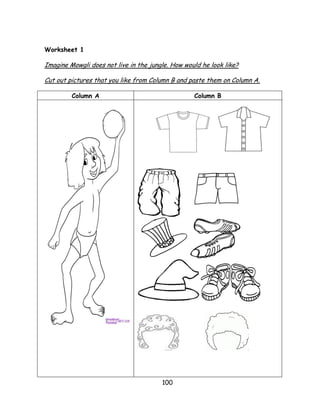
5. Distribute Worksheet 1. 
6. Pupils cut out pictures (up to pupils to choose) from column B and paste it on Mowgli in column A to represent Mowgli who lives in the human village. 
Educational Emphases: 
Contextual Learning 
Multiple Intelligences – Interpersonal Thinking Skills (Evaluating) 
LIFE BEYOND THE JUNGLE LS 4.2.1 (a)
100 
Worksheet 1 
Imagine Mowgli does not live in the jungle. How would he look like? 
Cut out pictures that you like from Column B and paste them on Column A. 
Column A 
Column B
101 
SAMPLE LESSON PLANS
102 
Theme : World of Stories 
Topic : The Jungle 
Learning Standards : 
1.1.2 Able to listen to and enjoy stories. 
3.3.1 Able to create simple texts using a variety of media with guidance: (a) linear 
4.2.1 Able to respond to literary texts: (b) place and time 
Objectives : By the end of the lesson, pupils should be able to: 
(1) Identify and match the setting based on the dialogues. 
(2) Label places on a map that can be found in the story. 
Time : 60 minutes 
Teaching aids : Handout 1, Handout 2, Worksheet 1, The Jungle Book, Handout 3, Handout 4 and Worksheet 2. 
Moral Value : Appreciating the environment 
CCE / Educational Emphases : Thinking skills, multiple intelligences, visual/spatial, creativity and innovation. 
Steps: 
Pre-Reading 
1. Play sounds of the music of various animals and other relevant sounds that could be heard in the jungle. 
2. Pupils close their eyes and listen to the sounds. 
SAMPLE LESSON PLANS 
LESSON PLAN 1
103 
3. Pupils guess and say where they can hear these sounds. Teacher writes the responses on the board. 
4. Link the topic to the Jungle Book by talking about Mowgli living in the jungle. 
5. Ask some questions on jungle to prepare pupils to the text. 
 Have you been into the jungle? 
 What can you see in the jungle? 
 What can you do in the jungle? 
While-Reading 
Activity 1 
1. Pupils work in pairs. 
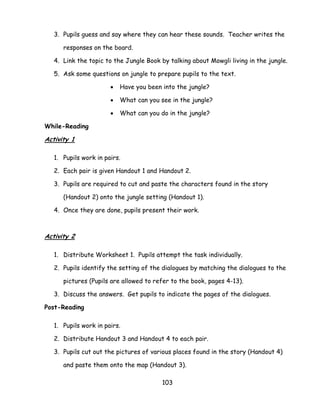
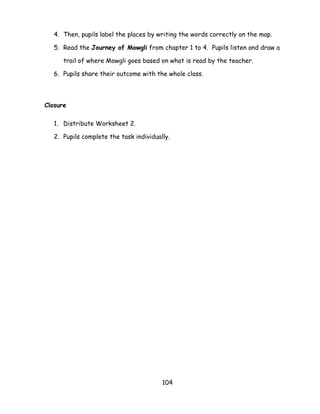
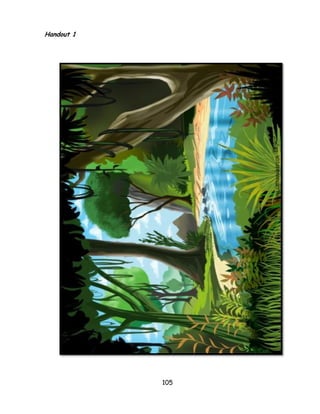
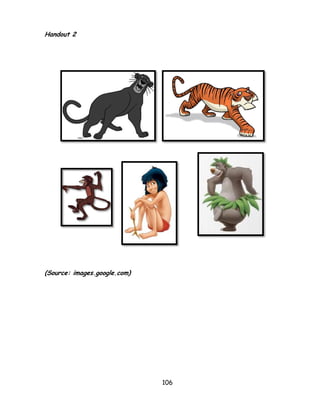
2. Each pair is given Handout 1 and Handout 2. 
3. Pupils are required to cut and paste the characters found in the story (Handout 2) onto the jungle setting (Handout 1). 
4. Once they are done, pupils present their work. 
Activity 2 
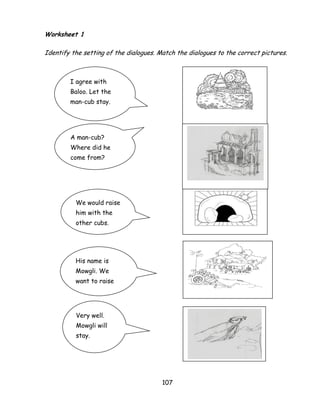
1. Distribute Worksheet 1. Pupils attempt the task individually. 
2. Pupils identify the setting of the dialogues by matching the dialogues to the pictures (Pupils are allowed to refer to the book, pages 4-13). 
3. Discuss the answers. Get pupils to indicate the pages of the dialogues. 
Post-Reading 
1. Pupils work in pairs. 
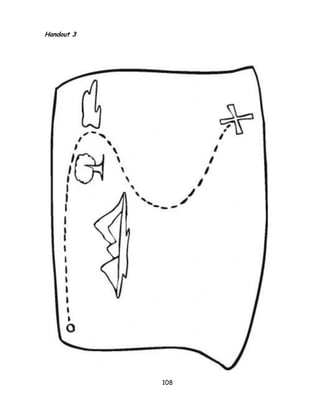
2. Distribute Handout 3 and Handout 4 to each pair. 
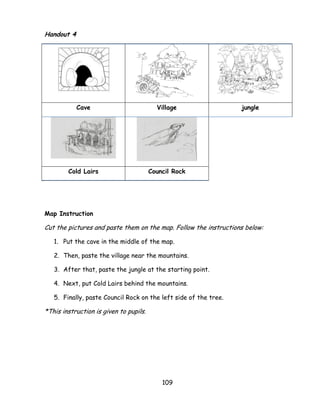
3. Pupils cut out the pictures of various places found in the story (Handout 4) and paste them onto the map (Handout 3).
104 
4. Then, pupils label the places by writing the words correctly on the map. 
5. Read the Journey of Mowgli from chapter 1 to 4. Pupils listen and draw a trail of where Mowgli goes based on what is read by the teacher. 
6. Pupils share their outcome with the whole class. 
Closure 
1. Distribute Worksheet 2. 
2. Pupils complete the task individually.
105 
Handout 1
106 
Handout 2 
(Source: images.google.com)
107 
Worksheet 1 
Identify the setting of the dialogues. Match the dialogues to the correct pictures. 
I agree with Baloo. Let the man-cub stay. 
A man-cub? Where did he come from? 
We would raise him with the other cubs. 
His name is Mowgli. We want to raise him with our 
Very well. Mowgli will stay.
108 
Handout 3
109 
Handout 4 
Cave 
Village 
jungle 
Cold Lairs 
Council Rock Map Instruction Cut the pictures and paste them on the map. Follow the instructions below: 1. Put the cave in the middle of the map. 2. Then, paste the village near the mountains. 3. After that, paste the jungle at the starting point. 4. Next, put Cold Lairs behind the mountains. 5. Finally, paste Council Rock on the left side of the tree. *This instruction is given to pupils.
110 
Mowgli’s Journey (to be read by teacher) Mowgli‘s was abandoned in the jungle when he was young. He took refuge in a cave where he was adopted and brought up by two wolves, Akela and Mother Wolf. At Council Rock, Akela asked if anyone will speak for Mowgli. Baloo, the bear and Bagheera, the panther suggested that Mowgli should stay. Years passed and one day, the monkeys kidnapped Mowgli and brought him to the Cold Lairs. Baloo and Bagheera seek help from Kaa and together they managed to save Mowgli from the monkeys. Later on, Mowgli left for the village to live life as a human.
111 
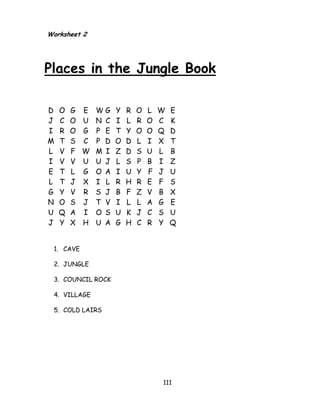
Worksheet 2 Places in the Jungle Book 
D O G E W G Y R O L W E J C O U N C I L R O C K I R O G P E T Y O O Q D M T S C P D O D L I X T L V F W M I Z D S U L B I V V U U J L S P B I Z E T L G O A I U Y F J U L T J X I L R H R E F S G Y V R S J B F Z V B X N O S J T V I L L A G E U Q A I O S U K J C S U J Y X H U A G H C R Y Q 
1. CAVE 
2. JUNGLE 
3. COUNCIL ROCK 
4. VILLAGE 
5. COLD LAIRS
112 
Theme : World of Stories 
Topic : Who is good? Who is not? 
Learning Standards : 
1.1.2 Able to listen and enjoy stories 
1.1.3 Able to listen to and recite poems, tongues twisters, and sing songs paying attention to pronunciation, rhythm and intonation. 
2.2.2 Able to read and understand phrases and sentences from non-linear text. 
4.2.1 Able to respond to literary texts: (a) characters 
Objectives : By the end of the lesson, pupils should be able to: 
i. Talk about the characters. 
ii. Identify the good characters and bad characters by grading the characters with either A, B or C. 
iii. Give reason why a character is good or bad. 
Teaching Aids : ‗The Jungle‘ book, report cards and grading cards, Handout 1. 
Moral value(s) : Good over evil 
CCE / Educational Emphases : Thinking skills, Values and Citizenship, Multiple Intelligences 
LESSON PLAN 2
113 
Steps: 
Pre-Reading 
Activity 1 
1. Tell pupils to listen to the dialogues and identify the speakers (5 characters from the story). 
 You don‘t belong here Akela. You‘re old and weak! (Shere Khan, pg. 29) 
 Very well. Mowgli may stay. (Akela, pg. 13) 
 We‘re looking for the Monkey People. They‘ve taken Mowgli. (Bagheera, pg. 19) 
 This is a human place, and you‘re human. You can teach us to be like humans! (The monkey, pg. 20) 
 I‘m part of the pack! That‘s all I want to be! (Mowgli, pg. 27). 
2. After each guess, show the picture of each character and talk about the characters with the pupils. 
Sample questions: 
 What is his/her name? 
 What is he? (human/bear/wolf/tiger/monkey) 
 Do you like this character? Why? 
 Can you describe this character? (Suggested responses: kind, fierce, patient, brave)
114 
While-Reading 
Activity 1 
1. Read the story from page 4 to 13 using the correct intonation and expression. 
2. Pupils listen and read after teacher. 
3. Pick pupils at random and asks them to read with the correct pronunciation and intonation. 
4. Tell pupils the importance of using the right intonation when you are reading dialogues of different characters. 
Activity 2 
1. Distribute two report cards and two sets of grading cards (A, B and C) to each pupil. 
2. Tell pupils that one report card is for the character they like and the other one is for the character they dislike. 
3. Pupils need to paste a grade (A, B or C) for each of the two characters. 
A – Good character 
B – Good and Bad character 
C – Bad character 
4. Pupils give reasons for their choice in simple sentences.
115 
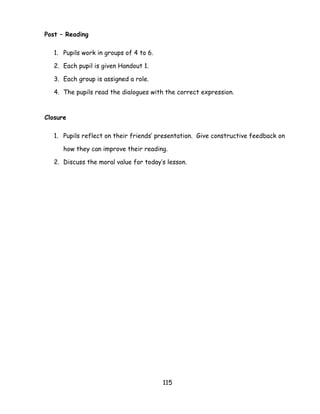
Post – Reading 
1. Pupils work in groups of 4 to 6. 
2. Each pupil is given Handout 1. 
3. Each group is assigned a role. 
4. The pupils read the dialogues with the correct expression. 
Closure 
1. Pupils reflect on their friends‘ presentation. Give constructive feedback on how they can improve their reading. 
2. Discuss the moral value for today‘s lesson.
116 
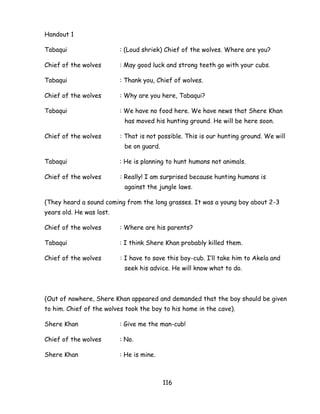
Handout 1 
Tabaqui : (Loud shriek) Chief of the wolves. Where are you? 
Chief of the wolves : May good luck and strong teeth go with your cubs. 
Tabaqui : Thank you, Chief of wolves. 
Chief of the wolves : Why are you here, Tabaqui? 
Tabaqui : We have no food here. We have news that Shere Khan has moved his hunting ground. He will be here soon. 
Chief of the wolves : That is not possible. This is our hunting ground. We will be on guard. 
Tabaqui : He is planning to hunt humans not animals. 
Chief of the wolves : Really! I am surprised because hunting humans is against the jungle laws. 
(They heard a sound coming from the long grasses. It was a young boy about 2-3 years old. He was lost. 
Chief of the wolves : Where are his parents? 
Tabaqui : I think Shere Khan probably killed them. 
Chief of the wolves : I have to save this boy-cub. I‘ll take him to Akela and seek his advice. He will know what to do. 
(Out of nowhere, Shere Khan appeared and demanded that the boy should be given to him. Chief of the wolves took the boy to his home in the cave). 
Shere Khan : Give me the man-cub! 
Chief of the wolves : No. 
Shere Khan : He is mine.
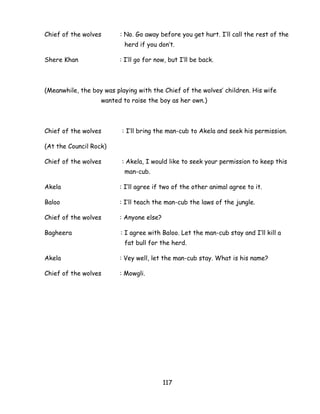
117 
Chief of the wolves : No. Go away before you get hurt. I‘ll call the rest of the herd if you don‘t. 
Shere Khan : I‘ll go for now, but I‘ll be back. 
(Meanwhile, the boy was playing with the Chief of the wolves‘ children. His wife wanted to raise the boy as her own.) 
Chief of the wolves : I‘ll bring the man-cub to Akela and seek his permission. 
(At the Council Rock) 
Chief of the wolves : Akela, I would like to seek your permission to keep this man-cub. 
Akela : I‘ll agree if two of the other animal agree to it. 
Baloo : I‘ll teach the man-cub the laws of the jungle. 
Chief of the wolves : Anyone else? 
Bagheera : I agree with Baloo. Let the man-cub stay and I‘ll kill a fat bull for the herd. 
Akela : Vey well, let the man-cub stay. What is his name? 
Chief of the wolves : Mowgli.
118 
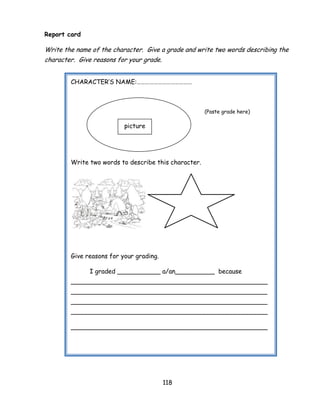
Report card 
Write the name of the character. Give a grade and write two words describing the character. Give reasons for your grade. 
CHARACTER‘S NAME:………………………………… 
(Paste grade here) 
Write two words to describe this character. 
Give reasons for your grading. 
I graded ___________ a/an__________ because __________________________________________________ __________________________________________________ __________________________________________________ __________________________________________________ 
__________________________________________________ 
picture
119 
2 Sets of Grading Cards. 
A B C 
A B C
120 
(LESSON PLAN ON MORAL VALUES) 
Theme : World of Stories 
Topic : The Jungle 
Learning Standards: 
1.1.2 Able to listen to and enjoy stories. 
2.2.2 Able to read and understand phrases and sentences from non-linear texts. 
4.2.1 Able to respond to literary texts: (c) values 
4.3.1 Able to produce and display creative works based on literary texts using a variety of media with guidance. 
Objectives : By the end of the lesson, pupils should be able to: 
i. express their opinions about good over evil 
ii. design a poster 
Teaching Aids : Red and blue cards, character bingo cards on 5 characters, sample poster. 
Moral Value : Kindness and love 
CCE / Educational Emphases : Thinking skills, Values and Citizenship, Multiple Intelligences 
Steps: 
Pre-Reading 
1. Play a song on animals and pupils sing along. 
2. Pupils identify the characters in the song. 
LESSON PLAN 3
121 
While-Reading 
1. Each pupil is given a red and blue card each (Blue represents ‗like‘ and red represents ‗dislike‘). 
2. Read out description/information about 5 characters (Handout 1) 
3. Pupils identify the characters. 
4. Paste the picture/write the name of the character on the board after every answer and ask questions pertaining to the character. 
Do you like this character? Why? 
Do you think he/she/it is good? Why? 
5. For questions that require a ‗like‘ or ‗dislike‘ answers, pupils put up the blue or red cards. 
6. After reading out and discussing all the characters, discuss the overall moral value/message of the story. 
7. Get pupils to share what they have learnt from the story. 
Post Reading 
1. Write the moral values/message learnt on the board for pupils‘ reference. 
2. Prepare a cut-out of the main characters on A4 sized papers that pupils can use to design their posters. 
3. Individually, pupils design a poster based on the moral values/message learnt from the story. 
4. Pupils use the pictures they need for their poster based on the moral value/message that they chose.
122 
5. Pupils are to write the moral values/message on the poster. Pupils are free to design their poster based on their own creativity. 
6. Once pupils have completed their posters, get pupils to display their posters around the classroom. 
7. A gallery walk is done for pupils to take a look at their friends‘ work. 
*Pupils are told to bring necessary materials beforehand. You can use the template that have been prepared or create your own. 
Closure 
1. Sum up the lesson with a brief discussion on the moral value of the lesson.
123
124 
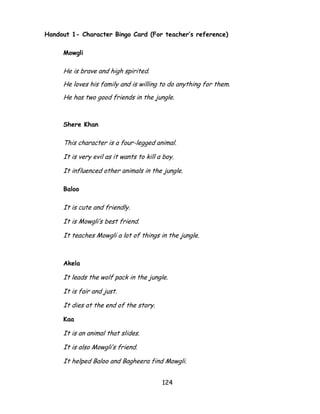
Handout 1- Character Bingo Card (For teacher’s reference) 
Mowgli 
He is brave and high spirited. 
He loves his family and is willing to do anything for them. 
He has two good friends in the jungle. 
Shere Khan 
This character is a four-legged animal. 
It is very evil as it wants to kill a boy. 
It influenced other animals in the jungle. 
Baloo 
It is cute and friendly. 
It is Mowgli‘s best friend. 
It teaches Mowgli a lot of things in the jungle. 
Akela 
It leads the wolf pack in the jungle. 
It is fair and just. 
It dies at the end of the story. 
Kaa 
It is an animal that slides. 
It is also Mowgli‘s friend. 
It helped Baloo and Bagheera find Mowgli.
125 
Red and blue cards 
BLUE 
RED CARD
126 
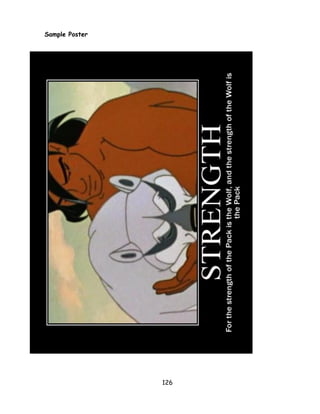
Sample Poster
127 
NAME: __________________________ 
CLASS: _________________________ 
TEACHER‘S NAME: ______________________ 
Teacher‘s note: Tick the appropriate column 
No 
Criteria 
Excellent 
Good 
Satisfactory 
Ideas to improve 
a Classroom Involvement 
Not shy to express their own opinion and ask questions 
b Creative 
Creative and dare to be different 
c Imaginative 
Interesting ideas and able to go beyond the text 
d Language Delivery 
Pronunciation and intonation 
Accurate and fluent in speech 
e Knowledge and Understanding 
Able to understand the story and write/talk about it 
Comments: ______________________________________________________________ ______________________________________________________________ 
BALOO HERE! TAKE A LOOK AT HOW YOU ARE DOING! 
EXAMPLES FOR ASSESSMENT
128 
GROUP WORK 
GROUP: __________________ 
CRITERIA 
EXCELLENT 
GOOD 
SATISFACTORY 
NEED PRACTICE 
Language Delivery 
(enunciation, intonation and pronunciation) 
Physical Expression 
(movements, gestures & expressions) 
Creativity 
(costume, sound effects) 
Teamwork 
(cooperation among group members) 
Total Stars
129 
THANK YOU FOR THE LOVELY STORY! 
MY NAME IS _______________ AND I FEEL 
WHAT I LIKE IN THE STORY 
WHAT I DON‘T UNDERSTAND IN THE GRAPHIC NOVEL 
Hi, I am Bagheera. You read about me in the ―Jungle Book‖. Feel free to write to me and tell me what you like about the story. 
CIRCLE OR DRAW A FACE! 
PUPIL‘S SELF REFLECTION

Graphic novel the jungle book -final draft

  • 1.
  • 2.
    2 Table ofContents USING GRAPHIC NOVELS WITH CHILDREN 5 A GUIDE FOR TEACHERS 5 DEFINITION 5 WHY DO WE USE GRAPHIC NOVELS? 5 VISUAL FEATURES OF GRAPHIC NOVELS 6 INTRODUCING THE BOOK 11 REVOLVING AROUND THE TEXT 11 EXPLORING THE FRONT COVER 11 EXPLORING THE BACK COVER 12 SYNOPSIS 13 CHARACTERS IN THE BOOK 15 SUPPORTING CHARACTERS 16 DESCRIPTION 17 SETTING/PLACE OF THE STORY 19 EVENTS IN THE STORY 20 MESSAGE/MORAL OF THE STORY 21 REVOLVING AROUND THE TEXT 23 WHAT’S ON THE COVER 23 JUMBLED UP ANIMALS 27 A WALK ALONG THE JUNGLE PATH 29 SYPNOSIS 32 WHAT HAPPENS NEXT? 32 PICTURE ARRANGEMENT 35 WHEEL OF THE JUNGLE 38 CHARACTERS IN THE STORY 41 CHARACTER REPORT CARD 41 PRODUCING A MASK 44 FREEZE AND GUESS 48 MIRROR EXERCISE 49 SETTINGS 50 WHO LIVES IN THE CAVE? 50 MEETING AKELA 52 HERE OR THERE 54 MY JUNGLE BOOK 56
  • 3.
    3 EVENTS INTHE STORY 59 ROLE PLAY 59 MONKEY POEM 60 BEWARE MOWGLI 62 THE RED FLOWER 63 MOWGLI, MOWGLI WHAT DO YOU DO? 65 TELL ME WHY 67 LET’S GET SHERE KHAN 68 AKELA’S DEATH 70 LETTER TO MOWGLI 72 MORAL VALUES / MESSAGE OF THE STORY 74 CHARACTER BINGO 74 MAKING A POSTER 77 BRAINSTORMING 79 GOING BEYOND THE TEXT 82 SORT OF SORTS 82 READERS’ THEATRE 84 JUNGLE SCRAPBOOK 89 CREATE YOUR OWN ANIMAL (ADVANCED PUPILS) 91 THEATRICAL VOCABULARY WORD SEARCH (ADVANCED PUPILS) 92 MOVIE POSTER (AVERAGE/ADVANCED PUPILS) 94 CHORAL SPEAKING 95 LIFE BEYOND THE JUNGLE 99 SAMPLE LESSON PLANS 102 LESSON PLAN 1 102 LESSON PLAN 2 112 LESSON PLAN 3 120 EXAMPLES FOR ASSESSMENT 127 PUPIL’S SELF REFLECTION 127
  • 4.
  • 5.
    5 USING GRAPHICNOVELS WITH CHILDREN A Guide for Teachers Definition A graphic novel is a combination of words and images that form a story. It is presented in the form of a book. It consists of dialogues shown in balloons that enable learners to read simple and short texts. A graphic novel can be an ideal tool for pupils to learn the language. This is because it consists of several unique elements: o Linear narrative as found in short stories and novels o Illustrations and images as found in picture books o Dialogues as found in plays and poetry Why do we use graphic novels? Graphic novels can be used in the primary schools for the following reasons:  Attract pupils‘ interest to read especially the reluctant readers  Consist of rich and complex plots which can attract advanced readers  Colourful graphics in the form of pictures that can attract young pupils  Help pupils who are struggling with the language as the illustration provides contextual clues to the meaning of the words/sentences  Expose pupils to literary elements through visual and words
  • 6.
    6 Visual Featuresof Graphic Novels Graphic novels consist of various features which one needs to know. These features are elaborated below. 1. Splash Page: It is a full page illustration which opens and introduces a story. It can also be used to indicate suspense. The splash page usually consists of large, dominant visuals and bold print that function as an attention grabber among young learners. Figure 1
  • 7.
    7 2. Frames/Panels: Graphic novels use frames and panels to illustrate the story. The visuals on one page are captured in a big frame. Within a frame, one may find few panels. The panels are boxes that contain each of the scenes. The panels can be arranged on the page in a linear fashion as shown in Figure 1 or in a non-linear fashion as shown in Figure 2. Figure 2
  • 8.
    8 3. FontSizes, Colours, and Styles: The texts in graphic novels are differentiated using various font sizes. For example, bigger font size is used to indicate dramatic effect. Different colours are used to differentiate between the narratives and the dialogues. Words can also be used to display sounds and emphasise the action taking place in the story. The use of onomatopoeia in graphic novel is indicated through the use of styles. For example, ‗fwoosh‘ (refer to Figure 3) is written in such a way to follow the movement of the swinging of the torch. Figure 3 4. Gutters: The space between the panels is called the gutter. As readers move from panel to panel, they have to make inferences and draw conclusions as to what happens in the gutter—in that tiny space between each scene. The authors use the gutters to move along the action in scenes, to show the passage of time, or to make changes in locations.
  • 9.
    9 5. WordBalloons: Word balloons are speech bubbles found in graphic novels. These can be in different shapes and sizes throughout the novel. Word balloons indicate the words uttered by various characters in the story. . Gutter
  • 10.
  • 11.
    11 EXPLORING THEFRONT COVER INTRODUCING THE BOOK REVOLVING AROUND THE TEXT ORIGINAL AUTHOR TITLE RETELLING AUTHOR ARTIST/ILLUSTRATOR GENRE
  • 12.
    12 TITLE BARCODE PUBLISHER BLURB EXPLORING THE BACK COVER
  • 13.
    13 Chapter 1 Mowgli, a little boy, takes refuge in a cave. He is adopted and brought up by two wolves, Father Wolf and Mother Wolf. Shere Khan, the tiger has killed Mowgli‘s parents and vows to kill Mowgli. Mother Wolf feels the need to keep Mowgli in the pack to protect him. At Council Rock, Akela asks if anyone will speak for Mowgli. Baloo, the bear and Bagheera, the panther suggest that Mowgli should stay. Chapter 2 Mowgli‘s new ‗parents‘, Baloo, the bear and Bagheera, the panther, teach Mowgli the ways of the jungle and the laws and customs of the Jungle Folk. Mowgli develops a strong bond with his new friends, Baloo and Bagheera. He grows up into a strong young man. One day, Mowgli is kidnapped by a group of monkeys and taken to the Cold Lairs. Baloo and Bagheera seek help from Kaa, the rock snake and together, they manage to save Mowgli from the monkeys. Chapter 3 Two wolf-friends warn Mowgli that Shere Khan still wants to kill him. Shere Khan tries to poison the young wolves‘ minds against Mowgli and Akela. Mowgli goes to the village and steals the Red Flower (a vessel containing fire). He lights a torch, warns the other young wolves not to listen to Shere Khan and accepts Akela as their leader. Shere Khan runs away into the jungle. Mowgli also leaves for the village. SYNOPSIS
  • 14.
    14 Chapter 4 In the village, a woman named Messua claims that Mowgli is her son. Mowgli is very happy. In the village, he learns to live like a human. Baloo and Bagheera visit Mowgli to tell him that Shere Khan is hiding nearby. Together, they trap Shere Khan and kill him. Mowgli skins Shere Khan‘s hide and lays it on the Council Rock. The villagers chase Mowgli out of the village because they think that Mowgli is a wolf-child and is dangerous. Mowgli then returns to the jungle. Chapter 5 Mowgli and his close friends share many adventures. One day, the Jungle Folk is attacked by a pack of dholes/red dogs. Mowgli quickly seeks advice from Kaa in his attempt to save the Jungle Folk. Mowgli and Kaa lead the dholes towards the homes of the Little People. The Little People attack the dholes and kill them. After defeating the dholes, Akela dies. Before dying, Akela tells Mowgli that one day, Mowgli will leave the jungle because he does not belong there. Mowgli ponders on Akela‘s last words but he is not ready at that moment.
  • 15.
    15 Kaa ShereKhan CHARACTERS IN THE BOOK Bagheera Baloo Akela Mowgli
  • 16.
    16 Won-tolla Messua Dholes SUPPORTING CHARACTERS Little People The Monkeys Buldeo the Hunter
  • 17.
    17 Main Characters CHARACTER DESCRIPTION WHY WE SAY THIS? Mowgli (The boy who was raised by wolves)  Brave  Determined  Grateful  Intelligent - I‘m not your prey, Shere Khan! Now get out of my sight! (pg. 32) - I may be a man, but I promised to fight with the pack! Even if I die! (pg. 50) - I have had enough of that tiger. It‘s time I killed him….I have a plan…(pg. 38) Baloo (The bear- Mowgli‘s best friend)  Loving  Protective -Who knows? But those careless fools will hurt Mowgli. We have to get him back. (pg. 19) - Leave the man cub alone! (pg. 21) Kaa (The python)  Helpful -Kaa helped us find you. (pg. 22) Bagheera (Black panther)  Thoughtful  Protective -I was once a prisoner myself. (pg. 26) -Or you‘ll answer us! (pg. 21) Shere Khan (The evil tiger)  Determined  Vengeful/ revengeful -Give me the man-cub! My hunt isn‘t finished! (pg. 9) -You‘ll regret this, wolves. I will kill that man-cub. (pg. 11) Akela (Leader of the wolf pack)  Respected  Fair -Akela won‘t allow a human to be part of the pack. We have to ask. (pg. 11) -If two others speak for him, I will let him stay. (pg. 12) DESCRIPTION
  • 18.
    18 Supporting Characters CHARACTER DESCRIPTION WHY WE SAY THIS? Messua (A village woman who claims that Mowgli/ Nanthoo is her son)  Loving -Filled with joy, Messua took Mowgli to her home. She cleaned him up and she taught him human speech. (pg. 35) The monkeys  Mischievous -This is a human place, and you are human. You can teach us to be like humans (pg. 20). Won-tolla (A wolf who warns the other wolves)  Concerned -The cry was the pheaal. It served as a warning to the Jungle Folk. (pg. 46) Dholes (Red dogs)  Fierce  Evil -I‘ll tear out your stomach for that. (pg. 54) -Come down here, hairless ape! Your jungle is our jungle now! (pg. 53) Buldeo the Hunter  Arrogant  Furious -Stay back wolf-child! (pg. 41) Tabaqui (The hyena)  Evil -That‘s why I sounded the pheaal. (pg. 7) Little People  Wild -All the Jungle Folk feared the swarm of the Little People (pg. 57).
  • 19.
    19 SETTING/PLACE OFTHE STORY The Jungle Book takes place in the jungles of India and in a small village. (Source: http://www.google.com.my/search?aq=&rlz=1T4AURU_enMY505MY509&q=setting+of+the+jungle+book+by+rudyard+kipling) SETTING/PLACE OF THE STORY
  • 20.
    20 EVENTS INTHE STORY Akela thanks Mowgli for his deeds, but tells him that the jungle is not his place. Mowgli is undecided. Mowgli decides to stay in the jungle for the time being. The remaining dogs battle with Mowgli and the wolves. All the dogs are killed and Akela is badly hurt. A pack of Red Dogs heads to the jungle. Mowgli and Kaa lure them to the Little People’s home where most of them are stung to death. The villagers are threathened by Mowgli's strength so they drive him out of the village. Mowgli returns to the jungle. The wolves meet Mowgli in the village and tell him that Shere Khan is hiding and waiting to kill him. They trap Shere Khan and Mowgli kills him. Mowgli heads to the village and is raised as a human by Messua, who claims that Mowgli is her son , Nanthoo. Shere Khan turns the young wolves against Mowgli and Akela. Mowgli warns the young wolves to accept Akela as the leader. Mowgli is kidnapped by some monkeys and is taken to Cold Lairs. He is later saved by Baloo and Bagheera with the help from Kaa. A boy named Mowgli, is raised by a pack of wolves after his parents are killed by the evil tiger, Shere Khan. EVENTS IN THE STORY
  • 21.
    21 MESSAGE/MORAL OFTHE STORY Moral values from the story 1. Good over evil 2. Kindness 3. Love 4. Sense of belonging 5. Appreciation 6. Respect Message from the story 1. We should know how to differentiate between the good and the bad. 2. We should be kind to one another. 3. We should love our family and friends. 4. We should never forget our roots. 5. We should appreciate sacrifices made by others. 6. We should respect others irrespective of their age, gender and background. MESSAGE/MORAL OF THE STORY
  • 22.
  • 23.
    23 Steps: 1.Talk about the cover of the book. 2. Ask pupils to guess the name of the boy in the cover (Let the pupils guess and give a suitable name). 3. Discuss on the facial expression of the boy.  Is he happy? Sad? Angry/furious? Why do you think so?  Show me your happy/ angry/sad face. 4. Talk about the attire.  What is he wearing? Why? Who do you think wears clothes like this? Would you wear this? 5. Talk about the resemblance of the character with other characters.  Name other characters which look like him. (Suggested answers: Tarzan, George of the Jungle, Flintstones) REVOLVING AROUND THE TEXT WHAT’S ON THE COVER LS 4.2.1 (a)
  • 24.
    24 *Note: Teachershows pictures for those who are not familiar with these characters. 6. Talk about the font size and the title of the book.  Look at the title and tell me what comes to your mind?  What can you find in the jungle?  What is the difference between a jungle and a forest? *Teacher can discuss the font size of the title of the book by focusing on these aspects:  Big and small alphabets represent the big and small trees in the jungle.  The shapes of the alphabets represent the trees. 7. Ask pupils for other books, movies, cartoons or anime with the same words used for the title (E.g.: George of the Jungle). *Note: Teacher shows pictures for those who are not familiar with the examples provided. 8. Get pupils to predict the story from the title.  From the word ‗jungle‘, what do you think is the story about?  What other characters do you think you can find in this story?  Where do you think the story took place? 9. Elicit pupils‘ responses on the posture of the boy as seen on the cover page.  Look at how the boy is standing.  Why is he standing this way?  What can you tell about his character?
  • 25.
    25 10. Askpupils to complete the diagram based on the cover of the book. Educational Emphases: Constructivism i-THINK Programme - Bubble Map Multiple Intelligences – Intrapersonal Thinking Skills (Applying)
  • 26.
    26 Look atthe cover of Jungle Book and fill in the details as follows. TITLE ………………………… … PUBLISHER …………………………… ILLUSTRATOR …………………………… RETELLING AUTHOR …………………………… ORIGINAL AUTHOR …………………………… i-THINK Programme - Bubble Map
  • 27.
    27 Steps: 1.Pupils work in groups. 2. Distribute a display sheet and an envelope containing jumbled up body parts of five animals that pupils will come across in the novel (bear, wolf, panther, tiger and snake). 3. In their respective groups, pupils are to arrange and paste the body parts correctly on the display sheet provided. 4. Pupils label the body parts of the animals. 5. The group that completes the task first will be rewarded (Teacher can turn this activities into a competition by giving a time frame for them to complete the task). 6. Once completed, pupils display their work. 7. Pupils discuss the features and characteristics of the animals. Educational Emphases: Constructivism Multiple Intelligences – Visual-Spatial / Bodily-Kinaesthetic Thinking Skills (Evaluating) JUMBLED UP ANIMALS LS 4.3.1
  • 28.
    28 (Picture tobe cut out by teacher) (Images via images.google.com)
  • 29.
    29 A WALKALONG THE JUNGLE PATH Steps: 1. Introduce the sounds of some animals. (Bring recording of sounds made by various animals) 2. Introduce the words used to describe the sounds made by animals and write them down on the board. 3. Distribute worksheet to pupils to reinforce their understanding on various sounds of animals. Match the animals to their sounds: 1. tigers howl 2. wolves chatter 3, elephants roar 4. monkeys hiss 5. snakes trumpet 6. owls hoot 4. Assign a few pupils to take the roles of these animals; tiger, wolf, bear, bird, monkey and snake. 5. Pupils remember the sound of these animals and repeat them thrice whenever they hear their names. E.g.: Hoot, hoot, hoot Hiss, hiss, hiss 6. Choose a pupil/s to be the narrator. A WALK ALONG THE JUNGLE PATH LS 4.3.1
  • 30.
    30 7. Theother pupils stand in a big circle and the narrator stands in the centre. 8. As the narrator reads the text, the pupils walk in a circle. 9. When the pupils hear their names (animals) being mentioned in the text, they howl, hiss, roar or growl three times (giving special sound effect). Educational Emphases: Contextual Learning Multiple Intelligences - Bodily Kinaesthetic / Musical Thinking Skills (Applying)
  • 31.
    31 Text: Thejungle is so peaceful and occasionally you can hear the hooting of the owl,,, ‗hoot,‘ ‗hoot‘ (....), the tiger(....), wolf (...) bear(...), monkey (...) and the snake (...). The ground is so smooth with fine pebbles. The walk is easy. You can feel the cool breeze brushing onto your face. Nearby, the water in the river is rushing down the stream. Soon, the ground is hard. There are roots and stumps all over. You need to be careful or you may fall and hurt yourself. You can hear the birds (.....) chirping and whistling happily, the tiger (...), the bear (...) and the monkey (....). The path into the jungle is without any incident until a sound of the hungry wolf (...) is heard. All the animals become very quiet, wondering if the monkey (...) dares to appear into the path of the hungry wolf (...). Suddenly, the grizzly bear (...) pounds his heavy feet on the ground and the whole jungle starts to tremble. The sound gets louder and louder. The snake (...) realises that the bear (...) is coming closer. The snake (...) rushes to hide behind some thick bushes. From the chatter of the monkeys (...) you can sense the fear that has been created by the bear. There! There! The worse is about to happen! The tiger‘s roar (...) is deafening. He has a disturbed sleep. All the animals (.....) run behind tree trunks and bushes to hide. Hiss! The snake (...) projects his long head and sensing his environment he too rushes into a thick bush. (The children scream and return to the seats.)
  • 32.
    32 Steps: 1.Pupils work in groups of 4 to 5. 2. Each group is given an envelope containing strips of the synopsis of all five chapters of the story. (Each strip is numbered according to the chapters and folded to ensure that pupils do not read all strips before predicting). 3. In respective groups, one pupil will read the first strip to his/her group members. 4. Then, they discuss and predict what they think would happen next. 5. Pupils write their prediction at the back of the first strip. 6. Another pupil reads the second strip and the members listen. 7. Pupils then compare what is read with their prediction. 8. Steps 3 to 7 are repeated with the following strips until the end of the story. 9. One representative may read out the first strip and continue with their predictions until the end of the story. SYPNOSIS WHAT HAPPENS NEXT? LS 4.2.1 (a) (b) Educational Emphases: Constructivism Multiple Intelligences- Interpersonal Thinking Skills (Applying)
  • 33.
    33 Strips ofSynopsis Chapter 1 Mowgli, a little boy, takes refuge in a cave. He is adopted and brought up by two wolves, Father Wolf and Mother Wolf. Shere Khan, the tiger has killed Mowgli‘s parents and vows to kill Mowgli. Mother Wolf feels the need to keep Mowgli in the pack to protect him. At Council Rock, Akela asks if anyone will speak for Mowgli. Baloo, the bear and Bagheera, the panther suggest that Mowgli should stay. Chapter 2 Mowgli‘s new parents, Baloo, the bear and Bagheera, the panther, teach Mowgli the ways of the jungle and the laws and customs of the Jungle Folk. Mowgli develops a strong bond with his new friends, Baloo and Bagheera. He grows up into a strong young man. One day, Mowgli is kidnapped by a group of monkeys and taken to the Cold Lairs. Baloo and Bagheera seek help from Kaa, the rock snake and together, they manage to save Mowgli from the monkeys. Chapter 3 Two wolf-friends warn Mowgli that Shere Khan still wants to kill him. Shere Khan tries to poison the young wolves‘ minds against Mowgli and Akela. Mowgli goes to the village and steal the Red Flower (a vessel containing fire). He lights a torch, warns the other young wolves not to listen to Shere Khan and accept Akela as their leader. Shere Khan disappears into the jungle. Mowgli also leaves for the village.
  • 34.
    34 Chapter 4 In the village, a woman named Messua claims that Mowgli is her son. Mowgli is very happy. In the village, he learns to live like a human. Baloo and Bagheera visit Mowgli to tell him that Shere Khan is hiding nearby. Together, they trap Shere Khan and kill him. Mowgli skins Shere Khan‘s hide and brings it back. The villagers chase Mowgli out of the village because they think that Mowgli is a wolf-child and is dangerous. Mowgli then returns to the jungle. Chapter 5 Mowgli and his close friends share many adventures. One day, the Jungle Folk is attacked by a pack of dholes/red dogs. Mowgli quickly seeks advice from Kaa in his attempt to save the Jungle Folk. Mowgli and Kaa led the dholes towards the homes of the Little People. The Little People attacked the dholes and killed them. After defeating the dholes, Akela dies. Before dying, Akela tells Mowgli that one day, Mowgli will leave the jungle because he does not belong there. Mowgli ponders on Akela‘s last words but he is not ready at that moment.
  • 35.
    35 Steps: 1.Make enough copies of pictures based on events in the chapters of the graphic novel (refer to Worksheet 1). 2. Cut the pictures, jumble them up and place them in an envelope. 3. Pupils work in groups of four. 4. Distribute an envelope containing the pictures to each group. 5. Pupils rearrange the pictures in the correct order according to the chapters (There are 2 pictures for each chapter). 6. Pupils paste and colour the pictures on an A4 paper. 7. Pupils present their work. Educational Emphases: Contextual Learning Multiple Intelligences – Visual- Spatial / Verbal Linguistic Thinking Skills (Applying) TITLE PICTURE ARRANGEMENT LS 4.2.1 (b)
  • 36.
    36 Worksheet 1 1 (Chapter 1: Mowgli‘s Brothers) 2 (Chapter 1: Mowgli‘s Brothers) 3 (Chapter 2: Kaa‘s Hunting) 4 (Chapter 2: Kaa‘s Hunting) 5 (Chapter 3: The Red Flower) 6 (Chapter 3: The Red Flower)
  • 37.
    37 7 (Chapter4: Tiger, Tiger) 8 (Chapter 4: Tiger, Tiger) 9 (Chapter 5: Red Dog) 10 (Chapter 5: Red Dog) (Picture source: http://www.kids-n-fun.com/Coloringpages/Jungle-Book)
  • 38.
    38 WHEEL OFTHE JUNGLE Steps: *Note: This activity is carried out when pupils have read the whole book. 1. Tell pupils to summarise each chapter into 2 sentences. 2. Facilitate each group and check their sentences. 3. Distribute the ―Wheel of the Jungle Worksheet‖ to the pupils. 4. Pupils write the title and the author‘s name in the first panel. 5. Pupils copy the summaries done earlier into the panels correctly. 6. Pupils cut and paste pictures (Handout 1) according to the chapters in the correct panels. 7. Have the pupils share their ―Wheel of the Jungle‖ and talk about it with the class. Educational Emphases: Creativity and Innovation Multiple Intelligences – Visual-Spatial Thinking Skills (Creating) WHEEL OF THE JUNGLE LS 4.2.1 (a) (b)
  • 39.
    39 WHEEL OFTHE JUNGLE CHAPTER 1 MOWGLI‘S BROTHERS CHAPTER 2 KAA‘S HUNTING CHAPTER 3 THE RED FLOWER CHAPTER 4 TIGER, TIGER CHAPTER 5 RED DOG TITLE AUTHOR
  • 40.
  • 41.
    41 Steps: 1.Play recording of dialogues of 5 different characters from the story (or teacher can read out the dialogues). 2. After playing/reading each of the dialogues, get pupils to guess the character. 3. After guessing, paste/display the picture of the character and discuss briefly about the characters with the pupils. Ask questions to get them to respond. E.g.: 1. Who is this? (pointing at the picture) 2. Do you like this character? Why? 3. Can you describe this character in one word? 4. After discussion, distribute two report cards and two sets of Label 1 to each pupil. 5. Tell pupils that one report card is for the character they like and the other is for the character they dislike. 6. Explain to pupils that they need to paste a grade (A, B or C) for each of the two characters. (A being the best character, B representing both good and bad character and C for bad character.) 7. Then, pupils write two adjectives to describe each character. 8. Pupils provide justification/reasons for awarding the specific grades to the characters they chose. 9. Pupils display their report cards in their classroom. CHARACTERS IN THE STORY CHARACTER REPORT CARD LS 4.2.1 (a) Educational Emphases: Values and Citizenship Multiple Intelligences – Visual-Spatial Thinking Skills (Analysing)
  • 42.
    42 Label 1 A B C Letters for grading
  • 43.
    43 Report card Write the name of the character. Give a grade and write two words describing the character. Give reasons for your grade. CHARACTER‘S NAME:………………………………… (Paste grade here) Write two words to describe this character. Give reasons for your grading. I graded ___________ a/an__________ because __________________________________________________ __________________________________________________ __________________________________________________ __________________________________________________ __________________________________________________ Picture
  • 44.
    44 PRODUCING AMASK Steps: 1. Pupils work in groups of 4 to 5. 2. Distribute an envelope to each group. 3. Each envelope contains puzzle pieces of a character for pupils to assemble. 4. Once they have completed the puzzle, the representative informs the teacher the name of the character and gets the mask outline of the same character from the teacher. 5. In their respective groups, pupils use the outline given to draw and colour the mask using their own creativity. (Pupils will be told to bring materials like colour pencils/crayons, colour papers and other relevant materials.) 6. Once they have completed, a representative from each group wears the mask and displays it to the whole class. 7. Another member from the same group provides the description of the particular character. Educational Emphases: Creativity and Innovation Multiple Intelligences – Visual-Spatial Thinking Skills (Creating) PRODUCING A MASK LS 4.3.1
  • 45.
    45 MASK OUTLINE- www.firstpalette.com
  • 46.
  • 47.
  • 48.
    48 Steps: 1.Divide pupils into five groups and assign a chapter to each group. 2. Ask each group to identify a significant scene from the particular chapter. 3. Each group will perform a freeze frame of the particular scene. 4. Other groups figure out what is happening with the scene and provide their opinion what the scene is all about. Note to teacher: A freeze frame is an activity where pupils select a significant scene and act it out. However, they have to freeze a position as a character for audience to understand and figure out what is going on in the scene. Educational Emphases: Creativity and Innovation Multiple Intelligences – Bodily-Kinaesthetic Thinking Skills (Creating) FREEZE AND GUESS LS 4.2.1 (a)
  • 49.
    49 Steps: 1.Pupils work in pairs, where one would be pupil A and the other is pupil B. 2. Pupil A is given a sentence strip consisting of one of the scenes found in the story. e.g.:  The monkeys carry Mowgli fiercely to the secret place.  Mowgli fights with Shere Khan.  Monkeys running away from Kaa the snake.  Dholes screaming in pain after being stung by little people. 3. Pupil A is required to read the sentence strip and identify the emotion (feeling/expression) of the character (e.g. Monkeys – fierce, Dholes – in pain). 4. Pupil A will perform the facial expression and pupil B will follow the expression made by pupil A (mirror). 5. Next, pupil A becomes the mirror and pupil B performs the facial expression. Educational Emphases: Creativity and Innovation Multiple Intelligences – Bodily-Kinaesthetic Thinking Skills (Creating) MIRROR EXERCISE LS 4.2.1 (a)
  • 50.
    50 Steps: 1.Show pupils a picture of a cave. 2. Ask pupils where they may find caves in Malaysia. 3. Ask pupils to write down 3 animals that live in caves. 4. Ask pupils to fill in the missing letters to find out the animals which live in caves (refer to Suggested List & Answer). Discuss the answers. 5. Ask pupils to imagine standing in a cave. 6. Elicit their responses by asking the following questions:  What can you see?  What can you hear?  How do you feel? Educational Emphases: Knowledge Acquisition Multiple Intelligences - Bodily-Kinaesthetic Thinking Skills (Applying) WHO LIVES IN THE CAVE? LS 4.2.1 (b) SETTINGS
  • 51.
    51 (Picture source:http://community.imaginefx.com/forums/3/170776/ShowThread.aspx) Suggested list: a) w __ l __ es b) __ a __ s c) b __ __ rs d) __ i r__ s Answer: a) wolves b) bats c) bears d) birds
  • 52.
    52 Steps: 1.Show picture to pupils. 2. Ask pupils to look at the picture and guess what Akela is telling to the Jungle Folk at Council Rock. 3. Based on the story, discuss with pupils what the Council Rock is.  What is it used for?  What usually happens there? 4. Ask pupils to work in fours. 5. Ask pupils to imagine that they are a part of the Jungle Folk. 6. Ask pupils to think of a complaint to be made at the Council Rock. 7. Place masks of a few animals on the table. 8. Call one pupil to wear the mask of Akela to sit in front of the class. 9. Call one representative to put on the other animal masks. 10. Pupils inform ―Akela‖ of their complaints. ―Akela‖ responds to their complaints by providing possible solutions. Educational Emphases: Knowledge Acquisition Multiple Intelligences – Bodily-Kinaesthetic Thinking Skills (Applying) MEETING AKELA LS 4.3.2
  • 53.
  • 54.
    54 A Village Steps: A Jungle 1. Distribute Worksheet 1. 2. Ask pupils to list at least 3 things they can see, hear and smell in a village and in a jungle. 3. Pupils present responses. 4. Call a pupil to sit in front of the class for the Hot Seat activity. 4. Ask the pupil to imagine that he/she is Mowgli. 5. Ask the pupil at least 2 questions. - Do you like living in the jungle? Why? - Where do you sleep in the jungle? - What do you do when it rains in the jungle? - What do you eat in the jungle? - Do you like living in the village? Why? - What do you eat in the village? HERE OR THERE LS 4.2.1 (a), (b)
  • 55.
    55 - Whichis more comfortable, the village or the jungle? Why? 6. Encourage other pupils to ask questions. Worksheet 1 ...in a village? ...in a jungle? What can you see...? What can you smell...? What can you hear...? Educational Emphases: Knowledge Acquisition Multiple Intelligences – Visual-Spatial Thinking Skills (Applying)
  • 56.
    56 MY JUNGLEBOOK Steps: 1. Play sounds of various animals and other relevant sounds that could be heard in the jungle. 2. Pupils close their eyes and listen to the sounds while imagining themselves being in the jungle. 3. Once pupils have heard and guessed the sounds correctly, talk to them about the jungle in general. 4. Link the topic to The Jungle Book by talking about Mowgli living in the jungle. 5. Ask some questions to encourage pupils‘ participation.  Who is the main character in the story?  Where does he live?  Why does he live there? 6. Pupils then work in groups of 5. 7. Distribute a picture of a jungle in A3 size paper and pictures of Mowgli and the various animals found in the story as well as other relevant pictures to each group. 8. In groups, pupils create their own jungle by pasting various animals in the picture. 9. Pupils display their work and talk about their jungle. Educational Emphases: Creativity and Innovation Multiple Intelligences – Bodily-Kinaesthetic / Musical Thinking Skills (Creating) MY JUNGLE BOOK LS 4.3.1
  • 57.
    57 Sample ofa jungle
  • 58.
    58 (Source: http://www.google.com.my/imgres?q=cartoon+jungle&hl=en&biw=1366&bih=556&tbm=isch&tbnid=AwVLR8pzVvLVwM:&imgrefurl=http://www.cartoonaday.com/cartoon-jungle-illustration/) Sample pictures: *Teacher can use more pictures (any other animals) to make the pupils‘ jungle more interesting. Sources: http://www.zazzle.com/the_jungle_book_baloo_with_grass_skirt_disney_mousepad-144024299876029760 www.comicvine.com www.tripletsandus.com www.sphmajor.wordpress.com www.stlewis.blogspot.com
  • 59.
    59 EVENTS INTHE STORY ROLE PLAY Steps: 1. Play video. Link: http://www.youtube.com/watch?v=_Rt6hU58g08 2. Pupils work in groups. 3. Pupils predict what will happen next. 4. Ask each group to prepare a role play based on their predictions. 5. Pupils perform/present. Educational Emphases: Information and Communication Technology (ICT) Multiple Intelligences – Bodily-Kinaesthetic Thinking Skills (Creating) EVENTS IN THE STORY ROLE PLAY LS 4.3.2
  • 60.
    60 MONKEY POEM Steps: 1. Pupils read the poem (Handout 1) with appropriate intonation and action. 2. Discuss the content of the poem and talk about monkeys in general. 3. Ask pupils to fill in the blanks with any appropriate words to create their own parallel poem (Worksheet 1). 4. Pupils to present with the appropriate intonation, action and expression. Educational Emphases: Constructivism Multiple Intelligences – Bodily-Kinaesthetic Thinking Skills (Creating) MONKEY POEM LS 4.3.1
  • 61.
    61 (Handout 1) MONKEYS Monkeys can swing from vine to vine. twisting and craning their own monkey spine. Taking a deep breath of the clean mountain air, standing on end is their smooth and soft hair. Why, oh why do those great monkeys fly? I wonder how hard those great monkeys try. (Adapted from http://blog.minimonos.com/partymaster/2011/12/funniest-monkey- funny-poems.html) …………………………………………………………………………………………………………………………………………… (Worksheet 1) MONKEYS Monkeys can swing from ________ to ________. twisting and ________ their own monkey spine. Taking a deep breath of the ________ mountain air, standing on end is their ________ and ________ hair. Why, oh why do those ________ monkeys fly? I wonder how hard those great monkeys try.
  • 62.
    62 CHAPTER 3: BEWARE MOWGLI Steps: 1. Distribute the text (Activity can be done individually or in groups). 2. Ask pupils to practise reading the text using different voices. 3. Present to the class (masks can be used). 4. Create jazz chant by using verbs found in the text. Example: Jumping, running, chasing Jumping, running, chasing Hunting too. I can jump, I can run, We can chase, can you too? Other possible verbs: Screaming, hiding, crying, howling, catching, fighting, swimming, cutting, sprinting, diving Educational Emphases: Creativity and Innovation Multiple Intelligences – Musical Thinking Skills (Creating) BEWARE MOWGLI LS 4.1.2
  • 63.
    63 THE REDFLOWER 1. Distribute Worksheet 4 to pupils. 2. Ask pupils what the ―Red Flower‖ in the graphic novel represents (Fire/a torch). 3. Ask pupils to draw relevant pictures relating to The Red Flower in the boxes provided. They can colour the pictures. 5. Call pupils to present and share with the rest of the class. Educational Emphases: Constructivism Multiple Intelligences – Visual-Spatial Thinking Skills (Creating) THE RED FLOWER LS 4.3.1
  • 64.
    64 (Worksheet 4) The Red Flower looks like Fire (Source: fire: http://sweetclipart.com/red-and-yellow-fire-logo-408, flower: http://www.saatchionline.com/art/Painting-Acrylic-Red-tulip/391416/224547/view) Suggested answers: Spiky red hair, a bunch of chillies, red apples.
  • 65.
    65 Steps: 1.Ask pupils to refer to the text on page 27 and 28. 2. Ask pupils to complete the exercise based on the text. 3. Pupils write down the things that Mowgli must do. Educational Emphases: Constructivism Multiple Intelligences– Visual-Spatial Thinking Skills (Analysing) MOWGLI, MOWGLI WHAT DO YOU DO? LS 4.2.1 (a)
  • 66.
    66 Read pages27 and 28. Write what Mowgli must do, in the boxes. 1. 2 3 5. 4.
  • 67.
    67 CHAPTER 4 Steps: 1. Read Chapter 4. 2. Discuss the following questions with pupils (As seen in Worksheet 1). 3. Distribute Worksheet 1. 4. Pupils complete the task individually. Worksheet 1 1. Why did Mowgli leave the jungle? ..................................................................................................... 2. How did he feel leaving the jungle? ...................................................................................................... 3. Why did Mowgli run back to the jungle? ...................................................................................................... Educational Emphases: Knowledge Acquisition Multiple Intelligences - Intrapersonal Thinking Skills (Analysing) TELL ME WHY LS 4.2.1
  • 68.
    68 LET’S GETSHERE KHAN! Steps: 1. Distribute Worksheet 1. 2. Pupils work in groups of 4. 3. Pupils list out steps taken by Mowgli and his wolf-friends to get Shere Khan killed. 4. Ask each group to write each step in the outline of the tiger to create its stripes. 7. Ask each group to prepare a role play based on the scene in Chapter 4. 8. Ask pupils to perform/present. Teacher‘s note: For the weaker group, teacher can provide the pupils with sentence strips and ask them to arrange them in the correct order and form the tiger‘s stripes. Educational Emphases: Constructivism Multiple Intelligences –Interpersonal / Visual-Spatial Thinking Skills (Creating) LET’S GET SHERE KHAN LS 4.3.2
  • 69.
    69 (Worksheet 1) IN CHAPTER 4: HOW SHERE KHAN IS KILLED (Source: http://www.supercoloring.com/pages/tiger-outline/) Suggested Answers; 1. Divided the buffaloes into two groups. 2. Led the buffaloes into two different directions. 3. Found Shere Khan hiding between two tall rock walls on both sides. 4. The buffaloes ran through between the rock walls and trampled Shere Khan.
  • 70.
    70 CHAPTER 5 Steps: 1. Demonstrate reciting the poem using the correct pronunciation and intonation, and appropriate expression and action. 2. Pupils recite the poem (Handout 1) with the correct pronunciation and intonation, and appropriate expression and action. 3. Pupils work in groups. 4. Pupils present the poem in groups with the correct pronunciation and intonation, and appropriate expression and action. Educational Emphases: Creativity and Innovation Multiple Intelligences – Interpersonal / Musical Thinking Skills (Creating) AKELA’S DEATH LS 4.3.2
  • 71.
    71 Handout 1 (Poem adapted from: http://www.familyfriendpoems.com/poem/my-dad-12 Picture source: http://www.listal.com/viewimage/912272) To Akela, I‘ll miss you every day, I love you in every single way. I don‘t know why you had to die, It was a very sad goodbye. I hope you can rest now in the sky, I will try my best not to cry.
  • 72.
    72 Steps: 1.Pupils work in pairs. 2. Ask pupils to discuss whether Mowgli should remain in the jungle or go back to the village. Pupils write their arguments in the worksheet provided (Worksheet 1). 3. Pupils present their arguments to the rest of the class. 4. At the end of the lesson, get a consensus of what the class thinks Mowgli should do. Educational Emphases: Constructivism Multiple Intelligences – Interpersonal / Verbal Linguistic Thinking Skills (Evaluating) LETTER TO MOWGLI LS 4.2.1 (c)
  • 73.
    73 Worksheet 1 Source: http://www.dreamstime.com/stock-photography- old-parchment-paper-letter-background-image14437142 Dear Mowgli, I think you should ________________ because _______________________ ______________________________ ______________________________ ______________________________ ______________________________ Yours sincerely, ___________
  • 74.
    74 Steps: 1.Divide the pupils into groups of five. 2. Each group is given a short description of a character in the story. They read out descriptions about the character. (Handout 1). E.g.: (Mowgli) He is brave and high spirited. He loves his family and is willing to do anything for them. He has two good friends in the jungle. 3. Pupils in the other groups guess the character. 4. Paste the picture on the board after every guess. 5. Each pupil is given a red and blue card each (Blue represents ‗like‘ and Red represents ‗dislike‘). 6. After the information for each character is read out, ask pupils questions to elicit responses. E.g.: (Mowgli)  Where does Mowgli live?  Do you like Mowgli?  Do you want to be like Mowgli? CHARACTER BINGO LS 4.2.1 (c) MORAL VALUES / MESSAGE OF THE STORY
  • 75.
    75 7. Forquestions that require a ‗like‘ or ‗dislike‘ answers, pupils put up the green or red cards. 8. After reading out and discussing all the characters, discuss the overall moral values/message of the story. 9. Get pupils randomly to share what they have learnt from the story. Educational Emphases: Values and Citizenship Multiple Intelligences – Interpersonal/Visual-Spatial Thinking Skills (Evaluating)
  • 76.
    76 Handout 1 Mowgli He is brave and high spirited. He loves his family and is willing to do anything for them. He has two good friends in the jungle. Akela He is a wise leader. He is loving and caring. He is respected by all in his pack. Baloo He is big and strong. He is loving and also protective. He is a wise teacher. Bagheera He is thoughtful. He is a skilled hunter. He is serious and protective. Shere Khan He is revengeful. He is rude and intrusive. He is evil and cunning.
  • 77.
    77 ACTIVITY 2:MAKING A POSTER Steps: 1. Discuss the moral value/message of the story. 2. Write it down on the board for pupils‘ reference for the later activity. 3. Prepare a cut-out of the main characters on A4 sized papers that pupils can use to design their posters. 4. Individually, pupils design a poster based on the message learnt from the story. 5. Pupils use the pictures they need for their poster based on the moral values/message that they chose. 6. Pupils write the moral value/message on the poster. Pupils are free to design their poster based on their own creativity. 7. Once pupils have completed their posters, get pupils to display their posters around the classroom. 8. Pupils take a look at their friends‘ work by using the gallery walk technique. *Pupils are told to bring necessary materials beforehand. Educational Emphases: Values and Citizenship Creativity and Innovation Multiple Intelligences – Visual Spatial /Bodily-Kinaesthetic Thinking Skills (Creating) MAKING A POSTER LS 4.3.1
  • 78.
  • 79.
    79 ACTIVITY 3:BRAINSTORMING Steps: 1. Pupils work in groups of four to five. 2. Distribute short descriptions of each chapter to each group. 3. In their respective groups, pupils discuss and write the moral value/message that they could think related to the short descriptions. 4. Guide groups in eliciting the moral values. 5. Once pupils have completed, get them to share what they have discussed. Educational Emphases: Values and Citizenship Multiple Intelligences – Interpersonal / Verbal Linguistic Thinking Skills (Evaluating) BRAINSTORMING LS 4.3.2
  • 80.
    80 Short Descriptionof 5 Chapters Chapter 1 Mowgli, a little boy, takes refuge in a cave. He is adopted and brought up by two wolves, Father Wolf and Mother Wolf. Shere Khan, the tiger has killed Mowgli‘s parents and vows to kill Mowgli. Mother Wolf feels the need to keep Mowgli in the pack to protect him. At Council Rock, Akela asks if anyone will speak for Mowgli. Baloo, the bear and Bagheera, the panther suggest that Mowgli should stay. (Moral/message :_______________________) Chapter 2 Mowgli‘s new parents, Baloo, the bear and Bagheera, the panther, teach Mowgli the ways of the jungle and the laws and customs of the Jungle Folk. Mowgli develops a strong bond with his new friends, Baloo and Bagheera. Mowgli grows up into a strong young man. One day, Mowgli is kidnapped by a group of monkeys and taken to the Cold Lairs. Baloo and Bagheera seek help from Kaa the rock snake and together, they manage to save Mowgli from the monkeys. (Moral/message: ___________________________) Chapter 3 Two wolf-friends warn Mowgli that Shere Khan still wants to kill him. Shere Khan tries to poison the young wolves‘ minds against Mowgli and Akela. Mowgli goes to the village and steal the Red Flower (a vessel containing fire). He lights a torch, warns the other young wolves not to listen to Shere Khan and accept Akela as their leader. Shere Khan disappears into the jungle. Mowgli also leaves for the village. (Moral/message: ________________)
  • 81.
    81 Chapter 4 In the village, a woman named Messua claims that Mowgli is her son. Mowgli is very happy. In the village, he learns to live like a human. Grey Brother and Akela visit Mowgli to tell him that Shere Khan is hiding nearby. Together, they trap Shere Khan and kill him. Mowgli skins Shere Khan‘s hide and brings it back. The villagers chase Mowgli out of the village because they think that Mowgli is a wolf-child and is dangerous. Mowgli then returns to the jungle. (Moral/message :_______________________) Chapter 5 Mowgli and his close friends share many adventures. One day, the Jungle Folk is attacked by a pack of dholes/red dogs. Mowgli quickly seeks advice from Kaa in his attempt to save the Jungle Folk. Mowgli and Kaa led the dholes towards the homes of the Little People. The Little People attacked the dholes and killed them. After defeating the dholes, Akela dies. Before dying, Akela tells Mowgli that one day, Mowgli will leave the jungle because he does not belong there. Mowgli ponders on Akela‘s last words but he is not ready at that moment. (Moral/message :________________________) Suggested Answers: Chapter 1: Helping the weak Chapter 2: Teamwork Chapter 3: We should know how to differentiate between the good and Bad Chapter 4: We should help and love our family and friends Chapter 5: Good over evil
  • 82.
    82 Steps: 1.Elicit responses from pupils on animals‘ food. • What does a____________ eat? Animals Food They Eat Tiger Meat Giraffe Plants Crow Meat and Plants Bear Meat and Plants Buffalo Plants 2. Write out responses on the board. 3. Point out the differences on the types of food they eat. 4. Introduce the words: CARNIVORES, HERBIVORES AND OMNIVORES. 5. Show pictures of animals and discuss on the characteristics. Sample questions: • How does a lion‘s tooth look? • Why do you think it is sharp? • Describe its legs. • Is a lion‘s leg similar to a goat‘s leg? 6. Relate the animals to its category (CARNIVORES, HERBIVORES AND OMNIVORES.) 7. Distribute Worksheet 1 and instruct pupils to work on it. 8. Discuss the answers. GOING BEYOND THE TEXT SORT OF SORTS LS 4.2.1 Educational Emphases: Knowledge Acquisition Multiple Intelligences – Visual-Spatial Thinking Skills (Analysing)
  • 83.
    83 Worksheet 1 Read the information in the box. Match the type of animals to the information given by writing the numbers correctly. 1. Has flat teeth to grind food. 2. Hunts and eats other animals for food. 3. Has long sharp teeth to tear and rip flesh. 4. Eats plants. 5. Eats both plants and meat. 6. Its legs have claws. 7. Its legs have hoofs. a)carnivore b) herbivore c) omnivore
  • 84.
    84 Steps: 1.Divide class into five groups. Tell pupils they will be doing a reader‘s theatre for each chapter. 2. Get pupils to choose a leader. The leader will choose a chapter. 3. Give a leader a script (refer to the sample script) which is simplified by teacher according to the class ability. 4. Each pupil takes a role from the given script. Some roles can be shared by two pupils if there are more members in a group. Every group is given about 15 minutes to practise reading as a group. 5. When the group is ready to perform, each pupil can choose a mask to use for the reader‘s theatre. 6. High stools (science lab stools/ music room stools) can be borrowed and used for this purpose. Every pupil reads his lines in a creative way. 7. This performance can even be used as a competition. Pupils‘ appreciation of the text can be assessed based on this activity. Educational Emphases: Creativity and Innovation Multiple Intelligences – Interpersonal / Verbal Linguistic Thinking Skills (Creating) READERS’ THEATRE LS 4.3.2
  • 85.
    85 SAMPLE SCRIPT(CHAPTER 5: RED DOG) NARRATOR : Mowgli continued living in the jungle with his four wolf brothers. MOWGLI : Come my brothers. I will teach you how to survive in the jungle. YOUNG WOLVES : Yeh.. fun, fun, fun in the jungle. NARRATOR : Soon the young wolves were experts in hunting. Sometimes they were also joined by Bagheera and Baloo. Together they became fearless hunters. BAGHEERA : Mowgli, I see a rabbit behind the rock. Let‘s duck in. MOWGLI : Drat.... missed it. There it is. Come on quick. This way. YOUNG WOLF 1 : Got it, Big Brother. Yes! Yes! MOWGLI : Well done, I am so proud of you. Bagheera, Baloo, see how my brothers are so skilful. They will be the most powerful animals in this jungle kingdom. NARRATOR : Mowgli grows up to be a strong man. Mother Wolf is as proud of him as Mowgli is also a good brother to four young cubs. But one day... MOTHER WOLF : Mowgli, I will not stay long anymore. Father Wolf is calling me. I want you to take good care of your brothers. They are young. Protect them from hunters and the winds of death. Promise me? MOWGLI : Mother, you make me really sad. But I promise, my brothers will always be my eyes. I will never leave them. Just as how you protected me when I came to you, helpless and weak. NARRATOR : With that Mother Wolf dies. Mowgli is deeply saddened. He leaves her in a cave and rolls a big stone to cover the mouth of the cave. Many years later..... WONTOLLA : Pheeal.... Pheeal
  • 86.
    86 MOWGLI :Who sounded that? Let‘s head to the Council Rock. NARRATOR : All the animals head to the Council Rock. Won-Tolla, one of the young wolves is badly hurt and bleeding. WONTOLLA : The red dogs are on their way here. They did this to me. They are trailing me here. I came to warn you. Hide somewhere, Mowgli so that they will not find you. The others can stay and fight with them. MOWGLI : What! Over my dead body. I will never leave my family here. I must fight the enemy. My knife will be a fang for this pack. WON-TOLLA : It‘s not easy, Mowgli. There are about two hundred dogs trailing me here. It‘s impossible. MOWGLI : I know what to do. I will go south and see what‘s happening. NARRATOR : Mowgli ran towards the river. He met Kaa, the snake. KAA : Where are you heading, Mowgli? MOWGLI : Didn‘t you hear the pheeal, the dead shriek a while ago? Won- Tolla has been attacked by the red dogs. He is badly injured and he came to tell us. They are on their way now. We must fight them. KAA : I have an idea. You must lead the dogs to where the Little People live. This will get the dogs to be swarmed and stung by the Little People. NARRATOR : They both swim to the place of Death, where the dangerous hornets live. The hornets sting and kill anyone who pass their homes or disturb them. MOWGLI : Thank you, Kaa. You are very wise. Now go back to the jungle. Tell my pack to wait for me by the river. NARRATOR : Kaa returns to the jungle. Mowgli swims to the other side, passing the Little People‘s homes very carefully. He finds a tall
  • 87.
    87 tree andclimbs it. From there he sees the dogs. He calls them to the tree. MOWGLI : Go home you cowards! RED DOG LEADER : Come down, you weak bones. Your jungle is ours now. NARRATOR : Mowgli annoyed them further. This angered the leader and he nearly caught Mowgli‘s leg. But Mowgli was quicker and managed to catch the dog and cut off his tail. MOWGLI : Ha ha. Go home and cry that a human has done this to you. You know who‘s stronger now. NARRATOR : This made them even angrier. By evening, Mowgli left the tree and started towards the Little People‘s homes. With such speed, he swung from tree to tree and even sprinted on the ground. He was too fast for the dogs. MOWGLI :The Little People‘s Homes are here. I must jump carefully without disturbing them. NARRATOR : But as he jumps over, some stones fall on the homes. The hornets charge and sting the dogs. But Mowgli manages to jump into the river and swim away. DOGS : Ouch, eeow. Oh Oh. My body aches. What are these? Hornets... aargh.Quick escape! Leave our weak friends here. NARRATOR : Many of the dogs are dead. Some are too weak to continue the fight. The remaining few however, chase Mowgli. The dogs gather around Mowgli. RED DOG : The Hunt is over. Time for us to tear your flesh off, human! MOWGLI : You are wrong. The hunt is about to begin. My brothers are waiting for you.
  • 88.
    88 NARRATOR :The dogs are weak and tired but the wolves are well rested. They fight and howl all night. Akela is badly hurt. Mowgli goes to see him. AKELA : Mowgli, I won‘t last long. I cared for you. Now you have paid your gratitude. You must go now to be with your kind. Live among humans. You don‘t belong here. MOWGLI : No! I will never. I belong here. Akela! Akela? NARRATOR : Akela dies. Now, Mowgli is the strongest among his pack. Yet, Akela‘ words trouble Mowgli's mind. Will he leave the jungle, his home? Maybe. But not today. Someday....perhaps.
  • 89.
    89 JUNGLE SCRAPBOOK Steps: 1. Pupils choose an animal each from the story. 2. Tell them they have to collect as much information about that animal. 3. Information can come from the Internet, encyclopaedia, parents and teachers. 4. Give each pupil a handout on circle map. 5. Pupils need to write the information on the map. 6. Provide guidance and facilitate this activity to help pupils with this activity. Educational Emphases: Information and Communication Technology Skills (ICT) Learning How to Learn Skills i-THINK Programme– Circle Map Multiple Intelligences – Visual-Spatial Thinking Skills (Analysing) JUNGLE SCRAPBOOK LS 4.3.1
  • 90.
    90 Sample: CircleMap : MA BEAR Library mammal omnivorous North and South America, Europe and Asia. docile Covered in fur Polar bear, sun bear, honey bear, koala bear Eats fish, bamboo, honey,
  • 91.
    91 CREATE YOUROWN ANIMAL (Advanced) Steps: 1. Pupils work individually. 2. Distribute a guide for the task that pupils need to do. 3. Explain the task. 4. Using the guide, pupils are to write a short description about their animal. Guide for Pupils Using the guide provided below, write a short description about your animal... 1) Give your animal a name. 2) Describe what the animal looks like (fur, no fur, number of feet, height, weight, features, colour). 3) Describe the personality of your animal (playful, gentle, mean, fearful, aggressive, etc.). 4) Describe what kind of food your animal eats and why (plants, meat, berries, twigs, etc.). 5) Describe where your animal lives (jungle, forest, domestic, cave, hole in the ground, etc.). 6) Describe your animal‘s skills and why these skills are necessary for its survival (hunter, flier, runner, etc.) 7) describe the advantages and disadvantages your animal has on a daily basis (sight, night animal, day animal, etc.). 8) Draw a picture of your animal. Educational Emphases: Constructivism Creativity and Innovation Multiple Intelligences –Visual-Spatial Thinking Skills (Analysing) CREATE YOUR OWN ANIMAL (ADVANCED PUPILS) LS 4.3.1
  • 92.
    92 HEATRICAL VOCABULARYWORD SEARCH (Advanced) Steps: 1. Distribute the Worksheet 1 to pupils. 2. In pairs, pupils try to unscramble the letters to form words which are related to stage play/drama. 3. Check the answers with them. 4. Provide the correct answers. Educational Emphases: Contextual Learning Multiple Intelligences –Interpersonal Thinking Skills (Analysing) THEATRICAL VOCABULARY WORD SEARCH (ADVANCED PUPILS) LS 4.2.1
  • 93.
    93 Worksheet 1 Name: ______________________ Date: _______________________ Unscramble the words, based on the theatrical definitions: 1. Someone who comes up with the play‘s main story LTHRIAGYPW ________________ (PLAYWRIGHT) 2. Where the play takes place GEAST ________________ (STAGE) 3. The person who is in charge TCIDORER ________________ (DIRECTOR) 4. A person who takes on a role OTCRA ________________ (ACTOR) 5. Things used in the play SOPPR ________________ (PROPS) 6. Worn during the play UTSCEMO ________________ (COSTUME) 7. A group of actors in play SACT ________________ (CAST) 8. What actors study to know their lines? TPSICR ________________ (SCRIPT)
  • 94.
    94 MOVIE POSTER(Average or Advanced) Steps: 1. Brainstorm pupils on the importance of movie posters - to inform people about a movie, information of the movie and the cast. 2. Show pupils samples of movie posters. Tell pupils they have to produce a movie poster on ‗The Jungle Book‘. 3. Pupils form groups of four. They discuss on what to include in the poster which can be done using A4 paper. 4. Pupils start their project. They can use poster colours, crayons or even print from the Internet. 5. Display every poster for the whole class to view. Educational Emphases: Creativity and Innovation Multiple Intelligences –Visual-Spatial / Interpersonal Thinking Skills (Creating) MOVIE POSTER (AVERAGE/ADVANCED PUPILS) LS 4.3.1
  • 95.
    95 CHORAL SPEAKING Steps: 1. Give the choral speaking script to the pupils. 2. Read the lines and get pupils to follow after the teacher. 3. Get them to improvise if they want to. 4. Give pupils time to rehearse well. 5. Prepare pupils for a presentation during assembly. Educational Emphases: Creativity and Innovation Multiple Intelligences – Musical / Interpersonal Thinking Skills (Creating) CHORAL SPEAKING LS 4.3.2
  • 96.
    96 SAMPLE SCRIPTFOR CHORAL READING/SPEAKING (Teachers are free to improvise on this script to suit your class potential) In a dark gloomy cave (krik krik krik) boys Deep inside the jungle (oooh oooh ooh) Little Mowgli cries alone (ngen ngen ngen) all Akela comes to the rescue girls Four young cubs are his brothers now The Council Rock Sits for a meeting boys ―I will teach him the laws of the jungle, shouts Baloo. a boy ―I will bring a fat bull for you a boy If you keep the man-cub‖ echoes Bagheera a boy Big and strong grows Mowgli - (show actions) Monkeys drag him to Cold Lairs A kick and a punch whole class Mowgli escapes the stupid monkeys
  • 97.
    97 The EvilOne, a girl The Bad One a girl The Instigator a girl None other than Shere Khan all Into the jungle Mowgli goes girls Girl with flower trembles and run Hey it‘s the flower The torch to scare Shere Khan. boys No more threats No more fears girls Only goodness and kindness all Mowgli leaves the jungle And heads for the village girls, boys, girls Jungle, village ,jungle ,village alternate Settle in the village Lives as a human girls Learning how to talk And tend the bulls
  • 98.
    98 Then comesShere Khan Revenge, fury, challenge But Mowgli gets him boys individual voices for sound effects Cornered by bulls No way to escape Shere Khan faces death In Mowgli‘s hands girls His skin covering the rock Mowgli rules Yehh yehh yehh all This is our jungle book By, Kalaimathy Irene George
  • 99.
    99 LIFE BEYONDTHE JUNGLE Steps: 1. Display a picture of Mowgli on the whiteboard/on LCD. 2. Elicit responses from pupils on Mowgli‘s attire, physical appearance and his behaviour. 3. Get pupils to share why they think Mowgli behaves and dresses in such way. (Expected response: It is because he lived in the jungle and is raised by wolves) 4. Initiate discussion to get pupils to think and compare if Mowgli lives in the human village and is raised by humans. Sample question:  Imagine Mowgli living in the human village.  How do you think he would look like?  What do you think he would wear?  How do you think he would behave? Will he be as brave as Mowgli in the jungle?  How about his hair? 5. Distribute Worksheet 1. 6. Pupils cut out pictures (up to pupils to choose) from column B and paste it on Mowgli in column A to represent Mowgli who lives in the human village. Educational Emphases: Contextual Learning Multiple Intelligences – Interpersonal Thinking Skills (Evaluating) LIFE BEYOND THE JUNGLE LS 4.2.1 (a)
  • 100.
    100 Worksheet 1 Imagine Mowgli does not live in the jungle. How would he look like? Cut out pictures that you like from Column B and paste them on Column A. Column A Column B
  • 101.
  • 102.
    102 Theme :World of Stories Topic : The Jungle Learning Standards : 1.1.2 Able to listen to and enjoy stories. 3.3.1 Able to create simple texts using a variety of media with guidance: (a) linear 4.2.1 Able to respond to literary texts: (b) place and time Objectives : By the end of the lesson, pupils should be able to: (1) Identify and match the setting based on the dialogues. (2) Label places on a map that can be found in the story. Time : 60 minutes Teaching aids : Handout 1, Handout 2, Worksheet 1, The Jungle Book, Handout 3, Handout 4 and Worksheet 2. Moral Value : Appreciating the environment CCE / Educational Emphases : Thinking skills, multiple intelligences, visual/spatial, creativity and innovation. Steps: Pre-Reading 1. Play sounds of the music of various animals and other relevant sounds that could be heard in the jungle. 2. Pupils close their eyes and listen to the sounds. SAMPLE LESSON PLANS LESSON PLAN 1
  • 103.
    103 3. Pupilsguess and say where they can hear these sounds. Teacher writes the responses on the board. 4. Link the topic to the Jungle Book by talking about Mowgli living in the jungle. 5. Ask some questions on jungle to prepare pupils to the text.  Have you been into the jungle?  What can you see in the jungle?  What can you do in the jungle? While-Reading Activity 1 1. Pupils work in pairs. 2. Each pair is given Handout 1 and Handout 2. 3. Pupils are required to cut and paste the characters found in the story (Handout 2) onto the jungle setting (Handout 1). 4. Once they are done, pupils present their work. Activity 2 1. Distribute Worksheet 1. Pupils attempt the task individually. 2. Pupils identify the setting of the dialogues by matching the dialogues to the pictures (Pupils are allowed to refer to the book, pages 4-13). 3. Discuss the answers. Get pupils to indicate the pages of the dialogues. Post-Reading 1. Pupils work in pairs. 2. Distribute Handout 3 and Handout 4 to each pair. 3. Pupils cut out the pictures of various places found in the story (Handout 4) and paste them onto the map (Handout 3).
  • 104.
    104 4. Then,pupils label the places by writing the words correctly on the map. 5. Read the Journey of Mowgli from chapter 1 to 4. Pupils listen and draw a trail of where Mowgli goes based on what is read by the teacher. 6. Pupils share their outcome with the whole class. Closure 1. Distribute Worksheet 2. 2. Pupils complete the task individually.
  • 105.
  • 106.
    106 Handout 2 (Source: images.google.com)
  • 107.
    107 Worksheet 1 Identify the setting of the dialogues. Match the dialogues to the correct pictures. I agree with Baloo. Let the man-cub stay. A man-cub? Where did he come from? We would raise him with the other cubs. His name is Mowgli. We want to raise him with our Very well. Mowgli will stay.
  • 108.
  • 109.
    109 Handout 4 Cave Village jungle Cold Lairs Council Rock Map Instruction Cut the pictures and paste them on the map. Follow the instructions below: 1. Put the cave in the middle of the map. 2. Then, paste the village near the mountains. 3. After that, paste the jungle at the starting point. 4. Next, put Cold Lairs behind the mountains. 5. Finally, paste Council Rock on the left side of the tree. *This instruction is given to pupils.
  • 110.
    110 Mowgli’s Journey(to be read by teacher) Mowgli‘s was abandoned in the jungle when he was young. He took refuge in a cave where he was adopted and brought up by two wolves, Akela and Mother Wolf. At Council Rock, Akela asked if anyone will speak for Mowgli. Baloo, the bear and Bagheera, the panther suggested that Mowgli should stay. Years passed and one day, the monkeys kidnapped Mowgli and brought him to the Cold Lairs. Baloo and Bagheera seek help from Kaa and together they managed to save Mowgli from the monkeys. Later on, Mowgli left for the village to live life as a human.
  • 111.
    111 Worksheet 2Places in the Jungle Book D O G E W G Y R O L W E J C O U N C I L R O C K I R O G P E T Y O O Q D M T S C P D O D L I X T L V F W M I Z D S U L B I V V U U J L S P B I Z E T L G O A I U Y F J U L T J X I L R H R E F S G Y V R S J B F Z V B X N O S J T V I L L A G E U Q A I O S U K J C S U J Y X H U A G H C R Y Q 1. CAVE 2. JUNGLE 3. COUNCIL ROCK 4. VILLAGE 5. COLD LAIRS
  • 112.
    112 Theme :World of Stories Topic : Who is good? Who is not? Learning Standards : 1.1.2 Able to listen and enjoy stories 1.1.3 Able to listen to and recite poems, tongues twisters, and sing songs paying attention to pronunciation, rhythm and intonation. 2.2.2 Able to read and understand phrases and sentences from non-linear text. 4.2.1 Able to respond to literary texts: (a) characters Objectives : By the end of the lesson, pupils should be able to: i. Talk about the characters. ii. Identify the good characters and bad characters by grading the characters with either A, B or C. iii. Give reason why a character is good or bad. Teaching Aids : ‗The Jungle‘ book, report cards and grading cards, Handout 1. Moral value(s) : Good over evil CCE / Educational Emphases : Thinking skills, Values and Citizenship, Multiple Intelligences LESSON PLAN 2
  • 113.
    113 Steps: Pre-Reading Activity 1 1. Tell pupils to listen to the dialogues and identify the speakers (5 characters from the story).  You don‘t belong here Akela. You‘re old and weak! (Shere Khan, pg. 29)  Very well. Mowgli may stay. (Akela, pg. 13)  We‘re looking for the Monkey People. They‘ve taken Mowgli. (Bagheera, pg. 19)  This is a human place, and you‘re human. You can teach us to be like humans! (The monkey, pg. 20)  I‘m part of the pack! That‘s all I want to be! (Mowgli, pg. 27). 2. After each guess, show the picture of each character and talk about the characters with the pupils. Sample questions:  What is his/her name?  What is he? (human/bear/wolf/tiger/monkey)  Do you like this character? Why?  Can you describe this character? (Suggested responses: kind, fierce, patient, brave)
  • 114.
    114 While-Reading Activity1 1. Read the story from page 4 to 13 using the correct intonation and expression. 2. Pupils listen and read after teacher. 3. Pick pupils at random and asks them to read with the correct pronunciation and intonation. 4. Tell pupils the importance of using the right intonation when you are reading dialogues of different characters. Activity 2 1. Distribute two report cards and two sets of grading cards (A, B and C) to each pupil. 2. Tell pupils that one report card is for the character they like and the other one is for the character they dislike. 3. Pupils need to paste a grade (A, B or C) for each of the two characters. A – Good character B – Good and Bad character C – Bad character 4. Pupils give reasons for their choice in simple sentences.
  • 115.
    115 Post –Reading 1. Pupils work in groups of 4 to 6. 2. Each pupil is given Handout 1. 3. Each group is assigned a role. 4. The pupils read the dialogues with the correct expression. Closure 1. Pupils reflect on their friends‘ presentation. Give constructive feedback on how they can improve their reading. 2. Discuss the moral value for today‘s lesson.
  • 116.
    116 Handout 1 Tabaqui : (Loud shriek) Chief of the wolves. Where are you? Chief of the wolves : May good luck and strong teeth go with your cubs. Tabaqui : Thank you, Chief of wolves. Chief of the wolves : Why are you here, Tabaqui? Tabaqui : We have no food here. We have news that Shere Khan has moved his hunting ground. He will be here soon. Chief of the wolves : That is not possible. This is our hunting ground. We will be on guard. Tabaqui : He is planning to hunt humans not animals. Chief of the wolves : Really! I am surprised because hunting humans is against the jungle laws. (They heard a sound coming from the long grasses. It was a young boy about 2-3 years old. He was lost. Chief of the wolves : Where are his parents? Tabaqui : I think Shere Khan probably killed them. Chief of the wolves : I have to save this boy-cub. I‘ll take him to Akela and seek his advice. He will know what to do. (Out of nowhere, Shere Khan appeared and demanded that the boy should be given to him. Chief of the wolves took the boy to his home in the cave). Shere Khan : Give me the man-cub! Chief of the wolves : No. Shere Khan : He is mine.
  • 117.
    117 Chief ofthe wolves : No. Go away before you get hurt. I‘ll call the rest of the herd if you don‘t. Shere Khan : I‘ll go for now, but I‘ll be back. (Meanwhile, the boy was playing with the Chief of the wolves‘ children. His wife wanted to raise the boy as her own.) Chief of the wolves : I‘ll bring the man-cub to Akela and seek his permission. (At the Council Rock) Chief of the wolves : Akela, I would like to seek your permission to keep this man-cub. Akela : I‘ll agree if two of the other animal agree to it. Baloo : I‘ll teach the man-cub the laws of the jungle. Chief of the wolves : Anyone else? Bagheera : I agree with Baloo. Let the man-cub stay and I‘ll kill a fat bull for the herd. Akela : Vey well, let the man-cub stay. What is his name? Chief of the wolves : Mowgli.
  • 118.
    118 Report card Write the name of the character. Give a grade and write two words describing the character. Give reasons for your grade. CHARACTER‘S NAME:………………………………… (Paste grade here) Write two words to describe this character. Give reasons for your grading. I graded ___________ a/an__________ because __________________________________________________ __________________________________________________ __________________________________________________ __________________________________________________ __________________________________________________ picture
  • 119.
    119 2 Setsof Grading Cards. A B C A B C
  • 120.
    120 (LESSON PLANON MORAL VALUES) Theme : World of Stories Topic : The Jungle Learning Standards: 1.1.2 Able to listen to and enjoy stories. 2.2.2 Able to read and understand phrases and sentences from non-linear texts. 4.2.1 Able to respond to literary texts: (c) values 4.3.1 Able to produce and display creative works based on literary texts using a variety of media with guidance. Objectives : By the end of the lesson, pupils should be able to: i. express their opinions about good over evil ii. design a poster Teaching Aids : Red and blue cards, character bingo cards on 5 characters, sample poster. Moral Value : Kindness and love CCE / Educational Emphases : Thinking skills, Values and Citizenship, Multiple Intelligences Steps: Pre-Reading 1. Play a song on animals and pupils sing along. 2. Pupils identify the characters in the song. LESSON PLAN 3
  • 121.
    121 While-Reading 1.Each pupil is given a red and blue card each (Blue represents ‗like‘ and red represents ‗dislike‘). 2. Read out description/information about 5 characters (Handout 1) 3. Pupils identify the characters. 4. Paste the picture/write the name of the character on the board after every answer and ask questions pertaining to the character. Do you like this character? Why? Do you think he/she/it is good? Why? 5. For questions that require a ‗like‘ or ‗dislike‘ answers, pupils put up the blue or red cards. 6. After reading out and discussing all the characters, discuss the overall moral value/message of the story. 7. Get pupils to share what they have learnt from the story. Post Reading 1. Write the moral values/message learnt on the board for pupils‘ reference. 2. Prepare a cut-out of the main characters on A4 sized papers that pupils can use to design their posters. 3. Individually, pupils design a poster based on the moral values/message learnt from the story. 4. Pupils use the pictures they need for their poster based on the moral value/message that they chose.
  • 122.
    122 5. Pupilsare to write the moral values/message on the poster. Pupils are free to design their poster based on their own creativity. 6. Once pupils have completed their posters, get pupils to display their posters around the classroom. 7. A gallery walk is done for pupils to take a look at their friends‘ work. *Pupils are told to bring necessary materials beforehand. You can use the template that have been prepared or create your own. Closure 1. Sum up the lesson with a brief discussion on the moral value of the lesson.
  • 123.
  • 124.
    124 Handout 1-Character Bingo Card (For teacher’s reference) Mowgli He is brave and high spirited. He loves his family and is willing to do anything for them. He has two good friends in the jungle. Shere Khan This character is a four-legged animal. It is very evil as it wants to kill a boy. It influenced other animals in the jungle. Baloo It is cute and friendly. It is Mowgli‘s best friend. It teaches Mowgli a lot of things in the jungle. Akela It leads the wolf pack in the jungle. It is fair and just. It dies at the end of the story. Kaa It is an animal that slides. It is also Mowgli‘s friend. It helped Baloo and Bagheera find Mowgli.
  • 125.
    125 Red andblue cards BLUE RED CARD
  • 126.
  • 127.
    127 NAME: __________________________ CLASS: _________________________ TEACHER‘S NAME: ______________________ Teacher‘s note: Tick the appropriate column No Criteria Excellent Good Satisfactory Ideas to improve a Classroom Involvement Not shy to express their own opinion and ask questions b Creative Creative and dare to be different c Imaginative Interesting ideas and able to go beyond the text d Language Delivery Pronunciation and intonation Accurate and fluent in speech e Knowledge and Understanding Able to understand the story and write/talk about it Comments: ______________________________________________________________ ______________________________________________________________ BALOO HERE! TAKE A LOOK AT HOW YOU ARE DOING! EXAMPLES FOR ASSESSMENT
  • 128.
    128 GROUP WORK GROUP: __________________ CRITERIA EXCELLENT GOOD SATISFACTORY NEED PRACTICE Language Delivery (enunciation, intonation and pronunciation) Physical Expression (movements, gestures & expressions) Creativity (costume, sound effects) Teamwork (cooperation among group members) Total Stars
  • 129.
    129 THANK YOUFOR THE LOVELY STORY! MY NAME IS _______________ AND I FEEL WHAT I LIKE IN THE STORY WHAT I DON‘T UNDERSTAND IN THE GRAPHIC NOVEL Hi, I am Bagheera. You read about me in the ―Jungle Book‖. Feel free to write to me and tell me what you like about the story. CIRCLE OR DRAW A FACE! PUPIL‘S SELF REFLECTION